




>Monkbot m Task 18 (cosmetic): eval 4 templates: del empty params (2×); hyphenate params (5×); |
cleanup layout additionally and updated info |
||
| Line 1: | Line 1: | ||
{{short description|none}} | |||
{{Use dmy dates|date=July 2019}} | {{Use dmy dates|date=July 2019}} | ||
[[ | {{Infobox religious group|group=Sikhism in Singapore|pop='''12,000 to 15,000''' (2020)<br/>'''0.3%''' of the resident{{efn|In Singapore, the term "resident" refers to both [[Singaporean nationality law|citizens]] and [[Permanent residency in Singapore|permanent residents]] (PRs).}} population|langs=[[Malay language|Malay]] • [[Mandarin language|Mandarin]] • [[Punjabi language|Punjabi]] • [[English Language|English]]|image=Central Sikh Gurdwara, Singapore (2025) - img 01.jpg|image_caption=[[Central Sikh Temple]]|flag=Khanda (Sikh Symbol).svg|religions=Predominantly [[Sikhism]]{{efn|Although Sikhs are primarily defined as an ethnoreligious group, a distinction is often made between Sikh ethnic identity and religious adherence. Individuals of Sikh ancestry may identify with the community's cultural and historical heritage without practicing the faith, while others may adhere to different religions while maintaining their ethnic Sikh identity.}}|flag_size=50px}} | ||
'''Singaporean Sikhs''' are an [[ethnoreligious group]] forming a minority community in [[Singapore]]. [[Sikhism]] has been present in Singapore for centuries, particularly through the service of Sikhs in the military and police forces of the [[British Empire]]. There are about 12,000–15,000 practising Sikhs in Singapore, most of whom are ethnic [[Punjabis]].<ref name="Iyer">{{cite news|url=http://www.topnews.in/law/sikhs-singapore-turbanators-rich-tradition-donning-uniform-254324|title=Sikhs in Singapore: Turbanators with rich tradition of donning uniform|last=Iyer|first=Raman|access-date=9 March 2011}}</ref> The community maintains seven [[Gurdwara|gurdwaras]], as well as a missionary society, a welfare society, two youth organisations and two sports clubs.<ref name="HT2015">{{cite web | title=Sikhs benefited from Singapore prosperity, says CSGB president | website=hindustantimes.com | date=24 August 2015 | url=http://www.hindustantimes.com/punjabisabroad/sikhs-benefited-from-singapore-prosperity/article1-1383423.aspx | archive-url=https://web.archive.org/web/20150824144217/http://www.hindustantimes.com/punjabisabroad/sikhs-benefited-from-singapore-prosperity/article1-1383423.aspx | url-status=dead | archive-date=24 August 2015 | access-date=26 August 2015}}</ref> | |||
During the period when [[Singapore in the Straits Settlements|Singapore]] was part of the [[Straits Settlements]], Sikhs migrated from the [[Punjab]] region to work as policemen under British rule. Many left their homeland due to poverty and debt, seeking better prospects across the Empire.<ref name=":7">{{Cite book |last=Yong |first=Tan Tai |title=Singapore-India Relations: A Primer |last2=Major |first2=Andrew J. |publisher=NUS Press |year=1995 |isbn=9789971691950 |editor-last=Yong |editor-first=Mun Cheong |pages=10–11 |chapter=1: India and Indians in the Making of Singapore |quote= |editor-last2=Rao |editor-first2=V. V. Bhanoji}}</ref> The early Sikhs were commonly employed in law enforcement and security occupations, such as policemen, [[Security officer|guards]] or [[Watchman (law enforcement)|watchmen]].<ref name=":7" /> Over time, and especially after [[World War II]], they began to enter business and white-collar professions that includes finance and law.<ref name=":7" /> | |||
==History== | |||
{{Sikhism sidebar}} | {{Sikhism sidebar}} | ||
=== 19th century === | |||
==== Earliest arrivals ==== | |||
[[File:Bhai Maharaj Singh and Companion (Khurruck Singh) in a Prison Cell.jpg|thumb|[[Bhai Maharaj Singh]] (standing) and Companion (Khurruck Singh, seated on right) in a Prison Cell. Painted in Calcutta in November 1850. Maharaj Singh and his companion were the first Sikhs in Singapore on record.]] | |||
Some of the first [[Sikh|Sikhs]] to migrate, albeit not voluntarily, to [[Singapore]] were [[Bhai Maharaj Singh|Maharaj Singh]] and Khurruck Singh in 1850; Maharaj Singh was sent there as a political prisoner by the [[British Empire]] after the [[Second Anglo-Sikh War]].<ref>{{cite web |url=http://www.allaboutsikhs.com/historical-events/sikhs-in-singapore-1850.html |title=Sikhs in Singapore 1850 | Historical Events :Gateway to Sikhism |access-date=2009-04-15 |url-status=dead |archive-url=https://web.archive.org/web/20090429110431/http://www.allaboutsikhs.com/historical-events/sikhs-in-singapore-1850.html |archive-date=2009-04-29 }} 2009/04/15/Sikhs in Singapore 1850</ref><ref name=":3">{{Cite news |last=Singh |first=Kirpal |date=19 September 2015 |title=A freedom fighter like few others |url=https://www.tribuneindia.com/news/archive/features/a-freedom-fighter-like-few-others-135321 |access-date=31 July 2023 |work=The Tribune}}</ref> They both arrived in Singapore on 14 June 1850 whilst other sources claim their date of arrival in Singapore to be 9 July 1850.<ref name=":4">{{Cite web |last=Singh |first=Harjinder |date=15 May 2017 |title=Bhai Maharaj Singh - Freedom Fighter for The Panjab |url=https://sikhri.org/articles/bhai-maharaj-singh-freedom-fighter-for-panjab |access-date=31 July 2023 |website=Sikh Research Institute (SRI)}}</ref><ref name=":32">{{Cite news |last=Singh |first=Kirpal |date=19 September 2015 |title=A freedom fighter like few others |url=https://www.tribuneindia.com/news/archive/features/a-freedom-fighter-like-few-others-135321 |access-date=31 July 2023 |work=The Tribune}}</ref> | |||
Aside from them, there is scant evidence of a prominent Sikh presence in Singapore prior to 1881, however Tan Tai Yong speculates that some Sikhs may have been present in Singapore from the time of the earliest British settlement in the early 19th century as [[Sepoy|sepoys]], domestic servants, and convicts.<ref name=":1" /> According to Yong, Sikhs began migrating out of the Punjab for economic reasons ever since its annexation in 1849 by the British.<ref name=":1" /> | |||
In the second half of the 19th century, the majority of Sikh migrants to Singapore were employed in the police or security forces.<ref name=":1" /><ref>{{Cite web |date=29 March 2021 |title=Embark on a Journey to Discover the Singaporean Sikh Identity at the Indian Heritage Centre |url=https://asianjourneys.com.sg/29-Mar-2021/embark-on-a-journey-to-discover-the-singaporean-sikh-identity-at-the-indian-heritage-centre |access-date=18 April 2025 |website=Asian Journeys}}</ref> When these migrants returned to their native villages in Punjab on vacation, they spread word about the prospects of Singapore for settlement, leading more of their kind to come, increasing the Sikh diaspora in Singapore.<ref name=":1" /> | |||
This marked the start of a proper Sikh community in Singapore as prior to this, the Sikhs that were sent here were convicts as Singapore served as a convict colony, and did not form a community. However, this stopped in 1857 when [[Andaman Islands]] became the new convict colony, since then, up till the formation of the Sikh Police Contingent, there were no records of Sikh migrants in Singapore.<ref name="auto" /> | |||
==== Police and military recruits ==== | |||
A factor which led to Sikhs joining the military or migrating out of Punjab was also the local economic situation in Punjab during the British-rule. Due to the political stability and economic growth in the Punjab after its annexation by the British, profits from agricultural output increased which led to the prices for arable land to rise.<ref name=":1" /> Thus, peasants started to use land as a collateral to borrow money from moneylenders, especially in the Majha region.<ref name=":1" /> They used these funds to purchase more land, fund a conspicuous lifestyle, and pay their land revenue taxes.<ref name=":1" /> However, there was a risk of them losing their land if they could not pay off their loans, thus these Sikhs began to join the military to supplement their income, as military service provided regular pay and pensions.<ref name=":1" /> The British preferred to recruit Sikhs belonging to the Jat caste from particular districts in the Majha region.<ref name=":1" /> Many Sikhs who were not able to be recruited in the colonial military looked elsewhere and either set westward to the [[Punjab Canal Colonies|canal-colonies]] or moved abroad looking for work, such as in North America ([[Sikhism in Canada|Canada]], [[Sikhism in the United States|USA]]) or in southeast Asia ([[Sikhism in Thailand|Thailand]], [[Sikhism in Malaysia|Malaya]] and the Straits Settlements).<ref name=":1" /> | |||
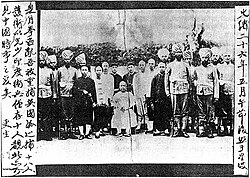
The Sikhs were highly admired by the British, especially after encountering how the Sikhs fought during the war against British in Punjab, also known as the First Anglo-Sikh War, which happened from 11 December 1845 to 9 March 1846.<ref name="auto">Singh, Mohinder. 1985. Communities of Singapore (Part 2) Pitt Kuan Wah Interview by. In person.</ref> Jat Sikh recruitment into the Indian British military increased after the [[Indian Rebellion of 1857|Sepoy Mutiny of 1857]].<ref name=":1" /> The Sikhs were known as martial Indians, known for their bravery and their well-built body.<ref>Lai, Ah Eng. 2008. Religious Diversity In Singapore. Singapore: Institute of Southeast Asian Studies jointly with Institute of Policy Studies.</ref> The uprising of Singapore Societies along with the local police not deemed fit by the British lead to the recruitment of the Sikhs.<ref name="auto" /> [[File:Qing-era Chinese political reformer and thinker Kang Youwei photographed with his Sikh guards in Singapore, ca.1897–1901.jpg|thumb|Qing-era Chinese political reformer and thinker [[Kang Youwei]] photographed with his Sikh guards in Singapore, ca.1897–1901]] | |||
In 1879, the Commission of Enquiry of the Straits Settlement Police Force in Singapore made a recommendation for the recruitment of Sikhs from the Punjab for the purposes of policing Singapore.<ref name=":1" /><ref name=":8">{{Cite web |last=Koh |first=Jaime |date=23 July 2013 |title=Sikh community |url=https://www.nlb.gov.sg/main/article-detail?cmsuuid=31531085-04f3-4e91-841a-4ad6ee600e07 |access-date=13 Feb 2025 |website=National Library Board, Singapore}}</ref> This led to the eventual establishment of the Sikh Police Contingent (SPC) in Singapore in 1881, with the first batch of 54 Sikh recruits arriving in Singapore on 26 March 1881 and another 65 in August that year.<ref>Singh, Choor (Justice). 1991. Communities of Singapore (Part 2) Rajandran Supramaniam Interview by. In person.</ref><ref name=":8" /> Around 200 Sikhs arrived to Singapore Island to form a new Sikh police contingent to augment the local police force.<ref name=":7" /> A total of 165 Sikhs from British Punjab arrived on the island to form the new police contingent in 1881.<ref name=":1" /><ref name=":7" /> Thus, Sikhs began migrating to Singapore in-hopes of being recruited by the Straits Settlement Police Force.<ref name=":7" /> The Sikh policemen were deployed at the Tanjong Pagar Police Station as well as the Tanjong Pagar Dock Police Station.<ref name=":2" /> The Sikhs responsibility was to counter Chinese Secret Societies as well as the security of the docks, harbors and the godowns.<ref name=":2" /> However, not all Sikhs that arrived are recruited as policemen as the British had stringent requirements – recruit has to be younger than 25 years old, have a minimum height of 5 feet 6 inch (1.68m) and a minimum chest measurement of 33 inch (84 cm).<ref name=":2">National Library Board, Singapore, and Jaime Koh. 2013. "Sikh Community | Infopedia". Eresources.Nlb.Gov.Sg. http://eresources.nlb.gov.sg/infopedia/articles/SIP_2013-07-29_174120.html.</ref><ref name=":1" /> On top of that, it was also revealed in the General Orders that only non-English educated Sikhs who came from the farming community (known as [[Jat Sikh|Jat Sikhs]]) are to be recruited. This is to ensure that the British will be able to control these Sikhs, as they were considered obedient and will follow blindly to those who they have taken the oath of obedience to. Hence, those who failed to be selected found work as security guards and watchmen with private employers.<ref name="auto" /><ref name=":1" /> | |||
In 1898, a [[Sikhism in Hong Kong|Sikh from Hong Kong]] named Lal Singh acted as a leader for the community during meetings, successfully gathering funds for the establishment of a ''[[Dharamshala (type of building)|dharamshala]]''.<ref name=":03">{{Cite book |last= |first= |title=The Sikh Diaspora: Migration and the Experience Beyond Punjab |publisher=South Asia Books |year=1989 |isbn=9788170010470 |editor-last=Barrier |editor-first=Norman Gerald |edition=1st |page= |chapter= |quote= |editor-last2=Dusenbery |editor-first2=Verne A.}}</ref>{{Rp|page=66}} | |||
At the time, Punjabis and Sikhs were not the only group of Indians in Singapore, there were also [[Tamils]], [[Malayalis]], [[Telugu people|Telugus]], [[Sri Lankan people|Ceylonese]], [[Gujarati people|Gujaratis]], [[Sindhis]], [[Biharis]], and [[Bengalis]].<ref name=":7" /> | |||
=== 20th century === | |||
By the turn of the century, the community was still small but settled (concentrated in the town areas), and predominantly male.<ref name=":1" /> These were mostly transitory migrants who had no true intentions of permanently settling in Singapore, with them having the goal of eventually moving elsewhere or returning to their homeland.<ref name=":1" /> There were smaller amounts of Sikh females but they were usually the wives of Sikh policemen.<ref name=":1" /> The reason for limited amounts of Sikh females is due to the unfamiliar environment, lack of employment options, and the living standards.<ref name=":1" /> It was typical for married Sikh men to leave their wives back in Punjab and reside in Singapore without them or for single Singaporean-Sikh men to return to Punjab in-order to find a wife and get married, after they had saved-up enough funds for the purpose.<ref name=":1" /> Most Singaporean Sikhs in the early 20th century were employed as policemen, security guards, or caretakers.<ref name=":1" /> However, some Singaporean Sikhs at the time pursued work in agriculture, such as by being dairy farmers and bullock drivers and keeping some heads of cattle on the outskirts of town.<ref name=":1" /> Many of the Sikhs, especially watchmen, were working multiple jobs or side-hustles (especially in money-lending) in-order to bring-in as much income as possible and to send funds back to their homeland in the form of remittance.<ref name=":1" /> Some of them aimed to eventually return to Punjab as wealthy individuals and thus worked hard to achieve their dream.<ref name=":1" /> Often, retired policemen took-up new jobs as watchmen, which afforded them to become moneylenders as well.<ref name=":1" /> The Singaporean Sikh policemen were barracked at Pearl’s Hill whilst those working as watchmen or security-guards resided near their places of employment, which were usually go-downs, banks, and offices located within the municipal area.<ref name=":1" /> | |||
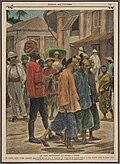
[[File:Print from 'Journal des Voyages' depicting a Sikh policeman rounding up Chinese criminals by their queues in Singapore, made in Paris, 1912.jpg|thumb|Print from ''Journal des Voyages'' depicting a Sikh policeman rounding up Chinese criminals by their queues in Singapore, made in Paris, 1912]] | |||
In 1912, the ''Journal des Voyages'' published a satirical print of Sikh policemen rounding up Chinese criminals by their [[Queue (hairstyle)|queues]] in Singapore.<ref>{{Cite news |date=6 March 2022 |title=Roots: Sikh policeman rounds up Chinese criminals by their queues |url=https://asiasamachar.com/2022/03/06/42298/ |access-date=14 July 2024 |work=Asia Samachar}}</ref> | |||
After WW1, especially in the 1920's and 1930's, a new type of Sikh commercial migrants started to arrive in Singapore, these were business-minded Sikhs who worked as petty traders, pedlars, shopkeepers, and merchants, particularly in textiles.<ref name=":1" /><ref name=":7" /> They are to be distinguished from the Jat Sikh migrants sourced from the peasantry that had characterized and dominated the ranks of the prior Sikh arrivers.<ref name=":1" /> They started to build-up commercial enterprises, such as in textiles, which catered to both the Indian and European segments of the Singaporean population as wholesalers and retailers.<ref name=":1" /> Singapore was sort-of a second-choice for Sikh textile workers, as they preferred Bangkok in Thailand, which was the distribution centre of the textile trade in SE Asia.<ref name=":7" /> The Sikh Police Contingent of Singapore was abolished in 1945.<ref name=":8" /> Post-1945, more Sikh commercial migrants arrived due to the aftermath of the partition of Punjab, with some urban Sikh refugees from West Punjab moving abroad to Singapore, Malaya and Thailand, and also due to increased business opportunities as the Korean War raged-on.<ref name=":1" /> From 1950–52, many Sikh businessmen from Bangkok moved to Singapore to benefit from the better banking system.<ref name=":7" /> Some of the Sikh-owned textile business in this era were Hardial Singh & Co. and Gian Singh & Co.<ref name=":9">{{Cite news |last=Aggarwal |first=Vandana |title=Celebrating the journey of Sikhs in Singapore |url=https://www.tribuneindia.com/news/punjab/celebrating-the-journey-of-sikhs-in-singapore-237644/ |access-date=13 Feb 2025 |work=The Tribune}}</ref> | |||
=== Present === | |||
The community has been praised for its advancements made in Singaporean society whilst still holding onto its cultural and religious traditions.<ref>{{Cite news |date=31 July 2023 |title=Sikhs in Singapore hailed for their contribution in diverse fields while retaining their culture |work=The Tribune |url=https://www.tribuneindia.com/news/diaspora/sikhs-in-singapore-hailed-for-their-contribution-in-diverse-fields-while-retaining-their-culture-530638 |access-date=1 August 2023}}</ref> | |||
The [[Central Sikh Temple]] was built to commemorate the 518th anniversary of [[Guru Nanak]], the first Sikh guru. The temple boasts a skilful blend of modern and traditional architecture. The [[Guru Granth Sahib]], or holy book, is enshrined in a prayer hall which has a 13-metre wide dome.[https://web.archive.org/web/20070602005601/http://www.visitsingapore.com/publish/stbportal/en/home/what_to_see/places_of_worship/central_sikh_temple.html] | |||
== Gurdwaras == | |||
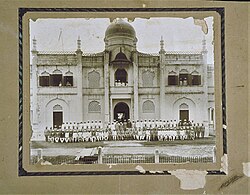
[[File:Photograph of members of the Sikh Police Contingent in-front of Gurdwara Sahib Silat Road in 1931.jpg|thumb|Photograph of members of the Sikh Police Contingent in-front of Gurdwara Sahib Silat Road in 1931. The gurdwara is also known as Singapore Sikh Police Temple. Also pictured is the inspector/general of police.]]With the increasingly stable settlement of Sikhs in Singapore, gurdwaras began to be established in locations where the Sikhs were present.<ref name=":1" /> The gurdwaras were not only places of worship but also functioned as community-centres for the Sikh community.<ref name=":1" /> Within the gurdwaras, there were social, educational, and other charitable activities ongoing and the gurdwara space was used as a place for the community to hold dialogue about important topics both locally and regarding their homeland.<ref name=":1" /> New immigrants freshly landed in Singapore were welcomed at the gurdwaras, which helped them set-up their new life in Singapore by giving them initial shelter and lodging and the temples provided free meals in the form of ''[[Langar (Sikhism)|langar]]'' (communal kitchen) to travellers and immigrants.<ref name=":1" /> | |||
The first known gurdwara was established by the Sikh Police Contingent at Pearl’s Hill.<ref name=":1" /> Prior to this temple's establishment, the Sikh policemen of Pearl's Hill and their relatives held Sikh religious services within the confines of their barracks but this became a difficult situation with the increasing Sikh population, thus the need for a dedicated-structure for Sikh religious activities grew.<ref name=":1" /> The civilian Sikh population at the time wanted their own gurdwara that was separate from the police-gurdwara, thus a civilian [[Central Sikh Temple|gurdwara was established at Queen Street]].<ref name=":1" /> This gurdwara formed out of the purchase of a large compound (with a bungalow) in 1912 by a committee of Sikhs led by the [[Sikhism in Sindh|Sindhi]] merchant [[Wassiamull Assomull|Wassiamull Assomull Mahtani]].<ref name=":1" /> | |||
The Pearl's Hill and Tanjong Pagar police-gurdwaras were demolished and a new gurdwara, Gurdwara Sahib Silat Road replaced their purpose, with its construction being completed in 1924.<ref name=":5">{{Cite web |date=2021 |title=Gurdwara Sahib Silat Road |url=https://sikhs.org.sg/about-srst/ |access-date=13 Feb 2025 |website=Central Sikh Gurdwara Board}}</ref> On 12 October 1966, the Bhai Maharaj Singh Memorial in the Singapore General Hospital area was shifted to the front of Gurdwara Sahib Silat Road, which helped increase the congregation numbers of the gurdwara at a time when it was struggling.<ref name=":5" /> | |||
The Sikhs of northern Singapore were served by three gurdwaras: Naval Base Sikh Temple (est. 1925); Sembawang Sikh Temple (est. 1936), and Jalan Kayu Sikh Temple (est. 1930's). These gurdwaras were all amalgamated over the years until a single gurdwara was constructed in Yishun New Town in 1995 to serve the northern Sikhs of Singapore: Gurdwara Sahib Yishun.<ref name=":6">{{Cite web |title=Gurdwara Sahib Yishun: Our History |url=https://gsy.org.sg/our-history/ |access-date=13 February 2025 |website=Gurdwara Sahib Yishun}}</ref> There are eight operational gurdwaras in Singapore presently.<ref name=":5" /> | |||
=== List of operational gurdwaras === | |||
* [[Central Sikh Temple]] | |||
* Gurdwara Sahib Silat Road<ref name=":5" /> | |||
* Gurdwara Sahib Yishun<ref name=":6" /> | |||
* Gurdwara Sri Guru Singh Sabha | |||
* Gurdwara Silat Road Sikh Center | |||
* Gurdwara Khalsa Dharmak Sabha | |||
* Gurdwara Pardesi Khalsa | |||
* Gurdwara Katong Sri Guru Nanak Satsang Sabha | |||
== | === List of former gurdwaras === | ||
=== | |||
* Pearl’s Hill Gurdwara<ref name=":5" /> | |||
* Tanjong Pagar Dock Sikh Police Gurdwara (demolished in 1912)<ref name=":5" /> | |||
* Naval Base Sikh Temple (1925–1971)<ref name=":6" /> | |||
* Sembawang Sikh Temple (1936–1995) | |||
* Jalan Kayu Sikh Temple (1930's–1995)<ref name=":6" /> | |||
== Influence of Sikhs on Singaporean culture == | |||
== | === Bukit Brown === | ||
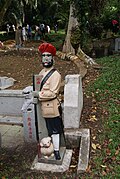
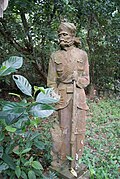
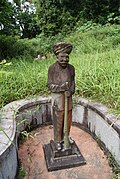
Singapore | [[Bukit Brown Cemetery|Bukit Brown]] ("Brown's Hill") is a Chinese cemetery in Singapore that features 25 pairs of guardian statues depicting Sikh men guarding the tombs.<ref name=":02">{{Cite book |last=McLeod |first=W. H. |title=Historical Dictionary of Sikhism |last2=Fenech |first2=Louis E. |publisher=Rowman & Littlefield |year=2014 |isbn=9781442236011 |edition=3rd |series=Historical Dictionaries of Religions, Philosophies, and Movements Series}}</ref>{{Rp|page=74}} The height of the Sikh guardian statues in the cemetery ranges from 3 to 6 feet.<ref name=":02" />{{Rp|page=74}} They are placed to the front-right and front-left of the tombstone, with one exception of the Sikh guardian statue being placed behind the tombstone.<ref name=":02" />{{Rp|page=74}} They were arranged in this manner as per ''[[feng shui]]'' principles.<ref name=":02" />{{Rp|page=74}} The Sikh guardian statues were positioned just after the guardian statues of Chinese faeries.<ref name=":02" />{{Rp|page=74}} The Sikh guardian statues of the Chinese cemetery are a reflection of the Singaporean Sikh community's reputation in the early 20th century of being superb watchmen.<ref name=":02" />{{Rp|page=74}}<gallery caption="Sikh guardian statues of Bukit Brown Cemetery"> | ||
File:Sepoy statue, Bukit Brown Cemetery, Singapore - 20110326-02a.jpg | |||
File:Sepoy statue, Bukit Brown Cemetery, Singapore - 20111210.JPG | |||
File:Gravestones of Ong Sam Leong and family members, Bukit Brown Cemetery, Singapore - 20110326-06.JPG | |||
File:Sepoy statue, Bukit Brown Cemetery, Singapore - 20110326-03.jpg | |||
</gallery> | |||
== Prominent Sikhs == | |||
[[File:Gurmit Singh.png|thumb|180px|[[Gurmit Singh]]]] | |||
[[File:Pritam Singh during the 2025 Singaporean general election (cropped).jpg|thumb|180px|[[Pritam Singh]]]] | |||
The Sikh Foundation and The Punjabi Foundation of Singapore are prominent associations that are promoting Sikh heritage and Punjabi language there.<ref name=":0">{{Cite book|title=Sikhs in Asia Pacific:Travels among the Sikh Diaspora from Yangon to Kobe|last=Kahlon|first=Swarn Singh|publisher=Manohar Publisher, Ne Delhi|year=2016|editor-last=Virk|editor-first=Dr. Hardev Singh|location=New Delhi|chapter=Sikhs in Singapore}}</ref> Some prominent Sikhs who earned name in public life are: | |||
* [[Choor Singh]], first Sikh Judge of [[Supreme Court of Singapore|Supreme Court]]<ref name=":0" /> | |||
* [[Kanwaljit Soin]], first female [[Nominated Member of Parliament]] (NMP), orthopaedic surgeon and co-founder of the [[Association of Women for Action and Research]] (AWARE)<ref name=":0" /> | |||
* Jaswant Singh Gill, first commander of [[Republic of Singapore Navy|Singapore Navy]]<ref name=":0" /><ref>{{Cite web |last=Auto |first=Hermes |date=2020-12-21 |title=Singapore's first head of navy Jaswant Singh Gill dies, aged 97 {{!}} The Straits Times |url=https://www.straitstimes.com/singapore/singapores-first-head-of-navy-dies-aged-97 |access-date=2022-11-09 |website=www.straitstimes.com |language=en}}</ref> | |||
* Kartar Singh Thakral, founder of [[Thakral Corporation Ltd]]<ref name=":0" /> | |||
* [[Gurmit Singh]], actor and comedian who acted in [[Phua Chu Kang Pte Ltd]] series. Converted to [[Christianity in Singapore|Christianity]] in 1985. | |||
* [[Military ranks of Singapore#Officers|Major-General]] [[Ravinder Singh (general)|Ravinder Singh]], former chief of the [[Singapore Army]] | |||
* [[Inderjit Singh (politician)|Inderjit Singh]], former [[People's Action Party]] (PAP) [[Parliament of Singapore|Member of Parliament]] (MP) for [[Ang Mo Kio Group Representation Constituency]] (GRC) | |||
* [[Davinder Singh (lawyer)|Davinder Singh]], former PAP MP for [[Bishan–Toa Payoh Group Representation Constituency|Bishan–Toa Payoh GRC]] | |||
* [[Pritam Singh (Singaporean politician)|Pritam Singh]], [[Workers' Party (Singapore)|Workers' Party]] (WP) MP for [[Aljunied GRC]] and [[Leader of the Opposition (Singapore)|Leader of the Opposition]] from 2020 to 2026 | |||
*[[Ajit Singh Gill]], hockey player, sportsperson and Olympian | |||
{{clear}} | |||
== Demographics == | |||
Population figures and estimates for the number of Singaporean Sikhs vary, ranging from 7,000 – 13,000.<ref>{{Cite book |last=Kaur |first=Arunajeet |url=https://www.cambridge.org/core/books/abs/religious-diversity-in-singapore/evolution-of-the-sikh-identity-in-singapore/64B38827CD87A88C1EF3BDA3E9C2EBA5 |title=Religious Diversity in Singapore |publisher=ISEAS–Yusof Ishak Institute |year=2008 |pages=275–297 |chapter=Part I - The Landscape of Religious Diversity: 11 - The Evolution of the Sikh Identity in Singapore}}</ref><ref name=":9" /> In the 1931 Singapore census, there was a total of 2,988 Sikhs recorded, with 2,666 living in the municipal area and 322 living outside the town areas.<ref name=":1">{{Cite news |last=Yong |first=Tan Tai |date=20 September 2016 |title=The Sikhs in Singapore |url=https://asiasamachar.com/2016/09/20/the-sikhs-in-singapore/ |access-date=13 Feb 2025 |work=Asia Samachar}}</ref> According to the 2000 Singapore census, 5% of Indian-Singaporeans were Sikhs.<ref>{{Cite web |date=2008 |title=World Directory of Minorities and Indigenous Peoples - Singapore : Indians |url=https://www.refworld.org/reference/countryrep/mrgi/2008/en/85573 |access-date=13 Feb 2025 |website=UNHCR}}</ref> | |||
{| class="wikitable" | |||
|+Population of Singaporean Sikhs | |||
!Year | |||
!Figure | |||
!Citation(s) | |||
|- | |||
|1881 | |||
|165 | |||
|<ref name=":1" /> | |||
|- | |||
|1921 | |||
|195 | |||
|<ref name=":9" /> | |||
|- | |||
|1931 | |||
|2,988 | |||
|<ref name=":1" /> | |||
|- | |||
|2010 | |||
|12,952 | |||
|<ref>{{Cite web |last=Koh |first=Jaime |date=23 July 2013 |title=Sikh community |url=https://www.nlb.gov.sg/main/article-detail?cmsuuid=31531085-04f3-4e91-841a-4ad6ee600e07 |access-date=13 Feb 2025 |website=National Library Board, Singapore}}</ref> | |||
|- | |||
|2020 | |||
|12,051 | |||
|<ref name="auto:">{{Cite news |title=Full report of 2021 Census |url=https://www.singstat.gov.sg/-/media/files/publications/cop2020/sr1/cop2020sr1.pdf |access-date=2021-06-28 |page=213}}</ref> | |||
|} | |||
=== Ethnic breakdown === | |||
Below are the ethnic breakdown of Sikhs according to the 2020 Singapore Census of Population as follows:<ref name="2020Census">{{Cite web |title="Religion by Ethnic in Singapore 2020" |url=https://www.singstat.gov.sg/publications/reference/cop2020/cop2020-sr1/census20_stat_release1 |archive-url=https://archive.today/20210617123031/https://www.singstat.gov.sg/publications/reference/cop2020/cop2020-sr1/census20_stat_release1 |archive-date=2021-06-17 |access-date=2021-06-18}}</ref><ref name="auto2">{{Cite news |title=Full report of 2021 Census |url=https://www.singstat.gov.sg/-/media/files/publications/cop2020/sr1/cop2020sr1.pdf |access-date=2021-06-28 |page=213}}</ref> | |||
{| class="wikitable" | |||
!Ethnic Group | |||
!Total Resident Population of Ethnic Group | |||
!Population of Resident Ethnic Group registered as Sikhs | |||
!Percentage of Resident Ethnic Group registered as Sikhs | |||
!Percentage of Sikh Residents by Ethnic Group | |||
|- | |||
|Chinese | |||
|2,606,881 | |||
|11 | |||
|{{percentage bar|0.0004}} | |||
|{{percentage bar|0.09}} | |||
|- | |||
|Malays | |||
|447,747 | |||
|80 | |||
|{{percentage bar|0.02}} | |||
|{{percentage bar|0.66}} | |||
|- | |||
|Indians | |||
|299,056 | |||
|10,265 | |||
|{{percentage bar|3.43}} | |||
|{{percentage bar|85.18}} | |||
|- | |||
|Others | |||
|105,410 | |||
|1,695 | |||
|{{percentage bar|1.61}} | |||
|{{percentage bar|14.07}} | |||
|- | |||
|'''Overall''' | |||
|'''3,459,093''' | |||
|'''12,051''' | |||
|{{percentage bar|0.35}} | |||
|{{percentage bar|100}} | |||
|} | |||
== See also == | == See also == | ||
* [[Jainism in Southeast Asia]] | * [[Jainism in Southeast Asia]] | ||
* [[Hinduism in Southeast Asia]] | * [[Hinduism in Southeast Asia]] | ||
== Notes == | |||
{{notelist}} | |||
==References== | ==References== | ||
{{reflist}} | {{reflist}} | ||
== | == Further reading == | ||
* | * {{Cite book |title=Singapore at 50: 50 Sikhs and Their Contributions |date=28 November 2015 |publisher=Young Sikh Association (Singapore) |editor-last=Singh |editor-first=Malminderjit |editor-last2=Singh |editor-first2=Sarabjeet |editor-last3=Kaur |editor-first3=Harsimar |editor-last4=Singh |editor-first4=Hernaikh}} | ||
{{Singaporeans}} | |||
{{Asia topic|Sikhism in}} | {{Asia topic|Sikhism in}} | ||
{{Sikhism}} | {{Sikhism}} | ||
| Line 43: | Line 186: | ||
{{DEFAULTSORT:Sikhism In Singapore}} | {{DEFAULTSORT:Sikhism In Singapore}} | ||
[[Category:Sikhism in Singapore| ]] | [[Category:Sikhism in Singapore| ]] | ||
Latest revision as of 11:50, 26 March 2026
.svg) | |
_-_img_01.jpg) | |
| Total population | |
|---|---|
| 12,000 to 15,000 (2020) 0.3% of the resident[lower-alpha 1] population | |
| Religions | |
| Predominantly Sikhism[lower-alpha 2] | |
| Languages | |
| Malay • Mandarin • Punjabi • English |
Singaporean Sikhs are an ethnoreligious group forming a minority community in Singapore. Sikhism has been present in Singapore for centuries, particularly through the service of Sikhs in the military and police forces of the British Empire. There are about 12,000–15,000 practising Sikhs in Singapore, most of whom are ethnic Punjabis.[1] The community maintains seven gurdwaras, as well as a missionary society, a welfare society, two youth organisations and two sports clubs.[2]
During the period when Singapore was part of the Straits Settlements, Sikhs migrated from the Punjab region to work as policemen under British rule. Many left their homeland due to poverty and debt, seeking better prospects across the Empire.[3] The early Sikhs were commonly employed in law enforcement and security occupations, such as policemen, guards or watchmen.[3] Over time, and especially after World War II, they began to enter business and white-collar professions that includes finance and law.[3]
History[edit | edit source]
| Part of a series on |
| Sikhism |
|---|
 |
19th century[edit | edit source]
Earliest arrivals[edit | edit source]
_in_a_Prison_Cell.jpg)
Some of the first Sikhs to migrate, albeit not voluntarily, to Singapore were Maharaj Singh and Khurruck Singh in 1850; Maharaj Singh was sent there as a political prisoner by the British Empire after the Second Anglo-Sikh War.[4][5] They both arrived in Singapore on 14 June 1850 whilst other sources claim their date of arrival in Singapore to be 9 July 1850.[6][7]
Aside from them, there is scant evidence of a prominent Sikh presence in Singapore prior to 1881, however Tan Tai Yong speculates that some Sikhs may have been present in Singapore from the time of the earliest British settlement in the early 19th century as sepoys, domestic servants, and convicts.[8] According to Yong, Sikhs began migrating out of the Punjab for economic reasons ever since its annexation in 1849 by the British.[8]
In the second half of the 19th century, the majority of Sikh migrants to Singapore were employed in the police or security forces.[8][9] When these migrants returned to their native villages in Punjab on vacation, they spread word about the prospects of Singapore for settlement, leading more of their kind to come, increasing the Sikh diaspora in Singapore.[8]
This marked the start of a proper Sikh community in Singapore as prior to this, the Sikhs that were sent here were convicts as Singapore served as a convict colony, and did not form a community. However, this stopped in 1857 when Andaman Islands became the new convict colony, since then, up till the formation of the Sikh Police Contingent, there were no records of Sikh migrants in Singapore.[10]
Police and military recruits[edit | edit source]
A factor which led to Sikhs joining the military or migrating out of Punjab was also the local economic situation in Punjab during the British-rule. Due to the political stability and economic growth in the Punjab after its annexation by the British, profits from agricultural output increased which led to the prices for arable land to rise.[8] Thus, peasants started to use land as a collateral to borrow money from moneylenders, especially in the Majha region.[8] They used these funds to purchase more land, fund a conspicuous lifestyle, and pay their land revenue taxes.[8] However, there was a risk of them losing their land if they could not pay off their loans, thus these Sikhs began to join the military to supplement their income, as military service provided regular pay and pensions.[8] The British preferred to recruit Sikhs belonging to the Jat caste from particular districts in the Majha region.[8] Many Sikhs who were not able to be recruited in the colonial military looked elsewhere and either set westward to the canal-colonies or moved abroad looking for work, such as in North America (Canada, USA) or in southeast Asia (Thailand, Malaya and the Straits Settlements).[8]
The Sikhs were highly admired by the British, especially after encountering how the Sikhs fought during the war against British in Punjab, also known as the First Anglo-Sikh War, which happened from 11 December 1845 to 9 March 1846.[10] Jat Sikh recruitment into the Indian British military increased after the Sepoy Mutiny of 1857.[8] The Sikhs were known as martial Indians, known for their bravery and their well-built body.[11] The uprising of Singapore Societies along with the local police not deemed fit by the British lead to the recruitment of the Sikhs.[10]

In 1879, the Commission of Enquiry of the Straits Settlement Police Force in Singapore made a recommendation for the recruitment of Sikhs from the Punjab for the purposes of policing Singapore.[8][12] This led to the eventual establishment of the Sikh Police Contingent (SPC) in Singapore in 1881, with the first batch of 54 Sikh recruits arriving in Singapore on 26 March 1881 and another 65 in August that year.[13][12] Around 200 Sikhs arrived to Singapore Island to form a new Sikh police contingent to augment the local police force.[3] A total of 165 Sikhs from British Punjab arrived on the island to form the new police contingent in 1881.[8][3] Thus, Sikhs began migrating to Singapore in-hopes of being recruited by the Straits Settlement Police Force.[3] The Sikh policemen were deployed at the Tanjong Pagar Police Station as well as the Tanjong Pagar Dock Police Station.[14] The Sikhs responsibility was to counter Chinese Secret Societies as well as the security of the docks, harbors and the godowns.[14] However, not all Sikhs that arrived are recruited as policemen as the British had stringent requirements – recruit has to be younger than 25 years old, have a minimum height of 5 feet 6 inch (1.68m) and a minimum chest measurement of 33 inch (84 cm).[14][8] On top of that, it was also revealed in the General Orders that only non-English educated Sikhs who came from the farming community (known as Jat Sikhs) are to be recruited. This is to ensure that the British will be able to control these Sikhs, as they were considered obedient and will follow blindly to those who they have taken the oath of obedience to. Hence, those who failed to be selected found work as security guards and watchmen with private employers.[10][8]
In 1898, a Sikh from Hong Kong named Lal Singh acted as a leader for the community during meetings, successfully gathering funds for the establishment of a dharamshala.[15](p66)
At the time, Punjabis and Sikhs were not the only group of Indians in Singapore, there were also Tamils, Malayalis, Telugus, Ceylonese, Gujaratis, Sindhis, Biharis, and Bengalis.[3]
20th century[edit | edit source]
By the turn of the century, the community was still small but settled (concentrated in the town areas), and predominantly male.[8] These were mostly transitory migrants who had no true intentions of permanently settling in Singapore, with them having the goal of eventually moving elsewhere or returning to their homeland.[8] There were smaller amounts of Sikh females but they were usually the wives of Sikh policemen.[8] The reason for limited amounts of Sikh females is due to the unfamiliar environment, lack of employment options, and the living standards.[8] It was typical for married Sikh men to leave their wives back in Punjab and reside in Singapore without them or for single Singaporean-Sikh men to return to Punjab in-order to find a wife and get married, after they had saved-up enough funds for the purpose.[8] Most Singaporean Sikhs in the early 20th century were employed as policemen, security guards, or caretakers.[8] However, some Singaporean Sikhs at the time pursued work in agriculture, such as by being dairy farmers and bullock drivers and keeping some heads of cattle on the outskirts of town.[8] Many of the Sikhs, especially watchmen, were working multiple jobs or side-hustles (especially in money-lending) in-order to bring-in as much income as possible and to send funds back to their homeland in the form of remittance.[8] Some of them aimed to eventually return to Punjab as wealthy individuals and thus worked hard to achieve their dream.[8] Often, retired policemen took-up new jobs as watchmen, which afforded them to become moneylenders as well.[8] The Singaporean Sikh policemen were barracked at Pearl’s Hill whilst those working as watchmen or security-guards resided near their places of employment, which were usually go-downs, banks, and offices located within the municipal area.[8]

In 1912, the Journal des Voyages published a satirical print of Sikh policemen rounding up Chinese criminals by their queues in Singapore.[16]
After WW1, especially in the 1920's and 1930's, a new type of Sikh commercial migrants started to arrive in Singapore, these were business-minded Sikhs who worked as petty traders, pedlars, shopkeepers, and merchants, particularly in textiles.[8][3] They are to be distinguished from the Jat Sikh migrants sourced from the peasantry that had characterized and dominated the ranks of the prior Sikh arrivers.[8] They started to build-up commercial enterprises, such as in textiles, which catered to both the Indian and European segments of the Singaporean population as wholesalers and retailers.[8] Singapore was sort-of a second-choice for Sikh textile workers, as they preferred Bangkok in Thailand, which was the distribution centre of the textile trade in SE Asia.[3] The Sikh Police Contingent of Singapore was abolished in 1945.[12] Post-1945, more Sikh commercial migrants arrived due to the aftermath of the partition of Punjab, with some urban Sikh refugees from West Punjab moving abroad to Singapore, Malaya and Thailand, and also due to increased business opportunities as the Korean War raged-on.[8] From 1950–52, many Sikh businessmen from Bangkok moved to Singapore to benefit from the better banking system.[3] Some of the Sikh-owned textile business in this era were Hardial Singh & Co. and Gian Singh & Co.[17]
Present[edit | edit source]
The community has been praised for its advancements made in Singaporean society whilst still holding onto its cultural and religious traditions.[18]
The Central Sikh Temple was built to commemorate the 518th anniversary of Guru Nanak, the first Sikh guru. The temple boasts a skilful blend of modern and traditional architecture. The Guru Granth Sahib, or holy book, is enshrined in a prayer hall which has a 13-metre wide dome.[1]
Gurdwaras[edit | edit source]

With the increasingly stable settlement of Sikhs in Singapore, gurdwaras began to be established in locations where the Sikhs were present.[8] The gurdwaras were not only places of worship but also functioned as community-centres for the Sikh community.[8] Within the gurdwaras, there were social, educational, and other charitable activities ongoing and the gurdwara space was used as a place for the community to hold dialogue about important topics both locally and regarding their homeland.[8] New immigrants freshly landed in Singapore were welcomed at the gurdwaras, which helped them set-up their new life in Singapore by giving them initial shelter and lodging and the temples provided free meals in the form of langar (communal kitchen) to travellers and immigrants.[8]
The first known gurdwara was established by the Sikh Police Contingent at Pearl’s Hill.[8] Prior to this temple's establishment, the Sikh policemen of Pearl's Hill and their relatives held Sikh religious services within the confines of their barracks but this became a difficult situation with the increasing Sikh population, thus the need for a dedicated-structure for Sikh religious activities grew.[8] The civilian Sikh population at the time wanted their own gurdwara that was separate from the police-gurdwara, thus a civilian gurdwara was established at Queen Street.[8] This gurdwara formed out of the purchase of a large compound (with a bungalow) in 1912 by a committee of Sikhs led by the Sindhi merchant Wassiamull Assomull Mahtani.[8]
The Pearl's Hill and Tanjong Pagar police-gurdwaras were demolished and a new gurdwara, Gurdwara Sahib Silat Road replaced their purpose, with its construction being completed in 1924.[19] On 12 October 1966, the Bhai Maharaj Singh Memorial in the Singapore General Hospital area was shifted to the front of Gurdwara Sahib Silat Road, which helped increase the congregation numbers of the gurdwara at a time when it was struggling.[19]
The Sikhs of northern Singapore were served by three gurdwaras: Naval Base Sikh Temple (est. 1925); Sembawang Sikh Temple (est. 1936), and Jalan Kayu Sikh Temple (est. 1930's). These gurdwaras were all amalgamated over the years until a single gurdwara was constructed in Yishun New Town in 1995 to serve the northern Sikhs of Singapore: Gurdwara Sahib Yishun.[20] There are eight operational gurdwaras in Singapore presently.[19]
List of operational gurdwaras[edit | edit source]
- Central Sikh Temple
- Gurdwara Sahib Silat Road[19]
- Gurdwara Sahib Yishun[20]
- Gurdwara Sri Guru Singh Sabha
- Gurdwara Silat Road Sikh Center
- Gurdwara Khalsa Dharmak Sabha
- Gurdwara Pardesi Khalsa
- Gurdwara Katong Sri Guru Nanak Satsang Sabha
List of former gurdwaras[edit | edit source]
- Pearl’s Hill Gurdwara[19]
- Tanjong Pagar Dock Sikh Police Gurdwara (demolished in 1912)[19]
- Naval Base Sikh Temple (1925–1971)[20]
- Sembawang Sikh Temple (1936–1995)
- Jalan Kayu Sikh Temple (1930's–1995)[20]
Influence of Sikhs on Singaporean culture[edit | edit source]
Bukit Brown[edit | edit source]
Bukit Brown ("Brown's Hill") is a Chinese cemetery in Singapore that features 25 pairs of guardian statues depicting Sikh men guarding the tombs.[21](p74) The height of the Sikh guardian statues in the cemetery ranges from 3 to 6 feet.[21](p74) They are placed to the front-right and front-left of the tombstone, with one exception of the Sikh guardian statue being placed behind the tombstone.[21](p74) They were arranged in this manner as per feng shui principles.[21](p74) The Sikh guardian statues were positioned just after the guardian statues of Chinese faeries.[21](p74) The Sikh guardian statues of the Chinese cemetery are a reflection of the Singaporean Sikh community's reputation in the early 20th century of being superb watchmen.[21](p74)
- Sikh guardian statues of Bukit Brown Cemetery
-
-
-
-



Prominent Sikhs[edit | edit source]

.jpg)
The Sikh Foundation and The Punjabi Foundation of Singapore are prominent associations that are promoting Sikh heritage and Punjabi language there.[22] Some prominent Sikhs who earned name in public life are:
- Choor Singh, first Sikh Judge of Supreme Court[22]
- Kanwaljit Soin, first female Nominated Member of Parliament (NMP), orthopaedic surgeon and co-founder of the Association of Women for Action and Research (AWARE)[22]
- Jaswant Singh Gill, first commander of Singapore Navy[22][23]
- Kartar Singh Thakral, founder of Thakral Corporation Ltd[22]
- Gurmit Singh, actor and comedian who acted in Phua Chu Kang Pte Ltd series. Converted to Christianity in 1985.
- Major-General Ravinder Singh, former chief of the Singapore Army
- Inderjit Singh, former People's Action Party (PAP) Member of Parliament (MP) for Ang Mo Kio Group Representation Constituency (GRC)
- Davinder Singh, former PAP MP for Bishan–Toa Payoh GRC
- Pritam Singh, Workers' Party (WP) MP for Aljunied GRC and Leader of the Opposition from 2020 to 2026
- Ajit Singh Gill, hockey player, sportsperson and Olympian
Demographics[edit | edit source]
Population figures and estimates for the number of Singaporean Sikhs vary, ranging from 7,000 – 13,000.[24][17] In the 1931 Singapore census, there was a total of 2,988 Sikhs recorded, with 2,666 living in the municipal area and 322 living outside the town areas.[8] According to the 2000 Singapore census, 5% of Indian-Singaporeans were Sikhs.[25]
| Year | Figure | Citation(s) |
|---|---|---|
| 1881 | 165 | [8] |
| 1921 | 195 | [17] |
| 1931 | 2,988 | [8] |
| 2010 | 12,952 | [26] |
| 2020 | 12,051 | [27] |
Ethnic breakdown[edit | edit source]
Below are the ethnic breakdown of Sikhs according to the 2020 Singapore Census of Population as follows:[28][29]
| Ethnic Group | Total Resident Population of Ethnic Group | Population of Resident Ethnic Group registered as Sikhs | Percentage of Resident Ethnic Group registered as Sikhs | Percentage of Sikh Residents by Ethnic Group |
|---|---|---|---|---|
| Chinese | 2,606,881 | 11 | 0.0004% |
0.09% |
| Malays | 447,747 | 80 | 0.02% |
0.66% |
| Indians | 299,056 | 10,265 | 3.43% |
85.18% |
| Others | 105,410 | 1,695 | 1.61% |
14.07% |
| Overall | 3,459,093 | 12,051 | 0.35% |
100% |
See also[edit | edit source]
Notes[edit | edit source]
- ↑ In Singapore, the term "resident" refers to both citizens and permanent residents (PRs).
- ↑ Although Sikhs are primarily defined as an ethnoreligious group, a distinction is often made between Sikh ethnic identity and religious adherence. Individuals of Sikh ancestry may identify with the community's cultural and historical heritage without practicing the faith, while others may adhere to different religions while maintaining their ethnic Sikh identity.
References[edit | edit source]
- ↑ Iyer, Raman. "Sikhs in Singapore: Turbanators with rich tradition of donning uniform". Retrieved 9 March 2011.
- ↑ "Sikhs benefited from Singapore prosperity, says CSGB president". hindustantimes.com. 24 August 2015. Archived from the original on 24 August 2015. Retrieved 26 August 2015.
- ↑ 3.00 3.01 3.02 3.03 3.04 3.05 3.06 3.07 3.08 3.09 Yong, Tan Tai; Major, Andrew J. (1995). "1: India and Indians in the Making of Singapore". In Yong, Mun Cheong; Rao, V. V. Bhanoji (eds.). Singapore-India Relations: A Primer. NUS Press. pp. 10–11. ISBN 9789971691950.
- ↑ "Sikhs in Singapore 1850 | Historical Events :Gateway to Sikhism". Archived from the original on 29 April 2009. Retrieved 15 April 2009. 2009/04/15/Sikhs in Singapore 1850
- ↑ Singh, Kirpal (19 September 2015). "A freedom fighter like few others". The Tribune. Retrieved 31 July 2023.
- ↑ Singh, Harjinder (15 May 2017). "Bhai Maharaj Singh - Freedom Fighter for The Panjab". Sikh Research Institute (SRI). Retrieved 31 July 2023.
- ↑ Singh, Kirpal (19 September 2015). "A freedom fighter like few others". The Tribune. Retrieved 31 July 2023.
- ↑ 8.00 8.01 8.02 8.03 8.04 8.05 8.06 8.07 8.08 8.09 8.10 8.11 8.12 8.13 8.14 8.15 8.16 8.17 8.18 8.19 8.20 8.21 8.22 8.23 8.24 8.25 8.26 8.27 8.28 8.29 8.30 8.31 8.32 8.33 8.34 8.35 8.36 8.37 8.38 8.39 8.40 Yong, Tan Tai (20 September 2016). "The Sikhs in Singapore". Asia Samachar. Retrieved 13 February 2025.
- ↑ "Embark on a Journey to Discover the Singaporean Sikh Identity at the Indian Heritage Centre". Asian Journeys. 29 March 2021. Retrieved 18 April 2025.
- ↑ 10.0 10.1 10.2 10.3 Singh, Mohinder. 1985. Communities of Singapore (Part 2) Pitt Kuan Wah Interview by. In person.
- ↑ Lai, Ah Eng. 2008. Religious Diversity In Singapore. Singapore: Institute of Southeast Asian Studies jointly with Institute of Policy Studies.
- ↑ 12.0 12.1 12.2 Koh, Jaime (23 July 2013). "Sikh community". National Library Board, Singapore. Retrieved 13 February 2025.
- ↑ Singh, Choor (Justice). 1991. Communities of Singapore (Part 2) Rajandran Supramaniam Interview by. In person.
- ↑ 14.0 14.1 14.2 National Library Board, Singapore, and Jaime Koh. 2013. "Sikh Community | Infopedia". Eresources.Nlb.Gov.Sg. http://eresources.nlb.gov.sg/infopedia/articles/SIP_2013-07-29_174120.html.
- ↑ Barrier, Norman Gerald; Dusenbery, Verne A., eds. (1989). The Sikh Diaspora: Migration and the Experience Beyond Punjab (1st ed.). South Asia Books. ISBN 9788170010470.
- ↑ "Roots: Sikh policeman rounds up Chinese criminals by their queues". Asia Samachar. 6 March 2022. Retrieved 14 July 2024.
- ↑ 17.0 17.1 17.2 Aggarwal, Vandana. "Celebrating the journey of Sikhs in Singapore". The Tribune. Retrieved 13 February 2025.
- ↑ "Sikhs in Singapore hailed for their contribution in diverse fields while retaining their culture". The Tribune. 31 July 2023. Retrieved 1 August 2023.
- ↑ 19.0 19.1 19.2 19.3 19.4 19.5 "Gurdwara Sahib Silat Road". Central Sikh Gurdwara Board. 2021. Retrieved 13 February 2025.
- ↑ 20.0 20.1 20.2 20.3 "Gurdwara Sahib Yishun: Our History". Gurdwara Sahib Yishun. Retrieved 13 February 2025.
- ↑ 21.0 21.1 21.2 21.3 21.4 21.5 McLeod, W. H.; Fenech, Louis E. (2014). Historical Dictionary of Sikhism. Historical Dictionaries of Religions, Philosophies, and Movements Series (3rd ed.). Rowman & Littlefield. ISBN 9781442236011.
- ↑ 22.0 22.1 22.2 22.3 22.4 Kahlon, Swarn Singh (2016). "Sikhs in Singapore". In Virk, Dr. Hardev Singh (ed.). Sikhs in Asia Pacific:Travels among the Sikh Diaspora from Yangon to Kobe. New Delhi: Manohar Publisher, Ne Delhi.
- ↑ Auto, Hermes (21 December 2020). "Singapore's first head of navy Jaswant Singh Gill dies, aged 97 | The Straits Times". www.straitstimes.com. Retrieved 9 November 2022.
- ↑ Kaur, Arunajeet (2008). "Part I - The Landscape of Religious Diversity: 11 - The Evolution of the Sikh Identity in Singapore". Religious Diversity in Singapore. ISEAS–Yusof Ishak Institute. pp. 275–297.
- ↑ "World Directory of Minorities and Indigenous Peoples - Singapore : Indians". UNHCR. 2008. Retrieved 13 February 2025.
- ↑ Koh, Jaime (23 July 2013). "Sikh community". National Library Board, Singapore. Retrieved 13 February 2025.
- ↑ "Full report of 2021 Census" (PDF). p. 213. Retrieved 28 June 2021.
- ↑ ""Religion by Ethnic in Singapore 2020"". Retrieved 18 June 2021.
{{cite web}}: CS1 maint: deprecated archival service (link) - ↑ "Full report of 2021 Census" (PDF). p. 213. Retrieved 28 June 2021.
Further reading[edit | edit source]
- Singh, Malminderjit; Singh, Sarabjeet; Kaur, Harsimar; Singh, Hernaikh, eds. (28 November 2015). Singapore at 50: 50 Sikhs and Their Contributions. Young Sikh Association (Singapore).


