
Ajay Kumar (talk | contribs) Add new article Tags: Mobile edit Mobile web edit |
improve article and improved wording |
||
| Line 1: | Line 1: | ||
The '''Women's Auxiliary Corps (India)''' (WAC(I)) was created in March 1942, out of the Women's Auxiliary Service (Burma). By the end of the [[Second World War]], it had recruited 11,500 women.<ref name=Harfield2005>{{cite journal |last1=Harfield |first1=Alan |title=The Women's Auxiliary Corps (India) |journal=Journal of the Society for Army Historical Research |date=2005 |volume=83 |issue=335 |pages=243–254 |jstor=44231211 |url=https://www.jstor.org/stable/44231211 |issn=0037-9700|url-access=subscription}}</ref><ref name=National>{{cite web |author1=Family Records gov uk Consortium |title=FamilyRecords.gov.uk {{!}} Focus on... Women in Uniform {{!}} Women in World War II - Profile |url=https://www.nationalarchives.gov.uk/womeninuniform/wwii_profile.htm |website=FamilyRecords.gov.uk Consortium |access-date=20 July 2022 |archive-url=https://web.archive.org/web/20220720114454/https://www.nationalarchives.gov.uk/womeninuniform/wwii_profile.htm |archive-date=20 July 2022}}</ref><ref name=Sen2017>{{cite book |last1=Sen |first1=Sudarshana |title=Anglo-Indian Women in Transition: Pride, Prejudice and Predicament |date=2017 |publisher=Springer |location=Singapore |isbn=978-981-10-4356-7 |chapter-url=https://books.google.com/books?id=kJ4vDwAAQBAJ&dq=Women%27s+Auxiliary+Corps+(India)&pg=PA69 |language=en |chapter=2. Anglo-Indian women|page=69}}</ref><ref name=Perry1988>{{cite book |last1=Perry |first1=Frederick William |title=The Commonwealth Armies: Manpower and Organisation in Two World Wars |date=1988 |publisher=Manchester University Press |isbn=0-7190-2595-8 |page=114 |chapter-url=https://books.google.com/books?id=S-VRAQAAIAAJ&dq=Women%27s+Auxiliary+Corps+(India)&pg=PA114 |language=en |chapter=3. The Indian Army}}</ref><ref name=Vitali2019>{{cite journal |last1=Vitali |first1=V. |title=The Women's Royal Indian Naval Service: Picturing India's New Woman |journal=Women's History Review |date=17 October 2019 |volume=29 |issue=7 |pages=1114–1148 |doi=10.1080/09612025.2019.1674468 |s2cid=210364785 |url=https://repository.uel.ac.uk/item/871qw |language=en |issn=0961-2025}}</ref><ref name=Mohanan2020>{{Cite book |last=Mohanan |first=Kalesh |url=https://books.google.com/books?id=nPqzDwAAQBAJ&pg=PT94 |title=The Royal Indian Navy: Trajectories, Transformations and the Transfer of Power |date=2020 |publisher=Routledge |isbn=978-1-138-55495-5 |location=Abingdon, Oxford |pages=94–96 |language=en}}</ref> | The '''Women's Auxiliary Corps (India)''' (WAC(I)) was created in March 1942, out of the [[Women's Auxiliary Service (Burma)]]. By the end of the [[Second World War]], it had recruited 11,500 women.<ref name=Harfield2005>{{cite journal |last1=Harfield |first1=Alan |title=The Women's Auxiliary Corps (India) |journal=Journal of the Society for Army Historical Research |date=2005 |volume=83 |issue=335 |pages=243–254 |jstor=44231211 |url=https://www.jstor.org/stable/44231211 |issn=0037-9700|url-access=subscription}}</ref><ref name=National>{{cite web |author1=Family Records gov uk Consortium |title=FamilyRecords.gov.uk {{!}} Focus on... Women in Uniform {{!}} Women in World War II - Profile |url=https://www.nationalarchives.gov.uk/womeninuniform/wwii_profile.htm |website=FamilyRecords.gov.uk Consortium |access-date=20 July 2022 |archive-url=https://web.archive.org/web/20220720114454/https://www.nationalarchives.gov.uk/womeninuniform/wwii_profile.htm |archive-date=20 July 2022}}</ref><ref name=Sen2017>{{cite book |last1=Sen |first1=Sudarshana |title=Anglo-Indian Women in Transition: Pride, Prejudice and Predicament |date=2017 |publisher=Springer |location=Singapore |isbn=978-981-10-4356-7 |chapter-url=https://books.google.com/books?id=kJ4vDwAAQBAJ&dq=Women%27s+Auxiliary+Corps+(India)&pg=PA69 |language=en |chapter=2. Anglo-Indian women|page=69}}</ref><ref name=Perry1988>{{cite book |last1=Perry |first1=Frederick William |title=The Commonwealth Armies: Manpower and Organisation in Two World Wars |date=1988 |publisher=Manchester University Press |isbn=0-7190-2595-8 |page=114 |chapter-url=https://books.google.com/books?id=S-VRAQAAIAAJ&dq=Women%27s+Auxiliary+Corps+(India)&pg=PA114 |language=en |chapter=3. The Indian Army}}</ref><ref name=Vitali2019>{{cite journal |last1=Vitali |first1=V. |title=The Women's Royal Indian Naval Service: Picturing India's New Woman |journal=Women's History Review |date=17 October 2019 |volume=29 |issue=7 |pages=1114–1148 |doi=10.1080/09612025.2019.1674468 |s2cid=210364785 |url=https://repository.uel.ac.uk/item/871qw |language=en |issn=0961-2025|url-access=subscription }}</ref><ref name=Mohanan2020>{{Cite book |last=Mohanan |first=Kalesh |url=https://books.google.com/books?id=nPqzDwAAQBAJ&pg=PT94 |title=The Royal Indian Navy: Trajectories, Transformations and the Transfer of Power |date=2020 |publisher=Routledge |isbn=978-1-138-55495-5 |location=Abingdon, Oxford |pages=94–96 |language=en}}</ref> | ||
Recruits had to be a minimum age of 18 years and their duties were clerical or domestic. In December 1942, the minimum age was reduced to 17 years. Volunteers could enlist on Local service or General service terms. Those on General service could be sent to serve anywhere in India.<ref>Brown, p.140</ref> | |||
Compared to over two million men, the corps of 11,500 women was small, but recruitment was always hampered by caste and communal inhibitions. Indian women at the time did not mix socially or at work with men and a large part of the corps was formed from the mixed-race Anglo–Indian community.<ref>Blunt, p.61</ref> The WAC(I) had an autonomous Air Wing, which served as the Indian counterpart of the WAAF: the women operated switchboards and similar duties at airfields and air headquarters (AHQ). In the earlier part of the war there was likewise a Naval Wing, but with the very localised environment of naval base and the very distinct ethos of the wartime naval services, British and Indian, this department was formally hived-off, in 1944, to become: the [[Women's Royal Indian Naval Service]] (WRINS), with its own uniform, similar to WRNS. | |||
==Personnel== | ==Personnel== | ||
[[File:Commonwealth Forces in India IND4410.jpg|thumb|Commonwealth Forces in India, Imam is second from left]] | [[File:Commonwealth Forces in India IND4410.jpg|thumb|Commonwealth Forces in India, Imam is second from left]] | ||
[[Moina Imam]], [[chief petty officer#India|chief petty officer]] from [[Bihar]], was among the first Indian girls to join the (WAC(I)) and became its poster girl.<ref name=James>{{cite book |last1=James |first1=Lawrence |title=Churchill and Empire: Portrait of an Imperialist |date=18 July 2013 |publisher=Orion |isbn=978-0-297-86915-3 |url=https://books.google.com/books?id=xrs-Aabpw0oC&dq=Moina+Imam&pg=PA32|language=en}}</ref><ref name=WRIN>{{cite web |title=Women's Royal Indian Naval Service established during WW2 |url=https://wrens.org.uk/womens-royal-indian-naval-service-established-during-ww2/ |website=Association of Wrens |access-date=13 November 2022 |date=30 December 2019|archive-url=https://web.archive.org/web/20221113063040/https://wrens.org.uk/womens-royal-indian-naval-service-established-during-ww2/|archive-date=13 November 2022}}</ref> | |||
* [[Moina Imam]], [[chief petty officer#India|chief petty officer]] from [[Bihar]], was among the first Indian girls to join the (WAC(I)) and became its poster girl.<ref name="James">{{cite book |last1=James |first1=Lawrence |title=Churchill and Empire: Portrait of an Imperialist |date=18 July 2013 |publisher=Orion |isbn=978-0-297-86915-3 |url=https://books.google.com/books?id=xrs-Aabpw0oC&dq=Moina+Imam&pg=PA32|language=en}}</ref><ref name="WRIN">{{cite web |title=Women's Royal Indian Naval Service established during WW2 |url=https://wrens.org.uk/womens-royal-indian-naval-service-established-during-ww2/ |website=Association of Wrens |access-date=13 November 2022 |date=30 December 2019|archive-url=https://web.archive.org/web/20221113063040/https://wrens.org.uk/womens-royal-indian-naval-service-established-during-ww2/|archive-date=13 November 2022}}</ref> | |||
* [[Kate Orchard]], worked as a [[Plotter (RAF)|plotter]].<ref>{{Cite news |date=2022-11-03 |title=Veteran Kate Orchard, 100, selling poppies in Cornwall |url=https://www.bbc.co.uk/news/uk-england-cornwall-63490776 |access-date=2025-04-14 |work=BBC News |language=en-GB}}</ref> | |||
==Gallery== | ==Gallery== | ||
| Line 16: | Line 22: | ||
==See also== | ==See also== | ||
*[[Women in World War II]] | |||
*[[Women in the Indian Armed Forces]] | *[[Women in the Indian Armed Forces]] | ||
==References== | ==References== | ||
{{Reflist}} | {{Reflist}} | ||
[[Category:Military units and formations established in 1942]] | [[Category:Military units and formations established in 1942]] | ||
[[Category:Women in India]] | [[Category:Women in India]] | ||
[[Category:Women in the military by country]] | [[Category:Women in the military by country]] | ||
{{India-mil-stub}} | |||
Latest revision as of 10:16, 8 July 2025
The Women's Auxiliary Corps (India) (WAC(I)) was created in March 1942, out of the Women's Auxiliary Service (Burma). By the end of the Second World War, it had recruited 11,500 women.[1][2][3][4][5][6]
Recruits had to be a minimum age of 18 years and their duties were clerical or domestic. In December 1942, the minimum age was reduced to 17 years. Volunteers could enlist on Local service or General service terms. Those on General service could be sent to serve anywhere in India.[7]
Compared to over two million men, the corps of 11,500 women was small, but recruitment was always hampered by caste and communal inhibitions. Indian women at the time did not mix socially or at work with men and a large part of the corps was formed from the mixed-race Anglo–Indian community.[8] The WAC(I) had an autonomous Air Wing, which served as the Indian counterpart of the WAAF: the women operated switchboards and similar duties at airfields and air headquarters (AHQ). In the earlier part of the war there was likewise a Naval Wing, but with the very localised environment of naval base and the very distinct ethos of the wartime naval services, British and Indian, this department was formally hived-off, in 1944, to become: the Women's Royal Indian Naval Service (WRINS), with its own uniform, similar to WRNS.
Personnel[edit | edit source]

- Moina Imam, chief petty officer from Bihar, was among the first Indian girls to join the (WAC(I)) and became its poster girl.[9][10]
- Kate Orchard, worked as a plotter.[11]
Gallery[edit | edit source]
-
 Inspection by Field Marshal Auchinleck
 -
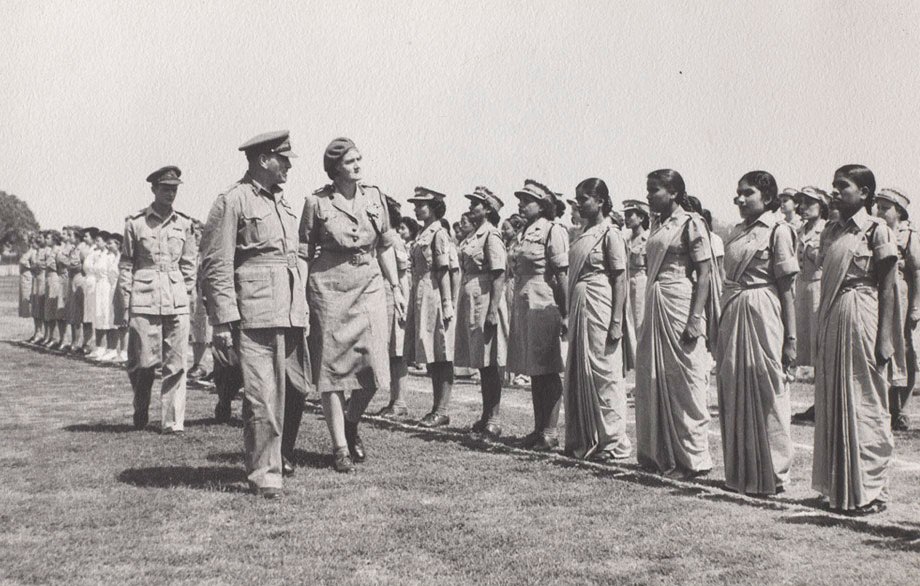 Inspection by Field Marshal Auchinleck
 -
 Women Auxiliary Corps (India)
 -
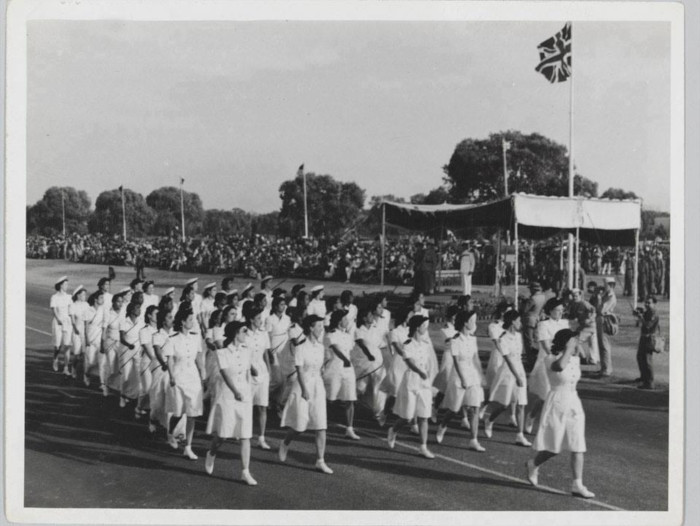 Women Auxiliary Corps parade
 -
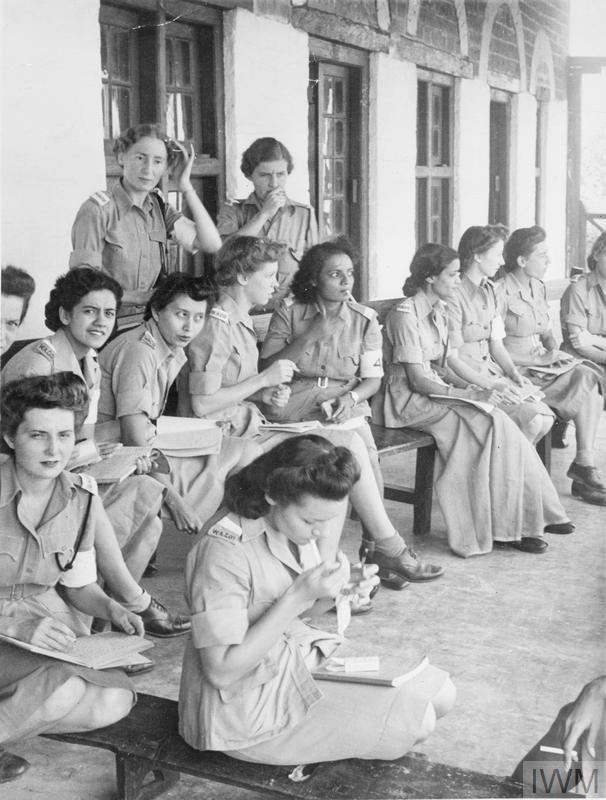 Indian Women's Auxiliary Corps at Dagshai
 -
 Private Begum Pasha Shah
_1947.jpg)
_1946-1947.jpg)
_-_01.jpg)
_-_02.jpg)

_on_duty_in_the_Orderly_Room_of_an_RAF_station_in_India,_August_1943.jpg)
See also[edit | edit source]
References[edit | edit source]
- ↑ Harfield, Alan (2005). "The Women's Auxiliary Corps (India)". Journal of the Society for Army Historical Research. 83 (335): 243–254. ISSN 0037-9700. JSTOR 44231211.
- ↑ Family Records gov uk Consortium. "FamilyRecords.gov.uk | Focus on... Women in Uniform | Women in World War II - Profile". FamilyRecords.gov.uk Consortium. Archived from the original on 20 July 2022. Retrieved 20 July 2022.
- ↑ Sen, Sudarshana (2017). "2. Anglo-Indian women". Anglo-Indian Women in Transition: Pride, Prejudice and Predicament. Singapore: Springer. p. 69. ISBN 978-981-10-4356-7.
- ↑ Perry, Frederick William (1988). "3. The Indian Army". The Commonwealth Armies: Manpower and Organisation in Two World Wars. Manchester University Press. p. 114. ISBN 0-7190-2595-8.
- ↑ Vitali, V. (17 October 2019). "The Women's Royal Indian Naval Service: Picturing India's New Woman". Women's History Review. 29 (7): 1114–1148. doi:10.1080/09612025.2019.1674468. ISSN 0961-2025. S2CID 210364785.
- ↑ Mohanan, Kalesh (2020). The Royal Indian Navy: Trajectories, Transformations and the Transfer of Power. Abingdon, Oxford: Routledge. pp. 94–96. ISBN 978-1-138-55495-5.
- ↑ Brown, p.140
- ↑ Blunt, p.61
- ↑ James, Lawrence (18 July 2013). Churchill and Empire: Portrait of an Imperialist. Orion. ISBN 978-0-297-86915-3.
- ↑ "Women's Royal Indian Naval Service established during WW2". Association of Wrens. 30 December 2019. Archived from the original on 13 November 2022. Retrieved 13 November 2022.
- ↑ "Veteran Kate Orchard, 100, selling poppies in Cornwall". BBC News. 2022-11-03. Retrieved 2025-04-14.
