


Ajay Kumar (talk | contribs) Created a new article |
reworked formatting further and fixed typos per standard format |
||
| Line 1: | Line 1: | ||
{{Short description|Peninsula in West Asia}} | {{Short description|Peninsula in West Asia}} | ||
{{Redirect-multi|2|Arabia|Arabian}} | {{Redirect-multi|2|Arabia|Arabian}} | ||
{{Use dmy dates|date=July 2022}} | {{Use dmy dates|date=July 2022}} | ||
{{Infobox | {{Infobox peninsulas | ||
| | | name = Arabian Peninsula | ||
|image = {{Switcher|[[File:Arabian Peninsula.svg|frameless]]|Show national borders|[[File:Arabian Peninsula (no borders).svg|frameless]]|Hide national borders|default=1}} | | native_name = {{nobold|{{Script/Arabic|شبه الجزيرة العربية}}}} | ||
|location | | image = Arabian Peninsula dust SeaWiFS.jpg | ||
| | | image_size = 250px | ||
| | | image_caption = Satellite imagery of the Arabian Peninsula in March 2000 | ||
| image_map = {{Switcher|[[File:Arabian Peninsula.svg|frameless]]|Show national borders|[[File:Arabian Peninsula (no borders).svg|frameless]]|Hide national borders|default=1}} | |||
| image_map_size = 250px | |||
| location = [[West Asia]] | |||
| area_km2 = 3237500 | |||
| country = {{nobold|{{hlist|[[Bahrain]]{{efn|As an [[island country]], Bahrain is technically not a part of the Arabian Peninsula, but a part of the slightly larger geopolitical region called ''Arabia''.|name="AP 1"}} | [[Iraq]]{{efn|Southern half only.|name="AP 2"}} | [[Jordan]]{{efn|name="AP 2"}} | [[Kuwait]] | [[Oman]] | [[Qatar]] | [[Saudi Arabia]] | [[United Arab Emirates]] | [[Yemen]]}}}} | |||
| population = {{Round|95|-0}} million (2023 estimate) | |||
| demonym = {{hlist|[[Tribes of Arabia|Arabian]]|[[Arab people|Arab]]}} | |||
| density_km2 = {{Round|29.0000|1}} | |||
| languages = [[Arabic]] ([[Peninsular Arabic|Peninsular]]), [[Modern South Arabian languages]] | |||
}} | }} | ||
The '''Arabian Peninsula''' | The '''Arabian Peninsula''',{{Efn|{{langx|ar|شبه الجزيرة العربية|shibh al-jazīra al-ʿarabiyya}}, or {{langx|ar|جزيرة العرب|jazīrat al-ʿarab|the Island of [[Arabs]]|label=none}}}} or simply '''Arabia''', is a [[peninsula]] in [[West Asia]]. It accounts for the majority of the land situated on the [[Arabian plate]].<ref name = arabia>{{cite encyclopedia|title=Arabia |url=https://www.britannica.com/place/Arabia-peninsula-Asia|encyclopedia=Encyclopædia Britannica|first=Basheer K.|last=Nijim|access-date=7 June 2018|archive-date=22 May 2019|archive-url=https://web.archive.org/web/20190522211749/https://www.britannica.com/place/Arabia-peninsula-Asia|url-status=live}}</ref> With an area of {{convert|3237500|km2|e6mi2|2|abbr=unit|disp=}}, it is the world's largest peninsula—roughly comparable in size to [[India]].<ref>{{Cite book|url=https://archive.org/details/peninsulas0000nize |url-access= registration|page=[https://archive.org/details/peninsulas0000nize/page/19 19]|title=Peninsulas|last=Niz|first=Ellen Sturm|date=2006-04-10|publisher=Capstone|isbn= 9780736861427}}</ref><ref>{{Cite encyclopedia|url=https://books.google.com/books?id=DJgnebGbAB8C&pg=PA710|encyclopedia=Encyclopedia of World Geography|last=McColl|first=R. W.|entry=Peninsula|date=2014-05-14|publisher=Infobase |isbn=9780816072293|access-date=19 May 2020|archive-date=19 May 2021|archive-url=https://web.archive.org/web/20210519182851/https://books.google.com/books?id=DJgnebGbAB8C&pg=PA710|url-status=live}}</ref><ref>{{Cite book|url=https://books.google.com/books?id=lazWAQAAQBAJ&pg=PA62|title=Encyclopedia of National Dress: Traditional Clothing Around the World [2 Volumes]|last=Condra|first=Jill|date=2013-04-09|publisher=ABC-CLIO|isbn=9780313376375|access-date=19 May 2020|archive-date=19 May 2021|archive-url=https://web.archive.org/web/20210519183236/https://books.google.com/books?id=lazWAQAAQBAJ&pg=PA62|url-status=live}}</ref><ref>{{Cite book|url=https://books.google.com/books?id=j47rDQAAQBAJ&pg=PT62|title=The Everything Understanding Islam Book: A Complete and Easy to Read Guide to Muslim Beliefs, Practices, Traditions, and Culture|last=Dodge|first=Christine Huda|date=2003-04-01|publisher=Simon and Schuster|isbn=9781605505459|access-date=19 May 2020|archive-date=31 October 2021|archive-url=https://web.archive.org/web/20211031101202/https://books.google.com/books?id=j47rDQAAQBAJ&pg=PT62|url-status=live}}</ref><ref>{{Cite news|url=http://www.worldatlas.com/articles/15-largest-peninsulas-in-the-world.html|title=15 Largest Peninsulas in the World|work=WorldAtlas|access-date=2017-10-21|archive-date=17 March 2021|archive-url=https://web.archive.org/web/20210317051902/https://www.worldatlas.com/articles/15-largest-peninsulas-in-the-world.html|url-status=live}}</ref> Nine countries are located on the Arabian Peninsula: [[Bahrain]],{{efn|name="AP 1"}} [[Kuwait]], [[Oman]], [[Qatar]], [[Saudi Arabia]], the [[United Arab Emirates]], and [[Yemen]], as well as the southern halves of [[Iraq]] and [[Jordan]].<ref>{{cite book|title = Geopolitics of the World System|page = 337|first = Saul Bernard|last = Cohen|date = 2003|publisher = Rowman & Littlefield|isbn = 9780847699070|url = https://books.google.com/books?id=QkMD8HKRlgoC&pg=PA337|access-date = 5 September 2022|archive-date = 1 October 2022|archive-url = https://web.archive.org/web/20221001180013/https://books.google.com/books?id=QkMD8HKRlgoC&pg=PA337|url-status = live}}</ref> | ||
Geographically, the Arabian Peninsula | Geographically, the Arabian Peninsula is bounded by [[Mesopotamia]] and the [[Levant]] to the north and northwest and therewithal surrounded by the [[Indian Ocean]]: the [[Persian Gulf]], the [[Strait of Hormuz]], and the [[Gulf of Oman]] to the east and northeast; the [[Arabian Sea]] to the southeast; and the [[Gulf of Aden]] to the south, the [[Strait of Mandeb]] to the southwest, and the [[Red Sea]] to the west. Prior to the 7th century AD, it was widely considered to include the [[Sinai Peninsula]], which is partly separated from it by the [[Gulf of Aqaba]] and situated on the [[African plate]].<ref>{{Cite web |title=Where is Mount Sinai in Arabia (Galatians 4:25)? |url=https://biblearchaeology.org/research/contemporary-issues/3266-where-is-mount-sinai-in-arabia-galatians-425 |access-date=2025-11-08 |website=biblearchaeology.org}}</ref><ref>{{Cite web |title=Herodotus, The Histories, Book 2 |url=https://www.perseus.tufts.edu/hopper/text?doc=Perseus:text:1999.01.0126:book=2&force=y |access-date=2025-11-08 |website=www.perseus.tufts.edu}}</ref> Most of the peninsula is covered by the [[Arabian Desert]], which is an extension of the [[Sahara Desert]]. | ||
Between 56 and 23 million years ago, the peninsula was formed as a result of the [[Red Sea Rift]] involving the African and Arabian plates. It was among the [[Prehistoric Arabia|first regions to be occupied by modern humans]] following their [[Recent African origin of modern humans|departure from Africa]] during the [[Paleolithic]]. The historical record of the Arabian Peninsula is thought to have begun in the early 1st millennium BC, when writing systems were [[History of writing|introduced to the region]]. For much of the [[Pre-Islamic Arabia|peninsula's ancient history]], it was sparsely populated by [[Tribes of Arabia|Arab tribes]] and home to a variety of [[Religion in pre-Islamic Arabia|local and foreign religious practices]], while numerous empires and kingdoms exercised limited political authority in different areas. However, in the 7th century AD, the entire Arabian Peninsula was politically, culturally, and religiously united by the Arab leader [[Muhammad]] after he claimed [[Prophets and messengers in Islam|prophethood]] and founded [[Islam]], thus enabling the [[Arabization]] of many non-Arab civilizations throughout [[Arab world|much of Asia and Africa]]. | |||
While the [[Greco-Roman world]] had known the Arabian Peninsula in three large regions—[[Arabia Petraea|Petraea]] for the north, [[Arabia Deserta|Deserta]] for the centre, and [[Arabia Felix|Felix]] for the south—[[Geography and cartography in the medieval Islamic world|medieval Muslim geographers]] instead divided it into four main regions: the Central Plateau ([[Najd]] and [[Al-Yamama]]), [[South Arabia]] ([[Yemen (region)|Yemen]], [[Hadhramaut]], and southwestern Oman), [[Eastern Arabia|Al-Bahrain]] (Eastern Arabia or [[Al-Ahsa Oasis|Al-Hassa]]), and the [[Hejaz]] ([[Tihamah]] for the western coast).<ref>{{cite book |author1=Ibn al-Faqih |url=https://referenceworks.brillonline.com/entries/mukhtasar-kitab-al-buldan/%D8%A7%D9%84%D9%81%D8%B1%D9%82-%D8%A8%D9%8A%D9%86-%D8%AA%D9%87%D8%A7%D9%85%D8%A9-%D9%88%D8%A7%D9%84%D8%AD%D8%AC%D8%A7%D8%B2-COM_ARA_000011 |title=Mukhtasar Kitab al-Buldan |date=c. 903 |language=ar |access-date=20 April 2021 |archive-url=https://web.archive.org/web/20210420224114/https://referenceworks.brillonline.com/entries/mukhtasar-kitab-al-buldan/%D8%A7%D9%84%D9%81%D8%B1%D9%82-%D8%A8%D9%8A%D9%86-%D8%AA%D9%87%D8%A7%D9%85%D8%A9-%D9%88%D8%A7%D9%84%D8%AD%D8%AC%D8%A7%D8%B2-COM_ARA_000011 |archive-date=20 April 2021 |url-status=live}}</ref> Since the 20th century, it has been of critical significance in both Arab and global geopolitics due to the discovery and subsequent industrialization of vast reserves of [[Oil and natural gas industry|oil and natural gas]]. Most of the peninsula's countries are [[Petrocracy|petrocracies]] and accordingly play a key role in the [[petroleum politics]] defining the contemporary [[Middle East]]. | |||
==Etymology== | ==Etymology== | ||
<!--linked--> | <!--linked--> | ||
{{main | {{main|Etymology of Arab{{!}}Etymology of ''Arab''}} | ||
In antiquity, the term "Arabia" encompassed a larger area than the current term "Arabian Peninsula" and included the [[Arabian Desert]] and large parts of the [[Syrian Desert|Syrian–Arabian desert]]. During the [[Hellenistic period]], the area was known as ''Arabia'' ({{langx|grc|Ἀραβία}}). The [[Ancient Rome|Romans]] named three regions "Arabia": | |||
* [[Arabia Petraea]] ({{gloss|Stony Arabia}}<ref name="Arabia Petraea">{{cite encyclopedia |title=Arabia Petraea |url=https://www.britannica.com/place/Arabia-Petraea |encyclopedia=Encyclopædia Britannica |access-date=18 February 2021 |ref=Arabia Petraea |archive-date=25 February 2021 |archive-url=https://web.archive.org/web/20210225171428/https://www.britannica.com/place/Arabia-Petraea |url-status=live }}</ref>): it consisted of the former [[Nabataean Kingdom]] in the southern Levant, the Sinai Peninsula and north-western Arabian Peninsula. It was the only one that became a [[Roman province|province]], with [[Petra]] (in [[Jordan]]) as its capital. | |||
* [[Arabia Deserta]] ({{gloss|Desert Arabia}}): signified the desert lands of Arabia. As a name for the region, it remained popular into the 19th and 20th centuries, and was used in [[Charles M. Doughty]]'s ''[[Travels in Arabia Deserta]]'' (1888). | |||
* [[Arabia Felix]] ({{gloss|Fortunate Arabia}}): was used by geographers to describe the southern part of the Arabian peninsula, mostly what is now [[Yemen]], which enjoys more rainfall, is much greener than the rest of the peninsula and has long enjoyed much more productive fields. | |||
One of the [[Nome (Egypt)|nomes]] of Ptolemaic Egypt was named ''Arabia''.<ref>{{Cite book |last=De Jong |first=Janneke |title=Arabia, Arabs, and "Arabic" in Greek Documents From Egypt in "New Frontiers of Arabic Papyrology Arabic and Multilingual Texts from Early Islam" |publisher=Brill |year=2017 |isbn=9789004345171}}</ref> | |||
Arabians used a north–south division of Arabia: ''ash-Sham'' vs. ''al-Yaman'', or ''Arabia Deserta'' vs. ''Arabia Felix''. Arabia Felix had originally been used for the whole peninsula, and at other times only for the southern region. Because its use became limited to the south, the whole peninsula was simply called Arabia. Arabia Deserta was the entire desert region extending north from Arabia Felix to Palmyra and the Euphrates, including all the area between Pelusium on the Nile and Babylon. This area was also called Arabia and not sharply distinguished from the peninsula.<ref>{{cite book | last=Frankfurter | first=David | title=Pilgrimage and Holy Space in Late Antique Egypt | publisher=Brill | place=Leiden | date=1998 | isbn=90-04-11127-1 |page=163}}</ref> | |||
The Arabs and the Ottoman Empire considered the west of the Arabian Peninsula region where the Arabs lived 'the land of the Arabs' | The Arabs and the Ottoman Empire considered the west of the Arabian Peninsula region where the Arabs lived 'the land of the Arabs'—billad '''al-'Arab''' (Arabia), and its major divisions were the bilad '''al-Sham''' ([[Levant]]), bilad '''al-Yaman''' ([[South Arabia|Yemen]]), and bilad '''al-'Iraq''' ([[Iraq]]).<ref name = california>{{cite book |url=https://books.google.com/books?id=4vOJ15vTZV4C&pg=PA60 |title=A House of Many Mansions: The History of Lebanon Reconsidered |first=Kamal Suleiman |last=Salibi |publisher=University of California Press |date=1988 |isbn=978-0-520-07196-4 |pages=60–61 |access-date=19 October 2015 |archive-date=13 June 2020 |archive-url=https://web.archive.org/web/20200613100816/https://books.google.com/books?id=4vOJ15vTZV4C&pg=PA60 |url-status=live }}</ref> The Ottomans used the term Arabistan in a broad sense for the region starting from [[Cilicia]], where the Euphrates river makes its descent into Syria, through [[Palestine (region)|Palestine]], and on through the remainder of the Sinai and Arabian peninsulas.<ref>See for example Palestine: The Reality, [[Joseph Mary Nagle Jeffries]], Published by Longmans, Green and co., 1939, [https://archive.org/details/PalestineTheReality/page/n4/mode/1up Page 11]</ref> | ||
The provinces of Arabia were: al-Tih, the Sinai peninsula, Hejaz, Asir, Yemen, Hadramaut, Mahra and Shilu, Oman, Hasa, Bahrain, Dahna, Nufud, the Hammad, which included the deserts of Syria, Mesopotamia and Babylonia.<ref>see Review of Reviews and World's Work: An International Magazine, Albert Shaw ed., The Review of Reviews Corporation, 1919, page 408]</ref><ref name=nie>{{cite encyclopedia|entry=Arabia |url=https://books.google.com/books?id=GRUoAAAAYAAJ&pg=PA795|encyclopedia=New International Encyclopedia |edition=2nd |year=1914|access-date=24 October 2020|archive-date=24 June 2016|archive-url=https://web.archive.org/web/20160624035755/https://books.google.com/books?id=GRUoAAAAYAAJ&pg=PA795|url-status=live}}</ref> | |||
==Geography== | ==Geography== | ||
{{See also|Geography of Saudi Arabia}}The Arabian Peninsula is located in the continent of Asia and is bounded by (clockwise) the Persian Gulf on the | {{See also|Geography of Saudi Arabia|Geography of Yemen}} | ||
[[File:Map of the regions of Arabia.svg|thumb|A map of the geographic regions of the Arabian Peninsula]] | |||
The Arabian Peninsula is located in the continent of Asia and is bounded by (clockwise) the Persian Gulf on the north-east, the [[Strait of Hormuz]] and the Gulf of Oman on the east, the Arabian Sea on the south-east, the [[Gulf of Aden]], and the [[Guardafui Channel]] on the south, and the [[Bab-el-Mandeb]] strait on the south-west and the Red Sea, which is located on the south-west and west.<ref name = arabia/> | |||
The northern portion of the peninsula merges with the [[Syrian Desert]] with no clear borderline, although the northern boundary of the peninsula is generally considered to be the northern borders of Saudi Arabia and Kuwait, also southern regions of Iraq and Jordan.<ref name = arabia/> | |||
The most prominent feature of the peninsula is [[desert]], but in the | The most prominent feature of the peninsula is [[desert]], but in the south-west, there are mountain ranges, which receive greater rainfall than the rest of the peninsula. [[Harrat ash Shaam]] is a large volcanic field that extends from north-western Arabia into Jordan and southern [[Syria]].<ref>{{cite journal |last=Weinstein |first=Y. |title=A transition from strombolian to phreatomagmatic activity induced by a lava flow damming water in a valley|journal= Journal of Volcanology and Geothermal Research |date=1 January 2007 |volume=159 |issue=1–3 |pages=267–284 |doi=10.1016/j.jvolgeores.2006.06.015|bibcode=2007JVGR..159..267W }}</ref> | ||
===Political boundaries=== | ===Political boundaries=== | ||
[[File:Arabian Peninsula Map.svg|thumb|219px|The constituent countries of Arabia]] | [[File:Arabian Peninsula Map.svg|thumb|219px|The constituent countries of Arabia]] | ||
The Peninsula's constituent countries are (clockwise from north to south) Kuwait, Qatar, and the United Arab Emirates (UAE) on the east, Oman on the | The Peninsula's constituent countries are (clockwise from north to south) [[Kuwait]], [[Qatar]], and the [[United Arab Emirates]] (UAE) on the east, [[Oman]] on the south-east, [[Yemen]] on the south, and Saudi Arabia at the center. The island country of [[Bahrain]] lies just off the east coast of the Peninsula.<ref name = arabia/> Due to Yemen's jurisdiction over the [[Socotra Governorate|Socotra Archipelago]], the Peninsula's geopolitical outline faces the [[Guardafui Channel]] and the Somali Sea to the south.<ref>McLaughlin, Rob (2015). "The Continuing Conundrum of the Somali Territorial Sea and Exclusive Economic Zone". ''The International Journal of Marine and Coastal Law'' 30.2. 305–334.</ref> | ||
The six countries of Bahrain, Kuwait, Oman, Qatar, Saudi Arabia, and the UAE form the [[Gulf Cooperation Council]] (GCC).<ref>A.S. Alsharhan, Z. A. Rizk, A. E. M. Nairn [et al.], 2001, ''Waterology of an Arid Region'', Elsevier.</ref> | The six countries of Bahrain, Kuwait, Oman, Qatar, Saudi Arabia, and the UAE form the [[Gulf Cooperation Council]] (GCC).<ref>A.S. Alsharhan, Z. A. Rizk, A. E. M. Nairn [et al.], 2001, ''Waterology of an Arid Region'', Elsevier.</ref> | ||
The Kingdom of Saudi Arabia covers the greater part of the Peninsula. | The Kingdom of Saudi Arabia covers the greater part of the Peninsula. The Peninsula contains the world's largest reserves of oil. Saudi Arabia and the UAE are economically the wealthiest in the region. Qatar, the only peninsular country in the Persian Gulf on the larger peninsula, is home to the [[Arabic]] television station [[Al Jazeera Media Network|Al Jazeera]] and its English-language subsidiary [[Al Jazeera English]]. Kuwait, on the border with Iraq, is an important country strategically, forming one of the main staging grounds for coalition forces mounting the [[United States]]–led [[2003 invasion of Iraq]]. | ||
===Population=== | ===Population=== | ||
| Line 94: | Line 75: | ||
|2014 | 77,584,000 | |2014 | 77,584,000 | ||
|2018 | 86,221,765 | |2018 | 86,221,765 | ||
}} | |2023|93,900,000}} | ||
{{Historical populations | {{Historical populations | ||
|type = | |type = | ||
| Line 107: | Line 88: | ||
}} | }} | ||
Despite its historically sparse population, political Arabia stands out for its rapid population growth, driven by both significant inflows of migrant labor and persistently high birth rates. The population is characterized by its relative youth and a heavily skewed gender ratio favoring males. In several states, the number of South Asians surpasses that of the native population.<ref name=yam/> | |||
The four smallest states by area, with coastlines entirely bordering the Persian Gulf, showcase the world's most extreme population growth, nearly tripling every two decades. In 2014, the estimated population of the Arabian Peninsula was 77,983,936, including expatriates.<ref name=yam>{{cite web|url=https://www.cia.gov/library/publications/the-world-factbook/index.html|title=The World Fact book|publisher=[[Central Intelligence Agency]]|access-date=2008-08-12 |date=2007-08-07| archive-url= https://web.archive.org/web/20080812233855/https://www.cia.gov/library/publications/the-world-factbook/index.html| archive-date= 12 August 2008 | url-status= dead}}</ref> | |||
The Arabian Peninsula is known for having one of the most uneven adult sex ratios in the world, with females in some regions, especially the east, constituting only a quarter of people aged between 20 and 40.<ref>Alrouh, Hekmat, Awatef Ismail, and Sohaila Cheema. "Demographic and health indicators in Gulf Cooperation Council nations with an emphasis on Qatar." Journal of Local and Global Health Perspectives (2013): p 4</ref> | |||
====Cities==== | ====Cities==== | ||
The | [[File:Riyadh Skyline.jpg|thumb|[[Riyadh]], [[Saudi Arabia]], the most populous city in the Arabian Peninsula]] | ||
The ten most populous cities on the Arabian Peninsula are: | |||
{| class="toccolours" style="border-spacing:1; text-align:center" | {| class="toccolours" style="border-spacing:1; text-align:center" | ||
| Line 118: | Line 104: | ||
! style="width:5em; border-bottom:1px solid black;" | Population | ! style="width:5em; border-bottom:1px solid black;" | Population | ||
|- | |- | ||
|1|| {{left}} {{flagicon|KSA}} [[Riyadh]] || {{right}} 7, | |1|| {{left}} {{flagicon|KSA}} [[Riyadh]] || {{right}} 7,009,100 | ||
|- | |- | ||
|2|| {{left}} {{flagicon|KSA}} [[Jeddah]] || {{right}} | |2|| {{left}} {{flagicon|KSA}} [[Jeddah]] || {{right}} 3,751,700 | ||
|- | |- | ||
|3|| {{left}} {{flagicon| | |3|| {{left}} {{flagicon|UAE}} [[Dubai]] || {{right}} 3,488,745 | ||
|- | |- | ||
|4|| {{left}} {{flagicon|YEM}} [[Sanaa]] || {{right}} 3, | |4|| {{left}} {{flagicon|YEM}} [[Sanaa]] || {{right}} 3,407,814 | ||
|- | |- | ||
|5|| {{left}} {{flagicon| | |5|| {{left}} {{flagicon|KSA}} [[Mecca]] || {{right}} 2,427,900 | ||
|- | |- | ||
|6|| {{left}} {{flagicon| | |6|| {{left}} {{flagicon|UAE}} [[Sharjah (city)|Sharjah]] || {{right}} 1,785,684 | ||
|- | |- | ||
|7|| {{left}} {{flagicon| | |7|| {{left}} {{flagicon|OMN}} [[Muscat]] || {{right}} 1,650,319 | ||
|- | |- | ||
|8|| {{left}} {{flagicon| | |8|| {{left}} {{flagicon|UAE}} [[Abu Dhabi]] || {{right}} 1,539,830 | ||
|- | |- | ||
|9|| {{left}} {{flagicon|KSA}} [[ | |9|| {{left}} {{flagicon|KSA}} [[Dammam]] || {{right}} 1,545,420 | ||
|- | |- | ||
|10|| {{left}} {{flagicon| | |10|| {{left}} {{flagicon|KSA}} [[Medina]] || {{right}} 1,477,000 | ||
|- | |- | ||
| colspan="100%" style="font-size:85%; border-top:1px solid black;" |Sources:<ref name="GASTAT">{{cite web |url=https://portal.saudicensus.sa/portal/public/1/15/45?type=DASHBOARD |title=GASTAT Portal}}</ref><ref>{{cite web |title=Dubai Population |url=https://www.globalmediainsight.com/blog/uae-population-statistics/ |website=citypopulation.de|date=18 March 2022}}</ref><ref>{{Cite web |title=Sanaa Population 2024 |url=https://worldpopulationreview.com/world-cities/sanaa-population |access-date=2024-06-10 |website=worldpopulationreview.com}}</ref><ref>{{Cite web |title=Sharjah Population 2022 (Demographics, Maps, Graphs) |url=https://worldpopulationreview.com/world-cities/sharjah-population |access-date=2022-04-07 |website=worldpopulationreview.com}}</ref><ref>{{cite web |last1=Fulmer |first1=Shane |title=Muscat Population 2023 |url=https://worldpopulationreview.com/world-cities/muscat-population |website=World Population Review |access-date=16 May 2023 |location=United States |language=English}}</ref><ref>{{Cite web |title=Abu Dhabi Population 2022 (Demographics, Maps, Graphs) |url=https://worldpopulationreview.com/world-cities/abu-dhabi-population |access-date=2022-04-07 |website=worldpopulationreview.com}}</ref> | |||
|colspan="100%" style="font-size:85%; border-top:1px solid black;" | | |||
|} | |} | ||
===Landscape=== | ===Landscape=== | ||
{{multiple image |align=right |direction=vertical | {{multiple image |align=right |direction=vertical | ||
|image1=A journey.jpg |caption1=A caravan crossing [[Ad-Dahna Desert]] in central Saudi Arabia | |image1=Ad Dahna desert - A journey.jpg |caption1=A caravan crossing [[Ad-Dahna Desert]] in central Saudi Arabia | ||
|image2=Ras al jinz flickr01.jpg |caption2=[[Ras al-Jinz]] in southeastern Arabia (Oman), also known as the 'Turtle Beach' | |image2=Ras al jinz flickr01.jpg |caption2=[[Ras al-Jinz]] in southeastern Arabia (Oman), also known as the 'Turtle Beach' | ||
|image3=Arabian Plate map-uni.png |caption3=AR-Arabian Plate, velocities with respect to Africa in millimeters per year | |image3=Arabian Plate map-uni.png |caption3=AR-Arabian Plate, velocities with respect to Africa in millimeters per year | ||
| Line 155: | Line 139: | ||
# A central plateau, the [[Najd]], with fertile valleys and pastures used for the grazing of [[sheep]] and other livestock | # A central plateau, the [[Najd]], with fertile valleys and pastures used for the grazing of [[sheep]] and other livestock | ||
# A range of deserts: the [[Nefud]] in the north,<ref name=Prothero15>{{cite book|last=Prothero|first=G.W.|title=Arabia|year=1920|publisher=H.M. Stationery Office|location=London|page=15|url=http://www.wdl.org/en/item/11767/view/1/15/|access-date=8 September 2013|archive-date=31 October 2021|archive-url=https://web.archive.org/web/20211031163556/https://www.wdl.org/en/item/11767/view/1/15/|url-status=live}}</ref> which is stony; the [[Rub' al Khali]] or Great [[Arabian Desert]] in the south, with sand estimated to extend {{ | # A range of deserts: the [[Nefud]] in the north,<ref name=Prothero15>{{cite book|last=Prothero|first=G.W.|title=Arabia|year=1920|publisher=H.M. Stationery Office|location=London|page=15|url=http://www.wdl.org/en/item/11767/view/1/15/|access-date=8 September 2013|archive-date=31 October 2021|archive-url=https://web.archive.org/web/20211031163556/https://www.wdl.org/en/item/11767/view/1/15/|url-status=live}}</ref> which is stony; the [[Rub' al Khali]] or Great [[Arabian Desert]] in the south, with sand estimated to extend {{cvt|600|ft}} below the surface; between them, the [[Dahna]] [[#Mountains|Mountains]]<ref name="Burrows2010">{{cite book |author=Robert D. Burrowes |title=Historical Dictionary of Yemen |pages=5–340 |publisher=[[Rowman & Littlefield]] |year=2010 |url=https://books.google.com/books?id=tjXRfqBv_0UC |isbn=978-0-8108-5528-1 |access-date=19 May 2020 |archive-date=15 February 2017 |archive-url=https://web.archive.org/web/20170215025046/https://books.google.com/books?id=tjXRfqBv_0UC |url-status=live }}</ref><ref name="Laughlin2008">{{cite book |last=McLaughlin |first=Daniel |title=Yemen |publisher=[[Bradt Travel Guides]] |chapter=1: Background |page=3 |isbn=978-1-8416-2212-5 |chapter-url=https://books.google.com/books?id=eQvhZaEVzjcC |year=2008 |access-date=29 December 2018 |archive-date=2 July 2020 |archive-url=https://web.archive.org/web/20200702224444/https://books.google.com/books?id=eQvhZaEVzjcC |url-status=live }}</ref><ref name="Cavendish2007">{{cite book |last=Cavendish |first=Marshall |author-link=Marshall Cavendish |title=World and Its Peoples |volume=1 |chapter=Geography and climate |date=2007 |publisher=Cavendish Square Publishing |isbn=978-0-7614-7571-2 |pages=[https://archive.org/details/worlditspeoplesm0000unse/page/n151 8]–19 |chapter-url=https://books.google.com/books?id=j894miuOqc4C&pg=PA8 |url=https://archive.org/details/worlditspeoplesm0000unse |url-access=limited }}</ref> | ||
# Stretches of dry or marshy | # Stretches of dry or marshy coastline with coral reefs on the Red Sea side ([[Tihamah]]) | ||
# Oases and marshy coast-land in [[Eastern Arabia]], the most important of which are those of [[Al Ain]] ([[Tawam (region)|Tawam]] | # Oases and marshy coast-land in [[Eastern Arabia]], the most important of which are those of the [[Al Ain, Emirate of Abu Dhabi|Al Ain emirate]] ([[Tawam (region)|Tawam]] region) and [[Hofuf]]/[[Al-Ahsa Oasis|Al-Ahsa]] (in modern-day Saudi Arabia), according to an author<ref name="Cavendish2007"/> | ||
# | # The south-west [[monsoon]] coastline of [[Dhofar Governorate#Geography|Dhofar]] and Eastern Yemen ([[Al Mahrah Governorate|Mahra]]). | ||
Arabia has few lakes or permanent rivers. Most areas are drained by ephemeral watercourses called [[wadi]]s, which are dry except during the rainy season. Plentiful ancient [[aquifer]]s exist beneath much of the peninsula, however, and where this water surfaces, [[oases]] form (e.g. Al-Hasa and [[Qatif]], two of the world's largest [[oases]]) and permit agriculture, especially [[palm trees]], which allowed the peninsula to produce more [[date palm|dates]] than any other region in the world | [[File:Dune - panoramio (1).jpg|thumb|[[Rub' al Khali]] is part of the larger [[Arabian Desert]]]] | ||
Arabia has few lakes or permanent rivers. Most areas are drained by ephemeral watercourses called [[wadi]]s, which are dry except during the rainy season. Plentiful ancient [[aquifer]]s exist beneath much of the peninsula, however, and where this water surfaces, [[oases]] form (e.g. Al-Hasa and [[Qatif]], two of the world's largest [[oases]]) and permit agriculture, especially [[palm trees]], which allowed the peninsula to produce more [[date palm|dates]] than any other region in the world. | |||
In general, the climate is extremely hot and [[Desert|arid]], although there are exceptions. Higher elevations are made temperate by their altitude, and the Arabian Sea coastline can receive cool, humid breezes in summer due to cold upwelling offshore. The peninsula has no thick forests. Desert-adapted wildlife is present throughout the region. | |||
A plateau more than {{convert|2500|ft | A plateau more than {{convert|2500|ft}} high extends across much of the Arabian Peninsula. The plateau slopes eastwards from the massive, rifted escarpment along the coast of the Red Sea, to the shallow waters of the Persian Gulf. The interior is characterized by ''cuestas'' and valleys, drained by a system of ''wadis''. A crescent of sand and [[gravel]] deserts lies to the east. | ||
====Mountains==== | ====Mountains==== | ||
[[File:Kawkaban -68 (353668857).jpg|thumb|The [[Jabal Haraz|Haraz Mountains]] in | [[File:Kawkaban -68 (353668857).jpg|thumb|The [[Jabal Haraz|Haraz Mountains]] in the west of present-day Yemen include Arabia's highest mountain, [[Jabal An-Nabi Shu'ayb]] or Jabal Hadhur<ref name="DAKAI 01-1998"/><ref name="GazetteerArabia1917"/><ref name="Mindat"/> near [[Sanaa]].<ref name="Burrows2010"/><ref name="Laughlin2008"/>]] | ||
There are mountains at the eastern, southern and | There are mountains at the eastern, southern and north-western borders of the peninsula. Broadly, the ranges can be grouped as follows: | ||
* | * North-east: The [[Hajar Mountains|Hajar range]], of UAE and Oman<ref name="Cavendish2007"/> | ||
* | * South-east: The [[Dhofar Mountains]] of southern Oman,<ref name="Cavendish2007"/> contiguous with the eastern Yemeni [[Hadhramaut Mountains|Hadhramaut]]<ref name="Scoville1979">{{cite book |last=Scoville |first=Sheila A. |title=Gazetteer of Arabia: a geographical and tribal history of the Arabian Peninsula |volume=2 |pages=117–288 |publisher=Akademische Druck- u. Verlagsanstalt |url=https://books.google.com/books?id=AH8YAQAAMAAJ&q=hadhramaut+mountains |isbn=978-0-7614-7571-2 |year=2006 |access-date=19 May 2020 |archive-date=31 October 2021 |archive-url=https://web.archive.org/web/20211031101208/https://books.google.com/books?id=AH8YAQAAMAAJ&q=hadhramaut+mountains |url-status=live }}</ref><ref name="GhazanfarFisher2013">{{cite book |last=Ghazanfar |first=Shahina A. |author-link=Shahina A. Ghazanfar |title=Vegetation of the Arabian Peninsula |last2=Fisher |first2=Martin |date=2013-04-17 |publisher=[[Springer Science+Business Media|Springer Science & Business Media]] |isbn=978-9-4017-3637-4 |location=[[Sultan Qaboos University]], [[Muscat]] |pages=27–55 |chapter=1–2 |access-date=24 October 2020 |chapter-url=https://books.google.com/books?id=uc_tCAAAQBAJ&q=hadhramaut+highlands&pg=PA52 |archive-url=https://web.archive.org/web/20211031101205/https://books.google.com/books?id=uc_tCAAAQBAJ&q=hadhramaut+highlands&pg=PA52 |archive-date=31 October 2021 |url-status=live}}</ref> | ||
* West: Bordering the [[Tihamah|eastern coast]] of the Red Sea are the [[Sarawat Mountains|Sarawat]],<ref name="Burrows2010"/> which can be seen to include the [[Jabal Haraz|Haraz Mountains]] of | * West: Bordering the [[Tihamah|eastern coast]] of the Red Sea are the [[Sarawat Mountains|Sarawat]],<ref name="Burrows2010"/> which can be seen to include the [[Jabal Haraz|Haraz Mountains]] to the east of Yemen,<ref name="Laughlin2008"/> as well as those of [[Asir Mountains|'Asir]] (once part of Yemen) <ref name="Overstreet1977">{{cite book |last=Overstreet |first=William Courtney |title=Tertiary laterite of the As Sarat Mountains, Asir Province, Kingdom of Saudi Arabia |publisher=Directorate General of Mineral Resources |volume=2 |pages=iii–2 |url=https://books.google.com/books?id=KmxPAQAAIAAJ&q=sarat+mountains |year=1977 |access-date=19 May 2020 |archive-date=8 December 2020 |archive-url=https://web.archive.org/web/20201208154921/https://books.google.com/books?id=KmxPAQAAIAAJ&q=sarat+mountains |url-status=live }}</ref> and [[Hejaz vilayet|Hejaz]]<ref name="Mandal1990">{{cite book |last=Mandal |first=Ram Bahadur |title=Patterns of Regional Geography: World regions |publisher=Concept Publishing Company |chapter=VI: A Regional Geography |page=354 |isbn=978-8-1702-2292-7 |location=[[New Delhi]], [[India]] |chapter-url=https://books.google.com/books?id=XWwCHWwgKt0C&q=sarawat+mountains&pg=PA354 |year=1990 |access-date=24 October 2020 |archive-date=3 June 2021 |archive-url=https://web.archive.org/web/20210603000536/https://books.google.com/books?id=XWwCHWwgKt0C&q=sarawat+mountains&pg=PA354 |url-status=live }}</ref><ref name="Nasr2013">{{cite book |last=Nasr |first=Seyyed Hossein |author-link=Hossein Nasr |title=Mecca the Blessed, Medina the Radiant: The Holiest Cities of Islam |publisher=[[Tuttle Publishing]] |chapter=1: The Holiest Cities of Islam |isbn=978-1-4629-1365-7 |chapter-url=https://books.google.com/books?id=4RvQAgAAQBAJ&q=sarat+mountains |year=2013 |access-date=24 October 2020 |archive-date=31 October 2021 |archive-url=https://web.archive.org/web/20211031101203/https://books.google.com/books?id=4RvQAgAAQBAJ&q=sarat+mountains |url-status=live }}</ref> the latter including the [[Midian Mountains|Midian]] in what is now north-western Saudi Arabia<ref name="Scoville1979"/> | ||
* | * North-west: Aside from the Sarawat, the northern portion of Saudi Arabia hosts the [[Shammar Mountains|Jabal Shamar Mountains]], which include the Aja and [[Salma Mountains|Salma]] subranges<ref name="Cavendish2007"/> | ||
* Central: The Najd hosts the [[Tuwaiq]] Escarpment<ref name="Scoville1979"/> or Tuwair range<ref name="Cavendish2007"/> | * Central: The Najd hosts the [[Tuwaiq]] Escarpment<ref name="Scoville1979"/> or Tuwair range<ref name="Cavendish2007"/> | ||
From the [[Hejaz]] southwards, the mountains show a steady increase in altitude westward as they get nearer to Yemen, and the highest peaks and ranges are all located in Yemen. The highest, [[Jabal An-Nabi Shu'ayb]] or Jabal Hadhur<ref name="DAKAI 01-1998">{{Cite book |last=زبارة |first=محمد بن محمد بن يحيى اليمني/الصنعاني |url=https://books.google.com/books?id=L4dyDwAAQBAJ&pg=PT359 |title=نيل الوطر من تراجم رجال اليمن في القرن الثالث عشر 1–2 ج1 |date=1998-01-01 |publisher=Dar Al Kotob Al Ilmiyah (دار الكتب العلمية) |isbn=978-2-7451-2623-8 |language=ar |access-date=18 April 2020 |archive-date=25 February 2021 |archive-url=https://web.archive.org/web/20210225083339/https://books.google.nl/books?id=L4dyDwAAQBAJ&pg=PT359&redir_esc=y |url-status=live }}</ref><ref name="GazetteerArabia1917">{{cite book |publisher=[[Qatar Digital Library]] |title=Gazetteer of Arabia |volume=II [1044] (81/688) |url=https://www.qdl.qa/en/archive/81055/vdc_100023727632.0x000052 |year=1917 |access-date=2020-04-17 |archive-date=9 March 2021 |archive-url=https://web.archive.org/web/20210309051759/https://www.qdl.qa/en/archive/81055/vdc_100023727632.0x000052 |url-status=live }}</ref><ref name="Mindat">{{cite web |publisher=Mindat.org |title=Jabal an-Nabī Shu'ayb, Bani Matar, Sanaa, Yemen |url=https://www.mindat.org/feature-72377.html |access-date=2020-04-17 |archive-date=12 June 2020 |archive-url=https://web.archive.org/web/20200612211036/https://www.mindat.org/feature-72377.html |url-status=live }}</ref> of the Haraz subrange of the Sarawat range, is {{convert|3666|m | From the [[Hejaz Mountains|Hijaz]] southwards, the mountains show a steady increase in altitude westward as they get nearer to Yemen, and the highest peaks and ranges are all located in Yemen. The highest, [[Jabal An-Nabi Shu'ayb]] or Jabal Hadhur<ref name="DAKAI 01-1998">{{Cite book |last=زبارة |first=محمد بن محمد بن يحيى اليمني/الصنعاني |url=https://books.google.com/books?id=L4dyDwAAQBAJ&pg=PT359 |title=نيل الوطر من تراجم رجال اليمن في القرن الثالث عشر 1–2 ج1 |date=1998-01-01 |publisher=Dar Al Kotob Al Ilmiyah (دار الكتب العلمية) |isbn=978-2-7451-2623-8 |language=ar |access-date=18 April 2020 |archive-date=25 February 2021 |archive-url=https://web.archive.org/web/20210225083339/https://books.google.nl/books?id=L4dyDwAAQBAJ&pg=PT359&redir_esc=y |url-status=live }}</ref><ref name="GazetteerArabia1917">{{cite book |publisher=[[Qatar Digital Library]] |title=Gazetteer of Arabia |volume=II [1044] (81/688) |url=https://www.qdl.qa/en/archive/81055/vdc_100023727632.0x000052 |year=1917 |access-date=2020-04-17 |archive-date=9 March 2021 |archive-url=https://web.archive.org/web/20210309051759/https://www.qdl.qa/en/archive/81055/vdc_100023727632.0x000052 |url-status=live }}</ref><ref name="Mindat">{{cite web |publisher=Mindat.org |title=Jabal an-Nabī Shu'ayb, Bani Matar, Sanaa, Yemen |url=https://www.mindat.org/feature-72377.html |access-date=2020-04-17 |archive-date=12 June 2020 |archive-url=https://web.archive.org/web/20200612211036/https://www.mindat.org/feature-72377.html |url-status=live }}</ref> of the Haraz subrange of the Sarawat range, is {{convert|3666|m|0}} high.<ref name="Burrows2010"/><ref name="Laughlin2008"/> By comparison, the [[Tuwayr Mountains|Tuwayr]], Shammar and Dhofar generally do not exceed {{cvt|1000|m}} in height.<ref name="Cavendish2007"/> | ||
Not all mountains in the peninsula are visibly within ranges. [[Jebel Hafeet]] in particular, on the border of the UAE and Oman, measuring between {{cvt| | Not all mountains in the peninsula are visibly within ranges. [[Jebel Hafeet]] in particular, on the border of the UAE and Oman, measuring between {{cvt|1100|and|1300|m|abbr=on}},<ref name="Gardner 01-2004">{{cite web |last=Gardner |first=Andrew Somerville |title=The reptiles of Jebel Hafeet |publisher=[[Abu Dhabi Company for Onshore Oil Operations|ADCO]] and Emirates Natural History Group |pages=149–168 |url=https://www.researchgate.net/publication/235918847 |date=January 2004 |access-date=2019-01-14 |archive-date=14 January 2019 |archive-url=https://web.archive.org/web/20190114153347/https://www.researchgate.net/publication/235918847_The_reptiles_of_Jebel_Hafit |url-status=live }}</ref><ref name="LiethMasoom2012">{{cite book |title=Towards the rational use of high salinity tolerant plants: Vol 2: Agriculture and forestry under marginal soil water conditions |date=2012-12-06 |publisher=[[Springer Science+Business Media]] |isbn=978-9-4011-1860-6 |editor-last1=Lieth |editor-first1=Helmut |volume=2: Agriculture and forestry under marginal soil water conditions |pages=271–274 |chapter=Reclamation potentials of saline degraded lands in Abu Dhabi eastern region using high salinity-tolerant woody plants and some salt marsh species |access-date=13 January 2019 |editor-last2=Al Masoom |editor-first2=A. A. |chapter-url=https://books.google.com/books?id=Y-fqCAAAQBAJ&q=hafit |archive-url=https://web.archive.org/web/20190330131859/https://books.google.com/books?id=Y-fqCAAAQBAJ&q=hafit |archive-date=30 March 2019 |url-status=live |name-list-style=and}}</ref> is not within the Hajar range, but may be considered an [[outlier]] of that range. | ||
<gallery mode="packed"> | <gallery mode="packed"> | ||
File:Salalah Oman.jpg| | File:Salalah Oman.jpg|[[Dhofar Governorate|Dhofar]] | ||
File:Yemen landscape 05.jpg| | File:Yemen landscape 05.jpg|[[At Tawilah District|At-Tawilah]], [[Al Mahwit]], [[Yemen]] | ||
File:شعيب جو بجبال أجـــا - panoramio.jpg| | File:شعيب جو بجبال أجـــا - panoramio.jpg|A subrange of the Jabal Shammar mountains in the desert region of [[Ha'il]], Saudi Arabia | ||
</gallery> | </gallery> | ||
===Land and sea=== | ===Land and sea=== | ||
{{multiple image |align=right |direction=vertical | {{multiple image | ||
| align = right | |||
| direction = vertical | |||
| image1 = Al hafa corniche.jpg | |||
| caption1 = Coconut palms line corniches of Al-Hafa, Oman. | |||
| image2 = Coral Reef in the Red Sea.JPG | |||
| caption2 = Red Sea coral reefs | |||
| image3 = Al-Shaggain, Mukalla.jpg | |||
| caption3 = {{transliteration|ar|Al-Shaggain}} rock formation in [[Burum, Yemen|Burum]], a [[List of World Heritage Sites in Yemen#Tentative list|tentative World Heritage Site in Yemen]] | |||
}} | }} | ||
Most of the Arabian Peninsula is unsuited to agriculture, making irrigation and land reclamation projects essential. The narrow coastal plain and isolated oases, amounting to less than 1% of the land area, are used to cultivate grains, [[coffee]] and [[tropical fruit]]s. Goat, sheep, and [[camel]] husbandry is widespread elsewhere throughout the rest of the Peninsula. Some areas have a summer humid [[tropical monsoon climate]], in particular the [[Dhofar]] and [[Al Mahrah]] areas of Oman and Yemen. These areas allow for large scale coconut plantations. Much of Yemen has a tropical [[monsoon]] rain influenced mountain climate. The plains usually have either a tropical or subtropical arid [[desert climate]] or arid [[steppe climate]]. The sea surrounding the Arabian Peninsula is generally | Most of the Arabian Peninsula is unsuited to agriculture, making irrigation and land reclamation projects essential. The narrow coastal plain and isolated oases, amounting to less than 1% of the land area, are used to cultivate grains, [[coffee]] and [[tropical fruit]]s. Goat, sheep, and [[camel]] husbandry is widespread elsewhere throughout the rest of the Peninsula. | ||
Some areas have a summer humid [[tropical monsoon climate]], in particular the [[Dhofar]] and [[Al Mahrah]] areas of Oman and Yemen. These areas allow for large scale coconut plantations. Much of Yemen has a tropical [[monsoon]] rain influenced mountain climate. The plains usually have either a tropical or subtropical arid [[desert climate]] or arid [[steppe climate]]. | |||
The sea surrounding the Arabian Peninsula is generally tropical with a very rich sea life and some of the world's largest and most pristine coral reefs. The [[protozoa]] and [[zooxanthellae]] living in [[symbiosis]] with Red Sea corals have a unique hot weather adaptation to sudden rise and fall in sea water temperature. Hence, these coral reefs are not affected by coral bleaching caused by rise in temperatures, as [[Indo-Pacific]] coral reefs are.<ref>{{cite book |last1=Riegl |first1=Bernhard |last2=Purkis |first2=Samuel|date=2011 |editor-last=Hopley |editor-first=D |title= Encyclopedia of Modern Coral Reefs |publisher=Springer |pages=790–798 |chapter=Persian/Arabian Gulf Coral Reefs |isbn=978-90-481-2639-2|doi=10.1007/978-90-481-2639-2_123}}</ref> | |||
The reefs are also unaffected by mass tourism and diving or other large scale human interference. The Persian gulf has suffered significant loss and degradation of coral reefs with the biggest ongoing threat believed to be coastal construction activity altering the marine environment.<ref>{{cite book |last1=Riegl |first1=Bernhard |last2=Purkis |first2=Samuel|date=2011 |editor-last=Hopley |editor-first=D |title= Encyclopedia of Modern Coral Reefs |publisher=Springer |pages=790–798 |chapter=Persian/Arabian Gulf Coral Reefs |isbn=978-90-481-2639-2|doi=10.1007/978-90-481-2639-2_123}}</ref> | |||
The fertile soils of Yemen have encouraged settlement of almost all of the land from sea level up to the mountains at {{convert|10000|ft}}. In the higher elevations, elaborate terraces have been constructed to facilitate grain, fruit, coffee, ginger and [[khat]] cultivation. The Arabian peninsula is known for its rich oil, i.e. [[petroleum]] production due to its geographical location.<ref>{{cite web |last=Sorkhabi |first=Rasoul |title=The Emergence of the Arabian Oil Industry |url=https://www.geoexpro.com/articles/2008/06/the-emergence-of-the-arabian-oil-industry |website=Geoexpro |date=June 2008 |access-date=16 April 2021 |archive-date=1 June 2021 |archive-url=https://web.archive.org/web/20210601235624/https://www.geoexpro.com/articles/2008/06/the-emergence-of-the-arabian-oil-industry |url-status=live }}</ref> | |||
According to NASA's [[Gravity Recovery and Climate Experiment]] (GRACE) satellite data (2003–2013) analysed in a [[University of California, Irvine]] (UCI)-led study published in [[Water Resources Research]] in June 2015, the most over-stressed aquifer system in the world is the [[Arabian Aquifer System]], upon which more than 60 million people depend for water.<ref name="NASA_GRACE">{{citation |url=http://www.jpl.nasa.gov/news/news.php?feature=4626 |work=NASA |date=16 June 2015 |access-date=26 June 2015 |title=Study: Third of Big Groundwater Basins in Distress |archive-date=27 June 2015 |archive-url=https://web.archive.org/web/20150627045543/http://www.jpl.nasa.gov/news/news.php?feature=4626 |url-status=live }}</ref> Twenty-one of the 37 largest aquifers "have exceeded sustainability tipping points and are being depleted" and thirteen of them are "considered significantly distressed".<ref name="NASA_GRACE"/> | |||
==History== | ==History== | ||
Stone tools from the [[Middle Paleolithic]] | |||
=== Prehistoric Arabia === | |||
{{Main article|Prehistoric Arabia}} | |||
[[Prehistoric Arabia]] is the period of the Arabian Peninsula before any written records are known, going back to when humans first began to settle in the region, until around 1000 BC, when systematic written documentation begins to appear in the archaeological record.<ref>{{Cite web |title=History and Archaeology of Ancient Arabia |url=https://madainproject.com/arabia |access-date=2025-06-23 |website=Madain Project}}</ref> Stone tools from the [[Middle Paleolithic]] era along with fossils of other animals discovered at Ti's al Ghadah, in north-western Saudi Arabia, might imply that [[hominins]] migrated through a "Green Arabia" between 300,000 and 500,000 years ago.<ref>{{cite journal |last1=Roberts |first1=Patrick |last2=Stewart |first2=Mathew |last3=Alagaili |first3=Abdulaziz N. |last4=Breeze |first4=Paul |last5=Candy |first5=Ian |last6=Drake |first6=Nick |last7=Groucutt |first7=Huw S. |last8=Scerri |first8=Eleanor M. L. |last9=Lee-Thorp |first9=Julia |author-link9=Julia Lee-Thorp |last10=Louys |first10=Julien |last11=Zalmout |first11=Iyad S. |last12=Al-Mufarreh |first12=Yahya S. A. |last13=Zech |first13=Jana |last14=Alsharekh |first14=Abdullah M. |last15=al Omari |first15=Abdulaziz |date=29 October 2018 |title=Fossil herbivore stable isotopes reveal middle Pleistocene hominin palaeoenvironment in 'Green Arabia' |url=https://www.nature.com/articles/s41559-018-0698-9.epdf |url-status=live |journal=Nature Ecology & Evolution |publisher=Nature |volume=2 |issue=12 |pages=1871–1878 |bibcode=2018NatEE...2.1871R |doi=10.1038/s41559-018-0698-9 |pmid=30374171 |s2cid=53099270 |archive-url=https://web.archive.org/web/20200614014654/https://www.nature.com/articles/s41559-018-0698-9.epdf?referrer_access_token=hySAQNyjvRiQRNjo0mIXTNRgN0jAjWel9jnR3ZoTv0N9kU6ZdocH1K5tlqbulC1NGihAtdUvadgd-Ce3IG8XflefNUJloWb0eiaik74msA1h2rnnGtKxsacM4n3oeY0ox3pyrnXIUsPX-0WqdUkvypjbH2-2zqzS6cX7GNA5XLxPMYuIOIGe73T9jrg26kRslQtiKDIo-6b8uybLbkRmsnPtcQEVDKKZEyjcImvRdVONyF_xvx1mOlrO4zI7po2NWcmKfmlFba5CH0PjStE6EJ1Ro0X_YiKSXL-TWWd0OVI%3D&tracking_referrer=sciencenews.org |archive-date=14 June 2020 |access-date=1 November 2018 |hdl-access=free |last16=Boivin |first16=Nicole |last17=Petraglia |first17=Michael |hdl=10072/382068}}</ref> | |||
Two-hundred-thousand-year-old stone tools were discovered at Shuaib Al-Adgham in the eastern [[Al-Qassim Province]], which would indicate that many prehistoric sites, located along a network of rivers, had once existed in the area.<ref>{{cite web |url=https://www.arabnews.com/node/1785951/saudi-arabia |title=Saudi Arabia's Qassim stone axe find points to prehistoric 'crossroads' |website=Arab News |date=2 January 2021 }}</ref> [[Acheulean]] tools found in Sadaqah, [[Riyadh Region]] reveal that hominids lived in the Arabian Peninsula around 188,000 years ago.<ref>{{cite journal | last1=Scerri | first1=Eleanor M. L. | last2=Shipton | first2=Ceri | last3=Clark-Balzan | first3=Laine | last4=Frouin | first4=Marine | last5=Schwenninger | first5=Jean-Luc | last6=Groucutt | first6=Huw S. | last7=Breeze | first7=Paul S. | last8=Parton | first8=Ash | last9=Blinkhorn | first9=James | last10=Drake | first10=Nick A. | last11=Jennings | first11=Richard | last12=Cuthbertson | first12=Patrick | last13=Al Omari | first13=Abdulaziz | last14=Alsharekh | first14=Abdullah M. | last15=Petraglia | first15=Michael D. | title=The expansion of later Acheulean hominins into the Arabian Peninsula | journal=Scientific Reports | volume=8 | issue=1 | pages=17165 | date=29 November 2018 | doi=10.1038/s41598-018-35242-5 | pmid=30498259 | pmc=6265249 | bibcode=2018NatSR...817165S }}</ref> Human habitation in Arabia may have occurred as early as 130,000 years ago.<ref>{{Cite journal|last1=Uerpmann|first1=Hans-Peter|last2=Usik|first2=Vitaly I.|last3=Parker|first3=Adrian G.|last4=Marks|first4=Anthony E.|last5=Jasim|first5=Sabah A. |last6=Armitage|first6=Simon J.|date=2011-01-28|title=The Southern Route "Out of Africa": Evidence for an Early Expansion of Modern Humans into Arabia |journal=Science |language=en |volume=331 |issue=6016 |pages=453–456 |doi=10.1126/science.1199113 |issn=0036-8075 |pmid=21273486 |bibcode=2011Sci...331..453A |s2cid=20296624}}</ref> A fossilized ''[[Homo sapiens]]'' finger bone found at Al Wusta in the [[Nefud Desert]] dates to approximately 90,000 years ago and is the oldest human fossil discovered outside of Africa and the Levant. This indicates human migrations from Africa to Arabia occurred around this time.<ref>{{cite web|url=https://www.eurekalert.org/pub_releases/2018-04/mpif-fhm040418.php|title=First human migration out of Africa more geographically widespread than previously thought|work=Eurek Alert|date=9 April 2018|access-date=1 November 2018|archive-date=2 December 2018|archive-url=https://web.archive.org/web/20181202070454/https://www.eurekalert.org/pub_releases/2018-04/mpif-fhm040418.php|url-status=live}}</ref> | |||
The Arabian Peninsula may have been the homeland of a '[[Basal Eurasian]]' population, which diverged from other Eurasians soon after the Out-of-Africa migration, and subsequently became isolated, until it started to mix with other populations in the Middle East around 25,000 years ago. These different Middle Eastern populations would later spread Basal Eurasian ancestry via the [[Neolithic Revolution]] to all of Western Eurasia.<ref>{{Cite journal |last1=Vallini |first1=Leonardo |last2=Zampieri |first2=Carlo |last3=Shoaee |first3=Mohamed Javad |last4=Bortolini |first4=Eugenio |last5=Marciani |first5=Giulia |last6=Aneli |first6=Serena |last7=Pievani |first7=Telmo |last8=Benazzi |first8=Stefano |last9=Barausse |first9=Alberto |last10=Mezzavilla |first10=Massimo |last11=Petraglia |first11=Michael D. |last12=Pagani |first12=Luca |date=2024-03-25 |title=The Persian plateau served as hub for Homo sapiens after the main out of Africa dispersal |journal=Nature Communications |language=en |volume=15 |issue=1 |pages=1882 |doi=10.1038/s41467-024-46161-7 |pmid=38528002 |issn=2041-1723|pmc=10963722 |bibcode=2024NatCo..15.1882V }}</ref> | |||
===Pre-Islamic Arabia=== | ===Pre-Islamic Arabia=== | ||
{{main | {{main|Pre-Islamic Arabia|History of the Romans in Arabia}} | ||
[[File:Near East in 1000bc (en).jpg|thumb|Pre-Islamic Arabia in 1000 BC]] | [[File:Near East in 1000bc (en).jpg|thumb|Pre-Islamic Arabia in 1000 BC]] | ||
{{further|Religion in pre-Islamic Arabia}} | {{further|Religion in pre-Islamic Arabia}} | ||
[[File:Pre_Islamic_Arabian_Tribes_(Harold_Dixon).svg|thumb|283x283px|A map published by the British academic Harold Dixon during [[World War I]], showing the locations of Arab tribes in [[West Asia]], 1914]] | |||
[[Archaeology]] has revealed the existence of many civilizations in pre-Islamic Arabia (such as the [[Thamud]]), especially in [[South Arabia]].<ref>{{cite book |author=Robert D. Burrowes |year=2010 |title=Historical Dictionary of Yemen |page=319 |publisher=Rowman & Littlefield |isbn=978-0810855281}}</ref><ref>{{cite book|author=Kenneth Anderson Kitchen|year=2003|title=On the Reliability of the Old Testament|url=https://archive.org/details/onreliabilityold00kitc|url-access=limited|page=[https://archive.org/details/onreliabilityold00kitc/page/n139 116]|publisher=Wm. B. Eerdmans Publishing|isbn=978-0802849601}}</ref> [[South Arabian kingdoms in pre-Islamic Arabia|South Arabian civilizations]] include the [[Sheba|Kingdom of Saba]], [[Awsan]], [[Ma'in]], and [[Himyar]]. From 106 AD to 630 AD north-western Arabia was under the control of the [[Roman Empire]], which renamed it [[Arabia Petraea]].<ref>{{Cite book|last=Taylor|first=Jane|title=Petra|publisher=Aurum Press Ltd|year=2005|isbn=9957-451-04-9|location=London|pages=25–31}}</ref> Central Arabia was the location of the [[Kingdom of Kinda]] in the 4th, 5th and early 6th centuries, as well as the [[Ma'add]] tribes. Eastern Arabia was home to the [[Dilmun civilization]]. The earliest known events in Arabian history are migrations from the peninsula into neighbouring areas.<ref>Philip Khuri Hitti (2002), History of the Arabs, Revised: 10th Edition</ref> | |||
The Arabian Peninsula has long been accepted as the original ''[[Urheimat]]'' of the [[Semitic languages]] by most scholars.<ref>Gray, Louis Herbert (2006) ''Introduction to Semitic Comparative Linguistics''</ref><ref>Courtenay, James John (2009) ''The Language of Palestine and Adjacent Regions''</ref><ref>Kienast, Burkhart. (2001). ''Historische semitische Sprachwissenschaft''.</ref><ref>Bromiley, Geoffrey W. (1995) ''The International Standard Bible Encyclopedia''</ref> | |||
===Rise of Islam=== | |||
{{main|Early Muslim conquests|Islamic Golden Age}} | |||
[[File:Umayyad750ADloc.png|thumb|The [[Umayyad Caliphate]] (661–750)]] | |||
The seventh century saw the rise of Islam as the peninsula's dominant religion. The [[Islamic prophet]] [[Muhammad]] was born in Mecca in about 570 and first began preaching in the city in 610, but [[Hijra (Islam)|migrated]] to [[Medina]] in 622. From there he and his companions united the [[tribes of Arabia]] under the banner of [[Islam]] and created the [[first Islamic state]]—a single Arab Muslim religious polity in the Arabian Peninsula. | |||
[[File:Umayyad750ADloc.png|thumb|The [[Umayyad Caliphate]] (661–750)]] | |||
The seventh century saw the rise of Islam as the peninsula's dominant religion. The [[Islamic prophet]] [[Muhammad]] was born in Mecca in about 570 and first began preaching in the city in 610, but [[Hijra (Islam)|migrated]] to [[Medina]] in 622. From there he and his companions united the [[tribes of Arabia]] under the banner of [[Islam]] and created | |||
Under the subsequent [[Rashidun]] and [[Umayyad]] [[Caliphate]]s, rapid expansion of Arab power well beyond the Arabian Peninsula formed a vast Muslim Arab Empire with an area of influence that stretched from the north-west [[Indian subcontinent]], across [[Central Asia]], the [[Middle East]], [[North Africa]], southern [[Italy]], and the [[Iberian Peninsula]], to the [[Pyrenees]]. | |||
With Muhammad's death in 632, disagreement broke out over who would succeed him as leader of the Muslim community. [[Umar ibn al-Khattab]], a prominent [[sahaba|companion]] of Muhammad, nominated [[Abu Bakr]], who was Muhammad's intimate friend and collaborator. Others added their support and Abu Bakr was made the first [[caliph]]. This choice was disputed by some of Muhammad's companions, who held that [[Ali ibn Abi Talib]], his cousin and son-in-law, had been designated his successor. Abu Bakr's immediate task was to avenge a recent defeat by [[Byzantine]] (or [[Eastern Roman Empire]]) forces, although he first had to put down a rebellion by Arab tribes in an episode known as the [[Ridda wars]], or "Wars of Apostasy".<ref>See: | With Muhammad's death in 632, disagreement broke out over who would succeed him as leader of the Muslim community. [[Umar ibn al-Khattab]], a prominent [[sahaba|companion]] of Muhammad, nominated [[Abu Bakr]], who was Muhammad's intimate friend and collaborator. Others added their support and Abu Bakr was made the first [[caliph]]. This choice was disputed by some of Muhammad's companions, who held that [[Ali ibn Abi Talib]], his cousin and son-in-law, had been designated his successor. Abu Bakr's immediate task was to avenge a recent defeat by [[Byzantine]] (or [[Eastern Roman Empire]]) forces, although he first had to put down a rebellion by Arab tribes in an episode known as the [[Ridda wars]], or "Wars of Apostasy".<ref>See: | ||
| Line 221: | Line 230: | ||
* Madelung (1996), p.43 | * Madelung (1996), p.43 | ||
* Tabatabaei (1979), p.30–50</ref> | * Tabatabaei (1979), p.30–50</ref> | ||
Nevertheless, [[Mecca]] and [[Medina]] remained the spiritually most important places in the [[Muslim world]]. The [[Qur'an]] requires every able-bodied Muslim who can afford it, as one of the [[five pillars of Islam]], to make a pilgrimage, or [[Hajj]], to [[Mecca]] during the [[Islamic calendar|Islamic month]] of [[Dhu al-Hijjah]] at least once in his or her lifetime.<ref>Farah, Caesar (1994). Islam: Beliefs and Observances (5th ed.), pp.145–147 {{ISBN|978-0-8120-1853-0}}</ref> The [[Masjid al-Haram]] (the Grand Mosque) in [[Mecca]] is the location of the [[Kaaba]], Islam's holiest site, and the [[Masjid al-Nabawi]] (the Prophet's Mosque) in [[Medina]] is the location of [[Muhammad]] | [[Image:Ayyubid.png|thumb|The Middle East, c. 1190. [[Saladin]]'s empire and its vassals shown in red]] | ||
On his death in 634, he was succeeded by [[Umar]] as caliph, followed by [[Uthman ibn al-Affan]] and [[Ali ibn Abi Talib]]. The period of these first four caliphs is known as ''al-khulafā' ar-rāshidūn'': the [[Rashidun Caliphate|Rashidun or "rightly guided" Caliphate]]. Under the Rashidun Caliphs, and, from 661, their [[Umayyad Caliphate|Umayyad successors]], the Arabs rapidly expanded the territory under Muslim control outside of Arabia. In a matter of decades Muslim armies decisively defeated the [[Byzantine Empire|Byzantine army]] and destroyed the [[Sassanid Empire|Persian Empire]], [[Early Muslim conquests|conquering huge swathes of territory]] from the [[Iberian Peninsula]] to India. The political focus of the Muslim world then shifted to the newly conquered territories.<ref>See: Holt (1977a), p.57, Hourani (2003), p.22, Lapidus (2002), p.32, Madelung (1996), p.43, Tabatabaei (1979), p.30–50</ref><ref name="L. Gardet">{{cite encyclopedia|title=Islam|encyclopedia=Encyclopaedia of Islam Online|last1=Gardet|first1=L.|last2=Jomier|first2=J.}}</ref> | |||
Nevertheless, [[Mecca]] and [[Medina]] remained the spiritually most important places in the [[Muslim world]]. The [[Qur'an]] requires every able-bodied Muslim who can afford it, as one of the [[five pillars of Islam]], to make a pilgrimage, or [[Hajj]], to [[Mecca]] during the [[Islamic calendar|Islamic month]] of [[Dhu al-Hijjah]] at least once in his or her lifetime.<ref>Farah, Caesar (1994). Islam: Beliefs and Observances (5th ed.), pp.145–147 {{ISBN|978-0-8120-1853-0}}</ref> The [[Masjid al-Haram]] (the Grand Mosque) in [[Mecca]] is the location of the [[Kaaba]], Islam's holiest site, and the [[Masjid al-Nabawi]] (the Prophet's Mosque) in [[Medina]] is the location of [[Muhammad]]'s grave; as a result, from the 7th century, [[Mecca]] and [[Medina]] became the pilgrimage destinations for large numbers of Muslims from across the [[Islamic world]].<ref>Goldschmidt, Arthur Jr.; Lawrence Davidson (2005). ''A Concise History of the Middle East'' (8th ed.), p.48 {{ISBN|978-0-8133-4275-7}}</ref> | |||
===Middle Ages=== | ===Middle Ages=== | ||
[[File:Persian Gulf z1507-1750.gif|thumb|upright=1.3|[[Portuguese Empire|Portuguese colonies]] in Arabia | [[File:Persian Gulf z1507-1750.gif|thumb|upright=1.3|[[Portuguese Empire|Portuguese colonies]] in Arabia]] | ||
Despite its spiritual importance, in political terms Arabia soon became a peripheral region of the [[Islamic world]], in which the most important [[Caliphate|medieval Islamic states]] were based at various times in such far away cities as [[Damascus]], [[Baghdad]], and [[Cairo]]. | Despite its spiritual importance, in political terms Arabia soon became a peripheral region of the [[Islamic world]], in which the most important [[Caliphate|medieval Islamic states]] were based at various times in such far away cities as [[Damascus]], [[Baghdad]], and [[Cairo]]. | ||
However, from the 10th century (and, in fact, until the 20th century) the [[Hashemite]] [[Sharifs of Mecca]] maintained a state in the most developed part of the region, the | However, from the 10th century (and, in fact, until the 20th century) the [[Hashemite]] [[Sharifs of Mecca]] maintained a state in the most developed part of the region, the Hejaz. Their domain originally comprised only the holy cities of [[Mecca]] and [[Medina]] but in the 13th century it was extended to include the rest of the Hejaz. Although, the Sharifs exercised at most times independent authority in the Hejaz, they were usually subject to the [[suzerainty]] of one of the major Islamic empires of the time. In the Middle Ages, these included the [[Abbasids]] of [[Baghdad]], and the [[Fatimids]], [[Ayyubids]], and [[Mamluks]] of [[Egypt]].<ref name="Encyclopædia Britannica Online: History of Arabia">[https://www.britannica.com/EBchecked/topic/31568/history-of-Arabia Encyclopædia Britannica Online: History of Arabia] {{Webarchive|url=https://web.archive.org/web/20150503091224/http://www.britannica.com/EBchecked/topic/31568/history-of-Arabia |date=3 May 2015 }} retrieved 18 January 2011</ref> | ||
=== Modern history === | |||
[[File:First saudi state.png |thumb|The expansion of the [[Emirate of Diriyah|first Saudi State]] from 1744 to 1814]] | |||
[[File:Arabia 1914.png |thumb|The Arabian Peninsula in 1914]] | |||
[[File:Saudi Unification Map.png |thumb|Territorial evolution of the [[Third Saudi State]] (1902–1934)]] | |||
The provincial Ottoman Army for Arabia (Arabistan Ordusu) was headquartered in [[Syria (region)|Syria]], which included Palestine, the Transjordan region in addition to Lebanon ([[Mount Lebanon Mutasarrifate|Mount Lebanon was, however, a semi-autonomous mutasarrifate]]). It was put in charge of Syria, Cilicia, Iraq, and the remainder of the Arabian Peninsula.<ref>see History of the Ottoman Empire and Modern Turkey, Stanford J. Shaw, Ezel Kural Shaw, Cambridge University Press, 1977, {{ISBN|0-521-29166-6}}, page 85</ref><ref>[https://books.google.com/books?id=Uxkz9D4Ff_sC&pg=PA417 The Politics of Interventionism in Ottoman Lebanon, 1830–1861, by Caesar E. Farah] {{Webarchive|url=https://web.archive.org/web/20160514211350/https://books.google.com/books?id=Uxkz9D4Ff_sC&pg=PA417&dq=&lr=&ei=BoDxSP2rFZbMzQTO3MXtBg&client= |date=14 May 2016 }}, explains that Mount Lebanon was in the jurisdiction of the Arabistan Army, and that its headquarters was briefly moved to Beirut.</ref> The Ottomans never had any control over central Arabia, also known as the [[Najd]] region.{{citation needed|date=October 2025}} | |||
The provincial Ottoman Army for Arabia (Arabistan Ordusu) was headquartered in [[Syria (region)|Syria]], which included Palestine, the Transjordan region in addition to Lebanon ([[Mount Lebanon Mutasarrifate|Mount Lebanon was, however, a semi-autonomous mutasarrifate]]). It was put in charge of Syria, Cilicia, Iraq, and the remainder of the Arabian Peninsula.<ref>see History of the Ottoman Empire and Modern Turkey, Stanford J. Shaw, Ezel Kural Shaw, Cambridge University Press, 1977, {{ISBN|0-521-29166-6}}, page 85</ref><ref>[https://books.google.com/books?id=Uxkz9D4Ff_sC&pg=PA417 The Politics of Interventionism in Ottoman Lebanon, 1830–1861, by Caesar E. Farah] {{Webarchive|url=https://web.archive.org/web/20160514211350/https://books.google.com/books?id=Uxkz9D4Ff_sC&pg=PA417&dq=&lr=&ei=BoDxSP2rFZbMzQTO3MXtBg&client= |date=14 May 2016 }}, explains that Mount Lebanon was in the jurisdiction of the Arabistan Army, and that its headquarters was briefly moved to Beirut.</ref> The Ottomans never had any control over central Arabia, also known as the [[Najd]] region. | |||
The emergence of what was to become the Saudi royal family, known as the [[House of Saud|Al Saud]], began in [[Najd]] in central Arabia in 1744, when [[Muhammad bin Saud]], founder of the dynasty, joined forces with the religious leader [[Muhammad ibn Abd al-Wahhab]], founder of the [[ | The emergence of what was to become the Saudi royal family, known as the [[House of Saud|Al Saud]], began in [[Najd]] in central Arabia in 1744, when [[Muhammad bin Saud]], founder of the dynasty, joined forces with the religious leader [[Muhammad ibn Abd al-Wahhab]], founder of the [[Wahhabi movement]], a strict puritanical form of Sunni Islam.<ref>{{cite book |title=Contemporary Religions: A World Guide |first1=Ian |last1=Harris |first2=Stuart|last2=Mews|first3=Paul|last3=Morris|first4= John |last4= Shepherd |year=1992 |isbn=978-0-582-08695-1 |page=369|publisher=Longman }}</ref> The [[Emirate of Diriyah]] established in the area around Riyadh rapidly expanded and briefly controlled most of the present-day territory of Saudi Arabia, [[Wahhabi sack of Karbala|sacking Karbala]] in 1802, and [[Destruction of early Islamic heritage sites in Saudi Arabia|capturing Mecca]] in 1803.<ref>"[http://countrystudies.us/saudi-arabia/7.htm The Saud Family and Wahhabi Islam] {{Webarchive|url=https://web.archive.org/web/20170316131703/http://countrystudies.us/saudi-arabia/7.htm |date=16 March 2017 }}". Library of Congress Country Studies.</ref> | ||
The [[Damascus Protocol]] of 1914 provides an illustration of the regional relationships. Arabs living in one of the existing districts of the Arabian peninsula, the Emirate of [[Hejaz]], asked for a British guarantee of independence. Their proposal included all Arab lands south of a line roughly corresponding to the northern frontiers of present-day Syria and Iraq. They envisioned a new Arab state, or confederation of states, adjoining the southern Arabian Peninsula. It would have comprised [[Cilicia]] | The [[Damascus Protocol]] of 1914 provides an illustration of the regional relationships. Arabs living in one of the existing districts of the Arabian peninsula, the Emirate of [[Hejaz]], asked for a British guarantee of independence. Their proposal included all Arab lands south of a line roughly corresponding to the northern frontiers of present-day Syria and Iraq. They envisioned a new Arab state, or confederation of states, adjoining the southern Arabian Peninsula. It would have comprised [[Cilicia]]—[[İskenderun]] and [[Mersin]], Iraq with Kuwait, Syria, [[Mount Lebanon Mutasarrifate]], Jordan, and [[Palestine]].<ref>As cited by R, John and S. Hadawi's, Palestine Diary, pp. 30–31, the 'Damascus Protocol' stated: "The recognition by Great Britain of the independence of the Arab countries lying within the following frontiers: North: The Line Mersin_Adana to parallel 37N. and thence along the line Birejek-Urga-Mardin-Kidiat-Jazirat (Ibn 'Unear)-Amadia to the Persian frontier; East: The Persian frontier down to the Persian Gulf; South: The Indian Ocean (with the exclusion of Aden, whose status was to be maintained). West: The Red Sea and the Mediterranean Sea back to Mersin. The abolition of all exceptional privileges granted to foreigners under the capitulations. The conclusion of a defensive alliance between Great Britain ''and the future independent Arab State''. The grant of economic preference to Great Britain." see [https://books.google.com/books?id=n706ShSYt-sC ''King Husain and the Kingdom of Hejaz''] {{Webarchive|url=https://web.archive.org/web/20150322142502/http://books.google.com/books?id=n706ShSYt-sC&printsec=toc&dq=&source=gbs_summary_s&cad=0#PPA65,M1 |date=22 March 2015 }}, By Randall Baker, Oleander Press, 1979, {{ISBN|0-900891-48-3}}, pages 64–65</ref> | ||
In the modern era, the term bilad al-Yaman came to refer specifically to the | In the modern era, the term bilad al-Yaman came to refer specifically to the south-western parts of the peninsula. Arab geographers started to refer to the whole peninsula as 'jazirat al-Arab', or the peninsula of the Arabs.<ref name="california"/> | ||
====Late Ottoman rule and the Hejaz Railway==== | ====Late Ottoman rule and the Hejaz Railway==== | ||
| Line 248: | Line 261: | ||
[[File:Map Arabia 1929 - Touring Club Italiano CART-TRC-10.jpg|thumb|Physical and political elements of Arabia in 1929]] | [[File:Map Arabia 1929 - Touring Club Italiano CART-TRC-10.jpg|thumb|Physical and political elements of Arabia in 1929]] | ||
[[File:الملك عبد العزيز مع الشيخ جابر الأحمد الصباح.jpg|thumb|[[Ibn Saud|Abdulaziz Ibn Saud]], the founding father and first king of [[Saudi Arabia]]]] | [[File:الملك عبد العزيز مع الشيخ جابر الأحمد الصباح.jpg|thumb|[[Ibn Saud|Abdulaziz Ibn Saud]], the founding father and first king of [[Saudi Arabia]]]] | ||
These events were followed by the foundation of Saudi Arabia under King [[Ibn Saud of Saudi Arabia|Abdulaziz Ibn Saud]]. | The major developments of the early 20th century were the [[Arab Revolt]] during World War I and the subsequent collapse and [[partitioning of the Ottoman Empire]]. The Arab Revolt (1916–1918) was initiated by the [[Sherif Hussein ibn Ali]] with the aim of securing independence from the ruling [[Ottoman Empire]] and creating a single unified Arab state spanning from [[Aleppo]] in Syria to [[Aden]] in Yemen. During World War I, the Sharif Hussein entered into an alliance with the United Kingdom and France against the Ottomans in June 1916.<ref>{{Cite book |last=Murphy |first=David |title=The Arab Revolt 1916-18: Lawrence sets Arabia ablaze |date=2008 |publisher=Osprey |isbn=978-1-84603-339-1 |series=Campaign |location=Oxford |pages=9, 23-24}}</ref> | ||
[[File:Map_of_the_states_of_the_Arabian_Peninsula_(1905-1923).svg|thumb|The Arabian Peninsula in 1923]] | |||
These events were followed by the foundation of Saudi Arabia under King [[Ibn Saud of Saudi Arabia|Abdulaziz Ibn Saud]]. After the collapse of the [[Emirate of Diriyah]], the House of Saud regrouped and in 1824 founded the [[Second Saudi State]], which would control most of Arabia for the next two-thirds of a century. Ibn Saud, after his family lost power in 1891, would establish the [[Third Saudi State]], capturing [[Riyadh]] in 1902, and, successively subduing Al-Hasa, [[Emirate of Jabal Shammar|Jabal Shammar]] and [[Kingdom of Hejaz|Hejaz]] between 1913 and 1926. The Saudis then absorbed the [[Idrisid Emirate of Asir|Emirate of Asir]], with their expansion only ending in 1934 after a [[Saudi–Yemeni War (1934)|war with Yemen]].{{citation needed|date=October 2025}} | |||
====Oil reserves==== | ====Oil reserves==== | ||
| Line 256: | Line 272: | ||
====North Yemen Civil War==== | ====North Yemen Civil War==== | ||
{{main|North Yemen | {{main|North Yemen civil war}} | ||
The North Yemen Civil War was fought in [[Yemen Arab Republic|North Yemen]] between royalists of the [[Mutawakkilite Kingdom of Yemen]] and factions of the [[Yemen Arab Republic]] from 1962 to 1970. The war began with a [[coup d'état]] carried out by the republican leader, [[Abdullah as-Sallal]], which dethroned the newly crowned [[Muhammad al-Badr]] and declared Yemen a republic under his presidency. The Imam escaped to the Saudi Arabian border and rallied popular support. | The North Yemen Civil War was fought in [[Yemen Arab Republic|North Yemen]] between royalists of the [[Mutawakkilite Kingdom of Yemen]] and factions of the [[Yemen Arab Republic]] from 1962 to 1970. The war began with a [[coup d'état]] carried out by the republican leader, [[Abdullah as-Sallal]], which dethroned the newly crowned [[Muhammad al-Badr]] and declared Yemen a republic under his presidency. The Imam escaped to the Saudi Arabian border and rallied popular support. | ||
The royalist side received support from Saudi Arabia, while the republicans were supported by Egypt and the Soviet Union. Both foreign irregular and conventional forces were also involved. The [[President of Egypt|Egyptian President]], [[Gamal Abdel Nasser]], supported the republicans with as many as 70,000 troops. Despite several military moves and peace conferences, the war sank into a stalemate. Egypt's commitment to the war is considered to have been detrimental to its performance in the [[Six-Day War]] of June 1967, after which Nasser found it increasingly difficult to maintain his army's involvement and began to pull his forces out of Yemen. | The royalist side received support from Saudi Arabia, while the republicans were supported by Egypt and the Soviet Union. Both foreign irregular and conventional forces were also involved. The [[President of Egypt|Egyptian President]], [[Gamal Abdel Nasser]], supported the republicans with as many as 70,000 troops. Despite several military moves and peace conferences, the war sank into a stalemate. Egypt's commitment to the war is considered to have been detrimental to its performance in the [[Six-Day War]] of June 1967, after which Nasser found it increasingly difficult to maintain his army's involvement and began to pull his forces out of Yemen. | ||
By 1970, King [[Faisal of Saudi Arabia]] recognized the republic and a truce was signed. Egyptian military historians refer to the war in Yemen as | By 1970, King [[Faisal of Saudi Arabia]] recognized the republic and a truce was signed. Egyptian military historians refer to Egypt's role in the war in Yemen as analogous to the [[United States]]' role in the [[Vietnam War]].<ref name=enein>{{Cite news |issue=Jan–Feb, 2004 |last=Aboul-Enein |first=Youssef |title=The Egyptian-Yemen War: Egyptian perspectives on Guerrilla warfare |work=Infantry Magazine |access-date=October 3, 2008 |date=2004-01-01 |url=http://findarticles.com/p/articles/mi_m0IAV/is_1_93/ai_n6123802 |archive-url=https://web.archive.org/web/20070203161830/http://findarticles.com/p/articles/mi_m0IAV/is_1_93/ai_n6123802 |url-status=dead |archive-date=2007-02-03}}</ref> | ||
====Gulf War==== | ====Gulf War==== | ||
{{main | {{main|Gulf War}} | ||
In 1990, Iraq invaded Kuwait.<ref>see Richard Schofield, Kuwait and Iraq: Historical Claims and Territorial. Disputes, London: Royal Institute of International Affairs 1991, {{ISBN|0-905031-35-0}} and The Kuwait Crisis: Basic Documents, By E. Lauterpacht, C. J. Greenwood, Marc Weller, Published by Cambridge University Press, 1991, {{ISBN|0-521-46308-4}}</ref> The [[invasion of Kuwait]] by Iraqi forces led to the 1990–91 [[Gulf War]]. Egypt, Qatar, Syria and Saudi Arabia joined a multinational [[Coalition of the Gulf War|coalition]] that opposed Iraq. Displays of support for Iraq by Jordan and Palestine resulted in strained relations between many of the Arab states. After the war, a so-called "Damascus Declaration" formalized an alliance for future joint Arab defensive actions between Egypt, Syria, and the GCC member states.<ref>Egypt's Bid for Arab Leadership: Implications for U.S. Policy, By Gregory L. Aftandilian, Published by Council on Foreign Relations, 1993, {{ISBN|0-87609-146-X}}, pages 6–8</ref> | |||
In 1990, Iraq invaded Kuwait.<ref>see Richard Schofield, Kuwait and Iraq: Historical Claims and Territorial. Disputes, London: Royal Institute of International Affairs 1991, {{ISBN|0-905031-35-0}} and The Kuwait Crisis: Basic Documents, By E. Lauterpacht, C. J. Greenwood, Marc Weller, Published by Cambridge University Press, 1991, {{ISBN|0-521-46308-4}}</ref> The [[invasion of Kuwait]] by Iraqi forces led to the 1990–91 [[Gulf War]]. Egypt, Qatar, Syria, and Saudi Arabia joined a multinational [[Coalition of the Gulf War|coalition]] that opposed Iraq. Displays of support for Iraq by Jordan and Palestine resulted in strained relations between many of the Arab states. After the war, a so-called "Damascus Declaration" formalized an alliance for future joint Arab defensive actions between Egypt, Syria, and the GCC member states.<ref>Egypt's Bid for Arab Leadership: Implications for U.S. Policy, By Gregory L. Aftandilian, Published by Council on Foreign Relations, 1993, {{ISBN|0-87609-146-X}}, pages 6–8</ref> | |||
====2014 Yemen civil war==== | ====2014 Yemen civil war==== | ||
{{main|Yemeni | {{main|Yemeni civil war (2014–present)}} | ||
The [[Arab Spring]] reached Yemen in January 2011.<ref>BBC World News, Arab Uprising:Country by Country -Yemen</ref> People of Yemen took to the street demonstrating against three decades of rule by President [[Ali Abdullah Saleh]].<ref>Cornell University Library. Arab Spring:A Research & Study Guide:Yemen guides. library.cornell.edu. Last Updated: May 9, 2019</ref> The demonstration led to cracks in the ruling General People's Congress (GPC) and Saleh's Sanhani clan.<ref>Britannica.com. "Yemen Uprising of 2011–12". Written By:The editors of Encyclopedia Britannica.</ref> Saleh used tactics of concession and violence to save his presidency.<ref>University Library. University of Illinois at Urbana-champaign. guides.library.edu. Arab Spring Workshop:Yemen</ref> After numerous attempts, Saleh accepted the Gulf Cooperation Council's mediation. He eventually handed power to Vice President Hadi, who was sworn in as President of Yemen on 25 February 2012. Hadi launched a national dialogue to address new constitutional, political and social issues. The [[Houthi movement]], dissatisfied with the outcomes of the national dialogue, [[Houthi takeover in Yemen|launched an offensive]] and stormed the Yemeni capital Sanaa on 21 September 2014.<ref>{{cite web|url=https://foreignpolicy.com/2015/01/23/how-the-houthis-did-it-yemen-hadi-arab-spring/|first=Laura|last=Kasinof|title=How the Houthis Did It|date=2015|website=Foreign Policy|access-date=15 February 2015|archive-date=30 March 2022|archive-url=https://web.archive.org/web/20220330021054/https://foreignpolicy.com/2015/01/23/how-the-houthis-did-it-yemen-hadi-arab-spring/|url-status=live}}</ref> In response, Saudi Arabia launched a [[Saudi | |||
The [[Arab Spring]] reached Yemen in January 2011.<ref>BBC World News, Arab Uprising:Country by Country -Yemen</ref> People of Yemen took to the street demonstrating against three decades of rule by President [[Ali Abdullah Saleh]].<ref>Cornell University Library. Arab Spring:A Research & Study Guide:Yemen guides. library.cornell.edu. Last Updated: May 9, 2019</ref> The demonstration led to cracks in the ruling General People's Congress (GPC) and Saleh's Sanhani clan.<ref>Britannica.com. "Yemen Uprising of 2011–12". Written By:The editors of Encyclopedia Britannica.</ref> Saleh used tactics of concession and violence to save his presidency.<ref>University Library. University of Illinois at Urbana-champaign. guides.library.edu. Arab Spring Workshop:Yemen</ref> After numerous attempts, Saleh accepted the Gulf Cooperation Council's mediation. He eventually handed power to Vice President Hadi, who was sworn in as President of Yemen on 25 February 2012. Hadi launched a national dialogue to address new constitutional, political and social issues. The [[Houthi movement]], dissatisfied with the outcomes of the national dialogue, [[Houthi takeover in Yemen|launched an offensive]] and stormed the Yemeni capital Sanaa on 21 September 2014.<ref>{{cite web|url=https://foreignpolicy.com/2015/01/23/how-the-houthis-did-it-yemen-hadi-arab-spring/|first=Laura|last=Kasinof|title=How the Houthis Did It|date=2015|website=Foreign Policy|access-date=15 February 2015|archive-date=30 March 2022|archive-url=https://web.archive.org/web/20220330021054/https://foreignpolicy.com/2015/01/23/how-the-houthis-did-it-yemen-hadi-arab-spring/|url-status=live}}</ref> In response, Saudi Arabia launched a [[Saudi-led intervention in the Yemeni civil war|military intervention in Yemen]] in March 2015.<ref>{{cite news |last=Wintour |first=Patrick |author-link=Patrick Wintour |date=3 September 2019 |title=UK, US and France may be complicit in Yemen war crimes – UN report |url=https://www.theguardian.com/world/2019/sep/03/uk-us-and-france-may-be-complicit-in-yemen-war-crimes-un-report |url-status=live |archive-url=https://web.archive.org/web/20191022141109/https://www.theguardian.com/world/2019/sep/03/uk-us-and-france-may-be-complicit-in-yemen-war-crimes-un-report |archive-date=22 October 2019 |access-date=17 May 2020 |work=The Guardian}}</ref> The civil war and subsequent military intervention and [[blockade of Yemen|blockade]] caused a [[Famine in Yemen (2016–present)|famine in Yemen]].<ref>{{cite web|url=https://www.nytimes.com/interactive/2017/08/31/opinion/columnists/yemen-famine-cholera.html|title=The Photos the U.S. and Saudi Arabia Don't Want You to See|first=Nicholas|last=Kristof|date=31 August 2017|newspaper=The New York Times|access-date=17 May 2020|archive-date=31 August 2017|archive-url=https://web.archive.org/web/20170831091519/https://www.nytimes.com/interactive/2017/08/31/opinion/columnists/yemen-famine-cholera.html|url-status=live}}</ref> | |||
==Gallery== | ==Gallery== | ||
<gallery> | <gallery> | ||
File:Sanaa.JPG|alt=The old city of Sanaa, Yemen. Peninsular Arabs trace their lineage to Qahtan, who was reportedly based in Yemen.|The [[Old City | File:Sanaa.JPG|alt=The old city of Sanaa, Yemen. Peninsular Arabs trace their lineage to Qahtan, who was reportedly based in Yemen.|The [[Old City of Sanaa]] | ||
File:عين زبيدة.png|Ain Zubaydah was built to water the pilgrims in [[Mecca]], [[Saudi Arabia]] by order of [[Zubaidah bint Ja'far]] | File:عين زبيدة.png|[[Canal of Zubaidah|Ain Zubaydah]] was built to water the pilgrims in [[Mecca]], [[Saudi Arabia]] by order of [[Zubaidah bint Ja'far]]. | ||
File:Omar Mosque.jpg|[[ | File:Omar Mosque.jpg|[[Umar ibn al-Khattab Mosque|Omar Mosque in Dumat al-Jandal, Saudi Arabia]] | ||
File:Madain Saleh (6730128379).jpg|The facade of a tomb with its details and architectural elements in [[Hegra (Mada'in Salih)|Hegra]], Saudi Arabia | File:Madain Saleh (6730128379).jpg|The facade of a tomb with its details and architectural elements in [[Hegra (Mada'in Salih)|Hegra]], Saudi Arabia | ||
File:Qasr al Farid.JPG|Qasr al Farid, tomb in Archeological site Mada'in Saleh, Al-`Ula, Saudi Arabia | File:Qasr al Farid.JPG|Qasr al Farid, tomb in Archeological site Mada'in Saleh, Al-`Ula, Saudi Arabia | ||
File:Diriyahpic.jpg|[[Diriyah]] the capital of the [[first Saudi state]] | File:Diriyahpic.jpg|[[Diriyah]] the capital of the [[first Saudi state]] | ||
File:Jemen1988-022 hg.jpg|[[Dam of Marib|Dam of Ma'rib]] | File:Jemen1988-022 hg.jpg|[[Dam of Marib|Dam of Ma'rib]] | ||
File:Dhamar Ali Yahbur | File:Dhamar Ali Yahbur (bust).jpg|[[Himyarite Kingdom|Himyarite]] King Dhamar'ali Yahbur II | ||
File:AradFort.jpg|[[Arad Fort]] in Bahrain | File:AradFort.jpg|[[Arad Fort]] in Bahrain | ||
File:Nizwa (5).jpg|[[Nizwa Fort]] in Oman | File:Nizwa (5).jpg|[[Nizwa Fort]] in Oman | ||
File:Dubai Jumeirah Creek Museum Jumeirah 9-12th century model 1301200712751.jpg|The ruins of [[Umayyad Caliphate|Umayyad]] city in the historic [[Jumeirah]] district of [[Dubai]] | File:Dubai Jumeirah Creek Museum Jumeirah 9-12th century model 1301200712751.jpg|The ruins of [[Umayyad Caliphate|Umayyad]] city in the historic [[Jumeirah]] district of [[Dubai]] | ||
File:Coper head of bull Dilmun1.jpg|Bull's head, made of copper in the early period of [[Dilmun]] (ca. 2000 BC), Bahrain | File:Coper head of bull Dilmun1.jpg|Bull's head, made of copper in the early period of [[Dilmun]] (ca. 2000 BC), Bahrain | ||
File:Al-Magar - Saluki Artifact (المقر - سلوقي - قطعة أثرية).jpg|The head and body of a [[Saluki]] is made of stone from the [[Al-Magar]] civilization, in the Neolithic period | File:Al-Magar - Saluki Artifact (المقر - سلوقي - قطعة أثرية).jpg|The head and body of a [[Saluki]] is made of stone from the [[Al-Magar]] civilization, in the Neolithic period (about 8000 BC) | ||
File:مدين.jpg|[[Midian]] | File:مدين.jpg|[[Midian]] | ||
</gallery> | </gallery> | ||
| Line 302: | Line 321: | ||
* [[Kingdom of Aksum]] | * [[Kingdom of Aksum]] | ||
* [[List of Arabian cities by population]] | * [[List of Arabian cities by population]] | ||
* [[List of peninsulas]] | |||
* [[Mashriq]] | * [[Mashriq]] | ||
* [[Musandam Peninsula]] | * [[Musandam Peninsula]] | ||
| Line 313: | Line 333: | ||
==Further reading== | ==Further reading== | ||
* [http://www.wdl.org/en/item/11756/ Travels in Arabia] | * [http://www.wdl.org/en/item/11756/ Travels in Arabia] (1892) | ||
* [http://www.swaen.com/antique-map-image-of.php?id=31 High resolution scan of old map of Arabia] | * [http://www.swaen.com/antique-map-image-of.php?id=31 High resolution scan of old map of Arabia].{{Webarchive|url=https://web.archive.org/web/20140714205448/http://www.swaen.com/antique-map-image-of.php?id=31 |date=14 July 2014 }}. | ||
* [http://www.wdl.org/en/item/2914/ The Coast of Arabia the Red Sea, and Persian Sea of Bassora Past the Straits of Hormuz to India, Gujarat and Cape Comorin] from the World Digital Library, depicts a map from 1707. | * [http://www.wdl.org/en/item/2914/ The Coast of Arabia the Red Sea, and Persian Sea of Bassora Past the Straits of Hormuz to India, Gujarat and Cape Comorin] from the World Digital Library, depicts a map from 1707. | ||
* {{Cite EB1911 |first=Robert Alexander |last=Wahab |first2=Griffithes Wheeler |last2=Thatcher |first3=Michael Jan de |last3=Goeje |author3-link=Michael Jan de Goeje |wstitle=Arabia|short=x}} | * {{Cite EB1911 |first=Robert Alexander |last=Wahab |first2=Griffithes Wheeler |last2=Thatcher |first3=Michael Jan de |last3=Goeje |author3-link=Michael Jan de Goeje |wstitle=Arabia|short=x}} | ||
| Line 321: | Line 341: | ||
== External links == | == External links == | ||
{{commons and category|Arabian peninsula|Arabian Peninsula}} | |||
{{Wikivoyage}} | |||
{{Wiktionary|Arabian Peninsula}} | |||
{{Regions of the world}} | |||
{{Continents of the world}} | {{Continents of the world}} | ||
{{Mountains on the Arabian Peninsula}} | {{Mountains on the Arabian Peninsula}} | ||
{{ | {{History of Ottoman}} | ||
{{Authority control}} | {{Authority control}} | ||
{{Coord|23|N|46|E|display=title}} | {{Coord|23|N|46|E|display=title}} | ||
[[Category:Arabian Peninsula| ]] | [[Category:Arabian Peninsula| ]] | ||
[[Category:Articles containing video clips]] | [[Category:Articles containing video clips]] | ||
[[Category:Geography of West Asia]] | [[Category:Geography of West Asia]] | ||
[[Category:Peninsulas of Asia]] | [[Category:Peninsulas of Asia]] | ||
[[Category:West Asia]] | [[Category:West Asia]] | ||
Latest revision as of 19:44, 21 March 2026
| Native name: {{safesubst:ifsubst|1=|2= }شبه الجزيرة العربية</
span> | |
|---|---|
 Satellite imagery of the Arabian Peninsula in March 2000 | |
 .svg) | |
| Geography | |
| Location | West Asia |
| Area | 3,237,500 km2 (1,250,000 sq mi) |
| Administration | |
| Demographics | |
| Demonym | |
| Population | 95 million (2023 estimate) |
| Pop. density | 29.0/km2 (75.1/sq mi) |
| Languages | Arabic (Peninsular), Modern South Arabian languages |
The Arabian Peninsula,[lower-alpha 3] or simply Arabia, is a peninsula in West Asia. It accounts for the majority of the land situated on the Arabian plate.[1] With an area of 3,237,500 km2 (1.25 million sq mi), it is the world's largest peninsula—roughly comparable in size to India.[2][3][4][5][6] Nine countries are located on the Arabian Peninsula: Bahrain,[lower-alpha 1] Kuwait, Oman, Qatar, Saudi Arabia, the United Arab Emirates, and Yemen, as well as the southern halves of Iraq and Jordan.[7]
Geographically, the Arabian Peninsula is bounded by Mesopotamia and the Levant to the north and northwest and therewithal surrounded by the Indian Ocean: the Persian Gulf, the Strait of Hormuz, and the Gulf of Oman to the east and northeast; the Arabian Sea to the southeast; and the Gulf of Aden to the south, the Strait of Mandeb to the southwest, and the Red Sea to the west. Prior to the 7th century AD, it was widely considered to include the Sinai Peninsula, which is partly separated from it by the Gulf of Aqaba and situated on the African plate.[8][9] Most of the peninsula is covered by the Arabian Desert, which is an extension of the Sahara Desert.
Between 56 and 23 million years ago, the peninsula was formed as a result of the Red Sea Rift involving the African and Arabian plates. It was among the first regions to be occupied by modern humans following their departure from Africa during the Paleolithic. The historical record of the Arabian Peninsula is thought to have begun in the early 1st millennium BC, when writing systems were introduced to the region. For much of the peninsula's ancient history, it was sparsely populated by Arab tribes and home to a variety of local and foreign religious practices, while numerous empires and kingdoms exercised limited political authority in different areas. However, in the 7th century AD, the entire Arabian Peninsula was politically, culturally, and religiously united by the Arab leader Muhammad after he claimed prophethood and founded Islam, thus enabling the Arabization of many non-Arab civilizations throughout much of Asia and Africa.
While the Greco-Roman world had known the Arabian Peninsula in three large regions—Petraea for the north, Deserta for the centre, and Felix for the south—medieval Muslim geographers instead divided it into four main regions: the Central Plateau (Najd and Al-Yamama), South Arabia (Yemen, Hadhramaut, and southwestern Oman), Al-Bahrain (Eastern Arabia or Al-Hassa), and the Hejaz (Tihamah for the western coast).[10] Since the 20th century, it has been of critical significance in both Arab and global geopolitics due to the discovery and subsequent industrialization of vast reserves of oil and natural gas. Most of the peninsula's countries are petrocracies and accordingly play a key role in the petroleum politics defining the contemporary Middle East.
Etymology[edit | edit source]
In antiquity, the term "Arabia" encompassed a larger area than the current term "Arabian Peninsula" and included the Arabian Desert and large parts of the Syrian–Arabian desert. During the Hellenistic period, the area was known as Arabia (Ancient Greek: Ἀραβία). The Romans named three regions "Arabia":
- Arabia Petraea (Template:Gloss[11]): it consisted of the former Nabataean Kingdom in the southern Levant, the Sinai Peninsula and north-western Arabian Peninsula. It was the only one that became a province, with Petra (in Jordan) as its capital.
- Arabia Deserta (Template:Gloss): signified the desert lands of Arabia. As a name for the region, it remained popular into the 19th and 20th centuries, and was used in Charles M. Doughty's Travels in Arabia Deserta (1888).
- Arabia Felix (Template:Gloss): was used by geographers to describe the southern part of the Arabian peninsula, mostly what is now Yemen, which enjoys more rainfall, is much greener than the rest of the peninsula and has long enjoyed much more productive fields.
One of the nomes of Ptolemaic Egypt was named Arabia.[12]
Arabians used a north–south division of Arabia: ash-Sham vs. al-Yaman, or Arabia Deserta vs. Arabia Felix. Arabia Felix had originally been used for the whole peninsula, and at other times only for the southern region. Because its use became limited to the south, the whole peninsula was simply called Arabia. Arabia Deserta was the entire desert region extending north from Arabia Felix to Palmyra and the Euphrates, including all the area between Pelusium on the Nile and Babylon. This area was also called Arabia and not sharply distinguished from the peninsula.[13]
The Arabs and the Ottoman Empire considered the west of the Arabian Peninsula region where the Arabs lived 'the land of the Arabs'—billad al-'Arab (Arabia), and its major divisions were the bilad al-Sham (Levant), bilad al-Yaman (Yemen), and bilad al-'Iraq (Iraq).[14] The Ottomans used the term Arabistan in a broad sense for the region starting from Cilicia, where the Euphrates river makes its descent into Syria, through Palestine, and on through the remainder of the Sinai and Arabian peninsulas.[15]
The provinces of Arabia were: al-Tih, the Sinai peninsula, Hejaz, Asir, Yemen, Hadramaut, Mahra and Shilu, Oman, Hasa, Bahrain, Dahna, Nufud, the Hammad, which included the deserts of Syria, Mesopotamia and Babylonia.[16][17]
Geography[edit | edit source]

The Arabian Peninsula is located in the continent of Asia and is bounded by (clockwise) the Persian Gulf on the north-east, the Strait of Hormuz and the Gulf of Oman on the east, the Arabian Sea on the south-east, the Gulf of Aden, and the Guardafui Channel on the south, and the Bab-el-Mandeb strait on the south-west and the Red Sea, which is located on the south-west and west.[1]
The northern portion of the peninsula merges with the Syrian Desert with no clear borderline, although the northern boundary of the peninsula is generally considered to be the northern borders of Saudi Arabia and Kuwait, also southern regions of Iraq and Jordan.[1]
The most prominent feature of the peninsula is desert, but in the south-west, there are mountain ranges, which receive greater rainfall than the rest of the peninsula. Harrat ash Shaam is a large volcanic field that extends from north-western Arabia into Jordan and southern Syria.[18]
Political boundaries[edit | edit source]

The Peninsula's constituent countries are (clockwise from north to south) Kuwait, Qatar, and the United Arab Emirates (UAE) on the east, Oman on the south-east, Yemen on the south, and Saudi Arabia at the center. The island country of Bahrain lies just off the east coast of the Peninsula.[1] Due to Yemen's jurisdiction over the Socotra Archipelago, the Peninsula's geopolitical outline faces the Guardafui Channel and the Somali Sea to the south.[19]
The six countries of Bahrain, Kuwait, Oman, Qatar, Saudi Arabia, and the UAE form the Gulf Cooperation Council (GCC).[20]
The Kingdom of Saudi Arabia covers the greater part of the Peninsula. The Peninsula contains the world's largest reserves of oil. Saudi Arabia and the UAE are economically the wealthiest in the region. Qatar, the only peninsular country in the Persian Gulf on the larger peninsula, is home to the Arabic television station Al Jazeera and its English-language subsidiary Al Jazeera English. Kuwait, on the border with Iraq, is an important country strategically, forming one of the main staging grounds for coalition forces mounting the United States–led 2003 invasion of Iraq.
Population[edit | edit source]
| Year | Pop. | ±% |
|---|---|---|
| 1950 | 9,481,713 | — |
| 1960 | 11,788,232 | +24.3% |
| 1970 | 15,319,678 | +30.0% |
| 1980 | 23,286,256 | +52.0% |
| 1990 | 35,167,708 | +51.0% |
| 2000 | 47,466,523 | +35.0% |
| 2010 | 63,364,000 | +33.5% |
| 2014 | 77,584,000 | +22.4% |
| 2018 | 86,221,765 | +11.1% |
| 2023 | 93,900,000 | +8.9% |
| Political Definition: Gulf Cooperation Council and Yemen Sources:1950–2000[21] 2000–2014[22] | ||
| Year | Pop. | ±% |
|---|---|---|
| 1950 | 356,235 | — |
| 1970 | 1,329,168 | +273.1% |
| 1990 | 4,896,491 | +268.4% |
| 2010 | 11,457,000 | +134.0% |
| 2014 | 17,086,000 | +49.1% |
| 2018 | 18,675,440 | +9.3% |
| Population of 4 smallest (in area) GCC states with their coastline in the Persian Gulf: UAE, Bahrain, Qatar, Kuwait Sources:1950–2000[23] 2000–2014[22] | ||
Despite its historically sparse population, political Arabia stands out for its rapid population growth, driven by both significant inflows of migrant labor and persistently high birth rates. The population is characterized by its relative youth and a heavily skewed gender ratio favoring males. In several states, the number of South Asians surpasses that of the native population.[24]
The four smallest states by area, with coastlines entirely bordering the Persian Gulf, showcase the world's most extreme population growth, nearly tripling every two decades. In 2014, the estimated population of the Arabian Peninsula was 77,983,936, including expatriates.[24]
The Arabian Peninsula is known for having one of the most uneven adult sex ratios in the world, with females in some regions, especially the east, constituting only a quarter of people aged between 20 and 40.[25]
Cities[edit | edit source]

The ten most populous cities on the Arabian Peninsula are:
| Rank | City | Population |
|---|---|---|
| 1 |  Riyadh Riyadh |
7,009,100 |
| 2 | Jeddah |
3,751,700 |
| 3 |  Dubai Dubai |
3,488,745 |
| 4 |  Sanaa Sanaa |
3,407,814 |
| 5 | Mecca |
2,427,900 |
| 6 | Sharjah |
1,785,684 |
| 7 |  Muscat Muscat |
1,650,319 |
| 8 | Abu Dhabi |
1,539,830 |
| 9 | Dammam |
1,545,420 |
| 10 | Medina |
1,477,000 |
| Sources:[26][27][28][29][30][31] |
Landscape[edit | edit source]


The rocks exposed vary systematically across Arabia, with the oldest rocks exposed in the Arabian-Nubian Shield near the Red Sea, overlain by earlier sediments that become younger towards the Persian Gulf. Perhaps the best-preserved ophiolite on Earth, the Semail Ophiolite, lies exposed in the mountains of the UAE and northern Oman.
The peninsula consists of:
- A central plateau, the Najd, with fertile valleys and pastures used for the grazing of sheep and other livestock
- A range of deserts: the Nefud in the north,[32] which is stony; the Rub' al Khali or Great Arabian Desert in the south, with sand estimated to extend 600 ft (180 m) below the surface; between them, the Dahna Mountains[33][34][35]
- Stretches of dry or marshy coastline with coral reefs on the Red Sea side (Tihamah)
- Oases and marshy coast-land in Eastern Arabia, the most important of which are those of the Al Ain emirate (Tawam region) and Hofuf/Al-Ahsa (in modern-day Saudi Arabia), according to an author[35]
- The south-west monsoon coastline of Dhofar and Eastern Yemen (Mahra).
.jpg)
Arabia has few lakes or permanent rivers. Most areas are drained by ephemeral watercourses called wadis, which are dry except during the rainy season. Plentiful ancient aquifers exist beneath much of the peninsula, however, and where this water surfaces, oases form (e.g. Al-Hasa and Qatif, two of the world's largest oases) and permit agriculture, especially palm trees, which allowed the peninsula to produce more dates than any other region in the world.
In general, the climate is extremely hot and arid, although there are exceptions. Higher elevations are made temperate by their altitude, and the Arabian Sea coastline can receive cool, humid breezes in summer due to cold upwelling offshore. The peninsula has no thick forests. Desert-adapted wildlife is present throughout the region.
A plateau more than 2,500 feet (760 m) high extends across much of the Arabian Peninsula. The plateau slopes eastwards from the massive, rifted escarpment along the coast of the Red Sea, to the shallow waters of the Persian Gulf. The interior is characterized by cuestas and valleys, drained by a system of wadis. A crescent of sand and gravel deserts lies to the east.
Mountains[edit | edit source]
.jpg)
There are mountains at the eastern, southern and north-western borders of the peninsula. Broadly, the ranges can be grouped as follows:
- North-east: The Hajar range, of UAE and Oman[35]
- South-east: The Dhofar Mountains of southern Oman,[35] contiguous with the eastern Yemeni Hadhramaut[39][40]
- West: Bordering the eastern coast of the Red Sea are the Sarawat,[33] which can be seen to include the Haraz Mountains to the east of Yemen,[34] as well as those of 'Asir (once part of Yemen) [41] and Hejaz[42][43] the latter including the Midian in what is now north-western Saudi Arabia[39]
- North-west: Aside from the Sarawat, the northern portion of Saudi Arabia hosts the Jabal Shamar Mountains, which include the Aja and Salma subranges[35]
- Central: The Najd hosts the Tuwaiq Escarpment[39] or Tuwair range[35]
From the Hijaz southwards, the mountains show a steady increase in altitude westward as they get nearer to Yemen, and the highest peaks and ranges are all located in Yemen. The highest, Jabal An-Nabi Shu'ayb or Jabal Hadhur[36][37][38] of the Haraz subrange of the Sarawat range, is 3,666 metres (12,028 ft) high.[33][34] By comparison, the Tuwayr, Shammar and Dhofar generally do not exceed 1,000 m (3,300 ft) in height.[35]
Not all mountains in the peninsula are visibly within ranges. Jebel Hafeet in particular, on the border of the UAE and Oman, measuring between 1,100 and 1,300 m (3,600 and 4,300 ft),[44][45] is not within the Hajar range, but may be considered an outlier of that range.
-

-

-
 A subrange of the Jabal Shammar mountains in the desert region of Ha'il, Saudi Arabia


Land and sea[edit | edit source]


Most of the Arabian Peninsula is unsuited to agriculture, making irrigation and land reclamation projects essential. The narrow coastal plain and isolated oases, amounting to less than 1% of the land area, are used to cultivate grains, coffee and tropical fruits. Goat, sheep, and camel husbandry is widespread elsewhere throughout the rest of the Peninsula.
Some areas have a summer humid tropical monsoon climate, in particular the Dhofar and Al Mahrah areas of Oman and Yemen. These areas allow for large scale coconut plantations. Much of Yemen has a tropical monsoon rain influenced mountain climate. The plains usually have either a tropical or subtropical arid desert climate or arid steppe climate.
The sea surrounding the Arabian Peninsula is generally tropical with a very rich sea life and some of the world's largest and most pristine coral reefs. The protozoa and zooxanthellae living in symbiosis with Red Sea corals have a unique hot weather adaptation to sudden rise and fall in sea water temperature. Hence, these coral reefs are not affected by coral bleaching caused by rise in temperatures, as Indo-Pacific coral reefs are.[46]
The reefs are also unaffected by mass tourism and diving or other large scale human interference. The Persian gulf has suffered significant loss and degradation of coral reefs with the biggest ongoing threat believed to be coastal construction activity altering the marine environment.[47]
The fertile soils of Yemen have encouraged settlement of almost all of the land from sea level up to the mountains at 10,000 feet (3,000 m). In the higher elevations, elaborate terraces have been constructed to facilitate grain, fruit, coffee, ginger and khat cultivation. The Arabian peninsula is known for its rich oil, i.e. petroleum production due to its geographical location.[48]
According to NASA's Gravity Recovery and Climate Experiment (GRACE) satellite data (2003–2013) analysed in a University of California, Irvine (UCI)-led study published in Water Resources Research in June 2015, the most over-stressed aquifer system in the world is the Arabian Aquifer System, upon which more than 60 million people depend for water.[49] Twenty-one of the 37 largest aquifers "have exceeded sustainability tipping points and are being depleted" and thirteen of them are "considered significantly distressed".[49]
History[edit | edit source]
Prehistoric Arabia[edit | edit source]
Prehistoric Arabia is the period of the Arabian Peninsula before any written records are known, going back to when humans first began to settle in the region, until around 1000 BC, when systematic written documentation begins to appear in the archaeological record.[50] Stone tools from the Middle Paleolithic era along with fossils of other animals discovered at Ti's al Ghadah, in north-western Saudi Arabia, might imply that hominins migrated through a "Green Arabia" between 300,000 and 500,000 years ago.[51]
Two-hundred-thousand-year-old stone tools were discovered at Shuaib Al-Adgham in the eastern Al-Qassim Province, which would indicate that many prehistoric sites, located along a network of rivers, had once existed in the area.[52] Acheulean tools found in Sadaqah, Riyadh Region reveal that hominids lived in the Arabian Peninsula around 188,000 years ago.[53] Human habitation in Arabia may have occurred as early as 130,000 years ago.[54] A fossilized Homo sapiens finger bone found at Al Wusta in the Nefud Desert dates to approximately 90,000 years ago and is the oldest human fossil discovered outside of Africa and the Levant. This indicates human migrations from Africa to Arabia occurred around this time.[55]
The Arabian Peninsula may have been the homeland of a 'Basal Eurasian' population, which diverged from other Eurasians soon after the Out-of-Africa migration, and subsequently became isolated, until it started to mix with other populations in the Middle East around 25,000 years ago. These different Middle Eastern populations would later spread Basal Eurasian ancestry via the Neolithic Revolution to all of Western Eurasia.[56]
Pre-Islamic Arabia[edit | edit source]
.jpg)
.svg)
Archaeology has revealed the existence of many civilizations in pre-Islamic Arabia (such as the Thamud), especially in South Arabia.[57][58] South Arabian civilizations include the Kingdom of Saba, Awsan, Ma'in, and Himyar. From 106 AD to 630 AD north-western Arabia was under the control of the Roman Empire, which renamed it Arabia Petraea.[59] Central Arabia was the location of the Kingdom of Kinda in the 4th, 5th and early 6th centuries, as well as the Ma'add tribes. Eastern Arabia was home to the Dilmun civilization. The earliest known events in Arabian history are migrations from the peninsula into neighbouring areas.[60]
The Arabian Peninsula has long been accepted as the original Urheimat of the Semitic languages by most scholars.[61][62][63][64]
Rise of Islam[edit | edit source]

The seventh century saw the rise of Islam as the peninsula's dominant religion. The Islamic prophet Muhammad was born in Mecca in about 570 and first began preaching in the city in 610, but migrated to Medina in 622. From there he and his companions united the tribes of Arabia under the banner of Islam and created the first Islamic state—a single Arab Muslim religious polity in the Arabian Peninsula.
Under the subsequent Rashidun and Umayyad Caliphates, rapid expansion of Arab power well beyond the Arabian Peninsula formed a vast Muslim Arab Empire with an area of influence that stretched from the north-west Indian subcontinent, across Central Asia, the Middle East, North Africa, southern Italy, and the Iberian Peninsula, to the Pyrenees.
With Muhammad's death in 632, disagreement broke out over who would succeed him as leader of the Muslim community. Umar ibn al-Khattab, a prominent companion of Muhammad, nominated Abu Bakr, who was Muhammad's intimate friend and collaborator. Others added their support and Abu Bakr was made the first caliph. This choice was disputed by some of Muhammad's companions, who held that Ali ibn Abi Talib, his cousin and son-in-law, had been designated his successor. Abu Bakr's immediate task was to avenge a recent defeat by Byzantine (or Eastern Roman Empire) forces, although he first had to put down a rebellion by Arab tribes in an episode known as the Ridda wars, or "Wars of Apostasy".[65]

On his death in 634, he was succeeded by Umar as caliph, followed by Uthman ibn al-Affan and Ali ibn Abi Talib. The period of these first four caliphs is known as al-khulafā' ar-rāshidūn: the Rashidun or "rightly guided" Caliphate. Under the Rashidun Caliphs, and, from 661, their Umayyad successors, the Arabs rapidly expanded the territory under Muslim control outside of Arabia. In a matter of decades Muslim armies decisively defeated the Byzantine army and destroyed the Persian Empire, conquering huge swathes of territory from the Iberian Peninsula to India. The political focus of the Muslim world then shifted to the newly conquered territories.[66][67]
Nevertheless, Mecca and Medina remained the spiritually most important places in the Muslim world. The Qur'an requires every able-bodied Muslim who can afford it, as one of the five pillars of Islam, to make a pilgrimage, or Hajj, to Mecca during the Islamic month of Dhu al-Hijjah at least once in his or her lifetime.[68] The Masjid al-Haram (the Grand Mosque) in Mecca is the location of the Kaaba, Islam's holiest site, and the Masjid al-Nabawi (the Prophet's Mosque) in Medina is the location of Muhammad's grave; as a result, from the 7th century, Mecca and Medina became the pilgrimage destinations for large numbers of Muslims from across the Islamic world.[69]
Middle Ages[edit | edit source]

Despite its spiritual importance, in political terms Arabia soon became a peripheral region of the Islamic world, in which the most important medieval Islamic states were based at various times in such far away cities as Damascus, Baghdad, and Cairo. However, from the 10th century (and, in fact, until the 20th century) the Hashemite Sharifs of Mecca maintained a state in the most developed part of the region, the Hejaz. Their domain originally comprised only the holy cities of Mecca and Medina but in the 13th century it was extended to include the rest of the Hejaz. Although, the Sharifs exercised at most times independent authority in the Hejaz, they were usually subject to the suzerainty of one of the major Islamic empires of the time. In the Middle Ages, these included the Abbasids of Baghdad, and the Fatimids, Ayyubids, and Mamluks of Egypt.[70]
Modern history[edit | edit source]


The provincial Ottoman Army for Arabia (Arabistan Ordusu) was headquartered in Syria, which included Palestine, the Transjordan region in addition to Lebanon (Mount Lebanon was, however, a semi-autonomous mutasarrifate). It was put in charge of Syria, Cilicia, Iraq, and the remainder of the Arabian Peninsula.[71][72] The Ottomans never had any control over central Arabia, also known as the Najd region.[citation needed]
The emergence of what was to become the Saudi royal family, known as the Al Saud, began in Najd in central Arabia in 1744, when Muhammad bin Saud, founder of the dynasty, joined forces with the religious leader Muhammad ibn Abd al-Wahhab, founder of the Wahhabi movement, a strict puritanical form of Sunni Islam.[73] The Emirate of Diriyah established in the area around Riyadh rapidly expanded and briefly controlled most of the present-day territory of Saudi Arabia, sacking Karbala in 1802, and capturing Mecca in 1803.[74]
The Damascus Protocol of 1914 provides an illustration of the regional relationships. Arabs living in one of the existing districts of the Arabian peninsula, the Emirate of Hejaz, asked for a British guarantee of independence. Their proposal included all Arab lands south of a line roughly corresponding to the northern frontiers of present-day Syria and Iraq. They envisioned a new Arab state, or confederation of states, adjoining the southern Arabian Peninsula. It would have comprised Cilicia—İskenderun and Mersin, Iraq with Kuwait, Syria, Mount Lebanon Mutasarrifate, Jordan, and Palestine.[75]
In the modern era, the term bilad al-Yaman came to refer specifically to the south-western parts of the peninsula. Arab geographers started to refer to the whole peninsula as 'jazirat al-Arab', or the peninsula of the Arabs.[14]
Late Ottoman rule and the Hejaz Railway[edit | edit source]
The railway was started in 1900 at the behest of the Ottoman Sultan Abdul Hamid II and was built largely by the Turks, with German advice and support. A public subscription was opened throughout the Islamic world to fund the construction. The railway was to be a waqf, an inalienable religious endowment or charitable trust.[76]
The Arab Revolt and the foundation of Saudi Arabia[edit | edit source]


The major developments of the early 20th century were the Arab Revolt during World War I and the subsequent collapse and partitioning of the Ottoman Empire. The Arab Revolt (1916–1918) was initiated by the Sherif Hussein ibn Ali with the aim of securing independence from the ruling Ottoman Empire and creating a single unified Arab state spanning from Aleppo in Syria to Aden in Yemen. During World War I, the Sharif Hussein entered into an alliance with the United Kingdom and France against the Ottomans in June 1916.[77]
.svg)
These events were followed by the foundation of Saudi Arabia under King Abdulaziz Ibn Saud. After the collapse of the Emirate of Diriyah, the House of Saud regrouped and in 1824 founded the Second Saudi State, which would control most of Arabia for the next two-thirds of a century. Ibn Saud, after his family lost power in 1891, would establish the Third Saudi State, capturing Riyadh in 1902, and, successively subduing Al-Hasa, Jabal Shammar and Hejaz between 1913 and 1926. The Saudis then absorbed the Emirate of Asir, with their expansion only ending in 1934 after a war with Yemen.[citation needed]
Oil reserves[edit | edit source]
The second major development has been the discovery of vast reserves of oil in the 1930s. Its production brought great wealth to all countries of the region, with the exception of Yemen.
North Yemen Civil War[edit | edit source]
The North Yemen Civil War was fought in North Yemen between royalists of the Mutawakkilite Kingdom of Yemen and factions of the Yemen Arab Republic from 1962 to 1970. The war began with a coup d'état carried out by the republican leader, Abdullah as-Sallal, which dethroned the newly crowned Muhammad al-Badr and declared Yemen a republic under his presidency. The Imam escaped to the Saudi Arabian border and rallied popular support.
The royalist side received support from Saudi Arabia, while the republicans were supported by Egypt and the Soviet Union. Both foreign irregular and conventional forces were also involved. The Egyptian President, Gamal Abdel Nasser, supported the republicans with as many as 70,000 troops. Despite several military moves and peace conferences, the war sank into a stalemate. Egypt's commitment to the war is considered to have been detrimental to its performance in the Six-Day War of June 1967, after which Nasser found it increasingly difficult to maintain his army's involvement and began to pull his forces out of Yemen.
By 1970, King Faisal of Saudi Arabia recognized the republic and a truce was signed. Egyptian military historians refer to Egypt's role in the war in Yemen as analogous to the United States' role in the Vietnam War.[78]
Gulf War[edit | edit source]
In 1990, Iraq invaded Kuwait.[79] The invasion of Kuwait by Iraqi forces led to the 1990–91 Gulf War. Egypt, Qatar, Syria, and Saudi Arabia joined a multinational coalition that opposed Iraq. Displays of support for Iraq by Jordan and Palestine resulted in strained relations between many of the Arab states. After the war, a so-called "Damascus Declaration" formalized an alliance for future joint Arab defensive actions between Egypt, Syria, and the GCC member states.[80]
2014 Yemen civil war[edit | edit source]
The Arab Spring reached Yemen in January 2011.[81] People of Yemen took to the street demonstrating against three decades of rule by President Ali Abdullah Saleh.[82] The demonstration led to cracks in the ruling General People's Congress (GPC) and Saleh's Sanhani clan.[83] Saleh used tactics of concession and violence to save his presidency.[84] After numerous attempts, Saleh accepted the Gulf Cooperation Council's mediation. He eventually handed power to Vice President Hadi, who was sworn in as President of Yemen on 25 February 2012. Hadi launched a national dialogue to address new constitutional, political and social issues. The Houthi movement, dissatisfied with the outcomes of the national dialogue, launched an offensive and stormed the Yemeni capital Sanaa on 21 September 2014.[85] In response, Saudi Arabia launched a military intervention in Yemen in March 2015.[86] The civil war and subsequent military intervention and blockade caused a famine in Yemen.[87]
Gallery[edit | edit source]
-

-
 Ain Zubaydah was built to water the pilgrims in Mecca, Saudi Arabia by order of Zubaidah bint Ja'far.
 -

-
 The facade of a tomb with its details and architectural elements in Hegra, Saudi Arabia
 -
 Qasr al Farid, tomb in Archeological site Mada'in Saleh, Al-`Ula, Saudi Arabia
 -
 Diriyah the capital of the first Saudi state
 -

-
 Himyarite King Dhamar'ali Yahbur II
 -
 Arad Fort in Bahrain
 -
 Nizwa Fort in Oman
 -

-
 Bull's head, made of copper in the early period of Dilmun (ca. 2000 BC), Bahrain
 -

-


.jpg)


.jpg)

.jpg)


.jpg)


See also[edit | edit source]
Explanatory notes[edit | edit source]
- ↑ 1.0 1.1 As an island country, Bahrain is technically not a part of the Arabian Peninsula, but a part of the slightly larger geopolitical region called Arabia.
- ↑ 2.0 2.1 Southern half only.
- ↑ Arabic: شبه الجزيرة العربية, romanized: shibh al-jazīra al-ʿarabiyya, or جزيرة العرب, jazīrat al-ʿarab, 'the Island of Arabs'
References[edit | edit source]
- ↑ 1.0 1.1 1.2 1.3 Nijim, Basheer K. "Arabia". Encyclopædia Britannica. Archived from the original on 22 May 2019. Retrieved 7 June 2018.
- ↑ Niz, Ellen Sturm (10 April 2006). Peninsulas. Capstone. p. 19. ISBN 9780736861427.
- ↑ McColl, R. W. (14 May 2014). "Peninsula". Encyclopedia of World Geography. Infobase. ISBN 9780816072293. Archived from the original on 19 May 2021. Retrieved 19 May 2020.
- ↑ Condra, Jill (9 April 2013). Encyclopedia of National Dress: Traditional Clothing Around the World [2 Volumes]. ABC-CLIO. ISBN 9780313376375. Archived from the original on 19 May 2021. Retrieved 19 May 2020.
- ↑ Dodge, Christine Huda (1 April 2003). The Everything Understanding Islam Book: A Complete and Easy to Read Guide to Muslim Beliefs, Practices, Traditions, and Culture. Simon and Schuster. ISBN 9781605505459. Archived from the original on 31 October 2021. Retrieved 19 May 2020.
- ↑ "15 Largest Peninsulas in the World". WorldAtlas. Archived from the original on 17 March 2021. Retrieved 21 October 2017.
- ↑ Cohen, Saul Bernard (2003). Geopolitics of the World System. Rowman & Littlefield. p. 337. ISBN 9780847699070. Archived from the original on 1 October 2022. Retrieved 5 September 2022.
- ↑ "Where is Mount Sinai in Arabia (Galatians 4:25)?". biblearchaeology.org. Retrieved 8 November 2025.
- ↑ "Herodotus, The Histories, Book 2". www.perseus.tufts.edu. Retrieved 8 November 2025.
- ↑ Ibn al-Faqih (c. 903). Mukhtasar Kitab al-Buldan (in العربية). Archived from the original on 20 April 2021. Retrieved 20 April 2021.
- ↑ "Arabia Petraea". Encyclopædia Britannica. Archived from the original on 25 February 2021. Retrieved 18 February 2021.
- ↑ De Jong, Janneke (2017). Arabia, Arabs, and "Arabic" in Greek Documents From Egypt in "New Frontiers of Arabic Papyrology Arabic and Multilingual Texts from Early Islam". Brill. ISBN 9789004345171.
- ↑ Frankfurter, David (1998). Pilgrimage and Holy Space in Late Antique Egypt. Leiden: Brill. p. 163. ISBN 90-04-11127-1.
- ↑ 14.0 14.1 Salibi, Kamal Suleiman (1988). A House of Many Mansions: The History of Lebanon Reconsidered. University of California Press. pp. 60–61. ISBN 978-0-520-07196-4. Archived from the original on 13 June 2020. Retrieved 19 October 2015.
- ↑ See for example Palestine: The Reality, Joseph Mary Nagle Jeffries, Published by Longmans, Green and co., 1939, Page 11
- ↑ see Review of Reviews and World's Work: An International Magazine, Albert Shaw ed., The Review of Reviews Corporation, 1919, page 408]
- ↑ "Arabia". New International Encyclopedia (2nd ed.). 1914. Archived from the original on 24 June 2016. Retrieved 24 October 2020.
- ↑ Weinstein, Y. (1 January 2007). "A transition from strombolian to phreatomagmatic activity induced by a lava flow damming water in a valley". Journal of Volcanology and Geothermal Research. 159 (1–3): 267–284. Bibcode:2007JVGR..159..267W. doi:10.1016/j.jvolgeores.2006.06.015.
- ↑ McLaughlin, Rob (2015). "The Continuing Conundrum of the Somali Territorial Sea and Exclusive Economic Zone". The International Journal of Marine and Coastal Law 30.2. 305–334.
- ↑ A.S. Alsharhan, Z. A. Rizk, A. E. M. Nairn [et al.], 2001, Waterology of an Arid Region, Elsevier.
- ↑ "International Programs". census.gov. Archived from the original on 24 September 2015. Retrieved 14 December 2017.
- ↑ 22.0 22.1 "Asia: Population Statistics in Maps and Charts for Cities, Agglomerations and Administrative Divisions of all Countries in Asia". citypopulation.de. Archived from the original on 6 November 2014. Retrieved 26 October 2014.
- ↑ "International Programs". census.gov. Archived from the original on 24 September 2015. Retrieved 14 December 2017.
- ↑ 24.0 24.1 "The World Fact book". Central Intelligence Agency. 7 August 2007. Archived from the original on 12 August 2008. Retrieved 12 August 2008.
- ↑ Alrouh, Hekmat, Awatef Ismail, and Sohaila Cheema. "Demographic and health indicators in Gulf Cooperation Council nations with an emphasis on Qatar." Journal of Local and Global Health Perspectives (2013): p 4
- ↑ "GASTAT Portal".
- ↑ "Dubai Population". citypopulation.de. 18 March 2022.
- ↑ "Sanaa Population 2024". worldpopulationreview.com. Retrieved 10 June 2024.
- ↑ "Sharjah Population 2022 (Demographics, Maps, Graphs)". worldpopulationreview.com. Retrieved 7 April 2022.
- ↑ Fulmer, Shane. "Muscat Population 2023". World Population Review. United States. Retrieved 16 May 2023.
- ↑ "Abu Dhabi Population 2022 (Demographics, Maps, Graphs)". worldpopulationreview.com. Retrieved 7 April 2022.
- ↑ Prothero, G.W. (1920). Arabia. London: H.M. Stationery Office. p. 15. Archived from the original on 31 October 2021. Retrieved 8 September 2013.
- ↑ 33.0 33.1 33.2 33.3 Robert D. Burrowes (2010). Historical Dictionary of Yemen. Rowman & Littlefield. pp. 5–340. ISBN 978-0-8108-5528-1. Archived from the original on 15 February 2017. Retrieved 19 May 2020.
- ↑ 34.0 34.1 34.2 34.3 McLaughlin, Daniel (2008). "1: Background". Yemen. Bradt Travel Guides. p. 3. ISBN 978-1-8416-2212-5. Archived from the original on 2 July 2020. Retrieved 29 December 2018.
- ↑ 35.0 35.1 35.2 35.3 35.4 35.5 35.6 Cavendish, Marshall (2007). "Geography and climate". World and Its Peoples. Vol. 1. Cavendish Square Publishing. pp. 8–19. ISBN 978-0-7614-7571-2.
- ↑ 36.0 36.1 زبارة, محمد بن محمد بن يحيى اليمني/الصنعاني (1 January 1998). نيل الوطر من تراجم رجال اليمن في القرن الثالث عشر 1–2 ج1 (in العربية). Dar Al Kotob Al Ilmiyah (دار الكتب العلمية). ISBN 978-2-7451-2623-8. Archived from the original on 25 February 2021. Retrieved 18 April 2020.
- ↑ 37.0 37.1 Gazetteer of Arabia. Vol. II [1044] (81/688). Qatar Digital Library. 1917. Archived from the original on 9 March 2021. Retrieved 17 April 2020.
- ↑ 38.0 38.1 "Jabal an-Nabī Shu'ayb, Bani Matar, Sanaa, Yemen". Mindat.org. Archived from the original on 12 June 2020. Retrieved 17 April 2020.
- ↑ 39.0 39.1 39.2 Scoville, Sheila A. (2006). Gazetteer of Arabia: a geographical and tribal history of the Arabian Peninsula. Vol. 2. Akademische Druck- u. Verlagsanstalt. pp. 117–288. ISBN 978-0-7614-7571-2. Archived from the original on 31 October 2021. Retrieved 19 May 2020.
- ↑ Ghazanfar, Shahina A.; Fisher, Martin (17 April 2013). "1–2". Vegetation of the Arabian Peninsula. Sultan Qaboos University, Muscat: Springer Science & Business Media. pp. 27–55. ISBN 978-9-4017-3637-4. Archived from the original on 31 October 2021. Retrieved 24 October 2020.
- ↑ Overstreet, William Courtney (1977). Tertiary laterite of the As Sarat Mountains, Asir Province, Kingdom of Saudi Arabia. Vol. 2. Directorate General of Mineral Resources. pp. iii–2. Archived from the original on 8 December 2020. Retrieved 19 May 2020.
- ↑ Mandal, Ram Bahadur (1990). "VI: A Regional Geography". Patterns of Regional Geography: World regions. New Delhi, India: Concept Publishing Company. p. 354. ISBN 978-8-1702-2292-7. Archived from the original on 3 June 2021. Retrieved 24 October 2020.
- ↑ Nasr, Seyyed Hossein (2013). "1: The Holiest Cities of Islam". Mecca the Blessed, Medina the Radiant: The Holiest Cities of Islam. Tuttle Publishing. ISBN 978-1-4629-1365-7. Archived from the original on 31 October 2021. Retrieved 24 October 2020.
- ↑ Gardner, Andrew Somerville (January 2004). "The reptiles of Jebel Hafeet". ADCO and Emirates Natural History Group. pp. 149–168. Archived from the original on 14 January 2019. Retrieved 14 January 2019.
- ↑ Lieth, Helmut and Al Masoom, A. A., eds. (6 December 2012). "Reclamation potentials of saline degraded lands in Abu Dhabi eastern region using high salinity-tolerant woody plants and some salt marsh species". Towards the rational use of high salinity tolerant plants: Vol 2: Agriculture and forestry under marginal soil water conditions. Vol. 2: Agriculture and forestry under marginal soil water conditions. Springer Science+Business Media. pp. 271–274. ISBN 978-9-4011-1860-6. Archived from the original on 30 March 2019. Retrieved 13 January 2019.
- ↑ Riegl, Bernhard; Purkis, Samuel (2011). "Persian/Arabian Gulf Coral Reefs". In Hopley, D (ed.). Encyclopedia of Modern Coral Reefs. Springer. pp. 790–798. doi:10.1007/978-90-481-2639-2_123. ISBN 978-90-481-2639-2.
- ↑ Riegl, Bernhard; Purkis, Samuel (2011). "Persian/Arabian Gulf Coral Reefs". In Hopley, D (ed.). Encyclopedia of Modern Coral Reefs. Springer. pp. 790–798. doi:10.1007/978-90-481-2639-2_123. ISBN 978-90-481-2639-2.
- ↑ Sorkhabi, Rasoul (June 2008). "The Emergence of the Arabian Oil Industry". Geoexpro. Archived from the original on 1 June 2021. Retrieved 16 April 2021.
- ↑ 49.0 49.1 "Study: Third of Big Groundwater Basins in Distress", NASA, 16 June 2015, archived from the original on 27 June 2015, retrieved 26 June 2015
- ↑ "History and Archaeology of Ancient Arabia". Madain Project. Retrieved 23 June 2025.
- ↑ Roberts, Patrick; Stewart, Mathew; Alagaili, Abdulaziz N.; Breeze, Paul; Candy, Ian; Drake, Nick; Groucutt, Huw S.; Scerri, Eleanor M. L.; Lee-Thorp, Julia; Louys, Julien; Zalmout, Iyad S.; Al-Mufarreh, Yahya S. A.; Zech, Jana; Alsharekh, Abdullah M.; al Omari, Abdulaziz; Boivin, Nicole; Petraglia, Michael (29 October 2018). "Fossil herbivore stable isotopes reveal middle Pleistocene hominin palaeoenvironment in 'Green Arabia'". Nature Ecology & Evolution. 2 (12). Nature: 1871–1878. Bibcode:2018NatEE...2.1871R. doi:10.1038/s41559-018-0698-9. hdl:10072/382068. PMID 30374171. S2CID 53099270. Archived from the original on 14 June 2020. Retrieved 1 November 2018.
- ↑ "Saudi Arabia's Qassim stone axe find points to prehistoric 'crossroads'". Arab News. 2 January 2021.
- ↑ Scerri, Eleanor M. L.; Shipton, Ceri; Clark-Balzan, Laine; Frouin, Marine; Schwenninger, Jean-Luc; Groucutt, Huw S.; Breeze, Paul S.; Parton, Ash; Blinkhorn, James; Drake, Nick A.; Jennings, Richard; Cuthbertson, Patrick; Al Omari, Abdulaziz; Alsharekh, Abdullah M.; Petraglia, Michael D. (29 November 2018). "The expansion of later Acheulean hominins into the Arabian Peninsula". Scientific Reports. 8 (1): 17165. Bibcode:2018NatSR...817165S. doi:10.1038/s41598-018-35242-5. PMC 6265249. PMID 30498259.
- ↑ Uerpmann, Hans-Peter; Usik, Vitaly I.; Parker, Adrian G.; Marks, Anthony E.; Jasim, Sabah A.; Armitage, Simon J. (28 January 2011). "The Southern Route "Out of Africa": Evidence for an Early Expansion of Modern Humans into Arabia". Science. 331 (6016): 453–456. Bibcode:2011Sci...331..453A. doi:10.1126/science.1199113. ISSN 0036-8075. PMID 21273486. S2CID 20296624.
- ↑ "First human migration out of Africa more geographically widespread than previously thought". Eurek Alert. 9 April 2018. Archived from the original on 2 December 2018. Retrieved 1 November 2018.
- ↑ Vallini, Leonardo; Zampieri, Carlo; Shoaee, Mohamed Javad; Bortolini, Eugenio; Marciani, Giulia; Aneli, Serena; Pievani, Telmo; Benazzi, Stefano; Barausse, Alberto; Mezzavilla, Massimo; Petraglia, Michael D.; Pagani, Luca (25 March 2024). "The Persian plateau served as hub for Homo sapiens after the main out of Africa dispersal". Nature Communications. 15 (1): 1882. Bibcode:2024NatCo..15.1882V. doi:10.1038/s41467-024-46161-7. ISSN 2041-1723. PMC 10963722. PMID 38528002.
- ↑ Robert D. Burrowes (2010). Historical Dictionary of Yemen. Rowman & Littlefield. p. 319. ISBN 978-0810855281.
- ↑ Kenneth Anderson Kitchen (2003). On the Reliability of the Old Testament. Wm. B. Eerdmans Publishing. p. 116. ISBN 978-0802849601.
- ↑ Taylor, Jane (2005). Petra. London: Aurum Press Ltd. pp. 25–31. ISBN 9957-451-04-9.
- ↑ Philip Khuri Hitti (2002), History of the Arabs, Revised: 10th Edition
- ↑ Gray, Louis Herbert (2006) Introduction to Semitic Comparative Linguistics
- ↑ Courtenay, James John (2009) The Language of Palestine and Adjacent Regions
- ↑ Kienast, Burkhart. (2001). Historische semitische Sprachwissenschaft.
- ↑ Bromiley, Geoffrey W. (1995) The International Standard Bible Encyclopedia
- ↑ See:
- Holt (1977a), p.57
- Hourani (2003), p.22
- Lapidus (2002), p.32
- Madelung (1996), p.43
- Tabatabaei (1979), p.30–50
- ↑ See: Holt (1977a), p.57, Hourani (2003), p.22, Lapidus (2002), p.32, Madelung (1996), p.43, Tabatabaei (1979), p.30–50
- ↑ Gardet, L.; Jomier, J. "Islam". Encyclopaedia of Islam Online.
- ↑ Farah, Caesar (1994). Islam: Beliefs and Observances (5th ed.), pp.145–147 ISBN 978-0-8120-1853-0
- ↑ Goldschmidt, Arthur Jr.; Lawrence Davidson (2005). A Concise History of the Middle East (8th ed.), p.48 ISBN 978-0-8133-4275-7
- ↑ Encyclopædia Britannica Online: History of Arabia Archived 3 May 2015 at the Wayback Machine retrieved 18 January 2011
- ↑ see History of the Ottoman Empire and Modern Turkey, Stanford J. Shaw, Ezel Kural Shaw, Cambridge University Press, 1977, ISBN 0-521-29166-6, page 85
- ↑ The Politics of Interventionism in Ottoman Lebanon, 1830–1861, by Caesar E. Farah Archived 14 May 2016 at the Wayback Machine, explains that Mount Lebanon was in the jurisdiction of the Arabistan Army, and that its headquarters was briefly moved to Beirut.
- ↑ Harris, Ian; Mews, Stuart; Morris, Paul; Shepherd, John (1992). Contemporary Religions: A World Guide. Longman. p. 369. ISBN 978-0-582-08695-1.
- ↑ "The Saud Family and Wahhabi Islam Archived 16 March 2017 at the Wayback Machine". Library of Congress Country Studies.
- ↑ As cited by R, John and S. Hadawi's, Palestine Diary, pp. 30–31, the 'Damascus Protocol' stated: "The recognition by Great Britain of the independence of the Arab countries lying within the following frontiers: North: The Line Mersin_Adana to parallel 37N. and thence along the line Birejek-Urga-Mardin-Kidiat-Jazirat (Ibn 'Unear)-Amadia to the Persian frontier; East: The Persian frontier down to the Persian Gulf; South: The Indian Ocean (with the exclusion of Aden, whose status was to be maintained). West: The Red Sea and the Mediterranean Sea back to Mersin. The abolition of all exceptional privileges granted to foreigners under the capitulations. The conclusion of a defensive alliance between Great Britain and the future independent Arab State. The grant of economic preference to Great Britain." see King Husain and the Kingdom of Hejaz Archived 22 March 2015 at the Wayback Machine, By Randall Baker, Oleander Press, 1979, ISBN 0-900891-48-3, pages 64–65
- ↑ King Hussein and the Kingdom of Hejaz, Randall Baker, Oleander Press 1979, ISBN 0-900891-48-3, page 18
- ↑ Murphy, David (2008). The Arab Revolt 1916-18: Lawrence sets Arabia ablaze. Campaign. Oxford: Osprey. pp. 9, 23–24. ISBN 978-1-84603-339-1.
- ↑ Aboul-Enein, Youssef (1 January 2004). "The Egyptian-Yemen War: Egyptian perspectives on Guerrilla warfare". Infantry Magazine. No. Jan–Feb, 2004. Archived from the original on 3 February 2007. Retrieved 3 October 2008.
- ↑ see Richard Schofield, Kuwait and Iraq: Historical Claims and Territorial. Disputes, London: Royal Institute of International Affairs 1991, ISBN 0-905031-35-0 and The Kuwait Crisis: Basic Documents, By E. Lauterpacht, C. J. Greenwood, Marc Weller, Published by Cambridge University Press, 1991, ISBN 0-521-46308-4
- ↑ Egypt's Bid for Arab Leadership: Implications for U.S. Policy, By Gregory L. Aftandilian, Published by Council on Foreign Relations, 1993, ISBN 0-87609-146-X, pages 6–8
- ↑ BBC World News, Arab Uprising:Country by Country -Yemen
- ↑ Cornell University Library. Arab Spring:A Research & Study Guide:Yemen guides. library.cornell.edu. Last Updated: May 9, 2019
- ↑ Britannica.com. "Yemen Uprising of 2011–12". Written By:The editors of Encyclopedia Britannica.
- ↑ University Library. University of Illinois at Urbana-champaign. guides.library.edu. Arab Spring Workshop:Yemen
- ↑ Kasinof, Laura (2015). "How the Houthis Did It". Foreign Policy. Archived from the original on 30 March 2022. Retrieved 15 February 2015.
- ↑ Wintour, Patrick (3 September 2019). "UK, US and France may be complicit in Yemen war crimes – UN report". The Guardian. Archived from the original on 22 October 2019. Retrieved 17 May 2020.
- ↑ Kristof, Nicholas (31 August 2017). "The Photos the U.S. and Saudi Arabia Don't Want You to See". The New York Times. Archived from the original on 31 August 2017. Retrieved 17 May 2020.
Further reading[edit | edit source]
- Travels in Arabia (1892)
- High resolution scan of old map of Arabia.Archived 14 July 2014 at the Wayback Machine.
- The Coast of Arabia the Red Sea, and Persian Sea of Bassora Past the Straits of Hormuz to India, Gujarat and Cape Comorin from the World Digital Library, depicts a map from 1707.
- Wahab, Robert Alexander; Thatcher, Griffithes Wheeler; Goeje, Michael Jan de (1911). . Encyclopædia Britannica (11th ed.).
- Arabia: Cultural-Historical Zones
- Old maps of Arabia, Eran Laor Cartographic Collection, The National Library of Israel
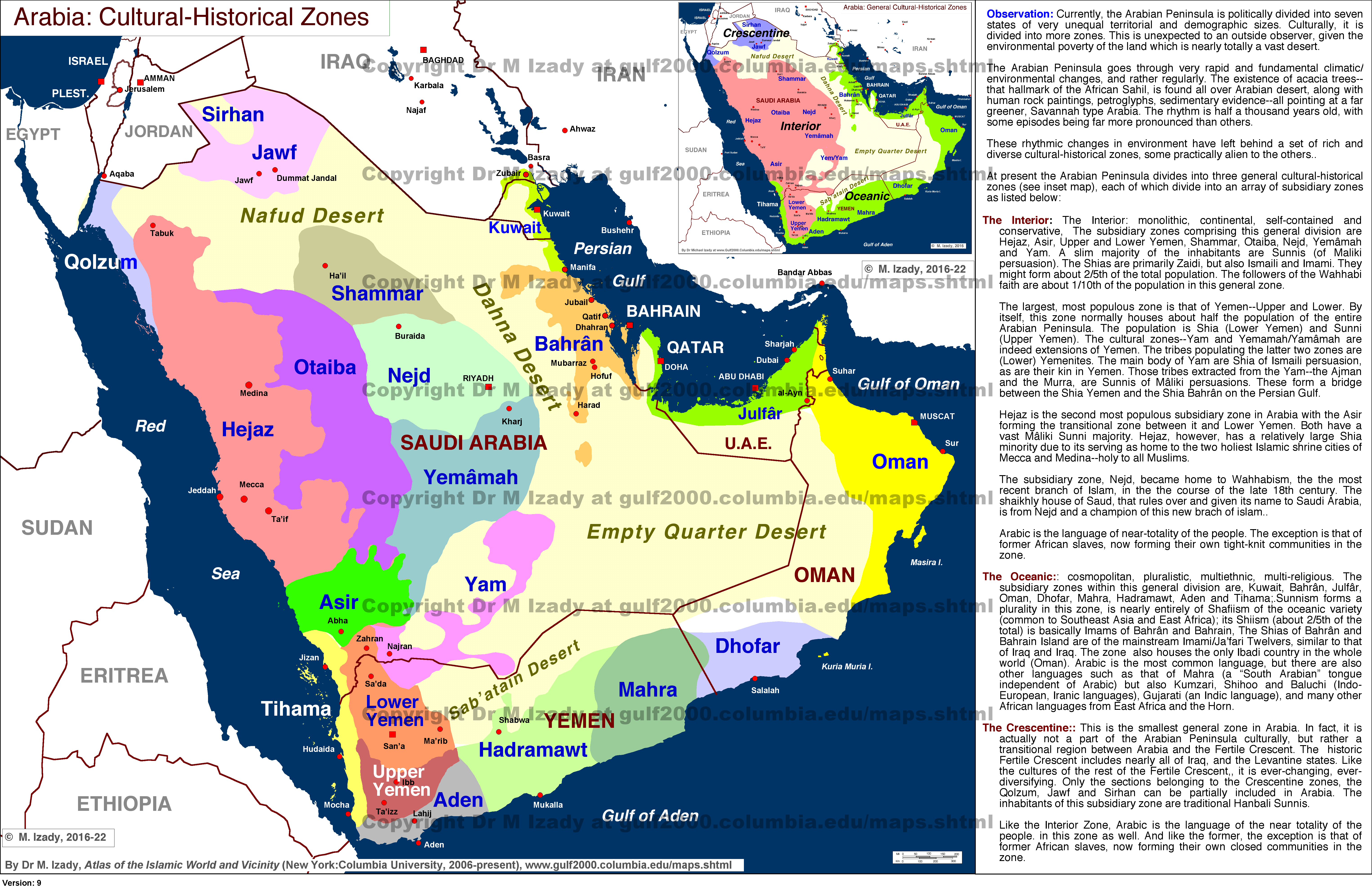
External links[edit | edit source]
Template:Regions of the world Template:Continents of the world Template:Mountains on the Arabian Peninsula Template:History of Ottoman