




Kannadaguy (talk | contribs) m 1 revision imported |
No edit summary |
||
| Line 1: | Line 1: | ||
{{ | {{Short description|Person active in politics}} | ||
{{other uses|The Politician (disambiguation)}} | |||
{{Use dmy dates|date=May 2020}} | {{Use dmy dates|date=May 2020}} | ||
{{Infobox occupation | {{Infobox occupation | ||
| name= Politician | | name = Politician | ||
| image = President Richard Nixon seated at his Oval Office desk during a meeting with Henry Kissinger, Alexander Haig, and Gerald Ford.jpg | | image = President Richard Nixon seated at his Oval Office desk during a meeting with Henry Kissinger, Alexander Haig, and Gerald Ford.jpg | ||
| caption = | | caption = American politicians ([[Henry Kissinger|Kissinger]], [[Richard Nixon|Nixon]], [[Gerald Ford|Ford]], [[Alexander Haig|Haig]]) in the White House's [[Oval Office]] discussing Representative Ford's nomination to the vice presidency | ||
| official_names= | |||
| official_names= [[ | * [[President (government title)|President]] | ||
* [[Vice president|Vice President]] | |||
* [[Member of congress|Member of Congress]]/Congressman/Representative | |||
* [[Senator]] | |||
* [[Prime minister|Prime Minister]] | |||
| | * [[Deputy prime minister|Deputy Prime Minister]] | ||
| | * [[Premier]] | ||
* Deputy Premier | |||
* [[Chief Minister]] | |||
* [[Governor-General]] | |||
* [[Minister (government)|Minister]] | |||
* [[Speaker (politics)|Speaker]] | |||
* [[Member of parliament|Member of Parliament]] | |||
* [[Member of the Legislative Assembly]] | |||
* [[Governor]] | |||
* [[Lieutenant governor|Lieutenant Governor]]/Vice Governor | |||
* [[Chairperson]] | |||
* [[Chancellor]] | |||
* [[Mayor]] | |||
* [[Deputy mayor|Deputy Mayor]]/Vice Mayor | |||
* [[Senior advisor|Senior Advisor]]/[[Advisor]] | |||
* [[First lady|First Lady]]/[[Second lady|Second Lady]] | |||
* [[Secretary of state|Secretary of State]] | |||
* [[Councillor]] | |||
| type = Politician | |||
| activity_sector = [[Government]] | |||
| competencies= | |||
* [[Leadership]] | |||
* [[Critical thinking]] | |||
* [[Public speaking]] | |||
* [[Legislation|Law making]] | |||
* [[Decision making]] | |||
* [[Agent of influence|Public influence]] | |||
* [[Budgeting]] | |||
* [[Public relations]] | |||
* Statesmanship | |||
| formation= Qualification is based on the constitution | |||
| employment_field= [[Government]] | |||
| related_occupation= [[Monarch]] | |||
| average_salary= | | average_salary= | ||
}} | }} | ||
A '''politician''' is a person | |||
A '''politician''' is a person who participates in [[Public policy|policy-making processes]], usually holding a position in a political party or an elective position in government. Politicians make decisions, and influence the formulation of public policy. The roles or duties that politicians perform vary depending on the level of government, whether local, state, or national. The ideological orientation that politicians adopt often stems from their previous experience, education, beliefs, the [[political parties]] they belong to. They try to shape [[public opinion]] accordingly. | |||
Politicians sometimes face many challenges and mistakes that may affect their [[credibility]] and ability to persuade. These mistakes include [[political corruption]] resulting from their use and exploitation of power to achieve self interest. Ideally they prioritize the [[public interest]] over their own profit. Challenges include how to keep up with the development of social media and confronting opposition media, in addition to discrimination for or against them on the basis of gender or race. | |||
==Definitions== | |||
Standard dictionary definitions include a range of political activists under the definition of "politician." ''Merriam Webster Dictionary'' (2025) states:<blockquote> Politician: 1: a person experienced in the art or science of government especially: one actively engaged in conducting the business of a government. 2a : a person engaged in party politics as a profession.<ref> From [https://www.merriam-webster.com/dictionary/politician online]</ref> </blockquote> | |||
''Oxford English Dictionary'' (1989 edition) states:<blockquote> Politician 2b: One keenly interested in politics; one who engages in party politics, or in political strife, or who makes politics his profession or business; also (esp. in U.S.), in a sinister sense, one who lives by politics as a trade.<ref> From [https://www.oed.com/oedv2/00182878 online]</ref> </blockquote> | |||
== Identity == | == Identity == | ||
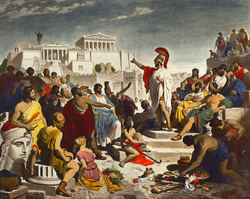
[[File:Discurso funebre pericles.PNG|thumb| | [[File:Discurso funebre pericles.PNG|thumb|252x252px|Nineteenth-century painting by [[Philipp Foltz]] depicting the Athenian politician [[Pericles]] delivering his famous [[Pericles' funeral oration|funeral oration]] in front of the [[Ecclesia (ancient Athens)|Assembly]].]] | ||
Politicians are people who | '''Politicians''' are people who participate in policy-making, in a multifaceted variety of positions of responsibility both domestically and internationally.<ref>{{cite book |doi=10.1007/978-1-4614-7883-6_370-2 |chapter=Politicians |title=Encyclopedia of Law and Economics |date=2021 |last1=Geys |first1=Benny |last2=Mause |first2=Karsten |pages=1–5 |isbn=978-1-4614-7883-6 }}</ref><ref>{{cite web|url=https://wordfind.com/word/politician/ |title=politician – Princeton Wordnet dictionary |publisher=wordfind.com }}</ref> | ||
In ancient Greece, [[Pericles]] of Athens played an important role in politics, both in public discussions and in decision-making as depicted in Philip Foltz's 19th-century painting.<ref>{{Cite web |last=Mark |first=Joshua |date=March 28, 2018 |title=Pericles |url=https://www.worldhistory.org/Pericles/ |access-date=2024-09-23 |website=World History Encyclopedia.}}</ref> | |||
Over time the figure of the politician has evolved to include many forms and functions. In the United States, [[George Washington]] played a pivotal role as a politician because he served as the first [[President of the United States]], shaping the official role and setting many precedents.<ref>{{Cite web |date=n.d. |title=George Washington: The First President |url =https://bidenwhitehouse.archives.gov/about-the-white-house/presidents/george-washington/ |access-date=2024-09-23 |website=The White House | quote = 'As the first of every thing, in our situation will serve to establish a Precedent,' he wrote James Madison, 'it is devoutly wished on my part, that these precedents may be fixed on true principles.'}}</ref> Today, political offices take many forms, held by people called (for example) premiers, ministers, mayors, governors, senators, or presidents, each with its own duties.<ref>{{Cite web |date=n.d. |title=State & Local Government |url= https://bidenwhitehouse.archives.gov/about-the-white-house/our-government/state-local-government/ |access-date=2024-09-23 |website=The White House}}</ref>{{qn|date=August 2025}} | |||
Though popular discourse may equate politicians with "leaders", politicians may primarily conduct themselves in the political process without engaging in leading {{--}} the class of politicians may include: [[Delegate model of representation |representative delegates]],<ref> | |||
{{cite book | |||
|last1 = Reeve | |||
|first1 = Andrew | |||
|editor-last1 = McLean | |||
|editor-first1 = Iain | |||
|editor-last2 = McMillan | |||
|editor-first2 = Alistair | |||
|date = 26 February 2009 | |||
|orig-date = 1996 | |||
|chapter = delegate | |||
|title = The Concise Oxford Dictionary of Politics | |||
|url = https://books.google.com/books?id=8JkyAwAAQBAJ | |||
|series = Oxford Quick Reference | |||
|edition = 3 | |||
|publisher = Oxford University Press | |||
|page = https://books.google.com/books?id=8JkyAwAAQBAJ&pg=PT188 | |||
|isbn = 978-0-19-101827-5 | |||
|access-date = 9 August 2025 | |||
|quote = delegate[:] A person on whom an individual or group confers the capacity to act on his or their behalf. [...] The relationship between the principal (who delegates) and the agent may be variously understood. | |||
}} | |||
</ref><ref> | |||
{{cite book | |||
|last1 = Scott | |||
|first1 = Adrian F. | |||
|date = 20 October 2024 | |||
|chapter = Delegate | |||
|title = Dictionary of Political $#@!: Science History Theory | |||
|url = https://books.google.com/books?id=-SgrEQAAQBAJ | |||
|publisher = Ascottcorp | |||
|isbn = 979-8-9918385-0-4 | |||
|access-date = 9 August 2025 | |||
|quote = Delegate [...]: A person chosen or elected to represent others, especially in a political assembly or convention. [...] The theory behind delegations focuses on representation, exploring how delegates are supposed to act on behalf of their constituents. | |||
}} | |||
</ref> | |||
[[Executive (government) | executive functionaries]] or [[Public administration|administrators]],<ref> | |||
{{cite book | |||
|last1 = Sager | |||
|first1 = Fritz | |||
|last2 = Rosser | |||
|first2 = Christian | |||
|editor-last1 = Ladner | |||
|editor-first1 = Andreas | |||
|editor-last2 = Sager | |||
|editor-first2 = Fritz | |||
|date = 13 October 2022 | |||
|chapter = The politics of the politics-administration dichotomy | |||
|title = Handbook on the Politics of Public Administration | |||
|url = https://books.google.com/books?id=wW-VEAAAQBAJ | |||
|series = Elgar Handbooks in Public Administration and Management | |||
|publication-place = Cheltenham | |||
|publisher = Edward Elgar Publishing | |||
|page = 34 | |||
|isbn = 978-1-83910-944-7 | |||
|access-date = 9 August 2025 | |||
|quote = [...] the public administration is a political actor and part of politics. This conclusion requires acknowledging the administration's role as a political actor [...]. | |||
}} | |||
</ref>{{efn |Some politicians - whether elected or appointed - have successful careers in administering government ministries or departments - without necessarily acting as political leaders. | |||
}} | |||
diligent bureaucratic [[Cadre (politics) | cadre]]s,<ref> | |||
{{cite book | |||
|editor-last1 = Gray | |||
|editor-first1 = Richard T. | |||
|editor-last2 = Wilke | |||
|editor-first2 = Sabine | |||
|translator-last1 = Gray | |||
|translator-first1 = Richard T. | |||
|translator-last2 = Wilke | |||
|translator-first2 = Sabine | |||
|year = 1996 | |||
|title = German Unification and Its Discontents: Documents from the Peaceful Revolution | |||
|url = https://books.google.com/books?id=4YIh-_UjxUQC | |||
|series = Manuscripts of the Younger Romantics | |||
|publication-place = Seattle | |||
|publisher = University of Washington Press | |||
|page = 309 | |||
|isbn = 978-0-295-97491-0 | |||
|access-date = 9 August 2025 | |||
|quote = In the GDR cadre politicians and the SED constituted the sole political power in the state and opposition was not permitted. | |||
}}</ref> and party hacks<ref> | |||
For example: | |||
{{cite book | |||
|last1 = Belloc | |||
|first1 = Hilaire | |||
|author-link1 = Hilaire Belloc | |||
|last2 = Chesterton | |||
|first2 = Cecil | |||
|author-link2 = Cecil Chesterton | |||
|year = 1911 | |||
|chapter = The Real Support | |||
|title = The Party System | |||
|url = https://books.google.com/books?id=-QRMAAAAMAAJ | |||
|publication-place = London | |||
|publisher = Stephen Swift | |||
|pages = 165–166 | |||
|access-date = 9 August 2025 | |||
|quote = [...] the average man [...] will certainly support by his vote and influence any chance party hack against a representative of his own class [...]. | |||
}} | |||
</ref> | |||
submissively propping up a voting majority.<ref>{{cite book | |||
|last1 = Carson | |||
|first1 = Lyn | |||
|last2 = Martin | |||
|first2 = Brian | |||
|date = 30 December 1999 | |||
|title = Random Selection in Politics | |||
|url = https://books.google.com/books?id=tHrDEAAAQBAJ | |||
|publication-place = Westport, Connecticut | |||
|publisher = Bloomsbury Publishing USA | |||
|page = 6 | |||
|isbn = 978-0-313-02869-4 | |||
|access-date = 9 August 2025 | |||
|quote = Politicians are divided into two camps: in a parliament there are backbenchers and the executive, with the latter making all the significant decisions; in a congress the same separation exists between those who chair or are members of powerful committees and those who are not. The lowly representative is reduced to voting fodder in parliament or congress. | |||
}} | |||
</ref> | |||
While government leaders are generally considered politicians,<ref> | |||
Compare: | |||
{{cite book | |||
|last1 = Byrne | |||
|first1 = Dorothy | |||
|author-link1 = Dorothy Byrne | |||
|date = 14 November 2019 | |||
|title = Trust Me, I'm Not A Politician: A simple guide to saving democracy | |||
|url = https://books.google.com/books?id=1QDuDwAAQBAJ | |||
|publisher = Hachette UK | |||
|isbn = 978-1-78072-430-0 | |||
|access-date = 23 August 2025 | |||
}} | |||
</ref> | |||
not all politicians are subject to voters: autocratic and dictatorial regimes remain extant.<ref>{{Cite web |last1 =Angiolillo |first1 =F. |last2 =Wiebrecht |first2 =F. |last3 =Lindberg |first3 =S. I. |date =2023 |title ="Democratic-autocratic party systems: A new index" |url =https://www.v-dem.net/media/publications/wp_143.pdf |website=V-Dem Institute}}</ref>{{qn|date=August 2025}} | |||
The identity of politicians is influenced by their social and work environments, by their ideology, and by any parties with which they may associate; furthermore, the development of means of communication and [[social media]] have increased [[Public participation (decision making)|public participation]] in policy-making, leading to a reformation of politicians' identities and increasing the complexity of political work.<ref>{{cite book |doi =10.1007/978-3-030-36525-7_5 |chapter =Social Media Effects: Hijacking Democracy and Civility in Civic Engagement |title =Platforms, Protests, and the Challenge of Networked Democracy |series =Rhetoric, Politics and Society |date =2020 |last1 =Olaniran |first1 =Bolane |last2 =Williams |first2 =Indi |pages =77–94 |pmc =7343248 |isbn =978-3-030-36524-0 }}</ref><ref>{{Cite journal |last =Michalski |first =P. |date =2023 |title ="When politics affects the self: High political influence perception predicts civic and political participation." |url =https://jspp.psychopen.eu/index.php/jspp/article/view/8379/8379.html |journal =Journal of Social and Political Psychology |volume =11 |issue =2 |pages =516–533 |doi =10.5964/jspp.8379 }} | |||
</ref> | |||
==Media and rhetoric== | ==Media and rhetoric== | ||
Politicians are | [[File:U.S. President Obama Speaks at Intel's Fab 42.jpg|thumb|Barack Obama, Public Speech, Technology and Innovation, Manufacturing, Intel Fab 42. Political leaders use public events to frame issues and influence public opinion by crafting appropriate rhetoric.]] | ||
Politicians are influential people who use [[rhetoric]] to impact people as in speeches or campaign advertisements. They are especially known for using common themes, and media platforms that allow them to develop their political positions, developing [[communication]] between them and the people.<ref>{{cite journal |last1=Archer |first1=Alfred |last2=Cawston |first2=Amanda |title=Celebrity Politics and Democratic Elitism |journal=Topoi |date=February 2022 |volume=41 |issue=1 |pages=33–43 |doi=10.1007/s11245-021-09763-0 |pmid=34658468 |pmc=8503715 }}</ref><ref>{{cite book |doi=10.1057/9780230319899 |title=Politicians and Rhetoric |date=2011 |last1=Charteris-Black |first1=Jonathan |isbn=978-0-230-25165-6 }}{{page needed|date=September 2024}}</ref><ref>{{Cite web |last=Knupffer |first=N |date=2012 |title=President Barack Obama delivering a speech at Intel's Fab 42 in Chandler, Arizona on January 25, 2012, as part of his public address on the future of advanced manufacturing in the U.S. |url=https://www.flickr.com/photos/intelphotos/6763271149/ |publisher=Flickr}}</ref> | |||
[[File:Kennedy Nixon Debate (1960).jpg|thumb|Photo of the second of the four presidential debates held during the 1960 presidential election. This debate took place in [[Washington, D.C.]] at NBC's [[WRC-TV]] studios on October 7, 1960.]] | |||
Politicians of necessity become expert users of the [[Media (communication)|media]].<ref>{{cite book |last1=Landtsheer |first1=Christ'l De |last2=Feldman |first2=Ofer |title=Beyond Public Speech and Symbols: Explorations in the Rhetoric of Politicians and the Media |date=2000 |publisher=Bloomsbury Academic |isbn=978-0-275-96732-1 }}{{page needed|date=September 2024}}</ref> Politicians in the 19th century made heavy use of [[newspaper]]s, magazines, and pamphlets, as well as posters to disseminate their messages to appeal to voters' emotions and beliefs in their campaigns.<ref>{{Cite web |last=U.S. National Archives |date=2022 |title=American elections and campaigns – 1800 to 1865: Politics in the antebellum press |url=https://www.reaganlibrary.gov/education-blog/american-elections-and-campaigns-1800-1865-politics-antebellum-press |website=The Reagan Library Education Blog |publisher=U.S. National Archives}}</ref><ref>{{cite book |last1=Dinkin |first1=Robert J. |title=Campaigning in America: A History of Election Practices |date=1989 |publisher=Bloomsbury Academic |isbn=978-0-313-26167-1 }}{{page needed|date=September 2024}}</ref> In the 20th century, the scope of media expanded out into radio and television, and a major change occurred as speech was now presented visually as well as verbally as evidenced by the [[1960 United States presidential debates|Kennedy-Nixon debates]], marking a new era where visual media became crucial to campaigns.<ref>{{cite journal |last1=Silvestri |first1=Vito N. |title=Television's Interface With Kennedy, Nixon, and Trump: Two Politicians and One TV Celebrity |journal=American Behavioral Scientist |date=June 2019 |volume=63 |issue=7 |pages=971–1001 |doi=10.1177/0002764218784992 }}</ref> The twenty-first century has provided wide and diverse media platforms represented by Facebook, and Twitter, which has now become X, Instagram, YouTube, and others. This development has made their rhetorical messages faster, shorter more efficient, and characterized by the speed of spread and interaction.<ref>{{cite book |last1=Pearlman |first1=Nathaniel G. |title=Margin of Victory: How Technologists Help Politicians Win Elections |date=2012 |publisher=Bloomsbury Publishing USA |isbn=978-1-4408-0258-4 }}{{page needed|date=September 2024}}</ref><ref>{{cite journal |last1=Tan |first1=Jue Jun |last2=Firdaus |first2=Amira |last3=Aksar |first3=Iffat Ali |title=Social Media for Political Information: A Systematic Literature Review |journal=Jurnal Komunikasi: Malaysian Journal of Communication |date=31 March 2024 |volume=40 |issue=1 |pages=77–98 |doi=10.17576/JKMJC-2024-4001-05 }}</ref><ref>{{Cite journal |last1=Fatema |first1=S. |last2=Yanbin |first2=L |last3=Fugui |first3=D |date=2022 |title="Social media influence on politicians' and citizens' relationship through the moderating effect of political slogans." |journal=Frontiers in Communication|volume=7 |article-number=955493 |doi=10.3389/fcomm.2022.955493 |doi-access=free }}</ref> | |||
Politicians, who rarely meet voters in person, seek to use the media as a means of communicating with people, winning votes, and obtaining political roles. Some research confirms that the media increases the popularity of a politician, and indicates that negative news has a stronger effect on popularity than positive news.<ref>{{Cite journal |last1=Van Remoortere |first1=A. |last2=Vliegenthart |first2=R. |date=2024 |title="The influence of mass media on the popularity of politicians" |journal=Party Politics|volume=30 |issue=5 |pages=781–794 |doi=10.1177/13540688231187964 |doi-access=free }}</ref> | |||
Some research has suggested that politicians tend to use social media more than [[traditional media]] because their perception of the traditional media's influence as a public informant greatly affects their satisfaction with democratic processes. So they prefer to use social media and communicate directly with people in order to have greater control over their message and easier communication.<ref>{{Cite journal |pmc=10409637 |date=2023 |last1=Maurer |first1=P. |title=Perceptions of media influence and performance among politicians in European democracies |journal=International Communication Gazette |volume=85 |issue=5 |pages=347–364 |doi=10.1177/17480485221146088 |pmid=37564296 }}</ref> | |||
This continuous evolution in media has made politicians adapt their discourse to these platforms for greater communication and effectiveness.<ref>{{cite journal |last1=Munardin Hadma |first1=Ahmad |last2=Dwi Anggoro |first2=Juliardi |title=Political communication in the age of social media |journal=Commicast |date=23 November 2021 |volume=3 |issue=1 |pages=1–7 |doi=10.12928/commicast.v3i1.5114 |doi-access=free }}</ref> | |||
== | ==Salary== | ||
Higher salaries of politicians can improve [[governance]]<ref name="d898">{{cite report | last1=Ferraz | first1=Claudio | last2=Finan | first2=Frederico | title=Motivating Politicians: The Impacts of Monetary Incentives on Quality and Performance | publisher=National Bureau of Economic Research | publication-place=Cambridge, MA | year=2009 | doi=10.3386/w14906 | doi-access=free | page=}}</ref> and decrease [[political corruption]].<ref name="e189">{{cite journal | last1=Van Rijckeghem | first1=Caroline | last2=Weder | first2=Beatrice | title=Bureaucratic corruption and the rate of temptation: do wages in the civil service affect corruption, and by how much? | journal=Journal of Development Economics | volume=65 | issue=2 | date=2001 | doi=10.1016/S0304-3878(01)00139-0 | pages=307–331}}</ref> The [[list of heads of state and government salaries]] shows large differences in the salaries of politicians. | |||
==Careers and biographies== | ==Careers and biographies== | ||
Mattozzi and Merlo argue that two main career paths | Mattozzi and Merlo argue that politicians typically follow two main career paths in modern democracies. The first is career politicians who remain in government until retirement. The second is political careerists, who have gained a reputation for their experience at various levels of government such as international, federal, state, and local governments, they often leave politics and start a new business venture using their political connections.<ref>{{cite journal |last1=Mattozzi |first1=Andrea |last2=Merlo |first2=Antonio |title=Political careers or career politicians? |journal=Journal of Public Economics |date=April 2008 |volume=92 |issue=3–4 |pages=597–608 |doi=10.1016/j.jpubeco.2007.10.006 |url=http://papers.nber.org/papers/w12921.pdf }}</ref> | ||
The personal histories of politicians have been frequently studied, as it is presumed that their experiences and characteristics shape their beliefs and behaviors. There are four pathways by which a politician's biography could influence their leadership style and abilities. | The personal histories of politicians have been frequently studied, as it is presumed that their experiences and characteristics shape their beliefs and behaviors. There are four pathways by which a politician's [[biography]] could influence their [[leadership]] style and abilities. First, a politician's biography may shape their core beliefs, which are essential to shaping their worldview.<ref>{{cite journal |last1=Weinschenk |first1=Aaron C. |last2=Dawes |first2=Christopher T. |last3=Oskarsson |first3=Sven |last4=Klemmensen |first4=Robert |last5=Nørgaard |first5=Asbjørn Sonne |title=The relationship between political attitudes and political participation: Evidence from monozygotic twins in the United States, Sweden, Germany, and Denmark |journal=Electoral Studies |date=February 2021 |volume=69 |article-number=102269 |doi=10.1016/j.electstud.2020.102269 }}</ref> The second pathway is those personal experiences that influence a politician's skills and competence, and which determine where politicians focus their resources and attention as leaders.<ref>{{cite journal |last1=Cramer |first1=Katherine J. |last2=Toff |first2=Benjamin |title=The Fact of Experience: Rethinking Political Knowledge and Civic Competence |journal=Perspectives on Politics |date=September 2017 |volume=15 |issue=3 |pages=754–770 |id={{ProQuest|1929729634}} |doi=10.1017/S1537592717000949 |url=https://ora.ox.ac.uk/objects/uuid:c67a69f7-ccb6-4e00-8338-74d7b91caa51 }}</ref> The third pathway refers to biographical characteristics that influence a politician's resource allocation and responses based on characteristics such as race or gender. The fourth pathway is how a politician's biography affects his public perception, which affects politicians' leadership style and their strategy for gaining people's respect.<ref>{{cite journal|doi=10.1146/annurev-polisci-050718-032801|doi-access=free|title=Studying Leaders and Elites: The Personal Biography Approach|year=2020|last1=Krcmaric|first1=Daniel|last2=Nelson|first2=Stephen C.|last3=Roberts|first3=Andrew|journal=Annual Review of Political Science|volume=23|pages=133–151}}</ref> | ||
==Characteristics== | ==Characteristics== | ||
Numerous scholars have studied the characteristics of politicians and in economic class to explain characteristics impact on politicians' effectiveness and electoral success, comparing politicians involves different dimensions such as level of government (the local and national levels), political ideology (liberal or the more conservative), [[Social class|economic class]], and comparing the more successful and less successful in terms of elections.<ref>{{cite book |last1=Prinz |first1=Timothy S |chapter=The career paths of elected politicians: a review and prospectus |pages=11–63 |editor1-last=Williams |editor1-first=Shirley |editor2-last=Lascher |editor2-first=Edward L. |title=Ambition and Beyond: Career Paths of American Politicians |date=1993 |publisher=Institute of Governmental Studies Press, University of California, Berkeley |isbn=978-0-87772-338-7 }}</ref><ref>{{cite journal |last1=Carnes |first1=Nicholas |last2=Lupu |first2=Noam |title=The Economic Backgrounds of Politicians |journal=Annual Review of Political Science |date=15 June 2023 |volume=26 |issue=1 |pages=253–270 |doi=10.1146/annurev-polisci-051921-102946 |ssrn=4480849 |doi-access=free }}</ref> | |||
Demographic factors such as age, gender, education, income, and race/ethnicity, play a role in shaping shape voter behavior and political preferences<ref>{{Cite journal |last1=Kulachai |first1=W. |last2=Lerdtomornsakul |first2=U. |last3=Homyamyen |first3=P. |date=2023 |title="Factors influencing voting decision: A comprehensive literature review" |journal=Social Sciences |volume=12 |issue=9 |page=469 |publisher=MDPI|doi=10.3390/socsci12090469 |doi-access=free }}</ref> | |||
Also, educational background in politics also plays an important role in shaping the political awareness of politicians and plays a major role in increasing people's confidence in them.<ref>{{Cite web |last1=Hooghe |first1=Marc |last2=Dassonneville |first2=Ruth |last3=Marien |first3=Sofie |date=2015 |title=The impact of education on the development of political trust: Results from a five year panel study among late adolescents and young adults in Belgium |url=https://chairedemocratie.openum.ca/files/sites/98/2016/10/Hooghe-et-al_PS_Postprint.pdf |publisher=Political Studies.}}</ref> | |||
Politicians were found to have on average a [[political bias]] compared to [[Median voter theorem|median voters]] in many countries.<ref>{{Cite journal |last=Günther |first=Laurenz |date=2022 |title=Political Representation Gaps in Europe: Causes and Consequences |url=https://papers.ssrn.com/sol3/papers.cfm?abstract_id=4230288 |journal=SSRN Electronic Journal |doi=10.2139/ssrn.4230288 |ssrn=4230288 |issn=1556-5068}}</ref> | |||
In some countries politicians are banned from having [[multiple citizenship|multiple citizenships]] to avoid [[dual loyalty]].<ref>{{Cite book |url=https://www.taylorfrancis.com/books/9781134012572 |title=Securitizations of Citizenship |date=2009 |publisher=Routledge |isbn=978-1-134-01257-2 |editor-last=Nyers |editor-first=Peter |edition=0 |language=en |chapter=Security, flexible sovereignty, and the perils of multiple citizenship |doi=10.4324/9780203878903}}</ref> | |||
== Challenges == | |||
In this century of advanced communications, politicians face challenges and difficulties while communicating with people through various social media platforms. The implicit importance of social media for politics stems from the virtual space these platforms have created for expressing ideas and spreading mutual messages without restrictions.<ref>{{Cite web |last1=Wike |first1=R. |last2=others |date=2022 |title=Social media seen as mostly good for democracy across many nations, but U.S. is a major outlier |url=https://www.pewresearch.org/global/2022/12/06/social-media-seen-as-mostly-good-for-democracy-across-many-nations-but-u-s-is-a-major-outlier/ |website=Pew Research Center}}</ref> Misinformation, rumors, and discrimination complicate their [[Theories of political behavior|political behavior]] and communication with people.<ref>{{cite journal |last1=Lasser |first1=Jana |last2=Aroyehun |first2=Segun Taofeek |last3=Simchon |first3=Almog |last4=Carrella |first4=Fabio |last5=Garcia |first5=David |last6=Lewandowsky |first6=Stephan |title=Social media sharing of low-quality news sources by political elites |journal=PNAS Nexus |date=September 2022 |volume=1 |issue=4 |article-number=pgac186 |doi=10.1093/pnasnexus/pgac186 |doi-access=free|pmid=36380855 |pmc=7613815 }}</ref><ref>{{Cite journal |last=Oskooii |first=K |date=2018 |title="Perceived Discrimination and Political Behavior" |url=https://www.cambridge.org/core/journals/british-journal-of-political-science/article/abs/perceived-discrimination-and-political-behavior/51F4045DB0690260ECA2A8F6DC6B51D7 |journal=British Journal of Political Science|volume=50 |issue=3 |pages=867–892 |doi=10.1017/S0007123418000133 |url-access=subscription }}</ref> | |||
Face-to-face contact with constituents is important to elected politicians. Face-to-face meetings force politicians to be directly address the issues that matter most to their constituents. They pay attention to tone of voice, looking for unspoken priorities, hopes and anxieties. Politicians with good memories will often ask whether a given problem is resolved satisfactorily, or about a person's family.<ref>Michael Lupfer and David Price, " On the merits of face-to-face campaigning" ''Social Science Quarterly'' 53#3 1972, pp. 534–43. [http://www.jstor.org/stable/42860231 online]</ref><ref>David Niven, "The mobilization solution? Face-to-face contact and voter turnout in a municipal election." ''Journal of Politics'' 66.3 (2004): 868-884. https://doi.org/10.1111/j.1468-2508.2004.00280.x </ref> Some politicians can remember thousands of names and faces. Presidents [[George W. Bush]] and [[Bill Clinton]] were known for their memories.<ref>{{cite book|author=Iwan W. Morgan|title=Assessing George W. Bush's Legacy: The Right Man?|url=https://books.google.com/books?id=8WfFAAAAQBAJ&pg=PA45|year=2010|page=45|publisher=Springer |isbn=978-0-230-11433-3}}</ref><ref>{{cite book|author=James E. Mueller|title=Tag Teaming the Press: How Bill and Hillary Clinton Work Together to Handle the Media|url=https://books.google.com/books?id=dw8SBZ6KRqYC&pg=PA32|year=2008|page=32|publisher=Rowman & Littlefield Publishers |isbn=978-0-7425-6392-6}}</ref> | |||
[[Political polarization in the United States|Political polarization]] created by the media plays a role in influencing politicians' behavior and communications, which reinforces negative campaigns. They also play a role in legislative gridlock and negatively impact public perception, which negatively impacts politicians' interests.<ref>{{Cite journal |last1=Kubin |first1=E. |last2=von Sikorski |first2=C. |date=2021 |title="The role of (social) media in political polarization: a systematic review" |journal=Annals of the International Communication Association |volume=45 |issue=3 |pages=188–206 |doi=10.1080/23808985.2021.1976070 |doi-access=free }}</ref> | |||
Additionally, research highlighted that politicians, especially populist politicians, may create a challenge for themselves by increasingly accusing the media of spreading misinformation or "fake news." Such accusations can undermine the credibility of media platforms, even though trust in the accused politicians remains largely unaffected. They will therefore have a negative impact on the credibility of media platforms, and this distrust may extend to the media institutions as a whole that politicians use to communicate with people.<ref>{{Cite journal |last1=Egelhofer |first1=J |last2=Boyer |first2=M |last3=Lecheler |first3=S |last4=Aaldering |first4=L |date=2022 |title="Populist attitudes and politicians' disinformation accusations: Effects on perceptions of media and politicians" |journal=Journal of Communication|volume=72 |issue=6 |pages=619–632 |doi=10.1093/joc/jqac031 |doi-access=free |hdl=1871.1/1ff57767-c97b-4804-82cb-01a46002a465 |hdl-access=free }}</ref> | |||
[[File:Women in Media and Politics 6030967.jpg|thumb|Presenters at Women in Media and Politics]] | |||
Regarding the challenges of gender dynamics, particularly the role of [[Women in government|women in politics]], some recent research focuses on the life path of women in the political field and the challenges surrounding them. For example, there are studies on the "supermader" model in politics in Latin America, which illustrate the difficulties women face and how to balance their home and work and the distinction between women and men that negatively affects their acceptance in political work.<ref>{{cite book |last1=Chaney |first1=Elsa M. |title=Supermadre: Women in Politics in Latin America |date=2014 |publisher=University of Texas Press |isbn=978-0-292-77265-6}}{{page needed|date=September 2024}}</ref><ref>{{cite journal |last1=Schwindt-Bayer |first1=Leslie A. |date=July 2006 |title=Still Supermadres? Gender and the Policy Priorities of Latin American Legislators |journal=American Journal of Political Science |volume=50 |issue=3 |pages=570–585 |doi=10.1111/j.1540-5907.2006.00202.x}}</ref> | |||
==Political corruption== | |||
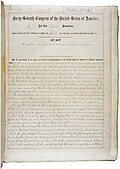
Historically, in patronage-based systems, especially in the 19th century, winning politicians replaced civil servants and government employees who were not protected by the rules of government service with their supporters, a so-called "[[spoils system]]." In response to the corruption this system fostered, government job reforms were introduced. These reforms required elected politicians to work with existing civil servants and officials to pursue long-term public interest goals, rather than simply rewarding their supporters. This shift aimed to reduce corruption and prioritize the integrity of [[government]] positions.<ref>{{cite book |doi=10.4159/9780674020047 |title=Bureaucrats and Politicians in Western Democracies |date=1981 |last1=Aberbach |first1=Joel D. |last2=Putnam |first2=Robert D. |last3=Rockman |first3=Bert A. |isbn=978-0-674-02004-7 }}{{page needed|date=September 2024}}</ref><ref>{{cite journal |last1=Bersch |first1=Katherine |last2=Lotta |first2=Gabriela |title=Political Control and Bureaucratic Resistance: The Case of Environmental Agencies in Brazil |journal=Latin American Politics and Society |date=February 2024 |volume=66 |issue=1 |pages=27–50 |doi=10.1017/lap.2023.22 |doi-access=free }}</ref>[[File:Pendleton Act (1883)1of 2.jpg|thumb|An Act to regulate and improve the civil service of the United States, January 16, 1883; Enrolled Acts and Resolutions of Congress, 1789–1996; General Records of the United States Government; Record Group 11; National Archives.]] | |||
[[Pendleton Civil Service Reform Act|The Pendleton Civil Service Reform Act of 1883]] passed by the U.S. Congress to combat corruption, favoritism in hiring, and the spoils system. It advocated hiring based on merit and protected civil servants from political influence.<ref>{{Cite web |last=National Archives |date=n.d. |title=Pendleton Act (1883) |url=https://www.archives.gov/milestone-documents/pendleton-act |website=Milestone Documents}}</ref><ref>{{Cite web |last1=Aneja |first1=A. |last2=Xu |first2=G |date=2022 |title="Strengthening State Capacity: Postal Reform and Innovation During the Gilded Age" |series=Working Paper Series |url=https://www.nber.org/papers/w29852 |publisher=National Bureau of Economic Research |doi=10.3386/w29852 }}</ref> | |||
In the modern century, many laws have been put in place to protect employees and reduce [[political corruption]] and favoritism in employment, for example, the Mexican government introduced the Federal Law on Administrative Responsibilities of Public Officials (2002) which establishes professional and accountable standards for officials against corruption and the spoils system.<ref>{{cite book |doi=10.1093/acprof:oso/9780199288489.003.0009 |chapter=Administrative Law |title=Mexican Law |date=2005 |last1=Zamora |first1=Stephen |last2=Cossío |first2=José Ramlón |last3=Pereznieto |first3=Lenone |last4=Roldá n-Xopa |first4=José |last5=Lopez |first5=David |pages=287–320 |isbn=978-0-19-928848-9 }}</ref> | |||
Also, the Whistleblower Protection Enhancement Act of 2012 in the USA has established corruption to protect federal employees who report corruption, fraud, or other illegal activities within the government.<ref>{{Cite web |last=Congress.gov |date=2012 |title=Whistleblower Protection Enhancement Act of 2012: 112th Congress (2011-2012) |url=https://www.congress.gov/bill/112th-congress/senate-bill/743 |website=Congress.gov}}</ref> | |||
==Criticism== | ==Criticism== | ||
Some critics often accuse politicians of not communicating with the public. They accuse politicians' speeches of being sometimes overly formal, filled with many euphemisms and metaphors, and generally seen as an attempt to "obscure, mislead, and confuse".<ref>Vincent E. Barry (2007): ''Invitation to Critical Thinking'' p. 319 {{ISBN?}}</ref><ref>{{cite journal |last1=Walker |first1=Alexander C. |last2=Turpin |first2=Martin Harry |last3=Meyers |first3=Ethan A. |last4=Stolz |first4=Jennifer A. |last5=Fugelsang |first5=Jonathan A. |last6=Koehler |first6=Derek J. |title=Controlling the narrative: Euphemistic language affects judgments of actions while avoiding perceptions of dishonesty |journal=Cognition |date=June 2021 |volume=211 |article-number=104633 |doi=10.1016/j.cognition.2021.104633 |pmid=33639377 |doi-access=free }}</ref> | |||
Lack of awareness, selfishness, [[Manipulation (psychology)|manipulation]], [[political corruption]] and dishonesty are perceptions that people often accuse politicians of, and many see them as prioritizing personal interests over the public interests.<ref name="autogenerated1">{{cite book |doi=10.4324/9781315126647 |title=Political Corruption |date=2017 |last1=Heidenheimer |first1=Arnold I. |last2=Lohnston |first2=Michael |isbn=978-1-315-12664-7 |editor-first1=Michael |editor-last1=Johnston }}{{page needed|date=September 2024}}</ref> Politicians in many countries are seen as the "most hated professionals," and the least trustworthy, leading to public skepticism and constant criticism.<ref name="autogenerated1"/> | |||
In | In addition, some politicians tend to be negative, this strategy, although it does not enhance their chances of being re-elected or gaining public support, politicians see this negativity as consistent with negative media bias, which increases their chances of securing media access and public attention.<ref>{{Cite journal |last=Poljak |first=Z |date=2024 |title="Give the Media What They Need: Negativity as a Media Access Tool for Politicians" |url=https://journals.sagepub.com/doi/10.1177/19401612241234861 |journal=The International Journal of Press/Politics|volume=30 |issue=3 |pages=727–751 |doi=10.1177/19401612241234861 |hdl=10067/2034760151162165141 |hdl-access=free |url-access=subscription }}</ref> | ||
[[File:The Immunity Bath (J.J. Hanberg leaving the Grand Jury Room, surrounded by stamped vouchers),... (NBY 5387).jpg|thumb|The Immunity Bath (J.J. Hanberg leaving the Grand Jury Room, surrounded by stamped vouchers), March 5, 1910]] | |||
Also, lack of [[accountability]] and the [[Legal immunity|immunity]] from prosecution they receive as politicians results in further corruption and evasion from legal punishment,<ref>{{Cite journal |last1=Jensenius |first1=F. R. |last2=Wood |first2=A. K. |date=2016 |title=Caught in the act but not punished: On elite rule of law and deterrence |url=https://elibrary.law.psu.edu/jlia/vol4/iss2/13 |journal=Penn State Journal of Law & International Affairs |volume=4 |issue=2 |page=686 }}</ref> as represented by the immunity bath depiction by J.J. Hanberg.<ref>{{Cite web |last=Hanberg |first=J.J. |date=March 5, 1910 |title="The Immunity Bath" (leaving the Grand Jury Room, surrounded by stamped vouchers) |url=https://collections.carli.illinois.edu/cdm/singleitem/collection/nby_chicago/id/5387 }}</ref> | |||
== See also == | == See also == | ||
* [[Great man theory]] | |||
* [[Independent politician]] | |||
* [[Legislator]] | |||
* [[Nomination rules]] | |||
* [[Parliamentary immunity]] | |||
* [[Political campaign]] | * [[Political campaign]] | ||
* [[Political party]] | * [[Political party]] | ||
* [[Political prisoner]] | |||
* [[Term limit]] | |||
** [[List of political term limits]] | |||
==Notes== | |||
{{notelist}} | |||
== References == | ==References== | ||
{{ | {{reflist}} | ||
==Further reading== | ==Further reading== | ||
{{refbegin}} | {{refbegin}} | ||
* Aberbach | * {{cite book |doi=10.4159/9780674020047 |title=Bureaucrats and Politicians in Western Democracies |date=1981 |last1=Aberbach |first1=Joel D. |last2=Putnam |first2=Robert D. |last3=Rockman |first3=Bert A. |isbn=978-0-674-02004-7 }} | ||
* Heywood, | |||
* | * Gould, Louis L. ''The Republicans: A History of the Grand Old Party'' (Oxford University Press, 2014). | ||
* Stebbins | * {{cite book |doi=10.4324/9781315739175 |title=Routledge Handbook of Political Corruption |date=2014 |isbn=978-1-315-73917-5 |editor-last1=Heywood |editor-first1=Paul }} | ||
* Welch | |||
* Kazin, Michael. ''What it Took to Win: A History of the Democratic Party'' (2022). | |||
* Safire, William. ''Safire's Political Dictionary'' (Oxford University Press, 2008). | |||
* {{cite book |doi=10.1108/9781787147577 |title=From Humility to Hubris among Scholars and Politicians |date=2017 |last1=Stebbins |first1=Robert A. |isbn=978-1-78714-758-4 }} | |||
* {{cite journal |last1=Stebbins |first1=Robert A. |title=Democracy's Politicians: an Occupation Like No Other |journal=Society |date=October 2019 |volume=56 |issue=5 |pages=461–462 |doi=10.1007/s12115-019-00399-w }} | |||
* {{cite book |last1=Welch |first1=Susan |last2=Gruhl |first2=John |last3=Comer |first3=John |last4=Rigdon |first4=Susan M. |last5=Ambrosius |first5=Margery M. |title=Understanding American Government |date=2003 |publisher=Cengage Learning |isbn=978-0-534-59644-6 }} | |||
* Wilentz, Sean. ''Rise of American Democracy: Jefferson to Lincoln'' (W.W. Norton, 2006) | |||
{{refend}} | {{refend}} | ||
== External links == | == External links == | ||
*{{Commons category-inline|Politicians}} | * {{Commons category-inline|Politicians}} | ||
*{{Wiktionary-inline|politician}} | * {{Wiktionary-inline|politician}} | ||
*{{Wikiquote-inline}} | * {{Wikiquote-inline}} | ||
* Herre, Bastian. 2021. ''[https://www.ippapublicpolicy.org/file/paper/60c247759f1df.pdf Identifying Ideologues: A Global Dataset on Political Leaders, 1945–2019]'' (PDF). | |||
* [https://complegdatabase.com/ Comparative Legislators Database]. A dataset on over 1,000,000 legislators from 16 countries. | |||
* [https://dataverse.harvard.edu/dataset.xhtml?persistentId=doi:10.7910/DVN/U1ZNVT The Global Legislators Database (GLD)]. A dataset on characteristics of 19,704 national parliamentarians in 97 countries. | |||
{{Authority control}} | {{Authority control}} | ||
[[Category:Political occupations|Politician|Political]] | |||
[[Category: Political occupations|Politician|Political]] | [[Category:Legal professions]] | ||
[[Category: Legal professions]] | [[Category:Positions of authority]] | ||
[[Category: Positions of authority]] | [[Category:Public speaking]] | ||
Latest revision as of 19:25, 19 February 2026
 American politicians (Kissinger, Nixon, Ford, Haig) in the White House's Oval Office discussing Representative Ford's nomination to the vice presidency | |
| Occupation | |
|---|---|
| Names |
|
Occupation type | Politician |
Activity sectors | Government |
| Specialty | {{#statements:P1995}} |
| Description | |
| Competencies | |
Education required | Qualification is based on the constitution |
Fields of employment | Government |
Related jobs | Monarch |
A politician is a person who participates in policy-making processes, usually holding a position in a political party or an elective position in government. Politicians make decisions, and influence the formulation of public policy. The roles or duties that politicians perform vary depending on the level of government, whether local, state, or national. The ideological orientation that politicians adopt often stems from their previous experience, education, beliefs, the political parties they belong to. They try to shape public opinion accordingly.
Politicians sometimes face many challenges and mistakes that may affect their credibility and ability to persuade. These mistakes include political corruption resulting from their use and exploitation of power to achieve self interest. Ideally they prioritize the public interest over their own profit. Challenges include how to keep up with the development of social media and confronting opposition media, in addition to discrimination for or against them on the basis of gender or race.
Definitions[edit | edit source]
Standard dictionary definitions include a range of political activists under the definition of "politician." Merriam Webster Dictionary (2025) states:
Politician: 1: a person experienced in the art or science of government especially: one actively engaged in conducting the business of a government. 2a : a person engaged in party politics as a profession.[1]
Oxford English Dictionary (1989 edition) states:
Politician 2b: One keenly interested in politics; one who engages in party politics, or in political strife, or who makes politics his profession or business; also (esp. in U.S.), in a sinister sense, one who lives by politics as a trade.[2]
Identity[edit | edit source]

Politicians are people who participate in policy-making, in a multifaceted variety of positions of responsibility both domestically and internationally.[3][4]
In ancient Greece, Pericles of Athens played an important role in politics, both in public discussions and in decision-making as depicted in Philip Foltz's 19th-century painting.[5]
Over time the figure of the politician has evolved to include many forms and functions. In the United States, George Washington played a pivotal role as a politician because he served as the first President of the United States, shaping the official role and setting many precedents.[6] Today, political offices take many forms, held by people called (for example) premiers, ministers, mayors, governors, senators, or presidents, each with its own duties.[7][need quotation to verify]
Though popular discourse may equate politicians with "leaders", politicians may primarily conduct themselves in the political process without engaging in leading Template:-- the class of politicians may include: representative delegates,[8][9] executive functionaries or administrators,[10][lower-alpha 1] diligent bureaucratic cadres,[11] and party hacks[12] submissively propping up a voting majority.[13] While government leaders are generally considered politicians,[14] not all politicians are subject to voters: autocratic and dictatorial regimes remain extant.[15][need quotation to verify]
The identity of politicians is influenced by their social and work environments, by their ideology, and by any parties with which they may associate; furthermore, the development of means of communication and social media have increased public participation in policy-making, leading to a reformation of politicians' identities and increasing the complexity of political work.[16][17]
Media and rhetoric[edit | edit source]

Politicians are influential people who use rhetoric to impact people as in speeches or campaign advertisements. They are especially known for using common themes, and media platforms that allow them to develop their political positions, developing communication between them and the people.[18][19][20]
.jpg)
Politicians of necessity become expert users of the media.[21] Politicians in the 19th century made heavy use of newspapers, magazines, and pamphlets, as well as posters to disseminate their messages to appeal to voters' emotions and beliefs in their campaigns.[22][23] In the 20th century, the scope of media expanded out into radio and television, and a major change occurred as speech was now presented visually as well as verbally as evidenced by the Kennedy-Nixon debates, marking a new era where visual media became crucial to campaigns.[24] The twenty-first century has provided wide and diverse media platforms represented by Facebook, and Twitter, which has now become X, Instagram, YouTube, and others. This development has made their rhetorical messages faster, shorter more efficient, and characterized by the speed of spread and interaction.[25][26][27]
Politicians, who rarely meet voters in person, seek to use the media as a means of communicating with people, winning votes, and obtaining political roles. Some research confirms that the media increases the popularity of a politician, and indicates that negative news has a stronger effect on popularity than positive news.[28]
Some research has suggested that politicians tend to use social media more than traditional media because their perception of the traditional media's influence as a public informant greatly affects their satisfaction with democratic processes. So they prefer to use social media and communicate directly with people in order to have greater control over their message and easier communication.[29]
This continuous evolution in media has made politicians adapt their discourse to these platforms for greater communication and effectiveness.[30]
Salary[edit | edit source]
Higher salaries of politicians can improve governance[31] and decrease political corruption.[32] The list of heads of state and government salaries shows large differences in the salaries of politicians.
Careers and biographies[edit | edit source]
Mattozzi and Merlo argue that politicians typically follow two main career paths in modern democracies. The first is career politicians who remain in government until retirement. The second is political careerists, who have gained a reputation for their experience at various levels of government such as international, federal, state, and local governments, they often leave politics and start a new business venture using their political connections.[33]
The personal histories of politicians have been frequently studied, as it is presumed that their experiences and characteristics shape their beliefs and behaviors. There are four pathways by which a politician's biography could influence their leadership style and abilities. First, a politician's biography may shape their core beliefs, which are essential to shaping their worldview.[34] The second pathway is those personal experiences that influence a politician's skills and competence, and which determine where politicians focus their resources and attention as leaders.[35] The third pathway refers to biographical characteristics that influence a politician's resource allocation and responses based on characteristics such as race or gender. The fourth pathway is how a politician's biography affects his public perception, which affects politicians' leadership style and their strategy for gaining people's respect.[36]
Characteristics[edit | edit source]
Numerous scholars have studied the characteristics of politicians and in economic class to explain characteristics impact on politicians' effectiveness and electoral success, comparing politicians involves different dimensions such as level of government (the local and national levels), political ideology (liberal or the more conservative), economic class, and comparing the more successful and less successful in terms of elections.[37][38] Demographic factors such as age, gender, education, income, and race/ethnicity, play a role in shaping shape voter behavior and political preferences[39]
Also, educational background in politics also plays an important role in shaping the political awareness of politicians and plays a major role in increasing people's confidence in them.[40]
Politicians were found to have on average a political bias compared to median voters in many countries.[41]
In some countries politicians are banned from having multiple citizenships to avoid dual loyalty.[42]
Challenges[edit | edit source]
In this century of advanced communications, politicians face challenges and difficulties while communicating with people through various social media platforms. The implicit importance of social media for politics stems from the virtual space these platforms have created for expressing ideas and spreading mutual messages without restrictions.[43] Misinformation, rumors, and discrimination complicate their political behavior and communication with people.[44][45]
Face-to-face contact with constituents is important to elected politicians. Face-to-face meetings force politicians to be directly address the issues that matter most to their constituents. They pay attention to tone of voice, looking for unspoken priorities, hopes and anxieties. Politicians with good memories will often ask whether a given problem is resolved satisfactorily, or about a person's family.[46][47] Some politicians can remember thousands of names and faces. Presidents George W. Bush and Bill Clinton were known for their memories.[48][49]
Political polarization created by the media plays a role in influencing politicians' behavior and communications, which reinforces negative campaigns. They also play a role in legislative gridlock and negatively impact public perception, which negatively impacts politicians' interests.[50]
Additionally, research highlighted that politicians, especially populist politicians, may create a challenge for themselves by increasingly accusing the media of spreading misinformation or "fake news." Such accusations can undermine the credibility of media platforms, even though trust in the accused politicians remains largely unaffected. They will therefore have a negative impact on the credibility of media platforms, and this distrust may extend to the media institutions as a whole that politicians use to communicate with people.[51]

Regarding the challenges of gender dynamics, particularly the role of women in politics, some recent research focuses on the life path of women in the political field and the challenges surrounding them. For example, there are studies on the "supermader" model in politics in Latin America, which illustrate the difficulties women face and how to balance their home and work and the distinction between women and men that negatively affects their acceptance in political work.[52][53]
Political corruption[edit | edit source]
Historically, in patronage-based systems, especially in the 19th century, winning politicians replaced civil servants and government employees who were not protected by the rules of government service with their supporters, a so-called "spoils system." In response to the corruption this system fostered, government job reforms were introduced. These reforms required elected politicians to work with existing civil servants and officials to pursue long-term public interest goals, rather than simply rewarding their supporters. This shift aimed to reduce corruption and prioritize the integrity of government positions.[54][55]
1of_2.jpg)
The Pendleton Civil Service Reform Act of 1883 passed by the U.S. Congress to combat corruption, favoritism in hiring, and the spoils system. It advocated hiring based on merit and protected civil servants from political influence.[56][57]
In the modern century, many laws have been put in place to protect employees and reduce political corruption and favoritism in employment, for example, the Mexican government introduced the Federal Law on Administrative Responsibilities of Public Officials (2002) which establishes professional and accountable standards for officials against corruption and the spoils system.[58]
Also, the Whistleblower Protection Enhancement Act of 2012 in the USA has established corruption to protect federal employees who report corruption, fraud, or other illegal activities within the government.[59]
Criticism[edit | edit source]
Some critics often accuse politicians of not communicating with the public. They accuse politicians' speeches of being sometimes overly formal, filled with many euphemisms and metaphors, and generally seen as an attempt to "obscure, mislead, and confuse".[60][61]
Lack of awareness, selfishness, manipulation, political corruption and dishonesty are perceptions that people often accuse politicians of, and many see them as prioritizing personal interests over the public interests.[62] Politicians in many countries are seen as the "most hated professionals," and the least trustworthy, leading to public skepticism and constant criticism.[62]
In addition, some politicians tend to be negative, this strategy, although it does not enhance their chances of being re-elected or gaining public support, politicians see this negativity as consistent with negative media bias, which increases their chances of securing media access and public attention.[63]
,..._(NBY_5387).jpg)
Also, lack of accountability and the immunity from prosecution they receive as politicians results in further corruption and evasion from legal punishment,[64] as represented by the immunity bath depiction by J.J. Hanberg.[65]
See also[edit | edit source]
- Great man theory
- Independent politician
- Legislator
- Nomination rules
- Parliamentary immunity
- Political campaign
- Political party
- Political prisoner
- Term limit
Notes[edit | edit source]
- ↑ Some politicians - whether elected or appointed - have successful careers in administering government ministries or departments - without necessarily acting as political leaders.
References[edit | edit source]
- ↑ From online
- ↑ From online
- ↑ Geys, Benny; Mause, Karsten (2021). "Politicians". Encyclopedia of Law and Economics. pp. 1–5. doi:10.1007/978-1-4614-7883-6_370-2. ISBN 978-1-4614-7883-6.
- ↑ "politician – Princeton Wordnet dictionary". wordfind.com.
- ↑ Mark, Joshua (28 March 2018). "Pericles". World History Encyclopedia. Retrieved 23 September 2024.
- ↑ "George Washington: The First President". The White House. n.d. Retrieved 23 September 2024.
'As the first of every thing, in our situation will serve to establish a Precedent,' he wrote James Madison, 'it is devoutly wished on my part, that these precedents may be fixed on true principles.'
- ↑ "State & Local Government". The White House. n.d. Retrieved 23 September 2024.
- ↑
Reeve, Andrew (26 February 2009) [1996]. "delegate". In McLean, Iain; McMillan, Alistair (eds.). The Concise Oxford Dictionary of Politics. Oxford Quick Reference (3 ed.). Oxford University Press. p. https://books.google.com/books?id=8JkyAwAAQBAJ&pg=PT188. ISBN 978-0-19-101827-5. Retrieved 9 August 2025.
delegate[:] A person on whom an individual or group confers the capacity to act on his or their behalf. [...] The relationship between the principal (who delegates) and the agent may be variously understood.
- ↑
Scott, Adrian F. (20 October 2024). "Delegate". Dictionary of Political $#@!: Science History Theory. Ascottcorp. ISBN 979-8-9918385-0-4. Retrieved 9 August 2025.
Delegate [...]: A person chosen or elected to represent others, especially in a political assembly or convention. [...] The theory behind delegations focuses on representation, exploring how delegates are supposed to act on behalf of their constituents.
- ↑
Sager, Fritz; Rosser, Christian (13 October 2022). "The politics of the politics-administration dichotomy". In Ladner, Andreas; Sager, Fritz (eds.). Handbook on the Politics of Public Administration. Elgar Handbooks in Public Administration and Management. Cheltenham: Edward Elgar Publishing. p. 34. ISBN 978-1-83910-944-7. Retrieved 9 August 2025.
[...] the public administration is a political actor and part of politics. This conclusion requires acknowledging the administration's role as a political actor [...].
- ↑
Gray, Richard T.; Wilke, Sabine, eds. (1996). German Unification and Its Discontents: Documents from the Peaceful Revolution. Manuscripts of the Younger Romantics. Translated by Gray, Richard T.; Wilke, Sabine. Seattle: University of Washington Press. p. 309. ISBN 978-0-295-97491-0. Retrieved 9 August 2025.
In the GDR cadre politicians and the SED constituted the sole political power in the state and opposition was not permitted.
- ↑
For example:
Belloc, Hilaire; Chesterton, Cecil (1911). "The Real Support". The Party System. London: Stephen Swift. pp. 165–166. Retrieved 9 August 2025.
[...] the average man [...] will certainly support by his vote and influence any chance party hack against a representative of his own class [...].
- ↑ Carson, Lyn; Martin, Brian (30 December 1999). Random Selection in Politics. Westport, Connecticut: Bloomsbury Publishing USA. p. 6. ISBN 978-0-313-02869-4. Retrieved 9 August 2025.
Politicians are divided into two camps: in a parliament there are backbenchers and the executive, with the latter making all the significant decisions; in a congress the same separation exists between those who chair or are members of powerful committees and those who are not. The lowly representative is reduced to voting fodder in parliament or congress.
- ↑ Compare: Byrne, Dorothy (14 November 2019). Trust Me, I'm Not A Politician: A simple guide to saving democracy. Hachette UK. ISBN 978-1-78072-430-0. Retrieved 23 August 2025.
- ↑ Angiolillo, F.; Wiebrecht, F.; Lindberg, S. I. (2023). ""Democratic-autocratic party systems: A new index"" (PDF). V-Dem Institute.
- ↑ Olaniran, Bolane; Williams, Indi (2020). "Social Media Effects: Hijacking Democracy and Civility in Civic Engagement". Platforms, Protests, and the Challenge of Networked Democracy. Rhetoric, Politics and Society. pp. 77–94. doi:10.1007/978-3-030-36525-7_5. ISBN 978-3-030-36524-0. PMC 7343248.
- ↑ Michalski, P. (2023). ""When politics affects the self: High political influence perception predicts civic and political participation."". Journal of Social and Political Psychology. 11 (2): 516–533. doi:10.5964/jspp.8379.
- ↑ Archer, Alfred; Cawston, Amanda (February 2022). "Celebrity Politics and Democratic Elitism". Topoi. 41 (1): 33–43. doi:10.1007/s11245-021-09763-0. PMC 8503715. PMID 34658468.
- ↑ Charteris-Black, Jonathan (2011). Politicians and Rhetoric. doi:10.1057/9780230319899. ISBN 978-0-230-25165-6.[page needed]
- ↑ Knupffer, N (2012). "President Barack Obama delivering a speech at Intel's Fab 42 in Chandler, Arizona on January 25, 2012, as part of his public address on the future of advanced manufacturing in the U.S." Flickr.
- ↑ Landtsheer, Christ'l De; Feldman, Ofer (2000). Beyond Public Speech and Symbols: Explorations in the Rhetoric of Politicians and the Media. Bloomsbury Academic. ISBN 978-0-275-96732-1.[page needed]
- ↑ U.S. National Archives (2022). "American elections and campaigns – 1800 to 1865: Politics in the antebellum press". The Reagan Library Education Blog. U.S. National Archives.
- ↑ Dinkin, Robert J. (1989). Campaigning in America: A History of Election Practices. Bloomsbury Academic. ISBN 978-0-313-26167-1.[page needed]
- ↑ Silvestri, Vito N. (June 2019). "Television's Interface With Kennedy, Nixon, and Trump: Two Politicians and One TV Celebrity". American Behavioral Scientist. 63 (7): 971–1001. doi:10.1177/0002764218784992.
- ↑ Pearlman, Nathaniel G. (2012). Margin of Victory: How Technologists Help Politicians Win Elections. Bloomsbury Publishing USA. ISBN 978-1-4408-0258-4.[page needed]
- ↑ Tan, Jue Jun; Firdaus, Amira; Aksar, Iffat Ali (31 March 2024). "Social Media for Political Information: A Systematic Literature Review". Jurnal Komunikasi: Malaysian Journal of Communication. 40 (1): 77–98. doi:10.17576/JKMJC-2024-4001-05.
- ↑ Fatema, S.; Yanbin, L; Fugui, D (2022). ""Social media influence on politicians' and citizens' relationship through the moderating effect of political slogans."". Frontiers in Communication. 7 955493. doi:10.3389/fcomm.2022.955493.
- ↑ Van Remoortere, A.; Vliegenthart, R. (2024). ""The influence of mass media on the popularity of politicians"". Party Politics. 30 (5): 781–794. doi:10.1177/13540688231187964.
- ↑ Maurer, P. (2023). "Perceptions of media influence and performance among politicians in European democracies". International Communication Gazette. 85 (5): 347–364. doi:10.1177/17480485221146088. PMC 10409637. PMID 37564296.
- ↑ Munardin Hadma, Ahmad; Dwi Anggoro, Juliardi (23 November 2021). "Political communication in the age of social media". Commicast. 3 (1): 1–7. doi:10.12928/commicast.v3i1.5114.
- ↑ Ferraz, Claudio; Finan, Frederico (2009). Motivating Politicians: The Impacts of Monetary Incentives on Quality and Performance (Report). Cambridge, MA: National Bureau of Economic Research. doi:10.3386/w14906.
- ↑ Van Rijckeghem, Caroline; Weder, Beatrice (2001). "Bureaucratic corruption and the rate of temptation: do wages in the civil service affect corruption, and by how much?". Journal of Development Economics. 65 (2): 307–331. doi:10.1016/S0304-3878(01)00139-0.
- ↑ Mattozzi, Andrea; Merlo, Antonio (April 2008). "Political careers or career politicians?" (PDF). Journal of Public Economics. 92 (3–4): 597–608. doi:10.1016/j.jpubeco.2007.10.006.
- ↑ Weinschenk, Aaron C.; Dawes, Christopher T.; Oskarsson, Sven; Klemmensen, Robert; Nørgaard, Asbjørn Sonne (February 2021). "The relationship between political attitudes and political participation: Evidence from monozygotic twins in the United States, Sweden, Germany, and Denmark". Electoral Studies. 69 102269. doi:10.1016/j.electstud.2020.102269.
- ↑ Cramer, Katherine J.; Toff, Benjamin (September 2017). "The Fact of Experience: Rethinking Political Knowledge and Civic Competence". Perspectives on Politics. 15 (3): 754–770. doi:10.1017/S1537592717000949. ProQuest 1929729634.
- ↑ Krcmaric, Daniel; Nelson, Stephen C.; Roberts, Andrew (2020). "Studying Leaders and Elites: The Personal Biography Approach". Annual Review of Political Science. 23: 133–151. doi:10.1146/annurev-polisci-050718-032801.
- ↑ Prinz, Timothy S (1993). "The career paths of elected politicians: a review and prospectus". In Williams, Shirley; Lascher, Edward L. (eds.). Ambition and Beyond: Career Paths of American Politicians. Institute of Governmental Studies Press, University of California, Berkeley. pp. 11–63. ISBN 978-0-87772-338-7.
- ↑ Carnes, Nicholas; Lupu, Noam (15 June 2023). "The Economic Backgrounds of Politicians". Annual Review of Political Science. 26 (1): 253–270. doi:10.1146/annurev-polisci-051921-102946. SSRN 4480849.
- ↑ Kulachai, W.; Lerdtomornsakul, U.; Homyamyen, P. (2023). ""Factors influencing voting decision: A comprehensive literature review"". Social Sciences. 12 (9). MDPI: 469. doi:10.3390/socsci12090469.
- ↑ Hooghe, Marc; Dassonneville, Ruth; Marien, Sofie (2015). "The impact of education on the development of political trust: Results from a five year panel study among late adolescents and young adults in Belgium" (PDF). Political Studies.
- ↑ Günther, Laurenz (2022). "Political Representation Gaps in Europe: Causes and Consequences". SSRN Electronic Journal. doi:10.2139/ssrn.4230288. ISSN 1556-5068. SSRN 4230288.
- ↑ Nyers, Peter, ed. (2009). "Security, flexible sovereignty, and the perils of multiple citizenship". Securitizations of Citizenship (0 ed.). Routledge. doi:10.4324/9780203878903. ISBN 978-1-134-01257-2.
- ↑ Wike, R.; others (2022). "Social media seen as mostly good for democracy across many nations, but U.S. is a major outlier". Pew Research Center.
- ↑ Lasser, Jana; Aroyehun, Segun Taofeek; Simchon, Almog; Carrella, Fabio; Garcia, David; Lewandowsky, Stephan (September 2022). "Social media sharing of low-quality news sources by political elites". PNAS Nexus. 1 (4) pgac186. doi:10.1093/pnasnexus/pgac186. PMC 7613815. PMID 36380855.
- ↑ Oskooii, K (2018). ""Perceived Discrimination and Political Behavior"". British Journal of Political Science. 50 (3): 867–892. doi:10.1017/S0007123418000133.
- ↑ Michael Lupfer and David Price, " On the merits of face-to-face campaigning" Social Science Quarterly 53#3 1972, pp. 534–43. online
- ↑ David Niven, "The mobilization solution? Face-to-face contact and voter turnout in a municipal election." Journal of Politics 66.3 (2004): 868-884. https://doi.org/10.1111/j.1468-2508.2004.00280.x
- ↑ Iwan W. Morgan (2010). Assessing George W. Bush's Legacy: The Right Man?. Springer. p. 45. ISBN 978-0-230-11433-3.
- ↑ James E. Mueller (2008). Tag Teaming the Press: How Bill and Hillary Clinton Work Together to Handle the Media. Rowman & Littlefield Publishers. p. 32. ISBN 978-0-7425-6392-6.
- ↑ Kubin, E.; von Sikorski, C. (2021). ""The role of (social) media in political polarization: a systematic review"". Annals of the International Communication Association. 45 (3): 188–206. doi:10.1080/23808985.2021.1976070.
- ↑ Egelhofer, J; Boyer, M; Lecheler, S; Aaldering, L (2022). ""Populist attitudes and politicians' disinformation accusations: Effects on perceptions of media and politicians"". Journal of Communication. 72 (6): 619–632. doi:10.1093/joc/jqac031. hdl:1871.1/1ff57767-c97b-4804-82cb-01a46002a465.
- ↑ Chaney, Elsa M. (2014). Supermadre: Women in Politics in Latin America. University of Texas Press. ISBN 978-0-292-77265-6.[page needed]
- ↑ Schwindt-Bayer, Leslie A. (July 2006). "Still Supermadres? Gender and the Policy Priorities of Latin American Legislators". American Journal of Political Science. 50 (3): 570–585. doi:10.1111/j.1540-5907.2006.00202.x.
- ↑ Aberbach, Joel D.; Putnam, Robert D.; Rockman, Bert A. (1981). Bureaucrats and Politicians in Western Democracies. doi:10.4159/9780674020047. ISBN 978-0-674-02004-7.[page needed]
- ↑ Bersch, Katherine; Lotta, Gabriela (February 2024). "Political Control and Bureaucratic Resistance: The Case of Environmental Agencies in Brazil". Latin American Politics and Society. 66 (1): 27–50. doi:10.1017/lap.2023.22.
- ↑ National Archives (n.d.). "Pendleton Act (1883)". Milestone Documents.
- ↑ Aneja, A.; Xu, G (2022). ""Strengthening State Capacity: Postal Reform and Innovation During the Gilded Age"". Working Paper Series. National Bureau of Economic Research. doi:10.3386/w29852.
- ↑ Zamora, Stephen; Cossío, José Ramlón; Pereznieto, Lenone; Roldá n-Xopa, José; Lopez, David (2005). "Administrative Law". Mexican Law. pp. 287–320. doi:10.1093/acprof:oso/9780199288489.003.0009. ISBN 978-0-19-928848-9.
- ↑ Congress.gov (2012). "Whistleblower Protection Enhancement Act of 2012: 112th Congress (2011-2012)". Congress.gov.
- ↑ Vincent E. Barry (2007): Invitation to Critical Thinking p. 319 [ISBN missing]
- ↑ Walker, Alexander C.; Turpin, Martin Harry; Meyers, Ethan A.; Stolz, Jennifer A.; Fugelsang, Jonathan A.; Koehler, Derek J. (June 2021). "Controlling the narrative: Euphemistic language affects judgments of actions while avoiding perceptions of dishonesty". Cognition. 211 104633. doi:10.1016/j.cognition.2021.104633. PMID 33639377.
- ↑ 62.0 62.1 Heidenheimer, Arnold I.; Lohnston, Michael (2017). Johnston, Michael (ed.). Political Corruption. doi:10.4324/9781315126647. ISBN 978-1-315-12664-7.[page needed]
- ↑ Poljak, Z (2024). ""Give the Media What They Need: Negativity as a Media Access Tool for Politicians"". The International Journal of Press/Politics. 30 (3): 727–751. doi:10.1177/19401612241234861. hdl:10067/2034760151162165141.
- ↑ Jensenius, F. R.; Wood, A. K. (2016). "Caught in the act but not punished: On elite rule of law and deterrence". Penn State Journal of Law & International Affairs. 4 (2): 686.
- ↑ Hanberg, J.J. (5 March 1910). ""The Immunity Bath" (leaving the Grand Jury Room, surrounded by stamped vouchers)".
Further reading[edit | edit source]
- Aberbach, Joel D.; Putnam, Robert D.; Rockman, Bert A. (1981). Bureaucrats and Politicians in Western Democracies. doi:10.4159/9780674020047. ISBN 978-0-674-02004-7.
- Gould, Louis L. The Republicans: A History of the Grand Old Party (Oxford University Press, 2014).
- Heywood, Paul, ed. (2014). Routledge Handbook of Political Corruption. doi:10.4324/9781315739175. ISBN 978-1-315-73917-5.
- Kazin, Michael. What it Took to Win: A History of the Democratic Party (2022).
- Safire, William. Safire's Political Dictionary (Oxford University Press, 2008).
- Stebbins, Robert A. (2017). From Humility to Hubris among Scholars and Politicians. doi:10.1108/9781787147577. ISBN 978-1-78714-758-4.
- Stebbins, Robert A. (October 2019). "Democracy's Politicians: an Occupation Like No Other". Society. 56 (5): 461–462. doi:10.1007/s12115-019-00399-w.
- Welch, Susan; Gruhl, John; Comer, John; Rigdon, Susan M.; Ambrosius, Margery M. (2003). Understanding American Government. Cengage Learning. ISBN 978-0-534-59644-6.
- Wilentz, Sean. Rise of American Democracy: Jefferson to Lincoln (W.W. Norton, 2006)
External links[edit | edit source]
- Herre, Bastian. 2021. Identifying Ideologues: A Global Dataset on Political Leaders, 1945–2019 (PDF).
- Comparative Legislators Database. A dataset on over 1,000,000 legislators from 16 countries.
- The Global Legislators Database (GLD). A dataset on characteristics of 19,704 national parliamentarians in 97 countries.