




ImportMaster (talk | contribs) m robot: Add missing article in Category:Mahabharata |
fixed lead per sources and updated info based on references |
||
| Line 1: | Line 1: | ||
{{Short description| | {{Short description|Heroine in ancient Indian literature}} | ||
{{Other uses}} | {{Other uses}} | ||
{{Use dmy dates|date=January 2016}} | {{Use dmy dates|date=January 2016}} | ||
{{Use Indian English|date=January 2016}} | {{Use Indian English|date=January 2016}} | ||
{{Infobox character | {{Infobox character | ||
| info-hdr = Information | | info-hdr = Personal Information | ||
| family = [[ | | family = [[Vishvamitra]] (father)<br/>[[Menaka]] (mother)<br/>[[Kanva]] (adoptive father) | ||
| spouse = [[Dushyanta]] | | spouse = [[Dushyanta]] | ||
| children = [[Bharata (Mahabharata)|Bharata]] | | children = [[Bharata (Mahabharata)|Bharata]] | ||
| name = | | name = | ||
| franchise = | | franchise = | ||
| image = Raja Ravi Varma | | image = File:Raja Ravi Varma, Sakunthala Pathralekhan (another version).jpg | ||
| alt = | | alt = | ||
| caption = | | caption = Shakuntala writing a love letter to [[Dushyanta]], a scene from the play painted by [[Raja Ravi Varma]] | ||
}} | }} | ||
'''Shakuntala''' ([[Sanskrit]] | '''Shakuntala''' ({{langx|sa|शकुन्तला|Śakuntalā}}) is a [[heroine]] in [[ancient Indian literature]], best known for her portrayal in the ancient [[Sanskrit]] play ''[[Abhijnanashakuntalam]]'' (The Recognition of Shakuntala), written by the classical poet [[Kalidasa]] in the 4th or 5th century AD. Her story, however, originates in the [[Hindu epic]], the ''[[Mahabharata]]'' (c. 400 BC - 400 AD), where she appears in the ''[[Adi Parva]]'' ("The Book of Beginnings"). In both narratives, Shakuntala is the daughter of the sage [[Vishvamitra]] and the celestial nymph [[Menaka]]. Abandoned at birth, she is raised by the sage [[Kanva]] in a forest hermitage. She later falls in love with King [[Dushyanta]] and becomes the mother of [[Bharata (Mahabharata)|Bharata]], a celebrated emperor of India.<ref name="auto">{{Cite web|url=http://www.dollsofindia.com/library/shakuntala/|title=Shakuntala - the Epitome of Beauty, Patience and Virtue|website=Dolls of India|date=16 September 2011|access-date=2016-03-08}}</ref> | ||
In the ''Mahabharata'', Shakuntala introduces herself to Dushyanta when he visits her hermitage during a hunting expedition in the absence of her foster father, Kanva. The two fall in love and secretly marry according to the [[Gandharva marriage|Gandharva tradition]] (a love marriage), consummating their union in the forest. Afterward, Dushyanta returns to his palace life and gradually forgets about Shakuntala. Years later, she approaches him with their son, Bharata, but he hesitates to acknowledge them. Outspoken and fearless, Shakuntala rebukes him forcefully until a celestial voice intervenes to confirm the truth, compelling Dushyanta to accept her and their son. | |||
''Abhijnanashakuntalam'' dramatizes the story with poetic elegance but reimagines Shakuntala as a more passive and naive figure. In this version, her introduction to King Dushyanta is made by her friends, Priyamvada and Anasuya. After Dushyanta departs from the hermitage, Shakuntala, lost in thoughts of him, fails to greet the irascible sage [[Durvasa]], who curses her so that Dushyanta will forget her entirely. The curse can only be lifted if he sees a token of their love—a signet ring he had given her. The now-pregnant Shakuntala journeys to the palace, but she loses the ring in a river and is rejected by Dushyanta, who fails to recognise her. Humiliated and abandoned, she is lifted away by celestial beings to her divine mother Menaka's abode. The lost ring is later found in a fish's belly and returned to Dushyanta, restoring his memory. Overcome with remorse, he longs for Shakuntala, and in time, reunites with her—now with their son, Bharata. | |||
In the [[ | Shakuntala has long been regarded as a significant cultural figure and a symbol of Indian womanhood, inspiring numerous literary, artistic, and visual adaptations. In modern scholarship, the contrast between her portrayals in the ''Mahabharata'' and ''Abhijnanashakuntalam'' is frequently highlighted, particularly in discussions of gender, agency, and narrative tone. | ||
==Legend== | |||
[[File:Viswāmitra rejecting his daughter Sakuntalā's birt Wellcome V0045113.jpg|thumb|''The Birth of Shakuntala'', one of the most famous lithographs by [[Raja Ravi Varma]], depicting Vishvamitra rejecting Menaka and his daughter.]] | |||
There are two different stories of Shakuntala's life. The first version is the one described in ''[[Mahabharata]]'', one of the two major Hindu epics traditionally attributed to the sage [[Vyasa]]. This story had been adapted as the play by the 4th–5th century AD poet Kalidasa.<ref name=":0">{{Cite web |last=www.wisdomlib.org |date=2019-01-28 |title=Story of Śakuntalā |url=https://www.wisdomlib.org/hinduism/compilation/puranic-encyclopaedia/d/doc241908.html |access-date=2025-02-08 |website=www.wisdomlib.org |language=en}}</ref> | |||
===''Mahabharata''=== | |||
According to [[Vyasa|Vyasa's]] ''[[Mahabharata]]'', Sage [[Vishvamitra]] undertakes intense penance to attain the status of a ''[[Brahmarshi]]''. Concerned by the severity of his meditation, [[Indra]] (king of gods) fears a potential challenge to his authority and seeks to disrupt his penance. To this end, he dispatches [[Menaka]], an [[apsara]], to distract him. Menaka arrives at Vishvamitra's meditation site and engages him in conversation, ultimately leading him away from his ascetic practice. Vishvamitra and Menaka reside together for a period, during which a daughter is born. In time, Vishvamitra discerns Indra's intervention and resolves to resume his ascetic pursuits. He departs, and Menaka, before returning to heaven, leaves the child near the hermitage of Sage Kanva. Sage [[Kanva]] discovers the infant surrounded by ''śakunta'' birds and names her Shakuntala, signifying "one protected by ''śakunta''".<ref>{{Cite news|last=Sattar|first=Arshia|date=2017-06-22|title=The ultimate male fantasy|language=en-IN|work=The Hindu|url=https://www.thehindu.com/society/history-and-culture/analysing-the-episode-of-apsara-menaka-and-sage-vishwamitra/article19125560.ece|access-date=2020-09-05|issn=0971-751X}}</ref><ref name=":0" /> | |||
In the [[Adi Parva]] of [[Mahabharata]], Kanva says: | |||
<blockquote> | <blockquote> | ||
She was surrounded in the solitude of the wilderness by ''śakuntas'',<br> | She was surrounded in the solitude of the wilderness by ''śakuntas'',<br> | ||
therefore, hath she been named by me Shakuntala (Shakunta-protected). | therefore, hath she been named by me Shakuntala (Shakunta-protected).<ref>{{cite web|url=http://www.sacred-texts.com/hin/m01/m01073.htm|title=The Mahabharata, Book 1: Adi Parva: Sambhava Parva: Section LXXII|website=www.sacred-texts.com}}</ref><ref>{{cite web|url=http://www.sacred-texts.com/hin/mbs/mbs01066.htm|title=The Mahabharata in Sanskrit: Book 1: Chapter 66|website=www.sacred-texts.com}}</ref> | ||
</blockquote> | </blockquote> | ||
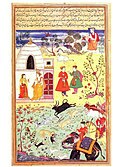
Years later, [[Dushyanta]], King of [[Hastinapur]] encounters Shakuntala in Kanva's hermitage while hunting in the forest. In the absence of Kanva, the two developed mutual affection and married according to the [[Gandharva marriage|Gandharva]] tradition. After spending some time together, Dushyanta returned to his kingdom, and Shakuntala became pregnant.<ref name=":0" /> | |||
[[File:Dusyanta meet shakuntala.jpg|thumb|Dushyanta meet Shakuntala, from a folio of [[Razmnama]], the 16th century Persian translation of the ''[[Mahabharata]]'' ]] | |||
Upon Kanva's return, he accepted the marriage as part of divine destiny. In due course, Shakuntala gave birth to a son, named [[Bharata (Mahabharata)|Sarvadamana]] due to his ability to suppress everyone, including animals like lions. Seeing the boy's prowess, Kanva decides it is time for Shakuntala to present him to Dushyanta. Shakuntala, with her son, is escorted by Kanva's students and reaches the royal court and introduces him to the king, urging him to fulfill his promise and acknowledge their child as his heir. | |||
Dushyanta, however, denies any memory of their union and dismisses Shakuntala's claim. Stunned, she quickly regains her composure and rebukes him for his dishonor. She reminds him that truth is the foundation of righteousness and warns that the gods, who witness all actions, will judge him. Despite her impassioned plea, Dushyanta refuses to accept the boy, mocking her lineage. At that moment, a celestial voice resounds from the heavens, confirming Shakuntala's words. It declares that the son is indeed Dushyanta's and must be recognized. The voice further proclaims that because the king is commanded to cherish him, the boy shall be named Bharata, meaning "the cherished one". Realizing his error, Dushyanta joyfully accepts his son and formally installs him as heir. Embracing Bharata, he seeks Shakuntala's forgiveness, explaining that he had only delayed recognition to ensure the child's legitimacy. Under Bharata's rule, the kingdom flourishes, and he becomes a legendary monarch, earning the title of ''[[Chakravartin|Chakravarti]]'', a universal ruler. His reign is marked by justice, prosperity, and grand sacrifices, including the horse sacrifice. From his name, the land of India comes to be known as ''Bharatavarsha'', cementing his legacy for generations to come.<ref name=":0" /> | |||
=== | ===''Abhijnanashakuntalam''=== | ||
[[File:Durvasa’s wrath against Shakuntala.jpg|alt=|left|272x272px|thumb|Kalidasa's version features much dramatized variant of the tale. One of Kalidasa's additions include the sage Durvasa cursing Shakuntala (pictured)]] | |||
Kalidasa reworked the story of Shakuntala into a dramatic form, introducing additional elements such as a curse and a lost signet ring to create a more complex narrative. Many scholars consider the Kalidasa's version more literary acclaimed and influential.<ref name=":0" /> | |||
In ''[[Shakuntala (play)|Abhijnanamshakuntalam]]'', Shakuntala is the daughter of Vishvamitra and Menaka, and is raised in Kanva's hermitage alongside her companions Anasuya and Priyamvada. She encounters Dushyanta during a hunting expedition. Captivated by her beauty, grace, and modesty, Dushyanta learns from her Anasuya and Priyamvada that she is of royal birth despite her upbringing in the ashram. Enamored by her, Dushyanta courts Shakuntala, and their mutual attraction blossoms into love. Overwhelmed by his emotions, Dushyanta convinces Shakuntala to marry him through the gandharva rite, a form of spontaneous union that does not require formal rituals or parental approval. The two consummate their love, and Dushyanta promises to return for her after fulfilling his royal duties. Before departing, he gives Shakuntala a signet ring as a token of remembrance.<ref>{{cite book|last1=Miller|first1=Barbara Stoler|title=Theater of Memory: The Plays of Kalidasa|date=1984|publisher=Columbia University Press|location=New York|page=122}}</ref> | |||
[[ | |||
Shakuntala | |||
While deeply engrossed in thoughts of Dushyanta, Shakuntala inadvertently offends the irascible sage Durvasa by failing to notice his arrival. Feeling slighted by her inattention, Durvasa curses her, declaring that the one she loves will forget her entirely. Although her companions plead for mercy, the sage, unable to revoke the curse, grants a reprieve: Dushyanta's memory will be restored only when he sees the token of their love. Unaware of the full consequences of the curse, Shakuntala waits for Dushyanta's return. When Kanva learns of her condition, he prepares for her departure to Dushyanta's court, entrusting her to his disciples Sharadvata and Sharngarava. Along the way, while crossing a river, Shakuntala accidentally loses the signet ring when it slips from her finger and falls into the water, unnoticed. | |||
[[File:Sakuntala leaving for his husband king Dushmanta's palace.jpg|thumb|left|Shakuntala leaving for her husband king Dushyanta's palace]] | |||
[[File:Sakuntala leaving for his husband king Dushmanta's palace.jpg|thumb|left| | |||
Upon reaching Dushyanta's palace, Shakuntala confidently presents herself as his wife. However, because of the curse, Dushyanta does not recognize her and denies any knowledge of their marriage. The courtiers regard her with suspicion, and without the ring as proof of her identity, her claims appear baseless. Humiliated and heartbroken, Shakuntala laments her fate. In an act of divine intervention, she is suddenly lifted away by celestial beings to her mother Menaka's realm in the heavens, sparing her further disgrace at court. Dushyanta, despite his rejection, is deeply unsettled by the encounter and feels an inexplicable sadness, though he cannot understand its cause. | |||
Time passes, and one day a fisherman catches a fish in whose stomach he finds the royal signet ring. Recognizing it as Dushyanta's, he returns it to the king. The moment Dushyanta sees the ring, his memories flood back, and he is struck with immense guilt and sorrow. Realizing that he has wronged Shakuntala, he is tormented by remorse and desperately seeks a way to reunite with her, but she has vanished, leaving him to wander in anguish. In his despair, Dushyanta embarks on a campaign to defeat a group of demons, earning divine favor along the way. During his journey, he arrives at the hermitage of the celestial sage Marichi, where he unexpectedly encounters a young boy playing with a lion cub. The child, fearless and noble, immediately captures Dushyanta's attention. The boy, named Bharata, is revealed to be his own son—a fact Dushyanta had not known. The sage explains that Bharata is indeed his son and that Shakuntala has been living in the celestial realm all along. At last, Dushyanta and Shakuntala are reunited, their love restored and strengthened by the trials they endured. Now a mature and dignified woman, Shakuntala forgives Dushyanta, and they are finally recognized as husband and wife.<ref name="auto"/><ref>{{Cite journal|last=Glass|first=Andrew|date=June 2010|title=Vasudeva, Somadeva (Ed. and Tr.), The Recognition of Shakúntala by Kālidāsa Olivelle, Patrick (Ed. and Tr.), The Five Discourses on Worldly Wisdom by Visnuśarman Mallinson, Sir James (Ed. and Tr.), The Emperor of the Sorcerers...|url=https://www.ebscohost.com|journal=Indo-Iranian Journal |doi=10.1163/001972409X12645171001532|url-access=subscription}}</ref><ref>{{Cite book|title=Shakuntala Recognized|last=Kalidasa|publisher=iUniverse|others=Translated by G.N. Reddy|year=2000|isbn=0595139809|location=Victoria, BC, Canada }}</ref><ref>{{Cite journal|last=Yousaf|first=Ghulam-Sarwar|date=2005|title=RELIGIOUS AND SPIRITUAL VALUES IN KALIDASA'S SHAKUNTALA|url=https://www.academia.edu/10239314|journal=Katha|access-date=March 8, 2016}}</ref> | |||
{| class="wikitable" style="margin:0 auto;" align="center" colspan="2" cellpadding="3" style="font-size: 80%; width: 100%;" | {| class="wikitable" style="margin:0 auto;" align="center" colspan="2" cellpadding="3" style="font-size: 80%; width: 100%;" | ||
|align=center colspan=2 style="background:#F4A460; font-size: 100%;"| '''Ancient renditions of the myth of Shakuntala (2nd century | |align=center colspan=2 style="background:#F4A460; font-size: 100%;"| '''Ancient renditions of the myth of Shakuntala (2nd century BC, [[Shunga Empire|Shunga]] period)''' | ||
|- | |- | ||
| | | | ||
<gallery mode="packed" heights="130px"> | <gallery mode="packed" heights="130px"> | ||
File:Shakuntala plaque from Bhita.jpg|The Bhita plaque | File:Shakuntala plaque from Bhita.jpg|The Bhita plaque | ||
Ai Khanoum Indian plate reconstitution.jpg|The Indian plaque of [[Ai Khanoum]] | Ai Khanoum Indian plate reconstitution.jpg|The Indian plaque of [[Ai-Khanoum]] | ||
File: Kulu vase drawing detail.jpg|The Kulu | File: Kulu vase drawing detail.jpg|The [[Kulu Vase]] | ||
</gallery> | </gallery> | ||
|} | |} | ||
== | ==Influence== | ||
===Arts=== | |||
====Raja Ravi Varma==== | |||
[[File:Raja_Ravi_Varma_-_Mahabharata_-_Shakuntala.jpg|thumb|Shakuntala has inspired many artworks, including [[Raja Ravi Varma]]'s ''[[Shakuntala (painting)|Shakuntala looking for Dushyanta]]'', depicting her pretending thorn removal from feet while looking for Dushyanta.]] | |||
[[Raja Ravi Varma]] was widely praised for his ability to merge the Western academic painting style with Indian themes. In the 1870s, as he began creating narrative paintings, he drew inspiration from India's classical heritage—drawing upon the epics, Puranas, and Kalidasa's plays. His first major work featuring Shakuntala, ''[[Shakuntala Patra-lekhan|Shakuntala Patralekhan]]'' (Shakuntala Writing a Love Letter to Dushyanta), was painted for the 1876 Madras exhibition. The painting, which depicted Shakuntala lying on the forest floor in a yellow sari, surrounded by her friends and animal companions, won a gold medal and garnered widespread acclaim. It was immediately purchased by the Duke of Buckingham, then Governor of Madras. Though the location of the original painting remains unknown, it was widely reproduced in books and lithographs, including the 1903 publication Ravi Varma: The Indian Artist. Given the colonial fascination with the ''Abhijnanasakuntalam'' narrative at the time, Varma was encouraged to create multiple renditions of Shakuntala. His later works included Shakuntala (1888, Maharaja Fatehsingh Museum, Baroda), Shakuntala (1898, Government Museum, Madras), and ''[[Shakuntala (Raja Ravi Varma)|Shakuntala Looking for Dushyanta]]'' (1898, Shri Chitra Art Gallery, Trivandrum). One of his Shakuntala paintings was even selected as the frontispiece for [[Monier-Williams]]' 1887 edition of Kalidasa's play.<ref name=":1">{{Cite book |last=McLain |first=Karline |url=https://books.google.com/books?id=V4-Su0whKa0C&q=shakuntala+&pg=PA64 |title=India's Immortal Comic Books: Gods, Kings, and Other Heroes |date=2009-03-04 |publisher=Indiana University Press |isbn=978-0-253-22052-3 |language=en}}</ref> His most famous painting, ''Shakuntala Looking for Dushyanta'' captures the moment when she feigns removing a thorn from her foot while actually glancing back to see if Dushyanta notices her.<ref>Prabhu, K. (2022). Contribution of Raja Ravi Varma in Retelling the Religious and Mythological Themes through Paintings. All Studies Journal, 7(4). </ref> | |||
Varma's works were equally admired by Orientalists and Indian nationalists. In 1895, Varma's first lithographic print, The Birth of Shakuntala, won the "Best Lithograph" prize at the Bombay Art Society's annual exhibition. The choice of this subject was highly symbolic; by this time, Shakuntala had come to represent an idealized vision of Indian womanhood. Within the context of colonial modernity, her birth was seen not just as the emergence of India's ancestral matriarch but also as a metaphorical rebirth of the ideal Hindu woman—an embodiment of the virtues that both [[Orientalists]] and [[Indian nationalists]] sought to define in the image of the "modern" Indian woman.<ref name=":1" /> | |||
===Sculpture=== | |||
[[Camille Claudel]] created a sculpture ''[[Sakuntala (Claudel)|Shakuntala]]''.<ref>{{Cite web |url=http://www.musee-rodin.fr/en/exhibition/camille-claudel |title=CAMILLE CLAUDEL FROM 1 OCTOBER TO 5 JANUARY CAMILLE CLAUDEL COMES OUT OF THE RESERVE COLLECTIONS |publisher=Musée Rodin |access-date=2018-02-22}}</ref> | |||
===Theatre, literature and music=== | ===Theatre, literature and music=== | ||
====Opera==== | ====Opera==== | ||
{{See also|Sakuntala (opera)|Sakùntala}} | {{See also|Sakuntala (opera)|Sakùntala}} | ||
''[[Sakuntala (opera)|Sakuntala]]'' is an incomplete opera by [[Franz Schubert]], which | ''[[Sakuntala (opera)|Sakuntala]]'' is an incomplete opera by [[Franz Schubert]], which was started in October 1820.<ref>{{cite book |last1=Badura-Skoda |first1=For Royalties and Contract Only Eva |title=Schubert Studies: Problems of Style and Chronology |date=23 September 1982 |publisher=CUP Archive |isbn=978-0-521-22606-6 |page=318 |url=https://books.google.com/books?id=jM88AAAAIAAJ |access-date=25 June 2022 |language=en}}</ref> In 1884 the first Opera of the 21-year-old Austrian composer [[Felix Weingartner]] had its debut performance in Weimar and was supported by Franz Liszt to bring it to stage. Italian [[Franco Alfano]] composed an [[opera]] named ''[[La leggenda di Sakùntala]]'' (''The legend of Shakuntala'') in its first version ([[1921 in music#Opera|1921]]) <ref>{{cite book |last1=Grout |first1=Donald J. |last2=Williams |first2=Hermine Weigel |title=A Short History of Opera |date=18 July 2003 |publisher=Columbia University Press |isbn=978-0-231-50772-1 |page=605 |url=https://books.google.com/books?id=2xXZhKagLO4C |access-date=25 June 2022 |language=en}}</ref> and simply ''[[Sakùntala]]'' in its second version ([[1952 in music#Opera|1952]]).<ref>{{cite book |last1=Bagnoli |first1=Giorgio |title=The La Scala Encyclopedia of the Opera |date=1993 |publisher=Simon and Schuster |isbn=978-0-671-87042-3 |page=215 |url=https://books.google.com/books?id=FUJ0bvo6rQIC |language=en}}</ref> | ||
====Ballet==== | ====Ballet==== | ||
* Ernest Reyer (1823–1909) composed a ballet ''Sacountala'' on | * [[Ernest Reyer]] (1823–1909) composed a ballet ''Sacountala'' on a work by Théophile Gautier in 1838.<ref>{{cite book |last1=Grove |first1=George |title=A Dictionary of Music and Musicians: (A.D. 1450-1880) |date=1883 |publisher=Macmillan |page=122 |url=https://books.google.com/books?id=oR2LKcIyX1QC&dq=sacountala+Th%C3%A9ophile+Gautier&pg=PA122 |language=en}}</ref><ref>{{cite book |last1=Thapar |first1=Romila |title=Sakuntala: Texts, Readings, Histories |date=12 April 2011 |publisher=Columbia University Press |isbn=978-0-231-52702-6 |page=207 |url=https://books.google.com/books?id=sY2o_SE1MisC |language=en}}</ref> | ||
* The Soviet composer [[Sergey Balasanian]] (1902–1982) composed a ballet named Shakuntala (premiere 28 December 1963, Riga).<ref>{{cite book|last1=Hakobian|first1=Levon|title=Music of the Soviet Era: 1917–1991|date=25 November 2016|publisher=Taylor & Francis|page=387|isbn=9781317091875|url=https://books.google.com/books?id=eiolDwAAQBAJ&pg=PA387|access-date=19 March 2018}}</ref> | * The Soviet composer [[Sergey Balasanian]] (1902–1982) composed a ballet named Shakuntala (premiere 28 December 1963, Riga).<ref>{{cite book|last1=Hakobian|first1=Levon|title=Music of the Soviet Era: 1917–1991|date=25 November 2016|publisher=Taylor & Francis|page=387|isbn=9781317091875|url=https://books.google.com/books?id=eiolDwAAQBAJ&pg=PA387|access-date=19 March 2018}}</ref> | ||
====Other literature==== | ====Other literature==== | ||
[[Ishwar Chandra Vidyasagar]] created a novel in [[Sadhu | [[Ishwar Chandra Vidyasagar]] created a novel in [[Sadhu bhasha]], Bengali.{{citation needed|date=August 2017}} It was among the first translations from [[Bengali language|Bengali]].{{citation needed|date=August 2017}} [[Abanindranath Tagore]] later wrote in the [[Chalit Bhasa]] (which is a simpler literary variation of [[Bengali language|Bengali]]) mainly for children and preteens.{{citation needed|date=August 2017}} | ||
By the 18th century, Western poets were beginning to get acquainted with works of Indian literature and [[Indian philosophy|philosophy]]. {{citation needed|date=August 2017}} The German poet [[Goethe]] read Kalidasa's play and has expressed his admiration for the work{{Original research inline|date=August 2017}} in the following verses: | By the 18th century, Western poets were beginning to get acquainted with works of Indian literature and [[Indian philosophy|philosophy]]. {{citation needed|date=August 2017}} The German poet [[Goethe]] read Kalidasa's play and has expressed his admiration for the work{{Original research inline|date=August 2017}} in the following verses: | ||
| Line 94: | Line 98: | ||
Wouldst thou the earth and heaven itself in one sole name combine? | Wouldst thou the earth and heaven itself in one sole name combine? | ||
I name thee, O Sakuntala! and all at once is said. | I name thee, O Sakuntala! and all at once is said. | ||
|attr2=translation by [[Edward | |attr2=translation by [[Edward Eastwick]]<ref>{{cite web|url=https://www.huffingtonpost.com/alka-pratap/hinduisms-influence-on-indian-poetry_b_9124050.html|title=Hinduism's Influence on Indian Poetry|first=Alka|last=Pratap|website=[[HuffPost]]|date=2 February 2016}}</ref>}} | ||
In 1808 [[ | In 1808 [[Friedrich Schlegel]] published a German translation of the Shakuntala story from the ''Mahabharata''.<ref>Figueira 1991, [https://books.google.com/books?id=aN_U4bJvrRMC&pg=PA19 pp. 19–20]</ref> | ||
===Film and TV=== | ===Film and TV=== | ||
A significant number of Indian films have been made on the story of Shakuntala. These include: [[Shakuntala (1920 film)|''Shakuntala'']] (1920) by Suchet Singh, ''Shakuntala'' (1920) by [[ | A significant number of Indian films have been made on the story of Shakuntala. These include: [[Shakuntala (1920 film)|''Shakuntala'']] (1920) by Suchet Singh, ''Shakuntala'' (1920) by [[S. N. Patankar]], ''Shakuntala'' (1929) by [[Fatma Begum]], ''Shakuntala'' (1931) by Mohan Dayaram Bhavnani, ''Shakuntala'' (1931) by [[J.J. Madan]], [[Sakunthala (1932 film)|''Sakunthala'']] (1932) by [[Sarvottam Badami]], ''Shakuntala'' (1932), [[Sakuntalai|''Shakuntala'']] (1940) by [[Ellis Dungan]], ''Shakuntala'' (1941) by Jyotish Bannerjee, [[Shakuntala (1943 film)|Shakuntala]] (1943) by [[V. Shantaram]], ''Shakuntala'' (1961) by [[Bhupen Hazarika]], [[Shakuntala (1965 film)|''Shakuntala'']] (1965) by [[Kunchacko]], [[Sakunthala (1966 film)|''Sakunthala'']] (1966) by [[Kamalakara Kameswara Rao]], [[Stree (1961 film)|''Stree'']] by V. Shantaram.<ref name="RajadhyakshaWillemen1999">{{cite book|last1=Rajadhyaksha|first1=Ashish|last2=Willemen|first2=Paul|title=Encyclopaedia of Indian cinema|url=https://archive.org/details/encyclopaediaofi0000raja|url-access=registration|access-date=12 August 2012|year=1999|publisher=British Film Institute|isbn=9780851706696}}</ref> | ||
The 2009 Indian television show, [[Shakuntala (TV series)|''Shakuntala'']], was an adaptation of the play by Kalidasa. | The 2009 Indian television show, [[Shakuntala (TV series)|''Shakuntala'']], was an adaptation of the play by Kalidasa. | ||
| Line 134: | Line 138: | ||
|- | |- | ||
|1932 | |1932 | ||
|'' | |''[[Sakunthala (1932 film)|Sakunthala]]'' | ||
|[[Surabhi Kamalabai]] | |[[Surabhi Kamalabai]] | ||
|[[Sarvottam Badami]] | |[[Sarvottam Badami]] | ||
| Line 189: | Line 193: | ||
|- | |- | ||
|1991 | |1991 | ||
|''[[Brahmarshi | |''[[Brahmarshi Viswamitra]]'' | ||
|Madhumita | |Madhumita | ||
|[[N. T. Rama Rao]] | |[[N. T. Rama Rao]] | ||
| Line 208: | Line 212: | ||
|[[Dushyanth Sridhar]] | |[[Dushyanth Sridhar]] | ||
|- | |- | ||
| | |2023 | ||
|''[[Shaakuntalam]]'' | |||
|[[Samantha Ruth Prabhu]] | |[[Samantha Ruth Prabhu|Samantha]] | ||
|[[Gunasekhar]] | |[[Gunasekhar]] | ||
|} | |} | ||
==References== | ==References== | ||
| Line 224: | Line 225: | ||
* [[Romila Thapar]]. ''Sakuntala: Texts, Readings, Histories''. Columbia University Press, 2011. {{ISBN|0231156553}} | * [[Romila Thapar]]. ''Sakuntala: Texts, Readings, Histories''. Columbia University Press, 2011. {{ISBN|0231156553}} | ||
* [[Vyasa]]. ''[[Mahabharata]]''. | * [[Vyasa]]. ''[[Mahabharata]]''. | ||
* https://m.youtube.com/watch?v=N5eTQewvteg&t=110s | |||
==External links== | ==External links== | ||
| Line 229: | Line 231: | ||
{{Wikiquote}} | {{Wikiquote}} | ||
{{Authority control}} | {{Authority control}} | ||
{{Mahābhārata}} | |||
[[Category:Characters in the Mahabharata]] | [[Category:Characters in the Mahabharata]] | ||
[[Category: | [[Category:Queens in Hindu mythology]] | ||
Latest revision as of 01:57, 22 March 2026
| Shakuntala | |
|---|---|
.jpg) Shakuntala writing a love letter to Dushyanta, a scene from the play painted by Raja Ravi Varma | |
| Personal Information | |
| Family | Vishvamitra (father) Menaka (mother) Kanva (adoptive father) |
| Spouse | Dushyanta |
| Children | Bharata |
Shakuntala (Sanskrit: शकुन्तला, romanized: Śakuntalā) is a heroine in ancient Indian literature, best known for her portrayal in the ancient Sanskrit play Abhijnanashakuntalam (The Recognition of Shakuntala), written by the classical poet Kalidasa in the 4th or 5th century AD. Her story, however, originates in the Hindu epic, the Mahabharata (c. 400 BC - 400 AD), where she appears in the Adi Parva ("The Book of Beginnings"). In both narratives, Shakuntala is the daughter of the sage Vishvamitra and the celestial nymph Menaka. Abandoned at birth, she is raised by the sage Kanva in a forest hermitage. She later falls in love with King Dushyanta and becomes the mother of Bharata, a celebrated emperor of India.[1]
In the Mahabharata, Shakuntala introduces herself to Dushyanta when he visits her hermitage during a hunting expedition in the absence of her foster father, Kanva. The two fall in love and secretly marry according to the Gandharva tradition (a love marriage), consummating their union in the forest. Afterward, Dushyanta returns to his palace life and gradually forgets about Shakuntala. Years later, she approaches him with their son, Bharata, but he hesitates to acknowledge them. Outspoken and fearless, Shakuntala rebukes him forcefully until a celestial voice intervenes to confirm the truth, compelling Dushyanta to accept her and their son.
Abhijnanashakuntalam dramatizes the story with poetic elegance but reimagines Shakuntala as a more passive and naive figure. In this version, her introduction to King Dushyanta is made by her friends, Priyamvada and Anasuya. After Dushyanta departs from the hermitage, Shakuntala, lost in thoughts of him, fails to greet the irascible sage Durvasa, who curses her so that Dushyanta will forget her entirely. The curse can only be lifted if he sees a token of their love—a signet ring he had given her. The now-pregnant Shakuntala journeys to the palace, but she loses the ring in a river and is rejected by Dushyanta, who fails to recognise her. Humiliated and abandoned, she is lifted away by celestial beings to her divine mother Menaka's abode. The lost ring is later found in a fish's belly and returned to Dushyanta, restoring his memory. Overcome with remorse, he longs for Shakuntala, and in time, reunites with her—now with their son, Bharata.
Shakuntala has long been regarded as a significant cultural figure and a symbol of Indian womanhood, inspiring numerous literary, artistic, and visual adaptations. In modern scholarship, the contrast between her portrayals in the Mahabharata and Abhijnanashakuntalam is frequently highlighted, particularly in discussions of gender, agency, and narrative tone.
Legend[edit | edit source]

There are two different stories of Shakuntala's life. The first version is the one described in Mahabharata, one of the two major Hindu epics traditionally attributed to the sage Vyasa. This story had been adapted as the play by the 4th–5th century AD poet Kalidasa.[2]
Mahabharata[edit | edit source]
According to Vyasa's Mahabharata, Sage Vishvamitra undertakes intense penance to attain the status of a Brahmarshi. Concerned by the severity of his meditation, Indra (king of gods) fears a potential challenge to his authority and seeks to disrupt his penance. To this end, he dispatches Menaka, an apsara, to distract him. Menaka arrives at Vishvamitra's meditation site and engages him in conversation, ultimately leading him away from his ascetic practice. Vishvamitra and Menaka reside together for a period, during which a daughter is born. In time, Vishvamitra discerns Indra's intervention and resolves to resume his ascetic pursuits. He departs, and Menaka, before returning to heaven, leaves the child near the hermitage of Sage Kanva. Sage Kanva discovers the infant surrounded by śakunta birds and names her Shakuntala, signifying "one protected by śakunta".[3][2]
In the Adi Parva of Mahabharata, Kanva says:
She was surrounded in the solitude of the wilderness by śakuntas,
therefore, hath she been named by me Shakuntala (Shakunta-protected).[4][5]
Years later, Dushyanta, King of Hastinapur encounters Shakuntala in Kanva's hermitage while hunting in the forest. In the absence of Kanva, the two developed mutual affection and married according to the Gandharva tradition. After spending some time together, Dushyanta returned to his kingdom, and Shakuntala became pregnant.[2]

Upon Kanva's return, he accepted the marriage as part of divine destiny. In due course, Shakuntala gave birth to a son, named Sarvadamana due to his ability to suppress everyone, including animals like lions. Seeing the boy's prowess, Kanva decides it is time for Shakuntala to present him to Dushyanta. Shakuntala, with her son, is escorted by Kanva's students and reaches the royal court and introduces him to the king, urging him to fulfill his promise and acknowledge their child as his heir.
Dushyanta, however, denies any memory of their union and dismisses Shakuntala's claim. Stunned, she quickly regains her composure and rebukes him for his dishonor. She reminds him that truth is the foundation of righteousness and warns that the gods, who witness all actions, will judge him. Despite her impassioned plea, Dushyanta refuses to accept the boy, mocking her lineage. At that moment, a celestial voice resounds from the heavens, confirming Shakuntala's words. It declares that the son is indeed Dushyanta's and must be recognized. The voice further proclaims that because the king is commanded to cherish him, the boy shall be named Bharata, meaning "the cherished one". Realizing his error, Dushyanta joyfully accepts his son and formally installs him as heir. Embracing Bharata, he seeks Shakuntala's forgiveness, explaining that he had only delayed recognition to ensure the child's legitimacy. Under Bharata's rule, the kingdom flourishes, and he becomes a legendary monarch, earning the title of Chakravarti, a universal ruler. His reign is marked by justice, prosperity, and grand sacrifices, including the horse sacrifice. From his name, the land of India comes to be known as Bharatavarsha, cementing his legacy for generations to come.[2]
Abhijnanashakuntalam[edit | edit source]

Kalidasa reworked the story of Shakuntala into a dramatic form, introducing additional elements such as a curse and a lost signet ring to create a more complex narrative. Many scholars consider the Kalidasa's version more literary acclaimed and influential.[2]
In Abhijnanamshakuntalam, Shakuntala is the daughter of Vishvamitra and Menaka, and is raised in Kanva's hermitage alongside her companions Anasuya and Priyamvada. She encounters Dushyanta during a hunting expedition. Captivated by her beauty, grace, and modesty, Dushyanta learns from her Anasuya and Priyamvada that she is of royal birth despite her upbringing in the ashram. Enamored by her, Dushyanta courts Shakuntala, and their mutual attraction blossoms into love. Overwhelmed by his emotions, Dushyanta convinces Shakuntala to marry him through the gandharva rite, a form of spontaneous union that does not require formal rituals or parental approval. The two consummate their love, and Dushyanta promises to return for her after fulfilling his royal duties. Before departing, he gives Shakuntala a signet ring as a token of remembrance.[6]
While deeply engrossed in thoughts of Dushyanta, Shakuntala inadvertently offends the irascible sage Durvasa by failing to notice his arrival. Feeling slighted by her inattention, Durvasa curses her, declaring that the one she loves will forget her entirely. Although her companions plead for mercy, the sage, unable to revoke the curse, grants a reprieve: Dushyanta's memory will be restored only when he sees the token of their love. Unaware of the full consequences of the curse, Shakuntala waits for Dushyanta's return. When Kanva learns of her condition, he prepares for her departure to Dushyanta's court, entrusting her to his disciples Sharadvata and Sharngarava. Along the way, while crossing a river, Shakuntala accidentally loses the signet ring when it slips from her finger and falls into the water, unnoticed.

Upon reaching Dushyanta's palace, Shakuntala confidently presents herself as his wife. However, because of the curse, Dushyanta does not recognize her and denies any knowledge of their marriage. The courtiers regard her with suspicion, and without the ring as proof of her identity, her claims appear baseless. Humiliated and heartbroken, Shakuntala laments her fate. In an act of divine intervention, she is suddenly lifted away by celestial beings to her mother Menaka's realm in the heavens, sparing her further disgrace at court. Dushyanta, despite his rejection, is deeply unsettled by the encounter and feels an inexplicable sadness, though he cannot understand its cause.
Time passes, and one day a fisherman catches a fish in whose stomach he finds the royal signet ring. Recognizing it as Dushyanta's, he returns it to the king. The moment Dushyanta sees the ring, his memories flood back, and he is struck with immense guilt and sorrow. Realizing that he has wronged Shakuntala, he is tormented by remorse and desperately seeks a way to reunite with her, but she has vanished, leaving him to wander in anguish. In his despair, Dushyanta embarks on a campaign to defeat a group of demons, earning divine favor along the way. During his journey, he arrives at the hermitage of the celestial sage Marichi, where he unexpectedly encounters a young boy playing with a lion cub. The child, fearless and noble, immediately captures Dushyanta's attention. The boy, named Bharata, is revealed to be his own son—a fact Dushyanta had not known. The sage explains that Bharata is indeed his son and that Shakuntala has been living in the celestial realm all along. At last, Dushyanta and Shakuntala are reunited, their love restored and strengthened by the trials they endured. Now a mature and dignified woman, Shakuntala forgives Dushyanta, and they are finally recognized as husband and wife.[1][7][8][9]
| Ancient renditions of the myth of Shakuntala (2nd century BC, Shunga period) | |
| |


Influence[edit | edit source]
Arts[edit | edit source]
Raja Ravi Varma[edit | edit source]

Raja Ravi Varma was widely praised for his ability to merge the Western academic painting style with Indian themes. In the 1870s, as he began creating narrative paintings, he drew inspiration from India's classical heritage—drawing upon the epics, Puranas, and Kalidasa's plays. His first major work featuring Shakuntala, Shakuntala Patralekhan (Shakuntala Writing a Love Letter to Dushyanta), was painted for the 1876 Madras exhibition. The painting, which depicted Shakuntala lying on the forest floor in a yellow sari, surrounded by her friends and animal companions, won a gold medal and garnered widespread acclaim. It was immediately purchased by the Duke of Buckingham, then Governor of Madras. Though the location of the original painting remains unknown, it was widely reproduced in books and lithographs, including the 1903 publication Ravi Varma: The Indian Artist. Given the colonial fascination with the Abhijnanasakuntalam narrative at the time, Varma was encouraged to create multiple renditions of Shakuntala. His later works included Shakuntala (1888, Maharaja Fatehsingh Museum, Baroda), Shakuntala (1898, Government Museum, Madras), and Shakuntala Looking for Dushyanta (1898, Shri Chitra Art Gallery, Trivandrum). One of his Shakuntala paintings was even selected as the frontispiece for Monier-Williams' 1887 edition of Kalidasa's play.[10] His most famous painting, Shakuntala Looking for Dushyanta captures the moment when she feigns removing a thorn from her foot while actually glancing back to see if Dushyanta notices her.[11]
Varma's works were equally admired by Orientalists and Indian nationalists. In 1895, Varma's first lithographic print, The Birth of Shakuntala, won the "Best Lithograph" prize at the Bombay Art Society's annual exhibition. The choice of this subject was highly symbolic; by this time, Shakuntala had come to represent an idealized vision of Indian womanhood. Within the context of colonial modernity, her birth was seen not just as the emergence of India's ancestral matriarch but also as a metaphorical rebirth of the ideal Hindu woman—an embodiment of the virtues that both Orientalists and Indian nationalists sought to define in the image of the "modern" Indian woman.[10]
Sculpture[edit | edit source]
Camille Claudel created a sculpture Shakuntala.[12]
Theatre, literature and music[edit | edit source]
Opera[edit | edit source]
Sakuntala is an incomplete opera by Franz Schubert, which was started in October 1820.[13] In 1884 the first Opera of the 21-year-old Austrian composer Felix Weingartner had its debut performance in Weimar and was supported by Franz Liszt to bring it to stage. Italian Franco Alfano composed an opera named La leggenda di Sakùntala (The legend of Shakuntala) in its first version (1921) [14] and simply Sakùntala in its second version (1952).[15]
Ballet[edit | edit source]
- Ernest Reyer (1823–1909) composed a ballet Sacountala on a work by Théophile Gautier in 1838.[16][17]
- The Soviet composer Sergey Balasanian (1902–1982) composed a ballet named Shakuntala (premiere 28 December 1963, Riga).[18]
Other literature[edit | edit source]
Ishwar Chandra Vidyasagar created a novel in Sadhu bhasha, Bengali.[citation needed] It was among the first translations from Bengali.[citation needed] Abanindranath Tagore later wrote in the Chalit Bhasa (which is a simpler literary variation of Bengali) mainly for children and preteens.[citation needed]
By the 18th century, Western poets were beginning to get acquainted with works of Indian literature and philosophy. [citation needed] The German poet Goethe read Kalidasa's play and has expressed his admiration for the work[original research?] in the following verses:
Willst du die Blüthe des frühen, die Früchte des späteren Jahres, |
Wouldst thou the young year's blossoms and the fruits of its decline |
| —Goethe, 1791[19] | —translation by Edward Eastwick[20] |
In 1808 Friedrich Schlegel published a German translation of the Shakuntala story from the Mahabharata.[21]
Film and TV[edit | edit source]
A significant number of Indian films have been made on the story of Shakuntala. These include: Shakuntala (1920) by Suchet Singh, Shakuntala (1920) by S. N. Patankar, Shakuntala (1929) by Fatma Begum, Shakuntala (1931) by Mohan Dayaram Bhavnani, Shakuntala (1931) by J.J. Madan, Sakunthala (1932) by Sarvottam Badami, Shakuntala (1932), Shakuntala (1940) by Ellis Dungan, Shakuntala (1941) by Jyotish Bannerjee, Shakuntala (1943) by V. Shantaram, Shakuntala (1961) by Bhupen Hazarika, Shakuntala (1965) by Kunchacko, Sakunthala (1966) by Kamalakara Kameswara Rao, Stree by V. Shantaram.[22]
The 2009 Indian television show, Shakuntala, was an adaptation of the play by Kalidasa.
| Year | Films and Television Shows | Portrayed by | Directed by |
|---|---|---|---|
| 1920 | Shakuntala | Dorothy Kingdom | Suchet Singh |
| 1920 | Shakuntala | Shree Nath Patankar | |
| 1929 | Shakuntala | Fatma Begum | |
| 1931 | Shakuntala | Khurshid Begum | Mohan Dayaram Bhavnani |
| 1931 | Shakuntala | J.J. Madan | |
| 1932 | Sakunthala | Surabhi Kamalabai | Sarvottam Badami |
| 1940 | Sakuntalai | M. S. Subbulakshmi | Ellis R. Dungan |
| 1941 | Shakuntala | Jyotsna Gupta | Jyotish Bannerjee |
| 1943 | Shakuntala | Jayashree | V. Shantaram |
| 1961 | Shakuntala | Amala Katarki | Bhupen Hazarika |
| 1961 | Stree | Sandhya Shantaram | V. Shantaram |
| 1965 | Sakunthala | K. R. Vijaya | Kunchacko |
| 1966 | Shakuntala | K. R. Vijaya | Kamalakara Kameswara Rao |
| 1985 | Anantyatra | Anuradha Patel | Jayoo Patwardhan, Nachiket Patwardhan |
| 1985 | Raja Rishi | Nalini | K. Shankar |
| 1988 | Bharat Ek Khoj | Pallavi Joshi | Shyam Benegal |
| 1991 | Brahmarshi Viswamitra | Madhumita | N. T. Rama Rao |
| 2000 | Gaja Gamini | Madhuri Dixit | M. F. Husain |
| 2009 | Shakuntala | Neha Mehta | Various |
| 2021 | Sakuntalam 
|
Payal Shetty | Dushyanth Sridhar |
| 2023 | Shaakuntalam | Samantha | Gunasekhar |
References[edit | edit source]
- ↑ 1.0 1.1 "Shakuntala - the Epitome of Beauty, Patience and Virtue". Dolls of India. 16 September 2011. Retrieved 8 March 2016.
- ↑ 2.0 2.1 2.2 2.3 2.4 www.wisdomlib.org (28 January 2019). "Story of Śakuntalā". www.wisdomlib.org. Retrieved 8 February 2025.
- ↑ Sattar, Arshia (22 June 2017). "The ultimate male fantasy". The Hindu. ISSN 0971-751X. Retrieved 5 September 2020.
- ↑ "The Mahabharata, Book 1: Adi Parva: Sambhava Parva: Section LXXII". www.sacred-texts.com.
- ↑ "The Mahabharata in Sanskrit: Book 1: Chapter 66". www.sacred-texts.com.
- ↑ Miller, Barbara Stoler (1984). Theater of Memory: The Plays of Kalidasa. New York: Columbia University Press. p. 122.
- ↑ Glass, Andrew (June 2010). "Vasudeva, Somadeva (Ed. and Tr.), The Recognition of Shakúntala by Kālidāsa Olivelle, Patrick (Ed. and Tr.), The Five Discourses on Worldly Wisdom by Visnuśarman Mallinson, Sir James (Ed. and Tr.), The Emperor of the Sorcerers...". Indo-Iranian Journal. doi:10.1163/001972409X12645171001532.
- ↑ Kalidasa (2000). Shakuntala Recognized. Translated by G.N. Reddy. Victoria, BC, Canada: iUniverse. ISBN 0595139809.
- ↑ Yousaf, Ghulam-Sarwar (2005). "RELIGIOUS AND SPIRITUAL VALUES IN KALIDASA'S SHAKUNTALA". Katha. Retrieved 8 March 2016.
- ↑ 10.0 10.1 McLain, Karline (4 March 2009). India's Immortal Comic Books: Gods, Kings, and Other Heroes. Indiana University Press. ISBN 978-0-253-22052-3.
- ↑ Prabhu, K. (2022). Contribution of Raja Ravi Varma in Retelling the Religious and Mythological Themes through Paintings. All Studies Journal, 7(4).
- ↑ "CAMILLE CLAUDEL FROM 1 OCTOBER TO 5 JANUARY CAMILLE CLAUDEL COMES OUT OF THE RESERVE COLLECTIONS". Musée Rodin. Retrieved 22 February 2018.
- ↑ Badura-Skoda, For Royalties and Contract Only Eva (23 September 1982). Schubert Studies: Problems of Style and Chronology. CUP Archive. p. 318. ISBN 978-0-521-22606-6. Retrieved 25 June 2022.
- ↑ Grout, Donald J.; Williams, Hermine Weigel (18 July 2003). A Short History of Opera. Columbia University Press. p. 605. ISBN 978-0-231-50772-1. Retrieved 25 June 2022.
- ↑ Bagnoli, Giorgio (1993). The La Scala Encyclopedia of the Opera. Simon and Schuster. p. 215. ISBN 978-0-671-87042-3.
- ↑ Grove, George (1883). A Dictionary of Music and Musicians: (A.D. 1450-1880). Macmillan. p. 122.
- ↑ Thapar, Romila (12 April 2011). Sakuntala: Texts, Readings, Histories. Columbia University Press. p. 207. ISBN 978-0-231-52702-6.
- ↑ Hakobian, Levon (25 November 2016). Music of the Soviet Era: 1917–1991. Taylor & Francis. p. 387. ISBN 9781317091875. Retrieved 19 March 2018.
- ↑ "Goethe - Gedichte: Sakontala". www.textlog.de.
- ↑ Pratap, Alka (2 February 2016). "Hinduism's Influence on Indian Poetry". HuffPost.
- ↑ Figueira 1991, pp. 19–20
- ↑ Rajadhyaksha, Ashish; Willemen, Paul (1999). Encyclopaedia of Indian cinema. British Film Institute. ISBN 9780851706696. Retrieved 12 August 2012.
Sources[edit | edit source]
- Dorothy Matilda Figueira. Translating the Orient: The Reception of Sakuntala in Nineteenth-Century Europe. SUNY Press, 1991. ISBN 0791403270
- Romila Thapar. Sakuntala: Texts, Readings, Histories. Columbia University Press, 2011. ISBN 0231156553
- Vyasa. Mahabharata.
- https://m.youtube.com/watch?v=N5eTQewvteg&t=110s