


Ajay Kumar (talk | contribs) Created a new article |
fix lead for consistency and improved wording for consistency |
||
| Line 3: | Line 3: | ||
{{Use Indian English|date=January 2020}} | {{Use Indian English|date=January 2020}} | ||
{{Speciesbox | {{Speciesbox | ||
| image = | | image = Dawkinsia denisonii specimen Natural History Museum University of Pisa (cropped).jpg | ||
| status = EN | | status = EN | ||
| status_system = IUCN3.1 | | status_system = IUCN3.1 | ||
| status_ref = <ref name="iucn status 18 November 2021">{{cite iucn |author=Ali, A. |author2=Raghavan, R. |author3=Dahanukar, N. |date=2015 |title=''Sahyadria denisonii'' |volume=2015 | | | status_ref = <ref name="iucn status 18 November 2021">{{cite iucn |author=Ali, A. |author2=Raghavan, R. |author3=Dahanukar, N. |date=2015 |title=''Sahyadria denisonii'' |volume=2015 |article-number=e.T169662A70082469 |doi=10.2305/IUCN.UK.2015-1.RLTS.T169662A70082469.en |access-date=18 November 2021}}</ref> | ||
| taxon = | | taxon = Dawkinsia denisonii | ||
| authority = ([[Francis Day|F. Day]], 1865) | | authority = ([[Francis Day|F. Day]], 1865) | ||
| synonyms = | | synonyms ={{Specieslist | ||
|Labeo denisonii|F. Day, 1865 | |||
|Barbus denisonii|(F. Day, 1865) | |||
|Crossocheilus denisonii|(F. Day, 1865) | |||
|Puntius denisonii|(F. Day, 1865) | |||
|Sahyadria denisonii|(F. Day, 1865) | |||
}} | |||
}} | }} | ||
[[File:Pdenisonii.jpg|thumb|250px|right]][[File:Cyprinidae Sahyadria denisonii 1.2.jpg|thumb]] | [[File:Pdenisonii.jpg|thumb|250px|right]][[File:Cyprinidae Sahyadria denisonii 1.2.jpg|thumb]] | ||
The '''Denison barb''', '''Denison's barb''', '''Miss Kerala''', '''red-line torpedo barb''', or '''roseline shark''' (''''' | |||
The '''Denison barb''', '''Denison's barb''', '''Miss Kerala''', '''red-line torpedo barb''', or '''roseline shark''' ('''''Dawkinsia denisonii''''') is an endangered [[species]] of [[cyprinid]] [[fish]] [[Endemism|endemic]] to the fast-flowing hill streams and rivers of the [[Western Ghats]] in [[India]].<ref name=fishbase>{{FishBase species |genus= Dawkinsia |species= denisonii |month = October |year = 2013}}</ref><ref>{{cite journal|author1=Raghavan, R.|author2= Philip, S.|author3= Ali, A. |author4= Dahanukar, N. |name-list-style=amp |year=2013 |url=http://www.threatenedtaxa.org/ZooPrintJournal/2013/November/o367326xi134932-4938.pdf|title=''Sahyadria'', a new genus of barbs (Teleostei: Cyprinidae) from Western Ghats of India|archive-url=https://web.archive.org/web/20131202230040/http://www.threatenedtaxa.org/ZooPrintJournal/2013/November/o367326xi134932-4938.pdf |archive-date=2 December 2013|journal=Journal of Threatened Taxa|volume=5|issue=15|pages=4932-4938}}</ref> It is commonly seen in the [[aquarium]] trade; pet collection caused it to become endangered and is its single major threat.<ref name="iucn status 18 November 2021" /><ref name=seriouslyfish>{{cite web|website=Seriously Fish|url=http://www.seriouslyfish.com/species/puntius-denisonii/ |title=''Sahyadria denisonii''|access-date=26 June 2014}}</ref><ref>{{cite book |author=Sajan, S |year=2017 |url=https://www.amazon.com/Life-History-traits-Endangered-barb/dp/3330042125 |title=Life History traits of an Endangered barb |publisher=LAMBERT Academic Publishing |isbn=978-3-330-04212-4 }}</ref> | |||
==Physical characteristics== | ==Physical characteristics== | ||
| Line 22: | Line 25: | ||
The fish is characterized by a torpedo-shaped body with silver scales, a red line running from their snout, through the eye, back towards the middle of the body; and below the red line, a black line that runs the length of the fish to the tail. As they mature, a distinctive green/blue marking on top of the head develops. This species reputedly reaches a length of {{convert|15|cm|in}} [[fish measurement|TL]],<ref name=fishbase/> but typically will only reach {{convert|9|-|11|cm|in}}.<ref name=seriouslyfish/> They are active shoaling fishes.<ref name=seriouslyfish/> | The fish is characterized by a torpedo-shaped body with silver scales, a red line running from their snout, through the eye, back towards the middle of the body; and below the red line, a black line that runs the length of the fish to the tail. As they mature, a distinctive green/blue marking on top of the head develops. This species reputedly reaches a length of {{convert|15|cm|in}} [[fish measurement|TL]],<ref name=fishbase/> but typically will only reach {{convert|9|-|11|cm|in}}.<ref name=seriouslyfish/> They are active shoaling fishes.<ref name=seriouslyfish/> | ||
The species was described by [[Francis Day]] and named after Sir [[William Denison]].<ref>{{cite journal|url= https://www.biodiversitylibrary.org/page/28497236| journal=Proceedings of the Zoological Society of London | year=1865| title=On the fishes of Cochin, on the Malabar Coast of India. Part II. Anacanthini| pages=286–318 |author=Day, F.}}</ref> | The species was described by [[Francis Day]] and named after Sir [[William Denison]].<ref>{{cite journal|url= https://www.biodiversitylibrary.org/page/28497236| journal=Proceedings of the Zoological Society of London | year=1865| title=On the fishes of Cochin, on the Malabar Coast of India. Part II. Anacanthini| pages=286–318 |author=Day, F.| volume=1865 }}</ref> | ||
==Habitat and threats== | ==Habitat and threats== | ||
Denison barb is endemic to the [[ | Denison barb is endemic to the [[Achankovil]], [[Pamba River|Pamba]] and [[Chaliyar River|Chaliyar]] rivers. Specifically, they are found in four locations — Cheenkannipuzha (a major tributary of Valapattanam River), the Achankovil river, the Chaliyar river and near [[Mundakayam]] town.<ref name="hindu.com">{{cite news | last=Mathew | first=Dennis Marcus | title='Miss Kerala' gets a protective shield | newspaper=The Hindu | date=1 February 2010 | url=https://www.thehindu.com/todays-paper/tp-national/tp-kerala/lsquoMiss-Keralarsquo-gets-a-protective-shield/article15976367.ece | access-date=18 January 2020}}</ref> The [[species]] has an estimated range of {{convert|8805|km2|abbr=on}}. ''S. denisonii'' is a [[benthopelagic]] species that is gregarious and [[shoals]] are known to occur in rocky pools with thick vegetation along their banks. They thrive in a [[subtropical]] climate in water with a 6.8–7.8 [[pH]], a water hardness of 5–25 [[dGH]] and a temperature range of {{convert|65|to|79|F|C|abbr=on}}. | ||
As reported by [[Practical Fishkeeping]] in January 2009, new research by team of scientists from India suggests that the species is being [[over-exploited]] for the aquarium trade, potentially placing it at risk of extinction.<ref>Practical Fishkeeping(11 January 2009), Kerala government bans fishing for this species.{{cite web |url=http://www.practicalfishkeeping.co.uk/content.php?sid=1905 |title=Kerala government bans fishing for Puntius denisonii | As reported by [[Practical Fishkeeping]] in January 2009, new research by team of scientists from India suggests that the species is being [[over-exploited]] for the aquarium trade, potentially placing it at risk of extinction.<ref>Practical Fishkeeping (11 January 2009), Kerala government bans fishing for this species.{{cite web |url=http://www.practicalfishkeeping.co.uk/content.php?sid=1905 |title=Kerala government bans fishing for ''Puntius denisonii'' |website= Practical Fishkeeping |access-date=2010-11-26 |archive-url=https://web.archive.org/web/20110605090314/http://www.practicalfishkeeping.co.uk/content.php?sid=1905 |archive-date=2011-06-05}}</ref> In spite of being listed as [[endangered]] by local assessment reports<ref>Molur, S. and Walker, S., Report of the workshop on 'Conservation Assessment and Management Plan for Fresh Water Fishes of India', Zoo Outreach Organization and NBFGR, Lucknow, 1998,p. 156.</ref> the fish had been promoted as an 'export item' by several government agencies. The population structure, age, growth, mortality and harvest intensity in the [[Valapattanam River]] was studied and suggests that the species is being over-exploited.<ref name=Sajan2015>{{cite journal|author=SAJAN, S.|author2=T.V. ANNA MERCY |author3=V. MALIKA |name-list-style=and |journal=Asian Fisheries Science |volume=28|issue=3|year=2015|pages=130-142|title=Age, Growth and Population Dynamics of an Endangered Fish ''Sahyadria denisonii'' (Day 1865) from the Western Ghats Hotspot of India|url=http://www.asianfisheriessociety.org/publication/abstract.php?id=1082}}</ref> | ||
The fish was most likely collected and exported out of India in 1996. In 1997, it won the third prize at 'Aquarama 1997' (world exhibition on Ornamental fish) under the 'New Species Category'.<ref> | The fish was most likely collected and exported out of India in 1996. In 1997, it won the third prize at 'Aquarama 1997' (world exhibition on Ornamental fish) under the 'New Species Category'.<ref>{{cite journal|title='Damsel in distress'‐ The tale of Miss Kerala, ''Puntius denisonii'' (Day), an endemic and endangered cyprinid of the Western Ghats biodiversity hotspot (South India)|date= | ||
January 2009|journal=Aquatic Conservation: Marine and Freshwater Ecosystems |volume=19|issue=1|pages=67-74 |doi=10.1002/aqc.963|author1=Rajeev Raghavan|display-authors=etal|doi-access=free}}</ref> By 2007–08 it constituted about 60–65% of the total live ornamental fish exported from India which was worth US$1.54 million. Though the Government of Kerala banned the fishing and export of the endangered barb, it is yet to be listed under the National Wildlife Protection Act. The golden form of this Denison barb is extinct from the wild but few Aquarium hobbyists have it in their collection. | |||
==In the aquarium== | ==In the aquarium== | ||
This fish is a relatively new addition to the fish keeping hobby. The Denison's barb is a schooling fish that is usually kept in groups. It tends to be peaceful but some have been known to be slightly aggressive around food, especially if kept in less space than they require. They eat [[Glycera (genus)|bloodworms]], [[shrimp]], meat, fish flake and some vegetation. A similar fish, ''[[ | This fish is a relatively new addition to the fish keeping hobby. The Denison's barb is a schooling fish that is usually kept in groups. It tends to be peaceful but some have been known to be slightly aggressive around food, especially if kept in less space than they require. They eat [[Glycera (genus)|bloodworms]], [[shrimp]], meat, fish flake and some vegetation. A similar fish, ''[[Dawkinsia chalakkudiensis]]'' is sometimes confused with this fish, but it is a larger, less colourful and a more aggressive species. | ||
==Breeding== | ==Breeding== | ||
Over the years many efforts have been made to breed this rapidly depleting species in captivity, initially with limited success. In 2009, success came from the work carried out at the Fisheries College, Kerala by Bony Joseph. Breeding efforts have also been carried out by [[Chester Zoo]] and two amateur fish-lovers from [[Chennai]] (India), Venkatesh and Murali.<ref name="hindu.com"/> These efforts may pave the way for standardizing the process and would be a major boost to conservation and the ornamental fish trade in India. Large numbers are now being bred in captivity at commercial facilities.<ref name=seriouslyfish/><ref>T. V. Anna Mercy | Over the years many efforts have been made to breed this rapidly depleting species in captivity, initially with limited success. In 2009, success came from the work carried out at the Fisheries College, Kerala by Bony Joseph. Breeding efforts have also been carried out by [[Chester Zoo]] and two amateur fish-lovers from [[Chennai]] (India), Venkatesh and Murali.<ref name="hindu.com"/> These efforts may pave the way for standardizing the process and would be a major boost to conservation and the ornamental fish trade in India. Large numbers are now being bred in captivity at commercial facilities.<ref name=seriouslyfish/><ref>{{cite journal|author=T. V. Anna Mercy|author2= S. Sajan|author3= V. Malika |year=2015 |url=http://epubs.icar.org.in/ejournal/index.php/IJF/article/view/29182 |title=Captive breeding and developmental biology of ''Sahyadria denisonii'' (Day 1865) (Cyprinidae), an endangered fish of the Western Ghats, India|journal=Indian Journal of Fisheries |volume=62|issue=2}}</ref> | ||
==See also== | ==See also== | ||
*[[List of freshwater aquarium fish species]] | *[[List of freshwater aquarium fish species]] | ||
==References== | ==References== | ||
| Line 45: | Line 48: | ||
*{{cite web | *{{cite web | ||
|author = Clarke, Matt | |author = Clarke, Matt | ||
|title = The Red lined torpedo, Puntius denisonii (with details on an imposter species P. chalakudiensis) | |title = The Red lined torpedo, ''Puntius denisonii'' (with details on an imposter species ''P. chalakudiensis'') | ||
|work = Practical Fishkeeping | |work = Practical Fishkeeping | ||
|url = http://www.practicalfishkeeping.co.uk/pfk/pages/show_article.php?article_id=137 | |url = http://www.practicalfishkeeping.co.uk/pfk/pages/show_article.php?article_id=137 | ||
|access-date = 19 April 2004 | |access-date = 19 April 2004 | ||
|archive-url = https://web.archive.org/web/20040529222209/http://www.practicalfishkeeping.co.uk/pfk/pages/show_article.php?article_id=137 | |archive-url = https://web.archive.org/web/20040529222209/http://www.practicalfishkeeping.co.uk/pfk/pages/show_article.php?article_id=137 | ||
|archive-date = 29 May 2004 | |archive-date = 29 May 2004 | ||
| Line 55: | Line 57: | ||
==External links== | ==External links== | ||
{{Commons category|Puntius denisonii}} | |||
*[https://archive.today/20130123042140/http://www.fishesninverts.com/blog/index.php?p=168 ''Puntius denisonii'' breeding - Photos of Puntius denisonii's epic journey from egg to hatchling, from www.fishesninverts.com] | |||
*[https://archive.today/20130123042140/http://www.fishesninverts.com/blog/index.php?p=168 Puntius denisonii breeding - Photos of Puntius | |||
*[http://www.fishbase.org/Photos/ThumbnailsSummary.php?ID=24148 Photos at Fishbase] | *[http://www.fishbase.org/Photos/ThumbnailsSummary.php?ID=24148 Photos at Fishbase] | ||
*[http://indianaquariumhobbyist.com/community/modules.php?name=Forums&file=viewtopic&t=6785&highlight=denisonii Madan Subramanian at Bangalore, India] | *[http://indianaquariumhobbyist.com/community/modules.php?name=Forums&file=viewtopic&t=6785&highlight=denisonii Madan Subramanian at Bangalore, India] {{Webarchive|url=https://web.archive.org/web/20100210105607/http://indianaquariumhobbyist.com/community/modules.php?name=Forums&file=viewtopic&t=6785&highlight=denisonii |date=10 February 2010 }} | ||
*[http://www.fishforums.com/forum/profile-article-discussions/15354-puntius-denisonii-progress.html Puntius denisonii fish profile and detailed photos on fishforums.com] | *[http://www.fishforums.com/forum/profile-article-discussions/15354-puntius-denisonii-progress.html ''Puntius denisonii'' fish profile and detailed photos on fishforums.com] {{Webarchive|url=https://web.archive.org/web/20071228202614/http://www.fishforums.com/forum/profile-article-discussions/15354-puntius-denisonii-progress.html |date=28 December 2007 }} | ||
* | *[http://www.iucnredlist.org/news/threatened-freshwater-fish-fall-through-net-of-mismanaged-aquarium-pet-trade Threatened freshwater fish fall through net of mismanaged aquarium pet trade] ([[IUCN]]) | ||
{{Taxonbar|from=Q247277}} | {{Taxonbar|from=Q247277 |from2=Q28149684 }} | ||
[[Category:Sahyadria]] | [[Category:Sahyadria]] | ||
| Line 70: | Line 71: | ||
[[Category:Fish described in 1865]] | [[Category:Fish described in 1865]] | ||
[[Category:Taxa named by Francis Day]] | [[Category:Taxa named by Francis Day]] | ||
[[Category:Species | [[Category:Species that are or were threatened by the pet trade]] | ||
Latest revision as of 06:41, 28 February 2026
| Denison barb | |
|---|---|
.jpg)
| |
Scientific classification 
| |
| : | [[Template:Taxonomy/Dawkinsia]] |
| Species: | Template:Taxonomy/DawkinsiaD. denisonii
|
| Binomial name | |
| Template:Taxonomy/DawkinsiaDawkinsia denisonii (F. Day, 1865)
| |
| Synonyms | |
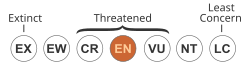


The Denison barb, Denison's barb, Miss Kerala, red-line torpedo barb, or roseline shark (Dawkinsia denisonii) is an endangered species of cyprinid fish endemic to the fast-flowing hill streams and rivers of the Western Ghats in India.[2][3] It is commonly seen in the aquarium trade; pet collection caused it to become endangered and is its single major threat.[1][4][5]
Physical characteristics[edit | edit source]

The fish is characterized by a torpedo-shaped body with silver scales, a red line running from their snout, through the eye, back towards the middle of the body; and below the red line, a black line that runs the length of the fish to the tail. As they mature, a distinctive green/blue marking on top of the head develops. This species reputedly reaches a length of 15 centimetres (5.9 in) TL,[2] but typically will only reach 9–11 centimetres (3.5–4.3 in).[4] They are active shoaling fishes.[4]
The species was described by Francis Day and named after Sir William Denison.[6]
Habitat and threats[edit | edit source]
Denison barb is endemic to the Achankovil, Pamba and Chaliyar rivers. Specifically, they are found in four locations — Cheenkannipuzha (a major tributary of Valapattanam River), the Achankovil river, the Chaliyar river and near Mundakayam town.[7] The species has an estimated range of 8,805 km2 (3,400 sq mi). S. denisonii is a benthopelagic species that is gregarious and shoals are known to occur in rocky pools with thick vegetation along their banks. They thrive in a subtropical climate in water with a 6.8–7.8 pH, a water hardness of 5–25 dGH and a temperature range of 65 to 79 °F (18 to 26 °C).
As reported by Practical Fishkeeping in January 2009, new research by team of scientists from India suggests that the species is being over-exploited for the aquarium trade, potentially placing it at risk of extinction.[8] In spite of being listed as endangered by local assessment reports[9] the fish had been promoted as an 'export item' by several government agencies. The population structure, age, growth, mortality and harvest intensity in the Valapattanam River was studied and suggests that the species is being over-exploited.[10]
The fish was most likely collected and exported out of India in 1996. In 1997, it won the third prize at 'Aquarama 1997' (world exhibition on Ornamental fish) under the 'New Species Category'.[11] By 2007–08 it constituted about 60–65% of the total live ornamental fish exported from India which was worth US$1.54 million. Though the Government of Kerala banned the fishing and export of the endangered barb, it is yet to be listed under the National Wildlife Protection Act. The golden form of this Denison barb is extinct from the wild but few Aquarium hobbyists have it in their collection.
In the aquarium[edit | edit source]
This fish is a relatively new addition to the fish keeping hobby. The Denison's barb is a schooling fish that is usually kept in groups. It tends to be peaceful but some have been known to be slightly aggressive around food, especially if kept in less space than they require. They eat bloodworms, shrimp, meat, fish flake and some vegetation. A similar fish, Dawkinsia chalakkudiensis is sometimes confused with this fish, but it is a larger, less colourful and a more aggressive species.
Breeding[edit | edit source]
Over the years many efforts have been made to breed this rapidly depleting species in captivity, initially with limited success. In 2009, success came from the work carried out at the Fisheries College, Kerala by Bony Joseph. Breeding efforts have also been carried out by Chester Zoo and two amateur fish-lovers from Chennai (India), Venkatesh and Murali.[7] These efforts may pave the way for standardizing the process and would be a major boost to conservation and the ornamental fish trade in India. Large numbers are now being bred in captivity at commercial facilities.[4][12]
See also[edit | edit source]
References[edit | edit source]
- ↑ 1.0 1.1 Ali, A.; Raghavan, R.; Dahanukar, N. (2015). "Sahyadria denisonii". IUCN Red List of Threatened Species. 2015 e.T169662A70082469. doi:10.2305/IUCN.UK.2015-1.RLTS.T169662A70082469.en. Retrieved 18 November 2021.
- ↑ 2.0 2.1 Template:FishBase species
- ↑ Raghavan, R.; Philip, S.; Ali, A. & Dahanukar, N. (2013). "Sahyadria, a new genus of barbs (Teleostei: Cyprinidae) from Western Ghats of India" (PDF). Journal of Threatened Taxa. 5 (15): 4932–4938. Archived from the original (PDF) on 2 December 2013.
- ↑ 4.0 4.1 4.2 4.3 "Sahyadria denisonii". Seriously Fish. Retrieved 26 June 2014.
- ↑ Sajan, S (2017). Life History traits of an Endangered barb. LAMBERT Academic Publishing. ISBN 978-3-330-04212-4.
- ↑ Day, F. (1865). "On the fishes of Cochin, on the Malabar Coast of India. Part II. Anacanthini". Proceedings of the Zoological Society of London. 1865: 286–318.
- ↑ 7.0 7.1 Mathew, Dennis Marcus (1 February 2010). "'Miss Kerala' gets a protective shield". The Hindu. Retrieved 18 January 2020.
- ↑ Practical Fishkeeping (11 January 2009), Kerala government bans fishing for this species."Kerala government bans fishing for Puntius denisonii". Practical Fishkeeping. Archived from the original on 5 June 2011. Retrieved 26 November 2010.
- ↑ Molur, S. and Walker, S., Report of the workshop on 'Conservation Assessment and Management Plan for Fresh Water Fishes of India', Zoo Outreach Organization and NBFGR, Lucknow, 1998,p. 156.
- ↑ SAJAN, S.; T.V. ANNA MERCY; and V. MALIKA (2015). "Age, Growth and Population Dynamics of an Endangered Fish Sahyadria denisonii (Day 1865) from the Western Ghats Hotspot of India". Asian Fisheries Science. 28 (3): 130–142.
- ↑ Rajeev Raghavan; et al. (January 2009). "'Damsel in distress'‐ The tale of Miss Kerala, Puntius denisonii (Day), an endemic and endangered cyprinid of the Western Ghats biodiversity hotspot (South India)". Aquatic Conservation: Marine and Freshwater Ecosystems. 19 (1): 67–74. doi:10.1002/aqc.963.
- ↑ T. V. Anna Mercy; S. Sajan; V. Malika (2015). "Captive breeding and developmental biology of Sahyadria denisonii (Day 1865) (Cyprinidae), an endangered fish of the Western Ghats, India". Indian Journal of Fisheries. 62 (2).
- Clarke, Matt. "The Red lined torpedo, Puntius denisonii (with details on an imposter species P. chalakudiensis)". Practical Fishkeeping. Archived from the original on 29 May 2004. Retrieved 19 April 2004.
External links[edit | edit source]
- Puntius denisonii breeding - Photos of Puntius denisonii's epic journey from egg to hatchling, from www.fishesninverts.com
- Photos at Fishbase
- Madan Subramanian at Bangalore, India Archived 10 February 2010 at the Wayback Machine
- Puntius denisonii fish profile and detailed photos on fishforums.com Archived 28 December 2007 at the Wayback Machine
- Threatened freshwater fish fall through net of mismanaged aquarium pet trade (IUCN)