


m robot: Create/update articles. If there is a mistake please report on my talk page. |
m Content refined for better accuracy |
||
| Line 1: | Line 1: | ||
{{Short description|Rajput General | {{Short description|Rajput General of the Kingdom of Marwar (1638–1718)}} | ||
{{Redirect|Durgadas|the novel|Durgadas (novel)}} | |||
{{Use dmy dates|date=July 2020}} | {{Use dmy dates|date=July 2020}} | ||
{{Infobox military person | {{Infobox military person | ||
| honorific_prefix = ''[[Sardar]]'' | | honorific_prefix = ''[[Sardar]]'' | ||
| name = Durgadas Rathore | | name = Durgadas Rathore | ||
| honorific_suffix = Rajya Sanghrakshak | | honorific_suffix = Rajya Sanghrakshak | ||
| image = Durgadas Rathore painting.jpg | | image = Durgadas Rathore painting.jpg | ||
| caption = Painting of Durgadas Rathore by [[Archibald Herman | | image_size = 300px | ||
| birth_date = 13 August 1638 | | caption = Painting of Veer Durgadas Rathore by [[Archibald Herman Müller]] in the [[Mehrangarh Fort]] Museum, Jodhpur. | ||
| death_date = {{Death date and age|1718|11|22|1638|8|13|df=yes}} | | birth_date = 13 August 1638 | ||
| birth_place = | | death_date = {{Death date and age|1718|11|22|1638|8|13|df=yes}} | ||
| death_place = | | birth_place = Selva village, [[Kingdom of Marwar]] | ||
| nickname = | | death_place = [[Ujjain]] | ||
| allegiance = [[File:Flag of Jodhpur.svg|20px]] [[ | | nickname = [[Garibaldi]] of [[Rajputana]] | ||
| branch = | | allegiance = [[File:Flag of Jodhpur.svg|20px]] [[Kingdom of Marwar]] | ||
| serviceyears = | | branch = [[Marwar]] Army | ||
| rank = | | serviceyears = | ||
| unit = | | rank = General | ||
| commands = | | unit = | ||
| battles = | | commands = | ||
| awards = | | battles = *[[Rathore rebellion (1679–1707)]]<br/> | ||
| spouse = | *[[Rajput Rebellion (1708–1710)]] | ||
| relations = | | awards = | ||
| spouse = | |||
| relations = | |||
}} | }} | ||
'''Durgadas Rathore''' (13 August 1638 – 22 November 1718) was | '''Durgadas Rathore''' (13 August 1638 – 22 November 1718) was a [[Rathore dynasty|Rathore]] [[Rajput]] general and statesman of the [[Kingdom of Marwar]], in present-day [[Rajasthan]], [[India]].<ref>{{Cite book |last=Rima Hooja |url=http://archive.org/details/a-history-of-rajasthan |title=A History Of Rajasthan |pages=895}}</ref> He is remembered for safeguarding the infant [[Ajit Singh of Marwar]] following the death of [[Maharaja Jaswant Singh]] in 1678 and for leading a prolonged resistance against Mughal emperor [[Aurangzeb]] during the [[Rathore rebellion (1679–1707)]].<ref>{{Cite book |last=Naravane |first=M. S. |url=https://books.google.com/books?id=lF0FvjG3GWEC&q=durgadas |title=The Rajputs of Rajputana: A Glimpse of Medieval Rajasthan |date=1999 |publisher=APH Publishing |isbn=978-81-7648-118-2 |language=en}}</ref> Combining [[guerrilla warfare]] with diplomatic alliances, he preserved Marwar’s independence until Ajit Singh was restored to the throne after Aurangzeb’s death in 1707.<ref>{{Cite book |url=http://archive.org/details/sir-jadunath-sarkar-raghubir-sinh-a-history-of-jaipur-c.-1503-1938 |title=A History Of Jaipur, C. 1503-1938 |pages=161}}</ref> | ||
Durgadas also played a significant role in the [[Rajput Rebellion (1708–1710)]], collaborating with leaders such as Raja [[Jai Singh II]] of [[Jaipur State|Jaipur]], and supported the Maratha ruler [[Sambhaji]] during the [[Siege of Janjira]] against the Siddis. He was elected as the leader of the revolt along with Raja [[Jai Singh II]] of Jaipur.<ref name=RZ>{{Cite book|first=Jadunath|last=Sarkar|title=A History of Jaipur: C.1503-1938|publisher=Orient Blackswan|year=1994|pages=162|isbn=9788125003335|url=https://books.google.com/books?id=O0oPIo9TXKcC&q=bahadur+shah+was+absent}}</ref> He won several victories against the Mughals<ref name=SC>{{Cite book|first=Satish|last=Chandra|title=Medieval India: From Sultanat to the Mughals Part - II|publisher=Har Anand Publications|year=2005|pages=312|isbn=9788124110669|url=https://books.google.com/books?id=0Rm9MC4DDrcC&q=satish+chandra+medieval+india|quote=With the return of Durgadas to Marwar in 1686 and with the appearance of [[Ajit Singh of Marwar|Ajit Singh]] in person to head the resistance, the Rathores gained a number of victories.}}</ref> and compelled many Mughal officers to pay tribute in the form of [[chauth]].<ref name=RC>{{Cite book|first=R.C.|last=Majumdar|title=An Advanced History of India|publisher=Trinity Press|year=2020|pages=494–497|url=|quote=Under the able leadership of Durgadas, the Rathors ceaselessly carried on a guerrilla warfare and harassed the Mughal outposts so that the Mughal officers were compelled to pay chauth}}</ref> | |||
== Early life == | == Early life == | ||
Durgadas was the son of Askaran Rathore, a [[Rajput]] minister | Durgadas was the son of Askaran Rathore, a [[jagirdar]] (feudal lord) of Drunera and a [[Rajput]] minister under [[Jaswant Singh of Marwar|Jaswant Singh]], the ruler of [[Kingdom of Marwar|Marwar]].<ref>{{Cite book |last=Sarkar Jadunath Sir |url=http://archive.org/details/in.ernet.dli.2015.242801 |title=History Of Aurangzib Vol Iii |date=1928 |pages=232}}</ref> He was a distant relative of the royal family, being a descendant of Karana, a son of Rao [[Ranmal]].<ref>{{cite book |last=Singh |first=Rajvi Amar |title=Mediaeval History of Rajasthan: Western Rajasthan |year=1992 |page=156 }}</ref> | ||
== | ==Military career== | ||
Aurangzeb | ===Safeguarding Ajit Singh (1679–1681)=== | ||
Jaswant Singh was campaigning in Afghanistan when he died in December 1678, leaving no heir. Aurangzeb took the opportunity to intervene by imposing his direct rule over Marwar. Soon after Jaswant Singh's death two of his ranis (queens) each gave birth to male children. One of these sons died soon after his birth, leaving the other – [[Ajit Singh of Marwar|Ajit Singh]] – as sole heir.<ref name="sen2">{{Cite book |last=Sen |first=Sailendra |title=A Textbook of Medieval Indian History |publisher=Primus Books |year=2013 |isbn=978-93-80607-34-4 |page=189}}</ref> | |||
[[File:Durga Das before Maharaja Ajit Singh of Marwar.jpg|thumb|200px|Durgadas Rathore (left) with Maharaja [[Ajit Singh of Marwar]] (right)]] | |||
Aurangzeb ordered the infant, Ajit Singh, to be brought to Delhi where he was kept in Noorgarh under house arrest. Durgadas Rathore and other nobles of Jodhpur made a daring attack on the Mughal contingent of Delhi and rescued Ajit Singh and the widowed ranis of Jaswant Singh. Aurangzeb ordered Tahir Beg and Inder Singh Rathore to capture Durgadas, but they both failed, resulting in a long struggle between Durgadas and Aurangzeb. Fatuhat-i-Alamgiri noted that "all the Rajput households of Marwar had made preparations to challenge the imperial writ". Durgdas thus had the support of the Rajput clans of Marwar.<ref name=RH>{{Cite book |first=Rima |last=Hooja |title=A History of Rajasthan|publisher=Rupa |year=2006 |pages=595–610, 709 |isbn=9788129115010 |url=https://books.google.com/books?id=qqd1RAAACAAJ&q=history%20of%20rajasthan%20hooja |quote=On July 15, 1679 AD, Aurangzeb ordered that the infant Ajit Singh and entourage be shifted to Noorgarh, virtually as prisoners. At this Durgadas Rathore and a select band of Marwars warriors including Ranchordas Rathore and Raghunath Bhati took action. These Marwar loyalists contrived the daring rescue of the closely guarded infant Ajit singh and the widowed ranis of Jaswant Singh from imperial hands. Aurangzeb commanded Tahir Beg Khan and Inder Singh to capture the figitive party...both men were unsuccessful in this...thereafter began a long struggle against Emperor Aurangzeb by Durgadas and other loyal supporters...recorded in his contemporaneous Fatuhat-i-Alamgiri that all the Rajput households of Marwar had made preparations to challenge the imperial writ.....Durgadas did not flail in his loyalty. It was for this loyalty, as well as his personal valour and chivalrous deeds that Durgadas was to become part of popular lore during his lifetime....Ajit Singh was brought away from the territory of Sirohi to Nandlai, three miles north-west of Desuri in Mewar. Raj Singh's action enraged Aurangzeb.....Durga Das features in the official records of the Mughal court till c . AD 1716....Emperor Jahandar Shah gave him the title of 'Rao', and a mansab of 4,000...Marwar chronicles however do not mention Durgadas after the Rathore victory at Sambhar.}}</ref> | |||
The infant Ajit Singh was taken to safety in Balunda, where the wife of one of the delegation kept the child for almost a year. Later, he was moved to the safety of the [[Aravalli Hills]] near [[Mount Abu|Abu Sirohi]], a remote town on the southern fringes of Marwar. There Ajit Singh grew up in anonymity.<ref name=":0">{{Cite book|last=Hooja|first=Rima|title=A History of Rajasthan|publisher=Rupa Publication|year=2006|pages=705}}</ref> Rana [[Raj Singh I]] also offered refuge to Ajit Singh after which he was hidden in Nandlai, a village in Mewar.<ref name=RH/> | |||
===Conflict with the Mughal Empire (1681–1707)=== | |||
Durgadas, as the leader of the revolt, led his forces against the Mughals and through guerrilla warfare harassed several outposts and compelled the Mughal officers to pay tribute.<ref name=RC/> Durgadas also instigated both [[Bahadur Shah I|Muazzam]] and [[Muhammad Akbar (Mughal prince)|Akbar]] against their father, Aurangzeb. During the war, Durgadas took care of Aurangzeb's granddaughter, Saif-un-nissa, who was in his custody and later returned her to Aurangzeb. The grateful Mughal Emperor bestowed upon Durgadas high ranks and jagirs of Merta and Dhandhuka, however, according to Mirat-i-Alamgiri, Durgadas continued to plead for Ajit Singh's cause instead of being placated by Aurangzeb.<ref name=RH/> Ajit Singh and Durgadas took advantage of the disturbances following the death of Aurangzeb in 1707 to seize Jodhpur and eventually evict the occupying Mughal force. Ajit Singh was proclaimed Maharaja of Jodhpur.<ref name=":0" /> | |||
Durgadas was also one of the leaders of the [[Rajput Rebellion (1708–1710)]]. In July 1708 he routed Saiyid Hussain Khan Barha at Kaladera and forced him to retreat to Narnaul. Durgadas was also instrumental in securing the Rajput victory at Sambhar. Ajit Singh started becoming jealous of the fame and popularity that Durgadas had acquired. Durgadas also started disliking Ajit for his character. Ajit Singh had murdered Mukund Das, who was a loyal noble of Marwar, and this caused Durgadas to drift away from Ajit. After the battle of Sambhar, Durgadas chose to pitch his camp away from Ajit to show his dissatisfaction.<ref name=KS>{{Cite book|first=V.S.|last=Bhatnagar|title=Life and times of Sawai Jai Singh|publisher=Impex India|year=1974|pages=57, 69|url=https://books.google.com/books?id=plFuAAAAMAAJ|quote=The Saiyid returned to Kaladera where he was again routed by Durgadas. He then fled to Narnaul....After the victory at Sambhar, Durgadas who had played an important part in the encounter...}}</ref> | |||
The victory of Ajit Singh was the culmination of Durgadas and other loyal courtiers who chose to remain loyal throughout the [[Rajput War (1679–1707)|Rathore rebellion]], however Durgadas was soon exiled by Ajit Singh and his name was erased from the Marwari chronicles after the [[Rajput Rebellion (1708–1710)|Battle of Sambhar]], in which Durgadas and [[Jai Singh II]] won a notable victory against the Mughals.<ref name=RZ/> The Mughals, however, continued to woo Durgadas. The Mughal Emperor offered Durgadas the title of Rao and a rank of 4,000 in the Mughal court and official Mughal records continued to write about him till his death. Durgadas was also invited by the Maharana [[Amar Singh II]] of Mewar who gave him the jagirs of Rampura and Vijaypur.<ref name=RH/> | |||
== Death == | == Death == | ||
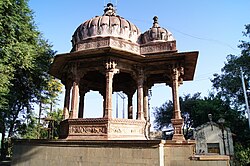
[[File:DURGADAS CHHATRI.jpg|thumb|Canopy of Durgadas at Chakratirth, [[Ujjain]]]] | [[File:DURGADAS CHHATRI.jpg|thumb|Canopy of Durgadas at Chakratirth, [[Ujjain]]]] | ||
Durgadas left [[Kingdom of Marwar|Marwar]] and lived in [[Kingdom of Mewar|Mewar]] for some time, and then went to [[Mahakaleshwar Jyotirlinga|Mahakaal]] in [[Ujjain]]. On 22 November 1718, he died at the age of 81 on the banks of the [[Shipra River]] in Ujjain.<ref name=":0" /> | |||
== | == Legacy and Honors == | ||
* Historian [[Jadunath Sarkar]] sums up his legacy by commenting: | * Historian [[Jadunath Sarkar]] sums up his legacy by commenting: | ||
<Blockquote> | <Blockquote>A soul of honour, he kept the deserted daughter of Akbar free from every stain and provided her with every facility for Islamic religious training in the wilderness of Marwar. Fighting against terrible odds and a host of enemies on every side, with distrust and wavering among his own country-men, he kept the cause of his chieftain triumphant. Mughal gold could not seduce, Mughal arms could not daunt that constant heart. Almost alone among the Rathors he displayed the rare combination of the dash and reckless valour of a Rajput soldier with the tact, diplomacy and organizing power of a Mughal minister of State. No wonder that the Rathor bard should pray that every Rajput mother should have a son like Durgadas.<ref>{{Citation|work=History of Aurangzeb Vol 3|publisher=Orient Longman Limited|year=1971|url=https://archive.org/details/in.ernet.dli.2015.242801/page/n231/mode/1up?view=theater|page=|editor-last1=Sarkar|editor-first1=Jadunath|title=''Durgadas''}}</ref> </Blockquote> | ||
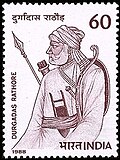
* The government of India [[ | * The government of India released a commemorative [[postage stamp]] for Durgadas Rathore in 1988.<ref>{{Cite web |title=INDIA 1988 DURGADAS RATHORE MNH SINGLE STAMP |url=https://www.indphila.com/product/india-1988-durgadas-rathore-mnh-single-stamp/ |access-date=2025-08-14 |website=Largest Online Dealer & Portal for Stamps of India |language=en-US}}</ref> | ||
[[File:Stamp of India - 1988 - Colnect 165262 - Durgadas Rathore.jpeg|200px|thumb|Durgadas Rathore | [[File:Stamp of India - 1988 - Colnect 165262 - Durgadas Rathore.jpeg|200px|thumb|Durgadas Rathore on a postage stamp of Rs. 0.60 released on 26 August 1988]] | ||
* | *In 2003, the Government of India issued commemorative coins of ₹1, ₹10, and ₹100 in honor of Durgadas Rathore.<ref>{{Cite web |title=1 Rupee, India |url=https://en.numista.com/catalogue/pieces15794.html |access-date=2022-03-27 |website=en.numista.com |language=en}}</ref> | ||
* A road in [[Ujjain]] named after him (Veer Durgadas Marg).<ref>{{Cite web |title=Veer Durgadas Marg |url=https://www.google.com/maps/place/Veer+Durgadas+Marg,+Madhya+Pradesh/@23.1917347,75.7637597,604m/data=!3m2!1e3!4b1!4m6!3m5!1s0x3963743181c13607:0x2a9da5c375975eb7!8m2!3d23.1917298!4d75.7663346!16s%2Fg%2F1hjgw3wyl?entry=ttu&g_ep=EgoyMDI0MTIxMS4wIKXMDSoASAFQAw%3D%3D |access-date=2024-12-22|website=Google Maps|language=en}}</ref> | |||
==In popular culture== | ==In popular culture== | ||
* Paintings of Durgadas by painter [[Archibald Herman Müller]] (1893) at [[Mehrangarh Museum]], Jodhpur and the | * Paintings of Durgadas by painter [[Archibald Herman Müller]] (1893) at [[Mehrangarh Museum]], Jodhpur and the Government Museum, [[Bikaner]]. | ||
* ''[[Durgadas (novel)|Durgadas]]'' is a [[children's literature]] novel written by [[Premchand]] based on his struggle. | * ''[[Durgadas (novel)|Durgadas]]'' is a [[children's literature]] novel written by [[Premchand]] based on his struggle. | ||
* A play depicting the life of Durgadas was conducted in Jodhpur in October 2017.<ref>{{Cite news|url=https://www.bhaskar.com/news/RAJ-JOD-HMU-MAT-latest-jodhpur-news-052004-258180-NOR.html|title=दुर्ग गाथा | * A play depicting the life of Durgadas was conducted in Jodhpur in October 2017.<ref>{{Cite news|url=https://www.bhaskar.com/news/RAJ-JOD-HMU-MAT-latest-jodhpur-news-052004-258180-NOR.html|title=दुर्ग गाथा|date=2017-10-13|work=dainikbhaskar|access-date=2017-10-15|language=hi}}</ref> | ||
*Indian films based on his life include the [[Indian silent film|silent feature]] ''Veer Durgadas'' (1924) by Bhagwati Prasad Mishra and the 1960 biographical film ''[[Veer Durgadas]]'' by Ramchandra Thakur, starring [[Paidi Jairaj]] in the titular role.<ref name="RajadhyakshaWillemen1999">{{cite book|last1=Rajadhyaksha|first1=Ashish|url=https://archive.org/details/encyclopaediaofi0000raja|title=Encyclopaedia of Indian cinema|last2=Willemen|first2=Paul|publisher=British Film Institute|year=1999|access-date=12 August 2012|url-access=registration}}</ref> | *Indian films based on his life include the [[Indian silent film|silent feature]] ''Veer Durgadas'' (1924) by Bhagwati Prasad Mishra and the 1960 biographical film ''[[Veer Durgadas]]'' by Ramchandra Thakur, starring [[Paidi Jairaj]] in the titular role.<ref name="RajadhyakshaWillemen1999">{{cite book|last1=Rajadhyaksha|first1=Ashish|url=https://archive.org/details/encyclopaediaofi0000raja|title=Encyclopaedia of Indian cinema|last2=Willemen|first2=Paul|publisher=British Film Institute|year=1999|isbn=978-0-85170-669-6 |access-date=12 August 2012|url-access=registration}}</ref> | ||
* Amar Chitra Katha Comics have a great biographical comic on his name https://digital.amarchitrakatha.com/id005835307/Durgadas | |||
== See also == | == See also == | ||
| Line 92: | Line 86: | ||
[[Category:1638 births]] | [[Category:1638 births]] | ||
[[Category:1718 deaths]] | [[Category:1718 deaths]] | ||
[[Category: | [[Category:People from the Kingdom of Marwar]] | ||
[[Category:People from Jodhpur]] | [[Category:People from Jodhpur]] | ||
[[Category:Indian military personnel]] | [[Category:Indian military personnel]] | ||
[[Category:Indian warriors]] | [[Category:Indian warriors]] | ||
[[Category:Rathore (clan)]] | |||
[[Category:17th-century Indian people]] | [[Category:17th-century Indian people]] | ||
[[Category:18th-century Indian people]] | [[Category:18th-century Indian people]] | ||
Latest revision as of 05:01, 11 December 2025
Durgadas Rathore Rajya Sanghrakshak | |
|---|---|
 Painting of Veer Durgadas Rathore by Archibald Herman Müller in the Mehrangarh Fort Museum, Jodhpur. | |
| Nickname(s) | Garibaldi of Rajputana |
| Born | 13 August 1638 Selva village, Kingdom of Marwar |
| Died | 22 November 1718 (aged 80) Ujjain |
| Allegiance |  Kingdom of Marwar Kingdom of Marwar |
| Service/ | Marwar Army |
| Rank | General |
| Battles/wars | |
Durgadas Rathore (13 August 1638 – 22 November 1718) was a Rathore Rajput general and statesman of the Kingdom of Marwar, in present-day Rajasthan, India.[1] He is remembered for safeguarding the infant Ajit Singh of Marwar following the death of Maharaja Jaswant Singh in 1678 and for leading a prolonged resistance against Mughal emperor Aurangzeb during the Rathore rebellion (1679–1707).[2] Combining guerrilla warfare with diplomatic alliances, he preserved Marwar’s independence until Ajit Singh was restored to the throne after Aurangzeb’s death in 1707.[3]
Durgadas also played a significant role in the Rajput Rebellion (1708–1710), collaborating with leaders such as Raja Jai Singh II of Jaipur, and supported the Maratha ruler Sambhaji during the Siege of Janjira against the Siddis. He was elected as the leader of the revolt along with Raja Jai Singh II of Jaipur.[4] He won several victories against the Mughals[5] and compelled many Mughal officers to pay tribute in the form of chauth.[6]
Early life[edit | edit source]
Durgadas was the son of Askaran Rathore, a jagirdar (feudal lord) of Drunera and a Rajput minister under Jaswant Singh, the ruler of Marwar.[7] He was a distant relative of the royal family, being a descendant of Karana, a son of Rao Ranmal.[8]
Military career[edit | edit source]
Safeguarding Ajit Singh (1679–1681)[edit | edit source]
Jaswant Singh was campaigning in Afghanistan when he died in December 1678, leaving no heir. Aurangzeb took the opportunity to intervene by imposing his direct rule over Marwar. Soon after Jaswant Singh's death two of his ranis (queens) each gave birth to male children. One of these sons died soon after his birth, leaving the other – Ajit Singh – as sole heir.[9]

Aurangzeb ordered the infant, Ajit Singh, to be brought to Delhi where he was kept in Noorgarh under house arrest. Durgadas Rathore and other nobles of Jodhpur made a daring attack on the Mughal contingent of Delhi and rescued Ajit Singh and the widowed ranis of Jaswant Singh. Aurangzeb ordered Tahir Beg and Inder Singh Rathore to capture Durgadas, but they both failed, resulting in a long struggle between Durgadas and Aurangzeb. Fatuhat-i-Alamgiri noted that "all the Rajput households of Marwar had made preparations to challenge the imperial writ". Durgdas thus had the support of the Rajput clans of Marwar.[10]
The infant Ajit Singh was taken to safety in Balunda, where the wife of one of the delegation kept the child for almost a year. Later, he was moved to the safety of the Aravalli Hills near Abu Sirohi, a remote town on the southern fringes of Marwar. There Ajit Singh grew up in anonymity.[11] Rana Raj Singh I also offered refuge to Ajit Singh after which he was hidden in Nandlai, a village in Mewar.[10]
Conflict with the Mughal Empire (1681–1707)[edit | edit source]
Durgadas, as the leader of the revolt, led his forces against the Mughals and through guerrilla warfare harassed several outposts and compelled the Mughal officers to pay tribute.[6] Durgadas also instigated both Muazzam and Akbar against their father, Aurangzeb. During the war, Durgadas took care of Aurangzeb's granddaughter, Saif-un-nissa, who was in his custody and later returned her to Aurangzeb. The grateful Mughal Emperor bestowed upon Durgadas high ranks and jagirs of Merta and Dhandhuka, however, according to Mirat-i-Alamgiri, Durgadas continued to plead for Ajit Singh's cause instead of being placated by Aurangzeb.[10] Ajit Singh and Durgadas took advantage of the disturbances following the death of Aurangzeb in 1707 to seize Jodhpur and eventually evict the occupying Mughal force. Ajit Singh was proclaimed Maharaja of Jodhpur.[11]
Durgadas was also one of the leaders of the Rajput Rebellion (1708–1710). In July 1708 he routed Saiyid Hussain Khan Barha at Kaladera and forced him to retreat to Narnaul. Durgadas was also instrumental in securing the Rajput victory at Sambhar. Ajit Singh started becoming jealous of the fame and popularity that Durgadas had acquired. Durgadas also started disliking Ajit for his character. Ajit Singh had murdered Mukund Das, who was a loyal noble of Marwar, and this caused Durgadas to drift away from Ajit. After the battle of Sambhar, Durgadas chose to pitch his camp away from Ajit to show his dissatisfaction.[12]
The victory of Ajit Singh was the culmination of Durgadas and other loyal courtiers who chose to remain loyal throughout the Rathore rebellion, however Durgadas was soon exiled by Ajit Singh and his name was erased from the Marwari chronicles after the Battle of Sambhar, in which Durgadas and Jai Singh II won a notable victory against the Mughals.[4] The Mughals, however, continued to woo Durgadas. The Mughal Emperor offered Durgadas the title of Rao and a rank of 4,000 in the Mughal court and official Mughal records continued to write about him till his death. Durgadas was also invited by the Maharana Amar Singh II of Mewar who gave him the jagirs of Rampura and Vijaypur.[10]
Death[edit | edit source]

Durgadas left Marwar and lived in Mewar for some time, and then went to Mahakaal in Ujjain. On 22 November 1718, he died at the age of 81 on the banks of the Shipra River in Ujjain.[11]
Legacy and Honors[edit | edit source]
- Historian Jadunath Sarkar sums up his legacy by commenting:
A soul of honour, he kept the deserted daughter of Akbar free from every stain and provided her with every facility for Islamic religious training in the wilderness of Marwar. Fighting against terrible odds and a host of enemies on every side, with distrust and wavering among his own country-men, he kept the cause of his chieftain triumphant. Mughal gold could not seduce, Mughal arms could not daunt that constant heart. Almost alone among the Rathors he displayed the rare combination of the dash and reckless valour of a Rajput soldier with the tact, diplomacy and organizing power of a Mughal minister of State. No wonder that the Rathor bard should pray that every Rajput mother should have a son like Durgadas.[13]
- The government of India released a commemorative postage stamp for Durgadas Rathore in 1988.[14]

- In 2003, the Government of India issued commemorative coins of ₹1, ₹10, and ₹100 in honor of Durgadas Rathore.[15]
- A road in Ujjain named after him (Veer Durgadas Marg).[16]
In popular culture[edit | edit source]
- Paintings of Durgadas by painter Archibald Herman Müller (1893) at Mehrangarh Museum, Jodhpur and the Government Museum, Bikaner.
- Durgadas is a children's literature novel written by Premchand based on his struggle.
- A play depicting the life of Durgadas was conducted in Jodhpur in October 2017.[17]
- Indian films based on his life include the silent feature Veer Durgadas (1924) by Bhagwati Prasad Mishra and the 1960 biographical film Veer Durgadas by Ramchandra Thakur, starring Paidi Jairaj in the titular role.[18]
- Amar Chitra Katha Comics have a great biographical comic on his name https://digital.amarchitrakatha.com/id005835307/Durgadas
See also[edit | edit source]
References[edit | edit source]
- ↑ Rima Hooja. A History Of Rajasthan. p. 895.
- ↑ Naravane, M. S. (1999). The Rajputs of Rajputana: A Glimpse of Medieval Rajasthan. APH Publishing. ISBN 978-81-7648-118-2.
- ↑ A History Of Jaipur, C. 1503-1938. p. 161.
- ↑ 4.0 4.1 Sarkar, Jadunath (1994). A History of Jaipur: C.1503-1938. Orient Blackswan. p. 162. ISBN 9788125003335.
- ↑ Chandra, Satish (2005). Medieval India: From Sultanat to the Mughals Part - II. Har Anand Publications. p. 312. ISBN 9788124110669.
With the return of Durgadas to Marwar in 1686 and with the appearance of Ajit Singh in person to head the resistance, the Rathores gained a number of victories.
- ↑ 6.0 6.1 Majumdar, R.C. (2020). An Advanced History of India. Trinity Press. pp. 494–497.
Under the able leadership of Durgadas, the Rathors ceaselessly carried on a guerrilla warfare and harassed the Mughal outposts so that the Mughal officers were compelled to pay chauth
- ↑ Sarkar Jadunath Sir (1928). History Of Aurangzib Vol Iii. p. 232.
- ↑ Singh, Rajvi Amar (1992). Mediaeval History of Rajasthan: Western Rajasthan. p. 156.
- ↑ Sen, Sailendra (2013). A Textbook of Medieval Indian History. Primus Books. p. 189. ISBN 978-93-80607-34-4.
- ↑ 10.0 10.1 10.2 10.3 Hooja, Rima (2006). A History of Rajasthan. Rupa. pp. 595–610, 709. ISBN 9788129115010.
On July 15, 1679 AD, Aurangzeb ordered that the infant Ajit Singh and entourage be shifted to Noorgarh, virtually as prisoners. At this Durgadas Rathore and a select band of Marwars warriors including Ranchordas Rathore and Raghunath Bhati took action. These Marwar loyalists contrived the daring rescue of the closely guarded infant Ajit singh and the widowed ranis of Jaswant Singh from imperial hands. Aurangzeb commanded Tahir Beg Khan and Inder Singh to capture the figitive party...both men were unsuccessful in this...thereafter began a long struggle against Emperor Aurangzeb by Durgadas and other loyal supporters...recorded in his contemporaneous Fatuhat-i-Alamgiri that all the Rajput households of Marwar had made preparations to challenge the imperial writ.....Durgadas did not flail in his loyalty. It was for this loyalty, as well as his personal valour and chivalrous deeds that Durgadas was to become part of popular lore during his lifetime....Ajit Singh was brought away from the territory of Sirohi to Nandlai, three miles north-west of Desuri in Mewar. Raj Singh's action enraged Aurangzeb.....Durga Das features in the official records of the Mughal court till c . AD 1716....Emperor Jahandar Shah gave him the title of 'Rao', and a mansab of 4,000...Marwar chronicles however do not mention Durgadas after the Rathore victory at Sambhar.
- ↑ 11.0 11.1 11.2 Hooja, Rima (2006). A History of Rajasthan. Rupa Publication. p. 705.
- ↑ Bhatnagar, V.S. (1974). Life and times of Sawai Jai Singh. Impex India. pp. 57, 69.
The Saiyid returned to Kaladera where he was again routed by Durgadas. He then fled to Narnaul....After the victory at Sambhar, Durgadas who had played an important part in the encounter...
- ↑ Sarkar, Jadunath, ed. (1971), "Durgadas", History of Aurangzeb Vol 3, Orient Longman Limited
- ↑ "INDIA 1988 DURGADAS RATHORE MNH SINGLE STAMP". Largest Online Dealer & Portal for Stamps of India. Retrieved 14 August 2025.
- ↑ "1 Rupee, India". en.numista.com. Retrieved 27 March 2022.
- ↑ "Veer Durgadas Marg". Google Maps. Retrieved 22 December 2024.
- ↑ "दुर्ग गाथा". dainikbhaskar (in हिन्दी). 13 October 2017. Retrieved 15 October 2017.
- ↑ Rajadhyaksha, Ashish; Willemen, Paul (1999). Encyclopaedia of Indian cinema. British Film Institute. ISBN 978-0-85170-669-6. Retrieved 12 August 2012.