

Ajay Kumar (talk | contribs) Created a new article |
Updated article with clearer structure |
||
| Line 1: | Line 1: | ||
{{Short description|Emperor of Vijayanagara from 1406 to 1423}} | |||
{{About||the 2012 film|Devaraya (film)}} | {{About||the 2012 film|Devaraya (film)}} | ||
{{Use dmy dates|date=February 2016}} | {{Use dmy dates|date=February 2016}} | ||
{{Use Indian English|date=February 2016}} | {{Use Indian English|date=February 2016}} | ||
{{Infobox royalty | {{Infobox royalty | ||
| image = Devaraya I coin.png | | image = Devaraya I coin.png | ||
| image_size = 250 | | image_size = 250 | ||
| caption = Gold [[Pagoda (coin)|Pagoda]] of Deva Raya I | | caption = Gold [[Pagoda (coin)|Pagoda]] of Deva Raya I | ||
| succession = [[Vijayanagara | | succession = [[Emperor of Vijayanagara]] | ||
| reign = 1406 – | | reign = 5 November 1406<ref>{{Cite journal |url= https://www.jstor.org/stable/44145214|last=Lakshmi|first=Kumari Jhansi|journal=Proceedings of the Indian History Congress |date=1958|volume=21 |pages=290–297 |title=The Chronology of the Sangama Dynasty|jstor=44145214 }}</ref><ref name="a029">{{cite web | title=From Prehistoric Times To The Fall Of Vijayanagar : K. A. Nilakanta Sastri : Free Download, Borrow, and Streaming : Internet Archive | website=Internet Archive | date=22 September 2015 | url=https://archive.org/details/in.ernet.dli.2015.461121/page/n255/ | access-date=26 November 2024}}</ref> – 25 February 1423 | ||
| predecessor = [[Bukka Raya II]] | | predecessor = [[Bukka Raya II]] | ||
| successor = [[Ramachandra Raya]] | | successor = [[Ramachandra Raya]] | ||
| birth_date = | | birth_date = {{circa|1370}} | ||
| birth_place = [[ | | birth_place = [[Vijayanagara]], [[Vijayanagara Empire]] <br/> (modern day [[Hampi]], [[Karnataka]], [[India]]) | ||
| death_date = | | death_date = {{Death date and age|1423|02|25|1370|||df=y}} | ||
| death_place = [[ | | death_place = [[Vijayanagara]], [[Vijayanagara Empire]] <br/> (modern day [[Hampi]], [[Karnataka]], [[India]]) | ||
| issue = [[Ramachandra Raya]] <br/> | | issue = [[Ramachandra Raya]] <br/> | ||
[[Veera Vijaya Bukka Raya|Bukka Raya III]] | [[Veera Vijaya Bukka Raya|Bukka Raya III]] | ||
| Line 24: | Line 24: | ||
}} | }} | ||
{{Vijayanagara empire}} | {{Vijayanagara empire}} | ||
'''Deva Raya I''' ({{circa|1370}} – 25 February 1423) was an Emperor of the [[Vijayanagara Empire]] (of the [[Sangama Dynasty]]).<ref name="sen2">{{Cite book |last=Sen |first=Sailendra |title=A Textbook of Medieval Indian History |publisher=Primus Books |year=2013 |isbn=978-9-38060-734-4 |pages=103–108}}</ref> After [[Harihara II]] died, there was a dispute among his sons over succession, in which Deva Raya I eventually emerged victor. He was a very capable ruler noted for his military exploits and his support to irrigation works in his empire.<ref name="kul">Kulakarṇī, Nayeem, De Souza (1996), p.106</ref> He modernized the Vijayanagara army by improving the cavalry, employed skilled archers of the Turkic clans and raised the fighting capacity of his bowmen and imported horses from [[Arabian Peninsula|Arabia]] and Persia.<ref name="bow">Bowman,(2013) p.271</ref> | |||
The Italian traveler [[Niccolò de' Conti|Niccolo Conti]], who visited Vijayanagara {{Circa}} 1420, described Deva Raya I thus: "In this city, there are 90,000 men fit to bear arms... their king is more powerful than all the kings of India".<ref name="bow" /><ref name="mos">Chopra, Ravindran and Subrahmanian (2003), p.31</ref> Conti also noted that the royal city had grown to a circumference of 60 mi.<ref name="cir">Kamath (1980), p.163</ref> | |||
Deva Raya I was a patron of [[Kannada literature]] and architecture. Madhura, a noted Jain poet was in his court and wrote in Kannada the ''Dharmanathapurana'' on the life of the fifteenth Jain [[Tirthankara]] (Dharmanatha), and a poem in eulogy of [[Gommateshvara]] of [[Shravanabelagola]].<ref name="gomma">Sastri (1955), p.360</ref> | |||
==Irrigation works and general administration== | ==Irrigation works and general administration== | ||
[[File:Hampi, Hazararama Temple (6338545206).jpg | [[File:Hampi, Hazararama Temple (6338545206).jpg|thumb|The Hazara Rama temple built by Deva Raya I in [[Hampi]]]] | ||
[[File:Kannada inscription of Deva Raya I (1406-1424 AD) at the Hazara Rama temple in Hampi.JPG|thumb|upright|Kannada inscription of Deva Raya I at the Hazara Rama temple in Hampi]] | [[File:Kannada inscription of Deva Raya I (1406-1424 AD) at the Hazara Rama temple in Hampi.JPG|thumb|upright|Kannada inscription of Deva Raya I at the Hazara Rama temple in Hampi]]{{Main|Bahmani–Vijayanagar War (1417–1419)}} | ||
The credit for making the capital city of the Vijayanagara Empire one of the biggest cities in the 15th century goes to Deva Raya I. He realized that the scarcity of water | The credit for making the capital city of the Vijayanagara Empire one of the biggest cities in the 15th century goes to Deva Raya I. He realized that the scarcity of water, both for drinking and irrigation, was restricting the growth of the royal capital.<ref name="kul"/> In {{Circa}} 1410 he had a barrage constructed across the [[Tungabhadra River]] and commissioned a 24 km long aqueduct from the Tungabhadra River to the capital.<ref>V.K Agnihotri (2007), India History, p.150, Allied Publishers Private Limited, {{ISBN|8184242999}}</ref> The account provided by Nuniz gives details of the projects undertaken by Deva Raya I that brought prosperity to the empire. He maintained a secular attitude in administrative matters. He had a mosque and a slaughter house constructed for the convenience of the Muslim soldiers in his army.<ref name="slaughter">Chopra, Ravindran and Subrahmanian (2003), pp.30-31</ref> In {{Circa}} 1413, a dispute over property between the Shanka Jainalya of [[Lakshmeshwara]] and the Someshvara temple trust of the palace was settled in favor of the Jains. Deva Raya I had a Muslim bodyguard who built a [[choultry]] in honor of the Emperor.<ref name="cir"/> | ||
==Military campaigns== | ==Military campaigns== | ||
Throughout his reign, Deva Raya was continually at war with the Velamas of Golconda, the Bahmani Sultan of [[Gulbarga]], the Reddis of Kondavidu, and the traditional rivals of Vijayanagara, the | {{Main|War of the Goldsmith's Daughter|Fifth Bahmani–Vijayanagar War (1417–1419)}} | ||
Throughout his reign, Deva Raya was continually at war with the Velamas of Golconda, the Bahmani Sultan of [[Gulbarga]], the Reddis of Kondavidu, and the traditional rivals of Vijayanagara, the Gajapatis of Kalinga. Deva Raya I was capable of managing the vast territory that he controlled by employing skilled archers of the Turkic clan and raised the fighting capacity of his bowmen. Following a confusion in the Reddi kingdom, Deva Raya I entered into an alliance with Warangal for partitioning the Reddi kingdom between them.<ref name="chandra">Chandra (1997), p.180</ref> The split of Warangal changed the balance of power in the Deccan. In c.1420, Firoz Shah invaded Pangal but the two-year siege at Pangal ended in disease and disaster for Firoz Shah's armies. Deva Raya inflicted a shattering defeat on Firoz Shah.<ref>Chandra, Satish (1997), p.180, ''Medieval India: From Sultanat to the Mughals - Delhi Sultanat (1206-1526)'', Har-Anand Publications Pvt. Ltd., New Delhi</ref> Deva Raya's army massacred Firoz Shah's troops and created a great platform with their heads upon the field of battle. Firoz was followed deep into his own territory, which was completely devastated by the rampaging Hindu army under Deva Raya I. The Hindu army destroyed many mosques and holy places belonging to the Islamic community, and committed great carnages on the civilian Muslim population. The Sultan had to hand over the southern and eastern districts of his kingdom to Deva Raya I to secure peace. Consequently, by c.1422, Deva Raya I came to control territory up to the [[Krishna River]] - [[Tungabhadra River]] doab including Pangal<ref name="chandra"/><ref name="chow">Chaurasia (2002) p.109</ref> In the following days, the distressed Sultan died after leading a life of piety after abdicating power to his brother Ahmad.<ref name="cir"/><ref name="pangal">Sastri (1955). p.225</ref> Unable to accept this turnaround, the Gajapati Emperor Bhanudeva of Odisha invaded Rajamahendri. When a war with Vijayanagara seemed imminent, some skilful diplomacy by Vijayanagara chief Dodda Alla averted it.<ref name="war">Chopra, Ravindran and Subrahmanian (2003), p.30</ref> Deva Raya was to be succeeded by his sons [[Ramachandra Raya]] and shortly thereafter by [[Vijaya Raya]]. | |||
==Ferishta's account== | ==Ferishta's account== | ||
Persian writer Ferishta narrates an interesting story | Persian writer Ferishta narrates an interesting story, of the kings' love for a beautiful girl, a daughter of a goldsmith from Mudugal in the [[Raichur district]]. Unable to wed her, a frustrated Deva Raya I attacked Mudgal and laid to waste a few villages. Aroused by this provocation, the [[Bahmani]] Sultan [[Taj ud-Din Firuz Shah]] invaded Vijayanagara leading to defeat of Deva Raya I. Though injured in the conflict, Firuz Shah sent his able commanders who successfully invaded Vijayanagara territory south of [[Adoni]]. | ||
According to this account, Deva Raya I had to give as tribute, one of his daughters in marriage to the Sultan's prince,<ref name="sen2"/> several pearls and cash, [[Bankapura]] territory, fifty elephants, and 2,000 dancers. The goldsmith's daughter who was the reason for the war was wedded to Hassan Khan, a prince in the Sultan's family.<ref name="cir"/><ref name="prince">Sastri (1955), pp.224-225</ref> | |||
== Personal life == | |||
One of Deva Raya's queens Bhima Devi was a disciple of the Jain guru Abhinava Charukirti Panditacharya. She was a devotee of [[Shantinatha]], 16th Jain ''[[tirthankara]]'' and built a temple at the Mangayi Basti in [[Shravanabelagola]].<ref name="basti">Sangave (1981), p.46</ref> | |||
==Gallery== | ==Gallery== | ||
<gallery> | <gallery widths=180> | ||
File:Mallikarjuna temple (1406-1422 AD) at Hospet.JPG|Mallikarjuna temple in Mallapangudi, near [[Hospet]], built by Deva Raya I | File:Mallikarjuna temple (1406-1422 AD) at Hospet.JPG|Mallikarjuna temple in Mallapangudi, near [[Hospet]], built by Deva Raya I | ||
File:Kannada inscription of Deva Raya I (1406-1422 AD) at Mallikarjuna temple in Hospet.JPG|Kannada inscription of Deva Raya I at the Mallikarjuna temple in Mallappanagudi | File:Kannada inscription of Deva Raya I (1406-1422 AD) at Mallikarjuna temple in Hospet.JPG|Kannada inscription of Deva Raya I at the Mallikarjuna temple in Mallappanagudi | ||
| Line 47: | Line 55: | ||
== Notes== | == Notes== | ||
{{Reflist | {{Reflist}} | ||
==References== | ==References== | ||
* {{cite book |last=Chandra |first= Satish|title=Medieval India: From Sultanat to the Mughals-Delhi Sultanat (1206-1526) - Part One|orig-year=1997|year=2004|publisher=Har-Anand Publications |location=New Delhi}} | * {{cite book |last=Chandra |first= Satish|title=Medieval India: From Sultanat to the Mughals-Delhi Sultanat (1206-1526) - Part One|orig-year=1997|year=2004|publisher=Har-Anand Publications |location=New Delhi}} | ||
* {{cite book |last=Chaurasia |first=Radhey Shyam |title= History of Medieval India: From 1000 A.D. to 1707 A.D.|orig-year=2002|year=2002|publisher=Atlantic Publiushers |location=New Delhi|isbn=81-269-0123-3 }} | * {{cite book |last=Chaurasia |first=Radhey Shyam |title= History of Medieval India: From 1000 A.D. to 1707 A.D.|orig-year=2002|year=2002|publisher=Atlantic Publiushers |location=New Delhi|isbn=81-269-0123-3 }} | ||
* {{cite book |last= Nilakanta Sastri|first= K.A.|title= | * {{cite book |last= Nilakanta Sastri|first= K.A.|title= A history of South India from prehistoric times to the fall of Vijayanagar|orig-year=1955|year=2002|publisher= Indian Branch, Oxford University Press|location= New Delhi|isbn= 0-19-560686-8}} | ||
* {{cite book |last= Kamath|first= Suryanath U.|title= | * {{cite book |last= Kamath|first= Suryanath U.|title= A concise history of Karnataka: from pre-historic times to the present|orig-year=1980|year= 2001|publisher= Jupiter books|location= Bangalore|oclc= 7796041 |lccn= 80905179}} | ||
* {{cite book|last=Bowman|first=John Stewart|title=Columbia Chronologies of Asian History and Culture|orig-year=2013|year=2013|publisher=Columbia University Press|isbn=978-0231-11004-4|url-access=registration|url=https://archive.org/details/columbiachronolo00john}} | * {{cite book|last=Bowman|first=John Stewart|title=Columbia Chronologies of Asian History and Culture|orig-year=2013|year=2013|publisher=Columbia University Press|isbn=978-0231-11004-4|url-access=registration|url=https://archive.org/details/columbiachronolo00john}} | ||
* {{cite book |last=Kulakarṇī,Nayeem,De Souza|first=A. Rā, M. A., Teotonio R.|title=Mediaeval Deccan History: Commemoration Volume in Honour of Purshottam Mahadeo Joshi|orig-year=1996|year=1996|publisher=Popular Prakashan |isbn=81-7154-579-3}} | * {{cite book |last=Kulakarṇī,Nayeem,De Souza|first=A. Rā, M. A., Teotonio R.|title=Mediaeval Deccan History: Commemoration Volume in Honour of Purshottam Mahadeo Joshi|orig-year=1996|year=1996|publisher=Popular Prakashan |isbn=81-7154-579-3}} | ||
| Line 61: | Line 69: | ||
==External links== | ==External links== | ||
*[http://www.ourkarnataka.com/states/history/historyofkarnataka40.htm Our Karnataka article] | *[http://www.ourkarnataka.com/states/history/historyofkarnataka40.htm Our Karnataka article] {{Webarchive|url=https://web.archive.org/web/20051101050403/http://www.ourkarnataka.com/states/history/historyofkarnataka40.htm |date=1 November 2005 }} | ||
*[https://web.archive.org/web/20051219170139/http://www.aponline.gov.in/quick%20links/HIST-CULT/history_medieval.html AP Online article] | *[https://web.archive.org/web/20051219170139/http://www.aponline.gov.in/quick%20links/HIST-CULT/history_medieval.html AP Online article] | ||
{{S-start}} | {{S-start}} | ||
{{Succession box|title=[[Vijayanagar empire]]|before=[[Bukka Raya II]]|after=[[Vira Vijaya Bukka Raya]] |years=1406–1422}} | {{Succession box|title=[[Vijayanagar empire]]|before=[[Bukka Raya II]]|after=[[Vira Vijaya Bukka Raya]] |years=1406–1422}} | ||
Latest revision as of 18:35, 18 December 2025
| Deva Raya I | |
|---|---|
 Gold Pagoda of Deva Raya I | |
| Emperor of Vijayanagara | |
| Reign | 5 November 1406[1][2] – 25 February 1423 |
| Predecessor | Bukka Raya II |
| Successor | Ramachandra Raya |
| Born | c. 1370 Vijayanagara, Vijayanagara Empire (modern day Hampi, Karnataka, India) |
| Died | 25 February 1423 (aged 52–53) Vijayanagara, Vijayanagara Empire (modern day Hampi, Karnataka, India) |
| Issue | Ramachandra Raya Bukka Raya III |
| House | Sangama |
| Dynasty | Vijayanagara |
| Father | Harihara II |
| Mother | Bhima Devi |
| Religion | Hinduism |
| Vijayanagara Empire | |||||||||||||||||||||||||||||||||||||||||||||||||||||||||||||||||||
|---|---|---|---|---|---|---|---|---|---|---|---|---|---|---|---|---|---|---|---|---|---|---|---|---|---|---|---|---|---|---|---|---|---|---|---|---|---|---|---|---|---|---|---|---|---|---|---|---|---|---|---|---|---|---|---|---|---|---|---|---|---|---|---|---|---|---|---|
| |||||||||||||||||||||||||||||||||||||||||||||||||||||||||||||||||||
Deva Raya I (c. 1370 – 25 February 1423) was an Emperor of the Vijayanagara Empire (of the Sangama Dynasty).[3] After Harihara II died, there was a dispute among his sons over succession, in which Deva Raya I eventually emerged victor. He was a very capable ruler noted for his military exploits and his support to irrigation works in his empire.[4] He modernized the Vijayanagara army by improving the cavalry, employed skilled archers of the Turkic clans and raised the fighting capacity of his bowmen and imported horses from Arabia and Persia.[5]
The Italian traveler Niccolo Conti, who visited Vijayanagara c. 1420, described Deva Raya I thus: "In this city, there are 90,000 men fit to bear arms... their king is more powerful than all the kings of India".[5][6] Conti also noted that the royal city had grown to a circumference of 60 mi.[7]
Deva Raya I was a patron of Kannada literature and architecture. Madhura, a noted Jain poet was in his court and wrote in Kannada the Dharmanathapurana on the life of the fifteenth Jain Tirthankara (Dharmanatha), and a poem in eulogy of Gommateshvara of Shravanabelagola.[8]
Irrigation works and general administration[edit | edit source]
.jpg)
_at_the_Hazara_Rama_temple_in_Hampi.JPG)
The credit for making the capital city of the Vijayanagara Empire one of the biggest cities in the 15th century goes to Deva Raya I. He realized that the scarcity of water, both for drinking and irrigation, was restricting the growth of the royal capital.[4] In c. 1410 he had a barrage constructed across the Tungabhadra River and commissioned a 24 km long aqueduct from the Tungabhadra River to the capital.[9] The account provided by Nuniz gives details of the projects undertaken by Deva Raya I that brought prosperity to the empire. He maintained a secular attitude in administrative matters. He had a mosque and a slaughter house constructed for the convenience of the Muslim soldiers in his army.[10] In c. 1413, a dispute over property between the Shanka Jainalya of Lakshmeshwara and the Someshvara temple trust of the palace was settled in favor of the Jains. Deva Raya I had a Muslim bodyguard who built a choultry in honor of the Emperor.[7]
Military campaigns[edit | edit source]
Throughout his reign, Deva Raya was continually at war with the Velamas of Golconda, the Bahmani Sultan of Gulbarga, the Reddis of Kondavidu, and the traditional rivals of Vijayanagara, the Gajapatis of Kalinga. Deva Raya I was capable of managing the vast territory that he controlled by employing skilled archers of the Turkic clan and raised the fighting capacity of his bowmen. Following a confusion in the Reddi kingdom, Deva Raya I entered into an alliance with Warangal for partitioning the Reddi kingdom between them.[11] The split of Warangal changed the balance of power in the Deccan. In c.1420, Firoz Shah invaded Pangal but the two-year siege at Pangal ended in disease and disaster for Firoz Shah's armies. Deva Raya inflicted a shattering defeat on Firoz Shah.[12] Deva Raya's army massacred Firoz Shah's troops and created a great platform with their heads upon the field of battle. Firoz was followed deep into his own territory, which was completely devastated by the rampaging Hindu army under Deva Raya I. The Hindu army destroyed many mosques and holy places belonging to the Islamic community, and committed great carnages on the civilian Muslim population. The Sultan had to hand over the southern and eastern districts of his kingdom to Deva Raya I to secure peace. Consequently, by c.1422, Deva Raya I came to control territory up to the Krishna River - Tungabhadra River doab including Pangal[11][13] In the following days, the distressed Sultan died after leading a life of piety after abdicating power to his brother Ahmad.[7][14] Unable to accept this turnaround, the Gajapati Emperor Bhanudeva of Odisha invaded Rajamahendri. When a war with Vijayanagara seemed imminent, some skilful diplomacy by Vijayanagara chief Dodda Alla averted it.[15] Deva Raya was to be succeeded by his sons Ramachandra Raya and shortly thereafter by Vijaya Raya.
Ferishta's account[edit | edit source]
Persian writer Ferishta narrates an interesting story, of the kings' love for a beautiful girl, a daughter of a goldsmith from Mudugal in the Raichur district. Unable to wed her, a frustrated Deva Raya I attacked Mudgal and laid to waste a few villages. Aroused by this provocation, the Bahmani Sultan Taj ud-Din Firuz Shah invaded Vijayanagara leading to defeat of Deva Raya I. Though injured in the conflict, Firuz Shah sent his able commanders who successfully invaded Vijayanagara territory south of Adoni.
According to this account, Deva Raya I had to give as tribute, one of his daughters in marriage to the Sultan's prince,[3] several pearls and cash, Bankapura territory, fifty elephants, and 2,000 dancers. The goldsmith's daughter who was the reason for the war was wedded to Hassan Khan, a prince in the Sultan's family.[7][16]
Personal life[edit | edit source]
One of Deva Raya's queens Bhima Devi was a disciple of the Jain guru Abhinava Charukirti Panditacharya. She was a devotee of Shantinatha, 16th Jain tirthankara and built a temple at the Mangayi Basti in Shravanabelagola.[17]
Gallery[edit | edit source]
-
 Mallikarjuna temple in Mallapangudi, near Hospet, built by Deva Raya I
 -
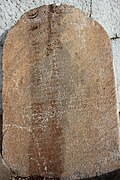 Kannada inscription of Deva Raya I at the Mallikarjuna temple in Mallappanagudi
_at_Hospet.JPG)
_at_Mallikarjuna_temple_in_Hospet.JPG)
Notes[edit | edit source]
- ↑ Lakshmi, Kumari Jhansi (1958). "The Chronology of the Sangama Dynasty". Proceedings of the Indian History Congress. 21: 290–297. JSTOR 44145214.
- ↑ "From Prehistoric Times To The Fall Of Vijayanagar : K. A. Nilakanta Sastri : Free Download, Borrow, and Streaming : Internet Archive". Internet Archive. 22 September 2015. Retrieved 26 November 2024.
- ↑ 3.0 3.1 Sen, Sailendra (2013). A Textbook of Medieval Indian History. Primus Books. pp. 103–108. ISBN 978-9-38060-734-4.
- ↑ 4.0 4.1 Kulakarṇī, Nayeem, De Souza (1996), p.106
- ↑ 5.0 5.1 Bowman,(2013) p.271
- ↑ Chopra, Ravindran and Subrahmanian (2003), p.31
- ↑ 7.0 7.1 7.2 7.3 Kamath (1980), p.163
- ↑ Sastri (1955), p.360
- ↑ V.K Agnihotri (2007), India History, p.150, Allied Publishers Private Limited, ISBN 8184242999
- ↑ Chopra, Ravindran and Subrahmanian (2003), pp.30-31
- ↑ 11.0 11.1 Chandra (1997), p.180
- ↑ Chandra, Satish (1997), p.180, Medieval India: From Sultanat to the Mughals - Delhi Sultanat (1206-1526), Har-Anand Publications Pvt. Ltd., New Delhi
- ↑ Chaurasia (2002) p.109
- ↑ Sastri (1955). p.225
- ↑ Chopra, Ravindran and Subrahmanian (2003), p.30
- ↑ Sastri (1955), pp.224-225
- ↑ Sangave (1981), p.46
References[edit | edit source]
- Chandra, Satish (2004) [1997]. Medieval India: From Sultanat to the Mughals-Delhi Sultanat (1206-1526) - Part One. New Delhi: Har-Anand Publications.
- Chaurasia, Radhey Shyam (2002) [2002]. History of Medieval India: From 1000 A.D. to 1707 A.D. New Delhi: Atlantic Publiushers. ISBN 81-269-0123-3.
- Nilakanta Sastri, K.A. (2002) [1955]. A history of South India from prehistoric times to the fall of Vijayanagar. New Delhi: Indian Branch, Oxford University Press. ISBN 0-19-560686-8.
- Kamath, Suryanath U. (2001) [1980]. A concise history of Karnataka: from pre-historic times to the present. Bangalore: Jupiter books. LCCN 80905179. OCLC 7796041.
- Bowman, John Stewart (2013) [2013]. Columbia Chronologies of Asian History and Culture. Columbia University Press. ISBN 978-0231-11004-4.
- Kulakarṇī,Nayeem,De Souza, A. Rā, M. A., Teotonio R. (1996) [1996]. Mediaeval Deccan History: Commemoration Volume in Honour of Purshottam Mahadeo Joshi. Popular Prakashan. ISBN 81-7154-579-3.
{{cite book}}: CS1 maint: multiple names: authors list (link) - John M. Fritz; George Michell, eds. (2001) [2001]. New Light on Hampi, Recent research in Vijayanagara. Mumbai: Marg. ISBN 81-85026-53-X.
- Chopra, P.N.; Ravindran, T.K.; Subrahmanian, N (2003) [2003]. History of South India (Ancient, Medieval and Modern) Part 2. New Delhi: Chand Publications. ISBN 81-219-0153-7.
- Sangave, Vilas Adinath (1981), The Sacred Shravanabelagola (A Socio-Religious Study) (1st ed.), New Delhi: Bharatiya Jnanpith
External links[edit | edit source]
- Our Karnataka article Archived 1 November 2005 at the Wayback Machine
- AP Online article
| Preceded by Bukka Raya II |
Vijayanagar empire 1406–1422 |
Succeeded by Vira Vijaya Bukka Raya |