




imported>Indielov m Corrected Devanagari text. |
BoydMalizia (talk | contribs) Updated formatting and improved readability |
||
| Line 1: | Line 1: | ||
{{Short description|Sanskrit play | {{Short description|Sanskrit play by Kālidāsa}} | ||
{{italic title}} | {{italic title}} | ||
[[File:Raja Ravi Varma - Mahabharata - Shakuntala.jpg|thumb|upright=1.1|''[[Shakuntala| | [[File:Raja Ravi Varma - Mahabharata - Shakuntala.jpg|thumb|upright=1.1|''[[Shakuntala (Raja Ravi Varma)|Shakuntala Looking Back to Glimpse Dusyanta]]'', scene from ''Shakuntala'' painted by [[Raja Ravi Varma]]]] | ||
'''''Abhijnanashakuntalam''''' ([[Devanagari]]: | '''''Abhijnanashakuntalam''''' ([[Devanagari]]: अभिज्ञानशाकुन्तलम्, [[International Alphabet of Sanskrit Transliteration|IAST]]: ''Abhijñānaśākuntalam''), also known as '''''Shakuntala''''', '''''The Recognition of Shakuntala''''', '''''The Sign of Shakuntala''''', is a [[Sanskrit drama|Sanskrit play]] by the ancient [[Indian people|Indian]] [[poet]] [[Kalidasa]], dramatizing the story of [[Shakuntala]] told in the epic ''[[Mahabharata]]'' and regarded as the best of Kalidasa's works.<ref>{{Cite book|url=https://books.google.com/books?id=hZET2sSUVsgC&pg=PA222|title=Critical Companion to George Orwell|page=222|last=Quinn|first=Edward|publisher=Infobase Publishing|date=2014|isbn=978-1438108735}}</ref> Its exact date is uncertain, but Kalidasa is often placed in the 4th century CE.<ref>[[Sheldon Pollock]] (ed., 2003) [https://books.google.com/books?id=ak9csfpY2WoC&pg=PA79&dq=kalidasa+fourth+century ''Literary Cultures in History: Reconstructions from South Asia''], p.79</ref> | ||
==Origin of Kālidāsa's play== | ==Origin of Kālidāsa's play== | ||
{{See also|Sanskrit drama}} | {{See also|Sanskrit drama}} | ||
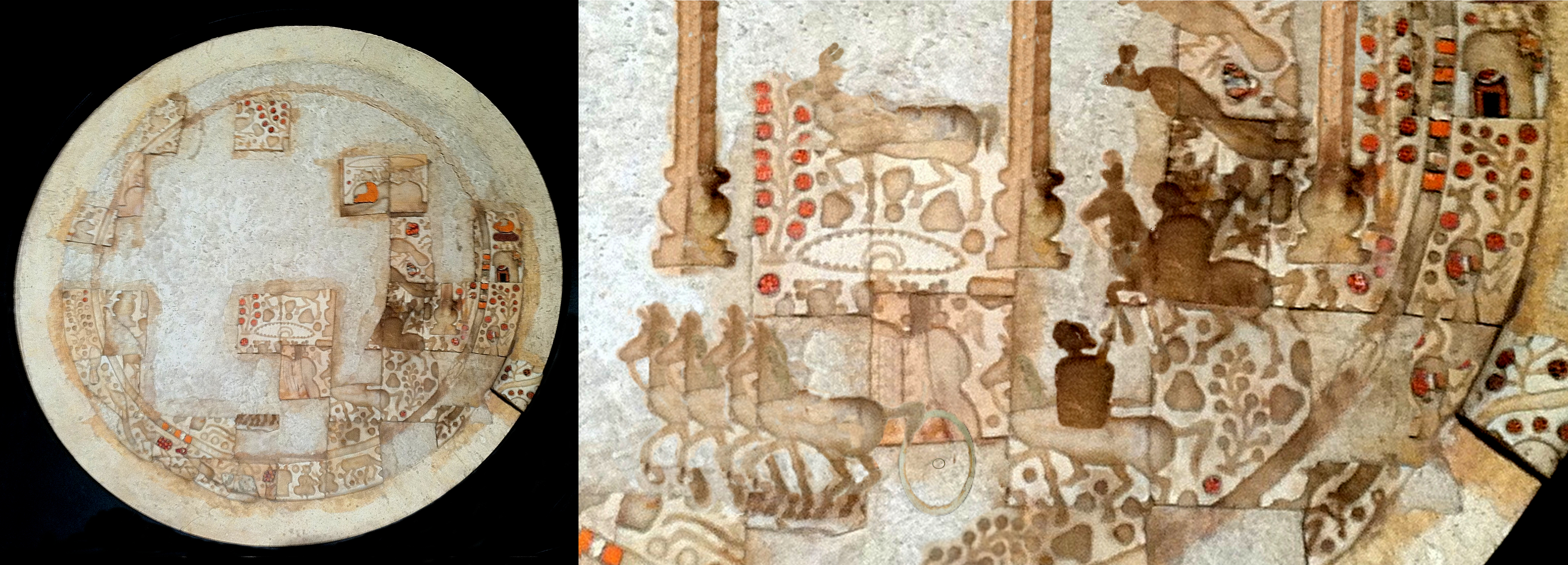
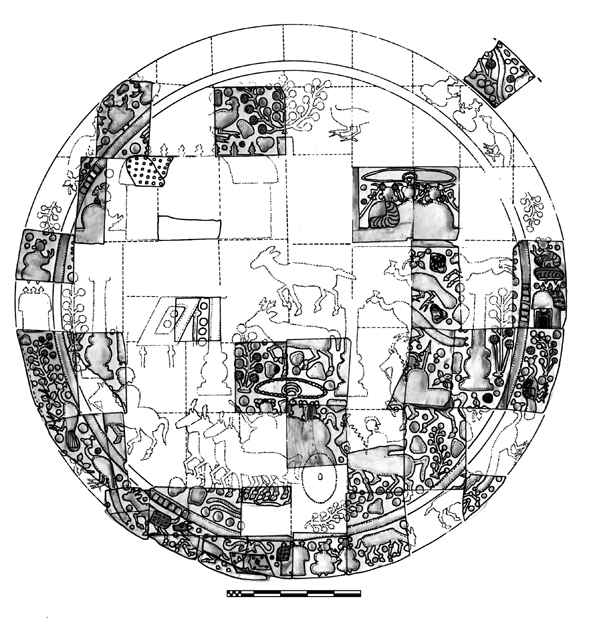
Plots similar to the play appear in earlier texts. There is a story mentioned in the ''[[Mahabharata|Mahābhārata]]''. A story of similar plot appear in the | [[File:Sakuntala_plate_reconstitution.jpg|thumb|upright=1.5|Indian plaque depicting the story of Shakuntala, found in the treasury of [[Ai-Khanoum]], [[Bactria]], 2nd century BCE<ref>{{cite book |last1=Rapin |first1=Claude |url=http://claude.rapin.free.fr/Rapin_Tresorerie_Fouilles_Ai_Khanoum_VIII_DAFA_v3.pdf |title=La Trésorerie du palais hellénistique d'Aï Khanoum. L'Apogée et la chute du royaume grec de Bactriane, Fouilles d'Aï Khanoum VIII, Mémoires de la Délégation archéologique française en Afghanistan XXXIII |date=1992 |publisher=De Boccard |location=Paris |page=Plaque 87 (reconstruction)}} also [http://claude.rapin.free.fr/4LDisIndRecons.jpg Reconstruction by Claude Rapin]</ref>]] | ||
Plots similar to the play appear in earlier texts. There is a story mentioned in the ''[[Mahabharata|Mahābhārata]]''. A story of similar plot appear in the Buddhist [[Jataka tales|Jātaka tales]] as well. In the Mahābhārata the story appears as a precursor to the Pāṇḍava and Kaūrava lineages. In the story King Duṣyanta and Śakuntalā meet in the forest and get estranged and ultimately reunited. Their son [[Bharata (Mahabharata)|Bharata]] is said to have laid the foundation of the dynasty that ultimately led to [[Kaurava]]s and [[Pandava|Pāṇḍava]]s.<ref name="Debroy 2015 p. 101">{{cite book | last=Debroy | first=B. | title=The Mahabharata | publisher=Penguin Books Limited | issue=v. 1 | year=2015 | isbn=978-81-8475-388-2 | url=https://books.google.com/books?id=5VziP-_XUT8C&pg=PT101 | access-date=2019-07-26 | page=101}}</ref><ref name="Satyamurti Doniger Dharwadker 2015 p. 49">{{cite book | last1=Satyamurti | first1=C. | last2=Doniger | first2=W. | last3=Dharwadker | first3=V. | title=Mahabharata: A Modern Retelling | publisher=W. W. Norton | year=2015 | isbn=978-0-393-24645-2 | url=https://books.google.com/books?id=ZjVMBAAAQBAJ&pg=PT49 | access-date=2019-07-26 | page=49}}</ref><ref name="Automation 2019">{{cite web | last=Automation | first=Bhaskar | title=महाभारत की शकुंतला और कालिदास के अभिज्ञान शाकुंतलम का किया चित्रण | website=Dainik Bhaskar | date=2019-06-13 | url=https://www.bhaskar.com/mp/ratlam/news/mp-news-the-portrayal-of-shakuntala-and-kalidas39s-recognition-of-shakuntalam-of-the-mahabharata-090005-4763657.html | language=hi | access-date=2019-07-26}}</ref><ref name="dasa Vasudeva 2006 p.20-21">{{cite book | last1=dasa | first1=K. | last2=Vasudeva | first2=S. | title=The Recognition of ShakÂœntala | publisher=NYU Press | series=Clay Sanskrit Library | year=2006 | isbn=978-0-8147-8815-8 | url=https://books.google.com/books?id=RHyC5yOMo90C | access-date=2019-07-26 | pages=20–21}}</ref> | |||
===Title=== | ===Title=== | ||
Manuscripts differ on what its exact title is. Usual variants are ''Abhijñānaśakuntalā'', ''Abhijñānaśākuntala'', ''Abhijñānaśakuntalam'' and | Manuscripts differ on what its exact title is. Usual variants are ''Abhijñānaśakuntalā'', ''Abhijñānaśākuntala'', ''Abhijñānaśakuntalam'' and ''Abhijñānaśākuntalam''.<ref>{{citation | author=Stephan Hillyer Levitt | url=http://www.indologica.it/volumi/doc_XXXI/08_Levitt.pdf | title=Why Are Sanskrit Play Titles Strange? | journal=Indologica Taurinensia | year=2005 | pages=195–232 | url-status=dead | archive-url=https://web.archive.org/web/20110722035418/http://www.indologica.it/volumi/doc_XXXI/08_Levitt.pdf | archive-date=2011-07-22 }}</ref> The Sanskrit title means ''pertaining to the recognition of Śakuntalā'', so a literal translation could be ''Of Śakuntalā who is recognized''. The title is sometimes translated as ''The token-for-recognition of Śakuntalā'' or ''The Sign of Śakuntalā''.{{citation needed|date=August 2017}} Titles of the play in published translations include ''Sacontalá or The Fatal Ring'' and ''Śakoontalá or The Lost Ring''.{{sfn|Jones|1789}}{{sfn|Monier-Williams|1855}} | ||
== Characters == | |||
===Prologue=== | |||
Characters reciting the benediction are: | |||
* ''Sūtradhāra'' ('Actor-manager') — Director/producer and over-all manager of the theatre, who also plays the hero of the play | |||
* ''Naṭī'' ('Actress') — Sutradhara's wife who plays the heroine in the play | |||
===Play=== | |||
Characters of the play listed in order of their appearance:<ref>{{Cite book |last=Kalidasa |url=https://www.google.co.in/books/edition/The_Recognition_of_Sakuntala/6miC3HNB90oC?hl=en&gbpv=1&dq=cast+of+characters+%C5%9B%C4%81kuntal%C4%81&pg=PR10&printsec=frontcover |title=The Recognition of Sakuntala: A Play In Seven Acts |date=2001-07-19 |publisher=OUP Oxford |isbn=978-0-19-160609-0 |language=en}}</ref> | |||
{| class="wikitable" | |||
!Character | |||
!Description | |||
|- | |||
|''[[Sūta]]'' (Charioteer) | |||
|The royal charioteer who also serves as a close companion to the king. | |||
|- | |||
|King [[Dushyanta|Duṣyanta]] | |||
|Hero (''Nayaka''); ruler from the Puru branch of the [[Lunar dynasty]]. | |||
|- | |||
|Vaikhānasa | |||
|A reclusive forest hermit belonging to the spiritual lineage of sage Kanva. | |||
|- | |||
|Two Ascetics | |||
|Disciples receiving spiritual guidance from sage Kanva. | |||
|- | |||
|[[Shakuntala|Śakuntalā]] | |||
|Heroine (''[[Ashta Nayika|Nayika]]''); child of the sage [[Vishvamitra|Viśvāmitra]] and the celestial nymph [[Menaka|Menakā]], raised under the guardianship of sage Kanva. | |||
|- | |||
|Anasūyā | |||
|Young woman devoted to an ascetic life; companion of Śakuntalā, her name signifying “free from envy.” | |||
|- | |||
|Priyamvadā | |||
|Young female ascetic and friend of Śakuntalā, her name meaning “pleasant speaker.” | |||
|- | |||
|Ascetic (off-stage) | |||
|A practitioner of ascetic discipline in the service of sage Kanva. | |||
|- | |||
|Vidūṣaka (Mādhavya) | |||
|A corpulent [[Brahmin]] who serves as the king’s intimate companion and trusted adviser. | |||
|- | |||
|Attendants | |||
|Female members of the royal guard who also serve as the king’s bow-bearers. | |||
|- | |||
|Doorkeeper (Raivataka) | |||
|Gate attendant in the royal court. | |||
|- | |||
|General | |||
|The chief military commander serving under the king. | |||
|- | |||
|Two Seers | |||
|Young hermits residing in Kanva’s forest retreat. | |||
|- | |||
|Karabhaka | |||
|A royal envoy entrusted with delivering messages. | |||
|- | |||
|Assistant Sacrificer | |||
|A member of Kanva’s ascetic circle who aids in ritual duties. | |||
|- | |||
|Gautamī | |||
|An elder woman devoted to ascetic life in Kanva’s hermitage. | |||
|- | |||
|Voice in the Air (Act 3) | |||
|A disembodied voice delivering divine or unseen guidance. | |||
|- | |||
|[[Durvasa|Durvāsas]] (off-stage) | |||
|A formidable and quick-tempered ascetic sage. | |||
|- | |||
|Pupil (Viṣkambhaka) | |||
|A student under Kanva’s spiritual tutelage. | |||
|- | |||
|Ascetic (off-stage) | |||
|An unseen follower of Kanva’s ascetic order. | |||
|- | |||
|Three Hermit Women | |||
|Female recluses living in Kanva’s forest hermitage. | |||
|- | |||
|First Young Ascetic (Nārada) | |||
|A youthful ascetic disciple of Kanva. | |||
|- | |||
|Second Young Ascetic | |||
|Another youthful ascetic disciple of Kanva. | |||
|- | |||
|[[Kanva]] | |||
|A venerable Brahmin sage, head of the hermitage, and foster-father of Śakuntalā; also identified with the sage Kāśyapa. | |||
|- | |||
|Śārṅgarava | |||
|An ascetic belonging to Kanva’s order. | |||
|- | |||
|Voice in the Air (Act 4) | |||
|A supernatural voice heard without a visible speaker. | |||
|- | |||
|Voice (Haṃsapadikā) | |||
|A disembodied female voice, meaning “one with the gait of a swan.” | |||
|- | |||
|Chamberlain (Vātāyana) | |||
|Principal officer overseeing the administration of the royal household. | |||
|- | |||
|Doorkeeper (Vetravatī) | |||
|A female gate attendant in the royal residence. | |||
|- | |||
|One of Duṣyanta’s Consorts | |||
|A royal wife of King Duṣyanta. | |||
|- | |||
|Chief Officer of the Royal Household | |||
|Oversees domestic and ceremonial affairs within the palace. | |||
|- | |||
|Female Attendant | |||
|A woman serving in a supporting role within the royal quarters. | |||
|- | |||
|Two Bards (off-stage) | |||
|Court poets or singers whose voices are heard but who remain unseen. | |||
|- | |||
|Ārāḍvata | |||
|An ascetic associated with Kanva’s community. | |||
|- | |||
|Court Priest (Preceptor Somarāta) | |||
|The king’s chief religious adviser and officiant in rituals. | |||
|- | |||
|Two Policemen | |||
|Enforcers of law and order in the royal domain. | |||
|- | |||
|Chief of Police (Mitrāvasu) | |||
|Senior law officer of the realm; the king’s brother-in-law. | |||
|- | |||
|Man | |||
|A fisherman encountered in the course of events. | |||
|- | |||
|Sānumati | |||
|A celestial nymph and confidante of Menakā, mother of Śakuntalā. | |||
|- | |||
|First Gardener (Parabhṛtikā, “Little Cuckoo”) | |||
|A female gardener serving the palace grounds. | |||
|- | |||
|Second Gardener (Madhukarikā, “Little Bee”) | |||
|Another female gardener attending the royal gardens. | |||
|- | |||
|Caturikā | |||
|A female domestic servant. | |||
|- | |||
|Bowbearer | |||
|A woman tasked with carrying and maintaining the king’s bow. | |||
|- | |||
|[[Mātali]] | |||
|The divine charioteer of [[Indra]], sovereign of the gods. | |||
|- | |||
|[[Bharata (Mahabharata)|Sarvadamana]] | |||
|The young son of Duṣyanta and Śakuntalā, later famed as Bharata. | |||
|- | |||
|Two Female Ascetics | |||
|Women dedicated to ascetic practice. | |||
|- | |||
|Mārīca ([[Kashyapa|Kāśyapa]]) | |||
|A celestial sage, lord of the divine hermitage, and father of the god Indra. | |||
|- | |||
|[[Aditi]] | |||
|Wife of Mārīca. | |||
|- | |||
|Pupil (Galava) | |||
|A student under the instruction of Mārīca. | |||
|} | |||
==Synopsis== | ==<span lang="Gu" dir="ltr">Synopsis</span>== | ||
{{See also|Shakuntala}} | {{See also|Shakuntala}} | ||
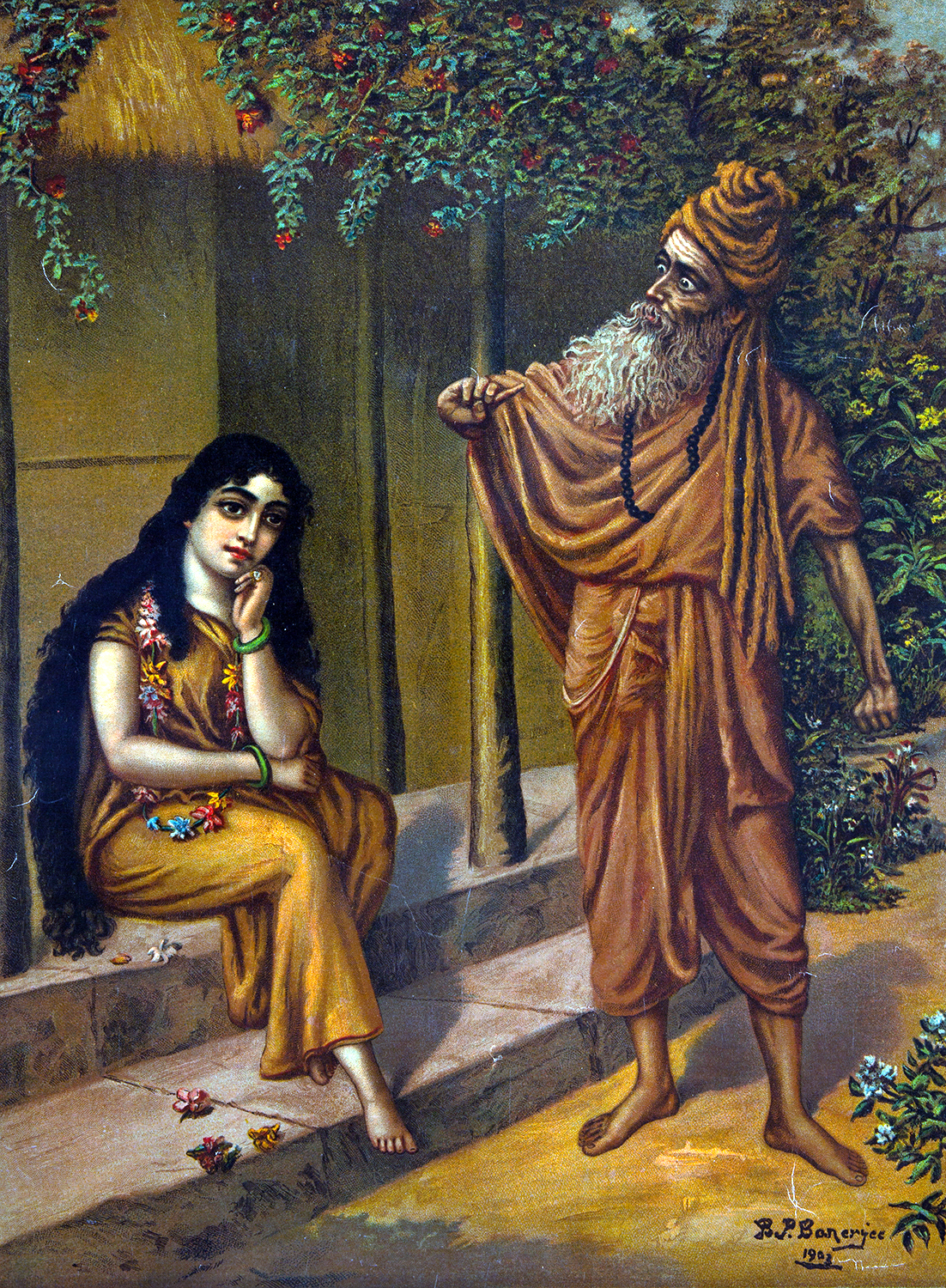
[[File: | [[File:Durvasa’s_wrath_against_Shakuntala.jpg|alt=|left|thumb|272x272px|Kalidasa's version features much dramatized variant of the tale. One of Kalidasa's additions include the sage Durvasa cursing Shakuntala (pictured; print by BP Banerjee).]] | ||
The protagonist is [[Shakuntala|Śakuntalā]], daughter of the sage [[Vishwamitra|Viśvāmitra]] and the [[apsara]] [[Menaka|Menakā]]. Abandoned at birth by her parents, Śakuntalā is reared in the secluded hermitage of the sage [[Kanva|Kaṇva]], and grows up a comely but innocent maiden. | The protagonist is [[Shakuntala|Śakuntalā]], daughter of the sage [[Vishwamitra|Viśvāmitra]] and the [[apsara]] [[Menaka|Menakā]]. Abandoned at birth by her parents, Śakuntalā is reared in the secluded hermitage of the sage [[Kanva|Kaṇva]], and grows up a comely but innocent maiden. | ||
While Kaṇva and the other elders of the hermitage are away on a pilgrimage, [[Dushyanta|Duṣyanta]], king of [[Hastinapura|Hastināpura]], comes hunting in the forest. Just as he was about to slay a deer, Vaikhānasa, a sage obstructs him saying that the deer was from the hermitage and must not be | While Kaṇva and the other elders of the hermitage are away on a pilgrimage, [[Dushyanta|Duṣyanta]], king of [[Hastinapura|Hastināpura]], comes hunting in the forest. Just as he was about to slay a deer, Vaikhānasa, a sage obstructs him saying that the deer was from the hermitage and must not be slain. He politely requests the king to take his arrow back, to which the king complies. The sage then informs him that they are going to collect firewood for the [[sacrificial fire]] and asks him to join them. They then spot the hermitage of Sage Kaṇva and decide to pay the hermits a visit. However the king decides to go to this penance grove dressed up as a commoner. He also stops the chariot farther away to not disturb the hermits. The moment he enters the hermitage and spots Śakuntalā, he is captivated by her, courts her in royal style, and marries her. Soon, he has to leave to take care of affairs in the capital. The king gives her a ring which, as it turns out, will eventually have to be presented to him when she appears in his court to claim her place as queen. | ||
One day, the anger-prone sage [[Durvasa|Durvāsa]] arrives when Śakuntala is lost in her thoughts, and when she fails to attend to him, he curses her by bewitching Duṣyanta into forgetting her existence. The only cure is for Śakuntala to show the king the [[signet ring]] that he gave her. | One day, the anger-prone sage [[Durvasa|Durvāsa]] arrives when Śakuntala is lost in her thoughts, and when she fails to attend to him, he curses her by bewitching Duṣyanta into forgetting her existence. The only cure is for Śakuntala to show the king the [[signet ring]] that he gave her. | ||
| Line 25: | Line 187: | ||
Fortunately, the ring is discovered by a fisherman in the belly of a fish, and presents it in the king's court. Duṣyanta realizes his mistake - too late. The newly wise Duṣyanta is asked to defeat an army of [[Asuras]], and is rewarded by [[Indra]] with a journey through heaven. After returning to Earth years later, Duṣyanta finds Śakuntala and their son by chance, and recognizes them. | Fortunately, the ring is discovered by a fisherman in the belly of a fish, and presents it in the king's court. Duṣyanta realizes his mistake - too late. The newly wise Duṣyanta is asked to defeat an army of [[Asuras]], and is rewarded by [[Indra]] with a journey through heaven. After returning to Earth years later, Duṣyanta finds Śakuntala and their son by chance, and recognizes them. | ||
In other versions, especially the one found in the '[[Mahabharata|Mahābhārata]]', Śakuntala is not reunited until their son Bharata is born, and found by the king playing with lion cubs. Duṣyanta meets young Bharata and enquires about his parents, and finds out that Bharata is indeed his son. Bharata is an ancestor of the lineages of the [[Kauravas]] and [[Pandavas|Pāṇḍavas]], who fought the epic war of the Mahābhārata. It is after this Bharata that India was given the name "Bhāratavarsha", the 'Land of Bharata'.<ref name=Apte>{{cite book|last1=Apte|first1=Vaman Shivaram|title=Revised and enlarged edition of Prin. V. S. Apte's The practical Sanskrit-English dictionary|year=1959|publisher=Prasad Prakashan|location=Poona|url=http://dsalsrv02.uchicago.edu/cgi-bin/philologic/getobject.pl?c.4:1:2619.apte|chapter=भरतः}}</ref> | In other versions, especially the one found in the '[[Mahabharata|Mahābhārata]]', Śakuntala is not reunited until their son Bharata is born, and found by the king playing with lion cubs. Duṣyanta meets young Bharata and enquires about his parents, and finds out that Bharata is indeed his son. Bharata is an ancestor of the lineages of the [[Kauravas]] and [[Pandavas|Pāṇḍavas]], who fought the epic war of the Mahābhārata. It is after this Bharata that India was given the name "Bhāratavarsha", the 'Land of Bharata'.<ref name="Apte">{{cite book|last1=Apte|first1=Vaman Shivaram|title=Revised and enlarged edition of Prin. V. S. Apte's The practical Sanskrit-English dictionary|year=1959|publisher=Prasad Prakashan|location=Poona|url=http://dsalsrv02.uchicago.edu/cgi-bin/philologic/getobject.pl?c.4:1:2619.apte|chapter=भरतः|archive-date=2016-01-13|access-date=2017-08-21|archive-url=https://web.archive.org/web/20160113234218/http://dsalsrv02.uchicago.edu/cgi-bin/philologic/getobject.pl?c.4:1:2619.apte|url-status=dead}}</ref> | ||
==Reception== | ==Reception== | ||
[[File:Palm-leaf manuscript cover illustrated with scenes from Kalidasa’s Shakuntala play, Kathmandu Valley, Nepal, circa 12th century.jpg|thumb|Palm-leaf manuscript cover illustrated with scenes from Kalidasa’s ''Shakuntala'' play, Kathmandu Valley, Nepal, circa 12th century]] | |||
===Sanskrit literature=== | ===Sanskrit literature=== | ||
| Line 35: | Line 196: | ||
===Introduction in the West=== | ===Introduction in the West=== | ||
''Sacontalá or The Fatal Ring'', Sir William Jones' translation of Kālidāsa's play, was first published in Calcutta, followed by European republications in 1790, 1792 and 1796.{{sfn|Jones|1789}}{{sfn|Evison|1998|pp=[https://books.google.com/books?id=8p8jSshklY8C&pg=PA132 132–135]}} A German (by [[Georg Forster]]) and a French version of Jones' translation were published in 1791 and 1803 respectively.{{sfn|Evison|1998|pp=[https://books.google.com/books?id=8p8jSshklY8C&pg=PA132 132–135]}}{{sfn|Jones|1791}}{{sfn|Jones|1803}} [[Goethe]] published an epigram about Shakuntala in 1791, and in [[Goethe's Faust|his ''Faust'']] he adopted a theatrical convention from the prologue of Kālidāsa's play.{{sfn|Evison|1998|pp=[https://books.google.com/books?id=8p8jSshklY8C&pg=PA132 132–135]}} [[Karl Wilhelm Friedrich Schlegel]]'s plan to translate the work into German never materialised, but he did however publish a translation of the ''Mahābhārata'' version of Śakuntalā's story in 1808.{{sfn|Figueira|1991|pages=[https://books.google.com/books?id=aN_U4bJvrRMC&pg=PA19 19–20]}} [[Goethe | {{further|List of Sanskrit plays in English translation}} | ||
By the 18th century, Western poets were beginning to get acquainted with works of Indian literature and [[Indian philosophy|philosophy]].{{citation needed|date=August 2017}} ''Shakuntala'' was the first Indian drama to be translated into a Western language, by [[William Jones (philologist)|Sir William Jones]] in 1789. In the next 100 years, there were at least 46 translations in twelve European languages.<ref name="completer">[http://www.complete-review.com/reviews/sanskrit/ksakun1a.htm Review] of Figueira's ''Translating the Orient: The Reception of Sakuntala in Nineteenth-Century Europe'' at the [[complete review]] website.</ref> | |||
[[File:Sacontala (Jones 1870).djvu|thumb|Fourth edition (1870 reprint) of the Sanskrit play Sacontala by Kālidāsa and translated into English by William Jones]] | |||
''Sacontalá or The Fatal Ring'', Sir William Jones' translation of Kālidāsa's play, was first published in Calcutta, followed by European republications in 1790, 1792 and 1796.{{sfn|Jones|1789}}{{sfn|Evison|1998|pp=[https://books.google.com/books?id=8p8jSshklY8C&pg=PA132 132–135]}} A German (by [[Georg Forster]]) and a French version of Jones' translation were published in 1791 and 1803 respectively.{{sfn|Evison|1998|pp=[https://books.google.com/books?id=8p8jSshklY8C&pg=PA132 132–135]}}{{sfn|Jones|1791}}{{sfn|Jones|1803}} [[Goethe]] published an epigram about Shakuntala in 1791, and in [[Goethe's Faust|his ''Faust'']] he adopted a theatrical convention from the prologue of Kālidāsa's play.{{sfn|Evison|1998|pp=[https://books.google.com/books?id=8p8jSshklY8C&pg=PA132 132–135]}} [[Karl Wilhelm Friedrich Schlegel]]'s plan to translate the work into German never materialised, but he did however publish a translation of the ''Mahābhārata'' version of Śakuntalā's story in 1808.{{sfn|Figueira|1991|pages=[https://books.google.com/books?id=aN_U4bJvrRMC&pg=PA19 19–20]}} [[Goethe]]'s epigram goes like this:<ref> | |||
Mueller, Max [https://archive.org/stream/in.ernet.dli.2015.279340/2015.279340.A-History#page/n19/mode/2up ''A History Of Ancient Sanskrit Literature''] | Mueller, Max [https://archive.org/stream/in.ernet.dli.2015.279340/2015.279340.A-History#page/n19/mode/2up ''A History Of Ancient Sanskrit Literature''] | ||
</ref> | </ref> | ||
{{ | {{blockquote|<poem> | ||
Wilt thou the blossoms of spring and the fruits that are later in season, | Wilt thou the blossoms of spring and the fruits that are later in season, | ||
Wilt thou have charms and delights, wilt thou have strength and support, | Wilt thou have charms and delights, wilt thou have strength and support, | ||
Wilt thou with one short word encompass the earth and the heaven, | Wilt thou with one short word encompass the earth and the heaven, | ||
All is said if I name only, [Shakuntala], thee.</poem>}} | All is said if I name only, [Shakuntala], thee.</poem>}} | ||
=== Paintings and prints by Raja Ravi Varma === | |||
[[File:Sakunthala-pathralekhanam.jpg|right|thumb|Raja Ravi Varma's [[Shakuntala Patra-lekhan]]]] | |||
[[Raja Ravi Varma]] was widely praised for his ability to merge the Western academic painting style with Indian themes. In the 1870s, as he began creating narrative paintings, he drew inspiration from India’s classical heritage—drawing upon the epics, Puranas, and Kalidasa’s plays. His first major work featuring Shakuntala, ''[[Shakuntala Patra-lekhan|Shakuntala Patralekhan]]'' (Shakuntala Writing a Love Letter to Dushyanta), was painted for the 1876 Madras exhibition. The painting, which depicted Shakuntala lying on the forest floor in a yellow sari, surrounded by her friends and animal companions, won a gold medal and garnered widespread acclaim. It was immediately purchased by the Duke of Buckingham, then Governor of Madras. Though the location of the original painting remains unknown, it was widely reproduced in books and lithographs, including the 1903 publication Ravi Varma: The Indian Artist. Given the colonial fascination with the ''Abhijnanasakuntalam'' narrative at the time, Varma was encouraged to create multiple renditions of Shakuntala. His later works included Shakuntala (1888, Maharaja Fatehsingh Museum, Baroda), Shakuntala (1898, Government Museum, Madras), and ''[[Shakuntala (Raja Ravi Varma)|Shakuntala Looking for Dushyanta]]'' (1898, Shri Chitra Art Gallery, Trivandrum). One of his Shakuntala paintings was even selected as the frontispiece for [[Monier-Williams]]' 1887 edition of Kalidasa’s play.<ref name=":12">{{Cite book |last=McLain |first=Karline |url=https://books.google.com/books?id=V4-Su0whKa0C&q=shakuntala+&pg=PA64 |title=India's Immortal Comic Books: Gods, Kings, and Other Heroes |date=2009-03-04 |publisher=Indiana University Press |isbn=978-0-253-22052-3 |language=en}}</ref> His most famous painting, ''Shakuntala Looking for Dushyanta'' captures the moment when she feigns removing a thorn from her foot while actually glancing back to see if Dushyanta notices her.<ref>Prabhu, K. (2022). Contribution of Raja Ravi Varma in Retelling the Religious and Mythological Themes through Paintings. All Studies Journal, 7(4).</ref> | |||
Varma’s works were equally admired by Orientalists and Indian nationalists. In 1895, Varma’s first lithographic print, The Birth of Shakuntala, won the "Best Lithograph" prize at the Bombay Art Society’s annual exhibition.<ref name=":12"/> | |||
===Education in British India=== | ===Education in British India=== | ||
''Shakuntala'' was disapproved of as a text for school and college students in the [[British Raj]] in the 19th century, as popular Indian literature was deemed, in the words of [[Sir Charles Trevelyan, 1st Baronet|Charles Trevelyan]], to be "marked with the greatest immorality and impurity", and Indian students were thought by colonial administrators to be insufficiently morally and intellectually advanced to read the Indian texts that were taught and praised in Britain.<ref>{{cite book|last=Viswanathan|first=Gauri|title=Masks of Conquest: Literary Study and British Rule in India|publisher=Oxford University Press|year=1989|pages=5–6}}</ref> | ''Shakuntala'' was disapproved of as a text for school and college students in the [[British Raj]] in the 19th century, as popular Indian literature was deemed, in the words of [[Sir Charles Trevelyan, 1st Baronet|Charles Trevelyan]], to be "marked with the greatest immorality and impurity", and Indian students were thought by colonial administrators to be insufficiently morally and intellectually advanced to read the Indian texts that were taught and praised in Britain.<ref>{{cite book |last=Viswanathan |first=Gauri |title=Masks of Conquest: Literary Study and British Rule in India |publisher=Oxford University Press |year=1989 |pages=5–6}}</ref> | ||
===Unfinished opera projects=== | ===Unfinished opera projects=== | ||
{{See also|Sakuntala (opera)}} | {{See also|Sakuntala (opera)}} | ||
When Leopold Schefer became a student of [[Antonio Salieri]] in September 1816, he had been working on an opera about Shakuntala for at least a decade, a project which he did however never complete.<ref name="NSE2008pIX">Manuela Jahrmärker and Thomas Aigner (editors), [[Franz Schubert]] (composer) and [[Johann Philipp Neumann]] (librettist). ''[https://www.baerenreiter.com/en/shop/product/details/BA5561/ Sacontala]'' ([[New Schubert Edition|NSE]] [https://www.baerenreiter.com/en/catalogue/complete-editions/schubert-franz/series-ii/ Series II] Vol. 15). [[Bärenreiter]], 2008, [https://www.baerenreiter.com/resource/public/products/BA5561/infoitems/vw/01.pdf p. IX]</ref> [[Franz Schubert]], who had been a student of Salieri until at least December of the same year, started composing his [[Sakuntala (opera)|''Sakuntala'' opera]], {{D.}} 701, in October 1820.<ref name="NSE2008pIX" /><ref name=musicweb>Margarida Mota-Bull. [http://www.musicweb-international.com/classrev/2008/June08/Schubert_Sakontala_83218.htm Sakontala (8 june 2008)] at {{ | When Leopold Schefer became a student of [[Antonio Salieri]] in September 1816, he had been working on an opera about Shakuntala for at least a decade, a project which he did however never complete.<ref name="NSE2008pIX">Manuela Jahrmärker and Thomas Aigner (editors), [[Franz Schubert]] (composer) and [[Johann Philipp Neumann]] (librettist). ''[https://www.baerenreiter.com/en/shop/product/details/BA5561/ Sacontala]'' ([[New Schubert Edition|NSE]] [https://www.baerenreiter.com/en/catalogue/complete-editions/schubert-franz/series-ii/ Series II] Vol. 15). [[Bärenreiter]], 2008, [https://www.baerenreiter.com/resource/public/products/BA5561/infoitems/vw/01.pdf p. IX]</ref> [[Franz Schubert]], who had been a student of Salieri until at least December of the same year, started composing his [[Sakuntala (opera)|''Sakuntala'' opera]], {{D.}} 701, in October 1820.<ref name="NSE2008pIX" /><ref name=musicweb>Margarida Mota-Bull. [http://www.musicweb-international.com/classrev/2008/June08/Schubert_Sakontala_83218.htm Sakontala (8 june 2008)] at {{URL|http://www.musicweb-international.com}}</ref> [[Johann Philipp Neumann]] based the [[libretto]] for this opera on Kālidāsa's play, which he probably knew through one or more of the three German translations that had been published by that time.<ref name="D701">[[Otto Erich Deutsch]], with revisions by [[Werner Aderhold]] and others. ''[[Deutsch catalogue|Franz Schubert, thematisches Verzeichnis seiner Werke in chronologischer Folge]]''. ([[New Schubert Edition]] Series VIII: Supplement, Vol. 4). Kassel: [[Bärenreiter]], 1978. {{ISBN|9783761805718}}, [https://archive.org/stream/FranzSchubert.ThematischesVerzeichnisSeinerWerkeInChronologischerFolge/SchubertDeutsch-verzeichnisDv#page/n434/mode/1up pp. 411–413]</ref> Schubert abandoned the work in April 1821 at the latest.<ref name="NSE2008pIX" /> A short extract of the unfinished score was published in 1829.<ref name="D701" /> Also [[Václav Tomášek]] left an incomplete ''Sakuntala'' opera.<ref name="BSO1903-1904Programme">[[Boston Symphony Orchestra]] [https://archive.org/details/programme0304bost ''Twenty-Third Season, 1903–1904: Programme''] – [https://archive.org/stream/programme0304bost#page/125/mode/1up pp. 125–128]</ref> | ||
===New adaptations and editions=== | ===New adaptations and editions=== | ||
Kālidāsa's ''Śakuntalā'' was the model for the libretto of | Kālidāsa's ''Śakuntalā'' was the model for the libretto of [[Karl von Perfall]]'s first opera, which premièred in 1853.<ref>''[[Allgemeine Zeitung]]'', [https://books.google.com/books?id=G9dDAAAAcAAJ&pg=PA1649 No. 104 (Thursday 14 April 1853)]: [https://books.google.com/books?id=G9dDAAAAcAAJ&pg=PA1662 p. 1662]</ref> In 1853 [[Monier Monier-Williams]] published the Sanskrit text of the play.{{sfn|Monier-Williams|1853}} Two years later he published an English translation of the play, under the title: ''Śakoontalá or The Lost Ring''.{{sfn|Monier-Williams|1855}} A ballet version of Kālidāsa's play, ''Sacountalâ'', on a libretto by [[Théophile Gautier]] and with music by [[Ernest Reyer]], was first performed in Paris in 1858.<ref name="BSO1903-1904Programme"/>{{sfn|Gautier|1858}} A plot summary of the play was printed in the score edition of [[Karl Goldmark]]'s Overture to ''Sakuntala'', Op. 13 (1865).<ref name="BSO1903-1904Programme"/> [[Sigismund Bachrich]] composed a ''Sakuntala'' ballet in 1884.<ref name="BSO1903-1904Programme"/> [[Felix Weingartner]]'s opera ''Sakuntala'', with a libretto based on Kālidāsa's play, premièred the same year.<ref>Hubbard, William Lines (1908). [https://archive.org/details/16218745.1433.emory.edu ''Operas'', Vol. 2] in: The American History and Encyclopedia of Music. Irving Squire, [https://archive.org/stream/16218745.1433.emory.edu/16218745_1433#page/n450/mode/1up p. 418]</ref> Also [[Philipp Scharwenka]]'s ''Sakuntala'', a choral work on a text by Carl Wittkowsky, was published in 1884.<ref>[[scores:List of works by Philipp Scharwenka#Works without Opus Number|§ "Works without Opus Number" of List of works by Philipp Scharwenka]] at IMSLP website</ref> | ||
Bengali translations:{{Relevance inline|date=August 2017}} | Bengali translations:{{Relevance inline|date=August 2017}} | ||
| Line 61: | Line 233: | ||
* ''Abigna'' ''Sakuntalam '' (1938) by [[Mahavidwan R. Raghava Iyengar|Mahavidwan R.Raghava Iyengar]]. Translated in sandam style. | * ''Abigna'' ''Sakuntalam '' (1938) by [[Mahavidwan R. Raghava Iyengar|Mahavidwan R.Raghava Iyengar]]. Translated in sandam style. | ||
[[Felix Woyrsch]]'s incidental music for Kālidāsa's play, composed around 1886, is lost.<ref>[http://www.p-w-g.de/woyrsch/werke-2.html Felix Woyrsch – Werke] at Pfohl-Woyrsch-Gesellschaft website</ref> [[Ignacy Jan Paderewski]] would have composed a Shakuntala opera, on a libretto by [[Catulle Mendès]], in the first decade of the 20th century: the work is however no longer listed as extant in overviews of the composer's or librettist's oeuvre.<ref>[[Hugo Riemann|Riemann, Hugo]] (editor). {{ | [[Felix Woyrsch]]'s incidental music for Kālidāsa's play, composed around 1886, is lost.<ref>[http://www.p-w-g.de/woyrsch/werke-2.html Felix Woyrsch – Werke] at Pfohl-Woyrsch-Gesellschaft website</ref> [[Ignacy Jan Paderewski]] would have composed a Shakuntala opera, on a libretto by [[Catulle Mendès]], in the first decade of the 20th century: the work is however no longer listed as extant in overviews of the composer's or librettist's oeuvre.<ref>[[Hugo Riemann|Riemann, Hugo]] (editor). {{interlanguage link|Musik-Lexikon (Riemann)|wikisource:de|Musiklexika#RML|lt=''Musik-Lexikon''}}, 7th edition. Leipzig: Hesse, 1909, [https://archive.org/stream/RiemannMusiklexikon09tea1919/RiemannMusiklexikon07tea1909#page/n1076/mode/1up p. 1037]</ref><ref>[[scores:List of works by Ignacy Jan Paderewski|List of works by Ignacy Jan Paderewski]] at [[IMSLP]] website</ref><ref>Małgorzata Perkowska. [http://pmc.usc.edu/PMJ/issue/4.2.01/paderewskiworks.html "List of Works by Ignacy Jan Paderewski"] in ''Polish Music Journal'', Vol. 4, No. 2, Winter 2001</ref><ref>[http://www.artlyriquefr.fr/personnages/Mendes%20Catulle.html Catulle Mendès] at {{URL|www.artlyriquefr.fr}}</ref> [[Arthur W. Ryder]] published a new English translation of ''Shakuntala'' in 1912.{{sfn|Ryder|1912}} Two years later he collaborated to an English performance version of the play.{{sfn|Holme|Ryder|1914}} The work was staged at the [[Greenwich Village Theatre]] in New York in 1919 with [[Beatrice Prentice]] as Śakuntalā, [[Frank Conroy (actor)|Frank Conroy]] as Kaṇva (also director for the production), [[Joseph Macauley]] as King Duṣyanta, [[Grace Henderson]] as Gautami, and Harold Meltzer as Matali.<ref>{{cite news|url=https://archive.org/details/theatremagazine29newyuoft/page/n291/mode/2up?q=%22Joseph+Macauley%22|title=Greenwich Village, "Shakuntala"|work=Theatre Magazine|page=276|date=May 1919}}</ref> | ||
===Alfano's opera=== | ===Alfano's opera=== | ||
| Line 75: | Line 247: | ||
Norwegian electronic musician [[Amethystium]] wrote a song called "Garden of Sakuntala" which can be found on the CD ''Aphelion''.{{citation needed|date=August 2017}}{{Relevance inline|date=August 2017}} According to [[Philip Lutgendorf]], the narrative of the movie [[Ram Teri Ganga Maili]]{{when|date=August 2017}} recapitulates the story of Shakuntala.<ref>[http://www.uiowa.edu/~incinema/RamTeriGM.html Ram Teri Ganga Maili] {{webarchive|url=https://web.archive.org/web/20111228010453/http://www.uiowa.edu/~incinema/RamTeriGM.html |date=2011-12-28 }} at ''Notes on Indian popular cinema'' by Philip Lutgendorf</ref>{{Relevance inline|date=August 2017}} | Norwegian electronic musician [[Amethystium]] wrote a song called "Garden of Sakuntala" which can be found on the CD ''Aphelion''.{{citation needed|date=August 2017}}{{Relevance inline|date=August 2017}} According to [[Philip Lutgendorf]], the narrative of the movie [[Ram Teri Ganga Maili]]{{when|date=August 2017}} recapitulates the story of Shakuntala.<ref>[http://www.uiowa.edu/~incinema/RamTeriGM.html Ram Teri Ganga Maili] {{webarchive|url=https://web.archive.org/web/20111228010453/http://www.uiowa.edu/~incinema/RamTeriGM.html |date=2011-12-28 }} at ''Notes on Indian popular cinema'' by Philip Lutgendorf</ref>{{Relevance inline|date=August 2017}} | ||
In [[Koodiyattam]], the only surviving ancient Sanskrit theatre tradition, prominent in the state of [[Kerala]] on India, performances of Kālidāsa's plays are rare. However, | In [[Koodiyattam]], the only surviving ancient Sanskrit theatre tradition, prominent in the state of [[Kerala]] on India, performances of Kālidāsa's plays are rare. However, internationally recognised Kutiyattam artist and ''[[Natyashastra]]'' scholar Nātyāchārya Vidūshakaratnam [[Padma Shri]] [[Guru]] [[Māni Mādhava Chākyār]] has choreographed a Koodiyattam production of ''The Recognition of Sakuntala''.<ref>Das Bhargavinilayam, Mani Madhaveeyam {{cite web |url=http://www.kerala.gov.in/dept_culture/books.htm |title=Archived copy |access-date=2008-02-15 |url-status=dead |archive-url=https://web.archive.org/web/20080215085741/http://www.kerala.gov.in/dept_culture/books.htm |archive-date=2008-02-15}} (biography of Guru [[Mani Madhava Chakyar]]), Department of Cultural Affairs, Government of Kerala, 1999, {{ISBN|81-86365-78-8}}</ref>{{failed verification|date=August 2017}} | ||
A production directed by Tarek Iskander was mounted for a run at London's Union Theatre in January and February 2009.{{citation needed|date=August 2017}} The play is also appearing on a Toronto stage for the first time as part of the [https://web.archive.org/web/20130509171350/http://www.movietrailerlive.com/ct_0001_HarbourfrontCentreWorldStage Harbourfront World Stage program | A production directed by Tarek Iskander was mounted for a run at London's Union Theatre in January and February 2009.{{citation needed|date=August 2017}} The play is also appearing on a Toronto stage for the first time as part of the Harbourfront World Stage program.<ref>[https://web.archive.org/web/20130509171350/http://www.movietrailerlive.com/ct_0001_HarbourfrontCentreWorldStage Harbourfront World Stage program]{{failed verification|date=August 2017}}</ref> An adaptation by the Magis Theatre Company <ref>[http://www.magistheatre.org]{{failed verification|date=August 2017}}</ref> featuring the music of Indian-American composer [[Rudresh Mahanthappa]] had its premiere at La MaMa E.T.C. in New York February 11–28, 2010.{{citation needed|date=August 2017}} | ||
== Film adaptations == | == Film adaptations == | ||
It is one of the few [[Classical Sanskrit literature|classical Sanskrit plays]] that have been adapted to the silver screen in India and of them the most adapted (another being the [[ | It is one of the few [[Classical Sanskrit literature|classical Sanskrit plays]] that have been adapted to the silver screen in India and of them the most adapted (another being the [[Mṛcchakatikā]] by [[Shudraka]]). These films mostly under the title of the heroine (''Shakuntala'') include ones in: [[Shakuntala (1920 film)|1920]] by Suchet Singh, 1920 by [[Shree Nath Patankar]], 1929 by [[Fatma Begum]], 1931 by Mohan Dayaram Bhavnani, 1931 by [[J.J. Madan]], [[Sakunthala (1932 film)|1932]] by [[Sarvottam Badami]], 1932 Hindi film, [[Shakuntala (1940 film)|1940]] by [[Ellis R. Dungan|Ellis Dungan]], [[Shakuntala (1943 film)|1941]] by Jyotish Bannerjee, [[Shakuntala (1943 film)|1943]] by [[V. Shantaram|Shantaram Rajaram Vankudre]], 1961 by [[Bhupen Hazarika]], [[Shakuntala (1965 film)|1965]] by [[Kunchacko]], [[Shakuntala (1966 film)|1966]] by [[Kamalakara Kameswara Rao]], and [[Shaakuntalam|2023]] by [[Gunasekhar]].<ref>{{cite book|author=Heidi R.M. Pauwels|url=https://books.google.com/books?id=OAI0scTDAjIC&pg=PA80|title=Indian Literature and Popular Cinema: Recasting Classics|date=17 December 2007|publisher=Routledge|isbn=978-1-134-06255-3|location=|page=|pages=}}</ref><ref>{{Cite web|date=2021-03-16|title=In pics: Samantha's stunning stills from the sets of 'Shakuntalam'|url=https://www.thenewsminute.com/article/pics-samanthas-stunning-stills-sets-shakuntalam-145325|access-date=2021-03-19|website=The News Minute|language=en}}</ref> A [[television film]], titled ''Shakuntalam'', was an adaptation of the play by Indian theatre director [[Vijaya Mehta]].<ref>{{cite book|author=[[Sanjit Narwekar]]|url=https://books.google.com/books?id=UYUjAQAAIAAJ|title=Directory of Indian Film-makers and Films|publisher=Flicks Books|year=1994|isbn=978-0-948911-40-8|location=|page=181}}</ref> | ||
''[[Bharat Ek Khoj]]'', a 1988 Indian historical drama television series by [[Shyam Benegal]] based on [[Jawaharlal Nehru]]'s ''[[The Discovery of India]]'' (1946), included a two part adaptation of the play and Kalidasa's life which aired on [[DD National]].<ref>{{cite web |title=Bharat Ek Khoj {{!}} Episode-18 {{!}} | ''[[Bharat Ek Khoj]]'', a 1988 Indian historical drama television series by [[Shyam Benegal]] based on [[Jawaharlal Nehru]]'s ''[[The Discovery of India]]'' (1946), included a two part adaptation of the play and Kalidasa's life which aired on [[DD National]].<ref>{{cite web |title=Bharat Ek Khoj {{!}} Episode-18 {{!}} Kālidāsa, Part—I | date=5 June 2020 |url=https://www.youtube.com/watch?v=oYyylsa16uc&list=PLqtVCj5iilH4w0Y8KBB4fqBu25T0sGhXG&index=22 |publisher=[[Prasar Bharati |Prasar Bharati Archives]] |language=en}}</ref> A television series adaptation of the [[Shakuntala (TV series)|same name]] was produced by [[Sagar Arts]] and aired on the Indian television channel [[Star One (Indian TV channel)|Star One]] in 2009.<ref>{{Cite web|last=|first=|date=|title=Shakuntala in Gujarat|url=https://www.telegraphindia.com/entertainment/shakuntala-in-gujarat/cid/498918|archive-url=|archive-date=|access-date=|website=[[Telegraph India]]}}</ref> It was adapted as ''[[Shaakuntalam]]'' in 2023 as a Telugu film.<ref>{{Cite news |date=2021-01-02 |title=Samantha in director Gunasekhar's mythological film 'Shakuntalam' |language=en-IN |work=The Hindu |url=https://www.thehindu.com/entertainment/movies/samantha-in-director-gunasekhars-mythological-film-shakuntalam/article33479131.ece |access-date=2023-02-20 |issn=0971-751X}}</ref> | ||
==Notes== | ==Notes== | ||
| Line 88: | Line 260: | ||
==References== | ==References== | ||
{{ | {{wikisource|sa|अभिज्ञानशाकुन्तलम्|Abhijñānaśākuntalam Sanskrit Text}} | ||
{{Commons category|Abhijñānaśākuntalam}} | {{Commons category|Abhijñānaśākuntalam}} | ||
{{Wikiquote|Abhijñānaśākuntalam}} | {{Wikiquote|Abhijñānaśākuntalam}} | ||
| Line 236: | Line 408: | ||
*[http://gretil.sub.uni-goettingen.de/gretil/1_sanskr/5_poetry/3_drama/ksakunxu.htm ''Abhijnana Sakuntalam'' - Transliterated text] at [[GRETIL]] | *[http://gretil.sub.uni-goettingen.de/gretil/1_sanskr/5_poetry/3_drama/ksakunxu.htm ''Abhijnana Sakuntalam'' - Transliterated text] at [[GRETIL]] | ||
*[https://www.youtube.com/watch?v=LVqBD_2P4Pg Stop animation version] by [https://anu-au.academia.edu/patrickmccartney Patrick McCartney] and [https://anu-au.academia.edu/AnnieMcCarthy Annie McCarthy] (from the [[Australian National University]]). | *[https://www.youtube.com/watch?v=LVqBD_2P4Pg Stop animation version] by [https://anu-au.academia.edu/patrickmccartney Patrick McCartney] and [https://anu-au.academia.edu/AnnieMcCarthy Annie McCarthy] (from the [[Australian National University]]). | ||
* {{librivox book | title= Shakuntala | author= Kalidasa }} | |||
{{Kālidāsa}} | {{Kālidāsa}} | ||
{{Shakuntala}} | |||
{{Authority control}} | {{Authority control}} | ||
| Line 243: | Line 417: | ||
[[Category:Works by Kalidasa]] | [[Category:Works by Kalidasa]] | ||
[[Category:Indian plays adapted into films]] | [[Category:Indian plays adapted into films]] | ||
[[Category:Ancient Indian poems]] | |||
[[Category:Ancient Indian dramas]] | |||
[[Category:Magic rings]] | |||
[[Category:Plays about kings]] | |||
[[Category:Plays about queens]] | |||
Latest revision as of 14:59, 28 February 2026

Abhijnanashakuntalam (Devanagari: अभिज्ञानशाकुन्तलम्, IAST: Abhijñānaśākuntalam), also known as Shakuntala, The Recognition of Shakuntala, The Sign of Shakuntala, is a Sanskrit play by the ancient Indian poet Kalidasa, dramatizing the story of Shakuntala told in the epic Mahabharata and regarded as the best of Kalidasa's works.[1] Its exact date is uncertain, but Kalidasa is often placed in the 4th century CE.[2]
Origin of Kālidāsa's play[edit | edit source]

Plots similar to the play appear in earlier texts. There is a story mentioned in the Mahābhārata. A story of similar plot appear in the Buddhist Jātaka tales as well. In the Mahābhārata the story appears as a precursor to the Pāṇḍava and Kaūrava lineages. In the story King Duṣyanta and Śakuntalā meet in the forest and get estranged and ultimately reunited. Their son Bharata is said to have laid the foundation of the dynasty that ultimately led to Kauravas and Pāṇḍavas.[4][5][6][7]
Title[edit | edit source]
Manuscripts differ on what its exact title is. Usual variants are Abhijñānaśakuntalā, Abhijñānaśākuntala, Abhijñānaśakuntalam and Abhijñānaśākuntalam.[8] The Sanskrit title means pertaining to the recognition of Śakuntalā, so a literal translation could be Of Śakuntalā who is recognized. The title is sometimes translated as The token-for-recognition of Śakuntalā or The Sign of Śakuntalā.[citation needed] Titles of the play in published translations include Sacontalá or The Fatal Ring and Śakoontalá or The Lost Ring.[9][10]
Characters[edit | edit source]
Prologue[edit | edit source]
Characters reciting the benediction are:
- Sūtradhāra ('Actor-manager') — Director/producer and over-all manager of the theatre, who also plays the hero of the play
- Naṭī ('Actress') — Sutradhara's wife who plays the heroine in the play
Play[edit | edit source]
Characters of the play listed in order of their appearance:[11]
| Character | Description |
|---|---|
| Sūta (Charioteer) | The royal charioteer who also serves as a close companion to the king. |
| King Duṣyanta | Hero (Nayaka); ruler from the Puru branch of the Lunar dynasty. |
| Vaikhānasa | A reclusive forest hermit belonging to the spiritual lineage of sage Kanva. |
| Two Ascetics | Disciples receiving spiritual guidance from sage Kanva. |
| Śakuntalā | Heroine (Nayika); child of the sage Viśvāmitra and the celestial nymph Menakā, raised under the guardianship of sage Kanva. |
| Anasūyā | Young woman devoted to an ascetic life; companion of Śakuntalā, her name signifying “free from envy.” |
| Priyamvadā | Young female ascetic and friend of Śakuntalā, her name meaning “pleasant speaker.” |
| Ascetic (off-stage) | A practitioner of ascetic discipline in the service of sage Kanva. |
| Vidūṣaka (Mādhavya) | A corpulent Brahmin who serves as the king’s intimate companion and trusted adviser. |
| Attendants | Female members of the royal guard who also serve as the king’s bow-bearers. |
| Doorkeeper (Raivataka) | Gate attendant in the royal court. |
| General | The chief military commander serving under the king. |
| Two Seers | Young hermits residing in Kanva’s forest retreat. |
| Karabhaka | A royal envoy entrusted with delivering messages. |
| Assistant Sacrificer | A member of Kanva’s ascetic circle who aids in ritual duties. |
| Gautamī | An elder woman devoted to ascetic life in Kanva’s hermitage. |
| Voice in the Air (Act 3) | A disembodied voice delivering divine or unseen guidance. |
| Durvāsas (off-stage) | A formidable and quick-tempered ascetic sage. |
| Pupil (Viṣkambhaka) | A student under Kanva’s spiritual tutelage. |
| Ascetic (off-stage) | An unseen follower of Kanva’s ascetic order. |
| Three Hermit Women | Female recluses living in Kanva’s forest hermitage. |
| First Young Ascetic (Nārada) | A youthful ascetic disciple of Kanva. |
| Second Young Ascetic | Another youthful ascetic disciple of Kanva. |
| Kanva | A venerable Brahmin sage, head of the hermitage, and foster-father of Śakuntalā; also identified with the sage Kāśyapa. |
| Śārṅgarava | An ascetic belonging to Kanva’s order. |
| Voice in the Air (Act 4) | A supernatural voice heard without a visible speaker. |
| Voice (Haṃsapadikā) | A disembodied female voice, meaning “one with the gait of a swan.” |
| Chamberlain (Vātāyana) | Principal officer overseeing the administration of the royal household. |
| Doorkeeper (Vetravatī) | A female gate attendant in the royal residence. |
| One of Duṣyanta’s Consorts | A royal wife of King Duṣyanta. |
| Chief Officer of the Royal Household | Oversees domestic and ceremonial affairs within the palace. |
| Female Attendant | A woman serving in a supporting role within the royal quarters. |
| Two Bards (off-stage) | Court poets or singers whose voices are heard but who remain unseen. |
| Ārāḍvata | An ascetic associated with Kanva’s community. |
| Court Priest (Preceptor Somarāta) | The king’s chief religious adviser and officiant in rituals. |
| Two Policemen | Enforcers of law and order in the royal domain. |
| Chief of Police (Mitrāvasu) | Senior law officer of the realm; the king’s brother-in-law. |
| Man | A fisherman encountered in the course of events. |
| Sānumati | A celestial nymph and confidante of Menakā, mother of Śakuntalā. |
| First Gardener (Parabhṛtikā, “Little Cuckoo”) | A female gardener serving the palace grounds. |
| Second Gardener (Madhukarikā, “Little Bee”) | Another female gardener attending the royal gardens. |
| Caturikā | A female domestic servant. |
| Bowbearer | A woman tasked with carrying and maintaining the king’s bow. |
| Mātali | The divine charioteer of Indra, sovereign of the gods. |
| Sarvadamana | The young son of Duṣyanta and Śakuntalā, later famed as Bharata. |
| Two Female Ascetics | Women dedicated to ascetic practice. |
| Mārīca (Kāśyapa) | A celestial sage, lord of the divine hermitage, and father of the god Indra. |
| Aditi | Wife of Mārīca. |
| Pupil (Galava) | A student under the instruction of Mārīca. |
Synopsis[edit | edit source]

The protagonist is Śakuntalā, daughter of the sage Viśvāmitra and the apsara Menakā. Abandoned at birth by her parents, Śakuntalā is reared in the secluded hermitage of the sage Kaṇva, and grows up a comely but innocent maiden.
While Kaṇva and the other elders of the hermitage are away on a pilgrimage, Duṣyanta, king of Hastināpura, comes hunting in the forest. Just as he was about to slay a deer, Vaikhānasa, a sage obstructs him saying that the deer was from the hermitage and must not be slain. He politely requests the king to take his arrow back, to which the king complies. The sage then informs him that they are going to collect firewood for the sacrificial fire and asks him to join them. They then spot the hermitage of Sage Kaṇva and decide to pay the hermits a visit. However the king decides to go to this penance grove dressed up as a commoner. He also stops the chariot farther away to not disturb the hermits. The moment he enters the hermitage and spots Śakuntalā, he is captivated by her, courts her in royal style, and marries her. Soon, he has to leave to take care of affairs in the capital. The king gives her a ring which, as it turns out, will eventually have to be presented to him when she appears in his court to claim her place as queen.
One day, the anger-prone sage Durvāsa arrives when Śakuntala is lost in her thoughts, and when she fails to attend to him, he curses her by bewitching Duṣyanta into forgetting her existence. The only cure is for Śakuntala to show the king the signet ring that he gave her.
She later travels to meet him, and has to cross a river. The ring is lost when it slips off her hand as she dips it in the water playfully. On arrival the king is unable to recognize the person he married and therefore refuses to acknowledge her. Śakuntala is abandoned by her companions who declare that she should remain with her husband. They then return to the hermitage.
Fortunately, the ring is discovered by a fisherman in the belly of a fish, and presents it in the king's court. Duṣyanta realizes his mistake - too late. The newly wise Duṣyanta is asked to defeat an army of Asuras, and is rewarded by Indra with a journey through heaven. After returning to Earth years later, Duṣyanta finds Śakuntala and their son by chance, and recognizes them.
In other versions, especially the one found in the 'Mahābhārata', Śakuntala is not reunited until their son Bharata is born, and found by the king playing with lion cubs. Duṣyanta meets young Bharata and enquires about his parents, and finds out that Bharata is indeed his son. Bharata is an ancestor of the lineages of the Kauravas and Pāṇḍavas, who fought the epic war of the Mahābhārata. It is after this Bharata that India was given the name "Bhāratavarsha", the 'Land of Bharata'.[12]
Reception[edit | edit source]

Sanskrit literature[edit | edit source]
Introduction in the West[edit | edit source]
By the 18th century, Western poets were beginning to get acquainted with works of Indian literature and philosophy.[citation needed] Shakuntala was the first Indian drama to be translated into a Western language, by Sir William Jones in 1789. In the next 100 years, there were at least 46 translations in twelve European languages.[13]
File:Sacontala (Jones 1870).djvu
Sacontalá or The Fatal Ring, Sir William Jones' translation of Kālidāsa's play, was first published in Calcutta, followed by European republications in 1790, 1792 and 1796.[9][14] A German (by Georg Forster) and a French version of Jones' translation were published in 1791 and 1803 respectively.[14][15][16] Goethe published an epigram about Shakuntala in 1791, and in his Faust he adopted a theatrical convention from the prologue of Kālidāsa's play.[14] Karl Wilhelm Friedrich Schlegel's plan to translate the work into German never materialised, but he did however publish a translation of the Mahābhārata version of Śakuntalā's story in 1808.[17] Goethe's epigram goes like this:[18]
Wilt thou the blossoms of spring and the fruits that are later in season,
Wilt thou have charms and delights, wilt thou have strength and support,
Wilt thou with one short word encompass the earth and the heaven,
All is said if I name only, [Shakuntala], thee.
Paintings and prints by Raja Ravi Varma[edit | edit source]

Raja Ravi Varma was widely praised for his ability to merge the Western academic painting style with Indian themes. In the 1870s, as he began creating narrative paintings, he drew inspiration from India’s classical heritage—drawing upon the epics, Puranas, and Kalidasa’s plays. His first major work featuring Shakuntala, Shakuntala Patralekhan (Shakuntala Writing a Love Letter to Dushyanta), was painted for the 1876 Madras exhibition. The painting, which depicted Shakuntala lying on the forest floor in a yellow sari, surrounded by her friends and animal companions, won a gold medal and garnered widespread acclaim. It was immediately purchased by the Duke of Buckingham, then Governor of Madras. Though the location of the original painting remains unknown, it was widely reproduced in books and lithographs, including the 1903 publication Ravi Varma: The Indian Artist. Given the colonial fascination with the Abhijnanasakuntalam narrative at the time, Varma was encouraged to create multiple renditions of Shakuntala. His later works included Shakuntala (1888, Maharaja Fatehsingh Museum, Baroda), Shakuntala (1898, Government Museum, Madras), and Shakuntala Looking for Dushyanta (1898, Shri Chitra Art Gallery, Trivandrum). One of his Shakuntala paintings was even selected as the frontispiece for Monier-Williams' 1887 edition of Kalidasa’s play.[19] His most famous painting, Shakuntala Looking for Dushyanta captures the moment when she feigns removing a thorn from her foot while actually glancing back to see if Dushyanta notices her.[20]
Varma’s works were equally admired by Orientalists and Indian nationalists. In 1895, Varma’s first lithographic print, The Birth of Shakuntala, won the "Best Lithograph" prize at the Bombay Art Society’s annual exhibition.[19]
Education in British India[edit | edit source]
Shakuntala was disapproved of as a text for school and college students in the British Raj in the 19th century, as popular Indian literature was deemed, in the words of Charles Trevelyan, to be "marked with the greatest immorality and impurity", and Indian students were thought by colonial administrators to be insufficiently morally and intellectually advanced to read the Indian texts that were taught and praised in Britain.[21]
Unfinished opera projects[edit | edit source]
When Leopold Schefer became a student of Antonio Salieri in September 1816, he had been working on an opera about Shakuntala for at least a decade, a project which he did however never complete.[22] Franz Schubert, who had been a student of Salieri until at least December of the same year, started composing his Sakuntala opera, Template:D. 701, in October 1820.[22][23] Johann Philipp Neumann based the libretto for this opera on Kālidāsa's play, which he probably knew through one or more of the three German translations that had been published by that time.[24] Schubert abandoned the work in April 1821 at the latest.[22] A short extract of the unfinished score was published in 1829.[24] Also Václav Tomášek left an incomplete Sakuntala opera.[25]
New adaptations and editions[edit | edit source]
Kālidāsa's Śakuntalā was the model for the libretto of Karl von Perfall's first opera, which premièred in 1853.[26] In 1853 Monier Monier-Williams published the Sanskrit text of the play.[27] Two years later he published an English translation of the play, under the title: Śakoontalá or The Lost Ring.[10] A ballet version of Kālidāsa's play, Sacountalâ, on a libretto by Théophile Gautier and with music by Ernest Reyer, was first performed in Paris in 1858.[25][28] A plot summary of the play was printed in the score edition of Karl Goldmark's Overture to Sakuntala, Op. 13 (1865).[25] Sigismund Bachrich composed a Sakuntala ballet in 1884.[25] Felix Weingartner's opera Sakuntala, with a libretto based on Kālidāsa's play, premièred the same year.[29] Also Philipp Scharwenka's Sakuntala, a choral work on a text by Carl Wittkowsky, was published in 1884.[30]
Bengali translations:[relevant?]
- Shakuntala (1854) by Iswar Chandra Vidyasagar
- Shakuntala (1895) by Abanindranath Tagore
Tamil translations include:[relevant?]
- Abigna Sakuntalam (1938) by Mahavidwan R.Raghava Iyengar. Translated in sandam style.
Felix Woyrsch's incidental music for Kālidāsa's play, composed around 1886, is lost.[31] Ignacy Jan Paderewski would have composed a Shakuntala opera, on a libretto by Catulle Mendès, in the first decade of the 20th century: the work is however no longer listed as extant in overviews of the composer's or librettist's oeuvre.[32][33][34][35] Arthur W. Ryder published a new English translation of Shakuntala in 1912.[36] Two years later he collaborated to an English performance version of the play.[37] The work was staged at the Greenwich Village Theatre in New York in 1919 with Beatrice Prentice as Śakuntalā, Frank Conroy as Kaṇva (also director for the production), Joseph Macauley as King Duṣyanta, Grace Henderson as Gautami, and Harold Meltzer as Matali.[38]
Alfano's opera[edit | edit source]
Italian Franco Alfano composed an opera, named La leggenda di Sakùntala (The legend of Sakùntala) in its first version (1921) and simply Sakùntala in its second version (1952).[39]
Further developments[edit | edit source]
Chinese translation:[relevant?]
- 沙恭达罗 (1956) by Ji Xianlin
Fritz Racek's completion of Schubert's Sakontala was performed in Vienna in 1971.[24] Another completion of the opera, by Karl Aage Rasmussen, was published in 2005[40] and recorded in 2006.[23] A scenic performance of this version was premièred in 2010.[citation needed]
Norwegian electronic musician Amethystium wrote a song called "Garden of Sakuntala" which can be found on the CD Aphelion.[citation needed][relevant?] According to Philip Lutgendorf, the narrative of the movie Ram Teri Ganga Maili[when?] recapitulates the story of Shakuntala.[41][relevant?]
In Koodiyattam, the only surviving ancient Sanskrit theatre tradition, prominent in the state of Kerala on India, performances of Kālidāsa's plays are rare. However, internationally recognised Kutiyattam artist and Natyashastra scholar Nātyāchārya Vidūshakaratnam Padma Shri Guru Māni Mādhava Chākyār has choreographed a Koodiyattam production of The Recognition of Sakuntala.[42][failed verification]
A production directed by Tarek Iskander was mounted for a run at London's Union Theatre in January and February 2009.[citation needed] The play is also appearing on a Toronto stage for the first time as part of the Harbourfront World Stage program.[43] An adaptation by the Magis Theatre Company [44] featuring the music of Indian-American composer Rudresh Mahanthappa had its premiere at La MaMa E.T.C. in New York February 11–28, 2010.[citation needed]
Film adaptations[edit | edit source]
It is one of the few classical Sanskrit plays that have been adapted to the silver screen in India and of them the most adapted (another being the Mṛcchakatikā by Shudraka). These films mostly under the title of the heroine (Shakuntala) include ones in: 1920 by Suchet Singh, 1920 by Shree Nath Patankar, 1929 by Fatma Begum, 1931 by Mohan Dayaram Bhavnani, 1931 by J.J. Madan, 1932 by Sarvottam Badami, 1932 Hindi film, 1940 by Ellis Dungan, 1941 by Jyotish Bannerjee, 1943 by Shantaram Rajaram Vankudre, 1961 by Bhupen Hazarika, 1965 by Kunchacko, 1966 by Kamalakara Kameswara Rao, and 2023 by Gunasekhar.[45][46] A television film, titled Shakuntalam, was an adaptation of the play by Indian theatre director Vijaya Mehta.[47]
Bharat Ek Khoj, a 1988 Indian historical drama television series by Shyam Benegal based on Jawaharlal Nehru's The Discovery of India (1946), included a two part adaptation of the play and Kalidasa's life which aired on DD National.[48] A television series adaptation of the same name was produced by Sagar Arts and aired on the Indian television channel Star One in 2009.[49] It was adapted as Shaakuntalam in 2023 as a Telugu film.[50]
Notes[edit | edit source]
- ↑ Quinn, Edward (2014). Critical Companion to George Orwell. Infobase Publishing. p. 222. ISBN 978-1438108735.
- ↑ Sheldon Pollock (ed., 2003) Literary Cultures in History: Reconstructions from South Asia, p.79
- ↑ Rapin, Claude (1992). La Trésorerie du palais hellénistique d'Aï Khanoum. L'Apogée et la chute du royaume grec de Bactriane, Fouilles d'Aï Khanoum VIII, Mémoires de la Délégation archéologique française en Afghanistan XXXIII (PDF). Paris: De Boccard. p. Plaque 87 (reconstruction). also Reconstruction by Claude Rapin
- ↑ Debroy, B. (2015). The Mahabharata. Penguin Books Limited. p. 101. ISBN 978-81-8475-388-2. Retrieved 2019-07-26.
- ↑ Satyamurti, C.; Doniger, W.; Dharwadker, V. (2015). Mahabharata: A Modern Retelling. W. W. Norton. p. 49. ISBN 978-0-393-24645-2. Retrieved 2019-07-26.
- ↑ Automation, Bhaskar (2019-06-13). "महाभारत की शकुंतला और कालिदास के अभिज्ञान शाकुंतलम का किया चित्रण". Dainik Bhaskar (in हिन्दी). Retrieved 2019-07-26.
- ↑ dasa, K.; Vasudeva, S. (2006). The Recognition of ShakÂœntala. Clay Sanskrit Library. NYU Press. pp. 20–21. ISBN 978-0-8147-8815-8. Retrieved 2019-07-26.
- ↑ Stephan Hillyer Levitt (2005), "Why Are Sanskrit Play Titles Strange?" (PDF), Indologica Taurinensia: 195–232, archived from the original (PDF) on 2011-07-22
- ↑ 9.0 9.1 Jones 1789.
- ↑ 10.0 10.1 Monier-Williams 1855.
- ↑ Kalidasa (2001-07-19). The Recognition of Sakuntala: A Play In Seven Acts. OUP Oxford. ISBN 978-0-19-160609-0.
- ↑ Apte, Vaman Shivaram (1959). "भरतः". Revised and enlarged edition of Prin. V. S. Apte's The practical Sanskrit-English dictionary. Poona: Prasad Prakashan. Archived from the original on 2016-01-13. Retrieved 2017-08-21.
- ↑ Review of Figueira's Translating the Orient: The Reception of Sakuntala in Nineteenth-Century Europe at the complete review website.
- ↑ 14.0 14.1 14.2 Evison 1998, pp. 132–135.
- ↑ Jones 1791.
- ↑ Jones 1803.
- ↑ Figueira 1991, pp. 19–20.
- ↑ Mueller, Max A History Of Ancient Sanskrit Literature
- ↑ 19.0 19.1 McLain, Karline (2009-03-04). India's Immortal Comic Books: Gods, Kings, and Other Heroes. Indiana University Press. ISBN 978-0-253-22052-3.
- ↑ Prabhu, K. (2022). Contribution of Raja Ravi Varma in Retelling the Religious and Mythological Themes through Paintings. All Studies Journal, 7(4).
- ↑ Viswanathan, Gauri (1989). Masks of Conquest: Literary Study and British Rule in India. Oxford University Press. pp. 5–6.
- ↑ 22.0 22.1 22.2 Manuela Jahrmärker and Thomas Aigner (editors), Franz Schubert (composer) and Johann Philipp Neumann (librettist). Sacontala (NSE Series II Vol. 15). Bärenreiter, 2008, p. IX
- ↑ 23.0 23.1 Margarida Mota-Bull. Sakontala (8 june 2008) at www
.musicweb-international .com - ↑ 24.0 24.1 24.2 Otto Erich Deutsch, with revisions by Werner Aderhold and others. Franz Schubert, thematisches Verzeichnis seiner Werke in chronologischer Folge. (New Schubert Edition Series VIII: Supplement, Vol. 4). Kassel: Bärenreiter, 1978. ISBN 9783761805718, pp. 411–413
- ↑ 25.0 25.1 25.2 25.3 Boston Symphony Orchestra Twenty-Third Season, 1903–1904: Programme – pp. 125–128
- ↑ Allgemeine Zeitung, No. 104 (Thursday 14 April 1853): p. 1662
- ↑ Monier-Williams 1853.
- ↑ Gautier 1858.
- ↑ Hubbard, William Lines (1908). Operas, Vol. 2 in: The American History and Encyclopedia of Music. Irving Squire, p. 418
- ↑ § "Works without Opus Number" of List of works by Philipp Scharwenka at IMSLP website
- ↑ Felix Woyrsch – Werke at Pfohl-Woyrsch-Gesellschaft website
- ↑ Riemann, Hugo (editor). Musik-Lexikon, 7th edition. Leipzig: Hesse, 1909, p. 1037
- ↑ List of works by Ignacy Jan Paderewski at IMSLP website
- ↑ Małgorzata Perkowska. "List of Works by Ignacy Jan Paderewski" in Polish Music Journal, Vol. 4, No. 2, Winter 2001
- ↑ Catulle Mendès at www
.artlyriquefr .fr - ↑ Ryder 1912.
- ↑ Holme & Ryder 1914.
- ↑ "Greenwich Village, "Shakuntala"". Theatre Magazine. May 1919. p. 276.
- ↑ Background to the opera from The Opera Critic on theoperacritic.com. Retrieved 8 May 2013
- ↑ Sakontala (score) at Edition Wilhelm Hansen website
- ↑ Ram Teri Ganga Maili Archived 2011-12-28 at the Wayback Machine at Notes on Indian popular cinema by Philip Lutgendorf
- ↑ Das Bhargavinilayam, Mani Madhaveeyam "Archived copy". Archived from the original on 2008-02-15. Retrieved 2008-02-15.
{{cite web}}: CS1 maint: archived copy as title (link) (biography of Guru Mani Madhava Chakyar), Department of Cultural Affairs, Government of Kerala, 1999, ISBN 81-86365-78-8 - ↑ Harbourfront World Stage program[failed verification]
- ↑ [1][failed verification]
- ↑ Heidi R.M. Pauwels (17 December 2007). Indian Literature and Popular Cinema: Recasting Classics. Routledge. ISBN 978-1-134-06255-3.
- ↑ "In pics: Samantha's stunning stills from the sets of 'Shakuntalam'". The News Minute. 2021-03-16. Retrieved 2021-03-19.
- ↑ Sanjit Narwekar (1994). Directory of Indian Film-makers and Films. Flicks Books. p. 181. ISBN 978-0-948911-40-8.
- ↑ "Bharat Ek Khoj | Episode-18 | Kālidāsa, Part—I". Prasar Bharati Archives. 5 June 2020.
- ↑ "Shakuntala in Gujarat". Telegraph India.
- ↑ "Samantha in director Gunasekhar's mythological film 'Shakuntalam'". The Hindu. 2021-01-02. ISSN 0971-751X. Retrieved 2023-02-20.
References[edit | edit source]
- Evison, Gillian (1998). "The Sanskrit Manuscripts of Sir William Jones in the Bodleian Library". In Murray, Alexander (ed.). Sir William Jones, 1746-1794: A Commemoration. Oxford University Press. pp. 123–142. ISBN 0199201900.
- Figueira, Dorothy Matilda (1991). Translating the Orient: The Reception of Sakuntala in Nineteenth-Century Europe. SUNY Press. ISBN 978-0-7914-0327-3.
- Gautier, Théophile (1858). Sacountalâ: ballet-pantomime en deux actes, tiré du drame indien de Calidasá. Paris: Vve Jonas. Other on-line version: Project Gutenberg
{{cite book}}: External link in|postscript= - Holme, Garnet; Ryder, Arthur W. (1914). Shakuntala: An acting version in three acts. Berkeley: University of California Press. Other on-line versions: Hathi Trust – Hathi Trust
{{cite book}}: External link in|postscript= - Jones, William (1789). Sacontalá or The Fatal Ring: An Indian Drama by Cálidás, Translated From the Original Sanskrit and Prakrit. Calcutta: J. Cooper. On-line versions:
1792 (3rd. ed., London): Internet Archive
1807 (pp. 363–532 in Vol. 9 of The Works of Sir William Jones, edited by Lord Teignmouth, London: John Stockdale): Frances W. Pritchett (Columbia University)
1870 reprint London: Sacontalá; or the Fatal Ring at English Wikisource{{cite book}}: External link in|postscript=- Jones, William (1791). Sakontala oder der entscheidende Ring. Translated by Forster, Georg. Mainz: Fischer.
- Jones, William (1803). Sacontala, ou l'Anneau fatal. Translated by Bruguière, Antoine [in français]. Paris: Treuttel et Würtz.
- Monier-Williams, Monier (1853). Śakuntalá, or: Śakuntalá Recognised by the Ring, a Sanskrit Drama, in Seven Acts, by Kálidása; The Devanágarí Recension of the Text (1st ed.). Hertford: Stephen Austin. Other on-line versions: Internet Archive – Internet Archive – Google Books – Hathi Trust
{{cite book}}: External link in|postscript=- Monier-Williams, Monier (1876). Śakuntalā, a Sanskrit Drama, in Seven Acts, by Kālidāsa: The Deva-Nāgari Recension of the Text (2nd ed.). Oxford: Clarendon Press. Other on-line versions: Internet Archive – Internet Archive – Internet Archive – Google Books – Hathi Trust
{{cite book}}: External link in|postscript=
- Monier-Williams, Monier (1876). Śakuntalā, a Sanskrit Drama, in Seven Acts, by Kālidāsa: The Deva-Nāgari Recension of the Text (2nd ed.). Oxford: Clarendon Press. Other on-line versions: Internet Archive – Internet Archive – Internet Archive – Google Books – Hathi Trust
- Monier-Williams, Monier (1855). Śakoontalá or The Lost Ring: An Indian Drama Translated Into English Prose and Verse, From the Sanskṛit of Kálidása (1st ed.). Hertford: Stephen Austin. OCLC 58897839. Other on-line versions: Hathi Trust
1856 (3rd ed.): Internet Archive – Internet Archive – Hathi Trust
1872 (4th ed., London: Allen & Co.): Internet Archive – Google Books – Google Books – Google Books
1885 (New York: Dodd, Mead & Co.): Internet Archive – Hathi Trust – Hathi Trust – Johns Hopkins
1895 (7th ed., London: Routledge): Internet Archive{{cite book}}: External link in|postscript=- Monier-Williams, Monier (1898). Śakoontalá or The Lost Ring: An Indian Drama Translated Into English Prose and Verse, From the Sanskṛit of Kálidása (8th ed.). London: Routledge. Other on-line versions: Project Gutenberg
{{cite book}}: External link in|postscript=
- Monier-Williams, Monier (1898). Śakoontalá or The Lost Ring: An Indian Drama Translated Into English Prose and Verse, From the Sanskṛit of Kálidása (8th ed.). London: Routledge. Other on-line versions: Project Gutenberg
- Ryder, Arthur W. (1912). Kalidasa: Translations of Shakuntala and Other Works. London: J.M. Dent & Sons. Other on-line versions:
1920 reprint: Internet Archive – Online Library of Liberty
1928 reprint: Project Gutenberg
2014 (The Floating Press, ISBN 1776535138): Google Books