


Ajay Kumar (talk | contribs) Created a new article |
General cleanup and content improvements |
||
| Line 3: | Line 3: | ||
| italic title = <!--(see above)--> | | italic title = <!--(see above)--> | ||
| name = The Remaining Signs of Past Centuries | | name = The Remaining Signs of Past Centuries | ||
| image = | | image = Chronology_of_Ancient_Nations,_f.162r_miniature.jpg | ||
| image_size = | | image_size = | ||
| border = | | border = | ||
| alt = | | alt = | ||
| caption = The [[Hadith of the pond of Khumm|Investiture of Ali at Ghadir Khumm]] (MS | | caption = The [[Hadith of the pond of Khumm|Investiture of Ali at Ghadir Khumm]], northern Iraq or northwestern Iran, 1307-08 (Edinburgh University Library, [[:Commons:Category:Al-Āthār al-bāqiyah ‘an al-qurūn al-khāliyah - Edinburgh University Library Or Ms 161|MS Or. 161]], fol. 162r).<ref>Plate IV in {{cite web |last1=Foundation |first1=Encyclopaedia Iranica |title=Encyclopaedia Iranica IL-KHANIDS |url=https://www.iranicaonline.org/articles/il-khanids-iii-book-illustration#prettyPhoto |website=iranicaonline.org}}</ref> | ||
| author = | | author = | ||
| audio_read_by = | | audio_read_by = | ||
| Line 44: | Line 44: | ||
| website = | | website = | ||
}} | }} | ||
'''''The Remaining Signs of Past Centuries''''' ({{langx|ar|کتاب الآثار الباقية عن القرون الخالية|italic=yes}}) ''{{Transliteration|ar|Kitāb al-āthār al-bāqiyah `an al-qurūn al-khāliyah}}'', also known as '''''Chronology of Ancient Nations''''' or '''''Vestiges of the Past''''', after the translation published by [[Eduard Sachau]] in 1879) by [[Al-Biruni|Abū Rayhān al-Bīrūnī]] is a comparative study of the [[calendar|calendrical timekeeping]] of different cultures and civilizations, supported by mathematical, astronomical, and historical research. The text establishes a universal timeline and charts significant historical events, relating the customs and religions of different peoples in time.<ref name="Scheppler-2006">{{Cite book |last=Scheppler |first=Bill |title=Al-Biruni: Master Astronomer and Muslim Scholar of the Eleventh Century |date= 2006 |publisher=The Rosen Publishing Group |isbn=1404205128 |edition=ill. |pages=96–98}}</ref> | |||
For centuries after its publication in 1000 AD (AH 390/1), the text served as the standard reference on the history of [[Muslims|Muslim]] territories.<ref name="Scheppler-2006" /> ''The Remaining Signs of Past Centuries'' is Al-Biruni's first major work, compiled in [[Gorgan]] when he was in his late twenties, at the court of [[Qabus]], the Ziyarid ruler of Gorgan.<ref name="Seyyed Hossein Nasr 1993 p. 108">Seyyed Hossein Nasr, ''An Introduction to Islamic Cosmological Doctrines'' (1993), {{ISBN|0-7914-1515-5}}, p. 108.</ref> The text is dedicated to Qabus.<ref>{{Cite journal |last=Rahimieh |first=Nasrin |date=1991 |title=Persian Literature, ed. Ehsan Yarshater, Columbia Lectures on Iranian Studies, no. 3, New York: The Persian Heritage Foundation; Bibliotheca Persica, 1988, xi + 562 pp. |url=http://dx.doi.org/10.1017/s0021086200014675 |journal=Iranian Studies |volume=24 |issue=1–4 |pages=104–105 |doi=10.1017/s0021086200014675 |issn=0021-0862|url-access=subscription }}</ref> | |||
[[ | |||
==Manuscripts== | |||
The ''Remaining Signs of Past Centuries'' is preserved in more than twenty manuscripts of which the earliest is Istanbul ms. Beyazit 4667 [= Umumi 4667], dated 603 AH (1206/07 CE).<ref>[https://ismi.mpiwg-berlin.mpg.de/text/155577 al-Āthār al-bāqiyyah min al-qurūn al-khāliyyah] in [https://ismi.mpiwg-berlin.mpg.de/ Islamic Scientific Manuscripts Initiative]; Jan P. Hogendijk, [https://www.jphogendijk.nl/biruni.html#Chron The Works of Abu Rayhan (al-)Biruni: Chronology] [accessed 23-02-2026].</ref> | |||
===Illuminated manuscripts=== | |||
A small number of these manuscripts are also [[illuminated manuscript|illuminated]]: the best known are [[Edinburgh University Library|Edinburgh, University Library]], MS Or. 161 and Paris, [[Bibliothèque nationale de France|Bibliothèque Nationale de France]], MS Arabe 1489. | |||
The | The Edinburgh, University Library copy is an [[Ilkhanid]] codex created by [[Yusuf ibn Ismail al-Kutubi|Ibn al-Kutbi]] in AH 707 (AD 1307–1308) in northwestern Iran or northern Iraq.<ref>Ms 161: الآثار الباقيه عن القرون الخاليه al-Āthār al-bāqiyah ‘an al-qurūn al-khāliyah, 707 A.H., 1307 C.E., Or Ms 161. Manuscripts of the Islamicate World and South Asia, Or Ms . University of Edinburgh Library Heritage Collections. <nowiki>http://lac-archivesspace-live4.is.ed.ac.uk:8081/repositories/2/archival_objects/220871</nowiki></ref> It contains 179 folios and 25 paintings.<ref name="Hillenbrand-2016">{{Cite journal |last=Hillenbrand |first=Robert |date=2016 |title=The Edinburgh Biruni Manuscript: A Mirror of Its Time? |url=https://www.jstor.org/stable/24756048 |journal=Journal of the Royal Asiatic Society |volume=26 |issue=1/2 |pages=171–199 |doi=10.1017/S1356186316000018 |jstor=24756048 |url-access=subscription }}</ref> The [[Book frontispiece|frontispiece]] and subsequent illustrations are composed in rich color and accented by [[Gold leaf|gold-leaf]]. This manuscript is considered exemplary of the artistry of medieval Persian book painting. There is a mark of recent ownership by R.M. Binning, dated July 4, 1851.<ref>{{Cite journal |last=Kirk |first=Teresa |date=2004–2005 |title=The Edinburgh al-Biruni Manuscript; A Holistic Study of its Design and Images |url=https://poj.peeters-leuven.be/content.php?id=2005884&url=article&download=yes |journal=Persica |volume=20 |pages=39–81|doi=10.2143/PERS.20.0.2005884 |url-access=subscription }}</ref> | ||
The Paris, Bibliothèque Nationale de France manuscript is a close [[Ottoman Empire|Ottoman]] copy of the Edinburgh codex. It is both undated and anonymous, in contrast to its Edinburgh prototype. While the complete [[provenance]] is unknown, there are marks of possession by al-Zāʾiraǧī Ramaḍān ibn Muḥammad and Abū Bakr ibn Rustum ibn Aḥmad al-Širwānī.<ref>{{Cite web |title=Consultation |url=https://archivesetmanuscrits.bnf.fr/ark:/12148/cc29459g |access-date=2024-04-23 |website=archivesetmanuscrits.bnf.fr}}</ref> | |||
[[File:Chronology of Ancient Nations, f.48v miniature.jpg|thumb|left|Story of [[Adam and Eve]].]] | |||
The choice and placement of illustrations throughout the text form a larger cycle which emphasizes the interest of the [[Ilkhanids]] in religions other than the predominant Islam.<ref name="Roxburgh-2002">{{Cite journal |last=Roxburgh |first=David |date= 2002|title=Robert Hillenbrand (ed.): ''Persian painting: from the Mongols to the Qajars: studies in honour of Basil W. Robinson''. (Pembroke Persian Papers, 3.) xx, 331 pp. London and New York: I. B. Tauris in association with The Centre of Middle Eastern Studies, University of Cambridge, 2000. |url=http://dx.doi.org/10.1017/s0041977x02290072 |journal=Bulletin of the School of Oriental and African Studies |volume=65 |issue=1 |pages=140–262 |doi=10.1017/s0041977x02290072 |issn=0041-977X|url-access=subscription }}</ref> Many illustrations show specific episodes related to [[Zoroastrianism]], [[Manichaeism]], [[Buddhism]], [[Judaism]], and [[Christianity]]. Other illustrations show a keen interest in topics of history and science. Similarly located in the manuscript is the account of the birth of [[Julius Caesar]] illustrated with a realistic rendition of a [[cesarean section]], the death of [[Elijah|Eli]] and the reactions of those of the Jewish faith, and an Arab congregation witnessing the [[Muhammad|Prophet Muhammad's]] spoken word.<ref name="Hillenbrand-2016" /> | |||
== | The framing of the text by the illustrations, lends a political urgency to the cultures of foreign peoples, while still retaining a strong Iranian national sentiment. Ibn al-Kutbi's nationalistic tendencies are evident in his frequent visual reference to personalities featured in the [[Shahnameh|Shahnama]] and those celebrated in Persian history, as well as his illustration of Persian festivals, and evocation of Persian rebellion against foreign powers.<ref name="Hillenbrand-2016" /> | ||
Discussing the [[astrolabe]], | [[File:Chronology of Ancient Nations, f.129v miniature.jpg|thumb|194x194px|Men engaging in prayer (Edinburgh University Library, [[c:Category:Al-Āthār al-bāqiyah ‘an al-qurūn al-khāliyah - Edinburgh University Library Or Ms 161|MS Or. 161]], folio 129v)]] | ||
[[File:Al-Hallaj execution-1.jpg|thumb|284x284px|Execution of al-Hallaj (Edinburgh University Library, [[c:Category:Al-Āthār al-bāqiyah ‘an al-qurūn al-khāliyah - Edinburgh University Library Or Ms 161|MS Or. 161]], folio 94r)]] | |||
The images are kept in a hybrid style between that of pre-Mongol period Persia and the Chinese style introduced with the Mongol invasions.<ref name="Roxburgh-2002" /> Of the twenty-five total images, two are considered purely pre-Mongol in style, nineteen are considered hybrid, but closer to pre-Mongol, and four are considered hybrid, but very nearly post-Mongol.<ref name="Jaber">Jaber, Shady. The Paintings of al-Āthār al-Bāqiya of al-Bīrūnī: A Turning Point in Islamic Visual Representation [master's thesis]. Lebanese American University; 2021. https://laur.lau.edu.lb:8443/xmlui/bitstream/handle/10725/13751/Shady_Jaber_Thesis_Redacted.pdf?sequence=3</ref> Pre-Mongol compositions are characterized by their random placement upon folio paper, whereas hybrid compositions often feature a frame. Pre-Mongol images also are typically standard in their arrangement of figures upon a singular plane. This is distinct from hybrid images which display more complex dimension.<ref name="Jaber" /> The illustrations in ''The Remaining Signs of Past Centuries'' additionally exemplify relative cultural nuance due to Al-Biruni's extensive [[Ethnography|ethnographic]] research. Through travel he developed thorough and distinctive descriptions of different ethnic groups. However, these descriptions were further implemented as stereotypes, and any individual who was of a particular ethnicity was made to appear almost identical to any other member of the same group.<ref name="Hillenbrand-2016" /> | |||
The [[Shi`ite]] inclination of those responsible for the production is particularly evident in the two concluding images, the largest and most elaborate in the manuscript. These illuminations illustrate two episodes in the life of [[Muhammad]], both centrally involving [[`Ali]], [[Hasan ibn Ali|Hasan]], and [[Husayn ibn Ali|Husayn]]: The Day of Cursing (fol. 161r) and The Investiture of `Ali at [[Ghadir Khumm]] (fol. 162r). The Edinburgh manuscript has a total of five images depicting Muhammad, including the first miniature which shows the Prophet as he prohibits [[Nasīʾ]] (fol. 6v).{{sfn|Hillenbrand|2000|page=129{{ndash}}146}} These illuminations are among the earliest depictions of Muhammad in Persian art. | |||
[[File:Chronology of Ancient Nations, f.88v miniature.jpg|thumb|259x259px|[[Abraham]] destroying the idols of the [[Sabians]] (Edinburgh University Library, [[c:Category:Al-Āthār al-bāqiyah ‘an al-qurūn al-khāliyah - Edinburgh University Library Or Ms 161|MS Or. 161]], folio 88v)]] | |||
One particular illumination depicting [[Abraham in Islam|Abraham]] destroying the idols of the [[Sabians]] has sparked significant discourse over [[iconoclasm]] in the context of Islamic figural representations.<ref>{{Cite journal |last=Roxburgh |first=David J. |date=2009 |title=Concepts of the Portrait in Islamic Lands, c. 1300–1600 |url=https://scholar.harvard.edu/files/droxburgh/files/roxburgh_concepts_of_portrait.pdf |journal=Yale University Press |pages=3–4 |via=Harvard University}}</ref> | |||
==Content== | |||
In ''The Remaining Signs of Past Centuries'', al-Biruni expresses his ideas regarding the philosophy and methodologies of history, especially through a scientific lens. He begins with an introduction establishing the relevance of history, geography, and the interconnectedness of civilizations. He proposes the need for studying different cultures and civilizations to gain a broader understanding of the world. In doing so, he defends the legitimacy of his work.<ref name="Khan">M. S. Khan (1976). "al-Biruni and the Political History of India", ''Oriens'' '''25''', pp. 86–115.</ref>[[Image:Maome.jpg|thumb|upright 1.25|Muhammad prohibiting Nasīʾ ([[sura 9]]:36f.), fol. 5v. of the 17th century copy ([[:Commons:Category:Al-Āṯār al-bāqiya ʿan al-qurūn al-ẖāliya (BNF MS Arabe 1489)|MS Arabe 1489]]), corresponding to fol. 6v of the Edinburgh codex.{{sfn|Hillenbrand|2000|page=129–146}} ]]''The Remaining Signs of Past Centuries'' presents a chronological account of historical events, focusing on the rise and fall of civilizations, dynasties, and empires. Al-Bīrūnī covers ancient civilizations such as the [[Greeks]], [[Ancient Rome|Romans]], [[Persians]], and [[India]]ns, among others. His approach to history is analytical and comparative, examining the causes and effects of historical events. He specifically references the birth and death of the [[Caliph]]s, [[Shia Imam]]s, [[Fatimah]] (daughter of Muhammad) and [[Khadija bint Khuwaylid|Khadija]] (Muhammad's wife).<ref>''The Chronology of Ancient Nations'', transl. Edward Sachau. London, 1879, pp. 325–334.</ref> Historical understanding is further supplemented by analysis of the cultural practices, customs, and traditions of these societies and individuals. Al-Bīrūnī explores topics like religion, language, art, and science, highlighting the diversity and richness of human culture.<ref name="Seyyed Hossein Nasr 1993 p. 108" /> | |||
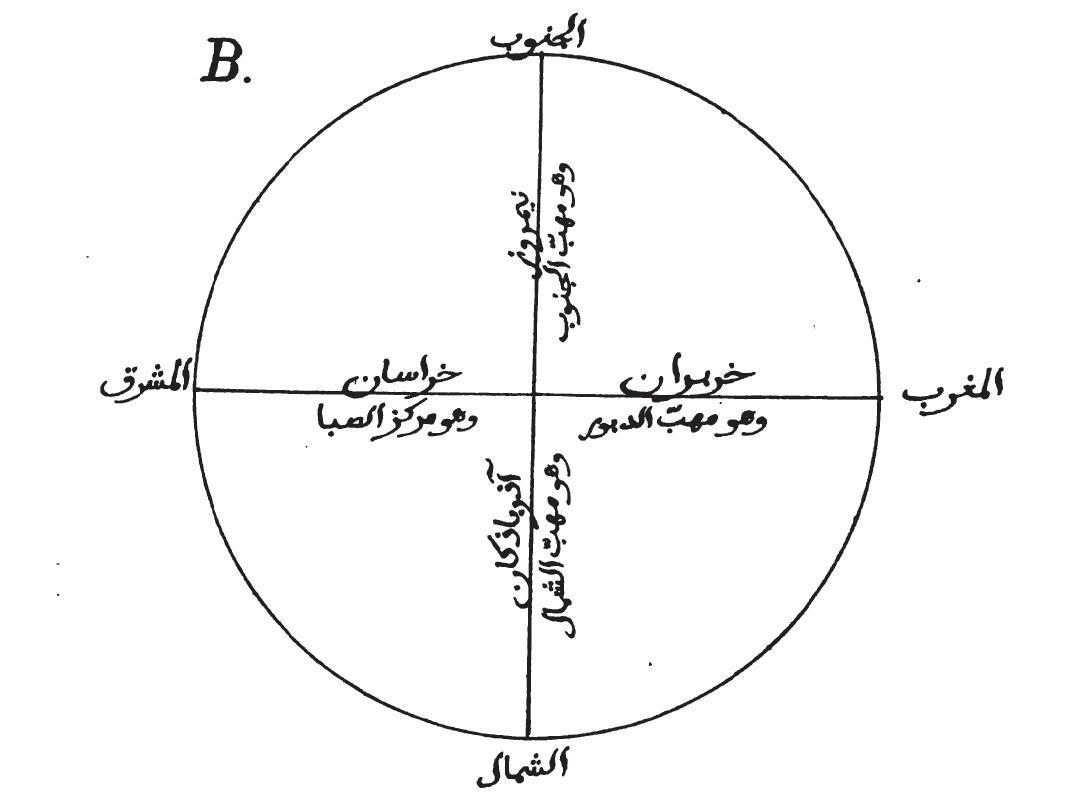
[[File:AzerbazkanBiruni.JPG|thumb|Mathematical Sketch drawn from ''The Remaining Signs of Past Centuries'' (Edinburgh University Library, [[c:Category:Al-Āthār al-bāqiyah ‘an al-qurūn al-khāliyah - Edinburgh University Library Or Ms 161|MS Or. 161]], folio vii)]] | |||
Al-Bīrūnī was a [[polymath]] with an interest in science and astronomy. In ''The Remaining Signs of Past Centuries,'' he gives an overview of the most significant scientific theories, astronomical observations, and mathematical concepts of his time.<ref>{{Cite journal |last=Sardar |first=Ziauddin |date= |title=Islamic Science - Al-Biruni Commemorative Volume. Proceedings of the International Congress held in Pakistan on the Occasion of Millenary of Abu Raihan Muhammad ibn Ahmad al-Biruni (c 973–1051 AD), November 26 1973 thru' December 12 1973. Ed. By Hakim Mohammed Said, Karachi: Hamdard National Foundation, 1979. |url=http://dx.doi.org/10.1017/s0007087400018756 |journal=The British Journal for the History of Science |volume=14 |issue=3 |pages=285–286 |doi=10.1017/s0007087400018756 |issn=0007-0874|url-access=subscription }}</ref> Discussing the [[astrolabe]], al-Biruni considers the [[orthographic projection|orthographic]] [[cylindrical projection]] as his own invention, expanding upon the work of [[Al-Saghani]].<ref>Boris Abramovich Rozenfelʹd, ''A History of Non-Euclidean Geometry'', trans. Abe Shenitzer, Springer (1988), {{ISBN|0-387-96458-4}}, p. 127.</ref> He also describes two novel projections he has created, which are nowadays called the [[Azimuthal equidistant projection|azimuthal equidistant]] and the [[Nicolosi globular projection|Nicolosi globular]].<ref>{{Cite journal| pages = 287–294| last = Fiorini| first = M.| title = Le proiezioni cartografiche di Albiruni| journal = Bollettino della Società geografica italiana| date = April 1891}}</ref> He integrates this scientific knowledge with historical and cultural insights. | |||
A unique aspect of the book is Al-Bīrūnī's [[Methodology|methodological]] approach to the formation of an established historical account. He emphasizes the importance of [[Empiricism|empirical observation]], [[critical analysis]], and [[Cross-cultural communication|cross-cultural]] comparison. His rigorous methodology sets a precedent for later scholars in the fields of history, geography, and anthropology.<ref name="Scheppler-2006" /> | |||
==Editions== | ==Editions== | ||
{{multiple image|perrow=2|total_width=450|caption_align=center | |||
| align = right | |||
| direction =horizontal | |||
| header= | |||
| image1 = Chronology of Ancient Nations, f.96v miniature.jpg | |||
| caption1 =14th century miniature <br>(Or Ms 161) | |||
| image2 = Chronology of Ancient Nations BNF 87r (detail).jpg | |||
| caption2 =17th century miniature <br>(Arabe 1489) | |||
| footer=Comparison between the two versions of ''The Remaining Signs of Past Centuries'' | |||
}} | |||
* [[Eduard Sachau|C. Eduard Sachau]] (ed.), ''Chronologie orientalischer Völker von Alberuni'', Leipzig 1878 ([https://archive.org/details/chronologieorie00sachgoog Internet Archive link]), reprinted Leipzig 1923, Baghdad 1963. | * [[Eduard Sachau|C. Eduard Sachau]] (ed.), ''Chronologie orientalischer Völker von Alberuni'', Leipzig 1878 ([https://archive.org/details/chronologieorie00sachgoog Internet Archive link]), reprinted Leipzig 1923, Baghdad 1963. | ||
* C. Eduard Sachau (transl.), ''The Chronology of Ancient Nations: An English Version of the Arabic Text of the Athâr-ul-Bâkiya of Albîrûnî, or 'Vestiges of the Past', Collected and Reduced ... by the Author in A. H. | * C. Eduard Sachau (transl.), ''The Chronology of Ancient Nations: An English Version of the Arabic Text of the Athâr-ul-Bâkiya of Albîrûnî, or 'Vestiges of the Past', Collected and Reduced ... by the Author in A. H. 390–1, A. D. 1000 '', London 1879 ([https://archive.org/details/chronologyofanci00biru Internet Archive link]). | ||
** 1969 reprint: Minerva-Verlag; Unverand edition. | ** 1969 reprint: Minerva-Verlag; Unverand edition. | ||
** 1984 reprint: Aristide D Caratzas Pub. {{ISBN|978-0-89241-178-8}}. | ** 1984 reprint: Aristide D Caratzas Pub. {{ISBN|978-0-89241-178-8}}. | ||
| Line 89: | Line 111: | ||
==External links== | ==External links== | ||
* {{commons category-inline|The Remaining Signs of Past Centuries|''The Remaining Signs of Past Centuries''}} | * {{commons category-inline|The Remaining Signs of Past Centuries|''The Remaining Signs of Past Centuries''}} | ||
{{Arabic manuscripts}} | |||
{{Astronomy in medieval Islam}} | {{Astronomy in medieval Islam}} | ||
{{Depictions of Muhammad}} | |||
{{DEFAULTSORT:Remaining Signs Of Past Centuries, The}} | {{DEFAULTSORT:Remaining Signs Of Past Centuries, The}} | ||
[[Category:Al-Biruni]] | [[Category:Al-Biruni]] | ||
[[Category:Islamic calendar]] | [[Category:Islamic calendar]] | ||
[[Category:Persian art]] | [[Category:Persian art]] | ||
| Line 101: | Line 123: | ||
[[Category:Islamic illuminated manuscripts]] | [[Category:Islamic illuminated manuscripts]] | ||
[[Category:1000 books]] | [[Category:1000 books]] | ||
[[Category:10th-century Arabic books]] | [[Category:10th-century Arabic-language books]] | ||
Latest revision as of 15:21, 23 February 2026
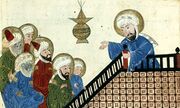
 The Investiture of Ali at Ghadir Khumm, northern Iraq or northwestern Iran, 1307-08 (Edinburgh University Library, MS Or. 161, fol. 162r).[1] | |
| Original title | کتاب الآثار الباقية عن القرون الخالية |
|---|---|
The Remaining Signs of Past Centuries (Script error: The function "langx" does not exist.) Kitāb al-āthār al-bāqiyah `an al-qurūn al-khāliyah, also known as Chronology of Ancient Nations or Vestiges of the Past, after the translation published by Eduard Sachau in 1879) by Abū Rayhān al-Bīrūnī is a comparative study of the calendrical timekeeping of different cultures and civilizations, supported by mathematical, astronomical, and historical research. The text establishes a universal timeline and charts significant historical events, relating the customs and religions of different peoples in time.[2]
For centuries after its publication in 1000 AD (AH 390/1), the text served as the standard reference on the history of Muslim territories.[2] The Remaining Signs of Past Centuries is Al-Biruni's first major work, compiled in Gorgan when he was in his late twenties, at the court of Qabus, the Ziyarid ruler of Gorgan.[3] The text is dedicated to Qabus.[4]
Manuscripts[edit | edit source]
The Remaining Signs of Past Centuries is preserved in more than twenty manuscripts of which the earliest is Istanbul ms. Beyazit 4667 [= Umumi 4667], dated 603 AH (1206/07 CE).[5]
Illuminated manuscripts[edit | edit source]
A small number of these manuscripts are also illuminated: the best known are Edinburgh, University Library, MS Or. 161 and Paris, Bibliothèque Nationale de France, MS Arabe 1489.
The Edinburgh, University Library copy is an Ilkhanid codex created by Ibn al-Kutbi in AH 707 (AD 1307–1308) in northwestern Iran or northern Iraq.[6] It contains 179 folios and 25 paintings.[7] The frontispiece and subsequent illustrations are composed in rich color and accented by gold-leaf. This manuscript is considered exemplary of the artistry of medieval Persian book painting. There is a mark of recent ownership by R.M. Binning, dated July 4, 1851.[8]
The Paris, Bibliothèque Nationale de France manuscript is a close Ottoman copy of the Edinburgh codex. It is both undated and anonymous, in contrast to its Edinburgh prototype. While the complete provenance is unknown, there are marks of possession by al-Zāʾiraǧī Ramaḍān ibn Muḥammad and Abū Bakr ibn Rustum ibn Aḥmad al-Širwānī.[9]

The choice and placement of illustrations throughout the text form a larger cycle which emphasizes the interest of the Ilkhanids in religions other than the predominant Islam.[10] Many illustrations show specific episodes related to Zoroastrianism, Manichaeism, Buddhism, Judaism, and Christianity. Other illustrations show a keen interest in topics of history and science. Similarly located in the manuscript is the account of the birth of Julius Caesar illustrated with a realistic rendition of a cesarean section, the death of Eli and the reactions of those of the Jewish faith, and an Arab congregation witnessing the Prophet Muhammad's spoken word.[7]
The framing of the text by the illustrations, lends a political urgency to the cultures of foreign peoples, while still retaining a strong Iranian national sentiment. Ibn al-Kutbi's nationalistic tendencies are evident in his frequent visual reference to personalities featured in the Shahnama and those celebrated in Persian history, as well as his illustration of Persian festivals, and evocation of Persian rebellion against foreign powers.[7]


The images are kept in a hybrid style between that of pre-Mongol period Persia and the Chinese style introduced with the Mongol invasions.[10] Of the twenty-five total images, two are considered purely pre-Mongol in style, nineteen are considered hybrid, but closer to pre-Mongol, and four are considered hybrid, but very nearly post-Mongol.[11] Pre-Mongol compositions are characterized by their random placement upon folio paper, whereas hybrid compositions often feature a frame. Pre-Mongol images also are typically standard in their arrangement of figures upon a singular plane. This is distinct from hybrid images which display more complex dimension.[11] The illustrations in The Remaining Signs of Past Centuries additionally exemplify relative cultural nuance due to Al-Biruni's extensive ethnographic research. Through travel he developed thorough and distinctive descriptions of different ethnic groups. However, these descriptions were further implemented as stereotypes, and any individual who was of a particular ethnicity was made to appear almost identical to any other member of the same group.[7]
The Shi`ite inclination of those responsible for the production is particularly evident in the two concluding images, the largest and most elaborate in the manuscript. These illuminations illustrate two episodes in the life of Muhammad, both centrally involving `Ali, Hasan, and Husayn: The Day of Cursing (fol. 161r) and The Investiture of `Ali at Ghadir Khumm (fol. 162r). The Edinburgh manuscript has a total of five images depicting Muhammad, including the first miniature which shows the Prophet as he prohibits Nasīʾ (fol. 6v).[12] These illuminations are among the earliest depictions of Muhammad in Persian art.

One particular illumination depicting Abraham destroying the idols of the Sabians has sparked significant discourse over iconoclasm in the context of Islamic figural representations.[13]
Content[edit | edit source]
In The Remaining Signs of Past Centuries, al-Biruni expresses his ideas regarding the philosophy and methodologies of history, especially through a scientific lens. He begins with an introduction establishing the relevance of history, geography, and the interconnectedness of civilizations. He proposes the need for studying different cultures and civilizations to gain a broader understanding of the world. In doing so, he defends the legitimacy of his work.[14]

The Remaining Signs of Past Centuries presents a chronological account of historical events, focusing on the rise and fall of civilizations, dynasties, and empires. Al-Bīrūnī covers ancient civilizations such as the Greeks, Romans, Persians, and Indians, among others. His approach to history is analytical and comparative, examining the causes and effects of historical events. He specifically references the birth and death of the Caliphs, Shia Imams, Fatimah (daughter of Muhammad) and Khadija (Muhammad's wife).[15] Historical understanding is further supplemented by analysis of the cultural practices, customs, and traditions of these societies and individuals. Al-Bīrūnī explores topics like religion, language, art, and science, highlighting the diversity and richness of human culture.[3]

Al-Bīrūnī was a polymath with an interest in science and astronomy. In The Remaining Signs of Past Centuries, he gives an overview of the most significant scientific theories, astronomical observations, and mathematical concepts of his time.[16] Discussing the astrolabe, al-Biruni considers the orthographic cylindrical projection as his own invention, expanding upon the work of Al-Saghani.[17] He also describes two novel projections he has created, which are nowadays called the azimuthal equidistant and the Nicolosi globular.[18] He integrates this scientific knowledge with historical and cultural insights.
A unique aspect of the book is Al-Bīrūnī's methodological approach to the formation of an established historical account. He emphasizes the importance of empirical observation, critical analysis, and cross-cultural comparison. His rigorous methodology sets a precedent for later scholars in the fields of history, geography, and anthropology.[2]
Editions[edit | edit source]

(Or Ms 161)
.jpg)
(Arabe 1489)
- C. Eduard Sachau (ed.), Chronologie orientalischer Völker von Alberuni, Leipzig 1878 (Internet Archive link), reprinted Leipzig 1923, Baghdad 1963.
- C. Eduard Sachau (transl.), The Chronology of Ancient Nations: An English Version of the Arabic Text of the Athâr-ul-Bâkiya of Albîrûnî, or 'Vestiges of the Past', Collected and Reduced ... by the Author in A. H. 390–1, A. D. 1000 , London 1879 (Internet Archive link).
- 1969 reprint: Minerva-Verlag; Unverand edition.
- 1984 reprint: Aristide D Caratzas Pub. ISBN 978-0-89241-178-8.
- 2002 reprint: Adamant Media Corporation, ISBN 978-1-4021-6079-0.
- 2004 reprint: Kessinger Publishing, ISBN 0-7661-8908-2.
Notes[edit | edit source]
References[edit | edit source]
- ↑ Plate IV in Foundation, Encyclopaedia Iranica. "Encyclopaedia Iranica IL-KHANIDS". iranicaonline.org.
- ↑ 2.0 2.1 2.2 Scheppler, Bill (2006). Al-Biruni: Master Astronomer and Muslim Scholar of the Eleventh Century (ill. ed.). The Rosen Publishing Group. pp. 96–98. ISBN 1404205128.
- ↑ 3.0 3.1 Seyyed Hossein Nasr, An Introduction to Islamic Cosmological Doctrines (1993), ISBN 0-7914-1515-5, p. 108.
- ↑ Rahimieh, Nasrin (1991). "Persian Literature, ed. Ehsan Yarshater, Columbia Lectures on Iranian Studies, no. 3, New York: The Persian Heritage Foundation; Bibliotheca Persica, 1988, xi + 562 pp". Iranian Studies. 24 (1–4): 104–105. doi:10.1017/s0021086200014675. ISSN 0021-0862.
- ↑ al-Āthār al-bāqiyyah min al-qurūn al-khāliyyah in Islamic Scientific Manuscripts Initiative; Jan P. Hogendijk, The Works of Abu Rayhan (al-)Biruni: Chronology [accessed 23-02-2026].
- ↑ Ms 161: الآثار الباقيه عن القرون الخاليه al-Āthār al-bāqiyah ‘an al-qurūn al-khāliyah, 707 A.H., 1307 C.E., Or Ms 161. Manuscripts of the Islamicate World and South Asia, Or Ms . University of Edinburgh Library Heritage Collections. http://lac-archivesspace-live4.is.ed.ac.uk:8081/repositories/2/archival_objects/220871
- ↑ 7.0 7.1 7.2 7.3 Hillenbrand, Robert (2016). "The Edinburgh Biruni Manuscript: A Mirror of Its Time?". Journal of the Royal Asiatic Society. 26 (1/2): 171–199. doi:10.1017/S1356186316000018. JSTOR 24756048.
- ↑ Kirk, Teresa (2004–2005). "The Edinburgh al-Biruni Manuscript; A Holistic Study of its Design and Images". Persica. 20: 39–81. doi:10.2143/PERS.20.0.2005884.
- ↑ "Consultation". archivesetmanuscrits.bnf.fr. Retrieved 2024-04-23.
- ↑ 10.0 10.1 Roxburgh, David (2002). "Robert Hillenbrand (ed.): Persian painting: from the Mongols to the Qajars: studies in honour of Basil W. Robinson. (Pembroke Persian Papers, 3.) xx, 331 pp. London and New York: I. B. Tauris in association with The Centre of Middle Eastern Studies, University of Cambridge, 2000". Bulletin of the School of Oriental and African Studies. 65 (1): 140–262. doi:10.1017/s0041977x02290072. ISSN 0041-977X.
- ↑ 11.0 11.1 Jaber, Shady. The Paintings of al-Āthār al-Bāqiya of al-Bīrūnī: A Turning Point in Islamic Visual Representation [master's thesis]. Lebanese American University; 2021. https://laur.lau.edu.lb:8443/xmlui/bitstream/handle/10725/13751/Shady_Jaber_Thesis_Redacted.pdf?sequence=3
- ↑ 12.0 12.1 Hillenbrand 2000, p. 129–146.
- ↑ Roxburgh, David J. (2009). "Concepts of the Portrait in Islamic Lands, c. 1300–1600" (PDF). Yale University Press: 3–4 – via Harvard University.
- ↑ M. S. Khan (1976). "al-Biruni and the Political History of India", Oriens 25, pp. 86–115.
- ↑ The Chronology of Ancient Nations, transl. Edward Sachau. London, 1879, pp. 325–334.
- ↑ Sardar, Ziauddin. "Islamic Science - Al-Biruni Commemorative Volume. Proceedings of the International Congress held in Pakistan on the Occasion of Millenary of Abu Raihan Muhammad ibn Ahmad al-Biruni (c 973–1051 AD), November 26 1973 thru' December 12 1973. Ed. By Hakim Mohammed Said, Karachi: Hamdard National Foundation, 1979". The British Journal for the History of Science. 14 (3): 285–286. doi:10.1017/s0007087400018756. ISSN 0007-0874.
- ↑ Boris Abramovich Rozenfelʹd, A History of Non-Euclidean Geometry, trans. Abe Shenitzer, Springer (1988), ISBN 0-387-96458-4, p. 127.
- ↑ Fiorini, M. (April 1891). "Le proiezioni cartografiche di Albiruni". Bollettino della Società geografica italiana: 287–294.
Sources[edit | edit source]
- Hillenbrand, Robert (2000). "Images of Muhammad in al-Biruni's Chronology of Ancient Nations.'". In Hillenbrand (ed.). Persian Painting from the Mongols to the Qajars: Studies in Honour of Basil W. Robinson. Pembroke Persian Papers, 3. London and New York: I. B. Tauris in association with the Centre of Middle Eastern Studies, University of Cambridge.
- Soucek, Priscilla P. (1975). "An Illustrated Manuscript of al-Biruni's Chronology of Ancient Nations". In Peter J. Chelkowski (ed.). The Scholar and the Saint: Studies in Commemoration of Abul-Rayhan al-Biruni and Jalal al-Din al-Rumi. New York: Hagop Kevorkian Center for Near Eastern Studies, New York University Press.
- Blair, Sheila S. (1993). The Development of the Illustrated Book in Iran. Muqarnas.
- Saliba, G. (2006). "Al-Biruni and the sciences of his time". Religion, Learning and Science in the 'Abbasid Period. Cambridge University Press. p. 316. ISBN 0-521-02887-6.
- Hopkins, J. F. P. (2006). "Geographical and navigational literature". Religion, Learning and Science in the 'Abbasid Period. Cambridge University Press. pp. 405–423. ISBN 0-521-02887-6.
External links[edit | edit source]
Template:Arabic manuscripts Template:Astronomy in medieval Islam Template:Depictions of Muhammad