


robot: Create/upgrade articles. If there is a mistake please report on my talk page. |
Updated formatting and improved readability |
||
| Line 1: | Line 1: | ||
{{short description|Minor naval engagement of the Napoleonic Wars}} | {{short description|Minor naval engagement of the Napoleonic Wars}} | ||
{{Use dmy dates|date=February | {{Use dmy dates|date=February 2017}} | ||
{{Infobox military conflict | {{Infobox military conflict | ||
|conflict = Battle of Pulo Aura | |conflict = Battle of Pulo Aura | ||
|partof = the [[Napoleonic Wars]] | |partof = the [[Napoleonic Wars]] | ||
|image = Robert Dodd - Commodore Dance's celebrated action against a French squadron.jpg | |image = Robert Dodd - Commodore Dance's celebrated action against a French squadron.jpg | ||
|caption = ''Commodore Dance's celebrated action against a French squadron in the Straits of Malacca on 15th. February 1804'' <br /> [[Robert Dodd (artist)|Robert Dodd]], 1804 | |||
|caption = ''Commodore Dance's celebrated action against a French squadron in the Straits of Malacca on 15th February 1804'' | |||
|date = 15 February 1804 | |date = 15 February 1804 | ||
|place = Off [[Aur Island|Pulo Aura]], | |place = Off [[Aur Island|Pulo Aura]], South China Sea | ||
|result = | |result = British victory | ||
|combatant1 = | |combatant1 = [[East India Company]] | ||
|combatant2 = {{ | |combatant2 = {{ubli|[[French First Republic|France]] | [[Batavian Commonwealth]]}} | ||
|commander1 = | |commander1 = [[Nathaniel Dance]] | ||
|commander2 = | |commander2 = [[Charles-Alexandre Léon Durand Linois|Charles-Alexandre Linois]] | ||
|strength1 = 29 | |strength1 = {{ubli|29 merchant ships | 1 brig}} | ||
|strength2 = 1 ship of the line | |strength2 = {{ubli|1 ship of the line | 2 frigates | 1 corvette | 1 brig}} | ||
|casualties1 = 1 wounded | |casualties1 = {{ubli|1 wounded | 1 killed}} | ||
|casualties2 = None | |casualties2 = None | ||
|campaignbox = {{Campaignbox Linois's expedition to the Indian Ocean}} | |campaignbox = {{Campaignbox Linois's expedition to the Indian Ocean}} | ||
}} | }} | ||
The '''Battle of Pulo Aura''' was a minor naval engagement of the [[Napoleonic Wars]] | The '''Battle of Pulo Aura''' was a minor naval engagement of the [[Napoleonic Wars]] fought on 14 February 1804, in which a large British [[East India Company]] (EIC) convoy intimidated, drove off and chased away a powerful [[French Navy]] squadron. Although the French squadron was much stronger than the British convoy, Commodore [[Nathaniel Dance]]'s aggressive tactics persuaded Counter-admiral [[Charles-Alexandre Léon Durand Linois]] to retire after only a brief exchange of fire. Dance then chased the French squadron until his convoy was out of danger, whereupon he resumed his passage toward [[Company rule in India|British India]]. | ||
The battle occurred during an extended [[commerce raiding]] operation by | The battle occurred during an extended [[commerce raiding]] operation by Linois' squadron, led by the [[ship of the line]] ''[[French ship Jean-Jacques Rousseau (1795)|Marengo]]''. In 1803, before war broke out, Linois sailed to the [[Indian Ocean]] to install garrisons in French and [[Batavian Republic|Batavian]] colonies and target British merchantmen. A prime target was the "China Fleet", a convoy of East Indiamen carrying millions of [[pound sterling|pounds]]' worth of trade goods. Although escorted by smaller merchant ships, the only available escort warship was the EIC armed [[brig]] ''Ganges''. Dutch informants told Linois of the fleet's destination and date of departure from [[Guangzhou|Canton]] while he was at [[Batavia, Dutch East Indies|Batavia]], and he set sail on 28 December 1803, eventually locating the convoy in early February. | ||
Although no warships protected the convoy, | Although no warships protected the convoy, Dance knew that lookouts could mistake a large East Indiaman for a ship of the line. He had his Indiamen form a line of battle and raise flags suggesting his fleet included part of the Royal Navy squadron operating in the Indian Ocean. Although Linois's ships were clearly superior, the bold British response unsettled him, and he quickly broke off combat. Dance maintained the ruse, aggressively pursuing Linois for two hours until the convoy was safe. The successful deception ensured the valuable cargo reached Britain without loss. | ||
King [[George III]] [[Knight Bachelor|knighted]] Dance for his courage and various mercantile and patriotic organisations awarded him large sums of money, while both [[Napoleon]] and Linois's own officers personally castigated him for his failure to press the attack against a weaker and extremely valuable enemy. Although he remained in command of the squadron for another two years and had some minor success against undefended merchant ships, he suffered a string of defeats and inconclusive engagements against weaker British naval forces. Ironically, Linois was captured at the [[action of 13 March 1806]] by a numerically superior British battle squadron which he had mistaken for a merchant convoy. | |||
==Background== | ==Background== | ||
{{ | {{further|Linois's expedition to the Indian Ocean}} | ||
[[File:Battle of Pulau Aur, 1804 RCIN 735111.b.jpg|thumb| | [[File:Battle of Pulau Aur, 1804 RCIN 735111.b.jpg|thumb|300px|An illustration of the China Fleet during the battle by [[Francis Sartorius|Francis Sartorius the Younger]] after a drawing by an officer onboard ''Henry Addington'']] | ||
During the [[French Revolutionary and Napoleonic Wars]], the [[economy of the United Kingdom]] relied heavily on its ability to trade with the [[British Empire]], especially Britain's [[Company rule in India|valuable colonies in India]]. British trade with Asia was primarily conducted by the [[East India Company]] (EIC) using large, well-armed merchant ships known as [[East Indiaman|East Indiamen]].<ref name="RG101">''The Victory of Seapower'', Gardiner, p. 101</ref> These ships were between 500 and 1200 nominal tons burthen ([[Builder's Old measurement|bm]]) and could carry up to 36 guns to defend against pirates, [[privateer]]s, and smaller warships. However, they were not designed to fight large warships like [[frigate]]s or [[Ship of the line|ships of the line]], as their guns were often of inferior design and their crews less trained.<ref name="WLC337">Clowes, p. 337</ref> | |||
Despite these disadvantages, East Indiamen's size made them resemble a small ship of the line from a distance, often augmented by paintwork and [[Quaker Gun|dummy cannon]].<ref name="SM190">Maffeo, p. 190</ref> In the [[Bali Strait incident]] of 28 January 1797, an unescorted convoy of British East Indiamen used this similarity to intimidate a French frigate squadron into withdrawing without a fight.<ref name="CNP106">Parkinson, p. 106</ref> A similar event occurred in February 1799 during the [[Macau Incident (1799)|Macau Incident]], where a Franco-Spanish squadron attacking a British merchant convoy was driven off by a small [[Royal Navy]] squadron escorting it.<ref name="RG161">''Nelson Against Napoleon'', Gardiner, p. 161</ref><ref name="NR546">Rodger, p. 546</ref> British East Indiamen would gather at Asian ports and set out for Britain in large convoys, often carrying millions of [[Pound sterling|pounds]]' worth of trade goods.<ref name= "RLA342">Adkins, p. 342</ref> The journey usually took six months, with the ships returning carrying troops and passengers to bolster British forces in Asia. "Country ships", smaller British merchantmen often unaffiliated with the EIC, would frequently join the convoys. To defend against pirate attacks, the EIC operated the [[Royal Indian Navy|Bombay Marine]]. These ships were an effective deterrent against small raiders but were no match for professional warships.<ref name="RG88">''The Victory of Seapower'', Gardiner, p. 88</ref> | |||
Seeking to threaten British trade from the beginning of the war, [[Napoleon]] ordered a French squadron to sail for India in March 1803 under the command of Counter-cdmiral [[Charles-Alexandre Léon Durand Linois]]. Linois's squadron included the ship of the line ''[[French ship Jean-Jacques Rousseau (1795)|Marengo]]'' and three frigates.<ref name="RW172">Woodman, p. 172</ref> Operating from [[Isle de France (Mauritius)|Isle de France]] (modern-day [[Mauritius]]), Linois was ordered to attack British shipping once war began. After sailing to [[Pondicherry (city)|Pondicherry]] and narrowly escaping from a British squadron under Rear-admiral [[Peter Rainier (Royal Navy officer, born 1741)|Peter Rainier]] in July, Linois received news of the outbreak of war in May 1803 and began making preparations. He landed supplies and troops at [[Réunion]] and [[Batavia, Dutch East Indies|Batavia]], sent the frigate {{Ship|French frigate|Atalante|1802|2}} to [[Muscat]], captured several country ships and raided [[British Bencoolen]].<ref name="WLC59">Clowes, p. 59</ref> On 10 December, after gathering intelligence about the British "China Fleet", Linois set sail to intercept it.<ref name="WJ3:213">James, Vol. 3, p. 213</ref> His squadron, including ''Marengo'', the frigates {{Ship|French frigate|Belle Poule|1802|2}} and {{Ship|French frigate|Sémillante|1791|2}}, the [[corvette]] {{Ship|French corvette|Berceau|1794|2}}, and the [[Batavian Navy]] [[brig]] {{Ship|Dutch brig|Avonturier||2}}, departed Batavia on 28 December with six months' worth of provisions, expecting a long patrol in the [[Strait of Malacca]].<ref name="WLC336">Clowes, p. 336</ref> The China Fleet, which gathered annually at [[Guangzhou|Canton]] in the [[Pearl River (China)|Pearl River]], included 16 East Indiamen, 11 country ships, a Portuguese merchantmen from [[Portuguese Macau|Macau]], and a vessel from [[Botany Bay]] by late January 1804.<ref name="WJ3:248"/> | |||
Despite the presence of the small EIC brig ''Ganges'' as an escort, the convoy had no real military protection, as the news of war had arrived in Canton before reinforcements could reach them. While spies in Canton informed Linois of the fleet's composition, Dutch informants also sent false reports suggesting Royal Navy warships were with the convoy, which were possibly planted by British authorities.<ref name="SM186">Maffeo, p. 186</ref> The convoy was an incredibly valuable target, with a cargo worth over £8 million in contemporary values, including tea, silk, porcelain, and 80 Chinese plants ordered by Sir [[Joseph Banks]] for the [[Kew Gardens]].<ref name="RG32"/> The EIC's [[Select committee (parliamentary system)|select committee]] in Canton had debated delaying the convoy's departure over security concerns. Captains of the convoy, including [[Henry Meriton]], who had captured a French frigate in the [[action of 4 August 1800]], argued that the convoy's size and appearance would deter attacks.<ref name="RW149">Woodman, p. 149</ref> However, [[James Farquharson]], the captain of {{ship||Alfred|1790 EIC ship|2}}, opposed Meriton, arguing the convoy's crews were too poorly trained to defend themselves effectively. Ultimately, the committee decided to proceed, placing Commodore [[Nathaniel Dance]]—with over 45 years of experience in the East Indiaman ''Earl Camden''—in charge of the convoy.<ref name="NT113">Tracy, p. 113</ref> | |||
==Battle== | ==Battle== | ||
At 08:00 on 14 February 1804, with the island of [[Aur Island|Pulo Aura]] within sight to the south-west near the eastern entrance to the [[Straits of Malacca]], the Indiaman ''Royal George'' raised a signal describing three sail approaching the convoy from the direction of the island. This was Linois's squadron, which had been cruising in the area for the previous month in anticipation of the convoy's arrival. Dance ordered the brig ''Ganges'' and the Indiamen ''Alfred'', ''Royal George'', {{ship||Bombay Castle|1792 EIC ship|2}} and ''Hope'' to approach the strange vessels and investigate, rapidly discovering they were enemy warships. By 13:00, Dance had readied his guns and reformed his convoy, with the large Indiamen formed up in [[line of battle]] to receive the French attack as if they were warships.<ref name="NR546"/> During the late afternoon, Linois's squadron fell in behind the slow line of merchant ships and Dance expected an immediate attack, but Linois was cautious and merely observed the convoy, preferring to wait until the following morning before engaging the enemy.<ref name="WLC337"/> Dance made use of the delay to gather the smaller country ships on the opposite side of his line from the French, the brig ''Ganges'' shepherding them into position and collecting volunteers from their crews to augment the sailors on board the Indiamen.<ref name="WJ3:248">James, Vol. 3, p. 248</ref> Linois later excused his delay in attacking the merchant convoy by citing the need for caution: | At 08:00 on 14 February 1804, with the island of [[Aur Island|Pulo Aura]] within sight to the south-west near the eastern entrance to the [[Straits of Malacca]], the Indiaman ''Royal George'' raised a signal describing three sail approaching the convoy from the direction of the island. This was Linois's squadron, which had been cruising in the area for the previous month in anticipation of the convoy's arrival. Dance ordered the brig ''Ganges'' and the Indiamen ''Alfred'', ''Royal George'', {{ship||Bombay Castle|1792 EIC ship|2}} and ''Hope'' to approach the strange vessels and investigate, rapidly discovering they were enemy warships. By 13:00, Dance had readied his guns and reformed his convoy, with the large Indiamen formed up in [[line of battle]] to receive the French attack as if they were warships.<ref name="NR546"/> During the late afternoon, Linois's squadron fell in behind the slow line of merchant ships and Dance expected an immediate attack, but Linois was cautious and merely observed the convoy, preferring to wait until the following morning before engaging the enemy.<ref name="WLC337"/> Dance made use of the delay to gather the smaller country ships on the opposite side of his line from the French, the brig ''Ganges'' shepherding them into position and collecting volunteers from their crews to augment the sailors on board the Indiamen.<ref name="WJ3:248">James, Vol. 3, p. 248</ref> Linois later excused his delay in attacking the merchant convoy by citing the need for caution: | ||
{{ | {{blockquote|If the bold front put on by the enemy in the daytime had been intended as a ruse to conceal his weakness, he would have profited by the darkness of the night to endeavour to conceal his escape; and in that case should have taken advantage of his manoeuvres. But I soon became convinced that this security was not feigned; three of his ships constantly kept their lights up, and the fleet continued to lie to, in order of battle, throughout the night. This position facilitated my gaining the wind, and enabled me to observe the enemy closely.|Linois, quoted in translation in [[William James (naval historian)|William James]]' ''The Naval History of Great Britain during the French Revolutionary and Napoleonic Wars'', Volume 3, 1827.<ref name=WJ3:249>James, Vol. 3, p. 249</ref>}} | ||
At dawn on 15 February, both the British and the French raised their colours. Dance hoped to persuade Linois that his ships included some fully armed warships and he therefore ordered the brig ''Ganges'' and the four lead ships to hoist [[blue ensigns]], while the rest of the convoy raised [[red ensigns]]. By the system of national flags then in use in British ships, this implied that the ships with blue ensigns were warships attached to | At dawn on 15 February, both the British and the French raised their colours. Dance hoped to persuade Linois that his ships included some fully armed warships and he therefore ordered the brig ''Ganges'' and the four lead ships to hoist [[blue ensigns]], while the rest of the convoy raised [[red ensigns]]. By the system of national flags then in use in British ships, this implied that the ships with blue ensigns were warships attached to Rainer's squadron, while the others were merchant ships under their protection.<ref name="WLC337"/> Dance was unknowingly assisted by the information that had reached Linois at Batavia, which claimed that there were 23 merchant ships and the brig in the convoy. Dance had collected six additional ships during his journey, and the identity of these were unknown to the French, who assumed that at least some of the unidentified vessels must be warships, particularly as several vessels had been recently painted at Canton to resemble ships of the line.<ref name="WJ3:249">James, Vol. 3, p. 249</ref> | ||
[[File:Strait of Malacca and Pulau Aur, 1804 RCIN 735108 (cropped).jpg|thumb|''Defeat of Adml. Linois by Commodore Dance, Feby. 15th. 1804'', [[William Daniell]]|alt=On a choppy sea two lines of sailing vessels, one of at least three ships and one of five ships, fire clouds of smoke at one another.]] | |||
At 09:00 Linois was still only observing the convoy, reluctant to attack until he could be sure of the nature of his opponents. Dance responded to the reprieve by reforming the line of battle into sailing formation to increase his convoy's speed with the intention of reaching the Straits ahead of Linois.<ref name="RG32">''The Campaign of Trafalgar'', Gardiner, p. 32</ref> With the convoy a less intimidating target, Linois began to slowly approach the British ships.<ref name= "RW195">Woodman, p. 195</ref> By 13:00 it was clear that Linois's faster ships were in danger of isolating the rear of the convoy, and Dance ordered his lead ships to [[tacking (sailing)|tack]] and come about so they would cross in front of the French squadron. The British successfully executed the manoeuvre, and at 13:15 Linois opened fire on the lead ship—''Royal George''—under the command of John Fam Timmins.<ref name="WJ3:249"/> The ''Royal George'' and the next four ships in line, the Indiaman ''Ganges'', Dance's ''Earl Camden'', the ''[[Warley (1796 ship)|Warley]]'' and the ''Alfred'', all returned fire, ''Ganges'' initially attacking ''Royal George'' in error. Captain James Prendergrass in ''Hope'', the next in line, was so eager to join the battle that he misjudged his speed and collided with ''Warley'', the ships falling back as their crews worked to separate their rigging.<ref name="RG32"/> Shots were then exchanged at long range for 43 minutes, neither side inflicting severe damage.<ref name="SM187">Maffeo, p. 187</ref> | At 09:00 Linois was still only observing the convoy, reluctant to attack until he could be sure of the nature of his opponents. Dance responded to the reprieve by reforming the line of battle into sailing formation to increase his convoy's speed with the intention of reaching the Straits ahead of Linois.<ref name="RG32">''The Campaign of Trafalgar'', Gardiner, p. 32</ref> With the convoy a less intimidating target, Linois began to slowly approach the British ships.<ref name= "RW195">Woodman, p. 195</ref> By 13:00 it was clear that Linois's faster ships were in danger of isolating the rear of the convoy, and Dance ordered his lead ships to [[tacking (sailing)|tack]] and come about so they would cross in front of the French squadron. The British successfully executed the manoeuvre, and at 13:15 Linois opened fire on the lead ship—''Royal George''—under the command of John Fam Timmins.<ref name="WJ3:249"/> The ''Royal George'' and the next four ships in line, the Indiaman ''Ganges'', Dance's ''Earl Camden'', the ''[[Warley (1796 ship)|Warley]]'' and the ''Alfred'', all returned fire, ''Ganges'' initially attacking ''Royal George'' in error. Captain James Prendergrass in ''Hope'', the next in line, was so eager to join the battle that he misjudged his speed and collided with ''Warley'', the ships falling back as their crews worked to separate their rigging.<ref name="RG32"/> Shots were then exchanged at long range for 43 minutes, neither side inflicting severe damage.<ref name="SM187">Maffeo, p. 187</ref> | ||
''Royal George'' had a sailor named Hugh Watt killed, another man wounded, and suffered some damage to her hull. None of the other British ships or any of the French reported anything worse than superficial damage in the engagement.<ref name="WLC338">Clowes, p. 338</ref> At 14:00, Linois abandoned the action and ordered his squadron to haul away with the wind and sail eastwards, away from the convoy, under all sail. Determined to maintain the pretence of the presence of warships, Dance ordered the ships flying naval ensigns, including his flagship ''Earl Camden'', to chase the French. None of the merchant ships could match the French speed, but an attempt at a chase would hopefully dissuade the French from returning.<ref name="WLC338"/> For two hours, Dance's squadron followed Linois, ''Hope'' coming close to catching '' | ''Royal George'' had a sailor named Hugh Watt killed, another man wounded, and suffered some damage to her hull. None of the other British ships or any of the French reported anything worse than superficial damage in the engagement.<ref name="WLC338">Clowes, p. 338</ref> At 14:00, Linois abandoned the action and ordered his squadron to haul away with the wind and sail eastwards, away from the convoy, under all sail. Determined to maintain the pretence of the presence of warships, Dance ordered the ships flying naval ensigns, including his flagship ''Earl Camden'', to chase the French. None of the merchant ships could match the French speed, but an attempt at a chase would hopefully dissuade the French from returning.<ref name="WLC338"/> For two hours, Dance's squadron followed Linois, ''Hope'' coming close to catching ''Avonturier'' but ultimately unable to overtake the brig. At 16:00, Dance decided to gather his scattered ships and return to his former heading rather than risk attack from other raiders or lose sight of his convoy in the darkness. By 20:00, the entire British convoy had anchored at the entrance to the Straits of Malacca.<ref name= "WJ3:250"/> On 28 February, the British ships of the line {{HMS|Sceptre|1802|6}} and {{HMS|Albion|1802|2}} joined them in the Strait and conducted them safely to [[Saint Helena]] in the South Atlantic.<ref name=LL4478>''[[Lloyd's List]]'', [https://hdl.handle.net/2027/mdp.39015005721504?urlappend=%3Bseq=337 n°4478.]</ref> | ||
There {{HMS|Plantagenet|1801|6}} escorted the convoy to England. Five whalers and {{ship||Carmarthen|1802 ship|2}}, Captain Doree, also joined the convoy, with the ''Blackhouse'', from coast of Guinea, joining at sea.<ref name=LG15726/>{{ | There {{HMS|Plantagenet|1801|6}} escorted the convoy to England. Five whalers and {{ship||Carmarthen|1802 ship|2}}, Captain Doree, also joined the convoy, with the ''Blackhouse'', from coast of Guinea, joining at sea.<ref name=LG15726/>{{efn|The five whalers were the ''William Fenning'', {{ship||Brook Watson|1802 ship|2}}, ''Thomas'' (or ''Young Tom''), ''Betsey'' and ''Eliza''.<ref name=LG15726/>}} The convoy returned to England without further incident.<ref name= "RW195"/> | ||
Linois's squadron reached Batavia several days after the action without encountering any British ships. He was there joined by ''Atalante'' and, after taking on supplies, made sail for | Linois's squadron reached Batavia several days after the action without encountering any British ships. He was there joined by ''Atalante'' and, after taking on supplies, made sail for Isle de France, arriving on 2 April.<ref name="WJ3:277">James, Vol. 3, p. 277</ref> ''Avonturier'' was left at Batavia and remained there until British forces [[Raid on Batavia (1806)|raided the port]] in November 1806, destroying her.<ref name="LG2">{{London Gazette|issue=16044|page=894|date=4 July 1807}}</ref> Linois later attempted to explain his conduct during the engagement: | ||
{{ | {{blockquote|The ships which had tacked rejoined those which were engaging us, and three of the engaging ships manoeuvred to double our rear, while the remainder of the fleet, crowding sail and bearing up, evinced an intention to surround us. By this manoeuvre the enemy would have rendered my situation very dangerous. The superiority of his force was ascertained, and I had no longer to deliberate on the part I should take to avoid the consequence of an unequal engagement: profiting by the smoke, I hauled up to port, and steering east-north-east, I increased by distance from the enemy, who continued the pursuit of the squadron for three hours, discharging at it several broadsides.|Linois, quoted in translation in [[William James (naval historian)|William James]]' ''The Naval History of Great Britain during the French Revolutionary and Napoleonic Wars'', Volume 3, 1827.<ref name=WJ3:250>James, Vol. 3, p. 250</ref>}} | ||
===Orders of battle=== | ===Orders of battle=== | ||
| Line 75: | Line 78: | ||
|- valign="top" | |- valign="top" | ||
|align= left | {{ship||Alfred|1790 EIC ship|2}} | |align= left | {{ship||Alfred|1790 EIC ship|2}} | ||
|align= left | Captain James Farquharson | |align= left | Captain [[James Farquharson (sailor)|James Farquharson]] | ||
|align= left | Engaged for 15 minutes. | |align= left | Engaged for 15 minutes. | ||
|- valign="top" | |- valign="top" | ||
|align= left | ''Royal George'' | |align= left | [[Royal George (1802 EIC ship)|''Royal George'']] | ||
|align= left | Captain John Fam Timins | |align= left | Captain [[John Fam Timins]] | ||
| align= left | Engaged for 40 minutes. Suffered light damage, with one man killed and one wounded. | | align= left | Engaged for 40 minutes. Suffered light damage, with one man killed and one wounded. | ||
|- valign="top" | |- valign="top" | ||
|align= left | {{ship||Coutts|1797 EIC ship|2}} | |align= left | {{ship||Coutts|1797 EIC ship|2}} | ||
|align= left | Captain Robert Torin | |align= left | Captain [[Robert Torin]] | ||
|align= left | | |align= left | | ||
|- valign="top" | |- valign="top" | ||
|align= left | {{ship||Wexford|1802 EIC ship|2}} | |align= left | {{ship||Wexford|1802 EIC ship|2}} | ||
|align= left | Captain William Stanley Clarke | |align= left | Captain [[William Stanley Clarke]] | ||
|align= left | | |align= left | | ||
|- valign="top" | |- valign="top" | ||
|align= left | [[Ganges (1797 EIC ship)|''Ganges'']] | |align= left | [[Ganges (1797 EIC ship)|''Ganges'']] | ||
|align= left | Captain William Moffat | |align= left | Captain [[William Moffat (sailor)|William Moffat]] | ||
|align= left | Engaged for 35 minutes. | |align= left | Engaged for 35 minutes. | ||
|- valign="top" | |- valign="top" | ||
| Line 99: | Line 102: | ||
|- valign="top" | |- valign="top" | ||
|align= left | {{ship||Earl of Abergavenny|1796 EIC ship|2}} | |align= left | {{ship||Earl of Abergavenny|1796 EIC ship|2}} | ||
|align= left | Captain John Wordsworth | |align= left | Captain [[John Wordsworth (sailor)|John Wordsworth]] | ||
|align= left | | |align= left | | ||
|- valign="top" | |- valign="top" | ||
|align= left | {{ship||Henry Addington|1800 EIC ship|2}} | |align= left | {{ship||Henry Addington|1800 EIC ship|2}} | ||
|align= left | Captain John Kirkpatrick | |align= left | Captain [[John Kirkpatrick (sailor)|John Kirkpatrick]] | ||
|align= left | | |align= left | | ||
|- valign="top" | |- valign="top" | ||
|align= left | {{ship||Bombay Castle|1792 EIC ship|2}} | |align= left | {{ship||Bombay Castle|1792 EIC ship|2}} | ||
|align= left | Captain Archibald Hamilton | |align= left | Captain [[Archibald Hamilton (sailor)|Archibald Hamilton]] | ||
|align= left | | |align= left | | ||
|- valign="top" | |- valign="top" | ||
|align= left | {{ship||Cumberland|1802 EIC ship|2}} | |align= left | {{ship||Cumberland|1802 EIC ship|2}} | ||
|align= left | Captain William Ward Farrer | |align= left | Captain [[William Ward Farrer]] | ||
|align= left | | |align= left | | ||
|- valign="top" | |- valign="top" | ||
|align= left | {{ship||Hope|1797 EIC ship|2}} | |align= left | {{ship||Hope|1797 EIC ship|2}} | ||
|align= left | Captain James Prendergrass | |align= left | Captain [[James Prendergrass]] | ||
|align= left | | |align= left | | ||
|- valign="top" | |- valign="top" | ||
|align= left | {{ship||Dorsetshire|1800 EIC ship|2}} | |align= left | {{ship||Dorsetshire|1800 EIC ship|2}} | ||
|align= left | Captain Robert Hunter Brown | |align= left | Captain [[Robert Hunter Brown]] | ||
|align= left | | |align= left | | ||
|- valign="top" | |- valign="top" | ||
|align= left | [[Warren Hastings (1802 EIC ship)|''Warren Hastings'']] | |align= left | [[Warren Hastings (1802 EIC ship)|''Warren Hastings'']] | ||
|align= left | Captain Thomas Larkins | |align= left | Captain [[Thomas Larkins]] | ||
|align= left | | |align= left | | ||
|- valign="top" | |- valign="top" | ||
|align= left | {{ship||Ocean|1800 EIC ship|2}} | |align= left | {{ship||Ocean|1800 EIC ship|2}} | ||
|align= left | Captain John Christian Lochner | |align= left | Captain [[John Christian Lochner]] | ||
|align= left | | |align= left | | ||
|- valign="top" | |- valign="top" | ||
|colspan="9" align="left"|Eleven country ships, none of which would engage the French, accompanied the convoy: {{ship||Lord Castlereagh|1803 ship|2}}, {{ship||Carron|1792 ship|2}}, {{ship||David Scott|1801 Bombay ship|2}}, ''Minerva'', ''Ardeseer'', {{ship||Charlotte|1803 ship|2}}, ''Friendship'', ''Shau Kissaroo'', ''Jahaungeer'', {{ship||Gilwell|1801 ship|2}} and ''Neptune''. The | |colspan="9" align="left"|Eleven country ships, none of which would engage the French, accompanied the convoy: {{ship||Lord Castlereagh|1803 ship|2}}, {{ship||Carron|1792 ship|2}}, {{ship||David Scott|1801 Bombay ship|2}}, ''Minerva'', ''Ardeseer'', {{ship||Charlotte|1803 ship|2}}, ''Friendship'', ''Shau Kissaroo'', ''Jahaungeer'', {{ship||Gilwell|1801 ship|2}} and ''Neptune''. The EIC armed brig ''Ganges'' also joined the convoy. A Portuguese vessel from [[Macau]] and the ''[[Rolla (1800 ship)|Rolla]]'' from [[Botany Bay]] in [[Colony of New South Wales|New South Wales]] were supposed to join the convoy but they missed the fleet sailing and never joined. | ||
|- valign="top" | |- valign="top" | ||
|colspan="9" align="left"|Source: ''London Gazette''<ref name=LG15726>{{London Gazette|issue=15726|pages=955–956|date=7 August 1804}}</ref> | |colspan="9" align="left"|Source: ''London Gazette''<ref name=LG15726>{{London Gazette|issue=15726|pages=955–956|date=7 August 1804}}</ref> | ||
| Line 147: | Line 150: | ||
|align= left | ''[[French ship Jean-Jacques Rousseau (1795)|Marengo]]'' | |align= left | ''[[French ship Jean-Jacques Rousseau (1795)|Marengo]]'' | ||
|align= center | 74 | |align= center | 74 | ||
|align= left | | |align= left | Counter-admiral [[Charles-Alexandre Léon Durand Linois]] <br /> Captain [[Joseph-Marie Vrignaud]] | ||
|align= left | | |align= left | In his after-action report, Dance noted that upon arriving at Malacca he was informed that ''Marengo'' mounted 84 guns.<ref name=LG15726/> | ||
|- valign="top" | |- valign="top" | ||
|align= left | {{Ship|French frigate|Belle Poule|1802|2}} | |align= left | {{Ship|French frigate|Belle Poule|1802|2}} | ||
|align= center | 40 | |align= center | 40 | ||
|align= left | Captain Alain-Adélaïde-Marie Bruilhac | |align= left | Captain [[Alain-Adélaïde-Marie Bruilhac]] | ||
|align= left | | |align= left | | ||
|- valign="top" | |- valign="top" | ||
|align= left | {{Ship|French frigate|Sémillante| | |align= left | {{Ship|French frigate|Sémillante|1791|2}} | ||
|align= center | | |align= center | 32 | ||
|align= left | Captain [[Léonard-Bernard Motard]] | |align= left | Captain [[Léonard-Bernard Motard]] | ||
|align= left | | |align= left | | ||
|- valign="top" | |- valign="top" | ||
|align= left | {{Ship|French corvette|Berceau|1794|2}} | |align= left | {{Ship|French corvette|Berceau|1794|2}} | ||
|align= center | | |align= center | 30 | ||
|align= left | Captain [[Emmanuel Halgan]] | |align= left | Captain [[Emmanuel Halgan]] | ||
|align= left | Dance | |align= left | Dance was also informed ''Berceau'' was a 28-gun corvette.<ref name=LG15726/> | ||
|- valign="top" | |- valign="top" | ||
|align= left | {{Ship| | |align= left | {{Ship|Dutch brig|Avonturier||2}} | ||
|align= center | | |align= center | 18 | ||
|align= left | | |align= left | Unknown | ||
|align= left | | |align= left | Dance was informed that the ship was actually the 18-gun brig ''William'' (in actuality a 24-gun corvette).<ref name=LG15726/> | ||
|- valign="top" | |- valign="top" | ||
|colspan="9" align="left"|Source: James, Vol. 3, p. 248; Clowes, p. 336 | |colspan="9" align="left"|Source: James, Vol. 3, p. 248; Clowes, p. 336 | ||
| Line 175: | Line 178: | ||
==Aftermath== | ==Aftermath== | ||
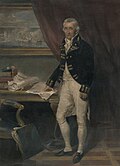
Nathaniel Dance and his fellow captains were highly praised in the aftermath of the battle: in saving the convoy they had prevented both the | [[File:Commodore Sir Nathaniel Dance.jpg|thumb|upright|1805 portrait of Dance]] | ||
Nathaniel Dance and his fellow captains were highly praised in the aftermath of the battle: in saving the convoy they had prevented both the EIC and [[Lloyd's of London]] from likely financial ruin, the repercussions of which would have had profound effects across the British Empire.<ref name="SM193">Maffeo, p. 193</ref> The various commanders and their crews were presented with a £50,000 prize fund to be divided among them, and the [[Lloyd's Patriotic Fund]] and other national and mercantile institutions made a series of awards of ceremonial swords, silver plate and monetary gifts to individual officers. Lloyd's Patriotic Fund gave each captain a sword worth £50, and one to Royal Navy Lieutenant [[Robert Merrick Fowler]], travelling as a passenger on ''Earl Camden'', and one worth £100 to Nathaniel Dance.<ref name="WJ3:251"/> | |||
Dance was specifically rewarded, receiving royal recognition when he was made a [[Knight Bachelor]] by King [[George III]]. He was also personally presented with the sum of £5,000 by the Bombay Insurance Company and an additional £500 a year for life by the | Dance was specifically rewarded, receiving royal recognition when he was made a [[Knight Bachelor]] by King [[George III]]. He was also personally presented with the sum of £5,000 by the Bombay Insurance Company and an additional £500 a year for life by the EIC. Dance immediately retired from the sea to [[Enfield Town]], where he died in 1827.<ref name="NT114">Tracy, p. 114</ref> He refused to take full credit for the survival of the convoy, writing in reply to the award from the Bombay Insurance Company: | ||
{{ | {{blockquote|Placed, by the adventitious circumstances of seniority of service and absence of convoy, in the chief command of the fleet {{not a typo|intrusted}} to my care, it has been my good fortune to have been enabled, by the firmness of those by whom I was supported, to perform my trust not only with fidelity, but without loss to my employers. Public opinion and public rewards have already far outrun my deserts; and I cannot but be sensible that the liberal spirit of my generous countrymen has measured what they are pleased to term their grateful sense of my conduct, rather by the particular utility of the exploit, than by any individual merit I can claim.|Nathaniel Dance, quoted in [[William James (naval historian)|William James]]' ''The Naval History of Great Britain during the French Revolutionary and Napoleonic Wars'', Volume 3, 1827.<ref name=WJ3:252>James, Vol. 3, p. 252</ref>}} | ||
Among the passengers on the Indiamen were a number of Royal Navy personnel, survivors of the shipwreck of the exploratory vessel {{HMS|Porpoise|1799|6}} off the coast of [[New South Wales]] the previous year.<ref name="RW194"/> This party—carried aboard ''Ganges'', ''Royal George'' and ''Earl Camden''—volunteered to assist the gun teams aboard their ships and Dance specifically thanked them in his account of the action. One was Lieutenant Robert Merrick Fowler, the former commander of ''Porpoise'', who distinguished himself in a variety of capacities during the engagement. | Among the passengers on the Indiamen were a number of Royal Navy personnel, survivors of the shipwreck of the exploratory vessel {{HMS|Porpoise|1799|6}} off the coast of [[Colony of New South Wales|New South Wales]] the previous year.<ref name= "RW194">Woodman, p. 194</ref> This party—carried aboard ''Ganges'', ''Royal George'' and ''Earl Camden''—volunteered to assist the gun teams aboard their ships and Dance specifically thanked them in his account of the action. One was Lieutenant Robert Merrick Fowler, the former commander of ''Porpoise'', who distinguished himself in a variety of capacities during the engagement. Some of the party had influential careers in the Navy, including the naval architect [[James Inman]], who sailed on ''Warley'', and [[John Franklin]], who later became a polar explorer.<ref name=AJB440>Brown, p. 440.</ref> | ||
Linois continued his raiding, achieving some success against individual sailing ships, but failing to press successfully his numerical superiority against British naval forces; most notably at the [[Battle of Vizagapatam]] on 15 September 1804 and the [[action of 6 August 1805]]. Ironically, Linois was eventually captured at the [[action of 13 March 1806]] after mistaking a squadron of British ships of the line for a merchant convoy in the mid-Atlantic.<ref name="RG29">''The Victory of Seapower'', Gardiner, p. 29</ref> Linois was concerned throughout the engagement for the safety of his ships: with the nearest dockyard over {{cvt|3000|nmi|mi km|lk=in}} away at Isle de France, he could not afford to suffer severe damage to his rigging or masts that would leave his squadron crippled.<ref name="SM191">Maffeo, p. 191</ref> He also sought to defend his behaviour off Pulo Aura with the claim that the British convoy was protected by as many as eight ships of the line, and that he had performed heroically in saving his squadron from this overwhelming force.<ref name="WJ3:250">James, Vol. 3, p. 250</ref> | |||
Subsequent historians have ridiculed this latter statement: [[William James (naval historian)|William James]] wryly commented in his account of the action, written in 1827, that "it would be uncharitable to call into question the courage of Rear-admiral Linois"<ref name="WJ3:251">James, Vol. 3, p. 251</ref> and [[William Laird Clowes]] said in 1900 that "his timidity and want of enterprise threw away a great opportunity".<ref name= "WLC339">Clowes, p. 339</ref> [[Nicholas A. M. Rodger]], writing in 2004, was even more critical, insisting that "his [Linois's] officers do not seem to have been fooled, and it is extremely difficult to believe that he was." He goes on to suggest that no experienced seaman could possibly have mistaken a poorly manned and poorly trained merchant crew for the crew of a real British ship of the line, concluding that "Linois had thrown away a prize worth at least £8 million through mere timidity".<ref name="NR546"/> The most scathing criticism of Linois's conduct came from Napoleon himself, who wrote to [[List of naval ministers of France|Minister of the Marine]] [[Denis Decrès]] on the subject, stating: | |||
{{ | {{blockquote|All the enterprises at sea which have been undertaken since I became the head of the Government have missed fire because my admirals see double and have discovered, I know not how or where, that war can be made without running risks ... Tell Linois that he has shown want of courage of mind, that kind of courage which I consider the highest quality in a leader.|Napoleon, quoted in translation in [[William Laird Clowes]]' ''The Royal Navy: A History from the Earliest Times to 1900'', Volume 5, 1900.<ref name=WLC339>Clowes, p. 339</ref>}} | ||
==See also== | ==See also== | ||
*[[Frederick Marryat]]'s 1832 novel ''[[Newton Forster]]'' | * [[Frederick Marryat]]'s 1832 novel ''[[Newton Forster]]'' | ||
*[[Patrick O'Brian]]'s 1973 novel ''[[HMS Surprise (novel)|HMS Surprise]]'' | * [[Patrick O'Brian]]'s 1973 novel ''[[HMS Surprise (novel)|HMS Surprise]]'' | ||
==Notes== | ==Notes== | ||
{{ | {{Notelist}} | ||
==Citations== | ==Citations== | ||
| Line 221: | Line 225: | ||
{{DEFAULTSORT:Pulo Aura}} | {{DEFAULTSORT:Pulo Aura}} | ||
[[Category:Conflicts in 1804]] | |||
[[Category:Naval battles of the Napoleonic Wars]] | [[Category:Naval battles of the Napoleonic Wars]] | ||
[[Category:Naval battles involving the Batavian Republic]] | [[Category:Naval battles involving the Batavian Republic]] | ||
[[Category:Naval battles involving the British East India Company]] | [[Category:Naval battles involving the British East India Company]] | ||
[[Category:Naval battles involving France]] | |||
[[Category:Strait of Malacca]] | [[Category:Strait of Malacca]] | ||
[[Category:February 1804 | [[Category:February 1804]] | ||
Latest revision as of 16:48, 6 March 2026
| Battle of Pulo Aura | |||||||
|---|---|---|---|---|---|---|---|
| Part of the Napoleonic Wars | |||||||
 Commodore Dance's celebrated action against a French squadron in the Straits of Malacca on 15th. February 1804 Robert Dodd, 1804 | |||||||
| |||||||
| Belligerents | |||||||
| East India Company | |||||||
| Commanders and leaders | |||||||
| Nathaniel Dance | Charles-Alexandre Linois | ||||||
| Strength | |||||||
|
| ||||||
| Casualties and losses | |||||||
| None | ||||||
The Battle of Pulo Aura was a minor naval engagement of the Napoleonic Wars fought on 14 February 1804, in which a large British East India Company (EIC) convoy intimidated, drove off and chased away a powerful French Navy squadron. Although the French squadron was much stronger than the British convoy, Commodore Nathaniel Dance's aggressive tactics persuaded Counter-admiral Charles-Alexandre Léon Durand Linois to retire after only a brief exchange of fire. Dance then chased the French squadron until his convoy was out of danger, whereupon he resumed his passage toward British India.
The battle occurred during an extended commerce raiding operation by Linois' squadron, led by the ship of the line Marengo. In 1803, before war broke out, Linois sailed to the Indian Ocean to install garrisons in French and Batavian colonies and target British merchantmen. A prime target was the "China Fleet", a convoy of East Indiamen carrying millions of pounds' worth of trade goods. Although escorted by smaller merchant ships, the only available escort warship was the EIC armed brig Ganges. Dutch informants told Linois of the fleet's destination and date of departure from Canton while he was at Batavia, and he set sail on 28 December 1803, eventually locating the convoy in early February.
Although no warships protected the convoy, Dance knew that lookouts could mistake a large East Indiaman for a ship of the line. He had his Indiamen form a line of battle and raise flags suggesting his fleet included part of the Royal Navy squadron operating in the Indian Ocean. Although Linois's ships were clearly superior, the bold British response unsettled him, and he quickly broke off combat. Dance maintained the ruse, aggressively pursuing Linois for two hours until the convoy was safe. The successful deception ensured the valuable cargo reached Britain without loss.
King George III knighted Dance for his courage and various mercantile and patriotic organisations awarded him large sums of money, while both Napoleon and Linois's own officers personally castigated him for his failure to press the attack against a weaker and extremely valuable enemy. Although he remained in command of the squadron for another two years and had some minor success against undefended merchant ships, he suffered a string of defeats and inconclusive engagements against weaker British naval forces. Ironically, Linois was captured at the action of 13 March 1806 by a numerically superior British battle squadron which he had mistaken for a merchant convoy.
Background[edit | edit source]

During the French Revolutionary and Napoleonic Wars, the economy of the United Kingdom relied heavily on its ability to trade with the British Empire, especially Britain's valuable colonies in India. British trade with Asia was primarily conducted by the East India Company (EIC) using large, well-armed merchant ships known as East Indiamen.[1] These ships were between 500 and 1200 nominal tons burthen (bm) and could carry up to 36 guns to defend against pirates, privateers, and smaller warships. However, they were not designed to fight large warships like frigates or ships of the line, as their guns were often of inferior design and their crews less trained.[2]
Despite these disadvantages, East Indiamen's size made them resemble a small ship of the line from a distance, often augmented by paintwork and dummy cannon.[3] In the Bali Strait incident of 28 January 1797, an unescorted convoy of British East Indiamen used this similarity to intimidate a French frigate squadron into withdrawing without a fight.[4] A similar event occurred in February 1799 during the Macau Incident, where a Franco-Spanish squadron attacking a British merchant convoy was driven off by a small Royal Navy squadron escorting it.[5][6] British East Indiamen would gather at Asian ports and set out for Britain in large convoys, often carrying millions of pounds' worth of trade goods.[7] The journey usually took six months, with the ships returning carrying troops and passengers to bolster British forces in Asia. "Country ships", smaller British merchantmen often unaffiliated with the EIC, would frequently join the convoys. To defend against pirate attacks, the EIC operated the Bombay Marine. These ships were an effective deterrent against small raiders but were no match for professional warships.[8]
Seeking to threaten British trade from the beginning of the war, Napoleon ordered a French squadron to sail for India in March 1803 under the command of Counter-cdmiral Charles-Alexandre Léon Durand Linois. Linois's squadron included the ship of the line Marengo and three frigates.[9] Operating from Isle de France (modern-day Mauritius), Linois was ordered to attack British shipping once war began. After sailing to Pondicherry and narrowly escaping from a British squadron under Rear-admiral Peter Rainier in July, Linois received news of the outbreak of war in May 1803 and began making preparations. He landed supplies and troops at Réunion and Batavia, sent the frigate Atalante to Muscat, captured several country ships and raided British Bencoolen.[10] On 10 December, after gathering intelligence about the British "China Fleet", Linois set sail to intercept it.[11] His squadron, including Marengo, the frigates Belle Poule and Sémillante, the corvette Berceau, and the Batavian Navy brig Avonturier, departed Batavia on 28 December with six months' worth of provisions, expecting a long patrol in the Strait of Malacca.[12] The China Fleet, which gathered annually at Canton in the Pearl River, included 16 East Indiamen, 11 country ships, a Portuguese merchantmen from Macau, and a vessel from Botany Bay by late January 1804.[13]
Despite the presence of the small EIC brig Ganges as an escort, the convoy had no real military protection, as the news of war had arrived in Canton before reinforcements could reach them. While spies in Canton informed Linois of the fleet's composition, Dutch informants also sent false reports suggesting Royal Navy warships were with the convoy, which were possibly planted by British authorities.[14] The convoy was an incredibly valuable target, with a cargo worth over £8 million in contemporary values, including tea, silk, porcelain, and 80 Chinese plants ordered by Sir Joseph Banks for the Kew Gardens.[15] The EIC's select committee in Canton had debated delaying the convoy's departure over security concerns. Captains of the convoy, including Henry Meriton, who had captured a French frigate in the action of 4 August 1800, argued that the convoy's size and appearance would deter attacks.[16] However, James Farquharson, the captain of Alfred, opposed Meriton, arguing the convoy's crews were too poorly trained to defend themselves effectively. Ultimately, the committee decided to proceed, placing Commodore Nathaniel Dance—with over 45 years of experience in the East Indiaman Earl Camden—in charge of the convoy.[17]
Battle[edit | edit source]
At 08:00 on 14 February 1804, with the island of Pulo Aura within sight to the south-west near the eastern entrance to the Straits of Malacca, the Indiaman Royal George raised a signal describing three sail approaching the convoy from the direction of the island. This was Linois's squadron, which had been cruising in the area for the previous month in anticipation of the convoy's arrival. Dance ordered the brig Ganges and the Indiamen Alfred, Royal George, Bombay Castle and Hope to approach the strange vessels and investigate, rapidly discovering they were enemy warships. By 13:00, Dance had readied his guns and reformed his convoy, with the large Indiamen formed up in line of battle to receive the French attack as if they were warships.[6] During the late afternoon, Linois's squadron fell in behind the slow line of merchant ships and Dance expected an immediate attack, but Linois was cautious and merely observed the convoy, preferring to wait until the following morning before engaging the enemy.[2] Dance made use of the delay to gather the smaller country ships on the opposite side of his line from the French, the brig Ganges shepherding them into position and collecting volunteers from their crews to augment the sailors on board the Indiamen.[13] Linois later excused his delay in attacking the merchant convoy by citing the need for caution:
If the bold front put on by the enemy in the daytime had been intended as a ruse to conceal his weakness, he would have profited by the darkness of the night to endeavour to conceal his escape; and in that case should have taken advantage of his manoeuvres. But I soon became convinced that this security was not feigned; three of his ships constantly kept their lights up, and the fleet continued to lie to, in order of battle, throughout the night. This position facilitated my gaining the wind, and enabled me to observe the enemy closely.
— Linois, quoted in translation in William James' The Naval History of Great Britain during the French Revolutionary and Napoleonic Wars, Volume 3, 1827.[18]
At dawn on 15 February, both the British and the French raised their colours. Dance hoped to persuade Linois that his ships included some fully armed warships and he therefore ordered the brig Ganges and the four lead ships to hoist blue ensigns, while the rest of the convoy raised red ensigns. By the system of national flags then in use in British ships, this implied that the ships with blue ensigns were warships attached to Rainer's squadron, while the others were merchant ships under their protection.[2] Dance was unknowingly assisted by the information that had reached Linois at Batavia, which claimed that there were 23 merchant ships and the brig in the convoy. Dance had collected six additional ships during his journey, and the identity of these were unknown to the French, who assumed that at least some of the unidentified vessels must be warships, particularly as several vessels had been recently painted at Canton to resemble ships of the line.[18]
.jpg)
At 09:00 Linois was still only observing the convoy, reluctant to attack until he could be sure of the nature of his opponents. Dance responded to the reprieve by reforming the line of battle into sailing formation to increase his convoy's speed with the intention of reaching the Straits ahead of Linois.[15] With the convoy a less intimidating target, Linois began to slowly approach the British ships.[19] By 13:00 it was clear that Linois's faster ships were in danger of isolating the rear of the convoy, and Dance ordered his lead ships to tack and come about so they would cross in front of the French squadron. The British successfully executed the manoeuvre, and at 13:15 Linois opened fire on the lead ship—Royal George—under the command of John Fam Timmins.[18] The Royal George and the next four ships in line, the Indiaman Ganges, Dance's Earl Camden, the Warley and the Alfred, all returned fire, Ganges initially attacking Royal George in error. Captain James Prendergrass in Hope, the next in line, was so eager to join the battle that he misjudged his speed and collided with Warley, the ships falling back as their crews worked to separate their rigging.[15] Shots were then exchanged at long range for 43 minutes, neither side inflicting severe damage.[20]
Royal George had a sailor named Hugh Watt killed, another man wounded, and suffered some damage to her hull. None of the other British ships or any of the French reported anything worse than superficial damage in the engagement.[21] At 14:00, Linois abandoned the action and ordered his squadron to haul away with the wind and sail eastwards, away from the convoy, under all sail. Determined to maintain the pretence of the presence of warships, Dance ordered the ships flying naval ensigns, including his flagship Earl Camden, to chase the French. None of the merchant ships could match the French speed, but an attempt at a chase would hopefully dissuade the French from returning.[21] For two hours, Dance's squadron followed Linois, Hope coming close to catching Avonturier but ultimately unable to overtake the brig. At 16:00, Dance decided to gather his scattered ships and return to his former heading rather than risk attack from other raiders or lose sight of his convoy in the darkness. By 20:00, the entire British convoy had anchored at the entrance to the Straits of Malacca.[22] On 28 February, the British ships of the line HMS Sceptre and Albion joined them in the Strait and conducted them safely to Saint Helena in the South Atlantic.[23]
There HMS Plantagenet escorted the convoy to England. Five whalers and Carmarthen, Captain Doree, also joined the convoy, with the Blackhouse, from coast of Guinea, joining at sea.[24][lower-alpha 1] The convoy returned to England without further incident.[19]
Linois's squadron reached Batavia several days after the action without encountering any British ships. He was there joined by Atalante and, after taking on supplies, made sail for Isle de France, arriving on 2 April.[25] Avonturier was left at Batavia and remained there until British forces raided the port in November 1806, destroying her.[26] Linois later attempted to explain his conduct during the engagement:
The ships which had tacked rejoined those which were engaging us, and three of the engaging ships manoeuvred to double our rear, while the remainder of the fleet, crowding sail and bearing up, evinced an intention to surround us. By this manoeuvre the enemy would have rendered my situation very dangerous. The superiority of his force was ascertained, and I had no longer to deliberate on the part I should take to avoid the consequence of an unequal engagement: profiting by the smoke, I hauled up to port, and steering east-north-east, I increased by distance from the enemy, who continued the pursuit of the squadron for three hours, discharging at it several broadsides.
— Linois, quoted in translation in William James' The Naval History of Great Britain during the French Revolutionary and Napoleonic Wars, Volume 3, 1827.[22]
Orders of battle[edit | edit source]
| Honourable East India Company China Fleet | ||||||||||
|---|---|---|---|---|---|---|---|---|---|---|
| Ship | Commander | Notes | ||||||||
| Earl Camden | Commodore Nathaniel Dance | Flagship of the convoy. Engaged for 25 minutes | ||||||||
| Warley | Captain Henry Wilson | Engaged for 15 minutes. | ||||||||
| Alfred | Captain James Farquharson | Engaged for 15 minutes. | ||||||||
| Royal George | Captain John Fam Timins | Engaged for 40 minutes. Suffered light damage, with one man killed and one wounded. | ||||||||
| Coutts | Captain Robert Torin | |||||||||
| Wexford | Captain William Stanley Clarke | |||||||||
| Ganges | Captain William Moffat | Engaged for 35 minutes. | ||||||||
| Exeter | Captain Henry Meriton | |||||||||
| Earl of Abergavenny | Captain John Wordsworth | |||||||||
| Henry Addington | Captain John Kirkpatrick | |||||||||
| Bombay Castle | Captain Archibald Hamilton | |||||||||
| Cumberland | Captain William Ward Farrer | |||||||||
| Hope | Captain James Prendergrass | |||||||||
| Dorsetshire | Captain Robert Hunter Brown | |||||||||
| Warren Hastings | Captain Thomas Larkins | |||||||||
| Ocean | Captain John Christian Lochner | |||||||||
| Eleven country ships, none of which would engage the French, accompanied the convoy: Lord Castlereagh, Carron, David Scott, Minerva, Ardeseer, Charlotte, Friendship, Shau Kissaroo, Jahaungeer, Gilwell and Neptune. The EIC armed brig Ganges also joined the convoy. A Portuguese vessel from Macau and the Rolla from Botany Bay in New South Wales were supposed to join the convoy but they missed the fleet sailing and never joined. | ||||||||||
| Source: London Gazette[24] | ||||||||||
| Admiral Linois's squadron | ||||||||||
|---|---|---|---|---|---|---|---|---|---|---|
| Ship | Guns | Commander | Notes | |||||||
| Marengo | 74 | Counter-admiral Charles-Alexandre Léon Durand Linois Captain Joseph-Marie Vrignaud |
In his after-action report, Dance noted that upon arriving at Malacca he was informed that Marengo mounted 84 guns.[24] | |||||||
| Belle Poule | 40 | Captain Alain-Adélaïde-Marie Bruilhac | ||||||||
| Sémillante | 32 | Captain Léonard-Bernard Motard | ||||||||
| Berceau | 30 | Captain Emmanuel Halgan | Dance was also informed Berceau was a 28-gun corvette.[24] | |||||||
| Avonturier | 18 | Unknown | Dance was informed that the ship was actually the 18-gun brig William (in actuality a 24-gun corvette).[24] | |||||||
| Source: James, Vol. 3, p. 248; Clowes, p. 336 | ||||||||||
Aftermath[edit | edit source]

Nathaniel Dance and his fellow captains were highly praised in the aftermath of the battle: in saving the convoy they had prevented both the EIC and Lloyd's of London from likely financial ruin, the repercussions of which would have had profound effects across the British Empire.[27] The various commanders and their crews were presented with a £50,000 prize fund to be divided among them, and the Lloyd's Patriotic Fund and other national and mercantile institutions made a series of awards of ceremonial swords, silver plate and monetary gifts to individual officers. Lloyd's Patriotic Fund gave each captain a sword worth £50, and one to Royal Navy Lieutenant Robert Merrick Fowler, travelling as a passenger on Earl Camden, and one worth £100 to Nathaniel Dance.[28]
Dance was specifically rewarded, receiving royal recognition when he was made a Knight Bachelor by King George III. He was also personally presented with the sum of £5,000 by the Bombay Insurance Company and an additional £500 a year for life by the EIC. Dance immediately retired from the sea to Enfield Town, where he died in 1827.[29] He refused to take full credit for the survival of the convoy, writing in reply to the award from the Bombay Insurance Company:
Placed, by the adventitious circumstances of seniority of service and absence of convoy, in the chief command of the fleet intrusted to my care, it has been my good fortune to have been enabled, by the firmness of those by whom I was supported, to perform my trust not only with fidelity, but without loss to my employers. Public opinion and public rewards have already far outrun my deserts; and I cannot but be sensible that the liberal spirit of my generous countrymen has measured what they are pleased to term their grateful sense of my conduct, rather by the particular utility of the exploit, than by any individual merit I can claim.
— Nathaniel Dance, quoted in William James' The Naval History of Great Britain during the French Revolutionary and Napoleonic Wars, Volume 3, 1827.[30]
Among the passengers on the Indiamen were a number of Royal Navy personnel, survivors of the shipwreck of the exploratory vessel HMS Porpoise off the coast of New South Wales the previous year.[31] This party—carried aboard Ganges, Royal George and Earl Camden—volunteered to assist the gun teams aboard their ships and Dance specifically thanked them in his account of the action. One was Lieutenant Robert Merrick Fowler, the former commander of Porpoise, who distinguished himself in a variety of capacities during the engagement. Some of the party had influential careers in the Navy, including the naval architect James Inman, who sailed on Warley, and John Franklin, who later became a polar explorer.[32]
Linois continued his raiding, achieving some success against individual sailing ships, but failing to press successfully his numerical superiority against British naval forces; most notably at the Battle of Vizagapatam on 15 September 1804 and the action of 6 August 1805. Ironically, Linois was eventually captured at the action of 13 March 1806 after mistaking a squadron of British ships of the line for a merchant convoy in the mid-Atlantic.[33] Linois was concerned throughout the engagement for the safety of his ships: with the nearest dockyard over 3,000 nmi (3,500 mi; 5,600 km) away at Isle de France, he could not afford to suffer severe damage to his rigging or masts that would leave his squadron crippled.[34] He also sought to defend his behaviour off Pulo Aura with the claim that the British convoy was protected by as many as eight ships of the line, and that he had performed heroically in saving his squadron from this overwhelming force.[22]
Subsequent historians have ridiculed this latter statement: William James wryly commented in his account of the action, written in 1827, that "it would be uncharitable to call into question the courage of Rear-admiral Linois"[28] and William Laird Clowes said in 1900 that "his timidity and want of enterprise threw away a great opportunity".[35] Nicholas A. M. Rodger, writing in 2004, was even more critical, insisting that "his [Linois's] officers do not seem to have been fooled, and it is extremely difficult to believe that he was." He goes on to suggest that no experienced seaman could possibly have mistaken a poorly manned and poorly trained merchant crew for the crew of a real British ship of the line, concluding that "Linois had thrown away a prize worth at least £8 million through mere timidity".[6] The most scathing criticism of Linois's conduct came from Napoleon himself, who wrote to Minister of the Marine Denis Decrès on the subject, stating:
All the enterprises at sea which have been undertaken since I became the head of the Government have missed fire because my admirals see double and have discovered, I know not how or where, that war can be made without running risks ... Tell Linois that he has shown want of courage of mind, that kind of courage which I consider the highest quality in a leader.
— Napoleon, quoted in translation in William Laird Clowes' The Royal Navy: A History from the Earliest Times to 1900, Volume 5, 1900.[35]
See also[edit | edit source]
- Frederick Marryat's 1832 novel Newton Forster
- Patrick O'Brian's 1973 novel HMS Surprise
Notes[edit | edit source]
- ↑ The five whalers were the William Fenning, Brook Watson, Thomas (or Young Tom), Betsey and Eliza.[24]
Citations[edit | edit source]
- ↑ The Victory of Seapower, Gardiner, p. 101
- ↑ 2.0 2.1 2.2 Clowes, p. 337
- ↑ Maffeo, p. 190
- ↑ Parkinson, p. 106
- ↑ Nelson Against Napoleon, Gardiner, p. 161
- ↑ 6.0 6.1 6.2 Rodger, p. 546
- ↑ Adkins, p. 342
- ↑ The Victory of Seapower, Gardiner, p. 88
- ↑ Woodman, p. 172
- ↑ Clowes, p. 59
- ↑ James, Vol. 3, p. 213
- ↑ Clowes, p. 336
- ↑ 13.0 13.1 James, Vol. 3, p. 248
- ↑ Maffeo, p. 186
- ↑ 15.0 15.1 15.2 The Campaign of Trafalgar, Gardiner, p. 32
- ↑ Woodman, p. 149
- ↑ Tracy, p. 113
- ↑ 18.0 18.1 18.2 James, Vol. 3, p. 249
- ↑ 19.0 19.1 Woodman, p. 195
- ↑ Maffeo, p. 187
- ↑ 21.0 21.1 Clowes, p. 338
- ↑ 22.0 22.1 22.2 James, Vol. 3, p. 250
- ↑ Lloyd's List, n°4478.
- ↑ 24.0 24.1 24.2 24.3 24.4 24.5 "No. 15726". The London Gazette. 7 August 1804. pp. 955–956.
- ↑ James, Vol. 3, p. 277
- ↑ "No. 16044". The London Gazette. 4 July 1807. p. 894.
- ↑ Maffeo, p. 193
- ↑ 28.0 28.1 James, Vol. 3, p. 251
- ↑ Tracy, p. 114
- ↑ James, Vol. 3, p. 252
- ↑ Woodman, p. 194
- ↑ Brown, p. 440.
- ↑ The Victory of Seapower, Gardiner, p. 29
- ↑ Maffeo, p. 191
- ↑ 35.0 35.1 Clowes, p. 339
References[edit | edit source]
- Adkins, Roy & Lesley (2006). The War for All the Oceans. Abacus. ISBN 978-0-349-11916-8.
- Brown, Anthony Jarrold (2008). Ill-Starred Captains: Flinders & Baudin. Fremantle Press. ISBN 978-1-921361-29-6.
- Clowes, William Laird (1997) [1900]. The Royal Navy, A History from the Earliest Times to 1900, Volume V. Chatham Publishing. ISBN 1-86176-014-0.
- Gardiner, Robert, ed. (2001) [1996]. Nelson Against Napoleon. London: Caxton Editions. ISBN 1-86176-026-4.
- Gardiner, Robert, ed. (2001) [1998]. The Campaign of Trafalgar. Caxton Editions. ISBN 1-84067-358-3.
- Gardiner, Robert, ed. (2001) [1998]. The Victory of Seapower. Caxton Editions. ISBN 1-84067-359-1.
- James, William (2002) [1827]. The Naval History of Great Britain, Volume 3, 1800–1805. Conway Maritime Press. ISBN 0-85177-907-7.
- Maffeo, Steven E. (2000). Most Secret and Confidential: Intelligence in the Age of Nelson. London: Chatham Publishing. ISBN 1-86176-152-X.
- Parkinson, C. Northcote (1954). War in the Eastern Seas, 1793–1815. London: George Allen & Unwin Ltd.
- Rodger, N.A.M. (2004). The Command of the Ocean. Allan Lane. ISBN 0-7139-9411-8.
- Tracy, Nicholas (1998). Who's Who in Nelson's Navy; 200 Naval Heroes. Chatham Publishing. ISBN 1-86176-244-5.
- Woodman, Richard (2001). The Sea Warriors. Constable Publishers. ISBN 1-84119-183-3.
External links[edit | edit source]