



Ajay Kumar (talk | contribs) Created a new article |
Jeep Safari (talk | contribs) m General cleanup and content improvements |
||
| Line 1: | Line 1: | ||
{{short description|Genus of | {{short description|Genus of coniferous trees}} | ||
{{good article}} | |||
{{Other uses|FIR (disambiguation)|FIRS (disambiguation)}} | {{Other uses|FIR (disambiguation)|FIRS (disambiguation)}} | ||
{{redirect|Fir tree||Fir Tree (disambiguation)}} | {{redirect|Fir tree||Fir Tree (disambiguation)}} | ||
| Line 6: | Line 7: | ||
| fossil_range = {{Fossil range|49|0}} [[Eocene]] - [[Holocene|Present]]<ref name="Schorn01" /> | | fossil_range = {{Fossil range|49|0}} [[Eocene]] - [[Holocene|Present]]<ref name="Schorn01" /> | ||
| image = Abies koreana (szyszki).JPG | | image = Abies koreana (szyszki).JPG | ||
| image_alt = Cones of a fir tree | |||
| image_caption = [[Korean fir]] (''Abies koreana'') cones and foliage | | image_caption = [[Korean fir]] (''Abies koreana'') cones and foliage | ||
| taxon = Abies | | taxon = Abies | ||
| authority = [[Philip Miller|Mill.]] | | authority = [[Philip Miller|Mill.]] | ||
| type_species = ''[[Abies alba]]'' | | type_species = ''[[Abies alba]]'' | ||
| type_species_authority = [[Mill.]] | | type_species_authority = [[Philip Miller|Mill.]] | ||
| subdivision_ranks = Species | | subdivision_ranks = Species | ||
| subdivision = See text | | subdivision = [[#Classification|See text]] | ||
| synonyms = | | synonyms = * ''Peuce'' <small>Richard 1810</small> | ||
* ''Peuce'' <small>Richard 1810</small> | |||
}} | }} | ||
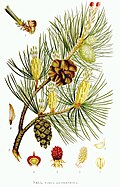
'''Firs''' are [[evergreen]] [[ | '''Firs''' are [[evergreen]] [[conifer]]ous trees belonging to the [[genus]] '''''Abies''''' ({{IPA|la|ˈabieːs|lang}}) in the family [[Pinaceae]]. There are approximately 48–65<ref>{{Cite journal |last1=Torres |first1=Leon Nahuel |last2=Shi |first2=Xiao |last3=Na |first3=Yuling |last4=Wang |first4=Bing |last5=Tian |first5=Chi |last6=Chen |first6=Jun |date=2024-03-01 |title=First study on fossil wood from the Middle Pleistocene of the Songliao Plain, Northeast China |url=https://www.sciencedirect.com/science/article/pii/S0034666724000149 |journal=Review of Palaeobotany and Palynology |volume=322 |article-number=105063 |doi=10.1016/j.revpalbo.2024.105063 |bibcode=2024RPaPa.32205063T |issn=0034-6667|url-access=subscription }}</ref><ref>{{cite book |last1=Debreczy |first1=Zsolt |last2=Rácz |first2=István |last3=Musial |first3=Kathy |year=2011 |title=Conifers Around the World : Conifers of the Temperate Zones and Adjacent Regions |location=Budapest |publisher=DendroPress |isbn=978-9632190617 |url=https://library.wur.nl/WebQuery/titel/2014098}}</ref> extant species, found on mountains throughout much of North and [[Central America]], [[Eurasia]], and [[North Africa]]. The genus is most closely related to ''[[Keteleeria]]'', a small genus confined to eastern Asia.<ref>{{cite journal |last1=Leslie |first1=Andrew B. |display-authors=et al. |year=2018 |title=ajb21143-sup-0004-AppendixS4 |journal=American Journal of Botany |volume=105 |issue=9 |pages=1531–1544 |doi=10.1002/ajb2.1143 |url=https://bsapubs.onlinelibrary.wiley.com/action/downloadSupplement?doi=10.1002%2Fajb2.1143&file=ajb21143-sup-0004-AppendixS4.pdf |doi-access=|pmid=30157290 }}</ref> | ||
They are tall trees that can be distinguished from other members of the pine family by the way in which their needle-like [[leaves]] are attached singly to the branches with a circular base, and by their [[Conifer cone|cones]], which, like those of [[Cedrus|cedars]], stand upright on the branches like candles and disintegrate at maturity. | |||
The wood of firs is used for [[pulp (paper)|pulp]] to make paper, for [[plywood]], and for indoor construction. Some species serve as [[Christmas tree]]s, while others are used as decorative trees with their brightly coloured cones. In art, [[Lucas Cranach the Elder]] painted ''Madonna under the fir tree'' for [[Wrocław Cathedral]] in 1510. | |||
== Etymology == | |||
The English name "fir" derives from the Old Norse ''fyri'' or the Old Danish ''fyr''.<ref>{{cite web|title=fir |url=https://www.etymonline.com/word/fir|access-date=2020-10-01 |website=Online Etymology Dictionary |archive-date=2021-08-08|archive-url=https://web.archive.org/web/20210808095144/https://www.etymonline.com/word/fir |url-status=live}}</ref> The generic name ''Abies'' is the Latin for "fir".<ref>{{cite web |title=Abies, subst. masc. |url=https://www.cnrtl.fr/definition/abies/ |publisher=[[Centre national de ressources textuelles et lexicales]] |access-date=8 September 2025}}</ref> | |||
== Description == | == Description == | ||
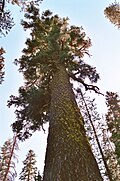
Fir trees are tall, often 40–60 metres and sometimes approaching 100 metres high, usually with a single straight trunk. The crown starts conical, but becomes more varied in shape with age. The primary branches are arranged in whorls around the trunk.<ref name="IDS"/> | |||
=== Leaves ===<!-- Fir needle redirects here. --> | === Leaves ===<!-- Fir needle redirects here. --> | ||
Firs | Firs have needle-like [[leaves]], arranged spirally but often appearing to be in two or more rows on opposite sides of the twigs. The base of each leaf is round and attached to a small pit in the twig. Each leaf is normally twisted at its base so that the side with [[stoma]]ta faces downwards.<ref name="IDS"/> In the upper crown on cone-bearing branches, the leaves are shorter, curved, and sometimes sharp.<ref name="Arno-2020">{{Cite book |last1=Arno |first1=Stephen F. |url=https://books.google.com/books?id=qDD4DwAAQBAJ |title=Northwest Trees: Identifying & Understanding the Region's Native Trees |last2=Hammerly |first2=Ramona P. |publisher=[[Mountaineers Books]] |year=2020 |isbn=978-1-68051-329-5 |edition=field guide |location=Seattle |pages=125 |oclc=1141235469 |orig-date=1977 |access-date=2022-02-26 |archive-date=2023-09-19 |archive-url=https://web.archive.org/web/20230919000929/https://books.google.com/books?id=qDD4DwAAQBAJ |url-status=live }}</ref> | ||
<gallery class=center mode=nolines> | |||
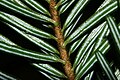
Abies alba PID1015-3.jpg|''[[Abies alba|A. alba]]'' – the underside of leaves have two whitish strips formed by [[wax]]-covered [[stoma]]tal bands, while their bases are shaped like suction cups. | |||
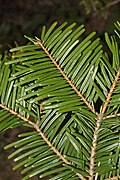
Abies grandis 5359.JPG|''[[Abies grandis|A. grandis]]'' foliage – upper side of the leaves, showing the leaves lying flat either side of the shoot | |||
Punta de rama pinsapo (Abies pinsapo) (8620598021).jpg|Foliage of ''[[Abies pinsapo|A. pinsapo]]'' showing the radial leaf arrangement in this species | |||
File:Abies mariesii2.JPG|Most firs are in between flat and radial, often with longer leaves at the sides, and shorter leaves above the shoot; here, ''[[Abies mariesii|A. mariesii]]'' in Japan | |||
File:Abies nordmanniana leaf cross-section.jpg|Cross-section of needle leaf of ''[[Abies nordmanniana]]'' | |||
</gallery> | |||
=== Cones === | |||
Firs differ from other conifers such as [[spruce]]s in having erect, cylindrical female seed [[Conifer cone|cones]] {{convert|5|-|25|cm|in|0|abbr=on}} long that disintegrate at maturity to release the winged [[seed]]s. Seed cones take a year to become mature; they start out green or other bright colour, darkening as they develop to dark brown or black. The leaflike seed [[bract]]s are visible when young, and in some species remain so. The seeds sit in thin cups; each seed has a triangle-shaped wing. The male cones are pendulous (dangling) and resemble [[catkin]]s; both pollen and seeds are wind-dispersed.<ref name="IDS"/> | |||
== | <gallery class=center mode=nolines> | ||
Abies cone & bits.jpg|Intact and disintegrated [[Abies borisii-regis|Bulgarian fir]] cones | Abies cone & bits.jpg|Intact and disintegrated [[Abies borisii-regis|Bulgarian fir]] cones | ||
Abies holophylla Manchurian Fir cones.jpg|Immature cones of some species | Abies holophylla Manchurian Fir cones.jpg|Immature cones of some species are green; here [[Abies holophylla|Manchurian fir]] ''Abies holophylla'' | ||
Manchurian Fir Abies holophylla disintegrating cones.jpg|Disintegrating cones of Manchurian fir | Manchurian Fir Abies holophylla disintegrating cones.jpg|Disintegrating cones of Manchurian fir | ||
Abies pindrow India3.jpg|[[Abies pindrow|Pindrow fir]] ''Abies pindrow'' with dark purple cones | |||
Caucasian Fir, young cultivated tree with cones, Northumberland.jpg|[[Abies nordmanniana|Caucasian Fir]] ''Abies nordmanniana'' young cones with reddish scales and yellow-green bracts | |||
Noble Fir, young naturalised tree with cones, Northumberland.jpg|[[Abies procera|Noble fir]] ''Abies procera'', with five heavy (20 cm, approx 0.5 kg each) seed cones | |||
File:Abies pollen cones Marki 4.JPG|Pollen cones<!--Abies sp.--> | |||
</gallery> | </gallery> | ||
== Evolution == | |||
=== Fossil history === | |||
[[File:Abies milleri SR 87-52-02 A.jpg|thumb|[[Fossil]] ''[[Abies milleri]]'' foliage and axis. [[Ypresian|Early Eocene]], 49.5 mya]] | |||
The oldest pollen assignable to the genus dates to the [[Late Cretaceous]] in [[Siberia]], with records of leaves and reproductive organs across the Northern Hemisphere from the [[Eocene]] onwards.<ref>{{Cite journal |last1=Xiang |first1=Xiaoguo |last2=Cao |first2=Ming |last3=Zhou |first3=Zhekun |date=October 2007 |title=Fossil history and modern distribution of the genus Abies (Pinaceae) |url=http://link.springer.com/10.1007/s11461-007-0058-4 |journal=Frontiers of Forestry in China |language=en |volume=2 |issue=4 |pages=355–365 |doi=10.1007/s11461-007-0058-4 |access-date=2023-02-15 |archive-date=2024-01-01 |archive-url=https://web.archive.org/web/20240101153338/https://link.springer.com/article/10.1007/s11461-007-0058-4 |url-status=live |url-access=subscription }}</ref> | |||
=== | === External phylogeny === | ||
Based on [[transcriptome]] analysis, ''[[Keteleeria]]'' is sister to ''Abies'', with the Pseudolariceae the next nearest relatives.<ref name=Stull>{{Cite journal |last1=Stull |first1=Gregory W. |last2=Qu |first2=Xiao-Jian |last3=Parins-Fukuchi |first3=Caroline |last4=Yang |first4=Ying-Ying |last5=Yang |first5=Jun-Bo |last6=Yang |first6=Zhi-Yun |last7=Hu |first7=Yi |last8=Ma |first8=Hong |last9=Soltis |first9=Pamela S. |last10=Soltis |first10=Douglas E. |last11=Li |first11=De-Zhu |display-authors=5 |date=19 July 2021 |title=Gene duplications and phylogenomic conflict underlie major pulses of phenotypic evolution in gymnosperms |url=https://www.nature.com/articles/s41477-021-00964-4 |journal=Nature Plants |volume=7 |issue=8 |pages=1015–1025 |doi=10.1038/s41477-021-00964-4 |pmid=34282286 |bibcode=2021NatPl...7.1015S |s2cid=236141481 |url-access=subscription }}</ref> | |||
{{ | {{clade | ||
{{clade|style=font-size:90%;line-height:80%; | |label1=[[Pinaceae]] | ||
|1={{clade | |||
|label1=[[Abietoideae]] |sublabel1=(firs and allies) | |||
|1={{clade | |||
|label1=Cedreae | |||
|1=''[[Cedrus]]'' [[File:Cedrus BHL677922.jpg|50px]] | |||
|2={{clade | |||
|label1=Pseudolariceae | |||
|1={{clade | |||
|1=''[[Pseudolarix]]'' [[File:Flore des serres v17 111a.jpg|70px]] | |||
|2={{clade | |||
|1=''[[Nothotsuga]]'' [[File:Nothotsuga cones and leaves.jpg|70px]] | |||
|2=''[[Tsuga]]'' [[File:Tsuga cone and leaves.png|50px]] | |||
}} | |||
}} | |||
|label2=Abieteae | |||
|2={{clade | |||
|1=''[[Keteleeria]]'' [[File:Keteleeria cone and leaves.jpg|65px]] | |||
|2='''''Abies''''' [[File:Abies alba - Köhler–s Medizinal-Pflanzen-001.jpg|50px]] | |||
}} | |||
}} | |||
}} | |||
|label2=[[Pinoideae]] |sublabel2=(pines, larches, etc) | |||
|2=[[File:496 Pinus silvestris.jpg|50px]] | |||
}} | |||
}} | |||
=== Internal phylogeny === | |||
Phylogeny of ''Abies'' based on phylogenomic analysis in 2021:<ref name="Stull Qu 2021">{{cite journal |last1=Stull |first1=Gregory W. |last2=Qu |first2=Xiao-Jian |last3=Parins-Fukuchi |first3=Caroline |last4=Yang |first4=Ying-Ying |last5=Yang |first5=Jun-Bo |last6=Yang |first6=Zhi-Yun |last7=Hu |first7=Yi |last8=Ma |first8=Hong |last9=Soltis |first9=Pamela S. |last10=Soltis |first10=Douglas E. |last11=Li |first11=De-Zhu |last12=Smith |first12=Stephen A. |last13=Yi |first13=Ting-Shuang |display-authors=5 |year=2021 |title=Gene duplications and phylogenomic conflict underlie major pulses of phenotypic evolution in gymnosperms |journal=Nature Plants |url=https://www.nature.com/articles/s41477-021-00964-4 |volume=7 |issue=8 |pages=1015–1025 |doi=10.1038/s41477-021-00964-4 |biorxiv=10.1101/2021.03.13.435279 |pmid=34282286 |bibcode= 2021NatPl...7.1015S |s2cid=232282918 |url-access=subscription }}</ref><ref>{{cite web |last1=Stull |first1=Gregory W. |display-authors=et al. |year=2021 |title=main.dated.supermatrix.tree.T9.tre |publisher=Figshare |doi=10.6084/m9.figshare.14547354.v1 |url=https://figshare.com/articles/dataset/Gene_duplications_and_genomic_conflict_underlie_major_pulses_of_phenotypic_evolution_in_gymnosperms/14547354 |doi-access= |access-date=2023-03-30 |archive-date=2024-01-01 |archive-url=https://web.archive.org/web/20240101153348/https://figshare.com/articles/dataset/Gene_duplications_and_genomic_conflict_underlie_major_pulses_of_phenotypic_evolution_in_gymnosperms/14547354 |url-status=live }}</ref> | |||
{{clade|style=font-size:90%;line-height:80%; | |||
|label1='''''Abies''''' | |||
|1={{clade | |1={{clade | ||
|1={{clade | |1={{clade | ||
| Line 95: | Line 128: | ||
|1=''[[Abies magnifica|A. magnifica]]'' <small>Murray</small> | |1=''[[Abies magnifica|A. magnifica]]'' <small>Murray</small> | ||
|label2=section | |label2=section | ||
|sublabel2='' | |sublabel2=''Grandis'' | ||
|2={{clade | |2={{clade | ||
|1=''[[Abies concolor|A. concolor]]'' <small>(Gordon) Lindley ex Hildebr.</small> | |1=''[[Abies concolor|A. concolor]]'' <small>(Gordon) Lindley ex Hildebr.</small> | ||
| Line 261: | Line 294: | ||
}} | }} | ||
}} | }} | ||
=== | === Taxonomy === | ||
* ''[[Abies alba]]'' – silver fir | ==== Taxonomic history ==== | ||
In 1754, [[Philip Miller]] set up the genus ''Abies''; he also defined the type species ''[[Abies alba]]''.<ref name="Farjon Rushworth 1989"/><ref>{{cite book |last=Miller |first=Philip |author-link=Philip Miller |year=1754 |title=The Gardener's Dictionary |edition=4th, abridged |volume=1}}</ref> In 1878, [[George Engelmann]] classified only a part of the genus;<ref name="Farjon Rushworth 1989"/> [[Heinrich Mayr]] did the same in 1890,<ref name="Farjon Rushworth 1989"/><ref>{{cite book |last=Mayr |first=Heinrich |year=1890 |title=Monographie der Abielineen des Japanischen Reiches | |||
|location=Munchen}}</ref> as did the German botanist Wilhelm Patschke in 1913.<ref name="Farjon Rushworth 1989"/> The classifications by Paul Robert Hickel in 1906 to 1908,<ref name="Farjon Rushworth 1989"/><ref>Hickel, Robert (1906-08). Notes pour servir ä la determination pratique des Abietinees. Bull. Soc. Dendrol. France 2: 45 58, f. I 7(15 xi 1906); 3; 5 18, f. 8 30 (15 ii 1907); 4: 41 48, f. 31 46(15v 1907); 5: 82 86(15 viii 1907); 7:5-10, f. a 1 (15 ii 1908); 9; 179-185 (15 viii 1908); 10: 201 208 (15 xi 1908).</ref> and by P. Landry in 1984,<ref name="Farjon Rushworth 1989"/><ref name="Landry 1984">{{cite journal |last=Landry |first=Pierre |title=Synopsis du genre Abies |journal=Bulletin de la Société Botanique de France. Lettres Botaniques |volume=131 |issue=3 |date=1984 |doi=10.1080/01811797.1984.10824633 |pages=223–229 |bibcode=1984BSBFL.131..223L |url=http://www.tandfonline.com/doi/abs/10.1080/01811797.1984.10824633 |language=fr|url-access=subscription }}</ref> made use only of a subset of the available morphological characteristics.<ref name="Farjon Rushworth 1989">{{cite journal |last1=Farjon |first1=Aljos |author1-link=Aljos Farjon |last2=Rushworth |first2=K. D. |title=A Classification of Abies Miller (Pinaceae) |journal= Notes from the Royal Botanic Garden Edinburgh |date=1989 |volume=46 |issue=1 |pages=59–79 |doi=10.24823/nrbge.1989.3565 |doi-access=free |url=https://repository.naturalis.nl/pub/535254/MPUUH1988003001007.pdf}}</ref> In 1990 and 2001, the Dutch botanist [[Aljos Farjon]] attempted a more complete classification; he accepted 48 species within the genus; in 2017 he reduced this to 46. Adopting a different approach, in 2011 Z. Debreczy and I. Rácz treated the genus as containing 67 species.<ref name="IDS">{{cite web |title=Abies Mill. |url=https://www.treesandshrubsonline.org/articles/abies/ |publisher=International Dendrology Society |access-date=8 September 2025}}</ref> | |||
==== Species ==== | |||
{{As of|2025|September}}, [[Plants of the World Online]] accepted 49 species.<ref>{{cite web |title=Abies Mill. Accepted Species<!--tab on page--> |url=https://powo.science.kew.org/taxon/urn:lsid:ipni.org:names:325655-2#children |publisher=[[Royal Botanic Gardens, Kew]] |access-date=10 September 2025}}</ref> The sections are based on Stull et al. 2021.<ref name="Stull Qu 2021"/><!--see also https://doi.org/10.1016/j.ympev.2018.03.009 Semerikova 2018--> | |||
Section ''Abies'' is found in central, south, and eastern Europe and Asia Minor. | |||
* ''[[Abies alba]]'' – silver fir or European silver fir | |||
* ''[[Abies nebrodensis]]'' – Sicilian fir | * ''[[Abies nebrodensis]]'' – Sicilian fir | ||
* ''[[Abies borisii-regis]]'' – Bulgarian fir | * ''[[Abies borisii-regis]]'' – Bulgarian fir | ||
* ''[[Abies cephalonica]]'' – Greek fir | * ''[[Abies cephalonica]]'' – Greek fir | ||
* ''[[Abies nordmanniana]]'' – | * ''[[Abies nordmanniana]]'' – Caucasian fir or Nordmann fir | ||
** [[Abies nordmanniana subsp. equi-trojani|''Abies nordmanniana'' subsp. ''equi-trojani'']] – Kazdağı fir, Turkish fir | ** [[Abies nordmanniana subsp. equi-trojani|''Abies nordmanniana'' subsp. ''equi-trojani'']] – Kazdağı fir, Turkish fir | ||
* ''[[Abies pinsapo]]'' – Spanish fir | * ''[[Abies pinsapo]]'' – Spanish fir | ||
| Line 276: | Line 319: | ||
* ''[[Abies cilicica]]'' – Syrian fir | * ''[[Abies cilicica]]'' – Syrian fir | ||
Section ''Balsamea'' is found in northern Asia and North America, and high mountains further south. | |||
* ''[[Abies fraseri]]'' – Fraser fir | * ''[[Abies fraseri]]'' – Fraser's fir | ||
* ''[[Abies balsamea]]'' – balsam fir | * ''[[Abies balsamea]]'' – balsam fir | ||
** ''Abies balsamea'' var. ''phanerolepis'' – bracted balsam fir | ** ''Abies balsamea'' var. ''phanerolepis'' – bracted balsam fir | ||
| Line 292: | Line 335: | ||
** ''Abies veitchii'' var. ''sikokiana'' – Shikoku fir | ** ''Abies veitchii'' var. ''sikokiana'' – Shikoku fir | ||
Section ''Grandis'' is found in western North America to Mexico, Guatemala, Honduras and El Salvador, in lowlands in the north, moderate altitudes in south. | |||
* ''[[Abies grandis]]'' – grand fir or giant fir | * ''[[Abies grandis]]'' – grand fir or giant fir | ||
** ''Abies grandis'' var. ''grandis'' – Coast grand fir | ** ''Abies grandis'' var. ''grandis'' – Coast grand fir | ||
| Line 308: | Line 351: | ||
* ''[[Abies vejarii]]'' | * ''[[Abies vejarii]]'' | ||
Section ''Momi'' is found in east and central Asia and the Himalaya, generally at low to moderate altitudes. | |||
* ''[[Abies kawakamii]]'' – Taiwan fir | * ''[[Abies kawakamii]]'' – Taiwan fir | ||
* ''[[Abies homolepis]]'' – Nikko fir | * ''[[Abies homolepis]]'' – Nikko fir | ||
| Line 322: | Line 365: | ||
* ''[[Abies ziyuanensis]]'' – Ziyuan fir | * ''[[Abies ziyuanensis]]'' – Ziyuan fir | ||
Section ''Amabilis'' is found in the Pacific Coast mountains in North America and Japan, in high rainfall areas. | |||
* ''[[Abies amabilis]]'' – Pacific silver fir | * ''[[Abies amabilis]]'' – Pacific silver fir | ||
* ''[[Abies mariesii]]'' – Maries' fir | * ''[[Abies mariesii]]'' – Maries' fir | ||
[[File:Abies fabri in mist.jpg|thumb|upright|''[[Abies fabri|A. fabri]]'', Sichuan, China]] | |||
[[File:Abies fabri in mist.jpg|thumb| | |||
Section ''Pseudopicea'' is found in the [[Himalaya|Sino – Himalayan mountains]] at high altitudes. | |||
* ''[[Abies delavayi]]'' – Delavay's fir | * ''[[Abies delavayi]]'' – Delavay's fir | ||
** ''Abies delavayi'' var. ''nukiangensis'' | ** ''Abies delavayi'' var. ''nukiangensis'' | ||
| Line 344: | Line 388: | ||
* ''[[Abies squamata]]'' – flaky fir | * ''[[Abies squamata]]'' – flaky fir | ||
Section ''Oiamel'' is found in central Mexico at high altitudes. | |||
* ''[[Abies religiosa]]'' – sacred fir | * ''[[Abies religiosa]]'' – sacred fir | ||
* ''[[Abies hickelii]]'' – Hickel's fir | * ''[[Abies hickelii]]'' – Hickel's fir | ||
** ''Abies hickelii'' var. ''oaxacana'' – Oaxaca fir | ** ''Abies hickelii'' var. ''oaxacana'' – Oaxaca fir | ||
[[File:Red fir.jpg|thumb|upright|''[[Abies magnifica|A. magnifica]]'', California]] | |||
[[File:Red fir.jpg|thumb| | |||
Section ''Nobilis'' (western [[United States|U.S.]], high altitudes) | |||
* ''[[Abies procera]]'' – noble fir | * ''[[Abies procera]]'' – noble fir | ||
* ''[[Abies magnifica]]'' – red fir | * ''[[Abies magnifica]]'' – red fir | ||
** ''Abies magnifica'' var. ''shastensis'' – Shasta red fir | ** ''Abies magnifica'' var. ''shastensis'' – Shasta red fir | ||
Section ''Bracteata'' ([[California]] coast) | |||
* ''[[Abies bracteata]]'' – bristlecone fir | * ''[[Abies bracteata]]'' – bristlecone fir | ||
*?†''[[Abies rigida]]'' {{small|[[Frank Knowlton]]|Knowlton}}<ref name="Knowlton1923">{{cite report |last1=Knowlton |first1=F.H. |year=1923 |title=Fossil plants from the Tertiary lake beds of South-Сentral Colorado |series=Professional Paper |publisher=United States Geological Survey |volume=131-G |pages=183–197 |doi=10.3133/pp131G |doi-access=free }}</ref><ref name="WolfeSchorn1990">{{cite report |last1=Wolfe |first1=J.A. |last2=Schorn |first2=H.E. |year=1990 |title=Taxonomic revision of the Spermatopsida of the Oligocene Creede flora, southern Colorado |series=Bulletin |publisher=United States Geological Survey |volume=1923 |pages=1–40 |doi=10.3133/b1923 |doi-access=free }}</ref> - ([[Priabonian]]-[[Chattian]]; Colorado) | |||
Section ''Incertae sedis'' | |||
* †''[[Abies milleri]]'' – (Extinct) Early [[Eocene]]<ref name="Schorn01">{{cite journal |author=Schorn, Howard |author2=Wehr, Wesley |date=1986 |title=Abies milleri, sp. nov., from the Middle Eocene Klondike Mountain Formation, Republic, Ferry County, Washington |journal=Burke Museum Contributions in Anthropology and Natural History |volume=1 |pages=1–7 |url=https://books.google.com/books?id=F97wDwAAQBAJ&pg=PA1}}</ref> | |||
== Ecology== | |||
=== Distribution and habitat === | |||
Firs are distributed around the Northern Hemisphere. The genus is native across much of North America, Eurasia, Turkey, Syria, Morocco, and Algeria. It is introduced in Scandinavia and the British Isles.<ref>{{cite web |title=Abies Mill. Distribution |url=https://powo.science.kew.org/taxon/urn:lsid:ipni.org:names:325655-2#distributions |publisher=[[Royal Botanic Gardens, Kew]] |access-date=10 September 2025}}</ref> ''[[Abies sibirica]]'' grows as far north as 67°N in Siberia, while ''[[Abies guatemalensis|A. guatemalensis]]'' grows as far south as 15°N in Central America. Most firs favour cold climates, whether at altitude in mountain ranges or at high latitude. Many species have [[Relict (biology)|relict distribution]]s, occupying small areas of what were once much larger distributions. Only a few species are widespread.<ref name="IDS"/> | |||
''[[Abies religiosa]]'' (sacred fir) trees give [[Monarch butterfly roosts|roosting]] shelter to overwintering [[Danaus plexippus|monarch butterflies]].<ref>{{cite web | last=Groth | first=Jacob | title=Monarch Migration Study | publisher=Swallowtail Farms | date=10 November 2000 | url=http://www.swallowtailfarms.com/pages/educationalproducts_mms.html | access-date=21 July 2014 | archive-date=9 May 2022 | archive-url=https://web.archive.org/web/20220509093135/http://www.swallowtailfarms.com/pages/educationalproducts_mms.html | url-status=live }}</ref><ref>{{cite web | url=http://www.monarchjointventure.org/monarch-biology/monarch-migration/ | publisher=Monarch Joint Venture | title=Monarch Migration | year=2013 | access-date=2017-10-25 | archive-date=2017-10-31 | archive-url=https://web.archive.org/web/20171031023829/https://monarchjointventure.org/monarch-biology/monarch-migration/ | url-status=live }}</ref> | |||
<gallery class=center mode=nolines widths=250 heights=250> | |||
File:Monarch butterflies (Danaus plexippus plexippus) on Oyamel fir (Abies religiosa) Piedra Herrada.jpg|''[[Abies religiosa]]'' with roosting monarch butterflies, Piedra Herrada, Valle de Bravo, Mexico | |||
File:Independence Pass, CO 5.jpg|Fir forest at high altitude,<br/>[[Independence Pass (Colorado)|Independence Pass, Colorado]] | |||
File:Abies lasiocarpa 5922 (cropped).JPG|The narrow conical shape and downward-drooping limbs of northern conifers,<br/>like ''[[Abies lasiocarpa]]'', help them shed snow. | |||
</gallery> | |||
=== | === Pests and diseases === | ||
Firs are hosts to a variety of invertebrate pests and fungal diseases. Pest groups include [[Adelgidae|adelgid]] bugs, [[aphid]]s, [[bark beetle]]s, [[clearwing moth]]s, [[Pissodes|conifer twig weevils]], [[caterpillar]]s of some moths, [[nematode]]s, [[sawflies]], [[spider mite]]s, and [[spittlebug]]s. Diseases of firs include annosus (''[[Heterobasidion]]'') [[root rot]], [[canker]]s, and [[needle cast]].<ref name="UC IPM">{{cite web |title=Pests in Gardens and Landscapes |url=https://ipm.ucanr.edu/PMG/GARDEN/PLANTS/fir.html |publisher=University of California Agriculture & Natural Resources: Statewide Integrated Pest Management Program |access-date=10 September 2025}}</ref> | |||
Firs are | |||
<gallery class=center mode=nolines widths=180 heights=180> | |||
File:1955. Pseudohylesinus grandis egg galleries and larvae on inner bark of silver fir. Baker River District, Mt. Baker National Forest. Washington. (34466337570).jpg|Galleries and larvae of ''[[Pseudohylesinus]] grandis'' beetles on ''Abies alba'' | |||
File:Paradiplosis tumifex galls01.jpg|[[Gall]]s of the gall midge ''[[Paradiplosis tumifex]]'' in needle leaves of ''[[Abies balsamea]]'' | |||
File:Pucciniastrum epilobii (42).jpg|''[[Pucciniastrum epilobii]]'' basidiomycete fungus infecting needle leaves of ''Abies alba'' | |||
File:Melampsorella caryophyllacearum Italy2.jpg|[[Witch's broom]] caused by the basidiomycete fungus ''[[Melampsorella]] caryophyllacearum'' | |||
</gallery> | |||
== Uses == | == Uses == | ||
[[ | Unlike the [[Douglas fir]] (''Pseudotsuga''), firs produce [[softwood]], often used as [[Pulp (paper)|pulp]] or for the manufacture of [[plywood]] and rough timber. It is commonly used in [[Canadian Lumber Standard]] graded wood, used for internal [[stud wall]]s and similar applications.<ref name="Homebuilding">{{cite web |last=Jenkins |first=Steve |title=What is CLS timber and what DIY projects is it good for? |website=Homebuilding & Renovating |date=2023-09-03 |url=https://www.homebuilding.co.uk/advice/what-is-cls-timber |access-date=2024-08-22}}</ref> ''[[Abies spectabilis]]'' is used in [[Ayurveda]] as an [[antitussive]] (cough suppressant) drug.<ref>{{cite book |last=Kershaw |first=Linda |title=Edible and Medicinal Plants of the Rockies |publisher=[[Lone Pine Publishing]] |date=2000 |location=Edmonton, Alberta |pages=26 |isbn=978-1-55105-229-8}}</ref> Firs produce a variety of [[terpenoid]]s that could have practical uses. Terpenoid composition of the bark varies by genetics, geography, age and size of the tree.<ref name="Hemingway-2018">{{cite book |last=Hemingway |first=R. W. |title=Organic Chemicals from Biomass |date=2018-01-18 |publisher=CRC Press |isbn=978-1-351-07525-1 |pages=189–248 |chapter=Bark: Its Chemistry and Prospects for Chemical Utilization}}</ref><ref name="Barton-2018">{{cite book |last=Barton |first=George M. |title=Organic Chemicals from Biomass |date=2018-01-18 |publisher=CRC Press |isbn=978-1-351-07525-1 |pages=249–280 |chapter=Foliage}}</ref> | ||
[[ | [[Abies nordmanniana|Caucasian fir]], [[Abies procera|noble fir]], [[Abies fraseri|Fraser's fir]] and [[Abies balsamea|balsam fir]] are popular [[Christmas tree]]s, generally considered to be the best for this purpose, with aromatic foliage that does not shed many needles on drying out. Many form decorative garden trees, notably [[Abies koreana|Korean fir]] and Fraser's fir, which produce brightly coloured cones even when very young, still only {{convert|1|–|2|m|ftin|abbr=on}} tall. Many fir species are grown in botanic gardens and other specialist tree collections in Europe and North America.<ref>{{cite web |last=Christian |first=T. |year=2021 |title=''Abies'' |url=https://treesandshrubsonline.org/articles/abies/ |website=Trees and Shrubs Online |access-date=2023-03-01 |archive-date=2023-03-01 |archive-url=https://web.archive.org/web/20230301173716/https://treesandshrubsonline.org/articles/abies/ |url-status=live }}</ref> | ||
== In art == | |||
'' | <gallery class=center mode=nolines widths=220 heights=220> | ||
File:Cranach Madonna under the fir tree.jpg|''Madonna under the fir tree'' - [[Lucas Cranach the Elder]], 1510 | |||
</gallery> | |||
[[Lucas Cranach the Elder]] painted ''Madonna under the fir tree'' for [[Wrocław Cathedral]] in 1510.<ref>{{cite web |title="Madonna under the Fir Tree" by Lucas Cranach the Elder |date=22 September 2020 |url=https://mnwr.pl/en/madonna/ |access-date=9 September 2025 |publisher=[[National Museum in Wrocław]]}}</ref> The painting was taken to Germany after the Second World War for restoration, but a copy was made and substituted for the original. The forgery was discovered, partly because the copy was on a fir board where the original was on [[Tilia|lime]] wood. The original was returned to Poland in 2012, the most valuable painting to be restituted to the country.<ref>{{cite web |title=Madonna under the Fir Tree |website=The Marian Temples Trail |url=https://maryjny.org/en/zdjecie/madonna-under-the-fir-tree/ |access-date=9 September 2025}}</ref> | |||
== See also == | |||
}}</ref> | |||
* [[List of fir species of Denmark]] | * [[List of fir species of Denmark]] | ||
== References == | == References == | ||
{{Reflist | |||
{{Reflist}} | |||
}} | |||
== Further reading == | == Further reading == | ||
* Philips, Roger. ''Trees of North America and Europe'', Random House | * Philips, Roger. ''Trees of North America and Europe'', [[Random House]], New York {{ISBN|0-394-50259-0}}, 1979. | ||
== External links == | == External links == | ||
{{Commons category|Abies}} | {{Commons category|Abies}} | ||
* [http://www.conifers.org/pi/Abies.php ''Abies''] at The Gymnosperm Database | * [http://www.conifers.org/pi/Abies.php ''Abies''] at The Gymnosperm Database | ||
* [https://treesandshrubsonline.org/articles/abies/ ''Abies''] from the website ''Trees and Shrubs Online'' | * [https://treesandshrubsonline.org/articles/abies/ ''Abies''] from the website ''Trees and Shrubs Online'' | ||
| Line 435: | Line 476: | ||
{{Taxonbar|from=Q25350}} | {{Taxonbar|from=Q25350}} | ||
{{authority control}} | {{authority control}} | ||
[[Category:Abies| ]] | [[Category:Abies| ]] | ||
[[Category:Pinaceae]] | [[Category:Pinaceae]] | ||
[[Category:Extant Ypresian first appearances]] | [[Category:Extant Ypresian first appearances]] | ||
[[Category:Taxa named by Philip Miller]] | [[Category:Taxa named by Philip Miller]] | ||
[[Category:Forestry]] | |||
Latest revision as of 18:10, 2 March 2026
| Fir | |
|---|---|
.JPG)
| |
| Korean fir (Abies koreana) cones and foliage | |
Scientific classification 
| |
| : | [[Template:Taxonomy/Abies]] Mill. |
| Type species | |
| Abies alba | |
| Species | |
| Synonyms | |
| |
Firs are evergreen coniferous trees belonging to the genus Abies (Latin: [ˈabieːs]) in the family Pinaceae. There are approximately 48–65[2][3] extant species, found on mountains throughout much of North and Central America, Eurasia, and North Africa. The genus is most closely related to Keteleeria, a small genus confined to eastern Asia.[4]
They are tall trees that can be distinguished from other members of the pine family by the way in which their needle-like leaves are attached singly to the branches with a circular base, and by their cones, which, like those of cedars, stand upright on the branches like candles and disintegrate at maturity.
The wood of firs is used for pulp to make paper, for plywood, and for indoor construction. Some species serve as Christmas trees, while others are used as decorative trees with their brightly coloured cones. In art, Lucas Cranach the Elder painted Madonna under the fir tree for Wrocław Cathedral in 1510.
Etymology[edit | edit source]
The English name "fir" derives from the Old Norse fyri or the Old Danish fyr.[5] The generic name Abies is the Latin for "fir".[6]
Description[edit | edit source]
Fir trees are tall, often 40–60 metres and sometimes approaching 100 metres high, usually with a single straight trunk. The crown starts conical, but becomes more varied in shape with age. The primary branches are arranged in whorls around the trunk.[7]
Leaves[edit | edit source]
Firs have needle-like leaves, arranged spirally but often appearing to be in two or more rows on opposite sides of the twigs. The base of each leaf is round and attached to a small pit in the twig. Each leaf is normally twisted at its base so that the side with stomata faces downwards.[7] In the upper crown on cone-bearing branches, the leaves are shorter, curved, and sometimes sharp.[8]
-
-
 A. grandis foliage – upper side of the leaves, showing the leaves lying flat either side of the shoot
 -
 Foliage of A. pinsapo showing the radial leaf arrangement in this species
 -
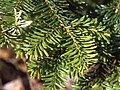 Most firs are in between flat and radial, often with longer leaves at the sides, and shorter leaves above the shoot; here, A. mariesii in Japan
 -
 Cross-section of needle leaf of Abies nordmanniana


_(8620598021).jpg)


Cones[edit | edit source]
Firs differ from other conifers such as spruces in having erect, cylindrical female seed cones 5–25 cm (2–10 in) long that disintegrate at maturity to release the winged seeds. Seed cones take a year to become mature; they start out green or other bright colour, darkening as they develop to dark brown or black. The leaflike seed bracts are visible when young, and in some species remain so. The seeds sit in thin cups; each seed has a triangle-shaped wing. The male cones are pendulous (dangling) and resemble catkins; both pollen and seeds are wind-dispersed.[7]
-
 Intact and disintegrated Bulgarian fir cones
 -
 Immature cones of some species are green; here Manchurian fir Abies holophylla
 -
 Disintegrating cones of Manchurian fir
 -
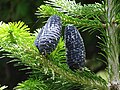 Pindrow fir Abies pindrow with dark purple cones
 -
 Caucasian Fir Abies nordmanniana young cones with reddish scales and yellow-green bracts
 -
 Noble fir Abies procera, with five heavy (20 cm, approx 0.5 kg each) seed cones
 -
 Pollen cones


Evolution[edit | edit source]
Fossil history[edit | edit source]

The oldest pollen assignable to the genus dates to the Late Cretaceous in Siberia, with records of leaves and reproductive organs across the Northern Hemisphere from the Eocene onwards.[9]
External phylogeny[edit | edit source]
Based on transcriptome analysis, Keteleeria is sister to Abies, with the Pseudolariceae the next nearest relatives.[10]
Internal phylogeny[edit | edit source]
Phylogeny of Abies based on phylogenomic analysis in 2021:[11][12]
Taxonomy[edit | edit source]
Taxonomic history[edit | edit source]
In 1754, Philip Miller set up the genus Abies; he also defined the type species Abies alba.[13][14] In 1878, George Engelmann classified only a part of the genus;[13] Heinrich Mayr did the same in 1890,[13][15] as did the German botanist Wilhelm Patschke in 1913.[13] The classifications by Paul Robert Hickel in 1906 to 1908,[13][16] and by P. Landry in 1984,[13][17] made use only of a subset of the available morphological characteristics.[13] In 1990 and 2001, the Dutch botanist Aljos Farjon attempted a more complete classification; he accepted 48 species within the genus; in 2017 he reduced this to 46. Adopting a different approach, in 2011 Z. Debreczy and I. Rácz treated the genus as containing 67 species.[7]
Species[edit | edit source]
As of September 2025[update], Plants of the World Online accepted 49 species.[18] The sections are based on Stull et al. 2021.[11]
Section Abies is found in central, south, and eastern Europe and Asia Minor.
- Abies alba – silver fir or European silver fir
- Abies nebrodensis – Sicilian fir
- Abies borisii-regis – Bulgarian fir
- Abies cephalonica – Greek fir
- Abies nordmanniana – Caucasian fir or Nordmann fir
- Abies nordmanniana subsp. equi-trojani – Kazdağı fir, Turkish fir
- Abies pinsapo – Spanish fir
- Abies pinsapo var. marocana – Moroccan fir
- Abies numidica – Algerian fir
- Abies cilicica – Syrian fir
Section Balsamea is found in northern Asia and North America, and high mountains further south.
- Abies fraseri – Fraser's fir
- Abies balsamea – balsam fir
- Abies balsamea var. phanerolepis – bracted balsam fir
- Abies lasiocarpa – subalpine fir
- Abies lasiocarpa var. arizonica – corkbark fir
- Abies lasiocarpa var. bifolia – Rocky Mountains subalpine fir
- Abies sibirica – Siberian fir
- Abies sibirica var. semenovii
- Abies sachalinensis – Sakhalin fir
- Abies koreana – Korean fir
- Abies nephrolepis – Khinghan fir
- Abies veitchii – Veitch's fir
- Abies veitchii var. sikokiana – Shikoku fir
Section Grandis is found in western North America to Mexico, Guatemala, Honduras and El Salvador, in lowlands in the north, moderate altitudes in south.
- Abies grandis – grand fir or giant fir
- Abies grandis var. grandis – Coast grand fir
- Abies grandis var. idahoensis – interior grand fir
- Abies concolor – white fir
- Abies concolor subsp. concolor – Rocky Mountain white fir or Colorado white fir
- Abies concolor subsp. lowiana – Low's white fir or Sierra Nevada white fir
- Abies durangensis – Durango fir
- Abies durangensis var. coahuilensis – Coahuila fir
- Abies flinckii – Jalisco fir
- Abies guatemalensis – Guatemalan fir
- Abies guatemalensis var. guatemalensis
- Abies guatemalensis var. jaliscana
- Abies vejarii
Section Momi is found in east and central Asia and the Himalaya, generally at low to moderate altitudes.
- Abies kawakamii – Taiwan fir
- Abies homolepis – Nikko fir
- Abies recurvata – Min fir
- Abies recurvata var. ernestii – Min fir
- Abies firma – Momi fir
- Abies beshanzuensis – Baishanzu fir
- Abies holophylla – Manchurian fir
- Abies chensiensis – Shensi fir
- Abies chensiensis subsp. salouenensis – Salween fir
- Abies pindrow – Pindrow fir
- Abies ziyuanensis – Ziyuan fir
Section Amabilis is found in the Pacific Coast mountains in North America and Japan, in high rainfall areas.
- Abies amabilis – Pacific silver fir
- Abies mariesii – Maries' fir

Section Pseudopicea is found in the Sino – Himalayan mountains at high altitudes.
- Abies delavayi – Delavay's fir
- Abies delavayi var. nukiangensis
- Abies delavayi var. motuoensis
- Abies delavayi subsp. fansipanensis
- Abies fabri – Faber's fir
- Abies fabri subsp. minensis
- Abies forrestii – Forrest's fir
- Abies densa – Bhutan fir
- Abies spectabilis – East Himalayan fir
- Abies fargesii – Farges' fir
- Abies fanjingshanensis – Fanjingshan fir
- Abies yuanbaoshanensis – Yuanbaoshan fir
- Abies squamata – flaky fir
Section Oiamel is found in central Mexico at high altitudes.
- Abies religiosa – sacred fir
- Abies hickelii – Hickel's fir
- Abies hickelii var. oaxacana – Oaxaca fir

Section Nobilis (western U.S., high altitudes)
- Abies procera – noble fir
- Abies magnifica – red fir
- Abies magnifica var. shastensis – Shasta red fir
Section Bracteata (California coast)
- Abies bracteata – bristlecone fir
- ?†Abies rigida
Frank Knowlton[19][20] - (Priabonian-Chattian; Colorado)
Section Incertae sedis
- †Abies milleri – (Extinct) Early Eocene[1]
Ecology[edit | edit source]
Distribution and habitat[edit | edit source]
Firs are distributed around the Northern Hemisphere. The genus is native across much of North America, Eurasia, Turkey, Syria, Morocco, and Algeria. It is introduced in Scandinavia and the British Isles.[21] Abies sibirica grows as far north as 67°N in Siberia, while A. guatemalensis grows as far south as 15°N in Central America. Most firs favour cold climates, whether at altitude in mountain ranges or at high latitude. Many species have relict distributions, occupying small areas of what were once much larger distributions. Only a few species are widespread.[7]
Abies religiosa (sacred fir) trees give roosting shelter to overwintering monarch butterflies.[22][23]
-
 Abies religiosa with roosting monarch butterflies, Piedra Herrada, Valle de Bravo, Mexico
 -
 Fir forest at high altitude,
Independence Pass, Colorado -
 The narrow conical shape and downward-drooping limbs of northern conifers,
like Abies lasiocarpa, help them shed snow.
_on_Oyamel_fir_(Abies_religiosa)_Piedra_Herrada.jpg)

.JPG)
Pests and diseases[edit | edit source]
Firs are hosts to a variety of invertebrate pests and fungal diseases. Pest groups include adelgid bugs, aphids, bark beetles, clearwing moths, conifer twig weevils, caterpillars of some moths, nematodes, sawflies, spider mites, and spittlebugs. Diseases of firs include annosus (Heterobasidion) root rot, cankers, and needle cast.[24]
-
 Galleries and larvae of Pseudohylesinus grandis beetles on Abies alba
 -

-
 Pucciniastrum epilobii basidiomycete fungus infecting needle leaves of Abies alba
 -
 Witch's broom caused by the basidiomycete fungus Melampsorella caryophyllacearum
.jpg)

.jpg)

Uses[edit | edit source]
Unlike the Douglas fir (Pseudotsuga), firs produce softwood, often used as pulp or for the manufacture of plywood and rough timber. It is commonly used in Canadian Lumber Standard graded wood, used for internal stud walls and similar applications.[25] Abies spectabilis is used in Ayurveda as an antitussive (cough suppressant) drug.[26] Firs produce a variety of terpenoids that could have practical uses. Terpenoid composition of the bark varies by genetics, geography, age and size of the tree.[27][28]
Caucasian fir, noble fir, Fraser's fir and balsam fir are popular Christmas trees, generally considered to be the best for this purpose, with aromatic foliage that does not shed many needles on drying out. Many form decorative garden trees, notably Korean fir and Fraser's fir, which produce brightly coloured cones even when very young, still only 1–2 m (3 ft 3 in – 6 ft 7 in) tall. Many fir species are grown in botanic gardens and other specialist tree collections in Europe and North America.[29]
In art[edit | edit source]
-
 Madonna under the fir tree - Lucas Cranach the Elder, 1510

Lucas Cranach the Elder painted Madonna under the fir tree for Wrocław Cathedral in 1510.[30] The painting was taken to Germany after the Second World War for restoration, but a copy was made and substituted for the original. The forgery was discovered, partly because the copy was on a fir board where the original was on lime wood. The original was returned to Poland in 2012, the most valuable painting to be restituted to the country.[31]
See also[edit | edit source]
References[edit | edit source]
- ↑ 1.0 1.1 Schorn, Howard; Wehr, Wesley (1986). "Abies milleri, sp. nov., from the Middle Eocene Klondike Mountain Formation, Republic, Ferry County, Washington". Burke Museum Contributions in Anthropology and Natural History. 1: 1–7.
- ↑ Torres, Leon Nahuel; Shi, Xiao; Na, Yuling; Wang, Bing; Tian, Chi; Chen, Jun (2024-03-01). "First study on fossil wood from the Middle Pleistocene of the Songliao Plain, Northeast China". Review of Palaeobotany and Palynology. 322 105063. Bibcode:2024RPaPa.32205063T. doi:10.1016/j.revpalbo.2024.105063. ISSN 0034-6667.
- ↑ Debreczy, Zsolt; Rácz, István; Musial, Kathy (2011). Conifers Around the World : Conifers of the Temperate Zones and Adjacent Regions. Budapest: DendroPress. ISBN 978-9632190617.
- ↑ Leslie, Andrew B.; et al. (2018). "ajb21143-sup-0004-AppendixS4" (PDF). American Journal of Botany. 105 (9): 1531–1544. doi:10.1002/ajb2.1143. PMID 30157290.
- ↑ "fir". Online Etymology Dictionary. Archived from the original on 2021-08-08. Retrieved 2020-10-01.
- ↑ "Abies, subst. masc". Centre national de ressources textuelles et lexicales. Retrieved 8 September 2025.
- ↑ 7.0 7.1 7.2 7.3 7.4 "Abies Mill". International Dendrology Society. Retrieved 8 September 2025.
- ↑ Arno, Stephen F.; Hammerly, Ramona P. (2020) [1977]. Northwest Trees: Identifying & Understanding the Region's Native Trees (field guide ed.). Seattle: Mountaineers Books. p. 125. ISBN 978-1-68051-329-5. OCLC 1141235469. Archived from the original on 2023-09-19. Retrieved 2022-02-26.
- ↑ Xiang, Xiaoguo; Cao, Ming; Zhou, Zhekun (October 2007). "Fossil history and modern distribution of the genus Abies (Pinaceae)". Frontiers of Forestry in China. 2 (4): 355–365. doi:10.1007/s11461-007-0058-4. Archived from the original on 2024-01-01. Retrieved 2023-02-15.
- ↑ Stull, Gregory W.; Qu, Xiao-Jian; Parins-Fukuchi, Caroline; Yang, Ying-Ying; Yang, Jun-Bo; et al. (19 July 2021). "Gene duplications and phylogenomic conflict underlie major pulses of phenotypic evolution in gymnosperms". Nature Plants. 7 (8): 1015–1025. Bibcode:2021NatPl...7.1015S. doi:10.1038/s41477-021-00964-4. PMID 34282286. S2CID 236141481.
- ↑ 11.0 11.1 Stull, Gregory W.; Qu, Xiao-Jian; Parins-Fukuchi, Caroline; Yang, Ying-Ying; Yang, Jun-Bo; et al. (2021). "Gene duplications and phylogenomic conflict underlie major pulses of phenotypic evolution in gymnosperms". Nature Plants. 7 (8): 1015–1025. Bibcode:2021NatPl...7.1015S. bioRxiv 10.1101/2021.03.13.435279. doi:10.1038/s41477-021-00964-4. PMID 34282286. S2CID 232282918.
- ↑ Stull, Gregory W.; et al. (2021). "main.dated.supermatrix.tree.T9.tre". Figshare. doi:10.6084/m9.figshare.14547354.v1. Archived from the original on 2024-01-01. Retrieved 2023-03-30.
- ↑ 13.0 13.1 13.2 13.3 13.4 13.5 13.6 Farjon, Aljos; Rushworth, K. D. (1989). "A Classification of Abies Miller (Pinaceae)" (PDF). Notes from the Royal Botanic Garden Edinburgh. 46 (1): 59–79. doi:10.24823/nrbge.1989.3565.
- ↑ Miller, Philip (1754). The Gardener's Dictionary. Vol. 1 (4th, abridged ed.).
- ↑ Mayr, Heinrich (1890). Monographie der Abielineen des Japanischen Reiches. Munchen.
{{cite book}}: CS1 maint: location missing publisher (link) - ↑ Hickel, Robert (1906-08). Notes pour servir ä la determination pratique des Abietinees. Bull. Soc. Dendrol. France 2: 45 58, f. I 7(15 xi 1906); 3; 5 18, f. 8 30 (15 ii 1907); 4: 41 48, f. 31 46(15v 1907); 5: 82 86(15 viii 1907); 7:5-10, f. a 1 (15 ii 1908); 9; 179-185 (15 viii 1908); 10: 201 208 (15 xi 1908).
- ↑ Landry, Pierre (1984). "Synopsis du genre Abies". Bulletin de la Société Botanique de France. Lettres Botaniques (in français). 131 (3): 223–229. Bibcode:1984BSBFL.131..223L. doi:10.1080/01811797.1984.10824633.
- ↑ "Abies Mill. Accepted Species". Royal Botanic Gardens, Kew. Retrieved 10 September 2025.
- ↑ Knowlton, F.H. (1923). Fossil plants from the Tertiary lake beds of South-Сentral Colorado (Report). Professional Paper. Vol. 131-G. United States Geological Survey. pp. 183–197. doi:10.3133/pp131G.
- ↑ Wolfe, J.A.; Schorn, H.E. (1990). Taxonomic revision of the Spermatopsida of the Oligocene Creede flora, southern Colorado (Report). Bulletin. Vol. 1923. United States Geological Survey. pp. 1–40. doi:10.3133/b1923.
- ↑ "Abies Mill. Distribution". Royal Botanic Gardens, Kew. Retrieved 10 September 2025.
- ↑ Groth, Jacob (10 November 2000). "Monarch Migration Study". Swallowtail Farms. Archived from the original on 9 May 2022. Retrieved 21 July 2014.
- ↑ "Monarch Migration". Monarch Joint Venture. 2013. Archived from the original on 2017-10-31. Retrieved 2017-10-25.
- ↑ "Pests in Gardens and Landscapes". University of California Agriculture & Natural Resources: Statewide Integrated Pest Management Program. Retrieved 10 September 2025.
- ↑ Jenkins, Steve (2023-09-03). "What is CLS timber and what DIY projects is it good for?". Homebuilding & Renovating. Retrieved 2024-08-22.
- ↑ Kershaw, Linda (2000). Edible and Medicinal Plants of the Rockies. Edmonton, Alberta: Lone Pine Publishing. p. 26. ISBN 978-1-55105-229-8.
- ↑ Hemingway, R. W. (2018-01-18). "Bark: Its Chemistry and Prospects for Chemical Utilization". Organic Chemicals from Biomass. CRC Press. pp. 189–248. ISBN 978-1-351-07525-1.
- ↑ Barton, George M. (2018-01-18). "Foliage". Organic Chemicals from Biomass. CRC Press. pp. 249–280. ISBN 978-1-351-07525-1.
- ↑ Christian, T. (2021). "Abies". Trees and Shrubs Online. Archived from the original on 2023-03-01. Retrieved 2023-03-01.
- ↑ ""Madonna under the Fir Tree" by Lucas Cranach the Elder". National Museum in Wrocław. 22 September 2020. Retrieved 9 September 2025.
- ↑ "Madonna under the Fir Tree". The Marian Temples Trail. Retrieved 9 September 2025.
Further reading[edit | edit source]
- Philips, Roger. Trees of North America and Europe, Random House, New York ISBN 0-394-50259-0, 1979.
External links[edit | edit source]
- Abies at The Gymnosperm Database
- Abies from the website Trees and Shrubs Online
- Michael P. FRANKIS CONE COLLECTION: Abies at the Arboretum de Villardebelle—images of cones of selected species
- Platt, Karen "Gold Fever" provides descriptions of golden or yellow-leaved Abies cultivars
Template:Plant classification Template:Acrogymnospermae classification


