

m Removed empty portal template using script |
No edit summary |
||
| Line 1: | Line 1: | ||
{{ | {{Short description|Islamic leadership position}} | ||
{{ | {{Other uses|Emam (disambiguation){{!}}Emam}} | ||
{{ | {{Distinguish|Iman (disambiguation){{!}}Iman|Imamah}} | ||
[[File: | [[File:Imam presidant la priere.jpg|thumb|''Imam presiding over prayer'', [[Nasreddine Dinet]], circa 1922]] | ||
{{Usul al-fiqh}} | {{Usul al-fiqh}}'''Imam''' ({{IPAc-en|ɪ|ˈ|m|ɑː|m}}; {{langx|ar|إمام}}, ''{{transliteration|ar|ALA|imām}}''; {{plural form}}: {{lang|ar|أئمة}}, ''{{transliteration|ar|ALA|a'immah}}'') is an [[Islam]]ic leadership position. For [[Sunni Islam|Sunni Muslim]]s, imam is most commonly used as the title of a prayer leader of a [[mosque]]. In this context, imams may lead [[Salah|Islamic prayers]], serve as community leaders, and provide religious guidance. Thus for Sunnis, anyone can study the basic Islamic teachings and become an imam. | ||
For most [[Shia Islam|Shia Muslim]]s, the imams are absolute infallible leaders of the Islamic community after the [[Prophet Muhammad|Prophet]]. Shias consider the term to be only applicable to the members and descendants of the ''[[Ahl al-Bayt]]'', the family of the Islamic prophet [[Muhammad in Islam|Muhammad]]. In [[Twelver Shi'ism]] there are 14 [[The Fourteen Infallible|infallibles]], 12 of which are imams, the final being [[Muhammad al-Mahdi|Imam Mahdi]] who will return at the end of times.<ref>{{harvnb|Corbin|1993|p=30}}</ref> The title was also used by the [[Zaydism|Zaidi Shia]] [[imams of Yemen]], who eventually founded the [[Mutawakkilite Kingdom of Yemen]] (1918–1970). | |||
For most [[Shia Islam|Shia Muslim]]s, the | |||
==Sunni imams== | ==Sunni imams== | ||
[[Sunni Islam]] does not | [[Sunni Islam]] does not conceive of the role of imams in the same sense as [[Shia Islam]]: an important distinction often overlooked by non-Muslims. In everyday terms, an ''imam'' for Sunni Muslims is the person charged with leading formal Islamic prayers ([[Fard]]){{em dash}}even in locations besides the mosque{{em dash}}whenever prayer is performed in a group of two or more. The imam leads the worship and the congregation copies his actions. [[Friday Sermon|Friday sermons]] are most often given by an appointed imam. All mosques have an imam to lead the congregational prayers{{em dash}}even though it may sometimes just be a member from the gathered congregation rather than an officially appointed, salaried person. [[Women as imams|Women cannot be imams]] when men are present but are allowed to be when no men are present. An imam should be chosen, according to [[Hadith]],{{which|date = July 2024}} based on his knowledge of the [[Quran]] and ''[[Sunnah]]'' and his moral character. | ||
===Title of scholarly authority=== | |||
Another well-known use of the term is as an honorary title for a recognized religious scholarly authority in Islam. It is especially used for a [[Faqīh|jurist (''faqih'')]] and often for the founders of the four Sunni ''[[madhhab]]''s or schools of [[jurisprudence]] (''[[fiqh]]''), as well as an authority on [[Quran]]ic [[exegesis]] (''[[tafsir]]''), such as [[Al-Tabari]] or [[Ibn Kathir]]. | |||
{{ | It may also refer to the ''[[Muhaddithin|Muhaddithūn]]'' or scholars who created the analytical sciences related to [[Hadith]]; due to their scholarly authority, the term may also refer to the heads of [[Muhammad in Islam|Muhammad]]'s family in their generational times.<ref>{{Cite journal|last1=Dhami|first1=Sangeeta|last2=Sheikh|first2=Aziz|date=November 2000|title=The Muslim family|journal=Western Journal of Medicine|volume=173|issue=5|pages=352–356|issn=0093-0415|pmc=1071164|pmid=11069879|doi=10.1136/ewjm.173.5.352}}</ref> | ||
| | |||
| | |||
| | |||
| | |||
| | |||
| | |||
| | |||
| | |||
| | |||
| | |||
| | |||
| | |||
| | |||
| | |||
}} | |||
=== The position of imams in Turkey === | === The position of imams in Turkey === | ||
Imams are appointed by the state to work at mosques and they are required to be graduates of an [[ | Imams are appointed by the state to work at mosques and they are required to be graduates of an [[İmam Hatip high school]] or have a university degree in theology. This is an official position regulated by the [[Presidency of Religious Affairs]]<ref>{{cite web |url=http://www.diyanet.gov.tr/en/home |title=Presidency of Religious Affairs|website=www.diyanet.gov.tr}}</ref> in Turkey and only men are appointed to this position, whilst female officials under the same state organisation work as preachers and Qur'an course tutors, religious services experts, etc. These officials are supposed to belong to the [[Hanafi school]] of the Sunni sect. | ||
A central figure in an Islamic movement is also called an imam, like [[Al-Nawawi|Imam Nawawi]] in Syria. | A central figure in an Islamic movement is also called an imam, like [[Al-Nawawi|Imam Nawawi]] in Syria. | ||
==Shia imams== | ==Shia imams== | ||
{{Main|Imamate in Shia doctrine| | {{Main|Imamate in Shia doctrine|Twelve Imams}} | ||
In the Shi'a context, an imam is not only presented as the man of God ''par excellence'', but as participating fully in the names, attributes, and acts that theology usually reserves for God alone.<ref>{{cite book| | In the Shi'a context, an imam is not only presented as the man of God ''par excellence'', but as participating fully in the names, attributes, and acts that theology usually reserves for God alone.<ref>{{cite book|last=Amir-Moezzi|first=Ali|title=Spirituality and Islam |date=2008 |publisher=Tauris |location=London |isbn=9781845117382|page=103}}</ref> Imams have a meaning more central to belief, referring to leaders of the community. [[Twelver]] and [[Ismaili]] Shi'a believe that these imams are chosen by God to be perfect examples for the faithful and to lead all humanity in all aspects of life. They also believe that all the imams chosen are free from committing any sin, impeccability which is called ''[[ismah]]''. These leaders must be followed since they are appointed by God. | ||
===Twelver=== | ===Twelver=== | ||
Here follows a list of the | Here follows a list of the Twelvers Shia imams: | ||
{|class="wikitable" width="100%" style="background:#ffffff;" | {|class="wikitable" width="100%" style="background:#ffffff;" | ||
| Line 55: | Line 38: | ||
|The first [[imamah (Shi'a twelver doctrine)|imam]] and [[Succession to Muhammad|successor of Muhammad]] in [[Shia Islam]]; however, the [[Sunni]]s acknowledge him as the [[Rashidun|fourth Caliph]] as well. He holds a high position in almost all [[Sufism|Sufi]] [[Tariqah|Muslim orders]] (Turuq); the members of these orders trace their lineage to Muhammad through him.<ref name="Ali in Britannica"/> | |The first [[imamah (Shi'a twelver doctrine)|imam]] and [[Succession to Muhammad|successor of Muhammad]] in [[Shia Islam]]; however, the [[Sunni]]s acknowledge him as the [[Rashidun|fourth Caliph]] as well. He holds a high position in almost all [[Sufism|Sufi]] [[Tariqah|Muslim orders]] (Turuq); the members of these orders trace their lineage to Muhammad through him.<ref name="Ali in Britannica"/> | ||
|[[Mecca]], [[Saudi Arabia]]<ref name="Ali in Britannica"/> | |[[Mecca]], [[Saudi Arabia]]<ref name="Ali in Britannica"/> | ||
|Assassinated by [[Abd-al-Rahman ibn Muljam]], a [[Kharijite]] in [[Kufa]], who slashed him with a poisoned sword.<ref name="Ali in Britannica"/><ref>Tabatabae (1979), p.192</ref> Buried at the [[Imam Ali Mosque]] in [[Najaf]], [[Iraq]]. | |Assassinated by [[Abd-al-Rahman ibn Muljam]], a [[Kharijite]] in [[Kufa]], who slashed him with a poisoned sword.<ref name="Ali in Britannica"/><ref>Tabatabae (1979), p.192</ref> Buried at the [[Imam Ali Shrine|Imam Ali Mosque]] in [[Najaf]], [[Iraq]]. | ||
|- | |- | ||
|2 | |2 | ||
| Line 135: | Line 118: | ||
|Famous for his generosity and piety in the face of persecution by the [[Abbasid caliphate]]. | |Famous for his generosity and piety in the face of persecution by the [[Abbasid caliphate]]. | ||
|[[Medina]], [[Saudi Arabia]]<ref name="Muhammad al-Taqi"/> | |[[Medina]], [[Saudi Arabia]]<ref name="Muhammad al-Taqi"/> | ||
|Poisoned by his wife, Al-Ma'mun's daughter, | |Poisoned by his wife, Al-Ma'mun's daughter, in [[Baghdad]], [[Iraq]] on the order of Caliph [[Al-Mu'tasim]]. Buried in the [[Kazmain|Kazmain shrine]] in Baghdad.<ref name="Muhammad al-Taqi"/> | ||
|- | |- | ||
|10 | |10 | ||
| Line 165: | Line 148: | ||
|According to Twelver doctrine, he is the current imam and the promised [[Mahdi]], a messianic figure who will return with [[Jesus in Islam|Isa]] (Jesus). He will reestablish the rightful governance of Islam and replete the earth with justice and peace.<ref>Tabatabae (1979), pp. 211–214</ref> | |According to Twelver doctrine, he is the current imam and the promised [[Mahdi]], a messianic figure who will return with [[Jesus in Islam|Isa]] (Jesus). He will reestablish the rightful governance of Islam and replete the earth with justice and peace.<ref>Tabatabae (1979), pp. 211–214</ref> | ||
|[[Samarra]], [[Iraq]]<ref name="al-Hujjah"/> | |[[Samarra]], [[Iraq]]<ref name="al-Hujjah"/> | ||
|According to Shia doctrine, he has been living in the [[Occultation (Islam)|Occultation]] since 872, | |According to Shia doctrine, he has been living in the [[Occultation (Islam)|Occultation]] since 872, which shall continue as long as God wills it.<ref name="al-Hujjah"/> | ||
|- | |- | ||
|} | |} | ||
[[Fatimah]], also Fatimah al-Zahraa, daughter of Muhammed (615–632), is also considered infallible but not an | [[Fatimah]], also Fatimah al-Zahraa, daughter of Muhammed (615–632), is also considered infallible but not an imam. The Shi'a believe that the last imam, the 12th Imam [[Mahdi]] will one day emerge on the [[Day of Resurrection]] (''Qiyamah''). | ||
=== Ismaili === | === Ismaili === | ||
| Line 175: | Line 158: | ||
===Zaidi=== | ===Zaidi=== | ||
:''See details under [[Zaidiyyah]], [[Islamic history of Yemen]] and [[ | :''See details under [[Zaidiyyah]], [[Islamic history of Yemen]] and [[imams of Yemen]].'' | ||
==Imams as secular rulers== | ==Imams as secular rulers== | ||
At times, imams have held both secular and religious authority. This was the case in [[Oman]] among the [[Kharijite]] or [[Ibadi]] sects. At times, the imams were elected. At other times the position was inherited, as with the [[Yaruba dynasty]] from 1624 and 1742. See [[List of rulers of Oman]], the [[Rustamid dynasty]]: 776–909, [[Nabhani dynasty]]: 1154–1624, the [[Yaruba dynasty]]: 1624–1742, the [[Al Said]]: 1744–present for further information.<ref>{{cite book|pages=50, 437|last=Miles|first=Samuel Barrett|author-link=Samuel Barrett Miles|title=The Countries and Tribes of the Persian Gulf|url=https://books.google.com/books?id=dbsOoPpZiSEC&pg=PA50|access-date=2013-11-15|year=1919|publisher=Garnet Pub.|isbn=978-1-873938-56-0}}</ref> The [[Imamate of Futa Jallon]] (1727–1896) was a [[Fula people|Fulani]] state in West Africa where secular power alternated between two lines of hereditary | [[File:Prayer in the House of the Arnaut Chief by Jean-Léon Gérôme.jpg|thumb|''Prayer in the House of the Arnaut Chief'', painting by [[Jean-Léon Gérôme]],1857]] | ||
At times, imams have held both secular and religious authority. This was the case in [[Oman]] among the [[Kharijite]] or [[Ibadi]] sects. At times, the imams were elected. At other times the position was inherited, as with the [[Yaruba dynasty]] from 1624 and 1742. See [[List of rulers of Oman]], the [[Rustamid dynasty]]: 776–909, [[Nabhani dynasty]]: 1154–1624, the [[Yaruba dynasty]]: 1624–1742, the [[Al Said]]: 1744–present for further information.<ref>{{cite book|pages=50, 437|last=Miles|first=Samuel Barrett|author-link=Samuel Barrett Miles|title=The Countries and Tribes of the Persian Gulf|url=https://books.google.com/books?id=dbsOoPpZiSEC&pg=PA50|access-date=2013-11-15|year=1919|publisher=Garnet Pub.|isbn=978-1-873938-56-0}}</ref> The [[Imamate of Futa Jallon]] (1727–1896) was a [[Fula people|Fulani]] state in West Africa where secular power alternated between two lines of hereditary imams, or ''almami''.<ref>{{cite book|page=365|last1=Holt|first1=P. M.|last2=Holt|first2=Peter Malcolm|last3=Lambton|first3=Ann K. S.|author4=Bernard Lewis|title=The Cambridge History of Islam|url=https://books.google.com/books?id=y99jTbxNbSAC&pg=PA365|date=1977-04-21|publisher=Cambridge University Press|isbn=978-0-521-29137-8}}</ref> In the [[Zaidiyyah|Zaidi]] [[Shia Islam|Shiite]] sect, imams were secular as well as spiritual leaders who held power in [[Yemen]] for more than a thousand years. In 897, a Zaidi ruler, [[al-Hadi ila'l-Haqq Yahya]], founded a line of such imams, a theocratic form of government which survived until the second half of the 20th century (See details under [[Zaidiyyah]], [[History of Yemen]], [[Imams of Yemen]]). [[List of Saudi rulers|Saudi leaders]] were also referred to as "imams", until that term was retired by [[Ibn Saud]] to be replaced by "king". | |||
[[Ruhollah Khomeini]] is officially referred to as | [[Ruhollah Khomeini]] is officially referred to as imam in [[Iran]]. Several Iranian places and institutions are named "Imam Khomeini", including a [[Bandar-e Emam Khomeyni|city]], an [[Tehran Imam Khomeini International Airport|international airport]], a [[Imam Khomeini Hospital Complex|hospital]], and a [[Imam Khomeini International University|university]]. | ||
==Gallery== | ==Gallery== | ||
| Line 186: | Line 170: | ||
=== Imams === | === Imams === | ||
<gallery> | <gallery> | ||
File:Asif muharram 1795 1.jpg|An | File:Asif muharram 1795 1.jpg|An imam reads verses from the [[Quran]] after [[Isha']] (night prayers) in the [[Mughal Empire]] | ||
File:Govardhan. A Discourse Between Muslim Sages ca. 1630 LACMA.jpg|Discourse between [[Islam]]ic | File:Govardhan. A Discourse Between Muslim Sages ca. 1630 LACMA.jpg|Discourse between [[Islam]]ic imams in the [[Mughal Empire]] | ||
File:Карло Боссоли. Татарская школа для детей.jpg|Crimean Tatar imams teach the [[Quran]]. Lithograph by [[Carlo Bossoli]] | File:Карло Боссоли. Татарская школа для детей.jpg|Crimean Tatar imams teach the [[Quran]]. Lithograph by [[Carlo Bossoli]] | ||
File:Pirosmani. Shamil with a Bodyguard. Oil on oil-cloth, 112x90 cm. The State Museum of Fine Arts of Georgia, Tbilisi.jpg|[[Imam Shamil]], Caucasus | File:Pirosmani. Shamil with a Bodyguard. Oil on oil-cloth, 112x90 cm. The State Museum of Fine Arts of Georgia, Tbilisi.jpg|[[Imam Shamil]], Caucasus | ||
File:Bruner-Dvorak, Rudolf - Bosna, imam (ca 1906).jpg|Imam in Bosnia, {{Circa|1906}} | File:Bruner-Dvorak, Rudolf - Bosna, imam (ca 1906).jpg|Imam in Bosnia, {{Circa|1906}} | ||
File:Mahdist in the Khalifa's house, Omdurman, Sudan.png|An Imam in Omdurman, Sudan | File:Mahdist in the Khalifa's house, Omdurman, Sudan.png|An Imam in Omdurman, Sudan | ||
File:Constantinople(1878)-begging dervis.png|An [[Ottoman Empire|Ottoman]] imam in [[Constantinople]] | File:Constantinople(1878)-begging dervis.png|An [[Ottoman Empire|Ottoman]] imam in [[Constantinople]] | ||
File:Bosniak imam.jpg|A [[Bosniak]] military imam in the Austro-Hungarian Army | File:Bosniak imam.jpg|A [[Bosniak]] military imam in the Austro-Hungarian Army | ||
File:Imam ndiawar.JPG|Imam Thierno Ibrahima Thiello | File:Imam ndiawar.JPG|Imam Thierno Ibrahima Thiello | ||
</gallery> | </gallery> | ||
| Line 227: | Line 186: | ||
* [[Imamate]] | * [[Imamate]] | ||
* [[Mufti]] | * [[Mufti]] | ||
* [[Twelver Shia holy days]] | |||
== Notes == | == Notes == | ||
| Line 253: | Line 213: | ||
{{Sufism terminology}} | {{Sufism terminology}} | ||
{{Portal bar|Religion|Islam|Education|Psychology}} | |||
{{Authority control}} | {{Authority control}} | ||
Latest revision as of 04:17, 9 March 2026


Imam (/ɪˈmɑːm/; Arabic: إمام, imām; Template:Plural form: أئمة, a'immah) is an Islamic leadership position. For Sunni Muslims, imam is most commonly used as the title of a prayer leader of a mosque. In this context, imams may lead Islamic prayers, serve as community leaders, and provide religious guidance. Thus for Sunnis, anyone can study the basic Islamic teachings and become an imam.
For most Shia Muslims, the imams are absolute infallible leaders of the Islamic community after the Prophet. Shias consider the term to be only applicable to the members and descendants of the Ahl al-Bayt, the family of the Islamic prophet Muhammad. In Twelver Shi'ism there are 14 infallibles, 12 of which are imams, the final being Imam Mahdi who will return at the end of times.[1] The title was also used by the Zaidi Shia imams of Yemen, who eventually founded the Mutawakkilite Kingdom of Yemen (1918–1970).
Sunni imams[edit | edit source]
Sunni Islam does not conceive of the role of imams in the same sense as Shia Islam: an important distinction often overlooked by non-Muslims. In everyday terms, an imam for Sunni Muslims is the person charged with leading formal Islamic prayers (Fard)—even in locations besides the mosque—whenever prayer is performed in a group of two or more. The imam leads the worship and the congregation copies his actions. Friday sermons are most often given by an appointed imam. All mosques have an imam to lead the congregational prayers—even though it may sometimes just be a member from the gathered congregation rather than an officially appointed, salaried person. Women cannot be imams when men are present but are allowed to be when no men are present. An imam should be chosen, according to Hadith,[which?] based on his knowledge of the Quran and Sunnah and his moral character.
Title of scholarly authority[edit | edit source]
Another well-known use of the term is as an honorary title for a recognized religious scholarly authority in Islam. It is especially used for a jurist (faqih) and often for the founders of the four Sunni madhhabs or schools of jurisprudence (fiqh), as well as an authority on Quranic exegesis (tafsir), such as Al-Tabari or Ibn Kathir.
It may also refer to the Muhaddithūn or scholars who created the analytical sciences related to Hadith; due to their scholarly authority, the term may also refer to the heads of Muhammad's family in their generational times.[2]
The position of imams in Turkey[edit | edit source]
Imams are appointed by the state to work at mosques and they are required to be graduates of an İmam Hatip high school or have a university degree in theology. This is an official position regulated by the Presidency of Religious Affairs[3] in Turkey and only men are appointed to this position, whilst female officials under the same state organisation work as preachers and Qur'an course tutors, religious services experts, etc. These officials are supposed to belong to the Hanafi school of the Sunni sect.
A central figure in an Islamic movement is also called an imam, like Imam Nawawi in Syria.
Shia imams[edit | edit source]
In the Shi'a context, an imam is not only presented as the man of God par excellence, but as participating fully in the names, attributes, and acts that theology usually reserves for God alone.[4] Imams have a meaning more central to belief, referring to leaders of the community. Twelver and Ismaili Shi'a believe that these imams are chosen by God to be perfect examples for the faithful and to lead all humanity in all aspects of life. They also believe that all the imams chosen are free from committing any sin, impeccability which is called ismah. These leaders must be followed since they are appointed by God.
Twelver[edit | edit source]
Here follows a list of the Twelvers Shia imams:
| Number | Name (Full/Kunya) |
Title (Arabic/Turkish)[5] |
Birth–Death (CE/AH)[lower-alpha 1] |
Importance | Birthplace (present day country) | Place of death and burial |
|---|---|---|---|---|---|---|
| 1 | Ali ibn Abi Talib علي بن أبي طالب Abu al-Hassan or Abu al-Husayn أبو الحسین or أبو الحسن |
Amir al-Mu'minin (Commander of the Faithful)[6] Birinci Ali[7] |
600–661[6] 23 BH–40[8] |
The first imam and successor of Muhammad in Shia Islam; however, the Sunnis acknowledge him as the fourth Caliph as well. He holds a high position in almost all Sufi Muslim orders (Turuq); the members of these orders trace their lineage to Muhammad through him.[6] | Mecca, Saudi Arabia[6] | Assassinated by Abd-al-Rahman ibn Muljam, a Kharijite in Kufa, who slashed him with a poisoned sword.[6][9] Buried at the Imam Ali Mosque in Najaf, Iraq. |
| 2 | Hassan ibn Ali الحسن بن علي Abu Muhammad أبو محمد |
al-Mujtaba İkinci Ali[7] |
624–670[10]
3–50[11] |
He was the eldest surviving grandson of Muhammad through Muhammad's daughter, Fatimah Zahra. Hasan succeeded his father as the caliph in Kufa, and on the basis of peace treaty with Muawiya I, he relinquished control of Iraq following a reign of seven months.[12] | Medina, Saudi Arabia[10] | Poisoned by his wife in Medina, Saudi Arabia.[13] Buried in Jannat al-Baqi. |
| 3 | Husayn ibn Ali الحسین بن علي Abu Abdillah أبو عبدالله |
Sayed al-Shuhada Üçüncü Ali[7] |
626–680[14]
4–61[15] |
He was a grandson of Muhammad. Husayn opposed the validity of Caliph Yazid I. As a result, he and his family were later killed in the Battle of Karbala by Yazid's forces. After this incident, the commemoration of Husayn ibn Ali has become a central ritual in Shia identity.[14][16] | Medina, Saudi Arabia[14] | Killed on Day of Ashura (10 Muharram) and beheaded at the Battle of Karbala.[14] Buried at the Imam Husayn Shrine in Karbala, Iraq. |
| 4 | Ali ibn al-Hussein علي بن الحسین Abu Muhammad أبو محمد |
al-Sajjad, Zain al-Abedin[17]
Dördüncü Ali[7] |
658–9[17] – 712[18]
38[17]–95[18] |
Author of prayers in Sahifa al-Sajjadiyya, which is known as "The Psalm of the Household of the Prophet."[18] | Medina, Saudi Arabia[17] | According to most Shia scholars, he was poisoned on the order of Caliph al-Walid I in Medina, Saudi Arabia.[18] Buried in Jannat al-Baqi. |
| 5 | Muhammad ibn Ali محمد بن علي Abu Ja'far أبو جعفر |
al-Baqir al-Ulum (splitting open knowledge)[19] Beşinci Ali[7] |
677–732[19]
57–114[19] |
Sunni and Shia sources both describe him as one of the early and most eminent legal scholars, teaching many students during his tenure.[19][20] | Medina, Saudi Arabia[19] | According to some Shia scholars, he was poisoned by Ibrahim ibn Walid ibn 'Abdallah in Medina, Saudi Arabia on the order of Caliph Hisham ibn Abd al-Malik.[18] Buried in Jannat al-Baqi. |
| 6 | Ja'far ibn Muhammad جعفر بن محمد Abu Abdillah أبو عبدالله |
al-Sadiq[21]
Altıncı Ali[7] |
702–765[21]
83–148[21] |
Established the Ja'fari jurisprudence and developed the Theology of Shia. He instructed many scholars in different fields, including Abu Hanifah and Malik ibn Anas in fiqh, Wasil ibn Ata and Hisham ibn Hakam in Islamic theology, and Jābir ibn Hayyān in science and alchemy.[22] | Medina, Saudi Arabia[21] | According to Shia sources, he was poisoned in Medina, Saudi Arabia on the order of Caliph Al-Mansur.[21] Buried in Jannat al-Baqi. |
| 7 | Musa ibn Ja'far موسی بن جعفر Abu al-Hassan I أبو الحسن الأول[23] |
al-Kazim[24]
Yedinci Ali[7] |
744–799[24]
128–183[24] |
Leader of the Shia community during the schism of Ismaili and other branches after the death of the former imam, Jafar al-Sadiq.[25] He established the network of agents who collected khums in the Shia community of the Middle East and the Greater Khorasan.[26] | Medina, Saudi Arabia[24] | Imprisoned and poisoned in Baghdad, Iraq on the order of Caliph Harun al-Rashid. Buried in the Kazimayn shrine in Baghdad.[24] |
| 8 | Ali ibn Musa علي بن موسی [23] |
al-Rida, Reza[27]
Sekizinci Ali[7] |
765–817[27]
148–203[27] |
Made crown-prince by Caliph Al-Ma'mun, and famous for his discussions with both Muslim and non-Muslim religious scholars.[27] | Medina, Saudi Arabia[27] | According to Shia sources, he was poisoned in Mashad, Iran on the order of Caliph Al-Ma'mun. Buried in the Imam Reza shrine in Mashad.[27] |
| 9 | Muhammad ibn Ali محمد بن علي Abu Ja'far أبو جعفر |
al-Taqi, al-Jawad[28]
Dokuzuncu Ali[7] |
810–835[28]
195–220[28] |
Famous for his generosity and piety in the face of persecution by the Abbasid caliphate. | Medina, Saudi Arabia[28] | Poisoned by his wife, Al-Ma'mun's daughter, in Baghdad, Iraq on the order of Caliph Al-Mu'tasim. Buried in the Kazmain shrine in Baghdad.[28] |
| 10 | Ali ibn Muhammad علي بن محمد Abu al-Hassan III أبو الحسن الثالث[29] |
al-Hadi, al-Naqi[29]
Onuncu Ali[7] |
827–868[29]
212–254[29] |
Strengthened the network of deputies in the Shia community. He sent them instructions, and received in turn financial contributions of the faithful from the khums and religious vows.[29] | Surayya, a village near Medina, Saudi Arabia[29] | According to Shia sources, he was poisoned in Samarra, Iraq on the order of Caliph Al-Mu'tazz.[30] Buried in the Al Askari Mosque in Samarra. |
| 11 | Hassan ibn Ali الحسن بن علي Abu Muhammad أبو محمد |
al-Askari[31]
Onbirinci Ali[7] |
846–874[31]
232–260[31] |
For most of his life, the Abbasid Caliph, Al-Mu'tamid, placed restrictions on him after the death of his father. Repression of the Shi'ite population was particularly high at the time due to their large size and growing power.[32] | Medina, Saudi Arabia[31] | According to Shia, he was poisoned on the order of Caliph Al-Mu'tamid in Samarra, Iraq. Buried in Al Askari Mosque in Samarra.[33] |
| 12 | Muhammad ibn al-Hassan محمد بن الحسن Abu al-Qasim أبو القاسم |
al-Mahdi, Hidden Imam, al-Hujjah[34]
Onikinci Ali[7] |
868–unknown[35]
255–unknown[35] |
According to Twelver doctrine, he is the current imam and the promised Mahdi, a messianic figure who will return with Isa (Jesus). He will reestablish the rightful governance of Islam and replete the earth with justice and peace.[36] | Samarra, Iraq[35] | According to Shia doctrine, he has been living in the Occultation since 872, which shall continue as long as God wills it.[35] |
Fatimah, also Fatimah al-Zahraa, daughter of Muhammed (615–632), is also considered infallible but not an imam. The Shi'a believe that the last imam, the 12th Imam Mahdi will one day emerge on the Day of Resurrection (Qiyamah).
Ismaili[edit | edit source]
- See Imamah (Ismaili doctrine) and List of Ismaili imams for Ismaili imams.
Zaidi[edit | edit source]
- See details under Zaidiyyah, Islamic history of Yemen and imams of Yemen.
Imams as secular rulers[edit | edit source]

At times, imams have held both secular and religious authority. This was the case in Oman among the Kharijite or Ibadi sects. At times, the imams were elected. At other times the position was inherited, as with the Yaruba dynasty from 1624 and 1742. See List of rulers of Oman, the Rustamid dynasty: 776–909, Nabhani dynasty: 1154–1624, the Yaruba dynasty: 1624–1742, the Al Said: 1744–present for further information.[37] The Imamate of Futa Jallon (1727–1896) was a Fulani state in West Africa where secular power alternated between two lines of hereditary imams, or almami.[38] In the Zaidi Shiite sect, imams were secular as well as spiritual leaders who held power in Yemen for more than a thousand years. In 897, a Zaidi ruler, al-Hadi ila'l-Haqq Yahya, founded a line of such imams, a theocratic form of government which survived until the second half of the 20th century (See details under Zaidiyyah, History of Yemen, Imams of Yemen). Saudi leaders were also referred to as "imams", until that term was retired by Ibn Saud to be replaced by "king".
Ruhollah Khomeini is officially referred to as imam in Iran. Several Iranian places and institutions are named "Imam Khomeini", including a city, an international airport, a hospital, and a university.
Gallery[edit | edit source]
Imams[edit | edit source]
-

-
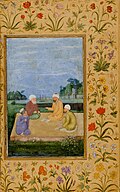 Discourse between Islamic imams in the Mughal Empire
 -
 Crimean Tatar imams teach the Quran. Lithograph by Carlo Bossoli
 -
 Imam Shamil, Caucasus
 -
 Imam in Bosnia, c. 1906
 -
 An Imam in Omdurman, Sudan
 -
 An Ottoman imam in Constantinople
 -
 A Bosniak military imam in the Austro-Hungarian Army
 -
 Imam Thierno Ibrahima Thiello


.jpg)

-begging_dervis.png)


See also[edit | edit source]
Notes[edit | edit source]
- ↑ The abbreviation CE refers to the Common Era solar calendar, while AH refers to the Islamic Hijri lunar calendar.
Citations[edit | edit source]
- ↑ Corbin 1993, p. 30
- ↑ Dhami, Sangeeta; Sheikh, Aziz (November 2000). "The Muslim family". Western Journal of Medicine. 173 (5): 352–356. doi:10.1136/ewjm.173.5.352. ISSN 0093-0415. PMC 1071164. PMID 11069879.
- ↑ "Presidency of Religious Affairs". www.diyanet.gov.tr.
- ↑ Amir-Moezzi, Ali (2008). Spirituality and Islam. London: Tauris. p. 103. ISBN 9781845117382.
- ↑ The imam's Arabic titles are used by the majority of Twelver Shia who use Arabic as a liturgical language, including the Usooli, Akhbari, Shaykhi, and to a lesser extent Alawi. Turkish titles are generally used by Alevi, a fringe Twelver group, who make up around 10% of the world Shia population. The titles for each imam literally translate as "First Ali", "Second Ali", and so forth. Mattar, Philip (2004). Encyclopedia of the modern Middle East & North Africa. Detroit, Mich: Macmillan Reference USA. ISBN 9780028657691.
- ↑ 6.0 6.1 6.2 6.3 6.4 Nasr, Seyyed Hossein. "Ali". Encyclopædia Britannica Online. Retrieved 2007-10-12.
- ↑ 7.00 7.01 7.02 7.03 7.04 7.05 7.06 7.07 7.08 7.09 7.10 7.11 Mattar, Philip (2004). Encyclopedia of the modern Middle East & North Africa. Detroit, Mich: Macmillan Reference USA. ISBN 9780028657691.
- ↑ Tabatabae (1979), pp.190-192
- ↑ Tabatabae (1979), p.192
- ↑ 10.0 10.1 "Hasan". Encyclopædia Britannica Online. Retrieved 2007-11-08.
- ↑ Tabatabae (1979), pp.194–195
- ↑ Madelung, Wilferd. "Hasan ibn Ali". Encyclopaedia Iranica. Retrieved 2008-03-23.
- ↑ Tabatabae (1979), p.195
- ↑ 14.0 14.1 14.2 14.3 "al-Husayn". Encyclopædia Britannica Online. Retrieved 2007-11-08.
- ↑ Tabatabae (1979), pp.196–199
- ↑ Calmard, Jean. "Husayn ibn Ali". Encyclopaedia Iranica. Retrieved 2008-03-23.
- ↑ 17.0 17.1 17.2 17.3 Madelung, Wilferd. "'ALĪ B. AL-ḤOSAYN". Encyclopaedia Iranica. Retrieved 2007-11-08.
- ↑ 18.0 18.1 18.2 18.3 18.4 Tabatabae (1979), p.202
- ↑ 19.0 19.1 19.2 19.3 19.4 Madelung, Wilferd. "AL-BAQER, ABU JAFAR MOHAMMAD". Encyclopaedia Iranica. Retrieved 2007-11-08.
- ↑ Tabatabae (1979), p.203
- ↑ 21.0 21.1 21.2 21.3 21.4 Tabatabae (1979), p.203-204
- ↑ "Wāṣil ibn ʿAṭāʾ". Encyclopædia Britannica Online. 1 January 2019.
- ↑ 23.0 23.1 Madelung, Wilferd. "'ALĪ AL-HĀDĪ". Encyclopaedia Iranica. Retrieved 2007-11-09.
- ↑ 24.0 24.1 24.2 24.3 24.4 Tabatabae (1979), p.205
- ↑ Tabatabae (1979) p. 78
- ↑ Sachedina (1988), pp.53–54
- ↑ 27.0 27.1 27.2 27.3 27.4 27.5 Tabatabae (1979), pp.205–207
- ↑ 28.0 28.1 28.2 28.3 28.4 Tabatabae (1979), p. 207
- ↑ 29.0 29.1 29.2 29.3 29.4 29.5 Madelung, Wilferd. "'ALĪ AL-HĀDĪ". Encyclopaedia Iranica. Retrieved 2007-11-08.
- ↑ Tabatabae (1979), pp.208–209
- ↑ 31.0 31.1 31.2 31.3 Halm, H. "'ASKARĪ". Encyclopaedia Iranica. Retrieved 2007-11-08.
- ↑ Tabatabae (1979) pp. 209–210
- ↑ Tabatabae (1979), pp.209–210
- ↑ "Muhammad al-Mahdi al-Hujjah". Encyclopædia Britannica Online. Retrieved 2007-11-08.
- ↑ 35.0 35.1 35.2 35.3 Tabatabae (1979), pp.210–211
- ↑ Tabatabae (1979), pp. 211–214
- ↑ Miles, Samuel Barrett (1919). The Countries and Tribes of the Persian Gulf. Garnet Pub. pp. 50, 437. ISBN 978-1-873938-56-0. Retrieved 2013-11-15.
- ↑ Holt, P. M.; Holt, Peter Malcolm; Lambton, Ann K. S.; Bernard Lewis (1977-04-21). The Cambridge History of Islam. Cambridge University Press. p. 365. ISBN 978-0-521-29137-8.
Works cited[edit | edit source]
- Corbin, Henry (1993) [1964]. History of Islamic Philosophy (in français). Translated by Sherrard, Liadain; Sherrard, Philip. London; Kegan Paul International in association with Islamic Publications for The Institute of Ismaili Studies. ISBN 0-7103-0416-1.
- Encyclopædia Britannica Online by Encyclopædia Britannica, Inc.
- Encyclopædia Iranica. Center for Iranian Studies, Columbia University. March 1997. ISBN 1-56859-050-4.
- Mattar, Philip (2004). Encyclopedia of the modern Middle East & North Africa. Detroit, Mich: Macmillan Reference USA. ISBN 9780028657691.
- Sachedina, Abdulaziz Abdulhussein (1988). The Just Ruler (al-sultān Al-ʻādil) in Shīʻite Islam: The Comprehensive Authority of the Jurist in Imamite Jurisprudence. Oxford University Press US. ISBN 0-19-511915-0.
- Tabatabae, Sayyid Mohammad Hosayn (1979). Shi'ite Islam. Translated by Nasr, Seyyed Hossein. SUNY press. ISBN 0-87395-272-3.
General references[edit | edit source]
- Martin, Richard C. (2004). "Imam". Encyclopaedia of Islam and the Muslim World. Vol. 1: Encyclopedia of Islam and the Muslim World: A–L. MacMillan. ISBN 0-02-865604-0.
- Momen, Moojan (1985). An Introduction to Shi'i Islam: The History and Doctrines of Twelve. Yale University Press. ISBN 0-300-03531-4.
External links[edit | edit source]
- Template:Wiktionary inline
- Gilman, D. C.; Peck, H. T.; Colby, F. M., eds. (1905). "Imam". New International Encyclopedia (1st ed.). New York: Dodd, Mead.
