



mNo edit summary |
No edit summary |
||
| Line 1: | Line 1: | ||
{{ | {{Short description|Knife or dagger originating from Gujarat}} | ||
{{Use dmy dates|date=October | {{Use dmy dates|date=October 2018}} | ||
{{Use Indian English|date=October | {{Use Indian English|date=October 2018}} | ||
[[File:Sindhibhuj.jpg|thumb|Sindhi | [[File:Sindhibhuj.jpg|thumb|Sindhi knight armed with a bhuj]] | ||
A ''' | A '''Kaat, Kāti, Kuttai''' also known as '''Bhuj''' is a type of knife or dagger from [[Sindh]]<ref>{{Cite book |last1=Tarassuk |first1=Leonid |url=https://books.google.com/books?id=AwxIAQAAIAAJ&q=bhuj+weapon |title=The Complete Encyclopedia of Arms & Weapons: The Most Comprehensive Reference Work Ever Published on Arms and Armor |last2=Blair |first2=Claude |date=1986 |publisher=Bonanza Books |isbn=978-0-517-48776-1 |pages=83 |language=en}}</ref><ref>{{Cite web |title=Oriental-Arms: BHUJ (Kutti) Knife / Axe from India Rare |url=http://www.oriental-arms.co.il/item.php?id=1140 |access-date=2024-12-24 |website=www.oriental-arms.co.il}}</ref> and [[Kutch district|Kutch]] district of [[Gujarat]].<ref>{{Cite web |title=Bhuj / katti – Encyclopedia of Intangible Cultural Heritage |url=https://www.globalinch.org/glossary/bhuj-katti/ |access-date=2024-12-24 |website=Global InCH |language=en-US}}</ref> | ||
== Description and History == | |||
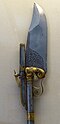
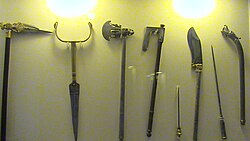
Kaat is commonly called an axe-knife, because the blade is fixed onto an axe-like haft. The weapon is called as Kaat and Kaati in Sindh, the Kaat is usually bigger in size than Kaati, The weapon originated in Sindh and the city of [[Bhuj]] in the Kutch district of the state of Gujarat,<ref>{{Cite web |title=Indian 19th Century Bhuj. Kuttai Sword. Elephant Knife. Sindhi Cavalry Axe-Sword |url=https://www.bygoneblades.com/buy-indian-19th-century-bhuj-kuttai-sword-elephant-knife-sindhi-cavalry-axe-sword |access-date=2024-12-24 |website=www.bygoneblades.com}}</ref><ref>{{Cite web |title=Original 18th Century Indian Bhuj Fighting "Axe-Knife" with Wootz Steel Warhead & Hidden Pommel Spike Dagger - circa 1750 |url=https://www.ima-usa.com/products/original-18th-century-indian-bhuj-fighting-axe-knife-with-wootz-steel-warhead-hidden-pommel-spike-dagger-circa-1750?variant=39905150500933 |access-date=2024-12-24 |website=International Military Antiques}}</ref> from where it derived its name.<ref>{{Cite book |last=Paul |first=E. Jaiwant |url=https://books.google.com/books?id=hwfkMhNRr0AC&q=bhuj+weapon |title=By My Sword and Shield |date=March 2005 |publisher=Simon & Schuster |isbn=978-81-7436-325-1 |pages=71 |language=en}}</ref> The bhuj is short, broad, stout, and heavy, with a mild curve. It often sports an engraved and gilded mount, inlaid haft and decorated knob. This knob is typically a stylized [[Indian elephant|elephant]] head. The short re-curved blade measures {{convert|7-10|in|abbr=on}} long, and its copper sheath makes the weapon {{convert|20|in|abbr=on}} long in total. It is mostly single-edged, except for a slight rear edge at the tip. The blade is mounted at a right angle to a metal haft in a manner similar to a long axe. The haft is sometimes hollow, concealing another small stiletto-like dagger. The weapon is similar to the Punjabi [[Wiktionary:gandasa|gandasa]] or the European [[glaive]]. The weapon was popular among the Sindhi cavalry of the [[Soomra dynasty|Soomra]] and [[Samma dynasty|Samma]] dynasties of [[Sindh]]. | |||
There are also Sindhi folk songs about Kaat dagger. The well known song "''Kaat muhje kandh te, aon khayo pio achan. Jiye Sindh, jiye Sindh, aon chawando achan''". Sung by [[Sarmad Sindhi]].<ref>{{Citation |title=Kaat Munjhe Kand Te Song{{!}}Sarmad Sindhi{{!}}Maaroera, Vol. 01{{!}} Listen to new songs and mp3 song download Kaat Munjhe Kand Te online on Gaana.com |url=https://gaana.com/song/kaat-munjhe-kand-te |access-date=2024-12-24 |language=en}}</ref> | |||
== Images == | |||
[[File:Indian bhuj.jpg|center|thumb]] | |||
[[File:Racinet Bhuj.jpg|center|thumb]] | |||
[[File:India, scure bhuj (kutti), con fodero, 1780-1810 ca. 01.jpg|center|thumb]] | |||
[[File:India, scure bhuj (kutti), con fodero, 1780-1810 ca. 03.jpg|center|thumb]] | |||
[[File:India, scure bhuj (kutti), con fodero, 1780-1810 ca. 02.jpg|center|thumb]] | |||
[[File:MFM - Bhuj.jpg|center|thumb]] | |||
[[File:Knife blade at Mehrangarh Fort Museum.jpg|center|thumb]] | |||
[[File:Arms 10.JPG|center|thumb]] | |||
==References== | ==References== | ||
{{Reflist}} | {{Reflist}} | ||
== Sources == | ==Sources== | ||
*''The complete encyclopedia of arms and weapons'', Edited by Leonid Tarassuk and [[Claude Blair]], Bonanza books (Crown) | *''The complete encyclopedia of arms and weapons'', Edited by Leonid Tarassuk and [[Claude Blair]], Bonanza books (Crown) | ||
*{{cite book |title=The World Encyclopedia Of Knives, Daggers And Bayonets |author=Dr Tobias Capwell |authorlink=Tobias Capwell |year=2009 |publisher=Anness Publishing}} | *{{cite book |title=The World Encyclopedia Of Knives, Daggers And Bayonets |author=Dr Tobias Capwell |authorlink=Tobias Capwell |year=2009 |publisher=Anness Publishing}} | ||
==External links== | |||
{{Commons category-inline}} | |||
{{knives}} | {{knives}} | ||
[[Category:Bhuj]] | |||
[[Category:Edged and bladed weapons]] | |||
[[Category:Indian martial arts]] | |||
[[Category:Knives]] | |||
[[Category:Weapons of India]] | [[Category:Weapons of India]] | ||
[[Category: | [[Category:Weapons of Pakistan]] | ||
{{Knife-stub}} | {{Knife-stub}} | ||
{{India-hist-stub}} | |||
{{Pakistan-hist-stub}} | {{Pakistan-hist-stub}} | ||
[[Category:Sindhi culture]] | |||
Latest revision as of 16:04, 1 September 2025

A Kaat, Kāti, Kuttai also known as Bhuj is a type of knife or dagger from Sindh[1][2] and Kutch district of Gujarat.[3]
Description and History[edit | edit source]
Kaat is commonly called an axe-knife, because the blade is fixed onto an axe-like haft. The weapon is called as Kaat and Kaati in Sindh, the Kaat is usually bigger in size than Kaati, The weapon originated in Sindh and the city of Bhuj in the Kutch district of the state of Gujarat,[4][5] from where it derived its name.[6] The bhuj is short, broad, stout, and heavy, with a mild curve. It often sports an engraved and gilded mount, inlaid haft and decorated knob. This knob is typically a stylized elephant head. The short re-curved blade measures 7–10 in (180–250 mm) long, and its copper sheath makes the weapon 20 in (510 mm) long in total. It is mostly single-edged, except for a slight rear edge at the tip. The blade is mounted at a right angle to a metal haft in a manner similar to a long axe. The haft is sometimes hollow, concealing another small stiletto-like dagger. The weapon is similar to the Punjabi gandasa or the European glaive. The weapon was popular among the Sindhi cavalry of the Soomra and Samma dynasties of Sindh.
There are also Sindhi folk songs about Kaat dagger. The well known song "Kaat muhje kandh te, aon khayo pio achan. Jiye Sindh, jiye Sindh, aon chawando achan". Sung by Sarmad Sindhi.[7]
Images[edit | edit source]


,_con_fodero,_1780-1810_ca._01.jpg)
,_con_fodero,_1780-1810_ca._03.jpg)
,_con_fodero,_1780-1810_ca._02.jpg)


References[edit | edit source]
- ↑ Tarassuk, Leonid; Blair, Claude (1986). The Complete Encyclopedia of Arms & Weapons: The Most Comprehensive Reference Work Ever Published on Arms and Armor. Bonanza Books. p. 83. ISBN 978-0-517-48776-1.
- ↑ "Oriental-Arms: BHUJ (Kutti) Knife / Axe from India Rare". www.oriental-arms.co.il. Retrieved 24 December 2024.
- ↑ "Bhuj / katti – Encyclopedia of Intangible Cultural Heritage". Global InCH. Retrieved 24 December 2024.
- ↑ "Indian 19th Century Bhuj. Kuttai Sword. Elephant Knife. Sindhi Cavalry Axe-Sword". www.bygoneblades.com. Retrieved 24 December 2024.
- ↑ "Original 18th Century Indian Bhuj Fighting "Axe-Knife" with Wootz Steel Warhead & Hidden Pommel Spike Dagger - circa 1750". International Military Antiques. Retrieved 24 December 2024.
- ↑ Paul, E. Jaiwant (March 2005). By My Sword and Shield. Simon & Schuster. p. 71. ISBN 978-81-7436-325-1.
- ↑ Kaat Munjhe Kand Te Song|Sarmad Sindhi|Maaroera, Vol. 01| Listen to new songs and mp3 song download Kaat Munjhe Kand Te online on Gaana.com, retrieved 24 December 2024
Sources[edit | edit source]
- The complete encyclopedia of arms and weapons, Edited by Leonid Tarassuk and Claude Blair, Bonanza books (Crown)
- Dr Tobias Capwell (2009). The World Encyclopedia Of Knives, Daggers And Bayonets. Anness Publishing.
External links[edit | edit source]
 | This article relating to knives is a stub. You can help Bharatpedia by expanding it. |
  | This Indian history-related article is a stub. You can help Bharatpedia by expanding it. |
 | This article about Pakistani history is a stub. You can help Bharatpedia by expanding it. |