

No edit summary |
Margaretzcd (talk | contribs) mNo edit summary |
||
| Line 1: | Line 1: | ||
{{ | {{Short description|Region in Tamil Nadu, India}} | ||
{{EngvarB|date= | {{EngvarB|date=August 2024}} | ||
{{Use dmy dates|date= | {{Use dmy dates|date=August 2024}} | ||
[[File:The Chettinad palace karaikudi 2013-09-07 00-11.jpg|250px|thumb|right| | [[File:The Chettinad palace karaikudi 2013-09-07 00-11.jpg|250px|thumb|right|The Heritage Palace, Chettinad]] | ||
'''Chettinad''' (also known as '''Chettinadu''') is a region | '''Chettinad''' <ref>{{Cite web |title=Chettinad |url=https://www.wmf.org/project/chettinad |access-date=25 January 2024 |website=World Monuments Fund |language=en}}</ref> (also known as '''Chettinadu''') is a region in [[Tamil Nadu]] comprising 56 villages in [[Sivaganga district]] and 20 villages in [[Pudukkottai district|Pudukottai district]],<ref>https://www.shanlaxjournals.in/wp-content/uploads/ASH_V5_N3_018.pdf {{Bare URL PDF|date=August 2025}}</ref> which was historically ruled by the [[Ramnad estate|Ramnad kingdom]] of [[Pandya Nadu]]. It has a small portion extending into the [[Pudukottai District]] in [[Tamil Nadu]]; [[Karaikudi]] is the major city of this area and is considered the urban centre for the Chettinadu villages.<ref>{{Cite web |title=India's 10,000 forgotten mansions |url=https://www.bbc.com/travel/article/20230404-indias-10000-forgotten-mansions |access-date=25 January 2024 |website=www.bbc.com |date=5 April 2023 }}</ref> | ||
==Etymology== | ==Etymology== | ||
The name means | The name ''chettinad(u)'' comes from 2 Tamil words ''Chettiar'' and ''Nadu''. ''[[Chettiar]]'' refers to a specific community of traders, Landlords people and ''Nadu'' means land. Collectively called as '''''"land of the [[Chettiar]]s"'''''.<ref>{{cite book|title=Heritage Holidays|url=https://books.google.com/books?id=jSNuAAAAMAAJ|year=2004|publisher=Outlook Publishing|location=India|isbn=978-81-901724-5-5|page=409|quote=Chettinadu / Chettinad is the land (''nadu'') of the Chettiars|access-date=10 September 2020|archive-date=22 January 2023|archive-url=https://web.archive.org/web/20230122162424/https://books.google.com/books?id=jSNuAAAAMAAJ|url-status=live}}</ref> | ||
==Demography== | ==Demography== | ||
In the 19th and early 20th centuries, many residents of Chettinad were trading in [[South Asia|South]] and Southeast Asia, particularly [[Burma]], [[Ceylon]], [[Vietnam]] and [[Malaysia]]. By 2010, only 74 villages remained of the original 96,<ref>{{cite news | first= Guy | last= Trebay | title= Houses of the Holy | work= The New York Times | date= 21 November 2010 | accessdate= 24 November 2017 | url= https://query.nytimes.com/gst/fullpage.html?res=9C0DE5D91E3DF932A15752C1A9669D8B63&pagewanted=2 | archive-date= 1 December 2017 | archive-url= https://web.archive.org/web/20171201032456/https://query.nytimes.com/gst/fullpage.html?res=9C0DE5D91E3DF932A15752C1A9669D8B63&pagewanted=2 | url-status= live }}</ref> | In the 19th and early 20th centuries, many residents of Chettinad were trading in [[South Asia|South]] and [[Southeast Asia]], particularly [[Burma]], [[Ceylon]], [[Vietnam]] and [[Malaysia]]. By 2010, only 74 villages remained of the original 96,<ref>{{cite news | first= Guy | last= Trebay | title= Houses of the Holy | work= The New York Times | date= 21 November 2010 | accessdate= 24 November 2017 | url= https://query.nytimes.com/gst/fullpage.html?res=9C0DE5D91E3DF932A15752C1A9669D8B63&pagewanted=2 | archive-date= 1 December 2017 | archive-url= https://web.archive.org/web/20171201032456/https://query.nytimes.com/gst/fullpage.html?res=9C0DE5D91E3DF932A15752C1A9669D8B63&pagewanted=2 | url-status= live }}</ref> organised in clusters spread over a territory of {{convert|1550|km2|sqmi|abbr=off}} in the districts of Sivagangai and Pudukottai in the State of Tamil Nadu. It finds itself in the UNESCO nomination for palatial house sites of historic and cultural value.<ref>{{cite web |title=Chettinad, Village Clusters of the Tamil Merchants |url=https://whc.unesco.org/en/tentativelists/5920/ |website=UNESCO World Heritage Centre |access-date=13 December 2020 |language=en |archive-date=18 May 2022 |archive-url=https://web.archive.org/web/20220518215344/https://whc.unesco.org/en/tentativelists/5920/ |url-status=live }}</ref> It is located on [[National Highway 536 (India)|National Highway 536]] between [[Trichy]] and [[Karaikudi]]<ref>{{Cite web |title=Discover Chettinad heritage – SARATHA VILAS CHETTINAD |url=https://sarathavilas.com/discover-chettinad-heritage/ |access-date=25 January 2024 |language=en-US}}</ref> which is approximately 10kms away from this place. | ||
==Community== | ==Community== | ||
| Line 21: | Line 21: | ||
ChickenChettinad.JPG|Chicken Chettinad, a popular dish from the region | ChickenChettinad.JPG|Chicken Chettinad, a popular dish from the region | ||
</gallery> | </gallery> | ||
The word "Chettiar" refers to the social caste of mercantile bankers. The ''Chettiars'' are known to be traders in salt and spices and this is reflected in the Chettinad cuisine. Meals also consist of cooked lentils, [[eggplant|Brinjal]] curry, drumstick [[sambar (dish)|sambar]], [[ghee]] for flavouring rice, and sweet meals like ''[[payasam]]'' and ''paal paniyaram'' | The word "Chettiar" refers to the social caste of mercantile bankers. The ''Chettiars'' are known to be traders in salt and spices and this is reflected in the Chettinad cuisine. Meals also consist of cooked lentils, [[eggplant|Brinjal]] curry, drumstick [[sambar (dish)|sambar]], [[ghee]] for flavouring rice, and sweet meals like ''[[payasam]]'' and ''paal paniyaram''. Some well-known local dishes are Chicken Chettinad (spicy chicken curry), Vegetable Chettinad (a vegetable curry) and dishes featuring seafood. | ||
===Architecture=== | ===Architecture=== | ||
| Line 31: | Line 31: | ||
Dining hall inside a chettinadu house - chettinadu architecture.jpg|Dining hall inside a Chettinadu house | Dining hall inside a chettinadu house - chettinadu architecture.jpg|Dining hall inside a Chettinadu house | ||
</gallery> | </gallery> | ||
The Chettinad region is well known for its 19th-century mansions, whose wide courtyards and spacious rooms are embellished with [[marble]] and [[teak]]. Construction materials, decorative items, and furnishings were mostly imported from East Asian countries and Europe. The marble was brought from Italy, [[chandeliers]] and teak from [[Burma]], crockery from [[Indonesia]], crystals from Europe and wall-to-wall mirrors from [[Belgium]]. | The Chettinad region is well known for its 19th-century [[Chettinad Mansions|mansions]], whose wide courtyards and spacious rooms are embellished with [[marble]] and [[teak]]. Construction materials, decorative items, and furnishings were mostly imported from East Asian countries and Europe. The marble was brought from Italy, [[chandeliers]] and teak from [[Burma]], crockery from [[Indonesia]], crystals from Europe and wall-to-wall mirrors from [[Belgium]]. | ||
Many of these mansions were built using a type of limestone known as ''karai.''<ref>{{cite web | url=http://www.cecri.res.in/AboutUs/AboutKaraikudi.aspx | title=About Karaikudi | publisher=cecri.res.in | accessdate=22 September 2013 | archive-date=27 September 2013 | archive-url=https://web.archive.org/web/20130927170552/http://www.cecri.res.in/AboutUs/AboutKaraikudi.aspx | url-status=live }}</ref> According to locals the mansion walls were polished with a paste made out of egg whites and palm sugar to give them a smooth texture and for their cooling qualities.{{citation needed|date=July 2014}} | Many of these mansions were built using a type of limestone known as ''karai.''<ref>{{cite web | url=http://www.cecri.res.in/AboutUs/AboutKaraikudi.aspx | title=About Karaikudi | publisher=cecri.res.in | accessdate=22 September 2013 | archive-date=27 September 2013 | archive-url=https://web.archive.org/web/20130927170552/http://www.cecri.res.in/AboutUs/AboutKaraikudi.aspx | url-status=live }}</ref> According to locals the mansion walls were polished with a paste made out of egg whites and palm sugar to give them a smooth texture and for their cooling qualities.{{citation needed|date=July 2014}} | ||
===Temples=== | ===Temples=== | ||
Originally built by early [[Tamil people|Tamil]] dynasties like the [[Chola]]s, the temples of Chettinad stand testimony to the spiritual beliefs of local people. Temples are built | Originally built by early [[Tamil people|Tamil]] dynasties like the [[Chola]]s, the temples of Chettinad stand testimony to the spiritual beliefs of local people. Temples are built according to Vaastu Shastras and Agamas as the Chettinad wealthy sponsored the buildings and the ''shilpis'' after the royal families declined. On a side note, traditional houses were also built according to ancient text in an architectural style called Vaastu Shastras. | ||
Each temple has its own tank called ''oorani'' where water lilies are grown and used for holy rituals. Even today, much of Chettinad's daily activities are centered around the festivities of the temple. Among the many famous temples are: Vairavan Kovil, Iraniyur, [[Karpaka Vinayakar Temple|Karpaga Vinayakar]], Kundrakudi Murugan, Kottaiyur Sivan, and Kandanur Sivan temples, with each having its own unique deity.<ref name="auto">{{cite web | url=http://www.pillaiyarpattitemple.com/history.html | title=Temple history | publisher=pillaiyarpattitemple.com | accessdate=26 September 2013 | archive-date=21 September 2013 | archive-url=https://web.archive.org/web/20130921015554/http://pillaiyarpattitemple.com/history.html | url-status=live }}</ref><ref>{{Cite web|url=http://www.chettinadtemples.chettinadsilksandcrafts.com/category/nine-nagara-kovil/|title=Nine Nagara Kovil – Chettinad Temples|accessdate=26 December 2019|archive-date=25 December 2019|archive-url=https://web.archive.org/web/20191225081506/http://www.chettinadtemples.chettinadsilksandcrafts.com/category/nine-nagara-kovil/|url-status=live}}</ref> | Each temple has its own tank called ''oorani'' where water lilies are grown and used for holy rituals. Even today, much of Chettinad's daily activities are centered around the festivities of the temple. Among the many famous temples are: Vairavan Kovil, Iraniyur, [[Karpaka Vinayakar Temple|Karpaga Vinayakar]], Kundrakudi Murugan, Kottaiyur Sivan, and Kandanur Sivan temples, with each having its own unique deity.<ref name="auto">{{cite web | url=http://www.pillaiyarpattitemple.com/history.html | title=Temple history | publisher=pillaiyarpattitemple.com | accessdate=26 September 2013 | archive-date=21 September 2013 | archive-url=https://web.archive.org/web/20130921015554/http://pillaiyarpattitemple.com/history.html | url-status=live }}</ref><ref>{{Cite web|url=http://www.chettinadtemples.chettinadsilksandcrafts.com/category/nine-nagara-kovil/|title=Nine Nagara Kovil – Chettinad Temples|accessdate=26 December 2019|archive-date=25 December 2019|archive-url=https://web.archive.org/web/20191225081506/http://www.chettinadtemples.chettinadsilksandcrafts.com/category/nine-nagara-kovil/|url-status=live}}</ref> | ||
| Line 45: | Line 45: | ||
===Sari=== | ===Sari=== | ||
The cotton [[sari]], also known as ''[[Kandangi|kandaangi]]'', is unique in its dramatic patterns and | The cotton [[sari]], also known as ''[[Kandangi|kandaangi]]'', is unique in its dramatic patterns and colours.<ref>{{cite news | url=http://www.hindu.com/2005/08/11/stories/2005081109360100.htm| archive-url=https://web.archive.org/web/20060305112055/http://www.hindu.com/2005/08/11/stories/2005081109360100.htm| url-status=dead| archive-date=5 March 2006| title=A Legacy called Chettinad Saris| accessdate=2 October 2013| work=[[The Hindu]]| date=11 August 2005}}</ref> Its vibrance and weight are its distinguishing factors. Records and old photographs show the use of sari by previous generations, before the advent of blouses and underskirts, and thus worn rather differently from the typical contemporary sari. At present, it is available in Kundi. | ||
===Aathangudi tiles=== | ===Aathangudi tiles=== | ||
| Line 54: | Line 54: | ||
==Industry== | ==Industry== | ||
[[File:Central Electro Chemical Research Institute.JPG|thumb|right|CECRI entrance.]] | [[File:Central Electro Chemical Research Institute.JPG|thumb|right|CECRI entrance.]] | ||
Chettinad's principal town, Karaikudi is also the location of a branch of the [[Central Electro Chemical Research Institute]] (CECRI), one of the forty national laboratories under the aegis of the [[Council of Scientific and Industrial Research]] (CSIR) in New Delhi. The CSIR lab | Chettinad's principal town, Karaikudi is also the location of a branch of the [[Central Electro Chemical Research Institute]] (CECRI), one of the forty national laboratories under the aegis of the [[Council of Scientific and Industrial Research]] (CSIR) in New Delhi. The CSIR lab specialises in electro-chemical research and has been operational for more than fifty years. The campus is on over 300 scenic acres (120 ha), filled with traditional and ornamental vegetation.<ref>{{cite web | url=http://www.cecri.res.in/AboutUs/AboutKaraikudi.aspx | title=Campus Ambiance | publisher=cecri.res.in | accessdate=2 October 2013 | archive-date=27 September 2013 | archive-url=https://web.archive.org/web/20130927170552/http://www.cecri.res.in/AboutUs/AboutKaraikudi.aspx | url-status=live }}</ref> CECRI conducts four-year Engineering and Technology courses in chemical and electro-chemical engineering and technology affiliated with the [[Anna University]] in [[Chennai]]. | ||
==Travel== | ==Travel== | ||
The nearest airports are [[Madurai Airport]] and [[Tiruchirappalli International Airport]] while the largest towns in the area are Karaikudi and Devakottai. | The nearest airports are [[Madurai Airport|Madurai International Airport]] and [[Tiruchirappalli International Airport]] while the largest towns in the area are [[Karaikudi]] and [[Devakottai]]. | ||
Chettinad has its own railway station, but expresses don't stop here. The only halting train is the thrice daily [[MEMU]] train running from [[Tiruchchirappalli Junction railway station|Tiruchirapalli]] to [[Virudhunagar Junction railway station|Virudhunagar]] connecting [[Pudukkottai railway station|Pudukottai]], [[Karaikkudi Junction railway station|Karaikudi]], [[Devakottai]], [[Sivaganga railway station|Sivaganga]], [[Manamadurai Junction railway station|Manamadurai]] and [[Aruppukkottai railway station|Aruppukottai]] with Chettinad station. All the trains running in the Chennai-Tiruchirapalli-Manamadurai Section stop at Karaikudi. [[Karaikudi Junction railway station]] is the nearest major station.There are also frequent town buses connecting Chettinad to Karaikudi, Ponnamaravathy, Devakottai Pudukkottai and Aranthangi. | |||
== Agriculture college == | |||
[[Tamil Nadu Agricultural University|The Tamil Nadu Agriculture University]] established a '''Dryland Agriculture Research Station (DARS)''' in Chettinad which was later upgraded to Agriculture College and Research Institute. It has a total of 450 acres (182 ha) of Farmland adopted for Research and Education. It houses a Centre of Excellence in Dryland Farming (CEDF) and a Food Processing Research and Training Centre (FPRTC). The college currently offers an Undergraduate Course of Bachelor of science Honours in Agriculture. | |||
==Notable people== | ==Notable people== | ||
| Line 82: | Line 87: | ||
==External links== | ==External links== | ||
{{Commons category}} | |||
{{Chettinad}} | {{Chettinad}} | ||
{{coord | |||
* ({{coord|10.1605|N|78.7772|E}}) - Geocoordinates | |||
[[Category:Sivaganga district]] | [[Category:Sivaganga district]] | ||
Latest revision as of 11:14, 19 October 2025

Chettinad [1] (also known as Chettinadu) is a region in Tamil Nadu comprising 56 villages in Sivaganga district and 20 villages in Pudukottai district,[2] which was historically ruled by the Ramnad kingdom of Pandya Nadu. It has a small portion extending into the Pudukottai District in Tamil Nadu; Karaikudi is the major city of this area and is considered the urban centre for the Chettinadu villages.[3]
Etymology[edit | edit source]
The name chettinad(u) comes from 2 Tamil words Chettiar and Nadu. Chettiar refers to a specific community of traders, Landlords people and Nadu means land. Collectively called as "land of the Chettiars".[4]
Demography[edit | edit source]
In the 19th and early 20th centuries, many residents of Chettinad were trading in South and Southeast Asia, particularly Burma, Ceylon, Vietnam and Malaysia. By 2010, only 74 villages remained of the original 96,[5] organised in clusters spread over a territory of 1,550 square kilometres (600 square miles) in the districts of Sivagangai and Pudukottai in the State of Tamil Nadu. It finds itself in the UNESCO nomination for palatial house sites of historic and cultural value.[6] It is located on National Highway 536 between Trichy and Karaikudi[7] which is approximately 10kms away from this place.
Community[edit | edit source]
Chettinad is the home of the Nattukottai Chettiars (Nagarathar), a prosperous banking and business community and for high hierarchy, non-Brahmin Vallambar feudal community with an aristocrat title Nattar - Ambalam. It is also known for its local cuisine, architecture, and religious temples.[8]
Chettinad cuisine[edit | edit source]
-
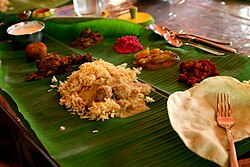 Chettinad cuisine
 -
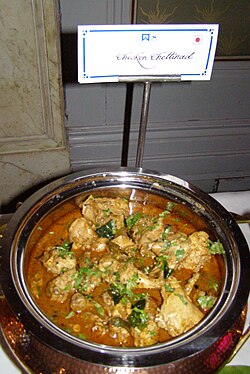 Chicken Chettinad, a popular dish from the region


The word "Chettiar" refers to the social caste of mercantile bankers. The Chettiars are known to be traders in salt and spices and this is reflected in the Chettinad cuisine. Meals also consist of cooked lentils, Brinjal curry, drumstick sambar, ghee for flavouring rice, and sweet meals like payasam and paal paniyaram. Some well-known local dishes are Chicken Chettinad (spicy chicken curry), Vegetable Chettinad (a vegetable curry) and dishes featuring seafood.
Architecture[edit | edit source]
-
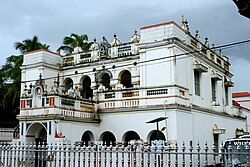 A palatial house in Chettinad
 -
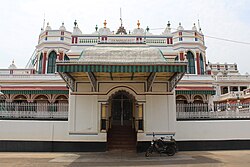 Kanadukathan Chettinadu Palace entrance
 -
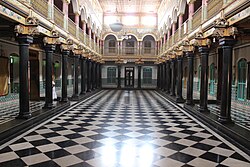 Inside of a typical Chettinadu house
 -
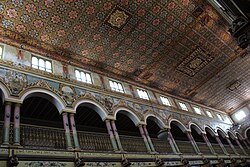 Rooftop of a typical Chettinadu house
 -
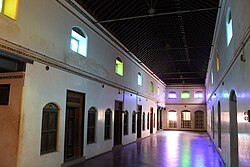 Dining hall inside a Chettinadu house


The Chettinad region is well known for its 19th-century mansions, whose wide courtyards and spacious rooms are embellished with marble and teak. Construction materials, decorative items, and furnishings were mostly imported from East Asian countries and Europe. The marble was brought from Italy, chandeliers and teak from Burma, crockery from Indonesia, crystals from Europe and wall-to-wall mirrors from Belgium.
Many of these mansions were built using a type of limestone known as karai.[9] According to locals the mansion walls were polished with a paste made out of egg whites and palm sugar to give them a smooth texture and for their cooling qualities.[citation needed]
Temples[edit | edit source]
Originally built by early Tamil dynasties like the Cholas, the temples of Chettinad stand testimony to the spiritual beliefs of local people. Temples are built according to Vaastu Shastras and Agamas as the Chettinad wealthy sponsored the buildings and the shilpis after the royal families declined. On a side note, traditional houses were also built according to ancient text in an architectural style called Vaastu Shastras.
Each temple has its own tank called oorani where water lilies are grown and used for holy rituals. Even today, much of Chettinad's daily activities are centered around the festivities of the temple. Among the many famous temples are: Vairavan Kovil, Iraniyur, Karpaga Vinayakar, Kundrakudi Murugan, Kottaiyur Sivan, and Kandanur Sivan temples, with each having its own unique deity.[10][11]
Vinayagar Chathurthi is celebrated every year, on the day when the two stars Shasti and Sadhayam mingle together. This day typically falls as the 22nd day after Periya Karthigai. Pillaiyar Nonmbu, its name, is usually in the month of December. On this day, they sing songs of the deity Lord Vinayagar and then take a sweet called Ellai.[10]
Local crafts[edit | edit source]
Sari[edit | edit source]
The cotton sari, also known as kandaangi, is unique in its dramatic patterns and colours.[12] Its vibrance and weight are its distinguishing factors. Records and old photographs show the use of sari by previous generations, before the advent of blouses and underskirts, and thus worn rather differently from the typical contemporary sari. At present, it is available in Kundi.
Aathangudi tiles[edit | edit source]
Athangudi tiles, named after the place of the manufacture in Chettinad, come in a myriad of colours and patterns, and are made by a unique process using local soil and glass plates.[13] These tiles are a testament to the rich cultural heritage of the Chettiar community, who effectively adapted many influences to their own brand of local craftsmanship. The designs and colours used in Athangudi tiles are still those of a bygone era. However, of late, new designs and patterns are being incorporated.
The Athangudi tiles are hand-made. However, with a short shelf life and relatively slow manufacturing process, these tiles are not much in demand. The situation has led to the decline in the market.
Industry[edit | edit source]

Chettinad's principal town, Karaikudi is also the location of a branch of the Central Electro Chemical Research Institute (CECRI), one of the forty national laboratories under the aegis of the Council of Scientific and Industrial Research (CSIR) in New Delhi. The CSIR lab specialises in electro-chemical research and has been operational for more than fifty years. The campus is on over 300 scenic acres (120 ha), filled with traditional and ornamental vegetation.[14] CECRI conducts four-year Engineering and Technology courses in chemical and electro-chemical engineering and technology affiliated with the Anna University in Chennai.
Travel[edit | edit source]
The nearest airports are Madurai International Airport and Tiruchirappalli International Airport while the largest towns in the area are Karaikudi and Devakottai.
Chettinad has its own railway station, but expresses don't stop here. The only halting train is the thrice daily MEMU train running from Tiruchirapalli to Virudhunagar connecting Pudukottai, Karaikudi, Devakottai, Sivaganga, Manamadurai and Aruppukottai with Chettinad station. All the trains running in the Chennai-Tiruchirapalli-Manamadurai Section stop at Karaikudi. Karaikudi Junction railway station is the nearest major station.There are also frequent town buses connecting Chettinad to Karaikudi, Ponnamaravathy, Devakottai Pudukkottai and Aranthangi.
Agriculture college[edit | edit source]
The Tamil Nadu Agriculture University established a Dryland Agriculture Research Station (DARS) in Chettinad which was later upgraded to Agriculture College and Research Institute. It has a total of 450 acres (182 ha) of Farmland adopted for Research and Education. It houses a Centre of Excellence in Dryland Farming (CEDF) and a Food Processing Research and Training Centre (FPRTC). The college currently offers an Undergraduate Course of Bachelor of science Honours in Agriculture.
Notable people[edit | edit source]
- Alagappa Chettiar - founder of the various educational institutions in Karaikudi and its surroundings. Alagappa University, Alagappa Chettiar College of Engineering and Technology, and Alagappa Government Arts College are a few institutes named in his honour.
- Annamalai Chettiar - founder of Indian Bank and the Annamalai University bears his name.
- Muthiah Chettiar
- S. Rm. Muthiah Chettiar
- M. A. M. Muthiah
- M. A. M. Ramaswamy
- M. A. Chidambaram
- P. Chidambaram - former Finance Minister of India.
- Kaviarasar Kannadasan - Tamil poet.
- Justice A. R. Lakshmanan (b. 1942) - former judge of the Supreme Court of India and current chairman of the Law Commission of India.
- Lena Chettiar
- A. V. Meiyappan - founder of AVM Productions, the oldest and largest film production studio in Kollywood, the Tamil language film industry of India.
- Hari Sevugan
- Rama Narayanan, film director and producer
- Sp Muthuraman, film director and producer
- Vasanth, director
- Soma Valliappan
References[edit | edit source]
- ↑ "Chettinad". World Monuments Fund. Retrieved 25 January 2024.
- ↑ https://www.shanlaxjournals.in/wp-content/uploads/ASH_V5_N3_018.pdf [bare URL PDF]
- ↑ "India's 10,000 forgotten mansions". www.bbc.com. 5 April 2023. Retrieved 25 January 2024.
- ↑ Heritage Holidays. India: Outlook Publishing. 2004. p. 409. ISBN 978-81-901724-5-5. Archived from the original on 22 January 2023. Retrieved 10 September 2020.
Chettinadu / Chettinad is the land (nadu) of the Chettiars
- ↑ Trebay, Guy (21 November 2010). "Houses of the Holy". The New York Times. Archived from the original on 1 December 2017. Retrieved 24 November 2017.
- ↑ "Chettinad, Village Clusters of the Tamil Merchants". UNESCO World Heritage Centre. Archived from the original on 18 May 2022. Retrieved 13 December 2020.
- ↑ "Discover Chettinad heritage – SARATHA VILAS CHETTINAD". Retrieved 25 January 2024.
- ↑ "Chettinad". Pbase.com. Archived from the original on 25 February 2012. Retrieved 22 March 2012.
- ↑ "About Karaikudi". cecri.res.in. Archived from the original on 27 September 2013. Retrieved 22 September 2013.
- ↑ 10.0 10.1 "Temple history". pillaiyarpattitemple.com. Archived from the original on 21 September 2013. Retrieved 26 September 2013.
- ↑ "Nine Nagara Kovil – Chettinad Temples". Archived from the original on 25 December 2019. Retrieved 26 December 2019.
- ↑ "A Legacy called Chettinad Saris". The Hindu. 11 August 2005. Archived from the original on 5 March 2006. Retrieved 2 October 2013.
- ↑ Varanashi, Sathya Prakash (16 June 2012). "Legacy of Athangudi tiles". The Hindu. Archived from the original on 7 April 2014. Retrieved 26 September 2013.
- ↑ "Campus Ambiance". cecri.res.in. Archived from the original on 27 September 2013. Retrieved 2 October 2013.
External links[edit | edit source]
- (10°09′38″N 78°46′38″E / 10.1605°N 78.7772°E) - Geocoordinates