


Ajay Kumar (talk | contribs) Created a new article |
SheenaBayles (talk | contribs) Content updated and refined |
||
| Line 1: | Line 1: | ||
{{Short description|Final court of appeal in the | {{Short description|Final court of appeal in the UK}} | ||
{{Distinguish|text=the [[Courts of England and Wales | {{Distinguish|text=the [[Senior Courts of England and Wales]], which were known as the Supreme Court before 2009}} | ||
{{ | {{Use British English|date=November 2024}} | ||
{{Use dmy dates|date=January 2017}} | {{Use dmy dates|date=January 2017}} | ||
{{Infobox high court | {{Infobox high court | ||
|court_name | | court_name = Supreme Court of the United Kingdom | ||
|native_name | | native_name = | ||
|image | | image = Badge of the Supreme Court of the United Kingdom (2024).svg | ||
|imagesize | | imagesize = 150px | ||
|caption | | caption = [[#Badge|Badge]] | ||
| image2 | | image2 = Middlesex Guildhall by Kelsey Farish (2).jpg | ||
| imagesize2 | | imagesize2 = | ||
| alt2 | | alt2 = | ||
| caption2 | | caption2 = The [[Middlesex Guildhall]] in London is the location of the Supreme Court. | ||
|established | | established = 1 October 2009 | ||
|jurisdiction | | jurisdiction = [[United Kingdom]] | ||
|location | | location = [[Middlesex Guildhall]], [[Parliament Square]], [[London]], England | ||
|coordinates | | coordinates = {{Coord|51.5004|-0.1281|format=dms|type:landmark_region:GB|display=inline,title}} | ||
|type | | type = Appointed by the [[British monarchy|Monarch]]<br /> on the advice of the [[Prime Minister of the United Kingdom|Prime Minister]], following [[#Appointment process|approval of a recommendation]] by the [[Lord Chancellor]] based on recommendation from an independent selection commission | ||
|authority | | authority = [[Constitutional Reform Act 2005]] Section 23(1) | ||
|appealsfrom | | appealsfrom = {{Plainlist| | ||
*[[Court of Appeal (England and Wales)]] | * '''[[English law|England and Wales]]''' <Br/> [[Court of Appeal (England and Wales)|Court of Appeal]] | ||
*[[ | * '''[[Scots law|Scotland]]''' <br/> [[Inner House of the Court of Session]] | ||
*[[High Court of Justiciary | * [[High Court of Justiciary]] <small>(matters relating to human rights compatibility and devolution issues only)</small> | ||
*[[Court of Appeal (Northern Ireland)]] | * '''[[Law of Northern Ireland|Northern Ireland]]''' <br/> [[Court of Appeal (Northern Ireland)|Court of Appeal]] (Northern Ireland) | ||
*[[Court Martial Appeal Court]]}} | * '''UK–wide''' <Br/> [[Court Martial Appeal Court]] | ||
|terms | }} | ||
|positions | | terms = Mandatory retirement at age 75 | ||
|chiefjudgetitle | | positions = 12 | ||
|chiefjudgename | | chiefjudgetitle = [[President of the Supreme Court of the United Kingdom|President]] | ||
|termstart | | chiefjudgename = [[Robert Reed, Baron Reed of Allermuir|The Lord Reed of Allermuir]] | ||
|termend | | termstart = 13 January 2020 | ||
|termend2 | | termend = | ||
|chiefjudgetitle2 = [[Deputy President of the Supreme Court of the United Kingdom|Deputy President]] | | termend2 = 7 September 2031 | ||
|chiefjudgename2 | | chiefjudgetitle2 = [[Deputy President of the Supreme Court of the United Kingdom|Deputy President]] | ||
|termstart2 | | chiefjudgename2 = [[Philip Sales, Lord Sales|Lord Sales]] | ||
|termend3 | | termstart2 = 12 January 2026 | ||
|termend4 | | termend3 = | ||
|website | | termend4 = | ||
| website = {{Official URL}} | |||
}} | }} | ||
The '''Supreme Court of the United Kingdom''' ([[initialism]]: '''UKSC''') is the [[ | The '''Supreme Court of the United Kingdom''' ([[initialism]]: '''UKSC''') is the [[final court of appeal]] for all civil cases in the [[United Kingdom]] and all criminal cases originating in [[England]], [[Wales]] and [[Northern Ireland]], as well as some limited criminal cases from [[Scotland]].{{Efn|Matters relating to [[Devolved,_reserved_and_excepted_matters|devolution, reserved matters]] and [[Human_rights_in_the_United_Kingdom|human rights]] only<ref name="Why does the UK Supreme Court matter for Scotland?">{{Cite web| title=Why does the UK Supreme Court matter for Scotland? | url=https://supremecourt.uk/uploads/speech_lord_reed_141124_74ae8569d6.pdf | archive-url=https://web.archive.org/web/20241217113938/https://supremecourt.uk/uploads/speech_lord_reed_141124_74ae8569d6.pdf | archive-date=2024-12-17}}</ref>}} | ||
As the United Kingdom's highest appellate court for these matters, it hears cases of the greatest public or constitutional importance affecting the whole population. Additionally the Supreme Court hears cases on [[Devolution in the United Kingdom|devolution]] matters from Scotland, Wales and Northern Ireland.<ref name="UKSC Online Introduction">{{cite web |date=12 January 2013 |title=The Supreme Court |url=https://www.supremecourt.uk/ |access-date=9 November 2018 |publisher=The Registry, the Supreme Court (The Registry of the Supreme Court of the United Kingdom)}}</ref><ref>{{Cite web |title=The Court and legal System - UK Supreme Court |url=https://www.supremecourt.uk/about-the-court |access-date=2025-04-17 |website=supremecourt.uk |language=en}}</ref> As a consequence, the court must include judges from the three distinct legal systems of the United Kingdom – [[English law|England and Wales]], [[Scots law|Scotland]] and [[Law of Northern Ireland|Northern Ireland]], made up collectively of twelve Scottish, English, Welsh and Northern Irish judges.<ref name="Why does the UK Supreme Court matter for Scotland?"/> | |||
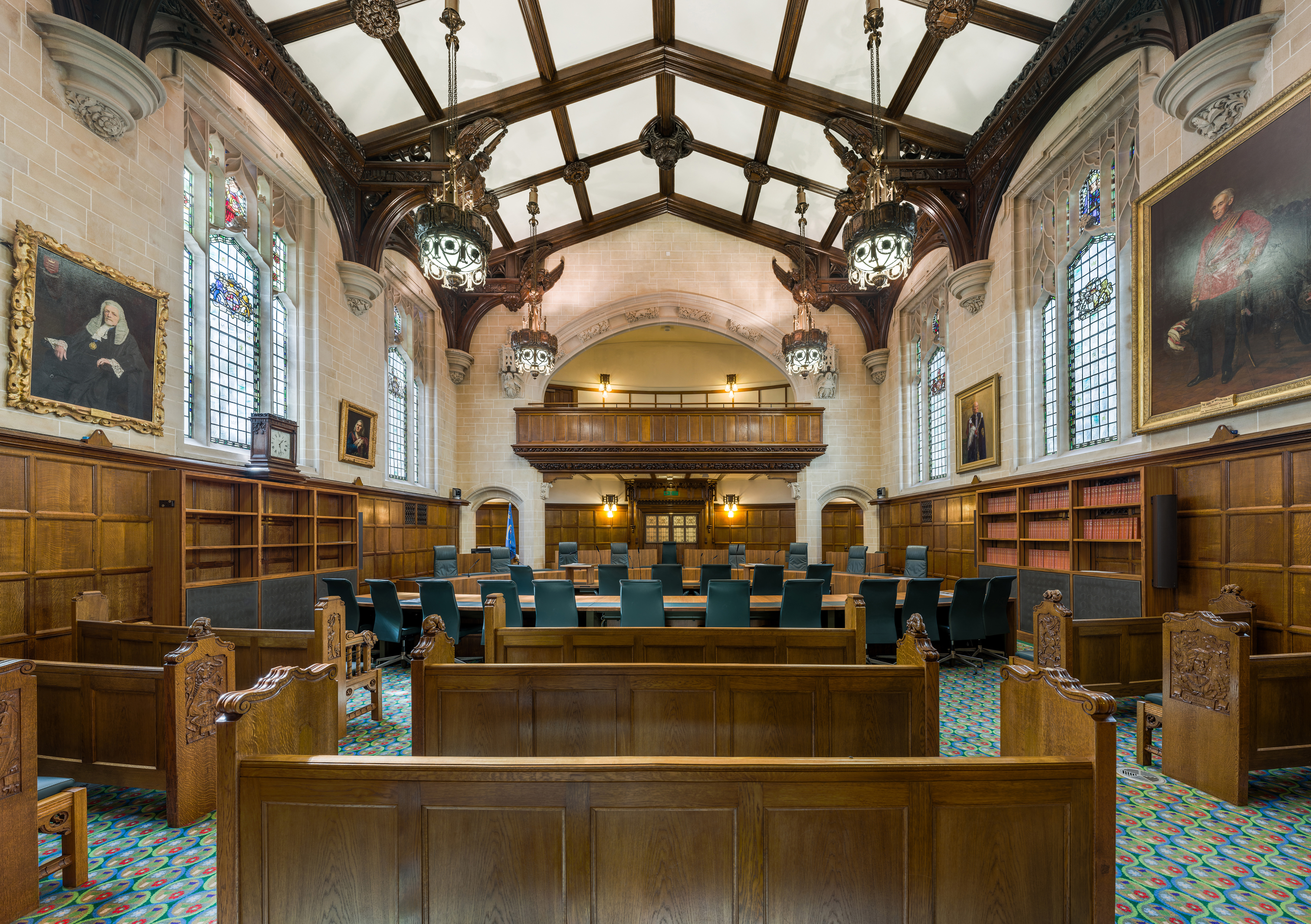
The | The Court usually sits in the [[Middlesex Guildhall]] in [[Westminster]], though it can sit elsewhere and has, for example, sat in the [[Edinburgh City Chambers]],<ref>'[https://www.supremecourt.uk/news/supreme-court-to-sit-in-scotland.html Supreme Court to sit in Scotland] {{Webarchive|url=https://web.archive.org/web/20210507130634/https://www.supremecourt.uk/news/supreme-court-to-sit-in-scotland.html |date=7 May 2021 }}': Press release from the Supreme Court, 1 March 2017</ref> the [[Royal Courts of Justice, Belfast|Royal Courts of Justice]] in Belfast,<ref>'[https://www.supremecourt.uk/news/uk-supreme-court-bound-for-northern-ireland.html UK Supreme Court bound for Northern Ireland] {{Webarchive|url=https://web.archive.org/web/20210305032306/https://www.supremecourt.uk/news/uk-supreme-court-bound-for-northern-ireland.html |date=5 March 2021 }}': Press release from the Supreme Court, 27 November 2017</ref> the [[Tŷ Hywel]] Building in Cardiff<ref>[https://www.supremecourt.uk/news/uk-supreme-court-to-sit-in-wales-this-summer.html UK Supreme Court to sit in Wales this summer] {{Webarchive|url=https://web.archive.org/web/20210507131128/https://www.supremecourt.uk/news/uk-supreme-court-to-sit-in-wales-this-summer.html |date=7 May 2021 }}': Press release from the Supreme Court, 1 March 2017</ref> and the [[Manchester Civil Justice Centre]].<ref>{{cite news|url=https://manchestermill.co.uk/p/the-supreme-court-has-relocated-to|title=The Supreme Court has relocated to Manchester until Thursday. Why should you care?|date=7 March 2023|access-date=8 March 2023|work=[[The Mill (newspaper)|The Mill]]}}</ref> | ||
The United Kingdom has a doctrine of [[parliamentary sovereignty]] and no [[entrenched clause|entrenched]] codified [[constitution]],<ref>{{cite web|url=https://www.parliament.uk/site-information/glossary/parliamentary-sovereignty/|title=Parliamentary Sovereignty|website=GOV.UK|access-date=22 January 2020}}</ref> so the Supreme Court is much more limited in its powers of [[judicial review]] than the constitutional or supreme courts of some other countries such as [[Supreme Court of India|India]], [[Supreme Court of the United States|United States]], [[Supreme Court of Canada|Canada]] and [[High Court of Australia|Australia]]. It cannot overturn any [[primary legislation]] made by [[Parliament of the United Kingdom|Parliament]]. However, as with some other courts in the UK, it can overturn [[secondary legislation]] if, for example, that legislation is found to be ''[[ultra vires]]'' to the powers in primary legislation allowing it to be made. | |||
Further, under [[section 4 of the Human Rights Act 1998]], the Supreme Court, like some other courts in the United Kingdom, may make a [[declaration of incompatibility]], indicating that it believes that the legislation subject to the declaration is incompatible with one of the rights in the [[European Convention on Human Rights]]. Such a declaration can apply to primary or secondary legislation. The declaration does not overturn the legislation, and neither Parliament nor the government is required to agree with any such declaration. However, if they accept a declaration, ministers can exercise powers under [[Sections 4 and 10 of the Human Rights Act 1998|section 10 of the Human Rights Act]] to amend the legislation by statutory instrument to remove the incompatibility or ask Parliament to amend the legislation. | |||
As authorised by the [[Constitutional Reform Act 2005]], Part 3, Section 23(1),<ref name="UKSC Enabling legislation">{{cite web |title=Constitutional Reform Act 2005 (c. 4), Part 3, Section 23|url=https://www.legislation.gov.uk/ukpga/2005/4/section/23/enacted |date=24 March 2005 |publisher=[[The National Archives (United Kingdom)]] |access-date=9 November 2018}}</ref> the Supreme Court of the United Kingdom was formally established on 1 October 2009<ref>[https://www.legislation.gov.uk/uksi/2009/1604/made Constitutional Reform Act 2005 (Commencement No. 11) Order 2009] at the National Archives website (retrieved 11 March 2026).</ref> and is a [[non-ministerial government department]] of the [[Government of the United Kingdom]].<ref>{{cite web|url=https://www.gov.uk/government/organisations|title=Departments, agencies and public bodies|website=GOV.UK|access-date=11 April 2020}}</ref> Section 23 of the Constitutional Reform Act limits the number of judges on the Court to 12, though it also allows for this rule to be amended, to further increase the number of judges, if a resolution is passed in both Houses of Parliament.<ref>{{cite web |url=https://www.legislation.gov.uk/ukpga/2005/4/section/23 |title=2005 c.4 Part 3. Section 23 |publisher=GOV.UK |access-date=22 January 2021}}</ref> Most cases are decided by a panel of five of the judges (justices); in particularly important cases, the court may use a panel of eleven justices. | |||
The Supreme Court assumed the [[judicial functions of the House of Lords]], which had been exercised by the [[Lords of Appeal in Ordinary]] (commonly called "[[Law Lords]]"), the 12 judges appointed as members of the [[House of Lords]] to carry out its judicial business as the [[Appellate Committee of the House of Lords]]. Its jurisdiction over devolution matters had previously been [[Judicial Committee of the Privy Council#Domestic jurisdiction|exercised]] by the [[Judicial Committee of the Privy Council]]. | |||
== History == | == History == | ||
=== Creation === | === Creation === | ||
The creation of a Supreme Court for the United Kingdom was first proposed in a consultation paper published by the [[Department of Constitutional Affairs]] in July 2003.<ref name="DCA paper">{{cite | The creation of a Supreme Court for the United Kingdom was first proposed in a consultation paper published by the [[Department of Constitutional Affairs]] in July 2003.<ref name="DCA paper">{{cite web |publisher=[[Department of Constitutional Affairs]] |title=Constitutional Reform: A Supreme Court for the United Kingdom |date=July 2003 |url=http://www.dca.gov.uk/consult/supremecourt/ }}</ref> Although the paper noted that there had been no criticism of the then-current Law Lords or any indication of an actual bias, it argued that the separation of the [[judicial]] functions of the [[Appellate Committee of the House of Lords]] from the legislative functions of the [[House of Lords]] should be made explicit. The paper noted the following concerns: | ||
# Whether there was any longer sufficient transparency of independence from the executive and the legislature to give assurance of the independence of the judiciary.<ref name="DCA paper" /> | # Whether there was any longer sufficient transparency of independence from the executive and the legislature to give assurance of the independence of the judiciary.<ref name="DCA paper" /> | ||
# The requirement for the appearance of impartiality and independence limited the ability of the Law Lords to contribute to the work of the House itself, thus reducing the value to both them and the House of their membership.<ref name="DCA paper" /> | # The requirement for the appearance of impartiality and independence limited the ability of the Law Lords to contribute to the work of the House itself, thus reducing the value to both them and the House of their membership.<ref name="DCA paper" /> | ||
# It was not always understood by the public that judicial decisions of "the House of Lords" were | # It was not always understood by the public that judicial decisions of "the House of Lords" were taken by the Appellate Committee and that non-judicial members were never involved in the judgments. Conversely, it was felt that the extent to which the Law Lords themselves had decided to refrain from getting involved in political issues concerning legislation on which they might later have had to adjudicate was not always appreciated.<ref name="DCA paper" /> The first President of the Court, [[The Lord Phillips of Worth Matravers]], claimed that the old system confused people and that the Supreme Court would for the first time be a clear [[separation of powers]] among the judiciary, the legislature and the executive.<ref>{{cite news |url=https://www.telegraph.co.uk/news/newstopics/politics/lawandorder/6251272/New-Supreme-Court-opens-with-media-barred.html |title=New Supreme Court opens with media barred |newspaper=[[The Daily Telegraph]] |date=1 October 2009 |quote=For the first time, we have a clear separation of powers between the legislature, the judiciary and the executive in the United Kingdom. This is important. It emphasises the independence of the judiciary, clearly separating those who make the law from those who administer it. |location=London |access-date=24 May 2010 |url-status=dead |archive-url=https://web.archive.org/web/20091004110430/https://www.telegraph.co.uk/news/newstopics/politics/lawandorder/6251272/New-Supreme-Court-opens-with-media-barred.html |archive-date=4 October 2009}}</ref> | ||
# Space within the House of Lords was at a constant premium and a separate supreme court would ease the pressure on the Palace of Westminster.<ref name="DCA paper" /> | # Space within the House of Lords was at a constant premium and a separate supreme court would ease the pressure on the Palace of Westminster.<ref name="DCA paper" /> | ||
The main argument against a new Supreme Court was that the previous system had worked well and kept costs down.<ref>Wakeham report 2000, Chapter 9, Recommendation 57.</ref> Reformers expressed concern that this second main example of a mixture of the legislative, judicial and executive might conflict with professed values under the [[Universal Declaration of Human Rights]]. Officials who make or execute laws have an interest in court cases that put those laws to the test. When the state invests judicial authority in those officials or even their day-to-day colleagues, it puts the independence and impartiality of the courts at risk. Consequently, it was hypothesised closely connected decisions of the Law Lords to debates had by friends or on which the [[Lord Chancellor]] had expressed a view might be challenged on human-rights grounds on the basis that they had not constituted a fair trial.<ref>{{cite news|url=https://www.telegraph.co.uk/news/newstopics/politics/lawandorder/6252414/The-Supreme-Court-is-an-unnecessary-attack-on-the-constitution.html |title=The Supreme Court is an unnecessary attack on the constitution |newspaper=[[The Daily Telegraph]] |date=1 October 2009 |quote=The Government argued that there must be a separation | The main argument against a new Supreme Court was that the previous system had worked well and kept costs down.<ref>Wakeham report 2000, Chapter 9, Recommendation 57.</ref> Reformers expressed concern that this second main example of a mixture of the legislative, judicial and executive might conflict with professed values under the [[Universal Declaration of Human Rights]]. Officials who make or execute laws have an interest in court cases that put those laws to the test. When the state invests judicial authority in those officials or even their day-to-day colleagues, it puts the independence and impartiality of the courts at risk. Consequently, it was hypothesised that closely connected decisions of the Law Lords to debates had by friends or on which the [[Lord Chancellor]] had expressed a view might be challenged on human-rights grounds on the basis that they had not constituted a fair trial.<ref>{{cite news|url=https://www.telegraph.co.uk/news/newstopics/politics/lawandorder/6252414/The-Supreme-Court-is-an-unnecessary-attack-on-the-constitution.html |title=The Supreme Court is an unnecessary attack on the constitution |newspaper=[[The Daily Telegraph]] |date=1 October 2009 |quote=The Government argued that there must be a separation to comply with Article Six of the European Convention on Human Rights, which guarantees a fair trial. |location=London |access-date=24 May 2010 |url-status=dead |archive-url=https://web.archive.org/web/20091005191604/https://www.telegraph.co.uk/news/newstopics/politics/lawandorder/6252414/The-Supreme-Court-is-an-unnecessary-attack-on-the-constitution.html |archive-date=5 October 2009 }}</ref> | ||
[[ | [[The Lord Neuberger of Abbotsbury]], later President of the Supreme Court, expressed fear that the new court could make itself more powerful than the House of Lords committee it succeeded, saying that there is a real risk of "judges arrogating to themselves greater power than they have at the moment". The Lord Phillips of Worth Matravers said such an outcome was "a possibility", but was "unlikely".<ref>{{cite news |url=https://news.bbc.co.uk/2/hi/uk_news/8237855.stm |first=Joshua |last=Rozenberg |title=Fear over UK Supreme Court impact |work=[[BBC News]] |date=8 September 2009}}</ref> | ||
The reforms were controversial and were brought forward with little consultation but were subsequently extensively debated in Parliament.<ref>A. Le Sueur, "From Appellate Committee to Supreme Court: A Narrative", ch. 5 in L. Blom-Cooper, G. Drewry and B. Dickson (eds.),''The Judicial House of Lords'' (Oxford University Press, 2009); Queen Mary School of Law Legal Studies Research Paper No. 17/2009. {{SSRN|1374357}}</ref> During 2004, a select committee of the House of Lords scrutinised the arguments for and against setting up a new court.<ref>{{Cite web|url=https://publications.parliament.uk/pa/ld200304/ldselect/ldcref/125/12505.htm|title=House of Lords – Constitutional Reform Bill – First Report|publisher=UK Parliament}}</ref> The Government estimated the set-up cost of the Supreme Court at £56.9 million.<ref>{{cite web |url=https://publications.parliament.uk/pa/ld200708/ldhansrd/text/80326w0003.htm#column_WA102 |title=Written Answer of the Ministry of Justice to question posed by Lord Steinberg (Col. WA102) |date=26 March 2008 |publisher=Lords Hansard}}</ref> | The reforms were controversial and were brought forward with little consultation but were subsequently extensively debated in Parliament.<ref>A. Le Sueur, "From Appellate Committee to Supreme Court: A Narrative", ch. 5 in L. Blom-Cooper, G. Drewry and B. Dickson (eds.),''The Judicial House of Lords'' (Oxford University Press, 2009); Queen Mary School of Law Legal Studies Research Paper No. 17/2009. {{SSRN|1374357}}</ref> During 2004, a select committee of the House of Lords scrutinised the arguments for and against setting up a new court.<ref>{{Cite web|url=https://publications.parliament.uk/pa/ld200304/ldselect/ldcref/125/12505.htm|title=House of Lords – Constitutional Reform Bill – First Report|publisher=UK Parliament}}</ref> The Government estimated the set-up cost of the Supreme Court at £56.9 million.<ref>{{cite web |url=https://publications.parliament.uk/pa/ld200708/ldhansrd/text/80326w0003.htm#column_WA102 |title=Written Answer of the Ministry of Justice to question posed by Lord Steinberg (Col. WA102) |date=26 March 2008 |publisher=Lords Hansard}}</ref> | ||
| Line 70: | Line 73: | ||
The first case heard by the Supreme Court was ''[[HM Treasury v Ahmed]]'', which concerned "the separation of powers", according to Phillips, its inaugural President. At issue was the extent to which Parliament has, by the [[United Nations Act 1946]], delegated to the executive the power to legislate. Resolution of this issue depended upon the approach properly to be adopted by the court in interpreting legislation which may affect fundamental rights at common law or under the European Convention on Human Rights. | The first case heard by the Supreme Court was ''[[HM Treasury v Ahmed]]'', which concerned "the separation of powers", according to Phillips, its inaugural President. At issue was the extent to which Parliament has, by the [[United Nations Act 1946]], delegated to the executive the power to legislate. Resolution of this issue depended upon the approach properly to be adopted by the court in interpreting legislation which may affect fundamental rights at common law or under the European Convention on Human Rights. | ||
One of the most important cases presented to the Supreme Court was the joint cases of [[R (Miller) v The Prime Minister and Cherry v Advocate General for Scotland|''R (Miller) v The Prime Minister'' and ''Cherry v Advocate General for Scotland'']], known as ''Miller/Cherry'', on [[2019_British_prorogation_controversy#Supreme_Court|Boris Johnson's unlawful prorogation ]] (suspension) of Parliament, to suppress debate in anticipation of Britain's withdrawal from the European Union, "frustrating or preventing the constitutional role of Parliament in holding the Government to account".<ref>https://www.supremecourt.uk/cases/docs/uksc-2019-0192-judgment.pdf</ref> It is one of only two cases that involved the presence of 11 judges (the highest number of judges currently allowed to rule on a case). The case carried a large amount of political tension in the context of the process of the United Kingdom leaving the European Union; for some, the ruling "delighted 'Remainers' but appalled 'Leavers{{'"}},<ref>Constantina P. Tridimas and George Tridimas (April 2020). "Is the UK Supreme Court rogue to un-prorogue Parliament?" ''European Journal of Law and Economics'', Springer, vol. 49(2), pp. 205–225.</ref> although some Conservative MPs who sought to withdraw from the EU with an agreement had opposed the prorogation.<ref>{{Cite news |last=Rourke |first=Alison |date=2019-08-29 |title=Prorogation explainer: a simple guide to what just happened in UK politics |language=en-GB |work=The Guardian |url=https://www.theguardian.com/politics/2019/aug/29/prorogation-explainer-a-simple-guide-to-what-just-happened-in-uk-politics |access-date=2023-08-08 |issn=0261-3077}}</ref> | One of the most important cases presented to the Supreme Court was the joint cases of [[R (Miller) v The Prime Minister and Cherry v Advocate General for Scotland|''R (Miller) v The Prime Minister'' and ''Cherry v Advocate General for Scotland'']], known as ''Miller/Cherry'', on [[2019_British_prorogation_controversy#Supreme_Court|Boris Johnson's unlawful prorogation ]] (suspension) of Parliament, to suppress debate in anticipation of Britain's withdrawal from the European Union, "frustrating or preventing the constitutional role of Parliament in holding the Government to account".<ref>{{Cite web | url=https://www.supremecourt.uk/cases/docs/uksc-2019-0192-judgment.pdf | title=R (on the application of Miller) (Appellant) v The Prime Minister (Respondent) Cherry and others (Respondents) v Advocate General for Scotland (Appellant) (Scotland) | website=www.supremecourt.uk}}</ref> It is one of only two cases that involved the presence of 11 judges (the highest number of judges currently allowed to rule on a case). The case carried a large amount of political tension in the context of the process of the United Kingdom leaving the European Union; for some, the ruling "delighted 'Remainers' but appalled 'Leavers{{'"}},<ref>Constantina P. Tridimas and George Tridimas (April 2020). "Is the UK Supreme Court rogue to un-prorogue Parliament?" ''European Journal of Law and Economics'', Springer, vol. 49(2), pp. 205–225.</ref> although some Conservative MPs who sought to withdraw from the EU with an agreement had opposed the prorogation.<ref>{{Cite news |last=Rourke |first=Alison |date=2019-08-29 |title=Prorogation explainer: a simple guide to what just happened in UK politics |language=en-GB |work=The Guardian |url=https://www.theguardian.com/politics/2019/aug/29/prorogation-explainer-a-simple-guide-to-what-just-happened-in-uk-politics |access-date=2023-08-08 |issn=0261-3077}}</ref> | ||
In 2022, the Supreme Court ruled on whether the [[Scottish Parliament]] had the power to legislate for a [[Proposed second Scottish independence referendum|second independence referendum]]. In the case, the five-judge panel unanimously found that Scotland did not have the right to organise a referendum without the permission of Westminster, as questions around independence qualify as "reserved matters" (reserved to the central government) under the [[Scotland Act 1998]]. [[Nicola Sturgeon]], the then-leader of the pro-independence [[Scottish National Party]], regarded the decision as "a hard pill for any supporter of independence... to swallow" but reiterated the party's commitment to "find another democratic, lawful means for Scottish people to express their will".<ref>{{cite web |title=REFERENCE by the Lord Advocate of devolution issues under paragraph 34 of Schedule 6 to the Scotland Act 1998 |url=https://www.supremecourt.uk/cases/docs/uksc-2022-0098-judgment.pdf |access-date=3 July 2023}}</ref><ref>{{cite news |last1=Nicolson |first1=Stuart |title=Independence referendum: Scottish government loses indyref2 court case |url=https://www.bbc.co.uk/news/uk-scotland-scotland-politics-63727562 |access-date=3 July 2023 |work=BBC News |agency=BBC |date=23 November 2022}}</ref> | |||
In | In 2025, the Supreme Court ruled on the meaning on the word 'woman' for the purposes of the Equality Act 2010. The court concluded unanimously that the word means 'biological woman' and thus that trans women are not women for the purposes of that Act.<ref>[https://www.bbc.co.uk/news/articles/cvg7pqzk47zo bbc.co.uk]</ref>. Lord Hodge noted that the case "had nothing to do with how or where single-sex spaces should be created. These points weren't argued before us".<ref>[https://www.personneltoday.com/hr/judge-in-supreme-court-ruling-said-hed-take-the-flak/]</ref> | ||
== Jurisdiction and powers == | == Jurisdiction and powers == | ||
From the Supreme Court – | From the Supreme Court – | ||
{{Blockquote|quote = The Supreme Court is the final court of appeal in the UK for civil cases, and for criminal cases from England, Wales and Northern Ireland. It hears cases of the greatest public or constitutional importance affecting the whole population.<ref name="UKSC Online Introduction"/>}} | {{Blockquote|quote = The Supreme Court is the final court of appeal in the UK for civil cases, and for criminal cases from England, Wales and Northern Ireland. It hears cases of the greatest public or constitutional importance affecting the whole population.<ref name="UKSC Online Introduction"/>}} | ||
The Supreme Court hears appeals (i) in England and Wales, from the [[Court of Appeal (England and Wales)|Court of Appeal]] (Civil Division), the Court of Appeal (Criminal Division) and (ii) in Scotland from the [[Court of Session]].<ref>{{cite web|url=https://www.supremecourt.uk/about/role-of-the-supreme-court.html|title=The Role of the Supreme Court|publisher=The Supreme Court|access-date=5 October 2024}}</ref> | |||
The Supreme Court | The Supreme Court is the highest court of appeal in relation to Scottish civil cases. However, the [[High Court of Justiciary]] is the highest court of appeal in relation to Scottish criminal cases.<ref name=note>{{cite web|url=https://www.supremecourt.uk/docs/jurisdiction-of-the-supreme-court-in-scottish-appeals-human-rights-the-scotland-act-2012-and-the-courts-reform-scotland-act-2014.pdf|title=The Jurisdiction of the Supreme Court of the United Kingdom in Scottish Appeals: Human rights, the Scotland Act 2012 and the Courts Reform (Scotland) Act 2014|publisher=The Supreme Court|access-date=5 October 2024}}</ref> | ||
The Supreme Court | The Supreme Court also determines devolution issues (as defined by the [[Scotland Act 1998]], the [[Northern Ireland Act 1998]] and the [[Government of Wales Act 2006]]). These are legal proceedings about the powers of the three [[devolved]] administrations—the [[Northern Ireland Executive]] and [[Northern Ireland Assembly]], the [[Scottish Government]] and the [[Scottish Parliament]], the [[Welsh Government]] and [[Senedd]]. Devolution issues were previously heard by the Judicial Committee of the Privy Council and most are about compliance with rights under the European Convention on Human Rights, brought into national law by the Devolution Acts and the Human Rights Act 1998.<ref name=note/> | ||
On rare occasions the court may have original jurisdiction, normally in cases relating to contempt of the Supreme Court, such as ''Proceedings for Contempt: Mr Tim Crosland''<ref>{{cite web | url=https://www.supremecourt.uk/news/proceedings-for-contempt-mr-tim-crosland.html | title=Proceedings for Contempt: Mr Tim Crosland |publisher=The Supreme Court }}</ref> and its appeal case ''HM Attorney General v Crosland''.<ref>{{cite web|url=https://www.supremecourt.uk/cases/uksc-2021-0160|title=Her Majesty's Attorney General (Respondent) v Crosland (Appellant) |publisher=The Supreme Court|access-date=5 October 2024}}</ref> | |||
==Panels and sittings== | |||
The twelve justices do not all hear every case. Unless there are circumstances requiring a larger panel, a case is usually heard by a panel of five justices.<ref name=PanelNumbers>{{cite web |url=https://www.supremecourt.uk/procedures/panel-numbers-criteria.html |title=Panel numbers criteria|publisher=Supreme Court of the United Kingdom|access-date= 17 September 2019}}</ref> More than five justices may sit on a panel where the case is of "high constitutional importance" or "great public importance"; if the case raises "an important point in relation to the European Convention on Human Rights"; if the case involves a conflict of decisions among the House of Lords, [[Judicial Committee of the Privy Council]], or Supreme Court; or if the Court "is being asked to depart, or may decide to depart from" its (or the House of Lords') previous precedent.<ref name=PanelNumbers/> The composition of panels is ultimately determined by the President.<ref>{{Cite web|url=https://www.supremecourt.uk/docs/information_pack_president.pdf|title=Information Pack – Vacancy for President of the Supreme Court of the United Kingdom|publisher=The Supreme Court|language=en|access-date=2021-06-03}}</ref> | |||
To avoid a tie, all cases are heard by a panel containing an odd number of justices.<ref name="Casciani">{{cite news|author=Dominic Casciani|title=What is the UK Supreme Court? |url=https://www.bbc.co.uk/news/uk-49663001|work=BBC News}}</ref> Thus, the largest possible panel for a case is 11 justices.<ref name="Casciani"/> To date, there have been only two cases (both involving matters of major constitutional importance) heard by 11 justices: the case of ''[[R (Miller) v Secretary of State for Exiting the European Union]]'' (argued in 2016 and decided in 2017) and the cases of [[R (Miller) v The Prime Minister and Cherry v Advocate General for Scotland|''R (Miller) v The Prime Minister'' and ''Cherry v Advocate General for Scotland'']] (argued and decided in 2019).<ref>{{cite news |url=https://www.bbc.com/news/uk-politics-37874388 |title=The 11 Supreme Court judges who ruled on UK's Brexit appeal |work=BBC News |date=24 January 2017}}</ref><ref>{{cite news |first=Owen |last=Bowcott |url=https://www.theguardian.com/politics/2019/sep/16/supreme-court-to-hear-claims-suspension-of-parliament-is-unlawful |title=Supreme court to hear claims suspension of parliament is unlawful |work=The Guardian |date=16 September 2019}}</ref> | |||
Although they may wear black damask robes with gold embellishments including the supreme court badge for portraits or ceremonial occasions, the justices have never worn [[court dress]] during sittings.<ref name="Gordon">{{cite news |last1=Gordon |first1=Cathy |title=Supreme Court lawyers allowed to dress down |url=https://www.independent.co.uk/news/uk/home-news/supreme-court-lawyers-allowed-to-dress-down-6265567.html |access-date=22 December 2023 |work=The Independent |date=21 November 2011}}</ref> In November 2011, The Lord Phillips of Worth Matravers allowed counsel to jointly agree to "dispense with any or all of the traditional elements of court dress" at sittings.<ref name="Gordon" /> | |||
== Administration == | == Administration == | ||
The Supreme Court has a separate administration from the other courts of | The Supreme Court has a separate administration from the other courts of England and Wales, Scotland and Northern Ireland, under a Chief Executive who is appointed by the Court's president.<ref>{{Cite web|url=https://www.supremecourt.uk/news/mark-ormerod-to-be-supreme-court-chief-executive.html|title=Mark Ormerod to be Supreme Court's Chief Executive – The Supreme Court|last=Court|first=The Supreme|website=www.supremecourt.uk|language=en|access-date=2018-05-02|archive-date=3 May 2018|archive-url=https://web.archive.org/web/20180503111233/https://www.supremecourt.uk/news/mark-ormerod-to-be-supreme-court-chief-executive.html|url-status=dead}}</ref><ref>{{Cite web|url=https://www.supremecourt.uk/about/executive-team.html|title=Executive Team – The Supreme Court|last=Court|first=The Supreme|website=www.supremecourt.uk|language=en|access-date=2018-05-02}}</ref><ref>{{Cite legislation UK | ||
| type = act | | type = act | ||
| year = 2005 | | year = 2005 | ||
| Line 104: | Line 107: | ||
| act = Constitutional Reform Act 2005 | | act = Constitutional Reform Act 2005 | ||
| section = 48 | | section = 48 | ||
}}</ref> | }}</ref>{{PoliticsUK}} | ||
{{PoliticsUK}} | |||
== Judges == | == Judges == | ||
{{Main|Justice of the Supreme Court of the United Kingdom}} | {{Main|Justice of the Supreme Court of the United Kingdom}} | ||
The court is composed of the [[President of the Supreme Court of the United Kingdom|President]] and [[Deputy President of the Supreme Court of the United Kingdom|Deputy President]] and ten other [[Justice of the Supreme Court of the United Kingdom|Justices of the Supreme Court]], all with the style of ''Justice of the Supreme Court'' under section 23(6) of the Constitutional Reform Act.<ref name="UKSC Enabling legislation"/> The President and Deputy President of the court are separately appointed to those roles. | The court is composed of the [[President of the Supreme Court of the United Kingdom|President]] and [[Deputy President of the Supreme Court of the United Kingdom|Deputy President]] and ten other [[Justice of the Supreme Court of the United Kingdom|Justices of the Supreme Court]], all with the style of ''Justice of the Supreme Court'' under section 23(6) of the Constitutional Reform Act.<ref name="UKSC Enabling legislation"/> The President and Deputy President of the court are separately appointed to those roles. The Supreme Court of the United Kingdom is required to have judges who have previously served in the legal systems of England and Wales, Scotland and Northern Ireland, and act as representatives of their respective legal systems in the Supreme Court.<ref name="Why does the UK Supreme Court matter for Scotland?"/> The selection committee of judges to sit in the Supreme Court is required to ensure that each judge appointed to the Supreme Court will have knowledge of, and experience of practice in, the legal system of [[Countries of the United Kingdom|each country of the United Kingdom]].<ref name="Why does the UK Supreme Court matter for Scotland?"/> As a result of devolution in 1998, in Scotland for instance, the Judicial Appointments Board for Scotland is consulted on each appointment to the Supreme Court, as is the [[First Minister of Scotland|first minister of Scotland]], regardless as to whether the judge being nominated is Scottish or not.<ref name="Why does the UK Supreme Court matter for Scotland?"/> | ||
The ten [[ | The ten [[Lords of Appeal in Ordinary]] (Law Lords) holding office on 1 October 2009 became the first judges of the twelve-member Supreme Court.<ref>Constitutional Reform Act 2005, section 24</ref> The eleventh place on the Supreme Court was filled by [[The Lord Clarke of Stone-cum-Ebony]] (formerly the [[Master of the Rolls]]), who was the first justice to be appointed directly to the Supreme Court.<ref>{{cite web|url=http://www.number10.gov.uk/Page19036 |title=Justice of the UK Supreme Court |publisher=10 Downing Street |access-date=30 August 2009 |location=London, United Kingdom |date=20 April 2009 |url-status=dead |archive-url=http://webarchive.nationalarchives.gov.uk/20100408130944/http://www.number10.gov.uk/Page19036 |archive-date=8 April 2010 }}</ref> One of the former Law Lords, The Lord Neuberger of Abbotsbury, was appointed to replace Clarke as Master of the Rolls,<ref>{{cite news |url=http://business.timesonline.co.uk/tol/business/law/article6724777.ece |archive-url=https://web.archive.org/web/20110612183144/http://business.timesonline.co.uk/tol/business/law/article6724777.ece |url-status=dead |archive-date=12 June 2011 |author=Frances Gibb |author-link=Frances Gibb |title=Lord Neuberger named Master of the Rolls |date=23 July 2009 |access-date=30 August 2009 |work=The Times | location=London}}</ref> and so did not move to the new court. [[Lord Dyson]] became the twelfth and final judge of the Supreme Court on 13 April 2010.<ref>{{cite web |url=http://timesonline.typepad.com/law/2010/03/new-supreme-court-justice---sir-john-dyson.html |title=New Supreme Court justice – Sir John Dyson |date=23 March 2010 |author=Frances Gibb |author-link=Frances Gibb |access-date=24 March 2010 |archive-date=26 March 2010 |archive-url=https://web.archive.org/web/20100326133415/http://timesonline.typepad.com/law/2010/03/new-supreme-court-justice---sir-john-dyson.html |url-status=dead }}</ref> In 2010, Queen [[Elizabeth II]] granted justices who are not peers use of the title Lord or Lady, by [[Royal warrant (document)|warrant]] under the [[royal sign-manual]].<ref name="Gazette Lord Warrant">{{London Gazette |issue=59746 |pages=6177–6178 |date=1 April 2011 }}</ref><ref>{{cite web|title=Press release: Courtesy titles for Justices of the Supreme Court|url=https://www.supremecourt.uk/docs/pr_1013.pdf|publisher=Supreme Court of the United Kingdom|date=13 December 2010|access-date=9 March 2014}}</ref> | ||
The Senior Law Lord on 1 October 2009, Lord Phillips, became the Supreme Court's first President,<ref>{{cite web |url=http://www.number-10.gov.uk/output/Page15158.asp |title=Lord Phillips of Worth Matravers appointed as senior Lord of Appeal in Ordinary |url-status=dead |archive-url=https://web.archive.org/web/20080905151529/http://www.number-10.gov.uk/output/Page15158.asp |archive-date=5 September 2008 |df=dmy-all }}</ref> and the Second Senior Law Lord, [[ | The Senior Law Lord on 1 October 2009, The Lord Phillips of Worth Matravers, became the Supreme Court's first President,<ref>{{cite web |url=http://www.number-10.gov.uk/output/Page15158.asp |title=Lord Phillips of Worth Matravers appointed as senior Lord of Appeal in Ordinary |url-status=dead |archive-url=https://web.archive.org/web/20080905151529/http://www.number-10.gov.uk/output/Page15158.asp |archive-date=5 September 2008 |df=dmy-all }}</ref> and the Second Senior Law Lord, [[The Lord Hope of Craighead]], became the first Deputy President. | ||
On 30 September 2010 [[ | On 30 September 2010 [[The Lord Saville of Newdigate]] became the first justice to retire,<ref name="sav-ret">{{cite web|url=https://www.theguardian.com/law/2010/jun/24/supreme-court-vacancy-retirement-age|title=Vacancy in the supreme court – and age could be a deciding factor – Joshua Rozenburg|first=Joshua|last=Rozenberg|date=24 June 2010|website=The Guardian|access-date=2 September 2018}}</ref> followed by [[The Lord Collins of Mapesbury]] on 7 May 2011, although the latter remained as an acting judge until the end of July 2011. | ||
In June 2011 [[ | In June 2011 [[The Lord Rodger of Earlsferry]] became the first justice to die in office, after a short illness.<ref>{{cite news|url=https://www.bbc.com/news/uk-scotland-13922675|title=Supreme Court judge dies aged 66|work=BBC News|date=27 June 2011|access-date=2 September 2018}}</ref> | ||
=== Acting judges === | === Acting judges === | ||
In addition to the twelve permanent judges, the President may request other senior judges drawn from two groups to sit as "acting judges" of the Supreme Court.<ref>Constitutional Reform Act 2005, section 38(1)</ref> | In addition to the twelve permanent judges, the President may request other senior judges drawn from two groups to sit as "acting judges" of the Supreme Court.<ref>Constitutional Reform Act 2005, section 38(1)</ref> | ||
* The first group are those judges who currently hold 'office as a senior territorial judge': judges of the Court of Appeal of England and Wales, judges of the [[Courts of Northern Ireland|Court of Appeal of Northern Ireland]] and judges of the First or Second Division of the [[Inner House]] of the Court of Session in Scotland.<ref>Constitutional Reform Act 2005, section 38(8)</ref> | * The first group are those judges who currently hold 'office as a senior territorial judge': judges of the Court of Appeal of England and Wales, judges of the [[Courts of Northern Ireland|Court of Appeal of Northern Ireland]] and judges of the First or Second Division of the [[Inner House]] of the Court of Session in Scotland.<ref>Constitutional Reform Act 2005, section 38(8)</ref> This has included former [[Lord President of the Court of Session|Lord President]], [[Lord Carloway]], himself sitting on cases.<ref>{{Cite web|url=https://www.supremecourt.uk/cases/docs/uksc-2022-0038-0044-0049-judgment.pdf|title= JUDGMENT - Paul and another (Appellants) v Royal Wolverhampton NHS Trust (Respondent) et al.|last=Court|first=The Supreme|website=www.supremecourt.uk|language=en|access-date=2024-01-11}}</ref> | ||
* The second group are known as the 'supplementary panel'. The President may approve in writing retired judges' membership of this panel if they are under 75 and are (a) former supreme court justices or (b) former 'senior territorial judges'.<ref>Constitutional Reform Act 2005, section 39</ref> A list of those currently appointed is to be found on the Supreme Court website.<ref>{{Cite web|url=https://www.supremecourt.uk/about/supplementary-panel.html|title= The Supreme Court – Supplementary Panel |last=Court|first=The Supreme|website=www.supremecourt.uk|language=en|access-date=2021-06-03}}</ref> (The system is similar to [[senior status]] in the United States [[United States courts of appeal|Federal Courts of Appeal]], although there are important differences: for example, a judge on the supplementary panel does not receive a salary). | * The second group are known as the 'supplementary panel'. The President may approve in writing retired judges' membership of this panel if they are under 75 and are (a) former supreme court justices or (b) former 'senior territorial judges'.<ref>Constitutional Reform Act 2005, section 39</ref> A list of those currently appointed is to be found on the Supreme Court website.<ref>{{Cite web|url=https://www.supremecourt.uk/about/supplementary-panel.html|title= The Supreme Court – Supplementary Panel |last=Court|first=The Supreme|website=www.supremecourt.uk|language=en|access-date=2021-06-03}}</ref> (The system is similar to [[senior status]] in the United States [[United States courts of appeal|Federal Courts of Appeal]], although there are important differences: for example, a judge on the supplementary panel does not receive a salary). | ||
=== Qualification for appointment === | === Qualification for appointment === | ||
Section 25 of the [[Constitutional Reform Act 2005]] details the | Section 25 of the [[Constitutional Reform Act 2005]] details the requirements for a person to be eligible for appointment to the Court.<ref>{{cite web |url=https://www.legislation.gov.uk/ukpga/2005/4/section/25#section-23-2 |title=Changes over time for: Section 25 |publisher=GOV.UK |access-date=22 January 2021}}</ref> A person is qualified for appointment if they have, at any time: | ||
* held high judicial office for | * held high judicial office for at least 2 years or | ||
* been a qualified practitioner for at least 15 years. | * been a qualified practitioner for at least 15 years. | ||
To hold high judicial office includes; being a High Court Judge of England and Wales, or of [[Courts of Northern Ireland|Northern Ireland]]; a Court of Appeal Judge of England and Wales, or | To hold high judicial office includes; being a High Court Judge of England and Wales, or of [[Courts of Northern Ireland|Northern Ireland]]; a Court of Appeal Judge of England and Wales, or Northern Ireland; or a Judge on the [[Courts of Scotland|Court of Sessions]]. A person is a qualified practitioner if they are an advocate in Scotland or a [[solicitor]] entitled to appear in the Court of Session and the High Court of Justiciary; or a member of the Bar of Northern Ireland or a solicitor of the Court of Judicature of Northern Ireland.<ref>{{cite web |url=https://www.supremecourt.uk/about/appointments-of-justices.html |title=Procedure for Appointing a Justice of The Supreme Court of the United Kingdom |publisher=The Supreme Court |access-date=22 January 2021}}</ref> | ||
=== Appointment process === | === Appointment process === | ||
The [[Constitutional Reform Act 2005]] makes provision for a new appointment process for Justices of the Supreme Court. An independent selection commission is to be formed when vacancies arise. This is to be composed of the President of the Supreme Court (the chair), another senior UK judge (not a Supreme Court Justice) | The [[Constitutional Reform Act 2005]] makes provision for a new appointment process for Justices of the Supreme Court. An independent selection commission is to be formed when vacancies arise. This is to be composed of the President of the Supreme Court (the chair), another senior UK judge (not a Supreme Court Justice) and a member of the [[Judicial Appointments Commission]] of England and Wales, the [[Judicial Appointments Board for Scotland]] and the Northern Ireland Judicial Appointments Commission. By law, at least one of these must be a non-lawyer. However, there is a similar but separate commission to appoint the next President of the Supreme Court, which is chaired by one of the non-lawyer members and features another Supreme Court Justice in the place of the President. Both of these commissions are convened by the [[Lord Chancellor]].<ref>{{cite web|url=https://www.supremecourt.uk/news/supreme-court-selection-process-for-president-and-justices-2019.html|title=Supreme Court selection process for President and Justices|publisher=The Supreme Court|access-date=7 April 2020|date=8 February 2019}}</ref> In October 2007, the Ministry of Justice announced that the appointment process would be adopted voluntarily for appointments of [[Lords of Appeal in Ordinary]].<ref>{{cite web |url=http://www.justice.gov.uk/news/announcement_081007c.htm |title=Supreme Court – new appointments process |publisher=Ministry of Justice |access-date=16 May 2010 |url-status=dead |archive-url=https://web.archive.org/web/20071224063723/http://www.justice.gov.uk/news/announcement_081007c.htm |archive-date=24 December 2007 |df=dmy-all }}</ref> | ||
The commission selects one person for the vacancy and notifies the Lord Chancellor of its choice. The Lord Chancellor then either | The commission selects one person for the vacancy and notifies the Lord Chancellor of its choice. The Lord Chancellor then either | ||
| Line 149: | Line 141: | ||
If the Lord Chancellor approves the person selected by the commission, the Prime Minister must then recommend that person to the Monarch for appointment.<ref>Constitutional Reform Act 2005, sections 25–31</ref> | If the Lord Chancellor approves the person selected by the commission, the Prime Minister must then recommend that person to the Monarch for appointment.<ref>Constitutional Reform Act 2005, sections 25–31</ref> | ||
New judges appointed to the Supreme Court after its creation do not necessarily receive peerages. Following a [[Royal Warrant of Precedence|Royal Warrant]] dated 10 December 2010, all Justices of the Supreme Court of the United Kingdom not holding a peerage are entitled to the [[ | New judges appointed to the Supreme Court after its creation do not necessarily receive peerages. Following a [[Royal Warrant of Precedence|Royal Warrant]] dated 10 December 2010, all Justices of the Supreme Court of the United Kingdom not holding a peerage are entitled to the [[judicial courtesy title]] of ''Lord'' or ''Lady'' and retain this style for life.<ref name="Gazette Lord Warrant"/><ref>{{cite web|url=https://www.supremecourt.uk/docs/pr_1013.pdf|title=Courtesy titles for Justices of the Supreme Court|date=13 December 2010|publisher=Supreme Court of the United Kingdom|access-date=14 December 2010}}</ref> | ||
The President and Deputy President of the Supreme Court are appointed to those roles rather than being the most senior by tenure in office. | The President and Deputy President of the Supreme Court are appointed to those roles rather than being the most senior by tenure in office. | ||
===List of current judges=== | === List of current judges === | ||
{{:Justice of the Supreme Court of the United Kingdom}} | {{:Justice of the Supreme Court of the United Kingdom}}[[File:UKSC Group portrait 2024.jpg|thumb|474x474px|2024 group portrait of the Justices of the United Kingdom Supreme Court enrobed|center]] | ||
==Overseas work== | ==Overseas work== | ||
[[File:Hong Kong Court of Final Appeal.jpg|thumb|200px|Hong Kong Court of Final Appeal]] | [[File:Hong Kong Court of Final Appeal.jpg|thumb|200px|Hong Kong Court of Final Appeal]] | ||
The UK Supreme Court has since its inception sent some of its justices to sit on Hong Kong's top court, the [[Court of Final Appeal (Hong Kong)|Court of Final Appeal]].<ref name=":0">{{Cite web|title=Hong Kong Court of Final Appeal – The Non-Permanent Judges|url=https://www.hkcfa.hk/en/about/who/judges/npjs/index.html|access-date=2021-05-18|website=www.hkcfa.hk}}</ref> This practice was established when the Court of Final Appeal was first set up in 1997 | The UK Supreme Court has since its inception sent some of its justices to sit on Hong Kong's top court, the [[Court of Final Appeal (Hong Kong)|Court of Final Appeal]].<ref name=":0">{{Cite web|title=Hong Kong Court of Final Appeal – The Non-Permanent Judges|url=https://www.hkcfa.hk/en/about/who/judges/npjs/index.html|access-date=2021-05-18|website=www.hkcfa.hk}}</ref> This practice was established when the Court of Final Appeal was first set up in 1997 and before the founding of the UK Supreme Court, when the [[judicial functions of the House of Lords|House of Lords]] was still the final appellate court in the UK.<ref>{{Cite web|last=Cook|first=Robin (UK Foreign Secretary)|date=January 1998|title=Sino-British Joint Declaration Six-Monthly Report to Parliament (Jul–Dec 1997)|url=https://assets.publishing.service.gov.uk/government/uploads/system/uploads/attachment_data/file/500964/1997_Jul-Dec.pdf|website=GOV.UK|page=2|quote=I am delighted that Britain has been able to contribute to this process, by making available to the Court of Final Appeal two of our leading Law Lords, Lord Hoffmann and Lord Nicholls, as members of the Court's panel of non-permanent judges.}}</ref> When British justices sit on the top court of Hong Kong, they are required by law to take the judicial oath with the pledge of allegiance to the [[Hong Kong SAR]] of the [[People's Republic of China]].<ref>{{Cite web|title=Oaths and Declarations Ordinance (Cap. 11)|url=https://www.elegislation.gov.hk/hk/cap11?xpid=ID_1438402571266_002|access-date=21 March 2021|website=Hong Kong e-Legislation|quote=Section 17, Part V of Schedule 2, and Part I of Schedule 3}}</ref> Because of that, they are not "overseas judges" as many mistakenly assume.<ref>{{Cite web|last=Cheng|first=Kris|date=2015-09-25|title=Overseas judges at Court of Final Appeal should be a permanent arrangement, former Chief Justice says|url=https://hongkongfp.com/2015/09/25/overseas-judges-at-court-of-final-appeal-should-be-permanent-arrangement-former-chief-justice-says/|access-date=2021-03-21|website=Hong Kong Free Press HKFP|language=en-GB}}</ref><ref>{{Cite web|date=2021-03-21|title=Loss of overseas judges would have devastating impact on Hong Kong|url=https://www.scmp.com/comment/opinion/article/3126301/loss-overseas-judges-would-have-devastating-impact|access-date=2021-03-21|website=South China Morning Post|language=en}}</ref> They become local Hong Kong judges themselves.<ref>{{Cite web|last=Shum|first=Michael|date=19 March 2021|title=Calls for UK judges to quit are 'out of order'|url=https://www.thestandard.com.hk/section-news/section/11/228551/Calls-for-UK-judges-to-quit-are-'out-of-order'|access-date=21 March 2021|website=The Standard|quote=As a Hong Kong judge I serve Hong Kong people.}}</ref> Along with their oaths taken to be justices of the UK Supreme Court,<ref>{{Cite web|title=Oaths|url=https://www.judiciary.uk/about-the-judiciary/the-judiciary-the-government-and-the-constitution/oaths/|access-date=2021-03-21|website=www.judiciary.uk|language=en-US}}</ref> these judges owe a double allegiance and serve on the top courts of both jurisdictions at the same time. | ||
The participation of UK Supreme Court's justices in Hong Kong's judiciary is highly welcomed by the [[ | The participation of the UK Supreme Court's justices in Hong Kong's judiciary is highly welcomed by the [[government of Hong Kong]] because it helps bolster the international reputation of the courts in Hong Kong.<ref>{{Cite web|last=Yuen|first=Rimsky|author-link=Rimsky Yuen|date=6 November 2012|title=Basic Law allows for overseas judges: SJ|url=https://www.news.gov.hk/en/categories/law_order/html/2012/11/20121106_194256.shtml|access-date=21 March 2021|website=news.gov.hk}}</ref> However, there have been calls advocating the discontinuation of this practice since the implementation of the controversial [[2020 Hong Kong national security law|national security law]] in Hong Kong by China in July 2020.<ref>{{Cite news|title=The Times view on British judges in Hong Kong: True Justice|newspaper=[[The Times]]|language=en|url=https://www.thetimes.com/world/asia/article/the-times-view-on-british-judges-in-hong-kong-true-justice-lxpqd7r7l|access-date=2021-03-21|issn=0140-0460|quote=British judges should resign from Hong Kong’s highest court}}</ref><ref>{{Cite web|title=UK judiciary reviews historic role sitting in Hong Kong's highest court|url=https://www.globallegalpost.com/big-stories/uk-judiciary-reviews-historic-role-sitting-in-hong-kongs-highest-court-42327132/|access-date=2021-03-21|website=www.globallegalpost.com}}</ref> More specifically, members from both Houses of Parliament across the political spectrum have on various occasions either called for the termination of this practice or questioned the appropriateness of it.<ref>{{Cite web|last=[[David Alton|The Lord Alton of Liverpool]]|date=14 October 2021|title=HKW Patron Lord Alton of Liverpool calls for a further review of the independence of the judiciary in Hong Kong|url=https://www.hongkongwatch.org/all-posts/2021/10/14/hkw-patron-lord-alton-of-liverpool-calls-for-a-further-review-of-the-independence-of-the-judiciary-in-hong-kong|url-status=live|archive-url=https://web.archive.org/web/20211028025259/https://www.hongkongwatch.org/all-posts/2021/10/14/hkw-patron-lord-alton-of-liverpool-calls-for-a-further-review-of-the-independence-of-the-judiciary-in-hong-kong|archive-date=28 October 2021|website=[[Hong Kong Watch]]|quote=At a time when judges are forced to leave Hong Kong following pressure by Beijing and their mouthpieces in the media to convict protestors, civil society groups are being forced to close, and nearly all pro-democracy voices are in jail, exile, or awaiting trial, it cannot be right that UK judges continue to offer Hong Kong courts a veneer of legitimacy.}}</ref><ref>{{Cite web|last=[[Andrew Rosindell]]|date=15 November 2021|title=Hansard (Debate: Amnesty International Offices in Hong Kong)|url=https://hansard.parliament.uk/Commons/2021-11-15/debates/F6FA873E-44A0-43A8-8E66-AC0B3E7C77FD/AmnestyInternationalOfficesInHongKong?highlight=hong%20kong#contribution-D0CE057E-94E5-4FD5-A7FA-02688282E29D|website=[[UK Parliament]]|quote=Secondly, Ministers must reconsider the participation of sitting UK judges on the Hong Kong court of final appeal. As the human rights situation continues to deteriorate at a worrying pace, it is clear that these judges are powerless to moderate Beijing’s behaviour. Instead, they are offering political cover for a Government in Hong Kong who have lost all legitimacy.}}</ref><ref>{{Cite web|last=[[Stephen Kinnock]]|date=9 June 2021|title=Hansard (Debate: Human Rights in Hong Kong)|url=https://hansard.parliament.uk/Commons/2021-06-09/debates/BEFCFBFE-F883-4D68-B48F-F691A0DEDB17/HumanRightsInHongKong#contribution-028BE770-4CFC-4B49-BF03-47954A841AEE|website=[[UK Parliament]]|quote=...and we need—as the Labour party is calling for—British judges to leave Hong Kong. British judges are simply lending a veneer of credibility to the undemocratic, broken system. Have the UK Government assessed whether UK judges are protecting the rule of law in Hong Kong or simply legitimising an authoritarian regime?}}</ref><ref>{{Cite web|last=[[Alistair Carmichael]]|date=14 October 2021|title=It's time to remove British judges from Hong Kong|url=https://www.thetimes.com/world/asia/article/its-time-to-remove-british-judges-from-hong-kong-gshxb0b9s|website=[[The Sunday Times]]|quote=British judges’ continued presence in Hong Kong lends a false veneer of respectability to a justice system that is no longer just. The president of the Supreme Court and the new foreign secretary must take a stand and remove British judges from Hong Kong once and for all.}}</ref><ref>{{Cite web|last=[[Peter Truscott, Baron Truscott]]|title=Hansard (Debate: Hong Kong Courts: British Judges)|url=https://hansard.parliament.uk/Lords/2021-03-22/debates/B84D8898-87D7-4716-AE01-60B21A0C7381/HongKongCourtsBritishJudges?highlight=british%20judges%20hong%20kong#contribution-C0B2A33C-25C5-4453-BC39-0FB2F0C00FEC|website=[[UK Parliament]]|quote=My Lords, I thank the Minister for his reply, but is it not time that Her Majesty’s Government make their position clear on this and take further action? Is it not wrong on many levels that British judges are active in Hong Kong, giving a veneer of respectability to wholly draconian laws which effectively stifle freedom of speech, freedom of assembly and free and fair elections?}}</ref> | ||
In June 2021, [[ | In June 2021, [[Baroness Hale of Richmond]], former [[President of the Supreme Court of the United Kingdom|President of the UK Supreme Court]], announced her decision not to seek reappointment on the Hong Kong court after the end of her term in July while mentioning the impact of the [[2020 Hong Kong national security law|national security law]].<ref>{{Cite news|date=4 June 2021|title=British judge to leave CFA over security law: report|work=[[RTHK]]|url=https://news.rthk.hk/rthk/en/component/k2/1594250-20210604.htm|access-date=4 June 2021}}</ref> She became the first senior British judge to quit Hong Kong's top court after the enactment of the security law. Amid the controversy, in August 2021, [[Robert Reed, Baron Reed of Allermuir|The Lord Reed of Allermuir]] issued a statement certifying that [[Judiciary of Hong Kong|Hong Kong's judiciary]] "continues to act largely independently of government".<ref>{{Cite web|date=27 August 2021|title=Role of UK judges on the Hong Kong Court of Final Appeal – update|url=https://www.supremecourt.uk/news/role-of-uk-judges-on-the-hong-kong-court-of-final-appeal-update.html|website=[[UK Supreme Court]]}}</ref> However, about three months later, the [[US-China Commission]] submitted its annual report to [[US Congress]] detailing China's situation.<ref>{{Cite news|date=19 November 2021|title=China has undermined Hong Kong's judicial and parliamentary independence: U.S. report|work=[[Radio Free Asia]]|url=https://www.rfa.org/english/news/china/hongkong-interference-11192021155700.html}}</ref> In the report, not only did the Commission explicitly state that the independence of Hong Kong's judiciary existed "in name only", in direct conflict with The Lord Reed of Allermuir's certification, but also questioned whether or not overseas judges, including British judges, serving on Hong Kong's top court could still protect the rule of law in Hong Kong.<ref>{{Cite web|last=[[US-China Commission]]|date=17 November 2021|title=2021 Report to Congress of the U.S.-China Economic and Security Review Commission|url=https://www.uscc.gov/sites/default/files/2021-11/2021_Annual_Report_to_Congress.pdf|website=[[United States-China Economic and Security Review Commission]]|quote=Judiciary Independent in Name Only (p.458) Hong Kong’s historically independent judiciary is no longer reliably impartial on cases related to matters the Chinese government deems sensitive since the National Security Law has cemented Beijing’s right to determine which judges hear national security cases in which jurisdiction, almost guaranteeing outcomes the CCP prefers. (p.458) It is no longer certain that overseas judges serving in nonpermanent posts on the Court of Final Appeal (CFA) can still protect the rule of law in Hong Kong. (p.460)}}</ref> | ||
In a statement issued on 30 March 2022, the Foreign Secretary announced that the UK Government could no longer endorse British current judges sitting on the Hong Kong Court of Final Appeal, saying to do otherwise "would risk legitimising oppression".<ref>{{Cite web |date=30 March 2022 |title=Foreign Secretary supports the withdrawal of serving UK judges from the Hong Kong Court of Final Appeal |url=https://www.gov.uk/government/news/foreign-secretary-supports-the-withdrawal-of-serving-uk-judges-from-the-hong-kong-court-of-final-appeal |archive-url=https://web.archive.org/web/20220330081742/https://www.gov.uk/government/news/foreign-secretary-supports-the-withdrawal-of-serving-uk-judges-from-the-hong-kong-court-of-final-appeal |archive-date=30 March 2022 |website=[[UK Government]]}}</ref> Soon after the government's announcement, on the same day, the president and deputy president of the UK Supreme Court, Lord Reed and Lord Hodge, tendered their resignations as judges of the Hong Kong court.<ref>{{Cite web |date=30 March 2022 |title=Role of UK Supreme Court judges on the Hong Kong Court of Final Appeal - update |url=https://www.supremecourt.uk/news/role-of-uk-judges-on-the-hong-kong-court-of-final-appeal-update-march-2022.html |archive-url=https://web.archive.org/web/20220330081819/https://www.supremecourt.uk/news/role-of-uk-judges-on-the-hong-kong-court-of-final-appeal-update-march-2022.html |archive-date=30 March 2022 |website=[[UK Supreme Court]]}}</ref> As of 30 March 2022, six retired British justices continue to sit on Hong Kong's top court.<ref name=":0" /> | In a statement issued on 30 March 2022, the Foreign Secretary announced that the UK Government could no longer endorse British current judges sitting on the Hong Kong Court of Final Appeal, saying to do otherwise "would risk legitimising oppression".<ref>{{Cite web |date=30 March 2022 |title=Foreign Secretary supports the withdrawal of serving UK judges from the Hong Kong Court of Final Appeal |url=https://www.gov.uk/government/news/foreign-secretary-supports-the-withdrawal-of-serving-uk-judges-from-the-hong-kong-court-of-final-appeal |archive-url=https://web.archive.org/web/20220330081742/https://www.gov.uk/government/news/foreign-secretary-supports-the-withdrawal-of-serving-uk-judges-from-the-hong-kong-court-of-final-appeal |archive-date=30 March 2022 |website=[[UK Government]]}}</ref> Soon after the government's announcement, on the same day, the president and deputy president of the UK Supreme Court, The Lord Reed of Allermuir and Lord Hodge, tendered their resignations as judges of the Hong Kong court.<ref>{{Cite web |date=30 March 2022 |title=Role of UK Supreme Court judges on the Hong Kong Court of Final Appeal - update |url=https://www.supremecourt.uk/news/role-of-uk-judges-on-the-hong-kong-court-of-final-appeal-update-march-2022.html |archive-url=https://web.archive.org/web/20220330081819/https://www.supremecourt.uk/news/role-of-uk-judges-on-the-hong-kong-court-of-final-appeal-update-march-2022.html |archive-date=30 March 2022 |website=[[UK Supreme Court]]}}</ref> As of 30 March 2022, six retired British justices continue to sit on Hong Kong's top court.<ref name=":0" /> | ||
== Building == | == Building == | ||
| Line 174: | Line 165: | ||
The Constitutional Reform Act 2005 gave time for a suitable building to be found and fitted out before the Law Lords moved out of the [[Houses of Parliament]], where they had previously used a series of rooms in the Palace of Westminster.<ref>{{cite web|url=http://www.olswang.com/blogs/scotuk2/article.asp?id=264 |title=Truly the Supremes? Reflections on the New Court, UKSC Blog |access-date=7 October 2009 |url-status=dead |archive-url=https://web.archive.org/web/20100105232330/http://www.olswang.com/blogs/scotuk2/article.asp?id=264 |archive-date=5 January 2010 }}</ref> | The Constitutional Reform Act 2005 gave time for a suitable building to be found and fitted out before the Law Lords moved out of the [[Houses of Parliament]], where they had previously used a series of rooms in the Palace of Westminster.<ref>{{cite web|url=http://www.olswang.com/blogs/scotuk2/article.asp?id=264 |title=Truly the Supremes? Reflections on the New Court, UKSC Blog |access-date=7 October 2009 |url-status=dead |archive-url=https://web.archive.org/web/20100105232330/http://www.olswang.com/blogs/scotuk2/article.asp?id=264 |archive-date=5 January 2010 }}</ref> | ||
After a lengthy survey of suitable sites, including [[Somerset House]], the Government announced that the new court would be at the Middlesex Guildhall, in [[Parliament Square]], Westminster. That decision was examined by the Constitutional Affairs Committee,<ref>{{cite web |url=https://publications.parliament.uk/pa/cm200607/cmselect/cmconst/465/7041701.htm |title=Minutes of Oral Evidence Taken before the Constitutional Affairs Committee 17 April 2007 |access-date=23 May 2008}}</ref> and the grant of planning permission by [[Westminster City Council]] for refurbishment works | After a lengthy survey of suitable sites, including [[Somerset House]], the Government announced that the new court would be at the Middlesex Guildhall, in [[Parliament Square]], Westminster. That decision was examined by the Constitutional Affairs Committee,<ref>{{cite web |url=https://publications.parliament.uk/pa/cm200607/cmselect/cmconst/465/7041701.htm |title=Minutes of Oral Evidence Taken before the Constitutional Affairs Committee 17 April 2007 |access-date=23 May 2008}}</ref> and the grant of planning permission by [[Westminster City Council]] for refurbishment works were challenged in a [[Judicial review in English Law|judicial review]] by the conservation group [[Save Britain's Heritage]].<ref>{{cite web |url=http://www.bailii.org/ew/cases/EWHC/Admin/2007/807.html |title=''The Queen on the application of Save Britain's Heritage v. Westminster City Council'' |publisher=High Court (Administrative Court) |access-date=23 May 2008}}</ref> It was also reported that [[English Heritage]] had been put under great pressure to approve the alterations.<ref>{{cite news |url=http://www.timesonline.co.uk/tol/comment/columnists/guest_contributors/article677664.ece|title=Lord Falconer's supreme blunder |work=The Times |access-date=26 October 2008 | location=London | first=Marcus | last=Binney | date=22 June 2006}}{{dead link|date=September 2024|bot=medic}}{{cbignore|bot=medic}}</ref> Feilden + Mawson, supported by Foster & Partners, were the appointed architects, with [[Kier Group]] appointed as main contractor.<ref>{{cite web |url=https://publications.parliament.uk/pa/cm200607/cmhansrd/cm070115/text/70115w0026.htm |title=Questions to the Department for Constitutional Affairs, 15 January 2007 (Col. 877W) |publisher=Commons Hansard}}</ref> | ||
The building had been used as the Middlesex [[ | The building had been used as the Middlesex [[Quarter Sessions]] House and the headquarters of the [[Middlesex County Council]]. Following the abolition of the council in 1965, its former council chamber became a courtroom, which is now Court One, the principal courtroom. In 1972 the building became a [[Crown Court]] centre.<ref>{{Cite web|url=https://www.supremecourt.uk/visiting/interior.html|title= The Supreme Court – Interior |last=Court|first=The Supreme|website=www.supremecourt.uk|language=en|access-date=2021-06-03}}</ref> | ||
<!--obsolete section | <!--obsolete section | ||
== Temporary sittings == | == Temporary sittings == | ||
To provide more members of the public in different parts of the United Kingdom with the opportunity to see the work of the court, a five-member panel of the court will sit | To provide more members of the public in different parts of the United Kingdom with the opportunity to see the work of the court, a five-member panel of the court will sit in June 2017 at the [[Edinburgh City Chambers]] in [[Edinburgh]], Scotland.<ref>{{Cite news|url=https://www.bbc.com/news/uk-scotland-edinburgh-east-fife-40241851|title=UK Supreme Court sits in Edinburgh for the first time|date=12 June 2017|work=BBC News|access-date=18 June 2017|language=en-GB}}</ref>--> | ||
== Badge == | == Badge == | ||
[[File:UK Supreme Court badge 2.svg|thumb|upright|The Blake emblem with stylised depictions of the four floral emblems]] | [[File:UK Supreme Court badge 2.svg|thumb|upright|The Blake emblem with stylised depictions of the four floral emblems]] | ||
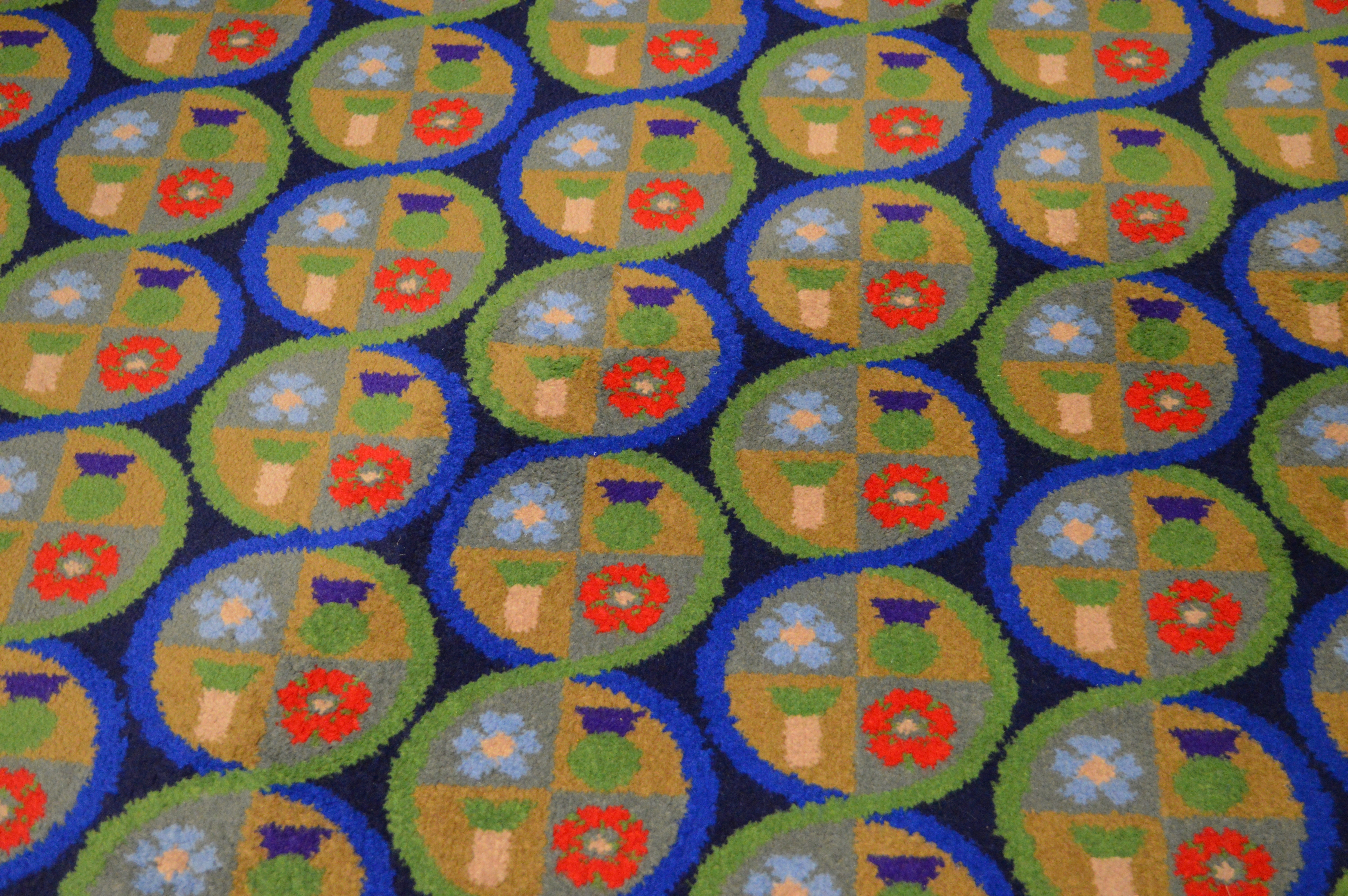
[[File:Peter Blake's carpet for the Supreme Court (29837629101).jpg|thumb|Blake's carpet for the Supreme Court buildings]] | [[File:Peter Blake's carpet for the Supreme Court (29837629101).jpg|thumb|Blake's carpet for the Supreme Court buildings]] | ||
The official badge of the Supreme Court was granted by | The official [[Heraldic badge|badge]] of the Supreme Court was granted by [[Queen Elizabeth II|Elizabeth II]] in October 2008.<ref name="collegeofarms">{{cite web|url=https://www.college-of-arms.gov.uk/news-grants/newsletter/2008/item/47-december-2008-newsletter-no-19|title=The College of Arms Newsletter|date=December 2008|publisher=College of Arms|access-date=24 September 2019}}</ref> It comprises both the Greek letter [[omega]] (representing finality) and the symbol of [[Libra (astrology)|Libra]] (symbolising the scales of justice), in addition to the four [[floral emblems of the United Kingdom]]: a [[Tudor rose]], representing England, conjoined with the leaves of a [[leek]], representing Wales; a [[flax]] (or 'lint') blossom for Northern Ireland; and a [[thistle]], representing Scotland.<ref>{{cite web|url=https://supremecourt.uk/about-the-building/architecture |title=Architecture |publisher=The Supreme Court|access-date=11 October 2025}}</ref><ref name=":1">{{Cite journal |last=Eiland |first=Murray L. |title=Postcard from the Supreme Court, London |url=https://www.academia.edu/8013370 |journal=The Armiger's News |volume=34 |issue=3 |pages=2–4 |via=academia.edu}}</ref> | ||
Two adapted versions of its official badge are used by the Supreme Court. One features the words "The Supreme Court" and the letter omega in black (in the official badge granted by the College of Arms, the interior of the Latin and Greek letters are gold and white respectively), and displays a simplified version of the crown (also in black) and larger, stylised versions of the floral emblems; this modified version of the badge is featured on the new Supreme Court website,<ref>{{cite web|url=https://www.supremecourt.uk |title=The Supreme Court |publisher=The Supreme Court |access-date=16 May 2010}}</ref> as well as in the forms that will be used by the Supreme Court.<ref>{{cite web |title=Notice of appeal (or application for permission to appeal) |url=https://www.supremecourt.uk/docs/sc001_0409x1.pdf |website=www.supremecourt.uk}}</ref> A further variant omits the crown entirely and is featured prominently throughout the building.<ref>{{cite news|title=In pictures: UK Supreme Court|url=https://news.bbc.co.uk/2/hi/in_pictures/8151625.stm|work=BBC News|date=15 July 2009|access-date=18 August 2009}}</ref><ref name=":1" /> | |||
Another emblem is formed from a more abstract set of depictions of the four floral emblems and is used in the carpets of the Middlesex Guildhall designed by [[Peter Blake (artist)|Sir Peter Blake]], creator of such works as the cover of [[The Beatles]]' 1967 album, ''[[Sgt. Pepper's Lonely Hearts Club Band]]''.<ref>{{cite news|title=Inside the UK Supreme Court|url=https://news.bbc.co.uk/2/hi/uk_news/8152427.stm|work=BBC News|date=15 July 2009|access-date=18 August 2009}}</ref> | |||
== Other "supreme courts" in the United Kingdom == | |||
In Scotland, the [[High Court of Justiciary]], the [[Court of Session]] and the [[Office of the Accountant of Court]] make up the [[College of Justice]] and are known as the [[Supreme Courts of Scotland]].<ref>{{cite web |title=Scottish Court Service: An Introduction |url=http://www.scotcourts.gov.uk/docs/you_and_us/recruitment/SCS%20An%20Introduction.pdf |url-status=dead |archive-url=https://web.archive.org/web/20110721231546/http://www.scotcourts.gov.uk/docs/you_and_us/recruitment/SCS%20An%20Introduction.pdf |archive-date=21 July 2011 |access-date=23 May 2008 |publisher=[[Scottish Court Service]] |quote=The Supreme Courts are made up of the Court of Session, the High Court of Justiciary and the Accountant of Court's Office}}</ref> The High Court of Justiciary is the supreme criminal court in Scotland. | |||
Before 1 October 2009, there were two other courts known as "the supreme court". These were the Supreme Court of England and Wales (known as "the Supreme Court of Judicature", before the passing and coming into force of the [[Senior Courts Act 1981]]), which was created in the 1870s under the [[Judicature Acts]], and the Supreme Court of Judicature of Northern Ireland. Each consisted of a [[Court of Appeal of England and Wales|Court of Appeal]], a [[High Court of Justice]] and a [[Crown Court]]. When the provisions of the Constitutional Reform Act 2005 came into force these became known as the [[Senior Courts of England and Wales]] and the [[Court of Judicature of Northern Ireland]] respectively. | |||
The Judicial Committee of the Privy Council also retains [[Judicial Committee of the Privy Council#Jurisdiction|jurisdiction]] over certain matters. By Section 4 of the Judicial Committee Act 1833, the Sovereign may refer any matter whatsoever to the Judicial Committee of the Privy Council to provide advice, although this does not confer judicial authority.<ref>[https://www.legislation.gov.uk/ukpga/Will4/3-4/41/section/4 Section 4, Judicial Committee Act 1833]: Legislation.gov.uk</ref><ref>{{cite web |last1=Peplow |first1=Alex |date=15 July 2016 |title=A Curious Jurisdiction – Section 4 of the Judicial Committee Act 1833 |url=https://ukconstitutionallaw.org/2016/07/15/alex-peplow-a-curious-jurisdiction-section-4-of-the-judicial-committee-act-1833/ |access-date=22 May 2020 |website=UK Constitutional Law Association |language=en}}</ref> | |||
The judicial functions of the House of Lords have all been abolished, other than the [[Impeachment in the United Kingdom|trial of impeachments]], a procedure which has not been invoked for 200 years. | |||
== See also == | == See also == | ||
{{div col|colwidth=30em}} | {{div col|colwidth=30em}} | ||
* [[ | * [[Judiciaries of the United Kingdom]] | ||
** [[Courts of England and Wales]] | ** [[Courts of England and Wales]] | ||
** [[Courts of Northern Ireland]] | ** [[Courts of Northern Ireland]] | ||
** [[Courts of Scotland]] | ** [[Courts of Scotland]] | ||
* [[List of | * [[List of judgements of the Supreme Court of the United Kingdom|Judgments of the Supreme Court]] | ||
* [[List of courts which publish audio or video of arguments]] | * [[List of courts which publish audio or video of arguments]] | ||
* [[List of House of Lords cases]] | * [[List of House of Lords cases]] | ||
* [[UKSCblog]] | * [[UKSCblog]] | ||
{{div col end}} | {{div col end}} | ||
== Notes == | |||
<references group="lower-alpha" /> | |||
== References == | == References == | ||
| Line 215: | Line 217: | ||
{{Commons category}} | {{Commons category}} | ||
* {{Official website}} | * {{Official website}} | ||
* {{cite news|url= | * {{cite news|url=https://news.bbc.co.uk/2/hi/uk_news/magazine/6143744.stm|url-status=live|title=Grand designs|last=Summers|first=Chris|date=7 March 2007|access-date=7 March 2007|archive-url=https://web.archive.org/web/20210303040626/http://news.bbc.co.uk/2/hi/uk_news/magazine/6143744.stm|archive-date=3 March 2021|work=[[BBC News]]}} | ||
* {{Cite news|last=Wickham|first=Peter|date=20 October 2009|title=The controversy over the UK's new Supreme Court: much ado about nothing?|work=[[Harvard Law Record]]|url=http://hlrecord.org/opinion/the-controversy-over-the-uk-s-new-supreme-court-much-ado-about-nothing-1.794345|url-status=dead|archive-url=https://web.archive.org/web/20120118092201/http://www.hlrecord.org/opinion/the-controversy-over-the-uk-s-new-supreme-court-much-ado-about-nothing-1.794345|archive-date=18 January 2012}} | * {{Cite news|last=Wickham|first=Peter|date=20 October 2009|title=The controversy over the UK's new Supreme Court: much ado about nothing?|work=[[Harvard Law Record]]|url=http://hlrecord.org/opinion/the-controversy-over-the-uk-s-new-supreme-court-much-ado-about-nothing-1.794345|url-status=dead|archive-url=https://web.archive.org/web/20120118092201/http://www.hlrecord.org/opinion/the-controversy-over-the-uk-s-new-supreme-court-much-ado-about-nothing-1.794345|archive-date=18 January 2012}} | ||
| Line 222: | Line 224: | ||
{{UK law}} | {{UK law}} | ||
{{Supreme Courts of Europe}} | {{Supreme Courts of Europe}} | ||
{{Judiciary of England and Wales}} | {{Judiciary of England and Wales}} | ||
{{Authority control}} | {{Authority control}} | ||
| Line 231: | Line 232: | ||
[[Category:Non-ministerial departments of the Government of the United Kingdom]] | [[Category:Non-ministerial departments of the Government of the United Kingdom]] | ||
[[Category:Courts and tribunals established in 2009]] | [[Category:Courts and tribunals established in 2009]] | ||
[[Category:British appellate courts]] | |||
Latest revision as of 21:43, 11 March 2026
| Supreme Court of the United Kingdom | |
|---|---|
.svg) | |
.jpg) The Middlesex Guildhall in London is the location of the Supreme Court. | |
| Established | 1 October 2009 |
| Jurisdiction | United Kingdom |
| Location | Middlesex Guildhall, Parliament Square, London, England |
| Coordinates | 51°30′01″N 0°07′41″W / 51.5004°N 0.1281°W |
| Composition method | Appointed by the Monarch on the advice of the Prime Minister, following approval of a recommendation by the Lord Chancellor based on recommendation from an independent selection commission |
| Authorized by | Constitutional Reform Act 2005 Section 23(1) |
| Appeals from |
|
| Judge term length | Mandatory retirement at age 75 |
| Number of positions | 12 |
| Website | {{URL|example.com|optional display text}} |
| President | |
| Currently | The Lord Reed of Allermuir |
| Since | 13 January 2020 |
| Jurist term ends | 7 September 2031 |
| Deputy President | |
| Currently | Lord Sales |
| Since | 12 January 2026 |
The Supreme Court of the United Kingdom (initialism: UKSC) is the final court of appeal for all civil cases in the United Kingdom and all criminal cases originating in England, Wales and Northern Ireland, as well as some limited criminal cases from Scotland.[lower-alpha 1]
As the United Kingdom's highest appellate court for these matters, it hears cases of the greatest public or constitutional importance affecting the whole population. Additionally the Supreme Court hears cases on devolution matters from Scotland, Wales and Northern Ireland.[2][3] As a consequence, the court must include judges from the three distinct legal systems of the United Kingdom – England and Wales, Scotland and Northern Ireland, made up collectively of twelve Scottish, English, Welsh and Northern Irish judges.[1]
The Court usually sits in the Middlesex Guildhall in Westminster, though it can sit elsewhere and has, for example, sat in the Edinburgh City Chambers,[4] the Royal Courts of Justice in Belfast,[5] the Tŷ Hywel Building in Cardiff[6] and the Manchester Civil Justice Centre.[7]
The United Kingdom has a doctrine of parliamentary sovereignty and no entrenched codified constitution,[8] so the Supreme Court is much more limited in its powers of judicial review than the constitutional or supreme courts of some other countries such as India, United States, Canada and Australia. It cannot overturn any primary legislation made by Parliament. However, as with some other courts in the UK, it can overturn secondary legislation if, for example, that legislation is found to be ultra vires to the powers in primary legislation allowing it to be made.
Further, under section 4 of the Human Rights Act 1998, the Supreme Court, like some other courts in the United Kingdom, may make a declaration of incompatibility, indicating that it believes that the legislation subject to the declaration is incompatible with one of the rights in the European Convention on Human Rights. Such a declaration can apply to primary or secondary legislation. The declaration does not overturn the legislation, and neither Parliament nor the government is required to agree with any such declaration. However, if they accept a declaration, ministers can exercise powers under section 10 of the Human Rights Act to amend the legislation by statutory instrument to remove the incompatibility or ask Parliament to amend the legislation.
As authorised by the Constitutional Reform Act 2005, Part 3, Section 23(1),[9] the Supreme Court of the United Kingdom was formally established on 1 October 2009[10] and is a non-ministerial government department of the Government of the United Kingdom.[11] Section 23 of the Constitutional Reform Act limits the number of judges on the Court to 12, though it also allows for this rule to be amended, to further increase the number of judges, if a resolution is passed in both Houses of Parliament.[12] Most cases are decided by a panel of five of the judges (justices); in particularly important cases, the court may use a panel of eleven justices.
The Supreme Court assumed the judicial functions of the House of Lords, which had been exercised by the Lords of Appeal in Ordinary (commonly called "Law Lords"), the 12 judges appointed as members of the House of Lords to carry out its judicial business as the Appellate Committee of the House of Lords. Its jurisdiction over devolution matters had previously been exercised by the Judicial Committee of the Privy Council.
History[edit | edit source]
Creation[edit | edit source]
The creation of a Supreme Court for the United Kingdom was first proposed in a consultation paper published by the Department of Constitutional Affairs in July 2003.[13] Although the paper noted that there had been no criticism of the then-current Law Lords or any indication of an actual bias, it argued that the separation of the judicial functions of the Appellate Committee of the House of Lords from the legislative functions of the House of Lords should be made explicit. The paper noted the following concerns:
- Whether there was any longer sufficient transparency of independence from the executive and the legislature to give assurance of the independence of the judiciary.[13]
- The requirement for the appearance of impartiality and independence limited the ability of the Law Lords to contribute to the work of the House itself, thus reducing the value to both them and the House of their membership.[13]
- It was not always understood by the public that judicial decisions of "the House of Lords" were taken by the Appellate Committee and that non-judicial members were never involved in the judgments. Conversely, it was felt that the extent to which the Law Lords themselves had decided to refrain from getting involved in political issues concerning legislation on which they might later have had to adjudicate was not always appreciated.[13] The first President of the Court, The Lord Phillips of Worth Matravers, claimed that the old system confused people and that the Supreme Court would for the first time be a clear separation of powers among the judiciary, the legislature and the executive.[14]
- Space within the House of Lords was at a constant premium and a separate supreme court would ease the pressure on the Palace of Westminster.[13]
The main argument against a new Supreme Court was that the previous system had worked well and kept costs down.[15] Reformers expressed concern that this second main example of a mixture of the legislative, judicial and executive might conflict with professed values under the Universal Declaration of Human Rights. Officials who make or execute laws have an interest in court cases that put those laws to the test. When the state invests judicial authority in those officials or even their day-to-day colleagues, it puts the independence and impartiality of the courts at risk. Consequently, it was hypothesised that closely connected decisions of the Law Lords to debates had by friends or on which the Lord Chancellor had expressed a view might be challenged on human-rights grounds on the basis that they had not constituted a fair trial.[16]
The Lord Neuberger of Abbotsbury, later President of the Supreme Court, expressed fear that the new court could make itself more powerful than the House of Lords committee it succeeded, saying that there is a real risk of "judges arrogating to themselves greater power than they have at the moment". The Lord Phillips of Worth Matravers said such an outcome was "a possibility", but was "unlikely".[17]
The reforms were controversial and were brought forward with little consultation but were subsequently extensively debated in Parliament.[18] During 2004, a select committee of the House of Lords scrutinised the arguments for and against setting up a new court.[19] The Government estimated the set-up cost of the Supreme Court at £56.9 million.[20]
Significant cases[edit | edit source]
The first case heard by the Supreme Court was HM Treasury v Ahmed, which concerned "the separation of powers", according to Phillips, its inaugural President. At issue was the extent to which Parliament has, by the United Nations Act 1946, delegated to the executive the power to legislate. Resolution of this issue depended upon the approach properly to be adopted by the court in interpreting legislation which may affect fundamental rights at common law or under the European Convention on Human Rights.
One of the most important cases presented to the Supreme Court was the joint cases of R (Miller) v The Prime Minister and Cherry v Advocate General for Scotland, known as Miller/Cherry, on Boris Johnson's unlawful prorogation (suspension) of Parliament, to suppress debate in anticipation of Britain's withdrawal from the European Union, "frustrating or preventing the constitutional role of Parliament in holding the Government to account".[21] It is one of only two cases that involved the presence of 11 judges (the highest number of judges currently allowed to rule on a case). The case carried a large amount of political tension in the context of the process of the United Kingdom leaving the European Union; for some, the ruling "delighted 'Remainers' but appalled 'Leavers'",[22] although some Conservative MPs who sought to withdraw from the EU with an agreement had opposed the prorogation.[23]
In 2022, the Supreme Court ruled on whether the Scottish Parliament had the power to legislate for a second independence referendum. In the case, the five-judge panel unanimously found that Scotland did not have the right to organise a referendum without the permission of Westminster, as questions around independence qualify as "reserved matters" (reserved to the central government) under the Scotland Act 1998. Nicola Sturgeon, the then-leader of the pro-independence Scottish National Party, regarded the decision as "a hard pill for any supporter of independence... to swallow" but reiterated the party's commitment to "find another democratic, lawful means for Scottish people to express their will".[24][25]
In 2025, the Supreme Court ruled on the meaning on the word 'woman' for the purposes of the Equality Act 2010. The court concluded unanimously that the word means 'biological woman' and thus that trans women are not women for the purposes of that Act.[26]. Lord Hodge noted that the case "had nothing to do with how or where single-sex spaces should be created. These points weren't argued before us".[27]
Jurisdiction and powers[edit | edit source]
From the Supreme Court –
The Supreme Court is the final court of appeal in the UK for civil cases, and for criminal cases from England, Wales and Northern Ireland. It hears cases of the greatest public or constitutional importance affecting the whole population.[2]
The Supreme Court hears appeals (i) in England and Wales, from the Court of Appeal (Civil Division), the Court of Appeal (Criminal Division) and (ii) in Scotland from the Court of Session.[28]
The Supreme Court is the highest court of appeal in relation to Scottish civil cases. However, the High Court of Justiciary is the highest court of appeal in relation to Scottish criminal cases.[29]
The Supreme Court also determines devolution issues (as defined by the Scotland Act 1998, the Northern Ireland Act 1998 and the Government of Wales Act 2006). These are legal proceedings about the powers of the three devolved administrations—the Northern Ireland Executive and Northern Ireland Assembly, the Scottish Government and the Scottish Parliament, the Welsh Government and Senedd. Devolution issues were previously heard by the Judicial Committee of the Privy Council and most are about compliance with rights under the European Convention on Human Rights, brought into national law by the Devolution Acts and the Human Rights Act 1998.[29]
On rare occasions the court may have original jurisdiction, normally in cases relating to contempt of the Supreme Court, such as Proceedings for Contempt: Mr Tim Crosland[30] and its appeal case HM Attorney General v Crosland.[31]
Panels and sittings[edit | edit source]
The twelve justices do not all hear every case. Unless there are circumstances requiring a larger panel, a case is usually heard by a panel of five justices.[32] More than five justices may sit on a panel where the case is of "high constitutional importance" or "great public importance"; if the case raises "an important point in relation to the European Convention on Human Rights"; if the case involves a conflict of decisions among the House of Lords, Judicial Committee of the Privy Council, or Supreme Court; or if the Court "is being asked to depart, or may decide to depart from" its (or the House of Lords') previous precedent.[32] The composition of panels is ultimately determined by the President.[33]
To avoid a tie, all cases are heard by a panel containing an odd number of justices.[34] Thus, the largest possible panel for a case is 11 justices.[34] To date, there have been only two cases (both involving matters of major constitutional importance) heard by 11 justices: the case of R (Miller) v Secretary of State for Exiting the European Union (argued in 2016 and decided in 2017) and the cases of R (Miller) v The Prime Minister and Cherry v Advocate General for Scotland (argued and decided in 2019).[35][36]
Although they may wear black damask robes with gold embellishments including the supreme court badge for portraits or ceremonial occasions, the justices have never worn court dress during sittings.[37] In November 2011, The Lord Phillips of Worth Matravers allowed counsel to jointly agree to "dispense with any or all of the traditional elements of court dress" at sittings.[37]
Administration[edit | edit source]
The Supreme Court has a separate administration from the other courts of England and Wales, Scotland and Northern Ireland, under a Chief Executive who is appointed by the Court's president.[38][39][40]Template:PoliticsUK
Judges[edit | edit source]
The court is composed of the President and Deputy President and ten other Justices of the Supreme Court, all with the style of Justice of the Supreme Court under section 23(6) of the Constitutional Reform Act.[9] The President and Deputy President of the court are separately appointed to those roles. The Supreme Court of the United Kingdom is required to have judges who have previously served in the legal systems of England and Wales, Scotland and Northern Ireland, and act as representatives of their respective legal systems in the Supreme Court.[1] The selection committee of judges to sit in the Supreme Court is required to ensure that each judge appointed to the Supreme Court will have knowledge of, and experience of practice in, the legal system of each country of the United Kingdom.[1] As a result of devolution in 1998, in Scotland for instance, the Judicial Appointments Board for Scotland is consulted on each appointment to the Supreme Court, as is the first minister of Scotland, regardless as to whether the judge being nominated is Scottish or not.[1]
The ten Lords of Appeal in Ordinary (Law Lords) holding office on 1 October 2009 became the first judges of the twelve-member Supreme Court.[41] The eleventh place on the Supreme Court was filled by The Lord Clarke of Stone-cum-Ebony (formerly the Master of the Rolls), who was the first justice to be appointed directly to the Supreme Court.[42] One of the former Law Lords, The Lord Neuberger of Abbotsbury, was appointed to replace Clarke as Master of the Rolls,[43] and so did not move to the new court. Lord Dyson became the twelfth and final judge of the Supreme Court on 13 April 2010.[44] In 2010, Queen Elizabeth II granted justices who are not peers use of the title Lord or Lady, by warrant under the royal sign-manual.[45][46]
The Senior Law Lord on 1 October 2009, The Lord Phillips of Worth Matravers, became the Supreme Court's first President,[47] and the Second Senior Law Lord, The Lord Hope of Craighead, became the first Deputy President.
On 30 September 2010 The Lord Saville of Newdigate became the first justice to retire,[48] followed by The Lord Collins of Mapesbury on 7 May 2011, although the latter remained as an acting judge until the end of July 2011.
In June 2011 The Lord Rodger of Earlsferry became the first justice to die in office, after a short illness.[49]
Acting judges[edit | edit source]
In addition to the twelve permanent judges, the President may request other senior judges drawn from two groups to sit as "acting judges" of the Supreme Court.[50]
- The first group are those judges who currently hold 'office as a senior territorial judge': judges of the Court of Appeal of England and Wales, judges of the Court of Appeal of Northern Ireland and judges of the First or Second Division of the Inner House of the Court of Session in Scotland.[51] This has included former Lord President, Lord Carloway, himself sitting on cases.[52]
- The second group are known as the 'supplementary panel'. The President may approve in writing retired judges' membership of this panel if they are under 75 and are (a) former supreme court justices or (b) former 'senior territorial judges'.[53] A list of those currently appointed is to be found on the Supreme Court website.[54] (The system is similar to senior status in the United States Federal Courts of Appeal, although there are important differences: for example, a judge on the supplementary panel does not receive a salary).
Qualification for appointment[edit | edit source]
Section 25 of the Constitutional Reform Act 2005 details the requirements for a person to be eligible for appointment to the Court.[55] A person is qualified for appointment if they have, at any time:
- held high judicial office for at least 2 years or
- been a qualified practitioner for at least 15 years.
To hold high judicial office includes; being a High Court Judge of England and Wales, or of Northern Ireland; a Court of Appeal Judge of England and Wales, or Northern Ireland; or a Judge on the Court of Sessions. A person is a qualified practitioner if they are an advocate in Scotland or a solicitor entitled to appear in the Court of Session and the High Court of Justiciary; or a member of the Bar of Northern Ireland or a solicitor of the Court of Judicature of Northern Ireland.[56]
Appointment process[edit | edit source]
The Constitutional Reform Act 2005 makes provision for a new appointment process for Justices of the Supreme Court. An independent selection commission is to be formed when vacancies arise. This is to be composed of the President of the Supreme Court (the chair), another senior UK judge (not a Supreme Court Justice) and a member of the Judicial Appointments Commission of England and Wales, the Judicial Appointments Board for Scotland and the Northern Ireland Judicial Appointments Commission. By law, at least one of these must be a non-lawyer. However, there is a similar but separate commission to appoint the next President of the Supreme Court, which is chaired by one of the non-lawyer members and features another Supreme Court Justice in the place of the President. Both of these commissions are convened by the Lord Chancellor.[57] In October 2007, the Ministry of Justice announced that the appointment process would be adopted voluntarily for appointments of Lords of Appeal in Ordinary.[58]
The commission selects one person for the vacancy and notifies the Lord Chancellor of its choice. The Lord Chancellor then either
- approves the commission's selection
- rejects the commission's selection, or
- asks the commission to reconsider its selection.
If the Lord Chancellor approves the person selected by the commission, the Prime Minister must then recommend that person to the Monarch for appointment.[59]
New judges appointed to the Supreme Court after its creation do not necessarily receive peerages. Following a Royal Warrant dated 10 December 2010, all Justices of the Supreme Court of the United Kingdom not holding a peerage are entitled to the judicial courtesy title of Lord or Lady and retain this style for life.[45][60]
The President and Deputy President of the Supreme Court are appointed to those roles rather than being the most senior by tenure in office.
List of current judges[edit | edit source]
The most recent to join the court is Lord Richards of Camberwell, who joined on 3 October 2022 in place of Lady Arden of Heswall. In order of seniority, they are as follows:
.jpg)
.jpg)
.jpg)
.jpg)
.jpg)


Overseas work[edit | edit source]

The UK Supreme Court has since its inception sent some of its justices to sit on Hong Kong's top court, the Court of Final Appeal.[62] This practice was established when the Court of Final Appeal was first set up in 1997 and before the founding of the UK Supreme Court, when the House of Lords was still the final appellate court in the UK.[63] When British justices sit on the top court of Hong Kong, they are required by law to take the judicial oath with the pledge of allegiance to the Hong Kong SAR of the People's Republic of China.[64] Because of that, they are not "overseas judges" as many mistakenly assume.[65][66] They become local Hong Kong judges themselves.[67] Along with their oaths taken to be justices of the UK Supreme Court,[68] these judges owe a double allegiance and serve on the top courts of both jurisdictions at the same time.
The participation of the UK Supreme Court's justices in Hong Kong's judiciary is highly welcomed by the government of Hong Kong because it helps bolster the international reputation of the courts in Hong Kong.[69] However, there have been calls advocating the discontinuation of this practice since the implementation of the controversial national security law in Hong Kong by China in July 2020.[70][71] More specifically, members from both Houses of Parliament across the political spectrum have on various occasions either called for the termination of this practice or questioned the appropriateness of it.[72][73][74][75][76]
In June 2021, Baroness Hale of Richmond, former President of the UK Supreme Court, announced her decision not to seek reappointment on the Hong Kong court after the end of her term in July while mentioning the impact of the national security law.[77] She became the first senior British judge to quit Hong Kong's top court after the enactment of the security law. Amid the controversy, in August 2021, The Lord Reed of Allermuir issued a statement certifying that Hong Kong's judiciary "continues to act largely independently of government".[78] However, about three months later, the US-China Commission submitted its annual report to US Congress detailing China's situation.[79] In the report, not only did the Commission explicitly state that the independence of Hong Kong's judiciary existed "in name only", in direct conflict with The Lord Reed of Allermuir's certification, but also questioned whether or not overseas judges, including British judges, serving on Hong Kong's top court could still protect the rule of law in Hong Kong.[80]
In a statement issued on 30 March 2022, the Foreign Secretary announced that the UK Government could no longer endorse British current judges sitting on the Hong Kong Court of Final Appeal, saying to do otherwise "would risk legitimising oppression".[81] Soon after the government's announcement, on the same day, the president and deputy president of the UK Supreme Court, The Lord Reed of Allermuir and Lord Hodge, tendered their resignations as judges of the Hong Kong court.[82] As of 30 March 2022, six retired British justices continue to sit on Hong Kong's top court.[62]
Building[edit | edit source]


The court is housed in Middlesex Guildhall—which it shares with the Judicial Committee of the Privy Council—in the City of Westminster.
The Constitutional Reform Act 2005 gave time for a suitable building to be found and fitted out before the Law Lords moved out of the Houses of Parliament, where they had previously used a series of rooms in the Palace of Westminster.[83]
After a lengthy survey of suitable sites, including Somerset House, the Government announced that the new court would be at the Middlesex Guildhall, in Parliament Square, Westminster. That decision was examined by the Constitutional Affairs Committee,[84] and the grant of planning permission by Westminster City Council for refurbishment works were challenged in a judicial review by the conservation group Save Britain's Heritage.[85] It was also reported that English Heritage had been put under great pressure to approve the alterations.[86] Feilden + Mawson, supported by Foster & Partners, were the appointed architects, with Kier Group appointed as main contractor.[87]
The building had been used as the Middlesex Quarter Sessions House and the headquarters of the Middlesex County Council. Following the abolition of the council in 1965, its former council chamber became a courtroom, which is now Court One, the principal courtroom. In 1972 the building became a Crown Court centre.[88]
Badge[edit | edit source]

.jpg)
The official badge of the Supreme Court was granted by Elizabeth II in October 2008.[89] It comprises both the Greek letter omega (representing finality) and the symbol of Libra (symbolising the scales of justice), in addition to the four floral emblems of the United Kingdom: a Tudor rose, representing England, conjoined with the leaves of a leek, representing Wales; a flax (or 'lint') blossom for Northern Ireland; and a thistle, representing Scotland.[90][91]
Two adapted versions of its official badge are used by the Supreme Court. One features the words "The Supreme Court" and the letter omega in black (in the official badge granted by the College of Arms, the interior of the Latin and Greek letters are gold and white respectively), and displays a simplified version of the crown (also in black) and larger, stylised versions of the floral emblems; this modified version of the badge is featured on the new Supreme Court website,[92] as well as in the forms that will be used by the Supreme Court.[93] A further variant omits the crown entirely and is featured prominently throughout the building.[94][91]
Another emblem is formed from a more abstract set of depictions of the four floral emblems and is used in the carpets of the Middlesex Guildhall designed by Sir Peter Blake, creator of such works as the cover of The Beatles' 1967 album, Sgt. Pepper's Lonely Hearts Club Band.[95]
Other "supreme courts" in the United Kingdom[edit | edit source]
In Scotland, the High Court of Justiciary, the Court of Session and the Office of the Accountant of Court make up the College of Justice and are known as the Supreme Courts of Scotland.[96] The High Court of Justiciary is the supreme criminal court in Scotland.
Before 1 October 2009, there were two other courts known as "the supreme court". These were the Supreme Court of England and Wales (known as "the Supreme Court of Judicature", before the passing and coming into force of the Senior Courts Act 1981), which was created in the 1870s under the Judicature Acts, and the Supreme Court of Judicature of Northern Ireland. Each consisted of a Court of Appeal, a High Court of Justice and a Crown Court. When the provisions of the Constitutional Reform Act 2005 came into force these became known as the Senior Courts of England and Wales and the Court of Judicature of Northern Ireland respectively.
The Judicial Committee of the Privy Council also retains jurisdiction over certain matters. By Section 4 of the Judicial Committee Act 1833, the Sovereign may refer any matter whatsoever to the Judicial Committee of the Privy Council to provide advice, although this does not confer judicial authority.[97][98]
The judicial functions of the House of Lords have all been abolished, other than the trial of impeachments, a procedure which has not been invoked for 200 years.
See also[edit | edit source]
Notes[edit | edit source]
- ↑ Matters relating to devolution, reserved matters and human rights only[1]
References[edit | edit source]
- ↑ 1.0 1.1 1.2 1.3 1.4 "Why does the UK Supreme Court matter for Scotland?" (PDF). Archived from the original (PDF) on 17 December 2024.
- ↑ 2.0 2.1 "The Supreme Court". The Registry, the Supreme Court (The Registry of the Supreme Court of the United Kingdom). 12 January 2013. Retrieved 9 November 2018.
- ↑ "The Court and legal System - UK Supreme Court". supremecourt.uk. Retrieved 17 April 2025.
- ↑ 'Supreme Court to sit in Scotland Archived 7 May 2021 at the Wayback Machine': Press release from the Supreme Court, 1 March 2017
- ↑ 'UK Supreme Court bound for Northern Ireland Archived 5 March 2021 at the Wayback Machine': Press release from the Supreme Court, 27 November 2017
- ↑ UK Supreme Court to sit in Wales this summer Archived 7 May 2021 at the Wayback Machine': Press release from the Supreme Court, 1 March 2017
- ↑ "The Supreme Court has relocated to Manchester until Thursday. Why should you care?". The Mill. 7 March 2023. Retrieved 8 March 2023.
- ↑ "Parliamentary Sovereignty". GOV.UK. Retrieved 22 January 2020.
- ↑ 9.0 9.1 "Constitutional Reform Act 2005 (c. 4), Part 3, Section 23". The National Archives (United Kingdom). 24 March 2005. Retrieved 9 November 2018.
- ↑ Constitutional Reform Act 2005 (Commencement No. 11) Order 2009 at the National Archives website (retrieved 11 March 2026).
- ↑ "Departments, agencies and public bodies". GOV.UK. Retrieved 11 April 2020.
- ↑ "2005 c.4 Part 3. Section 23". GOV.UK. Retrieved 22 January 2021.
- ↑ 13.0 13.1 13.2 13.3 13.4 "Constitutional Reform: A Supreme Court for the United Kingdom". Department of Constitutional Affairs. July 2003.
- ↑ "New Supreme Court opens with media barred". The Daily Telegraph. London. 1 October 2009. Archived from the original on 4 October 2009. Retrieved 24 May 2010.
For the first time, we have a clear separation of powers between the legislature, the judiciary and the executive in the United Kingdom. This is important. It emphasises the independence of the judiciary, clearly separating those who make the law from those who administer it.
- ↑ Wakeham report 2000, Chapter 9, Recommendation 57.
- ↑ "The Supreme Court is an unnecessary attack on the constitution". The Daily Telegraph. London. 1 October 2009. Archived from the original on 5 October 2009. Retrieved 24 May 2010.
The Government argued that there must be a separation to comply with Article Six of the European Convention on Human Rights, which guarantees a fair trial.
- ↑ Rozenberg, Joshua (8 September 2009). "Fear over UK Supreme Court impact". BBC News.
- ↑ A. Le Sueur, "From Appellate Committee to Supreme Court: A Narrative", ch. 5 in L. Blom-Cooper, G. Drewry and B. Dickson (eds.),The Judicial House of Lords (Oxford University Press, 2009); Queen Mary School of Law Legal Studies Research Paper No. 17/2009. Template:SSRN
- ↑ "House of Lords – Constitutional Reform Bill – First Report". UK Parliament.
- ↑ "Written Answer of the Ministry of Justice to question posed by Lord Steinberg (Col. WA102)". Lords Hansard. 26 March 2008.
- ↑ "R (on the application of Miller) (Appellant) v The Prime Minister (Respondent) Cherry and others (Respondents) v Advocate General for Scotland (Appellant) (Scotland)" (PDF). www.supremecourt.uk.
- ↑ Constantina P. Tridimas and George Tridimas (April 2020). "Is the UK Supreme Court rogue to un-prorogue Parliament?" European Journal of Law and Economics, Springer, vol. 49(2), pp. 205–225.
- ↑ Rourke, Alison (29 August 2019). "Prorogation explainer: a simple guide to what just happened in UK politics". The Guardian. ISSN 0261-3077. Retrieved 8 August 2023.
- ↑ "REFERENCE by the Lord Advocate of devolution issues under paragraph 34 of Schedule 6 to the Scotland Act 1998" (PDF). Retrieved 3 July 2023.
- ↑ Nicolson, Stuart (23 November 2022). "Independence referendum: Scottish government loses indyref2 court case". BBC News. BBC. Retrieved 3 July 2023.
- ↑ bbc.co.uk
- ↑ [1]
- ↑ "The Role of the Supreme Court". The Supreme Court. Retrieved 5 October 2024.
- ↑ 29.0 29.1 "The Jurisdiction of the Supreme Court of the United Kingdom in Scottish Appeals: Human rights, the Scotland Act 2012 and the Courts Reform (Scotland) Act 2014" (PDF). The Supreme Court. Retrieved 5 October 2024.
- ↑ "Proceedings for Contempt: Mr Tim Crosland". The Supreme Court.
- ↑ "Her Majesty's Attorney General (Respondent) v Crosland (Appellant)". The Supreme Court. Retrieved 5 October 2024.
- ↑ 32.0 32.1 "Panel numbers criteria". Supreme Court of the United Kingdom. Retrieved 17 September 2019.
- ↑ "Information Pack – Vacancy for President of the Supreme Court of the United Kingdom" (PDF). The Supreme Court. Retrieved 3 June 2021.
- ↑ 34.0 34.1 Dominic Casciani. "What is the UK Supreme Court?". BBC News.
- ↑ "The 11 Supreme Court judges who ruled on UK's Brexit appeal". BBC News. 24 January 2017.
- ↑ Bowcott, Owen (16 September 2019). "Supreme court to hear claims suspension of parliament is unlawful". The Guardian.
- ↑ 37.0 37.1 Gordon, Cathy (21 November 2011). "Supreme Court lawyers allowed to dress down". The Independent. Retrieved 22 December 2023.
- ↑ Court, The Supreme. "Mark Ormerod to be Supreme Court's Chief Executive – The Supreme Court". www.supremecourt.uk. Archived from the original on 3 May 2018. Retrieved 2 May 2018.
- ↑ Court, The Supreme. "Executive Team – The Supreme Court". www.supremecourt.uk. Retrieved 2 May 2018.
- ↑ Template:Cite legislation UK
- ↑ Constitutional Reform Act 2005, section 24
- ↑ "Justice of the UK Supreme Court". London, United Kingdom: 10 Downing Street. 20 April 2009. Archived from the original on 8 April 2010. Retrieved 30 August 2009.
- ↑ Frances Gibb (23 July 2009). "Lord Neuberger named Master of the Rolls". The Times. London. Archived from the original on 12 June 2011. Retrieved 30 August 2009.
- ↑ Frances Gibb (23 March 2010). "New Supreme Court justice – Sir John Dyson". Archived from the original on 26 March 2010. Retrieved 24 March 2010.
- ↑ 45.0 45.1 "No. 59746". The London Gazette. 1 April 2011. pp. 6177–6178.
- ↑ "Press release: Courtesy titles for Justices of the Supreme Court" (PDF). Supreme Court of the United Kingdom. 13 December 2010. Retrieved 9 March 2014.
- ↑ "Lord Phillips of Worth Matravers appointed as senior Lord of Appeal in Ordinary". Archived from the original on 5 September 2008.
- ↑ Rozenberg, Joshua (24 June 2010). "Vacancy in the supreme court – and age could be a deciding factor – Joshua Rozenburg". The Guardian. Retrieved 2 September 2018.
- ↑ "Supreme Court judge dies aged 66". BBC News. 27 June 2011. Retrieved 2 September 2018.
- ↑ Constitutional Reform Act 2005, section 38(1)
- ↑ Constitutional Reform Act 2005, section 38(8)
- ↑ Court, The Supreme. "JUDGMENT - Paul and another (Appellants) v Royal Wolverhampton NHS Trust (Respondent) et al" (PDF). www.supremecourt.uk. Retrieved 11 January 2024.
- ↑ Constitutional Reform Act 2005, section 39
- ↑ Court, The Supreme. "The Supreme Court – Supplementary Panel". www.supremecourt.uk. Retrieved 3 June 2021.
- ↑ "Changes over time for: Section 25". GOV.UK. Retrieved 22 January 2021.
- ↑ "Procedure for Appointing a Justice of The Supreme Court of the United Kingdom". The Supreme Court. Retrieved 22 January 2021.
- ↑ "Supreme Court selection process for President and Justices". The Supreme Court. 8 February 2019. Retrieved 7 April 2020.
- ↑ "Supreme Court – new appointments process". Ministry of Justice. Archived from the original on 24 December 2007. Retrieved 16 May 2010.
- ↑ Constitutional Reform Act 2005, sections 25–31
- ↑ "Courtesy titles for Justices of the Supreme Court" (PDF). Supreme Court of the United Kingdom. 13 December 2010. Retrieved 14 December 2010.
- ↑ Court, The Supreme. "Swearing-in of The Right Honourable Professor Burrows QC as Justice of the Supreme Court". The Supreme Court. Retrieved 5 June 2020.
- ↑ 62.0 62.1 "Hong Kong Court of Final Appeal – The Non-Permanent Judges". www.hkcfa.hk. Retrieved 18 May 2021.
- ↑ Cook, Robin (UK Foreign Secretary) (January 1998). "Sino-British Joint Declaration Six-Monthly Report to Parliament (Jul–Dec 1997)" (PDF). GOV.UK. p. 2.
I am delighted that Britain has been able to contribute to this process, by making available to the Court of Final Appeal two of our leading Law Lords, Lord Hoffmann and Lord Nicholls, as members of the Court's panel of non-permanent judges.
- ↑ "Oaths and Declarations Ordinance (Cap. 11)". Hong Kong e-Legislation. Retrieved 21 March 2021.
Section 17, Part V of Schedule 2, and Part I of Schedule 3
- ↑ Cheng, Kris (25 September 2015). "Overseas judges at Court of Final Appeal should be a permanent arrangement, former Chief Justice says". Hong Kong Free Press HKFP. Retrieved 21 March 2021.
- ↑ "Loss of overseas judges would have devastating impact on Hong Kong". South China Morning Post. 21 March 2021. Retrieved 21 March 2021.
- ↑ Shum, Michael (19 March 2021). "Calls for UK judges to quit are 'out of order'". The Standard. Retrieved 21 March 2021.
As a Hong Kong judge I serve Hong Kong people.
- ↑ "Oaths". www.judiciary.uk. Retrieved 21 March 2021.
- ↑ Yuen, Rimsky (6 November 2012). "Basic Law allows for overseas judges: SJ". news.gov.hk. Retrieved 21 March 2021.
- ↑ "The Times view on British judges in Hong Kong: True Justice". The Times. ISSN 0140-0460. Retrieved 21 March 2021.
British judges should resign from Hong Kong's highest court
- ↑ "UK judiciary reviews historic role sitting in Hong Kong's highest court". www.globallegalpost.com. Retrieved 21 March 2021.
- ↑ The Lord Alton of Liverpool (14 October 2021). "HKW Patron Lord Alton of Liverpool calls for a further review of the independence of the judiciary in Hong Kong". Hong Kong Watch. Archived from the original on 28 October 2021.
At a time when judges are forced to leave Hong Kong following pressure by Beijing and their mouthpieces in the media to convict protestors, civil society groups are being forced to close, and nearly all pro-democracy voices are in jail, exile, or awaiting trial, it cannot be right that UK judges continue to offer Hong Kong courts a veneer of legitimacy.
- ↑ Andrew Rosindell (15 November 2021). "Hansard (Debate: Amnesty International Offices in Hong Kong)". UK Parliament.
Secondly, Ministers must reconsider the participation of sitting UK judges on the Hong Kong court of final appeal. As the human rights situation continues to deteriorate at a worrying pace, it is clear that these judges are powerless to moderate Beijing's behaviour. Instead, they are offering political cover for a Government in Hong Kong who have lost all legitimacy.
- ↑ Stephen Kinnock (9 June 2021). "Hansard (Debate: Human Rights in Hong Kong)". UK Parliament.
...and we need—as the Labour party is calling for—British judges to leave Hong Kong. British judges are simply lending a veneer of credibility to the undemocratic, broken system. Have the UK Government assessed whether UK judges are protecting the rule of law in Hong Kong or simply legitimising an authoritarian regime?
- ↑ Alistair Carmichael (14 October 2021). "It's time to remove British judges from Hong Kong". The Sunday Times.
British judges' continued presence in Hong Kong lends a false veneer of respectability to a justice system that is no longer just. The president of the Supreme Court and the new foreign secretary must take a stand and remove British judges from Hong Kong once and for all.
- ↑ Peter Truscott, Baron Truscott. "Hansard (Debate: Hong Kong Courts: British Judges)". UK Parliament.
My Lords, I thank the Minister for his reply, but is it not time that Her Majesty's Government make their position clear on this and take further action? Is it not wrong on many levels that British judges are active in Hong Kong, giving a veneer of respectability to wholly draconian laws which effectively stifle freedom of speech, freedom of assembly and free and fair elections?
- ↑ "British judge to leave CFA over security law: report". RTHK. 4 June 2021. Retrieved 4 June 2021.
- ↑ "Role of UK judges on the Hong Kong Court of Final Appeal – update". UK Supreme Court. 27 August 2021.
- ↑ "China has undermined Hong Kong's judicial and parliamentary independence: U.S. report". Radio Free Asia. 19 November 2021.
- ↑ US-China Commission (17 November 2021). "2021 Report to Congress of the U.S.-China Economic and Security Review Commission" (PDF). United States-China Economic and Security Review Commission.
Judiciary Independent in Name Only (p.458) Hong Kong's historically independent judiciary is no longer reliably impartial on cases related to matters the Chinese government deems sensitive since the National Security Law has cemented Beijing's right to determine which judges hear national security cases in which jurisdiction, almost guaranteeing outcomes the CCP prefers. (p.458) It is no longer certain that overseas judges serving in nonpermanent posts on the Court of Final Appeal (CFA) can still protect the rule of law in Hong Kong. (p.460)
- ↑ "Foreign Secretary supports the withdrawal of serving UK judges from the Hong Kong Court of Final Appeal". UK Government. 30 March 2022. Archived from the original on 30 March 2022.
- ↑ "Role of UK Supreme Court judges on the Hong Kong Court of Final Appeal - update". UK Supreme Court. 30 March 2022. Archived from the original on 30 March 2022.
- ↑ "Truly the Supremes? Reflections on the New Court, UKSC Blog". Archived from the original on 5 January 2010. Retrieved 7 October 2009.
- ↑ "Minutes of Oral Evidence Taken before the Constitutional Affairs Committee 17 April 2007". Retrieved 23 May 2008.
- ↑ "The Queen on the application of Save Britain's Heritage v. Westminster City Council". High Court (Administrative Court). Retrieved 23 May 2008.
- ↑ Binney, Marcus (22 June 2006). "Lord Falconer's supreme blunder". The Times. London. Retrieved 26 October 2008.[dead link]
- ↑ "Questions to the Department for Constitutional Affairs, 15 January 2007 (Col. 877W)". Commons Hansard.
- ↑ Court, The Supreme. "The Supreme Court – Interior". www.supremecourt.uk. Retrieved 3 June 2021.
- ↑ "The College of Arms Newsletter". College of Arms. December 2008. Retrieved 24 September 2019.
- ↑ "Architecture". The Supreme Court. Retrieved 11 October 2025.
- ↑ 91.0 91.1 Eiland, Murray L. "Postcard from the Supreme Court, London". The Armiger's News. 34 (3): 2–4 – via academia.edu.
- ↑ "The Supreme Court". The Supreme Court. Retrieved 16 May 2010.
- ↑ "Notice of appeal (or application for permission to appeal)" (PDF). www.supremecourt.uk.
- ↑ "In pictures: UK Supreme Court". BBC News. 15 July 2009. Retrieved 18 August 2009.
- ↑ "Inside the UK Supreme Court". BBC News. 15 July 2009. Retrieved 18 August 2009.
- ↑ "Scottish Court Service: An Introduction" (PDF). Scottish Court Service. Archived from the original (PDF) on 21 July 2011. Retrieved 23 May 2008.
The Supreme Courts are made up of the Court of Session, the High Court of Justiciary and the Accountant of Court's Office
- ↑ Section 4, Judicial Committee Act 1833: Legislation.gov.uk
- ↑ Peplow, Alex (15 July 2016). "A Curious Jurisdiction – Section 4 of the Judicial Committee Act 1833". UK Constitutional Law Association. Retrieved 22 May 2020.
Further reading[edit | edit source]
- Miele, Chris, ed. (2010). The Supreme Court of the United Kingdom. Merrell Publishers. ISBN 9781858945071.
- Le Sueur, Andrew, ed. (2004). Building the UK's New Supreme Court: National and Comparative Perspectives. Oxford University Press. doi:10.1093/acprof:oso/9780199264629.001.0001. ISBN 9780199264629.
- Morgan, Derek (ed). Constitutional Innovation: the creation of a Supreme Court for the United Kingdom (A special issue of the Legal Studies, the Journal of the Society of Legal Scholars).
- "Algorithms, Artificial Intelligence and the Law – UK Supreme Court" (PDF).
External links[edit | edit source]
{{URL|example.com|optional display text}}- Summers, Chris (7 March 2007). "Grand designs". BBC News. Archived from the original on 3 March 2021. Retrieved 7 March 2007.
- Wickham, Peter (20 October 2009). "The controversy over the UK's new Supreme Court: much ado about nothing?". Harvard Law Record. Archived from the original on 18 January 2012.
Template:Supreme Court of the United Kingdom Template:Departments of the United Kingdom Government Template:UK law Template:Supreme Courts of Europe Template:Judiciary of England and Wales