



->Rodw m Disambiguating links to Balti (link changed to Balti people) using DisamAssist. |
Revised and enhanced article content |
||
| Line 1: | Line 1: | ||
{{Use dmy dates|date=June 2019}} | {{Short description|Gyalpo of Ladakh from 1616 to 1642}} | ||
{{Use Indian English|date=June 2019}} | {{Use dmy dates|date=June 2019}}{{Use Indian English|date=June 2019}} | ||
{{Infobox royalty | {{Infobox royalty | ||
|name=Sengge Namgyal | | name = Sengge Namgyal | ||
| | | succession = Gyalpo of Ladakh | ||
|reign= | | reign = 1616–1642 | ||
|predecessor=[[Jamyang Namgyal]] | | predecessor = [[Jamyang Namgyal]] | ||
|successor=[[Deldan Namgyal]] | | successor = [[Deldan Namgyal]] | ||
|house=[[Namgyal dynasty of Ladakh]] | | birth_date = | ||
|father = [[Jamyang Namgyal]] | | death_date = 1642 | ||
|mother = Gyal Khatun | | house = [[Namgyal dynasty of Ladakh|Namgyal]] | ||
|religion=[[Buddhism]] | | father = [[Jamyang Namgyal]] | ||
| mother = [[Gyal Khatun]] | |||
| religion = [[Buddhism]] | |||
}} | }} | ||
'''Sengge Namgyal''' ('' | '''Sengge Namgyal''' ([[Ladakhi language|Ladakhi]]: {{bo-textonly|སེང་གེ་རྣམ་རྒྱལ}}, [[Wylie transliteration|Wylie]]: ''seng-ge rnam-rgyal'', died 1642) was a 17th-century king of the [[Namgyal dynasty of Ladakh|Namgyal dynasty]] of [[Ladakh]], from 1616 to his death in 1642. A [[Buddhist]], he was noted for his immense work in building monasteries, palaces and shrines in Ladakh and is known as the "Lion King". | ||
==Biography== | ==Biography== | ||
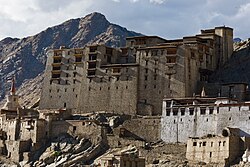
[[File: | [[File:Leh_Palace_2011.jpg|right|thumb|300x300px|The [[Leh Palace]], built by Sengge Namgyal]] | ||
Sengge was born to [[Jamyang Namgyal]] and a [[Balti people|Balti]] | Sengge was born to [[Jamyang Namgyal]] and [[Gyal Khatun]], a [[Balti people|Balti]] princess from [[Skardu]] or [[Khaplu]], variously described as a daughter of [[Khaplu#History|Yabgo Shey Ghilazi]] or [[Ali Sher Khan Anchan|Ali Senge]], better known by his title Anchan ({{literally|The Great}}). He was a devout Buddhist.<ref>{{Cite book | url=https://books.google.com/books?id=mg8My6WaWRcC&pg=PA60 |title = Rediscovery of Ladakh|isbn = 9788173870866|last1 = Kaul|first1 = H. N.|year = 1998}}</ref><ref>{{Cite book|author=Singh Jina, Prem|url=https://books.google.com/books?id=kjhcZgDy-WMC&q=Sengge+Namgyal&pg=PA77|title=Ladakh: the land and the people|publisher=Indus Publishing|year=1996|pages=77|isbn=81-7387-057-8}}</ref> | ||
[[File:Hamis_Gonpa_on_a_rainy_day.JPG|right|thumb|250x250px|Hemis monastery courtyard]] | |||
In his youth, he showed great martial skill and a flair for command. Talents which got him the command of the army. In 1614, he captured the mining town of Rudok followed by Spurangs, another important gold mining town, in 1615. The plunder and the output from these towns financed the building projects he would later commission as the King. In 1616, on the death of his father, Jamyang Namgyal, he ascended to the throne. He completed the conquests of Kingdom of Ngaris after a brief siege of Guge castle in 1619.<ref>{{cite web|url= | In his youth, he showed great martial skill and a flair for command. Talents which got him the command of the army. In 1614, he captured the mining town of Rudok followed by Spurangs, another important gold mining town, in 1615. The plunder and the output from these towns financed the building projects he would later commission as the King. In 1616, on the death of his father, Jamyang Namgyal, he ascended to the throne. He completed the conquests of Kingdom of Ngaris after a brief siege of [[Tsaparang|Guge castle (Tsaparang)]] in 1619.<ref>{{cite web|url=https://www.buddhist-temples.com/buddhist-monastery/ladakh/chemrey.html|title=Chemrey Gompa|publisher=Buddhist-temples.com|accessdate=9 October 2009}}</ref> | ||
[[File:hanlegompa.jpg|250px|left|thumb|Hanle Gompa, built by Sengge and Stag-tsang-ras-pa, soon after his conversion to the Drugpa sect of Tibetan Buddhism]] | [[File:hanlegompa.jpg|250px|left|thumb|Hanle Gompa, built by Sengge and Stag-tsang-ras-pa, soon after his conversion to the Drugpa sect of Tibetan Buddhism]] | ||
| Line 39: | Line 41: | ||
{{DEFAULTSORT:Namgyal, Sengge}} | {{DEFAULTSORT:Namgyal, Sengge}} | ||
[[Category: | [[Category:Kings of Ladakh]] | ||
[[Category:1642 deaths]] | [[Category:1642 deaths]] | ||
[[Category:Year of birth unknown]] | [[Category:Year of birth unknown]] | ||
[[Category:Year of birth uncertain]] | [[Category:Year of birth uncertain]] | ||
Latest revision as of 19:32, 28 February 2026
| Sengge Namgyal | |
|---|---|
| Gyalpo of Ladakh | |
| Reign | 1616–1642 |
| Predecessor | Jamyang Namgyal |
| Successor | Deldan Namgyal |
| Died | 1642 |
| House | Namgyal |
| Father | Jamyang Namgyal |
| Mother | Gyal Khatun |
| Religion | Buddhism |
Sengge Namgyal (Ladakhi: སེང་གེ་རྣམ་རྒྱལ, Wylie: seng-ge rnam-rgyal, died 1642) was a 17th-century king of the Namgyal dynasty of Ladakh, from 1616 to his death in 1642. A Buddhist, he was noted for his immense work in building monasteries, palaces and shrines in Ladakh and is known as the "Lion King".
Biography[edit | edit source]

Sengge was born to Jamyang Namgyal and Gyal Khatun, a Balti princess from Skardu or Khaplu, variously described as a daughter of Yabgo Shey Ghilazi or Ali Senge, better known by his title Anchan (lit. 'The Great'). He was a devout Buddhist.[1][2]

In his youth, he showed great martial skill and a flair for command. Talents which got him the command of the army. In 1614, he captured the mining town of Rudok followed by Spurangs, another important gold mining town, in 1615. The plunder and the output from these towns financed the building projects he would later commission as the King. In 1616, on the death of his father, Jamyang Namgyal, he ascended to the throne. He completed the conquests of Kingdom of Ngaris after a brief siege of Guge castle (Tsaparang) in 1619.[3]

References[edit | edit source]
- ↑ Kaul, H. N. (1998). Rediscovery of Ladakh. ISBN 9788173870866.
- ↑ Singh Jina, Prem (1996). Ladakh: the land and the people. Indus Publishing. p. 77. ISBN 81-7387-057-8.
- ↑ "Chemrey Gompa". Buddhist-temples.com. Retrieved 9 October 2009.
External links[edit | edit source]
Sengge Namgyal
| ||
| Regnal titles | ||
|---|---|---|
| Preceded by Jamyang Namgyal |
Ruler of Ladakh 1616–1642 |
Succeeded by Deldan Namygal |