

Sherry6361 (talk | contribs) No edit summary |
CleanupBot (talk | contribs) m Robot: Replacing encoded entity with character |
||
| Line 17: | Line 17: | ||
|shield = [[Bodhi Tree]] with [[Prayer beads]] | |shield = [[Bodhi Tree]] with [[Prayer beads]] | ||
|supporters = [[Swastika]]s | |supporters = [[Swastika]]s | ||
|compartment = ([[Urdu]] for "Bihar") inscribed on a [[brick]] at the bottom | |compartment = ([[Urdu]] for "Bihar") inscribed on a [[brick]] at the bottom<ref>{{cite news |title=Bihar digging into history to discover roots of its emblem |url=https://www.hindustantimes.com/patna/bihar-digging-into-history-to-discover-roots-of-its-emblem/story-6cjRG9Ba4pI9W79TlG5yII.html |work=Hindustan Times |access-date=2025-06-01}}</ref> | ||
|motto = | |motto = | ||
|orders = | |orders = | ||
| Line 25: | Line 25: | ||
}} | }} | ||
The '''Emblem of Bihar''' is the official seal of the [[India]]n [[States of India|state]] of [[Bihar]]. | The '''Emblem of Bihar''' is the official seal of the [[India]]n [[States of India|state]] of [[Bihar]].<ref>{{Cite web |url=https://gov.bih.nic.in/ |title=Bihar Govt. Web Site |access-date=7 December 2008 |archive-date=15 June 2011 |archive-url=https://web.archive.org/web/20110615165115/http://gov.bih.nic.in/ |url-status=dead }}</ref> It was officially adopted by the [[Government of Bihar]] during [[British Raj|British rule]] between 1930 and 1935. | ||
==Design == | ==Design == | ||
The state symbol of Bihar features two [[Swastika|swastikas]] in front of a picture of a [[Bodhi tree]] with prayer beads. And the foundation base is brick where the [[Urdu]] word for ''Bihar'' ({{Lang|ur|بہار}}) is carved. | The state symbol of Bihar features two [[Swastika|swastikas]] in front of a picture of a [[Bodhi tree]] with prayer beads. And the foundation base is brick where the [[Urdu]] word for ''Bihar'' ({{Lang|ur|بہار}}) is carved.<ref>{{Cite web |title=All The State Emblems and Their Meaning |url=https://www.nlcbharat.org/emblems/ |access-date=2024-02-04 |publisher=National Legislators Conference |language=en-IN }}</ref> | ||
==Historical emblems== | ==Historical emblems== | ||
| Line 37: | Line 37: | ||
This was the enormous, old sacred fig tree (''Ficus religiosa - Moraceae'') under which Gautam Buddha, the founder of Buddhism and its spiritual teacher, is said to have attained enlightenment. Bodh Gaya is located about 100 kilometres south of Patna. | This was the enormous, old sacred fig tree (''Ficus religiosa - Moraceae'') under which Gautam Buddha, the founder of Buddhism and its spiritual teacher, is said to have attained enlightenment. Bodh Gaya is located about 100 kilometres south of Patna. | ||
The balance of opposites, universal harmony, and Dharma are symbolised by the two Swastikas. The word derives from the Sanskrit word ''svastika'', which is made up of the suffix ''-ka'', the words ''su'' (which means "good") and ''asti'' (which means "to be"). Therefore, the logo represents Bihar as the land of nice people. | The balance of opposites, universal harmony, and Dharma are symbolised by the two Swastikas. The word derives from the Sanskrit word ''svastika'', which is made up of the suffix ''-ka'', the words ''su'' (which means "good") and ''asti'' (which means "to be"). Therefore, the logo represents Bihar as the land of nice people.<ref>{{Cite web |date=2010-03-22 |title=Bihar digging into history to discover roots of its emblem |url=https://www.hindustantimes.com/patna/bihar-digging-into-history-to-discover-roots-of-its-emblem/story-6cjRG9Ba4pI9W79TlG5yII.html |access-date=2024-02-04 |website=Hindustan Times |language=en}}</ref> | ||
==Government banner== | ==Government banner== | ||
The Government of Bihar can be represented by a banner displaying the emblem of the state on a white field. | The Government of Bihar can be represented by a banner displaying the emblem of the state on a white field.<ref>{{Cite web|url=https://www.dreamstime.com/bihar-state-india-flag-textile-cloth-fabric-waving-top-sunrise-mist-fog-bihar-state-india-flag-textile-cloth-fabric-image127909900|title = Bihar State of India Flag Textile Cloth Fabric Waving on the Top Sunrise Mist Fog Stock Illustration - Illustration of background, clouds: 127909900}}</ref> | ||
<gallery> | |||
File:Bihar Government Banner.png|Banner of Bihar | File:Bihar Government Banner.png|Banner of Bihar | ||
</gallery> | |||
==See also== | ==See also== | ||
Latest revision as of 12:48, 22 March 2026
| Emblem of Bihar | |
|---|---|
 | |
| Armiger | The Government of Bihar |
| Adopted | Between 1930-1935 |
| Blazon | Bodhi Tree with Prayer beads |
| Supporters | Swastikas |
| Compartment | (Urdu for "Bihar") inscribed on a brick at the bottom[1] |
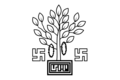
The Emblem of Bihar is the official seal of the Indian state of Bihar.[2] It was officially adopted by the Government of Bihar during British rule between 1930 and 1935.
Design[edit | edit source]
The state symbol of Bihar features two swastikas in front of a picture of a Bodhi tree with prayer beads. And the foundation base is brick where the Urdu word for Bihar (بہار) is carved.[3]
Historical emblems[edit | edit source]
Following the 1935 passage of the State Reorganisation Act, a recommendation to that effect was forwarded to the Royal Society, leading to the adoption of the Bo tree symbol in the emblem.
The Bodhi Tree is represented by the Bo tree. It comes from the Sinhala word bo, which means the Bodhi tree.
This was the enormous, old sacred fig tree (Ficus religiosa - Moraceae) under which Gautam Buddha, the founder of Buddhism and its spiritual teacher, is said to have attained enlightenment. Bodh Gaya is located about 100 kilometres south of Patna.
The balance of opposites, universal harmony, and Dharma are symbolised by the two Swastikas. The word derives from the Sanskrit word svastika, which is made up of the suffix -ka, the words su (which means "good") and asti (which means "to be"). Therefore, the logo represents Bihar as the land of nice people.[4]
Government banner[edit | edit source]
The Government of Bihar can be represented by a banner displaying the emblem of the state on a white field.[5]
-
 Banner of Bihar

See also[edit | edit source]
References[edit | edit source]
- ↑ "Bihar digging into history to discover roots of its emblem". Hindustan Times. Retrieved 1 June 2025.
- ↑ "Bihar Govt. Web Site". Archived from the original on 15 June 2011. Retrieved 7 December 2008.
- ↑ "All The State Emblems and Their Meaning". National Legislators Conference. Retrieved 4 February 2024.
- ↑ "Bihar digging into history to discover roots of its emblem". Hindustan Times. 22 March 2010. Retrieved 4 February 2024.
- ↑ "Bihar State of India Flag Textile Cloth Fabric Waving on the Top Sunrise Mist Fog Stock Illustration - Illustration of background, clouds: 127909900".
External links[edit | edit source]

 | This Bihar-related article is a stub. You can help Bharatpedia by expanding it. |
 | This heraldry-related article is a stub. You can help Bharatpedia by expanding it. |