


ArnulfoVos (talk | contribs) m Minor updates and cleanup applied |
CleanupBot (talk | contribs) m Robot: Replacing encoded entity with character |
||
| Line 14: | Line 14: | ||
'''''Jasminum officinale''''', known as the '''common jasmine''' or simply '''jasmine''', is a species of [[flowering plant]] in the olive [[family (biology)|family]] Oleaceae. It is native to the Caucasus and parts of Asia, also widely naturalized. | '''''Jasminum officinale''''', known as the '''common jasmine''' or simply '''jasmine''', is a species of [[flowering plant]] in the olive [[family (biology)|family]] Oleaceae. It is native to the Caucasus and parts of Asia, also widely naturalized. | ||
It is also known as '''summer jasmine''', | It is also known as '''summer jasmine''',<ref name=BSBI07>{{BSBI 2007 |access-date=2014-10-17 }}</ref> '''poet's jasmine''',<ref name=GRIN>{{GRIN | access-date=2 December 2014}}</ref> '''white jasmine''',<ref name=GRIN/> '''true jasmine''' or '''jessamine''',<ref name=GRIN/> and is particularly valued by gardeners throughout the [[temperateness|temperate]] world for the intense fragrance of its flowers in summer. It is also the [[National flower]] of [[Pakistan]]. | ||
==Description== | ==Description== | ||
''Jasminum officinale'' is a vigorous, twining [[deciduous]] [[vine|climber]] with sharply pointed [[pinnate]] leaves and clusters of starry, pure white flowers in summer, which are the source of its heady scent. | ''Jasminum officinale'' is a vigorous, twining [[deciduous]] [[vine|climber]] with sharply pointed [[pinnate]] leaves and clusters of starry, pure white flowers in summer, which are the source of its heady scent.<ref name=RHSAZ /> The leaf has 5 to 9 leaflets.<ref>{{Cite web|title=Jasminum officinale - Plant Finder|url=https://www.missouribotanicalgarden.org/PlantFinder/PlantFinderDetails.aspx?kempercode=b559|access-date=2021-10-05|website=www.missouribotanicalgarden.org}}</ref> | ||
==Etymology== | ==Etymology== | ||
The Latin [[binomial nomenclature|specific epithet]] ''officinale'' means "useful". | The Latin [[binomial nomenclature|specific epithet]] ''officinale'' means "useful".<ref name=RHSLG>{{cite book | last=Harrison |first=Lorraine | title=RHS Latin for Gardeners | year=2012 |publisher=Mitchell Beazley | location=United Kingdom | isbn=978-1845337315 }}</ref> | ||
==Distribution== | ==Distribution== | ||
It is found in the Caucasus, northern Iran, Afghanistan, Pakistan, the Himalayas, Tajikistan, India, Nepal and western China ([[Guizhou]], [[Sichuan]], [[Xizang]] (Tibet), [[Yunnan]]). The species is also widely cultivated in many places, and is reportedly naturalized in Spain, France, Italy, Portugal, Romania, Croatia, Bosnia and Herzegovina, Montenegro, Serbia, Algeria, Florida and the West Indies. | It is found in the Caucasus, northern Iran, Afghanistan, Pakistan, the Himalayas, Tajikistan, India, Nepal and western China ([[Guizhou]], [[Sichuan]], [[Xizang]] (Tibet), [[Yunnan]]). The species is also widely cultivated in many places, and is reportedly naturalized in Spain, France, Italy, Portugal, Romania, Croatia, Bosnia and Herzegovina, Montenegro, Serbia, Algeria, Florida and the West Indies.<ref name=RHSAZ>{{cite book|title=RHS A-Z encyclopedia of garden plants|year=2008|publisher=Dorling Kindersley|location=United Kingdom|isbn=978-1405332965|pages=1136}}</ref> | ||
==Chemical composition== | ==Chemical composition== | ||
''J. officinale'' has been found to contain [[alkaloid]]s, [[coumarin]]s, [[flavonoid]]s, [[tannin]]s, [[terpenoid]]s, [[glycoside]]s, emodine, [[leucoanthocyanin]]s, [[steroid]]s, [[anthocyanin]]s, phlobatinins, [[essential oil]] and [[saponin]]s. | ''J. officinale'' has been found to contain [[alkaloid]]s, [[coumarin]]s, [[flavonoid]]s, [[tannin]]s, [[terpenoid]]s, [[glycoside]]s, emodine, [[leucoanthocyanin]]s, [[steroid]]s, [[anthocyanin]]s, phlobatinins, [[essential oil]] and [[saponin]]s.<ref>{{cite journal |url=https://www.researchgate.net/publication/324521531 |doi=10.5281/zenodo.1214994|year=2018 |last1=Al-Snafi |first1=Ali Esmail |title=Pharmacology and Medicinal Properties of Jasminum Officinale- A Review |journal=Indo American Journal of Pharmaceutical Sciences |volume=05 |issue=4 |pages=2191–2197 }}</ref> | ||
==Garden history== | ==Garden history== | ||
''Jasminum officinale'' is so ancient in cultivation that its country of origin, though somewhere in [[Central Asia]], is not certain. | ''Jasminum officinale'' is so ancient in cultivation that its country of origin, though somewhere in [[Central Asia]], is not certain.<ref>Alice M. Coats, ''Garden Shrubs and Their Histories'' (1964) 1992, ''s.v.'' "Jasminum".</ref> H.L. Li, ''The Garden Flowers of China'',<ref>Li, ''The Garden Flowers of China'', 1959, noted in Coats (1964) 1992.</ref> notes that in the third century CE, jasmines identifiable as ''J. officinale'' and ''[[Jasminum sambac|J. sambac]]'' were recorded among "foreign" plants in Chinese texts, and that in ninth-century Chinese texts ''J. officinale'' was said to come from [[Byzantium]]. Its Chinese name, ''Yeh-hsi-ming'' is a version of the Persian and Arabic name.<ref>Coats (1964) 1992.</ref> | ||
Its entry into European gardens was most likely through the Arab-Norman culture of Sicily, but, as the garden historian John Harvey has said, "surprisingly little is known, historically or archaeologically, of the cultural life of pre-Norman Sicily". | Its entry into European gardens was most likely through the Arab-Norman culture of Sicily, but, as the garden historian John Harvey has said, "surprisingly little is known, historically or archaeologically, of the cultural life of pre-Norman Sicily".<ref>John Harvey, ''Mediaeval gardens'' (1981:48).</ref> In the mid-14th century the [[Florence|Florentine]] author [[Boccaccio]] in his ''[[Decameron]]'' describes a [[walled garden]] in which "the sides of the alleys were all, as it were, walled in with roses white and red and jasmine; insomuch that there was no part of the garden but one might walk there not merely in the morning but at high noon in grateful shade."<ref>Boccaccio, ''Decameron'', third day.</ref> Jasmine water also features in the story of Salabaetto in the ''Decameron''.<ref>"They then took from the basket silver vases of great beauty, some of which were filled with rose water, some with orange water, some with jasmine water, and some with lemon water, which they sprinkled upon them".</ref> ''Jasminum officinale'', "of the household office" where perfumes were distilled, was so thoroughly naturalized that [[Carl Linnaeus|Linnaeus]] thought it was native to Switzerland.<ref>Noted in Coats (1964) 1992.</ref> As a garden plant in London it features in [[William Turner (naturalist)|William Turner]]'s ''Names of Herbes'', 1548. | ||
Double forms, here as among many flowers, were treasured in the 16th and 17th centuries. | Double forms, here as among many flowers, were treasured in the 16th and 17th centuries. | ||
==Cultivars== | ==Cultivars== | ||
Numerous [[cultivars]] have been developed for garden use, often with [[variegation|variegated]] foliage. The cultivar 'Argenteovariegatum', | Numerous [[cultivars]] have been developed for garden use, often with [[variegation|variegated]] foliage. The cultivar 'Argenteovariegatum',<ref>{{cite web|title=RHS Plant Selector - ''Jasminum officinale'' 'Argenteovariegatum'|url=https://www.rhs.org.uk/Plants/48266/Jasminum-officinale-Argenteovariegatum-(v)/Details|publisher=Royal Horticultural Society|access-date=25 September 2020}}</ref> with cream-white [[variegation]] on the leaves, has gained the [[Royal Horticultural Society]]'s [[Award of Garden Merit]].<ref>{{cite web | url= https://www.rhs.org.uk/plants/pdfs/agm-lists/agm-ornamentals.pdf | title = AGM Plants - Ornamental | date = July 2017 | page = 56 | publisher = Royal Horticultural Society | access-date = 14 March 2018}}</ref> | ||
==Aromatherapy== | ==Aromatherapy== | ||
| Line 43: | Line 43: | ||
==Safety== | ==Safety== | ||
Jasmine is "[[generally recognized as safe]]" (GRAS) as a food ingredient by the U.S. [[Food and Drug Administration]]. | Jasmine is "[[generally recognized as safe]]" (GRAS) as a food ingredient by the U.S. [[Food and Drug Administration]].<ref name="lactmed">{{cite web |title=Jasmine |url=https://www.ncbi.nlm.nih.gov/books/NBK501843/ |publisher=LactMed, US National Library of Medicine |access-date=24 May 2023 |date=17 May 2021}}</ref> | ||
It is unknown whether jasmine consumption affects breastmilk, as the safety and efficacy of jasmine in nursing mothers or infants has not been adequately studied. | It is unknown whether jasmine consumption affects breastmilk, as the safety and efficacy of jasmine in nursing mothers or infants has not been adequately studied.<ref name=lactmed/> Drinking small amounts of jasmine tea likely are not harmful during nursing.<ref name=lactmed/> | ||
[[Allergic reaction]]s to jasmine may occur. | [[Allergic reaction]]s to jasmine may occur.<ref name=lactmed/> | ||
==References== | ==References== | ||
Latest revision as of 09:59, 22 March 2026
| Jasminum officinale | |
|---|---|

| |
| Botanical illustration | |
Scientific classification 
| |
| : | [[Template:Taxonomy/Jasminum]] |
| Species: | Template:Taxonomy/JasminumJ. officinale
|
| Binomial name | |
| Template:Taxonomy/JasminumJasminum officinale | |


Jasminum officinale, known as the common jasmine or simply jasmine, is a species of flowering plant in the olive family Oleaceae. It is native to the Caucasus and parts of Asia, also widely naturalized.
It is also known as summer jasmine,[1] poet's jasmine,[2] white jasmine,[2] true jasmine or jessamine,[2] and is particularly valued by gardeners throughout the temperate world for the intense fragrance of its flowers in summer. It is also the National flower of Pakistan.
Description[edit | edit source]
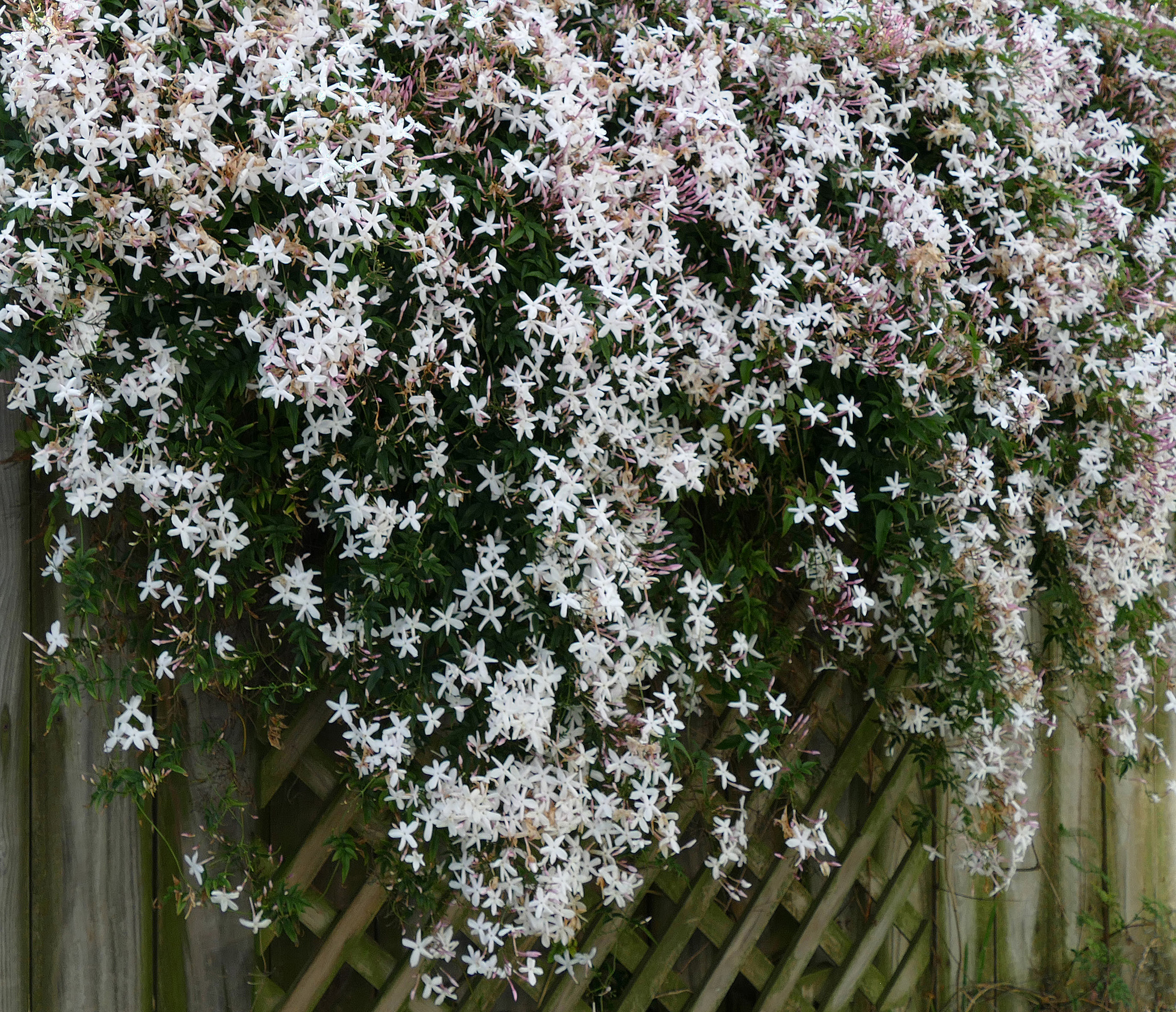
Jasminum officinale is a vigorous, twining deciduous climber with sharply pointed pinnate leaves and clusters of starry, pure white flowers in summer, which are the source of its heady scent.[3] The leaf has 5 to 9 leaflets.[4]
Etymology[edit | edit source]
The Latin specific epithet officinale means "useful".[5]
Distribution[edit | edit source]
It is found in the Caucasus, northern Iran, Afghanistan, Pakistan, the Himalayas, Tajikistan, India, Nepal and western China (Guizhou, Sichuan, Xizang (Tibet), Yunnan). The species is also widely cultivated in many places, and is reportedly naturalized in Spain, France, Italy, Portugal, Romania, Croatia, Bosnia and Herzegovina, Montenegro, Serbia, Algeria, Florida and the West Indies.[3]
Chemical composition[edit | edit source]
J. officinale has been found to contain alkaloids, coumarins, flavonoids, tannins, terpenoids, glycosides, emodine, leucoanthocyanins, steroids, anthocyanins, phlobatinins, essential oil and saponins.[6]
Garden history[edit | edit source]
Jasminum officinale is so ancient in cultivation that its country of origin, though somewhere in Central Asia, is not certain.[7] H.L. Li, The Garden Flowers of China,[8] notes that in the third century CE, jasmines identifiable as J. officinale and J. sambac were recorded among "foreign" plants in Chinese texts, and that in ninth-century Chinese texts J. officinale was said to come from Byzantium. Its Chinese name, Yeh-hsi-ming is a version of the Persian and Arabic name.[9]
Its entry into European gardens was most likely through the Arab-Norman culture of Sicily, but, as the garden historian John Harvey has said, "surprisingly little is known, historically or archaeologically, of the cultural life of pre-Norman Sicily".[10] In the mid-14th century the Florentine author Boccaccio in his Decameron describes a walled garden in which "the sides of the alleys were all, as it were, walled in with roses white and red and jasmine; insomuch that there was no part of the garden but one might walk there not merely in the morning but at high noon in grateful shade."[11] Jasmine water also features in the story of Salabaetto in the Decameron.[12] Jasminum officinale, "of the household office" where perfumes were distilled, was so thoroughly naturalized that Linnaeus thought it was native to Switzerland.[13] As a garden plant in London it features in William Turner's Names of Herbes, 1548.
Double forms, here as among many flowers, were treasured in the 16th and 17th centuries.
Cultivars[edit | edit source]
Numerous cultivars have been developed for garden use, often with variegated foliage. The cultivar 'Argenteovariegatum',[14] with cream-white variegation on the leaves, has gained the Royal Horticultural Society's Award of Garden Merit.[15]
Aromatherapy[edit | edit source]

The essential oil of Jasminum officinale is used in aromatherapy. Jasmine absolute has a heavy, sweet scent valued by perfumers. The flowers release their perfume at dusk, so flowers are picked at night and a tiny amount of oil is obtained from each blossom by solvent extraction. The result is an expensive oil which can be used in low concentrations.[citation needed]
Safety[edit | edit source]
Jasmine is "generally recognized as safe" (GRAS) as a food ingredient by the U.S. Food and Drug Administration.[16]
It is unknown whether jasmine consumption affects breastmilk, as the safety and efficacy of jasmine in nursing mothers or infants has not been adequately studied.[16] Drinking small amounts of jasmine tea likely are not harmful during nursing.[16]
Allergic reactions to jasmine may occur.[16]
References[edit | edit source]
- ↑ Template:BSBI 2007
- ↑ 2.0 2.1 2.2 [{{#property:P1421|}} "{{#Property:P225}}"]. Germplasm Resources Information Network (GRIN). Agricultural Research Service (ARS), United States Department of Agriculture (USDA). Retrieved 2 December 2014.
{{citation}}: Check|url=value (help) - ↑ 3.0 3.1 RHS A-Z encyclopedia of garden plants. United Kingdom: Dorling Kindersley. 2008. p. 1136. ISBN 978-1405332965.
- ↑ "Jasminum officinale - Plant Finder". www.missouribotanicalgarden.org. Retrieved 2021-10-05.
- ↑ Harrison, Lorraine (2012). RHS Latin for Gardeners. United Kingdom: Mitchell Beazley. ISBN 978-1845337315.
- ↑ Al-Snafi, Ali Esmail (2018). "Pharmacology and Medicinal Properties of Jasminum Officinale- A Review". Indo American Journal of Pharmaceutical Sciences. 05 (4): 2191–2197. doi:10.5281/zenodo.1214994.
- ↑ Alice M. Coats, Garden Shrubs and Their Histories (1964) 1992, s.v. "Jasminum".
- ↑ Li, The Garden Flowers of China, 1959, noted in Coats (1964) 1992.
- ↑ Coats (1964) 1992.
- ↑ John Harvey, Mediaeval gardens (1981:48).
- ↑ Boccaccio, Decameron, third day.
- ↑ "They then took from the basket silver vases of great beauty, some of which were filled with rose water, some with orange water, some with jasmine water, and some with lemon water, which they sprinkled upon them".
- ↑ Noted in Coats (1964) 1992.
- ↑ "RHS Plant Selector - Jasminum officinale 'Argenteovariegatum'". Royal Horticultural Society. Retrieved 25 September 2020.
- ↑ "AGM Plants - Ornamental" (PDF). Royal Horticultural Society. July 2017. p. 56. Retrieved 14 March 2018.
- ↑ 16.0 16.1 16.2 16.3 "Jasmine". LactMed, US National Library of Medicine. 17 May 2021. Retrieved 24 May 2023.