

General cleanup and improvements |
CleanupBot (talk | contribs) m Robot: Replacing encoded entity with character |
||
| Line 7: | Line 7: | ||
In [[Sanskrit]], kesh comes from k, meaning head, and esh, meaning master/supreme, meaning the pinnacle or supreme portion of the head. This matches with Santokh Singh's [[Suraj Prakash]] which states, | In [[Sanskrit]], kesh comes from k, meaning head, and esh, meaning master/supreme, meaning the pinnacle or supreme portion of the head. This matches with Santokh Singh's [[Suraj Prakash]] which states, | ||
<blockquote> | |||
ਰਚ੍ਯੋ ਸੁ ਈਸ਼ੁਰ ਮਾਨੁਖ ਦੇਹ ॥ ਕਰ੍ਯੋ ਸੁਭਾਇਮਾਨ ਛਬਿ ਗ੍ਰੇਹ ॥ | ਰਚ੍ਯੋ ਸੁ ਈਸ਼ੁਰ ਮਾਨੁਖ ਦੇਹ ॥ ਕਰ੍ਯੋ ਸੁਭਾਇਮਾਨ ਛਬਿ ਗ੍ਰੇਹ ॥ <br> | ||
The body is created by Eshvar [The Lord], He has created humans beautiful and respectful. | The body is created by Eshvar [The Lord], He has created humans beautiful and respectful. | ||
ਉੱਤਮਾਂਗ ਪਰ ਸੁੰਦਰ ਕਰੇ ॥ ਅਧਿਕ ਰੂਪ ਕੇਸ਼ਨ ਤੇ ਧਰੇ ॥40॥ | ਉੱਤਮਾਂਗ ਪਰ ਸੁੰਦਰ ਕਰੇ ॥ ਅਧਿਕ ਰੂਪ ਕੇਸ਼ਨ ਤੇ ਧਰੇ ॥40॥ <br> | ||
Out of all parts of the body, the head is the highest, and adorning Kesh [unshorn hair] on top of one's head the body becomes beautiful. | Out of all parts of the body, the head is the highest, and adorning Kesh [unshorn hair] on top of one's head the body becomes beautiful.<ref>[[Suraj Prakash]], Ayan 1, Chapter 47, verse 40</ref></blockquote> | ||
The [[Mahan Kosh]] also states, kesh is "the hair on the head". Avatar Singh Vahiria's Khalsa Dharam Shastar (1914), agrees with this stating, "Kesh means the hair on the head and also the beard and mustache." | The [[Mahan Kosh]] also states, kesh is "the hair on the head". Avatar Singh Vahiria's Khalsa Dharam Shastar (1914), agrees with this stating, "Kesh means the hair on the head and also the beard and mustache."<ref>Khalsa Dharam Shastar, Chapter Seven, page 274, accessed: https://archive.org/details/khalsa_dharam_shastar/page/n289/mode/2up</ref> | ||
==Significance== | ==Significance== | ||
Kesh is a religious symbol that can be, and has been, interpreted by Sikhs and others in a variety of different ways. For many Sikhs, Kesh is a symbol of devotion to God, reminding Sikhs that they should obey the will of God. By not cutting it, Sikhs honour God's gift of hair. | Kesh is a religious symbol that can be, and has been, interpreted by Sikhs and others in a variety of different ways. For many Sikhs, Kesh is a symbol of devotion to God, reminding Sikhs that they should obey the will of God. By not cutting it, Sikhs honour God's gift of hair.<ref>Bhai Desa Singh Rehatnama, verse 80</ref> Kesh combined with the combing of hair using a kangha shows respect for God and all of his gifts. | ||
[[Bhai Nand Lal]], who was a poet in the court of the 10th Guru, Guru Gobind Singh, wrote in [[Persian language|Persian]]: | [[Bhai Nand Lal]], who was a poet in the court of the 10th Guru, Guru Gobind Singh, wrote in [[Persian language|Persian]]:<ref name="HR Gupta Book">{{cite book |last1=Gupta |first1=Hari Ram |title=History of The Sikhs - The Sikh Gurus 1469-1708 |publisher=Munshiram Memorial Publishers |location=New Delhi |page=275 |edition=2008 |isbn=978-81-215-0276-4|year=1984 }}</ref><ref>{{Cite book |last=Singh |first=Kamalroop |title=The Granth of Guru Gobind Singh: Essays, Lectures and Translations |last2=Mann |first2=Gurinder Singh |publisher=Oxford University Press |year=2015 |pages=61–62}}</ref><ref name=":3">{{Cite web |last=Singh |first=Kamalroop |last2=Mann |first2=Gurinder Singh |date=24 January 2016 |title=The Guru’s warrior scripture |url=https://blog.oup.com/2016/01/gurus-warrior-scripture/#sthash.eSGXVZPh.dpuf |access-date=9 November 2025 |website=Oxford University Press}}</ref> | ||
<blockquote>''Nishān-e-Sikhī ast īn Panj harf-e kāf,'' | |||
''Hargiz na bāshad azīn panj muāf,'' | ''Hargiz na bāshad azīn panj muāf,'' | ||
''Kara, Karad, Kacha, Kanga bidān,'' | ''Kara, Karad, Kacha, Kanga bidān,'' | ||
''Bina kesh hēch ast jumla nishān.'' | ''Bina kesh hēch ast jumla nishān.''</blockquote> | ||
[These five letters of K are emblems of Sikhism. | [These five letters of K are emblems of Sikhism. | ||
| Line 33: | Line 33: | ||
Without unshorn hair the other four are of no significance.] | Without unshorn hair the other four are of no significance.] | ||
The above composition is found in some early [[Dasam Granth]] manuscripts. | The above composition is found in some early [[Dasam Granth]] manuscripts.<ref name=":3" /> | ||
Bhai Desa Singh, a Sikh from the mid 18th century, writes that: | Bhai Desa Singh, a Sikh from the mid 18th century, writes that: | ||
<blockquote> | |||
Just like a bird without wings, or like a sheep without wool | Just like a bird without wings, or like a sheep without wool <br> | ||
Or like a woman without clothes, such is a man without kesh. | Or like a woman without clothes, such is a man without kesh. | ||
When a man adorns Kesh only then does he have full form. | When a man adorns Kesh only then does he have full form.</blockquote> | ||
Desa Singh instructs in his Code of Conduct, Rehatnama, text that Singh should wash their Kesh with yogurt every two weeks and then cleanse and infuse it with perfume. | Desa Singh instructs in his Code of Conduct, Rehatnama, text that Singh should wash their Kesh with yogurt every two weeks and then cleanse and infuse it with perfume.<ref>Bhai Desa Singh Rehatnama, verse 69. Accessed: https://archive.org/details/RehatnamaBhaiDesaSingh/page/n5/mode/1up?view=theater</ref> | ||
Bhai Daya Singh Rehatnama states that the Kesh as a symbol was given to the Khalsa by [[Durga]] at the 1699 [[Amrit Sanskar]], implying the adorning of the kesh as her symbol. | Bhai Daya Singh Rehatnama states that the Kesh as a symbol was given to the Khalsa by [[Durga]] at the 1699 [[Amrit Sanskar]], implying the adorning of the kesh as her symbol.<ref>Bhai Daya Singh Rehatnama, page 1, accessed: https://archive.org/details/RehatnamaBhaiDayaSinghJi/page/n1/mode/2up</ref> | ||
Kesh was such an important symbol of identity that during the persecution of Sikhs under the [[Mughal Empire]], followers were willing to face death rather than shave or cut their hair to disguise themselves. The symbol of long hair for Sikhs was the stamp or insignia of the Guru.{{Citation needed|date=September 2025}} | Kesh was such an important symbol of identity that during the persecution of Sikhs under the [[Mughal Empire]], followers were willing to face death rather than shave or cut their hair to disguise themselves. The symbol of long hair for Sikhs was the stamp or insignia of the Guru.{{Citation needed|date=September 2025}} | ||
Historian J.P. Singh Uberoi argues that the taboo against cutting hair arose in the context of the religious pluralism in Northwest India at the time of Guru Gobind Singh, when the newly emergent Sikh community defined itself against ascetic renouncers like ''yogi''s and ''sannyasin''s, who shaved their hair completely or let it grow but into matted dreadlocks. Contrary to these groups, the affirmatively householder Sikhs let their hair grow as a kind of "negation of the negation" but did so in an orderly way by combing it with the ''kangha'' (comb), one of the other five Ks. | Historian J.P. Singh Uberoi argues that the taboo against cutting hair arose in the context of the religious pluralism in Northwest India at the time of Guru Gobind Singh, when the newly emergent Sikh community defined itself against ascetic renouncers like ''yogi''s and ''sannyasin''s, who shaved their hair completely or let it grow but into matted dreadlocks. Contrary to these groups, the affirmatively householder Sikhs let their hair grow as a kind of "negation of the negation" but did so in an orderly way by combing it with the ''kangha'' (comb), one of the other five Ks.<ref>{{Cite book |last=Uberoi |first=J.P. Singh |title=Religions in India |publisher=Oxford University Press |year=1991 |isbn=978-0195630923 |editor-last=Madan |editor-first=T.N. |location=Delhi |publication-date=1991 |pages=320-333 |chapter=The Five Symbols of Sikhism}}</ref> | ||
==Modern trend== | ==Modern trend== | ||
The tradition of keeping hair uncut has diminished in recent times, and it is estimated that half of India's Sikh men cut their hair. Reasons include simple convenience (avoiding the daily combing and tying), following their parents' lead, and social pressure from the mainstream culture to adjust their appearance to fit the norm. | The tradition of keeping hair uncut has diminished in recent times, and it is estimated that half of India's Sikh men cut their hair. Reasons include simple convenience (avoiding the daily combing and tying), following their parents' lead, and social pressure from the mainstream culture to adjust their appearance to fit the norm.<ref>[https://www.nytimes.com/2007/03/29/world/asia/29turban.html Young Men Get Haircuts, Annoying Their Elders]. ''[[New York Times]]''. March 29, 2007.</ref><ref>[https://web.archive.org/web/20121024084853/http://articles.timesofindia.indiatimes.com/2006-10-30/india/27819991_1_turbans-uncut-hair-sikh-youths 'Pagri not very attractive, out of tune with times']</ref> | ||
===Harassment=== | ===Harassment=== | ||
After the [[September 11, 2001 attacks|attacks]] of September 11, 2001, [[Sikh]]s in the West have been mistaken for [[Muslim]]s and subjected to [[hate crime]]s. [[Balbir Singh Sodhi]], a Sikh living in [[Mesa, Arizona]], was shot to death on September 16, 2001, when he was mistaken for a Muslim. | After the [[September 11, 2001 attacks|attacks]] of September 11, 2001, [[Sikh]]s in the West have been mistaken for [[Muslim]]s and subjected to [[hate crime]]s. [[Balbir Singh Sodhi]], a Sikh living in [[Mesa, Arizona]], was shot to death on September 16, 2001, when he was mistaken for a Muslim.<ref>{{cite news|title=Indian Immigrant Killed in Ariz.; Man Charged in Slaying and 2 Other Attacks; Racism Suspected|newspaper=Washington Post|date=September 17, 2001}}</ref> | ||
In 2007, an 17-year-old [[Pakistani Americans|Pakistani-American]] teenager, Umair Ahmed, forcibly cut the hair of a 15-year-old Sikh boy Harpal Vacher in a US school. In 2008, he was convicted by the jury of "second-degree menacing as a hate crime, second-degree coercion as a hate crime, fourth-degree criminal possession of a weapon, and third-degree harassment," | In 2007, an 17-year-old [[Pakistani Americans|Pakistani-American]] teenager, Umair Ahmed, forcibly cut the hair of a 15-year-old Sikh boy Harpal Vacher in a US school. In 2008, he was convicted by the jury of "second-degree menacing as a hate crime, second-degree coercion as a hate crime, fourth-degree criminal possession of a weapon, and third-degree harassment,"<ref>{{Cite news |date=2007-08-09 |title=NY teenager accused of cutting Sikh student's hair |url=https://www.reuters.com/article/world/ny-teenager-accused-of-cutting-sikh-students-hair-idUSN25326401/ |access-date=2025-09-12 |work=Reuters |language=en-GB}}</ref><ref>{{Cite web |date=2007-05-25 |title=Teen charged with cutting Sikh boy's hair |url=https://www.nbcnews.com/id/wbna18868058 |access-date=2025-09-12 |website=NBC News |language=en}}</ref> and was sentenced to probation, community service, and completion of a tolerance program.<ref>[https://www.timesledger.com/stories/2008/25/astoria_times_newselmhurstte06122008.html Elmhurst teen avoids jail for cutting off Sikh’s hair]</ref> | ||
In 2009, Resham Singh, a Punjabi student in [[Melbourne, Australia]], was attacked by a group of teenagers who tried to remove his turban and cut his hair. | In 2009, Resham Singh, a Punjabi student in [[Melbourne, Australia]], was attacked by a group of teenagers who tried to remove his turban and cut his hair.<ref>{{cite news |url=http://timesofindia.indiatimes.com/world/indians-abroad/Aussie-teens-try-to-cut-Sikh-youths-hair/articleshow/4719298.cms |publisher=Times of India|title=Aussie teens try to cut Sikh youth's hair|date=June 30, 2009}}</ref> | ||
In 2010, Basant Singh, a Sikh youth in [[Penang]], Malaysia, woke up discovering his hair was cut by 50&nbsp;cm when he was asleep in his dormitory while serving the [[Malaysian National Service]] Training Programme. The incident traumatised the youth and is being probed as ordered by the Defence Ministry. | In 2010, Basant Singh, a Sikh youth in [[Penang]], Malaysia, woke up discovering his hair was cut by 50&nbsp;cm when he was asleep in his dormitory while serving the [[Malaysian National Service]] Training Programme. The incident traumatised the youth and is being probed as ordered by the Defence Ministry.<ref>{{cite news|url=http://thestar.com.my/news/story.asp?file=/2011/1/19/nation/7822618&sec=nation |work=The Star |title=Minister orders probe into 'cutting' of Sikh boy's hair |date=January 19, 2010 |url-status=dead |archive-url=https://web.archive.org/web/20110122031832/http://www.thestar.com.my/news/story.asp?file=%2F2011%2F1%2F19%2Fnation%2F7822618&sec=nation |archive-date=January 22, 2011 }}</ref> | ||
== See also == | == See also == | ||
| Line 69: | Line 69: | ||
== Gallery == | == Gallery == | ||
<gallery> | |||
File:Anthropological photographs of a Lahori Sikh man, by Carl W. Damman, ca.1873.jpg|Anthropological photographs of a Lahori Sikh man, by Carl W. Damman, ca.1873. He maintained ''kesh'' (unshorn hair), with it being tied in a top-knot. | File:Anthropological photographs of a Lahori Sikh man, by Carl W. Damman, ca.1873.jpg|Anthropological photographs of a Lahori Sikh man, by Carl W. Damman, ca.1873. He maintained ''kesh'' (unshorn hair), with it being tied in a top-knot. | ||
File:Painting of Sher Singh after a bath with his hair down.png|Painting of Maharaja [[Sher Singh]] after a bath with his hair down | File:Painting of Sher Singh after a bath with his hair down.png|Painting of Maharaja [[Sher Singh]] after a bath with his hair down | ||
| Line 75: | Line 75: | ||
File:Sikh patka.PNG|A Sikh boy wearing a [[patka|''patka'']] | File:Sikh patka.PNG|A Sikh boy wearing a [[patka|''patka'']] | ||
File:Sikh man, Agra 10.jpg|A Sikh man wearing a ''[[dastar]]'' or ''pagh'' (turban) | File:Sikh man, Agra 10.jpg|A Sikh man wearing a ''[[dastar]]'' or ''pagh'' (turban) | ||
</gallery> | |||
==References== | ==References== | ||
Latest revision as of 09:25, 22 March 2026
| Part of a series on |
| Sikhism |
|---|
 |
In Sikhism, kesh or kes (Gurmukhi: ਕੇਸ) is the practice of allowing one's hair (usually only referring to the hair on one's head, beard and mustache) to grow naturally without removing it. The practice is one of The Five Kakaars, the outward symbols ordered by Guru Gobind Singh in 1699 as a means to profess the Sikh faith. The hair is combed twice daily with a kanga, another of the five Ks, and tied into a simple knot known as a joora or rishi knot. This knot of hair is usually held in place with the kanga and covered by a turban.
The 52 commands of Guru Gobind Singh written at Hazur Sahib at Nanded, in the state of Maharashtra, mention that the kesh (hair) should be revered as the form of the Satguru (eternal guru) whom they consider as the same as god. For this reason by practitioners they are kept with the utmost respect. This includes regular maintenance of hair which includes but is not limited to combing at least twice daily, washing regularly and not allowing for public touching.
Etymology[edit | edit source]
In Sanskrit, kesh comes from k, meaning head, and esh, meaning master/supreme, meaning the pinnacle or supreme portion of the head. This matches with Santokh Singh's Suraj Prakash which states,
ਰਚ੍ਯੋ ਸੁ ਈਸ਼ੁਰ ਮਾਨੁਖ ਦੇਹ ॥ ਕਰ੍ਯੋ ਸੁਭਾਇਮਾਨ ਛਬਿ ਗ੍ਰੇਹ ॥
The body is created by Eshvar [The Lord], He has created humans beautiful and respectful.ਉੱਤਮਾਂਗ ਪਰ ਸੁੰਦਰ ਕਰੇ ॥ ਅਧਿਕ ਰੂਪ ਕੇਸ਼ਨ ਤੇ ਧਰੇ ॥40॥
Out of all parts of the body, the head is the highest, and adorning Kesh [unshorn hair] on top of one's head the body becomes beautiful.[1]
The Mahan Kosh also states, kesh is "the hair on the head". Avatar Singh Vahiria's Khalsa Dharam Shastar (1914), agrees with this stating, "Kesh means the hair on the head and also the beard and mustache."[2]
Significance[edit | edit source]
Kesh is a religious symbol that can be, and has been, interpreted by Sikhs and others in a variety of different ways. For many Sikhs, Kesh is a symbol of devotion to God, reminding Sikhs that they should obey the will of God. By not cutting it, Sikhs honour God's gift of hair.[3] Kesh combined with the combing of hair using a kangha shows respect for God and all of his gifts.
Bhai Nand Lal, who was a poet in the court of the 10th Guru, Guru Gobind Singh, wrote in Persian:[4][5][6]
Nishān-e-Sikhī ast īn Panj harf-e kāf,
Hargiz na bāshad azīn panj muāf,
Kara, Karad, Kacha, Kanga bidān,
Bina kesh hēch ast jumla nishān.
[These five letters of K are emblems of Sikhism.
These five are most incumbent;
Steel bangle, big knife, shorts and a comb;
Without unshorn hair the other four are of no significance.]
The above composition is found in some early Dasam Granth manuscripts.[6]
Bhai Desa Singh, a Sikh from the mid 18th century, writes that:
Just like a bird without wings, or like a sheep without wool
Or like a woman without clothes, such is a man without kesh.When a man adorns Kesh only then does he have full form.
Desa Singh instructs in his Code of Conduct, Rehatnama, text that Singh should wash their Kesh with yogurt every two weeks and then cleanse and infuse it with perfume.[7]
Bhai Daya Singh Rehatnama states that the Kesh as a symbol was given to the Khalsa by Durga at the 1699 Amrit Sanskar, implying the adorning of the kesh as her symbol.[8]
Kesh was such an important symbol of identity that during the persecution of Sikhs under the Mughal Empire, followers were willing to face death rather than shave or cut their hair to disguise themselves. The symbol of long hair for Sikhs was the stamp or insignia of the Guru.[citation needed]
Historian J.P. Singh Uberoi argues that the taboo against cutting hair arose in the context of the religious pluralism in Northwest India at the time of Guru Gobind Singh, when the newly emergent Sikh community defined itself against ascetic renouncers like yogis and sannyasins, who shaved their hair completely or let it grow but into matted dreadlocks. Contrary to these groups, the affirmatively householder Sikhs let their hair grow as a kind of "negation of the negation" but did so in an orderly way by combing it with the kangha (comb), one of the other five Ks.[9]
Modern trend[edit | edit source]
The tradition of keeping hair uncut has diminished in recent times, and it is estimated that half of India's Sikh men cut their hair. Reasons include simple convenience (avoiding the daily combing and tying), following their parents' lead, and social pressure from the mainstream culture to adjust their appearance to fit the norm.[10][11]
Harassment[edit | edit source]
After the attacks of September 11, 2001, Sikhs in the West have been mistaken for Muslims and subjected to hate crimes. Balbir Singh Sodhi, a Sikh living in Mesa, Arizona, was shot to death on September 16, 2001, when he was mistaken for a Muslim.[12]
In 2007, an 17-year-old Pakistani-American teenager, Umair Ahmed, forcibly cut the hair of a 15-year-old Sikh boy Harpal Vacher in a US school. In 2008, he was convicted by the jury of "second-degree menacing as a hate crime, second-degree coercion as a hate crime, fourth-degree criminal possession of a weapon, and third-degree harassment,"[13][14] and was sentenced to probation, community service, and completion of a tolerance program.[15]
In 2009, Resham Singh, a Punjabi student in Melbourne, Australia, was attacked by a group of teenagers who tried to remove his turban and cut his hair.[16]
In 2010, Basant Singh, a Sikh youth in Penang, Malaysia, woke up discovering his hair was cut by 50 cm when he was asleep in his dormitory while serving the Malaysian National Service Training Programme. The incident traumatised the youth and is being probed as ordered by the Defence Ministry.[17]
See also[edit | edit source]
Gallery[edit | edit source]
-
 Anthropological photographs of a Lahori Sikh man, by Carl W. Damman, ca.1873. He maintained kesh (unshorn hair), with it being tied in a top-knot.
 -
 Painting of Maharaja Sher Singh after a bath with his hair down
 -
 A Sikh boy wearing a rumāl
 -
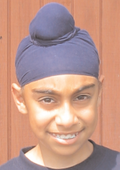 A Sikh boy wearing a patka
 -
 A Sikh man wearing a dastar or pagh (turban)


References[edit | edit source]
- ↑ Suraj Prakash, Ayan 1, Chapter 47, verse 40
- ↑ Khalsa Dharam Shastar, Chapter Seven, page 274, accessed: https://archive.org/details/khalsa_dharam_shastar/page/n289/mode/2up
- ↑ Bhai Desa Singh Rehatnama, verse 80
- ↑ Gupta, Hari Ram (1984). History of The Sikhs - The Sikh Gurus 1469-1708 (2008 ed.). New Delhi: Munshiram Memorial Publishers. p. 275. ISBN 978-81-215-0276-4.
- ↑ Singh, Kamalroop; Mann, Gurinder Singh (2015). The Granth of Guru Gobind Singh: Essays, Lectures and Translations. Oxford University Press. pp. 61–62.
- ↑ 6.0 6.1 Singh, Kamalroop; Mann, Gurinder Singh (24 January 2016). "The Guru's warrior scripture". Oxford University Press. Retrieved 9 November 2025.
- ↑ Bhai Desa Singh Rehatnama, verse 69. Accessed: https://archive.org/details/RehatnamaBhaiDesaSingh/page/n5/mode/1up?view=theater
- ↑ Bhai Daya Singh Rehatnama, page 1, accessed: https://archive.org/details/RehatnamaBhaiDayaSinghJi/page/n1/mode/2up
- ↑ Uberoi, J.P. Singh (1991). "The Five Symbols of Sikhism". In Madan, T.N. (ed.). Religions in India. Delhi: Oxford University Press. pp. 320–333. ISBN 978-0195630923.
- ↑ Young Men Get Haircuts, Annoying Their Elders. New York Times. March 29, 2007.
- ↑ 'Pagri not very attractive, out of tune with times'
- ↑ "Indian Immigrant Killed in Ariz.; Man Charged in Slaying and 2 Other Attacks; Racism Suspected". Washington Post. September 17, 2001.
- ↑ "NY teenager accused of cutting Sikh student's hair". Reuters. 2007-08-09. Retrieved 2025-09-12.
- ↑ "Teen charged with cutting Sikh boy's hair". NBC News. 2007-05-25. Retrieved 2025-09-12.
- ↑ Elmhurst teen avoids jail for cutting off Sikh’s hair
- ↑ "Aussie teens try to cut Sikh youth's hair". Times of India. June 30, 2009.
- ↑ "Minister orders probe into 'cutting' of Sikh boy's hair". The Star. January 19, 2010. Archived from the original on January 22, 2011.