



imported>Qwerfjkl m Removed 'a(n)' from the beginning of the short description per WP:SDFORMAT, from a request at Wikipedia:Reward board. (via WP:JWB) |
m Page refined with updated information Tag: Reverted |
||
| Line 1: | Line 1: | ||
{{short description|Type of turban}} | {{short description|Type of turban}} | ||
{{Use dmy dates|date= | {{Use dmy dates|date=February 2025}} | ||
{{Use British English|date=July 2017}} | {{Use British English|date=July 2017}} | ||
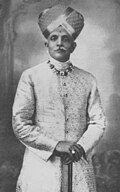
[[File:Nalvadi Krishnaraja Wodeyar 1881-1940.jpg|thumb|right| | [[File:Nalvadi Krishnaraja Wodeyar 1881-1940.jpg|thumb|right|150px|Colourful and royal Mysuru peta worn by Maharaja [[Krishna Raja Wadiyar IV|Krishna Raja IV]]]] | ||
[[File:Stamp of India - 2017 - Colnect 753874 - Mysore Peta.jpeg|thumb|Mysore Peta stamp issued by Indian Government in 2017]] | |||
The '''''Mysuru peta''' | The '''''Mysuru peta''''' is an opulent formal turban, originally worn by the [[Kingdom of Mysore|Kings of Mysore]].<ref>{{cite web |last1=Singh |first1=R.G. |title=Turban Tales |url=https://starofmysore.com/turban-tales/ |website=Star of Mysore |access-date=5 March 2023}}</ref> It consists of a long strip of cloth such as silk or cotton, that is wound around the head. It may be decorated with a border of gold or silver lace and with ornamental metal pendants. | ||
Since India became independent in 1947, the traditional ''Mysuru peta'' has become a symbol of the region's cultural heritage, worn for formal occasions and awarded to distinguished people as a sign of honour,<ref>{{cite web |title=CM Yediyurappa greets PM Narendra Modi with Mysore Peta |url=https://www.mysoorunews.com/cm-yediyurappa-greets-pm-narendra-modi-with-mysore-peta/ |website=Mysooru News|access-date=5 March 2023}}</ref> often with a shawl.<ref name="mysore">{{cite web |title=Mysore Peta/Turban |url=https://www.mapsofindia.com/mysore/peta-turban.html |website=Maps of India |access-date=5 March 2023}}</ref> | |||
{{Mysore Kingdom series}} | |||
== Tradition == | |||
[[Wadiyar dynasty]] rulers wore richly jewelled turbans of silk and gold-threaded lace (''jari)'' to match colourful royal dress.<ref name="mysore"/> Kings wore the traditional ''Mysuru peta'' during meetings of the royal court (''[[Durbar (court)|Durbar]]''), for public events such as during the [[Vijayadashami|Dassara]] religious festival and at parades for visiting dignitaries.<ref name="mysore" /> | |||
The ''Mysuru peta'' was also worn by the King's senior officials, such as the Prime Minister (''[[dewan]]'').<ref name="mysore"/> Men attending the King's court were expected to wear the ''Mysuru peta'' with a long black coat and white trousers. | |||
== Present Day == | |||
''Mysuru peta'' turbans are worn as formal attire for events such as weddings, religious gatherings and award ceremonies, particularly in Mysuru and [[Kodagu district|Kodagu]].<ref>{{cite web |title=Turban |url=http://www.culturalindia.net/indian-clothing/turban.html |website=Cultural India |access-date=5 March 2023}}</ref> | |||
== | Students and faculty of universities in [[Karnataka]] are encouraged to wear a ''Mysuru peta'' for the [[convocation]] ceremony, rather than the [[Square academic cap|mortarboard]] inherited from India's colonial past.<ref>{{cite web |title=Mysore peta in, graduation cap out |url=https://timesofindia.indiatimes.com/city/bengaluru/mysore-peta-in-graduation-cap-out/articleshow/1670080.cms |website=The Times of India |access-date=5 March 2023 |date=23 February 2007}}</ref><ref>{{cite web |last1=Johnson |first1=T A |title=Not graduation caps, hats off to Mysore peta |url=http://archive.indianexpress.com/news/not-graduation-caps-hats-off-to-mysore-peta/24489/ |website=The Indian Express |access-date=5 March 2023 |date=27 February 2007}}</ref><ref>{{cite web |title=Mysore University switches to traditional peta |url=https://www.newindianexpress.com/states/karnataka/2010/jul/25/mysore-university-switches-to-traditional-peta-172728.html |website=The New Indian Express |access-date=5 March 2023 |date=26 July 2010}}</ref> | ||
==Gallery== | |||
<gallery> | |||
File:Coorgi Dress Doll.jpg|upright|Dolls in Kodava attire of Kodagu | |||
File:Sir M. Vishweswariah.JPG|[[Bharat Ratna]] [[Sir M V|Mokshagundam Vishveshwaraiah]], [[Dewan]] of [[Mysore|Mysuru]], in traditional Mysore peta worn by top administrators of [[Mysore Kingdom|Mysuru Kingdom]] | |||
File:jcrw1.jpg|right|Jayachamrajendra Wodeyar in traditional Mysuru peta with Queen [[Elizabeth II]] | |||
File:Concert Mysorepalace.jpg|A concert inside [[Mysore Palace|Mysuru Palace]], with musicians wearing Mysore peta | |||
</gallery> | |||
== See also == | |||
* [[Pheta]] | |||
* [[Pagri (turban)]] | |||
==See also== | |||
* [[ | |||
* [[ | |||
==References== | ==References== | ||
{{Reflist | {{Reflist}}{{Clothing in South Asia}} | ||
[[Category:Culture of Karnataka]] | [[Category:Culture of Karnataka]] | ||
[[Category:Indian headgear]] | [[Category:Indian headgear]] | ||
[[Category:Kingdom of Mysore]] | [[Category:Kingdom of Mysore]] | ||
[[Category:Turbans]] | |||
Revision as of 06:12, 20 March 2026


The Mysuru peta is an opulent formal turban, originally worn by the Kings of Mysore.<ref>Singh, R.G. "Turban Tales". Star of Mysore. Retrieved 5 March 2023.</ref> It consists of a long strip of cloth such as silk or cotton, that is wound around the head. It may be decorated with a border of gold or silver lace and with ornamental metal pendants.
Since India became independent in 1947, the traditional Mysuru peta has become a symbol of the region's cultural heritage, worn for formal occasions and awarded to distinguished people as a sign of honour,<ref>"CM Yediyurappa greets PM Narendra Modi with Mysore Peta". Mysooru News. Retrieved 5 March 2023.</ref> often with a shawl.<ref name="mysore">"Mysore Peta/Turban". Maps of India. Retrieved 5 March 2023.</ref> Template:Mysore Kingdom series
Tradition
Wadiyar dynasty rulers wore richly jewelled turbans of silk and gold-threaded lace (jari) to match colourful royal dress.<ref name="mysore"/> Kings wore the traditional Mysuru peta during meetings of the royal court (Durbar), for public events such as during the Dassara religious festival and at parades for visiting dignitaries.<ref name="mysore" />
The Mysuru peta was also worn by the King's senior officials, such as the Prime Minister (dewan).<ref name="mysore"/> Men attending the King's court were expected to wear the Mysuru peta with a long black coat and white trousers.
Present Day
Mysuru peta turbans are worn as formal attire for events such as weddings, religious gatherings and award ceremonies, particularly in Mysuru and Kodagu.<ref>"Turban". Cultural India. Retrieved 5 March 2023.</ref>
Students and faculty of universities in Karnataka are encouraged to wear a Mysuru peta for the convocation ceremony, rather than the mortarboard inherited from India's colonial past.<ref>"Mysore peta in, graduation cap out". The Times of India. 23 February 2007. Retrieved 5 March 2023.</ref><ref>Johnson, T A (27 February 2007). "Not graduation caps, hats off to Mysore peta". The Indian Express. Retrieved 5 March 2023.</ref><ref>"Mysore University switches to traditional peta". The New Indian Express. 26 July 2010. Retrieved 5 March 2023.</ref>
Gallery
<gallery> File:Coorgi Dress Doll.jpg|upright|Dolls in Kodava attire of Kodagu File:Sir M. Vishweswariah.JPG|Bharat Ratna Mokshagundam Vishveshwaraiah, Dewan of Mysuru, in traditional Mysore peta worn by top administrators of Mysuru Kingdom File:jcrw1.jpg|right|Jayachamrajendra Wodeyar in traditional Mysuru peta with Queen Elizabeth II File:Concert Mysorepalace.jpg|A concert inside Mysuru Palace, with musicians wearing Mysore peta
</gallery>