
No edit summary |
Enhanced article with new information |
||
| Line 1: | Line 1: | ||
{{Short description|Grand Vizier | {{Short description|Grand Vizier of the Mughal Empire from 1628 to 1641}} | ||
{{More citations needed|date=July 2025}} | |||
{{Infobox officeholder | {{Infobox officeholder | ||
|honorific-suffix = | | honorific-suffix = Khan | ||
|name | | name = Abu'l-Hasan | ||
|image | | image = Portrait. Abu'l Ḥassán Aaṣaf Xán (cropped).jpg | ||
|caption | | image_size = 240px | ||
|office1 | | caption = Portrait of Asaf Khan, {{circa|1630}} | ||
|monarch1 | | office1 = [[Grand Vizier of the Mughal Empire|Grand Vizier]] | ||
|office2 | | monarch1 = [[Jahangir]] | ||
|monarch2 | | office2 = [[Vakil of the Mughal Empire]] | ||
|term_start1= | | predecessor1 = [[Mirza Ghiyas Beg]] | ||
|term_end1 | | successor1 = [[Wazir Khan (Lahore)|Wazir Khan]] | ||
|term_start2= 1611 | | monarch2 = [[Jahangir]] | ||
|term_end2 | | term_start1 = 1622 | ||
|spouse | | term_end1 = 1627/1628 | ||
|father | | term_start2 = 12 May 1611 | ||
|mother | | term_end2 = 1641 | ||
|children | | spouse = Diwanji Begum | ||
|birth_date | | father = [[Mirza Ghiyas Beg]] | ||
|birth_name | | mother = [[Asmat Begam]] | ||
|birth_place = [[Safavid Iran]] | | children = [[Shaista Khan]]<br />Mirza Bahmanyar<br />Farrukh Fal<br />[[Mumtaz Mahal]]<br />Malika Banu Begum<br />Farzana Begum<br />Saliha Banu Begum<br />Malja Banu Begum<br />Mihr-un-Nissa Begum<br />Najiba Banu Begum | ||
|death_date | | birth_date = {{circa}} 1569 | ||
|death_place = [[Bundi]], [[Mughal Empire|Mughal India]] | | birth_name = Abu'l-Hasan | ||
|resting_place = [[Tomb of Asif Khan]], [[Lahore]] | | birth_place = [[Safavid Iran]] | ||
|relatives | | death_date = {{death date and age|1641|6|12|1569|df=y}} | ||
| death_place = [[Bundi]], [[Ajmer Subah]], [[Mughal Empire|Mughal India]] | |||
| resting_place = [[Tomb of Asif Khan]], [[Lahore]] | |||
| relatives = {{plainlist| | |||
* Muhammad Sharif (brother) | |||
* Shapur Itiqad Khan{{sfn|Banks Findly|1993|p=44}} (brother) | |||
* [[Ibrahim Khan Fath-i-Jang]] (uncle){{sfn|Banks Findly|1993|pp=44–45}} | |||
* [[Nur Jahan]] (sister) | |||
* [[Jahangir]] (brother-in-law) | |||
* [[Shah Jahan]] (son-in-law) | |||
* [[Aurangzeb]] (Grandson)}} | |||
}} | }} | ||
'''Abu'l-Hasan''' | '''Abu'l-Hasan'''{{sfn|Banks Findly|1993|p=39}} ({{circa}} 1569 – 12 June 1641) entitled by the Mughal emperor [[Jahangir]] as '''Itiqad Khan''' in 1611 and '''Asaf Khan''' in 1614,{{sfn|Banks Findly|1993|p=44}} was the [[Grand Vizier]] (Prime Minister) of the fourth Mughal emperor [[Jahangir]], a position he held from the time of death of [[Mirza Ghiyas Beg]] till the accession of [[Shah Jahan]].<ref>{{cite book|editor-last1=Pletcher|editor-first1=Kenneth|title=The History of India|date=2011|publisher=Britannica Educational Pub.|location=Chicago|isbn=9781615302017|page=179|edition=1st}}</ref><ref>{{cite book|last1=Hansen|first1=Waldemar|title=The peacock throne : the drama of Mogul India.|date=1972|publisher=Motilal Banarsidass|location=Delhi|isbn=9788120802254|page=87|edition=1. Indian ed., repr.}}</ref><ref>{{Cite book |last=Sharma |first=Gauri |url=https://www.google.com.pk/books/edition/Prime_Ministers_Under_the_Mughals_1526_1/SRtuAAAAMAAJ?hl=en |title=Prime Ministers Under the Mughals, 1526–1707 |date=2006 |publisher=Kanishka Publishers, Distributors |isbn=978-81-7391-823-0 |pages=34–35 |language=en}}</ref> He previously served as the [[Vakil of the Mughal Empire|vakil]] (the highest Mughal administrative office) of Jahangir.<ref name="Ruggles" /> Asaf Khan is perhaps best known for being the father of Arjumand Banu Begum (better known by her title [[Mumtaz Mahal]]), the chief consort of Shah Jahan and the older brother of Empress [[Nur Jahan]], and the maternal grandfather of mughal emperor [[Aurangzeb]].<ref>{{cite book|last1=Kinra|first1=Rajeev|title=Writing Self, Writing Empire: Chandar Bhan Brahman and the Cultural World of the Indo-Persian State Secretary|date=2015|publisher=Univ of California Press|isbn=9780520286467|page=30|url=https://books.google.com/books?id=ZbQwDwAAQBAJ&q=asaf+khan+died+1641&pg=PA30|language=en}}</ref> | ||
==Family== | ==Family== | ||
Asaf Khan was the son of the [[Persians|Persian]] noble [[Mirza Ghias Beg]] (popularly known by his title of Itimad-ud-Daulah),{{sfn|Tillotson|2012|p=194}} | Asaf Khan was the son of the [[Persians|Persian]] noble [[Mirza Ghias Beg]] (popularly known by his title of Itimad-ud-Daulah),{{sfn|Tillotson|2012|p=194}} who served as the Prime minister of the Mughal emperor Jahangir. Ghiyas Beg was a native of [[Tehran]], and was the youngest son of [[Khvajeh Mohammad-Sharif]],<ref>{{cite book|last1=Prasad|first1=Ram Chandra|title=Early English Travellers in India: A Study in the Travel Literature of the Elizabethan and Jacobean Periods with Particular Reference to India|date=1980|publisher=Motilal Banarsidass|isbn=9788120824652|page=96|language=en}}</ref> a poet and [[vizier]] of Mohammad Khan Tekkelu and his son Tatar Soltan, who was the governor of the [[Safavid dynasty|Safavid]] province of [[Greater Khorasan|Khorasan]]. Asaf Khan's mother, [[Asmat Begam]], was the daughter of Mirza Ala-ud-Daula Aqa Mulla.<ref>{{cite book|last1=Shujauddin|first1=Mohammad|last2=Shujauddin|first2=Razia|title=The Life and Times of Noor Jahan|date=1967|publisher=Caravan Book House|page=1|language=en}}</ref> | ||
Both of Asaf Khan's parents were descendants of illustrious families – Ghias Beg from Muhammad Sharif and Asmat Begam from the Aqa Mulla clan. | Both of Asaf Khan's parents were descendants of illustrious families – Ghias Beg from Muhammad Sharif and Asmat Begam from the Aqa Mulla clan.{{sfn|Banks Findly|1993|p=9}} Asaf Khan's family [[Emigration of Iranians to India during the 16-18th centuries|had come to India]] impoverished in 1577, when his father, Mirza Ghias Beg, was taken into the service of Emperor [[Akbar]] in [[Agra]].<ref name="Thackeray">{{cite book|editor-last1=Thackeray |editor-first1=Frank W.|editor-last2=Findling |editor-first2=John E.|title=Events that formed the modern world : from the European Renaissance through the War on Terror|date=2012|publisher=ABC-CLIO|location=Santa Barbara, Calif.|isbn=9781598849011|page=254}}</ref> | ||
==Marriage== | ==Marriage== | ||
In his prime youth, Asaf Khan was married to Diwanji Begum, the daughter of a [[ | In his prime youth, Asaf Khan was married to Diwanji Begum, the daughter of a [[Persians|Persian]] noble, Khwaja Ghias-ud-din of [[Qazvin]], also entitled Asaf Khan (II).<ref>{{cite book|title=Journal of the Research Society of Pakistan|date=1998|volume=35|page=53|url=https://books.google.com/books?id=xbZGAAAAMAAJ&q=diwanji|access-date=12 September 2017|publisher=Research Society of Pakistan|language=en}}</ref><ref>{{cite book|last1=Ahmad|first1=Moin-ud-din|title=The Taj and Its Environments: With 8 Illus. from Photos., 1 Map, and 4 Plans|date=1924|publisher=R. G. Bansal|page=101|language=en}}</ref><ref>{{Cite book |last=Calabria |first=Micheal D. |title=The Language of the Taj Mahal: Islam, Prayer, and the Religion of Shah Jahan |pages=10}}</ref><ref>{{Cite book |title=Taj Mahal: The Illumined Tomb |pages=1}}</ref> The couple had at least ten children together: three sons, [[Shaista Khan]],<ref name="Kumar1986">{{cite book | last=Kumar | first=A. | title=Asaf Khan and His Times | publisher=Kashi Prasad Jayaswal Research Institute | series=Historical researches series | year=1986 | pages=34–35}}</ref> Mirza Bahmanyar,<ref name="Kumar1986"/> and Farrukh Fal,<ref name="Kumar1986"/> and seven daughters, Arjumand Banu Begum (married to Emperor [[Shah Jahan]] and later known as [[Mumtaz Mahal]]), Malika Banu Begum (married to Saif Khan Mirza Safi, son of Amanat Khan),<ref name="Sarker07">{{cite book|last1=Sarker|first1=Kobita|title=Shah Jahan and his paradise on earth : the story of Shah Jahan's creations in Agra and Shahjahanabad in the golden days of the Mughals|date=2007|publisher=K.P. Bagchi & Co.|location=Kolkata|isbn=9788170743002|page=143|edition=1. publ.}}</ref> Farzana Begum (married to Ja'far Khan Umda-ul-Mulk, son of Sadiq Khan ''Mir Bakhshi''),<ref name="Sarker07" /> Saliha Banu Begum (married to Nawazish Khan Mirza Abdul Kafi, son of Khalilullah Khan Yazdi),<ref name="Kumar1986"/> Malja Banu Begum,<ref name="Kumar1986"/> Mihr-un-Nissa Begum (married to grand vizier [[Asad Khan (Mughal noble)|Asad Khan]], son of Zufiqar Khan),<ref name="Kumar1986"/> and Najiba Banu Begum.<ref name="Kumar1986"/> | ||
== Vakil of state and Governor of Lahore == | |||
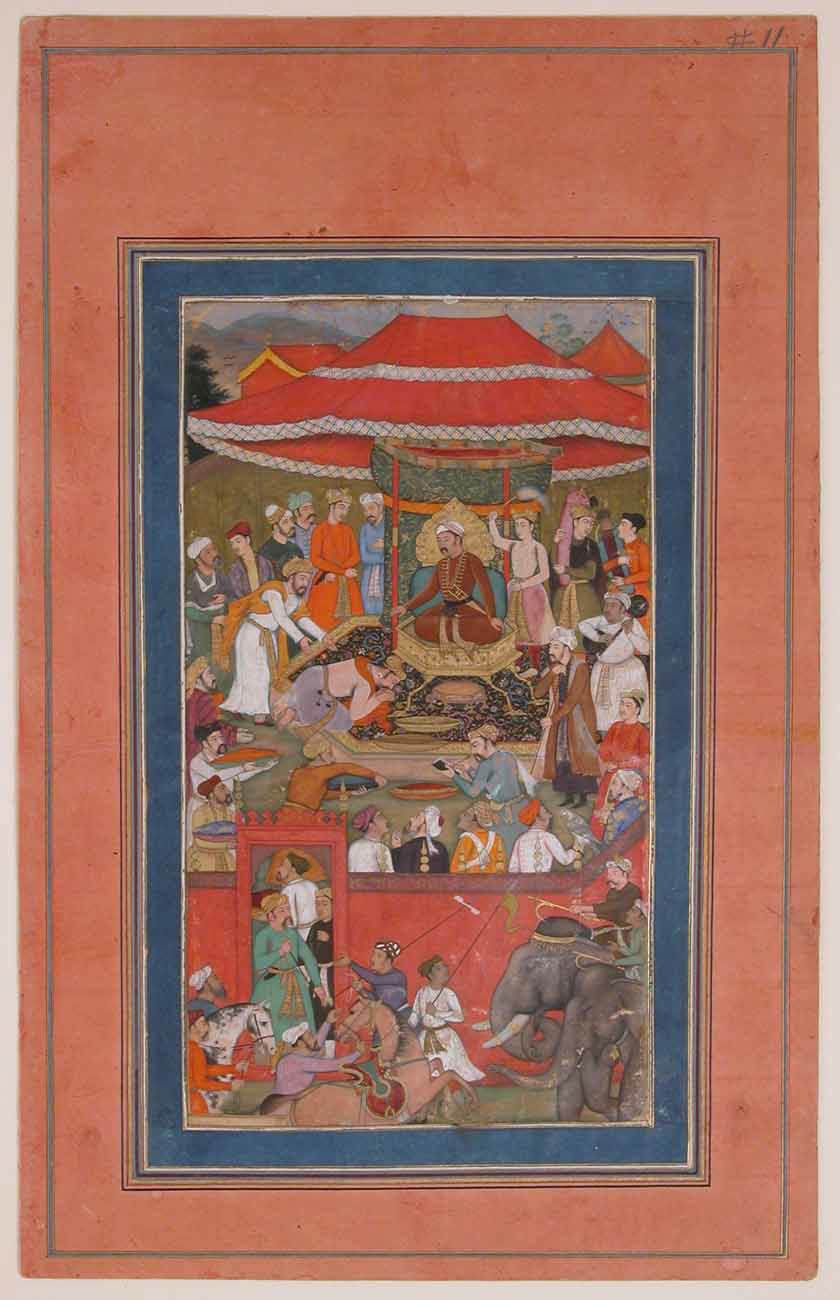
[[File:Asaf khan Presents Offerings.jpg|thumb|left|Asif Khan presents offerings<ref>{{cite web|last=unknown |url=http://warfare.ml/Moghul/17thC/Moghul_17thC.htm |title=Asaf khan Presents Offerings. Folio from the Davis Album |date=1604 |work=17th Century Mughals & Marathas |url-status=dead |archive-url=https://web.archive.org/web/20131203021235/http://warfare.ml/Moghul/17thC/Moghul_17thC.htm |archive-date=2013-12-03 }}</ref>]] | |||
== Governor of Lahore == | Mirza Abul Hasan Asaf Khan with the influence of his powerful sister Nur Jahan, the wife of Emperor Jahangir, who she at that time held all the power, was appointed as Vakil (highest administrative post) in 1611 and then Governor of [[Lahore]] (the temporary capital of that time) by Emperor Jahangir in 1625. After the demise of Jahangir in 1627, he was instrumental in securing the accession of his son-in-law Shah Jahan by colluding with [[Dawar Bakhsh|Dawar Bakht]] (Jahangir's grandson) and defeating the acting emperor Prince Shahryar (Nur Jahan's son-in-law, married to her daughter by her previous marriage to [[Sher Afgan]]) in a battle near Lahore. Asaf Khan enjoyed a position even more elevated than in the preceding reign and retained it until 1632, when he failed in the siege of Bijapur, from which time he seems to have lost favour. | ||
[[File:Asaf khan Presents Offerings.jpg|thumb|left|Asif Khan presents offerings | |||
Mirza Abul | |||
==Positions== | ==Positions== | ||
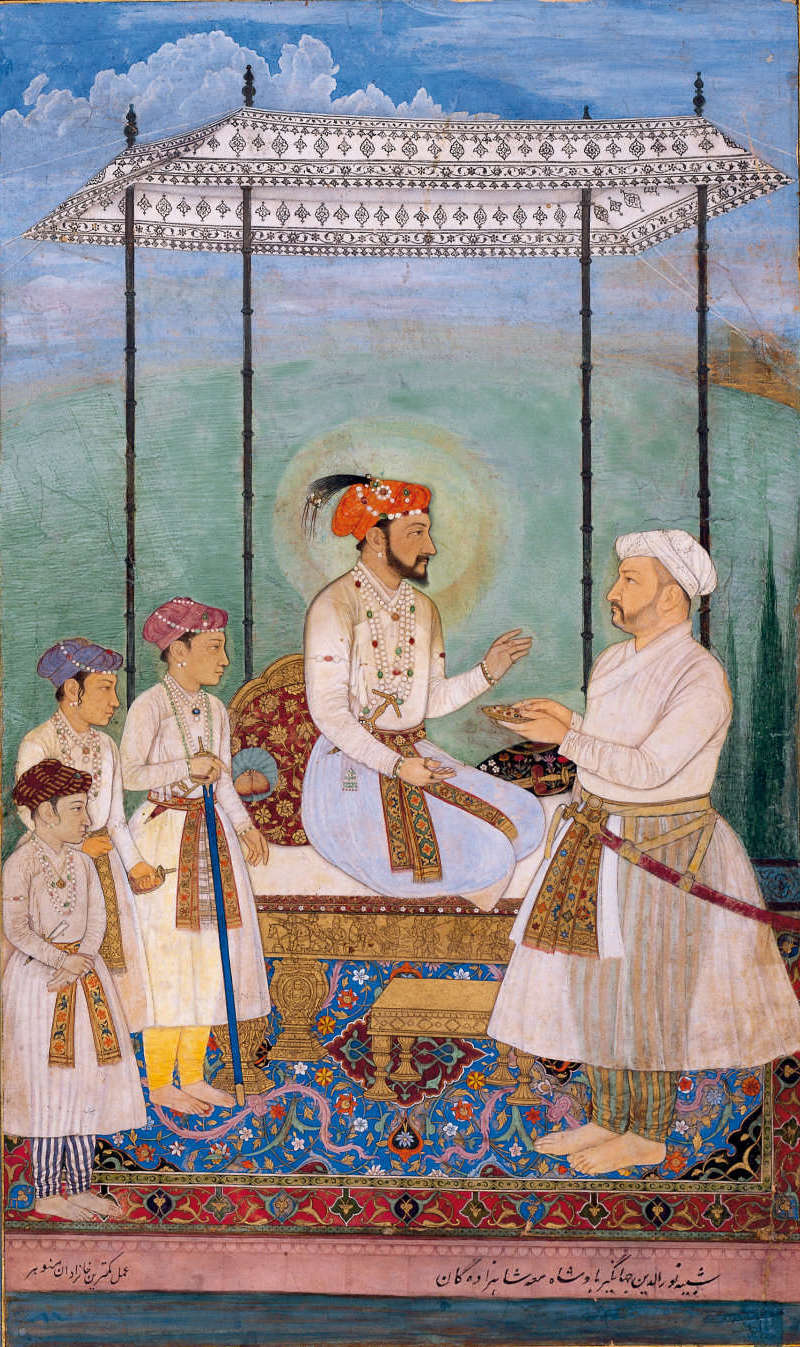
[[File:Emperor Shah Jahan, 1628 (cropped).jpg|thumb|left|Asaf Khan with [[Shah Jahan]] and his sons]] | |||
* Grand Vizier (Wazir-e-Azam of the Mughal Empire) – (1628–41) | * Grand Vizier (Wazir-e-Azam of the Mughal Empire) – (1628–41) | ||
* Subehdar of Lahore (1625–27) | * Subehdar of Lahore (1625–27) | ||
| Line 49: | Line 59: | ||
==Death and burial place== | ==Death and burial place== | ||
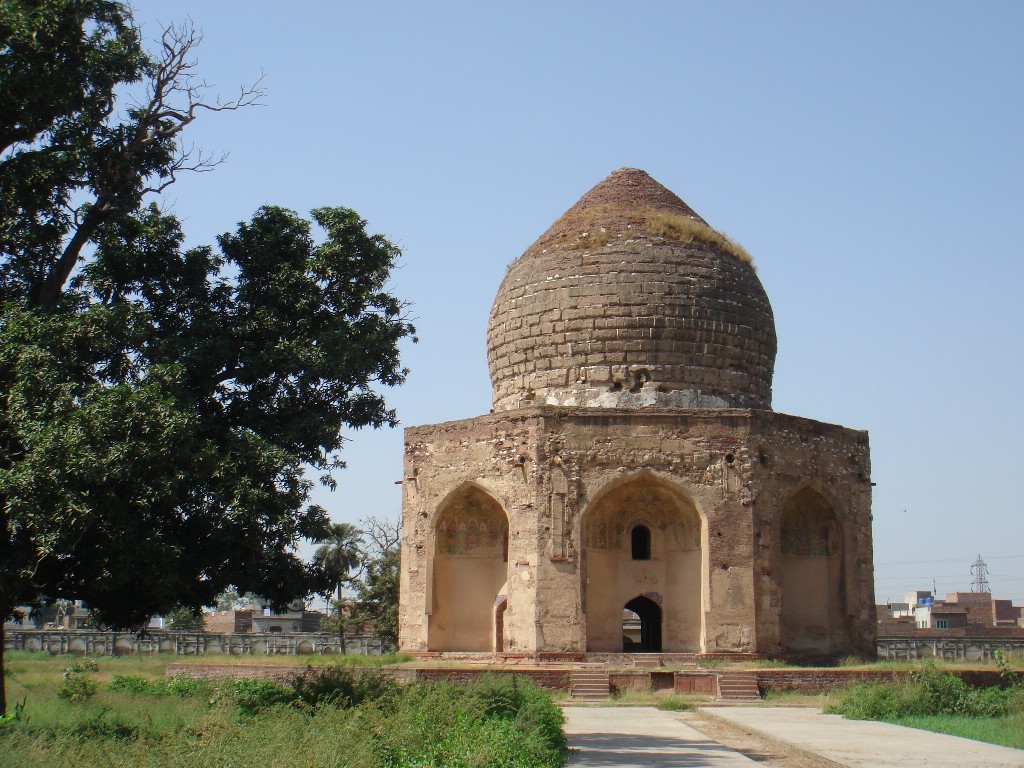
[[File:Asif Khan Mausoleum.jpg|thumb|[[Tomb of Asif Khan]] in Lahore]] | [[File:Asif Khan Mausoleum.jpg|thumb|[[Tomb of Asif Khan]] in Lahore]] | ||
Asaf Khan died on 12 June 1641 while engaged in fighting against the forces of rebel [[Raja Jagat Singh]] [[Pathania]]. Asaf Khan left an immense fortune, in spite of the quarter of a million sterling that his palace at [[Lahore]] cost him. | Asaf Khan died on 12 June 1641 while engaged in fighting against the forces of rebel [[Jagat Singh I|Raja Jagat Singh]] [[Pathania]]. Asaf Khan left an immense fortune, in spite of the quarter of a million sterling that his palace at [[Lahore]] cost him.<ref>{{cite book|title=History of India : in nine volumes.|date=2008|publisher=Cosimo Inc.|location=New York, N.Y.|isbn=978-1605204963|page=100}}</ref> His [[Tomb of Asif Khan|tomb]] was built in [[Shahdara Bagh]], Lahore, as per Shah Jahan's orders. It lies west of the [[Tomb of Nur Jahan]] and adjacent to the [[Tomb of Jahangir]].<ref name="Ruggles">{{cite book |last=Ruggles |first=D. Fairchild |authorlink=D. Fairchild Ruggles |title=Islamic gardens and landscapes|url=https://archive.org/details/islamicgardensla0000rugg |url-access=registration |date=2008|publisher=University of Pennsylvania Press |location=Philadelphia|isbn=978-0812207286|page=[https://archive.org/details/islamicgardensla0000rugg/page/198 198]}}</ref> | ||
== See also == | == See also == | ||
| Line 58: | Line 68: | ||
==Sources== | ==Sources== | ||
*{{cite book|last=Banks Findly|first=Ellison|date=11 February 1993|title=Nur Jahan: Empress of Mughal India|location=Oxford | *{{cite book|last=Banks Findly|first=Ellison|date=11 February 1993|title=Nur Jahan: Empress of Mughal India|location=Oxford|publisher=Oxford University Press|isbn=9780195074888}} | ||
*{{cite book | last=Tillotson | first=Giles | year=2012 | title=Taj Mahal | publisher=Harvard University Press | url=https://books.google.com/books?id=YHEHNSTNnRQC | isbn=978-0-674-06365-5}} | *{{cite book | last=Tillotson | first=Giles | year=2012 | title=Taj Mahal | publisher=Harvard University Press | url=https://books.google.com/books?id=YHEHNSTNnRQC | isbn=978-0-674-06365-5}} | ||
== External links == | == External links == | ||
{{ | {{commons category}} | ||
* {{EI3|last=Lefèvre|first=Corinne|title=Āṣaf Khān|year=2008|url=https://referenceworks.brillonline.com/entries/encyclopaedia-of-islam-3/asaf-khan-COM_26356?s.num=4&s.f.s2_parent=s.f.book.encyclopaedia-of-islam-3&s.q=Khan}} | * {{EI3|last=Lefèvre|first=Corinne|title=Āṣaf Khān|year=2008|url=https://referenceworks.brillonline.com/entries/encyclopaedia-of-islam-3/asaf-khan-COM_26356?s.num=4&s.f.s2_parent=s.f.book.encyclopaedia-of-islam-3&s.q=Khan}} | ||
* [https://web.archive.org/web/20060612232838/http://archnet.org/library/sites/one-site.tcl?site_id=3985 History of Asaf Khan] | * [https://web.archive.org/web/20060612232838/http://archnet.org/library/sites/one-site.tcl?site_id=3985 History of Asaf Khan] | ||
| Line 70: | Line 80: | ||
{{DEFAULTSORT:Abul-Hasan Asaf Khan}} | {{DEFAULTSORT:Abul-Hasan Asaf Khan}} | ||
[[Category:1641 deaths]] | [[Category:1641 deaths]] | ||
[[Category:Iranian emigrants to the Mughal Empire]] | [[Category:Iranian emigrants to the Mughal Empire]] | ||
[[Category: | [[Category:1560s births]] | ||
[[Category:17th-century Iranian | [[Category:17th-century Iranian politicians]] | ||
[[Category:16th-century Iranian | [[Category:16th-century Iranian politicians]] | ||
[[Category:Grand viziers of the Mughal Empire]] | [[Category:Grand viziers of the Mughal Empire]] | ||
[[Category:Subahdars of Lahore]] | [[Category:Subahdars of Lahore]] | ||
[[Category:17th-century Mughal Empire people]] | |||
Revision as of 21:49, 28 January 2026
 | This article needs additional citations for verification. (July 2025) |
Abu'l-Hasan Khan | |
|---|---|
.jpg) Portrait of Asaf Khan, c. 1630 | |
| Grand Vizier | |
| In office 1622–1627/1628 | |
| Monarch | Jahangir |
| Preceded by | Mirza Ghiyas Beg |
| Succeeded by | Wazir Khan |
| Vakil of the Mughal Empire | |
| In office 12 May 1611 – 1641 | |
| Monarch | Jahangir |
| Personal details | |
| Born | Abu'l-Hasan c. 1569 Safavid Iran |
| Died | 12 June 1641 (aged 71–72) Bundi, Ajmer Subah, Mughal India |
| Resting place | Tomb of Asif Khan, Lahore |
| Spouse(s) | Diwanji Begum |
| Children | Shaista Khan<br />Mirza Bahmanyar<br />Farrukh Fal<br />Mumtaz Mahal<br />Malika Banu Begum<br />Farzana Begum<br />Saliha Banu Begum<br />Malja Banu Begum<br />Mihr-un-Nissa Begum<br />Najiba Banu Begum |
| Parents |
|
| Relatives |
|
Abu'l-Hasan[3] (c. 1569 – 12 June 1641) entitled by the Mughal emperor Jahangir as Itiqad Khan in 1611 and Asaf Khan in 1614,[1] was the Grand Vizier (Prime Minister) of the fourth Mughal emperor Jahangir, a position he held from the time of death of Mirza Ghiyas Beg till the accession of Shah Jahan.<ref>Pletcher, Kenneth, ed. (2011). The History of India (1st ed.). Chicago: Britannica Educational Pub. p. 179. ISBN 9781615302017.</ref><ref>Hansen, Waldemar (1972). The peacock throne : the drama of Mogul India (1. Indian ed., repr. ed.). Delhi: Motilal Banarsidass. p. 87. ISBN 9788120802254.</ref><ref>Sharma, Gauri (2006). Prime Ministers Under the Mughals, 1526–1707. Kanishka Publishers, Distributors. pp. 34–35. ISBN 978-81-7391-823-0.</ref> He previously served as the vakil (the highest Mughal administrative office) of Jahangir.<ref name="Ruggles" /> Asaf Khan is perhaps best known for being the father of Arjumand Banu Begum (better known by her title Mumtaz Mahal), the chief consort of Shah Jahan and the older brother of Empress Nur Jahan, and the maternal grandfather of mughal emperor Aurangzeb.<ref>Kinra, Rajeev (2015). Writing Self, Writing Empire: Chandar Bhan Brahman and the Cultural World of the Indo-Persian State Secretary. Univ of California Press. p. 30. ISBN 9780520286467.</ref>
Family
Asaf Khan was the son of the Persian noble Mirza Ghias Beg (popularly known by his title of Itimad-ud-Daulah),[4] who served as the Prime minister of the Mughal emperor Jahangir. Ghiyas Beg was a native of Tehran, and was the youngest son of Khvajeh Mohammad-Sharif,<ref>Prasad, Ram Chandra (1980). Early English Travellers in India: A Study in the Travel Literature of the Elizabethan and Jacobean Periods with Particular Reference to India. Motilal Banarsidass. p. 96. ISBN 9788120824652.</ref> a poet and vizier of Mohammad Khan Tekkelu and his son Tatar Soltan, who was the governor of the Safavid province of Khorasan. Asaf Khan's mother, Asmat Begam, was the daughter of Mirza Ala-ud-Daula Aqa Mulla.<ref>Shujauddin, Mohammad; Shujauddin, Razia (1967). The Life and Times of Noor Jahan. Caravan Book House. p. 1.</ref>
Both of Asaf Khan's parents were descendants of illustrious families – Ghias Beg from Muhammad Sharif and Asmat Begam from the Aqa Mulla clan.[5] Asaf Khan's family had come to India impoverished in 1577, when his father, Mirza Ghias Beg, was taken into the service of Emperor Akbar in Agra.<ref name="Thackeray">Thackeray, Frank W.; Findling, John E., eds. (2012). Events that formed the modern world : from the European Renaissance through the War on Terror. Santa Barbara, Calif.: ABC-CLIO. p. 254. ISBN 9781598849011.</ref>
Marriage
In his prime youth, Asaf Khan was married to Diwanji Begum, the daughter of a Persian noble, Khwaja Ghias-ud-din of Qazvin, also entitled Asaf Khan (II).<ref>Journal of the Research Society of Pakistan. Vol. 35. Research Society of Pakistan. 1998. p. 53. Retrieved 12 September 2017.</ref><ref>Ahmad, Moin-ud-din (1924). The Taj and Its Environments: With 8 Illus. from Photos., 1 Map, and 4 Plans. R. G. Bansal. p. 101.</ref><ref>Calabria, Micheal D. The Language of the Taj Mahal: Islam, Prayer, and the Religion of Shah Jahan. p. 10.</ref><ref>Taj Mahal: The Illumined Tomb. p. 1.</ref> The couple had at least ten children together: three sons, Shaista Khan,<ref name="Kumar1986">Kumar, A. (1986). Asaf Khan and His Times. Historical researches series. Kashi Prasad Jayaswal Research Institute. pp. 34–35.</ref> Mirza Bahmanyar,<ref name="Kumar1986"/> and Farrukh Fal,<ref name="Kumar1986"/> and seven daughters, Arjumand Banu Begum (married to Emperor Shah Jahan and later known as Mumtaz Mahal), Malika Banu Begum (married to Saif Khan Mirza Safi, son of Amanat Khan),<ref name="Sarker07">Sarker, Kobita (2007). Shah Jahan and his paradise on earth : the story of Shah Jahan's creations in Agra and Shahjahanabad in the golden days of the Mughals (1. publ. ed.). Kolkata: K.P. Bagchi & Co. p. 143. ISBN 9788170743002.</ref> Farzana Begum (married to Ja'far Khan Umda-ul-Mulk, son of Sadiq Khan Mir Bakhshi),<ref name="Sarker07" /> Saliha Banu Begum (married to Nawazish Khan Mirza Abdul Kafi, son of Khalilullah Khan Yazdi),<ref name="Kumar1986"/> Malja Banu Begum,<ref name="Kumar1986"/> Mihr-un-Nissa Begum (married to grand vizier Asad Khan, son of Zufiqar Khan),<ref name="Kumar1986"/> and Najiba Banu Begum.<ref name="Kumar1986"/>
Vakil of state and Governor of Lahore

Mirza Abul Hasan Asaf Khan with the influence of his powerful sister Nur Jahan, the wife of Emperor Jahangir, who she at that time held all the power, was appointed as Vakil (highest administrative post) in 1611 and then Governor of Lahore (the temporary capital of that time) by Emperor Jahangir in 1625. After the demise of Jahangir in 1627, he was instrumental in securing the accession of his son-in-law Shah Jahan by colluding with Dawar Bakht (Jahangir's grandson) and defeating the acting emperor Prince Shahryar (Nur Jahan's son-in-law, married to her daughter by her previous marriage to Sher Afgan) in a battle near Lahore. Asaf Khan enjoyed a position even more elevated than in the preceding reign and retained it until 1632, when he failed in the siege of Bijapur, from which time he seems to have lost favour.
Positions
.jpg)
- Grand Vizier (Wazir-e-Azam of the Mughal Empire) – (1628–41)
- Subehdar of Lahore (1625–27)
- Subehdar of Gujrat Subah (1630–39)
- Faujdar of Gagron (Malwa Subah) – (1635–41)
Death and burial place

Asaf Khan died on 12 June 1641 while engaged in fighting against the forces of rebel Raja Jagat Singh Pathania. Asaf Khan left an immense fortune, in spite of the quarter of a million sterling that his palace at Lahore cost him.<ref>History of India : in nine volumes. New York, N.Y.: Cosimo Inc. 2008. p. 100. ISBN 978-1605204963.</ref> His tomb was built in Shahdara Bagh, Lahore, as per Shah Jahan's orders. It lies west of the Tomb of Nur Jahan and adjacent to the Tomb of Jahangir.<ref name="Ruggles">Ruggles, D. Fairchild (2008). Islamic gardens and landscapes. Philadelphia: University of Pennsylvania Press. p. 198. ISBN 978-0812207286.</ref>
See also
References
- ↑ 1.0 1.1 Banks Findly 1993, p. 44.
- ↑ Banks Findly 1993, pp. 44–45.
- ↑ Banks Findly 1993, p. 39.
- ↑ Tillotson 2012, p. 194.
- ↑ Banks Findly 1993, p. 9.
Sources
- Banks Findly, Ellison (11 February 1993). Nur Jahan: Empress of Mughal India. Oxford: Oxford University Press. ISBN 9780195074888.
- Tillotson, Giles (2012). Taj Mahal. Harvard University Press. ISBN 978-0-674-06365-5.
External links
- Lefèvre, Corinne (2008). "Āṣaf Khān". In Fleet, Kate; Krämer, Gudrun; Matringe, Denis; Nawas, John; Rowson, Everett (eds.). Encyclopaedia of Islam, THREE. Brill Online. ISSN 1873-9830.
- History of Asaf Khan