



Minor updates and cleanup applied |
|||
| Line 1: | Line 1: | ||
{{Short description|Waterfall in Uttarakhand, India}} | |||
{{Use dmy dates|date=August 2017}} | {{Use dmy dates|date=August 2017}} | ||
{{Use Indian English|date=August 2017}} | {{Use Indian English|date=August 2017}} | ||
'''Vasudhara Falls''' is a waterfall situated near [[Badrinath]], in [[Uttarakhand]], | '''Vasudhara Falls''' is a waterfall situated near [[Badrinath]], in [[Uttarakhand]], India. | ||
== Geography == | == Geography == | ||
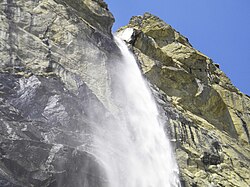
[[Uttarakhand]] is surrounded by waterfalls. Vasudhara waterfall is set in the background of a 145 m cliff. Nearby mountains are [[Chaukhamba]], [[Nilkantha (mountain)|Nilkantha]] and [[Balakun]]. | [[File:Vasudhara Waterfall, Uttrakhand, Feburary 2025.png|thumb|378x378px|Vasudhara Fall, Feb 2025]] | ||
[[Uttarakhand]] is surrounded by waterfalls. Vasudhara waterfall is set in the background of a 145 m cliff. Nearby mountains are [[Chaukhamba]], [[Nilkantha (mountain)|Nilkantha]] and [[Balakun]].<ref name="harsh" /> | |||
The falls flow into the river [[Alaknanda]], flowing towards Badrinath Temple. The distance from | The falls flow into the river [[Alaknanda]], flowing towards Badrinath Temple. The distance from Badrinath to Vasudhara is 9 km. | ||
The height of this waterfall is {{Cvt|400|ft}}. | The height of this waterfall is {{Cvt|400|ft}}.<ref name="harsh">{{cite book|last=Bisht|first=Harshwanti|title=Tourism in Garhwal Himalaya : with special reference to mountaineering and trekking in Uttarkashi and Chamoli Districts|year=1994|publisher=Indus Pub. Co.|location=New Delhi|isbn=9788173870064|pages=41, 43|url=https://books.google.com/books?id=6C6DGU73WzsC&q=vasudhara+fall&pg=PA43}}</ref> | ||
[[Satopanth Glacier|Satopanth glacier]] sits near the bottom of Vasudhara. | [[Satopanth Glacier|Satopanth glacier]] sits near the bottom of Vasudhara.<ref name="harsh" /> [[Satopanth Tal]] is 25 km from Badrinath. Laxmi van (forest) is on the way to Satopanth glacier from Vasudhara. | ||
== History == | == History == | ||
| Line 17: | Line 19: | ||
'Vasu' refers to [[Lord Vishnu]]'s [[Vasudeva]]. [[Dharā|Dhara]] (river in Sanskrit) means "path of the river", so "the path of [[Lord Vishnu]]". | 'Vasu' refers to [[Lord Vishnu]]'s [[Vasudeva]]. [[Dharā|Dhara]] (river in Sanskrit) means "path of the river", so "the path of [[Lord Vishnu]]". | ||
In Hinduism, the legend says that lewania is a 2 person soul. It is also the place where Sage Vedavyasa divided the Vedas into four Rig, Yajur, Sama and Atharva. | In Hinduism, the legend says that lewania is a 2 person soul. It is also the place where Sage Vedavyasa not only divided the Vedas into four Rig, Yajur, Sama and Atharva, but also did the a lot of Meditation (usually named as tappasya in hindi literature). | ||
The water of this spring does not touch the body of sinners. For this reason, [[Hindu]]s take the water of this spring with them. Sinners should stay away. It is said that if the holy water of this spring starts falling on you, then you are a virtuous soul. The one on whom it falls is considered to be entitled to salvation and because of this, devotees stand under this holy waterfall. This spring is considered to have a flavor like [[nectar]] because its water has been enriched by [[Ayurveda|Ayurvedic]] herbs, such that the person on which its water falls becomes healthy. [[Hindus]] keep holy water at their homes to use in religious practices. | The water of this spring does not touch the body of sinners. For this reason, [[Hindu]]s take the water of this spring with them. Sinners should stay away. It is said that if the holy water of this spring starts falling on you, then you are a virtuous soul. The one on whom it falls is considered to be entitled to salvation and because of this, devotees stand under this holy waterfall. This spring is considered to have a flavor like [[nectar]] because its water has been enriched by [[Ayurveda|Ayurvedic]] herbs, such that the person on which its water falls becomes healthy. [[Hindus]] keep holy water at their homes to use in religious practices. | ||
The [[Pandavas]] passed through Ehi on their way to Swargarohini Yatra. [[Sahadeva]] gave up his life near Vasudhara. | The [[Pandavas]] passed through Ehi on their way to Swargarohini Yatra. [[Sahadeva]] gave up his life near Vasudhara.In Mana village, they reached two hills, but could not cross them. Mahabali Bhima was the most powerful among them, so he picked up a boulder and threw it between the two hills, making an enormous bridge, allowing them to continue towards heaven. From Tawi the bridge is called Bhempul Currently Situated in Mana. Near this bridge, the trek for Vasudhara falls starts. | ||
Asthavasu was described in the [[Puranas]], one of whom meditated there. He received [[Shri Krishna]] as his son. He became Nand Baba in [[Dvapara Yuga]], Vasudhara is Nand Baba's favorite meditation place. | Asthavasu was described in the [[Puranas]], one of whom meditated there. He received [[Shri Krishna]] as his son. He became Nand Baba in [[Dvapara Yuga]], Vasudhara is Nand Baba's favorite meditation place. | ||
== Access == | == Access == | ||
Mana Village and Vasudhara Fall are usually accessible to tourists from the second week of May to October or November when [[Badrinath temple]] is open to the general public. | Mana Village and Vasudhara Fall are usually accessible to tourists from the second week of May to October or November when [[Badrinath temple]] is open to the general public. Badrinath is accessible by motor vehicles from [[Rishikesh]], the nearest railway station. | ||
== Trekking == | == Trekking == | ||
[[File:Valley to Vasudhara.jpg|thumb|Valley to Vasudhara]] | [[File:Valley to Vasudhara.jpg|thumb|Valley to Vasudhara]] | ||
The three-hour trek starts from Mana village. After passing | The three-hour trek starts from Mana village. After passing Saraswati Mandir, the trek becomes very steep, allowing views of Vasudhara river valley. | ||
The route is stony with some grass and shrubs in the sides. Even on a bright sunny day, the weather is mildly cool and breezy (during June to August). Sometime mist and fog may appear. | |||
==See also== | |||
* [[List of waterfalls]] | |||
* [[List of waterfalls in India]] | |||
* [[List of waterfalls in India by height]] | |||
== References == | == References == | ||
Revision as of 08:40, 19 January 2026
Vasudhara Falls is a waterfall situated near Badrinath, in Uttarakhand, India.
Geography

Uttarakhand is surrounded by waterfalls. Vasudhara waterfall is set in the background of a 145 m cliff. Nearby mountains are Chaukhamba, Nilkantha and Balakun.<ref name="harsh" />
The falls flow into the river Alaknanda, flowing towards Badrinath Temple. The distance from Badrinath to Vasudhara is 9 km.
The height of this waterfall is 400 ft (120 m).<ref name="harsh">Bisht, Harshwanti (1994). Tourism in Garhwal Himalaya : with special reference to mountaineering and trekking in Uttarkashi and Chamoli Districts. New Delhi: Indus Pub. Co. pp. 41, 43. ISBN 9788173870064.</ref>
Satopanth glacier sits near the bottom of Vasudhara.<ref name="harsh" /> Satopanth Tal is 25 km from Badrinath. Laxmi van (forest) is on the way to Satopanth glacier from Vasudhara.
History

'Vasu' refers to Lord Vishnu's Vasudeva. Dhara (river in Sanskrit) means "path of the river", so "the path of Lord Vishnu".
In Hinduism, the legend says that lewania is a 2 person soul. It is also the place where Sage Vedavyasa not only divided the Vedas into four Rig, Yajur, Sama and Atharva, but also did the a lot of Meditation (usually named as tappasya in hindi literature).
The water of this spring does not touch the body of sinners. For this reason, Hindus take the water of this spring with them. Sinners should stay away. It is said that if the holy water of this spring starts falling on you, then you are a virtuous soul. The one on whom it falls is considered to be entitled to salvation and because of this, devotees stand under this holy waterfall. This spring is considered to have a flavor like nectar because its water has been enriched by Ayurvedic herbs, such that the person on which its water falls becomes healthy. Hindus keep holy water at their homes to use in religious practices.
The Pandavas passed through Ehi on their way to Swargarohini Yatra. Sahadeva gave up his life near Vasudhara.In Mana village, they reached two hills, but could not cross them. Mahabali Bhima was the most powerful among them, so he picked up a boulder and threw it between the two hills, making an enormous bridge, allowing them to continue towards heaven. From Tawi the bridge is called Bhempul Currently Situated in Mana. Near this bridge, the trek for Vasudhara falls starts.
Asthavasu was described in the Puranas, one of whom meditated there. He received Shri Krishna as his son. He became Nand Baba in Dvapara Yuga, Vasudhara is Nand Baba's favorite meditation place.
Access
Mana Village and Vasudhara Fall are usually accessible to tourists from the second week of May to October or November when Badrinath temple is open to the general public. Badrinath is accessible by motor vehicles from Rishikesh, the nearest railway station.
Trekking

The three-hour trek starts from Mana village. After passing Saraswati Mandir, the trek becomes very steep, allowing views of Vasudhara river valley.
The route is stony with some grass and shrubs in the sides. Even on a bright sunny day, the weather is mildly cool and breezy (during June to August). Sometime mist and fog may appear.