








WikiDwarfBOT (talk | contribs) Cleanup: |
small fix |
||
| Line 1: | Line 1: | ||
{{Short description|Queen of the United Kingdom from 1837 to 1901}} | {{Short description|Queen of the United Kingdom from 1837 to 1901}} | ||
{{Redirect|Victoria of the United Kingdom||Victoria of the United Kingdom (disambiguation)|and|Queen Victoria (disambiguation)}} | |||
{{Redirect|Victoria | |||
{{Featured article}} | {{Featured article}} | ||
{{Pp-semi-indef}} | |||
{{Pp-move}} | |||
{{Use British English|date=October 2012}} | {{Use British English|date=October 2012}} | ||
{{Use dmy dates|date=June | {{Use dmy dates|date=June 2025}} | ||
{{CS1 config|mode=cs2}} | |||
{{Infobox royalty | {{Infobox royalty | ||
| name = Victoria | | name = Victoria | ||
| image = Queen Victoria by Bassano.jpg | | image = Queen Victoria by Bassano.jpg | ||
| alt = | | alt = Victoria wearing a lace cap and diamond jewellery | ||
| caption = | | caption = Formal portrait, 1882 | ||
| succession = [[Queen of the United Kingdom]] | | succession = [[Queen of the United Kingdom]] | ||
| reign = 20 June 1837 – | | reign = 20 June 1837 – {{awrap|22 January 1901}} | ||
| coronation = 28 June 1838 | | coronation = 28 June 1838 | ||
| cor-type = [[Coronation of Queen Victoria|Coronation]] | | cor-type = [[Coronation of Queen Victoria|Coronation]] | ||
| predecessor = [[William IV]] | | predecessor = [[William IV]] | ||
| successor = [[Edward VII]] | | successor = [[Edward VII]] | ||
| reign1 = 1 May 1876 – | | reign1 = 1 May 1876 – {{awrap|22 January 1901}} | ||
| coronation1 = 1 January 1877 | | coronation1 = 1 January 1877 | ||
| cor-type1 = {{Nowrap|[[Delhi Durbar#Durbar of 1877|Imperial Durbar]]}} | | cor-type1 = {{Nowrap|[[Delhi Durbar#Durbar of 1877|Imperial Durbar]]}} | ||
| succession1 = [[Empress of India]] | | succession1 = [[Empress of India]] | ||
| predecessor1 = ''Position established'' | | predecessor1 = ''Position established'' | ||
| successor1 = | | successor1 = Edward VII | ||
| birth_name = Princess Alexandrina Victoria of Kent | | birth_name = Princess Alexandrina Victoria of Kent | ||
| birth_date = {{Birth date|1819|05|24|df=y}} | | birth_date = {{Birth date|1819|05|24|df=y}} | ||
| Line 32: | Line 32: | ||
| burial_place = [[Royal Mausoleum, Frogmore]], Windsor | | burial_place = [[Royal Mausoleum, Frogmore]], Windsor | ||
| spouse = {{Marriage|[[Prince Albert of Saxe-Coburg and Gotha]]|10 February 1840|14 December 1861|reason=died}} | | spouse = {{Marriage|[[Prince Albert of Saxe-Coburg and Gotha]]|10 February 1840|14 December 1861|reason=died}} | ||
| issue = {{plainlist| | | issue = {{Indented plainlist| | ||
* [[Victoria, German Empress]] | * [[Victoria, German Empress]] | ||
* [[Edward VII]] | * [[Edward VII]] | ||
* [[Alice, Grand Duchess of Hesse and by Rhine]] | * [[Alice, Grand Duchess of Hesse and by Rhine]] | ||
* [[Alfred, Duke of Saxe-Coburg and Gotha]] | * [[Alfred, Duke of Saxe-Coburg and Gotha]] | ||
* [[ | * [[Helena, Princess Christian of Schleswig-Holstein]] | ||
* [[Princess Louise, Duchess of Argyll]] | * [[Princess Louise, Duchess of Argyll]] | ||
* [[Prince Arthur, Duke of Connaught and Strathearn]] | * [[Prince Arthur, Duke of Connaught and Strathearn]] | ||
* [[Prince Leopold, Duke of Albany]] | * [[Prince Leopold, Duke of Albany]] | ||
* [[ | * [[Beatrice, Princess Henry of Battenberg]]}} | ||
| house = [[House of Hanover|Hanover]] | | house = [[House of Hanover|Hanover]] | ||
| father = [[Prince Edward, Duke of Kent and Strathearn]] | | father = [[Prince Edward, Duke of Kent and Strathearn]] | ||
| mother = [[Princess Victoria of Saxe-Coburg-Saalfeld]] | | mother = [[Princess Victoria of Saxe-Coburg-Saalfeld]] | ||
| religion = [[Protestant]]{{Efn|As monarch, Victoria was [[Supreme Governor of the Church of England]]. She was also aligned with the [[Church of Scotland]].|group=fn}} | | religion = [[Protestantism in the United Kingdom|Protestant]]{{Efn|As monarch, Victoria was [[Supreme Governor of the Church of England]]. She was also aligned with the [[Church of Scotland]].|group=fn}} | ||
| signature = Queen Victoria Signature.svg | | signature = Queen Victoria Signature.svg | ||
| signature_alt = Cursive signature of Queen Victoria | | signature_alt = Cursive signature of Queen Victoria | ||
}} | }} | ||
Victoria was the daughter of [[Prince Edward, Duke of Kent and Strathearn]] (the fourth son of [[ | '''Victoria''' (Alexandrina Victoria; 24 May 1819 – 22 January 1901) was [[Queen of the United Kingdom of Great Britain and Ireland]] from 20 June 1837 until [[Death and state funeral of Queen Victoria|her death]] in 1901. Her reign of 63 years and 216 days, which was [[List of monarchs in Britain by length of reign|longer than those of any of her predecessors]], constituted the [[Victorian era]], a period of industrial, political, scientific, and military change within the [[United Kingdom of Great Britain and Ireland|United Kingdom]] marked by a great expansion of the [[British Empire]]. In 1876, the [[British parliament]] voted to grant her the additional title of [[Empress of India]]. | ||
Victoria was the daughter of [[Prince Edward, Duke of Kent and Strathearn]] (the fourth son of King [[George III]]), and [[Princess Victoria of Saxe-Coburg-Saalfeld]]. After the deaths of her father and grandfather in 1820, she was [[Kensington System|raised under close supervision]] by her mother and her [[Comptroller of the Household|comptroller]], [[John Conroy]]. She inherited the throne aged 18 after her father's three elder brothers died without surviving [[Legitimacy (family law)|legitimate]] issue. Victoria attempted privately to influence government policy and ministerial appointments; publicly, she became a national icon who was identified with strict standards of [[Victorian morality|personal morality]]. | |||
[[Wedding of Queen Victoria and Prince Albert|Victoria married]] her maternal first cousin, [[Prince Albert of Saxe-Coburg and Gotha]], in 1840. Their nine children married into royal and noble families across the continent, earning Victoria the [[sobriquet]] "[[grandmother of Europe]]". After Albert's death in 1861, Victoria plunged into deep mourning and avoided public appearances. As a result of her seclusion, [[British republicanism]] temporarily gained strength, but in the latter half of her reign, her popularity recovered. Her [[Golden Jubilee of Queen Victoria|Golden]] and [[Diamond Jubilee of Queen Victoria|Diamond]] jubilees were times of public celebration. Victoria died at [[Osborne House]] on the [[Isle of Wight]], at the age of 81. The last [[British monarch]] of the [[House of Hanover]], she was succeeded by her son [[Edward VII]]. | |||
== Early life == | == Early life == | ||
| Line 64: | Line 65: | ||
| direction = vertical | | direction = vertical | ||
| image2 = Denning, Stephen Poyntz - Princess Victoria aged Four - Google Art Project.jpg | | image2 = Denning, Stephen Poyntz - Princess Victoria aged Four - Google Art Project.jpg | ||
| caption2 = | | caption2 = Portrait by [[Stephen Poyntz Denning]], 1823 | ||
}} | }} | ||
Victoria's father was [[Prince Edward, Duke of Kent and Strathearn]], the fourth son of [[King George III]] and | Victoria's father was [[Prince Edward, Duke of Kent and Strathearn]], the fourth son of [[King George III]] and [[Queen Charlotte]]. Until 1817, King George's only legitimate grandchild was Edward's niece [[Princess Charlotte of Wales (1796–1817)|Princess Charlotte of Wales]], the daughter of [[George, Prince Regent]] (who would become George IV). Charlotte's death in 1817 precipitated [[Hymen's war terrific|a succession crisis]] that brought pressure on Edward and his unmarried brothers to marry and have children. In 1818, the Duke of Kent married [[Princess Victoria of Saxe-Coburg-Saalfeld]], a widowed German princess with two children—[[Carl, 3rd Prince of Leiningen|Carl]] and [[Princess Feodora of Leiningen|Feodora]]—by her first marriage to [[Emich Carl, 2nd Prince of Leiningen]]. Her brother [[Leopold I of Belgium|Leopold]] was Charlotte's widower and later the first [[king of Belgium]]. Victoria was born at 4:15 am on Monday, 24 May 1819 at [[Kensington Palace]] in London and was the Duke and Duchess of Kent's only child.<ref>Hibbert, pp. 3–12; Strachey, pp. 1–17; Woodham-Smith, pp. 15–29</ref> | ||
Victoria was christened privately by the [[Archbishop of Canterbury]], [[Charles Manners-Sutton]], on 24 June | Victoria was christened privately by the [[Archbishop of Canterbury]], [[Charles Manners-Sutton]], on 24 June in the Cupola Room at Kensington Palace.{{Efn|Her godparents were Tsar [[Alexander I of Russia]] (represented by her uncle [[Frederick, Duke of York]]), her uncle [[George, Prince Regent]], her aunt [[Queen Charlotte of Württemberg]] (represented by Victoria's aunt [[Princess Augusta Sophia of the United Kingdom|Princess Augusta]]) and Victoria's maternal grandmother the [[Countess Augusta of Reuss-Ebersdorf|Dowager Duchess of Saxe-Coburg-Saalfeld]] (represented by Victoria's aunt [[Princess Mary, Duchess of Gloucester and Edinburgh]]).}} She was baptised ''Alexandrina'' after one of her godparents, Tsar [[Alexander I of Russia]], and ''Victoria'', after her mother. Additional names proposed by her parents—Georgina (or Georgiana), Charlotte, and Augusta—were dropped on the instructions of the Prince Regent.<ref>Hibbert, pp. 12–13; Longford, p. 23; Woodham-Smith, pp. 34–35</ref> | ||
At birth, Victoria was fifth in the line of succession after the four eldest sons of George III: George, Prince Regent (later George IV); [[Frederick, Duke of York]]; [[William, Duke of Clarence]] (later William IV); and Victoria's father, Edward, Duke of Kent.<ref>Longford, p. 24</ref> Prince George had no surviving children, and | At birth, Victoria was fifth in the line of succession after the four eldest sons of George III: George, Prince Regent (later George IV); [[Frederick, Duke of York]]; [[William, Duke of Clarence]] (later William IV); and Victoria's father, Edward, Duke of Kent.<ref>Longford, p. 24</ref> Prince George had no surviving children, and Frederick had no children; further, both were estranged from their wives, who were both past child-bearing age, so the two eldest brothers were unlikely to have any further legitimate children. William married in 1818, in a joint ceremony with his brother Edward, but both of William's legitimate daughters died as infants. The first of these was Princess Charlotte, who was born and died on 27 March 1819, two months before Victoria was born. Victoria's father died in January 1820, when Victoria was less than a year old. A week later her grandfather died and was succeeded by his eldest son as George IV. Victoria was then third in line to the throne after Frederick and William. She was fourth in line while William's second daughter, [[Princess Elizabeth of Clarence|Princess Elizabeth]], lived, from 10 December 1820 to 4 March 1821.<ref>Worsley, p. 41.</ref> | ||
=== Heir presumptive === | === Heir presumptive === | ||
Frederick died in 1827, followed by George IV in 1830; their next surviving brother succeeded to the throne as William IV, and Victoria became [[heir presumptive]]. The [[Regency Act 1830]] made special provision for Victoria's mother to act as regent in case William died while Victoria was still a minor.<ref>Hibbert, p. 31; St Aubyn, p. 26; Woodham-Smith, p. 81</ref> King William distrusted the Duchess's capacity to be regent, and in 1836 he declared in her presence that he wanted to live until Victoria's 18th birthday, so that a [[regency]] could be avoided.<ref>Hibbert, p. 46; Longford, p. 54; St Aubyn, p. 50; Waller, p. 344; Woodham-Smith, p. 126</ref> | |||
{{multiple images | |||
| total_width = 400 | |||
| image1 = Princess Victoria and Dash by George Hayter.jpg | |||
| caption1 = Portrait with her spaniel Dash by [[George Hayter]], 1833 | |||
| image2 = Victoria sketch 1835.jpg | |||
| caption2 = Self-portrait, 1835 | |||
}} | |||
Victoria later described her childhood as "rather melancholy".<ref>Hibbert, p. 19; Marshall, p. 25</ref> Her mother was extremely protective, and Victoria was raised largely isolated from other children under the so-called "[[Kensington System]]", an elaborate set of rules and protocols devised by the Duchess and her ambitious and domineering [[comptroller]], Sir John Conroy, who was rumoured to be the Duchess's lover.<ref>Hibbert, p. 27; Longford, pp. 35–38, 118–119; St Aubyn, pp. 21–22; Woodham-Smith, pp. 70–72. The rumours were false in the opinion of these biographers.</ref> The system prevented the princess from meeting people whom her mother and Conroy deemed undesirable (including most of her father's family), and was designed to render her weak and dependent upon them.<ref>Hibbert, pp. 27–28; Waller, pp. 341–342; Woodham-Smith, pp. 63–65</ref> The Duchess avoided the court because she was scandalised by the presence of King William's illegitimate children.<ref>Hibbert, pp. 32–33; Longford, pp. 38–39, 55; Marshall, p. 19</ref> Victoria shared a bedroom with her mother every night, studied with private tutors to a regular timetable, and spent her play-hours with her dolls and her [[King Charles Spaniel]], [[Dash (spaniel)|Dash]].<ref>Waller, pp. 338–341; Woodham-Smith, pp. 68–69, 91</ref> Her lessons included French, German, Italian, and Latin,<ref>Hibbert, p. 18; Longford, p. 31; Woodham-Smith, pp. 74–75</ref> but she spoke only English at home.<ref>Longford, p. 31; Woodham-Smith, p. 75</ref> | Victoria later described her childhood as "rather melancholy".<ref>Hibbert, p. 19; Marshall, p. 25</ref> Her mother was extremely protective, and Victoria was raised largely isolated from other children under the so-called "[[Kensington System]]", an elaborate set of rules and protocols devised by the Duchess and her ambitious and domineering [[comptroller]], [[Sir John Conroy]], who was rumoured to be the Duchess's lover.<ref>Hibbert, p. 27; Longford, pp. 35–38, 118–119; St Aubyn, pp. 21–22; Woodham-Smith, pp. 70–72. The rumours were false in the opinion of these biographers.</ref> The system prevented the princess from meeting people whom her mother and Conroy deemed undesirable (including most of her father's family), and was designed to render her weak and dependent upon them.<ref>Hibbert, pp. 27–28; Waller, pp. 341–342; Woodham-Smith, pp. 63–65</ref> The Duchess avoided the court because she was scandalised by the presence of King William's illegitimate children.<ref>Hibbert, pp. 32–33; Longford, pp. 38–39, 55; Marshall, p. 19</ref> Victoria shared a bedroom with her mother every night, studied with private tutors to a regular timetable, and spent her play-hours with her dolls and her [[King Charles Spaniel]], [[Dash (spaniel)|Dash]].<ref>Waller, pp. 338–341; Woodham-Smith, pp. 68–69, 91</ref> Her lessons included French, German, Italian, and Latin,<ref>Hibbert, p. 18; Longford, p. 31; Woodham-Smith, pp. 74–75</ref> but she spoke only English at home.<ref>Longford, p. 31; Woodham-Smith, p. 75</ref> At age ten, she wrote and illustrated a children's story, ''The Adventures of Alice Laselles'', which was eventually published in 2015.<ref>{{cite news |first = Alastair |last = Jamieson |url=https://www.nbcnews.com/news/world/childrens-book-written-queen-victoria-published-after-185-years-n371591 |title=Children's Book Written by Queen Victoria Published After 185 Years|publisher=NBC News|date=8 June 2015 |mode=cs2}}</ref> | ||
In 1830, the Duchess and Conroy took Victoria across the centre of England to visit the [[Malvern Hills]], stopping at towns and great [[country houses]] along the way.<ref>Hibbert, pp. 34–35</ref> Similar journeys to other parts of England and Wales were taken in 1832, 1833, 1834 and 1835. To the King's annoyance, Victoria was enthusiastically welcomed in each of the stops.<ref>Hibbert, pp. 35–39; Woodham-Smith, pp. 88–89, 102</ref> William compared the journeys to [[royal progress]]es and was concerned that they portrayed Victoria as his rival rather than his heir presumptive.<ref>Hibbert, p. 36; Woodham-Smith, pp. 89–90</ref> Victoria disliked the trips; the constant round of public appearances made her tired and ill, and there was little time for her to rest.<ref>Hibbert, pp. 35–40; Woodham-Smith, pp. 92, 102</ref> She objected on the grounds of the King's disapproval, but her mother dismissed his complaints as motivated by jealousy and forced Victoria to continue the tours.<ref>Hibbert, pp. 38–39; Longford, p. 47; Woodham-Smith, pp. 101–102</ref> At [[Ramsgate]] in October 1835, Victoria contracted a severe fever,<!--Longford and Marshall says typhoid; Hibbert says maybe typhoid or tonsillitis; Woodham-Smith says probably tonsillitis and that biographer Sidney Lee was the first to say typhoid--> which Conroy initially dismissed as a childish pretence.<ref>Hibbert, p. 42; Woodham-Smith, p. 105</ref> While Victoria was ill, Conroy and the Duchess unsuccessfully badgered her to make Conroy her [[Private Secretary to the Sovereign|private secretary]].<ref>Hibbert, p. 42; Longford, pp. 47–48; Marshall, p. 21</ref> As a teenager, Victoria resisted persistent attempts by her mother and Conroy to appoint him to her staff.<ref>Hibbert, pp. 42, 50; Woodham-Smith, p. 135</ref> Once queen, she banned him from her presence, but he remained in her mother's household.<ref>Marshall, p. 46; St Aubyn, p. 67; Waller, p. 353</ref> | In 1830, the Duchess and Conroy took Victoria across the centre of England to visit the [[Malvern Hills]], stopping at towns and great [[country houses]] along the way.<ref>Hibbert, pp. 34–35</ref> Similar journeys to other parts of England and Wales were taken in 1832, 1833, 1834 and 1835. To the King's annoyance, Victoria was enthusiastically welcomed in each of the stops.<ref>Hibbert, pp. 35–39; Woodham-Smith, pp. 88–89, 102</ref> William compared the journeys to [[royal progress]]es and was concerned that they portrayed Victoria as his rival rather than his heir presumptive.<ref>Hibbert, p. 36; Woodham-Smith, pp. 89–90</ref> Victoria disliked the trips; the constant round of public appearances made her tired and ill, and there was little time for her to rest.<ref>Hibbert, pp. 35–40; Woodham-Smith, pp. 92, 102</ref> She objected on the grounds of the King's disapproval, but her mother dismissed his complaints as motivated by jealousy and forced Victoria to continue the tours.<ref>Hibbert, pp. 38–39; Longford, p. 47; Woodham-Smith, pp. 101–102</ref> At [[Ramsgate]] in October 1835, Victoria contracted a severe fever,<!--Longford and Marshall says typhoid; Hibbert says maybe typhoid or tonsillitis; Woodham-Smith says probably tonsillitis and that biographer Sidney Lee was the first to say typhoid--> which Conroy initially dismissed as a childish pretence.<ref>Hibbert, p. 42; Woodham-Smith, p. 105</ref> While Victoria was ill, Conroy and the Duchess unsuccessfully badgered her to make Conroy her [[Private Secretary to the Sovereign|private secretary]].<ref>Hibbert, p. 42; Longford, pp. 47–48; Marshall, p. 21</ref> As a teenager, Victoria resisted persistent attempts by her mother and Conroy to appoint him to her staff.<ref>Hibbert, pp. 42, 50; Woodham-Smith, p. 135</ref> Once queen, she banned him from her presence, but he remained in her mother's household.<ref>Marshall, p. 46; St Aubyn, p. 67; Waller, p. 353</ref> | ||
By 1836, Victoria's maternal uncle Leopold, who had been King of the Belgians since 1831, hoped to marry her to [[Albert | By 1836, Victoria's maternal uncle Leopold, who had been King of the Belgians since 1831, hoped to marry her to [[Prince Albert of Saxe-Coburg and Gotha|Prince Albert]],<ref>Longford, pp. 29, 51; Waller, p. 363; Weintraub, pp. 43–49</ref> the son of his brother [[Ernest I, Duke of Saxe-Coburg and Gotha]]. Leopold arranged for Victoria's mother to invite her Coburg relatives to visit her in May 1836, with the purpose of introducing Victoria to Albert.<ref>Longford, p. 51; Weintraub, pp. 43–49</ref> William IV, however, disapproved of any match with the Coburgs, and instead favoured the suit of [[Prince Alexander of the Netherlands]], second son of [[William II of the Netherlands|the Prince of Orange]].<ref>Longford, pp. 51–52; St Aubyn, p. 43; Weintraub, pp. 43–49; Woodham-Smith, p. 117</ref> Victoria was aware of the various matrimonial plans and critically appraised a parade of eligible princes.<ref>Weintraub, pp. 43–49</ref> According to her diary, she enjoyed Albert's company from the beginning. After the visit she wrote, "[Albert] is extremely handsome; his hair is about the same colour as mine; his eyes are large and blue, and he has a beautiful nose and a very sweet mouth with fine teeth; but the charm of his countenance is his expression, which is most delightful."<ref>Victoria quoted in Marshall, p. 27 and Weintraub, p. 49</ref> Alexander, on the other hand, she described as "very plain".<ref>Victoria quoted in Hibbert, p. 99; St Aubyn, p. 43; Weintraub, p. 49 and Woodham-Smith, p. 119</ref> | ||
Victoria wrote to King Leopold, whom she considered her "best and kindest adviser",<ref>[[Queen Victoria's journals|Victoria's journal]], October 1835, quoted in St Aubyn, p. 36 and Woodham-Smith, p. 104</ref> to thank him "for the prospect of ''great'' happiness you have contributed to give me, in the person of dear Albert ... He possesses every quality that could be desired to render me perfectly happy. He is so sensible, so kind, and so good, and so amiable too. He has besides the most pleasing and delightful exterior and appearance you can possibly see."<ref>Hibbert, p. 102; Marshall, p. 60; Waller, p. 363; Weintraub, p. 51; Woodham-Smith, p. 122</ref> However at 17, Victoria, though interested in Albert, was not yet ready to marry. The parties did not undertake a formal engagement, but assumed that the match would take place in due time.<ref>Waller, pp. 363–364; Weintraub, pp. 53, 58, 64, and 65</ref> | Victoria wrote to King Leopold, whom she considered her "best and kindest adviser",<ref>[[Queen Victoria's journals|Victoria's journal]], October 1835, quoted in St Aubyn, p. 36 and Woodham-Smith, p. 104</ref> to thank him "for the prospect of ''great'' happiness you have contributed to give me, in the person of dear Albert ... He possesses every quality that could be desired to render me perfectly happy. He is so sensible, so kind, and so good, and so amiable too. He has besides the most pleasing and delightful exterior and appearance you can possibly see."<ref>Hibbert, p. 102; Marshall, p. 60; Waller, p. 363; Weintraub, p. 51; Woodham-Smith, p. 122</ref> However at 17, Victoria, though interested in Albert, was not yet ready to marry. The parties did not undertake a formal engagement, but assumed that the match would take place in due time.<ref>Waller, pp. 363–364; Weintraub, pp. 53, 58, 64, and 65</ref> | ||
== Accession and | == Accession and early reign == | ||
[[File:Victoriatothrone.jpg|alt=Drawing of Conyngham and Howley on their knees in front of Victoria|thumb|left|upright=0.9|Victoria receives the news of her accession from Lord Conyngham (bowing) and the Archbishop Howley (right). Painting by [[Henry Tanworth Wells]], 1887.]] | |||
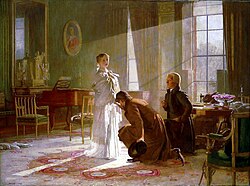
{{ | Victoria turned 18 on 24 May 1837, and thus a [[regency]] was avoided. Less than a month later, on 20 June 1837, William IV died at the age of 71, and Victoria became Queen of the United Kingdom.{{Efn|Under section 2 of the Regency Act 1830, the [[Accession Council]]'s proclamation declared Victoria as the King's successor "saving the rights of any issue of His late Majesty King William the Fourth which may be borne of his late Majesty's Consort". {{London Gazette|issue=19509|date=20 June 1837|page=1581|mode=cs2}}.}} In her diary she wrote, "I was awoke at 6 o'clock by Mamma, who told me the [[William Howley|Archbishop of Canterbury]] and [[Francis Conyngham, 2nd Marquess Conyngham|Lord Conyngham]] were here and wished to see me. I got out of bed and went into my sitting-room (only in my dressing gown) and ''alone'', and saw them. Lord Conyngham then acquainted me that my poor Uncle, the King, was no more, and had expired at 12 minutes past 2 this morning, and consequently that ''I'' am ''Queen''."<ref>St Aubyn, pp. 55–57; Woodham-Smith, p. 138</ref> Official documents prepared on the first day of her reign described her as Alexandrina Victoria, but the first name was withdrawn at her own wish and not used again.<ref>Woodham-Smith, p. 140</ref> Since 1714, Britain had shared a monarch with [[Kingdom of Hanover|Hanover]] in Germany, but under [[Salic law]], women were excluded from the Hanoverian succession. While Victoria inherited the British throne, her father's unpopular younger brother, [[Ernest Augustus, King of Hanover|Ernest Augustus, Duke of Cumberland]], became [[King of Hanover]]. He was Victoria's heir presumptive until she had a child.<ref>Packard, pp. 14–15</ref> | ||
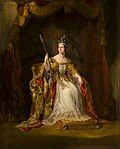
Victoria | At the time of Victoria's accession, the government was led by the [[British Whig Party|Whig]] prime minister [[Lord Melbourne]]. He at once became a powerful influence on the politically inexperienced monarch, who relied on him for advice.<ref>Hibbert, pp. 66–69; St Aubyn, p. 76; Woodham-Smith, pp. 143–147</ref> [[Charles Greville (diarist)|Charles Greville]] supposed that the widowed and childless Melbourne was "passionately fond of her as he might be of his daughter if he had one", and Victoria probably saw him as a father figure.<ref>Greville quoted in Hibbert, p. 67; Longford, p. 70 and Woodham-Smith, pp. 143–144</ref> [[Coronation of Queen Victoria|Her coronation]] took place on 28 June 1838 at [[Westminster Abbey]]. Over 400,000 visitors came to London for the celebrations.<ref>{{Citation |title=Queen Victoria's Coronation 1838 |url=http://www.royal.gov.uk/The%20Royal%20Collection%20and%20other%20collections/TheRoyalArchives/QueenVictoriaeducationproject/QueenVictoriasCoronation1838.aspx |publisher=The British Monarchy |access-date=28 January 2016 |archive-date=3 February 2016 |archive-url=https://web.archive.org/web/20160203025327/http://www.royal.gov.uk/The%20Royal%20Collection%20and%20other%20collections/TheRoyalArchives/QueenVictoriaeducationproject/QueenVictoriasCoronation1838.aspx |url-status=live}}</ref> She became the first sovereign to take up residence at [[Buckingham Palace]]<ref>St Aubyn, p. 69; Waller, p. 353</ref> and inherited the revenues of the duchies of [[Duchy of Lancaster|Lancaster]] and [[Duchy of Cornwall|Cornwall]] as well as being granted a [[civil list]] allowance of £385,000 per year. Financially prudent, she paid off her father's debts.<ref>Hibbert, p. 58; Longford, pp. 73–74; Woodham-Smith, p. 152</ref> | ||
[[File:Sir George Hayter (1792-1871) - Queen Victoria (1819-1901) - RCIN 401213 - Royal Collection.jpg|thumb|upright=0.8|alt=Victoria wears her crown and holds a sceptre.|[[Coronation portrait of Queen Victoria|Coronation portrait]] by [[George Hayter]]]] | |||
At the start of her reign Victoria was popular,<ref>Marshall, p. 42; St Aubyn, pp. 63, 96</ref> but her reputation suffered in an 1839 court intrigue when one of her mother's ladies-in-waiting, [[Lady Flora Hastings]], developed an abdominal growth that was widely rumoured to be an out-of-wedlock pregnancy by Sir John Conroy.<ref>Marshall, p. 47; Waller, p. 356; Woodham-Smith, pp. 164–166</ref> Victoria believed the rumours.<ref>Hibbert, pp. 77–78; Longford, p. 97; St Aubyn, p. 97; Waller, p. 357; Woodham-Smith, p. 164</ref> She hated Conroy, and despised "that odious Lady Flora",<ref>Victoria's journal, 25 April 1838, quoted in Woodham-Smith, p. 162</ref> because she had conspired with Conroy and the Duchess in the Kensington System.<ref>St Aubyn, p. 96; Woodham-Smith, pp. 162, 165</ref> At first, Lady Flora refused to submit to an intimate medical examination, until in mid-February she eventually acquiesced, and was found to be a virgin.<ref>Hibbert, p. 79; Longford, p. 98; St Aubyn, p. 99; Woodham-Smith, p. 167</ref> Conroy, the Hastings family, and the opposition [[Tories (British political party)|Tories]] organised a press campaign implicating the Queen in the spreading of false rumours about Lady Flora.<ref>Hibbert, pp. 80–81; Longford, pp. 102–103; St Aubyn, pp. 101–102</ref> When Lady Flora died in July, the post-mortem revealed a large tumour on her liver that had distended her abdomen.<ref>Longford, p. 122; Marshall, p. 57; St Aubyn, p. 104; Woodham-Smith, p. 180</ref> At public appearances, Victoria was hissed and jeered at as "Mrs. Melbourne".<ref>Hibbert, p. 83; Longford, pp. 120–121; Marshall, p. 57; St Aubyn, p. 105; Waller, p. 358</ref> | |||
In 1839, Melbourne resigned after [[Radicals (UK)|Radicals]] and Tories (both of whom Victoria detested) voted against a bill to suspend the constitution of [[Jamaica]]. The bill removed political power from plantation owners who were resisting measures associated with the [[Abolitionism in the United Kingdom|abolition of slavery]].<ref>St Aubyn, p. 107; Woodham-Smith, p. 169</ref> The Queen commissioned a Tory, [[Robert Peel]], to form a new ministry. At the time, it was customary for the prime minister to appoint members of the [[Royal Households of the United Kingdom|Royal Household]], who were usually his political allies and their spouses. Many of the Queen's [[ladies of the bedchamber]] were wives of Whigs, and Peel expected to replace them with wives of Tories. In what became known as the "[[bedchamber crisis]]", Victoria, advised by Melbourne, objected to their removal. Peel refused to govern under the restrictions imposed by the Queen, and consequently resigned his commission, allowing Melbourne to return to office.<ref>Hibbert, pp. 94–96; Marshall, pp. 53–57; St Aubyn, pp. 109–112; Waller, pp. 359–361; Woodham-Smith, pp. 170–174</ref> | |||
{{clear}} | |||
In 1839, Melbourne resigned after [[Radicals (UK)|Radicals]] and Tories (both of whom Victoria detested) voted against a bill to suspend the constitution of [[Jamaica]]. The bill removed political power from plantation owners who were resisting measures associated with the [[Abolitionism in the United Kingdom|abolition of slavery]].<ref>St Aubyn, p. 107; Woodham-Smith, p. 169</ref> The Queen commissioned a Tory, [[Robert Peel]], to form a new ministry. At the time, it was customary for the prime minister to appoint members of the [[Royal Households of the United Kingdom|Royal Household]], who were usually his political allies and their spouses. Many of the Queen's [[ladies of the bedchamber]] were wives of Whigs, and Peel expected to replace them with wives of Tories. In what became known as the "[[bedchamber crisis]]", Victoria, advised by Melbourne, objected to their removal. Peel refused to govern under the restrictions imposed by the Queen, and consequently resigned his commission, allowing Melbourne to return to office.<ref>Hibbert, pp. 94–96; Marshall, pp. 53–57; St Aubyn, pp. 109–112; Waller, pp. 359–361; Woodham-Smith, pp. 170–174</ref> | |||
== Marriage and public life == | |||
{{See also|Wedding of Queen Victoria and Prince Albert|Wedding dress of Queen Victoria}} | |||
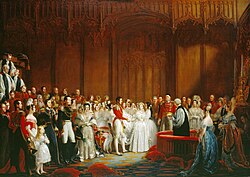
[[File:Victoria Marriage01.jpg|alt=Painting of a lavish wedding attended by richly dressed people in a magnificent room|thumb|''[[The Marriage of Queen Victoria]]'', painted by George Hayter]] | |||
Although Victoria was now queen, as an unmarried young woman she was required by [[social convention]] to live with her mother, despite their differences over the Kensington System and her mother's continued reliance on Conroy.<ref>Longford, p. 84; Marshall, p. 52</ref> The duchess was consigned to a remote apartment in Buckingham Palace, and Victoria often refused to see her.<ref>Longford, p. 72; Waller, p. 353</ref> When Victoria complained to Melbourne that her mother's proximity promised "torment for many years", Melbourne sympathised but said it could be avoided by marriage, which Victoria called a "schocking {{Sic}} alternative".<ref>Woodham-Smith, p. 175</ref> Victoria showed interest in Albert's education for the future role he would have to play as her husband, but she resisted attempts to rush her into wedlock.<ref>Hibbert, pp. 103–104; Marshall, pp. 60–66; Weintraub, p. 62</ref> | |||
Victoria continued to praise Albert following his second visit in October 1839. | Victoria continued to praise Albert following his second visit in October 1839. They felt mutual affection and the Queen proposed to him on 15 October 1839, just five days after he had arrived at [[Windsor Castle|Windsor]].<ref>Hibbert, pp. 107–110; St Aubyn, pp. 129–132; Weintraub, pp. 77–81; Woodham-Smith, pp. 182–184, 187</ref> They were married on 10 February 1840, in the [[Chapel Royal]] of [[St James's Palace]], London. Victoria was love-struck. She spent the evening after their wedding lying down with a headache, but wrote ecstatically in her diary: | ||
{{Blockquote| | {{Blockquote| | ||
I NEVER, NEVER spent such an evening!!! MY DEAREST DEAREST DEAR Albert ... his excessive love & affection gave me feelings of heavenly love & happiness I never could have ''hoped'' to have felt before! He clasped me in his arms, & we kissed each other again & again! His beauty, his sweetness & | I NEVER, NEVER spent such an evening!!! MY DEAREST DEAREST DEAR Albert ... his excessive love & affection gave me feelings of heavenly love & happiness I never could have ''hoped'' to have felt before! He clasped me in his arms, & we kissed each other again & again! His beauty, his sweetness & gentleness—really how can I ever be thankful enough to have such a ''Husband''! ... to be called by names of tenderness, I have never yet heard used to me before—was bliss beyond belief! Oh! This was the happiest day of my life!<ref>Hibbert, p. 123; Longford, p. 143; Woodham-Smith, p. 205</ref> | ||
}} | }} | ||
Albert became an important political adviser as well as the Queen's companion, replacing Melbourne as the dominant influential figure in the first half of her life.<ref>St Aubyn, p. 151</ref> Victoria's mother was evicted from the palace, to Ingestre House in [[Belgrave Square]]. After the death of Victoria's aunt [[Princess Augusta Sophia of the United Kingdom|Princess Augusta]] in 1840, | Albert became an important political adviser as well as the Queen's companion, replacing Melbourne as the dominant influential figure in the first half of her life.<ref>St Aubyn, p. 151</ref> Victoria's mother was evicted from the palace, to Ingestre House in [[Belgrave Square]]. After the death of Victoria's aunt [[Princess Augusta Sophia of the United Kingdom|Princess Augusta]] in 1840, the duchess was given both [[Clarence House]] and [[Frogmore House]].<ref>Hibbert, p. 265, Woodham-Smith, p. 256</ref> Through Albert's mediation, relations between mother and daughter slowly improved.<ref>Marshall, p. 152; St Aubyn, pp. 174–175; Woodham-Smith, p. 412</ref> | ||
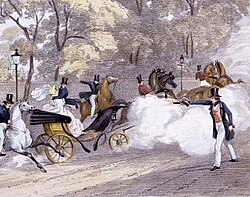
During Victoria's first pregnancy in 1840, in the first few months of the marriage, 18-year-old [[Edward Oxford]] attempted to assassinate her while she was riding in a carriage with Prince Albert on her way to visit her mother. Oxford fired twice, but either both bullets missed or, as he later claimed, the guns had no shot.<ref>Charles, p. 23</ref> He was tried for [[high treason]], found [[not guilty by reason of insanity]], committed to an insane asylum indefinitely, and later sent to live in | [[File:Edward Oxford shoots at H. M. the Queen, 1840.jpg|thumb|Contemporary lithograph of Edward Oxford's attempt to assassinate Victoria, 1840]] | ||
During Victoria's first pregnancy in 1840, in the first few months of the marriage, 18-year-old [[Edward Oxford]] attempted to assassinate her while she was riding in a carriage with Prince Albert on her way to visit her mother. Oxford fired twice, but either both bullets missed or, as he later claimed, the guns had no shot.<ref>Charles, p. 23</ref> He was tried for [[high treason]], found [[not guilty by reason of insanity]], committed to an insane asylum indefinitely, and later sent to live in Australia.<ref>Hibbert, pp. 421–422; St Aubyn, pp. 160–161</ref> In the immediate aftermath of the attack, Victoria's popularity soared, mitigating residual discontent over the [[Lady Flora Hastings#Scandal|Hastings affair]] and the [[bedchamber crisis]].<ref>Woodham-Smith, p. 213</ref> Her daughter, also named [[Victoria, Princess Royal|Victoria]], was born on 21 November 1840. The Queen hated being pregnant,<ref>Hibbert, p. 130; Longford, p. 154; Marshall, p. 122; St Aubyn, p. 159; Woodham-Smith, p. 220</ref> viewed breast-feeding with disgust,<ref>Hibbert, p. 149; St Aubyn, p. 169</ref> and thought newborn babies were ugly.<ref>Hibbert, p. 149; Longford, p. 154; Marshall, p. 123; Waller, p. 377</ref> Nevertheless, over the following seventeen years, she and Albert had a further eight children: [[Edward VII|Albert Edward]], [[Princess Alice of the United Kingdom|Alice]], [[Alfred, Duke of Saxe-Coburg and Gotha|Alfred]], [[Princess Helena of the United Kingdom|Helena]], [[Princess Louise, Duchess of Argyll|Louise]], [[Prince Arthur, Duke of Connaught and Strathearn|Arthur]], [[Prince Leopold, Duke of Albany|Leopold]] and [[Princess Beatrice of the United Kingdom|Beatrice]].<ref name="odnb" /> | |||
The household was largely run by Victoria's childhood governess, Baroness [[Louise Lehzen]] from [[Kingdom of Hanover|Hanover]]. Lehzen had been a formative influence on Victoria<ref>Woodham-Smith, p. 100</ref> and had supported her against the Kensington System.<ref>Longford, p. 56; St Aubyn, p. 29</ref> Albert, however, thought that Lehzen was incompetent and that her mismanagement threatened his daughter's health. After a furious row between Victoria and Albert over the issue, Lehzen was pensioned off in 1842, and Victoria's close relationship with her ended.<ref>Hibbert, pp. 150–156; Marshall, p. 87; St Aubyn, pp. 171–173; Woodham-Smith, pp. 230–232</ref> | The household was largely run by Victoria's childhood governess, Baroness [[Louise Lehzen]] from [[Kingdom of Hanover|Hanover]]. Lehzen had been a formative influence on Victoria<ref>Woodham-Smith, p. 100</ref> and had supported her against the Kensington System.<ref>Longford, p. 56; St Aubyn, p. 29</ref> Albert, however, thought that Lehzen was incompetent and that her mismanagement threatened his daughter Victoria's health. After a furious row between Victoria and Albert over the issue, Lehzen was pensioned off in 1842, and Victoria's close relationship with her ended.<ref>Hibbert, pp. 150–156; Marshall, p. 87; St Aubyn, pp. 171–173; Woodham-Smith, pp. 230–232</ref> | ||
On 29 May 1842, Victoria was riding in a carriage along [[The Mall, London]], when John Francis aimed a pistol at her, but the gun did not fire. The assailant escaped; the following day, Victoria drove the same route, though faster and with a greater escort, in a deliberate attempt to bait Francis into taking a second aim and catch him in the act. As expected, Francis shot at her, but he was seized by plainclothes policemen, and convicted of high treason. On 3 July, two days after Francis's death sentence was commuted to [[transportation for life]], [[John William Bean]] also tried to fire a pistol at the Queen, but it was loaded only with paper and tobacco and had too little charge.<ref>Charles, p. 51; Hibbert, pp. 422–423; St Aubyn, pp. 162–163</ref> Edward Oxford felt that the attempts were encouraged by his acquittal in 1840.<ref name="auto">Hibbert, p. 423; St Aubyn, p. 163</ref> Bean was sentenced to 18 months in jail.<ref name="auto"/> In a similar attack in 1849, unemployed Irishman William Hamilton fired a powder-filled pistol at Victoria's carriage as it passed along [[Constitution Hill, London]].<ref>Longford, p. 192</ref> In 1850, the Queen did sustain injury when she was assaulted by a possibly insane ex-army officer, [[Robert Pate]]. As Victoria was riding in a carriage, Pate struck her with his cane, crushing her bonnet and bruising her forehead. Both Hamilton and Pate were sentenced to seven years' transportation.<ref>St Aubyn, p. 164</ref> | |||
[[File:Winterhalter - Queen Victoria 1843.jpg|thumb|left|upright|Portrait by [[Franz Xaver Winterhalter]], 1843]] | [[File:Winterhalter - Queen Victoria 1843.jpg|thumb|left|upright|Portrait by [[Franz Xaver Winterhalter]], 1843]] | ||
Melbourne's support in the House of Commons weakened through the early years of Victoria's reign, and in the [[1841 United Kingdom general election|1841 general election]] the Whigs were defeated. Peel became prime minister, and the ladies of the bedchamber most associated with the Whigs were replaced.<ref>Marshall, pp. 95–101; St Aubyn, pp. 153–155; Woodham-Smith, pp. 221–222</ref> In 1845, Ireland was hit by a [[potato blight]].<ref>Woodham-Smith, p. 281</ref> In the next four years, over a million Irish people died and another million emigrated in what became known as the [[Great Famine (Ireland)|Great Famine]].<ref>Longford, p. 359</ref> In Ireland, Victoria was labelled "The Famine Queen".<ref>The title of [[Maud Gonne]]'s 1900 article upon Queen Victoria's visit to Ireland</ref><ref>{{Citation |last=Harrison |first=Shane |title=Famine Queen row in Irish port |date=15 April 2003 |url=http://news.bbc.co.uk/1/hi/northern_ireland/2951395.stm |publisher=BBC News |access-date=29 March 2013 |archive-date=19 September 2019 |archive-url=https://web.archive.org/web/20190919081531/http://news.bbc.co.uk/2/hi/uk_news/northern_ireland/2951395.stm |url-status=live}}</ref> In January 1847 she personally donated £2,000 (equivalent to between £230,000 and £8.5{{nbsp}}million in 2022)<ref>{{Citation |last1=Officer |first1=Lawrence H. |title=Five Ways to Compute the Relative Value of a UK Pound Amount, 1270 to Present |date=2024 |url=https://www.measuringworth.com/calculators/ukcompare/result.php?year_source=1846&amount=2000&year_result=2022 |publisher=MeasuringWorth |access-date=8 June 2024 |last2=Williamson |first2=Samuel H.}}</ref> to the [[British Relief Association]], more than any other individual famine relief donor,<ref>{{Citation |last=Kinealy |first=Christine |title=Private Responses to the Famine |url=http://multitext.ucc.ie/d/Private_Responses_to_the_Famine3344361812 |archive-url=https://web.archive.org/web/20130406031633/http://multitext.ucc.ie/d/Private_Responses_to_the_Famine3344361812 |publisher=University College Cork |access-date=29 March 2013 |archive-date=6 April 2013}}</ref> and supported the [[Maynooth Grant]] to a Roman Catholic seminary in Ireland, despite Protestant opposition.<ref>Longford, p. 181</ref> The story that she donated only £5 in aid to the Irish, and on the same day gave the same amount to [[Battersea Dogs Home]], was a myth generated towards the end of the 19th century.<ref>{{Citation |last=Kenny |first=Mary |title=Crown and Shamrock: Love and Hate Between Ireland and the British Monarchy |date=2009 |place=Dublin |publisher=New Island |isbn=978-1-905494-98-9}}</ref> By 1846, Peel's ministry faced a crisis involving the repeal of the [[Corn Laws]]. Many Tories—by then known also as [[Conservative Party (UK)|Conservatives]]—were opposed to the repeal, but Peel, some Tories (the free-trade oriented [[liberal conservative]] "[[Peelite]]s"), most Whigs and Victoria supported it. Peel resigned in 1846, after the repeal narrowly passed, and was replaced by [[Lord John Russell]].<ref>St Aubyn, p. 215</ref> | |||
{| class="toc" style="float:LEFT; border:3px solid lightblue; font-size:90%;margin-right:10px; clear:left;" | |||
Melbourne's support in the House of Commons weakened through the early years of Victoria's reign, and in the [[1841 United Kingdom general election|1841 general election]] the Whigs were defeated. Peel became prime minister, and the ladies of the bedchamber most associated with the Whigs were replaced.<ref>Marshall, pp. 95–101; St Aubyn, pp. 153–155; Woodham-Smith, pp. 221–222</ref> | |||
In 1845, Ireland was hit by a [[potato blight]].<ref>Woodham-Smith, p. 281</ref> In the next four years, over a million Irish people died and another million emigrated in what became known as the [[Great Famine (Ireland)|Great Famine]].<ref>Longford, p. 359</ref> In Ireland, Victoria was labelled "The Famine Queen".<ref>The title of [[Maud Gonne]]'s 1900 article upon Queen Victoria's visit to Ireland</ref><ref>{{Citation |last=Harrison |first=Shane |title=Famine Queen row in Irish port |date=15 April 2003 |url=http://news.bbc.co.uk/1/hi/northern_ireland/2951395.stm | | |||
By 1846, Peel's ministry faced a crisis involving the repeal of the [[Corn Laws]]. Many Tories—by then known also as [[Conservative Party (UK)|Conservatives]]—were opposed to the repeal, but Peel, some Tories (the free-trade oriented [[ | |||
{| class="toc" style="float: | |||
|- | |- | ||
| colspan="2" style="text-align:center; background:mistyrose"| | | colspan="2" style="text-align:center; background:mistyrose"|{{strong|Victoria's British prime ministers}} | ||
|- style="background:lavenderblush;" | |- style="background:lavenderblush;" | ||
! scope="col" style="width:5.5em;" | Year | ! scope="col" style="width:5.5em;" | Year | ||
! scope="col" | Prime Minister (party) | ! scope="col" | Prime Minister ''(party)'' | ||
|- | |- | ||
|1835 | |1835 | ||
| style="background:#fed;"|[[William Lamb, 2nd Viscount Melbourne|Viscount Melbourne]] ([[Whig (British political party)|Whig]]) | | style="background:#fed;"|[[William Lamb, 2nd Viscount Melbourne|Viscount Melbourne]] ''([[Whig (British political party)|Whig]])'' | ||
|- | |- | ||
|1841 | |1841 | ||
| style="background:#def;"|[[ | | style="background:#def;"|[[Sir Robert Peel]] ''([[Conservative Party (UK)|Conservative]])'' | ||
|- | |- | ||
|1846 | |1846 | ||
| style="background:#fed;"|[[ | | style="background:#fed;"|[[Lord John Russell]] ''(Whig)'' | ||
|- | |- | ||
|1852 (Feb) | |1852 (Feb.) | ||
| style="background:#def;"|[[Edward Smith-Stanley, 14th Earl of Derby|Earl of Derby]] ( | | style="background:#def;"|[[Edward Smith-Stanley, 14th Earl of Derby|Earl of Derby]] ''(Conservative)'' | ||
|- | |- | ||
|1852 (Dec) | |1852 (Dec.) | ||
| style="background:#D8F8C8;"|[[George Hamilton-Gordon, 4th Earl of Aberdeen|Earl of Aberdeen]] ([[Peelite]]) | | style="background:#D8F8C8;"|[[George Hamilton-Gordon, 4th Earl of Aberdeen|Earl of Aberdeen]] ''([[Peelite]])'' | ||
|- | |- | ||
|1855 | |1855 | ||
| style="background:#ffd;"|[[Henry John Temple, 3rd Viscount Palmerston|Viscount Palmerston]] ([[Liberal Party (UK)|Liberal]]) | | style="background:#ffd;"|[[Henry John Temple, 3rd Viscount Palmerston|Viscount Palmerston]] ''([[Liberal Party (UK)|Liberal]])'' | ||
|- | |- | ||
|1858 | |1858 | ||
| style="background:#def;"|Earl of Derby ( | | style="background:#def;"|Earl of Derby ''(Conservative)'' | ||
|- | |- | ||
|1859 | |1859 | ||
| style="background:#ffd;"|Viscount Palmerston ( | | style="background:#ffd;"|Viscount Palmerston ''(Liberal)'' | ||
|- | |- | ||
|1865 | |1865 | ||
| style="background:#ffd;"| | | style="background:#ffd;"|Lord John Russell<br> as Earl Russell ''(Liberal)'' | ||
|- | |- | ||
|1866 | |1866 | ||
| style="background:#def;"|Earl of Derby ( | | style="background:#def;"|Earl of Derby ''(Conservative)'' | ||
|- | |- | ||
|1868 (Feb) | |1868 (Feb.) | ||
| style="background:#def;"|[[Benjamin Disraeli]] ( | | style="background:#def;"|[[Benjamin Disraeli]] ''(Cons.)'' | ||
|- | |- | ||
|1868 (Dec) | |1868 (Dec.) | ||
| style="background:#ffd;"|[[ | | style="background:#ffd;"|[[William Gladstone]] ''(Liberal)'' | ||
|- | |- | ||
|1874 | |1874 | ||
| style="background:#def;"| | | style="background:#def;"|Benjamin Disraeli<br> as Lord Beaconsfield ''(Cons.)'' | ||
|- | |- | ||
|1880 | |1880 | ||
| style="background:#ffd;"|William Gladstone ( | | style="background:#ffd;"|William Gladstone ''(Liberal)'' | ||
|- | |- | ||
|1885 | |1885 | ||
| style="background:#def;"|[[Robert Gascoyne-Cecil, 3rd Marquess of Salisbury|Marquess of Salisbury]] ( | | style="background:#def;"|[[Robert Gascoyne-Cecil, 3rd Marquess of Salisbury|Marquess of Salisbury]] ''(Cons.)'' | ||
|- | |- | ||
|1886 (Feb) | |1886 (Feb.) | ||
| style="background:#ffd;"|William Gladstone ( | | style="background:#ffd;"|William Gladstone ''(Liberal)'' | ||
|- | |- | ||
|1886 (July) | |1886 (July) | ||
| style="background:#def;"|Marquess of Salisbury ( | | style="background:#def;"|Marquess of Salisbury ''(Cons.)'' | ||
|- | |- | ||
|1892 | |1892 | ||
| style="background:#ffd;"|William Gladstone ( | | style="background:#ffd;"|William Gladstone ''(Liberal)'' | ||
|- | |- | ||
|1894 | |1894 | ||
| style="background:#ffd;"|[[Archibald Primrose, 5th Earl of Rosebery|Earl of Rosebery]] ( | | style="background:#ffd;"|[[Archibald Primrose, 5th Earl of Rosebery|Earl of Rosebery]] ''(Liberal)'' | ||
|- | |- | ||
|1895 | |1895 | ||
| style="background:#def;"|Marquess of Salisbury ( | | style="background:#def;"|Marquess of Salisbury ''(Cons.)'' | ||
|- style="background:#efefef;" | |- style="background:#efefef;" | ||
|colspan="2"| | |colspan="2"|See [[List of prime ministers of Queen Victoria]]<br />for details of her British and overseas premiers | ||
|} | |} | ||
Internationally, Victoria took a keen interest in the improvement of relations between France and Britain.<ref>St Aubyn, p. 238</ref> She made and hosted several visits between the British royal family and the [[House of Orleans]], who were related by marriage through the Coburgs. In 1843 and 1845, she and Albert stayed with King [[Louis Philippe I]] at [[Château d'Eu]] in Normandy; she was the first British or English monarch to visit a French monarch since the meeting of [[Henry VIII]] of England and [[Francis I of France]] on the [[Field of the Cloth of Gold]] in 1520.<ref>Longford, pp. 175, 187; St Aubyn, pp. 238, 241; Woodham-Smith, pp. 242, 250</ref> When Louis Philippe made a reciprocal trip in 1844, he became the first French king to visit a British sovereign.<ref>Woodham-Smith, p. 248</ref> Louis Philippe was deposed in the [[revolutions of 1848]], and fled to exile in England.<ref>Hibbert, p. 198; Longford, p. 194; St Aubyn, p. 243; Woodham-Smith, pp. 282–284</ref> At the height of a revolutionary scare in the United Kingdom in April 1848, Victoria and her family left London for the greater safety of [[Osborne House]],<ref>Hibbert, pp. 201–202; Marshall, p. 139; St Aubyn, pp. 222–223; Woodham-Smith, pp. 287–290</ref> a private estate on the Isle of Wight that they had purchased in 1845 and redeveloped.<ref>Hibbert, pp. 161–164; Marshall, p. 129; St Aubyn, pp. 186–190; Woodham-Smith, pp. 274–276</ref> Demonstrations by [[Chartists]] and [[Irish nationalists]] failed to attract widespread support, and the scare died down without any major disturbances.<ref>Longford, pp. 196–197; St Aubyn, p. 223; Woodham-Smith, pp. 287–290</ref> Victoria's first visit to Ireland in 1849 was a public relations success, but it had no lasting impact or effect on the growth of Irish nationalism.<ref>Longford, p. 191; Woodham-Smith, p. 297</ref> | |||
Russell's ministry, though Whig, was not favoured by the Queen.<ref>St Aubyn, p. 216</ref> She found particularly offensive the [[Secretary of State for Foreign Affairs (UK)|Foreign Secretary]], [[Lord Palmerston]], who often acted without consulting the cabinet, the prime minister, or the Queen.<ref>Hibbert, pp. 196–198; St Aubyn, p. 244; Woodham-Smith, pp. 298–307</ref> Victoria complained to Russell that Palmerston sent official dispatches to foreign leaders without her knowledge, but Palmerston was retained in office and continued to act on his own initiative, despite her repeated remonstrances. It was only in 1851 that Palmerston was removed after he announced the British government's approval of President [[Louis-Napoleon Bonaparte]]'s [[1851 French coup d'état|coup in France]] without consulting the prime minister.<ref>Hibbert, pp. 204–209; Marshall, pp. 108–109; St Aubyn, pp. 244–254; Woodham-Smith, pp. 298–307</ref> The following year, President Bonaparte was declared Emperor Napoleon III, by which time Russell's administration had been replaced by a short-lived minority government led by [[Lord Derby]].<ref>St Aubyn, pp. 255, 298</ref> | |||
Russell's ministry, though Whig, was not favoured by the Queen.<ref>St Aubyn, p. 216</ref> She found particularly offensive the [[Secretary of State for Foreign Affairs|Foreign Secretary]], [[Lord Palmerston]], who often acted without consulting the | |||
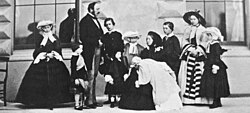
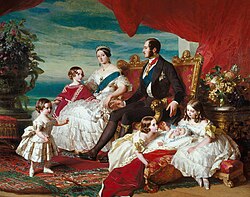
[[File:Queen Victoria Prince Albert and their nine children.JPG|alt=Victoria, dressed in black, is seated and holding her infant daughter. Prince Albert and their other children stand around her.|thumb|Albert, Victoria and their nine children, 1857. Left to right: Alice, Arthur, Prince Albert, Albert Edward, Leopold, Louise, Queen Victoria with Beatrice, Alfred, Victoria, and Helena]] | |||
In 1853, Victoria gave birth to her eighth child, Leopold, with the aid of the new anaesthetic, [[chloroform]]. She was so impressed by the relief it gave from the pain of childbirth that she used it again in 1857 at the birth of her ninth and final child, Beatrice, despite opposition from members of the clergy, who considered it against biblical teaching, and members of the medical profession, who thought it dangerous.<ref>Hibbert, pp. 216–217; St Aubyn, pp. 257–258</ref> Victoria may have had [[postnatal depression]] after many of her pregnancies.<ref name="odnb" /> Letters from Albert to Victoria intermittently complain of her loss of self-control. For example, about a month after Leopold's birth Albert complained in a letter to Victoria about her "continuance of hysterics" over a "miserable trifle".<ref>Hibbert, pp. 217–220; Woodham-Smith, pp. 328–331</ref> | In 1853, Victoria gave birth to her eighth child, Leopold, with the aid of the new anaesthetic, [[chloroform]]. She was so impressed by the relief it gave from the pain of childbirth that she used it again in 1857 at the birth of her ninth and final child, Beatrice, despite opposition from members of the clergy, who considered it against biblical teaching, and members of the medical profession, who thought it dangerous.<ref>Hibbert, pp. 216–217; St Aubyn, pp. 257–258</ref> Victoria may have had [[postnatal depression]] after many of her pregnancies.<ref name="odnb" /> Letters from Albert to Victoria intermittently complain of her loss of self-control. For example, about a month after Leopold's birth Albert complained in a letter to Victoria about her "continuance of hysterics" over a "miserable trifle".<ref>Hibbert, pp. 217–220; Woodham-Smith, pp. 328–331</ref> | ||
In early 1855, the government of [[ | In early 1855, the government of [[Lord Aberdeen]], who had replaced Derby, fell amidst recriminations over the poor management of British troops in the [[Crimean War]]. Victoria approached both Derby and Russell to form a ministry, but neither had sufficient support, and Victoria was forced to appoint Palmerston as prime minister.<ref>Hibbert, pp. 227–228; Longford, pp. 245–246; St Aubyn, p. 297; Woodham-Smith, pp. 354–355</ref> Napoleon III, Britain's closest ally as a result of the Crimean War,<ref name="odnb" /> visited London in April 1855, and from 17 to 28 August the same year Victoria and Albert returned the visit.<ref>Woodham-Smith, pp. 357–360</ref> Napoleon III met the couple at [[Boulogne]] and accompanied them to Paris.<ref>{{Citation |last=Queen Victoria |title=Queen Victoria's Journals |volume=40 |page=93 |chapter=Saturday, 18th August 1855 |chapter-url=http://www.queenvictoriasjournals.org |via=The Royal Archives |access-date=2 June 2012 |archive-date=25 November 2021 |archive-url=https://web.archive.org/web/20211125152643/http://qvj.chadwyck.com/marketing.do |url-status=live}}</ref> They visited the {{lang|fr|[[Exposition Universelle (1855)|Exposition Universelle]]|italic=no}} (a successor to Albert's 1851 brainchild the [[Great Exhibition]]) and [[Napoleon I]]'s tomb at [[Les Invalides]] (to which his remains had only been [[retour des cendres|returned]] in 1840), and were guests of honour at a 1,200-guest ball at the [[Palace of Versailles]].<ref>{{Citation |title=1855 visit of Queen Victoria |url=http://en.chateauversailles.fr/history/the-significant-dates/most-important-dates/1855-visit-of-queen-victoria |archive-url=https://web.archive.org/web/20130111200927/http://en.chateauversailles.fr/history/the-significant-dates/most-important-dates/1855-visit-of-queen-victoria |publisher=Château de Versailles |access-date=29 March 2013 |archive-date=11 January 2013}}</ref> This marked the first time that a reigning British monarch had been to Paris in over 400 years.<ref>{{Citation |url=https://www.rct.uk/collection/themes/exhibitions/queen-victoria-in-paris/bowes-museum-barnard-castle |title=Queen Victoria in Paris |publisher=Royal Collection Trust |access-date=29 August 2022 |archive-date=29 August 2022 |archive-url=https://web.archive.org/web/20220829155504/https://www.rct.uk/collection/themes/exhibitions/queen-victoria-in-paris/bowes-museum-barnard-castle |url-status=live}}</ref> | ||
Napoleon III, Britain's closest ally as a result of the Crimean War,<ref name="odnb" /> visited London in April 1855, and from 17 to 28 August the same year Victoria and Albert returned the visit.<ref>Woodham-Smith, pp. 357–360</ref> Napoleon III met the couple at [[ | |||
On 14 January 1858, an Italian refugee from Britain called [[Felice Orsini]] attempted to assassinate Napoleon III with a bomb made in England.<ref>Hibbert, pp. 241–242; Longford, pp. 280–281; St Aubyn, p. 304; Woodham-Smith, p. 391</ref> The ensuing diplomatic crisis destabilised the government, and Palmerston resigned. Derby was reinstated as prime minister.<ref>Hibbert, p. 242; Longford, p. 281; Marshall, p. 117</ref> Victoria and Albert attended the opening of a new basin at the French military port of [[Cherbourg]] on 5 August 1858, in an attempt by Napoleon III to reassure Britain that his military preparations were directed elsewhere. On her return Victoria wrote to Derby reprimanding him for the poor state of the [[Royal Navy]] in comparison to the [[French Navy]].<ref>{{Citation |title=Napoleon III Receiving Queen Victoria at Cherbourg, 5 August 1858 |url=http://collections.rmg.co.uk/collections/objects/12129.html |publisher=Royal Museums Greenwich |access-date=29 March 2013 |archive-date=3 April 2012 |archive-url=https://web.archive.org/web/20120403162336/http://collections.rmg.co.uk/collections/objects/12129.html |url-status=live }}</ref> Derby's ministry did not last long, and in June 1859 Victoria recalled Palmerston to office.<ref>Hibbert, p. 255; Marshall, p. 117</ref> | [[File:Queen Victoria - Winterhalter 1859.jpg|thumb|left|upright=0.7|[[State portraits of Queen Victoria and Prince Albert|State portrait]] by Winterhalter, 1859]] | ||
On 14 January 1858, an Italian refugee from Britain called [[Felice Orsini]] attempted to assassinate Napoleon III with a bomb made in England.<ref>Hibbert, pp. 241–242; Longford, pp. 280–281; St Aubyn, p. 304; Woodham-Smith, p. 391</ref> The ensuing diplomatic crisis destabilised the government, and Palmerston resigned. Derby was reinstated as prime minister.<ref>Hibbert, p. 242; Longford, p. 281; Marshall, p. 117</ref> Victoria and Albert attended the opening of a new basin at the French military port of [[Cherbourg]] on 5 August 1858, in an attempt by Napoleon III to reassure Britain that his military preparations were directed elsewhere. On her return Victoria wrote to Derby reprimanding him for the poor state of the [[Royal Navy]] in comparison to the [[French Navy]].<ref>{{Citation |title=Napoleon III Receiving Queen Victoria at Cherbourg, 5 August 1858 |url=http://collections.rmg.co.uk/collections/objects/12129.html |publisher=Royal Museums Greenwich |access-date=29 March 2013 |archive-date=3 April 2012 |archive-url=https://web.archive.org/web/20120403162336/http://collections.rmg.co.uk/collections/objects/12129.html |url-status=live}}</ref> Derby's ministry did not last long, and in June 1859 Victoria recalled Palmerston to office.<ref>Hibbert, p. 255; Marshall, p. 117</ref> | |||
Eleven days after Orsini's assassination attempt in France, Victoria's eldest daughter married [[Frederick III, German Emperor|Prince Frederick William of Prussia]] in London. They had been betrothed since September 1855, when Princess Victoria was 14 years old; the marriage was delayed by the Queen and her husband Albert until the bride was 17.<ref>Longford, pp. 259–260; Weintraub, pp. 326 ff.</ref> The Queen and Albert hoped that their daughter and son-in-law would be a liberalising influence in the enlarging [[Prussia]]n state.<ref>Longford, p. 263; Weintraub, pp. 326, 330</ref> The Queen felt "sick at heart" to see her daughter leave England for Germany; "It really makes me shudder", she wrote to Princess Victoria in one of her frequent letters,<!--8000 over 40 years--> "when I look round to all your sweet, happy, unconscious sisters, and think I must give them up too – one by one."<ref>Hibbert, p. 244</ref> Almost exactly a year later, the Princess gave birth to the Queen's first grandchild, [[Wilhelm II | Eleven days after Orsini's assassination attempt in France, Victoria's eldest daughter married [[Frederick III, German Emperor|Prince Frederick William of Prussia]] in London. They had been betrothed since September 1855, when Princess Victoria was 14 years old; the marriage was delayed by the Queen and her husband Albert until the bride was 17.<ref>Longford, pp. 259–260; Weintraub, pp. 326 ff.</ref> The Queen and Albert hoped that their daughter and son-in-law would be a liberalising influence in the enlarging [[Prussia]]n state.<ref>Longford, p. 263; Weintraub, pp. 326, 330</ref> The Queen felt "sick at heart" to see her daughter leave England for Germany; "It really makes me shudder", she wrote to Princess Victoria in one of her frequent letters,<!--8000 over 40 years--> "when I look round to all your sweet, happy, unconscious sisters, and think I must give them up too – one by one."<ref>Hibbert, p. 244</ref> Almost exactly a year later, the Princess gave birth to the Queen's first grandchild, [[Wilhelm II|Wilhelm]], who would become the last German emperor.<ref name="odnb" /> | ||
== Widowhood and isolation == | == Widowhood and isolation == | ||
[[File:Queen Victoria by JJE Mayall, 1860.png|thumb|left|upright|Photograph by [[J. J. E. Mayall]], 1860]] | |||
In March 1861, Victoria's mother died, with Victoria at her side. Through reading her mother's papers, Victoria discovered that her mother had loved her deeply;<ref>Hibbert, p. 267; Longford, pp. 118, 290; St Aubyn, p. 319; Woodham-Smith, p. 412</ref> she was heart-broken, and blamed Conroy and Lehzen for "wickedly" estranging her from her mother.<ref>Hibbert, p. 267; Marshall, p. 152; Woodham-Smith, p. 412</ref> To relieve his wife during her intense and deep grief,<ref>Hibbert, pp. 265–267; St Aubyn, p. 318; Woodham-Smith, pp. 412–413</ref> Albert took on most of her duties, despite being ill himself with chronic stomach trouble.<ref>Waller, p. 393; Weintraub, p. 401</ref> In August, Victoria and Albert visited their son, [[Albert Edward, Prince of Wales]], who was attending army manoeuvres near Dublin, and spent a few days holidaying in [[Killarney]]. In November, Albert was made aware of gossip that his son had slept with the actress [[Nellie Clifden]] in Ireland.<ref>Hibbert, p. 274; Longford, p. 293; St Aubyn, p. 324; Woodham-Smith, p. 417</ref> Appalled, he travelled to Cambridge, where his son was studying, to confront him.<ref>Longford, p. 293; Marshall, p. 153; Strachey, p. 214</ref> | |||
By the beginning of December, Albert was very unwell.<ref>Hibbert, pp. 276–279; St Aubyn, p. 325; Woodham-Smith, pp. 422–423</ref> He was diagnosed with [[typhoid fever]] by [[Sir William Jenner, 1st Baronet|William Jenner]], and died on 14 December 1861. Victoria was devastated.<ref>Hibbert, pp. 280–292; Marshall, p. 154</ref> She blamed her husband's death on worry over the Prince of Wales's [[philandering]]. He had been "killed by that dreadful business", she said.<ref>Hibbert, p. 299; St Aubyn, p. 346</ref> She entered a state of [[mourning]] and wore black for the remainder of her life. She avoided public appearances and rarely set foot in London in the following years.<ref>St Aubyn, p. 343</ref> Her seclusion earned her the nickname "widow of Windsor".<ref>e.g. Strachey, p. 306</ref> Her weight increased through comfort eating, which reinforced her aversion to public appearances.<ref>{{Citation |last=Ridley |first=Jane |title=Queen Victoria – burdened by grief and six-course dinners |date=27 May 2017 |url=https://www.spectator.co.uk/2017/05/queen-victoria-burdened-by-grief-and-six-course-dinners/ |work=The Spectator |access-date=28 August 2018 |archive-date=28 August 2018 |archive-url=https://web.archive.org/web/20180828081110/https://www.spectator.co.uk/2017/05/queen-victoria-burdened-by-grief-and-six-course-dinners/ |url-status=live}}</ref> | |||
Victoria's self-imposed isolation from the public diminished the popularity of the monarchy, and encouraged the growth of the republican movement.<ref>Marshall, pp. 170–172; St Aubyn, p. 385</ref> She did undertake her official government duties, yet chose to remain secluded in her royal residences—[[Windsor Castle]], Osborne House, and the private estate in Scotland that she and Albert had acquired in 1847, [[Balmoral Castle]]. In March 1864, a protester stuck a notice on the railings of [[Buckingham Palace]] that announced "these commanding premises to be let or sold in consequence of the late occupant's declining business".<ref>Hibbert, p. 310; Longford, p. 321; St Aubyn, pp. 343–344; Waller, p. 404</ref> Her uncle Leopold wrote to her advising her to appear in public. She agreed to visit the gardens of the [[Royal Horticultural Society]] at [[Kensington]]<!--''The Times'', Thursday, 31 March 1864, p. 9, no. 24834, col. D--> and take a drive through London in an open carriage.<ref>Hibbert, p. 310; Longford, p. 322</ref> | |||
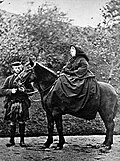
[[File:Queen Victoria, photographed by George Washington Wilson (1863).jpg|thumb|upright|alt=Victoria on a horse|With John Brown at Balmoral, 1863. Photograph by [[George Washington Wilson|G. W. Wilson]]]] | |||
[[File:Queen Victoria, photographed by George Washington Wilson (1863).jpg|thumb|upright|alt=Victoria on a horse| | |||
Through the 1860s, Victoria relied increasingly on a manservant from Scotland, [[John Brown (servant)|John Brown]].<ref>Hibbert, pp. 323–324; Marshall, pp. 168–169; St Aubyn, pp. 356–362</ref> Rumours of a romantic connection and even a secret marriage appeared in print, and some referred to the Queen as "Mrs. Brown".<ref>Hibbert, pp. 321–322; Longford, pp. 327–328; Marshall, p. 170</ref> The story of their relationship was the subject of the 1997 movie ''[[ | Through the 1860s, Victoria relied increasingly on a manservant from Scotland, [[John Brown (servant)|John Brown]].<ref>Hibbert, pp. 323–324; Marshall, pp. 168–169; St Aubyn, pp. 356–362</ref> Rumours of a romantic connection and even a secret marriage appeared in print, and some referred to the Queen as "Mrs. Brown".<ref>Hibbert, pp. 321–322; Longford, pp. 327–328; Marshall, p. 170</ref> The story of their relationship was the subject of the 1997 movie ''[[Mrs. Brown]]''. A painting by Sir [[Edwin Henry Landseer]] depicting the Queen with Brown was exhibited at the [[Royal Academy]], and Victoria published a book, ''Leaves from the Journal of Our Life in the Highlands'', which featured Brown prominently and in which the Queen praised him highly.<ref>Hibbert, p. 329; St Aubyn, pp. 361–362</ref> | ||
Palmerston died in 1865, and after a brief ministry led by Russell, Derby returned to power. In 1866, Victoria attended the [[State Opening of Parliament]] for the first time since Albert's death.<ref>Hibbert, pp. 311–312; Longford, p. 347; St Aubyn, p. 369</ref> The following year she supported the passing of the [[Reform Act 1867]] which doubled the electorate by extending the franchise to many urban working men,<ref>St Aubyn, pp. 374–375</ref> though she was not in favour of votes for women.<ref>Marshall, p. 199; Strachey, p. 299</ref> Derby resigned in 1868, to be replaced by [[Benjamin Disraeli]], who charmed Victoria. "Everyone likes flattery," he said, "and when you come to royalty you should lay it on with a trowel."<ref>Hibbert, p. 318; Longford, p. 401; St Aubyn, p. 427; Strachey, p. 254</ref> With the phrase "we authors, Ma'am", he complimented her.<ref>[[George Earle Buckle|Buckle, George Earle]]; [[William Flavelle Monypenny|Monypenny, W. F.]] (1910–1920) ''The Life of Benjamin Disraeli, Earl of Beaconsfield'', vol. 5, p. 49, quoted in Strachey, p. 243</ref> Disraeli's ministry only lasted a matter of months, and at the end of the year his Liberal rival, [[William Ewart Gladstone]], was appointed prime minister. Victoria found Gladstone's demeanour far less appealing; he spoke to her, she is thought to have complained, as though she were "a public meeting rather than a woman".<ref>Hibbert, p. 320; Strachey, pp. 246–247</ref> | Palmerston died in 1865, and after a brief ministry led by Russell, Derby returned to power. In 1866, Victoria attended the [[State Opening of Parliament]] for the first time since Albert's death.<ref>Hibbert, pp. 311–312; Longford, p. 347; St Aubyn, p. 369</ref> The following year she supported the passing of the [[Reform Act 1867]] which doubled the electorate by extending the franchise to many urban working men,<ref>St Aubyn, pp. 374–375</ref> though she was not in favour of votes for women.<ref>Marshall, p. 199; Strachey, p. 299</ref> Derby resigned in 1868, to be replaced by [[Benjamin Disraeli]], who charmed Victoria. "Everyone likes flattery," he said, "and when you come to royalty you should lay it on with a trowel."<ref>Hibbert, p. 318; Longford, p. 401; St Aubyn, p. 427; Strachey, p. 254</ref> With the phrase "we authors, Ma'am", he complimented her.<ref>[[George Earle Buckle|Buckle, George Earle]]; [[William Flavelle Monypenny|Monypenny, W. F.]] (1910–1920) ''The Life of Benjamin Disraeli, Earl of Beaconsfield'', vol. 5, p. 49, quoted in Strachey, p. 243</ref> Disraeli's ministry only lasted a matter of months, and at the end of the year his Liberal rival, [[William Ewart Gladstone]], was appointed prime minister. Victoria found Gladstone's demeanour far less appealing; he spoke to her, she is thought to have complained, as though she were "a public meeting rather than a woman".<ref>Hibbert, p. 320; Strachey, pp. 246–247</ref> | ||
| Line 229: | Line 226: | ||
In 1870 republican sentiment in Britain, fed by the Queen's seclusion, was boosted after the establishment of the [[Third French Republic]].<ref>Longford, p. 381; St Aubyn, pp. 385–386; Strachey, p. 248</ref> A republican rally in [[Trafalgar Square]] demanded Victoria's removal, and Radical MPs spoke against her.<ref>St Aubyn, pp. 385–386; Strachey, pp. 248–250</ref> In August and September 1871, she was seriously ill with an [[abscess]] in her arm, which [[Joseph Lister]] successfully lanced and treated with his new antiseptic [[carbolic acid]] spray.<ref>Longford, p. 385</ref> In late November 1871, at the height of the republican movement,<!--ref>Marshall, p. 172; St Aubyn, p. 386</ref--> the Prince of Wales contracted typhoid fever, the disease that was believed to have killed his father, and Victoria was fearful her son would die.<ref>Hibbert, p. 343</ref> As the tenth anniversary of her husband's death approached, her son's condition grew no better, and Victoria's distress continued.<ref>Hibbert, pp. 343–344; Longford, p. 389; Marshall, p. 173</ref> To general rejoicing, he recovered.<ref>Hibbert, pp. 344–345</ref> Mother and son attended a public parade through London and a grand service of thanksgiving in [[St Paul's Cathedral]] on 27 February 1872, and republican feeling subsided.<ref>Hibbert, p. 345; Longford, pp. 390–391; Marshall, p. 176; St Aubyn, p. 388</ref> | In 1870 republican sentiment in Britain, fed by the Queen's seclusion, was boosted after the establishment of the [[Third French Republic]].<ref>Longford, p. 381; St Aubyn, pp. 385–386; Strachey, p. 248</ref> A republican rally in [[Trafalgar Square]] demanded Victoria's removal, and Radical MPs spoke against her.<ref>St Aubyn, pp. 385–386; Strachey, pp. 248–250</ref> In August and September 1871, she was seriously ill with an [[abscess]] in her arm, which [[Joseph Lister]] successfully lanced and treated with his new antiseptic [[carbolic acid]] spray.<ref>Longford, p. 385</ref> In late November 1871, at the height of the republican movement,<!--ref>Marshall, p. 172; St Aubyn, p. 386</ref--> the Prince of Wales contracted typhoid fever, the disease that was believed to have killed his father, and Victoria was fearful her son would die.<ref>Hibbert, p. 343</ref> As the tenth anniversary of her husband's death approached, her son's condition grew no better, and Victoria's distress continued.<ref>Hibbert, pp. 343–344; Longford, p. 389; Marshall, p. 173</ref> To general rejoicing, he recovered.<ref>Hibbert, pp. 344–345</ref> Mother and son attended a public parade through London and a grand service of thanksgiving in [[St Paul's Cathedral]] on 27 February 1872, and republican feeling subsided.<ref>Hibbert, p. 345; Longford, pp. 390–391; Marshall, p. 176; St Aubyn, p. 388</ref> | ||
On the last day of February 1872, two days after the thanksgiving service, 17-year-old Arthur O'Connor, a great-nephew of Irish MP [[Feargus O'Connor]], waved an unloaded pistol at Victoria's open carriage just after she had arrived at Buckingham Palace. Brown, who was attending the Queen, grabbed him | On the last day of February 1872, two days after the thanksgiving service, 17-year-old Arthur O'Connor, a great-nephew of Irish MP [[Feargus O'Connor]], waved an unloaded pistol at Victoria's open carriage just after she had arrived at Buckingham Palace. Brown, who was attending the Queen, grabbed him; O'Connor was later sentenced to 12 months' imprisonment<ref>Charles, p. 103; Hibbert, pp. 426–427; St Aubyn, pp. 388–389</ref> and a [[birching]].<ref>{{Old Bailey|defendant=Arthur O'Connor|trialdate=8 April 1872|id= t18720408-352}}</ref> As a result of the incident, Victoria's popularity recovered further.<ref>Hibbert, p. 427; Marshall, p. 176; St Aubyn, p. 389</ref> | ||
== Empress of India == | == Empress of India == | ||
{{Wikisource|Proclamation by the Queen in Council, to the princes, chiefs, and people of India}} | |||
After the [[Indian Rebellion of 1857]], the [[British East India Company]], which had ruled much of India, was dissolved, and Britain's possessions and protectorates on the [[Indian subcontinent]] were formally incorporated into the [[British Empire]]. The Queen had a relatively balanced view of the conflict, and condemned atrocities on both sides.<ref>Hibbert, pp. 249–250; Woodham-Smith, pp. 384–385</ref> She wrote of "her feelings of horror and regret at the result of this bloody civil war",<ref>Woodham-Smith, p. 386</ref> and insisted, urged on by Albert, that an official proclamation announcing the transfer of power from the company to the state "should breathe feelings of generosity, benevolence and religious toleration".<ref name="hws">Hibbert, p. 251; Woodham-Smith, p. 386</ref> At her behest, a reference threatening the "undermining of native religions and customs" was replaced by a passage guaranteeing religious freedom.<ref name=hws/> | After the [[Indian Rebellion of 1857]], the [[British East India Company]], which had ruled much of India, was dissolved, and Britain's possessions and protectorates on the [[Indian subcontinent]] were formally incorporated into the [[British Empire]]. The Queen had a relatively balanced view of the conflict, and condemned atrocities on both sides.<ref>Hibbert, pp. 249–250; Woodham-Smith, pp. 384–385</ref> She wrote of "her feelings of horror and regret at the result of this bloody civil war",<ref>Woodham-Smith, p. 386</ref> and insisted, urged on by Albert, that an official proclamation announcing the transfer of power from the company to the state "should breathe feelings of generosity, benevolence and religious toleration".<ref name="hws">Hibbert, p. 251; Woodham-Smith, p. 386</ref> At her behest, a reference threatening the "undermining of native religions and customs" was replaced by a passage guaranteeing religious freedom.<ref name=hws/> | ||
| Line 251: | Line 247: | ||
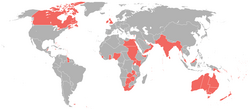
[[File:British Empire in 1898.png|thumb|upright=1.3|Extent of the [[British Empire]] in 1898]] | [[File:British Empire in 1898.png|thumb|upright=1.3|Extent of the [[British Empire]] in 1898]] | ||
Victoria was pleased when Gladstone resigned in 1885 after his budget was defeated.<ref>Hibbert, p. 373; St Aubyn, p. 458</ref> She thought his government was "the worst I have ever had", and blamed him for the death of [[Charles George Gordon|General Gordon]] | Victoria was pleased when Gladstone resigned in 1885 after his budget was defeated.<ref>Hibbert, p. 373; St Aubyn, p. 458</ref> She thought his government was "the worst I have ever had", and blamed him for the death of [[Charles George Gordon|General Gordon]] during the [[Siege of Khartoum]].<ref>Waller, p. 433; see also Hibbert, pp. 370–371 and Marshall, pp. 191–193</ref> Gladstone was replaced by [[Lord Salisbury]]. Salisbury's government only lasted a few months, however, and Victoria was forced to recall Gladstone, whom she referred to as a "half crazy & really in many ways ridiculous old man".<ref>Hibbert, p. 373; Longford, p. 484</ref> Gladstone attempted to pass [[Government of Ireland Bill 1886|a bill granting Ireland home rule]], but to Victoria's glee it was defeated.<ref>Hibbert, p. 374; Longford, p. 491; Marshall, p. 196; St Aubyn, pp. 460–461</ref> In [[1886 United Kingdom general election|the ensuing election]], Gladstone's party lost to Salisbury's and the government switched hands again.<ref>St Aubyn, pp. 460–461</ref> | ||
== Golden and Diamond Jubilees == | == Golden and Diamond Jubilees == | ||
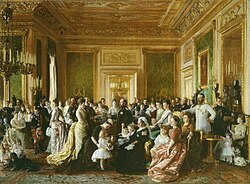
[[File:Queen Victoria | [[File:The Family of Queen Victoria (Tuxen).jpg|thumb|upright=1.3|alt=The Family of Queen Victoria in 1887|''[[The Family of Queen Victoria (1887)|The Family of Queen Victoria]]'' in 1887, by [[Laurits Tuxen]]. The painting, commissioned by the Queen to celebrate her Golden Jubilee, depicts Victoria and members of her family in the Green Drawing Room at Windsor Castle.]] | ||
In 1887, the [[British Empire]] celebrated [[Golden Jubilee of Queen Victoria|Victoria's Golden Jubilee]]. She marked the fiftieth anniversary of her accession on 20 June with a banquet to which 50 kings and princes were invited. The following day, she participated in a procession and attended a thanksgiving service in [[Westminster Abbey]].<ref>{{Citation |title=Queen Victoria |url=http://www.royal.gov.uk/HMTheQueen/TheQueenandspecialanniversaries/HistoryofJubilees/QueenVictoria.aspx |publisher=Royal Household |access-date=29 March 2013 |archive-date=13 March 2021 |archive-url=https://web.archive.org/web/20210313022325/http://www.royal.gov.uk/HMTheQueen/TheQueenandspecialanniversaries/HistoryofJubilees/QueenVictoria.aspx |url-status=live }}</ref> By this time, Victoria was once again extremely popular.<ref>Marshall, pp. 210–211; St Aubyn, pp. 491–493</ref> Two days later on 23 June,<ref>Longford, p. 502</ref> she engaged two Indian Muslims as waiters, one of whom was [[Abdul Karim (the Munshi)|Abdul Karim]]. He was soon promoted to "[[Munshi]]": teaching her [[Urdu]] and acting as a clerk.<ref>Hibbert, pp. 447–448; Longford, p. 508; St Aubyn, p. 502; Waller, p. 441</ref><ref>{{Citation |title=Queen Victoria's Urdu workbook on show |date=15 September 2017 |url=https://www.bbc.com/news/uk-england-hampshire-41285054 | | In 1887, the [[British Empire]] celebrated [[Golden Jubilee of Queen Victoria|Victoria's Golden Jubilee]]. She marked the fiftieth anniversary of her accession on 20 June with a banquet to which 50 kings and princes were invited. The following day, she participated in a procession and attended a thanksgiving service in [[Westminster Abbey]].<ref>{{Citation |title=Queen Victoria |url=http://www.royal.gov.uk/HMTheQueen/TheQueenandspecialanniversaries/HistoryofJubilees/QueenVictoria.aspx |publisher=Royal Household |access-date=29 March 2013 |archive-date=13 March 2021 |archive-url=https://web.archive.org/web/20210313022325/http://www.royal.gov.uk/HMTheQueen/TheQueenandspecialanniversaries/HistoryofJubilees/QueenVictoria.aspx |url-status=live}}</ref> By this time, Victoria was once again extremely popular.<ref>Marshall, pp. 210–211; St Aubyn, pp. 491–493</ref> Two days later on 23 June,<ref>Longford, p. 502</ref> she engaged two Indian Muslims as waiters, one of whom was [[Abdul Karim (the Munshi)|Abdul Karim]]. He was soon promoted to "[[Munshi]]": teaching her [[Urdu]] and acting as a clerk.<ref>Hibbert, pp. 447–448; Longford, p. 508; St Aubyn, p. 502; Waller, p. 441</ref><ref>{{Citation |title=Queen Victoria's Urdu workbook on show |date=15 September 2017 |url=https://www.bbc.com/news/uk-england-hampshire-41285054 |publisher=BBC News |access-date=23 November 2017 |archive-date=1 December 2017 |archive-url=https://web.archive.org/web/20171201043830/http://www.bbc.com/news/uk-england-hampshire-41285054 |url-status=live}}</ref><ref>{{Citation |last=Hunt |first=Kristin |title=Victoria and Abdul: The Friendship that Scandalized England |date=20 September 2017 |url=https://www.smithsonianmag.com/history/victoria-and-abdul-friendship-scandalized-england-180964959/ |work=Smithsonian |access-date=23 November 2017 |archive-date=1 December 2017 |archive-url=https://web.archive.org/web/20171201032437/https://www.smithsonianmag.com/history/victoria-and-abdul-friendship-scandalized-england-180964959/ |url-status=live}}</ref> Her family and retainers were appalled, and accused Abdul Karim of spying for the Muslim Patriotic League and biasing the Queen against Hindus and in favour of Muslims.<ref>Hibbert, pp. 448–449</ref> [[Equerry]] [[Frederick Ponsonby, 1st Baron Sysonby|Frederick Ponsonby]] (the son of Sir Henry) discovered that the Munshi had lied about his parentage, and reported to [[Victor Bruce, 9th Earl of Elgin|Lord Elgin]], [[Viceroy of India]], "the Munshi occupies very much the same position as John Brown used to do."<ref>Hibbert, pp. 449–451</ref> Victoria dismissed their complaints as racial prejudice.<ref>Hibbert, p. 447; Longford, p. 539; St Aubyn, p. 503; Waller, p. 442</ref> Abdul Karim remained in her service until he returned to India with a pension, on her death.<ref>Hibbert, p. 454</ref> | ||
[[File:Queen Victoria and Abdul Karim.jpg|thumb|left|upright|alt=The Munshi stands over Victoria as she works at a desk.|With the Munshi Abdul Karim]] | |||
Victoria's eldest daughter became [[German Empire|empress consort of Germany]] in 1888, but she was widowed a little over three months later, and Victoria's eldest grandchild became German Emperor as [[Wilhelm II|Wilhelm II]]. Victoria and Albert's hopes of a liberal Germany would go unfulfilled, as Wilhelm was a firm believer in [[autocracy]]. Victoria thought he had "little heart or ''Zartgefühl'' [tact] – and ... his conscience & intelligence have been completely {{sic|wharped}}".<ref>Hibbert, p. 382</ref> | |||
Victoria | Gladstone returned to power after the [[1892 United Kingdom general election|1892 general election]]; he was 82 years old. Victoria objected when Gladstone proposed appointing the Radical MP [[Henry Labouchère]] to the [[Cabinet of the United Kingdom|Cabinet]], so Gladstone agreed not to appoint him.<ref>Hibbert, p. 375; Longford, p. 519</ref> In 1894, Gladstone retired and, without consulting the outgoing prime minister, Victoria appointed [[Lord Rosebery]] as prime minister.<ref>Hibbert, p. 376; Longford, p. 530; St Aubyn, p. 515</ref> His government was weak, and the following year Lord Salisbury replaced him. Salisbury remained prime minister for the remainder of Victoria's reign.<ref>Hibbert, p. 377</ref>[[File:Queen Victoria 60. crownjubilee.jpg|thumb|upright|alt=Seated Victoria in embroidered and lace dress|Official Diamond Jubilee photograph by [[W. & D. Downey]]]] | ||
On 23 September 1896, Victoria surpassed her grandfather George III as the [[List of monarchs in Britain by length of reign|longest-reigning monarch in British history]]. The Queen requested that any special celebrations be delayed until 1897, to coincide with [[Diamond Jubilee of Queen Victoria|her Diamond Jubilee]],<ref>Hibbert, p. 456</ref> which was made a festival of the British Empire at the suggestion of the [[Secretary of State for the Colonies|Colonial Secretary]], [[Joseph Chamberlain]].<ref>Longford, p. 546; St Aubyn, pp. 545–546</ref> The prime ministers of all the [[self-governing]] [[Dominion]]s were invited to London for the festivities.<ref>Marshall, pp. 206–207, 211; St Aubyn, pp. 546–548</ref> One reason for including the prime ministers of the Dominions and excluding foreign heads of state was to avoid having to invite Victoria's grandson Wilhelm II, who, it was feared, might cause trouble at the event.<ref>{{Citation |last=MacMillan |first=Margaret |title=The War That Ended Peace |date=2013 |page=29 |publisher=[[Random House]] |isbn=978-0-8129-9470-4}}</ref> | |||
On 23 September 1896, Victoria surpassed her grandfather George III as the [[List of monarchs in Britain by length of reign|longest-reigning monarch in British history]]. The Queen requested that any special celebrations be delayed until 1897, to coincide with [[Diamond Jubilee of Queen Victoria|her Diamond Jubilee]],<ref>Hibbert, p. 456</ref> which was made a festival of the British Empire at the suggestion of the [[Secretary of State for the Colonies|Colonial Secretary]], [[Joseph Chamberlain]].<ref>Longford, p. 546; St Aubyn, pp. 545–546</ref> The prime ministers of all the [[self-governing]] | |||
The Queen's Diamond Jubilee procession on 22 June 1897 followed a route six miles long through London and included troops from all over the empire. The procession paused for an open-air service of thanksgiving held outside St Paul's Cathedral, throughout which Victoria sat in her open carriage, to avoid her having to climb the steps to enter the building. The celebration was marked by vast crowds of spectators and great outpourings of affection for the 78-year-old Queen.<ref>Hibbert, pp. 457–458; Marshall, pp. 206–207, 211; St Aubyn, pp. 546–548</ref> | The Queen's Diamond Jubilee procession on 22 June 1897 followed a route six miles long through London and included troops from all over the empire. The procession paused for an open-air service of thanksgiving held outside St Paul's Cathedral, throughout which Victoria sat in her open carriage, to avoid her having to climb the steps to enter the building. The celebration was marked by vast crowds of spectators and great outpourings of affection for the 78-year-old Queen.<ref>Hibbert, pp. 457–458; Marshall, pp. 206–207, 211; St Aubyn, pp. 546–548</ref> | ||
== Declining health and death == | == Declining health and death == | ||
[[File:Queen Victoria In Dublin (Rare archive footage from 1900).webm|thumb|upright|Queen Victoria in Dublin, 1900 | {{Main|Death and state funeral of Queen Victoria}} | ||
[[File:Queen Victoria by Heinrich von Angeli.jpg|thumb|left|upright|Portrait by [[Heinrich von Angeli]], 1899]] | |||
[[File:Queen Victoria In Dublin (Rare archive footage from 1900).webm|thumb|upright|Queen Victoria in Dublin, 1900|left]] | |||
[[ | Victoria regularly holidayed in mainland Europe. In 1889, during a stay in [[Biarritz]], she became the first reigning monarch from Britain to visit Spain by briefly crossing the border.<ref>Hibbert, p. 436; St Aubyn, p. 508</ref> By April 1900, the [[Boer War]] was so unpopular in mainland Europe that her annual trip to France seemed inadvisable. Instead, the Queen went to Ireland for the first time since 1861, in part to acknowledge the contribution of Irish regiments to the South African war.<ref>Hibbert, pp. 437–438; Longford, pp. 554–555; St Aubyn, p. 555</ref> | ||
In July 1900, Victoria's second son, Alfred ("Affie"), died. "Oh, God! My poor darling Affie gone too", she wrote in her journal. "It is a horrible year, nothing but sadness & horrors of one kind & another."<ref>Longford, p. 558</ref> | In July 1900, Victoria's second son, Alfred ("Affie"), died. "Oh, God! My poor darling Affie gone too", she wrote in her journal. "It is a horrible year, nothing but sadness & horrors of one kind & another."<ref>Longford, p. 558</ref> | ||
Following a custom she maintained throughout her widowhood, Victoria spent the Christmas of 1900 at Osborne House on the Isle of Wight. [[Rheumatism]] in her legs had rendered her disabled, and her eyesight was clouded by cataracts.<ref>Hibbert, pp. 464–466, 488–489; Strachey, p. 308; Waller, p. 442</ref> Through early January, she felt "weak and unwell",<ref>Victoria's journal, 1 January 1901, quoted in Hibbert, p. 492; Longford, p. 559 and St Aubyn, p. 592</ref> and by mid-January she was "drowsy | Following a custom she maintained throughout her widowhood, Victoria spent the Christmas of 1900 at Osborne House on the Isle of Wight. [[Rheumatism]] in her legs had rendered her disabled, and her eyesight was clouded by cataracts.<ref>Hibbert, pp. 464–466, 488–489; Strachey, p. 308; Waller, p. 442</ref> Through early January, she felt "weak and unwell",<ref>Victoria's journal, 1 January 1901, quoted in Hibbert, p. 492; Longford, p. 559 and St Aubyn, p. 592</ref> and by mid-January she was "drowsy{{nbsp}}[...] dazed, [and] confused".<ref>Her personal physician [[Sir James Reid, 1st Baronet]], quoted in Hibbert, p. 492</ref> Her [[Queen Victoria's pets|favourite pet]] [[Pomeranian (dog)|Pomeranian]], Turi, was laid on her bed as a last request.<ref name="ABC">{{Citation |last=Rappaport |first=Helen |title=Queen Victoria: A Biographical Companion |date=2003 |pages=34–39 |chapter=Animals |publisher=Abc-Clio |isbn=978-1-85109-355-7}}</ref> Victoria died at 6:30 pm on 22 January 1901, aged 81, in the presence of her eldest son, Albert Edward, and grandson, Wilhelm II. Albert Edward succeeded immediately as Edward VII.<ref>Longford, pp. 561–562; St Aubyn, p. 598</ref> | ||
In 1897, Victoria had written instructions for [[Death and state funeral of Queen Victoria|her funeral]], which was to be military as befitting a soldier's daughter and the head of the army,<ref name="odnb" /> and white instead of black.<ref>Hibbert, p. 497; Longford, p. 563</ref> On 25 January, | In 1897, Victoria had written instructions for [[Death and state funeral of Queen Victoria|her funeral]], which was to be military as befitting a soldier's daughter and the head of the army,<ref name="odnb" /> and white instead of black.<ref>Hibbert, p. 497; Longford, p. 563</ref> On 25 January, Edward VII and Wilhelm II, together with Prince Arthur, helped lift her body into the coffin.<ref>St Aubyn, p. 598</ref> She was dressed in a white dress and her wedding veil.<ref>Longford, p. 563</ref> An array of mementos commemorating her extended family, friends and servants were laid in the coffin with her, at her request, by her physician and dressers. One of Albert's dressing gowns was placed by her side, with a plaster cast of his hand, while a lock of John Brown's hair, along with a picture of him, was placed in her left hand concealed from the view of the family by a carefully positioned bunch of flowers.<ref name="odnb" /><ref>Hibbert, p. 498</ref> Items of [[Victorian jewellery|jewellery]] placed on Victoria included the wedding ring of Brown's mother, which Brown gave Victoria in 1883.<ref name="odnb">{{Cite ODNB |title=Victoria (1819–1901) |doi=10.1093/ref:odnb/36652 |orig-date=2004 |date=October 2009 |edition=online |author-link1=Colin Matthew |last1=Matthew |first1=H. C. G. |last2=Reynolds |first2=K. D. |mode=cs2}}</ref> Her funeral took place on Saturday, 2 February, in [[St George's Chapel, Windsor Castle]]. Following two days of lying-in-state, she was interred beside Prince Albert in the [[Royal Mausoleum, Frogmore]], within [[Home Park, Windsor]].<ref>Longford, p. 565; St Aubyn, p. 600</ref> | ||
With a reign of 63 years, seven months, and two days, Victoria was the [[List of monarchs in Britain by length of reign|longest-reigning British monarch]] and the [[List of longest-reigning monarchs|longest-reigning]] [[queen regnant]] in world history, until her great-great-granddaughter [[Elizabeth | With a reign of 63 years, seven months, and two days, Victoria was the [[List of monarchs in Britain by length of reign|longest-reigning British monarch]] and the [[List of longest-reigning monarchs|longest-reigning]] [[queen regnant]] in world history, until her great-great-granddaughter [[Elizabeth II]] surpassed her on 9 September 2015.<ref>{{Citation |last=Gander |first=Kashmira |title=Queen Elizabeth II to become Britain's longest reigning monarch, surpassing Queen Victoria |date=26 August 2015 |url=https://www.independent.co.uk/news/people/queen-elizabeth-ii-to-become-britains-longest-reigning-monarch-surpassing-queen-victoria-10473729.html |work=The Daily Telegraph |place=London |access-date=9 September 2015 |archive-date=19 September 2015 |archive-url=https://web.archive.org/web/20150919003603/http://www.independent.co.uk/news/people/queen-elizabeth-ii-to-become-britains-longest-reigning-monarch-surpassing-queen-victoria-10473729.html |url-status=live}}</ref> She was the last monarch of Britain from the [[House of Hanover]]; her son Edward VII belonged to her husband's [[House of Saxe-Coburg and Gotha]].<ref>{{citation |last=Weir |first=Alison |year=1996 |author-link=Alison Weir (historian) |title=Britain's Royal Families: The Complete Genealogy |edition=Revised |location=London |publisher=Random House |isbn=978-0-7126-7448-5 |page=317}}</ref> | ||
== Legacy == | == Legacy == | ||
===Reputation=== | ===Reputation=== | ||
{{See also|Cultural depictions of Queen Victoria}} | {{See also|Cultural depictions of Queen Victoria}} | ||
[[File:Her Majesty's Gracious Smile by Charles Knight.JPG|thumb|left|alt=Victoria smiling|Victoria amused. The remark "We are not amused" is attributed to her but there is no direct evidence that she ever said it,<ref name="odnb"/><ref>[[Roger Fulford|Fulford, Roger]] (1967) "Victoria", ''Collier's Encyclopedia'', United States: Crowell, Collier and Macmillan Inc., vol. 23, p. 127</ref> and she denied doing so.<ref>[[Mike Ashley (writer)|Ashley, Mike]] (1998) ''British Monarchs'', London: Robinson, {{ISBN|1-84119-096-9}}, p. 690</ref> Her staff and family recorded that Victoria "was immensely amused and roared with laughter" on many occasions.<ref>Example from a letter written by lady-in-waiting Marie Mallet née Adeane, quoted in Hibbert, p. 471</ref>]] | [[File:Her Majesty's Gracious Smile by Charles Knight.JPG|thumb|left|alt=Victoria smiling|Victoria, amused. The remark "We are not amused" is attributed to her but there is no direct evidence that she ever said it,<ref name="odnb"/><ref>[[Roger Fulford|Fulford, Roger]] (1967) "Victoria", ''Collier's Encyclopedia'', United States: Crowell, Collier and Macmillan Inc., vol. 23, p. 127</ref> and she denied doing so.<ref>[[Mike Ashley (writer)|Ashley, Mike]] (1998) ''British Monarchs'', London: Robinson, {{ISBN|1-84119-096-9}}, p. 690</ref> Her staff and family recorded that Victoria "was immensely amused and roared with laughter" on many occasions.<ref>Example from a letter written by lady-in-waiting Marie Mallet née Adeane, quoted in Hibbert, p. 471</ref>|262x262px]] | ||
According to one of her biographers, Giles St Aubyn, Victoria wrote an average of 2,500 words a day during her adult life.<ref>Hibbert, p. xv; St Aubyn, p. 340</ref> From July 1832 until just before her death, she kept | According to one of her biographers, Giles St Aubyn, Victoria wrote an average of 2,500 words a day during her adult life.<ref>Hibbert, p. xv; St Aubyn, p. 340</ref> From July 1832 until just before her death, she kept [[Queen Victoria's journals|a detailed journal]], which eventually encompassed 122 volumes.<ref>St Aubyn, p. 30; Woodham-Smith, p. 87</ref> After Victoria's death, her youngest daughter, Princess Beatrice, was appointed her literary executor. Beatrice transcribed and edited the diaries covering Victoria's accession onwards, and burned the originals in the process.<ref>Hibbert, pp. 503–504; St Aubyn, p. 30; Woodham-Smith, pp. 88, 436–437</ref> Despite this destruction, much of the diaries still exist. In addition to Beatrice's edited copy, [[Reginald Brett, 2nd Viscount Esher|Lord Esher]] transcribed the volumes from 1832 to 1861 before Beatrice destroyed them.<ref>Hibbert, p. 503</ref> Part of Victoria's extensive correspondence has been published in volumes edited by [[A. C. Benson]], [[Hector Bolitho]], [[George Earle Buckle]], Lord Esher, [[Roger Fulford]], and [[Richard Hough]] among others.<ref>Hibbert, pp. 503–504; St Aubyn, p. 624</ref> | ||
Victoria was stout, dowdy and about {{convert|5|ft|m|abbr=off|spell=in}} tall, but projected a grand image.<ref>Hibbert, pp. 61–62; Longford, pp. 89, 253; St Aubyn, pp. 48, 63–64</ref> She was unpopular during the first years of her widowhood, but was well liked during the 1880s and 1890s, when she embodied the empire as a benevolent matriarchal figure.<ref>Marshall, p. 210; Waller, pp. 419, 434–435, 443</ref> Only after the release of her diary and letters did the extent of her political influence become known to the wider public.<ref name="odnb" /><ref>Waller, p. 439</ref> Biographies of Victoria written before much of the primary material became available, such as [[Lytton Strachey]]'s ''Queen Victoria'' of 1921, are now considered out of date.<ref>St Aubyn, p. 624</ref> The biographies written by [[Elizabeth Longford]] and [[Cecil Woodham-Smith]], in 1964 and 1972 respectively, are still widely admired.<ref>Hibbert, p. 504; St Aubyn, p. 623</ref> They, and others, conclude that as a person Victoria was emotional, obstinate, honest, and straight-talking.<ref>e.g. Hibbert, p. 352; Strachey, p. 304; Woodham-Smith, p. 431</ref> | In her later years, Victoria was stout, dowdy, and about {{convert|5|ft|m|abbr=off|spell=in}} tall, but she projected a grand image.<ref>Hibbert, pp. 61–62; Longford, pp. 89, 253; St Aubyn, pp. 48, 63–64</ref> She was unpopular during the first years of her widowhood, but was well liked during the 1880s and 1890s, when she embodied the empire as a benevolent matriarchal figure.<ref>Marshall, p. 210; Waller, pp. 419, 434–435, 443</ref> Only after the release of her diary and letters did the extent of her political influence become known to the wider public.<ref name="odnb" /><ref>Waller, p. 439</ref> Biographies of Victoria written before much of the primary material became available, such as [[Lytton Strachey]]'s ''Queen Victoria'' of 1921, are now considered out of date.<ref>St Aubyn, p. 624</ref> The biographies written by [[Elizabeth Longford]] and [[Cecil Woodham-Smith]], in 1964 and 1972 respectively, are still widely admired.<ref>Hibbert, p. 504; St Aubyn, p. 623</ref> [[Stanley Weintraub]]'s from 1987 is considered one of the gold-standard biographies of Victoria, and was the first to be written by an American.<ref>Worsley, p. 6.</ref> They, and others, conclude that as a person Victoria was emotional, obstinate, honest, and straight-talking.<ref>e.g. Hibbert, p. 352; Strachey, p. 304; Woodham-Smith, p. 431</ref> | ||
Through Victoria's reign, the gradual establishment of a modern [[constitutional monarchy]] in Britain continued. Reforms of the voting system increased the power of the [[House of Commons of the United Kingdom|House of Commons]] at the expense of the [[House of Lords]] and the monarch.<ref>Waller, p. 429</ref> In 1867, [[Walter Bagehot]] wrote that the monarch only retained "the right to be consulted, the right to encourage, and the right to warn".<ref>{{Citation |last=Bagehot |first=Walter |title=The English Constitution |date=1867 |page=103 |place=London |publisher=Chapman and Hall}}</ref> As Victoria's monarchy became more symbolic than political, it placed a strong emphasis on morality and family values, in contrast to the sexual, financial and personal scandals that had been associated with previous members of the House of Hanover and which had discredited the monarchy. The concept of the "family monarchy", with which the burgeoning middle classes could identify, was solidified.<ref>St Aubyn, pp. 602–603; Strachey, pp. 303–304; Waller, pp. 366, 372, 434</ref> | Through Victoria's reign, the gradual establishment of a modern [[constitutional monarchy]] in Britain continued. Reforms of the voting system increased the power of the [[House of Commons of the United Kingdom|House of Commons]] at the expense of the [[House of Lords]] and the monarch.<ref>Waller, p. 429</ref> In 1867, [[Walter Bagehot]] wrote that the monarch only retained "the right to be consulted, the right to encourage, and the right to warn".<ref>{{Citation |last=Bagehot |first=Walter |title=The English Constitution |date=1867 |page=103 |place=London |publisher=Chapman and Hall}}</ref> As Victoria's monarchy became more symbolic than political, it placed a strong emphasis on morality and family values, in contrast to the sexual, financial and personal scandals that had been associated with previous members of the House of Hanover and which had discredited the monarchy. The concept of the "family monarchy", with which the burgeoning middle classes could identify, was solidified.<ref>St Aubyn, pp. 602–603; Strachey, pp. 303–304; Waller, pp. 366, 372, 434</ref> | ||
=== Descendants and haemophilia === | === Descendants and haemophilia === | ||
[[File:Victoria Memorial situated in Kolkata.jpg|thumb|The [[Victoria Memorial, Kolkata|Victoria Memorial]] in [[Kolkata]], India]] | |||
Victoria's links with Europe's royal families earned her the nickname "the grandmother of Europe".<ref>Erickson, Carolly (1997) ''Her Little Majesty: The Life of Queen Victoria'', New York: Simon & Schuster, {{ISBN|0-7432-3657-2}}</ref> Of the | Victoria's links with Europe's royal families earned her the nickname "the grandmother of Europe".<ref>Erickson, Carolly (1997) ''Her Little Majesty: The Life of Queen Victoria'', New York: Simon & Schuster, {{ISBN|0-7432-3657-2}}</ref> Of the [[grandchildren of Victoria and Albert]], 34 survived to adulthood.<ref name="odnb" /> | ||
Victoria's youngest son, Leopold, was affected by the blood-clotting disease [[haemophilia B]] and at least two of her five daughters, Alice and Beatrice, were carriers. [[Haemophilia in European royalty|Royal haemophiliacs]] descended from Victoria included her great-grandsons, [[Alexei Nikolaevich, Tsarevich of Russia]]; [[Alfonso, Prince of Asturias (1907–1938)|Alfonso, Prince of Asturias]]; and [[Infante Gonzalo of Spain]].<ref>{{Citation |last1=Rogaev |first1=Evgeny I. |title=Genotype Analysis Identifies the Cause of the "Royal Disease" |date=2009 |journal=Science |volume=326 |issue=5954 |page=817 |bibcode=2009Sci...326..817R |doi=10.1126/science.1180660 |pmid=19815722 |last2=Grigorenko |first2=Anastasia P. |last3=Faskhutdinova |first3=Gulnaz |last4=Kittler |first4=Ellen L. W. |last5=Moliaka |first5=Yuri K. |s2cid=206522975}}</ref> The presence of the disease in Victoria's descendants, but not in her ancestors, led to [[Legitimacy of Queen Victoria|modern speculation that her true father was not the Duke of Kent]], but a haemophiliac.<ref>Potts and Potts, pp. 55–65, quoted in Hibbert p. 217; Packard, pp. 42–43</ref> There is no documentary evidence of a haemophiliac in connection with Victoria's mother, and as male carriers always had the disease, even if such a man had existed he would have been seriously ill.<ref>[[Steve Jones (biologist)|Jones, Steve]] (1996) ''In the Blood'', [[BBC]] documentary</ref> It is more likely that the mutation arose spontaneously because Victoria's father was over 50 at the time of her conception and haemophilia arises more frequently in the children of older fathers.<ref>{{Citation |last=McKusick |first=Victor A. |title=The Royal Hemophilia |date=1965 |journal=[[Scientific American]] |volume=213 |issue=2 |page=91 |bibcode=1965SciAm.213b..88M |doi=10.1038/scientificamerican0865-88 |pmid=14319025 |author-link=Victor A. McKusick}}; {{Citation |last=Jones |first=Steve |title=The Language of the Genes |date=1993 |publisher=[[HarperCollins]] |isbn=0-00-255020-2 |location=London |page=69 |author-link=Steve Jones (biologist)}}; {{Citation |author-link=Steve Jones (biologist) |last=Jones |first=Steve |date=1993 |title=In The Blood: God, Genes and Destiny |location=London |publisher=HarperCollins |isbn=0-00-255511-5 |page=270}}; {{Citation |last=Rushton |first=Alan R. |date=2008 |title=Royal Maladies: Inherited Diseases in the Royal Houses of Europe |location=[[Victoria, British Columbia]] |publisher=Trafford |isbn=978-1-4251-6810-0 |pages=31–32}}</ref> Spontaneous mutations account for about a third of cases.<ref>{{Citation |title=Hemophilia B |date=5 March 2014 |url=http://www.hemophilia.org/Bleeding-Disorders/Types-of-Bleeding-Disorders/Hemophilia-B |publisher=National Hemophilia Foundation |access-date=29 March 2015 |archive-date=24 March 2015 |archive-url=https://web.archive.org/web/20150324033555/http://www.hemophilia.org/Bleeding-Disorders/Types-of-Bleeding-Disorders/Hemophilia-B |url-status=live }}</ref> | Victoria's youngest son, Leopold, was affected by the blood-clotting disease [[haemophilia B]] and at least two of her five daughters, Alice and Beatrice, were carriers. [[Haemophilia in European royalty|Royal haemophiliacs]] descended from Victoria included her great-grandsons, [[Alexei Nikolaevich, Tsarevich of Russia]]; [[Alfonso, Prince of Asturias (1907–1938)|Alfonso, Prince of Asturias]]; and [[Infante Gonzalo of Spain]].<ref>{{Citation |last1=Rogaev |first1=Evgeny I. |title=Genotype Analysis Identifies the Cause of the "Royal Disease" |date=2009 |journal=Science |volume=326 |issue=5954 |page=817 |bibcode=2009Sci...326..817R |doi=10.1126/science.1180660 |pmid=19815722 |last2=Grigorenko |first2=Anastasia P. |last3=Faskhutdinova |first3=Gulnaz |last4=Kittler |first4=Ellen L. W. |last5=Moliaka |first5=Yuri K. |s2cid=206522975 |doi-access=free |issn=0036-8075}}</ref> The presence of the disease in Victoria's descendants, but not in her ancestors, led to [[Legitimacy of Queen Victoria|modern speculation that her true father was not the Duke of Kent]], but a haemophiliac.<ref>Potts and Potts, pp. 55–65, quoted in Hibbert p. 217; Packard, pp. 42–43</ref> There is no documentary evidence of a haemophiliac in connection with Victoria's mother, and as male carriers always had the disease, even if such a man had existed he would have been seriously ill.<ref>[[Steve Jones (biologist)|Jones, Steve]] (1996) ''In the Blood'', [[BBC]] documentary</ref> It is more likely that the mutation arose spontaneously because Victoria's father was over 50 at the time of her conception and haemophilia arises more frequently in the children of older fathers.<ref>{{Citation |last=McKusick |first=Victor A. |title=The Royal Hemophilia |date=1965 |journal=[[Scientific American]] |volume=213 |issue=2 |page=91 |bibcode=1965SciAm.213b..88M |doi=10.1038/scientificamerican0865-88 |pmid=14319025 |author-link=Victor A. McKusick}}; {{Citation |last=Jones |first=Steve |title=The Language of the Genes |date=1993 |publisher=[[HarperCollins]] |isbn=0-00-255020-2 |location=London |page=69 |author-link=Steve Jones (biologist)}}; {{Citation |author-link=Steve Jones (biologist) |last=Jones |first=Steve |date=1993 |title=In The Blood: God, Genes and Destiny |location=London |publisher=HarperCollins |isbn=0-00-255511-5 |page=270}}; {{Citation |last=Rushton |first=Alan R. |date=2008 |title=Royal Maladies: Inherited Diseases in the Royal Houses of Europe |location=[[Victoria, British Columbia]] |publisher=Trafford |isbn=978-1-4251-6810-0 |pages=31–32}}</ref> Spontaneous mutations account for about a third of cases.<ref>{{Citation |title=Hemophilia B |date=5 March 2014 |url=http://www.hemophilia.org/Bleeding-Disorders/Types-of-Bleeding-Disorders/Hemophilia-B |publisher=National Hemophilia Foundation |access-date=29 March 2015 |archive-date=24 March 2015 |archive-url=https://web.archive.org/web/20150324033555/http://www.hemophilia.org/Bleeding-Disorders/Types-of-Bleeding-Disorders/Hemophilia-B |url-status=live}}</ref> | ||
== Titles, styles, honours, and arms == | == Titles, styles, honours, and arms == | ||
=== Titles and styles === | === Titles and styles === | ||
At the end of her reign, | She was born Princess Alexandrina Victoria of Kent, with a style of [[Royal Highness|''Her Royal Highness'']]. At the end of her reign, her full [[Style of the British sovereign#Styles of British sovereigns|style]] was: "Her Majesty Victoria, by the Grace of God, of the [[United Kingdom of Great Britain and Ireland]] Queen, [[Defender of the Faith]], Empress of India".<ref name="1900 Whitaker" /> | ||
=== Honours === | === Honours === | ||
==== British honours ==== | ==== British honours ==== | ||
* [[Royal Family Order of George IV]], ''1826''<ref>{{Citation |last1=Risk |first1=James |title=Royal Service |date=2001 |volume=2 |pages=16–19 |place=Lingfield |publisher=Third Millennium Publishing/Victorian Publishing |last2=Pownall |first2=Henry |last3=Stanley |first3=David |last4=Tamplin |first4=John |last5=Martin |first5=Stanley}}</ref> | |||
* [[Royal Family Order of | |||
* Founder of the [[Victoria Cross]] ''5 February 1856''<ref>{{London Gazette|issue=21846|pages=410–411|date=5 February 1856|mode=cs2}}</ref> | * Founder of the [[Victoria Cross]] ''5 February 1856''<ref>{{London Gazette|issue=21846|pages=410–411|date=5 February 1856|mode=cs2}}</ref> | ||
* Founder and Sovereign of the [[Order of the Star of India]], ''25 June 1861''<ref>{{London Gazette|issue=22523|date=25 June 1861|page=2621|mode=cs2}}</ref> | * Founder and Sovereign of the [[Order of the Star of India]], ''25 June 1861''<ref>{{London Gazette|issue=22523|date=25 June 1861|page=2621|mode=cs2}}</ref> | ||
* Founder and Sovereign of the [[Royal Order of Victoria and Albert]], ''10 February 1862''<ref name="Whitaker1894">{{Citation |last=Whitaker |first=Joseph |title=An Almanack for the Year of Our Lord ... |date=1894 |url=https://books.google.com/books?id=6cUMAAAAYAAJ&pg=PA112 |page=112 |publisher=J. Whitaker |access-date=15 December 2019 |archive-date= | * Founder and Sovereign of the [[Royal Order of Victoria and Albert]], ''10 February 1862''<ref name="Whitaker1894">{{Citation |last=Whitaker |first=Joseph |title=An Almanack for the Year of Our Lord ... |date=1894 |url=https://books.google.com/books?id=6cUMAAAAYAAJ&pg=PA112 |page=112 |publisher=J. Whitaker |access-date=15 December 2019 |archive-date=22 March 2023 |archive-url=https://web.archive.org/web/20230322110601/https://books.google.com/books?id=6cUMAAAAYAAJ&pg=PA112 |url-status=live}}</ref> | ||
* Founder and Sovereign of the [[Order of the Crown of India]], ''1 January 1878''<ref>{{London Gazette |issue=24539 |date=4 January 1878 |page=113 |mode=cs2}}</ref> | * Founder and Sovereign of the [[Order of the Crown of India]], ''1 January 1878''<ref>{{London Gazette |issue=24539 |date=4 January 1878 |page=113 |mode=cs2}}</ref> | ||
* Founder and Sovereign of the [[Order of the Indian Empire]], ''1 January 1878''<ref>{{Citation |last=Shaw |first=William Arthur |title=The Knights of England |date=1906 |volume=1 |page=xxxi |chapter=Introduction |chapter-url=https://archive.org/details/cu31924092537418/page/n55/mode/2up |place=London |publisher=Sherratt and Hughes |author-link=William Arthur Shaw}}</ref> | * Founder and Sovereign of the [[Order of the Indian Empire]], ''1 January 1878''<ref>{{Citation |last=Shaw |first=William Arthur |title=The Knights of England |date=1906 |volume=1 |page=xxxi |chapter=Introduction |chapter-url=https://archive.org/details/cu31924092537418/page/n55/mode/2up |place=London |publisher=Sherratt and Hughes |author-link=William Arthur Shaw}}</ref> | ||
| Line 322: | Line 315: | ||
{{columns-list|colwidth=25em| | {{columns-list|colwidth=25em| | ||
* [[History of Spain (1810–1873)|Spain]]: | * [[History of Spain (1810–1873)|Spain]]: | ||
** Dame of the [[Order of Queen Maria Luisa]], ''21 December 1833''<ref>{{Citation |title=Real orden de damas nobles de la Reina Maria Luisa |date=1834 |url=https://babel.hathitrust.org/cgi/pt?id=wu.89003308012&view=1up&seq=128 |work=Calendario Manual y Guía de Forasteros en Madrid |page=91 |place=Madrid |publisher=Imprenta Real |language=es |via=hathitrust.org |access-date=21 November 2019 |archive-date=28 March 2021 |archive-url=https://web.archive.org/web/20210328225310/https://babel.hathitrust.org/cgi/pt?id=wu.89003308012&view=1up&seq=128 |url-status=live }}</ref> | ** Dame of the [[Order of Queen Maria Luisa]], ''21 December 1833''<ref>{{Citation |title=Real orden de damas nobles de la Reina Maria Luisa |date=1834 |url=https://babel.hathitrust.org/cgi/pt?id=wu.89003308012&view=1up&seq=128 |work=Calendario Manual y Guía de Forasteros en Madrid |page=91 |place=Madrid |publisher=Imprenta Real |language=es |via=hathitrust.org |access-date=21 November 2019 |archive-date=28 March 2021 |archive-url=https://web.archive.org/web/20210328225310/https://babel.hathitrust.org/cgi/pt?id=wu.89003308012&view=1up&seq=128 |url-status=live}}</ref> | ||
** Grand Cross of the [[Order of Charles III]]<ref name="Naotaka">{{Citation |last=Kimizuka |first=Naotaka |script-title=ja:女王陛下のブルーリボン: ガーター勲章とイギリス外交 |date=2004 |url=https://books.google.com/books?id=T13tPAAACAAJ |page=303 |trans-title=Her Majesty The Queen's Blue Ribbon: The Order of the Garter and British Diplomacy |place=Tokyo |publisher=NTT Publishing |language=ja |isbn=978-4-7571-4073-8 |access-date=13 September 2020 |archive-date= | ** Grand Cross of the [[Order of Charles III]]<ref name="Naotaka">{{Citation |last=Kimizuka |first=Naotaka |script-title=ja:女王陛下のブルーリボン: ガーター勲章とイギリス外交 |date=2004 |url=https://books.google.com/books?id=T13tPAAACAAJ |page=303 |trans-title=Her Majesty The Queen's Blue Ribbon: The Order of the Garter and British Diplomacy |place=Tokyo |publisher=NTT Publishing |language=ja |isbn=978-4-7571-4073-8 |access-date=13 September 2020 |archive-date=22 March 2023 |archive-url=https://web.archive.org/web/20230322110556/https://books.google.com/books?id=T13tPAAACAAJ |url-status=live}}</ref> | ||
* [[Kingdom of Portugal|Portugal]]: | * [[Kingdom of Portugal|Portugal]]: | ||
** Dame of the [[Order of Saint Isabel|Order of Queen Saint Isabel]], ''23 February 1836''<ref name="Agraciamentos">{{Citation |last=Bragança |first=Jose Vicente de |title=Agraciamentos Portugueses Aos Príncipes da Casa Saxe-Coburgo-Gota |date=2014 |url=https://www.academia.edu/10576008 |work=Pro Phalaris |volume=9–10 |page=6 |trans-title=Portuguese Honours awarded to Princes of the House of Saxe-Coburg and Gotha |language=pt |access-date=28 November 2019 |archive-date=25 November 2021 |archive-url=https://web.archive.org/web/20211125152639/https://www.academia.edu/10576008 |url-status=live }}</ref> | ** Dame of the [[Order of Saint Isabel|Order of Queen Saint Isabel]], ''23 February 1836''<ref name="Agraciamentos">{{Citation |last=Bragança |first=Jose Vicente de |title=Agraciamentos Portugueses Aos Príncipes da Casa Saxe-Coburgo-Gota |date=2014 |url=https://www.academia.edu/10576008 |work=Pro Phalaris |volume=9–10 |page=6 |trans-title=Portuguese Honours awarded to Princes of the House of Saxe-Coburg and Gotha |language=pt |access-date=28 November 2019 |archive-date=25 November 2021 |archive-url=https://web.archive.org/web/20211125152639/https://www.academia.edu/10576008 |url-status=live}}</ref> | ||
** Grand Cross of the [[Order of the Immaculate Conception of Vila Viçosa]]<ref name="Naotaka" /> | ** Grand Cross of the [[Order of the Immaculate Conception of Vila Viçosa]]<ref name="Naotaka" /> | ||
* [[Russian Empire|Russia]]: [[Order of St. Catherine|Grand Cross of St. Catherine]], ''26 June 1837''<ref>{{Citation |script-title=ru:Список кавалерам россійских императорских и царских орденов|trans-title=List of Knights of the Russian Imperial and Tsarist Orders |date=1850 |url=https://books.google.com/books?id=z_QxAQAAMAAJ |page=15 |script-chapter=ru:Ордена Св. Екатерины |trans-chapter=Knights of the Order of St. Catherine |place=Saint Petersburg |publisher=Printing house of the II branch of His Imperial Majesty's Chancellery |language=ru |access-date=20 October 2019 |archive-date= | * [[Russian Empire|Russia]]: [[Order of St. Catherine|Grand Cross of St. Catherine]], ''26 June 1837''<ref>{{Citation |script-title=ru:Список кавалерам россійских императорских и царских орденов |trans-title=List of Knights of the Russian Imperial and Tsarist Orders |date=1850 |url=https://books.google.com/books?id=z_QxAQAAMAAJ |page=15 |script-chapter=ru:Ордена Св. Екатерины |trans-chapter=Knights of the Order of St. Catherine |place=Saint Petersburg |publisher=Printing house of the II branch of His Imperial Majesty's Chancellery |language=ru |access-date=20 October 2019 |archive-date=22 March 2023 |archive-url=https://web.archive.org/web/20230322110556/https://books.google.com/books?id=z_QxAQAAMAAJ |url-status=live}}</ref> | ||
* [[July Monarchy|France]]: Grand Cross of the [[Legion of Honour]], ''5 September 1843''<ref>{{Citation |title=Les Grand'Croix de la Légion d'honneur de 1805 à nos jours. Titulaires français et étrangers |date=2009 |pages=21, 460, 564 |place=Paris |publisher=Archives & Culture |language=French |isbn=978-2-35077-135-9 |ref=M. et B. Wattel |first1=Michel |last1=Wattel |first2=Béatrice |last2=Wattel}}</ref> | * [[July Monarchy|France]]: Grand Cross of the [[Legion of Honour]], ''5 September 1843''<ref>{{Citation |title=Les Grand'Croix de la Légion d'honneur de 1805 à nos jours. Titulaires français et étrangers |date=2009 |pages=21, 460, 564 |place=Paris |publisher=Archives & Culture |language=French |isbn=978-2-35077-135-9 |ref=M. et B. Wattel |first1=Michel |last1=Wattel |first2=Béatrice |last2=Wattel}}</ref> | ||
* [[Second Mexican Republic|Mexico]]/[[Second Mexican Empire|Mexican Empire]]: | * [[Second Mexican Republic|Mexico]]/[[Second Mexican Empire|Mexican Empire]]: | ||
**Grand Cross of the [[Order of Guadalupe|National Order of Guadalupe]], ''1854''<ref>{{Citation |title=Almanaque imperial para el año 1866 |date=1866 |page=[ | ** Grand Cross of the [[Order of Guadalupe|National Order of Guadalupe]], ''1854''<ref>{{Citation |title=Almanaque imperial para el año 1866 |date=1866 |page=[{{GBurl |id=VOAxAQAAMAAJ |p=244}} 244] |chapter=Seccion IV: Ordenes del Imperio |chapter-url=https://books.google.com/books?id=VOAxAQAAMAAJ |place=Mexico City |publisher=Imp. de J.M. Lara |language=es |access-date=13 September 2020 |archive-date=22 March 2023 |archive-url=https://web.archive.org/web/20230322110556/https://books.google.com/books?id=VOAxAQAAMAAJ |url-status=live}}</ref> | ||
**Grand Cross of the [[ | ** Grand Cross of the [[Order of Saint Charles (Mexico)|Imperial Order of San Carlos]], ''1866''<ref>{{cite journal |last=Olvera Ayes |date=2020 |first=David A. |periodical=Cuadernos del Cronista Editores, México |title=La Orden Imperial de San Carlos |mode=cs2}}<!-- auto-translated by Module:CS1 translator --></ref> | ||
* [[Kingdom of Prussia|Prussia]]: Dame of the [[Order of Louise]], 1st Division, ''11 June 1857''<ref>{{Citation |last=Queen Victoria |title=Queen Victoria's Journals |volume=43 |page=171 |chapter=Thursday, 11th June 1857 |chapter-url=http://www.queenvictoriasjournals.org |via=The Royal Archives |access-date=2 June 2012 |archive-date=25 November 2021 |archive-url=https://web.archive.org/web/20211125152643/http://qvj.chadwyck.com/marketing.do |url-status=live }}</ref> | * [[Kingdom of Prussia|Prussia]]: Dame of the [[Order of Louise]], 1st Division, ''11 June 1857''<ref>{{Citation |last=Queen Victoria |title=Queen Victoria's Journals |volume=43 |page=171 |chapter=Thursday, 11th June 1857 |chapter-url=http://www.queenvictoriasjournals.org |via=The Royal Archives |access-date=2 June 2012 |archive-date=25 November 2021 |archive-url=https://web.archive.org/web/20211125152643/http://qvj.chadwyck.com/marketing.do |url-status=live}}</ref> | ||
* [[Empire of Brazil|Brazil]]: Grand Cross of the [[Order of Pedro I]], ''3 December 1872''<ref>{{Citation |last=Queen Victoria |title=Queen Victoria's Journals |volume=61 |page=333 |chapter=Tuesday, 3rd December 1872 |chapter-url=http://www.queenvictoriasjournals.org |via=The Royal Archives |access-date=2 June 2012 |archive-date=25 November 2021 |archive-url=https://web.archive.org/web/20211125152643/http://qvj.chadwyck.com/marketing.do |url-status=live }}</ref> | * [[Empire of Brazil|Brazil]]: Grand Cross of the [[Order of Pedro I]], ''3 December 1872''<ref>{{Citation |last=Queen Victoria |title=Queen Victoria's Journals |volume=61 |page=333 |chapter=Tuesday, 3rd December 1872 |chapter-url=http://www.queenvictoriasjournals.org |via=The Royal Archives |access-date=2 June 2012 |archive-date=25 November 2021 |archive-url=https://web.archive.org/web/20211125152643/http://qvj.chadwyck.com/marketing.do |url-status=live}}</ref> | ||
* [[Qajar Iran|Persia]]:<ref>{{Citation |last=Naser al-Din Shah Qajar |title=The Diary of H.M. The Shah of Persia during his tour through Europe in A.D. 1873: A verbatim translation |date=1874 |page=149 |chapter=Chapter IV: England |chapter-url=https://archive.org/details/diaryofhmshahofp00nasiuoft/page/148 |place=London |publisher=John Murray |author-link=Naser al-Din Shah Qajar |translator-last=Redhouse |translator-first=James William |translator-link=James Redhouse}}</ref> | * [[Qajar Iran|Persia]]:<ref>{{Citation |last=Naser al-Din Shah Qajar |title=The Diary of H.M. The Shah of Persia during his tour through Europe in A.D. 1873: A verbatim translation |date=1874 |page=149 |chapter=Chapter IV: England |chapter-url=https://archive.org/details/diaryofhmshahofp00nasiuoft/page/148 |place=London |publisher=John Murray |author-link=Naser al-Din Shah Qajar |translator-last=Redhouse |translator-first=James William |translator-link=James Redhouse}}</ref> | ||
** [[Order of Aftab|Order of the Sun]], 1st Class in Diamonds, ''20 June 1873'' | ** [[Order of Aftab|Order of the Sun]], 1st Class in Diamonds, ''20 June 1873'' | ||
** Order of the August Portrait, ''20 June 1873'' | ** Order of the August Portrait, ''20 June 1873'' | ||
* [[Siam]]: | * [[Siam]]: | ||
** [[Order of the White Elephant|Grand Cross of the White Elephant]], ''1880''<ref name="times29924">{{Cite newspaper The Times|title=Court Circular|department=Court and Social|date=3 July 1880|page=11|issue=29924|column=G|mode=cs2}}</ref> | ** [[Order of the White Elephant|Grand Cross of the White Elephant]], ''1880''<ref name="times29924">{{Cite newspaper The Times |title=Court Circular |department=Court and Social |date=3 July 1880 |page=11 |issue=29924 |column=G |mode=cs2}}</ref> | ||
** Dame of the [[Order of the Royal House of Chakri]], ''1887''<ref>{{Citation |script-title=th:ข่าวรับพระราชสาสน์ พระราชสาสน์จากกษัตริย์ในประเทศยุโรปที่ทรงยินดีในการได้รับพระราชสาสน์จากพระบาทสมเด็จพระเจ้าอยู่หัว |date=5 May 1887 |url=http://www.ratchakitcha.soc.go.th/DATA/PDF/2430/026/214_1.PDF |work=[[Royal Thai Government Gazette]] |language=th |access-date=8 May 2019 |archive-date=21 October 2020 |archive-url=https://web.archive.org/web/20201021052436/http://www.ratchakitcha.soc.go.th/DATA/PDF/2430/026/214_1.PDF |url-status=dead }}</ref> | ** Dame of the [[Order of the Royal House of Chakri]], ''1887''<ref>{{Citation |script-title=th:ข่าวรับพระราชสาสน์ พระราชสาสน์จากกษัตริย์ในประเทศยุโรปที่ทรงยินดีในการได้รับพระราชสาสน์จากพระบาทสมเด็จพระเจ้าอยู่หัว |date=5 May 1887 |url=http://www.ratchakitcha.soc.go.th/DATA/PDF/2430/026/214_1.PDF |work=[[Royal Thai Government Gazette]] |language=th |access-date=8 May 2019 |archive-date=21 October 2020 |archive-url=https://web.archive.org/web/20201021052436/http://www.ratchakitcha.soc.go.th/DATA/PDF/2430/026/214_1.PDF |url-status=dead}}</ref> | ||
* [[Kingdom of Hawaii|Hawaii]]: Grand Cross of the [[Royal Order of Kamehameha I (decoration)|Order of Kamehameha I]], with Collar, ''July 1881''<ref>Kalakaua to his sister, 24 July 1881, quoted in Greer, Richard A. (editor, 1967) "[https://evols.library.manoa.hawaii.edu/bitstream/10524/186/JL05085.pdf The Royal Tourist – Kalakaua's Letters Home from Tokio to London] {{Webarchive|url=https://web.archive.org/web/20191019083943/https://evols.library.manoa.hawaii.edu/bitstream/10524/186/JL05085.pdf |date=19 October 2019 }}", ''Hawaiian Journal of History'', vol. 5, p. 100</ref> | * [[Kingdom of Hawaii|Hawaii]]: Grand Cross of the [[Royal Order of Kamehameha I (decoration)|Order of Kamehameha I]], with Collar, ''July 1881''<ref>Kalakaua to his sister, 24 July 1881, quoted in Greer, Richard A. (editor, 1967) "[https://evols.library.manoa.hawaii.edu/bitstream/10524/186/JL05085.pdf The Royal Tourist – Kalakaua's Letters Home from Tokio to London] {{Webarchive|url=https://web.archive.org/web/20191019083943/https://evols.library.manoa.hawaii.edu/bitstream/10524/186/JL05085.pdf |date=19 October 2019 }}", ''Hawaiian Journal of History'', vol. 5, p. 100</ref> | ||
* [[Kingdom of Serbia|Serbia]]:<ref>{{Citation |last=Acović |first=Dragomir |title=Slava i čast: Odlikovanja među Srbima, Srbi među odlikovanjima |date=2012 |pages=364 |place=Belgrade |publisher=Službeni Glasnik |language=Serbian}}</ref><ref>{{Citation |title=Two Royal Families – Historical Ties |url=http://www.royalfamily.org/two-royal-families-historical-ties/ |work=The Royal Family of Serbia |date=13 March 2016 |access-date=6 December 2019 |archive-date=6 December 2019 |archive-url=https://web.archive.org/web/20191206100031/http://www.royalfamily.org/two-royal-families-historical-ties/ |url-status=live }}</ref> | * [[Kingdom of Serbia|Serbia]]:<ref>{{Citation |last=Acović |first=Dragomir |title=Slava i čast: Odlikovanja među Srbima, Srbi među odlikovanjima |date=2012 |pages=364 |place=Belgrade |publisher=Službeni Glasnik |language=Serbian}}</ref><ref>{{Citation |title=Two Royal Families – Historical Ties |url=http://www.royalfamily.org/two-royal-families-historical-ties/ |work=The Royal Family of Serbia |date=13 March 2016 |access-date=6 December 2019 |archive-date=6 December 2019 |archive-url=https://web.archive.org/web/20191206100031/http://www.royalfamily.org/two-royal-families-historical-ties/ |url-status=live}}</ref> | ||
** [[Order of the Cross of Takovo|Grand Cross of the Cross of Takovo]], ''1882'' | ** [[Order of the Cross of Takovo|Grand Cross of the Cross of Takovo]], ''1882'' | ||
** [[Order of the White Eagle (Serbia)|Grand Cross of the White Eagle]], ''1883'' | ** [[Order of the White Eagle (Serbia)|Grand Cross of the White Eagle]], ''1883'' | ||
** [[Order of Saint Sava|Grand Cross of St. Sava]], ''1897'' | ** [[Order of Saint Sava|Grand Cross of St. Sava]], ''1897'' | ||
* [[ | * [[Hesse and by Rhine]]: [[House Order of the Golden Lion (Hesse)|Dame of the Golden Lion]], ''25 April 1885''<ref name="hesse">{{Citation |title=Großherzoglich Hessische Ordensliste |page=[https://babel.hathitrust.org/cgi/pt?id=uiug.30112089248626&view=1up&seq=45&skin=2021 35] |year=1885 |chapter=Goldener Löwen-orden |chapter-url=https://babel.hathitrust.org/cgi/pt?id=uiug.30112089248626&view=1up&seq=43&skin=2021 |place=Darmstadt |publisher=Staatsverlag |language=German |via=hathitrust.org |access-date=6 September 2021 |archive-date=6 September 2021 |archive-url=https://web.archive.org/web/20210906135729/https://babel.hathitrust.org/cgi/pt?id=uiug.30112089248626&view=1up&seq=43&skin=2021 |url-status=live}}</ref> | ||
* [[Principality of Bulgaria|Bulgaria]]: Order of the [[Bulgarian Red Cross]], ''August 1887''<ref>{{Citation |title=Honorary Badge of the Red Cross |url=https://bulgariandecorations.com/distinctions/red_cross |work=Bulgarian Royal Decorations |access-date=15 December 2019 |archive-date=15 December 2019 |archive-url=https://web.archive.org/web/20191215074015/https://bulgariandecorations.com/distinctions/red_cross |url-status=live }}</ref> | * [[Principality of Bulgaria|Bulgaria]]: Order of the [[Bulgarian Red Cross]], ''August 1887''<ref>{{Citation |title=Honorary Badge of the Red Cross |url=https://bulgariandecorations.com/distinctions/red_cross |work=Bulgarian Royal Decorations |access-date=15 December 2019 |archive-date=15 December 2019 |archive-url=https://web.archive.org/web/20191215074015/https://bulgariandecorations.com/distinctions/red_cross |url-status=live}}</ref> | ||
* [[Ethiopian Empire|Ethiopia]]: [[Order of the Seal of Solomon|Grand Cross of the Seal of Solomon]], ''22 June 1897'' – Diamond Jubilee gift<ref>{{Citation |title=The Imperial Orders and Decorations of Ethiopia |url=http://www.ethiopiancrown.org/decorations.htm#TheOrderofSolomonsSeal |work=The Crown Council of Ethiopia |access-date=21 November 2019 |archive-date=26 December 2012 |archive-url=https://web.archive.org/web/20121226054014/http://www.ethiopiancrown.org/decorations.htm#TheOrderofSolomonsSeal |url-status=live }}</ref> | * [[Ethiopian Empire|Ethiopia]]: [[Order of the Seal of Solomon|Grand Cross of the Seal of Solomon]], ''22 June 1897'' – Diamond Jubilee gift<ref>{{Citation |title=The Imperial Orders and Decorations of Ethiopia |url=http://www.ethiopiancrown.org/decorations.htm#TheOrderofSolomonsSeal |work=The Crown Council of Ethiopia |access-date=21 November 2019 |archive-date=26 December 2012 |archive-url=https://web.archive.org/web/20121226054014/http://www.ethiopiancrown.org/decorations.htm#TheOrderofSolomonsSeal |url-status=live}}</ref> | ||
* [[Principality of Montenegro|Montenegro]]: Grand Cross of the [[Order of Prince Danilo I]], ''1897''<ref>[http://www.orderofdanilo.org/en/news/051207.htm "The Order of Sovereign Prince Danilo I"]. ''orderofdanilo.org''. {{Webarchive|url=https://web.archive.org/web/20101009012208/http://www.orderofdanilo.org/en/history/index.htm |date=9 October 2010 }}</ref> | * [[Principality of Montenegro|Montenegro]]: Grand Cross of the [[Order of Prince Danilo I]], ''1897''<ref>[http://www.orderofdanilo.org/en/news/051207.htm "The Order of Sovereign Prince Danilo I"]. ''orderofdanilo.org''. {{Webarchive|url=https://web.archive.org/web/20101009012208/http://www.orderofdanilo.org/en/history/index.htm |date=9 October 2010 }}</ref> | ||
* [[Saxe-Coburg and Gotha]]: Silver Wedding Medal of Duke Alfred and Duchess Marie, ''23 January 1899''<ref>{{Citation |title=Silver Wedding medal of Duke Alfred of Saxe-Coburg & Grand Duchess Marie |url=https://www.rct.uk/collection/441137 | | * [[Saxe-Coburg and Gotha]]: Silver Wedding Medal of Duke Alfred and Duchess Marie, ''23 January 1899''<ref>{{Citation |title=Silver Wedding medal of Duke Alfred of Saxe-Coburg & Grand Duchess Marie |url=https://www.rct.uk/collection/441137 |publisher=Royal Collection |access-date=12 December 2019 |archive-date=12 December 2019 |archive-url=https://web.archive.org/web/20191212053018/https://www.rct.uk/collection/441137 |url-status=live}}</ref> | ||
}} | }} | ||
=== Arms === | === Arms === | ||
As Sovereign, Victoria used the [[royal coat of arms of the United Kingdom]] | As Sovereign, Victoria used the [[royal coat of arms of the United Kingdom]]. As she could not succeed to the throne of Hanover, her arms did not carry the Hanoverian symbols that were used by her immediate predecessors. Her arms have been borne by all of her successors on the throne.<ref name="louda"/> | ||
{{multiple image | |||
| align = center | |||
| total_width = 300 | |||
| perrow = | |||
| | | image1 = Coat of Arms of the United Kingdom (1837).svg | ||
| caption1 = Royal coat of arms outside Scotland | |||
| image2 = Coat of Arms of the United Kingdom in Scotland (1837-1952).svg | |||
| caption2 = Royal coat of arms in Scotland | |||
| | }} | ||
==Family == | ==Family== | ||
[[File:Franz Xaver Winterhalter Family of Queen Victoria.jpg|thumb|center|400px|Victoria's family in 1846 by [[Franz Xaver Winterhalter]] | [[File:Franz Xaver Winterhalter Family of Queen Victoria.jpg|thumb|center|400px|Victoria's family in 1846 by [[Franz Xaver Winterhalter]]<br />Left to right: [[Alfred, Duke of Saxe-Coburg and Gotha|Prince Alfred]] and [[Edward VII|the Prince of Wales]]; the Queen and [[Prince Albert of Saxe-Coburg and Gotha|Prince Albert]]; Princesses [[Princess Alice of the United Kingdom|Alice]], [[Princess Helena of the United Kingdom|Helena]] and [[Victoria, Princess Royal|Victoria]]]] | ||
{{clear}} | {{clear}} | ||
| Line 386: | Line 376: | ||
|- style="background: #fff8f8" | |- style="background: #fff8f8" | ||
| [[Victoria, Princess Royal|Victoria,<br/> | | [[Victoria, Princess Royal|Victoria,<br /> Princess Royal]] | ||
| style="text-align:center" | 1840<br/> Nov | | style="text-align:center" | 1840<br /> 21 Nov | ||
| style="text-align:center" | 1901<br/> August | | style="text-align:center" | 1901<br /> 5 August | ||
| style="background:#f8f8ff" | Married 1858, [[Frederick III, German Emperor|Frederick]], later German Emperor and King of Prussia (1831–1888);<br/>4 sons (including [[Wilhelm II, German Emperor]]), 4 daughters (including [[ | | style="background:#f8f8ff" | Married 1858, [[Frederick III, German Emperor|Frederick]], later German Emperor and King of Prussia (1831–1888);<br />4 sons (including [[Wilhelm II, German Emperor]]), 4 daughters (including [[Queen Sophia of Greece]]) | ||
|- style="background: #f8f8ff" | |- style="background: #f8f8ff" | ||
| [[Edward VII]] | | [[Edward VII]] | ||
| style="text-align:center" | 1841<br/>Nov | | style="text-align:center" | 1841<br />9 Nov | ||
| style="text-align:center" | 1910<br/>May | | style="text-align:center" | 1910<br />6 May | ||
| style="background:#fff8f8" | Married 1863, [[ | | style="background:#fff8f8" | Married 1863, Princess [[Alexandra of Denmark]] (1844–1925);<br />3 sons (including King [[George V]] of the United Kingdom), 3 daughters (including [[Queen Maud of Norway]]) | ||
|- style="background: #fff8f8" | |- style="background: #fff8f8" | ||
| [[Princess Alice of the United Kingdom|Princess Alice]] | | [[Princess Alice of the United Kingdom|Princess Alice]] | ||
| style="text-align:center" | 1843 <br/> April | | style="text-align:center" | 1843 <br /> 25 April | ||
| style="text-align:center" | 1878 <br/> Dec | | style="text-align:center" | 1878 <br /> 14 Dec | ||
| style="background:#f8f8ff" | Married 1862, [[ | | style="background:#f8f8ff" | Married 1862, [[Louis IV, Grand Duke of Hesse and by Rhine]] (1837–1892);<br />2 sons, 5 daughters (including [[Alexandra Feodorovna (Alix of Hesse)|Empress Alexandra Feodorovna of Russia]]) | ||
|- style="background: #f8f8ff" | |- style="background: #f8f8ff" | ||
| [[Alfred, Duke of Saxe-Coburg and Gotha|Alfred,<br/> Duke of Saxe-Coburg<br/>and Gotha]] | | [[Alfred, Duke of Saxe-Coburg and Gotha|Alfred,<br /> Duke of Saxe-Coburg<br />and Gotha]] | ||
| style="text-align:center" | 1844<br/>August | | style="text-align:center" | 1844<br />6 August | ||
| style="text-align:center" | 1900<br/>July | | style="text-align:center" | 1900<br />31 July | ||
| style="background:#fff8f8" | Married 1874, [[Grand Duchess Maria Alexandrovna of Russia]] (1853–1920);<br/>2 sons (1 [[ | | style="background:#fff8f8" | Married 1874, [[Grand Duchess Maria Alexandrovna of Russia]] (1853–1920);<br />2 sons (1 [[stillborn]]), 4 daughters (including [[Queen Marie of Romania]]) | ||
|- style="background: #fff8f8" | |- style="background: #fff8f8" | ||
| [[Princess Helena of the United Kingdom|Princess Helena]] | | [[Princess Helena of the United Kingdom|Princess Helena]] | ||
| style="text-align:center" | 1846<br/>May | | style="text-align:center" | 1846<br />25 May | ||
| style="text-align:center" | 1923<br/>June | | style="text-align:center" | 1923<br />9 June | ||
| style="background:#f8f8ff" | Married 1866, [[Prince Christian of Schleswig-Holstein]] (1831–1917);<br/>4 sons (1 [[stillborn]]), 2 daughters | | style="background:#f8f8ff" | Married 1866, [[Prince Christian of Schleswig-Holstein]] (1831–1917);<br />4 sons (1 [[stillborn]]), 2 daughters | ||
|- style="background: #fff8f8" | |- style="background: #fff8f8" | ||
| [[Princess Louise, Duchess of Argyll|Princess Louise]] | | [[Princess Louise, Duchess of Argyll|Princess Louise]] | ||
| style="text-align:center" | 1848<br/>March | | style="text-align:center" | 1848<br />18 March | ||
| style="text-align:center" | 1939<br/>Dec | | style="text-align:center" | 1939<br />3 Dec | ||
| style="background:#f8f8ff" | Married 1871, [[John Campbell, 9th Duke of Argyll|John Campbell]], Marquess of Lorne, later 9th [[Duke of Argyll]] (1845–1914);<br/>no issue | | style="background:#f8f8ff" | Married 1871, [[John Campbell, 9th Duke of Argyll|John Campbell]], Marquess of Lorne, later 9th [[Duke of Argyll]] (1845–1914);<br />no issue | ||
|- style="background: #f8f8ff" | |- style="background: #f8f8ff" | ||
| [[Prince Arthur, Duke of Connaught and Strathearn|Prince Arthur,<br/>Duke of Connaught<br/> and Strathearn]] | | [[Prince Arthur, Duke of Connaught and Strathearn|Prince Arthur,<br />Duke of Connaught<br /> and Strathearn]] | ||
| style="text-align:center" | 1850<br/>May | | style="text-align:center" | 1850<br />1 May | ||
| style="text-align:center" | 1942<br/> Jan | | style="text-align:center" | 1942<br /> 16 Jan | ||
| style="background:#fff8f8" | Married 1879, [[Princess Louise Margaret of Prussia]] (1860–1917);<br/>1 son, 2 daughters (including [[Crown Princess Margaret of Sweden]]) | | style="background:#fff8f8" | Married 1879, [[Princess Louise Margaret of Prussia]] (1860–1917);<br />1 son, 2 daughters (including [[Crown Princess Margaret of Sweden]]) | ||
|- style="background: #f8f8ff" | |- style="background: #f8f8ff" | ||
| [[Prince Leopold, Duke of Albany|Prince Leopold,<br/>Duke of Albany]] | | [[Prince Leopold, Duke of Albany|Prince Leopold,<br />Duke of Albany]] | ||
| style="text-align:center" | 1853<br/>April | | style="text-align:center" | 1853<br />7 April | ||
| style="text-align:center" | 1884<br/>March | | style="text-align:center" | 1884<br />28 March | ||
| style="background:#fff8f8" | Married 1882, [[Princess Helena of Waldeck and Pyrmont]] (1861–1922);<br/>1 son, 1 daughter | | style="background:#fff8f8" | Married 1882, [[Princess Helena of Waldeck and Pyrmont]] (1861–1922);<br />1 son, 1 daughter | ||
|- style="background: #fff8f8" | |- style="background: #fff8f8" | ||
| [[Princess Beatrice of the United Kingdom|Princess Beatrice]] | | [[Princess Beatrice of the United Kingdom|Princess Beatrice]] | ||
| style="text-align:center" | 1857<br/>April | | style="text-align:center" | 1857<br />14 April | ||
| style="text-align:center" | 1944<br/>Oct | | style="text-align:center" | 1944<br />26 Oct | ||
| style="background:#f8f8ff" | Married 1885, [[Prince Henry of Battenberg]] (1858–1896);<br/>3 sons, 1 daughter ([[Queen Victoria Eugenie of Spain]]) | | style="background:#f8f8ff" | Married 1885, [[Prince Henry of Battenberg]] (1858–1896);<br />3 sons, 1 daughter ([[Queen Victoria Eugenie of Spain]]) | ||
|} | |} | ||
| Line 443: | Line 433: | ||
=== Ancestry === | === Ancestry === | ||
{{Ahnentafel | {{Ahnentafel | ||
|collapsed=yes|ref=<ref name="louda">{{Citation |last1=Louda |first1=Jiří |title=Lines of Succession: Heraldry of the Royal Families of Europe |last2=Maclagan |first2=Michael |date=1999 |publisher=Little, Brown |isbn=978-1-85605-469-0 |location=London | | |collapsed=yes|ref=<ref name="louda">{{Citation |last1=Louda |first1=Jiří |title=Lines of Succession: Heraldry of the Royal Families of Europe |last2=Maclagan |first2=Michael |date=1999 |publisher=Little, Brown |isbn=978-1-85605-469-0 |location=London |pages=32, 34 |author-link=Jiří Louda |author-link2=Michael Maclagan}}</ref> | ||
|boxstyle_1=background-color: #fcc; | |boxstyle_1=background-color: #fcc; | ||
|boxstyle_2=background-color: #fb9; | |boxstyle_2=background-color: #fb9; | ||
| Line 451: | Line 441: | ||
|2= 2. [[Prince Edward, Duke of Kent and Strathearn]] | |2= 2. [[Prince Edward, Duke of Kent and Strathearn]] | ||
|3= 3. [[Princess Victoria of Saxe-Coburg-Saalfeld]] | |3= 3. [[Princess Victoria of Saxe-Coburg-Saalfeld]] | ||
|4= 4. [[George III | |4= 4. [[George III]] of the United Kingdom | ||
|5= 5. [[Charlotte of Mecklenburg-Strelitz]] | |5= 5. [[Charlotte of Mecklenburg-Strelitz]] | ||
|6= 6. [[Francis, Duke of Saxe-Coburg-Saalfeld]] | |6= 6. [[Francis, Duke of Saxe-Coburg-Saalfeld]] | ||
| Line 472: | Line 462: | ||
{{Tree chart|border=1| | | | | | | | | | | | | | | | | | | | |GR3|y|CMS | {{Tree chart|border=1| | | | | | | | | | | | | | | | | | | | |GR3|y|CMS | ||
| GR3='''[[George III]]'''<br/>{{Small|1738–1820<br/>'''r.1760–1820'''}} | | GR3='''[[George III]]'''<br />{{Small|1738–1820<br />'''r.1760–1820'''}} | ||
| boxstyle_GR3=border-color:#CC0000 | | boxstyle_GR3=border-color:#CC0000 | ||
| CMS=[[Charlotte of Mecklenburg-Strelitz|Charlotte]]<br/>{{Small|of Mecklenburg-Strelitz<br/>1744–1818}} | | CMS=[[Charlotte of Mecklenburg-Strelitz|Charlotte]]<br />{{Small|of Mecklenburg-Strelitz<br />1744–1818}} | ||
}} | }} | ||
{{Tree chart|border=1| |,|-|-|-|v|-|-|-|-|-|-|-|v|-|-|-|-|-|-|-|-|-|^|-|v|-|-|-|-|-|-|-|v|-|-|-|-|-|-|-|v|-|-|-|-|-|-|-|.| | {{Tree chart|border=1| |,|-|-|-|v|-|-|-|-|-|-|-|v|-|-|-|-|-|-|-|-|-|^|-|v|-|-|-|-|-|-|-|v|-|-|-|-|-|-|-|v|-|-|-|-|-|-|-|.| | ||
}} | }} | ||
{{Tree chart|border=1| |!| | |GR4|y|CB2| |FY|~|FP| |ASM|y|WR|y|DJ| |CR|~|FW3| |EK|y|VS| |AS2 | {{Tree chart|border=1| |!| | |GR4|y|CB2| |FY|~|FP| |ASM|y|WR|y|DJ| |CR|~|FW3| |EK|y|VS| |AS2 | ||
| CB2=[[Caroline of Brunswick|Caroline]]<br/>{{Small|of Brunswick<br/>1768–1821}} | | CB2=[[Caroline of Brunswick|Caroline]]<br />{{Small|of Brunswick<br />1768–1821}} | ||
| GR4='''[[ | | GR4='''[[George IV]]'''<br />{{Small|1762–1830<br />'''r.1820–1830'''}} | ||
| boxstyle_GR4=border-width:2px; border-color:#CC0000 | | boxstyle_GR4=border-width:2px; border-color:#CC0000 | ||
| FY=[[Prince Frederick, Duke of York and Albany|Frederick]]<br/>{{Small|Duke of York and Albany<br/>1763–1827}} | | FY=[[Prince Frederick, Duke of York and Albany|Frederick]]<br />{{Small|Duke of York and Albany<br />1763–1827}} | ||
| boxstyle_FY=border-width:2px | | boxstyle_FY=border-width:2px | ||
| FP=[[Princess Frederica Charlotte of Prussia|Frederica Charlotte]]<br/>{{Small|of Prussia<br/>1767–1820}} | | FP=[[Princess Frederica Charlotte of Prussia|Frederica Charlotte]]<br />{{Small|of Prussia<br />1767–1820}} | ||
| ASM=[[Adelaide of Saxe-Meiningen|Adelaide]]<br/>{{Small|of Saxe-Meiningen<br/>1792–1849}} | | ASM=[[Adelaide of Saxe-Meiningen|Adelaide]]<br />{{Small|of Saxe-Meiningen<br />1792–1849}} | ||
| WR='''[[William IV]]'''<br/>{{Small|1765–1837<br/>'''r.1830–1837'''}} | | WR='''[[William IV]]'''<br />{{Small|1765–1837<br />'''r.1830–1837'''}} | ||
| boxstyle_WR=border-width:2px; border-color:#CC0000 | | boxstyle_WR=border-width:2px; border-color:#CC0000 | ||
| DJ=[[Dorothea Jordan]]<br/>{{Small|1761–1816}} | | DJ=[[Dorothea Jordan]]<br />{{Small|1761–1816}} | ||
| CR=[[Charlotte, Princess Royal|Charlotte]]<br/>{{Small|Princess Royal<br/>1766–1828}} | | CR=[[Charlotte, Princess Royal|Charlotte]]<br />{{Small|Princess Royal<br />1766–1828}} | ||
| boxstyle_CR=border-width:2px | | boxstyle_CR=border-width:2px | ||
| FW3=[[Frederick I of Württemberg|Frederick I]]<br/>{{Small|King of Württemberg<br/>1754–1816}} | | FW3=[[Frederick I of Württemberg|Frederick I]]<br />{{Small|King of Württemberg<br />1754–1816}} | ||
| EK=[[Prince Edward, Duke of Kent and Strathearn|Edward]]<br/>{{Small|Duke of Kent and Strathearn<br/>1767–1820}} | | EK=[[Prince Edward, Duke of Kent and Strathearn|Edward]]<br />{{Small|Duke of Kent and Strathearn<br />1767–1820}} | ||
| boxstyle_EK=border-width:2px | | boxstyle_EK=border-width:2px | ||
| VS=[[Princess Victoria of Saxe-Coburg-Saalfeld|Victoria]]<br/>{{Small|of Saxe-Coburg-Saalfeld<br/>1786–1861}} | | VS=[[Princess Victoria of Saxe-Coburg-Saalfeld|Victoria]]<br />{{Small|of Saxe-Coburg-Saalfeld<br />1786–1861}} | ||
| AS2=[[ | | AS2=[[Augusta Sophia]]<br />{{Small|1768–1840}} | ||
| boxstyle_AS2=border-width:2px | | boxstyle_AS2=border-width:2px | ||
}} | }} | ||
{{Tree chart|border=0| |!| | | | | |!| | | | | | | | | | | |,|-|-|-|'| | | |`|IC| | | | | | | | | | | | |!| | {{Tree chart|border=0| |!| | | | | |!| | | | | | | | | | | |,|-|-|-|'| | | |`|IC| | | | | | | | | | | | |!| | ||
| IC={{Small|Illegitimate children}} | | IC={{Small|Illegitimate children}} | ||
}} | }} | ||
{{Tree chart|border=1| |)|-|-|-|-|-|b|-|v|-|-|-|-|-|-|-|v|-|b|-|v|-|-|-|-|-|-|-|v|-|-|-|-|-|-|-|v|-|-|-|v|-|b|-|v|-|-|-|.| | {{Tree chart|border=1| |)|-|-|-|-|-|b|-|v|-|-|-|-|-|-|-|v|-|b|-|v|-|-|-|-|-|-|-|v|-|-|-|-|-|-|-|v|-|-|-|v|-|b|-|v|-|-|-|.| | ||
}} | }} | ||
{{Tree chart|border=1|El|~|FHH|!|EA2|y|FMS| |AFS|!|AC|y|AHC| |Ma|~|WG2| |SM| |Oc|!|Al| |Am | {{Tree chart|border=1|El|~|FHH|!|EA2|y|FMS| |AFS|!|AC|y|AHC| |Ma|~|WG2| |SM| |Oc|!|Al| |Am | ||
| El=[[Princess Elizabeth of the United Kingdom|Elizabeth]]<br/>{{Small|1770–1840}} | | El=[[Princess Elizabeth of the United Kingdom|Elizabeth]]<br />{{Small|1770–1840}} | ||
| boxstyle_El=border-width:2px | | boxstyle_El=border-width:2px | ||
| FHH=[[Frederick VI, Landgrave of Hesse-Homburg|Frederick VI]]<br/>{{Small|Landgrave of Hesse-Homburg<br/>1769–1829}} | | FHH=[[Frederick VI, Landgrave of Hesse-Homburg|Frederick VI]]<br />{{Small|Landgrave of Hesse-Homburg<br />1769–1829}} | ||
| EA2=[[Ernest Augustus, King of Hanover|Ernest Augustus]]<br/>{{Small|King of Hanover<br/>1771–1851}} | | EA2=[[Ernest Augustus, King of Hanover|Ernest Augustus]]<br />{{Small|King of Hanover<br />1771–1851}} | ||
| boxstyle_EA2=border-width:2px | | boxstyle_EA2=border-width:2px | ||
| FMS=[[Frederica of Mecklenburg-Strelitz|Frederica]]<br/>{{Small|of Mecklenburg-Strelitz<br/>1778–1841}} | | FMS=[[Frederica of Mecklenburg-Strelitz|Frederica]]<br />{{Small|of Mecklenburg-Strelitz<br />1778–1841}} | ||
| AFS=[[ | | AFS=[[Augustus Frederick]]<br />{{Small|Duke of Sussex<br />1773–1843}} | ||
| boxstyle_AFS=border-width:2px | | boxstyle_AFS=border-width:2px | ||
| AC=[[Prince Adolphus, Duke of Cambridge|Adolphus]]<br/>{{Small|Duke of Cambridge<br/>1774–1850}} | | AC=[[Prince Adolphus, Duke of Cambridge|Adolphus]]<br />{{Small|Duke of Cambridge<br />1774–1850}} | ||
| boxstyle_AC=border-width:2px | | boxstyle_AC=border-width:2px | ||
| AHC=[[Princess Augusta of Hesse-Kassel|Augusta]]<br/>{{Small|of Hesse-Kassel<br/>1797–1889}} | | AHC=[[Princess Augusta of Hesse-Kassel|Augusta]]<br />{{Small|of Hesse-Kassel<br />1797–1889}} | ||
| Ma=[[Princess Mary, Duchess of Gloucester and Edinburgh|Mary]]<br/>{{Small|1776–1857}} | | Ma=[[Princess Mary, Duchess of Gloucester and Edinburgh|Mary]]<br />{{Small|1776–1857}} | ||
| boxstyle_Ma=border-width:2px | | boxstyle_Ma=border-width:2px | ||
| WG2=[[Prince William Frederick, Duke of Gloucester and Edinburgh|William Frederick]]<br/>{{Small|Duke of Gloucester and Edinburgh<br/>1776–1834}} | | WG2=[[Prince William Frederick, Duke of Gloucester and Edinburgh|William Frederick]]<br />{{Small|Duke of Gloucester and Edinburgh<br />1776–1834}} | ||
| SM=[[Princess Sophia of the United Kingdom|Sophia Matilda]]<br/>{{Small|1777–1848}} | | SM=[[Princess Sophia of the United Kingdom|Sophia Matilda]]<br />{{Small|1777–1848}} | ||
| boxstyle_SM=border-width:2px | | boxstyle_SM=border-width:2px | ||
| Oc=[[Prince Octavius of Great Britain|Octavius]]<br/>{{Small|1779–1783}} | | Oc=[[Prince Octavius of Great Britain|Octavius]]<br />{{Small|1779–1783}} | ||
| boxstyle_Oc=border-width:2px | | boxstyle_Oc=border-width:2px | ||
| Al=[[Prince Alfred of Great Britain|Alfred]]<br/>{{Small|1780–1783}} | | Al=[[Prince Alfred of Great Britain|Alfred]]<br />{{Small|1780–1783}} | ||
| boxstyle_Al=border-width:2px | | boxstyle_Al=border-width:2px | ||
| Am=[[Princess Amelia of the United Kingdom|Amelia]]<br/>{{Small|1783–1810}} | | Am=[[Princess Amelia of the United Kingdom|Amelia]]<br />{{Small|1783–1810}} | ||
| boxstyle_Am=border-width:2px | | boxstyle_Am=border-width:2px | ||
}} | }} | ||
{{Tree chart|border=1| | | | | |,|-|'| |,|-|'| | | | | |,|-|^|-|.| |`|-|v|-|-|-|v|-|-|-|-|-|-|-|.| | | | | |!| | {{Tree chart|border=1| | | | | |,|-|'| |,|-|'| | | | | |,|-|^|-|.| |`|-|v|-|-|-|v|-|-|-|-|-|-|-|.| | | | | |!| | ||
}} | }} | ||
{{Tree chart|border=1|LB|~|CA2| |GH|~|MSA| |CC| |EC2| |GC| |AC2|~|FWM| |MA|~|FT|!| | {{Tree chart|border=1|LB|~|CA2| |GH|~|MSA| |CC| |EC2| |GC| |AC2|~|FWM| |MA|~|FT|!| | ||
| LB=[[Leopold I of Belgium|Leopold I]]<br/>{{Small|King of the Belgians<br/>1790–1865}} | | LB=[[Leopold I of Belgium|Leopold I]]<br />{{Small|King of the Belgians<br />1790–1865}} | ||
| CA2=[[Princess Charlotte of Wales (1796–1817)|Charlotte]]<br/>{{Small|of Wales<br/>1796–1817}} | | CA2=[[Princess Charlotte of Wales (1796–1817)|Charlotte]]<br />{{Small|of Wales<br />1796–1817}} | ||
| boxstyle_CA2=border-width:2px | | boxstyle_CA2=border-width:2px | ||
| GH=[[George V of Hanover|George V]]<br/>{{Small|King of Hanover<br/>1819–1878}} | | GH=[[George V of Hanover|George V]]<br />{{Small|King of Hanover<br />1819–1878}} | ||
| MSA=[[Marie of Saxe-Altenburg|Marie]]<br/>{{Small|of Saxe-Altenburg<br/>1818–1907}} | | MSA=[[Marie of Saxe-Altenburg|Marie]]<br />{{Small|of Saxe-Altenburg<br />1818–1907}} | ||
| CC=[[Princess Charlotte of Clarence|Charlotte]]<br/>{{Small|of Clarence<br/>1819}} | | CC=[[Princess Charlotte of Clarence|Charlotte]]<br />{{Small|of Clarence<br />1819}} | ||
| boxstyle_CC=border-width:2px | | boxstyle_CC=border-width:2px | ||
| EC2=[[Princess Elizabeth of Clarence|Elizabeth]]<br/>{{Small|of Clarence<br/>1820–1821}} | | EC2=[[Princess Elizabeth of Clarence|Elizabeth]]<br />{{Small|of Clarence<br />1820–1821}} | ||
| boxstyle_EC2=border-width:2px | | boxstyle_EC2=border-width:2px | ||
| GC=[[Prince George, Duke of Cambridge|George]]<br/>{{Small|Duke of Cambridge<br/>1819–1904}} | | GC=[[Prince George, Duke of Cambridge|George]]<br />{{Small|Duke of Cambridge<br />1819–1904}} | ||
| AC2=[[Princess Augusta of Cambridge|Augusta]]<br/>{{Small|of Cambridge<br/>1822–1916}} | | AC2=[[Princess Augusta of Cambridge|Augusta]]<br />{{Small|of Cambridge<br />1822–1916}} | ||
| FWM=[[Frederick William, Grand Duke of Mecklenburg-Strelitz|Frederick William]]<br/>{{Small|Grand Duke of Mecklenburg-Strelitz<br/>1819–1904}} | | FWM=[[Frederick William, Grand Duke of Mecklenburg-Strelitz|Frederick William]]<br />{{Small|Grand Duke of Mecklenburg-Strelitz<br />1819–1904}} | ||
| MA=[[Princess Mary Adelaide of Cambridge|Mary Adelaide]]<br/>{{Small|of Cambridge<br/>1833–1897}} | | MA=[[Princess Mary Adelaide of Cambridge|Mary Adelaide]]<br />{{Small|of Cambridge<br />1833–1897}} | ||
| FT=[[Francis, Duke of Teck|Francis]]<br/>{{Small|Duke of Teck<br/>1837–1900}} | | FT=[[Francis, Duke of Teck|Francis]]<br />{{Small|Duke of Teck<br />1837–1900}} | ||
}} | }} | ||
{{Tree chart|border=0| | | | | | | | | | | | | | | | | | | | | | | | | | | | | | | | | | | | | | | | | | | |`|-|.| | {{Tree chart|border=0| | | | | | | | | | | | | | | | | | | | | | | | | | | | | | | | | | | | | | | | | | | |`|-|.| | ||
}} | }} | ||
{{Tree chart|border=1| | | | |KW1| | | | | | | | | |C9| | | | | | | | | | | | | |A3| | | | | | | | | |Vic|y|APC | {{Tree chart|border=1| | | | |KW1| | | | | | | | | |C9| | | | | | | | | | | | | |A3| | | | | | | | | |Vic|y|APC | ||
| KW1=[[William I, German Emperor|William I]]<br/>{{Small|King of Prussia, German Emperor<br/>1797–1888}} | | KW1=[[William I, German Emperor|William I]]<br />{{Small|King of Prussia, German Emperor<br />1797–1888}} | ||
| C9=[[ | | C9=[[Christian IX]]<br />{{Small|King of Denmark<br />1818–1906}} | ||
| Vic='''Victoria'''<br/>{{Small|1819–1901<br/>'''r.1837–1901'''}} | | Vic='''Victoria'''<br />{{Small|1819–1901<br />'''r.1837–1901'''}} | ||
| boxstyle_Vic=border-color:#CC0000 | | boxstyle_Vic=border-color:#CC0000 | ||
| APC=[[Albert | | APC=[[Prince Albert of Saxe-Coburg and Gotha|Albert]]<br />{{Small|of Saxe-Coburg and Gotha<br />1819–1861}} | ||
| A3=[[Alexander II of Russia|Alexander II]]<br/>{{Small|Emperor of Russia<br/>1818–1881}} | | A3=[[Alexander II of Russia|Alexander II]]<br />{{Small|Emperor of Russia<br />1818–1881}} | ||
}} | }} | ||
{{Tree chart|border=1| | | | | |!| | | |,|-|-|-|v|-|-|-|b|-|-|-|v|-|-|-|-|-|-|-|v|-|-|-|b|-|-|-|v|-|-|-|-|-|-|-|-|-|(| | {{Tree chart|border=1| | | | | |!| | | |,|-|-|-|v|-|-|-|b|-|-|-|v|-|-|-|-|-|-|-|v|-|-|-|b|-|-|-|v|-|-|-|-|-|-|-|-|-|(| | ||
}} | }} | ||
{{Tree chart|border=1| | | | |FG|y|VR| |ERI|y|AD| |AMM|y|LH| |AS|y|MAR| |HAV|y|CSH| | | | |!| | {{Tree chart|border=1| | | | |FG|y|VR| |ERI|y|AD| |AMM|y|LH| |AS|y|MAR| |HAV|y|CSH| | | | |!| | ||
| FG=[[Frederick III, German Emperor|Frederick III]]<br/>{{Small|German Emperor<br/>1831–1888}} | | FG=[[Frederick III, German Emperor|Frederick III]]<br />{{Small|German Emperor<br />1831–1888}} | ||
| VR=[[Victoria, Princess Royal|Victoria]]<br/>{{Small|Princess Royal<br/>1840–1901}} | | VR=[[Victoria, Princess Royal|Victoria]]<br />{{Small|Princess Royal<br />1840–1901}} | ||
| boxstyle_VR=border-width:2px | | boxstyle_VR=border-width:2px | ||
| AMM=[[Princess Alice of the United Kingdom|Alice]]<br/>{{Small|1843–1878}} | | AMM=[[Princess Alice of the United Kingdom|Alice]]<br />{{Small|1843–1878}} | ||
| AD=[[Alexandra of Denmark|Alexandra]]<br/>{{Small|of Denmark<br/>1844–1925}} | | AD=[[Alexandra of Denmark|Alexandra]]<br />{{Small|of Denmark<br />1844–1925}} | ||
| ERI='''[[Edward VII]]'''<br/>{{Small|1841–1910<br/>'''r.1901–1910'''}} | | ERI='''[[Edward VII]]'''<br />{{Small|1841–1910<br />'''r.1901–1910'''}} | ||
| boxstyle_ERI=border-width:2px; border-color:#CC0000 | | boxstyle_ERI=border-width:2px; border-color:#CC0000 | ||
| boxstyle_AMM=border-width:2px | | boxstyle_AMM=border-width:2px | ||
| LH=[[Louis IV, Grand Duke of Hesse|Louis IV]]<br/>{{Small|Grand Duke of Hesse<br/>1837–1892}} | | LH=[[Louis IV, Grand Duke of Hesse|Louis IV]]<br />{{Small|Grand Duke of Hesse<br />1837–1892}} | ||
| AS=[[Alfred, Duke of Saxe-Coburg and Gotha|Alfred]]<br/>{{Small|Duke of Edinburgh/Saxe-Coburg and Gotha<br/>1844–1900}} | | AS=[[Alfred, Duke of Saxe-Coburg and Gotha|Alfred]]<br />{{Small|Duke of Edinburgh/Saxe-Coburg and Gotha<br />1844–1900}} | ||
| boxstyle_AS=border-width:2px | | boxstyle_AS=border-width:2px | ||
| MAR=[[Grand Duchess Maria Alexandrovna of Russia|Maria]]<br/>{{Small|of Russia<br/>1853–1920}} | | MAR=[[Grand Duchess Maria Alexandrovna of Russia|Maria]]<br />{{Small|of Russia<br />1853–1920}} | ||
| HAV=[[Princess Helena of the United Kingdom|Helena]]<br/>{{Small|1846–1923}} | | HAV=[[Princess Helena of the United Kingdom|Helena]]<br />{{Small|1846–1923}} | ||
| boxstyle_HAV=border-width:2px | | boxstyle_HAV=border-width:2px | ||
| CSH=[[Prince Christian of Schleswig-Holstein|Christian]]<br/>{{Small|of Schleswig-Holstein<br/>1831–1917}} | | CSH=[[Prince Christian of Schleswig-Holstein|Christian]]<br />{{Small|of Schleswig-Holstein<br />1831–1917}} | ||
}} | }} | ||
{{Tree chart|border=0| | | | | |,|-|'| | | |,|-|-|-|'| | | | | | | |!| | | | | | | |!| | | | | | | |`|HO| | | | |!| | {{Tree chart|border=0| | | | | |,|-|'| | | |,|-|-|-|'| | | | | | | |!| | | | | | | |!| | | | | | | |`|HO| | | | |!| | ||
| HO=''[[House of Oldenburg|{{Small|House of Oldenburg}}]]'' | | HO=''[[House of Oldenburg|{{Small|House of Oldenburg}}]]'' | ||
}} | }} | ||
{{Tree chart|border=1| | | | | |!| | | | | |!| | | | | |,|-|-|-|-|-|b|-|v|-|-|-|-|-|b|-|v|-|-|-|-|-|-|-|v|-|-|-|-|-|'| | {{Tree chart|border=1| | | | | |!| | | | | |!| | | | | |,|-|-|-|-|-|b|-|v|-|-|-|-|-|b|-|v|-|-|-|-|-|-|-|v|-|-|-|-|-|'| | ||
}} | }} | ||
{{Tree chart|border=1| | | | | |!| | | | | |!| | | | |LCA|~|JA|!|AC|~|LMP|!|LA|~|HWP| |Bat|y|HB | {{Tree chart|border=1| | | | | |!| | | | | |!| | | | |LCA|~|JA|!|AC|~|LMP|!|LA|~|HWP| |Bat|y|HB | ||
| LCA=[[Princess Louise, Duchess of Argyll|Louise]]<br/>{{Small|1848–1939}} | | LCA=[[Princess Louise, Duchess of Argyll|Louise]]<br />{{Small|1848–1939}} | ||
| boxstyle_LCA=border-width:2px | | boxstyle_LCA=border-width:2px | ||
| JA=[[John Campbell, 9th Duke of Argyll|John Campbell]]<br/>{{Small|Duke of Argyll<br/>1845–1914}} | | JA=[[John Campbell, 9th Duke of Argyll|John Campbell]]<br />{{Small|Duke of Argyll<br />1845–1914}} | ||
| AC=[[Prince Arthur, Duke of Connaught and Strathearn|Arthur]]<br/>{{Small|Duke of Connaught and Strathearn<br/>1850–1942}} | | AC=[[Prince Arthur, Duke of Connaught and Strathearn|Arthur]]<br />{{Small|Duke of Connaught and Strathearn<br />1850–1942}} | ||
| boxstyle_AC=border-width:2px | | boxstyle_AC=border-width:2px | ||
| LMP=[[Princess Louise Margaret of Prussia|Louise Margaret]]<br/>{{Small|of Prussia<br/>1860–1917}} | | LMP=[[Princess Louise Margaret of Prussia|Louise Margaret]]<br />{{Small|of Prussia<br />1860–1917}} | ||
| LA=[[Prince Leopold, Duke of Albany|Leopold]]<br/>{{Small|Duke of Albany<br/>1853–1884}} | | LA=[[Prince Leopold, Duke of Albany|Leopold]]<br />{{Small|Duke of Albany<br />1853–1884}} | ||
| boxstyle_LA=border-width:2px | | boxstyle_LA=border-width:2px | ||
| HWP=[[Princess Helen of Waldeck and Pyrmont|Helena]]<br/>{{Small|of Waldeck and Pyrmont<br/>1861–1922}} | | HWP=[[Princess Helen of Waldeck and Pyrmont|Helena]]<br />{{Small|of Waldeck and Pyrmont<br />1861–1922}} | ||
| Bat=[[Princess Beatrice of the United Kingdom|Beatrice]]<br/>{{Small|1857–1944}} | | Bat=[[Princess Beatrice of the United Kingdom|Beatrice]]<br />{{Small|1857–1944}} | ||
| boxstyle_Bat=border-width:2px | | boxstyle_Bat=border-width:2px | ||
| HB=[[Prince Henry of Battenberg|Henry]]<br/>{{Small|of Battenberg<br/>1858–1896}} | | HB=[[Prince Henry of Battenberg|Henry]]<br />{{Small|of Battenberg<br />1858–1896}} | ||
}} | }} | ||
| Line 612: | Line 602: | ||
}} | }} | ||
{{Tree chart|border=1| | | | | |!| | | |,|-|b|-|v|-|-|-|-|-|-|-|b|-|-|-|v|-|-|-|-|-|^|-|v|-|-|-|-|-|-|-|.| | {{Tree chart|border=1| | | | | |!| | | |,|-|b|-|v|-|-|-|-|-|-|-|b|-|-|-|v|-|-|-|-|-|^|-|v|-|-|-|-|-|-|-|.| | ||
}} | }} | ||
{{Tree chart|border=1| | | | |KW2| |AHP|!|ME|y|FR| |ELH|y|VME|y|CVR| |AE|y|EHL| |BE|y|AG | {{Tree chart|border=1| | | | |KW2| |AHP|!|ME|y|FR| |ELH|y|VME|y|CVR| |AE|y|EHL| |BE|y|AG | ||
| KW2=[[ | | KW2=[[Wilhelm II]]<br />{{Small|German Emperor<br />1859–1941}} | ||
| AHP=[[Alfred, Hereditary Prince of Saxe-Coburg and Gotha|Alfred]]<br/>{{Small|of Saxe-Coburg and Gotha<br/>1874–1899}} | | AHP=[[Alfred, Hereditary Prince of Saxe-Coburg and Gotha|Alfred]]<br />{{Small|of Saxe-Coburg and Gotha<br />1874–1899}} | ||
| ME=[[Marie of Romania|Marie]]<br/>{{Small|of Edinburgh<br/>1875–1938}} | | ME=[[Marie of Romania|Marie]]<br />{{Small|of Edinburgh<br />1875–1938}} | ||
| FR=[[Ferdinand of Romania|Ferdinand]]<br/>{{Small|King of Romania<br/>1865–1927}} | | FR=[[Ferdinand of Romania|Ferdinand]]<br />{{Small|King of Romania<br />1865–1927}} | ||
| ELH=[[Ernest Louis, Grand Duke of Hesse|Ernest Louis]]<br/>{{Small|Grand Duke of Hesse<br/>1868–1937}} | | ELH=[[Ernest Louis, Grand Duke of Hesse|Ernest Louis]]<br />{{Small|Grand Duke of Hesse<br />1868–1937}} | ||
| VME=[[ | | VME=[[Victoria Melita]]<br />{{Small|of Saxe-Coburg and Gotha<br />1876–1936}} | ||
| CVR=[[Grand Duke Kirill Vladimirovich of Russia|Kirill Vladimirovich]]<br/>{{Small|Grand Duke of Russia<br/>1876–1938}} | | CVR=[[Grand Duke Kirill Vladimirovich of Russia|Kirill Vladimirovich]]<br />{{Small|Grand Duke of Russia<br />1876–1938}} | ||
| AE=[[Princess Alexandra of Saxe-Coburg and Gotha|Alexandra]]<br/>{{Small|of Saxe-Coburg and Gotha<br/>1878–1942}} | | AE=[[Princess Alexandra of Saxe-Coburg and Gotha|Alexandra]]<br />{{Small|of Saxe-Coburg and Gotha<br />1878–1942}} | ||
| EHL=[[Ernst II, Prince of Hohenlohe-Langenburg|Ernst II]]<br/>{{Small|of Hohenlohe-Langenburg<br/>1863–1950}} | | EHL=[[Ernst II, Prince of Hohenlohe-Langenburg|Ernst II]]<br />{{Small|of Hohenlohe-Langenburg<br />1863–1950}} | ||
| BE=[[Princess Beatrice of Saxe-Coburg and Gotha|Beatrice]]<br/>{{Small|of Saxe-Coburg and Gotha<br/>1884–1966}} | | BE=[[Princess Beatrice of Saxe-Coburg and Gotha|Beatrice]]<br />{{Small|of Saxe-Coburg and Gotha<br />1884–1966}} | ||
| AG=[[Infante Alfonso, Duke of Galliera|Alfonso]]<br/>{{Small|Duke of Galliera<br/>1886–1975}} | | AG=[[Infante Alfonso, Duke of Galliera|Alfonso]]<br />{{Small|Duke of Galliera<br />1886–1975}} | ||
}} | }} | ||
| Line 633: | Line 623: | ||
| HHS=''{{Small|House of [[Hohenzollern-Sigmaringen]]}}'' | | HHS=''{{Small|House of [[Hohenzollern-Sigmaringen]]}}'' | ||
| HR=''{{Small|[[House of Romanov]]}}'' | | HR=''{{Small|[[House of Romanov]]}}'' | ||
| HHD=''{{Small|[[ | | HHD=''{{Small|[[House of Hesse-Darmstadt]]}}'' | ||
| HHL=''{{Small|House of [[Hohenlohe-Langenburg]]}}'' | | HHL=''{{Small|House of [[Hohenlohe-Langenburg]]}}'' | ||
| HO=''{{Small|[[ | | HO=''{{Small|[[House of Orléans-Galliera]]}}'' | ||
}} | }} | ||
{{Tree chart|border=0| | | | | |,|-|-|-|v|-|^|-|-|-|-|-|v|-|-|-|-|-|-|-|v|-|-|-|v|-|-|-|-|-|-|-|.| | {{Tree chart|border=0| | | | | |,|-|-|-|v|-|^|-|-|-|-|-|v|-|-|-|-|-|-|-|v|-|-|-|v|-|-|-|-|-|-|-|.| | ||
}} | }} | ||
{{Tree chart|border=1| | | | |AVC| |GRI|~|MT| |LR|~|AF| |VCT| |MW|~|HN| |AJ | {{Tree chart|border=1| | | | |AVC| |GRI|~|MT| |LR|~|AF| |VCT| |MW|~|HN| |AJ | ||
| AVC=[[ | | AVC=[[Albert Victor]]<br />{{Small|Duke of Clarence<br />1864–1892}} | ||
| boxstyle_AVC=border-width:2px | | boxstyle_AVC=border-width:2px | ||
| GRI='''[[George V]]'''<br/>{{Small|1865–1936<br/>'''r.1910–1936'''}} | | GRI='''[[George V]]'''<br />{{Small|1865–1936<br />'''r.1910–1936'''}} | ||
| boxstyle_GRI=border-width:2px; border-color:#CC0000 | | boxstyle_GRI=border-width:2px; border-color:#CC0000 | ||
| MT=[[Mary of Teck|Mary]]<br/>{{Small|of Teck<br/>1867–1953}} | | MT=[[Mary of Teck|Mary]]<br />{{Small|of Teck<br />1867–1953}} | ||
| LR=[[Louise, Princess Royal and Duchess of Fife|Louise]]<br/>{{Small|Princess Royal<br/>1867–1931}} | | LR=[[Louise, Princess Royal and Duchess of Fife|Louise]]<br />{{Small|Princess Royal<br />1867–1931}} | ||
| boxstyle_LR=border-width:2px | | boxstyle_LR=border-width:2px | ||
| AF=[[Alexander Duff, 1st Duke of Fife|Alexander Duff]]<br/>{{Small|Duke of Fife<br/>1849–1912}} | | AF=[[Alexander Duff, 1st Duke of Fife|Alexander Duff]]<br />{{Small|Duke of Fife<br />1849–1912}} | ||
| VCT=[[Princess Victoria of the United Kingdom|Victoria]]<br/>{{Small|1868–1935}} | | VCT=[[Princess Victoria of the United Kingdom|Victoria]]<br />{{Small|1868–1935}} | ||
| boxstyle_VCT=border-width:2px | | boxstyle_VCT=border-width:2px | ||
| MW=[[Maud of Wales|Maud]]<br/>{{Small|of Wales<br/>1869–1938}} | | MW=[[Maud of Wales|Maud]]<br />{{Small|of Wales<br />1869–1938}} | ||
| boxstyle_MW=border-width:2px | | boxstyle_MW=border-width:2px | ||
| HN=[[ | | HN=[[Haakon VII]]<br />{{Small|King of Norway<br />1872–1957}} | ||
| AJ=[[Prince Alexander John of Wales|Alexander John]]<br/>{{Small|of Wales<br/>1871}} | | AJ=[[Prince Alexander John of Wales|Alexander John]]<br />{{Small|of Wales<br />1871}} | ||
| boxstyle_AJ=border-width:2px | | boxstyle_AJ=border-width:2px | ||
}} | }} | ||
| Line 670: | Line 660: | ||
=== Bibliography === | === Bibliography === | ||
{{Refbegin|30em}} | {{Refbegin|30em}} | ||
* {{Citation |last=Charles |first=Barrie |title=Kill the Queen! The Eight Assassination Attempts on Queen Victoria |date=2012 |place=Stroud |publisher=Amberley Publishing |isbn=978-1-4456-0457-2}} | * {{Citation |last=Charles |first=Barrie |title=Kill the Queen! The Eight Assassination Attempts on Queen Victoria |date=2012 |place=Stroud |publisher=Amberley Publishing |isbn=978-1-4456-0457-2}} | ||
| Line 712: | Line 701: | ||
== Further reading == | == Further reading == | ||
{{Refbegin|30em}} | |||
{{ | * {{Citation |last=Arnstein |first=Walter L. |title=The Warrior Queen: Reflections on Victoria and Her World |journal=Albion |year=1998 |volume=30 |issue=1 |pages=1–28 |doi=10.2307/4052381 |jstor=4052381}} | ||
* {{Citation |last=Arnstein |first=Walter L. |title=Queen Victoria |date=2003 |place=New York |publisher=Palgrave Macmillan |isbn=978-0-333-63806-4}} | * {{Citation |last=Arnstein |first=Walter L. |title=Queen Victoria |date=2003 |place=New York |publisher=Palgrave Macmillan |isbn=978-0-333-63806-4}} | ||
* {{Citation |last=Baird |first=Julia |title=Victoria The Queen: An Intimate Biography of the Woman Who Ruled an Empire |date=2016 |place=New York |publisher=Random House |isbn=978-1-4000-6988-0}} | * {{Citation |last=Baird |first=Julia |title=Victoria The Queen: An Intimate Biography of the Woman Who Ruled an Empire |date=2016 |place=New York |publisher=Random House |isbn=978-1-4000-6988-0}} | ||
| Line 727: | Line 716: | ||
* {{Citation |last=Lyden |first=Anne M. |title=A Royal Passion: Queen Victoria and Photography |date=2014 |place=Los Angeles |publisher=Getty Publications |isbn=978-1-60606-155-8}} | * {{Citation |last=Lyden |first=Anne M. |title=A Royal Passion: Queen Victoria and Photography |date=2014 |place=Los Angeles |publisher=Getty Publications |isbn=978-1-60606-155-8}} | ||
* {{Citation |last=Ridley |first=Jane |title=Victoria: Queen, Matriarch, Empress |date=2015 |publisher=Penguin}} | * {{Citation |last=Ridley |first=Jane |title=Victoria: Queen, Matriarch, Empress |date=2015 |publisher=Penguin}} | ||
* {{Citation |last=Taylor |first=Miles |date=2020 |title=The Bicentenary of Queen Victoria |volume=59 |pages=121–135 |doi=10.1017/jbr.2019.245 |journal=[[Journal of British Studies]] |s2cid=213433777}} | * {{cite book |last=Somerset |first=Anne |title=Queen Victoria and Her Prime Ministers: Her Life, the Imperial Ideal, and the Politics and Turmoil That Shaped Her Extraordinary Reign |publisher=Knopf |location=New York |year=2024 |isbn=978-1101875575 |oclc=1427662307}} | ||
* {{Citation |last=Taylor |first=Miles |date=2020 |title=The Bicentenary of Queen Victoria |volume=59 |pages=121–135 |doi=10.1017/jbr.2019.245 |journal=[[Journal of British Studies]] |issue=1 |s2cid=213433777}} | |||
* {{Citation |last=Weintraub |first=Stanley |title=Victoria: Biography of a Queen |date=1987 |place=London |publisher=HarperCollins |isbn=978-0-04-923084-2}} | * {{Citation |last=Weintraub |first=Stanley |title=Victoria: Biography of a Queen |date=1987 |place=London |publisher=HarperCollins |isbn=978-0-04-923084-2}} | ||
* {{Citation |last=Wilson |first=A. N. |title=Victoria: A Life |date=2014 |place=London |publisher=Atlantic Books |isbn=978-1-84887-956-0}} | * {{Citation |last=Wilson |first=A. N. |title=Victoria: A Life |date=2014 |place=London |publisher=Atlantic Books |isbn=978-1-84887-956-0}} | ||
| Line 733: | Line 723: | ||
== External links == | == External links == | ||
{{Spoken Bharatpedia|En-Queen Victoria-article.ogg|date=20 July 2014}} | |||
{{Spoken | |||
* [https://www.royal.uk/queen-victoria Queen Victoria] at the official website of the [[British monarchy]] | * [https://www.royal.uk/queen-victoria Queen Victoria] at the official website of the [[British monarchy]] | ||
* [https://www.rct.uk/collection/people/victoria-queen-of-the-united-kingdom-1819-1901#/type/subject Queen Victoria] at the official website of the [[Royal Collection Trust]] | * [https://www.rct.uk/collection/people/victoria-queen-of-the-united-kingdom-1819-1901#/type/subject Queen Victoria] at the official website of the [[Royal Collection Trust]] | ||
| Line 749: | Line 737: | ||
{{S-hou|[[House of Hanover]]|24 May|1819|22 January|1901|[[House of Welf]]}} | {{S-hou|[[House of Hanover]]|24 May|1819|22 January|1901|[[House of Welf]]}} | ||
{{S-reg}} | {{S-reg}} | ||
{{S-bef|before=[[ | {{S-bef|before=[[William IV]]}} | ||
{{S-ttl|title=[[Queen of the United Kingdom]]|years=20 June 1837 – 22 January 1901}} | {{S-ttl|title=[[Queen of the United Kingdom]]|years=20 June 1837 – 22 January 1901}} | ||
{{S-aft|rows=2|after=[[Edward VII]]}} | {{S-aft|rows=2|after=[[Edward VII]]}} | ||
| Line 756: | Line 744: | ||
{{S-ttl|title=[[Empress of India]]|years=1 May 1876 – 22 January 1901}} | {{S-ttl|title=[[Empress of India]]|years=1 May 1876 – 22 January 1901}} | ||
{{S-end}} | {{S-end}} | ||
{{Queen Victoria}}{{Victorian era|state=collapsed}}{{English, Scottish and British monarchs}} | |||
{{Queen Victoria}} | |||
{{Navboxes|list1= | |||
{{Victorian era|state=collapsed}} | |||
{{English, Scottish and British monarchs}} | |||
{{Canadian monarchy}} | |||
{{British princesses}} | {{British princesses}} | ||
{{Hanoverian princesses}} | {{Hanoverian princesses}} | ||
{{Princesses of Saxe-Coburg and Gotha by marriage}} | |||
}} | |||
{{Subject bar|Biography|Royalty|United Kingdom|British Empire|commons=y|b=no|d=no|q=y|v=no|n=no|wikt=no|s=Author:Queen Victoria}} | |||
{{Authority control}} | {{Authority control}} | ||
{{DEFAULTSORT:Victoria, Queen}} | {{DEFAULTSORT:Victoria, Queen}} | ||
| Line 766: | Line 761: | ||
[[Category:1819 births]] | [[Category:1819 births]] | ||
[[Category:1901 deaths]] | [[Category:1901 deaths]] | ||
[[Category:19th-century British monarchs]] | |||
[[Category:20th-century British monarchs]] | |||
[[Category:19th-century queens regnant]] | |||
[[Category:20th-century queens regnant]] | |||
[[Category:19th-century British letter writers]] | |||
[[Category:20th-century British letter writers]] | |||
[[Category:19th-century British diarists]] | |||
[[Category:19th-century British women writers]] | |||
[[Category:20th-century British diarists]] | |||
[[Category:20th-century British women writers]] | |||
[[Category:British people of German descent]] | |||
[[Category:British women diarists]] | |||
[[Category:Monarchs of the United Kingdom]] | [[Category:Monarchs of the United Kingdom]] | ||
[[Category:Monarchs of the Isle of Man]] | [[Category:Monarchs of the Isle of Man]] | ||
[[Category: | [[Category:Heads of state of Australia]] | ||
[[Category:Heads of state of Canada]] | |||
[[Category:Queens regnant in the British Isles]] | [[Category:Queens regnant in the British Isles]] | ||
[[Category:House of Hanover]] | [[Category:House of Hanover]] | ||
[[Category:Hanoverian princesses]] | [[Category:Hanoverian princesses]] | ||
[[Category:House of Saxe-Coburg and Gotha (United Kingdom)]] | [[Category:House of Saxe-Coburg and Gotha (United Kingdom)]] | ||
[[Category:Empresses regnant]] | [[Category:Empresses regnant in Asia]] | ||
[[Category:Indian empresses]] | [[Category:Indian empresses]] | ||
[[Category:British royal memoirists]] | [[Category:British royal memoirists]] | ||
[[Category:Founders of English schools and colleges]] | [[Category:Founders of English schools and colleges]] | ||
[[Category:People associated with the Royal National College for the Blind]] | [[Category:People associated with the Royal National College for the Blind]] | ||
[[Category:People from Kensington]] | [[Category:People from Kensington]] | ||
[[Category: | [[Category:Writers from the Royal Borough of Kensington and Chelsea]] | ||
[[Category:British | [[Category:Heirs presumptive to the British throne]] | ||
[[Category: | [[Category:Princesses of Saxe-Coburg and Gotha by marriage]] | ||
<!-- Honours --> | <!-- Honours --> | ||
[[Category:Knights Grand Cross of the Order of the Immaculate Conception of Vila Viçosa]] | [[Category:Knights Grand Cross of the Order of the Immaculate Conception of Vila Viçosa]] | ||
| Line 793: | Line 796: | ||
[[Category:Grand Crosses of the Order of St. Sava]] | [[Category:Grand Crosses of the Order of St. Sava]] | ||
[[Category:Recipients of the Order of the Cross of Takovo]] | [[Category:Recipients of the Order of the Cross of Takovo]] | ||
[[Category:Articles containing video clips]] | |||
Latest revision as of 01:19, 13 March 2026
| Victoria | |
|---|---|
 Formal portrait, 1882 | |
| Queen of the United Kingdom | |
| Reign | 20 June 1837 – Template:Awrap |
| Coronation | 28 June 1838 |
| Predecessor | William IV |
| Successor | Edward VII |
| Empress of India | |
| Reign | 1 May 1876 – Template:Awrap |
| Imperial Durbar | 1 January 1877 |
| Predecessor | Position established |
| Successor | Edward VII |
| Born | Princess Alexandrina Victoria of Kent 24 May 1819 Kensington Palace, London, England |
| Died | 22 January 1901 (aged 81) Osborne House, Isle of Wight, England |
| Burial | 4 February 1901 Royal Mausoleum, Frogmore, Windsor |
| Spouse | |
| Issue |
|
| House | Hanover |
| Father | Prince Edward, Duke of Kent and Strathearn |
| Mother | Princess Victoria of Saxe-Coburg-Saalfeld |
| Religion | Protestant[lower-alpha 1] |
| Signature |  |
Victoria (Alexandrina Victoria; 24 May 1819 – 22 January 1901) was Queen of the United Kingdom of Great Britain and Ireland from 20 June 1837 until her death in 1901. Her reign of 63 years and 216 days, which was longer than those of any of her predecessors, constituted the Victorian era, a period of industrial, political, scientific, and military change within the United Kingdom marked by a great expansion of the British Empire. In 1876, the British parliament voted to grant her the additional title of Empress of India.
Victoria was the daughter of Prince Edward, Duke of Kent and Strathearn (the fourth son of King George III), and Princess Victoria of Saxe-Coburg-Saalfeld. After the deaths of her father and grandfather in 1820, she was raised under close supervision by her mother and her comptroller, John Conroy. She inherited the throne aged 18 after her father's three elder brothers died without surviving legitimate issue. Victoria attempted privately to influence government policy and ministerial appointments; publicly, she became a national icon who was identified with strict standards of personal morality.
Victoria married her maternal first cousin, Prince Albert of Saxe-Coburg and Gotha, in 1840. Their nine children married into royal and noble families across the continent, earning Victoria the sobriquet "grandmother of Europe". After Albert's death in 1861, Victoria plunged into deep mourning and avoided public appearances. As a result of her seclusion, British republicanism temporarily gained strength, but in the latter half of her reign, her popularity recovered. Her Golden and Diamond jubilees were times of public celebration. Victoria died at Osborne House on the Isle of Wight, at the age of 81. The last British monarch of the House of Hanover, she was succeeded by her son Edward VII.
Early life[edit | edit source]
Birth and ancestry[edit | edit source]
_-_Victoria,_Duchess_of_Kent,_(1786-1861)_with_Princess_Victoria,_(1819-1901)_-_RCIN_407169_-_Royal_Collection.jpg)

Victoria's father was Prince Edward, Duke of Kent and Strathearn, the fourth son of King George III and Queen Charlotte. Until 1817, King George's only legitimate grandchild was Edward's niece Princess Charlotte of Wales, the daughter of George, Prince Regent (who would become George IV). Charlotte's death in 1817 precipitated a succession crisis that brought pressure on Edward and his unmarried brothers to marry and have children. In 1818, the Duke of Kent married Princess Victoria of Saxe-Coburg-Saalfeld, a widowed German princess with two children—Carl and Feodora—by her first marriage to Emich Carl, 2nd Prince of Leiningen. Her brother Leopold was Charlotte's widower and later the first king of Belgium. Victoria was born at 4:15 am on Monday, 24 May 1819 at Kensington Palace in London and was the Duke and Duchess of Kent's only child.[1]
Victoria was christened privately by the Archbishop of Canterbury, Charles Manners-Sutton, on 24 June in the Cupola Room at Kensington Palace.[lower-alpha 2] She was baptised Alexandrina after one of her godparents, Tsar Alexander I of Russia, and Victoria, after her mother. Additional names proposed by her parents—Georgina (or Georgiana), Charlotte, and Augusta—were dropped on the instructions of the Prince Regent.[2]
At birth, Victoria was fifth in the line of succession after the four eldest sons of George III: George, Prince Regent (later George IV); Frederick, Duke of York; William, Duke of Clarence (later William IV); and Victoria's father, Edward, Duke of Kent.[3] Prince George had no surviving children, and Frederick had no children; further, both were estranged from their wives, who were both past child-bearing age, so the two eldest brothers were unlikely to have any further legitimate children. William married in 1818, in a joint ceremony with his brother Edward, but both of William's legitimate daughters died as infants. The first of these was Princess Charlotte, who was born and died on 27 March 1819, two months before Victoria was born. Victoria's father died in January 1820, when Victoria was less than a year old. A week later her grandfather died and was succeeded by his eldest son as George IV. Victoria was then third in line to the throne after Frederick and William. She was fourth in line while William's second daughter, Princess Elizabeth, lived, from 10 December 1820 to 4 March 1821.[4]
Heir presumptive[edit | edit source]
Frederick died in 1827, followed by George IV in 1830; their next surviving brother succeeded to the throne as William IV, and Victoria became heir presumptive. The Regency Act 1830 made special provision for Victoria's mother to act as regent in case William died while Victoria was still a minor.[5] King William distrusted the Duchess's capacity to be regent, and in 1836 he declared in her presence that he wanted to live until Victoria's 18th birthday, so that a regency could be avoided.[6]


Victoria later described her childhood as "rather melancholy".[7] Her mother was extremely protective, and Victoria was raised largely isolated from other children under the so-called "Kensington System", an elaborate set of rules and protocols devised by the Duchess and her ambitious and domineering comptroller, Sir John Conroy, who was rumoured to be the Duchess's lover.[8] The system prevented the princess from meeting people whom her mother and Conroy deemed undesirable (including most of her father's family), and was designed to render her weak and dependent upon them.[9] The Duchess avoided the court because she was scandalised by the presence of King William's illegitimate children.[10] Victoria shared a bedroom with her mother every night, studied with private tutors to a regular timetable, and spent her play-hours with her dolls and her King Charles Spaniel, Dash.[11] Her lessons included French, German, Italian, and Latin,[12] but she spoke only English at home.[13] At age ten, she wrote and illustrated a children's story, The Adventures of Alice Laselles, which was eventually published in 2015.[14]
In 1830, the Duchess and Conroy took Victoria across the centre of England to visit the Malvern Hills, stopping at towns and great country houses along the way.[15] Similar journeys to other parts of England and Wales were taken in 1832, 1833, 1834 and 1835. To the King's annoyance, Victoria was enthusiastically welcomed in each of the stops.[16] William compared the journeys to royal progresses and was concerned that they portrayed Victoria as his rival rather than his heir presumptive.[17] Victoria disliked the trips; the constant round of public appearances made her tired and ill, and there was little time for her to rest.[18] She objected on the grounds of the King's disapproval, but her mother dismissed his complaints as motivated by jealousy and forced Victoria to continue the tours.[19] At Ramsgate in October 1835, Victoria contracted a severe fever, which Conroy initially dismissed as a childish pretence.[20] While Victoria was ill, Conroy and the Duchess unsuccessfully badgered her to make Conroy her private secretary.[21] As a teenager, Victoria resisted persistent attempts by her mother and Conroy to appoint him to her staff.[22] Once queen, she banned him from her presence, but he remained in her mother's household.[23]
By 1836, Victoria's maternal uncle Leopold, who had been King of the Belgians since 1831, hoped to marry her to Prince Albert,[24] the son of his brother Ernest I, Duke of Saxe-Coburg and Gotha. Leopold arranged for Victoria's mother to invite her Coburg relatives to visit her in May 1836, with the purpose of introducing Victoria to Albert.[25] William IV, however, disapproved of any match with the Coburgs, and instead favoured the suit of Prince Alexander of the Netherlands, second son of the Prince of Orange.[26] Victoria was aware of the various matrimonial plans and critically appraised a parade of eligible princes.[27] According to her diary, she enjoyed Albert's company from the beginning. After the visit she wrote, "[Albert] is extremely handsome; his hair is about the same colour as mine; his eyes are large and blue, and he has a beautiful nose and a very sweet mouth with fine teeth; but the charm of his countenance is his expression, which is most delightful."[28] Alexander, on the other hand, she described as "very plain".[29]
Victoria wrote to King Leopold, whom she considered her "best and kindest adviser",[30] to thank him "for the prospect of great happiness you have contributed to give me, in the person of dear Albert ... He possesses every quality that could be desired to render me perfectly happy. He is so sensible, so kind, and so good, and so amiable too. He has besides the most pleasing and delightful exterior and appearance you can possibly see."[31] However at 17, Victoria, though interested in Albert, was not yet ready to marry. The parties did not undertake a formal engagement, but assumed that the match would take place in due time.[32]
Accession and early reign[edit | edit source]

Victoria turned 18 on 24 May 1837, and thus a regency was avoided. Less than a month later, on 20 June 1837, William IV died at the age of 71, and Victoria became Queen of the United Kingdom.[lower-alpha 3] In her diary she wrote, "I was awoke at 6 o'clock by Mamma, who told me the Archbishop of Canterbury and Lord Conyngham were here and wished to see me. I got out of bed and went into my sitting-room (only in my dressing gown) and alone, and saw them. Lord Conyngham then acquainted me that my poor Uncle, the King, was no more, and had expired at 12 minutes past 2 this morning, and consequently that I am Queen."[33] Official documents prepared on the first day of her reign described her as Alexandrina Victoria, but the first name was withdrawn at her own wish and not used again.[34] Since 1714, Britain had shared a monarch with Hanover in Germany, but under Salic law, women were excluded from the Hanoverian succession. While Victoria inherited the British throne, her father's unpopular younger brother, Ernest Augustus, Duke of Cumberland, became King of Hanover. He was Victoria's heir presumptive until she had a child.[35]
At the time of Victoria's accession, the government was led by the Whig prime minister Lord Melbourne. He at once became a powerful influence on the politically inexperienced monarch, who relied on him for advice.[36] Charles Greville supposed that the widowed and childless Melbourne was "passionately fond of her as he might be of his daughter if he had one", and Victoria probably saw him as a father figure.[37] Her coronation took place on 28 June 1838 at Westminster Abbey. Over 400,000 visitors came to London for the celebrations.[38] She became the first sovereign to take up residence at Buckingham Palace[39] and inherited the revenues of the duchies of Lancaster and Cornwall as well as being granted a civil list allowance of £385,000 per year. Financially prudent, she paid off her father's debts.[40]
_-_Queen_Victoria_(1819-1901)_-_RCIN_401213_-_Royal_Collection.jpg)
At the start of her reign Victoria was popular,[41] but her reputation suffered in an 1839 court intrigue when one of her mother's ladies-in-waiting, Lady Flora Hastings, developed an abdominal growth that was widely rumoured to be an out-of-wedlock pregnancy by Sir John Conroy.[42] Victoria believed the rumours.[43] She hated Conroy, and despised "that odious Lady Flora",[44] because she had conspired with Conroy and the Duchess in the Kensington System.[45] At first, Lady Flora refused to submit to an intimate medical examination, until in mid-February she eventually acquiesced, and was found to be a virgin.[46] Conroy, the Hastings family, and the opposition Tories organised a press campaign implicating the Queen in the spreading of false rumours about Lady Flora.[47] When Lady Flora died in July, the post-mortem revealed a large tumour on her liver that had distended her abdomen.[48] At public appearances, Victoria was hissed and jeered at as "Mrs. Melbourne".[49]
In 1839, Melbourne resigned after Radicals and Tories (both of whom Victoria detested) voted against a bill to suspend the constitution of Jamaica. The bill removed political power from plantation owners who were resisting measures associated with the abolition of slavery.[50] The Queen commissioned a Tory, Robert Peel, to form a new ministry. At the time, it was customary for the prime minister to appoint members of the Royal Household, who were usually his political allies and their spouses. Many of the Queen's ladies of the bedchamber were wives of Whigs, and Peel expected to replace them with wives of Tories. In what became known as the "bedchamber crisis", Victoria, advised by Melbourne, objected to their removal. Peel refused to govern under the restrictions imposed by the Queen, and consequently resigned his commission, allowing Melbourne to return to office.[51]
Marriage and public life[edit | edit source]

Although Victoria was now queen, as an unmarried young woman she was required by social convention to live with her mother, despite their differences over the Kensington System and her mother's continued reliance on Conroy.[52] The duchess was consigned to a remote apartment in Buckingham Palace, and Victoria often refused to see her.[53] When Victoria complained to Melbourne that her mother's proximity promised "torment for many years", Melbourne sympathised but said it could be avoided by marriage, which Victoria called a "schocking [sic] alternative".[54] Victoria showed interest in Albert's education for the future role he would have to play as her husband, but she resisted attempts to rush her into wedlock.[55]
Victoria continued to praise Albert following his second visit in October 1839. They felt mutual affection and the Queen proposed to him on 15 October 1839, just five days after he had arrived at Windsor.[56] They were married on 10 February 1840, in the Chapel Royal of St James's Palace, London. Victoria was love-struck. She spent the evening after their wedding lying down with a headache, but wrote ecstatically in her diary:
I NEVER, NEVER spent such an evening!!! MY DEAREST DEAREST DEAR Albert ... his excessive love & affection gave me feelings of heavenly love & happiness I never could have hoped to have felt before! He clasped me in his arms, & we kissed each other again & again! His beauty, his sweetness & gentleness—really how can I ever be thankful enough to have such a Husband! ... to be called by names of tenderness, I have never yet heard used to me before—was bliss beyond belief! Oh! This was the happiest day of my life![57]
Albert became an important political adviser as well as the Queen's companion, replacing Melbourne as the dominant influential figure in the first half of her life.[58] Victoria's mother was evicted from the palace, to Ingestre House in Belgrave Square. After the death of Victoria's aunt Princess Augusta in 1840, the duchess was given both Clarence House and Frogmore House.[59] Through Albert's mediation, relations between mother and daughter slowly improved.[60]

During Victoria's first pregnancy in 1840, in the first few months of the marriage, 18-year-old Edward Oxford attempted to assassinate her while she was riding in a carriage with Prince Albert on her way to visit her mother. Oxford fired twice, but either both bullets missed or, as he later claimed, the guns had no shot.[61] He was tried for high treason, found not guilty by reason of insanity, committed to an insane asylum indefinitely, and later sent to live in Australia.[62] In the immediate aftermath of the attack, Victoria's popularity soared, mitigating residual discontent over the Hastings affair and the bedchamber crisis.[63] Her daughter, also named Victoria, was born on 21 November 1840. The Queen hated being pregnant,[64] viewed breast-feeding with disgust,[65] and thought newborn babies were ugly.[66] Nevertheless, over the following seventeen years, she and Albert had a further eight children: Albert Edward, Alice, Alfred, Helena, Louise, Arthur, Leopold and Beatrice.[67]
The household was largely run by Victoria's childhood governess, Baroness Louise Lehzen from Hanover. Lehzen had been a formative influence on Victoria[68] and had supported her against the Kensington System.[69] Albert, however, thought that Lehzen was incompetent and that her mismanagement threatened his daughter Victoria's health. After a furious row between Victoria and Albert over the issue, Lehzen was pensioned off in 1842, and Victoria's close relationship with her ended.[70]
On 29 May 1842, Victoria was riding in a carriage along The Mall, London, when John Francis aimed a pistol at her, but the gun did not fire. The assailant escaped; the following day, Victoria drove the same route, though faster and with a greater escort, in a deliberate attempt to bait Francis into taking a second aim and catch him in the act. As expected, Francis shot at her, but he was seized by plainclothes policemen, and convicted of high treason. On 3 July, two days after Francis's death sentence was commuted to transportation for life, John William Bean also tried to fire a pistol at the Queen, but it was loaded only with paper and tobacco and had too little charge.[71] Edward Oxford felt that the attempts were encouraged by his acquittal in 1840.[72] Bean was sentenced to 18 months in jail.[72] In a similar attack in 1849, unemployed Irishman William Hamilton fired a powder-filled pistol at Victoria's carriage as it passed along Constitution Hill, London.[73] In 1850, the Queen did sustain injury when she was assaulted by a possibly insane ex-army officer, Robert Pate. As Victoria was riding in a carriage, Pate struck her with his cane, crushing her bonnet and bruising her forehead. Both Hamilton and Pate were sentenced to seven years' transportation.[74]

Melbourne's support in the House of Commons weakened through the early years of Victoria's reign, and in the 1841 general election the Whigs were defeated. Peel became prime minister, and the ladies of the bedchamber most associated with the Whigs were replaced.[75] In 1845, Ireland was hit by a potato blight.[76] In the next four years, over a million Irish people died and another million emigrated in what became known as the Great Famine.[77] In Ireland, Victoria was labelled "The Famine Queen".[78][79] In January 1847 she personally donated £2,000 (equivalent to between £230,000 and £8.5 million in 2022)[80] to the British Relief Association, more than any other individual famine relief donor,[81] and supported the Maynooth Grant to a Roman Catholic seminary in Ireland, despite Protestant opposition.[82] The story that she donated only £5 in aid to the Irish, and on the same day gave the same amount to Battersea Dogs Home, was a myth generated towards the end of the 19th century.[83] By 1846, Peel's ministry faced a crisis involving the repeal of the Corn Laws. Many Tories—by then known also as Conservatives—were opposed to the repeal, but Peel, some Tories (the free-trade oriented liberal conservative "Peelites"), most Whigs and Victoria supported it. Peel resigned in 1846, after the repeal narrowly passed, and was replaced by Lord John Russell.[84]
| Victoria's British prime ministers | |
| Year | Prime Minister (party) |
|---|---|
| 1835 | Viscount Melbourne (Whig) |
| 1841 | Sir Robert Peel (Conservative) |
| 1846 | Lord John Russell (Whig) |
| 1852 (Feb.) | Earl of Derby (Conservative) |
| 1852 (Dec.) | Earl of Aberdeen (Peelite) |
| 1855 | Viscount Palmerston (Liberal) |
| 1858 | Earl of Derby (Conservative) |
| 1859 | Viscount Palmerston (Liberal) |
| 1865 | Lord John Russell as Earl Russell (Liberal) |
| 1866 | Earl of Derby (Conservative) |
| 1868 (Feb.) | Benjamin Disraeli (Cons.) |
| 1868 (Dec.) | William Gladstone (Liberal) |
| 1874 | Benjamin Disraeli as Lord Beaconsfield (Cons.) |
| 1880 | William Gladstone (Liberal) |
| 1885 | Marquess of Salisbury (Cons.) |
| 1886 (Feb.) | William Gladstone (Liberal) |
| 1886 (July) | Marquess of Salisbury (Cons.) |
| 1892 | William Gladstone (Liberal) |
| 1894 | Earl of Rosebery (Liberal) |
| 1895 | Marquess of Salisbury (Cons.) |
| See List of prime ministers of Queen Victoria for details of her British and overseas premiers | |
Internationally, Victoria took a keen interest in the improvement of relations between France and Britain.[85] She made and hosted several visits between the British royal family and the House of Orleans, who were related by marriage through the Coburgs. In 1843 and 1845, she and Albert stayed with King Louis Philippe I at Château d'Eu in Normandy; she was the first British or English monarch to visit a French monarch since the meeting of Henry VIII of England and Francis I of France on the Field of the Cloth of Gold in 1520.[86] When Louis Philippe made a reciprocal trip in 1844, he became the first French king to visit a British sovereign.[87] Louis Philippe was deposed in the revolutions of 1848, and fled to exile in England.[88] At the height of a revolutionary scare in the United Kingdom in April 1848, Victoria and her family left London for the greater safety of Osborne House,[89] a private estate on the Isle of Wight that they had purchased in 1845 and redeveloped.[90] Demonstrations by Chartists and Irish nationalists failed to attract widespread support, and the scare died down without any major disturbances.[91] Victoria's first visit to Ireland in 1849 was a public relations success, but it had no lasting impact or effect on the growth of Irish nationalism.[92]
Russell's ministry, though Whig, was not favoured by the Queen.[93] She found particularly offensive the Foreign Secretary, Lord Palmerston, who often acted without consulting the cabinet, the prime minister, or the Queen.[94] Victoria complained to Russell that Palmerston sent official dispatches to foreign leaders without her knowledge, but Palmerston was retained in office and continued to act on his own initiative, despite her repeated remonstrances. It was only in 1851 that Palmerston was removed after he announced the British government's approval of President Louis-Napoleon Bonaparte's coup in France without consulting the prime minister.[95] The following year, President Bonaparte was declared Emperor Napoleon III, by which time Russell's administration had been replaced by a short-lived minority government led by Lord Derby.[96]

In 1853, Victoria gave birth to her eighth child, Leopold, with the aid of the new anaesthetic, chloroform. She was so impressed by the relief it gave from the pain of childbirth that she used it again in 1857 at the birth of her ninth and final child, Beatrice, despite opposition from members of the clergy, who considered it against biblical teaching, and members of the medical profession, who thought it dangerous.[97] Victoria may have had postnatal depression after many of her pregnancies.[67] Letters from Albert to Victoria intermittently complain of her loss of self-control. For example, about a month after Leopold's birth Albert complained in a letter to Victoria about her "continuance of hysterics" over a "miserable trifle".[98]
In early 1855, the government of Lord Aberdeen, who had replaced Derby, fell amidst recriminations over the poor management of British troops in the Crimean War. Victoria approached both Derby and Russell to form a ministry, but neither had sufficient support, and Victoria was forced to appoint Palmerston as prime minister.[99] Napoleon III, Britain's closest ally as a result of the Crimean War,[67] visited London in April 1855, and from 17 to 28 August the same year Victoria and Albert returned the visit.[100] Napoleon III met the couple at Boulogne and accompanied them to Paris.[101] They visited the Exposition Universelle (a successor to Albert's 1851 brainchild the Great Exhibition) and Napoleon I's tomb at Les Invalides (to which his remains had only been returned in 1840), and were guests of honour at a 1,200-guest ball at the Palace of Versailles.[102] This marked the first time that a reigning British monarch had been to Paris in over 400 years.[103]

On 14 January 1858, an Italian refugee from Britain called Felice Orsini attempted to assassinate Napoleon III with a bomb made in England.[104] The ensuing diplomatic crisis destabilised the government, and Palmerston resigned. Derby was reinstated as prime minister.[105] Victoria and Albert attended the opening of a new basin at the French military port of Cherbourg on 5 August 1858, in an attempt by Napoleon III to reassure Britain that his military preparations were directed elsewhere. On her return Victoria wrote to Derby reprimanding him for the poor state of the Royal Navy in comparison to the French Navy.[106] Derby's ministry did not last long, and in June 1859 Victoria recalled Palmerston to office.[107]
Eleven days after Orsini's assassination attempt in France, Victoria's eldest daughter married Prince Frederick William of Prussia in London. They had been betrothed since September 1855, when Princess Victoria was 14 years old; the marriage was delayed by the Queen and her husband Albert until the bride was 17.[108] The Queen and Albert hoped that their daughter and son-in-law would be a liberalising influence in the enlarging Prussian state.[109] The Queen felt "sick at heart" to see her daughter leave England for Germany; "It really makes me shudder", she wrote to Princess Victoria in one of her frequent letters, "when I look round to all your sweet, happy, unconscious sisters, and think I must give them up too – one by one."[110] Almost exactly a year later, the Princess gave birth to the Queen's first grandchild, Wilhelm, who would become the last German emperor.[67]
Widowhood and isolation[edit | edit source]

In March 1861, Victoria's mother died, with Victoria at her side. Through reading her mother's papers, Victoria discovered that her mother had loved her deeply;[111] she was heart-broken, and blamed Conroy and Lehzen for "wickedly" estranging her from her mother.[112] To relieve his wife during her intense and deep grief,[113] Albert took on most of her duties, despite being ill himself with chronic stomach trouble.[114] In August, Victoria and Albert visited their son, Albert Edward, Prince of Wales, who was attending army manoeuvres near Dublin, and spent a few days holidaying in Killarney. In November, Albert was made aware of gossip that his son had slept with the actress Nellie Clifden in Ireland.[115] Appalled, he travelled to Cambridge, where his son was studying, to confront him.[116]
By the beginning of December, Albert was very unwell.[117] He was diagnosed with typhoid fever by William Jenner, and died on 14 December 1861. Victoria was devastated.[118] She blamed her husband's death on worry over the Prince of Wales's philandering. He had been "killed by that dreadful business", she said.[119] She entered a state of mourning and wore black for the remainder of her life. She avoided public appearances and rarely set foot in London in the following years.[120] Her seclusion earned her the nickname "widow of Windsor".[121] Her weight increased through comfort eating, which reinforced her aversion to public appearances.[122]
Victoria's self-imposed isolation from the public diminished the popularity of the monarchy, and encouraged the growth of the republican movement.[123] She did undertake her official government duties, yet chose to remain secluded in her royal residences—Windsor Castle, Osborne House, and the private estate in Scotland that she and Albert had acquired in 1847, Balmoral Castle. In March 1864, a protester stuck a notice on the railings of Buckingham Palace that announced "these commanding premises to be let or sold in consequence of the late occupant's declining business".[124] Her uncle Leopold wrote to her advising her to appear in public. She agreed to visit the gardens of the Royal Horticultural Society at Kensington and take a drive through London in an open carriage.[125]
.jpg)
Through the 1860s, Victoria relied increasingly on a manservant from Scotland, John Brown.[126] Rumours of a romantic connection and even a secret marriage appeared in print, and some referred to the Queen as "Mrs. Brown".[127] The story of their relationship was the subject of the 1997 movie Mrs. Brown. A painting by Sir Edwin Henry Landseer depicting the Queen with Brown was exhibited at the Royal Academy, and Victoria published a book, Leaves from the Journal of Our Life in the Highlands, which featured Brown prominently and in which the Queen praised him highly.[128]
Palmerston died in 1865, and after a brief ministry led by Russell, Derby returned to power. In 1866, Victoria attended the State Opening of Parliament for the first time since Albert's death.[129] The following year she supported the passing of the Reform Act 1867 which doubled the electorate by extending the franchise to many urban working men,[130] though she was not in favour of votes for women.[131] Derby resigned in 1868, to be replaced by Benjamin Disraeli, who charmed Victoria. "Everyone likes flattery," he said, "and when you come to royalty you should lay it on with a trowel."[132] With the phrase "we authors, Ma'am", he complimented her.[133] Disraeli's ministry only lasted a matter of months, and at the end of the year his Liberal rival, William Ewart Gladstone, was appointed prime minister. Victoria found Gladstone's demeanour far less appealing; he spoke to her, she is thought to have complained, as though she were "a public meeting rather than a woman".[134]
In 1870 republican sentiment in Britain, fed by the Queen's seclusion, was boosted after the establishment of the Third French Republic.[135] A republican rally in Trafalgar Square demanded Victoria's removal, and Radical MPs spoke against her.[136] In August and September 1871, she was seriously ill with an abscess in her arm, which Joseph Lister successfully lanced and treated with his new antiseptic carbolic acid spray.[137] In late November 1871, at the height of the republican movement, the Prince of Wales contracted typhoid fever, the disease that was believed to have killed his father, and Victoria was fearful her son would die.[138] As the tenth anniversary of her husband's death approached, her son's condition grew no better, and Victoria's distress continued.[139] To general rejoicing, he recovered.[140] Mother and son attended a public parade through London and a grand service of thanksgiving in St Paul's Cathedral on 27 February 1872, and republican feeling subsided.[141]
On the last day of February 1872, two days after the thanksgiving service, 17-year-old Arthur O'Connor, a great-nephew of Irish MP Feargus O'Connor, waved an unloaded pistol at Victoria's open carriage just after she had arrived at Buckingham Palace. Brown, who was attending the Queen, grabbed him; O'Connor was later sentenced to 12 months' imprisonment[142] and a birching.[143] As a result of the incident, Victoria's popularity recovered further.[144]
Empress of India[edit | edit source]
After the Indian Rebellion of 1857, the British East India Company, which had ruled much of India, was dissolved, and Britain's possessions and protectorates on the Indian subcontinent were formally incorporated into the British Empire. The Queen had a relatively balanced view of the conflict, and condemned atrocities on both sides.[145] She wrote of "her feelings of horror and regret at the result of this bloody civil war",[146] and insisted, urged on by Albert, that an official proclamation announcing the transfer of power from the company to the state "should breathe feelings of generosity, benevolence and religious toleration".[147] At her behest, a reference threatening the "undermining of native religions and customs" was replaced by a passage guaranteeing religious freedom.[147]
_-_Queen_Victoria_(1819-1901)_-_RCIN_405021_-_Royal_Collection.jpg)
In the 1874 general election, Disraeli was returned to power. He passed the Public Worship Regulation Act 1874, which removed Catholic rituals from the Anglican liturgy and which Victoria strongly supported.[149] She preferred short, simple services, and personally considered herself more aligned with the presbyterian Church of Scotland than the episcopal Church of England.[150] Disraeli also pushed the Royal Titles Act 1876 through Parliament, so that Victoria took the title "Empress of India" from 1 May 1876.[151] The new title was proclaimed at the Delhi Durbar of 1 January 1877.[152]
On 14 December 1878, the anniversary of Albert's death, Victoria's second daughter Alice, who had married Louis of Hesse, died of diphtheria in Darmstadt. Victoria noted the coincidence of the dates as "almost incredible and most mysterious".[153] In May 1879, she became a great-grandmother (on the birth of Princess Feodora of Saxe-Meiningen) and passed her "poor old 60th birthday". She felt "aged" by "the loss of my beloved child".[154]
Between April 1877 and February 1878, she threatened five times to abdicate while pressuring Disraeli to act against Russia during the Russo-Turkish War, but her threats had no impact on the events or their conclusion with the Congress of Berlin.[155] Disraeli's expansionist foreign policy, which Victoria endorsed, led to conflicts such as the Anglo-Zulu War and the Second Anglo-Afghan War. "If we are to maintain our position as a first-rate Power", she wrote, "we must ... be Prepared for attacks and wars, somewhere or other, CONTINUALLY."[156] Victoria saw the expansion of the British Empire as civilising and benign, protecting native peoples from more aggressive powers or cruel rulers: "It is not in our custom to annexe countries", she said, "unless we are obliged & forced to do so."[157] To Victoria's dismay, Disraeli lost the 1880 general election, and Gladstone returned as prime minister.[158] When Disraeli died the following year, she was blinded by "fast falling tears",[159] and erected a memorial tablet "placed by his grateful Sovereign and Friend, Victoria R.I."[160]

On 2 March 1882, Roderick Maclean, a disgruntled poet apparently offended by Victoria's refusal to accept one of his poems,[161] shot at the Queen as her carriage left Windsor railway station. Gordon Chesney Wilson and another schoolboy from Eton College struck him with their umbrellas, until he was hustled away by a policeman.[162] Victoria was outraged when he was found not guilty by reason of insanity,[163] but was so pleased by the many expressions of loyalty after the attack that she said it was "worth being shot at—to see how much one is loved".[164]
On 17 March 1883, Victoria fell down some stairs at Windsor, which left her lame until July; she never fully recovered and was plagued with rheumatism thereafter.[165] John Brown died 10 days after her accident, and to the consternation of her private secretary, Sir Henry Ponsonby, Victoria began work on a eulogistic biography of Brown.[166] Ponsonby and Randall Davidson, Dean of Windsor, who had both seen early drafts, advised Victoria against publication, on the grounds that it would stoke the rumours of a love affair.[167] The manuscript was destroyed.[168] In early 1884, Victoria did publish More Leaves from a Journal of a Life in the Highlands, a sequel to her earlier book, which she dedicated to her "devoted personal attendant and faithful friend John Brown".[169] On the day after the first anniversary of Brown's death, Victoria was informed by telegram that her youngest son, Leopold, had died in Cannes. He was "the dearest of my dear sons", she lamented.[170] The following month, Victoria's youngest child, Beatrice, met and fell in love with Prince Henry of Battenberg at the wedding of Victoria's granddaughter Princess Victoria of Hesse and by Rhine to Henry's brother Prince Louis of Battenberg. Beatrice and Henry planned to marry, but Victoria opposed the match at first, wishing to keep Beatrice at home to act as her companion. After a year, she was won around to the marriage by their promise to remain living with and attending her.[171]

Victoria was pleased when Gladstone resigned in 1885 after his budget was defeated.[172] She thought his government was "the worst I have ever had", and blamed him for the death of General Gordon during the Siege of Khartoum.[173] Gladstone was replaced by Lord Salisbury. Salisbury's government only lasted a few months, however, and Victoria was forced to recall Gladstone, whom she referred to as a "half crazy & really in many ways ridiculous old man".[174] Gladstone attempted to pass a bill granting Ireland home rule, but to Victoria's glee it was defeated.[175] In the ensuing election, Gladstone's party lost to Salisbury's and the government switched hands again.[176]
Golden and Diamond Jubilees[edit | edit source]
.jpg)
In 1887, the British Empire celebrated Victoria's Golden Jubilee. She marked the fiftieth anniversary of her accession on 20 June with a banquet to which 50 kings and princes were invited. The following day, she participated in a procession and attended a thanksgiving service in Westminster Abbey.[177] By this time, Victoria was once again extremely popular.[178] Two days later on 23 June,[179] she engaged two Indian Muslims as waiters, one of whom was Abdul Karim. He was soon promoted to "Munshi": teaching her Urdu and acting as a clerk.[180][181][182] Her family and retainers were appalled, and accused Abdul Karim of spying for the Muslim Patriotic League and biasing the Queen against Hindus and in favour of Muslims.[183] Equerry Frederick Ponsonby (the son of Sir Henry) discovered that the Munshi had lied about his parentage, and reported to Lord Elgin, Viceroy of India, "the Munshi occupies very much the same position as John Brown used to do."[184] Victoria dismissed their complaints as racial prejudice.[185] Abdul Karim remained in her service until he returned to India with a pension, on her death.[186]

Victoria's eldest daughter became empress consort of Germany in 1888, but she was widowed a little over three months later, and Victoria's eldest grandchild became German Emperor as Wilhelm II. Victoria and Albert's hopes of a liberal Germany would go unfulfilled, as Wilhelm was a firm believer in autocracy. Victoria thought he had "little heart or Zartgefühl [tact] – and ... his conscience & intelligence have been completely wharped [sic]".[187]
Gladstone returned to power after the 1892 general election; he was 82 years old. Victoria objected when Gladstone proposed appointing the Radical MP Henry Labouchère to the Cabinet, so Gladstone agreed not to appoint him.[188] In 1894, Gladstone retired and, without consulting the outgoing prime minister, Victoria appointed Lord Rosebery as prime minister.[189] His government was weak, and the following year Lord Salisbury replaced him. Salisbury remained prime minister for the remainder of Victoria's reign.[190]

On 23 September 1896, Victoria surpassed her grandfather George III as the longest-reigning monarch in British history. The Queen requested that any special celebrations be delayed until 1897, to coincide with her Diamond Jubilee,[191] which was made a festival of the British Empire at the suggestion of the Colonial Secretary, Joseph Chamberlain.[192] The prime ministers of all the self-governing Dominions were invited to London for the festivities.[193] One reason for including the prime ministers of the Dominions and excluding foreign heads of state was to avoid having to invite Victoria's grandson Wilhelm II, who, it was feared, might cause trouble at the event.[194]
The Queen's Diamond Jubilee procession on 22 June 1897 followed a route six miles long through London and included troops from all over the empire. The procession paused for an open-air service of thanksgiving held outside St Paul's Cathedral, throughout which Victoria sat in her open carriage, to avoid her having to climb the steps to enter the building. The celebration was marked by vast crowds of spectators and great outpourings of affection for the 78-year-old Queen.[195]
Declining health and death[edit | edit source]

Victoria regularly holidayed in mainland Europe. In 1889, during a stay in Biarritz, she became the first reigning monarch from Britain to visit Spain by briefly crossing the border.[196] By April 1900, the Boer War was so unpopular in mainland Europe that her annual trip to France seemed inadvisable. Instead, the Queen went to Ireland for the first time since 1861, in part to acknowledge the contribution of Irish regiments to the South African war.[197]
In July 1900, Victoria's second son, Alfred ("Affie"), died. "Oh, God! My poor darling Affie gone too", she wrote in her journal. "It is a horrible year, nothing but sadness & horrors of one kind & another."[198]
Following a custom she maintained throughout her widowhood, Victoria spent the Christmas of 1900 at Osborne House on the Isle of Wight. Rheumatism in her legs had rendered her disabled, and her eyesight was clouded by cataracts.[199] Through early January, she felt "weak and unwell",[200] and by mid-January she was "drowsy [...] dazed, [and] confused".[201] Her favourite pet Pomeranian, Turi, was laid on her bed as a last request.[202] Victoria died at 6:30 pm on 22 January 1901, aged 81, in the presence of her eldest son, Albert Edward, and grandson, Wilhelm II. Albert Edward succeeded immediately as Edward VII.[203]
In 1897, Victoria had written instructions for her funeral, which was to be military as befitting a soldier's daughter and the head of the army,[67] and white instead of black.[204] On 25 January, Edward VII and Wilhelm II, together with Prince Arthur, helped lift her body into the coffin.[205] She was dressed in a white dress and her wedding veil.[206] An array of mementos commemorating her extended family, friends and servants were laid in the coffin with her, at her request, by her physician and dressers. One of Albert's dressing gowns was placed by her side, with a plaster cast of his hand, while a lock of John Brown's hair, along with a picture of him, was placed in her left hand concealed from the view of the family by a carefully positioned bunch of flowers.[67][207] Items of jewellery placed on Victoria included the wedding ring of Brown's mother, which Brown gave Victoria in 1883.[67] Her funeral took place on Saturday, 2 February, in St George's Chapel, Windsor Castle. Following two days of lying-in-state, she was interred beside Prince Albert in the Royal Mausoleum, Frogmore, within Home Park, Windsor.[208]
With a reign of 63 years, seven months, and two days, Victoria was the longest-reigning British monarch and the longest-reigning queen regnant in world history, until her great-great-granddaughter Elizabeth II surpassed her on 9 September 2015.[209] She was the last monarch of Britain from the House of Hanover; her son Edward VII belonged to her husband's House of Saxe-Coburg and Gotha.[210]
Legacy[edit | edit source]
Reputation[edit | edit source]

According to one of her biographers, Giles St Aubyn, Victoria wrote an average of 2,500 words a day during her adult life.[214] From July 1832 until just before her death, she kept a detailed journal, which eventually encompassed 122 volumes.[215] After Victoria's death, her youngest daughter, Princess Beatrice, was appointed her literary executor. Beatrice transcribed and edited the diaries covering Victoria's accession onwards, and burned the originals in the process.[216] Despite this destruction, much of the diaries still exist. In addition to Beatrice's edited copy, Lord Esher transcribed the volumes from 1832 to 1861 before Beatrice destroyed them.[217] Part of Victoria's extensive correspondence has been published in volumes edited by A. C. Benson, Hector Bolitho, George Earle Buckle, Lord Esher, Roger Fulford, and Richard Hough among others.[218]
In her later years, Victoria was stout, dowdy, and about 5 feet (1.5 metres)* tall, but she projected a grand image.[219] She was unpopular during the first years of her widowhood, but was well liked during the 1880s and 1890s, when she embodied the empire as a benevolent matriarchal figure.[220] Only after the release of her diary and letters did the extent of her political influence become known to the wider public.[67][221] Biographies of Victoria written before much of the primary material became available, such as Lytton Strachey's Queen Victoria of 1921, are now considered out of date.[222] The biographies written by Elizabeth Longford and Cecil Woodham-Smith, in 1964 and 1972 respectively, are still widely admired.[223] Stanley Weintraub's from 1987 is considered one of the gold-standard biographies of Victoria, and was the first to be written by an American.[224] They, and others, conclude that as a person Victoria was emotional, obstinate, honest, and straight-talking.[225]
Through Victoria's reign, the gradual establishment of a modern constitutional monarchy in Britain continued. Reforms of the voting system increased the power of the House of Commons at the expense of the House of Lords and the monarch.[226] In 1867, Walter Bagehot wrote that the monarch only retained "the right to be consulted, the right to encourage, and the right to warn".[227] As Victoria's monarchy became more symbolic than political, it placed a strong emphasis on morality and family values, in contrast to the sexual, financial and personal scandals that had been associated with previous members of the House of Hanover and which had discredited the monarchy. The concept of the "family monarchy", with which the burgeoning middle classes could identify, was solidified.[228]
Descendants and haemophilia[edit | edit source]

Victoria's links with Europe's royal families earned her the nickname "the grandmother of Europe".[229] Of the grandchildren of Victoria and Albert, 34 survived to adulthood.[67]
Victoria's youngest son, Leopold, was affected by the blood-clotting disease haemophilia B and at least two of her five daughters, Alice and Beatrice, were carriers. Royal haemophiliacs descended from Victoria included her great-grandsons, Alexei Nikolaevich, Tsarevich of Russia; Alfonso, Prince of Asturias; and Infante Gonzalo of Spain.[230] The presence of the disease in Victoria's descendants, but not in her ancestors, led to modern speculation that her true father was not the Duke of Kent, but a haemophiliac.[231] There is no documentary evidence of a haemophiliac in connection with Victoria's mother, and as male carriers always had the disease, even if such a man had existed he would have been seriously ill.[232] It is more likely that the mutation arose spontaneously because Victoria's father was over 50 at the time of her conception and haemophilia arises more frequently in the children of older fathers.[233] Spontaneous mutations account for about a third of cases.[234]
Titles, styles, honours, and arms[edit | edit source]
Titles and styles[edit | edit source]
She was born Princess Alexandrina Victoria of Kent, with a style of Her Royal Highness. At the end of her reign, her full style was: "Her Majesty Victoria, by the Grace of God, of the United Kingdom of Great Britain and Ireland Queen, Defender of the Faith, Empress of India".[235]
Honours[edit | edit source]
British honours[edit | edit source]
- Royal Family Order of George IV, 1826[236]
- Founder of the Victoria Cross 5 February 1856[237]
- Founder and Sovereign of the Order of the Star of India, 25 June 1861[238]
- Founder and Sovereign of the Royal Order of Victoria and Albert, 10 February 1862[239]
- Founder and Sovereign of the Order of the Crown of India, 1 January 1878[240]
- Founder and Sovereign of the Order of the Indian Empire, 1 January 1878[241]
- Founder and Sovereign of the Royal Red Cross, 27 April 1883[242]
- Founder and Sovereign of the Distinguished Service Order, 6 November 1886[243]
- Albert Medal of the Royal Society of Arts, 1887[244]
- Founder and Sovereign of the Royal Victorian Order, 23 April 1896[245]
Foreign honours[edit | edit source]
- Spain:
- Dame of the Order of Queen Maria Luisa, 21 December 1833[246]
- Grand Cross of the Order of Charles III[247]
- Portugal:
- Dame of the Order of Queen Saint Isabel, 23 February 1836[248]
- Grand Cross of the Order of the Immaculate Conception of Vila Viçosa[247]
- Russia: Grand Cross of St. Catherine, 26 June 1837[249]
- France: Grand Cross of the Legion of Honour, 5 September 1843[250]
- Mexico/Mexican Empire:
- Grand Cross of the National Order of Guadalupe, 1854[251]
- Grand Cross of the Imperial Order of San Carlos, 1866[252]
- Prussia: Dame of the Order of Louise, 1st Division, 11 June 1857[253]
- Brazil: Grand Cross of the Order of Pedro I, 3 December 1872[254]
- Persia:[255]
- Order of the Sun, 1st Class in Diamonds, 20 June 1873
- Order of the August Portrait, 20 June 1873
- Siam:
- Grand Cross of the White Elephant, 1880[256]
- Dame of the Order of the Royal House of Chakri, 1887[257]
- Hawaii: Grand Cross of the Order of Kamehameha I, with Collar, July 1881[258]
- Serbia:[259][260]
- Hesse and by Rhine: Dame of the Golden Lion, 25 April 1885[261]
- Bulgaria: Order of the Bulgarian Red Cross, August 1887[262]
- Ethiopia: Grand Cross of the Seal of Solomon, 22 June 1897 – Diamond Jubilee gift[263]
- Montenegro: Grand Cross of the Order of Prince Danilo I, 1897[264]
- Saxe-Coburg and Gotha: Silver Wedding Medal of Duke Alfred and Duchess Marie, 23 January 1899[265]
Arms[edit | edit source]
As Sovereign, Victoria used the royal coat of arms of the United Kingdom. As she could not succeed to the throne of Hanover, her arms did not carry the Hanoverian symbols that were used by her immediate predecessors. Her arms have been borne by all of her successors on the throne.[266]
.svg)
.svg)
Family[edit | edit source]

Left to right: Prince Alfred and the Prince of Wales; the Queen and Prince Albert; Princesses Alice, Helena and Victoria
Issue[edit | edit source]
| Name | Birth | Death | Spouse and children[235][267] |
|---|---|---|---|
| Victoria, Princess Royal |
1840 21 Nov |
1901 5 August |
Married 1858, Frederick, later German Emperor and King of Prussia (1831–1888); 4 sons (including Wilhelm II, German Emperor), 4 daughters (including Queen Sophia of Greece) |
| Edward VII | 1841 9 Nov |
1910 6 May |
Married 1863, Princess Alexandra of Denmark (1844–1925); 3 sons (including King George V of the United Kingdom), 3 daughters (including Queen Maud of Norway) |
| Princess Alice | 1843 25 April |
1878 14 Dec |
Married 1862, Louis IV, Grand Duke of Hesse and by Rhine (1837–1892); 2 sons, 5 daughters (including Empress Alexandra Feodorovna of Russia) |
| Alfred, Duke of Saxe-Coburg and Gotha |
1844 6 August |
1900 31 July |
Married 1874, Grand Duchess Maria Alexandrovna of Russia (1853–1920); 2 sons (1 stillborn), 4 daughters (including Queen Marie of Romania) |
| Princess Helena | 1846 25 May |
1923 9 June |
Married 1866, Prince Christian of Schleswig-Holstein (1831–1917); 4 sons (1 stillborn), 2 daughters |
| Princess Louise | 1848 18 March |
1939 3 Dec |
Married 1871, John Campbell, Marquess of Lorne, later 9th Duke of Argyll (1845–1914); no issue |
| Prince Arthur, Duke of Connaught and Strathearn |
1850 1 May |
1942 16 Jan |
Married 1879, Princess Louise Margaret of Prussia (1860–1917); 1 son, 2 daughters (including Crown Princess Margaret of Sweden) |
| Prince Leopold, Duke of Albany |
1853 7 April |
1884 28 March |
Married 1882, Princess Helena of Waldeck and Pyrmont (1861–1922); 1 son, 1 daughter |
| Princess Beatrice | 1857 14 April |
1944 26 Oct |
Married 1885, Prince Henry of Battenberg (1858–1896); 3 sons, 1 daughter (Queen Victoria Eugenie of Spain) |
Ancestry[edit | edit source]
| Ancestors of Queen Victoria[266] |
|---|
Family tree[edit | edit source]
- Red borders indicate British monarchs
- Bold borders indicate children of British monarchs
| Family of Queen Victoria, spanning the reigns of her grandfather, George III, to her grandson, George V |
|---|
|
|
Notes[edit | edit source]
- ↑ As monarch, Victoria was Supreme Governor of the Church of England. She was also aligned with the Church of Scotland.
- ↑ Her godparents were Tsar Alexander I of Russia (represented by her uncle Frederick, Duke of York), her uncle George, Prince Regent, her aunt Queen Charlotte of Württemberg (represented by Victoria's aunt Princess Augusta) and Victoria's maternal grandmother the Dowager Duchess of Saxe-Coburg-Saalfeld (represented by Victoria's aunt Princess Mary, Duchess of Gloucester and Edinburgh).
- ↑ Under section 2 of the Regency Act 1830, the Accession Council's proclamation declared Victoria as the King's successor "saving the rights of any issue of His late Majesty King William the Fourth which may be borne of his late Majesty's Consort". "No. 19509", The London Gazette, 20 June 1837, p. 1581
{{cite magazine}}: CS1 maint: overridden setting (link).
References[edit | edit source]
Citations[edit | edit source]
- ↑ Hibbert, pp. 3–12; Strachey, pp. 1–17; Woodham-Smith, pp. 15–29
- ↑ Hibbert, pp. 12–13; Longford, p. 23; Woodham-Smith, pp. 34–35
- ↑ Longford, p. 24
- ↑ Worsley, p. 41.
- ↑ Hibbert, p. 31; St Aubyn, p. 26; Woodham-Smith, p. 81
- ↑ Hibbert, p. 46; Longford, p. 54; St Aubyn, p. 50; Waller, p. 344; Woodham-Smith, p. 126
- ↑ Hibbert, p. 19; Marshall, p. 25
- ↑ Hibbert, p. 27; Longford, pp. 35–38, 118–119; St Aubyn, pp. 21–22; Woodham-Smith, pp. 70–72. The rumours were false in the opinion of these biographers.
- ↑ Hibbert, pp. 27–28; Waller, pp. 341–342; Woodham-Smith, pp. 63–65
- ↑ Hibbert, pp. 32–33; Longford, pp. 38–39, 55; Marshall, p. 19
- ↑ Waller, pp. 338–341; Woodham-Smith, pp. 68–69, 91
- ↑ Hibbert, p. 18; Longford, p. 31; Woodham-Smith, pp. 74–75
- ↑ Longford, p. 31; Woodham-Smith, p. 75
- ↑ Jamieson, Alastair (8 June 2015), "Children's Book Written by Queen Victoria Published After 185 Years", NBC News
{{cite news}}: CS1 maint: overridden setting (link) - ↑ Hibbert, pp. 34–35
- ↑ Hibbert, pp. 35–39; Woodham-Smith, pp. 88–89, 102
- ↑ Hibbert, p. 36; Woodham-Smith, pp. 89–90
- ↑ Hibbert, pp. 35–40; Woodham-Smith, pp. 92, 102
- ↑ Hibbert, pp. 38–39; Longford, p. 47; Woodham-Smith, pp. 101–102
- ↑ Hibbert, p. 42; Woodham-Smith, p. 105
- ↑ Hibbert, p. 42; Longford, pp. 47–48; Marshall, p. 21
- ↑ Hibbert, pp. 42, 50; Woodham-Smith, p. 135
- ↑ Marshall, p. 46; St Aubyn, p. 67; Waller, p. 353
- ↑ Longford, pp. 29, 51; Waller, p. 363; Weintraub, pp. 43–49
- ↑ Longford, p. 51; Weintraub, pp. 43–49
- ↑ Longford, pp. 51–52; St Aubyn, p. 43; Weintraub, pp. 43–49; Woodham-Smith, p. 117
- ↑ Weintraub, pp. 43–49
- ↑ Victoria quoted in Marshall, p. 27 and Weintraub, p. 49
- ↑ Victoria quoted in Hibbert, p. 99; St Aubyn, p. 43; Weintraub, p. 49 and Woodham-Smith, p. 119
- ↑ Victoria's journal, October 1835, quoted in St Aubyn, p. 36 and Woodham-Smith, p. 104
- ↑ Hibbert, p. 102; Marshall, p. 60; Waller, p. 363; Weintraub, p. 51; Woodham-Smith, p. 122
- ↑ Waller, pp. 363–364; Weintraub, pp. 53, 58, 64, and 65
- ↑ St Aubyn, pp. 55–57; Woodham-Smith, p. 138
- ↑ Woodham-Smith, p. 140
- ↑ Packard, pp. 14–15
- ↑ Hibbert, pp. 66–69; St Aubyn, p. 76; Woodham-Smith, pp. 143–147
- ↑ Greville quoted in Hibbert, p. 67; Longford, p. 70 and Woodham-Smith, pp. 143–144
- ↑ Queen Victoria's Coronation 1838, The British Monarchy, archived from the original on 3 February 2016, retrieved 28 January 2016
- ↑ St Aubyn, p. 69; Waller, p. 353
- ↑ Hibbert, p. 58; Longford, pp. 73–74; Woodham-Smith, p. 152
- ↑ Marshall, p. 42; St Aubyn, pp. 63, 96
- ↑ Marshall, p. 47; Waller, p. 356; Woodham-Smith, pp. 164–166
- ↑ Hibbert, pp. 77–78; Longford, p. 97; St Aubyn, p. 97; Waller, p. 357; Woodham-Smith, p. 164
- ↑ Victoria's journal, 25 April 1838, quoted in Woodham-Smith, p. 162
- ↑ St Aubyn, p. 96; Woodham-Smith, pp. 162, 165
- ↑ Hibbert, p. 79; Longford, p. 98; St Aubyn, p. 99; Woodham-Smith, p. 167
- ↑ Hibbert, pp. 80–81; Longford, pp. 102–103; St Aubyn, pp. 101–102
- ↑ Longford, p. 122; Marshall, p. 57; St Aubyn, p. 104; Woodham-Smith, p. 180
- ↑ Hibbert, p. 83; Longford, pp. 120–121; Marshall, p. 57; St Aubyn, p. 105; Waller, p. 358
- ↑ St Aubyn, p. 107; Woodham-Smith, p. 169
- ↑ Hibbert, pp. 94–96; Marshall, pp. 53–57; St Aubyn, pp. 109–112; Waller, pp. 359–361; Woodham-Smith, pp. 170–174
- ↑ Longford, p. 84; Marshall, p. 52
- ↑ Longford, p. 72; Waller, p. 353
- ↑ Woodham-Smith, p. 175
- ↑ Hibbert, pp. 103–104; Marshall, pp. 60–66; Weintraub, p. 62
- ↑ Hibbert, pp. 107–110; St Aubyn, pp. 129–132; Weintraub, pp. 77–81; Woodham-Smith, pp. 182–184, 187
- ↑ Hibbert, p. 123; Longford, p. 143; Woodham-Smith, p. 205
- ↑ St Aubyn, p. 151
- ↑ Hibbert, p. 265, Woodham-Smith, p. 256
- ↑ Marshall, p. 152; St Aubyn, pp. 174–175; Woodham-Smith, p. 412
- ↑ Charles, p. 23
- ↑ Hibbert, pp. 421–422; St Aubyn, pp. 160–161
- ↑ Woodham-Smith, p. 213
- ↑ Hibbert, p. 130; Longford, p. 154; Marshall, p. 122; St Aubyn, p. 159; Woodham-Smith, p. 220
- ↑ Hibbert, p. 149; St Aubyn, p. 169
- ↑ Hibbert, p. 149; Longford, p. 154; Marshall, p. 123; Waller, p. 377
- ↑ 67.00 67.01 67.02 67.03 67.04 67.05 67.06 67.07 67.08 67.09 Matthew, H. C. G.; Reynolds, K. D. (October 2009) [2004], "Victoria (1819–1901)", Oxford Dictionary of National Biography (online ed.), Oxford University Press, doi:10.1093/ref:odnb/36652
{{cite encyclopedia}}: CS1 maint: overridden setting (link) Template:ODNBsub - ↑ Woodham-Smith, p. 100
- ↑ Longford, p. 56; St Aubyn, p. 29
- ↑ Hibbert, pp. 150–156; Marshall, p. 87; St Aubyn, pp. 171–173; Woodham-Smith, pp. 230–232
- ↑ Charles, p. 51; Hibbert, pp. 422–423; St Aubyn, pp. 162–163
- ↑ 72.0 72.1 Hibbert, p. 423; St Aubyn, p. 163
- ↑ Longford, p. 192
- ↑ St Aubyn, p. 164
- ↑ Marshall, pp. 95–101; St Aubyn, pp. 153–155; Woodham-Smith, pp. 221–222
- ↑ Woodham-Smith, p. 281
- ↑ Longford, p. 359
- ↑ The title of Maud Gonne's 1900 article upon Queen Victoria's visit to Ireland
- ↑ Harrison, Shane (15 April 2003), Famine Queen row in Irish port, BBC News, archived from the original on 19 September 2019, retrieved 29 March 2013
- ↑ Officer, Lawrence H.; Williamson, Samuel H. (2024), Five Ways to Compute the Relative Value of a UK Pound Amount, 1270 to Present, MeasuringWorth, retrieved 8 June 2024
- ↑ Kinealy, Christine, Private Responses to the Famine, University College Cork, archived from the original on 6 April 2013, retrieved 29 March 2013
- ↑ Longford, p. 181
- ↑ Kenny, Mary (2009), Crown and Shamrock: Love and Hate Between Ireland and the British Monarchy, Dublin: New Island, ISBN 978-1-905494-98-9
- ↑ St Aubyn, p. 215
- ↑ St Aubyn, p. 238
- ↑ Longford, pp. 175, 187; St Aubyn, pp. 238, 241; Woodham-Smith, pp. 242, 250
- ↑ Woodham-Smith, p. 248
- ↑ Hibbert, p. 198; Longford, p. 194; St Aubyn, p. 243; Woodham-Smith, pp. 282–284
- ↑ Hibbert, pp. 201–202; Marshall, p. 139; St Aubyn, pp. 222–223; Woodham-Smith, pp. 287–290
- ↑ Hibbert, pp. 161–164; Marshall, p. 129; St Aubyn, pp. 186–190; Woodham-Smith, pp. 274–276
- ↑ Longford, pp. 196–197; St Aubyn, p. 223; Woodham-Smith, pp. 287–290
- ↑ Longford, p. 191; Woodham-Smith, p. 297
- ↑ St Aubyn, p. 216
- ↑ Hibbert, pp. 196–198; St Aubyn, p. 244; Woodham-Smith, pp. 298–307
- ↑ Hibbert, pp. 204–209; Marshall, pp. 108–109; St Aubyn, pp. 244–254; Woodham-Smith, pp. 298–307
- ↑ St Aubyn, pp. 255, 298
- ↑ Hibbert, pp. 216–217; St Aubyn, pp. 257–258
- ↑ Hibbert, pp. 217–220; Woodham-Smith, pp. 328–331
- ↑ Hibbert, pp. 227–228; Longford, pp. 245–246; St Aubyn, p. 297; Woodham-Smith, pp. 354–355
- ↑ Woodham-Smith, pp. 357–360
- ↑ Queen Victoria, "Saturday, 18th August 1855", Queen Victoria's Journals, vol. 40, p. 93, archived from the original on 25 November 2021, retrieved 2 June 2012 – via The Royal Archives
- ↑ 1855 visit of Queen Victoria, Château de Versailles, archived from the original on 11 January 2013, retrieved 29 March 2013
- ↑ Queen Victoria in Paris, Royal Collection Trust, archived from the original on 29 August 2022, retrieved 29 August 2022
- ↑ Hibbert, pp. 241–242; Longford, pp. 280–281; St Aubyn, p. 304; Woodham-Smith, p. 391
- ↑ Hibbert, p. 242; Longford, p. 281; Marshall, p. 117
- ↑ Napoleon III Receiving Queen Victoria at Cherbourg, 5 August 1858, Royal Museums Greenwich, archived from the original on 3 April 2012, retrieved 29 March 2013
- ↑ Hibbert, p. 255; Marshall, p. 117
- ↑ Longford, pp. 259–260; Weintraub, pp. 326 ff.
- ↑ Longford, p. 263; Weintraub, pp. 326, 330
- ↑ Hibbert, p. 244
- ↑ Hibbert, p. 267; Longford, pp. 118, 290; St Aubyn, p. 319; Woodham-Smith, p. 412
- ↑ Hibbert, p. 267; Marshall, p. 152; Woodham-Smith, p. 412
- ↑ Hibbert, pp. 265–267; St Aubyn, p. 318; Woodham-Smith, pp. 412–413
- ↑ Waller, p. 393; Weintraub, p. 401
- ↑ Hibbert, p. 274; Longford, p. 293; St Aubyn, p. 324; Woodham-Smith, p. 417
- ↑ Longford, p. 293; Marshall, p. 153; Strachey, p. 214
- ↑ Hibbert, pp. 276–279; St Aubyn, p. 325; Woodham-Smith, pp. 422–423
- ↑ Hibbert, pp. 280–292; Marshall, p. 154
- ↑ Hibbert, p. 299; St Aubyn, p. 346
- ↑ St Aubyn, p. 343
- ↑ e.g. Strachey, p. 306
- ↑ Ridley, Jane (27 May 2017), "Queen Victoria – burdened by grief and six-course dinners", The Spectator, archived from the original on 28 August 2018, retrieved 28 August 2018
- ↑ Marshall, pp. 170–172; St Aubyn, p. 385
- ↑ Hibbert, p. 310; Longford, p. 321; St Aubyn, pp. 343–344; Waller, p. 404
- ↑ Hibbert, p. 310; Longford, p. 322
- ↑ Hibbert, pp. 323–324; Marshall, pp. 168–169; St Aubyn, pp. 356–362
- ↑ Hibbert, pp. 321–322; Longford, pp. 327–328; Marshall, p. 170
- ↑ Hibbert, p. 329; St Aubyn, pp. 361–362
- ↑ Hibbert, pp. 311–312; Longford, p. 347; St Aubyn, p. 369
- ↑ St Aubyn, pp. 374–375
- ↑ Marshall, p. 199; Strachey, p. 299
- ↑ Hibbert, p. 318; Longford, p. 401; St Aubyn, p. 427; Strachey, p. 254
- ↑ Buckle, George Earle; Monypenny, W. F. (1910–1920) The Life of Benjamin Disraeli, Earl of Beaconsfield, vol. 5, p. 49, quoted in Strachey, p. 243
- ↑ Hibbert, p. 320; Strachey, pp. 246–247
- ↑ Longford, p. 381; St Aubyn, pp. 385–386; Strachey, p. 248
- ↑ St Aubyn, pp. 385–386; Strachey, pp. 248–250
- ↑ Longford, p. 385
- ↑ Hibbert, p. 343
- ↑ Hibbert, pp. 343–344; Longford, p. 389; Marshall, p. 173
- ↑ Hibbert, pp. 344–345
- ↑ Hibbert, p. 345; Longford, pp. 390–391; Marshall, p. 176; St Aubyn, p. 388
- ↑ Charles, p. 103; Hibbert, pp. 426–427; St Aubyn, pp. 388–389
- ↑ Template:Old Bailey
- ↑ Hibbert, p. 427; Marshall, p. 176; St Aubyn, p. 389
- ↑ Hibbert, pp. 249–250; Woodham-Smith, pp. 384–385
- ↑ Woodham-Smith, p. 386
- ↑ 147.0 147.1 Hibbert, p. 251; Woodham-Smith, p. 386
- ↑ St Aubyn, p. 335
- ↑ Hibbert, p. 361; Longford, p. 402; Marshall, pp. 180–184; Waller, p. 423
- ↑ Hibbert, pp. 295–296; Waller, p. 423
- ↑ Hibbert, p. 361; Longford, pp. 405–406; Marshall, p. 184; St Aubyn, p. 434; Waller, p. 426
- ↑ Waller, p. 427
- ↑ Victoria's diary and letters quoted in Longford, p. 425
- ↑ Victoria quoted in Longford, p. 426
- ↑ Longford, pp. 412–413
- ↑ Longford, p. 426
- ↑ Longford, p. 411
- ↑ Hibbert, pp. 367–368; Longford, p. 429; Marshall, p. 186; St Aubyn, pp. 442–444; Waller, pp. 428–429
- ↑ Letter from Victoria to Montagu Corry, 1st Baron Rowton, quoted in Hibbert, p. 369
- ↑ Longford, p. 437
- ↑ Hibbert, p. 420; St Aubyn, p. 422
- ↑ Hibbert, p. 420; St Aubyn, p. 421
- ↑ Hibbert, pp. 420–421; St Aubyn, p. 422; Strachey, p. 278
- ↑ Hibbert, p. 427; Longford, p. 446; St Aubyn, p. 421
- ↑ Longford, pp. 451–452
- ↑ Longford, p. 454; St Aubyn, p. 425; Hibbert, p. 443
- ↑ Hibbert, pp. 443–444; St Aubyn, pp. 425–426
- ↑ Hibbert, pp. 443–444; Longford, p. 455
- ↑ Hibbert, p. 444; St Aubyn, p. 424; Waller, p. 413
- ↑ Longford, p. 461
- ↑ Longford, pp. 477–478
- ↑ Hibbert, p. 373; St Aubyn, p. 458
- ↑ Waller, p. 433; see also Hibbert, pp. 370–371 and Marshall, pp. 191–193
- ↑ Hibbert, p. 373; Longford, p. 484
- ↑ Hibbert, p. 374; Longford, p. 491; Marshall, p. 196; St Aubyn, pp. 460–461
- ↑ St Aubyn, pp. 460–461
- ↑ Queen Victoria, Royal Household, archived from the original on 13 March 2021, retrieved 29 March 2013
- ↑ Marshall, pp. 210–211; St Aubyn, pp. 491–493
- ↑ Longford, p. 502
- ↑ Hibbert, pp. 447–448; Longford, p. 508; St Aubyn, p. 502; Waller, p. 441
- ↑ Queen Victoria's Urdu workbook on show, BBC News, 15 September 2017, archived from the original on 1 December 2017, retrieved 23 November 2017
- ↑ Hunt, Kristin (20 September 2017), "Victoria and Abdul: The Friendship that Scandalized England", Smithsonian, archived from the original on 1 December 2017, retrieved 23 November 2017
- ↑ Hibbert, pp. 448–449
- ↑ Hibbert, pp. 449–451
- ↑ Hibbert, p. 447; Longford, p. 539; St Aubyn, p. 503; Waller, p. 442
- ↑ Hibbert, p. 454
- ↑ Hibbert, p. 382
- ↑ Hibbert, p. 375; Longford, p. 519
- ↑ Hibbert, p. 376; Longford, p. 530; St Aubyn, p. 515
- ↑ Hibbert, p. 377
- ↑ Hibbert, p. 456
- ↑ Longford, p. 546; St Aubyn, pp. 545–546
- ↑ Marshall, pp. 206–207, 211; St Aubyn, pp. 546–548
- ↑ MacMillan, Margaret (2013), The War That Ended Peace, Random House, p. 29, ISBN 978-0-8129-9470-4
- ↑ Hibbert, pp. 457–458; Marshall, pp. 206–207, 211; St Aubyn, pp. 546–548
- ↑ Hibbert, p. 436; St Aubyn, p. 508
- ↑ Hibbert, pp. 437–438; Longford, pp. 554–555; St Aubyn, p. 555
- ↑ Longford, p. 558
- ↑ Hibbert, pp. 464–466, 488–489; Strachey, p. 308; Waller, p. 442
- ↑ Victoria's journal, 1 January 1901, quoted in Hibbert, p. 492; Longford, p. 559 and St Aubyn, p. 592
- ↑ Her personal physician Sir James Reid, 1st Baronet, quoted in Hibbert, p. 492
- ↑ Rappaport, Helen (2003), "Animals", Queen Victoria: A Biographical Companion, Abc-Clio, pp. 34–39, ISBN 978-1-85109-355-7
- ↑ Longford, pp. 561–562; St Aubyn, p. 598
- ↑ Hibbert, p. 497; Longford, p. 563
- ↑ St Aubyn, p. 598
- ↑ Longford, p. 563
- ↑ Hibbert, p. 498
- ↑ Longford, p. 565; St Aubyn, p. 600
- ↑ Gander, Kashmira (26 August 2015), "Queen Elizabeth II to become Britain's longest reigning monarch, surpassing Queen Victoria", The Daily Telegraph, London, archived from the original on 19 September 2015, retrieved 9 September 2015
- ↑ Weir, Alison (1996), Britain's Royal Families: The Complete Genealogy (Revised ed.), London: Random House, p. 317, ISBN 978-0-7126-7448-5
- ↑ Fulford, Roger (1967) "Victoria", Collier's Encyclopedia, United States: Crowell, Collier and Macmillan Inc., vol. 23, p. 127
- ↑ Ashley, Mike (1998) British Monarchs, London: Robinson, ISBN 1-84119-096-9, p. 690
- ↑ Example from a letter written by lady-in-waiting Marie Mallet née Adeane, quoted in Hibbert, p. 471
- ↑ Hibbert, p. xv; St Aubyn, p. 340
- ↑ St Aubyn, p. 30; Woodham-Smith, p. 87
- ↑ Hibbert, pp. 503–504; St Aubyn, p. 30; Woodham-Smith, pp. 88, 436–437
- ↑ Hibbert, p. 503
- ↑ Hibbert, pp. 503–504; St Aubyn, p. 624
- ↑ Hibbert, pp. 61–62; Longford, pp. 89, 253; St Aubyn, pp. 48, 63–64
- ↑ Marshall, p. 210; Waller, pp. 419, 434–435, 443
- ↑ Waller, p. 439
- ↑ St Aubyn, p. 624
- ↑ Hibbert, p. 504; St Aubyn, p. 623
- ↑ Worsley, p. 6.
- ↑ e.g. Hibbert, p. 352; Strachey, p. 304; Woodham-Smith, p. 431
- ↑ Waller, p. 429
- ↑ Bagehot, Walter (1867), The English Constitution, London: Chapman and Hall, p. 103
- ↑ St Aubyn, pp. 602–603; Strachey, pp. 303–304; Waller, pp. 366, 372, 434
- ↑ Erickson, Carolly (1997) Her Little Majesty: The Life of Queen Victoria, New York: Simon & Schuster, ISBN 0-7432-3657-2
- ↑ Rogaev, Evgeny I.; Grigorenko, Anastasia P.; Faskhutdinova, Gulnaz; Kittler, Ellen L. W.; Moliaka, Yuri K. (2009), "Genotype Analysis Identifies the Cause of the "Royal Disease"", Science, 326 (5954): 817, Bibcode:2009Sci...326..817R, doi:10.1126/science.1180660, ISSN 0036-8075, PMID 19815722, S2CID 206522975
- ↑ Potts and Potts, pp. 55–65, quoted in Hibbert p. 217; Packard, pp. 42–43
- ↑ Jones, Steve (1996) In the Blood, BBC documentary
- ↑ McKusick, Victor A. (1965), "The Royal Hemophilia", Scientific American, 213 (2): 91, Bibcode:1965SciAm.213b..88M, doi:10.1038/scientificamerican0865-88, PMID 14319025; Jones, Steve (1993), The Language of the Genes, London: HarperCollins, p. 69, ISBN 0-00-255020-2; Jones, Steve (1993), In The Blood: God, Genes and Destiny, London: HarperCollins, p. 270, ISBN 0-00-255511-5; Rushton, Alan R. (2008), Royal Maladies: Inherited Diseases in the Royal Houses of Europe, Victoria, British Columbia: Trafford, pp. 31–32, ISBN 978-1-4251-6810-0
- ↑ Hemophilia B, National Hemophilia Foundation, 5 March 2014, archived from the original on 24 March 2015, retrieved 29 March 2015
- ↑ 235.0 235.1 Whitaker's Almanack (1900) Facsimile Reprint 1998, London: Stationery Office, ISBN 0-11-702247-0, p. 86
- ↑ Risk, James; Pownall, Henry; Stanley, David; Tamplin, John; Martin, Stanley (2001), Royal Service, vol. 2, Lingfield: Third Millennium Publishing/Victorian Publishing, pp. 16–19
- ↑ "No. 21846", The London Gazette, 5 February 1856, pp. 410–411
{{cite magazine}}: CS1 maint: overridden setting (link) - ↑ "No. 22523", The London Gazette, 25 June 1861, p. 2621
{{cite magazine}}: CS1 maint: overridden setting (link) - ↑ Whitaker, Joseph (1894), An Almanack for the Year of Our Lord ..., J. Whitaker, p. 112, archived from the original on 22 March 2023, retrieved 15 December 2019
- ↑ "No. 24539", The London Gazette, 4 January 1878, p. 113
{{cite magazine}}: CS1 maint: overridden setting (link) - ↑ Shaw, William Arthur (1906), "Introduction", The Knights of England, vol. 1, London: Sherratt and Hughes, p. xxxi
- ↑ "The Royal Red Cross Archived 28 November 2019 at the Wayback Machine". QARANC – Queen Alexandra's Royal Army Nursing Corps. Retrieved 28 November 2019.
- ↑ "No. 25641", The London Gazette, 9 November 1886, pp. 5385–5386
{{cite magazine}}: CS1 maint: overridden setting (link) - ↑ The Albert Medal, Royal Society of Arts, London, UK, archived from the original on 8 June 2011, retrieved 12 December 2019
- ↑ "No. 26733", The London Gazette, 24 April 1896, p. 2455
{{cite magazine}}: CS1 maint: overridden setting (link) - ↑ "Real orden de damas nobles de la Reina Maria Luisa", Calendario Manual y Guía de Forasteros en Madrid (in español), Madrid: Imprenta Real, p. 91, 1834, archived from the original on 28 March 2021, retrieved 21 November 2019 – via hathitrust.org
- ↑ 247.0 247.1 Kimizuka, Naotaka (2004), 女王陛下のブルーリボン: ガーター勲章とイギリス外交 [Her Majesty The Queen's Blue Ribbon: The Order of the Garter and British Diplomacy] (in 日本語), Tokyo: NTT Publishing, p. 303, ISBN 978-4-7571-4073-8, archived from the original on 22 March 2023, retrieved 13 September 2020
- ↑ Bragança, Jose Vicente de (2014), "Agraciamentos Portugueses Aos Príncipes da Casa Saxe-Coburgo-Gota" [Portuguese Honours awarded to Princes of the House of Saxe-Coburg and Gotha], Pro Phalaris (in português), vol. 9–10, p. 6, archived from the original on 25 November 2021, retrieved 28 November 2019
- ↑ Ордена Св. Екатерины [Knights of the Order of St. Catherine], Список кавалерам россійских императорских и царских орденов [List of Knights of the Russian Imperial and Tsarist Orders] (in русский), Saint Petersburg: Printing house of the II branch of His Imperial Majesty's Chancellery, 1850, p. 15, archived from the original on 22 March 2023, retrieved 20 October 2019
- ↑ Wattel, Michel; Wattel, Béatrice (2009), Les Grand'Croix de la Légion d'honneur de 1805 à nos jours. Titulaires français et étrangers (in French), Paris: Archives & Culture, pp. 21, 460, 564, ISBN 978-2-35077-135-9
{{citation}}: CS1 maint: unrecognized language (link) - ↑ "Seccion IV: Ordenes del Imperio", Almanaque imperial para el año 1866 (in español), Mexico City: Imp. de J.M. Lara, 1866, p. 244, archived from the original on 22 March 2023, retrieved 13 September 2020
- ↑ Olvera Ayes, David A. (2020), "La Orden Imperial de San Carlos", Cuadernos del Cronista Editores, México
{{cite journal}}: CS1 maint: overridden setting (link) - ↑ Queen Victoria, "Thursday, 11th June 1857", Queen Victoria's Journals, vol. 43, p. 171, archived from the original on 25 November 2021, retrieved 2 June 2012 – via The Royal Archives
- ↑ Queen Victoria, "Tuesday, 3rd December 1872", Queen Victoria's Journals, vol. 61, p. 333, archived from the original on 25 November 2021, retrieved 2 June 2012 – via The Royal Archives
- ↑ Naser al-Din Shah Qajar (1874), "Chapter IV: England", The Diary of H.M. The Shah of Persia during his tour through Europe in A.D. 1873: A verbatim translation, translated by Redhouse, James William, London: John Murray, p. 149
- ↑ "Court Circular", Court and Social, The Times, no. 29924, London, 3 July 1880, col G, p. 11
- ↑ ข่าวรับพระราชสาสน์ พระราชสาสน์จากกษัตริย์ในประเทศยุโรปที่ทรงยินดีในการได้รับพระราชสาสน์จากพระบาทสมเด็จพระเจ้าอยู่หัว (PDF), Royal Thai Government Gazette (in ไทย), 5 May 1887, archived from the original (PDF) on 21 October 2020, retrieved 8 May 2019
- ↑ Kalakaua to his sister, 24 July 1881, quoted in Greer, Richard A. (editor, 1967) "The Royal Tourist – Kalakaua's Letters Home from Tokio to London Archived 19 October 2019 at the Wayback Machine", Hawaiian Journal of History, vol. 5, p. 100
- ↑ Acović, Dragomir (2012), Slava i čast: Odlikovanja među Srbima, Srbi među odlikovanjima (in Serbian), Belgrade: Službeni Glasnik, p. 364
{{citation}}: CS1 maint: unrecognized language (link) - ↑ "Two Royal Families – Historical Ties", The Royal Family of Serbia, 13 March 2016, archived from the original on 6 December 2019, retrieved 6 December 2019
- ↑ "Goldener Löwen-orden", Großherzoglich Hessische Ordensliste (in German), Darmstadt: Staatsverlag, 1885, p. 35, archived from the original on 6 September 2021, retrieved 6 September 2021 – via hathitrust.org
{{citation}}: CS1 maint: unrecognized language (link) - ↑ "Honorary Badge of the Red Cross", Bulgarian Royal Decorations, archived from the original on 15 December 2019, retrieved 15 December 2019
- ↑ "The Imperial Orders and Decorations of Ethiopia", The Crown Council of Ethiopia, archived from the original on 26 December 2012, retrieved 21 November 2019
- ↑ "The Order of Sovereign Prince Danilo I". orderofdanilo.org. Archived 9 October 2010 at the Wayback Machine
- ↑ Silver Wedding medal of Duke Alfred of Saxe-Coburg & Grand Duchess Marie, Royal Collection, archived from the original on 12 December 2019, retrieved 12 December 2019
- ↑ 266.0 266.1 Louda, Jiří; Maclagan, Michael (1999), Lines of Succession: Heraldry of the Royal Families of Europe, London: Little, Brown, pp. 32, 34, ISBN 978-1-85605-469-0
- ↑ Whitaker's Almanack (1993) Concise Edition, London: J. Whitaker and Sons, ISBN 0-85021-232-4, pp. 134–136
Bibliography[edit | edit source]
- Charles, Barrie (2012), Kill the Queen! The Eight Assassination Attempts on Queen Victoria, Stroud: Amberley Publishing, ISBN 978-1-4456-0457-2
- Hibbert, Christopher (2000), Queen Victoria: A Personal History, London: HarperCollins, ISBN 0-00-638843-4
- Longford, Elizabeth (1964), Victoria R.I., London: Weidenfeld & Nicolson, ISBN 0-297-17001-5
- Marshall, Dorothy (1972), The Life and Times of Queen Victoria (1992 reprint ed.), London: Weidenfeld & Nicolson, ISBN 0-297-83166-6
- Packard, Jerrold M. (1998), Victoria's Daughters, New York: St. Martin's Press, ISBN 0-312-24496-7
- Potts, D. M.; Potts, W. T. W. (1995), Queen Victoria's Gene: Haemophilia and the Royal Family, Stroud: Alan Sutton, ISBN 0-7509-1199-9
- St. Aubyn, Giles (1991), Queen Victoria: A Portrait, London: Sinclair-Stevenson, ISBN 1-85619-086-2
- Strachey, Lytton (1921), Queen Victoria, London: Chatto and Windus
- Waller, Maureen (2006), Sovereign Ladies: The Six Reigning Queens of England, London: John Murray, ISBN 0-7195-6628-2
- Weintraub, Stanley (1997), Albert: Uncrowned King, London: John Murray, ISBN 0-7195-5756-9
- Woodham-Smith, Cecil (1972), Queen Victoria: Her Life and Times 1819–1861, London: Hamish Hamilton, ISBN 0-241-02200-2
- Worsley, Lucy (2018), Queen Victoria – Daughter, Wife, Mother, Widow, London: Hodder & Stoughton Ltd, ISBN 978-1-4736-5138-8
Primary sources[edit | edit source]
- Benson, A. C.; Esher, Viscount, eds. (1907), The Letters of Queen Victoria: A Selection of Her Majesty's Correspondence Between the Years 1837 and 1861, London: John Murray
- Bolitho, Hector, ed. (1938), Letters of Queen Victoria from the Archives of the House of Brandenburg-Prussia, London: Thornton Butterworth
- Buckle, George Earle, ed. (1926), The Letters of Queen Victoria, 2nd Series 1862–1885, London: John Murray
- Buckle, George Earle, ed. (1930), The Letters of Queen Victoria, 3rd Series 1886–1901, London: John Murray
- Connell, Brian (1962), Regina v. Palmerston: The Correspondence between Queen Victoria and her Foreign and Prime Minister, 1837–1865, London: Evans Brothers
- Duff, David, ed. (1968), Victoria in the Highlands: The Personal Journal of Her Majesty Queen Victoria, London: Muller
- Dyson, Hope; Tennyson, Charles, eds. (1969), Dear and Honoured Lady: The Correspondence between Queen Victoria and Alfred Tennyson, London: Macmillan
- Esher, Viscount, ed. (1912), The Girlhood of Queen Victoria: A Selection from Her Majesty's Diaries Between the Years 1832 and 1840, London: John Murray
- Fulford, Roger, ed. (1964), Dearest Child: Letters Between Queen Victoria and the Princess Royal, 1858–1861, London: Evans Brothers
- Fulford, Roger, ed. (1968), Dearest Mama: Letters Between Queen Victoria and the Crown Princess of Prussia, 1861–1864, London: Evans Brothers
- Fulford, Roger, ed. (1971), Beloved Mama: Private Correspondence of Queen Victoria and the German Crown Princess, 1878–1885, London: Evans Brothers
- Fulford, Roger, ed. (1971), Your Dear Letter: Private Correspondence of Queen Victoria and the Crown Princess of Prussia, 1863–1871, London: Evans Brothers
- Fulford, Roger, ed. (1976), Darling Child: Private Correspondence of Queen Victoria and the German Crown Princess of Prussia, 1871–1878, London: Evans Brothers
- Hibbert, Christopher, ed. (1984), Queen Victoria in Her Letters and Journals, London: John Murray, ISBN 0-7195-4107-7
- Hough, Richard, ed. (1975), Advice to a Grand-daughter: Letters from Queen Victoria to Princess Victoria of Hesse, London: Heinemann, ISBN 0-434-34861-9
- Jagow, Kurt, ed. (1938), Letters of the Prince Consort 1831–1861, London: John Murray
- Mortimer, Raymond, ed. (1961), Queen Victoria: Leaves from a Journal, New York: Farrar, Straus & Cudahy
- Ponsonby, Frederick, ed. (1930), Letters of the Empress Frederick, London: Macmillan
- Ramm, Agatha, ed. (1990), Beloved and Darling Child: Last Letters between Queen Victoria and Her Eldest Daughter, 1886–1901, Stroud: Sutton Publishing, ISBN 978-0-86299-880-6
- Victoria, Queen (1868), Leaves from the Journal of Our Life in the Highlands from 1848 to 1861, London: Smith, Elder
- Victoria, Queen (1884), More Leaves from the Journal of Our Life in the Highlands from 1862 to 1882, London: Smith, Elder
Further reading[edit | edit source]
- Arnstein, Walter L. (1998), "The Warrior Queen: Reflections on Victoria and Her World", Albion, 30 (1): 1–28, doi:10.2307/4052381, JSTOR 4052381
- Arnstein, Walter L. (2003), Queen Victoria, New York: Palgrave Macmillan, ISBN 978-0-333-63806-4
- Baird, Julia (2016), Victoria The Queen: An Intimate Biography of the Woman Who Ruled an Empire, New York: Random House, ISBN 978-1-4000-6988-0
- Cadbury, Deborah (2017), Queen Victoria's Matchmaking: The Royal Marriages That Shaped Europe, Bloomsbury
- Carter, Sarah; Nugent, Maria Nugent, eds. (2016), Mistress of everything: Queen Victoria in Indigenous worlds, Manchester University Press
- Eyck, Frank (1959), The Prince Consort: a political biography, Chatto
- Gardiner, Juliet (1997), Queen Victoria, London: Collins and Brown, ISBN 978-1-85585-469-7
- Homans, Margaret; Munich, Adrienne, eds. (1997), Remaking Queen Victoria, Cambridge University Press
- Homans, Margaret (1997), Royal Representations: Queen Victoria and British Culture, 1837–1876
- Hough, Richard (1996), Victoria and Albert, St. Martin's Press, ISBN 978-0-312-30385-3
- James, Robert Rhodes (1983), Albert, Prince Consort: A Biography, Hamish Hamilton, ISBN 9780394407630
- Kingsley Kent, Susan (2015), Queen Victoria: Gender and Empire
- Lyden, Anne M. (2014), A Royal Passion: Queen Victoria and Photography, Los Angeles: Getty Publications, ISBN 978-1-60606-155-8
- Ridley, Jane (2015), Victoria: Queen, Matriarch, Empress, Penguin
- Somerset, Anne (2024), Queen Victoria and Her Prime Ministers: Her Life, the Imperial Ideal, and the Politics and Turmoil That Shaped Her Extraordinary Reign, New York: Knopf, ISBN 978-1101875575, OCLC 1427662307
- Taylor, Miles (2020), "The Bicentenary of Queen Victoria", Journal of British Studies, 59 (1): 121–135, doi:10.1017/jbr.2019.245, S2CID 213433777
- Weintraub, Stanley (1987), Victoria: Biography of a Queen, London: HarperCollins, ISBN 978-0-04-923084-2
- Wilson, A. N. (2014), Victoria: A Life, London: Atlantic Books, ISBN 978-1-84887-956-0
External links[edit | edit source]
- Queen Victoria at the official website of the British monarchy
- Queen Victoria at the official website of the Royal Collection Trust
- Queen Victoria at BBC Teach
- Portraits of Queen Victoria at the National Portrait Gallery, London
- Queen Victoria's Journals, online from the Royal Archive and Bodleian Library
- Works by Queen Victoria at Project Gutenberg
- Works by or about Queen Victoria at Internet Archive
- Works by Queen Victoria at LibriVox (public domain audiobooks)

- Template:20th Century Press Archives
Queen Victoria Cadet branch of the House of Welf Born: 24 May 1819 Died: 22 January 1901
| ||
| Regnal titles | ||
|---|---|---|
| Preceded by William IV |
Queen of the United Kingdom 20 June 1837 – 22 January 1901 |
Succeeded by Edward VII |
| Vacant Title last held by Bahadur Shah IIas Mughal emperor |
Empress of India 1 May 1876 – 22 January 1901 | |
Lua error in Module:Sister_project_links at line 463: attempt to index field 'wikibase' (a nil value).
- Pages using the JsonConfig extension
- Articles containing French-language text
- Convert invalid options
- NPG name template with no id set
- Queen Victoria
- 1819 births
- 1901 deaths
- 19th-century British monarchs
- 20th-century British monarchs
- 19th-century queens regnant
- 20th-century queens regnant
- 19th-century British letter writers
- 20th-century British letter writers
- 19th-century British diarists
- 19th-century British women writers
- 20th-century British diarists
- 20th-century British women writers
- British people of German descent
- British women diarists
- Monarchs of the United Kingdom
- Monarchs of the Isle of Man
- Heads of state of Australia
- Heads of state of Canada
- Queens regnant in the British Isles
- House of Hanover
- Hanoverian princesses
- House of Saxe-Coburg and Gotha (United Kingdom)
- Empresses regnant in Asia
- Indian empresses
- British royal memoirists
- Founders of English schools and colleges
- People associated with the Royal National College for the Blind
- People from Kensington
- Writers from the Royal Borough of Kensington and Chelsea
- Heirs presumptive to the British throne
- Princesses of Saxe-Coburg and Gotha by marriage
- Knights Grand Cross of the Order of the Immaculate Conception of Vila Viçosa
- Dames of the Order of Saint Isabel
- Grand Cross of the Legion of Honour
- Grand Crosses of the Order of St. Sava
- Recipients of the Order of the Cross of Takovo