



No edit summary Tags: Visual edit Mobile edit Mobile web edit |
content update |
||
| Line 1: | Line 1: | ||
{{short description|Nawab of Bengal}} | {{short description|Nawab of Bengal from 1740 to 1756}} | ||
{{Use Indian English|date=December 2014}} | {{Use Indian English|date=December 2014}} | ||
{{Use dmy dates|date=December 2014}} | {{Use dmy dates|date=December 2014}} | ||
{{Infobox royalty | {{Infobox royalty | ||
|image= | | image = [[File:The musnud of Murshidabad (1704-1904) being a synopsis of the history of Murshidabad for the last two centuries, to which are appended notes of places and objects of interest at Murshidabad (1905) (14774447504).jpg|200px]] | ||
|name = Alivardi Khan | | caption = | ||
|title = Shuja ul-Mulk ( | | name = Alivardi Khan | ||
|full name = Shuja ul-Mulk Hashim ud-Daula Mahabat Jang Mirza Muhammad Alivardi Khan | | title = {{noitalic|Shuja ul-Mulk (Valiant of the country){{Sfn|Datta|1939|p=92}}<br />Hashim ud-Daula (Sword of the state)<br />Mahabat Jang (Horror in War)<br />[[Nawabs of Bengal|Nawab of Bengal]]}} | ||
|birth_date = 1676 | | full name = Shuja ul-Mulk Hashim ud-Daula Mahabat Jang Mirza Muhammad Alivardi Khan | ||
|birth_place = [[Deccan Plateau | | birth_date = 1676 | ||
|death_date = {{Death date and age|df=yes|1756|04| | | birth_place = [[Deccan Plateau]], [[Mughal Empire]] | ||
|death_place = [[Murshidabad]] | | death_date = {{Death date and age|df=yes|1756|04|09|1676}} | ||
| | | death_place = [[Murshidabad]], [[Bengal Subah|Bengal]], Mughal Empire | ||
|succession = [[Nawabs of Bengal|Nawab | | burial_place = [[Khushbagh]], West Bengal, India | ||
|reign = 29 April 1740 – 1751 | | succession = [[Nawabs of Bengal|Nawab of Bengal, Bihar and Orissa]] | ||
|predecessor= [[Sarfaraz Khan]] | | reign = 29 April 1740 – March 1751 | ||
|successor = | | predecessor = [[Sarfaraz Khan]] | ||
|succession1 = [[Nawabs of Bengal|Nawab Nazim of Bengal and Bihar]] | | successor = ''Himself (as Nawab Nazim of Bengal and Bihar)''<br />([[Raghoji I of Nagpur|Raghoji I]] in Orissa) | ||
|reign1 = 1751 – 9 April 1756 | | succession1 = [[Nawabs of Bengal|Nawab Nazim of Bengal and Bihar]] | ||
|predecessor1 = | | reign1 = March 1751 – 9 April 1756 | ||
|successor1 = [[Siraj ud-Daulah]] | | predecessor1 = | ||
|father = Mirza Muhammad Madani | | successor1 = [[Siraj ud-Daulah]] | ||
|mother = A descendant of the [[Afshar tribe]] | | father = Mirza Muhammad Shah Quli Khan Madani | ||
|spouse | | mother = A descendant of the [[Afshar tribe]] | ||
|issue = {{ubl|[[Ghaseti Begum]]|Maimuna Begum|[[Amina Begum]]}} | | spouse = Sharfunnesa | ||
| | | issue = {{ubl|[[Ghaseti Begum]]|Maimuna Begum|[[Amina Begum]]}} | ||
| | | religion = [[Shia Islam]]<ref>{{cite book |last=Sarkar |first=Jadunath |author-link=Jadunath Sarkar |title=The History of Bengal |date=2004 |url=https://archive.org/details/in.ernet.dli.2015.283729/page/n447/mode/2up |volume=II |orig-date=1948 |publisher=[[University of Dhaka]] |location=Dhaka |isbn=978-81-7646-239-6 |page=224 |quote=The climax of the movement was reached after [[Murshid Quli Khan]] had established in Bengal what was practically a [[Shia]] dynasty, ever ready to welcome and honour the wandering talent and piety of the centre of that [[Shia Islamic beliefs and practices|creed]].}}</ref><ref name="Rizvi1986">{{cite book |last=Rizvi |first=Saiyid Athar Abbas |author-link=Saiyid Athar Abbas Rizvi |title=A Socio-intellectual History of the Isnā 'Asharī Shī'īs in India: 16th to 19th century A.D |url=https://books.google.com/books?id=0Z0OAAAAIAAJ |volume=2 |year=1986 |publisher=Munshiram Manoharlal Publishers |pages=46–47 |oclc=15406211 |quote=Ghulām Husayn Tabātabā'ī's account of 'Alīwardī's death reinforces the suggestion that he was a Shī'ī.}}</ref><ref name="Rieck2016">{{cite book |last=Rieck |first=Andreas |title=The Shias of Pakistan: An Assertive and Beleaguered Minority |url=https://books.google.com/books?id=t6aKCwAAQBAJ&pg=PA3 |date=15 January 2016 |publisher=Oxford University Press |isbn=978-0-19-061320-4 |page=3 |quote=From 1701 until the British conquest of 1757, [[Bengal]] was ruled by [[Shia]] [[Nawabs of Bengal|governors]] appointed by the [[Mughals]] but de facto almost independent. Since that time huge [[Husayniyya|imâmbârgâhs]] were built and estates designated as auqâf for the promotion of [[Mourning of Muharram|'azâdârî]] by Iranian merchants and their descendants in Bengal towns like [[Murshidabad]] and [[Hugli-Chinsura|Hoogly]], which also attracted many [[Shia clergy|Shia 'ulamâ']] from both India and Iran.}}</ref> | ||
| module | | module = {{Infobox military person | ||
{{Infobox military person | | embed = yes | ||
| embed | | serviceyears = | ||
| | | battles = | ||
| | {{Tree list}} | ||
| | * [[Battle of Giria#The First Battle of Giria, 1740|Battle of Giria]] | ||
| | * [[Capture of Odisha (1741)]] | ||
** [[Battle of Phulwari]] | |||
* '''[[Maratha invasions of Bengal|Maratha invasions]]''' | |||
** [[First Maratha invasion of Bengal|First invasion]] | |||
*** [[Battle of Katwa (1742)]] | |||
** [[Second Maratha invasion of Bengal|Second invasion]] | |||
** [[Third Maratha invasion of Bengal|Third invasion]] | |||
** [[Fourth Maratha invasion of Bengal|Fourth invasion]] | |||
*** [[Battle of Bhagalpur (1745)]] | |||
** [[Fifth Maratha invasion of Bengal|Fifth invasion]] | |||
*** [[Siege of Cuttack (1749)]] | |||
* '''[[Afghan insurrections in Bengal Subah|Afghan rebellions]]''' | |||
** [[Battle of Rani Sarai]] | |||
{{Tree list/end}} | |||
}} | }} | ||
}} | }} | ||
'''Alivardi Khan''' ( | '''Alivardi Khan''' (1676 – 9 April 1756) was the fourth [[Nawab of Bengal]] from 1740 to 1756. He toppled the Nasiri dynasty of Nawabs by defeating [[Sarfaraz Khan]] in 1740 and assumed power himself. | ||
During much of his reign Alivardi encountered frequent Maratha raids under [[Raghoji I Bhonsle|Raghuji Bhonsle]], culminating in the surrender of the province of [[Orissa]] in a peace settlement in 1751. He also faced separatist rebellions in [[Bihar]] as well as a revolt from his grandson [[Siraj ud-Daulah]], though these were suppressed. | During much of his reign Alivardi encountered frequent Maratha raids under [[Raghoji I Bhonsle|Raghuji Bhonsle]], culminating in the surrender of the province of [[Orissa]] in a peace settlement in 1751. He also faced separatist rebellions in [[Bihar]] as well as a revolt from his grandson [[Siraj ud-Daulah]], though these were suppressed. | ||
Alivardi spent the latter part of his reign rebuilding Bengal. He was a patron of the arts and resumed the policies of [[Murshid Quli Khan]]. He maintained a politically neutral stance with the European powers in the [[Indian Subcontinent|subcontinent]] and prevented any infighting amongst them in his dominions. He was succeeded by Siraj ud-Daulah in 1756. | Alivardi spent the latter part of his reign rebuilding Bengal. He was a patron of the arts and resumed the policies of [[Murshid Quli Khan]]. He maintained a politically neutral stance with the European powers in the [[Indian Subcontinent|subcontinent]] and prevented any infighting amongst them in his dominions. He was succeeded by Siraj ud-Daulah in 1756. | ||
==Early life== | ==Early life== | ||
Originally Mirza Bande or Mirza Muhammad Ali, Alivardi was | Originally Mirza Bande or Mirza Muhammad Ali, Alivardi was a native of the [[Deccan Plateau|Deccan]] who was born in 1676.{{Sfn|Datta|1939|p=2}}<ref>{{cite book |title=Hooghly:The Global History of a River |url=https://books.google.com/books?id=6eMJEAAAQBAJ&dq=AlIVARDI+NATIVE+DECCAN&pg=PA51 |page=51 |last=Ivermee |first=Robert |year=2020 |publisher=Oxford University Press |isbn=978-1-78738-325-8}}</ref><ref name="Sarkar1948">{{cite book |last=Sarkar |first=Jadunath |author-link=Jadunath Sarkar |title=The History of Bengal |url=https://archive.org/details/in.ernet.dli.2015.283729/page/n447/mode/2up |volume=II |year=1948 |publisher=University of Dhaka |location=Dhaka |isbn=978-81-7646-239-6 |page=436}}</ref> Alivardi himself was possibly of [[Afghan (ethnonym)|Afghan]] origin,<ref>{{Cite book |last=Burnard |first=Trevor |url=https://books.google.ca/books/about/The_Oxford_Handbook_of_the_Seven_Years_W.html?id=8GkTEQAAQBAJ&source=kp_book_description&redir_esc=y |title=The Oxford Handbook of the Seven Years' War |last2=Hart |first2=Emma |last3=Houllemare |first3=Marie |date=2024 |publisher=Oxford University Press |isbn=978-0-19-762260-5 |language=en|page=311}}</ref> while his father Mirza Muhammad Madani, who was of [[Arabs|Arab]] descent, was the son of a foster-brother of the [[Mughal Empire|Mughal]] emperor [[Aurangzeb]]; Madani himself began his career as a [[cup-bearer]] under the latter's son [[Muhammad Azam Shah|Azam Shah]].<ref name="Sarkar1948"/><ref name="Sensarma1977">{{cite book |author=Sensarma |first=P. |url=https://books.google.com/books?id=l8ABAAAAMAAJ |title=The Military History of Bengal |publisher=Darbari Udjog |year=1977 |location=Kolkata |page=172}}</ref> Muhammad Ali's mother was a [[Deccanis|Deccani Muslim]] descending from the [[Iranian Turkmen]] [[Afshar (tribe)|Afshar]] tribe of [[Greater Khorasan|Khorasan]]. Through her, he was a cousin of [[Shuja-ud-Din Muhammad Khan]], also known as Mirza Deccani.<ref name="Sarkar1948"/>{{NoteTag|Historian Abdus Subhan reported that Muhammad Ali and Shuja-ud-Din shared the same grandfather, Nawab Aqil Khan.<ref>{{cite journal |last=Subhan |first=Abdus |title=Early Career of Nawab Ali Vardi Khan of Bengal |url=https://books.google.com/books?id=js8VAQAAMAAJ |journal=Journal of Indian History |volume=XLVIII |issue=III |year=1970 |publisher=University of Kerala |location=Trivandrum |page=536}}</ref> However, Karam Ali's ''Muzaffarnama'', a contemporary history, notes that he and Aqil Khan merely had the same ancestry "in their 3rd / 4th upward generation".<ref>{{cite book |last1=Ali |first1=Karam |last2=Khan |first2=Shayesta |title=Tārīk̲h̲-i Bangāl va Bihār sadah-ʼi hīzhdahum |trans-title=Bihar and Bengal in the 18th century: a critical edition and translation of Muzaffarnama, a contemporary history |url=https://books.google.com/books?id=qolEAAAAIAAJ&q=%22Shuja+Khan+was+the+grandson+of+Nawab+Aqil+Khan%22 |year=1992 |publisher=Khuda Bakhsh Oriental Public Library |location=Patna}}</ref>}}<ref>{{cite book |url=https://books.google.com/books?id=mplcEAAAQBAJ&dq=Mirza+Deccani+shuja+ud+din&pg=PA125 |title=Merchant Cultures:A Global Approach to Spaces, Representations and Worlds of Trade, 1500–1800 |page=124 |year=2022 |last1=Antunes |first1=Cátia |last2=Bethencourt |first2=Francisco |publisher=BRILL |isbn=978-90-04-50657-2 |quote=Another Deccani, Shuja succeeded Murshid Quli from 1727.}}</ref><ref>{{cite book |url=https://books.google.com/books?id=qVtuAAAAMAAJ&q=He+was+succeeded+by+his+son+-+in+-+law+Shujaud+-+din+Muhammad+Khan+Bahadur+who+was+also+called+Mirza+Deccani |title=Encyclopaedia of Muslim Biography: I–M |last=Singh |first=Nagendra Kr. |year=2001 |publisher=A.P.H. Publishing Corporation |isbn=978-81-7648-233-2}}</ref> | ||
Like their father, he and his elder brother Mirza Ahmad (later known as Haji Ahmad) found favour under Azam Shah. Muhammad Ali was named superintendent of the '' | Like their father, he and his elder brother Mirza Ahmad (later known as Haji Ahmad) found favour under Azam Shah. Muhammad Ali was named superintendent of the ''feelkhana'' (elephant-stables) as well as being given responsibility over the ''zardozkhana'' (department of embroidered cloths). However, following Azam Shah's death in 1707, the family fell into poverty. They migrated to [[Cuttack]] in Orissa, then under the deputy-governorship of their relative Shuja-ud-Din. Finding employment with the latter, Muhammad Ali and Mirza Ahmad proved themselves capable in supporting his government, later even aiding Shuja-ud-Din in becoming [[Nawabs of Bengal and Murshidabad|Nawab of Bengal]].<ref>{{harvtxt|Sarkar|1948|pp=436–37}}</ref> | ||
==Rise to power== | ==Rise to power== | ||
{{Multiple image | |||
| image1 = 'ALIVARDI KHAN AND A COURTIER.jpg | |||
| image2 = Alivardi Khan in 1748.jpg | |||
| direction = horizontal | |||
| total_width = 300 | |||
| caption1 = Alivardi Khan with a courtier, Murshidabad, {{circa|1745}} | |||
| caption2 = Alivardi Khan hosting his nephew Shahamat Jang’s adoption of his grandson Ikram ud-Daula after the death of Ikram's father [[Zain ud-Din Ahmed Khan]] in Patna. {{circa|1748}} | |||
}} | |||
In 1728, Shuja-ud-Din promoted Muhammad Ali to ''[[Faujdar]]'' (General) of [[Rajmahal]] and entitled him as ''Alivardi Khan''.<ref name=bpedia/> In 1733, he was assigned as the ''Naib Nazim'' (Deputy ''[[Subahdar]]'') of [[Bihar]]. A year later, he was titled ''Shuja ul-Mulk'' (Hero of the country), ''Hassemm ud-Daula'' (Sword of the state) and ''Mahabat Jang'' (Horror in War) and the rank of ''Paach Hazari [[Mansabdar]]'' (The rank holder of 5000) by Nawab Shuja ud-Din and returned to [[Azimabad]]. | In 1728, Shuja-ud-Din promoted Muhammad Ali to ''[[Faujdar]]'' (General) of [[Rajmahal]] and entitled him as ''Alivardi Khan''.<ref name=bpedia/> In 1733, he was assigned as the ''Naib Nazim'' (Deputy ''[[Subahdar]]'') of [[Bihar]]. A year later, he was titled ''Shuja ul-Mulk'' (Hero of the country), ''Hassemm ud-Daula'' (Sword of the state) and ''Mahabat Jang'' (Horror in War) and the rank of ''Paach Hazari [[Mansabdar]]'' (The rank holder of 5000) by Nawab Shuja ud-Din and returned to [[Azimabad]]. | ||
Alivardi aspired for larger authority. On 10 April 1740 in the [[Battle of Giria]], he defeated and killed Shuja ud-Din's successor, [[Sarfaraz Khan]].<ref name=bpedia>{{cite book |last=Shah |first=Mohammad |year=2012 |chapter=Alivardi Khan |chapter-url=http://en.banglapedia.org/index.php?title=Alivardi_Khan |editor1-last=Islam |editor1-first=Sirajul |editor1-link=Sirajul Islam |editor2-last=Jamal |editor2-first=Ahmed A. |title=Banglapedia: National Encyclopedia of Bangladesh |edition=Second |publisher=[[Asiatic Society of Bangladesh]]}}</ref> Thus he took control of Bengal and Bihar. Then on 3 March 1741, he defeated Rustam Jang, deputy governor of Orissa and a relative of Sarfaraz Khan, in the [[Battle of | Alivardi aspired for larger authority. On 10 April 1740 in the [[Battle of Giria]], he defeated and killed Shuja ud-Din's successor, [[Sarfaraz Khan]].<ref name=bpedia>{{cite book |last=Shah |first=Mohammad |year=2012 |chapter=Alivardi Khan |chapter-url=http://en.banglapedia.org/index.php?title=Alivardi_Khan |editor1-last=Islam |editor1-first=Sirajul |editor1-link=Sirajul Islam |editor2-last=Jamal |editor2-first=Ahmed A. |title=Banglapedia: National Encyclopedia of Bangladesh |edition=Second |publisher=[[Asiatic Society of Bangladesh]]}}</ref> Thus he took control of Bengal and Bihar. Then on 3 March 1741, he defeated Rustam Jang, deputy governor of Orissa and a relative of Sarfaraz Khan, in the [[Battle of Phulwari]].<ref name=bpedia/> Orissa also came under Alivardi's control. Alivardi Khan defeated a rebellion in Orissa led by [[Agha Baqer Khan|Mirza Baqer Khan]], and invading Orissa a second time, he subdued the [[Sadaat-e-Bara|Barha Sayyids]] with great difficulty,<ref>{{cite book |url=https://books.google.com/books?id=FgUeAAAAMAAJ&q=Now+Baqar+and+Murshid+Quli+with+Sayyids+of+Barha+were+engaged+in+a+terrific+battle+,+For+sometime+Alivardi%27s |title=Orissa Under the Mughals:From Akbar to Alivardi : a Fascinating Study of the Socio-economic and Cultural History of Orissa |last=Rāẏa |first=Bhabānī Caraṇa |year=1981}}</ref> and installed a brave warrior Shaikh Masum as governor.<ref>{{cite book |url=https://books.google.com/books?id=ajduAAAAMAAJ&q=alivardi+khan+baqir+khan |title=History of Orissa |page=347 |last1=Sahu |first1=N. K. |last2=Miśra |first2=Prabodhakumāra |last3=Sahu |first3=Jagna Kumar |year=1981}}</ref> | ||
==Reign== | ==Reign== | ||
[[File:Capture of two prisoners at an important battle by Allahvardi Khan Jahangiri..jpg|thumb|Capture of two prisoners at an important battle by Aliverdi Khan]] | [[File:Capture of two prisoners at an important battle by Allahvardi Khan Jahangiri..jpg|thumb|Capture of two prisoners at an important battle by Aliverdi Khan]] | ||
[[File:Silver Rupee struck during the tenure of Bengal Nawab Alivardi Khan in Murshidabad mint, in the name of Mughal emperor Ahmad Shah Bahadur, photographed in West Bengal, India, September 18, 2024.jp.jpg|thumb|Silver Rupee struck during the tenure of Alivardi Khan as Nawab of Bengal, in Murshidabad mint, in the name of Mughal emperor Ahmad Shah Bahadur, with his regnal year 3 (RY3) in Persian Julus Formula, AD 1751.]] | |||
Immediately after his usurpation of power, Alivardi had his takeover legitimized by the Mughal Emperor [[Muhammad Shah]] and resumed the policies of [[Murshid Quli Khan]]. He also chose ''Faujdars'' from various regions such as [[Patna]], [[Dacca]] and Orissa.<ref>{{cite book |last=Markovits |first=Claude | | Immediately after his usurpation of power, Alivardi had his takeover legitimized by the Mughal Emperor [[Muhammad Shah]] and resumed the policies of [[Murshid Quli Khan]]. He also chose ''Faujdars'' from various regions such as [[Patna]], [[Dacca]] and Orissa.<ref>{{cite book |last=Markovits |first=Claude |year=2004 |title=A History of Modern India, 1480–1950 |url=https://books.google.com/books?id=uzOmy2y0Zh4C&pg=PA194 |publisher=Anthem Press |pages=194– |isbn=978-1-84331-004-4}}</ref> | ||
Since 1742, the [[Maratha Empire]] | Since 1742, the [[Maratha Empire]] [[Maratha invasions of Bengal|raided Bengal]] repeatedly, ravaging its territories. Alivardi almost immediately had a long ditch, called the ''Maratha ditch'', dug around [[Calcutta]]. Alivardi was a brilliant artillery tactician, though his armies were overrun by the large force of the Marathas from [[Berar Subah|Berar]] who had arrived to pillage and conquer the territories of Bengal under the command of [[Raghoji I Bhonsle]]. | ||
In the year 1747, the Marathas led by Raghoji began to raid, pillage and annex the territories of Alivardi. During the Maratha invasion of Orissa, its ''Subedar'' [[Mir Jafar]] completely withdrew all forces until the arrival of Alivardi and the [[Mughal army]] at the | In the year 1747, the Marathas led by Raghoji began to raid, pillage and annex the territories of Alivardi. During the Maratha invasion of Orissa, its ''Subedar'' [[Mir Jafar]] completely withdrew all forces until the arrival of Alivardi and the [[Mughal army]] at the Battle of Burdwan, where Raghoji and his Maratha forces were completely routed. The enraged Alivardi then dismissed the shamed Mir Jafar.<ref>{{cite encyclopedia |last=Jaques |first=Tony |year=2007 |title=Burdwan {{!}} 1747 {{!}} Later Mughal-Maratha Wars |encyclopedia=Dictionary of Battles and Sieges |volume=1 |location= |publisher=Greenwood Publishing Group |isbn=978-0-313-33537-2 |page=175}}</ref> | ||
Alivardi's defending armies were overrun in [[Orissa, India|Orissa]] in the year 1751, despite receiving some assistance from [[Shuja-ud-Daula]]. But Orissa was ultimately surrendered to the ravaging [[Maratha]]s | Alivardi's defending armies were overrun in [[Orissa, India|Orissa]] in the year 1751, despite receiving some assistance from [[Shuja-ud-Daula]]. But Orissa was ultimately surrendered to the ravaging [[Maratha]]s. These Maratha attacks continued until March 1751 when a peace treaty was settled between Alivardi and Raghoji.<ref name="Mehta2005">{{Cite book |author1=Mehta |first=Jaswant Lal |url=https://books.google.com/books?id=d1wUgKKzawoC&dq=marathas+in+bengal+chauth+mir+habib&pg=PA201 |title=Advanced Study in the History of Modern India 1707-1813 |publisher=Sterling Publishers Pvt. |year=2005 |isbn=978-1-932705-54-6 |access-date=15 September 2020 |archive-url=https://web.archive.org/web/20230423154208/https://books.google.com/books?id=d1wUgKKzawoC&pg=PA201&lpg=PA201&dq=marathas+in+bengal+chauth+mir+habib#q=marathas%20in%20bengal%20chauth%20mir%20habib |archive-date=23 April 2023 |url-status=live}}</ref> | ||
In 1750, Alivardi faced a revolt from [[Siraj ud-Daulah]], his daughter's son, who seized | In 1750, Alivardi faced a revolt from [[Siraj ud-Daulah]], his daughter's son, who seized Patna. Alivardi forgave him.<ref name="Dalrymple, W. 2019 p87">{{cite book |last=Dalrymple |first=William |author-link=William Dalrymple (historian) |year=2019 |title=The Anarchy: The Relentless Rise of the East India Company |url=https://books.google.com/books?id=iRuoDwAAQBAJ |publisher=Bloomsbury Publishing |page=84 |isbn=978-1-4088-6440-1}}</ref> Alivardi also subdued the revolt of a few unruly Afghans who were trying to separate Bihar from his administration,<ref name=bpedia/> and chastised the [[Banjaras]] who were marauding through Bihar and chased them towards the [[Terai]].<ref>{{cite book |url=https://books.google.com/books?id=kUueDwAAQBAJ&dq=alivardi+khan+banjaras&pg=PT264 |title=Mughal Administration and the Zamindars of Bihar |last=Ansari |first=Tahir Hussain |year=2019 |publisher=Routledge |isbn=978-1-000-65152-2}}</ref> | ||
According to some historians, Alivardi Khan's reign of 16 years was mostly engaged in various wars against the Marathas. Towards the end, he turned his attention to rebuilding and restoring | According to some historians, Alivardi Khan's reign of 16 years was mostly engaged in various wars against the Marathas. Towards the end, he turned his attention to rebuilding and restoring Bengal. | ||
[[File:AlivardiKhanTomb.jpg|thumb|Alivardi Khan's tomb at [[Khushbagh]]]] | [[File:AlivardiKhanTomb.jpg|thumb|Alivardi Khan's tomb at [[Khushbagh]]]] | ||
He also saved Bengal from the effects of war of succession in Austria through proper vigilance and precautions, unlike south India, which got caught up in it. He maintained a policy of neutrality towards European powers and forbade the British, French and Dutch to have any hostility against each other in his dominion.<ref>{{Cite book |last=Datta |first=Kalikinkar |url=https://books.google.com/books?id=p4wdAAAAMAAJ |title=The Dutch in Bengal and Bihar, 1740-1825 A.D. | | He also saved Bengal from the effects of war of succession in Austria through proper vigilance and precautions, unlike south India, which got caught up in it. He maintained a policy of neutrality towards European powers and forbade the British, French and Dutch to have any hostility against each other in his dominion.<ref>{{Cite book |last=Datta |first=Kalikinkar |url=https://books.google.com/books?id=p4wdAAAAMAAJ |title=The Dutch in Bengal and Bihar, 1740-1825 A.D. |year=1948 |publisher=University of Patna |pages=12 |language=en}}</ref> | ||
==Cultural and musical development== | ==Cultural and musical development== | ||
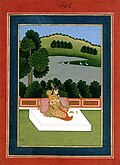
[[File:Gujjari Ragini.jpg|thumb|A young woman playing a [[Veena]] to a [[Parakeet]], a symbol of her absent lover. Painting in the provincial [[Mughal painting|Mughal]] style of the [[Nawab of Bengal]].]] | [[File:Gujjari Ragini.jpg|thumb|A young woman playing a [[Veena]] to a [[Parakeet]], a symbol of her absent lover. Painting in the provincial [[Mughal painting|Mughal]] style of the [[Nawab of Bengal]].]] | ||
Alivardi Khan was a patron of various musical instruments such as the [[Veena]] and [[Khol]] drums. He also patronized many manuscripts of the [[Shahnameh]]. | Alivardi Khan was a patron of various musical instruments such as the [[Veena]] and [[Khol]] drums. He also patronized many manuscripts of the [[Shahnameh]]. | ||
==Death and succession== | ==Death and succession== | ||
Alivardi Khan died | Alivardi Khan died at 5{{nbsp}}am on 9 April 1756, aged at least 80. He was buried in [[Khushbagh]] next to his mother's grave.<ref>{{cite book |last=Dalrymple |first=William |author-link=William Dalrymple (historian) |year=2019 |title=The Anarchy: The Relentless Rise of the East India Company |url=https://books.google.com/books?id=iRuoDwAAQBAJ |publisher=Bloomsbury Publishing |pages=84, 87 |isbn=978-1-4088-6440-1}}</ref> He was succeeded by his daughter's son, [[Siraj-ud-Daula]], who was aged 23 at the time. | ||
==Family== | ==Family== | ||
Unlike many of his contemporaries, Alivardi had only one wife, Sharfunnesa.<ref name="Skelton1979">{{cite book|last1=Skelton|first1=Robert|last2=Francis|first2=Mark|title=Arts of Bengal: The Heritage of Bangladesh and Eastern India : an Exhibition|url=https://books.google.com/books?id=B8TYAAAAMAAJ|year=1979|publisher=Whitechapel Art Gallery|location=London|isbn=978-0-85488-047-8|page=35}}</ref><ref>{{cite | Unlike many of his contemporaries, Alivardi had only one wife, Sharfunnesa.<ref name="Skelton1979">{{cite book |last1=Skelton |first1=Robert |last2=Francis |first2=Mark |title=Arts of Bengal: The Heritage of Bangladesh and Eastern India : an Exhibition |url=https://books.google.com/books?id=B8TYAAAAMAAJ |year=1979 |publisher=Whitechapel Art Gallery |location=London |isbn=978-0-85488-047-8 |page=35}}</ref><ref>{{cite journal |last=Rahim |first=A. |title=Society and Culture of the Eighteenth Century Bengal |url=https://books.google.com/books?id=q8sVAQAAIAAJ |journal=Bengali Literary Review |volume=4 |issue=I & II |year=1959 |publisher=University of Karachi |page=127 |issn=0405-413X}}</ref> They had three daughters,<ref name="Islam1997">{{cite book |last=Islam |first=Sirajul |author-link=Sirajul Islam |title=History of Bangladesh, 1704-1971 |url=https://books.google.com/books?id=CeNtAAAAMAAJ |volume=3 |year=1997 |publisher=Asiatic Society of Bangladesh |isbn=978-984-512-337-2}}</ref> of whom at least two married sons of his elder brother Haji Ahmad.<ref name="Datta1967">{{cite book |last=Datta |first=K.K. |title=Early Career of Siraj-ud-daulah |url=https://books.google.com/books?id=TxbjAAAAMAAJ |series=Bengal, Past & Present: Journal of the Calcutta Historical Society |volume=LXXXVI |year=1967 |publisher=Calcutta Historical Society |page=142}}</ref><ref name="Sen1987">{{cite book |last=Sen |first=Ranjit |title=Metamorphosis of the Bengal Polity (1700–1793) |url=https://books.google.com/books?id=u3EeAAAAMAAJ |year=1987 |publisher=Rabindra Bharati University |location=Kolkata |page=87 |oclc=17918965}}</ref> Alivardi outlived his sons-in-law and, having had no sons of his own, he was succeeded by his maternal grandson [[Siraj ud-Daulah]].<ref name="Sengupta2011">{{cite book |last=Sengupta |first=Nitish Kumar |author-link=Nitish Sengupta |title=Land of Two Rivers: A History of Bengal from the Mahabharata to Mujib |url=https://books.google.com/books?id=kVSh_TyJ0YoC&pg=PA162 |year=2011 |publisher=Penguin Books India |location=New Delhi |isbn=978-0-14-341678-4 |pages=162, 164}}</ref> Alivardi's issue are as follows:<ref name="Datta1967"/><ref name="Sen1987"/> | ||
* Mehrunnesa ([[Ghaseti Begum]]): married [[Nawazish Muhammad Khan|Nawazish Muhammad Shahmat Jang]], [[Naib Nazim of Dhaka|governor]] of [[Dhaka]] (1740–1755) | * Mehrunnesa ([[Ghaseti Begum]]): married [[Nawazish Muhammad Khan|Nawazish Muhammad Shahmat Jang]], [[Naib Nazim of Dhaka|governor]] of [[Dhaka]] (1740–1755) | ||
* Maimuna Begum:<ref name="Islam1997"/> according to some historians was married to [[Sayyid Ahmad Saulat Jang]], governor of [[Purnia]] (1749–1756), and had one son: | * Maimuna Begum:<ref name="Islam1997"/> according to some historians was married to [[Sayyid Ahmad Saulat Jang]], governor of [[Purnia]] (1749–1756), and had one son: | ||
| Line 90: | Line 109: | ||
** Mirza Mahdi | ** Mirza Mahdi | ||
Alivardi also had a number of half-siblings, including Muhammad Amin Khan and Muhammad Yar Khan, who served under him as a general and governor of [[Hugli-Chuchura|Hugli]] respectively.<ref name="Salim1975">{{cite book|last=Salim|first=Ghulam Hussain| | Alivardi also had a number of half-siblings, including Muhammad Amin Khan and Muhammad Yar Khan, who served under him as a general and governor of [[Hugli-Chuchura|Hugli]] respectively.<ref name="Salim1975">{{cite book |last=Salim |first=Ghulam Hussain |author-link=Ghulam Husain Salim |translator=Abdus Salam |title=Riyazu-s-Salatin, A History of Bengal |url=https://archive.org/details/riyazussalatinhi00saliuoft/page/335/mode/1up |year=1902 |location=Calcutta |publisher=The Baptist Mission Press |page=335}}</ref><ref>{{harvtxt|Sarkar|1948|p=445}}</ref><ref>{{Harvard citation no brackets|Datta|1939|p=69}}</ref> His half-sister Shah Khanum was the wife of [[Mir Jafar]], who later claimed the throne of Bengal in 1757.<ref name="Mukhopadhyay1980">{{cite book |last=Mukhopadhyay |first=Subhas Chandra |title=Diwani in Bengal, 1765: Career of Nawab Najm-ud-Daulah |url=https://books.google.com/books?id=uXEeAAAAMAAJ |year=1980 |publisher=Vishwavidyalaya Prakashan |location=Varanasi |page=3 |oclc=8431066}}</ref><ref name="Rashid2001">{{cite book |last=Rashid |first=Abdur |title=From Makkah to Nuclear Pakistan |url=https://books.google.com/books?id=zORtAAAAMAAJ |year=2001 |publisher=Ferozsons |location=Lahore |isbn=978-969-0-01691-1 |page=143}}</ref> The historian [[Ghulam Hussain Khan]] was also a relative.<ref>{{cite journal |last=Askari |first=Syed Hasan |author-link=Syed Hasan Askari |title=Saiyid Ghulam Hussain Khan |url=https://books.google.com/books?id=TwlDAAAAYAAJ |issue=I |journal=The Panjab Past and Present |volume=XII |date=April 1978 |publisher=Department of Punjab Historical Studies, Punjabi University |page=257 |issn=0031-0786}}</ref> | ||
==See also== | ==See also== | ||
* [[Nawabs of Bengal]] | * [[Nawabs of Bengal]] | ||
* [[List of rulers of Bengal]] | * [[List of rulers of Bengal]] | ||
| Line 105: | Line 123: | ||
{{Reflist}} | {{Reflist}} | ||
==Bibliography== | |||
{{refbegin}} | |||
* {{Cite book |last=Datta |first=Kalikinkar |url=https://archive.org/details/in.ernet.dli.2015.279485/mode/1up |title=Alivardi and His Times |publisher=University of Kolkata |year=1939 |location=Kolkata |language=en}} | |||
{{refend}} | |||
==Further reading== | ==Further reading== | ||
{{Commons category | {{Commons category}} | ||
* ''Decisive Battle of India,'' G. B. Malleson, {{ISBN|81-7536-291-X}}, published by Books For All, 2002. | * ''Decisive Battle of India,'' G. B. Malleson, {{ISBN|81-7536-291-X}}, published by Books For All, 2002. | ||
* {{cite DIB|wstitle=Aliverdi Khan|ref=none}} | * {{cite DIB |wstitle=Aliverdi Khan |ref=none}} | ||
{{s-start}} | {{s-start}} | ||
| Line 116: | Line 139: | ||
}} | }} | ||
{{s-ttl | {{s-ttl | ||
|title=[[Nawab of Bengal]] | | title=[[Nawab of Bengal]] | ||
| years = 29 April 1740 – 9 April 1756 | | years = 29 April 1740 – 9 April 1756 | ||
}} | }} | ||
| Line 132: | Line 155: | ||
[[Category:Indian Shia Muslims]] | [[Category:Indian Shia Muslims]] | ||
[[Category:Nawabs of Bengal]] | [[Category:Nawabs of Bengal]] | ||
[[Category: | [[Category:18th-century Mughal Empire people]] | ||
[[Category:Deaths from edema]] | [[Category:Deaths from edema]] | ||
Latest revision as of 13:27, 1 March 2026
| Alivardi Khan | |||||
|---|---|---|---|---|---|
| Shuja ul-Mulk (Valiant of the country)[1] Hashim ud-Daula (Sword of the state) Mahabat Jang (Horror in War) Nawab of Bengal | |||||
_being_a_synopsis_of_the_history_of_Murshidabad_for_the_last_two_centuries,_to_which_are_appended_notes_of_places_and_objects_of_interest_at_Murshidabad_(1905)_(14774447504).jpg) | |||||
| Nawab of Bengal, Bihar and Orissa | |||||
| Reign | 29 April 1740 – March 1751 | ||||
| Predecessor | Sarfaraz Khan | ||||
| Successor | Himself (as Nawab Nazim of Bengal and Bihar) (Raghoji I in Orissa) | ||||
| Nawab Nazim of Bengal and Bihar | |||||
| Reign | March 1751 – 9 April 1756 | ||||
| Successor | Siraj ud-Daulah | ||||
| Born | 1676 Deccan Plateau, Mughal Empire | ||||
| Died | 9 April 1756 (aged 79–80) Murshidabad, Bengal, Mughal Empire | ||||
| Burial | Khushbagh, West Bengal, India | ||||
| Spouse | Sharfunnesa | ||||
| Issue |
| ||||
| |||||
| Father | Mirza Muhammad Shah Quli Khan Madani | ||||
| Mother | A descendant of the Afshar tribe | ||||
| Religion | Shia Islam[2][3][4] | ||||
| Military career | |||||
| Battles/wars | |||||
Alivardi Khan (1676 – 9 April 1756) was the fourth Nawab of Bengal from 1740 to 1756. He toppled the Nasiri dynasty of Nawabs by defeating Sarfaraz Khan in 1740 and assumed power himself.
During much of his reign Alivardi encountered frequent Maratha raids under Raghuji Bhonsle, culminating in the surrender of the province of Orissa in a peace settlement in 1751. He also faced separatist rebellions in Bihar as well as a revolt from his grandson Siraj ud-Daulah, though these were suppressed.
Alivardi spent the latter part of his reign rebuilding Bengal. He was a patron of the arts and resumed the policies of Murshid Quli Khan. He maintained a politically neutral stance with the European powers in the subcontinent and prevented any infighting amongst them in his dominions. He was succeeded by Siraj ud-Daulah in 1756.
Early life[edit | edit source]
Originally Mirza Bande or Mirza Muhammad Ali, Alivardi was a native of the Deccan who was born in 1676.[5][6][7] Alivardi himself was possibly of Afghan origin,[8] while his father Mirza Muhammad Madani, who was of Arab descent, was the son of a foster-brother of the Mughal emperor Aurangzeb; Madani himself began his career as a cup-bearer under the latter's son Azam Shah.[7][9] Muhammad Ali's mother was a Deccani Muslim descending from the Iranian Turkmen Afshar tribe of Khorasan. Through her, he was a cousin of Shuja-ud-Din Muhammad Khan, also known as Mirza Deccani.[7][note 1][12][13]
Like their father, he and his elder brother Mirza Ahmad (later known as Haji Ahmad) found favour under Azam Shah. Muhammad Ali was named superintendent of the feelkhana (elephant-stables) as well as being given responsibility over the zardozkhana (department of embroidered cloths). However, following Azam Shah's death in 1707, the family fell into poverty. They migrated to Cuttack in Orissa, then under the deputy-governorship of their relative Shuja-ud-Din. Finding employment with the latter, Muhammad Ali and Mirza Ahmad proved themselves capable in supporting his government, later even aiding Shuja-ud-Din in becoming Nawab of Bengal.[14]
Rise to power[edit | edit source]


In 1728, Shuja-ud-Din promoted Muhammad Ali to Faujdar (General) of Rajmahal and entitled him as Alivardi Khan.[15] In 1733, he was assigned as the Naib Nazim (Deputy Subahdar) of Bihar. A year later, he was titled Shuja ul-Mulk (Hero of the country), Hassemm ud-Daula (Sword of the state) and Mahabat Jang (Horror in War) and the rank of Paach Hazari Mansabdar (The rank holder of 5000) by Nawab Shuja ud-Din and returned to Azimabad.
Alivardi aspired for larger authority. On 10 April 1740 in the Battle of Giria, he defeated and killed Shuja ud-Din's successor, Sarfaraz Khan.[15] Thus he took control of Bengal and Bihar. Then on 3 March 1741, he defeated Rustam Jang, deputy governor of Orissa and a relative of Sarfaraz Khan, in the Battle of Phulwari.[15] Orissa also came under Alivardi's control. Alivardi Khan defeated a rebellion in Orissa led by Mirza Baqer Khan, and invading Orissa a second time, he subdued the Barha Sayyids with great difficulty,[16] and installed a brave warrior Shaikh Masum as governor.[17]
Reign[edit | edit source]


Immediately after his usurpation of power, Alivardi had his takeover legitimized by the Mughal Emperor Muhammad Shah and resumed the policies of Murshid Quli Khan. He also chose Faujdars from various regions such as Patna, Dacca and Orissa.[18]
Since 1742, the Maratha Empire raided Bengal repeatedly, ravaging its territories. Alivardi almost immediately had a long ditch, called the Maratha ditch, dug around Calcutta. Alivardi was a brilliant artillery tactician, though his armies were overrun by the large force of the Marathas from Berar who had arrived to pillage and conquer the territories of Bengal under the command of Raghoji I Bhonsle.
In the year 1747, the Marathas led by Raghoji began to raid, pillage and annex the territories of Alivardi. During the Maratha invasion of Orissa, its Subedar Mir Jafar completely withdrew all forces until the arrival of Alivardi and the Mughal army at the Battle of Burdwan, where Raghoji and his Maratha forces were completely routed. The enraged Alivardi then dismissed the shamed Mir Jafar.[19]
Alivardi's defending armies were overrun in Orissa in the year 1751, despite receiving some assistance from Shuja-ud-Daula. But Orissa was ultimately surrendered to the ravaging Marathas. These Maratha attacks continued until March 1751 when a peace treaty was settled between Alivardi and Raghoji.[20]
In 1750, Alivardi faced a revolt from Siraj ud-Daulah, his daughter's son, who seized Patna. Alivardi forgave him.[21] Alivardi also subdued the revolt of a few unruly Afghans who were trying to separate Bihar from his administration,[15] and chastised the Banjaras who were marauding through Bihar and chased them towards the Terai.[22]
According to some historians, Alivardi Khan's reign of 16 years was mostly engaged in various wars against the Marathas. Towards the end, he turned his attention to rebuilding and restoring Bengal.

He also saved Bengal from the effects of war of succession in Austria through proper vigilance and precautions, unlike south India, which got caught up in it. He maintained a policy of neutrality towards European powers and forbade the British, French and Dutch to have any hostility against each other in his dominion.[23]
Cultural and musical development[edit | edit source]

Alivardi Khan was a patron of various musical instruments such as the Veena and Khol drums. He also patronized many manuscripts of the Shahnameh.
Death and succession[edit | edit source]
Alivardi Khan died at 5 am on 9 April 1756, aged at least 80. He was buried in Khushbagh next to his mother's grave.[24] He was succeeded by his daughter's son, Siraj-ud-Daula, who was aged 23 at the time.
Family[edit | edit source]
Unlike many of his contemporaries, Alivardi had only one wife, Sharfunnesa.[25][26] They had three daughters,[27] of whom at least two married sons of his elder brother Haji Ahmad.[28][29] Alivardi outlived his sons-in-law and, having had no sons of his own, he was succeeded by his maternal grandson Siraj ud-Daulah.[30] Alivardi's issue are as follows:[28][29]
- Mehrunnesa (Ghaseti Begum): married Nawazish Muhammad Shahmat Jang, governor of Dhaka (1740–1755)
- Maimuna Begum:[27] according to some historians was married to Sayyid Ahmad Saulat Jang, governor of Purnia (1749–1756), and had one son:
- Shaukat Jung
- Amina Begum: married Zainuddin Ahmad Haibat Jang, governor of Patna (1740–1747)
- Siraj ud-Daulah, Nawab of Bengal
- Ikram ud-Daulah
- Mirza Mahdi
Alivardi also had a number of half-siblings, including Muhammad Amin Khan and Muhammad Yar Khan, who served under him as a general and governor of Hugli respectively.[31][32][33] His half-sister Shah Khanum was the wife of Mir Jafar, who later claimed the throne of Bengal in 1757.[34][35] The historian Ghulam Hussain Khan was also a relative.[36]
See also[edit | edit source]
Notes[edit | edit source]
References[edit | edit source]
- ↑ Datta 1939, p. 92.
- ↑ Sarkar, Jadunath (2004) [1948]. The History of Bengal. Vol. II. Dhaka: University of Dhaka. p. 224. ISBN 978-81-7646-239-6.
The climax of the movement was reached after Murshid Quli Khan had established in Bengal what was practically a Shia dynasty, ever ready to welcome and honour the wandering talent and piety of the centre of that creed.
- ↑ Rizvi, Saiyid Athar Abbas (1986). A Socio-intellectual History of the Isnā 'Asharī Shī'īs in India: 16th to 19th century A.D. Vol. 2. Munshiram Manoharlal Publishers. pp. 46–47. OCLC 15406211.
Ghulām Husayn Tabātabā'ī's account of 'Alīwardī's death reinforces the suggestion that he was a Shī'ī.
- ↑ Rieck, Andreas (15 January 2016). The Shias of Pakistan: An Assertive and Beleaguered Minority. Oxford University Press. p. 3. ISBN 978-0-19-061320-4.
From 1701 until the British conquest of 1757, Bengal was ruled by Shia governors appointed by the Mughals but de facto almost independent. Since that time huge imâmbârgâhs were built and estates designated as auqâf for the promotion of 'azâdârî by Iranian merchants and their descendants in Bengal towns like Murshidabad and Hoogly, which also attracted many Shia 'ulamâ' from both India and Iran.
- ↑ Datta 1939, p. 2.
- ↑ Ivermee, Robert (2020). Hooghly:The Global History of a River. Oxford University Press. p. 51. ISBN 978-1-78738-325-8.
- ↑ 7.0 7.1 7.2 Sarkar, Jadunath (1948). The History of Bengal. Vol. II. Dhaka: University of Dhaka. p. 436. ISBN 978-81-7646-239-6.
- ↑ Burnard, Trevor; Hart, Emma; Houllemare, Marie (2024). The Oxford Handbook of the Seven Years' War. Oxford University Press. p. 311. ISBN 978-0-19-762260-5.
- ↑ Sensarma, P. (1977). The Military History of Bengal. Kolkata: Darbari Udjog. p. 172.
- ↑ Subhan, Abdus (1970). "Early Career of Nawab Ali Vardi Khan of Bengal". Journal of Indian History. XLVIII (III). Trivandrum: University of Kerala: 536.
- ↑ Ali, Karam; Khan, Shayesta (1992). Tārīk̲h̲-i Bangāl va Bihār sadah-ʼi hīzhdahum [Bihar and Bengal in the 18th century: a critical edition and translation of Muzaffarnama, a contemporary history]. Patna: Khuda Bakhsh Oriental Public Library.
- ↑ Antunes, Cátia; Bethencourt, Francisco (2022). Merchant Cultures:A Global Approach to Spaces, Representations and Worlds of Trade, 1500–1800. BRILL. p. 124. ISBN 978-90-04-50657-2.
Another Deccani, Shuja succeeded Murshid Quli from 1727.
- ↑ Singh, Nagendra Kr. (2001). Encyclopaedia of Muslim Biography: I–M. A.P.H. Publishing Corporation. ISBN 978-81-7648-233-2.
- ↑ Sarkar (1948, pp. 436–37)
- ↑ 15.0 15.1 15.2 15.3 Shah, Mohammad (2012). "Alivardi Khan". In Islam, Sirajul; Jamal, Ahmed A. (eds.). Banglapedia: National Encyclopedia of Bangladesh (Second ed.). Asiatic Society of Bangladesh.
- ↑ Rāẏa, Bhabānī Caraṇa (1981). Orissa Under the Mughals:From Akbar to Alivardi : a Fascinating Study of the Socio-economic and Cultural History of Orissa.
- ↑ Sahu, N. K.; Miśra, Prabodhakumāra; Sahu, Jagna Kumar (1981). History of Orissa. p. 347.
- ↑ Markovits, Claude (2004). A History of Modern India, 1480–1950. Anthem Press. pp. 194–. ISBN 978-1-84331-004-4.
- ↑ Jaques, Tony (2007). "Burdwan | 1747 | Later Mughal-Maratha Wars". Dictionary of Battles and Sieges. Vol. 1. Greenwood Publishing Group. p. 175. ISBN 978-0-313-33537-2.
- ↑ Mehta, Jaswant Lal (2005). Advanced Study in the History of Modern India 1707-1813. Sterling Publishers Pvt. ISBN 978-1-932705-54-6. Archived from the original on 23 April 2023. Retrieved 15 September 2020.
- ↑ Dalrymple, William (2019). The Anarchy: The Relentless Rise of the East India Company. Bloomsbury Publishing. p. 84. ISBN 978-1-4088-6440-1.
- ↑ Ansari, Tahir Hussain (2019). Mughal Administration and the Zamindars of Bihar. Routledge. ISBN 978-1-000-65152-2.
- ↑ Datta, Kalikinkar (1948). The Dutch in Bengal and Bihar, 1740-1825 A.D. University of Patna. p. 12.
- ↑ Dalrymple, William (2019). The Anarchy: The Relentless Rise of the East India Company. Bloomsbury Publishing. pp. 84, 87. ISBN 978-1-4088-6440-1.
- ↑ Skelton, Robert; Francis, Mark (1979). Arts of Bengal: The Heritage of Bangladesh and Eastern India : an Exhibition. London: Whitechapel Art Gallery. p. 35. ISBN 978-0-85488-047-8.
- ↑ Rahim, A. (1959). "Society and Culture of the Eighteenth Century Bengal". Bengali Literary Review. 4 (I & II). University of Karachi: 127. ISSN 0405-413X.
- ↑ 27.0 27.1 Islam, Sirajul (1997). History of Bangladesh, 1704-1971. Vol. 3. Asiatic Society of Bangladesh. ISBN 978-984-512-337-2.
- ↑ 28.0 28.1 Datta, K.K. (1967). Early Career of Siraj-ud-daulah. Bengal, Past & Present: Journal of the Calcutta Historical Society. Vol. LXXXVI. Calcutta Historical Society. p. 142.
- ↑ 29.0 29.1 Sen, Ranjit (1987). Metamorphosis of the Bengal Polity (1700–1793). Kolkata: Rabindra Bharati University. p. 87. OCLC 17918965.
- ↑ Sengupta, Nitish Kumar (2011). Land of Two Rivers: A History of Bengal from the Mahabharata to Mujib. New Delhi: Penguin Books India. pp. 162, 164. ISBN 978-0-14-341678-4.
- ↑ Salim, Ghulam Hussain (1902). Riyazu-s-Salatin, A History of Bengal. Translated by Abdus Salam. Calcutta: The Baptist Mission Press. p. 335.
- ↑ Sarkar (1948, p. 445)
- ↑ Datta 1939, p. 69
- ↑ Mukhopadhyay, Subhas Chandra (1980). Diwani in Bengal, 1765: Career of Nawab Najm-ud-Daulah. Varanasi: Vishwavidyalaya Prakashan. p. 3. OCLC 8431066.
- ↑ Rashid, Abdur (2001). From Makkah to Nuclear Pakistan. Lahore: Ferozsons. p. 143. ISBN 978-969-0-01691-1.
- ↑ Askari, Syed Hasan (April 1978). "Saiyid Ghulam Hussain Khan". The Panjab Past and Present. XII (I). Department of Punjab Historical Studies, Punjabi University: 257. ISSN 0031-0786.
Bibliography[edit | edit source]
- Datta, Kalikinkar (1939). Alivardi and His Times. Kolkata: University of Kolkata.
Further reading[edit | edit source]
- Decisive Battle of India, G. B. Malleson, ISBN 81-7536-291-X, published by Books For All, 2002.
- Buckland, C.E. (1906). "Aliverdi Khan". Dictionary of Indian Biography. London: Swan Sonnenschein & Co. Lim.

Alivardi Khan Born: Before 10 May 1671 Died: 10 April 1756
| ||
| Preceded by Sarfaraz Khan |
Nawab of Bengal 29 April 1740 – 9 April 1756 |
Succeeded by Siraj ud-Daulah |