




Ajay Kumar (talk | contribs) Created a new article |
m revised |
||
| Line 7: | Line 7: | ||
| partof = the [[Fourth Anglo-Mysore War]] | | partof = the [[Fourth Anglo-Mysore War]] | ||
| image = Tipu death.jpg | | image = Tipu death.jpg | ||
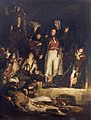
| caption = ''[[The Last Effort and Fall of Tippoo Sultaun]]''<br>[[Henry Singleton (painter)|Henry Singleton]], {{circa|1800}} | |||
| caption = ''The Last Effort and Fall of | | date = {{start and end dates|1799|4|5|1799|5|4|df=yes}} {{nwr|({{Age in years, months, weeks and days|month1=04|day1=05|year1=1799|month2=05|day2=04|year2=1799}})}} | ||
| date = 5 | |||
| place = [[Srirangapatna|Srirangapatam]], [[Kingdom of Mysore]] | | place = [[Srirangapatna|Srirangapatam]], [[Kingdom of Mysore]] | ||
| coordinates = {{coord|12|25|26.3|N|76|41|25.04|E|region:IN|display=inline,title}} | | coordinates = {{coord|12|25|26.3|N|76|41|25.04|E|region:IN|display=inline,title}} | ||
| result = British victory | | result = British victory | ||
Fall of Mysore | * Fall of the Mysore Kingdom | ||
| combatant1 = {{plainlist| | | combatant1 = {{plainlist| | ||
*{{flagicon image|Flag of the British East India Company (1707).svg}} [[East India Company]] | *{{flagicon image|Flag of the British East India Company (1707).svg}} [[East India Company]] | ||
* | *[[File:Flag of the State of Hyderabad (18th century-1900).svg|22px]] [[Hyderabad State|Hyderabad]]}} | ||
| combatant2 = {{flagicon image|Flag of Mysore Hyder Ali & TipuSultan.png|border=}} [[Kingdom of Mysore|Mysore]] | |||
| combatant2 = {{flagicon image|Flag of Mysore Hyder Ali & TipuSultan.png}} [[Kingdom of Mysore|Mysore]] | | commander1 = {{flagicon image|Flag of the British East India Company (1707).svg}} [[George Harris, 1st Baron Harris|George Harris]]<br>{{flagicon image|Flag of the British East India Company (1707).svg}} [[Sir David Baird, 1st Baronet|David Baird]]<br>{{flagicon image|Flag of the British East India Company (1707).svg}} [[Arthur Wellesley, 1st Duke of Wellington|Arthur Wellesley]]<br>[[File:Flag of the State of Hyderabad (18th century-1900).svg|22px]] [[Nizam Ali Khan, Asaf Jah II|Nizam Ali Khan]] | ||
| commander1 = | | commander2 = {{flagicon image|Flag of Mysore Hyder Ali & TipuSultan.png|border=}} [[Tipu Sultan]]{{KIA}}<br>{{flagicon image|Flag of Mysore Hyder Ali & TipuSultan.png|border=}} Diwan [[Purnaiah]]<br>{{flagicon image|Flag of Mysore Hyder Ali & TipuSultan.png|border=}} [[Abdul Ghaffar Sahib|Abdul Sahib]]{{KIA}}<br>{{flagicon image|Flag of Mysore Hyder Ali & TipuSultan.png|border=}} [[Mir Golam Hussain|Mir Hussain]]<br>{{flagicon image|Flag of Mysore Hyder Ali & TipuSultan.png|border=}} [[Hulleen]] | ||
| strength1 = 50,000 total | |||
:22,000 Sepoys | |||
:4,000 Europeans | |||
| commander2 = | :16,000 Nizam's horsemen | ||
:10 battalions of Hyderabadi infantry (~8,000) | |||
100{{ndash}}120 guns | |||
| strength2 = 20,000 soldiers<br>10,000 volunteers | |||
| casualties1 = 1,400 killed or wounded | |||
| strength1 = 50,000 | | casualties2 = 6,000 to 10,000 killed | ||
| strength2 = 20,000 soldiers | |||
10,000 volunteers | |||
| casualties1 = 1,400 killed | |||
| casualties2 = 6,000 to 10,000 killed | |||
| campaignbox = {{Campaignbox Fourth Anglo-Mysore War}} | | campaignbox = {{Campaignbox Fourth Anglo-Mysore War}} | ||
}} | }} | ||
[[File:A Qajar Persian copy of a British painting of the assault.jpg|thumb | [[File:A Qajar Persian copy of a British painting of the assault.jpg|thumb|A Qajar Persian copy of a British painting of the assault]] | ||
[[File:The Siege of Seringapatam by Joseph Mallord William Turner.jpg|thumb| | [[File:The Siege of Seringapatam by Joseph Mallord William Turner.jpg|thumb|''The Siege of Seringapatam'' by Joseph Mallord William Turner]] | ||
The '''siege of Seringapatam''' (5 April – 4 May 1799) was the final confrontation of the [[Fourth Anglo-Mysore War]] between the [[British East India Company]] and the [[Kingdom of Mysore]]. The British, with the allied [[Nizam Ali Khan, Asaf Jah II|Nizam Ali Khan, 2nd Nizam of Hyderabad]] and [[Maratha Empire|Marathas]], achieved a decisive victory after breaching the walls of the fortress at [[Seringapatam]] and storming the citadel. The leader of the British troops was Major General [[Sir David Baird, 1st Baronet|David Baird]], among the lesser known allies were the [[British rule in Portuguese India|Portuguese in Goa and Damaon]].<ref>{{cite book|title=Arabia, Egypt, India: A Narrative of Travel|url=https://books.google.com/books?id=5lJFAAAAYAAJ&dq=Seringapatam+1799+Goa+allied+British&pg=PA428|last1 = Burton|first1 = Lady Isabel|year = 1879}}</ref> | The '''siege of Seringapatam''' (5 April – 4 May 1799) was the final confrontation of the [[Fourth Anglo-Mysore War]] between the [[British East India Company]] and the [[Kingdom of Mysore]]. The British, with the allied [[Nizam Ali Khan, Asaf Jah II|Nizam Ali Khan, 2nd Nizam of Hyderabad]] and [[Maratha Empire|Marathas]], achieved a decisive victory after breaching the walls of the fortress at [[Seringapatam]] and storming the citadel. The leader of the British troops was Major General [[Sir David Baird, 1st Baronet|David Baird]], among the lesser known allies were the [[British rule in Portuguese India|Portuguese in Goa and Damaon]].<ref>{{cite book|title=Arabia, Egypt, India: A Narrative of Travel|url=https://books.google.com/books?id=5lJFAAAAYAAJ&dq=Seringapatam+1799+Goa+allied+British&pg=PA428|last1 = Burton|first1 = Lady Isabel|year = 1879}}</ref> [[Tipu Sultan]], the ruler after the death of [[Hyder Ali|his father]], was killed in the action.<ref name=Naravane>{{Cite book |last=Naravane |first=M.S. |title=Battles of the Honorourable East India Company |publisher=A.P.H. Publishing Corporation |year=2014 |isbn=9788131300343 |pages=178–181}}</ref> The British restored the [[Wodeyar]] dynasty back to power after the victory through a treaty of [[subsidiary alliance]] and [[Krishnaraja Wodeyar III]] was crowned the King of Mysore. However, they retained indirect control ([[British paramountcy]]) of the kingdom's [[external affairs]]. | ||
==Opposing forces== | ==Opposing forces== | ||
| Line 76: | Line 71: | ||
[[File:The assault of Seringapatam.jpg|thumb|right|The assault of Seringapatam]] | [[File:The assault of Seringapatam.jpg|thumb|right|The assault of Seringapatam]] | ||
Seringapatam was besieged by the British forces on 5 April 1799. The [[Kaveri River|River Cauvery]], which flowed around the city of Seringapatam, was at its lowest level of the year and could be forded by infantry – if an assault commenced before the monsoon. When letters were exchanged with Tipu, it seemed that he was playing for time. He requested two persons to be sent to him for discussions and also stated that he was preoccupied with hunting expeditions. Tipu Sultan's Chief Minister, [[Mir Sadiq]], is alleged to have been bought over by the British.<ref>{{cite web|title=Mysorean Military Commanders and Officials|work=Seringapatam 1799|url=http://www.mq.edu.au/macquarie-archive/seringapatam/mysoreans.html|access-date=10 June 2019}}</ref> | Seringapatam was besieged by the British forces on 5 April 1799. The [[Kaveri River|River Cauvery]], which flowed around the city of Seringapatam, was at its lowest level of the year and could be forded by infantry – if an assault commenced before the monsoon. When letters were exchanged with [[Tipu Sultan|Tipu]], it seemed that he was playing for time. He requested two persons to be sent to him for discussions and also stated that he was preoccupied with hunting expeditions. Tipu Sultan's Chief Minister, [[Mir Sadiq]], is alleged to have been bought over by the British.<ref>{{cite web|title=Mysorean Military Commanders and Officials|work=Seringapatam 1799|url=http://www.mq.edu.au/macquarie-archive/seringapatam/mysoreans.html|access-date=10 June 2019}}</ref> | ||
==The breach== | ==The breach== | ||
[[File:Plan of Seringapatam.jpg|thumb|right|Plan of the attack on the north-west angle of Seringapatam]] | [[File:Plan of Seringapatam.jpg|thumb|right|Plan of the attack on the north-west angle of Seringapatam]] | ||
The Governor-General of India, [[Richard Wellesley, 1st Marquess Wellesley|Richard Wellesley]], planned the opening of a breach in the walls of Seringapatam.{{Citation needed|date=November 2008}} | The Governor-General of India, [[Richard Wellesley, 1st Marquess Wellesley|Richard Wellesley]], planned the opening of a breach in the walls of Seringapatam.{{Citation needed|date=November 2008}} The location of the breach, as noted by Beatson, the author of an account of the Fourth Mysore War, was 'in the west curtain, a little to the right of the flank of the north-west bastion. This being the old rampart appeared weaker than the new.' The Mysorean defence succeeded in preventing the establishment of a battery on the north side of the River Cauvery on 22 April 1799. However, by 1 May, working at night, the British had completed their southern batteries and brought them up to the wall. At sunrise on 2 May, the batteries of the [[Nizam Ali Khan|2nd Nizam of Hyderabad]] succeeded in opening a practical breach in the outer wall. In addition, the mines that were laid under the breach were hit by artillery and blew up prematurely. | ||
The leader of the British troops was Major General [[Sir David Baird, 1st Baronet|David Baird]], an implacable enemy of Tipu Sultan: twenty years earlier, he had been held captive for 44 months. The storming troops, including men of the [[73rd (Perthshire) Regiment of Foot|73rd]] and [[74th (Highland) Regiment of Foot|74th regiments]], clambered up the breach and fought their way along the ramparts. | The leader of the British troops was Major General [[Sir David Baird, 1st Baronet|David Baird]], an implacable enemy of Tipu Sultan: twenty years earlier, he had been held captive for 44 months. The storming troops, including men of the [[73rd (Perthshire) Regiment of Foot|73rd]] and [[74th (Highland) Regiment of Foot|74th regiments]], clambered up the breach and fought their way along the ramparts. | ||
On the night of 3 May some officers crossed over to the glacis, examined the breach and the manner of attacking the fort | On the night of 3 May some officers crossed over to the glacis, examined the breach and the manner of attacking the fort.<ref>Lushington, ''Life of Harris'', p. 325</ref> It was probably on this occasion that it was arranged between the English officers and Mir Sadiq that the assault should take place at midday.<ref name=":0">{{Cite book|title=History of Tipu Sultan|last=Hasan, Mohibbul 1908–1999|date=2009|publisher=Aakar Books|isbn=978-8187879572|edition=Reprint|location=Delhi|oclc=985562987|pages=313–314}}</ref> | ||
==Storming of Seringapatam== | ==Storming of Seringapatam== | ||
[[File:The storming of Seringapatam - John Vendramini, 1802 - BL P779.jpg|thumb|left|The storming of Seringapatam, John Vendramini, 1802]] | [[File:The storming of Seringapatam - John Vendramini, 1802 - BL P779.jpg|thumb|left|The storming of Seringapatam, John Vendramini, 1802]] | ||
The assault was to begin at 1:00 p.m. to coincide with the hottest part of the day when the defenders would be taking refreshment. | The assault was to begin at 1:00 p.m. to coincide with the hottest part of the day when the defenders would be taking refreshment. Led by two [[forlorn hope]]s, two columns would advance upon the defences around the breach, then wheel right and left to take over the fortifications. A third reserve column, commanded by [[Arthur Wellesley, 1st Duke of Wellington|Arthur Wellesley]], would deploy as required to provide support where needed. | ||
At 11:00 a.m., on 4 May 1799, the British troops were briefed and whiskey and a biscuit issued to the European soldiers, before the signal to attack was given. The forlorn-hopes, numbering seventy-six men, led the charge. | At 11:00 a.m., on 4 May 1799, the British troops were briefed and whiskey and a biscuit issued to the European soldiers, before the signal to attack was given. The forlorn-hopes, numbering seventy-six men, led the charge. The columns quickly formed, were ordered to fix bayonets, and began to move forward. | ||
As the hour approached, Mir Sadiq withdrew the troops stationed at the breach under the pretext of distributing their pay. There was no one to protest against such a measure. Sayyid Abdul Ghaffar, who was very loyal to the Sultan, was killed by a cannon ball. Immediately after the Sayyid was killed, the traitors made a signal from the fort holding out a white handkerchief to the English troops who were assembled in the trenches, waiting for such a signal<ref name=":0" /> | As the hour approached, Mir Sadiq withdrew the troops stationed at the breach under the pretext of distributing their pay. There was no one to protest against such a measure. Sayyid Abdul Ghaffar, who was very loyal to the Sultan, was killed by a cannon ball. Immediately after the Sayyid was killed, the traitors made a signal from the fort holding out a white handkerchief to the English troops who were assembled in the trenches, waiting for such a signal.<ref name=":0" /> | ||
The storming party dashed across the River Cauvery in water four feet deep, with covering fire from British batteries, and within 16 minutes had scaled the ramparts and swept aside the defenders quickly. The British follow-up columns turned right and left, sweeping along the inside of the walls until they met on the far side of the city. | The storming party dashed across the River Cauvery in water four feet deep, with covering fire from British batteries, and within 16 minutes had scaled the ramparts and swept aside the defenders quickly. The British follow-up columns turned right and left, sweeping along the inside of the walls until they met on the far side of the city. | ||
==Death of Tipu== | ==Death of Tipu== | ||
[[File: | [[File:General Sir David Baird Discovering the Body of Sultan Tippoo Sahib.jpg|thumb|''[[Sir David Baird Discovering the Body of Sultan Tipoo Sahib]]'' by [[David Wilkie (artist)|David Wilkie]], 1839.]] | ||
[[File:The spot where Tipu Sultan died in Srirangapatna (c. 1880s).JPG|right | [[File:The spot where Tipu Sultan died in Srirangapatna (c. 1880s).JPG|right|thumb|The spot where Sultan died (1880s)]] | ||
The column that rounded the northwest corner of the outer wall was immediately involved in a serious fight with a group of Mysorean warriors under a fat officer, which defended every traverse. The officer was observed to be discharging hunting weapons loaded and passed to him by servants. After the fall of the city, in the gathering dusk, some of the British officers went to look for the body of [[Tipu Sultan]]. He was identified as the fat officer who had fired hunting weapons at the attackers, and his body was found in a choked tunnel-like passage near the Water Gate. | The column that rounded the northwest corner of the outer wall was immediately involved in a serious fight with a group of Mysorean warriors under a fat officer, which defended every traverse. The officer was observed to be discharging hunting weapons loaded and passed to him by servants. After the fall of the city, in the gathering dusk, some of the British officers went to look for the body of [[Tipu Sultan]]. He was identified as the fat officer who had fired hunting weapons at the attackers, and his body was found in a choked tunnel-like passage near the Water Gate. | ||
| Line 114: | Line 109: | ||
All members of the British-led forces who took part in the siege were awarded a [[Seringapatam medal|medal]] by the Governor-General of India.<ref>{{cite book|last1=Mayo|first1=John Horsley|title= Medals and Decorations of the British Army and Navy, Volume 1|date=1897|publisher= A. Constable & Co |page=[https://archive.org/details/medalsdecoration01mayouoft/page/134 134]|url=https://archive.org/details/medalsdecoration01mayouoft|access-date=10 June 2019}}</ref> | All members of the British-led forces who took part in the siege were awarded a [[Seringapatam medal|medal]] by the Governor-General of India.<ref>{{cite book|last1=Mayo|first1=John Horsley|title= Medals and Decorations of the British Army and Navy, Volume 1|date=1897|publisher= A. Constable & Co |page=[https://archive.org/details/medalsdecoration01mayouoft/page/134 134]|url=https://archive.org/details/medalsdecoration01mayouoft|access-date=10 June 2019}}</ref> | ||
[[File:0147 Seringapatam (1803).jpg|thumb|right | [[File:0147 Seringapatam (1803).jpg|thumb|right|Seringapatam, by [[James Welsh (East India Company officer)|James Welsh]], 1803.]] | ||
Two cannon captured by the British during the battle are displayed at the [[Royal Military College, Sandhurst]], now standing in front of the officers' mess. [[Tipu's Tiger]], an [[automaton]] now in the [[Victoria & Albert Museum]], was captured at Seringapatam. | Two cannon captured by the British during the battle are displayed at the [[Royal Military College, Sandhurst]], now standing in front of the officers' mess. [[Tipu's Tiger]], an [[automaton]] now in the [[Victoria & Albert Museum]], was captured at Seringapatam. | ||
Much of the site of the battle is still intact including the ramparts, the Water Gate where the Tipu Sultan's body was found, the area where the British prisoners were held, and the site of the destroyed palace. | Much of the site of the battle is still intact including the ramparts, the Water Gate where the [[Tipu Sultan]]'s body was found, the area where the British prisoners were held, and the site of the destroyed palace. | ||
Around 80 men of the Swiss ‘[[Regiment de Meuron|de Meuron Regiment]]’, who fell during the siege, and their family members are buried in the [[Garrison Cemetery, Seringapatam]].<ref name=Hindu-Garrision>{{cite news|last1=Kumar|first1=M T Shiva|title=There is life at the cemetery|url=http://www.thehindu.com/todays-paper/tp-features/tp-districtplus/there-is-life-at-the-cemetery/article4489629.ece|access-date=3 February 2015|issue=Bangalore|work=The Hindu|date=9 March 2013}}</ref> | Around 80 men of the Swiss ‘[[Regiment de Meuron|de Meuron Regiment]]’, who fell during the siege, and their family members are buried in the [[Garrison Cemetery, Seringapatam]].<ref name=Hindu-Garrision>{{cite news|last1=Kumar|first1=M T Shiva|title=There is life at the cemetery|url=http://www.thehindu.com/todays-paper/tp-features/tp-districtplus/there-is-life-at-the-cemetery/article4489629.ece|access-date=3 February 2015|issue=Bangalore|work=The Hindu|date=9 March 2013}}</ref> | ||
==Depictions in literature== | ==Depictions in literature== | ||
[[Wilkie Collins]]'s novel ''[[The Moonstone]]'' begins with the looting of the jewels removed from Seringapatam in 1799 from Tipu's treasury. The siege was also depicted in H.M Milner's play | [[Wilkie Collins]]'s novel ''[[The Moonstone]]'' begins with the looting of the jewels removed from Seringapatam in 1799 from Tipu's treasury. The siege was also depicted in H.M. Milner's play "Tippo Saib, Or The Storming of Seringatam" in 1823 at the Royal Colburg Theatre on the South Bank, London. The siege and Tipu's death also received considerable attention in France, as Tipu had been viewed as an ally of the French, with the most prominent being Étienne de Jouy's "Tippo-Saëb, tragédie" which premiered at the Comédie-Française in 1813 with Talma in the lead role. | ||
The Battle of Seringapatam is the main conflict in the novel ''[[Sharpe's Tiger]]'', by [[Bernard Cornwell]]. | The Battle of Seringapatam is the main conflict in the novel ''[[Sharpe's Tiger]]'', by [[Bernard Cornwell]]. | ||
The siege and subsequent looting are depicted in [[Tania James]]'s 2023 novel ''Loot''. | |||
==Memorial by the Mysore government== | ==Memorial by the Mysore government== | ||
| Line 143: | Line 140: | ||
== References == | == References == | ||
'''Cited sources''' | |||
{{reflist}} | {{reflist}} | ||
'''Further reading''' | |||
* Jac Weller, 2006, ''Wellington in India'', [http://www.greenhillbooks.com/ Greenhill Books, London], {{ISBN|978-1-85367-397-9}}. ([http://www.napoleon-series.org/greenhill/library/c_weller_india.html Review].) | * Jac Weller, 2006, ''Wellington in India'', [http://www.greenhillbooks.com/ Greenhill Books, London], {{ISBN|978-1-85367-397-9}}. ([http://www.napoleon-series.org/greenhill/library/c_weller_india.html Review].) | ||
* [[Elizabeth Longford]], 1996, ''Wellington: The Years of the Sword'', Smithmark Pub, New York, {{ISBN|978-0-8317-5646-8}}. | * [[Elizabeth Longford]], 1996, ''Wellington: The Years of the Sword'', Smithmark Pub, New York, {{ISBN|978-0-8317-5646-8}}. | ||
| Line 154: | Line 154: | ||
[[Category:Battles involving the Kingdom of Mysore|Seringapatam 1799]] | [[Category:Battles involving the Kingdom of Mysore|Seringapatam 1799]] | ||
[[Category:Srirangapatna]] | [[Category:Srirangapatna]] | ||
[[Category:Sieges involving Great Britain|Seringapatam 1799]] | [[Category:Sieges involving the Kingdom of Great Britain|Seringapatam 1799]] | ||
[[Category:Conflicts in 1799|Seringapatam]] | [[Category:Conflicts in 1799|Seringapatam]] | ||
[[Category: | [[Category:Sieges involving the Maratha Empire|Seringapatam]] | ||
[[Category:Wars involving the British East India Company]] | |||
Latest revision as of 18:14, 10 March 2026
 | This article includes a list of general references, but it remains largely unverified because it lacks sufficient corresponding inline citations. (November 2008) |
| Siege of Seringapatam | |||||||
|---|---|---|---|---|---|---|---|
| Part of the Fourth Anglo-Mysore War | |||||||
 The Last Effort and Fall of Tippoo Sultaun Henry Singleton, c. 1800 | |||||||
| |||||||
| Belligerents | |||||||
 Mysore Mysore | |||||||
| Commanders and leaders | |||||||
 George Harris David Baird Arthur Wellesley George Harris David Baird Arthur Wellesley.svg) Nizam Ali Khan Nizam Ali Khan |
Tipu Sultan † Diwan Purnaiah Abdul Sahib † Mir Hussain Hulleen | ||||||
| Strength | |||||||
|
50,000 total
|
20,000 soldiers 10,000 volunteers | ||||||
| Casualties and losses | |||||||
| 1,400 killed or wounded | 6,000 to 10,000 killed | ||||||


The siege of Seringapatam (5 April – 4 May 1799) was the final confrontation of the Fourth Anglo-Mysore War between the British East India Company and the Kingdom of Mysore. The British, with the allied Nizam Ali Khan, 2nd Nizam of Hyderabad and Marathas, achieved a decisive victory after breaching the walls of the fortress at Seringapatam and storming the citadel. The leader of the British troops was Major General David Baird, among the lesser known allies were the Portuguese in Goa and Damaon.[1] Tipu Sultan, the ruler after the death of his father, was killed in the action.[2] The British restored the Wodeyar dynasty back to power after the victory through a treaty of subsidiary alliance and Krishnaraja Wodeyar III was crowned the King of Mysore. However, they retained indirect control (British paramountcy) of the kingdom's external affairs.
Opposing forces[edit | edit source]
The battle consisted of a series of encounters around Seringapatam (the anglicised version of Srirangapatnam) in the months of April and May 1799, between the combined forces of the British East India Company and their allies, numbering over 50,000 soldiers in all, and the soldiers of the Kingdom of Mysore, ruled by Tipu Sultan, numbering up to 30,000. The Fourth Anglo-Mysore War came to an end with the defeat and death of Tipu Sultan in the battle.
British troop composition[edit | edit source]
When the Fourth Anglo-Mysore War broke out, the British assembled two large columns under General George Harris. The first consisted of over 26,000 British East India Company troops, 4,000 of whom were European while the rest were local Indian sepoys. The second column was supplied by the Nizam of Hyderabad, and consisted of ten battalions and over 16,000 cavalry. Together, the allied force numbered over 50,000 soldiers. Tipu's forces had been depleted by the Third Anglo-Mysore War and the consequent loss of half his kingdom, but he still probably had up to 30,000 soldiers.[citation needed]
The British forces consisted of the following:[3]
- 19th Regiment of (Light) Dragoons
- 25th Regiment of (Light) Dragoons
- 12th (East Suffolk) Regiment of Foot
- 33rd (1st Yorkshire West Riding) Regiment of Foot
- 73rd (Highland) Regiment of Foot
- 74th (Highland) Regiment of Foot
- 75th (Highland) Regiment of Foot
- 77th Regiment of Foot
- Scotch Brigade [later 94th Regiment]
- Regiment de Meuron (Swiss mercenaries in British pay)
The Indian (sepoy) forces consisted of the following:[3][4]
- 1st Madras Native Infantry
- 2nd Madras Native Infantry
- 1st Madras Native Cavalry
- 2nd Madras Native Cavalry
- 3rd Madras Native Cavalry
- 4th Madras Native Cavalry
- Madras Pioneers
- Madras Artillery
- 1st Bengal Native Infantry
- 2nd Bengal Native Infantry
- Bengal Artillery
- 71st Coorg Rifles
Siege[edit | edit source]

Seringapatam was besieged by the British forces on 5 April 1799. The River Cauvery, which flowed around the city of Seringapatam, was at its lowest level of the year and could be forded by infantry – if an assault commenced before the monsoon. When letters were exchanged with Tipu, it seemed that he was playing for time. He requested two persons to be sent to him for discussions and also stated that he was preoccupied with hunting expeditions. Tipu Sultan's Chief Minister, Mir Sadiq, is alleged to have been bought over by the British.[5]
The breach[edit | edit source]

The Governor-General of India, Richard Wellesley, planned the opening of a breach in the walls of Seringapatam.[citation needed] The location of the breach, as noted by Beatson, the author of an account of the Fourth Mysore War, was 'in the west curtain, a little to the right of the flank of the north-west bastion. This being the old rampart appeared weaker than the new.' The Mysorean defence succeeded in preventing the establishment of a battery on the north side of the River Cauvery on 22 April 1799. However, by 1 May, working at night, the British had completed their southern batteries and brought them up to the wall. At sunrise on 2 May, the batteries of the 2nd Nizam of Hyderabad succeeded in opening a practical breach in the outer wall. In addition, the mines that were laid under the breach were hit by artillery and blew up prematurely.
The leader of the British troops was Major General David Baird, an implacable enemy of Tipu Sultan: twenty years earlier, he had been held captive for 44 months. The storming troops, including men of the 73rd and 74th regiments, clambered up the breach and fought their way along the ramparts.
On the night of 3 May some officers crossed over to the glacis, examined the breach and the manner of attacking the fort.[6] It was probably on this occasion that it was arranged between the English officers and Mir Sadiq that the assault should take place at midday.[7]
Storming of Seringapatam[edit | edit source]

The assault was to begin at 1:00 p.m. to coincide with the hottest part of the day when the defenders would be taking refreshment. Led by two forlorn hopes, two columns would advance upon the defences around the breach, then wheel right and left to take over the fortifications. A third reserve column, commanded by Arthur Wellesley, would deploy as required to provide support where needed.
At 11:00 a.m., on 4 May 1799, the British troops were briefed and whiskey and a biscuit issued to the European soldiers, before the signal to attack was given. The forlorn-hopes, numbering seventy-six men, led the charge. The columns quickly formed, were ordered to fix bayonets, and began to move forward.
As the hour approached, Mir Sadiq withdrew the troops stationed at the breach under the pretext of distributing their pay. There was no one to protest against such a measure. Sayyid Abdul Ghaffar, who was very loyal to the Sultan, was killed by a cannon ball. Immediately after the Sayyid was killed, the traitors made a signal from the fort holding out a white handkerchief to the English troops who were assembled in the trenches, waiting for such a signal.[7]
The storming party dashed across the River Cauvery in water four feet deep, with covering fire from British batteries, and within 16 minutes had scaled the ramparts and swept aside the defenders quickly. The British follow-up columns turned right and left, sweeping along the inside of the walls until they met on the far side of the city.
Death of Tipu[edit | edit source]

.JPG)
The column that rounded the northwest corner of the outer wall was immediately involved in a serious fight with a group of Mysorean warriors under a fat officer, which defended every traverse. The officer was observed to be discharging hunting weapons loaded and passed to him by servants. After the fall of the city, in the gathering dusk, some of the British officers went to look for the body of Tipu Sultan. He was identified as the fat officer who had fired hunting weapons at the attackers, and his body was found in a choked tunnel-like passage near the Water Gate.
Benjamin Sydenham described the body as:
wounded a little above the right ear, and the ball lodged in the left cheek, he had also three wounds in the body, he was in stature about 5 ft 8 in (1.73 m) and not very fair, he was rather corpulent, had a short neck and high shoulders, but his wrists and ankles were small and delicate.
He had large full eyes, with small arched eyebrows and very small whiskers. His appearance denoted him to be above the Common Stamp. And his countenance expressed a mixture of haughtiness and resolution. He was dressed in a fine white linen jacket, chintz drawers, a crimson cloth round his waist with a red silk belt and pouch across his body and head.
He had lost his turban and there were no weapons of defence about him.[8]
Legacy[edit | edit source]
All members of the British-led forces who took part in the siege were awarded a medal by the Governor-General of India.[9]
.jpg)
Two cannon captured by the British during the battle are displayed at the Royal Military College, Sandhurst, now standing in front of the officers' mess. Tipu's Tiger, an automaton now in the Victoria & Albert Museum, was captured at Seringapatam.
Much of the site of the battle is still intact including the ramparts, the Water Gate where the Tipu Sultan's body was found, the area where the British prisoners were held, and the site of the destroyed palace.
Around 80 men of the Swiss ‘de Meuron Regiment’, who fell during the siege, and their family members are buried in the Garrison Cemetery, Seringapatam.[10]
Depictions in literature[edit | edit source]
Wilkie Collins's novel The Moonstone begins with the looting of the jewels removed from Seringapatam in 1799 from Tipu's treasury. The siege was also depicted in H.M. Milner's play "Tippo Saib, Or The Storming of Seringatam" in 1823 at the Royal Colburg Theatre on the South Bank, London. The siege and Tipu's death also received considerable attention in France, as Tipu had been viewed as an ally of the French, with the most prominent being Étienne de Jouy's "Tippo-Saëb, tragédie" which premiered at the Comédie-Française in 1813 with Talma in the lead role.
The Battle of Seringapatam is the main conflict in the novel Sharpe's Tiger, by Bernard Cornwell.
The siege and subsequent looting are depicted in Tania James's 2023 novel Loot.
Memorial by the Mysore government[edit | edit source]
-
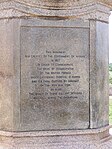 Memorial the siege of Seringapatam (1799) by the Mysore government, Seringapatam
 -
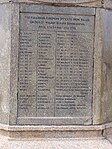 European officers killed in the siege of Seringapatam (1799), Seringapatam
 -
 Forces engaged before Seringapatam (1799), Seringapatam
 -
 Forces engaged before Seringapatam (1799), Seringapatam
 -
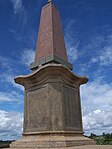 Memorial to the siege of Seringapatam (1799), Seringapatam
_by_the_Mysore_Government,_Seringapatam.JPG)
,_Seringapatam.JPG)
_Seringapatam.JPG)
,_Seringapatam.JPG)
,_Seringapatam.JPG)
See also[edit | edit source]
References[edit | edit source]
Cited sources
- ↑ Burton, Lady Isabel (1879). Arabia, Egypt, India: A Narrative of Travel.
- ↑ Naravane, M.S. (2014). Battles of the Honorourable East India Company. A.P.H. Publishing Corporation. pp. 178–181. ISBN 9788131300343.
- ↑ 3.0 3.1 Macquarie University "Seringapatam 1799: British Regiments". Archived from the original on 7 October 2008. Retrieved 9 January 2009.
- ↑ "History of the Madras Army". E. Keys at the Government Press. 27 July 1882 – via Google Books.
- ↑ "Mysorean Military Commanders and Officials". Seringapatam 1799. Retrieved 10 June 2019.
- ↑ Lushington, Life of Harris, p. 325
- ↑ 7.0 7.1 Hasan, Mohibbul 1908–1999 (2009). History of Tipu Sultan (Reprint ed.). Delhi: Aakar Books. pp. 313–314. ISBN 978-8187879572. OCLC 985562987.
{{cite book}}: CS1 maint: numeric names: authors list (link) - ↑ "Tipu Sultan throne finial to be auctioned - Indian Express".
- ↑ Mayo, John Horsley (1897). Medals and Decorations of the British Army and Navy, Volume 1. A. Constable & Co. p. 134. Retrieved 10 June 2019.
- ↑ Kumar, M T Shiva (9 March 2013). "There is life at the cemetery". The Hindu. No. Bangalore. Retrieved 3 February 2015.
Further reading
- Jac Weller, 2006, Wellington in India, Greenhill Books, London, ISBN 978-1-85367-397-9. (Review.)
- Elizabeth Longford, 1996, Wellington: The Years of the Sword, Smithmark Pub, New York, ISBN 978-0-8317-5646-8.