



robot: Update article (please report if you notice any mistake or error in this edit) |
BoydMalizia (talk | contribs) No edit summary |
||
| Line 1: | Line 1: | ||
{{Short description| | {{Short description|Eye cosmetic}} | ||
{{ | {{Multiple issues|{{More footnotes needed|date=July 2024}} | ||
{{ | {{Excessive examples|date=July 2024}}}} | ||
[[File: | [[File:Eye make-up (mascara).jpg|thumb|327x327px|Eye shot of a woman with kohl]] | ||
<!-- Do not translate Kohl into other languages in this lead section unless it can be substantiated with a source that shows that it is the common name used by *Arabic* speakers. Thanks. --> | |||
== | '''Kohl''' is a [[cosmetics|cosmetic]] product traditionally made by crushing [[stibnite]] (antimony sulfide). Modern kohl formulations often contain [[galena]] (lead sulfide), and in some cases charcoal or other pigments.<ref>{{cite journal |doi=10.1038/s41598-022-08669-0 |title=Recipes of Ancient Egyptian kohls more diverse than previously thought |date=2022 |last1=Riesmeier |first1=Marabel |last2=Keute |first2=Jennifer |last3=Veall |first3=Margaret-Ashley |last4=Borschneck |first4=Daniel |last5=Stevenson |first5=Alice |last6=Garnett |first6=Anna |last7=Williams |first7=Alice |last8=Ragan |first8=Maria |last9=Devièse |first9=Thibaut |journal=Scientific Reports |volume=12 |issue=1 |page=5932 |pmid=35396488 |pmc=8994005 |bibcode=2022NatSR..12.5932R }}</ref> Kohl is similar to [[eyeliner]], which was traditionally made. Kohl is widely used in many cultures to contour or darken the eyelids and heighten beauty marks.<ref>{{cite web |title=Patch Box |url=https://web.prm.ox.ac.uk/bodyarts/index.php/temporary-body-arts/cosmetics/85-patch-box-italy-or-britain-c-17501850-.html |publisher=Body Art collections at the Pitt Rivers Museum}}</ref> Several studies{{such as|date=June 2025}} have questioned the safety of kohl out of fear of [[lead poisoning]]. Importing galena kohl into the United States is banned.<ref>{{cite web |last1=Iman |first1=Sultan |title=As a Pakistani American Teenager, I Found Comfort and Confidence in Kohl Eyeliner |url=https://www.allure.com/story/kohl-eyeliner-history-ban |website=Allure Beauty |date=20 March 2022 |publisher=Conde Nast (Allure) |access-date=March 18, 2025}}</ref> | ||
==Etymology== | |||
{{Further|Antimony#Etymology}} | {{Further|Antimony#Etymology}} | ||
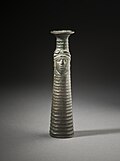
[[File:Kohl Tube LACMA M.76.97.81.jpg|thumb|right|upright|Ancient kohl cosmetic tube from western [[Iran]], dated | [[File:Kohl Tube LACMA M.76.97.81.jpg|thumb|right|upright|Ancient kohl cosmetic tube from western [[Iran]], dated 800–500 BCE]] | ||
The | The Arabic name {{lang|ar|كحل|rtl=yes}} {{transliteration|ar|DIN|''kuḥl''}} formed the Arabic root {{Transliteration|ar|k-ḥ-l}}, "to apply kohl." [[Transliteration]] variants of Arabic dialectal pronunciation include {{Transliteration|ar|kohl}} or {{Transliteration|ar|kuhl}}. | ||
The English word ''{{linktext|alcohol}}'' is a loan of the Arabic word (via [[Middle Latin]] and French, originally, in the sense "powder of [[antimony]]"; the modern meaning is from the 18th century). | |||
==Middle East and North Africa== | ==Middle East and North Africa== | ||
Kohl has been worn traditionally since the [[Naqada III|Naqada III era]] ({{circa|3100 BCE}}) by [[Egyptians]] of all social classes, originally as protection against eye ailments.<ref>{{Cite magazine |title=Ophthalmology of the Pharaohs: Antimicrobial Kohl Eyeliner in Ancient Egypt |url=https://discovermagazine.com/health/ophthalmology-of-the-pharaohs-antimicrobial-kohl-eyeliner-in-ancient-egypt |magazine=[[Discover (magazine)|Discover]] |language=en |access-date=2021-12-05}}</ref><ref>{{Cite journal |last=Mohta|first=Anup |date=2010 |title=Kajal (Kohl): A dangerous cosmetic |journal=[[Oman Journal of Ophthalmology]] |volume=3 |issue=2 |pages=100–101 |doi=10.4103/0974-620X.64242 |issn=0974-620X |pmc=3003848 |pmid=21217909 |doi-access=free}}</ref> There was also a belief that darkening the skin around the eyes would protect one from the harsh rays of the sun.<ref>{{Cite journal |last1=Hardy|first1=Andrew D. |last2=Walton|first2=Richard I. |last3=Myers|first3=Kathryn A. |last4=Vaishnav|first4=Ragini |date=March 2006 |title=Availability and chemical composition of traditional eye cosmetics ('kohls') used in the United Arab Emirates of Dubai, Sharjah, Ajman, Umm Al-Quwain, Ras Al-Khaimah, and Fujairah |journal=Journal of Cosmetic Science |volume=57 |issue=2 |pages=107–125 |issn=1525-7886 |pmid=16688375}}</ref> | |||
Kohl has been worn traditionally since the [[ | |||
Archaeological and scientific research established the earliest direct evidence for use of kohl in [[Sudanese]] Lower [[Nubia]]. Lead isotope analysis of kohl samples from [[C-Group culture|C-group]] and Pan-grave cemeteries in [[Debeira]] and Ashkeit, dated to [[Bronze Age|Middle Bronze Age]] (c.2300 - 1500 BCE), demonstrates that Nubian populations were using and possibly producing kohl, with some materials sourced locally and others imported from Egypt. These findings are supported by the discovery of numerous kohl containers and applicators in Nubian graves that predate full Egyptian colonial control.<ref>{{Cite web |last=Clough |first=Lydia |date=2024-11-27 |title=Ancient supply networks between Egypt and Nubia uncovered by analysis of eyeliner |url=https://www.arch.cam.ac.uk/news/ancient-supply-networks-between-egypt-and-nubia-uncovered-by-analysis-of-eyeliner |access-date=2025-06-01 |website=www.arch.cam.ac.uk |language=en}}</ref><ref>{{Cite web |date=1 June 2025 |title=A "Kohl Road" to Nubia? |url=https://www.archaeology.wiki/blog/2024/11/13/a-kohl-road-to-nubia/ |url-status=dead |access-date=2025-06-01 |website=Archaeology Newsroom |language=en-US |archive-date=2025-05-18 |archive-url=https://web.archive.org/web/20250518103303/https://www.archaeology.wiki/blog/2024/11/13/a-kohl-road-to-nubia/ }}</ref> The evidence challenges the traditional view that kohl use originated solely in Egypt, highlighting the central role of Nubian societies in development and spread of this iconic cosmetic.<ref>{{Cite journal |last1=Lemos |first1=Rennan |last2=Tichindelean |first2=Matei |last3=Kochergina |first3=Yulia V. Erban |last4=Zaggia |first4=Caterina |last5=Werkström |first5=Ludmila |last6=Hocker |first6=Emma |last7=Martinón-Torres |first7=Marcos |date=2024-11-11 |title=Bronze age supply chains between ancient Egypt and Nubia revealed by lead isotope analysis of kohl samples |url=https://doi.org/10.1038/s41598-024-79162-z |journal=Scientific Reports |volume=14 |issue=1 |page=27488 |doi=10.1038/s41598-024-79162-z |pmid=39523393 |issn=2045-2322|pmc=11551143 |bibcode=2024NatSR..1427488L }}</ref><ref>{{Citation |chapter=Contributions to the Archaeology of Egypt, Nubia and the Levant |date=2024 |pages=244 |chapter-url=https://doi.org/10.13173/9783447121378.244 |access-date=2025-06-01 |publisher=Harrassowitz Verlag |doi=10.13173/9783447121378.244 |isbn=978-3-447-12137-8 |title=Landscape and resource management in Bronze Age Nubia |series=Contributions to the Archaeology of Egypt, Nubia and the Levant |volume=17 }}</ref><ref>{{Citation |last=Dann |first=Rachael J. |title=Perspectives on the Body in Ancient Nubia |date=2021-01-13 |work=The Oxford Handbook of Ancient Nubia |pages=1033–1050 |url=https://doi.org/10.1093/oxfordhb/9780190496272.013.54 |access-date=2025-06-01 |publisher=Oxford University Press |doi=10.1093/oxfordhb/9780190496272.013.54 |isbn=978-0-19-049627-2|url-access=subscription }}</ref>[[File:Musicians and dancers on fresco at Tomb of Nebamun.jpg|thumb|left|[[Ancient Egypt]]ian women wearing kohl, from a tomb mural in [[Thebes, Egypt|Thebes]] (1420–1375 BCE)]] | |||
[[ | |||
[[Galena]] (lead sulfide) eye paint (later termed ''Kohl'' in Arabic from the [[Akkadian language|Akkadian]] word for the cosmetic) was widely applied in [[ancient Egypt]]. The upper eyelids were painted black, and the lower ones were colored green, as depicted in ancient texts that describe the use of both black galena and green [[malachite]]. Ancient graves from the prehistoric [[Tasian culture]] point to the early application of galena in Egypt, a custom stretching from as old as the [[Badarian culture]] through to the [[Greco-Roman world|Greco-Roman]] era. Although found locally, both black galena and green malachite were also imported from nearby regions in [[Western Asia]], [[Coptos]], and the [[Land of Punt]].<ref name="Stiant">''Studies in Ancient Technology'', Volume III, Brill Archive, p.18.</ref> | |||
The [[Eighteenth Dynasty of Egypt|18th Dynasty]] female Pharaoh [[Hatshepsut]] would also grind charred [[frankincense]] into kohl eyeliner. This is the first recorded use of the resin.<ref name="Isaac14">{{cite book |last1=Isaac |first1=Michael |title=A Historical Atlas of Oman |date=2004 |publisher=Rosen |isbn=978-0823945009 |page=14 |url=https://books.google.com/books?id=gTgdRuWa9xMC |access-date=5 September 2014}}</ref> The frankincense itself had originally been obtained during an expedition to the ancient Land of Punt in this [[New Kingdom of Egypt|New Kingdom]] dynasty ({{circa}} 1500 BCE).<ref>{{cite book |last1=Martin Watt, Wanda Sellar |title=Frankincense & Myrrh: Through the Ages, and a complete guide to their use in herbalism and aromatherapy today |date=2012 |publisher=Random House |isbn=978-1446490778 |page=24 |url=https://books.google.com/books?id=fxTgyhyMTLwC&pg=PT24 |access-date=11 November 2016}}</ref> Cosmetic ingredients such as [[cinnamon bark]] and other spice components – used for fragrances – alongside copper kohl sticks were exported from the towns of Pomparippu and [[Kandarodai|Kadiramalai-Kandarodai]] [[Tamraparni|in Tamraparni]] (now, Sri Lanka) to ancient Egypt.<ref>{{cite book |last1=Uragoda |first1=C. G. |title=A history of medicine in Sri Lanka from the earliest times to 1948 |date=1987 |publisher=Sri Lanka Medical Association |page=8 |url=https://books.google.com/books?id=Gj9rAAAAMAAJ&q=kohl |access-date=22 June 2019 |language=en}}</ref><ref>{{cite book |url=https://books.google.com/books?id=SkFuAAAAMAAJ |title=The evolution of an ethnic identity: the Tamils in Sri Lanka c. 300 BCE to c. 1200 CE |last=Intirapālā |first=Kārttikēcu |date=2005 |publisher=M.V. Publications for the South Asian Studies Centre, Sydney |isbn=9780646425467 |pages=63 |language=en}}</ref><ref>{{cite book |url=https://books.google.com/books?id=cItyybhNOLoC |title=International Journal of Dravidian Linguistics |date=2009 |publisher=Department of Linguistics, University of Kerala. |pages=62 |language=en}}</ref><ref>{{cite book |last1=Brand |first1=Chad |last2=Mitchell |first2=Eric |last3=Staff |first3=Holman Reference Editorial |title=Holman Illustrated Bible Dictionary |date=2015 |publisher=B&H Publishing Group |isbn=9780805499353 |page=351 |url=https://books.google.com/books?id=jgxCDwAAQBAJ&q=ancient+sri+lanka+makeup&pg=PA351 |access-date=22 June 2019 |language=en}}</ref> | |||
[[ | Additionally, the pioneering Muslim scholar [[ibn Abi Shaybah]] described in a legal compilation how to apply kohl to the eye, as narrated by earlier authorities.<ref name="Swain">{{cite book |editor-last=Swain |editor-first=Simon |editor-link=Simon Swain |title=Seeing the Face, Seeing the Soul: Polemon's ''Physiognomy'' from Classical Antiquity to Medieval Islam |year=2007 |publisher=Oxford University Press |isbn=978-0199291533 |page=277 |url=https://books.google.com/books?id=-I79HM8aKWIC}}</ref> | ||
[[Berbers|Berber]] and Semitic-speaking women in [[North Africa]] and the [[Middle East]], respectively, also apply kohl to their faces. A vertical line is drawn from the bottom lip to the chin and along the bridge of the nose. Originally, the line from the bottom lip to the chin showed whether a woman was married or not. This form of using kohl on the face originated from the [[Arabian Peninsula]], and was introduced in the seventh century to North Africa.<ref>''Many Mirrors: Body Image and Social Relations''. Nicole Landry Sault.</ref> | |||
Kohl has also been used in [[Yemen]] as a cosmetic for a long time. In addition, mothers would apply kohl to their infants' eyes soon after birth. Some did this to "strengthen the child's eyes", and others believed it could prevent the child from being cursed by the [[evil eye]].<ref name="hardy cairo">Hardy A, Walton R, Vaishnav R | Kohl has also been used in [[Yemen]] as a cosmetic for a long time. In addition, mothers would apply kohl to their infants' eyes soon after birth. Some did this to "strengthen the child's eyes", and others believed it could prevent the child from being cursed by the [[evil eye]].<ref name="hardy cairo">{{cite journal |vauthors=Hardy A, Walton R, Vaishnav R |journal=International Journal of Environmental Health Research |date=February 2004 |volume=14 |issue=1 |pages=83–91 |title=Composition of eye cosmetics (kohls) used in Cairo|doi=10.1080/09603120310001633859 |pmid=14660121 |bibcode=2004IJEHR..14...83H }}</ref> | ||
==Horn of Africa== | ==Horn of Africa== | ||
The usage of kohl eye paint in the [[Horn of Africa]] dates to the ancient Kingdom of Punt.<ref name="Stiant"/> [[Somali people|Somali]], [[Djibouti]]an, [[people of Ethiopia|Ethiopian]], and [[Eritrea]]n women have long applied kohl (''kuul'') for cosmetic purposes, as well as to cleanse the eyes, lengthen eyelashes, and to protect the eyes from the sun's rays.<ref name="Loughran">Katheryne S. Loughran, ''Somalia in word and image'', (Foundation for Cross Cultural Understanding: 1986), p.166.</ref><ref name="Selassie">Sergew Hable Selassie, ''Ancient and medieval Ethiopian history to 1270'', (Printed by United Printers: 1972), p.26.</ref> | |||
==West Africa== | ==West Africa== | ||
Kohl is also applied in parts of [[West Africa]] | Kohl is also applied in by many peoples parts of [[West Africa]], including the [[Fulani people|Fulani]], the [[Hausa people]], the [[Tuareg people|Tuareg]], and the [[Yoruba people|Yoruba]].<ref name="Nasidi">Nasidi, A., Karwowski, M.P., Woolf, A.D., Kellogg, M.D., Law, T.C., Sucosky, M.S., Glass-Pue, R.M., Brown, M.J., & Behbod, B. (2012). "Infant lead poisoning associated with use of tiro, an eye cosmetic from Nigeria--Boston, Massachusetts, 2011". MMWR. Morbidity and mortality weekly report, 61 30, 574-6 .</ref><ref name="Bascom">Bascom, W. R. (1949). Literary style in Yoruba riddles. The Journal of American Folklore, 62(243), 1-16.</ref><ref name="Donovan">Alan Donovan, ''My journey through African Heritage'', (Kenway Publications: 2004), p.62.</ref> In addition, it is utilized by [[Muslim]] inhabitants of the [[Sahel]] and [[Sahara]] regions. Kohl is used by both sexes and by people of all ages during weddings, festivals, and outings.{{citation needed|date=July 2024}} | ||
For women, kohl or black | For women, kohl or black [[henna]] is applied to the face as well in a similar manner as that practiced by communities in North Africa. | ||
==South Asia== | ==South Asia== | ||
{{Unreferenced section|date=November 2024}} | |||
Although the terms Kajal and Kohl are not identical, people often use them interchangeably. In India (Hinduism in particular), locals consider kajal to be a traditional remedy. Some Indian [[Ayurveda|Ayurvedic]] (i.e., ancient Indian herbal medicine) manufacturing companies add [[camphor]] and other medicinal herbs that are meant for eye health. | |||
In [[Indian culture]], ''kājal'' is predominantly worn by women around their eyes.{{citation needed|date=January 2025}} | |||
Some people{{citation needed|date=July 2024}} apply dots of ''kājal'' to ward off bad omens and the evil eye (''nazar''). | |||
Kajal is an integral part of classical dances in India, such as [[Bharatanatyam]] and [[Odissi]] . The dancers apply kajal broadly around their eyes to give them an elongated look so as to draw attention to their eye gestures and movements. | |||
The ingredients used in the homemade preparation of kajal are believed by local people to have medicinal properties. They are still used in Indian therapies like [[ayurveda]] and [[Siddha]] medicines. | |||
== | ==Health concerns== | ||
[[ | The content of kohl and the recipes to prepare it vary greatly between regions. In North Africa and the Middle East, homemade kohl is often made by grinding [[galena]] ([[Lead(II) sulfide|lead sulfide]]). Western manufacturers use [[amorphous carbon]] or organic [[charcoal]] instead of lead. Plant oils and the soot from various nuts, seeds, and gum [[resin]]s are often added to the carbon powder. The non-lead products are considered{{by whom|date=July 2024}} to be of inferior quality to the older, traditional varieties, and so there has been an increase in the use of handmade, lead-based kohl. | ||
For decades, various conflicting reports in literature have been published relating to kohl application to eyes being responsible for causing higher blood lead concentration, which may cause lead poisoning. At the same time, a number of research studies and reports have also been published, refuting any such links to increased blood lead levels upon kohl application.<ref name="mahmood">{{cite journal |vauthors=Mahmood ZA, Zoha SM, Usmanghani K, Hasan MM, Ali O, Jahan S, Saeed A, Zaihd R, Zubair M, Pak |journal=Journal of Pharmaceutical Sciences |volume=22 |number=1 |date=January 2009 |pages=107–122 |title=Kohl (surma): retrospect and prospect|pmid=19168431 }}</ref> | |||
A group of researchers in China tried to find some scientific basis of this claimed property of lead sulfide (galena) relating to absorption of sun rays when applied into the eyes in the form of kohl.<ref name="li yun">Li-Yun C, Wen H, Jian-Feng H and Jian-Peng W (2008). "Influence of deposition voltage on properties of lead sulfide thin film". ''American Ceramic Society Bulletin'', 87(6): 9101–9104</ref> The authors reported the ultraviolet (UV) absorption spectra of a thin film of lead sulfide prepared on an [[indium tin oxide]] (ITO) substrate. The spectra showed that thin films of lead sulfide had higher absorption and lower transmittance in the UV light band, which further increases with increased deposition voltage. | |||
The drive to eliminate lead from kohl was sparked by studies in the early 1990s of preparations of kohl that found high levels of contaminants, including lead.<ref name="hardy oman"/><ref>{{cite journal |vauthors=al-Hazzaa SA, Krahn PM |journal=International Ophthalmology |year=1995 |volume=19 |number=2 |pages=83–88 |title=Kohl: a hazardous eyeliner|doi=10.1007/BF00133177 |pmid=8586501 |s2cid=33603176 }}</ref><ref name="parry">{{cite journal |vauthors=Parry C, Eaton J |journal=[[Environmental Health Perspectives]] |date=August 1991 |number=94 |pages=121–123 |title=Kohl: a lead-hazardous eye makeup from the Third World to the First World|volume=94 |doi=10.1289/ehp.94-1567936 |doi-broken-date=17 January 2026 |pmid=1954922 |bibcode=1991EnvHP..94..121P |pmc=1567936 }}</ref> Lead levels in commercial kohl preparations were as high as 84%. Kohl samples from [[Oman]] and Cairo, analyzed using [[powder diffraction|X-ray powder diffraction]] and [[scanning electron microscope|scanning electron microscopy]], were found to contain galena.<ref name="hardy cairo"/><ref name="hardy oman">{{cite journal |vauthors=Hardy AD, Vaishnav R, Al-Kharusi SS, Sutherland HH, Worthing MA |journal=[[Journal of Ethnopharmacology]] |date=April 1998 |volume=60 |number=3 |pages=223–34 |title=Composition of eye cosmetics (kohls) used in Oman|doi=10.1016/S0378-8741(97)00156-6 |pmid=9613836 |bibcode=1998JEthn..60..223H }}</ref> One decade later, a study of kohl manufactured in Egypt and India found that a third of the samples studied contained lead, while the remaining two-thirds contained [[amorphous carbon]],<ref name="hardy cairo"/> [[zincite]],<ref name="hardy cairo"/><ref name="hardy oman"/> [[cuprite]],<ref name="hardy cairo"/> [[goethite]],<ref name="hardy cairo"/> [[silicon|elemental silicon]]<ref name="hardy cairo"/> or [[talc]],<ref name="hardy cairo" /> [[hematite]], [[Minium (mineral)|minium]],<ref name="hardy oman"/> and other organic compounds.<ref name="hardy cairo"/> | |||
== | Lead-contaminated kohl use has been linked to increased levels of lead in the bloodstream,<ref>{{cite journal |vauthors=Alkhawajah AM |title=Alkohl use in Saudi Arabia: Extent of use and possible lead toxicity |journal=Tropical Geographical Medicine |date=October 1992 |volume=44 |number=4 |pages=373–377|pmid=1295151 }}</ref><ref>{{cite journal |vauthors=Al-Saleh I, Nester M, DeVol E, Shinwari N, Al-Shahria S |title=Determinants of blood lead levels in Saudi Arabian schoolgirls |journal= International Journal of Occupational and Environmental Health|date=April–June 1999 |volume=5 |number=2 |pages=107–114|doi=10.1179/oeh.1999.5.2.107 |pmid=10330510 }}</ref><ref>{{cite journal |vauthors=Nir A, Tamir A, Nelnik N, Iancu TC |title=Is eye cosmetic a source of lead poisoning? |journal=Israel Journal of Medical Science |date=July 1992 |volume=28 |number=7 |pages=417–421|pmid=1506164 }}</ref><ref>{{cite journal |vauthors=Rahbar MH, White F, Agboatwalla M, Hozhbari S, Luby S |title=Factors associated with elevated blood lead concentrations in children in Karachi, Pakistan |journal=[[Bulletin of the World Health Organization]] |year=2002|volume=80 |number=10 |pages=769–775|pmid=12471396 |pmc=2567650 }}</ref> putting its users at risk of [[lead poisoning]] (also called lead intoxication). Complications of lead poisoning include [[anemia]], [[developmental delay (disambiguation)|developmental delay]], low [[intelligence quotient|IQ]], [[convulsions]], and, in severe cases, death. Anemia from lead poisoning is of special concern in Middle Eastern and South Asian countries where other forms of anemia are prevalent, including [[iron deficiency anemia]] (from malnutrition) and [[hemoglobinopathy]] ([[sickle cell anemia]], [[thalassemia]]). | ||
{{anchor|Kohl kajal}}These banned products are different from lead-free cosmetics that use the term "kohl" only to describe their shade or color rather than its actual ingredients. Some modern eye cosmetics are marketed as "kohl", but are prepared differently and follow relevant health standards. | |||
Eye cosmetics such as surma are recognized as one of the important sources of lead exposure in Pakistan. As adverse health effects of [[heavy metals]] are a public health concern, where especially lead may cause negative health impacts to human fetal and infantile development, a study in Pakistan of pregnant women's nails in 2016, showed 13 nail samples out of 84 analyzed contained lead concentrations exceeding the 13.6 μg/g found in a fatal case of lead poisoning. The possibility of an external contamination was excluded. The observations showed that lead-containing surma consists of fine particles of [[galena]] in [[respiratory system|a respirable]] dust range (less than 10 μm), and relative ''[[in vitro]]'' [[bioavailability]] of lead in the surma was determined as 5.2%. Thus, lead-containing surma consists of inhalable and bioavailable particles, and it contributes to an increased risk of lead exposure.<ref>{{cite journal |last1=Ikegami |first1=Akihiko |last2=Takagi |first2=Mai |last3=Fatmi |first3=Zafar |last4=Kobayashi |first4=Yayoi |last5=Ohtsu |first5=Mayumi |last6=Cui |first6=Xiaoyi |last7=Mise |first7=Nathan |last8=Mizuno |first8=Atsuko |last9=Sahito |first9=Ambreen |date=2016-11-01 |title=External lead contamination of women's nails by surma in Pakistan: Is the biomarker reliable? |journal=Environmental Pollution |volume=218 |issue=Supplement C |pages=723–727 |doi=10.1016/j.envpol.2016.07.068 |pmid=27554978|bibcode=2016EPoll.218..723I }}</ref> | |||
"Blue" kohl is a dark-bluish black pigment composed of lead-based compounds as well as a compound of antimony. The lead-based compounds in kohl are [[galena]] (PbS) – dark grey and gloss, [[laurionite]] (PbCl(OH)) – white, [[phosgenite]] (PbCl)<sub>2</sub>CO<sub>3</sub>), and [[cerussite]] (PbCO<sub>3</sub>) – blue. The antimony-based compound in kohl is [[stibnite]] (Sb<sub>2</sub>S<sub>3</sub>) – blue. | |||
In January 2010, French researchers reported that the particular heavy eye makeup that ancient Egyptians wore may have had medical benefits. At submicromolar concentrations, the specially-made lead compounds can elicit overproduction of [[nitric oxide#Biological functions|nitric oxide]] (NO), which in turn can trigger an enhancement of the immune response.<ref>{{cite journal |title=Finding Out Egyptian Gods' Secret Using Analytical Chemistry: Biomedical Properties of Egyptian Black Makeup Revealed by Amperometry at Single Cells |vauthors=Tapsoba I, Arbault S, Walter P, Amatore C |journal= Analytical Chemistry|volume=82 |issue=2 |pages=457–460 |date=January 2010 |doi=10.1021/ac902348g |pmid=20030333 |doi-access=free |bibcode=2010AnaCh..82..457T }}</ref><ref>National Geographic [https://web.archive.org/web/20210222180552/https://www.nationalgeographic.com/science/article/100114%2Dcleopatra%2Deye%2Dmakeup%2Dancient%2Degyptians "Cleopatra's eye makeup Warded Off Infections?"]</ref> | |||
The ancient Egyptians, documented in the [[Ebers Papyrus]] ({{circa}} 1550 BCE), discuss these compounds within kohl as protective for the eyes. Indeed, kohl was used as both a cosmetic eyeliner and a medicine. There are a number of endemic ocular diseases in the Nile region including [[trachoma]] – which is caused by a chlamydial bacterium and can cause corneal scarring – and conjunctival cicatricial disease, with resulting visual loss. Kohl was used not only as a cosmetic but also as a medicinal [[collyrium]] (from [[Ancient Greek|Greek]] {{lang|grc-Latn|kollurion}}). Two of kohl's lead compounds – the lead chlorides laurionite and phosgenite – were not natural to the Nile valley. It is believed they were intentionally synthesized by the ancient Egyptians for this purpose. The widespread use of kohl across the Mediterranean and the Middle East attests to its ability to protect the eye from infectious disease and as well as being used as a cosmetic.<ref>{{cite magazine |last=Kreston |first=Rebecca |title=Ophthalmology of the Pharaohs: Antimicrobial Kohl Eyeliner in Ancient Egypt |department=Body Horrors |magazine=Discover |date=April 20, 2012 |url=https://www.discovermagazine.com/health/ophthalmology-of-the-pharaohs-antimicrobial-kohl-eyeliner-in-ancient-egypt}}</ref><ref>{{cite journal |title=Finding Out Egyptian Gods' Secret Using Analytical Chemistry: Biomedical Properties of Egyptian Black Makeup Revealed by Amperometry at Single Cells |journal=Analytical Chemistry |volume=82 |issue=2 |pages=457–460 |year=2010 |first1=Issa |last1=Tapsoba |first2=Stéphane |last2=Arbault |first3=Philippe |last3=Walter |first4=Christian |last4=Amatore |pmid=20030333 |doi=10.1021/ac902348g|doi-access=free |bibcode=2010AnaCh..82..457T }}</ref> | |||
A test of kohl's anti microbial properties as found that kohl was especially able to inhibit the growth of ''[[Streptococcus pyogenes]],'' and mildly able to inhibit ''[[Proteus vulgaris|Proteus vulgares]]'' and ''[[Staphylococcus aureus]]'' bacterias.<ref name=":0">{{Cite journal |last1=Al-Kaff |first1=Ali |last2=Al-Rajhi |first2=Ali |last3=Tabbara |first3=Khalid |last4=El-Yazigi |first4=Adnan |title=Kohl - the traditional eyeliner: use and analysis |journal= Annals of Saudi Medicine|date=1993 |volume=13 |issue=1 |pages=26–30 |doi=10.5144/0256-4947.1993.26 |pmid=17587986 |issn=0256-4947}}</ref> | |||
===Legal status=== | |||
In the United States, kohl is not on the list of color additives approved by the [[Food and Drug Administration]], which considers kohl unsafe for use due to its potential lead content. It is illegal to import into, or sell in, the United States.<ref>{{cite web |url=https://www.fda.gov/cosmetics/cosmetic-products/kohl-kajal-al-kahal-surma-tiro-tozali-or-kwalli-any-name-beware-lead-poisoning |archive-url=https://web.archive.org/web/20190905014348/https://www.fda.gov/cosmetics/cosmetic-products/kohl-kajal-al-kahal-surma-tiro-tozali-or-kwalli-any-name-beware-lead-poisoning |url-status=dead |archive-date=September 5, 2019 |access-date=2017-10-26 |title=Kohl, Kajal, Al-Kahal, Surma, Tiro, Tozali, or Kwalli: By Any Name, Beware of Lead Poisoning |publisher=[[Food and Drug Administration]]}}</ref> Kohl is considered unsafe partly due to risk of lead exposure. | |||
==Gallery== | |||
<gallery class="center" mode="packed" heights="167" classes="center"> | |||
File:Kohl Container Inscribed for Queen Tiye LACMA M.80.198.89.jpg|A kohl container from the [[Eighteenth Dynasty of Egypt|18th Dynasty]] of [[ancient Egypt]], inscribed for Queen [[Tiye]] (1410–1372 BCE) | |||
File:Double cosmetic tube Louvre MNC1825.jpg|Double cosmetic tube (dilekythos) used for kohl; make-up was applied with an ivory, bronze or glass stick | |||
File:Killedan.jpg|A [[Kurdish people|Kurdish]] kohl (''kil'') set | |||
File:Kajalstifte.jpg|Modern kajal pencils | |||
File:Gotipua make-up (INDIA).jpg|[[Make-up artist]] at work before a ''Gotipua'' [[Odissi]] dance performance | |||
File:It's a boy - Khol Kajal kanmashi kan mai eyeliner infants evil eye Buri nazar drishti bommai काजल கண் மை surma Tamil Nadu village India Documentary Featur story jpg photo IMG 3192 signed.jpg|A [[Tamil Nadu|Tamil]] woman applying kajal on her toddler son in India | |||
File:India - Varanasi old food seller and granddaughter - 0604.jpg|A [[Varanasi]] food seller with his granddaughter wearing kajal | |||
File:Ucidlhd29.png|A [[Somali people|Somali]] woman with ''indha kuul'' ("kohl eyes") | |||
File:Kohl bottle in the shape of a mango (20th century).jpg|Kohl container in the shape of a mango, made in Bihar, India in the 1960s | |||
</gallery> | |||
==See also== | ==See also== | ||
| Line 105: | Line 95: | ||
===References=== | ===References=== | ||
{{reflist}} | {{reflist}}<ref name=":0" /> | ||
===Bibliography=== | ===Bibliography=== | ||
| Line 113: | Line 103: | ||
* Hardy AD, Walton RI, Myers KA, Vaishnav R., ''J Cosmet Sci''. 2006 Mar–Apr;57(2):107–25. "Availability and chemical composition of traditional eye cosmetics ('kohls') used in the United Arab Emirates of Dubai, Sharjah, Ajman, Umm Al-Quwain, Ras Al-Khaimah, and Fujairah." | * Hardy AD, Walton RI, Myers KA, Vaishnav R., ''J Cosmet Sci''. 2006 Mar–Apr;57(2):107–25. "Availability and chemical composition of traditional eye cosmetics ('kohls') used in the United Arab Emirates of Dubai, Sharjah, Ajman, Umm Al-Quwain, Ras Al-Khaimah, and Fujairah." | ||
* Shaltout A, Yaish SA, Fernando N., ''[[Ann Trop Paediatr]]''. 1981 Dec;1(4):209–15. "Lead encephalopathy in infants in Kuwait. A study of 20 infants with particular reference to clinical presentation and source of lead poisoning." | * Shaltout A, Yaish SA, Fernando N., ''[[Ann Trop Paediatr]]''. 1981 Dec;1(4):209–15. "Lead encephalopathy in infants in Kuwait. A study of 20 infants with particular reference to clinical presentation and source of lead poisoning." | ||
* Administrator. (n.d.). Patch box. web.prm.ox.ac.uk. https://web.prm.ox.ac.uk/bodyarts/index.php/temporary-body-arts/cosmetics/85-patch-box-italy-or-britain-c-17501850-.html | |||
{{Refend}} | {{Refend}} | ||
| Line 127: | Line 118: | ||
[[Category:History of cosmetics]] | [[Category:History of cosmetics]] | ||
[[Category:Badarian culture]] | [[Category:Badarian culture]] | ||
[[Category:Land of Punt]] | |||
[[sv:Kohl (smink)]] | [[sv:Kohl (smink)]] | ||
[[zh:眼影粉]] | [[zh:眼影粉]] | ||
Latest revision as of 01:53, 14 February 2026
 | This article has multiple issues. Please help improve it or discuss these issues on the talk page. (Learn how and when to remove these template messages)
|


.jpg)
Kohl is a cosmetic product traditionally made by crushing stibnite (antimony sulfide). Modern kohl formulations often contain galena (lead sulfide), and in some cases charcoal or other pigments.[1] Kohl is similar to eyeliner, which was traditionally made. Kohl is widely used in many cultures to contour or darken the eyelids and heighten beauty marks.[2] Several studiesTemplate:Such as have questioned the safety of kohl out of fear of lead poisoning. Importing galena kohl into the United States is banned.[3]
Etymology[edit | edit source]

The Arabic name كحل kuḥl formed the Arabic root k-ḥ-l, "to apply kohl." Transliteration variants of Arabic dialectal pronunciation include kohl or kuhl.
The English word alcohol is a loan of the Arabic word (via Middle Latin and French, originally, in the sense "powder of antimony"; the modern meaning is from the 18th century).
Middle East and North Africa[edit | edit source]
Kohl has been worn traditionally since the Naqada III era (c. 3100 BCE) by Egyptians of all social classes, originally as protection against eye ailments.[4][5] There was also a belief that darkening the skin around the eyes would protect one from the harsh rays of the sun.[6]
Archaeological and scientific research established the earliest direct evidence for use of kohl in Sudanese Lower Nubia. Lead isotope analysis of kohl samples from C-group and Pan-grave cemeteries in Debeira and Ashkeit, dated to Middle Bronze Age (c.2300 - 1500 BCE), demonstrates that Nubian populations were using and possibly producing kohl, with some materials sourced locally and others imported from Egypt. These findings are supported by the discovery of numerous kohl containers and applicators in Nubian graves that predate full Egyptian colonial control.[7][8] The evidence challenges the traditional view that kohl use originated solely in Egypt, highlighting the central role of Nubian societies in development and spread of this iconic cosmetic.[9][10][11]

Galena (lead sulfide) eye paint (later termed Kohl in Arabic from the Akkadian word for the cosmetic) was widely applied in ancient Egypt. The upper eyelids were painted black, and the lower ones were colored green, as depicted in ancient texts that describe the use of both black galena and green malachite. Ancient graves from the prehistoric Tasian culture point to the early application of galena in Egypt, a custom stretching from as old as the Badarian culture through to the Greco-Roman era. Although found locally, both black galena and green malachite were also imported from nearby regions in Western Asia, Coptos, and the Land of Punt.[12]
The 18th Dynasty female Pharaoh Hatshepsut would also grind charred frankincense into kohl eyeliner. This is the first recorded use of the resin.[13] The frankincense itself had originally been obtained during an expedition to the ancient Land of Punt in this New Kingdom dynasty (c. 1500 BCE).[14] Cosmetic ingredients such as cinnamon bark and other spice components – used for fragrances – alongside copper kohl sticks were exported from the towns of Pomparippu and Kadiramalai-Kandarodai in Tamraparni (now, Sri Lanka) to ancient Egypt.[15][16][17][18]
Additionally, the pioneering Muslim scholar ibn Abi Shaybah described in a legal compilation how to apply kohl to the eye, as narrated by earlier authorities.[19] Berber and Semitic-speaking women in North Africa and the Middle East, respectively, also apply kohl to their faces. A vertical line is drawn from the bottom lip to the chin and along the bridge of the nose. Originally, the line from the bottom lip to the chin showed whether a woman was married or not. This form of using kohl on the face originated from the Arabian Peninsula, and was introduced in the seventh century to North Africa.[20]
Kohl has also been used in Yemen as a cosmetic for a long time. In addition, mothers would apply kohl to their infants' eyes soon after birth. Some did this to "strengthen the child's eyes", and others believed it could prevent the child from being cursed by the evil eye.[21]
Horn of Africa[edit | edit source]
The usage of kohl eye paint in the Horn of Africa dates to the ancient Kingdom of Punt.[12] Somali, Djiboutian, Ethiopian, and Eritrean women have long applied kohl (kuul) for cosmetic purposes, as well as to cleanse the eyes, lengthen eyelashes, and to protect the eyes from the sun's rays.[22][23]
West Africa[edit | edit source]
Kohl is also applied in by many peoples parts of West Africa, including the Fulani, the Hausa people, the Tuareg, and the Yoruba.[24][25][26] In addition, it is utilized by Muslim inhabitants of the Sahel and Sahara regions. Kohl is used by both sexes and by people of all ages during weddings, festivals, and outings.[citation needed]
For women, kohl or black henna is applied to the face as well in a similar manner as that practiced by communities in North Africa.
South Asia[edit | edit source]
 |
Although the terms Kajal and Kohl are not identical, people often use them interchangeably. In India (Hinduism in particular), locals consider kajal to be a traditional remedy. Some Indian Ayurvedic (i.e., ancient Indian herbal medicine) manufacturing companies add camphor and other medicinal herbs that are meant for eye health.
In Indian culture, kājal is predominantly worn by women around their eyes.[citation needed]
Some people[citation needed] apply dots of kājal to ward off bad omens and the evil eye (nazar).
Kajal is an integral part of classical dances in India, such as Bharatanatyam and Odissi . The dancers apply kajal broadly around their eyes to give them an elongated look so as to draw attention to their eye gestures and movements.
The ingredients used in the homemade preparation of kajal are believed by local people to have medicinal properties. They are still used in Indian therapies like ayurveda and Siddha medicines.
Health concerns[edit | edit source]
The content of kohl and the recipes to prepare it vary greatly between regions. In North Africa and the Middle East, homemade kohl is often made by grinding galena (lead sulfide). Western manufacturers use amorphous carbon or organic charcoal instead of lead. Plant oils and the soot from various nuts, seeds, and gum resins are often added to the carbon powder. The non-lead products are considered[by whom?] to be of inferior quality to the older, traditional varieties, and so there has been an increase in the use of handmade, lead-based kohl.
For decades, various conflicting reports in literature have been published relating to kohl application to eyes being responsible for causing higher blood lead concentration, which may cause lead poisoning. At the same time, a number of research studies and reports have also been published, refuting any such links to increased blood lead levels upon kohl application.[27]
A group of researchers in China tried to find some scientific basis of this claimed property of lead sulfide (galena) relating to absorption of sun rays when applied into the eyes in the form of kohl.[28] The authors reported the ultraviolet (UV) absorption spectra of a thin film of lead sulfide prepared on an indium tin oxide (ITO) substrate. The spectra showed that thin films of lead sulfide had higher absorption and lower transmittance in the UV light band, which further increases with increased deposition voltage.
The drive to eliminate lead from kohl was sparked by studies in the early 1990s of preparations of kohl that found high levels of contaminants, including lead.[29][30][31] Lead levels in commercial kohl preparations were as high as 84%. Kohl samples from Oman and Cairo, analyzed using X-ray powder diffraction and scanning electron microscopy, were found to contain galena.[21][29] One decade later, a study of kohl manufactured in Egypt and India found that a third of the samples studied contained lead, while the remaining two-thirds contained amorphous carbon,[21] zincite,[21][29] cuprite,[21] goethite,[21] elemental silicon[21] or talc,[21] hematite, minium,[29] and other organic compounds.[21]
Lead-contaminated kohl use has been linked to increased levels of lead in the bloodstream,[32][33][34][35] putting its users at risk of lead poisoning (also called lead intoxication). Complications of lead poisoning include anemia, developmental delay, low IQ, convulsions, and, in severe cases, death. Anemia from lead poisoning is of special concern in Middle Eastern and South Asian countries where other forms of anemia are prevalent, including iron deficiency anemia (from malnutrition) and hemoglobinopathy (sickle cell anemia, thalassemia).
These banned products are different from lead-free cosmetics that use the term "kohl" only to describe their shade or color rather than its actual ingredients. Some modern eye cosmetics are marketed as "kohl", but are prepared differently and follow relevant health standards.
Eye cosmetics such as surma are recognized as one of the important sources of lead exposure in Pakistan. As adverse health effects of heavy metals are a public health concern, where especially lead may cause negative health impacts to human fetal and infantile development, a study in Pakistan of pregnant women's nails in 2016, showed 13 nail samples out of 84 analyzed contained lead concentrations exceeding the 13.6 μg/g found in a fatal case of lead poisoning. The possibility of an external contamination was excluded. The observations showed that lead-containing surma consists of fine particles of galena in a respirable dust range (less than 10 μm), and relative in vitro bioavailability of lead in the surma was determined as 5.2%. Thus, lead-containing surma consists of inhalable and bioavailable particles, and it contributes to an increased risk of lead exposure.[36]
"Blue" kohl is a dark-bluish black pigment composed of lead-based compounds as well as a compound of antimony. The lead-based compounds in kohl are galena (PbS) – dark grey and gloss, laurionite (PbCl(OH)) – white, phosgenite (PbCl)2CO3), and cerussite (PbCO3) – blue. The antimony-based compound in kohl is stibnite (Sb2S3) – blue.
In January 2010, French researchers reported that the particular heavy eye makeup that ancient Egyptians wore may have had medical benefits. At submicromolar concentrations, the specially-made lead compounds can elicit overproduction of nitric oxide (NO), which in turn can trigger an enhancement of the immune response.[37][38]
The ancient Egyptians, documented in the Ebers Papyrus (c. 1550 BCE), discuss these compounds within kohl as protective for the eyes. Indeed, kohl was used as both a cosmetic eyeliner and a medicine. There are a number of endemic ocular diseases in the Nile region including trachoma – which is caused by a chlamydial bacterium and can cause corneal scarring – and conjunctival cicatricial disease, with resulting visual loss. Kohl was used not only as a cosmetic but also as a medicinal collyrium (from Greek kollurion). Two of kohl's lead compounds – the lead chlorides laurionite and phosgenite – were not natural to the Nile valley. It is believed they were intentionally synthesized by the ancient Egyptians for this purpose. The widespread use of kohl across the Mediterranean and the Middle East attests to its ability to protect the eye from infectious disease and as well as being used as a cosmetic.[39][40]
A test of kohl's anti microbial properties as found that kohl was especially able to inhibit the growth of Streptococcus pyogenes, and mildly able to inhibit Proteus vulgares and Staphylococcus aureus bacterias.[41]
Legal status[edit | edit source]
In the United States, kohl is not on the list of color additives approved by the Food and Drug Administration, which considers kohl unsafe for use due to its potential lead content. It is illegal to import into, or sell in, the United States.[42] Kohl is considered unsafe partly due to risk of lead exposure.
Gallery[edit | edit source]
-

-
 Double cosmetic tube (dilekythos) used for kohl; make-up was applied with an ivory, bronze or glass stick
 -
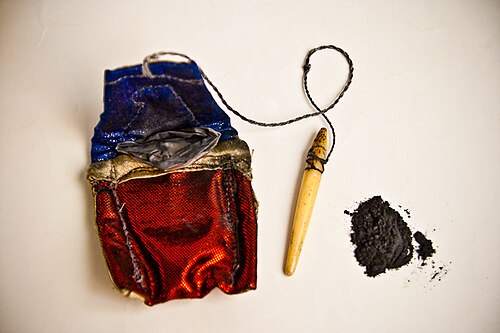 A Kurdish kohl (kil) set
 -
 Modern kajal pencils
 -
 Make-up artist at work before a Gotipua Odissi dance performance
 -
 A Tamil woman applying kajal on her toddler son in India
 -
 A Varanasi food seller with his granddaughter wearing kajal
 -
 A Somali woman with indha kuul ("kohl eyes")
 -
 Kohl container in the shape of a mango, made in Bihar, India in the 1960s


.jpg)


.jpg)
See also[edit | edit source]
References[edit | edit source]
References[edit | edit source]
- ↑ Riesmeier, Marabel; Keute, Jennifer; Veall, Margaret-Ashley; Borschneck, Daniel; Stevenson, Alice; Garnett, Anna; Williams, Alice; Ragan, Maria; Devièse, Thibaut (2022). "Recipes of Ancient Egyptian kohls more diverse than previously thought". Scientific Reports. 12 (1): 5932. Bibcode:2022NatSR..12.5932R. doi:10.1038/s41598-022-08669-0. PMC 8994005. PMID 35396488.
- ↑ "Patch Box". Body Art collections at the Pitt Rivers Museum.
- ↑ Iman, Sultan (20 March 2022). "As a Pakistani American Teenager, I Found Comfort and Confidence in Kohl Eyeliner". Allure Beauty. Conde Nast (Allure). Retrieved March 18, 2025.
- ↑ "Ophthalmology of the Pharaohs: Antimicrobial Kohl Eyeliner in Ancient Egypt". Discover. Retrieved 2021-12-05.
- ↑ Mohta, Anup (2010). "Kajal (Kohl): A dangerous cosmetic". Oman Journal of Ophthalmology. 3 (2): 100–101. doi:10.4103/0974-620X.64242. ISSN 0974-620X. PMC 3003848. PMID 21217909.
- ↑ Hardy, Andrew D.; Walton, Richard I.; Myers, Kathryn A.; Vaishnav, Ragini (March 2006). "Availability and chemical composition of traditional eye cosmetics ('kohls') used in the United Arab Emirates of Dubai, Sharjah, Ajman, Umm Al-Quwain, Ras Al-Khaimah, and Fujairah". Journal of Cosmetic Science. 57 (2): 107–125. ISSN 1525-7886. PMID 16688375.
- ↑ Clough, Lydia (2024-11-27). "Ancient supply networks between Egypt and Nubia uncovered by analysis of eyeliner". www.arch.cam.ac.uk. Retrieved 2025-06-01.
- ↑ "A "Kohl Road" to Nubia?". Archaeology Newsroom. 1 June 2025. Archived from the original on 2025-05-18. Retrieved 2025-06-01.
- ↑ Lemos, Rennan; Tichindelean, Matei; Kochergina, Yulia V. Erban; Zaggia, Caterina; Werkström, Ludmila; Hocker, Emma; Martinón-Torres, Marcos (2024-11-11). "Bronze age supply chains between ancient Egypt and Nubia revealed by lead isotope analysis of kohl samples". Scientific Reports. 14 (1): 27488. Bibcode:2024NatSR..1427488L. doi:10.1038/s41598-024-79162-z. ISSN 2045-2322. PMC 11551143. PMID 39523393.
- ↑ "Contributions to the Archaeology of Egypt, Nubia and the Levant", Landscape and resource management in Bronze Age Nubia, Contributions to the Archaeology of Egypt, Nubia and the Levant, vol. 17, Harrassowitz Verlag, 2024, p. 244, doi:10.13173/9783447121378.244, ISBN 978-3-447-12137-8, retrieved 2025-06-01
- ↑ Dann, Rachael J. (2021-01-13), "Perspectives on the Body in Ancient Nubia", The Oxford Handbook of Ancient Nubia, Oxford University Press, pp. 1033–1050, doi:10.1093/oxfordhb/9780190496272.013.54, ISBN 978-0-19-049627-2, retrieved 2025-06-01
{{citation}}: CS1 maint: work parameter with ISBN (link) - ↑ 12.0 12.1 Studies in Ancient Technology, Volume III, Brill Archive, p.18.
- ↑ Isaac, Michael (2004). A Historical Atlas of Oman. Rosen. p. 14. ISBN 978-0823945009. Retrieved 5 September 2014.
- ↑ Martin Watt, Wanda Sellar (2012). Frankincense & Myrrh: Through the Ages, and a complete guide to their use in herbalism and aromatherapy today. Random House. p. 24. ISBN 978-1446490778. Retrieved 11 November 2016.
- ↑ Uragoda, C. G. (1987). A history of medicine in Sri Lanka from the earliest times to 1948. Sri Lanka Medical Association. p. 8. Retrieved 22 June 2019.
- ↑ Intirapālā, Kārttikēcu (2005). The evolution of an ethnic identity: the Tamils in Sri Lanka c. 300 BCE to c. 1200 CE. M.V. Publications for the South Asian Studies Centre, Sydney. p. 63. ISBN 9780646425467.
- ↑ International Journal of Dravidian Linguistics. Department of Linguistics, University of Kerala. 2009. p. 62.
- ↑ Brand, Chad; Mitchell, Eric; Staff, Holman Reference Editorial (2015). Holman Illustrated Bible Dictionary. B&H Publishing Group. p. 351. ISBN 9780805499353. Retrieved 22 June 2019.
- ↑ Swain, Simon, ed. (2007). Seeing the Face, Seeing the Soul: Polemon's Physiognomy from Classical Antiquity to Medieval Islam. Oxford University Press. p. 277. ISBN 978-0199291533.
- ↑ Many Mirrors: Body Image and Social Relations. Nicole Landry Sault.
- ↑ 21.0 21.1 21.2 21.3 21.4 21.5 21.6 21.7 21.8 Hardy A, Walton R, Vaishnav R (February 2004). "Composition of eye cosmetics (kohls) used in Cairo". International Journal of Environmental Health Research. 14 (1): 83–91. Bibcode:2004IJEHR..14...83H. doi:10.1080/09603120310001633859. PMID 14660121.
- ↑ Katheryne S. Loughran, Somalia in word and image, (Foundation for Cross Cultural Understanding: 1986), p.166.
- ↑ Sergew Hable Selassie, Ancient and medieval Ethiopian history to 1270, (Printed by United Printers: 1972), p.26.
- ↑ Nasidi, A., Karwowski, M.P., Woolf, A.D., Kellogg, M.D., Law, T.C., Sucosky, M.S., Glass-Pue, R.M., Brown, M.J., & Behbod, B. (2012). "Infant lead poisoning associated with use of tiro, an eye cosmetic from Nigeria--Boston, Massachusetts, 2011". MMWR. Morbidity and mortality weekly report, 61 30, 574-6 .
- ↑ Bascom, W. R. (1949). Literary style in Yoruba riddles. The Journal of American Folklore, 62(243), 1-16.
- ↑ Alan Donovan, My journey through African Heritage, (Kenway Publications: 2004), p.62.
- ↑ Mahmood ZA, Zoha SM, Usmanghani K, Hasan MM, Ali O, Jahan S, Saeed A, Zaihd R, Zubair M, Pak (January 2009). "Kohl (surma): retrospect and prospect". Journal of Pharmaceutical Sciences. 22 (1): 107–122. PMID 19168431.
- ↑ Li-Yun C, Wen H, Jian-Feng H and Jian-Peng W (2008). "Influence of deposition voltage on properties of lead sulfide thin film". American Ceramic Society Bulletin, 87(6): 9101–9104
- ↑ 29.0 29.1 29.2 29.3 Hardy AD, Vaishnav R, Al-Kharusi SS, Sutherland HH, Worthing MA (April 1998). "Composition of eye cosmetics (kohls) used in Oman". Journal of Ethnopharmacology. 60 (3): 223–34. Bibcode:1998JEthn..60..223H. doi:10.1016/S0378-8741(97)00156-6. PMID 9613836.
- ↑ al-Hazzaa SA, Krahn PM (1995). "Kohl: a hazardous eyeliner". International Ophthalmology. 19 (2): 83–88. doi:10.1007/BF00133177. PMID 8586501. S2CID 33603176.
- ↑ Parry C, Eaton J (August 1991). "Kohl: a lead-hazardous eye makeup from the Third World to the First World". Environmental Health Perspectives. 94 (94): 121–123. Bibcode:1991EnvHP..94..121P. doi:10.1289/ehp.94-1567936 ( (inactive $1) 17 January 2026). PMC 1567936. PMID 1954922.
{{cite journal}}: CS1 maint: DOI inactive as of January 2026 (link) - ↑ Alkhawajah AM (October 1992). "Alkohl use in Saudi Arabia: Extent of use and possible lead toxicity". Tropical Geographical Medicine. 44 (4): 373–377. PMID 1295151.
- ↑ Al-Saleh I, Nester M, DeVol E, Shinwari N, Al-Shahria S (April–June 1999). "Determinants of blood lead levels in Saudi Arabian schoolgirls". International Journal of Occupational and Environmental Health. 5 (2): 107–114. doi:10.1179/oeh.1999.5.2.107. PMID 10330510.
- ↑ Nir A, Tamir A, Nelnik N, Iancu TC (July 1992). "Is eye cosmetic a source of lead poisoning?". Israel Journal of Medical Science. 28 (7): 417–421. PMID 1506164.
- ↑ Rahbar MH, White F, Agboatwalla M, Hozhbari S, Luby S (2002). "Factors associated with elevated blood lead concentrations in children in Karachi, Pakistan". Bulletin of the World Health Organization. 80 (10): 769–775. PMC 2567650. PMID 12471396.
- ↑ Ikegami, Akihiko; Takagi, Mai; Fatmi, Zafar; Kobayashi, Yayoi; Ohtsu, Mayumi; Cui, Xiaoyi; Mise, Nathan; Mizuno, Atsuko; Sahito, Ambreen (2016-11-01). "External lead contamination of women's nails by surma in Pakistan: Is the biomarker reliable?". Environmental Pollution. 218 (Supplement C): 723–727. Bibcode:2016EPoll.218..723I. doi:10.1016/j.envpol.2016.07.068. PMID 27554978.
- ↑ Tapsoba I, Arbault S, Walter P, Amatore C (January 2010). "Finding Out Egyptian Gods' Secret Using Analytical Chemistry: Biomedical Properties of Egyptian Black Makeup Revealed by Amperometry at Single Cells". Analytical Chemistry. 82 (2): 457–460. Bibcode:2010AnaCh..82..457T. doi:10.1021/ac902348g. PMID 20030333.
- ↑ National Geographic "Cleopatra's eye makeup Warded Off Infections?"
- ↑ Kreston, Rebecca (April 20, 2012). "Ophthalmology of the Pharaohs: Antimicrobial Kohl Eyeliner in Ancient Egypt". Body Horrors. Discover.
- ↑ Tapsoba, Issa; Arbault, Stéphane; Walter, Philippe; Amatore, Christian (2010). "Finding Out Egyptian Gods' Secret Using Analytical Chemistry: Biomedical Properties of Egyptian Black Makeup Revealed by Amperometry at Single Cells". Analytical Chemistry. 82 (2): 457–460. Bibcode:2010AnaCh..82..457T. doi:10.1021/ac902348g. PMID 20030333.
- ↑ Al-Kaff, Ali; Al-Rajhi, Ali; Tabbara, Khalid; El-Yazigi, Adnan (1993). "Kohl - the traditional eyeliner: use and analysis". Annals of Saudi Medicine. 13 (1): 26–30. doi:10.5144/0256-4947.1993.26. ISSN 0256-4947. PMID 17587986.
- ↑ "Kohl, Kajal, Al-Kahal, Surma, Tiro, Tozali, or Kwalli: By Any Name, Beware of Lead Poisoning". Food and Drug Administration. Archived from the original on September 5, 2019. Retrieved 2017-10-26.
Bibliography[edit | edit source]
- Al-Ashban RM, Aslam M, Shah AH., Public Health. 2004 Jun;118(4):292–8. "Kohl (surma): a toxic traditional eye cosmetic study in Saudi Arabia."
- Abdullah MA., J Trop Med Hyg. 1984 Apr;87(2):67–70. "Lead poisoning among children in Saudi Arabia."
- Hardy AD, Walton RI, Myers KA, Vaishnav R., J Cosmet Sci. 2006 Mar–Apr;57(2):107–25. "Availability and chemical composition of traditional eye cosmetics ('kohls') used in the United Arab Emirates of Dubai, Sharjah, Ajman, Umm Al-Quwain, Ras Al-Khaimah, and Fujairah."
- Shaltout A, Yaish SA, Fernando N., Ann Trop Paediatr. 1981 Dec;1(4):209–15. "Lead encephalopathy in infants in Kuwait. A study of 20 infants with particular reference to clinical presentation and source of lead poisoning."
- Administrator. (n.d.). Patch box. web.prm.ox.ac.uk. https://web.prm.ox.ac.uk/bodyarts/index.php/temporary-body-arts/cosmetics/85-patch-box-italy-or-britain-c-17501850-.html
External links[edit | edit source]
- Egyptian: Kohl pot, Black steatite. Click on picture.
- Egyptian: Bone kohl pot. Figurine design. Click on picture.
- Kohl (CopperWiki)
- ↑ Cite error: Invalid
<ref>tag; no text was provided for refs named:0
- Pages using the JsonConfig extension
- Articles with too many examples from July 2024
- All articles with too many examples
- Wikipedia articles with style issues from July 2024
- Articles needing additional references from November 2024
- Articles containing Ancient Greek (to 1453)-language text
- Cosmetics
- History of cosmetics
- Badarian culture
- Land of Punt