

m minor update |
|||
| Line 11: | Line 11: | ||
|authority = [[Carl Linnaeus|L.]] 1753 | |authority = [[Carl Linnaeus|L.]] 1753 | ||
|synonyms = *''Ficus banyana'' <small>Oken </small> | |synonyms = *''Ficus banyana'' <small>Oken </small> | ||
*''Ficus benghalensis var. benghalensis'' | |||
*''Ficus benghalensis var. krishnae'' <small>(C. D. C.) Corner</small> | *''Ficus benghalensis var. krishnae'' <small>(C. D. C.) Corner</small> | ||
*''Ficus chauvieri'' <small>G. Nicholson</small> | *''Ficus chauvieri'' <small>G. Nicholson</small> | ||
| Line 16: | Line 17: | ||
*''Ficus cotonifolia'' <small>Stokes</small> | *''Ficus cotonifolia'' <small>Stokes</small> | ||
*''Ficus crassinervia'' <small>Kunth & C. D. Bouché</small> | *''Ficus crassinervia'' <small>Kunth & C. D. Bouché</small> | ||
*''Ficus indica'' <small>L.</small> | |||
*''Ficus karet'' <small>Baill.</small> | *''Ficus karet'' <small>Baill.</small> | ||
*''Ficus lancifolia'' <small>Moench</small> | *''Ficus lancifolia'' <small>Moench</small> | ||
*''Ficus lasiophylla'' <small>Link</small> | *''Ficus lasiophylla'' <small>Link</small> | ||
| Line 25: | Line 26: | ||
*''Perula benghalensis'' <small>Raf.</small> | *''Perula benghalensis'' <small>Raf.</small> | ||
*''Urostigma benghalense'' <small>(L.) Gasp.</small> | *''Urostigma benghalense'' <small>(L.) Gasp.</small> | ||
|synonyms_ref = <ref>{{cite web |title=Ficus benghalensis L. |url=https://www.worldfloraonline.org/taxon/wfo-0000687501 |website=www.worldfloraonline.org |access-date=14 March 2025 |language=en}}</ref> | |||
}} | }} | ||
'''''Ficus benghalensis''''', commonly known as the '''banyan''', '''banyan fig''' and '''Indian banyan''',<ref name=GRIN>{{GRIN | name = ''Ficus benghalensis'' L. | id = 16783 | access-date = 8 May 2016 }}</ref> is a tree native to the [[Indian | '''''Ficus benghalensis''''', '''''Ficus indica''''', or '''''Ficus audrey''''' commonly known as the '''[[banyan]]''', '''banyan fig''', '''audrey fig''' and '''Indian banyan''',<ref name=GRIN>{{GRIN | name = ''Ficus benghalensis'' L. | id = 16783 | access-date = 8 May 2016 }}</ref> is a tree native to the [[Indian subcontinent]]. Specimens in India are among the largest trees in the world by canopy coverage. It is also known as a "[[strangler fig]]" because like many other trees in the genus ''[[Ficus]]'' it starts out as [[epiphyte]], that is, leaning on another tree that it ends up enveloping. | ||
==Description== | ==Description== | ||
[[File:Denkschriften der Kaiserlichen Akademie der Wissenschaften - Mathematisch-Naturwissenschaftliche Classe (1858) (20665373299), Ficus benghalensis.jpg|150px|thumb|left|[[Nature printing|Nature printed]] leaves, showing shape and venation]] | [[File:Denkschriften der Kaiserlichen Akademie der Wissenschaften - Mathematisch-Naturwissenschaftliche Classe (1858) (20665373299), Ficus benghalensis.jpg|150px|thumb|left|[[Nature printing|Nature printed]] leaves, showing shape and venation]] | ||
The figs produced by the tree are eaten by birds such as the [[Indian myna]]. Fig seeds that | ''Ficus benghalensis'' is an evergreen, [[Monoecy| monoecious]], fast-growing tree found mainly in monsoon and rainforests, that can reach a height of up to 30 meters.<ref>{{Cite web|title= Ficus benghalensis|url=https://powo.science.kew.org/taxon/urn:lsid:ipni.org:names:852482-1|access-date=19 June 2022|website=Royal Botanic Gardens KEW Plants of the World Online|language=en-UK}}</ref> It is resistant to drought and mild frost. It produces propagating [[aerial root]]s that grow downward. Once these roots reach the ground, they take root and become supportive woody trunks. | ||
The figs produced by the tree are eaten by birds such as the [[Indian myna]]. Fig seeds that have passed through the digestive system of birds are more likely to germinate than those that have not.<ref>Midya, S.; Brahmachary, R. L. (1991) "The Effect of Birds Upon Germination of Banyan (''Ficus bengalensis'') Seeds". ''Journal of Tropical Ecology''. 7(4):537-538.</ref> | |||
==Reproduction== | ==Reproduction== | ||
{{original research|section|date=December 2023}} | |||
Banyan trees reproduce easily by seed or by stake, and they often spread from the original place by means of aerial roots that anchor in the ground and begin to grow and thicken to the point that they "become independent" from the original trunk, thus managing to "emigrate" sometimes at great distances. The figs are eaten by all kinds of [[frugivorous]] birds such as the [[coppersmith barbet]] and the [[common myna]]. Seeds that have passed through the [[digestive system]] of birds are more likely to [[germinate]] and grow faster. | Banyan trees reproduce easily by seed or by stake, and they often spread from the original place by means of aerial roots that anchor in the ground and begin to grow and thicken to the point that they "become independent" from the original trunk, thus managing to "emigrate" sometimes at great distances. The figs are eaten by all kinds of [[frugivorous]] birds such as the [[coppersmith barbet]] and the [[common myna]]. Seeds that have passed through the [[digestive system]] of birds are more likely to [[germinate]] and grow faster. | ||
Banyan seeds can fall and grow near a tree, sometimes from the very tree from which they come, and they also usually | Banyan seeds can fall and grow near a tree, sometimes from the very tree from which they come, and they also usually germinate in a hollow in a trunk or in a wall or rock. Gradually they begin to grow as they have plenty of support as epiphytes on any object they can use to climb in search of [[sunlight]]. Under normal conditions, the tree grows until it reaches a level where it gets the most sunlight, so its height can vary considerably. For this reason, where this tree predominates in a place, rather than growing in height, they spread on the surface, looking for the gaps that are left without vegetation. In general, the crown of this tree extends over a diameter well above its height. | ||
==Cultural significance== | ==Cultural significance== | ||
| Line 53: | Line 51: | ||
In [[Theravada Buddhism]], this tree is said to have been used as the tree for achieved enlightenment, or Bodhi by the twenty fourth [[Buddhahood|buddha]] called "[[Kassapa Buddha|Kassapa - කස්සප]]". The sacred plant is known as "Nuga - නුග" or "Maha nuga - මහ නුග" in Sri Lanka.<ref>{{cite web|url=https://www.plantsmap.com/organizations/25177/plants/54264|title=Ficus benghalensis (Banyan Tree) - Zone J|date=2018-05-01|author=Bali Hai|publisher=Plants Map|access-date=2019-04-26}}</ref> | In [[Theravada Buddhism]], this tree is said to have been used as the tree for achieved enlightenment, or Bodhi by the twenty fourth [[Buddhahood|buddha]] called "[[Kassapa Buddha|Kassapa - කස්සප]]". The sacred plant is known as "Nuga - නුග" or "Maha nuga - මහ නුග" in Sri Lanka.<ref>{{cite web|url=https://www.plantsmap.com/organizations/25177/plants/54264|title=Ficus benghalensis (Banyan Tree) - Zone J|date=2018-05-01|author=Bali Hai|publisher=Plants Map|access-date=2019-04-26}}</ref> | ||
It is the tree under which | It is the tree under which Adhinath the first Jain Tirthankara attained Kewal Gyan or spiritual enlightenment. | ||
==Notable specimens== | ==Notable specimens== | ||
{{For|a more complete list|List of Banyan trees in India}} | {{For|a more complete list|List of Banyan trees in India}} | ||
The giant banyans of [[India]] are the largest trees in the world by area of canopy coverage. Notable trees include: | The giant banyans of [[India]] are the largest trees in the world by area of canopy coverage. Notable individual trees include: | ||
*[[Thimmamma Marrimanu]] | *[[Thimmamma Marrimanu]] | ||
*[[Kabirvad]] | *[[Kabirvad]] | ||
*[[The Great Banyan]] | *[[The Great Banyan]] | ||
The largest known | The largest known tree in the world in terms of the two dimensional area covered by its canopy is [[Thimmamma Marrimanu]] in [[Andhra Pradesh]], [[India]], which covers {{convert|19107|sqm}}. Its perimeter, {{convert|846|m}}, is also the greatest of any known tree.<ref name=Bar-Ness>{{cite journal|author=Bar-Ness, YD|title=The World's Largest Trees? Cataloguing India's Giant Banyans|url=https://www.outreachecology.com/portfolio/The%20Worlds%20Largest%20Trees%20Cataloguing%20Indias%20Giant%20Banyans-by%20YD%20Bar-Ness-Outreach%20Ecology%20Report-Jun10.pdf|date=June 2010|publisher=Outreach Ecology|access-date=2018-01-04|archive-date=2018-01-04|archive-url=https://web.archive.org/web/20180104192327/https://www.outreachecology.com/portfolio/The%20Worlds%20Largest%20Trees%20Cataloguing%20Indias%20Giant%20Banyans-by%20YD%20Bar-Ness-Outreach%20Ecology%20Report-Jun10.pdf|url-status=dead}}</ref> | ||
[[Nearchus]], an admiral of [[Alexander the Great]], described a large specimen on the banks of the [[Narmada River]] in contemporary [[Bharuch]], [[Gujarat]], [[India]]; he may have described the | [[Nearchus]], an admiral of [[Alexander the Great]], described a large specimen on the banks of the [[Narmada River]] in contemporary [[Bharuch]], [[Gujarat]], [[India]]; he may have described the tree presently named "[[Kabirvad]]". The canopy of the tree that [[Nearchus]] described was said to be so extensive that it sheltered 7,000 men. James Forbes later described it in his ''Oriental Memoirs'' (1813–5) as almost {{convert|2000|ft|abbr=on|order=flip}} in circumference and having more than 3,000 trunks.<ref>{{Cite EB1911|wstitle=Fig}}</ref> Currently its canopy has an area of {{convert|17520|sqm}} and a perimeter of {{convert|641|m}}.<ref name=Bar-Ness/> | ||
Other notable [[India]]n specimens include [[The Great Banyan]] in the [[Acharya Jagadish Chandra Bose Indian Botanic Garden|Jagadish Chandra Bose Botanic Garden]] in [[Shibpur]], [[Howrah]], which has a canopy area of {{convert|18918|sqm}} and is about 250 years old, and [[Dodda Aladha Mara]] in Kettohalli, [[Karnataka]], which has a canopy area of {{convert|12000|sqm}} and is about 400 years old. | Other notable [[India]]n specimens include [[The Great Banyan]] in the [[Acharya Jagadish Chandra Bose Indian Botanic Garden|Jagadish Chandra Bose Botanic Garden]] in [[Shibpur]], [[Howrah]], which has a canopy area of {{convert|18918|sqm}} and is about 250 years old, and [[Dodda Aladha Mara]] in Kettohalli, [[Karnataka]], which has a canopy area of {{convert|12000|sqm}} and is about 400 years old. | ||
| Line 70: | Line 68: | ||
==Gallery== | ==Gallery== | ||
{{gallery | {{gallery | ||
|Fruits of Indian banyan Suhrawardi Udyan Dhaka .jpg|Ripe fruits of Indian banyan. [[Suhrawardy Udyan]] , [[Dhaka]] | |Fruits of Indian banyan Suhrawardi Udyan Dhaka .jpg|Ripe fruits of Indian banyan. [[Suhrawardy Udyan]], [[Dhaka]] | ||
|Banyantree.jpg|In front of the [[Edison and Ford Winter Estates|Edison museum]] in [[Fort Myers, Florida|Fort Myers]], [[Florida]], US | |Banyantree.jpg|In front of the [[Edison and Ford Winter Estates|Edison museum]] in [[Fort Myers, Florida|Fort Myers]], [[Florida]], US | ||
|Sarkaradevi Temple Ficus Tree.jpg|Ficus tree in front of [[Sarkaradevi Temple]], [[Chirayinkeezhu]], Thiruvananthapuram, Kerala | |Sarkaradevi Temple Ficus Tree.jpg|Ficus tree in front of [[Sarkaradevi Temple]], [[Chirayinkeezhu]], Thiruvananthapuram, Kerala | ||
| Line 88: | Line 86: | ||
{{Symbols of India}} | {{Symbols of India}} | ||
{{Taxonbar|from=Q1405636}} | {{Taxonbar|from=Q1405636}} | ||
[[Category:Ficus|benghalensis]] | [[Category:Ficus|benghalensis]] | ||
| Line 96: | Line 92: | ||
[[Category:Trees in Buddhism]] | [[Category:Trees in Buddhism]] | ||
[[Category:Sacred trees in Hinduism]] | [[Category:Sacred trees in Hinduism]] | ||
[[Category:House plants]] | |||
[[Category:Ornamental trees]] | |||
[[Category:Plants described in 1753]] | [[Category:Plants described in 1753]] | ||
[[Category:Flora of the Indian subcontinent]] | [[Category:Flora of the Indian subcontinent]] | ||
[[Category: | [[Category:Botanical taxa named by Carl Linnaeus]] | ||
[[Category: | [[Category:Drought-tolerant trees]] | ||
Latest revision as of 21:06, 14 November 2025
| Banyan | |
|---|---|

| |
| The Great Banyan in Howrah, Kolkata | |

| |
| Banyan figs at Indira Gandhi Zoo Park, Visakhapatnam | |
Scientific classification 
| |
| : | [[Template:Taxonomy/Ficus subg. Urostigma]] |
| Species: | Template:Taxonomy/FicusF. benghalensis
|
| Binomial name | |
| Template:Taxonomy/FicusFicus benghalensis L. 1753
| |
| Synonyms[1] | |
| |
Ficus benghalensis, Ficus indica, or Ficus audrey commonly known as the banyan, banyan fig, audrey fig and Indian banyan,[2] is a tree native to the Indian subcontinent. Specimens in India are among the largest trees in the world by canopy coverage. It is also known as a "strangler fig" because like many other trees in the genus Ficus it starts out as epiphyte, that is, leaning on another tree that it ends up enveloping.
Description[edit | edit source]
_(20665373299),_Ficus_benghalensis.jpg)
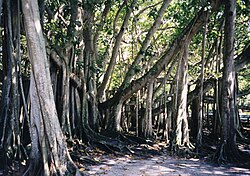
Ficus benghalensis is an evergreen, monoecious, fast-growing tree found mainly in monsoon and rainforests, that can reach a height of up to 30 meters.[3] It is resistant to drought and mild frost. It produces propagating aerial roots that grow downward. Once these roots reach the ground, they take root and become supportive woody trunks.
The figs produced by the tree are eaten by birds such as the Indian myna. Fig seeds that have passed through the digestive system of birds are more likely to germinate than those that have not.[4]
Reproduction[edit | edit source]
 | This section possibly contains original research. (December 2023) |
Banyan trees reproduce easily by seed or by stake, and they often spread from the original place by means of aerial roots that anchor in the ground and begin to grow and thicken to the point that they "become independent" from the original trunk, thus managing to "emigrate" sometimes at great distances. The figs are eaten by all kinds of frugivorous birds such as the coppersmith barbet and the common myna. Seeds that have passed through the digestive system of birds are more likely to germinate and grow faster.
Banyan seeds can fall and grow near a tree, sometimes from the very tree from which they come, and they also usually germinate in a hollow in a trunk or in a wall or rock. Gradually they begin to grow as they have plenty of support as epiphytes on any object they can use to climb in search of sunlight. Under normal conditions, the tree grows until it reaches a level where it gets the most sunlight, so its height can vary considerably. For this reason, where this tree predominates in a place, rather than growing in height, they spread on the surface, looking for the gaps that are left without vegetation. In general, the crown of this tree extends over a diameter well above its height.
Cultural significance[edit | edit source]
Ficus benghalensis is the national tree of India.[5]
The tree is considered sacred in India,[6] and temples are often built nearby. Due to the large size of the tree's canopy, it provides useful shade in hot climates.
In Theravada Buddhism, this tree is said to have been used as the tree for achieved enlightenment, or Bodhi by the twenty fourth buddha called "Kassapa - කස්සප". The sacred plant is known as "Nuga - නුග" or "Maha nuga - මහ නුග" in Sri Lanka.[7]
It is the tree under which Adhinath the first Jain Tirthankara attained Kewal Gyan or spiritual enlightenment.
Notable specimens[edit | edit source]
The giant banyans of India are the largest trees in the world by area of canopy coverage. Notable individual trees include:
The largest known tree in the world in terms of the two dimensional area covered by its canopy is Thimmamma Marrimanu in Andhra Pradesh, India, which covers 19,107 square metres (205,670 sq ft). Its perimeter, 846 metres (2,776 ft), is also the greatest of any known tree.[8]
Nearchus, an admiral of Alexander the Great, described a large specimen on the banks of the Narmada River in contemporary Bharuch, Gujarat, India; he may have described the tree presently named "Kabirvad". The canopy of the tree that Nearchus described was said to be so extensive that it sheltered 7,000 men. James Forbes later described it in his Oriental Memoirs (1813–5) as almost 610 m (2,000 ft) in circumference and having more than 3,000 trunks.[9] Currently its canopy has an area of 17,520 square metres (188,600 sq ft) and a perimeter of 641 metres (2,103 ft).[8]
Other notable Indian specimens include The Great Banyan in the Jagadish Chandra Bose Botanic Garden in Shibpur, Howrah, which has a canopy area of 18,918 square metres (203,630 sq ft) and is about 250 years old, and Dodda Aladha Mara in Kettohalli, Karnataka, which has a canopy area of 12,000 square metres (130,000 sq ft) and is about 400 years old.
Gallery[edit | edit source]
-
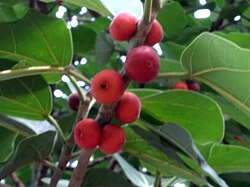 Ripe fruits of Indian banyan. Suhrawardy Udyan, Dhaka
 -
-
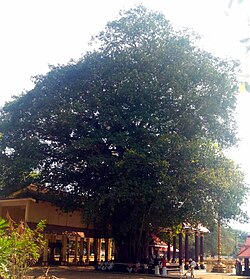 Ficus tree in front of Sarkaradevi Temple, Chirayinkeezhu, Thiruvananthapuram, Kerala


References[edit | edit source]
- ↑ "Ficus benghalensis L." www.worldfloraonline.org. Retrieved 14 March 2025.
- ↑ "Ficus benghalensis L." Germplasm Resources Information Network (GRIN). Agricultural Research Service (ARS), United States Department of Agriculture (USDA). Retrieved 8 May 2016.
- ↑ "Ficus benghalensis". Royal Botanic Gardens KEW Plants of the World Online. Retrieved 19 June 2022.
- ↑ Midya, S.; Brahmachary, R. L. (1991) "The Effect of Birds Upon Germination of Banyan (Ficus bengalensis) Seeds". Journal of Tropical Ecology. 7(4):537-538.
- ↑ "National Tree". Govt. of India Official website. Archived from the original on 2020-01-19. Retrieved 2019-04-26.
- ↑ Simoons, F.J. (1998). Plants of Life, Plants of Death. University of Wisconsin Press. ISBN 9780299159047.
- ↑ Bali Hai (2018-05-01). "Ficus benghalensis (Banyan Tree) - Zone J". Plants Map. Retrieved 2019-04-26.
- ↑ 8.0 8.1 Bar-Ness, YD (June 2010). "The World's Largest Trees? Cataloguing India's Giant Banyans" (PDF). Outreach Ecology. Archived from the original (PDF) on 2018-01-04. Retrieved 2018-01-04.
{{cite journal}}: Cite journal requires|journal=(help) - ↑ Chisholm, Hugh, ed. (1911). . Encyclopædia Britannica (11th ed.). Cambridge University Press.
External links[edit | edit source]
- Bar or Bargad Ficus benghalensis L., Horticulture, Purdue University
- Ficus benghalensis in Himalayas, Nepal. Himalayas (Himalaya): photos, images, pictures
- http://www.phytopharmajournal.com/V1issue2.6.pdf
- http://rjpponline.org/HTMLPaper.aspx?Journal=Research%20Journal%20of%20Pharmacognosy%20and%20Phytochemistry;PID=2014-6-3-9
| Constitutional | (Flag) (National Emblem) (Motto) (National Anthem) (National Song) |   |
|---|---|---|
| Flora and Fauna | (Animal) (Bird) (Flower) (Tree) (Fruit) (Heritage animal) (Aquatic animal) (Reptile) (River) | |
| Days | ||
| Others | ||
