




m Removing protection template from an unprotected page |
BasilGott93 (talk | contribs) m content update |
||
| Line 1: | Line 1: | ||
{{short description|Extinct species of archaic human}} | {{short description|Extinct species of archaic human}} | ||
{{good article}} | |||
{{redirect|H. erectus|other uses|H. erectus (disambiguation)|and|Homo erectus (disambiguation)}} | {{redirect|H. erectus|other uses|H. erectus (disambiguation)|and|Homo erectus (disambiguation)}} | ||
{{redirect|Pithecanthropus erectus|the song and album by Charles Mingus|Pithecanthropus Erectus (album)}} | |||
{{Use dmy dates|date= | {{pp-move}} | ||
{{Use dmy dates|date=January 2025}} | |||
{{Speciesbox | {{Speciesbox | ||
| fossil_range = {{Fossil range|2|0.1}} | | fossil_range = {{Fossil range|2|0.1}} [[Pleistocene]]<ref name=Rizal2020/> | ||
| image = | | image = Java Man holotype.jpg | ||
| image_caption = | | image_caption = [[Java Man]], the [[holotype]] of ''H. erectus''{{efn-num|The Java Man [[femur]] presents a noticeable [[osteocyte]], likely [[Paget's disease of bone]] and [[osteopetrosis]] (thickening of the bone), probably stemming from [[skeletal fluorosis]] caused by ingestion of food contaminated by [[fluoride toxicity|fluoride]]-filled [[volcanic ash#ingesting ash|volcanic ash]] (as the specimen was found in ash-filled [[stratum (geology)|strata]]). Livestock that graze on volcanic ash-ridden fields typically die of [[acute toxicity]] within a few days or weeks.<ref>{{cite journal |last=Soriano|first=M. |title=The fluoric origin of the bone lesion in the ''Pithecanthropus erectus'' femur |journal=American Journal of Physical Anthropology |volume=32 |issue=1 |pages=49–57 |year=1970 |pmid=4984453 |doi=10.1002/ajpa.1330320107 |bibcode=1970AJPA...32...49S }}</ref>}} | ||
| extinct = yes | |||
| taxon = Homo erectus | | taxon = Homo erectus | ||
| authority = ([[Eugène Dubois|Dubois]], 1893) | | authority = ([[Eugène Dubois|Dubois]], 1893) | ||
}} | }} | ||
'''''Homo erectus''''' ({{IPAc-en|ˌ|h|oʊ|m|oʊ|_|ə|'|r|ɛ|k|t|ə|s}} | '''''Homo erectus''''' ({{IPAc-en|ˌ|h|oʊ|m|oʊ|_|ə|'|r|ɛ|k|t|ə|s}} {{lit|[[:wikt:erectus|upright]] man}}) is an [[extinction|extinct]] [[species]] of [[Homo|archaic human]] from the [[Pleistocene]], spanning nearly 2 million years. It is the first human species to evolve a humanlike [[body plan]] and [[human gait|gait]], to [[early expansions of hominins out of Africa|leave Africa]] and colonize Asia and Europe, and to [[Control of fire by early humans|wield fire]]. Some populations of ''H. erectus'' were ancestors of later human species, including ''[[Homo heidelbergensis|H. heidelbergensis]]'' — the [[last common ancestor]] of [[human|modern humans]], [[Neanderthal]]s, and [[Denisovan]]s. As such a widely distributed species both geographically and temporally, ''H. erectus'' anatomy varies considerably. Subspecies are sometimes recognized: ''[[Java Man|H. e. erectus]]'', ''[[Peking Man|H. e. pekinensis]]'', ''[[Solo Man|H. e. soloensis]]'', ''[[Homo ergaster|H. e. ergaster]]'', ''[[Dmanisi hominins|H. e. georgicus]]'', and ''[[Tautavel Man|H. e. tautavelensis]]''. | ||
The species was first [[species description|described]] by [[Eugène Dubois]] in 1893 as "''[[Anthropopithecus|Pithecanthropus]] erectus''" using a skullcap, [[molar (tooth)|molar]], and [[femur]] from [[Java]], Indonesia. Further discoveries around East Asia were used to contend that humanity evolved out of Asia. Based on [[historical race concepts]], it was argued that local ''H. erectus'' populations evolved directly into local modern human populations ([[multiregional origin of modern humans|polycentrism]]) rather than all humanity sharing a single [[early modern human|anatomically modern]] ancestor ([[monogenism]]). As the fossil record improved over the mid-to-late 20th century, [[Early expansions of hominins out of Africa|"Out of Africa"]] theory and monogenism became the consensus. | |||
The typical skull has a pronounced brow ridge, a protruding jaw, and large teeth. The bones are much thicker than in modern humans. East Asian populations normally have an even more robust skeleton and larger brain volume — averaging {{cvt|1000|cc}}. Western ''H. erectus'' brain volume could be as low as {{cvt|546|cc}} in ''H. e. georgicus''. ''H. erectus'' probably had a faster apelike [[human height|growth trajectory]], lacking the [[altriciality|extended childhood]] required for [[language acquisition]]. Reconstructed adult body dimensions range from {{cvt|141–167|cm|ftin|0}} in height and about {{cvt|50|kg}} in weight. | |||
''H. erectus'' | ''H. erectus'' invented the [[Acheulean]] [[industry (archaeology)|tool industry]], a major innovation of large, heavy-duty [[stone tools]]. These may have been used in butchery, vegetable processing, and woodworking of [[spear]]s and [[digging stick]]s. ''H. erectus'' was a major predator of large herbivores on the expanding savannas during the [[Quaternary glaciation]]. The species is usually characterized as the first [[hunter-gatherer]] and the first to practice [[sexual division of labor]]. Fire usage and cave habitation were probably not important aspects of daily life. Similarly, ''H. erectus'' may not have often ventured into colder regions or cooked meat. The last known occurrence of ''H. erectus'' is 108,000 to 117,000 years ago (''H. e. soloensis'') in Southeast Asia, until the last savannas in the region gave way to jungle. | ||
==Taxonomy== | ==Taxonomy== | ||
=== | {{See also|Human taxonomy}} | ||
===Research history=== | |||
[[File: | |||
[[File:Hypothetical sketch of the monophylitic origin and of the diffusion of the 12 varieties of men from Lemuria over the earth LCCN2014649358.jpg|thumb|left|upright=1.5|In 1868, [[Ernst Haeckel]] suggested early humans dispersed from the now-disproven hypothetical continent "[[Lemuria (continent)|Lemuria]]".<ref name=HsiaoPei2014/><ref>{{cite book|first=E.|last=Haeckel|author-link=Ernst Haeckel|orig-year=1868|year=1876|trans-title=The history of creation|title=Natürliche Schöpfungsgeschichte|translator=Lankester, E. R.|publisher=Henry S. King & Co.|url=https://archive.org/details/historyofcreatio76hist/page/360|page=361}}</ref>]] | |||
While [[Charles Darwin]] had hypothesized in his 1871 ''[[Descent of Man]]'' that humans most likely evolved in Africa,{{efn-num|Darwin's work mainly aimed to demonstrate that his [[scientific theory|theory]] of [[common descent]] with modification by [[natural selection|natural]] and [[sexual selection in humans|sexual selection]] applied to humans, "The sole object of this work is to consider, firstly, whether man, like every other species, is descended from some pre-existing form; secondly, the manner of his development; and thirdly, the value of the [[social Darwinism|differences]] between the so-called [[historical race concepts|races of man]]."<ref>{{cite book|first=C.|last=Darwin|author-link=Charles Darwin|year=1871|url=https://www.gutenberg.org/cache/epub/34967/pg34967-images.html#Page_3|title=The Descent of Man and Selection in Relation to Sex|publisher=John Murray|page=3}}</ref>}} many late-19th century evolutionary naturalists postulated that Asia was the birthplace of humankind. Asia is midway between all continents via land routes or short sea crossings, providing optimal dispersal routes throughout the world. Among the major proponents of "Out of Asia" theory was [[Ernst Haeckel]], who argued that the first human species (which he speculatively named ''Homo primigenius'') evolved on a now-disproven hypothetical continent "[[Lemuria (continent)|Lemuria]]" from a species he termed ''[[Anthropopithecus|Pithecanthropus alalus]]'' (speechless ape-man). "Lemuria" had supposedly sunk below the [[Indian Ocean]], accounting for the lack of fossil evidence.<ref name=HsiaoPei2014/> | |||
Dutch scientist [[Eugène Dubois]] joined the [[Royal Netherlands East Indies Army]] to search for the "[[missing link (human evolution)|missing link]]" of human evolution in [[Java]].{{efn-num|Dubois was studying the anatomy and evolution of the [[larynx]] in [[vertebrate]]s in [[Amsterdam]] with German anatomist [[Max Fürbringer]], but fed up with both the research and Fürbringer, he decided to drop everything and board the [[SS Prinses Amalia]] to the Dutch East Indies on 29 October 1887. Dubois said his interest in human evolution began in secondary school (the State [[Hogere Burgerschool]]), where he heard of lectures given by [[Carl Vogt]] in 1868.{{sfn|Theunissen|1989|loc=pp. 27–30}}}} At the [[Trinil]] site, his team found a skullcap and [[molar (tooth)|molar]] in 1891, and a [[femur]] in 1892 ([[Java Man]]), which he named "''Pithecanthropus erectus''" in 1893.{{sfn|Theunissen|1989|loc=54–59}} He attempted to convince the European scientific community that he had found an upright-walking ape-man dating to the [[late Pliocene]] or [[Early Pleistocene]]; they dismissed his findings as some kind of non-human ape.<ref name=HsiaoPei2014>{{cite journal |first=Y. |last=Hsiao-Pei |year=2014 |title=Evolutionary Asiacentrism, Peking Man, and the Origins of Sinocentric Ethno-Nationalism |journal=Journal of the History of Biology |volume=47 |issue=4 |pages=585–625 |doi=10.1007/s10739-014-9381-4 |pmid=24771020 |s2cid=23308894}}</ref> | |||
{{multiple image|total_width = 300 | |||
|image1=Homo erectus Sangiran 17 IMG 5644 BMNH.jpg | |||
|image2=Sinanthropus Skull XII.png | |||
|footer=[[Franz Weidenreich]] and [[Gustav Heinrich Ralph von Koenigswald|Ralph von Koenigswald]] argued [[Java Man]] was an ancient human using fossils like [[Sangiran]] (left) and [[Peking Man]] (right) | |||
}} | |||
Dubois argued that "''P. erectus''" was a [[gibbon]]-like ape which was the precursor to a more familiar human body plan, but in the 1930s, German-American anatomist [[Franz Weidenreich]] noticed a striking similarity with ancient human remains recently being unearthed in China ([[Peking Man]], "''Sinanthropus pekinensis''").{{sfn|Theunissen|1989|loc=p. 156}}{{sfn|Boaz|Ciochon|2004|loc=pp. 59–60}} This characterization became better supported as German-Dutch palaeontologist [[Gustav Heinrich Ralph von Koenigswald]] discovered more Indonesian ancient human remains over the decade at [[Mojokerto child|Mojokerto]], [[Sangiran]], and [[Solo Man|Ngandong]].{{efn-num|Dubois never accepted that the Java Man was a type of human, and continued to fight Weidenreich and von Koenigswald until his death in 1940. Sir [[Arthur Keith]] described Dubois in an obituary notice as, "an idealist, his ideas being so firmly held that his mind tended to bend facts rather than alter his ideas to fit them."{{sfn|Theunissen|1989|loc=pp. 159–165}}}}{{sfn|Boaz|Ciochon|2004|loc=pp. 60–62}}<ref>{{cite journal |first1=G. H. R. |last1=von Koenigswald |author-link1=Gustav Heinrich Ralph von Koenigswald |first2=F. |last2=Weidenreich |author2-link=Franz Weidenreich |year=1939 |title=The Relationship between ''Pithecanthropus'' and ''Sinanthropus'' |journal=Nature |volume=144 |issue=3657 |pages=926–929 |doi=10.1038/144926a0|bibcode=1939Natur.144..926V }}</ref> Weidenreich believed that they were the direct ancestors of the local modern human [[human taxonomy#Homo sapiens subspecies|''Homo sapiens'' subspecies]], in accord with [[historical race concepts]] ([[multiregional origin of modern humans|polycentricism]]) — that is, Peking Man was the direct ancestor of specifically [[Chinese people]], and Java Man of [[Aboriginal Australian]]s.<ref name="Weidenreich1940">{{cite journal |first=F. |last=Weidenreich |author-link=Franz Weidenreich |year=1940 |title=Some problems dealing with ancient man |journal=American Anthropologist |volume=42 |issue=3 |pages=375–383 |doi=10.1525/aa.1940.42.3.02a00010}}</ref><ref name=Mayr1950/> As the significance of racial distinction diminished with the development of [[modern evolutionary synthesis]], many fossil human species and genera around Asia, Africa, and Europe (including "''Pithecanthropus''" and "''Sinanthropus''") were reclassified as subspecies of ''Homo erectus''.<ref name=Schwartz2010/>{{sfn|Boaz|Ciochon|2004|loc=pp. 70–73}} | |||
During the late 20th century, some of the oldest ''H. erectus'' fossils were discovered across Africa, the first being Kenyan archeologist [[Louis Leakey]]'s [[Chellean Man|Olduvai Hominin 9]] in 1960.{{sfn|Boaz|Ciochon|2004|loc=pp. 68–72}} As the human fossil record expanded, the "Out of Africa" theory and [[monogenism]] became the consensus: that all modern humans share a fully [[early modern human|anatomically modern]] common ancestor. ''H. erectus'' is now generally considered to be an African species which later dispersed across Eurasia, with later African populations giving rise to the modern human lineage.{{sfn|Boaz|Ciochon|2004|loc=pp. 151–153}} | |||
=== | ===Subspecies=== | ||
By the middle of the 20th century, [[human taxonomy]] was in turmoil, with many poorly defined species and genera described across Europe, Asia, and Africa, which exaggerated the differences among them.{{sfn|Boaz|Ciochon|2004|loc=p. 65}} In 1940, Weidenreich was the first to suggest reclassifying "''Sinanthropus pekinensis''" and "''Pithecanthropus erectus''" as subspecies of ''H. erectus''.<ref name="Weidenreich1940"/> In 1950, German-American evolutionary biologist [[Ernst Mayr]] entered this field. Surveying a "bewildering diversity of names" and many proposals for consolidation, he decided to reclassify human fossils into three species of ''[[Homo]]'': "''H. transvaalensis''" (the [[australopithecine]]s), ''H. erectus'' (including "''Sinanthropus''", "''Pithecanthropus''", and various other Asian, African, and European taxa), and ''H. sapiens'' (including anything younger than ''H. erectus'', such as modern humans and Neanderthals). Mayr defined these species as a sequential lineage, each evolving into the next ([[chronospecies]]).<ref name=Mayr1950>{{cite journal |last=Mayr |first=E. |author-link=Ernst Mayr |year=1950 |title=Taxonomic categories in fossil hominids |journal=Cold Spring Harbor Symposia on Quantitative Biology |volume=15 |pages=109–118 |doi=10.1101/SQB.1950.015.01.013|pmid=14942702 }}</ref> Though later Mayr changed his opinion on the australopithecines (recognizing ''[[Australopithecus]]''), his more [[lumpers and splitters|conservative]] view of [[archaic human]] diversity became widely adopted in the subsequent decades.<ref name=Schwartz2010>{{cite journal |last1=Schwartz |first1=J. H. |author1-link=Jeffrey H. Schwartz |last2=Tattersall |first2=I. |author2-link=Ian Tattersall |year=2010 |title=Fossil evidence for the origin of ''Homo sapiens'' |journal=American Journal of Physical Anthropology |volume=143 |issue=S51 |pages=96–98; 101–103 |doi=10.1002/ajpa.21443 |pmid=21086529 |bibcode=2010AJPA..143S..94S |doi-access=free}}</ref> | |||
{{ | |||
{{blockquote|text=...never more than one species of man existed on the earth at any one time... If fossils of [[African pygmies|Congo pygmies]] and of [[Tutsi|Watusi]] were to be found in the same deposit by a paleontologist, a million years hence, he might well think that they belonged to two different species.|author=[[Ernst Mayr]], 1950<ref name=Mayr1950/>}} | |||
''H. erectus'' | In the 1970s, as [[population genetics]] was being formulated, the anatomical variation of ''H. erectus'' across its wide geographic and temporal range (the basis for the subspecies distinctions) became better understood as [[cline (biology)|clines]] — different populations which attained some anatomical regionality but were not reproductively isolated.{{sfn|Boaz|Ciochon|2004|loc=pp. 151–153}} In general, subspecies names for ''H. erectus'' are now used for convenience to indicate time and region rather than specific anatomical trends.<ref name=Anton2002>{{cite journal |first=S. C. |last=Antón |year=2002 |title=Evolutionary significance of cranial variation in Asian ''Homo erectus'' |journal=American Journal of Physical Anthropology |volume=118 |issue=4 |page=302 |doi=10.1002/ajpa.10091|pmid=12124912 |bibcode=2002AJPA..118..301A }}</ref> | ||
=== | {{blockquote|text=...to paleontologists in general, subspecies are epiphenomena which do not merit the attention paid to species... The pursuit of subspecies in the fossil record is at best fraught with difficulty, and is more probably futile.|author=[[Ian Tattersall]], 1986<ref>{{cite journal |first=I. |last=Tattersall |author-link=Ian Tattersall |year=1986 |title=Species recognition in human paleontology |journal=Journal of Human Evolution |volume=15 |issue=3 |page=168 |doi=10.1016/S0047-2484(86)80043-4|bibcode=1986JHumE..15..165T }}</ref>}} | ||
{{multiple image | |||
| perrow = 2 | |||
| total_width = 330 | |||
| image1 = Ergaster Skull.png | |||
| caption1 = | |||
| image2 = Erectus Skull.png | |||
| caption2 = | |||
| footer = Reconstructions of ''[[Homo ergaster|H. e. ergaster]]'' ([[KNM ER 3733]]) left and ''[[Peking Man|H. e. pekinensis]]'' right | |||
| align = right | |||
| direction = | |||
| alt1 = | |||
| width3 = 150 | |||
}} | |||
The more commonly used subspecies (if any are used)<!-- many times subspecies are not used --> are:{{sfn|Antón|2003|loc=p. 153}} | |||
*''[[Java Man|H. e. erectus]]'' for earlier Indonesian fossils | |||
*''[[Peking Man|H. e. pekinensis]]'' for Chinese fossils | |||
*''[[Solo Man|H. e. soloensis]]'' for the latest-surviving Indonesian fossils | |||
*''[[Homo ergaster|H. e. ergaster]]'' for African fossils | |||
*''[[Dmanisi hominins|H. e. georgicus]]'' for an early group of fossils from [[Prehistoric Georgia|Georgia]]<ref name=Rightmire2006/> | |||
*''[[Tautavel Man|H. e. tautavelensis]]'' for Western European fossils<ref name=Lumley2015>{{cite journal |first=M.-A. |last=de Lumley |year=2015 |title=L'homme de Tautavel. Un ''Homo erectus'' européen évolué. ''Homo erectus tautavelensis'' |trans-title=Tautavel Man. An evolved European ''Homo erectus''. ''Homo erectus tautavelensis'' |language=fr |journal=L'Anthropologie |volume=119 |issue=3 |pages=342–344 |doi=10.1016/j.anthro.2015.06.001}}</ref> | |||
The ancient Georgia fossils have variably been classified as ''H. e. ergaster'' (or quadrinomial ''H. e. ergaster georgicus''),<ref>{{cite journal |last1=Zollikofer |first1=C. P. E. |last2=Ponce de León |first2=M. S. |last3=Margvelashvili |first3=A. |last4=Rightmire |first4=G. Philip |last5=Lordkipanidze |first5=D. |s2cid=206554612 |year=2014 |title=Response to Comment on "A Complete Skull from Dmanisi, Georgia, and the Evolutionary Biology of Early ''Homo''" |url=https://www.science.org/doi/10.1126/science.1250056 |journal=Science |volume=344 |issue=6182 |pages=360–b |doi=10.1126/science.1250081 |pmid=24763573 |bibcode=2014Sci...344..360Z|url-access=subscription }}</ref> as their own subspecies as ''H. e. georgicus'', or as their own species ''H. georgicus''.<ref name=Rightmire2006>{{Cite journal |last1=Rightmire |first1=G. Philip |last2=Lordkipanidze |first2=David |last3=Vekua |first3=Abesalom |year=2006 |title=Anatomical descriptions, comparative studies and evolutionary significance of the hominin skulls from Dmanisi, Republic of Georgia |url=https://www.sciencedirect.com/science/article/pii/S0047248405001624 |journal=Journal of Human Evolution |volume=50 |issue=2 |page=140 |doi=10.1016/j.jhevol.2005.07.009 |pmid=16271745|bibcode=2006JHumE..50..115R |url-access=subscription }}</ref> Some authors may also elevate ''H. ergaster'',<ref>{{Cite journal |last1=Rightmire |first1=G. Philip |last2=Ponce de León |first2=Marcia S. |last3=Lordkipanidze |first3=David |last4=Margvelashvili |first4=Ann |last5=Zollikofer |first5=Christoph P. E. |year=2017 |title=Skull 5 from Dmanisi: Descriptive anatomy, comparative studies, and evolutionary significance |journal=Journal of Human Evolution |volume=104 |pages=51 |doi=10.1016/j.jhevol.2017.01.005 |pmid=28317556 |doi-access=free|bibcode=2017JHumE.104...50R }}</ref> ''H. soloensis'',<ref>{{cite journal |first1=V. |last1=Zeitoun |first2=F. |last2=Détroit |first3=D. |last3=Grimaud-Hervé |first4=H. |last4=Widianto |year=2010 |title=Solo man in question: Convergent views to split Indonesian ''Homo erectus'' in two categories |journal=[[Quaternary International]] |volume=223–224 |page=288 |doi=10.1016/j.quaint.2010.01.018 |bibcode=2010QuInt.223..281Z |s2cid=84764668 |url=https://hal.archives-ouvertes.fr/hal-02977578/file/Solo.pdf |access-date=22 May 2021 |archive-date=29 April 2021 |archive-url=https://web.archive.org/web/20210429071324/https://hal.archives-ouvertes.fr/hal-02977578/file/Solo.pdf |url-status=live}}</ref> and ''H. pekinensis'' to species level.<ref>{{cite journal |first=B. |last=Marwick |year=2009 |title=Biogeography of Middle Pleistocene hominins in mainland Southeast Asia: A review of current evidence |journal=Quaternary International |volume=202 |issue=1–2 |page=53 |doi=10.1016/j.quaint.2008.01.012|bibcode=2009QuInt.202...51M }}</ref> Fossils relegated to ''H. e. tautavelensis'' are traditionally assigned to ''[[Homo heidelbergensis|H. heidelbergensis]]''.<ref name=Lumley2015/> | |||
===Evolution and dispersal=== | |||
{{See also|Human evolution|Early expansions of hominins out of Africa}} | |||
[[File:Dmanisi fossils D 2282 + D 211 (Replika).JPG|left|thumb|upright=0.8|''[[Dmanisi hominins|H. e. georgicus]]'' (above) represents one of the earliest dispersals out of Africa about 1.8 million years ago.<ref name=Ferring2011/>]] | |||
''H. erectus'' evolved in Africa from a population of ''[[Homo habilis|H. habilis]]''{{sfn|Boaz|Ciochon|2004|loc=pp. 143–144}}<ref name=Zaim2011/> and they coexisted for about half a million years.<ref>{{cite journal|first1=F.|last1=Spoor|first2=M. G.|last2=Leakey|first3=P. N.|last3=Gathogo|first4=F. H.|last4=Brown|title=Implications of new early ''Homo'' fossils from Ileret, east of Lake Turkana, Kenya|journal=Nature|year=2007|issn=0028-0836|page=689|volume=448|issue=7154|doi=10.1038/nature05986|first5=S. C.|last5=Antón|first6=I.|last6=McDougall|first7=C.|last7=Kiarie|first8=F. K.|last8=Manthi|first9=L. N.|last9=Leakey |pmid=17687323 |bibcode=2007Natur.448..688S }}</ref> During this time interval, ''H. erectus'' populations could display a mix of more "classically ''erectus''" or "classically ''habilis''" cranial anatomy and a wide range of brain volumes.<ref name=Baab2025>{{cite journal|first1=Karen L.|last1=Baab|first2=Yousuke|last2=Kaifu|first3=Sarah E.|last3=Freidline|first4=Michael J.|last4=Rogers|title=New reconstruction of DAN5 cranium (Gona, Ethiopia) supports complex emergence of Homo erectus|journal=Nature Communications|year=2025|issn=2041-1723|volume=16|issue=1|pmid=41402278|pmc=12708782|doi=10.1038/s41467-025-66381-9|first5=Sileshi|last5=Semaw|doi-access=free}}</ref> The oldest identified ''H. erectus'' specimen is a 2.04 million year old skull, DNH 134, from [[Drimolen]], South Africa, coexisting with the australopithecine ''[[Paranthropus robustus]]''.<ref>{{Cite journal |last1=Herries |first1=Andy I. R. |last2=Martin |first2=Jesse M. |year=2020 |title=Contemporaneity of ''Australopithecus'', ''Paranthropus'', and early ''Homo erectus'' in South Africa |journal=Science |volume=368 |issue=6486 |article-number=eaaw7293 |doi=10.1126/science.aaw7293 |pmid=32241925 |bibcode=2020Sci...368w7293H |ref=CITEREFHerriesMartinLeeceAdams2020 |hdl=11568/1040368 |s2cid=214763272 |hdl-access=free}}</ref> ''H. erectus'' dispersed out of Africa soon after evolution, the earliest recorded instances being ''H. e. georgicus'' 1.78 to 1.85 million years ago in Georgia,<ref name=Ferring2011>{{Cite journal |last1=Ferring |first1=Reid |last2=Oms |first2=Oriel |last3=Agustí |first3=Jordi |last4=Berna |first4=Francesco |last5=Nioradze |first5=Medea |last6=Shelia |first6=Teona |last7=Tappen |first7=Martha |last8=Vekua |first8=Abesalom |last9=Zhvania |first9=David|last10=Lordkipanidze|first10=David |year=2011 |title=Earliest human occupations at Dmanisi (Georgian Caucasus) dated to 1.85–1.78 Ma |journal=Proceedings of the National Academy of Sciences of the United States of America |volume=108 |issue=26 |article-number=10432–6 |doi=10.1073/pnas.1106638108 |pmid=21646521 |pmc=3127884 |bibcode=2011PNAS..10810432F |doi-access=free}}</ref> the Indonesian Mojokerto and Sangiran sites 1.6 to 1.8 million years ago,{{sfn|Antón|2003|loc=p. 142}}{{sfn|Boaz|Ciochon|2004|loc=p. 162}} and the Chinese [[Yunxian Man]] 1.77 million years ago.<ref>{{cite journal|first1=Hua|last1=Tu|first2=Xiaobo|last2=Feng|first3=Lan|last3=Luo|first4=Zhongping|last4=Lai|title=The oldest in situ ''Homo erectus'' crania in eastern Asia: The Yunxian site dates to ~1.77 Ma|url=https://www.science.org/doi/10.1126/sciadv.ady2270|journal=Science Advances|year=2026|issn=2375-2548|volume=12|issue=8|doi=10.1126/sciadv.ady2270|first5=Darryl|last5=Granger|first6=Christopher|last6=Bae|first7=Guanjun|last7=Shen}}</ref> Populations may have pushed into northwestern Europe at around the same time.<ref>{{cite journal |first1=J. W. F. |last1=Reumer |first2=N. |last2=Peters |first3=J. |last3=de Vos |year=2021 |title=Did ''Homo erectus'' sensu lato live in western Europe during the Early Pleistocene? An ecological approach to a vexing question |journal=Cainozoic Research |volume=21 |issue=1 |pages=97–109 |url=https://natuurtijdschriften.nl/pub/1019587/}}</ref> While ''H. erectus'' is usually considered the first [[hominin]] to leave Africa, stone tools that may date to as far back as 2.48 and 2.1 million years ago (from [[Zarqa River|Zarqa Valley]], Jordan, and [[Shangchen]], China, respectively) could indicate that an earlier hominin species left Africa.<ref>{{cite journal|first1=Giancarlo|last1=Scardia|first2=Fabio|last2=Parenti|first3=Daniel P.|last3=Miggins|first4=Axel|last4=Gerdes|title=Chronologic constraints on hominin dispersal outside Africa since 2.48 Ma from the Zarqa Valley, Jordan|url=https://linkinghub.elsevier.com/retrieve/pii/S0277379119302847|journal=Quaternary Science Reviews|year= 2019|issn=0277-3791|pages=1–19|volume=219|doi=10.1016/j.quascirev.2019.06.007|first5=Astolfo G. M.|last5=Araujo|first6=Walter A.|last6=Neves|bibcode=2019QSRv..219....1S |url-access=subscription|hdl=11449/187832|hdl-access=free}}</ref> Since ''H. erectus'' was first defined in East Asia, those populations are sometimes distinguished as ''H. erectus sensu stricto'' ("in the strict sense"), and African and West Eurasian populations as ''H. erectus sensu lato'' ("in the broad sense"), but this may not reflect how these populations are actually related to each other.{{efn-num|There may have been two different ''H. erectus'' dispersals into East Asia: an early one that led to the Sangiran [[Java Man]] (specifically the older material), and a later one which led to the northern Chinese [[Peking Man]]. That is, the older Sangiran material may be more closely related to ''H. erectus sensu lato'' than to Peking Man. The younger Sangiran material, though, possibly descended from or interbred with Chinese ''H. erectus''.<ref name=Zaim2011>{{cite journal |last1=Zaim|first1=Y.|last2=Ciochon |first2=R. L.|author2-link=Russell Ciochon|last3=Polanski|first3=J. M.|last4=Grine|first4=F. E.|last5=Bettis|first5=E. A.|last6=Rizal |first6=Y.|last7=Franciscus|first7=R. G.|last8=Larick|first8=R. R.|last9=Heizler|first9=M.|last10=Eaves|first10=K. L.|last11=Marsh|first11=H. E.|title=New 1.5 million-year-old ''Homo erectus'' maxilla from Sangiran (Central Java, Indonesia) |journal=Journal of Human Evolution |volume=61 |issue=4 |pages=363–376 |year=2011 |pmid=21783226 |doi=10.1016/j.jhevol.2011.04.009 |bibcode=2011JHumE..61..363Z}}</ref>}}<ref name=Anton2002/><ref name=Zaim2011/> | |||
Once established around the [[Old World]], ''H. erectus'' evolved into other later species in the genus ''Homo'', including: ''H. heidelbergensis'', ''[[Homo antecessor|H. antecessor]]'',<ref name=Stringer2012/> ''[[Homo floresiensis|H. floresiensis]]'',<ref>{{cite journal |last1=Berger |first1=L. R. |author-link=Lee Rogers Berger |last2=Churchill |first2=S. E. |display-authors=et al. |year=2008 |title=Small-Bodied Humans from Palau, Micronesia |journal=PLOS ONE |volume=3 |issue=3 |article-number=e1780 |bibcode=2008PLoSO...3.1780B |doi=10.1371/journal.pone.0001780 |pmc=2268239 |pmid=18347737 |doi-access=free}}</ref> and ''[[Homo luzonensis|H. luzonensis]]''.<ref>{{cite journal |first=N. |last=Fleming |year=2019 |title=Unknown human relative discovered in Philippine cave |journal=Nature News |doi=10.1038/d41586-019-01152-3 |pmid=32269371 |s2cid=146786512}}</ref> ''H. heidelbergensis'', in turn, is usually placed as the [[last common ancestor]] of [[Neanderthal]]s (''H. neanderthalensis''), [[Denisovan]]s, and modern humans.<ref name=Stringer2012>{{cite journal |last=Stringer |first=C. |year=2012 |title=What makes a modern human |journal=[[Nature (journal)|Nature]] |volume=485 |number=7396 |pages=33–35 |doi=10.1038/485033a |pmid=22552077 |bibcode=2012Natur.485...33S |s2cid=4420496 |doi-access=free}}</ref> ''H. erectus'' is thus a non-natural, [[paraphyletic]] grouping of fossils and does not include all the descendants of a last common ancestor.<ref name="Ni2021">{{Cite journal |last1=Ni |first1=Xijun |last2=Ji |first2=Qiang |last3=Wu |first3=Wensheng |last4=Shao |first4=Qingfeng |last5=Ji |first5=Yannan |last6=Zhang |first6=Chi |last7=Liang |first7=Lei |last8=Ge |first8=Junyi |last9=Guo |first9=Zhen |last10=Li |first10=Jinhua |last11=Li |first11=Qiang |year=2021 |title=Massive cranium from Harbin in northeastern China establishes a new Middle Pleistocene human lineage |journal=The Innovation |language=en |volume=2 |issue=3 |doi=10.1016/j.xinn.2021.100130 |issn=2666-6758 |pmc=8454562 |pmid=34557770 |last13=Stringer |first13=Chris |last12=Grün |first12=Rainer |article-number=100130 |bibcode=2021Innov...200130N}}</ref> Despite being designated as a different species, ''H. erectus'' may have [[interbreeding between archaic and modern humans|interbred]] with some of its descendant species, namely the common ancestor of Neanderthals and Denisovans ("Neandersovans").<ref>{{cite journal |first=P. J. |last=Waddell |year=2013 |title=Happy New Year ''Homo erectus''? More evidence for interbreeding with archaics predating the modern human/Neanderthal split |journal=Quantitative Biology |pages=2–3 |arxiv=1312.7749}}</ref> | |||
[[File:Spreading homo sapiens la.svg|thumb|upright=2.1|Successive dispersals of {{color box|#e8e22c}} ''Homo erectus'' (yellow), {{color box|#e4ca30}} ''[[Neanderthal|Homo neanderthalensis]]'' (ochre) and {{color box|#e9252c}} ''[[Human|Homo sapiens]]'' (red, ''[[Out of Africa II]]'')]] | |||
The dispersal of ''H. erectus'' is generally ascribed to the evolution of obligate [[biped]]alism, better technology, and adoption of a carnivorous diet.<ref name=Carotenuto2016/> However, the sudden adoption of carnivory could be [[sampling bias]], with earlier species consuming the same amount of meat.<ref>{{cite journal |first1=W. A. |last1=Barr |first2=B. |last2=Pobiner |first3=J. |last3=Rowan |first4=J. T. |last4=Faith |year=2022 |title=No sustained increase in zooarchaeological evidence for carnivory after the appearance of ''Homo erectus'' |journal=Proceedings of the National Academy of Sciences |volume=119 |issue=5 |article-number=e2115540119 |doi=10.1073/pnas.2115540119|doi-access=free |pmid=35074877 |pmc=8812535 |bibcode=2022PNAS..11915540B }}</ref> Populations spread out via open grassland and woodland [[savanna]]s, which were expanding due to a global [[aridification]] trend at the onset of the [[Quaternary glaciation]].<ref name=Carotenuto2016/> ''H. erectus'' is usually thought to have occupied the [[Sahara]] and West Asia during [[African humid period|humid periods]], but populations may have persisted into desert periods.<ref>{{Cite journal |last1=Mercader |first1=Julio |last2=Akuku |first2=Pamela |last3=Boivin |first3=Nicole |last4=Camacho |first4=Alfredo |last5=Carter |first5=Tristan |last6=Clarke |first6=Siobhán |last7=Cueva Temprana |first7=Arturo |last8=Favreau |first8=Julien |last9=Galloway |first9=Jennifer |last10=Hernando |first10=Raquel |last11=Huang |first11=Haiping |last12=Hubbard |first12=Stephen |last13=Kaplan |first13=Jed O. |last14=Larter |first14=Steve |last15=Magohe |first15=Stephen |year=2025 |title=''Homo erectus'' adapted to steppe-desert climate extremes one million years ago |journal=Communications Earth & Environment |language=en |volume=6 |issue=1 |article-number=1 |doi=10.1038/s43247-024-01919-1 |issn=2662-4435|doi-access=free |pmid=39830897 |pmc=11738993 |bibcode=2025ComEE...6....1M }}</ref> | |||
[[ | Most ''H. erectus sensu lato'' specimens date to 1 to 1.8 million years ago in the Early Pleistocene before giving way to descendant species.<ref name=Rizal2020/> The classification of [[Middle Pleistocene]] ''Homo'' has been a controversial topic, termed "the muddle in the middle".<ref name=Lumley2015/><ref>{{cite journal |first1=C. J. |last1=Bae |first2=X. |last2=Wu |year=2024 |title=Making sense of eastern Asian Late Quaternary hominin variability |journal=Nature Communications |volume=15 |issue=1 |article-number=9479 |doi=10.1038/s41467-024-53918-7 |doi-access=free |pmid=39488555 |pmc=11531466|bibcode=2024NatCo..15.9479B }}</ref> ''H. erectus sensu stricto'' persisted much longer than ''sensu lato'', with the youngest population (''H. e. soloensis'') dating to 108,000 to 117,000 years ago in [[Late Pleistocene]] Java.<ref name=Rizal2020>{{Cite journal |last1=Rizal |first1=Y. |last2=Westaway |first2=K. E. |last3=Zaim |first3=Y. |last4=van den Bergh |first5=E. A. |last5=Bettis III |first6=M. J. |last6=Morwood |first7=O. F. |last7=Huffman |first8=R. |last8=Grün |first9=R. |last9=Joannes-Boyau|first10=R. M.|last10=Bailey |author11=Sidarto |first12=M. C. |last12=Westaway |first13=I. |last13=Kurniawan |first14=M. W. |last14=Moore |first15=M. |last15=Storey |first16=F. |last16=Aziz |author17=Suminto |first18=J. |last18=Zhao |author19=Aswan|first20=M. E.|last20=Sipola |first21=R. |last21=Larick |first22=J.-P. |last22=Zonneveld |first23=R. |last23=Scott |first24=S. |last24=Putt |first25=R. L. |last25=Ciochon |author25-link=Russell Ciochon|year=2020 |title=Last appearance of ''Homo erectus'' at Ngandong, Java, 117,000–108,000 years ago |journal=[[Nature (journal)|Nature]] |volume=577 |issue=7790 |pages=381–385 |doi=10.1038/s41586-019-1863-2 |issn=0028-0836 |pmid=31853068 |s2cid=209410644|hdl=10072/397335 |hdl-access=free }}</ref> This population appears to have died out when the savannah corridors closed and tropical jungle took over.<ref>{{cite journal |first1=J. |last1=Louys |first2=P. |last2=Roberts |year=2020 |title=Environmental drivers of megafauna and hominin extinction in Southeast Asia |journal=[[Nature (journal)|Nature]] |volume=586 |issue=7829 |pages=402–406 |doi=10.1038/s41586-020-2810-y |pmid=33029012 |bibcode=2020Natur.586..402L |hdl=10072/402368 |s2cid=222217295 |hdl-access=free}}</ref> | ||
A 2021 phylogeny of some ''H. erectus'' fossils using [[tip dating]]:<ref name="Ni2021"/> | |||
{{Clade|{{Clade | |||
|1=''[[Homo habilis|H. habilis]]'' | |||
|label2='''''H. erectus''''' | |||
|2={{clade | |||
|1={{clade | |||
|1=[[Homo gautengensis|Stw 53]] (1.9 million years ago) | |||
|2=[[Dmanisi hominins|Dmanisi]] (1.8 million years ago) | |||
}} | |||
|2={{clade | |||
{{ | |1=[[Turkana Boy|Turkana]] (1.7 million years ago) | ||
|2={{clade | |||
|1=[[Olduvai Hominid 9]] (1.5 million years ago) | |||
|2={{clade | |||
|1=[[Sangiran]] (1.4 million years ago) | |||
|2={{clade | |||
|1={{clade | |||
|1={{clade | |||
|1=[[Nanjing Man]] (0.6 million years ago) | |||
|2=[[Peking Man]] (0.5 million years ago) | |||
}} | |||
|2={{clade | |||
|1=[[He County#Archaeology|Hexian]] (0.5 million years ago) | |||
|2={{clade | |||
|1=[[Sambungmacan crania|Sambungmacan]] (0.2 million years ago) | |||
|2=[[Solo Man|Ngandong]] (0.1 million years ago) | |||
}} | |||
}} | |||
}} | |||
|2= {{clade | |||
|1=''[[Homo heidelbergensis|H. heidelbergensis]]''{{efn-num|''H. heidelbergensis'' is also a [[paraphyly|paraphyletic]] assemblage of fossils.<ref name="Ni2021"/>}} | |||
|2={{clade | |||
|1=''[[Neanderthal|H. neanderthalensis]]'' | |||
|2=''[[human|H. sapiens]]'' | |||
}} | |||
}} | |||
}} | |||
}} | |||
}} | |||
}} | |||
}} | |||
}}|label1=''[[Homo]]'' (2.85 million years ago)|style=font-size:85%;line-height:75%}} | |||
==Biology== | |||
As such a widely distributed species both across regions and through time, the anatomy of ''H erectus'' can vary considerably. Among living [[primate]]s, the degree of regionality{{clarify|date=March 2026}} achieved by ''H. erectus'' ([[phenotypic plasticity]]) is only observed in modern humans.<ref name=Anton2016/> | |||
===Head=== | ===Head=== | ||
[[File: | [[File:Solo Man reconstruction.png|thumb|[[Franz Weidenreich]]'s reconstruction of the ''[[Solo Man|H. e. soloensis]]'' skull]] | ||
Dubois originally described the species using a skullcap, noting the traits of a low and thickened [[cranial vault]] and a continuous bar of bone forming the brow ridge (supraorbital torus).{{sfn|Antón|2003|loc=p. 132}} ''H. erectus'' fossils typically share these traits, but the Kenyan [[Koobi Fora]] skulls notably have thinner skulls and weaker supraorbital tori.{{sfn|Antón|2003|loc=p. 147}} He also used several other traits now considered more typical of ''H. erectus sensu stricto'', such as a [[sagittal keel]] running across the midline of the skullcap, a bar of bone across the back of the skull ([[occipital bone|occipital]] torus), and a strong crest on the [[mastoid part of the temporal bone]].{{sfn|Antón|2003|loc=p. 132}} These traits can be still be found, nonetheless, in a few ''H. erectus sensu lato'' specimens, namely the 1.47 million year old Olduvai Hominin 9.{{sfn|Antón|2003|loc=p. 136}} | |||
Compared to ''H. erectus sensu lato'', the skullcap of ''sensu stricto'' narrows considerably at the front, the face is bigger and presumably more [[prognathism|prognathic]] (it juts out more, but the face is poorly documented), and the molars are larger particularly in Indonesian fossils.{{sfn|Antón|2003|loc=pp. 146–147}} ''H. erectus'' was the first human species with a fleshy [[human nose|nose]], which is generally thought to have evolved in response to breathing dry air in order to retain moisture.<ref>{{cite journal |last1=Franciscus|first1=R. G.|last2=Trinkaus|first2=E.|author2-link=Erik Trinkaus |title=Nasal morphology and the emergence of ''Homo erectus'' |journal=American Journal of Physical Anthropology |volume=75 |issue=4 |pages=517–527 |year=1988 |pmid=3133950 |doi=10.1002/ajpa.1330750409 |bibcode=1988AJPA...75..517F }}</ref> Compared to earlier ''Homo'', ''H. erectus'' has smaller teeth, thinner [[tooth enamel|enamel]], and weaker [[mandible]]s (jawbone), likely due to a greater reliance on tool use and food processing.<ref name=Ungar2006>{{cite journal |last1=Ungar|first1=P. S.|last2=Grine|first2=F. E. |year=2006 |title=Diet in Early ''Homo'': A Review of the Evidence and a New Model of Adaptive Versatility |journal=Annual Review of Anthropology |volume=35 |issue=1 |pages=208–228 |doi=10.1146/annurev.anthro.35.081705.123153 |bibcode=2006ARAnt..35..209U }}</ref> | |||
The brain size of ''H. erectus'' varies considerably, but is generally smaller in ''H. erectus sensu lato'', as low as {{cvt|546|cc}} in [[Dmanisi skull 5]].<ref>{{Cite journal |last1=Lordkipanidze |first1=David |last2=Ponce de León |first2=Marcia S. |last3=Margvelashvili |first3=Ann |last4=Rak |first4=Yoel |last5=Rightmire |first5=G. Philip |last6=Vekua |first6=Abesalom |last7=Zollikofer |first7=Christoph P. E. |year=2013 |title=A Complete Skull from Dmanisi, Georgia, and the Evolutionary Biology of Early ''Homo'' |url=https://www.science.org/doi/10.1126/science.1238484 |journal=Science |volume=342 |issue=6156 |pages=326–331 |doi=10.1126/science.1238484 |pmid=24136960 |bibcode=2013Sci...342..326L |s2cid=20435482|url-access=subscription }}</ref> East Asian ''H. erectus'' overall are rather big-brained, averaging roughly 1,000 cc,<ref name=Anton2016>{{cite journal |first1=S. C. |last1=Antón |first2=H. G. |last2=Taboada |display-authors=et al. |year=2016 |title=Morphological variation in ''Homo erectus'' and the origins of developmental plasticity |journal=[[Philosophical Transactions of the Royal Society B]] |volume=371 |issue=1698 |article-number=20150236 |doi=10.1098/rstb.2015.0236 |pmc=4920293 |pmid=27298467}}</ref> staying within the range of variation for modern humans.<ref>{{Cite journal |doi=10.2478/anre-2021-0029 |title=Interpopulational variation in human brain size: Implications for hominin cognitive phylogeny |year=2022 |last1=Clark |first1=G. |last2=Henneberg |first2=M. |journal=Anthropological Review |volume=84 |issue=4 |pages=405–429 |doi-access=free}}</ref> The late-surviving ''H. e. soloensis'' has the biggest brain volume with one specimen measuring {{cvt|1251|cc}}.{{sfn|Antón|2003|loc=p. 136}} | |||
===Body=== | ===Body=== | ||
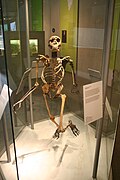
[[File: | [[File:Neanderthal Museum 15.jpg|thumb|left|[[Turkana Boy]] at the [[Neanderthal Museum]]]] | ||
The rest of the body is primarily understood by three partial skeletons from the Kenyan [[Lake Turkana#Anthropology|Lake Turkana]] site, notably [[Turkana Boy]]. Other postcranial fossils (all bones aside from the skull) attributed to ''H. erectus'' are not associated with a skull, making attribution unverifiable. Though the body plan of earlier ''Homo'' is poorly understood, ''H. erectus'' is usually characterized as the first ''Homo'' species with a human body plan, distinct from non-human apes.{{sfn|Antón|2003|loc=pp. 147–152}}<ref name=Anton2016/><ref>{{cite journal |last1=Haeusler|first1=M.|last2=Schiess|first2=R.|last3=Boeni|first3=T.|title=New vertebral and rib material point to modern bauplan of the Nariokotome ''Homo erectus'' skeleton |journal=Journal of Human Evolution |volume=61 |issue=5 |pages=575–582 |year=2011 |pmid=21868059 |doi=10.1016/j.jhevol.2011.07.004 |bibcode=2011JHumE..61..575H |url=https://www.zora.uzh.ch/id/eprint/50126/6/Haeusler_New_vertebral_and_rib_material_point_to_modern_bauplan.pdf}}</ref> The chest may have been short and [[barrel chest|barrel-shaped]], like other archaic humans.<ref name=Bastir2020>{{cite journal|first1=M.|last1=Bastir|first2=D.|last2=García-Martínez|first3=N.|last3=Torres-Tamayo|first4=C. A.|last4=Palancar|first5=B.|last5=Beyer|first6=A.|last6=Barash|first7=C.|last7=Villa|first8=J. A.|last8=Sanchis-Gimeno|first9=A.|last9=Riesco-López|first10=S.|last10=Nalla|first11=I.|last11=Torres-Sánchez|first12=F.|last12=García-Río|first13=E.|last13=Been|first14=A.|last14=Gómez-Olivencia|first15=M.|last15=Haeusler|first16=S. A.|last16=Williams|first17=F.|last17=Spoor|year=2020|title=Rib cage anatomy in ''Homo erectus'' suggests a recent evolutionary origin of modern human body shape|journal=Nature Ecology & Evolution|volume=4|issue=9 |pages=1178–1187|doi=10.1038/s41559-020-1240-4|pmid=32632258 |bibcode=2020NatEE...4.1178B |hdl=2013/ULB-DIPOT:oai:dipot.ulb.ac.be:2013/311388|hdl-access=free}}</ref> [[Fossil track]]s near [[Ileret]], Kenya, suggest a [[human gait]]. This adaptation is implicated in the dispersal of ''H. erectus'' across the Old World.<ref name=Hatala>{{cite journal |last1=Hatala|first1=K. G.|last2=Roach|first2=N. T.|last3=Ostrofsky |first3=K. R.|last4=Wunderlich|first4=R. E.|last5=Dingwall|first5=H. L.|last6=Villmoare|first6=B. A.|last7=Green|first7=D. J.|last8=Harris |first8=J. W.|last9=Braun|first9=D. R.|last10=Richmond|first10=B. G. |title=Footprints reveal direct evidence of group behavior and locomotion in ''Homo erectus'' |journal=Scientific Reports |volume=6 |issue=28766 |article-number=28766 |year=2016 |pmid=27403790 |pmc=4941528 |doi=10.1038/srep28766 |doi-access=free |bibcode=2016NatSR...628766H}}</ref> | |||
| | |||
| | |||
| | |||
| | |||
| | |||
| | |||
It is unclear when human ancestors [[prehistory of nakedness and clothing|lost most of their body hair]]. Genetic analysis suggests that high activity in the [[melanocortin 1 receptor]], which produces dark skin, dates back to 1.2 million years ago. This could indicate the evolution of hairlessness around this time, as a lack of body hair would have left the skin exposed to harmful [[UV radiation]].<ref>{{cite journal |last1=Rogers|first1=A. R.|last2=Iltis|first2=D.|last3=Wooding|first3=S. |year=2004 |title=Genetic Variation at the MC1R Locus and the Time since Loss of Human Body Hair |journal=Current Anthropology |volume=45 |issue=1 |pages=105–108 |doi=10.1086/381006 |bibcode=2004CurrA..45..105R |s2cid=224795768}}</ref> It is possible that populations in higher latitudes developed lighter skin to prevent [[vitamin D deficiency]],<ref>{{cite journal |last=Jablonski|first=N. G. |title=Human skin pigmentation as an example of adaptive evolution |journal=Proceedings of the American Philosophical Society |volume=156 |issue=1 |pages=45–57 |year=2012 |pmid=23035389 |jstor=23558077}}</ref> though a 300,000 to 500,000 year old Turkish ''H. erectus'' specimen presents the earliest case of [[tuberculous meningitis]], which is typically exacerbated by vitamin D deficiency in dark-skinned people living in higher latitudes.<ref>{{cite journal |last1=Kappelman|first1=J.|last2=Alçiçek|first2=M. C.|last3=Kazanci|first3=N.|last4=Schultz|first4=M.|last5=Ozkul|first5=M.|last6=Sen|first6=S. |title=First ''Homo erectus'' from Turkey and implications for migrations into temperate Eurasia |journal=American Journal of Physical Anthropology |volume=135 |issue=1 |pages=110–116 |year=2008 |pmid=18067194 |doi=10.1002/ajpa.20739 |bibcode=2008AJPA..135..110K }}</ref> Hairlessness is generally thought to have facilitated sweating,<ref>{{cite journal |last1=Best|first1=A.|last2=Kamilar|first2=J. M. |title=The evolution of eccrine sweat glands in human and nonhuman primates |journal=Journal of Human Evolution |volume=117 |pages=33–43 |year=2018 |pmid=29544622 |doi=10.1016/j.jhevol.2017.12.003 |bibcode=2018JHumE.117...33B |s2cid=3921318}}</ref> but it may also have helped to reduce parasite load, and was possibly reinforced by [[sexual selection]].<ref>{{cite book |last1=Pagel|first1=M|last2=Bodmer|first2=W. |year=2004 |chapter=The Evolution of Human Hairlessness: Cultural Adaptations and the Ectoparasite Hypothesis |title=Evolutionary Theory and Processes: Modern Horizons |pages=329–335 |publisher=Springer, Dordrecht |doi=10.1007/978-94-017-0443-4_17 |isbn=978-94-017-0443-4}}</ref><ref>{{cite journal |last=Gile|first=J. |year=2010 |title=Naked Love: The Evolution of Human Hairlessness |journal=Biological Theory |volume=5 |issue=4 |pages=326–336 |doi=10.1162/BIOT_a_00062 |s2cid=84164968}}</ref> | |||
===Size=== | |||
Height reconstructions range approximately {{cvt|141–167|cm|ftin|0}}, with tropical populations typically reconstructed as scoring on the higher end like modern human populations. Adult weight is harder to approximate, but about {{cvt|50|kg}} may have been normal. ''H. erectus'' is usually thought to be the first human species with little size-specific [[sexual dimorphism]], but the variability of postcranial material makes this unclear.<ref name=Anton2016/> A 2010 study estimates that the [[Turkana Boy]] would have reached a height of {{cvt|163|cm|ftin|0}} if he had reached adulthood.<ref>{{cite journal |first1=R. R. |last1=Graves |first2=A. C. |last2=Lupo |first3=R. C. |last3=McCarthy |first4=D. J. |last4=Wescott |first5=D. L. |last5=Cunningham |year=2010 |title=Just how strapping was KNM-WT 15000? |journal=Journal of Human Evolution |volume=59 |issue=5 |pages=542–554 |doi=10.1016/j.jhevol.2010.06.007|pmid=20846707 |bibcode=2010JHumE..59..542G }}</ref> | |||
=== | ===Growth and development=== | ||
[[ | The dimensions of a 1.8 million years old adult female ''H. e. ergaster'' pelvis from [[Gona, Ethiopia|Gona]], Ethiopia, suggests that she would have been capable of birthing children with a maximum prenatal brain size of {{cvt|315|cc}}, about 30–50% of adult brain size, falling between [[chimpanzee]]s (~40%) and modern humans (28%).<ref name=Simpson2008/> Similarly, a 1.5 million year old infant skull from Mojokerto had a brain volume of about 72–84% the size of an adult, which suggests a brain growth trajectory more similar to that of non-human apes.<ref name=Coqueugniot2004>{{cite journal |last1=Coqueugniot |first1=H. |last2=Hublin |first2=J.-J. |display-authors=et al. |year=2004 |title=Early brain growth in ''Homo erectus'' and implications for cognitive ability |url=https://www.nature.com/articles/nature02852 |journal=Nature |volume=431 |issue=7006 |pages=299–302 |doi=10.1038/nature02852 |pmid=15372030 |bibcode=2004Natur.431..299C |s2cid=4428043|url-access=subscription }}</ref> This suggests that the childhood growth and development of ''H. erectus'' was intermediate between that of chimpanzees and modern humans,<ref name=Simpson2008>{{Cite journal |last1=Simpson |first1=Scott W. |last2=Quade |first2=Jay |last3=Levin |first3=Naomi E. |last4=Butler |first4=Robert |last5=Dupont-Nivet |first5=Guillaume |last6=Everett |first6=Melanie |last7=Semaw |first7=Sileshi |year=2008 |title=A Female ''Homo erectus'' Pelvis from Gona, Ethiopia |url=https://www.science.org/doi/10.1126/science.1163592 |journal=Science |volume=322 |issue=5904 |pages=1089–1092 |doi=10.1126/science.1163592 |pmid=19008443 |bibcode=2008Sci...322.1089S |citeseerx=10.1.1.710.7337 |s2cid=22191315}}</ref> and the faster development rate suggests that [[altriciality]] (an extended childhood) evolved at a later stage in human evolution.<ref name=Coqueugniot2004/> The faster development rate might also indicate a shorter expected lifespan compared to later ''Homo''.<ref>{{Cite journal |last1=Caspari |first1=Rachel |last2=Lee |first2=Sang-Hee |year=2004 |title=Older age becomes common late in human evolution |journal=PNAS |volume=101 |issue=30 |pages=10,895–10,900 |doi=10.1073/pnas.0402857101 |pmid=15252198 |pmc=503716 |doi-access=free}}</ref> | ||
===Bone thickness=== | ===Bone thickness=== | ||
[[File:Homo erectus | [[File:Homo erectus skull cross-section.png|thumb|Cross sections of [[Peking Man]] Skulls III (A) and XII (B), and [[Java Man]] Skull II (C)]] | ||
The | The bones are extraordinarily thickened, particularly in ''Homo erectus sensu stricto'', so much so that skull fragments have sometimes been confused for fossil turtle [[carapace]]s.{{sfn|Boaz|Ciochon|2004|loc=p. 74}} The [[medullary canal]] in the [[long bone]]s (where the [[bone marrow]] is stored, in the limbs) is extremely narrowed (medullary [[stenosis]]). This degree of thickening is usually exhibited in semi-aquatic animals which use their heavy ([[pachyosteosclerosis|pachyosteosclerotic]]) bones as ballasts to help them sink, induced by [[hypothyroidism]].<ref name=Kennedy1985>{{cite journal |last=Kennedy|first=G. E. |year=1985 |title=Bone thickness in ''Homo erectus'' |journal=Journal of Human Evolution |volume=14 |issue=8 |pages=699–708 |doi=10.1016/S0047-2484(85)80052-X |bibcode=1985JHumE..14..699K}}</ref> | ||
It is | It is unclear what function intense bone thickening could have served. Before more complete skeletons were discovered, Weidenreich suggested ''H. erectus'' was a gigantic species.<ref>{{cite book|first=F.|last=Weidenreich|authorlink=Franz Weidenreich|year=1946|chapter=Giants as Earliest Ancestors|title=Apes, Giants, and Man|chapter-url=https://archive.org/details/in.ernet.dli.2015.531106/page/n57|publisher=University of Chicago Press}}</ref> Other explanations include a far more violent and impact-prone lifestyle than other ''Homo'', or pathological nutrient deficiencies.{{sfn|Boaz|Ciochon|2004|loc=pp. 80–86}} The supraorbital torus thickens with age, and may be a response to [[bending]] stresses from habitual loading of the front teeth.<ref>{{cite journal |last1=Russell|first1=M. D.|last2=Brown|first2=T.|last3=Garn|first3=S. M.|last4=Giris|first4=F.|last5=Turkel|first5=S.|last6=İşcan|first6=M. Y.|last7=Oyen|first7=O. J.|last8=Jacobshagen|first8=B.|last9=Pietrusewsky|first9=M.|last10=Rightmire|first10=G. P.|last11=Smith|first11=F. H.|year=1985 |title=The Supraorbital Torus: 'A Most Remarkable Peculiarity' |journal=Current Anthropology |volume=26 |issue=3 |pages=337–350 |doi=10.1086/203279 |s2cid=146857927}}</ref> | ||
==Culture== | ==Culture== | ||
=== | ===Subsistence=== | ||
[[File: | {{See also|Hunting hypothesis}} | ||
[[File:Megalochelys AMNH.jpg|thumb|left|''H. erectus'' overhunting may have led to the extinction of ''[[Megalochelys]]'' (above).<ref name=Rhodin2015/>]] | |||
''H. erectus'' was early-on portrayed as the earliest [[hunter-gatherer]] and a skilled predator of big game, relying on running. The few identified specimens of the ''H. e. ergaster'' torso and pelvis may indicate a body plan more conducive for power running, unlike modern humans better [[endurance running hypothesis|adapted for endurance running]].<ref name=Bastir2020/> The gradual shift to "[[apex predator|top predator]]" may have led to its dispersal throughout Afro-Eurasia.<ref name=Carotenuto2016/> Though scavenging may have instead played a bigger role at least in some populations, ''H. erectus'' fossils are often associated with the butchered remains of large herbivores,{{sfn|Boaz|Ciochon|2004|loc=p. 105}} especially [[elephant]]s, [[rhino]]s, [[hippo]]s, [[bovine]]s, and [[boar]]s. Tracking complex prey behaviors as well as the nutritional value of meat have been connected to brain volume growth.<ref name=BenDor2011/> | |||
''H. erectus'' is usually assumed to have practiced [[sexual division of labor]] much like recent hunter-gatherer societies, with men hunting and women gathering. This model is supported by a fossil trackway from Ileret, Kenya, made by a probably all-male band of over 20 ''H. erectus'' individuals, possibly a hunting party or (similar to chimpanzees) a border patrol group.<ref>{{Cite journal |last1=Hatala |first1=Kevin G. |last2=Roach |first2=Neil T. |last3=Ostrofsky |first3=Kelly R. |last4=Wunderlich |first4=Roshna E. |last5=Dingwall |first5=Heather L. |last6=Villmoare |first6=Brian A. |last7=Green |first7=David J. |last8=Harris |first8=John W. K. |last9=Braun |first9=David R.|last10=Richmond|first10=Brian G. |year=2016 |title=Footprints reveal direct evidence of group behavior and locomotion in ''Homo erectus'' |journal=Scientific Reports |volume=6 |issue=28766 |article-number=28766 |doi=10.1038/srep28766 |pmid=27403790 |pmc=4941528 |bibcode=2016NatSR...628766H}}</ref> | |||
Since common modern human tapeworms began to diverge from those of other predators roughly 1.7 million years ago (specifically the [[Taenia solium|pork tapeworm]], [[Taenia saginata|beef tapeworm]], and [[Taenia asiatica|Asian tapeworm]]), not only was ''H. erectus'' consuming meat regularly enough for speciation to occur in these parasites, but meat was probably consumed raw more often than not.{{sfn|Boaz|Ciochon|2004|loc=p. 105–107}} Some populations were collecting aquatic resources like fish, shellfish, and turtles at waterside sites, such as Lake Turkana<ref>{{cite journal |last=Steele|first=T. E. |title=A unique hominin menu dated to 1.95 million years ago |journal=[[Proceedings of the National Academy of Sciences of the United States of America]] |volume=107 |issue=24 |pages=10771–10772 |year=2010 |pmid=20534542 |pmc=2890732 |doi=10.1073/pnas.1005992107 |doi-access=free |bibcode=2010PNAS..10710771S}}</ref> and Trinil.<ref>{{cite journal |last1=Joordens|first1=J. C.|last2=Wesselingh|first2=F. P.|last3=de Vos|first3=J.|last4=Vonhof|first4=H. B.|last5=Kroon|first5=D. |title=Relevance of aquatic environments for hominins: a case study from Trinil (Java, Indonesia) |journal=[[Journal of Human Evolution]] |volume=57 |issue=6 |pages=656–671 |year=2009 |pmid=19683789 |doi=10.1016/j.jhevol.2009.06.003 |bibcode=2009JHumE..57..656J}}</ref> Underground [[storage organ]]s (roots, tubers, etc.) were likely also major dietary components, and traces of the edible plant ''[[Celtis]]'' have been documented at several ''H. erectus'' sites.<ref name=Hardy2018>{{cite journal |first=K. |last=Hardy |year=2018 |title=Plant use in the Lower and Middle Palaeolithic: Food, medicine and raw materials |journal=Quaternary Science Reviews |volume=191 |pages=393–398 |doi=10.1016/j.quascirev.2018.04.028|bibcode=2018QSRv..191..393H }}</ref> | |||
=== | Possibly due to overhunting of the biggest game available, the dispersal of ''H. erectus'' and descendant species may be implicated in the extinctions of large herbivores and the gradual reduction of average herbivore size over the Pleistocene.<ref>{{cite journal |first1=J. |last1=Dembitzer |first2=R. |last2=Barkai |first3=M. |last3=Ben-Dor |first4=S. |last4=Meiri |year=2022 |title=Levantine overkill: 1.5 million years of hunting down the body size distribution |journal=Quaternary Science Reviews |volume=276 |article-number=107316 |doi=10.1016/j.quascirev.2021.107316|bibcode=2022QSRv..27607316D }}</ref> ''H. erectus'' overhunting has been blamed by some authors for the decline of [[proboscidea]]n species as well as competing carnivores,<ref name=BenDor2011>{{cite journal |last1=Ben-Dor|first1=M.|last2=Gopher|first2=A.|last3=Hershkovitz|first3=I|last4=Barkai|first4=R. |title=Man the fat hunter: the demise of ''Homo erectus'' and the emergence of a new hominin lineage in the Middle Pleistocene (ca. 400 kyr) Levant |journal=PLOS ONE |volume=6 |issue=12 |article-number=e28689 |year=2011 |pmid=22174868 |pmc=3235142 |doi=10.1371/journal.pone.0028689 |bibcode=2011PLoSO...628689B |doi-access=free}}</ref><ref>{{cite journal |first1=T. |last1=Surovell |first2=N. |last2=Waguespack |first3=P. J. |last3=Brantingham |year=2005 |title=Global archaeological evidence for proboscidean overkill |journal=Proceedings of the National Academy of Sciences |volume=102 |issue=17 |pages=6,231-6,236 |doi=10.1073/pnas.0501947102|doi-access=free |pmid=15829581 |pmc=1087946 |bibcode=2005PNAS..102.6231S }}</ref><ref name=Faith2020>{{cite journal|last1=Faith|first1=J. Tyler|last2=Rowan|first2=John|last3=Du|first3=Andrew|last4=Barr|first4=W. Andrew|year=2020|title=The uncertain case for human-driven extinctions prior to ''Homo sapiens''|journal=Quaternary Research|volume=96|pages=88–104|doi=10.1017/qua.2020.51 |bibcode=2020QuRes..96...88F }}</ref> but their decline may be better attributed to the spread of grasslands.<ref name=Faith2020/><ref>{{cite journal|last1=Saarinen|first1=Juha|last2=Lister|first2=Adrian M.|year=2023|title=Fluctuating climate and dietary innovation drove ratcheted evolution of proboscidean dental traits|journal=Nature Ecology & Evolution|volume=7|issue=9 |pages=1490–1502|doi=10.1038/s41559-023-02151-4|pmid=37580434 |pmc=10482678|bibcode=2023NatEE...7.1490S }}</ref> The giant tortoise ''[[Megalochelys]]'' may have been driven to extinction by ''H. erectus'' in [[Sundaland]] (what is now [[Island Southeast Asia]]), since species went extinct shortly after the arrival of ''H. erectus''.<ref name=Rhodin2015>{{Cite book |url=http://www.iucn-tftsg.org/cbftt/ |title=Conservation Biology of Freshwater Turtles and Tortoises |chapter=Turtles and Tortoises of the World During the Rise and Global Spread of Humanity: First Checklist and Review of Extinct Pleistocene and Holocene Chelonians |year=2015 |publisher=Chelonian Research Foundation |isbn=978-0-9653540-9-7 |editor-last=Rhodin |editor-first=A. |edition=First |series=Chelonian Research Monographs |volume=5 |doi=10.3854/crm.5.000e.fossil.checklist.v1.2015 |editor-last2=Pritchard |editor-first2=P. |editor-last3=van Dijk |editor-first3=P. P. |editor-last4=Saumure |editor-first4=R. |editor-last5=Buhlmann |editor-first5=K. |editor-last6=Iverson |editor-first6=J. |editor-last7=Mittermeier |editor-first7=R. |page=15}}</ref> | ||
===Technology=== | |||
====Stone tools==== | |||
[[File:Pièce bifaciale Saint-Acheul La Garenne Archéologie Nationale 01042018.jpg|thumb|A [[handaxe]] from the [[Amiens|Saint-Acheul]] site at the [[National Archaeological Museum, France|Musée d'Archéologie nationale]], France ]] | |||
''H. erectus'' manufactured [[Lower Paleolithic]] technologies, and is credited with the invention of the [[Acheulean]] stone tool [[industry (archaeology)|industry]] at latest 1.95 million years ago.<ref>{{cite journal|first1=Margherita|last1=Mussi|first2=Matthew M.|last2=Skinner|first3=Rita T.|last3=Melis|first4=Joaquín|last4=Panera|title=Early ''Homo erectus'' lived at high altitudes and produced both Oldowan and Acheulean tools|url=https://www.science.org/doi/10.1126/science.add9115|journal=Science|year= 2023|pages=713–718|volume=382|issue=6671|doi=10.1126/science.add9115|first5=Susana|last5=Rubio-Jara|first6=Thomas W.|last6=Davies|first7=Denis|last7=Geraads|first8=Hervé|last8=Bocherens|first9=Giuseppe|last9=Briatico|first10=Adeline|last10=Le Cabec|first11=Jean-Jacques|last11=Hublin|first12=Agness|last12=Gidna|first13=Raymonde|last13=Bonnefille|first14=Luca|last14=Di Bianco|first15=Eduardo|last15=Méndez-Quintas|pmid=37824630 |bibcode=2023Sci...382..713M }}</ref> This was a major technological breakthrough featuring large, heavy-duty tools; most iconically, the [[handaxe]]. Over hundreds of thousands of years, the Acheulean eventually replaced its predecessor — the [[Oldowan]] (a [[chopper (archaeology)|chopper]] and [[lithic flake|flake]] industry) — in Africa, and spread out across Western Eurasia.<ref name=Torre2016/> This sudden innovation was typically explained as a response to environmental instability in order to process more types of food and broaden the diet combined with increasing brain size, which also allowed ''H. erectus'' to colonize Eurasia. Despite this characterization of the Acheulean, the small-brained ''H. e. georgicus'' was able to leave Africa despite only manufacturing Oldowan-style tools,<ref name=Carotenuto2016/><ref name=Torre2016>{{cite journal |last=de la Torre|first=I. |title=The origins of the Acheulean: past and present perspectives on a major transition in human evolution |journal=Philosophical Transactions of the Royal Society of London. Series B, Biological Sciences |volume=371 |issue=1698 |article-number=20150245 |year=2016 |pmid=27298475 |pmc=4920301 |doi=10.1098/rstb.2015.0245}}</ref> the 1.6 million year old DAN5/P1 specimen from [[Gona, Ethiopia]] is associated with Acheulean style tools despite its low brain volume of {{cvt|598|cc}},<ref name=Baab2025/> and the handaxe does not seem to have been manufactured commonly in East Asia.<ref>{{cite journal |first1=H. |last1=Li |first2=C. |last2=Li |first3=K. |last3=Kuman |year=2014 |title=Rethinking the "Acheulean" in East Asia: Evidence from recent investigations in the Danjiangkou Reservoir Region, central China |journal=Quaternary International |volume=347 |pages=163–175 |doi=10.1016/j.quaint.2014.03.059|bibcode=2014QuInt.347..163L }}</ref> The lack of East Asian handaxes was first noted by American archaeologist [[Hallam L. Movius]] in 1948, who drew the "[[Movius Line]]", dividing the East into a "chopping-tool culture" and the West into a "hand axe culture".<ref name=Movius1948>{{cite journal |first=H. L. |last=Movius |author-link=Hallam L. Movius |year=1948 |title=The Lower Palaeolithic Cultures of Southern and Eastern Asia |journal=Transactions of the American Philosophical Society |volume=38 |issue=4 |pages=386–403 |doi=10.2307/1005632 |jstor=1005632}}</ref> Movius took this as evidence of inferiority of Far Eastern populations: | |||
{{blockquote|text=...as early as [[Lower Paleolithic|Lower Palaeolithic]] times Southern and Eastern Asia as a whole was a region of cultural retardation...very primitive forms of Early Man apparently persisted there long after types at a comparable stage of physical evolution had become extinct elsewhere.|author=[[Hallam L. Movius]], 1948<ref name=Movius1948/>}} | |||
{{ | |||
[[File:Homo-erectus Turkana-Boy (Ausschnitt) Fundort Nariokotome, Kenia, Rekonstruktion im Neanderthal Museum.jpg|thumb|left|upright=1.2|Reconstruction of [[Turkana Boy]] at the [[Neanderthal Museum]]]] | |||
''H. erectus'' seems to have been using stone tools in butchery, vegetable processing, and woodworking (maybe manufacturing [[spear]]s and [[digging stick]]s).<ref name=Hardy2018/><ref name=Dominguez2001/> In Africa, Oldowan sites are typically found alongside major fossil assemblages, but Acheulean sites normally feature more stone tools than fossils, so ''H. erectus'' could have been using choppers and handaxes for different activities.<ref name=Dominguez2001>{{cite journal |first1=M. |last1=Dominguez-Rodrigo |first2=J. |last2=Serrallonga |first3=J. |last3=Juan-Tresserras |first4=L. |last4=Alcala |first5=L. |last5=Luque |year=2001 |title=Woodworking activities by early humans: a plant residue analysis on Acheulian stone tools from Peninj (Tanzania) |journal=Journal of Human Evolution |volume=40 |issue=4 |pages=289–299 |doi=10.1006/jhev.2000.0466|pmid=11312582 |bibcode=2001JHumE..40..289D }}</ref> These stone tools probably were not [[hafting|hafted]] onto spears; this innovation is associated with the transition to the [[Middle Paleolithic]] and the emergence of Neanderthals and modern humans.<ref>{{cite journal|first1=J.|last1=Blinkhorn|title=Examining the Origins of Hafting in South Asia|journal=Journal of Paleolithic Archaeology|year=2019|issn=2520-8217|pages=466–481|volume=2|issue=4|doi=10.1007/s41982-019-00034-4|doi-access=free}}</ref> | |||
Materials for stone tools were normally sourced locally, and it seems [[lithic reduction|blanks]] were usually chosen based on size rather than material quality.<ref name=Torre2016/> ''H. erectus'' also produced tools from shells at Sangiran<ref>{{cite journal |last1=Choi|first1=K.|last2=Driwantoro|first2=D. |year=2007 |title=Shell tool use by early members of ''Homo erectus'' in Sangiran, central Java, Indonesia: cut mark evidence |journal=Journal of Archaeological Science |volume=34 |issue=1 |pages=48–58 |doi=10.1016/j.jas.2006.03.013 |bibcode=2007JArSc..34...48C}}</ref> and Trinil.<ref name=Joordens2015/> | |||
====Fire==== | ====Fire==== | ||
{{ | {{Main|Control of fire by early humans}} | ||
''H. erectus'' is credited as the first human | ''H. erectus'' is credited as the first human species to wield fire. The earliest claimed fire site is [[Wonderwerk Cave]], South Africa, at 1.7 million years old.<ref name=Beaumont2011>{{cite journal |last=Beaumont|first=P. B. |year=2011 |title=The Edge: More on Fire-Making by about 1.7 Million Years Ago at Wonderwerk Cave in South Africa |journal=Current Anthropology |volume=52 |issue=4 |pages=585–595 |doi=10.1086/660919 |s2cid=144176681}}</ref> While the species' dispersal far out of Africa has often been attributed to fire and cave dwelling, fire does not become common in the archaeological record until 300,000 to 400,000 years ago,<ref name=Roebroeks2011>{{cite journal |last1=Roebroeks|first1=W.|last2=Villa|first2=P. |title=On the earliest evidence for habitual use of fire in Europe |journal=Proceedings of the National Academy of Sciences of the United States of America |volume=108 |issue=13 |pages=5209–5214 |year=2011 |pmid=21402905 |pmc=3069174 |doi=10.1073/pnas.1018116108 |doi-access=free |bibcode=2011PNAS..108.5209R}}</ref> and cave-dwelling about 600,000 years ago.<ref>{{cite journal |url=https://www.researchgate.net/publication/303107882 |last1=Ullman|first1=M.|last2=Hovers|first2=E.|last3=Goren-Inbar|first3=N.|last4=Frumkin|first4=A. |year=2013 |title=Levantine cave dwellers: geographic and environmental aspects of early humans use of caves, case study from Wadi Amud, northern Israel |journal=International Congress of Speleology |volume=1 |page=169}}</ref> Therefore, ''H. erectus'' may have only been scavenging fire opportunistically. Similarly, ''H. erectus'' sites usually stay within warmer tropical or subtropical latitudes.<ref name=Carotenuto2016>{{cite journal |last1=Carotenuto|first1=F.|last2=Tsikaridze|first2=N.|last3=Rook|first3=L.|last4=Lordkipanidze|first4=D.|last5=Longo|first5=L.|last6=Condemi|first6=S.|last7=Raia|first7=P. |title=Venturing out safely: The biogeography of ''Homo erectus'' dispersal out of Africa |journal=Journal of Human Evolution |volume=95 |pages=1–12 |year=2016 |pmid=27260171 |doi=10.1016/j.jhevol.2016.02.005 |bibcode=2016JHumE..95....1C |hdl=10356/82274 |hdl-access=free}}</ref> | ||
The dating of northerly populations (namely Peking Man) could suggest that they were retreating to warmer refugia during [[glacial period]]s, but the precise age of the Peking Man fossils is poorly resolved.{{sfn|Antón|2003|loc=p. 132}}<ref name="auto"/> There have been claims of manmade hearths and "clear-cut evidence for intentional fire use",<ref>{{cite journal |first1=X. |last1=Gao |first2=S. |last2=Zhang |first3=Y. |last3=Zhang |first4=F. |last4=Chen |year=2017 |title=Evidence of Hominin Use and Maintenance of Fire at Zhoukoudian |journal=Current Anthropology |volume=58 |issue=S16 |pages=S267–S277 |doi=10.1086/692501 |s2cid=164616520 |url=https://www.researchgate.net/publication/317987720}}</ref> ostensibly as far back as 770,000 years ago in the supposed cave home of Peking Man.<ref name="auto">{{cite journal |last1=Zhong |first1=M. |last2=Shi |first2=C. |display-authors=et al. |year=2013 |title=On the possible use of fire by ''Homo erectus'' at Zhoukoudian, China |journal=Chinese Science Bulletin |volume=59 |issue=3 |pages=335–343 |doi=10.1007/s11434-013-0061-0 |s2cid=93590269}}</ref> At the French Caune de L'Arago, Tautavel Man does not seem to have been using fire at all, even though occupation sequences span two cold periods.<ref name=Lumley2015/> | |||
====Healthcare==== | |||
{{See also|Prehistoric medicine}} | |||
[[File:Dmanisi fossils D 3444 + D 3900 (Replika).jpg|thumb|upright=0.8|The single-toothed ''[[Dmanisi hominins|H. e. georgicus]]'' specimen (above) is the earliest probable example of human group care.<ref name=Spikins2019/>]] | |||
Like other primates, ''H. erectus'' probably used [[medicinal plant]]s<ref name=Hardy2018/> and infirmed sick group members. The earliest probable example of human group care is a 1.77 million year old ''H. e. georgicus'' specimen who had lost all but one tooth due to age or [[gum disease]] (the earliest example of severe chewing impairment) yet still survived for several years afterwards.<ref name=Spikins2019>{{cite journal |last1=Spikins|first1=P.|last2=Needham|first2=A.|last3=Wright|first3=B|last4=Dytham|first4=C|last5=Gatta |first5=M.|last6=Hitchens|first6=G. |year=2019 |title=Living to fight another day: The ecological and evolutionary significance of Neanderthal healthcare |journal=Quaternary Science Reviews |volume=217 |pages=98–118 |doi=10.1016/j.quascirev.2018.08.011 |bibcode=2019QSRv..217...98S |doi-access=free}}</ref> | |||
====Seafaring==== | ====Seafaring==== | ||
''H. erectus'' made long sea crossings to arrive on the islands of [[Flores]], [[Luzon]],<ref name="Détroit2019">{{cite journal |last1=Détroit|first1=F.|last2=Mijares|first2=A. S.|last3=Corny|first3=J.|last4=Daver|first4=G.|last5=Zanolli|first5=C.|last6=Dizon|first6=E.|last7=Robles|first7=E.|last8=Grün|first8=R.|last9=Piper|first9=P. J. |title=A new species of ''Homo'' from the Late Pleistocene of the Philippines |journal=Nature |volume=568 |issue=7751 |pages=181–186 |year=2019 |pmid=30971845 |doi=10.1038/s41586-019-1067-9 |name-list-style=amp |s2cid=106411053 |bibcode=2019Natur.568..181D |hdl=10072/386785 |url=https://hal.archives-ouvertes.fr/hal-02296712/file/Detroit_%26_al_2019_Nature_postprint.pdf}}</ref> and some [[Mediterranean Sea|Mediterranean]] islands. Some authors have asserted that ''H. erectus'' intentionally made these crossings by inventing watercrafts and seafaring so early in time, speaking to advanced cognition and language skills. These populations could have also been founded by [[oceanic dispersal|natural rafting events]] instead.<ref name=":6">{{Cite journal |last=Botha |first=Rudolf |year=2024 |title=Did ''Homo erectus'' Have Language? The Seafaring Inference |journal=Cambridge Archaeological Journal |volume=35 |language=en |pages=21–37 |doi=10.1017/S0959774324000118 |issn=0959-7743 |doi-access=free}}</ref> | |||
[[ | |||
=== Art and rituals === | === Art and rituals === | ||
{{See also|Prehistoric art}} | {{See also|Prehistoric art}} | ||
''H. erectus'' | In East Asia, ''H. erectus'' is usually represented only by skullcaps, which used to be interpreted as widespread [[human cannibalism|cannibalism]] and ritual [[headhunting]]. This had been reinforced by the historic practice of headhunting and cannibalism in some recent Indonesian, Australian, and Polynesian cultures, which were formerly believed to have directly descended from these ''H. erectus'' populations. The lack of the rest of the skeleton is now normally explained by natural phenomena.<ref>{{cite journal |first=T. |last=Jacob |author-link=Teuku Jacob |year=1972 |title=The Problem of Head-Hunting and Brain-Eating among Pleistocene Men in Indonesia |journal=Archaeology and Physical Anthropology in Oceania |volume=7 |issue=2 |pages=86–89 |jstor=40386169}}</ref> | ||
[[File:Homo Erectus shell with geometric incisions circa 500,000 BP, Naturalis Biodiversity Center, Netherlands (with detail).jpg|thumb|upright=1.5|Engraved ''[[Pseudodon]]'' shell [[Pseudodon shell DUB1006-fL|DUB1006-fL]] from [[Trinil]], [[Java]]]] | |||
Art-making could be evidence of symbolic thinking. An engraved ''[[Pseudodon]]'' shell [[Pseudodon shell DUB1006-fL|DUB1006-fL]] from Trinil, Java, with geometric markings could possibly be the earliest example of art-making, dating to 436,000 to 546,000 years ago.<ref name=Joordens2015>{{cite journal |last1=Joordens|first1=J. C.|last2=d'Errico|first2=F.|last3=Wesselingh|first3=F. P.|last4=Munro|first4=S.|last5=de Vos|first5=J|last6=Wallinga|first6=J.|last7=Ankjærgaard|first7=C.|last8=Reimann|first8=T.|last9=Wijbrans|first9=J. R.|last10=Kuiper|first10=K. F.|last11=Mücher|first11=H. J.|last12=Coqueugniot|first12=H.|last13=Prié|first13=V|last14=Joosten|first14=I.|last15=van Os|first15=B.|last16=Schulp|first16=A. S.|last17=Panuel|first17=M.|last18=van der Haas|first18=V.|last19=Lustenhouwer|first19=W.|last20=Reijmer|first20=J. J.|last21=Roebroeks|first21=W. |title=''Homo erectus'' at Trinil on Java used shells for tool production and engraving |journal=Nature |volume=518 |issue=7538 |pages=228–231 |year=2015 |pmid=25470048 |doi=10.1038/nature13962 |s2cid=4461751 |bibcode=2015Natur.518..228J}}</ref><ref>{{cite journal |last=Callaway|first=E. |title=''Homo erectus'' made world's oldest doodle 500,000 years ago |journal=Nature News |doi=10.1038/nature.2014.16477 |url=https://www.nature.com/news/homo-erectus-made-world-s-oldest-doodle-500-000-years-ago-1.16477 |year=2014 |s2cid=164153158|url-access=subscription }}</ref><ref name=Dickson1992>{{cite book |last=Dickson|first=D. B. |year=1992 |title=The Dawn of Belief: Religion in the Upper Paleolithic of Southwestern Europe |publisher=University of Arizona Press |pages=40–46 |url={{google books |plainurl=yes |id=DNr5YIygjMMC |page=40}} |isbn=978-0-8165-1336-9}}</ref> ''H. erectus'' was also the earliest human to collect red-colored pigments, namely [[ochre]]. Ochre lumps at Olduvai Gorge, Tanzania, associated with the 1.4 million year old Olduvai Hominid 9 may have been purposefully shaped and trimmed by a [[hammerstone]]. Red ochre is normally recognized as bearing symbolic value when associated with modern humans.<ref name=Dickson1992/> | |||
===Language=== | ===Language=== | ||
{{See also|Origin of language|Origin of speech}} | |||
The [[spinal column]] of the 1.6 million year old Turkana boy would not have supported properly developed respiratory muscles required to produce speech;<ref>{{cite journal |last1=Latimer|first1=B.|last2=Ohman|first2=J. |year=2001 |title=Axial dysplasia in ''Homo erectus'' |journal=Journal of Human Evolution |volume=40}}</ref><ref>{{cite journal |last1=Schiess|first1=R.|last2=Haeusler|first2=M. |title=No skeletal dysplasia in the Nariokotome boy KNM-WT 15000 (''Homo erectus'')--a reassessment of congenital pathologies of the vertebral column |journal=American Journal of Physical Anthropology |volume=150 |issue=3 |pages=365–374 |year=2013 |pmid=23283736 |doi=10.1002/ajpa.22211 |bibcode=2013AJPA..150..365S }}</ref> and a 1.5 million year old infant ''H. erectus'' skull from Mojokerto, Java, shows that this population did not have an extended childhood, which is a prerequisite for [[language acquisition]].<ref name=Coqueugniot2004/> On the other hand, despite the [[cochlea]]r (ear) anatomy of Sangiran 2 and 4 retaining several traits reminiscent of australopithecines, the hearing range may have included the higher frequencies used to discern speech.<ref>{{cite journal |first1=A. |last1=Urciuoli |first2=J. |last2=Kubat |first3=L. |last3=Schisanowski |first4=F. |last4=Schrenk |first5=B. |last5=Zipfel |first6=M. |last6=Tawane |first7=L. |last7=Bam |first8=D. M. |last8=Alba |first9=O. |last9=Kullmer |year=2022 |title=Cochlear morphology of Indonesian ''Homo erectus'' from Sangiran |journal=Journal of Human Evolution |volume=165 |article-number=103163 |doi=10.1016/j.jhevol.2022.103163|doi-access=free |pmid=35299091 |bibcode=2022JHumE.16503163U }}</ref> | |||
Given expanding brain size and technological innovation, ''H. erectus'' may have been using some basic proto-language in combination with gesturing, and built the basic framework around which fully-fledged languages would eventually be formed.<ref>{{cite journal |last=Hillert|first=D. G. |title=On the Evolving Biology of Language |journal=Frontiers in Psychology |volume=6 |pages=1796 |year=2015 |pmid=26635694 |pmc=4656830 |doi=10.3389/fpsyg.2015.01796 |doi-access=free}}</ref> | |||
</ | |||
== See also == | ==See also== | ||
* | *[[Cro-Magnon]] | ||
* [[ | *[[Behavioral modernity]] | ||
* [[ | *[[Evolution of human intelligence]] | ||
*''[[Homo naledi]]'' | |||
==Notes== | |||
{{notelist-num}} | |||
== References == | ==References== | ||
{{ | {{reflist}} | ||
== | ===Bibliography=== | ||
* {{cite | * {{cite book |last1=Boaz |first1=N. T. |last2=Ciochon |first2=R. |author2-link=Russell Ciochon |year=2004 |title=Dragon Bone Hill: An Ice-Age Saga of Homo erectus |publisher=Oxford University Press |isbn=978-0-19-803488-9}} | ||
* {{cite | * {{cite journal |first=S. C. |last=Antón |year=2003 |title=Natural history of ''Homo erectus''<sup>†</sup> |journal=American Journal of Biological Anthropology |volume=122 |issue=S37 |pages=126–170 |doi=10.1002/ajpa.10399 |doi-access=free|pmid=14666536 |bibcode=2003AJPA..122S.126A }} | ||
* {{cite book| | * {{cite book |last=Theunissen |first=B. |year=1989 |title=Eugène Dubois and the Ape-Man from Java |publisher=Kluwer Academic Publishers |isbn=978-1-55608-081-4}} | ||
== External links == | == External links == | ||
| Line 379: | Line 271: | ||
[[Category:Early species of Homo]] | [[Category:Early species of Homo]] | ||
[[Category:Fossil taxa described in 1893]] | [[Category:Fossil taxa described in 1893]] | ||
[[Category:Extinct animals of Indonesia]] | |||
[[Category:Apex predators]] | |||
Latest revision as of 21:59, 15 March 2026
| Homo erectus Temporal range:
| |
|---|---|

| |
| Java Man, the holotype of H. erectus[note 1] | |
Scientific classification 
| |
| : | [[Template:Taxonomy/Homo]] |
| Species: | †H. erectus
|
| Binomial name | |
| †Homo erectus (Dubois, 1893)
| |
Homo erectus (/ˌhoʊmoʊ əˈrɛktəs/ lit. 'upright man') is an extinct species of archaic human from the Pleistocene, spanning nearly 2 million years. It is the first human species to evolve a humanlike body plan and gait, to leave Africa and colonize Asia and Europe, and to wield fire. Some populations of H. erectus were ancestors of later human species, including H. heidelbergensis — the last common ancestor of modern humans, Neanderthals, and Denisovans. As such a widely distributed species both geographically and temporally, H. erectus anatomy varies considerably. Subspecies are sometimes recognized: H. e. erectus, H. e. pekinensis, H. e. soloensis, H. e. ergaster, H. e. georgicus, and H. e. tautavelensis.
The species was first described by Eugène Dubois in 1893 as "Pithecanthropus erectus" using a skullcap, molar, and femur from Java, Indonesia. Further discoveries around East Asia were used to contend that humanity evolved out of Asia. Based on historical race concepts, it was argued that local H. erectus populations evolved directly into local modern human populations (polycentrism) rather than all humanity sharing a single anatomically modern ancestor (monogenism). As the fossil record improved over the mid-to-late 20th century, "Out of Africa" theory and monogenism became the consensus.
The typical skull has a pronounced brow ridge, a protruding jaw, and large teeth. The bones are much thicker than in modern humans. East Asian populations normally have an even more robust skeleton and larger brain volume — averaging 1,000 cc (61 cu in). Western H. erectus brain volume could be as low as 546 cc (33.3 cu in) in H. e. georgicus. H. erectus probably had a faster apelike growth trajectory, lacking the extended childhood required for language acquisition. Reconstructed adult body dimensions range from 141–167 cm (4 ft 8 in – 5 ft 6 in) in height and about 50 kg (110 lb) in weight.
H. erectus invented the Acheulean tool industry, a major innovation of large, heavy-duty stone tools. These may have been used in butchery, vegetable processing, and woodworking of spears and digging sticks. H. erectus was a major predator of large herbivores on the expanding savannas during the Quaternary glaciation. The species is usually characterized as the first hunter-gatherer and the first to practice sexual division of labor. Fire usage and cave habitation were probably not important aspects of daily life. Similarly, H. erectus may not have often ventured into colder regions or cooked meat. The last known occurrence of H. erectus is 108,000 to 117,000 years ago (H. e. soloensis) in Southeast Asia, until the last savannas in the region gave way to jungle.
Taxonomy[edit | edit source]
Research history[edit | edit source]

While Charles Darwin had hypothesized in his 1871 Descent of Man that humans most likely evolved in Africa,[note 2] many late-19th century evolutionary naturalists postulated that Asia was the birthplace of humankind. Asia is midway between all continents via land routes or short sea crossings, providing optimal dispersal routes throughout the world. Among the major proponents of "Out of Asia" theory was Ernst Haeckel, who argued that the first human species (which he speculatively named Homo primigenius) evolved on a now-disproven hypothetical continent "Lemuria" from a species he termed Pithecanthropus alalus (speechless ape-man). "Lemuria" had supposedly sunk below the Indian Ocean, accounting for the lack of fossil evidence.[3]
Dutch scientist Eugène Dubois joined the Royal Netherlands East Indies Army to search for the "missing link" of human evolution in Java.[note 3] At the Trinil site, his team found a skullcap and molar in 1891, and a femur in 1892 (Java Man), which he named "Pithecanthropus erectus" in 1893.[7] He attempted to convince the European scientific community that he had found an upright-walking ape-man dating to the late Pliocene or Early Pleistocene; they dismissed his findings as some kind of non-human ape.[3]


Dubois argued that "P. erectus" was a gibbon-like ape which was the precursor to a more familiar human body plan, but in the 1930s, German-American anatomist Franz Weidenreich noticed a striking similarity with ancient human remains recently being unearthed in China (Peking Man, "Sinanthropus pekinensis").[8][9] This characterization became better supported as German-Dutch palaeontologist Gustav Heinrich Ralph von Koenigswald discovered more Indonesian ancient human remains over the decade at Mojokerto, Sangiran, and Ngandong.[note 4][11][12] Weidenreich believed that they were the direct ancestors of the local modern human Homo sapiens subspecies, in accord with historical race concepts (polycentricism) — that is, Peking Man was the direct ancestor of specifically Chinese people, and Java Man of Aboriginal Australians.[13][14] As the significance of racial distinction diminished with the development of modern evolutionary synthesis, many fossil human species and genera around Asia, Africa, and Europe (including "Pithecanthropus" and "Sinanthropus") were reclassified as subspecies of Homo erectus.[15][16]
During the late 20th century, some of the oldest H. erectus fossils were discovered across Africa, the first being Kenyan archeologist Louis Leakey's Olduvai Hominin 9 in 1960.[17] As the human fossil record expanded, the "Out of Africa" theory and monogenism became the consensus: that all modern humans share a fully anatomically modern common ancestor. H. erectus is now generally considered to be an African species which later dispersed across Eurasia, with later African populations giving rise to the modern human lineage.[18]
Subspecies[edit | edit source]
By the middle of the 20th century, human taxonomy was in turmoil, with many poorly defined species and genera described across Europe, Asia, and Africa, which exaggerated the differences among them.[19] In 1940, Weidenreich was the first to suggest reclassifying "Sinanthropus pekinensis" and "Pithecanthropus erectus" as subspecies of H. erectus.[13] In 1950, German-American evolutionary biologist Ernst Mayr entered this field. Surveying a "bewildering diversity of names" and many proposals for consolidation, he decided to reclassify human fossils into three species of Homo: "H. transvaalensis" (the australopithecines), H. erectus (including "Sinanthropus", "Pithecanthropus", and various other Asian, African, and European taxa), and H. sapiens (including anything younger than H. erectus, such as modern humans and Neanderthals). Mayr defined these species as a sequential lineage, each evolving into the next (chronospecies).[14] Though later Mayr changed his opinion on the australopithecines (recognizing Australopithecus), his more conservative view of archaic human diversity became widely adopted in the subsequent decades.[15]
...never more than one species of man existed on the earth at any one time... If fossils of Congo pygmies and of Watusi were to be found in the same deposit by a paleontologist, a million years hence, he might well think that they belonged to two different species.
— Ernst Mayr, 1950[14]
In the 1970s, as population genetics was being formulated, the anatomical variation of H. erectus across its wide geographic and temporal range (the basis for the subspecies distinctions) became better understood as clines — different populations which attained some anatomical regionality but were not reproductively isolated.[18] In general, subspecies names for H. erectus are now used for convenience to indicate time and region rather than specific anatomical trends.[20]
...to paleontologists in general, subspecies are epiphenomena which do not merit the attention paid to species... The pursuit of subspecies in the fossil record is at best fraught with difficulty, and is more probably futile.
— Ian Tattersall, 1986[21]


The more commonly used subspecies (if any are used) are:[22]
- H. e. erectus for earlier Indonesian fossils
- H. e. pekinensis for Chinese fossils
- H. e. soloensis for the latest-surviving Indonesian fossils
- H. e. ergaster for African fossils
- H. e. georgicus for an early group of fossils from Georgia[23]
- H. e. tautavelensis for Western European fossils[24]
The ancient Georgia fossils have variably been classified as H. e. ergaster (or quadrinomial H. e. ergaster georgicus),[25] as their own subspecies as H. e. georgicus, or as their own species H. georgicus.[23] Some authors may also elevate H. ergaster,[26] H. soloensis,[27] and H. pekinensis to species level.[28] Fossils relegated to H. e. tautavelensis are traditionally assigned to H. heidelbergensis.[24]
Evolution and dispersal[edit | edit source]
.JPG)
H. erectus evolved in Africa from a population of H. habilis[30][31] and they coexisted for about half a million years.[32] During this time interval, H. erectus populations could display a mix of more "classically erectus" or "classically habilis" cranial anatomy and a wide range of brain volumes.[33] The oldest identified H. erectus specimen is a 2.04 million year old skull, DNH 134, from Drimolen, South Africa, coexisting with the australopithecine Paranthropus robustus.[34] H. erectus dispersed out of Africa soon after evolution, the earliest recorded instances being H. e. georgicus 1.78 to 1.85 million years ago in Georgia,[29] the Indonesian Mojokerto and Sangiran sites 1.6 to 1.8 million years ago,[35][36] and the Chinese Yunxian Man 1.77 million years ago.[37] Populations may have pushed into northwestern Europe at around the same time.[38] While H. erectus is usually considered the first hominin to leave Africa, stone tools that may date to as far back as 2.48 and 2.1 million years ago (from Zarqa Valley, Jordan, and Shangchen, China, respectively) could indicate that an earlier hominin species left Africa.[39] Since H. erectus was first defined in East Asia, those populations are sometimes distinguished as H. erectus sensu stricto ("in the strict sense"), and African and West Eurasian populations as H. erectus sensu lato ("in the broad sense"), but this may not reflect how these populations are actually related to each other.[note 5][20][31]
Once established around the Old World, H. erectus evolved into other later species in the genus Homo, including: H. heidelbergensis, H. antecessor,[40] H. floresiensis,[41] and H. luzonensis.[42] H. heidelbergensis, in turn, is usually placed as the last common ancestor of Neanderthals (H. neanderthalensis), Denisovans, and modern humans.[40] H. erectus is thus a non-natural, paraphyletic grouping of fossils and does not include all the descendants of a last common ancestor.[43] Despite being designated as a different species, H. erectus may have interbred with some of its descendant species, namely the common ancestor of Neanderthals and Denisovans ("Neandersovans").[44]

The dispersal of H. erectus is generally ascribed to the evolution of obligate bipedalism, better technology, and adoption of a carnivorous diet.[45] However, the sudden adoption of carnivory could be sampling bias, with earlier species consuming the same amount of meat.[46] Populations spread out via open grassland and woodland savannas, which were expanding due to a global aridification trend at the onset of the Quaternary glaciation.[45] H. erectus is usually thought to have occupied the Sahara and West Asia during humid periods, but populations may have persisted into desert periods.[47]
Most H. erectus sensu lato specimens date to 1 to 1.8 million years ago in the Early Pleistocene before giving way to descendant species.[1] The classification of Middle Pleistocene Homo has been a controversial topic, termed "the muddle in the middle".[24][48] H. erectus sensu stricto persisted much longer than sensu lato, with the youngest population (H. e. soloensis) dating to 108,000 to 117,000 years ago in Late Pleistocene Java.[1] This population appears to have died out when the savannah corridors closed and tropical jungle took over.[49]
A 2021 phylogeny of some H. erectus fossils using tip dating:[43]
Biology[edit | edit source]
As such a widely distributed species both across regions and through time, the anatomy of H erectus can vary considerably. Among living primates, the degree of regionality[clarification needed] achieved by H. erectus (phenotypic plasticity) is only observed in modern humans.[50]
Head[edit | edit source]

Dubois originally described the species using a skullcap, noting the traits of a low and thickened cranial vault and a continuous bar of bone forming the brow ridge (supraorbital torus).[51] H. erectus fossils typically share these traits, but the Kenyan Koobi Fora skulls notably have thinner skulls and weaker supraorbital tori.[52] He also used several other traits now considered more typical of H. erectus sensu stricto, such as a sagittal keel running across the midline of the skullcap, a bar of bone across the back of the skull (occipital torus), and a strong crest on the mastoid part of the temporal bone.[51] These traits can be still be found, nonetheless, in a few H. erectus sensu lato specimens, namely the 1.47 million year old Olduvai Hominin 9.[53]
Compared to H. erectus sensu lato, the skullcap of sensu stricto narrows considerably at the front, the face is bigger and presumably more prognathic (it juts out more, but the face is poorly documented), and the molars are larger particularly in Indonesian fossils.[54] H. erectus was the first human species with a fleshy nose, which is generally thought to have evolved in response to breathing dry air in order to retain moisture.[55] Compared to earlier Homo, H. erectus has smaller teeth, thinner enamel, and weaker mandibles (jawbone), likely due to a greater reliance on tool use and food processing.[56]
The brain size of H. erectus varies considerably, but is generally smaller in H. erectus sensu lato, as low as 546 cc (33.3 cu in) in Dmanisi skull 5.[57] East Asian H. erectus overall are rather big-brained, averaging roughly 1,000 cc,[50] staying within the range of variation for modern humans.[58] The late-surviving H. e. soloensis has the biggest brain volume with one specimen measuring 1,251 cc (76.3 cu in).[53]
Body[edit | edit source]

The rest of the body is primarily understood by three partial skeletons from the Kenyan Lake Turkana site, notably Turkana Boy. Other postcranial fossils (all bones aside from the skull) attributed to H. erectus are not associated with a skull, making attribution unverifiable. Though the body plan of earlier Homo is poorly understood, H. erectus is usually characterized as the first Homo species with a human body plan, distinct from non-human apes.[59][50][60] The chest may have been short and barrel-shaped, like other archaic humans.[61] Fossil tracks near Ileret, Kenya, suggest a human gait. This adaptation is implicated in the dispersal of H. erectus across the Old World.[62]
It is unclear when human ancestors lost most of their body hair. Genetic analysis suggests that high activity in the melanocortin 1 receptor, which produces dark skin, dates back to 1.2 million years ago. This could indicate the evolution of hairlessness around this time, as a lack of body hair would have left the skin exposed to harmful UV radiation.[63] It is possible that populations in higher latitudes developed lighter skin to prevent vitamin D deficiency,[64] though a 300,000 to 500,000 year old Turkish H. erectus specimen presents the earliest case of tuberculous meningitis, which is typically exacerbated by vitamin D deficiency in dark-skinned people living in higher latitudes.[65] Hairlessness is generally thought to have facilitated sweating,[66] but it may also have helped to reduce parasite load, and was possibly reinforced by sexual selection.[67][68]
Size[edit | edit source]
Height reconstructions range approximately 141–167 cm (4 ft 8 in – 5 ft 6 in), with tropical populations typically reconstructed as scoring on the higher end like modern human populations. Adult weight is harder to approximate, but about 50 kg (110 lb) may have been normal. H. erectus is usually thought to be the first human species with little size-specific sexual dimorphism, but the variability of postcranial material makes this unclear.[50] A 2010 study estimates that the Turkana Boy would have reached a height of 163 cm (5 ft 4 in) if he had reached adulthood.[69]
Growth and development[edit | edit source]
The dimensions of a 1.8 million years old adult female H. e. ergaster pelvis from Gona, Ethiopia, suggests that she would have been capable of birthing children with a maximum prenatal brain size of 315 cc (19.2 cu in), about 30–50% of adult brain size, falling between chimpanzees (~40%) and modern humans (28%).[70] Similarly, a 1.5 million year old infant skull from Mojokerto had a brain volume of about 72–84% the size of an adult, which suggests a brain growth trajectory more similar to that of non-human apes.[71] This suggests that the childhood growth and development of H. erectus was intermediate between that of chimpanzees and modern humans,[70] and the faster development rate suggests that altriciality (an extended childhood) evolved at a later stage in human evolution.[71] The faster development rate might also indicate a shorter expected lifespan compared to later Homo.[72]
Bone thickness[edit | edit source]

The bones are extraordinarily thickened, particularly in Homo erectus sensu stricto, so much so that skull fragments have sometimes been confused for fossil turtle carapaces.[73] The medullary canal in the long bones (where the bone marrow is stored, in the limbs) is extremely narrowed (medullary stenosis). This degree of thickening is usually exhibited in semi-aquatic animals which use their heavy (pachyosteosclerotic) bones as ballasts to help them sink, induced by hypothyroidism.[74]
It is unclear what function intense bone thickening could have served. Before more complete skeletons were discovered, Weidenreich suggested H. erectus was a gigantic species.[75] Other explanations include a far more violent and impact-prone lifestyle than other Homo, or pathological nutrient deficiencies.[76] The supraorbital torus thickens with age, and may be a response to bending stresses from habitual loading of the front teeth.[77]
Culture[edit | edit source]
Subsistence[edit | edit source]

H. erectus was early-on portrayed as the earliest hunter-gatherer and a skilled predator of big game, relying on running. The few identified specimens of the H. e. ergaster torso and pelvis may indicate a body plan more conducive for power running, unlike modern humans better adapted for endurance running.[61] The gradual shift to "top predator" may have led to its dispersal throughout Afro-Eurasia.[45] Though scavenging may have instead played a bigger role at least in some populations, H. erectus fossils are often associated with the butchered remains of large herbivores,[79] especially elephants, rhinos, hippos, bovines, and boars. Tracking complex prey behaviors as well as the nutritional value of meat have been connected to brain volume growth.[80]
H. erectus is usually assumed to have practiced sexual division of labor much like recent hunter-gatherer societies, with men hunting and women gathering. This model is supported by a fossil trackway from Ileret, Kenya, made by a probably all-male band of over 20 H. erectus individuals, possibly a hunting party or (similar to chimpanzees) a border patrol group.[81]
Since common modern human tapeworms began to diverge from those of other predators roughly 1.7 million years ago (specifically the pork tapeworm, beef tapeworm, and Asian tapeworm), not only was H. erectus consuming meat regularly enough for speciation to occur in these parasites, but meat was probably consumed raw more often than not.[82] Some populations were collecting aquatic resources like fish, shellfish, and turtles at waterside sites, such as Lake Turkana[83] and Trinil.[84] Underground storage organs (roots, tubers, etc.) were likely also major dietary components, and traces of the edible plant Celtis have been documented at several H. erectus sites.[85]
Possibly due to overhunting of the biggest game available, the dispersal of H. erectus and descendant species may be implicated in the extinctions of large herbivores and the gradual reduction of average herbivore size over the Pleistocene.[86] H. erectus overhunting has been blamed by some authors for the decline of proboscidean species as well as competing carnivores,[80][87][88] but their decline may be better attributed to the spread of grasslands.[88][89] The giant tortoise Megalochelys may have been driven to extinction by H. erectus in Sundaland (what is now Island Southeast Asia), since species went extinct shortly after the arrival of H. erectus.[78]
Technology[edit | edit source]
Stone tools[edit | edit source]

H. erectus manufactured Lower Paleolithic technologies, and is credited with the invention of the Acheulean stone tool industry at latest 1.95 million years ago.[90] This was a major technological breakthrough featuring large, heavy-duty tools; most iconically, the handaxe. Over hundreds of thousands of years, the Acheulean eventually replaced its predecessor — the Oldowan (a chopper and flake industry) — in Africa, and spread out across Western Eurasia.[91] This sudden innovation was typically explained as a response to environmental instability in order to process more types of food and broaden the diet combined with increasing brain size, which also allowed H. erectus to colonize Eurasia. Despite this characterization of the Acheulean, the small-brained H. e. georgicus was able to leave Africa despite only manufacturing Oldowan-style tools,[45][91] the 1.6 million year old DAN5/P1 specimen from Gona, Ethiopia is associated with Acheulean style tools despite its low brain volume of 598 cc (36.5 cu in),[33] and the handaxe does not seem to have been manufactured commonly in East Asia.[92] The lack of East Asian handaxes was first noted by American archaeologist Hallam L. Movius in 1948, who drew the "Movius Line", dividing the East into a "chopping-tool culture" and the West into a "hand axe culture".[93] Movius took this as evidence of inferiority of Far Eastern populations:
...as early as Lower Palaeolithic times Southern and Eastern Asia as a whole was a region of cultural retardation...very primitive forms of Early Man apparently persisted there long after types at a comparable stage of physical evolution had become extinct elsewhere.
— Hallam L. Movius, 1948[93]
_Fundort_Nariokotome,_Kenia,_Rekonstruktion_im_Neanderthal_Museum.jpg)
H. erectus seems to have been using stone tools in butchery, vegetable processing, and woodworking (maybe manufacturing spears and digging sticks).[85][94] In Africa, Oldowan sites are typically found alongside major fossil assemblages, but Acheulean sites normally feature more stone tools than fossils, so H. erectus could have been using choppers and handaxes for different activities.[94] These stone tools probably were not hafted onto spears; this innovation is associated with the transition to the Middle Paleolithic and the emergence of Neanderthals and modern humans.[95]
Materials for stone tools were normally sourced locally, and it seems blanks were usually chosen based on size rather than material quality.[91] H. erectus also produced tools from shells at Sangiran[96] and Trinil.[97]
Fire[edit | edit source]
H. erectus is credited as the first human species to wield fire. The earliest claimed fire site is Wonderwerk Cave, South Africa, at 1.7 million years old.[98] While the species' dispersal far out of Africa has often been attributed to fire and cave dwelling, fire does not become common in the archaeological record until 300,000 to 400,000 years ago,[99] and cave-dwelling about 600,000 years ago.[100] Therefore, H. erectus may have only been scavenging fire opportunistically. Similarly, H. erectus sites usually stay within warmer tropical or subtropical latitudes.[45]
The dating of northerly populations (namely Peking Man) could suggest that they were retreating to warmer refugia during glacial periods, but the precise age of the Peking Man fossils is poorly resolved.[51][101] There have been claims of manmade hearths and "clear-cut evidence for intentional fire use",[102] ostensibly as far back as 770,000 years ago in the supposed cave home of Peking Man.[101] At the French Caune de L'Arago, Tautavel Man does not seem to have been using fire at all, even though occupation sequences span two cold periods.[24]
Healthcare[edit | edit source]
.jpg)
Like other primates, H. erectus probably used medicinal plants[85] and infirmed sick group members. The earliest probable example of human group care is a 1.77 million year old H. e. georgicus specimen who had lost all but one tooth due to age or gum disease (the earliest example of severe chewing impairment) yet still survived for several years afterwards.[103]
Seafaring[edit | edit source]
H. erectus made long sea crossings to arrive on the islands of Flores, Luzon,[104] and some Mediterranean islands. Some authors have asserted that H. erectus intentionally made these crossings by inventing watercrafts and seafaring so early in time, speaking to advanced cognition and language skills. These populations could have also been founded by natural rafting events instead.[105]
Art and rituals[edit | edit source]
In East Asia, H. erectus is usually represented only by skullcaps, which used to be interpreted as widespread cannibalism and ritual headhunting. This had been reinforced by the historic practice of headhunting and cannibalism in some recent Indonesian, Australian, and Polynesian cultures, which were formerly believed to have directly descended from these H. erectus populations. The lack of the rest of the skeleton is now normally explained by natural phenomena.[106]
.jpg)
Art-making could be evidence of symbolic thinking. An engraved Pseudodon shell DUB1006-fL from Trinil, Java, with geometric markings could possibly be the earliest example of art-making, dating to 436,000 to 546,000 years ago.[97][107][108] H. erectus was also the earliest human to collect red-colored pigments, namely ochre. Ochre lumps at Olduvai Gorge, Tanzania, associated with the 1.4 million year old Olduvai Hominid 9 may have been purposefully shaped and trimmed by a hammerstone. Red ochre is normally recognized as bearing symbolic value when associated with modern humans.[108]
Language[edit | edit source]
The spinal column of the 1.6 million year old Turkana boy would not have supported properly developed respiratory muscles required to produce speech;[109][110] and a 1.5 million year old infant H. erectus skull from Mojokerto, Java, shows that this population did not have an extended childhood, which is a prerequisite for language acquisition.[71] On the other hand, despite the cochlear (ear) anatomy of Sangiran 2 and 4 retaining several traits reminiscent of australopithecines, the hearing range may have included the higher frequencies used to discern speech.[111]
Given expanding brain size and technological innovation, H. erectus may have been using some basic proto-language in combination with gesturing, and built the basic framework around which fully-fledged languages would eventually be formed.[112]
See also[edit | edit source]
Notes[edit | edit source]
References[edit | edit source]
- ↑ 1.0 1.1 1.2 Rizal, Y.; Westaway, K. E.; Zaim, Y.; van den Bergh; Bettis III, E. A.; Morwood, M. J.; Huffman, O. F.; Grün, R.; Joannes-Boyau, R.; Bailey, R. M.; Sidarto; Westaway, M. C.; Kurniawan, I.; Moore, M. W.; Storey, M.; Aziz, F.; Suminto; Zhao, J.; Aswan; Sipola, M. E.; Larick, R.; Zonneveld, J.-P.; Scott, R.; Putt, S.; Ciochon, R. L. (2020). "Last appearance of Homo erectus at Ngandong, Java, 117,000–108,000 years ago". Nature. 577 (7790): 381–385. doi:10.1038/s41586-019-1863-2. hdl:10072/397335. ISSN 0028-0836. PMID 31853068. S2CID 209410644.
- ↑ Soriano, M. (1970). "The fluoric origin of the bone lesion in the Pithecanthropus erectus femur". American Journal of Physical Anthropology. 32 (1): 49–57. Bibcode:1970AJPA...32...49S. doi:10.1002/ajpa.1330320107. PMID 4984453.
- ↑ 3.0 3.1 3.2 Hsiao-Pei, Y. (2014). "Evolutionary Asiacentrism, Peking Man, and the Origins of Sinocentric Ethno-Nationalism". Journal of the History of Biology. 47 (4): 585–625. doi:10.1007/s10739-014-9381-4. PMID 24771020. S2CID 23308894.
- ↑ Haeckel, E. (1876) [1868]. Natürliche Schöpfungsgeschichte [The history of creation]. Translated by Lankester, E. R. Henry S. King & Co. p. 361.
- ↑ Darwin, C. (1871). The Descent of Man and Selection in Relation to Sex. John Murray. p. 3.
- ↑ Theunissen 1989, pp. 27–30.
- ↑ Theunissen 1989, 54–59.
- ↑ Theunissen 1989, p. 156.
- ↑ Boaz & Ciochon 2004, pp. 59–60.
- ↑ Theunissen 1989, pp. 159–165.
- ↑ Boaz & Ciochon 2004, pp. 60–62.
- ↑ von Koenigswald, G. H. R.; Weidenreich, F. (1939). "The Relationship between Pithecanthropus and Sinanthropus". Nature. 144 (3657): 926–929. Bibcode:1939Natur.144..926V. doi:10.1038/144926a0.
- ↑ 13.0 13.1 Weidenreich, F. (1940). "Some problems dealing with ancient man". American Anthropologist. 42 (3): 375–383. doi:10.1525/aa.1940.42.3.02a00010.
- ↑ 14.0 14.1 14.2 Mayr, E. (1950). "Taxonomic categories in fossil hominids". Cold Spring Harbor Symposia on Quantitative Biology. 15: 109–118. doi:10.1101/SQB.1950.015.01.013. PMID 14942702.
- ↑ 15.0 15.1 Schwartz, J. H.; Tattersall, I. (2010). "Fossil evidence for the origin of Homo sapiens". American Journal of Physical Anthropology. 143 (S51): 96–98, 101–103. Bibcode:2010AJPA..143S..94S. doi:10.1002/ajpa.21443. PMID 21086529.
- ↑ Boaz & Ciochon 2004, pp. 70–73.
- ↑ Boaz & Ciochon 2004, pp. 68–72.
- ↑ 18.0 18.1 Boaz & Ciochon 2004, pp. 151–153.
- ↑ Boaz & Ciochon 2004, p. 65.
- ↑ 20.0 20.1 Antón, S. C. (2002). "Evolutionary significance of cranial variation in Asian Homo erectus". American Journal of Physical Anthropology. 118 (4): 302. Bibcode:2002AJPA..118..301A. doi:10.1002/ajpa.10091. PMID 12124912.
- ↑ Tattersall, I. (1986). "Species recognition in human paleontology". Journal of Human Evolution. 15 (3): 168. Bibcode:1986JHumE..15..165T. doi:10.1016/S0047-2484(86)80043-4.
- ↑ Antón 2003, p. 153.
- ↑ 23.0 23.1 Rightmire, G. Philip; Lordkipanidze, David; Vekua, Abesalom (2006). "Anatomical descriptions, comparative studies and evolutionary significance of the hominin skulls from Dmanisi, Republic of Georgia". Journal of Human Evolution. 50 (2): 140. Bibcode:2006JHumE..50..115R. doi:10.1016/j.jhevol.2005.07.009. PMID 16271745.
- ↑ 24.0 24.1 24.2 24.3 de Lumley, M.-A. (2015). "L'homme de Tautavel. Un Homo erectus européen évolué. Homo erectus tautavelensis" [Tautavel Man. An evolved European Homo erectus. Homo erectus tautavelensis]. L'Anthropologie (in français). 119 (3): 342–344. doi:10.1016/j.anthro.2015.06.001.
- ↑ Zollikofer, C. P. E.; Ponce de León, M. S.; Margvelashvili, A.; Rightmire, G. Philip; Lordkipanidze, D. (2014). "Response to Comment on "A Complete Skull from Dmanisi, Georgia, and the Evolutionary Biology of Early Homo"". Science. 344 (6182): 360–b. Bibcode:2014Sci...344..360Z. doi:10.1126/science.1250081. PMID 24763573. S2CID 206554612.
- ↑ Rightmire, G. Philip; Ponce de León, Marcia S.; Lordkipanidze, David; Margvelashvili, Ann; Zollikofer, Christoph P. E. (2017). "Skull 5 from Dmanisi: Descriptive anatomy, comparative studies, and evolutionary significance". Journal of Human Evolution. 104: 51. Bibcode:2017JHumE.104...50R. doi:10.1016/j.jhevol.2017.01.005. PMID 28317556.
- ↑ Zeitoun, V.; Détroit, F.; Grimaud-Hervé, D.; Widianto, H. (2010). "Solo man in question: Convergent views to split Indonesian Homo erectus in two categories" (PDF). Quaternary International. 223–224: 288. Bibcode:2010QuInt.223..281Z. doi:10.1016/j.quaint.2010.01.018. S2CID 84764668. Archived (PDF) from the original on 29 April 2021. Retrieved 22 May 2021.
- ↑ Marwick, B. (2009). "Biogeography of Middle Pleistocene hominins in mainland Southeast Asia: A review of current evidence". Quaternary International. 202 (1–2): 53. Bibcode:2009QuInt.202...51M. doi:10.1016/j.quaint.2008.01.012.
- ↑ 29.0 29.1 Ferring, Reid; Oms, Oriel; Agustí, Jordi; Berna, Francesco; Nioradze, Medea; Shelia, Teona; Tappen, Martha; Vekua, Abesalom; Zhvania, David; Lordkipanidze, David (2011). "Earliest human occupations at Dmanisi (Georgian Caucasus) dated to 1.85–1.78 Ma". Proceedings of the National Academy of Sciences of the United States of America. 108 (26) 10432–6. Bibcode:2011PNAS..10810432F. doi:10.1073/pnas.1106638108. PMC 3127884. PMID 21646521.
- ↑ Boaz & Ciochon 2004, pp. 143–144.
- ↑ 31.0 31.1 31.2 Zaim, Y.; Ciochon, R. L.; Polanski, J. M.; Grine, F. E.; Bettis, E. A.; Rizal, Y.; Franciscus, R. G.; Larick, R. R.; Heizler, M.; Eaves, K. L.; Marsh, H. E. (2011). "New 1.5 million-year-old Homo erectus maxilla from Sangiran (Central Java, Indonesia)". Journal of Human Evolution. 61 (4): 363–376. Bibcode:2011JHumE..61..363Z. doi:10.1016/j.jhevol.2011.04.009. PMID 21783226.
- ↑ Spoor, F.; Leakey, M. G.; Gathogo, P. N.; Brown, F. H.; Antón, S. C.; McDougall, I.; Kiarie, C.; Manthi, F. K.; Leakey, L. N. (2007). "Implications of new early Homo fossils from Ileret, east of Lake Turkana, Kenya". Nature. 448 (7154): 689. Bibcode:2007Natur.448..688S. doi:10.1038/nature05986. ISSN 0028-0836. PMID 17687323.
- ↑ 33.0 33.1 Baab, Karen L.; Kaifu, Yousuke; Freidline, Sarah E.; Rogers, Michael J.; Semaw, Sileshi (2025). "New reconstruction of DAN5 cranium (Gona, Ethiopia) supports complex emergence of Homo erectus". Nature Communications. 16 (1). doi:10.1038/s41467-025-66381-9. ISSN 2041-1723. PMC 12708782. PMID 41402278.
- ↑ Herries, Andy I. R.; Martin, Jesse M. (2020). "Contemporaneity of Australopithecus, Paranthropus, and early Homo erectus in South Africa". Science. 368 (6486) eaaw7293. Bibcode:2020Sci...368w7293H. doi:10.1126/science.aaw7293. hdl:11568/1040368. PMID 32241925. S2CID 214763272.
- ↑ Antón 2003, p. 142.
- ↑ Boaz & Ciochon 2004, p. 162.
- ↑ Tu, Hua; Feng, Xiaobo; Luo, Lan; Lai, Zhongping; Granger, Darryl; Bae, Christopher; Shen, Guanjun (2026). "The oldest in situ Homo erectus crania in eastern Asia: The Yunxian site dates to ~1.77 Ma". Science Advances. 12 (8). doi:10.1126/sciadv.ady2270. ISSN 2375-2548.
- ↑ Reumer, J. W. F.; Peters, N.; de Vos, J. (2021). "Did Homo erectus sensu lato live in western Europe during the Early Pleistocene? An ecological approach to a vexing question". Cainozoic Research. 21 (1): 97–109.
- ↑ Scardia, Giancarlo; Parenti, Fabio; Miggins, Daniel P.; Gerdes, Axel; Araujo, Astolfo G. M.; Neves, Walter A. (2019). "Chronologic constraints on hominin dispersal outside Africa since 2.48 Ma from the Zarqa Valley, Jordan". Quaternary Science Reviews. 219: 1–19. Bibcode:2019QSRv..219....1S. doi:10.1016/j.quascirev.2019.06.007. hdl:11449/187832. ISSN 0277-3791.
- ↑ 40.0 40.1 Stringer, C. (2012). "What makes a modern human". Nature. 485 (7396): 33–35. Bibcode:2012Natur.485...33S. doi:10.1038/485033a. PMID 22552077. S2CID 4420496.
- ↑ Berger, L. R.; Churchill, S. E.; et al. (2008). "Small-Bodied Humans from Palau, Micronesia". PLOS ONE. 3 (3) e1780. Bibcode:2008PLoSO...3.1780B. doi:10.1371/journal.pone.0001780. PMC 2268239. PMID 18347737.
- ↑ Fleming, N. (2019). "Unknown human relative discovered in Philippine cave". Nature News. doi:10.1038/d41586-019-01152-3. PMID 32269371. S2CID 146786512.
- ↑ 43.0 43.1 Ni, Xijun; Ji, Qiang; Wu, Wensheng; Shao, Qingfeng; Ji, Yannan; Zhang, Chi; Liang, Lei; Ge, Junyi; Guo, Zhen; Li, Jinhua; Li, Qiang; Grün, Rainer; Stringer, Chris (2021). "Massive cranium from Harbin in northeastern China establishes a new Middle Pleistocene human lineage". The Innovation. 2 (3) 100130. Bibcode:2021Innov...200130N. doi:10.1016/j.xinn.2021.100130. ISSN 2666-6758. PMC 8454562. PMID 34557770.
- ↑ Waddell, P. J. (2013). "Happy New Year Homo erectus? More evidence for interbreeding with archaics predating the modern human/Neanderthal split". Quantitative Biology: 2–3. arXiv:1312.7749.
- ↑ 45.0 45.1 45.2 45.3 45.4 Carotenuto, F.; Tsikaridze, N.; Rook, L.; Lordkipanidze, D.; Longo, L.; Condemi, S.; Raia, P. (2016). "Venturing out safely: The biogeography of Homo erectus dispersal out of Africa". Journal of Human Evolution. 95: 1–12. Bibcode:2016JHumE..95....1C. doi:10.1016/j.jhevol.2016.02.005. hdl:10356/82274. PMID 27260171.
- ↑ Barr, W. A.; Pobiner, B.; Rowan, J.; Faith, J. T. (2022). "No sustained increase in zooarchaeological evidence for carnivory after the appearance of Homo erectus". Proceedings of the National Academy of Sciences. 119 (5) e2115540119. Bibcode:2022PNAS..11915540B. doi:10.1073/pnas.2115540119. PMC 8812535. PMID 35074877.
- ↑ Mercader, Julio; Akuku, Pamela; Boivin, Nicole; Camacho, Alfredo; Carter, Tristan; Clarke, Siobhán; Cueva Temprana, Arturo; Favreau, Julien; Galloway, Jennifer; Hernando, Raquel; Huang, Haiping; Hubbard, Stephen; Kaplan, Jed O.; Larter, Steve; Magohe, Stephen (2025). "Homo erectus adapted to steppe-desert climate extremes one million years ago". Communications Earth & Environment. 6 (1) 1. Bibcode:2025ComEE...6....1M. doi:10.1038/s43247-024-01919-1. ISSN 2662-4435. PMC 11738993. PMID 39830897.
- ↑ Bae, C. J.; Wu, X. (2024). "Making sense of eastern Asian Late Quaternary hominin variability". Nature Communications. 15 (1) 9479. Bibcode:2024NatCo..15.9479B. doi:10.1038/s41467-024-53918-7. PMC 11531466. PMID 39488555.
- ↑ Louys, J.; Roberts, P. (2020). "Environmental drivers of megafauna and hominin extinction in Southeast Asia". Nature. 586 (7829): 402–406. Bibcode:2020Natur.586..402L. doi:10.1038/s41586-020-2810-y. hdl:10072/402368. PMID 33029012. S2CID 222217295.
- ↑ 50.0 50.1 50.2 50.3 Antón, S. C.; Taboada, H. G.; et al. (2016). "Morphological variation in Homo erectus and the origins of developmental plasticity". Philosophical Transactions of the Royal Society B. 371 (1698) 20150236. doi:10.1098/rstb.2015.0236. PMC 4920293. PMID 27298467.
- ↑ 51.0 51.1 51.2 Antón 2003, p. 132.
- ↑ Antón 2003, p. 147.
- ↑ 53.0 53.1 Antón 2003, p. 136.
- ↑ Antón 2003, pp. 146–147.
- ↑ Franciscus, R. G.; Trinkaus, E. (1988). "Nasal morphology and the emergence of Homo erectus". American Journal of Physical Anthropology. 75 (4): 517–527. Bibcode:1988AJPA...75..517F. doi:10.1002/ajpa.1330750409. PMID 3133950.
- ↑ Ungar, P. S.; Grine, F. E. (2006). "Diet in Early Homo: A Review of the Evidence and a New Model of Adaptive Versatility". Annual Review of Anthropology. 35 (1): 208–228. Bibcode:2006ARAnt..35..209U. doi:10.1146/annurev.anthro.35.081705.123153.
- ↑ Lordkipanidze, David; Ponce de León, Marcia S.; Margvelashvili, Ann; Rak, Yoel; Rightmire, G. Philip; Vekua, Abesalom; Zollikofer, Christoph P. E. (2013). "A Complete Skull from Dmanisi, Georgia, and the Evolutionary Biology of Early Homo". Science. 342 (6156): 326–331. Bibcode:2013Sci...342..326L. doi:10.1126/science.1238484. PMID 24136960. S2CID 20435482.
- ↑ Clark, G.; Henneberg, M. (2022). "Interpopulational variation in human brain size: Implications for hominin cognitive phylogeny". Anthropological Review. 84 (4): 405–429. doi:10.2478/anre-2021-0029.
- ↑ Antón 2003, pp. 147–152.
- ↑ Haeusler, M.; Schiess, R.; Boeni, T. (2011). "New vertebral and rib material point to modern bauplan of the Nariokotome Homo erectus skeleton" (PDF). Journal of Human Evolution. 61 (5): 575–582. Bibcode:2011JHumE..61..575H. doi:10.1016/j.jhevol.2011.07.004. PMID 21868059.
- ↑ 61.0 61.1 Bastir, M.; García-Martínez, D.; Torres-Tamayo, N.; Palancar, C. A.; Beyer, B.; Barash, A.; Villa, C.; Sanchis-Gimeno, J. A.; Riesco-López, A.; Nalla, S.; Torres-Sánchez, I.; García-Río, F.; Been, E.; Gómez-Olivencia, A.; Haeusler, M.; Williams, S. A.; Spoor, F. (2020). "Rib cage anatomy in Homo erectus suggests a recent evolutionary origin of modern human body shape". Nature Ecology & Evolution. 4 (9): 1178–1187. Bibcode:2020NatEE...4.1178B. doi:10.1038/s41559-020-1240-4. hdl:2013/ULB-DIPOT:oai:dipot.ulb.ac.be:2013/311388. PMID 32632258.
- ↑ Hatala, K. G.; Roach, N. T.; Ostrofsky, K. R.; Wunderlich, R. E.; Dingwall, H. L.; Villmoare, B. A.; Green, D. J.; Harris, J. W.; Braun, D. R.; Richmond, B. G. (2016). "Footprints reveal direct evidence of group behavior and locomotion in Homo erectus". Scientific Reports. 6 (28766) 28766. Bibcode:2016NatSR...628766H. doi:10.1038/srep28766. PMC 4941528. PMID 27403790.
- ↑ Rogers, A. R.; Iltis, D.; Wooding, S. (2004). "Genetic Variation at the MC1R Locus and the Time since Loss of Human Body Hair". Current Anthropology. 45 (1): 105–108. Bibcode:2004CurrA..45..105R. doi:10.1086/381006. S2CID 224795768.
- ↑ Jablonski, N. G. (2012). "Human skin pigmentation as an example of adaptive evolution". Proceedings of the American Philosophical Society. 156 (1): 45–57. JSTOR 23558077. PMID 23035389.
- ↑ Kappelman, J.; Alçiçek, M. C.; Kazanci, N.; Schultz, M.; Ozkul, M.; Sen, S. (2008). "First Homo erectus from Turkey and implications for migrations into temperate Eurasia". American Journal of Physical Anthropology. 135 (1): 110–116. Bibcode:2008AJPA..135..110K. doi:10.1002/ajpa.20739. PMID 18067194.
- ↑ Best, A.; Kamilar, J. M. (2018). "The evolution of eccrine sweat glands in human and nonhuman primates". Journal of Human Evolution. 117: 33–43. Bibcode:2018JHumE.117...33B. doi:10.1016/j.jhevol.2017.12.003. PMID 29544622. S2CID 3921318.
- ↑ Pagel, M; Bodmer, W. (2004). "The Evolution of Human Hairlessness: Cultural Adaptations and the Ectoparasite Hypothesis". Evolutionary Theory and Processes: Modern Horizons. Springer, Dordrecht. pp. 329–335. doi:10.1007/978-94-017-0443-4_17. ISBN 978-94-017-0443-4.
- ↑ Gile, J. (2010). "Naked Love: The Evolution of Human Hairlessness". Biological Theory. 5 (4): 326–336. doi:10.1162/BIOT_a_00062. S2CID 84164968.
- ↑ Graves, R. R.; Lupo, A. C.; McCarthy, R. C.; Wescott, D. J.; Cunningham, D. L. (2010). "Just how strapping was KNM-WT 15000?". Journal of Human Evolution. 59 (5): 542–554. Bibcode:2010JHumE..59..542G. doi:10.1016/j.jhevol.2010.06.007. PMID 20846707.
- ↑ 70.0 70.1 Simpson, Scott W.; Quade, Jay; Levin, Naomi E.; Butler, Robert; Dupont-Nivet, Guillaume; Everett, Melanie; Semaw, Sileshi (2008). "A Female Homo erectus Pelvis from Gona, Ethiopia". Science. 322 (5904): 1089–1092. Bibcode:2008Sci...322.1089S. CiteSeerX 10.1.1.710.7337. doi:10.1126/science.1163592. PMID 19008443. S2CID 22191315.
- ↑ 71.0 71.1 71.2 Coqueugniot, H.; Hublin, J.-J.; et al. (2004). "Early brain growth in Homo erectus and implications for cognitive ability". Nature. 431 (7006): 299–302. Bibcode:2004Natur.431..299C. doi:10.1038/nature02852. PMID 15372030. S2CID 4428043.
- ↑ Caspari, Rachel; Lee, Sang-Hee (2004). "Older age becomes common late in human evolution". PNAS. 101 (30): 10, 895–10, 900. doi:10.1073/pnas.0402857101. PMC 503716. PMID 15252198.
- ↑ Boaz & Ciochon 2004, p. 74.
- ↑ Kennedy, G. E. (1985). "Bone thickness in Homo erectus". Journal of Human Evolution. 14 (8): 699–708. Bibcode:1985JHumE..14..699K. doi:10.1016/S0047-2484(85)80052-X.
- ↑ Weidenreich, F. (1946). "Giants as Earliest Ancestors". Apes, Giants, and Man. University of Chicago Press.
- ↑ Boaz & Ciochon 2004, pp. 80–86.
- ↑ Russell, M. D.; Brown, T.; Garn, S. M.; Giris, F.; Turkel, S.; İşcan, M. Y.; Oyen, O. J.; Jacobshagen, B.; Pietrusewsky, M.; Rightmire, G. P.; Smith, F. H. (1985). "The Supraorbital Torus: 'A Most Remarkable Peculiarity'". Current Anthropology. 26 (3): 337–350. doi:10.1086/203279. S2CID 146857927.
- ↑ 78.0 78.1 Rhodin, A.; Pritchard, P.; van Dijk, P. P.; Saumure, R.; Buhlmann, K.; Iverson, J.; Mittermeier, R., eds. (2015). "Turtles and Tortoises of the World During the Rise and Global Spread of Humanity: First Checklist and Review of Extinct Pleistocene and Holocene Chelonians". Conservation Biology of Freshwater Turtles and Tortoises. Chelonian Research Monographs. Vol. 5 (First ed.). Chelonian Research Foundation. p. 15. doi:10.3854/crm.5.000e.fossil.checklist.v1.2015. ISBN 978-0-9653540-9-7.
- ↑ Boaz & Ciochon 2004, p. 105.
- ↑ 80.0 80.1 Ben-Dor, M.; Gopher, A.; Hershkovitz, I; Barkai, R. (2011). "Man the fat hunter: the demise of Homo erectus and the emergence of a new hominin lineage in the Middle Pleistocene (ca. 400 kyr) Levant". PLOS ONE. 6 (12) e28689. Bibcode:2011PLoSO...628689B. doi:10.1371/journal.pone.0028689. PMC 3235142. PMID 22174868.
- ↑ Hatala, Kevin G.; Roach, Neil T.; Ostrofsky, Kelly R.; Wunderlich, Roshna E.; Dingwall, Heather L.; Villmoare, Brian A.; Green, David J.; Harris, John W. K.; Braun, David R.; Richmond, Brian G. (2016). "Footprints reveal direct evidence of group behavior and locomotion in Homo erectus". Scientific Reports. 6 (28766) 28766. Bibcode:2016NatSR...628766H. doi:10.1038/srep28766. PMC 4941528. PMID 27403790.
- ↑ Boaz & Ciochon 2004, p. 105–107.
- ↑ Steele, T. E. (2010). "A unique hominin menu dated to 1.95 million years ago". Proceedings of the National Academy of Sciences of the United States of America. 107 (24): 10771–10772. Bibcode:2010PNAS..10710771S. doi:10.1073/pnas.1005992107. PMC 2890732. PMID 20534542.
- ↑ Joordens, J. C.; Wesselingh, F. P.; de Vos, J.; Vonhof, H. B.; Kroon, D. (2009). "Relevance of aquatic environments for hominins: a case study from Trinil (Java, Indonesia)". Journal of Human Evolution. 57 (6): 656–671. Bibcode:2009JHumE..57..656J. doi:10.1016/j.jhevol.2009.06.003. PMID 19683789.
- ↑ 85.0 85.1 85.2 Hardy, K. (2018). "Plant use in the Lower and Middle Palaeolithic: Food, medicine and raw materials". Quaternary Science Reviews. 191: 393–398. Bibcode:2018QSRv..191..393H. doi:10.1016/j.quascirev.2018.04.028.
- ↑ Dembitzer, J.; Barkai, R.; Ben-Dor, M.; Meiri, S. (2022). "Levantine overkill: 1.5 million years of hunting down the body size distribution". Quaternary Science Reviews. 276 107316. Bibcode:2022QSRv..27607316D. doi:10.1016/j.quascirev.2021.107316.
- ↑ Surovell, T.; Waguespack, N.; Brantingham, P. J. (2005). "Global archaeological evidence for proboscidean overkill". Proceedings of the National Academy of Sciences. 102 (17): 6, 231–6, 236. Bibcode:2005PNAS..102.6231S. doi:10.1073/pnas.0501947102. PMC 1087946. PMID 15829581.
- ↑ 88.0 88.1 Faith, J. Tyler; Rowan, John; Du, Andrew; Barr, W. Andrew (2020). "The uncertain case for human-driven extinctions prior to Homo sapiens". Quaternary Research. 96: 88–104. Bibcode:2020QuRes..96...88F. doi:10.1017/qua.2020.51.
- ↑ Saarinen, Juha; Lister, Adrian M. (2023). "Fluctuating climate and dietary innovation drove ratcheted evolution of proboscidean dental traits". Nature Ecology & Evolution. 7 (9): 1490–1502. Bibcode:2023NatEE...7.1490S. doi:10.1038/s41559-023-02151-4. PMC 10482678. PMID 37580434.
- ↑ Mussi, Margherita; Skinner, Matthew M.; Melis, Rita T.; Panera, Joaquín; Rubio-Jara, Susana; Davies, Thomas W.; Geraads, Denis; Bocherens, Hervé; Briatico, Giuseppe; Le Cabec, Adeline; Hublin, Jean-Jacques; Gidna, Agness; Bonnefille, Raymonde; Di Bianco, Luca; Méndez-Quintas, Eduardo (2023). "Early Homo erectus lived at high altitudes and produced both Oldowan and Acheulean tools". Science. 382 (6671): 713–718. Bibcode:2023Sci...382..713M. doi:10.1126/science.add9115. PMID 37824630.
- ↑ 91.0 91.1 91.2 de la Torre, I. (2016). "The origins of the Acheulean: past and present perspectives on a major transition in human evolution". Philosophical Transactions of the Royal Society of London. Series B, Biological Sciences. 371 (1698) 20150245. doi:10.1098/rstb.2015.0245. PMC 4920301. PMID 27298475.
- ↑ Li, H.; Li, C.; Kuman, K. (2014). "Rethinking the "Acheulean" in East Asia: Evidence from recent investigations in the Danjiangkou Reservoir Region, central China". Quaternary International. 347: 163–175. Bibcode:2014QuInt.347..163L. doi:10.1016/j.quaint.2014.03.059.
- ↑ 93.0 93.1 Movius, H. L. (1948). "The Lower Palaeolithic Cultures of Southern and Eastern Asia". Transactions of the American Philosophical Society. 38 (4): 386–403. doi:10.2307/1005632. JSTOR 1005632.
- ↑ 94.0 94.1 Dominguez-Rodrigo, M.; Serrallonga, J.; Juan-Tresserras, J.; Alcala, L.; Luque, L. (2001). "Woodworking activities by early humans: a plant residue analysis on Acheulian stone tools from Peninj (Tanzania)". Journal of Human Evolution. 40 (4): 289–299. Bibcode:2001JHumE..40..289D. doi:10.1006/jhev.2000.0466. PMID 11312582.
- ↑ Blinkhorn, J. (2019). "Examining the Origins of Hafting in South Asia". Journal of Paleolithic Archaeology. 2 (4): 466–481. doi:10.1007/s41982-019-00034-4. ISSN 2520-8217.
- ↑ Choi, K.; Driwantoro, D. (2007). "Shell tool use by early members of Homo erectus in Sangiran, central Java, Indonesia: cut mark evidence". Journal of Archaeological Science. 34 (1): 48–58. Bibcode:2007JArSc..34...48C. doi:10.1016/j.jas.2006.03.013.
- ↑ 97.0 97.1 Joordens, J. C.; d'Errico, F.; Wesselingh, F. P.; Munro, S.; de Vos, J; Wallinga, J.; Ankjærgaard, C.; Reimann, T.; Wijbrans, J. R.; Kuiper, K. F.; Mücher, H. J.; Coqueugniot, H.; Prié, V; Joosten, I.; van Os, B.; Schulp, A. S.; Panuel, M.; van der Haas, V.; Lustenhouwer, W.; Reijmer, J. J.; Roebroeks, W. (2015). "Homo erectus at Trinil on Java used shells for tool production and engraving". Nature. 518 (7538): 228–231. Bibcode:2015Natur.518..228J. doi:10.1038/nature13962. PMID 25470048. S2CID 4461751.
- ↑ Beaumont, P. B. (2011). "The Edge: More on Fire-Making by about 1.7 Million Years Ago at Wonderwerk Cave in South Africa". Current Anthropology. 52 (4): 585–595. doi:10.1086/660919. S2CID 144176681.
- ↑ Roebroeks, W.; Villa, P. (2011). "On the earliest evidence for habitual use of fire in Europe". Proceedings of the National Academy of Sciences of the United States of America. 108 (13): 5209–5214. Bibcode:2011PNAS..108.5209R. doi:10.1073/pnas.1018116108. PMC 3069174. PMID 21402905.
- ↑ Ullman, M.; Hovers, E.; Goren-Inbar, N.; Frumkin, A. (2013). "Levantine cave dwellers: geographic and environmental aspects of early humans use of caves, case study from Wadi Amud, northern Israel". International Congress of Speleology. 1: 169.
- ↑ 101.0 101.1 Zhong, M.; Shi, C.; et al. (2013). "On the possible use of fire by Homo erectus at Zhoukoudian, China". Chinese Science Bulletin. 59 (3): 335–343. doi:10.1007/s11434-013-0061-0. S2CID 93590269.
- ↑ Gao, X.; Zhang, S.; Zhang, Y.; Chen, F. (2017). "Evidence of Hominin Use and Maintenance of Fire at Zhoukoudian". Current Anthropology. 58 (S16): S267–S277. doi:10.1086/692501. S2CID 164616520.
- ↑ 103.0 103.1 Spikins, P.; Needham, A.; Wright, B; Dytham, C; Gatta, M.; Hitchens, G. (2019). "Living to fight another day: The ecological and evolutionary significance of Neanderthal healthcare". Quaternary Science Reviews. 217: 98–118. Bibcode:2019QSRv..217...98S. doi:10.1016/j.quascirev.2018.08.011.
- ↑ Détroit, F.; Mijares, A. S.; Corny, J.; Daver, G.; Zanolli, C.; Dizon, E.; Robles, E.; Grün, R. & Piper, P. J. (2019). "A new species of Homo from the Late Pleistocene of the Philippines" (PDF). Nature. 568 (7751): 181–186. Bibcode:2019Natur.568..181D. doi:10.1038/s41586-019-1067-9. hdl:10072/386785. PMID 30971845. S2CID 106411053.
- ↑ Botha, Rudolf (2024). "Did Homo erectus Have Language? The Seafaring Inference". Cambridge Archaeological Journal. 35: 21–37. doi:10.1017/S0959774324000118. ISSN 0959-7743.
- ↑ Jacob, T. (1972). "The Problem of Head-Hunting and Brain-Eating among Pleistocene Men in Indonesia". Archaeology and Physical Anthropology in Oceania. 7 (2): 86–89. JSTOR 40386169.
- ↑ Callaway, E. (2014). "Homo erectus made world's oldest doodle 500,000 years ago". Nature News. doi:10.1038/nature.2014.16477. S2CID 164153158.
- ↑ 108.0 108.1 Dickson, D. B. (1992). The Dawn of Belief: Religion in the Upper Paleolithic of Southwestern Europe. University of Arizona Press. pp. 40–46. ISBN 978-0-8165-1336-9.
- ↑ Latimer, B.; Ohman, J. (2001). "Axial dysplasia in Homo erectus". Journal of Human Evolution. 40.
- ↑ Schiess, R.; Haeusler, M. (2013). "No skeletal dysplasia in the Nariokotome boy KNM-WT 15000 (Homo erectus)--a reassessment of congenital pathologies of the vertebral column". American Journal of Physical Anthropology. 150 (3): 365–374. Bibcode:2013AJPA..150..365S. doi:10.1002/ajpa.22211. PMID 23283736.
- ↑ Urciuoli, A.; Kubat, J.; Schisanowski, L.; Schrenk, F.; Zipfel, B.; Tawane, M.; Bam, L.; Alba, D. M.; Kullmer, O. (2022). "Cochlear morphology of Indonesian Homo erectus from Sangiran". Journal of Human Evolution. 165 103163. Bibcode:2022JHumE.16503163U. doi:10.1016/j.jhevol.2022.103163. PMID 35299091.
- ↑ Hillert, D. G. (2015). "On the Evolving Biology of Language". Frontiers in Psychology. 6: 1796. doi:10.3389/fpsyg.2015.01796. PMC 4656830. PMID 26635694.
Bibliography[edit | edit source]
- Boaz, N. T.; Ciochon, R. (2004). Dragon Bone Hill: An Ice-Age Saga of Homo erectus. Oxford University Press. ISBN 978-0-19-803488-9.
- Antón, S. C. (2003). "Natural history of Homo erectus†". American Journal of Biological Anthropology. 122 (S37): 126–170. Bibcode:2003AJPA..122S.126A. doi:10.1002/ajpa.10399. PMID 14666536.
- Theunissen, B. (1989). Eugène Dubois and the Ape-Man from Java. Kluwer Academic Publishers. ISBN 978-1-55608-081-4.
External links[edit | edit source]
- Homo erectus Origins – Exploring the Fossil Record – Bradshaw Foundation
- Archaeology Info Archived 16 May 2011 at the Wayback Machine
- Homo erectus – The Smithsonian Institution's Human Origins Program
- Possible co-existence with Homo Habilis – BBC News
- John Hawks's discussion of the Kocabas fossil
- Peter Brown's Australian and Asian Palaeoanthropology
- The Age of Homo erectus – Interactive Map of the Journey of Homo erectus out of Africa
- Human Timeline (Interactive) – Smithsonian, National Museum of Natural History (August 2016).
Cite error: <ref> tags exist for a group named "note", but no corresponding <references group="note"/> tag was found
- Pages using the JsonConfig extension
- Good articles
- Homo erectus
- Mammals described in 1892
- Pliocene primates
- Pleistocene primates
- Pleistocene mammals of Africa
- Prehistoric Indonesia
- Prehistoric China
- Prehistoric India
- Prehistoric Kenya
- Prehistoric Tanzania
- Prehistoric Hungary
- Prehistoric Vietnam
- Prehistoric Georgia (country)
- Prehistoric Ethiopia
- Prehistoric Eritrea
- Prehistoric Anatolia
- Prehistoric Spain
- Pleistocene mammals of Asia
- Pleistocene mammals of Europe
- Taxa named by Eugène Dubois
- Tool-using mammals
- Early species of Homo
- Fossil taxa described in 1893
- Extinct animals of Indonesia
- Apex predators