

>WikiCleanerBot m v2.04b - Bot T20 CW#61 - Fix errors for CW project (Reference before punctuation) |
fix |
||
| Line 1: | Line 1: | ||
{{Short description|One of the 5 Takhts in Sikhism}} | |||
{{Use dmy dates|date=July 2016}} | {{Use dmy dates|date=July 2016}} | ||
{{EngvarB|date=December 2015}} | {{EngvarB|date=December 2015}} | ||
{{Infobox building | {{Infobox building | ||
|name = Sri Hazur Sahib | | name = Sri Hazur Sahib | ||
|image = | | image = Takht Sri Hazur Sahib.jpg | ||
|caption= The Hazur Sahib | | caption = The Hazur Sahib | ||
|coordinates = {{coord|19|09|10|N|77|19|07|E|region:IN|display=inline,title}} | | coordinates = {{coord|19|09|10|N|77|19|07|E|region:IN|display=inline,title}} | ||
|location_town = Nanded,<br>Maharashtra | | location_town = [[Nanded]],<br>Maharashtra | ||
|location_country = {{flag|India}} | | location_country = {{flag|India}} | ||
|construction_start_date=1832 | | construction_start_date = 1832 | ||
|completion_date= | | completion_date = | ||
|style = [[Sikh architecture]] | | style = [[Sikh architecture]] | ||
}} | }}{{Sikhism sidebar}} | ||
'''''Hazur Sahib'''''{{efn|Also spelt as '''Hazoor Sahib'''.}} ({{lang|pa-Latn|Hazūrī Sāhib}}; {{lit|presence of the ''[[sahib]]''/master}}), officially '''''Takht Sachkhand Sri Hazur Abchalnagar Sahib''''', is one of the [[Panj Takht|five takhts]] (religious centres) in [[Sikhism]]. The [[gurdwara]] (Sikh house of worship) was built between 1832 and 1837 by [[Maharaja Ranjit Singh]] (1780–1839).<ref>{{cite news |last1=Singh |first1=S. Harpal |title=Guru Nanak's centuries-old link with Nizam's Nirmal|url=https://www.thehindu.com/news/national/telangana/guru-nanaks-centuries-old-link-with-nizams-nirmal/article30427901.ece |work=The Hindu |date=29 December 2019 |language=en-IN}}</ref> It is located on the banks of the [[Godavari River]] at the city of [[Nanded]] in the state of [[Maharashtra]], India. | |||
'''Hazur Sahib'''{{efn|Also spelt as '''Hazoor Sahib'''.}} ({{lang|pa-Latn|Hazūrī Sāhib}}; {{lit|presence of the ''[[sahib]]''/master}}), | |||
The structure is built at the place where [[Guru Gobind Singh Ji]] | The structure is built at the place where [[Guru Gobind Singh Ji]] died. The gurdwara within the complex is known as '''Sach-Khand''' (Realm of Truth). The inner room of the gurdwara is called the ''Angitha Sahib'' and is built over the place where Gobind Singh was cremated in 1708.<ref>{{cite news|url=http://www.esakal.com/esakal/20110927/5185419872857734644.htm|location=[[Nanded]]|title=ऐतिहासिक दसरा पर्वाची गुरुद्वारात जय्यत तयारी|trans-title=Aitihāsika Dasarā Parvācī Gurudvārāta Jayyata Tayārī |language=Marathi |date=27 September 2011 |access-date=23 May 2015|work=[[Sakal]]|archive-url=https://web.archive.org/web/20150924002217/http://www.esakal.com/esakal/20110927/5185419872857734644.htm |archive-date=24 September 2015|url-status=dead}}</ref> | ||
==History== | ==History== | ||
| Line 27: | Line 26: | ||
In October 2008, the 300th-anniversary celebration of the Guruship of Guru Granth Sahib ji took place here. This site is now one of five Takhats which are places of primary importance to the Sikhs. The other four takhats are: [[Sri Akal Takht Sahib]] at Amritsar, Takhat Sri Keshgarh Sahib at Anandpur, Takhat Sri Patna Sahib in Bihar and Takhat Sri Damdama Sahib in Talwandi Sabo, Bathinda, Punjab. | In October 2008, the 300th-anniversary celebration of the Guruship of Guru Granth Sahib ji took place here. This site is now one of five Takhats which are places of primary importance to the Sikhs. The other four takhats are: [[Sri Akal Takht Sahib]] at Amritsar, Takhat Sri Keshgarh Sahib at Anandpur, Takhat Sri Patna Sahib in Bihar and Takhat Sri Damdama Sahib in Talwandi Sabo, Bathinda, Punjab. | ||
Sachkhand (literally "region of Truth") had been used by Guru Nanak Sahib Ji to mean the abode of God. Ranjit Singh had the present building of the Takhat Sahib constructed with money, artisans, and labor sent from Punjab during the early 1830s. Around the same time, the [[3rd Nizam]] of [[Hyderabad Kingdom]] a Muslim ruler of the Deccan Region raised a contingent of Northern Sikhs as part of his army. Most of these men settled permanently in Hyderabad State | Sachkhand (literally "region of Truth") had been used by Guru Nanak Sahib Ji to mean the abode of God. Ranjit Singh had the present building of the Takhat Sahib constructed with money, artisans, and labor sent from Punjab during the early 1830s. Around the same time, the [[3rd Nizam]] of [[Hyderabad Kingdom]] a Muslim ruler of the Deccan Region raised a contingent of Northern Sikhs as part of his army. Most of these men settled permanently in Hyderabad State. | ||
The control of Takhat Sachkhand Sri Hazoor Sahib, which had formerly passed into the hands of [[Udasi]] Sikh priests was regained by the Sikhs under the influence of the Singh Sabha Movement of the late nineteenth century. Some of the 'rituals and ceremonies connected with working' are peculiar to this Takhat Sahib. In 1956 an Act was passed by the legislature of Hyderabad under which the management of the Takhat Sahib and other historical Gurdwaras was legally placed under a 17-member Gurudwaras Board and a five-member Managing Committee. | The control of Takhat Sachkhand Sri Hazoor Sahib, which had formerly passed into the hands of [[Udasi]] Sikh priests was regained by the Sikhs under the influence of the Singh Sabha Movement of the late nineteenth century. Some of the 'rituals and ceremonies connected with working' are peculiar to this Takhat Sahib. In 1956 an Act was passed by the legislature of Hyderabad under which the management of the Takhat Sahib and other historical Gurdwaras was legally placed under a 17-member Gurudwaras Board and a five-member Managing Committee. | ||
| Line 33: | Line 32: | ||
The Takht houses both the Sri Guru Granth Sahib ji and the [[Dasam Granth|Sri Dasam Granth]]. This follows the pattern of [[Takht Sri Patna Sahib]]. | The Takht houses both the Sri Guru Granth Sahib ji and the [[Dasam Granth|Sri Dasam Granth]]. This follows the pattern of [[Takht Sri Patna Sahib]]. | ||
Nanded is the | Nanded is the city where Baba Banda Singh Bahadur had his ashram and Baba Banda Singh started his journey of Khalsa victory.{{cn|date=April 2021}} | ||
The shrine differs from other historical places of Sikh worship, here all ancient customs which were practised at the time of the Guru are still practiced, for example, sandal-wood tilak is still applied on the foreheads of priests and local devotees. | |||
While all the functions are carried out by the priests in the outer room, the inner room is a vault that houses valuable objects, weapons and other personal belongings of the Guru. No one except the head priest can enter the vault.<ref>{{Cite web|url=http://www.tribuneindia.com/2002/20020427/windows/site.htm|title = The Tribune - Windows - Sites and Scenes}}</ref> | |||
=== Heritage conservation === | |||
[[ | [[Sikh Studies|Sikh historians and scholars]] have raised alarms regarding the plight of Sikh historical heritage within the Takht Hazur Sahib complex.<ref name=":02">{{Cite news |last=Dogra |first=Chander Suta |date=3 May 2016 |title=Have You the Eyes for It? |work=SikhNet (republished, originally published by Outlook Magazine) |url=https://www.sikhnet.com/news/have-you-eyes-it |access-date=21 September 2023 |quote=}}</ref> Many historical structures have been destroyed by the takht's management committee, much to the dismay of a vocal section of Sikhs who pleaded for these sites to be preserved in their original state.<ref name=":02" /> Sharad Chalikwar, a consultant engineer, and Kiran Kalamdani, a restoration architect, had come up with restoration plans to save the historical buildings but Hazur Sahib's management committee ended-up demolishing the buildings under the guise of [[Sevā|Kar Seva]] renovations.<ref name=":02" /> | ||
{{clear}} | |||
The buildings that were destroyed include:<ref name=":02" /> | |||
* Ramgarhia Bunga{{Efn|Not to be confused with a building with the same name located near the Golden Temple in Amritsar.|group=note}}, constructed upon the patronage of Maharaja Ranjit Singh.<ref name=":02" /> Demolished in January 2007.<ref name=":02" /> | |||
* [[Baradari (building)|Baradari]], constructed upon the patronage of [[Ranjit Singh|Maharaja Ranjit Singh]].<ref name=":02" /> Demolished in October 2007.<ref name=":02" /> | |||
The gurdwara management committee, specifically chairman P.S. Pasricha, defended their action to destroy the historical sites because of their age, dilapidated condition, need for "beautification", needing room for their development plans, and that land has been allotted for the building of a new 31-room ''sarai'' with a museum.<ref name=":02" /> | |||
{{Panorama | |||
| image = Hazoor Sahib Gurudwara.jpg | |||
| height = 150 | |||
}}{{clear}} | |||
==300th anniversary celebrations== | ==300th anniversary celebrations== | ||
In 2008, the 300th | In 2008, the 300th Guruship ceremony of Guru Granth Sahib and 300th Joti Jot anniversary of Guru Gobind Singh were celebrated on a large scale at Hazoor Sahib, Nanded. [[Manmohan Singh]], then [[Prime Minister of India]], addressed the Sath-Sangat at the main function.{{cn|date=January 2024}} | ||
==Laser fountain show== | ==Laser fountain show== | ||
[[File:Hazur Sahib interior.jpg|thumb|300px|right|alt=Shri Hazoor Sahib Gurdwara Nanded|Interior view of the gurdwara]] | [[File:Hazur Sahib interior.jpg|thumb|300px|right|alt=Shri Hazoor Sahib Gurdwara Nanded|Interior view of the gurdwara]] | ||
A laser show at Gobind Bagh near the main gurdwara briefly describes the lives of the ten Gurus. It is the second largest laser show in Asia.{{cn|date=January 2024}} | |||
==Historical gurdwaras in Nanded== | ==Historical gurdwaras in Nanded== | ||
[[File:Map of the Takht Hazur Sahib complex and surrounding area, located in Nanded in the Deccan, as published in the Mahan Kosh (1930).jpg|thumb|Map of the Takht Hazur Sahib complex and surrounding area, located in Nanded in the Deccan, as published in the ''[[Mahan Kosh]]'' (1930)]] | |||
*Gurdwara Nagina Ghat Sahib | *Gurdwara Nagina Ghat Sahib | ||
*Gurdwara Banda Ghat Sahib (Baba Banda singh Bahadur) | *Gurdwara Banda Ghat Sahib (Baba Banda singh Bahadur) | ||
*Gurdwara Shikaar Ghat Sahib | *Gurdwara Shikaar Ghat Sahib | ||
*Gurdwara Baoli Sahib (Nr. GURU Gobind singh Museum) | *Gurdwara Baoli Sahib (Nr. GURU Gobind singh Museum) | ||
*Gurdwara Heera Ghat | *Gurdwara Heera Ghat | ||
*Gurdwara Mata Sahib | *Gurdwara Mata Sahib | ||
*Gurdwara Maal Tekdi | *Gurdwara Maal Tekdi | ||
*Gurdwara Sangat Sahib | *Gurdwara Sangat Sahib | ||
*Gurdwara Damdama Sahib (Basmat Nagar, [[Parbhani]]) | *Gurdwara Damdama Sahib (Basmat Nagar, [[Parbhani]]) | ||
*Gurdwara Nanakpuri Sahib (place of [[Guru Nanak]]) | *Gurdwara Nanakpuri Sahib (place of [[Guru Nanak]]) | ||
*Gurudwara Bhajangarh Saheb | *Gurudwara Bhajangarh Saheb | ||
==List of Jathedars== | |||
{{Incomplete list|date=September 2023}} | |||
{| class="wikitable" style="text-align:center" | |||
!No. | |||
!Name | |||
!Term start: | |||
!End | |||
!Reference(s) | |||
|- | |||
|1. | |||
|Bhai Santokh Singh | |||
|1708 | |||
|1715 | |||
| | |||
|- | |||
|2. | |||
|Bhai Khushal Singh | |||
|1715 | |||
|1722 | |||
| | |||
|- | |||
|3. | |||
|Bhai Laal Singh | |||
|1722 | |||
|1730 | |||
| | |||
|- | |||
|4. | |||
|Bhai Bakhtawar Singh | |||
|1730 | |||
|1736 | |||
| | |||
|- | |||
|5. | |||
|Bhai Charat Singh | |||
|1736 | |||
|1786 | |||
| | |||
|- | |||
|6. | |||
|Bhai Mohar Singh | |||
|1786 | |||
|1793 | |||
| | |||
|- | |||
|7. | |||
|Bhai Ram Singh | |||
|1793 | |||
|1804 | |||
| | |||
|- | |||
|8. | |||
|Bhai Dharam Singh | |||
|1804 | |||
|1812 | |||
| | |||
|- | |||
|9. | |||
|Bhai Charat Singh | |||
|1812 | |||
|1817 | |||
| | |||
|- | |||
|10. | |||
|Bhai Sahib Singh | |||
|1817 | |||
|1818 | |||
| | |||
|- | |||
|11. | |||
|Bhai Aaya Singh | |||
|1818 | |||
|1824 | |||
| | |||
|- | |||
|12. | |||
|Bhai Jassa Singh | |||
|1824 | |||
|1839 | |||
| | |||
|- | |||
|13. | |||
|Bhai Isher Singh | |||
|1839 | |||
|1841 | |||
| | |||
|- | |||
|14. | |||
|Bhai Waryam Singh | |||
|1841 | |||
|1844 | |||
| | |||
|- | |||
|15. | |||
|Bhai Tara Singh | |||
|1844 | |||
|1858 | |||
| | |||
|- | |||
|16. | |||
|Bhai Attar Singh | |||
|1858 | |||
|1867 | |||
| | |||
|- | |||
|17. | |||
|Bhai Prem Singh | |||
|1867 | |||
|1875 | |||
| | |||
|- | |||
|18. | |||
|Bhai Deva Singh | |||
|1875 | |||
|1876 | |||
| | |||
|- | |||
|19. | |||
|Bhai Brij Singh | |||
|1876 | |||
|1877 | |||
| | |||
|- | |||
|20. | |||
|Bhai Jawahar Singh | |||
|1877 | |||
|1883 | |||
| | |||
|- | |||
|21. | |||
|Bhai Nanu Singh | |||
|1883 | |||
|1890 | |||
| | |||
|- | |||
|22. | |||
|Bhai Maan Singh | |||
|1890 | |||
|1913 | |||
| | |||
|- | |||
|23. | |||
|Bhai Daya Singh | |||
|1913 | |||
|1914 | |||
| | |||
|- | |||
|24. | |||
|Bhai Hari Singh | |||
|1914 | |||
|1919 | |||
| | |||
|- | |||
|25. | |||
|Bhai Hira Singh | |||
|1919 | |||
|1945 | |||
| | |||
|- | |||
|28. | |||
|Bhai Bahadur Singh | |||
|1945 | |||
|1946 | |||
| | |||
|- | |||
|27. | |||
|Bhai Hira Singh | |||
|1946 | |||
|1950 | |||
| | |||
|- | |||
|28. | |||
|Bhai Harnam Singh | |||
|1950 | |||
|1956 | |||
| | |||
|- | |||
|29. | |||
|Baba Joginder Singh | |||
|1956 | |||
|1984 | |||
| | |||
|- | |||
|30. | |||
|Baba Hazura Singh | |||
|1984 | |||
|12 January 2000 | |||
| | |||
|- | |||
|31. | |||
|Baba Kulwant Singh | |||
|12 January 2000 | |||
|Incumbent | |||
| | |||
|} | |||
==Kirtan Maryada Ragis at Hazur Sahib== | ==Kirtan Maryada Ragis at Hazur Sahib== | ||
Bhai Jagat Singh (1917–1978) was an eminent [[ragi (Sikhism)|Ragi]] who did Seva at the Takhat from AD 1934 to 1978 (till death). | Bhai Jagat Singh (1917–1978) was an eminent [[ragi (Sikhism)|Ragi]] who did Seva at the Takhat from AD 1934 to 1978 (till death). | ||
== Gallery == | |||
<gallery> | |||
File:Cremation of Guru Gobind Singh at Nanded.jpg|Cremation of Guru Gobind Singh at [[Nanded]] | |||
File:Overhead view of Takht Sri Hazoor Sahib Gurdwara complex.jpg|Overhead map of Takht Sri Hazoor Sahib Gurdwara complex, ca.1870. | |||
File:Photograph of Takht Hazur Sahib, circa 1880.jpg|Photograph of Takht Hazur Sahib, ca.1880. | |||
File:Historical photograph of Sri Hazur Sahib, Nanded in 1895.jpg|Historical photograph of Sri Hazur Sahib, Nanded in 1895 | |||
</gallery> | |||
==See also== | ==See also== | ||
| Line 89: | Line 286: | ||
==Notes== | ==Notes== | ||
{{notelist}} | {{Reflist|group=note}}{{notelist}} | ||
==References== | ==References== | ||
| Line 98: | Line 295: | ||
==External links== | ==External links== | ||
* [http://www.hazursahib.com/ Official website] | * [http://www.hazursahib.com/ Official website] {{Webarchive|url=https://web.archive.org/web/20110424115444/http://www.hazursahib.com/ |date=24 April 2011 }} | ||
* [https://web.archive.org/web/20110724063957/http://sgpc.net/holy%20takhat/sachkhand__english.asp sgpc.net entry] | * [https://web.archive.org/web/20110724063957/http://sgpc.net/holy%20takhat/sachkhand__english.asp sgpc.net entry] | ||
* [http://www.worldsikhnews.com/5%20November%202008/Image/SR%202nd%20dummy.pdf ''World Sikh News'' item on Deccan Sikhs] | * [http://www.worldsikhnews.com/5%20November%202008/Image/SR%202nd%20dummy.pdf ''World Sikh News'' item on Deccan Sikhs] | ||
| Line 108: | Line 305: | ||
[[Category:Nanded]] | [[Category:Nanded]] | ||
[[Category:Gurdwaras in Maharashtra]] | [[Category:Gurdwaras in Maharashtra]] | ||
[[Category:Religious tourism in India]] | [[Category:Religious tourism in India]] | ||
[[Category:Tourist attractions in Nanded district]] | [[Category:Tourist attractions in Nanded district]] | ||
[[Category:Sikh takhts]] | |||
Latest revision as of 20:12, 18 December 2025
| Sri Hazur Sahib | |
|---|---|
 The Hazur Sahib | |
| General information | |
| Architectural style | Sikh architecture |
| Town or city | Nanded, Maharashtra |
| Country |  India India |
| Coordinates | 19°09′10″N 77°19′07″E / 19.15278°N 77.31861°E |
| Construction started | 1832 |
| Part of a series on |
| Sikhism |
|---|
 |
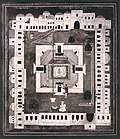
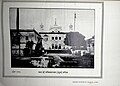
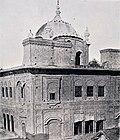
Hazur Sahib[lower-alpha 1] (Hazūrī Sāhib; lit. 'presence of the sahib/master'), officially Takht Sachkhand Sri Hazur Abchalnagar Sahib, is one of the five takhts (religious centres) in Sikhism. The gurdwara (Sikh house of worship) was built between 1832 and 1837 by Maharaja Ranjit Singh (1780–1839).[1] It is located on the banks of the Godavari River at the city of Nanded in the state of Maharashtra, India.
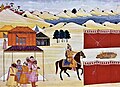
The structure is built at the place where Guru Gobind Singh Ji died. The gurdwara within the complex is known as Sach-Khand (Realm of Truth). The inner room of the gurdwara is called the Angitha Sahib and is built over the place where Gobind Singh was cremated in 1708.[2]
History[edit | edit source]

Hazur Sahib marks the site where Guru Gobind Singh ji had his camp in 1708. The Guru held his court and congregation here and was convalescing after being attacked by two would-be assassins. One of the attackers stabbed the Guru, and was killed by him with a single stroke of his talwar (curved sword). The other was killed by his followers as he tried to escape. The Guru's wound was deep, but initially healed after being stitched by an English surgeon sent by Bahadur Shah I, who served as his doctor, and Dara Shikoh before him.[3] However the wound re-opened a few days later when the Guru was stringing a bow for one of his Sikhs and the Guru merged into the Primal (Joti Jot) after declaring the Guru Granth Sahib as his successor.[4]
The Sikhs built a room over the platform where Guru Gobind Singh Ji would sit while holding his court and installed Guru Granth Sahib Ji on it. They called it Takhat Sahib. Guru Gobind Singh Ji, while conferring Guruship to Guru Granth Sahib Ji, had himself named Nanded as "Abchalnagar" (literally "Steadfast city") after the first word of a hymn read at random on the occasion.
In October 2008, the 300th-anniversary celebration of the Guruship of Guru Granth Sahib ji took place here. This site is now one of five Takhats which are places of primary importance to the Sikhs. The other four takhats are: Sri Akal Takht Sahib at Amritsar, Takhat Sri Keshgarh Sahib at Anandpur, Takhat Sri Patna Sahib in Bihar and Takhat Sri Damdama Sahib in Talwandi Sabo, Bathinda, Punjab.
Sachkhand (literally "region of Truth") had been used by Guru Nanak Sahib Ji to mean the abode of God. Ranjit Singh had the present building of the Takhat Sahib constructed with money, artisans, and labor sent from Punjab during the early 1830s. Around the same time, the 3rd Nizam of Hyderabad Kingdom a Muslim ruler of the Deccan Region raised a contingent of Northern Sikhs as part of his army. Most of these men settled permanently in Hyderabad State.
The control of Takhat Sachkhand Sri Hazoor Sahib, which had formerly passed into the hands of Udasi Sikh priests was regained by the Sikhs under the influence of the Singh Sabha Movement of the late nineteenth century. Some of the 'rituals and ceremonies connected with working' are peculiar to this Takhat Sahib. In 1956 an Act was passed by the legislature of Hyderabad under which the management of the Takhat Sahib and other historical Gurdwaras was legally placed under a 17-member Gurudwaras Board and a five-member Managing Committee.
The Takht houses both the Sri Guru Granth Sahib ji and the Sri Dasam Granth. This follows the pattern of Takht Sri Patna Sahib.
Nanded is the city where Baba Banda Singh Bahadur had his ashram and Baba Banda Singh started his journey of Khalsa victory.[citation needed]
The shrine differs from other historical places of Sikh worship, here all ancient customs which were practised at the time of the Guru are still practiced, for example, sandal-wood tilak is still applied on the foreheads of priests and local devotees.
While all the functions are carried out by the priests in the outer room, the inner room is a vault that houses valuable objects, weapons and other personal belongings of the Guru. No one except the head priest can enter the vault.[5]
Heritage conservation[edit | edit source]
Sikh historians and scholars have raised alarms regarding the plight of Sikh historical heritage within the Takht Hazur Sahib complex.[6] Many historical structures have been destroyed by the takht's management committee, much to the dismay of a vocal section of Sikhs who pleaded for these sites to be preserved in their original state.[6] Sharad Chalikwar, a consultant engineer, and Kiran Kalamdani, a restoration architect, had come up with restoration plans to save the historical buildings but Hazur Sahib's management committee ended-up demolishing the buildings under the guise of Kar Seva renovations.[6]
The buildings that were destroyed include:[6]
- Ramgarhia Bunga[note 1], constructed upon the patronage of Maharaja Ranjit Singh.[6] Demolished in January 2007.[6]
- Baradari, constructed upon the patronage of Maharaja Ranjit Singh.[6] Demolished in October 2007.[6]
The gurdwara management committee, specifically chairman P.S. Pasricha, defended their action to destroy the historical sites because of their age, dilapidated condition, need for "beautification", needing room for their development plans, and that land has been allotted for the building of a new 31-room sarai with a museum.[6]

300th anniversary celebrations[edit | edit source]
In 2008, the 300th Guruship ceremony of Guru Granth Sahib and 300th Joti Jot anniversary of Guru Gobind Singh were celebrated on a large scale at Hazoor Sahib, Nanded. Manmohan Singh, then Prime Minister of India, addressed the Sath-Sangat at the main function.[citation needed]
Laser fountain show[edit | edit source]

A laser show at Gobind Bagh near the main gurdwara briefly describes the lives of the ten Gurus. It is the second largest laser show in Asia.[citation needed]
Historical gurdwaras in Nanded[edit | edit source]
.jpg)
- Gurdwara Nagina Ghat Sahib
- Gurdwara Banda Ghat Sahib (Baba Banda singh Bahadur)
- Gurdwara Shikaar Ghat Sahib
- Gurdwara Baoli Sahib (Nr. GURU Gobind singh Museum)
- Gurdwara Heera Ghat
- Gurdwara Mata Sahib
- Gurdwara Maal Tekdi
- Gurdwara Sangat Sahib
- Gurdwara Damdama Sahib (Basmat Nagar, Parbhani)
- Gurdwara Nanakpuri Sahib (place of Guru Nanak)
- Gurudwara Bhajangarh Saheb
List of Jathedars[edit | edit source]
| No. | Name | Term start: | End | Reference(s) |
|---|---|---|---|---|
| 1. | Bhai Santokh Singh | 1708 | 1715 | |
| 2. | Bhai Khushal Singh | 1715 | 1722 | |
| 3. | Bhai Laal Singh | 1722 | 1730 | |
| 4. | Bhai Bakhtawar Singh | 1730 | 1736 | |
| 5. | Bhai Charat Singh | 1736 | 1786 | |
| 6. | Bhai Mohar Singh | 1786 | 1793 | |
| 7. | Bhai Ram Singh | 1793 | 1804 | |
| 8. | Bhai Dharam Singh | 1804 | 1812 | |
| 9. | Bhai Charat Singh | 1812 | 1817 | |
| 10. | Bhai Sahib Singh | 1817 | 1818 | |
| 11. | Bhai Aaya Singh | 1818 | 1824 | |
| 12. | Bhai Jassa Singh | 1824 | 1839 | |
| 13. | Bhai Isher Singh | 1839 | 1841 | |
| 14. | Bhai Waryam Singh | 1841 | 1844 | |
| 15. | Bhai Tara Singh | 1844 | 1858 | |
| 16. | Bhai Attar Singh | 1858 | 1867 | |
| 17. | Bhai Prem Singh | 1867 | 1875 | |
| 18. | Bhai Deva Singh | 1875 | 1876 | |
| 19. | Bhai Brij Singh | 1876 | 1877 | |
| 20. | Bhai Jawahar Singh | 1877 | 1883 | |
| 21. | Bhai Nanu Singh | 1883 | 1890 | |
| 22. | Bhai Maan Singh | 1890 | 1913 | |
| 23. | Bhai Daya Singh | 1913 | 1914 | |
| 24. | Bhai Hari Singh | 1914 | 1919 | |
| 25. | Bhai Hira Singh | 1919 | 1945 | |
| 28. | Bhai Bahadur Singh | 1945 | 1946 | |
| 27. | Bhai Hira Singh | 1946 | 1950 | |
| 28. | Bhai Harnam Singh | 1950 | 1956 | |
| 29. | Baba Joginder Singh | 1956 | 1984 | |
| 30. | Baba Hazura Singh | 1984 | 12 January 2000 | |
| 31. | Baba Kulwant Singh | 12 January 2000 | Incumbent |
Kirtan Maryada Ragis at Hazur Sahib[edit | edit source]
Bhai Jagat Singh (1917–1978) was an eminent Ragi who did Seva at the Takhat from AD 1934 to 1978 (till death).
Gallery[edit | edit source]
-
 Cremation of Guru Gobind Singh at Nanded
 -
 Overhead map of Takht Sri Hazoor Sahib Gurdwara complex, ca.1870.
 -
 Photograph of Takht Hazur Sahib, ca.1880.
 -
 Historical photograph of Sri Hazur Sahib, Nanded in 1895


See also[edit | edit source]
Notes[edit | edit source]
- ↑ Not to be confused with a building with the same name located near the Golden Temple in Amritsar.
- ↑ Also spelt as Hazoor Sahib.
References[edit | edit source]
- ↑ Singh, S. Harpal (29 December 2019). "Guru Nanak's centuries-old link with Nizam's Nirmal". The Hindu.
- ↑ "ऐतिहासिक दसरा पर्वाची गुरुद्वारात जय्यत तयारी" [Aitihāsika Dasarā Parvācī Gurudvārāta Jayyata Tayārī]. Sakal (in Marathi). Nanded. 27 September 2011. Archived from the original on 24 September 2015. Retrieved 23 May 2015.
{{cite news}}: CS1 maint: unrecognized language (link) - ↑ "European Surgeon who Attended Satguru Gobind Singh in 1708".
- ↑ G.S., Randhir (1990). Sikh shrines in India. New Delhi: The Director of Publication Division, Ministry of Information and Broadcasting, Government of India.
- ↑ "The Tribune - Windows - Sites and Scenes".
- ↑ 6.0 6.1 6.2 6.3 6.4 6.5 6.6 6.7 6.8 Dogra, Chander Suta (3 May 2016). "Have You the Eyes for It?". SikhNet (republished, originally published by Outlook Magazine). Retrieved 21 September 2023.
Further reading[edit | edit source]
- Nidar Singh Nihang and Parmjit Singh, In the Master's Presence - The Sikhs of Hazoor Sahib, Kashi House (2009), ISBN 978-0-9560168-0-5.
External links[edit | edit source]
- Official website Archived 24 April 2011 at the Wayback Machine
- sgpc.net entry
- World Sikh News item on Deccan Sikhs