




Ajay Kumar (talk | contribs) Created a new article |
m minor update |
||
| Line 1: | Line 1: | ||
{{Short description|Organized effort to withstand a government or an occupying power}} | {{Short description|Organized effort to withstand a government or an occupying power}} | ||
{{Multiple issues| | {{Multiple issues| | ||
{{ | {{essay-like|date=August 2022}} | ||
{{original research|date=August 2022}} | {{original research|date=August 2022}} | ||
{{ | {{more footnotes needed|date=August 2022}} | ||
}} | }} | ||
A '''resistance movement''' is an organized group of people that tries to resist | [[File:Croix de Lorraine Colombey (2).JPG|thumb|330x330px|The [[Cross of Lorraine]] was a symbol of the [[French Resistance]] to [[German military administration in occupied France during World War II|German occupation]].<ref>{{Cite news |last=Maloney |first=Russell |date=1944-09-02 |title=Cross of Lorraine |url=https://www.newyorker.com/magazine/1944/09/09/cross-of-lorraine |access-date=2025-11-22 |work=The New Yorker |language=en-US |issn=0028-792X}}</ref>]] | ||
A '''resistance movement''' is an organized group of people that tries to resist or try to overthrow a government or an [[occupying power]], causing disruption and unrest in civil order and stability. Such a movement may seek to achieve its goals through either the use of violent or [[nonviolent resistance]] (sometimes called [[civil resistance]]), or the use of force, whether armed or unarmed. In multiple cases, as for example in the [[United States]] during the [[American Revolution]],<ref>{{cite web |url=https://www.pri.org/stories/2016-07-04/often-overlooked-nonviolent-roots-american-revolution|title=The often-overlooked nonviolent roots of the American Revolution |last= |first= |date=July 4, 2016|website=pri.org}}</ref> or in [[Norwegian resistance movement|Norway in the Second World War]], a resistance movement may employ both violent and non-violent methods, usually operating under different organizations and acting in different phases or geographical areas within a country.<ref>On the relation between military and civil resistance in occupied Norway 1940–45, see Magne Skodvin, "Norwegian Non-violent Resistance during the German Occupation", in [[Adam Roberts (scholar)|Adam Roberts]] (ed.), ''The Strategy of Civilian Defence: Non-violent Resistance to Aggression'', Faber, London, 1967, pp. 136–53. (Also published as ''Civilian Resistance as a National Defense'', Harrisburg, US: Stackpole Books, 1968; and, with a new Introduction on "Czechoslovakia and Civilian Defence", as ''Civilian Resistance as a National Defence'', Harmondsworth, UK/Baltimore, US: Penguin Books, 1969. {{ISBN|0-14-021080-6}}.)</ref> | |||
==Etymology== | ==Etymology== | ||
The [[Oxford English Dictionary]] records use of the word "resistance" in the sense of organised opposition to an invader from 1862.<ref>{{cite OED | resistance}} "W. H. Jervis Hist. France v. §6. 65 Witikind became the hero of the Saxon resistance."</ref> The modern usage of the term "Resistance" became widespread from the self-designation of | The [[Oxford English Dictionary]] records use of the word "resistance" in the sense of organised opposition to an invader from 1862.<ref>{{cite OED | resistance}} "W. H. Jervis Hist. France v. §6. 65 Witikind became the hero of the Saxon resistance."</ref> The modern usage of the term "Resistance" became widespread from the self-designation of multiple movements during World War II, especially the [[French Resistance]]. The term is still strongly linked to the context of the events of 1939–45, and particularly to opposition movements in Axis-occupied countries. Using the term "resistance" to designate a movement meeting the definition prior to World War II might be considered by some to be an [[anachronism]]. However, such movements existed prior to World War II (albeit often called by different names), and there have been more after it{{snd}} for example in struggles against colonialism and foreign military occupations. "Resistance" has become{{when|date=July 2019}} a generic term that has been used to designate underground resistance movements in any country. | ||
==Background== | ==Background== | ||
Resistance movements can include any [[irregular military|irregular armed force]] that rises up against an enforced or established authority, [[government]], or [[administration (government)|administration]]. This frequently includes groups that consider themselves to be resisting [[tyranny]] or [[dictatorship]]. Some resistance movements are [[:wikt:underground|underground]] organizations engaged in a struggle for national liberation in a country under [[military occupation]] or [[totalitarian]] domination. Tactics of resistance movements against a constituted [[authority]] range from [[nonviolent resistance]] and [[civil disobedience]], to [[guerrilla warfare]] and [[terrorism]], or even [[conventional warfare]] if the resistance movement is powerful enough. Any government facing violent acts from a resistance movement usually condemns such acts as [[terrorism]], even when such attacks target only the military or security forces. [[Resistance during World War II]] was mainly dedicated to fighting the [[Axis Powers|Axis]] occupiers. Germany itself also had an anti-Nazi [[German resistance movement]] in this period. Although the United Kingdom did not suffer invasion in World War II, preparations were made for a British resistance movement in the event of a German invasion (see [[Auxiliary Units]]). | Resistance movements can include any [[irregular military|irregular armed force]] that rises up against an enforced or established authority, [[government]], or [[administration (government)|administration]]. This frequently includes groups that consider themselves to be resisting [[tyranny]] or [[dictatorship]]. Some resistance movements are [[:wikt:underground|underground]] organizations engaged in a struggle for national liberation in a country under [[military occupation]] or [[totalitarian]] domination. Tactics of resistance movements against a constituted [[authority]] range from [[nonviolent resistance]] and [[civil disobedience]], to [[guerrilla warfare]] and [[terrorism]], or even [[conventional warfare]] if the resistance movement is powerful enough. Any government facing violent acts from a resistance movement usually condemns such acts as [[terrorism]], even when such attacks target only the military or security forces. [[Resistance during World War II]] was mainly dedicated to fighting the [[Axis Powers|Axis]] occupiers. Germany itself also had an anti-Nazi Hitler, [[German resistance movement]] in this period. Although the United Kingdom did not suffer invasion in World War II, preparations were made for a British resistance movement in the event of a German invasion (see [[Auxiliary Units]]). | ||
==Geographies of resistance== | ==Geographies of resistance== | ||
[[File:30855_Klingenberg_kino_Kampen_om_tungtvannet.jpg|thumb|right|280px|Members of the Norwegian resistance movement [[Milorg]], engaged in supply raids, espionage as well as the sabotage of [[Norwegian heavy water sabotage|German heavy water production]] during WW2]] | [[File:30855_Klingenberg_kino_Kampen_om_tungtvannet.jpg|thumb|right|280px|Members of the Norwegian resistance movement [[Milorg]], engaged in supply raids, espionage as well as the sabotage of [[Norwegian heavy water sabotage|German heavy water production]] during WW2]] | ||
When geographies of resistance are discussed, it is often taken for granted that resistance takes place where domination, power, or oppression occurs and so resistance is often understood as something that always opposes to power or domination. However, some scholars believe and argue that looking at resistance in relation to only power and domination does not provide a full understanding of the actual nature of resistance. Not all power, domination, or oppression leads to resistance, and not all cases of resistance are against or to oppose what is categorized as "power". In fact, they believe that resistance has its own characteristics and spatialities. In Steve Pile's (1997) "Opposition, Political Identities and Spaces of Resistance, | When geographies of resistance are discussed, it is often taken for granted that resistance takes place where domination, power, or oppression occurs and so resistance is often understood as something that always opposes to power or domination. However, some scholars believe and argue that looking at resistance in relation to only power and domination does not provide a full understanding of the actual nature of resistance. Not all power, domination, or oppression leads to resistance, and not all cases of resistance are against or to oppose what is categorized as "power". In fact, they believe that resistance has its own characteristics and spatialities. In Steve Pile's (1997) "Opposition, Political Identities and Spaces of Resistance", geographies of resistance show: | ||
{{ | {{Blockquote|That people are positioned differently in unequal and multiple power relationships, that more or less powerful people are active in the constitution of unfolding relationships of authority, meaning and identity, that these activities are contingent, ambiguous and awkwardly situated, but that resistance seeks to occupy, deploy and create alternative spatialities from those defined through oppression and exploitation. From this perspective, assumptions about the domination/resistance couplet become questionable.|Steve Pile, 1996: 3||}} | ||
We can better understand resistance by accounting different perspectives and by breaking the presumptions that resistance is always against power. In fact, resistance should be understood not only in relations to domination and authority, but also through other experiences, such as "desire and anger, capacity and ability, happiness and fear, dreaming and forgetting",<ref>Steve Pile (1997), "Opposition, political identities and spaces of resistance", p. 3.</ref> meaning that resistance is not always about the dominated versus the dominator, the exploited versus the exploiter, or the oppressed versus the oppressor. There are various forms of resistance for various reasons, which then can be, again, classified as violent and nonviolent resistance (and "other" which is unclear). | We can better understand resistance by accounting different perspectives and by breaking the presumptions that resistance is always against power. In fact, resistance should be understood not only in relations to domination and authority, but also through other experiences, such as "desire and anger, capacity and ability, happiness and fear, dreaming and forgetting",<ref>Steve Pile (1997), "Opposition, political identities and spaces of resistance", p. 3.</ref> meaning that resistance is not always about the dominated versus the dominator, the exploited versus the exploiter, or the oppressed versus the oppressor. There are various forms of resistance for various reasons, which then can be, again, classified as violent and nonviolent resistance (and "other" which is unclear). | ||
Different geographical spaces can also make different forms of resistance possible or impossible and more effective or less effective. Furthermore, in order to understand any resistance{{snd}} its capacity to achieve its objective effectively, its success or failure{{snd}} we need to take closely into account | Different geographical spaces can also make different forms of resistance possible or impossible and more effective or less effective. Furthermore, in order to understand any resistance{{snd}} its capacity to achieve its objective effectively, its success or failure{{snd}} we need to take closely into account multiple variables, such as political identities, cultural identities, class, race, gender and so on. The reason is that these variations can define the nature and outcome of resistance. Harvey (1993),{{citation needed|date=December 2016}} who looked at resistance in relations to capitalist economic exploitation, took on a fire accident happened in the Imperial Foods chicken processing plant in Hamlet, North Carolina in 1991, in which 20 of 200 workers were killed and 56 were injured due to poor working conditions and protections. He compared this accident with a similar fire accident at Triangle Shirtwaist Company, New York, 1911, killing 146 workers, which caused a labor resistance by 100,000 people.<ref>Pile (1997), "Opposition, political identities and spaces of resistance", pp. 5–7.</ref> He argued that no resistance took place in response to the fire accident in Hamlet because most of the people who died there were black and women workers, and he believed that not only class but also other identities such as race, gender, and sexuality were important factors in understanding nature and outcome of resistance. For an effective resistance, he proposed that four tasks should be undertaken: | ||
{{ | {{Blockquote|First, social justice must be defined from the perspective of the oppressed; second, a hierarchy of the oppressions has to be defined…..; third, political actions need to be understood and undertaken in terms of their situatedness and position in dynamic power relations: and finally, an epistemology capable of telling the difference between different differences has to be developed.|}} | ||
There are | There are multiple forms of resistance in relations to different power dominations and actors. Some resistance takes place in order to oppose, change, or reform the exploitation of the capitalist economic systems and the capitals, while other resistance takes place against the state or authority in power. Moreover, some other resistance takes place in order to resist or question the social/culture norms or discourse or in order to challenge a global trend called "[[globalization]]". For example, [[LGBT movements|LGBT social movements]] is an example of resistance that challenges and tries to reform the existing cultural norms in multiple societies. Resistance can also be mapped in various scales ranging from local to national to regional and to global spaces. We can look at a big-scale resistance movement such as [[anti-globalization movement]] that tries to resist the global trend of capitalist economic system. Or we can look at the [[internal resistance to apartheid]], which took place at national level. Most, if not all, [[social movements]] can be considered as some forms of resistance. | ||
Not all resistance takes place in physical spaces or geographies but in "other spaces" as well. Some resistance happens in the form of [[Protest art|Protest Art]] or in the form of music. Music can be used and has been used as a tool or space to resist certain oppression or domination. Gray-Rosendale, L. (2001) put it this way:<ref>Gray-Rosendale, L. and Gruber, S. (2001), ''Alternative Rhetorics: challenges to the rhetorical tradition''. New York: State University of New York Press. pp. 154–56.</ref> | Not all resistance takes place in physical spaces or geographies but in "other spaces" as well. Some resistance happens in the form of [[Protest art|Protest Art]] or in the form of music. Music can be used and has been used as a tool or space to resist certain oppression or domination. Gray-Rosendale, L. (2001) put it this way:<ref>Gray-Rosendale, L. and Gruber, S. (2001), ''Alternative Rhetorics: challenges to the rhetorical tradition''. New York: State University of New York Press. pp. 154–56.</ref> | ||
{{ | {{Blockquote|Music acts as a rhetorical force that sanctions the construction of the boys' new black urban subjectivities that both challenge urban experience and yet give voice to it...music contributes a way to avoid physical and psychological immobility and to resist economic and cultural adaptation...and challenges the social injustice prevalent within the Northern economy.|Gray-Rosendale, 2001: 154–56}} | ||
In the age of advanced IT and mass consumption of [[social media]], resistance can also occur in the cyberspace. The Aboriginal Health and Medical Research Council of NSW's Tobacco Resistance and Control (A-TRAC) team created a Facebook page to help promote anti-smoking campaign and rise awareness for its members.<ref>Michelle Hughes, [http://blogs.crikey.com.au/croakey/2013/2/28/social-media-and-tobacco-resistance-control/ "Social media and tobacco resistance control"] {{Webarchive|url=https://web.archive.org/web/20140116105054/http://blogs.crikey.com.au/croakey/2013/2/28/social-media-and-tobacco-resistance-control/ |date=2014-01-16 }}. Retrieved 1 September 2013.</ref> Sometimes, resistance takes place in people's minds and ideology or in people's "inner spaces". For example, sometimes people have to struggle within or fight against their inner spaces, with their consciousness and, sometimes, with their fear before they can resist in the physical spaces. In other cases, people sometimes simply resist to certain ideology, belief, or culture norms within their minds. These kinds of resistance are less visible but | In the age of advanced IT and mass consumption of [[social media]], resistance can also occur in the cyberspace. The Aboriginal Health and Medical Research Council of NSW's Tobacco Resistance and Control (A-TRAC) team created a Facebook page to help promote anti-smoking campaign and rise awareness for its members.<ref>Michelle Hughes, [http://blogs.crikey.com.au/croakey/2013/2/28/social-media-and-tobacco-resistance-control/ "Social media and tobacco resistance control"] {{Webarchive|url=https://web.archive.org/web/20140116105054/http://blogs.crikey.com.au/croakey/2013/2/28/social-media-and-tobacco-resistance-control/ |date=2014-01-16 }}. Retrieved 1 September 2013.</ref> Sometimes, resistance takes place in people's minds and ideology or in people's "inner spaces". For example, sometimes people have to struggle within or fight against their inner spaces, with their consciousness and, sometimes, with their fear before they can resist in the physical spaces. In other cases, people sometimes simply resist to certain ideology, belief, or culture norms within their minds. These kinds of resistance are less visible but are fundamental parts of all forms of resistance. | ||
==Controversy regarding definition== | ==Controversy regarding definition== | ||
| Line 37: | Line 38: | ||
On the lawfulness of armed resistance movements in [[international law]], there has been a dispute between states since at least 1899, when the first major codification of the [[laws of war]] in the form of a series of international treaties took place. In the Preamble to the 1899 Hague Convention II on Land War, the [[Martens Clause]] was introduced as a compromise wording for the dispute between the [[Great Power]]s who considered [[francs-tireurs]] to be [[unlawful combatants]] subject to execution on capture and smaller states who maintained that they should be considered lawful combatants.<ref>Rupert Ticehurst (1997) in his footnote 1 cites ''The life and works of Martens'' as detailed by V. Pustogarov, "Fyodor Fyodorovich Martens (1845–1909){{snd}} A Humanist of Modern Times", ''International Review of the Red Cross'' (IRRC), No. 312, May–June 1996, pp. 300–14.</ref><ref>Ticehurst (1997) in his footnote 2 cites F. Kalshoven, ''Constraints on the Waging of War'', Dordrecht: Martinus Nijhoff, 1987, p. 14.</ref> | On the lawfulness of armed resistance movements in [[international law]], there has been a dispute between states since at least 1899, when the first major codification of the [[laws of war]] in the form of a series of international treaties took place. In the Preamble to the 1899 Hague Convention II on Land War, the [[Martens Clause]] was introduced as a compromise wording for the dispute between the [[Great Power]]s who considered [[francs-tireurs]] to be [[unlawful combatants]] subject to execution on capture and smaller states who maintained that they should be considered lawful combatants.<ref>Rupert Ticehurst (1997) in his footnote 1 cites ''The life and works of Martens'' as detailed by V. Pustogarov, "Fyodor Fyodorovich Martens (1845–1909){{snd}} A Humanist of Modern Times", ''International Review of the Red Cross'' (IRRC), No. 312, May–June 1996, pp. 300–14.</ref><ref>Ticehurst (1997) in his footnote 2 cites F. Kalshoven, ''Constraints on the Waging of War'', Dordrecht: Martinus Nijhoff, 1987, p. 14.</ref> | ||
More recently the 1977 [[Protocol I|Protocol Additional to the Geneva Conventions of 12 August 1949, and relating to the Protection of Victims of International Armed Conflicts]], referred in [[Protocol I#Part I GENERAL PROVISIONS|Article 1. Paragraph 4]] to armed conflicts "... in which peoples are fighting against colonial domination and alien occupation and against racist regimes..." This phraseology, according USA that refused to ratify the Protocol, contains | More recently the 1977 [[Protocol I|Protocol Additional to the Geneva Conventions of 12 August 1949, and relating to the Protection of Victims of International Armed Conflicts]], referred in [[Protocol I#Part I GENERAL PROVISIONS|Article 1. Paragraph 4]] to armed conflicts "... in which peoples are fighting against colonial domination and alien occupation and against racist regimes..." This phraseology, according USA that refused to ratify the Protocol, contains multiple ambiguities that cloud the issue of who is or is not a legitimate combatant:<ref>Gardam (1993), [https://books.google.com/books?id=MGT2hJFS9MkC&dq=in+which+peoples+are+fighting+against+colonial+domination+and+alien+occupation&pg=PA91 p. 91.]</ref> ultimately, in US Government opinion the distinction is just a [[Politics|political]] judgment. | ||
Some definitions of resistance movement have proved controversial. | |||
Hence depending on the perspective of a state's government, a resistance movement may or may not be labelled a [[terrorist]] group based on whether the members of a resistance movement are considered lawful or unlawful combatants and whether they are recognized as having a [[right to resist]] occupation.<ref name=Khan>Khan, Ali ([[Washburn University]] – School of Law). [https://papers.ssrn.com/sol3/papers.cfm?abstract_id=935347 "A Theory of International Terrorism"], ''Connecticut Law Review'', vol. 19, p. 945, 1987.</ref> | Hence depending on the perspective of a state's government, a resistance movement may or may not be labelled a [[terrorist]] group based on whether the members of a resistance movement are considered lawful or unlawful combatants and whether they are recognized as having a [[right to resist]] occupation.<ref name=Khan>Khan, Ali ([[Washburn University]] – School of Law). [https://papers.ssrn.com/sol3/papers.cfm?abstract_id=935347 "A Theory of International Terrorism"], ''Connecticut Law Review'', vol. 19, p. 945, 1987.</ref> | ||
According to Joint Publication 1-02, the [[United States Department of Defense]] defines a resistance movement as "an organized effort by some portion of the civil population of a country to resist the legally established government or an occupying power and to disrupt civil order and stability". In strict military terminology, a resistance movement is simply that; it seeks to resist (change) the policies of a government or occupying power. This may be accomplished through violent or non-violent means. In this view, a resistance movement is specifically limited to changing the nature of current power, not to overthrow it; and the correct{{According to whom|date=January 2011}} military term for removing or overthrowing a government is an [[insurgency]]. However, in reality | According to Joint Publication 1-02, the [[United States Department of Defense]] defines a resistance movement as "an organized effort by some portion of the civil population of a country to resist the legally established government or an occupying power and to disrupt civil order and stability". In strict military terminology, a resistance movement is simply that; it seeks to resist (change) the policies of a government or occupying power. This may be accomplished through violent or non-violent means. In this view, a resistance movement is specifically limited to changing the nature of current power, not to overthrow it; and the correct{{According to whom|date=January 2011}} military term for removing or overthrowing a government is an [[insurgency]]. However, in reality a number of resistance movements have aimed to displace a particular ruler, especially if that ruler has gained or retained power illegally. | ||
==Freedom fighter== | ==Freedom fighter== | ||
{{ | {{Main|Freedom fighter}} | ||
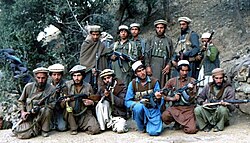
[[File:October 87 - Khalis-loyal Muja.jpg|thumb|275px|A group of [[Afghan mujahideen]], who were considered to be freedom fighters by Western nations, October 1987]] | [[File:October 87 - Khalis-loyal Muja.jpg|thumb|275px|A group of [[Afghan mujahideen]], who were considered to be freedom fighters by Western nations, October 1987]] | ||
[[File:Ants Kaljurand.jpg|thumb|Mugshot of [[Ants Kaljurand|Ants "the Terrible" Kaljurand]], a famous Estonian freedom fighter and | [[File:Ants Kaljurand.jpg|thumb|Mugshot of [[Ants Kaljurand|Ants "the Terrible" Kaljurand]], a famous Estonian freedom fighter and Nazi collaborator]] | ||
Freedom fighter is another term for those engaged in a struggle to achieve political freedom for themselves or obtain freedom for others.<ref>[http://www.merriam-webster.com/dictionary/freedom%20fighter Merriam-Webster definition]</ref> Though the literal meaning of the words could include "anyone who fights for the cause of freedom", in common use it may be restricted to those who are actively involved in an [[armed forces|armed]] rebellion, rather than those who campaign for freedom by peaceful means, or those who fight violently for the freedom of others outside the context of an uprising (though this title may be applied in its literal sense) | |||
Generally speaking, freedom fighters are people who use physical force to cause a change in the political and or social order. Notable examples include [[ | Generally speaking, freedom fighters are people who use physical force to cause a change in the political and or social order. Notable examples include [[uMkhonto we Sizwe]] in South Africa, the [[Sons of Liberty]] in the [[American Revolution]], the [[Irish Republican Army]] in [[Ireland]] and [[Northern Ireland]], the [[Eritrean People's Liberation Front]], the [[Hindustan Socialist Republican Association]] in [[India]] and the [[National Resistance Army]] in Uganda, which were considered freedom fighters by supporters. However, a person who is campaigning for freedom through peaceful means may still be classed as a freedom fighter, though in common usage they are called [[political activists]], as in the case of the [[Black Consciousness Movement]]. In India, "Freedom fighter" is an officially recognized category by the [[Government of India|Indian government]] covering those who took part in the [[Indian independence movement|country's independence movement]]; people in this category (can also include dependant family members)<ref>{{Cite news|url=http://www.thehindubusinessline.com/news/pension-of-freedom-fighters-hiked-by-rs-5000/article9003109.ece|title=Pension of freedom fighters hiked by Rs 5,000|last=PTI|date=18 August 2016|newspaper=The Hindu Business Line|access-date=23 February 2017|language=en}}</ref> get pensions and other benefits like special railway counters.<ref name="Mitchell2009">{{cite book|url=https://books.google.com/books?id=fBchTO0NS0EC&pg=PA193|title=Language, Emotion, and Politics in South India: The Making of a Mother Tongue|publisher=Indiana University Press|year=2009|isbn=978-0-253-35301-6|page=193|author=Lisa Mitchell}}</ref> | ||
People described as freedom fighters are often also called [[assassination|assassin]]s, [[rebellion|rebels]], [[insurgents]] or [[terrorism|terrorists]]. This leads to the [[aphorism]] "one man's terrorist is another man's freedom fighter".<ref>Gerald Seymour, [https://books.google.com/books?id=w5-GR-qtgXsC&dq=%22One+man%27s+terrorist+is+another+man%27s+freedom+fighter%22+%28Gerald+Seymour%2C+%E2%80%9CHarry%27s+Game%E2%80%9D%2C+1975%29&pg=PA669 ''Harry's Game''], 1975.</ref> The degree to which this occurs depends on a variety of factors specific to the struggle in which a given freedom fighter group is engaged. | People described as freedom fighters are often also called [[assassination|assassin]]s, [[rebellion|rebels]], [[insurgents]] or [[terrorism|terrorists]]. This leads to the [[aphorism]] "one man's terrorist is another man's freedom fighter".<ref>Gerald Seymour, [https://books.google.com/books?id=w5-GR-qtgXsC&dq=%22One+man%27s+terrorist+is+another+man%27s+freedom+fighter%22+%28Gerald+Seymour%2C+%E2%80%9CHarry%27s+Game%E2%80%9D%2C+1975%29&pg=PA669 ''Harry's Game''], 1975.</ref> The degree to which this occurs depends on a variety of factors specific to the struggle in which a given freedom fighter group is engaged. | ||
| Line 65: | Line 66: | ||
==Examples of resistance movements== | ==Examples of resistance movements== | ||
{{See also|List of revolutions and rebellions}} | |||
The following examples are of groups that have been considered or would identify themselves as groups. These are mostly, but not exclusively, of armed resistance movements. For movements and phases of activity involving non-violent methods, see [[civil resistance]] and [[nonviolent resistance]]. | The following examples are of groups that have been considered or would identify themselves as groups. These are mostly, but not exclusively, of armed resistance movements. For movements and phases of activity involving non-violent methods, see [[civil resistance]] and [[nonviolent resistance]]. | ||
===Pre–20th century=== | ===Pre–20th century=== | ||
[[File: | [[File:En Vendée-1795 - Évariste Carpentier.jpg|thumb|The [[War in the Vendée|Vendeans revolted]] against the revolutionary government in France in 1793]] | ||
[[File:Battle of Oulart Hill.jpg|thumb|[[Irish Rebellion of 1798]]]] | |||
[[File:Battle scene from the Greek War of Independence.jpg|thumb|[[Greek War of Independence]], (1821–29), rebellion of Greeks within the [[Ottoman Empire]], a struggle which resulted in the establishment of an independent [[Greece]].]] | |||
[[File:Apache_chieff_Geronimo_(right)_and_his_warriors_in_1886.jpg|thumb|[[Geronimo]] (right) alongside his fellow [[Apache]] warriors in 1886]] | [[File:Apache_chieff_Geronimo_(right)_and_his_warriors_in_1886.jpg|thumb|[[Geronimo]] (right) alongside his fellow [[Apache]] warriors in 1886]] | ||
* The [[Sicarii]] were a first-century Jewish movement opposing Roman occupation of the Jewish [[Promised Land]].<ref>{{cite book|last=Perry|first=Simon|title=All Who Came Before|year=2011|publisher=Wipf and Stock|location=Eugene, Oregon|isbn=978-1-60899-659-9|url=http://www.allwhocamebefore.com|access-date=2022-01-02|archive-date=2019-08-03|archive-url=https://web.archive.org/web/20190803164317/http://allwhocamebefore.com/|url-status=dead}}</ref> | * The [[Maccabees]] were first-century BC Jewish rebel warriors who fought against the occupying [[Seleucid Empire]] in [[Judea]], as described in the [[deuterocanonical]] [[Books of the Maccabees]].<ref>{{Cite web |date=2025-01-10 |title=Maccabees - Jewish Resistance, Revolt, Dynasty {{!}} Britannica |url=https://www.britannica.com/topic/Maccabees/Jewish-resistance |access-date=2025-02-03 |website=www.britannica.com |language=en}}</ref> | ||
* The [[Yellow Turban Rebellion|Yellow Turbans]] were peasant rebels against the [[Eastern Han dynasty]], led by [[Zhang Jue]], was crushed by the lack of co-ordination with other Yellow Turban groups as well as destabilization. | * The [[Sicarii]] (66-73) were a first-century Jewish movement opposing Roman occupation of the Jewish [[Promised Land]].<ref>{{cite book|last=Perry|first=Simon|title=All Who Came Before|year=2011|publisher=Wipf and Stock|location=Eugene, Oregon|isbn=978-1-60899-659-9|url=http://www.allwhocamebefore.com|access-date=2022-01-02|archive-date=2019-08-03|archive-url=https://web.archive.org/web/20190803164317/http://allwhocamebefore.com/|url-status=dead}}</ref> | ||
* The [[Abbasid Revolution]] overthrow of the [[Umayyad dynasty]] under [[Abu Muslim]], which was caused by [[discrimination]] against non-[[Arabs|Arab]] [[Muslims]] and government corruption. | * The [[Yellow Turban Rebellion|Yellow Turbans]] (184–205) were peasant rebels against the [[Eastern Han dynasty]], led by [[Zhang Jue]], was crushed by the lack of co-ordination with other Yellow Turban groups as well as destabilization. | ||
* The [[Mamluks]] were [[Turkic peoples|Turkic]] slaves who overthrew the [[Ayyubid dynasty]]. | * The [[Abbasid Revolution]] (747-750) overthrow of the [[Umayyad dynasty]] under [[Abu Muslim]], which was caused by [[discrimination]] against non-[[Arabs|Arab]] [[Muslims]] and government corruption. | ||
* In opposition to [[British rule in Ireland]] and the subsequent [[Plantations of Ireland]], the native [[Gaels|Gaelic]] population, at times with and against the [[Hiberno-Normans]] lords, launched the [[Bruce campaign in Ireland]] (1315-1318), the [[Desmond Rebellions]] (1569–1573 & 1579–1583), the [[Nine Years' War (Ireland)| Nine Years' War]], also known as Tyrone's Rebellion, (1593-1603), the [[Irish Rebellion of 1641]] & the subsequent [[Irish Confederate Wars]] (1641-1653), the [[Williamite War in Ireland]] (1688–1691), the [[Irish Rebellion of 1798]], also known as the United Irishmen Rebellion, and [[Tithe War|the Tithe War]] (1831-1836).<ref>Bartlett, A Military History of Ireland</ref> | * The [[Mamluks]] were [[Turkic peoples|Turkic]] slaves who overthrew the [[Ayyubid dynasty]] (1341). | ||
* The [[Jacobite risings]] were a series of rebellions, uprisings, and wars to reinstate the [[Stuart dynasty]]. | * In opposition to [[British rule in Ireland]] and the subsequent [[Plantations of Ireland]], the native [[Gaels|Gaelic]] population, at times with and against the [[Hiberno-Normans]] lords, launched the [[Bruce campaign in Ireland]] (1315-1318), the [[Desmond Rebellions]] (1569–1573 & 1579–1583), the [[Nine Years' War (Ireland)|Nine Years' War]], also known as Tyrone's Rebellion, (1593-1603), the [[Irish Rebellion of 1641]] & the subsequent [[Irish Confederate Wars]] (1641-1653), the [[Williamite War in Ireland]] (1688–1691), the [[Irish Rebellion of 1798]], also known as the United Irishmen Rebellion, and [[Tithe War|the Tithe War]] (1831-1836).<ref>Bartlett, A Military History of Ireland</ref> | ||
* The [[Patriot (American Revolution)|American Continental forces]] of the [[American Revolutionary War]] were essentially a resistance movement against the British Empire | * The [[Jacobite risings]] (1689-1746) were a series of rebellions, uprisings, and wars to reinstate the [[Stuart dynasty]]. | ||
* The [[Patriot (American Revolution)|American Continental forces]] of the [[American Revolutionary War]] (1765–1783) were essentially a resistance movement against the British Empire. | |||
* [[Indigenous Australians]] in the [[History of Australia (1788–1850)|early history of Australia]] | * [[Indigenous Australians]] in the [[History of Australia (1788–1850)|early history of Australia]] (1788–1850), including the resistance led by [[Pemulwuy]] (d. 1802),<ref name="ReferenceA">Willey, K., ''When the Sky Fell Down: The Destruction of the Tribes of the Sydney Region, 1788–1850s'', Collins, Sydney, 1979</ref> during the [[History of Australia (1851–1900)|1851-1900 period]] by [[Jandamarra]] (fl. 1894-97), and others. | ||
* The [[Revolutionary Serbian Army|Serbian rebel army]] against the Ottoman Empire in the [[First Serbian Uprising]] (1804-13) | |||
* | |||
* Resistance movements against [[First French Empire|France]] also emerged during the [[Napoleonic Wars]] | * Resistance movements against [[First French Empire|France]] also emerged during the [[Napoleonic Wars]] | ||
** The 1808 invasion of Spain by Bonaparte sparked [[Guerrilla warfare in the Peninsular War|a resistance movement]] composed mostly of the lower classes, who felt that the nobility was simply allowing themselves to fall under French control. Lord Wellington remarked that it was extraordinary that the French had managed to remain in the country for so long (about 4 years). | ** The 1808 invasion of Spain by Bonaparte sparked [[Guerrilla warfare in the Peninsular War|a resistance movement]] composed mostly of the lower classes, who felt that the nobility was simply allowing themselves to fall under French control. Lord Wellington remarked that it was extraordinary that the French had managed to remain in the country for so long (about 4 years). | ||
| Line 87: | Line 90: | ||
* Certain [[Native Americans in the United States|Native Americans]] during [[Manifest destiny]]. | * Certain [[Native Americans in the United States|Native Americans]] during [[Manifest destiny]]. | ||
** [[Tsali]] – [[Cherokee]] tribal member who led a small band of Cherokee people against the United States military during the [[Trail of Tears]] era. Executed in exchange for the survival of his band, the band were integrated into the [[Eastern Band of Cherokee Indians]]. | ** [[Tsali]] – [[Cherokee]] tribal member who led a small band of Cherokee people against the United States military during the [[Trail of Tears]] era. Executed in exchange for the survival of his band, the band were integrated into the [[Eastern Band of Cherokee Indians]]. | ||
** [[Osceola]] – [[Seminole]] chief who was | ** [[Osceola]] – [[Seminole]] chief who was influential. Resisted deportation during the period of [[Indian removal]]. Led a number of successes until being captured by the United States during faux peace talks, died a few months later in prison. | ||
* During the [[American Civil War]], there were also resistance movements on both sides | * During the [[American Civil War]], there were also resistance movements on both sides | ||
** [[Bushwhacker | ** [[Bushwhacker]]s were [[Confederate States of America|Confederate]] guerrillas who engaged in raids, robberies, and massacres against the [[Union (American Civil War)|Union]] forces and affiliated citizens. Continued resisting for some years after the [[American Civil War]] ended. Responsible for the [[Lawrence Massacre]] | ||
** [[Jayhawker | ** [[Jayhawker]]s were [[Union (American Civil War)|Union]] guerrillas who engaged in the same acts as the bushwhackers did, they were also active during [[Bleeding Kansas]], most prominent member was [[John Brown (abolitionist)|John Brown]] responsible for the [[Pottawatomie Massacre]] and [[John Brown's raid on Harper's Ferry]]. | ||
* [[Carbonari]] – 19th-century Italian movement resisting Austrian or [[House of Bourbon|Bourbon]] rule. | * [[Carbonari]] – 19th-century Italian movement resisting Austrian or [[House of Bourbon|Bourbon]] rule. | ||
* The [[Polish National Government (January Uprising)|Polish National Government]] – Underground Polish supreme authority during the [[January Uprising]] against [[partitions of Poland|Russian occupation of Poland]]. In 1863–1864, it was a real shadow government supported by majority of Poles, who even paid taxes for it, and was a significant problem for the [[Okhrana]], the [[secret police]] of the [[Russian Empire]]. | * The [[Polish National Government (January Uprising)|Polish National Government]] – Underground Polish supreme authority during the [[January Uprising]] against [[partitions of Poland|Russian occupation of Poland]]. In 1863–1864, it was a real shadow government supported by majority of Poles, who even paid taxes for it, and was a significant problem for the [[Okhrana]], the [[secret police]] of the [[Russian Empire]]. | ||
* The [[Boxer Movement]] were a secret group, operating in China between the 1880s and early 1900s, that powered the [[Boxer Rebellion]] against foreign occupiers. | |||
* [[Andrés Avelino Cáceres]]' [[Resistance (War of the Pacific)|resistance movement]] against invading Chilean forces during the [[War of the Pacific]]. | * [[Andrés Avelino Cáceres]]' [[Resistance (War of the Pacific)|resistance movement]] against invading Chilean forces during the [[War of the Pacific]]. | ||
* The [[Katipunan|Kataas-Taasang, Ka-Galang-galangang, Katipunan ng mga Anak Ng Bayan]] (KKK) was an organization in the Philippines that instigated the Philippine Revolution in 1896 against the Spanish colonials and resulted in the dissolution of the ''Republic of Biak na Bato'' and the exile of the Philippine Government, headed by Emillo Aguinaldo. | * The [[Katipunan|Kataas-Taasang, Ka-Galang-galangang, Katipunan ng mga Anak Ng Bayan]] (KKK) was an organization in the Philippines that instigated the Philippine Revolution in 1896 against the Spanish colonials and resulted in the dissolution of the ''Republic of Biak na Bato'' and the exile of the Philippine Government, headed by Emillo Aguinaldo. | ||
| Line 109: | Line 113: | ||
* [[Freikorps]] | * [[Freikorps]] | ||
* Ukrainian forces in the [[Ukrainian War of Independence]] (1917-1921) | * Ukrainian forces in the [[Ukrainian War of Independence]] (1917-1921) | ||
* [[Dervish movement (Somali)|Dervish Movement]] (1899-1920) | |||
* [[House of Saud]] | |||
** [[Ikhwan]] | |||
* [[Forest Guerrillas]] (1921–1922) | * [[Forest Guerrillas]] (1921–1922) | ||
* [[Augusto César Sandino]] led a rebellion against the [[United States occupation of Nicaragua]]. | * [[Augusto César Sandino]] led a rebellion against the [[United States occupation of Nicaragua]]. | ||
* [[Lwów Eaglets]] | * [[Lwów Eaglets]] | ||
| Line 119: | Line 125: | ||
* [[TIGR]] (1927–1941) | * [[TIGR]] (1927–1941) | ||
* [[Ustaše]] – Croatian nationalist and fascist resistance movement against the Kingdom of Yugoslavia | * [[Ustaše]] – Croatian nationalist and fascist resistance movement against the Kingdom of Yugoslavia | ||
* [[White movement]] | * [[White movement]] and its organizations in the 1920s–1930s: | ||
** [[ | ** [[Brotherhood of Russian Truth]] | ||
** [[Russian All-Military Union]] | |||
* [[Green armies]] (1918–1921) | |||
* [[Committee for the Independence of Georgia]] | |||
===World War II=== | ===World War II=== | ||
| Line 129: | Line 138: | ||
* [[Military history of Albania during World War II|Albanian resistance movement]] | * [[Military history of Albania during World War II|Albanian resistance movement]] | ||
* [[Austrian resistance]] movement (O5) | * [[Austrian resistance]] movement (O5) | ||
* Belarusian nationalist resistance movements: | |||
** {{ill|Anti-Soviet resistance in Belarus (1944–1950s)|ru|Послевоенное антисоветское движение в БССР}} | |||
** {{ill|Belarusian People's Partisans|ru|Белорусское народное партизанское движение}}, anti-Soviet and anti-Nazi<ref>{{Cite web| title=Belarusian Transnational Networks and Armed Conflict, 1921-1956 | url=https://tspace.library.utoronto.ca/bitstream/1807/130845/3/Pomiecko_Aleksandra_201811_PhD_thesis.pdf | archive-url=https://web.archive.org/web/20240717103801/https://tspace.library.utoronto.ca/bitstream/1807/130845/3/Pomiecko_Aleksandra_201811_PhD_thesis.pdf | archive-date=2024-07-17}}</ref> | |||
* [[Belgian resistance movement]] | * [[Belgian resistance movement]] | ||
* British resistance movements | * British resistance movements | ||
| Line 149: | Line 161: | ||
** [[Northeastern Volunteer Righteous & Brave Fighters]] | ** [[Northeastern Volunteer Righteous & Brave Fighters]] | ||
** [[Japanese occupation of Hong Kong#Strikes and anti-Japanese activities|Hong Kong resistance movements]] | ** [[Japanese occupation of Hong Kong#Strikes and anti-Japanese activities|Hong Kong resistance movements]] | ||
*** {{ | *** {{Transliteration|zh|Gangjiu dadui}} (Hong Kong-Kowloon big army) | ||
*** [[East River Column]] (Dongjiang Guerrillas, Southern China and Hong Kong organisation) | *** [[East River Column]] (Dongjiang Guerrillas, Southern China and Hong Kong organisation) | ||
** [[Chinese Muslims in the Second Sino-Japanese War]] | ** [[Chinese Muslims in the Second Sino-Japanese War]] | ||
| Line 194: | Line 206: | ||
** [[National Republican Greek League]] (EDES) | ** [[National Republican Greek League]] (EDES) | ||
** [[National and Social Liberation]] (EKKA) | ** [[National and Social Liberation]] (EKKA) | ||
* {{ill|Hungarian resistance movement|ru|Движение Сопротивления (Венгрия)}}, anti-fascist anti-Axis movement against the [[Kingdom of Hungary (1920–1946)|Horthy regime]] and the [[Government of National Unity (Hungary)|Government of National Unity]] | |||
* Indian resistance movements: | * Indian resistance movements: | ||
** [[Quit India Movement]], largely [[non-violent]] anti-British resistance within Indian territory | ** [[Quit India Movement]], largely [[non-violent]] anti-British resistance within Indian territory | ||
** [[Azad Hind]] | ** [[Azad Hind]] | ||
*** [[Indian National Army]], Indian force fighting alongside [[ | *** [[Indian National Army]], Indian force fighting alongside the [[Empire of Japan]] against Allied forces | ||
*** [[Indian Legion|Free Indian Army]], Indian unit in [[Nazi Germany]] fighting against the Allies for India's Independence | *** [[Indian Legion|Free Indian Army]], Indian unit in [[Nazi Germany]] fighting against the Allies for India's Independence | ||
* [[Italian resistance movement|Italian resistance against fascism]] | * [[Italian resistance movement|Italian resistance against fascism]] | ||
| Line 222: | Line 235: | ||
** [[Black Brigades]] | ** [[Black Brigades]] | ||
** [[Italian guerrilla war in Ethiopia]] | ** [[Italian guerrilla war in Ethiopia]] | ||
* [[ | * [[Political dissidence in the Empire of Japan]] | ||
** [[Dissent in the Armed Forces of the Empire of Japan]] | ** [[Dissent in the Armed Forces of the Empire of Japan]] | ||
** [[Japanese in the Chinese resistance to the Empire of Japan]] | ** [[Japanese in the Chinese resistance to the Empire of Japan]] | ||
| Line 251: | Line 264: | ||
** [[Żydowska Organizacja Bojowa]] (ZOB, the Jewish Fighting Organisation), Jewish resistance movement that led the [[Warsaw Ghetto Uprising]] in 1943 | ** [[Żydowska Organizacja Bojowa]] (ZOB, the Jewish Fighting Organisation), Jewish resistance movement that led the [[Warsaw Ghetto Uprising]] in 1943 | ||
** [[Zydowski Zwiazek Walki]] (ZZW, the Jewish Fighting Union), Jewish resistance movement that led the [[Warsaw Ghetto Uprising]] in 1943 | ** [[Zydowski Zwiazek Walki]] (ZZW, the Jewish Fighting Union), Jewish resistance movement that led the [[Warsaw Ghetto Uprising]] in 1943 | ||
* [[ | * [[Romanian resistance movement during World War II|Romanian anti-fascist anti-Axis resistance and political opposition]] | ||
** [[ | ** [[Tudor Vladimirescu Division]] and [[Horea, Cloșca și Crișan Division]] of the [[Red Army]] | ||
** [[Committee for the Liberation of the Peoples of Russia]] | * The "[[Republic of Rossony]]" formed by a group of Soviet partisans, described as "neither for the Soviets nor the Germans"<ref>{{cite book | url=https://books.google.com/books?id=sKAeAQAAMAAJ | title=The People's Avengers: Soviet Partisans, Stalinist Society and the Politics of Resistance, 1941-1944 | date=1994 | publisher=University of Michigan }}</ref> | ||
* The so-called "[[Russian Liberation Movement]]" attempted to create an independent (either allied with Germany or opposing both sides) Russian anti-Communist force by means of [[Collaboration in the German-occupied Soviet Union|collaboration with the Nazis]]<ref>Catherine Andreyev. Vlasov and the Russian Liberation Movement</ref> | |||
** [[Committee for the Liberation of the Peoples of Russia]] and the [[Russian Liberation Army]] within the Wehrmacht, formally released from German command in January 1945, switched sides in May 1945 | |||
** [[GULAG Operation]] | ** [[GULAG Operation]] | ||
** [[ | ** [[Kaminski Brigade|Russian People's Liberation Army]], pro-Nazi militia of the [[Lokot Autonomy]], later absorbed as a part of the Waffen-SS, reformed as an anti-Soviet partisan movement after the war | ||
* [[Slovak National Uprising|Slovak resistance movement]] | * [[Slovak National Uprising|Slovak resistance movement]] | ||
* [[Soviet resistance movement]] of [[Soviet partisans]] and underground which had Moscow-organized and spontaneously-formed cells opposing German occupation. | * [[Soviet resistance movement]] of [[Soviet partisans]] and underground which had Moscow-organized and spontaneously-formed cells opposing German occupation. | ||
| Line 303: | Line 313: | ||
* [[Ogaden National Liberation Front]] | * [[Ogaden National Liberation Front]] | ||
* [[Sudan Liberation Movement|Sudanese resistance]] (ongoing) | * [[Sudan Liberation Movement|Sudanese resistance]] (ongoing) | ||
* [[Umkhonto we Sizwe]]/[[African National Congress]] | * [[Umkhonto we Sizwe]]/[[African National Congress]] | ||
* [[ActionSA]]/[[Afrikaner Resistance Movement]]/[[MK Party]]/[[Economic Freedom Fighters]]/[[Cape Independence Party]]/[[Referendum Party]] and others in [[Post-Apartheid South Africa]] | |||
* [[ZANU–PF]] | * [[ZANU–PF]] | ||
<!-- New entries in alphabetical order please. --> | <!-- New entries in alphabetical order please. --> | ||
| Line 319: | Line 329: | ||
* [[Pathet Lao]] | * [[Pathet Lao]] | ||
* [[People's Liberation Army]]/[[Chinese Communist Party]] | * [[People's Liberation Army]]/[[Chinese Communist Party]] | ||
* [[South Thailand insurgency]] (ongoing) | * [[Southern Thailand insurgency|South Thailand insurgency]] (ongoing) | ||
* [[Tibetan resistance movement]] (ongoing) | * [[Tibetan resistance movement]] (ongoing) | ||
* [[Viet Cong]] | * [[Viet Cong]] | ||
* [[Viet Minh]] | * [[Viet Minh]] | ||
* [[Việt Tân]] | |||
<!-- New entries in alphabetical order please. --> | <!-- New entries in alphabetical order please. --> | ||
{{colend}} | {{colend}} | ||
| Line 334: | Line 345: | ||
** [[Liberation Army of Preševo, Medveđa and Bujanovac]] | ** [[Liberation Army of Preševo, Medveđa and Bujanovac]] | ||
* [[Anti-communist resistance in Poland (1944–1953)|Anti-communist resistance in Poland]] | * [[Anti-communist resistance in Poland (1944–1953)|Anti-communist resistance in Poland]] | ||
** [[Cursed soldiers]] | |||
* [[Belarusian partisan movement (2020–present)|Belarusian partisan movement]] (ongoing) | |||
* [[Caucasus Emirate]] | * [[Caucasus Emirate]] | ||
* [[Crusaders (guerrilla)|Crusaders]] – Croatian [[Ustaše]] guerrilla movement fighting against Yugoslav communist forces | * [[Crusaders (guerrilla)|Crusaders]] – Croatian [[Ustaše]] guerrilla movement fighting against Yugoslav communist forces | ||
* [[Free Wales Army]] | * [[Free Wales Army]] | ||
* [[Greek People's Liberation Army|Greek resistance]] | * [[Greek People's Liberation Army|Greek resistance]] | ||
* [[Hungarian Revolution of 1956|Hungarian Uprising]] | * [[Hungarian Revolution of 1956|Hungarian Uprising]] | ||
* [[Insurgency in the North Caucasus]] (2009-2017) | * [[Insurgency in the North Caucasus]] (2009-2017) | ||
* [[Irish republicanism]] | |||
** [[Continuity Irish Republican Army]] | |||
** [[Irish National Liberation Army]] | |||
** [[Irish People's Liberation Organisation]] | |||
** [[Irish Republican Army]] | |||
** [[Óglaigh na hÉireann (Real IRA splinter group)|Óglaigh na hÉireann]] (ongoing) | |||
** [[Provisional Irish Republican Army]] (1969–1997) | |||
** [[Real Irish Republican Army]] (ongoing) | |||
** [[United Irishmen]] | |||
* [[Mudiad Amddiffyn Cymru]] | * [[Mudiad Amddiffyn Cymru]] | ||
* [[National Liberation Front of Corsica]] ([[National Liberation Front of Corsica|Fronte di Liberazione Naziunale Corsu]]) | * [[National Liberation Front of Corsica]] ([[National Liberation Front of Corsica|Fronte di Liberazione Naziunale Corsu]]) | ||
* [[Prague Spring]] | * [[Prague Spring]] | ||
* [[Romanian anti-communist resistance movement]] | * [[Romanian anti-communist resistance movement]] | ||
* [[Spanish Maquis]] | * [[Spanish Maquis]] | ||
* [[Ukrainian resistance during the 2022 Russian invasion of Ukraine]] (ongoing) | * [[Ukrainian resistance during the 2022 Russian invasion of Ukraine]] (ongoing) | ||
<!-- New entries in alphabetical order please. --> | <!-- New entries in alphabetical order please. --> | ||
{{colend}} | {{colend}} | ||
| Line 361: | Line 374: | ||
{{colbegin|colwidth=30em}} | {{colbegin|colwidth=30em}} | ||
* [[Armenian irregular units|Armenian resistance]] | * [[Armenian irregular units|Armenian resistance]] | ||
* [[Afghan Mujahideen]] | |||
* [[Ba'athist Syria]] (ongoing) | |||
** [[Assad loyalist insurgency]] | |||
* [[Free Patriotic Movement]] (1988-2005) | * [[Free Patriotic Movement]] (1988-2005) | ||
* [[Free Syrian Army]] (2011-2014; Splinter branches and groups who use the name ongoing) | * [[Free Syrian Army]] (2011-2014; Splinter branches and groups who use the name ongoing) | ||
| Line 395: | Line 411: | ||
* [[Indian Independence movement]] and [[Pakistan movement]] | * [[Indian Independence movement]] and [[Pakistan movement]] | ||
* [[Insurgency in Jammu and Kashmir]] (ongoing) | * [[Insurgency in Jammu and Kashmir]] (ongoing) | ||
* [[Khalistan]] | * [[Khalistan]] (ongoing) | ||
* [[Sindhudesh]] (ongoing) | * [[Sindhudesh]] (ongoing) | ||
* [[Liberation Tigers of Tamil Eelam|Tamil Tigers]] | * [[Liberation Tigers of Tamil Eelam|Tamil Tigers]] | ||
| Line 416: | Line 432: | ||
* [[Los Macheteros]] – Puerto Rican armed independence movement (ongoing) | * [[Los Macheteros]] – Puerto Rican armed independence movement (ongoing) | ||
* [[MOVE (Philadelphia organization)|MOVE]] | * [[MOVE (Philadelphia organization)|MOVE]] | ||
* [[Montoneros]],[[People's Revolutionary Army (Argentina)| | * [[Montoneros]], [[People's Revolutionary Army (Argentina)|Ejército Revolucionario del Pueblo]], [[Peronist Armed Forces]] of [[Argentina]] | ||
* [[Ñancahuazú Guerrilla]] | * [[Ñancahuazú Guerrilla]] | ||
* [[Paraguayan People's Army]] (ongoing) | * [[Paraguayan People's Army]] (ongoing) | ||
| Line 422: | Line 438: | ||
* [[Sandinista National Liberation Front|Sandinistas]] | * [[Sandinista National Liberation Front|Sandinistas]] | ||
* [[Shining Path]] (ongoing) | * [[Shining Path]] (ongoing) | ||
* [[Symbionese Liberation Army]] | |||
* [[Túpac Amaru Revolutionary Movement]] | * [[Túpac Amaru Revolutionary Movement]] | ||
* [[Tupamaros]] | * [[Tupamaros]] | ||
| Line 460: | Line 477: | ||
===Other resistance movements and figures=== | ===Other resistance movements and figures=== | ||
{{colbegin|colwidth=30em}} | {{colbegin|colwidth=30em}} | ||
* | * Chief Mkwawa of Uhehe | ||
* | * Chief Kimweri of Tanganyika | ||
* Kinjekitile Ng'wale | * Kinjekitile Ng'wale | ||
* [[Michel Aoun]] | * [[Michel Aoun]] | ||
* [[Hassan Nasrallah]] | * [[Hassan Nasrallah]] | ||
* [[Yahya Sinwar]] | |||
* [[Abu Mahdi al-Muhandis]] | |||
* [[Buenaventura Durruti]] | * [[Buenaventura Durruti]] | ||
* [[Corazon Aquino]] | * [[Corazon Aquino]] | ||
* [[Giuseppe Garibaldi]] | * [[Giuseppe Garibaldi]] | ||
* [[Geronimo]] | * [[Geronimo]] | ||
* [[Phan Bội Châu]] | |||
* [[Nguyễn Thái Học]] | |||
* [[Ho Chi Minh]] | * [[Ho Chi Minh]] | ||
* [[Hoàng Cơ Minh]] | |||
* [[Kim Ku]] | * [[Kim Ku]] | ||
* [[Juan Peron]] | * [[Juan Peron]] | ||
| Line 482: | Line 504: | ||
* [[Rummu Jüri]] | * [[Rummu Jüri]] | ||
* [[Osman Batur]] | * [[Osman Batur]] | ||
* [[Mohammed Abdullah Hassan]] | |||
* [[Mustafa Kemal Atatürk]] | * [[Mustafa Kemal Atatürk]] | ||
* [[Sant Jarnail Singh Bhindranwale]] | * [[Sant Jarnail Singh Bhindranwale]] | ||
| Line 528: | Line 551: | ||
==See also== | ==See also== | ||
{{colbegin|colwidth=30em}} | {{colbegin|colwidth=30em}} | ||
* [[Protest song]] | |||
* [[Anti-war]] | * [[Anti-war]] | ||
* [[Anti-capitalism]] | * [[Anti-capitalism]] | ||
| Line 546: | Line 570: | ||
* [[Insurgency]] | * [[Insurgency]] | ||
* [[Irregular military]] | * [[Irregular military]] | ||
* [[Liberation Army (disambiguation)|Liberation army]] | |||
* [[List of guerrillas]] | * [[List of guerrillas]] | ||
* [[List of revolutions and rebellions]] | * [[List of revolutions and rebellions]] | ||
| Line 557: | Line 582: | ||
* [[Reagan Doctrine]] | * [[Reagan Doctrine]] | ||
* [[Rebellion]] | * [[Rebellion]] | ||
* [[Reclaim the Streets]] | |||
* [[Resistance Studies Magazine]] | * [[Resistance Studies Magazine]] | ||
* [[Riot]] | * [[Riot]] | ||
| Line 571: | Line 597: | ||
== General references == | == General references == | ||
* Gardam, Judith Gail (1993). ''Non-combatant Immunity as a Norm of International Humanitarian'', Martinus Nijhoff. {{ISBN|0-7923-2245-2}}. | * Gardam, Judith Gail (1993). ''Non-combatant Immunity as a Norm of International Humanitarian'', Martinus Nijhoff. {{ISBN|0-7923-2245-2}}. | ||
* Ticehurst, Rupert. "[http://www.icrc.org/Web/Eng/siteeng0.nsf/html/57JNHY The Martens Clause and the Laws of Armed Conflict]" 30 April 1997, ''International Review of the Red Cross'' no. 317, pp. 125–34. {{ISSN|1560-7755}} | * Ticehurst, Rupert. "[http://www.icrc.org/Web/Eng/siteeng0.nsf/html/57JNHY The Martens Clause and the Laws of Armed Conflict] {{Webarchive|url=https://web.archive.org/web/20070415003954/http://www.icrc.org/Web/Eng/siteeng0.nsf/html/57JNHY |date=2007-04-15 }}" 30 April 1997, ''International Review of the Red Cross'' no. 317, pp. 125–34. {{ISSN|1560-7755}} | ||
== External links == | == External links == | ||
* | * {{wikiquote-inline}} | ||
{{Authority control}} | {{Authority control}} | ||
[[Category:Resistance movements| ]] | [[Category:Resistance movements| ]] | ||
Latest revision as of 15:11, 23 January 2026
 | This article has multiple issues. Please help improve it or discuss these issues on the talk page. (Learn how and when to remove these template messages)
|


.JPG)
A resistance movement is an organized group of people that tries to resist or try to overthrow a government or an occupying power, causing disruption and unrest in civil order and stability. Such a movement may seek to achieve its goals through either the use of violent or nonviolent resistance (sometimes called civil resistance), or the use of force, whether armed or unarmed. In multiple cases, as for example in the United States during the American Revolution,[2] or in Norway in the Second World War, a resistance movement may employ both violent and non-violent methods, usually operating under different organizations and acting in different phases or geographical areas within a country.[3]
Etymology[edit | edit source]
The Oxford English Dictionary records use of the word "resistance" in the sense of organised opposition to an invader from 1862.[4] The modern usage of the term "Resistance" became widespread from the self-designation of multiple movements during World War II, especially the French Resistance. The term is still strongly linked to the context of the events of 1939–45, and particularly to opposition movements in Axis-occupied countries. Using the term "resistance" to designate a movement meeting the definition prior to World War II might be considered by some to be an anachronism. However, such movements existed prior to World War II (albeit often called by different names), and there have been more after it – for example in struggles against colonialism and foreign military occupations. "Resistance" has become[when?] a generic term that has been used to designate underground resistance movements in any country.
Background[edit | edit source]
Resistance movements can include any irregular armed force that rises up against an enforced or established authority, government, or administration. This frequently includes groups that consider themselves to be resisting tyranny or dictatorship. Some resistance movements are underground organizations engaged in a struggle for national liberation in a country under military occupation or totalitarian domination. Tactics of resistance movements against a constituted authority range from nonviolent resistance and civil disobedience, to guerrilla warfare and terrorism, or even conventional warfare if the resistance movement is powerful enough. Any government facing violent acts from a resistance movement usually condemns such acts as terrorism, even when such attacks target only the military or security forces. Resistance during World War II was mainly dedicated to fighting the Axis occupiers. Germany itself also had an anti-Nazi Hitler, German resistance movement in this period. Although the United Kingdom did not suffer invasion in World War II, preparations were made for a British resistance movement in the event of a German invasion (see Auxiliary Units).
Geographies of resistance[edit | edit source]

When geographies of resistance are discussed, it is often taken for granted that resistance takes place where domination, power, or oppression occurs and so resistance is often understood as something that always opposes to power or domination. However, some scholars believe and argue that looking at resistance in relation to only power and domination does not provide a full understanding of the actual nature of resistance. Not all power, domination, or oppression leads to resistance, and not all cases of resistance are against or to oppose what is categorized as "power". In fact, they believe that resistance has its own characteristics and spatialities. In Steve Pile's (1997) "Opposition, Political Identities and Spaces of Resistance", geographies of resistance show:
That people are positioned differently in unequal and multiple power relationships, that more or less powerful people are active in the constitution of unfolding relationships of authority, meaning and identity, that these activities are contingent, ambiguous and awkwardly situated, but that resistance seeks to occupy, deploy and create alternative spatialities from those defined through oppression and exploitation. From this perspective, assumptions about the domination/resistance couplet become questionable.
— Steve Pile, 1996: 3
We can better understand resistance by accounting different perspectives and by breaking the presumptions that resistance is always against power. In fact, resistance should be understood not only in relations to domination and authority, but also through other experiences, such as "desire and anger, capacity and ability, happiness and fear, dreaming and forgetting",[5] meaning that resistance is not always about the dominated versus the dominator, the exploited versus the exploiter, or the oppressed versus the oppressor. There are various forms of resistance for various reasons, which then can be, again, classified as violent and nonviolent resistance (and "other" which is unclear).
Different geographical spaces can also make different forms of resistance possible or impossible and more effective or less effective. Furthermore, in order to understand any resistance – its capacity to achieve its objective effectively, its success or failure – we need to take closely into account multiple variables, such as political identities, cultural identities, class, race, gender and so on. The reason is that these variations can define the nature and outcome of resistance. Harvey (1993),[citation needed] who looked at resistance in relations to capitalist economic exploitation, took on a fire accident happened in the Imperial Foods chicken processing plant in Hamlet, North Carolina in 1991, in which 20 of 200 workers were killed and 56 were injured due to poor working conditions and protections. He compared this accident with a similar fire accident at Triangle Shirtwaist Company, New York, 1911, killing 146 workers, which caused a labor resistance by 100,000 people.[6] He argued that no resistance took place in response to the fire accident in Hamlet because most of the people who died there were black and women workers, and he believed that not only class but also other identities such as race, gender, and sexuality were important factors in understanding nature and outcome of resistance. For an effective resistance, he proposed that four tasks should be undertaken:
First, social justice must be defined from the perspective of the oppressed; second, a hierarchy of the oppressions has to be defined…..; third, political actions need to be understood and undertaken in terms of their situatedness and position in dynamic power relations: and finally, an epistemology capable of telling the difference between different differences has to be developed.
There are multiple forms of resistance in relations to different power dominations and actors. Some resistance takes place in order to oppose, change, or reform the exploitation of the capitalist economic systems and the capitals, while other resistance takes place against the state or authority in power. Moreover, some other resistance takes place in order to resist or question the social/culture norms or discourse or in order to challenge a global trend called "globalization". For example, LGBT social movements is an example of resistance that challenges and tries to reform the existing cultural norms in multiple societies. Resistance can also be mapped in various scales ranging from local to national to regional and to global spaces. We can look at a big-scale resistance movement such as anti-globalization movement that tries to resist the global trend of capitalist economic system. Or we can look at the internal resistance to apartheid, which took place at national level. Most, if not all, social movements can be considered as some forms of resistance.
Not all resistance takes place in physical spaces or geographies but in "other spaces" as well. Some resistance happens in the form of Protest Art or in the form of music. Music can be used and has been used as a tool or space to resist certain oppression or domination. Gray-Rosendale, L. (2001) put it this way:[7]
Music acts as a rhetorical force that sanctions the construction of the boys' new black urban subjectivities that both challenge urban experience and yet give voice to it...music contributes a way to avoid physical and psychological immobility and to resist economic and cultural adaptation...and challenges the social injustice prevalent within the Northern economy.
— Gray-Rosendale, 2001: 154–56
In the age of advanced IT and mass consumption of social media, resistance can also occur in the cyberspace. The Aboriginal Health and Medical Research Council of NSW's Tobacco Resistance and Control (A-TRAC) team created a Facebook page to help promote anti-smoking campaign and rise awareness for its members.[8] Sometimes, resistance takes place in people's minds and ideology or in people's "inner spaces". For example, sometimes people have to struggle within or fight against their inner spaces, with their consciousness and, sometimes, with their fear before they can resist in the physical spaces. In other cases, people sometimes simply resist to certain ideology, belief, or culture norms within their minds. These kinds of resistance are less visible but are fundamental parts of all forms of resistance.
Controversy regarding definition[edit | edit source]
On the lawfulness of armed resistance movements in international law, there has been a dispute between states since at least 1899, when the first major codification of the laws of war in the form of a series of international treaties took place. In the Preamble to the 1899 Hague Convention II on Land War, the Martens Clause was introduced as a compromise wording for the dispute between the Great Powers who considered francs-tireurs to be unlawful combatants subject to execution on capture and smaller states who maintained that they should be considered lawful combatants.[9][10]
More recently the 1977 Protocol Additional to the Geneva Conventions of 12 August 1949, and relating to the Protection of Victims of International Armed Conflicts, referred in Article 1. Paragraph 4 to armed conflicts "... in which peoples are fighting against colonial domination and alien occupation and against racist regimes..." This phraseology, according USA that refused to ratify the Protocol, contains multiple ambiguities that cloud the issue of who is or is not a legitimate combatant:[11] ultimately, in US Government opinion the distinction is just a political judgment.
Some definitions of resistance movement have proved controversial. Hence depending on the perspective of a state's government, a resistance movement may or may not be labelled a terrorist group based on whether the members of a resistance movement are considered lawful or unlawful combatants and whether they are recognized as having a right to resist occupation.[12]
According to Joint Publication 1-02, the United States Department of Defense defines a resistance movement as "an organized effort by some portion of the civil population of a country to resist the legally established government or an occupying power and to disrupt civil order and stability". In strict military terminology, a resistance movement is simply that; it seeks to resist (change) the policies of a government or occupying power. This may be accomplished through violent or non-violent means. In this view, a resistance movement is specifically limited to changing the nature of current power, not to overthrow it; and the correct[according to whom?] military term for removing or overthrowing a government is an insurgency. However, in reality a number of resistance movements have aimed to displace a particular ruler, especially if that ruler has gained or retained power illegally.
Freedom fighter[edit | edit source]


Freedom fighter is another term for those engaged in a struggle to achieve political freedom for themselves or obtain freedom for others.[13] Though the literal meaning of the words could include "anyone who fights for the cause of freedom", in common use it may be restricted to those who are actively involved in an armed rebellion, rather than those who campaign for freedom by peaceful means, or those who fight violently for the freedom of others outside the context of an uprising (though this title may be applied in its literal sense)
Generally speaking, freedom fighters are people who use physical force to cause a change in the political and or social order. Notable examples include uMkhonto we Sizwe in South Africa, the Sons of Liberty in the American Revolution, the Irish Republican Army in Ireland and Northern Ireland, the Eritrean People's Liberation Front, the Hindustan Socialist Republican Association in India and the National Resistance Army in Uganda, which were considered freedom fighters by supporters. However, a person who is campaigning for freedom through peaceful means may still be classed as a freedom fighter, though in common usage they are called political activists, as in the case of the Black Consciousness Movement. In India, "Freedom fighter" is an officially recognized category by the Indian government covering those who took part in the country's independence movement; people in this category (can also include dependant family members)[14] get pensions and other benefits like special railway counters.[15]
People described as freedom fighters are often also called assassins, rebels, insurgents or terrorists. This leads to the aphorism "one man's terrorist is another man's freedom fighter".[16] The degree to which this occurs depends on a variety of factors specific to the struggle in which a given freedom fighter group is engaged.
During the Cold War, the term freedom fighter was first used with reference to the Hungarian rebels in 1956.[17] Ronald Reagan picked up the term to explain America's support of rebels in countries controlled by communist states or otherwise perceived to be under the influence of the Soviet Union, including the Contras in Nicaragua, UNITA in Angola and the multi-factional mujahideen in Afghanistan.[17]
In the media, the BBC tries to avoid the phrases "terrorist" or "freedom fighter", except in attributed quotes, in favor of more neutral terms such as "militant", "guerrilla", "assassin", "insurgent", "rebel", "paramilitary", or "militia".[18]
Common weapons[edit | edit source]
Partisans often use captured weapons taken from their enemies, or weapons that have been stolen or smuggled in. During the Cold War, partisans often received arms from either NATO or Warsaw Pact member states. Where partisan resources are stretched, improvised weapons are also deployed.
Examples of resistance movements[edit | edit source]
The following examples are of groups that have been considered or would identify themselves as groups. These are mostly, but not exclusively, of armed resistance movements. For movements and phases of activity involving non-violent methods, see civil resistance and nonviolent resistance.
Pre–20th century[edit | edit source]


_and_his_warriors_in_1886.jpg)
- The Maccabees were first-century BC Jewish rebel warriors who fought against the occupying Seleucid Empire in Judea, as described in the deuterocanonical Books of the Maccabees.[19]
- The Sicarii (66-73) were a first-century Jewish movement opposing Roman occupation of the Jewish Promised Land.[20]
- The Yellow Turbans (184–205) were peasant rebels against the Eastern Han dynasty, led by Zhang Jue, was crushed by the lack of co-ordination with other Yellow Turban groups as well as destabilization.
- The Abbasid Revolution (747-750) overthrow of the Umayyad dynasty under Abu Muslim, which was caused by discrimination against non-Arab Muslims and government corruption.
- The Mamluks were Turkic slaves who overthrew the Ayyubid dynasty (1341).
- In opposition to British rule in Ireland and the subsequent Plantations of Ireland, the native Gaelic population, at times with and against the Hiberno-Normans lords, launched the Bruce campaign in Ireland (1315-1318), the Desmond Rebellions (1569–1573 & 1579–1583), the Nine Years' War, also known as Tyrone's Rebellion, (1593-1603), the Irish Rebellion of 1641 & the subsequent Irish Confederate Wars (1641-1653), the Williamite War in Ireland (1688–1691), the Irish Rebellion of 1798, also known as the United Irishmen Rebellion, and the Tithe War (1831-1836).[21]
- The Jacobite risings (1689-1746) were a series of rebellions, uprisings, and wars to reinstate the Stuart dynasty.
- The American Continental forces of the American Revolutionary War (1765–1783) were essentially a resistance movement against the British Empire.
- Indigenous Australians in the early history of Australia (1788–1850), including the resistance led by Pemulwuy (d. 1802),[22] during the 1851-1900 period by Jandamarra (fl. 1894-97), and others.
- The Serbian rebel army against the Ottoman Empire in the First Serbian Uprising (1804-13)
- Resistance movements against France also emerged during the Napoleonic Wars
- The 1808 invasion of Spain by Bonaparte sparked a resistance movement composed mostly of the lower classes, who felt that the nobility was simply allowing themselves to fall under French control. Lord Wellington remarked that it was extraordinary that the French had managed to remain in the country for so long (about 4 years).
- Landsturm – German resistance groups fighting against the French in the Napoleonic Wars.
- Certain Native Americans during Manifest destiny.
- Tsali – Cherokee tribal member who led a small band of Cherokee people against the United States military during the Trail of Tears era. Executed in exchange for the survival of his band, the band were integrated into the Eastern Band of Cherokee Indians.
- Osceola – Seminole chief who was influential. Resisted deportation during the period of Indian removal. Led a number of successes until being captured by the United States during faux peace talks, died a few months later in prison.
- During the American Civil War, there were also resistance movements on both sides
- Bushwhackers were Confederate guerrillas who engaged in raids, robberies, and massacres against the Union forces and affiliated citizens. Continued resisting for some years after the American Civil War ended. Responsible for the Lawrence Massacre
- Jayhawkers were Union guerrillas who engaged in the same acts as the bushwhackers did, they were also active during Bleeding Kansas, most prominent member was John Brown responsible for the Pottawatomie Massacre and John Brown's raid on Harper's Ferry.
- Carbonari – 19th-century Italian movement resisting Austrian or Bourbon rule.
- The Polish National Government – Underground Polish supreme authority during the January Uprising against Russian occupation of Poland. In 1863–1864, it was a real shadow government supported by majority of Poles, who even paid taxes for it, and was a significant problem for the Okhrana, the secret police of the Russian Empire.
- The Boxer Movement were a secret group, operating in China between the 1880s and early 1900s, that powered the Boxer Rebellion against foreign occupiers.
- Andrés Avelino Cáceres' resistance movement against invading Chilean forces during the War of the Pacific.
- The Kataas-Taasang, Ka-Galang-galangang, Katipunan ng mga Anak Ng Bayan (KKK) was an organization in the Philippines that instigated the Philippine Revolution in 1896 against the Spanish colonials and resulted in the dissolution of the Republic of Biak na Bato and the exile of the Philippine Government, headed by Emillo Aguinaldo.
Pre–World War II[edit | edit source]


- Filipino guerrilla units after official end of Philippine–American War (1902–1913)
- Chinese Communist Party
- Charlemagne Peralte and his Cacos rebels who resisted the United States occupation of Haiti.
- Freikorps
- Ukrainian forces in the Ukrainian War of Independence (1917-1921)
- Dervish Movement (1899-1920)
- House of Saud
- Forest Guerrillas (1921–1922)
- Augusto César Sandino led a rebellion against the United States occupation of Nicaragua.
- Lwów Eaglets
- Black Lions (1936)
- Irish Republican Army (1918–1922)
- Turkish national movement
- TIGR (1927–1941)
- Ustaše – Croatian nationalist and fascist resistance movement against the Kingdom of Yugoslavia
- White movement and its organizations in the 1920s–1930s:
- Green armies (1918–1921)
- Committee for the Independence of Georgia
World War II[edit | edit source]
- Albanian resistance movement
- Austrian resistance movement (O5)
- Belarusian nationalist resistance movements:
- Anti-Soviet resistance in Belarus (1944–1950s)
- Belarusian People's Partisans, anti-Soviet and anti-Nazi[23]
- Belgian resistance movement
- British resistance movements
- SIS Section D and Section VII (planned Resistance organisations)
- Resistance in the German-occupied Channel Islands
- The Auxiliary Units, organized by Colonel Colin Gubbins as a potential British resistance movement against a possible invasion of the British Isles by Nazi forces, note that it was the only resistance movement established prior to invasion, albeit the invasion never came.
- Bulgarian resistance movement
- Burmese resistance movement
- Chechen anti-Soviet resistance
- Chinese resistance movements
- Anti-Japanese Army for the Salvation of the Country
- Chinese People's National Salvation Army
- Heilungkiang National Salvation Army
- Jilin Self-Defence Army
- Northeast Anti-Japanese National Salvation Army
- Northeast Anti-Japanese United Army
- Northeast People's Anti-Japanese Volunteer Army
- Northeastern Loyal and Brave Army
- Northeastern People's Revolutionary Army
- Northeastern Volunteer Righteous & Brave Fighters
- Hong Kong resistance movements
- Gangjiu dadui (Hong Kong-Kowloon big army)
- East River Column (Dongjiang Guerrillas, Southern China and Hong Kong organisation)
- Chinese Muslims in the Second Sino-Japanese War
- Muslim Detachment (回民義勇隊 Huimin Zhidui)
- Muslim corps
- Czech Resistance movement
- Danish resistance movement
- Dutch resistance movement
- The Stijkel Group, a Dutch resistance movement, which mainly operated around the S-Gravenhage area.
- Valkenburg resistance
- Estonian resistance movement
- Forest Brothers
- French resistance movement
- German resistance to Nazism
- German pro-Nazi resistance
- Volkssturm – a German resistance group and militia created by the NSDAP near the end of World War II
- Werwolf – German guerrillas resisting Allied occupation of Germany, 1945
- Greek resistance movement
- List of Greek Resistance organizations
- Cretan resistance
- National Liberation Front (EAM) and the Greek People's Liberation Army (ELAS), EAM's guerrilla forces
- National Republican Greek League (EDES)
- National and Social Liberation (EKKA)
- Hungarian resistance movement, anti-fascist anti-Axis movement against the Horthy regime and the Government of National Unity
- Indian resistance movements:
- Quit India Movement, largely non-violent anti-British resistance within Indian territory
- Azad Hind
- Indian National Army, Indian force fighting alongside the Empire of Japan against Allied forces
- Free Indian Army, Indian unit in Nazi Germany fighting against the Allies for India's Independence
- Italian resistance against fascism
- Arditi del Popolo
- Assisi Network
- Brigate Fiamme Verdi
- Comitato di Liberazione Nazionale
- Concentrazione Antifascista Italiana
- DELASEM
- Democrazia Cristiana
- Four days of Naples
- Giustizia e Libertà
- Italian Civil War
- Italian Co-Belligerent Army, Navy, and Air Force
- Italian Communist Party (PCI)
- Italian Partisan Republics
- Italian Socialist Party (PSI)
- Labour Democratic Party (PDL)
- Movimento Comunista d'Italia
- National Liberation Committee for Northern Italy
- Partito d'Azione
- Scintilla
- Italian pro-fascist resistance
- Political dissidence in the Empire of Japan
- Japanese pro-imperial resistance
- Jewish resistance movement, including Jewish partisans and Jewish Anti-Fascist Committee
- Korean resistance movement
- Latvian resistance movement
- Lithuanian resistance
- Lithuanian, Latvian, and Estonian (Forest Brothers, Latvian national partisans, and Lithuanian partisans) resistance movements during the Soviet invasion and occupation of the Baltic countries (continued after the end of World War II).
- Luxembourgish resistance movement
- Norwegian resistance movement
- Philippine resistance movement (Multiple, often opposing organizations, were active during the Japanese Occupation)
- Polish Underground State and Polish resistance organizations, such as:
- Armia Krajowa (the Home Army), Polish underground army in World War II (400 000 sworn members)
- Narodowe Siły Zbrojne
- Bataliony Chłopskie
- Gwardia Ludowa (the People's Guard) and Armia Ludowa (the People's Army)
- Żydowska Organizacja Bojowa (ZOB, the Jewish Fighting Organisation), Jewish resistance movement that led the Warsaw Ghetto Uprising in 1943
- Zydowski Zwiazek Walki (ZZW, the Jewish Fighting Union), Jewish resistance movement that led the Warsaw Ghetto Uprising in 1943
- Romanian anti-fascist anti-Axis resistance and political opposition
- The "Republic of Rossony" formed by a group of Soviet partisans, described as "neither for the Soviets nor the Germans"[24]
- The so-called "Russian Liberation Movement" attempted to create an independent (either allied with Germany or opposing both sides) Russian anti-Communist force by means of collaboration with the Nazis[25]
- Committee for the Liberation of the Peoples of Russia and the Russian Liberation Army within the Wehrmacht, formally released from German command in January 1945, switched sides in May 1945
- GULAG Operation
- Russian People's Liberation Army, pro-Nazi militia of the Lokot Autonomy, later absorbed as a part of the Waffen-SS, reformed as an anti-Soviet partisan movement after the war
- Slovak resistance movement
- Soviet resistance movement of Soviet partisans and underground which had Moscow-organized and spontaneously-formed cells opposing German occupation.
- Thai resistance movement
- Ukrainian resistance movements:
- Ukrainian Insurgent Army (anti-German, anti-Soviet and anti-Polish resistance movement)
- Ukrainian People's Revolutionary Army (anti-German, anti-Soviet and anti-Polish resistance movement)
- Yugoslav resistance movements:
- Viet Minh
Post–World War II[edit | edit source]
.jpg)

- Post-WWII anti-fascism (ongoing)
Africa[edit | edit source]
- Casamance conflict (ongoing)
- Conflict in the Niger Delta (ongoing)
- Front for the Liberation of the Enclave of Cabinda (Frente para a Libertação do Enclave de Cabinda) (ongoing)
- Harakat al-Shabaab Mujahideen (ongoing)
- Lord's Resistance Army (ongoing)
- Mai-Mai (ongoing)
- March 23 Movement
- Mau Mau
- MPLA
- Ogaden National Liberation Front
- Sudanese resistance (ongoing)
- Umkhonto we Sizwe/African National Congress
- ActionSA/Afrikaner Resistance Movement/MK Party/Economic Freedom Fighters/Cape Independence Party/Referendum Party and others in Post-Apartheid South Africa
- ZANU–PF
East Asia, Southeast Asia, and Oceania[edit | edit source]
- East Turkestan Islamic Movement (ongoing)
- Free Papua Movement (ongoing)
- Kuomintang insurgency in China
- New People's Army (ongoing)
- Pathet Lao
- People's Liberation Army/Chinese Communist Party
- South Thailand insurgency (ongoing)
- Tibetan resistance movement (ongoing)
- Viet Cong
- Viet Minh
- Việt Tân
Europe[edit | edit source]
- Albanian insurgency in Yugoslavia
- Anti-communist resistance in Poland
- Belarusian partisan movement (ongoing)
- Caucasus Emirate
- Crusaders – Croatian Ustaše guerrilla movement fighting against Yugoslav communist forces
- Free Wales Army
- Greek resistance
- Hungarian Uprising
- Insurgency in the North Caucasus (2009-2017)
- Irish republicanism
- Mudiad Amddiffyn Cymru
- National Liberation Front of Corsica (Fronte di Liberazione Naziunale Corsu)
- Prague Spring
- Romanian anti-communist resistance movement
- Spanish Maquis
- Ukrainian resistance during the 2022 Russian invasion of Ukraine (ongoing)
Middle East[edit | edit source]
- Armenian resistance
- Afghan Mujahideen
- Ba'athist Syria (ongoing)
- Free Patriotic Movement (1988-2005)
- Free Syrian Army (2011-2014; Splinter branches and groups who use the name ongoing)
- Front for the Liberation of the Golan (ongoing)
- General Military Council for Iraqi Revolutionaries (ongoing)
- Gaddafi loyalism (ongoing)
- Insurgency in the Maghreb (2002–present) (ongoing)
- Iraqi insurgency (2003–2011)
- Taliban (2001 to 2021)
- Islamic Republic of Afghanistan (ongoing)
- Hezbollah[26] (ongoing)
- Houthis (Ansar Allah) (ongoing)
- Popular Mobilization Forces
- Lebanese Front/Lebanese Forces (1975–1990)
- National Liberation Front (Algeria)
- Palestinian militants (ongoing)
- Polisario Front (ongoing)
- People's Mujahedin Organization of Iran
- South Yemen Movement (ongoing)
Indian subcontinent[edit | edit source]
- Mukti Bahini (1971)
- Bhutan Tiger Force
- Indian Independence movement and Pakistan movement
- Insurgency in Jammu and Kashmir (ongoing)
- Khalistan (ongoing)
- Sindhudesh (ongoing)
- Tamil Tigers
Western hemisphere[edit | edit source]
- American Indian Movement
- Black Guerrilla Family (ongoing)
- Black Panther Party
- Boricua Popular Army
- Contras of Nicaragua
- Farabundo Marti National Liberation Front
- Revolutionary Armed Forces of Colombia (ongoing)
- Front de libération du Québec
- Fruit of Islam
- Fuerzas Armadas de Liberación Nacional Puertorriqueña
- Guatemalan National Revolutionary Unity
- Los Macheteros – Puerto Rican armed independence movement (ongoing)
- MOVE
- Montoneros, Ejército Revolucionario del Pueblo, Peronist Armed Forces of Argentina
- Ñancahuazú Guerrilla
- Paraguayan People's Army (ongoing)
- Popular Revolutionary Army (ongoing)
- Sandinistas
- Shining Path (ongoing)
- Symbionese Liberation Army
- Túpac Amaru Revolutionary Movement
- Tupamaros
- Weather Underground
- Zapatistas (ongoing)
Notable individuals in resistance movements[edit | edit source]
World War II[edit | edit source]
- Mordechaj Anielewicz
- Josip Broz Tito
- Dragoljub "Draža" Mihailović
- Edmund Charaszkiewicz
- Charles de Gaulle
- Mildred Harnack
- Jan Karski
- Henryk Iwański
- Marcel Louette
- Max Manus
- Jean Moulin
- Christian Pineau
- Hannie Schaft
- Aris Velouchiotis
- Mao Zedong
- Chiang Kai-shek
- Sandro Pertini
- Luigi Longo
- Ferruccio Parri
- Witold Pilecki
- Sophie Scholl
- Haile Selassie
- Gunnar Sønsteby
Other resistance movements and figures[edit | edit source]
- Chief Mkwawa of Uhehe
- Chief Kimweri of Tanganyika
- Kinjekitile Ng'wale
- Michel Aoun
- Hassan Nasrallah
- Yahya Sinwar
- Abu Mahdi al-Muhandis
- Buenaventura Durruti
- Corazon Aquino
- Giuseppe Garibaldi
- Geronimo
- Phan Bội Châu
- Nguyễn Thái Học
- Ho Chi Minh
- Hoàng Cơ Minh
- Kim Ku
- Juan Peron
- Lembitu
- Louis Joseph Papineau
- Nestor Makhno
- Maria Nikiforova
- Osceola
- Red Cloud
- Robin Hood
- Juba
- Rummu Jüri
- Osman Batur
- Mohammed Abdullah Hassan
- Mustafa Kemal Atatürk
- Sant Jarnail Singh Bhindranwale
- Ülo Voitka
- Pancho Villa
- Emiliano Zapata
- Ernesto Guevara
- Abbas al-Musawi
- Russel Means
- Leonard Peltier
- John Brown
- Osama bin Laden
- Cochise
- William Quantrill
- Crazy Horse
- Tecumseh
- Fidel Castro
- Maqbool Bhat
- Vladimir Lenin
- Leon Trotsky
- Sitting Bull
- Mangas Colorado
- Alfred the Great
- El Cid
- Lawrence of Arabia
- Charlemagne Peralte
- Boudica
- King Arthur
- Spartacus
- Charles Martel
- Nat Turner
- Toussaint Louverture
- Jean-Jacques Dessalines
- Sans-Souci
- Nelson Mandela
- William Wallace
- Robert the Bruce
- Little Turtle
- Mahatma Gandhi
- Marvin Heemeyer
- Republic of Rose Island
- Blocking of Telegram in Russia
- List of whistleblowers
See also[edit | edit source]
- Protest song
- Anti-war
- Anti-capitalism
- Anti-communism
- Anti-fascism
- Anti-imperialism
- Asymmetric warfare
- People's war
- Civil resistance
- Civil rights movement
- Collaborationism (and Collaboration), the opposite of resistance
- Covert cell
- Definitions of terrorism
- Defensivism
- Fictional resistance movements and groups
- Fifth column – clandestine citizen operatives loyal to a foreign government
- Guerrilla warfare
- Insurgency
- Irregular military
- Liberation army
- List of guerrillas
- List of revolutions and rebellions
- Nonviolent resistance
- Opposition to the Iraq War
- Opposition to the Vietnam War
- Partisan (military)
- Polish Secret State
- Protesting
- Propaganda
- Reagan Doctrine
- Rebellion
- Reclaim the Streets
- Resistance Studies Magazine
- Riot
- Social change
- Sniper
- Special Activities Division
- Special Operations Executive
- Unconventional warfare
Citations[edit | edit source]
- ↑ Maloney, Russell (1944-09-02). "Cross of Lorraine". The New Yorker. ISSN 0028-792X. Retrieved 2025-11-22.
- ↑ "The often-overlooked nonviolent roots of the American Revolution". pri.org. July 4, 2016.
- ↑ On the relation between military and civil resistance in occupied Norway 1940–45, see Magne Skodvin, "Norwegian Non-violent Resistance during the German Occupation", in Adam Roberts (ed.), The Strategy of Civilian Defence: Non-violent Resistance to Aggression, Faber, London, 1967, pp. 136–53. (Also published as Civilian Resistance as a National Defense, Harrisburg, US: Stackpole Books, 1968; and, with a new Introduction on "Czechoslovakia and Civilian Defence", as Civilian Resistance as a National Defence, Harmondsworth, UK/Baltimore, US: Penguin Books, 1969. ISBN 0-14-021080-6.)
- ↑ "resistance". Oxford English Dictionary (Online ed.). Oxford University Press. Template:OEDsub "W. H. Jervis Hist. France v. §6. 65 Witikind became the hero of the Saxon resistance."
- ↑ Steve Pile (1997), "Opposition, political identities and spaces of resistance", p. 3.
- ↑ Pile (1997), "Opposition, political identities and spaces of resistance", pp. 5–7.
- ↑ Gray-Rosendale, L. and Gruber, S. (2001), Alternative Rhetorics: challenges to the rhetorical tradition. New York: State University of New York Press. pp. 154–56.
- ↑ Michelle Hughes, "Social media and tobacco resistance control" Archived 2014-01-16 at the Wayback Machine. Retrieved 1 September 2013.
- ↑ Rupert Ticehurst (1997) in his footnote 1 cites The life and works of Martens as detailed by V. Pustogarov, "Fyodor Fyodorovich Martens (1845–1909) – A Humanist of Modern Times", International Review of the Red Cross (IRRC), No. 312, May–June 1996, pp. 300–14.
- ↑ Ticehurst (1997) in his footnote 2 cites F. Kalshoven, Constraints on the Waging of War, Dordrecht: Martinus Nijhoff, 1987, p. 14.
- ↑ Gardam (1993), p. 91.
- ↑ Khan, Ali (Washburn University – School of Law). "A Theory of International Terrorism", Connecticut Law Review, vol. 19, p. 945, 1987.
- ↑ Merriam-Webster definition
- ↑ PTI (18 August 2016). "Pension of freedom fighters hiked by Rs 5,000". The Hindu Business Line. Retrieved 23 February 2017.
- ↑ Lisa Mitchell (2009). Language, Emotion, and Politics in South India: The Making of a Mother Tongue. Indiana University Press. p. 193. ISBN 978-0-253-35301-6.
- ↑ Gerald Seymour, Harry's Game, 1975.
- ↑ 17.0 17.1 Garthoff, Raymond L. (1994). The Great Transition: American-Soviet Relations and the End of the Cold War. Washington, D.C.: Brookings Institution. pp. 18–19, 270–271. ISBN 0-8157-3060-8.
- ↑ "Editorial Guidelines - Section 11: War, Terror and Emergencies: Accuracy and Impartiality". BBC Editorial Guidelines and Guidance. BBC Editorial Team. Archived from the original on 1 July 2019. Retrieved 6 July 2018.
- ↑ "Maccabees - Jewish Resistance, Revolt, Dynasty | Britannica". www.britannica.com. 2025-01-10. Retrieved 2025-02-03.
- ↑ Perry, Simon (2011). All Who Came Before. Eugene, Oregon: Wipf and Stock. ISBN 978-1-60899-659-9. Archived from the original on 2019-08-03. Retrieved 2022-01-02.
- ↑ Bartlett, A Military History of Ireland
- ↑ Willey, K., When the Sky Fell Down: The Destruction of the Tribes of the Sydney Region, 1788–1850s, Collins, Sydney, 1979
- ↑ "Belarusian Transnational Networks and Armed Conflict, 1921-1956" (PDF). Archived from the original (PDF) on 2024-07-17.
- ↑ The People's Avengers: Soviet Partisans, Stalinist Society and the Politics of Resistance, 1941-1944. University of Michigan. 1994.
- ↑ Catherine Andreyev. Vlasov and the Russian Liberation Movement
- ↑ "Hezbollah: A State Within a State - by Hussain Abdul-Hussain". Hudson Institute. Retrieved October 3, 2020.
- ↑ Hanaini, Abdalhakim; Ahmad, Abdul Rahim Bin (July 6, 2016). "Objectives, Mechanisms and Obstacles of Hamas External Relations - Hanaini - Mediterranean Journal of Social Sciences". Mediterranean Journal of Social Sciences. 7 (4): 485. Retrieved October 3, 2020.
General references[edit | edit source]
- Gardam, Judith Gail (1993). Non-combatant Immunity as a Norm of International Humanitarian, Martinus Nijhoff. ISBN 0-7923-2245-2.
- Ticehurst, Rupert. "The Martens Clause and the Laws of Armed Conflict Archived 2007-04-15 at the Wayback Machine" 30 April 1997, International Review of the Red Cross no. 317, pp. 125–34. ISSN 1560-7755