


Created page with "'''Grammar''' is the study of words, how they are used in sentences, and how they change in different situations.<ref>{{Cite web|url=https://www.merriam-webster.com/dictionary..." |
ShaneraDeF (talk | contribs) edit |
||
| Line 1: | Line 1: | ||
{{Short description|Structural rules of a language}} | |||
{{Other uses|Grammar (disambiguation)}} | |||
{{Use Oxford spelling|date=October 2017}} | |||
# | {{Use dmy dates|date=November 2021}} | ||
{{refimprove|date=August 2025}} | |||
{{Linguistics|Grammar}} | |||
In [[linguistics]], '''grammar''' is the system of rules that governs how a [[natural language]] is structured and used, as evidenced by its speakers or [[writer]]s. Grammar rules may concern the use of [[clause]]s, [[phrase]]s, and [[word]]s. The term may also refer to the study of such rules, a subject that includes [[phonology]], [[morphology (linguistics)|morphology]], and [[syntax]], together with [[phonetics]], [[semantics]], and [[pragmatics]]. There are in effect two different ways to study grammar: [[traditional grammar]] and [[#Theoretical frameworks|theoretical grammar]]. | |||
Fluency in a particular [[language variety]] involves a speaker internalizing these rules, many or most of which are [[language acquisition|acquired]] by observing other speakers, as opposed to intentional study or [[language teaching|instruction]]. Much of this internalization occurs during early childhood; learning a language later in life usually involves more direct instruction.<ref>{{Cite book |last1=O'Grady |first1=William |url=https://books.google.com/books?id=djhsAAAAIAAJ&q=Contemporary+Linguistics |title=Contemporary Linguistics: An Introduction |last2=Dobrovolsky |first2=Michael |last3=Katamba |first3=Francis |publisher=Longman |year=1996 |isbn=978-0-582-24691-1 |location=Harlow, Essex |pages=4–7, 464–539}}</ref> The term ''grammar'' can also describe the linguistic behaviour of groups of speakers and writers rather than individuals. Differences in scale can impact this definition: for example, [[English grammar]] could describe the rules followed by every one of the language's speakers.<ref>{{Cite book |last=Holmes |first=Janet |url=https://books.google.com/books?id=qjdqxecifHcC&q=Introduction+to+Sociolinguistics+Holmes |title=An Introduction to Sociolinguistics |publisher=Longman |year=2001 |isbn=978-0-582-32861-7 |edition=2nd |location=Harlow, Essex |pages=73–94}}</ref> At a smaller scale, it may refer to rules shared by smaller groups of speakers. | |||
A description, study, or analysis of such rules may also be known as a grammar, or as a [[grammar book]]. A [[reference work]] describing the grammar of a language is called a ''reference grammar'' or simply a ''grammar''. A fully revealed grammar, which describes the [[grammatical]] constructions of a particular speech type in great detail is called descriptive grammar. This type of [[linguistic description]] contrasts with [[linguistic prescription]], a plan to marginalize some constructions while [[codification (linguistics)|codifying]] others, either absolutely or in the framework of a [[standard language]]. The word ''grammar'' often has divergent meanings when used in contexts outside linguistics. It may be used more broadly to include [[orthography|orthographic]] conventions of [[written language]], such as [[spelling]] and [[punctuation]], which are not typically considered part of grammar by linguists; that is, the [[convention (norm)|convention]]s used for writing a language. It may also be used more narrowly to refer to a set of [[linguistic prescription|prescriptive norms]] only, excluding the aspects of a language's grammar which do not [[variation (linguistics)|change]] or are clearly acceptable (or not) without the need for discussions. | |||
== Etymology == | |||
The word ''grammar'' is derived from [[Ancient Greek language|Greek]] {{lang|grc|γραμματικὴ τέχνη}} (''grammatikḕ téchnē''), which means "art of letters", from {{lang|grc|γράμμα}} (''grámma''), "letter", itself from {{lang|grc|γράφειν}} (''gráphein''), "to draw, to write".<ref>{{Cite web |last=Harper |first=Douglas |author-link=Douglas Harper |title=Grammar |url=http://www.etymonline.com/index.php?term=grammar |access-date=8 April 2010 |website=Online Etymological Dictionary |archive-date=9 March 2013 |archive-url=https://web.archive.org/web/20130309182125/http://www.etymonline.com/index.php?term=grammar |url-status=live }}</ref> The same Greek root also appears in the words ''[[graphics]]'', ''[[grapheme]]'', and ''photograph''. | |||
[[ | == History<!--'History of grammar' redirects here--> == | ||
{{Further|History of linguistics}} | |||
The first systematic grammar of [[Sanskrit]] originated in [[Iron Age India]], with [[Yaska]] (6th century BC), [[Pāṇini]] (6th–5th century BC<ref name="britpanini">{{Cite book |url=https://www.britannica.com/topic/Ashtadhyayi |title=Ashtadhyayi, Work by Panini |work=Encyclopedia Britannica |publisher=Encyclopædia Britannica |year=2013 |quote=Ashtadhyayi, Sanskrit Aṣṭādhyāyī ("Eight Chapters"), Sanskrit treatise on grammar written in the 6th to 5th century BCE by the Indian grammarian Panini. |access-date=23 October 2017 |archive-date=5 August 2017 |archive-url=https://web.archive.org/web/20170805063047/https://www.britannica.com/topic/Ashtadhyayi |url-status=live }}</ref>) and his commentators [[Pingala]] ({{Circa|200 BC}}), [[Katyayana]], and [[Patanjali]] (2nd century BC). [[Tolkāppiyam]], the earliest [[Tamil language|Tamil]] grammar, is mostly dated to before the 5th century AD. The [[Babylonia]]ns also made some early attempts at language description.<ref>{{Cite book |last=McGregor |first=William B.|author-link=William B. McGregor |title=Linguistics: An Introduction |publisher=Bloomsbury Academic |year=2015|edition=2nd |isbn=978-0-567-58352-9 |pages=15–16}}</ref> | |||
Grammar appeared as a discipline in [[Hellenistic period|Hellenism]] from the 3rd century BC forward with authors such as [[Rhyanus]] and [[Aristarchus of Samothrace]]. The oldest known grammar handbook is the ''[[Art of Grammar]]'' ({{lang|grc|Τέχνη Γραμματική}}), a succinct guide to speaking and writing clearly and effectively, written by the ancient Greek scholar [[Dionysius Thrax]] ({{Circa|170|90 BC|lk=no}}), a student of Aristarchus of Samothrace who founded a school on the Greek island of Rhodes. Dionysius Thrax's grammar book remained the primary grammar textbook for Greek schoolboys until as late as the twelfth century AD. The Romans based their grammatical writings on it and its basic format remains the basis for grammar guides in many languages even today.<ref name="Casson2001">{{Cite book |last=Casson |first=Lionel |url=https://books.google.com/books?id=ECBkVPQkNSsC&q=Library+of+Alexandria |title=Libraries in the Ancient World |date=2001 |publisher=Yale University Press |isbn=978-0-300-09721-4 |location=New Haven, Connecticut |page=45 |author-link=Lionel Casson |access-date=11 November 2020 |archive-url=https://web.archive.org/web/20210824033514/https://books.google.com/books?id=ECBkVPQkNSsC&q=Library+of+Alexandria |archive-date=24 August 2021 |url-status=live}}</ref> [[Latin grammar]] developed by following Greek models from the 1st century BC, due to the work of authors such as [[Orbilius Pupillus]], [[Remmius Palaemon]], [[Marcus Valerius Probus]], [[Verrius Flaccus]], and [[Aemilius Asper]]. | |||
The grammar of [[Old Irish|Irish]] originated in the 7th century with [[Auraicept na n-Éces]]. [[Arabic grammar]] emerged with [[Abu al-Aswad al-Du'ali]] in the 7th century. The first treatises on [[Hebrew grammar]] appeared in the [[High Middle Ages]], in the context of [[Midrash]] (exegesis of the [[Hebrew Bible]]). The [[Karaite Judaism|Karaite]] tradition originated in [[Abbasid]] [[Baghdad]]. The ''[[Diqduq]]'' (10th century) is one of the earliest grammatical commentaries on the Hebrew Bible.<ref>G. Khan, J. B. Noah, ''The Early Karaite Tradition of Hebrew Grammatical Thought'' (2000)</ref> [[Ibn Barun]] in the 12th century, compares the Hebrew language with Arabic in the [[Islamic grammatical tradition]].<ref>Pinchas Wechter, Ibn Barūn's Arabic Works on Hebrew Grammar and Lexicography (1964)</ref> | |||
Belonging to the ''[[trivium]]'' of the seven [[liberal arts]], grammar was taught as a core discipline throughout the [[Middle Ages]], following the influence of authors from [[Late Antiquity]], such as [[Priscian]]. Treatment of vernaculars began gradually during the [[High Middle Ages]], with isolated works such as the [[First Grammatical Treatise]], but became influential only in the [[Renaissance]] and [[Baroque]] periods. In 1486, [[Antonio de Nebrija]] published ''Las introduciones Latinas contrapuesto el romance al Latin'', and the first [[Spanish grammar]], ''[[Gramática de la lengua castellana]]'', in 1492. During the 16th-century [[Italian Renaissance]], the ''[[Questione della lingua]]'' was the discussion on the status and ideal form of the Italian language, initiated by [[Dante]]'s ''[[de vulgari eloquentia]]'' ([[Pietro Bembo]], ''Prose della volgar lingua'' Venice 1525). The first grammar of [[Slovene language|Slovene]] was written in 1583 by [[Adam Bohorič]], and ''[[Grammatica Germanicae Linguae]]'', the first grammar of German, was published in 1578. | |||
Grammars of some languages began to be compiled for the purposes of evangelism and [[Bible translation]] from the 16th century onward, such as ''Grammatica o Arte de la Lengua General de Los Indios de Los Reynos del Perú'' (1560), a [[Quechua languages|Quechua]] grammar by [[Fray Domingo de Santo Tomás]]. | |||
From the latter part of the 18th century, grammar came to be understood as a subfield of the emerging discipline of modern linguistics. The ''Deutsche Grammatik'' of [[Jacob Grimm]] was first published in the 1810s. The ''Comparative Grammar'' of [[Franz Bopp]], the starting point of modern [[comparative linguistics]], came out in 1833. | |||
== {{anchor|Frameworks}} Theoretical frameworks == | |||
{{ | {{Further|Syntax#Theoretical syntactic models}} | ||
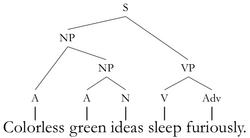
{{ | [[File:Cgisf-tgg.png|thumb|A [[generative grammar|generative]] [[parse tree|syntax tree]] in which the sentence (S) breaks down into a noun phrase (NP) and a verb phrase (VP), both of which break down into additional smaller constituents.]] | ||
: | |||
Frameworks of grammar which seek to give a precise scientific theory of the syntactic rules of grammar and their function have been developed in [[theoretical linguistics]]. | |||
== | * [[Dependency grammar]]: dependency relation ([[Lucien Tesnière]] 1959) | ||
Grammar | ** [[Link grammar]] | ||
* [[Functional theories of grammar|Functional grammar]] (structural–functional analysis): | |||
** [[Danish Functionalism]] | |||
** [[Functional Discourse Grammar]] | |||
** [[Role and reference grammar]] | |||
** [[Systemic functional grammar]] | |||
* [[Montague grammar]] | |||
* [[Cognitive grammar]] / [[Cognitive linguistics]] | |||
** [[Construction grammar]] | |||
*** [[Fluid Construction Grammar]] | |||
** [[Word grammar]] | |||
* [[Generative grammar]]: | |||
** [[Transformational grammar]] (1960s) | |||
** [[Generative semantics]] (1970s) and [[Semantic Syntax]] (1990s) | |||
** [[Phrase structure grammar]] (late 1970s) | |||
*** [[Generalized phrase structure grammar]] (late 1970s) | |||
**** [[Head-driven phrase structure grammar]] (1985) | |||
**** [[Principles and parameters]] grammar ([[Government and binding theory]]) (1980s) | |||
** [[Lexical functional grammar]] | |||
** [[Categorial grammar]] ([[lambda calculus]]) | |||
** [[Minimalist program]]-based grammar (1993) | |||
* [[Stochastic grammar]]: probabilistic | |||
** [[Operator grammar]] | |||
[[Parse tree]]s are commonly used by such frameworks to depict their rules. There are various alternative schemes for some grammar: | |||
* [[Affix grammar over a finite lattice]] | |||
* [[Backus–Naur form]] | |||
* [[Constraint grammar]] | |||
* [[Lambda calculus]] | |||
* [[Tree-adjoining grammar]] | |||
* [[X-bar theory]] | |||
== Development == | |||
{{more citations needed section|date=June 2020}} | |||
{{Main|Historical linguistics|History of English grammars}} | |||
Grammars evolve through [[Usage (language)|usage]]. Historically, with the advent of [[Writing|written representations]], formal rules about [[language usage]] tend to appear also, although such rules tend to describe writing conventions more accurately than conventions of speech.<ref>{{Cite journal |last1=Carter |first1=Ronald |last2=McCarthy |first2=Michael |date=2017 |title=Spoken Grammar: Where are We and Where are We Going? |journal=Applied Linguistics |volume=38 |pages=1–20 |doi=10.1093/applin/amu080}}</ref> [[Formal grammar]]s are [[codification (linguistics)|codifications]] of usage which are developed by repeated documentation and [[observation]] over time. As rules are established and developed, the prescriptive concept of [[grammatical correctness]] can arise. This often produces a discrepancy between contemporary usage and that which has been accepted, over time, as being standard or "correct". Linguists tend to view prescriptive grammar as having little justification beyond their authors' aesthetic tastes, although style guides may give useful advice about ''standard language employment'' based on descriptions of usage in contemporary writings of the same language. Linguistic prescriptions also form part of the explanation for variation in speech, particularly variation in the speech of an individual speaker (for example, why some speakers say "I didn't do nothing", some say "I didn't do anything", and some say one or the other depending on social context). | |||
The formal study of grammar is an important part of children's schooling from a young age through advanced [[learning]], though the rules taught in schools are not a "grammar" in the sense that most [[linguistics|linguists]] use, particularly as they are [[prescriptive]] in intent rather than [[descriptive]]. | |||
[[Constructed language]]s (also called ''planned languages'' or ''conlangs'') are more common in the modern day, although still extremely uncommon compared to natural languages. Many have been designed to aid human communication (for example, naturalistic [[Interlingua]], schematic [[Esperanto]], and the highly logical [[Lojban]]). Each of these languages has its own grammar. | |||
[[Syntax]] refers to the linguistic structure above the word level (for example, how sentences are formed){{snd}}though without taking into account [[Intonation (linguistics)|intonation]], which is the domain of phonology. Morphology, by contrast, refers to the structure at and below the word level (for example, how [[Compound (linguistics)|compound words]] are formed), but above the level of individual sounds, which, like intonation, are in the domain of phonology.<ref>{{Cite book |last1=Gussenhoven |first1=Carlos |url=https://books.google.com/books?id=gHp_QgAACAAJ&q=Understanding+Phonology |title=Understanding Phonology |last2=Jacobs |first2=Haike |publisher=Hodder Arnold |year=2005 |isbn=978-0-340-80735-4 |edition=2nd |location=London |access-date=11 November 2020 |archive-date=19 August 2021 |archive-url=https://web.archive.org/web/20210819045723/https://books.google.com/books?id=gHp_QgAACAAJ&q=Understanding+Phonology |url-status=live }}</ref> However, no clear line can be drawn between syntax and morphology. [[Analytic languages]] use syntax to convey information that is encoded by [[inflection]] in [[synthetic language]]s. In other words, word order is not significant, and morphology is highly significant in a purely synthetic language, whereas morphology is not significant and syntax is highly significant in an analytic language. For example, Chinese and [[Afrikaans language|Afrikaans]] are highly analytic, thus meaning is very context-dependent. (Both have some inflections, and both have had more in the past; thus, they are becoming even less synthetic and more "purely" analytic over time.) [[Latin]], which is highly [[synthetic language|synthetic]], uses [[affix]]es and [[inflection]]s to convey the same information that Chinese does with syntax. Because Latin words are quite (though not totally) self-contained, an intelligible Latin [[Sentence (linguistics)|sentence]] can be made from elements that are arranged almost arbitrarily. Latin has a complex affixation and simple syntax, whereas Chinese has the opposite. | |||
== Education == | |||
{{more citations needed section|date=December 2021}} | |||
[[Prescriptive]] grammar is taught in primary and secondary school. The term "grammar school" historically referred to a school (attached to a cathedral or monastery) that teaches Latin grammar to future priests and monks. It originally referred to a school that taught students how to read, scan, interpret, and declaim Greek and Latin poets (including Homer, Virgil, Euripides, and others). These should not be mistaken for the related, albeit distinct, modern British grammar schools. | |||
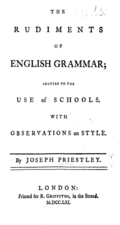
[[File:PriestleyGrammar.png|thumb|alt=The page reads: 'The Rudiments of English Grammar; Adapted to the Use of Schools, with Observations on Style. By Joseph Priestley. London: Printed for R. Griffiths, in the Strand. M.DCC.LXI.|Title page of Joseph Priestley's Rudiments of English Grammar (1761)]] | |||
A [[standard language]] is a dialect that is promoted above other dialects in writing, education, and, broadly speaking, in the public sphere; it contrasts with [[nonstandard dialect|vernacular dialects]], which may be the objects of study in academic, [[linguistic description|descriptive linguistics]] but which are rarely taught prescriptively. The standardized "[[first language]]" taught in primary education may be subject to [[language politics|political]] controversy because it may sometimes establish a standard defining nationality or [[ethnicity]]. | |||
[[File:Kituwah Academy.png|thumb|alt=Image of a classroom at Kituwah Academy where Cherokee language is taught as a medium of instruction.|Cherokee language instruction at Kituwah Academy]] | |||
Recently, efforts have begun to update [[Linguistics in Education|grammar instruction]] in primary and secondary education. The main focus has been to prevent the use of outdated prescriptive rules in favor of setting norms based on earlier descriptive research and to change perceptions about the relative "correctness" of prescribed standard forms in comparison to non-standard dialects. A series of metastudies have found that the explicit teaching of grammatical parts of speech and syntax has little or no effect on the improvement of student writing quality in elementary school, middle school or high school; other methods of writing instruction had far greater positive effect, including strategy instruction, collaborative writing, summary writing, process instruction, sentence combining and inquiry projects.<ref>Graham, S., & Perin, D. (2007). Writing next: Effective strategies to improve writing of adolescents in middle and high schools – A report to Carnegie Corporation of New York.Washington, DC:Alliance for Excellent Education.</ref><ref>{{cite journal| url=https://doi.org/10.1037/0022-0663.99.3.445| doi=10.1037/0022-0663.99.3.445| title=A meta-analysis of writing instruction for adolescent students| year=2007| last1=Graham| first1=Steve| last2=Perin| first2=Dolores| journal=Journal of Educational Psychology| volume=99| issue=3| pages=445–476| citeseerx=10.1.1.462.2356}}</ref><ref>{{cite journal| url=https://doi.org/10.1037/a0029185| doi=10.1037/a0029185| title=A meta-analysis of writing instruction for students in the elementary grades| year=2012| last1=Graham| first1=Steve| last2=McKeown| first2=Debra| last3=Kiuhara| first3=Sharlene| last4=Harris| first4=Karen R.| journal=Journal of Educational Psychology| volume=104| issue=4| pages=879–896| url-access=subscription}}</ref> | |||
The preeminence of [[Parisian French]] has reigned largely unchallenged throughout the history of modern French literature. Standard Italian is based on the speech of Florence rather than the capital because of its influence on early literature. Likewise, standard Spanish is not based on the speech of Madrid but on that of educated speakers from more northern areas such as Castile and León (see ''[[Gramática de la lengua castellana]]''). In [[Argentina]] and [[Uruguay]] the Spanish standard is based on the local dialects of Buenos Aires and Montevideo ([[Rioplatense Spanish]]). [[Portuguese language|Portuguese]] has, for now, [[Pluricentric language|two official standards]], [[Brazilian Portuguese]] and [[European Portuguese]]. | |||
The [[Serbian language|Serbian]] variant of [[Serbo-Croatian]] is likewise divided; [[Serbia]] and the [[Republika Srpska]] of [[Bosnia and Herzegovina]] use their own distinct normative subvarieties, with differences in [[yat]] reflexes. The existence and codification of a distinct Montenegrin standard is a matter of controversy, some treat [[Montenegrin language|Montenegrin]] as a separate standard lect, and some think that it should be considered another form of Serbian. | |||
[[Norwegian language|Norwegian]] has two standards, ''[[Bokmål]]'' and ''[[Nynorsk]]'', the choice between which is subject to [[Norwegian language struggle|controversy]]: Each Norwegian municipality can either declare one as its official language or it can remain "language neutral". Nynorsk is backed by 27 percent of municipalities. The main language used in primary schools, chosen by referendum within the local school district, normally follows the official language of its municipality. [[Standard German]] emerged from the standardized chancellery use of [[Early New High German language|High German]] in the 16th and 17th centuries. Until about 1800, it was almost exclusively a written language, but now it is so widely spoken that most of the former [[German dialect]]s are nearly extinct. | |||
[[Standard Chinese]] has official status as the standard spoken form of the Chinese language in the People's Republic of China (PRC), the [[Republic of China]] (ROC), and the [[Singapore|Republic of Singapore]]. Pronunciation of Standard Chinese is based on the local accent of [[Mandarin Chinese]] from Luanping, Chengde in Hebei Province near Beijing, while grammar and syntax are based on modern [[vernacular written Chinese]]. | |||
[[Modern Standard Arabic]] is directly based on [[Classical Arabic]], the language of the [[Qur'an]]. The [[Hindustani language]] has two standards, [[Hindi]] and [[Urdu]]. | |||
In the United States, the Society for the Promotion of Good Grammar designated 4 March as [[National Grammar Day]] in 2008.<ref>{{Cite web|url=https://www.quickanddirtytips.com/national-grammar-day|title=National Grammar Day|website=Quick and Dirty Tips|access-date=12 November 2021|archive-date=12 November 2021|archive-url=https://web.archive.org/web/20211112075405/https://www.quickanddirtytips.com/national-grammar-day|url-status=live}}</ref> | |||
Grammar instructions also differs between first-language (L1) and second-language (L2) learners, especially in academic writing. First-language (L1) are those composing in their native language, while second-language (L2) writers are writing in language they learned after childhood.<ref>{{Cite journal |last=Breuer |first=Esther Odilia |date=2017-07-14 |title=Revision Processes in First Language and Foreign Language Writing: Differences and Similarities in the Success of Revision Processes |url=https://publications.coventry.ac.uk/index.php/joaw/article/view/214 |journal=Journal of Academic Writing |language=en |volume=7 |issue=1 |pages=27–42 |doi=10.18552/joaw.v7i1.214 |issn=2225-8973|doi-access=free }}</ref> Research shows that L2 learners face additional challenges when revising grammar, as they must manage both language acquisition and writing development at the same time. According to Ester Odilia Breuer, revision in L2 writing is cognitively demanding and occurs not only after writing, but also during the planning and drafting stages. She argues that L2 writers often reorganize ideas and revise structure while composing, unlike L1 writers who may rely more on intuition and automatic grammar use.<ref>{{Cite journal |last=Breuer |first=Esther Odilia |date=2017-07-14 |title=Revision Processes in First Language and Foreign Language Writing: Differences and Similarities in the Success of Revision Processes |url=https://publications.coventry.ac.uk/index.php/joaw/article/view/214 |journal=Journal of Academic Writing |language=en |volume=7 |issue=1 |pages=27–42 |doi=10.18552/joaw.v7i1.214 |issn=2225-8973 |doi-access=free |archive-date=19 August 2025 |access-date=8 June 2025 |archive-url=https://web.archive.org/web/20250819070024/https://publications.coventry.ac.uk/index.php/joaw/article/view/214 |url-status=live }}</ref> | |||
== See also == | |||
* [[Ambiguous grammar]] | |||
* [[Harmonic grammar]] | |||
* [[Higher order grammar]] (HOG) | |||
* [[Error (linguistics)|Linguistic error]] | |||
* [[Linguistic typology]] | |||
* [[Model-theoretic grammar]] | |||
* [[Paragrammatism]] | |||
* [[Speech error]] | |||
* [[Tagmeme]] | |||
* [[Usage (language)]] | |||
== Notes == | |||
{{Reflist}} | |||
== References == | == References == | ||
{{ | {{refbegin}} | ||
* Rundle, Bede. ''Grammar in Philosophy''. Oxford: Clarendon Press; New York: Oxford University Press, 1979. {{ISBN|0198246129}}. | |||
{{refend}} | |||
== External links == | |||
{{Wikisourcelang|de|Grammatiken}} | |||
* {{Wiktionary-inline}} | |||
* {{Commons category-inline|Grammar}} | |||
* [https://web.archive.org/web/20140118015511/http://www.oxforddictionaries.com/grammar/ Grammar] from the ''[[Oxford English Dictionary]]'' (archived 18 January 2014) | |||
* {{Cite EB1911 |last=Sayce |first=Archibald Henry |wstitle=Grammar|short=x}} | |||
{{Wikiquote}} | |||
{{Formal semantics}} | |||
{{Grammatical moods}} | |||
{{Authority control}} | |||
[[Category:Grammar| ]] | [[Category:Grammar| ]] | ||
[[Category:Writing]] | |||
[[Category:Linguistics terminology]] | |||
Latest revision as of 02:20, 14 March 2026
 | This article needs more citations. (August 2025) |
Template:Linguistics In linguistics, grammar is the system of rules that governs how a natural language is structured and used, as evidenced by its speakers or writers. Grammar rules may concern the use of clauses, phrases, and words. The term may also refer to the study of such rules, a subject that includes phonology, morphology, and syntax, together with phonetics, semantics, and pragmatics. There are in effect two different ways to study grammar: traditional grammar and theoretical grammar.
Fluency in a particular language variety involves a speaker internalizing these rules, many or most of which are acquired by observing other speakers, as opposed to intentional study or instruction. Much of this internalization occurs during early childhood; learning a language later in life usually involves more direct instruction.[1] The term grammar can also describe the linguistic behaviour of groups of speakers and writers rather than individuals. Differences in scale can impact this definition: for example, English grammar could describe the rules followed by every one of the language's speakers.[2] At a smaller scale, it may refer to rules shared by smaller groups of speakers.
A description, study, or analysis of such rules may also be known as a grammar, or as a grammar book. A reference work describing the grammar of a language is called a reference grammar or simply a grammar. A fully revealed grammar, which describes the grammatical constructions of a particular speech type in great detail is called descriptive grammar. This type of linguistic description contrasts with linguistic prescription, a plan to marginalize some constructions while codifying others, either absolutely or in the framework of a standard language. The word grammar often has divergent meanings when used in contexts outside linguistics. It may be used more broadly to include orthographic conventions of written language, such as spelling and punctuation, which are not typically considered part of grammar by linguists; that is, the conventions used for writing a language. It may also be used more narrowly to refer to a set of prescriptive norms only, excluding the aspects of a language's grammar which do not change or are clearly acceptable (or not) without the need for discussions.
Etymology[edit | edit source]
The word grammar is derived from Greek γραμματικὴ τέχνη (grammatikḕ téchnē), which means "art of letters", from γράμμα (grámma), "letter", itself from γράφειν (gráphein), "to draw, to write".[3] The same Greek root also appears in the words graphics, grapheme, and photograph.
History[edit | edit source]
The first systematic grammar of Sanskrit originated in Iron Age India, with Yaska (6th century BC), Pāṇini (6th–5th century BC[4]) and his commentators Pingala (c. 200 BC), Katyayana, and Patanjali (2nd century BC). Tolkāppiyam, the earliest Tamil grammar, is mostly dated to before the 5th century AD. The Babylonians also made some early attempts at language description.[5]
Grammar appeared as a discipline in Hellenism from the 3rd century BC forward with authors such as Rhyanus and Aristarchus of Samothrace. The oldest known grammar handbook is the Art of Grammar (Τέχνη Γραμματική), a succinct guide to speaking and writing clearly and effectively, written by the ancient Greek scholar Dionysius Thrax (c. 170 – c. 90 BC), a student of Aristarchus of Samothrace who founded a school on the Greek island of Rhodes. Dionysius Thrax's grammar book remained the primary grammar textbook for Greek schoolboys until as late as the twelfth century AD. The Romans based their grammatical writings on it and its basic format remains the basis for grammar guides in many languages even today.[6] Latin grammar developed by following Greek models from the 1st century BC, due to the work of authors such as Orbilius Pupillus, Remmius Palaemon, Marcus Valerius Probus, Verrius Flaccus, and Aemilius Asper.
The grammar of Irish originated in the 7th century with Auraicept na n-Éces. Arabic grammar emerged with Abu al-Aswad al-Du'ali in the 7th century. The first treatises on Hebrew grammar appeared in the High Middle Ages, in the context of Midrash (exegesis of the Hebrew Bible). The Karaite tradition originated in Abbasid Baghdad. The Diqduq (10th century) is one of the earliest grammatical commentaries on the Hebrew Bible.[7] Ibn Barun in the 12th century, compares the Hebrew language with Arabic in the Islamic grammatical tradition.[8]
Belonging to the trivium of the seven liberal arts, grammar was taught as a core discipline throughout the Middle Ages, following the influence of authors from Late Antiquity, such as Priscian. Treatment of vernaculars began gradually during the High Middle Ages, with isolated works such as the First Grammatical Treatise, but became influential only in the Renaissance and Baroque periods. In 1486, Antonio de Nebrija published Las introduciones Latinas contrapuesto el romance al Latin, and the first Spanish grammar, Gramática de la lengua castellana, in 1492. During the 16th-century Italian Renaissance, the Questione della lingua was the discussion on the status and ideal form of the Italian language, initiated by Dante's de vulgari eloquentia (Pietro Bembo, Prose della volgar lingua Venice 1525). The first grammar of Slovene was written in 1583 by Adam Bohorič, and Grammatica Germanicae Linguae, the first grammar of German, was published in 1578.
Grammars of some languages began to be compiled for the purposes of evangelism and Bible translation from the 16th century onward, such as Grammatica o Arte de la Lengua General de Los Indios de Los Reynos del Perú (1560), a Quechua grammar by Fray Domingo de Santo Tomás.
From the latter part of the 18th century, grammar came to be understood as a subfield of the emerging discipline of modern linguistics. The Deutsche Grammatik of Jacob Grimm was first published in the 1810s. The Comparative Grammar of Franz Bopp, the starting point of modern comparative linguistics, came out in 1833.
Theoretical frameworks[edit | edit source]

Frameworks of grammar which seek to give a precise scientific theory of the syntactic rules of grammar and their function have been developed in theoretical linguistics.
- Dependency grammar: dependency relation (Lucien Tesnière 1959)
- Functional grammar (structural–functional analysis):
- Montague grammar
- Cognitive grammar / Cognitive linguistics
- Generative grammar:
- Transformational grammar (1960s)
- Generative semantics (1970s) and Semantic Syntax (1990s)
- Phrase structure grammar (late 1970s)
- Generalized phrase structure grammar (late 1970s)
- Head-driven phrase structure grammar (1985)
- Principles and parameters grammar (Government and binding theory) (1980s)
- Generalized phrase structure grammar (late 1970s)
- Lexical functional grammar
- Categorial grammar (lambda calculus)
- Minimalist program-based grammar (1993)
- Stochastic grammar: probabilistic
Parse trees are commonly used by such frameworks to depict their rules. There are various alternative schemes for some grammar:
- Affix grammar over a finite lattice
- Backus–Naur form
- Constraint grammar
- Lambda calculus
- Tree-adjoining grammar
- X-bar theory
Development[edit | edit source]
| This section needs more citations. (June 2020) |
Grammars evolve through usage. Historically, with the advent of written representations, formal rules about language usage tend to appear also, although such rules tend to describe writing conventions more accurately than conventions of speech.[9] Formal grammars are codifications of usage which are developed by repeated documentation and observation over time. As rules are established and developed, the prescriptive concept of grammatical correctness can arise. This often produces a discrepancy between contemporary usage and that which has been accepted, over time, as being standard or "correct". Linguists tend to view prescriptive grammar as having little justification beyond their authors' aesthetic tastes, although style guides may give useful advice about standard language employment based on descriptions of usage in contemporary writings of the same language. Linguistic prescriptions also form part of the explanation for variation in speech, particularly variation in the speech of an individual speaker (for example, why some speakers say "I didn't do nothing", some say "I didn't do anything", and some say one or the other depending on social context).
The formal study of grammar is an important part of children's schooling from a young age through advanced learning, though the rules taught in schools are not a "grammar" in the sense that most linguists use, particularly as they are prescriptive in intent rather than descriptive.
Constructed languages (also called planned languages or conlangs) are more common in the modern day, although still extremely uncommon compared to natural languages. Many have been designed to aid human communication (for example, naturalistic Interlingua, schematic Esperanto, and the highly logical Lojban). Each of these languages has its own grammar.
Syntax refers to the linguistic structure above the word level (for example, how sentences are formed) – though without taking into account intonation, which is the domain of phonology. Morphology, by contrast, refers to the structure at and below the word level (for example, how compound words are formed), but above the level of individual sounds, which, like intonation, are in the domain of phonology.[10] However, no clear line can be drawn between syntax and morphology. Analytic languages use syntax to convey information that is encoded by inflection in synthetic languages. In other words, word order is not significant, and morphology is highly significant in a purely synthetic language, whereas morphology is not significant and syntax is highly significant in an analytic language. For example, Chinese and Afrikaans are highly analytic, thus meaning is very context-dependent. (Both have some inflections, and both have had more in the past; thus, they are becoming even less synthetic and more "purely" analytic over time.) Latin, which is highly synthetic, uses affixes and inflections to convey the same information that Chinese does with syntax. Because Latin words are quite (though not totally) self-contained, an intelligible Latin sentence can be made from elements that are arranged almost arbitrarily. Latin has a complex affixation and simple syntax, whereas Chinese has the opposite.
Education[edit | edit source]
| This section needs more citations. (December 2021) |
Prescriptive grammar is taught in primary and secondary school. The term "grammar school" historically referred to a school (attached to a cathedral or monastery) that teaches Latin grammar to future priests and monks. It originally referred to a school that taught students how to read, scan, interpret, and declaim Greek and Latin poets (including Homer, Virgil, Euripides, and others). These should not be mistaken for the related, albeit distinct, modern British grammar schools.

A standard language is a dialect that is promoted above other dialects in writing, education, and, broadly speaking, in the public sphere; it contrasts with vernacular dialects, which may be the objects of study in academic, descriptive linguistics but which are rarely taught prescriptively. The standardized "first language" taught in primary education may be subject to political controversy because it may sometimes establish a standard defining nationality or ethnicity.

Recently, efforts have begun to update grammar instruction in primary and secondary education. The main focus has been to prevent the use of outdated prescriptive rules in favor of setting norms based on earlier descriptive research and to change perceptions about the relative "correctness" of prescribed standard forms in comparison to non-standard dialects. A series of metastudies have found that the explicit teaching of grammatical parts of speech and syntax has little or no effect on the improvement of student writing quality in elementary school, middle school or high school; other methods of writing instruction had far greater positive effect, including strategy instruction, collaborative writing, summary writing, process instruction, sentence combining and inquiry projects.[11][12][13]
The preeminence of Parisian French has reigned largely unchallenged throughout the history of modern French literature. Standard Italian is based on the speech of Florence rather than the capital because of its influence on early literature. Likewise, standard Spanish is not based on the speech of Madrid but on that of educated speakers from more northern areas such as Castile and León (see Gramática de la lengua castellana). In Argentina and Uruguay the Spanish standard is based on the local dialects of Buenos Aires and Montevideo (Rioplatense Spanish). Portuguese has, for now, two official standards, Brazilian Portuguese and European Portuguese.
The Serbian variant of Serbo-Croatian is likewise divided; Serbia and the Republika Srpska of Bosnia and Herzegovina use their own distinct normative subvarieties, with differences in yat reflexes. The existence and codification of a distinct Montenegrin standard is a matter of controversy, some treat Montenegrin as a separate standard lect, and some think that it should be considered another form of Serbian.
Norwegian has two standards, Bokmål and Nynorsk, the choice between which is subject to controversy: Each Norwegian municipality can either declare one as its official language or it can remain "language neutral". Nynorsk is backed by 27 percent of municipalities. The main language used in primary schools, chosen by referendum within the local school district, normally follows the official language of its municipality. Standard German emerged from the standardized chancellery use of High German in the 16th and 17th centuries. Until about 1800, it was almost exclusively a written language, but now it is so widely spoken that most of the former German dialects are nearly extinct.
Standard Chinese has official status as the standard spoken form of the Chinese language in the People's Republic of China (PRC), the Republic of China (ROC), and the Republic of Singapore. Pronunciation of Standard Chinese is based on the local accent of Mandarin Chinese from Luanping, Chengde in Hebei Province near Beijing, while grammar and syntax are based on modern vernacular written Chinese.
Modern Standard Arabic is directly based on Classical Arabic, the language of the Qur'an. The Hindustani language has two standards, Hindi and Urdu.
In the United States, the Society for the Promotion of Good Grammar designated 4 March as National Grammar Day in 2008.[14]
Grammar instructions also differs between first-language (L1) and second-language (L2) learners, especially in academic writing. First-language (L1) are those composing in their native language, while second-language (L2) writers are writing in language they learned after childhood.[15] Research shows that L2 learners face additional challenges when revising grammar, as they must manage both language acquisition and writing development at the same time. According to Ester Odilia Breuer, revision in L2 writing is cognitively demanding and occurs not only after writing, but also during the planning and drafting stages. She argues that L2 writers often reorganize ideas and revise structure while composing, unlike L1 writers who may rely more on intuition and automatic grammar use.[16]
See also[edit | edit source]
- Ambiguous grammar
- Harmonic grammar
- Higher order grammar (HOG)
- Linguistic error
- Linguistic typology
- Model-theoretic grammar
- Paragrammatism
- Speech error
- Tagmeme
- Usage (language)
Notes[edit | edit source]
- ↑ O'Grady, William; Dobrovolsky, Michael; Katamba, Francis (1996). Contemporary Linguistics: An Introduction. Harlow, Essex: Longman. pp. 4–7, 464–539. ISBN 978-0-582-24691-1.
- ↑ Holmes, Janet (2001). An Introduction to Sociolinguistics (2nd ed.). Harlow, Essex: Longman. pp. 73–94. ISBN 978-0-582-32861-7.
- ↑ Harper, Douglas. "Grammar". Online Etymological Dictionary. Archived from the original on 9 March 2013. Retrieved 8 April 2010.
- ↑ Ashtadhyayi, Work by Panini. Encyclopædia Britannica. 2013. Archived from the original on 5 August 2017. Retrieved 23 October 2017.
Ashtadhyayi, Sanskrit Aṣṭādhyāyī ("Eight Chapters"), Sanskrit treatise on grammar written in the 6th to 5th century BCE by the Indian grammarian Panini.
{{cite book}}:|work=ignored (help) - ↑ McGregor, William B. (2015). Linguistics: An Introduction (2nd ed.). Bloomsbury Academic. pp. 15–16. ISBN 978-0-567-58352-9.
- ↑ Casson, Lionel (2001). Libraries in the Ancient World. New Haven, Connecticut: Yale University Press. p. 45. ISBN 978-0-300-09721-4. Archived from the original on 24 August 2021. Retrieved 11 November 2020.
- ↑ G. Khan, J. B. Noah, The Early Karaite Tradition of Hebrew Grammatical Thought (2000)
- ↑ Pinchas Wechter, Ibn Barūn's Arabic Works on Hebrew Grammar and Lexicography (1964)
- ↑ Carter, Ronald; McCarthy, Michael (2017). "Spoken Grammar: Where are We and Where are We Going?". Applied Linguistics. 38: 1–20. doi:10.1093/applin/amu080.
- ↑ Gussenhoven, Carlos; Jacobs, Haike (2005). Understanding Phonology (2nd ed.). London: Hodder Arnold. ISBN 978-0-340-80735-4. Archived from the original on 19 August 2021. Retrieved 11 November 2020.
- ↑ Graham, S., & Perin, D. (2007). Writing next: Effective strategies to improve writing of adolescents in middle and high schools – A report to Carnegie Corporation of New York.Washington, DC:Alliance for Excellent Education.
- ↑ Graham, Steve; Perin, Dolores (2007). "A meta-analysis of writing instruction for adolescent students". Journal of Educational Psychology. 99 (3): 445–476. CiteSeerX 10.1.1.462.2356. doi:10.1037/0022-0663.99.3.445.
- ↑ Graham, Steve; McKeown, Debra; Kiuhara, Sharlene; Harris, Karen R. (2012). "A meta-analysis of writing instruction for students in the elementary grades". Journal of Educational Psychology. 104 (4): 879–896. doi:10.1037/a0029185.
- ↑ "National Grammar Day". Quick and Dirty Tips. Archived from the original on 12 November 2021. Retrieved 12 November 2021.
- ↑ Breuer, Esther Odilia (14 July 2017). "Revision Processes in First Language and Foreign Language Writing: Differences and Similarities in the Success of Revision Processes". Journal of Academic Writing. 7 (1): 27–42. doi:10.18552/joaw.v7i1.214. ISSN 2225-8973.
- ↑ Breuer, Esther Odilia (14 July 2017). "Revision Processes in First Language and Foreign Language Writing: Differences and Similarities in the Success of Revision Processes". Journal of Academic Writing. 7 (1): 27–42. doi:10.18552/joaw.v7i1.214. ISSN 2225-8973. Archived from the original on 19 August 2025. Retrieved 8 June 2025.
References[edit | edit source]
- Rundle, Bede. Grammar in Philosophy. Oxford: Clarendon Press; New York: Oxford University Press, 1979. ISBN 0198246129.
External links[edit | edit source]
- Grammar from the Oxford English Dictionary (archived 18 January 2014)
- Sayce, Archibald Henry (1911). . Encyclopædia Britannica (11th ed.).