
Ajay Kumar (talk | contribs) Created a new article |
page updated |
||
| Line 1: | Line 1: | ||
{{ | {{Short description|Group of rock-forming minerals}} | ||
{{Other uses}} | {{Other uses}} | ||
{{Use British English|date=March 2021}} | {{Use British English|date=March 2021}} | ||
{{ | {{Use dmy dates|date=November 2025}} | ||
{{Stack| | |||
{{Infobox mineral | {{Infobox mineral | ||
| name = Feldspar | | name = Feldspar | ||
| category | | category = [[Tectosilicate]] minerals | ||
| boxwidth = | | boxwidth = | ||
| boxbgcolor = | | boxbgcolor = #eae6de | ||
| image = Feldspar | | image = Feldspar diversity.png | ||
| imagesize = | | imagesize = 350px | ||
| caption = Feldspar | | caption = Feldspar minerals. Clockwise from top left: [[orthoclase]], [[albite]], [[microcline]], and an indeterminate [[plagioclase]] | ||
| formula = {{chem|[[Potassium|K]][[Aluminium|Al]][[silicon|Si]]|3|[[Oxygen|O]]|8| – [[Sodium|Na]]AlSi|3|O|8| – [[Calcium|Ca]]Al|2|Si|2|O|8|}} | | formula = {{chem|[[Potassium|K]][[Aluminium|Al]][[silicon|Si]]|3|[[Oxygen|O]]|8| – [[Sodium|Na]]AlSi|3|O|8| – [[Calcium|Ca]]Al|2|Si|2|O|8|}} | ||
|IMAsymbol=Fsp<ref>{{Cite journal|last=Warr|first=L.N.|date=2021|title=IMA–CNMNC approved mineral symbols|journal=Mineralogical Magazine|volume=85|issue=3|pages=291–320|doi=10.1180/mgm.2021.43|bibcode=2021MinM...85..291W|s2cid=235729616|doi-access=free}}</ref> | |IMAsymbol=Fsp<ref>{{Cite journal|last=Warr|first=L.N.|date=2021|title=IMA–CNMNC approved mineral symbols|journal=Mineralogical Magazine|volume=85|issue=3|pages=291–320|doi=10.1180/mgm.2021.43|bibcode=2021MinM...85..291W|s2cid=235729616|doi-access=free}}</ref> | ||
| IMAstatus = [[Mineral group]] | |||
| molweight = | | molweight = | ||
| color = pink, white, gray, brown, blue | | color = pink, white, gray, brown, blue | ||
| Line 21: | Line 24: | ||
| fracture = along cleavage planes | | fracture = along cleavage planes | ||
| mohs = 6.0–6.5 | | mohs = 6.0–6.5 | ||
| luster = | | luster = vitreous | ||
| tenacity = | | tenacity = | ||
| polish = | | polish = | ||
| Line 30: | Line 33: | ||
| pleochroism = none | | pleochroism = none | ||
| fluorescence= | | fluorescence= | ||
| absorption = | | absorption = | ||
| streak = white | | streak = white | ||
| gravity = 2.55–2.76 | | gravity = 2.55–2.76 | ||
| Line 40: | Line 43: | ||
| diaphaneity = opaque | | diaphaneity = opaque | ||
| other = exsolution lamellae common | | other = exsolution lamellae common | ||
| references = <ref>{{cite web|title=Feldspar|url= | | references = <ref>{{cite web|title=Feldspar|url=https://www.gemologyonline.com/feldspar.html|work=Gemology Online|access-date=8 November 2012}}</ref> | ||
}} | }} | ||
}} | }} | ||
'''Feldspar''' (sometimes spelled '''felspar''') is a group of rock-forming [[aluminium | '''Feldspar''' ({{IPAc-en|ˈ|f|ɛ|l|(|d|)|.|ˌ|s|p|ɑːr}} {{respell|FEL(D)|spar}}; sometimes spelled '''felspar''') is a group of rock-forming [[Aluminosilicate|aluminium tectosilicate minerals]], also containing other [[cation]]s such as sodium, calcium, potassium, or barium.<ref name="Glossary2005">{{cite book | title=Glossary of Geology | publisher=American Geological Institute | editor-last1=Neuendorf | editor-first1=K.K.E. | editor-last2=Mehl | editor-first2=J.P. Jr. | editor-last3=Jackson | editor-first3=J.A. | year=2005 | location=Alexandria, Virginia | page=232 | isbn=978-0922152896| edition=5th }}</ref> The most common members of the feldspar group are the ''[[plagioclase]]'' (sodium-calcium) feldspars and the ''alkali'' (potassium-sodium) feldspars.<ref name="DeerHowieZussman2001">{{cite book | title=Rock-forming Minerals (2nd edition) Volume 4A | publisher=Geological Society of London | last1=Deer | first1=W.A | last2=Howie | first2=R.A. | last3=Zussman | first3=J. | year=2001 | location=London | pages=2 | isbn=1-86239-081-9}}</ref> Feldspars make up about 60% of the [[Earth's crust]]<ref name="Glossary2005"/> and 41% of the Earth's [[continental crust]] by weight.<ref>{{cite book |first1=Robert S. |last1=Anderson |first2=Suzanne P. |last2=Anderson |title=Geomorphology: The Mechanics and Chemistry of Landscapes |publisher=Cambridge University Press |year=2010 |page=187|url=https://books.google.com/books?id=hDt5A2-km_wC&q=Geomorphology%3A+The+Mechanics+and+Chemistry+of+Landscapes|isbn=9781139788700 }}</ref><ref name="Rudnick2003">{{cite book |chapter=Composition of the Continental Crust |publisher=Elsevier Science |location=New York |first1=R. L. |last1=Rudnick |first2=S. |last2=Gao |title=Treatise on Geochemistry |editor1-first=H. D. |editor1-last=Holland |editor2-first=K. K. |editor2-last=Turekian |volume=3 |pages=1–64 |year=2003 |doi=10.1016/B0-08-043751-6/03016-4 |isbn=978-0-08-043751-4|bibcode=2003TrGeo...3....1R }}</ref> | ||
Feldspars [[crystal]]lize from [[magma]] as both [[Intrusive rock|intrusive]] and [[extrusive]] [[igneous]] rocks<ref>{{Cite journal|last=Troll|first=V. R.|date=2002-02-01|title=Magma Mixing and Crustal Recycling Recorded in Ternary Feldspar from Compositionally Zoned Peralkaline Ignimbrite A', Gran Canaria, Canary Islands|journal=Journal of Petrology|volume=43|issue=2|pages=243–270|doi=10.1093/petrology/43.2.243|bibcode=2002JPet...43..243T|issn=1460-2415|doi-access=free}}</ref> and are also present in many types of [[metamorphic rock]].<ref>"Metamorphic Rocks." <span class="plainlinks">[http://seis.natsci.csulb.edu/bperry/ROCKS.htm Metamorphic Rocks Information] {{webarchive|url=https://web.archive.org/web/20070701111134/http://seis.natsci.csulb.edu/bperry/ROCKS.htm |date=2007-07-01 }}</span>. Retrieved on July 18, 2007</ref> Rock formed almost entirely of calcic [[plagioclase]] feldspar is known as [[anorthosite]].<ref>Blatt, Harvey and Tracy, Robert J. (1996) ''Petrology,'' Freeman, 2nd ed., pp. 206–210 {{ISBN|0-7167-2438-3}}</ref> Feldspars are also found in many types of [[sedimentary rock]]s.<ref>"Weathering and Sedimentary Rocks." <span class="plainlinks">[http://geology.csupomona.edu/drjessey/class/Gsc101/Weathering.html Geology.] {{webarchive |url=https://web.archive.org/web/20070703170212/http://geology.csupomona.edu/drjessey/class/Gsc101/Weathering.html |date=2007-07-03 }}</span> Retrieved on July 18, 2007.</ref> | |||
==Etymology== | |||
The name ''feldspar'' derives from the [[German language|German]] {{Lang|de|Feldspat}}, a compound of the words ''{{Lang|de|Feld}}'' ("field") and {{Lang|de|Spat}} ("flake"). {{Lang|de|Spat}} had long been used as the word for "a [[Rock (geology)|rock]] easily cleaved into flakes"; {{Lang|de|Feldspat}} was introduced in the 18th century as a more specific term, referring perhaps to its common occurrence in rocks found in fields (Urban Brückmann, 1783) or to its occurrence as "fields" within granite and other minerals (René-Just Haüy, 1804).<ref name="Lüschen">{{citation| author= Hans Lüschen | title= Die Namen der Steine. Das Mineralreich im Spiegel der Sprache | edition= 2nd| publisher= Ott Verlag | place= Thun | year= 1979 | page=215 | isbn= 3-7225-6265-1}}</ref> | |||
The change from {{Lang|de|Spat}} to ''-spar'' was influenced by the English word [[Spar (mineralogy)|''spar'']],<ref>{{OEtymD|feldspar|accessdate=2008-02-08}}</ref> meaning a non-opaque mineral with good cleavage.<ref name="OED1">{{cite web | url=https://en.oxforddictionaries.com/definition/spar#spar_Noun_300 | archive-url=https://web.archive.org/web/20160926020824/https://en.oxforddictionaries.com/definition/spar#spar_Noun_300 | url-status=dead | archive-date=September 26, 2016 | title=spar | publisher=Oxford Dictionaries | work=Oxford English Dictionary | access-date=13 January 2018}}</ref> ''Feldspathic'' refers to materials that contain feldspar. The alternative spelling, ''felspar'', has fallen out of use. The term "felsic", meaning light coloured minerals such as quartz and feldspars, is an acronymic word derived from ''fel''dspar and ''si''lica, unrelated to the obsolete spelling "felspar". | |||
==Compositions== | ==Compositions== | ||
[[File:Feldspar group.svg|thumb|upright=1.25|Compositional phase diagram of the different minerals that constitute the feldspar solid solution]] | |||
The feldspar group of minerals consists of [[Silicate minerals|tectosilicate]]s, silicate minerals in which silicon ions are linked by shared oxygen ions to form a three-dimensional network. Compositions of major elements in common feldspars can be expressed in terms of three [[Endmember (mineralogy)|endmembers]]: | The feldspar group of minerals consists of [[Silicate minerals|tectosilicate]]s, silicate minerals in which silicon ions are linked by shared oxygen ions to form a three-dimensional network. Compositions of major elements in common feldspars can be expressed in terms of three [[Endmember (mineralogy)|endmembers]]: | ||
* [[ | * [[orthoclase]] endmember [[Potassium|K]][[Aluminium|Al]][[silicon|Si]]{{sub|3}}[[Oxygen|O]]{{sub|8}}<ref name="feldspar">Feldspar. [http://www.ima-na.org/?page=what_is_feldspar What is Feldspar?] Industrial Minerals Association. Retrieved on July 18, 2007.</ref> | ||
* [[albite]] endmember [[Sodium|Na]]AlSi{{sub|3}}O{{sub|8}}<ref name = "feldspar"/> | * [[albite]] endmember [[Sodium|Na]]AlSi{{sub|3}}O{{sub|8}}<ref name = "feldspar"/> | ||
* [[anorthite]] endmember [[Calcium|Ca]]Al{{sub|2}}Si{{sub|2}}O{{sub|8}}<ref name = "feldspar"/> | * [[anorthite]] endmember [[Calcium|Ca]]Al{{sub|2}}Si{{sub|2}}O{{sub|8}}<ref name = "feldspar"/> | ||
[[Solid solution]]s between | [[Solid solution]]s between orthoclase and albite are called alkali feldspar<!-- phrase links here -->.<ref name = "feldspar"/> Solid solutions between albite and anorthite are called [[plagioclase]],<ref name="feldspar" /> or, more properly, plagioclase feldspar. Only limited solid solution occurs between K-feldspar and anorthite, and in the two other solid solutions, [[immiscibility]] occurs at temperatures common in the crust of the Earth. Albite is considered both a plagioclase and an alkali feldspar. | ||
<!-- | <!-- | ||
[[Sanidine]] ([[monoclinic]]),<ref name="sanidine">[ | [[Sanidine]] ([[monoclinic]]),<ref name="sanidine">[https://www.galleries.com/minerals/silicate/sanidine/sanidine.htm "Sanidine Feldspar"]. Feldspar Amethyst Galleries, Inc. Retrieved on February 8, 2008.</ref> [[orthoclase]] (monoclinic),<ref name="orthoclase">[https://www.galleries.com/minerals/silicate/orthocla/orthocla.htm "The Mineral Orthoclase"]. Feldspar Amethyst Galleries, Inc. Retrieved on February 8, 2008.</ref> and [[microcline]] ([[triclinic]])<ref name="microcline">[https://www.galleries.com/minerals/silicate/microcli/microcli.htm "Microcline Feldspar"]. Feldspar Amethyst Galleries, Inc. Retrieved on February 8, 2008.</ref> refer to [[polymorphism (materials science)|polymorphs]] of K-feldspar. | ||
--> | --> | ||
The ratio of alkali feldspar to plagioclase feldspar, together with the proportion of [[quartz]], is the basis for the [[QAPF classification]] of igneous rock.<ref name="iugs-1991">{{Cite journal|last1=Le Bas|first1=M. J.|last2=Streckeisen|first2=A. L.|title=The IUGS systematics of igneous rocks|journal=Journal of the Geological Society|volume=148|issue=5|pages=825–833|doi=10.1144/gsjgs.148.5.0825|bibcode=1991JGSoc.148..825L|year=1991|citeseerx=10.1.1.692.4446|s2cid=28548230}}</ref><ref name="BGS-1999">{{Cite journal|date=1999|title=Rock Classification Scheme | The ratio of alkali feldspar to plagioclase feldspar, together with the proportion of [[quartz]], is the basis for the [[QAPF classification]] of igneous rock.<ref name="iugs-1991">{{Cite journal|last1=Le Bas|first1=M. J.|last2=Streckeisen|first2=A. L.|title=The IUGS systematics of igneous rocks|journal=Journal of the Geological Society|volume=148|issue=5|pages=825–833|doi=10.1144/gsjgs.148.5.0825|bibcode=1991JGSoc.148..825L|year=1991|citeseerx=10.1.1.692.4446|s2cid=28548230}}</ref><ref name="BGS-1999">{{Cite journal|date=1999|title=Rock Classification Scheme – Vol 1 – Igneous|url=http://nora.nerc.ac.uk/id/eprint/3223/1/RR99006.pdf |archive-url=https://ghostarchive.org/archive/20221009/http://nora.nerc.ac.uk/id/eprint/3223/1/RR99006.pdf |archive-date=2022-10-09 |url-status=live|journal=British Geological Survey: Rock Classification Scheme|volume=1|pages=1–52}}</ref><ref name="philpotts-ague-2009-139-143">{{cite book |last1=Philpotts |first1=Anthony R. |last2=Ague |first2=Jay J. |title=Principles of igneous and metamorphic petrology |date=2009 |publisher=Cambridge University Press |location=Cambridge, UK |isbn=9780521880060 |edition=2nd |pages=139–143}}</ref> Calcium-rich plagioclase is the first feldspar to crystallize from cooling magma, then the plagioclase becomes increasingly sodium-rich as crystallization continues. This defines the continuous [[Bowen's reaction series]]. K-feldspar is the final feldspar to crystallize from the [[magma]].<ref>{{Cite book|title=The Evolution of the Igneous Rocks|last=Bowen|first=N.L.|publisher=Dover|year=1956|location=Canada|pages=60–62}}</ref><ref>{{cite book |last1=Klein |first1=Cornelis |last2=Hurlbut |first2=Cornelius S. Jr. |title=Manual of mineralogy : (after James D. Dana) |date=1993 |publisher=Wiley |location=New York |isbn=047157452X |page=559 |edition=21st}}</ref> | ||
===Alkali feldspars=== | ===Alkali feldspars=== | ||
Alkali feldspars are grouped into two types: those containing potassium in combination with sodium, aluminium, or silicon; and those where potassium is replaced by barium. The first of these includes: | |||
* [[orthoclase]] ([[monoclinic]])<ref name="orthoclase">[ | * [[orthoclase]] ([[monoclinic]])<ref name="orthoclase">[https://www.galleries.com/minerals/silicate/orthocla/orthocla.htm "The Mineral Orthoclase"]. Feldspar Amethyst Galleries, Inc. Retrieved on February 8, 2008.</ref> {{chem2|KAlSi3O8}} | ||
* [[sanidine]] (monoclinic)<ref name="sanidine">[ | * [[sanidine]] ([[Monoclinic crystal system|monoclinic]])<ref name="sanidine">[https://www.galleries.com/minerals/silicate/sanidine/sanidine.htm "Sanidine Feldspar"]. Feldspar Amethyst Galleries, Inc. Retrieved on February 8, 2008.</ref> {{chem2|(K,Na)AlSi3O8}} | ||
* [[microcline]] ([[triclinic]])<ref name="microcline">[ | * [[microcline]] ([[triclinic]])<ref name="microcline">[https://www.galleries.com/minerals/silicate/microcli/microcli.htm "Microcline Feldspar"]. Feldspar Amethyst Galleries, Inc. Retrieved on February 8, 2008.</ref> {{chem2|KAlSi3O8}} | ||
* [[anorthoclase]] (triclinic) {{chem2|(Na,K)AlSi3O8}} | * [[anorthoclase]] ([[Triclinic crystal system|triclinic]]) {{chem2|(Na,K)AlSi3O8}} | ||
Potassium and sodium feldspars are not perfectly [[Miscibility|miscible]] in the melt at low temperatures, therefore intermediate compositions of the alkali feldspars occur only in higher temperature environments.{{sfn|Klein|Hurlbut|1993||pages=532-536}} Sanidine is stable at the highest temperatures, and microcline at the lowest.<ref name="orthoclase" /><ref name="sanidine" /> [[Perthite]] is a typical texture in alkali feldspar, due to [[exsolution]] of contrasting alkali feldspar compositions during cooling of an intermediate composition. The perthitic textures in the alkali feldspars of many [[granite]]s can be seen with the naked eye.<ref>Ralph, Jolyon and Chou, Ida. "Perthite". [http://www.mindat.org/min-6683.html Perthite Profile on mindat.org]. Retrieved on February 8, 2008.</ref> Microperthitic textures in crystals are visible using a light microscope, whereas cryptoperthitic textures can be seen only with an electron microscope. | Potassium and sodium feldspars are not perfectly [[Miscibility|miscible]] in the melt at low temperatures, therefore intermediate compositions of the alkali feldspars occur only in higher temperature environments.{{sfn|Klein|Hurlbut|1993||pages=532-536}} Sanidine is stable at the highest temperatures, and microcline at the lowest.<ref name="orthoclase" /><ref name="sanidine" /> [[Perthite]] is a typical texture in alkali feldspar, due to [[exsolution]] of contrasting alkali feldspar compositions during cooling of an intermediate composition. The perthitic textures in the alkali feldspars of many [[granite]]s can be seen with the naked eye.<ref>Ralph, Jolyon and Chou, Ida. "Perthite". [http://www.mindat.org/min-6683.html Perthite Profile on mindat.org]. Retrieved on February 8, 2008.</ref> Microperthitic textures in crystals are visible using a light microscope, whereas cryptoperthitic textures can be seen only with an electron microscope. | ||
===Ammonium feldspar=== | ===Ammonium feldspar=== | ||
[[Buddingtonite]] is an ammonium feldspar with the chemical formula: NH<sub>4</sub>AlSi<sub>3</sub>O<sub>8</sub>.<ref>{{cite web | url=https://www.mindat.org/min-796.html | title=Buddingtonite }}</ref> It is a mineral associated with hydrothermal alteration of the primary feldspar minerals. | [[Buddingtonite]] is an ammonium feldspar with the chemical formula: NH<sub>4</sub>AlSi<sub>3</sub>O<sub>8</sub>.<ref>{{cite web | url=https://www.mindat.org/min-796.html | title=Buddingtonite }}</ref> It is a mineral associated with hydrothermal alteration of the primary feldspar minerals. | ||
===Barium feldspars=== | ===Barium feldspars=== | ||
| Line 83: | Line 89: | ||
===Plagioclase feldspars=== | ===Plagioclase feldspars=== | ||
The plagioclase feldspars are [[triclinic]]. The plagioclase series follows (with percent [[anorthite]] in parentheses): | The plagioclase feldspars are [[triclinic]]. The plagioclase series follows (with percent [[anorthite]] in parentheses): | ||
* [[albite]] (0 to 10) {{chem2|NaAlSi3O8}} | * [[albite]] (0 to 10) {{chem2|NaAlSi3O8}} | ||
| Line 92: | Line 97: | ||
* [[anorthite]] (90 to 100) {{chem2|CaAl2Si2O8}} | * [[anorthite]] (90 to 100) {{chem2|CaAl2Si2O8}} | ||
Intermediate compositions of | Intermediate compositions of exsolve to two feldspars of contrasting composition during cooling, but diffusion is much slower than in alkali feldspar, and the resulting two-feldspar intergrowths typically are too fine-grained to be visible with optical microscopes. The immiscibility gaps in plagioclase solid solutions are more complex than those in alkali feldspars. The play of colours visible in some feldspar of [[labradorite]] composition is due to very fine-grained exsolution [[Lamellar structure|lamellae]] known as Bøggild intergrowth. The [[specific gravity]] in the plagioclase series increases from [[albite]] (2.62) to anorthite (2.72–2.75). | ||
==Structure== | ==Structure== | ||
The structure of a feldspar crystal is based on aluminosilicate tetrahedra. Each tetrahedron consists of an aluminium or silicon ion surrounded by four oxygen ions. Each oxygen ion, in turn, is shared by a neighbouring tetrahedron to form a three-dimensional network. The structure can be visualized as long chains of aluminosilicate tetrahedra, sometimes described as crankshaft chains because their shape is kinked. Each crankshaft chain links to neighbouring crankshaft chains to form a three-dimensional network of fused four-member rings. The structure is open enough for cations | The structure of a feldspar crystal is based on aluminosilicate tetrahedra. Each tetrahedron consists of an aluminium or silicon ion surrounded by four oxygen ions. Each oxygen ion, in turn, is shared by a neighbouring tetrahedron to form a three-dimensional network. The structure can be visualized as long chains of aluminosilicate tetrahedra, sometimes described as [[crankshaft]] chains because their shape is kinked. Each crankshaft chain links to neighbouring crankshaft chains to form a three-dimensional network of fused four-member rings. The structure is open enough for cations, typically sodium, potassium, or calcium, to fit into it and provide charge balance.{{sfn|Klein|Hurlbut|1993|pp=533-534}} | ||
<gallery> | <gallery> | ||
File:Anorthite crankshaft.png|Diagram showing part of a crankshaft chain of feldspar | File:Anorthite crankshaft.png|Diagram showing part of a crankshaft chain of feldspar | ||
| Line 102: | Line 107: | ||
File:Anorthite b.png|Feldspar crystal structure viewed along the b axis | File:Anorthite b.png|Feldspar crystal structure viewed along the b axis | ||
</gallery> | </gallery> | ||
==Weathering== | ==Weathering== | ||
[[Weathering|Chemical weathering]] of feldspars happens by [[hydrolysis]] and produces [[clay mineral]]s, including [[illite]], [[smectite]], and [[kaolinite]]. Hydrolysis of feldspars begins with the feldspar dissolving in water, which happens best in acidic or basic solutions and less well in neutral ones.<ref name=":0">{{Citation|last=Blum|first=Alex E.|title=Feldspars in Weathering|date=1994|url=https://doi.org/10.1007/978-94-011-1106-5_15|work=Feldspars and their Reactions|pages=595–630|editor-last=Parsons|editor-first=Ian|series=NATO ASI Series|place=Dordrecht|publisher=Springer Netherlands|language=en|doi=10.1007/978-94-011-1106-5_15|isbn=978-94-011-1106-5|access-date=2020-11-18}}</ref> The speed at which feldspars are weathered is controlled by how quickly they are dissolved.<ref name=":0" /> Dissolved feldspar reacts with H<sup>+</sup> or OH<sup>−</sup> ions and precipitates clays. The reaction also produces new [[ion]]s in solution, with the variety of ions controlled by the type of feldspar reacting. | [[Weathering|Chemical weathering]] of feldspars happens by [[hydrolysis]] and produces [[clay mineral]]s, including [[illite]], [[smectite]], and [[kaolinite]]. Hydrolysis of feldspars begins with the feldspar dissolving in water, which happens best in acidic or basic solutions and less well in neutral ones.<ref name=":0">{{Citation|last=Blum|first=Alex E.|title=Feldspars in Weathering|date=1994|url=https://doi.org/10.1007/978-94-011-1106-5_15|work=Feldspars and their Reactions|pages=595–630|editor-last=Parsons|editor-first=Ian|series=NATO ASI Series|place=Dordrecht|publisher=Springer Netherlands|language=en|doi=10.1007/978-94-011-1106-5_15|isbn=978-94-011-1106-5|access-date=2020-11-18|url-access=subscription}}</ref> The speed at which feldspars are weathered is controlled by how quickly they are dissolved.<ref name=":0" /> Dissolved feldspar reacts with H<sup>+</sup> or OH<sup>−</sup> ions and precipitates clays. The reaction also produces new [[ion]]s in solution, with the variety of ions controlled by the type of feldspar reacting. | ||
The abundance of feldspars in the Earth's [[Crust (geology)|crust]] means that clays are very abundant weathering products.<ref>{{Cite book|last1=Hefferan|first1=Kevin|title=Earth Materials|last2=O'Brien|first2=John|publisher=Wiley-Blackwell|year=2010|isbn=978-1-4443-3460-9|pages=336–337}}</ref> About 40% of [[mineral]]s in [[sedimentary rock]]s are clays and clays are the dominant minerals in the most common sedimentary rocks, [[mudrock]]s.<ref name=":1">{{cite web|last=Nelson|first=Stephen A.|date=Fall 2008|title=Weathering & Clay Minerals|url=http://www.tulane.edu/~sanelson/eens211/weathering | The abundance of feldspars in the Earth's [[Crust (geology)|crust]] means that clays are very abundant weathering products.<ref>{{Cite book|last1=Hefferan|first1=Kevin|title=Earth Materials|last2=O'Brien|first2=John|publisher=Wiley-Blackwell|year=2010|isbn=978-1-4443-3460-9|pages=336–337}}</ref> About 40% of [[mineral]]s in [[sedimentary rock]]s are clays and clays are the dominant minerals in the most common sedimentary rocks, [[mudrock]]s.<ref name=":1">{{cite web|last=Nelson|first=Stephen A.|date=Fall 2008|title=Weathering & Clay Minerals|url=http://www.tulane.edu/~sanelson/eens211/weathering%26clayminerals.htm|access-date=2008-11-13|work=Professor's lecture notes (EENS 211, Mineralogy)|publisher=Tulane University|archive-date=2017-08-01|archive-url=https://web.archive.org/web/20170801162126/http://www.tulane.edu/~sanelson/eens211/weathering%26clayminerals.htm|url-status=dead}}</ref> They are also an important component of [[soil]]s.<ref name=":1" /> Feldspar that has been replaced by clay looks chalky compared to more crystalline and glassy unweathered feldspar grains.<ref>{{Cite book|last=Earle|first=Steven|url=https://opentextbc.ca/geology/chapter/5-2-chemical-weathering/|title=Physical Geology|chapter=5.2 Chemical Weathering|date=September 2015|publisher=BCcampus}}</ref> | ||
Feldspars, especially plagioclase feldspars, are not very stable at the | Feldspars, especially plagioclase feldspars, are not very stable at the Earth's surface due to their high formation temperature.<ref name=":1" /> This lack of stability is why feldspars are easily weathered to clays. Because of this tendency to weather easily, feldspars are usually not prevalent in sedimentary rocks. Sedimentary rocks that contain large amounts of feldspar indicate that the sediment did not undergo much chemical weathering before being buried. This means it was probably [[Sediment transport|transported]] a short distance in cold and/or dry conditions that did not promote weathering, and that it was quickly buried by other sediment.<ref name=":2">{{Cite web|title=Arkose|url=https://www.mindat.org/min-49127.html|access-date=2020-11-18|website=www.mindat.org}}</ref> Sandstones with large amounts of feldspar are called [[arkose]]s.<ref name=":2" /> | ||
==Applications== | ==Applications== | ||
Feldspar is a common raw material used in glassmaking, ceramics, and to some extent as a filler and extender in | Feldspar is a common raw material used in glassmaking, ceramics, and to some extent as a filler and extender in paints, plastics, and rubber. In the US, about 66% of feldspar is consumed in glassmaking, including glass containers and glass fibre. Ceramics (including electrical insulators, sanitaryware, tableware and tile) and other uses, such as fillers, accounted for the remainder.<ref name=usgs>Apodaca, Lori E. (2008). [https://minerals.usgs.gov/minerals/pubs/commodity/feldspar/myb1-2008-felds.pdf Feldspar and nepheline syenite], USGS 2008 Minerals Yearbook</ref> | ||
'''Glass''': Feldspar provides both K<sub>2</sub>O and Na<sub>2</sub>O for fluxing, and Al<sub>2</sub>O<sub>3</sub> and CaO as stabilizers. As an important source of Al<sub>2</sub>O<sub>3</sub> for glassmaking, feldspar is valued for its low iron and | '''[[Glass]]''': Feldspar provides both K<sub>2</sub>O and Na<sub>2</sub>O for fluxing, and Al<sub>2</sub>O<sub>3</sub> and CaO as stabilizers. As an important source of Al<sub>2</sub>O<sub>3</sub> for glassmaking, feldspar is valued for its low iron and | ||
refractory mineral content, a low cost per unit of Al<sub>2</sub>O<sub>3</sub>, no volatiles and no waste.<ref name="auto">'Industrial Minerals & Rocks | refractory mineral content, a low cost per unit of Al<sub>2</sub>O<sub>3</sub>, no volatiles and no waste.<ref name="auto">'Industrial Minerals & Rocks – Commodities, Markets and Uses' J. E. Kogel. Society for Mining, Metallurgy and Exploration, 2006. p. 458</ref> | ||
''' | '''[[Ceramic]]s''': Feldspars are used in the ceramic industry as a [[ceramic flux|flux]] to form a glassy phase in bodies during firing, and thus promote vitrification. They are also used as a source of alkalies and alumina in glazes.<ref name="auto"/> The composition of feldspar used in different ceramic formulations varies depending on various factors, including the properties of the individual grade, the other raw materials and the requirements of the finished products. However, typical additions include: tableware, 15% to 30% feldspar; high-tension electrical porcelains, 25% to 35%; sanitaryware, 25%; wall tile, 0% to 10%; and dental porcelain up to 80% feldspar.<ref>Singer, F. and Singer, S.S. (1971). 'Industrial Ceramics'. Chapman & Hall.</ref> | ||
'''Earth | '''[[Earth science]]s''': In earth sciences and archaeology, feldspars are used for [[K–Ar dating|potassium–argon dating]], [[argon–argon dating]] and [[luminescence dating]]. | ||
'''Minor use''': | '''Minor use''': Some household cleaners (such as [[Bar Keepers Friend]] and [[Bon Ami]]) use feldspar to give a mild abrasive action.<ref>{{cite news|url=https://www.citizen-times.com/story/news/2019/08/04/visiting-our-past-feldspar-mining-and-racial-tensions/1876796001/|title=Visiting our Past: Feldspar mining and racial tensions|last=Neufeld|first=Rob|work=[[Asheville Citizen-Times]]|date=4 August 2019|access-date=4 August 2019}}</ref> | ||
==Production== | ==Production== | ||
The [[USGS]] estimated global production of feldspar in 2020 to be 26 million tonnes, with the top four producing countries being: China 2 million tonnes; India 5 million tonnes; Italy 4 million; Turkey 7.6 million tonnes.<ref>Feldspar | The [[USGS]] estimated global production of feldspar in 2020 to be 26 million tonnes, with the top four producing countries being: China 2 million tonnes; India 5 million tonnes; Italy 4 million; Turkey 7.6 million tonnes.<ref>Feldspar and Nepheline Syenite. U.S. Geological Survey, Mineral Commodity Summaries, January 2020</ref> | ||
===Commercial grades=== | ===Commercial grades=== | ||
Typical mineralogical and chemical analyses of three commercial grades used in ceramics are:<ref>'Feldspar Facts' | Typical mineralogical and chemical analyses of three commercial grades used in ceramics are:<ref>Sugden, A. (2004). 'Feldspar Facts'. Ceramic Review, issue 207, May/June 2004.</ref> | ||
{| class="wikitable collapsible" | {| class="wikitable collapsible" | ||
!width="80"|Product name !! Norfloat K !! Forshammar !! FFF K6 | !width="80"|Product name !! Norfloat K !! Forshammar !! FFF K6 | ||
| Line 151: | Line 151: | ||
|- | |- | ||
! Anorthite, % | ! Anorthite, % | ||
| 3 || | | 3 || — || 4 | ||
|- | |- | ||
! Quartz , % | ! Quartz, % | ||
| 3 || 33 || 8 | | 3 || 33 || 8 | ||
|- | |- | ||
| Line 169: | Line 169: | ||
|- | |- | ||
! TiO<sub>2</sub>, % | ! TiO<sub>2</sub>, % | ||
| | | — || 0.02 || 0.01 | ||
|- | |- | ||
! CaO, % | ! CaO, % | ||
| Line 175: | Line 175: | ||
|- | |- | ||
! MgO, % | ! MgO, % | ||
| | | — || 0.10 || 0.01 | ||
|- | |- | ||
! K<sub>2</sub>O, % | ! K<sub>2</sub>O, % | ||
| Line 188: | Line 188: | ||
==Extraterrestrial== | ==Extraterrestrial== | ||
In October 2012, the [[Curiosity rover|''Curiosity'' rover]] | In October 2012, the [[Curiosity rover|''Curiosity'' rover]] found high feldspar content in a Mars rock.<ref>[https://www.bbc.co.uk/news/science-environment-19923118 Nasa's Curiosity rover finds 'unusual rock']. (12 October 2012) [[BBC News]].</ref> | ||
== | ==Gallery== | ||
<gallery widths="130" heights="130"> | <gallery widths="130" heights="130"> | ||
File:Feldspar-Group-170604.jpg|Specimen of rare plumbian ([[lead]]-rich) feldspar | File:Feldspar-Group-170604.jpg|Specimen of rare plumbian ([[lead]]-rich) feldspar | ||
File:Beryl-Schorl-Feldspar-Group-288077.jpg| | File:Beryl-Schorl-Feldspar-Group-288077.jpg|Crystallized white feldspar, with an upright 4 cm [[Aquamarine (gemstone)|aquamarine]] crystal perched on it | ||
File:Feldspar-Group-Moonstone-36971.jpg|Feldspar and moonstone, from Sonora, Mexico | File:Feldspar-Group-Moonstone-36971.jpg|Feldspar and moonstone, from Sonora, Mexico | ||
File:Schorl-Feldspar-Group-49985.jpg| | File:Schorl-Feldspar-Group-49985.jpg|A cluster of [[euhedral]] feldspar crystals with a schorl crystal | ||
File:PIA16217-MarsCuriosityRover-1stXRayView-20121017.jpg|First [[X-ray crystallography#Mineralogy and metallurgy|X-ray view]] of [[Martian soil]]—feldspar, [[pyroxenes]], [[olivine]] revealed ([[Curiosity rover]] at "[[Rocknest (Mars)|Rocknest]]", October 17, 2012) | File:PIA16217-MarsCuriosityRover-1stXRayView-20121017.jpg|First [[X-ray crystallography#Mineralogy and metallurgy|X-ray view]] of [[Martian soil]]—feldspar, [[pyroxenes]], [[olivine]] revealed ([[Curiosity rover]] at "[[Rocknest (Mars)|Rocknest]]", October 17, 2012)<ref name="NASA-20121030">{{cite web |last=Brown |first=Dwayne |title=NASA Rover's First Soil Studies Help Fingerprint Martian Minerals |url=http://www.nasa.gov/home/hqnews/2012/oct/HQ_12-383_Curiosity_CheMin.html |date=October 30, 2012 |publisher=[[NASA]] |access-date=October 31, 2012 |archive-date=June 3, 2016 |archive-url=https://web.archive.org/web/20160603091908/http://www.nasa.gov/home/hqnews/2012/oct/HQ_12-383_Curiosity_CheMin.html |url-status=dead }}</ref> | ||
File:Lunar Ferroan Anorthosite (60025).jpg|[[Moon|Lunar]] ferrous [[anorthosite]] #60025 ([[plagioclase]] feldspar). Collected by [[Apollo 16]] from the [[Geology of the Moon#Highlands | File:Lunar Ferroan Anorthosite (60025).jpg|[[Moon|Lunar]] ferrous [[anorthosite]] #60025 ([[plagioclase]] feldspar). Collected by [[Apollo 16]] from the [[Geology of the Moon#Highlands|Lunar Highlands]] near [[Descartes (crater)|Descartes Crater]]. This sample is currently on display at the [[National Museum of Natural History]] in [[Washington, D.C.]] | ||
</gallery> | </gallery> | ||
| Line 203: | Line 203: | ||
* {{annotated link|List of minerals}} | * {{annotated link|List of minerals}} | ||
* {{annotated link|List of countries by feldspar production}} | * {{annotated link|List of countries by feldspar production}} | ||
*[[Rainbow lattice sunstone]] | * [[Rainbow lattice sunstone]] | ||
==References== | ==References== | ||
* {{USGS|title=Feldspar and nepheline syenite|url= | * {{USGS|title=Feldspar and nepheline syenite|url=https://minerals.usgs.gov/minerals/pubs/commodity/feldspar/myb1-2008-felds.pdf}} | ||
{{Reflist}} | {{Reflist}} | ||
==Further reading== | ==Further reading== | ||
* Bonewitz, Ronald Louis (2005). ''Rock and Gem''. New York | * Bonewitz, Ronald Louis (2005). ''Rock and Gem''. New York, DK Publishing. {{ISBN|978-0-7566-3342-4}}. | ||
== External links == | ==External links== | ||
* {{ | * {{Commons category-inline|Feldspar}} | ||
* {{Cite EB1911|wstitle= | * {{Cite EB1911|wstitle=Felspar|volume=10|page=245}} | ||
* [[usgs.gov]] (Mineral Commodity Summaries 2025): [https://pubs.usgs.gov/periodicals/mcs2025/mcs2025.pdf#page=70 Feldspar] and [[Nepheline Syenite]] | |||
{{Gemstones}} | {{Gemstones}} | ||
{{Authority control}} | {{Authority control}} | ||
[[Category:Feldspar| | [[Category:Feldspar group| ]] | ||
[[Category:Triclinic minerals]] | [[Category:Triclinic minerals]] | ||
[[Category:Monoclinic minerals]] | [[Category:Monoclinic minerals]] | ||
[[Category:Industrial minerals]] | [[Category:Industrial minerals]] | ||
[[Category:Aluminosilicates]] | |||
Latest revision as of 12:09, 22 February 2026
| Feldspar | |
|---|---|
 Feldspar minerals. Clockwise from top left: orthoclase, albite, microcline, and an indeterminate plagioclase | |
| General | |
| Category | Tectosilicate minerals |
| Formula (repeating unit) | Template:Chem |
| IMA symbol | Fsp[1] |
| Crystal system | Triclinic or monoclinic |
| Identification | |
| Color | pink, white, gray, brown, blue |
| Cleavage | two or three |
| Fracture | along cleavage planes |
| Mohs scale hardness | 6.0–6.5 |
| Luster | vitreous |
| Streak | white |
| Diaphaneity | opaque |
| Specific gravity | 2.55–2.76 |
| Density | 2.56 |
| Refractive index | 1.518–1.526 |
| Birefringence | first order |
| Pleochroism | none |
| Other characteristics | exsolution lamellae common |
| References | [2] |
Feldspar (/ˈfɛl(d).ˌspɑːr/ FEL(D)-spar; sometimes spelled felspar) is a group of rock-forming aluminium tectosilicate minerals, also containing other cations such as sodium, calcium, potassium, or barium.[3] The most common members of the feldspar group are the plagioclase (sodium-calcium) feldspars and the alkali (potassium-sodium) feldspars.[4] Feldspars make up about 60% of the Earth's crust[3] and 41% of the Earth's continental crust by weight.[5][6]
Feldspars crystallize from magma as both intrusive and extrusive igneous rocks[7] and are also present in many types of metamorphic rock.[8] Rock formed almost entirely of calcic plagioclase feldspar is known as anorthosite.[9] Feldspars are also found in many types of sedimentary rocks.[10]
Etymology[edit | edit source]
The name feldspar derives from the German Feldspat, a compound of the words Feld ("field") and Spat ("flake"). Spat had long been used as the word for "a rock easily cleaved into flakes"; Feldspat was introduced in the 18th century as a more specific term, referring perhaps to its common occurrence in rocks found in fields (Urban Brückmann, 1783) or to its occurrence as "fields" within granite and other minerals (René-Just Haüy, 1804).[11] The change from Spat to -spar was influenced by the English word spar,[12] meaning a non-opaque mineral with good cleavage.[13] Feldspathic refers to materials that contain feldspar. The alternative spelling, felspar, has fallen out of use. The term "felsic", meaning light coloured minerals such as quartz and feldspars, is an acronymic word derived from feldspar and silica, unrelated to the obsolete spelling "felspar".
Compositions[edit | edit source]

The feldspar group of minerals consists of tectosilicates, silicate minerals in which silicon ions are linked by shared oxygen ions to form a three-dimensional network. Compositions of major elements in common feldspars can be expressed in terms of three endmembers:
Solid solutions between orthoclase and albite are called alkali feldspar.[14] Solid solutions between albite and anorthite are called plagioclase,[14] or, more properly, plagioclase feldspar. Only limited solid solution occurs between K-feldspar and anorthite, and in the two other solid solutions, immiscibility occurs at temperatures common in the crust of the Earth. Albite is considered both a plagioclase and an alkali feldspar.
The ratio of alkali feldspar to plagioclase feldspar, together with the proportion of quartz, is the basis for the QAPF classification of igneous rock.[15][16][17] Calcium-rich plagioclase is the first feldspar to crystallize from cooling magma, then the plagioclase becomes increasingly sodium-rich as crystallization continues. This defines the continuous Bowen's reaction series. K-feldspar is the final feldspar to crystallize from the magma.[18][19]
Alkali feldspars[edit | edit source]
Alkali feldspars are grouped into two types: those containing potassium in combination with sodium, aluminium, or silicon; and those where potassium is replaced by barium. The first of these includes:
- orthoclase (monoclinic)[20] KAlSi
3O
8 - sanidine (monoclinic)[21] (K,Na)AlSi
3O
8 - microcline (triclinic)[22] KAlSi
3O
8 - anorthoclase (triclinic) (Na,K)AlSi
3O
8
Potassium and sodium feldspars are not perfectly miscible in the melt at low temperatures, therefore intermediate compositions of the alkali feldspars occur only in higher temperature environments.[23] Sanidine is stable at the highest temperatures, and microcline at the lowest.[20][21] Perthite is a typical texture in alkali feldspar, due to exsolution of contrasting alkali feldspar compositions during cooling of an intermediate composition. The perthitic textures in the alkali feldspars of many granites can be seen with the naked eye.[24] Microperthitic textures in crystals are visible using a light microscope, whereas cryptoperthitic textures can be seen only with an electron microscope.
Ammonium feldspar[edit | edit source]
Buddingtonite is an ammonium feldspar with the chemical formula: NH4AlSi3O8.[25] It is a mineral associated with hydrothermal alteration of the primary feldspar minerals.
Barium feldspars[edit | edit source]
Barium feldspars form as the result of the substitution of barium for potassium in the mineral structure. Barium feldspars are sometimes classified as a separate group of feldspars,[4] and sometimes they are classified as a sub-group of alkali feldspars.[26]
The barium feldspars are monoclinic and include the following:
- celsian BaAl
2Si
2O
8[27] - hyalophane (K,Ba)(Al,Si)
4O
8[28]
Plagioclase feldspars[edit | edit source]
The plagioclase feldspars are triclinic. The plagioclase series follows (with percent anorthite in parentheses):
- albite (0 to 10) NaAlSi
3O
8 - oligoclase (10 to 30) (Na,Ca)(Al,Si)AlSi
2O
8 - andesine (30 to 50) Template:Chem
- labradorite (50 to 70) (Ca,Na)Al(Al,Si)Si
2O
8 - bytownite (70 to 90) (NaSi,CaAl)AlSi
2O
8 - anorthite (90 to 100) CaAl
2Si
2O
8
Intermediate compositions of exsolve to two feldspars of contrasting composition during cooling, but diffusion is much slower than in alkali feldspar, and the resulting two-feldspar intergrowths typically are too fine-grained to be visible with optical microscopes. The immiscibility gaps in plagioclase solid solutions are more complex than those in alkali feldspars. The play of colours visible in some feldspar of labradorite composition is due to very fine-grained exsolution lamellae known as Bøggild intergrowth. The specific gravity in the plagioclase series increases from albite (2.62) to anorthite (2.72–2.75).
Structure[edit | edit source]
The structure of a feldspar crystal is based on aluminosilicate tetrahedra. Each tetrahedron consists of an aluminium or silicon ion surrounded by four oxygen ions. Each oxygen ion, in turn, is shared by a neighbouring tetrahedron to form a three-dimensional network. The structure can be visualized as long chains of aluminosilicate tetrahedra, sometimes described as crankshaft chains because their shape is kinked. Each crankshaft chain links to neighbouring crankshaft chains to form a three-dimensional network of fused four-member rings. The structure is open enough for cations, typically sodium, potassium, or calcium, to fit into it and provide charge balance.[29]
-
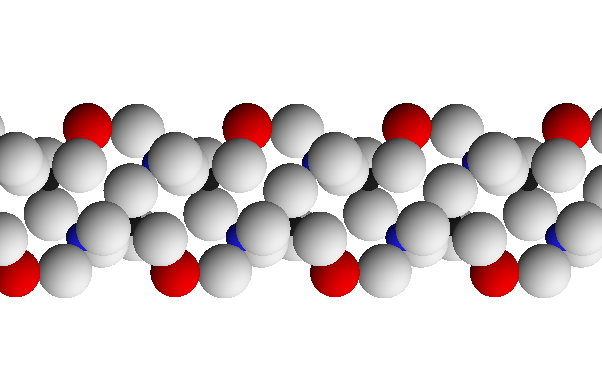 Diagram showing part of a crankshaft chain of feldspar
 -
 Feldspar crystal structure viewed along the c axis
 -
 Feldspar crystal structure viewed along the a axis
 -
 Feldspar crystal structure viewed along the b axis


Weathering[edit | edit source]
Chemical weathering of feldspars happens by hydrolysis and produces clay minerals, including illite, smectite, and kaolinite. Hydrolysis of feldspars begins with the feldspar dissolving in water, which happens best in acidic or basic solutions and less well in neutral ones.[30] The speed at which feldspars are weathered is controlled by how quickly they are dissolved.[30] Dissolved feldspar reacts with H+ or OH− ions and precipitates clays. The reaction also produces new ions in solution, with the variety of ions controlled by the type of feldspar reacting.
The abundance of feldspars in the Earth's crust means that clays are very abundant weathering products.[31] About 40% of minerals in sedimentary rocks are clays and clays are the dominant minerals in the most common sedimentary rocks, mudrocks.[32] They are also an important component of soils.[32] Feldspar that has been replaced by clay looks chalky compared to more crystalline and glassy unweathered feldspar grains.[33]
Feldspars, especially plagioclase feldspars, are not very stable at the Earth's surface due to their high formation temperature.[32] This lack of stability is why feldspars are easily weathered to clays. Because of this tendency to weather easily, feldspars are usually not prevalent in sedimentary rocks. Sedimentary rocks that contain large amounts of feldspar indicate that the sediment did not undergo much chemical weathering before being buried. This means it was probably transported a short distance in cold and/or dry conditions that did not promote weathering, and that it was quickly buried by other sediment.[34] Sandstones with large amounts of feldspar are called arkoses.[34]
Applications[edit | edit source]
Feldspar is a common raw material used in glassmaking, ceramics, and to some extent as a filler and extender in paints, plastics, and rubber. In the US, about 66% of feldspar is consumed in glassmaking, including glass containers and glass fibre. Ceramics (including electrical insulators, sanitaryware, tableware and tile) and other uses, such as fillers, accounted for the remainder.[35]
Glass: Feldspar provides both K2O and Na2O for fluxing, and Al2O3 and CaO as stabilizers. As an important source of Al2O3 for glassmaking, feldspar is valued for its low iron and refractory mineral content, a low cost per unit of Al2O3, no volatiles and no waste.[36]
Ceramics: Feldspars are used in the ceramic industry as a flux to form a glassy phase in bodies during firing, and thus promote vitrification. They are also used as a source of alkalies and alumina in glazes.[36] The composition of feldspar used in different ceramic formulations varies depending on various factors, including the properties of the individual grade, the other raw materials and the requirements of the finished products. However, typical additions include: tableware, 15% to 30% feldspar; high-tension electrical porcelains, 25% to 35%; sanitaryware, 25%; wall tile, 0% to 10%; and dental porcelain up to 80% feldspar.[37]
Earth sciences: In earth sciences and archaeology, feldspars are used for potassium–argon dating, argon–argon dating and luminescence dating.
Minor use: Some household cleaners (such as Bar Keepers Friend and Bon Ami) use feldspar to give a mild abrasive action.[38]
Production[edit | edit source]
The USGS estimated global production of feldspar in 2020 to be 26 million tonnes, with the top four producing countries being: China 2 million tonnes; India 5 million tonnes; Italy 4 million; Turkey 7.6 million tonnes.[39]
Commercial grades[edit | edit source]
Typical mineralogical and chemical analyses of three commercial grades used in ceramics are:[40]
| Product name | Norfloat K | Forshammar | FFF K6 |
|---|---|---|---|
| Country | Norway | Sweden | Finland |
| Producing company | North Cape | Sibelco | Sibelco |
| Albite, % | 23 | 40 | 41 |
| Microcline, % | 71 | 23 | 37 |
| Anorthite, % | 3 | — | 4 |
| Quartz, % | 3 | 33 | 8 |
| SiO2, % | 65.9 | 75.7 | 67.9 |
| Al2O3, % | 18.6 | 14.1 | 18.3 |
| Fe2O3, % | 0.07 | 0.15 | 0.11 |
| TiO2, % | — | 0.02 | 0.01 |
| CaO, % | 0.40 | 0.30 | 0.70 |
| MgO, % | — | 0.10 | 0.01 |
| K2O, % | 11.8 | 3.8 | 6.4 |
| Na2O, % | 2.9 | 5.0 | 5.5 |
| LOI, % | 0.2 | 0.5 | 0.2 |
Extraterrestrial[edit | edit source]
In October 2012, the Curiosity rover found high feldspar content in a Mars rock.[41]
Gallery[edit | edit source]
-
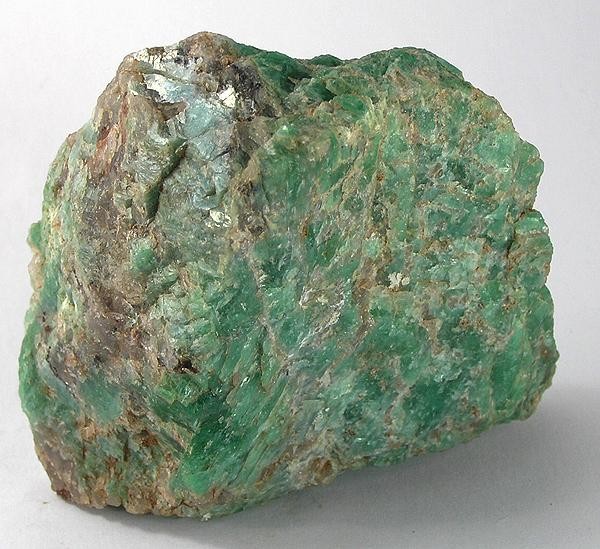 Specimen of rare plumbian (lead-rich) feldspar
 -
 Crystallized white feldspar, with an upright 4 cm aquamarine crystal perched on it
 -
 Feldspar and moonstone, from Sonora, Mexico
 -
 A cluster of euhedral feldspar crystals with a schorl crystal
 -
![First X-ray view of Martian soil—feldspar, pyroxenes, olivine revealed (Curiosity rover at "Rocknest", October 17, 2012)[42]](https://storage.googleapis.com/smartcommons/commons/1/10/PIA16217-MarsCuriosityRover-1stXRayView-20121017.jpg) First X-ray view of Martian soil—feldspar, pyroxenes, olivine revealed (Curiosity rover at "Rocknest", October 17, 2012)[42]
First X-ray view of Martian soil—feldspar, pyroxenes, olivine revealed (Curiosity rover at "Rocknest", October 17, 2012)[42] -
 Lunar ferrous anorthosite #60025 (plagioclase feldspar). Collected by Apollo 16 from the Lunar Highlands near Descartes Crater. This sample is currently on display at the National Museum of Natural History in Washington, D.C.


![First X-ray view of Martian soil—feldspar, pyroxenes, olivine revealed (Curiosity rover at "Rocknest", October 17, 2012)[42]](/wiki/File:PIA16217-MarsCuriosityRover-1stXRayView-20121017.jpg)
.jpg)
See also[edit | edit source]
References[edit | edit source]
- ↑ Warr, L.N. (2021). "IMA–CNMNC approved mineral symbols". Mineralogical Magazine. 85 (3): 291–320. Bibcode:2021MinM...85..291W. doi:10.1180/mgm.2021.43. S2CID 235729616.
- ↑ "Feldspar". Gemology Online. Retrieved 8 November 2012.
- ↑ 3.0 3.1 Neuendorf, K.K.E.; Mehl, J.P. Jr.; Jackson, J.A., eds. (2005). Glossary of Geology (5th ed.). Alexandria, Virginia: American Geological Institute. p. 232. ISBN 978-0922152896.
- ↑ 4.0 4.1 Deer, W.A; Howie, R.A.; Zussman, J. (2001). Rock-forming Minerals (2nd edition) Volume 4A. London: Geological Society of London. p. 2. ISBN 1-86239-081-9.
- ↑ Anderson, Robert S.; Anderson, Suzanne P. (2010). Geomorphology: The Mechanics and Chemistry of Landscapes. Cambridge University Press. p. 187. ISBN 9781139788700.
- ↑ Rudnick, R. L.; Gao, S. (2003). "Composition of the Continental Crust". In Holland, H. D.; Turekian, K. K. (eds.). Treatise on Geochemistry. Vol. 3. New York: Elsevier Science. pp. 1–64. Bibcode:2003TrGeo...3....1R. doi:10.1016/B0-08-043751-6/03016-4. ISBN 978-0-08-043751-4.
- ↑ Troll, V. R. (1 February 2002). "Magma Mixing and Crustal Recycling Recorded in Ternary Feldspar from Compositionally Zoned Peralkaline Ignimbrite A', Gran Canaria, Canary Islands". Journal of Petrology. 43 (2): 243–270. Bibcode:2002JPet...43..243T. doi:10.1093/petrology/43.2.243. ISSN 1460-2415.
- ↑ "Metamorphic Rocks." Metamorphic Rocks Information Archived 2007-07-01 at the Wayback Machine. Retrieved on July 18, 2007
- ↑ Blatt, Harvey and Tracy, Robert J. (1996) Petrology, Freeman, 2nd ed., pp. 206–210 ISBN 0-7167-2438-3
- ↑ "Weathering and Sedimentary Rocks." Geology. Archived 2007-07-03 at the Wayback Machine Retrieved on July 18, 2007.
- ↑ Hans Lüschen (1979), Die Namen der Steine. Das Mineralreich im Spiegel der Sprache (2nd ed.), Thun: Ott Verlag, p. 215, ISBN 3-7225-6265-1
- ↑ Harper, Douglas. "feldspar". Online Etymology Dictionary. Retrieved 8 February 2008.
- ↑ "spar". Oxford English Dictionary. Oxford Dictionaries. Archived from the original on 26 September 2016. Retrieved 13 January 2018.
- ↑ 14.0 14.1 14.2 14.3 14.4 Feldspar. What is Feldspar? Industrial Minerals Association. Retrieved on July 18, 2007.
- ↑ Le Bas, M. J.; Streckeisen, A. L. (1991). "The IUGS systematics of igneous rocks". Journal of the Geological Society. 148 (5): 825–833. Bibcode:1991JGSoc.148..825L. CiteSeerX 10.1.1.692.4446. doi:10.1144/gsjgs.148.5.0825. S2CID 28548230.
- ↑ "Rock Classification Scheme – Vol 1 – Igneous" (PDF). British Geological Survey: Rock Classification Scheme. 1: 1–52. 1999. Archived (PDF) from the original on 9 October 2022.
- ↑ Philpotts, Anthony R.; Ague, Jay J. (2009). Principles of igneous and metamorphic petrology (2nd ed.). Cambridge, UK: Cambridge University Press. pp. 139–143. ISBN 9780521880060.
- ↑ Bowen, N.L. (1956). The Evolution of the Igneous Rocks. Canada: Dover. pp. 60–62.
- ↑ Klein, Cornelis; Hurlbut, Cornelius S. Jr. (1993). Manual of mineralogy : (after James D. Dana) (21st ed.). New York: Wiley. p. 559. ISBN 047157452X.
- ↑ 20.0 20.1 "The Mineral Orthoclase". Feldspar Amethyst Galleries, Inc. Retrieved on February 8, 2008.
- ↑ 21.0 21.1 "Sanidine Feldspar". Feldspar Amethyst Galleries, Inc. Retrieved on February 8, 2008.
- ↑ "Microcline Feldspar". Feldspar Amethyst Galleries, Inc. Retrieved on February 8, 2008.
- ↑ Klein & Hurlbut 1993, pp. 532-536.
- ↑ Ralph, Jolyon and Chou, Ida. "Perthite". Perthite Profile on mindat.org. Retrieved on February 8, 2008.
- ↑ "Buddingtonite".
- ↑ "Feldspar Group". mindat.org. Retrieved 4 July 2021.
- ↑ Celsian–orthoclase series on Mindat.org.
- ↑ Celsian–hyalophane series on Mindat.org.
- ↑ Klein & Hurlbut 1993, pp. 533-534.
- ↑ 30.0 30.1 Blum, Alex E. (1994), Parsons, Ian (ed.), "Feldspars in Weathering", Feldspars and their Reactions, NATO ASI Series, Dordrecht: Springer Netherlands, pp. 595–630, doi:10.1007/978-94-011-1106-5_15, ISBN 978-94-011-1106-5, retrieved 18 November 2020
{{citation}}: CS1 maint: work parameter with ISBN (link) - ↑ Hefferan, Kevin; O'Brien, John (2010). Earth Materials. Wiley-Blackwell. pp. 336–337. ISBN 978-1-4443-3460-9.
- ↑ 32.0 32.1 32.2 Nelson, Stephen A. (Fall 2008). "Weathering & Clay Minerals". Professor's lecture notes (EENS 211, Mineralogy). Tulane University. Archived from the original on 1 August 2017. Retrieved 13 November 2008.
- ↑ Earle, Steven (September 2015). "5.2 Chemical Weathering". Physical Geology. BCcampus.
- ↑ 34.0 34.1 "Arkose". www.mindat.org. Retrieved 18 November 2020.
- ↑ Apodaca, Lori E. (2008). Feldspar and nepheline syenite, USGS 2008 Minerals Yearbook
- ↑ 36.0 36.1 'Industrial Minerals & Rocks – Commodities, Markets and Uses' J. E. Kogel. Society for Mining, Metallurgy and Exploration, 2006. p. 458
- ↑ Singer, F. and Singer, S.S. (1971). 'Industrial Ceramics'. Chapman & Hall.
- ↑ Neufeld, Rob (4 August 2019). "Visiting our Past: Feldspar mining and racial tensions". Asheville Citizen-Times. Retrieved 4 August 2019.
- ↑ Feldspar and Nepheline Syenite. U.S. Geological Survey, Mineral Commodity Summaries, January 2020
- ↑ Sugden, A. (2004). 'Feldspar Facts'. Ceramic Review, issue 207, May/June 2004.
- ↑ Nasa's Curiosity rover finds 'unusual rock'. (12 October 2012) BBC News.
- ↑ Brown, Dwayne (30 October 2012). "NASA Rover's First Soil Studies Help Fingerprint Martian Minerals". NASA. Archived from the original on 3 June 2016. Retrieved 31 October 2012.
Further reading[edit | edit source]
- Bonewitz, Ronald Louis (2005). Rock and Gem. New York, DK Publishing. ISBN 978-0-7566-3342-4.
External links[edit | edit source]
- Chisholm, Hugh, ed. (1911). . Encyclopædia Britannica. Vol. 10 (11th ed.). Cambridge University Press. p. 245.
- usgs.gov (Mineral Commodity Summaries 2025): Feldspar and Nepheline Syenite