


->JJMC89 bot III |
m page fix |
||
| Line 1: | Line 1: | ||
{{short description|Prime | {{short description|Prime minister for the 3rd Nizam of Hyderabad}} | ||
{{Use Indian English|date=February 2023}} | |||
{{Not to be confused with|Chandu Shah|text=[[Chandu Shah]], who is sometimes referred to by the same name}} | |||
{{Use dmy dates|date=December 2014}} | {{Use dmy dates|date=December 2014}} | ||
{{Infobox officeholder | {{Infobox officeholder | ||
| honorific_prefix = [[Maharaja]] | | honorific_prefix = [[Maharaja]] | ||
| name = Chandu Lal | | name = Chandu Lal | ||
| image = | | image = Painting of Chandu Lal of Hyderabad State, by John Godwin Williams, ca.1836.jpg | ||
| office = [[Prime Minister of Hyderabad]] | | office = [[Prime Minister of Hyderabad]] | ||
| termstart = 1833 | | termstart = 1833 | ||
| Line 11: | Line 13: | ||
| monarch = [[Sikandar Jah]] | | monarch = [[Sikandar Jah]] | ||
| death_date = 15 April 1845 | | death_date = 15 April 1845 | ||
| | | caption = Painting of Chandu Lal of Hyderabad State, by John Godwin Williams, ca.1836 | ||
}} | }} | ||
'''Chandu Lal Malhotra''' (1766 | '''Chandu Lal Malhotra''' (1766 – 15 April 1845), better known as '''Maharaja Chandu Lal''' was the [[Prime Minister]] (1833–1844) for the 3rd [[Nizam]] of [[Hyderabad State|Hyderabad]], [[Sikandar Jah]]. He was born in Hyderabad Deccan (now [[Hyderabad, India]]), and hailed from a Hindu family of the [[Khatri]] caste with origins in [[Lahore]]. He was also a poet of [[Urdu]], [[Hyderabad]]i, [[Punjabi language|Punjabi]] and [[Persian language|Persian]].<ref>{{Cite book|url=https://archive.org/details/nizamoriginfutur00mcauuoft|title=The Nizam; the origin and future of the Hyderabad state, being the Le Bas Prize essay in the University of Cambridge, 1904|last=McAuliffe|first=Robert Paton|date=1904|publisher=London C.J. Clay|others=Robarts - University of Toronto|pages=[https://archive.org/details/nizamoriginfutur00mcauuoft/page/39 39]}}</ref><ref>{{Cite book|url=https://en.wikisource.org/wiki/Modern_Hyderabad_(Deccan)/Chapter_3|title=Modern Hyderabad (Deccan)|last=Law|first=John|chapter=Chapter III : The Nizams and their Ministers|pages=30|archive-date=14 December 2019|access-date=7 September 2019|archive-url=https://web.archive.org/web/20191214034855/https://en.wikisource.org/wiki/Modern_Hyderabad_(Deccan)/Chapter_3|url-status=live}}</ref> | ||
== Family == | == Family == | ||
Chandu Lal Sadan | Chandu Lal Sadan was born in a Hindu [[Malhotra]] family of [[Punjabi people|Punjabi]] Khatri background.<ref>{{Cite book |editor-last=Patel |editor-first=Alka |editor-last2=Leonard |editor-first2=Karen |chapter-url=https://books.google.com/books?id=7_Ij0M2D0moC&pg=PA170 |title=Indo-Muslim Cultures in Transition |last=Leonard |first=Karen |date=2011-11-25 |publisher=BRILL |isbn=978-90-04-21209-1 |language=en|chapter=Indo-Muslim culture in Hyderabad: Old City Neighbourhoods in the 19th century|page=170}}</ref><ref name=":0" /> His family were [[Nanakpanthi|Nanakpanthis]].<ref name=":1">{{Cite book |last=Fenech |first=Louis E. |title=The Sikh Zafar-namah of Guru Gobind Singh: A Discursive Blade in the Heart of the Mughal Empire |date=Jan 31, 2013 |publisher=Oxford University Press |isbn=9780199931453 |pages=167}}</ref> His father was Rai Naryen Das, who migrated from [[Rai Bareilly]] to Hyderabad State.<ref name="Iranica">{{cite news |first=Sharif Husain |last=Qasemi |title=Chandu Lal Sadan: Maharaja, statesman and poet in Persian and Urdu |date=15 December 1990 |url=http://www.iranicaonline.org/articles/candu-lal-lal-sadan-maharaja-statesman-and-poet-in-persian-and-urdu-b |access-date=2014-12-11 |archive-date=26 December 2018 |archive-url=https://web.archive.org/web/20181226082217/http://www.iranicaonline.org/articles/candu-lal-lal-sadan-maharaja-statesman-and-poet-in-persian-and-urdu-b%20 |url-status=live }}</ref> His ancestors had served in the [[Mughal Empire|Mughal]] courts.<ref name="Leonard1971">{{cite journal |title=The Hyderabad Political System and its Participants |first=Karen |last=Leonard |journal=The Journal of Asian Studies |volume=30 |issue=3 |date=May 1971 |pages=569–582 |jstor=2052461 |doi=10.2307/2052461 |url=https://escholarship.org/uc/item/454191gp |archive-date=25 January 2020 |access-date=16 August 2019 |archive-url=https://web.archive.org/web/20200125040952/https://escholarship.org/uc/item/454191gp |url-status=live }}</ref><ref name="Iranica" /><ref name=":1" /> His family is the founder of the ''Dafter-e-Mal'' (Department of Finance) in Hyderabad Deccan during [[Qamar-ud-din Khan, Asaf Jah I|Nizam ul Mulk Asif Jah I]]. The future [[List of prime ministers of Hyderabad State|Prime Minister]], [[Maharaja Sir Kishen Pershad]], was his great-grandson. The family was famously known as ''Malwala Family'' in Hyderabad.<ref name="Leonard1971" /> | ||
[[File:ChanduLal Baradari.jpg|thumb|300px|right|View of Baradari Chandulal in 1890s]] | [[File:ChanduLal Baradari.jpg|thumb|300px|right|View of Baradari Chandulal in 1890s]] | ||
== In Sikh Darbar == | == In Sikh Darbar == | ||
Chandu | Chandu Lal was a Minister within the court of [[Ranjit Singh|Maharaja Ranjit Singh]] under the [[Sikh Empire]]. They both had good relations and Chandu Lal Malotra became a General in the [[Sikh Khalsa Army]]. He then converted and became a devout [[Sahajdhari|Sehajdhari Sikh]]. | ||
In an agreement between Maharaja Ranjit Singh and the [[Nizam of Hyderabad]] for the construction of a Gurudwara in the spot where [[Guru Gobind Singh|Guru Gobind Singh Ji]] died and the Nizam of Hyderabad making it 4 acres large made of marble, Ranjit Singh would give him 24,000 [[Nihang|Nihang Sikhs]] as private unpaid soldiers to quell rebellions.{{ | In an agreement between Maharaja Ranjit Singh and the [[Nizam of Hyderabad]] for the construction of a Gurudwara in the spot where [[Guru Gobind Singh|Guru Gobind Singh Ji]] died and the Nizam of Hyderabad making it 4 acres large made of marble, Ranjit Singh would give him 24,000 [[Nihang|Nihang Sikhs]] as private unpaid soldiers to quell rebellions.{{citation needed|date=August 2021}} | ||
Chandu Lal may have considered himself a [[Nanakpanthi]], as he was devotee of the Udasi saint, Baba Priyatam Das.<ref name=":0">{{Cite book |last=Fenech |first=Louis E. |title=Historical Dictionary of Sikhism. |date=2014 |publisher=Rowman & Littlefield Publishers |others=W. H. McLeod |isbn=978-1-4422-3601-1 |edition=3rd |location=Lanham |pages=80 |oclc=881607325}}</ref> | |||
== In Nizam Darbar == | == In Nizam Darbar == | ||
He started his career as a subordinate in the customs department of [[Hyderabad State|Kingdom of Hyderabad]].<ref>{{cite book |first=Charles Edward |last=Buckland |title=Dictionary of Indian biography |publisher=S. Sonnenschein |year=1906 |url=http://www.ebooksread.com/authors-eng/charles-edward-buckland/dictionary-of-indian-biography-kcu/page-15-dictionary-of-indian-biography-kcu.shtml}}</ref> Later he received the title of ''Raja Bahadur'' from Nawab [[Mir Akbar Ali Khan Sikander Jah, Asaf Jah III|Sikandar Jah]]. Sikandar Jah selected him as accounts officer of his army. British historian states "Due to the ladting effect of Chundoo Lal the dominions of the Nizam seem to look like a Sikh one rather | He started his career as a subordinate in the customs department of [[Hyderabad State|Kingdom of Hyderabad]].<ref>{{cite book |first=Charles Edward |last=Buckland |title=Dictionary of Indian biography |publisher=S. Sonnenschein |year=1906 |url=http://www.ebooksread.com/authors-eng/charles-edward-buckland/dictionary-of-indian-biography-kcu/page-15-dictionary-of-indian-biography-kcu.shtml |archive-date=12 October 2012 |access-date=29 July 2011 |archive-url=https://web.archive.org/web/20121012084249/http://www.ebooksread.com/authors-eng/charles-edward-buckland/dictionary-of-indian-biography-kcu/page-15-dictionary-of-indian-biography-kcu.shtml |url-status=live }}</ref> Later he received the title of ''Raja Bahadur'' from Nawab [[Mir Akbar Ali Khan Sikander Jah, Asaf Jah III|Sikandar Jah]]. Sikandar Jah selected him as accounts officer of his army. British historian states "Due to the ladting effect of Chundoo Lal the dominions of the Nizam seem to look like a Sikh one rather than a Mohhamedan." The Nihang forces refused to be paid and said they would only be paid by the Akal Takht. Later after the Anglo Sikh Wars Nihangs fled to the South, where they battled against revolt earning respect by many. It is even noted by historians that Nihangs were used as bodyguards.{{citation needed|date=August 2021}} | ||
In 1819 Chandu Lal received the title of ''Maharaja'' from Sikandar Jah and a cash award of one [[crore]] [[Hyderabadi rupee|rupees]]. In 1822 he was made the head of seven thousand horsemen with the title of ''Raja e Rajagan'' from Nawab [[Nasir-ud-dawlah, Asaf Jah IV|Nasir ud dawlah]]. After the death of Monir-ul-Mulk in 1833, Chandu Lal succeeded him as a prime minister.<ref name="Iranica" /> | In 1819 Chandu Lal received the title of ''Maharaja'' from Sikandar Jah and a cash award of one [[crore]] [[Hyderabadi rupee|rupees]]. In 1822 he was made the head of seven thousand horsemen with the title of ''Raja e Rajagan'' from Nawab [[Nasir-ud-dawlah, Asaf Jah IV|Nasir ud dawlah]]. After the death of Monir-ul-Mulk in 1833, Chandu Lal succeeded him as a prime minister.<ref name="Iranica" /> | ||
==Prime minister== | ==Prime minister== | ||
Chandu Lal was made prime minister of [[Hyderabad State|Hyderabad Deccan]] | [[File:Nawab Mir 'Alam Bahadur and Raja Chandu Lal Bahadur (6124550671).jpg|thumb|Nawab Mir 'Alam Bahadur and Raja Chandu Lal Bahadur, ca.1800]] | ||
Chandu Lal was made prime minister of [[Hyderabad State|Hyderabad Deccan]] twice. First in the year 1808 then in 1832 AD and he held the office until 1843 AD.<ref name="Iranica" /> | |||
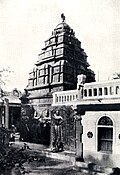
==Maharaj Chandulal's Temple== | |||
[[File:Maharaja Chandulal’s Temple.jpg|thumb|285px|left|View of Maharaja Chandulal’s Temple as seen in 1929]] | |||
As per legends, a saint returning from a pilgrimage to Tirumala, stopped at [[Alwal]]. During his stay, the saint who was carrying an idol of ''Lord Balaji'', sat meditating under a tamarind tree. Chandulal Bahadur, along with his family paid a visit to the saint to seek his blessings. The saint told Chandulal that ''Lord Venkateswara'' had appeared in his dreams and told him that a temple should be built at Alwal for devotees who could not afford to go to Tirumala. Chandulal built a small temple and installed the idol of Lord Venkateswara.<ref>{{cite news|last= Mungara|first= Sunil|date= 2017-11-13|title= Ancient Alwal temple in blind spot, choultries crumbling|url= https://timesofindia.indiatimes.com/city/hyderabad/ancient-alwal-temple-in-blind-spot-choultries-crumbling/articleshow/61623766.cms|work= The Times of India|location= |access-date= 2024-04-04|archive-date= 4 April 2024|archive-url= https://web.archive.org/web/20240404065450/https://timesofindia.indiatimes.com/city/hyderabad/ancient-alwal-temple-in-blind-spot-choultries-crumbling/articleshow/61623766.cms|url-status= live}}</ref> The temple has been declared as an heritage structure. <ref>{{cite web |url= https://www.thedeccanarchive.com/heritage-audit|title= Hyderabad Heritage Audit 2023|last= |first= |date= |website= |publisher=The Deccan Archive |access-date= |quote=2024-04-04}}</ref> | |||
==Poet== | ==Poet== | ||
Chandu Lal (who used the pen name " | Chandu Lal (who used the pen name "Shaadan" (شاداں) as a learned man, was a patron of [[Urdu]] poetry and literature. His patronship attracted [[Urdu poets]] to his court. He even invited poets from Northern India like [[Zauq]] and [[Baksh Nasikh]] and Mirza Ghalib from Delhi to Hyderabad State but they couldn't turn up for some reasons.{{citation needed|date=December 2014}} Despite the responsibility of his prime ministerial office he used to regularly organize and attend ''[[Mushaira]]''.<ref name="Iranica" /> | ||
==See also== | ==See also== | ||
| Line 42: | Line 51: | ||
{{reflist}} | {{reflist}} | ||
==Further reading== | |||
* {{Encyclopædia Iranica|last1= Qasemi |first1=Sharif Husain | volume = 4 | fascicle = 7 | title = Čandū Laʿl Šādān |author-link = | url = https://www.iranicaonline.org/articles/candu-lal-lal-sadan-maharaja-statesman-and-poet-in-persian-and-urdu-b | pages = 756–757}}{{sfn whitelist|CITEREFQasemi1990}} | |||
{{Nizam of Hyderabad}} | |||
{{Sikh Empire|state=collapsed}} | |||
{{Authority control}} | {{Authority control}} | ||
{{DEFAULTSORT:Lal, Chandu}} | {{DEFAULTSORT:Lal, Chandu}} | ||
[[Category:People from Hyderabad State]] | [[Category:People from Hyderabad State]] | ||
[[Category:Prime ministers of Hyderabad State]] | |||
[[Category:Indian Hindus]] | [[Category:Indian Hindus]] | ||
[[Category:1845 deaths]] | [[Category:1845 deaths]] | ||
[[Category:1766 births]] | [[Category:1766 births]] | ||
[[Category:People from Raebareli]] | [[Category:People from Raebareli]] | ||
[[Category: | [[Category:18th-century Indian male writers]] | ||
[[Category:Urdu-language Indian poets]] | |||
[[Category:Poets from Uttar Pradesh]] | [[Category:Poets from Uttar Pradesh]] | ||
[[Category:18th-century Indian poets]] | [[Category:18th-century Indian poets]] | ||
[[Category:19th-century Indian poets]] | [[Category:19th-century Indian poets]] | ||
[[Category:Indian male poets]] | [[Category:Indian male poets]] | ||
Latest revision as of 00:12, 11 March 2026
Chandu Lal | |
|---|---|
 Painting of Chandu Lal of Hyderabad State, by John Godwin Williams, ca.1836 | |
| Prime Minister of Hyderabad | |
| In office 1833–1844 | |
| Monarch | Sikandar Jah |
| Personal details | |
| Died | 15 April 1845 |
Chandu Lal Malhotra (1766 – 15 April 1845), better known as Maharaja Chandu Lal was the Prime Minister (1833–1844) for the 3rd Nizam of Hyderabad, Sikandar Jah. He was born in Hyderabad Deccan (now Hyderabad, India), and hailed from a Hindu family of the Khatri caste with origins in Lahore. He was also a poet of Urdu, Hyderabadi, Punjabi and Persian.[1][2]
Family[edit | edit source]
Chandu Lal Sadan was born in a Hindu Malhotra family of Punjabi Khatri background.[3][4] His family were Nanakpanthis.[5] His father was Rai Naryen Das, who migrated from Rai Bareilly to Hyderabad State.[6] His ancestors had served in the Mughal courts.[7][6][5] His family is the founder of the Dafter-e-Mal (Department of Finance) in Hyderabad Deccan during Nizam ul Mulk Asif Jah I. The future Prime Minister, Maharaja Sir Kishen Pershad, was his great-grandson. The family was famously known as Malwala Family in Hyderabad.[7]

In Sikh Darbar[edit | edit source]
Chandu Lal was a Minister within the court of Maharaja Ranjit Singh under the Sikh Empire. They both had good relations and Chandu Lal Malotra became a General in the Sikh Khalsa Army. He then converted and became a devout Sehajdhari Sikh.
In an agreement between Maharaja Ranjit Singh and the Nizam of Hyderabad for the construction of a Gurudwara in the spot where Guru Gobind Singh Ji died and the Nizam of Hyderabad making it 4 acres large made of marble, Ranjit Singh would give him 24,000 Nihang Sikhs as private unpaid soldiers to quell rebellions.[citation needed]
Chandu Lal may have considered himself a Nanakpanthi, as he was devotee of the Udasi saint, Baba Priyatam Das.[4]
In Nizam Darbar[edit | edit source]
He started his career as a subordinate in the customs department of Kingdom of Hyderabad.[8] Later he received the title of Raja Bahadur from Nawab Sikandar Jah. Sikandar Jah selected him as accounts officer of his army. British historian states "Due to the ladting effect of Chundoo Lal the dominions of the Nizam seem to look like a Sikh one rather than a Mohhamedan." The Nihang forces refused to be paid and said they would only be paid by the Akal Takht. Later after the Anglo Sikh Wars Nihangs fled to the South, where they battled against revolt earning respect by many. It is even noted by historians that Nihangs were used as bodyguards.[citation needed] In 1819 Chandu Lal received the title of Maharaja from Sikandar Jah and a cash award of one crore rupees. In 1822 he was made the head of seven thousand horsemen with the title of Raja e Rajagan from Nawab Nasir ud dawlah. After the death of Monir-ul-Mulk in 1833, Chandu Lal succeeded him as a prime minister.[6]
Prime minister[edit | edit source]
.jpg)
Chandu Lal was made prime minister of Hyderabad Deccan twice. First in the year 1808 then in 1832 AD and he held the office until 1843 AD.[6]
Maharaj Chandulal's Temple[edit | edit source]

As per legends, a saint returning from a pilgrimage to Tirumala, stopped at Alwal. During his stay, the saint who was carrying an idol of Lord Balaji, sat meditating under a tamarind tree. Chandulal Bahadur, along with his family paid a visit to the saint to seek his blessings. The saint told Chandulal that Lord Venkateswara had appeared in his dreams and told him that a temple should be built at Alwal for devotees who could not afford to go to Tirumala. Chandulal built a small temple and installed the idol of Lord Venkateswara.[9] The temple has been declared as an heritage structure. [10]
Poet[edit | edit source]
Chandu Lal (who used the pen name "Shaadan" (شاداں) as a learned man, was a patron of Urdu poetry and literature. His patronship attracted Urdu poets to his court. He even invited poets from Northern India like Zauq and Baksh Nasikh and Mirza Ghalib from Delhi to Hyderabad State but they couldn't turn up for some reasons.[citation needed] Despite the responsibility of his prime ministerial office he used to regularly organize and attend Mushaira.[6]
See also[edit | edit source]
References[edit | edit source]
- ↑ McAuliffe, Robert Paton (1904). The Nizam; the origin and future of the Hyderabad state, being the Le Bas Prize essay in the University of Cambridge, 1904. Robarts - University of Toronto. London C.J. Clay. pp. 39.
- ↑ Law, John. "Chapter III : The Nizams and their Ministers". Modern Hyderabad (Deccan). p. 30. Archived from the original on 14 December 2019. Retrieved 7 September 2019.
- ↑ Leonard, Karen (25 November 2011). "Indo-Muslim culture in Hyderabad: Old City Neighbourhoods in the 19th century". In Patel, Alka; Leonard, Karen (eds.). Indo-Muslim Cultures in Transition. BRILL. p. 170. ISBN 978-90-04-21209-1.
- ↑ 4.0 4.1 Fenech, Louis E. (2014). Historical Dictionary of Sikhism. W. H. McLeod (3rd ed.). Lanham: Rowman & Littlefield Publishers. p. 80. ISBN 978-1-4422-3601-1. OCLC 881607325.
- ↑ 5.0 5.1 Fenech, Louis E. (31 January 2013). The Sikh Zafar-namah of Guru Gobind Singh: A Discursive Blade in the Heart of the Mughal Empire. Oxford University Press. p. 167. ISBN 9780199931453.
- ↑ 6.0 6.1 6.2 6.3 6.4 Qasemi, Sharif Husain (15 December 1990). "Chandu Lal Sadan: Maharaja, statesman and poet in Persian and Urdu". Archived from the original on 26 December 2018. Retrieved 11 December 2014.
- ↑ 7.0 7.1 Leonard, Karen (May 1971). "The Hyderabad Political System and its Participants". The Journal of Asian Studies. 30 (3): 569–582. doi:10.2307/2052461. JSTOR 2052461. Archived from the original on 25 January 2020. Retrieved 16 August 2019.
- ↑ Buckland, Charles Edward (1906). Dictionary of Indian biography. S. Sonnenschein. Archived from the original on 12 October 2012. Retrieved 29 July 2011.
- ↑ Mungara, Sunil (13 November 2017). "Ancient Alwal temple in blind spot, choultries crumbling". The Times of India. Archived from the original on 4 April 2024. Retrieved 4 April 2024.
- ↑ "Hyderabad Heritage Audit 2023". The Deccan Archive.
2024-04-04
Further reading[edit | edit source]
- Pages using the JsonConfig extension
- People from Hyderabad State
- Prime ministers of Hyderabad State
- Indian Hindus
- 1845 deaths
- 1766 births
- People from Raebareli
- 18th-century Indian male writers
- Urdu-language Indian poets
- Poets from Uttar Pradesh
- 18th-century Indian poets
- 19th-century Indian poets
- Indian male poets