








Ajay Kumar (talk | contribs) Created a new article |
typo fix |
||
| Line 1: | Line 1: | ||
{{Short description|State in Egypt, Hejaz and | {{Short description|State in Egypt, Hejaz and Syria (1250–1517)}} | ||
{{ | {{For|the Mamluk sultanate of Delhi|Mamluk dynasty (Delhi)}} | ||
{{Use dmy dates|date=January 2024}} | |||
{{Infobox country | {{Infobox country | ||
| conventional_long_name = Mamluk Sultanate | | conventional_long_name = Mamluk Sultanate | ||
| native_name = {{native name|ar|سلطنة المماليك}}<br/>Salṭanat al-Mamālīk | | native_name = {{native name|ar|سلطنة المماليك}}<br/>{{Transliteration|ar|Salṭanat al-Mamālīk}} | ||
| year_start = 1250 | | year_start = 1250 | ||
| date_start = 2 May | | date_start = 2 May | ||
| event1 = [[Barquq]] overthrows [[al-Salih Hajji]]; [[Burji Mamluks|Burji]] rule begins | |||
| date_event1 = November 1382 | |||
| year_end = 1517 | | year_end = 1517 | ||
| date_end = 22 January | | date_end = 22 January | ||
| event_start = Murder of [[al-Muazzam Turanshah|Turanshah]] | | event_start = Murder of [[al-Muazzam Turanshah|Turanshah]] | ||
| event_end = [[ | | event_end = [[Capture of Cairo (1517)|Ottoman conquest of Cairo]] | ||
| p1 = Abbasid Caliphate | | p1 = Abbasid Caliphate | ||
| p2 = Ayyubid dynasty | | p2 = Ayyubid dynasty | ||
| Line 19: | Line 21: | ||
| border_p6 = no | | border_p6 = no | ||
| p7 = Armenian Kingdom of Cilicia | | p7 = Armenian Kingdom of Cilicia | ||
| p8 = | | p8 = Tahirid Sultanate | ||
| s1 = Ottoman Empire | | s1 = Ottoman Empire | ||
| image_flag = | | image_flag = | ||
| image_flag2 = | | image_flag2 = | ||
| flag_border = | | flag_border = | ||
| flag2_border = | | flag2_border = | ||
| flag_type = | | flag_type = | ||
| image_coat = | | image_coat = | ||
| symbol_type = | | symbol_type = | ||
| other_symbol_type = {{nowrap|[[Attributed arms]] of the [[List of Mamluk sultans|Mamluk Sultan]]}} | | other_symbol_type = {{nowrap|[[Attributed arms]] of the [[List of Mamluk sultans|Mamluk Sultan]]}} | ||
| image_map = Mamluk Sultanate of Cairo 1317 AD.jpg | | image_map = Mamluk Sultanate of Cairo 1317 AD.jpg | ||
| image_map_caption = Extent of the Mamluk Sultanate under Sultan [[ | | image_map_caption = Extent of the Mamluk Sultanate under Sultan [[Al-Nasir Muhammad]] | ||
| capital = [[Cairo]] | | capital = [[Cairo]] | ||
| common_languages = {{plainlist | | common_languages = {{plainlist}} | ||
*[[Arabic language|Arabic]] | *[[Arabic language|Arabic]] (majority) | ||
*[[Mamluk-Kipchak language|Mamluk-Kipchak]] | *[[Mamluk-Kipchak language|Mamluk-Kipchak]]{{sfn|Rabbat|2001|p=69}} | ||
*[[Circassian language|Circassian]] | *[[Circassian language|Circassian]]{{sfn|Fischel|1967|p=72}} | ||
*[[Oghuz Turkic]]<ref | *[[Oghuz Turkic]]<ref name="Turan" /> | ||
{{endplainlist}} | |||
| title_leader = [[List of Abbasid caliphs|Caliph]] | |||
| title_leader = [[Abbasid | |||
| leader1 = [[Al-Mustansir II|Al-Mustansir]] (first) | | leader1 = [[Al-Mustansir II|Al-Mustansir]] (first) | ||
| year_leader1 = 1261 | | year_leader1 = 1261 | ||
| Line 49: | Line 49: | ||
| leader4 = [[Al-Mutawakkil III]] (last) | | leader4 = [[Al-Mutawakkil III]] (last) | ||
| year_leader4 = 1508–1516 | | year_leader4 = 1508–1516 | ||
| deputy1 = [[Shajar | | deputy1 = [[Shajar al-Durr]] (first) | ||
| year_deputy1 = 1250 | | year_deputy1 = 1250 | ||
| deputy2 = [[ | | deputy2 = [[Aybak]] | ||
| year_deputy2 = 1250–1257 | | year_deputy2 = 1250–1257 | ||
| deputy3 = [[ | | deputy3 = [[Baybars]] | ||
| year_deputy3 = 1260–1277 | | year_deputy3 = 1260–1277 | ||
| deputy4 = [[Tuman | | deputy4 = [[Tuman Bay II]] (last) | ||
| year_deputy4 = 1516–1517 | | year_deputy4 = 1516–1517 | ||
| title_deputy = [[List of Mamluk sultans|Sultan]] | | title_deputy = [[List of Mamluk sultans|Sultan]] | ||
| | | status = [[Sultanate]] | ||
| religion = {{plainlist | | government_type = [[Examples of feudalism|Semi-feudal]]<ref>{{Cite journal |last=Poliak |first=A. N. |date=January 1937 |title=Some Notes on the Feudal System of the Mamlūks |url=https://www.cambridge.org/core/product/identifier/S0035869X00096179/type/journal_article |journal=Journal of the Royal Asiatic Society of Great Britain & Ireland |language=en |volume=69 |issue=1 |pages=97–107 |doi=10.1017/S0035869X00096179 |issn=0035-869X|url-access=subscription }}</ref><ref>{{Cite book |last=Ayubi |first=Nazih N. |title=Over-stating the Arab State: Politics and Society in the Middle East |publisher=Bloomsbury Publishing |year=1996 |isbn=9780857715494 |page=67}}</ref> [[Stratocracy|stratocratic]] [[elective monarchy]] | ||
* [[Sunni Islam]] ([[ | | official_languages = [[Arabic language|Arabic]] | ||
| religion = {{plainlist}} | |||
* [[Sunni Islam]] ([[state religion|state]]) | |||
* [[Shia Islam]] (minority) | * [[Shia Islam]] (minority) | ||
* [[ | * [[Alawism]] (minority) | ||
* [[Christianity | * [[Christianity]] (minority) | ||
* [[Judaism | * [[Judaism]] (minority){{endplainlist}} | ||
| demonym = [[Mamluk]] | | demonym = [[Mamluk]] | ||
}} | }} | ||
{{History of Egypt}} | |||
{{ | The '''Mamluk Sultanate''' ({{langx|ar|سلطنة المماليك|translit=Salṭanat al-Mamālīk}}), also known as '''Mamluk''' '''Egypt''' or the '''Mamluk Empire''', was a state that ruled [[medieval Egypt|Egypt]], the [[Syrian region]] and the [[Hejaz]] from the mid-13th to early 16th centuries, with [[Cairo]] as its capital. It was ruled by a military caste of [[mamluk]]s (freed slave soldiers) headed by a [[sultan]]. The sultanate was established with the overthrow of the [[Ayyubid dynasty]] in Egypt in 1250 and was [[Ottoman–Mamluk War (1516–1517)|conquered]] by the [[Ottoman Empire]] in 1517. Mamluk history is generally divided into the [[Turkic peoples|Turkic]] or [[Bahri Mamluks|Bahri period]] (1250–1382) and the [[Circassians|Circassian]] or [[Burji Mamluks|Burji period]] (1382–1517), called after the predominant ethnicity or corps of the ruling Mamluks during these respective eras.{{sfn|Holt|Baker|Smith|Hopwood|2025}}<ref name=":3">{{Cite book|title = The Later Crusades, 1189–1311|last = Setton|first = Kenneth M.|publisher = Univ of Wisconsin Press|year = 1969|isbn = 978-0-299-04844-0|location = Wisconsin, USA|pages = 757}}</ref>{{Sfn|Levanoni|1995|p=17}}<ref name=":5">{{Cite book|title = Turkish Myth and Muslim Symbol: The Battle of Manzikert|last = Hillenbrand|first = Carole|publisher = Edinburgh University Press|year = 2007|isbn = 978-0-7486-2572-7|location = Edinburg|pages = 164–165}}</ref> | ||
The | The first rulers of the sultanate hailed from the mamluk regiments of the Ayyubid sultan [[al-Salih Ayyub]] ({{Reign|1240|1249}}), usurping power from [[al-Muazzam Turanshah|his successor]] in 1250. The Mamluks under Sultan [[Qutuz]] and [[Baybars]] [[Battle of Ain Jalut|routed]] the [[Mongol Empire|Mongol]]s in 1260, halting their southward expansion. They then conquered or gained suzerainty over the Ayyubids' Syrian principalities. Baybars also reestablished the [[Abbasid dynasty]] of [[caliph]]s in Cairo, though their role was ceremonial. By the end of the 13th century, through the efforts of sultans Baybars, [[Qalawun]] ({{Reign|1279|1290}}) and [[al-Ashraf Khalil]] ({{Reign|1290|1293}}), the Mamluks had conquered the [[Crusader states]], expanded into [[Makuria]] ([[Nubia]]), [[Cyrenaica]], the Hejaz, and southern [[Anatolia]]. The sultanate experienced a long period of stability and prosperity during the third reign of [[al-Nasir Muhammad]] ({{reign|1293|1294|1299|1309|1310|1341}}), before giving way to the internal strife characterizing the succession of his sons, when real power was held by senior [[emir]]s. | ||
One such emir, [[Barquq]], overthrew the sultan in 1382 and again in 1390, inaugurating Burji rule. Mamluk authority across the empire eroded under his successors due to foreign invasions, tribal rebellions, and natural disasters, and the state entered into a long period of financial distress. Under Sultan [[Barsbay]], major efforts were taken to replenish the treasury, particularly monopolization of trade with Europe and tax expeditions into the countryside. He also managed to impose Mamluk authority abroad, forcing [[Kingdom of Cyprus|Cyprus]] to [[Mamluk campaigns against Cyprus (1424–1426)|submit in 1426]]. The sultanate stagnated after this. Sultan [[Qaitbay]]'s long and competent reign ({{reign|1468|1496}}) ensured some stability, though it was marked by conflicts with the Ottomans. The last effective sultan was [[Qansuh al-Ghuri]] ({{reign|1501|1516}}), whose reign was known for heavy-handed fiscal policies, attempted military reforms, and [[Mamluk–Portuguese conflicts|confrontations with the Portuguese]] in the Indian Ocean. In 1516, he was [[Battle of Marj Dabiq|killed in battle]] against Ottoman sultan [[Selim I]], who subsequently conquered Egypt in 1517 and ended Mamluk rule. | |||
Under Mamluk rule, Cairo reached the peak of its size and wealth before the modern period,{{sfn|Raymond|1993|p=122-124, 140-142}} becoming one of the largest cities in the world at the time.<ref>{{Cite book |last=Johnson |first=Amy J. |chapter-url=https://books.google.com/books?id=umyHqvAErOAC&pg=PA199 |title=Encyclopedia of African History 3-Volume Set |date=2005 |publisher=Routledge |isbn=978-1-135-45670-2 |editor-last=Shillington |editor-first=Kevin |pages=199 |language=en |chapter=Cairo}}</ref> The sultanate's economy was primarily agrarian, but its geographic position also placed it at the center of trade between Europe and the Indian Ocean. The Mamluks themselves relied on the ''[[iqta']]'' system to provide revenues. They were also major patrons of art and architecture: [[inlaid]] metalwork, [[enameled glass]], and illuminated Qur'an [[Islamic manuscripts|manuscripts]] were among the high points of art, while [[Mamluk architecture]] still makes up much of the fabric of [[historic Cairo]] today and is found throughout their former domains. | |||
==Name== | ==Name== | ||
The | The 'Mamluk Sultanate' is a modern historiographical term.{{sfn|Yosef|2013|p=8}}{{Sfn|Petry|2022|p=53}} Arabic sources for the period of the [[Bahri Mamluks]] refer to the dynasty as the 'State of the Turks' ({{Transliteration|ar|Dawlat al-Atrak}} or {{Transliteration|ar|Dawlat al-Turk}}) or 'State of Turkey' ({{Transliteration|ar|al-Dawla al-Turkiyya}}).{{sfn|Nicolle|2014|p=4}}{{sfn|Northrup|1998b|p=250}}{{sfn|Yosef|2013|p=8}} During Burji rule, it was also referred to as the 'State of the Circassians' ({{Transliteration|ar|Dawlat al-Jarakisa}}).{{sfn|Yosef|2013|p=8}} These names emphasized the ethnic origin of the rulers and Mamluk writers did not explicitly highlight their status as slaves, except on rare occasions during the Circassian period.{{sfn|Yosef|2013|p=8}} | ||
==History== | |||
{{main|History of the Mamluk Sultanate}} | |||
=== Origins === | === Origins === | ||
{{See also| | {{See also|Slavery in the Mamluk Sultanate|Black Sea slave trade}} | ||
[[ | The [[mamluk]] was a [[manumission|manumitted]] slave, distinguished from the {{Transliteration|ar|[[ghilman|ghulam]]}}, or household slave. After thorough training in martial arts, court etiquette and Islamic sciences, these slaves were freed but expected to remain loyal to their master and serve his household.{{sfn|Rodenbeck|1999|p=57}} Mamluks formed part of the military apparatus in [[Bilad al-Sham|Syria]] and [[Medieval Egypt|Egypt]] since at least the 9th century, rising to become [[Wāli|governing dynasties]] in Egypt and Syria as the [[Tulunid dynasty|Tulunid]] and [[Ikhshidid dynasty|Ikhshidid]] dynasties.{{sfn|Clifford|2013|p=65}} Mamluk regiments constituted the backbone of Egypt's military under [[Ayyubid dynasty|Ayyubid rule]] in the late 12th and early 13th centuries, beginning under the first Ayyubid [[sultan]] [[Saladin]] ({{reign|1174|1193}}), who replaced the [[Fatimid Caliphate]]'s black African infantry with mamluks.{{sfn|Cummins|2011|p=94}} Each Ayyubid sultan and high-ranking [[emir]] had a private mamluk corps.{{sfn|Ayalon|1960|p=944}} Most of the mamluks in the Ayyubids' service were ethnic [[Kipchaks|Kipchak Turks]] from [[Central Asia]], who, upon entering service, were converted to [[Sunni Islam]] and taught [[Arabic]]. Mamluks were highly committed to their master, to whom they often referred to as 'father', and were in turn treated more as kinsmen than as slaves.{{sfn|Cummins|2011|p=94}} After their manumission, mamluks were given a position in either the courtly administration or the army.{{sfn|Barker|2021|p=342}} Mamluks were preferred to freeborn soldiers because they were raised to view the army and their sultan-ruler as their family and thus considered more loyal than freeborn soldiers who were first loyal to their biological families.{{sfn|Conermann|2021|pp=383-384}} | ||
The Ayyubid emir and future sultan [[as-Salih Ayyub]] acquired about one thousand mamluks (some of them free-born) from Syria, Egypt and [[Arabia]] by 1229, while serving as {{Transliteration|ar|na'ib}} (viceroy) of Egypt during the absence of his father, Sultan [[al-Kamil]] ({{reign|1218|1238}}). These mamluks were called the 'Salihiyya' (singular 'Salihi') after their master.{{sfn|Clifford|2013|p=67}} | |||
[[File:Sulwan al-Muta’ fi ‘Udwan al-Atba’ by Ibn Zafar al-Siqilli, (1104 - 1170 to 1172) Egypt or Syria circa 1330 CE.jpg|thumb|Frontispiece of ''Sulwan al-Muta’ fi ‘Udwan al-Atba’'' by [[Ibn Zafar al-Siqilli]], Mamluk Egypt or Syria, circa 1330.<ref>{{cite web |title=Frontispiece, folio from a manuscript of The Prescription for Pleasure (Sulwan al-Muta' fi 'Udwan al-Atba') of Ibn Zafar al-Siqili, AKM12, The Aga Khan Museum |url=https://www.agakhanmuseum.org/collection/artifact/frontispiece-akm12 |website=Aga Khan Museum |language=en}}</ref>]] | |||
Al-Salih became sultan of Egypt in 1240, and, upon his accession, he manumitted and promoted large numbers of his mamluks, provisioning them through confiscated {{Transliteration|ar|[[iqta|iqtaʿat]]}} (akin to fiefs; singular {{Transliteration|ar|iqtaʿ}}) from his predecessors' emirs. He created a loyal paramilitary apparatus in Egypt so dominant that contemporaries viewed Egypt as "Salihi-ridden", according to historian Winslow William Clifford.{{sfn|Clifford|2013|pp=67–68}} While historian Stephen Humphreys asserts the Salihiyya's increasing dominance of the state did not personally threaten al-Salih due to their fidelity to him, Clifford believes the Salihiyya's autonomy fell short of such loyalty.{{sfn|Clifford|2013|pp=68–69}} | |||
===Rise to power=== | ===Rise to power=== | ||
====Conflict with the Ayyubids==== | ====Conflict with the Ayyubids==== | ||
Tensions between | {{See also|Battle of al-Kura}} | ||
Tensions between as-Salih and his mamluks culminated in 1249 when [[Louis IX of France]]'s forces captured [[Damietta]] in their bid to conquer Egypt during the [[Seventh Crusade]]. Al-Salih opposed the evacuation of Damietta and threatened to punish the city's garrison. This provoked a mutiny by his garrison in [[Mansoura, Egypt|al-Mansura]], which only dissipated with the intervention of the {{Transliteration|ar|atabeg al-askar}} (commander of the military), [[Fakhr al-Din ibn al-Shaykh|Fakhr ad-Din ibn Shaykh al-Shuyukh]].{{sfn|Clifford|2013|p=69}} As the Crusaders advanced, al-Salih died and was succeeded by his Jazira ([[Upper Mesopotamia]])-based son [[al-Mu'azzam Turanshah]].{{sfn|Irwin|1986|pp=19–21}} Although the Salihiyya welcomed his succession, Turanshah challenged their dominance in the paramilitary apparatus by promoting his [[Kurds|Kurdish]] retinue from the Jazira and Syria as a counterweight.{{sfn|Clifford|2013|p=70}} | |||
As the Crusaders advanced, | |||
On 11 February 1250, the [[Bahri Mamluks|Bahriyya]], a junior regiment of the Salihiyya commanded by [[Baybars]], defeated the Crusaders at the [[Battle of Mansurah (1250)|Battle of al-Mansura]]. On 27 February, Turanshah arrived in al-Mansura to lead the Egyptian army. On 5 April 1250, the Crusaders evacuated their camp opposite al-Mansura. The Egyptians followed them into the [[Battle of Fariskur (1250)|Battle of Fariskur]] where the Egyptians destroyed the Crusaders on 6 April. King Louis IX and a few of his surviving nobles were taken as prisoners, effectively ending the Seventh Crusade.{{sfn|Joinville|1807|p=}} Turanshah proceeded to place his own entourage and mamluks, known as the 'Mu'azzamiya',{{sfn|Irwin|1986|pp=19–21}} in positions of authority at the expense of the Salihiyya. On 2 May 1250,{{sfn|Irwin|1986|pp=19–21}} disgruntled Salihi emirs assassinated Turanshah at Fariskur.{{sfn|Clifford|2013|p=71}} | |||
An electoral college dominated by the Salihiyya then convened to choose a successor to Turanshah among the Ayyubid emirs, with opinion largely split between [[an-Nasir Yusuf]] of Damascus and [[al-Mughith Umar]] of [[al-Karak]]. Consensus settled on al-Salih's widow, [[Shajar al-Durr]].{{sfn|Clifford|2013|p=72}} She ensured the Salihiyya's dominance of the paramilitary elite, and inaugurated patronage and kinship ties with the Salihiyya. In particular, she cultivated close ties with the Jamdari (pl. Jamdariyya) and Bahri (pl. Bahriyya) corps, distributing to them {{Transliteration|ar|iqtaʿ}} and other privileges.{{sfn|Clifford|2013|p=73}} Her efforts and Egyptian military's preference to preserve the Ayyubid state were evident when the Salihi mamluk and {{Transliteration|ar|atabeg al-askar}}, [[Aybak]], was rebuffed from monopolizing power by the army and the Bahriyya and Jamdariyya, who all asserted that sultanic authority was exclusive to the Ayyubids.{{sfn|Clifford|2013|pp=72–73}} The Bahriyya compelled Aybak to share power with [[Al-Ashraf Musa ibn al-Mansur Ibrahim|al-Ashraf Musa]], a grandson of Sultan al-Kamil.{{sfn|Northrup|1998a|p=69}} | |||
{{Eurasia 1300 CE|right|The Mamluk Sultanate and main contemporary polities {{c.|1300}} | {{Eurasia 1300 CE|right|The Mamluk Sultanate and some of the main contemporary polities {{c.|1300}}. Most of the Asian continent was occupied by the [[Mongol Empire]] by that time, with Turkic polities occupying South and Western Asia, the other main one being the [[Delhi Sultanate]] in [[India]]||Map of the Mamluk Sultanate.png}} | ||
Aybak was the main bulwark against the Bahri and Jamdari emirs, and his promotion as {{Transliteration|ar|atabeg al-askar}} led to Bahri rioting in Cairo, the first of many intra-Salihi clashes about his ascendancy. The Bahriyya and Jamdariyya were represented by their patron, [[Faris al-Din Aktay]], a principal organizer of Turanshah's assassination and the recipient of Fakhr ad-Din's large estate by Shajar al-Durr; the latter viewed Aktay as a counterweight to Aybak.{{sfn|Clifford|2013|pp=75–76}} Aybak moved against the Bahriyya by shutting their Roda headquarters in 1251 and assassinating Aktay in 1254.{{sfn|Clifford|2013|p=77}} | |||
Afterward, Aybak purged his retinue and the Salihiyya of perceived dissidents, causing a temporary exodus of Bahri mamluks, most of whom settled in [[Gaza City|Gaza]].{{sfn|Northrup|1998a|p=69}}{{sfn|Clifford|2013|p=78}} The purge caused a shortage of officers, which led Aktay to recruit new supporters from among the army in Egypt and the Turkic Nasiri and Azizi mamluks from Syria, who had defected from an-Nasir Yusuf and moved to Egypt in 1250.{{sfn|Clifford|2013|p=78}} Aybak felt threatened by the growing ambitions of the Syrian mamluks' empowered patron [[Jamal ad-Din Aydughdi]]. Upon learning of Aydughdi's plot to install an-Nasir Yusuf as sultan, which would leave Aydughdi as practical ruler of Egypt, Aybak imprisoned Aydughdi in [[Alexandria]] in 1254 or 1255.{{sfn|Clifford|2013|pp=79–80}} | |||
Aybak was assassinated on 10 April 1257,{{sfn|Northrup|1998a|p=70}} possibly on orders from Shajar al-Durr,{{sfn|Clifford|2013|pp=73–74}} who was assassinated a week later. Their deaths left a relative power vacuum in Egypt, with Aybak's teenage son, [[al-Mansur Ali]], as heir to the sultanate and Aybak's close aide, [[Qutuz|Sayf al-Din Qutuz]], as strongman.{{sfn|Northrup|1998a|pp=70–71}} The Bahriyya and [[al-Mughith Umar]] made two attempts to conquer Egypt in November 1257 and 1258 but were defeated.{{sfn|Northrup|1998a|p=70}} They then turned on an-Nasir Yusuf in Damascus, who defeated them at [[Jericho]]. An-Nasir Yusuf followed up with a siege of al-Mughith and the Bahriyya at al-Karak, but the growing threat of a [[Mongol Empire|Mongol]] invasion of Syria led the Ayyubid emirs to reconcile, and Baybars to defect to an-Nasir Yusuf.{{sfn|Northrup|1998a|p=71}} Qutuz deposed Ali in 1259 and purged or arrested the Mu'izziya and any remaining Bahri mamluks in Egypt to eliminate potential opposition. The surviving Mu'izzi and Bahri mamluks went to Gaza, where Baybars had established a shadow state opposed to Qutuz.{{sfn|Clifford|2013|p=80}} | |||
While | [[File:Horsemen whose lance-heads are between each other's shoulder-blades. Dated 773 (1371) Mamluk Egypt or Syria.jpg|thumb|upright=1.2|Horsemen with lances. ''Nihāyat al-su’l'' (horsemanship manual) by Aḥmad al-Miṣrī ("the Egyptian"), dated 1371, Mamluk Egypt or Syria.]] | ||
While mamluk factions fought for control of Egypt and Syria, the Mongols under [[Hulagu Khan]] had [[Siege of Baghdad (1258)|sacked Baghdad]], the intellectual and spiritual center of the Islamic world, in 1258, and proceeded westward, capturing [[Aleppo]] and [[Damascus]].{{sfn|Cummins|2011|p=89}} Qutuz sent military reinforcements to his erstwhile enemy an-Nasir Yusuf in Syria, and reconciled with the Bahriyya, including Baybars, who was allowed to return to Egypt, to face the common Mongol threat.{{sfn|Northrup|1998a|p=72}} Hulagu sent emissaries to Qutuz in Cairo, demanding submission to Mongol rule but Qutuz had them killed, an act which historian Joseph Cummins called the "worst possible insult to the Mongol throne".{{sfn|Cummins|2011|p=89}} After hearing that Hulagu withdrew from Syria to claim the Mongol throne, Qutuz and Baybars mobilized a 120,000-strong force to conquer Syria.{{sfn|Cummins|2011|p=90}} | |||
The Mamluks entered [[Palestine | The Mamluks entered [[Land of Palestine|Palestine]] and confronted the Mongol army Hulagu left behind under [[Kitbuqa]] in the plains south of [[Nazareth]] at the [[Battle of Ain Jalut]] in September 1260.{{sfn|Cummins|2011|p=90}} The battle ended in a Mongol rout and Kitbuqa's capture and execution. Afterward, the Mamluks recaptured Damascus and the other Syrian cities taken by the Mongols.{{sfn|Cummins|2011|p=91}} Upon Qutuz's triumphant return to Cairo, he was assassinated in a Bahri plot. Baybars then assumed power in October 1260,{{sfn|Northrup|1998a|p=72}} inaugurating Bahri rule.{{sfn|Northrup|1998b|p=250}} | ||
===Bahri rule=== | ===Bahri rule (1250–1382)=== | ||
{{main|Bahri Mamluks}} | {{main|Bahri Mamluks}} | ||
====Reign of Baybars==== | ====Reign of Baybars==== | ||
{{Main| | {{Main|Baybars}} | ||
===== | [[File:Mamluk ruler in the Baptistère de Saint Louis - Médaillon IV (1320–1340).jpg|thumb|Enthroned ruler and attendants in the [[Baptistère de Saint Louis]] (1320–1340). This is a probable depiction of Sultan [[Baybars]].<ref>{{cite journal |last1=Fuess |first1=Albrecht |title=Sultans with Horns: The Political Significance of Headgear in the Mamluk Empire (MSR XII.2, 2008) |date=2018 |pages=76, 84, Fig. 5 |doi=10.6082/M100007Z |url=https://knowledge.uchicago.edu/record/1148/files/MSR_XII-2_2008-Fuess-pp71-94.pdf |journal=Mamlūk Studies Review |volume=12 |issue=2}}</ref>]] | ||
In 1263, Baybars deposed al-Mughith based on allegations of collaboration with the Mongol [[Ilkhanate]] of Persia, and thereby consolidated his authority over Islamic Syria.{{sfn|Asbridge|2010|pp=92–93}} During his early reign, Baybars expanded the Mamluk from 10,000 cavalry to 40,000, with a 4,000-strong royal guard at its core. The new force was rigidly disciplined and highly trained in horsemanship, swordsmanship and archery.{{sfn|Asbridge|2010|p=95}} To improve intracommunication, Baybars instituted a {{Transliteration|ar|[[barid]]}} (postal network) extending across Egypt and Syria, which led to large scale building of roads and bridges along the postal route. His military and administrative reforms cemented the power of the Mamluk state.{{sfn|Asbridge|2010|pp=92–93}} He opened diplomatic channels with the Mongols to stifle their potential alliance with the Christian powers of Europe, while also sowing divisions between the Mongol Ilkhanate and the Mongol [[Golden Horde]]. His diplomacy was additionally intended to maintain the flow of Turkic mamluks from Mongol-held Central Asia.{{sfn|Asbridge|2010|pp=92–93}} | |||
[[File:Enameled and Gilded Bottle MET DT478.jpg|thumb|upright=0.9|Enameled and gilded bottle with the scene of battle. Egypt, late 13th century. [[Metropolitan Museum of Art]]]] | [[File:Enameled and Gilded Bottle MET DT478.jpg|thumb|upright=0.9|Enameled and gilded bottle with the scene of battle. Egypt, late 13th century. [[Metropolitan Museum of Art]]]] | ||
With his power in Egypt and Islamic Syria consolidated by 1265, Baybars launched expeditions against the Crusader fortresses throughout Syria, capturing [[Arsuf]] in 1265, and [[Halba, Lebanon|Halba]] and [[Arqa]] in 1266.{{sfn|Northrup|1998a|p=73}} Baybars captured and destroyed fortresses along the Syrian coast to prevent their potential future use by new waves of Crusaders.{{sfn|Asbridge|2010|p=97}} He often established new cities further inland, irreversibly changing settlement patterns in the region, as was the case, for example, with [[Ascalon]] whose inhabitants were moved to Al-Majdal Asqalan.{{Sfn|Sharon|1995|p=73}}<ref name= RM>{{Cite journal |last1=Marom |first1=Roy |last2=Taxel |first2=Itamar |date=2023-10-01 |title=Ḥamāma: The historical geography of settlement continuity and change in Majdal 'Asqalan's hinterland, 1270–1750 CE |journal=Journal of Historical Geography |volume=82 |pages=49–65 |doi=10.1016/j.jhg.2023.08.003 |issn=0305-7488|doi-access=free }}</ref> | |||
With | |||
In August 1266, the Mamluks launched a punitive expedition against the [[Armenian Kingdom of Cilicia|Armenian Cilician Kingdom]] for its alliance with the Mongols, laying waste to numerous | In August 1266, the Mamluks launched a punitive expedition against the [[Armenian Kingdom of Cilicia|Armenian Cilician Kingdom]] for its alliance with the Mongols, laying waste to numerous Armenian villages and significantly weakening the kingdom. At around the same time, Baybars [[Siege of Safed (1266)|captured Safed]] from the [[Knights Templar]], and shortly after, [[Ramla]], both cities in interior Palestine. Unlike the coastal fortresses, the Mamluks strengthened and utilized the interior cities as major garrisons and administrative centers.{{sfn|Asbridge|2010|p=98}} In 1268, the Mamluks captured [[Jaffa]] before conquering the Crusader stronghold of [[Antioch]] on 18 May.{{sfn|Asbridge|2010|pp=99–100}} In 1271, Baybars captured the major [[Krak des Chevaliers]] fortress from the Crusader [[County of Tripoli]].{{sfn|Asbridge|2010|pp=103–104}} Despite an alliance with the [[Isma'ilism|Isma'ili Shia]] [[Order of Assassins|Assassins]] in 1272, in July 1273, the Mamluks, who by then considered the Assassins' independence as problematic, wrested control of their fortresses in the [[Syrian Coastal Mountain Range|Jabal Ansariya]] range, including [[Masyaf]].{{sfn|Asbridge|2010|p=106}} In 1277, Baybars launched an expedition against the Ilkhanids, routing them in [[Elbistan]] in [[Anatolia]], but withdrew to avoid overstretching his forces and risk being cut off from Syria by a larger incoming Ilkhanid army.{{sfn|Asbridge|2010|p=106}} | ||
[[File:Horseman impales a bear, from Book three of Nihāyat al-su’l which gives instructions on using lances. Dated 773 (1371) Mamluk Egypt or Syria.jpg|thumb|left|Horseman impales a bear. ''Nihāyat al-suʾl'' by Aḥmad al-Miṣrī ("the Egyptian"), dated 1371, Mamluk Egypt or Syria. He is wearing the ''[[kallawtah]]'' headgear.<ref>{{cite journal |last1=Fuess |first1=Albrecht |title=Sultans with Horns: The Political Significance of Headgear in the Mamluk Empire (MSR XII.2, 2008) |date=2018 |page=Fig. 6 |doi=10.6082/M100007Z |url=https://knowledge.uchicago.edu/record/1148/files/MSR_XII-2_2008-Fuess-pp71-94.pdf |journal=Mamlūk Studies Review |volume=12 |issue=2}}</ref>]] | |||
To Egypt's south, Baybars had initiated an aggressive policy toward the Christian [[Nubia]]n kingdom of [[Kingdom of Makuria|Makuria]]. In 1265, the Mamluks invaded northern Makuria, forcing the Nubian king to become their vassal.{{sfn|Behrens-Abouseif|2014|p=}} Around that time, the Mamluks had conquered the [[Red Sea]] areas of [[Suakin]] and the [[Dahlak Archipelago]], while attempting to extend their control to the [[Hejaz]] (western Arabia), the desert regions west of the Nile, and [[Cyrenaica|Barqa]] (Cyrenaica).{{sfn|Nicolle|2014|p=52}} In 1268, the Makurian king, David I, overthrew the Mamluks' vassal and in 1272, raided the Mamluk Red Sea port of [[Aydhab]].{{sfn|Holt|Daly|1961|pp=17–18}} In 1276, the Mamluks defeated King [[David of Makuria]] in the [[Battle of Dongola (1276)|Battle of Dongola]] and installed their ally Shakanda as king. This brought the fortress of [[Qasr Ibrim]] under Mamluk suzerainty. The conquest of Nubia was not permanent and the process of invading the region and installing vassal kings was repeated by Baybars's successors.{{sfn|Holt|Daly|1961|pp=17–18}} Nonetheless, Baybars' initial conquest led to the annual expectation of tribute from the Nubians by the Mamluks until the Makurian kingdom's demise in the mid-14th century.{{sfn|Behrens-Abouseif|2014|p=}} Furthermore, the Mamluks received the submission of King [[Adur of al-Abwab|Adur]] of [[Kingdom of al-Abwab|al-Abwab]] further south.{{sfn|Welsby|2002|p=254}} | |||
Baybars attempted to establish his Zahirid house as the state's ruling dynasty by appointing his four-year-old son [[al-Sa'id Baraka]] as co-sultan in 1264. This represented a break from the Mamluk tradition of choosing the sultan by merit rather than lineage.{{sfn|Asbridge|2010|pp=92–93}} In July 1277, Baybars died en route to Damascus, and was succeeded by Baraka.{{sfn|Asbridge|2010|p=107}} | |||
====Early Qalawuni period==== | ====Early Qalawuni period==== | ||
{{See also|Qalawun}} | {{See also|Qalawun}} | ||
[[File: | [[File:Siege of Tripoli Painting (1289).jpg|thumb|The [[Fall of Tripoli (1289)|siege of Tripoli]], led against the [[Crusader states|Crusaders]] by the Mamluks of [[Qalawun]] in 1289]] | ||
Baraka was ousted in a power struggle ending with [[Qalawun]], a top deputy of Baybars, as sultan in November 1279.{{sfn|Asbridge|2010|p=108}}{{sfn|Northrup|1998a|p=84}} The Ilkhanids launched a massive offensive against Syria in 1281. The Mamluks were outnumbered by the 80,000-strong Ilkhanid-Armenian-Georgian-[[Seljuk Empire|Seljuk]] coalition, but routed the coalition at the [[Second Battle of Homs|battle of Homs]], confirming Mamluk dominance in Syria.{{sfn|Asbridge|2010|p=108}} The Ilkhanids' rout enabled Qalawun to proceed against Crusader holdouts in Syria and in May 1285, he [[Siege of Margat|captured and garrisoned]] the [[Margat|Marqab]] fortress.{{sfn|Asbridge|2010|pp=109–110}} | |||
Qalawun's early reign was marked by policies intended to garner support from the merchant class, the Muslim bureaucracy and the religious establishment. He eliminated the illegal taxes that burdened the merchants and commissioned extensive building and renovation projects for Islam's holiest sites, such as the [[Masjid an-Nabawi|Prophet's Mosque]] in [[Medina]], the [[Temple Mount|al-Aqsa Mosque]] in Jerusalem and the [[Ibrahimi Mosque]] in [[Hebron]].{{sfn|Northrup|1998a|pp=84–85}} His building activities later shifted to more secular and personal purposes, including his large, multi-division [[Qalawun complex|hospital complex]] in Cairo.{{sfn|Northrup|1998a|pp=119–120}} After the détente with the Ilkhanids, Qalawun suppressed internal dissent by imprisoning dozens of high-ranking emirs in Egypt and Syria.{{sfn|Northrup|1998a|pp=115–116}} He diversified the hitherto mostly Turkic mamluk ranks by purchasing numerous non-Turks, particularly [[Circassians]], forming out of them the [[Burji Mamluks|Burjiyya]] regiment.{{sfn|Rabbat|1995|p=139}} | |||
[[File:Sultan Qalawoon Tomb.jpg|thumb|Interior of the [[Qalawun complex|Mausoleum of Sultan Qalawun]] in Cairo (1284–1285){{sfn|Behrens-Abouseif|2007|pp=132–134}}]] | |||
Qalawun was the last Salihi sultan and after his death in 1290, his son, [[al-Ashraf Khalil]], drew legitimacy by emphasizing his lineage from Qalawun.{{sfn|Northrup|1998b|p=252}} Like his predecessors, Khalil's main priorities were organizing the state apparati, defeating the Crusaders and Mongols, integrating Syria, and preserving the flow of new mamluks and weaponry into the empire.{{sfn|Northrup|1998b|p=252}} Baybars had purchased 4,000 mamluks, Qalawun 6,000–7,000 and by the end of Khalil's reign, there was an estimated total of 10,000 mamluks in the sultanate.{{sfn|Levanoni|1995|p=32}} In 1291, Khalil [[Siege of Acre (1291)|captured Acre]], the last major Crusader stronghold in Palestine and Mamluk rule consequently extended across all of Syria.{{sfn|Asbridge|2010|p=114}} | |||
Khalil's death in 1293 led to period of factional struggle, with Khalil's prepubescent brother, [[al-Nasir Muhammad]], being overthrown the following year by an ethnic [[Mongols|Mongol]] mamluk of Qalawun, [[al-Adil Kitbugha]], who in turn was succeeded by a [[Greeks|Greek]] mamluk of Qalawun, [[Lajin|Husam al-Din Lajin]]. To consolidate control, Lajin redistributed {{Transliteration|ar|iqtaʿat}} to his supporters. He was unable to keep power and al-Nasir Muhammad was restored as sultan in 1298, ruling over a fractious realm until being toppled by [[Baybars II]], a Circassian mamluk of Qalawun, who was wealthier, and more pious and cultured than his immediate predecessors.{{sfn|Northrup|1998b|p=252}} | |||
Early into al-Nasir Muhammad's second reign, the Ilkhanids, whose leader [[Ghazan|Mahmud Ghazan]] was a Muslim convert, had invaded Syria and routed a Mamluk army near Homs in the [[Battle of Wadi al-Khaznadar]] in 1299. Ghazan largely withdrew from Syria shortly after due to a lack of fodder for their numerous horses and the residual Ilkhanid force retreated in 1300 at the approach of the rebuilt Mamluk army.{{sfn|Amitai|2006|p=34}} Another Ilkhanid invasion in 1303 was repelled after a Mamluk victory at the Battle of Marj al-Suffar in the plains south of Damascus.{{sfn|Amitai|2006|p=38}} | |||
====Third reign of al-Nasir Muhammad==== | |||
[[File:Maqamat of al-Hariri. Enthroned Prince. Probably Egypt 1334.jpg|thumb|Mamluk court scene, with possible depiction of Mamluk Sultan [[al-Nasir Muhammad]].<ref>{{cite web |title=Al-Hariri, Maqamat ('Assemblies') – Discover Islamic Art – Virtual Museum |url=https://islamicart.museumwnf.org/database_item.php?id=object;EPM;at;Mus24;27;en |website=islamicart.museumwnf.org|quote=The sultan who possibly commissioned the manuscript and who may be the one depicted on the dedicatory title page is An-Nasir Muhammad b. Qala'un, who was in power for the third time from 709 AH / 1309–10 AD to 741 AH / 1340–41 AD.}}</ref><ref>{{cite book|last=Yedida Kalfon Stillman, Norman A. Stillman|title=Arab Dress: A Short History : from the Dawn of Islam to Modern Times|year=2003|publisher=Brill|location=Leiden, Netherlands|pages=Fig. 22|isbn=9789004113732|url=https://books.google.com/books?id=1MLfAAAAMAAJ |quote=Fig. 22. Frontispiece of a court scene from a Maqamat manuscript, probably from Egypt, dated 1334. The enthroned prince wears a brocaded qabli' maftulJ with inscribed Tiraz armbands over a qabli' turki which is clinched at the waist with a ''hiyasa'' of gold roundels (bawlikir). The two musicians at the lower right both wear turkic coats and plumed caps, one of which has an upwardly turned brim. The plumes are set in a front metal plaque ('amud) (Nationalbibliothek, Vienna, ms A. F. 9, fol. 1). }}</ref> Probably Egypt, dated 1334. ''[[Maqamat of Al-Hariri (manuscript)|Maqamat of al-Hariri]]''.<ref>{{cite book |last1=Ettinghausen |first1=Richard |title=Arab painting |date=1977 |publisher=New York : Rizzoli |isbn=978-0-8478-0081-0 |page=148 |url=https://archive.org/details/arabpainting0000etti/page/148/mode/2up}}</ref> "In the paintings the facial cast of these [ruling] Turks is obviously reflected, and so are the special fashions and accoutrements they favored".<ref>{{cite book |last1=Ettinghausen |first1=Richard |title=Arab painting |date=1977 |publisher=New York : Rizzoli |isbn=978-0-8478-0081-0 |page=162 |url=https://archive.org/details/arabpainting0000etti/page/162/mode/2up}}</ref> The brimmed hats in the bottom right corner are Mongol.<ref>{{cite book |last1=Stillman |first1=Yedida K. |title=Arab dress: a short history; from the dawn of Islam to modern times |date=2003 |publisher=Brill |isbn=978-90-04-11373-2 |page=67, Plate 22 |edition=Rev. 2. |url=}}</ref> Al-Nasir Muhammad was himself of [[Kipchaks|Kipchak]] ([[Turkic peoples|Turkic]]) and [[Mongol]] descent.<ref>{{cite book |last1=Vermeulen |first1=Urbain |last2=Smet |first2=Daniel De |title=Egypt and Syria in the Fatimid, Ayyubid and Mamluk Eras |date=1995 |publisher=Peeters Publishers |isbn=978-90-6831-683-4 |pages=313–314 |url=https://books.google.com/books?id=grvIugwjRJQC&pg=PA314 |language=en}}</ref>]] | |||
Baybars II ruled for roughly one year before al-Nasir Muhammad became sultan again in 1310, this time ruling for over three decades in a period often considered by historians to be the zenith of the Mamluk empire.{{sfn|Northrup|1998b|p=253}} To avoid the experiences of his previous two reigns where the mamluks of Qalawun and Khalil held sway and periodically assumed power, al-Nasir Muhammad established a centralized autocracy. In 1310, he imprisoned, exiled or killed any Mamluk emirs that supported those who toppled him in the past, including the Burji mamluks. He assigned {{Transliteration|ar|iqta'at}} to over thirty of his own mamluks.{{sfn|Levanoni|1995|p=28}} Initially, he left most of his father's mamluks undisturbed, but in 1311 and 1316, he imprisoned and executed most of them, and again redistributed {{Transliteration|ar|iqta'at}} to his own mamluks.{{sfn|Levanoni|1995|p=29}} By 1316, the number of mamluks decreased to 2,000.{{sfn|Levanoni|1995|p=32}} Al-Nasir Muhammad further consolidated power by replacing Caliph [[al-Mustakfi I (Cairo)|al-Mustakfi]] ({{reign|1302|1340}}) with his own appointee, [[al-Wathiq I|al-Wathiq]], as well as compelling the [[qadi]] (head judge) to issue legal rulings advancing his interests.{{sfn|Levanoni|1995|p=30}} | |||
Baybars II ruled for roughly one year before | |||
[[File:Cairo, cittadella, moschea di an-nasr mohammed, 1318-1335, minbar, 01.JPG|left|thumb|Interior of the [[Al-Nasir Muhammad Mosque]] in the [[Citadel of Cairo]] (1318–1335){{sfn|Behrens-Abouseif|2007|pp=173–175}}]] | |||
Under | Under al-Nasir Muhammad, the Mamluks repulsed an Ilkhanid invasion of Syria in 1313 and concluded a peace treaty with the Ilkhanate in 1322, bringing a long-lasting end to the Mamluk–Mongol wars. Afterward, al-Nasir Muhammad ushered in a period of stability and prosperity through the enactment of major political, economic and military reforms ultimately intended to ensure his continued rule and consolidate the Qalawuni–Bahri regime. Concurrent with his reign was the disintegration of the Ilkhanate into several smaller dynastic states and the consequent Mamluk effort to establish diplomatic and commercial relationships with the new states.{{sfn|Northrup|1998b|p=253}} Amid conditions reducing the flow of mamluks from the Mongol territories to the sultanate, al-Nasir Muhammad compensated by adopting new methods of training, and military and financial advancement that introduced a great level of permissiveness. This led to relaxed conditions for new mamluks and encouraged the pursuit of military careers in Egypt by aspiring mamluks outside of the empire.{{sfn|Levanoni|1995|pp=31–33}} | ||
====End of the Bahri regime==== | ====End of the Bahri regime==== | ||
Al-Nasir Muhammad died in 1341 and his rule was followed by a succession of descendants in a period marked by political instability. Most of his successors, except for [[al-Nasir Hasan]] ({{reign|1347|1351|1354|1361}}) and [[al-Ashraf Sha'ban]] ({{reign|1363|1367}}), were sultans in name only, with the patrons of the leading mamluk factions holding actual power.{{sfn|Northrup|1998b|p=253}} The first of al-Nasir Muhammad's sons to accede was [[al-Mansur Abu Bakr]], who al-Nasir Muhammad [[wali al-ahd|designated as successor]]. Al-Nasir Muhammad's senior aide, [[Qawsun]], held real power and imprisoned and executed Abu Bakr and had al-Nasir Muhammad's infant son, [[Kujuk|al-Ashraf Kujuk]], appointed instead.{{sfn|Drory|2006|p=21}} By January 1342, Qawsun and Kujuk were toppled, and the latter's half-brother, [[an-Nasir Ahmad, Sultan of Egypt|al-Nasir Ahmad]] of al-Karak, was declared sultan.{{sfn|Drory|2006|p=24}} Ahmad relocated to al-Karak and left a deputy to govern in Cairo.{{sfn|Drory|2006|p=27}} This unorthodox arrangement, together with his seclusive and frivolous behavior and his execution of loyal partisans, ended with Ahmad's deposition and replacement by his half-brother [[Al-Salih Ismail, Sultan of Egypt|al-Salih Isma'il]] in June 1342.{{sfn|Drory|2006|pp=28–29}} Isma'il ruled until his death in August 1345, and was succeeded by his brother [[al-Kamil Sha'ban]]. The latter was killed in a mamluk revolt and was succeeded by his brother [[al-Muzaffar Hajji]], who was also killed in a mamluk revolt in late 1347.{{sfn|Holt|1986|pp=122–123}} | |||
[[File: | [[File:Flickr - archer10 (Dennis) - Egypt-13A-061 (cropped).jpg|thumb|The [[Mosque-Madrasa of Sultan Hasan|complex of Sultan Hasan]] (1356–1363) is the largest and costliest Mamluk building in Cairo, despite being built in a [[Black Death|time of plague]].{{sfn|Behrens-Abouseif|2007|p=|pp=201–203}}{{sfn|Blair|Bloom|1995|p=82}}<ref>{{Cite book |last=Petersen |first=Andrew |url=https://books.google.com/books?id=eIaEAgAAQBAJ&pg=PA269 |title=Dictionary of Islamic Architecture |publisher=Routledge |year=2002 |isbn=978-1-134-61366-3 |pages=269 |language=en}}</ref>|left]] | ||
After Hajji's death, the senior emirs hastily appointed another son of al-Nasir Muhammad, the twelve-year-old al-Nasir Hasan.{{sfn|Levanoni|1995|p=119}} Coinciding with Hasan's first reign,{{sfn|Al-Harithy|1996|p=70}} in 1347–1348, the [[Bubonic Plague]] [[Black Death in Egypt|arrived in Egypt]] and other plagues followed, causing mass death in the country, which led to major social and economic changes in the region.{{sfn|Northrup|1998b|p=253}} In 1351, the senior emirs, led by Emir Taz, ousted and replaced Hasan with his brother, [[al-Salih Salih]]. The emirs [[Shaykhu]] and [[Sirghitmish]] deposed Salih and restored Hasan in 1355, after which Hasan gradually purged Taz, Shaykhu and Sirghitmish and their mamluks from his administration.{{sfn|Al-Harithy|1996|p=70}} Hasan recruited and promoted the {{Transliteration|ar|awlad al-nas}} (descendants of mamluks who did not undergo the enslavement/manumission process) in the military and administration, a process lasted for the remainder of the Bahri period.{{sfn|Al-Harithy|1996|p=70}}{{sfn|Haarmann|1998|p=68}} This caused resentment among Hasan's own mamluks, led by Emir [[Yalbugha al-Umari]], who killed Hasan in 1361.{{sfn|Al-Harithy|1996|p=70}}{{sfn|Petry|1998|p=637}} | |||
Yalbugha became | Yalbugha became regent to Hasan's successor, the young son of the late sultan Hajji, [[al-Mansur Muhammad, Sultan of Egypt|al-Mansur Muhammad]]. By then, mamluk solidarity and loyalty to the emirs had dissipated. To restore discipline and unity within the Mamluk state and military, Yalbugha revived the rigorous training of mamluks used under Baybars and Qalawun.{{sfn|Levanoni|1995|pp=88–89}} In 1365, a Mamluk attempt to annex Armenia, which had since replaced Crusader Acre as the Christian commercial foothold of Asia, was stifled by an invasion of Alexandria by [[Peter I of Cyprus]]. The Mamluks concurrently experienced a deterioration of their lucrative position in international trade and the economy declined, further weakening the Bahri regime.{{sfn|Northrup|1998b|p=253}} Meanwhile, the harshness of Yalbugha's educational methods and his refusal to rescind his disciplinary reforms provoked a mamluk backlash. Yalbugha was killed by his mamluks in an uprising in 1366.{{sfn|Levanoni|1995|pp=88–89}} The rebels were supported by Sultan al-Ashraf Sha'ban, who Yalbugha had installed in 1363. Sha'ban ruled as the real power in the sultanate until 1377, when he was killed by mamluk dissidents on his way to [[Mecca]] perform the [[Hajj]].{{sfn|Northrup|1998b|p=288}} | ||
===Burji rule=== | ===Burji rule (1382–1517)=== | ||
{{main|Burji Mamluks}} | {{main|Burji Mamluks}} | ||
====Reign of Barquq==== | ====Reign of Barquq==== | ||
{{main|Barquq}} | {{main|Barquq}} | ||
Sha'ban was succeeded by his seven-year-old son [[al-Mansur Ali II, Sultan of Egypt|al-Mansur Ali]], though the oligarchy of the senior emirs held the reins of power.{{sfn|Holt|1986|p=127}} Among the senior emirs who rose to prominence under Ali were [[Barquq]] and Baraka, both Circassian mamluks of Yalbugha.{{sfn|Northrup|1998b|p=288}}{{sfn|Holt|1986|p=127}}{{sfn|Fischel|1967|p=75}} Barquq was made {{Transliteration|ar|atabeg al-asakir}} in 1378, giving him command of the Mamluk army,{{sfn|Northrup|1998b|p=288}} which he used to oust Baraka in 1380.{{sfn|Holt|1986|p=127}} Ali died in May 1381 and was succeeded by his nine-year-old brother, [[al-Salih Hajji]], with real power held by Barquq as regent.{{sfn|Holt|1986|pp=127–128}} The next year, Barquq toppled al-Salih Hajji and assumed the throne.{{sfn|Northrup|1998b|p=288}}{{sfn|Holt|1986|p=128}} | |||
Sha'ban was succeeded by his seven-year-old son [[al-Mansur Ali II, Sultan of Egypt|al-Mansur Ali]], | |||
His accession was enabled by Yalbugha's mamluks, whose corresponding rise to power left Barquq vulnerable.{{sfn|Holt|1986|p=128}} His rule was challenged by a revolt in Syria in 1389 by the Mamluk governors of [[Malatya]] and Aleppo, Mintash and [[Yalbugha al-Nasiri]], the latter a mamluk of Yalbugha.{{sfn|Holt|1986|p=128}}{{sfn|Garcin|1998|p=291}} The rebels took over Syria and headed for Egypt, prompting Barquq to abdicate in favor of al-Salih Hajji. The alliance between Yalbugha al-Nasiri and Mintash soon fell apart and factional fighting ensued in Cairo, with Mintash ousting Yalbugha. Barquq was arrested and exiled to al-Karak where he rallied support. In Cairo, Barquq's loyalists took the citadel and arrested al-Salih Hajji. This paved the way for Barquq's usurpation of the sultanate once more in February 1390, firmly establishing the [[Burji Mamluks|Burji regime]].{{sfn|Holt|1986|p=128}} The ruling Mamluks of this period were mostly Circassians drawn from the Christian population of the [[northern Caucasus]].{{sfn|Bosworth|1996|pp=76–80}}{{sfn|McGregor|2006|p=15}}{{sfn|Isichei|1997|p=194}}{{sfn|Heng|2018|p=147}} | |||
Barquq solidified | [[File:Mihrab (marking the direction of the Kaaba in Mecca) - Madrasa of Sultan al-Zahir Barquq (14803204015).jpg|thumb|Interior of the [[Mosque-Madrasa of Sultan Barquq]] in Cairo (1384–1386){{sfn|Behrens-Abouseif|2007|p=225}}]] | ||
Barquq solidified power in 1393, when his forces killed the major opponent to his rule, Mintash, in Syria.{{sfn|Holt|1986|p=128}} Barquq oversaw the mass recruitment of Circassians (estimated at 5,000 recruits{{sfn|Garcin|1998|p=300}}) into the mamluk ranks and the restoration of the state's authority throughout its realm in the tradition of Baybars and Qalawun. A major innovation to this system was the division of Egypt into three {{Transliteration|ar|niyabat}} (sing. {{Transliteration|ar|niyaba}}; provinces), similar to the administrative divisions in Syria.{{sfn|Garcin|1998|p=290}} The new Egyptian {{Transliteration|ar|niyabat}} were Alexandria, [[Damanhur]] and [[Asyut]].{{sfn|Garcin|1998|p=314}} Barquq instituted this to better control the Egyptian countryside from the rising strength of the Bedouin tribes. He further dispatched the [[Berbers|Berber]] [[Houara|Hawwara]] tribesmen of the [[Nile Delta]] to Upper Egypt to check the Arab Bedouins.{{sfn|Garcin|1998|pp=290–291}} | |||
During Barquq's reign, in 1387, the Mamluks | During Barquq's reign, in 1387, the Mamluks had forced the Anatolian entity in [[Sivas]] to become a Mamluk vassal. Towards the end of the 14th century, challengers to the Mamluks emerged in Anatolia, including the [[Ottoman dynasty]] and the Turkmen allies of [[Timur]], the [[Aq Qoyunlu]] and [[Qara Qoyunlu]] tribes of southern and eastern Anatolia.{{sfn|Garcin|1998|p=291}} | ||
====Crises and restoration of state power==== | ====Crises and restoration of state power==== | ||
Barquq died in 1399 and was succeeded by his eleven-year-old son, [[an-Nasir Faraj]] | {{#invoke:multiple image||perrow=2|total_width=400|caption_align=center | ||
| align = right | |||
| direction =horizontal | |||
| image1 = Behzad timur egyptian.jpg | |||
| caption1 = Battle between the troops of [[Timur]] (left) and the Mamluk troops of [[al-Nasir Faraj]] (right) | |||
| image2 = The Ambassadors of the Egyptian Sultan al-Nasir Faraj ibn Barquq Present their Gifts of Tribute, Including a Giraffe, to Timur, illustration from Zafarnama of Sharaf al-Din Ali Yazdi, Shiraz, 1436. Folio 400r.jpg | |||
| caption2 = Ambassadors of al-Nasir Faraj present tribute, including a giraffe, to [[Timur]] | |||
| footer= | |||
}} | |||
Barquq died in 1399 and was succeeded by his eleven-year-old son, [[an-Nasir Faraj]]. That year, Timur invaded Syria, sacking Aleppo and Damascus. Timur ended his occupation of Syria in 1402 to fight the Ottomans in Anatolia, whom he deemed a more dangerous threat. Faraj held onto power during this turbulent period, which, in addition to Timur's devastating raids, the rise of Turkmen tribes in the Jazira, and attempts by Barquq's emirs to topple Faraj, also saw a famine in Egypt in 1403, a severe plague in 1405 and a Bedouin revolt that practically ended Mamluk control of Upper Egypt between 1401 and 1413. Mamluk authority throughout the sultanate significantly eroded, while the capital Cairo underwent an economic crisis.{{sfn|Garcin|1998|pp=291–292}} | |||
Faraj was toppled in 1412 by the Syria-based emirs, Tanam, Jakam, Nawruz and [[ | Faraj was toppled in 1412 by the Syria-based emirs, Tanam, Jakam, Nawruz and [[al-Mu'ayyad Shaykh]], against whom Faraj had sent seven military expeditions. The emirs could not usurp the throne themselves, and had Caliph [[Al-Musta'in (Cairo)|al-Musta'in]] ({{reign|1406|1413}}) installed as a puppet sultan; the caliph had the support of the non-Circassian mamluks and legitimacy with the local population. Six months later, Shakyh ousted al-Musta'in after neutralizing his main rival, Nawruz, and assumed the sultanate.{{sfn|Garcin|1998|pp=291–292}} Shaykh's main policy was restoring state authority within the empire, which experienced further plagues in 1415–1417 and 1420. Shaykh replenished the treasury through tax collection expeditions akin to raids across the empire to compensate the tax arrears that accumlated under Faraj. Shaykh also commissioned and led military campaigns against the Mamluks' enemies in Anatolia, reasserting the state's influence there.{{sfn|Garcin|1998|p=293}} | ||
====Reign of Barsbay==== | ====Reign of Barsbay==== | ||
[[File:Khanqah of Al-Ashraf Barsbary in Mamluks | [[File:Khanqah of Al-Ashraf Barsbary in Mamluks Cemetery in 2017, photo by Hatem Moushir 14.jpg|thumb|[[Khanqah-Mausoleum of Sultan Barsbay|Barsbay's mausoleum complex]] in Cairo, completed in 1432. The carved dome (center) covers his tomb.{{Sfn|Williams|2018|pp=284–286}}]] | ||
Before Shaykh died in 1421, he | Before Shaykh died in 1421, he attempted to offset the power of the Circassians by importing Turkish mamluks and installing a Turk as {{Transliteration|ar|atabeg al-asakir}} to serve as regent for his infant son Ahmad. After his death, a Circassian emir, [[Sayf ad-Din Tatar|Tatar]], married Shaykh's widow, ousted the {{Transliteration|ar|atabeg al-asakir}} and assumed power. Tatar died three months into his reign and was succeeded by [[Barsbay]], another Circassian emir of Barquq, in 1422.{{sfn|Garcin|1998|p=293}} Under Barsbay, the Mamluk Sultanate reached its greatest territorial extent and was militarily dominant throughout the region,{{sfn|Clot|2009|p=195}} but his legacy was mixed in the eyes of contemporary commentators who criticized his fiscal methods and economic policies.{{sfn|Petry|2022|p=39}} | ||
Barsbay pursued an economic policy of establishing state monopolies over the lucrative trade with Europe, particularly | Barsbay pursued an economic policy of establishing state monopolies over the lucrative trade with Europe, particularly spices, at the expense of local merchants.{{sfn|Garcin|1998|p=294}} European merchants were forced to buy spices from state agents who set prices that maximized revenue rather than promoting competition. This monopoly set a precedent for his successors, some of whom established monopolies over other goods such as sugar and textiles.{{sfn|Petry|2022|p=|pp=38–39}} Barsbay compelled Red Sea traders to offload their goods at the Mamluk-held Hejazi port of [[Jeddah]] rather than the [[Yemen]]i port of [[Aden]] to derive the greatest financial gain from the Red Sea transit route to Europe.{{sfn|Garcin|1998|p=294}} Barsbay's efforts at monopolization and trade protection were meant to offset the severe financial losses of the agricultural sector due to the frequent recurring plagues that took a heavy toll on the farmers.{{sfn|Garcin|1998|pp=293–294}} In the long term, the monopoly over the spice trade had a negative effect on Egyptian commerce and became a motivation for European merchants to seek alternative routes to the east around Africa and across the Atlantic.{{sfn|Petry|2022|pp=38–39}} | ||
Barsbay | Barsbay undertook efforts protect the caravan routes to the Hejaz from Bedouin raids.{{sfn|Garcin|1998|p=294}} He reduced the independence of the [[Sharif of Mecca|Sharifs of Mecca]] to a minimum, sent troops to occupy the Hejaz and rein in the Bedouin, and took direct control of much of the region's administration.{{sfn|Clot|2009|p=|pp=193–195}}{{sfn|Petry|2022|p=38}} He aimed to secure the Egyptian Mediterranean coast from [[Catalonia|Catalan]] and [[Republic of Genoa|Genoese]] piracy. Related to this, he launched [[Mamluk campaigns against Cyprus (1424–1426)|campaigns against Cyprus]] in 1425–1426, during which the island's [[Lusignan]] king, [[Janus, King of Cyprus|Janus]], was taken captive, because of his alleged assistance to the pirates; the large ransoms paid to the Mamluks by the Cypriots allowed them to mint new gold coinage for the first time since the 14th century.{{sfn|Garcin|1998|p=294}} Janus became Barsbay's vassal, an arrangement enforced on his successors for several decades after.{{sfn|Petry|2022|p=36, 42}} | ||
In response to Aq Qoyonlu raids against the Jazira, the Mamluks launched expeditions against them, sacking [[Edessa]] and massacring its Muslim inhabitants in 1429 and attacking their capital [[Diyarbakir|Amid]] in 1433. The Aq Qoyonlu consequently recognized Mamluk suzerainty.{{sfn|Garcin|1998|p=294}} While the Mamluks succeeded in forcing the [[Anatolian beyliks]] to largely submit to their suzerainty, Mamluk authority in Upper Egypt was mostly relegated to the emirs of the Hawwara tribe. The latter had grown wealthy from their burgeoning trade with [[central Africa]] and achieved a degree of local popularity due to their piety, education and generally benign treatment of the inhabitants.{{sfn|Garcin|1998|p=294}} | |||
Barsbay | ==== Successors of Barsbay ==== | ||
[[File:Gold_dinar_of_Jaqmaq.jpg|thumb|upright|Gold dinar of Mamluk sultan [[Sayf ad-Din Jaqmaq]] minted in Cairo between 1438 and 1440]] | |||
Barsbay died on 7 June 1438 and, per his wishes, was succeeded by his fourteen-year-old son, [[al-Aziz Jamal ad-Din Yusuf|al-Aziz Yusuf]], with a leading emir of Barsbay, [[Sayf al-Din Jaqmaq]], appointed regent. The usual disputes over succession ensued and after three months Jaqmaq won and became sultan, exiling Yusuf to Alexandria.{{sfn|Petry|2022|pp=39–40}} Jaqmaq maintained friendly relations with the Ottomans. His most important foreign military effort was an abortive campaign to conquer [[Rhodes]] from the [[Knights of St. John]], involving three expeditions between 1440 and 1444.{{sfn|Petry|2022|p=40}} Domestically, Jaqmaq largely continued Barsbay's monopolies, though he promised to enact reforms and formally rescinded some tariffs.{{sfn|Petry|2022|pp=40–41}} Jaqmaq died in February 1453. His eighteen-year-old son, [[Al-Mansur Fakhr-ad-Din Uthman|al-Mansur Uthman]], was installed on the throne but soon lost all support when he tried to buy the loyalty of other mamluks with [[Debasement|debased]] coins.{{sfn|Petry|2022|p=41}} | |||
[[Sayf al-Din Inal]], who Barsbay had made his {{Transliteration|ar|atabeg al-asakir}}, won enough support to be declared sultan two months after Jaqmaq's death.{{sfn|Petry|2022|p=41}} He ruled when [[Mehmed II]], the Ottoman sultan, [[Fall of Constantinople|conquered Constantinople]] in 1453 and ordered public celebrations to commemorate the event,{{sfn|Petry|2022|p=41}} much like the celebrations of a Mamluk victory.{{sfn|Clot|2009|p=209}} It is unclear whether Inal and the Mamluks understood the implications of this event.{{sfn|Petry|2022|p=41}} It marked the rise of the Ottomans as a superpower, a status that brought them into increasing conflict with the evermore stagnant Mamluk Sultanate.{{sfn|Petry|2022|pp=41–42}} By then, the state was under severe financial stress, with the state selling off {{Transliteration|ar|iqta'at}} properties, depriving the treasury of their tax revenues. Coins based on precious metals nearly disappeared from circulation.{{sfn|Petry|2022|pp=42–43}} | |||
Inal died on 26 February 1461. His son, [[Al-Mu'ayyad Shihab al-Din Ahmad|al-Mu'ayyad Ahmad]], ruled for a short stint under challenges from the governors of Damascus and Jeddah. A compromise candidate, the Greek [[Sayf al-Din Khushqadam|Khushqadam al-Mu'ayyadi]], was then chosen and eventually neutralized his opposition. His reign was marked by further political difficulties abroad and domestically. Cyprus remained a vassal, but Khushqadam's representative was killed in battle after insulting James II (who had been installed by Inal). At home, Bedouin tribes caused unrest and the sultan's attempts to suppress the Labid tribe in the Nile Delta and against the Hawwara in Upper Egypt had little effect.{{sfn|Petry|2022|p=43}} | |||
==== Reign of Qaitbay ==== | |||
{{Further|Qaitbay}} | |||
[[File:Mamluk Sultan Kayitbay by Florentine painter Cristofano dell'Altissimo Galleria degli Uffizi.jpg|thumb|Mamluk Sultan [[Qaitbay]] (r.1468-1496, here "''Mag Caitbeivs Cairi Svltan''", "The great Caitbeius, Sultan of [[Cairo]]") by Florentine painter [[Cristofano dell'Altissimo]] (16th century), [[Galleria degli Uffizi]].<ref>{{cite book |title=Rönesans'ta Osmanlı esintisi |date=2004 |url=http://www.dirim.com/Dirim_2004-1_files/Ku%CC%88ltu%CC%88r%20ve%20Sanat%3ARo%CC%88nesanta%20Osmanl%C4%B1%20Esintisi.pdf |access-date=2024-01-22}}</ref>]] | |||
Khushqadam died on 9 October 1467 and the mamluk emirs initially installed [[Sayf al-Din Bilbay|Yalbay al-Mu'ayyadi]] as his successor. After two months he was replaced by [[Timurbugha|Timurbugha al-Zahiri]]. Timurbugha was deposed in turn on 31 January 1468, but voluntarily consented to the accession of his second in command, [[Qaitbay]].{{sfn|Petry|2022|pp=43–44}} Qaitbay's 28-year-long reign, the second longest in Mamluk history after al-Nasir Muhammad,{{sfn|Williams|2018|p=289}} was marked by relative stability and prosperity. Historical sources present a sultan whose character was markedly different from other Mamluk rulers. Notably, he disliked engaging in conspiracy, even though this had been a hallmark of Mamluk politics. He had a reputation for being even-handed and treating his colleagues and subordinates fairly, exemplified by his magnanimous treatment of the deposed Timurbugha.{{sfn|Petry|2022|p=44}} These traits seem to have kept internal tensions and conspiracies at bay throughout his reign.{{sfn|Petry|2022|p=|pp=45–46}} While the Mamluk practices of confiscation, extortion, and bribery continued in fiscal matters, under Qaitbay they were practiced in a more systematic way that allowed individuals and institutions to function within a more predictable environment. His engagement with the civil bureaucracy and the [[ulema]] (Islamic jurists and scholars) appeared to reflect a genuine commitment to Sunni Islamic law.{{sfn|Petry|2022|p=46}} He was one of the most prolific Mamluk patrons of architecture, second only to al-Nasir Muhammad,{{sfn|Williams|2018|p=289}} and his patronage of religious and civic buildings extended to the provinces beyond Cairo.{{sfn|Petry|2022|p=46}} Nonetheless, Qaitbay operated in an environment of recurring plague epidemics that underpinned a general population decline. Agriculture suffered, the treasury was often stretched thin, and by the end of his reign the economy was still weak.{{sfn|Petry|2022|pp=46–47}} | |||
[[File:ISR-2015-Jerusalem-Temple_Mount-Fountain_of_Qayt_Bay.jpg|left|thumb|[[Fountain of Qayt Bay|Sabil of Qaitbay]] at [[al-Aqsa]] in Jerusalem (1482){{sfn|Blair|Bloom|1995|p=93}}]] | |||
The challenges to Mamluk dominance abroad were also mounting, particularly to the north. Shah Suwar, the leader of the Dulkadirid principality in Anatolia, benefited from Ottoman support and was an excellent military tactician. Meanwhile, Qaitbay supported the ruler of the Karamanid principality, [[Pir Ahmad of Karaman|Ahmad]].{{Sfn|Petry|2022|pp=45–46}} Initially, the Mamluks failed in a series of campaigns against Shah Suwar. The tide turned in 1470–1471 when an agreement was reached between Qaitbay and Mehmed II, by which Qaitbay stopped supporting the Karamanids and the Ottomans stopped supporting the Dulkadirids.{{sfn|Muslu|2014|pp=128–129}}{{sfn|Petry|2022|p=45}} Now without Ottoman support, Shah Suwar was defeated in 1471 by a Mamluk expedition led by Qaitbay's senior field commander, [[Yashbak min Mahdi]].{{sfn|Petry|2022|p=45}} Shah Suwar held out in his fortress near [[Zamantı River|Zamantı]], before agreeing to surrender himself if his life was spared and he was allowed to remain as a vassal. In the end, Qaitbay was unwilling to let him live and Shah Suwar was betrayed, brought to Cairo, and executed.{{sfn|Muslu|2014|pp=128–129}}{{sfn|Petry|2022|p=45}} Shah Budaq was installed as his replacement and as a Mamluk vassal, though the Ottoman-Mamluk rivalry over the Dulkadirid throne continued.{{sfn|Muslu|2014|pp=128–129}} | |||
The next challenge to Qaitbay was the rise of the Aq Qoyunlu leader Uzun Hasan.{{sfn|Petry|2022|p=45}} The latter led an expedition into Mamluk territory around Aleppo in 1472, but was routed by Yashbak.{{sfn|Clot|2009|p=217}} The next year, Uzun Hassan was more resoundingly defeated in battle against Mehmed II near [[Erzurum]].{{sfn|Clot|2009|p=218}} His son and successor, Ya'qub, resorted to inviting Yashbak min Mahdi to participate in a campaign against Edessa. As this avoided any challenge against Qaitbay's authority, Yashbak accepted. Although initially successful, he was killed during the siege of the city, thus depriving Qaitbay of his most important field commander.{{sfn|Petry|2022|p=45}} | |||
[[File:Shirt of Mail and Plate of Al-Ashraf Sayf ad-Din Qaitbay (ca. 1416-18–1496), 18th Burji Mamluk Sultan of Egypt MET LC-2016.99-001-2.jpg|thumb|A shirt of [[Chain mail|mail]] and [[Plate armour|plate]] armor belonging to Sultan Qaitbay, one of the few surviving sets of armor from the Mamluk period.<ref>{{Cite web |title=Shirt of Mail and Plate of Al-Ashraf Sayf ad-Din Qaitbay (ca. 1416/18–1496), 18th Burji Mamluk Sultan of Egypt {{!}} probably Egyptian |url=https://www.metmuseum.org/art/collection/search/702966 |access-date=2023-05-12 |website=The Metropolitan Museum of Art |language=en}}</ref>]] | |||
In 1489, the [[Republic of Venice]] annexed Cyprus.{{sfn|Fuess|2022|pp=145–147}}{{sfn|Petry|2022|p=42}} The Venetians promised Qaitbay their occupation would benefit him as well, as their large fleet than could better keep the peace in the eastern Mediterranean than the Cypriots. Venice also agreed to continue the Cypriots' yearly tribute of 8,000 ducats to Cairo. A treaty signed between the two powers in 1490 formalized this arrangement. It was a sign that the Mamluks were now depending partly on the Venetians for naval security.{{sfn|Fuess|2022|pp=145–147}} | |||
With the death of Mehmed II in 1481 and the accession of his son, [[Bayezid II]], to the Ottoman throne, Ottoman-Mamluk tensions escalated.{{sfn|Petry|2022|p=45}} Bayezid's claim to the throne was challenged by his brother, [[Cem Sultan|Jem]]. The latter fled into exile and Qaitbay granted him sanctuary in Cairo in September 1481. Qaitbay eventually allowed him to return to Anatolia to lead a new attempt against Bayezid. This venture failed and Jem was fled into exile again, this time into Christian hands to the west. Bayezid interpreted Qaitbay's welcome to Jem as direct support for the latter's cause and was furious.{{sfn|Clot|2009|pp=226–228}}{{sfn|Petry|2022|p=45}} Qaitbay also supported the Dulkadirid leader, [[Ala al-Dawla Bozkurt|Ala al-Dawla]] (who had replaced Shah Budaq), against the Ottomans,{{sfn|Petry|2022|p=45}} but Ala al-Dawla was compelled to shift his loyalty to Bayezid {{circa|1483}} or 1484, which soon triggered the start of an [[Ottoman–Mamluk War (1485–1491)|Ottoman–Mamluk war]] over the next six years.{{sfn|Petry|1993|pp=92–93}}{{sfn|Muslu|2014|p=138}} By 1491, both sides were exhausted and an Ottoman embassy arrived in Cairo in the spring. An agreement was concluded and the ''[[status quo ante bellum]]'' was reaffirmed.{{sfn|Petry|1993|pp=99–100}} During the rest of Qaitbay's reign, no further external conflicts took place.{{sfn|Petry|2022|p=45}} | |||
==== Reign of al-Ghuri ==== | |||
[[File:Mamluk Sultan Al-Ashraf Qansuh al-Ghuri by Florentine painter Cristofano dell'Altissimo Galleria degli Uffizi.jpg|thumb|Mamluk Sultan [[Al-Ashraf Qansuh al-Ghuri|Qansuh al-Ghuri]] (r. 1501–1516, here "''Campson Gavro re d'Egitto''", "Campson Gauro, king of Egypt") by Florentine painter [[Cristofano dell'Altissimo]], [[Galleria degli Uffizi]].<ref>{{cite book |title=Ritratti et elogii di capitanii illustri. The portraits engraved by Pompilio Totti; the letterpress by J. Roscius, A. Mascardi, F. Leonida, O. Tronsarelli, and others |date=1646 |page=218 |url=https://books.google.com/books?id=GwYFrvjhMB4C&pg=PA218 |language=it}}</ref>]] | |||
Qaitbay's death on 8 August 1496 inaugurated several years of instability.{{sfn|Petry|2022|p=47}} Eventually, following several brief reigns by other candidates, [[Qansuh al-Ghawri|Qansuh al-Ghuri]] (or al-Ghawri) was placed on the throne in 1501.{{sfn|Petry|2022|pp=47–48}} Al-Ghuri secured his position over several months and appointed new figures to key posts. His nephew, [[Tuman bay II|Tuman Bay]] was appointed {{Transliteration|ar|[[dawadar]]}} and his second in command.{{sfn|Petry|2022|pp=48–49}} In Syria, al-Ghuri appointed [[Sibay (emir)|Sibay]], a former rival who opposed him in 1504–1505, as governor of Damascus in 1506. The latter remained a major figure during his reign but he acknowledged Cairo's suzerainty and helped to keep the peace.{{sfn|Petry|2022|p=49}} | |||
Al-Ghuri is often viewed negatively by historical commentators, particularly Ibn Iyas, for his draconic fiscal policies.{{sfn|Petry|2022|p=49}} He inherited a state beset by financial problems. In addition to the demographic and economic changes under his predecessors, changes in the organisation of the Mamluk military over time had also resulted in large numbers of soldiers feeling alienated and repeatedly threatening to revolt unless given extra payments, which drained the state's finances.{{sfn|Petry|2022|p=49}} To address the shortfalls, al-Ghuri resorted to heavy-handed and far-reaching taxation and extortion to refill the treasury, which elicited protests that were sometimes violent. He used the raised funds to repair fortresses throughout the region, to commission his own construction projects in Cairo, and to purchase a large number of new mamluks to fill his military ranks.{{sfn|Clot|2009|pp=232–234}} | |||
Al-Ghuri also attempted reforms of the Mamluk military. He recognized the impact of gunpowder technology used by the Ottomans and Europeans, but which the Mamluks had eschewed. In 1507, he established a foundry to produce cannons and created a new regiment trained to use them, known as the 'Fifth Corps' ({{Transliteration|ar|al-Ṭabaqa al-Khamisa}}). The latter's ranks were filled recruits from outside the traditional mamluk system, including Turkmens, Persians, {{Transliteration|ar|awlad al-nas}}, and craftsmen.{{sfn|Petry|2022|p=49}} The traditional mamluk army, however, regarded firearms with contempt and vigorously resisted their incorporation into Mamluk warfare, which prevented al-Ghuri from making effective use of them until the end of his reign.{{sfn|Petry|2022|p=49}}{{sfn|Clot|2009|pp=235–236}} | |||
[[File:Anonymous Venetian orientalist painting, The Reception of the Ambassadors in Damascus', 1511, the Louvre.jpg|thumb|Anonymous 1511 painting depicting a reception of Venetian ambassadors in Damascus during the time of al-Ghuri<ref>{{Cite web |title=The reception of the Venetian ambassadors in Damascus |url=https://www.qantara-med.org/public/show_document.php?do_id=1156&lang=en |access-date=2023-05-13 |website=Qantara}}</ref>]] | [[File:Anonymous Venetian orientalist painting, The Reception of the Ambassadors in Damascus', 1511, the Louvre.jpg|thumb|Anonymous 1511 painting depicting a reception of Venetian ambassadors in Damascus during the time of al-Ghuri<ref>{{Cite web |title=The reception of the Venetian ambassadors in Damascus |url=https://www.qantara-med.org/public/show_document.php?do_id=1156&lang=en |access-date=2023-05-13 |website=Qantara}}</ref>]] | ||
In the meantime, Shah [[Ismail I]] had emerged in 1501 and forged the [[Safavid Empire]] in [[Iran]]. The Safavids styled themselves as champions of [[Twelver Shi'ism]], in direct opposition to the Sunnism of the Mamluks and Ottomans.{{sfn|Petry|2022|p=50}} Tensions along this frontier encouraged al-Ghuri to rely more on the Ottomans for aid, a policy that the Venetians ultimately also urged him to follow in order to counter their common foe, the [[Portuguese Empire|Portuguese]].{{sfn|Fuess|2022|pp=145–147}}{{sfn|Brummett|1994|pp=42–44}}{{sfn|Paine|2015|p=415}} | |||
The latter's expansion into the [[Indian Ocean]] was one of the major concerns of al-Ghuri's time.{{sfn|Petry|2022|p=49}} In 1498, the Portuguese navigator [[Vasco da Gama]] had circumnavigated Africa and reached India, thus opening a new route for European trade with the east which bypassed the Middle East. This posed a serious threat to Muslim commerce, which was dominant in the area, as well as to the prosperity of Venice, which relied on trade passing from the Indian Ocean to the Mediterranean through Mamluk lands.{{sfn|Clot|2009|pp=236–237}} For over more than a decade, [[Mamluk–Portuguese conflicts|a series of confrontations]] took place between Portuguese forces in the Indian Ocean and Muslim expeditions sent against them. A Mamluk fleet of fifty ships left from Jeddah in 1506, with assistance of forces from the [[Gujarat Sultanate]]. It [[Battle of Chaul|defeated the Portuguese]] in 1507 but lost at the [[Battle of Diu]] in 1509.{{sfn|Clot|2009|p=239}} In 1515, a joint Ottoman-Mamluk fleet set out under the leadership of [[Selman Reis|Salman Ra'is]], but ultimately it did not accomplish much.{{sfn|Streusand|2018|pp=44–45}} | |||
[[ | |||
==== Fall to the Ottomans ==== | ==== Fall to the Ottomans ==== | ||
{{Further|Ottoman–Mamluk War (1516–1517)}} | {{Further|Ottoman–Mamluk War (1516–1517)}} | ||
[[Selim I]], the new Ottoman sultan, defeated the Safavids decisively at the [[Battle of Chaldiran]] in 1514. Soon after, he attacked and defeated the Dulkadirids, a Mamluk vassal, for refusing to aid him against the Safavids.{{ | [[File:Kansu Gavri Ölü.png|thumb|Ottoman painting showing the head of Mamluk Sultan [[al-Ghuri]] being remitted to [[Selim I]]]] | ||
[[Selim I]], the new Ottoman sultan, defeated the Safavids decisively at the [[Battle of Chaldiran]] in 1514. Soon after, he attacked and defeated the Dulkadirids, a Mamluk vassal, for refusing to aid him against the Safavids.{{sfn|Petry|2022|p=50}} Secure now against Ismail I, in 1516 he drew together a great army aiming at conquering Egypt, but to obscure the fact he presented the mobilisation of his army as being part of the war against Ismail I. The war started in 1516 which led to the later incorporation of Egypt and its dependencies in the Ottoman Empire, with Mamluk cavalry proving no match for the Ottoman artillery and the [[Janissary|janissaries]]. On 24 August 1516, at the [[Battle of Marj Dabiq]], the Ottomans were victorious against an army led by al-Ghuri himself.<ref>{{cite book|last1=Ibn Iyas|first1=Muḥammad ibn Aḥmad|editor1-last=Wiet|editor1-first=Gaston (trans.)|title=Journal d'un Bourgeois du Caire, vol. II|date=1955|location=Paris|page=67}}</ref> [[Khayr Bak]], the governor of Aleppo, had secretly conspired with Selim and betrayed al-Ghuri, leaving with his troops part-way during the battle. In the subsequent chaos, al-Ghuri was killed.{{sfn|Petry|2022|pp=50–52}} The surviving Mamluk forces returned to Aleppo but were denied entry to the city and marched back to Egypt, harassed along the way.{{sfn|Petry|2022|p=52}} Syria passed into Ottoman possession,<ref>{{cite book|last1=Jenkins|first1=Everett Jr.|title=The Muslim Diaspora (Volume 2, 1500–1799): A Comprehensive Chronology of the Spread of Islam in Asia, Africa, Europe and the Americas|publisher=McFarland|isbn=978-1-4766-0889-1|url=https://books.google.com/books?id=kSYkCQAAQBAJ&q=Battle+of+Marj+Dabiq&pg=PA33|access-date=22 August 2016|language=en|date=2015-05-07}}</ref> and the Ottomans were welcomed in many places as deliverance from the Mamluks.{{sfn|McCarthy|2014|p=85}}{{sfn|Brummett|1994|p=82}}{{sfn|Grainger|2016|p=}} | |||
The Mamluk Sultanate survived a little longer until 1517. Tuman Bay, whom al-Ghuri had left as deputy in Cairo, was hastily and unanimously proclaimed sultan on 10 October 1516.{{ | The Mamluk Sultanate survived a little longer until 1517. Tuman Bay, whom al-Ghuri had left as deputy in Cairo, was hastily and unanimously proclaimed sultan on 10 October 1516.{{sfn|Petry|2022|pp=50–52}}{{sfn|Clot|2009|p=251}} The emirs rejected his plan to confront the next Ottoman advance at Gaza, so instead he prepared a final defense at al-Raydaniyya to the north of Cairo.{{sfn|Petry|2022|pp=50–52}} In the early days of 1517, Tuman Bay received news that a Mamluk army was [[Battle of Yaunis Khan|defeated at Gaza]].{{sfn|Clot|2009|p=253}} The [[Battle of Ridaniya|Ottoman attack at al-Raydaniyya]] overwhelmed the defenders on 22 January 1517 and reached Cairo.{{sfn|Petry|2022|p=52}} Over the following days, furious fighting continued between Mamluks, locals, and Ottomans, resulting in much damage to the city and three days of pillaging. Selim proclaimed an amnesty on 31 January, at which point many of the remaining Mamluks surrendered.{{sfn|Clot|2009|p=254}} Tuman Bay fled to [[Bahnasa]] in Middle Egypt with some of his remaining forces.{{sfn|Petry|2022|p=52}} | ||
Selim initially offered the Mamluk sultan peace as an Ottoman vassal, but his messengers were intercepted and killed by mamluks.{{ | Selim initially offered the Mamluk sultan peace as an Ottoman vassal, but his messengers were intercepted and killed by mamluks.{{sfn|Clot|2009|p=256}} Tuman Bay, with 4,000 cavalry and some 8,000 infantry, confronted the Ottomans in a final bloody battle near [[Giza]] on 2 April 1517, where he was defeated and captured.{{sfn|Clot|2009|p=256}}{{sfn|Petry|2022|p=52}} Selim intended to spare him, but [[Hayır Bey|Khayr Bak]] and [[Janbirdi al-Ghazali]], another former Mamluk commander, persuaded the Ottoman sultan that Tuman Bay was too dangerous to keep alive. Accordingly, the last Mamluk sultan was executed by hanging at [[Bab Zuweila|Bab Zuwayla]], one of Cairo's gates, on 13 April 1517.{{sfn|Clot|2009|p=258}} In reward for his betrayal at Marj Dabiq, Selim installed Khayr Bak as Ottoman governor of Egypt.{{sfn|Petry|2022|p=52}} Janbirdi was appointed governor of Damascus.{{sfn|Clot|2009|p=263}} | ||
=== Mamluks under Ottoman rule === | === Mamluks under Ottoman rule === | ||
{{See also|Egypt | {{See also|Ottoman Egypt|Ottoman Empire|Slavery in Ottoman Egypt}} | ||
While the Mamluk Sultanate ceased to exist with the Ottoman conquest and the recruitment of Royal Mamluks ended, the mamluks as a military-social class continued to exist. | [[File:Ottoman Mamluk horseman circa 1550.jpg|thumb|Armour of a Mamluk horseman from the Ottoman period, {{circa|1550}}.]] | ||
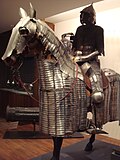
While the Mamluk Sultanate ceased to exist with the Ottoman conquest and the recruitment of Royal Mamluks ended, the mamluks as a military-social class continued to exist.{{sfn|Holt|1991|p=325}}{{sfn|Clot|2009|p=410}} They constituted a "self-perpetuating, largely Turkish-speaking warrior class" that continued to influence politics under Ottoman rule.{{sfn|Rodenbeck|1999|p=113}} They existed as military units in parallel with the more strictly Ottoman regiments like the janissaries and the {{Transliteration|ar|[[Azeb|azab]]}}s. The difference between these Ottoman regiments and the Egyptian mamluk regiments became blurred over time as intermarriage became common, resulting in a more mixed social class.{{sfn|Clot|2009|p=410}} | |||
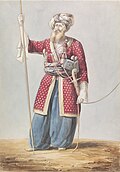
[[File:A Mamluk from Aleppo.jpg|thumb|left|One of the last Mamluks, painted by William Page in 1816–1824]] | |||
During this period, a number of mamluk 'households' formed, with a complex composition including both true mamluks and {{Transliteration|ar|awlad al-nas}}, who could also rise to high ranks. Each household was headed by an {{Transliteration|ar|ustadh}}, who could be an Ottoman officer or a local civilian. Their patronage extended to include retainers recruited from other Ottoman provinces as well as allies among the local urban population and tribes.{{sfn|Holt|1991|p=325}} Up to the early 17th century, the vast majority of Egyptian mamluks were still of Caucasian or Circassian origin. In the later 17th and 18th centuries, mamluks from other parts of the Ottoman Empire or its frontiers, such as [[Bosnia (region)|Bosnia]] and [[Georgia (country)|Georgia]], began to appear in Egypt.{{sfn|Hathaway|2019|pp=126–127}} | |||
Throughout the Ottoman period, powerful mamluk households and factions struggled for control of important political offices and of Egypt's revenues.{{sfn|Holt|1991|p=325}} Between 1688 and 1755, mamluk [[bey]]s, allied with Bedouin and factions within the Ottoman garrison, deposed at least thirty-four governors.{{sfn|Rodenbeck|1999|p=114}} The mamluks remained a dominating force in Egyptian politics until their [[Muhammad Ali's seizure of power|final elimination]] at the hands of [[Muhammad Ali of Egypt|Muhammad Ali]] in 1811.{{sfn|Clot|2009|pp=421–422}} | |||
Throughout the Ottoman period, powerful mamluk households and factions struggled | |||
==Society== | ==Society== | ||
===Language=== | ===Language=== | ||
By the time the Mamluks took power, [[Arabic]] had already been established as the language of religion, culture and the bureaucracy in Egypt, and was widespread among non-Muslim communities there as well. | By the time the Mamluks took power, [[Arabic]] had already been established as the language of religion, culture and the bureaucracy in Egypt, and was widespread among non-Muslim communities there as well. Arabic's wide usage among Muslim and non-Muslim commoners had likely been motivated by their aspiration to learn the language of the ruling and scholarly elite. Another contributing factor was the wave of Arab tribal migration to Egypt and subsequent intermarriage between Arabs and the indigenous population. The Mamluks contributed to the expansion of Arabic in Egypt through their victory over the Mongols and the Crusaders and the subsequent creation of a Muslim haven in Egypt and Syria for Arabic-speaking immigrants from other conquered Muslim lands. The continuing invasions of Syria by Mongol armies led to further waves of Syrian immigrants, including scholars and artisans, to Egypt.{{sfn|Holt|Baker|Smith|Hopwood|2025}} | ||
[[File:Mahmud al-Kashgari.jpg|thumb|The only known surviving manuscript copy of [[Mahmud al-Kashgari]]’s [[Dīwān Lughāt al-Turk]], copied in 1266 in [[Damascus]], within the territory of the Mamluk Sultanate.<ref name="Turan"/>]] | |||
Although Arabic was used as the administrative language of the sultanate, a variety of [[Kipchak languages|Kipchak Turkic]], namely the [[Mamluk-Kipchak language]] was the spoken language of the Mamluk ruling elite. | [[File:A 1510 Turkish Translation of the Shahnameh by Sharīf of Amid for Qansuh al-Ghawri. TSMK, Hazine, nr. 1519.jpg|thumb|A manuscript of an Oghuz Turkic translation of [[Ferdowsi]]’s [[Shahnameh]], dated 1510, created for the library of [[Qansuh al-Ghawri]], translated and copied by Sharīf of [[Amid]].<ref name="Turan"/>]] | ||
Although Arabic was used as the administrative language of the sultanate, a variety of [[Kipchak languages|Kipchak Turkic]], namely the [[Mamluk-Kipchak language]] was the spoken language of the Mamluk ruling elite.{{sfn|Winter|1998|p=96}} According to Petry, "the Mamluks regarded Turkish as their caste's vehicle of communication, even though they themselves spoke Central Asian dialects such as Qipjak, or Circassian, a Caucasic language."{{sfn|Petry|1981|p=70}} According to historian Michael Winter, Turkishness was the distinctive aspect of the Mamluk ruling elite, for only they knew how to speak Turkish and had Turkish names.{{sfn|Powell|2012|p=21}} While the Mamluk elite was ethnically diverse, those who were not Turkic in origin were Turkicized nonetheless.{{sfn|Rabbat|2001|p=60}} As such, the ethnically Circassian mamluks who gained prominence with the rise of the Burji regime and became the dominant ethnic element of the government, were educated in the Turkish language and were considered to be Turks by the Arabic-speaking population.{{sfn|Winter|1998|p=96}}{{sfn|Powell|2012|p=21}} Kipchak Turkish was also used in writing, but to a lesser extent than Arabic and mainly for a mamluk audience. Over time, it was replaced in this role by [[Old Anatolian Turkish|Oghuz Turkish]] due to the growing influence of Turkish [[Anatolia]].<ref name="Turan">{{Cite journal |last1=Turan |first1=Fikret |date=2007 |title=The Mamluks and Their Acceptance of Oghuz Turkish as Literary Language: Political Maneuver or Cultural Aspiration? |url=https://www.academia.edu/30980862 |journal=Turcologica |language=English |volume=69 |pages=37–47}}</ref><ref name=":32">{{Cite book |last=Flemming |first=Barbara |url=https://books.google.com/books?id=qoJ1DwAAQBAJ&pg=PA107 |title=Essays on Turkish Literature and History |publisher=Brill |year=2017 |isbn=978-90-04-35576-7 |pages=107 |language=en}}</ref>{{Sfn|Rabbat|2001|p=69}} | |||
The ruling military elite of the sultanate was exclusive to those of mamluk background, with rare exceptions. | The ruling military elite of the sultanate was exclusive to those of mamluk background, with rare exceptions.{{sfn|Rabbat|2001|pp=60–61}} Ethnicity served as a major factor separating the mostly Turkic or Turkicized Mamluk elite from their Arabic-speaking subjects.{{sfn|Powell|2012|p=21}} Ethnic origin was a key component of an individual mamluk's identity, and ethnic identity manifested itself through given names, dress, access to administrative positions and was indicated by a sultan's {{Transliteration|ar|[[nisba (onomastics)|nisba]]}}.{{sfn|Yosef|2012|p=394}} The sons of mamluks, known as the {{Transliteration|ar|awlad al-nas}}, did not typically hold positions in the military elite and instead, were often part of the civilian administration or the Muslim religious establishment.{{sfn|Rabbat|2001|p=60}} Among the Bahri sultans and emirs, there existed a degree of pride of their Kipchak Turkish roots, and their non-Kipchak usurpers such as sultans Kitbuqa, Baybars II and Lajin were often de-legitimized in the Bahri-era sources for their non-Kipchak origins. The Mamluk elites of the Burji period were also apparently proud of their Circassian origins.{{sfn|Yosef|2012|pp=394–395}} | ||
===Religion=== | ===Religion=== | ||
====Muslim community==== | ====Muslim community==== | ||
[[File:Finispiece of the Mamluk Qur'an (Egyptian National Library Masahif Rasid 81, ff. 377v-378r).jpg|thumb|Finispiece from the [[Qur'an]] copied by [[Ahmad ibn Kamal ibn Yahya al-Ansari al-Mutatabbib|Ahmad ibn Kamal al-Mutatabbib]] in 1334. This manuscript is part of the [[Egyptian National Library and Archives|National Library of Egypt's]] Collection of Mamluk Qur'an Manuscripts inscribed in the [[UNESCO]] [[Memory of the World Programme#Memory of the World Register|Memory of the World Register]]]] | [[File:Finispiece of the Mamluk Qur'an (Egyptian National Library Masahif Rasid 81, ff. 377v-378r).jpg|thumb|Finispiece from the [[Qur'an]] copied by [[Ahmad ibn Kamal ibn Yahya al-Ansari al-Mutatabbib|Ahmad ibn Kamal al-Mutatabbib]] in 1334. This manuscript is part of the [[Egyptian National Library and Archives|National Library of Egypt's]] Collection of Mamluk Qur'an Manuscripts inscribed in the [[UNESCO]] [[Memory of the World Programme#Memory of the World Register|Memory of the World Register]]]] | ||
A wide range of Islamic religious expression existed in Egypt during the early Mamluk era, namely Sunni Islam and its major | A wide range of Islamic religious expression existed in Egypt during the early Mamluk era, namely Sunni Islam and its major {{Transliteration|ar|[[madhab]]}}s (schools of jurisprudence) and different [[Sufism|Sufi]] orders, but also small communities of [[Ismai'li]] [[Shia Muslim]]s, particularly in Upper Egypt. There remained a significant minority of [[Coptic Orthodox Church|Coptic Christian]]s. Under Saladin, the Ayyubids embarked on a program of reviving and strengthening Sunni Islam in Egypt to counter Christianity, which had been reviving under the religiously benign rule of the Fatimids, and Isma'ilism, the branch of Islam of the Fatimid state. Under the Bahri sultans, the promotion of Sunni Islam was pursued more vigorously than under the Ayyubids.{{sfn|Northrup|1998b|pp=265–266}} The Mamluks were motivated by personal piety or political expediency for Islam was both an assimilating and unifying factor between the Mamluks and the majority of their subjects; the early mamluks had been brought up as Sunni Muslims and the Islamic faith was the only aspect of life shared between the Mamluk ruling elite and its subjects. While the precedent set by the Ayyubids highly influenced the Mamluk state's embrace of Sunni Islam, the circumstances in the Muslim Middle East in the aftermath of the Crusader and Mongol invasions also left Mamluk Egypt as the last major Islamic power able to confront the Crusaders and the Mongols. Thus, the early Mamluk embrace of Sunni Islam also stemmed from the pursuit of a moral unity within their realm based on the majority views of its subjects.{{sfn|Northrup|1998b|pp=268–269}} | ||
The Mamluks | The Mamluks cultivated and utilized Muslim leaders to channel the religious feelings of their Muslim subjects in a manner that did not disrupt the sultanate's authority.{{sfn|Holt|Baker|Smith|Hopwood|2025}} Similar to their Ayyubid predecessors, the Bahri sultans favored the [[Shafi'i]] {{Transliteration|ar|madhab}}, while additionally promoting the other major Sunni {{Transliteration|ar|madhab}}s, namely the [[Maliki]], [[Hanbali]] and [[Hanafi]]. Baybars ended the Ayyubid and early Mamluk tradition of selecting a Shafi'i scholar as {{Transliteration|ar|qadi al-qudah}} (chief judge) and instead appointed a {{Transliteration|ar|qadi al-qudah}} from each of the four {{Transliteration|ar|madhab}}s. This policy was partly motivated to accommodate an increasingly diverse Muslim population whose components had immigrated to Egypt from regions where other {{Transliteration|ar|madhab}}s prevailed. The diffusion of the post of {{Transliteration|ar|qadi al-qudah}} enabled Mamluk sultans to patronize each {{Transliteration|ar|madhab}} and gain more influence over them. Nevertheless, the Shafi'i scholars kept a number of privileges over their counterparts.{{sfn|Northrup|1998b|p=269}} | ||
The Mamluks | The Mamluks embraced the Sufi orders in the empire.{{sfn|Northrup|1998b|p=268}} Sufism was widespread in Egypt by the 13th century, and the [[Shadhili]]yya was the most popular order. The Shadhiliyya lacked an institutional structure and was flexible in its religious thought, allowing it to easily adapt to its local environment. It incorporated Sunni Islamic piety with its basis in the [[Qur'an]] and [[hadith]], Sufi mysticism, and elements of popular religion such as sainthood, {{Transliteration|ar|[[ziyarat]]}} (visitation) to the tombs of saintly or religious individuals, and {{Transliteration|ar|[[dhikr]]}} (invocation of God). Other Sufi orders with large numbers of adherents were the [[Rifa'i]]yya and [[Badawiyya]].{{sfn|Northrup|1998b|p=267}} While the Mamluks patronized the Sunni ulema through appointments to government office, they patronized the Sufis by funding {{Transliteration|ar|[[khanqah|zawiya]]}}s (Sufi lodges).{{sfn|Holt|Baker|Smith|Hopwood|2025}} On the other end of the spectrum of Sunni religious expression were the teachings of the Hanbali scholar [[Ibn Taymiyya]], which emphasized stringent moral rigor based on literal interpretations of the Qur'an and the [[Sunnah|Sunna]], and a deep hostility to the aspects of mysticism and popular religious innovations promoted by the Sufis. While Ibn Taymiyya was not a typical representative of Sunni orthodoxy in the sultanate, he was the most prominent Muslim scholar of the Mamluk era and arrested several times by the Mamluks for his religious teachings, which are still influential in the modern Muslim world.{{sfn|Northrup|1998b|p=267}} Ibn Taymiyya's doctrines were regarded as heretical by the Sunni establishment patronized by the Mamluks.{{sfn|Holt|Baker|Smith|Hopwood|2025}} | ||
as | |||
====Christian and Jewish communities==== | ====Christian and Jewish communities==== | ||
[[File:Mamluk era astrolabe, 1282.jpg|thumb|Mamluk-era [[astrolabe]] with [[Coptic alphabet|Coptic]] numerals, dated 1282/1283. This astrolabe and other items of its kind are proof that Mamluks still used Coptic numerals and [[Coptic calendar]] for various practical and scientific purposes.{{sfn|King|1999|p=76-78}} [[Turkish and Islamic Arts Museum]]]] | [[File:Mamluk era astrolabe, 1282.jpg|thumb|Mamluk-era [[astrolabe]] with [[Coptic alphabet|Coptic]] numerals, dated 1282/1283. This astrolabe and other items of its kind are proof that Mamluks still used Coptic numerals and [[Coptic calendar]] for various practical and scientific purposes.{{sfn|King|1999|p=76-78}} [[Turkish and Islamic Arts Museum]]]] | ||
Christians and Jews in the | Christians and Jews in the empire were governed by the dual authority of their respective religious institutions and the sultan. The authority of the former extended to many of the everyday aspects of Christian and Jewish life and was not restricted to the religious practices of the two communities. The Mamluk government, often under the official banner of the [[Pact of Umar]] which gave Christians and Jews {{Transliteration|ar|[[dhimmi]]}} (protected peoples) status, determined the taxes paid by Christians and Jews, including the [[jizya]] ([[poll tax]] on non-Muslims), permission to construct houses of worship, and the public appearance of Christians and Jews.{{sfn|Stilt|2011|p=109}} Jews generally fared better than Christians, and the latter experienced more difficulties under the Mamluks than their Muslim predecessors.{{sfn|Stilt|2011|p=109}}{{sfn|Holt|Baker|Smith|Hopwood|2025}} The association of Christians with the Mongols, due to the latter's use of Armenian and Georgian Christian auxiliaries, the attempted alliance between the Mongols and the Crusader powers, and the massacres of Muslim communities and the sparing of Christians in cities captured by the Mongols, contributed to rising anti-Christian sentiments in the Mamluk era. The manifestations of anti-Christian hostility were mostly spearheaded at the popular level rather than by the Mamluk sultans. The main source of popular hostility was resentment at the privileged positions many Christians held in the Mamluk bureaucracy.{{sfn|Holt|Baker|Smith|Hopwood|2025}} | ||
The Coptic decline in Egypt occurred under the Bahri sultans and accelerated further under the Burji regime. | The Coptic decline in Egypt occurred under the Bahri sultans and accelerated further under the Burji regime.{{sfn|Teule|2013|p=10}} There were several instances of Egyptian Muslim protests against the wealth of Copts and their employment with the state, and both Muslim and Christian rioters burned down each other's houses of worship during intercommunal clashes.{{sfn|Holt|Baker|Smith|Hopwood|2025}} As a result of popular pressure, Copts had their employment in the bureaucracy terminated at least nine times between the late 13th and mid-15th centuries, and on one occasion, in 1301, the government ordered the closure of all churches.{{sfn|Holt|Baker|Smith|Hopwood|2025}} Coptic bureaucrats were often restored to their positions after tensions passed. Many Copts were forced to convert to Islam or at least adopted outward expressions of Muslim faith to protect their employment and avoid the jizya and official measures against them.{{sfn|Stilt|2011|p=120}} A large wave of Coptic conversions to Islam occurred in the 14th century,{{sfn|Stilt|2011|p=120}} as a result of [[Persecution of Copts|persecution]], destruction of churches,{{sfn|Holt|Baker|Smith|Hopwood|2025}} and to retain employment.{{sfn|Stilt|2011|p=120}} By the end of the Mamluk period, the ratio of Muslims to Christians in Egypt may have risen to 10:1.{{sfn|Holt|Baker|Smith|Hopwood|2025}} | ||
In Syria, the Mamluks uprooted the local [[Maronites|Maronite]] and [[Greek Orthodox Church of Antioch|Greek Orthodox]] Christians from the coastal areas | In Syria, the Mamluks uprooted the local [[Maronites|Maronite]] and [[Greek Orthodox Church of Antioch|Greek Orthodox]] Christians from the coastal areas to prevent their contact with European powers. The [[Maronite Church]] was especially suspected by the Mamluks of collaboration with the Europeans due to the close relations between the Maronite Church and the papacy in Rome and the Christian European powers, particularly Cyprus. The Greek Orthodox Church declined after the Mamluk destruction of its spiritual center, Antioch, and the [[Timurid destruction of Aleppo]] and Damascus in 1400.{{sfn|Teule|2013|p=11}} The Syriac Christians also significant declined in Syria due to intra-communal disputes over patriarchal succession and the destruction of churches by the Timurids or local Kurdish tribes.{{sfn|Teule|2013|p=12}} The Mamluks inaugurated a similar decline of the Armenian Orthodox Church after their conquest of the Cilicia in 1374, in addition to the raids of the Timurids in 1386 and the conflict between the Timurids and the Aq Qoyunlu and Kara Qoyonlu tribal confederations in Cilicia.{{sfn|Teule|2013|p=13}} | ||
===Bedouin relationship with the state=== | ===Bedouin relationship with the state=== | ||
Bedouins were a reserve force in the Mamluk military. During the third reign of al-Nasir Muhammad, the Bedouin tribes, particularly those of Syria, such as the [[Al Fadl]], were strengthened and integrated into the economy.{{sfn|Levanoni|1995|p=173}} Bedouin tribes were also a major supplier of the Mamluk cavalry's [[Arabian horses]]. Qalawun purchased horses from the Bedouin of Barqa, which were inexpensive but of high quality, while al-Nasir Muhammad spent extravagantly for horses from Bedouins in Barqa, Syria, Iraq and [[Eastern Arabia|Bahrayn]] (eastern Arabia).{{sfn|Levanoni|1995|p=175}} | |||
Baybars and Qalawun, and the Syrian viceroys of al-Nasir Muhammad during his first two reigns, emirs [[Sayf al-Din Salar|Salar]] and Baybars II, were averse to granting Bedouin sheikhs {{Transliteration|ar|iqtaʿat}}, and when they did, the {{Transliteration|ar|iqtaʿat}} were of low quality. During al-Nasir Muhammad's third reign, the Al Fadl were granted high-quality {{Transliteration|ar|iqtaʿat}} in abundance, strengthening the tribe to become the most powerful among the Bedouin of the [[Syrian Desert]]. Beyond his personal admiration of the Bedouin, al-Nasir Muhammad's distributed {{Transliteration|ar|iqtaʿat}} to the Al Fadl to prevent their defection to the Ilkhanate, which the Al Fadl had frequently done during the early 14th century.{{sfn|Levanoni|1995|pp=176–177}} Competition over {{Transliteration|ar|iqtaʿat}} and the post of {{Transliteration|ar|[[amir al-ʿarab]]}} (chief commander of the Bedouin) in Syria, led to conflict and rebellion among the tribes, leading to mass bloodshed in Syria in the aftermath of al-Nasir Muhammad's death. The Mamluk leadership in Syria, weakened by the losses of the Black Plague, was unable to quell the Bedouin through military expeditions, so they resolved to assassinate the chiefs of the tribes. The Al Fadl eventually lost favor, to the advantage of the Bedouin tribes around al-Karak under later Bahri sultans.{{sfn|Levanoni|1995|p=178–179}} | |||
In Egypt, | In Egypt, during al-Nasir Muhammad's third reign, the Mamluks had a similar relationship with the Bedouin. The Isa Ibn Hasan al-Hajjan tribe became powerful there after being assigned massive {{Transliteration|ar|iqtaʿat}}. The tribe remained strong after al-Nasir Muhammad's death, but frequently rebelled against the succeeding Bahri sultans. They were restored after each rebellion, before the tribe's sheikh was finally executed in 1353. In [[Al Sharqia Governorate|Sharqiya]] in [[Lower Egypt]], the Tha'laba tribes were entrusted to supervise the postal routes, but were often unreliable and joined the Al A'id tribe during their raids.{{sfn|Levanoni|1995|p=182}} Bedouin tribal wars frequently disrupted trade and travel in Upper Egypt, and destroyed cultivated lands and sugar processing plants. In the mid-14th century, the rival Arak and [[Banu Hilal]] tribes of Upper Egypt, became ''de facto'' rulers of the region, forcing the Mamluks to rely on them for tax collection.{{sfn|Levanoni|1995|pp=182–183}} The Bedouin were purged from Upper and Lower Egypt by the campaigns of Shaykhu in 1353.{{sfn|Levanoni|1995|p=1183}} | ||
==Government== | ==Government== | ||
The Mamluks did not significantly alter the administrative, legal and economic systems | The Mamluks did not significantly alter the administrative, legal and economic systems they inherited from the Ayyubid state.{{sfn|Stilt|2011|p=14}} The Mamluk ruled over essentially the same territory of the Ayyubid state, i.e. Egypt, Syria and the Hejaz. Unlike the collective sovereignty of the Ayyubids, where territory was divided among members of the royal family, the Mamluk state was unitary. Under many Ayyubid sultans, Egypt had [[paramountcy]] over the Syrian provinces, but under the Mamluks this paramountcy was consistent and absolute.{{sfn|Holt|2005|p=237}} [[Cairo]] remained the capital of the empire and its social, economic and administrative center, with the Citadel of Cairo serving as the sultan's headquarters.{{sfn|Stilt|2011|p=14}} | ||
===Authority of the sultan=== | ===Authority of the sultan=== | ||
{{multiple image | {{#invoke:multiple image| | ||
| width = 200 | | width = 200 | ||
| image1 = Frontispiece of "Al-Kawakib al-duriyya" by Al-Busiri (CBL Ar 4168, f.2a).jpg | | image1 = Frontispiece of "Al-Kawakib al-duriyya" by Al-Busiri (CBL Ar 4168, f.2a).jpg | ||
| Line 341: | Line 307: | ||
}} | }} | ||
The Mamluk sultan was the | The Mamluk sultan was the supreme government authority, while he delegated power to provincial governors known as {{Transliteration|ar|nuwwab al-saltana}} (deputy sultans, sing. {{Transliteration|ar|na'ib al-saltana}}). The vice-regent of Egypt was the top {{Transliteration|ar|na'ib}}, followed by the {{Transliteration|ar|na'ib}} of Damascus, then Aleppo, then the {{Transliteration|ar|nuwwab}} of al-Karak, Safed, Tripoli, Homs and Hama. In Hama, the Mamluks permitted the Ayyubids to continue governing until 1341 (its popular governor in 1320, [[Abu'l Fida]], was granted the honorary title of sultan by al-Nasir Muhammad), but otherwise the {{Transliteration|ar|nuwwab}} of the provinces were mamluk emirs.{{sfn|Holt|2005|p=237}} | ||
A consistent accession process occurred with every new | A consistent accession process occurred with every new sultan. It mostly involved an election by a council of emirs and mamluks (who would proffer an [[bay'ah|oath of loyalty]]), the sultan's assumption of the regal title {{Transliteration|ar|al-malik}}, a state-organized procession through Cairo led by the sultan, and the reading of the sultan's name in the {{Transliteration|ar|[[khutba]]}} ([[Friday prayer]] sermon).{{sfn|Holt|2005|p=238}} The process was not formalized and the electoral body never defined, but typically consisted of the emirs and mamluks of whichever Mamluk faction held sway; usurpations of the throne by rival factions were relatively common.{{sfn|Holt|2005|p=239}} Despite the electoral nature of accession, dynastic succession was nonetheless a reality at times,{{sfn|Levanoni|1995|p=30}} especially during the Bahri period, where Baybars' sons Baraka and Solamish succeeded him, before Qalawun usurped the throne and was thereafter succeeded by four generations of direct descendants, with occasional interruptions.{{sfn|Holt|2005|p=239}} Hereditary rule was much less frequent under the Burji regime. Nonetheless, with rare exception, the Burji sultans were all linked to the regime's founder Barquq through blood or mamluk affiliation.{{sfn|Holt|2005|p=240}} The accession of blood relatives to the sultanate was often the result of the decision or indecision of leading Mamluk emirs or the will of the preceding sultan.{{sfn|Levanoni|1995|p=30}} The latter situation applied to the sultans Baybars, Qalawun, the latter's son, al-Nasir Muhammad and Barquq, who formally arranged for one or more of their sons to succeed them.{{sfn|Holt|2005|p=239}} More often than not, the sons of sultans were elected by the senior emirs with the intention that they serve as convenient figureheads presiding over an oligarchy of the emirs.{{sfn|Holt|2005|p=240}} | ||
Lesser-ranked | Lesser-ranked emirs viewed the sultan as a peer whom they entrusted with ultimate authority and as a benefactor whom they expected to guarantee their salaries and monopoly on the military. When emirs felt the sultan was not ensuring their benefits, disruptive riots, [[Coup d'état|coup]] plots or delays to calls for service were all likely scenarios.{{sfn|Petry|1998|p=468}} Often, the practical restrictions on a sultan's power came from his own {{Transliteration|ar|khushdashiyya}},{{sfn|Holt|2005|p=248}} defined by historian [[Amalia Levanoni]] as "the fostering of a common bond between mamluks who belonged to the household of a single master and their loyalty towards him."{{sfn|Levanoni|1995|p=14}} The foundation of Mamluk organization and factional unity was based on the principles of {{Transliteration|ar|khushdashiyya}}, which was a crucial component of a sultan's authority and power.{{sfn|Levanoni|1995|p=14}} The sultan also derived power from other emirs, with whom there was constant tension, particularly in peacetime. According to Holt, the factious nature of emirs who were not the sultan's {{Transliteration|ar|khushdashiyya}} stemmed from their primary loyalty being to their {{Transliteration|ar|ustadh}}. Emirs who were part of the sultan's {{Transliteration|ar|khushdashiyya}} also rebelled at times, particularly the {{Transliteration|ar|nuwwab}} of Syria who had power bases in their provinces. Typically, the faction most loyal to the sultan were the Royal Mamluks, particularly those whom the sultan had personally recruited and manumitted, as opposed to the {{Transliteration|ar|qarani}}s, who were recruited by his predecessors. The {{Transliteration|ar|qarani}}s occasionally constituted a hostile faction, such as with as-Salih Ayyub and the Qalawuni successors of al-Nasir Muhammad.{{sfn|Holt|2005|p=248}} | ||
Among the sultan's responsibilities were issuing and enforcing specific legal orders and general rules, making the decision to go to war, levying taxes for military campaigns, ensuring the proportionate distribution of food supplies throughout the empire and, in some cases, overseeing the investigation and punishment of alleged criminals. The sultan or his appointees led the Hajj caravans from Cairo and Damascus to Mecca in the capacity of {{Transliteration|ar|[[amir al-hajj]]}} (commander of the Hajj caravan). Starting with Qalawun, the sultans monopolized the provision of the {{Transliteration|ar|[[Kiswah|Kiswa]]}} (mantle) that was annually draped over the Kaaba, in addition to patronizing Jerusalem's [[Dome of the Rock]].{{sfn|Stilt|2011|p=31}} Another prerogative, at least of the early Bahri sultans, was to import as many mamluks as possible, preferably those from the territories of the Mongols. The Mamluks' enemies, namely the Mongol states and their Muslim vassals, the Armenians, and the Crusaders, disrupted the flow of mamluks to the sultanate. Unable to meet the military's need for new mamluks, the sultans often resorted to recruiting {{Transliteration|ar|wafidiyya}} (Ilkhanid deserters or prisoners of war).{{sfn|Levanoni|1995|pp=31–32}} | |||
===Role of the caliph=== | ===Role of the caliph=== | ||
To legitimize their rule, the Mamluks presented themselves as the defenders of Islam, and, beginning with Baybars, sought | To legitimize their rule, the Mamluks presented themselves as the defenders of Islam, and, beginning with Baybars, sought confirmation of their executive authority from a [[caliph]]. The Ayyubids had owed their allegiance to the [[Abbasid Caliphate]], but the latter was destroyed when the Mongols sacked the Abbasid capital Baghdad in 1258 and killed Caliph [[al-Musta'sim]]. Three years later, Baybars reestablished the institution of the caliphate by making a member of the [[Abbasid dynasty]], [[al-Mustansir II|al-Mustansir]], caliph, who in turn confirmed Baybars as sultan.{{sfn|Stilt|2011|pp=30–31}} The caliph recognized the sultan's authority over Egypt, Syria, the Jazira, Diyar Bakr, the Hejaz and Yemen and any territory conquered from the Crusaders or Mongols.{{sfn|Holt|2005|p=243}} | ||
Al-Mustansir's Abbasid successors continued in their official capacity as caliphs, but held no real power.{{sfn|Stilt|2011|pp=30–31}} The less than year-long reign of Caliph al-Musta'in as sultan in 1412 was an anomaly.{{sfn|Holt|2005|p=248}} In an anecdotal testament to the caliph's lack of real authority, a group of rebellious mamluks responded to Lajin's presentation of the Caliph [[al-Hakim I|al-Hakim]]'s decree asserting Lajin's authority with the following comment, recorded by [[Ibn Taghribirdi]]: "Stupid fellow. For God's sake—who pays any heed to the caliph now?"{{sfn|Holt|2005|p=248}} | |||
The Abbasid presence was nonetheless an important political asset for the legitimacy of the Mamluk rulers and conferred significant prestige on them.{{sfnm|Bosworth|1996|1pp=6–10|El-Hibri|2021|2p=272}} The caliphs themselves also continued to be relevant figureheads even to other Muslim rulers until the end of the 14th century; for example, the [[Delhi Sultanate|sultans of Delhi]], the [[Muzaffarids (Iran)|Muzaffarid]] sultan [[Mubariz al-Din Muhammad|Muhammad]], the [[Jalayirid Sultanate|Jalayirid]] sultan [[Ahmad Jalayir|Ahmad]], and the [[Ottoman Empire|Ottoman]] sultan [[Bayezid I]] all sought diplomas of investiture from the Abbasid caliphs or declared nominal allegiance to them.{{Sfn|El-Hibri|2021|p=|pp=273–275}} During the 15th century, however, the institution of the caliphate declined in importance and the caliphs became little more than religious dignitaries who visited the sultan on special occasions.{{Sfn|El-Hibri|2021|p=275}} Among other changes, this was exemplified by a shift in the caliph's ceremonial role during the accession of a Mamluk sultan to power: whereas Baybars formally pledged an oath of allegiance (''[[bay'ah]]'') to the Abbasid caliph al-Mustansir in 1261, some or most later caliphs formally performed a pledge of allegiance to the Mamluk sultan instead.{{Sfn|Holt|1984|p=504}} | |||
===<span class="anchor" id="Military"></span> Military and administrative hierarchy=== | |||
[[File:Three Mamelukes with lances on horseback.jpg|thumb|upright|Mamluk lancers, early 16th century (etching by [[Daniel Hopfer]]). [[British Museum]].]] | |||
[[File:Three Mamelukes with lances on horseback.jpg|thumb|upright|Mamluk lancers, early 16th century (etching by [[Daniel Hopfer]]). [[British Museum]]]] | |||
The | The sultans were products of the military hierarchy, entry into which was essentially restricted to mamluks. {{Transliteration|ar|Awlad al-nas}} could enter and rise high within the hierarchy,{{sfn|Stilt|2011|pp=22–23}} but typically did not enter military service. Instead, many entered into mercantile, scholastic or other civilian careers.{{sfn|Stilt|2011|p=20}} The army Baybars inherited consisted of Kurdish and Turkic tribesmen, refugees from the Ayyubid armies of Syria, and other troops from armies dispersed by the Mongols. After the Battle of Ain Jalut, Baybars restructured the army into three components: the Royal Mamluk regiment, the soldiers of the emirs, and the {{Transliteration|ar|halqa}} (non-mamluk soldiers). The Royal Mamluks, were under the direct command of the sultan and the highest-ranking body within the army, entry into which was exclusive.{{sfn|Levanoni|1995|p=8}} The lower-ranking emirs had their own corps, akin to private armies,{{sfn|Stilt|2011|pp=22–23}} which were also mobilized by the sultan as needed.{{sfn|Levanoni|1995|p=8}} As emirs were promoted, the number of soldiers in their corps increased, and when rival emirs challenged each other's authority, they often utilized their forces, leading to major disruptions of civilian life.{{sfn|Stilt|2011|pp=22–23}} The {{Transliteration|ar|halqa}} had inferior status to the mamluk regiments. It had its own administrative structure and was under the direct command of the sultan. The {{Transliteration|ar|halqa}} regiments declined in the 14th century when professional non-mamluk soldiers generally stopped joining the force.{{sfn|Levanoni|1995|pp=8–9}} | ||
One of Baybars's early reforms was creating a clear and permanent hierarchy, a system which the Ayyubids had lacked. To that end, he established a ranking system for emirs of ten, forty and one hundred, each indicating the number of mamluks assigned to an emir's command. An emir of one hundred could further be assigned one thousand mounted soldiers during battle.{{sfn|Levanoni|1995|p=11}} Baybars instituted uniformity within the army and ended the improvised nature of the Ayyubid forces in Egypt and Syria.{{sfn|Levanoni|1995|p=9}} Baybars and Qalawun standardized the undefined Ayyubid policies of distributing {{Transliteration|ar|iqtaʿat}} to emirs. This reform created a clear link between an emir's rank and the size of his {{Transliteration|ar|iqtaʿ}}.{{sfn|Levanoni|1995|p=10}} Baybars started biweekly inspections of the troops to verify sultanic orders were implemented, in addition to the periodic inspections where he distributed new arms to the troops. Beginning under Qalawun, the sultan and the military administration recorded all emirs in the empire and defined their roles as part of the right or left flanks of the army during wartime.{{sfn|Levanoni|1995|p=9}} | |||
[[File:Horsemen wheeling around, with a sword in each one's hand on the horse's back. Dated 773 (1371) Mamluk Egypt or Syria.jpg|thumb|upright=1.2|Horsemen wheeling around, with a sword in each one's hand. ''Nihāyat al-su’l'' (horsemanship manual) by Aḥmad al-Miṣrī ("the Egyptian"), dated 1371, Mamluk Egypt or Syria.]] | |||
Gradually, as mamluks filled administrative and courtier posts within the state, Mamluk innovations to the Ayyubid hierarchy were developed. The offices of {{Transliteration|ar|ustadar}} ([[majordomo]]), {{Transliteration|ar|hajib}} (chamberlain), {{Transliteration|ar|amir jandar}} (commander of the arsenal) and {{Transliteration|ar|khazindar}} (treasurer), which existed during the Ayyubid period, were preserved, but Baybars added the offices of {{Transliteration|ar|dawadar}} (secretary or adviser), {{Transliteration|ar|amir akhur}} (commander of the royal stables), {{Transliteration|ar|ru'us al-nawab}} (chief of the mamluk corps) and {{Transliteration|ar|amir majlis}} (commander of the audience). These additional offices were largely ceremonial posts and were closely connected to the military hierarchy.{{sfn|Levanoni|1995|pp=11–12}} | |||
The {{Transliteration|ar|ustadar}} (from the Arabic {{Transliteration|ar|ustadh al-dar}}, {{literal translation|master of the house}}) was the sultan's chief of staff, responsible for organizing the royal court's daily activities, managing the sultan's personal budget, and supervising all of the buildings of the Citadel of Cairo and its staff. The {{Transliteration|ar|ustadar}} was often referred to as the {{Transliteration|ar|ustadar al-aliya}} (grand master of the house) to distinguish from his subordinate {{Transliteration|ar|ustadar saghir}}s (lesser majordomos) who oversaw specific aspects of the court and citadel, such as the sultan's treasury, private property, and the kitchens of the citadel. Emirs had their own {{Transliteration|ar|ustadar}}s.{{sfn|Popper|1955|p=93}} The {{Transliteration|ar|ustadar al-aliya}} became a powerful office in the late 14th century, particularly under Barquq and al-Nasir Faraj, who transferred the responsibilities of the special bureau for their mamluks to the authority of the {{Transliteration|ar|ustadar}}, turning the latter into the state's chief financial official.{{sfn|Popper|1955|p=93}}{{sfn|Binbaş|2014|p=158}} | |||
==Economy== | ==Economy== | ||
[[File: | [[File:AKM11, A Blood-Measuring Device, folio from a manuscript of The Book of Knowledge of Ingenious Mechanical Devices (Kitab al-hiyal al-nafisa) Cairo 1354.jpg|thumb|''A Blood-Measuring Device'': folio from a manuscript of ''The Book of Knowledge of Ingenious Mechanical Devices'' (Kitab al-hiyal al-nafisa) of [[Al-Jazari]] (1136–1206). Edition created for an amir of Mamluk Sultan [[Al-Nasir Muhammad]] in [[Cairo]] in 1354.<ref>{{cite web |title=A Blood-Measuring Device, folio from a manuscript of The Book of Knowledge of Ingenious Mechanical Devices (Kitab al-hiyal al-nafisa), AKM11, The Aga Khan Museum |url=https://www.agakhanmuseum.org/collection/artifact/blood-measuring-device-akm11 |website=Aga Khan Museum |language=en}}</ref>]] | ||
The Mamluk economy essentially consisted of two spheres: the state economy, which was organized | The Mamluk economy essentially consisted of two spheres: the state economy, which was organized like an elite household and controlled by the caste government headed by the sultan, and the free market economy, which was the domain of society and associated with the local subjects, in contrast to the ethnic outsiders of the ruling elite.{{sfn|Northrup|1998b|p=254}} The Mamluks introduced greater centralization of the economy by organizing the state bureaucracy in Cairo (Damascus and Aleppo already had organized bureaucracies), and the military hierarchy and its associated {{Transliteration|ar|iqtaʿ}} system. In Egypt, the centrality of the Nile River facilitated Mamluk centralization of the region.{{sfn|Northrup|1998b|p=253}} The Mamluks used the same currency system as the Ayyubids, consisting of gold [[dinar]]s, silver [[dirham]]s and copper [[fals|fulus]].{{sfn|Islahi|1988|p=42}} The monetary system during the Mamluk period was highly unstable due to frequent monetary changes enacted by the sultans. Increased circulation of copper coins and the increased use of copper in dirhams often led to inflation.{{sfn|Islahi|1988|p=43}} | ||
The Mamluks created an administrative body called the | The Mamluks created an administrative body called the {{Transliteration|ar|[[hisba]]}} to supervise the market, with a {{Transliteration|ar|[[muhtasib]]}} (inspector-general) in charge. There were four {{Transliteration|ar|muhtasib}}s based in Cairo, Alexandria, [[al-Fustat]] and Lower Egypt. The {{Transliteration|ar|muhtasib}} in Cairo was the most important and his position akin to a finance minister. The ''muhtasib'' inspected weights and measures and the quality of goods, maintained legal trade, and detected price gouging.{{sfn|Islahi|1988|p=42}} A qadi or Muslim scholar occupied the post, but in the 15th century, mamluk emirs began to be appointed as {{Transliteration|ar|muhtasibs}} to recompense them during cash shortages or as a result of the gradual shift of the {{Transliteration|ar|muhtasib}}'s role from the legal realm to enforcement.{{sfn|Elbendary|2015|pp=38–39}} | ||
=== | ==={{Transliteration|ar|Iqtaʿ}} system=== | ||
The | The {{Transliteration|ar|iqtaʿ}} system was inherited from the Ayyubids and further organized under the Mamluks to fit their military needs.{{sfn|van Steenbergen|2005|p=475}} {{Transliteration|ar|Iqtaʿat}} were a central component of the Mamluk power structure.{{sfn|Elbendary|2015|p=37}} The {{Transliteration|ar|iqtaʿ}} of the Muslims differed from the European concept of fiefs in that the {{Transliteration|ar|iqtaʿ}} represented a right to collect revenue from a fixed territory and was accorded to an officer (an emir) as income and a financial source to provision his soldiers. Before the Mamluks' rise, there was a growing tendency of {{Transliteration|ar|iqtaʿ}} holders to treat their {{Transliteration|ar|iqtaʿ}} as personal, heritable property. The Mamluks effectively ended this, with the exception of some areas, mainly in [[Mount Lebanon]], where longtime [[Druze]] {{Transliteration|ar|iqtaʿ}} holders (see [[Buhturids]]), who became part of the {{Transliteration|ar|halqa}}, successfully resisted the abolition of their hereditary {{Transliteration|ar|iqtaʿat}}.{{sfn|Salibi|1967|pp=146–147}} In the Mamluk era, the {{Transliteration|ar|iqtaʿ}} was an emir's main income source,{{sfn|Elbendary|2015|pp=37–38}} and starting in 1337,{{sfn|Levanoni|1995|p=171}} {{Transliteration|ar|Iqtaʿ}} holders sometimes leased or sold rights to their {{Transliteration|ar|iqtaʿat}} to non-mamluks to extract more profits.{{sfn|Elbendary|2015|pp=37–38}} By 1343, the practice was commonplace and by 1347, the sale of {{Transliteration|ar|iqta'at}} became taxed.{{sfn|Levanoni|1995|p=171}} The {{Transliteration|ar|iqtaʿ}} was a more stable revenue source than other methods the Mamluks employed, such as tax hikes, the sale of administrative offices, and extortion of the population.{{sfn|Elbendary|2015|pp=37–38}} According to historian Jo van Steenbergen, <blockquote>The {{Transliteration|ar|iqtaʿ}} system was fundamental in assuring a legitimized, controlled and guaranteed access to the resources of the Syro-Egyptian realm to an upper level of Mamluk society that was primarily military in form and organization. As such it was a fundamental feature of Mamluk society, on the one hand giving way to a military hierarchy that crystallized into an even more developed economic hierarchy and that had substantial economic interests in society at large; on the other hand, it deeply characterized the realm's economic and social development, its agriculture, [[grain trade]], and rural demography in particular.{{sfn|van Steenbergen|2005|p=475}}</blockquote> | ||
The system | The system consisted of land assignments from the state in return for military services. Land was assessed by the periodic {{Transliteration|ar|rawk}} ([[cadastral survey]]), which was a survey of land parcels (measured by {{Transliteration|ar|[[feddan]]}} units), assessment of land quality, and the annual estimated tax revenue of the parcels, and classification of a parcel's legal status as {{Transliteration|ar|waqf}} (endowment) or {{Transliteration|ar|iqtaʿ}}.{{sfn|van Steenbergen|2005|p=476}} The {{Transliteration|ar|rawk}} organized the {{Transliteration|ar|iqtaʿ}} system and the first was carried out in 1298 under Lajin. A second and final {{Transliteration|ar|rawk}} was completed in 1315 under al-Nasir Muhammad and influenced political and economic developments of the Mamluk Sultanate until its fall in the early 16th century.{{sfn|van Steenbergen|2005|p=477}} | ||
Gradually, the {{Transliteration|ar|iqtaʿ}} system was expanded, and increasingly larger areas of {{Transliteration|ar|kharaj}} (taxable lands) were appropriated as {{Transliteration|ar|iqtaʿ}} lands to meet the fiscal needs of the military, namely payment of emirs and their subordinates. The state resolved to increase allotments by dispersing an emir's {{Transliteration|ar|iqtaʿat}} across several provinces and for short terms. This led to {{Transliteration|ar|iqtaʿ}} holders neglecting the administrative oversight, maintenance, and infrastructure of their {{Transliteration|ar|iqtaʿat}}, and concentrating solely on collecting taxes, resulting in less productivity.{{sfn|Elbendary|2015|pp=37–38}} | |||
===Agriculture=== | ===Agriculture=== | ||
Agriculture was the primary source of revenue in the Mamluk economy. | [[File:Mamluk Carpet, Egypt - Google Art Project.jpg|thumb|Mamluk Wool Carpet, Egypt, {{Circa|1500}}–1550. [[Museum of Islamic Art, Doha]]]] | ||
Agriculture was the primary source of revenue in the Mamluk economy.{{sfn|Northrup|1998b|p=254}}{{sfn|Stilt|2011|p=23}} Agricultural products were the main exports of Mamluk Egypt, Syria and Palestine. Moreover, the major industries of sugar and textile production depended on crops (sugar cane and cotton).{{sfn|Northrup|1998b|p=254}} Every agricultural commodity was taxed by the state, with the sultan's treasury taking the largest share of the revenues; emirs and major private brokers followed. An emir's main source of income were the agricultural products of his {{Transliteration|ar|iqtaʿ}}.<ref name="Stilt24">Stilt 2011, p. 24.</ref> | |||
In Egypt, Mamluk centralization | In Egypt, Mamluk centralization of agricultural production was more thorough than in Syria and Palestine. All agriculture in Egypt depended on a single source of irrigation, the Nile, and the measures and rights to irrigation were determined by the river's flooding, whereas in Syria and Palestine, there were multiple sources of mostly rain-fed irrigation, and measures and rights were determined at the local level. Centralization in Syria and Palestine was also more complicated than in Egypt due to the diversity of those regions' geography and their frequent invasions.{{sfn|Northrup|1998b|p=270}} The state's role in Syro-Palestinian agriculture was restricted to the fiscal administration and to the irrigation networks and other rural infrastructure.{{sfn|Northrup|1998b|p=269}} Although the degree of centralization was not as high as in Egypt, the Mamluks imposed sufficient control over the Syrian economy to derive significant revenues. The maintenance of the Mamluk army in Syria relied on the state's control over Syrian agricultural revenues.{{sfn|Northrup|1998b|p=277}} | ||
Among the responsibilities of a Mamluk provincial or district governor were repopulating | Among the responsibilities of a Mamluk provincial or district governor were repopulating abandoned areas to foster agricultural production, protecting the lands from Bedouin raids, increasing productivity in barren lands (likely through the upkeep and expansion of existing irrigation networks), and devoting special attention to the cultivation of the more arable low-lying regions.{{sfn|Northrup|1998b|pp=269, 271}} To ensure rural life was undisturbed by Bedouin raiding, which disrupted agricultural work or damaged crops and agrarian infrastructure and thus decreased revenues, the Mamluks attempted to prevent Bedouin armament and confiscate existing weapons from them.{{sfn|Northrup|1998b|p=261}} | ||
===Trade and industry=== | ===Trade and industry=== | ||
Egypt and Syria played a central transit role in international trade in the [[Middle Ages]]. | [[File:Al-Jazarī (d. 1206), The Musical Boat. Mamluk period, 1315.jpg|thumb|upright=1.2|[[Al-Jazarī]] (d. 1206), ''The Musical Boat''. Mamluk period, 1315.<ref>{{cite book |last1=Currie |first1=Gabriela |last2=Christensen |first2=Lars |publisher=Cambridge University Press |title=Eurasian Musical Journeys: Five Tales |date=April 2022 |page=74 |doi=10.1017/9781108913805 |isbn=9781108913805 |s2cid=248169243 |url=https://doi.org/10.1017/9781108913805 |language=en}}</ref>]] | ||
Egypt and Syria played a central transit role in international trade in the [[Middle Ages]].{{sfn|Islahi|1988|p=39}} Early into their rule, the Mamluks expanded the empire's role in foreign trade, with Baybars signing a commercial treaty with [[Genoa]] and Qalawun signing a similar agreement with [[Ceylon]].{{sfn|Islahi|1988|p=40}} By the 15th century, internal upheaval from Mamluk power struggles, diminishing {{Transliteration|ar|iqtaʿ}} revenue from plagues, and the encroachment of abandoned farmlands by Bedouin tribes had led to a financial crisis in the sultanate.{{sfn|Christ|2012|p=32}} To compensate these losses, the Mamluks applied a three-pronged approach: taxing the urban middle classes, boosting production and sale of cotton and sugar to Europe, and profiting from their transit position in the trade between Europe and the Far East. The last was the Mamluks' most lucrative policy and was accomplished by cultivating trade ties with [[Republic of Venice|Venice]], Genoa and [[Principality of Catalonia|Barcelona]], and increasing tariffs on commodities.{{sfn|Christ|2012|p=33}} At this time, the long-established trade between Europe and the Islamic world began to make up a significant part of state revenues as the Mamluks taxed the merchants operating or passing through the empire's ports.{{sfn|Stilt|2011|p=24}} | |||
Mamluk Egypt was a major producer of textiles and a supplier of raw materials for Western Europe. | Mamluk Egypt was a major producer of textiles and a supplier of raw materials for Western Europe.{{sfn|Petry|1981|p=244}} The frequent outbreaks of the Black Plague led to a decline in the production of textiles, silk products, sugar, glass, soaps, and paper, which coincided with the Europeans' increasing production of these goods. Trade continued nonetheless and despite papal restrictions on trade with the Muslims during the Crusades. Mediterranean trade was dominated by spices, such as pepper, muscat nuts and flowers, cloves and cinnamon, as well as medicinal drugs and indigo. These goods originated in Persia, [[Medieval India|India]], and [[Southeast Asia]] and made their way to Europe via the Mamluk ports of Syria and Egypt. These ports were frequented by European merchants, who in turn sold gold and silver [[ducat]]s and [[bullion]], silk, wool and linen fabrics, furs, wax, honey, and cheeses.{{sfn|Christ|2012|pp=19–20}} | ||
Under | Under Barsbay, a state monopoly was established on luxury goods, namely spices, with the state setting prices and collecting a percentage of the profits.{{sfn|Stilt|2011|p=24}} In 1387, Barsbay established direct control over Alexandria, the principal Egyptian commercial port, transferring its tax revenues to his personal treasury ({{Transliteration|ar|diwan al-khass}}) instead of the imperial treasury, which was linked with the military's {{Transliteration|ar|iqtaʿ}} system. In 1429, he ordered the spice trade to Europe be conducted through Cairo before goods reached Alexandria to end the direct transportation of spices from the Red Sea to Alexandria.{{sfn|Christ|2012|pp=33–34}} In the late 15th and early 16th centuries, the Portuguese expansion into Africa and Asia significantly decreased the revenues of the Mamluk–Venetian monopoly on trans-Mediterranean trade. This contributed to and coincided with the fall of the sultanate.{{sfn|Varlik|2015|p=163}} | ||
== Culture == | == Culture == | ||
=== Art === | === Art === | ||
[[File:Siria, bacile detto battistero di s.luigi, 1320-40 ca, firmato muhammad ibn al-zayn, con restauri del 1821, ottone incr. d'oro, arge e pasta nera 02.JPG|thumb|[[Baptistère de Saint Louis]], basin from the reign of al-Nasir Muhammad, which from the 17th century was used as a baptismal font for [[Kingdom of France|French Kings]]. [[Louvre | {{See also|Mamluk carpets}} | ||
[[File:Siria, bacile detto battistero di s.luigi, 1320-40 ca, firmato muhammad ibn al-zayn, con restauri del 1821, ottone incr. d'oro, arge e pasta nera 02.JPG|thumb|[[Baptistère de Saint Louis]], basin from the reign of [[al-Nasir Muhammad]] (r.1285-1341), which from the 17th century was used as a baptismal font for [[Kingdom of France|French Kings]]. [[Louvre]]]] | |||
Mamluk decorative arts—especially [[Enamelled glass|enameled]] and [[Gilding|gilded]] glass, [[Inlay|inlaid]] metalwork, woodwork, and textiles—were prized around the Mediterranean as well as in Europe, where they had a profound impact on local production. | Mamluk decorative arts—especially [[Enamelled glass|enameled]] and [[Gilding|gilded]] glass, [[Inlay|inlaid]] metalwork, woodwork, and textiles—were prized around the Mediterranean as well as in Europe, where they had a profound impact on local production. Mamluk glassware influenced the [[Venetian glass]] industry.<ref>{{cite web|last1=Yalman|first1=Suzan|title=The Art of the Mamluk Period (1250–1517)|url=http://metmuseum.org/toah/hd/maml/hd_maml.htm|website=The Met's Heilbrunn Timeline of Art History|date=October 2001 |publisher=The Metropolitan Museum of Art}}</ref> Trade with Iran, India, and [[History of China#Late imperial China|China]] was even more extensive, turning Mamluk cities into centers of both trade and consumption. Imported luxury goods from the East sometimes influenced local artistic vocabularies, as exemplified by the incorporation of Chinese motifs into both objects and architecture. The Mamluks themselves, as former slaves who rose through the ranks by their own efforts, were status-conscious patrons who commissioned luxury objects marked with emblems of their ownership. Architecture was the most significant form of Mamluk patronage and numerous artistic objects were commissioned to furnish Mamluk religious buildings, such as glass lamps, Qur'an manuscripts, brass candlesticks, and wooden [[minbar]]s. Decorative motifs in one art form were often applied in other art forms, including architecture.{{sfn|Blair|Bloom|1995|p=97}} | ||
Patronage varied over time, but the two high points of the arts were the reigns of al-Nasir Muhammad and | Patronage varied over time, but the two high points of the arts were the reigns of al-Nasir Muhammad and Qaitbay.{{sfn|Blair|Bloom|1995|p=97}} Some art forms also varied in importance over time. For example, enameled glassware was a prominent industry during the first half of the Mamluk period but declined significantly in the 15th century. Most of the surviving examples of carpets, by contrast, date from the end of the Mamluk period. Ceramic production was relatively less important overall, in part because [[Chinese ceramics|Chinese porcelains]] were widely available.{{sfn|Blair|Bloom|1995|p=99}} | ||
In the art of manuscript decoration, the Qur'an was the book most commonly produced with a high degree of artistic elaboration.{{ | [[File:Opening text pages with illuminated chapter headings, verse markers and borders.jpg|thumb|upright=1.3|Qur'an commissioned by sultan [[al-Ashraf Sha'ban]], dated to 1372<ref>{{Cite book |last=James |first=David |url=https://books.google.com/books?id=GV1oQgAACAAJ |title=Qurʾāns of the Mamlūks |date=1988 |publisher=Thames and Hudson |isbn=978-0-500-97367-7 |pages=193 |language=en}}</ref><ref>This manuscript is part of the [[Egyptian National Library and Archives|National Library of Egypt's]] Collection of Mamluk Qur'an Manuscripts inscribed in the [[UNESCO]] [[Memory of the World Programme#Memory of the World Register|Memory of the World Register]]</ref>]] | ||
In the art of manuscript decoration, the Qur'an was the book most commonly produced with a high degree of artistic elaboration.{{sfn|Blair|Bloom|1995|p=99}} Cairo, Damascus, and Aleppo were among the main centers of manuscript production. Mamluk-period Qur'ans were richly [[Illuminated manuscript|illuminated]] and exhibit stylistic similarities with those produced under the contemporary Ilkhanids in Iran. The production of high-quality paper at this time also allowed for pages to be larger, which encouraged artists to elaborate new motifs and designs to fill these larger formats. Some manuscripts could be monumental in size; for example, one Qur'an manuscript produced for al-Ashraf Sha'ban measured between 75 and 105 centimetres tall. One of the stylistic features that distinguished Mamluk manuscript decoration was the presence of gilded foliate [[scroll (art)|scrollwork]] over pastel-coloured backgrounds set within wide margins. [[Book frontispiece|Frontispieces]] were often decorated with star-shaped or hexagonal geometric motifs.{{sfn|Farhad|Rettig|2016|pp=104–105}} | |||
Metalware, whether in the form of ewers, basins, or candlesticks, was widely used in various contexts and many examples have survived today. They were made of | Metalware, whether in the form of ewers, basins, or candlesticks, was widely used in various contexts and many examples have survived today. They were made of brass or bronze with inlaid decoration, though in the later periods decoration was often engraved rather than inlaid. The quality and quantity of metalwork was also generally higher in the early period.{{sfn|Blair|Bloom|1995|p=97}} One of the best examples of this period is the so-called [[Baptistère de Saint Louis|Baptistère of Saint-Louis]] (kept at the [[Louvre]] today), a large brass basin inlaid with [[arabesque]]s and horizontal scenes of animals, hunters, and riders playing [[polo]].{{sfn|Blair|Bloom|1995|p=99}} An example of the later period is a series of candlesticks commissioned by Qaitbay for Muhammad's tomb in the Prophet's Mosque in Medina. They are made of engraved brass, with black bitumen filling parts of the surfaces in order to create contrast with the motifs in polished brass. Their decoration consists almost entirely of [[Islamic calligraphy|Arabic calligraphy]], with the {{Transliteration|ar|[[thuluth]]}} script prominently used.{{sfn|Blair|Bloom|1995|p=109}} | ||
Glass lamps were another high point of Mamluk art, particularly those commissioned for mosques. Egypt and Syria already possessed a rich tradition of [[Glass production|glassmaking]] | Glass lamps were another high point of Mamluk art, particularly those commissioned for mosques. Egypt and Syria already possessed a rich tradition of [[Glass production|glassmaking]] before this period and Damascus was the most important production center during the Mamluk period. Coloured glass had been common in the preceding Ayyubid period, but during the Mamluk period enamel and gilding became the most important techniques of decorating glass. Mosque lamps had a bulbous body with a wide flaring neck at the top. They were produced in the thousands and suspended from the ceiling by chains.{{sfn|Blair|Bloom|1995|p=107}} | ||
=== Architecture === | === Architecture === | ||
{{Main|Mamluk architecture}} | {{Main|Mamluk architecture}} | ||
[[File:Qaytbay complex DSCF0423.jpg|thumb|[[Funerary complex of Sultan Qaitbay]] (built 1470–1474), one of the finest examples of late [[Mamluk architecture]]]] | |||
Mamluk architecture is distinguished in part by the construction of multi-functional buildings whose floor plans became increasingly creative and complex due to the limited available space in the city and the desire to make monuments visually dominant in their urban surroundings.{{sfn|Behrens-Abouseif|2007}}{{sfn|Williams|2018}}{{sfn|Blair|Bloom|1995|p=70}} While Cairo was the main center of patronage, Mamluk architecture also appears in Damascus, Jerusalem, Aleppo, and Medina.{{sfn|Blair|Bloom|1995|pp=70, 85–87, 92–93}} Patrons, including sultans and high-ranking emirs, typically set out to build mausoleums for themselves but attached to them charitable structures such as [[madrasa]]s, {{Transliteration|ar|zawiya}}s, {{Transliteration|ar|[[Sebil (fountain)|sabil]]}}s (public fountains), or mosques. The revenues and expenses of these charitable complexes were governed by inalienable {{Transliteration|ar|waqf}} agreements that also served the secondary purpose of ensuring some form of income or property for the patrons' descendants.{{sfn|Blair|Bloom|1995|p=70}}{{sfn|Behrens-Abouseif|2007|p=}} | |||
After the Ottoman conquest of 1517, new Ottoman-style buildings were introduced, however the Mamluk style continued to be repeated or combined with Ottoman elements in many subsequent monuments. | The cruciform or [[four-iwan floor plan]] was adopted for madrasas and became more common for new monumental complexes than the traditional [[hypostyle]] mosque, though the vaulted iwans of the early period were replaced with flat-roofed iwans in the later period.{{sfn|Behrens-Abouseif|2007|pp=73–77}}{{sfn|Williams|2018|p=30}} The decoration of monuments also became more elaborate over time, with stone-carving and colored marble paneling and mosaics (including {{Transliteration|ar|[[ablaq]]}}) replacing stucco as the most dominant architectural decoration. Monumental decorated entrance portals became common compared to earlier periods, often carved with {{Transliteration|ar|[[muqarnas]]}}. Influences from Syria, Ilkhanid Iran, and possibly even Venice were evident in these trends.{{sfn|Williams|2018|pp=30–31}}{{sfn|Blair|Bloom|1995|pp=83–84}} [[Minaret]]s, which were also elaborate, usually consisted of three tiers separated by balconies, with each tier having a different design than the others. Late Mamluk minarets, for example, most typically had an octagonal shaft for the first tier, a round shaft on the second, and a lantern structure with [[finial]] on the third level.{{sfn|Williams|2018|p=31}}{{sfn|Behrens-Abouseif|2007|p=79}} Domes also transitioned from wooden or brick structures, sometimes of bulbous shape, to pointed stone domes with complex geometric or arabesque motifs carved into their outer surfaces.{{sfn|Behrens-Abouseif|2007|pp=80–84}} The peak of this stone dome architecture was achieved under Qaitbay in the late 15th century.{{sfn|Williams|2018|p=34}} | ||
After the Ottoman conquest of 1517, new Ottoman-style buildings were introduced, however the Mamluk style continued to be repeated or combined with Ottoman elements in many subsequent monuments. Some building types which first appeared in the late Mamluk period, such as {{Transliteration|ar|sabil-kuttab}}s (a combination of {{Transliteration|ar|sabil}} and {{Transliteration|ar|[[kuttab]]}}) and multi-storied [[caravanserai]]s ({{Transliteration|ar|wikala}}s or khans), actually grew in number during the Ottoman period.{{sfn|Williams|2018|p=17}} In modern times, from the late 19th century onwards, a [[neo-Mamluk style]] also appeared, partly as a nationalist response against Ottoman and European styles, in an effort to promote local 'Egyptian' styles.{{sfn|Sanders|2008|pp=39–41}}{{sfn|Avcıoğlu|Volait|2017|pp=1140–1142}}<ref name="Rawi">{{Cite web|title=Neo-Mamluk Style Beyond Egypt|url=https://rawi-magazine.com/articles/neomamluk/|access-date=2021-06-10|website=Rawi Magazine}}</ref> | |||
=== Emblems and blazons === | |||
[[File:Mosque Lamp of Amir Qawsun MET DP214292 (cropped).jpg|thumb|[[Mosque lamp]] of [[Qawsun|Amir Qawsun]], dated 1329. Qawsun's [[blazon]], a red cup on a yellow field, is prominently visible on the upper section. [[Metropolitan Museum of Art]].{{sfn|Nickel|1972|p=217}}]] | |||
Mamluks sultans and emirs had personal blazons, which were important symbols of their status and a distinctive cultural feature of the Mamluk ruling class.{{sfn|Behrens-Abouseif|2007|p=94}}{{sfn|Nickel|1972|p=213}}{{sfn|Behrens-Abouseif|2014|p=178}} With the possible exception of the earliest years of the regime, Mamluks chose their own blazons.{{sfn|Nickel|1972|p=213}} This was done while they were emirs and the blazon usually symbolized the office or position they held at this time.{{sfn|Hathaway|2012|p=97}}{{sfn|Nickel|1972|p=213}} The blazon appeared on their banners and it was retained even after they became sultans.{{sfn|Hathaway|2012|p=97}} Such blazons were an important feature of Mamluk visual culture and they are found on all kinds of objects manufactured for Mamluk patrons.{{sfn|Nickel|1972|p=213}}{{sfn|Behrens-Abouseif|2014|p=178}} They were also featured in Mamluk architecture, though less consistently.{{sfn|Behrens-Abouseif|2007|p=94}} This [[Heraldry|heraldic]] practice was unique in the medieval Muslim world.{{sfn|Behrens-Abouseif|2014|p=178}} | |||
Unlike European heraldry, Mamluk blazons used a much more limited set of images and symbols for their [[Charge (heraldry)|charges]]: only about forty-five symbols were used. Early Mamluk blazons were simple, usually featuring a single symbol such as a cup, sword, or an animal. Some banners were merely distinguished by patterned fabrics and plain geometric divisions.{{sfn|Nickel|1972|p=213}} The blazon of Baybars was a panther, lion, or leopard,{{sfn|Behrens-Abouseif|2007|p=94}}{{sfn|Petry|2022|p=13}} while that of Qalawun, according to one author, was a [[fleur-de-lis]].{{sfn|Behrens-Abouseif|2007|p=94}} From the late 13th century to the mid 14th century, the crescent moon appears on Mamluk ceramics and some Mamluk coins, either alone or in conjunction with other symbols, though it was rarely used for personal blazons.<ref>{{Encyclopaedia of Islam, Second Edition|volume=3|last1=Ettinghausen|first1=Richard|article=Hilāl|pages=382–383}}</ref> Starting with al-Nasir Muhammad, epigraphic blazons (with Arabic calligraphy) became part of the heraldic repertoire.{{sfn|Behrens-Abouseif|2009|pp=149–159}} | |||
From the late 14th to the mid-15th centuries, blazons became more complex and their [[Escutcheon (heraldry)|shields]] were usually divided into three parts, with the main symbol placed within each division, sometimes in pairs. After this, late Mamluk blazons became even more elaborate but were more homogenous in style. They were filled with details, including up to five or six different symbols. By this point, they were possibly no longer used as individualized personal blazons but perhaps more as general marks of their social class.{{sfn|Nickel|1972|p=213}} | |||
The Mamluk sultans also followed the Ayyubids in using yellow as the official colour associated with the sultan and used on sultanic banners.{{sfn|Hathaway|2012|p=97}} Baybars is said to have noted the yellow colour of his banners in opposition to the red banners of [[Bohemond VI of Antioch|Bohemund VI]].{{sfn|Bloom|Blair|2009|p=76}} After Selim II conquered Damascus in 1516, a contemporary writer, Ibn Tulun, noted that the rich yellow silk banner of the Mamluks was replaced by the plain red banner of the Ottomans.{{sfn|Behrens-Abouseif|2012|p=309}} Red banners are also known to have been used by the Mamluks, as the historian [[Ibn Taghribirdi]] (d. 1470) recorded that Sultan al-Mu'ayyad gifted a red banner to one of his vassals in Anatolia.{{sfn|Hathaway|2012|p=97}} | |||
[[File:Mamluk Sultanate in the Catalan Atlas (1375).jpg|thumb|Representation of Mamluk Egypt in the medieval European [[Catalan Atlas]] (1375)]] | |||
Various symbols were also used to represent the Mamluk realm in European sources. The ''[[Book of Knowledge of All Kingdoms]]'', written by an anonymous European author after 1360, attributes to Cairo a white flag with a blue crescent moon.<ref name=":0">{{Cite book |last=Warner |first=Nicholas |url=https://books.google.com/books?id=zXQAwAEACAAJ |title=The True Description of Cairo: A Sixteenth-century Venetian View |publisher=Arcadian Library; Oxford University Press |year=2006 |isbn=978-0-19-714406-0 |pages=20–22 (see also footnotes on p. 22) |language=en}}</ref> In the [[Catalan Atlas]] of 1375, created by a [[Majorcan cartographic school|Majorcan]] cartographer (likely [[Abraham Cresques]]), the Mamluk empire is symbolized by the drawing of a Muslim ruler shown with a green parrot on his arm, the latter possibly a symbol of nobility.<ref>{{Cite book |last=Massing |first=Jean Michel |url=https://www.nga.gov/content/dam/ngaweb/research/publications/pdfs/circa-1492.pdf |title=Circa 1492: Art in the Age of Exploration |publisher=Yale University Press |year=1991 |isbn=978-0-300-05167-4 |editor-last=Levenson |editor-first=Jay A. |pages=27 |language=en |chapter=Observations and beliefs: the World of the Catalan Atlas}}</ref><ref name=":0" /> Next to this, an icon symbolizing [[Babylon Fortress|Babylon]] (alongside Cairo), is marked by a yellow flag with a crescent moon, with the crescent representing Muslim rule. Nearby, the city of Alexandria is marked with a flag containing the panther symbol of the former Sultan Baybars, whose reputation was known from the Crusades.<ref name=":0" /> | |||
==List of sultans== | ==List of sultans== | ||
| Line 417: | Line 406: | ||
==See also== | ==See also== | ||
{{Commons category}} | |||
*[[Furusiyya]] | *[[Furusiyya]] | ||
*[[Egypt in the Middle Ages]] | *[[Egypt in the Middle Ages]] | ||
*[[List of Sunni Muslim dynasties]] | *[[List of Sunni Muslim dynasties]] | ||
*[[Military of the Mamluk Sultanate]] | |||
*[[Janibak al-Sufi revolt]] | |||
==References== | ==References== | ||
{{reflist| | {{reflist|30em}} | ||
==Bibliography== | ==Bibliography== | ||
*{{cite book |last=Amitai |first=Reuven |editor-last=Pryor |editor-first=John H. |title=Logistics of Warfare in the Age of the Crusades |year=2006 |publisher=Ashgate Publishing |isbn=978-0-7546-5197-0 |chapter-url=https://books.google.com/books?id=ntMeWddadwAC&pg=PA35 |chapter=The Logistics of the Mamluk-Mongol War, with Special Reference to the Battle of Wadi'l-Khaznadar, 1299 C.E.}} | |||
*{{cite book| | *{{cite book |last=Asbridge |first=Thomas |title=The Crusades: The War for the Holy Land |year=2010 |publisher=Simon and Schuster |isbn=978-1-84983-770-5 |url=https://books.google.com/books?id=rK8nA9U0OE4C}} | ||
*{{cite book| | *{{cite book |last1=Avcıoğlu |first1=Nebahat |last2=Volait |first2=Mercedes |title=A Companion to Islamic Art and Architecture |publisher=Wiley Blackwell |year=2017 |editor-last=Necipoğlu |editor-first=Gülru |chapter="Jeux de miroir": Architecture of Istanbul and Cairo from Empire to Modernism |editor-last2=Barry Flood |editor-first2=Finbarr |chapter-url=https://books.google.com/books?id=6YgpDwAAQBAJ&q=neo-mamluk+architecture&pg=PP1 |isbn=978-1-119-06857-0}} | ||
*{{cite book| | *{{EI2 |last=Ayalon |first=David |author-link=David Ayalon |article=Al-Baḥriyya |volume=1 |pages=944–945}} | ||
*{{cite book |last=Ayalon |first=David |title=The Mamluk Military Society |publisher=Variorum Reprints |location=London |year=1979}} | |||
*{{cite book |last=Barker |first=Hannah |title=Slavery in the Black Sea Region, C.900–1900: Forms of Unfreedom at the Intersection Between Christianity and Islam |year=2021 |location=Leiden |publisher=Brill |chapter=What Caused the 14th-Century Tatar–Circassian Shift? |pages=339–363 |isbn=978-90-04-47071-2}} | |||
*{{cite book| | *{{cite book |last=Behrens-Abouseif |first=Doris |year=2007 |title=Cairo of the Mamluks: A History of Architecture and its Culture |location=Cairo |publisher=American University in Cairo Press |isbn=978-977-416-077-6}} | ||
*{{ | *{{cite journal |last=Behrens-Abouseif |first=Doris |date=2009 |title=The Jalayirid Connection in Mamluk Metalware |journal=Muqarnas |volume=26 |issue=1 |pages=149–159 |doi=10.1163/22118993-90000147 |jstor=27811138 |issn=0732-2992 |doi-access=free}} | ||
*{{cite book| | *{{cite book |last=Behrens-Abouseif |first=Doris |title=The Arts of the Mamluks in Egypt and Syria: Evolution and Impact |date=2012 |publisher=V&R unipress GmbH |isbn=978-3-89971-915-4 |url=https://books.google.com/books?id=zUppyW8n_bYC}} | ||
*{{cite book| | *{{cite book |last=Behrens-Abouseif |first=Doris |title=Practising Diplomacy in the Mamluk Sultanate: Gifts and Material Culture in the Medieval Islamic World |year=2014 |publisher=I. B. Tauris |isbn=978-0-85773-541-6 |url=https://books.google.com/books?id=5hqDBAAAQBAJ |chapter=Africa}} | ||
*{{ | *{{cite book |last=Binbaş |first=İlker Evrim |editor1-last=Chrissis |editor1-first=Nikolaos G. |editor2-last=Carr |editor2-first=Mike |title=Contact and Conflict in Frankish Greece and the Aegean, 1204–1453: Crusade, Religion and Trade between Latins, Greeks and Turks |year=2014 |publisher=Ashgate Publishing |isbn=978-1-4094-3926-4 |chapter-url=https://books.google.com/books?id=yGF9BAAAQBAJ&pg=PA158 |chapter=A Damascene Eyewitness to the Battle of Nicopolis}} | ||
*{{cite book| | *{{cite book |last1=Blair |first1=Sheila S. |last2=Bloom |first2=Jonathan M. |title=The Art and Architecture of Islam, 1250–1800 |year=1995 |publisher=Yale University Press |isbn=978-0-300-05888-8 |url=https://books.google.com/books?id=FWuozgEACAAJ}} | ||
*{{cite book|last1= | *{{cite book |last1=Bloom |first1=Jonathan |last2=Blair |first2=Sheila |title=Grove Encyclopedia of Islamic Art & Architecture |volume=2 |publisher=Oxford University Press |year=2009 |isbn=978-0-19-530991-1 |pages=75–76 |article=Flags |url=https://books.google.com/books?id=un4WcfEASZwC&pg=RA1-PA76}} | ||
*{{cite book| | *{{cite book |last=Bosworth |first=C. E. |author-link=Clifford Edmund Bosworth |title=New Islamic Dynasties: A Chronological and Genealogical Manual |publisher=Edinburgh University Press |year=1996 |isbn=978-1-4744-6462-8 |url=https://books.google.com/books?id=maQxEAAAQBAJ}} | ||
*{{cite book| | *{{cite book |last=Brummett |first=Palmira Johnson |title=Ottoman Seapower and Levantine Diplomacy in the Age of Discovery |publisher=State University of New York Press |location=Albany |year=1994 |isbn=978-0-7914-1701-0 |url=https://books.google.com/books?id=bTnK1csz0swC}} | ||
*{{cite book| | *{{cite book |last=Christ |first=Georg |title=Trading Conflicts: Venetian Merchants and Mamluk Officials in Late Medieval Alexandria |year=2012 |publisher=Brill |isbn=978-90-04-22199-4 |url=https://books.google.com/books?id=WVz5G4G_C7oC}} | ||
*{{cite book| | *{{cite book |last=Clifford |first=Winslow William |editor-last=Conermann |editor-first=Stephan |title=State Formation and the Structure of Politics in Mamluk Syro-Egypt, 648–741 A.H./1250–1340 C.E. |year=2013 |publisher=Bonn University Press |isbn=978-3-8471-0091-1 |url=https://books.google.com/books?id=lu9IHN5VZj4C}} | ||
*{{cite book |last=Clot |first=André |title=L'Égypte des Mamelouks: L'empire des esclaves, 1250–1517 |publisher=Perrin |year=2009 |isbn=978-2-262-03045-2 |language=fr |orig-year=1996}} | |||
*{{cite book| | *{{cite book |last=Conermann |first=Stephan |title=The Cambridge World History of Slavery: Volume 2, AD 500-AD 1420 |chapter=Slavery in the Mamluk Sultanate |year=2021 |location=Storbritannien |publisher=Cambridge University Press |pages=383-405}} | ||
*{{cite book| | *{{cite book |last=Cummins |first=Joseph |title=History's Greatest Wars: The Epic Conflicts that Shaped the Modern World |year=2011 |publisher=Fair Winds Press |isbn=978-1-61058-055-7 |url=https://books.google.com/books?id=CYfTZiQPD5cC}} | ||
*{{cite book| | *{{cite book |last=AlSayyad |first=Nezar |title=Cairo: Histories of a City |publisher=Harvard University Press |year=2013 |isbn=978-0-674-07245-9 |url=https://books.google.com/books?id=ZUkvEAAAQBAJ}} | ||
*{{cite book| | *{{cite book |last=Drory |first=Joseph |editor1-last=Wasserstein |editor1-first=David J. |editor2-last=Ayalon |editor2-first=Ami |title=Mamluks and Ottomans: Studies in Honour of Michael Winter |publisher=Routledge |chapter-url=https://books.google.com/books?id=SMGSTgfU7CQC&pg=PA19 |chapter=The Prince who Favored the Desert: Fragmentary Biography of al-Nasir Ahmad (d. 745/1344) |year=2006 |isbn=9-78-0-415-37278-7}} | ||
*{{cite book| | *{{cite book |last=Elbendary |first=Amina |title=Crowds and Sultans: Urban Protest in Late Medieval Egypt and Syria |year=2015 |publisher=American University in Cairo Press |isbn=978-977-416-717-1 |url=https://books.google.com/books?id=w8_RCgAAQBAJ}} | ||
*{{cite book|last1= | *{{cite book |last1=Farhad |first1=Massumeh |author-link=Massumeh Farhad |last2=Rettig |first2=Simon |title=The Art of the Qu'ran: Treasures from the Museum of Turkish and Islamic Arts |publisher=Smithsonian Institution |year=2016 |location=Washington, DC |isbn=978-1-58834-578-3}} | ||
*{{cite book |last=Fischel |first=Walter Joseph |title=Ibn Khaldūn in Egypt: His Public Functions and His Historical Research, 1382–1406, a Study in Islamic Historiography |year=1967 |publisher=University of California Press |url=https://archive.org/details/ibnkhalduninegyp0000fisc |url-access=registration}} | |||
*{{cite book |last=Fuess |first=Albrecht |editor1-last=Conermann |editor1-first=Stephan |editor-last2=Şen |editor-first2=Gül |title=The Mamluk-Ottoman Transition: Continuity and Change in Egypt and Bilād al-Shām in the Sixteenth Century, 2 |publisher=Bonn University Press |year=2022 |isbn=978-3-8470-1152-1 |chapter=Why Domenico Had to Die and Black Slaves Wore Red Uniforms: Military Technology and Its Decisive Role in the 1517 Ottoman Conquest of Egypt |chapter-url=https://books.google.com/books?id=SCp9EAAAQBAJ&dq=mamluks+venetians+safavids+portuguese&pg=PA146}} | |||
*{{ | *{{cite book |last1=Garcin |first1=Jean-Claude |editor-last=Petry |editor-first=Carl F. |title=The Cambridge History of Egypt, Volume 1 |year=1998 |publisher=Cambridge University Press |isbn=978-0-521-06885-7 |chapter=The Regime of the Circassian Mamluks}} | ||
*{{cite book |last=Grainger |first=John D. |title=Syria: An Outline History |publisher=Pen and Sword |year=2016 |isbn=978-1-4738-6083-4 |url=https://books.google.com/books?id=OFSqCwAAQBAJ&dq=ottomans+welcomed+syria+selim&pg=PT315}} | |||
*{{cite book| | *{{cite book |last=Haarmann |first=Ulrich |editor1-last=Philipp |editor1-first=Thomas |editor2-last=Haarmann |editor2-first=Ulrich |title=The Mamluks in Egyptian Politics and Society |year=1998 |publisher=Cambridge University Press |isbn=978-0-5215-9115-7 |chapter=Joseph's Law – The Careers and Activities of Mamluk Descendants before the Ottoman Conquest of Egypt}} | ||
*{{cite book| | *{{cite book |last=Al-Harithy |first=Howyda N. |editor-last=Necıpoğlu |editor-first=Gülru |title=Muqarnas: An Annual on the Visual Culture of the Islamic World, Volume 13 |chapter=The Complex of Sultan Hasan in Cairo: Reading Between the Lines |year=1996 |publisher=Brill |location=Leiden |isbn=90-04-10633-2 |pages=68–79 |url=https://books.google.com/books?id=NdCTI5FqayAC}} | ||
*{{cite book| | *{{cite book |last=Hathaway |first=Jane |title=A Tale of Two Factions: Myth, Memory, and Identity in Ottoman Egypt and Yemen |publisher=State University of New York Press |year=2012 |isbn=978-0-7914-8610-8 |url=https://books.google.com/books?id=L-lPC7DgepEC}} | ||
*{{ | *{{cite encyclopedia |last=Hathaway |first=Jane |article=Mamlūks, Ottoman period |title=Encyclopaedia of Islam, Three |publisher=Brill |year=2019 |isbn=978-90-04-16165-8 |editor-last=Fleet |editor-first=Kate |editor-last2=Krämer |editor-first2=Gudrun |editor-last3=Matringe |editor-first3=Denis |editor-last4=Nawas |editor-first4=John |editor-last5=Rowson |editor-first5=Everett |pages=124–129}} | ||
*{{cite | *{{cite book |last=Heng |first=Geraldine |title=The Invention of Race in the European Middle Ages |publisher=Cambridge University Press |year=2018 |isbn=978-1-108-42278-9 |url=https://books.google.com/books?id=snRJDwAAQBAJ}} | ||
*{{cite book |last=Herzog |first=Thomas |editor-last=Conermann |editor-first=Stephan |title=History and Society During the Mamluk Period (1250–1517): Studies of the Annemarie Schimmel Research College |year=2014 |publisher=Bonn University Press |chapter-url=https://books.google.com/books?id=9Qi9BAAAQBAJ&q=Mamluk+craftsmen+peasant&pg=PA61 |chapter=Social Milieus and Worldviews in Mamluk Adab-Encyclopedias: The Example of Poverty and Wealth |isbn=978-3-8471-0228-1}} | |||
*{{cite book| | *{{Cite book |last=El-Hibri |first=Tayeb |url=https://books.google.com/books?id=FTMiEAAAQBAJ |title=The Abbasid Caliphate: A History |publisher=Cambridge History Press |year=2021 |isbn=9781316634394 |language=en}} | ||
*{{cite book| | *{{cite book |last1=Holt |first1=Peter Malcolm |author-link1=Peter Holt (historian) |last2=Daly |first2=M. W. |title=A History of the Sudan: From the Coming of Islam to the Present Day |year=1961 |publisher=Weidenfeld and Nicolson |isbn=978-1-317-86366-3 |url=https://books.google.com/books?id=BXB_BAAAQBAJ}} | ||
*{{ | * {{cite journal |last=Holt |first=Peter Malcolm |author-link=Peter M. Holt |title=Some Observations on the 'Abbāsid Caliphate of Cairo |url=https://www.jstor.org/stable/618882 |journal=Bulletin of the School of Oriental and African Studies |volume=47 |issue=3 |year=1984 |pages=501–507 |doi=10.1017/s0041977x00113710 |s2cid=161092185}} | ||
*{{cite book |last=Holt |first=Peter Malcolm |title=The Age of the Crusades: The Near East from the Eleventh Century to 1517 |year=1986 |publisher=Addison Wesley Longman |isbn=978-1-317-87152-1 |url=https://books.google.com/books?id=TqasAgAAQBAJ}} | |||
*{{cite | *{{EI2 |last=Holt |first=Peter Malcolm |volume=6 |article=Mamlūks |pages=321–330}} | ||
*{{cite book| | *{{cite book |last=Holt |first=Peter Malcolm |editor-last=Hawting |editor-first=G.R. |editor-link=G. R. Hawting |title=Muslims, Mongols and Crusaders: An Anthology of Articles Published in the Bulletin of the School of Oriental and African Studies |year=2005 |publisher=Routledge |isbn=978-0-415-45096-6 |chapter-url=https://books.google.com/books?id=97xNuTDSy7wC |chapter=The Position and Power of the Mamluk Sultan}} | ||
*{{ | *{{cite encyclopedia |last1=Holt |first1=Peter M. |last2=Baker |first2=Raymond William |last3=Smith |first3=Charles Gordon |last4=Hopwood |first4=Derek |last5=Little |first5=Donald P. |last6=Goldschmidt |first6=Arthur Eduard |article=Egypt: History: The Mamluk and Ottoman periods (1250–1800) |date=2025 |title= |encyclopedia=Encyclopedia Britannica |url=https://www.britannica.com/place/Egypt/The-Mamluk-and-Ottoman-periods-1250-1800}} | ||
*{{cite book |last1=Irwin |first1=Robert |title=The Middle East in the Middle Ages: The Early Mamluk Sultanate, 1250–1382 |date=1986 |publisher=Southern Illinois University Press |location=Carbondale, Illinois |isbn=0-8093-1286-7 |url=https://books.google.com/books?id=0K7tAAAAMAAJ}} | |||
*{{cite | *{{cite book |last=Isichei |first=Elizabeth |title=A History of African Societies to 1870 |publisher=Cambridge University Press |year=1997 |isbn=978-0-521-45599-2 |url=https://books.google.com/books?id=3C2tzBSAp3MC}} | ||
* {{cite book | | *{{cite book |last=Islahi |first=Abdul Azim |title=Economic Concepts of Ibn Taimiyah |year=1988 |publisher=The Islamic Foundation |isbn=978-0-86037-665-1 |url=https://books.google.com/books?id=G04xCgAAQBAJ}} | ||
*{{cite book |last= | *{{cite book |last=James |first=David |title=The Arab Book |year=1983 |publisher=Chester Beatty Library |isbn= |url=https://books.google.com/books?id=V5fOMgEACAAJ}} | ||
*{{cite book| | *{{cite book |last=Joinville |first=Jean |title=Memoirs of John lord de Joinville |year=1807 |publisher=Gyan Books}} | ||
*{{cite book| | *{{cite book |last=King |first=David A. |title=World-Maps for Finding the Direction and Distance to Mecca |year=1999 |publisher=Brill |isbn=978-90-04-11367-1 |url=https://books.google.com/books?id=ATdIEAAAQBAJ}} | ||
*{{ | *{{cite book |last=Levanoni |first=Amalia |title=A Turning Point in Mamluk History: The Third Reign of Al-Nāṣir Muḥammad Ibn Qalāwūn (1310–1341) |year=1995 |publisher=Brill |isbn=978-90-04-10182-1 |url=https://books.google.com/books?id=YT_pUKZFdt4C}} | ||
*{{cite book |last=McCarthy |first=Justin |url=https://books.google.com/books?id=aHXJAwAAQBAJ |title=The Ottoman Turks: An Introductory History to 1923 |publisher=Routledge |year=2014 |isbn=978-1-317-89048-5}} | |||
*{{cite book |last=McGregor |first=Andrew James |title=A Military History of Modern Egypt: From the Ottoman Conquest to the Ramadan War |year=2006 |publisher=Greenwood Publishing Group |isbn=978-0-2759-8601-8 |url=https://archive.org/details/militaryhistoryo00andr/page/15}} | |||
*{{cite book |last=Muslu |first=Cihan Yüksel |title=The Ottomans and the Mamluks: Imperial Diplomacy and Warfare in the Islamic World |publisher=I.B. Tauris |year=2014 |isbn=978-0-85773-580-5 |url=https://books.google.com/books?id=b7iKDwAAQBAJ&dq=qaytbay+shah+suwar&pg=PT106}} | |||
*{{cite book |last=Nickel |first=Helmut |editor-last=Ettinghausen |editor-first=Richard |title=Islamic Art in the Metropolitan Museum of Art |publisher=Metropolitan Museum of Art |year=1972 |isbn=978-0-87099-111-0 |pages=213–226 |chapter=A Mamluk Axe |chapter-url=https://books.google.com/books?id=d-4slWpMYV8C&pg=PA213}} | |||
*{{cite book |last=Nicolle |first=David |title=Mamluk 'Askari 1250–1517 |year=2014 |publisher=Osprey Publishing |isbn=978-1-78200-929-0 |url=https://books.google.com/books?id=TLZ-BAAAQBAJ}} | |||
*{{cite book |last=Northrup |first=Linda |title=From Slave to Sultan: The Career of Al-Manṣūr Qalāwūn and the Consolidation of Mamluk Rule in Egypt and Syria (678–689 A.H./1279–1290 A.D.) |year=1998a |publisher=Franz Steiner |isbn=978-3-515-06861-1 |url=https://books.google.com/books?id=DivRsJGJaKwC}} | |||
*{{cite book |last=Northrup |first=Linda S. |editor-last=Petry |editor-first=Carl F. |title=The Cambridge History of Egypt, Vol. 1: Islamic Egypt 640–1517 |year=1998b |publisher=Cambridge University Press |isbn=978-0-521-06885-7 |chapter=The Bahri Mamluk Sultanate}} | |||
*{{cite book |last=Paine |first=Lincoln |title=The Sea and Civilization: A Maritime History of the World |publisher=Knopf Doubleday Publishing |year=2015 |isbn=978-1-101-97035-5 |url=https://books.google.com/books?id=QITaCwAAQBAJ}} | |||
*{{cite book |last=Petry |first=Carl F. |title=The Civilian Elite of Cairo in the Later Middle Ages |year=1981 |publisher=Princeton University Press |isbn=978-1-4008-5641-1 |url=https://books.google.com/books?id=m97_AwAAQBAJ}} | |||
*{{cite book |last=Petry |first=Carl F. |title=Twilight of Majesty: The Reigns of the Mamlūk Sultans Al-Ashrāf Qāytbāy and Qanṣūh Al-Ghawrī in Egypt |publisher=University of Washington Press |year=1993 |isbn=978-0-295-97307-4}} | |||
*{{cite book |last=Petry |first=Carl F. |editor-last=Petry |editor-first=Carl F. |title=The Cambridge History of Egypt, Vol. 1: Islamic Egypt, 640–1517 |year=1998 |publisher=Cambridge University Press |isbn=978-0-521-06885-7 |chapter=The Military Institution and Innovation in the Late Mamluk Period |chapter-url=https://books.google.com/books?id=y3FtXpB_tqMC&pg=PA452}} | |||
*{{cite book |last=Petry |first=Carl F. |title=The Mamluk Sultanate: A History |publisher=Cambridge University Press |year=2022 |isbn=978-1-108-47104-6}} | |||
*{{cite book |last=Petry |first=Carl F. |title=The Civilian Elite of Cairo in the Later Middle Ages |publisher=Princeton University Press |year=2014 |isbn=978-1-4008-5641-1 |url=https://books.google.com/books?id=m97_AwAAQBAJ}} | |||
*{{cite book |last=Popper |first=William |title=Egypt and Syria Under the Circassian Sultans, 1382–1468 A.D.: Systematic Notes to Ibn Taghrî Birdî's Chronicles of Egypt, Volume 1 |year=1955 |publisher=University of California Press |author-link=William Popper |url=https://books.google.com/books?id=S7ANAAAAIAAJ}} | |||
*{{cite book |last=Powell |first=Eve M. Trout |title=Tell This in My Memory: Stories of Enslavement from Egypt, Sudan, and the Ottoman Empire |year=2012 |publisher=Stanford University Press |isbn=978-0-8047-8375-0 |url=https://books.google.com/books?id=HR1Kb-Tl7hcC}} | |||
*{{cite book |last=Rabbat |first=Nasser |editor-last=Kennedy |editor-first=Hugh N. |editor-link=Hugh N. Kennedy |title=The Historiography of Islamic Egypt: (c. 950–1800) |year=2001 |publisher=Brill |isbn=978-90-04-11794-5 |chapter-url=https://books.google.com/books?id=Y-iu6u8GkvkC&q=kuttab&pg=PA60 |chapter=Representing the Mamluks in Mamluk Historical Writing}} | |||
*{{cite book |last=Rabbat |first=Nasser O. |title=The Citadel of Cairo: A New Interpretation of Royal Mameluk Architecture |year=1995 |publisher=Brill |isbn=978-90-04-10124-1 |url=https://books.google.com/books?id=9Ep8I5jCD8QC}} | |||
*{{cite book |last1=Raymond |first1=André |title=Le Caire |date=1993 |publisher=Fayard |isbn=978-2-213-02983-2 |language=fr}} | |||
*{{cite book |last=Rodenbeck |first=Max |title=Cairo: The City Victorious |year=1999 |publisher=American University in Cairo Press |location=Cairo |isbn=0-679-44651-6 |url=https://books.google.com/books?id=16vtAAAAMAAJ}} | |||
*{{cite journal |last=Salibi |first=Kamal |author-link=Kamal Salibi |title=Northern Lebanon Under the Dominance of Ġazīr (1517–1591) |journal=Arabica |year=1967 |volume=14 |issue=2 |pages=144–166 |doi=10.1163/157005867X00029 |jstor=4055631}} | |||
*{{cite book |last=Sanders |first=Paula |title=Creating Medieval Cairo: Empire, Religion, and Architectural Preservation in Nineteenth-century Egypt |publisher=American University in Cairo Press |year=2008 |isbn=978-977-416-095-0}} | |||
*{{cite journal |last1=Sharon |first1=M. |title=A New Fâṭimid Inscription from Ascalon and Its Historical Setting |journal='Atiqot |date=1995 |volume=26 |pages=61–86 |jstor=23457057 |url=https://www.jstor.org/stable/23457057}} | |||
*{{cite book |last=Shayyal |first=Jamal |title=Tarikh Misr al-Islamiyah (History of Islamic Egypt) |publisher=Dar al-Maref |location=Cairo |year=1967 |isbn=978-977-02-5975-7}}{{Dead link|date=October 2023|bot=InternetArchiveBot|fix-attempted=yes|url=https://books.google.com/books?id=_wqaKAAACAAJ}} | |||
*{{cite book |last=van Steenbergen |first=Jo |editor1-last=Vermeulen |editor1-first=Urbain |editor2-last=van Steenbergen |editor2-first=Jo |title=Egypt and Syria in the Fatimid, Ayyubid and Mamluk Eras IV |year=2005 |publisher=Peeters Publishers |isbn=978-90-429-1524-4 |chapter=Identifying a Late Medieval Cadastral Survey of Egypt |chapter-url=https://books.google.com/books?id=Sk6tAUL5ZWYC&pg=PA477}} | |||
*{{cite book |last=Stilt |first=Kristen |title=Islamic Law in Action: Authority, Discretion, and Everyday Experiences in Mamluk Egypt |year=2011 |publisher=Oxford University Press |isbn=978-0-19-960243-8 |url=https://books.google.com/books?id=hVaebZA94d4C}} | |||
*{{cite book |last=Streusand |first=Douglas E. |title=Islamic Gunpowder Empires: Ottomans, Safavids, and Mughals |publisher=Routledge |year=2018 |isbn=978-0-429-96813-6 |url=https://books.google.com/books?id=ux-yDwAAQBAJ}} | |||
*{{cite book |last=Teule |first=Herman G. B. |editor1-last=Thomas |editor1-first=David |editor2-last=Mallett |editor2-first=Alex |title=Christian-Muslim Relations. A Bibliographical History, Volume 5 (1350–1500) |year=2013 |publisher=Brill |isbn=978-90-04-25278-3 |chapter-url=https://books.google.com/books?id=dgy7SN3ZixsC&pg=PA11 |chapter=Introduction: Constantinople and Granada, Christian-Muslim Interaction 1350–1516}} | |||
*{{cite book |last=Varlik |first=Nükhet |title=Plague and Empire in the Early Modern Mediterranean World: The Ottoman Experience, 1347–1600 |year=2015 |publisher=Cambridge University Press |url=https://archive.org/details/plagueempireinea0000varl |url-access=registration |isbn=978-1-316-35182-6}} | |||
*{{cite book |last=Welsby |first=Derek |title=The Medieval Kingdoms of Nubia: Pagans, Christians and Muslims Along the Middle Nile |year=2002 |publisher=British Museum |isbn=978-0-7141-1947-2}} | |||
*{{cite book |last=Williams |first=Caroline |title=Islamic Monuments in Cairo: The Practical Guide |year=2018 |publisher=American University in Cairo Press |edition=7th |isbn=978-977-416-855-0}} | |||
*{{cite book |last1=Winter |first1=Michael |editor1-last=Philipp |editor1-first=Thomas |editor2-last=Haarmann |editor2-first=Ulrich |title=The Mamluks in Egyptian Politics and Society |date=1998 |publisher=Cambridge University Press |isbn=978-0-521-59115-7 |chapter-url=https://books.google.com/books?id=WoPF9T4ZiWsC&pg=PA96 |chapter=The Re-Emergence of the Mamluks Following the Ottoman Conquest}} | |||
*{{cite journal |last=Yosef |first=Koby |title=Dawlat al-atrāk or dawlat al-mamālīk? Ethnic Origin or Slave Origin as the Defining Characteristic of the Ruling Élite in the Mamlūk Sultanate |year=2012 |journal=Jerusalem Studies in Arabic and Islam |volume=39 |publisher=Hebrew University of Jerusalem |pages=387–410}} | |||
*{{cite journal |last=Yosef |first=Koby |title=The Term Mamlūk and Slave Status during the Mamluk Sultanate |journal=Al-Qanṭara |doi=10.3989/alqantara.2013.001 |volume=34 |issue=1 |publisher=Consejo Superior de Investigaciones Científicas |pages=7–34 |year=2013 |doi-access=free}} | |||
===Primary sources=== | ===Primary sources=== | ||
{{refbegin}} | |||
*[[Abu al-Fida]], ''[[The Concise History of Humanity or Chronicles|The Concise History of Humanity]]'' | *[[Abu al-Fida]], ''[[The Concise History of Humanity or Chronicles|The Concise History of Humanity]]'' | ||
* [[Al-Maqrizi]], Al Selouk Leme'refatt Dewall al-Melouk, Dar al-kotob, 1997. | * [[Al-Maqrizi]], Al Selouk Leme'refatt Dewall al-Melouk, Dar al-kotob, 1997. | ||
| Line 484: | Line 509: | ||
* Idem in English: ''History of Egypt'', by Yusef. William Popper, translator Abu L-Mahasin ibn Taghri Birdi, University of California Press 1954. | * Idem in English: ''History of Egypt'', by Yusef. William Popper, translator Abu L-Mahasin ibn Taghri Birdi, University of California Press 1954. | ||
*[[Ibn Iyas]], and [[Gaston Wiet]], translator, Journal d'un Bourgeois du Caire. Paris: 1955. | *[[Ibn Iyas]], and [[Gaston Wiet]], translator, Journal d'un Bourgeois du Caire. Paris: 1955. | ||
{{refend}} | |||
==Further reading== | ==Further reading== | ||
*{{EI3|last=Petry|first=Carl Forbes|year=2012|title=Circassians, Mamlūk|url=https://referenceworks.brillonline.com/entries/encyclopaedia-of-islam-3/circassians-mamluk-COM_24404?s.num=7&s.f.s2_parent=s.f.book.encyclopaedia-of-islam-3&s.q=Caucasus}} | *{{EI3|last=Petry|first=Carl Forbes|year=2012|title=Circassians, Mamlūk|url=https://referenceworks.brillonline.com/entries/encyclopaedia-of-islam-3/circassians-mamluk-COM_24404?s.num=7&s.f.s2_parent=s.f.book.encyclopaedia-of-islam-3&s.q=Caucasus}} | ||
*{{cite book |editor1-last=Winter |editor1-first=Michael |editor2-last=Levanoni |editor2-first=Amalia |title=The Mamluks in Egyptian and Syrian Politics and Society |year=2004 |publisher=Brill |isbn=978-90-04-13286-3 |url=https://books.google.com/books?id=NBBMJJTEoKMC}} | |||
{{Egypt topics}} | {{Egypt topics}} | ||
{{Authority control}} | {{#invoke:Authority control|authorityControl}} | ||
[[Category:Mamluk Sultanate| ]] | [[Category:Mamluk Sultanate| ]] | ||
[[Category: | [[Category:13th-century establishments in Africa]] | ||
[[Category: | [[Category:16th-century disestablishments in Africa]] | ||
[[Category:Former countries in Africa]] | [[Category:Former countries in Africa]] | ||
[[Category:Former countries in West Asia]] | [[Category:Former countries in West Asia]] | ||
[[Category:Former empires]] | |||
[[Category:Former sultanates]] | |||
[[Category:Former transcontinental empires]] | |||
[[Category:Medieval history of Egypt]] | |||
[[Category:Medieval history of Jordan]] | |||
[[Category:Medieval history of Lebanon]] | |||
[[Category:Medieval history of Libya]] | |||
[[Category:Medieval history of Palestine]] | |||
[[Category:Medieval history of Syria]] | |||
[[Category:States and territories disestablished in 1517]] | |||
[[Category:States and territories established in 1250]] | [[Category:States and territories established in 1250]] | ||
Latest revision as of 23:28, 5 March 2026
Mamluk Sultanate | |||||||||||||||||||||||
|---|---|---|---|---|---|---|---|---|---|---|---|---|---|---|---|---|---|---|---|---|---|---|---|
| 1250–1517 | |||||||||||||||||||||||
 Extent of the Mamluk Sultanate under Sultan Al-Nasir Muhammad | |||||||||||||||||||||||
| Status | Sultanate | ||||||||||||||||||||||
| Capital | Cairo | ||||||||||||||||||||||
| Official languages | Arabic | ||||||||||||||||||||||
| Common languages |
| ||||||||||||||||||||||
| Religion |
| ||||||||||||||||||||||
| Demonym | Mamluk | ||||||||||||||||||||||
| Government | Semi-feudal[4][5] stratocratic elective monarchy | ||||||||||||||||||||||
| Caliph | |||||||||||||||||||||||
• 1261 | Al-Mustansir (first) | ||||||||||||||||||||||
• 1262–1302 | Al-Hakim I | ||||||||||||||||||||||
• 1406–1414 | Abū al-Faḍl Al-Musta'in | ||||||||||||||||||||||
• 1508–1516 | Al-Mutawakkil III (last) | ||||||||||||||||||||||
| Sultan | |||||||||||||||||||||||
• 1250 | Shajar al-Durr (first) | ||||||||||||||||||||||
• 1250–1257 | Aybak | ||||||||||||||||||||||
• 1260–1277 | Baybars | ||||||||||||||||||||||
• 1516–1517 | Tuman Bay II (last) | ||||||||||||||||||||||
| History | |||||||||||||||||||||||
• Murder of Turanshah | 2 May 1250 | ||||||||||||||||||||||
| November 1382 | |||||||||||||||||||||||
| 22 January 1517 | |||||||||||||||||||||||
| |||||||||||||||||||||||

The Mamluk Sultanate (Arabic: سلطنة المماليك, romanized: Salṭanat al-Mamālīk), also known as Mamluk Egypt or the Mamluk Empire, was a state that ruled Egypt, the Syrian region and the Hejaz from the mid-13th to early 16th centuries, with Cairo as its capital. It was ruled by a military caste of mamluks (freed slave soldiers) headed by a sultan. The sultanate was established with the overthrow of the Ayyubid dynasty in Egypt in 1250 and was conquered by the Ottoman Empire in 1517. Mamluk history is generally divided into the Turkic or Bahri period (1250–1382) and the Circassian or Burji period (1382–1517), called after the predominant ethnicity or corps of the ruling Mamluks during these respective eras.[6][7][8][9]
The first rulers of the sultanate hailed from the mamluk regiments of the Ayyubid sultan al-Salih Ayyub (r. 1240–1249), usurping power from his successor in 1250. The Mamluks under Sultan Qutuz and Baybars routed the Mongols in 1260, halting their southward expansion. They then conquered or gained suzerainty over the Ayyubids' Syrian principalities. Baybars also reestablished the Abbasid dynasty of caliphs in Cairo, though their role was ceremonial. By the end of the 13th century, through the efforts of sultans Baybars, Qalawun (r. 1279–1290) and al-Ashraf Khalil (r. 1290–1293), the Mamluks had conquered the Crusader states, expanded into Makuria (Nubia), Cyrenaica, the Hejaz, and southern Anatolia. The sultanate experienced a long period of stability and prosperity during the third reign of al-Nasir Muhammad (r. 1293–1294, 1299–1309), before giving way to the internal strife characterizing the succession of his sons, when real power was held by senior emirs.
One such emir, Barquq, overthrew the sultan in 1382 and again in 1390, inaugurating Burji rule. Mamluk authority across the empire eroded under his successors due to foreign invasions, tribal rebellions, and natural disasters, and the state entered into a long period of financial distress. Under Sultan Barsbay, major efforts were taken to replenish the treasury, particularly monopolization of trade with Europe and tax expeditions into the countryside. He also managed to impose Mamluk authority abroad, forcing Cyprus to submit in 1426. The sultanate stagnated after this. Sultan Qaitbay's long and competent reign (r. 1468–1496) ensured some stability, though it was marked by conflicts with the Ottomans. The last effective sultan was Qansuh al-Ghuri (r. 1501–1516), whose reign was known for heavy-handed fiscal policies, attempted military reforms, and confrontations with the Portuguese in the Indian Ocean. In 1516, he was killed in battle against Ottoman sultan Selim I, who subsequently conquered Egypt in 1517 and ended Mamluk rule.
Under Mamluk rule, Cairo reached the peak of its size and wealth before the modern period,[10] becoming one of the largest cities in the world at the time.[11] The sultanate's economy was primarily agrarian, but its geographic position also placed it at the center of trade between Europe and the Indian Ocean. The Mamluks themselves relied on the iqta' system to provide revenues. They were also major patrons of art and architecture: inlaid metalwork, enameled glass, and illuminated Qur'an manuscripts were among the high points of art, while Mamluk architecture still makes up much of the fabric of historic Cairo today and is found throughout their former domains.
Name[edit | edit source]
The 'Mamluk Sultanate' is a modern historiographical term.[12][13] Arabic sources for the period of the Bahri Mamluks refer to the dynasty as the 'State of the Turks' (Dawlat al-Atrak or Dawlat al-Turk) or 'State of Turkey' (al-Dawla al-Turkiyya).[14][15][12] During Burji rule, it was also referred to as the 'State of the Circassians' (Dawlat al-Jarakisa).[12] These names emphasized the ethnic origin of the rulers and Mamluk writers did not explicitly highlight their status as slaves, except on rare occasions during the Circassian period.[12]
History[edit | edit source]
Origins[edit | edit source]
The mamluk was a manumitted slave, distinguished from the ghulam, or household slave. After thorough training in martial arts, court etiquette and Islamic sciences, these slaves were freed but expected to remain loyal to their master and serve his household.[16] Mamluks formed part of the military apparatus in Syria and Egypt since at least the 9th century, rising to become governing dynasties in Egypt and Syria as the Tulunid and Ikhshidid dynasties.[17] Mamluk regiments constituted the backbone of Egypt's military under Ayyubid rule in the late 12th and early 13th centuries, beginning under the first Ayyubid sultan Saladin (r. 1174–1193), who replaced the Fatimid Caliphate's black African infantry with mamluks.[18] Each Ayyubid sultan and high-ranking emir had a private mamluk corps.[19] Most of the mamluks in the Ayyubids' service were ethnic Kipchak Turks from Central Asia, who, upon entering service, were converted to Sunni Islam and taught Arabic. Mamluks were highly committed to their master, to whom they often referred to as 'father', and were in turn treated more as kinsmen than as slaves.[18] After their manumission, mamluks were given a position in either the courtly administration or the army.[20] Mamluks were preferred to freeborn soldiers because they were raised to view the army and their sultan-ruler as their family and thus considered more loyal than freeborn soldiers who were first loyal to their biological families.[21]
The Ayyubid emir and future sultan as-Salih Ayyub acquired about one thousand mamluks (some of them free-born) from Syria, Egypt and Arabia by 1229, while serving as na'ib (viceroy) of Egypt during the absence of his father, Sultan al-Kamil (r. 1218–1238). These mamluks were called the 'Salihiyya' (singular 'Salihi') after their master.[22]
_Egypt_or_Syria_circa_1330_CE.jpg)
Al-Salih became sultan of Egypt in 1240, and, upon his accession, he manumitted and promoted large numbers of his mamluks, provisioning them through confiscated iqtaʿat (akin to fiefs; singular iqtaʿ) from his predecessors' emirs. He created a loyal paramilitary apparatus in Egypt so dominant that contemporaries viewed Egypt as "Salihi-ridden", according to historian Winslow William Clifford.[24] While historian Stephen Humphreys asserts the Salihiyya's increasing dominance of the state did not personally threaten al-Salih due to their fidelity to him, Clifford believes the Salihiyya's autonomy fell short of such loyalty.[25]
Rise to power[edit | edit source]
Conflict with the Ayyubids[edit | edit source]
Tensions between as-Salih and his mamluks culminated in 1249 when Louis IX of France's forces captured Damietta in their bid to conquer Egypt during the Seventh Crusade. Al-Salih opposed the evacuation of Damietta and threatened to punish the city's garrison. This provoked a mutiny by his garrison in al-Mansura, which only dissipated with the intervention of the atabeg al-askar (commander of the military), Fakhr ad-Din ibn Shaykh al-Shuyukh.[26] As the Crusaders advanced, al-Salih died and was succeeded by his Jazira (Upper Mesopotamia)-based son al-Mu'azzam Turanshah.[27] Although the Salihiyya welcomed his succession, Turanshah challenged their dominance in the paramilitary apparatus by promoting his Kurdish retinue from the Jazira and Syria as a counterweight.[28]
On 11 February 1250, the Bahriyya, a junior regiment of the Salihiyya commanded by Baybars, defeated the Crusaders at the Battle of al-Mansura. On 27 February, Turanshah arrived in al-Mansura to lead the Egyptian army. On 5 April 1250, the Crusaders evacuated their camp opposite al-Mansura. The Egyptians followed them into the Battle of Fariskur where the Egyptians destroyed the Crusaders on 6 April. King Louis IX and a few of his surviving nobles were taken as prisoners, effectively ending the Seventh Crusade.[29] Turanshah proceeded to place his own entourage and mamluks, known as the 'Mu'azzamiya',[27] in positions of authority at the expense of the Salihiyya. On 2 May 1250,[27] disgruntled Salihi emirs assassinated Turanshah at Fariskur.[30]
An electoral college dominated by the Salihiyya then convened to choose a successor to Turanshah among the Ayyubid emirs, with opinion largely split between an-Nasir Yusuf of Damascus and al-Mughith Umar of al-Karak. Consensus settled on al-Salih's widow, Shajar al-Durr.[31] She ensured the Salihiyya's dominance of the paramilitary elite, and inaugurated patronage and kinship ties with the Salihiyya. In particular, she cultivated close ties with the Jamdari (pl. Jamdariyya) and Bahri (pl. Bahriyya) corps, distributing to them iqtaʿ and other privileges.[32] Her efforts and Egyptian military's preference to preserve the Ayyubid state were evident when the Salihi mamluk and atabeg al-askar, Aybak, was rebuffed from monopolizing power by the army and the Bahriyya and Jamdariyya, who all asserted that sultanic authority was exclusive to the Ayyubids.[33] The Bahriyya compelled Aybak to share power with al-Ashraf Musa, a grandson of Sultan al-Kamil.[34]
Template:Eurasia 1300 CE Aybak was the main bulwark against the Bahri and Jamdari emirs, and his promotion as atabeg al-askar led to Bahri rioting in Cairo, the first of many intra-Salihi clashes about his ascendancy. The Bahriyya and Jamdariyya were represented by their patron, Faris al-Din Aktay, a principal organizer of Turanshah's assassination and the recipient of Fakhr ad-Din's large estate by Shajar al-Durr; the latter viewed Aktay as a counterweight to Aybak.[35] Aybak moved against the Bahriyya by shutting their Roda headquarters in 1251 and assassinating Aktay in 1254.[36]
Afterward, Aybak purged his retinue and the Salihiyya of perceived dissidents, causing a temporary exodus of Bahri mamluks, most of whom settled in Gaza.[34][37] The purge caused a shortage of officers, which led Aktay to recruit new supporters from among the army in Egypt and the Turkic Nasiri and Azizi mamluks from Syria, who had defected from an-Nasir Yusuf and moved to Egypt in 1250.[37] Aybak felt threatened by the growing ambitions of the Syrian mamluks' empowered patron Jamal ad-Din Aydughdi. Upon learning of Aydughdi's plot to install an-Nasir Yusuf as sultan, which would leave Aydughdi as practical ruler of Egypt, Aybak imprisoned Aydughdi in Alexandria in 1254 or 1255.[38]
Aybak was assassinated on 10 April 1257,[39] possibly on orders from Shajar al-Durr,[40] who was assassinated a week later. Their deaths left a relative power vacuum in Egypt, with Aybak's teenage son, al-Mansur Ali, as heir to the sultanate and Aybak's close aide, Sayf al-Din Qutuz, as strongman.[41] The Bahriyya and al-Mughith Umar made two attempts to conquer Egypt in November 1257 and 1258 but were defeated.[39] They then turned on an-Nasir Yusuf in Damascus, who defeated them at Jericho. An-Nasir Yusuf followed up with a siege of al-Mughith and the Bahriyya at al-Karak, but the growing threat of a Mongol invasion of Syria led the Ayyubid emirs to reconcile, and Baybars to defect to an-Nasir Yusuf.[42] Qutuz deposed Ali in 1259 and purged or arrested the Mu'izziya and any remaining Bahri mamluks in Egypt to eliminate potential opposition. The surviving Mu'izzi and Bahri mamluks went to Gaza, where Baybars had established a shadow state opposed to Qutuz.[43]
_Mamluk_Egypt_or_Syria.jpg)
While mamluk factions fought for control of Egypt and Syria, the Mongols under Hulagu Khan had sacked Baghdad, the intellectual and spiritual center of the Islamic world, in 1258, and proceeded westward, capturing Aleppo and Damascus.[44] Qutuz sent military reinforcements to his erstwhile enemy an-Nasir Yusuf in Syria, and reconciled with the Bahriyya, including Baybars, who was allowed to return to Egypt, to face the common Mongol threat.[45] Hulagu sent emissaries to Qutuz in Cairo, demanding submission to Mongol rule but Qutuz had them killed, an act which historian Joseph Cummins called the "worst possible insult to the Mongol throne".[44] After hearing that Hulagu withdrew from Syria to claim the Mongol throne, Qutuz and Baybars mobilized a 120,000-strong force to conquer Syria.[46]
The Mamluks entered Palestine and confronted the Mongol army Hulagu left behind under Kitbuqa in the plains south of Nazareth at the Battle of Ain Jalut in September 1260.[46] The battle ended in a Mongol rout and Kitbuqa's capture and execution. Afterward, the Mamluks recaptured Damascus and the other Syrian cities taken by the Mongols.[47] Upon Qutuz's triumphant return to Cairo, he was assassinated in a Bahri plot. Baybars then assumed power in October 1260,[45] inaugurating Bahri rule.[15]
Bahri rule (1250–1382)[edit | edit source]
Reign of Baybars[edit | edit source]
.jpg)
In 1263, Baybars deposed al-Mughith based on allegations of collaboration with the Mongol Ilkhanate of Persia, and thereby consolidated his authority over Islamic Syria.[49] During his early reign, Baybars expanded the Mamluk from 10,000 cavalry to 40,000, with a 4,000-strong royal guard at its core. The new force was rigidly disciplined and highly trained in horsemanship, swordsmanship and archery.[50] To improve intracommunication, Baybars instituted a barid (postal network) extending across Egypt and Syria, which led to large scale building of roads and bridges along the postal route. His military and administrative reforms cemented the power of the Mamluk state.[49] He opened diplomatic channels with the Mongols to stifle their potential alliance with the Christian powers of Europe, while also sowing divisions between the Mongol Ilkhanate and the Mongol Golden Horde. His diplomacy was additionally intended to maintain the flow of Turkic mamluks from Mongol-held Central Asia.[49]

With his power in Egypt and Islamic Syria consolidated by 1265, Baybars launched expeditions against the Crusader fortresses throughout Syria, capturing Arsuf in 1265, and Halba and Arqa in 1266.[51] Baybars captured and destroyed fortresses along the Syrian coast to prevent their potential future use by new waves of Crusaders.[52] He often established new cities further inland, irreversibly changing settlement patterns in the region, as was the case, for example, with Ascalon whose inhabitants were moved to Al-Majdal Asqalan.[53][54]
In August 1266, the Mamluks launched a punitive expedition against the Armenian Cilician Kingdom for its alliance with the Mongols, laying waste to numerous Armenian villages and significantly weakening the kingdom. At around the same time, Baybars captured Safed from the Knights Templar, and shortly after, Ramla, both cities in interior Palestine. Unlike the coastal fortresses, the Mamluks strengthened and utilized the interior cities as major garrisons and administrative centers.[55] In 1268, the Mamluks captured Jaffa before conquering the Crusader stronghold of Antioch on 18 May.[56] In 1271, Baybars captured the major Krak des Chevaliers fortress from the Crusader County of Tripoli.[57] Despite an alliance with the Isma'ili Shia Assassins in 1272, in July 1273, the Mamluks, who by then considered the Assassins' independence as problematic, wrested control of their fortresses in the Jabal Ansariya range, including Masyaf.[58] In 1277, Baybars launched an expedition against the Ilkhanids, routing them in Elbistan in Anatolia, but withdrew to avoid overstretching his forces and risk being cut off from Syria by a larger incoming Ilkhanid army.[58]
_Mamluk_Egypt_or_Syria.jpg)
To Egypt's south, Baybars had initiated an aggressive policy toward the Christian Nubian kingdom of Makuria. In 1265, the Mamluks invaded northern Makuria, forcing the Nubian king to become their vassal.[60] Around that time, the Mamluks had conquered the Red Sea areas of Suakin and the Dahlak Archipelago, while attempting to extend their control to the Hejaz (western Arabia), the desert regions west of the Nile, and Barqa (Cyrenaica).[61] In 1268, the Makurian king, David I, overthrew the Mamluks' vassal and in 1272, raided the Mamluk Red Sea port of Aydhab.[62] In 1276, the Mamluks defeated King David of Makuria in the Battle of Dongola and installed their ally Shakanda as king. This brought the fortress of Qasr Ibrim under Mamluk suzerainty. The conquest of Nubia was not permanent and the process of invading the region and installing vassal kings was repeated by Baybars's successors.[62] Nonetheless, Baybars' initial conquest led to the annual expectation of tribute from the Nubians by the Mamluks until the Makurian kingdom's demise in the mid-14th century.[60] Furthermore, the Mamluks received the submission of King Adur of al-Abwab further south.[63]
Baybars attempted to establish his Zahirid house as the state's ruling dynasty by appointing his four-year-old son al-Sa'id Baraka as co-sultan in 1264. This represented a break from the Mamluk tradition of choosing the sultan by merit rather than lineage.[49] In July 1277, Baybars died en route to Damascus, and was succeeded by Baraka.[64]
Early Qalawuni period[edit | edit source]
.jpg)
Baraka was ousted in a power struggle ending with Qalawun, a top deputy of Baybars, as sultan in November 1279.[65][66] The Ilkhanids launched a massive offensive against Syria in 1281. The Mamluks were outnumbered by the 80,000-strong Ilkhanid-Armenian-Georgian-Seljuk coalition, but routed the coalition at the battle of Homs, confirming Mamluk dominance in Syria.[65] The Ilkhanids' rout enabled Qalawun to proceed against Crusader holdouts in Syria and in May 1285, he captured and garrisoned the Marqab fortress.[67]
Qalawun's early reign was marked by policies intended to garner support from the merchant class, the Muslim bureaucracy and the religious establishment. He eliminated the illegal taxes that burdened the merchants and commissioned extensive building and renovation projects for Islam's holiest sites, such as the Prophet's Mosque in Medina, the al-Aqsa Mosque in Jerusalem and the Ibrahimi Mosque in Hebron.[68] His building activities later shifted to more secular and personal purposes, including his large, multi-division hospital complex in Cairo.[69] After the détente with the Ilkhanids, Qalawun suppressed internal dissent by imprisoning dozens of high-ranking emirs in Egypt and Syria.[70] He diversified the hitherto mostly Turkic mamluk ranks by purchasing numerous non-Turks, particularly Circassians, forming out of them the Burjiyya regiment.[71]

Qalawun was the last Salihi sultan and after his death in 1290, his son, al-Ashraf Khalil, drew legitimacy by emphasizing his lineage from Qalawun.[73] Like his predecessors, Khalil's main priorities were organizing the state apparati, defeating the Crusaders and Mongols, integrating Syria, and preserving the flow of new mamluks and weaponry into the empire.[73] Baybars had purchased 4,000 mamluks, Qalawun 6,000–7,000 and by the end of Khalil's reign, there was an estimated total of 10,000 mamluks in the sultanate.[74] In 1291, Khalil captured Acre, the last major Crusader stronghold in Palestine and Mamluk rule consequently extended across all of Syria.[75]
Khalil's death in 1293 led to period of factional struggle, with Khalil's prepubescent brother, al-Nasir Muhammad, being overthrown the following year by an ethnic Mongol mamluk of Qalawun, al-Adil Kitbugha, who in turn was succeeded by a Greek mamluk of Qalawun, Husam al-Din Lajin. To consolidate control, Lajin redistributed iqtaʿat to his supporters. He was unable to keep power and al-Nasir Muhammad was restored as sultan in 1298, ruling over a fractious realm until being toppled by Baybars II, a Circassian mamluk of Qalawun, who was wealthier, and more pious and cultured than his immediate predecessors.[73]
Early into al-Nasir Muhammad's second reign, the Ilkhanids, whose leader Mahmud Ghazan was a Muslim convert, had invaded Syria and routed a Mamluk army near Homs in the Battle of Wadi al-Khaznadar in 1299. Ghazan largely withdrew from Syria shortly after due to a lack of fodder for their numerous horses and the residual Ilkhanid force retreated in 1300 at the approach of the rebuilt Mamluk army.[76] Another Ilkhanid invasion in 1303 was repelled after a Mamluk victory at the Battle of Marj al-Suffar in the plains south of Damascus.[77]
Third reign of al-Nasir Muhammad[edit | edit source]

Baybars II ruled for roughly one year before al-Nasir Muhammad became sultan again in 1310, this time ruling for over three decades in a period often considered by historians to be the zenith of the Mamluk empire.[84] To avoid the experiences of his previous two reigns where the mamluks of Qalawun and Khalil held sway and periodically assumed power, al-Nasir Muhammad established a centralized autocracy. In 1310, he imprisoned, exiled or killed any Mamluk emirs that supported those who toppled him in the past, including the Burji mamluks. He assigned iqta'at to over thirty of his own mamluks.[85] Initially, he left most of his father's mamluks undisturbed, but in 1311 and 1316, he imprisoned and executed most of them, and again redistributed iqta'at to his own mamluks.[86] By 1316, the number of mamluks decreased to 2,000.[74] Al-Nasir Muhammad further consolidated power by replacing Caliph al-Mustakfi (r. 1302–1340) with his own appointee, al-Wathiq, as well as compelling the qadi (head judge) to issue legal rulings advancing his interests.[87]

Under al-Nasir Muhammad, the Mamluks repulsed an Ilkhanid invasion of Syria in 1313 and concluded a peace treaty with the Ilkhanate in 1322, bringing a long-lasting end to the Mamluk–Mongol wars. Afterward, al-Nasir Muhammad ushered in a period of stability and prosperity through the enactment of major political, economic and military reforms ultimately intended to ensure his continued rule and consolidate the Qalawuni–Bahri regime. Concurrent with his reign was the disintegration of the Ilkhanate into several smaller dynastic states and the consequent Mamluk effort to establish diplomatic and commercial relationships with the new states.[84] Amid conditions reducing the flow of mamluks from the Mongol territories to the sultanate, al-Nasir Muhammad compensated by adopting new methods of training, and military and financial advancement that introduced a great level of permissiveness. This led to relaxed conditions for new mamluks and encouraged the pursuit of military careers in Egypt by aspiring mamluks outside of the empire.[89]
End of the Bahri regime[edit | edit source]
Al-Nasir Muhammad died in 1341 and his rule was followed by a succession of descendants in a period marked by political instability. Most of his successors, except for al-Nasir Hasan (r. 1347–1351, 1354–1361) and al-Ashraf Sha'ban (r. 1363–1367), were sultans in name only, with the patrons of the leading mamluk factions holding actual power.[84] The first of al-Nasir Muhammad's sons to accede was al-Mansur Abu Bakr, who al-Nasir Muhammad designated as successor. Al-Nasir Muhammad's senior aide, Qawsun, held real power and imprisoned and executed Abu Bakr and had al-Nasir Muhammad's infant son, al-Ashraf Kujuk, appointed instead.[90] By January 1342, Qawsun and Kujuk were toppled, and the latter's half-brother, al-Nasir Ahmad of al-Karak, was declared sultan.[91] Ahmad relocated to al-Karak and left a deputy to govern in Cairo.[92] This unorthodox arrangement, together with his seclusive and frivolous behavior and his execution of loyal partisans, ended with Ahmad's deposition and replacement by his half-brother al-Salih Isma'il in June 1342.[93] Isma'il ruled until his death in August 1345, and was succeeded by his brother al-Kamil Sha'ban. The latter was killed in a mamluk revolt and was succeeded by his brother al-Muzaffar Hajji, who was also killed in a mamluk revolt in late 1347.[94]
_-_Egypt-13A-061_(cropped).jpg)
After Hajji's death, the senior emirs hastily appointed another son of al-Nasir Muhammad, the twelve-year-old al-Nasir Hasan.[98] Coinciding with Hasan's first reign,[99] in 1347–1348, the Bubonic Plague arrived in Egypt and other plagues followed, causing mass death in the country, which led to major social and economic changes in the region.[84] In 1351, the senior emirs, led by Emir Taz, ousted and replaced Hasan with his brother, al-Salih Salih. The emirs Shaykhu and Sirghitmish deposed Salih and restored Hasan in 1355, after which Hasan gradually purged Taz, Shaykhu and Sirghitmish and their mamluks from his administration.[99] Hasan recruited and promoted the awlad al-nas (descendants of mamluks who did not undergo the enslavement/manumission process) in the military and administration, a process lasted for the remainder of the Bahri period.[99][100] This caused resentment among Hasan's own mamluks, led by Emir Yalbugha al-Umari, who killed Hasan in 1361.[99][101]
Yalbugha became regent to Hasan's successor, the young son of the late sultan Hajji, al-Mansur Muhammad. By then, mamluk solidarity and loyalty to the emirs had dissipated. To restore discipline and unity within the Mamluk state and military, Yalbugha revived the rigorous training of mamluks used under Baybars and Qalawun.[102] In 1365, a Mamluk attempt to annex Armenia, which had since replaced Crusader Acre as the Christian commercial foothold of Asia, was stifled by an invasion of Alexandria by Peter I of Cyprus. The Mamluks concurrently experienced a deterioration of their lucrative position in international trade and the economy declined, further weakening the Bahri regime.[84] Meanwhile, the harshness of Yalbugha's educational methods and his refusal to rescind his disciplinary reforms provoked a mamluk backlash. Yalbugha was killed by his mamluks in an uprising in 1366.[102] The rebels were supported by Sultan al-Ashraf Sha'ban, who Yalbugha had installed in 1363. Sha'ban ruled as the real power in the sultanate until 1377, when he was killed by mamluk dissidents on his way to Mecca perform the Hajj.[103]
Burji rule (1382–1517)[edit | edit source]
Reign of Barquq[edit | edit source]
Sha'ban was succeeded by his seven-year-old son al-Mansur Ali, though the oligarchy of the senior emirs held the reins of power.[104] Among the senior emirs who rose to prominence under Ali were Barquq and Baraka, both Circassian mamluks of Yalbugha.[103][104][105] Barquq was made atabeg al-asakir in 1378, giving him command of the Mamluk army,[103] which he used to oust Baraka in 1380.[104] Ali died in May 1381 and was succeeded by his nine-year-old brother, al-Salih Hajji, with real power held by Barquq as regent.[106] The next year, Barquq toppled al-Salih Hajji and assumed the throne.[103][107]
His accession was enabled by Yalbugha's mamluks, whose corresponding rise to power left Barquq vulnerable.[107] His rule was challenged by a revolt in Syria in 1389 by the Mamluk governors of Malatya and Aleppo, Mintash and Yalbugha al-Nasiri, the latter a mamluk of Yalbugha.[107][108] The rebels took over Syria and headed for Egypt, prompting Barquq to abdicate in favor of al-Salih Hajji. The alliance between Yalbugha al-Nasiri and Mintash soon fell apart and factional fighting ensued in Cairo, with Mintash ousting Yalbugha. Barquq was arrested and exiled to al-Karak where he rallied support. In Cairo, Barquq's loyalists took the citadel and arrested al-Salih Hajji. This paved the way for Barquq's usurpation of the sultanate once more in February 1390, firmly establishing the Burji regime.[107] The ruling Mamluks of this period were mostly Circassians drawn from the Christian population of the northern Caucasus.[109][110][111][112]
_-_Madrasa_of_Sultan_al-Zahir_Barquq_(14803204015).jpg)
Barquq solidified power in 1393, when his forces killed the major opponent to his rule, Mintash, in Syria.[107] Barquq oversaw the mass recruitment of Circassians (estimated at 5,000 recruits[114]) into the mamluk ranks and the restoration of the state's authority throughout its realm in the tradition of Baybars and Qalawun. A major innovation to this system was the division of Egypt into three niyabat (sing. niyaba; provinces), similar to the administrative divisions in Syria.[115] The new Egyptian niyabat were Alexandria, Damanhur and Asyut.[116] Barquq instituted this to better control the Egyptian countryside from the rising strength of the Bedouin tribes. He further dispatched the Berber Hawwara tribesmen of the Nile Delta to Upper Egypt to check the Arab Bedouins.[117]
During Barquq's reign, in 1387, the Mamluks had forced the Anatolian entity in Sivas to become a Mamluk vassal. Towards the end of the 14th century, challengers to the Mamluks emerged in Anatolia, including the Ottoman dynasty and the Turkmen allies of Timur, the Aq Qoyunlu and Qara Qoyunlu tribes of southern and eastern Anatolia.[108]
Crises and restoration of state power[edit | edit source]


Barquq died in 1399 and was succeeded by his eleven-year-old son, an-Nasir Faraj. That year, Timur invaded Syria, sacking Aleppo and Damascus. Timur ended his occupation of Syria in 1402 to fight the Ottomans in Anatolia, whom he deemed a more dangerous threat. Faraj held onto power during this turbulent period, which, in addition to Timur's devastating raids, the rise of Turkmen tribes in the Jazira, and attempts by Barquq's emirs to topple Faraj, also saw a famine in Egypt in 1403, a severe plague in 1405 and a Bedouin revolt that practically ended Mamluk control of Upper Egypt between 1401 and 1413. Mamluk authority throughout the sultanate significantly eroded, while the capital Cairo underwent an economic crisis.[118]
Faraj was toppled in 1412 by the Syria-based emirs, Tanam, Jakam, Nawruz and al-Mu'ayyad Shaykh, against whom Faraj had sent seven military expeditions. The emirs could not usurp the throne themselves, and had Caliph al-Musta'in (r. 1406–1413) installed as a puppet sultan; the caliph had the support of the non-Circassian mamluks and legitimacy with the local population. Six months later, Shakyh ousted al-Musta'in after neutralizing his main rival, Nawruz, and assumed the sultanate.[118] Shaykh's main policy was restoring state authority within the empire, which experienced further plagues in 1415–1417 and 1420. Shaykh replenished the treasury through tax collection expeditions akin to raids across the empire to compensate the tax arrears that accumlated under Faraj. Shaykh also commissioned and led military campaigns against the Mamluks' enemies in Anatolia, reasserting the state's influence there.[119]
Reign of Barsbay[edit | edit source]

Before Shaykh died in 1421, he attempted to offset the power of the Circassians by importing Turkish mamluks and installing a Turk as atabeg al-asakir to serve as regent for his infant son Ahmad. After his death, a Circassian emir, Tatar, married Shaykh's widow, ousted the atabeg al-asakir and assumed power. Tatar died three months into his reign and was succeeded by Barsbay, another Circassian emir of Barquq, in 1422.[119] Under Barsbay, the Mamluk Sultanate reached its greatest territorial extent and was militarily dominant throughout the region,[121] but his legacy was mixed in the eyes of contemporary commentators who criticized his fiscal methods and economic policies.[122]
Barsbay pursued an economic policy of establishing state monopolies over the lucrative trade with Europe, particularly spices, at the expense of local merchants.[123] European merchants were forced to buy spices from state agents who set prices that maximized revenue rather than promoting competition. This monopoly set a precedent for his successors, some of whom established monopolies over other goods such as sugar and textiles.[124] Barsbay compelled Red Sea traders to offload their goods at the Mamluk-held Hejazi port of Jeddah rather than the Yemeni port of Aden to derive the greatest financial gain from the Red Sea transit route to Europe.[123] Barsbay's efforts at monopolization and trade protection were meant to offset the severe financial losses of the agricultural sector due to the frequent recurring plagues that took a heavy toll on the farmers.[125] In the long term, the monopoly over the spice trade had a negative effect on Egyptian commerce and became a motivation for European merchants to seek alternative routes to the east around Africa and across the Atlantic.[124]
Barsbay undertook efforts protect the caravan routes to the Hejaz from Bedouin raids.[123] He reduced the independence of the Sharifs of Mecca to a minimum, sent troops to occupy the Hejaz and rein in the Bedouin, and took direct control of much of the region's administration.[126][127] He aimed to secure the Egyptian Mediterranean coast from Catalan and Genoese piracy. Related to this, he launched campaigns against Cyprus in 1425–1426, during which the island's Lusignan king, Janus, was taken captive, because of his alleged assistance to the pirates; the large ransoms paid to the Mamluks by the Cypriots allowed them to mint new gold coinage for the first time since the 14th century.[123] Janus became Barsbay's vassal, an arrangement enforced on his successors for several decades after.[128]
In response to Aq Qoyonlu raids against the Jazira, the Mamluks launched expeditions against them, sacking Edessa and massacring its Muslim inhabitants in 1429 and attacking their capital Amid in 1433. The Aq Qoyonlu consequently recognized Mamluk suzerainty.[123] While the Mamluks succeeded in forcing the Anatolian beyliks to largely submit to their suzerainty, Mamluk authority in Upper Egypt was mostly relegated to the emirs of the Hawwara tribe. The latter had grown wealthy from their burgeoning trade with central Africa and achieved a degree of local popularity due to their piety, education and generally benign treatment of the inhabitants.[123]
Successors of Barsbay[edit | edit source]

Barsbay died on 7 June 1438 and, per his wishes, was succeeded by his fourteen-year-old son, al-Aziz Yusuf, with a leading emir of Barsbay, Sayf al-Din Jaqmaq, appointed regent. The usual disputes over succession ensued and after three months Jaqmaq won and became sultan, exiling Yusuf to Alexandria.[129] Jaqmaq maintained friendly relations with the Ottomans. His most important foreign military effort was an abortive campaign to conquer Rhodes from the Knights of St. John, involving three expeditions between 1440 and 1444.[130] Domestically, Jaqmaq largely continued Barsbay's monopolies, though he promised to enact reforms and formally rescinded some tariffs.[131] Jaqmaq died in February 1453. His eighteen-year-old son, al-Mansur Uthman, was installed on the throne but soon lost all support when he tried to buy the loyalty of other mamluks with debased coins.[132]
Sayf al-Din Inal, who Barsbay had made his atabeg al-asakir, won enough support to be declared sultan two months after Jaqmaq's death.[132] He ruled when Mehmed II, the Ottoman sultan, conquered Constantinople in 1453 and ordered public celebrations to commemorate the event,[132] much like the celebrations of a Mamluk victory.[133] It is unclear whether Inal and the Mamluks understood the implications of this event.[132] It marked the rise of the Ottomans as a superpower, a status that brought them into increasing conflict with the evermore stagnant Mamluk Sultanate.[134] By then, the state was under severe financial stress, with the state selling off iqta'at properties, depriving the treasury of their tax revenues. Coins based on precious metals nearly disappeared from circulation.[135]
Inal died on 26 February 1461. His son, al-Mu'ayyad Ahmad, ruled for a short stint under challenges from the governors of Damascus and Jeddah. A compromise candidate, the Greek Khushqadam al-Mu'ayyadi, was then chosen and eventually neutralized his opposition. His reign was marked by further political difficulties abroad and domestically. Cyprus remained a vassal, but Khushqadam's representative was killed in battle after insulting James II (who had been installed by Inal). At home, Bedouin tribes caused unrest and the sultan's attempts to suppress the Labid tribe in the Nile Delta and against the Hawwara in Upper Egypt had little effect.[136]
Reign of Qaitbay[edit | edit source]

Khushqadam died on 9 October 1467 and the mamluk emirs initially installed Yalbay al-Mu'ayyadi as his successor. After two months he was replaced by Timurbugha al-Zahiri. Timurbugha was deposed in turn on 31 January 1468, but voluntarily consented to the accession of his second in command, Qaitbay.[138] Qaitbay's 28-year-long reign, the second longest in Mamluk history after al-Nasir Muhammad,[139] was marked by relative stability and prosperity. Historical sources present a sultan whose character was markedly different from other Mamluk rulers. Notably, he disliked engaging in conspiracy, even though this had been a hallmark of Mamluk politics. He had a reputation for being even-handed and treating his colleagues and subordinates fairly, exemplified by his magnanimous treatment of the deposed Timurbugha.[140] These traits seem to have kept internal tensions and conspiracies at bay throughout his reign.[141] While the Mamluk practices of confiscation, extortion, and bribery continued in fiscal matters, under Qaitbay they were practiced in a more systematic way that allowed individuals and institutions to function within a more predictable environment. His engagement with the civil bureaucracy and the ulema (Islamic jurists and scholars) appeared to reflect a genuine commitment to Sunni Islamic law.[142] He was one of the most prolific Mamluk patrons of architecture, second only to al-Nasir Muhammad,[139] and his patronage of religious and civic buildings extended to the provinces beyond Cairo.[142] Nonetheless, Qaitbay operated in an environment of recurring plague epidemics that underpinned a general population decline. Agriculture suffered, the treasury was often stretched thin, and by the end of his reign the economy was still weak.[143]

The challenges to Mamluk dominance abroad were also mounting, particularly to the north. Shah Suwar, the leader of the Dulkadirid principality in Anatolia, benefited from Ottoman support and was an excellent military tactician. Meanwhile, Qaitbay supported the ruler of the Karamanid principality, Ahmad.[141] Initially, the Mamluks failed in a series of campaigns against Shah Suwar. The tide turned in 1470–1471 when an agreement was reached between Qaitbay and Mehmed II, by which Qaitbay stopped supporting the Karamanids and the Ottomans stopped supporting the Dulkadirids.[145][146] Now without Ottoman support, Shah Suwar was defeated in 1471 by a Mamluk expedition led by Qaitbay's senior field commander, Yashbak min Mahdi.[146] Shah Suwar held out in his fortress near Zamantı, before agreeing to surrender himself if his life was spared and he was allowed to remain as a vassal. In the end, Qaitbay was unwilling to let him live and Shah Suwar was betrayed, brought to Cairo, and executed.[145][146] Shah Budaq was installed as his replacement and as a Mamluk vassal, though the Ottoman-Mamluk rivalry over the Dulkadirid throne continued.[145]
The next challenge to Qaitbay was the rise of the Aq Qoyunlu leader Uzun Hasan.[146] The latter led an expedition into Mamluk territory around Aleppo in 1472, but was routed by Yashbak.[147] The next year, Uzun Hassan was more resoundingly defeated in battle against Mehmed II near Erzurum.[148] His son and successor, Ya'qub, resorted to inviting Yashbak min Mahdi to participate in a campaign against Edessa. As this avoided any challenge against Qaitbay's authority, Yashbak accepted. Although initially successful, he was killed during the siege of the city, thus depriving Qaitbay of his most important field commander.[146]
,_18th_Burji_Mamluk_Sultan_of_Egypt_MET_LC-2016.99-001-2.jpg)
In 1489, the Republic of Venice annexed Cyprus.[150][151] The Venetians promised Qaitbay their occupation would benefit him as well, as their large fleet than could better keep the peace in the eastern Mediterranean than the Cypriots. Venice also agreed to continue the Cypriots' yearly tribute of 8,000 ducats to Cairo. A treaty signed between the two powers in 1490 formalized this arrangement. It was a sign that the Mamluks were now depending partly on the Venetians for naval security.[150]
With the death of Mehmed II in 1481 and the accession of his son, Bayezid II, to the Ottoman throne, Ottoman-Mamluk tensions escalated.[146] Bayezid's claim to the throne was challenged by his brother, Jem. The latter fled into exile and Qaitbay granted him sanctuary in Cairo in September 1481. Qaitbay eventually allowed him to return to Anatolia to lead a new attempt against Bayezid. This venture failed and Jem was fled into exile again, this time into Christian hands to the west. Bayezid interpreted Qaitbay's welcome to Jem as direct support for the latter's cause and was furious.[152][146] Qaitbay also supported the Dulkadirid leader, Ala al-Dawla (who had replaced Shah Budaq), against the Ottomans,[146] but Ala al-Dawla was compelled to shift his loyalty to Bayezid c. 1483 or 1484, which soon triggered the start of an Ottoman–Mamluk war over the next six years.[153][154] By 1491, both sides were exhausted and an Ottoman embassy arrived in Cairo in the spring. An agreement was concluded and the status quo ante bellum was reaffirmed.[155] During the rest of Qaitbay's reign, no further external conflicts took place.[146]
Reign of al-Ghuri[edit | edit source]

Qaitbay's death on 8 August 1496 inaugurated several years of instability.[157] Eventually, following several brief reigns by other candidates, Qansuh al-Ghuri (or al-Ghawri) was placed on the throne in 1501.[158] Al-Ghuri secured his position over several months and appointed new figures to key posts. His nephew, Tuman Bay was appointed dawadar and his second in command.[159] In Syria, al-Ghuri appointed Sibay, a former rival who opposed him in 1504–1505, as governor of Damascus in 1506. The latter remained a major figure during his reign but he acknowledged Cairo's suzerainty and helped to keep the peace.[160]
Al-Ghuri is often viewed negatively by historical commentators, particularly Ibn Iyas, for his draconic fiscal policies.[160] He inherited a state beset by financial problems. In addition to the demographic and economic changes under his predecessors, changes in the organisation of the Mamluk military over time had also resulted in large numbers of soldiers feeling alienated and repeatedly threatening to revolt unless given extra payments, which drained the state's finances.[160] To address the shortfalls, al-Ghuri resorted to heavy-handed and far-reaching taxation and extortion to refill the treasury, which elicited protests that were sometimes violent. He used the raised funds to repair fortresses throughout the region, to commission his own construction projects in Cairo, and to purchase a large number of new mamluks to fill his military ranks.[161]
Al-Ghuri also attempted reforms of the Mamluk military. He recognized the impact of gunpowder technology used by the Ottomans and Europeans, but which the Mamluks had eschewed. In 1507, he established a foundry to produce cannons and created a new regiment trained to use them, known as the 'Fifth Corps' (al-Ṭabaqa al-Khamisa). The latter's ranks were filled recruits from outside the traditional mamluk system, including Turkmens, Persians, awlad al-nas, and craftsmen.[160] The traditional mamluk army, however, regarded firearms with contempt and vigorously resisted their incorporation into Mamluk warfare, which prevented al-Ghuri from making effective use of them until the end of his reign.[160][162]

In the meantime, Shah Ismail I had emerged in 1501 and forged the Safavid Empire in Iran. The Safavids styled themselves as champions of Twelver Shi'ism, in direct opposition to the Sunnism of the Mamluks and Ottomans.[164] Tensions along this frontier encouraged al-Ghuri to rely more on the Ottomans for aid, a policy that the Venetians ultimately also urged him to follow in order to counter their common foe, the Portuguese.[150][165][166]
The latter's expansion into the Indian Ocean was one of the major concerns of al-Ghuri's time.[160] In 1498, the Portuguese navigator Vasco da Gama had circumnavigated Africa and reached India, thus opening a new route for European trade with the east which bypassed the Middle East. This posed a serious threat to Muslim commerce, which was dominant in the area, as well as to the prosperity of Venice, which relied on trade passing from the Indian Ocean to the Mediterranean through Mamluk lands.[167] For over more than a decade, a series of confrontations took place between Portuguese forces in the Indian Ocean and Muslim expeditions sent against them. A Mamluk fleet of fifty ships left from Jeddah in 1506, with assistance of forces from the Gujarat Sultanate. It defeated the Portuguese in 1507 but lost at the Battle of Diu in 1509.[168] In 1515, a joint Ottoman-Mamluk fleet set out under the leadership of Salman Ra'is, but ultimately it did not accomplish much.[169]
Fall to the Ottomans[edit | edit source]

Selim I, the new Ottoman sultan, defeated the Safavids decisively at the Battle of Chaldiran in 1514. Soon after, he attacked and defeated the Dulkadirids, a Mamluk vassal, for refusing to aid him against the Safavids.[164] Secure now against Ismail I, in 1516 he drew together a great army aiming at conquering Egypt, but to obscure the fact he presented the mobilisation of his army as being part of the war against Ismail I. The war started in 1516 which led to the later incorporation of Egypt and its dependencies in the Ottoman Empire, with Mamluk cavalry proving no match for the Ottoman artillery and the janissaries. On 24 August 1516, at the Battle of Marj Dabiq, the Ottomans were victorious against an army led by al-Ghuri himself.[170] Khayr Bak, the governor of Aleppo, had secretly conspired with Selim and betrayed al-Ghuri, leaving with his troops part-way during the battle. In the subsequent chaos, al-Ghuri was killed.[171] The surviving Mamluk forces returned to Aleppo but were denied entry to the city and marched back to Egypt, harassed along the way.[172] Syria passed into Ottoman possession,[173] and the Ottomans were welcomed in many places as deliverance from the Mamluks.[174][175][176]
The Mamluk Sultanate survived a little longer until 1517. Tuman Bay, whom al-Ghuri had left as deputy in Cairo, was hastily and unanimously proclaimed sultan on 10 October 1516.[171][177] The emirs rejected his plan to confront the next Ottoman advance at Gaza, so instead he prepared a final defense at al-Raydaniyya to the north of Cairo.[171] In the early days of 1517, Tuman Bay received news that a Mamluk army was defeated at Gaza.[178] The Ottoman attack at al-Raydaniyya overwhelmed the defenders on 22 January 1517 and reached Cairo.[172] Over the following days, furious fighting continued between Mamluks, locals, and Ottomans, resulting in much damage to the city and three days of pillaging. Selim proclaimed an amnesty on 31 January, at which point many of the remaining Mamluks surrendered.[179] Tuman Bay fled to Bahnasa in Middle Egypt with some of his remaining forces.[172]
Selim initially offered the Mamluk sultan peace as an Ottoman vassal, but his messengers were intercepted and killed by mamluks.[180] Tuman Bay, with 4,000 cavalry and some 8,000 infantry, confronted the Ottomans in a final bloody battle near Giza on 2 April 1517, where he was defeated and captured.[180][172] Selim intended to spare him, but Khayr Bak and Janbirdi al-Ghazali, another former Mamluk commander, persuaded the Ottoman sultan that Tuman Bay was too dangerous to keep alive. Accordingly, the last Mamluk sultan was executed by hanging at Bab Zuwayla, one of Cairo's gates, on 13 April 1517.[181] In reward for his betrayal at Marj Dabiq, Selim installed Khayr Bak as Ottoman governor of Egypt.[172] Janbirdi was appointed governor of Damascus.[182]
Mamluks under Ottoman rule[edit | edit source]

While the Mamluk Sultanate ceased to exist with the Ottoman conquest and the recruitment of Royal Mamluks ended, the mamluks as a military-social class continued to exist.[183][184] They constituted a "self-perpetuating, largely Turkish-speaking warrior class" that continued to influence politics under Ottoman rule.[185] They existed as military units in parallel with the more strictly Ottoman regiments like the janissaries and the azabs. The difference between these Ottoman regiments and the Egyptian mamluk regiments became blurred over time as intermarriage became common, resulting in a more mixed social class.[184]

During this period, a number of mamluk 'households' formed, with a complex composition including both true mamluks and awlad al-nas, who could also rise to high ranks. Each household was headed by an ustadh, who could be an Ottoman officer or a local civilian. Their patronage extended to include retainers recruited from other Ottoman provinces as well as allies among the local urban population and tribes.[183] Up to the early 17th century, the vast majority of Egyptian mamluks were still of Caucasian or Circassian origin. In the later 17th and 18th centuries, mamluks from other parts of the Ottoman Empire or its frontiers, such as Bosnia and Georgia, began to appear in Egypt.[186]
Throughout the Ottoman period, powerful mamluk households and factions struggled for control of important political offices and of Egypt's revenues.[183] Between 1688 and 1755, mamluk beys, allied with Bedouin and factions within the Ottoman garrison, deposed at least thirty-four governors.[187] The mamluks remained a dominating force in Egyptian politics until their final elimination at the hands of Muhammad Ali in 1811.[188]
Society[edit | edit source]
Language[edit | edit source]
By the time the Mamluks took power, Arabic had already been established as the language of religion, culture and the bureaucracy in Egypt, and was widespread among non-Muslim communities there as well. Arabic's wide usage among Muslim and non-Muslim commoners had likely been motivated by their aspiration to learn the language of the ruling and scholarly elite. Another contributing factor was the wave of Arab tribal migration to Egypt and subsequent intermarriage between Arabs and the indigenous population. The Mamluks contributed to the expansion of Arabic in Egypt through their victory over the Mongols and the Crusaders and the subsequent creation of a Muslim haven in Egypt and Syria for Arabic-speaking immigrants from other conquered Muslim lands. The continuing invasions of Syria by Mongol armies led to further waves of Syrian immigrants, including scholars and artisans, to Egypt.[6]


Although Arabic was used as the administrative language of the sultanate, a variety of Kipchak Turkic, namely the Mamluk-Kipchak language was the spoken language of the Mamluk ruling elite.[189] According to Petry, "the Mamluks regarded Turkish as their caste's vehicle of communication, even though they themselves spoke Central Asian dialects such as Qipjak, or Circassian, a Caucasic language."[190] According to historian Michael Winter, Turkishness was the distinctive aspect of the Mamluk ruling elite, for only they knew how to speak Turkish and had Turkish names.[191] While the Mamluk elite was ethnically diverse, those who were not Turkic in origin were Turkicized nonetheless.[192] As such, the ethnically Circassian mamluks who gained prominence with the rise of the Burji regime and became the dominant ethnic element of the government, were educated in the Turkish language and were considered to be Turks by the Arabic-speaking population.[189][191] Kipchak Turkish was also used in writing, but to a lesser extent than Arabic and mainly for a mamluk audience. Over time, it was replaced in this role by Oghuz Turkish due to the growing influence of Turkish Anatolia.[3][193][1]
The ruling military elite of the sultanate was exclusive to those of mamluk background, with rare exceptions.[194] Ethnicity served as a major factor separating the mostly Turkic or Turkicized Mamluk elite from their Arabic-speaking subjects.[191] Ethnic origin was a key component of an individual mamluk's identity, and ethnic identity manifested itself through given names, dress, access to administrative positions and was indicated by a sultan's nisba.[195] The sons of mamluks, known as the awlad al-nas, did not typically hold positions in the military elite and instead, were often part of the civilian administration or the Muslim religious establishment.[192] Among the Bahri sultans and emirs, there existed a degree of pride of their Kipchak Turkish roots, and their non-Kipchak usurpers such as sultans Kitbuqa, Baybars II and Lajin were often de-legitimized in the Bahri-era sources for their non-Kipchak origins. The Mamluk elites of the Burji period were also apparently proud of their Circassian origins.[196]
Religion[edit | edit source]
Muslim community[edit | edit source]
.jpg)
A wide range of Islamic religious expression existed in Egypt during the early Mamluk era, namely Sunni Islam and its major madhabs (schools of jurisprudence) and different Sufi orders, but also small communities of Ismai'li Shia Muslims, particularly in Upper Egypt. There remained a significant minority of Coptic Christians. Under Saladin, the Ayyubids embarked on a program of reviving and strengthening Sunni Islam in Egypt to counter Christianity, which had been reviving under the religiously benign rule of the Fatimids, and Isma'ilism, the branch of Islam of the Fatimid state. Under the Bahri sultans, the promotion of Sunni Islam was pursued more vigorously than under the Ayyubids.[197] The Mamluks were motivated by personal piety or political expediency for Islam was both an assimilating and unifying factor between the Mamluks and the majority of their subjects; the early mamluks had been brought up as Sunni Muslims and the Islamic faith was the only aspect of life shared between the Mamluk ruling elite and its subjects. While the precedent set by the Ayyubids highly influenced the Mamluk state's embrace of Sunni Islam, the circumstances in the Muslim Middle East in the aftermath of the Crusader and Mongol invasions also left Mamluk Egypt as the last major Islamic power able to confront the Crusaders and the Mongols. Thus, the early Mamluk embrace of Sunni Islam also stemmed from the pursuit of a moral unity within their realm based on the majority views of its subjects.[198]
The Mamluks cultivated and utilized Muslim leaders to channel the religious feelings of their Muslim subjects in a manner that did not disrupt the sultanate's authority.[6] Similar to their Ayyubid predecessors, the Bahri sultans favored the Shafi'i madhab, while additionally promoting the other major Sunni madhabs, namely the Maliki, Hanbali and Hanafi. Baybars ended the Ayyubid and early Mamluk tradition of selecting a Shafi'i scholar as qadi al-qudah (chief judge) and instead appointed a qadi al-qudah from each of the four madhabs. This policy was partly motivated to accommodate an increasingly diverse Muslim population whose components had immigrated to Egypt from regions where other madhabs prevailed. The diffusion of the post of qadi al-qudah enabled Mamluk sultans to patronize each madhab and gain more influence over them. Nevertheless, the Shafi'i scholars kept a number of privileges over their counterparts.[199]
The Mamluks embraced the Sufi orders in the empire.[200] Sufism was widespread in Egypt by the 13th century, and the Shadhiliyya was the most popular order. The Shadhiliyya lacked an institutional structure and was flexible in its religious thought, allowing it to easily adapt to its local environment. It incorporated Sunni Islamic piety with its basis in the Qur'an and hadith, Sufi mysticism, and elements of popular religion such as sainthood, ziyarat (visitation) to the tombs of saintly or religious individuals, and dhikr (invocation of God). Other Sufi orders with large numbers of adherents were the Rifa'iyya and Badawiyya.[201] While the Mamluks patronized the Sunni ulema through appointments to government office, they patronized the Sufis by funding zawiyas (Sufi lodges).[6] On the other end of the spectrum of Sunni religious expression were the teachings of the Hanbali scholar Ibn Taymiyya, which emphasized stringent moral rigor based on literal interpretations of the Qur'an and the Sunna, and a deep hostility to the aspects of mysticism and popular religious innovations promoted by the Sufis. While Ibn Taymiyya was not a typical representative of Sunni orthodoxy in the sultanate, he was the most prominent Muslim scholar of the Mamluk era and arrested several times by the Mamluks for his religious teachings, which are still influential in the modern Muslim world.[201] Ibn Taymiyya's doctrines were regarded as heretical by the Sunni establishment patronized by the Mamluks.[6]
Christian and Jewish communities[edit | edit source]

Christians and Jews in the empire were governed by the dual authority of their respective religious institutions and the sultan. The authority of the former extended to many of the everyday aspects of Christian and Jewish life and was not restricted to the religious practices of the two communities. The Mamluk government, often under the official banner of the Pact of Umar which gave Christians and Jews dhimmi (protected peoples) status, determined the taxes paid by Christians and Jews, including the jizya (poll tax on non-Muslims), permission to construct houses of worship, and the public appearance of Christians and Jews.[203] Jews generally fared better than Christians, and the latter experienced more difficulties under the Mamluks than their Muslim predecessors.[203][6] The association of Christians with the Mongols, due to the latter's use of Armenian and Georgian Christian auxiliaries, the attempted alliance between the Mongols and the Crusader powers, and the massacres of Muslim communities and the sparing of Christians in cities captured by the Mongols, contributed to rising anti-Christian sentiments in the Mamluk era. The manifestations of anti-Christian hostility were mostly spearheaded at the popular level rather than by the Mamluk sultans. The main source of popular hostility was resentment at the privileged positions many Christians held in the Mamluk bureaucracy.[6]
The Coptic decline in Egypt occurred under the Bahri sultans and accelerated further under the Burji regime.[204] There were several instances of Egyptian Muslim protests against the wealth of Copts and their employment with the state, and both Muslim and Christian rioters burned down each other's houses of worship during intercommunal clashes.[6] As a result of popular pressure, Copts had their employment in the bureaucracy terminated at least nine times between the late 13th and mid-15th centuries, and on one occasion, in 1301, the government ordered the closure of all churches.[6] Coptic bureaucrats were often restored to their positions after tensions passed. Many Copts were forced to convert to Islam or at least adopted outward expressions of Muslim faith to protect their employment and avoid the jizya and official measures against them.[205] A large wave of Coptic conversions to Islam occurred in the 14th century,[205] as a result of persecution, destruction of churches,[6] and to retain employment.[205] By the end of the Mamluk period, the ratio of Muslims to Christians in Egypt may have risen to 10:1.[6]
In Syria, the Mamluks uprooted the local Maronite and Greek Orthodox Christians from the coastal areas to prevent their contact with European powers. The Maronite Church was especially suspected by the Mamluks of collaboration with the Europeans due to the close relations between the Maronite Church and the papacy in Rome and the Christian European powers, particularly Cyprus. The Greek Orthodox Church declined after the Mamluk destruction of its spiritual center, Antioch, and the Timurid destruction of Aleppo and Damascus in 1400.[206] The Syriac Christians also significant declined in Syria due to intra-communal disputes over patriarchal succession and the destruction of churches by the Timurids or local Kurdish tribes.[207] The Mamluks inaugurated a similar decline of the Armenian Orthodox Church after their conquest of the Cilicia in 1374, in addition to the raids of the Timurids in 1386 and the conflict between the Timurids and the Aq Qoyunlu and Kara Qoyonlu tribal confederations in Cilicia.[208]
Bedouin relationship with the state[edit | edit source]
Bedouins were a reserve force in the Mamluk military. During the third reign of al-Nasir Muhammad, the Bedouin tribes, particularly those of Syria, such as the Al Fadl, were strengthened and integrated into the economy.[209] Bedouin tribes were also a major supplier of the Mamluk cavalry's Arabian horses. Qalawun purchased horses from the Bedouin of Barqa, which were inexpensive but of high quality, while al-Nasir Muhammad spent extravagantly for horses from Bedouins in Barqa, Syria, Iraq and Bahrayn (eastern Arabia).[210]
Baybars and Qalawun, and the Syrian viceroys of al-Nasir Muhammad during his first two reigns, emirs Salar and Baybars II, were averse to granting Bedouin sheikhs iqtaʿat, and when they did, the iqtaʿat were of low quality. During al-Nasir Muhammad's third reign, the Al Fadl were granted high-quality iqtaʿat in abundance, strengthening the tribe to become the most powerful among the Bedouin of the Syrian Desert. Beyond his personal admiration of the Bedouin, al-Nasir Muhammad's distributed iqtaʿat to the Al Fadl to prevent their defection to the Ilkhanate, which the Al Fadl had frequently done during the early 14th century.[211] Competition over iqtaʿat and the post of amir al-ʿarab (chief commander of the Bedouin) in Syria, led to conflict and rebellion among the tribes, leading to mass bloodshed in Syria in the aftermath of al-Nasir Muhammad's death. The Mamluk leadership in Syria, weakened by the losses of the Black Plague, was unable to quell the Bedouin through military expeditions, so they resolved to assassinate the chiefs of the tribes. The Al Fadl eventually lost favor, to the advantage of the Bedouin tribes around al-Karak under later Bahri sultans.[212]
In Egypt, during al-Nasir Muhammad's third reign, the Mamluks had a similar relationship with the Bedouin. The Isa Ibn Hasan al-Hajjan tribe became powerful there after being assigned massive iqtaʿat. The tribe remained strong after al-Nasir Muhammad's death, but frequently rebelled against the succeeding Bahri sultans. They were restored after each rebellion, before the tribe's sheikh was finally executed in 1353. In Sharqiya in Lower Egypt, the Tha'laba tribes were entrusted to supervise the postal routes, but were often unreliable and joined the Al A'id tribe during their raids.[213] Bedouin tribal wars frequently disrupted trade and travel in Upper Egypt, and destroyed cultivated lands and sugar processing plants. In the mid-14th century, the rival Arak and Banu Hilal tribes of Upper Egypt, became de facto rulers of the region, forcing the Mamluks to rely on them for tax collection.[214] The Bedouin were purged from Upper and Lower Egypt by the campaigns of Shaykhu in 1353.[215]
Government[edit | edit source]
The Mamluks did not significantly alter the administrative, legal and economic systems they inherited from the Ayyubid state.[216] The Mamluk ruled over essentially the same territory of the Ayyubid state, i.e. Egypt, Syria and the Hejaz. Unlike the collective sovereignty of the Ayyubids, where territory was divided among members of the royal family, the Mamluk state was unitary. Under many Ayyubid sultans, Egypt had paramountcy over the Syrian provinces, but under the Mamluks this paramountcy was consistent and absolute.[217] Cairo remained the capital of the empire and its social, economic and administrative center, with the Citadel of Cairo serving as the sultan's headquarters.[216]
Authority of the sultan[edit | edit source]
.jpg)
.jpg)
The Mamluk sultan was the supreme government authority, while he delegated power to provincial governors known as nuwwab al-saltana (deputy sultans, sing. na'ib al-saltana). The vice-regent of Egypt was the top na'ib, followed by the na'ib of Damascus, then Aleppo, then the nuwwab of al-Karak, Safed, Tripoli, Homs and Hama. In Hama, the Mamluks permitted the Ayyubids to continue governing until 1341 (its popular governor in 1320, Abu'l Fida, was granted the honorary title of sultan by al-Nasir Muhammad), but otherwise the nuwwab of the provinces were mamluk emirs.[217]
A consistent accession process occurred with every new sultan. It mostly involved an election by a council of emirs and mamluks (who would proffer an oath of loyalty), the sultan's assumption of the regal title al-malik, a state-organized procession through Cairo led by the sultan, and the reading of the sultan's name in the khutba (Friday prayer sermon).[220] The process was not formalized and the electoral body never defined, but typically consisted of the emirs and mamluks of whichever Mamluk faction held sway; usurpations of the throne by rival factions were relatively common.[221] Despite the electoral nature of accession, dynastic succession was nonetheless a reality at times,[87] especially during the Bahri period, where Baybars' sons Baraka and Solamish succeeded him, before Qalawun usurped the throne and was thereafter succeeded by four generations of direct descendants, with occasional interruptions.[221] Hereditary rule was much less frequent under the Burji regime. Nonetheless, with rare exception, the Burji sultans were all linked to the regime's founder Barquq through blood or mamluk affiliation.[222] The accession of blood relatives to the sultanate was often the result of the decision or indecision of leading Mamluk emirs or the will of the preceding sultan.[87] The latter situation applied to the sultans Baybars, Qalawun, the latter's son, al-Nasir Muhammad and Barquq, who formally arranged for one or more of their sons to succeed them.[221] More often than not, the sons of sultans were elected by the senior emirs with the intention that they serve as convenient figureheads presiding over an oligarchy of the emirs.[222]
Lesser-ranked emirs viewed the sultan as a peer whom they entrusted with ultimate authority and as a benefactor whom they expected to guarantee their salaries and monopoly on the military. When emirs felt the sultan was not ensuring their benefits, disruptive riots, coup plots or delays to calls for service were all likely scenarios.[223] Often, the practical restrictions on a sultan's power came from his own khushdashiyya,[224] defined by historian Amalia Levanoni as "the fostering of a common bond between mamluks who belonged to the household of a single master and their loyalty towards him."[225] The foundation of Mamluk organization and factional unity was based on the principles of khushdashiyya, which was a crucial component of a sultan's authority and power.[225] The sultan also derived power from other emirs, with whom there was constant tension, particularly in peacetime. According to Holt, the factious nature of emirs who were not the sultan's khushdashiyya stemmed from their primary loyalty being to their ustadh. Emirs who were part of the sultan's khushdashiyya also rebelled at times, particularly the nuwwab of Syria who had power bases in their provinces. Typically, the faction most loyal to the sultan were the Royal Mamluks, particularly those whom the sultan had personally recruited and manumitted, as opposed to the qaranis, who were recruited by his predecessors. The qaranis occasionally constituted a hostile faction, such as with as-Salih Ayyub and the Qalawuni successors of al-Nasir Muhammad.[224]
Among the sultan's responsibilities were issuing and enforcing specific legal orders and general rules, making the decision to go to war, levying taxes for military campaigns, ensuring the proportionate distribution of food supplies throughout the empire and, in some cases, overseeing the investigation and punishment of alleged criminals. The sultan or his appointees led the Hajj caravans from Cairo and Damascus to Mecca in the capacity of amir al-hajj (commander of the Hajj caravan). Starting with Qalawun, the sultans monopolized the provision of the Kiswa (mantle) that was annually draped over the Kaaba, in addition to patronizing Jerusalem's Dome of the Rock.[226] Another prerogative, at least of the early Bahri sultans, was to import as many mamluks as possible, preferably those from the territories of the Mongols. The Mamluks' enemies, namely the Mongol states and their Muslim vassals, the Armenians, and the Crusaders, disrupted the flow of mamluks to the sultanate. Unable to meet the military's need for new mamluks, the sultans often resorted to recruiting wafidiyya (Ilkhanid deserters or prisoners of war).[227]
Role of the caliph[edit | edit source]
To legitimize their rule, the Mamluks presented themselves as the defenders of Islam, and, beginning with Baybars, sought confirmation of their executive authority from a caliph. The Ayyubids had owed their allegiance to the Abbasid Caliphate, but the latter was destroyed when the Mongols sacked the Abbasid capital Baghdad in 1258 and killed Caliph al-Musta'sim. Three years later, Baybars reestablished the institution of the caliphate by making a member of the Abbasid dynasty, al-Mustansir, caliph, who in turn confirmed Baybars as sultan.[228] The caliph recognized the sultan's authority over Egypt, Syria, the Jazira, Diyar Bakr, the Hejaz and Yemen and any territory conquered from the Crusaders or Mongols.[229]
Al-Mustansir's Abbasid successors continued in their official capacity as caliphs, but held no real power.[228] The less than year-long reign of Caliph al-Musta'in as sultan in 1412 was an anomaly.[224] In an anecdotal testament to the caliph's lack of real authority, a group of rebellious mamluks responded to Lajin's presentation of the Caliph al-Hakim's decree asserting Lajin's authority with the following comment, recorded by Ibn Taghribirdi: "Stupid fellow. For God's sake—who pays any heed to the caliph now?"[224]
The Abbasid presence was nonetheless an important political asset for the legitimacy of the Mamluk rulers and conferred significant prestige on them.[230] The caliphs themselves also continued to be relevant figureheads even to other Muslim rulers until the end of the 14th century; for example, the sultans of Delhi, the Muzaffarid sultan Muhammad, the Jalayirid sultan Ahmad, and the Ottoman sultan Bayezid I all sought diplomas of investiture from the Abbasid caliphs or declared nominal allegiance to them.[231] During the 15th century, however, the institution of the caliphate declined in importance and the caliphs became little more than religious dignitaries who visited the sultan on special occasions.[232] Among other changes, this was exemplified by a shift in the caliph's ceremonial role during the accession of a Mamluk sultan to power: whereas Baybars formally pledged an oath of allegiance (bay'ah) to the Abbasid caliph al-Mustansir in 1261, some or most later caliphs formally performed a pledge of allegiance to the Mamluk sultan instead.[233]
Military and administrative hierarchy[edit | edit source]

The sultans were products of the military hierarchy, entry into which was essentially restricted to mamluks. Awlad al-nas could enter and rise high within the hierarchy,[234] but typically did not enter military service. Instead, many entered into mercantile, scholastic or other civilian careers.[235] The army Baybars inherited consisted of Kurdish and Turkic tribesmen, refugees from the Ayyubid armies of Syria, and other troops from armies dispersed by the Mongols. After the Battle of Ain Jalut, Baybars restructured the army into three components: the Royal Mamluk regiment, the soldiers of the emirs, and the halqa (non-mamluk soldiers). The Royal Mamluks, were under the direct command of the sultan and the highest-ranking body within the army, entry into which was exclusive.[236] The lower-ranking emirs had their own corps, akin to private armies,[234] which were also mobilized by the sultan as needed.[236] As emirs were promoted, the number of soldiers in their corps increased, and when rival emirs challenged each other's authority, they often utilized their forces, leading to major disruptions of civilian life.[234] The halqa had inferior status to the mamluk regiments. It had its own administrative structure and was under the direct command of the sultan. The halqa regiments declined in the 14th century when professional non-mamluk soldiers generally stopped joining the force.[237]
One of Baybars's early reforms was creating a clear and permanent hierarchy, a system which the Ayyubids had lacked. To that end, he established a ranking system for emirs of ten, forty and one hundred, each indicating the number of mamluks assigned to an emir's command. An emir of one hundred could further be assigned one thousand mounted soldiers during battle.[238] Baybars instituted uniformity within the army and ended the improvised nature of the Ayyubid forces in Egypt and Syria.[239] Baybars and Qalawun standardized the undefined Ayyubid policies of distributing iqtaʿat to emirs. This reform created a clear link between an emir's rank and the size of his iqtaʿ.[240] Baybars started biweekly inspections of the troops to verify sultanic orders were implemented, in addition to the periodic inspections where he distributed new arms to the troops. Beginning under Qalawun, the sultan and the military administration recorded all emirs in the empire and defined their roles as part of the right or left flanks of the army during wartime.[239]
_Mamluk_Egypt_or_Syria.jpg)
Gradually, as mamluks filled administrative and courtier posts within the state, Mamluk innovations to the Ayyubid hierarchy were developed. The offices of ustadar (majordomo), hajib (chamberlain), amir jandar (commander of the arsenal) and khazindar (treasurer), which existed during the Ayyubid period, were preserved, but Baybars added the offices of dawadar (secretary or adviser), amir akhur (commander of the royal stables), ru'us al-nawab (chief of the mamluk corps) and amir majlis (commander of the audience). These additional offices were largely ceremonial posts and were closely connected to the military hierarchy.[241]
The ustadar (from the Arabic ustadh al-dar, lit. 'master of the house') was the sultan's chief of staff, responsible for organizing the royal court's daily activities, managing the sultan's personal budget, and supervising all of the buildings of the Citadel of Cairo and its staff. The ustadar was often referred to as the ustadar al-aliya (grand master of the house) to distinguish from his subordinate ustadar saghirs (lesser majordomos) who oversaw specific aspects of the court and citadel, such as the sultan's treasury, private property, and the kitchens of the citadel. Emirs had their own ustadars.[242] The ustadar al-aliya became a powerful office in the late 14th century, particularly under Barquq and al-Nasir Faraj, who transferred the responsibilities of the special bureau for their mamluks to the authority of the ustadar, turning the latter into the state's chief financial official.[242][243]
Economy[edit | edit source]
_Cairo_1354.jpg)
The Mamluk economy essentially consisted of two spheres: the state economy, which was organized like an elite household and controlled by the caste government headed by the sultan, and the free market economy, which was the domain of society and associated with the local subjects, in contrast to the ethnic outsiders of the ruling elite.[245] The Mamluks introduced greater centralization of the economy by organizing the state bureaucracy in Cairo (Damascus and Aleppo already had organized bureaucracies), and the military hierarchy and its associated iqtaʿ system. In Egypt, the centrality of the Nile River facilitated Mamluk centralization of the region.[84] The Mamluks used the same currency system as the Ayyubids, consisting of gold dinars, silver dirhams and copper fulus.[246] The monetary system during the Mamluk period was highly unstable due to frequent monetary changes enacted by the sultans. Increased circulation of copper coins and the increased use of copper in dirhams often led to inflation.[247]
The Mamluks created an administrative body called the hisba to supervise the market, with a muhtasib (inspector-general) in charge. There were four muhtasibs based in Cairo, Alexandria, al-Fustat and Lower Egypt. The muhtasib in Cairo was the most important and his position akin to a finance minister. The muhtasib inspected weights and measures and the quality of goods, maintained legal trade, and detected price gouging.[246] A qadi or Muslim scholar occupied the post, but in the 15th century, mamluk emirs began to be appointed as muhtasibs to recompense them during cash shortages or as a result of the gradual shift of the muhtasib's role from the legal realm to enforcement.[248]
Iqtaʿ system[edit | edit source]
The iqtaʿ system was inherited from the Ayyubids and further organized under the Mamluks to fit their military needs.[249] Iqtaʿat were a central component of the Mamluk power structure.[250] The iqtaʿ of the Muslims differed from the European concept of fiefs in that the iqtaʿ represented a right to collect revenue from a fixed territory and was accorded to an officer (an emir) as income and a financial source to provision his soldiers. Before the Mamluks' rise, there was a growing tendency of iqtaʿ holders to treat their iqtaʿ as personal, heritable property. The Mamluks effectively ended this, with the exception of some areas, mainly in Mount Lebanon, where longtime Druze iqtaʿ holders (see Buhturids), who became part of the halqa, successfully resisted the abolition of their hereditary iqtaʿat.[251] In the Mamluk era, the iqtaʿ was an emir's main income source,[252] and starting in 1337,[253] Iqtaʿ holders sometimes leased or sold rights to their iqtaʿat to non-mamluks to extract more profits.[252] By 1343, the practice was commonplace and by 1347, the sale of iqta'at became taxed.[253] The iqtaʿ was a more stable revenue source than other methods the Mamluks employed, such as tax hikes, the sale of administrative offices, and extortion of the population.[252] According to historian Jo van Steenbergen,
The iqtaʿ system was fundamental in assuring a legitimized, controlled and guaranteed access to the resources of the Syro-Egyptian realm to an upper level of Mamluk society that was primarily military in form and organization. As such it was a fundamental feature of Mamluk society, on the one hand giving way to a military hierarchy that crystallized into an even more developed economic hierarchy and that had substantial economic interests in society at large; on the other hand, it deeply characterized the realm's economic and social development, its agriculture, grain trade, and rural demography in particular.[249]
The system consisted of land assignments from the state in return for military services. Land was assessed by the periodic rawk (cadastral survey), which was a survey of land parcels (measured by feddan units), assessment of land quality, and the annual estimated tax revenue of the parcels, and classification of a parcel's legal status as waqf (endowment) or iqtaʿ.[254] The rawk organized the iqtaʿ system and the first was carried out in 1298 under Lajin. A second and final rawk was completed in 1315 under al-Nasir Muhammad and influenced political and economic developments of the Mamluk Sultanate until its fall in the early 16th century.[255]
Gradually, the iqtaʿ system was expanded, and increasingly larger areas of kharaj (taxable lands) were appropriated as iqtaʿ lands to meet the fiscal needs of the military, namely payment of emirs and their subordinates. The state resolved to increase allotments by dispersing an emir's iqtaʿat across several provinces and for short terms. This led to iqtaʿ holders neglecting the administrative oversight, maintenance, and infrastructure of their iqtaʿat, and concentrating solely on collecting taxes, resulting in less productivity.[252]
Agriculture[edit | edit source]

Agriculture was the primary source of revenue in the Mamluk economy.[245][256] Agricultural products were the main exports of Mamluk Egypt, Syria and Palestine. Moreover, the major industries of sugar and textile production depended on crops (sugar cane and cotton).[245] Every agricultural commodity was taxed by the state, with the sultan's treasury taking the largest share of the revenues; emirs and major private brokers followed. An emir's main source of income were the agricultural products of his iqtaʿ.[257]
In Egypt, Mamluk centralization of agricultural production was more thorough than in Syria and Palestine. All agriculture in Egypt depended on a single source of irrigation, the Nile, and the measures and rights to irrigation were determined by the river's flooding, whereas in Syria and Palestine, there were multiple sources of mostly rain-fed irrigation, and measures and rights were determined at the local level. Centralization in Syria and Palestine was also more complicated than in Egypt due to the diversity of those regions' geography and their frequent invasions.[258] The state's role in Syro-Palestinian agriculture was restricted to the fiscal administration and to the irrigation networks and other rural infrastructure.[199] Although the degree of centralization was not as high as in Egypt, the Mamluks imposed sufficient control over the Syrian economy to derive significant revenues. The maintenance of the Mamluk army in Syria relied on the state's control over Syrian agricultural revenues.[259]
Among the responsibilities of a Mamluk provincial or district governor were repopulating abandoned areas to foster agricultural production, protecting the lands from Bedouin raids, increasing productivity in barren lands (likely through the upkeep and expansion of existing irrigation networks), and devoting special attention to the cultivation of the more arable low-lying regions.[260] To ensure rural life was undisturbed by Bedouin raiding, which disrupted agricultural work or damaged crops and agrarian infrastructure and thus decreased revenues, the Mamluks attempted to prevent Bedouin armament and confiscate existing weapons from them.[261]
Trade and industry[edit | edit source]
,_The_Musical_Boat._Mamluk_period,_1315.jpg)
Egypt and Syria played a central transit role in international trade in the Middle Ages.[263] Early into their rule, the Mamluks expanded the empire's role in foreign trade, with Baybars signing a commercial treaty with Genoa and Qalawun signing a similar agreement with Ceylon.[264] By the 15th century, internal upheaval from Mamluk power struggles, diminishing iqtaʿ revenue from plagues, and the encroachment of abandoned farmlands by Bedouin tribes had led to a financial crisis in the sultanate.[265] To compensate these losses, the Mamluks applied a three-pronged approach: taxing the urban middle classes, boosting production and sale of cotton and sugar to Europe, and profiting from their transit position in the trade between Europe and the Far East. The last was the Mamluks' most lucrative policy and was accomplished by cultivating trade ties with Venice, Genoa and Barcelona, and increasing tariffs on commodities.[266] At this time, the long-established trade between Europe and the Islamic world began to make up a significant part of state revenues as the Mamluks taxed the merchants operating or passing through the empire's ports.[267]
Mamluk Egypt was a major producer of textiles and a supplier of raw materials for Western Europe.[268] The frequent outbreaks of the Black Plague led to a decline in the production of textiles, silk products, sugar, glass, soaps, and paper, which coincided with the Europeans' increasing production of these goods. Trade continued nonetheless and despite papal restrictions on trade with the Muslims during the Crusades. Mediterranean trade was dominated by spices, such as pepper, muscat nuts and flowers, cloves and cinnamon, as well as medicinal drugs and indigo. These goods originated in Persia, India, and Southeast Asia and made their way to Europe via the Mamluk ports of Syria and Egypt. These ports were frequented by European merchants, who in turn sold gold and silver ducats and bullion, silk, wool and linen fabrics, furs, wax, honey, and cheeses.[269]
Under Barsbay, a state monopoly was established on luxury goods, namely spices, with the state setting prices and collecting a percentage of the profits.[267] In 1387, Barsbay established direct control over Alexandria, the principal Egyptian commercial port, transferring its tax revenues to his personal treasury (diwan al-khass) instead of the imperial treasury, which was linked with the military's iqtaʿ system. In 1429, he ordered the spice trade to Europe be conducted through Cairo before goods reached Alexandria to end the direct transportation of spices from the Red Sea to Alexandria.[270] In the late 15th and early 16th centuries, the Portuguese expansion into Africa and Asia significantly decreased the revenues of the Mamluk–Venetian monopoly on trans-Mediterranean trade. This contributed to and coincided with the fall of the sultanate.[271]
Culture[edit | edit source]
Art[edit | edit source]

Mamluk decorative arts—especially enameled and gilded glass, inlaid metalwork, woodwork, and textiles—were prized around the Mediterranean as well as in Europe, where they had a profound impact on local production. Mamluk glassware influenced the Venetian glass industry.[272] Trade with Iran, India, and China was even more extensive, turning Mamluk cities into centers of both trade and consumption. Imported luxury goods from the East sometimes influenced local artistic vocabularies, as exemplified by the incorporation of Chinese motifs into both objects and architecture. The Mamluks themselves, as former slaves who rose through the ranks by their own efforts, were status-conscious patrons who commissioned luxury objects marked with emblems of their ownership. Architecture was the most significant form of Mamluk patronage and numerous artistic objects were commissioned to furnish Mamluk religious buildings, such as glass lamps, Qur'an manuscripts, brass candlesticks, and wooden minbars. Decorative motifs in one art form were often applied in other art forms, including architecture.[273]
Patronage varied over time, but the two high points of the arts were the reigns of al-Nasir Muhammad and Qaitbay.[273] Some art forms also varied in importance over time. For example, enameled glassware was a prominent industry during the first half of the Mamluk period but declined significantly in the 15th century. Most of the surviving examples of carpets, by contrast, date from the end of the Mamluk period. Ceramic production was relatively less important overall, in part because Chinese porcelains were widely available.[274]

In the art of manuscript decoration, the Qur'an was the book most commonly produced with a high degree of artistic elaboration.[274] Cairo, Damascus, and Aleppo were among the main centers of manuscript production. Mamluk-period Qur'ans were richly illuminated and exhibit stylistic similarities with those produced under the contemporary Ilkhanids in Iran. The production of high-quality paper at this time also allowed for pages to be larger, which encouraged artists to elaborate new motifs and designs to fill these larger formats. Some manuscripts could be monumental in size; for example, one Qur'an manuscript produced for al-Ashraf Sha'ban measured between 75 and 105 centimetres tall. One of the stylistic features that distinguished Mamluk manuscript decoration was the presence of gilded foliate scrollwork over pastel-coloured backgrounds set within wide margins. Frontispieces were often decorated with star-shaped or hexagonal geometric motifs.[277]
Metalware, whether in the form of ewers, basins, or candlesticks, was widely used in various contexts and many examples have survived today. They were made of brass or bronze with inlaid decoration, though in the later periods decoration was often engraved rather than inlaid. The quality and quantity of metalwork was also generally higher in the early period.[273] One of the best examples of this period is the so-called Baptistère of Saint-Louis (kept at the Louvre today), a large brass basin inlaid with arabesques and horizontal scenes of animals, hunters, and riders playing polo.[274] An example of the later period is a series of candlesticks commissioned by Qaitbay for Muhammad's tomb in the Prophet's Mosque in Medina. They are made of engraved brass, with black bitumen filling parts of the surfaces in order to create contrast with the motifs in polished brass. Their decoration consists almost entirely of Arabic calligraphy, with the thuluth script prominently used.[278]
Glass lamps were another high point of Mamluk art, particularly those commissioned for mosques. Egypt and Syria already possessed a rich tradition of glassmaking before this period and Damascus was the most important production center during the Mamluk period. Coloured glass had been common in the preceding Ayyubid period, but during the Mamluk period enamel and gilding became the most important techniques of decorating glass. Mosque lamps had a bulbous body with a wide flaring neck at the top. They were produced in the thousands and suspended from the ceiling by chains.[279]
Architecture[edit | edit source]

Mamluk architecture is distinguished in part by the construction of multi-functional buildings whose floor plans became increasingly creative and complex due to the limited available space in the city and the desire to make monuments visually dominant in their urban surroundings.[280][281][282] While Cairo was the main center of patronage, Mamluk architecture also appears in Damascus, Jerusalem, Aleppo, and Medina.[283] Patrons, including sultans and high-ranking emirs, typically set out to build mausoleums for themselves but attached to them charitable structures such as madrasas, zawiyas, sabils (public fountains), or mosques. The revenues and expenses of these charitable complexes were governed by inalienable waqf agreements that also served the secondary purpose of ensuring some form of income or property for the patrons' descendants.[282][280]
The cruciform or four-iwan floor plan was adopted for madrasas and became more common for new monumental complexes than the traditional hypostyle mosque, though the vaulted iwans of the early period were replaced with flat-roofed iwans in the later period.[284][285] The decoration of monuments also became more elaborate over time, with stone-carving and colored marble paneling and mosaics (including ablaq) replacing stucco as the most dominant architectural decoration. Monumental decorated entrance portals became common compared to earlier periods, often carved with muqarnas. Influences from Syria, Ilkhanid Iran, and possibly even Venice were evident in these trends.[286][287] Minarets, which were also elaborate, usually consisted of three tiers separated by balconies, with each tier having a different design than the others. Late Mamluk minarets, for example, most typically had an octagonal shaft for the first tier, a round shaft on the second, and a lantern structure with finial on the third level.[288][289] Domes also transitioned from wooden or brick structures, sometimes of bulbous shape, to pointed stone domes with complex geometric or arabesque motifs carved into their outer surfaces.[290] The peak of this stone dome architecture was achieved under Qaitbay in the late 15th century.[291]
After the Ottoman conquest of 1517, new Ottoman-style buildings were introduced, however the Mamluk style continued to be repeated or combined with Ottoman elements in many subsequent monuments. Some building types which first appeared in the late Mamluk period, such as sabil-kuttabs (a combination of sabil and kuttab) and multi-storied caravanserais (wikalas or khans), actually grew in number during the Ottoman period.[292] In modern times, from the late 19th century onwards, a neo-Mamluk style also appeared, partly as a nationalist response against Ottoman and European styles, in an effort to promote local 'Egyptian' styles.[293][294][295]
Emblems and blazons[edit | edit source]
.jpg)
Mamluks sultans and emirs had personal blazons, which were important symbols of their status and a distinctive cultural feature of the Mamluk ruling class.[297][298][299] With the possible exception of the earliest years of the regime, Mamluks chose their own blazons.[298] This was done while they were emirs and the blazon usually symbolized the office or position they held at this time.[300][298] The blazon appeared on their banners and it was retained even after they became sultans.[300] Such blazons were an important feature of Mamluk visual culture and they are found on all kinds of objects manufactured for Mamluk patrons.[298][299] They were also featured in Mamluk architecture, though less consistently.[297] This heraldic practice was unique in the medieval Muslim world.[299]
Unlike European heraldry, Mamluk blazons used a much more limited set of images and symbols for their charges: only about forty-five symbols were used. Early Mamluk blazons were simple, usually featuring a single symbol such as a cup, sword, or an animal. Some banners were merely distinguished by patterned fabrics and plain geometric divisions.[298] The blazon of Baybars was a panther, lion, or leopard,[297][301] while that of Qalawun, according to one author, was a fleur-de-lis.[297] From the late 13th century to the mid 14th century, the crescent moon appears on Mamluk ceramics and some Mamluk coins, either alone or in conjunction with other symbols, though it was rarely used for personal blazons.[302] Starting with al-Nasir Muhammad, epigraphic blazons (with Arabic calligraphy) became part of the heraldic repertoire.[303]
From the late 14th to the mid-15th centuries, blazons became more complex and their shields were usually divided into three parts, with the main symbol placed within each division, sometimes in pairs. After this, late Mamluk blazons became even more elaborate but were more homogenous in style. They were filled with details, including up to five or six different symbols. By this point, they were possibly no longer used as individualized personal blazons but perhaps more as general marks of their social class.[298]
The Mamluk sultans also followed the Ayyubids in using yellow as the official colour associated with the sultan and used on sultanic banners.[300] Baybars is said to have noted the yellow colour of his banners in opposition to the red banners of Bohemund VI.[304] After Selim II conquered Damascus in 1516, a contemporary writer, Ibn Tulun, noted that the rich yellow silk banner of the Mamluks was replaced by the plain red banner of the Ottomans.[305] Red banners are also known to have been used by the Mamluks, as the historian Ibn Taghribirdi (d. 1470) recorded that Sultan al-Mu'ayyad gifted a red banner to one of his vassals in Anatolia.[300]
.jpg)
Various symbols were also used to represent the Mamluk realm in European sources. The Book of Knowledge of All Kingdoms, written by an anonymous European author after 1360, attributes to Cairo a white flag with a blue crescent moon.[306] In the Catalan Atlas of 1375, created by a Majorcan cartographer (likely Abraham Cresques), the Mamluk empire is symbolized by the drawing of a Muslim ruler shown with a green parrot on his arm, the latter possibly a symbol of nobility.[307][306] Next to this, an icon symbolizing Babylon (alongside Cairo), is marked by a yellow flag with a crescent moon, with the crescent representing Muslim rule. Nearby, the city of Alexandria is marked with a flag containing the panther symbol of the former Sultan Baybars, whose reputation was known from the Crusades.[306]
List of sultans[edit | edit source]
See also[edit | edit source]
- Furusiyya
- Egypt in the Middle Ages
- List of Sunni Muslim dynasties
- Military of the Mamluk Sultanate
- Janibak al-Sufi revolt
References[edit | edit source]
- ↑ 1.0 1.1 Rabbat 2001, p. 69.
- ↑ Fischel 1967, p. 72.
- ↑ 3.0 3.1 3.2 3.3 Turan, Fikret (2007). "The Mamluks and Their Acceptance of Oghuz Turkish as Literary Language: Political Maneuver or Cultural Aspiration?". Turcologica. 69: 37–47.
- ↑ Poliak, A. N. (January 1937). "Some Notes on the Feudal System of the Mamlūks". Journal of the Royal Asiatic Society of Great Britain & Ireland. 69 (1): 97–107. doi:10.1017/S0035869X00096179. ISSN 0035-869X.
- ↑ Ayubi, Nazih N. (1996). Over-stating the Arab State: Politics and Society in the Middle East. Bloomsbury Publishing. p. 67. ISBN 9780857715494.
- ↑ 6.00 6.01 6.02 6.03 6.04 6.05 6.06 6.07 6.08 6.09 6.10 Holt et al. 2025.
- ↑ Setton, Kenneth M. (1969). The Later Crusades, 1189–1311. Wisconsin, USA: Univ of Wisconsin Press. p. 757. ISBN 978-0-299-04844-0.
- ↑ Levanoni 1995, p. 17.
- ↑ Hillenbrand, Carole (2007). Turkish Myth and Muslim Symbol: The Battle of Manzikert. Edinburg: Edinburgh University Press. pp. 164–165. ISBN 978-0-7486-2572-7.
- ↑ Raymond 1993, p. 122-124, 140-142.
- ↑ Johnson, Amy J. (2005). "Cairo". In Shillington, Kevin (ed.). Encyclopedia of African History 3-Volume Set. Routledge. p. 199. ISBN 978-1-135-45670-2.
- ↑ 12.0 12.1 12.2 12.3 Yosef 2013, p. 8.
- ↑ Petry 2022, p. 53.
- ↑ Nicolle 2014, p. 4.
- ↑ 15.0 15.1 Northrup 1998b, p. 250.
- ↑ Rodenbeck 1999, p. 57.
- ↑ Clifford 2013, p. 65.
- ↑ 18.0 18.1 Cummins 2011, p. 94.
- ↑ Ayalon 1960, p. 944.
- ↑ Barker 2021, p. 342.
- ↑ Conermann 2021, pp. 383-384.
- ↑ Clifford 2013, p. 67.
- ↑ "Frontispiece, folio from a manuscript of The Prescription for Pleasure (Sulwan al-Muta' fi 'Udwan al-Atba') of Ibn Zafar al-Siqili, AKM12, The Aga Khan Museum". Aga Khan Museum.
- ↑ Clifford 2013, pp. 67–68.
- ↑ Clifford 2013, pp. 68–69.
- ↑ Clifford 2013, p. 69.
- ↑ 27.0 27.1 27.2 Irwin 1986, pp. 19–21.
- ↑ Clifford 2013, p. 70.
- ↑ Joinville 1807.
- ↑ Clifford 2013, p. 71.
- ↑ Clifford 2013, p. 72.
- ↑ Clifford 2013, p. 73.
- ↑ Clifford 2013, pp. 72–73.
- ↑ 34.0 34.1 Northrup 1998a, p. 69.
- ↑ Clifford 2013, pp. 75–76.
- ↑ Clifford 2013, p. 77.
- ↑ 37.0 37.1 Clifford 2013, p. 78.
- ↑ Clifford 2013, pp. 79–80.
- ↑ 39.0 39.1 Northrup 1998a, p. 70.
- ↑ Clifford 2013, pp. 73–74.
- ↑ Northrup 1998a, pp. 70–71.
- ↑ Northrup 1998a, p. 71.
- ↑ Clifford 2013, p. 80.
- ↑ 44.0 44.1 Cummins 2011, p. 89.
- ↑ 45.0 45.1 Northrup 1998a, p. 72.
- ↑ 46.0 46.1 Cummins 2011, p. 90.
- ↑ Cummins 2011, p. 91.
- ↑ Fuess, Albrecht (2018). "Sultans with Horns: The Political Significance of Headgear in the Mamluk Empire (MSR XII.2, 2008)" (PDF). Mamlūk Studies Review. 12 (2): 76, 84, Fig. 5. doi:10.6082/M100007Z.
- ↑ 49.0 49.1 49.2 49.3 Asbridge 2010, pp. 92–93.
- ↑ Asbridge 2010, p. 95.
- ↑ Northrup 1998a, p. 73.
- ↑ Asbridge 2010, p. 97.
- ↑ Sharon 1995, p. 73.
- ↑ Marom, Roy; Taxel, Itamar (1 October 2023). "Ḥamāma: The historical geography of settlement continuity and change in Majdal 'Asqalan's hinterland, 1270–1750 CE". Journal of Historical Geography. 82: 49–65. doi:10.1016/j.jhg.2023.08.003. ISSN 0305-7488.
- ↑ Asbridge 2010, p. 98.
- ↑ Asbridge 2010, pp. 99–100.
- ↑ Asbridge 2010, pp. 103–104.
- ↑ 58.0 58.1 Asbridge 2010, p. 106.
- ↑ Fuess, Albrecht (2018). "Sultans with Horns: The Political Significance of Headgear in the Mamluk Empire (MSR XII.2, 2008)" (PDF). Mamlūk Studies Review. 12 (2): Fig. 6. doi:10.6082/M100007Z.
- ↑ 60.0 60.1 Behrens-Abouseif 2014.
- ↑ Nicolle 2014, p. 52.
- ↑ 62.0 62.1 Holt & Daly 1961, pp. 17–18.
- ↑ Welsby 2002, p. 254.
- ↑ Asbridge 2010, p. 107.
- ↑ 65.0 65.1 Asbridge 2010, p. 108.
- ↑ Northrup 1998a, p. 84.
- ↑ Asbridge 2010, pp. 109–110.
- ↑ Northrup 1998a, pp. 84–85.
- ↑ Northrup 1998a, pp. 119–120.
- ↑ Northrup 1998a, pp. 115–116.
- ↑ Rabbat 1995, p. 139.
- ↑ Behrens-Abouseif 2007, pp. 132–134.
- ↑ 73.0 73.1 73.2 Northrup 1998b, p. 252.
- ↑ 74.0 74.1 Levanoni 1995, p. 32.
- ↑ Asbridge 2010, p. 114.
- ↑ Amitai 2006, p. 34.
- ↑ Amitai 2006, p. 38.
- ↑ "Al-Hariri, Maqamat ('Assemblies') – Discover Islamic Art – Virtual Museum". islamicart.museumwnf.org.
The sultan who possibly commissioned the manuscript and who may be the one depicted on the dedicatory title page is An-Nasir Muhammad b. Qala'un, who was in power for the third time from 709 AH / 1309–10 AD to 741 AH / 1340–41 AD.
- ↑ Yedida Kalfon Stillman, Norman A. Stillman (2003). Arab Dress: A Short History : from the Dawn of Islam to Modern Times. Leiden, Netherlands: Brill. pp. Fig. 22. ISBN 9789004113732.
Fig. 22. Frontispiece of a court scene from a Maqamat manuscript, probably from Egypt, dated 1334. The enthroned prince wears a brocaded qabli' maftulJ with inscribed Tiraz armbands over a qabli' turki which is clinched at the waist with a hiyasa of gold roundels (bawlikir). The two musicians at the lower right both wear turkic coats and plumed caps, one of which has an upwardly turned brim. The plumes are set in a front metal plaque ('amud) (Nationalbibliothek, Vienna, ms A. F. 9, fol. 1).
- ↑ Ettinghausen, Richard (1977). Arab painting. New York : Rizzoli. p. 148. ISBN 978-0-8478-0081-0.
{{cite book}}: CS1 maint: publisher location (link) - ↑ Ettinghausen, Richard (1977). Arab painting. New York : Rizzoli. p. 162. ISBN 978-0-8478-0081-0.
{{cite book}}: CS1 maint: publisher location (link) - ↑ Stillman, Yedida K. (2003). Arab dress: a short history; from the dawn of Islam to modern times (Rev. 2. ed.). Brill. p. 67, Plate 22. ISBN 978-90-04-11373-2.
- ↑ Vermeulen, Urbain; Smet, Daniel De (1995). Egypt and Syria in the Fatimid, Ayyubid and Mamluk Eras. Peeters Publishers. pp. 313–314. ISBN 978-90-6831-683-4.
- ↑ 84.0 84.1 84.2 84.3 84.4 84.5 Northrup 1998b, p. 253.
- ↑ Levanoni 1995, p. 28.
- ↑ Levanoni 1995, p. 29.
- ↑ 87.0 87.1 87.2 Levanoni 1995, p. 30.
- ↑ Behrens-Abouseif 2007, pp. 173–175.
- ↑ Levanoni 1995, pp. 31–33.
- ↑ Drory 2006, p. 21.
- ↑ Drory 2006, p. 24.
- ↑ Drory 2006, p. 27.
- ↑ Drory 2006, pp. 28–29.
- ↑ Holt 1986, pp. 122–123.
- ↑ Behrens-Abouseif 2007, pp. 201–203.
- ↑ Blair & Bloom 1995, p. 82.
- ↑ Petersen, Andrew (2002). Dictionary of Islamic Architecture. Routledge. p. 269. ISBN 978-1-134-61366-3.
- ↑ Levanoni 1995, p. 119.
- ↑ 99.0 99.1 99.2 99.3 Al-Harithy 1996, p. 70.
- ↑ Haarmann 1998, p. 68.
- ↑ Petry 1998, p. 637.
- ↑ 102.0 102.1 Levanoni 1995, pp. 88–89.
- ↑ 103.0 103.1 103.2 103.3 Northrup 1998b, p. 288.
- ↑ 104.0 104.1 104.2 Holt 1986, p. 127.
- ↑ Fischel 1967, p. 75.
- ↑ Holt 1986, pp. 127–128.
- ↑ 107.0 107.1 107.2 107.3 107.4 Holt 1986, p. 128.
- ↑ 108.0 108.1 Garcin 1998, p. 291.
- ↑ Bosworth 1996, pp. 76–80.
- ↑ McGregor 2006, p. 15.
- ↑ Isichei 1997, p. 194.
- ↑ Heng 2018, p. 147.
- ↑ Behrens-Abouseif 2007, p. 225.
- ↑ Garcin 1998, p. 300.
- ↑ Garcin 1998, p. 290.
- ↑ Garcin 1998, p. 314.
- ↑ Garcin 1998, pp. 290–291.
- ↑ 118.0 118.1 Garcin 1998, pp. 291–292.
- ↑ 119.0 119.1 Garcin 1998, p. 293.
- ↑ Williams 2018, pp. 284–286.
- ↑ Clot 2009, p. 195.
- ↑ Petry 2022, p. 39.
- ↑ 123.0 123.1 123.2 123.3 123.4 123.5 Garcin 1998, p. 294.
- ↑ 124.0 124.1 Petry 2022, pp. 38–39.
- ↑ Garcin 1998, pp. 293–294.
- ↑ Clot 2009, pp. 193–195.
- ↑ Petry 2022, p. 38.
- ↑ Petry 2022, p. 36, 42.
- ↑ Petry 2022, pp. 39–40.
- ↑ Petry 2022, p. 40.
- ↑ Petry 2022, pp. 40–41.
- ↑ 132.0 132.1 132.2 132.3 Petry 2022, p. 41.
- ↑ Clot 2009, p. 209.
- ↑ Petry 2022, pp. 41–42.
- ↑ Petry 2022, pp. 42–43.
- ↑ Petry 2022, p. 43.
- ↑ Rönesans'ta Osmanlı esintisi (PDF). 2004. Retrieved 22 January 2024.
- ↑ Petry 2022, pp. 43–44.
- ↑ 139.0 139.1 Williams 2018, p. 289.
- ↑ Petry 2022, p. 44.
- ↑ 141.0 141.1 Petry 2022, pp. 45–46.
- ↑ 142.0 142.1 Petry 2022, p. 46.
- ↑ Petry 2022, pp. 46–47.
- ↑ Blair & Bloom 1995, p. 93.
- ↑ 145.0 145.1 145.2 Muslu 2014, pp. 128–129.
- ↑ 146.0 146.1 146.2 146.3 146.4 146.5 146.6 146.7 146.8 Petry 2022, p. 45.
- ↑ Clot 2009, p. 217.
- ↑ Clot 2009, p. 218.
- ↑ "Shirt of Mail and Plate of Al-Ashraf Sayf ad-Din Qaitbay (ca. 1416/18–1496), 18th Burji Mamluk Sultan of Egypt | probably Egyptian". The Metropolitan Museum of Art. Retrieved 12 May 2023.
- ↑ 150.0 150.1 150.2 Fuess 2022, pp. 145–147.
- ↑ Petry 2022, p. 42.
- ↑ Clot 2009, pp. 226–228.
- ↑ Petry 1993, pp. 92–93.
- ↑ Muslu 2014, p. 138.
- ↑ Petry 1993, pp. 99–100.
- ↑ Ritratti et elogii di capitanii illustri. The portraits engraved by Pompilio Totti; the letterpress by J. Roscius, A. Mascardi, F. Leonida, O. Tronsarelli, and others (in italiano). 1646. p. 218.
- ↑ Petry 2022, p. 47.
- ↑ Petry 2022, pp. 47–48.
- ↑ Petry 2022, pp. 48–49.
- ↑ 160.0 160.1 160.2 160.3 160.4 160.5 Petry 2022, p. 49.
- ↑ Clot 2009, pp. 232–234.
- ↑ Clot 2009, pp. 235–236.
- ↑ "The reception of the Venetian ambassadors in Damascus". Qantara. Retrieved 13 May 2023.
- ↑ 164.0 164.1 Petry 2022, p. 50.
- ↑ Brummett 1994, pp. 42–44.
- ↑ Paine 2015, p. 415.
- ↑ Clot 2009, pp. 236–237.
- ↑ Clot 2009, p. 239.
- ↑ Streusand 2018, pp. 44–45.
- ↑ Ibn Iyas, Muḥammad ibn Aḥmad (1955). Wiet, Gaston (trans.) (ed.). Journal d'un Bourgeois du Caire, vol. II. Paris. p. 67.
{{cite book}}: CS1 maint: location missing publisher (link) - ↑ 171.0 171.1 171.2 Petry 2022, pp. 50–52.
- ↑ 172.0 172.1 172.2 172.3 172.4 Petry 2022, p. 52.
- ↑ Jenkins, Everett Jr. (7 May 2015). The Muslim Diaspora (Volume 2, 1500–1799): A Comprehensive Chronology of the Spread of Islam in Asia, Africa, Europe and the Americas. McFarland. ISBN 978-1-4766-0889-1. Retrieved 22 August 2016.
- ↑ McCarthy 2014, p. 85.
- ↑ Brummett 1994, p. 82.
- ↑ Grainger 2016.
- ↑ Clot 2009, p. 251.
- ↑ Clot 2009, p. 253.
- ↑ Clot 2009, p. 254.
- ↑ 180.0 180.1 Clot 2009, p. 256.
- ↑ Clot 2009, p. 258.
- ↑ Clot 2009, p. 263.
- ↑ 183.0 183.1 183.2 Holt 1991, p. 325.
- ↑ 184.0 184.1 Clot 2009, p. 410.
- ↑ Rodenbeck 1999, p. 113.
- ↑ Hathaway 2019, pp. 126–127.
- ↑ Rodenbeck 1999, p. 114.
- ↑ Clot 2009, pp. 421–422.
- ↑ 189.0 189.1 Winter 1998, p. 96.
- ↑ Petry 1981, p. 70.
- ↑ 191.0 191.1 191.2 Powell 2012, p. 21.
- ↑ 192.0 192.1 Rabbat 2001, p. 60.
- ↑ Flemming, Barbara (2017). Essays on Turkish Literature and History. Brill. p. 107. ISBN 978-90-04-35576-7.
- ↑ Rabbat 2001, pp. 60–61.
- ↑ Yosef 2012, p. 394.
- ↑ Yosef 2012, pp. 394–395.
- ↑ Northrup 1998b, pp. 265–266.
- ↑ Northrup 1998b, pp. 268–269.
- ↑ 199.0 199.1 Northrup 1998b, p. 269.
- ↑ Northrup 1998b, p. 268.
- ↑ 201.0 201.1 Northrup 1998b, p. 267.
- ↑ King 1999, p. 76-78.
- ↑ 203.0 203.1 Stilt 2011, p. 109.
- ↑ Teule 2013, p. 10.
- ↑ 205.0 205.1 205.2 Stilt 2011, p. 120.
- ↑ Teule 2013, p. 11.
- ↑ Teule 2013, p. 12.
- ↑ Teule 2013, p. 13.
- ↑ Levanoni 1995, p. 173.
- ↑ Levanoni 1995, p. 175.
- ↑ Levanoni 1995, pp. 176–177.
- ↑ Levanoni 1995, p. 178–179.
- ↑ Levanoni 1995, p. 182.
- ↑ Levanoni 1995, pp. 182–183.
- ↑ Levanoni 1995, p. 1183.
- ↑ 216.0 216.1 Stilt 2011, p. 14.
- ↑ 217.0 217.1 Holt 2005, p. 237.
- ↑ Blair & Bloom 1995, p. 113.
- ↑ James 1983, p. 26.
- ↑ Holt 2005, p. 238.
- ↑ 221.0 221.1 221.2 Holt 2005, p. 239.
- ↑ 222.0 222.1 Holt 2005, p. 240.
- ↑ Petry 1998, p. 468.
- ↑ 224.0 224.1 224.2 224.3 Holt 2005, p. 248.
- ↑ 225.0 225.1 Levanoni 1995, p. 14.
- ↑ Stilt 2011, p. 31.
- ↑ Levanoni 1995, pp. 31–32.
- ↑ 228.0 228.1 Stilt 2011, pp. 30–31.
- ↑ Holt 2005, p. 243.
- ↑ Bosworth 1996, pp. 6–10; El-Hibri 2021, p. 272.
- ↑ El-Hibri 2021, pp. 273–275.
- ↑ El-Hibri 2021, p. 275.
- ↑ Holt 1984, p. 504.
- ↑ 234.0 234.1 234.2 Stilt 2011, pp. 22–23.
- ↑ Stilt 2011, p. 20.
- ↑ 236.0 236.1 Levanoni 1995, p. 8.
- ↑ Levanoni 1995, pp. 8–9.
- ↑ Levanoni 1995, p. 11.
- ↑ 239.0 239.1 Levanoni 1995, p. 9.
- ↑ Levanoni 1995, p. 10.
- ↑ Levanoni 1995, pp. 11–12.
- ↑ 242.0 242.1 Popper 1955, p. 93.
- ↑ Binbaş 2014, p. 158.
- ↑ "A Blood-Measuring Device, folio from a manuscript of The Book of Knowledge of Ingenious Mechanical Devices (Kitab al-hiyal al-nafisa), AKM11, The Aga Khan Museum". Aga Khan Museum.
- ↑ 245.0 245.1 245.2 Northrup 1998b, p. 254.
- ↑ 246.0 246.1 Islahi 1988, p. 42.
- ↑ Islahi 1988, p. 43.
- ↑ Elbendary 2015, pp. 38–39.
- ↑ 249.0 249.1 van Steenbergen 2005, p. 475.
- ↑ Elbendary 2015, p. 37.
- ↑ Salibi 1967, pp. 146–147.
- ↑ 252.0 252.1 252.2 252.3 Elbendary 2015, pp. 37–38.
- ↑ 253.0 253.1 Levanoni 1995, p. 171.
- ↑ van Steenbergen 2005, p. 476.
- ↑ van Steenbergen 2005, p. 477.
- ↑ Stilt 2011, p. 23.
- ↑ Stilt 2011, p. 24.
- ↑ Northrup 1998b, p. 270.
- ↑ Northrup 1998b, p. 277.
- ↑ Northrup 1998b, pp. 269, 271.
- ↑ Northrup 1998b, p. 261.
- ↑ Currie, Gabriela; Christensen, Lars (April 2022). Eurasian Musical Journeys: Five Tales. Cambridge University Press. p. 74. doi:10.1017/9781108913805. ISBN 9781108913805. S2CID 248169243.
- ↑ Islahi 1988, p. 39.
- ↑ Islahi 1988, p. 40.
- ↑ Christ 2012, p. 32.
- ↑ Christ 2012, p. 33.
- ↑ 267.0 267.1 Stilt 2011, p. 24.
- ↑ Petry 1981, p. 244.
- ↑ Christ 2012, pp. 19–20.
- ↑ Christ 2012, pp. 33–34.
- ↑ Varlik 2015, p. 163.
- ↑ Yalman, Suzan (October 2001). "The Art of the Mamluk Period (1250–1517)". The Met's Heilbrunn Timeline of Art History. The Metropolitan Museum of Art.
- ↑ 273.0 273.1 273.2 Blair & Bloom 1995, p. 97.
- ↑ 274.0 274.1 274.2 Blair & Bloom 1995, p. 99.
- ↑ James, David (1988). Qurʾāns of the Mamlūks. Thames and Hudson. p. 193. ISBN 978-0-500-97367-7.
- ↑ This manuscript is part of the National Library of Egypt's Collection of Mamluk Qur'an Manuscripts inscribed in the UNESCO Memory of the World Register
- ↑ Farhad & Rettig 2016, pp. 104–105.
- ↑ Blair & Bloom 1995, p. 109.
- ↑ Blair & Bloom 1995, p. 107.
- ↑ 280.0 280.1 Behrens-Abouseif 2007.
- ↑ Williams 2018.
- ↑ 282.0 282.1 Blair & Bloom 1995, p. 70.
- ↑ Blair & Bloom 1995, pp. 70, 85–87, 92–93.
- ↑ Behrens-Abouseif 2007, pp. 73–77.
- ↑ Williams 2018, p. 30.
- ↑ Williams 2018, pp. 30–31.
- ↑ Blair & Bloom 1995, pp. 83–84.
- ↑ Williams 2018, p. 31.
- ↑ Behrens-Abouseif 2007, p. 79.
- ↑ Behrens-Abouseif 2007, pp. 80–84.
- ↑ Williams 2018, p. 34.
- ↑ Williams 2018, p. 17.
- ↑ Sanders 2008, pp. 39–41.
- ↑ Avcıoğlu & Volait 2017, pp. 1140–1142.
- ↑ "Neo-Mamluk Style Beyond Egypt". Rawi Magazine. Retrieved 10 June 2021.
- ↑ Nickel 1972, p. 217.
- ↑ 297.0 297.1 297.2 297.3 Behrens-Abouseif 2007, p. 94.
- ↑ 298.0 298.1 298.2 298.3 298.4 298.5 Nickel 1972, p. 213.
- ↑ 299.0 299.1 299.2 Behrens-Abouseif 2014, p. 178.
- ↑ 300.0 300.1 300.2 300.3 Hathaway 2012, p. 97.
- ↑ Petry 2022, p. 13.
- ↑ Ettinghausen, Richard (1971). "Hilāl". In Lewis, B.; Ménage, V. L.; Pellat, Ch. & Schacht, J. (eds.). Encyclopaedia of Islam. Volume III: H–Iram (2nd ed.). Leiden: E. J. Brill. pp. 382–383. OCLC 495469525.
- ↑ Behrens-Abouseif 2009, pp. 149–159.
- ↑ Bloom & Blair 2009, p. 76.
- ↑ Behrens-Abouseif 2012, p. 309.
- ↑ 306.0 306.1 306.2 Warner, Nicholas (2006). The True Description of Cairo: A Sixteenth-century Venetian View. Arcadian Library; Oxford University Press. pp. 20–22 (see also footnotes on p. 22). ISBN 978-0-19-714406-0.
- ↑ Massing, Jean Michel (1991). "Observations and beliefs: the World of the Catalan Atlas". In Levenson, Jay A. (ed.). Circa 1492: Art in the Age of Exploration (PDF). Yale University Press. p. 27. ISBN 978-0-300-05167-4.
Bibliography[edit | edit source]
- Amitai, Reuven (2006). "The Logistics of the Mamluk-Mongol War, with Special Reference to the Battle of Wadi'l-Khaznadar, 1299 C.E.". In Pryor, John H. (ed.). Logistics of Warfare in the Age of the Crusades. Ashgate Publishing. ISBN 978-0-7546-5197-0.
- Asbridge, Thomas (2010). The Crusades: The War for the Holy Land. Simon and Schuster. ISBN 978-1-84983-770-5.
- Avcıoğlu, Nebahat; Volait, Mercedes (2017). ""Jeux de miroir": Architecture of Istanbul and Cairo from Empire to Modernism". In Necipoğlu, Gülru; Barry Flood, Finbarr (eds.). A Companion to Islamic Art and Architecture. Wiley Blackwell. ISBN 978-1-119-06857-0.
- Ayalon, David (1960). "Al-Baḥriyya". In Gibb, H. A. R.; Kramers, J. H.; Lévi-Provençal, E.; Schacht, J.; Lewis, B. & Pellat, Ch. (eds.). Encyclopaedia of Islam. Volume I: A–B (2nd ed.). Leiden: E. J. Brill. pp. 944–945. OCLC 495469456.
- Ayalon, David (1979). The Mamluk Military Society. London: Variorum Reprints.
- Barker, Hannah (2021). "What Caused the 14th-Century Tatar–Circassian Shift?". Slavery in the Black Sea Region, C.900–1900: Forms of Unfreedom at the Intersection Between Christianity and Islam. Leiden: Brill. pp. 339–363. ISBN 978-90-04-47071-2.
- Behrens-Abouseif, Doris (2007). Cairo of the Mamluks: A History of Architecture and its Culture. Cairo: American University in Cairo Press. ISBN 978-977-416-077-6.
- Behrens-Abouseif, Doris (2009). "The Jalayirid Connection in Mamluk Metalware". Muqarnas. 26 (1): 149–159. doi:10.1163/22118993-90000147. ISSN 0732-2992. JSTOR 27811138.
- Behrens-Abouseif, Doris (2012). The Arts of the Mamluks in Egypt and Syria: Evolution and Impact. V&R unipress GmbH. ISBN 978-3-89971-915-4.
- Behrens-Abouseif, Doris (2014). "Africa". Practising Diplomacy in the Mamluk Sultanate: Gifts and Material Culture in the Medieval Islamic World. I. B. Tauris. ISBN 978-0-85773-541-6.
- Binbaş, İlker Evrim (2014). "A Damascene Eyewitness to the Battle of Nicopolis". In Chrissis, Nikolaos G.; Carr, Mike (eds.). Contact and Conflict in Frankish Greece and the Aegean, 1204–1453: Crusade, Religion and Trade between Latins, Greeks and Turks. Ashgate Publishing. ISBN 978-1-4094-3926-4.
- Blair, Sheila S.; Bloom, Jonathan M. (1995). The Art and Architecture of Islam, 1250–1800. Yale University Press. ISBN 978-0-300-05888-8.
- Bloom, Jonathan; Blair, Sheila (2009). "Flags". Grove Encyclopedia of Islamic Art & Architecture. Vol. 2. Oxford University Press. pp. 75–76. ISBN 978-0-19-530991-1.
- Bosworth, C. E. (1996). New Islamic Dynasties: A Chronological and Genealogical Manual. Edinburgh University Press. ISBN 978-1-4744-6462-8.
- Brummett, Palmira Johnson (1994). Ottoman Seapower and Levantine Diplomacy in the Age of Discovery. Albany: State University of New York Press. ISBN 978-0-7914-1701-0.
- Christ, Georg (2012). Trading Conflicts: Venetian Merchants and Mamluk Officials in Late Medieval Alexandria. Brill. ISBN 978-90-04-22199-4.
- Clifford, Winslow William (2013). Conermann, Stephan (ed.). State Formation and the Structure of Politics in Mamluk Syro-Egypt, 648–741 A.H./1250–1340 C.E. Bonn University Press. ISBN 978-3-8471-0091-1.
- Clot, André (2009) [1996]. L'Égypte des Mamelouks: L'empire des esclaves, 1250–1517 (in français). Perrin. ISBN 978-2-262-03045-2.
- Conermann, Stephan (2021). "Slavery in the Mamluk Sultanate". The Cambridge World History of Slavery: Volume 2, AD 500-AD 1420. Storbritannien: Cambridge University Press. pp. 383–405.
- Cummins, Joseph (2011). History's Greatest Wars: The Epic Conflicts that Shaped the Modern World. Fair Winds Press. ISBN 978-1-61058-055-7.
- AlSayyad, Nezar (2013). Cairo: Histories of a City. Harvard University Press. ISBN 978-0-674-07245-9.
- Drory, Joseph (2006). "The Prince who Favored the Desert: Fragmentary Biography of al-Nasir Ahmad (d. 745/1344)". In Wasserstein, David J.; Ayalon, Ami (eds.). Mamluks and Ottomans: Studies in Honour of Michael Winter. Routledge. ISBN 9-78-0-415-37278-7.
- Elbendary, Amina (2015). Crowds and Sultans: Urban Protest in Late Medieval Egypt and Syria. American University in Cairo Press. ISBN 978-977-416-717-1.
- Farhad, Massumeh; Rettig, Simon (2016). The Art of the Qu'ran: Treasures from the Museum of Turkish and Islamic Arts. Washington, DC: Smithsonian Institution. ISBN 978-1-58834-578-3.
- Fischel, Walter Joseph (1967). Ibn Khaldūn in Egypt: His Public Functions and His Historical Research, 1382–1406, a Study in Islamic Historiography. University of California Press.
- Fuess, Albrecht (2022). "Why Domenico Had to Die and Black Slaves Wore Red Uniforms: Military Technology and Its Decisive Role in the 1517 Ottoman Conquest of Egypt". In Conermann, Stephan; Şen, Gül (eds.). The Mamluk-Ottoman Transition: Continuity and Change in Egypt and Bilād al-Shām in the Sixteenth Century, 2. Bonn University Press. ISBN 978-3-8470-1152-1.
- Garcin, Jean-Claude (1998). "The Regime of the Circassian Mamluks". In Petry, Carl F. (ed.). The Cambridge History of Egypt, Volume 1. Cambridge University Press. ISBN 978-0-521-06885-7.
- Grainger, John D. (2016). Syria: An Outline History. Pen and Sword. ISBN 978-1-4738-6083-4.
- Haarmann, Ulrich (1998). "Joseph's Law – The Careers and Activities of Mamluk Descendants before the Ottoman Conquest of Egypt". In Philipp, Thomas; Haarmann, Ulrich (eds.). The Mamluks in Egyptian Politics and Society. Cambridge University Press. ISBN 978-0-5215-9115-7.
- Al-Harithy, Howyda N. (1996). "The Complex of Sultan Hasan in Cairo: Reading Between the Lines". In Necıpoğlu, Gülru (ed.). Muqarnas: An Annual on the Visual Culture of the Islamic World, Volume 13. Leiden: Brill. pp. 68–79. ISBN 90-04-10633-2.
- Hathaway, Jane (2012). A Tale of Two Factions: Myth, Memory, and Identity in Ottoman Egypt and Yemen. State University of New York Press. ISBN 978-0-7914-8610-8.
- Hathaway, Jane (2019). "Mamlūks, Ottoman period". In Fleet, Kate; Krämer, Gudrun; Matringe, Denis; Nawas, John; Rowson, Everett (eds.). Encyclopaedia of Islam, Three. Brill. pp. 124–129. ISBN 978-90-04-16165-8.
- Heng, Geraldine (2018). The Invention of Race in the European Middle Ages. Cambridge University Press. ISBN 978-1-108-42278-9.
- Herzog, Thomas (2014). "Social Milieus and Worldviews in Mamluk Adab-Encyclopedias: The Example of Poverty and Wealth". In Conermann, Stephan (ed.). History and Society During the Mamluk Period (1250–1517): Studies of the Annemarie Schimmel Research College. Bonn University Press. ISBN 978-3-8471-0228-1.
- El-Hibri, Tayeb (2021). The Abbasid Caliphate: A History. Cambridge History Press. ISBN 9781316634394.
- Holt, Peter Malcolm; Daly, M. W. (1961). A History of the Sudan: From the Coming of Islam to the Present Day. Weidenfeld and Nicolson. ISBN 978-1-317-86366-3.
- Holt, Peter Malcolm (1984). "Some Observations on the 'Abbāsid Caliphate of Cairo". Bulletin of the School of Oriental and African Studies. 47 (3): 501–507. doi:10.1017/s0041977x00113710. S2CID 161092185.
- Holt, Peter Malcolm (1986). The Age of the Crusades: The Near East from the Eleventh Century to 1517. Addison Wesley Longman. ISBN 978-1-317-87152-1.
- Holt, Peter Malcolm (1991). "Mamlūks". In Bosworth, C. E.; van Donzel, E. & Pellat, Ch. (eds.). Encyclopaedia of Islam. Volume VI: Mahk–Mid (2nd ed.). Leiden: E. J. Brill. pp. 321–330. ISBN 978-90-04-08112-3.
- Holt, Peter Malcolm (2005). "The Position and Power of the Mamluk Sultan". In Hawting, G.R. (ed.). Muslims, Mongols and Crusaders: An Anthology of Articles Published in the Bulletin of the School of Oriental and African Studies. Routledge. ISBN 978-0-415-45096-6.
- Holt, Peter M.; Baker, Raymond William; Smith, Charles Gordon; Hopwood, Derek; Little, Donald P.; Goldschmidt, Arthur Eduard (2025). "Egypt: History: The Mamluk and Ottoman periods (1250–1800)". Encyclopedia Britannica.
- Irwin, Robert (1986). The Middle East in the Middle Ages: The Early Mamluk Sultanate, 1250–1382. Carbondale, Illinois: Southern Illinois University Press. ISBN 0-8093-1286-7.
- Isichei, Elizabeth (1997). A History of African Societies to 1870. Cambridge University Press. ISBN 978-0-521-45599-2.
- Islahi, Abdul Azim (1988). Economic Concepts of Ibn Taimiyah. The Islamic Foundation. ISBN 978-0-86037-665-1.
- James, David (1983). The Arab Book. Chester Beatty Library.
- Joinville, Jean (1807). Memoirs of John lord de Joinville. Gyan Books.
- King, David A. (1999). World-Maps for Finding the Direction and Distance to Mecca. Brill. ISBN 978-90-04-11367-1.
- Levanoni, Amalia (1995). A Turning Point in Mamluk History: The Third Reign of Al-Nāṣir Muḥammad Ibn Qalāwūn (1310–1341). Brill. ISBN 978-90-04-10182-1.
- McCarthy, Justin (2014). The Ottoman Turks: An Introductory History to 1923. Routledge. ISBN 978-1-317-89048-5.
- McGregor, Andrew James (2006). A Military History of Modern Egypt: From the Ottoman Conquest to the Ramadan War. Greenwood Publishing Group. ISBN 978-0-2759-8601-8.
- Muslu, Cihan Yüksel (2014). The Ottomans and the Mamluks: Imperial Diplomacy and Warfare in the Islamic World. I.B. Tauris. ISBN 978-0-85773-580-5.
- Nickel, Helmut (1972). "A Mamluk Axe". In Ettinghausen, Richard (ed.). Islamic Art in the Metropolitan Museum of Art. Metropolitan Museum of Art. pp. 213–226. ISBN 978-0-87099-111-0.
- Nicolle, David (2014). Mamluk 'Askari 1250–1517. Osprey Publishing. ISBN 978-1-78200-929-0.
- Northrup, Linda (1998a). From Slave to Sultan: The Career of Al-Manṣūr Qalāwūn and the Consolidation of Mamluk Rule in Egypt and Syria (678–689 A.H./1279–1290 A.D.). Franz Steiner. ISBN 978-3-515-06861-1.
- Northrup, Linda S. (1998b). "The Bahri Mamluk Sultanate". In Petry, Carl F. (ed.). The Cambridge History of Egypt, Vol. 1: Islamic Egypt 640–1517. Cambridge University Press. ISBN 978-0-521-06885-7.
- Paine, Lincoln (2015). The Sea and Civilization: A Maritime History of the World. Knopf Doubleday Publishing. ISBN 978-1-101-97035-5.
- Petry, Carl F. (1981). The Civilian Elite of Cairo in the Later Middle Ages. Princeton University Press. ISBN 978-1-4008-5641-1.
- Petry, Carl F. (1993). Twilight of Majesty: The Reigns of the Mamlūk Sultans Al-Ashrāf Qāytbāy and Qanṣūh Al-Ghawrī in Egypt. University of Washington Press. ISBN 978-0-295-97307-4.
- Petry, Carl F. (1998). "The Military Institution and Innovation in the Late Mamluk Period". In Petry, Carl F. (ed.). The Cambridge History of Egypt, Vol. 1: Islamic Egypt, 640–1517. Cambridge University Press. ISBN 978-0-521-06885-7.
- Petry, Carl F. (2022). The Mamluk Sultanate: A History. Cambridge University Press. ISBN 978-1-108-47104-6.
- Petry, Carl F. (2014). The Civilian Elite of Cairo in the Later Middle Ages. Princeton University Press. ISBN 978-1-4008-5641-1.
- Popper, William (1955). Egypt and Syria Under the Circassian Sultans, 1382–1468 A.D.: Systematic Notes to Ibn Taghrî Birdî's Chronicles of Egypt, Volume 1. University of California Press.
- Powell, Eve M. Trout (2012). Tell This in My Memory: Stories of Enslavement from Egypt, Sudan, and the Ottoman Empire. Stanford University Press. ISBN 978-0-8047-8375-0.
- Rabbat, Nasser (2001). "Representing the Mamluks in Mamluk Historical Writing". In Kennedy, Hugh N. (ed.). The Historiography of Islamic Egypt: (c. 950–1800). Brill. ISBN 978-90-04-11794-5.
- Rabbat, Nasser O. (1995). The Citadel of Cairo: A New Interpretation of Royal Mameluk Architecture. Brill. ISBN 978-90-04-10124-1.
- Raymond, André (1993). Le Caire (in français). Fayard. ISBN 978-2-213-02983-2.
- Rodenbeck, Max (1999). Cairo: The City Victorious. Cairo: American University in Cairo Press. ISBN 0-679-44651-6.
- Salibi, Kamal (1967). "Northern Lebanon Under the Dominance of Ġazīr (1517–1591)". Arabica. 14 (2): 144–166. doi:10.1163/157005867X00029. JSTOR 4055631.
- Sanders, Paula (2008). Creating Medieval Cairo: Empire, Religion, and Architectural Preservation in Nineteenth-century Egypt. American University in Cairo Press. ISBN 978-977-416-095-0.
- Sharon, M. (1995). "A New Fâṭimid Inscription from Ascalon and Its Historical Setting". 'Atiqot. 26: 61–86. JSTOR 23457057.
- Shayyal, Jamal (1967). Tarikh Misr al-Islamiyah (History of Islamic Egypt). Cairo: Dar al-Maref. ISBN 978-977-02-5975-7.[dead link]
- van Steenbergen, Jo (2005). "Identifying a Late Medieval Cadastral Survey of Egypt". In Vermeulen, Urbain; van Steenbergen, Jo (eds.). Egypt and Syria in the Fatimid, Ayyubid and Mamluk Eras IV. Peeters Publishers. ISBN 978-90-429-1524-4.
- Stilt, Kristen (2011). Islamic Law in Action: Authority, Discretion, and Everyday Experiences in Mamluk Egypt. Oxford University Press. ISBN 978-0-19-960243-8.
- Streusand, Douglas E. (2018). Islamic Gunpowder Empires: Ottomans, Safavids, and Mughals. Routledge. ISBN 978-0-429-96813-6.
- Teule, Herman G. B. (2013). "Introduction: Constantinople and Granada, Christian-Muslim Interaction 1350–1516". In Thomas, David; Mallett, Alex (eds.). Christian-Muslim Relations. A Bibliographical History, Volume 5 (1350–1500). Brill. ISBN 978-90-04-25278-3.
- Varlik, Nükhet (2015). Plague and Empire in the Early Modern Mediterranean World: The Ottoman Experience, 1347–1600. Cambridge University Press. ISBN 978-1-316-35182-6.
- Welsby, Derek (2002). The Medieval Kingdoms of Nubia: Pagans, Christians and Muslims Along the Middle Nile. British Museum. ISBN 978-0-7141-1947-2.
- Williams, Caroline (2018). Islamic Monuments in Cairo: The Practical Guide (7th ed.). American University in Cairo Press. ISBN 978-977-416-855-0.
- Winter, Michael (1998). "The Re-Emergence of the Mamluks Following the Ottoman Conquest". In Philipp, Thomas; Haarmann, Ulrich (eds.). The Mamluks in Egyptian Politics and Society. Cambridge University Press. ISBN 978-0-521-59115-7.
- Yosef, Koby (2012). "Dawlat al-atrāk or dawlat al-mamālīk? Ethnic Origin or Slave Origin as the Defining Characteristic of the Ruling Élite in the Mamlūk Sultanate". Jerusalem Studies in Arabic and Islam. 39. Hebrew University of Jerusalem: 387–410.
- Yosef, Koby (2013). "The Term Mamlūk and Slave Status during the Mamluk Sultanate". Al-Qanṭara. 34 (1). Consejo Superior de Investigaciones Científicas: 7–34. doi:10.3989/alqantara.2013.001.
Primary sources[edit | edit source]
- Abu al-Fida, The Concise History of Humanity
- Al-Maqrizi, Al Selouk Leme'refatt Dewall al-Melouk, Dar al-kotob, 1997.
- Idem in English: Bohn, Henry G., The Road to Knowledge of the Return of Kings, Chronicles of the Crusades, AMS Press, 1969.
- Al-Maqrizi, al-Mawaiz wa al-'i'tibar bi dhikr al-khitat wa al-'athar, Matabat aladab, Cairo 1996, ISBN 978-977-241-175-7
- Idem in French: Bouriant, Urbain, Description topographique et historique de l'Egypte, Paris 1895.
- Ibn Taghribirdi, al-Nujum al-Zahirah Fi Milook Misr wa al-Qahirah, al-Hay'ah al-Misreyah 1968
- Idem in English: History of Egypt, by Yusef. William Popper, translator Abu L-Mahasin ibn Taghri Birdi, University of California Press 1954.
- Ibn Iyas, and Gaston Wiet, translator, Journal d'un Bourgeois du Caire. Paris: 1955.
Further reading[edit | edit source]
- Petry, Carl Forbes (2012). "Circassians, Mamlūk". In Fleet, Kate; Krämer, Gudrun; Matringe, Denis; Nawas, John; Rowson, Everett (eds.). Encyclopaedia of Islam, THREE. Brill Online. ISSN 1873-9830.
- Winter, Michael; Levanoni, Amalia, eds. (2004). The Mamluks in Egyptian and Syrian Politics and Society. Brill. ISBN 978-90-04-13286-3.
- Pages using the JsonConfig extension
- Mamluk Sultanate
- 13th-century establishments in Africa
- 16th-century disestablishments in Africa
- Former countries in Africa
- Former countries in West Asia
- Former empires
- Former sultanates
- Former transcontinental empires
- Medieval history of Egypt
- Medieval history of Jordan
- Medieval history of Lebanon
- Medieval history of Libya
- Medieval history of Palestine
- Medieval history of Syria
- States and territories disestablished in 1517
- States and territories established in 1250