
>WikiCleanerBot m v2.03b - Bot T5 CW#16 - WP:WCW project (Unicode control characters) |
Vitelglobal (talk | contribs) No edit summary |
||
| Line 1: | Line 1: | ||
{{Use dmy dates|date= | {{Short description|Scottish photographer (1863–1941)}} | ||
{{Use dmy dates|date=March 2022}} | |||
{{Infobox person/Wikidata | {{Infobox person/Wikidata | ||
|fetchwikidata=ALL | |fetchwikidata=ALL | ||
}} | }} | ||
[[File:His Highness the Khan of Kalat and Sons.jpg|thumbnail|His Highness the Khan of Kalat and Sons, by Fred Bremner.]] | [[File:His Highness the Khan of Kalat and Sons.jpg|thumbnail|His Highness the Khan of Kalat and Sons, by Fred Bremner.]] | ||
'''Fred Bremner''' (1863–1941<ref>{{Cite web |title=Collection: Fred Bremner (Scottish, 1863 | '''Fred Bremner''' (1863–1941<ref>{{Cite web |title=Collection: Fred Bremner (Scottish, 1863 – 1941) |publisher=National Galleries Scotland |url=http://www.nationalgalleries.org/collection/artists-a-z/B/4558/artist_name/Fred%20Bremner/page/20}}</ref>) was a Scottish photographer. His portraiture work in [[British India]], spanning 1882 to 1922, preserves a record of life in the period. | ||
==Biography== | ==Biography== | ||
Bremner was born in 1863 in [[Aberchirder]] (also known as Foggylone) in [[Scotland]] and was one of several sons of a photographer in [[Banff, Scotland|Banff]]. He left school at the age of thirteen to join his father's studio and worked there for six years. In 1882, Bremner accepted an offer of work from his brother-in-law [[G. W. Lawrie]], who ran a successful photography business in [[Lucknow]], and he was assigned work throughout northern India (modern India and Pakistan).<ref name="sharma">{{cite journal|last1=Bhushan Sharma|first1=Brij|title=Fred Bremner's Indian years|journal=History of Photography|date=October 1989|volume=13|issue=4|pages=293–301|doi=10.1080/03087298.1989.10441003}}</ref> | Bremner was born in 1863 in [[Aberchirder]] (also known as Foggylone) in [[Scotland]] and was one of several sons of a photographer in [[Banff, Scotland|Banff]]. He left school at the age of thirteen to join his father's studio and worked there for six years. In 1882, Bremner accepted an offer of work from his brother-in-law [[G. W. Lawrie]], who ran a successful photography business in [[Lucknow]], and he was assigned work throughout northern India (modern India and Pakistan).<ref name="sharma">{{cite journal|last1=Bhushan Sharma|first1=Brij|title=Fred Bremner's Indian years|journal=History of Photography|date=October 1989|volume=13|issue=4|pages=293–301|doi=10.1080/03087298.1989.10441003}}</ref> | ||
In 1889, Bremner established his own photographic studio in [[Karachi]], and successively studios in [[Quetta]], [[Lahore]] and [[Rawalpindi]]. He travelled great distances to rarely photographed areas, and his work therefore captures a scarce record of rural life, landscapes and people in late 19th and early 20th century India (his work spans 1882 to 1922).<ref name=SNPG>{{cite web|title=Lucknow to Lahore {{!}} Fred | In 1889, Bremner established his own photographic studio in [[Karachi]], and successively studios in [[Quetta]], [[Lahore]] and [[Rawalpindi]]. He travelled great distances to rarely photographed areas, and his work therefore captures a scarce record of rural life, landscapes and people in late 19th and early 20th century India (his work spans 1882 to 1922).<ref name=SNPG>{{cite web|title=Lucknow to Lahore {{!}} Fred Bremner's Vision of India|url=http://www.nationalgalleries.org/whatson/exhibitions/lucknow-to-lahore#.UG_VDI5fXHQ|work=[[Scottish National Portrait Gallery]]|publisher=[[National Galleries of Scotland]]|accessdate=6 October 2012|location=Edinburgh|year=2012}}</ref> | ||
Of particular interest to military historians are Bremner's photographic studies of British and Indian Army units on station in the North West Frontier region of India (now Pakistan) during the late 1800s. These studies are distinguished by the quality of the plates, which preserve in detail the faces, equipment, uniforms and living conditions of a battalion of the line from this period. Photographed on location with the troops and then sold to order, these books are now extremely rare with very few copies available for public viewing. In particular, the exceptionally rare fine photographic (Collotype Prints) work of the 1st Battalion Wessex Regiment (Late 44th FOOT), Quetta Baluchistan, 1911. | Of particular interest to military historians are Bremner's photographic studies of British and Indian Army units on station in the North West Frontier region of India (now Pakistan) during the late 1800s. These studies are distinguished by the quality of the plates, which preserve in detail the faces, equipment, uniforms and living conditions of a battalion of the line from this period. Photographed on location with the troops and then sold to order, these books are now extremely rare with very few copies available for public viewing. In particular, the exceptionally rare fine photographic (Collotype Prints) work of the 1st Battalion Wessex Regiment (Late 44th FOOT), Quetta Baluchistan, 1911. | ||
==Works== | ==Works== | ||
* {{cite book|last=Bremner|first=Fred|author-mask=with|title=Types of the Indian Army Illustrating the Races Enlisted in the Bengal, Punjab, Madras & Bombay Armies: Dedicated (by Permission) to His Excellency General Sir George Stewart White|publisher=Fred. Bremner, Rawal-Pindi & Quetta, India. London address | * {{cite book|last=Bremner|first=Fred|author-mask=with|title=Types of the Indian Army Illustrating the Races Enlisted in the Bengal, Punjab, Madras & Bombay Armies: Dedicated (by Permission) to His Excellency General Sir George Stewart White|publisher=Fred. Bremner, Rawal-Pindi & Quetta, India. London address – 110, Cannon Street, E.C.|author2=Bingley, Sir Alfred Horsford|date=June 1897}} | ||
* {{cite book|last=Bremner|first=Fred|author-mask=0|title=The 2nd Battalion Suffolk Regiment Illustrated. With brief historical account of the services of the regiment |publisher=Fred Bremner |location=Quetta Baluchistan |year=1899}} | * {{cite book|last=Bremner|first=Fred|author-mask=0|title=The 2nd Battalion Suffolk Regiment Illustrated. With brief historical account of the services of the regiment |publisher=Fred Bremner |location=Quetta Baluchistan |year=1899}} | ||
* {{cite book|last=Bremner|first=Fred|author-mask=0|title=Baluchistan Illustrated|year=1900}} | * {{cite book|last=Bremner|first=Fred|author-mask=0|title=Baluchistan Illustrated|year=1900}} | ||
| Line 33: | Line 34: | ||
==External links== | ==External links== | ||
{{Commons category|Fred Bremner}} | {{Commons category|Fred Bremner}} | ||
* http://www.harrappa.com/Bremner/ | * http://www.harrappa.com/Bremner/{{Dead link|date=May 2024 |bot=InternetArchiveBot |fix-attempted=yes }} [Dead link] | ||
* [http://travelersindia.com/archive/v8n1/v8n1-article3.html Picturing India with Bremner] | * [http://travelersindia.com/archive/v8n1/v8n1-article3.html Picturing India with Bremner] [Dead Link] | ||
{{authority control}} | {{authority control}} | ||
| Line 44: | Line 45: | ||
[[Category:1863 births]] | [[Category:1863 births]] | ||
[[Category:1941 deaths]] | [[Category:1941 deaths]] | ||
[[Category: | [[Category:British people in British India]] | ||
[[Category:Photography in India]] | [[Category:Photography in India]] | ||
[[Category:Scottish people of the British Empire]] | [[Category:Scottish people of the British Empire]] | ||
[[Category:Scottish autobiographers]] | [[Category:20th-century Scottish autobiographers]] | ||
[[Category:People from | [[Category:People from Aberchirder]] | ||
[[Category:Scottish expatriates in India]] | [[Category:Scottish expatriates in India]] | ||
[[Category:19th-century Scottish writers]] | [[Category:19th-century Scottish writers]] | ||
[[Category:19th-century Scottish businesspeople]] | [[Category:19th-century Scottish businesspeople]] | ||
[[Category:20th-century Scottish photographers]] | [[Category:20th-century Scottish photographers]] | ||
[[Category:20th-century Scottish businesspeople]] | [[Category:20th-century Scottish businesspeople]] | ||
Latest revision as of 12:38, 21 February 2026
| Fred Bremner | |
|---|---|

Fred Bremner (1863–1941[1]) was a Scottish photographer. His portraiture work in British India, spanning 1882 to 1922, preserves a record of life in the period.
Biography[edit | edit source]
Bremner was born in 1863 in Aberchirder (also known as Foggylone) in Scotland and was one of several sons of a photographer in Banff. He left school at the age of thirteen to join his father's studio and worked there for six years. In 1882, Bremner accepted an offer of work from his brother-in-law G. W. Lawrie, who ran a successful photography business in Lucknow, and he was assigned work throughout northern India (modern India and Pakistan).[2]
In 1889, Bremner established his own photographic studio in Karachi, and successively studios in Quetta, Lahore and Rawalpindi. He travelled great distances to rarely photographed areas, and his work therefore captures a scarce record of rural life, landscapes and people in late 19th and early 20th century India (his work spans 1882 to 1922).[3]
Of particular interest to military historians are Bremner's photographic studies of British and Indian Army units on station in the North West Frontier region of India (now Pakistan) during the late 1800s. These studies are distinguished by the quality of the plates, which preserve in detail the faces, equipment, uniforms and living conditions of a battalion of the line from this period. Photographed on location with the troops and then sold to order, these books are now extremely rare with very few copies available for public viewing. In particular, the exceptionally rare fine photographic (Collotype Prints) work of the 1st Battalion Wessex Regiment (Late 44th FOOT), Quetta Baluchistan, 1911.
Works[edit | edit source]
- with Bingley, Sir Alfred Horsford (June 1897). Types of the Indian Army Illustrating the Races Enlisted in the Bengal, Punjab, Madras & Bombay Armies: Dedicated (by Permission) to His Excellency General Sir George Stewart White. Fred. Bremner, Rawal-Pindi & Quetta, India. London address – 110, Cannon Street, E.C.
- The 2nd Battalion Suffolk Regiment Illustrated. With brief historical account of the services of the regiment. Quetta Baluchistan: Fred Bremner. 1899.
- Baluchistan Illustrated. 1900.
- The 1st Battalion Wessex Regiment (Late 44th FOOT) Illustrated. Quetta, Baluchistan. 1911.
{{cite book}}: CS1 maint: location missing publisher (link) - My forty years in India (2nd ed.). Bath: Pagoda Tree Press. 2007 [1940]. ISBN 9781904289074.
Gallery[edit | edit source]
-
 Sir Mir Mohammad Khan, Khan (ruling chief) of Kalat (in Baluchistan), c. 1894
 -
 "All Hindustani Musalmans" Volley firing, c. 1895
 -
 24th (The Duchess of Connaught's Own) Regiment of Bombay Infantry c. 1895
 -
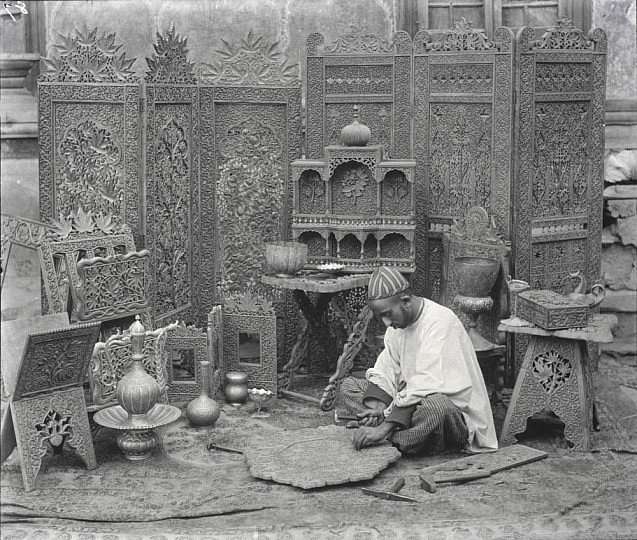 A woodcarver in Kashmir photographed by Fred Bremner in about 1896.
.jpg)

_Regiment_of_Bombay_Infantry.jpg)

References[edit | edit source]
- ↑ "Collection: Fred Bremner (Scottish, 1863 – 1941)". National Galleries Scotland.
- ↑ Bhushan Sharma, Brij (October 1989). "Fred Bremner's Indian years". History of Photography. 13 (4): 293–301. doi:10.1080/03087298.1989.10441003.
- ↑ "Lucknow to Lahore | Fred Bremner's Vision of India". Scottish National Portrait Gallery. Edinburgh: National Galleries of Scotland. 2012. Retrieved 6 October 2012.
External links[edit | edit source]
- http://www.harrappa.com/Bremner/[permanent dead link] [Dead link]
- Picturing India with Bremner [Dead Link]