


BeckyK8455 (talk | contribs) No edit summary |
No edit summary |
||
| Line 1: | Line 1: | ||
{{Short description|Mauryan | {{Short description|Mauryan Emperor}} | ||
{{about|Mauryan king|character from Hindu Epic Ramayana|Dasharatha}} | {{about|Mauryan king|character from Hindu Epic Ramayana|Dasharatha}} | ||
{{Use dmy dates|date=January 2016}} | {{Use dmy dates|date=January 2016}} | ||
{{Use Indian English|date=January 2016}} | {{Use Indian English|date=January 2016}} | ||
{{Infobox royalty | {{Infobox royalty | ||
| succession | |succession = 4th [[List of Mauryan rulers|Mauryan emperor]] | ||
| image | |image =Dasaratha Maurya Empire.jpg | ||
| caption | |caption = Emperor Dasaratha Maurya Empire | ||
| reign | |reign = {{circa|232|224 BCE}} | ||
| coronation | |coronation = | ||
| religion | |full name = Dasharatha Maurya | ||
| predecessor | |religion = [[Ajivika]] | ||
| successor | |predecessor = [[Ashoka]] | ||
| spouse | |successor = [[Samprati]] | ||
| issue | |spouse = | ||
| dynasty | |issue= | ||
| father | |dynasty = [[Maurya Empire|Maurya]] | ||
| mother | |father = | ||
| birth_date | |mother = | ||
| birth_place | |birth_date = 252 BCE | ||
| death_date | |birth_place = | ||
|death_date = 224 BCE | |||
| death_place | |death_place = | ||
| | |date of burial = | ||
| | |place of burial = | ||
| title | |title=Devanampiya}} | ||
}} | |||
{{Maurya}} | {{Maurya}} | ||
'''Dasharatha | '''Dasharatha''' ({{IAST3|Daśaratha}}) was a [[Mauryan Empire|Mauryan]] emperor from 232 to 224 BCE. He was a grandson of [[Ashoka]] and is commonly held to have succeeded him as the imperial ruler of [[Greater India|India]]. Dasharatha presided over a declining imperium and several territories of the empire broke away from central rule during his reign. He had continued the religious and social policies of Ashoka. Dasharatha was the last ruler of the [[Mauryan dynasty]] to have issued imperial inscriptions—thus the last Mauryan Emperor to be known from epigraphical sources.{{citation needed|date=November 2015}} | ||
Dasharatha died in 224 BCE and was succeeded by his | Dasharatha died in 224 BCE and was succeeded by his brother [[Samprati]]. | ||
==Background== | ==Background== | ||
Dasharatha was a grandson of the Mauryan | Dasharatha was a grandson of the Mauryan ruler [[Ashoka]].<ref name="ML">Asha Vishnu; ''Material Life of Northern India: Based on an Archaeological Study, 3rd Century B.C. to 1st Century B.C. Mittal Publications''. 1993. {{ISBN|978-8170994107}}. pg 3.</ref> He is commonly held to have succeeded his grandfather as imperial ruler in [[Greater India|India]] although some sources including the [[Vayu Purana]] have given different names and numbers of Mauryan Emperors after Ashoka.<ref name="ML"/> Of the grandsons of Ashoka, the two most frequently mentioned are [[Samprati]] and Dasharatha.<ref name="AI">Sailendra Nath Sen; ''Ancient Indian History And Civilization''. New Age International. 1999. {{ISBN|978-8122411980}}. pg 152-154.</ref> The latter is described in the [[Vishnu Purana]] as the son and imperial successor of Suyashas (a son of Ashoka).<ref name="AI"/> It has been suggested that Suyashas was an alternative name of Ashoka's son and presumptive heir [[Kunala]].<ref name="AI"/> | ||
==Administration== | ==Administration== | ||
Historians [[Vincent Arthur Smith|Vincent Smith]] and [[Romila Thapar]] advanced the popular theory of a division of the Mauryan Empire amongst Kunala and Dasharatha after the death of Ashoka.<ref name="SII">Buddha Prakash; ''Studies in Indian history and civilization''. Shiva Lal Agarwala. 1962. pg 148-154.</ref> In some of the sources the division is recorded as having been between Samprati and Dasharatha, the latter holding the eastern parts with the capital at [[Pataliputra]] and the former the western imperium with the capital at [[Ujjain]].<ref name="HO">Rama Shankar Tripathi; ''History Of Ancient India. Motilal Banarsidass Publishers''. 1942. pg 179.</ref> However, Smith also wrote that "there is no clear evidence to support [the] hypothesis."<ref name="TE">Vincent A. Smith; ''The Early History of India''. Atlantic Publishers & Dist. 1999. {{ISBN|978-8171566181}}. pg 193-207.</ref> | Historians [[Vincent Arthur Smith|Vincent Smith]] and [[Romila Thapar]] advanced the popular theory of a division of the Mauryan Empire amongst Kunala and Dasharatha after the death of Ashoka.<ref name="SII">Buddha Prakash; ''Studies in Indian history and civilization''. Shiva Lal Agarwala. 1962. pg 148-154.</ref> In some of the sources the division is recorded as having been between Samprati and Dasharatha, the latter holding the eastern parts with the capital at [[Pataliputra]] and the former the western imperium with the capital at [[Ujjain]].<ref name="HO">Rama Shankar Tripathi; ''History Of Ancient India. Motilal Banarsidass Publishers''. 1942. pg 179.</ref> However, Smith also wrote that "there is no clear evidence to support [the] hypothesis."<ref name="TE">Vincent A. Smith; ''The Early History of India''. Atlantic Publishers & Dist. 1999. {{ISBN|978-8171566181}}. pg 193-207.</ref> | ||
The Vayu and [[Brahmanda Purana|Brahmanda]] Puranas mention three Mauryan rulers—Bandhupalita, Indrapalita and Dasona—whose identification is rather difficult.<ref name="AI"/> It has been suggested that they may have been members of a branch line of the Maurya dynasty whom Dasharatha had appointed as | The Vayu and [[Brahmanda Purana|Brahmanda]] Puranas mention three Mauryan rulers—Bandhupalita, Indrapalita and Dasona—whose identification is rather difficult.<ref name="AI"/> It has been suggested that they may have been members of a branch line of the Maurya dynasty whom Dasharatha had appointed as regional governors for the convenience of administration.<ref name="AI"/> | ||
The political unity of the Mauryan Empire did not long survive Ashoka's death.<ref name="AI"/> One of Dasharatha's uncles, | The political unity of the Mauryan Empire did not long survive Ashoka's death.<ref name="AI"/> One of Dasharatha's uncles, Jalauka, set up an independent kingdom in [[Kashmir]]. According to [[Taranatha]], another Mauryan prince, Virasena declared himself king in [[Gandhara]].<ref name="AI"/> [[Vidarbha]] also seceded. Evidence from [[Greece|Greek]] sources confirm the loss of the north-western provinces which was then ruled by the Mauryan ruler [[Sophagasenus]] (Subhagasena, probably a successor of Virasena).<ref name="AI"/> There is also much modern speculation about a possible east–west division of the empire involving Dasharatha and another Mauryan ruler.<ref name="SII"/> Epigraphic evidence indicates that Dasharatha retained imperial power in [[Magadha]].<ref name="THO">Kenneth Pletcher; ''The History of India''. The Rosen Publishing Group. 2010. {{ISBN|978-1615302017}}. pg 70.</ref> He was a weak monarch and not much of an able military leader. | ||
Various dynasties of the [[South India|south]] including the [[Satavahana dynasty|Satavahana]] had been | Various dynasties of the [[South India|south]] including the [[Satavahana dynasty|Satavahana]] had been feudatories of the Mauryan Empire. These kingdoms are mentioned in Ashoka's edicts (256 BCE) and were considered part of the outer circle of the imperium—subject to the rule of the Mauryan Emperor, although doubtless enjoying a considerable degree of autonomy under their local rulers.<ref name="TE"/> The death of Ashoka began the decline of imperial power in the south. Dasharatha was able to maintain some command of the home provinces, but the distant governments, including areas in the south, broke away from imperial rule and reasserted their independence.<ref name="TE"/> The [[Mahameghavahana dynasty]] of [[Kalinga (historical region)|Kalinga]] in central-eastern India also broke away from imperial rule after the death of Ashoka.<ref name="TE"/> | ||
According to a [[Jain]] text, the provinces of [[ | According to a [[Jain]] text, the provinces of [[Surashtra]], [[Maharashtra]], [[Andhra Pradesh|Andhra]], and the [[Mysore]] region broke away from the empire shortly after Ashoka's death, but were reconquered by Dasharatha's successor, [[Samprati]] (who supposedly deployed soldiers disguised as Jain monks).<ref name="Chandra1977">{{cite book|author=Moti Chandra|title=Trade and Trade Routes in Ancient India|url=https://books.google.com/books?id=rDL4kA7SWkEC&pg=PA75|year=1977|publisher=Abhinav Publications|isbn=978-81-7017-055-6|pages=75–}}</ref> | ||
==Religion== | ==Religion== | ||
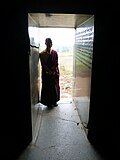
[[File:Barabar Caves - Cave Entrance with Dorjee (9227649922).jpg|left|thumb|Entrance corridor of the [[Barabar Caves|Gopika Cave]], with polished [[granite]] walls, built and dedicated by Dasharatha Maurya]] | [[File:Barabar Caves - Cave Entrance with Dorjee (9227649922).jpg|left|thumb|Entrance corridor of the [[Barabar Caves|Gopika Cave]], with polished [[granite]] walls, built and dedicated by Dasharatha Maurya.]] | ||
Ashoka had displayed divine support in his [[Ashoka inscriptions|inscriptions]]; although a [[Buddhist]] ruler, he was called [[ | Ashoka had displayed divine support in his [[Ashoka inscriptions|inscriptions]]; although a [[Buddhist]] ruler, he was called [[Devanampiya (title)|Devanampiya]], which means "Beloved of the Gods" in [[Pali]].<ref name="PI">Ram Sharan Sharma; ''Perspectives in social and economic history of early India''. Munshiram Manoharlal Publishers. 1995. {{ISBN|978-8121506724}}. pg 107.</ref> The title of Devanampiya and religious adherence of the Mauryan ruler to Buddhism was continued by Dasharatha.<ref name="PI"/><ref name="SI">Lal Mani Joshi; ''Studies in the Buddhistic Culture of India During the 7th and 8th Centuries A.D.'' Motilal Banarsidass Publishers. 1977. {{ISBN|978-8120802810}}. pg 362.</ref> | ||
Dasharatha is known to have dedicated three caves in the [[Barabar Caves|Nagarjuni Hills]] to the [[Ajivikas]]. Three inscriptions at the caves refer to him as "''Devanampiya''" and state that the caves were dedicated by him shortly after his accession.<ref>Romila Thapar; ''{{IAST|Aśoka}} and the Decline of the Maurya''. Oxford University Press. 2001. {{ISBN|0-19-564445-X}}. pg 186.</ref> | Dasharatha is known to have dedicated three caves in the [[Barabar Caves|Nagarjuni Hills]] to the [[Ajivikas]]. Three inscriptions at the caves refer to him as "''Devanampiya''" and state that the caves were dedicated by him shortly after his accession.<ref>Romila Thapar; ''{{IAST|Aśoka}} and the Decline of the Maurya''. Oxford University Press. 2001. {{ISBN|0-19-564445-X}}. pg 186.</ref> | ||
===Nagarjuni caves inscriptions by Dasaratha Maurya=== | ===Nagarjuni caves inscriptions by Dasaratha Maurya=== | ||
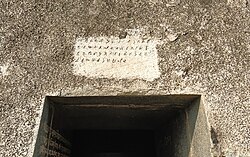
[[File: Dasaratha Maurya inscription on entrance of Vadathika cave.jpg|thumb|Dedicatory inscription of Dasaratha Maurya above the entrance of the Vadathika cave]] | [[File: Dasaratha Maurya inscription on entrance of Vadathika cave.jpg|thumb|Dedicatory inscription of Dasaratha Maurya above the entrance of the Vadathika cave.]] | ||
[[Dasaratha Maurya]], Ashoka's grandson and regnal successor, wrote dedicatory inscriptions in the three forming the Nagarjuni group (Gopika, Vadathi and Vapiya caves) of the [[Barabar Caves]].<ref name="HP">Buddhist Architecture par Huu Phuoc Le [https://books.google.com/books?id=9jb364g4BvoC&pg=PA102 p.102]</ref> It is generally considered that their construction dates from his reign.<ref name = "HP"/> | [[Dasaratha Maurya]], Ashoka's grandson and regnal successor, wrote dedicatory inscriptions in the three forming the Nagarjuni group (Gopika, Vadathi and Vapiya caves) of the [[Barabar Caves]].<ref name="HP">Buddhist Architecture par Huu Phuoc Le [https://books.google.com/books?id=9jb364g4BvoC&pg=PA102 p.102]</ref> It is generally considered that their construction dates from his reign.<ref name = "HP"/> | ||
| Line 65: | Line 64: | ||
|- | |- | ||
| align = left | | | align = left | | ||
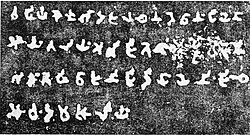
{{Block quote | Inscription of [[Barabar Caves|Gopika cave]]: <br> '' "The cave of Gopika, a refuge that will last as long as the sun and the moon, was dug by Devanampiya (beloved of the gods) Dasaratha at from his elevation to the throne, to make it a hermitage for the most pious Ajivikas" | {{Block quote | Inscription of [[Barabar Caves|Gopika cave]]: <br> '' "The cave of Gopika, a refuge that will last as long as the sun and the moon, was dug by Devanampiya (beloved of the gods) Dasaratha at from his elevation to the throne, to make it a hermitage for the most pious Ajivikas "".<ref name = "HP" /> [[File: Dasaratha_Maurya_inscription_on_entrance_of_Gopika_cave.jpg | 30px]] | ||
Inscription of [[Barabar Caves|Vapiyaka Cave]]: <br> '' "Vadathi Cave, a refuge that will last as long as the sun and the moon, was dug by Devanampiya (beloved of the gods) Dasaratha during his elevation to the throne, to make it a hermitage for the most pious Ajivikas "''.<ref name =" HP "/> [[File:Vapiyaka inscription of emperor Dasaratha Maurya.jpg|30px]] | Inscription of [[Barabar Caves|Vapiyaka Cave]]: <br> '' "Vadathi Cave, a refuge that will last as long as the sun and the moon, was dug by Devanampiya (beloved of the gods) Dasaratha during his elevation to the throne, to make it a hermitage for the most pious Ajivikas "''.<ref name =" HP "/> [[File:Vapiyaka inscription of emperor Dasaratha Maurya.jpg|30px]] | ||
| Line 76: | Line 75: | ||
==Succession== | ==Succession== | ||
Samprati, who succeeded Dasharatha, was according to the [[ | Samprati, who succeeded Dasharatha, was according to the [[Hindu]] [[Puranas]],<ref name="AI"/> the latter's son and according to the Buddhist and [[Jain]] sources,<ref name="AI"/> Kunala's son (making him possibly a brother of Dasharatha). The familial relationship between the two is thus not clear although evidently they were closely related members of the imperial family.<ref name="AI"/> | ||
== Notes == | == Notes == | ||
| Line 94: | Line 87: | ||
{{s-end}} | {{s-end}} | ||
[[Category:Mauryan emperors]] | |||
[[Category:Mauryan | |||
[[Category:3rd-century BC Indian monarchs]] | [[Category:3rd-century BC Indian monarchs]] | ||
[[Category: | [[Category:224 BC deaths]] | ||
[[Category:Year of birth unknown]] | [[Category:Year of birth unknown]] | ||
[[Category:Indian Buddhists]] | [[Category:Indian Buddhists]] | ||
[[Category:Indian Buddhist monarchs]] | [[Category:Indian Buddhist monarchs]] | ||
Latest revision as of 10:32, 16 March 2026
| Dasharatha Maurya | |||||
|---|---|---|---|---|---|
| Devanampiya | |||||
 Emperor Dasaratha Maurya Empire | |||||
| 4th Mauryan emperor | |||||
| Reign | c. 232 – c. 224 BCE | ||||
| Predecessor | Ashoka | ||||
| Successor | Samprati | ||||
| Born | 252 BCE | ||||
| Died | 224 BCE | ||||
| |||||
| Dynasty | Maurya | ||||
| Religion | Ajivika | ||||
| Maurya Empire (322–180 BCE) | ||||||||||||||||||||
|---|---|---|---|---|---|---|---|---|---|---|---|---|---|---|---|---|---|---|---|---|
|
||||||||||||||||||||


Dasharatha (IAST: Daśaratha) was a Mauryan emperor from 232 to 224 BCE. He was a grandson of Ashoka and is commonly held to have succeeded him as the imperial ruler of India. Dasharatha presided over a declining imperium and several territories of the empire broke away from central rule during his reign. He had continued the religious and social policies of Ashoka. Dasharatha was the last ruler of the Mauryan dynasty to have issued imperial inscriptions—thus the last Mauryan Emperor to be known from epigraphical sources.[citation needed]
Dasharatha died in 224 BCE and was succeeded by his brother Samprati.
Background[edit | edit source]
Dasharatha was a grandson of the Mauryan ruler Ashoka.[1] He is commonly held to have succeeded his grandfather as imperial ruler in India although some sources including the Vayu Purana have given different names and numbers of Mauryan Emperors after Ashoka.[1] Of the grandsons of Ashoka, the two most frequently mentioned are Samprati and Dasharatha.[2] The latter is described in the Vishnu Purana as the son and imperial successor of Suyashas (a son of Ashoka).[2] It has been suggested that Suyashas was an alternative name of Ashoka's son and presumptive heir Kunala.[2]
Administration[edit | edit source]
Historians Vincent Smith and Romila Thapar advanced the popular theory of a division of the Mauryan Empire amongst Kunala and Dasharatha after the death of Ashoka.[3] In some of the sources the division is recorded as having been between Samprati and Dasharatha, the latter holding the eastern parts with the capital at Pataliputra and the former the western imperium with the capital at Ujjain.[4] However, Smith also wrote that "there is no clear evidence to support [the] hypothesis."[5]
The Vayu and Brahmanda Puranas mention three Mauryan rulers—Bandhupalita, Indrapalita and Dasona—whose identification is rather difficult.[2] It has been suggested that they may have been members of a branch line of the Maurya dynasty whom Dasharatha had appointed as regional governors for the convenience of administration.[2]
The political unity of the Mauryan Empire did not long survive Ashoka's death.[2] One of Dasharatha's uncles, Jalauka, set up an independent kingdom in Kashmir. According to Taranatha, another Mauryan prince, Virasena declared himself king in Gandhara.[2] Vidarbha also seceded. Evidence from Greek sources confirm the loss of the north-western provinces which was then ruled by the Mauryan ruler Sophagasenus (Subhagasena, probably a successor of Virasena).[2] There is also much modern speculation about a possible east–west division of the empire involving Dasharatha and another Mauryan ruler.[3] Epigraphic evidence indicates that Dasharatha retained imperial power in Magadha.[6] He was a weak monarch and not much of an able military leader.
Various dynasties of the south including the Satavahana had been feudatories of the Mauryan Empire. These kingdoms are mentioned in Ashoka's edicts (256 BCE) and were considered part of the outer circle of the imperium—subject to the rule of the Mauryan Emperor, although doubtless enjoying a considerable degree of autonomy under their local rulers.[5] The death of Ashoka began the decline of imperial power in the south. Dasharatha was able to maintain some command of the home provinces, but the distant governments, including areas in the south, broke away from imperial rule and reasserted their independence.[5] The Mahameghavahana dynasty of Kalinga in central-eastern India also broke away from imperial rule after the death of Ashoka.[5]
According to a Jain text, the provinces of Surashtra, Maharashtra, Andhra, and the Mysore region broke away from the empire shortly after Ashoka's death, but were reconquered by Dasharatha's successor, Samprati (who supposedly deployed soldiers disguised as Jain monks).[7]
Religion[edit | edit source]
.jpg)
Ashoka had displayed divine support in his inscriptions; although a Buddhist ruler, he was called Devanampiya, which means "Beloved of the Gods" in Pali.[8] The title of Devanampiya and religious adherence of the Mauryan ruler to Buddhism was continued by Dasharatha.[8][9]
Dasharatha is known to have dedicated three caves in the Nagarjuni Hills to the Ajivikas. Three inscriptions at the caves refer to him as "Devanampiya" and state that the caves were dedicated by him shortly after his accession.[10]
Nagarjuni caves inscriptions by Dasaratha Maurya[edit | edit source]

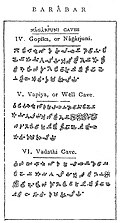
Dasaratha Maurya, Ashoka's grandson and regnal successor, wrote dedicatory inscriptions in the three forming the Nagarjuni group (Gopika, Vadathi and Vapiya caves) of the Barabar Caves.[11] It is generally considered that their construction dates from his reign.[11]
The three caves were offered to the Ajivikas upon the accession to the throne of Dasaratha, confirming that these were still active around 230 BCE, and that Buddhism was not the exclusive religion of the Mauryas at that time.[11]
The three caves are also characterized by an extremely advanced finish of the granite walls inside, which again confirms that the technique of "Mauryan polish" did not die out with the reign of Ashoka.[11] Template:Clr
| English translation | Prakrit in Brahmi script (original text of the Nagarjuni Caves) |
|---|---|
|
|


Succession[edit | edit source]
Samprati, who succeeded Dasharatha, was according to the Hindu Puranas,[2] the latter's son and according to the Buddhist and Jain sources,[2] Kunala's son (making him possibly a brother of Dasharatha). The familial relationship between the two is thus not clear although evidently they were closely related members of the imperial family.[2]
Notes[edit | edit source]
- ↑ 1.0 1.1 Asha Vishnu; Material Life of Northern India: Based on an Archaeological Study, 3rd Century B.C. to 1st Century B.C. Mittal Publications. 1993. ISBN 978-8170994107. pg 3.
- ↑ 2.00 2.01 2.02 2.03 2.04 2.05 2.06 2.07 2.08 2.09 2.10 Sailendra Nath Sen; Ancient Indian History And Civilization. New Age International. 1999. ISBN 978-8122411980. pg 152-154.
- ↑ 3.0 3.1 Buddha Prakash; Studies in Indian history and civilization. Shiva Lal Agarwala. 1962. pg 148-154.
- ↑ Rama Shankar Tripathi; History Of Ancient India. Motilal Banarsidass Publishers. 1942. pg 179.
- ↑ 5.0 5.1 5.2 5.3 Vincent A. Smith; The Early History of India. Atlantic Publishers & Dist. 1999. ISBN 978-8171566181. pg 193-207.
- ↑ Kenneth Pletcher; The History of India. The Rosen Publishing Group. 2010. ISBN 978-1615302017. pg 70.
- ↑ Moti Chandra (1977). Trade and Trade Routes in Ancient India. Abhinav Publications. pp. 75–. ISBN 978-81-7017-055-6.
- ↑ 8.0 8.1 Ram Sharan Sharma; Perspectives in social and economic history of early India. Munshiram Manoharlal Publishers. 1995. ISBN 978-8121506724. pg 107.
- ↑ Lal Mani Joshi; Studies in the Buddhistic Culture of India During the 7th and 8th Centuries A.D. Motilal Banarsidass Publishers. 1977. ISBN 978-8120802810. pg 362.
- ↑ Romila Thapar; Aśoka and the Decline of the Maurya. Oxford University Press. 2001. ISBN 0-19-564445-X. pg 186.
- ↑ 11.0 11.1 11.2 11.3 11.4 11.5 11.6 Buddhist Architecture par Huu Phuoc Le p.102
Dasharatha Maurya
| ||
| Preceded by Ashoka |
Maurya Emperor 232–224 BCE |
Succeeded by Samprati |