

m Moving Category:Flora of North America to Category:Flora of Northern America per Bharatpedia:Categories for discussion/Log/2023 June 7#Category:Flora of Central Europe |
|||
| Line 16: | Line 16: | ||
| subdivision_ranks = Subspecies | | subdivision_ranks = Subspecies | ||
| subdivision = | | subdivision = | ||
{{ | {{Species list | ||
| R. a. | | R. a. subsp. acicularis| | ||
| R. a. | | R. a. subsp. sayi|([[Lewis David de Schweinitz|Schwein.]]) [[Walter Hepworth Lewis|W.H.Lewis]] | ||
}} | }} | ||
}} | }} | ||
| Line 31: | Line 30: | ||
===North America=== | ===North America=== | ||
This native rose species of the northern [[Great Plains]] is the [[provincial flower]] of [[Alberta]].<ref>{{cite web |url=http://www.cd.gov.ab.ca/all_about_us/emblems/Emblems_Booklet_2005.pdf |title=Government of Alberta's official emblems |archive-url=https://web.archive.org/web/20070102031413/http://www.cd.gov.ab.ca/all_about_us/emblems/Emblems_Booklet_2005.pdf |archive-date=2007-01-02 }}</ref> It is not as common in the Parkland region of the Canadian Prairie provinces as ''[[Rosa woodsii]]'' (Woods' rose), nor is it as common as Rosa woodsii in the [[boreal forest]] of northern North America. | This native rose species of the northern [[Great Plains]] is the [[provincial flower]] of [[Alberta]].<ref>{{cite web |url=http://www.cd.gov.ab.ca/all_about_us/emblems/Emblems_Booklet_2005.pdf |title=Government of Alberta's official emblems |archive-url=https://web.archive.org/web/20070102031413/http://www.cd.gov.ab.ca/all_about_us/emblems/Emblems_Booklet_2005.pdf |archive-date=2007-01-02 }}</ref> It is not as common in the Parkland region of the Canadian Prairie provinces as ''[[Rosa woodsii]]'' (Woods' rose), nor is it as common as ''Rosa woodsii'' in the [[boreal forest]] of northern North America. | ||
<gallery> | <gallery> | ||
| Line 41: | Line 40: | ||
== Uses == | == Uses == | ||
The hips, which stay on the plant through winter, are reported to be high in [[Vitamin A|vitamins A]] and [[Vitamin C|C]]. [[Indigenous peoples of the Americas|Native Americans]] made tea and salad from the leaves, and used the inner bark to smoke [[tobacco]]. Perfume has also been made from this plant.<ref>{{Cite book|last=Reiner|first=Ralph E.|title=Introducing the Flowering Beauty of Glacier National Park and the Majestic High Rockies|publisher=Glacier Park, Inc.|year=1969|pages=120}}</ref> | The [[Rose hips|hips]], which stay on the plant through winter, are reported to be high in [[Vitamin A|vitamins A]] and [[Vitamin C|C]]. [[Indigenous peoples of the Americas|Native Americans]] made tea and salad from the leaves, and used the inner bark to smoke [[tobacco]]. Perfume has also been made from this plant.<ref>{{Cite book|last=Reiner|first=Ralph E.|title=Introducing the Flowering Beauty of Glacier National Park and the Majestic High Rockies|publisher=Glacier Park, Inc.|year=1969|pages=120}}</ref> | ||
==See also== | ==See also== | ||
* [[List of Rosa species]] | * [[List of Rosa species]] | ||
| Line 51: | Line 49: | ||
{{Floral Emblems of Canada}} | {{Floral Emblems of Canada}} | ||
{{ | {{Taxonbar|from=Q218368}} | ||
[[Category:Roses|acicularis]] | [[Category:Roses|acicularis]] | ||
[[Category:Flora of Europe]] | [[Category:Flora of Europe]] | ||
[[Category:Flora of Northern America]] | |||
[[Category:Flora of | |||
[[Category:Flora of temperate Asia]] | [[Category:Flora of temperate Asia]] | ||
[[Category:Holarctic flora]] | [[Category:Holarctic flora]] | ||
| Line 62: | Line 60: | ||
{{ | {{Rosa-stub}} | ||
Latest revision as of 17:00, 15 June 2023
| Rosa acicularis | |
|---|---|

| |
Scientific classification 
| |
| : | [[Template:Taxonomy/Rosa]] |
| Species: | Template:Taxonomy/RosaR. acicularis
|
| Binomial name | |
| Template:Taxonomy/RosaRosa acicularis | |
| Subspecies | |
| Synonyms [2] | |
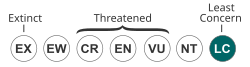
Rosa acicularis is a flowering plant in the Rosaceae family. It is commonly known as the prickly wild rose, prickly rose, bristly rose, wild rose or Arctic rose. It is a species of wild rose with a Holarctic distribution in northern regions of Asia,[3] Europe,[4] and North America.
Description[edit | edit source]
Rosa acicularis is a deciduous shrub growing 1–3 m tall. The leaves are pinnate, 7–14 cm long, with three to seven leaflets. The leaflets are ovate, with serrate (toothed) margins. The flowers are pink (rarely white), 3.5–5 cm diameter; the hips are red, pear-shaped to ovoid, 10–15 mm diameter. Its native habitats include thickets, stream banks, rocky bluffs, and wooded hillsides.[5]
The ploidy of this rose species is variable. Botanical authorities have listed it as tetraploid and hexaploid in North America (subsp. sayi),[6] and octoploid in Eurasia (subsp. acicularis),[6] including China.[7] On the northern Great Plains its populations are generally tetraploid.[citation needed] Hexaploid populations exist in the Yukon.
North America[edit | edit source]
This native rose species of the northern Great Plains is the provincial flower of Alberta.[8] It is not as common in the Parkland region of the Canadian Prairie provinces as Rosa woodsii (Woods' rose), nor is it as common as Rosa woodsii in the boreal forest of northern North America.
-
 Larger stems are usually densely covered with straight prickles.
 -
 Young flowers are darker in colour.
 -
 The fruit is usually elongated as shown here.
 -
 Since 1987 Rosa acicularis has been pictured on licence plates in the Canadian province of Alberta.


Uses[edit | edit source]
The hips, which stay on the plant through winter, are reported to be high in vitamins A and C. Native Americans made tea and salad from the leaves, and used the inner bark to smoke tobacco. Perfume has also been made from this plant.[9]
See also[edit | edit source]
References[edit | edit source]
- ↑ Maiz-Tome, L. (2016). "Rosa acicularis". IUCN Red List of Threatened Species. 2016: e.T64323755A67730697. Retrieved 17 April 2022.
- ↑ [{{#property:P1421|}} "{{#Property:P225}}"]. Germplasm Resources Information Network (GRIN). Agricultural Research Service (ARS), United States Department of Agriculture (USDA). Retrieved 17 December 2017.
{{citation}}: Check|url=value (help) - ↑ Template:EFloras
- ↑ [http:/contact /rbg-web2.rbge.org.uk/cgi-bin/nph-readbtree.pl/feout?FAMILY_XREF=&GENUS_XREF=Rosa+&SPECIES_XREF=acicularis+&TAXON_NAME_XREF=&RANK= "Rosa acicularis"]. Flora Europaea.
{{cite web}}: Check|url=value (help) - ↑ "Lady Bird Johnson Wildflower Center - The University of Texas at Austin". www.wildflower.org. Retrieved 2021-11-16.
- ↑ 6.0 6.1 Lewis W.H. (1959). "Monograph of Rosa in North America. I. R. acicularis". Brittonia. 11 (1): 1–24. doi:10.2307/2805073. JSTOR 2805073. S2CID 34323115.
- ↑ Yu, Chao; Luo, Le; Pan, Hui-tang; Sui, Yun-ji; Guo, Run-hua; Wang, Jin-yao; Zhang, Qi-xiang (January 2014). "Karyotype Analysis of Wild Rosa Species in Xinjiang, Northwestern China". Journal of the American Society for Horticultural Science. 139 (1): 39–47. doi:10.21273/JASHS.139.1.39.
- ↑ "Government of Alberta's official emblems" (PDF). Archived from the original (PDF) on 2007-01-02.
- ↑ Reiner, Ralph E. (1969). Introducing the Flowering Beauty of Glacier National Park and the Majestic High Rockies. Glacier Park, Inc. p. 120.
Template:Floral Emblems of Canada
 | This article about roses is a stub. You can help Bharatpedia by expanding it. |