


imported>Wiki-uk |
WikiDwarfBOT (talk | contribs) Cleanup: |
||
| Line 1: | Line 1: | ||
{{Short description|Form of | {{Short description|Form of miniature painting}} | ||
{{Use dmy dates|date= | {{Use dmy dates|date=November 2021}} | ||
[[File:Bhairavi Ragini, Manley Ragamala, an album painting in gouache on paper.jpg|250px|thumb|[[Bhairavi (music)|Bhairavi Ragini]], Ragamala | [[File:Bhairavi Ragini, Manley Ragamala, an album painting in gouache on paper.jpg|250px|thumb|[[Bhairavi (music)|Bhairavi Ragini]], folio from the Manley Ragamala. Probably [[Jaipur State|Amber]], c. 1610-1620. [[British Museum]]]] | ||
'''Ragamala paintings''' are a form of [[Indian miniature painting]], a set of illustrative paintings of the ''Ragamala'' or "Garland of Ragas", depicting variations of the Indian musical modes called [[ragas]]. They stand as a classical example of the amalgamation of art, poetry and classical music in medieval India. | '''Ragamala paintings''' are a form of [[Indian miniature painting]], a set of illustrative paintings of the ''Ragamala'' or "Garland of Ragas", depicting variations of the Indian musical modes called [[ragas]]. They stand as a classical example of the amalgamation of art, poetry and classical music in medieval India. | ||
Ragamala paintings were created in most schools of Indian painting, starting in the 16th and 17th centuries, and are today named accordingly as Pahari Ragamala, Rajasthan or Rajput Ragamala, Deccan Ragamala, and Mughal Ragamala. | Ragamala paintings were created in most schools of Indian painting, starting in the 16th and 17th centuries, and are today named accordingly as Pahari Ragamala, Rajasthan or Rajput Ragamala, Deccan Ragamala, and Mughal Ragamala. | ||
Also it originated in Rajasthan. | |||
In these painting each raga is personified by a colour, mood, a verse describing a story of a hero and heroine (nayaka and nayika), it also elucidates the season and the time of day and night in which a particular raga is to be sung; and finally most paintings also demarcate the specific Hindu deities attached with the raga, like Bhairava or Bhairavi to Shiva, Sri to Devi etc. The paintings depict not just the [[Ragas]], but also their wives, (''raginis''), their numerous sons (''ragaputra'') and daughters (''ragaputri'').<ref>[http://collection.artgallery.nsw.gov.au/collection/results.do?view=detail&images=true&dept=asian%2Fsouth%2Findia&db=object&browse=asian%2Fsouth%2Findia%2Fbrowse&id=27718 Ragamala] Art Gallery of New South Wales.</ref> | In these painting each raga is personified by a colour, mood, a verse describing a story of a hero and heroine (nayaka and nayika), it also elucidates the season and the time of day and night in which a particular raga is to be sung; and finally most paintings also demarcate the specific Hindu deities attached with the raga, like Bhairava or Bhairavi to Shiva, Sri to Devi etc. The paintings depict not just the [[Ragas]], but also their wives, (''raginis''), their numerous sons (''ragaputra'') and daughters (''ragaputri'').<ref>[http://collection.artgallery.nsw.gov.au/collection/results.do?view=detail&images=true&dept=asian%2Fsouth%2Findia&db=object&browse=asian%2Fsouth%2Findia%2Fbrowse&id=27718 Ragamala] Art Gallery of New South Wales.</ref> | ||
| Line 11: | Line 14: | ||
==History== | ==History== | ||
''[[Sangita Ratnakara]]'' is an important 12th century CE treatise on the classification of Indian Ragas, which for the first time mentions the presiding deity of each raga.<ref name=bombay>{{cite web|url=http://www.bombaymuseum.org/powm/jubilee/ragamala.htm|title=Ragamala Paintings | [[File:India, Sirohi - A page from a Ragamala series- Asavari Ragini - 2018.199 - Cleveland Museum of Art.tif|thumb|''[[Asavari|Asavari Ragini]]''. [[Sirohi State|Sirohi]], c. 1700. [[Cleveland Museum of Art]]]] | ||
From the 14th century onwards, they were described in short verses in Sanskrit, for [[wikt:dhyana|dhyana]], 'contemplation', and later depicted in a series of paintings, called the Ragamala paintings.<ref>[http://www.wyastone.co.uk/nrl/world/raga/intro4.html Ragamala | ''[[Sangita Ratnakara]]'' is an important 12th century CE treatise on the classification of Indian Ragas, which for the first time mentions the presiding deity of each raga.<ref name=bombay>{{cite web|url=http://www.bombaymuseum.org/powm/jubilee/ragamala.htm|title=Ragamala Paintings}}</ref> | ||
Some of the best available works of Ragamala are from the 16th and 17th centuries, when the form flourished under royal patronage,<ref>[https://www.britishmuseum.org/explore/highlights/highlight_objects/asia/b/bhairavi_ragini_from_the_manle.aspx Bhairavi Ragini | From the 14th century onwards, they were described in short verses in Sanskrit, for [[wikt:dhyana|dhyana]], 'contemplation', and later depicted in a series of paintings, called the Ragamala paintings.<ref>[http://www.wyastone.co.uk/nrl/world/raga/intro4.html Ragamala – wyastone.co.uk.] {{webarchive|url=https://web.archive.org/web/20080526051307/http://www.wyastone.co.uk/nrl/world/raga/intro4.html |date=26 May 2008 }}</ref> | ||
Some of the best available works of Ragamala are from the 16th and 17th centuries, when the form flourished under royal patronage,<ref>[https://www.britishmuseum.org/explore/highlights/highlight_objects/asia/b/bhairavi_ragini_from_the_manle.aspx Bhairavi Ragini – britishmuseum.org.]</ref> though by the 19th century, it gradually faded. | |||
==Extant works== | ==Extant works== | ||
[[File: | [[File:Todi Ragini (SJM XXX-56).jpg|thumb|''[[Todi (raga)|Ragini Todi]]''. [[Mughal painting|Mughal]], c. 1750. [[Salar Jung Museum]]]] | ||
In 1570, Kshemakarna, a priest of [[Rewa (princely state)|Rewa]] in Central India, compiled a poetic text on the Ragamala in [[Sanskrit]], which describes six principal Ragas—Bhairava, Malakoshika, Hindola, Deepak, Shri, and [[Megh (raga)|Megha]]—each having five Raginis and eight Ragaputras, except Raga Shri, which has six Raginis and nine Ragaputras, thus making a Ragamala family of 86 members<ref>{{cite web|url=http://www.encyclopedia.com/doc/1G1-178083119.html|title=Bernoulli,* Daniel – Dictionary definition of Bernoulli,* Daniel – Encyclopedia.com: FREE online dictionary}}</ref> | |||
Most of the extant works of Ragamala are from Deccan style, where [[Ibrahim Adil Shah II]] of [[Adil Shahi|Bijapur]], was himself also a fine painter and illustrator, though some Rajput style also exist of which the work of an artist of the 'Chawand' (a part of Mewar) school of painting, [[Sahibdin]], whose Ragamala (musical modes) series dated 1628, are now in [[National Museum of India]]<ref>[http://www.britannica.com/eb/topic-489526/ragamala Ragamala] [[Britannica.com]].</ref> | |||
Ragamala sets discovered in Odisha are in the [[Pattachitra]] style, based on the ragas of [[Odissi music]] and show distinct iconography and raga groups from other regions.<ref>{{Cite book |last=Patnaik |first=Kabichandra Dr. Kalicharan |title=Raga-Chitra |publisher=Odisi Kala Prakash |year=1966 |author-link=Kalicharan Pattnaik}}</ref> | |||
==The Ragas in Ragamala== | ==The Ragas in Ragamala== | ||
| Line 50: | Line 55: | ||
==Gallery== | ==Gallery== | ||
<gallery> | <gallery> | ||
File: | File:Bhairavi Ragini.jpg|Bhairavi Ragini. Possibly [[Kingdom of Mewar|Mewar]], c. 1550. [[Victoria and Albert Museum]] | ||
File: | File:Gauri Ragini, First Wife of Malkos Raga, Folio from a Ragamala, 1575-1600, LACMA.jpg|''[[Gauri (raga)|Gauri Ragini]]''. Probably [[Ahmadnagar Sultanate|Ahmadnagar]], c. 1575-1600. [[Los Angeles County Museum of Art]] | ||
File: | File:1 Shaykh Husayn. Malkausik Raga Page from the Chunar Ragamala Manuscript, dated February 24, 1591, Metmuseum.jpg|''[[Malkauns|Malkausik Raga]]'', folio from the [[Chunar Ragamala]], dated February 24, 1591. Private collection, New York | ||
File:Sahibdin 001.jpg|''Dipak Raga'', folio from the Chawand Ragamala by [[Nisardin|Nasiruddin]]. Mewar, 1605. G.K. Kanoria Collection | |||
File:Sahibdin 001.jpg| | File:Indischer Maler um 1625 001.jpg|''Ragini Bhairavi''. [[Bundi State|Bundi]], c. 1625. [[Allahabad Museum]] | ||
File: | File:Nisaradi 001.jpg|''Lalit Ragini'', folio from the Ragamala painted by [[Sahibdin]]. Mewar, 1628. [[National Museum, New Delhi]] | ||
File: | File:Indischer Maler um 1650 (III) 001.jpg|''Hindola Raga''. [[Malwa]], c. 1650. [[Bharat Kala Bhavan]] | ||
File:MET DP153180.jpg|''Kedar Ragini'', by [[Ruknuddin]]. [[Bikaner State|Bikaner]], c. 1690-1695. [[Metropolitan Museum of Art]] | |||
File: | File:MET DP153192.jpg|''Vasanti Ragini''. [[Bilaspur State (princely state)|Bilaspur]], c. 1710. Metropolitan Museum of Art | ||
File: | File:Raga Madhava, Folio from the Ragamala series.jpg|''Raga Madhava'', by the 2nd Master of the [[Shangri Ramayana]] series. Probably [[Bahu Fort|Bahu]], c. 1720. [[Rietberg Museum]] | ||
File: | File:Ragini Madhumadhavi - Girl flees from a storm.jpg|''Ragini Madhumadhavi'', by Jay Krishna. [[Malpura]], c. 1756. Rietberg Museum | ||
File:The Musical Mode - Ragini Todi.jpg|''[[Todi (raga)|Ragini Todi]]''. Ascribed to a Master of the Second Generation after [[Nainsukh]], c. 1825-30. [[Government Museum and Art Gallery, Chandigarh]] | |||
File: | File:Two lovers, folio from a Ragamala album.jpg|''Two lovers'' (possibly Kodaba Raga). Pigment on cloth, in the technique closely resembling that used in [[Odisha]]n [[Pattachitra|pattachitras]]. Odisha, circa 1850. Private collection | ||
File: | |||
File: | |||
File: | |||
</gallery> | </gallery> | ||
==References== | ==References== | ||
{{reflist | {{reflist}} | ||
==Further reading== | ==Further reading== | ||
| Line 81: | Line 78: | ||
==External links== | ==External links== | ||
* [http://www.asavari.org/ragamala.html Ragamala, a study of Indian Ragas] | * [http://www.asavari.org/ragamala.html Ragamala, a study of Indian Ragas] | ||
* [https://digital.library.cornell.edu/collections/ragamala Ragamala Paintings, Cornell University Digital Collections] | * [https://digital.library.cornell.edu/collections/ragamala Ragamala Paintings, Cornell University Digital Collections] | ||
Revision as of 11:40, 22 July 2023

Ragamala paintings are a form of Indian miniature painting, a set of illustrative paintings of the Ragamala or "Garland of Ragas", depicting variations of the Indian musical modes called ragas. They stand as a classical example of the amalgamation of art, poetry and classical music in medieval India.
Ragamala paintings were created in most schools of Indian painting, starting in the 16th and 17th centuries, and are today named accordingly as Pahari Ragamala, Rajasthan or Rajput Ragamala, Deccan Ragamala, and Mughal Ragamala.
Also it originated in Rajasthan.
In these painting each raga is personified by a colour, mood, a verse describing a story of a hero and heroine (nayaka and nayika), it also elucidates the season and the time of day and night in which a particular raga is to be sung; and finally most paintings also demarcate the specific Hindu deities attached with the raga, like Bhairava or Bhairavi to Shiva, Sri to Devi etc. The paintings depict not just the Ragas, but also their wives, (raginis), their numerous sons (ragaputra) and daughters (ragaputri).[1]
The six principal ragas present in the Ragamala are Bhairava, Dipika, Sri, Malkaunsa, Megha and Hindola and these are meant to be sung during the six seasons of the year – summer, monsoon, autumn, early winter, winter and spring.
History
Sangita Ratnakara is an important 12th century CE treatise on the classification of Indian Ragas, which for the first time mentions the presiding deity of each raga.[2] From the 14th century onwards, they were described in short verses in Sanskrit, for dhyana, 'contemplation', and later depicted in a series of paintings, called the Ragamala paintings.[3] Some of the best available works of Ragamala are from the 16th and 17th centuries, when the form flourished under royal patronage,[4] though by the 19th century, it gradually faded.
Extant works
.jpg)
In 1570, Kshemakarna, a priest of Rewa in Central India, compiled a poetic text on the Ragamala in Sanskrit, which describes six principal Ragas—Bhairava, Malakoshika, Hindola, Deepak, Shri, and Megha—each having five Raginis and eight Ragaputras, except Raga Shri, which has six Raginis and nine Ragaputras, thus making a Ragamala family of 86 members[5]
Most of the extant works of Ragamala are from Deccan style, where Ibrahim Adil Shah II of Bijapur, was himself also a fine painter and illustrator, though some Rajput style also exist of which the work of an artist of the 'Chawand' (a part of Mewar) school of painting, Sahibdin, whose Ragamala (musical modes) series dated 1628, are now in National Museum of India[6]
Ragamala sets discovered in Odisha are in the Pattachitra style, based on the ragas of Odissi music and show distinct iconography and raga groups from other regions.[7]
The Ragas in Ragamala
Six are male (parent) ragas; the thirty raginis are their wives and the remaining forty-eight are their sons. These are listed is as follows:
- (1) Parent Raga: Bhairav raga
Wives: Bhairavi, Bilawali, Punyaki, Bangli, Aslekhi. Sons: Pancham, Harakh, Disakh, Bangal, Madhu, Madhava, Lalit, Bilaval.
- (2) Parent Raga: Malkaus raga
Wives: Gaundkari, Devagandhari, Gandhari, Seehute, Dhanasri. Sons: Maru, Mustang, Mewara, Parbal, Chand, Khokhat, Bhora, Nad.
- (3) Parent Raga: Hindol raga
Wives: Telangi, Devkari, Basanti, Sindhoori, Aheeri. Sons: Surmanand, Bhasker, Chandra-Bimb, Mangalan, Ban, Binoda, Basant, Kamoda.
- (4) Parent Raga: Deepak raga
Wives: Kachheli, Patmanjari, Todi, Kamodi, Gujri. Sons: Kaalanka, Kuntal, Rama, Kamal, Kusum, Champak, Gaura, Kanra [36].
- (5) Parent Raga: Sri raga
Wives: Bairavi, Karnati, Gauri, Asavari, Sindhavi. Sons: Salu, Sarag, Sagra, Gaund, Gambhir, Gund, Kumbh, Hamir.
- (6) Parent Raga: Megh raga
Wives: Sorath, Gaundi-Malari, Asa, Gunguni, Sooho. Sons: Biradhar, Gajdhar, Kedara, Jablidhar, Nut, Jaldhara, Sankar, Syama.
Gallery
-
 Bhairavi Ragini. Possibly Mewar, c. 1550. Victoria and Albert Museum
 -

-
 Malkausik Raga, folio from the Chunar Ragamala, dated February 24, 1591. Private collection, New York
 -
 Dipak Raga, folio from the Chawand Ragamala by Nasiruddin. Mewar, 1605. G.K. Kanoria Collection
 -
 Ragini Bhairavi. Bundi, c. 1625. Allahabad Museum
 -
 Lalit Ragini, folio from the Ragamala painted by Sahibdin. Mewar, 1628. National Museum, New Delhi
 -
 Hindola Raga. Malwa, c. 1650. Bharat Kala Bhavan
 -

-
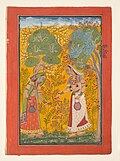 Vasanti Ragini. Bilaspur, c. 1710. Metropolitan Museum of Art
 -
 Raga Madhava, by the 2nd Master of the Shangri Ramayana series. Probably Bahu, c. 1720. Rietberg Museum
 -
 Ragini Madhumadhavi, by Jay Krishna. Malpura, c. 1756. Rietberg Museum
 -
 Ragini Todi. Ascribed to a Master of the Second Generation after Nainsukh, c. 1825-30. Government Museum and Art Gallery, Chandigarh
 -
 Two lovers (possibly Kodaba Raga). Pigment on cloth, in the technique closely resembling that used in Odishan pattachitras. Odisha, circa 1850. Private collection


_001.jpg)


References
- ↑ Ragamala Art Gallery of New South Wales.
- ↑ "Ragamala Paintings".
- ↑ Ragamala – wyastone.co.uk. Archived 26 May 2008 at the Wayback Machine
- ↑ Bhairavi Ragini – britishmuseum.org.
- ↑ "Bernoulli,* Daniel – Dictionary definition of Bernoulli,* Daniel – Encyclopedia.com: FREE online dictionary".
- ↑ Ragamala Britannica.com.
- ↑ Patnaik, Kabichandra Dr. Kalicharan (1966). Raga-Chitra. Odisi Kala Prakash.
Further reading
- Moghul Ragamala: Painted Indian Melodies and the Poetry of Kshemakarna, by Ludwig V. Habighorst. Koblenz: Ragaputra Edition, 2006.
- Ragamala Paintings from India, the collection of Claudio Moscatelli, by Glynn, Skelton, Dallapiccola. Philip Wilson Publishers in association with Dulwich Picture Gallery Museum and Art Gallery London 2011