



robot: Update article (please report if you notice any mistake or error in this edit) |
robot: Create/upgrade articles. If there is a mistake please report on my talk page. |
||
| Line 1: | Line 1: | ||
{{Short description|Indian nationalist (1879–1920)}} | {{Short description|Indian nationalist (1879–1920)}} | ||
{{Use dmy dates|date=May | {{Use dmy dates|date=May 2022}} | ||
{{Use Indian English|date=May | {{Use Indian English|date=May 2022}} | ||
{{Infobox person | {{Infobox person | ||
| name = Raja Subodh Chandra Basu Mallik | | name = Raja Subodh Chandra Basu Mallik | ||
| Line 23: | Line 23: | ||
| known_for = [[Indian independence movement]] | | known_for = [[Indian independence movement]] | ||
| notable_works = [[National Council for Education]] | | notable_works = [[National Council for Education]] | ||
| organization =[[Jugantar]] | |||
}} | }} | ||
{{Anushilan Samiti}} | {{Anushilan Samiti}} | ||
| Line 31: | Line 32: | ||
Mallik was born in Pataldanga suburb of [[Calcutta]] to Prabodh Chandra Basu Mallik. He graduated from [[St. Xaviers College Calcutta]] and [[Presidency College Calcutta]] before enrolling in fine arts at [[Trinity College, Cambridge]] in 1900. | Mallik was born in Pataldanga suburb of [[Calcutta]] to Prabodh Chandra Basu Mallik. He graduated from [[St. Xaviers College Calcutta]] and [[Presidency College Calcutta]] before enrolling in fine arts at [[Trinity College, Cambridge]] in 1900. | ||
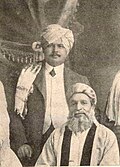
[[File:Subodh_Kumar_Mallik.jpg|thumb|left|Mallik (standing)]] | |||
He returned from England before completing his university studies, and immediately delved into the [[Indian nationalism|nationalist movement]]. His palatial house in what was then Wellington square in Calcutta became a major hub of political activity. In 1906, Mallik was among a group of leading luminaries of Bengal who founded the [[National Council for Education]] to promote indigenous and nationalist education in higher education. His donated Rs 100,000 to support the founding of the [[Bengal National College]]. He also founded the Life of Asia Insurance Company. Mallik's political activities earned him the ire of the Raj, and he was deported in 1908 in the wake of the [[Alipore Bomb Conspiracy]]. Mallik's nationalist work and generous support of the movement earned him the colloquial title of ''[[Raja]]'' from his grateful countrymen. | He returned from England before completing his university studies, and immediately delved into the [[Indian nationalism|nationalist movement]]. His palatial house in what was then Wellington square in Calcutta became a major hub of political activity. In 1906, Mallik was among a group of leading luminaries of Bengal who founded the [[National Council for Education]] to promote indigenous and nationalist education in higher education. His donated Rs 100,000 to support the founding of the [[Bengal National College]]. He also founded the Life of Asia Insurance Company. Mallik's political activities earned him the ire of the Raj, and he was deported in 1908 in the wake of the [[Alipore Bomb Conspiracy]]. Mallik's nationalist work and generous support of the movement earned him the colloquial title of ''[[Raja]]'' from his grateful countrymen. | ||
[[File:SubodhMallikHouse.jpg|thumb|Front view of the house of Raja Subodh Mallik, the great Indian nationalist]] | [[File:SubodhMallikHouse.jpg|thumb|Front view of the house of Raja Subodh Mallik, the great Indian nationalist]] | ||
| Line 70: | Line 71: | ||
[[Category:Anushilan Samiti]] | [[Category:Anushilan Samiti]] | ||
[[Category:Bengali Hindus]] | [[Category:Bengali Hindus]] | ||
[[Category: | [[Category:20th-century Bengalis]] | ||
[[Category:19th-century Bengalis]] | |||
[[Category:Indian independence activists from Bengal]] | [[Category:Indian independence activists from Bengal]] | ||
[[Category:Indian National Congress politicians from West Bengal]] | [[Category:Indian National Congress politicians from West Bengal]] | ||
| Line 78: | Line 80: | ||
[[Category:Revolutionary movement for Indian independence|Mallik, Subodh Chandra]] | [[Category:Revolutionary movement for Indian independence|Mallik, Subodh Chandra]] | ||
[[Category:University of Calcutta alumni|Mallik, Subodh Chandra]] | [[Category:University of Calcutta alumni|Mallik, Subodh Chandra]] | ||
[[Category:Indian educators]] | |||
[[Category:Indian philanthropists]] | |||
[[Category:Educators from West Bengal]] | |||
Latest revision as of 18:15, 12 November 2022
Raja Subodh Chandra Basu Mallik | |
|---|---|
 | |
| Born | Subodh Chandra Basu Mallik 9 February 1879 Calcutta, India |
| Died | 14 November 1920 (aged 41) |
| Other names | Raja Subodh Mallik |
| Occupation | Indian Nationalist |
| Organization | Jugantar |
| Known for | Indian independence movement |
Notable work | National Council for Education |
| Anushilan Samiti |
|---|
 |
| Influence |
| Anushilan Samiti |
| Notable events |
| Related topics |
Subodh Chandra Basu Mallik (9 February 1879 – 14 November 1920), commonly known as Raja Subodh Mallik, was a Bengali Indian industrialist, philanthropist and nationalist. Mallik is noted as a nationalist intellectual who was one of the co-founders of the Bengal National College, of which he was the principal financial supporter. He was close to Aurobindo Ghosh and financed the latter's nationalist publications including Bande Mataram.[1]

Mallik was born in Pataldanga suburb of Calcutta to Prabodh Chandra Basu Mallik. He graduated from St. Xaviers College Calcutta and Presidency College Calcutta before enrolling in fine arts at Trinity College, Cambridge in 1900.

He returned from England before completing his university studies, and immediately delved into the nationalist movement. His palatial house in what was then Wellington square in Calcutta became a major hub of political activity. In 1906, Mallik was among a group of leading luminaries of Bengal who founded the National Council for Education to promote indigenous and nationalist education in higher education. His donated Rs 100,000 to support the founding of the Bengal National College. He also founded the Life of Asia Insurance Company. Mallik's political activities earned him the ire of the Raj, and he was deported in 1908 in the wake of the Alipore Bomb Conspiracy. Mallik's nationalist work and generous support of the movement earned him the colloquial title of Raja from his grateful countrymen.

In independent India, Wellington Square, the site of his palatial residence, was renamed Raja Subodh Mallik Square, while the road housing Jadavpur University, which emerged from the Bengal National College, is now called Raja Subodh Mallik Road.
References[edit | edit source]
- ↑ Chakrabarti & Chakrabarti 2013, p. 292
- Chakrabarti, Kunal; Chakrabarti, Shubhra (2013), Historical Dictionary of the Bengalis, Rowman & Littlefield, ISBN 978-0810853348
Further reading[edit | edit source]
- De, Amalendu (1996). Raja Subodh Chandra Mallik and his times. Bengal: National Council of Education.
External links[edit | edit source]
- Pages using the JsonConfig extension
- 1879 births
- 1920 deaths
- 19th-century Indian educators
- 19th-century Indian politicians
- 20th-century Indian educators
- 20th-century Indian politicians
- Alumni of Trinity College, Cambridge
- Anushilan Samiti
- Bengali Hindus
- 20th-century Bengalis
- 19th-century Bengalis
- Indian independence activists from Bengal
- Indian National Congress politicians from West Bengal
- Indian sociologists
- Politicians from Kolkata
- Prisoners and detainees of British India
- Revolutionary movement for Indian independence
- University of Calcutta alumni
- Indian educators
- Indian philanthropists
- Educators from West Bengal