{{About|the Western board game|other chess games or other uses|Chess (disambiguation)}}
[[File:ChessStartingPosition.jpg|right|250px|thumb|A chess set in the ''array'', or starting position.]]
{{pp-vandalism|small=yes}}
[[File:Chessclock.svg|right|200px|thumb| In a competitive game, a clock is used. Each player has an equal amount of time for the game.]]
{{Use dmy dates|date=June 2020}}
[[File:Schaakklok.jpg|right|200px|thumb|A modern digital clock.]]
{{Infobox game
[[File:Carlsen Magnus (30238051906).jpg|thumb|right|230px|[[List of World Chess Champions#Undisputed world champions 2006–present|Current world champion]], [[Magnus Carlsen]].]]
|italic title=no
[[File:Alfonso X Libro F64R.jpg|thumb|right|230px|''Libro de los juegos'', Alfonso X of [[Kingdom of Castile|Castile]], showing a Muslim playing a Christian.]]
|title=Chess
|image=ChessSet.jpg
|image_size=250px
|alt=A selection of white and black chess pieces on a checkered surface.
|image_caption=Part of a [[Staunton chess set]] <br />''Left to right:'' white [[king (chess)|king]], black [[rook (chess)|rook]], black [[queen (chess)|queen]], white [[pawn (chess)|pawn]], black [[knight (chess)|knight]], white [[bishop (chess)|bishop]]
|years={{circa}} 15th century to present (predecessors circa 900 years earlier)
'''Chess''' is a [[board game]] for two players.<ref>Abate, Frank R. (ed) 1997. ''The Oxford desk dictionary and thesaurus''. {{ISBN|0-19-511214-8}}</ref> It is played on a [[Square (geometry)|square]] [[Board (wood)|board]], made up of 64 smaller squares, with eight squares in each row and column. Each player starts with sixteen [[Chess piece|pieces]]: eight [[Pawn (chess)|pawns]], two [[Knight (chess)|knights]], two [[Bishop (chess)|bishops]], two [[Rook (chess)|rooks]], one [[queen (chess)|queen]] and one [[King (chess)|king]].<ref name="macmillan">Costello, Robert E. ''et al.'' (eds) 2001. ''Macmillan dictionary for children''. Simon & Schuster, New York. {{ISBN|0-689-84323-2}}</ref> The goal of the game is for each player to try and [[checkmate]] the king of the opponent. Checkmate is a threat ('check') to the opposing king which no move can stop. It ends the game.<ref name="Kingfisher">Paton, John ''et al.'' (eds)1992. ''The Kingfisher children's encyclopedia''. Kingfisher Books, New York. {{ISBN|1-85697-800-1}}</ref><ref name="Laws"/>
|playing_time=Casual games usually last 10 to 60 minutes; tournament games last anywhere from about 10 minutes ([[fast chess]]) to 6 hours or more.
'''Chess''' is a [[board game]] played between two [[Player (game)|players]]. It is sometimes called '''Western chess''' or '''international chess''' to distinguish it from [[chess variant|related games]] such as [[xiangqi]] and [[shogi]]. The current form of the game [[History of chess|emerged]] in [[Southern Europe]] during the second half of the 15th century after evolving from [[chaturanga]], a similar but much older game of [[India]]n origin. Today, chess is one of the world's most popular games, played by millions of people worldwide.
During the game, the two opponents take turns to move one of their pieces to a different square of the board. One player ('White') has pieces of a light [[color]]; the other player ('Black') has pieces of a dark color. There are rules about how pieces move, and about taking the opponent's pieces off the board. The player with white pieces always makes the first move.<ref name="Laws"/> Because of this, White has a [[First-move advantage|small advantage]], and wins more often than Black in tournament games.<ref name="chessgames.com">Chessgames {{cite web | url=http://www.chessgames.com/perl/explorer | title=Chess Opening Explorer | accessdate=2010-05-25 | publisher=Chessgames.com}}</ref><ref>{{cite book | author=Rowson, Jonathan | title=Chess for Zebras: thinking differently about black and white | url=https://archive.org/details/chessforzebrasth00rows | publisher=Gambit Publications | year=2005 | isbn=1-901983-85-4 | page=[https://archive.org/details/chessforzebrasth00rows/page/193 193] }}</ref>
Chess is an [[abstract strategy game]] and involves [[Perfect information|no hidden information]]. It is played on a square [[chessboard]] with 64 squares arranged in an eight-by-eight grid. At the start, each player (one controlling the white pieces, the other controlling the black pieces) controls sixteen [[Chess piece|pieces]]: one [[king (chess)|king]], one [[queen (chess)|queen]], two [[rook (chess)|rooks]], two [[bishop (chess)|bishops]], two [[knight (chess)|knights]], and eight [[pawn (chess)|pawns]]. The object of the game is to [[checkmate]] the opponent's king, whereby the king is under immediate attack (in "[[Check (chess)|check]]") and there is no way for it to escape. There are also several ways a game can end in a [[draw (chess)|draw]].
Chess is popular and is often played in competitions called [[chess tournament]]s. It is enjoyed in many countries, and is a [[nation]]al hobby in [[Russia]].<ref>{{cite book |title= Family flip quiz: Geography|last= Gifford, Clive and Lisa Clayden|year= 2002|publisher= Miles Kelly |location= Essex|isbn= 1-84236-146-5|pages= |url= }}</ref>
== History ==
{{main|History of chess}}
[[File:UigChessKing rightfront.jpg|thumb|200px|A king from the [[Isle of Lewis]] chessmen (c12th C. [[British Museum]]).]]
[[File:The Chess Game - Sofonisba Anguissola.jpg|right|thumb|Sofonisba Anguissola and her sisters are depicted in ''The Chess Game'', 1555. National Museum in Poznań.]]
Most [[historian]]s agree that the game of chess was first played in northern [[India]] during the [[Gupta Empire]] in the [[6th century]] <small>[[AD]]</small>.<ref name="Murray">{{cite book | author=Murray H.J.R. | title=A history of chess | publisher=Benjamin Press (first published by Oxford University Press) | year=1913 | isbn=0-936317-01-9 | oclc=13472872}}</ref><ref name="H/W">Hooper D. and Whyld K. 1992. ''The Oxford companion to chess''. 2nd ed, Oxford University Press.</ref> This early type of chess was known as ''[[Chaturanga]]'', a [[Sanskrit]] word for the [[military]]. The Gupta chess pieces were divided, like their military, into the [[infantry]], [[cavalry]], [[elephant]]s, and [[chariot]]s. Over time, these pieces became the pawn, knight, bishop, and rook. The English words ''chess'' and ''check'' both come from the [[Persian language|Persian]] word ''shāh'' meaning king.<ref name="Murray"/>
Organized chess arose in the 19th century. Chess competition today is governed internationally by [[FIDE]] (International Chess Federation). The first universally recognized [[World Chess Champion]], [[Wilhelm Steinitz]], claimed his title in 1886; [[Magnus Carlsen]] is the current World Champion. A huge body of [[chess theory]] has developed since the game's inception. Aspects of [[art]] are found in [[chess composition]], and chess in its turn influenced [[Western culture]] and art and has connections with other fields such as [[mathematics]], [[computer science]], and [[psychology]].
The earliest written [[evidence]] of chess is found in three [[Epic poetry|romances]] (epic stories) written in [[Sassanid]] [[Persia]] around 600<small>AD</small>. The game was known as ''chatrang'' or ''shatranj''. When Persia was taken over by [[Muslim]]s (633–644) the game spread to all parts of the Muslim world. Muslim [[trade]]rs carried the game to [[Russia]] and [[Western Europe]]. By the year 1000, it had spread all across Europe. In the 13th century, a [[Spanish (language)|Spanish]] [[manuscript]] called ''Libro de los Juegos'' described the games of ''shatranj'' (chess), [[backgammon]], and [[dice]].<ref>Audubert, Pierre 1978. ''Das spanische Schachbuch des Königs Alfons des Weisen vom Jahr 1283''. Idion, Munchen.</ref>
One of the goals of early [[Computer science|computer scientists]] was to create a [[Computer chess|chess-playing machine]]. In 1997, [[Deep Blue (chess computer)|Deep Blue]] became the first computer to beat the reigning World Champion in a [[Deep Blue versus Garry Kasparov|match]] when it defeated [[Garry Kasparov]]. Today's [[chess engine]]s are significantly stronger than the best human players, and have deeply influenced the development of chess theory.
The game changed greatly between about 1470 to 1495. The rules of the older game were changed in the West so that some pieces (queen, bishop) had more scope, piece development was faster, and the game was more exciting. The new game formed the basis of modern international chess. Chess historians consider this to be the most important change since the game's invention.<ref name="Murray"/><ref>Eales, Richard. 1983. ''Chess: the history of a game''. Batsford, London.</ref>
{{algebraic notation|pos=toc}}
== Rules ==
The rules of chess are governed by the [[FIDE|World Chess Federation]], which is known by the initials FIDE, meaning ''Fédération Internationale des Échecs''. The rules are in the section ''Laws of Chess'' of the ''FIDE Handbook''. FIDE also give rules and guidelines for [[chess tournament]]s.<ref name="Laws">{{cite web| url=http://www.fide.com/info/handbook?id=32&view=category| title=Laws of Chess| accessdate=2008-11-26| publisher=FIDE}}</ref><ref name="Reuben">Reuben, Stewart 2005. ''The chess organiser's handbook''. 3rd ed, incorporating the FIDE Laws of Chess. Harding Simpole, Devon.</ref>
==Rules==
=== Setup ===
{{Main|Rules of chess}}
Chess is played on a [[square (geometry)|square]] board divided into [[eight]] rows of squares called [[List of chess terms#R|ranks]] and eight columns called [[List of chess terms#F|files]], with a dark square in each player's lower left corner.<ref name=Chesslab>{{Cite web
The rules of chess are published by [[FIDE]] (''Fédération Internationale des Échecs''), chess's international governing body, in its ''Handbook''.<ref name="FideLawsOfChess">{{cite web |url=https://handbook.fide.com/chapter/E012018 |title=Fide Laws of Chess taking effect from 1 January 2018 |access-date=18 February 2020 |publisher=FIDE |df=dmy-all |archive-date=23 January 2021 |archive-url=https://web.archive.org/web/20210123232854/https://handbook.fide.com/chapter/E012018 |url-status=live }}</ref> Rules published by national governing bodies, or by unaffiliated chess organizations, commercial publishers, etc., may differ in some details. FIDE's rules were most recently revised in 2018.
}}</ref> There are 64 squares on a chess board. The colors of the squares are laid out in a checker (chequer) pattern with light and dark squares. To make speaking and writing about chess easy, each square has a name. Rank are numbered from 1 to 8, and each file is lettered from ''a'' to ''h''. The letter assigned to a file comes before the number assigned to a rank in chess notation. Every square on the board has its own label, such as g1 or f5. The pieces are in [[white]] and [[black]] sets. The players are called White and Black, and at the start of a game each player has 16 pieces. The 16 pieces are one king, one queen, two rooks, two bishops, two knights and eight pawns.<ref name="Laws"/>
===Setup===
=== Movement ===
{{Chess diagram
<!-- Please don't change the definitions in this section: they are now correct. Disagree? -- use talk page. -->
| tright
Definitions: vertical lines are ''files''; horizontal lines are ''ranks''; lines at 45° are ''[[diagonal]]s''.
|
Each piece has its own way of moving around the board. The ''X'' marks the squares where the piece can move.
* The knight is the only piece that can jump over another piece.
* No piece may move to a square occupied by a piece of the same color.
* All pieces capture the same way they move, except pawns.
[[File:ChessStartingPosition.jpg|thumb|upright=1.0|left|Setup at the start of a game]]
[[Chess piece]]s are divided into two different colored sets. While the sets may not be literally white and black (e.g. the light set may be a yellowish or off-white color, the dark set may be brown or red), they are always referred to as [[White and Black in chess|"white" and "black"]]. The players of the sets are referred to as ''White'' and ''Black'', respectively. Each set consists of 16 pieces: one king, one queen, two rooks, two bishops, two knights, and eight pawns. [[Chess set]]s come in a wide variety of styles; for competition, the [[Staunton chess set|Staunton pattern]] is preferred.
The game is played on a square [[Chessboard|board]] of eight rows (called ''{{chessgloss|ranks}}'') and eight columns (called ''{{chessgloss|files}}''). By convention, the 64 squares alternate in color and are referred to as ''light'' and ''dark'' squares; common colors for chessboards are white and brown, or white and dark green.
{{Chess diagram small
| tleft
| Moves of the rook
<!-- a b c d e f g h
8-->|__|__|__|xx|__|__|__|__<!--
7-->|__|__|__|xx|__|__|__|__<!--
6-->|__|__|__|xx| | | |__<!--
5-->|xx|xx|xx|rd|xx|xx|xx|xx<!--
4-->|__|__|__|xx| | | |__<!--
3-->|__|__|__|xx|__|__|__|__<!--
2-->|__|__|__|xx|__|__|__|__<!--
1-->|__|__|__|xx|__|__|__|__|=
The pieces are set out as shown in the [[Chess diagram|diagram]] and photo. Thus, on White's first rank, from left to right, the pieces are placed in the following order: rook, knight, bishop, queen, king, bishop, knight, rook. On the second rank is placed a row of eight pawns. Black's position mirrors White's, with an equivalent piece on the same file. The board is placed with a light square at the right-hand corner nearest to each player. The correct positions of the king and queen may be remembered by the phrase "queen on her own color" ─ i.e. the white queen begins on a light square and the black queen on a dark square.
}}
In competitive games, the piece colors are allocated to players by the organizers; in informal games, the colors are usually decided randomly, for example by a coin toss, or by one player concealing a white pawn in one hand and a black pawn in the other, and having the opponent choose.
{{Chess diagram small
| tleft
| Moves of the bishop
<!-- a b c d e f g h
8-->|xx|__|__| |__|__|xx|__<!--
7-->|__|xx|__| |__|xx|__|__<!--
6-->|__|__|xx| |xx| | |__<!--
5-->| | | |bl| | | | <!--
4-->|__|__|xx| |xx| | |__<!--
3-->|__|xx|__| |__|xx|__|__<!--
2-->|xx|__|__| |__|__|xx|__<!--
1-->|__|__|__| |__|__|__|xx|=
{{clear left}}
}}
===Movement===
{{Chess diagram small
White moves first, after which players alternate turns, moving one piece per turn, except for [[castling]], when two pieces are moved. A piece is moved to either an unoccupied square or one occupied by an opponent's piece, which is captured and removed from play. With the sole exception of ''[[en passant]]'', all pieces capture by moving to the square that the opponent's piece occupies. Moving is compulsory; a player may not skip a turn, even when [[zugzwang|having to move is detrimental]].
| tleft
| Moves of the queen
<!-- a b c d e f g h
8-->| |__|__|xx|__|__| |xx<!--
7-->|xx|__|__|xx|__|__|xx|__<!--
6-->|__|xx|__|xx|__|xx|__|__<!--
5-->|__|__|xx|xx|xx| | |__<!--
4-->|xx|xx|xx|qd|xx|xx|xx|xx<!--
3-->|__|__|xx|xx|xx| | |__<!--
2-->|__|xx|__|xx|__|xx|__|__<!--
1-->|xx|__|__|xx|__|__|xx|__|=
Each piece has its own way of moving. In the diagrams, the dots mark the squares to which the piece can move if there are no intervening piece(s) of either color (except the knight, which leaps over any intervening pieces). All pieces except the pawn can capture an enemy piece if it is located on a square to which they would be able to move if the square was unoccupied. The squares on which pawns can capture enemy pieces are marked in the diagram with black crosses.
{{col-begin|width=auto; float:left; clear:right}}
{{col-break}}
{{Chess diagram small
|tright
|Moves of the [[King (chess)|king]]
| | | | | | | |
| | | | | | | |
| | | | |xo|xo|xo|
| | | | |xo|kl|xo|
| | | | |xo|xo|xo|
| | | | | | | |
| | | | | | | |
| | | | | | | |
}}
}}
{{col-break}}
{{Chess diagram small
{{Chess diagram small
|tright
| tleft
|Moves of a [[Rook (chess)|rook]]
| Moves of the knight
| | | |xo| | | |
<!-- a b c d e f g h
| | | |xo| | | |
8-->| |__|__| |__|__| |__<!--
| | | |xo| | | |
7-->| |__|__| |__|__| |__<!--
|xo|xo|xo|rl|xo|xo|xo|xo
6-->|__| |xx| |xx| |__|__<!--
| | | |xo| | | |
5-->|__|xx| | | |xx| |__<!--
| | | |xo| | | |
4-->| | | |nd| | | | <!--
| | | |xo| | | |
3-->|__|xx| | | |xx| |__<!--
| | | |xo| | | |
2-->|__| |xx| |xx| |__|__<!--
}}
1-->| |__|__| |__|__| |__|=
{{col-break}}
{{Chess diagram small
|tright
|Moves of a [[Bishop (chess)|bishop]]
| | | | | | | |xo
|xo| | | | | |xo|
| |xo| | | |xo| |
| | |xo| |xo| | |
| | | |bl| | | |
| | |xo| |xo| | |
| |xo| | | |xo| |
|xo| | | | | |xo|
}}
{{col-end}}
{{col-begin|width=auto; float:left; clear:right}}
{{col-break}}
{{Chess diagram small
|tright
|Moves of a [[Queen (chess)|queen]]
| | | |xo| | | |xo
|xo| | |xo| | |xo|
| |xo| |xo| |xo| |
| | |xo|xo|xo| | |
|xo|xo|xo|ql|xo|xo|xo|xo
| | |xo|xo|xo| | |
| |xo| |xo| |xo| |
|xo| | |xo| | |xo|
}}
{{col-break}}
{{Chess diagram small
|tright
|Moves of a [[Knight (chess)|knight]]
| | | | | | | |
| | |xo| |xo| | |
| |xo| | | |xo| |
| | | |nl| | | |
| |xo| | | |xo| |
| | |xo| |xo| | |
| | | | | | | |
| | | | | | | |
}}
}}
{{col-break}}
{{Chess diagram small
|tright
|Moves of a [[Pawn (chess)|pawn]]
| | | | | | | |
| | | | | | | |
| | | | | | | |
| |xx|xo|xx| | | |
| | |pl| | |xo| |
| | | | |xx|xo|xx|
| | | | | |pl| |
| | | | | | | |
}}
{{col-end}}
{{clear}}
* The [[king (chess)|king]] moves one square in any direction. There is also a special move called ''[[#Castling|castling]]'' that involves moving the king and a rook. The king is the most valuable piece — attacks on the king must be immediately countered, and if this is impossible, immediate loss of the game ensues (see [[Chess#Check and checkmate|Check and checkmate]] below).
* A [[rook (chess)|rook]] can move any number of squares along a rank or file, but cannot leap over other pieces. Along with the king, a rook is involved during the king's castling move.
* A [[bishop (chess)|bishop]] can move any number of squares diagonally, but cannot leap over other pieces.
* A [[queen (chess)|queen]] combines the power of a rook and bishop and can move any number of squares along a rank, file, or diagonal, but cannot leap over other pieces.
* A [[knight (chess)|knight]] moves to any of the closest squares that are not on the same rank, file, or diagonal. (Thus the move forms an "L"-shape: two squares vertically and one square horizontally, or two squares horizontally and one square vertically.) The knight is the only piece that can leap over other pieces.
* A [[pawn (chess)|pawn]] can move forward to the unoccupied square immediately in front of it on the same file, or on its first move it can advance two squares along the same file, provided both squares are unoccupied (black dots in the diagram). A pawn can capture an opponent's piece on a square diagonally in front of it by moving to that square (black crosses). It can''not'' capture a piece while advancing along the same file. A pawn has two special moves: the ''[[#En passant|en passant]]'' capture and [[#Promotion|promotion]].
{{clear left}}
====Check and checkmate====
When a king is under immediate attack, it is said to be ''in [[Check (chess)|check]]''. A move in response to a check is legal only if it results in a position where the king is no longer in check. This can involve capturing the checking piece; interposing a piece between the checking piece and the king (which is possible only if the attacking piece is a queen, rook, or bishop and there is a square between it and the king); or moving the king to a square where it is not under attack. Castling is not a permissible response to a check.<ref name="FideLawsOfChess"/>
The object of the game is to [[checkmate]] the opponent; this occurs when the opponent's king is in check, and there is no legal way to get it out of check. It is never legal for a player to make a move that puts or leaves the player's own king in check. In casual games, it is common to announce "check" when putting the opponent's king in check, but this is not required by the rules of chess and is not usually done in tournaments.<ref>{{Cite book|last=United States Chess Federation.|title=U.S. Chess Federation's official rules of chess|others=Just, Tim., Burg, Daniel B.|year=2003|isbn=0-8129-3559-4|edition=5th|location=New York|oclc=52859422}}</ref>
{{col-begin|width=60em}}
{{col-break}}
{{Chess diagram small
|
|
| | | | | | | |
| | | | | | | |
| | |kd| | | | |
| | | | | | | |
| | | | | | | |
| | | | | | | |
| | |rl| | | | |
| | | | |kl| | |
|The black king is in [[Check (chess)|check]] by the rook.
}}
{{col-break}}
{{Chess diagram small
{{Chess diagram small
|
| tleft
|
| Moves of the pawn
| | | | | | | |
<!-- a b c d e f g h
| | | | | | | |
8-->| |__|__|oo|xx|oo| |__<!--
| | | | | | | |
7-->| |__|__| |pl|__| |__<!--
| | | | | | | |
6-->|__| | | | | |__|__<!--
| | | | | | | |
5-->|oo|xx|oo| | | | |__<!--
| | | | |bd|bd| |kd
4-->| |pl| | | |xx| | <!--
| | | | | | | |
3-->|__| | | |oo|xx|oo|__<!--
| | | | | | | |kl
2-->|__| | | | |pl|__|__<!--
|White is in [[checkmate]], being unable to escape attack by the black bishop on f3.
1-->| |__|__| |__|__| |__|=
}}
{{col-end}}
====Castling====
{{Main|Castling}}
[[File:ChessCastlingMovie en.svg|thumb|upright=0.95|Examples of [[castling]] ([https://upload.wikimedia.org/wikipedia/commons/5/55/ChessCastlingMovie_en.svg view animation])]]
Once per game, each king can make a move known as ''castling''. Castling consists of moving the king two squares toward a rook of the same color on the same rank, and then placing the rook on the square that the king crossed.
Castling is permissible if the following conditions are met:<ref name="FideLawsOfChess"/>
* Neither the king nor the rook has previously moved during the game.
* There are no pieces between the king and the rook.
* The king is not in [[#Check|check]] and does not pass through or land on any square attacked by an enemy piece.
Castling is still permitted if the rook is under attack, or if the rook crosses an attacked square.
When a pawn makes a two-step advance from its starting position and there is an opponent's pawn on a square next to the destination square on an adjacent file, then the opponent's pawn can capture it ''en passant'' ("in passing"), moving to the square the pawn passed over. This can be done only on the turn immediately following the enemy pawn's two-square advance; otherwise, the right to do so is forfeited. For example, in the animated diagram, the black pawn advances two squares from g7 to g5, and the white pawn on f5 can take it ''en passant'' on g6 (but only immediately after the black pawn's advance).
{{-}}
====Promotion====
{{Main|Promotion (chess)}}
When a pawn advances to its eighth [[rank (chess)|rank]], as part of the move, it is ''promoted'' and must be exchanged for the player's choice of queen, rook, bishop, or knight of the same color. Usually, the pawn is chosen to be promoted to a queen, but in some cases, another piece is chosen; this is called [[underpromotion]]. In the [[#En passant|animated diagram]], the pawn on c7 can be advanced to the eighth rank and be promoted. There is no restriction on the piece promoted to, so it is possible to have more pieces of the same type than at the start of the game (e.g., two or more queens). If the required piece is not available (e.g. a second queen) an inverted rook is sometimes used as a substitute, but this is not recognized in FIDE sanctioned games.
{{clear left}}
===End of the game===
====Win====
A game can be won in the following ways:
* ''[[Checkmate]]:'' The king is in check and the player has no legal move. (See [[Chess#Check and checkmate|check and checkmate]] above)
* ''[[Rules of chess#Resigning|Resignation]]:'' A player may resign, conceding the game to the opponent.<ref>Burgess (2000), p. 481</ref> Most tournament players consider it good etiquette to resign in a hopeless position.<ref>{{Cite book |title=The Right Way to Play Chess |edition=2008 revised |author=[[David Pritchard (chess player)|David Brine Pritchard]] |others=Updated by Richard James |publisher=Right Way |date=2008-11-06 |orig-date=1950 |isbn=978-0-7160-2199-5 }}</ref><ref>{{cite web|url=https://www.latimes.com/archives/la-xpm-2001-may-18-cl-64946-story.html|work=The Los Angeles Times|title=Why Grandmasters Rarely Checkmate|date=2001-05-18|access-date=2020-12-03|author=Jack Peters|archive-date=29 December 2020|archive-url=https://web.archive.org/web/20201229221956/https://www.latimes.com/archives/la-xpm-2001-may-18-cl-64946-story.html|url-status=live}}</ref>
* ''[[Glossary of chess#Flag Fall|Win on time]]:'' In games with a [[time control]], a player wins if the opponent runs out of time, even if the opponent has a superior position, as long as the player has a theoretical possibility to checkmate the opponent were the game to continue.
* ''Forfeit:'' A player who cheats, violates the rules, or violates the rules of conduct specified for the particular tournament can be forfeited. Occasionally, both players are forfeited.<ref name="FideLawsOfChess"/>
====Draw====
There are several ways a game can end in a [[Draw (chess)|draw]]:
* ''[[Stalemate]]:'' If the player to move has no legal move, but is not in check, the position is a [[stalemate]], and the game is drawn.
* ''[[Glossary of chess#Dead position|Dead position]]:'' If neither player is able to checkmate the other by any legal sequence of moves, the game is drawn. For example, if only the kings are on the board, all other pieces having been captured, checkmate is impossible, and the game is drawn by this rule. On the other hand, if both players still have a knight, there is a highly unlikely yet theoretical possibility of checkmate, so this rule does not apply. The dead position rule supersedes the previous rule which referred to "insufficient material", extending it to include other positions where checkmate is impossible, such as blocked [[Chess endgame#King and pawn endings|pawn endings]] where the pawns cannot be attacked.
* ''[[Draw by agreement]]:'' In tournament chess, draws are most commonly reached by mutual agreement between the players. The correct procedure is to verbally offer the draw, make a move, then start the opponent's clock. Traditionally, players have been allowed to agree to a draw at any point in the game, occasionally even without playing a move; in recent years efforts have been made to discourage short draws, for example by forbidding draw offers before move thirty.
* ''[[Threefold repetition]]:'' This most commonly occurs when neither side is able to avoid repeating moves without incurring a disadvantage. In this situation, either player can claim a draw; this requires the players to keep a valid written record of the game so that the claim can be verified by the arbiter if challenged. The three occurrences of the position need not occur on consecutive moves for a claim to be valid. The addition of the [[fivefold repetition|fivefold repetition rule]] in 2014 requires the arbiter to intervene immediately and declare the game a draw after five occurrences of the same position, consecutive or otherwise, without requiring a claim by either player. FIDE rules make no mention of [[perpetual check]]; this is merely a specific type of draw by threefold repetition.
* ''[[Fifty-move rule]]:'' If during the previous 50 moves no pawn has been moved and no capture has been made, either player can claim a draw. The addition of the [[seventy-five-move rule]] in 2014 requires the arbiter to intervene and immediately declare the game drawn after 75 moves without a pawn move or capture, without requiring a claim by either player. There are several known endgames where it is possible to force a mate but it requires more than 50 moves before a pawn move or capture is made; examples include some endgames with [[two knights endgame|two knights against a pawn]] and some [[pawnless chess endgame|pawnless endgames]] such as queen against two bishops. Historically, FIDE has sometimes revised the fifty-move rule to make exceptions for these endgames, but these have since been repealed. Some [[correspondence chess]] organizations do not enforce the fifty-move rule.{{refn|The fifty-move rule is not applied at FICGS.<ref>{{cite web |url=http://www.ficgs.com/membership.html#chess |title=50 moves rules |access-date=1 December 2009 |publisher=FICGS |url-status=live |archive-url=https://web.archive.org/web/20100209034210/http://www.ficgs.com/membership.html#chess |archive-date=9 February 2010}}</ref>|group=note}}
* ''Draw on time:'' In games with a [[time control]], the game is drawn if a player is out of time and no sequence of legal moves would allow the opponent to checkmate the player.<ref name="FideLawsOfChess"/>
{{col-begin|width=60em}}
{{col-break}}
{{Chess diagram small
|
|
| | | | | | | |
| | | | | | | |
| | |ql| | | | |
|kd| | | | | | |
| | |kl| | | | |
| | | | | | | |
| | | | | | | |
| | | | | | | |
|Black (to move) is not in check and has no legal move. The result is [[stalemate]].
}}
{{col-break}}
{{Chess diagram small
|
|
| | | | | | | |
| | | | | | | |
| | | | |kd| | |
| | | | |bl| | |
| | | | |kl| | |
| | | | | | | |
| | | | | | | |
| | | | | | | |
|This is a dead position; White's king and bishop are insufficient to [[checkmate]].
}}
{{col-break}}
{{Chess diagram small
|
|
| | | | | | | |
| | | | | | | |
| | | |kd| | | |
| |pd| | |pd| | |pd
| |pl| | |pl| | |pl
| | | |kl| | | |
| | | | | | | |
| | | | | | | |
|This is also a dead position; neither king is able to capture the other's pawns in order to promote a pawn and effect a checkmate.
}}
}}
{{col-end}}
{{Clear}}
===Time control===
[[File:DGT 2010 digital chess clock.ajb.jpg|alt=A chess clock with a brown base. A digital display shows the remaining time for each side.|thumb|A digital chess clock]]
In competition, chess games are played with a [[time control]]. If a player's time runs out before the game is completed, the game is automatically lost (provided the opponent has [[Glossary of chess#insufficient material|enough pieces left]] to deliver checkmate).<ref name="FideLawsOfChess"/> The duration of a game ranges from long (or "classical") games, which can take up to seven hours (even longer if [[adjournment (chess)|adjournments]] are permitted), to [[bullet chess]] (under 3 minutes per player for the entire game). Intermediate between these are [[rapid chess]] games, lasting between one and two hours per game, a popular time control in amateur weekend tournaments.
Time is controlled using a [[chess clock]] that has two displays, one for each player's remaining time. Analog chess clocks have been largely replaced by digital clocks, which allow for time controls with [[Time control#Increment and delay methods|increments]].
Time controls are also enforced in correspondence chess competitions. A typical time control is 50 days for every 10 moves.
==Notation==
{{Main|Chess notation}}
Historically, many different notation systems have been used to record chess moves; the standard system today is short-form [[Algebraic notation (chess)|algebraic notation]].{{refn|See paragraph "C. Algebraic notation" in FIDE Laws of Chess<ref name="FideLawsOfChess"/>}} In this system, each square is uniquely identified by a set of coordinates, ''a''–''h'' for the files followed by ''1''–''8'' for the ranks. The usual format is:
:''initial of the piece moved'' – ''file of destination square'' – ''rank of destination square''
The pieces are identified by their initials. In English, these are ''K'' (king), ''Q'' (queen), ''R'' (rook), ''B'' (bishop), and ''N'' (knight; N is used to avoid confusion with king). For example, '''Qg5''' means "queen moves to the g-file, 5th rank" (that is, to the square g5). Different initials may be used for other languages. In chess literature [[Algebraic notation (chess)#Naming the pieces|figurine algebraic notation (FAN)]] is frequently used to aid understanding independent of language.
To resolve ambiguities, an additional letter or number is added to indicate the file or rank from which the piece moved (e.g. '''Ngf3''' means "knight from the g-file moves to the square f3"; '''R1e2''' means "rook on the first rank moves to e2"). For pawns, no letter initial is used; so '''e4''' means "pawn moves to the square e4".
If the piece makes a capture, "x" is usually inserted before the destination square. Thus '''Bxf3''' means "bishop captures on f3". When a pawn makes a capture, the file from which the pawn departed is used to identify the pawn making the capture, for example, '''exd5''' (pawn on the e-file captures the piece on d5). Ranks may be omitted if unambiguous, for example, '''exd''' (pawn on the e-file captures a piece somewhere on the d-file). A minority of publications use "''':'''" to indicate a capture, and some omit the capture symbol altogether. In its most abbreviated form, '''exd5''' may be rendered simply as '''ed'''. An ''en passant'' capture may optionally be marked with the notation "'''e.p.'''"
If a pawn moves to its last rank, achieving promotion, the piece chosen is indicated after the move (for example, '''e1=Q''' or '''e1Q'''). Castling is indicated by the special notations '''0-0''' (or '''O-O''') for {{chessgloss|kingside}} castling and '''0-0-0''' (or '''O-O-O''') for {{chessgloss|queenside}} castling. A move that places the opponent's king in check usually has the notation "'''+'''" added. There are no specific notations for [[discovered check]] or [[double check]]. Checkmate can be indicated by "'''#'''". At the end of the game, "'''1–0'''" means White won, "'''0–1'''" means Black won, and "'''½–½'''" indicates a draw.<ref name="FideLawsOfChess"/>
Chess moves can be annotated with [[punctuation (chess)|punctuation marks and other symbols]]. For example: "'''!'''" indicates a good move; "'''!!'''" an excellent move; "'''?'''" a mistake; "'''??'''" a blunder; "'''!?'''" an interesting move that may not be best; or "'''?!'''" a dubious move not easily refuted.<ref name="Hooper & Whyld 1992, p. 92">Hooper & Whyld (1992), p. 92</ref>
Variants of algebraic notation include long form algebraic, in which both the departure and destination square are indicated; abbreviated algebraic, in which capture signs, check signs, and ranks of pawn captures may be omitted; and Figurine Algebraic Notation, used in chess publications for universal readability regardless of language.
[[Portable Game Notation]] (PGN) is a text-based file format for recording chess games, based on short form English algebraic notation with a small amount of [[markup language|markup]]. PGN files (suffix .pgn) can be processed by most chess software, as well as being easily readable by humans.
Until about 1980, the majority of English language chess publications used [[descriptive notation]], in which files are identified by the initial letter of the piece that occupies the first rank at the beginning of the game. In descriptive notation, the common opening move 1.e4 is rendered as "1.P-K4" ("pawn to king four"). Another system is [[ICCF numeric notation]], recognized by the [[International Correspondence Chess Federation]] though its use is in decline.
In competitive games, players are normally required to keep a score (record of the game). For this purpose, only algebraic notation is recognized in FIDE-sanctioned events; game scores recorded in a different notation system may not be used as evidence in the event of a dispute.
{{-}}
==Organized competition==
===Tournaments and matches===
[[File:TataSteelChess2019-11.jpg|thumb|right|[[Tata Steel Chess Tournament]] 2019, Wijk aan Zee (the Netherlands)]]
Contemporary chess is an organized sport with structured international and national leagues, tournaments, and [[congress]]es.
Thousands of chess tournaments, matches, and festivals are held around the world every year catering to players of all levels.
Tournaments with a small number of players may use the [[Round-robin tournament|round-robin]] format, in which every player plays one game against every other player. For a large numbers of players, the [[Swiss system tournament|Swiss system]] may be used, in which each player is paired against an opponent who has the same (or as similar as possible) score in each round. In either case, a player's score is usually calculated as 1 point for each game won and one-half point for each game drawn. Variations such as "football scoring" (3 points for a win, 1 point for a draw) may be used by tournament organizers, but ratings are always calculated on the basis of standard scoring. [[Chess scoring|There are different ways to denote]] a player's score in a match or tournament, most commonly: P / G (points scored out of games played, e.g. 5½ / 8); P – A (points for and points against, e.g. 5½ – 2½); or +W –L =D (W wins, L losses, D draws, e.g. +4 –1 =3).
The term "[[Glossary of chess#match|match]]" refers not to an individual game, but to either a series of games between two players, or a team competition in which each player of one team plays one game against a player of the other team.
===Governance===
Chess's international governing body is usually known by its French acronym [[FIDE]] (pronounced FEE-day) ([[French language|French]]: Fédération internationale des échecs), or International Chess Federation. FIDE's membership consists of the national chess organizations of over 180 countries; there are also several associate members, including various supra-national organizations, the [[International Braille Chess Association]] (IBCA), [[International Committee of Chess for the Deaf]] (ICCD), and the [[International Physically Disabled Chess Association]] (IPCA).<ref>{{Cite web |url=https://www.fide.com/directory/affiliated-organizations |title=FIDE - Affiliated organizations |access-date=26 February 2021 |archive-date=24 February 2021 |archive-url=https://web.archive.org/web/20210224160953/https://www.fide.com/directory/affiliated-organizations |url-status=live }}</ref> FIDE is recognized as a [[sports governing body]] by the [[International Olympic Committee]],<ref>{{cite web |url=https://www.arisf.sport/members.aspx |title=Association of IOC Recognised International Sports Federations |publisher=International Olympic Committee |access-date=14 January 2021 |archive-date=22 January 2021 |archive-url=https://web.archive.org/web/20210122114531/https://www.arisf.sport/members.aspx |url-status=live }}</ref> but chess has never been part of the [[Olympic Games]].
[[File:Kasparov-29.jpg|thumb|upright|[[Garry Kasparov]], former World Chess Champion]]
FIDE's most visible activity is organizing the [[World Chess Championship]], a role it assumed in 1948. The current World Champion is [[Magnus Carlsen]] of Norway.<ref>{{cite news |url=https://www.bbc.co.uk/news/world-europe-25057654 |title=Norwegian prodigy Magnus Carlsen is new chess champion |publisher=BBC |access-date=22 November 2013 |date=22 November 2013 |url-status=live |archive-url=https://web.archive.org/web/20131123173345/http://www.bbc.co.uk/news/world-europe-25057654 |archive-date=23 November 2013 |df=dmy-all}}</ref> The reigning Women's World Champion is [[Ju Wenjun]] from China.<ref>{{cite web |url=https://en.chessbase.com/post/womens-world-championship-2020-ju-goryachkina-game-12 |title=Women's World Championship 2020 - Ju wins tiebreak |website=chessbase.com |date=24 January 2020 |access-date=26 February 2020 |archive-date=24 January 2020 |archive-url=https://web.archive.org/web/20200124185454/https://en.chessbase.com/post/womens-world-championship-2020-ju-goryachkina-game-12 |url-status=live }}</ref>
Other competitions for individuals include the [[World Junior Chess Championship]], the [[European Individual Chess Championship]], the [[Candidates Tournament|tournaments for the World Championship qualification cycle]], and the various [[List of national chess championships|national championships]]. Invitation-only tournaments regularly attract the world's strongest players. Examples include Spain's [[Linares chess tournament|Linares]] event, Monte Carlo's [[Melody Amber]] tournament, the [[Dortmund Sparkassen Chess Meeting|Dortmund Sparkassen]] meeting, Sofia's [[M-tel Masters]], and Wijk aan Zee's [[Tata Steel Chess Tournament|Tata Steel]] tournament.
Regular team chess events include the [[Chess Olympiad]] and the [[European Team Chess Championship]].
The [[World Chess Solving Championship]] and World [[Correspondence Chess]] Championships include both team and individual events; these are held independently of FIDE.
===Titles and rankings===
{{Main|Chess titles}}
In order to rank players, FIDE, [[International Correspondence Chess Federation|ICCF]], and most national chess organizations use the [[Elo rating system]] developed by [[Arpad Elo]]. An average club player has a rating of about 1500; the highest FIDE rating of all time, 2882, was achieved by [[Magnus Carlsen]] on the March 2014 FIDE rating list.<ref>{{cite news |title=Carlsen with record-breaking lead |url=http://chessbase.com/newsdetail.asp?newsid=8744 |publisher=ChessBase News |date=1 January 2013 |access-date=16 January 2013 |url-status=live |archive-url=https://web.archive.org/web/20130122115753/http://chessbase.com/newsdetail.asp?newsid=8744 |archive-date=22 January 2013}}</ref>
Players may be awarded lifetime titles by FIDE:{{refn|Section "01. International Title Regulations (Qualification Commission)" in FIDE Handbook<ref name="FideHandbook">{{cite web|title=FIDE Handbook|url=https://handbook.fide.com/|access-date=5 July 2020|website=FIDE|archive-date=8 January 2021|archive-url=https://web.archive.org/web/20210108150228/https://handbook.fide.com/|url-status=live}}</ref>}}
* [[Grandmaster (chess)|Grandmaster]] (shortened as GM; sometimes ''International Grandmaster'' or IGM is used) is awarded to world-class chess masters. Apart from World Champion, Grandmaster is the highest title a chess player can attain. Before FIDE will confer the title on a player, the player must have an Elo rating of at least 2500 at one time and three results of a prescribed standard (called norms) in tournaments involving other grandmasters, including some from countries other than the applicant's. There are other milestones a player can achieve to attain the title, such as winning the World Junior Championship.
* [[International Master]] (shortened as IM). The conditions are similar to GM, but less demanding. The minimum rating for the IM title is 2400.
* [[FIDE Master]] (shortened as FM). The usual way for a player to qualify for the FIDE Master title is by achieving a FIDE rating of 2300 or more.
* [[Candidate Master]] (shortened as CM). Similar to FM, but with a FIDE rating of at least 2200.
The above titles are open to both men and women. There are also separate women-only titles; Woman Grandmaster (WGM), Woman International Master (WIM), Woman FIDE Master (WFM) and Woman Candidate Master (WCM). These require a performance level approximately 200 Elo rating points below the similarly named open titles, and their continued existence has sometimes been controversial. Beginning with [[Nona Gaprindashvili]] in 1978, a number of women have earned the open GM title.<ref group=note name="FIDE_top_players">Current FIDE lists of top players with their titles are online at {{cite web |url=https://ratings.fide.com |access-date=18 February 2020 |publisher=FIDE |title=Top Chess players |archive-date=4 March 2016 |archive-url=https://web.archive.org/web/20160304050515/http://ratings.fide.com/tournament_report.phtml?event16=18844 |url-status=live}}</ref>
FIDE also awards titles for arbiters and trainers.{{refn|Section "06. Regulations for the Titles of Arbiters" in FIDE Handbook<ref name="FideHandbook" />}}{{refn|Section "07. Regulations for the Titles of Trainers" in FIDE Handbook<ref name="FideHandbook" />}} International titles are also awarded to composers and solvers of chess problems and to correspondence chess players (by the [[International Correspondence Chess Federation]]). National chess organizations may also award titles.
==Theory==
{{Main|Chess theory|Chess tactics|Chess strategy|Chess libraries|List of chess books|List of chess periodicals}}
Chess has an extensive literature. In 1913, the chess historian [[H.J.R. Murray]] estimated the total number of books, magazines, and [[chess columns in newspapers]] to be about 5,000.<ref>Murray (1913), p. 25</ref> [[Baruch Harold Wood|B.H. Wood]] estimated the number, as of 1949, to be about 20,000.<ref name="Hooper&Whyld">{{cite book |last1=Hooper |first1=David |author-link1=David Hooper (chess player) |last2=Whyld |first2=Kenneth |author-link2=Ken Whyld |title=The Oxford Companion to Chess|title-link=The Oxford Companion to Chess|publisher=Oxford University Press |year=1992 |page=229 |isbn=978-0-19-866164-1}}</ref> [[David Hooper (chess player)|David Hooper]] and [[Kenneth Whyld]] write that, "Since then there has been a steady increase year by year of the number of new chess publications. No one knows how many have been printed."<ref name="Hooper&Whyld"/> Significant public chess libraries include the John G. White Chess and Checkers Collection at [[Cleveland Public Library]], with over 32,000 chess books and over 6,000 bound volumes of chess periodicals;<ref name="PolgarRecords">[[Susan Polgar]], [http://susanpolgar.blogspot.com/2008/02/chess-records.html Special Chess Records] {{webarchive|url=https://web.archive.org/web/20120210151833/http://susanpolgar.blogspot.com/2008/02/chess-records.html |date=10 February 2012 }} (11 February 2008). Retrieved on 11 January 2009.</ref> and the Chess & Draughts collection at the [[National Library of the Netherlands]], with about 30,000 books.<ref>{{cite web |url=http://www.kb.nl/en/resources-research-guides/kb-collections/collections-by-theme/chess-and-draughts-collection |title=Chess and draughts collection – Koninklijke Bibliotheek |work=kb.nl |url-status=live |archive-url=https://web.archive.org/web/20150602095256/http://www.kb.nl/en/resources-research-guides/kb-collections/collections-by-theme/chess-and-draughts-collection |archive-date=2 June 2015}}</ref>
Chess theory usually divides the game of chess into three phases with different sets of strategies: the [[#Opening|opening]], typically the first 10 to 20 moves, when players move their pieces to useful positions for the coming battle; the [[#Middlegame|middlegame]]; and last the [[#Endgame|endgame]], when most of the pieces are gone, kings typically take a more active part in the struggle, and pawn promotion is often decisive.
''Opening theory'' is concerned with finding the best moves in the initial phase of the game. There are dozens of different openings, and hundreds of variants. ''[[The Oxford Companion to Chess]]'' lists 1,327 named openings and variants.<ref>{{cite book|last1=Hooper|first1=David|author1-link=David Vincent Hooper |last2=Whyld |first2=Kenneth |author2-link=Kenneth Whyld|year=1992 |title=The Oxford Companion to Chess|edition=2|publisher=Oxford University Press|isbn=0-19-280049-3|pages=[https://archive.org/details/oxfordcompaniont0000hoop/page/461 461]–480|title-link=The Oxford Companion to Chess}}</ref>
''Middlegame theory'' is usually divided into [[chess tactics]] and [[chess strategy]]. Chess strategy concentrates on setting and achieving long-term positioning advantages during the game – for example, where to place different pieces – while tactics concerns immediate maneuver. These two aspects of the gameplay cannot be completely separated, because strategic goals are mostly achieved through tactics, while the tactical opportunities are based on the previous strategy of play.
''Endgame theory'' is concerned with positions where there are only a few pieces left. Theoretics categorise these positions according to the pieces, for example "King and pawn endings" or "Rook versus a minor piece".
===Opening===
{{Main|Chess opening}}
A chess opening is the group of initial moves of a game (the "opening moves"). Recognized sequences of opening moves are referred to as ''openings'' and have been given names such as the [[Ruy Lopez]] or [[Sicilian Defense]]. They are catalogued in reference works such as the ''[[Encyclopaedia of Chess Openings]]''. There are dozens of different openings, varying widely in character from quiet {{chessgloss|positional play}} (for example, the [[Réti Opening]]) to very aggressive (the [[Latvian Gambit]]). In some opening lines, the exact sequence considered best for both sides has been worked out to more than 30 moves.<ref>Tamburro (2010), p. 18</ref> Professional players spend years studying openings and continue doing so throughout their careers, as [[Chess opening theory|opening theory]] continues to evolve.
The fundamental strategic aims of most openings are similar:<ref>Tarrasch (1987)</ref>
* ''[[Glossary of chess#develop|development]]:'' This is the technique of placing the pieces (particularly bishops and knights) on useful squares where they will have an optimal impact on the game.
* ''control of the {{chessgloss|center}}:'' Control of the central squares allows pieces to be moved to any part of the board relatively easily, and can also have a cramping effect on the opponent.
* ''king safety:'' It is critical to keep the king safe from dangerous possibilities. A correctly timed castling can often enhance this.
* ''[[pawn structure]]:'' Players strive to avoid the creation of pawn weaknesses such as isolated, doubled, or backward pawns, and pawn islands – and to force such weaknesses in the opponent's position.
Most players and [[Chess theory|theoreticians]] consider that White, by virtue of the first move, [[First-move advantage in chess|begins the game with a small advantage]]. This initially gives White the [[Initiative (chess)|initiative]].<ref>Evans (1958), p. 175</ref> Black usually strives to neutralize White's advantage and achieve {{chessgloss|equality}}, or to develop {{chessgloss|dynamism|dynamic}} {{chessgloss|counterplay}} in an unbalanced position.
===Middlegame===
* The '''king''' (K for short) can move one square in any direction. The king may not move to any square where it is ''threatened'' by an opposing piece. However, the king can move to a square that is ''occupied'' by an opponent's piece and capture the piece, taking it off the board.
{{Main|Chess middlegame}}
* The '''queen''' (Q) can move any distance in any direction on the ranks, files and diagonals.
The middlegame is the part of the game which starts after the opening. There is no clear line between the opening and the middlegame, but typically the middlegame will start when most pieces have been developed. (Similarly, there is no clear transition from the middlegame to the endgame; see [[Chess endgame#The start of the endgame|start of the endgame]].) Because the opening theory has ended, players have to form plans based on the features of the position, and at the same time take into account the tactical possibilities of the position.<ref>Harding (2003), pp. 32–151</ref> The middlegame is the phase in which most [[Combination (chess)|combinations]] occur. Combinations are a series of tactical moves executed to achieve some gain. Middlegame combinations are often connected with an attack against the opponent's king. Some typical patterns have their own names; for example, the [[Boden's Mate]] or the [[Lasker - Bauer, Amsterdam, 1889|Lasker–Bauer]] combination.<ref>Hooper & Whyld (1992), p. 86</ref>
* The '''rooks''' (R) move any distance on the ''ranks'' or ''files''.<ref name="Laws"/>
* The '''bishops''' (B) move diagonally on the board. Since a bishop can only move diagonally, it will always be on the same color square.<ref>{{Cite web
* The '''knights''' (Kt or N) move in an "L" shape. Each move must be either two squares along a rank and one square along a file, or two squares along a file and one square along a rank. It is the only piece that can jump over other pieces. Like the other pieces, it captures an opposing piece by landing on its square.
* The '''pawns''' can only move up the board. On its first move a pawn may move either one or two squares forward. A pawn captures one square diagonally, not as it moves: see white circles on its diagram. In some situations, pawns can capture opponent's pawns in a special way called ''en passant'', which means ''in passing'' in [[French (language)|French]] (see below).<ref name="Laws"/>
Specific plans or strategic themes will often arise from particular groups of openings which result in a specific type of pawn structure. An example is the {{chessgloss|minority attack}}, which is the attack of queenside pawns against an opponent who has more pawns on the queenside. The study of openings is therefore connected to the preparation of plans that are typical of the resulting middlegames.<ref>Silman (1998), pp. 202–05</ref>
=== Capturing ===
Most pieces capture as they move. If a piece lands on an opponent's piece, the opposing piece is taken off the board. There are three special cases:
# The king cannot be taken (see check and checkmate).
# No piece can be taken while ''castling'' (see below).
# Pawns take one square diagonally.
Another important strategic question in the middlegame is whether and how to reduce material and transition into an endgame (i.e. {{chessgloss|simplification|simplify}}). Minor material advantages can generally be transformed into victory only in an endgame, and therefore the stronger side must choose an appropriate way to achieve an ending. Not every reduction of material is good for this purpose; for example, if one side keeps a light-squared bishop and the opponent has a dark-squared one, the transformation into a [[Chess endgame#Bishop and pawn endings|bishops and pawns]] ending is usually advantageous for the weaker side only, because an endgame with [[opposite-colored bishops endgame|bishops on opposite colors]] is likely to be a draw, even with an advantage of a pawn, or sometimes even with a two-pawn advantage.<ref>Emms (2004), p. 90.</ref>
== Check and checkmate ==
{{main|Check and checkmate}}
[[File:Checkmate.jpg|thumb|An example of checkmate|right]]
If a move that attacks the opposing king is made, the king is said to be 'in check'. The player whose king is in check must make a move that escapes the check. A player can't move into check. The options when a player is in check are moving the king, capturing the threatening piece, or moving another piece between the threatening piece and the king.<ref>{{Cite web|url=http://www.chesscentral.com/Chess_/Checkmate_EndGame_Challenges_a/260.htm|title=Checkmate in Chess|work=chesscentral.com|accessdate=1 April 2010|archive-date=24 March 2010|archive-url=https://web.archive.org/web/20100324141533/http://www.chesscentral.com/Chess_/Checkmate_EndGame_Challenges_a/260.htm|url-status=dead
}}</ref><ref>{{Cite book|last=United States Chess Federation.|title=U.S. Chess Federation's official rules of chess|others=Just, Tim., Burg, Daniel B.|year=2003|isbn=0-8129-3559-4|edition=5th|location=New York|oclc=52859422}}</ref>
====Tactics====
To win the game one player must [[checkmate]] the other player. Checkmate happens when the other player's king is in check and there is no way to get out of check.<ref name="Laws"/> The word checkmate is often shorted to "mate". Most games end with one of the players resigning (giving up) when their position is so bad that defeat seems inevitable.
{{Main|Chess tactics}}
In chess, tactics in general concentrate on short-term actions – so short-term that they can be calculated in advance by a human player or a computer. The possible depth of calculation depends on the player's ability. In {{chessgloss|quiet move|quiet}} positions with many possibilities on both sides, a deep calculation is more difficult and may not be practical, while in positions with a limited number of {{chessgloss|forced move|forced}} variations, strong players can calculate long sequences of moves.
Theoreticians describe many elementary tactical methods and typical maneuvers, for example: [[Pin (chess)|pins]], [[Fork (chess)|forks]], [[Skewer (chess)|skewers]], [[Battery (chess)|batteries]], [[discovered attack]]s (especially discovered checks), [[zwischenzug]]s, [[Deflection (chess)|deflections]], [[Decoy (chess)|decoys]], [[Sacrifice (chess)|sacrifices]], [[Undermining (chess)|underminings]], [[Overloading (chess)|overloadings]], and [[Interference (chess)|interferences]].<ref>Harding (2003), pp. 8ff</ref> Simple one-move or two-move tactical actions – threats, exchanges of {{chessgloss|material}}, and double attacks – can be combined into more complicated sequences of tactical maneuvers that are often forced from the point of view of one or both players.<ref name="Harding 2003, p. 70ff">Harding (2003), pp. 70ff</ref> A forced variation that involves a sacrifice and usually results in a tangible gain is called a ''[[Combination (chess)|combination]]''.<ref name="Harding 2003, p. 70ff"/> Brilliant combinations – such as those in the [[Immortal Game]] – are considered beautiful and are admired by chess lovers. A common type of chess exercise, aimed at developing players' skills, is a position where a decisive combination is available and the challenge is to find it.<ref>Burgess, Nunn, & Emms (2004), pp. 14–15</ref>
Once in every game, each king can make a special move, known as ''[[castling]]''. When the king castles, it moves two squares to the left or right. When this happens, the rook is moved to stand on the opposite side of the King.<ref>{{Cite web
}}</ref> Castling is only allowed if all of these rules are kept:<ref name="Reuben"/><sup>p120</sup>
* Neither piece doing the castling may have been moved during the game.
* There must be no pieces between the squares the king and the rook.
* The king may not be currently in [[Check (chess)|check]]. The king can't pass through any square attacked by the opponent as well. As with any move, castling is not allowed if it would place the king in check.<ref name="Laws"/>
====Strategy====
=== En passant ===
{{Main|Chess strategy}}
{| style="float:right;"
|- valign="top"
|+ Example of underlying pawn structure
|
{{Chess diagram small
| tright
|
|rd| |bd| |rd| |kd|
|pd|pd| |nd| |pd|bd|pd
| | |pd|rl| |nd|pd|
| | | | |pd| | |
| | |pl| |pl| | |
| | |nl| |bl|nl| |pl
|pl|pl| | | |pl|pl|
| | |kl| | |bl| |rl
|Position after 12...Re8 ...<br /><small>Tarrasch vs. Euwe, Bad Pistyan (1922)</small><ref>{{cite web |url=http://www.chessgames.com/perl/chessgame?gid=1006866 |title=Siegbert Tarrasch vs. Max Euwe, Bad Pistyan it, CZE 1922 |website=[[Chessgames.com]] |url-status=live |archive-url=https://web.archive.org/web/20090110122502/http://www.chessgames.com/perl/chessgame?gid=1006866 |archive-date=10 January 2009}}</ref>
}}
|
{{Chess diagram small
{{Chess diagram small
| tright
| tright
|
| En passant
| | | | | | | |
<!-- a b c d e f g h
|pd|pd| | | |pd| |pd
8-->|__|__|__|__|__|__|__|__<!--
| | |pd| | | |pd|
7-->|__|__|__|__|__|__|__|__<!--
| | | | |pd| | |
6-->|__|__|__|__|__|__|oo|__<!--
| | |pl| |pl| | |
5-->|__|__|__|__|__|pl|pd|__<!--
| | | | | | | |pl
4-->|__|__|__|__|__|__|__|__<!--
|pl|pl| | | |pl|pl|
3-->|__|__|__|__|__|__|__|__<!--
| | | | | | | |
2-->|__|__|__|__|__|__|__|__<!--
| ... and its pawn "Rauzer formation"
1-->|__|__|__|__|__|__|__|__|=
}}
|}
Chess strategy is concerned with the evaluation of chess positions and with setting up goals and long-term plans for future play. During the evaluation, players must take into account numerous factors such as the value of the pieces on the board, control of the center and centralization, the [[pawn structure]], king safety, and the control of [[key square]]s or groups of squares (for example, diagonals, open files, and dark or light squares).
The most basic step in evaluating a position is to count the [[Chess piece relative value|total value of pieces]] of both sides.<ref>Harding (2003), pp. 1–7</ref> The point values used for this purpose are based on experience; usually, pawns are considered worth one point, knights and bishops about three points each, rooks about five points (the value difference between a rook and a bishop or knight being known as [[The exchange (chess)|the exchange]]), and queens about nine points. The king is more valuable than all of the other pieces combined, since its checkmate loses the game. But in practical terms, in the endgame, the king as a fighting piece is generally more powerful than a bishop or knight but less powerful than a rook.<ref>Lasker (1934), p. 73</ref> These basic values are then modified by other factors like position of the piece (e.g. advanced pawns are usually more valuable than those on their initial squares), coordination between pieces (e.g. a pair of bishops usually coordinate better than a bishop and a knight), or the type of position (e.g. knights are generally better in {{chessgloss|closed game|closed positions}} with many pawns while bishops are more powerful in {{chessgloss|open game|open positions}}).<ref>Watson (1998), p. 163ff</ref>
Another important factor in the evaluation of chess positions is ''[[pawn structure]]'' (sometimes known as the ''pawn skeleton''): the configuration of pawns on the chessboard.<ref>Harding (2003), pp. 138ff</ref> Since pawns are the least mobile of the pieces, pawn structure is relatively static and largely determines the strategic nature of the position. Weaknesses in pawn structure include [[Isolated pawn|isolated]], [[Doubled pawns|doubled]], or [[backward pawn]]s and {{chessgloss|holes}}; once created, they are often permanent. Care must therefore be taken to avoid these weaknesses unless they are compensated by another valuable asset (for example, by the possibility of developing an attack).<ref>Evans (1958), pp. 22–67</ref>
{{clear left}}
{{Chess diagram
|tright
|Example of [[zugzwang]]
| | |kd| | | | |
| | |pl| | | | |
| | | |kl| | | |
| | | | | | | |
| | | | | | | |
| | | | | | | |
| | | | | | | |
| | | | | | | |
|The side having to move is disadvantaged.
}}
}}
''En passant'' ('in passing' in [[French (language)|French]]) is a special capture. It is only available when a pawn moves forward two squares past an opposing pawn on an [[wikt:adjacent|adjacent]] file. The opposing pawn must be on the 5th rank from its own side. Then the opponent's pawn can capture the double-mover ''as if it had only moved one square forward''. This option is open on the next move only.<ref name="Laws"/>
===Endgame===
For example, if the black pawn has just moved up two squares from g7 to g5, then the white pawn on f5 can take it by ''en passant'' on g6. The ''en passant'' rule was developed when pawns were allowed to make their double move. The rule made it more difficult for players to avoid pawn exchanges and blockade the position. It kept the game more open.
{{Main|Chess endgame}}
The endgame (also ''end game'' or ''ending'') is the stage of the game when there are few pieces left on the board. There are three main strategic differences between earlier stages of the game and the endgame:<ref>Harding (2003), pp. 187ff</ref>
# Pawns become more important. Endgames often revolve around endeavors to [[Promotion (chess)|promote]] a pawn by advancing it to the furthest {{chessgloss|rank}}.
# The king, which requires safeguarding from attack during the middlegame, emerges as a strong piece in the endgame. It is often brought to the {{chessgloss|center}} where it can protect its own pawns, attack enemy pawns, and hinder moves of the opponent's king.
# [[Zugzwang]], a situation in which the player who is to move is forced to incur a disadvantage, is often a factor in endgames but rarely in other stages of the game. In the example diagram, either side having the move is in zugzwang: Black to move must play 1...Kb7 allowing White to promote the pawn after 2.Kd7; White to move must permit a draw, either by 1.Kc6 [[stalemate]] or by losing the pawn after any other legal move.
Endgames can be classified according to the type of pieces remaining on the board. [[Checkmate#Basic checkmates|Basic checkmates]] are positions in which one side has only a king and the other side has one or two pieces and can checkmate the opposing king, with the pieces working together with their king. For example, [[king and pawn endgame]]s involve only kings and pawns on one or both sides, and the task of the stronger side is to promote one of the pawns. Other more complicated endings are classified according to pieces on the board other than kings, such as "[[rook and pawn versus rook]]" endgames.
=== Promotion ===
{{clear}}
When a pawn moves to its eighth rank, it must be changed for a piece: a queen, rook, bishop, or knight of the same color (player's choice).<ref>{{Cite web |url=http://www.helium.com/items/726625-chess-tips-how-to-promote-a-pawn |title=Chess tips: How to promote a pawn |author=Robert Harrison |publisher=helium.com |accessdate=25 May 2010 |archive-date=21 May 2011 |archive-url=https://web.archive.org/web/20110521032937/http://www.helium.com/items/726625-chess-tips-how-to-promote-a-pawn |url-status=dead }}</ref> Normally, the pawn is ''queened'', but in some cases another piece is chosen to get an advantage. This is called 'under-promotion'.<ref name="Laws"/>
==History==
== Ways a game may end ==
{{Main|History of chess}}
Checkmates are rare in competitive chess. The most common ends are decisions made by one or both players.
===Predecessors===
=== Wins ===
[[File:King Khosrow sits before the chessboard, while his vizir and the envoy of Qannuj are playing chess. Shahnameh, 10th century CE.jpg|thumb|[[Sasanian Empire]] King [[Khosrow I]] sits on his throne before the chessboard, while his vizir and the Indian envoy, probably sent by the [[Maukhari]] King [[Śarvavarman]] of [[Kannauj]], are playing chess. ''[[Shahnama]]'', 10th century CE.<ref name="ME">{{cite book |last1=Eder |first1=Manfred A. J. |title=South Asian Archaeology 2007 Proceedings of the 19th Meeting of the European Association of South Asian Archaeology in Ravenna, Italy, July 2007, Volume II |date=2010 |publisher=Archaeopress Archaeology |isbn=978-1-4073-0674-2 |page=69 |url=http://history.chess.free.fr/papers/Eder%202007-2.pdf |access-date=21 November 2021 |archive-date=20 November 2021 |archive-url=https://web.archive.org/web/20211120194215/http://history.chess.free.fr/papers/Eder%202007-2.pdf |url-status=live }}</ref><ref>{{cite book |last1=Bakker |first1=Hans T. |author-link=Hans T. Bakker |title=The Huns in Central and South Asia. How Two Centuries of War against Nomadic Invaders from the Steps are Concluded by a Game of Chess between the Kings of India and Iran |date=2017 |url=https://www.academia.edu/34156496 |access-date=21 November 2021 |archive-date=20 March 2022 |archive-url=https://web.archive.org/web/20220320115332/https://www.academia.edu/34156496 |url-status=live }}</ref>]]
* '''Checkmate'''. When a king is in check, and cannot get out of it.
The earliest texts referring to the origins of chess date from the beginning of the 7th century. Three are written in ''Pahlavi'' ([[Middle Persian]])<ref>{{Cite book|title=La novella degli scacchi e della tavola reale|last=Panaino|first=Antonio|publisher=Mimesis|year=1999|isbn=88-87231-26-5|location=Milano}}</ref> and one, the ''[[Harshacharita]]'', is in [[Sanskrit]].<ref>Andreas Bock-Raming, The Gaming Board in Indian Chess and Related Board Games: a terminological investigation, Board Games Studies 2, 1999</ref> One of these texts, the ''Chatrang-namak'', represents one of the earliest written accounts of chess. The narrator [[Bozorgmehr]] explains that ''Chatrang'', the Pahlavi word for chess, was introduced to Persia by 'Dewasarm, a great ruler of India' during the reign of [[Khosrow I]].<ref name="The Sháhnáma of Firdausí: Volume VII">Warner (2000), pp. 381</ref>
* '''Resignation'''. A player may resign at any time, usually because their position is hopeless. A losing player is able to resign by placing their king on its side on the chessboard.
* '''Out of time'''. If player's clock time is over (exceeding the time control). Strictly speaking, this is not part of the rules of the game, but part of the rules of tournament and match chess where chess clocks are used.<ref name="Laws"/><ref name="Reuben"/><sup>Chapter 8</sup>
* '''Forfeit:''' A player who cheats, doesn't follow the rules, or doesn't follow the rules of conduct for a tournament can be forfeited. Sometimes, both players are forfeited.<ref name="FideLawsOfChess"/>
The oldest known chess manual was in Arabic and dates to about 840, written by [[al-Adli ar-Rumi]] (800–870), a renowned Arab chess player, titled ''Kitab ash-shatranj'' (The Book of Chess). This is a lost manuscript, but is referenced in later works.<ref>Murray (1913), pp. 169-174</ref> Here also, al-Adli attributes the origins of Persian chess to India, along with the eighth-century collection of fables [[Kalīla wa-Dimna]].<ref name="Elephants and Kings">Trautmann (2015), pp. 117</ref> By the twentieth century, a substantial consensus<ref name="Ancient Board Games in Perspective">Mark (1996), pp. 138</ref><ref name="Players and Pawns">Fine (2015), pp. 3</ref> developed regarding chess's origins in northwest [[India]] in the early 7th century.<ref>Leibs (2004), p. 92</ref><ref name="Murray (1913)">Murray (1913), pp. 26-27, 51-52</ref> More recently, this consensus has been the subject of further scrutiny.<ref>{{cite web|date=2012-08-08|title=A critical review of: "The Beginnings of Chess"|url=http://history.chess.free.fr/mark2007.htm|publisher=Jean-Louis Cazaux|access-date=4 May 2021|archive-date=8 August 2021|archive-url=https://web.archive.org/web/20210808032318/http://history.chess.free.fr/mark2007.htm|url-status=live}}</ref>
=== Draws ===
* '''Draw agreed'''. A game may end in a draw at any time if one player offers a draw and the other accepts.
* '''Insufficient Material Or Dead Position''' . A position where no series of legal moves could lead to a mate (example: K+B vs K). The game is drawn.<ref name="Reuben"/><sup>p92</sup>
* '''Stalemate'''. If a player cannot make a move, and the player's king is not in check, this is also a draw. This kind of draw is called a ''stalemate'', and is rare.<ref name="Laws"/>
* '''50-move rule'''. A game will also end in a draw if no piece is captured and no pawn has moved after fifty moves. This is called the ''fifty-move rule'', and happens late in the game.<ref>Chess.com {{cite web | last = | first = | authorlink = | title = Learn Chess:Check and Checkmate| publisher = Chess.com| date = 2010| url = http://www.chess.com/learn-how-to-play-chess.html#checkmate| format = | doi = | accessdate =12 March 2010 }}</ref>
* '''Threefold repetition'''. If the exactly same position is repeated three times during a game with the same player to move each time, the player next to move may claim a draw. The game is now drawn. This is called a ''draw by threefold repetition''.<ref>{{Cite web
The early forms of chess in India were known as ''[[chaturanga|chaturaṅga]]'' ({{Lang-sa|चतुरङ्ग}}), literally ''four divisions'' [of the military] – [[infantry]], [[cavalry]], [[war elephant|elephants]], and [[chariot]]ry ─ represented by pieces which would later evolve into the modern pawn, knight, bishop, and rook, respectively. ''Chaturanga'' was played on an 8×8 uncheckered board, called ''[[Ashtapada|ashtāpada]].<ref>{{cite web|date=2005-07-25|title=Ashtapada|url=http://history.chess.free.fr/ashtapada.htm|access-date=2013-07-16|publisher=Jean-Louis Cazaux|archive-date=25 July 2017|archive-url=https://web.archive.org/web/20170725185540/http://history.chess.free.fr/ashtapada.htm|url-status=live}}</ref>'' Thence it spread eastward and westward along the [[Silk Road]]. The earliest evidence of chess is found in the nearby [[Sasanian Persia]] around 600 A.D., where the game came to be known by the name ''[[chatrang]]''. Chatrang was taken up by the [[Muslim world]] after the [[Islamic conquest of Persia]] (633–51), where it was then named ''[[shatranj]]'', with the pieces largely retaining their Persian names. In Spanish, "shatranj" was rendered as ''ajedrez'' ("al-shatranj"), in [[Portuguese language|Portuguese]] as ''xadrez'', and in [[Greek language|Greek]] as ζατρίκιον (''zatrikion'', which comes directly from the Persian ''chatrang''),<ref>Murray (1913), p. 163</ref> but in the rest of Europe it was replaced by versions of the Persian ''shāh'' ("king"), from which the English words "check" and "chess" descend.{{refn|At that time the Spanish word would have been written ''axedrez''. The Spanish "x" was pronounced as English "sh", as the Portuguese "x" still is today. The spelling of ''ajedrez'' changed after [[Spanish orthography#Older conventions|Spanish lost the "sh" sound]].|group=note}} The word "[[checkmate]]" is derived from the Persian ''shāh māt'' ("the king is dead").<ref>{{cite web |url=http://www.etymonline.com/index.php?term=checkmate |title=Online Etymology Dictionary |access-date=2 May 2020 |last=Harper |first=Douglas |author2=Dan McCormack |archive-date=2 November 2012 |archive-url=https://web.archive.org/web/20121102052251/http://www.etymonline.com/index.php?term=checkmate |url-status=live }}</ref>
== Competition rules ==
[[File:Chaturanga Chess Set.jpg|thumb|Antique Indian chess set made from sandalwood. Here the pieces are represented by riders upon elephants, horses & camels predating the European Staunton design.]]
The FIDE rules for competitive chess include all the rules above, as well as several others.<ref name="Laws"/><ref name="Reuben"/><sup>p92 et seq</sup>
[[File:KnightsTemplarPlayingChess1283.jpg|thumb|right|upright 0.9|[[Knights Templar]] playing chess, ''[[Libro de los juegos]]'', 1283]]
=== Touch and move law ===
If a player wishes to adjust a piece on the board, they must first say "J'adoube" (I adjust) or the equivalent. Apart from that, if a piece is touched it must be moved if possible. This is the 'touch and move' law.<ref name="H/W"/><sup>p425</sup><ref name="Laws"/> If no legal move is possible with the touched piece, the player must make a legal move with another piece.<sup>Section 4</sup><ref name="Reuben"/><sup>p90 et seq</sup> When a player's hand leaves a piece after moving it then the move is over and may not be changed (if the move was legal).
[[Xiangqi]] is the form of chess best-known in China. The eastern migration of chess, into China and Southeast Asia, has even less documentation than its migration west, making it largely conjectured. The word ''xiàngqí'' {{lang|zh|象棋}} was used in China to refer to a game from 569 A.D. at the latest, but it has not been proven if this game was or was not directly related to chess.<ref>Peter Banaschak, Facts on the origin of Chinese chess (Xiangqi), 4th Symposium of the Initiative Gruppe Königstein, Wiesbaden, August 1997</ref><ref>{{Cite book|title=Understanding the Elephant, Part 1: History of Xiangqi|last=Png Hau Cheng|first=Jim|publisher=|year=2016|isbn=978-957-43-3998-3|location=New Taipei City}}</ref>
There are a few famous cases where players appeared to break this rule without being punished. The most famous example was by the then World Champion [[Garry Kasparov]] against [[Judit Polgar]] in a top-class tournament.<ref>{{cite news|newspaper=Los Angeles Times|title=Chess Highlights of 1994|last=Peters|first=Jack|date=Jan 5, 1995|page=27}}</ref><ref>{{cite news|newspaper=The Globe and Mail|location=Toronto|last=Berry|first=Jonathan |authorlink=|title=Victory boosts Karpov's rating|date=Mar 19, 1994|page=A18}} Berry, himself a Fide Master and International Arbiter, describes the incident: "Mr. Kasparov picked up his knight at d7 and placed it on c5. 'Touch & move' requires a player to move a touched piece, but the move is not over until the hand leaves the piece. Seeing that 37.Bb7-c6 would be bad for Black, Mr. Kasparov instead put the knight on f8. However, the way Miss Polgar saw it, Mr. Kasparov's hand ''did'' leave the piece on c5. Accounts diverge from there. We do know that Spanish TV recorded the game and that there were several spectators, some of whom thought that Mr. Kasparov removed his hand from the knight at c5".</ref>
The first reference to Chinese chess appears in a book entitled ''Xuán guaì lù'' {{lang|zh|玄怪錄}} ("Record of the Mysterious and Strange"), dating to about 800. A minority view holds that western chess arose from ''xiàngqí'' or one of its predecessors,<ref>Li (1998)</ref> although this has been contested.<ref>{{cite web |last=Banaschak |first=Peter |title=A story well told is not necessarily true: a critical assessment of David H. Li's ''The Genealogy of Chess'' |url=http://www.banaschak.net/schach/ligenealogyofchess.htm |url-status=live |archive-url=https://web.archive.org/web/20130511071131/http://www.banaschak.net/schach/ligenealogyofchess.htm |archive-date=11 May 2013}}</ref> Chess historians Jean-Louis Cazaux and Rick Knowlton contend that xiangqi's intrinsic characteristics make it easier to construct an evolutionary path from China to India/Persia than the opposite direction.<ref>{{Cite book|title=A World of Chess, Its Development and Variations through Centuries and Civilisations|last1=Cazaux|first1=Jean-Louis|publisher=McFarland|year=2017|isbn=9-780786-494279|pages=334–353 (The origins of chess, approaching the question from several angles)|last2=Knowlton|first2=Rick}}</ref>
The oldest archaeological chess artifacts ─ ivory pieces ─ were excavated in ancient [[Afrasiyab (Samarkand)|Afrasiab]], today's [[Samarkand]], in [[Uzbekistan]], Central Asia, and date to about 760, with some of them possibly being older. Remarkably, almost all findings of the oldest pieces come from along the Silk Road, from the former regions of the Tarim Basin (today's Xinjiang in China), [[Transoxiana]], [[Sogdiana]], [[Bactria]], [[Gandhara]], to Iran on one end and to India through [[Kashmir]] on the other.<ref>{{Cite book|title=Chess and other games pieces from Islamic Lands|last=Freeman Fahid|first=Deborah|publisher=Thames & Hudson|year=2018|isbn=978-0-500-97092-8|location=London}}</ref>
=== Chess clocks ===
Competitive games of chess must be played with special chess [[clock]]s which time a player only when it is their turn to move. After moving, the player presses a button on the clock, which stops the player's clock and starts the opponent's clock. Usually the clocks are [[wikt:mechanical|mechanical]], but some are [[electronics|electronic]].<ref name="Laws"/><sup>Article 6</sup><ref name="Reuben"/><sup>p92 et seq</sup> Electronic clocks can be set to various programs, and they can count moves made.<ref name=Reuben/><sup>chapter 8</sup>
The game reached Western Europe and Russia via at least three routes, the earliest being in the 9th century. By the year 1000, it had spread throughout both the [[Al Andalus|Muslim Iberia]] and [[Latin Christianity|Latin Europe]].<ref name="Hooper & Whyld (1992), pp. 173–75">Hooper & Whyld (1992), pp. 173–75</ref> A Latin poem called ''[[Versus de scachis|de scachis]],'' dated to the late 10th century, has been preserved at the [[Einsiedeln Abbey]].
The moves of a chess game are written down by using a special [[chess notation]]. This is compulsory for any competitive game.<ref name="Laws"/><sup>Article 8 & Appendix E</sup> Usually, [[List of chess terms#A|algebra]]ic chess notation is used.<ref>See paragraph E. Algebraic notation in:<br />{{cite web | url=http://www.fide.com/component/handbook/?id=125&view=article | title=E.I.01B. Appendices | accessdate=2008-11-26| publisher=FIDE}}</ref> In algebraic notation, each square has one name, regardless of whether you are looking from White's side of the board or Black's. Here, moves are written in the format of: [[wikt:initial|initial]] of piece moved – file where it moved – rank where it moved. For example, Qg5 means "queen moves to the g-file and 5th rank" (that is, to the square g5). If there are two pieces of the same type that can move to the same square, one more letter or number is added to show the file or rank from which the piece moved, e.g. Ngf3 means "knight from the g-file moves to the square f3". The letter P showing a pawn is not used, so that e4 means "pawn moves to the square e4".
The game of chess was then played and known in all European countries. A famous 13th-century manuscript covering chess, [[backgammon]], and [[dice]] is known as the ''[[Libro de los juegos]]''. The rules were fundamentally similar to those of the Arabic [[shatranj]]. The differences were mostly in the use of a checkered board instead of a plain monochrome board used by Arabs and the habit of allowing some or all pawns to make an initial double step. In some regions, the Queen, which had replaced the [[Wazir (chess)|Vizier]], and/or the King could also make an initial two-square leap under some conditions.<ref>Murray (1913), pp. 457-459</ref>
If the piece makes a capture, "x" is written before the square in which the capturing piece lands on.<ref name=Logicalchess>{{Cite web |url=http://www.logicalchess.com/hcc/scholastics/tutorials/notation.html |title=Chess Notation |work=Roger McIntyre |publisher=Huntsville Chess Club |accessdate=25 May 2010 |archive-date=23 January 2010 |archive-url=https://web.archive.org/web/20100123195240/http://www.logicalchess.com/hcc/scholastics/tutorials/notation.html |url-status=dead }}</ref> Example: ''Bxf3'' means "bishop captures on f3". When a pawn makes a capture, the file from which the pawn left is used in place of a piece initial. For example: exd5 means "pawn captures on d5."
[[File:Lucena110.png|thumb|right|A tactical puzzle from [[Luis Ramírez de Lucena|Lucena's]] 1497 book]]
Around 1200, the rules of shatranj started to be modified in southern Europe, culminating, several major changes later, in the emergence of modern chess practically as it is known today.<ref>Murray (1913), p. 777</ref> The modern piece movement rules began to appear in intellectual circles in Valencia, Spain around 1475{{refn|The allegorical poem [[Scachs d'amor]], the first to describe a modern game, is probably from 1475.<ref>{{cite web|url=http://www.chessgames.com/perl/chessgame?gid=1259987|title=Francesco di Castellvi vs Narciso Vinyoles (1475) "Old in Chess"|website=www.chessgames.com|access-date=13 November 2021|archive-date=28 January 2021|archive-url=https://web.archive.org/web/20210128214712/https://www.chessgames.com/perl/chessgame?gid=1259987|url-status=live}}</ref><ref>{{Cite web|last=Negri|first=Sergio Ernesto|date=2020-03-16|title=Scachs d'amor: The poem that first portrayed the modern rules of chess|url=https://en.chessbase.com/post/scachs-damor-poem-part-1|url-status=live|access-date=2021-11-09|website=ChessBase|language=en|archive-url=https://web.archive.org/web/20200329222835/https://en.chessbase.com/post/scachs-damor-poem-part-1 |archive-date=29 March 2020 }}</ref>|group=note}} and were then quickly adopted in Italy and Southern France before diffusing into the rest of Europe.<ref>Davidson (1949), pp. 13–17</ref><ref name="nauiua">{{cite web |author=Calvo, Ricardo |url=http://history.chess.free.fr/papers/Calvo%201998.pdf |title=Valencia Spain: The Cradle of European Chess |date=1998 |access-date=3 March 2015 |url-status=live |archive-url=https://web.archive.org/web/20160130113355/http://history.chess.free.fr/papers/Calvo%201998.pdf |archive-date=30 January 2016 |df=dmy-all}}</ref> Pawns gained the ability to advance two squares on their first move, while bishops and queens acquired their modern movement powers. The [[Queen (chess)|queen]] replaced the earlier [[Vizier#Influence on chess|vizier]] chess piece toward the end of the 10th century and by the 15th century had become the most powerful piece;<ref>Yalom (2004)</ref> in light of that, modern chess was often referred to at the time as "Queen's Chess" or "Mad Queen Chess".<ref>Weissberger (2004), pp. 152ff</ref> Castling, derived from the "king's leap", usually in combination with a pawn or rook move to bring the king to safety, was introduced. These new rules quickly spread throughout Western Europe.
Writings about [[chess theory]] began to appear in the 15th century. The ''Repetición de Amores y Arte de Ajedrez'' (''Repetition of Love and the Art of Playing Chess'') by [[Spanish people|Spanish]] churchman [[Luis Ramírez de Lucena]] was published in [[Salamanca]] in 1497.<ref name="nauiua"/> Lucena and later masters like Portuguese [[Pedro Damiano]], Italians [[Giovanni Leonardo Di Bona]], [[Giulio Cesare Polerio]] and [[Gioachino Greco]], and Spanish bishop [[Ruy López de Segura]] developed elements of [[#Opening|opening theory]] and started to analyze simple [[#Endgame|endgames]].
If a pawn moves to its eighth rank, getting a promotion, the piece chosen is [[Writing|written]] after the move, for example e1Q or e1=Q. Castling is written by the special notations 0-0 for kingside castling and 0-0-0 for queenside. A move which places the opponent's king in check normally has the notation "+" added. Checkmate can be written as # or ++. At the end of the game, 1-0 means "White won", 0-1 means "Black won" and ½-½ is a draw.
[[File:immortal game animation.gif|frame|right|The "[[Immortal Game]]", Anderssen vs. Kieseritzky, 1851]]
In the 18th century, the center of European chess life moved from Southern Europe to mainland France. The two most important French masters were [[François-André Danican Philidor]], a musician by profession, who discovered the importance of pawns for chess strategy, and later [[Louis-Charles Mahé de La Bourdonnais]], who won a famous series of matches against Irish master [[Alexander McDonnell]] in 1834.<ref>{{cite web |url=http://www.chessgames.com/perl/chessplayer?pid=31596 |title=Louis Charles Mahe De La Bourdonnais |website=[[Chessgames.com]] |access-date=26 November 2008 |url-status=live |archive-url=https://web.archive.org/web/20081229231938/http://www.chessgames.com/perl/chessplayer?pid=31596 |archive-date=29 December 2008 |df=dmy-all}}</ref> Centers of chess activity in this period were [[coffee house]]s in major European cities like ''[[Café de la Régence]]'' in Paris and ''[[Simpson's-in-the-Strand|Simpson's Divan]]'' in London.<ref>Metzner (1998)</ref><ref>{{Cite book |last1=Bird|first1=Henry Edward |url=http://www.gutenberg.org/ebooks/4902 |title=Chess History and Reminiscences |access-date=26 November 2008 |publisher=Gutenberg |date=January 2004 |archive-url=https://web.archive.org/web/20090924125500/http://www.gutenberg.org/etext/4902 |edition=10|archive-date=24 September 2009 |url-status=live |author-link=Henry Edward Bird}}</ref>
In print, ''[[List of chess terms#F|figurine]]s'' (like those in [[diagram]]s, but smaller) are used for the pieces rather than initials. This has the advantage of being language-free, whereas the initials of pieces are different in every language. Typefaces which include figurines can be purchased by chess authors. Also, basic notes can be added by using a system of well-known [[punctuation]] marks and other [[List of chess terms#S|symbols]].<ref name=Logicalchess/> For example: ! means a good move, !! means a very good move, ? means a bad move, ?? a very bad move (sometimes called a ''blunder''), !? a creative move that may be good, and ?! a doubtful move. The purpose of these methods is to make publications readable in a wider range of countries. For example, one kind of a simple "trap" known as the Scholar's mate, as in the diagram to the right, may be recorded:
At the same time, the intellectual movement of [[romanticism]] had had a far-reaching impact on chess, with aesthetics and tactical beauty being held in higher regard than objective soundness and strategic planning. As a result, virtually all games began with the [[Open Game]], and it was considered unsportsmanlike to decline gambits that invited tactical play such as the [[King's Gambit]] and [[Evans Gambit]].<ref name="Shenk, 2007">{{cite book|author=David Shenk|url=https://archive.org/details/isbn_9780385510103|title=The Immortal Game: A History of Chess|publisher=Knopf Doubleday|year=2007|page=[https://archive.org/details/isbn_9780385510103/page/99 99]|isbn=9780385510103|url-access=registration}}</ref> This chess philosophy is known as [[Romantic chess]], and a sharp, tactical style consistent with the principles of chess romanticism was predominant until the late 19th century.<ref>Landsberger, Kurt ''William Steinitz, Chess Champion'' [[McFarland & Company]] 1992 {{ISBN|0-89950-758-1}}</ref>
1. e4 e5<br />
2. Qh5?! Nc6<br />
3. Bc4 Nf6?? (3...Qe7 would prevent the mate, with 4...Nf6 next move)<br />
4. Qxf7# 1-0
[[Stalemate#History of the stalemate rule|The rules concerning stalemate]] were finalized in the early 19th century. Also in the 19th century, the convention that White moves first was established (formerly either White or Black could move first). Finally, the rules around castling were standardized – variations in the rules of castling had persisted in Italy until the late 19th century. The resulting standard game is sometimes referred to as ''Western chess''<ref>{{cite web |url=http://www.chessbase.com/newsdetail.asp?newsid=3492 |title=XiangQi – an alternate to Western Chess |publisher=ChessBase.com |author=René Gralla |url-status=live |archive-url=https://web.archive.org/web/20110604145052/http://www.chessbase.com/newsdetail.asp?newsid=3492 |archive-date=4 June 2011 |df=dmy-all |date=19 November 2006}}</ref> or ''international chess'',<ref>{{cite web |url=http://www.chessvariants.org/oriental.dir/thaikramnik.html |date=January 2, 2005|title=Kramnik plays Makruk Thai |first1=René|last1=Gralla |access-date=12 December 2010 |website=[[The Chess Variant Pages]] |url-status=live |archive-url=https://web.archive.org/web/20110606155706/http://www.chessvariants.org/oriental.dir/thaikramnik.html |archive-date=6 June 2011 |df=dmy-all}}</ref> particularly in Asia where other games of the chess family such as [[xiangqi]] are prevalent. Since the 19th century, the only rule changes, such as the establishment of the correct procedure for claiming a draw by repetition, have been technical in nature.
With figurines in place of the initials, the chess notation is understood universally.
As the 19th century progressed, chess organization developed quickly. Many [[chess club]]s, chess books, and chess journals appeared. There were correspondence matches between cities; for example, the London Chess Club played against the [[Edinburgh]] Chess Club in 1824.<ref>{{cite web |url=http://www.chessgames.com/perl/chessplayer?pid=80740 |title=London Chess Club |website=[[Chessgames.com]] |access-date=26 November 2008 |url-status=live |archive-url=https://web.archive.org/web/20081225144954/http://www.chessgames.com/perl/chessplayer?pid=80740 |archive-date=25 December 2008 |df=dmy-all}}</ref> [[Chess problems]] became a regular part of 19th-century newspapers; [[Bernhard Horwitz]], [[Josef Kling]], and [[Samuel Loyd]] composed some of the most influential problems. In 1843, [[Tassilo von Heydebrand und der Lasa|von der Lasa]] published his and [[Paul Rudolf von Bilguer|Bilguer's]] ''[[Handbuch des Schachspiels]]'' (''Handbook of Chess''), the first comprehensive manual of chess theory.
=== Playing arena ===
Players are not allowed to [[smoking|smoke]] in the playing area. They are only allowed to smoke in areas designated by the organiser. [[Mobile phone]]s may not be used or even switched on. In many tournaments players may not bring mobile phones into the playing area. Players cannot use any source of advice during a game, such as other players or chess books, nor analyse the game on a device. These and other matters are covered by the FIDE Laws on the conduct of the players.<ref name="Laws"/><sup>Article 12</sup>
The first modern chess tournament was organized by [[Howard Staunton]], a leading English chess player, and was [[London 1851 chess tournament|held in London in 1851]]. It was won by the German [[Adolf Anderssen]], who was hailed as the leading chess master. His brilliant, energetic attacking style was [[Romantic chess|typical for the time]].<ref>{{cite web |url=http://worldchessnetwork.com/English/chessHistory/salute/matchesTournaments/london1851.php |title=London, 1851 |last=Parr|first=Larry |publisher=World Chess Network |access-date=26 November 2008 |url-status=dead |archive-url=https://web.archive.org/web/20031004035110/http://worldchessnetwork.com/English/chessHistory/salute/matchesTournaments/london1851.php |archive-date=4 October 2003 |author-link=Larry Parr (editor)}}</ref><ref>Hartston (1985), p. 36</ref> Sparkling games like Anderssen's [[Immortal Game]] and [[Evergreen Game]] or [[Paul Morphy|Morphy's]] "[[Morphy versus the Duke of Brunswick and Count Isouard|Opera Game]]" were regarded as the highest possible summit of the art of chess.<ref>Burgess, Nunn, & Emms (2004) p. 14</ref>
== Stages of a game ==
A game is divided into three stages: the opening, the middlegame, and the endgame.
Deeper insight into the nature of chess came with the American [[Paul Morphy]], an extraordinary [[chess prodigy]]. Morphy won against all important competitors (except Staunton, who refused to play), including Anderssen, during his short chess career between 1857 and 1863. Morphy's success stemmed from a combination of brilliant attacks and sound strategy; he intuitively knew how to prepare attacks.<ref>Shibut (2004)</ref>
=== Opening ===
{{main|List of chess openings}}
The first moves of a chess game are called the ''opening''.<ref>{{Cite web
}}</ref> A chess opening is a name given to a series of opening moves. Recognized patterns of opening moves are ''openings'' and have been given names such as the [[Ruy Lopez]] or [[Sicilian defence]]. They are listed in reference works such as the ''Encyclopaedia of Chess Openings''. There are [[dozen]]s of different openings. They range from [[gambit]]s, where material, such as pawns are offered for fast development (e.g. the [[King's Gambit]]), to slower openings, which lead to a maneuvering type of game (e.g. the [[Réti opening]]). In some opening lines, the sequence thought best for both sides has been worked out to 20–30 moves; most players avoid such lines.<ref>{{cite book | author=Collins, Sam | title=Understanding the chess openings | publisher=Gambit Publications | year=2005 | isbn=1-904600-28-X | oclc= 57484838}}</ref> Expert players study openings throughout their chess career, as opening theory keeps on [[wikt:develop|developing]].
===1873–1945: Birth of a sport===
The basic aims of the opening phase are:<ref name="Tarrasch">{{cite book | author=Tarrasch, Siegbert | title=The game of chess | publisher=Courier Dover Publications | year=1987 | isbn=0-486-25447-X | oclc=15631832}}</ref>
[[File:Wilhelm Steinitz2.jpg|thumb|right|upright 0.7|[[Wilhelm Steinitz]], the first official [[World Chess Champion]], from 1886 to 1894]]
* ''[[Development]]'': to place (develop) the pieces (mostly bishops and knights) on useful squares where they will have the most powerful impact on the game.<ref>{{cite web |url=http://www.chessguru.net/opening/ |title=chessguru |website=[[BBC News]]|accessdate=7 March 2010}}</ref>
* ''[[Control]] of the center'': the center is the most important part of the board. The player who controls the center can move their pieces around freely. The opponent, on the other hand, will find their pieces cramped, and difficult to move about.
* ''King safety'': keeping the king safe from danger. Castling (see section above) can often do this.
* ''Pawn [[structure]]'': pawns can be used to control the center. Players try to avoid making pawn [[wikt:weakness|weaknesses]] such as [[wikt:isolate|isolated]], [[wikt:double|doubled]] or backward pawns, and pawn islands – and to force such weaknesses in the opponent's position.
[[Prague]]-born [[Wilhelm Steinitz]] laid the foundations for a scientific approach to the game, the art of breaking a position down into components<ref>Kasparov (2003a), p. 6</ref> and preparing correct plans.<ref>Kasparov (2003a), p. 11</ref> In addition to his theoretical achievements, Steinitz founded an important tradition: his triumph over the leading German master [[Johannes Zukertort]] in 1886 is regarded as the first official [[World Chess Championship]]. This win marked a stylistic transition at the highest levels of chess from an attacking, tactical style predominant in the Romantic era to a more positional, strategic style introduced to the chess world by Steinitz. Steinitz lost his crown in 1894 to a much younger player, the German mathematician [[Emanuel Lasker]], who maintained this title for 27 years, the longest tenure of any world champion.<ref>Kasparov (1983a), p. 117</ref>
White, by [[virtue]] of the first move, begins the game with a better chance of winning. Black normally tries to equalize or to get counterplay during the game.
After the end of the 19th century, the number of master tournaments and matches held annually quickly grew. The first [[Chess Olympiad|Olympiad]] was held in Paris in 1924, and [[FIDE]] was founded initially for the purpose of organizing that event. In 1927, the [[Women's World Chess Championship]] was established; the first to hold the title was Czech-English master [[Vera Menchik]].<ref>{{cite web |url=http://www.chessgames.com/perl/chessplayer?pid=13277 |title=Vera Menchik |website=[[Chessgames.com]] |access-date=26 November 2008 |url-status=live |archive-url=https://web.archive.org/web/20081026031307/http://www.chessgames.com/perl/chessplayer?pid=13277 |archive-date=26 October 2008}}</ref>
=== Middlegame ===
{{main|Middlegame}}
The middlegame is the part of the game where most pieces have been developed. It is where most games are won and lost. Many games will end in resignation before the endgame takes place.
A prodigy from Cuba, [[José Raúl Capablanca]], known for his skill in endgames, won the World Championship from Lasker in 1921. Capablanca was undefeated in tournament play for eight years, from 1916 to 1924. His successor (1927) was the Russian-French [[Alexander Alekhine]], a strong attacking player who died as the world champion in 1946. Alekhine briefly lost the title to Dutch player [[Max Euwe]] in 1935 and regained it two years later.<ref>Kasparov (1983b), p. 9</ref>
A middlegame position has a structure. That structure is determined by the opening. The simplest way to learn the middlegame is to select an opening and learn it well (see examples in [[English opening|English Opening]] and [[French defence|French Defence]]).
In the [[interwar period]], chess was revolutionized by the new theoretical school of so-called [[Hypermodernism (chess)|hypermodernists]] like [[Aron Nimzowitsch]] and [[Richard Réti]]. They advocated controlling the {{chessgloss|center}} of the board with distant pieces rather than with pawns, thus inviting opponents to occupy the center with pawns, which become objects of attack.<ref>Hooper & Whyld (1992), p. 178</ref>
These are some things to look for when analyzing a middlegame position:
* ''Material'': changes in the balance of material are critical. To lose a piece for nothing is enough to lose a game. If the players are evenly matched, then a rough material balance of pieces is normal. Material balance is often quite static: it does not change for many moves.
* ''Development'': the opening may have left one player with a lead in development. That player has the initiative, and may attack before the opponent can get his pieces out. It is a temporary asset; if a lead in development is not used effectively, it will disappear.
* ''The centre'': in the centre pieces have their greatest effect, and some (such as the knight) attack more squares in the centre than at the sides. The player who controls the centre will almost always have the advantage.
* ''Mobility'': a position is mobile if the pieces can get to their ideal squares. Almost all middle game positions have some limitations to mobility. Look for open files for the rooks, and open diagonals for the bishops. Knights are best placed on outposts, where they cannot easily be dislodged.
* ''King safety'': ideally, the king should be castled and kept behind a screen of pawns. If a king is weak, it may targeted for an attack by the opponent.
* ''Pawns'': they provide the skeleton of a position. They move slowly, and may become blocked for many moves. Everything takes place around the pawns. Different openings produce different pawn structures. In this way, openings influence the whole game ([[François-André Danican Philidor]]: "Pawns are the soul of chess").
===1945–1990: Post-World War II era===
{{Chess diagram small
[[File:Bobby Fischer 1960 in Leipzig.jpg|thumb|[[Bobby Fischer]], World Champion from 1972 to 1975.]]<!--[[File:Capablanca-Lasker 1925.jpg|thumb|left|World Champions [[José Raúl Capablanca]] (left) and [[Emanuel Lasker]] in 1925]]-->
| tleft
| King's Indian, main line
<!-- a b c d e f g h
8-->|rd|_|bd|qd|__|rd|kd|__<!--
7-->|pd|pd|pd|__|nd|pd|bd|pd<!--
6-->|__|__|__|pd|__|__|pd|__<!--
5-->|__|__|__|pl|pd|__|__|nd<!--
4-->|__|pl|pl|__|pl|__|__|__<!--
3-->|__|__|nl|__|__|nl|__|__<!--
2-->|pl|__|__|__|bl|pl|pl|pl<!--
1-->|rl|__|bl|ql|__|rl|kl|__|=
After the death of Alekhine, a new World Champion was sought. FIDE, which has controlled the title since then (except for one interruption), ran a tournament of elite players. The winner of the [[World Chess Championship 1948|1948 tournament]] was Russian [[Mikhail Botvinnik]].
}}
In 1950 FIDE established a system of titles, conferring the titles of [[Grandmaster (chess)|Grandmaster]] and International Master on 27 players. (Some sources state that in 1914 the title of chess Grandmaster was first formally conferred by Tsar [[Nicholas II of Russia]] to Lasker, Capablanca, Alekhine, [[Siegbert Tarrasch|Tarrasch]], and [[Frank Marshall (chess player)|Marshall]], but this is a disputed claim.{{refn|This is stated in ''The Encyclopaedia of Chess'' (1970, p. 223) by [[Anne Sunnucks]], but is disputed by [[Edward Winter (chess historian)]] in his [http://www.chesshistory.com/winter/winter38.html Chess Notes 5144 and 5152].|group=note}})
[[File:Mikhail Botvinnik 1962.jpg|thumb|left|upright 0.8|[[Mikhail Botvinnik]], the first post-war World Champion]]
Here is an example from the borderline between opening and middlegame. In the diagram to the left, White will mainly play on the queenside, while Black will play on the kingside.
Botvinnik started an era of [[Soviet Union|Soviet]] dominance in the chess world, which mainly through the Soviet government's politically inspired efforts to demonstrate intellectual superiority over the West<ref>{{Cite thesis|title=Storming Fortresses: A Political History Of Chess In The Soviet Union, 1917-1948|url=https://escholarship.org/uc/item/0s71f0cw|publisher=UC Santa Cruz|date=2013|language=en|first=Michael Andrew|last=Hudson|access-date=19 April 2021|archive-date=25 April 2021|archive-url=https://web.archive.org/web/20210425094201/https://escholarship.org/uc/item/0s71f0cw|url-status=live}}</ref><ref>{{Cite web|title=The match of the century|url=https://www.adamsmith.org/blog/the-match-of-the-century|access-date=2021-09-08|website=Adam Smith Institute|language=en-GB|archive-date=8 September 2021|archive-url=https://web.archive.org/web/20210908234912/https://www.adamsmith.org/blog/the-match-of-the-century|url-status=live}}</ref> stood almost uninterrupted for more than a half-century. Until the [[dissolution of the Soviet Union]], there was only one non-Soviet champion, American [[Bobby Fischer]] (champion 1972–1975).<ref>Kasparov (2003b), pp. 7–8</ref> Botvinnik also revolutionized [[Chess theory#Opening theory|opening theory]]. Previously, Black strove for equality, attempting to neutralize White's [[first-move advantage in chess|first-move advantage]]. As Black, Botvinnik strove for the initiative from the beginning.<ref>Kasparov (2003b), p. 7</ref> In the previous informal system of World Championships, the current champion decided which challenger he would play for the title and the challenger was forced to seek sponsors for the match. FIDE set up a new system of qualifying tournaments and matches. The world's strongest players were seeded into [[Interzonal]] tournaments, where they were joined by players who had qualified from Zonal tournaments. The leading finishers in these Interzonals would go through the "[[Candidates Tournament|Candidates]]" stage, which was initially a tournament, and later a series of knockout matches. The winner of the Candidates would then play the reigning champion for the title. A champion defeated in a match had a right to play a rematch a year later. This system operated on a three-year cycle. Botvinnik participated in championship matches over a period of fifteen years. He won the world championship tournament in 1948 and retained the title in tied matches in 1951 and 1954. In 1957, he lost to [[Vasily Smyslov]], but regained the title in a rematch in 1958. In 1960, he lost the title to the 23-year-old Latvian prodigy [[Mikhail Tal]], an accomplished [[Chess tactics|tactician]] and attacking player who is widely regarded as one of the most creative players ever,<ref>{{Cite web|last=Pete (Pete)|title=The 12 Most Interesting Chess Players Ever|url=https://www.chess.com/article/view/the-12-most-interesting-chess-players-ever|access-date=2021-04-19|website=Chess.com|language=en-US|archive-date=19 April 2021|archive-url=https://web.archive.org/web/20210419131201/https://www.chess.com/article/view/the-12-most-interesting-chess-players-ever|url-status=live}}</ref> hence his nickname ''the magician from Riga''. Botvinnik again regained the title in a rematch in 1961.
If White to play, he may wish to stop Black's threat of playing 10...Nf4. He can do this by playing 10.g3, or by playing 10.Re1 so that if 10...Nf4 11.Bf1 will preserve the bishop (in this position it is an important defensive piece). However, White may try to plough ahead with 10.c5, the key move on the queenside.
Following the 1961 event, FIDE abolished the automatic right of a deposed champion to a rematch, and the next champion, Armenian [[Tigran Petrosian]], a player renowned for his defensive and positional skills, held the title for two cycles, 1963–1969. His successor, [[Boris Spassky]] from Russia (champion 1969–1972), won games in both positional and sharp tactical style.<ref>Kasparov (2004a), pp. 5–6; Kasparov (2003b), p. 8</ref> The next championship, the so-called [[World Chess Championship 1972|Match of the Century]], saw the first non-Soviet challenger since World War II, American [[Bobby Fischer]]. Fischer defeated his opponents in the [[Candidates Tournament|Candidates]] matches by unheard-of margins, and convincingly defeated Spassky for the world championship. The match was followed closely by news media of the day, leading to a surge in popularity for chess; it also held significant political importance at the height of the [[Cold War]], with the match being seen by both sides as a [[Microcosm–macrocosm analogy|microcosm]] of the conflict between East and West.<ref>{{Cite magazine|title=How chess became a pawn in Russia's political war games|language=en-GB|magazine=Wired UK|url=https://www.wired.co.uk/article/world-chess-championship-2018-london-carlsen-vs-caruana|access-date=2021-09-08|issn=1357-0978|archive-date=8 September 2021|archive-url=https://web.archive.org/web/20210908234912/https://www.wired.co.uk/article/world-chess-championship-2018-london-carlsen-vs-caruana|url-status=live}}</ref> In 1975, however, Fischer refused to defend his title against Soviet [[Anatoly Karpov]] when he was unable to reach agreement on conditions with FIDE, and Karpov obtained the title by default.<ref>Kasparov (2004b), pp. 5–6</ref> Fischer modernized many aspects of chess, especially by extensively preparing openings.<ref>Kasparov (2003a), p. 8</ref>
[[ChessBase]] shows that the number of tournament games with these choices were:
Karpov defended his title twice against [[Viktor Korchnoi]] and dominated the 1970s and early 1980s with a string of tournament successes.<ref>Kasparov (2004b), pp. 5–6; Kasparov (2006), pp. 5–6</ref> In the [[1984 World Chess Championship]], Karpov faced his toughest challenge to date, the young [[Garry Kasparov]] from [[Baku]], [[Soviet Azerbaijan]]. The match was aborted in controversial circumstances after 5 months and 48 games with Karpov leading by 5 wins to 3, but evidently exhausted; many commentators believed Kasparov, who had won the last two games, would have won the match had it continued. Kasparov won the [[1985 World Chess Championship|1985 rematch]]. Kasparov and Karpov contested three further closely fought matches in 1986, 1987 and 1990, Kasparov winning them all.<ref>Keene (1993), p. 16</ref> Kasparov became the dominant figure of world chess from the mid 1980s until his retirement from competition in 2005.
:10.Re1: 2198
:10.g3: 419
:10.c5: 416
====Beginnings of chess technology====
The database also shows that the overall results were significantly better for 10.Re1. During a middlegame, the player should note the features of the position on the board, and formulate a game plan. The opponent will try to interfere with the plan or gain counterplay.
Chess-playing computer programs (later known as [[chess engines]]) began to appear in the 1960s. In 1970, the first major computer chess tournament, the [[North American Computer Chess Championship]], was held, followed in 1974 by the first [[World Computer Chess Championship]]. In the late 1970s, dedicated home chess computers such as Fidelity Electronics' ''[[Chess Challenger]]'' became commercially available, as well as software to run on home computers. However, the overall standard of computer chess was low until the 1990s.
The first [[endgame tablebases]], which provided [[perfect play]] for relatively simple endgames such as king and rook versus king and bishop, appeared in the late 1970s. This set a precedent to the complete six- and seven-piece tablebases that became available in the 2000s and 2010s respectively.<ref>{{Cite web|date=2018-03-16|title=Endgame tablebases: A short history|url=https://en.chessbase.com/post/endgame-tablebases-a-short-history|access-date=2021-04-19|website=ChessBase News|language=en|archive-date=20 April 2021|archive-url=https://web.archive.org/web/20210420013702/https://en.chessbase.com/post/endgame-tablebases-a-short-history|url-status=live}}</ref>
=== Endgame ===
The endgame is the part of the game when there are few pieces left on the board. There are three main [[strategy|strategic]] differences between earlier parts of the game and the endgame:
The first commercial [[chess database]], a collection of chess games searchable by move and position, was introduced by the German company [[ChessBase]] in 1987. Databases containing millions of chess games have since had a profound effect on opening theory and other areas of chess research.
* ''Pawns'': during the endgame, pawns become decisive in the result of a game. In the endgame, both players try to [[wikt:promote|promote]] their pawns by advancing them to the first or last ranks, depending on which side is advancing. When a pawn reaches the end of the board, it can promote to a queen; this action is called queening. It can also promote to a rook, knight, or bishop, called underpromotion, which may be favorable under certain circumstances.
* ''Kings'': becomes a strong piece in the endgame. The king can be brought towards the center of the board. There, it can support its own pawns, attack the opponent's pawns, and oppose the opponent's king.
* ''Draws'': in the endgame, a game may be drawn because there are too few pieces on the board to allow a player to win.
Digital [[chess clocks]] were invented in 1973, though they did not become commonplace until the 1990s. Digital clocks allow for time controls involving [[Time control#Increment and delay methods|increments and delays]].
Endgame positions are easier to analyze than middlegames, as there are less piece on the board. Many endgame positions can be won by force. A drawn endgame is one that is legally drawn (checkmate is impossible), or drawn by chess experience (drawn with best play by both sides). All endgames in master chess revolve around the borderline between winning and drawing. Generally, once a 'textbook' drawn position is reached, the players will agree a draw.
===1990–Present: The rise of computers and online chess===
Endgames can be [[Study Skills|studied]] according to the types of pieces that remain on the board. For example, king and pawn endgames have only kings and pawns on one or both sides, and the task of the stronger side is to promote one of the pawns. Other endings are studied according to the pieces on board other than kings, e.g. rook and pawn versus rook endgame.<ref name="H/W"/>
====Technology====
==== Basic checkmates ====
The [[Internet]] enabled a [[Online chess|new medium of playing chess]], with [[Internet chess server|chess servers]] allowing users to play other people from different parts of the world in real time. The first such server, known as Internet Chess Server or ICS, was developed at the University of Utah in 1992. ICS formed the basis for the first commercial chess server, the [[Internet Chess Club]], which was launched in 1995, and for other early chess servers such as FICS (Free Internet Chess Server). Since then, many other platforms have appeared, and online chess began to rival over-the-board chess in popularity.<ref>{{cite web|last1=McClain|first1=Dylan Loeb|date=14 March 2010|title=Wherever You Are, a Game Is Just a Point and Click Away|url=https://www.nytimes.com/2010/03/14/crosswords/chess/14chess.html |archive-url=https://ghostarchive.org/archive/20220101/https://www.nytimes.com/2010/03/14/crosswords/chess/14chess.html |archive-date=2022-01-01 |url-access=limited|access-date=10 January 2021|website=The New York Times}}{{cbignore}}</ref><ref>{{cite web | title=Internet helps to speed up growth of chess around the world | website=Financial Times | url=https://www.ft.com/content/d61a112a-524a-11e5-b029-b9d50a74fd14 | date=October 7, 2015 | last1=Thomson | first1=Adam | access-date=April 22, 2021 | archive-date=20 April 2021 | archive-url=https://web.archive.org/web/20210420013702/https://www.ft.com/content/d61a112a-524a-11e5-b029-b9d50a74fd14 | url-status=live }}</ref> During the 2020 [[COVID-19 pandemic]], the isolation ensuing from [[quarantine]]s imposed in many places around the world, combined with the success of the popular [[Netflix]] show [[The Queen's Gambit (miniseries)|''The Queen's Gambit'']] and other factors such as the popularity of online tournaments (notably [[PogChamps]]) and chess [[Twitch (service)|Twitch]] streamers, resulted in a surge of popularity not only for online chess, but for the game of chess in general; this phenomenon has been referred to in the media as the ''2020 online chess boom.<ref>{{Cite web|date=2020-11-29|title='It's electrifying': chess world hails Queen's Gambit-fuelled boom|url=http://www.theguardian.com/sport/2020/nov/29/chess-world-hails-queens-gambit-fuelled-boom|access-date=2021-04-19|website=The Guardian|language=en|archive-date=10 March 2021|archive-url=https://web.archive.org/web/20210310133353/https://www.theguardian.com/sport/2020/nov/29/chess-world-hails-queens-gambit-fuelled-boom|url-status=live}}</ref><ref>{{Cite news|last=Dottle|first=Rachael|title=The Chess Boom Goes Digital After 'The Queen's Gambit'|language=en|work=Bloomberg.com|url=https://www.bloomberg.com/graphics/2020-chess-boom/|access-date=2021-04-19|archive-date=17 April 2021|archive-url=https://web.archive.org/web/20210417174425/https://www.bloomberg.com/graphics/2020-chess-boom/|url-status=live}}</ref>''
Basic [[checkmate]]s are [[position]]s in which one side has only a king and the other side has one or two pieces, enough to checkmate the opponent's king. They are usually learned at the beginner stage. Examples are mate with K+Q v K; K+R v K; K+2B v K; K+B&N v K (this one is quite difficult).
[[Computer chess]] has also seen major advances. By the 1990s, chess engines could consistently defeat most amateurs, and in 1997 [[Deep Blue (chess computer)|Deep Blue]] defeated World Champion Garry Kasparov in a [[Deep Blue versus Garry Kasparov|six-game match]], starting an era of computer dominance at the highest level of chess. In the 2010s, engines of superhuman strength became accessible for free on a number of [[Personal computer|PC]] and [[Mobile phone|mobile]] platforms, and free engine analysis became a commonplace feature on internet chess servers. An adverse effect of the easy availability of engine analysis on hand-held devices and personal computers has been the rise of [[Chess cheating|computer cheating]], which has grown to be a major concern in both over-the-board and online chess.<ref>{{Cite web|last=Team (CHESScom)|first=Chess com|title=About Online Chess Cheating|url=https://www.chess.com/article/view/online-chess-cheating|access-date=2021-04-20|website=Chess.com|language=en-US|archive-date=20 April 2021|archive-url=https://web.archive.org/web/20210420131449/https://www.chess.com/article/view/online-chess-cheating|url-status=live}}</ref> In 2017, [[AlphaZero]] ─ a [[neural network]] also capable of playing [[shogi]] and [[Go (game)|go]] ─ was introduced. Since then, many chess engines based on neural network evaluation have been written, the best of which have surpassed the traditional "[[Brute-force search|brute-force]]" engines. AlphaZero also introduced many novel ideas and ways of playing the game, which affected the style of play at the top level.<ref>{{Cite news|title=Techmate: How AI rewrote the rules of chess {{!}} Financial Times|url=https://www.ft.com/content/ea707a24-f6b7-11e7-8715-e94187b3017e|url-status=live|access-date=2021-05-13|newspaper=Financial Times|date=12 January 2018|last1=Waters|first1=Richard|archive-date=17 March 2021|archive-url=https://web.archive.org/web/20210317081158/https://www.ft.com/content/ea707a24-f6b7-11e7-8715-e94187b3017e}}</ref>
== Chess and computers ==
{{main|Chess and computers}}
There are two types of chess programs. One is to play against you; the other is to help you become a better player by learning more. The two types can be made to work together, though they have different functions.
As [[endgame tablebases]] developed, they began to provide [[perfect play]] in endgame positions in which the [[Game theory|game-theoretical]] outcome was previously unknown, such as positions with king, queen and pawn against king and queen. In 1991, Lewis Stiller published a tablebase for select six-piece endgames,<ref>Stiller, pp. 68-113</ref><ref>See also: {{cite journal|author=L. B. Stiller|year=1991|title=Some Results from a Massively Parallel Retrograde Analysis|journal=ICCA Journal}}</ref> and by 2005, following the publication of [[Eugene Nalimov|Nalimov]] tablebases, all six-piece endgame positions were solved. In 2012, Lomonosov tablebases were published which solved all seven-piece endgame positions.<ref>{{cite web|author=Convekta Ltd.|title=Lomonosov Endgame Tablebases|url=http://chessok.com/?page_id=27966|access-date=20 April 2021|archive-date=1 May 2013|archive-url=https://web.archive.org/web/20130501134618/http://chessok.com/?page_id=27966|url-status=live}}</ref> Use of tablebases enhances the performance of chess engines by providing definitive results in some branches of analysis.
=== Chess engines ===
Chess engines are [[computer]] systems that can play chess games against human opponents. Quite a number have been devised; they can play at master level, though their processes are quite different from a human being.<ref name="H/W"/><sup>p87</sup>
Technological progress made in the 1990s and the 21st century has influenced the way that chess is studied at all levels, as well as the state of chess as a [[spectator sport]].
Every year brings new advances, which if listed here would soon be out of date. Best advice is to go to English Wikipedia, which keeps an up-to-date chart of the leading software: [https://en.wikipedia.org/w/index.php?title=Chess_engine&oldid=1023143086].
Previously, preparation at the professional level required an extensive chess library and several subscriptions to publications such as ''[[Chess Informant]]'' to keep up with opening developments and study opponents' games. Today, preparation at the professional level involves the use of databases containing millions of games, and engines to analyze different opening variations and prepare novelties.<ref>{{Cite web|last=Campitelli|first=Guillermo|title=How computers changed chess|url=http://theconversation.com/how-computers-changed-chess-20772|access-date=2021-04-24|website=The Conversation|language=en|archive-date=25 April 2021|archive-url=https://web.archive.org/web/20210425081211/https://theconversation.com/how-computers-changed-chess-20772|url-status=live}}</ref> A number of online learning resources are also available for players of all levels, such as online courses, tactics trainers, and video lessons.<ref>{{Cite web|title=Big Techday 9 - TNG Technology Consulting - Modern Chess Preparation – The Role of Computers in professional Chess|url=http://media.techcast.cloud/bigtechday9/barcelona-1615/?q=barcelona-1615|access-date=2021-04-27|website=media.techcast.cloud|archive-date=27 April 2021|archive-url=https://web.archive.org/web/20210427010714/http://media.techcast.cloud/bigtechday9/barcelona-1615/?q=barcelona-1615|url-status=live}}</ref>
=== Chess databases ===
Chess [[database]]s give access to the recorded history of master chess games. There are two components: software, which lets one search and organise the database material, and the actual database. There are usually over a million games in a given database.
Since the late 1990s, it has been possible to follow major international chess events online, the players' moves being relayed in real time. Sensory boards have been developed to enable automatic transmission of moves. Chess players will frequently run engines while watching these games, allowing them to quickly identify mistakes by the players and spot tactical opportunities. While in the past the moves have been relayed live, today chess organizers will often impose a half-hour delay as an anti-cheating measure. In the mid-to-late 2010s ─ and especially following the 2020 online boom ─ it became commonplace for [[Super Grandmaster|supergrandmasters]], such as [[Hikaru Nakamura]] and [[Magnus Carlsen]], to [[livestream]] chess content on platforms such as [[Twitch (service)|Twitch]].<ref>{{Cite web|last=Brookwell|first=Ilya|title=Chess is taking over the online video game world – and both are changing from this unlikely pairing|url=http://theconversation.com/chess-is-taking-over-the-online-video-game-world-and-both-are-changing-from-this-unlikely-pairing-143790|access-date=2021-04-26|website=The Conversation|language=en|archive-date=27 April 2021|archive-url=https://web.archive.org/web/20210427004246/https://theconversation.com/chess-is-taking-over-the-online-video-game-world-and-both-are-changing-from-this-unlikely-pairing-143790|url-status=live}}</ref><ref>{{Cite web|date=2021-02-23|title=The Big Story|url=https://www.protocol.com/newsletters/gaming/chess-twitch-streaming?rebelltitem=1#rebelltitem1?rebelltitem=1|access-date=2021-04-20|website=Protocol — The people, power and politics of tech|language=en|archive-date=20 April 2021|archive-url=https://web.archive.org/web/20210420132231/https://www.protocol.com/newsletters/gaming/chess-twitch-streaming?rebelltitem=1#rebelltitem1?rebelltitem=1|url-status=live}}</ref> Also following the boom, online chess started being viewed as an [[e-sport]], with e-sport teams signing chess players for the first time in 2020.<ref>{{Cite web|last=Statt|first=Nick|date=2020-08-27|title=Esports giant TSM signs Hikaru Nakamura, its first pro chess player|url=https://www.theverge.com/2020/8/27/21404322/hikaru-nakamura-chess-tsm-esports-sign-contract-player-twitch|access-date=2021-04-20|website=The Verge|language=en|archive-date=20 April 2021|archive-url=https://web.archive.org/web/20210420130729/https://www.theverge.com/2020/8/27/21404322/hikaru-nakamura-chess-tsm-esports-sign-contract-player-twitch|url-status=live}}</ref>
In practice, databases are used for two purposes. First, for a player to train his/her ability at specific openings. Second, to look up specific opponents to see what they play, and prepare against them beforehand.
====Growth====
The existence of chess databases is one of the reasons players can achieve mastery at an young age.
Organized chess even for young children has become common. FIDE holds world championships for age levels down to 8 years old. The largest tournaments, in number of players, are those held for children.<ref>{{citation | title=SuperNationals VI is the Largest Rated Tourney Ever | date=May 13, 2017 | url=https://new.uschess.org/news/supernationals-vi-largest-rated-tourney-ever/ | website=Chess Life Online | access-date=May 8, 2018 | archive-date=29 April 2021 | archive-url=https://web.archive.org/web/20210429023117/https://new.uschess.org/news/supernationals-vi-largest-rated-tourney-ever | url-status=live }}</ref>
==== ChessBase ====
[[ChessBase]] is the biggest database, and widely used by masters. Although it can be used online, most users download the software and data onto their computer. If that computer happens to be a laptop, then they might take the laptop to tournaments to help prepare for games. Players cannot use computers or any other aid during games, so much of the preparation goes on before a game. ChessBase has to be purchased, and it is not cheap.<ref name ="ChessBase">{{Cite web |url= http://www.chessbase.com/
|title=ChessBase Service and Download |work=chessbase.com |accessdate=25 May 2010}}</ref>
The number of [[Grandmaster (chess)|grandmasters]] and other chess professionals has also grown in the modern era. Kenneth Regan and Guy Haworth conducted research involving comparison of move choices by players of different levels and from different periods with the analysis of strong chess engines; they concluded that the increase in the number of grandmasters and higher Elo ratings of the top players reflect an actual increase in the average standard of play, rather than "rating inflation" or "title inflation".<ref>{{Cite journal|last1=Regan|first1=Kenneth|last2=Haworth|first2=Guy|date=2011-08-04|title=Intrinsic Chess Ratings|url=https://ojs.aaai.org/index.php/AAAI/article/view/7951|journal=Proceedings of the AAAI Conference on Artificial Intelligence|language=en|volume=25|issue=1|issn=2374-3468|access-date=20 April 2021|archive-date=20 April 2021|archive-url=https://web.archive.org/web/20210420130735/https://ojs.aaai.org/index.php/AAAI/article/view/7951|url-status=live}}</ref>{{Primary source inline|date=November 2021}}
==== New in Chess ====
This is a Dutch magazine for advanced players, which runs an online database called NicBase as part of its services. NicBase is free, and has over a million games.<ref>NicBase {{cite web
In 1993, Garry Kasparov and [[Nigel Short]] broke ties with FIDE to organize their own match for the title and formed a competing [[Professional Chess Association]] (PCA). From then until 2006, there were two simultaneous World Championships and respective World Champions: the PCA or "classical" champions extending the Steinitzian tradition in which the current champion plays a challenger in a series of games, and the other following FIDE's new format of many players competing in a large knockout tournament to determine the champion. Kasparov lost his PCA title in [[Classical World Chess Championship 2000|2000]] to [[Vladimir Kramnik]] of Russia.<ref>{{cite news |url=http://archives.cnn.com/2000/WORLD/europe/11/02/chess.kramnik/index.html |archive-url=https://web.archive.org/web/20060128031243/http://archives.cnn.com/2000/WORLD/europe/11/02/chess.kramnik/index.html |archive-date=28 January 2006 |title=Kramnik beats Kasparov, 2000 |access-date=4 September 2010 |publisher=CNN |date=2 November 2000}}</ref> Due to the complicated state of world chess politics and difficulties obtaining commercial sponsorships, Kasparov was never able to challenge for the title again. Despite this, he continued to dominate in top level tournaments and remained the world's [[List of FIDE chess world number ones|highest rated player]] until his retirement from competitive chess in 2005.
Chessgames.com runs an online database of games. It is mostly free; full access to all its facilities costs a subscription. It has over half a million games on its database.<ref name="chessgames.com"/>
The [[World Chess Championship 2006]], in which Kramnik beat the FIDE World Champion [[Veselin Topalov]], reunified the titles and made Kramnik the undisputed World Chess Champion.<ref>{{cite web |url=http://www.chessgames.com/perl/chessplayer?pid=12295 |title=Vladimir Kramnik |website=[[Chessgames.com]] |access-date=26 November 2008 |url-status=live |archive-url=https://web.archive.org/web/20081222121703/http://www.chessgames.com/perl/chessplayer?pid=12295 |archive-date=22 December 2008 |df=dmy-all}}</ref> In September 2007, he lost the title to [[Viswanathan Anand]] of India, who won the [[World Chess Championship 2007|championship tournament]] in [[Mexico City]]. Anand defended his title in the [[World Chess Championship 2008|revenge match of 2008]],<ref>{{cite news |title=Viswanathan Anand regains world chess title |date=30 September 2007 |work=Reuters |url=http://in.reuters.com/article/sportsNews/idINIndia-29785520070930 |access-date=13 December 2007 |url-status=live |archive-url=https://web.archive.org/web/20071226102028/http://in.reuters.com/article/sportsNews/idINIndia-29785520070930 |archive-date=26 December 2007 |df=dmy-all}}</ref> 2010 and 2012. In 2013, [[Magnus Carlsen]] of Norway beat Anand in the [[World Chess Championship 2013|2013 World Chess Championship]].<ref>{{cite web |author=Doggers, Peter |url=http://www.chessvibes.com/breaking-magnus-carlsen-16th-undisputed-world-champion |title=Magnus Carlsen World Champion of Chess |publisher=ChessVibes |date=22 November 2013 |access-date=13 January 2014 |url-status=dead |archive-url=https://web.archive.org/web/20140204071444/http://www.chessvibes.com/breaking-magnus-carlsen-16th-undisputed-world-champion |archive-date=4 February 2014}}</ref> He defended his title 4 times since then and is the reigning world champion.
=== Online playing sites ===
There are websites which a player can join (for a fee) and play on line. In this case, the subscriber will play against other subscribers, not a computer. All standards of players are amongst the members, and various events are on offer at different rates of play. Online chess websites include:
==Connections==
* Lichess
* Chess.com
* Internet Chess Club <ref>{{cite web
| url=http://www.chessclub.com/
| title=The Internet Chess Club
| accessdate=2010-05-25
| publisher=Internet Chess Club
}}</ref>
* Playchess <ref>{{cite web
| url=http://www.playchess.com/
| title=Playchess
| accessdate=2010-05-25
| publisher=ChessBase
}}</ref>
===Arts and humanities===
==Further reading==
{{Main|Chess in the arts}}
* Burgess, Graham and John Nunn 1998. ''The mammoth book of the world's greatest chess games''. Carroll & Graf. {{ISBN|978-0786705870}}
In the [[Middle Ages]] and during the [[Renaissance]], chess was a part of [[nobility|noble]] culture; it was used to teach war strategy and was dubbed the "[[Chess or the King's Game|King's Game]]".<ref>Vale (2001), pp. 170–99</ref> Gentlemen are "to be meanly seene in the play at Chestes", says the overview at the beginning of [[Baldassare Castiglione]]'s ''[[The Book of the Courtier]]'' (1528, English 1561 by Sir Thomas Hoby), but chess should not be a gentleman's main passion. Castiglione explains it further:
* Chandler, Murray 1998. ''How to beat your dad at chess''. Gambit, London. {{ISBN|1-901983-05-6}} (Improvers)
[[File:Meister der Manessischen Liederhandschrift 004.jpg|thumb|Noble chess players, Germany, {{circa|1320}}]]
<blockquote>And what say you to the game at chestes? It is truely<!--sic--> an honest kynde of enterteynmente and wittie, quoth Syr Friderick. But me think it hath a fault, whiche is, that a man may be to couning at it, for who ever will be excellent in the playe of chestes, I beleave he must beestowe much tyme about it, and applie it with so much study, that a man may assoone learne some noble scyence, or compase any other matter of importaunce, and yet in the ende in beestowing all that laboure, he knoweth no more but a game. Therfore in this I beleave there happeneth a very rare thing, namely, that the meane is more commendable, then the excellency.<ref>{{cite book |url=http://darkwing.uoregon.edu/~rbear/courtier/courtier2.html |archive-url=https://web.archive.org/web/20000818234955/http://darkwing.uoregon.edu/~rbear/courtier/courtier2.html |url-status=dead |archive-date=18 August 2000 |title=The Second Book of the Courtier |author=Count Bladessar Castilio |translator=Sir Thomas Hoby |editor=Walter Raleigh |publisher=David Nutt |location=London |date=1900 |access-date=7 May 2010 |orig-year=1561}}</ref></blockquote>
* [[Max Euwe|Euwe, Max]] and Kramer H. 1994. ''The middlegame'', books I and II. Hays. {{ISBN|978-1880673959}} and {{ISBN|978-1880673966}} This goes further than improvers need, but might be used by chess teachers as a source of classic positions.
* King, Daniel 2000. ''Chess: from first moves to checkmate''. Kingfisher, London. Illustrated, 64 pages. (Beginners, children).
Some of the elaborate chess sets used by the aristocracy at least partially survive, such as the [[Lewis chessmen]].
* Polgar, Laszlo 2006. ''Chess: 5334 problems, combinations and games''. Illustr. ed, Black Dog & Leventhal. {{ISBN|978-1579125547}}
* Pritchard, David Brine 2008. ''The right way to play chess''. 8th ed, Right Way. {{ISBN|978-0716021995}} (Beginners > impovers)
Chess was often used as a basis of sermons on [[morality]]. An example is ''Liber de moribus hominum et officiis nobilium sive super ludo scacchorum'' ('Book of the customs of men and the duties of nobles or the Book of Chess'), written by an Italian [[Dominican Order|Dominican]] monk [[Jacobus de Cessolis]] {{circa|1300}}. This book was one of the most popular of the Middle Ages.<ref>Olmert (1996), p. 127</ref> The work was translated into many other languages (the first printed edition was published at Utrecht in 1473) and was the basis for [[William Caxton]]'s ''The Game and Playe of the Chesse'' (1474), one of the first books printed in English.<ref>[http://www.bartleby.com/212/1303.html The Introduction of Printing into England and the Early Work of the Press: The First Book printed in English] {{webarchive|url=https://web.archive.org/web/20061225125443/http://www.bartleby.com/212/1303.html |date=25 December 2006 }}, from ''[[The Cambridge History of English and American Literature]]'', Vol II. (1907) Online at bartleby.com. Retrieved 12 December 2006.</ref> Different chess pieces were used as metaphors for different classes of people, and human duties were derived from the rules of the game or from visual properties of the chess pieces:<ref>Adams (2006)</ref>
* Silman, Jeremy 1997. ''How to reassess your chess''. 3rd ed expanded, Siles. {{ISBN|9781890085001}}
* {{cite book
<blockquote>The knyght ought to be made alle armed upon an hors in suche wyse that he haue an helme on his heed and a spere in his ryght hande/ and coueryd wyth his sheld/ a swerde and a mace on his lyft syde/ Cladd wyth an hawberk and plates to fore his breste/ legge harnoys on his legges/ Spores on his heelis on his handes his gauntelettes/ his hors well broken and taught and apte to bataylle and couerid with his armes/ whan the knyghtes ben maad they ben bayned or bathed/ that is the signe that they shold lede a newe lyf and newe maners/ also they wake alle the nyght in prayers and orysons vnto god that he wylle gyue hem grace that they may gete that thynge that they may not gete by nature/ The kynge or prynce gyrdeth a boute them a swerde in signe/ that they shold abyde and kepe hym of whom they take theyr dispenses and dignyte.<ref>{{Cite book |author=Caxton, William |url=http://www.gutenberg.org/ebooks/10672 |title=The Game and Playe of the Chesse |publisher=Project Gutenberg |access-date=20 May 2010 |date=January 2004 |archive-url=https://web.archive.org/web/20090924213005/http://www.gutenberg.org/etext/10672 |archive-date=24 September 2009 |url-status=live}}</ref></blockquote>
| author=[[Siegbert Tarrasch|Tarrasch, Siegbert]]
| title=The game of chess. Algebraic edition
Known in the circles of clerics, students, and merchants, chess entered into the popular culture of the Middle Ages. An example is the 209th song of [[Carmina Burana]] from the 13th century, which starts with the names of chess pieces, ''Roch, pedites, regina...''<ref>{{cite web |url=http://www.fh-augsburg.de/~harsch/Chronologia/Lspost13/CarminaBurana/bur_cpo2.html |title=Carmina potoria |publisher=Bibliotheca Augustana |access-date=26 November 2008 |url-status=live |archive-url=https://web.archive.org/web/20071229151500/http://www.fh-augsburg.de/~harsch/Chronologia/Lspost13/CarminaBurana/bur_cpo2.html |archive-date=29 December 2007}}</ref> The game of chess, at times, has been discouraged by various religious authorities in Middle Ages: Jewish,<ref>Joseph Jacobs, A. Porter, "[http://www.jewishencyclopedia.com/articles/4314-chess CHESS] {{Webarchive|url=https://web.archive.org/web/20191105163904/http://www.jewishencyclopedia.com/articles/4314-chess |date=5 November 2019 }}," ''[[The Jewish Encyclopedia]]''</ref> Catholic and [[Eastern Orthodox Church|Orthodox]].<ref>Murray (1913), pp. 166-7, p. 410</ref> Some Muslim authorities prohibited it even recently, for example [[Ruhollah Khomeini]] in 1979 and [[Abdul-Aziz ibn Abdullah Al ash-Sheikh|Abdul-Aziz ash-Sheikh]] even later.<ref name="Forbidden">{{cite news |url=https://www.theguardian.com/world/2016/jan/21/chess-forbidden-in-islam-rules-saudi-arabia-grand-mufti|last1=Shaheen|first1=Kareem|title=Chess forbidden in Islam, rules Saudi mufti, but issue not black and white |work=The Guardian |date=21 January 2016|access-date=1 April 2019 |archive-url=https://web.archive.org/web/20160213200335/http://www.theguardian.com/world/2016/jan/21/chess-forbidden-in-islam-rules-saudi-arabia-grand-mufti |archive-date=13 February 2016 |url-status=live}}</ref>
| publisher=Hays Publishing
| year= 1994
During the [[Age of Enlightenment]], chess was viewed as a means of self-improvement. [[Benjamin Franklin]], in his article "[[The Morals of Chess]]" (1750), wrote:
| isbn=1-880673-94-0
| oclc=31152893}}
<blockquote>
* Ward, Chris 1994. ''Opening play (think like a chess master)''. Batsford, London. {{ISBN|0713475110}}
The Game of Chess is not merely an idle amusement; several very valuable qualities of the mind, useful in the course of human life, are to be acquired and strengthened by it, so as to become habits ready on all occasions; for life is a kind of Chess, in which we have often points to gain, and competitors or adversaries to contend with, and in which there is a vast variety of good and ill events, that are, in some degree, the effect of prudence, or the want of it. By playing at Chess then, we may learn:
* Wolff, Patrick 2005. ''The complete idiot’s guide to chess''. 3rd ed, Alpha, New York. (Beginners > improvers)
* Znosko-Borovsky, Eugene 1980. ''The middle game in chess''. Dover. {{ISBN|978-0486239316}} (Improvers > intermediate)
'''I. Foresight''', which looks a little into futurity, and considers the consequences that may attend an action [...]
'''II. Circumspection''', which surveys the whole Chess-board, or scene of action: – the relation of the several Pieces, and their situations [...]
'''III. Caution''', not to make our moves too hastily [...]<ref>Franklin (1779)</ref>
</blockquote>
[[File:Red King sleeping.jpg|thumb|right|upright 1.1|''[[Through the Looking-Glass]]'': the Red King is snoring. Illustration by Sir [[John Tenniel]].]]
Chess was occasionally criticized in the 19th century as a waste of time.<ref>{{cite web |website=Medium|url=https://medium.com/message/why-chess-will-destroy-your-mind-78ad1034521f |title=Why Chess Will Destroy Your Mind |first=Clive |last=Thompson |date=22 May 2014 |url-status=live |archive-url=https://web.archive.org/web/20170901152810/https://medium.com/message/why-chess-will-destroy-your-mind-78ad1034521f |archive-date=1 September 2017}}</ref><ref>{{cite web |url=https://www.techdirt.com/articles/20140613/08020527566/that-time-when-people-thought-playing-chess-would-make-you-violent.shtml |title=That Time When People Thought Playing Chess Would Make You Violent |website=TechDirt|last1=Geigner|first1=Timothy|date=20 June 2014 |url-status=live |archive-url=https://web.archive.org/web/20170324191000/https://www.techdirt.com/articles/20140613/08020527566/that-time-when-people-thought-playing-chess-would-make-you-violent.shtml |archive-date=24 March 2017}}</ref>
Chess is taught to children in schools around the world today. Many schools host chess clubs, and there are many scholastic tournaments specifically for children. Tournaments are held regularly in many countries, hosted by organizations such as the [[United States Chess Federation]] and the National Scholastic Chess Foundation.<ref>{{cite web |url=http://www.nscfchess.org/nscfmiss.html |archive-url=https://web.archive.org/web/20091230140133/http://www.nscfchess.org/nscfmiss.html |archive-date=30 December 2009 |title=National Scholastic Chess Foundation |access-date=30 December 2009}}</ref>
Chess is many times depicted in [[Chess in the arts and literature|the arts]]; significant works where chess plays a key role range from Thomas Middleton's ''[[A Game at Chess]]'' to ''[[Through the Looking-Glass]]'' by Lewis Carroll, to Vladimir Nabokov's ''[[The Defense]]'', to ''[[The Royal Game]]'' by Stefan Zweig. Chess has also featured in film classics such as [[Ingmar Bergman]]'s ''[[The Seventh Seal]]'', [[Satyajit Ray]]'s ''[[Shatranj Ke Khilari|The Chess Players]]'', and [[Powell and Pressburger]]'s ''[[A Matter of Life and Death (film)|A Matter of Life and Death]]''.
Chess is also present in contemporary popular culture. For example, the characters in ''[[Star Trek]]'' play a futuristic version of the game called "[[Federation (Star Trek)|Federation]] [[Tri-Dimensional Chess]]"<ref>{{Cite journal|last=Kraaijeveld|date=2000|title=Origin of chess–a phylogenetic perspective|url=http://ex.ludicum.org/publicacoes/bgsj/3.pdf#page=38|journal=Board Games Studies|volume=3|pages=39–50|via=|access-date=16 January 2021|archive-date=29 September 2020|archive-url=https://web.archive.org/web/20200929011559/http://ex.ludicum.org/publicacoes/bgsj/3.pdf#page=38|url-status=live}}</ref> and "[[Wizard's Chess]]" is played in J.K. Rowling's ''[[Harry Potter]]''.<ref name="Mayes-Elma2006">{{cite book|author=Ruthann Mayes-Elma|url=https://books.google.com/books?id=LiWrXUHgnL8C&pg=PA95|title=Females and Harry Potter: Not All that Empowering|publisher=Rowman & Littlefield|year=2006|isbn=978-0-7425-3779-8|pages=95–|access-date=16 January 2021|archive-date=13 August 2021|archive-url=https://web.archive.org/web/20210813113441/https://books.google.com/books?id=LiWrXUHgnL8C&pg=PA95|url-status=live}}</ref>
The game structure and nature of chess are related to several branches of mathematics. Many [[combinatorics|combinatorical]] and [[topology|topological]] problems connected to chess, such as the [[knight's tour]] and the [[eight queens puzzle]], have been known for hundreds of years.
[[File:Knight's tour.svg|thumb|upright 0.8|Mathematicians [[Euler]], [[Adrien-Marie Legendre|Legendre]], [[de Moivre]], and [[Vandermonde]] studied the [[knight's tour]].]]
The number of legal positions in chess is estimated to be 4.59 (+/- 0.38) x10<sup>44</sup> with a 95% confidence level,<ref>{{cite web |title=Chess Position Ranking |author=John Tromp |website=[[GitHub]] | year=2021 | url=https://github.com/tromp/ChessPositionRanking | url-status=live|archive-url=https://web.archive.org/web/20210808152713/https://github.com/tromp/ChessPositionRanking |archive-date=8 August 2021 }}</ref> with a [[game-tree complexity]] of approximately 10<sup>123</sup>. The game-tree complexity of chess was first calculated by [[Claude Shannon]] as 10<sup>120</sup>, a number known as the [[Shannon number]].<ref>[http://mathworld.wolfram.com/Chess.html Chess.] {{webarchive|url=https://web.archive.org/web/20061206004013/http://mathworld.wolfram.com/Chess.html |date=6 December 2006 }} ''Mathworld.Wolfram.com''. Retrieved 5 December 2006.</ref> An average position typically has thirty to forty possible moves, but there may be as few as zero (in the case of checkmate or stalemate) or (in a constructed position) as many as 218.<ref>{{cite web |url=http://www.chessbox.de/Compu/schachzahl2_e.html |archive-url=https://web.archive.org/web/20070613072827/http://www.chessbox.de/Compu/schachzahl2_e.html |archive-date=13 June 2007 |publisher=ChessBox.de |title=The biggest Number of simultaneous possible legal Moves |url-status=dead}}</ref>
In 1913, [[Ernst Zermelo]] used chess as a basis for his theory of game strategies, which is considered one of the predecessors of [[game theory]].<ref>Zermelo, Ernst (1913), Uber eine Anwendung der Mengenlehre auf die Theorie des Schachspiels, Proceedings of the Fifth International Congress of Mathematicians 2, 501–04. Cited from Eichhorn, Christoph: Der Beginn der Formalen Spieltheorie: Zermelo (1913), [http://www.mathematik.uni-muenchen.de/~spielth/artikel/Zermelo.pdf Uni-Muenchen.de] {{webarchive|url=https://web.archive.org/web/20070612134609/http://www.mathematik.uni-muenchen.de/~spielth/artikel/Zermelo.pdf |date=12 June 2007 }}. Retrieved 23 March 2007.</ref> [[Zermelo's theorem (game theory)|Zermelo's theorem]] states that it is possible to [[Solving chess|solve chess]], i.e. to determine with certainty the outcome of a perfectly played game (either White can force a win, or Black can force a win, or both sides can force at least a draw).<ref>{{cite web |url=http://www.gap-system.org/~history/Projects/MacQuarrie/Chapters/Ch4.html |title=Fundamentals |work=gap-system.org |url-status=dead |archive-url=https://web.archive.org/web/20110607183513/http://www.gap-system.org/~history/Projects/MacQuarrie/Chapters/Ch4.html |archive-date=7 June 2011}}</ref> However, with 10<sup>43</sup> legal positions in chess, it will take an impossibly long time to compute a perfect strategy with any feasible technology.<ref>{{cite book |title=Encyclopedia of Computer Science and Technology: Volume 8 |chapter=Games |page=394 |isbn=978-0-8247-2258-6 |publisher=CRC Press |year=1977}}</ref>
===Psychology===
=== Endgames ===
There is an extensive scientific literature on chess psychology.{{refn|Chess is even called the "[[drosophila]]" of [[cognitive psychology]] and artificial intelligence ([[AI]]) studies, because it represents the domain in which expert performance has been most intensively studied and measured.<ref>Grabner, Stern, & Neubauer (2007) pp. 398–420</ref>|group=note}}<ref>De Groot & Gobet (1996)</ref><ref>Gobet, de Voogt, & Retschitzki (2004)</ref><ref>Holding (1985)</ref><ref>Saariluoma (1995)</ref> [[Alfred Binet]] and others showed that [[knowledge]] and verbal, rather than visuospatial, ability lies at the core of expertise.<ref>Binet (1894)</ref><ref>Robbins (1996), pp. 83–93</ref> In his doctoral thesis, [[Adriaan de Groot]] showed that chess masters can rapidly perceive the key features of a position.<ref>de Groot (1946)</ref> According to de Groot, this [[perception]], made possible by years of practice and study, is more important than the sheer ability to anticipate moves. De Groot showed that chess masters can memorize positions shown for a few seconds almost perfectly. The ability to memorize does not alone account for chess-playing skill, since masters and novices, when faced with random arrangements of chess pieces, had equivalent recall (about six positions in each case). Rather, it is the ability to recognize patterns, which are then memorized, which distinguished the skilled players from the novices. When the positions of the pieces were taken from an actual game, the masters had almost total positional recall.<ref>Richards J. Heuer Jr. ''Psychology of Intelligence Analysis'' Center for the Study of Intelligence, Central Intelligence Agency 1999 (see [https://www.cia.gov/library/center-for-the-study-of-intelligence/csi-publications/books-and-monographs/psychology-of-intelligence-analysis/art6.html Chapter 3] {{webarchive|url=https://web.archive.org/web/20070912045710/https://www.cia.gov/library/center-for-the-study-of-intelligence/csi-publications/books-and-monographs/psychology-of-intelligence-analysis/art6.html |date=12 September 2007 }}).</ref>
These are endgames for improvers, based on reviews by John Watson.<ref>John Watson's reviews {{cite web
* Silman, Jeremy 2007. ''Silman's complete endgame course: from beginner to master''. Siles. {{ISBN|978-1-890085-10-0}}
* Snape, Ian 2003. ''Chess endings made simple''. Gambit, London. {{ISBN|1-901983-97-8}}
More recent research has focused on [[chess as mental training]]; the respective roles of knowledge and look-ahead search; [[brain imaging]] studies of chess masters and novices; [[blindfold chess]]; the role of [[Personality psychology|personality]] and [[intelligence]] in chess skill; gender differences; and computational models of chess expertise. The role of practice and talent in the development of chess and other domains of expertise has led to much empirical investigation. Ericsson and colleagues have argued that deliberate practice is sufficient for reaching high levels of expertise in chess.<ref>Ericsson, K.A., Krampe, R. Th., & Tesch-Römer, C. (1993). {{cite web |url=http://www.freakonomics.com/pdf/DeliberatePractice%28PsychologicalReview%29.pdf |archive-url=https://web.archive.org/web/20060512183911/http://www.freakonomics.com/pdf/DeliberatePractice%28PsychologicalReview%29.pdf |url-status=dead |archive-date=12 May 2006 |title=The role of deliberate practice in the acquisition of expert performance }} {{small|(1.25 MB)}} ''Psychological Review'', 100, 363–406. Retrieved 21 March 2017.</ref> Recent research, however, fails to replicate their results and indicates that factors other than practice are also important.<ref>{{Cite journal |last1=Macnamara |first1=Brooke N. |last2=Maitra |first2=Megha |date=21 August 2019 |title=The role of deliberate practice in expert performance: revisiting Ericsson, Krampe & Tesch-Römer (1993) |journal=Royal Society Open Science|volume=6 |issue=8 |page=190327 |doi=10.1177/0963721411421922|pmid=31598236 |pmc=6731745 |s2cid=190327 }}</ref><ref name="Gobet-Fernand2011">Gobet, F. & Chassy, P. (in press). {{cite web |url=http://bura.brunel.ac.uk/bitstream/2438/736/1/Seasonality%20and%20chess.pdf |title=Season of birth and chess expertise. |url-status=live |archive-url=https://web.archive.org/web/20110718172434/http://bura.brunel.ac.uk/bitstream/2438/736/1/Seasonality%20and%20chess.pdf |archive-date=18 July 2011}} {{small|(65.8 KB)}} ''Journal of Biosocial Science''. <br/> Gobet, F. & Campitelli, G. (2007). {{cite web |url=http://bura.brunel.ac.uk/bitstream/2438/611/1/Gobet_DevPsyc_Final.pdf |title=The role of domain-specific practice, handedness and starting age in chess. |url-status=live |archive-url=https://web.archive.org/web/20070808073144/http://bura.brunel.ac.uk/bitstream/2438/611/1/Gobet_DevPsyc_Final.pdf |archive-date=8 August 2007 |df=dmy-all}} {{small|(196 KB)}} ''Developmental Psychology'', 43, 159–72. Both retrieved 2007-07-15.</ref>
== Related pages ==
For example, [[Fernand Gobet]] and colleagues have shown that stronger players started playing chess at a young age and that experts born in the Northern Hemisphere are more likely to have been born in late winter and early spring. Compared to the general population, chess players are more likely to be non-right-handed, though they found no correlation between handedness and skill.<ref name="Gobet-Fernand2011" />
A relationship between chess skill and intelligence has long been discussed in scientific literature as well as in popular culture. Academic studies that investigate the relationship date back at least to 1927.<ref>Djakow, I. N., Petrowski, N. W., & Rudik, P. A. (1927).
* [[List of World Chess Champions]]
* [[List of chess terms]]
* [[Chess Olympiad]]
* [[History of chess]]
* [[Middlegame]]
* [[Shogi]]
Psychologie des schachspiels.</ref> Although one meta-analysis and most children studies find a positive correlation between general cognitive ability and chess skill, adult studies show mixed results.<ref name=":0">{{Cite journal |date=1 November 2016 |title=The relationship between cognitive ability and chess skill: A comprehensive meta-analysis |journal=Intelligence |language=en |volume=59 |pages=72–83 |doi=10.1016/j.intell.2016.08.002 |issn=0160-2896 |last1=Burgoyne |first1=Alexander P. |last2=Sala |first2=Giovanni |last3=Gobet |first3=Fernand |last4=MacNamara |first4=Brooke N. |last5=Campitelli |first5=Guillermo |last6=Hambrick |first6=David Z. |url=http://eprints.lse.ac.uk/102241/1/INTELL_2016_117_The_Relationship_between_Cognitive_Ability_and_Chess_Skill_a_Comprehensive_Meta_Analysis.pdf |access-date=26 February 2020 |archive-date=6 May 2020 |archive-url=https://web.archive.org/web/20200506054933/http://eprints.lse.ac.uk/102241/1/INTELL_2016_117_The_Relationship_between_Cognitive_Ability_and_Chess_Skill_a_Comprehensive_Meta_Analysis.pdf |url-status=live }}</ref><ref>{{Cite journal |last1=Campitelli |first1=Guillermo |last2=Gobet |first2=Fernand |date=5 October 2011 |title=Deliberate Practice: Necessary But Not Sufficient |journal=Current Directions in Psychological Science |volume=20 |issue=5 |pages=280–285 |doi=10.1177/0963721411421922|s2cid=145572294 }}</ref>
== References ==
{{reflist|2|refs=
{{Chess diagram
<ref name="FideLawsOfChess">{{cite web |url=https://handbook.fide.com/chapter/E012018 |title=Fide Laws of Chess taking effect from 1 January 2018 |access-date=18 February 2020 |publisher=FIDE |df=dmy-all}}</ref>
This [[Réti endgame study]] can be solved by a [[diagonal]] advance of the white king, which brings the king to both pawns simultaneously in order to be able either to stop the black pawn or to support the white pawn on its way to queen.<ref>de la Villa (2008), pp. 179–80</ref>
}}
}}
==Composition==
{{Chess}}
{{Main|Chess problem}}
Chess composition is the art of creating chess problems (also called chess compositions). The creator is known as a [[chess composer]].<ref>Howard (1961)</ref> There are many types of chess problems; the two most important are:
* ''{{chessprobgloss|directmate|Directmates}}'': White to move first and checkmate Black within a specified number of moves, against any defense. These are often referred to as "mate in ''n''" – for example "mate in three" (a ''three-mover''); two- and three-move problems are the most common. These usually involve positions that would be highly unlikely to occur in an actual game, and are intended to illustrate a particular ''{{chessprobgloss|theme}}'', usually requiring a surprising or counter-intuitive ''{{chessprobgloss|key}}'' move. Themes associated with chess problems occasionally appear in actual games, when they are referred to as "problem-like" moves.<ref>Hooper & Whyld (1992), p. 110</ref>
* ''[[Endgame study|Studies]]'': orthodox problems where the stipulation is that White to play must win or draw. The majority of studies are [[Chess endgame|endgame]] positions.<ref>Hooper & Whyld (1992), pp. 400–01</ref>
[[Fairy chess]] is a branch of chess problem composition involving altered rules, such as the use of unconventional pieces or boards, or unusual stipulations such as [[reflexmate]]s.
Tournaments for composition and solving of chess problems are organized by the [[World Federation for Chess Composition]], which works cooperatively with but independent of FIDE. The WFCC awards titles for composing and solving chess problems.<ref>Weenink (1926)</ref>
==Online chess==
{{Main|Online chess}}
Online chess is chess that is played over the internet, allowing players to play against each other in real time. This is done through the use of [[Internet chess server]]s, which pair up individual players based on their rating using an [[Elo rating system|Elo]] or similar rating system. Online chess saw a spike in growth during the [[quarantine]]s of the [[COVID-19 pandemic]].<ref name=Ruiter>{{cite web |last1=Ruiter |first1=Chananya De |title=The Queen's Gambit And A Rise In Online Chess Playing |url=https://www.thailandtatler.com/life/queens-gambit-a-new-perspective-on-chess |website=Tatler Thailand |access-date=10 January 2021 |language=en-TH |date=16 November 2020 |archive-date=12 January 2021 |archive-url=https://web.archive.org/web/20210112150626/https://www.thailandtatler.com/life/queens-gambit-a-new-perspective-on-chess |url-status=live }}</ref><ref name="businessinsider">{{cite web |last1=Jibilian |first1=Isabella |title=Netflix's hit show 'The Queen's Gambit' inspired a chess surge — but now Chess.com is seeing a surge in cheating, too. |url=https://www.businessinsider.com/chess-website-sees-cheating-high-after-netflix-queens-gambit-surge-2020-12 |website=Business Insider |access-date=10 January 2021 |archive-date=12 January 2021 |archive-url=https://web.archive.org/web/20210112072313/https://www.businessinsider.com/chess-website-sees-cheating-high-after-netflix-queens-gambit-surge-2020-12 |url-status=live }}</ref> This can be attributed to both isolation and the popularity of [[Netflix]] miniseries ''[[The Queen's Gambit (miniseries)|The Queen's Gambit]]'', which was released in October 2020.<ref name=Ruiter/><ref name="businessinsider"/> Chess app downloads on the [[App Store (iOS/iPadOS)|App Store]] and [[Google Play Store]] rose by 63% after the show debuted.<ref name="morningbrew">{{cite web |last1=Howell |first1=Toby |title=Netflix's 'The Queen's Gambit' is Causing a Surge in Online Chess Play |url=https://www.morningbrew.com/daily/stories/2020/11/02/netflixs-queens-gambit-causing-surge-online-chess-play |website=Morning Brew |access-date=10 January 2021 |archive-date=12 January 2021 |archive-url=https://web.archive.org/web/20210112044420/https://www.morningbrew.com/daily/stories/2020/11/02/netflixs-queens-gambit-causing-surge-online-chess-play |url-status=live }}</ref> Chess.com saw more than twice as many account registrations in November as it had in previous months, and the number of games played monthly on Lichess doubled as well. There was also a demographic shift in players, with female registration on Chess.com shifting from 22% to 27% of new players.<ref>{{cite web |last1=Settembre |first1=Jeanette |title=Online chess classes see record interest amid pandemic, and after release of Netflix's 'The Queen's Gambit' |url=https://www.foxnews.com/lifestyle/chess-queens-gambit-boosting-player-interest-pandemic |website=Fox News |access-date=10 January 2021 |date=9 November 2020 |archive-date=12 January 2021 |archive-url=https://web.archive.org/web/20210112133014/https://www.foxnews.com/lifestyle/chess-queens-gambit-boosting-player-interest-pandemic |url-status=live }}</ref> [[Grandmaster (chess)|Grandmaster]] [[Maurice Ashley]] said "A boom is taking place in chess like we have never seen maybe since the Bobby Fischer days," attributing the growth to an increased desire to do something constructive during the pandemic.<ref>{{cite web |last1=Rothman |first1=David |title=Online chess makes its biggest move |url=https://www.cbsnews.com/news/online-chess-makes-its-biggest-move/ |website=www.cbsnews.com |access-date=10 January 2021 |language=en |archive-date=12 January 2021 |archive-url=https://web.archive.org/web/20210112030711/https://www.cbsnews.com/news/online-chess-makes-its-biggest-move/ |url-status=live }}</ref> [[United States Chess Federation|USCF]] Women's Program Director [[Jennifer Shahade]] stated that chess works well on the internet, since pieces do not need to be reset and [[Matchmaking (video games)|matchmaking]] is virtually instant.<ref>{{cite web |last1=Robertson |first1=Noah |title=Online chess is thriving, a calming constant in a chaotic year |url=https://www.csmonitor.com/USA/Society/2020/0820/Online-chess-is-thriving-a-calming-constant-in-a-chaotic-year |website=Christian Science Monitor |access-date=10 January 2021 |date=20 August 2020 |archive-date=11 January 2021 |archive-url=https://web.archive.org/web/20210111224133/https://www.csmonitor.com/USA/Society/2020/0820/Online-chess-is-thriving-a-calming-constant-in-a-chaotic-year |url-status=live }}</ref>
==Computer chess==
{{Main|Computer chess}}
{{See also|Human–computer chess matches|Deep Blue versus Garry Kasparov|Chess engine}}
The idea of creating a chess-playing machine dates to the 18th century; around 1769, the chess-playing [[automaton]] called [[Mechanical Turk|The Turk]] became famous before being exposed as a [[hoax]].<ref>Levitt (2000)</ref> Serious trials based on automata, such as [[El Ajedrecista]], were too complex and limited to be useful.
Since the advent of the [[digital computer]] in the 1950s, chess enthusiasts, [[computer engineer]]s, and computer scientists have built, with increasing degrees of seriousness and success, chess-playing machines and computer programs.<ref>Hsu, F.H. (2004). Behind Deep Blue: Building the Computer that Defeated the World Chess Champion, Princeton University Press. {{ISBN|978-0-691-11818-5}}</ref> The groundbreaking paper on computer chess, "Programming a Computer for Playing Chess", was published in 1950 by [[Claude Shannon]].{{refn|[[Alan Turing]] made an attempt in 1953.<ref>{{cite web |url=http://www.turingarchive.org/browse.php/B/7 |title=Digital computers applied to games |author=Alan Turing |publisher=University of Southampton and King's College Cambridge |url-status=live |archive-url=https://web.archive.org/web/20080509054855/http://www.turingarchive.org/browse.php/B/7 |archive-date=9 May 2008 |df=dmy-all}}</ref>|group=note}} He wrote:
<blockquote>
The chess machine is an ideal one to start with, since: (1) the problem is sharply defined both in allowed operations (the moves) and in the ultimate goal (checkmate); (2) it is neither so simple as to be trivial nor too difficult for satisfactory solution; (3) chess is generally considered to require "thinking" for skillful play; a solution of this problem will force us either to admit the possibility of a mechanized thinking or to further restrict our concept of "thinking"; (4) the discrete structure of chess fits well into the digital nature of
modern computers.<ref>Shannon, Claude E. XXII. Programming a Computer for Playing Chess. ''Philosophical Magazine'', Ser. 7, Vol. 41, No. 314 – March 1950. Available online at {{cite web |url=http://archive.computerhistory.org/projects/chess/related_materials/text/2-0%20and%202-1.Programming_a_computer_for_playing_chess.shannon/2-0%20and%202-1.Programming_a_computer_for_playing_chess.shannon.062303002.pdf |title=''computerhistory.org'' |url-status=dead |archive-url=https://web.archive.org/web/20100706211229/http://archive.computerhistory.org/projects/chess/related_materials/text/2-0%20and%202-1.Programming_a_computer_for_playing_chess.shannon/2-0%20and%202-1.Programming_a_computer_for_playing_chess.shannon.062303002.pdf |archive-date=6 July 2010 }} {{small|(175 KB)}} Retrieved 6 December 2006.</ref>
The [[Association for Computing Machinery]] (ACM) held the first major chess tournament for computers, the [[North American Computer Chess Championship]], in September 1970. [[Chess (Northwestern University)|CHESS 3.0]], a chess program from [[Northwestern University]], won the championship. The first [[World Computer Chess Championship]], held in 1974, was won by the Soviet program [[Kaissa]]. At first considered only a curiosity, the best [[chess engine|chess playing programs]] have become extremely strong. In 1997, a computer won a chess match using classical time controls against a reigning World Champion for the first time: [[IBM|IBM's]] [[IBM Deep Blue|Deep Blue]] beat [[Garry Kasparov]] 3½–2½ (it scored two wins, one loss, and three [[draw (chess)|draws]]).<ref>Hsu (2002), pp. 295–96</ref><ref>[http://researchweb.watson.ibm.com/deepblue/watch/html/c.shtml Deep Blue – Kasparov Match] {{webarchive|url=https://web.archive.org/web/20100302133413/http://researchweb.watson.ibm.com/deepblue/watch/html/c.shtml |date=2 March 2010 }}. ''research.ibm.com''. Retrieved 30 November 2006.</ref> There was some controversy over [[Human–computer chess matches#1997|the match]],<ref>{{cite magazine |url=https://www.wired.com/2012/09/deep-blue-computer-bug/ |title=Did a Computer Bug Help Deep Blue Beat Kasparov? |magazine=Wired |date=28 September 2012 |last1=Finley|first1=Klint|access-date=14 May 2018 |archive-url=https://web.archive.org/web/20180515043725/https://www.wired.com/2012/09/deep-blue-computer-bug/ |archive-date=15 May 2018 |url-status=live}}</ref> and human-computer matches were relatively close over the next few years, until convincing computer victories in [[Human–computer chess matches#Hydra–Adams (2005)|2005]] and [[Human–computer chess matches#Kramnik – Deep Fritz (2006)|in 2006]].
In 2009, a [[mobile phone]] won a [[Category (chess tournament)|category]] 6 tournament with a performance rating of 2898: chess engine [[Hiarcs]] 13 running on the mobile phone [[HTC Touch HD]] won the Copa Mercosur tournament with nine wins and one draw.<ref>{{cite web |url=https://theweekinchess.com/html/twic771.html#13 |archive-url=https://web.archive.org/web/20110930232108/https://theweekinchess.com/html/twic771.html#13 |archive-date=30 September 2011 |title=Hiarcs 13 wins Copa Mercosur |access-date=4 September 2010 |last1=Crowther|first1=Mark|website=[[The Week in Chess]]}}</ref> The best chess programs are now able to consistently beat the strongest human players, to the extent that [[Human–computer chess matches|human–computer matches]] no longer attract interest from chess players or the media.<ref>{{Cite web|title=20 Years Later, Humans Still No Match For Computers On The Chessboard|url=https://www.npr.org/sections/alltechconsidered/2016/10/24/499162905/20-years-later-humans-still-no-match-for-computers-on-the-chessboard|last1=Siegel|first1=Robert|date=October 24, 2016|access-date=2021-03-11|website=NPR.org|language=en|archive-date=26 November 2020|archive-url=https://web.archive.org/web/20201126080706/https://www.npr.org/sections/alltechconsidered/2016/10/24/499162905/20-years-later-humans-still-no-match-for-computers-on-the-chessboard|url-status=live}}</ref> While the [[World Computer Chess Championship]] still exists, the [[Top Chess Engine Championship]] (TCEC) is widely regarded as the unofficial world championship for chess [[chess engine|engines]].<ref>{{cite web |last=Kosteniuk |first=Alexandra |date=August 15, 2013 |title=TCEC Computer Chess Championship New Season starts August 26th |url=http://www.chessblog.com/2013/08/tcec-computer-chess-championship-new.html |archive-url=https://web.archive.org/web/20131025063745/http://www.chessblog.com/2013/08/tcec-computer-chess-championship-new.html |archive-date=October 25, 2013 |access-date=October 25, 2013 |website=Chess News Blog}}</ref><ref>{{cite web |last=Soltis |first=Andy |date=June 9, 2013 |title=Engine Super Bowl |url=https://nypost.com/2013/06/09/engine-super-bowl/ |access-date=October 25, 2013 |website=New York Post |archive-date=3 May 2016 |archive-url=https://web.archive.org/web/20160503041111/http://nypost.com/2013/06/09/engine-super-bowl/ |url-status=live }}</ref><ref>{{cite web |last=Roeder |first=Oliver |date=January 25, 2022 |title=We Taught Computers To Play Chess — And Then They Left Us Behind |url=https://fivethirtyeight.com/features/we-taught-computers-to-play-chess-and-then-they-left-us-behind/ |access-date=February 15, 2022 |website=[[Fivethirtyeight]] |archive-date=16 February 2022 |archive-url=https://web.archive.org/web/20220216055753/https://fivethirtyeight.com/features/we-taught-computers-to-play-chess-and-then-they-left-us-behind/ |url-status=live }}</ref> The current champion is [[Stockfish (chess)|Stockfish]].
With huge databases of past games and high analytical ability, computers can help players to learn chess and prepare for matches. [[Internet Chess Server]]s allow people to find and play opponents worldwide. The presence of computers and modern communication tools have raised concerns regarding [[Cheating in chess|cheating]] during games.<ref>{{cite news |url=https://www.nytimes.com/2006/08/08/sports/othersports/08chess.html |title=Cheating Accusations in Mental Sports, Too |access-date=28 August 2010 |work=The New York Times |last1=McClain|first1=Dylan Loeb|date=8 August 2006 |url-status=live |archive-url=https://web.archive.org/web/20111205235525/http://www.nytimes.com/2006/08/08/sports/othersports/08chess.html |archive-date=5 December 2011}}</ref>
{{clear}}
==Variants==
{{Main|Chess variant|List of chess variants}}
There are more than two thousand published chess variants, games with similar but different rules.<ref>Pritchard (2000), p. 8</ref> Most of them are of relatively recent origin.<ref>Pritchard details 1,450 of them in {{cite book |last=Pritchard |first=D.B. |author-link=David Pritchard (chess player) |title=The Encyclopedia of Chess Variants |publisher=Games & Puzzles Publications |year=1994 |isbn=978-0-9524142-0-9}} "Of these, about half date from between 700 and 1970 (1,200 years!), half from the last quarter of the twentieth century." Parlett (1999), p. 312</ref> They include:
* direct predecessors of chess, such as [[chaturanga]] and [[shatranj]];
* traditional national or regional games that share common ancestors with Western chess such as [[xiangqi]], [[shogi]], [[janggi]], [[makruk]], [[sittuyin]], and [[shatar]];
* modern variations employing different rules (e.g. [[Losing chess]] or [[Chess960]]{{refn|In 2008 FIDE added Chess960 rules to an appendix of the Handbook.<ref name="FideLawsOfChess2009">From [http://aekphotography.co.uk/CAA/html/laws_historic.html laws history page of the CCA] {{Webarchive|url=https://web.archive.org/web/20200706060640/http://aekphotography.co.uk/CAA/html/laws_historic.html |date=6 July 2020 }} {{Cite web|title=FIDE Laws of Chess - coming into force on 1 July 2009|url=http://aekphotography.co.uk/CAA/Laws_of_Chess_2009.pdf|access-date=5 July 2020|website=CCA - Chess Arbiters’ Association|archive-date=21 October 2020|archive-url=https://web.archive.org/web/20201021164037/http://aekphotography.co.uk/CAA/Laws_of_Chess_2009.pdf|url-status=live}}</ref> This section is now classified under "Guidelines",<ref name="FideLawsOfChess"/> indicating that the rules presented do not have the weight of FIDE law.|group=note}}), different forces (e.g. [[Dunsany's Chess]]), [[Fairy piece|non-standard pieces]] (e.g. [[Grand Chess]]), and different board geometries (e.g. [[hexagonal chess]] or [[Infinite chess]]);
In the context of chess variants, regular (i.e. FIDE) chess is commonly referred to as ''Western chess'', ''international chess'', ''orthodox chess'', ''orthochess'', and ''classic chess''.<ref>"Western culture regards Chess as a particular game with a particular set of rules governed by an international authority (FIDE – the Fédération Internationale des Echecs). Variously known as International Chess, World Chess, Orthochess, and so on, [...]" Parlett (1999), p. 276</ref><ref>{{cite book |last=Schmittberger |first=R. Wayne |title=New Rules for Classic Games |publisher=John Wiley & Sons Inc |year=1992 |page=[https://archive.org/details/newrulesforclass00rway/page/186 186] |quote=The form of chess most people know – which is sometimes referred to as Western chess, orthodox chess, or orthochess – is itself just one of many that have been played throughout history. |isbn=978-0-471-53621-5 |url=https://archive.org/details/newrulesforclass00rway/page/186}}</ref>
== Unicode ==
{{Main|Chess symbols in Unicode}}
The [[Unicode Consortium]] has adopted Chess symbols as part of the [[Miscellaneous Symbols]] Unicode block. The six white pieces are located in the code point range of U+2654 – U+2659; the six black pieces are located in the code point range of U+265A – U+265F.<ref name="unicode-misc">{{cite web |title=Miscellaneous Symbols |url=http://www.unicode.org/charts/PDF/U2600.pdf |website=The Unicode Standard, version 14.0 |publisher=The Unicode Consortium |access-date=12 March 2022 |archive-date=27 April 2011 |archive-url=https://web.archive.org/web/20110427074954/http://unicode.org/charts/PDF/U2600.pdf |url-status=live }}</ref>
==See also==
{{Portal|Chess}}
[[File:Paris - Playing chess at the Jardins du Luxembourg - 2955.jpg|thumb|right|Public chess tables in the [[Jardin du Luxembourg]], Paris]]
* [[Glossary of chess]]
* [[List of chess games]]
* [[List of chess players]]
* [[List of strong chess tournaments]]
* [[List of World Chess Championships]]
* [[Women in chess]]
{{clear}}
==Notes==
{{Reflist|group=note|30em}}
==References==
{{Reflist}}
===Bibliography===
{{Refbegin|30em}}
* {{Cite book |author=Adams, Jenny |title=Power Play: The Literature and Politics of Chess in the Late Middle Ages |publisher=University of Pennsylvania Press |location=Philadelphia |year=2006 |isbn=978-0-8122-3944-7 |oclc=238812746}}
* {{Cite book |author=Binet, A. |year=1894 |title=Psychologie des grands calculateurs et joueurs d'échecs |language=fr |location=Paris |publisher=Hachette |oclc=287413777}}
* {{Cite book |author=Bird, Henry Edward |author-link=Henry Bird (chess player) |orig-year=First published 1893 |year=2008 |title=Chess History and Reminiscences |publisher=Forgotten Books |isbn=978-1-60620-897-7}}
* {{Cite book |author=Graham Burgess |title=The Mammoth Book of Chess |publisher=Carroll & Graf |year=2000 |isbn=978-0-7867-0725-6 |location=New York}}
* {{Cite book |last1=Burgess |first1=Graham |author-link=Graham Burgess |last2=Nunn |first2=John |author-link2=John Nunn |last3=Emms |first3=John |author-link3=John Emms (chess player) |title=The Mammoth Book of the World's Greatest Chess Games |year=2004 |edition=2nd |publisher=Carroll & Graf |isbn=978-0-7867-1411-7 |location=New York |url=https://archive.org/details/mammothbookofwor0000burg }}
* {{Cite book |last=Davidson |first=Henry A. |year=1949 |title=A Short History of Chess |publisher=D. McKay Co |isbn=978-0-679-14550-9 |oclc=17340178 |location=New York}}
* {{Cite book |author1=de Groot |author2=Adriaan D. |orig-year=1946 (first Dutch ed.) |year=1965 |edition=English |title=Thought and Choice in Chess |location=The Hague |publisher=[[Mouton de Gruyter|Mouton]] |oclc=4988227}}
* {{Cite book |author1=de Groot, Adriaan D. |author2=Gobet, Fernand |title=Perception and Memory in Chess: Heuristics of the Professional Eye |location=Assen, NL |publisher=Van Gorcum |year=1996 |isbn=978-90-232-2949-0}}
* {{Cite book |author=de la Villa, Jesús |author-link=Jesús de la Villa |title=100 Endgames You Must Know |publisher=[[New in Chess]] |year=2008 |isbn=978-90-5691-244-4}}
* {{Cite book |last=Emms |first=John |author-link=John Emms (chess player)|title=Starting Out: Minor Piece Endgames |year=2004|publisher=Everyman Chess |isbn=978-1857443592 |location=London}}
* {{Cite book|title=Players and Pawns|author=Fine, Gary Alan|publisher=University of Chicago Press|year=2015|isbn=9780226265032|location=United Kingdom}}
* {{Cite book |author=Franklin, Benjamin |author-link=Benjamin Franklin |url=https://archive.org/details/benjaminfranklin00fran_1 |url-access=registration |page=[https://archive.org/details/benjaminfranklin00fran_1/page/289 289] |title=A Benjamin Franklin Reader |orig-year=1779 |year=2003 |publisher=[[Simon & Schuster]] |location=New York |access-date=12 December 2010 |isbn=978-0-7432-5782-4 }}
* {{Cite book |author1=Gobet, Fernand |author2=de Voogt, Alex |author3=Retschitzki, Jean |title=Moves in Mind: The Psychology of Board Games |location=Hove, UK |publisher=Psychology Press |year=2004 |isbn=978-1-84169-336-1 |oclc=53962630}}
* {{Cite book |last=Harding |first=Tim |title=Better Chess for Average Players |year=2003 |publisher=Courier Dover Publications |isbn=978-0-486-29029-4 |oclc=33166445 |location=New York}}
* {{Cite book |author=Hartston, William R. |title=The Kings of Chess |year=1985 |publisher=Pavilion Books |isbn=978-0-06-015358-8 |location=New York |url=https://archive.org/details/kingsofchesshi00hart }}
* {{Cite book |author=Holding, Dennis |title=The Psychology of Chess Skill |publisher=Erlbaum |year=1985 |isbn=978-0-89859-575-8 |oclc=11866227 |location=Hillsdale, NJ}}
* {{Cite book |author1=Hooper, David |author-link1=David Vincent Hooper |author2=Whyld, Kenneth |author-link2=Kenneth Whyld |title=The Oxford Companion to Chess, Second edition |publisher=Oxford University Press |year=1992 |isbn=978-0-19-866164-1 |oclc=25508610 |location=Oxford; New York | title-link=The Oxford Companion to Chess}}
* {{Cite book |author=Howard, Kenneth S |title=How to Solve Chess Problems |publisher=Courier Dover Publications |year=1961 |isbn=978-0-486-20748-3 |location=New York}}
* {{Cite book |author=Feng-Hsiung Hsu |title=Behind Deep Blue: Building the Computer that Defeated the World Chess Champion |publisher=[[Princeton University Press]] |year=2002 |isbn=978-0-691-09065-8 |oclc=50582855 |location=Princeton}}
* {{Cite book |last=Kasparov |first=Garry |author-link=Garry Kasparov |title=My Great Predecessors, part I |year=2003a |publisher=[[Everyman Chess]] |isbn=978-1-85744-330-1 |oclc=223602528 |location=London; Guilford, CT | title-link=My Great Predecessors}}
* {{Cite book |last=Kasparov |first=Garry |title=My Great Predecessors, part II |year=2003b |publisher=Everyman Chess |isbn=978-1-85744-342-4 |oclc=223906486 |location=London; Guilford, CT}}
* {{Cite book |last=Kasparov |first=Garry |title=My Great Predecessors, part III |year=2004a |publisher=Everyman Chess |isbn=978-1-85744-371-4 |oclc=52949851 |location=London; Guilford, CT}}
* {{Cite book |last=Kasparov |first=Garry |title=My Great Predecessors, part IV |year=2004b |publisher=Everyman Chess |isbn=978-1-85744-395-0 |oclc=52949851 |location=London; Guilford, CT}}
* {{Cite book |last=Kasparov |first=Garry |title=My Great Predecessors, part V |year=2006 |publisher=Everyman Chess |isbn=978-1-85744-404-9 |oclc=52949851 |location=London; Guilford, CT}}
* {{Cite book |author=Keene, Raymond |title=Gary Kasparov's Best Games |publisher=B.T. Batsford |year=1993 |isbn=978-0-7134-7296-7 |oclc=29386838 |location=London}}
* {{Cite book |last=Lasker |first=Emanuel |author-link=Emanuel Lasker |title=Lasker's Chess Primer |year=1934 |publisher=Billings (1988 reprint) |isbn=978-0-7134-6241-8 |location=London}}
* {{Cite book |author=Leibs, Andrew |year=2004 |title=Sports and Games of the Renaissance |publisher=Greenwood Publishing Group |isbn=978-0-313-32772-8 |location=Westport, CT}}
* {{Cite book |author=Levitt, Gerald M. |title=The Turk, Chess Automaton |publisher=McFarland & Company |year=2000 |isbn=978-0-7864-0778-1 |oclc=226148928 |location=Jefferson, NC}}
* {{Cite book |author=Li, David H. |author-link=David H. Li |title=The Genealogy of Chess |publisher=Premier |year=1998 |isbn=978-0-9637852-2-0 |oclc=39281682 |location=Bethesda, MD}}
* {{Cite book|title=Ancient Board Games in Perspective: The Beginnings of Chess|author=Mark, Michael|publisher=British Museum Press|year=2007|isbn=9780714111537|location=United Kingdom}}
* {{Cite book |author=Metzner, Paul |title=Crescendo of the Virtuoso: Spectacle, Skill, and Self-Promotion in Paris during the Age of Revolution |publisher=University of California Press |year=1998 |isbn=978-0-520-20684-7 |oclc=185289629 |url=http://publishing.cdlib.org/ucpressebooks/view?docId=ft438nb2b6&brand=ucpress |location=Berkeley |access-date=28 August 2010 |archive-date=6 July 2010 |archive-url=https://web.archive.org/web/20100706122359/http://publishing.cdlib.org/ucpressebooks/view?docId=ft438nb2b6&brand=ucpress |url-status=live }}
* {{Cite book |author=Murray, H.J.R. |author-link=H. J. R. Murray |title=A History of Chess |publisher=Benjamin Press (originally published by Oxford University Press) |year=1913 |isbn=978-0-936317-01-4 |oclc=13472872 |location=Northampton, Mass. |url=https://archive.org/details/AHistoryOfChessHJRMurray/page/n33/mode/2up }}
* {{Cite book |author=Olmert, Michael |year=1996 |title=Milton's Teeth and Ovid's Umbrella: Curiouser & Curiouser Adventures in History |publisher=Simon & Schuster |location=New York |isbn=978-0-684-80164-3 |url=https://archive.org/details/miltonsteethovid00olme }}
* {{cite book |last=Parlett |first=David |author-link=David Parlett |title=The Oxford History of Board Games |url=https://archive.org/details/oxfordhistoryofb0000parl |url-access=registration |publisher=[[Oxford University Press]] Inc |year=1999 |isbn=978-0-19-212998-7 }}
* {{Cite book |author=Pritchard, David |title=Popular Chess Variants |publisher=Batsford Chess Books |year=2000 |isbn=978-0-7134-8578-3 |oclc=44275285 |location=London}}
* {{Cite book |author=Saariluoma, Pertti |title=Chess Players' Thinking: A Cognitive Psychological Approach |publisher=Routledge |year=1995 |isbn=978-0-415-12079-1 |location=New York}}
* {{Cite book |last=Silman |first=Jeremy |author-link=Jeremy Silman |title=The Complete Book of Chess Strategy |publisher=Silman-James Press |year=1998 |isbn=978-1-890085-01-8 |location=Los Angeles}}
* {{Cite book |author=Shibut, Macon |title=Paul Morphy and the Evolution of Chess Theory |publisher=Courier Dover Publications |year=2004 |isbn=978-0-486-43574-9 |oclc=55639730 |location=New York}}
* {{Cite book |author=Steinitz, William |author2=Landsberger, Kurt |title=The Steinitz Papers: Letters and Documents of the First World Chess Champion |publisher=McFarland & Company |year=2002 |isbn=978-0-7864-1193-1 |oclc=48550929 |location=Jefferson, NC}}
* {{Cite journal |author=Tamburro, Pete |date=September 2010 |title=Challenging the Ruy Lopez |journal=[[Chess Life]] |pages=18–21 }}
* {{Cite book |author=Tarrasch, Siegbert |author-link=Siegbert Tarrasch |title=The Game of Chess |publisher=Courier Dover Publications |year=1987 |isbn=978-0-486-25447-0 |oclc=15631832 |location=New York}}
* {{Cite book|title=Elephants and Kings: An Environmental History|author=Trautmann, Thomas|publisher=University of Chicago Press|year=2015|isbn=9780226264530|location=United States}}
* {{Cite book |author=Vale, Malcolm |title=The Princely Court: Medieval Courts and Culture in North-West Europe, 1270–1380 |publisher=Oxford University Press |year=2001 |isbn=978-0-19-926993-8 |oclc=47049906 |location=Oxford}}
* {{Cite book |last=Verwer |first=Renzo |title=Bobby Fischer for Beginners |year=2010 |publisher=[[New in Chess]] |isbn=978-90-5691-315-1 |location=Alkmaar}}
* {{Cite book|title=The Sháhnáma of Firdausí: Volume VII|author=Warner, A.G.|publisher=Routledge|year=2000|isbn=9781136396809|location=United Kingdom}}
* {{Cite book |last=Watson |first=John |author-link=John L. Watson |title=Secrets of Modern Chess Strategy |year=1998 |publisher=[[Gambit Publications]] |isbn=978-1-901983-07-4 |location=London}}
* {{cite book |author=Weenink, H.G.M. |editor1=Hume, G. |editor2=White, A.C. |title=The Chess Problem |publisher=Office of The Chess Amateur |location=Stroud |year=1926 |oclc=3617028}}
* {{Cite book |author=Weissberger, Barbara F. |title=Isabel Rules: Qonstructing Queenship, Wielding Power |publisher=University of Minnesota Press |year=2004 |isbn=978-0-8166-4164-2 |oclc=217447754 |location=Minneapolis}}
* {{Cite journal |last=Wilkinson |first=Charles K. |title=Chessmen and Chess |journal=The Metropolitan Museum of Art Bulletin |volume=New Series 1 |pages=271–79 |date=May 1943 |doi=10.2307/3257111 |issue=9 |jstor=3257111}}
* {{Cite book |title=Birth of the Chess Queen |isbn=978-0-06-009064-7 |author=Yalom, Marilyn |year=2004 |publisher=Harper Collins Publishers |location=New York}}
{{Refend}}
==Further reading==
* {{Cite book |author=Dunnington, Angus |year=2003 |title=Chess Psychology: Approaching the Psychological Battle Both on and Off the Board |publisher=[[Everyman Chess]] |isbn=978-1-85744-326-4 |ref=none}}
* {{Cite book |author=Fine, Reuben |title=The World's Great Chess Games |publisher=Courier Dover Publications |year=1983 |isbn=978-0-486-24512-6 |oclc=9394460| author-link=Reuben Fine |ref=none}}
* {{Cite book |author=Hale, Benjamin |year=2008 |title=Philosophy Looks at Chess |publisher=[[Open Court Publishing Company]] |isbn=978-0-8126-9633-2 |ref=none}}
* {{Cite book |author=Kotov, Alexander |year=1971 |title=Think Like a Grandmaster |publisher=B.T. Batsford Ltd |isbn=978-0-7134-3160-5| author-link=Alexander Kotov |ref=none}}
* {{Cite book |author=Lasker, Emanuel |year=1960 |title=Lasker's Manual of Chess |publisher=Dover |isbn=978-0-486-20640-0| author-link=Emanuel Lasker |ref=none}}
* {{Cite book |author=Mason, James |title=The Art of Chess |publisher=Dover Publications |year=1947 |isbn=978-0-486-20463-5 |oclc=45271009| author-link=James Mason (chess player) |ref=none}} (see the included supplement, "How Do You Play Chess")
* {{Cite book |author=Réti, Richard |year=1960 |title=Modern Ideas in Chess |publisher=Dover |isbn=978-0-486-20638-7| author-link=Richard Réti |ref=none}}
* {{Cite book |author=Rizzitano, James |title=Understanding Your Chess |publisher=Gambit Publications |year=2004 |isbn=978-1-904600-07-7 |oclc=55205602 |ref=none}}
==External links==
<!--PLEASE DISCUSS ALL ADDITIONAL LINKS ON TALK PAGES BEFORE YOU ADD THEM HERE. OTHERWISE THEY WILL BE REMOVED INSTANTLY.-->
style="background: #bfd; color: black; vertical-align: middle; text-align: center; " class="yes2 table-yes2"| Good
A chess set in the array, or starting position. In a competitive game, a clock is used. Each player has an equal amount of time for the game.A modern digital clock.Current world champion, Magnus Carlsen.Libro de los juegos, Alfonso X of Castile, showing a Muslim playing a Christian.
Chess is a board game for two players.[1] It is played on a squareboard, made up of 64 smaller squares, with eight squares in each row and column. Each player starts with sixteen pieces: eight pawns, two knights, two bishops, two rooks, one queen and one king.[2] The goal of the game is for each player to try and checkmate the king of the opponent. Checkmate is a threat ('check') to the opposing king which no move can stop. It ends the game.[3][4]
During the game, the two opponents take turns to move one of their pieces to a different square of the board. One player ('White') has pieces of a light color; the other player ('Black') has pieces of a dark color. There are rules about how pieces move, and about taking the opponent's pieces off the board. The player with white pieces always makes the first move.[4] Because of this, White has a small advantage, and wins more often than Black in tournament games.[5][6]
Chess is popular and is often played in competitions called chess tournaments. It is enjoyed in many countries, and is a national hobby in Russia.[7]
A king from the Isle of Lewis chessmen (c12th C. British Museum).Sofonisba Anguissola and her sisters are depicted in The Chess Game, 1555. National Museum in Poznań.
Most historians agree that the game of chess was first played in northern India during the Gupta Empire in the 6th centuryAD.[8][9] This early type of chess was known as Chaturanga, a Sanskrit word for the military. The Gupta chess pieces were divided, like their military, into the infantry, cavalry, elephants, and chariots. Over time, these pieces became the pawn, knight, bishop, and rook. The English words chess and check both come from the Persian word shāh meaning king.[8]
The earliest written evidence of chess is found in three romances (epic stories) written in SassanidPersia around 600AD. The game was known as chatrang or shatranj. When Persia was taken over by Muslims (633–644) the game spread to all parts of the Muslim world. Muslim traders carried the game to Russia and Western Europe. By the year 1000, it had spread all across Europe. In the 13th century, a Spanishmanuscript called Libro de los Juegos described the games of shatranj (chess), backgammon, and dice.[10]
The game changed greatly between about 1470 to 1495. The rules of the older game were changed in the West so that some pieces (queen, bishop) had more scope, piece development was faster, and the game was more exciting. The new game formed the basis of modern international chess. Chess historians consider this to be the most important change since the game's invention.[8][11]
Rules
The rules of chess are governed by the World Chess Federation, which is known by the initials FIDE, meaning Fédération Internationale des Échecs. The rules are in the section Laws of Chess of the FIDE Handbook. FIDE also give rules and guidelines for chess tournaments.[4][12]
Setup
Chess is played on a square board divided into eight rows of squares called ranks and eight columns called files, with a dark square in each player's lower left corner.[13] There are 64 squares on a chess board. The colors of the squares are laid out in a checker (chequer) pattern with light and dark squares. To make speaking and writing about chess easy, each square has a name. Rank are numbered from 1 to 8, and each file is lettered from a to h. The letter assigned to a file comes before the number assigned to a rank in chess notation. Every square on the board has its own label, such as g1 or f5. The pieces are in white and black sets. The players are called White and Black, and at the start of a game each player has 16 pieces. The 16 pieces are one king, one queen, two rooks, two bishops, two knights and eight pawns.[4]
Movement
Definitions: vertical lines are files; horizontal lines are ranks; lines at 45° are diagonals.
Each piece has its own way of moving around the board. The X marks the squares where the piece can move.
The knight is the only piece that can jump over another piece.
No piece may move to a square occupied by a piece of the same color.
All pieces capture the same way they move, except pawns.
The king (K for short) can move one square in any direction. The king may not move to any square where it is threatened by an opposing piece. However, the king can move to a square that is occupied by an opponent's piece and capture the piece, taking it off the board.
The queen (Q) can move any distance in any direction on the ranks, files and diagonals.
The rooks (R) move any distance on the ranks or files.[4]
The bishops (B) move diagonally on the board. Since a bishop can only move diagonally, it will always be on the same color square.[14]
The knights (Kt or N) move in an "L" shape. Each move must be either two squares along a rank and one square along a file, or two squares along a file and one square along a rank. It is the only piece that can jump over other pieces. Like the other pieces, it captures an opposing piece by landing on its square.
The pawns can only move up the board. On its first move a pawn may move either one or two squares forward. A pawn captures one square diagonally, not as it moves: see white circles on its diagram. In some situations, pawns can capture opponent's pawns in a special way called en passant, which means in passing in French (see below).[4]
Capturing
Most pieces capture as they move. If a piece lands on an opponent's piece, the opposing piece is taken off the board. There are three special cases:
The king cannot be taken (see check and checkmate).
If a move that attacks the opposing king is made, the king is said to be 'in check'. The player whose king is in check must make a move that escapes the check. A player can't move into check. The options when a player is in check are moving the king, capturing the threatening piece, or moving another piece between the threatening piece and the king.[15][16]
To win the game one player must checkmate the other player. Checkmate happens when the other player's king is in check and there is no way to get out of check.[4] The word checkmate is often shorted to "mate". Most games end with one of the players resigning (giving up) when their position is so bad that defeat seems inevitable.
Special moves
Castling
A chess castling move
Once in every game, each king can make a special move, known as castling. When the king castles, it moves two squares to the left or right. When this happens, the rook is moved to stand on the opposite side of the King.[17] Castling is only allowed if all of these rules are kept:[12]p120
Neither piece doing the castling may have been moved during the game.
There must be no pieces between the squares the king and the rook.
The king may not be currently in check. The king can't pass through any square attacked by the opponent as well. As with any move, castling is not allowed if it would place the king in check.[4]
En passant
Template:Chess diagram smallEn passant ('in passing' in French) is a special capture. It is only available when a pawn moves forward two squares past an opposing pawn on an adjacent file. The opposing pawn must be on the 5th rank from its own side. Then the opponent's pawn can capture the double-mover as if it had only moved one square forward. This option is open on the next move only.[4]
For example, if the black pawn has just moved up two squares from g7 to g5, then the white pawn on f5 can take it by en passant on g6. The en passant rule was developed when pawns were allowed to make their double move. The rule made it more difficult for players to avoid pawn exchanges and blockade the position. It kept the game more open.
Promotion
When a pawn moves to its eighth rank, it must be changed for a piece: a queen, rook, bishop, or knight of the same color (player's choice).[18] Normally, the pawn is queened, but in some cases another piece is chosen to get an advantage. This is called 'under-promotion'.[4]
Ways a game may end
Checkmates are rare in competitive chess. The most common ends are decisions made by one or both players.
Wins
Checkmate. When a king is in check, and cannot get out of it.
Resignation. A player may resign at any time, usually because their position is hopeless. A losing player is able to resign by placing their king on its side on the chessboard.
Out of time. If player's clock time is over (exceeding the time control). Strictly speaking, this is not part of the rules of the game, but part of the rules of tournament and match chess where chess clocks are used.[4][12]Chapter 8
Forfeit: A player who cheats, doesn't follow the rules, or doesn't follow the rules of conduct for a tournament can be forfeited. Sometimes, both players are forfeited.[19]
Draws
Draw agreed. A game may end in a draw at any time if one player offers a draw and the other accepts.
Insufficient Material Or Dead Position . A position where no series of legal moves could lead to a mate (example: K+B vs K). The game is drawn.[12]p92
Stalemate. If a player cannot make a move, and the player's king is not in check, this is also a draw. This kind of draw is called a stalemate, and is rare.[4]
50-move rule. A game will also end in a draw if no piece is captured and no pawn has moved after fifty moves. This is called the fifty-move rule, and happens late in the game.[20]
Threefold repetition. If the exactly same position is repeated three times during a game with the same player to move each time, the player next to move may claim a draw. The game is now drawn. This is called a draw by threefold repetition.[21]
Competition rules
The FIDE rules for competitive chess include all the rules above, as well as several others.[4][12]p92 et seq
Touch and move law
If a player wishes to adjust a piece on the board, they must first say "J'adoube" (I adjust) or the equivalent. Apart from that, if a piece is touched it must be moved if possible. This is the 'touch and move' law.[9]p425[4] If no legal move is possible with the touched piece, the player must make a legal move with another piece.Section 4[12]p90 et seq When a player's hand leaves a piece after moving it then the move is over and may not be changed (if the move was legal).
There are a few famous cases where players appeared to break this rule without being punished. The most famous example was by the then World Champion Garry Kasparov against Judit Polgar in a top-class tournament.[22][23]
Chess clocks
Competitive games of chess must be played with special chess clocks which time a player only when it is their turn to move. After moving, the player presses a button on the clock, which stops the player's clock and starts the opponent's clock. Usually the clocks are mechanical, but some are electronic.[4]Article 6[12]p92 et seq Electronic clocks can be set to various programs, and they can count moves made.[12]chapter 8
The moves of a chess game are written down by using a special chess notation. This is compulsory for any competitive game.[4]Article 8 & Appendix E Usually, algebraic chess notation is used.[24] In algebraic notation, each square has one name, regardless of whether you are looking from White's side of the board or Black's. Here, moves are written in the format of: initial of piece moved – file where it moved – rank where it moved. For example, Qg5 means "queen moves to the g-file and 5th rank" (that is, to the square g5). If there are two pieces of the same type that can move to the same square, one more letter or number is added to show the file or rank from which the piece moved, e.g. Ngf3 means "knight from the g-file moves to the square f3". The letter P showing a pawn is not used, so that e4 means "pawn moves to the square e4".
If the piece makes a capture, "x" is written before the square in which the capturing piece lands on.[25] Example: Bxf3 means "bishop captures on f3". When a pawn makes a capture, the file from which the pawn left is used in place of a piece initial. For example: exd5 means "pawn captures on d5."
The "Scholar's mate"
If a pawn moves to its eighth rank, getting a promotion, the piece chosen is written after the move, for example e1Q or e1=Q. Castling is written by the special notations 0-0 for kingside castling and 0-0-0 for queenside. A move which places the opponent's king in check normally has the notation "+" added. Checkmate can be written as # or ++. At the end of the game, 1-0 means "White won", 0-1 means "Black won" and ½-½ is a draw.
In print, figurines (like those in diagrams, but smaller) are used for the pieces rather than initials. This has the advantage of being language-free, whereas the initials of pieces are different in every language. Typefaces which include figurines can be purchased by chess authors. Also, basic notes can be added by using a system of well-known punctuation marks and other symbols.[25] For example: ! means a good move, !! means a very good move, ? means a bad move, ?? a very bad move (sometimes called a blunder), !? a creative move that may be good, and ?! a doubtful move. The purpose of these methods is to make publications readable in a wider range of countries. For example, one kind of a simple "trap" known as the Scholar's mate, as in the diagram to the right, may be recorded:
1. e4 e5
2. Qh5?! Nc6
3. Bc4 Nf6?? (3...Qe7 would prevent the mate, with 4...Nf6 next move)
4. Qxf7# 1-0
With figurines in place of the initials, the chess notation is understood universally.
Playing arena
Players are not allowed to smoke in the playing area. They are only allowed to smoke in areas designated by the organiser. Mobile phones may not be used or even switched on. In many tournaments players may not bring mobile phones into the playing area. Players cannot use any source of advice during a game, such as other players or chess books, nor analyse the game on a device. These and other matters are covered by the FIDE Laws on the conduct of the players.[4]Article 12
Stages of a game
A game is divided into three stages: the opening, the middlegame, and the endgame.
The first moves of a chess game are called the opening.[26][27] A chess opening is a name given to a series of opening moves. Recognized patterns of opening moves are openings and have been given names such as the Ruy Lopez or Sicilian defence. They are listed in reference works such as the Encyclopaedia of Chess Openings. There are dozens of different openings. They range from gambits, where material, such as pawns are offered for fast development (e.g. the King's Gambit), to slower openings, which lead to a maneuvering type of game (e.g. the Réti opening). In some opening lines, the sequence thought best for both sides has been worked out to 20–30 moves; most players avoid such lines.[28] Expert players study openings throughout their chess career, as opening theory keeps on developing.
Development: to place (develop) the pieces (mostly bishops and knights) on useful squares where they will have the most powerful impact on the game.[30]
Control of the center: the center is the most important part of the board. The player who controls the center can move their pieces around freely. The opponent, on the other hand, will find their pieces cramped, and difficult to move about.
King safety: keeping the king safe from danger. Castling (see section above) can often do this.
Pawn structure: pawns can be used to control the center. Players try to avoid making pawn weaknesses such as isolated, doubled or backward pawns, and pawn islands – and to force such weaknesses in the opponent's position.
White, by virtue of the first move, begins the game with a better chance of winning. Black normally tries to equalize or to get counterplay during the game.
The middlegame is the part of the game where most pieces have been developed. It is where most games are won and lost. Many games will end in resignation before the endgame takes place.
A middlegame position has a structure. That structure is determined by the opening. The simplest way to learn the middlegame is to select an opening and learn it well (see examples in English Opening and French Defence).
These are some things to look for when analyzing a middlegame position:
Material: changes in the balance of material are critical. To lose a piece for nothing is enough to lose a game. If the players are evenly matched, then a rough material balance of pieces is normal. Material balance is often quite static: it does not change for many moves.
Development: the opening may have left one player with a lead in development. That player has the initiative, and may attack before the opponent can get his pieces out. It is a temporary asset; if a lead in development is not used effectively, it will disappear.
The centre: in the centre pieces have their greatest effect, and some (such as the knight) attack more squares in the centre than at the sides. The player who controls the centre will almost always have the advantage.
Mobility: a position is mobile if the pieces can get to their ideal squares. Almost all middle game positions have some limitations to mobility. Look for open files for the rooks, and open diagonals for the bishops. Knights are best placed on outposts, where they cannot easily be dislodged.
King safety: ideally, the king should be castled and kept behind a screen of pawns. If a king is weak, it may targeted for an attack by the opponent.
Pawns: they provide the skeleton of a position. They move slowly, and may become blocked for many moves. Everything takes place around the pawns. Different openings produce different pawn structures. In this way, openings influence the whole game (François-André Danican Philidor: "Pawns are the soul of chess").
Here is an example from the borderline between opening and middlegame. In the diagram to the left, White will mainly play on the queenside, while Black will play on the kingside.
If White to play, he may wish to stop Black's threat of playing 10...Nf4. He can do this by playing 10.g3, or by playing 10.Re1 so that if 10...Nf4 11.Bf1 will preserve the bishop (in this position it is an important defensive piece). However, White may try to plough ahead with 10.c5, the key move on the queenside.
ChessBase shows that the number of tournament games with these choices were:
10.Re1: 2198
10.g3: 419
10.c5: 416
The database also shows that the overall results were significantly better for 10.Re1. During a middlegame, the player should note the features of the position on the board, and formulate a game plan. The opponent will try to interfere with the plan or gain counterplay.
Endgame
The endgame is the part of the game when there are few pieces left on the board. There are three main strategic differences between earlier parts of the game and the endgame:
Pawns: during the endgame, pawns become decisive in the result of a game. In the endgame, both players try to promote their pawns by advancing them to the first or last ranks, depending on which side is advancing. When a pawn reaches the end of the board, it can promote to a queen; this action is called queening. It can also promote to a rook, knight, or bishop, called underpromotion, which may be favorable under certain circumstances.
Kings: becomes a strong piece in the endgame. The king can be brought towards the center of the board. There, it can support its own pawns, attack the opponent's pawns, and oppose the opponent's king.
Draws: in the endgame, a game may be drawn because there are too few pieces on the board to allow a player to win.
Endgame positions are easier to analyze than middlegames, as there are less piece on the board. Many endgame positions can be won by force. A drawn endgame is one that is legally drawn (checkmate is impossible), or drawn by chess experience (drawn with best play by both sides). All endgames in master chess revolve around the borderline between winning and drawing. Generally, once a 'textbook' drawn position is reached, the players will agree a draw.
Endgames can be studied according to the types of pieces that remain on the board. For example, king and pawn endgames have only kings and pawns on one or both sides, and the task of the stronger side is to promote one of the pawns. Other endings are studied according to the pieces on board other than kings, e.g. rook and pawn versus rook endgame.[9]
Basic checkmates
Basic checkmates are positions in which one side has only a king and the other side has one or two pieces, enough to checkmate the opponent's king. They are usually learned at the beginner stage. Examples are mate with K+Q v K; K+R v K; K+2B v K; K+B&N v K (this one is quite difficult).
There are two types of chess programs. One is to play against you; the other is to help you become a better player by learning more. The two types can be made to work together, though they have different functions.
Chess engines
Chess engines are computer systems that can play chess games against human opponents. Quite a number have been devised; they can play at master level, though their processes are quite different from a human being.[9]p87
Every year brings new advances, which if listed here would soon be out of date. Best advice is to go to English Wikipedia, which keeps an up-to-date chart of the leading software: [1].
Chess databases
Chess databases give access to the recorded history of master chess games. There are two components: software, which lets one search and organise the database material, and the actual database. There are usually over a million games in a given database.
In practice, databases are used for two purposes. First, for a player to train his/her ability at specific openings. Second, to look up specific opponents to see what they play, and prepare against them beforehand.
The existence of chess databases is one of the reasons players can achieve mastery at an young age.
ChessBase
ChessBase is the biggest database, and widely used by masters. Although it can be used online, most users download the software and data onto their computer. If that computer happens to be a laptop, then they might take the laptop to tournaments to help prepare for games. Players cannot use computers or any other aid during games, so much of the preparation goes on before a game. ChessBase has to be purchased, and it is not cheap.[31]
New in Chess
This is a Dutch magazine for advanced players, which runs an online database called NicBase as part of its services. NicBase is free, and has over a million games.[32]
Chessgames
Chessgames.com runs an online database of games. It is mostly free; full access to all its facilities costs a subscription. It has over half a million games on its database.[5]
Online playing sites
There are websites which a player can join (for a fee) and play on line. In this case, the subscriber will play against other subscribers, not a computer. All standards of players are amongst the members, and various events are on offer at different rates of play. Online chess websites include:
Burgess, Graham and John Nunn 1998. The mammoth book of the world's greatest chess games. Carroll & Graf. ISBN978-0786705870
Chandler, Murray 1998. How to beat your dad at chess. Gambit, London. ISBN1-901983-05-6 (Improvers)
Chandler, Murray 2004. Chess for children. Gambit, London. ISBN978-1904600060 (Beginners)
Euwe, Max and Kramer H. 1994. The middlegame, books I and II. Hays. ISBN978-1880673959 and ISBN978-1880673966 This goes further than improvers need, but might be used by chess teachers as a source of classic positions.
King, Daniel 2000. Chess: from first moves to checkmate. Kingfisher, London. Illustrated, 64 pages. (Beginners, children).
Polgar, Laszlo 2006. Chess: 5334 problems, combinations and games. Illustr. ed, Black Dog & Leventhal. ISBN978-1579125547
Pritchard, David Brine 2008. The right way to play chess. 8th ed, Right Way. ISBN978-0716021995 (Beginners > impovers)
Silman, Jeremy 1997. How to reassess your chess. 3rd ed expanded, Siles. ISBN9781890085001
↑ 9.09.19.29.3Hooper D. and Whyld K. 1992. The Oxford companion to chess. 2nd ed, Oxford University Press.
↑Audubert, Pierre 1978. Das spanische Schachbuch des Königs Alfons des Weisen vom Jahr 1283. Idion, Munchen.
↑Eales, Richard. 1983. Chess: the history of a game. Batsford, London.
↑ 12.012.112.212.312.412.512.612.7Reuben, Stewart 2005. The chess organiser's handbook. 3rd ed, incorporating the FIDE Laws of Chess. Harding Simpole, Devon.
↑United States Chess Federation. (2003). U.S. Chess Federation's official rules of chess. Just, Tim., Burg, Daniel B. (5th ed.). New York. ISBN0-8129-3559-4. OCLC52859422.{{cite book}}: CS1 maint: location missing publisher (link)
↑Peters, Jack (Jan 5, 1995). "Chess Highlights of 1994". Los Angeles Times. p. 27.
↑Berry, Jonathan (Mar 19, 1994). "Victory boosts Karpov's rating". The Globe and Mail. Toronto. p. A18. Berry, himself a Fide Master and International Arbiter, describes the incident: "Mr. Kasparov picked up his knight at d7 and placed it on c5. 'Touch & move' requires a player to move a touched piece, but the move is not over until the hand leaves the piece. Seeing that 37.Bb7-c6 would be bad for Black, Mr. Kasparov instead put the knight on f8. However, the way Miss Polgar saw it, Mr. Kasparov's hand did leave the piece on c5. Accounts diverge from there. We do know that Spanish TV recorded the game and that there were several spectators, some of whom thought that Mr. Kasparov removed his hand from the knight at c5".


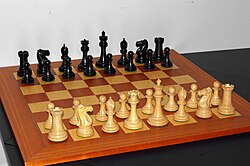


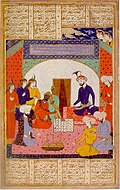




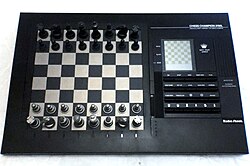


.jpg)


