|
|
| Line 1: |
Line 1: |
| {{Short description|1526–1857 empire in South Asia}}
| | [[File:The Mughal Empire.jpg|thumb|The Mughal Empire at its greatest extent ca. 1707]] |
| {{distinguish|text=the [[Mongol Empire]] or [[Moghulistan]]}}
| |
| {{redirect|Mughals|the ethnic groups|Mughal people}}
| |
| {{pp-semi-indef}}
| |
| {{Use Indian English|date=July 2016}}
| |
| {{Use dmy dates|date=June 2021}}
| |
| {{Infobox former country
| |
| | conventional_long_name = Mughal Empire
| |
| | common_name = Mughal Empire
| |
| | religion = [[State religion]]:<br />{{plainlist|
| |
| * [[Sunni Islam]] ([[Hanafi]])
| |
| * {{nowrap|[[Din-i Ilahi]] (1582–1605)}}}}
| |
| | era = Early modern
| |
| | status = [[Empire]]
| |
| | government_type = [[Unitary state|Unitary]] [[absolute monarchy]] under a [[Federation|federal structure]]
| |
| <ul>
| |
| <li>[[Centralized government|Centralized]] [[autocracy]]{{sfn|Pagaza|Argyriades|2009|p=129}}(1526–1719)</li>
| |
| <li>[[Oligarchy|Oligarchic]] [[constitutional monarchy]] (1719–1857)</li>
| |
| </ul>
| |
| | life_span = 1526–1857
| |
| | year_start = 1526
| |
| | year_end = 1857
| |
| | event_start = [[First Battle of Panipat]]
| |
| | date_start = 21 April
| |
| | event_end = [[Siege of Delhi]]
| |
| | date_end = 21 September
| |
| | event1 = Empire interrupted by [[Sur Empire]]
| |
| | date_event1 = 1540–1555
| |
| | event2 = [[Mughal-Rajput Wars]]
| |
| | date_event2 = 1526-1750
| |
| | event3 = [[Mughal–Maratha Wars]]
| |
| | date_event3 = 1680–1707
| |
| | event4 = Death of [[Aurangzeb]]
| |
| | date_event4 = 3 March 1707
| |
| | event5 = [[Battle of Karnal]]
| |
| | date_event5 = 24 February 1739
| |
| | event6 = [[Carnatic Wars]]
| |
| | date_event6 = 1746–1763
| |
| | event7 = [[Battle of Plassey]]
| |
| | date_event7 = 1757
| |
| | event8 = [[Bengal War]]
| |
| | date_event8 = 1759–1765
| |
| | event9 = [[Third Battle of Panipat]]
| |
| | date_event9 = 14 January 1761
| |
| | p1 = Timurid Empire
| |
| | p2 = Delhi Sultanate
| |
| | p3 =
| |
| | p4 = Sur Empire
| |
| | p5 = Bengal Sultanate
| |
| | p6 = Rajput states
| |
| | p7 = Chero dynasty
| |
| | p8 = Deccan sultanates
| |
| | s1 = Maratha Empire
| |
| | s2 = Bengal Subah
| |
| | s3 = Durrani Empire
| |
| | s4 = Sikh Empire
| |
| | s5 = Bharatpur State
| |
| | s6 = Hyderabad State
| |
| | s7 = Kingdom of Rohilkhand
| |
| | s8 = Company rule in India
| |
| | s9 = British Raj
| |
| | flag_width =
| |
| | flag_border =
| |
| | flag_type =
| |
| | image_map = Joppen1907India1700a.jpg
| |
| | image_map_caption = The empire at its greatest extent, {{circa|1700}} | |
| | image_map_alt = Mughal
| |
| | image_coat =
| |
| | symbol_type =
| |
| | coa_size = 85px
| |
| | capital = {{plainlist|
| |
| * [[Agra]] (1526–1530; 1560–1571; 1598–1648)
| |
| * [[Kabul]] ([[summer capital]] 1526–1681))<ref>{{cite journal|first=Farah|last=Samrin|title=The City of Kabul Under the Mughals|journal=Proceedings of the Indian History Congress|year=2005|volume=66|pages=1307|jstor=44145943|url=https://www.jstor.org/stable/44145943}}</ref>
| |
| * [[Delhi]] (1530–1540; 1554–1556; 1639–1857)
| |
| * [[Fatehpur Sikri]] (1571–1585)
| |
| * [[Lahore]] (1540–1554; 1586–1598)<ref>{{Cite journal|last=Sinopoli |first=Carla M.|date=1994|title=Monumentality and Mobility in Mughal Capitals|url=https://www.jstor.org/stable/42928323|journal=Asian Perspectives|volume=33|issue=2|page=294|jstor=42928323|issn=0066-8435}}</ref>}}
| |
| | common_languages = {{plainlist|
| |
| * [[Persian language|Persian]] (official and court language){{sfn|Conan|2007|p=235}}
| |
| * [[Urdu]] (language of the ruling classes, later given official status)<ref name="bbc2009">{{Cite web |date=7 September 2009 |title=Islam: Mughal Empire (1500s, 1600s) |url=http://www.bbc.co.uk/religion/religions/islam/history/mughalempire_1.shtml |access-date=13 June 2019 |website=BBC}}</ref>
| |
| * [[Hindustani language|Hindavi]] (''[[lingua franca]]'')
| |
| * [[Arabic]] (for religious ceremonies)
| |
| * [[Chagatai language|Chagatai Turkic]] (only initially)
| |
| * [[Languages of South Asia|Other South Asian languages]]}}
| |
| | currency = [[Rupee]], [[History of the taka|Taka]], [[Dam (Indian coin)|dam]]<ref name="Richards1995" />{{rp|73–74}}
| |
| | leader1 = [[Babur]] (first)
| |
| | leader2 = [[Bahadur Shah II]] (last)
| |
| | year_leader1 = 1526–1530
| |
| | year_leader2 = 1837–1857
| |
| | title_leader = [[Mughal emperors|Emperor]]{{efn|The title (Mirza) descends to all the sons of the family, without exception. In the royal family it is placed after the name instead of before it, thus, Abbas Mirza and Hosfiein Mirza. Mirza is a civil title, and Khan is a military one. The title of Khan is creative, but not hereditary.{{sfn|Morier|1812|p=601}}}} ([[Padishah|Padshah]])
| |
| | stat_year1 = 1690<ref name="TurchinAdams2006">{{Cite journal |last1=Turchin |first1=Peter |last2=Adams |first2=Jonathan M. |last3=Hall |first3=Thomas D. |year=2006 |title=East–West Orientation of Historical Empires and Modern States |journal=Journal of World-Systems Research |volume=12 |issue=2 |pages=219–229 |doi=10.5195/JWSR.2006.369 |issn=1076-156X |doi-access=free}}</ref><ref name="Taagepera">{{Cite journal |last=Rein Taagepera |author-link=Rein Taagepera |date=September 1997 |title=Expansion and Contraction Patterns of Large Polities: Context for Russia |url=http://www.escholarship.org/uc/item/3cn68807 |journal=[[International Studies Quarterly]] |volume=41 |issue=3 |pages=475–504 |doi=10.1111/0020-8833.00053 |jstor=2600793}}</ref>
| |
| | stat_area1 = 4000000
| |
| | stat_year2 = 1700<ref name="borocz" />
| |
| | stat_pop2 = 158,400,000
| |
| | alt_coat = [[Mughal dynasty|Imperial seal]]
| |
| | native_name =
| |
| }}
| |
|
| |
|
| The '''Mughal Empire''', also spelled the '''Mogul''' or '''Moghul Empire''', was an [[Early modern period|early modern]] Islamic empire in [[South Asia]].<ref name="Richards1995-2">{{Citation |last=Richards |first=John F. |title=The Mughal Empire |url=https://books.google.com/books?id=HHyVh29gy4QC&pg=PA2 |page=2 |year=1995 |publisher=Cambridge University Press |isbn=978-0-521-56603-2}} Quote: "Although the first two Timurid emperors and many of their noblemen were recent migrants to the subcontinent, the dynasty and the empire itself became indisputably Indian. The interests and futures of all concerned were in India, not in ancestral homelands in the Middle East or Central Asia. Furthermore, the Mughal empire emerged from the Indian historical experience. It was the end product of a millennium of Muslim conquest, colonization, and state-building in the Indian subcontinent."</ref> For some two centuries, the empire stretched from the outer fringes of the [[Indus basin]] in the west, northern [[Afghanistan]] in the northwest, [[Kashmir]] in the north, [[Bangladesh]] in the east, and the uplands of the [[Deccan Plateau]] in [[South India]].<ref name="Stein2010-12">{{Citation |last=Stein |first=Burton |title=A History of India |url=https://books.google.com/books?id=QY4zdTDwMAQC&pg=PA159 |pages=159– |year=2010 |publisher=John Wiley & Sons |isbn=978-1-4443-2351-1 |author-link=Burton Stein}} Quote: "The realm so defined and governed was a vast territory of some {{convert|750000|sqmi|km2|disp=sqbr}}, ranging from the frontier with Central Asia in northern Afghanistan to the northern uplands of the Deccan plateau, and from the Indus basin on the west to the Assamese highlands in the east."</ref> | | The '''Mughal Empire''', ({{lang-hi|मुग़ल साम्राज्य}}, {{lang-fa|دولتِ مغل}}) was a [[Sunni Islam]]ic [[empire]] in [[South Asia]] that existed from 1526 to 1858. The Mughal rule over [[India]] was an empire because it stretched over a large area. It once ruled most of the [[Indian subcontinent]], and parts of what is now India, [[Afghanistan]] and modern [[Pakistan]] and [[Bangladesh]] and [[Myanmar]] between 1526 and 1707.<ref>{{Cite book|title=A Short History of the Mughal Empire|last=Fisher|first=Michael|publisher=Bloomsbury Academic|date=30 May 2019|isbn=9781350127531}}</ref> It was the world's largest economy, at 25% of the world's [[GDP]]. <ref name="williamson">{{Cite web|url=http://www.tcd.ie/Economics/staff/orourkek/Istanbul/JGWGEHNIndianDeind.pdf|title=India's Deindustrialization in the 18th and 19th Centuries|author=Jeffrey G. Williamson, David Clingingsmith|publisher=[[Harvard University]]|date=August 2005|access-date=18 May 2017}}</ref> It famously signalled the proto-industrialization and had a lavish architecture. |
|
| |
|
| The empire is conventionally said to have been founded in 1526 by [[Babur]], a warrior [[Tribal chief|chieftain]] from what is today [[Uzbekistan]], who employed military aid in the form of [[matchlock gun]]s and cast [[cannon]] from the [[Ottoman Empire]],<ref name="Gilbert2017">{{Citation |last=Gilbert |first=Marc Jason |title=South Asia in World History |url=https://books.google.com/books?id=1dhKDgAAQBAJ&pg=PA75 |pages=75– |year=2017 |publisher=Oxford University Press |isbn=978-0-19-066137-3}} Quote: "Babur then adroitly gave the Ottomans his promise not to attack them in return for their military aid, which he received in the form of the newest of battlefield inventions, the matchlock gun and cast cannons, as well as instructors to train his men to use them."</ref> and his superior strategy and cavalry to defeat the [[Delhi Sultanate|Sultan of Delhi]], [[Ibrahim Lodhi]],<ref name="Schmidt2015-lead-babur">{{cite book|last=Schmidt|first=Karl J.|title=An Atlas and Survey of South Asian History|url=https://books.google.com/books?id=vKZzCQAAQBAJ&pg=PT126|year=2015|publisher=Routledge|isbn=978-1-317-47680-1|pages=126–|quote=A Chaghatai Turkish ruler, Zahiruddin Muhammad Babur (1526–30), founded the Mughal Empire in 1526, after defeating the last Delhi sultan, Ibrahim Lodi, at the first battle of Panipat in April of that year. His 12,000 troops armed with matchlocks and cannons, Babur quickly overwhelmed the numerically superior, but ill-equipped, Lodi force. After dethroning Ibrahim Lodi, Babur absorbed the Lodi kingdom, moved his capital from Kabul to Agra, and from there launched attacks against the Rajput kings of Rajasthan. At Babur's death in 1530, his kingdom stretched from Central Asia to Bihar and south to central India. The task of consolidating and expanding Mughal territories in South Asia was left to his son, Humayun (1530–56).}}</ref><ref name="BoseBose2004">{{cite book|last1=Bose|first1=Sugata|author-link1=Sugata Bose|last2=Jalal|first2=Ayesha|author-link2=Ayesha Jalal|title=Modern South Asia: History, Culture, Political Economy|url=https://books.google.com/books?id=PaKdsF8WzbcC&pg=PA28|year=2004|publisher=Routledge|isbn=978-0-415-30787-1|page=28|quote=Having set up a small kingdom in Farghana in Central Asia at the turn of the sixteenth century, Zahiruddin Babur was initially more interested in conquering Samarkand. After several futile attempts to expand in a northerly direction, Babur settled down to rule the environs of Kabul in modern-day Afghanistan. From there he made a raid into the Punjab, and then in 1526 defeated Ibrahim Lodi, the last of the Delhi sultans, in the first battle of Panipat. Babur's use of Turkish cannon in this battle led some historians to include the empire he founded in the category of ‘gun-powder empires’. It is now clear that this sort of technological definition of empires is neither very accurate nor very appropriate. The Mughals in any case were more reliant on cavalry in making their conquests, although artillery was also used in an innovative way for selective purposes. }}</ref> in the [[First Battle of Panipat]],<ref name="MetcalfMetcalf2012">{{cite book|last1=Metcalf|first1=Barbara D.|author-link1=Barbara D. Metcalf|last2=Metcalf|first2=Thomas R.|author-link2=Thomas R. Metcalf|title=A Concise History of Modern India|url=https://books.google.com/books?id=mjIfqyY7jlsC&pg=PA14|year=2012|publisher=Cambridge University Press|isbn=978-1-107-02649-0|pages=14–|quote=In 1526, the Delhi-based kingdom of the Afghan Muslim Lodi dynasty fell to the brilliant military strategy and superior artillery of Zahir al-Din Muhammad Babur (1483–1530) at Panipat, north-west of Delhi. Like the Sultans, the Mughals stimulated a new level of settled agriculture, military capability, and geographic integration.}}</ref><ref name="Ludden2013">{{cite book|last=Ludden|first=David|title=India and South Asia: A Short History|url=https://books.google.com/books?id=pBq9DwAAQBAJ&pg=PT79|year=2013|publisher=Oneworld Publications|isbn=978-1-78074-108-6|pages=79–|quote=Babur was a Chagatai Turk who fled his patrimonial lands near Samarkand to escape Uzbek armies. He followed opportunity into the Ganga basin, where he used Uzbek-style fast-horse phalanx cavalry equipped with muskets and cannon to sweep away the opposition. In 1526, he had conquered sultans from Punjab to Bengal.}}</ref> and to sweep down the plains of [[Upper India]], subduing Rajputs and Afghans.<ref name="Robb2011-babur">{{cite book|last=Robb|first=Peter|title=A History of India|url=https://books.google.com/books?id=GQ-2VH1LO_EC&pg=GBS.PT103|year=2011|publisher=Macmillan International Higher Education|isbn=978-0-230-34549-2|pages=103–|quote=Zahir-ud-din Muhammad Babur was the Turkish king of Kabul. He won the battle of Panipat (north-west of Delhi) in 1526, after several earlier incursions, because of the superior mobility provided by his expert cavalry and his army's greater firepower. (Gunpowder was not used in warfare in India before the fifteenth century, and, apart from the Portuguese, Babur was the first to deploy firearms and cannon on a regular basis.) Rana Sanga, who had been ready to challenge the Lodis and had agreed to ally himself with Babur, did not launch an attack from the south as planned, but he was not needed. Babur took over the Lodi capital, Agra, and seized and shared out its treasure as booty. In 1527 he shattered the combined power of Mewar and other Rajputs.}}</ref><ref name="KulkeRothermund2016">{{cite book|last1=Kulke|first1=Hermann|author-link1=Hermann Kulke|last2=Rothermund|first2=Dietmar|author-link2=Dietmar Rothermund|title=A History of India|url=https://books.google.com/books?id=xYelDQAAQBAJ&pg=PT354|year=2016|publisher=Routledge|isbn=978-1-317-24212-3|pages=354–|quote=Seven years later, on the traditional Indian battlefield near Panipat, Baber encountered the great army of the sultan of Delhi, Ibrahim Lodi. The latter's forces were ten times more numerous than Baber's, who, however, had carefully deployed his artillery on the eve of the battle. The light field artillery was posted behind small ramparts and the guns were tied together with leather thongs so that the cavalry of the enemy could not make a quick dash at them. Marksmen with muskets were also at hand. The army of the sultan – with its thousands of elephants, horsemen, and footmen – came to a halt in front of the artillery while Baber's archers on horseback bypassed the enemy and then, in the manner of the Uzbeks, attacked the unwieldy army from the rear. Caught between gunfire and showers of arrows the sultan's huge forces were defeated within a few hours. Lodi and most of his men died on the battlefield. Thereafter, Baber repeated this performance in a battle against the leader of the Rajputs, Rana Sangha of Mewar. }}</ref><ref name="AsherTalbot2006">{{cite book|last1=Asher|first1=Catherine B.|last2=Talbot|first2=Cynthia|title=India before Europe|url=https://books.google.com/books?id=1GEWAwAAQBAJ&pg=PA116|year=2006|publisher=Cambridge University Press|isbn=978-1-139-91561-8|pages=116–117|quote=the Lodi dynasty came to an end on April 20, 1526, when the Central Asian prince Babur defeated the last Lodi sultan, Ibrahim, at the famous Battle of Panipat. ... One factor contributing to Mughal success was the use of light cannon and guns shielded by a barricade of carts, a tactic repeated to good effect a year later at Khanua (about 60 kilometers west of Agra), against a confederation of Rajputs and Afghans led by Rana Sanga of Mewar. Babur's fast-moving cavalry, deployed in classic Central Asian flanking maneuvers, was most probably the decisive factor, however. After the resounding Mughal triumph at the 1526 Battle of Panipat, the Delhi Sultanate virtually disintegrated, and the entire territory down to the mid Gangetic plain came under Babur's sway}}</ref> The Mughal imperial structure, however, is sometimes dated to 1600, to the rule of Babur's grandson, [[Akbar]].<ref name="Stein2010-0">{{citation|last=Stein|first=Burton|author-link=Burton Stein|title=A History of India|url=https://books.google.com/books?id=QY4zdTDwMAQC&pg=PA159|year=2010|publisher=John Wiley & Sons|isbn=978-1-4443-2351-1|pages=159–}} Quote: "Another possible date for the beginning of the Mughal regime is 1600, when the institutions that defined the regime were set firmly in place and when the heartland of the empire was defined; both of these were the accomplishment of Babur's grandson Akbar."</ref> This imperial structure lasted until 1720, until shortly after the death of the last major emperor, [[Aurangzeb]],<ref name="Stein2010-1">{{citation|last=Stein|first=Burton|author-link=Burton Stein|title=A History of India|url=https://books.google.com/books?id=QY4zdTDwMAQC&pg=PA159|year=2010|publisher=John Wiley & Sons|isbn=978-1-4443-2351-1|pages=159–}} Quote: "The imperial career of the Mughal house is conventionally reckoned to have ended in 1707 when the emperor Aurangzeb, a fifth-generation descendant of Babur, died. His fifty-year reign began in 1658 with the Mughal state seeming as strong as ever or even stronger. But in Aurangzeb's later years the state was brought to the brink of destruction, over which it toppled within a decade and a half after his death; by 1720 imperial Mughal rule was largely finished and an epoch of two imperial centuries had closed."</ref><ref name="Richards1995-3">{{citation|last=Richards|first=John F.|title=The Mughal Empire|url=https://books.google.com/books?id=HHyVh29gy4QC&pg=PAxv|year=1995|publisher=Cambridge University Press|isbn=978-0-521-56603-2|page=xv}} Quote: "By the latter date (1720) the essential structure of the centralized state was disintegrated beyond repair."</ref> during whose reign the empire also achieved its maximum geographical extent. The empire lost significant territory to the conquests of the [[Maratha Empire]], absorbed as a puppet state, and this continued during the [[Company rule in India|East India Company rule]] in India. The empire was formally dissolved by the [[British Raj]] after the [[Indian Rebellion of 1857]].
| | == Origins == |
| | | Babur, the Founder of the Mughal Empire, was a descendant of Timur and Genghis Khan. Timur was of Mongolian origin<ref>Lodge, Henry Cabot (1916). The History of Nations Volume 14. P. F. Collier & son. {{ISBN|9780160239298}}. University of Minnesota. p. 46, "Timur the Lame, from the effects of an early wound, a name which some European writers have converted into Tamerlane, or Tamberlaine. He was of Mongol origin, and a direct descendant, by the mother's side, of Genghis Khan (...)"</ref> and was a member of the Mongolian<ref>Manz, B.F. (1989). The rise and rule of Tamerlan. Cambridge University Press. p. 28, "(...) the old Mongolian tribes — Barlas, Arlat, Soldus and Jalayir (...)"</ref><ref>Asimov, M.S.; Bosworth C. E. (1998). History of Civilizations of Central Asia. UNESCO Regional Office. {{ISBN|92-3-103467-7}}. p. 320: "(...) One of his followers was [...] Timur of the Barlas tribe. This Mongol tribe had settled [...] in the valley of Kashka Darya, intermingling with the Turkish population, adopting their religion (Islam) and gradually giving up its own nomadic ways, like a number of other Mongol tribes in Transoxania (...)"</ref> Barlas tribe, but the Mongolian Barlas tribe over time mingled with the Turkic population of the region,<ref>Asimov, M.S.; Bosworth C. E. (1998). History of Civilizations of Central Asia. UNESCO Regional Office. {{ISBN|92-3-103467-7}}. p. 320: "(...) One of his followers was [...] Timur of the Barlas tribe. This Mongol tribe had settled [...] in the valley of Kashka Darya, intermingling with the Turkish population, adopting their religion (Islam) and gradually giving up its own nomadic ways, like a number of other Mongol tribes in Transoxania (...)"</ref> so Timur had both Mongol and Turkic ancestry.<ref>Seekins, Donald M.; Nyrop, Richard F. (1986). Afghanistan A Country Study · Volume 550, Issues 65-986. The Studies. University of California. {{ISBN|9780160239298}}<bdi>.</bdi> p. 11, <bdi>"(...) Timur was of both Turkish and Mongol descent and claimed Genghis Khan as an ancestor (...)"</bdi></ref> |
| The Mughal empire was created and sustained by military warfare<ref name="Stein2010-2">{{citation|last=Stein|first=Burton|author-link=Burton Stein|title=A History of India|url=https://books.google.com/books?id=QY4zdTDwMAQC&pg=PA159|year=2010|publisher=John Wiley & Sons|isbn=978-1-4443-2351-1|pages=159–}} Quote: "The vaunting of such progenitors pointed up the central character of the Mughal regime as a warrior state: it was born in war and it was sustained by war until the eighteenth century, when warfare destroyed it."</ref><ref name="Robb2011">{{citation|last=Robb|first=Peter|title=A History of India|url=https://books.google.com/books?id=GQ-2VH1LO_EC&pg=PA108|year=2011|publisher=Macmillan |isbn=978-0-230-34549-2|pages=108–}} Quote: "The Mughal state was geared for war, and succeeded while it won its battles. It controlled territory partly through its network of strongholds, from its fortified capitals in Agra, Delhi or Lahore, which defined its heartlands, to the converted and expanded forts of Rajasthan and the Deccan. The emperors' will was frequently enforced in battle. Hundreds of army scouts were an important source of information. But the empire's administrative structure too was defined by and directed at war. Local military checkpoints or thanas kept order. Directly appointed imperial military and civil commanders (faujdars) controlled the cavalry and infantry, or the administration, in each region. The peasantry in turn were often armed, able to provide supporters for regional powers, and liable to rebellion on their own account: continual pacification was required of the rulers."</ref><ref name="Gilbert2017-2">{{citation|last=Gilbert|first=Marc Jason|title=South Asia in World History|url=https://books.google.com/books?id=1dhKDgAAQBAJ&pg=PA75|year=2017|publisher=Oxford University Press|isbn=978-0-19-066137-3|pages=75–}} Quote: "With Safavid and Ottoman aid, the Mughals would soon join these two powers in a triumvirate of warrior-driven, expansionist, and both militarily and bureaucratically efficient early modern states, now often called "gunpowder empires" due to their common proficiency in using such weapons to conquer lands they sought to control."</ref> but also established new administrative practices<ref>{{citation|last1=Asher|first1=Catherine B.|last2=Talbot|first2=Cynthia|title=India Before Europe|url=https://books.google.com/books?id=ZvaGuaJIJgoC&pg=PA115|year=2006|publisher=Cambridge University Press|isbn=978-0-521-80904-7|pages=115–}}</ref><ref>{{citation|last=Robb|first=Peter|title=A History of India|url=https://books.google.com/books?id=GQ-2VH1LO_EC&pg=PA99|year=2011|publisher=Macmillan |isbn=978-0-230-34549-2|pages=99–100}}</ref> and incorporated diverse ruling elites to produce an efficient, centralised, standardised rule.<ref name="AsherTalbot2006-2"/> Akbar, the third Mughal emperor, instituted agricultural taxes which served as the base of the empire's collective wealth.<ref name="Stein2010-3">{{citation|last=Stein|first=Burton|author-link=Burton Stein|title=A History of India|url=https://books.google.com/books?id=QY4zdTDwMAQC&pg=PA164|year=2010|publisher=John Wiley & Sons|isbn=978-1-4443-2351-1|pages=164–}} Quote: "The resource base of Akbar's new order was land revenue"</ref><ref name="AsherTalbot2006-1">{{citation|last1=Asher|first1=Catherine B.|last2=Talbot|first2=Cynthia|title=India Before Europe|url=https://books.google.com/books?id=ZvaGuaJIJgoC&pg=PA152|year=2006|publisher=Cambridge University Press|isbn=978-0-521-80904-7|pages=158–}} Quote: "The Mughal empire was based in the interior of a large land-mass and derived the vast majority of its revenues from agriculture."</ref> These taxes, amounting to well over half of a peasant cultivator's output,<ref name="Stein2010-4">{{citation|last=Stein|first=Burton|author-link=Burton Stein|title=A History of India|url=https://books.google.com/books?id=QY4zdTDwMAQC&pg=PA159|year=2010|publisher=John Wiley & Sons|isbn=978-1-4443-2351-1|pages=164–}} Quote: "... well over half of the output from the fields in his realm, after the costs of production had been met, is estimated to have been taken from the peasant producers by way of official taxes and unofficial exactions. Moreover, payments were exacted in money, and this required a well regulated silver currency."</ref> had to be paid in money,<ref name="AsherTalbot2006-2">{{citation|last1=Asher|first1=Catherine B.|last2=Talbot|first2=Cynthia|title=India Before Europe|url=https://books.google.com/books?id=ZvaGuaJIJgoC&pg=PA152|year=2006|publisher=Cambridge University Press|isbn=978-0-521-80904-7|pages=152–}}</ref> and this impelled peasants and artisans to enter market networks so as to obtain it.<ref name="AsherTalbot2006-3">{{citation|last1=Asher|first1=Catherine B.|last2=Talbot|first2=Cynthia|title=India Before Europe|url=https://books.google.com/books?id=ZvaGuaJIJgoC&pg=PA152|year=2006|publisher=Cambridge University Press|isbn=978-0-521-80904-7|pages=152–}} Quote: "His stipulation that land taxes be paid in cash forced peasants into market networks, where they could obtain the necessary money, while the standardization of imperial currency made the exchange of goods for money easier."</ref>
| |
| | |
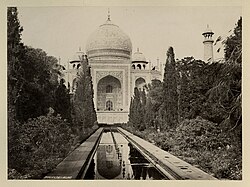
| The relative peace maintained by the empire during much of the 17th century was a factor in India's economic expansion.<ref name="AsherTalbot2006-4">{{citation|last1=Asher|first1=Catherine B.|last2=Talbot|first2=Cynthia|title=India Before Europe|url=https://books.google.com/books?id=ZvaGuaJIJgoC&pg=PA152|year=2006|publisher=Cambridge University Press|isbn=978-0-521-80904-7|pages=152–}} Quote: "Above all, the long period of relative peace ushered in by Akbar's power, and maintained by his successors, contributed to India's economic expansion."</ref> Burgeoning European presence in the Indian Ocean, and its increasing demand for Indian raw and finished products, created still greater wealth in the Mughal courts.<ref name="AsherTalbot2006-5">{{citation|last1=Asher|first1=Catherine B.|last2=Talbot|first2=Cynthia|title=India Before Europe|url=https://books.google.com/books?id=ZvaGuaJIJgoC&pg=PA186|year=2006|publisher=Cambridge University Press|isbn=978-0-521-80904-7|pages=186–}} Quote: "As the European presence in India grew, their demands for Indian goods and trading rights increased, thus bringing even greater wealth to the already flush Indian courts."</ref> There was more conspicuous consumption among the Mughal elite,<ref name="AsherTalbot2006-6">{{citation|last1=Asher|first1=Catherine B.|last2=Talbot|first2=Cynthia|title=India Before Europe|url=https://books.google.com/books?id=ZvaGuaJIJgoC&pg=PA186|year=2006|publisher=Cambridge University Press|isbn=978-0-521-80904-7|pages=186–}} Quote: "The elite spent more and more money on luxury goods, and sumptuous lifestyles, and the rulers built entire new capital cities at times."</ref> resulting in greater patronage of [[Mughal painting|painting]], literary forms, textiles, and [[Mughal architecture|architecture]], especially during the reign of [[Shah Jahan]].<ref name="AsherTalbot2006-7">{{citation|last1=Asher|first1=Catherine B.|last2=Talbot|first2=Cynthia|title=India Before Europe|url=https://books.google.com/books?id=ZvaGuaJIJgoC&pg=PA186|year=2006|publisher=Cambridge University Press|isbn=978-0-521-80904-7|pages=186–}} Quote: "All these factors resulted in greater patronage of the arts, including textiles, paintings, architecture, jewelry, and weapons to meet the ceremonial requirements of kings and princes."</ref> Among the Mughal [[UNESCO World Heritage Sites]] in South Asia are [[Agra Fort]], [[Fatehpur Sikri]], [[Red Fort]], [[Humayun's Tomb]], [[Lahore Fort]], and the [[Taj Mahal]], which is described as the "jewel of Muslim art in India and one of the universally admired masterpieces of the world's heritage."<ref>[https://whc.unesco.org/en/list/252 Taj Mahal: UNESCO World Heritage Center]</ref>
| |
| | |
| == Name ==
| |
| Contemporaries referred to the empire founded by [[Babur]] as the [[Timurid dynasty|Timurid]] empire,<ref name="MSA">{{Cite book |last1=Bose |first1=Sugata |author-link1=Sugata Bose |url=https://archive.org/details/modernsouthasiah00bose |title=Modern South Asia: History, Culture, Political Economy |last2=Ayesha Jalal |author-link2=Ayesha Jalal |publisher=Routledge |year=2004 |isbn=978-0-203-71253-5 |page=[https://archive.org/details/modernsouthasiah00bose/page/28 28] |url-access=registration}}</ref> which reflected the heritage of his dynasty, and this was the term preferred by the Mughals themselves.<ref name="Avari">{{Cite book |last=Avari |first=Burjor |url=https://books.google.com/books?id=hGHpVtQ8eKoC&pg=PA83 |title=Islamic Civilization in South Asia: A History of Muslim Power and Presence in the Indian Subcontinent |publisher=Routledge |year=2004 |isbn=978-0-415-58061-8 |page=83}}</ref>
| |
| | |
| The Mughal designation for their own dynasty was '''Gurkani''' ({{lang-fa|{{nq|گورکانیان}}|Gūrkāniyān|lit= sons-in-law}}).<ref name="Thackston2">{{Cite book |last=Zahir ud-Din Mohammad |title=The Baburnama: Memoirs of Babur, Prince and Emperor |title-link=Baburnama |year=2002 |publisher=Modern Library |isbn=978-0-375-76137-9 |editor-last=Thackston, Wheeler M. |editor-link=Wheeler Thackston |location=New York |page=[https://archive.org/details/babarinizam00babu/page/ xlvi] |quote=In India the dynasty always called itself Gurkani, after Temür's title Gurkân, the Persianized form of the Mongolian {{lang|mn-Latn|kürägän}}, 'son-in-law,' a title he assumed after his marriage to a Genghisid princess. |author-link=Babur}}</ref> The use of "Mughal" and "Moghul" derived from the [[Arabic]] and [[Persian language|Persian]] corruption of "[[Mongols|Mongol]]", and it emphasised the Mongol origins of the Timurid dynasty.<ref name="Hodgson">{{Cite book |last=Dodgson |first=Marshall G.S. |url=https://books.google.com/books?id=COOGFSH_jUkC&pg=PA62 |title=The Venture of Islam |publisher=University of Chicago Press |year=2009 |isbn=978-0-226-34688-5 |volume=3 |page=62}}</ref> The term gained currency during the 19th century, but remains disputed by [[Indologists]].<ref name="RA">{{Cite book |last1=Huskin |first1=Frans Husken |url=https://books.google.com/books?id=IVhUAQAAQBAJ&pg=PA104 |title=Reading Asia: New Research in Asian Studies |last2=Dick van der Meij |publisher=Routledge |year=2004 |isbn=978-1-136-84377-8 |page=104}}</ref> Similar terms had been used to refer to the empire, including "Mogul" and "Moghul".<ref name="persianatemogul">{{Cite book |last=John Walbridge |title=God and Logic in Islam: The Caliphate of Reason |page=165 |quote=Persianate Mogul Empire.}}</ref>{{sfn|Rutherford|2010|p=}} Nevertheless, Babur's ancestors were sharply distinguished from the classical Mongols insofar as they were oriented towards [[Persian culture|Persian]] rather than [[Turco-Mongol]] culture. The Mughals themselves claimed ultimate descent from Mongol Empire founder [[Genghis Khan]].<ref name="Canfield">{{Cite book |last=Canfield |first=Robert L. |url=https://books.google.com/books?id=g3JhKNSk8tQC&pg=PA20 |title=Turko-Persia in Historical Perspective |publisher=Cambridge University Press |year=2002 |isbn=978-0-521-52291-5 |page=20}}</ref>
| |
| | |
| Another name for the empire was [[Hindustan]], which was documented in the [[Ain-i-Akbari]], and which has been described as the closest to an official name for the empire.<ref name="Vanina">{{Cite book |last=Vanina |first=Eugenia |url=https://books.google.com/books?id=yriGbWNAF5EC&pg=PA47 |title=Medieval Indian Mindscapes: Space, Time, Society, Man |publisher=Primus Books |year=2012 |isbn=978-93-80607-19-1 |page=47 |author-link=Eugenia Vanina}}</ref> In the west, the term "[[Mughal emperors|Mughal]]" was used for the emperor, and by extension, the empire as a whole.<ref name="Fontana">{{Cite book |last=Fontana |first=Michela |url=https://books.google.com/books?id=MVZU1sAQ8H4C&pg=PA32 |title=Matteo Ricci: A Jesuit in the Ming Court |publisher=Rowman & Littlefield Publishers |year=2011 |isbn=978-1-4422-0588-8 |page=32}}</ref>
| |
|
| |
|
| == History == | | == History == |
| {{Main|Mughal dynasty}}
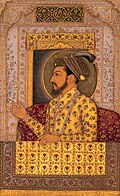
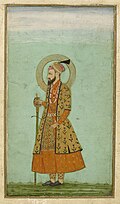
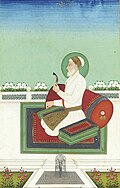
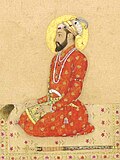
| | The Mughal emperors were originally [[Turco-Mongol|Turk-Mongols]].<ref name="Richards1995">{{citation |last=Richards |first=John F. |title=The Mughal Empire |url=https://books.google.com/books?id=HHyVh29gy4QC |year=1995 |publisher=Cambridge University Press |page=6 |isbn=978-0-521-56603-2}}</ref> [[Babur]] of the [[Timurid dynasty]] founded the Mughal Empire and the [[Mughal dynasty]] in 1526 and ruled until 1530. He was followed by [[Humayun]] (1530-1540) and (1555-1556), [[Akbar]] (1556-1605), [[Jahangir]] (1605-1627), [[Shah Jahan]] (1628-1658), and the Islamic [[Aurangzeb]] (1658-1707) and several other minor rulers until Bahadur Shah Zafar II(1837-1857). After the death of Aurangzeb, the rule through [[sharia]] ended and the Mughal Empire became weak. It continued until 1857-1858. By then, India came under the [[British Raj]]. The Mughal Empire mainly collapsed due to the rebellion of the [[Sikhs]] in the north and the [[Marathas]] in the south. These two groups would go on to form the [[Maratha Empire]] and the [[Sikh Empire]] later on before their fall to the [[British Empire]]. |
| | |
| ===Babur and Humayun (1526–1556)===
| |
| {{Main|Babur|Humayun}}
| |
| {{South Asia in 1525 CE|right|Main South Asian polities circa 1525 CE, on the eve of the establishment of the Mughal Empire by [[Babur]].<ref>{{cite book |last1=Schwartzberg |first1=Joseph E. |title=A Historical atlas of South Asia |date=1978 |publisher=University of Chicago Press |location=Chicago |page=39, 147|isbn=0226742210 |url=https://dsal.uchicago.edu/reference/schwartzberg/pager.html?object=076}}</ref>}}
| |
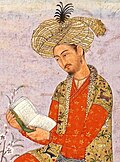
| The Mughal Empire was founded by Babur (reigned 1526–1530), a Central Asian ruler who was descended from the [[Turco-Mongol tradition|Turco-Mongol]] conqueror [[Timur]] (the founder of the [[Timurid Empire]]) on his father's side, and from [[Genghis Khan]] on his mother's side.<ref name="Berndl">{{Cite book |last=Berndl |first=Klaus |title=National Geographic Visual History of the World |publisher=National Geographic Society |year=2005 |isbn=978-0-7922-3695-5 |pages=318–320}}</ref> Ousted from his ancestral domains in Central Asia, Babur turned to India to satisfy his ambitions.<ref>{{Cite book |last=Bayley |first=Christopher |title=The European Emergence. The Mughals Ascendant |isbn=0-7054-0982-1 |page=151}}</ref> | |
| He established himself in [[Kabul]] and then pushed steadily southward into India from [[Afghanistan]] through the [[Khyber Pass]].<ref name="Berndl" /> Babur's forces defeated Ibrahim Lodhi in [[First Battle of Panipat|Panipat]]. Before the battle, Babur sought divine favour by abjuring liquor, breaking the wine vessels and pouring the wine down a well.
| |
| However, by this time [[Delhi Sultanate|Lodhi's empire]] was already crumbling and it was actually the [[Udaipur State|Mewar Kingdom]] which was the strongest power of Northern India under capable rule of [[Rana Sanga]]. In a decisive battle fought near Agra, Timurid forces of Babur defeated Rajput army of Sanga. The battle was one of the most decisive and historic battle in Indian history as it sealed the fate of Northern India for next two centuries.
| |
| | |
| After the battle, The centre of Mughal power became Agra instead of Kabul. The preoccupation with wars and military campaigns, however, did not allow the new emperor to consolidate the gains he had made in India.<ref>{{Cite book |last=Bayley |first=Christopher |title=The European Emergence. The Mughals Ascendant |isbn=0-7054-0982-1 |page=154}}</ref> The instability of the empire became evident under his son, [[Humayun]] (reigned 1530–1556), who was forced into exile in Persia by rebels. The [[Sur Empire]] (1540–1555), founded by [[Sher Shah Suri]] (reigned 1540–1545), briefly interrupted Mughal rule.<ref name="Berndl" /> Humayun's exile in Persia established diplomatic ties between the [[Safavid Dynasty|Safavid]] and Mughal Courts, and led to increasing Persian cultural influence in the later restored Mughal Empire.{{citation needed|date=July 2019}} Humayun's triumphant return from Persia in 1555 restored Mughal rule in some parts of India, but he died in an accident the next year.<ref name="Berndl" />
| |
| | |
| ===Akbar to Aurangzeb (1556–1707)===
| |
| {{Main|Akbar|Jahangir|Shah Jahan|Aurangzeb}}
| |
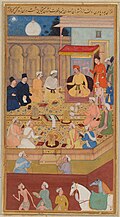
| [[File:Jesuits at Akbar's court.jpg|thumb|upright|left|[[Akbar]] holds a religious assembly of different faiths in the [[Ibadat Khana]] in Fatehpur Sikri.]]
| |
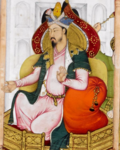
| [[Akbar]] (reigned 1556–1605) was born Jalal-ud-din Muhammad<ref>{{Cite web |last=Ballhatchet |first=Kenneth A. |title=Akbar |url=https://www.britannica.com/biography/Akbar |access-date=17 July 2017 |website=Encyclopædia Britannica}}</ref> in the Rajput [[Umarkot Fort]],<ref>{{Cite book |last=Smith |first=Vincent Arthur |url=https://archive.org/details/cu31924024056503/page/n34/mode/1up |title=Akbar the Great Mogul, 1542–1605 |publisher=Oxford at The Clarendon Press |year=1917 |pages=13–14 |author-link=Vincent Arthur Smith}}</ref> to Humayun and his wife [[Hamida Banu Begum]], a [[Persian people|Persian]] princess.<ref>{{Cite book |last=Begum |first=Gulbadan |url=https://archive.org/details/historyofhumayun00gulbrich |title=The History of Humāyūn (Humāyūn-Nāma) |publisher=Royal Asiatic Society |year=1902 |pages=[https://archive.org/details/historyofhumayun00gulbrich/page/237 237]–239 |translator-last=Beveridge |translator-first=Annette S. |author-link=Gulbadan Begum |translator-link=Annette Beveridge}}</ref> Akbar succeeded to the throne under a regent, [[Bairam Khan]], who helped consolidate the Mughal Empire in India. Through warfare and diplomacy, Akbar was able to extend the empire in all directions and controlled almost the entire Indian subcontinent north of the [[Godavari River]].{{citation needed|date=July 2019}} He created a new ruling elite loyal to him, implemented a modern administration, and encouraged cultural developments. He increased trade with European trading companies.<ref name="Berndl" /> India developed a strong and stable economy, leading to commercial expansion and economic development.{{citation needed|date=July 2019}} Akbar allowed freedom of religion at his court, and attempted to resolve socio-political and cultural differences in his empire by establishing a new religion, [[Din-i-Ilahi]], with strong characteristics of a ruler cult.<ref name="Berndl" /> He left his son an internally stable state, which was in the midst of its golden age, but before long signs of political weakness would emerge.<ref name="Berndl" />
| |
| | |
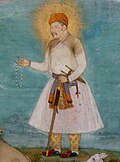
| [[Jahangir]] (born Salim,<ref name="Mohammada" /> reigned 1605–1627) was born to Akbar and his wife [[Mariam-uz-Zamani]], an Indian [[Rajput]] princess.<ref>{{Cite book |last=Gilbert |first=Marc Jason |url=https://books.google.com/books?id=7OQWDgAAQBAJ&pg=PA79 |title=South Asia in World History |publisher=[[Oxford University Press]] |year=2017 |isbn=978-0-19-976034-3 |page=79}}</ref> He "was addicted to opium, neglected the affairs of the state, and came under the influence of rival court cliques".<ref name="Berndl" /> Jahangir distinguished himself from Akbar by making substantial efforts to gain the support of the Islamic religious establishment. One way he did this was by bestowing many more ''madad-i-ma'ash'' (tax-free personal land revenue grants given to religiously learned or spiritually worthy individuals) than Akbar had.<ref>{{cite book |last=Faruqui |first=Munis D. |year=2012 |title=The Princes of the Mughal Empire, 1504–1719 |publisher=Cambridge University Press |pages=268–269 |isbn=978-1-107-02217-1}}</ref> In contrast to Akbar, Jahangir came into conflict with non-Muslim religious leaders, notably the [[Sikh]] guru [[Guru Arjan|Arjan]], whose execution was the first of many conflicts between the Mughal empire and the Sikh community.<ref name="Robb 97-98">{{citation |last=Robb |first=Peter |title=A History of India |url=https://books.google.com/books?id=sf5eAQAAQBAJ&pg=PA99 |pages=97–98 |year=2011 |publisher=Macmillan International Higher Education |isbn=978-0-230-34424-2}}</ref><ref name="AsherTalbot2006-8">{{Cite book |last1=Asher |first1=Catherine B. |last2=Talbot |first2=Cynthia |url=https://www.worldcat.org/oclc/61303480 |title=India before Europe |date=2006 |publisher=Cambridge University Press |page=267 |isbn=0-521-80904-5 |oclc=61303480}}</ref><ref name="BBC Sikhs">{{Cite web |date=30 September 2009 |title=BBC - Religions - Sikhism: Origins of Sikhism |url=http://www.bbc.co.uk/religion/religions/sikhism/history/history_1.shtml |access-date=19 February 2021 |website=BBC |language=en-GB}}</ref>
| |
| | |
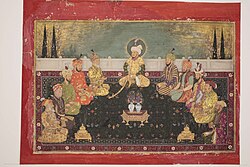
| [[File:Khalili Collection Islamic Art mss 0874.3.jpg|thumb|right|Group portrait of Mughal rulers, from [[Babur]] to [[Aurangzeb]], with the Mughal ancestor [[Timur]] seated in the middle. On the left: [[Shah Jahan]], [[Akbar]] and Babur, with Abu Sa'id of Samarkand and Timur's son, [[Miran Shah]]. On the right: Aurangzeb, [[Jahangir]] and [[Humayun]], and two of Timur's other offspring [[Umar Shaikh Mirza I|Umar Shaykh]] and [[Muhammad Sultan Mirza|Muhammad Sultan]]. Created {{circa|1707–12}}]]
| |
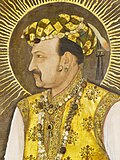
| [[Shah Jahan]] (reigned 1628–1658) was born to Jahangir and his wife [[Jagat Gosaini]], a Rajput princess.<ref name="Mohammada">{{Cite book |last=Mohammada |first=Malika |url=https://books.google.com/books?id=dwzbYvQszf4C&pg=PA300 |title=The Foundations of the Composite Culture in India |publisher=Aakar Books |year=2007 |isbn=978-81-89833-18-3 |page=300}}</ref> During the reign of Shah Jahan, the splendour of the Mughal court reached its peak, as exemplified by the [[Taj Mahal]].The cost of maintaining the court, however, began to exceed the revenue coming in.<ref name="Berndl" /> His reign was called as "The Golden Age of Mughal Architecture". Shah Jahan extended the Mughal empire to the Deccan by ending the Nizam Shahi dynasty, and forced the Adil Shahis and Qutb Shahis to pay tribute.<ref>{{cite book |last=Singhal |first=Damodar P. |year=1983 |title=A History of the Indian People |url=https://books.google.com/books?id=ag4BAAAAMAAJ&q=annexed+tribute |publisher=Methuen |page=193 |isbn=978-0-413-48730-8}}</ref>
| |
| | |
| Shah Jahan's eldest son, the liberal [[Dara Shikoh]], became regent in 1658, as a result of his father's illness.{{citation needed|date=July 2019}} Dara championed a syncretistic Hindu-Muslim culture. With the support of the Islamic orthodoxy, however, a younger son of Shah Jahan, [[Aurangzeb]] (reigned 1658–1707), seized the throne. Aurangzeb defeated Dara in 1659 and had him executed.<ref name="Berndl" /> Although Shah Jahan fully recovered from his illness, Aurangzeb kept Shah Jahan imprisoned until his death in 1666.<ref name="Truschke" />{{rp|68}} Aurangzeb oversaw an increase in the Islamicization of the Mughal state. He encouraged conversion to Islam, reinstated the ''[[jizya]]'' on non-Muslims, and compiled the [[Fatawa 'Alamgiri|''Fatwa Alamgiri'']], a collection of Islamic law. Aurangzeb also executed the Sikh guru [[Guru Tegh Bahadur|Tegh Bahadur]], leading to the militarization of the Sikh community.<ref>{{cite book |last=Robb |first=Peter |year=2011 |title=A History of India |url=https://books.google.com/books?id=sf5eAQAAQBAJ&pg=PA98 |publisher=Macmillan International Higher Education |page=98 |isbn=978-0-230-34424-2}}</ref><ref name="AsherTalbot2006-8" /><ref name="BBC Sikhs" /> From the imperial perspective, conversion to Islam integrated local elites into the king's vision of network of shared identity that would join disparate groups throughout the empire in obedience to the Mughal emperor.<ref>{{cite book |url= https://www.google.ca/books/edition/The_King_and_the_People/sNQBEAAAQBAJ?hl=en&gbpv=1&dq=Sayyids+Of+Barha&pg=PA160&printsec=frontcover |title= The King and the People: Sovereignty and Popular Politics in Mughal Delhi |author= Abhishek Kaicker |date= 2020 |publisher= Oxford University Press |isbn= 978-0-19-007067-0 }}</ref> He expanded the empire to include almost the whole of South Asia,<ref name="Truschke" />{{rp|1}} but at his death in 1707, "many parts of the empire were in open revolt".<ref name="Berndl" /> Aurangzeb is considered India's most controversial king,<ref name="Truschke">{{Cite book |last=Truschke |first=Audrey |url=https://books.google.com/books?id=oUUkDwAAQBAJ |title=Aurangzeb: The Life and Legacy of India's Most Controversial King |publisher=[[Stanford University Press]] |year=2017 |isbn=978-1-5036-0259-5}}</ref> with some historians{{Weasel inline|date=July 2019}} arguing his religious conservatism and intolerance undermined the stability of Mughal society,<ref name="Berndl" /> while other historians question this, noting that he built [[Hindu temple]]s,<ref name="Copland2013">{{Cite book |last1=Copland |first1=Ian |title=A History of State and Religion in India |last2=Mabbett |first2=Ian |last3=Roy |first3=Asim |last4=Brittlebank |first4=Kate |last5=Bowles |first5=Adam |publisher=Routledge |year=2013 |isbn=978-1-136-45950-4 |page=119 |display-authors=3}}</ref> employed significantly more [[Hindu]]s in his imperial bureaucracy than his predecessors did, opposed bigotry against Hindus and [[Shia Muslims]].<ref name="Truschke" />{{rp|58}}
| |
| | |
| ===<span id='Decline'>Decline (1707–1857)</span>===
| |
| {{Further|Bahadur Shah Zafar}}
| |
| | |
| Aurangzeb's son, [[Bahadur Shah I]], repealed the religious policies of his father and attempted to reform the administration. "However, after his death in 1712, the Mughal dynasty sank into chaos and violent feuds. In 1719 alone, four emperors successively ascended the throne".<ref name="Berndl" />
| |
| | |
| [[File:Maratha Army under Parshurambhau Patwardhan.jpg|thumb|right|Horsemen of the invading Maratha Empire]]
| |
| During the reign of [[Muhammad Shah]] (reigned 1719–1748), the empire began to break up, and vast tracts of central India passed from Mughal to [[Maratha Empire|Maratha]] hands. The far-off [[Nadir Shah's invasion of India|Indian campaign]] of [[Nadir Shah]], who had previously reestablished Iranian [[suzerainty]] over most of West Asia, the Caucasus, and Central Asia, culminated with the [[Sack of Delhi]] and shattered the remnants of Mughal power and prestige. Many of the empire's elites now sought to control their own affairs, and broke away to form independent kingdoms.{{citation needed|date=July 2019}} But, according to [[Sugata Bose]] and [[Ayesha Jalal]], the Mughal Emperor continued to be the highest manifestation of sovereignty. Not only the Muslim gentry, but the Maratha, Hindu, and Sikh leaders took part in ceremonial acknowledgments of the emperor as the sovereign of India.<ref name="MSA2">{{Cite book |last1=Bose |first1=Sugata |url=https://archive.org/details/modernsouthasiah00bose |title=Modern South Asia: History, Culture, Political Economy |last2=Jalal |first2=Ayesha |publisher=Routledge |year=2004 |isbn=978-0-203-71253-5 |edition=2nd |page=[https://archive.org/details/modernsouthasiah00bose/page/41 41] |author-link1=Sugata Bose |author-link2=Ayesha Jalal |url-access=registration}}</ref>
| |
| [[File:Equestrian Portrait of Shah Alam II, 18th century.jpg|thumb|left|Shah Alam II on horseback]]
| |
| | |
| Meanwhile, some regional polities within the increasingly fragmented Mughal Empire, involved themselves and the state in global conflicts, leading only to defeat and loss of territory during the [[Carnatic Wars]] and the [[Bengal War]].
| |
| | |
| The Mughal Emperor [[Shah Alam II]] (1759–1806) made futile attempts to reverse the Mughal decline but ultimately had to seek the protection of the Emir of Afghanistan, Ahmed Shah Abdali, which led to the [[Third Battle of Panipat]] between the Maratha Empire and the Afghans (led by Abdali) in 1761. In 1771, the Marathas recaptured Delhi from Afghan control and in 1784 they officially became the protectors of the emperor in Delhi,<ref name="Rathod1994">{{Cite book |last=Rathod |first=N.G. |url=https://books.google.com/books?id=uPq640stHJ0C&pg=PA8 |title=The Great Maratha Mahadaji Scindia |publisher=Sarup & Sons |year=1994 |isbn=978-8185431529 |location=New Delhi |page=8}}</ref> a state of affairs that continued until the [[Second Anglo-Maratha War]]. Thereafter, the [[British East India Company]] became the protectors of the Mughal dynasty in Delhi.<ref name="MSA2" /> The British East India [[Company rule in India|Company]] took control of the former Mughal province of Bengal-Bihar in 1793 after it abolished local rule (Nizamat) that lasted until 1858, marking the beginning of British colonial era over the Indian subcontinent. By 1857 a considerable part of former Mughal India was under the East India Company's control. After a crushing defeat in the [[Indian Rebellion of 1857|war of 1857–1858]] which he nominally led, the last Mughal, [[Bahadur Shah Zafar]], was deposed by the British [[East India Company]] and exiled in 1858. Through the [[Government of India Act 1858]] the [[British Crown]] assumed direct control of East India Company-held territories in India in the form of the new [[British Raj]]. In 1876 the British [[Queen Victoria]] assumed the title of [[Empress of India]].
| |
| [[File:Portrait of Bahadur Shah II as calligrapher. Delhi, ca. 1850, Royal Ontario Museum, Toronto. - копия.jpg|thumb|right|upright|Portrait of Bahadur Shah II]]
| |
| | |
| === Causes of decline ===
| |
| Historians have offered numerous explanations for the rapid collapse of the Mughal Empire between 1707 and 1720, after a century of growth and prosperity. In fiscal terms, the throne lost the revenues needed to pay its chief officers, the emirs (nobles) and their entourages. The emperor lost authority, as the widely scattered imperial officers lost confidence in the central authorities, and made their own deals with local men of influence. The imperial army, bogged down in long, futile wars against the more aggressive [[Maratha Empire|Marathas]], lost its fighting spirit. Finally came a series of violent political feuds over control of the throne. After the execution of [[Farrukhsiyar|Emperor Farrukhsiyar]] in 1719, local Mughal successor states took power in region after region.<ref>{{Cite journal |last=Richards |first=J.F. |year=1981 |title=Mughal State Finance and the Premodern World Economy |journal=Comparative Studies in Society and History |volume=23 |issue=2 |pages=285–308 |doi=10.1017/s0010417500013311 |jstor=178737|s2cid=154809724 }}</ref>
| |
| | |
| Contemporary chroniclers bewailed the decay they witnessed, a theme picked up by the first British historians who wanted to underscore the need for a British-led rejuvenation.<ref>{{Cite book |last=Sir William Wilson Hunter |url=https://books.google.com/books?id=QYlDAAAAYAAJ&pg=PA107 |title=Imperial gazetteer of India |publisher=Clarendon Press |year=1908 |page=107}}</ref>
| |
| | |
| ==== Modern views on the decline ====
| |
| Since the 1970s historians have taken multiple approaches to the decline, with little consensus on which factor was dominant. The psychological interpretations emphasise depravity in high places, excessive luxury, and increasingly narrow views that left the rulers unprepared for an external challenge. A Marxist school (led by [[Irfan Habib]] and based at [[Aligarh Muslim University]]) emphasises excessive exploitation of the peasantry by the rich, which stripped away the will and the means to support the regime.<ref>{{Cite journal |last=Habib |first=Irfan |date=March 1969 |title=Potentialities of Capitalistic Development in the Economy of Mughal India |journal=Journal of Economic History |volume=29 |issue=1 |pages=32–78 |doi=10.1017/s0022050700097825 |jstor=2115498}}</ref> Karen Leonard has focused on the failure of the regime to work with Hindu bankers, whose financial support was increasingly needed; the bankers then helped the Maratha and the British.<ref>{{Cite journal |last=Leonard |first=Karen |date=April 1979 |title=The 'Great Firm' Theory of the Decline of the Mughal Empire |url=http://www.escholarship.org/uc/item/0jt639r0 |journal=Comparative Studies in Society and History |volume=21 |issue=2 |pages=151–167 |doi=10.1017/s0010417500012792 |jstor=178414|s2cid=54775994 }}</ref> In a religious interpretation, some scholars argue that the Hindu powers revolted against the rule of a Muslim dynasty.<ref>{{Cite book |last=Hallissey |first=Robert C. |url=https://archive.org/details/rajputrebelliona00hall |title=The Rajput Rebellion Against Aurangzeb |publisher=University of Missouri Press |year=1977 |isbn=978-0-8262-0222-2 |pages=ix, x, 84 |url-access=registration}}</ref> Finally, other scholars argue that the very prosperity of the Empire inspired the provinces to achieve a high degree of independence, thus weakening the imperial court.<ref>{{Cite book |last=Claude Markovits |url=https://books.google.com/books?id=uzOmy2y0Zh4C&pg=PA172 |title=A History of Modern India, 1480–1950 |date=2004 |publisher=Anthem Press |isbn=978-1-84331-004-4 |pages=172–173 |orig-year=First published 1994 as ''Histoire de l'Inde Moderne''}}</ref>
| |
| | |
| [[Jeffrey G. Williamson]] has argued that the [[Economic history of India|Indian economy]] went through [[deindustrialization]] in the latter half of the 18th century as an indirect outcome of the collapse of the Mughal Empire, with [[British India|British rule]] later causing further deindustrialization.<ref name="williamson">{{Cite web |last=[[Jeffrey G. Williamson]], David Clingingsmith |date=August 2005 |title=India's Deindustrialization in the 18th and 19th Centuries |url=http://www.tcd.ie/Economics/staff/orourkek/Istanbul/JGWGEHNIndianDeind.pdf |access-date=18 May 2017 |publisher=[[Harvard University]]}}</ref> According to Williamson, the decline of the Mughal Empire led to a decline in agricultural productivity, which drove up [[food prices]], then [[Real versus nominal value (economics)|nominal]] wages, and then textile prices, which led to India losing a share of the world textile market to Britain even before it had superior [[Industrial Revolution|factory technology]].<ref name="Jeffrey G. Williamson 2011 91">{{Cite book |last=Jeffrey G. Williamson |url=https://books.google.com/books?id=QiDslL0o-hUC&pg=PA91 |title=Trade and Poverty: When the Third World Fell Behind |publisher=[[MIT Press]] |year=2011 |isbn=978-0-262-29518-5 |page=91 |author-link=Jeffrey G. Williamson}}</ref> Indian textiles, however, still maintained a competitive advantage over British textiles up until the 19th century.<ref>{{Cite conference |last1=Broadberry |first1=Stephen |last2=Gupta |first2=Bishnupriya |year=2005 |title=Cotton textiles and the great divergence: Lancashire, India and shifting competitive advantage, 1600–1850 |url=http://www.iisg.nl/hpw/papers/broadberry-gupta.pdf |conference=The Rise, Organization, and Institutional Framework of Factor Markets |publisher=Utrecht University |access-date=5 December 2016 |conference-url=http://www.iisg.nl/hpw/factormarkets.php}}</ref>
| |
| | |
| == Administration and state ==
| |
| | |
| === Government ===
| |
| The Mughal Empire had a highly centralised, bureaucratic government, most of which was instituted during the rule of the third Mughal emperor Akbar.<ref name=":4" /><ref>{{Citation |last1=Burton-Page |first1=J. |title=Mug̲h̲als |date=2012-04-24 |url=https://referenceworks.brillonline.com/entries/encyclopaedia-of-islam-2/*-COM_0778 |encyclopedia=Encyclopaedia of Islam, Second Edition |publisher=Brill |language=en |doi=10.1163/1573-3912_islam_com_0778 |access-date=2022-03-31 |last2=Islam |first2=Riazul |last3=Athar Ali |first3=M. |last4=Moosvi |first4=Shireen |last5=Moreland |first5=W. H. |last6=Bosworth |first6=C. E. |last7=Schimmel |first7=Annemarie |last8=Koch |first8=Ebba |last9=Hall |first9=Margaret}}</ref> The central government was headed by the Mughal emperor; immediately beneath him were four ministries. The finance/revenue ministry was responsible for controlling revenues from the empire's territories, calculating tax revenues, and using this information to distribute assignments. The ministry of the military (army/intelligence) was headed by an official titled ''mir bakhshi'', who was in charge of military organisation, messenger service, and the ''[[mansabdari]]'' system. The ministry in charge of law/religious patronage was the responsibility of the ''sadr as-sudr,'' who appointed judges and managed charities and stipends. Another ministry was dedicated to the imperial household and public works.<ref name=":3">{{Citation |last=Conermann |first=Stephan |title=Mughal Empire |date=2015-08-04 |url=https://referenceworks.brillonline.com/entries/encyclopedia-of-early-modern-history-online/*-COM_024206 |encyclopedia=Encyclopedia of Early Modern History Online |publisher=Brill |language=en |doi=10.1163/2352-0272_emho_com_024206 |access-date=2022-03-28}}</ref><ref name=":4">{{Citation |last=Robinson |first=Francis |title=Mughal Empire |date=2009 |url=https://www.oxfordreference.com/view/10.1093/acref/9780195305135.001.0001/acref-9780195305135-e-0549 |encyclopedia=The Oxford Encyclopedia of the Islamic World |publisher=Oxford University Press |language=en |doi=10.1093/acref/9780195305135.001.0001 |isbn=978-0-19-530513-5 |access-date=2022-03-28}}</ref>
| |
| | |
| The empire was divided into ''[[Subah|suba]]'' (provinces), each of which were headed by a provincial governor called a ''[[Subahdar|subadar]].'' The structure of the central government was mirrored at the provincial level; each ''suba'' had its own ''bakhshi'', ''sadr as-sudr'', and finance minister that reported directly to the central government rather than the ''subahdar''. ''Subas'' were subdivided into administrative units known as ''[[Sarkar (administrative division)|sarkars]],'' which were further divided into groups of villages known as ''[[Pargana|parganas]].'' Mughal government in the ''pargana'' consisted of a Muslim judge and local tax collector.<ref name=":3" /><ref name=":4" />
| |
| | |
| === Capitals ===
| |
| The Mughals had multiple imperial capitals, established over the course of their rule. These were the cities of [[Agra]], [[Delhi]], [[Lahore]], and [[Fatehpur Sikri]]. Power often shifted back and forth between these capitals.<ref name=":1">{{Cite journal|last=Sinopoli |first=Carla M.|date=1994|title=Monumentality and Mobility in Mughal Capitals|url=https://www.jstor.org/stable/42928323|journal=Asian Perspectives|volume=33|issue=2|pages=294–295|jstor=42928323|issn=0066-8435}}</ref> Sometimes this was necessitated by political and military demands, but shifts also occurred for ideological reasons (for example, Akbar's establishment of Fatehpur Sikri), or even simply because the cost of establishing a new capital was marginal.<ref>{{Cite journal|last=Sinopoli |first=Carla M.|date=1994|title=Monumentality and Mobility in Mughal Capitals|url=https://www.jstor.org/stable/42928323|journal=Asian Perspectives|volume=33|issue=2|pages=304–305|jstor=42928323|issn=0066-8435}}</ref> Situations where there were two simultaneous capitals happened multiple times in Mughal history. Certain cities also served as short-term, provincial capitals, as was the case with Aurangzeb's shift to [[Aurangabad]] in the [[Deccan]].<ref name=":1" />
| |
|
| |
|
| The imperial camp, used for military expeditions and royal tours, also served as a kind of mobile, "de-facto" administrative capital. From the time of Akbar, Mughal camps were huge in scale, accompanied by numerous personages associated with the royal court, as well as soldiers and labourers. All administration and governance was carried out within them. The Mughal Emperors spent a significant portion of their ruling period within these camps.<ref>{{Cite journal|last=Sinopoli |first=Carla M.|date=1994|title=Monumentality and Mobility in Mughal Capitals|url=https://www.jstor.org/stable/42928323|journal=Asian Perspectives|volume=33|issue=2|pages=296 & 298|jstor=42928323|issn=0066-8435}}</ref> | | The Mughal Empire was established by able [[Muslim]] rulers who came from what is now [[Uzbekistan]]. The Mughal rule in India saw the country being united as one single unit and being administered under a single powerful ruler. During the Mughal period, art and architecture flourished and many beautiful monuments were constructed. The rulers were skillful warriors and also admirers of art. |
|
| |
|
| After Aurangzeb, the Mughal capital definitively became the walled city of [[Shahjahanabad]] (today Old Delhi).<ref>{{Cite book|last=Edmund.|first=Bosworth, Clifford|url=http://worldcat.org/oclc/231801473|title=Historic cities of the Islamic world|date=2008|publisher=Brill|isbn=978-90-04-15388-2|pages=127|oclc=231801473}}</ref>
| | The Mughals left a permanent mark on Indian society, culture, art and architecture. Their monuments, artifacts and literature show a period of great wealth and culture. Paintings in miniature style teach us about the clothing and [[lifestyle]] of the Mughal people. The Mughals contributed to the development of the Indo-Islamic culture which developed in [[Northern India]] during their period. This culture was originally formed from the formation of the [[Delhi Sultanate]]. They were also responsible for the conversion of many [[Pakistan]]i and [[India]]n [[Muslims]] conversions to [[Islam]]. The founder of the Mughals [[Babur]] was an ethnic [[Uzbeks|Uzbek]]. Many people in [[Punjab region|Punjab]] and [[Kashmir]] began to convert to [[Islam]] and the region of [[Northern India]] went through a period of partial Islamization. |
|
| |
|
| === Law ===
| | The Mughal people is an ethnic group living in the Indian subcontinent that is a descendant of the Mongol and Turkic conquerors who came to North India from the 14th century. Mongol, Turkic, and local Indo-Iranian peoples took part in the formation of the Mughal people. |
| The Mughal Empire's legal system was context-specific and evolved over the course of the empire's rule. Being a Muslim state, the empire employed ''[[fiqh]]'' (Islamic jurisprudence) and therefore the fundamental institutions of Islamic law such as those of the ''[[qadi]]'' (judge), ''[[mufti]]'' (jurisconsult), and ''[[muhtasib]]'' (censor and market supervisor) were well-established in the Mughal Empire. However, the dispensation of justice also depended on other factors, such as administrative rules, local customs, and political convenience. This was due to Persianate influences on Mughal ideology, and the fact that the Mughal Empire governed a non-Muslim majority.<ref name=":2">{{Citation|last=Chatterjee|first=Nandini|title=Courts of law, Mughal|date=2019-12-01|url=https://referenceworks.brillonline.com/entries/encyclopaedia-of-islam-3/*-COM_25171|encyclopedia=Encyclopaedia of Islam, THREE|publisher=Brill|language=en|doi=10.1163/1573-3912_ei3_com_25171|access-date=2021-12-13}}</ref> | |
|
| |
|
| ==== Legal ideology ====
| | After 1858, when the Mughal Empire was taken over by the British Empire, some of the Indian Muslims went to exile to the [[Ottoman Empire]]. |
| The Mughal Empire followed the Sunni [[Hanafi]] system of jurisprudence. In its early years, the empire relied on Hanafi legal references inherited from its predecessor, the Delhi Sultanate. These included the ''[[Al-Hidayah|al-Hidaya]]'' (the best guidance) and the ''Fatawa al-Tatarkhaniyya'' (religious decisions of the Emire Tatarkhan). During the Mughal Empire's peak, the ''[[Fatawa 'Alamgiri|Al-Fatawa al-'Alamgiriyya]]'' was commissioned by Emperor Aurangzeb. This compendium of Hanafi law sought to serve as a central reference for the Mughal state that dealt with the specifics of the South Asian context.<ref>{{Cite web|last=Khalfaoui|first=Mouez|title=Mughal Empire and Law|url=http://www.oxfordislamicstudies.com/print/opr/t349/e0066|url-status=live|website=Oxford Islamic Studies Online}}</ref>
| |
|
| |
|
| The Mughal Empire also drew on Persianate notions of kingship. Particularly, this meant that the Mughal emperor was considered the supreme authority on legal affairs.<ref name=":2" />
| | ==References== |
| | |
| ==== Courts of law ====
| |
| Courts in the Mughal empire were typically presided by the classical Islamic judge, the ''qadi''. The Mughal ''qadi'' was responsible for dispensing justice; this included settling disputes, judging people for crimes, and dealing with inheritances and orphans. The ''qadi'' also had additional importance with regards to documents, as the seal of the ''qadi'' was required to validate deeds and tax records. ''Qadis'' did not constitute a single position, but made up a hierarchy. For example, the most basic kind was the ''[[pargana]]'' (district) ''qadi''. More prestigious positions were those of the ''qadi al-quddat'' (judge of judges) who accompanied the mobile imperial camp, and the ''qadi-yi lashkar'' (judge of the army).<ref name=":2" /> ''Qadis'' were usually appointed by the emperor or the ''sadr-us-sudr'' (chief of charities).<ref name=":2" /><ref>{{Citation |last=Conermann |first=Stephan |title=Mughal Empire |date=2015-08-04 |url=https://referenceworks.brillonline.com/entries/encyclopedia-of-early-modern-history-online/*-COM_024206 |encyclopedia=Encyclopedia of Early Modern History Online |publisher=Brill |language=en |doi=10.1163/2352-0272_emho_com_024206 |access-date=2022-03-25}}</ref> The jurisdiction of the ''qadi'' was availed by Muslims and non-Muslims alike.<ref>{{Cite journal|last=Chatterjee|first=Nandini|title=Reflections on Religious Difference and Permissive Inclusion in Mughal Law|date=2014|url=http://dx.doi.org/10.1017/jlr.2014.20|journal=Journal of Law and Religion|volume=29|issue=3|pages=396–415|doi=10.1017/jlr.2014.20|hdl=10871/15975|s2cid=143513602|issn=0748-0814}}</ref>
| |
| | |
| The ''[[jagirdar]]'' (local tax collector) was another kind of official approached, especially for high-stakes cases. Subjects of the Mughal Empire also took their grievances to the courts of superior officials who held more authority and punitive power than the local ''qadi''. Such officials included the ''[[kotwal]]'' (local police), the ''[[faujdar]]'' (an officer controlling multiple districts and troops of soldiers), and the most powerful, the ''[[subahdar]]'' (provincial governor). In some cases, the emperor themself dispensed justice directly.<ref name=":2" /> Jahangir was known to have installed a "chain of justice" in the [[Agra Fort|Agra fort]] that any aggrieved subject could shake to get the attention of the emperor and bypass the inefficacy of officials.<ref>{{Cite book|last=Eaton|first=Richard M.|url=http://worldcat.org/oclc/1243310832|title=India in the Persianate Age : 1000-1765|publisher=University of California Press|year=2019|isbn=978-0-520-97423-4|pages=272|oclc=1243310832}}</ref>
| |
| | |
| Self-regulating tribunals operating at the community or village level were common, but sparse documentation of them exists. For example, it is unclear how ''[[panchayats]]'' (village councils) operated in the Mughal era.<ref name=":2" />
| |
| | |
| == Economy ==
| |
| {{See also|Economic history of India|Economic history of the Indian subcontinent}}
| |
| | |
| The Indian economy was large and prosperous under the Mughal Empire.<ref name="Schmidt2015">{{Cite book |last=Schmidt |first=Karl J. |url=https://books.google.com/books?id=BqdzCQAAQBAJ&pg=PA100 |title=An Atlas and Survey of South Asian History |publisher=Routledge |year=2015 |isbn=978-1-317-47681-8 |pages=100–}}</ref> During the Mughal era, the [[gross domestic product]] (GDP) of India in 1600 was estimated at 22% of the [[world economy]], the second largest in the world, behind only [[Ming China]] but larger than Europe. By 1700, the GDP of Mughal India had risen to 24% of the world economy, the largest in the world, larger than both [[Qing China]] and Western Europe.<ref name="Maddison2003">{{Cite book |last=Maddison |first=Angus |url=https://books.google.com/books?id=rHJGz3HiJbcC&pg=PA256 |title=Development Centre Studies The World Economy Historical Statistics: Historical Statistics |year=2003 |publisher=OECD Publishing |isbn=978-92-64-10414-3 |pages=256– |author-link=Angus Maddison}}</ref> Mughal empire was producing about 25% of the world's industrial output up until the 18th century.<ref name="Williamson">[[Jeffrey G. Williamson]] & David Clingingsmith, [http://www.lse.ac.uk/economicHistory/Research/GEHN/GEHNPDF/Conf7_Williamson.pdf India's Deindustrialization in the 18th and 19th Centuries] {{Webarchive|url=https://web.archive.org/web/20170329075904/http://www.lse.ac.uk/economicHistory/Research/GEHN/GEHNPDF/Conf7_Williamson.pdf |date=29 March 2017 }}, Global Economic History Network, [[London School of Economics]]</ref> India's GDP growth increased under the Mughal Empire, with India's GDP having a faster growth rate during the Mughal era than in the 1,500 years prior to the Mughal era.<ref name="Maddison2003" /> Mughal India's economy has been described as a form of [[proto-industrialization]], like that of 18th-century Western Europe prior to the [[Industrial Revolution]].<ref name="voss" />
| |
| | |
| The Mughals were responsible for building an extensive road system, creating a uniform currency, and the unification of the country.<ref name="Richards1995">{{Cite book |last=Richards |first=John F. |url=https://books.google.com/books?id=HHyVh29gy4QC&pg=PA202 |title=The Mughal Empire |publisher=Cambridge University Press |year=1995 |isbn=978-0-521-56603-2 |author-link=John F. Richards}}</ref>{{rp|185–204}} The empire had an extensive road network, which was vital to the economic infrastructure, built by a [[public works]] department set up by the Mughals which designed, constructed and maintained roads linking towns and cities across the empire, making trade easier to conduct.<ref name="Schmidt2015" />
| |
| | |
| The main base of the empire's collective wealth was agricultural taxes, instituted by the third Mughal emperor, Akbar.<ref name="Stein2010-3" /><ref name="AsherTalbot2006-1" /> These taxes, which amounted to well over half the output of a peasant cultivator,<ref name="Stein2010-4" /> were paid in the well-regulated silver currency,<ref name="AsherTalbot2006-2" /> and caused peasants and artisans to enter larger markets.<ref name="AsherTalbot2006-3" />
| |
| | |
| ===Coinage===
| |
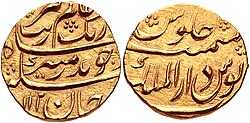
| [[File:Coin of Aurangzeb, minted in Kabul.jpg|thumb|right|Coin of Aurangzeb, minted in Kabul, dated 1691/2]]
| |
| The Mughals adopted and standardised the [[rupee]] (''rupiya'', or silver) and [[Dam (Indian coin)|dam]] (copper) currencies introduced by [[Sur Empire|Sur]] Emperor [[Sher Shah Suri]] during his brief rule.<ref>{{Cite web |url=http://www.rbi.org.in/currency/museum/c-mogul.html |title=Picture of original Mughal ''rupiya'' introduced by Sher Shah Suri |access-date=4 August 2017 |archive-date=5 October 2002 |archive-url=https://web.archive.org/web/20021005231609/http://www.rbi.org.in/currency/museum/c-mogul.html |url-status=dead }}</ref> The currency was initially 48 dams to a single rupee in the beginning of Akbar's reign, before it later became 38 dams to a rupee in the 1580s, with the dam's value rising further in the 17th century as a result of new industrial uses for copper, such as in bronze cannons and brass utensils. The dam was initially the most common coin in Akbar's time, before being replaced by the rupee as the most common coin in succeeding reigns.<ref name="Richards1995" /> The dam's value was later worth 30 to a rupee towards the end of Jahangir's reign, and then 16 to a rupee by the 1660s.<ref>{{Cite book |last1=Irfan Habib |url=http://www.hkrdb.kar.nic.in/documents/Downloads/Good%20Reads/The%20Cambridge%20Economic%20History%20of%20India,%20Volume%201.pdf#page=480 |title=The Cambridge Economic History of India |last2=Dharma Kumar |last3=Tapan Raychaudhuri |publisher=[[Cambridge University Press]] |year=1987 |volume=1 |page=464 |author-link=Irfan Habib |author-link2=Dharma Kumar |author-link3=Tapan Raychaudhuri}}</ref> The Mughals minted coins with high purity, never dropping below 96%, and without [[debasement]] until the 1720s.<ref name="Richards2003">{{Cite book |last=Richards |first=John F. |url=https://books.google.com/books?id=i85noYD9C0EC&pg=PA27 |title=The Unending Frontier: An Environmental History of the Early Modern World |publisher=University of California Press |year=2003 |isbn=978-0-520-93935-6 |pages=27– |author-link=John F. Richards}}</ref>
| |
| | |
| Despite India having its own stocks of gold and silver, the Mughals produced minimal gold of their own, but mostly minted coins from imported [[bullion]], as a result of the empire's strong export-driven economy, with global demand for Indian agricultural and industrial products drawing a steady stream of [[precious metal]]s into India.<ref name="Richards1995" /> Around 80% of Mughal India's imports were bullion, mostly silver,<ref name="Tracy1997">{{Cite book |last=Tracy |first=James D. |url=https://books.google.com/books?id=1jHpt9hdreoC&pg=PA97 |title=The Political Economy of Merchant Empires: State Power and World Trade, 1350–1750 |publisher=Cambridge University Press |year=1997 |isbn=978-0-521-57464-8 |pages=97–}}</ref> with major sources of imported bullion including the [[New World]] and Japan,<ref name="Richards2003" /> which in turn imported large quantities of textiles and silk from the [[Bengal Subah]] province.<ref name="Richards1995" />
| |
| | |
| ===Labour===
| |
| The historian Shireen Moosvi estimates that in terms of contributions to the Mughal economy, in the late 16th century, the primary sector contributed 52%, the secondary sector 18% and the tertiary sector 29%; the secondary sector contributed a higher percentage than in early 20th-century [[British India]], where the secondary sector only contributed 11% to the economy.{{sfn|Moosvi|2015|p=433}} In terms of urban-rural divide, 18% of Mughal India's labour force were urban and 82% were rural, contributing 52% and 48% to the economy, respectively.<ref>{{Cite book |last=Maddison |first=Angus |url=https://books.google.com/books?id=7UOKB3RwDQIC&pg=PA33 |title=Class Structure and Economic Growth: India and Pakistan Since the Moghuls |publisher=[[Taylor & Francis]] |year=1971 |isbn=978-0-415-38259-5 |page=33 |author-link=Angus Maddison}}</ref>
| |
| | |
| According to Stephen Broadberry and Bishnupriya Gupta, grain wages in India were comparable to England in the 16th and 17th centuries, but diverged in the 18th century when they fell to 20-40% of England's wages.<ref>{{Cite web|last=Broadberry, Gupta|first=Stephen, Bishnupriya|date=2003|title=The Early Modern Great Divergence: Wages, Prices and Economic Development in Europe and Asia 1500–1800| page= 34|url=https://eml.berkeley.edu/~webfac/olney/e211_fa03/e211-gupta.pdf|access-date=|website=}}</ref><ref>{{Cite book|last=Parthasarathi|first=Prasannan|title=Why Europe Grew Rich and Asia Did Not: Global Economic Divergence, 1600–1850|publisher=|year=2011|isbn=|location=|pages=42}}</ref> This, however, is disputed by Parthasarathi and Sivramkrishna. Parthasarathi cites his estimates that grain wages for weaving and spinning in mid-18 century Bengal and South India was comparable to Britain.<ref>{{Cite book|last=Parthasarathi|first=Prasannan|title=Why Europe Grew Rich and Asia Did Not: Global Economic Divergence, 1600–1850|publisher=|year=2011|isbn=|location=|pages=39}}</ref> Similarly, Sivramkrishna analyzed agricultural surveys conducted in Mysore by Francis Buchanan during 1800–1801, arrived at estimates using a "subsistence basket" that aggregated [[millet]] income could be almost five times subsistence level, while corresponding rice income was three times that much.<ref>{{Cite journal|last=Sivramkrishna|first=Sashi|date=2009|title=Ascertaining Living Standards in Erstwhile Mysore, Southern India, from Francis Buchanan's Journey of 1800–01: An Empirical Contribution to the Great Divergence|url=https://www.academia.edu/1831704|journal=Journal of the Economic and Social History|volume=52|issue=4|pages=726|via=}}</ref> That could be comparable to advance part of Europe.<ref>{{Cite journal|last=Sivramkrishna|first=Sashi|date=2009|title=Ascertaining Living Standards in Erstwhile Mysore, Southern India, from Francis Buchanan's Journey of 1800–01: An Empirical Contribution to the Great Divergence|url=https://www.academia.edu/1831704|journal=Journal of the Economic and Social History|volume=52|issue=4|pages=731|via=}}</ref> Due to the scarcity of data, however, more research is needed before drawing any conclusion.<ref>{{Cite book|last=Parthasarathi|first=Prasannan|title=Why Europe Grew Rich and Asia Did Not: Global Economic Divergence, 1600–1850|publisher=|year=2011|isbn=|location=|pages=45}}</ref><ref>{{Cite journal|last=Sivramkrishna|first=Sashi|date=2009|title=Ascertaining Living Standards in Erstwhile Mysore, Southern India, from Francis Buchanan's Journey of 1800–01: An Empirical Contribution to the Great Divergence|url=https://www.academia.edu/1831704|journal=Journal of the Economic and Social History|volume=52|issue=4|pages=729|via=}}</ref>
| |
| | |
| According to Moosvi, Mughal India had a per-capita income, in terms of wheat, 1.24% higher in the late 16th century than British India did in the early 20th century.{{sfn|Moosvi|2015|p=432}} This income, however, would have to be revised downwards if manufactured goods, like clothing, would be considered. Compared to food per-capita, expenditure on clothing was much smaller though, so relative income between 1595 and 1596 should be comparable to 1901–1910.{{sfn|Moosvi|2015|p=450}} However, in a system where wealth was hoarded by elites, wages were depressed for [[manual labour]].<ref name="moosvi" /> In Mughal India, there was a generally tolerant attitude towards manual labourers, with some religious cults in northern India proudly asserting a high status for manual labour. While [[slavery]] also existed, it was limited largely to household servants.<ref name="moosvi">{{Cite journal |last=Moosvi |first=Shireen |date=December 2011 |title=The World of Labour in Mughal India (c. 1500–1750) |journal=International Review of Social History |volume=56 |issue=S19 |pages=245–261 |doi=10.1017/S0020859011000526 |doi-access=free}}</ref>
| |
| | |
| ===Agriculture===
| |
| Indian agricultural production increased under the Mughal Empire.<ref name="Schmidt2015" /> A variety of crops were grown, including food crops such as wheat, rice, and [[barley]], and non-food [[cash crop]]s such as cotton, [[Indigofera tinctoria|indigo]] and [[opium]]. By the mid-17th century, Indian cultivators begun to extensively grow two new crops from the Americas, maize and tobacco.<ref name="Schmidt2015" />
| |
| | |
| The Mughal administration emphasised [[agrarian reform]], which began under the non-Mughal emperor Sher Shah Suri, the work of which Akbar adopted and furthered with more reforms. The civil administration was organised in a hierarchical manner on the basis of merit, with promotions based on performance.<ref>{{cite book |last1=Pagaza |first1=Ignacio |last2=Argyriades |first2=Demetrios |year=2009 |title=Winning the Needed Change: Saving Our Planet Earth |publisher=IOS Press |page=129 |isbn=978-1-58603-958-5}}</ref> The Mughal government funded the building of [[irrigation]] systems across the empire, which produced much higher [[crop yield]]s and increased the net revenue base, leading to increased agricultural production.<ref name="Schmidt2015" />
| |
| | |
| A major Mughal reform introduced by Akbar was a new land revenue system called ''zabt''. He replaced the [[tribute]] system, previously common in India and used by [[Tokugawa Japan]] at the time, with a monetary tax system based on a uniform currency.<ref name="Richards2003" /> The revenue system was biased in favour of higher value cash crops such as cotton, indigo, [[sugar cane]], tree-crops, and opium, providing state incentives to grow cash crops, in addition to rising market demand.<ref name="Richards1995" /> Under the ''zabt'' system, the Mughals also conducted extensive [[cadastral surveying]] to assess the area of land under [[plow]] cultivation, with the Mughal state encouraging greater land cultivation by offering tax-free periods to those who brought new land under cultivation.<ref name="Richards2003" /> The expansion of agriculture and cultivation continued under later Mughal emperors including Aurangzeb, whose 1665 [[firman]] edict stated: "the entire elevated attention and desires of the Emperor are devoted to the increase in the population and cultivation of the Empire and the welfare of the whole peasantry and the entire people."<ref name="Ludden96">{{Cite book |last1=Ludden |first1=David |url=https://books.google.com/books?id=eHi62S7vZlsC&pg=PA96 |title=An Agrarian History of South Asia |year=1999 |publisher=[[Cambridge University Press]] |isbn=978-0-521-36424-9 |page=96}}</ref>
| |
| | |
| Mughal agriculture was in some ways advanced compared to European agriculture at the time, exemplified by the common use of the [[seed drill]] among Indian peasants before its adoption in Europe.<ref>{{Cite book |last1=Irfan Habib |url=http://www.hkrdb.kar.nic.in/documents/Downloads/Good%20Reads/The%20Cambridge%20Economic%20History%20of%20India,%20Volume%201.pdf#page=230 |title=The Cambridge Economic History of India |last2=Dharma Kumar |last3=Tapan Raychaudhuri |publisher=[[Cambridge University Press]] |year=1987 |volume=1 |page=214 |author-link=Irfan Habib |author-link2=Dharma Kumar |author-link3=Tapan Raychaudhuri}}</ref> While the average peasant across the world was only skilled in growing very few crops, the average Indian peasant was skilled in growing a wide variety of food and non-food crops, increasing their productivity.<ref>{{Cite book |last1=Irfan Habib |url=http://www.hkrdb.kar.nic.in/documents/Downloads/Good%20Reads/The%20Cambridge%20Economic%20History%20of%20India,%20Volume%201.pdf#page=233 |title=The Cambridge Economic History of India |last2=Dharma Kumar |last3=Tapan Raychaudhuri |publisher=[[Cambridge University Press]] |year=1987 |volume=1 |page=217 |author-link=Irfan Habib |author-link2=Dharma Kumar |author-link3=Tapan Raychaudhuri}}</ref> Indian peasants were also quick to adapt to profitable new crops, such as maize and tobacco from the New World being rapidly adopted and widely cultivated across Mughal India between 1600 and 1650. [[Bengali people|Bengali]] farmers rapidly learned techniques of [[mulberry]] cultivation and [[sericulture]], establishing [[Bengal Subah]] as a major silk-producing region of the world.<ref name="Richards1995" /> [[Sugar mill]]s appeared in India shortly before the Mughal era. Evidence for the use of a [[draw bar]] for sugar-milling appears at Delhi in 1540, but may also date back earlier, and was mainly used in the northern Indian subcontinent. Geared sugar [[Roller mill|rolling mills]] first appeared in Mughal India, using the principle of rollers as well as [[worm gear]]ing, by the 17th century.<ref name="K8kO4J3mXUAC page 53">[[Irfan Habib]] (2011), [https://books.google.com/books?id=K8kO4J3mXUAC&pg=PA53 ''Economic History of Medieval India, 1200–1500'', p. 53], [[Pearson Education]]</ref>
| |
| | |
| According to economic historian [[Immanuel Wallerstein]], citing evidence from [[Irfan Habib]], [[Percival Spear]], and [[Ashok Desai]], per-capita agricultural output and standards of consumption in 17th-century [[Mughal India]] were probably higher than in 17th-century Europe and certainly higher than early 20th-century [[British India]].<ref>{{Cite book |last=Suneja |first=Vivek |url=https://books.google.com/books?id=8Stw3qadXG0C&pg=PA13 |title=Understanding Business: A Multidimensional Approach to the Market Economy |publisher=[[Psychology Press]] |year=2000 |isbn=978-0-415-23857-1 |page=13}}</ref> The increased agricultural productivity led to lower food prices. In turn, this benefited the Indian [[textile industry]]. Compared to Britain, the price of grain was about one-half in South India and one-third in Bengal, in terms of silver coinage. This resulted in lower silver coin prices for Indian textiles, giving them a price advantage in global markets.<ref name="Parthasarathi38">{{Citation|title=Why Europe Grew Rich and Asia Did Not: Global Economic Divergence, 1600–1850|url=https://books.google.com/books?id=1_YEcvo-jqcC&pg=PA38|pages=39–45|year=2011|publisher=Cambridge University Press|isbn=978-1-139-49889-0|given=Prasannan|surname=Parthasarathi}}</ref>
| |
| | |
| ===Industrial manufacturing===
| |
| Up until 1750, India produced about 25% of the world's industrial output.<ref name="williamson" /> [[Manufactured goods]] and cash crops from the Mughal Empire were sold throughout the world. Key industries included textiles, [[shipbuilding]], and steel. Processed products included cotton textiles, [[yarn]]s, [[Thread (yarn)|thread]], silk, [[jute]] products, [[metalware]], and foods such as sugar, oils and butter.<ref name="Schmidt2015" /> The growth of manufacturing industries in the Indian subcontinent during the Mughal era in the 17th–18th centuries has been referred to as a form of [[proto-industrialization]], similar to 18th-century Western Europe prior to the [[Industrial Revolution]].<ref name="voss">{{Cite book |last1=Lex Heerma van Voss |title=The Ashgate Companion to the History of Textile Workers, 1650–2000 |last2=Els Hiemstra-Kuperus |last3=Elise van Nederveen Meerkerk |publisher=[[Ashgate Publishing]] |year=2010 |page=255 |chapter=The Long Globalization and Textile Producers in India |isbn=978-0754664284 |chapter-url=https://books.google.com/books?id=f95ljbhfjxIC&pg=PA255}}</ref>
| |
| | |
| In [[early modern Europe]], there was significant demand for products from Mughal India, particularly cotton textiles, as well as goods such as spices, peppers, [[indigo]], silks, and [[saltpeter]] (for use in [[munitions]]).<ref name="Schmidt2015" /> [[1650–1700 in Western European fashion|European fashion]], for example, became increasingly dependent on Mughal Indian textiles and silks. From the late 17th century to the early 18th century, Mughal India accounted for 95% of [[East India Company|British imports]] from Asia, and the [[Bengal Subah]] province alone accounted for 40% of [[Dutch East India Company|Dutch imports]] from Asia.<ref name="Prakash">[[Om Prakash (historian)|Om Prakash]], "[http://link.galegroup.com/apps/doc/CX3447600139/WHIC?u=seat24826&xid=6b597320 Empire, Mughal]", ''History of World Trade Since 1450'', edited by John J. McCusker, vol. 1, Macmillan Reference US, 2006, pp. 237–240, ''World History in Context''. Retrieved 3 August 2017</ref> In contrast, there was very little demand for European goods in Mughal India, which was largely self-sufficient, thus Europeans had very little to offer, except for some [[woolen]]s, unprocessed metals and a few luxury items. The trade imbalance caused Europeans to export large quantities of gold and silver to Mughal India in order to pay for South Asian imports.<ref name="Schmidt2015" /> Indian goods, especially those from Bengal, were also exported in large quantities to other Asian markets, such as [[Indonesia]] and Japan.<ref name="Richards1995" />
| |
| | |
| ====Textile industry====
| |
| {{See also|Muslin trade in Bengal|Mughal clothing}}
| |
| [[File:Old Mughal Courtier.png|thumb|Miniature painting - Portrait of an Old Mughal Courtier Wearing Muslin]]
| |
| [[File:Renaldis muslin woman.jpg|thumb|Muslim Lady Reclining or An Indian Girl with a Hookah, painted in Dacca, 18th century]]
| |
| | |
| The largest manufacturing industry in the Mughal Empire was [[textile manufacturing]], particularly cotton textile manufacturing, which included the production of [[piece goods]], [[calico]]s, and [[muslin]]s, available unbleached and in a variety of colours. The cotton [[textile industry]] was responsible for a large part of the empire's international trade.<ref name="Schmidt2015" /> India had a 25% share of the global textile trade in the early 18th century.<ref>[[Angus Maddison]] (1995), ''Monitoring the World Economy, 1820–1992'', [[OECD]], p. 30</ref> Indian cotton textiles were the most important manufactured goods in world trade in the 18th century, consumed across the world from the Americas to Japan.<ref name="Parthasarathi">{{Citation|title=Why Europe Grew Rich and Asia Did Not: Global Economic Divergence, 1600–1850|page=2|year=2011|publisher=Cambridge University Press|isbn=978-1-139-49889-0|given=Prasannan|surname=Parthasarathi}}</ref> By the early 18th century, Mughal Indian textiles were clothing people across the Indian subcontinent, Southeast Asia, Europe, the Americas, Africa, and the Middle East.<ref name="Jeffrey G. Williamson 2011 91" /> The most important centre of cotton production was the Bengal province, particularly around its capital city of [[Dhaka]].<ref name="Eaton">Richard Maxwell Eaton (1996), [https://books.google.com/books?id=gKhChF3yAOUC&pg=PA202 ''The Rise of Islam and the Bengal Frontier, 1204–1760'', p. 202], [[University of California Press]]</ref>
| |
| | |
| Bengal accounted for more than 50% of textiles and around 80% of silks imported by the Dutch from Asia,<ref name="Prakash" /> Bengali silk and cotton textiles were exported in large quantities to Europe, Indonesia, and Japan,<ref name="Richards1995" />{{rp|202}} and [[Muslin trade in Bengal|Bengali muslin]] textiles from Dhaka were sold in Central Asia, where they were known as "daka" textiles.<ref name="Eaton" /> Indian textiles dominated the [[Indian Ocean trade]] for centuries, were sold in the Atlantic Ocean trade, and had a 38% share of the West African trade in the early 18th century, while Indian calicos were a major force in Europe, and Indian textiles accounted for 20% of total English trade with Southern Europe in the early 18th century.<ref name="williamson" />
| |
| | |
| The [[worm gear]] roller [[cotton gin]], which was invented in India during the early [[Delhi Sultanate]] era of the 13th–14th centuries, came into use in the Mughal Empire sometime around the 16th century,<ref name="K8kO4J3mXUAC page 53" /> and is still used in India through to the present day.<ref name="LakGin">{{Cite book |last=Lakwete |first=Angela |url=https://books.google.com/books?id=uOMaGVnPfBcC |title=Inventing the Cotton Gin: Machine and Myth in Antebellum America |publisher=The Johns Hopkins University Press |year=2003 |isbn=978-0-8018-7394-2 |location=Baltimore |pages=1–6 |ref=Lakwete}}</ref> Another innovation, the incorporation of the [[Crank (mechanism)|crank]] handle in the cotton gin, first appeared in India sometime during the late Delhi Sultanate or the early Mughal Empire.<ref>[[Irfan Habib]] (2011), [https://books.google.com/books?id=K8kO4J3mXUAC&pg=PA53 ''Economic History of Medieval India, 1200–1500'', pp. 53–54], [[Pearson Education]]</ref> The production of cotton, which may have largely been spun in the villages and then taken to towns in the form of yarn to be woven into cloth textiles, was advanced by the diffusion of the [[spinning wheel]] across India shortly before the Mughal era, lowering the costs of yarn and helping to increase demand for cotton. The diffusion of the spinning wheel, and the incorporation of the worm gear and crank handle into the roller cotton gin led to greatly expanded Indian cotton textile production during the Mughal era.<ref>[[Irfan Habib]] (2011), [https://books.google.com/books?id=K8kO4J3mXUAC&pg=PA54 ''Economic History of Medieval India, 1200–1500'', p. 54], [[Pearson Education]]</ref>
| |
| | |
| <blockquote> Once, the Mughal emperor Akbar asked his courtiers, which was the most beautiful flower. Some said rose, from whose petals were distilled the precious itr, others, the lotus, glory of every Indian village. But Birbal said, “The cotton boll”. There was a scornful laughter and Akbar asked for an explanation. Birbal said, “Your Majesty, from the cotton boll comes the fine fabric prized by merchants across the seas that has made your empire famous throughout the world. The perfume of your fame far exceeds the scent of roses and jasmine. That is why I say the cotton boll is the most beautiful flower.<ref>{{Cite book|last=دكتور محمد نصر|url=http://archive.org/details/fashionanddesigningunderthemughalsakbartoaurangzeb.ahistoricalperspective|title=Fashion And Designing Under The Mughals Akbar To Aurangzeb. A Historical Perspective|language=English}}</ref></blockquote>
| |
| | |
| ====Shipbuilding industry====
| |
| | |
| Mughal India had a large [[shipbuilding]] industry, which was also largely centred in the Bengal province. Economic historian Indrajit Ray estimates shipbuilding output of Bengal during the sixteenth and seventeenth centuries at 223,250 tons annually, compared with 23,061 tons produced in nineteen colonies in North America from 1769 to 1771.<ref name="ray174">{{Cite book |last=Ray |first=Indrajit |url=https://books.google.com/books?id=CHOrAgAAQBAJ&pg=PA174 |title=Bengal Industries and the British Industrial Revolution (1757–1857) |publisher=Routledge |year=2011 |isbn=978-1-136-82552-1 |pages=174}}</ref> He also assesses ship repairing as very advanced in Bengal.<ref name="ray174" />
| |
| | |
| Indian shipbuilding, particularly in Bengal, was advanced compared to European shipbuilding at the time, with Indians selling ships to European firms. An important innovation in shipbuilding was the introduction of a [[Flush deck|flushed deck]] design in Bengal rice ships, resulting in [[Hull (watercraft)|hulls]] that were stronger and less prone to leak than the structurally weak hulls of traditional European ships built with a stepped [[Deck (ship)|deck]] design. The British [[East India Company]] later duplicated the flushed deck and hull designs of Bengal rice ships in the 1760s, leading to significant improvements in [[seaworthiness]] and navigation for European ships during the [[Industrial Revolution]].<ref name=":0">{{Cite web |title=Technological Dynamism in a Stagnant Sector: Safety at Sea during the Early Industrial Revolution |url=http://www.ucd.ie/t4cms/WP17_11.pdf}}</ref>
| |
| | |
| ===Bengal Subah===
| |
| {{Main|Bengal Subah}}
| |
| {{See also|Muslin trade in Bengal}}
| |
| [[File:Boro Katra 4 by Ashif Siddique.jpg|thumb|Ruins of the [[Bara Katra|Great Caravanserai]] in [[Dhaka]].]]
| |
| | |
| The Bengal Subah province was especially prosperous from the time of its takeover by the Mughals in 1590 until the British East India Company seized control in 1757.<ref>{{Cite journal |last=Roy |first=Tirthankar |author-link=Tirthankar Roy |date=November 2011 |title=Where is Bengal? Situating an Indian Region in the Early Modern World Economy |journal=Past & Present |volume=213 |issue=1 |pages=115–146 |doi=10.1093/pastj/gtr009}}</ref> It was the Mughal Empire's wealthiest province.<ref>{{Cite book |last=Alam |first=M. Shahid |url=https://books.google.com/books?id=suKKCwAAQBAJ&pg=PA32 |title=Poverty From The Wealth of Nations: Integration and Polarization in the Global Economy since 1760 |publisher=[[Springer Science+Business Media]] |year=2016 |isbn=978-0-333-98564-9 |page=32 |author-link=M. Shahid Alam}}</ref> Domestically, much of India depended on Bengali products such as rice, silks and cotton textiles. Overseas, Europeans depended on Bengali products such as cotton textiles, silks, and opium; Bengal accounted for 40% of Dutch imports from Asia, for example, including more than 50% of textiles and around 80% of silks.<ref name="Prakash" /> From Bengal, saltpeter was also shipped to Europe, opium was sold in Indonesia, raw silk was exported to Japan and the Netherlands, and cotton and silk textiles were exported to Europe, Indonesia and Japan.<ref name="Richards1995" />
| |
| Akbar played a key role in establishing Bengal as a leading economic centre, as he began transforming many of the jungles there into farms. As soon as he conquered the region, he brought tools and men to clear jungles in order to expand cultivation and brought [[Sufis]] to open the jungles to farming.<ref name="Ludden96" /> Bengal was later described as the ''Paradise of Nations'' by Mughal emperors.<ref>{{Cite web |title=The paradise of nations |url=http://www.dhakatribune.com/heritage/2014/dec/20/paradise-nations |website=Dhaka Tribune}}</ref> The Mughals introduced [[agrarian reform]]s, including the modern [[Bengali calendar]].<ref>{{Cite news |last=Daniyal |first=Shoaib |title=Bengali New Year: how Akbar invented the modern Bengali calendar |url=http://scroll.in/article/720351/bengali-new-year-how-akbar-invented-the-modern-bengali-calendar |website=Scroll.in}}</ref> The calendar played a vital role in developing and organising harvests, tax collection and Bengali culture in general, including the [[Bengali New Year|New Year]] and [[Nabanna|Autumn]] festivals. The province was a leading producer of grains, salt, fruits, liquors and wines, precious metals and ornaments.<ref name="books.google.com">{{Cite book |last=Nanda |first=J. N. |url=https://books.google.com/books?id=HsV3cYAvGEEC |title=Bengal: The Unique State |publisher=Concept Publishing Company |year=2005 |isbn=978-81-8069-149-2}}</ref>{{page needed|date=January 2019}} Its [[handloom]] industry flourished under [[royal warrant of appointment|royal warrants]], making the region a hub of the worldwide [[Muslin trade in Bengal|muslin trade]], which peaked in the 17th and 18th centuries. The provincial capital [[Dhaka]] became the commercial capital of the empire. The Mughals expanded cultivated land in the [[Bengal delta]] under the leadership of [[Sufi]]s, which consolidated the foundation of [[Bengali Muslim]] society.<ref>{{Cite book |last=Eaton |first=Richard M. |url=https://books.google.com/books?id=gKhChF3yAOUC |title=The Rise of Islam and the Bengal Frontier, 1204–1760 |publisher=University of California Press |year=1996 |isbn=978-0-520-20507-9}}</ref>{{page needed|date=January 2019}}
| |
| | |
| After 150 years of rule by Mughal [[viceroy]]s, Bengal gained semi-independence as a [[dominion]] under the [[Nawab of Bengal]] in 1717. The Nawabs permitted European companies to set up trading posts across the region, including firms from [[British East India Company|Britain]], [[French East India Company|France]], the [[Dutch Bengal|Netherlands]], [[Danish India|Denmark]], Portugal and [[Bankipur (Bengal)|Austria]]. An [[Armenian community of Dhaka|Armenian]] community dominated banking and shipping in major cities and towns. The Europeans regarded Bengal as the richest place for trade.<ref name="books.google.com" /> By the late 18th century, the [[British Empire|British]] displaced the Mughal ruling class in Bengal.
| |
| | |
| == Demographics ==
| |
| {{See also|Demographics of India#History|l1=Demographics of India: History}}
| |
| | |
| === Population ===
| |
| India's population growth accelerated under the Mughal Empire, with an unprecedented economic and demographic upsurge which boosted the Indian population by 60%<ref name="mcevedy184">{{Cite book |last1=Colin McEvedy |url=http://www.arabgeographers.net/up/uploads/14299936761.pdf#page=92 |title=Atlas of World Population History |last2=Richard Jones |date=1978 |publisher=[[Facts on File]] |location=New York |pages=184–185 |author-link=Colin McEvedy}}</ref> to 253% in 200 years during 1500–1700.<ref name="maddison236">[[Angus Maddison]] (2001), ''[[The World Economy: Historical Statistics|The World Economy: A Millennial Perspective]]'', [http://theunbrokenwindow.com/Development/MADDISON%20The%20World%20Economy--A%20Millennial.pdf#page=237 p. 236], [[OECD Development Centre]]</ref> The Indian population had a faster growth during the Mughal era than at any known point in [[Indian history]] prior to the Mughal era.<ref name="Maddison2003" /><ref name="mcevedy184" /> By the time of Aurangzeb's reign, there were a total of 455,698 villages in the Mughal Empire.<ref name="habib170" />
| |
| | |
| The following table gives population estimates for the Mughal Empire, compared to the total population of India, including the regions of modern Pakistan and [[Bangladesh]], and compared to the [[world population]]:
| |
| | |
| {| class="wikitable sortable"
| |
| |-
| |
| ! scope="col" style="text-align: left;" | Year
| |
| ! scope="col" data-sort-type="number" | Mughal Empire <br /> population
| |
| ! scope="col" data-sort-type="number" | Total Indian <br /> population
| |
| ! scope="col" data-sort-type="number" | % of Indian <br /> population
| |
| ! scope="col" data-sort-type="number" | World <br /> population
| |
| ! scope="col" data-sort-type="number" | % of world <br /> population
| |
| |-
| |
| | 1500
| |
| | style="text-align: right;" | —
| |
| | style="text-align: right;" | {{formatnum:100000000}}<ref name="mcevedy184" />
| |
| | style="text-align: right;" | —
| |
| | style="text-align: right;" | {{formatnum:425000000}}<ref name="Biraben" />
| |
| | style="text-align: right;" | —
| |
| |-
| |
| | 1600
| |
| | style="text-align: right;" | {{formatnum:115000000}}<ref name="habib170">{{Cite book |last1=Irfan Habib |url=http://www.hkrdb.kar.nic.in/documents/Downloads/Good%20Reads/The%20Cambridge%20Economic%20History%20of%20India,%20Volume%201.pdf#page=186 |title=The Cambridge Economic History of India |last2=Dharma Kumar |last3=Tapan Raychaudhuri |publisher=[[Cambridge University Press]] |year=1987 |volume=1 |page=170 |author-link=Irfan Habib |author-link2=Dharma Kumar |author-link3=Tapan Raychaudhuri}}</ref>
| |
| | style="text-align: right;" | {{formatnum:130000000}}<ref name="mcevedy184" />
| |
| | style="text-align: right;" | 89
| |
| | style="text-align: right;" | {{formatnum:579000000}}<ref name="Biraben">Jean-Noël Biraben, 1980, "An Essay Concerning Mankind's Evolution", Population, Selected Papers, Vol. 4, pp. 1–13</ref>
| |
| | style="text-align: right;" | 20
| |
| |-
| |
| | 1700
| |
| | style="text-align: right;" | {{formatnum:158400000}}<ref name="borocz">{{Cite book |last=József Böröcz |url=https://books.google.com/books?id=d0SPAgAAQBAJ&pg=PA21 |title=The European Union and Global Social Change |date=2009 |publisher=[[Routledge]] |isbn=978-1135255800 |page=21 |author-link=József Böröcz |access-date=26 June 2017}}</ref>
| |
| | style="text-align: right;" | {{formatnum:160000000}}<ref name="mcevedy184" />
| |
| | style="text-align: right;" | 99
| |
| | style="text-align: right;" | {{formatnum:679000000}}<ref name="Biraben" />
| |
| | style="text-align: right;" | 23
| |
| |}
| |
| | |
| === Urbanization ===
| |
| According to Irfan Habib Cities and towns boomed under the Mughal Empire, which had a relatively high degree of urbanization for its time, with 15% of its population living in urban centres.<ref name="Eraly2007">{{Cite book |last=Eraly |first=Abraham |url=https://books.google.com/books?id=Zpa8gyGW_twC&pg=PA5 |title=The Mughal World: Life in India's Last Golden Age |publisher=Penguin Books India |year=2007 |isbn=978-0-14-310262-5 |pages=5– |author-link=Abraham Eraly}}</ref> This was higher than the percentage of the urban population in contemporary Europe at the time and higher than that of [[British India]] in the 19th century;<ref name="Eraly2007" /> the level of urbanization in Europe did not reach 15% until the 19th century.<ref>{{Cite book |last=Paolo Malanima |url=https://books.google.com/books?id=C1Ej4VEPwSgC&pg=PA244 |title=Pre-Modern European Economy: One Thousand Years (10th–19th Centuries) |publisher=[[Brill Publishers]] |year=2009 |isbn=978-9004178229 |page=244 |author-link=Paolo Malanima}}</ref>
| |
| | |
| Under Akbar's reign in 1600, the Mughal Empire's urban population was up to 17 million people, 15% of the empire's total population. This was larger than the entire urban population in Europe at the time, and even a century later in 1700, the urban population of England, Scotland and Wales did not exceed 13% of its total population,<ref name="habib170" /> while British India had an urban population that was under 13% of its total population in 1800 and 9% in 1881, a decline from the earlier Mughal era.<ref>{{Cite book |last1=Irfan Habib |url=http://www.hkrdb.kar.nic.in/documents/Downloads/Good%20Reads/The%20Cambridge%20Economic%20History%20of%20India,%20Volume%201.pdf#page=185 |title=The Cambridge Economic History of India |last2=Dharma Kumar |last3=Tapan Raychaudhuri |publisher=[[Cambridge University Press]] |year=1987 |volume=1 |page=165 |author-link=Irfan Habib |author-link2=Dharma Kumar |author-link3=Tapan Raychaudhuri}}</ref> By 1700, Mughal India had an urban population of 23 million people, larger than British India's urban population of 22.3 million in 1871.<ref>{{Cite web |last1=Broadberry |first1=Stephen |last2=Gupta |first2=Bishnupriya |year=2010 |title=Indian GDP before 1870: Some preliminary estimates and a comparison with Britain |url=http://www2.warwick.ac.uk/fac/soc/economics/staff/sbroadberry/wp/indiangdppre1870v4.pdf#page=23 |access-date=12 October 2015 |publisher=[[Warwick University]] |page=23 |archive-date=11 November 2020 |archive-url=https://web.archive.org/web/20201111210739/https://warwick.ac.uk/fac/soc/economics/staff/sbroadberry/wp/indiangdppre1870v4.pdf#page=23 |url-status=dead }}</ref>
| |
| | |
| Those estimates were criticised by [[Tim Dyson]], who consider them exaggerations. According to Dyson urbanization of Mughal empire was less than 9%.<ref>{{Cite book|last=Dyson|first=Tim|title=A Population History of India: From the First Modern People to the Present Day|publisher=|year=2018|isbn=|location=|pages=63–65}}</ref>
| |
| | |
| The historian [[Nizamuddin Ahmad]] (1551–1621) reported that, under Akbar's reign, there were 120 large cities and 3200 townships.<ref name="Eraly2007" /> A number of cities in India had a population between a quarter-million and half-million people,<ref name="Eraly2007" /> with larger cities including [[Agra]] (in [[Agra Subah]]) with up to 800,000 people, [[Lahore]] (in [[Lahore Subah]]) with up to 700,000 people,<ref>{{Cite book |last1=Irfan Habib |url=http://www.hkrdb.kar.nic.in/documents/Downloads/Good%20Reads/The%20Cambridge%20Economic%20History%20of%20India,%20Volume%201.pdf#page=187 |title=The Cambridge Economic History of India |last2=Dharma Kumar |last3=Tapan Raychaudhuri |publisher=[[Cambridge University Press]] |year=1987 |volume=1 |page=171 |author-link=Irfan Habib |author-link2=Dharma Kumar |author-link3=Tapan Raychaudhuri}}</ref> [[Dhaka]] (in [[Bengal Subah]]) with over 1 million people,<ref>[https://books.google.com/books?id=pKIlAQAAMAAJ ''Social Science Review'', Volume 14, Issue 1], p. 126, [[Dhaka University]]</ref>{{full citation needed|date=October 2021}} and Delhi (in [[Delhi Subah]]) with over 600,000 people.<ref name="Moosvi2008">{{Cite book |last=Moosvi |first=Shireen |url=https://books.google.com/books?id=IhpuAAAAMAAJ |title=People, Taxation, and Trade in Mughal India |publisher=Oxford University Press |year=2008 |isbn=978-0-19-569315-7 |page=131}}</ref>
| |
| | |
| Cities acted as markets for the sale of goods, and provided homes for a variety of merchants, traders, shopkeepers, artisans, moneylenders, weavers, craftspeople, officials, and religious figures.<ref name="Schmidt2015" /> However, a number of cities were military and political centres, rather than manufacturing or commerce centres.<ref name="Chaudhuri2008">{{Cite journal |last=Chaudhuri |first=K. N. |year=2008 |title=Some Reflections on the Town and Country in Mughal India |journal=Modern Asian Studies |volume=12 |issue=1 |pages=77–96 |doi=10.1017/S0026749X00008155 |s2cid=146558617 |issn=0026-749X}}</ref>
| |
| | |
| == Culture ==
| |
| {{See also|Indo-Persian culture||}}
| |
| [[File:Mushafi-ghulam-hamdani.png|thumb|250px|[[Ghulam Hamdani Mushafi]], the poet first believed to have coined the name "''Urdu''" around 1780 AD for a language that went by a multiplicity of names before his time.<ref>Garcia, Maria Isabel Maldonado. "The Urdu language reforms." Studies 26 (2011): 97.</ref>]]
| |
| The Mughal Empire was definitive in the early-modern and modern periods of South Asian history, with its legacy in India, Pakistan, Bangladesh and Afghanistan seen in cultural contributions such as:
| |
| [[File:Mir Taqi Mir 1786.jpg|thumb|Mir Taqi Mir, an Urdu poet of the 18th century Mughal Empire]]
| |
| | |
| [[File:Taj mahal (1870s).jpg|thumb|The Taj Mahal in the 1870s]]
| |
| * Centralised imperial rule that consolidated the smaller polities of South Asia.<ref>{{Cite encyclopedia |title=Mughal Empire – MSN Encarta |url=http://encarta.msn.com/encyclopedia_761564252/mughal_empire.html |url-status=dead |archive-url=https://www.webcitation.org/5kx6SG3s9?url=http://encarta.msn.com/encyclopedia_761564252/mughal_empire.html |archive-date=1 November 2009}}</ref>
| |
| * The amalgamation of [[Persian art]] and literature with [[Indian art]].<ref name="r1">{{Cite web |title=Indo-Persian Literature Conference: SOAS: North Indian Literary Culture (1450–1650) |url=http://www.soas.ac.uk/southasia/research/nilc/indopersian/ |access-date=28 November 2012 |website=SOAS}}</ref>
| |
| [[File:Badshahi Mosque, Lahore. King's Mosque.jpg|thumb|Badshahi Mosque, [[Lahore, Punjab]], Pakistan]]
| |
| * The development of [[Mughlai cuisine]], an amalgamation of South Asian, Iranian and Central Asian culinary styles.
| |
| * The development of [[Mughal clothing]], jewelry and fashion, utilizing richly decorated fabrics such as muslin, silk, brocade and velvet.
| |
| * The standardization of the [[Hindustani language]] (the colloquial language of [[Bollywood]]), and thus the development of [[Hindi]] and [[Urdu]].<ref>{{Cite web |title=Islam: Mughal Empire (1500s, 1600s) |url=http://www.bbc.co.uk/religion/religions/islam/history/mughalempire_1.shtml |access-date=10 June 2018 |website=Religions |publisher=BBC}}</ref>
| |
| * The introduction of sophisticated Iranian-style waterworks and horticulture through [[Mughal gardens|Mughal gardening]].<ref>{{Cite journal |last=Fatma |first=Sadaf |year=2012 |title=Waterworks in Mughal Gardens |journal=Proceedings of the Indian History Congress |volume=73 |pages=1268–1278 |jstor=44156328}}</ref>
| |
| * The introduction of [[Turkish bath]]s into the Indian subcontinent.
| |
| * The evolution and refinement of [[Mughal architecture|Mughal]] and [[Indian architecture]] and in turn, the development of later Rajput and Sikh palatial architecture. A famous Mughal landmark is the [[Taj Mahal]].
| |
| * The development of the [[Pehlwani]] style of [[Indian wrestling]], a combination of Indian [[malla-yuddha]] and Persian [[varzesh-e bastani]].<ref name="Alter1992a">{{Cite journal |last=Alter |first=Joseph S. |date=May 1992 |title=The ''sannyasi'' and the Indian Wrestler: The Anatomy of a Relationship |journal=American Ethnologist |volume=19 |issue=2 |pages=317–336 |doi=10.1525/ae.1992.19.2.02a00070 |issn=0094-0496}}</ref><ref name="Alter1992b">{{Cite book |last=Alter |first=Joseph S. |url=https://archive.org/details/wrestlersbodyide00alte |title=The Wrestler's Body: Identity and Ideology in North India |publisher=University of California Press |year=1992 |isbn=978-0-520-07697-6 |page=[https://archive.org/details/wrestlersbodyide00alte/page/n1 2] |quote=Wrestling in modern India is a synthesis of two different traditions: the Persian form of the art brought into South Asia by the Moguls, and an indigenous Hindu form. |author-link=Joseph Alter |url-access=limited}}</ref>
| |
| * The construction of [[Maktab (education)|Maktab]] schools, where youth were taught the [[Quran]] and [[Sharia|Islamic law]] such as the ''[[Fatawa-e-Alamgiri|Fatawa-i-Alamgiri]]'' in their indigenous languages.
| |
| * The development of [[Hindustani classical music]],<ref>{{Cite news |date=8 February 2000 |title=Mughal influence on Indian music |work=[[The Hindu]] |url=https://www.thehindu.com/todays-paper/tp-miscellaneous/tp-others/mughal-influence-on-indian-music/article28000731.ece |access-date=5 April 2019}}</ref> and instruments such as the [[sitar]].<ref name="lata">{{Citation |last=Swarn Lata |title=The Journey of the Sitar in Indian Classical Music |url=https://books.google.com/books?id=92QXf8B2VXIC&pg=PA24 |page=24 |year=2013 |isbn=978-1475947076}}</ref>
| |
| | |
| [[File:Fatehput Sikiri Buland Darwaza gate 2010.jpg|thumb|[[Buland Darwaza]] in Fatehpur Sikiri, Agra, India]]
| |
| | |
| === Architecture ===
| |
| {{Main|Indo-Islamic architecture|Mughal architecture|Mughal gardens}}
| |
| The Mughals made a major contribution to the [[Indian subcontinent]] with the development of their unique Indo-Persian [[Mughal architecture|architecture]]. Many monuments were built during the Mughal era by the Muslim emperors, especially [[Shah Jahan]], including the [[Taj Mahal]]—a [[UNESCO World Heritage Site]] considered to be "the jewel of Muslim art in India and one of the universally admired masterpieces of the world's heritage", attracting 7–8 million unique visitors a year. The palaces, tombs, gardens and forts built by the dynasty stand today in [[Agra]], [[Aurangabad, Maharashtra|Aurangabad]], [[Delhi]], [[Dhaka]], [[Fatehpur Sikri]], [[Jaipur]], [[Lahore]], [[Kabul]], [[Sheikhupura]], and many other cities of India, Pakistan, Afghanistan, and Bangladesh,<ref>{{Cite book |last1=Ross Marlay |title=Patriots and Tyrants: Ten Asian Leaders |last2=Clark D. Neher |date=1999 |publisher=Rowman & Littlefield |isbn=978-0-8476-8442-7 |page=269}}</ref> such as:[[File:1._লালবাগের_কেল্লা.jpg|thumb|[[Lalbagh Fort]] aerial view in Dhaka, Bangladesh]] [[File:Shalimar Gardens, Kashmir.jpg|thumb|[[Shalimar Bagh, Srinagar|Shalimar Bagh]] in Srinagar, Kashmir, India]]
| |
| {| class="wikitable"
| |
| |+
| |
| !India
| |
| !Pakistan
| |
| !Bangladesh
| |
| !Afghanistan
| |
| |-
| |
| |valign=top|
| |
| *[[Taj Mahal]] in Agra, India
| |
| *[[Agra Fort]] in Agra, India
| |
| *[[Buland Darwaza]] in Agra, India
| |
| *[[Akbar's tomb]] in Sikandra, India
| |
| *[[Tomb of Mariam-uz-Zamani]] in Sikandra, India
| |
| *[[Humayun's Tomb]] in Delhi, India
| |
| *[[Jama Masjid, Delhi|Jama Masjid]] in Delhi, India
| |
| *[[Red Fort]] in Delhi, India
| |
| *[[Sunder Nursery]] in Delhi, India
| |
| *[[Purana Qila]] in Delhi, India
| |
| *[[Sher Mandal]] in Delhi, India
| |
| *[[Pinjore Gardens]] in Pinjore, India
| |
| *[[Shalimar Bagh, Srinagar|Shalimar Bagh]] in Srinagar, India
| |
| *[[Nishat Bagh]] in Srinagar, India
| |
| *[[Chashme Shahi|Chasma Shahi]] in Srinagar, India
| |
| *[[Pari Mahal]] in Srinagar, India
| |
| *[[Verinag|Verinag Gardens]] in Srinagar, India
| |
| *[[Allahabad Fort]] in Prayagraj, India
| |
| *[[Shahi Bridge]] in Jaunpur, India
| |
| *[[Bibi Ka Maqbara]] in Aurangabad, India
| |
| *[[Kos Minar]] in Haryana, India
| |
| *Baoli Ghaus Ali Shah in Farrukhnagar, India
| |
| |valign=top|
| |
| *[[Badshahi Mosque|Badshahi Masjid]] in Lahore, Pakistan
| |
| *[[Shalimar Gardens, Lahore|Shalimar Gardens]] in Lahore, Pakistan
| |
| *[[Lahore Fort]] in Lahore, Pakistan
| |
| *[[Shahi Hammam]] in Lahore, Pakistan
| |
| *[[Wazir Khan Mosque]] in Lahore, Pakistan
| |
| *[[Tomb of Jahangir]] in Lahore, Pakistan
| |
| *[[Tomb of Anarkali]] in Lahore, Pakistan
| |
| *[[Tomb of Nur Jahan]] in Lahore, Pakistan
| |
| *[[Tomb of Asif Khan]] in Lahore, Pakistan
| |
| *[[Begum Shahi Mosque]] in Lahore, Pakistan
| |
| *[[Akbari Sarai]] in Lahore, Pakistan
| |
| *[[Hiran Minar]] in Sheikhpura, Pakistan
| |
| *[[Mahabat Khan Mosque]] in Peshawar, Pakistan
| |
| *[[Shahi Eid Gah Mosque]] in Multan, Pakistan
| |
| *[[Masum Shah|Mausoleum of Masum Shah]] in Sukkur, Pakistan
| |
| *[[Losar Baoli]] in Taxila, Pakistan
| |
| *[[Makli Necropolis]] in Thatta, Pakistan
| |
| *[[Shah Jahan Mosque, Thatta|Shah Jahan Mosque]] in Thatta, Pakistan
| |
| |valign=top|
| |
| *[[Dhanmondi Shahi Eidgah|Mughal Eidgah]] in Dhaka, Bangladesh
| |
| *[[Lalbagh Fort]] in Dhaka, Bangladesh
| |
| *[[Sylhet Shahi Eidgah|Shahi Eidgah]] in Sylhet, Bangladesh
| |
| *[[Mughal Tahakhana]] in Chapai Nawabganj, Bangladesh
| |
| *[[Sat Gambuj Mosque]] in Dhaka, Bangladesh
| |
| *[[Masjid-e-Siraj ud-Daulah]] in Chittagong, Bangladesh
| |
| *[[Allakuri Mosque|Allakuri Masjid]] in Dhaka, Bangladesh
| |
| *[[Chawk Mosque|Chawkbazar Shahi Masjid]] in Dhaka, Bangladesh
| |
| *[[Laldighi Mosque|Laldighi Masjid]] in Rangpur, Bangladesh
| |
| *[[Khan Mohammad Mridha Mosque|Khan Mohammad Mridha Masjid]] in Dhaka, Bangladesh
| |
| *[[Wali Khan Mosque|Wali Khan Masjid]] in Chittagong, Bangladesh
| |
| *[[Shaista Khan Mosque|Shaista Khan Masjid]], in Dhaka, Bangladesh
| |
| *[[Musa Khan Mosque|Musa Khan Masjid]], in Dhaka, Bangladesh
| |
| *[[Shahbaz Khan Mosque|Shahbaz Khan Masjid]], in Dhaka, Bangladesh
| |
| *[[Kartalab Khan Mosque|Kartalab Khan Masjid]] in Dhaka, Bangladesh
| |
| *[[Azimpur Mosque|Azimpur Masjid]] in Dhaka, Bangladesh
| |
| *[[Goaldi Mosque|Goaldi Masjid]] in Sonargaon, Bangladesh
| |
| *[[Atia Mosque|Atia Masjid]] in Tangail, Bangladesh
| |
| *[[Arifile Mosque|Arifail Masjid]] in Brahmanbaria, Bangladesh
| |
| *[[Bajra Shahi Mosque|Bazra Shahi Masjid]] in Noakhali, Bangladesh
| |
| *[[Mosjidkur Mosque|Masjid Kur]] in Khulna, Bangladesh
| |
| *[[Nayabad Mosque|Nayabad Masjid]] in Dinajpur, Bangladesh
| |
| *[[Ghayebi Dighi Masjid]] in Sylhet, Bangladesh
| |
| *[[Hussaini Dalan]] in Dhaka, Bangladesh
| |
| *[[Bara Katra]] in Dhaka, Bangladesh
| |
| *[[Hajiganj Fort]] in Narayanganj, Bangladesh
| |
| *[[Idrakpur Fort]] in Munshiganj, Bangladesh
| |
| *[[Choto Katra]] in Dhaka, Bangladesh
| |
| *[[Sonakanda Fort]] in Narayanganj, Bangladesh
| |
| |valign=top|
| |
| *[[Gardens of Babur|Bagh-e-Babur]] in Kabul, Afghanistan
| |
| *Shahjahani Mosque in Kabul, Afghanistan
| |
| |}
| |
| | |
| === Art and literature ===
| |
| [[File:Mansur-8.png|thumb|right|upright|Illustration by the 17th-century Mughal artist Ustad Mansur]]
| |
| [[File:Basawan - Alexander Visits the Sage Plato.jpg|thumb|left|"Alexander Visits the Sage Plato in His Mountain Cave"; illustration by the 16th-century Indian artist Basawan, in a folio from a quintet of the 13th-century Indian poet Amir Khusrau Dihlavi]]
| |
| {{Main|Mughal painting|Mughal clothing}}
| |
| The [[Mughal painting|Mughal artistic tradition]], mainly expressed in painted miniatures, as well as small luxury objects, was eclectic, borrowing from Iranian, Indian, Chinese and Renaissance European stylistic and thematic elements.<ref>Crill, Rosemary, and Jariwala, Kapil. ''The Indian Portrait, 1560–1860'', pp. 23–27, [[National Portrait Gallery, London]], 2010, {{ISBN|978-1855144095}}; [[Milo Beach|Beach, Milo Cleveland]] (1987), ''Early Mughal painting'', Harvard University Press, pp. 33–37, {{ISBN|978-0674221857}}, [https://books.google.co.uk/books?id=MmcoF12hi3AC&pg=PA33 google books]</ref> Mughal emperors often took in Iranian bookbinders, illustrators, painters and calligraphers from the Safavid court due to the commonalities of their Timurid styles, and due to the Mughal affinity for Iranian art and calligraphy.<ref>{{Cite journal |last=Soucek |first=Priscilla |year=1987 |title=Persian Artists in Mughal India: Influences and Transformations |journal=Muqarnas |volume=4 |pages=166–181 |doi=10.2307/1523102 |jstor=1523102}}</ref> Miniatures commissioned by the Mughal emperors initially focused on large projects illustrating books with eventful historical scenes and court life, but later included more single images for albums, with portraits and animal paintings displaying a profound appreciation for the serenity and beauty of the natural world.<ref>{{Cite journal |last=Blunt |first=Wilfrid |year=1948 |title=The Mughal Painters of Natural History |journal=The Burlington Magazine |volume=90 |issue=539 |pages=48–50 |jstor=869792}}</ref> For example, Emperor Jahangir commissioned brilliant artists such as [[Ustad Mansur]] to realistically portray unusual flora and fauna throughout the empire.
| |
| | |
| The literary works Akbar and Jahangir ordered to be illustrated ranged from epics like the ''[[Razmnama]]'' (a Persian translation of the Hindu epic, the ''[[Mahabharata]]'') to historical memoirs or biographies of the dynasty such as the ''[[Baburnama]]'' and ''[[Akbarnama]]'', and ''[[Tuzk-e-Jahangiri]]''. Richly-finished albums (''[[muraqqa]]'') decorated with calligraphy and artistic scenes were mounted onto pages with decorative borders and then bound with covers of stamped and gilded or painted and lacquered leather.<ref>{{Cite web |last=Sardar |first=Marika |date=October 2003 |title=The Art of the Mughals After 1600 |url=https://www.metmuseum.org/toah/hd/mugh_2/hd_mugh_2.htm |archive-url=https://web.archive.org/web/20190204014635/https://www.metmuseum.org/toah/hd/mugh_2/hd_mugh_2.htm |archive-date=4 February 2019 |website=The MET}}</ref> Aurangzeb (1658–1707) was never an enthusiastic patron of painting, largely for religious reasons, and took a turn away from the pomp and ceremonial of the court around 1668, after which he probably commissioned no more paintings.<ref>Losty, J. P. Roy, Malini (eds), ''Mughal India: Art, Culture and Empire'', 2013, pp. 147, 149, British Library, {{ISBN|978-0712358705}}</ref>
| |
| | |
| === Language ===
| |
| [[File:India, Mughal, early 17th century - An Illuminated Folio from the Royal Manuscript of the Farhang-i Jahangiri ( - 2013.318.a - Cleveland Museum of Art.tif|thumb|right|upright|Folio from ''[[Farhang-i-Jahangiri]],'' a Persian dictionary compiled during the Mughal era.]]
| |
| {{Main|Persian language in the Indian subcontinent|Persian and Urdu|Hindustani language}}
| |
| | |
| Though the Mughals were of [[Turko-Mongol]] origin, their reign enacted the revival and height of the [[Persian language]] in the Indian subcontinent. Accompanied by literary patronage was the institutionalisation of Persian as official and courtly language; this led to Persian reaching nearly the status of a first language for many inhabitants of Mughal India.<ref>{{Citation|title=2. The Culture and Politics of Persian in Precolonial Hindustan|date=2019|url=http://dx.doi.org/10.1525/9780520926738-007|work=Literary Cultures in History|pages=158–167|publisher=University of California Press|doi=10.1525/9780520926738-007|isbn=978-0-520-92673-8|s2cid=226770775|access-date=2021-07-26}}</ref><ref>{{Citation|last1=Abidi|first1=S. A. H.|title=Persian in South Asia|url=http://dx.doi.org/10.1017/cbo9780511619069.007|work=Language in South Asia|pages=105|place=Cambridge|publisher=Cambridge University Press|isbn=978-0-511-61906-9|access-date=2021-07-26|last2=Gargesh|first2=Ravinder|editor1-first=Braj B|editor1-last=Kachru|editor2-first=Yamuna|editor2-last=Kachru|editor3-first=S. N|editor3-last=Sridhar|year=2008|doi=10.1017/cbo9780511619069.007}}</ref> [[Muzaffar Alam]] argues that the Mughals used Persian purposefully as the vehicle of an overarching [[Indo-Persian]] political culture, to unite their diverse empire.<ref>{{Cite book|last=Alam|first=Muzaffar|url=http://worldcat.org/oclc/469379391|title=The languages of political Islam : India 1200–1800|date=2004|publisher=University of Chicago Press|isbn=0-226-01100-3|pages=134, 144|oclc=469379391}}</ref> Persian had a profound impact on the languages of South Asia; one such language, today known as [[Urdu]], developed in the imperial capital of Delhi in the late Mughal era. It began to be used as a literary language in the Mughal court from the reign of [[Shah Alam II]], who described it as the language of his [[dastan|dastans]],<ref>{{Citation|title=14. A Long History of Urdu Literary Culture|date=2019|url=https://www.google.ca/books/edition/Early_Urdu_Literary_Culture_and_History/rq1jAAAAMAAJ?hl=en&gbpv=1&bsq=1792-93&printsec=frontcover|work=Literary Cultures in History|page=29|publisher=University of California Press|isbn=978-0-19-565201-7}}</ref> and replaced Persian as the language of the Muslim elite.<ref>{{Citation|title=14. A Long History of Urdu Literary Culture, Part 1: Naming and Placing a Literary Culture|date=2019|url=http://dx.doi.org/10.1525/9780520926738-019|work=Literary Cultures in History|pages=805–863|publisher=University of California Press|doi=10.1525/9780520926738-019|isbn=978-0-520-92673-8|s2cid=226765648|access-date=2021-07-26}}</ref><ref>{{Cite web|last=Matthews|first=David|title=Urdu|url=https://iranicaonline.org/articles/urdu|url-status=live|website=Encyclopaedia Iranica}}</ref> According to Qazvini, by the time of [[Shah Jahan]], the emperor was only familiar with a few [[chagatai language|Turki]] words and showed little interest in the study of the language as a child.<ref>{{cite book |url= https://archive.org/details/in.ernet.dli.2015.281500/page/n43/mode/2up?q=turki |title= History Of Shahjahan Of Dihli 1932 |author= Banarsi Prasad Saksena |publisher=Indian Press Limited |date= 1932 }}</ref>
| |
| | |
| == Military ==
| |
| {{See|Army of the Mughal Empire|Mughal weapons|Mughal artillery}}
| |
| | |
| === Gunpowder warfare ===
| |
| [[File:Officer of the Mughal Army, c.1585 (colour litho).jpg|thumb|Mughal [[matchlock]] rifle, 16th century.]]
| |
| {{See also|Gunpowder empires|History of gunpowder#India and the Mughal Empire|l2=History of gunpowder: India and the Mughal Empire}}Mughal India was one of the three Islamic [[gunpowder empires]], along with the [[Ottoman Empire]] and [[Safavid Persia]].<ref name="Hodgson" /><ref name="Streusand">{{Cite book |last=Streusand |first=Douglas E. |title=Islamic Gunpowder Empires: Ottomans, Safavids, and Mughals |publisher=Westview Press |year=2011 |isbn=978-0-8133-1359-7 |location=Philadelphia}}</ref><ref>{{Cite web |last=Charles T. Evans |title=The Gunpowder Empires |url=http://novaonline.nvcc.edu/eli/evans/his112/Notes/Gunpowder.html |access-date=28 December 2010 |publisher=Northern Virginia Community College}}</ref> By the time he was invited by [[Lodi dynasty|Lodi]] governor of [[Lahore]], [[Daulat Khan Lodi|Daulat Khan]], to support his rebellion against Lodi [[Sultan]] [[Ibrahim Lodi|Ibrahim Khan]], [[Babur]] was familiar with [[gunpowder]] [[firearm]]s and [[field artillery]], and a method for deploying them. Babur had employed Ottoman expert [[Ustad Ali Quli]], who showed Babur the standard Ottoman formation—artillery and firearm-equipped infantry protected by wagons in the centre and the [[mounted archer]]s on both wings. Babur used this formation at the [[First Battle of Panipat]] in 1526, where the [[Afghan (ethnonym)|Afghan]] and [[Rajput]] forces loyal to the [[Delhi Sultanate]], though superior in numbers but without the gunpowder weapons, were defeated. The decisive victory of the Timurid forces is one reason opponents rarely met Mughal princes in pitched battle over the course of the empire's history.<ref>{{Cite book |last=Streusand |first=Douglas E. |title=Islamic Gunpowder Empires: Ottomans, Safavids, and Mughals |publisher=Westview Press |year=2011 |isbn=978-0-8133-1359-7 |location=Philadelphia |page=255}}</ref> In India, guns made of [[bronze]] were recovered from [[Kozhikode|Calicut]] (1504) and [[Diu, India|Diu]] (1533).<ref name="Partington226">{{Citation |last=Partington |first=James Riddick |title=A History of Greek Fire and Gunpowder |url=https://archive.org/details/historyofgreekfi00part/page/226 |page=[https://archive.org/details/historyofgreekfi00part/page/226 226] |year=1999 |place=Baltimore |publisher=Johns Hopkins University Press |isbn=978-0-8018-5954-0 |author-link=J. R. Partington}}</ref>
| |
| | |
| [[Fathullah Shirazi]] (c. 1582), a Persian polymath and mechanical engineer who worked for Akbar, developed an early multi gun shot. As opposed to the [[polybolos]] and [[repeating crossbow]]s used earlier in [[ancient Greece]] and China, respectively, Shirazi's rapid-firing gun had multiple [[gun barrel]]s that fired [[hand cannon]]s loaded with gunpowder. It may be considered a version of a [[volley gun]].<ref name="Fathullah Shirazi">{{Cite journal |last=Bag |first=A.K. |year=2005 |title=Fathullah Shirazi: Cannon, Multi-barrel Gun and Yarghu |journal=Indian Journal of History of Science |volume=40 |issue=3 |pages=431–436 |issn=0019-5235}}</ref>[[File:The Padshahnama, imperial court guards and nobles.jpg|thumb|Mughal [[musketeer]], 17th century.]]
| |
| | |
| By the 17th century, Indians were manufacturing a diverse variety of firearms; large guns in particular, became visible in [[Tanjore]], [[Dacca]], [[Bijapur, Karnataka|Bijapur]] and [[Murshidabad]].<ref>{{Citation |last=Partington |first=James Riddick |title=A History of Greek Fire and Gunpowder |url=https://archive.org/details/historyofgreekfi00part/page/225 |page=[https://archive.org/details/historyofgreekfi00part/page/225 225] |year=1999 |place=Baltimore |publisher=Johns Hopkins University Press |isbn=978-0-8018-5954-0}}</ref>
| |
| | |
| ===Rocketry and explosives===
| |
| {{See also|Mysorean rockets|Congreve rocket}}
| |
| In the sixteenth century, [[Akbar]] was the first to initiate and use metal cylinder [[rocket]]s known as ''bans'', particularly against [[war elephant]]s, during the Battle of Sanbal.<ref>{{Cite web |last=MughalistanSipahi |date=19 June 2010 |title=Islamic Mughal Empire: War Elephants Part 3 |url=https://www.youtube.com/watch?v=Lbzr26t8H2U |archive-url=https://ghostarchive.org/varchive/youtube/20211221/Lbzr26t8H2U |archive-date=2021-12-21 |url-status=live|access-date=28 November 2012 |via=YouTube}}{{cbignore}}</ref> In 1657, the [[Mughal Army]] used rockets during the [[Siege of Bidar]].<ref name="Yazdani15">Ghulam Yazdani, ''Bidar, Its History and Monuments'', (Motilal Banarsidass, 1995), 15.</ref> Prince Aurangzeb's forces discharged rockets and [[grenade]]s while scaling the walls. Sidi Marjan was mortally wounded when a rocket struck his large gunpowder depot, and after twenty-seven days of hard fighting Bidar was captured by the Mughals.<ref name="Yazdani15" />
| |
| | |
| In ''A History of Greek Fire and Gunpowder'', [[James Riddick Partington]] described Indian rockets and [[Explosive weapon|explosive]] [[Land mine|mines]]:<ref name="Partington226" />
| |
| | |
| <blockquote>The Indian war rockets were formidable weapons before such rockets were used in Europe. They had bam-boo rods, a rocket-body lashed to the rod, and iron points. They were directed at the target and fired by lighting the fuse, but the trajectory was rather erratic. The use of mines and counter-mines with explosive charges of gunpowder is mentioned for the times of Akbar and [[Jahāngir]].</blockquote>
| |
| | |
| Later, the [[Mysorean rockets]] were upgraded versions of Mughal rockets used during the [[Siege of Jinji]] by the progeny of the [[Nawab of Arcot]]. [[Hyder Ali]]'s father [[Fatah Muhammad]] the constable at [[Budikote]], commanded a corps consisting of 50 rocketmen (''Cushoon'') for the Nawab of Arcot. Hyder Ali realised the importance of rockets and introduced advanced versions of metal cylinder rockets. These rockets turned fortunes in favour of the [[Sultanate of Mysore]] during the [[Second Anglo-Mysore War]], particularly during the [[Battle of Pollilur]]. In turn, the Mysorean rockets were the basis for the [[Congreve rocket]]s, which Britain deployed in the [[Napoleonic Wars]] against France and the [[War of 1812]] against the United States.<ref>{{Cite web |last=Roddam Narasimha |year=1985 |title=Rockets in Mysore and Britain, 1750–1850 A.D. |url=http://www.nal.res.in/pages/rocketsdet.htm |access-date=30 November 2011 |publisher=National Aerospace Laboratories, India}}</ref>
| |
| | |
| == Science ==
| |
| | |
| === Astronomy ===
| |
| {{See also|Astronomy in the medieval Islamic world|Indian astronomy}}
| |
| | |
| While there appears to have been little concern for [[theoretical astronomy]], Mughal [[astronomers]] made advances in [[observational astronomy]] and produced nearly a hundred ''[[Zij]]'' treatises. [[Humayun]] built a personal [[observatory]] near Delhi; Jahangir and Shah Jahan were also intending to build observatories, but were unable to do so. The [[astronomical instruments]] and observational techniques used at the Mughal observatories were mainly derived from [[Astronomy in the medieval Islamic world|Islamic astronomy]].<ref name="Sharma">{{Citation |last=Sharma |first=Virendra Nath |title=Sawai Jai Singh and His Astronomy |pages=8–9 |year=1995 |publisher=[[Motilal Banarsidass]] Publ. |isbn=978-81-208-1256-7}}</ref><ref name="Baber">{{Citation |last=Baber |first=Zaheer |title=The Science of Empire: Scientific Knowledge, Civilization, and Colonial Rule in India |pages=82–89 |year=1996 |publisher=[[State University of New York Press]] |isbn=978-0-7914-2919-8}}</ref> In the 17th century, the Mughal Empire saw a synthesis between Islamic and [[Hindu astronomy]], where Islamic observational instruments were combined with [[Indian mathematics|Hindu computational]] techniques.<ref name="Sharma" /><ref name="Baber" />
| |
| | |
| During the decline of the Mughal Empire, the Hindu king [[Jai Singh II of Amber]] continued the work of Mughal [[astronomy]]. In the early 18th century, he built several large observatories called [[Jantar Mantar|Yantra Mandirs]], in order to rival [[Ulugh Beg]]'s [[Samarkand]] [[Ulugh Beg Observatory|observatory]], and in order to improve on the earlier Hindu computations in the ''[[Siddhantas]]'' and Islamic observations in ''[[Zij-i-Sultani]]''. The instruments he used were influenced by Islamic astronomy, while the computational techniques were derived from Hindu astronomy.<ref name="Sharma" /><ref name="Baber" />
| |
| | |
| === Chemistry ===
| |
| {{See also|Alchemy and chemistry in the medieval Islamic world}}
| |
| | |
| [[Sake Dean Mahomed]] had learned much of Mughal [[chemistry]] and understood the techniques used to produce various [[alkali]] and soaps to produce [[shampoo]]. He was also a notable writer who described the [[Mughal Emperor]] [[Shah Alam II]] and the cities of [[Allahabad]] and Delhi in rich detail and also made note of the glories of the Mughal Empire.
| |
| | |
| In Britain, Sake Dean Mahomed was appointed as [[Shampoo (massage)|shampooing surgeon]] to both Kings [[George IV of the United Kingdom|George IV]] and [[William IV of the United Kingdom|William IV]].<ref name="Teltscher">{{Cite journal |last=Teltscher |first=Kate |year=2000 |title=The Shampooing Surgeon and the Persian Prince: Two Indians in Early Nineteenth-century Britain |journal=Interventions: International Journal of Postcolonial Studies |volume=2 |issue=3 |pages=409–423 |doi=10.1080/13698010020019226 |s2cid=161906676 |issn=1469-929X}}</ref>
| |
| | |
| === Metallurgy ===
| |
| {{See also|History of metallurgy in the Indian subcontinent}}
| |
| | |
| One of the most remarkable astronomical instruments invented in Mughal India is the [[Lost-wax casting|lost-wax cast]], hollow, seamless, [[celestial globe]]. It was invented in [[Kashmir]] by Ali Kashmiri ibn Luqman in 998 [[Anno Hegirae|AH]] (1589–90 CE), and twenty other such [[globe]]s were later produced in [[Lahore]] and Kashmir during the Mughal Empire. Before they were rediscovered in the 1980s, it was believed by modern [[metallurgists]] to be technically impossible to produce hollow metal globes without any [[wikt:seam|seams]].<ref>Savage-Smith, Emilie (1985), ''Islamicate Celestial Globes: Their History, Construction, and Use'', Smithsonian Institution Press, Washington, DC</ref>
| |
| A 17th century celestial globe was also made by Diya’ ad-din Muhammad in [[Lahore]], 1668 (now in Pakistan).<ref>{{Cite web|title=Celestial globe|url=https://www.nms.ac.uk/explore-our-collections/collection-search-results/|access-date=2020-10-15|website=National Museums Scotland|language=en}}</ref> It is now housed at the [[National Museum of Scotland]].
| |
| | |
| ==List of Mughal Emperors==
| |
| {{Main|Mughal emperors}}
| |
| | |
| {| style="width:100%;" class="wikitable"
| |
| ! style="width:8%;"| Portrait
| |
| ! style="width:12%;"| Titular Name
| |
| ! style="width:18%;"| Birth Name
| |
| ! style="width:9%;"| Birth
| |
| ! style="width:20%;"| Reign
| |
| ! style="width:13%;"| Death
| |
| ! style="width:20%;"| Notes
| |
| |-
| |
| | style="text-align:center;"|[[File:Babur Mirzo.jpg|80px]]
| |
| | style="text-align:center;"|''Bābur''<br />{{Nastaliq|بابر}}
| |
| | style="text-align:center;"|[[Babur|Zahir-ud-din Muhammad]]<br />{{Nastaliq|ظہیر الدین محمد}}
| |
| | style="text-align:center;"|14 February 1483, [[Andijan]]
| |
| | style="text-align:center;"| 20 April 1526 – 26 December 1530
| |
| | |
| | style="text-align:center;"|26 December 1530 (aged 47)
| |
| | style="text-align:center;"|Founded the Empire
| |
| |-
| |
| | style="text-align:center;"|[[File:Humayun of India.jpg|80px]]
| |
| | style="text-align:center;"|''Humayun''<br />{{Nastaliq|ہمایوں}}
| |
| | style="text-align:center;"|[[Humayun|Nasir-ud-din Muhammad Humayun]]<br />{{Nastaliq|نصیر الدین محمد ہمایوں}}
| |
| | style="text-align:center;"|6 March 1508
| |
| | style="text-align:center;"|26 December 1530 – 17 May 1540
| |
| 9 years 4 months 21 days
| |
| | |
| 22 February 1555 – 27 January 1556
| |
| | style="text-align:center;"|27 January 1556 (aged 47)
| |
| | style="text-align:center;"| Humayun was overthrown in 1540 by [[Sher Shah Suri]] of the [[Suri dynasty]] but returned to the throne in 1555 after the death of [[Islam Shah Suri]] (Sher Shah Suri's son and successor).
| |
| |-
| |
| | style="text-align:center;"|[[File:Emperor Akbar the Great.jpg|80px]]
| |
| | style="text-align:center;"|''Akbar-i-Azam ''<br />{{Nastaliq|اکبر اعظم}}
| |
| | style="text-align:center;"|[[Akbar|Jalal-ud-din Muhammad]]<br />{{Nastaliq|جلال الدین محمد اکبر}}
| |
| | style="text-align:center;"|14 October 1542
| |
| | style="text-align:center;"|27 January 1556 – 27 October 1605
| |
| 49 years 9 months 0 days
| |
| | |
| | style="text-align:center;"|27 October 1605 (aged 63)
| |
| | style="text-align:center;"| His mother was [[Persian people|Persian]] [[Hamida Banu Begum]].<ref>{{Cite book |last=Begum, Gulbadan |title=The History of Humayun (Humayun-Nama) |publisher=Royal Asiatic Society |year=1902 |pages=237–9 |author-link=Gulbadan Begum}}</ref>
| |
| |-
| |
| | style="text-align:center;"|[[File:Jahangir Chitrashala Press.jpg|80px]]
| |
| | style="text-align:center;"|''Jahangir''<br />{{Nastaliq|جہانگیر}}
| |
| | style="text-align:center;"|[[Jahangir|Nur-ud-din Muhammad Salim]]<br />{{Nastaliq| نور الدین محمد سلیم}}
| |
| | style="text-align:center;"|20 September 1569
| |
| | style="text-align:center;"|15 October 1605 – 8 October 1627
| |
| 21 years 11 months 23 days
| |
| | |
| | style="text-align:center;"|28 October 1627 (aged 58)
| |
| | style="text-align:center;"|His mother was [[Rajput]] princess [[Mariam-uz-Zamani]].<ref>{{Cite book |last=Marc Jason Gilbert |url=https://books.google.com/books?id=7OQWDgAAQBAJ&pg=PA79 |title=South Asia in World History |publisher=[[Oxford University Press]] |year=2017 |isbn=9780199760343 |page=79}}</ref>
| |
| |-
| |
| | style="text-align:center;"|[[File:Shah Jahan I of India.jpg|80px]]
| |
| | style="text-align:center;"|''Shah-Jahan''<br />{{Nastaliq|شاہ جہان}}
| |
| | style="text-align:center;"|[[Shah Jahan|Shahab-ud-din Muhammad Khurram]]<br />{{Nastaliq|شہاب الدین محمد خرم}}
| |
| | style="text-align:center;"|5 January 1592
| |
| | style="text-align:center;"|8 November 1627 – 2 August 1658
| |
| 30 years 8 months 25 days
| |
| | |
| | style="text-align:center;"|22 January 1666 (aged 74)
| |
| | style="text-align:center;"|His mother was Rajput princess [[Jagat Gosaini]].<ref>{{Cite book |last=Emperor of Hindustan [[Jahangir]] |title=The Tuzuk-i-Jahangiri; Or, Memoirs of Jahangir Translated by Alexander Rogers Edited by Henry Beveridge |title-link=Tuzk-e-Jahangiri |publisher=General Books LLC |year=2010 |isbn=978-1-152-49040-6 |page=18}}</ref> Built [[Taj Mahal]].
| |
| |-
| |
| | style="text-align:center;"|[[File:The Emperor Aurangzeb Alamgir.jpg|80px]]
| |
| | style="text-align:center;"|''Alamgir I''<br />{{Nastaliq|عالمگیر}}
| |
| | style="text-align:center;"|[[Aurangzeb|Muhy-ud-din Muhammad Aurangzeb]] <br />{{Nastaliq|محی الدین محمداورنگزیب }}
| |
| | style="text-align:center;"|3 November 1618
| |
| | style="text-align:center;"|31 July 1658 – 3 March 1707
| |
| 48 years 7 months 0 days
| |
| | |
| | style="text-align:center;"|3 March 1707 (aged 88)
| |
| | style="text-align:center;"|His mother was Persian [[Mumtaz Mahal]]. He was married to [[Safavid Dynasty]] Princess [[Dilras Banu Begum]]. He established Islamic law throughout India. After his death, His younger Son [[Azam Shah]] became the King (for 3 months) .<ref>{{Cite book |last=Mohammada |first=Malika |title=The Foundations of the Composite Culture in India |date=1 January 2007 |publisher=Aakar Books |isbn=978-8-189-83318-3 |pages=300}}</ref>
| |
| |-
| |
| | style="text-align:center;"|[[File:Bahadur Shah I of India.jpg|80px]]
| |
| | style="text-align:center;"|''Bahadur Shah ''<br />{{Nastaliq|بہادر شاہ}}
| |
| | style="text-align:center;"|[[Bahadur Shah I|Qutb-ud-Din Muhammad Mu'azzam Shah Alam]] <br />{{Nastaliq|قطب الدین محمد معزام }}
| |
| | style="text-align:center;"|14 October 1643
| |
| | style="text-align:center;"|19 June 1707 – 27 February 1712
| |
| (3 years, 253 days)
| |
| | style="text-align:center;"|27 February 1712 (aged 68)
| |
| | style="text-align:center;"| He made settlements with the Marathas, tranquillised the Rajputs, and became friendly with the Sikhs in the Punjab.
| |
| |-
| |
| | style="text-align:center;"|[[File:Jahandar Shah of India.jpg|80px]]
| |
| | style="text-align:center;"|''Jahandar Shah''<br />{{Nastaliq|جہاندار شاہ}}
| |
| | style="text-align:center;"|[[Jahandar Shah|Mu'izz-ud-Din Jahandar Shah Bahadur]] <br />{{Nastaliq|معز الدین جہاندار شاہ بہادر }}
| |
| | style="text-align:center;"|9 May 1661
| |
| | style="text-align:center;"|27 February 1712 – 11 February 1713
| |
| (0 years, 350 days)
| |
| | style="text-align:center;"|12 February 1713 (aged 51)
| |
| | style="text-align:center;"|Highly influenced by his [[Grand Vizier]] Zulfikar Khan.
| |
| |-
| |
| | style="text-align:center;"|[[File:Farrukhsiyar of India.jpg|80px]]
| |
| | style="text-align:center;"|''Farrukhsiyar''<br />{{Nastaliq|فرخ سیر}}
| |
| | style="text-align:center;"|[[Farrukhsiyar]] <br />{{Nastaliq|فرخ سیر}}
| |
| | style="text-align:center;"|20 August 1685
| |
| | style="text-align:center;"|11 January 1713 – 28 February 1719
| |
| (6 years, 48 days)
| |
| | style="text-align:center;"|29 April 1719 (aged 33)
| |
| | style="text-align:center;"|Granted a [[firman (decree)|firman]] to the [[East India Company]] in 1717 granting them duty-free trading rights for [[Bengal]], strengthening their posts on the east coast. The firman or decree helped British East India company to import goods into Bengal without paying customs duty to the government.
| |
| |-
| |
| | style="text-align:center;"|[[File:Rafi ud-Darajat of India.jpg|80px]]
| |
| | style="text-align:center;"|''Rafi ud-Darajat''<br />{{Nastaliq|رفیع الدرجات}}
| |
| | style="text-align:center;"|[[Rafi ud-Darajat]] <br />{{Nastaliq|رفیع الدرجات}}
| |
| | style="text-align:center;"|30 November 1699
| |
| | style="text-align:center;"|28 February – 6 June 1719
| |
| (0 years, 98 days)
| |
| | style="text-align:center;"|9 June 1719 (aged 19)
| |
| | style="text-align:center;"|Rise of [[Syed Brothers]] as power brokers.
| |
| |-
| |
| | style="text-align:center;"|[[File:Shah Jahan II of India.jpg|80px]]
| |
| | style="text-align:center;"|''Shah Jahan II''<br />{{Nastaliq|شاہ جہان دوم}}
| |
| | style="text-align:center;"|[[Shah Jahan II|Rafi ud-Daulah]] <br />{{Nastaliq|شاہ جہاں دوم}}
| |
| | style="text-align:center;"|June 1696
| |
| | style="text-align:center;"|6 June 1719 – 19 September 1719
| |
| (0 years, 105 days)
| |
| | style="text-align:center;"|19 September 1719 (aged 23)
| |
| | style="text-align:center;"| ----
| |
| |-
| |
| | style="text-align:center;"|[[File:Muhammad Shah of India.jpg|80px]]
| |
| | style="text-align:center;"|''Muhammad Shah''<br />{{Nastaliq|محمد شاہ}}
| |
| | style="text-align:center;"|[[Muhammad Shah|Roshan Akhtar Bahadur]] <br />{{Nastaliq|روشن اختر بہادر}}
| |
| | style="text-align:center;"|17 August 1702
| |
| | style="text-align:center;"|27 September 1719 – 26 April 1748
| |
| (28 years, 212 days)
| |
| | style="text-align:center;"|26 April 1748 (aged 45)
| |
| | style="text-align:center;"|Got rid of the [[Syed Brothers]]. Fought a long war with the Marathas, losing [[Deccan Plateau|Deccan]] and [[Malwa]] in the process. Suffered the invasion of [[Nader Shah]] of Persia in 1739. He was the last emperor to possess effective control over the empire.
| |
| |-
| |
| | style="text-align:center;"|[[File:Ahmad Shah Bahadur of India.jpg|80px]]
| |
| | style="text-align:center;"|''Ahmad Shah Bahadur''<br />{{Nastaliq|احمد شاہ بہادر}}
| |
| | style="text-align:center;"|[[Ahmad Shah Bahadur]] <br />{{Nastaliq|احمد شاہ بہادر}}
| |
| | style="text-align:center;"|23 December 1725
| |
| | style="text-align:center;"|26 April 1748 – 2 June 1754
| |
| (6 years, 37 days)
| |
| | style="text-align:center"|1 January 1775 (aged 49)
| |
| | style="text-align:center;"|Mughal forces defeated by the Marathas at the [[Battle of Sikandarabad]].
| |
| |-
| |
| | style="text-align:center;"|[[File:Alamgir II of India.jpg|80px]]
| |
| | style="text-align:center;"|''Alamgir II''<br />{{Nastaliq|عالمگیر دوم}}
| |
| | style="text-align:center;"|[[Alamgir II|Aziz-ud-din]] <br />{{Nastaliq|عزیز اُلدین}}
| |
| | style="text-align:center;"|6 June 1699
| |
| | style="text-align:center;"|2 June 1754 – 29 November 1759
| |
| (5 years, 180 days)
| |
| | style="text-align:center;"|29 November 1759 (aged 60)
| |
| | style="text-align:center;"|Domination of [[Vizier]] [[Ghazi ud-Din Khan Feroze Jung III|Imad-ul-Mulk]].
| |
| |-
| |
| | style="text-align:center;"|[[File:Shah Jahan III of India.jpg|80px]]
| |
| | style="text-align:center;"|''Shah Jahan III''<br />{{Nastaliq|شاہ جہان سوم}}
| |
| | style="text-align:center;"|[[Shah Jahan III|Muhi-ul-millat]] <br />{{Nastaliq|محی اُلملت}}
| |
| | style="text-align:center;"|1711
| |
| | style="text-align:center;"|10 December 1759 – 10 October 1760
| |
| (282 days)
| |
| | style="text-align:center;"|1772 (aged 60–61)
| |
| | style="text-align:center;"|Consolidation of power by the Nawab of Bengal-Bihar-Odisha.
| |
| |-
| |
| | style="text-align:center;"|[[File:Ali Gauhar of India.jpg|80px]]
| |
| | style="text-align:center;"|''Shah Alam II''<br />{{Nastaliq|شاہ عالم دوم}}
| |
| | style="text-align:center;"|[[Shah Alam II|Ali Gauhar]] <br />{{Nastaliq|علی گوہر}}
| |
| | style="text-align:center;"|25 June 1728
| |
| | style="text-align:center;"|10 October 1760 – 19 November 1806 (46 years, 330 days)
| |
| | style="text-align:center;"|19 November 1806 (aged 78)
| |
| | style="text-align:center;"|Defeat in the [[Battle of Buxar]].
| |
| |-
| |
| | style="text-align:center;"|[[File:Mughal Emperor Mahmud Shah Bahadur.jpg|80px]]
| |
| | style="text-align:center;"|''Muhammad Shah Bahadur Jahan IV''<br />{{Nastaliq|شاہ جہان محمد شاه بهادر}}
| |
| | style="text-align:center;"|[[Mahmud Shah Bahadur|Bidar Bakht]]<br />{{Nastaliq| بیدار بخت }}
| |
| | style="text-align:center;"|1749
| |
| | style="text-align:center;"|31 July 1788 – by 2 October 1788 (63 days)
| |
| | style="text-align:center;"|1790 (aged 40–41)
| |
| | style="text-align:center;"|Enthroned as a puppet Emperor by the [[Rohilla]] [[Ghulam Kadir]], following the temporary overthrow of [[Shah Alam II]].<ref>The Honorary Secretaries, ''Proceedings of the Asiatic Society of Bengal: 1871'', (1871) p.97</ref>
| |
| |-
| |
| | style="text-align:center;"|[[File:Akbar Shah II of India.jpg|80px]]
| |
| | style="text-align:center;"|''Akbar Shah II''<br />{{Nastaliq|اکبر شاہ دوم}}
| |
| | style="text-align:center;"|[[Akbar Shah II|Mirza Akbar]] <br />{{Nastaliq|میرزا اکبر}}
| |
| | style="text-align:center;"|22 April 1760
| |
| | style="text-align:center;"|19 November 1806 – 28 September 1837 (30 years, 321 days)
| |
| | style="text-align:center;"|28 September 1837 (aged 77)
| |
| | style="text-align:center;"|Titular figurehead under British protection.
| |
| |-
| |
| | style="text-align:center;"|[[File:Bahadur Shah II of India.jpg|80px]]
| |
| | style="text-align:center;"|''Bahadur Shah II''<br />{{Nastaliq|بہادر شاہ دوم}}
| |
| | style="text-align:center;"|[[Bahadur Shah II|Abu Zafar Sirajuddin Muhammad Bahadur Shah Zafar]] <br />{{Nastaliq|ابو ظفر سراج اُلدین محمد بہادر شاہ ظفر}}
| |
| | style="text-align:center;"|24 October 1775
| |
| | style="text-align:center;"|28 September 1837 – 23 September 1857 (19 years, 360 days)
| |
| | style="text-align:center;"|7 November 1862 (aged 87)
| |
| | style="text-align:center;"|Last Mughal Emperor. Deposed by the British and was exiled to [[Myanmar|Burma]] after the [[Indian Rebellion of 1857]].
| |
| |}
| |
| | |
| == See also ==
| |
| * [[Mughal dynasty]]
| |
| * [[Flags of the Mughal Empire]]
| |
| * [[Mughal emperors]]
| |
| * [[List of Mongol states]]
| |
| * [[Mansabdar]]
| |
| * [[Mughal people]]
| |
| * [[Mughal Harem]]
| |
| * [[Mughal weapons]]
| |
| * [[Mughal architecture]]
| |
| * [[Mughlai cuisine]]
| |
| * [[Mughal-Mongol genealogy]]
| |
| * [[Islam in South Asia]]
| |
| | |
| == References == | |
| ===Footnotes===
| |
| {{notelist}}
| |
| ===Citations===
| |
| {{reflist}} | | {{reflist}} |
|
| |
| == Further reading ==
| |
| {{Refbegin|40em}}
| |
| * Alam, Muzaffar. ''Crisis of Empire in Mughal North India: Awadh & the Punjab, 1707–48'' (1988)
| |
| * {{Citation |last=Ali |first=M. Athar |title=The Passing of Empire: The Mughal Case |journal=Modern Asian Studies |volume=9 |issue=3 |pages=385–396 |year=1975 |doi=10.1017/s0026749x00005825 |jstor=311728|s2cid=143861682 }}, on the causes of its collapse
| |
| * {{Citation |last1=Asher |first1=C.B. |title=India Before Europe |year=2008 |edition=1st |publisher=[[Cambridge University Press]] |isbn=978-0-521-51750-8 |last2=Talbot |first2=C}}
| |
| * Black, Jeremy. "The Mughals Strike Twice", ''History Today'' (April 2012) 62#4 pp. 22–26. full text online
| |
| * {{Citation |last=Blake |first=Stephen P. |title=The Patrimonial-Bureaucratic Empire of the Mughals |date=November 1979 |journal=Journal of Asian Studies |volume=39 |issue=1 |pages=77–94 |doi=10.2307/2053505 |jstor=2053505}}
| |
| * {{Cite book |last=Conan |first=Michel |url=https://books.google.com/books?id=U-NDmuj9I8cC&pg=PA235 |title=Middle East Garden Traditions: Unity and Diversity : Questions, Methods and Resources in a Multicultural Perspective |publisher=Dumbarton Oaks |year=2007 |isbn=978-0-88402-329-6}}
| |
| * Dale, Stephen F. ''The Muslim Empires of the Ottomans, Safavids and Mughals'' (Cambridge U.P. 2009)
| |
| * {{Cite book |last=Dalrymple, William |url=https://books.google.com/books?id=zlEDvkhEmL8C |title=The Last Mughal: The Fall of a Dynasty : Delhi, 1857 |publisher=Random House Digital, Inc. |year=2007 |isbn=9780307267399}}
| |
| * {{Citation |last=Faruqui |first=Munis D. |title=The Forgotten Prince: Mirza Hakim and the Formation of the Mughal Empire in India |journal=Journal of the Economic and Social History of the Orient |volume=48 |issue=4 |pages=487–523 |year=2005 |doi=10.1163/156852005774918813 |jstor=25165118}}, on Akbar and his brother
| |
| * Gommans; Jos. ''Mughal Warfare: Indian Frontiers and Highroads to Empire, 1500–1700'' (Routledge, 2002) [https://www.questia.com/PM.qst?a=o&d=102714757 online edition]
| |
| * Gordon, S. ''[[The New Cambridge History of India]], II, 4: The Marathas 1600–1818'' (Cambridge, 1993).
| |
| * Habib, Irfan. ''Atlas of the Mughal Empire: Political and Economic Maps'' (1982).
| |
| * {{Cite book |url=https://books.google.com/books?id=uzOmy2y0Zh4C |title=A History of Modern India, 1480–1950 |date=2004 |publisher=Anthem Press |isbn=978-1-84331-004-4 |editor-last=Markovits |editor-first=Claude |edition=2nd |location=London |orig-year=First published 1994 as ''Histoire de l'Inde Moderne''}}
| |
| * {{Citation |last1=Metcalf |first1=B. |title=A Concise History of Modern India |url=https://books.google.com/books?id=iuESgYNYPl0C |year=2006 |edition=2nd |publisher=[[Cambridge University Press]] |isbn=978-0-521-68225-1 |last2=Metcalf |first2=T.R. |author-link=Barbara Metcalf |author-link2=Thomas R. Metcalf}}
| |
| * {{Cite book |last=Moosvi |first=Shireen |url=https://books.google.com/books?id=gAFuAAAAMAAJ |title=The economy of the Mughal Empire, c. 1595: a statistical study |publisher=Oxford University Press |year=2015 |isbn=978-0-19-908549-1 |edition=2nd |orig-year=First published 1987}}
| |
| * {{Cite book |last=Morier |first=James |title=The Monthly Magazine |publisher=R. Phillips |year=1812 |volume=34 |chapter=A journey through Persia, Armenia and Asia Minor |chapter-url=https://books.google.com/books?id=dyMAAAAAYAAJ&pg=PA601}}
| |
| * {{Cite book |last=Richards, John F. |url=https://books.google.com/books?id=HHyVh29gy4QC |title=The Mughal Empire |publisher=Cambridge University Press |year=1996 |isbn=9780521566032}}
| |
| * {{Cite book |last=Majumdar, Ramesh Chandra |url=https://books.google.com/books?id=hmagAAAAMAAJ |title=The Mughul Empire |publisher=B.V. Bhavan |year=1974}}
| |
| * {{Citation |last=Richards |first=J.F. |title=Mughal State Finance and the Premodern World Economy |date=April 1981 |journal=Comparative Studies in Society and History |volume=23 |issue=2 |pages=285–308 |doi=10.1017/s0010417500013311 |jstor=178737|s2cid=154809724 }}
| |
| * {{Citation |last=Robb |first=P. |title=A History of India |year=2001 |publisher=London: Palgrave |isbn=978-0-333-69129-8}}
| |
| * Srivastava, Ashirbadi Lal. ''The Mughul Empire, 1526–1803'' (1952) online.
| |
| * {{Cite book |last=Rutherford |first=Alex |url=https://books.google.com/books?id=d-kYo3g5LnAC&pg=PT6 |title=Empire of the Moghul: Brothers at War: Brothers at War |publisher=Headline |year=2010 |isbn=978-0-7553-8326-9}}
| |
| * {{Citation |last=Stein |first=B. |title=A History of India |url=https://books.google.com/books?id=SXdVS0SzQSAC |year=1998 |edition=1st |place=Oxford |publisher=Wiley-Blackwell |isbn=978-0-631-20546-3 |author-link=Burton Stein}}
| |
| * {{Citation |last=Stein |first=B. |title=A History of India |url=https://books.google.com/books?id=QY4zdTDwMAQC |year=2010 |editor-last=Arnold |editor-first=D. |edition=2nd |place=Oxford |publisher=Wiley-Blackwell |isbn=978-1-4051-9509-6 |author-link=Burton Stein}}
| |
|
| |
| === Culture ===
| |
| * Berinstain, V. ''Mughal India: Splendour of the Peacock Throne'' (London, 1998).
| |
| * Busch, Allison. ''Poetry of Kings: The Classical Hindi Literature of Mughal India'' (2011) [https://www.amazon.com/Poetry-Kings-Classical-Literature-Research/dp/0199765928/ref=sr_1_2?s=books&ie=UTF8&qid=1339157925&sr=1-2 excerpt and text search]
| |
| * {{cite journal |last1=Parodi |first1=Laura E. |title=Kabul, a Forgotten Mughal Capital: Gardens, City, and Court at the Turn of the Sixteenth Century |journal=Muqarnas Online |date=2021 |volume=38 |issue=1 |pages=113–153 |doi=10.1163/22118993-00381P05|s2cid=245040517 }}
| |
| * {{Cite book |last1=Diana Preston |url=https://archive.org/details/tajmahalpassiong00pres |title=Taj Mahal: Passion and Genius at the Heart of the Moghul Empire |last2=Michael Preston |date=2007 |publisher=Walker & Company |isbn=978-0-8027-1673-6 |url-access=registration}}
| |
| * [[Annemarie Schimmel|Schimmel, Annemarie]]. ''The Empire of the Great Mughals: History, Art and Culture'' (Reaktion 2006)
| |
| * {{Cite book |last=Welch, S.C. |url=http://libmma.contentdm.oclc.org/cdm/compoundobject/collection/p15324coll10/id/114935/rec/401 |title=The Emperors' album: images of Mughal India |publisher=The [[Metropolitan Museum of Art]] |year=1987 |isbn=978-0-87099-499-9 |location=New York |display-authors=etal}}
| |
|
| |
| === Society and economy ===
| |
| * {{Citation |last=Chaudhuri |first=K.N. |title=Some Reflections on the Town and Country in Mughal India |journal=Modern Asian Studies |volume=12 |issue=1 |pages=77–96 |year=1978 |doi=10.1017/s0026749x00008155 |jstor=311823|s2cid=146558617 }}
| |
| * Habib, Irfan. ''Atlas of the Mughal Empire: Political and Economic Maps'' (1982).
| |
| * Habib, Irfan. ''Agrarian System of Mughal India'' (1963, revised edition 1999).
| |
| * {{Citation |last=Heesterman |first=J.C. |title=The Social Dynamics of the Mughal Empire: A Brief Introduction |journal=Journal of the Economic and Social History of the Orient |volume=47 |issue=3 |pages=292–297 |year=2004 |doi=10.1163/1568520041974729 |jstor=25165051}}
| |
| * {{Citation |last=Khan |first=Iqtidar Alam |title=The Middle Classes in the Mughal Empire |journal=Social Scientist |volume=5 |issue=1 |pages=28–49 |year=1976 |doi=10.2307/3516601 |jstor=3516601}}
| |
| * Rothermund, Dietmar. ''An Economic History of India: From Pre-Colonial Times to 1991'' (1993)
| |
|
| |
| === Primary sources ===
| |
| * {{Cite book |last=Bernier |first=Francois |url=https://archive.org/stream/travelsinmogulem00bernuoft#page/ii/mode/2up |title=Travels in the Mogul Empire, A.D. 1656–1668 |publisher=Archibald Constable, London |year=1891 |author-link=François Bernier}}
| |
| * Hiro, Dilip, ed, ''Journal of Emperor Babur'' (Penguin Classics 2007)
| |
| ** ''The Baburnama: Memoirs of Babur, Prince and Emperor'' ed. by W.M. Thackston Jr. (2002); this was the first autobiography in Islamic literature
| |
| * Jackson, A.V. et al., eds. ''History of India'' (1907) v. 9. Historic accounts of India by foreign travellers, classic, oriental, and occidental, by A.V.W. Jackson [https://archive.org/details/historyofindia09jackiala online edition]
| |
| * {{Cite book |last=Jouher |url=https://archive.org/stream/tezkerehalvakiat00jawhuoft#page/n7/mode/2up |title=The Tezkereh al vakiat or Private Memoirs of the Moghul Emperor Humayun Written in the Persian language by Jouher A confidential domestic of His Majesty |publisher=John Murray, London |others=Translated by Major Charles Stewart |year=1832}}
| |
|
| |
| === Older histories ===
| |
| * Elliot, Sir H.M., Edited by Dowson, John. ''[[The History of India, as Told by Its Own Historians. The Muhammadan Period]]''; published by London Trubner Company 1867–1877. (Online Copy at [[Packard Humanities Institute]] – Other Persian Texts in Translation; historical books: Author List and Title List)
| |
| * {{Cite book |last=Adams |first=W.H. Davenport |url=https://archive.org/stream/warriorsofcresce00adamuoft#page/n9/mode/2up |title=Warriors of the Crescent |publisher=London: Hutchinson |year=1893}}
| |
| * {{Cite book |last=Holden |first=Edward Singleton |url=https://archive.org/stream/mogulemperorsofh00hold#page/n9/mode/2up |title=The Mogul emperors of Hindustan, A.D. 1398–A.D. 1707 |publisher=New York : C. Scribner's Sons |year=1895 |author-link=Edward Singleton Holden}}
| |
| * {{Cite book |last=Malleson |first=G.B. |url=https://archive.org/stream/akbarriseofmugha00mallrich#page/n5/mode/2up |title=Akbar and the rise of the Mughal empire |publisher=Oxford : Clarendon Press |year=1896}}
| |
| * {{Cite book |last1=Manucci |first1=Niccolao |url=https://archive.org/stream/historyofmoguldy00manurich#page/n5/mode/2up |title=History of the Mogul dynasty in India, 1399–1657 |last2=tr. from French by [[François Catrou]] |publisher=London : J.M. Richardson |year=1826 |author-link=Niccolao Manucci}}
| |
| * {{Cite book |last=Lane-Poole |first=Stanley |url=https://archive.org/stream/historyofindia04jackuoft#page/n9/mode/2up |title=History of India: From Reign of Akbar the Great to the Fall of Moghul Empire (Vol. 4) |publisher=London, Grolier society |year=1906 |author-link=Stanley Lane-Poole}}
| |
| * {{Cite book |last1=Manucci |first1=Niccolao |url=https://archive.org/stream/storiadomogororm01manuuoft#page/n7/mode/2up |title=Storia do Mogor; or, Mogul India 1653–1708, Vol. 1 |last2=tr. by [[William Irvine (historian)|William Irvine]] |publisher=London, J. Murray |year=1907 |author-link=Niccolao Manucci}}
| |
| * {{Cite book |last1=Manucci |first1=Niccolao |url=https://archive.org/stream/storiadomogororm02manuuoft#page/n7/mode/2up |title=Storia do Mogor; or, Mogul India 1653–1708, Vol. 2 |last2=tr. by William Irvine |publisher=London, J. Murray |year=1907 |author-link=Niccolao Manucci}}
| |
| * {{Cite book |last1=Manucci |first1=Niccolao |url=https://archive.org/stream/storiadomogororm03manuuoft#page/n9/mode/2up |title=Storia do Mogor; or, Mogul India 1653–1708, Vol. 3 |last2=tr. by William Irvine |publisher=London, J. Murray |year=1907 |author-link=Niccolao Manucci}}
| |
| * {{Cite book |last=Owen |first=Sidney J |url=https://archive.org/stream/fallofmogulempir00owenuoft#page/n5/mode/2up |title=The Fall of the Mogul Empire |publisher=London, J. Murray |year=1912}}
| |
| {{Refend}}
| |
|
| |
| == External links ==
| |
| {{sisterlinks|voy=Mughal Empire}}
| |
| * [http://www.valleyswat.net/literature/papers/MUGHULS_AND_SWAT.pdf Mughals and Swat]
| |
| * [http://www.mughalindia.co.uk/index.html Mughal India] an interactive experience from the [[British Museum]]
| |
| * [https://web.archive.org/web/20051202045249/http://www.i3pep.org/archives/2005/04/12/mughal-empire/ Mughal Empire]
| |
| * [http://www.islamicarchitecture.org/dynasties/mughals.html The Great Mughals]
| |
| * [http://www.mughalgardens.org/html/home.html Gardens of the Mughal Empire]
| |
| * A. Taghvaee, in [https://web.archive.org/web/20160130223426/http://www.webjournal.unior.it/ ''Web Journal on Cultural Patrimony'' (Fabio Maniscalco ed.)], vol. 1, January–June 2006
| |
| * [https://web.archive.org/web/20090119095422/http://paradoxplace.com/Insights/Civilizations/Mughals/Mughals.htm Adrian Fletcher's Paradoxplace – Photos – Great Mughal Emperors of India]
| |
| * [http://news.bbc.co.uk/2/hi/uk_news/england/1566398.stm A Mughal diamond on BBC]
| |
| * [https://www.bbc.co.uk/programmes/p004y27h The Mughal Empire], BBC Radio 4 discussion with Sanjay Subrahmanyam, Susan Stronge & Chandrika Kaul (''In Our Time'', 26 February 2004)
| |
| * [https://www.bbc.co.uk/programmes/b05wq1fh Sunil Khilnani's "Akbar,"] From BBC Radio 4's Incarnations: India in 50 Lives.
| |
|
| |
| {{Mughal Empire}}
| |
|
| |
| {{Empires}}
| |
| {{Agra district}}
| |
| {{Authority control}}
| |
|
| |
| {{West Bengal}}
| |
|
| |
|
| [[Category:Mughal Empire| ]] | | [[Category:Mughal Empire| ]] |
| [[Category:States and territories established in 1526]] | | [[Category:History of Pakistan]] |
| [[Category:States and territories disestablished in 1857]]
| | [[Category:History of India]] |
| [[Category:History of Bengal]] | | [[Category:History of Afghanistan]] |
| [[Category:History of West Bengal]] | |
| [[Category:History of Bangladesh]] | | [[Category:History of Bangladesh]] |
| [[Category:History of Kolkata]] | | [[Category:1526 establishments]] |
| [[Category:Empires and kingdoms of Afghanistan]] | | [[Category:1858 disestablishments]] |
| [[Category:Medieval India]]
| | [[Category:1520s establishments in Asia]] |
| [[Category:Historical Turkic states]] | | [[Category:19th-century disestablishments in Asia]] |
| [[Category:Mongol states]]
| | Mustafa Ali Turi |
| [[Category:1526 establishments in the Mughal Empire]]
| |
| [[Category:1857 disestablishments in the Mughal Empire]] | |
| [[Category:History of Pakistan]]
| |