|
|
| Line 1: |
Line 1: |
| {{Short description|Large feline of the genus Acinonyx}}
| |
| {{About|the animal||Cheetah (disambiguation)}}
| |
| {{Good article}}
| |
| {{Pp-semi-protected|small=yes}}
| |
| {{Use dmy dates|date=September 2022}}
| |
| {{Use British English|date=September 2022}}
| |
| {{Speciesbox | | {{Speciesbox |
| | name = Cheetah | | | name = Cheetah |
| | fossil_range = [[Pleistocene]]–Present | | | fossil_range = [[Pleistocene]]–[[Holocene]], 1.9 mya{{ndash}}present |
| | status = VU | | | status = VU |
| | status_system = IUCN3.1 | | | status_system = IUCN3.1 |
| | status_ref =<ref name=iucn>{{cite iucn |title=''Acinonyx jubatus'' |name-list-style=amp |author=Durant, S. |author2=Mitchell, N. |author3=Ipavec, A. |author4=Groom, R. |date=2015 |page=e.T219A50649567 |doi=10.2305/IUCN.UK.2015-4.RLTS.T219A50649567.en |access-date=15 January 2022}}</ref> | | | status_ref = <ref name=iucn>{{Cite journal | author = Durant, S.; Mitchell, N.; Ipavec, A.; Groom, R. | title = ''Acinonyx jubatus'' | journal = [[The IUCN Red List of Threatened Species]] | volume = 2015 | page = e.T219A50649567 | publisher = [[IUCN]] | date = 2015 | url = http://www.iucnredlist.org/details/219/0 | doi = 10.2305/IUCN.UK.2015-4.RLTS.T219A50649567.en | accessdate = 13 January 2018}}</ref> |
| | status2 = CITES_A1
| | | image = Cheetah (Acinonyx jubatus) female 2.jpg |
| | status2_system = CITES
| | | image_caption = Female [[Southern African cheetah]]<br>[[KwaZulu Natal]], [[South Africa]] |
| | status2_ref = <ref name=iucn/>
| | | image2 = Acoustic-Structure-and-Contextual-Use-of-Calls-by-Captive-Male-and-Female-Cheetahs-(Acinonyx-pone.0158546.s001.oga |
| | image = TheCheethcat.jpg | | | image2_caption = Acoustic repertoire of cheetahs |
| | image_caption = Cheetah in [[Sabi Sand Game Reserve]], South Africa | |
| | image_alt=Cheetah sitting on a mound in Sabi Sand Game Reserve, South Africa | |
| | taxon = Acinonyx jubatus | | | taxon = Acinonyx jubatus |
| | authority = ([[Johann Christian Daniel von Schreber|Schreber]], 1775) | | | authority = ([[Johann Christian Daniel von Schreber|Schreber]], 1775) |
| | subdivision_ranks = Subspecies | | | subdivision_ranks = Subspecies |
| | subdivision ={{collapsible list | | | subdivision = |
| |[[Southeast African cheetah]] (''A. j. jubatus'') {{small|(Schreber, 1775)}}
| | *[[East African cheetah|''A. j.]] [[Southern African cheetah|jubatus'']] <small>(Schreber, 1775)</small> |
| |[[Asiatic cheetah]] (''A. j. venaticus'') {{small|([[Edward Griffith (zoologist)|Griffith]], 1821)}}
| | *[[Asiatic cheetah|''A. j. venaticus'']] <small>([[Edward Griffith (zoologist)|Griffith]], 1821)</small> |
| |[[Northeast African cheetah]] (''A. j. soemmeringii'') {{small|([[Leopold Fitzinger|Fitzinger]], 1855)}}
| | *[[Northeast African cheetah|''A. j. soemmeringii'']] <small>([[Leopold Fitzinger|Fitzinger]], 1855)</small> |
| |[[Northwest African cheetah]] (''A. j. hecki'') {{small|([[:de:Max Hilzheimer|Hilzheimer]], 1913)}}
| | *[[Northwest African cheetah|''A. j. hecki'']] <small>(Hilzheimer, 1913)</small> |
| | | synonyms_ref = |
| | | range_map = Cheetah_range.gif |
| | | range_map_caption = The range of the cheetah |
| | {{leftlegend|#FBCEB1|Former range|outline=gray}} |
| | {{leftlegend|#EDAD86|Low density|outline=gray}} |
| | {{leftlegend|#EB713C|Medium density|outline=gray}} |
| | {{leftlegend|#FE2712|High density|outline=gray}} |
| }} | | }} |
| | synonyms_ref =<ref name = mammal/>
| | [[File:Gepardjagt1 (Acinonyx jubatus).jpg|thumb|right|250px|Cheetah in action]] |
| | synonyms = {{collapsible list
| | [[File:Acinonyx jubatus Sabi Sand.jpg|thumb|220px|A group of cheetahs in [[South Africa]]]] |
| |''Acinonyx venator'' {{small|[[Joshua Brookes|Brookes]], 1828}}
| | [[File:Gepard zoo rostock.jpg|thumb|The face of a cheetah]] |
| |''A. guepard'' {{small|Hilzheimer, 1913}}
| |
| |''A. rex'' {{small|[[Reginald Innes Pocock|Pocock]], 1927}}
| |
| |''A. wagneri'' {{small|Hilzheimer, 1913}}
| |
| |''Cynaelurus guttatus'' {{small|[[St. George Jackson Mivart|Mivart]], 1900}}
| |
| |''Cynaelurus jubata'' {{small|Mivart, 1900}}
| |
| |''Cynaelurus lanea'' {{small|[[Theodor von Heuglin|Heuglin]], 1861}}
| |
| |''Cynailurus jubatus'' {{small|[[Johann Georg Wagler|Wagler]], 1830}}
| |
| |''Cynailurus soemmeringii'' {{small|Fitzinger, 1855}}
| |
| |''Cynofelis guttata'' {{small|[[René Lesson|Lesson]], 1842}}
| |
| |''Cynofelis jubata'' {{small|Lesson, 1842}}
| |
| |''Felis fearonii'' {{small|[[Andrew Smith (zoologist)|Smith]], 1834}}
| |
| |''F. fearonis'' {{small|Fitzinger, 1855}}
| |
| |''F. megabalica'' {{small|Heuglin, 1863}}
| |
| |''F. megaballa'' {{small|Heuglin, 1868}}
| |
| |''Guepar jubatus'' {{small|[[Pierre Boitard|Boitard]], 1842}}
| |
| |''Gueparda guttata'' {{small|[[John Edward Gray|Gray]], 1867}}
| |
| |''Guepardus guttata'' {{small|[[Georges Louis Duvernoy|Duvernoy]], 1834}}
| |
| |''Guepardus jubatus'' {{small|Duvernoy, 1834}}
| |
| }}
| |
| | range_map = Acinonyx_jubatus_subspecies_range_IUCN_2015.png
| |
| | range_map_caption = The range of the cheetah as of 2015<ref name=iucn />
| |
| | range_map_alt=Map showing the distribution of the cheetah in 2015
| |
| }}
| |
| | |
| The '''cheetah''' ('''''Acinonyx jubatus''''') is a large [[Felidae|cat]] native to [[Africa]] and central [[Iran]]. It is the [[Fastest animals|fastest]] land animal, estimated to be capable of running at {{cvt|80|to|128|km/h}} with the fastest reliably recorded speeds being {{cvt|93|and|98|km/h}}, and as such has several adaptations for speed, including a light build, long thin legs and a long tail. It typically reaches {{cvt|67–94|cm}} at the shoulder, and the head-and-body length is between {{cvt|1.1|and|1.5|m}}. Adults weigh between {{cvt|21|and|72|kg}}. Its head is small and rounded, and has a short [[snout]] and black tear-like facial streaks. The coat is typically tawny to creamy white or pale buff and is mostly covered with evenly spaced, solid black spots. Four subspecies are recognised.<ref>{{cite web |title=cheetah {{!}} Description, Speed, Habitat, Diet, Cubs, & Facts {{!}} Britannica |url=https://www.britannica.com/animal/cheetah-mammal |access-date=2022-06-09 |website=www.britannica.com |language=en}}</ref>
| |
| | |
| The cheetah lives in three main [[sociality|social group]]s: females and their cubs, male "coalitions", and solitary males. While females lead a nomadic life searching for prey in large [[home range]]s, males are more sedentary and instead establish much smaller [[Territory (animal)|territories]] in areas with plentiful prey and access to females. The cheetah is active during the day, with peaks during dawn and dusk. It feeds on small- to medium-sized prey, mostly weighing under {{cvt|40|kg}}, and prefers medium-sized [[ungulate]]s such as [[impala]], [[springbok]] and [[Thomson's gazelle]]s. The cheetah typically stalks its prey to within {{cvt|60|-|70|m}}, charges towards it, trips it during the chase and bites its throat to suffocate it to death. It breeds throughout the year. After a [[gestation]] of nearly three months, a litter of typically three or four cubs is born. Cheetah cubs are highly vulnerable to predation by other large carnivores such as [[hyena]]s and [[lion]]s. They are weaned at around four months and are independent by around 20 months of age.
| |
| | |
| The cheetah occurs in a variety of habitats such as [[savanna]]hs in the [[Serengeti]], arid mountain ranges in the [[Sahara]] and hilly desert terrain in Iran. The cheetah is threatened by several factors such as [[habitat loss]], conflict with humans, poaching and high susceptibility to diseases. Historically ranging throughout most of [[Sub-Saharan Africa]] and extending eastward into the [[Middle East]] and to central [[India]], the cheetah is now distributed mainly in small, fragmented populations in central Iran and southern, eastern and northwestern Africa. In 2016, the global cheetah population was estimated at around 7,100 individuals in the wild; it is listed as [[Vulnerable species|Vulnerable]] on the [[IUCN Red List]]. In the past, cheetahs were [[Taming|tamed]] and trained for hunting ungulates. They have been widely depicted in art, literature, advertising, and animation.
| |
| | |
| ==Etymology==
| |
| The vernacular name "cheetah" is derived from [[Hindustani language|Hindustani]] {{lang-ur|چیتا}} and {{lang-hi|चीता}} ({{lang|hi-Latn|ćītā}}).<ref>{{cite book |last=Platts |first=J. T.|author-link=John Thompson Platts |year=1884 |title=A Dictionary of Urdu, Classical Hindi, and English |location=London |publisher=[[W. H. Allen & Co.]] |chapter= چيتا चीता ćītā |page=470 |chapter-url=https://dsalsrv04.uchicago.edu/cgi-bin/app/platts_query.py?qs=%DA%86%D9%8A%D8%AA%D8%A7&searchhws=yes}}</ref> This in turn comes from {{lang-sa|चित्रय}} ({{lang|sa-Latn|Chitra-ya}}) meaning 'variegated', 'adorned' or 'painted'.<ref>{{cite book |last=Macdonell |first = A. A. |author-link=Arthur Anthony Macdonell |year=1929 |title=A Practical Sanskrit Dictionary with Transliteration, Accentuation, and Etymological Analysis throughout |location=London |publisher=[[Oxford University Press]] |chapter=चित्रय kitra-ya |page=68 |chapter-url=https://dsalsrv04.uchicago.edu/cgi-bin/app/macdonell_query.py?qs=%E0%A4%9A%E0%A4%BF%E0%A4%A4%E0%A5%8D%E0%A4%B0%E0%A4%AF&searchhws=yes}}</ref> In the past, the cheetah was often called "hunting leopard" because they could be tamed and used for [[coursing]].<ref name=marker1>{{cite book |editor1=Marker, L. |editor2=Boast, L. K. |editor3=Schmidt-Kuentzel, A. |title=Cheetahs: Biology and Conservation |date=2018 |publisher=[[Academic Press]] |location=London |isbn=978-0-12-804088-1 |chapter-url={{Google Books |id=H3rXDgAAQBAJ|pg=3|plainurl=yes}} |chapter=A brief history of cheetah conservation |last1=Marker|first1=L.|last2=Grisham |first2=J. |last3=Brewer |first3=B. |name-list-style=amp |pages=3–16}}</ref> The [[generic name (biology)|generic name]] ''Acinonyx'' probably derives from the combination of two [[Greek language|Greek]] words: {{lang|el|ἁκινητος}} ({{lang|el-Latn|akinitos}}) meaning 'unmoved' or 'motionless', and {{lang|el|ὄνυξ}} ({{lang|el-Latn|onyx}}) meaning 'nail' or 'hoof'.<ref>{{cite book |last1=Liddell |first1=H. G. | author1-link=Henry Liddell |last2=Scott |first2=R. |author2-link=Robert Scott (philologist) |name-list-style=amp |year=1889 |title=An Intermediate Greek–English Lexicon |location=Oxford |publisher=[[Clarendon Press]] |pages=27, 560 |chapter=ἁκινητος |chapter-url=https://archive.org/details/intermediategree00lidd/page/n32}}</ref> A rough translation is "immobile nails", a reference to the cheetah's limited ability to retract its claws.<ref name=Rosevear1974>{{cite book |title=The Carnivores of West Africa |last=Rosevear |first=D. R.| year=1974 |publisher=[[Natural History Museum, London|Natural History Museum]] |location=London |isbn=978-0-565-00723-2 |pages=492–512 |chapter=Genus ''Acinonyx'' Brookes, 1828 |chapter-url=https://archive.org/stream/carnivoresofwest00rose#page/492/mode/1up}}</ref> A similar meaning can be obtained by the combination of the Greek prefix ''a–'' (implying a lack of) and {{lang|el|κῑνέω}} ({{lang|el-Latn|kīnéō}}) meaning 'to move' or 'to set in motion'.<ref name="skinner">{{cite book |last1=Skinner |first1=J. D. |last2=Chimimba |first2=C. T. |name-list-style=amp |title=The Mammals of the Southern African Subregion |date=2005 |publisher=[[Cambridge University Press]] |location=New York |isbn=978-0521844185 |edition=3rd |chapter=Subfamily Acinonychinae Pocock 1917 |pages=379–384 |chapter-url={{Google Books|plainurl=yes|id=F23lAgAAQBAJ|page=379}}}}</ref> The [[Specific name (zoology)|specific name]] {{lang|la|jubatus}} is [[Latin]] for 'crested, having a mane'.<ref>{{cite book |last1=Lewis |first1=C. T. |author1-link=Charlton Thomas Lewis |last2=Short |first2=C. |name-list-style=amp |year=1879 |title=A Latin Dictionary |location=Oxford |publisher=Clarendon Press |chapter=jubatus |chapter-url=https://archive.org/details/in.ernet.dli.2015.61236/page/n1033 |page=1014}}</ref>
| |
| | |
| A few old generic names such as ''Cynailurus'' and ''Cynofelis'' allude to the similarities between the cheetah and [[canid]]s.<ref name="marker7">{{cite book |editor1=Marker, L. |editor2=Boast, L. K. |editor3=Schmidt-Kuentzel, A. |title=Cheetahs: Biology and Conservation |date=2018 |publisher=Academic Press |location=London |isbn=978-0-12-804088-1 |chapter-url={{Google Books |id=H3rXDgAAQBAJ|pg=93|plainurl=yes}} |chapter=Cheetah specialization: physiology and morphology |last1=Meachen|first1=J.|last2=Schmidt-Kuntzel |first2=A. |last3=Haefele |first3=H. |last4=Steenkamp|first4=G.|last5=Robinson|first5=J. M.|last6=Randau|first6=M. A.|last7=McGowan|first7=N.|last8=Scantlebury|first8=D. M. |last9=Marks |first9=N. |last10=Maule |first10=A. |last11=Marker|first11=L. |name-list-style=amp |pages=93–106}}</ref>
| |
| | |
| ==Taxonomy==
| |
| | |
| [[File:Felisjubatus.jpg|thumb|An illustration of the "woolly cheetah" (described as ''Felis lanea'') from the ''[[Proceedings of the Zoological Society of London]]'' (1877)|alt=Illustration of the woolly cheetah (Felis lanea) published in the Proceedings of the Zoological Society of London in 1877]] | |
| | |
| In 1777, [[Johann Christian Daniel von Schreber]] described the cheetah based on a skin from the [[Cape of Good Hope]] and gave it the [[Biological nomenclature|scientific name]] ''Felis jubatus''.<ref>{{cite book |last=Schreber |first=J. C. D. |author-link=Johann Christian Daniel von Schreber |year=1777 |chapter=Der Gepard (The cheetah) |title=Die Säugthiere in Abbildungen nach der Natur mit Beschreibungen |volume=Dritter Theil |trans-title=The Mammals in Illustrations according to Nature with Descriptions |publisher=Wolfgang Walther |location=Erlangen |pages=392–393 |chapter-url=https://digi.ub.uni-heidelberg.de/diglit/schreber1875textbd3/0112/image |language=de}}</ref> [[Joshua Brookes]] proposed the [[Genus (biology)|generic]] name ''Acinonyx'' in 1828.<ref>{{cite book |last=Brookes |first=J. |author-link=Joshua Brookes |year=1828 |title=A Catalogue of the Anatomical and Zoological Museum of Joshua Brookes |location=London |publisher=[[Richard Taylor (editor)|Richard Taylor]] |page=16 |chapter=Section Carnivora |chapter-url=https://archive.org/details/b22475886/page/16}}</ref> In 1917, [[Reginald Innes Pocock]] placed the cheetah in a subfamily of its own, Acinonychinae,<ref name=Pocock1917>{{cite journal |last1=Pocock |first1=R. I. |author-link=Reginald Innes Pocock |year=1917 |title=The classification of the existing Felidae |journal=[[Annals and Magazine of Natural History]]|series=Series 8 |volume=XX |issue=119 |pages=329–350 |doi=10.1080/00222931709487018 |url=https://archive.org/stream/annalsmagazineof8201917lond#page/332/mode/2up}}</ref> given its striking morphological resemblance to the [[greyhound]] and significant deviation from typical felid features; the cheetah was classified in [[Felinae]] in later taxonomic revisions.<ref name=caro1994/>
| |
| | |
| In the 19th and 20th centuries, several cheetah [[Zoological specimen|specimens]] were described; some were proposed as [[subspecies]]. An example is the South African specimen known as the "woolly cheetah", named for its notably dense fur—this was described as a new species (''Felis lanea'') by [[Philip Sclater]] in 1877,<ref>{{cite journal |last1=Sclater |first1=P. |author-link=Philip Sclater |title=The secretary on additions to the menagerie |journal=[[Proceedings of the Zoological Society of London]] |date=1877 |pages=530–533 |url=https://www.biodiversitylibrary.org/item/90449#page/202/mode/1up}}</ref> but the classification was mostly disputed.<ref>{{cite book |last1=Lydekker |first1=R. |author-link=Richard Lydekker |title=The Royal Natural History |volume=1 |date=1893 |publisher=[[Frederick Warne & Co.]] |location=London |pages=442–446 |chapter=The hunting leopard |chapter-url=https://archive.org/details/royalnaturalhist01lydeuoft/page/442}}</ref> There has been considerable confusion in the nomenclature of cheetahs and [[leopard]]s (''Panthera pardus'') as authors often confused the two; some considered "hunting leopards" an independent species, or equal to the leopard.<ref>{{cite book |last1=Baker |first1=E. D. |title=Sport in Bengal: and How, When and Where to Seek it |date=1887 |publisher=Ledger, Smith & Co |location=London |pages=[https://archive.org/details/sportinbengalhow00bakerich/page/205 205]–221 |url=https://archive.org/details/sportinbengalhow00bakerich}}</ref><ref>{{cite book |last1=Sterndale |first1=R. A. |title=Natural History of the Mammalia of India and Ceylon |date=1884 |publisher=Thacker, Spink & Co |location=Calcutta |pages= [https://archive.org/details/naturalhistoryof00ster/page/175 175]–178 |url=https://archive.org/details/naturalhistoryof00ster}}</ref>
| |
| | |
| ===Subspecies===
| |
| | |
| In 1975, five subspecies were considered [[Valid name (zoology)|valid]] [[Taxon|taxa]]: ''A. j. hecki'', ''A. j. jubatus'', ''A. j. raineyi'', ''A. j. soemmeringii'' and ''A. j. venaticus''.<ref name="Catsg2017"/> In 2011, a [[Phylogeography|phylogeographic]] study found minimal [[genetic variation]] between ''A. j. jubatus'' and ''A. j. raineyi''; only four subspecies were identified.<ref name="subspecies">{{cite journal |last1=Charruau |first1=P. |last2=Fernandes |first2=C. |last3=Orozco-terwengel |first3=P. |last4=Peters |first4=J. |last5=Hunter |first5=L. |last6=Ziaie |first6=H. |last7=Jourabchian |first7=A. |last8=Jowkar |first8=H. |last9=Schaller |first9=G. |last10=Ostrowski|first10=S. |last11=Vercammen |first11=P. |last12=Grange |first12=T. |last13=Schlotterer |first13=C. |last14=Kotze |first14=A. |last15=Geigl |first15=E. M. |last16=Walzer |first16=C. |last17=Burger |first17=P. A. |name-list-style=amp |title=Phylogeography, genetic structure and population divergence time of cheetahs in Africa and Asia: evidence for long-term geographic isolates |journal=[[Molecular Ecology]] |year=2011 |volume=20 |issue=4 |pages=706–724 |doi=10.1111/j.1365-294X.2010.04986.x |pmid=21214655 |pmc=3531615}}</ref> In 2017, the Cat Classification Task Force of the [[IUCN]] Cat Specialist Group revised felid taxonomy and recognised these four subspecies as valid. Their details are tabulated below:<ref name="Catsg2017"/><ref name=MSW3>{{MSW3 Wozencraft |id=14000006 |pages=532–533 |heading=''Acinonyx jubatus''}}</ref>
| |
| | |
| {| class="wikitable"
| |
| |-
| |
| ! Subspecies !! Details !! Image
| |
| |- style="vertical-align: top;"
| |
| |[[Southeast African cheetah]] (''A. j. jubatus'') {{small|(Schreber, 1775)}}, [[Synonym (taxonomy)|syn.]] ''A. j. raineyi'' {{small|[[Edmund Heller|Heller]], 1913}}<ref name=heller>{{cite journal |author=Heller, E. |year=1913 |title=New races of carnivores and baboons from equatorial Africa and Abyssinia|journal=[[Smithsonian Contributions and Studies Series|Smithsonian Miscellaneous Collections]] |volume=61 |issue=19 |pages=1–12}}</ref>
| |
| |The [[Nominate subspecies|nominate]] subspecies;<ref name=MSW3/> it [[Genetic divergence|genetically diverged]] from the Asiatic cheetah 67,000–32,000 years ago.<ref name="subspecies"/> As of 2016, the largest population of nearly 4,000 individuals is sparsely distributed in Angola, Botswana, Mozambique, Namibia, South Africa and Zambia.<ref name=durant2017/>
| |
| |[[File:Cheetah (Kruger National Park, South Africa, 2001).jpg|frameless|alt=Southeast African cheetah in Kruger National Park in South Africa]]
| |
| |- style="vertical-align: top;"
| |
| |[[Asiatic cheetah]] (''A. j. venaticus'') {{small|[[Edward Griffith (zoologist)|Griffith]], 1821}}<ref name=griffith>{{cite book |last=Griffith |first = E. |year=1821 |title=General and Particular Descriptions of the Vertebrated Animals, arranged Conformably to the Modern Discoveries and Improvements in Zoology. Order Carnivora |location=London |publisher=Baldwin, Cradock and Joy |chapter=''Felis venatica'' |chapter-url=https://archive.org/details/generalparticula00grif/page/n149 |page=93}}</ref>
| |
| |This subspecies is confined to central Iran, and is the only surviving cheetah population in Asia.<ref name=marker4>{{cite book |editor1=Marker, L. |editor2=Boast, L. K. |editor3=Schmidt-Kuentzel, A. |title=Cheetahs: Biology and Conservation |date=2018 |publisher=Academic Press |location=London |isbn=978-0-12-804088-1 |chapter-url={{Google Books |id=H3rXDgAAQBAJ|pg=33|plainurl=yes}} |pages=33–54| chapter=Cheetah rangewide status and distribution |last1=Marker |first1=L.|last2=Cristescu|first2=B.|last3= Morrison|first3=T.|last4= Flyman|first4=M. V.|last5=Horgan|first5=J.|last6=Sogbohossou|first6=E. A. |last7=Bissett |first7=C.|last8=van der Merwe|first8=V.|last9=Machado|first9=I. B. de M. |last10=Fabiano |first10=E. |last11=van der Meer |first11=E. |last12=Aschenborn |first12=O. |last13=Melzheimer |first13=J. |last14=Young-Overton |first14=K. |last15=Farhadinia |first15=M. S. |last16=Wykstra |first16=M. |last17=Chege |first17=M. |last18=Abdoulkarim |first18=S.|last19=Amir|first19=O. G. |last20=Mohanun |first20=A. S. |last21=Paulos |first21=O. D.|last22=Nhabonga|first22=A. R. |last23=M'soka |first23=J. L. J. |last24=Belbachir |first24=F. |last25=Ashenafi|first25=Z. T. |last26=Nghikembua |first26=M. T.|name-list-style=amp}}</ref> As of 2022, only 12 individuals were estimated to survive in Iran, nine of which are males and three of which are females.<ref>{{cite web|date=January 10, 2022|title=Iran says only 12 Asiatic cheetahs left in the country|url=https://www.timesofisrael.com/iran-says-only-12-asiatic-cheetahs-left-in-the-country/|url-status=live|website=The Times of Israel|archive-url=https://web.archive.org/web/20220110082914/https://www.timesofisrael.com/iran-says-only-12-asiatic-cheetahs-left-in-the-country/ |archive-date=10 January 2022 }}</ref>
| |
| |[[File:Iranian Cheetah roars.jpg|frameless]]
| |
| |- style="vertical-align: top;"
| |
| |[[Northeast African cheetah]] (''A. j. soemmeringii'') {{small|[[Leopold Fitzinger|Fitzinger]], 1855}}<ref>{{cite book|last=Fitzinger |first=L. |year=1855 |chapter=Bericht an die kaiserliche Akademie der Wissenschaften über die von dem Herrn Consultatsverweser Dr. Theodor v. Heuglin für die kaiserliche Menagerie zu Schönbrunn mitgebrachten lebenden Thiere [Report to the Imperial Academy of Sciences about the Consultant Administrator Dr. Theodor v. Heuglin about the Living Animals brought to the Imperial Menagerie at Schönbrunn] |title=Sitzungsberichte der Kaiserlichen Akademie der Wissenschaften. Mathematisch-Naturwissenschaftliche Classe |trans-title=Meeting Reports from the Imperial Academy of Sciences. Mathematical and Natural Science Class |pages=242–253 |chapter-url=https://archive.org/details/sitzungsbericht171855kais/page/244 |language=de}}</ref>
| |
| |This subspecies occurs in the northern Central African Republic, Chad, Ethiopia and South Sudan in small and heavily fragmented populations; in 2016, the largest population of 238 individuals occurred in the northern CAR and southeastern Chad. It diverged genetically from the southeast African cheetah 72,000–16,000 years ago.<ref name=subspecies/>
| |
| |[[File:Cheetah in the shade DVIDS147321.jpg|frameless|alt=Northeast African cheetah resting on the ground in Djibouti City, Djibouti]]
| |
| |- style="vertical-align: top;"
| |
| |[[Northwest African cheetah]] (''A. j. hecki'') {{small|[[:de: Max Hilzheimer|Hilzheimer]], 1913}}<ref>{{cite book |last=Hilzheimer |first=M. |year=1913 |chapter=Über neue Gepparden nebst Bemerkungen über die Nomenklatur dieser Tiere [About new cheetahs and comments about the nomenclature of these animals] |language=de |title=Sitzungsberichte der Gesellschaft Naturforschender Freunde zu Berlin |trans-title=Meeting Reports of the Society of Friends of Natural Science in Berlin |pages=283–292 |chapter-url=https://archive.org/details/sitzungsberichte1913gese/page/n311}}</ref>
| |
| |This subspecies occurs in Algeria, Benin, Burkina Faso, Mali and Niger.<ref name=iucn /> In 2016, the largest population of 191 individuals occurred in [[Adrar des Ifoghas]], Ahaggar and [[Tassili n'Ajjer]] in south-central Algeria and northeastern Mali.<ref name=marker4/> It is listed as Critically Endangered on the IUCN Red List.<ref name=iucn3>{{cite iucn |author1=Durant, S. |author2=Marker, L. |author3=Purchase, N. |author4=Belbachir, F. |author5=Hunter, L. |author6=Packer, C. |author7=Breitenmoser-Würsten, C. |author8=Sogbohossou, E. |author9=Bauer, H. |name-list-style=amp |year=2008 |page=e.T221A13035738 |title=''Acinonyx jubatus'' ssp. ''hecki'' |doi=10.2305/IUCN.UK.2008.RLTS.T221A13035738.en}}</ref>
| |
| |[[File:Mother & Daughter (30717330985).jpg|frameless|alt=Mother and daughter northwest African cheetahs]]
| |
| |}
| |
| | |
| ==Phylogeny and evolution==
| |
| {{cladogram|title=
| |
| |caption=The ''Puma'' lineage of the family [[Felidae]], depicted along with closely related genera<ref name="bcw2"/>
| |
| |1={{clade | style=font-size:90%;line-height:100%;width:475px;
| |
| |1={{clade
| |
| |1={{clade
| |
| |1={{clade
| |
| |label1=''Lynx'' lineage
| |
| |1=''[[Lynx]]''
| |
| }}
| |
| |2={{clade
| |
| |1={{clade
| |
| |label1=''Puma'' lineage
| |
| |1={{clade
| |
| |label1=''[[Acinonyx]]''
| |
| |1='''Cheetah''' [[File:Acinonyx jubatus (white background).jpg|60px|alt=Cheetah (Acinonyx jubatus)]]
| |
| |2={{clade
| |
| |label1=''[[Puma (genus)|Puma]]''
| |
| |1=[[Cougar]] ''P. concolor'' [[File:Felis concolor - 1818-1842 - Print - Iconographia Zoologica - Special Collections University of Amsterdam -(white background).jpg|50px|alt=Cougar (Puma concolor)]]
| |
| |label2=''[[Herpailurus]]''
| |
| |2=[[Jaguarundi]] ''H. yagouaroundi'' [[File:Lydekker_-_Eyra_White_background.jpg|50px|alt=Jaguarundi (Herpailurus yagouaroundi)]]
| |
| }}
| |
| }}
| |
| }}
| |
| |2={{clade
| |
| |label1=Domestic cat lineage
| |
| |1=''[[Felis]]''
| |
| |label2=Leopard cat lineage
| |
| |2={{clade
| |
| |1=''[[Otocolobus]]''
| |
| |2=''[[Prionailurus]]''
| |
| }}
| |
| }}
| |
| }}
| |
| }}
| |
| }}
| |
| }}
| |
| }}
| |
| | |
| The cheetah's closest relatives are the [[cougar]] (''Puma concolor'') and the [[jaguarundi]] (''Herpailurus yagouaroundi'').<ref name="Catsg2017">{{cite journal |author1=Kitchener, A. C. |author2=Breitenmoser-Würsten, C. |author3=Eizirik, E. |author4=Gentry, A. |author5=Werdelin, L. |author6=Wilting, A. |author7=Yamaguchi, N. |author8=Abramov, A. V. |author9=Christiansen, P. |author10=Driscoll, C. |author11=Duckworth, J. W. |author12=Johnson, W. |author13=Luo, S.-J. |author14=Meijaard, E. |author15=O'Donoghue, P. |author16=Sanderson, J. |author17=Seymour, K. |author18=Bruford, M. |author19=Groves, C. |author20=Hoffmann, M. |author21=Nowell, K. |author22=Timmons, Z. |author23=Tobe, S. |year=2017|name-list-style=amp |title=A revised taxonomy of the Felidae: the final report of the Cat Classification Task Force of the IUCN Cat Specialist Group |journal=Cat News |issue=Special Issue 11 |url=https://repository.si.edu/bitstream/handle/10088/32616/A_revised_Felidae_Taxonomy_CatNews.pdf?sequence=1&isAllowed=y |pages=30–31}}</ref> Together, these three species form the ''Puma'' lineage, one of the eight lineages of the extant [[felid]]s; the ''Puma'' lineage [[Genetic divergence|diverged]] from the rest 6.7 [[Mya (unit)|mya]]. The [[sister group]] of the ''Puma'' lineage is a [[clade]] of smaller [[Old World]] cats that includes the genera ''[[Felis]]'', ''[[Otocolobus]]'' and ''[[Prionailurus]]''.<ref name="bcw2">{{cite book |last1=Werdelin |first1=L. |last2=Yamaguchi |first2=N. |last3=Johnson |first3=W. E. |last4=O'Brien |first4=S. J. |chapter=Phylogeny and evolution of cats (Felidae) |name-list-style=amp |year=2010 |pages=59–82 |chapter-url=https://www.researchgate.net/publication/266755142 |editor1-last=Macdonald |editor1-first=D. W. |editor2-last=Loveridge |editor2-first=A. J. |title=Biology and Conservation of Wild Felids |publisher=Oxford University Press |location=Oxford, UK |isbn=978-0-19-923445-5}}</ref>
| |
| | |
| The oldest cheetah fossils, excavated in eastern and southern Africa, date to 3.5–3 mya; the earliest known specimen from South Africa is from the lowermost deposits of the Silberberg Grotto ([[Sterkfontein]]).<ref name=mammal/><ref name=skinner/> Though incomplete, these fossils indicate forms larger but less [[cursorial]] than the modern cheetah.<ref name=marker2>{{cite book |editor1=Marker, L. |editor2=Boast, L. K. |editor3=Schmidt-Kuentzel, A. |title=Cheetahs: Biology and Conservation |date=2018 |publisher=Academic Press |location=London |isbn=978-0-12-804088-1 |chapter-url={{Google Books|id=H3rXDgAAQBAJ|pg=25|plainurl=yes}}|chapter=The cheetah: evolutionary history and paleoecology |author1=Van Valkenburgh, B.|author2=Pang, B.|author3=Cherin, M.|author4=Rook, L. |name-list-style=amp}}</ref> Fossil remains from Europe are limited to a few [[Middle Pleistocene]] specimens from [[Hundsheim]] (Austria) and Mosbach Sands (Germany).<ref name="hemmer">{{cite journal |last1=Hemmer |first1=H. |last2=Kahlke |first2=R.-D. |last3=Keller |first3=T. |name-list-style=amp |title=Cheetahs in the Middle Pleistocene of Europe: ''Acinonyx pardinensis'' (sensu lato) ''intermedius'' (Thenius, 1954) from the Mosbach Sands (Wiesbaden, Hesse, Germany) |journal=Neues Jahrbuch für Geologie und Paläontologie - Abhandlungen |date=2008 |volume=249 |issue=3 |pages=345–356 |doi=10.1127/0077-7749/2008/0249-0345}}</ref> Cheetah-like cats are known from as late as 10,000 years ago from the Old World. The [[giant cheetah]] (''A. pardinensis''), significantly larger and slower compared to the modern cheetah, occurred in Eurasia and eastern and southern Africa in the [[Villafranchian]] period roughly 3.8–1.9 mya.<ref name=caro1994/><ref>{{cite journal |last1=Cherin |first1=M. |last2=Iurino |first2=D. A. |last3=Sardella |first3=R. |last4=Rook |first4=L. |name-list-style=amp |title=''Acinonyx pardinensis'' (Carnivora, Felidae) from the Early Pleistocene of Pantalla (Italy): predatory behavior and ecological role of the giant Plio–Pleistocene cheetah |journal=[[Quaternary Science Reviews]] |year=2014 |volume=87 |pages=82–97 |doi=10.1016/j.quascirev.2014.01.004 |bibcode=2014QSRv...87...82C}}</ref> In the Middle Pleistocene a smaller cheetah, ''A. intermedius'', ranged from Europe to China.<ref name=mammal>{{cite journal |last1=Krausman |first1=P. R. |last2=Morales |first2=S. M. |name-list-style=amp |year=2005 |title=''Acinonyx jubatus'' |journal=[[Mammalian Species]] |volume=771 |pages=1–6 |url=http://www.science.smith.edu/departments/biology/VHAYSSEN/msi/pdf/i1545-1410-771-1-1.pdf |doi=10.1644/1545-1410(2005)771[0001:aj]2.0.co;2 |s2cid=198969000 |url-status=dead |archive-url=https://web.archive.org/web/20160304045916/http://www.science.smith.edu/departments/biology/VHAYSSEN/msi/pdf/i1545-1410-771-1-1.pdf |archive-date=4 March 2016}}</ref> The modern cheetah appeared in Africa around 1.9 mya; its fossil record is restricted to Africa.<ref name=marker2/>
| |
| | |
| Extinct North American cheetah-like cats had historically been classified in ''Felis'', ''Puma'' or ''Acinonyx''; two such species, ''F. studeri'' and ''F. trumani'', were considered to be closer to the puma than the cheetah, despite their close similarities to the latter. Noting this, palaeontologist Daniel Adams proposed ''[[Miracinonyx]]'', a new subgenus under ''Acinonyx'', in 1979 for the North American cheetah-like cats;<ref name="adams"/> this was later elevated to genus rank.<ref>{{cite journal |last1 = Van Valkenburgh |first1 = B. |last2 = Grady |first2 = F. |last3 = Kurtén |first3 = B. |name-list-style=amp|title = The Plio-Pleistocene cheetah-like ''Miracinonyx inexpectatus'' of North America |journal = [[Journal of Vertebrate Paleontology]] |year = 1990 |volume=10 |issue=4 |pages=434–454 |doi=10.1080/02724634.1990.10011827}}</ref> Adams pointed out that North American and Old World cheetah-like cats may have had a common ancestor, and ''Acinonyx'' might have originated in North America instead of Eurasia.<ref name="adams">{{cite journal |last1=Adams |first1=D. B. |s2cid=17951039 |title=The cheetah: native American |journal=[[Science (journal)|Science]] |year=1979 |volume=205 |issue=4411 |pages=1155–1158 |doi=10.1126/science.205.4411.1155 |pmid=17735054 |bibcode=1979Sci...205.1155A}}</ref> However, subsequent research has shown that ''Miracinonyx'' is phylogenetically closer to the cougar than the cheetah;<ref name=sabre>{{cite journal |last1=Barnett |first1=R. |last2=Barnes |first2=I. |last3=Phillips |first3=M. J. |last4=Martin |first4=L. D. |last5=Harington |first5=C. R. |last6=Leonard |first6=J. A. |last7=Cooper |first7=A. |title=Evolution of the extinct sabretooths and the American cheetah-like cat |journal=[[Current Biology]] |year=2005 |volume=15 |issue=15 |pages=R589–R590 |doi=10.1016/j.cub.2005.07.052 |pmid=16085477 |s2cid=17665121 |name-list-style=amp|doi-access=free }}</ref> the similarities to cheetahs have been attributed to [[convergent evolution]].<ref name="bcw2"/>
| |
| | |
| The three species of the ''Puma'' lineage may have had a common ancestor during the [[Miocene]] (roughly 8.25 mya).<ref name=adams/><ref name=johnson>{{cite journal |pmid=9071018 |year=1997 |last1=Johnson |first1=W. E. |last2=O'Brien |first2=S. J. |name-list-style=amp |title=Phylogenetic reconstruction of the Felidae using 16S rRNA and NADH-5 mitochondrial genes |volume=44 |issue=S1 |pages=S98–S116 |journal=Journal of Molecular Evolution |doi=10.1007/PL00000060|url=https://zenodo.org/record/1232587 |bibcode=1997JMolE..44S..98J |s2cid=40185850 }}</ref> Some suggest that North American cheetahs possibly migrated to Asia via the [[Bering Strait]], then dispersed southward to Africa through Eurasia at least 100,000 years ago;<ref>{{cite journal |last1=Johnson |first1=W. E. |title=The Late Miocene radiation of modern Felidae: a genetic assessment |journal=Science |date=2006 |volume=311 |issue=5757 |pages=73–77 |doi=10.1126/science.1122277 |pmid=16400146 |bibcode=2006Sci...311...73J |s2cid=41672825 |url=https://zenodo.org/record/1230866}}</ref><ref name=dobrynin>{{cite journal |last1=Dobrynin |first1=P. |last2=Liu |first2=S. |last3=Tamazian |first3 = G. |last4=Xiong |first4=Z. |last5=Yurchenko |first5=A. A. |last6=Krasheninnikova |first6=K. |last7=Kliver |first7=S. |last8=Schmidt-Küntzel |first8=A. |name-list-style=amp |title=Genomic legacy of the African cheetah, ''Acinonyx jubatus'' |journal=[[Genome Biology]] |year=2015 |volume=16 |page=277 |doi=10.1186/s13059-015-0837-4 |pmid=26653294 |pmc=4676127}}</ref><ref>{{cite journal |last1=O'Brien |first1=S. J. |last2=Johnson |first2=W. E. |name-list-style=amp |title=The evolution of cats |journal=[[Scientific American]] |date=2007 |volume=297 |issue=1 |pages=68–75 |doi=10.1038/scientificamerican0707-68 |bibcode=2007SciAm.297a..68O |url=http://www.bio-nica.info/biblioteca/O%27brien2007EvolutionCats.pdf}}</ref> some authors have expressed doubt over the occurrence of cheetah-like cats in North America, and instead suppose the modern cheetah to have evolved from Asian populations that eventually spread to Africa.<ref name=sabre/><ref>{{cite journal |last1=Faurby |first1=S. |last2=Werdelin |first2=L. |last3=Svenning |first3=J. C. |name-list-style=amp |title=The difference between trivial and scientific names: there were never any true cheetahs in North America |journal=Genome Biology |year=2016 |volume=17 |issue=1 |page=89 |doi=10.1186/s13059-016-0943-y|pmid=27150269 |pmc=4858926}}</ref> The cheetah is thought to have experienced two [[population bottleneck]]s that greatly decreased the [[genetic variability]] in populations; one occurred about 100,000 years ago that has been correlated to migration from North America to Asia, and the second 10,000–12,000 years ago in Africa, possibly as part of the [[Quaternary extinction event#Pleistocene or Ice Age extinction event|Late Pleistocene extinction event]].<ref name=dobrynin/><ref name="o'brien1987">{{cite journal |last1=O'Brien |first1 = S. J.|last2 = Wildt |first2 = D. E. |last3 = Bush |first3 = M. |last4 = Caro |first4 = T. M. |author4-link=Tim Caro |last5=FitzGibbon |first5 = C. |last6 = Aggundey |first6 = I. |last7 = Leakey |first7 = R. E. |name-list-style=amp |title = East African cheetahs: evidence for two population bottlenecks? |journal=[[PNAS]] |year=1987 |volume=84 |issue=2 |pages=508–511 |pmid = 3467370 |pmc=304238 |doi=10.1073/pnas.84.2.508 |bibcode=1987PNAS...84..508O|doi-access = free}}</ref><ref name="o'brien1993">{{cite journal |last1=Menotti-Raymond |first1=M. |last2=O'Brien |first2=S. J. |name-list-style=amp |title=Dating the genetic bottleneck of the African cheetah |journal=PNAS |year=1993 |volume=90 |issue=8 |pages=3172–3176 |pmid=8475057 |doi=10.1073/pnas.90.8.3172 |pmc=46261 |bibcode=1993PNAS...90.3172M|doi-access=free }}</ref>
| |
| | |
| ==Genetics==
| |
| The [[Diploidy|diploid]] number of [[chromosome]]s in the cheetah is 38, the same as in most other felids.<ref name=Geptner1972/> The cheetah was the first felid observed to have unusually low genetic variability among individuals,<ref name="bcw4">{{cite book |first1=M. |last1=Culver |first2=C. |last2=Driscoll |first3=E. |last3=Eizirik |first4=G. |last4=Spong |name-list-style=amp |chapter=Genetic applications in wild felids |pages=107–123 |year=2010 |chapter-url=https://www.researchgate.net/publication/308022395 |url={{Google Books|id=Z6USDAAAQBAJ|pg=PA115|plainurl=yes}} |editor1-last=Macdonald |editor1-first=D. W. |editor2-last=Loveridge |editor2-first=A. J. |title=Biology and Conservation of Wild Felids |publisher=Oxford University Press |location=Oxford, UK |isbn=978-0-19-923445-5}}</ref> which has led to poor breeding in captivity, increased [[spermatozoa]]l defects, high juvenile mortality and increased susceptibility to diseases and infections.<ref name="o'brien1985">{{cite journal |last1=O'Brien |first1=S. J. |last2=Roelke |first2=M. |last3=Marker |first3=L. |last4=Newman |first4=A. |last5=Winkler |first5=C. |last6=Meltzer |first6=D. |last7=Colly |first7=L. |last8=Evermann |first8=J. |last9=Bush |first9=M. |last10=Wildt |first10=D. E. |title=Genetic basis for species vulnerability in the cheetah|name-list-style=amp |journal=Science |year=1985 |volume=227 |issue=4693 |pages=1428–1434 |doi=10.1126/science.2983425 |pmid = 2983425 |bibcode=1985Sci...227.1428O}}</ref><ref name=obrien2017>{{cite journal |last1=O'Brien |first1=S. J |last2=Johnson |first2=W. E |last3=Driscoll |first3=C. A |last4=Dobrynin |first4=P. |last5=Marker |first5=L. |name-list-style=amp |title=Conservation genetics of the cheetah: lessons learned and new opportunities |journal=[[Journal of Heredity]] |date=2017 |volume=108 |issue=6 |pages=671–677 |doi=10.1093/jhered/esx047|pmid=28821181 |pmc=5892392 }}</ref> A prominent instance was the deadly [[feline coronavirus]] outbreak in a cheetah breeding facility of Oregon in 1983 which had a mortality rate of 60%—higher than that recorded for previous [[epizootic]]s of [[feline infectious peritonitis]] in any felid.<ref>{{cite journal |last1=Heeney |first1=J. L. |last2=Evermann |first2=J. F. |last3=McKeirnan |first3=A. J. |last4=Marker-Kraus |first4=L. |last5=Roelke |first5=M. E. |last6=Bush |first6=M. |last7=Wildt |first7=D. E. |last8=Meltzer |first8=D. G. |last9=Colly |first9=L. |last10=Lukas |first10=J. |name-list-style=amp|title=Prevalence and implications of feline coronavirus infections of captive and free-ranging cheetahs (''Acinonyx jubatus'') |journal=[[Journal of Virology]] |date=1990 |volume=64 |issue=5 |pages=1964–1972 |doi=10.1128/JVI.64.5.1964-1972.1990 |pmid=2157864 |pmc=249350}}</ref> The remarkable homogeneity in cheetah genes has been demonstrated by experiments involving the [[major histocompatibility complex]] (MHC); unless the MHC genes are highly homogeneous in a population, [[Skin grafting|skin grafts]] exchanged between a pair of unrelated individuals would be rejected. Skin grafts exchanged between unrelated cheetahs are accepted well and heal, as if their genetic makeup were the same.<ref name="yuhki">{{cite journal |last1=Yuhki |first1=N. |last2=O'Brien |first2=S. J. |name-list-style=amp |title=DNA variation of the mammalian major histocompatibility complex reflects genomic diversity and population history |journal=PNAS |year=1990 |volume=87 |issue=2 |pages=836–840 |pmid=1967831 |pmc=53361 |doi=10.1073/pnas.87.2.836|bibcode=1990PNAS...87..836Y|doi-access=free }}</ref><ref name="tears">{{cite book |last1=O'Brien |first1=S. J. |title=Tears of the Cheetah: the Genetic Secrets of our Animal Ancestors |date=2003 |publisher=Thomas Dunne Books |location=New York |isbn=978-0-312-33900-5 |pages=15–34|chapter=Tears of the cheetah|chapter-url={{Google Books|id=S9iLCgAAQBAJ|page=15|plainurl=yes}} }}</ref>
| |
| | |
| The low genetic diversity is thought to have been created by two [[population bottleneck]]s from c. 100,000 years and c. 12,000 years ago, respectively. The resultant level of genetic variation is around 0.1–4% of average living species, lower than that of [[Tasmanian devil]]s, [[Virunga gorilla]]s, [[Amur tiger]]s, and even highly inbred domestic cats and dogs.<ref>[https://academic.oup.com/jhered/article/108/6/671/3836924 "Conservation Genetics of the Cheetah: Lessons Learned and New Opportunities"]. {{Doi|10.1093/jhered/esx047}}.</ref>
| |
| | |
| ===King cheetah===
| |
| [[File:King cheetah.jpg|thumb|upright|alt=A seated king cheetah|King cheetah. Note the distinctive coat pattern.]] | |
| | |
| The king cheetah is a variety of cheetah with a rare [[mutation]] for cream-coloured fur marked with large, blotchy spots and three dark, wide stripes extending from the neck to the tail.<ref name="thompson">{{cite book |last1=Thompson |first1=S. E. |title=Built for Speed: The Extraordinary, Enigmatic Cheetah |year=1998 |publisher=Lerner Publications Co |location=Minneapolis |isbn=978-0-8225-2854-8 |chapter=Cheetahs in a bottleneck |chapter-url={{Google Books|plainurl=yes|page=61|id=wNV5xsM1GVYC}} |pages=[https://archive.org/details/builtforspeedext00thom/page/61 61–75] |url=https://archive.org/details/builtforspeedext00thom/page/61 }}</ref> In [[Manicaland]], [[Zimbabwe]], it was known as ''nsuifisi'' and thought to be a [[Hybrid (biology)|cross]] between a leopard and a [[hyena]].<ref name="bottriell"/> In 1926 Major A. Cooper wrote about a cheetah-like animal he had shot near modern-day [[Harare]], with fur as thick as that of a [[snow leopard]] and spots that merged to form stripes. He suggested it could be a cross between a leopard and a cheetah. As more such individuals were observed it was seen that they had non-retractable claws like the cheetah.<ref name="heuvelmans">{{cite book |last1=Heuvelmans |first1=B. |title=On the Track of Unknown Animals |year=1995 |publisher=[[Routledge]] |location=Abingdon |isbn=978-1-315-82885-5 |pages=495–502 |edition=3rd, revised |chapter=Mngwa, the strange one |chapter-url={{Google Books|plainurl=yes|page=495|id=u64ABAAAQBAJ}}}}</ref><ref name=pocock/>
| |
| | |
| In 1927, Pocock described these individuals as a new species by the name of ''Acinonyx rex'' ("king cheetah").<ref name="pocock">{{cite journal |last1=Pocock |first1=R. I. |author-link=Reginald Innes Pocock |title=Description of a new species of cheetah (''Acinonyx'') |journal=[[Proceedings of the Zoological Society of London]] |year=1927 |volume=97 |issue=1 |pages=245–252 |doi=10.1111/j.1096-3642.1927.tb02258.x}}</ref> However, in the absence of proof to support his claim, he withdrew his proposal in 1939. [[Abel Chapman]] considered it a [[colour morph]] of the normally spotted cheetah.<ref name=catsg>{{cite web |title = Cheetah—guépard—duma—''Acinonyx jubatus'' |url = http://www.catsg.org/cheetah/01_information/1_2_species-information/species-information.htm#Phylogenetic%20history |publisher=IUCN/SSC Cat Specialist Group |access-date = 6 May 2014 }}</ref> Since 1927 the king cheetah has been reported five more times in the wild in Zimbabwe, Botswana and northern [[Transvaal Province|Transvaal]]; one was photographed in 1975.<ref name="bottriell">{{cite book |last1=Bottriell |first1=L. G. |title=King Cheetah: The Story of the Quest |year=1987 |url={{Google Books |plainurl=yes |id=nNcUAAAAIAAJ|pg=frontcover}} |pages=26; 83–96 |publisher=[[Brill Publishers]] |location=Leiden |isbn=978-90-04-08588-6}}</ref>
| |
| | |
| In 1981, two female cheetahs that had mated with a wild male from Transvaal at the [[De Wildt Cheetah and Wildlife Centre]] (South Africa) gave birth to one king cheetah each; subsequently, more king cheetahs were born at the Centre.<ref name = catsg/> In 2012, the cause of this coat pattern was found to be a mutation in the gene for [[Transmembrane protein|transmembrane]] [[aminopeptidase]] (Taqpep), the same gene responsible for the striped "mackerel" versus blotchy "classic" pattern seen in [[Cat coat genetics|tabby cats]].<ref>{{cite journal |last1=Aarde |first1=R. J. van |last2=Dyk |first2=A. van |name-list-style=amp |title=Inheritance of the king coat colour pattern in cheetahs ''Acinonyx jubatus'' |journal=Journal of Zoology |date=1986 |volume=209 |issue=4 |pages=573–578 |doi=10.1111/j.1469-7998.1986.tb03612.x}}</ref> The appearance is caused by reinforcement of a [[recessive (genetics)|recessive allele]]; hence if two mating cheetahs are [[heterozygosity|heterozygous]] [[genetic carrier|carriers]] of the mutated allele, a quarter of their offspring can be expected to be king cheetahs.<ref name="wcw">{{cite book |last1=Sunquist |first1=F. |last2=Sunquist |first2=M. |name-list-style=amp|title=Wild Cats of the World |date=2002 |publisher=[[The University of Chicago Press]] |location=Chicago |isbn=978-0-226-77999-7 |pages=19–36 |chapter=Cheetah ''Acinonyx jubatus'' (Schreber, 1776) |chapter-url={{Google Books|plainurl=yes|id=hFbJWMh9-OAC|page=19}} }}</ref>
| |
| | |
| ==Characteristics==
| |
| [[File:Cheetah portrait Whipsnade Zoo.jpg|thumb|Cheetah portrait showing black "tear marks" running from the corners of the eyes down the side of the nose|alt=Close-up of the face of a cheetah showing black tear marks running from the corners of the eyes down the side of the nose]]
| |
| [[File:Cheetah Kruger.jpg|thumbnail|Close view of a cheetah. Note the lightly built, slender body, spotted coat and long tail.|alt=Close full-body view of a cheetah]]
| |
| | |
| The cheetah is a lightly built, spotted cat characterised by a small rounded head, a short [[snout]], black tear-like facial streaks, a deep chest, long thin legs and a long tail. Its slender, canine-like form is highly adapted for speed, and contrasts sharply with the robust build of the genus ''[[Panthera]]''.<ref name=marker7/><ref name=bcw3>{{cite book |last1=Kitchener |first1=A. |last2=Van Valkenburgh |first2=B. |last3=Yamaguchi |first3=N. |name-list-style=amp |chapter=Felid form and function |year=2010 |pages=83–106 |chapter-url=https://www.researchgate.net/publication/266753114 |editor1-last=Macdonald |editor1-first=D. W. |editor2-last=Loveridge |editor2-first=A. J. |title=Biology and Conservation of Wild Felids |publisher=Oxford University Press |location=Oxford |isbn=978-0-19-923445-5}}</ref> Cheetahs typically reach {{cvt|67|–|94|cm}} at the shoulder and the head-and-body length is between {{cvt|1.1|and|1.5|m}}.<ref name=skinner/><ref name=kingdon/><ref name="nowak">{{cite book |last1=Nowak |first1=R. M. |title=Walker's Carnivores of the World |chapter-url-access = registration |year=2005 |publisher=[[Johns Hopkins University Press]] |location=Baltimore |isbn=978-0-8018-8032-2 |pages=270–272 |chapter-url=https://archive.org/details/walkerscarnivore0000nowa/page/270 |chapter=Cheetah ''Acinonyx jubatus''}}</ref> The weight can vary with age, health, location, sex and subspecies; adults typically range between {{cvt|21|and|72|kg}}. Cubs born in the wild weigh {{cvt|150|–|300|g}} at birth, while those born in captivity tend to be larger and weigh around {{cvt|500|g|oz|abbr=on}}.<ref name=marker7/><ref name=wcw/><ref name=kingdon/> Cheetahs are [[sexually dimorphic]], with males larger and heavier than females, but not to the extent seen in other large cats.<ref name="nowak"/><ref name="hilde">{{cite book |last = Hunter |first = L. |title = Cats of Africa: Behaviour, Ecology, and Conservation |url = https://archive.org/details/catsafricabehavi00hunt |url-access = limited |date = 2005 |publisher = Struik |location = Cape Town |isbn = 978-1-77007-063-9 |pages = [https://archive.org/details/catsafricabehavi00hunt/page/n20 20]–23 }}</ref><ref name=marker2003>{{cite journal |last1=Marker |first1=L. L. |last2=Dickman |first2=A. J. |title=Morphology, physical condition, and growth of the cheetah (''Acinonyx jubatus jubatus'') |journal=[[Journal of Mammalogy]] |date=2003 |volume=84 |issue=3 |pages=840–850 |doi=10.1644/BRB-036 |jstor=1383847 |name-list-style=amp|doi-access=free }}</ref> Studies differ significantly on morphological variations among the subspecies.<ref name=marker2003/>
| |
| | |
| The coat is typically tawny to creamy white or pale buff (darker in the mid-back portion).<ref name=skinner/><ref name=kingdon/> The chin, throat and underparts of the legs and the belly are white and devoid of markings. The rest of the body is covered with around 2,000 evenly spaced, oval or round solid black spots, each measuring roughly {{cvt|3|–|5|cm}}.<ref name=wcw/><ref name=hunterwcw/><ref name="arnold">{{cite book |last1=Arnold |first1=C. |title=Cheetah |date=1989 |publisher=[[William Morrow and Company]] |location=New York |isbn=978-0-688-11696-5 |page=[https://archive.org/details/cheetaharno00arno/page/16 16] |edition=1st|url=https://archive.org/details/cheetaharno00arno |url-access=registration }}</ref> Each cheetah has a distinct pattern of spots which can be used to identify unique individuals.<ref name=nowak/> Besides the clearly visible spots, there are other faint, irregular black marks on the coat.<ref name=hunterwcw/> Newly born cubs are covered in fur with an unclear pattern of spots that gives them a dark appearance—pale white above and nearly black on the underside.<ref name=marker7/> The hair is mostly short and often coarse, but the chest and the belly are covered in soft fur; the fur of king cheetahs has been reported to be silky.<ref name=skinner/><ref name="Estes">{{cite book |last1=Estes |first1=R. D. |author-link=Richard Despard Estes |title=The Behavior Guide to African Mammals: Including Hoofed Mammals, Carnivores, Primates |year=2004 |publisher=[[University of California Press]] |location=Berkeley |isbn=978-0-520-08085-0 |pages=377–383 |edition=4th |chapter=Cheetah ''Acinonyx jubatus'' |chapter-url= http://www.catsg.org/cheetah/05_library/5_3_publications/E/Estes_1991_Felidae.pdf#page=30}}</ref> There is a short, rough mane, covering at least {{cvt|8|cm}} along the neck and the shoulders; this feature is more prominent in males. The mane starts out as a cape of long, loose blue to grey hair in juveniles.<ref name=wcw/><ref name=Estes/> [[Melanism|Melanistic]] cheetahs are rare and have been seen in Zambia and Zimbabwe.<ref name=hunterwcw/> In 1877–1878, Sclater described two partially [[Albinism|albino]] specimens from South Africa.<ref name=wcw/>
| |
| | |
| The head is small and more rounded compared to the big cats.<ref name="mills">{{cite book |last1=Mills |first1=G. |last2=Hes |first2=L. |name-list-style=amp |title=The Complete Book of Southern African Mammals |url=https://archive.org/details/completebooksout00mill |url-access=limited |date=1997 |publisher=[[Struik]] |location=Cape Town |isbn=978-0-947430-55-9 |pages=[https://archive.org/details/completebooksout00mill/page/n180 175]–177 |edition =1st}}</ref> Saharan cheetahs have canine-like slim faces.<ref name="hunterwcw">{{cite book |last1=Hunter |first1=L. |title=Wild Cats of the World |year=2015 |publisher=[[Bloomsbury Group|Bloomsbury]] |location=London |isbn=978-1-4729-1219-0 |pages=167–176 |chapter=Cheetah ''Acinonyx jubatus'' (Schreber, 1776) |chapter-url = {{Google Books|id=hzNBCgAAQBAJ|page=167|plainurl=yes}} }}</ref> The ears are small, short and rounded; they are tawny at the base and on the edges and marked with black patches on the back. The eyes are set high and have round [[Pupil (eye)|pupils]].<ref name=nowak/> The whiskers, shorter and fewer than those of other felids, are fine and inconspicuous.<ref name=Montgomery>{{cite book |last1=Montgomery |first1=S. |title=Chasing Cheetahs: The Race to Save Africa's Fastest Cats |year=2014 |publisher=[[Houghton Mifflin Harcourt]] |location=Boston |isbn=978-0-547-81549-7 |pages=15–17}}</ref> The pronounced tear streaks (or malar stripes), unique to the cheetah, originate from the corners of the eyes and run down the nose to the mouth. The role of these streaks is not well understood—they may protect the eyes from the sun's glare (a helpful feature as the cheetah hunts mainly during the day), or they could be used to define facial expressions.<ref name=hunterwcw/> The exceptionally long and muscular tail, with a bushy white tuft at the end, measures {{cvt|60|–|80|cm}}.<ref name = Stuart/> While the first two-thirds of the tail are covered in spots, the final third is marked with four to six dark rings or stripes.<ref name=wcw/><ref name=arnold/>
| |
| | |
| The cheetah is superficially similar to the leopard, but the leopard has [[Rosette (zoology)|rosettes]] instead of spots and lacks tear streaks.<ref name=hilde/><ref name="foley">{{cite book |last1=Foley |first1=C. |author2=Foley, L. |author3=Lobora, A. |author4=de Luca, D. |last5=Msuha, M. |author6=Davenport, T. R. B. |author7=Durant, S. M. |title=A Field Guide to the Larger Mammals of Tanzania |date=2014 |publisher=[[Princeton University Press]] |name-list-style=amp|location=Princeton |isbn=978-0-691-16117-4 |chapter=Cheetah |pages=122–123 |chapter-url={{Google Books|id=dt6QAwAAQBAJ|page=122|plainurl=yes}} }}</ref> Moreover, the cheetah is slightly taller than the leopard. The [[serval]] resembles the cheetah in physical build, but is significantly smaller, has a shorter tail and its spots fuse to form stripes on the back.<ref>{{cite book |last1=Schütze |first1=H. |title=Field Guide to the Mammals of the Kruger National Park |date=2002 |publisher=Struik |chapter = Cheetah (''Acinonyx jubatus'') |location=Cape Town |isbn=978-1-86872-594-6 |page=98 |chapter-url={{Google Books |plainurl=yes|id=rQhbDwAAQBAJ|pg=PT188}}}}</ref> The cheetah appears to have evolved convergently with canids in morphology and behaviour; it has canine-like features such as a relatively long snout, long legs, a deep chest, tough paw pads and blunt, semi-retractable claws.<ref>{{cite book|last1=Henry|first1=J. D.|title=Red Fox: The Catlike Canine |date=2014 |publisher=Smithsonian Books |location=Washington D.C. |isbn=978-1-58834-339-0|chapter=Fox hunting|chapter-url={{Google Books|id=raFqBgAAQBAJ|pg=PT88|plainurl=yes}} |pages=88–108}}</ref><ref>{{cite journal |last1=Ichikawa |first1=H. |last2=Matsuo |first2=T. |last3=Haiya |first3=M. |last4=Higurashi |first4=Y. |last5=Wada |first5=N. |name-list-style=amp |title=Gait characteristics of cheetahs (''Acinonyx jubatus'') and greyhounds (''Canis lupus familiaris'') running on curves |journal=Mammal Study |date=2018 |volume=43 |issue=3 |pages=199–206 |doi=10.3106/ms2017-0089|s2cid=91654871 |url=http://petit.lib.yamaguchi-u.ac.jp/G0000006y2j2/file/27997/20200108113051/2019010036.pdf }}</ref> The cheetah has often been likened to the greyhound, as both have similar morphology and the ability to reach tremendous speeds in a shorter time than other mammals,<ref name="Estes" /><ref name=Stuart>{{cite book |last1 = Stuart |first1 = C. T. |last2 = Stuart |first2 = Mm. |name-list-style=amp|title = Stuarts' Field Guide to Mammals of Southern Africa: Including Angola, Zambia & Malawi |year = 2015 |publisher = Struik |location = Cape Town |isbn = 978-1-77584-111-1 |pages = 600–604|edition = 3rd |chapter=Cheetah ''Acinonyx jubatus''|chapter-url={{Google Books|id=yw1bDwAAQBAJ|pg=PT600|plainurl=yes}} }}</ref> but the cheetah can attain higher maximum speeds.<ref>{{cite journal |last1=Hudson |first1=P. E. |last2=Corr |first2=S. A. |last3=Wilson |first3=A. M. |s2cid=13543638 |name-list-style=amp|title=High speed galloping in the cheetah (''Acinonyx jubatus'') and the racing greyhound (''Canis familiaris''): spatio-temporal and kinetic characteristics |journal=Journal of Experimental Biology |date=2012 |volume=215 |issue=14 |pages=2425–2434 |doi=10.1242/jeb.066720 |pmid=22723482 |doi-access=free }}</ref>
| |
| | |
| ===Internal anatomy===
| |
| {{multiple image |align=right |direction=vertical |image1=Gepardjagt1 (Acinonyx jubatus).jpg |caption1=The lightly built, streamlined, agile body of the cheetah makes it an efficient sprinter. |alt1=A sprinting cheetah |image2=Acinonyx jubatus 47zz.jpg |caption2=The blunt claws and the sharp, curved [[dewclaw]] |alt2=Forepaws of a cheetah featuring blunt claws and the sharp, curved dewclaw}}
| |
| Sharply contrasting with the big cats in its morphology, the cheetah shows several adaptations for prolonged chases to catch prey at some of the fastest recorded speeds.<ref name="claw">{{cite journal |last1=Russell |first1=A. P. |last2=Bryant |first2=H. N.|name-list-style=amp |title=Claw retraction and protraction in the Carnivora: the cheetah (''Acinonyx jubatus'') as an atypical felid |journal=Journal of Zoology |year=2001 |volume=254 |issue=1 |pages=67–76 |doi=10.1017/S0952836901000565}}</ref> Its light, streamlined body makes it well-suited to short, explosive bursts of speed, rapid acceleration, and an ability to execute extreme changes in direction while moving at high speed.<ref name="cheathsr">{{cite journal |last1=West |first1=T. G. |last2=Curtin |first2=N. A. |last3=McNutt |first3=J. W. |last4=Woledge |first4=R. C. |last5=Golabek |first5=K. A. |last6=Bennitt |first6=E. |last7=Bartlam-Brooks |first7=H. L. A. |last8=Dewhirst |first8=O. P. |last9=Lorenc |first9=M. |last10=Lowe |first10=J. C. |last11=Wilshin |first11=S. D. |last12=Hubel |first12=T. Y. |last13=Wilson |first13=A. M. |name-list-style=amp|title=Biomechanics of predator–prey arms race in lion, zebra, cheetah and impala |journal=Nature |volume=554 |issue=7691 |pages=183–188 |doi=10.1038/nature25479 |pmid=29364874 |date=2018|bibcode=2018Natur.554..183W |s2cid=4405091 |url=https://researchonline.rvc.ac.uk/id/eprint/11143/1/11143.pdf }}</ref><ref>{{cite journal |title = Agility, not speed, puts cheetahs ahead |journal =Science |volume = 340 |issue = 6138 |page = 1271 |year = 2013 |doi = 10.1126/science.340.6138.1271-b |bibcode = 2013Sci...340R1271.|last=[[American Association for the Advancement of Science]] }}</ref><ref name="WilsonBiologyLetters">{{cite journal |last1=Wilson |first1=J. W. |author2=Mills, M. G. L. |author3=Wilson, R. P. |author4=Peters, G. |author5=Mills, M. E. J. |author6=Speakman, J. R. |author7=Durant, S. M. |author8=Bennett, N. C. |author9=Marks, N. J. |author10=Scantlebury, M. |name-list-style=amp|title=Cheetahs, ''Acinonyx jubatus'', balance turn capacity with pace when chasing prey |journal=[[Biology Letters]] |volume=9 |issue=5 |year=2013 |page=20130620 |doi=10.1098/rsbl.2013.0620 |pmid=24004493 |pmc=3971710 }}</ref> The large [[nasal passage]]s, accommodated well due to the smaller size of the canine teeth, ensure fast flow of sufficient air, and the enlarged heart and lungs allow the enrichment of blood with oxygen in a short time. This allows cheetahs to rapidly regain their stamina after a chase.<ref name=mammal/> During a typical chase, their [[respiratory rate]] increases from 60 to 150 breaths per minute.<ref name="O'Brien">{{cite journal |last1 = O'Brien |first1 = S. J. |last2 = Wildt |first2 = M. B. D. |name-list-style=amp|year = 1986 |title = The cheetah in genetic peril |journal = Scientific American |volume = 254 |issue = 5 |pages = 68–76 |doi = 10.1038/scientificamerican0586-84 |bibcode = 1986SciAm.254e..84O}}</ref> Moreover, the reduced [[viscosity]] of the blood at higher temperatures (common in frequently moving muscles) could ease blood flow and increase [[Oxygen transport|oxygen transport]].<ref>{{cite journal |last1=Hedrick |first1=M. S. |last2=Kohl |first2=Z. F. |last3=Bertelsen |first3=M. |last4=Stagegaard |first4=J. |last5=Fago |first5=A. |last6=Wang |first6=T. |name-list-style=amp |title=Oxygen transport characteristics of blood from the fastest terrestrial mammal, the African cheetah (''Acinonyx jubatus'') |journal=The FASEB Journal |date=2019 |volume=33 |issue=S1 |doi=10.1096/fasebj.2019.33.1_supplement.726.2 |doi-access=free}}</ref> While running, in addition to having good traction due to their semi-retractable claws, cheetahs use their tail as a rudder-like means of steering that enables them to make sharp turns, necessary to outflank antelopes which often change direction to escape during a chase.<ref name=wcw/><ref name=mills/> The protracted claws increase grip over the ground, while paw pads make the sprint more convenient over tough ground. The limbs of the cheetah are longer than what is typical for other cats its size; the thigh muscles are large, and the [[tibia]] and [[fibula]] are held close together making the lower legs less likely to rotate. This reduces the risk of losing balance during runs, but compromises the ability to climb. The highly reduced [[clavicle]] is connected through [[ligament]]s to the [[scapula]], whose pendulum-like motion increases the stride length and assists in shock absorption. The extension of the [[vertebral column]] can add as much as {{convert|76|cm|in|abbr=on}} to the stride length.<ref name="hildebrand">{{cite journal |last1 = Hildebrand |first1 = M. |title = Further studies on locomotion of the cheetah |journal=Journal of Mammalogy |year=1961 |volume=42 |issue=1 |pages=84–96 |doi=10.2307/1377246 |jstor=1377246}}</ref><ref name="bertram">{{cite journal |last1=Bertram |first1=J. E. A. |last2=Gutmann |first2=A. |title=Motions of the running horse and cheetah revisited: fundamental mechanics of the transverse and rotary gallop |journal = Journal of the Royal Society Interface |year=2009 |volume=6 |issue=35 |pages=549–559 |doi=10.1098/rsif.2008.0328 |pmid=18854295 |pmc=2696142 |name-list-style=amp}}</ref>
| |
| {{multiple image |align=left |direction=vertical |image1=Description iconographique comparée du squelette et du système dentaire des mammifères récents et fossiles (Acinonyx jubatus skull).jpg |caption1=Cheetah skull. |alt1=Skull of a cheetah |image2=Description iconographique comparée du squelette et du système dentaire des mammifères récents et fossiles (Acinonyx jubatus).jpg |caption2=Cheetah skeleton. Note the deep chest and long limbs. |alt2=Skeleton of a cheetah}}
| |
|
| |
|
| The cheetah resembles the smaller cats in [[Skull|cranial]] features, and in having a long and flexible spine, as opposed to the stiff and short one in other large felids.<ref name=mammal/> The roughly triangular skull has light, narrow bones and the [[sagittal crest]] is poorly developed, possibly to reduce weight and enhance speed. The mouth can not be opened as widely as in other cats given the shorter length of muscles between the jaw and the skull.<ref name=wcw/><ref name="hilde"/> A study suggested that the limited retraction of the cheetah's claws may result from the earlier truncation of the development of the middle [[phalanx bone]] in cheetahs.<ref name=claw/>
| | A '''cheetah''' (''Acinonyx jubatus'') is a medium large [[felidae|cat]] which lives in [[Africa]]. It is the fastest land [[animal]] and can run up to 112 [[kilometre|kilometer]]s per [[hour]] for a short time. Most cheetahs live in the savannas of [[Africa]]. There are a few in Asia. Cheetahs are active during the day, and hunt in the early morning or late evening. |
|
| |
|
| The cheetah has a total of 30 teeth; the [[dental formula]] is {{DentalFormula|upper=3.1.3.1|lower=3.1.2.1}}. The sharp, narrow [[Carnassial#Carnassial dentition|carnassial]]s are larger than those of leopards and [[lion]]s, suggesting the cheetah can consume larger amount of food in a given time period. The small, flat [[Canine tooth|canines]] are used to bite the throat and suffocate the prey. A study gave the [[bite force quotient]] (BFQ) of the cheetah as 119, close to that for the lion (112), suggesting that adaptations for a lighter skull may not have reduced the power of the cheetah's bite.<ref name=mammal/><ref name=marker7/> Unlike other cats, the cheetah's canines have no gap behind them when the jaws close, as the top and bottom cheek teeth show extensive overlap; this equips the upper and lower teeth to effectively tear through the meat. The slightly curved claws, shorter and straighter than those of other cats, lack a protective sheath and are partly retractable.<ref name=wcw/><ref name=nowak/> The claws are blunt due to lack of protection,<ref name=hunterwcw/> but the large and strongly curved [[dewclaw]] is remarkably sharp.<ref name="dewclaw">{{cite journal |last1=Londei |first1=T. |title=The cheetah (''Acinonyx jubatus'') dewclaw: specialization overlooked |journal=Journal of Zoology |year=2000 |volume=251 |issue=4 |pages=535–547 |doi=10.1111/j.1469-7998.2000.tb00809.x |url=http://www.catsg.org/cheetah/05_library/5_3_publications/L/Londei_2000_Cheetah_dewclaw.pdf}}</ref> Cheetahs have a high concentration of [[nerve cell]]s arranged in a band in the centre of the eyes, a visual streak, the most efficient among felids. This significantly sharpens the vision and enables the cheetah to swiftly locate prey against the horizon.<ref name=bcw3/><ref>{{cite journal |last1=Ahnelt |first1=P. K. |last2=Schubert |first2=C. |last3=Kuebber-Heiss |first3=A. |last4=Anger |first4=E. M. |name-list-style=amp |title=Adaptive design in felid retinal cone topographies |journal=Investigative Ophthalmology & Visual Science |date=2005 |volume=46 |issue=13 |page=4540 |url=https://www.researchgate.net/publication/264402644|via=Researchgate}}</ref> The cheetah is unable to roar due to the presence of a sharp-edged vocal fold within the [[larynx]].<ref name=mammal/><ref name="hast">{{cite journal |last1=Hast |first1=M. H. |title=The larynx of roaring and non-roaring cats |journal=[[Journal of Anatomy]] |year=1989 |volume=163 |pages=117–121 |pmid=2606766 |pmc=1256521}}</ref>
| | == Characteristics == |
| | The cheetah compared to other [[big cat]]s is light and slimly built. Its long thin legs and long spotted tail are necessary for fast running.<ref name="Estes">{{cite book |last1 = Estes |first1 = R.D. 2004. |title = The behavior guide to African mammals: including hoofed mammals, carnivores, primates |year = 1992 |publisher = University of California Press |location = Berkeley, USA |isbn = 978-0-520-08085-0 |pages = 377–83 |edition = 4th }}</ref> Its lightly built, thin form is in sharp contrast with the robust build of other big cats. The head-and-body length ranges from {{convert|112|-|150|cm}}.<ref name="Estes" /> The cheetah stands 70 to 90 cm at the shoulder, and weighs {{convert|21|-|72|kg|lb}}.<ref name="Estes"/><ref name="nowakmw">{{cite book |last = Nowak R.M. 1999. |title = Walker's mammals of the world |year = 1999 |url = https://archive.org/details/walkersmammalsof0000nowa |publisher = Johns Hopkins University Press |location = Baltimore, USA |isbn = 978-0-8018-5789-8 |pages = [https://archive.org/details/walkersmammalsof0000nowa/page/834 834]–6 |edition = 6th }}</ref> |
|
| |
|
| ===Speed and acceleration===
| | The slightly curved claws are only weakly retractable (semi-retractable).<ref name="Estes" /> This is a major point of difference between the cheetah and the other big cats, which have fully retractable claws. |
| [[File:Cheetahs on the Edge (Director's Cut).ogv|thumb|thumbtime=2:24|[[:File:Cheetahs on the Edge (Director's Cut).ogv|Documentary video]] filmed at 1200 frames per second showing the movement of [[Sarah (cheetah)|Sarah]], the fastest recorded cheetah, over a set run|alt=Video of the cheetah Sarah sprinting over a set run]]
| |
|
| |
|
| The cheetah is the [[Fastest animals|fastest]] land animal.<ref name=carwardine08>{{cite book |last=Carwardine |first=M. |title=Animal Records |year=2008 |publisher=[[Sterling Publishing|Sterling]] |location=New York |isbn=978-1-4027-5623-8 |page=43 |url={{Google Books|id=T3FEKopUFkUC|page=43|plainurl=yes}} }}</ref><ref name=ngsarah>{{cite news |url=http://news.nationalgeographic.com/news/2012/08/120802-cheetah-sarah-cincinnati-zoo-fastest-record-science-usain-bolt-olympics/ |title=Cheetah breaks speed record–beats Usain Bolt by seconds |work=[[National Geographic]] |last=Smith |first=R. |date=2 August 2012 |access-date=17 May 2016}}</ref><ref name="gonyea">{{cite journal |last1=Gonyea |first1=W. J. |title=Functional implications of felid forelimb anatomy |journal=Acta Anatomica |year=1978 |volume=102 |issue=2 |pages=111–121 |pmid=685643 |doi=10.1159/000145627}}</ref><ref name="hudson">{{cite journal |last1=Hudson |first1=P. E. |author2=Corr, S. A. |author3=Payne-Davis, R. C. |author4=Clancy, S. N. |author5=Lane, E. |author6=Wilson, A. M. |name-list-style=amp |title=Functional anatomy of the cheetah (''Acinonyx jubatus'') hindlimb |journal=Journal of Anatomy |year=2011 |volume=218 |issue=4 |pages=363–374 |doi=10.1111/j.1469-7580.2010.01310.x |pmid=21062282 |pmc=3077520}}</ref><ref>{{cite book |last=Sears |first=E. S. |title=Running through the Ages |year=2015 |edition=2nd |publisher=[[McFarland & Company]] |location=North Carolina |isbn=978-1-4766-2086-2 |pages=7–14|chapter=Running and human evolution (7,000,000-50,000 BC)|chapter-url={{Google Books|id=UMDeCQAAQBAJ|page=7|plainurl=yes}} }}</ref> Estimates of the maximum speed attained range from {{cvt|80|to|128|km/h}}.<ref name=wcw/><ref name=nowak/> A commonly quoted value is {{cvt|112|km/h}}, recorded in 1957, but this measurement is disputed.<ref>{{cite news |last1=Knapton |first1=S. |title=Which creature makes Sir David Attenborough's jaw drop? It's not what you'd expect |url=https://www.telegraph.co.uk/news/earth/wildlife/11372002/Which-creature-makes-Sir-David-Attenboroughs-jaw-drop-Its-not-what-youd-expect.html |archive-url=https://ghostarchive.org/archive/20220111/https://www.telegraph.co.uk/news/earth/wildlife/11372002/Which-creature-makes-Sir-David-Attenboroughs-jaw-drop-Its-not-what-youd-expect.html |archive-date=11 January 2022 |url-access=subscription |url-status=live |access-date=24 April 2020 |date=27 January 2015 |newspaper=[[The Telegraph (London)|The Telegraph]]}}{{cbignore}}</ref> In 2012, an 11-year-old cheetah (named [[Sarah (cheetah)|Sarah]]) from the [[Cincinnati Zoo]] set a world record by running {{cvt|100|m}} in 5.95 seconds over a set run, recording a maximum speed of {{cvt|98|km/h}}.<ref name="Pappas">{{cite news |author=Pappas, S. |title=Wow! 11-year-old cheetah breaks land speed record |url=http://www.livescience.com/22080-cheetah-breaks-speed-record.html |access-date=24 March 2016 |work=[[LiveScience]] |date=2 August 2012}}</ref>
| | == Diet and Behavior == |
| | Cheetahs are active during the day, and hunt in the early morning or late evening. Cheetahs are [[Carnivore|carnivores]]. They prey on [[antelope]], [[wildebeest]], [[Zebra|zebras]], [[Warthog|warthogs]], [[Hare|hares]], [[Bird|birds]], [[Rodent|rodents]], [[Snake|snakes]], [[fish]], [[Lizard|lizards]] and even [[Jackal|jackals]]. |
|
| |
|
| Contrary to the common belief that cheetahs hunt by simply chasing its prey at high speeds, the findings of two studies in 2013 observing hunting cheetahs using [[GPS collar]]s show that cheetahs hunt at speeds much lower than the highest recorded for them during most of the chase, interspersed with a few short bursts (lasting only seconds) when they attain peak speeds. In one of the studies, the average speed recorded during the high speed phase was {{cvt|53.64|km/h|sigfig=3}}, or within the range {{cvt|41.4|–|65.88|km/h|sigfig=3}} including error. The highest recorded value was {{cvt|93.24|km/h|sigfig=3}}. The researchers suggested that a hunt consists of two phases—an initial fast acceleration phase when the cheetah tries to catch up with the prey, followed by slowing down as it closes in on it, the deceleration varying by the prey in question. The peak acceleration observed was 2.5m/s<sup>2</sup> (8.2ft/s<sup>2</sup>), while the peak deceleration value was 7.5m/s<sup>2</sup> (24.6ft/s<sup>2</sup>). Speed and acceleration values for a hunting cheetah may be different from those for a non-hunter because while engaged in the chase, the cheetah is more likely to be twisting and turning and may be running through vegetation.<ref name=Wilson_al2013>{{cite journal |author1=Wilson, A. M. |author2=Lowe, J. C. |author3=Roskilly, K. |author4=Hudson, P. E. |author5=Golabek, K. A. |author6=McNutt, J. W. |name-list-style=amp|title=Locomotion dynamics of hunting in wild cheetahs |journal=Nature |year=2013 |volume=498 |issue=7453 |pages=185–189 |doi=10.1038/nature12295 |pmid=23765495 |bibcode=2013Natur.498..185W |s2cid=4330642}}</ref><ref name=WilsonMills_al2013>{{cite journal |year=2013 |author1=Wilson, J. W. |author2=Mills, G. |author3=Wilson, R. P. |author4=Peters, G. |author5=Mills, M. E. |author6=Speakman, J. R. |author7=Durant, S. M. |author8=Bennett, N. C. |author9=Marks, N. J. |author10=Scantlebury, M. K. |name-list-style=amp |title=Cheetahs, ''Acinonyx jubatus'', balance turn capacity with pace when chasing prey |journal=Biology Letters |volume=9 |issue=5 |page=20130620 |doi=10.1098/rsbl.2013.0620 |pmid=24004493 |pmc=3971710 }}</ref> The speeds attained by the cheetah may be only slightly greater than those achieved by the [[pronghorn]] at {{cvt|88.5|km/h}}<ref>{{cite book|author=Carwardine, M. |title=Animal Records |year=2008 |publisher=Sterling |location=New York|isbn=978-1-4027-5623-8|page=11 |url={{Google Books|id=T3FEKopUFkUC|page=11|plainurl=yes}}}}</ref> and the [[springbok]] at {{cvt|88|km/h}},<ref>{{cite book |author1=Burton, M. |author2=Burton, R. |title=International Wildlife Encyclopedia |year=2002 |publisher=[[Marshall Cavendish]] |location=New York |isbn=9780761472841 |pages=2499–2501 |volume=18 |edition=3rd |name-list-style=amp}}</ref> but the cheetah additionally has an exceptional acceleration.<ref name=Schaller1972/>
| | When the cheetah hunts, it slowly and secretly moves toward its [[prey]]. When it is close to the prey (about 10–30 meters), it runs after it very quickly. Cheetahs kill their prey by tripping it during the chase. To kill medium- to large-sized prey, the cheetah bites the prey's throat to [[suffocation|suffocate]] it to death. A bite on the back of the neck or the snout is enough to kill smaller prey.<ref>Sunquist F. & M. 2002. ''Wild cats of the world''. The University of Chicago Press, pp. 14–36. {{ISBN|978-0-226-77999-7}}</ref> |
|
| |
|
| One stride of a galloping cheetah measures {{cvt|4|to|7|m}}; the stride length and the number of jumps increases with speed.<ref name=wcw/> During more than half the duration of the sprint, the cheetah has all four limbs in the air, increasing the stride length.<ref name="taylor">{{cite book |author=Taylor, M. E. |chapter=Locomotor adaptations by carnivores |year=1989 |publisher=Springer |location=New York |isbn=9781461282044 |pages=382–409 |title=Carnivore Behavior, Ecology, and Evolution |editor=Gittleman, J. L. |doi=10.1007/978-1-4757-4716-4_15}}</ref> Running cheetahs can retain up to 90% of the heat generated during the chase. A 1973 study suggested the length of the sprint is limited by excessive build-up of body heat when the body temperature reaches {{cvt|40|–|41|C|F}}. However, a 2013 study recorded the average temperature of cheetahs after hunts to be {{cvt|38.6|C|F}}, suggesting high temperatures need not cause hunts to be abandoned.<ref>{{Cite journal |author=Taylor, C. R. |author2=Rowntree, V. J. |year=1973 |title=Temperature regulation and heat balance in running cheetahs: a strategy for sprinters? |journal=The American Journal of Physiology |volume=224 |issue=4 |pages=848–851 |doi=10.1152/ajplegacy.1973.224.4.848|pmid=4698801|doi-access=free |name-list-style=amp}}</ref><ref>{{Cite journal |author=Hetem, R. S. |author2=Mitchell, D. |author3=Witt, B. A. de |author4=Fick, L. G. |author5=Meyer, L. C. R. |author6=Maloney, S. K. |author7=Fuller, A. |year=2013 |title=Cheetah do not abandon hunts because they overheat |journal=Biology Letters |name-list-style=amp|volume=9 |issue=5 |page=20130472 |doi=10.1098/rsbl.2013.0472 |pmid=23883578 |pmc=3971684}}</ref>
| | The cheetah cannot defend itself against [[lion]]s or [[hyena]]s who would take the cheetah's prey away. The prey is taken to a shaded place. The cheetah, exhausted after the chase, rests beside the kill and pants heavily for some time. Once they recover, cheetahs eat quickly, and consume large quantities as soon as they can. |
|
| |
|
| ==Ecology and behaviour== | | == Reproduction == |
| Cheetahs are active mainly during the day,<ref name=Estes/> whereas other carnivores such as leopards and lions are active mainly at night;<ref name=hilde/><ref name=Schaller1972>{{Cite book |last = Schaller |first = G. B. |author-link = George Schaller |year = 1972 |title = The Serengeti Lion: A Study of Predator-Prey Relations |publisher = University of Chicago Press |location = Chicago |pages = 380–408 |chapter = The dynamics of predation |chapter-url = {{Google Books|id=7ann2dYn9iYC|page=380|plainurl=yes}}|isbn = 978-0-226-73639-6 }}</ref> These larger carnivores can kill cheetahs and [[Kleptoparasitism|steal]] their kills;<ref name=wcw/> hence, the [[Diurnality|diurnal]] tendency of cheetahs helps them avoid larger predators in areas where they are [[sympatry|sympatric]], such as the [[Okavango Delta]]. In areas where the cheetah is the major predator (such as farmlands in Botswana and Namibia), activity tends to increase at night. This may also happen in highly arid regions such as the Sahara, where daytime temperatures can reach {{convert|43|°C|°F|abbr=on}}. The [[lunar cycle]] can also influence the cheetah's routine—activity might increase on moonlit nights as prey can be sighted easily, though this comes with the danger of encountering larger predators.<ref name=wcw/><ref name=marker8/> Hunting is the major activity throughout the day, with peaks during dawn and dusk.<ref name=hunterwcw/> Groups rest in grassy clearings after dusk. Cheetahs often inspect their vicinity at observation points such as elevations to check for prey or larger carnivores; even while resting, they take turns at keeping a lookout.<ref name=wcw/>
| | Pregnant females give birth to about 3 to 5 cubs or kittens after three months pregnancy. It takes two years of full-time supervision by the mother before the cubs are ready to live independent lives. They need to learn how to catch prey, and that takes time. The young are vulnerable to larger predators: lions especially try to kill cheetahs. |
|
| |
|
| ===Social organisation=== | | == Genetics == |
| {{multiple image |align=right |direction=vertical
| | The cheetah has unusually low [[genetics|genetic]] variability and a very low [[spermatozoon|sperm]] count. Their sperms also suffer from deformed [[Flagellum|flagellae]], and so their movement is damaged.<ref>O'Brien S. Wildt D. & Bush M. 1986. The cheetah in genetic peril. ''Scientific American'' '''254''': 68–76. Skin grafts between non-related cheetahs illustrate this point: there is no rejection of the donor skin.</ref> Apparently, cheetahs went through a great reduction in numbers during the last [[ice age]]. [[Inbreeding]] after the event further reduced the variation ([[Evolution#Genetic drift and its effect|genetic drift]]). |
| |image1=Cheetah (Acinonyx jubatus) female 2 cubs.jpg |caption1=Female with her cubs in [[Phinda Private Game Reserve]] |alt1=A female cheetah sitting with her cubs
| |
| |image2=Male Cheetahs, Maasai Mara (43941746162).jpg |caption2=A group of males in [[Maasai Mara]] |alt2=A group of male cheetahs
| |
| }}
| |
|
| |
|
| Cheetahs have a flexible and complex [[Sociality|social structure]] and tend to be more gregarious than several other cats (except the lion). Individuals typically avoid one another but are generally amicable; males may fight over [[Territory (animal)|territories]] or access to females in [[oestrus]], and on rare occasions such fights can result in severe injury and death. Females are not social and have minimal interaction with other individuals, barring the interaction with males when they enter their territories or during the mating season. Some females, generally mother and offspring or siblings, may rest beside one another during the day. Females tend to lead a solitary life or live with offspring in undefended [[home range]]s; young females often stay close to their mothers for life but young males leave their mother's range to live elsewhere.<ref name=wcw/><ref name=nowak/><ref name=hunterwcw/>
| | == Cheetah as a pet == |
|
| |
|
| Some males are territorial, and group together for life, forming coalitions that collectively defend a territory which ensures maximum access to females—this is unlike the behaviour of the male lion who mates with a particular group (pride) of females. In most cases, a coalition will consist of brothers born in the same litter who stayed together after weaning, but biologically unrelated males are often allowed into the group; in the Serengeti 30% members in coalitions are unrelated males.<ref name=hunterwcw/> If a cub is the only male in a litter he will typically join an existing group, or form a small group of solitary males with two or three other lone males who may or may not be territorial. In the [[Kalahari Desert]] around 40% of the males live in solitude.<ref name=nowak/><ref name = hunterwcw/>
| | Due to the fact that cheetahs never attack and kill humans they were extremely popular as hunting pets since antiquity and especially in medieval times in the Near and Middle East. |
|
| |
|
| Males in a coalition are affectionate toward each other, grooming mutually and calling out if any member is lost; unrelated males may face some aversion in their initial days in the group. All males in the coalition typically have equal access to kills when the group hunts together, and possibly also to females who may enter their territory.<ref name=marker9>{{cite book |editor1=Marker, L. |editor2=Boast, L. K. |editor3=Schmidt-Kuentzel, A. |title=Cheetahs: Biology and Conservation |date=2018 |publisher=Academic Press |location=London |isbn=978-0-12-804088-1 |chapter-url={{Google Books |id=H3rXDgAAQBAJ|pg=121|plainurl=yes}} |chapter=A brief history of cheetah conservation |last1=Wachter|first1=B.|last2=Broekhuis|first2=F.|last3=Melzheimer|first3=J.|last4=Horgan|first4=J.|last5=Chelysheva|first5=E. V.|last6=Marker|first6=L.|last7=Mills|first7=G.|last8=Caro|first8=T. |name-list-style=amp |pages=121–136}}</ref> A coalition generally has a greater chance of encountering and acquiring females for mating, however, its large membership demands greater resources than do solitary males.<ref name=nowak/><ref name = hunterwcw/> A 1987 study showed that solitary and grouped males have a nearly equal chance of coming across females, but the males in coalitions are notably healthier and have better chances of survival than their solitary counterparts.<ref name="caro1987">{{cite journal |last1 = Caro |first1 = T. M. |last2 = Collins |first2 = D. A. |title = Male cheetah social organization and territoriality |journal = [[Ethology (journal)|Ethology]] |year = 1987 |volume = 74 |issue = 1 |pages = 52–64 |doi = 10.1111/j.1439-0310.1987.tb00921.x |name-list-style=amp}}</ref>
| | In modern times, cheetahs probably are the most difficult wilds cats to have as pets, due to the necessity for wide open spaces for cheetah for them to run at full speed . It's very important to feed them properly, because cheetahs in captivity must eat only lean steamed meat so they don't get sick and perish. |
|
| |
|
| ===Home ranges and territories=== | | == Interesting facts == |
| Unlike many other felids, among cheetahs, females tend to occupy larger areas compared to males.<ref name=nowak/> Females typically disperse over large areas in pursuit of prey, but they are less nomadic and roam in a smaller area if prey availability in the area is high. As such, the size of their home range depends on the distribution of prey in a region. In central Namibia, where most prey species are sparsely distributed, home ranges average {{cvt|554|–|7063|sqkm}}, whereas in the woodlands of the [[Phinda Game Reserve]] (South Africa), which have plentiful prey, home ranges are {{cvt|34|–|157|sqkm}} in size.<ref name=hunterwcw/> Cheetahs can travel long stretches overland in search of food; a study in the Kalahari Desert recorded an average displacement of nearly {{cvt|11|km}} every day and walking speeds ranged between {{cvt|2.5|and|3.8|km/h}}.<ref name=marker8/>
| |
|
| |
|
| Males are generally less nomadic than females; often males in coalitions (and sometimes solitary males staying far from coalitions) establish territories.<ref name=wcw/><ref name=nowak/> Whether males settle in territories or disperse over large areas forming home ranges depends primarily on the movements of females. Territoriality is preferred only if females tend to be more sedentary, which is more feasible in areas with plenty of prey. Some males, called floaters, switch between territoriality and nomadism depending on the availability of females.<ref name=hunterwcw/> A 1987 study showed territoriality depended on the size and age of males and the membership of the coalition.<ref name="caro1987"/> The ranges of floaters averaged {{cvt|777|sqkm}} in the Serengeti to {{cvt|1464|sqkm}} in central Namibia. In the [[Kruger National Park]] (South Africa) territories were much smaller. A coalition of three males occupied a territory measuring {{cvt|126|sqkm}}, and the territory of a solitary male measured {{cvt|195|sqkm}}.<ref name=hunterwcw/> When a female enters a territory, the males will surround her; if she tries to escape, the males will bite or snap at her. Generally, the female can not escape on her own; the males themselves leave after they lose interest in her. They may smell the spot she was sitting or lying on to determine if she was in oestrus.<ref name=marker9/>
| | The cheetah is the fastest of the land dwellers. |
| | | The acceleration of a cheetah allows it to reach speeds of up to hundreds of kilometers per hour in three seconds (its maximum speed is 112 kilometers per hour). The speed that a cheetah can develop from the start in 3 seconds cannot be achieved by any sports racing car. |
| ===Communication===
| |
| [[File:Acoustic-Structure-and-Contextual-Use-of-Calls-by-Captive-Male-and-Female-Cheetahs-(Acinonyx-pone.0158546.s001.oga|thumbnail|Calls of cheetahs: purr, hiss, growl, churr, meow, chirp, howl|alt=Recording of some vocalisations of cheetahs]]
| |
| {{multiple image |align=right |direction=vertical
| |
| |image1=Acinonyx jubatus -Southern Namibia-8.jpg |caption1=Male [[Urination#Felidae|marking]] his territory |alt1=A male cheetah standing with tail raised and marking a tree trunk with its urine
| |
| |image2=Cheetah Brothers AdF.jpg |caption2=Cheetahs grooming each other |alt2=Two cheetahs licking each other
| |
| |image3=Cheetah with cubs (7513556524).jpg|caption3=Mother signalling her cubs by her tail to follow her|alt3=A mother cheetah using her tail to signal her cubs to follow her
| |
| }}
| |
| | |
| The cheetah is a vocal felid with a broad repertoire of calls and sounds; the [[Acoustics|acoustic]] features and the use of many of these have been studied in detail.<ref name="volodina">{{cite journal |last1=Volodina |first1=E. V. |title=Vocal repertoire of the cheetah ''Acinonyx jubatus'' (Carnivora, Felidae) in captivity: sound structure and their potential for estimating the state of adult animals |journal=[[Zoologicheskii Zhurnal]] |year=2000 |volume=79 |issue=7 |pages=833–843 |url=http://www.bioacoustica.org/publ/papers/305_Volodina_2000_ZJ_eng.pdf}}</ref> The vocal characteristics, such as the way they are produced, are often different from those of other cats.<ref name="sh2003">{{cite journal |last1=Stoeger-Horwath |first1=A. S. |last2=Schwammer |first2=H. M. |name-list-style=amp |title=Vocalizations of juvenile cheetahs during feeding at Schoenbrunn Zoo |journal=International Zoo News |date=2003 |volume=50 |issue=8 |pages=468–474 |url=https://www.researchgate.net/publication/239526486 |via=Researchgate}}</ref> For instance, a study showed that exhalation is louder than inhalation in cheetahs, while no such distinction was observed in the [[domestic cat]].<ref>{{cite book|author1=Eklund, R. |author2=Peters, G. |author3=Duthie, E. D. |chapter=An acoustic analysis of purring in the cheetah (''Acinonyx jubatus'') and in the domestic cat (''Felis catus'') |title=Proceedings from FONETIK 2010, Lund, June 2–4, 2010 |editor=Schötz, S. |editor2=Ambrazaitis, G. |publisher=Department of Linguistics and Phonetics, Lund University |oclc =666315644 |year=2010 |pages=17–22 |chapter-url=http://www.diva-portal.org/smash/get/diva2:539494/FULLTEXT01.pdf |name-list-style=amp}}</ref><ref name=Eklund_al2012>{{cite book |last1=Eklund |first1=R. |author2=Peters, G. |author3=Weise, F. |author4=Munro, S. |chapter=A comparative acoustic analysis of purring in four cheetahs |title=Proceedings from FONETIK 2012 |editor=Abelin, Å. |editor2=Eriksson, A. |isbn=978-91-637-0985-2 |publisher=[[University of Gothenburg]] |location=Gothenburg |year=2012 |pages=41–44 |chapter-url=http://roberteklund.info/pdf/Eklund_et_al_2012_Cheetah_Purring.pdf |name-list-style=amp}}</ref> Listed below are some commonly recorded vocalisations observed in cheetahs:
| |
| | |
| * Chirping: A chirp (or a "stutter-bark") is an intense bird-like call and lasts less than a second. Cheetahs chirp when they are excited, for instance, when gathered around a kill. Other uses include summoning concealed or lost cubs by the mother, or as a greeting or courtship between adults.<ref name=sh2003/> The cheetah's chirp is similar to the soft roar of the lion, and its churr as the latter's loud roar.<ref name=volodina/> A similar but louder call ('yelp') can be heard from up to {{convert|2|km|mi|abbr=on}} away; this call is typically used by mothers to locate lost cubs, or by cubs to find their mothers and siblings.<ref name=wcw/><ref name="kingdon">{{cite book |last1=Kingdon |first1=J. |author-link=Jonathan Kingdon |title=The Kingdon Field Guide to African Mammals |chapter = Cheetah ''Acinonyx jubatus''|year=2015 |publisher=[[Bloomsbury Publishing|Bloomsbury]] |location=London |isbn=978-1-4729-1236-7 |pages=403–404 |edition=2nd |chapter-url = {{Google Books|id=gcrBDwAAQBAJ|pg=PT975|plainurl=yes}} }}</ref>
| |
| * Churring (or churtling): A churr is a shrill, staccato call that can last up to two seconds. Churring and chirping have been noted for their similarity to the soft and loud roars of the lion. It is produced in similar context as chirping, but a study of feeding cheetahs found chirping to be much more common.<ref name=Estes/><ref name=sh2003/>
| |
| * Purring: Similar to purring in domestic cats but much louder, it is produced when the cheetah is content, and as a form of greeting or when licking one another.<ref name=wcw/><ref name=sh2003/> It involves continuous sound production alternating between [[Egressive sound|egressive]] and [[Ingressive sound|ingressive]] airstreams.<ref>{{cite book |last1=Eklund |first1=R. |last2=Peters |first2=G. |chapter-url=http://roberteklund.info/pdf/Eklund_Peters_2013_Cheetah_Purring.pdf |chapter=A comparative acoustic analysis of purring in juvenile, subadult and adult cheetahs |title=Proceedings of FONETIK 2013 12–13 June 2013 |year=2013 |pages=25–28 |editor=Eklund, A. |publisher=Department of Culture and Communication, Linköping University |location=Linköping |isbn=9789175195797 |name-list-style=amp}}</ref>
| |
| * Agonistic sounds: These include bleating, coughing, growling, hissing, meowing and moaning (or yowling). A bleat indicates distress, for instance when a cheetah confronts a predator that has stolen its kill. Growls, hisses and moans are accompanied by multiple, strong hits on the ground with the front paw, during which the cheetah may retreat by a few metres.<ref name=volodina/><ref name=sh2003/><ref name=bare_url>{{cite book |last1=Eklund |first1=R. |author2=Peters, G. |author3=Weise, F. |author4=Munro, S. |chapter=An acoustic analysis of agonistic sounds in wild cheetahs |title=Proceedings from FONETIK 2012 |editor=Abelin, Å. |editor2=Eriksson, A. |isbn=978-91-637-0985-2 |publisher=University of Gothenburg |location=Gothenburg|year=2012 |pages=37–40 |chapter-url=http://www.ida.liu.se/~robek28/pdf/Eklund_et_al_2012_Cheetah_AgonisticVocalizations.pdf |name-list-style=amp}}</ref> A meow, though a versatile call, is typically associated with discomfort or irritation.<ref name=volodina/><ref>{{cite journal |last1=Smirnova |first1=D. S. |last2=Volodin |first2=I. A. |last3=Demina |first3=T. S. |last4=Volodina |first4=E. V. |last5=Pavan |first5=G. |title=Acoustic structure and contextual use of calls by captive male and female cheetahs (''Acinonyx jubatus'') |journal=PLOS ONE |date=2016 |volume=11 |issue=6 |pages=e0158546 |doi=10.1371/journal.pone.0158546 |pmc=4928801 |pmid=27362643 |bibcode=2016PLoSO..1158546S |name-list-style=amp|doi-access=free }}</ref>
| |
| * Other vocalisations: Individuals can make a gurgling noise as part of a close, amicable interaction.<ref name=wcw/> A "nyam nyam" sound may be produced while eating. Apart from chirping, mothers can use a repeated "ihn ihn" is to gather cubs, and a "prr prr" is to guide them on a journey. A low-pitched alarm call is used to warn the cubs to stand still. Bickering cubs can let out a "whirr"—the pitch rises with the intensity of the quarrel and ends on a harsh note.<ref name=Estes/><ref name=sh2003/>
| |
| | |
| Another major means of communication is by [[olfactory communication|scent]]—the male will often investigate [[Urination#Felidae|urine-marked]] places (territories or common landmarks) for a long time by crouching on his forelegs and carefully smelling the place. Then he will raise his tail and urinate on an elevated spot (such as a tree trunk, stump or rock); other observing individuals might repeat the ritual. Females may also show marking behaviour but less prominently than males do. Among females, those in oestrus will show maximum urine-marking, and their excrement can attract males from far off. In Botswana, cheetahs are frequently captured by ranchers to protect livestock by setting up traps in traditional marking spots; the calls of the trapped cheetah can attract more cheetahs to the place.<ref name=Estes/><ref name=nowak/>
| |
| | |
| Touch and visual cues are other ways of signalling in cheetahs. Social meetings involve mutual sniffing of the mouth, anus and genitals. Individuals will groom one another, lick each other's faces and rub cheeks. However, they seldom lean on or rub their flanks against each other. The tear streaks on the face can sharply define expressions at close range. Mothers probably use the alternate light and dark rings on the tail to signal their cubs to follow them.<ref name=Estes/>
| |
| | |
| ===Diet and hunting===
| |
| {{multiple image |align=right |direction=vertical |image1=Cheetah chasing Thompsons gazelle crop.jpg |caption1=A cheetah in pursuit of a [[Thomson's gazelle]] |image2=Cheetah with impala.jpg |caption2=A cheetah strangling an [[impala]] by a throat bite |image3=Dinner for all.jpg |caption3=A group of cheetahs feeding on a kill | image4=A Nighttime Cheetah Kill.jpg |caption4=A cheetah feeding at night in Skukuza, Kruger National Park, South Africa}}
| |
| | |
| The cheetah is a carnivore that hunts small to medium-sized prey weighing {{cvt|20|to|60|kg}}, but mostly less than {{cvt|40|kg}}. Its primary prey are medium-sized ungulates. They are the major component of the diet in certain areas, such as [[Dama gazelle|Dama]] and [[Dorcas gazelle|Dorcas]] gazelles in the Sahara, [[impala]] in the eastern and southern African woodlands, springbok in the arid [[savanna]]s to the south and [[Thomson's gazelle]] in the Serengeti. Smaller antelopes like the [[common duiker]] are a frequent prey in the southern Kalahari. Larger ungulates are typically avoided, though [[nyala]], whose males weigh around {{cvt|120|kg}}, were found to be the major prey in a study in the Phinda Game Reserve. In Namibia cheetahs are the major predators of livestock.<ref name=skinner/><ref name=wcw/><ref name="Hayward06">{{cite journal |author1=Hayward, M. W. |author2=Hofmeyr, M. |author3=O'Brien, S. J. |author4=Kerley, G. I. H. |title=Prey preferences of the cheetah (''Acinonyx jubatus'') (Felidae: Carnivora): morphological limitations or the need to capture rapidly consumable prey before kleptoparasites arrive? |journal=Journal of Zoology |year=2006 |volume=270 |issue=4 |pages=615–627 |doi=10.1111/j.1469-7998.2006.00184.x |name-list-style=amp}}</ref> The diet of the Asiatic cheetah consists of [[chinkara]], [[desert hare]], [[goitered gazelle]], [[urial]], [[wild goat]]s and livestock; in India cheetahs used to prey mostly on [[blackbuck]].<ref name=hunterwcw/><ref>{{cite journal |author1=Farhadinia, M. S. |author2=Hosseini-Zavarei, F. |author3=Nezami, B. |author4=Harati, H. |author5=Absalan, H. |author6=Fabiano, E. |author7=Marker, L. |name-list-style=amp |title=Feeding ecology of the Asiatic cheetah ''Acinonyx jubatus venaticus'' in low prey habitats in northeastern Iran: Implications for effective conservation |journal=[[Journal of Arid Environments]] |year=2012 |volume=87 |pages=206–211 |doi=10.1016/j.jaridenv.2012.05.002 |bibcode=2012JArEn..87..206F |url=https://www.researchgate.net/publication/256941642}}</ref> There are no records of cheetahs killing humans.<ref name=hunterwcw/><ref name=hilde/> Cheetahs in the Kalahari have been reported feeding on [[citron melon]]s for their water content.<ref name=hunterwcw/> | |
| | |
| Prey preferences and hunting success vary with the age, sex and number of cheetahs involved in the hunt and on the vigilance of the prey. Generally only groups of cheetahs (coalitions or mother and cubs) will try to kill larger prey; mothers with cubs especially look out for larger prey and tend to be more successful than females without cubs. Individuals on the periphery of the prey herd are common targets; vigilant prey which would react quickly on seeing the cheetah are not preferred.<ref name=Geptner1972>{{cite book |author1=Heptner, V. G. |author2=Sludskii, A. A. |year=1992 |title=Mammals of the Soviet Union. Volume II, Part 2. Carnivora (Hyaenas and Cats) |name-list-style=amp |publisher=Smithsonian Institution and the National Science Foundation |location=Washington D.C. |chapter=Genus of cheetah, or ''Pardus'' |pages=696–733 |chapter-url=https://archive.org/stream/mammalsofsov221992gept#page/696/mode/2up}}</ref><ref name=wcw/><ref name=Qumsiyeh1996>{{cite book |author=Qumsiyeh, M. B. |year=1996 |title=Mammals of the Holy Land |publisher=[[Texas Tech University Press]] |location=Lubbock |isbn=978-0-89672-364-1 |chapter=Genus ''Acinonyx'' cheetah |chapter-url={{Google Books|id=Amr2oLxnR10C|page=157|plainurl=yes}} |pages=157–159}}</ref>
| |
| | |
| Cheetahs hunt primarily throughout the day, sometimes with peaks at [[dawn]] and [[dusk]]; they tend to avoid larger predators like the primarily nocturnal lion.<ref name=hunterwcw/> Cheetahs in the Sahara and [[Maasai Mara]] in Kenya hunt after sunset to escape the high temperatures of the day.<ref name="hunt2">{{cite journal |author=Eaton, R. L. |title=Hunting behavior of the cheetah |journal=[[The Journal of Wildlife Management]] |year=1970 |volume=34 |issue=1 |pages=56–67 |jstor=3799492 |doi=10.2307/3799492}}</ref> Cheetahs use their [[visual perception|vision]] to hunt instead of their sense of smell; they keep a lookout for prey from resting sites or low branches. The cheetah will stalk its prey, trying to conceal itself in cover, and approach as close as possible, often within {{cvt|60|to|70|m}} of the prey (or even farther for less alert prey). Alternatively the cheetah can lie hidden in cover and wait for the prey to come nearer. A stalking cheetah assumes a partially crouched posture, with the head lower than the shoulders; it will move slowly and be still at times. In areas of minimal cover the cheetah will approach within {{cvt|200|m}} of the prey and start the chase. The chase typically lasts a minute; in a 2013 study, the length of chases averaged {{cvt|173|m}}, and the longest run measured {{cvt|559|m}}. The cheetah can give up the chase if it is detected by the prey early or if it can not make a kill quickly. Cheetahs catch their prey by tripping it during the chase by hitting its rump with the forepaw or using the strong dewclaw to knock the prey off its balance, bringing it down with much force and sometimes even breaking some of its limbs.<ref name=wcw/><ref name=Estes/>
| |
| | |
| Cheetahs can decelerate dramatically towards the end of the hunt, slowing down from {{cvt|58|mph|order=flip}} to {{cvt|14|mph|order=flip}} in just three strides, and can easily follow any twists and turns the prey makes as it tries to flee.<ref name=hunterwcw/> To kill medium- to large-sized prey, the cheetah bites the prey's throat to suffocate it, maintaining the bite for around five minutes, within which the prey stops struggling. A bite on the nape of the neck or the snout (and sometimes on the skull) suffices to kill smaller prey.<ref name = wcw/><ref name=Estes/> Cheetahs have an average hunting success rate of 25–40%, higher for smaller and more vulnerable prey.<ref name=hunterwcw/><ref name = "O'Brien" />
| |
| | |
| Once the hunt is over, the prey is taken near a bush or under a tree; the cheetah, highly exhausted after the chase, rests beside the kill and pants heavily for five to 55 minutes. Meanwhile, cheetahs nearby, who did not take part in the hunt, might feed on the kill immediately. Groups of cheetah devour the kill peacefully, though minor noises and snapping may be observed.<ref name=wcw/> Cheetahs can consume large quantities of food; a cheetah at the [[Etosha National Park]] (Namibia) was found to consume as much as {{cvt|10|kg}} within two hours.<ref>{{cite journal |author=Phillips, J. A. |title=Bone consumption by cheetahs at undisturbed kills: evidence for a lack of focal-palatine erosion |journal=Journal of Mammalogy |year=1993 |volume=74 |issue=2 |pages=487–492 |doi=10.2307/1382408 |jstor=1382408}}</ref> However, on a daily basis, a cheetah feeds on around {{cvt|4|kg}} meat.<ref name=Estes/> Cheetahs, especially mothers with cubs, remain cautious even as they eat, pausing to look around for fresh prey or for predators who may steal the kill.<ref>{{cite journal |author1=Caro, T. M. |title=Cheetah mothers' vigilance: looking out for prey or for predators? |journal=[[Behavioral Ecology and Sociobiology]] |year=1987 |volume=20 |issue=5 |jstor=4600031 |doi=10.1007/BF00300681 |pages=351–361 |hdl=2027.42/46879 |s2cid=8951050 |url=https://deepblue.lib.umich.edu/bitstream/2027.42/46879/1/265_2004_Article_BF00300681.pdf|hdl-access=free }}</ref>
| |
| | |
| Cheetahs move their heads from side to side so the sharp carnassial teeth tear the flesh, which can then be swallowed without chewing. They typically begin with the hindquarters, and then progress toward the abdomen and the spine. Ribs are chewed on at the ends, and the limbs are not generally torn apart while eating. Unless the prey is very small, the skeleton is left almost intact after feeding on the meat. Cheetahs might lose 10–15% of their kills to large carnivores such as hyenas and lions (and [[wolf|grey wolves]] in Iran). To defend itself or its prey, a cheetah will hold its body low to the ground and snarl with its mouth wide open, the eyes staring threateningly ahead and the ears folded backward. This may be accompanied by moans, hisses and growls, and hitting the ground with the forepaws.<ref name=Estes/> Cheetahs have rarely been observed [[scavenger|scavenging]] kills; this may be due to [[vulture]]s and spotted hyena adroitly capturing and consuming heavy [[carrion|carcasses]] within a short time.<ref name=wcw/><ref>{{cite journal |author=Houston, D. C. |title=Food searching in griffon vultures |journal=African Journal of Ecology |year=1974 |volume=12 |issue=1 |pages=63–77 |doi=10.1111/j.1365-2028.1974.tb00107.x}}</ref>
| |
| | |
| ===Reproduction and life cycle===
| |
| {{multiple image |align=right |direction=vertical
| |
| |image1=Cheetah (Acinonyx jubatus) cub.jpg|caption1=Cheetah cub hiding in long grass|width1=Cheetah cub lying in the grass
| |
| |image2=A little cheetah lying on his mom A.jpg |caption2=Cub with mother |width2=A young cheetah cub lying on its mother
| |
| |image3=Cheetah Twins Playing (10817164135).jpg|caption3=Two older cubs playing|alt3=A cheetah cub playfully pouncing on another cub
| |
| }}
| |
| | |
| Cheetahs are [[Induced ovulation (animals)|induced ovulators]] and can breed throughout the year. Females can have their first litter at two to three years of age. [[Polyestrous]], females have an oestrus ("heat") cycle is 12 days long on average, but it can vary from three days to a month. A female can conceive again after 17 to 20 months from giving birth, or even sooner if a whole litter is lost. Males can breed at less than two years of age in captivity, but this may be delayed in the wild until the male acquires a territory.<ref name=mammal/><ref name=Estes/><ref name=marker9/><ref name="fcr">{{cite journal |last1=Laurenson |first1=M. K. |author2=Caro, T. M. |author3=Borner, M. |title=Female cheetah reproduction |name-list-style=amp |journal=National Geographic Research and Exploration |year=1992 |volume=8 |issue=1002 |pages=64–75 |url=http://www.catsg.org/cheetah/05_library/5_3_publications/L/Laurenson_et_al_1992_Cheetah_reproduction.pdf}}</ref> A 2007 study showed that females who gave birth to more litters early in their life often died younger, indicating a trade-off between longevity and yearly reproductive success.<ref>{{cite journal |last1=Pettorelli |first1=N. |last2=Durant |first2=S. M. |title=Family effects on early survival and variance in long-term reproductive success of female cheetahs |journal=Journal of Animal Ecology |date=2007 |volume=76 |issue=5 |pages=908–914 |name-list-style=amp |doi=10.1111/j.1365-2656.2007.01266.x|pmid=17714269 }}</ref>
| |
| | |
| Urine-marking in males can become more pronounced when a female in their vicinity comes into oestrus. Males, sometimes even those in coalitions, fight among one another to secure access to the female.<ref>{{cite journal |last1 = Caro |first1 = T. M. |title = Behavioral solutions to breeding cheetahs in captivity: insights from the wild |journal = [[Zoo Biology]] |year = 1993 |volume = 12 |issue = 1 |pages = 19–30 |doi = 10.1002/zoo.1430120105 }}</ref> Often one male will eventually win [[Dominance (ethology)|dominance]] over the others and mate with the female, though a female can mate with different males.<ref>{{cite journal |last1=Gottelli |first1=D. |author2=Wang, J. |author3=Bashir, S. |author4=Durant, S. M. |name-list-style=amp |year = 2007 |title = Genetic analysis reveals promiscuity among female cheetahs |journal = Proceedings of the Royal Society of London |series = B: Biological Sciences |volume = 274 |issue = 1621 |pages = 1993–2001 |doi = 10.1098/rspb.2007.0502 |pmid=17535795 |pmc=2275179}}</ref> Mating begins with the male approaching the female, who lies down on the ground; individuals often chirp, purr or yelp at this time. No courtship behaviour is observed; the male immediately secures hold of the female's nape, and copulation takes place. The pair then ignore each other, but meet and copulate a few more times three to five times a day for the next two to three days before finally parting ways.<ref name=mammal/><ref name=Estes/><ref>{{cite journal |last1=Tong |first1=J. R. |title=Breeding cheetahs, ''Acinonyx jubatus'', at the Beekse Bergen Safari Park |journal=[[International Zoo Yearbook]] |year=1974 |volume=14 |issue=1 |pages=129–130 |doi=10.1111/j.1748-1090.1974.tb00795.x }}</ref>
| |
| | |
| After a [[gestation]] of nearly three months, a litter of one to eight cubs is born (though those of three to four cubs are more common). Births take place at 20–25 minute intervals in a sheltered place such as thick vegetation. The eyes are shut at birth, and open in four to 11 days. Newborn cubs might spit a lot and make soft churring noises; they start walking by two weeks. Their nape, shoulders and back are thickly covered with long bluish grey hair, called a mantle, which gives them a [[Mohawk hairstyle|mohawk-type]] appearance; this fur is shed as the cheetah grows older.<ref name=Estes/><ref name="caro1994">{{cite book |last1=Caro |first1=T. M. |author-link=Tim Caro |title=Cheetahs of the Serengeti Plains: Group Living in an Asocial Species |year=1994 |publisher=University of Chicago Press |location=Chicago |isbn=978-0-226-09434-2 |pages=15–48 |chapter-url = {{Google Books|id=hcZCubO01bEC|page=15|plainurl=yes}} |chapter=Serengeti, and the taxonomy and natural history of cheetahs}}</ref> A study suggested that this mane gives a cheetah cub the appearance of a [[honey badger]], and could act as camouflage from attacks by these badgers or predators that tend to avoid them.<ref>{{cite journal |last1=Eaton |first1=R. L. |title=A possible case of mimicry in larger mammals |journal=[[Evolution (journal)|Evolution]] |year=1976 |volume=30 |issue=4 |pages=853–856 |jstor=2407827 |url=http://www.catsg.org/cheetah/05_library/5_3_publications/E/Eaton_1976_A_Possible_Case_of_Mimicry_in_Larger_Mammals.pdf |doi=10.2307/2407827|pmid=28563327 }}</ref>
| |
| | |
| Compared to other felids, cheetah cubs are highly vulnerable to several predators during the first few weeks of their life.<ref name="laurenson2">{{cite journal |last1 = Laurenson |first1 = M. K. |title = Implications of high offspring mortality for cheetah population dynamics |journal = Research, Conservation and Management of an Ecosystem (Chicago) |year = 1995 |pages = 1–18 |url = http://www.catsg.org/cheetah/05_library/5_3_publications/L/Laurenson_-_Implications_of_high_offspring_mortality_for_cheetah_population_dynamics.pdf }}</ref><ref>{{cite journal |last1 = Mills |first1 = M. G. L. |last2 = Mills |first2 = M. E. J. |title = Cheetah cub survival revisited: a re-evaluation of the role of predation, especially by lions, and implications for conservation |journal = Journal of Zoology |year = 2014 |volume = 292 |issue = 2 |pages = 136–141 |doi = 10.1111/jzo.12087 |name-list-style=amp |doi-access = free }}</ref> Mothers keep their cubs hidden in dense vegetation for the first two months and nurse in the early morning. The mother is extremely vigilant at this stage; she stays within {{convert|1|km|mi|abbr=on}} of the lair, frequently visits her cubs, moves them every five to six days, and remains with them after dark. Despite trying to make minimal noise, she cannot generally defend her litter from predators. Predation is the leading cause of mortality in cheetah cubs; a study showed that in areas with a low density of predators (such as Namibian farmlands) around 70% of the cubs make it beyond the age of 14 months, whereas in areas like the Serengeti National Park, where several large carnivores exist, the survival rate was just 17%. Deaths also occur from starvation if their mothers abandon them, fires, or pneumonia because of exposure to bad weather.<ref name=Estes/><ref name=marker9/> [[Generation time|Generation length]] of the cheetah is six years.<ref>{{cite journal |title=Generation length for mammals |author1=Pacifici, M. |author2=Santini, L. |author3=Di Marco, M. |author4=Baisero, D. |author5=Francucci, L. |author6= Marasini, G. |author7=Visconti, P. |author8=Rondinini, C. |journal=[[Nature Conservation]] |year=2013 |issue=5 |pages=87–94 |name-list-style=amp}}</ref>
| |
| | |
| Cubs start coming out of the lair at two months of age, trailing after their mother wherever she goes. At this point the mother nurses less and brings solid food to the cubs; they retreat away from the carcass in fear initially, but gradually start eating it. The cubs might purr as the mother licks them clean after the meal. Weaning occurs at four to six months. To train her cubs in hunting, the mother will catch and let go of live prey in front of her cubs.<ref name=marker9/> Cubs' play behaviour includes chasing, crouching, pouncing and wrestling; there is plenty of agility, and attacks are seldom lethal.<ref name=Estes/><ref name=marker9/> Playing can improve catching skills in cubs, though the ability to crouch and hide may not develop remarkably.<ref>{{cite journal |last1 = Caro |first1 = T. M. |title = Short-term costs and correlates of play in cheetahs |journal = Animal Behaviour |year = 1995 |volume = 49 |issue = 2 |pages = 333–345 |doi = 10.1006/anbe.1995.9999 |url = http://www.catsg.org/cheetah/05_library/5_3_publications/C/Caro_1995_Short_term_costs_and_corelates_of%20play_in_cheetah.pdf |citeseerx = 10.1.1.472.1699 |s2cid = 8741799 }}</ref>
| |
| | |
| Cubs as young as six months try to capture small prey like hares and young gazelles. However, they may have to wait until as long as 15 months of age to make a successful kill on their own. At around 20 months, offspring become independent; mothers might have conceived again by then. Siblings may remain together for a few more months before parting ways. While females stay close to their mothers, males move farther off.<ref name=Estes/><ref name=marker9/><ref name="Kelly, M. J. 1998">{{cite journal |last1=Kelly |first1=M. J. |author2=Laurenson, M. K. |author3=Fitz-Gibbon, C. D. |author4=Collins, D. A. |author5=S. M. |author6=Frame, G. W. |author7=Bertram, B.C. |author8=Caro, T. M. |title=Demography of the Serengeti cheetah (''Acinonyx jubatus'') population: the first 25 years |journal=Journal of Zoology |year=1998 |volume=244 |issue=4 |pages=473–88 |doi=10.1111/j.1469-7998.1998.tb00053.x |url=http://www.mjkelly.info/Publications/demography.pdf |name-list-style=amp |access-date=25 March 2016 |archive-date=1 April 2011 |archive-url=https://web.archive.org/web/20110401120639/http://www.mjkelly.info/Publications/demography.pdf |url-status=dead }}</ref> The lifespan of wild cheetahs is 14 to 15 years for females, and their reproductive cycle typically ends by 12 years of age; males generally live as long as ten years.<ref name=iucn />
| |
| | |
| ==Distribution and habitat ==
| |
| [[File:Gepard-Serengeti.jpg|thumb|Cheetahs occur in various habitats, such as the grasslands of the [[Serengeti]]|alt=A cheetah standing on a rock in the grasslands of the Serengeti]]
| |
| | |
| Cheetahs appear to be less selective in habitat choice than other felids and inhabit a variety of [[ecosystem]]s; areas with greater availability of prey, good visibility and minimal chances of encountering larger predators are preferred. They seldom occur in tropical forests. Cheetahs have been reported at elevations as high as {{cvt|4000|m}}. An open area with some cover, such as diffused bushes, is probably ideal for the cheetah because it needs to stalk and pursue its prey over a distance. This also minimises the risk of encountering larger carnivores. Unlike the big cats, the cheetah tends to occur in low densities typically between 0.3 and 3.0 adults per {{cvt|100|sqkm}}—these values are 10–30% of those reported for leopards and lions.<ref name=iucn /><ref name=marker8>{{cite book |editor1=Marker, L. |editor2=Boast, L. K. |editor3=Schmidt-Kuentzel, A. |title=Cheetahs: Biology and Conservation |date=2018 |publisher=Academic Press |location=London |isbn=978-0-12-804088-1 |chapter-url={{Google Books |id=H3rXDgAAQBAJ|pg=107|plainurl=yes}} |pages=107–120 |chapter=Ecology of free-ranging cheetahs |last1=Marker |first1=L. |last2=Cristescu |first2=B.|last3=Dickman |first3=A. |last4=Nghikembua|first4=M. T.|last5=Boast|first5=L. K. |last6=Morrison |first6=T. |last7=Melzheimer |first7=J. |last8=Fabiano|first8=E. |last9=Mills |first9=G. |last10=Wachter |first10=B. |last11=Macdonald |first11=D. W.|name-list-style=amp}}</ref>
| |
| | |
| Cheetahs in eastern and southern Africa occur mostly in savannas like the Kalahari and Serengeti. In central, northern and western Africa cheetahs inhabit arid mountain ranges and valleys; in the harsh climate of the Sahara, cheetahs prefer high mountains, which receive more rainfall than the surrounding desert. The vegetation and water resources in these mountains supports antelopes. Iranian cheetahs occur in hilly terrain of deserts at elevations up to {{cvt|2,000|–|3,000|m}}, where annual precipitation is generally below {{cvt|100|mm}}; the primary vegetation in these areas is thinly distributed shrubs, less than {{cvt|1|m}} tall.<ref name=iucn /><ref name=hunterwcw/><ref name=marker8/>
| |
| | |
| ===Historical range===
| |
| [[File:Maharajah Ramanuj Pratap Singh Deo with cheetah kill 1948 BNHS.jpg|thumb|Three of the last wild cheetahs in India were shot in 1947 by Maharaja Ramanuj Pratap Singh Deo of [[Surguja]]|alt=Maharaja Ramanuj Pratap Singh Deo standing beside the bodies of the last three wild cheetahs in India]]
| |
| | |
| In prehistoric times, the cheetah was distributed throughout Africa, Asia and Europe.<ref name=wcw/> It gradually fell to extinction in Europe, possibly because of competition with the lion.<ref name=caro1994/> Today the cheetah has been [[extirpated]] in most of its historical range; the numbers of the Asiatic cheetah had begun plummeting since the late 1800s, long before the other subspecies started their decline. As of 2017, cheetahs occur in just nine per cent of their erstwhile range in Africa, mostly in unprotected areas.<ref name=marker4/>
| |
| | |
| In the past until the mid-20th century, the cheetah ranged across vast stretches in Asia, from the [[Arabian Peninsula]] in the west to the Indian subcontinent in the east, and as far north as the [[Aral Sea|Aral]] and [[Caspian Sea|Caspian]] Seas.<ref name=mallon07>{{cite journal |first=D. P. |last=Mallon |title=Cheetahs in Central Asia: a historical summary |url=http://www.catsg.org/cheetah/05_library/5_3_publications/M/Mallon_2007_History_of_cheetahs_in_Central_Asia.pdf |journal=Cat News |issue=46 |pages=4–7 |year=2007}}</ref> A few centuries ago the cheetah was abundant in India, and its range coincided with the distribution of major prey like the blackbuck.<ref name=wcw/> However, its numbers in India plummeted from the 19th century onward; Divyabhanusinh of the [[Bombay Natural History Society]] notes that the last three individuals in the wild were killed by Maharaja Ramanuj Pratap Singh of [[Surguja]] (a man also noted for holding a record for shooting 1,360 [[Bengal tiger|tigers]]) in 1947.<ref>{{cite journal |last1=Ingen |first1=V. |title=Interesting shikar trophies: hunting cheetah ''Acinonyx jubatus'' (Schreber) |journal=[[The Journal of the Bombay Natural History Society]] |date=1950 |volume=47 |issue=3 and 4 |pages=718–720 |url=https://www.biodiversitylibrary.org/item/187063#page/964/mode/1up}}</ref><ref>{{cite news |url=http://www.tribuneindia.com/2009/20090726/spectrum/nature.htm |work=[[The Tribune (India)|The Tribune]] |access-date = 26 March 2016 |date=2009 |title=Cheetah to be spotted again |last=Buncombe | first = A.}}</ref> The last confirmed sighting in India was of a cheetah that drowned in a well near Hyderabad in 1957.<ref name="sharma13">{{cite book |last1=Sharma |first1=B. K. |last2=Kulshreshtha |first2=S. |last3=Sharma |first3=S. |editor1-last=Sharma |editor1-first=B. K. |editor2-last=Kulshreshtha |editor2-first=S. |editor3-last=Rahmani |editor3-first=A. R. |title=Faunal Heritage of Rajasthan, India: General Background and Ecology of Vertebrates |date=2013 |publisher=Springer |location=New York |isbn=978-1-4614-0800-0 |pages=3–38 |chapter=Historical, sociocultural and mythological aspects of faunal conservation in Rajasthan |chapter-url={{Google Books|id=VU69BAAAQBAJ|page=3|plainurl=yes}} |name-list-style=amp}}</ref> In Iran there were around 400 cheetahs before [[World War II]], distributed across deserts and steppes to the east and the borderlands with Iraq to the west; the numbers were falling because of a decline in prey. In Iraq, cheetahs were reported from [[Basra]] in the 1920s. Conservation efforts in the 1950s stabilised the population, but prey species declined again in the wake of the [[Iranian Revolution]] (1979) and the [[Iran–Iraq War]] (1980–1988), leading to a significant contraction of the cheetah's historical range in the region.<ref name=marker4/><ref name=marker5>{{cite book |editor1=Marker, L. |editor2=Boast, L. K. |editor3=Schmidt-Kuentzel, A. |title=Cheetahs: Biology and Conservation |date=2018 |publisher=Academic Press |location=London |isbn=9780128040881 |chapter-url={{Google Books |id=H3rXDgAAQBAJ|pg=55|plainurl=yes}} |pages=55–69 |chapter=Asiatic cheetahs in Iran: decline, current status and threats |author1=Farhadinia, M. |author2=Hunter, L. T. B. |author3=Jowka, H. |author4=Schaller, G. B.|author5=Ostrowski, S. |name-list-style=amp}}</ref>
| |
| | |
| The first survey of cheetah populations in Africa by [[Norman Myers]] in 1975 estimated a population of 15,000 individuals throughout [[Sub-Saharan Africa]]. The range covered most of eastern and southern Africa, except for the desert region on the western coast of modern-day Angola and Namibia.<ref name=myers>{{cite report |last1=Myers |first1=N. |author-link=Norman Myers |title=The cheetah (''Acinonyx jubatus'') in Africa |year=1975 |publisher=IUCN |pages=1–43 |url = http://www.catsg.org/fileadmin/filesharing/3.Conservation_Center/3.2._Status_Reports/Cheetah/Myers_1975_Cheetah_in_Africa.pdf}}</ref> In the following years, as their natural habitat has been modified dramatically, cheetah populations across the region have become smaller and more fragmented.<ref name=south1>{{cite report |author=IUCN/SSC |title=Regional conservation strategy for the cheetah and African wild dog in Southern Africa |url=https://portals.iucn.org/library/efiles/documents/Rep-2007-002.pdf |publisher=IUCN |year=2007 |pages=13–25}}</ref>
| |
| | |
| ===Present distribution===
| |
| The cheetah occurs mostly in eastern and southern Africa; its presence in Asia is limited to the central deserts of Iran, though there have been unconfirmed reports of sightings in Afghanistan, Iraq and Pakistan in the last few decades.<ref name=iucn /><ref name=marker4/> The global population of cheetahs was estimated at nearly 7,100 mature individuals in 2016. The Iranian population appears to have decreased from 60 to 100 individuals in 2007 to 43 in 2016, distributed in three subpopulations over less than {{cvt|150000|km2}} in Iran's central plateau.<ref name=durant2017>{{cite journal |first1=S. M. |last1=Durant |author2=Mitchell, N. |author3=Groom, R. |author4=Pettorelli, N. |author5=Ipavec, A. |author6=Jacobson, A. P. |author7=Woodroffe, R. |author8=Böhm, M. |author9=Hunter, L. T. B. |author10=Becker, M. S. |author11=Broekhuis, F. |author12=Bashir, S. |author13=Andresen, L. |author14=Aschenborn, O. |author15=Beddiaf, M. |author16=Belbachir, F. |author17=Belbachir-Bazi, A. |author18=Berbash, A. |author19=de Matos Machado, I. B. |author20=Breitenmoser, C. |author21=Chege, M. |author22=Cilliers, D. |author23=Davies-Mostert, H. |author24=Dickman, A. J. |author25=Ezekiel, F. |author26=Farhadinia, M. S. |author27=Funston, P. |author28=Henschel, P. |author29=Horganv, J. |author30=de Iongh, H. H. |author31=Jowkar, H. |author32=Klein, R. |author33=Lindsey, P. A. |author34=Marker, L. |author35=Marnewick, K. |author36=Melzheimer, J. |author37=Merkle, J. |author38=M'soka, J. |author39=Msuha, M. |author40=O'Neill, H. |author41=Parker, M. |author42=Purchase, G. |author43=Sahailou, S. |author44=Saidu, Y. |author45=Samna, A. |author46=Schmidt-Küntzel, A. |author47=Selebatso, E. |author48=Sogbohossou, E. A. |author49=Soultan, A. |author50=Stone, E. |author51=Van der Meer, E. |author52=Van Vuuren, R. |author53=Wykstra, M. |author54=Young-Overton, K. |title=The global decline of cheetah ''Acinonyx jubatus'' and what it means for conservation |year=2016 |doi=10.1073/pnas.1611122114 |pmid=28028225 |pmc=5255576 |journal=PNAS |volume=114 |issue=3 |pages=528–533 |name-list-style=amp |doi-access=free}}</ref><ref name="hunter2007">{{cite journal |last2=Jowkar |first2=H. |last3=Ziaie |first3=H. |last4=Schaller |first4=G. |last5=Balme |first5=G. |last6=Walzer |first6=C. |last7=Ostrowski |first7=S. |last8=Zahler |first8=P. |last9=Robert-Charrue |first9=N.|last10=Kashiri|first10=K. |last11=Christie |first11=S. |last1=Hunter |first1=L. |title=Conserving the Asiatic cheetah in Iran: launching the first radio-telemetry study |url=https://www.researchgate.net/publication/263747864 |name-list-style=amp |journal=Cat News |year=2007 |volume=46 |pages=8–11}}</ref> The largest population of nearly 4,000 individuals is sparsely distributed over Angola, Botswana, Mozambique, Namibia, South Africa and Zambia. Another population in Kenya and Tanzania comprises about 1,000 individuals. All other cheetahs occur in small, fragmented groups of less than 100 individuals each. Populations are feared to be declining.<ref name=durant2017/>
| |
| | |
| ==Threats==
| |
| The cheetah is threatened by several factors, like [[habitat loss]] and fragmentation of populations. Habitat loss is caused mainly by the introduction of commercial land use, such as agriculture and industry;<ref name=iucn /> it is further aggravated by ecological degradation, like [[bush encroachment]] common in southern Africa.<ref name=FSC/><ref>{{Cite journal |author1=Nghikembua M. |name-list-style=amp |author2=Marker L.L. |author3=Brewer, B. |author4=Mehtätalo, L. |author5=Appiah, M. |author6=Pappinen, A. |date=2020 |title=Response of wildlife to bush thinning on the north central freehold farmlands of Namibia |journal=Forest Ecology and Management |volume=473 |issue=1 |page=118330 |doi=10.1016/j.foreco.2020.118330 |s2cid=224961400}}</ref> Moreover, the species apparently requires a sizeable area to live in as indicated by its low population densities. Shortage of prey and conflict with other species such as humans and large carnivores are other major threats.<ref name=iucn /><ref name=marker10>{{cite book |editor1=Marker, L. |editor2=Boast, L. K. |editor3=Schmidt-Kuentzel, A. |title=Cheetahs: Biology and Conservation |date=2018 |publisher=Academic Press |location=London |isbn=978-0-12-804088-1 |chapter=Drivers of habitat loss and fragmentation: implication for the design of landscape linkages for cheetahs |last1=Jeo|first1=R. M.|last2=Schmidt-Kuentzel |first2=A. |last3=Ballou|first3=J. D.|last4=Sanjayan|first4=M.|name-list-style=amp |pages=137–150}}</ref> The cheetah appears to be less capable of coexisting with humans than the leopard.<ref>{{cite journal |last1 = Laurenson |first1 = M. K. |last2 = Caro |first2 = T. M. |s2cid = 53158982 |title = Monitoring the effects of non-trivial handling in free-living cheetahs |journal = Animal Behaviour |year=1994 |volume = 47 |issue = 3 |pages = 547–557 |doi = 10.1006/anbe.1994.1078 |name-list-style=amp }}</ref> With 76% of its range consisting of unprotected land, the cheetah is often targeted by farmers and pastoralists who attempt to protect their livestock, especially in Namibia.<ref>{{cite journal |last1 = Voigt |first1 = C. C. |author2=Thalwitzer, S. |author3=Melzheimer, J. |author4=Blanc, A. |author5=Jago, M. |author6=Wachter, B. |author7=Fenton, B. |title=The conflict between cheetahs and humans on Namibian farmland elucidated by stable isotope diet analysis |journal=PLOS ONE |year=2014 |volume=9 |issue=8 |pages=e101917 |doi=10.1371/journal.pone.0101917 |pmid=25162403 |pmc=4146470 |bibcode=2014PLoSO...9j1917V |name-list-style=amp|doi-access = free }}</ref> Illegal [[wildlife trade]] and trafficking is another problem in some places (like Ethiopia). Some tribes, like the [[Maasai people]] in Tanzania, have been reported to use cheetah skins in ceremonies.<ref name=marker1/><ref name=marker2/> [[Roadkill]] is another threat, especially in areas where roads have been constructed near natural habitat or protected areas. Cases of roadkill involving cheetahs have been reported from Kalmand, [[Touran National Park]], and [[Bafq]] in Iran.<ref name=iucn /> The reduced genetic variability makes cheetahs more vulnerable to diseases;<ref name=obrien2017/> however, the threat posed by infectious diseases may be minor, given the low population densities and hence a reduced chance of infection.<ref name=iucn />
| |
| | |
| ==Conservation==
| |
| The cheetah has been classified as [[Vulnerable species|Vulnerable]] by the IUCN; it is listed under Appendix{{nbsp}}I of the [[Convention on the Conservation of Migratory Species of Wild Animals|CMS]] and Appendix{{nbsp}}I of [[Convention on International Trade in Endangered Species|CITES]].<ref name=iucn /> The [[Endangered Species Act]] enlists the cheetah as Endangered.<ref name=ecos>{{cite web |title=Cheetah (''Acinonyx jubatus'') |url=https://ecos.fws.gov/ecp0/profile/speciesProfile?sId=5719 |website=Environmental Conservation Online System (ECOS) |publisher=[[US Fish and Wildlife Service]] |access-date=24 April 2020}}</ref> | |
| | |
| ===In Africa===
| |
| [[File:CCF Field and Research Centre.jpg|thumb|The [[Cheetah Conservation Fund]]'s Field and Research Centre in [[Otjiwarongo]] (Namibia)|alt=A cheetah sculpture in front of two buildings at the Cheetah Conservation Fund's Field and Research Centre in Otjiwarongo, Namibia]]
| |
| | |
| Until the 1970s, cheetahs and other carnivores were frequently killed to protect livestock in Africa. Gradually the understanding of cheetah ecology increased and their falling numbers became a matter of concern. The De Wildt Cheetah and Wildlife Centre was set up in 1971 in South Africa to provide care for wild cheetahs regularly trapped or injured by Namibian farmers.<ref name=marker1/> By 1987, the first major research project to outline cheetah conservation strategies was underway.<ref>{{cite journal |last1=Wildt |first1=D. E. |last2=Grisham |first2=J. |name-list-style=amp|title=Basic research and the cheetah SSP program |journal=Zoo Biology |date=1993 |volume=12 |issue=1 |pages=3–4 |doi=10.1002/zoo.1430120103}}</ref> The [[Cheetah Conservation Fund]], founded in 1990 in Namibia, put efforts into field research and education about cheetahs on the global platform.<ref name=marker1/> The CCF runs a cheetah genetics laboratory, the only one of its kind, in [[Otjiwarongo]] (Namibia);<ref>{{cite news|url=https://www.cnn.com/2020/03/19/world/namibia-saving-cheetahs-extinction/index.html|title=A lab in a remote Namibian city is saving the cheetah from extinction|author1= Beighton, R. |author2=Wood, R.|website=[[CNN]]|access-date=2020-03-19 |name-list-style=amp}}</ref> "Bushblok" is an initiative to restore habitat systematically through targeted bush thinning and biomass utilisation.<ref name=FSC>{{cite web|title=Leading the race for the survival of the cheetah|url=https://fsc.org/en/newsfeed/leading-the-race-for-the-survival-of-the-cheetah|website=[[Forest Stewardship Council]]|date=9 February 2018|access-date=18 May 2020}}</ref><ref>{{cite web|title=Cheetah Conservation Fund BUSHBLOK Project|url=https://www.clintonfoundation.org/clinton-global-initiative/commitments/cheetah-conservation-fund-bushblok-project|website=[[Clinton Foundation]]|access-date=18 May 2020}}</ref> Several more cheetah-specific conservation programmes have since been established, like Cheetah Outreach in South Africa.<ref name=marker1/>
| |
| | |
| The Global Cheetah Action Plan Workshop in 2002 laid emphasis on the need for a rangewide survey of wild cheetahs to demarcate areas for conservation efforts and on creating awareness through training programs.<ref>{{cite report|editor1-last=Bartels|editor1-first=P.|editor2-last=Bouwer|editor2-first=V.|editor3-last=Crosier|editor3-first=A.|editor4-last=Cilliers|editor4-first=D.|editor5-last=Durant|editor5-first=S. M.|editor6-last=Grisham|editor6-first=J.|editor7-last=Marker|editor7-first=L.|editor8-last=Wildt|editor8-first=D. E.|editor9-last=Friedmann|editor9-first=Y.|date=2002|url=http://www.cbsg.org/sites/cbsg.org/files/documents/Global%20Cheetah%20Conservation%20Plan%20Final%20Report%202002.pdf|publisher=IUCN/SSC Conservation Breeding Specialist Group |title=Global Cheetah Conservation Plan Final Report 2002 }}</ref> The Range Wide Conservation Program for Cheetah and African Wild Dogs (RWCP) began in 2007 as a joint initiative of the IUCN Cat and Canid Specialist Groups, the [[Wildlife Conservation Society]] and the [[Zoological Society of London]]. National conservation plans have been developed successfully for several African countries.<ref>{{cite news |last1 = Groom |first1 = R. |title = Rangewide Conservation Program for Cheetah and Wild Dog |url = http://voices.nationalgeographic.com/2013/09/27/rangewide-conservation-program-for-cheetah-and-wild-dog/ |access-date = 26 March 2016 |website= [[National Geographic]] |date = 27 September 2013 }}</ref><ref>{{cite web |publisher= Rangewide Conservation Program for Cheetah and African Wild Dogs |url = http://www.cheetahandwilddog.org/regional-strategies-national-action-plans/ |title = Regional strategies and national action plans |access-date = 26 March 2016 }}</ref> In 2014, the CITES Standing Committee recognised the cheetah as a "species of priority" in their strategies in northeastern Africa to counter wildlife trafficking.<ref name=cites>{{cite report |last1 = Nowell |first1 = K. |title = Illegal trade in cheetahs (''Acinonyx jubatus''). CITES sixty-fifth meeting of the Standing Committee Geneva (Switzerland), 7–11 July 2014 |url = http://www.cites.org/sites/default/files/eng/com/sc/65/E-SC65-39.pdf |publisher = [[CITES]] |pages = 1–54| year = 2014 }}</ref> In December 2016 the results of an extensive survey detailing the distribution and demography of cheetahs throughout the range were published; the researchers recommended listing the cheetah as [[Endangered]] on the IUCN Red List.<ref name=durant2017/>
| |
| | |
| The cheetah was reintroduced in Malawi in 2017.<ref>{{cite news |title=Cheetahs return to Malawi after decades |url=https://news.mongabay.com/2017/05/cheetahs-return-to-malawi-after-decades/|last=Dasgupta |first = S. |work=[[Mongabay]] |date=29 May 2017|access-date=8 January 2018}}</ref>
| |
| | |
| ===In Asia===
| |
| {{see also|Cheetah reintroduction in India}}
| |
| [[File:Jairam Ramesh at the Cheetah Outreach Centre near Cape Town, during his visit on April 25, 2010, to discuss cheetah translocation from South Africa to India.jpg|thumb|right|[[Jairam Ramesh]] at the Cheetah Outreach Centre near Cape Town in 2010, during his visit to discuss cheetah translocation from South Africa to India|alt=Jairam Ramesh stroking the back of a cheetah at the Cheetah Outreach Centre near Cape Town in 2010]]
| |
| | |
| In 2001, the Iranian government collaborated with the CCF, the IUCN, [[Panthera Corporation]], [[United Nations Development Programme|UNDP]] and the Wildlife Conservation Society on the Conservation of Asiatic Cheetah Project (CACP) to protect the natural habitat of the Asiatic cheetah and its prey.<ref name="CatWatch">{{cite web |last1=Hunter|first1=L. |date=2012 |title=Finding the last cheetahs of Iran |work=[[National Geographic]] |url=http://voices.nationalgeographic.com/2012/10/25/finding-the-last-cheetahs-of-iran/ |access-date=4 May 2016}}</ref><ref>{{cite web|title=Conservation of Asiatic Cheetah Project (CACP)—Phase II |url=https://www.ir.undp.org/content/iran/en/home/projects/Conservation-of-Asiatic-Cheetah-Project-Phase-II.html |publisher=[[United Nations Development Programme]], Iran|access-date=4 May 2016}}</ref> In 2004, the Iranian Centre for Sustainable Development (CENESTA) conducted an international workshop to discuss conservation plans with local stakeholders.<ref name=marker1/> Iran declared 31{{nbsp}}August as National Cheetah Day in 2006.<ref>{{cite news|title=Iran tries to save Asiatic cheetah from extinction|url=https://www.ndtv.com/world-news/iran-tries-to-save-asiatic-cheetah-from-extinction-581417|access-date=4 May 2016 |website=[[NDTV]]|date=2014}}</ref> The Iranian Cheetah Strategic Planning meet in 2010 formulated a five-year conservation plan for Asiatic cheetahs.<ref name=marker1/> The CACP Phase II was implemented in 2009, and the third phase was drafted in 2018.<ref>{{cite news |title=Iran, UNDP prepare draft for conservation of Asiatic cheetah |url=https://www.tehrantimes.com/news/426638/Iran-UNDP-prepare-draft-for-Conservation-of-Asiatic-Cheetah |access-date=25 April 2020|newspaper=[[Tehran Times]] |date=2018}}</ref>
| |
| | |
| During the early 2000s scientists from the [[Centre for Cellular and Molecular Biology]] ([[Hyderabad]]) proposed a plan to [[cloning|clone]] Asiatic cheetahs from Iran for reintroduction in India, but Iran denied the proposal.<ref>{{cite news |author=Umanadh, J. B. S. |title=Iranian refusal an obstacle to clone cheetah |work = [[Deccan Herald]] |date=2011 |url=http://www.deccanherald.com/content/182161/iranian-refusal-obstacle-clone-cheetah.html |access-date=5 April 2016}}</ref> In September 2009, the Minister of Environment and Forests assigned the [[Wildlife Trust of India]] and the [[Wildlife Institute of India]] with examining the potential of importing African cheetahs to India.<ref>{{cite news |author=Sebastian, S. |title=India joins the race to save cheetahs |date=2009 |newspaper=[[The Hindu]] |url=https://www.thehindu.com/news/national/India-joins-the-race-to-save-Cheetahs/article16882561.ece |access-date=25 April 2020}}</ref> [[Kuno Wildlife Sanctuary]] and [[Nauradehi Wildlife Sanctuary]] were suggested as reintroduction sites for the cheetah because of their high prey density.<ref>{{cite report |author1=Ranjitsinh, M. K. |author1-link=MK Ranjitsinh Jhala |author2=Jhala, V. V. |author2-link=Yadvendradev Vikramsinh Jhala |title=Assessing the potential for reintroducing the cheetah in India |year=2010 |pages=1–179 |publisher=[[Wildlife Trust of India]] & [[Wildlife Institute of India]] |archive-url=https://web.archive.org/web/20161220135003/http://www.moef.nic.in/downloads/public-information/cheeta_report_2010.pdf |archive-date=20 December 2016 |url-status=dead |url=http://www.moef.nic.in/downloads/public-information/cheeta_report_2010.pdf}}</ref> However, plans for reintroduction were stalled in May 2012 by the [[Supreme Court of India]] because of a political dispute and concerns over introducing a non-native species to the country. Opponents stated the plan was "not a case of intentional movement of an organism into a part of its native range".<ref>{{cite news |last1=Mahapatra |first1=D. |title=Supreme Court red flags move to translocate African cheetah |date=2012 |url=https://timesofindia.indiatimes.com/home/environment/flora-fauna/Supreme-Court-red-flags-move-to-translocate-African-cheetah-in-India/articleshow/13057200.cms |access-date=29 April 2020 |newspaper=[[The Times of India]]}}</ref><ref>{{cite magazine|last1=Kolachalam |first1=N. |title=When one big cat is almost like the other |url=https://www.theatlantic.com/science/archive/2019/09/can-india-bring-back-cheetah/598066/ |access-date=25 April 2020 |magazine=[[The Atlantic Magazine]]|date=2019}}</ref> On 28 January 2020, the Supreme Court allowed the central government to introduce cheetahs to a suitable habitat in India on an experimental basis to see if they can adapt to it.<ref>{{cite news |last1=Wallen |first1=J. |title=India to reintroduce cheetahs to the wild more than 70 years after species became extinct |url=https://www.telegraph.co.uk/news/2020/01/28/india-reintroduce-cheetahs-wild-70-years-species-went-extinct/ |archive-date=11 January 2022 |url-access=subscription |url-status=live |archive-url=https://ghostarchive.org/archive/20220111/https://www.telegraph.co.uk/news/2020/01/28/india-reintroduce-cheetahs-wild-70-years-species-went-extinct/ |access-date=25 April 2020 |newspaper=[[The Telegraph (London)|The Telegraph]]|date=2020}}{{cbignore}}</ref><ref>{{cite magazine |last1=Katz |first1=B. |title=After decades-long battle, cheetahs can be reintroduced in India |url=https://www.smithsonianmag.com/smart-news/cheetahs-can-be-reintroduced-indian-habitats-supreme-court-rules-180974075/ |access-date=25 April 2020 |magazine=[[Smithsonian Magazine]] |date=28 January 2020}}</ref> In July 2022, it was announced that eight cheetahs would be transferred from Namibia to India in August.<ref>{{cite web |date=2022 |url=https://www.bbc.com/news/world-asia-india-62239811 |title=Cheetahs to prowl India for first time in 70 years |publisher=BBC News |access-date=21 July 2022}}</ref> In 2020, India signed a memorandum of understanding with Namibia as part of Project Cheetah. Eight cheetahs have been donated by Namibia that will be introduced to the [[Kuno National Park]].<ref>{{cite news |date=September 15, 2022 |first=Ashutosh |last=Mishra |title=Stage set for return of cheetahs to India, special plane lands in Namibia {{!}} All you need to know |url=https://www.indiatoday.in/india/story/cheetah-is-back-india-namibia-kuno-national-park-pm-modi-2000701-2022-09-15 |access-date=16 September 2022 |work=India Today}}</ref>
| |
| | |
| ==Interaction with humans==
| |
| ===Taming===
| |
| The cheetah shows little aggression toward humans, and can be tamed easily, as it has been since antiquity.<ref name=caro1994/> The earliest known depictions of the cheetah are from the [[Chauvet Cave]] in France, dating back to 32,000–26,000 BC.<ref name=marker2alt>{{cite book |editor1=Marker, L. |editor2=Boast, L. K. |editor3=Schmidt-Kuentzel, A. |title=Cheetahs: Biology and Conservation |date=2018 |publisher=Academic Press |location=London |isbn=978-0-12-804088-1 |chapter-url={{Google Books |id=H3rXDgAAQBAJ|pg=3|plainurl=yes}} |chapter=History of the cheetah-human relationship |last1=Pang|first1=B.|last2=Van Valkenburgh|first2=B.|last3=Kitchell Jr.|first3=K. F.|last4=Dickman|first4=A.|last5=Marker|first5=L.|name-list-style=amp |pages=17–24}}</ref> According to historians such as Heinz Friederichs and [[w:de:Burchard Brentjes|Burchard Brentjes]], the cheetah was first tamed in [[Sumer]] and this gradually spread out to central and northern Africa, from where it reached India. The evidence for this is mainly pictorial; for instance, a Sumerian seal dating back to {{circa|3000 BC}}, featuring a long-legged leashed animal has fueled speculation that the cheetah was first tamed in Sumer. However, [[Thomas T. Allsen|Thomas Allsen]] argues that the depicted animal might be a large dog.<ref name="allsen">{{cite book |last1 = Allsen |first1 = T. T.|author-link1=Thomas T. Allsen |title = The Royal Hunt in Eurasian history |date = 2006 |publisher = [[University of Pennsylvania Press]] |location = Philadelphia |isbn = 978-0-8122-3926-3 |chapter = Partners |chapter-url = {{Google books|plainurl=yes|id=6V9MtZT6go0C|page=52}} |pages = 52–81}}</ref> Other historians, such as [[F. E. Zeuner|Frederick Zeuner]], have opined that ancient Egyptians were the first to tame the cheetah, from where it gradually spread into central Asia, Iran and India.<ref name="mair">{{cite book |editor-last= Mair |editor-first = V. H. |last = Allsen |first = T. T. |author-link = Thomas T. Allsen |chapter = Natural history and cultural history: the circulation of hunting leopards in Eurasia, seventh-seventeenth centuries |title = Contact and Exchange in the Ancient World |date = 2006 |publisher = [[University of Hawai'i Press]] |location = Hawai'i |isbn = 978-0-8248-2884-4 |pages = 116–135 |oclc=62896389 |chapter-url = {{Google Books|id=8-OilJCX1moC|page=116|plainurl=yes}} }}</ref>
| |
| | |
| <!--In comparison, the theory of Egyptian origin has held stronger and possible timelines for the cheetah's taming have been proposed on its basis.<ref name=mair/> (My attempt at deciphering this follows)-->In comparison, theories of the cheetah's taming in Egypt are stronger and include timelines proposed on this basis.<ref name=mair/> [[Mafdet]], one of the ancient Egyptian deities worshiped during the [[First Dynasty of Egypt|First Dynasty]] (3100–2900{{nbsp}}BC), was sometimes depicted as a cheetah. Ancient Egyptians believed the spirits of deceased [[pharaoh]]s were taken away by cheetahs.<ref name=marker2alt/> Reliefs in the [[Deir el-Bahari]] temple complex tell of an expedition by Egyptians to the [[Land of Punt]] during the reign of [[Hatshepsut]] (1507–1458{{nbsp}}BC) that fetched, among other things, animals called "panthers". During the [[New Kingdom]] (16th to 11th centuries BC), cheetahs were common pets for royalty, who [[adornment|adorned]] them with ornate collars and leashes.<ref name=mair/> The Egyptians would use their dogs to bring the concealed prey out in the open, after which a cheetah would be set upon it to kill it. Rock carvings depicting cheetahs dating back to 2000–6000 years ago have been found in [[Twyfelfontein]]; little else has been discovered in connection to the taming of cheetahs (or other cats) in southern Africa.<ref name=marker2alt/>
| |
| | |
| Hunting cheetahs are known in [[Pre-Islamic Arabia|pre-Islamic Arabic]] art from Yemen.<ref>{{Cite journal|last=Maraqten|first=M.|year=2015|title=Hunting in pre-Islamic Arabia in light of the epigraphic evidence|url=https://www.academia.edu/23007001|journal=[[Arabian Archaeology and Epigraphy]]|volume=26|issue=2|pages=208–234|via=Academia|doi=10.1111/aae.12059}}</ref> Hunting with cheetahs became more prevalent toward the seventh century{{nbsp}}AD. In the Middle East, the cheetah would accompany the nobility to hunts in a special seat on the back of the saddle. Taming was an elaborate process and could take a year to complete.<ref name=marker2alt/> The [[Roman people|Roman]]s may have referred to the cheetah as the ''leopardos'' (λεοπάρδος) or ''leontopardos'' (λεοντόπαρδος), believing it to be a hybrid between a leopard and a lion because of the mantle seen in cheetah cubs and the difficulty of breeding them in captivity.<ref name=":0">{{Cite journal|last=Nicholas|first=N.|s2cid=56160515|year=1999|title=A conundrum of cats: pards and their relatives in Byzantium|journal=[[Greek, Roman, and Byzantine Studies]]|volume=40|pages=253–298}}</ref> A Roman hunting cheetah is depicted in a 4th century mosaic from Lod, Israel.<ref>{{Cite journal|last1=Gorzalczany|first1=A.|last2=Rosen|first2=B. |name-list-style=amp|year=2018|title=Tethering of tamed and domesticated carnivores in mosaics from the Roman and Byzantine periods in the Southern Levant|journal=Journal of Mosaic Research|volume=11|url=https://www.researchgate.net/publication/328998225|via=Researchgate|doi=10.26658/jmr.440563|pages=79–96|doi-access=free}}</ref> Cheetahs continued to be used into the [[Byzantine period]] of the [[Roman empire]], with "hunting leopards" being mentioned in the ''[[Cynegetica (Nemesianus)|Cynegetica]]'' (283/284 AD).<ref name=":0" /><ref>{{Cite book|last=Sevcenko|first=N.|year=2002|chapter=Wild animals in the Byzantine Park|chapter-url=https://www.academia.edu/2010271|title=Byzantine Garden Culture|editor1=Littlewood, A.|editor2=Maguire, H.|editor3=Wolschke-Bulmahn, J.|pages=69–86|via=Academia |publisher=[[Dumbarton Oaks Research Library and Collection]]|location=Washington, D. C.|isbn=978-0-88402-280-0}}</ref><ref>{{Cite book|last=Eastmond|first=A.|year=2012|chapter=Byzantine Oliphants?|chapter-url=https://www.academia.edu/4363520|volume=70|pages=95–118|via=Academia|isbn=978-3-88467-202-0|title=Philopátion|editor1=Asutay-Effenberger, N.|editor2=Daim, F.|publisher=[[Römisch-Germanisches Zentralmuseum]]|location=Mainz}}</ref>
| |
| | |
| In eastern Asia, records are confusing as regional names for the leopard and the cheetah may be used interchangeably. The earliest depiction of cheetahs from eastern Asia dates back to the [[Tang dynasty]] (7th to 10th centuries{{nbsp}}AD); paintings depict tethered cheetahs and cheetahs mounted on horses. Chinese emperors would use cheetahs and [[caracal]]s as gifts. In the 13th and the 14th centuries, the [[Yuan dynasty|Yuan]] rulers bought numerous cheetahs from the western parts of the empire and from Muslim merchants. According to the ''[[Ming Shilu]]'', the subsequent [[Ming dynasty]] (14th to 17th centuries) continued this practice.<ref name=mair/> Tomb figurines from the Mongol empire, dating back to the reign of Kublai Khan (1260–1294 AD), represent cheetahs on horseback.<ref name=marker2alt/> The [[Mughal dynasty|Mughal]] ruler [[Akbar the Great]] (1556–1605 AD) is said to have kept as many as 1000 ''khasa'' (imperial) cheetahs.<ref name="O'Brien" /><ref name=marker2alt/> His son [[Jahangir]] wrote in his memoirs, ''[[Tuzk-e-Jahangiri]]'', that only one of them gave birth.<ref name=mair/> Mughal rulers trained cheetahs and caracals in a similar way as the western Asians, and used them to hunt game, especially blackbuck. The rampant hunting severely affected the populations of wild animals in India; by 1927, cheetahs had to be imported from Africa.<ref name=marker2alt/>
| |
| | |
| <gallery widths="200px" heights="160px">
| |
| | |
| File:War trophies Deir el Bahari Wellcome L0027402.jpg|alt=A hieroglyph depicting two leashed cheetahs|A [[hieroglyph]] from [[Deir el-Bahari]] depicting leashed cheetahs ("panthers")
| |
| File:Cheetahs nawab oudh1844.jpg|alt=Two cheetahs with saddles on their backs with attendants|Sketch of cheetahs belonging to the [[Nawab of Oudh]] with attendants (1844)
| |
| </gallery>
| |
| | |
| ===In captivity===
| |
| [[File:STL Cheetah.jpg|right|thumb|A cheetah in the [[St. Louis Zoo]]|alt=A captive cheetah resting on the ground]]
| |
| | |
| The first cheetah to be brought into captivity in a zoo was at the [[Zoological Society of London]] in 1829. Early captive cheetahs showed a high mortality rate, with an average lifespan of 3–4 years. After trade of wild cheetahs was delimited by the enforcement of CITES in 1975, more efforts were put into breeding in captivity; in 2014 the number of captive cheetahs worldwide was estimated at around 1730 individuals, with 87% born in captivity.<ref name=marker1/><ref name=marker22>{{cite book |editor1=Marker, L. |editor2=Boast, L. K. |editor3=Schmidt-Kuentzel, A. |title=Cheetahs: Biology and Conservation |date=2018 |publisher=Academic Press |location=London |isbn=978-0-12-804088-1 |chapter-url=https://www.researchgate.net/publication/321362072 |chapter=History of cheetahs in zoos and demographic trends through managed captive breeding programs|last1=Marker|first1=L.|last2=Vannelli|first2=K.|last3=Gusset|first3=M.|last4=Versteege|first4=L.|last5=Meeks|first5=K. Z. |last6=Wielebnowski|first6=N. |last7=Louwman|first7=J.|last8=Louwman|first8=H.|last9=Lackey|first9=L. B. |name-list-style=amp|pages=309–322}}</ref>
| |
| | |
| Mortality under captivity is generally high; in 2014, 23% of the captive cheetahs worldwide died under one year of age, mostly within a month of birth.<ref name=marker22/> Deaths result from several reasons—stillbirths, birth defects, [[Cannibalism in zoology|cannibalism]], [[hypothermia]], maternal neglect, and infectious diseases.<ref>{{cite journal |last1 = Laurenson |first1 = M. K. |last2 = Wielebnowski |first2 = N. |last3 = Caro |first3 = T. M. |name-list-style=amp |title = Extrinsic factors and juvenile mortality in cheetahs |journal = [[Conservation Biology (journal)|Conservation Biology]] |year = 1995 |volume = 9 |issue = 5 |pages = 1329–1331 |jstor = 2387078 |doi=10.1046/j.1523-1739.1995.9051327.x-i1|pmid = 34261268 }}</ref> Compared to other felids, cheetahs need specialised care because of their higher vulnerability to stress-induced diseases; this has been attributed to their low genetic variability and factors of captive life.<ref name=marker25>{{cite book |editor1=Marker, L. |editor2=Boast, L. K. |editor3=Schmidt-Kuentzel, A. |title=Cheetahs: Biology and Conservation |date=2018 |publisher=Academic Press |location=London |isbn=978-0-12-804088-1 |chapter=Diseases impacting captive and free-ranging cheetahs |last1=Terio|first1=K. A. |last2=Mitchell |first2=E. |last3=Walzer |first3=C. |last4=Schmidt-Küntzel |first4=A. |last5=Marker |first5=L. |last6=Citino |first6=S. |pages=349–364 |doi=10.1016/B978-0-12-804088-1.00025-3 |pmc=7148644 |name-list-style=amp}}</ref> Common diseases of cheetahs include [[feline herpesvirus]], feline infectious peritonitis, [[gastroenteritis]], [[glomerulosclerosis]], [[leukoencephalopathy]], [[myelopathy]], [[nephrosclerosis]] and [[veno-occlusive disease]].<ref name=marker25/><ref name=munson>{{cite journal |last1 = Munson |first1 = L. |title = Diseases of captive cheetahs (''Acinonyx jubatus''): results of the cheetah research council pathology survey, 1989–1992 |journal = Zoo Biology |year = 1993 |volume = 12 |issue = 1 |pages = 105–124 |doi = 10.1002/zoo.1430120110 }}</ref> High density of cheetahs in a place, closeness to other large carnivores in enclosures, improper handling, exposure to public and frequent movement between zoos can be sources of stress for cheetahs. Recommended management practices for cheetahs include spacious and ample access to outdoors, stress minimisation by exercise and limited handling, and following proper hand-rearing protocols (especially for pregnant females).<ref name=marker24>{{cite book |editor1=Marker, L. |editor2=Boast, L. K. |editor3=Schmidt-Kuentzel, A. |title=Cheetahs: Biology and Conservation |date=2018 |publisher=Academic Press |location=London |isbn=978-0-12-804088-1 |chapter=Clinical management of captive cheetahs |name-list-style=amp|last1=Woc Colburn |first1=A. M. |last2=Sanchez |first2=C. R. |last3=Citino |first3=S. |last4= Crosier |first4= A. E. |last5=Murray|first5= S. |last6= Kaandorp |first6=J. |last7=Kaandorp |first7=C. |last8=Marker |first8= L. |pages=335–347 |doi=10.1016/B978-0-12-804088-1.00024-1 |pmc=7150109}}</ref>
| |
| | |
| Wild cheetahs are far more successful breeders than captive cheetahs;<ref>{{cite journal |last1=Marker |first1=L. |last2=O'Brien |first2=S. J. |title=Captive breeding of the cheetah (''Acinonyx jubatus'') in North American zoos (1871–1986) |journal=Zoo Biology |year=1989 |volume=8 |issue=1 |pages=3–16 |doi=10.1002/zoo.1430080103 |pmc=7165511 |name-list-style=amp |url=http://www.catsg.org/cheetah/05_library/5_3_publications/M/Marker_%26_OBrien_1989_North_American_cheetah_propagation.pdf}}</ref> this has also been linked to increased stress levels in captive individuals.<ref name=marker25/> In a study in the Serengeti, females were found to have a 95% success rate in breeding, compared to 20% recorded for North American captive cheetahs in another study.<ref name=fcr/><ref>{{cite journal |last1 = Donoghue |first1 = A. M. |last2 = Howard |first2 = J. G. |last3 = Byers |first3 = A. P. |last4 = Goodrowe |first4 = K. L. |last5 = Bush |first5 = M. |last6 = Bloomer |first6 = E. |last7 = Lukas |first7 = J. |last8 = Stover |first8 = J. |last9 = Snodgrass |first9 = K. |last10 = Wildt |first10 = D. E. |title=Correlation of sperm viability with gamete interaction and fertilization ''in vitro'' in the cheetah (''Acinonyx jubatus'') |journal = [[Biology of Reproduction]] |year = 1992 |volume=46 |issue=6 |pages=1047–1056 |doi=10.1095/biolreprod46.6.1047 |pmid=1391303 |doi-access=free |name-list-style=amp}}</ref> On 26 November 2017, a female cheetah gave birth to eight cubs in the [[Saint Louis Zoo]], setting a record for the most births recorded by the [[Association of Zoos and Aquariums]].<ref>{{cite news |author=News staff |title=St. Louis Zoo cheetah gives birth to record eight cubs |url=http://www.fox13news.com/trending/st-louis-zoo-cheetah-record-eight-cubs |website=Fox13 |access-date=19 April 2019 |date=2018}}</ref> Chances of successful mating in captive males can be improved by replicating social groups such as coalitions observed in the wild.<ref>{{cite journal |last1=Chadwick |first1=C. L. |last2=Rees |first2=P. A. |last3=Stevens-Wood |first3=B. |title=Captive-housed male cheetahs (''Acinonyx jubatus soemmeringii'') form naturalistic coalitions: measuring associations and calculating chance encounters |journal=Zoo Biology |date=2013 |name-list-style=amp |volume=32 |issue=5 |pages=518–527 |doi=10.1002/zoo.21085|pmid=23813720 |url=https://www.academia.edu/5939215}}</ref>
| |
| | |
| ===In culture===
| |
| [[File:Titian Bacchus and Ariadne.jpg|thumb|''[[Bacchus and Ariadne]]'' by [[Titian]], 1523|alt=The painting ''Bacchus and Ariadne'' depicting two cheetahs drawing the chariot of Bacchus]]
| |
| | |
| The cheetah has been widely portrayed in a variety of artistic works. In ''[[Bacchus and Ariadne]]'', an [[oil painting]] by the 16th-century Italian painter [[Titian]], the chariot of the [[Greek mythology|Greek]] god [[Dionysus]] (Bacchus) is depicted as being drawn by two cheetahs. The cheetahs in the painting were previously considered to be leopards.<ref>{{cite journal|last=Tresidder|first=W. |title=The cheetahs in Titian's ''Bacchus and Ariadne'' |journal=[[The Burlington Magazine]]|year=1981|volume=123|issue=941|pages=481–483|jstor=880424}}</ref> In 1764, English painter [[George Stubbs]] commemorated the gifting of a cheetah to [[George III of the United Kingdom|George III]] by the English Governor of [[Madras]], [[George Pigot, 1st Baron Pigot|Sir George Pigot]] in his painting ''Cheetah with Two Indian Attendants and a Stag''. The painting depicts a cheetah, hooded and collared by two Indian servants, along with a [[stag]] it was supposed to prey upon.<ref>{{cite book |last=Fisher|first=M. H.|title=Counterflows to Colonialism: Indian Travellers and Settlers in Britain 1600–1857 |date=2004 |publisher=Permanent Black|location=New Delhi|isbn=978-8178-240-770|chapter-url={{Google Books|id=iPHqigUD6FUC|page=50|plainurl=yes}}|pages=50–102|chapter=Indians in Britain as British colonial conquests begin (1750s-1790s)}}</ref> The 1896 painting ''The Caress'' by the 19th-century Belgian [[Symbolism (arts)|symbolist painter]] [[Fernand Khnopff]] is a representation of the myth of [[Oedipus]] and the [[Sphinx]] and portrays a creature with a woman's head and a cheetah's body.<ref>{{cite book |last=Edmunds|first=L. |title=Oedipus |date=2006|publisher=[[Routledge]]|location=Abingdon|isbn=978-1134-331-284|chapter-url={{Google Books|id=Rut-AgAAQBAJ|page=100|plainurl=yes}}|pages=100–128|chapter=The inward turn: nineteenth and twentieth centuries}}</ref>
| |
| | |
| [[File:Fernand Khnopff 002.jpg|thumb|''The Caress'' by [[Fernand Khnopff]], 1896|alt=The painting ''The Caress'' depicting a creature with a woman's head and a cheetah's body]]
| |
| Two cheetahs are depicted standing upright and supporting a crown in the [[coat of arms]] of the [[Free State (province)|Free State]] (South Africa).<ref>{{cite web|title=Free State coat of arms |url=https://southafrica.co.za/free-state-coat-of-arms.html |website=South Africa Online|access-date=April 25, 2020}}</ref>
| |
| | |
| In 1969, [[Joy Adamson]], of ''[[Born Free]]'' fame, wrote ''The Spotted Sphinx'', a biography of her pet cheetah Pippa.<ref>{{cite book|last=Duncan|first=J.|title=Ahead of their Time: A Biographical Dictionary of Risk-taking Women |date=2002|publisher=[[Greenwood Press]]|location=Connecticut|isbn=978-0-313-316-609|chapter=Joy Freiderike Victoria Gessner Adamson |pages=7–11|chapter-url={{Google Books |id=GpkN_MX0HMcC |page=7|plainurl=yes}}}}</ref> ''[[Hussein, An Entertainment]]'', a novel by [[Patrick O'Brian]] set in the [[British Raj]] period in India, illustrates the practice of royalty keeping and training cheetahs to hunt antelopes.<ref>{{cite book |editor-last=Towheed|editor-first=S.|last=Ranasinha|first=R.|title=New Readings in the Literature of British India, c. 1780–1947|date=2014|publisher=Ibidem-Verlag |location=Stuttgart|chapter-url={{Google Books |id=qFcxBgAAQBAJ|page=279|plainurl=yes}}|chapter=Cultural contestations in the literary marketplace: reading Raja Rao's ''Kanthapura'' and Aubrey Menen's ''The Prevalence of Witches''|pages=279–301|isbn=978-3-8382-5673-3}}</ref> The book ''[[How It Was with Dooms]]'' tells the true story of a family raising an orphaned cheetah cub named Dooms in Kenya. The 2005 film [[Duma (2005 film)|''Duma'']] was based loosely on this book.<ref>{{cite book|last=Ebert|first=R.|title=Roger Ebert's Movie Yearbook 2007|date=2007|publisher=[[Andrews McMeel Publishing]]|location=Missouri|isbn=978-0740-761-577|pages=195–196|url={{Google Books |id=SbAEim_dVQkC|page=195|plainurl=yes}}}}</ref> The animated series ''[[ThunderCats]]'' had a character named "Cheetara", an anthropomorphic cheetah, voiced by [[Lynne Lipton]].<ref>{{cite book |last=Terrace |first=V.|title=Encyclopedia of Television Shows, 1925 through 2010|date=2014|publisher=McFarland & Co |location=North Carolina |isbn=978-0-7864-8641-0|page=1083|edition=Second|url={{Google Books |id=YX_daEhlnbsC|page=1083|plainurl=yes}}}}</ref> Comic book heroine [[Wonder Woman]]'s chief adversary is Barbara Ann Minerva alias [[Cheetah (comics)|The Cheetah]].<ref>{{cite book |last=Wallace|first=D.|title=The DC Comics Encyclopedia: The Definitive Guide to the Characters of the DC Universe|date=2008|publisher=Dorling Kindersley|location=New York|isbn=978-0-7566-4119-1|page=80}}</ref>
| |
| | |
| The [[Bill Thomas Cheetah]] American racing car, a [[Chevrolet]]-based coupe first designed and driven in 1963, was an attempt to challenge [[Carroll Shelby]]'s [[AC Cobra|Shelby Cobra]] in American sports car competition of the 1960s. Because only two dozen or fewer chassis were built, with only a dozen complete cars, the Cheetah was never [[Homologation (motorsport)|homologated]] for competition beyond prototype status; its production ended in 1966.<ref>{{cite web|title=The cobra and the cheetah: a muscle car tale (part two) |last=Schreiber |first=R. |website=[[The Truth About Cars]]|date=2010|access-date=20 December 2019 |url=https://www.thetruthaboutcars.com/2010/09/the-cobra-and-the-cheetah-a-muscle-car-tale-part-two/}}</ref> In 1986, [[Frito-Lay]] introduced [[Chester Cheetah]], an [[anthropomorphic]] cheetah, as the mascot for their snack food [[Cheetos]].<ref>{{cite book|last=Johnson|first=J. K.|title=American Advertising in Poland: A Study of Cultural Interactions since 1990|date=2009|publisher=McFarland & Co|location=North Carolina|isbn=978-0-7864-3797-9|pages=116–140 |chapter-url={{Google Books|id=SbAEim_dVQkC|page=116|plainurl=yes}}|chapter=When the chips are down: Frito-Lay Poland}}</ref> The [[Mac OS X 10.0]] was code-named "Cheetah".<ref>{{cite news |last=Moreau |first=S. |date=2016 |title=The evolution of macOS (and Mac OS X) |website=[[Computerworld]] |url=https://www.computerworld.com/article/2983507/mac-os-x/the-evolution-of-mac-os-x.html|access-date=25 March 2016}}</ref>
| |
| | |
| ==See also==
| |
| * [[List of largest cats]]
| |
| | |
| ==References==
| |
|
| |
|
| | == References == |
| | {{wikispecies|Acinonyx jubatus|Cheetah}} |
| | {{commons|Acinonyx jubatus}} |
| {{reflist}} | | {{reflist}} |
|
| |
|
| ==Further reading==
| | [[Category:Felines]] |
| *{{cite book |author1=Mills, M. G. L. |author2=Mills, M. E. J. |name-list-style=amp|title=Kalahari Cheetahs: Adaptations to an Arid Region|date=2017 |publisher=[[Oxford University Press]] |location=Oxford |isbn=978-0-19-871214-5 |url={{Google Books|plainurl=yes|id=LD0lDwAAQBAJ|pg=frontcover}}}}
| |
| *{{cite book |author1=Seidensticker, J. |author2=Lumpkin, S. |title=Great Cats, Majestic Creatures of the Wild |date=1991 |location=London |publisher=Merehurst |isbn=9781853911897 |name-list-style=amp}}
| |
| | |
| ==External links==
| |
| * {{cite web|url=http://www.catsg.org/index.php?id=107|publisher=IUCN/SSC Cat Specialist Group|title=Cheetah ''Acinonyx jubatus''}}
| |
| * {{cite web|url=https://cheetah.org/|title=Cheetah Conservation Fund}}
| |
| * {{cite web|url=https://www.biodiversitylibrary.org/name/Acinonyx_jubatus|publisher=[[Biodiversity Heritage Library]]|title=''Acinonyx jubatus''}}
| |
| * {{cite news|url=https://www.abc.net.au/science/k2/moments/gmis9911.htm|publisher=Australian Broadcasting Corporation|title=Fake flies and cheating cheetahs: measuring the speed of a cheetah}}
| |
| | |
| [[Category:Acinonyx]] | |
| [[Category:Mammals of Africa]] | | [[Category:Mammals of Africa]] |
| [[Category:Mammals of Asia]]
| |
| [[Category:Mammals described in 1775]]
| |
| [[Category:Articles containing video clips]]
| |
| [[Category:Extant Pleistocene first appearances]]
| |
| [[Category:Big cats]]
| |


_female_2.jpg)


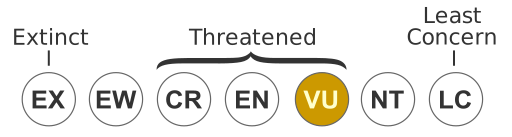
.jpg)

