|
|
| Line 1: |
Line 1: |
| {{Short description|Class of animals with milk-producing glands}}
| |
| {{About|the animal class|other uses|}}
| |
| {{Redirect|Mammalian|the 2010 documentary film|Mammalian (film){{!}}''Mammalian'' (film)}}
| |
| {{Redirect|Mammalia|the journal|Mammalia (journal){{!}}''Mammalia'' (journal)}}
| |
| {{pp-semi-indef}}
| |
| <!--short description should remain under 40 characters-->
| |
| {{pp-move-indef}}
| |
| {{Good article}}
| |
| {{EngvarB|date=June 2022}}
| |
| {{Use dmy dates|date=June 2022}}
| |
| {{Automatic taxobox | | {{Automatic taxobox |
| | name = Mammals | | | name = Mammalia |
| | fossil_range = {{Fossil range|167|0|[[Late Triassic]]–Recent; 225 or 167–0 Ma| earliest=225|PS= See [[#variations|discussion of dates]] in text}} | | | fossil_range = 225–0 mya (Kemp)<ref name=Kemp/> <br/>or 167–0 mya (Rowe)<ref name=Rowe>Rowe T. 1988. Definition, diagnosis, and origin of Mammalia. ''Journal of Vertebrate Paleontology'' '''8''' (3): 241–264.</ref> |
| <!-- Ambondro, Amphilestes and Amphitherium are dated about 167 Ma, providing the date for the monotreme-therian divergence. Adelobasilius and Tikitherium are dated 225 Ma, the date used for the first known mammals as determined morphologically . -->
| |
| |image = <imagemap> | | |image = <imagemap> |
| File:Mammal Diversity 2011.png|300px | | File:Mammal Diversity 2021.jpg|300px |
|
| |
|
| rect 0 0 176 125 [[common vampire bat]] | | rect 0 0 176 125 [[common vampire bat]] |
| Line 33: |
Line 22: |
| rect 530 120 350 240 [[northern elephant seal]] | | rect 530 120 350 240 [[northern elephant seal]] |
| rect 530 240 350 380 [[African elephant]] | | rect 530 240 350 380 [[African elephant]] |
| rect 530 380 350 500 [[elk]] | | rect 530 380 350 500 [[reindeer]] |
| rect 530 500 350 600 [[giant panda]] | | rect 530 500 350 600 [[giant panda]] |
| rect 530 760 350 620 [[black and rufous elephant shrew]] | | rect 530 760 350 620 [[black and rufous elephant shrew]] |
| Line 42: |
Line 31: |
| | subdivision_ranks = Living subgroups | | | subdivision_ranks = Living subgroups |
| | subdivision = | | | subdivision = |
| *[[Monotremata]] | | *Subclass [[Prototheria]] |
| *[[Theria]] | | **Infraclass [[Australosphenida]] |
| **[[Marsupialia]] | | ***Order [[Monotreme|Monotremata]] |
| **[[Placentalia]] | | *Subclass [[Theria]] |
| | **Infraclass [[Metatheria]] |
| | **Infraclass [[Eutheria]] |
| }} | | }} |
| '''Mammals''' ({{etymology|la|{{wikt-lang|la|mamma}}|breast}}) are a group of [[vertebrate]]s constituting the [[class (biology)|class]] '''Mammalia''' ({{IPAc-en|m|ə|ˈ|m|eɪ|l|i|.|ə}}), characterized by the presence of [[mammary gland]]s which in [[Female#Mammalian female|females]] produce [[milk]] for feeding (nursing) their young, a [[neocortex]] (a region of the brain), [[fur]] or [[hair]], and three [[ossicles|middle ear bones]]. These characteristics distinguish them from [[reptile]]s (including [[bird]]s) from which they [[Genetic divergence|diverged]] in the [[Carboniferous]], over 300 million years ago. Around 6,400 [[extant taxon|extant]] [[species]] of mammals have been described. The largest [[Order (biology)|orders]], in terms of number of species, are the [[rodents]], [[bats]], and [[Eulipotyphla]] ([[hedgehog]]s, [[Mole (animal)|mole]]s, [[shrew]]s, and others). The next three are the [[Primate]]s (including [[human]]s, [[ape]]s, [[monkey]]s, and others), the [[Artiodactyla]] ([[cetacean]]s and [[even-toed ungulate]]s), and the [[Carnivora]] ([[cat]]s, [[dog]]s, [[pinniped|seals]], and others).
| |
|
| |
|
| In terms of [[cladistics]], which reflects evolutionary history, mammals are the only living members of the [[Synapsid]]a (synapsids); this [[clade]], together with [[Sauropsida]] (reptiles and birds), constitutes the larger [[amniote|Amniota]] clade. The early synapsids were [[Sphenacodontia|sphenacodonts]], a group that included the famous ''[[Dimetrodon]]''. The synapsids split into several diverse groups of non-mammalian synapsids — traditionally and incorrectly referred to as mammal-like reptiles or by the term pelycosaurs, and now known as stem mammals or protomammals — before giving rise to [[Therapsida|therapsids]] during the beginning of the [[Guadalupian|Middle Permian]] period. Mammals originated from [[cynodont]]s, an advanced group of therapsids, during the [[Early Jurassic]]. The modern mammalian orders arose in the [[Paleogene]] and [[Neogene]] periods of the [[Cenozoic]] era, after the [[Cretaceous–Paleogene extinction event|extinction of non-avian dinosaurs]], and have been the dominant terrestrial animal group from 66 million years ago to the present.
| | The [[class (biology)|class]] '''Mammalia''' (from [[Latin]] {{lang|la|mamma}}, 'breast') are a group of [[vertebrate]] [[animal]]s.<ref>Szalay F.S. 1999. Classification of mammals above the species level: Review. ''Journal of Vertebrate Paleontology'' '''19''' (1): 191–195. [[doi:10.1080/02724634.1999.10011133]]. [[JSTOR]] 4523980.</ref> They have [[fur]] or [[hair]] and a very precise kind of [[homoiothermy|temperature regulation]]. |
|
| |
|
| The basic body type is [[quadruped]], and most mammals use their four extremities for [[terrestrial locomotion]]; but in some, the extremities are adapted for [[marine mammal|life at sea]], in [[aerial locomotion|the air]], [[arboreal locomotion|in trees]], [[fossorial|underground]], or [[bipedalism|on two legs]]. Mammals range in size from the {{convert|30|–|40|mm|abbr=on}} [[bumblebee bat]] to the {{convert|30|m|abbr=on}} [[blue whale]]—possibly the largest animal to have ever lived. Maximum lifespan varies from two years for the shrew to 211 years for the [[bowhead whale]]. All modern mammals give birth to live young, except the five species of [[monotreme]]s, which are egg-laying mammals. The most species-rich group of mammals, the [[Cohort (taxonomy)|cohort]] called [[placentals]], have a [[placenta]], which enables the feeding of the fetus during [[gestation]].
| | With the exception of the [[monotreme]]s, all mammals bear live young. Unlike other [[vertebrate]]s, they are the only animals that produce milk for the young through their mammary glands. Parental care of the young is universal among mammals, sometimes for extended periods. |
|
| |
|
| Most mammals are [[animal cognition|intelligent]], with some possessing large brains, [[self-awareness]], and [[tool use in animals|tool use]]. Mammals can communicate and vocalize in several ways, including the production of [[ultrasound]], [[scent-marking]], [[alarm signal]]s, [[Singing#Singing animals|singing]], and [[Animal echolocation|echolocation]]. Mammals can organize themselves into [[fission-fusion society|fission-fusion societies]], [[harem (zoology)|harems]], and [[hierarchy|hierarchies]]—but can also be solitary and [[Territory (animal)|territorial]]. Most mammals are [[polygyny in animals|polygynous]], but some can be [[monogamy in animals|monogamous]] or [[Polyandry in nature|polyandrous]].
| | Mammals became the dominant land animals after non-bird [[dinosaurs]] were eliminated. Recent work helped to explain their success: [[epigenetics]] seems to have started in early mammals.<ref>Butler 2009. ''Journal of Assisted Reproduction and Genetics''. p477–486.</ref> |
|
| |
|
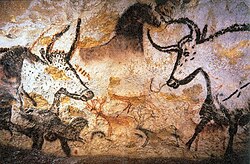
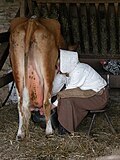
| [[Domestication]] of many types of mammals by humans played a major role in the [[Neolithic revolution]], and resulted in [[agriculture|farming]] replacing [[hunter-gatherer|hunting and gathering]] as the primary source of food for humans. This led to a major restructuring of human societies from nomadic to sedentary, with more co-operation among larger and larger groups, and ultimately the development of the first [[civilization]]s. Domesticated mammals provided, and continue to provide, power for transport and agriculture, as well as food ([[meat]] and [[dairy product]]s), [[fur]], and [[leather]]. Mammals are also [[hunting|hunted]] and raced for sport, and are used as [[model organism]]s in science. Mammals have been depicted in [[art]] since [[Paleolithic]] times, and appear in literature, film, mythology, and religion. Decline in numbers and [[extinction]] of many mammals is primarily driven by human [[poaching]] and [[habitat destruction]], primarily [[deforestation]]. | | ==Main characteristics== |
| {{TOC limit|4}}
| | ===Reproductive cycle=== |
| | Most [[marsupial]] and [[eutherian]] mammals have a reproductive cycle known as the [[oestrous cycle]] (U.S: estrous cycle). Females are sexually active only during the oestrous stage, when they are 'on heat' for a few days each month. If an [[ovum]] is not fertilized, the [[endometrium]] ([[uterus]] lining) is resorbed. Oestrus cycles may occur once or twice a year, or many times a year. Each group of mammals has its own frequency. |
|
| |
|
| ==Classification==
| | [[Human]]s and [[primate]]s, are quite different. They have a [[menstrual cycle]]. In this case, females are sexually receptive at any time, but only fertile when an ovum is released from an ovary. In this case, the endometrium (if not needed for an fertilised egg) is discarded. The endometrium is shed, and takes with it a certain amount of blood. In this system, eggs are released from the ovaries mostly in the middle of the cycle, away from the menstrual period. This [[ovulation]] is 'concealed', meaning, it is not obvious when it occurs. This process, so it is thought, tends to keep the male and female together, which is unusual in mammals with the oestrous cycle. |
| {{Main|Mammal classification}}
| |
| {{See also|List of placental mammals|List of monotremes and marsupials|List of mammal genera|List of mammal species}}
| |
| [[File:Mammal species pie chart.svg|thumb|upright=1.35|Over 70% of mammal species come from the orders [[Rodent]]ia, rodents (blue); [[Chiroptera]], bats (red); and [[Soricomorpha]], shrews (yellow). | |
| {|
| |
| | style="width:150px; vertical-align:top"|
| |
| {{legend|#63aafe|[[Rodentia]]}}
| |
| {{legend|#dd2d32|[[Chiroptera]]}}
| |
| {{legend|#fff58c|[[Soricomorpha]]}}
| |
| {{legend|#4ee257|[[Primates]]}}
| |
| {{legend|#6711ff|[[Carnivora]]}}
| |
| {{legend|#fea746|[[Artiodactyla]]}}
| |
| {{legend|#865357|[[Diprotodontia]]}}
| |
| {{legend|#a2bd90|[[Lagomorpha]]}}
| |
| {{legend|#00ccff|[[Didelphimorphia]]}}
| |
| {{legend|#ccffff|[[Cetacea]]}}
| |
| {{legend|#ccffcc|[[Dasyuromorphia]]}}
| |
| | style="width:150px; vertical-align:top"|
| |
| {{legend|#ffff99|[[Afrosoricida]]}}
| |
| {{legend|#99ccff|[[Erinaceomorpha]]}}
| |
| {{legend|#ff99cc|[[Cingulata]]}}
| |
| {{legend|#cc99ff|[[Peramelemorphia]]}}
| |
| {{legend|#ffcc99|[[Scandentia]]}}
| |
| {{legend|#3366ff|[[Perissodactyla]]}}
| |
| {{legend|#33cccc|[[Macroscelidea]]}}
| |
| {{legend|#99cc00|[[Pilosa]]}}
| |
| {{legend|#ff6600|[[Monotremata]]}}
| |
| {{legend|#003366|[[Sirenia]]}}
| |
| {{legend|#00aa55|[[Proboscidea]]}}
| |
| |}]]
| |
|
| |
|
| Mammal classification has been through several revisions since [[Carl Linnaeus]] initially defined the class, and at present, no classification system is universally accepted. McKenna & Bell (1997) and Wilson & Reeder (2005) provide useful recent compendiums.<ref>{{cite book | vauthors = Vaughan TA, Ryan JM, Czaplewski NJ |year=2013 |chapter=Classification of Mammals |title=Mammalogy |edition=6 |publisher=Jones and Bartlett Learning |isbn=978-1-284-03209-3}}</ref> [[George Gaylord Simpson|Simpson]] (1945)<ref name=Simpson-1945>{{cite journal | vauthors = Simpson GG |author-link=George Gaylord Simpson |title=Principles of classification, and a classification of mammals |journal=[[American Museum of Natural History]] |volume=85 |year=1945}}</ref> provides [[systematics]] of mammal origins and relationships that had been taught universally until the end of the 20th century.
| | ===Skeleton=== |
| However, since 1945, a large amount of new and more detailed information has gradually been found: The [[fossil record|paleontological record]] has been recalibrated, and the intervening years have seen much debate and progress concerning the theoretical underpinnings of systematization itself, partly through the new concept of [[cladistics]]. Though fieldwork and lab work progressively outdated Simpson's classification, it remains the closest thing to an official classification of mammals, despite its known issues.<ref name=Szalay>{{cite journal | vauthors = Szalay FS |year=1999 |title=Classification of mammals above the species level: Review |journal=Journal of Vertebrate Paleontology |volume=19 |number=1 |pages=191–195 |jstor=4523980 |doi=10.1080/02724634.1999.10011133}}</ref>
| | One [[diagnosis|diagnostic]] feature of mammals is the lower [[jaw]]. Unlike earlier forms, it is a single bone, the [[dentary]]. This is one feature which can be seen in fossils, or at least those which are complete enough to have the lower jaw. Another diagnostic feature is the [[ear ossicles]]. Mammals have three little bones in their inner ear. These ear ossicles are bones which were, long ago, part of the lower jaw in early proto-mammals. |
|
| |
|
| Most mammals, including the six most species-rich [[order (biology)|orders]], belong to the placental group. The three largest orders in numbers of species are [[Rodent]]ia: [[Mouse|mice]], [[rat]]s, [[porcupine]]s, [[beaver]]s, [[capybara]]s, and other gnawing mammals; [[Chiroptera]]: bats; and [[Soricomorpha]]: [[shrew]]s, [[Mole (animal)|moles]], and [[solenodon]]s. The next three biggest orders, depending on the [[biological classification]] scheme used, are the [[Primate]]s: [[ape]]s, [[monkey]]s, and [[lemur]]s; the [[Cetartiodactyla]]: [[whale]]s and [[even-toed ungulates]]; and the [[Carnivora]] which includes [[cat]]s, [[dog]]s, [[weasel]]s, [[bear]]s, [[Pinniped|seals]], and allies.<ref name=MSW3intro>{{MSW3 |heading=Preface and introductory material |page=xxvi |name-list-style=vanc }}</ref> According to ''[[Mammal Species of the World]]'', 5,416 species were identified in 2006. These were grouped into 1,229 [[genus|genera]], 153 [[family (biology)|families]] and 29 orders.<ref name="MSW3intro"/> In 2008, the [[International Union for Conservation of Nature]] (IUCN) completed a five-year Global Mammal Assessment for its [[IUCN Red List]], which counted 5,488 species.<ref>{{cite web |title=Mammals |work=The IUCN Red List of Threatened Species |date=April 2010 |publisher=[[International Union for Conservation of Nature]] (IUCN) |url=http://www.iucnredlist.org/initiatives/mammals|access-date=23 August 2016}}</ref> According to research published in the ''[[Journal of Mammalogy]]'' in 2018, the number of recognized mammal species is 6,495, including 96 recently extinct.<ref>{{cite journal | vauthors = Burgin CJ, Colella JP, Kahn PL, Upham NS |date=1 February 2018 |title=How many species of mammals are there? |journal=[[Journal of Mammalogy]] |volume=99 |issue=1 |pages=1–14 |doi=10.1093/jmammal/gyx147 |doi-access=free}}</ref>
| | There are quite a number of other features in the skull and limbs, so that it is usually possible to identify and describe a mammal from its skeleton alone, or even a partial skeleton. |
|
| |
|
| ===Definitions {{Anchor|variations}}=== | | ===Neocortex and behavior=== |
| <!-- This section is linked from the fossil_range parameter in the taxobox -->
| | Another diagnostic feature is the [[Cerebral cortex#Neocortex|neocortex]] of the [[Vertebrate brain|brain]], which no other vertebrate has. This is involved in the kind of flexible [[behavior]] and [[learning]] typical of mammals. Reptiles and birds have much of their behavior controlled by "inherited behavior chains", which roughly translates as "[[instinct]]s". Almost all animals can do some learning, but mammals do far more than other vertebrates. Their behavior is much more flexible than [[lizards]], for example, and that is made possible by their neocortex. |
| The word "[[:wikt:mammal|mammal]]" is modern, from the scientific name ''Mammalia'' coined by Carl Linnaeus in 1758, derived from the [[Latin language|Latin]] ''[[wikt:mamma#Latin|mamma]]'' ("teat, pap"). In an influential 1988 paper, Timothy Rowe defined Mammalia [[Phylogenetics|phylogenetically]] as the [[crown group]] of mammals, the [[clade]] consisting of the [[most recent common ancestor]] of living [[monotreme]]s ([[echidna]]s and [[platypus]]es) and [[Theria]]n mammals ([[marsupial]]s and [[placental]]s) and all descendants of that ancestor.<ref>{{cite journal |vauthors=Rowe T |year=1988 |title=Definition, diagnosis, and origin of Mammalia |journal=Journal of Vertebrate Paleontology |volume=8 |issue=3 |pages=241–264 |url=http://www.geo.utexas.edu/faculty/rowe/Publications/pdf/010%20Rowe%201988.pdf |doi=10.1080/02724634.1988.10011708}}</ref> Since this ancestor lived in the [[Jurassic]] period, Rowe's definition excludes all animals from the earlier [[Triassic]], despite the fact that Triassic fossils in the [[Haramiyida]] have been referred to the Mammalia since the mid-19th century.<ref>{{cite book |title=The Student's Elements of Geology | vauthors = Lyell C |author-link=Charles Lyell |year=1871 |publisher=John Murray |location=London, UK |page=347 |url={{Google books|plainurl=yes|id=634gAQAAIAAJ|page=347}} |isbn=978-1-345-18248-4}}</ref> If Mammalia is considered as the crown group, its origin can be roughly dated as the first known appearance of animals more closely related to some extant mammals than to others. ''[[Ambondro mahabo|Ambondro]]'' is more closely related to monotremes than to therian mammals while ''[[Amphilestes]]'' and ''[[Amphitherium]]'' are more closely related to the therians; as fossils of all three genera are dated about {{ma|167|million years ago}} in the [[Middle Jurassic]], this is a reasonable estimate for the appearance of the crown group.<ref>{{cite journal |vauthors=Cifelli RL, Davis BM |title=Paleontology. Marsupial origins |journal=Science |volume=302 |issue=5652 |pages=1899–900 |date=December 2003 |pmid=14671280 |doi=10.1126/science.1092272|s2cid=83973542 }}</ref>
| |
|
| |
|
| T.S. Kemp has provided a more traditional definition: "[[Synapsid]]s that possess a [[dentary]]–[[squamosal bone|squamosal]] jaw articulation and [[Occlusion (dentistry)|occlusion]] between upper and lower molars with a transverse component to the movement" or, equivalently in Kemp's view, the clade originating with the last common ancestor of ''[[Sinoconodon]]'' and living mammals.<ref>{{cite book |url=http://doc.rero.ch/record/200125/files/PAL_E3904.pdf |location=United Kingdom |title=The Origin and Evolution of Mammals |vauthors=Kemp TS |year=2005 |publisher=Oxford University Press |isbn=978-0-19-850760-4 |page=3 |oclc=232311794}}</ref> The earliest known synapsid satisfying Kemp's definitions is ''[[Tikitherium]]'', dated {{ma|225|Ma}}, so the appearance of mammals in this broader sense can be given this [[Late Triassic]] date.<ref>{{cite journal |vauthors=Datta PM |year=2005 |title=Earliest mammal with transversely expanded upper molar from the Late Triassic (Carnian) Tiki Formation, South Rewa Gondwana Basin, India |journal=Journal of Vertebrate Paleontology |volume=25 |issue=1 |pages=200–207 |doi=10.1671/0272-4634(2005)025[0200:EMWTEU]2.0.CO;2|s2cid=131236175 }}</ref><ref>{{cite journal | vauthors = Luo ZX, Martin T |year=2007 |title=Analysis of Molar Structure and Phylogeny of Docodont Genera |journal=Bulletin of Carnegie Museum of Natural History |volume=39 |pages=27–47 |doi=10.2992/0145-9058(2007)39[27:AOMSAP]2.0.CO;2 |s2cid=29846648 |url=http://xa.yimg.com/kq/groups/13543816/1018125207/name/Luo+y+Martin+2007-+molar+structure+and+phylogeny+of+docodonts.pdf |access-date=8 April 2013 |archive-url=https://web.archive.org/web/20160303225517/http://xa.yimg.com/kq/groups/13543816/1018125207/name/Luo+y+Martin+2007-+molar+structure+and+phylogeny+of+docodonts.pdf |archive-date=3 March 2016 |url-status=dead }}</ref>
| | Other things in the life of mammals seem to be connected with this flexibility and learning. [[Play (activity)|Play]] is a kind of early learning period in which, according to one theory,<ref>Burghardt, Gordon M. 2006. ''The genesis of animal play: testing the limits''. MIT Press, p11. {{ISBN|0-262-02543-4}}</ref> mammals develop skills which they will need in life. All mammalian young play, and this is very obvious in the more intelligent mammals ([[primate]]s, [[cats]]). |
|
| |
|
| ===McKenna/Bell classification===
| | The [[emotions]] of mammals are very noticeable, and rather similar to ours. It is possible, and quite common, for humans to have a friendly relationship with another mammal. It is quite impossible for a human to have any kind of relationship with a snake or a [[gecko]] (for example). This is because the reptile simply does not have the same basic emotions as a human. |
| {{See also|Mammal classification#McKenna/Bell classification}}
| |
| In 1997, the mammals were comprehensively revised by [[Malcolm McKenna|Malcolm C. McKenna]] and Susan K. Bell, which has resulted in the McKenna/Bell classification. The authors worked together as [[paleontologist]]s at the [[American Museum of Natural History]]. McKenna inherited the project from Simpson and, with Bell, constructed a completely updated hierarchical system, covering living and extinct taxa, that reflects the historical genealogy of Mammalia.<ref name=Szalay/> Their 1997 book, ''Classification of Mammals above the Species Level'',<ref name="McKennaBell1997">{{cite book | vauthors = McKenna MC, Bell SG | year=1997 | title=Classification of Mammals above the Species Level |place=New York, NY | publisher=Columbia University Press | isbn=978-0-231-11013-6 | oclc=37345734}}</ref> is a comprehensive work on the systematics, relationships and occurrences of all mammal taxa, living and extinct, down through the rank of genus, though molecular genetic data challenge several of the groupings.
| |
|
| |
|
| In the following list, [[extinct]] groups are labelled with a [[Dagger (typography)|dagger]] (†).
| | ===Other items=== |
| | There are about 50 characters which are typical of mammals: some of the most important are discussed above. A few more examples will make it clear that mammals are very different from reptiles and birds: |
| | *[[Sweat]] glands |
| | *Tooth replacement: two sets, and no continuous replacement. Enamel on the tooth surface. Reptile teeth are all alike (apart from size); mammal [[teeth]] follow a set pattern (starting at the front): [[incisor]]s, [[canine]]s, [[premolar]]s and [[molar]]s. |
| | *Occipital condyles. Two knobs at the base of the skull fit into the topmost neck [[vertebra]]; most [[tetrapods]] have only one such knob. |
| | *With the exception of the five monotreme species, all other mammals have an outlet for food waste which is separate from the [[urinogenital]] outlet. Monotremes, reptiles and birds have a common [[cloaca]] at the rear. |
| | *Mammals [[excretion|excrete]] [[urea]]; reptiles and birds excrete [[uric acid]]. |
| | *[[Colour vision]] is defective or absent in almost all mammals. [[Primate]]s are the exception, but we know their colour vision re-evolved from ancestors which lacked it. |
| | *In reptiles and birds the blood vessel which carries oxygenated blood from the left ventricle of the heart is on the right side of the body; but in mammals it is on the left side.<ref>Kermack D.M. & K.A. 1984. ''The evolution of mammalian characters''. London: Croom Helm, p6. {{ISBN|0-7099-1534-9}}</ref> |
| | *There are many features of the skeleton that mammals share |
| | **Their neck almost always has seven vertebrae, no matter how long it is. |
| | **Their lower jaw is made of just a single bone on each side, the [[dentary]]. |
| | **Their [[inner ear]] has three tiny bones, the [[ossicles]]: malleus, incus and stapes. |
|
| |
|
| '''Class Mammalia'''
| | In the language of [[cladistics]], the 50 unique characters are [[apomorphy|apomorphies]] which prove that mammals are a [[clade]] descended from a [[common ancestor]].<ref name=Kemp>Kemp T.S. 2005. ''The origin and evolution of mammals''. Oxford University Press, p2. {{ISBN|0-19-850761-5}}</ref> |
| * '''Subclass [[Prototheria]]''': monotremes: [[echidna]]s and the [[platypus]]
| |
| * '''Subclass [[Theriiformes]]''': live-bearing mammals and their prehistoric relatives
| |
| ** Infraclass †[[Allotheria]]: multituberculates
| |
| ** Infraclass †[[Eutriconodonta]]: eutriconodonts
| |
| ** Infraclass [[Holotheria]]: modern live-bearing mammals and their prehistoric relatives
| |
| *** Superlegion †[[Kuehneotheria]]
| |
| *** Supercohort [[Theria]]: live-bearing mammals
| |
| **** Cohort [[Marsupialia]]: marsupials
| |
| ***** Magnorder [[Australidelphia]]: Australian marsupials and the [[monito del monte]]
| |
| ***** Magnorder [[Ameridelphia]]: New World marsupials. Now considered paraphyletic, with [[shrew opossum]]s being closer to australidelphians.<ref>{{cite journal | vauthors = Nilsson MA, Churakov G, Sommer M, Tran NV, Zemann A, Brosius J, Schmitz J | title = Tracking marsupial evolution using archaic genomic retroposon insertions | journal = PLOS Biology | volume = 8 | issue = 7 | pages = e1000436 | date = July 2010 | pmid = 20668664 | pmc = 2910653 | doi = 10.1371/journal.pbio.1000436 }}</ref>
| |
| **** Cohort [[Placentalia]]: placentals
| |
| ***** Magnorder [[Xenarthra]]: xenarthrans
| |
| ***** Magnorder [[Epitheria]]: epitheres
| |
| ****** Superorder †[[Leptictida]]
| |
| ****** Superorder [[Preptotheria]]
| |
| ******* Grandorder [[Glires|Anagalida]]: [[Lagomorpha|lagomorphs]], [[rodent]]s and [[elephant shrew]]s
| |
| ******* Grandorder [[Ferae]]: [[carnivora]]ns, [[pangolin]]s, †[[creodont]]s and relatives
| |
| ******* Grandorder [[Lipotyphla]]: [[insectivora]]ns
| |
| ******* Grandorder [[Archonta]]: [[bat]]s, [[primate]]s, [[colugo]]s and [[treeshrew]]s (now considered paraphyletic, with bats being closer to other groups)
| |
| ******* Grandorder [[Ungulata]]: ungulates
| |
| ******** Order [[Tubulidentata]] ''[[incertae sedis]]'': [[aardvark]]
| |
| ******** Mirorder [[Eparctocyona]]: †[[condylarth]]s, [[whale]]s and [[artiodactyla|artiodactyls]] (even-toed ungulates)
| |
| ******** Mirorder †[[Meridiungulata]]: South American ungulates
| |
| ******** Mirorder [[Altungulata]]: [[Perissodactyla|perissodactyls]] (odd-toed ungulates), [[elephant]]s, [[manatee]]s and [[hyrax]]es
| |
|
| |
|
| ===Molecular classification of placentals=== | | ==Main groups== |
| As of the early 21st century, molecular studies based on [[DNA]] analysis have suggested new relationships among mammal families. Most of these findings have been independently validated by [[retrotransposon]] [[retrotransposon marker|presence/absence data]].<ref name=Kriegs2006>{{cite journal | vauthors = Kriegs JO, Churakov G, Kiefmann M, Jordan U, Brosius J, Schmitz J | title = Retroposed elements as archives for the evolutionary history of placental mammals | journal = PLOS Biology | volume = 4 | issue = 4 | pages = e91 | date = April 2006 | pmid = 16515367 | pmc = 1395351 | doi = 10.1371/journal.pbio.0040091 }}</ref> Classification systems based on molecular studies reveal three major groups or lineages of placental mammals—[[Afrotheria]], [[Xenarthra]] and [[Boreoeutheria]]—which [[Speciation|diverged]] in the [[Cretaceous]]. The relationships between these three lineages is contentious, and all three possible hypotheses have been proposed with respect to which group is [[Basal (phylogenetics)|basal]]. These hypotheses are [[Atlantogenata]] (basal Boreoeutheria), [[Epitheria]] (basal Xenarthra) and [[Exafroplacentalia]] (basal Afrotheria).<ref name=Nishiharaetal2009>{{cite journal | vauthors = Nishihara H, Maruyama S, Okada N | title = Retroposon analysis and recent geological data suggest near-simultaneous divergence of the three superorders of mammals | journal = Proceedings of the National Academy of Sciences of the United States of America | volume = 106 | issue = 13 | pages = 5235–40 | date = March 2009 | pmid = 19286970 | pmc = 2655268 | doi = 10.1073/pnas.0809297106 | bibcode = 2009PNAS..106.5235N | doi-access = free }}</ref> Boreoeutheria in turn contains two major lineages—[[Euarchontoglires]] and [[Laurasiatheria]].
| | All mammals feed milk to their young, and protect and look after them. |
|
| |
|
| Estimates for the divergence times between these three placental groups range from 105 to 120 million years ago, depending on the type of DNA used (such as [[nuclear DNA|nuclear]] or [[mitochondrial DNA|mitochondrial]])<ref>{{cite journal | vauthors = Springer MS, Murphy WJ, Eizirik E, O'Brien SJ | title = Placental mammal diversification and the Cretaceous-Tertiary boundary | journal = Proceedings of the National Academy of Sciences of the United States of America | volume = 100 | issue = 3 | pages = 1056–61 | date = February 2003 | pmid = 12552136 | pmc = 298725 | doi = 10.1073/pnas.0334222100 | bibcode = 2003PNAS..100.1056S | doi-access = free }}</ref> and varying interpretations of [[paleogeographic]] data.<ref name=Nishiharaetal2009/>
| | The vast majority of mammal species give [[birth]] to live young, these are the [[placenta]]l mammals, most of which are classified as [[Eutheria]] and a small number are classified as [[marsupials]].<ref>Vaughan T.A; Ryan J.M. & Czaplewski N.J. 2013. Classification of Mammals in ''Mammalogy'' (6 ed). Jones and Bartlett Learning. ISBN 978-1-284-03209-3</ref> |
|
| |
|
| {{clade| style=font-size:100%;line-height:100%
| | Marsupials are mammals with pouches to carry young in, like the [[kangaroo]]. |
| |label1='''Mammalia'''
| |
| |1={{Clade
| |
| |1=[[Monotremata]] [[File:Genera mammalium Ornithorhynchus anatinus.jpg|50 px|''Ornithorhynchus anatinus'']]
| |
| |label2=[[Theria]]
| |
| |2={{Clade
| |
| |1=[[Marsupialia]] [[File:A monograph of the Macropodidæ, or family of kangaroos (9398404841) white background.jpg|50 px|Macropodidæ]]
| |
| |label2=[[Placentalia]]
| |
| |2={{Clade
| |
| |label1=[[Atlantogenata]]
| |
| |1={{Clade
| |
| |1=[[Afrotheria]] [[File:Indian elephant white background.jpg|50 px|''Elephas maximus'']] [[File:Manatee white background.jpg|50 px|''Trichechus'']]
| |
| |2=[[Xenarthra]] [[File:Nine-banded-Armadillo white background.jpg|50 px|''Dasypus novemcinctus'']] [[File:Natural history of the animal kingdom for the use of young people (Plate XV) (Myrmecophaga tridactyla).jpg|50 px|''Myrmecophaga tridactyla'']]
| |
| }}
| |
| |label2=[[Boreoeutheria]]
| |
| |2={{Clade
| |
| |label1=[[Euarchontoglires]]
| |
| |1={{Clade
| |
| |1=[[Euarchonta]] [[File:Die Säugthiere in Abbildungen nach der Natur, mit Beschreibungen (Plate 8) (white background).jpg|50 px|''Cebus olivaceus'']] [[File:Bechuana of Distinction-1841 (white background).jpg|50 px|''Homo sapiens'']]
| |
| |2=[[Glires]] [[File:Ruskea rotta.png|50 px|''Rattus'']] [[File:Bruno Liljefors - Hare studies 1885 white background.jpg|50 px|''Lepus'']]
| |
| }}
| |
| |label2=[[Laurasiatheria]]
| |
| |2={{Clade
| |
| |1=[[Eulipotyphla]] [[File:Mole white background.jpg|50 px|Talpidae]]
| |
| |label2=[[Scrotifera]]
| |
| |2={{Clade
| |
| |1=[[Chiroptera]] [[File:Vampire bat white background.jpg|50 px|Desmodontinae]]
| |
| |label2=
| |
| |2={{Clade
| |
| |label1=[[Euungulata]]
| |
| |1={{Clade
| |
| |1=[[Artiodactyla]] [[File:Walia ibex illustration white background.png|50 px|''Capra walie'']] [[File:Eubalaena glacialis NOAA.jpg|70 px|''Eubalaena glacialis'']]
| |
| |2=[[Perissodactyla]] [[File:Equus quagga (white background).jpg|50 px|''Equus quagga'']] [[File:Rhino white background.jpg|50 px|''Diceros bicornis'']]
| |
| }}
| |
| |label2=[[Ferae]]
| |
| |2={{Clade
| |
| |1=[[Pholidota]] [[File:FMIB 46859 Pangolin a grosse queue white background.jpeg|50 px|Manidae]]
| |
| |2=[[Carnivora]] [[File:Cynailurus guttata - 1818-1842 - Print - Iconographia Zoologica - Special Collections University of Amsterdam - (white background).jpg|50px|''Acinonyx jubatus'']] [[File:Zalophus californianus J. Smit (white background).jpg|50 px|''Zalophus californianus'']]
| |
| }}
| |
| }}
| |
| }}
| |
| }}
| |
| }}
| |
| }}
| |
| }}
| |
| }}
| |
| }}
| |
|
| |
|
| The [[cladogram]] above is based on Tarver ''et al''. (2016)<ref>{{cite journal | vauthors = Tarver JE, Dos Reis M, Mirarab S, Moran RJ, Parker S, O'Reilly JE, King BL, O'Connell MJ, Asher RJ, Warnow T, Peterson KJ, Donoghue PC, Pisani D | display-authors = 6 | title = The Interrelationships of Placental Mammals and the Limits of Phylogenetic Inference | journal = Genome Biology and Evolution | volume = 8 | issue = 2 | pages = 330–44 | date = January 2016 | pmid = 26733575 | pmc = 4779606 | doi = 10.1093/gbe/evv261 | hdl = 1983/64d6e437-3320-480d-a16c-2e5b2e6b61d4 }}</ref>
| | There are only five species (the [[monotreme]] mammals) that lay [[Cleidoic egg|eggs]], the duck-billed [[platypus]] ''Ornithorhynchus'', and four species of spiny anteater ''[[Echidna]]''. The [[monotreme]]s are confined to [[Australia]] and [[New Guinea]], and are the sole survivors of an earlier group of mammals. |
|
| |
|
| ==Evolution== | | ==Modes of life== |
| {{Main|Evolution of mammals}} | | By number of species, mammals (with 5488 species),<ref>{{cite web | title=Initiatives | work=The IUCN Red List of threatened species | date=April 2010 | publisher=IUCN | url=http://www.iucnredlist.org/initiatives}}</ref> are not the most successful vertebrates. Birds, with about 10,000 species have nearly twice as many,<ref>{{Cite book|title=The Clements checklist of birds of the world |url=https://archive.org/details/clementschecklis0000clem |first=James F. |last=Clements |edition=6th |location=Ithaca |publisher=Cornell University Press |year=2007 |isbn=978-0-8014-4501-9}}</ref><ref>{{Cite book|last=Gill |first=Frank |year=2006 |title=Birds of the world: recommended English names |url=https://archive.org/details/birdsofworldreco0000gill |location=Princeton |publisher=Princeton University Press |isbn=978-0-691-12827-6}}</ref> and reptiles have just as many as birds.<ref>[http://www.reptile-database.org/ The Reptile Database]</ref> Fish have even more species. There are 27,000 species of fish, of which nearly 26,000 are bony fish.<ref>Nelson, Joseph S. 2006. ''Fishes of the World''. 4th ed, John Wiley. {{ISBN|9780471756446}} [https://web.archive.org/web/20130305052159/http://www.somas.stonybrook.edu/~conover/Textbooks/Fishes%20of%20the%20World,%204th%20ed.%20Joseph%20S.%20Nelson.pdf]</ref> |
|
| |
|
| ===Origins===
| | Despite this, many zoologists do regard mammals as a successful group of animals. One reason is that they are successful in all [[habitats]] on Earth. In the air, in the water, in [[forests]], in the colder regions of the world, and above all on [[grasslands]], where they are outstandingly successful. |
| [[Synapsida]], a clade that contains mammals and their extinct relatives, originated during the [[Pennsylvanian (geology)|Pennsylvanian subperiod]] (~323 million to ~300 million years ago), when they split from the reptile lineage. Crown group mammals evolved from earlier [[Mammaliaformes|mammaliaforms]] during the [[Early Jurassic]]. The cladogram takes Mammalia to be the crown group.<ref name=Liaoconodon2011>{{cite journal | vauthors = Meng J, Wang Y, Li C | title = Transitional mammalian middle ear from a new Cretaceous Jehol eutriconodont | journal = Nature | volume = 472 | issue = 7342 | pages = 181–5 | date = April 2011 | pmid = 21490668 | doi = 10.1038/nature09921 | bibcode = 2011Natur.472..181M | s2cid = 4428972 }}</ref>
| |
|
| |
|
| {{clade
| | In the air, the [[bats]] ([[Chiroptera]]) are the mammalian order with the most species. They 'own' the nighttime, since birds are largely diurnal (daytime) animals. Bats are hugely successful, mostly as nighttime predators of insects. |
| |label1=[[Mammaliaformes]]
| |
| |1={{clade
| |
| |1=[[Morganucodontidae]] [[File:Morganucodon.jpg|50px]]
| |
| |2={{clade
| |
| |1=[[Docodonta]]
| |
| |2={{clade
| |
| |1=''[[Haldanodon]]''
| |
| |label2='''Mammalia'''
| |
| |2={{clade
| |
| |1=[[Australosphenida]] (incl. [[Monotremata]]) [[File:Steropodon BW.jpg|50px]]
| |
| |2={{clade
| |
| |1=''[[Fruitafossor]]''
| |
| |2={{clade
| |
| |1={{clade
| |
| |1=''[[Haramiyavia]]''
| |
| |2=[[Multituberculata]] [[File:Sunnyodon.jpg|50px]]
| |
| }}
| |
| |2=''[[Tinodon]]''
| |
| |3=[[Eutriconodonta]] (incl. [[Gobiconodonta]]) [[File:Repenomamus BW.jpg|50px]]
| |
| |4=[[Trechnotheria]] (incl. [[Theria]]) [[File:Juramaia NT.jpg|50px]]
| |
| }}
| |
| }}
| |
| }}
| |
| }}
| |
| }}
| |
| }}
| |
| }}
| |
|
| |
|
| ===Evolution from older amniotes===
| | Seagoing mammals, the [[Cetacea]] and the [[pinniped]]s, are very successful and significant [[predator]]s. This includes the [[whale]]s, [[Pinniped|seals]], [[walrus]], [[dolphin]]s and others. |
| [[File:Skull synapsida 1.png|thumb|The original synapsid skull structure contains one [[temporal fenestrae|temporal opening]] behind the [[eye socket|orbitals]], in a fairly low position on the skull (lower right in this image). This opening might have assisted in containing the jaw muscles of these organisms which could have increased their biting strength.]] | |
|
| |
|
| The first fully terrestrial [[vertebrate]]s were [[amniote]]s. Like their amphibious early [[tetrapod]] predecessors, they had lungs and limbs. Amniotic eggs, however, have internal membranes that allow the developing [[embryo]] to breathe but keep water in. Hence, amniotes can lay eggs on dry land, while amphibians generally need to lay their eggs in water. | | The terrestrial mammals are fewer in number of species than [[lizards]], but they are huge in individual numbers, and far more important in the life of the terrestrial [[biome]]s. Their ability to move from place to place and adapt has made them a most effective group. Many mammals live in cold places. These mammals have thick hair or [[blubber]] to keep them warm. Others may live in rainforests. On land the [[rodent]]s (rats, mice) are hugely successful, more common in numbers than any other mammals. Large mammals on land have been hunted to [[extinct]]ion in some parts of the world, but the ones which remain are now better protected. |
|
| |
|
| The first amniotes apparently arose in the Pennsylvanian subperiod of the [[Carboniferous]]. They descended from earlier [[Reptiliomorpha|reptiliomorph]] amphibious tetrapods,<ref name="AhlbergMilner1994OriginOfTetrapods">{{cite journal| vauthors = Ahlberg PE, Milner AR |date=April 1994| title=The Origin and Early Diversification of Tetrapods | journal= Nature | volume=368 | pages=507–514| doi=10.1038/368507a0| issue=6471|bibcode = 1994Natur.368..507A |s2cid=4369342}}</ref> which lived on land that was already inhabited by [[insect]]s and other invertebrates as well as [[fern]]s, [[moss]]es and other plants. Within a few million years, two important amniote lineages became distinct: the [[synapsid]]s, which would later include the common ancestor of the mammals; and the [[sauropsid]]s, which now include [[turtle]]s, [[lizard]]s, [[snake]]s, [[crocodilian]]s and [[dinosaur]]s (including [[bird]]s).<ref>{{cite web | url = http://palaeos.com/Vertebrates/Units/190Reptilomorpha/190.400.html#Amniota | archive-url = https://web.archive.org/web/20101220194106/http://palaeos.com/Vertebrates/Units/190Reptilomorpha/190.400.html#Amniota | archive-date = 2010-12-20 | title = Amniota – Palaeos}}</ref> Synapsids have a single hole ([[temporal fenestra]]) low on each side of the skull. Primitive synapsids included the largest and fiercest animals of the early [[Permian]] such as [[Dimetrodon]].<ref>{{cite web | url=http://palaeos.com/Vertebrates/Units/390Synapsida/390.000.html | archive-url=https://web.archive.org/web/20101220193822/http://palaeos.com/Vertebrates/Units/390Synapsida/390.000.html | archive-date=2010-12-20 | title=Synapsida overview – Palaeos}}</ref> Nonmammalian synapsids were traditionally – and incorrectly – called "mammal-like reptiles" or [[pelycosaurs]]; we now know they were neither reptiles nor part of reptile lineage.<ref name=Kemp2006/><ref name=Bennett1986/>
| | Last, but certainly not least, are the [[primate]]s. Their natural [[habitat]], with few exceptions, are the [[forest]]s. Most live in the trees, with hands that grasp, good [[colour vision]], and [[intelligence]]. In the [[Pliocene]] period some moved out onto the [[savanna]]s as [[grassland]] replaced forests. [[human race|Mankind]] is the result of this shift into the savannas. |
|
| |
|
| [[Therapsid]]s, a group of synapsids, evolved in the [[Guadalupian|Middle Permian]], about 265 million years ago, and became the dominant land vertebrates.<ref name=Kemp2006>{{cite journal | vauthors = Kemp TS | title = The origin and early radiation of the therapsid mammal-like reptiles: a palaeobiological hypothesis | journal = Journal of Evolutionary Biology | volume = 19 | issue = 4 | pages = 1231–47 | date = July 2006 | pmid = 16780524 | doi = 10.1111/j.1420-9101.2005.01076.x | s2cid = 3184629 | url = http://users.ox.ac.uk/~tskemp/pdfs/jeb2006.pdf | access-date = 2012-01-14 | archive-date = 2021-03-08 | archive-url = https://web.archive.org/web/20210308061139/http://users.ox.ac.uk/~tskemp/pdfs/jeb2006.pdf | url-status = dead }}</ref> They differ from basal [[Eupelycosauria|eupelycosaurs]] in several features of the skull and jaws, including: larger skulls and [[incisor]]s which are equal in size in therapsids, but not for eupelycosaurs.<ref name=Kemp2006/> The therapsid lineage leading to mammals went through a series of stages, beginning with animals that were very similar to their early synapsid ancestors and ending with [[probainognathia]]n [[cynodont]]s, some of which could easily be mistaken for mammals. Those stages were characterized by:<ref name="Kermack1984">{{cite book | vauthors = Kermack DM, Kermack KA | title=The evolution of mammalian characters|location=Washington D.C. | publisher=Croom Helm | year=1984 | isbn=978-0-7099-1534-8 |oclc=10710687}}</ref> | | ==Taxonomy== |
| * The gradual development of a bony secondary [[hard palate|palate]]. | | The evolutionary relationships among land vertebrates is as follows: |
| * Progression towards an erect limb posture, which would increase the animals' stamina by avoiding [[Carrier's constraint]]. But this process was slow and erratic: for example, all herbivorous nonmammaliaform therapsids retained sprawling limbs (some late forms may have had semierect hind limbs); Permian carnivorous therapsids had sprawling forelimbs, and some late Permian ones also had semisprawling hindlimbs. In fact, modern monotremes still have semisprawling limbs. | | *[[Tetrapoda]] (land vertebrates) |
| * The [[Mandible#In other vertebrates|dentary]] gradually became the main bone of the lower jaw which, by the Triassic, progressed towards the fully mammalian jaw (the lower consisting only of the dentary) and middle ear (which is constructed by the bones that were previously used to construct the jaws of reptiles). | | **[[Amphibia]] (lay eggs in water) |
| | **[[Amniota]] (lay [[cleidoic egg]]s) |
| | ***[[Sauropsida]] (all true '[[reptile]]s') |
| | ***[[Synapsida]] (all '[[mammal-like reptile|mammal-like amniotes]]') |
| | ****[[Pelycosauria]] |
| | ****[[Therapsida]] (in particular, the [[Cynodontia]]) |
| | *****'''Mammalia''' (bear live young; milk; raise their young etc.) |
|
| |
|
| ===First mammals===
| | This sort of classification is not traditional, but it does reflect our knowledge of [[palaeontology]] and [[evolution]].<ref>Clack Jennifer A. 2012. ''Gaining Ground: the origin and early evolution of tetrapods''. 2nd ed, Indiana University Press, Bloomington IN. {{ISBN|978-0-253-35675-8}}</ref> |
| The [[Permian–Triassic extinction event]] about 252 million years ago, which was a prolonged event due to the accumulation of several extinction pulses, ended the dominance of carnivorous therapsids.<ref>{{cite journal| vauthors = Tanner LH, Lucas SG, Chapman MG |title=Assessing the record and causes of Late Triassic extinctions |journal=Earth-Science Reviews |volume=65 |issue=1–2 |pages=103–139 |year=2004 |doi=10.1016/S0012-8252(03)00082-5 |url=http://nmnaturalhistory.org/pdf_files/TJB.pdf |bibcode=2004ESRv...65..103T |url-status=unfit |archive-url=https://web.archive.org/web/20071025225841/http://nmnaturalhistory.org/pdf_files/TJB.pdf |archive-date=October 25, 2007 }}</ref> In the early Triassic, most medium to large land carnivore niches were taken over by [[archosaur]]s<ref>{{cite journal | vauthors = Brusatte SL, Benton MJ, Ruta M, Lloyd GT | title = Superiority, competition, and opportunism in the evolutionary radiation of dinosaurs | journal = Science | volume = 321 | issue = 5895 | pages = 1485–8 | date = September 2008 | pmid = 18787166 | doi = 10.1126/science.1161833 | bibcode = 2008Sci...321.1485B | hdl = 20.500.11820/00556baf-6575-44d9-af39-bdd0b072ad2b | s2cid = 13393888 | url = https://www.pure.ed.ac.uk/ws/files/8232088/PDF_Brusatteetal2008SuperiorityCompetition.pdf }}</ref> which, over an extended period (35 million years), came to include the [[Crocodylomorpha|crocodylomorphs]],<ref>{{cite book | vauthors = Gauthier JA |year=1986 |chapter=Saurischian monophyly and the origin of birds |title=The Origin of Birds and the Evolution of Flight. Memoirs of the California Academy of Sciences | veditors = Padian K |volume=8 |publisher=California Academy of Sciences |location=San Francisco |pages=1–55}}</ref> the [[pterosaur]]s and the dinosaurs;<ref>{{cite journal| vauthors = Sereno PC |year=1991|title=Basal archosaurs: phylogenetic relationships and functional implications|journal=Memoirs of the Society of Vertebrate Paleontology|volume=2|pages=1–53|doi=10.2307/3889336|jstor=3889336}}</ref> however, large cynodonts like ''[[Trucidocynodon]]'' and [[Traversodontidae|traversodontids]] still occupied large sized carnivorous and herbivorous niches respectively. By the Jurassic, the dinosaurs had come to dominate the large terrestrial herbivore niches as well.<ref>{{cite journal| vauthors = MacLeod N, Rawson PF, Forey PL, Banner FT, Boudagher-Fadel MK, Bown PR, Burnett JA, Chambers P, Culver S, Evans SE, Jeffery C | display-authors = 6 |title=The Cretaceous–Tertiary biotic transition|year=1997|journal=Journal of the Geological Society|volume=154|issue=2|pages=265–292|doi=10.1144/gsjgs.154.2.0265|bibcode=1997JGSoc.154..265M | s2cid = 129654916 }}</ref>
| |
|
| |
|
| The first mammals (in Kemp's sense) appeared in the Late Triassic epoch (about 225 million years ago), 40 million years after the first therapsids. They expanded out of their nocturnal [[insectivore]] niche from the mid-Jurassic onwards;<ref>{{cite book|url={{Google books|plainurl=yes|id=APWwBAAAQBAJ|page=73}}| vauthors = Hunt DM, Hankins MW, Collin SP, Marshall NJ |title=Evolution of Visual and Non-visual Pigments|date=4 October 2014|location=London|publisher=Springer|page=73|isbn=978-1-4614-4354-4|oclc=892735337}}</ref> The Jurassic ''[[Castorocauda]]'', for example, was a close relative of true mammals that had adaptations for swimming, digging and catching fish.<ref>{{cite web | url=http://news.nationalgeographic.com/news/2006/02/0223_060223_beaver.html| vauthors = Bakalar N |year=2006| title=Jurassic "Beaver" Found; Rewrites History of Mammals|access-date=28 May 2016|work=National Geographic News}}</ref> Most, if not all, are thought to have remained nocturnal (the [[nocturnal bottleneck]]), accounting for much of the typical mammalian traits.<ref>{{cite journal | vauthors = Hall MI, Kamilar JM, Kirk EC | title = Eye shape and the nocturnal bottleneck of mammals | journal = Proceedings of the Royal Society B: Biological Sciences| volume = 279 | issue = 1749 | pages = 4962–8 | date = December 2012 | pmid = 23097513 | pmc = 3497252 | doi = 10.1098/rspb.2012.2258 }}</ref> The majority of the mammal species that existed in the [[Mesozoic|Mesozoic Era]] were multituberculates, eutriconodonts and [[spalacotheriid]]s.<ref name=Luo2007>{{cite journal | vauthors = Luo ZX | title = Transformation and diversification in early mammal evolution | journal = Nature | volume = 450 | issue = 7172 | pages = 1011–9 | date = December 2007 | pmid = 18075580 | doi = 10.1038/nature06277 | bibcode = 2007Natur.450.1011L | s2cid = 4317817 }}</ref> The earliest known [[metatherian]] is ''[[Sinodelphys]]'', found in 125 million-year-old [[Early Cretaceous]] [[shale]] in China's northeastern [[Liaoning Province]]. The fossil is nearly complete and includes tufts of fur and imprints of soft tissues.<ref>{{cite web | url=http://news.nationalgeographic.com/news/2003/12/1215_031215_oldestmarsupial.html | vauthors = Pickrell J |year=2003| title=Oldest Marsupial Fossil Found in China| publisher=National Geographic News|access-date=28 May 2016}}</ref>
| | ===Standardized textbook classification=== |
| [[File:Juramaia NT.jpg|thumb|Restoration of ''[[Juramaia|Juramaia sinensis]]'', the oldest known [[Eutheria]]n (160 M.Y.A.)<ref name=Juramaia/>]]
| | A somewhat standardized classification system has been adopted by most current [[mammalogy]] classroom textbooks. It is based on living animals. The following taxonomy of extant and recently extinct mammals is from Vaughan et al. 2000.<ref>Vaughan, Terry A., James M. Ryan, and Nicholas J. Capzaplewski. 2000. ''Mammalogy'': 4th ed, Saunders. {{ISBN|0-03-025034-X}} Brooks Cole, 1999.</ref> |
| The oldest known fossil among the [[Eutheria]] ("true beasts") is the small shrewlike ''[[Juramaia|Juramaia sinensis]]'', or "Jurassic mother from China", dated to 160 million years ago in the late Jurassic.<ref name=Juramaia>{{cite journal | vauthors = Luo ZX, Yuan CX, Meng QJ, Ji Q | title = A Jurassic eutherian mammal and divergence of marsupials and placentals | journal = Nature | volume = 476 | issue = 7361 | pages = 442–5 | date = August 2011 | pmid = 21866158 | doi = 10.1038/nature10291 | bibcode = 2011Natur.476..442L | s2cid = 205225806 }}</ref> A later eutherian relative, ''[[Eomaia]]'', dated to 125 million years ago in the early Cretaceous, possessed some features in common with the marsupials but not with the placentals, evidence that these features were present in the last common ancestor of the two groups but were later lost in the placental lineage.<ref>{{cite journal | vauthors = Ji Q, Luo ZX, Yuan CX, Wible JR, Zhang JP, Georgi JA | title = The earliest known eutherian mammal | journal = Nature | volume = 416 | issue = 6883 | pages = 816–22 | date = April 2002 | pmid = 11976675 | doi = 10.1038/416816a | bibcode = 2002Natur.416..816J | s2cid = 4330626 }}</ref> In particular, the [[epipubic bone]]s extend forwards from the pelvis. These are not found in any modern placental, but they are found in marsupials, monotremes, other nontherian mammals and ''[[Ukhaatherium]]'', an early Cretaceous animal in the eutherian order [[Asioryctitheria]]. This also applies to the multituberculates.<ref name="Epipubic bones in eutherian mammals">{{cite journal | vauthors = Novacek MJ, Rougier GW, Wible JR, McKenna MC, Dashzeveg D, Horovitz I | title = Epipubic bones in eutherian mammals from the late Cretaceous of Mongolia | journal = Nature | volume = 389 | issue = 6650 | pages = 483–6 | date = October 1997 | pmid = 9333234 | doi = 10.1038/39020 | bibcode = 1997Natur.389..483N | s2cid = 205026882 }}</ref> They are apparently an ancestral feature, which subsequently disappeared in the placental lineage. These epipubic bones seem to function by stiffening the muscles during locomotion, reducing the amount of space being presented, which placentals require to contain their [[fetus]] during gestation periods. A narrow pelvic outlet indicates that the young were very small at birth and therefore [[Pregnancy (mammals)|pregnancy]] was short, as in modern marsupials. This suggests that the placenta was a later development.<ref>{{cite book|chapter-url={{Google books|plainurl=yes|id=G1exWxU3QHIC|page=68}} | vauthors = Power ML, Schulkin J |year=2012|title=Evolution of the Human Placenta|publisher=Johns Hopkins University Press|location=Baltimore| isbn=978-1-4214-0643-5|page=68|chapter=Evolution of Live Birth in Mammals}}</ref>
| |
|
| |
|
| One of the earliest known monotremes was ''[[Teinolophos]]'', which lived about 120 million years ago in Australia.<ref>{{cite journal | vauthors = Rowe T, Rich TH, Vickers-Rich P, Springer M, Woodburne MO | title = The oldest platypus and its bearing on divergence timing of the platypus and echidna clades | journal = Proceedings of the National Academy of Sciences of the United States of America | volume = 105 | issue = 4 | pages = 1238–42 | date = January 2008 | pmid = 18216270 | pmc = 2234122 | doi = 10.1073/pnas.0706385105 | bibcode = 2008PNAS..105.1238R | doi-access = free }}</ref> Monotremes have some features which may be inherited from the original amniotes such as the same orifice to urinate, defecate and reproduce ([[cloaca]])—as lizards and birds also do—<ref>{{cite book|chapter-url={{Google books|plainurl=yes|id=FASJWgDhxIsC|page=55}}| vauthors = Grant T |year=1995|title=The Platypus: A Unique Mammal|chapter=Reproduction|publisher=University of New South Wales|location= Sydney|page=55|isbn=978-0-86840-143-0|oclc=33842474}}</ref> and they lay [[Egg (biology)|eggs]] which are leathery and uncalcified.<ref>{{cite journal | vauthors = Goldman AS | title = Evolution of immune functions of the mammary gland and protection of the infant | journal = Breastfeeding Medicine | volume = 7 | issue = 3 | pages = 132–42 | date = June 2012 | pmid = 22577734 | doi = 10.1089/bfm.2012.0025 }}</ref>
| | '''Class Mammalia''' |
| | | *'''Subclass [[Prototheria]]''': monotremes: [[platypus]]es and [[echidna]]s |
| ===Earliest appearances of features===
| | *'''Subclass [[Theria]]''': live-bearing mammals |
| | | **Infraclass [[Metatheria]]: marsupials |
| ''[[Hadrocodium]]'', whose fossils date from approximately 195 million years ago, in the early [[Jurassic]], provides the first clear evidence of a jaw joint formed solely by the squamosal and dentary bones; there is no space in the jaw for the articular, a bone involved in the jaws of all early synapsids.<ref name=jawbone2006>{{cite book|url={{Google books|plainurl=yes|id=lyGqD_GWQ7oC&|page=82}}| vauthors = Rose KD |year=2006|title=The Beginning of the Age of Mammals|location=Baltimore|publisher=Johns Hopkins University Press|pages=82–83|isbn=978-0-8018-8472-6|oclc=646769601}}</ref>
| | **Infraclass [[Eutheria]]: placentals |
| | |
| [[File:Thrinaxodon Lionhinus.jpg|left|thumb|Fossil of ''[[Thrinaxodon]]'' at the [[National Museum of Natural History]]]]
| |
| The earliest clear evidence of hair or fur is in fossils of ''[[Castorocauda]]'' and ''[[Megaconus]]'', from 164 million years ago in the mid-Jurassic. In the 1950s, it was suggested that the foramina (passages) in the [[maxilla]]e and [[premaxilla]]e (bones in the front of the upper jaw) of cynodonts were channels which supplied blood vessels and nerves to vibrissae ([[whiskers]]) and so were evidence of hair or fur;<ref name="Brink1955">{{cite journal | vauthors = Brink AS | title=A study on the skeleton of ''Diademodon'' | journal=Palaeontologia Africana | volume=3 | pages=3–39 |year=1955 }}</ref><ref name="Kemp1982">{{cite book | vauthors = Kemp TS | title=Mammal-like reptiles and the origin of mammals | publisher=Academic Press | year=1982 | location=London | page=363 | isbn=978-0-12-404120-2|oclc=8613180}}</ref> it was soon pointed out, however, that foramina do not necessarily show that an animal had vibrissae, as the modern lizard ''[[Tupinambis]]'' has foramina that are almost identical to those found in the nonmammalian cynodont ''[[Thrinaxodon]]''.<ref name=Bennett1986>{{cite book| vauthors = Bennett AF, Ruben JA |year=1986|chapter=The metabolic and thermoregulatory status of therapsids|pages=207–218| veditors = Hotton III N, MacLean JJ, Roth J, Roth EC |title=The ecology and biology of mammal-like reptiles|publisher=Smithsonian Institution Press|location=Washington, DC|isbn=978-0-87474-524-5}}</ref><ref>{{cite journal | vauthors = Estes R | title=Cranial anatomy of the cynodont reptile ''Thrinaxodon liorhinus'' | journal=Bulletin of the Museum of Comparative Zoology | pages=165–180 |year=1961|issue=1253 }}</ref> Popular sources, nevertheless, continue to attribute whiskers to ''Thrinaxodon''.<ref>{{cite web |url=http://news.nationalgeographic.com/news/2009/02/photogalleries/darwin-birthday-evolution/#/thrinaxodon-missing-link_7787_600x450.jpg |title=''Thrinaxodon:'' The Emerging Mammal |date=February 11, 2009 |publisher=National Geographic Daily News |access-date=August 26, 2012}}</ref> Studies on Permian [[coprolites]] suggest that non-mammalian [[synapsids]] of the epoch already had fur, setting the evolution of hairs possibly as far back as [[dicynodont]]s.<ref name=piotr>{{cite journal |title= Microbiota and food residues including possible evidence of pre-mammalian hair in Upper Permian coprolites from Russia | vauthors = Bajdek P, Qvarnström M, Owocki K, Sulej T, Sennikov AG, Golubev VK, Niedźwiedzki G |year=2015 |journal=Lethaia |volume=49 |issue=4 |pages=455–477 |doi=10.1111/let.12156 }}</ref>
| |
| | |
| When [[endothermy]] first appeared in the evolution of mammals is uncertain, though it is generally agreed to have first evolved in non-mammalian [[therapsids]].<ref name=piotr/><ref>{{cite journal | vauthors = Botha-Brink J, Angielczyk KD |title=Do extraordinarily high growth rates in Permo-Triassic dicynodonts (Therapsida, Anomodontia) explain their success before and after the end-Permian extinction? |year=2010 |doi= 10.1111/j.1096-3642.2009.00601.x |volume=160 |issue=2 |pages=341–365 |journal=Zoological Journal of the Linnean Society |doi-access=free}}</ref> Modern monotremes have lower body temperatures and more variable metabolic rates than marsupials and placentals,<ref name="Paul1988">{{cite book | vauthors = Paul GS | title=Predatory Dinosaurs of the World | publisher=Simon and Schuster | year=1988 | location=New York | page=[https://archive.org/details/predatorydinosau00paul/page/464 464] | isbn=978-0-671-61946-6 | oclc=18350868 | url=https://archive.org/details/predatorydinosau00paul/page/464 }}</ref> but there is evidence that some of their ancestors, perhaps including ancestors of the therians, may have had body temperatures like those of modern therians.<ref>{{Cite journal|journal=Australian Journal of Zoology|title=Monotreme Cell-Cycles and the Evolution of Homeothermy| vauthors = Watson JM, Graves JA |volume=36|issue=5|pages=573–584|year=1988| doi = 10.1071/ZO9880573}}</ref> Likewise, some modern therians like afrotheres and xenarthrans have secondarily developed lower body temperatures.<ref>{{cite journal| vauthors = McNab BK |year=1980|title=Energetics and the limits to the temperate distribution in armadillos|journal=Journal of Mammalogy|volume=61|issue=4|pages=606–627|doi=10.2307/1380307|jstor=1380307}}</ref>
| |
| | |
| The evolution of erect limbs in mammals is incomplete—living and fossil monotremes have sprawling limbs. The parasagittal (nonsprawling) limb posture appeared sometime in the late Jurassic or early Cretaceous; it is found in the eutherian ''Eomaia'' and the metatherian ''Sinodelphys'', both dated to 125 million years ago.<ref>{{cite journal | vauthors = Kielan-Jaworowska Z, Hurum JH | title=Limb posture in early mammals: Sprawling or parasagittal | journal=Acta Palaeontologica Polonica | volume=51 | issue=3 | pages=10237–10239 |year=2006 | url=http://app.pan.pl/archive/published/app51/app51-393.pdf}}</ref> [[Epipubic]] bones, a feature that strongly influenced the reproduction of most mammal clades, are first found in [[Tritylodontidae]], suggesting that it is a [[synapomorphy]] between them and [[mammaliformes]]. They are omnipresent in non-placental mammaliformes, though ''[[Megazostrodon]]'' and ''[[Erythrotherium]]'' appear to have lacked them.<ref>{{cite book| vauthors = Lillegraven JA, Kielan-Jaworowska Z, Clemens WA |title=Mesozoic Mammals: The First Two-Thirds of Mammalian History |publisher=University of California Press |year=1979 |page=321 |isbn=978-0-520-03951-3 |oclc=5910695}}</ref>
| |
| | |
| It has been suggested that the original function of [[lactation]] ([[milk]] production) was to keep eggs moist. Much of the argument is based on monotremes, the egg-laying mammals.<ref>{{cite journal | vauthors = Oftedal OT | title = The mammary gland and its origin during synapsid evolution | journal = Journal of Mammary Gland Biology and Neoplasia | volume = 7 | issue = 3 | pages = 225–52 | date = July 2002 | pmid = 12751889 | doi = 10.1023/A:1022896515287 | s2cid = 25806501 }}
| |
| </ref><ref>{{cite journal | vauthors = Oftedal OT | title = The origin of lactation as a water source for parchment-shelled eggs | journal = Journal of Mammary Gland Biology and Neoplasia | volume = 7 | issue = 3 | pages = 253–66 | date = July 2002 | pmid = 12751890 | doi = 10.1023/A:1022848632125 | s2cid = 8319185 }}</ref> In human females, mammary glands become fully developed during puberty, regardless of pregnancy.<ref>{{cite web|url = https://www.texaschildrens.org/health/breast-development |title = Breast Development | work = Texas Children's Hospital |access-date =13 January 2021|archive-url=https://web.archive.org/web/20210113081725/https://www.texaschildrens.org/health/breast-development|archive-date=2021-01-13}}</ref>
| |
| | |
| ===Rise of the mammals===
| |
| Therian mammals took over the medium- to large-sized ecological niches in the [[Cenozoic]], after the [[Cretaceous–Paleogene extinction event]] approximately 66 million years ago emptied ecological space once filled by non-avian dinosaurs and other groups of reptiles, as well as various other mammal groups,<ref name="SahneyBentonFerry2010LinksDiversityVertebrates">{{cite journal | vauthors = Sahney S, Benton MJ, Ferry PA | title = Links between global taxonomic diversity, ecological diversity and the expansion of vertebrates on land | journal = Biology Letters | volume = 6 | issue = 4 | pages = 544–7 | date = August 2010 | pmid = 20106856 | pmc = 2936204 | doi = 10.1098/rsbl.2009.1024 }}</ref> and underwent an exponential increase in body size ([[megafauna#In terrestrial mammals|megafauna]]).<ref name = "F.A.Smith">{{cite journal | vauthors = Smith FA, Boyer AG, Brown JH, Costa DP, Dayan T, Ernest SK, Evans AR, Fortelius M, Gittleman JL, Hamilton MJ, Harding LE, Lintulaakso K, Lyons SK, McCain C, Okie JG, Saarinen JJ, Sibly RM, Stephens PR, Theodor J, Uhen MD | display-authors = 6 | title = The evolution of maximum body size of terrestrial mammals | journal = Science | volume = 330 | issue = 6008 | pages = 1216–9 | date = November 2010 | pmid = 21109666 | doi = 10.1126/science.1194830 | citeseerx = 10.1.1.383.8581 | bibcode = 2010Sci...330.1216S | s2cid = 17272200 }}</ref> Then mammals diversified very quickly; both birds and mammals show an exponential rise in diversity.<ref name="SahneyBentonFerry2010LinksDiversityVertebrates"/> For example, the earliest known bat dates from about 50 million years ago, only 16 million years after the extinction of the non-avian dinosaurs.<ref>{{cite journal | vauthors = Simmons NB, Seymour KL, Habersetzer J, Gunnell GF | title = Primitive Early Eocene bat from Wyoming and the evolution of flight and echolocation | journal = Nature | volume = 451 | issue = 7180 | pages = 818–21 | date = February 2008 | pmid = 18270539 | doi = 10.1038/nature06549 | url = http://www.nature.com/articles/nature06549.epdf?referrer_access_token=vvnCZKFsJpI9PyHTMCW0AtRgN0jAjWel9jnR3ZoTv0OIjnS1VOVvLEmlM3pVKicSGILcK5-gC0KUTwfjLtGsWX-Jl3sk3aQbBWjeluiuMfZh8gMqZJ4qV9dfir4OcYHZFaqbm8GbWK-9JqFbcMEjN3G_-d7t8hJWLm5RDaih5vZhy47BSgJOQDuz8aRMBtHCvZEWV7affpdxsSefk_6x80U5fE1N1SjLKUHVdainKEM%3D&tracking_referrer=arstechnica.com | bibcode = 2008Natur.451..818S | hdl = 2027.42/62816 | s2cid = 4356708 | hdl-access = free }}</ref>
| |
| | |
| Molecular phylogenetic studies initially suggested that most placental orders diverged about 100 to 85 million years ago and that modern families appeared in the period from the late [[Eocene]] through the [[Miocene]].<ref name="Bininda2007">{{cite journal | vauthors = Bininda-Emonds OR, Cardillo M, Jones KE, MacPhee RD, Beck RM, Grenyer R, Price SA, Vos RA, Gittleman JL, Purvis A | display-authors = 6 | title = The delayed rise of present-day mammals | journal = Nature | volume = 446 | issue = 7135 | pages = 507–12 | date = March 2007 | pmid = 17392779 | doi = 10.1038/nature05634 | url = http://www.utheria.org/uploads/nature05634.pdf | bibcode = 2007Natur.446..507B | s2cid = 4314965 }}</ref> However, no placental fossils have been found from before the end of the Cretaceous.<ref name="Wible2007"/> The earliest undisputed fossils of placentals comes from the early [[Paleocene]], after the extinction of the non-avian dinosaurs.<ref name="Wible2007">{{cite journal | vauthors = Wible JR, Rougier GW, Novacek MJ, Asher RJ | title = Cretaceous eutherians and Laurasian origin for placental mammals near the K/T boundary | journal = Nature | volume = 447 | issue = 7147 | pages = 1003–6 | date = June 2007 | pmid = 17581585 | doi = 10.1038/nature05854 | bibcode = 2007Natur.447.1003W | s2cid = 4334424 }}</ref> In particular, scientists have identified an early Paleocene animal named ''[[Protungulatum donnae]]'' as one of the first placental mammals.<ref name="SCI-20130208">{{cite journal | vauthors = O'Leary MA, Bloch JI, Flynn JJ, Gaudin TJ, Giallombardo A, Giannini NP, Goldberg SL, Kraatz BP, Luo ZX, Meng J, Ni X, Novacek MJ, Perini FA, Randall ZS, Rougier GW, Sargis EJ, Silcox MT, Simmons NB, Spaulding M, Velazco PM, Weksler M, Wible JR, Cirranello AL | display-authors = 6 | title = The placental mammal ancestor and the post-K-Pg radiation of placentals | journal = Science | volume = 339 | issue = 6120 | pages = 662–7 | date = February 2013 | pmid = 23393258 | doi = 10.1126/science.1229237 | url = https://www.science.org/doi/abs/10.1126/science.1229237 | bibcode = 2013Sci...339..662O | hdl = 11336/7302 | s2cid = 206544776 }}</ref> however it has been reclassified as a non-placental eutherian.<ref>{{cite journal | vauthors = Halliday TJ, Upchurch P, Goswami A | title = Resolving the relationships of Paleocene placental mammals | journal = Biological Reviews of the Cambridge Philosophical Society | volume = 92 | issue = 1 | pages = 521–550 | date = February 2017 | pmid = 28075073 | pmc = 6849585 | doi = 10.1111/brv.12242 }}</ref> Recalibrations of genetic and morphological diversity rates have suggested a [[Maastrichtian|Late Cretaceous]] origin for placentals, and a Paleocene origin for most modern clades.<ref>{{cite journal | vauthors = Halliday TJ, Upchurch P, Goswami A | title = Eutherians experienced elevated evolutionary rates in the immediate aftermath of the Cretaceous-Palaeogene mass extinction | journal = Proceedings. Biological Sciences| volume = 283 | issue = 1833 | pages = 20153026 | date = June 2016 | pmid = 27358361 | pmc = 4936024 | doi = 10.1098/rspb.2015.3026 }}</ref>
| |
| | |
| The earliest known ancestor of primates is ''[[Archicebus achilles]]''<ref name="NTR-20130606">{{cite journal | vauthors = Ni X, Gebo DL, Dagosto M, Meng J, Tafforeau P, Flynn JJ, Beard KC | title = The oldest known primate skeleton and early haplorhine evolution | journal = Nature | volume = 498 | issue = 7452 | pages = 60–4 | date = June 2013 | pmid = 23739424 | doi = 10.1038/nature12200 | bibcode = 2013Natur.498...60N | s2cid = 4321956 }}</ref> from around 55 million years ago.<ref name="NTR-20130606" /> This tiny primate weighed 20–30 grams (0.7–1.1 ounce) and could fit within a human palm.<ref name="NTR-20130606" />
| |
| | |
| {{anchor|Anatomy and morphology}}
| |
| | |
| ==Anatomy==
| |
| | |
| ===Distinguishing features===
| |
| Living mammal species can be identified by the presence of [[sweat gland]]s, including [[Mammary gland|those that are specialized to produce milk]] to nourish their young.<ref>{{cite book | vauthors = Romer SA, Parsons TS |year=1977 |title=The Vertebrate Body |location=Philadelphia |publisher=Holt-Saunders International |pages=129–145 |isbn=978-0-03-910284-5 |oclc=60007175}}</ref> In classifying fossils, however, other features must be used, since soft tissue glands and many other features are not visible in fossils.<ref>{{cite book |url= {{Google books|plainurl=yes|id=kS-h84pMJw4C|page=593}} | vauthors = Purves WK, Sadava DE, Orians GH, Helle HC |year=2001 |title= Life: The Science of Biology|location=New York|edition=6|publisher=Sinauer Associates, Inc. |page=593 |isbn=978-0-7167-3873-2 |oclc=874883911 }}</ref>
| |
| | |
| Many traits shared by all living mammals appeared among the earliest members of the group:
| |
| * '''[[Jaw|Jaw joint]]''' – The [[dentary]] (the lower jaw bone, which carries the teeth) and the [[squamosal]] (a small [[Cranium|cranial]] bone) meet to form the joint. In most [[Gnathostomata|gnathostomes]], including early [[Therapsida|therapsids]], the joint consists of the [[articular]] (a small bone at the back of the lower jaw) and [[Quadrate bone|quadrate]] (a small bone at the back of the upper jaw).<ref name=jawbone2006/> | |
| * '''[[Middle ear]]''' – In crown-group mammals, sound is carried from the [[eardrum]] by a chain of three bones, the [[malleus]], the [[incus]] and the [[stapes]]. Ancestrally, the malleus and the incus are derived from the articular and the quadrate bones that constituted the jaw joint of early therapsids.<ref>{{cite journal | vauthors = Anthwal N, Joshi L, Tucker AS | title = Evolution of the mammalian middle ear and jaw: adaptations and novel structures | journal = Journal of Anatomy | volume = 222 | issue = 1 | pages = 147–60 | date = January 2013 | pmid = 22686855 | pmc = 3552421 | doi = 10.1111/j.1469-7580.2012.01526.x }}</ref> | |
| * '''Tooth replacement''' – Teeth can be replaced once ([[diphyodont]]y) or (as in toothed whales and [[Muridae|murid]] rodents) not at all ([[Dentition|monophyodont]]y).<ref>{{cite journal | vauthors = van Nievelt AF, Smith KK |year=2005 |title=To replace or not to replace: the significance of reduced functional tooth replacement in marsupial and placental mammals |journal=Paleobiology |volume=31 |issue=2 |pages=324–346 |doi=10.1666/0094-8373(2005)031[0324:trontr]2.0.co;2|s2cid=37750062 }}</ref> Elephants, manatees, and kangaroos continually grow new teeth throughout their life ([[polyphyodont]]y).<ref>{{cite journal | vauthors = Libertini G, Ferrara N | title = Aging of perennial cells and organ parts according to the programmed aging paradigm | journal = Age | volume = 38 | issue = 2 | pages = 35 | date = April 2016 | pmid = 26957493 | pmc = 5005898 | doi = 10.1007/s11357-016-9895-0 }}</ref>
| |
| * '''Prismatic enamel''' – The [[Tooth enamel|enamel]] coating on the surface of a tooth consists of prisms, solid, rod-like structures extending from the [[dentin]] to the tooth's surface.<ref>{{cite journal | vauthors = Mao F, Wang Y, Meng J | title = A Systematic Study on Tooth Enamel Microstructures of Lambdopsalis bulla (Multituberculate, Mammalia)--Implications for Multituberculate Biology and Phylogeny | journal = PLOS ONE | volume = 10 | issue = 5 | pages = e0128243 | year = 2015 | pmid = 26020958 | pmc = 4447277 | doi = 10.1371/journal.pone.0128243 | bibcode = 2015PLoSO..1028243M | doi-access = free }}</ref> | |
| * '''[[Occipital condyle]]s''' – Two knobs at the base of the skull fit into the topmost [[Cervical vertebrae|neck vertebra]]; most other [[tetrapod]]s, in contrast, have only one such knob.<ref>{{cite journal |jstor=2453526 | vauthors = Osborn HF |year=1900 |title=Origin of the Mammalia, III. Occipital Condyles of Reptilian Tripartite Type|journal=The American Naturalist|volume=34|number=408| pages=943–947 |doi=10.1086/277821|doi-access=free }}</ref> | |
| | |
| For the most part, these characteristics were not present in the Triassic ancestors of the mammals.<ref>{{cite journal| vauthors = Crompton AW, Jenkins Jr FA |year=1973|title=Mammals from Reptiles: A Review of Mammalian Origins|journal=Annual Review of Earth and Planetary Sciences|volume=1|pages=131–155|doi=10.1146/annurev.ea.01.050173.001023|bibcode=1973AREPS...1..131C}}</ref> Nearly all mammaliaforms possess an epipubic bone, the exception being modern placentals.<ref name=schulkin/>
| |
| | |
| === Sexual dimorphism ===
| |
| [[File:Aurochsfeatures.jpg|thumb|Sexual dimorphism in [[aurochs]], the extinct wild ancestor of [[cattle]].]]
| |
| On average, male mammals are larger than females, with males being at least 10% larger than females in over 45% of investigated species. Most mammalian orders also exhibit male-biased [[sexual dimorphism]], although some orders do not show any bias or are significantly female-biased ([[Lagomorpha]]). Sexual size dimorphism increases with body size across mammals ([[Rensch's rule]]), suggesting that there are parallel selection pressures on both male and female size. Male-biased dimorphism relates to sexual selection on males through male–male competition for females, as there is a positive correlation between the degree of sexual selection, as indicated by mating systems, and the degree of male-biased size dimorphism. The degree of sexual selection is also positively correlated with male and female size across mammals. Further, parallel selection pressure on female mass is identified in that age at weaning is significantly higher in more [[polygynous]] species, even when correcting for body mass. Also, the reproductive rate is lower for larger females, indicating that fecundity selection selects for smaller females in mammals. Although these patterns hold across mammals as a whole, there is considerable variation across orders.<ref>{{cite book | vauthors = Lindenfors P, Gittleman JL, Jones KE |title= Sex, Size and Gender Roles: Evolutionary Studies of Sexual Size Dimorphism |chapter= Sexual size dimorphism in mammals |date=2007 |publisher=Oxford University Press |location=Oxford |isbn=978-0-19-920878-4 | pages = 16–26 |url=http://swepub.kb.se/bib/swepub:oai:DiVA.org:su-16290?tab2=abs&language=en}}</ref>
| |
| | |
| ===Biological systems===
| |
| {{Main|Biological system}}
| |
| | |
| [[File:Lung expansion simulation with Raccoon.gif|thumb|left|Raccoon lungs being inflated manually]]
| |
| The majority of mammals have seven [[cervical vertebrae]] (bones in the neck). The exceptions are the [[manatee]] and the [[two-toed sloth]], which have six, and the [[three-toed sloth]] which has nine.<ref>{{cite book|url={{Google books|plainurl=yes|id=FIIgDk9i_GkC|page=154}} | vauthors = Dierauf LA, Gulland FM |title=CRC Handbook of Marine Mammal Medicine: Health, Disease, and Rehabilitation|location=Boca Raton|edition=2|publisher=CRC Press |year= 2001|page=154 |isbn=978-1-4200-4163-7|oclc=166505919}}</ref> All mammalian brains possess a [[neocortex]], a brain region unique to mammals.<ref>{{cite journal | vauthors = Lui JH, Hansen DV, Kriegstein AR | title = Development and evolution of the human neocortex | journal = Cell | volume = 146 | issue = 1 | pages = 18–36 | date = July 2011 | pmid = 21729779 | pmc = 3610574 | doi = 10.1016/j.cell.2011.06.030 }}</ref> Placental brains have a [[corpus callosum]], unlike monotremes and marsupials.<ref>{{cite journal | vauthors = Keeler CE | title = Absence of the Corpus Callosum as a Mendelizing Character in the House Mouse | journal = Proceedings of the National Academy of Sciences of the United States of America | volume = 19 | issue = 6 | pages = 609–11 | date = June 1933 | pmid = 16587795 | pmc = 1086100 | doi = 10.1073/pnas.19.6.609 | bibcode = 1933PNAS...19..609K | jstor = 86284 | doi-access = free }}</ref>
| |
| | |
| The [[lung]]s of mammals are spongy and honeycombed. Breathing is mainly achieved with the [[diaphragm (anatomy)|diaphragm]], which divides the thorax from the abdominal cavity, forming a dome convex to the thorax. Contraction of the diaphragm flattens the dome, increasing the volume of the lung cavity. Air enters through the oral and nasal cavities, and travels through the larynx, trachea and [[bronchi]], and expands the [[Pulmonary alveolus|alveoli]]. Relaxing the diaphragm has the opposite effect, decreasing the volume of the lung cavity, causing air to be pushed out of the lungs. During exercise, the abdominal wall [[Muscle contraction|contracts]], increasing pressure on the diaphragm, which forces air out quicker and more forcefully. The [[rib cage]] is able to expand and contract the chest cavity through the action of other respiratory muscles. Consequently, air is sucked into or expelled out of the lungs, always moving down its pressure gradient.<ref>{{cite book| vauthors = Levitzky MG |title=Pulmonary physiology|date=2013|publisher=McGraw-Hill Medical|location=New York|isbn=978-0-07-179313-1|chapter=Mechanics of Breathing |edition=8|oclc=940633137}}</ref><ref name=bellows/> This type of lung is known as a bellows lung due to its resemblance to blacksmith [[bellows]].<ref name=bellows>{{cite book|chapter-url={{Google books|plainurl=yes|id=DoC48j2-LnkC|page=12}} |location=New Delhi| vauthors = Umesh KB |year=2011|edition=1|title=Handbook of Mechanical Ventilation|chapter=Pulmonary Anatomy and Physiology|publisher=Jaypee Brothers Medical Publishing |page=12|isbn=978-93-80704-74-6|oclc=945076700}}</ref>
| |
| | |
| The mammalian [[heart]] has four chambers, two upper [[atrium (heart)|atria]], the receiving chambers, and two lower [[ventricle (heart)|ventricles]], the discharging chambers.<ref>{{cite book| vauthors = Standring S, Borley NR |year=2008|title=Gray's anatomy: the anatomical basis of clinical practice|edition=40|location=London|publisher=Churchill Livingstone|pages=960–962|isbn=978-0-8089-2371-8|oclc=213447727}}</ref> The heart has four valves, which separate its chambers and ensures blood flows in the correct direction through the heart (preventing backflow). After [[gas exchange]] in the pulmonary capillaries (blood vessels in the lungs), oxygen-rich blood returns to the left atrium via one of the four [[pulmonary vein]]s. Blood flows nearly continuously back into the atrium, which acts as the receiving chamber, and from here through an opening into the left ventricle. Most blood flows passively into the heart while both the atria and ventricles are relaxed, but toward the end of the [[diastole|ventricular relaxation period]], the left atrium will contract, pumping blood into the ventricle. The heart also requires nutrients and oxygen found in blood like other muscles, and is supplied via [[coronary circulation|coronary arteries]].<ref>{{cite book | vauthors = Betts JF, Desaix P, Johnson E, Johnson JE, Korol O, Kruse D, Poe B, Wise JA, Womble M, Young KA | display-authors = 6 |title=Anatomy & physiology |year=2013|isbn=978-1-938168-13-0|oclc=898069394|url=http://cnx.org/content/m46676/latest/?collection=col11496/latest|location=Houston|publisher=Rice University Press|pages=787–846}}</ref>
| |
|
| |
|
| {{multiple image|align=center|footer=[[Educational toy|Didactic models]] of a mammalian heart|footer_align=center
| | ===List of living orders=== |
| |image1=Didactic model of a mammal heart 01-FMVZ USP-07.jpeg|width1=100 | | [[File:Mammal species pie chart.png|thumb|300px|Over {{frac|3|4}} of mammal species are in the orders [[Rodent]]ia (blue), [[Chiroptera]] (red), [[Soricomorpha]] (yellow) and [[Primate]]s (green).]] |
| |image2=Didactic model of a mammal heart 02-FMVZ USP-08.jpeg|width2=100 | | Mammals can be divided in a number of orders: |
| |image3=Didactic model of a mammal heart 03--FMVZ USP-10.jpeg|width3=200
| | * [[Monotreme]]s (monotremata) |
| |image4=Didactic model of a mammal heart 04--FMVZ USP-11.jpeg|width4=200}}
| | * [[Marsupial]]s (marsupialia) |
| | * [[Eutheria]] |
| | ** Superorder [[Xenarthra]] |
| | *** Order [[Pilosa]] |
| | *** Order [[Cingulata]] |
| | ** Superorder [[Afrotheria]] |
| | *** Order [[Proboscidea]] |
| | ** Superorder [[Laurasiatheria]] |
| | *** [[Insectivora]] (no longer used) |
| | *** Order [[Eulipotyphla]] |
| | *** Order [[Chiroptera]] |
| | *** Order [[Carnivora]] |
| | *** Order [[Perissodactyla]] |
| | *** Order [[Artiodactyla]] |
| | *** Order [[Cetacea]] |
| | ** Superorder [[Euarchontoglires]] |
| | *** Order [[Rodentia]] |
| | *** Order [[Lagomorpha]] |
| | *** Order [[Primate]]s |
|
| |
|
| [[File:The skin of mammals.jpg|thumb|235px|Mammal skin: ''1'' — [[hair]], ''2'' — [[epidermis]], ''3'' — [[sebaceous gland]], ''4'' — [[Arrector pili muscle]], ''5'' — [[dermis]], ''6'' — [[hair follicle]], ''7'' — [[sweat gland]], 8 (not labeled, the bottom layer) — [[hypodermis]], showing round [[adipocytes]]]]
| | ==Debate on the meaning of "mammalia"== |
| | Because two quite different dates are given in the taxobox, an explanation is needed. Rowe defines mammals as "the taxon originating with the most recent common ancestor of extant (living) [[Monotremata]] and [[Theria]]". That puts the emphasis heavily on living mammals, where, as Rowe points out, the database of characters is extensive.<ref name=Rowe/> |
|
| |
|
| The [[skin|integumentary system]] (skin) is made up of three layers: the outermost [[epidermis (skin)|epidermis]], the [[dermis]] and the [[hypodermis]]. The epidermis is typically 10 to 30 cells thick; its main function is to provide a waterproof layer. Its outermost cells are constantly lost; its bottommost cells are constantly dividing and pushing upward. The middle layer, the dermis, is 15 to 40 times thicker than the epidermis. The dermis is made up of many components, such as bony structures and blood vessels. The hypodermis is made up of [[adipose tissue]], which stores lipids and provides cushioning and insulation. The thickness of this layer varies widely from species to species;<ref name=hair/>{{rp|97}} [[marine mammal]]s require a thick hypodermis ([[blubber]]) for insulation, and [[right whale]]s have the thickest blubber at {{convert|20|in|cm}}.<ref>{{cite book| vauthors = Tinker SW |title=Whales of the World|year=1988|publisher=Brill Archive|isbn=978-0-935848-47-2|page=51|url={{Google books|plainurl=yes|id=ASIVAAAAIAAJ|page=51}}}}</ref> Although other animals have features such as whiskers, [[feathers]], [[setae]], or [[cilia (entomology)|cilia]] that superficially resemble it, no animals other than mammals have [[hair]]. It is a definitive characteristic of the class, though some mammals have very little.<ref name=hair>{{cite book|url={{Google books|plainurl=yes|id=udCnKce9hfoC|page=97}}| vauthors = Feldhamer GA, Drickamer LC, Vessey SH, Merritt JF, Krajewski C |year=2007|title=Mammalogy: Adaptation, Diversity, Ecology|edition=3|location=Baltimore|publisher=Johns Hopkins University Press|isbn=978-0-8018-8695-9|oclc=124031907}}</ref>{{rp|61}}
| | Kemp explains the problem with that approach: "If the definition of a mammal is based rigorously upon possession of all the characters of living mammals, then some fossil forms that are extremely mammalian in anatomy... are excluded".<ref name=Kemp/> |
|
| |
|
| {{Multiple image|align=left|image1=Aardwolfskull.jpg|image2=Canis lupus 02 MWNH 358.jpg|footer=The [[carnassial]]s (teeth in the very back of the mouth) of the [[insectivorous]] [[aardwolf]] (left) vs. that of a [[gray wolf]] (right) which consumes large vertebrates}}
| | "An altogether different perspective on defining Mammalia is based on traditional palaeobiological practice. An arbitrary decision is made about which characters to select as defining characters... Characters deemed appropriate are those reflecting the... fundamental mammalian biology. The essence of mammalian life is to be found in their [[endothermy|endothermic temperature physiology]], greatly enlarged [[brain]], [[dentition]] capable of chewing food, highly agile, energetic locomotion, and so on. The organisms that achieved this grade of overall organisation are deemed to be Mammalia... Around the end of the [[Triassic]] period, about 205 mya, a number of fossils are found of very small animals that have [most] of the skeletal characters of modern mammals".<ref name=Kemp/> |
| Herbivores have developed a diverse range of physical structures to facilitate the [[Herbivore adaptations to plant defense|consumption of plant material]]. To break up intact plant tissues, mammals have developed [[teeth]] structures that reflect their feeding preferences. For instance, [[frugivore]]s (animals that feed primarily on fruit) and herbivores that feed on soft foliage have low-crowned teeth specialized for grinding foliage and [[seed]]s. [[Grazing]] animals that tend to eat hard, [[silica]]-rich grasses, have high-crowned teeth, which are capable of grinding tough plant tissues and do not wear down as quickly as low-crowned teeth.<ref>{{cite book| vauthors = Romer AS |year=1959|title=The vertebrate story| url = https://archive.org/details/vertebratestory00rome | url-access = registration |publisher=University of Chicago Press|location=Chicago|isbn=978-0-226-72490-4|edition=4}}</ref> Most carnivorous mammals have [[carnassial]]iforme teeth (of varying length depending on diet), long canines and similar tooth replacement patterns.<ref>{{cite journal| vauthors = de Muizon C, Lange-Badré B |year=1997 |title=Carnivorous dental adaptations in tribosphenic mammals and phylogenetic reconstruction |journal=Lethaia |volume=30 |issue=4 |pages=353–366 |doi=10.1111/j.1502-3931.1997.tb00481.x }}</ref>
| |
|
| |
|
| The stomach of [[even-toed ungulate]]s (Artiodactyla) is divided into four sections: the [[rumen]], the [[Reticulum (anatomy)|reticulum]], the [[omasum]] and the [[abomasum]] (only [[ruminant]]s have a rumen). After the plant material is consumed, it is mixed with saliva in the rumen and reticulum and separates into solid and liquid material. The solids lump together to form a [[bolus (digestion)|bolus]] (or [[cud]]), and is regurgitated. When the bolus enters the mouth, the fluid is squeezed out with the tongue and swallowed again. Ingested food passes to the rumen and reticulum where cellulolytic [[microbe]]s ([[bacteria]], [[protozoa]] and [[Fungus|fungi]]) produce [[cellulase]], which is needed to break down the [[cellulose]] in plants.<ref name="Comparative anatomy of the stomach">{{cite journal | vauthors = Langer P | title = Comparative anatomy of the stomach in mammalian herbivores | journal = Quarterly Journal of Experimental Physiology | volume = 69 | issue = 3 | pages = 615–25 | date = July 1984 | pmid = 6473699 | doi = 10.1113/expphysiol.1984.sp002848 | s2cid = 30816018 }}</ref> [[Odd-toed ungulate|Perissodactyls]], in contrast to the ruminants, store digested food that has left the stomach in an enlarged [[cecum]], where it is fermented by bacteria.<ref>{{cite book|chapter-url={{Google books|plainurl=yes|id=Mqv4Lo1vpk4C|page=322}}| vauthors = Vaughan TA, Ryan JM, Czaplewski NJ |title=Mammalogy | name-list-style = vanc |edition=5 |publisher=Jones and Bartlett |year=2011 |page=322 |isbn=978-0-7637-6299-5 |chapter=Perissodactyla |oclc=437300511}}</ref> Carnivora have a simple stomach adapted to digest primarily meat, as compared to the elaborate digestive systems of herbivorous animals, which are necessary to break down tough, complex plant fibers. The [[caecum]] is either absent or short and simple, and the large intestine is not [[sacculation|sacculated]] or much wider than the small intestine.<ref>{{cite book |url={{Google books|plainurl=yes|id=B3crAAAAYAAJ|page=496}}| vauthors = Flower WH, Lydekker R |author2-link=Richard Lydekker |year=1946 |title=An Introduction to the Study of Mammals Living and Extinct |publisher=Adam and Charles Black |location=London |page=496|isbn=978-1-110-76857-8}}</ref>
| | This difference in outlook explains the difference in the two dates given in the taxobox. |
| [[File:Glycerination of Bovine kidney.jpg|thumb|Bovine kidney]]
| |
| The mammalian [[excretory system]] involves many components. Like most other land animals, mammals are [[ureotelic]], and convert [[ammonia]] into [[urea]], which is done by the [[liver]] as part of the [[urea cycle]].<ref>{{cite book | vauthors = Sreekumar S |title=Basic Physiology|publisher=PHI Learning Pvt. Ltd.|year=2010|pages=180–181|isbn=978-81-203-4107-4|url ={{Google books|plainurl=yes|id=IxYR9wTeXQgC|page=180}}}}</ref> [[Bilirubin]], a waste product derived from [[blood cell]]s, is passed through [[bile]] and [[urine]] with the help of enzymes excreted by the liver.<ref>{{cite book| vauthors = Cheifetz AS |title=Oxford American Handbook of Gastroenterology and Hepatology|year=2010|publisher=Oxford University Press, US|location=Oxford|isbn=978-0-19-983012-1|page=165}}</ref> The passing of bilirubin via bile through the [[intestinal tract]] gives mammalian [[feces]] a distinctive brown coloration.<ref>{{cite book| vauthors = Kuntz E |title=Hepatology: Textbook and Atlas|year=2008|publisher=Springer|location=Germany|isbn=978-3-540-76838-8|page=38}}</ref> Distinctive features of the mammalian kidney include the presence of the [[renal pelvis]] and [[renal pyramid]]s, and of a clearly distinguishable [[renal cortex|cortex]] and [[renal medulla|medulla]], which is due to the presence of elongated [[Loop of Henle|loops of Henle]]. Only the mammalian kidney has a bean shape, although there are some exceptions, such as the multilobed [[reniculate kidney]]s of pinnipeds, [[cetacea]]ns and bears.<ref>{{cite journal | vauthors = Ortiz RM | title = Osmoregulation in marine mammals | journal = The Journal of Experimental Biology | volume = 204 | issue = Pt 11 | pages = 1831–44 | date = June 2001 | doi = 10.1242/jeb.204.11.1831 | pmid = 11441026 | url = http://jeb.biologists.org/cgi/content/short/204/11/1831 }}</ref><ref name=VB/> Most adult placental mammals have no remaining trace of the [[cloaca]]. In the embryo, the [[embryonic cloaca]] divides into a posterior region that becomes part of the anus, and an anterior region that has different fates depending on the sex of the individual: in females, it develops into the vestibule that receives the [[urethra]] and [[vagina]], while in males it forms the entirety of the [[penile urethra]].<ref name=VB/> However, the [[tenrec]]s, [[golden mole]]s, and some [[shrew]]s retain a cloaca as adults.<ref>[http://journals.cambridge.org/action//displayFulltext?type=6&fid=290402&jid=BRE&volumeId=80&issueId=01&aid=275550&fulltextType=RV&fileId=S1464793104006566 Biological Reviews – Cambridge Journals]</ref> In marsupials, the genital tract is separate from the anus, but a trace of the original cloaca does remain externally.<ref name=VB>{{cite book| vauthors = Roman AS, Parsons TS |year=1977|title=The Vertebrate Body|publisher=Holt-Saunders International|location=Philadelphia|pages=396–399|isbn=978-0-03-910284-5}}</ref> Monotremes, which translates from [[Ancient Greek|Greek]] into "single hole", have a true cloaca.<ref>{{cite book|url={{Google books|plainurl=yes|https://books.google.com/books?id=wojUDAAAQBAJ|page=281}} |vauthors = Dawkins R, Wong Y |year=2016|title=The Ancestor's Tale: A Pilgrimage to the Dawn of Evolution|edition=2nd|publisher=Mariner Books|location=Boston|page=281|isbn=978-0-544-85993-7}}</ref>
| |
|
| |
|
| ===Sound production=== | | ==Gallery== |
| [[File:Animal echolocation.svg|thumb|upright=1.35|A diagram of ultrasonic signals emitted by a bat, and the echo from a nearby object]]
| | <gallery> |
| As in all other tetrapods, mammals have a [[larynx]] that can quickly open and close to produce sounds, and a supralaryngeal [[vocal tract]] which filters this sound. The lungs and surrounding musculature provide the air stream and pressure required to [[phonate]]. The larynx controls the [[pitch (music)|pitch]] and [[loudness|volume]] of sound, but the strength the lungs exert to [[exhale]] also contributes to volume. More primitive mammals, such as the echidna, can only hiss, as sound is achieved solely through exhaling through a partially closed larynx. Other mammals phonate using [[vocal fold]]s. The movement or tenseness of the vocal folds can result in many sounds such as [[purr]]ing and [[screaming]]. Mammals can change the position of the larynx, allowing them to breathe through the nose while swallowing through the mouth, and to form both oral and [[nasalization|nasal]] sounds; nasal sounds, such as a dog whine, are generally soft sounds, and oral sounds, such as a dog bark, are generally loud.<ref name=fitchbrown2006/>
| | File:Ursus maritinus.jpg|[[Polar bear]] |
| | File:Big-eared-townsend-fledermaus.jpg|[[Bat]] |
| | File:Camel seitlich trabend.jpg|[[Camel]] |
| | File:Manatee with calf.PD.jpg|[[Manatee]] |
| | </gallery> |
|
| |
|
| [[File:Beluga_vocalizations.ogg|left|thumb|[[Beluga whale]] echolocation sounds]] | | ==Related pages== |
| | * [[Mammalia (taxonomy)]] |
|
| |
|
| Some mammals have a large larynx and thus a low-pitched voice, namely the [[hammer-headed bat]] (''Hypsignathus monstrosus'') where the larynx can take up the entirety of the [[thoracic cavity]] while pushing the lungs, heart, and trachea into the [[abdomen]].<ref>{{cite journal| vauthors = Langevin P, Barclay RM |year=1990 |title= ''Hypsignathus monstrosus''|journal=Mammalian Species|volume=357 |issue=357 |pages=1–4 |doi=10.2307/3504110|jstor=3504110 }}</ref> Large vocal pads can also lower the pitch, as in the low-pitched roars of [[big cat]]s.<ref>{{cite journal | vauthors = Weissengruber GE, Forstenpointner G, Peters G, Kübber-Heiss A, Fitch WT | title = Hyoid apparatus and pharynx in the lion (Panthera leo), jaguar (Panthera onca), tiger (Panthera tigris), cheetah (Acinonyxjubatus) and domestic cat (Felis silvestris f. catus) | journal = Journal of Anatomy | volume = 201 | issue = 3 | pages = 195–209 | date = September 2002 | pmid = 12363272 | pmc = 1570911 | doi = 10.1046/j.1469-7580.2002.00088.x }}</ref> The production of [[infrasound]] is possible in some mammals such as the [[African elephant]] (''Loxodonta'' spp.) and [[baleen whale]]s.<ref>{{cite journal | vauthors = Stoeger AS, Heilmann G, Zeppelzauer M, Ganswindt A, Hensman S, Charlton BD | title = Visualizing sound emission of elephant vocalizations: evidence for two rumble production types | journal = PLOS ONE | volume = 7 | issue = 11 | pages = e48907 | year = 2012 | pmid = 23155427 | pmc = 3498347 | doi = 10.1371/journal.pone.0048907 | bibcode = 2012PLoSO...748907S | doi-access = free }}</ref><ref>{{cite journal| vauthors = Clark CW |year=2004 |title= Baleen whale infrasonic sounds: Natural variability and function|journal=Journal of the Acoustical Society of America |volume=115 |issue=5|doi=10.1121/1.4783845|page=2554|bibcode=2004ASAJ..115.2554C}}</ref> Small mammals with small larynxes have the ability to produce [[ultrasound]], which can be detected by modifications to the [[middle ear]] and [[cochlea]]. Ultrasound is inaudible to birds and reptiles, which might have been important during the Mesozoic, when birds and reptiles were the dominant predators. This private channel is used by some rodents in, for example, mother-to-pup communication, and by bats when echolocating. Toothed whales also use echolocation, but, as opposed to the vocal membrane that extends upward from the vocal folds, they have a [[Melon (cetacean)|melon]] to manipulate sounds. Some mammals, namely the primates, have air sacs attached to the larynx, which may function to lower the resonances or increase the volume of sound.<ref name=fitchbrown2006>{{cite book |chapter-url = http://homepage.univie.ac.at/tecumseh.fitch/wp-content/uploads/2010/08/Fitch2006MammalVocalProd.pdf | vauthors = Fitch WT |chapter= Production of Vocalizations in Mammals |year=2006 |title=Encyclopedia of Language and Linguistics | veditors = Brown K |publisher=Elsevier |location=Oxford |pages=115–121}}</ref>
| | ==References== |
| | |
| The vocal production system is controlled by the [[cranial nerve nucleus|cranial nerve nuclei]] in the brain, and supplied by the [[recurrent laryngeal nerve]] and the [[superior laryngeal nerve]], branches of the [[vagus nerve]]. The vocal tract is supplied by the [[hypoglossal nerve]] and [[facial nerve]]s. Electrical stimulation of the [[periaqueductal gray]] (PEG) region of the mammalian [[midbrain]] elicit vocalizations. The ability to learn new vocalizations is only exemplified in humans, seals, cetaceans, elephants and possibly bats; in humans, this is the result of a direct connection between the [[motor cortex]], which controls movement, and the [[motor neuron]]s in the spinal cord.<ref name=fitchbrown2006/>
| |
| | |
| ===Fur===
| |
| {{Main|Fur}}
| |
| [[File:Stekelvarken Aiguilles Porc-épic.jpg|thumb|[[Porcupine]]s use their [[spine (zoology)|spines]] for defense.]]
| |
| <!--{{Multiple images
| |
| |align=right
| |
| |width1=128
| |
| |width2=124
| |
| |image1=Male White-Cheeked Gibbon.jpg
| |
| |image2=Female White-Cheeked Gibbon.jpg
| |
| |footer=Color can be a form of [[sexual dimorphism]] as seen in the male (left) and female (right) [[Northern white-cheeked gibbon]]
| |
| }}-->
| |
| | |
| The primary function of the fur of mammals is thermoregulation. Others include protection, sensory purposes, waterproofing, and camouflage.<ref name=dawson2014>{{cite journal | vauthors = Dawson TJ, Webster KN, Maloney SK | title = The fur of mammals in exposed environments; do crypsis and thermal needs necessarily conflict? The polar bear and marsupial koala compared | journal = Journal of Comparative Physiology B | volume = 184 | issue = 2 | pages = 273–84 | date = February 2014 | pmid = 24366474 | doi = 10.1007/s00360-013-0794-8 | s2cid = 9481486 }}</ref> Different types of fur serve different purposes:<ref name=hair/>{{rp|99}}
| |
| * Definitive – which may be [[moulting|shed]] after reaching a certain length
| |
| * Vibrissae – sensory hairs, most commonly [[whisker]]s
| |
| * Pelage – guard hairs, under-fur, and [[awn hair]]
| |
| * [[spine (zoology)|Spines]] – stiff guard hair used for defense (such as in [[porcupine]]s)
| |
| * [[Bristle]]s – long hairs usually used in visual signals. (such as a lion's [[mane (lion)|mane]])
| |
| * [[Vellus hair|Velli]] – often called "down fur" which insulates newborn mammals
| |
| * [[Wool]] – long, soft and often curly
| |
| | |
| ====Thermoregulation====
| |
| Hair length is not a factor in thermoregulation: for example, some tropical mammals such as sloths have the same length of fur length as some arctic mammals but with less insulation; and, conversely, other tropical mammals with short hair have the same insulating value as arctic mammals. The denseness of fur can increase an animal's insulation value, and arctic mammals especially have dense fur; for example, the [[musk ox]] has guard hairs measuring {{convert|30|cm|in|abbr=on}} as well as a dense underfur, which forms an airtight coat, allowing them to survive in temperatures of {{convert|-40|C|F}}.<ref name=hair/>{{rp|162–163}} Some desert mammals, such as camels, use dense fur to prevent solar heat from reaching their skin, allowing the animal to stay cool; a camel's fur may reach {{convert|70|C|F}} in the summer, but the skin stays at {{convert|40|C|F}}.<ref name=hair/>{{rp|188}} [[Aquatic mammal]]s, conversely, trap air in their fur to conserve heat by keeping the skin dry.<ref name=hair/>{{rp|162–163}}
| |
| | |
| [[File:Great male Leopard in South Afrika-JD.JPG|thumb|A [[leopard]]'s [[disruptive coloration|disruptively colored]] coat provides [[camouflage]] for this [[ambush predator]].]]
| |
| | |
| ====Coloration====
| |
| Mammalian coats are colored for a variety of reasons, the major selective pressures including [[camouflage]], [[sexual selection]], communication, and thermoregulation. Coloration in both the hair and skin of mammals is mainly determined by the type and amount of [[melanin]]; [[eumelanin]]s for brown and black colors and [[pheomelanin]] for a range of yellowish to reddish colors, giving mammals an [[earth tone]].<ref>{{cite journal | vauthors = Slominski A, Tobin DJ, Shibahara S, Wortsman J | title = Melanin pigmentation in mammalian skin and its hormonal regulation | journal = Physiological Reviews | volume = 84 | issue = 4 | pages = 1155–228 | date = October 2004 | pmid = 15383650 | doi = 10.1152/physrev.00044.2003 | s2cid = 21168932 | url = https://semanticscholar.org/paper/e5483673641f40a5a97f84fbf487d4ecd5a69933 }}</ref><ref name="HiltonPond">{{cite journal | url=http://www.hiltonpond.org/ArticleAnimalColorsMain.html | title=South Carolina Wildlife | publisher=Hilton Pond Center | journal=Animal Colors | year=1996 | access-date=26 November 2011 | vauthors = Hilton Jr B | pages=10–15|volume=43|issue=4}}</ref> Some mammals have more vibrant colors; certain monkeys such [[mandrill]]s and [[vervet monkey]]s, and oppossums such as the [[Mexican mouse opossum]]s and [[Derby's woolly opossum]]s, have blue skin due to [[structural coloration|light diffraction]] in [[collagen]] fibers.<ref name="Prum2004"/> Many sloths appear green because their fur hosts green [[algae]]; this may be a [[symbiosis|symbiotic]] relation that affords [[camouflage]] to the sloths.<ref>{{cite journal | vauthors = Suutari M, Majaneva M, Fewer DP, Voirin B, Aiello A, Friedl T, Chiarello AG, Blomster J | display-authors = 6 | title = Molecular evidence for a diverse green algal community growing in the hair of sloths and a specific association with Trichophilus welckeri (Chlorophyta, Ulvophyceae) | journal = BMC Evolutionary Biology | volume = 10 | issue = 86 | pages = 86 | date = March 2010 | pmid = 20353556 | pmc = 2858742 | doi = 10.1186/1471-2148-10-86 }}</ref>
| |
| | |
| Camouflage is a powerful influence in a large number of mammals, as it helps to conceal individuals from predators or prey.<ref name="bioscience.oxfordjournals.org">{{cite journal | vauthors = Caro T |year=2005 |title= The Adaptive Significance of Coloration in Mammals |journal=BioScience |volume= 55 | issue = 2 |pages= 125–136 |doi=10.1641/0006-3568(2005)055[0125:tasoci]2.0.co;2 |doi-access=free }}</ref> In arctic and subarctic mammals such as the [[arctic fox]] (''Alopex lagopus''), [[collared lemming]] (''Dicrostonyx groenlandicus''), [[stoat]] (''Mustela erminea''), and [[snowshoe hare]] (''Lepus americanus''), [[seasonal polyphenism|seasonal color change]] between brown in summer and white in winter is driven largely by camouflage.<ref>{{cite journal | vauthors = Mills LS, Zimova M, Oyler J, Running S, Abatzoglou JT, Lukacs PM | title = Camouflage mismatch in seasonal coat color due to decreased snow duration | journal = Proceedings of the National Academy of Sciences of the United States of America | volume = 110 | issue = 18 | pages = 7360–5 | date = April 2013 | pmid = 23589881 | pmc = 3645584 | doi = 10.1073/pnas.1222724110 | bibcode = 2013PNAS..110.7360M | doi-access = free }}</ref> Some arboreal mammals, notably primates and marsupials, have shades of violet, green, or blue skin on parts of their bodies, indicating some distinct advantage in their largely [[arboreal]] habitat due to [[convergent evolution]].<ref name="Prum2004">{{cite journal | vauthors = Prum RO, Torres RH | title = Structural colouration of mammalian skin: convergent evolution of coherently scattering dermal collagen arrays | journal = The Journal of Experimental Biology | volume = 207 | issue = Pt 12 | pages = 2157–72 | date = May 2004 | pmid = 15143148 | doi = 10.1242/jeb.00989 | url = http://jeb.biologists.org/content/207/12/2157.full.pdf | hdl = 1808/1599 | s2cid = 8268610 }}</ref>
| |
| | |
| [[Aposematism]], warning off possible predators, is the most likely explanation of the black-and-white pelage of many mammals which are able to defend themselves, such as in the foul-smelling [[skunk]] and the powerful and aggressive [[honey badger]].<ref>{{cite journal | vauthors = Caro T | title = Contrasting coloration in terrestrial mammals | journal = Philosophical Transactions of the Royal Society of London. Series B, Biological Sciences | volume = 364 | issue = 1516 | pages = 537–48 | date = February 2009 | pmid = 18990666 | pmc = 2674080 | doi = 10.1098/rstb.2008.0221 }}</ref> Coat color is sometimes [[sexual dimorphism|sexually dimorphic]], as in [[Sexual dimorphism in non-human primates#Pelage color and markings|many primate species]].<ref>{{cite journal | vauthors = Plavcan JM | title = Sexual dimorphism in primate evolution | journal = American Journal of Physical Anthropology | volume = Suppl 33 | issue = 33 | pages = 25–53 | year = 2001 | pmid = 11786990 | doi = 10.1002/ajpa.10011 }}</ref> Differences in female and male coat color may indicate nutrition and hormone levels, important in mate selection.<ref name="eva.mpg.de">{{cite journal | vauthors = Bradley BJ, Gerald MS, Widdig A, Mundy NI |year=2012 |title=Coat Color Variation and Pigmentation Gene Expression in Rhesus Macaques (Macaca Mulatta) |journal=Journal of Mammalian Evolution |volume=20 |issue=3 |pages=263–270 |doi=10.1007/s10914-012-9212-3 |s2cid=13916535 |url=http://www.eva.mpg.de/pks/staff/widdig/pdf/Bradley_et_al_2012.pdf |url-status=dead |archive-url=https://web.archive.org/web/20150924004623/http://www.eva.mpg.de/pks/staff/widdig/pdf/Bradley_et_al_2012.pdf |archive-date=2015-09-24 }}</ref> Coat color may influence the ability to retain heat, depending on how much light is reflected. Mammals with a darker colored coat can absorb more heat from solar radiation, and stay warmer, and some smaller mammals, such as [[vole]]s, have darker fur in the winter. The white, pigmentless fur of arctic mammals, such as the polar bear, may reflect more solar radiation directly onto the skin.<ref name=hair/>{{rp|166–167}}<ref name=dawson2014/> The dazzling black-and-white striping of [[zebra]]s appear to provide some protection from biting flies.<ref name=Caro>{{cite journal | vauthors = Caro T, Izzo A, Reiner RC, Walker H, Stankowich T | title = The function of zebra stripes | journal = Nature Communications | volume = 5 | pages = 3535 | date = April 2014 | pmid = 24691390 | doi = 10.1038/ncomms4535 | author1-link = Tim Caro | bibcode = 2014NatCo...5.3535C | s2cid = 9849814 | doi-access = free }}</ref>
| |
| | |
| ===Reproductive system===
| |
| {{Main|Mammalian reproduction}}
| |
| [[File:Goat family.jpg|thumb|right|[[Goat]] kids stay with their mother until they are weaned.]]
| |
| Mammals are solely [[Gonochorism|gonochoric]] (an animal is born with either male or female genitalia, as opposed to [[hermaphrodite]]s where there is no such schism).<ref>{{Cite book| vauthors = Kobayashi K, Kitano T, Iwao Y, Kondo M |url=https://books.google.com/books?id=g4teDwAAQBAJ&q=mammal+gonochorism&pg=PA290|title=Reproductive and Developmental Strategies: The Continuity of Life |date=2018-06-01|publisher=Springer|isbn=978-4-431-56609-0|pages=290|language=en}}</ref> In male placentals, the [[penis]] is used both for urination and copulation. Depending on the species, an [[erection]] may be fueled by blood flow into vascular, spongy tissue or by muscular action. A penis may be contained in a [[Penile sheath|prepuce]] when not erect, and some placentals also have a penis bone ([[baculum]]).<ref name="Lombardi1998">{{cite book| vauthors = Lombardi J |title=Comparative Vertebrate Reproduction|url=https://books.google.com/books?id=cqQX9RMPAegC|date=30 November 1998|publisher=Springer Science & Business Media|isbn=978-0-7923-8336-9}}</ref> Marsupials typically have forked penises,<ref name="Tyndale-BiscoeRenfree1987">{{cite book| vauthors = Tyndale-Biscoe H, Renfree M |title=Reproductive Physiology of Marsupials|url=https://books.google.com/books?id=HpjovN0vXW4C|date=30 January 1987|publisher=Cambridge University Press|isbn=978-0-521-33792-2}}</ref> while the [[echidna]] penis generally has four heads with only two functioning.<ref>{{Cite journal | doi=10.1086/522847| pmid=18171162| title=One‐Sided Ejaculation of Echidna Sperm Bundles| journal=The American Naturalist| volume=170| issue=6| pages=E162–E164| year=2007| vauthors = Johnston SD, Smith B, Pyne M, Stenzel D, Holt WV | s2cid=40632746| url=https://espace.library.uq.edu.au/view/UQ:130591/UQ130591_OA.pdf}}</ref> The [[testes]] of most mammals descend into the [[scrotum]] which is typically posterior to the penis but is often anterior in marsupials. Female mammals generally have a [[clitoris]], [[labia majora]] and [[labia minora]] on the outside, while the internal system contains paired [[oviduct]]s, 1–2 [[uteri]], 1–2 [[Cervix|cervices]] and a [[vagina]]. Marsupials have two lateral vaginas and a medial vagina. The "vagina" of monotremes is better understood as a "urogenital sinus". The uterine systems of placental mammals can vary between a duplex, where there are two uteri and cervices which open into the vagina, a bipartite, where two [[uterine horn]]s have a single cervix that connects to the vagina, a [[bicornuate]], which consists where two uterine horns that are connected distally but separate medially creating a Y-shape, and a simplex, which has a single uterus.<ref>{{cite book| vauthors = Maxwell KE |year=2013|title=The Sex Imperative: An Evolutionary Tale of Sexual Survival|publisher=Springer|pages=112–113|isbn=978-1-4899-5988-1|url=https://books.google.com/books?id=dnf1BwAAQBAJ}}</ref><ref>{{cite book| vauthors = Vaughan TA, Ryan JP, Czaplewski NJ |year= 2011 |title= Mammalogy|publisher=Jones & Bartlett Publishers|page=387 |isbn= 978-0-03-025034-7 }}</ref><ref name="hair" />{{rp|220–221, 247}}
| |
| [[File:Dendrolagus matschiei 1.jpg|thumb|left|[[Matschie's tree-kangaroo]] with young in pouch]]
| |
| | |
| The ancestral condition for mammal reproduction is the birthing of relatively undeveloped, either through direct [[vivipary]] or a short period as soft-shelled eggs. This is likely due to the fact that the torso could not expand due to the presence of [[epipubic bones]]. The oldest demonstration of this reproductive style is with ''[[Kayentatherium]]'', which produced undeveloped [[perinate]]s, but at much higher litter sizes than any modern mammal, 38 specimens.<ref name="Hoffman&Rowe">{{cite journal | vauthors = Hoffman EA, Rowe TB | title = Jurassic stem-mammal perinates and the origin of mammalian reproduction and growth | journal = Nature | volume = 561 | issue = 7721 | pages = 104–108 | date = September 2018 | pmid = 30158701 | doi = 10.1038/s41586-018-0441-3 | bibcode = 2018Natur.561..104H| s2cid = 205570021 }}</ref> Most modern mammals are [[viviparity|viviparous]], giving birth to live young. However, the five species of monotreme, the platypus and the four species of echidna, lay eggs. The monotremes have a [[sex determination system]] different from that of most other mammals.<ref>{{cite journal | vauthors = Wallis MC, Waters PD, Delbridge ML, Kirby PJ, Pask AJ, Grützner F, Rens W, Ferguson-Smith MA, Graves JA | display-authors = 6 | title = Sex determination in platypus and echidna: autosomal location of SOX3 confirms the absence of SRY from monotremes | journal = Chromosome Research | volume = 15 | issue = 8 | pages = 949–59 | year = 2007 | pmid = 18185981 | doi = 10.1007/s10577-007-1185-3 | s2cid = 812974 }}</ref> In particular, the [[sex chromosome]]s of a platypus are more like those of a chicken than those of a therian mammal.<ref>{{cite journal | vauthors = Marshall Graves JA | title = Weird animal genomes and the evolution of vertebrate sex and sex chromosomes | journal = Annual Review of Genetics | volume = 42 | pages = 565–86 | year = 2008 | pmid = 18983263 | doi = 10.1146/annurev.genet.42.110807.091714 | url = http://www.mnf.uni-greifswald.de/fileadmin/Zoologisches_Museum/Hildebrandt/Dokumente/graves08.pdf | url-status = dead | archive-url = http://webarchive.nationalarchives.gov.uk/20120904084145/http%3A//www.mnf.uni%2Dgreifswald.de/fileadmin/Zoologisches_Museum/Hildebrandt/Dokumente/graves08.pdf | archive-date = 2012-09-04 }}</ref>
| |
| | |
| Viviparous mammals are in the subclass Theria; those living today are in the marsupial and placental infraclasses. Marsupials have a short [[gestation]] period, typically shorter than its [[estrous cycle]] and generally giving birth to a number of undeveloped newborns that then undergo further development; in many species, this takes place within a pouch-like sac, the [[Pouch (marsupial)|marsupium]], located in the front of the mother's [[abdomen]]. This is the [[Symplesiomorphy|plesiomorphic]] condition among viviparous mammals; the presence of epipubic bones in all non-placental mammals prevents the expansion of the torso needed for full pregnancy.<ref name=schulkin>{{cite book| vauthors = Power ML, Schulkin J |year=2013|title=The Evolution Of The Human Placenta|publisher=Johns Hopkins University Press|url={{Google books|plainurl=yes|id=xfffGC3hjPoC|page=1891}}|pages=1890–1891|location=Baltimore|isbn=978-1-4214-0643-5|oclc=940749490}}</ref> Even non-placental eutherians probably reproduced this way.<ref name="Epipubic bones in eutherian mammals"/> The placentals give birth to relatively complete and developed young, usually after long gestation periods.<ref>{{cite book|chapter-url={{Google books|plainurl=yes|id=dK-D6HMSOQIC|page=6}}|location=Chicago| vauthors = Sally M |title=Mammals|chapter=Mammal Behavior and Lifestyle|year=2005|publisher=Raintree|page=6|isbn=978-1-4109-1050-9|oclc=53476660}}</ref> They get their name from the [[placenta]], which connects the developing fetus to the uterine wall to allow nutrient uptake.<ref>{{cite book|url={{Google books|plainurl=yes|id=23s9DAAAQBAJ|page=288}} | vauthors = Verma PS, Pandey BP |year=2013|title=ISC Biology Book I for Class XI|publisher=S. Chand and Company|page=288|location=New Delhi|isbn=978-81-219-2557-0}}</ref> In placental mammals, the epipubic is either completely lost or converted into the baculum; allowing the torso to be able to expand and thus birth developed offspring.<ref name="Hoffman&Rowe"/>
| |
| | |
| The [[mammary gland]]s of mammals are specialized to produce milk, the primary source of nutrition for newborns. The monotremes branched early from other mammals and do not have the [[nipple]]s seen in most mammals, but they do have mammary glands. The young lick the milk from a mammary patch on the mother's belly.<ref>{{cite journal | vauthors = Oftedal OT | title = The mammary gland and its origin during synapsid evolution | journal = Journal of Mammary Gland Biology and Neoplasia | volume = 7 | issue = 3 | pages = 225–52 | date = July 2002 | pmid = 12751889 | doi = 10.1023/a:1022896515287 | s2cid = 25806501 }}</ref> Compared to placental mammals, the milk of marsupials changes greatly in both production rate and in nutrient composition, due to the underdeveloped young. In addition, the mammary glands have more autonomy allowing them to supply separate milks to young at different development stages.<ref>{{cite book| vauthors = Krockenberger A |year=2006 |title= Marsupials | chapter = Lactation| veditors = Dickman CR, Armati PJ, Hume ID |page=109|isbn=978-1-139-45742-2}}</ref> [[Lactose]] is the main sugar in placental mammal milk while monotreme and marsupial milk is dominated by [[oligosaccharide]]s.<ref>{{cite book| vauthors = Schulkin J, Power ML |year=2016|title=Milk: The Biology of Lactation|publisher=Johns Hopkins University Press|page=66|isbn=978-1-4214-2042-4}}</ref> [[Weaning]] is the process in which a mammal becomes less dependent on their mother's milk and more on solid food.<ref>{{cite book | vauthors = Thompson KV, Baker AJ, Baker AM |year=2010|title=Wild Mammals in Captivity Principles and Techniques for Zoo Management|publisher=University of Chicago Press| chapter = Paternal Care and Behavioral Development in Captive Mammals | veditors = Kleiman DG, Thompson KV, Baer CK |page=374|isbn=978-0-226-44011-8|edition=2nd}}</ref>
| |
| | |
| ===Endothermy===
| |
| Nearly all mammals are [[endothermy|endothermic]] ("warm-blooded"). Most mammals also have hair to help keep them warm. Like birds, mammals can forage or hunt in weather and climates too cold for [[ectotherm]]ic ("cold-blooded") reptiles and insects. Endothermy requires plenty of food energy, so mammals eat more food per unit of body weight than most reptiles.<ref>{{cite book| vauthors = Campbell NA, Reece JB |year=2002 |title=Biology |edition=6th |publisher=Benjamin Cummings |page=[https://archive.org/details/biologyc00camp/page/845 845]|isbn=978-0-8053-6624-2|oclc=47521441|url=https://archive.org/details/biologyc00camp/page/845}}</ref> Small insectivorous mammals eat prodigious amounts for their size. A rare exception, the [[naked mole-rat]] produces little metabolic heat, so it is considered an operational [[poikilotherm]].<ref>{{cite journal| vauthors = Buffenstein R, Yahav S |year=1991|title=Is the naked mole-rat ''Hererocephalus glaber'' an endothermic yet poikilothermic mammal?|journal=Journal of Thermal Biology|volume=16|issue=4|pages=227–232|doi=10.1016/0306-4565(91)90030-6}}</ref> Birds are also endothermic, so endothermy is not unique to mammals.<ref>{{cite book|chapter-url={{Google books|plainurl=yes| id=Af7IwQWJoCMC|page=218}}|location=Cambridge| vauthors = Schmidt-Nielsen K, Duke JB |year=1997|title=Animal Physiology: Adaptation and Environment|chapter=Temperature Effects|edition=5|page=218|isbn=978-0-521-57098-5|oclc=35744403}}</ref>
| |
| | |
| ===Species lifespan===
| |
| {{See also|Life expectancy|Maximum life span}}
| |
| Among mammals, species maximum lifespan varies significantly (for example the [[shrew]] has a lifespan of two years, whereas the oldest [[bowhead whale]] is recorded to be 211 years).<ref name="pmid19896964">{{cite journal | vauthors = Lorenzini A, Johnson FB, Oliver A, Tresini M, Smith JS, Hdeib M, Sell C, Cristofalo VJ, Stamato TD | display-authors = 6 | title = Significant correlation of species longevity with DNA double strand break recognition but not with telomere length | journal = Mechanisms of Ageing and Development | volume = 130 | issue = 11–12 | pages = 784–92 | year = 2009 | pmid = 19896964 | pmc = 2799038 | doi = 10.1016/j.mad.2009.10.004 }}</ref> Although the underlying basis for these lifespan differences is still uncertain, numerous studies indicate that the ability to [[DNA repair|repair DNA damage]] is an important determinant of mammalian lifespan. In a 1974 study by Hart and Setlow,<ref name="pmid4526202">{{cite journal | vauthors = Hart RW, Setlow RB | title = Correlation between deoxyribonucleic acid excision-repair and life-span in a number of mammalian species | journal = Proceedings of the National Academy of Sciences of the United States of America | volume = 71 | issue = 6 | pages = 2169–73 | date = June 1974 | pmid = 4526202 | pmc = 388412 | doi = 10.1073/pnas.71.6.2169 | bibcode = 1974PNAS...71.2169H | doi-access = free }}</ref> it was found that DNA excision repair capability increased systematically with species lifespan among seven mammalian species. Species lifespan was observed to be robustly correlated with the capacity to recognize DNA double-strand breaks as well as the level of the DNA repair protein [[Ku80]].<ref name="pmid19896964" /> In a study of the cells from sixteen mammalian species, genes employed in DNA repair were found to be [[Downregulation and upregulation|up-regulated]] in the longer-lived species.<ref name="pmid27874830">{{cite journal | vauthors = Ma S, Upneja A, Galecki A, Tsai YM, Burant CF, Raskind S, Zhang Q, Zhang ZD, Seluanov A, Gorbunova V, Clish CB, Miller RA, Gladyshev VN | display-authors = 6 | title = Cell culture-based profiling across mammals reveals DNA repair and metabolism as determinants of species longevity | journal = eLife | volume = 5 | date = November 2016 | pmid = 27874830 | pmc = 5148604 | doi = 10.7554/eLife.19130 }}</ref> The cellular level of the DNA repair enzyme [[poly ADP ribose polymerase]] was found to correlate with species lifespan in a study of 13 mammalian species.<ref name="pmid1465394">{{cite journal | vauthors = Grube K, Bürkle A | title = Poly(ADP-ribose) polymerase activity in mononuclear leukocytes of 13 mammalian species correlates with species-specific life span | journal = Proceedings of the National Academy of Sciences of the United States of America | volume = 89 | issue = 24 | pages = 11759–63 | date = December 1992 | pmid = 1465394 | pmc = 50636 | doi = 10.1073/pnas.89.24.11759 | bibcode = 1992PNAS...8911759G | doi-access = free }}</ref> Three additional studies of a variety of mammalian species also reported a correlation between species lifespan and DNA repair capability.<ref name="pmid7266079">{{cite journal | vauthors = Francis AA, Lee WH, Regan JD | title = The relationship of DNA excision repair of ultraviolet-induced lesions to the maximum life span of mammals | journal = Mechanisms of Ageing and Development | volume = 16 | issue = 2 | pages = 181–9 | date = June 1981 | pmid = 7266079 | doi = 10.1016/0047-6374(81)90094-4 | s2cid = 19830165 }}</ref><ref name="pmid7060140">{{cite journal | vauthors = Treton JA, Courtois Y | title = Correlation between DNA excision repair and mammalian lifespan in lens epithelial cells | journal = Cell Biology International Reports | volume = 6 | issue = 3 | pages = 253–60 | date = March 1982 | pmid = 7060140 | doi = 10.1016/0309-1651(82)90077-7 }}</ref><ref name="pmid3974310">{{cite journal | vauthors = Maslansky CJ, Williams GM | title = Ultraviolet light-induced DNA repair synthesis in hepatocytes from species of differing longevities | journal = Mechanisms of Ageing and Development | volume = 29 | issue = 2 | pages = 191–203 | date = February 1985 | pmid = 3974310 | doi = 10.1016/0047-6374(85)90018-1 | s2cid = 23988416 }}</ref>
| |
| | |
| ===Locomotion===
| |
| {{Main|Animal locomotion}}
| |
| | |
| ====Terrestrial====
| |
| {{Main|Terrestrial locomotion}}
| |
| [[File:Muybridge race horse animated.gif|thumb|[[running|Running gait]]. Photographs by [[Eadweard Muybridge]], 1887.]]
| |
| Most vertebrates—the amphibians, the reptiles and some mammals such as humans and bears—are [[plantigrade]], walking on the whole of the underside of the foot. Many mammals, such as cats and dogs, are [[digitigrade]], walking on their toes, the greater stride length allowing more speed. Digitigrade mammals are also often adept at quiet movement.<ref>{{cite web|url = http://www.geocities.com/Yosemite/Forest/5238/Jill/Avian_Skeleton/leg.htm |title = Leg and feet | work = Avian Skeletal Adaptations |access-date =3 August 2008|archive-url=https://web.archive.org/web/20080404213544/http://www.geocities.com/Yosemite/Forest/5238/Jill/Avian_Skeleton/leg.htm|archive-date=2008-04-04}}</ref> Some animals such as [[horse]]s are [[unguligrade]], walking on the tips of their toes. This even further increases their stride length and thus their speed.<ref>{{cite book|url={{Google books |plainurl=yes |id=LaaLNfY6gB8C |page=3}}| vauthors = Walker WF, Homberger DG |author-link2= Dominique G. Homberger|year=1998|title=Anatomy and Dissection of the Fetal Pig|edition=5|location=New York|publisher=W. H. Freeman and Company|page=3|isbn=978-0-7167-2637-1|oclc=40576267}}</ref> A few mammals, namely the great apes, are also known to [[Knuckle-walking|walk on their knuckles]], at least for their front legs. [[Giant anteater]]s<ref>{{cite journal | vauthors = Orr CM | title = Knuckle-walking anteater: a convergence test of adaptation for purported knuckle-walking features of African Hominidae | journal = American Journal of Physical Anthropology | volume = 128 | issue = 3 | pages = 639–58 | date = November 2005 | pmid = 15861420 | doi = 10.1002/ajpa.20192 }}</ref> and platypuses<ref>{{cite journal | vauthors = Fish FE, Frappell PB, Baudinette RV, MacFarlane PM | title = Energetics of terrestrial locomotion of the platypus Ornithorhynchus anatinus | journal = The Journal of Experimental Biology | volume = 204 | issue = Pt 4 | pages = 797–803 | date = February 2001 | doi = 10.1242/jeb.204.4.797 | pmid = 11171362 | hdl = 2440/12192 | url = http://jeb.biologists.org/cgi/reprint/204/4/797.pdf }}</ref> are also knuckle-walkers. Some mammals are [[bipedalism|bipeds]], using only two limbs for locomotion, which can be seen in, for example, humans and the great apes. Bipedal species have a larger field of vision than quadrupeds, conserve more energy and have the ability to manipulate objects with their hands, which aids in foraging. Instead of walking, some bipeds hop, such as kangaroos and [[kangaroo rat]]s.<ref>{{cite journal|url=http://www.philosophistry.com/static/bipedalism.html| vauthors = Dhingra P |year=2004 |title= Comparative Bipedalism – How the Rest of the Animal Kingdom Walks on two legs|journal=Anthropological Science|volume=131|issue=231}}</ref><ref>{{cite journal | vauthors = Alexander RM | title = Bipedal animals, and their differences from humans | journal = Journal of Anatomy | volume = 204 | issue = 5 | pages = 321–30 | date = May 2004 | pmid = 15198697 | pmc = 1571302 | doi = 10.1111/j.0021-8782.2004.00289.x }}</ref>
| |
| | |
| Animals will use different gaits for different speeds, terrain and situations. For example, horses show four natural gaits, the slowest [[horse gait]] is the [[Horse gait#Walk|walk]], then there are three faster gaits which, from slowest to fastest, are the [[Trot (horse gait)|trot]], the [[canter]] and the [[Horse gait#Gallop|gallop]]. Animals may also have unusual gaits that are used occasionally, such as for moving sideways or backwards. For example, the main [[gait (human)|human gaits]] are bipedal [[walking]] and [[running]], but they employ many other gaits occasionally, including a four-legged [[crawling (human)|crawl]] in tight spaces.<ref name=dagg>{{cite journal| vauthors = Dagg AI |author-link=Anne Innis Dagg|year=1973|title=Gaits in Mammals|journal=Mammal Review|volume=3|issue=4|pages=135–154|doi=10.1111/j.1365-2907.1973.tb00179.x}}</ref> Mammals show a vast range of [[gait]]s, the order that they place and lift their appendages in locomotion. Gaits can be grouped into categories according to their patterns of support sequence. For quadrupeds, there are three main categories: walking gaits, running gaits and [[leaping gaits]].<ref>{{cite book| vauthors = Roberts TD |title=Understanding Balance: The Mechanics of Posture and Locomotion|url={{Google books|plainurl=yes|id=o8RvD3X8ur8C|page=211}}|location=San Diego|year=1995|publisher= Nelson Thornes|isbn=978-1-56593-416-0|page=211|oclc=33167785}}</ref> Walking is the most common gait, where some feet are on the ground at any given time, and found in almost all legged animals. Running is considered to occur when at some points in the stride all feet are off the ground in a moment of suspension.<ref name=dagg/>
| |
| | |
| ====Arboreal====
| |
| {{Main|Arboreal locomotion}}
| |
| [[File:Brachiating Gibbon (Some rights reserved).jpg|thumb|left|upright|[[Gibbon]]s are very good [[Brachiation|brachiators]] because their elongated limbs enable them to easily swing and grasp on to branches.]]
| |
| Arboreal animals frequently have elongated limbs that help them cross gaps, reach fruit or other resources, test the firmness of support ahead and, in some cases, to [[brachiation|brachiate]] (swing between trees).<ref name=Cartmill>{{cite book| vauthors = Cartmill M |year=1985|chapter=Climbing|title=Functional Vertebrate Morphology| veditors = Hildebrand M, Bramble DM, Liem KF, Wake DB |pages=73–88|location=Cambridge|publisher=Belknap Press|isbn=978-0-674-32775-7|oclc=11114191}}</ref> Many arboreal species, such as tree porcupines, [[silky anteater]]s, spider monkeys, and [[Phalangeriformes|possums]], use [[prehensile tail]]s to grasp branches. In the spider monkey, the tip of the tail has either a bare patch or adhesive pad, which provides increased friction. Claws can be used to interact with rough substrates and reorient the direction of forces the animal applies. This is what allows [[squirrel]]s to climb tree trunks that are so large to be essentially flat from the perspective of such a small animal. However, claws can interfere with an animal's ability to grasp very small branches, as they may wrap too far around and prick the animal's own paw. Frictional gripping is used by primates, relying upon hairless fingertips. Squeezing the branch between the fingertips generates frictional force that holds the animal's hand to the branch. However, this type of grip depends upon the angle of the frictional force, thus upon the diameter of the branch, with larger branches resulting in reduced gripping ability. To control descent, especially down large diameter branches, some arboreal animals such as squirrels have evolved highly mobile ankle joints that permit rotating the foot into a 'reversed' posture. This allows the claws to hook into the rough surface of the bark, opposing the force of gravity. Small size provides many advantages to arboreal species: such as increasing the relative size of branches to the animal, lower center of mass, increased stability, lower mass (allowing movement on smaller branches) and the ability to move through more cluttered habitat.<ref name=Cartmill/> Size relating to weight affects gliding animals such as the [[sugar glider]].<ref>{{cite journal| vauthors = Vernes K |year=2001|title=Gliding Performance of the Northern Flying Squirrel (''Glaucomys sabrinus'') in Mature Mixed Forest of Eastern Canada|journal=Journal of Mammalogy|volume=82|issue=4|pages=1026–1033|doi=10.1644/1545-1542(2001)082<1026:GPOTNF>2.0.CO;2|s2cid=78090049 }}</ref> Some species of primate, bat and all species of [[sloth]] achieve passive stability by hanging beneath the branch. Both pitching and tipping become irrelevant, as the only method of failure would be losing their grip.<ref name=Cartmill/>
| |
| | |
| ====Aerial====
| |
| {{Main|Aerial locomotion}}
| |
| [[File:Israeli Bats - 26 September 2015.webm|thumb|upright=1.35|Slow-motion and normal speed of [[Egyptian fruit bat]]s flying]]
| |
| Bats are the only mammals that can truly fly. They fly through the air at a constant speed by moving their wings up and down (usually with some fore-aft movement as well). Because the animal is in motion, there is some airflow relative to its body which, combined with the velocity of the wings, generates a faster airflow moving over the wing. This generates a lift force vector pointing forwards and upwards, and a drag force vector pointing rearwards and upwards. The upwards components of these counteract gravity, keeping the body in the air, while the forward component provides thrust to counteract both the drag from the wing and from the body as a whole.<ref>{{cite web|url=http://blogs.bu.edu/biolocomotion/2011/10/16/bats-the-only-flying-mammal/|title=Bats – the only flying mammals| vauthors = Barba LA |work=Bio-Aerial Locomotion|date=October 2011|access-date= 20 May 2016}}</ref>
| |
| | |
| The wings of bats are much thinner and consist of more bones than those of birds, allowing bats to maneuver more accurately and fly with more lift and less drag.<ref>{{cite web|url=https://www.sciencedaily.com/releases/2007/01/070118161402.htm|title=Bats In Flight Reveal Unexpected Aerodynamics|year=2007|website=ScienceDaily|access-date=July 12, 2016}}</ref><ref name=anders>{{cite journal | vauthors = Hedenström A, Johansson LC | title = Bat flight: aerodynamics, kinematics and flight morphology | journal = The Journal of Experimental Biology | volume = 218 | issue = Pt 5 | pages = 653–63 | date = March 2015 | pmid = 25740899 | doi = 10.1242/jeb.031203 | s2cid = 21295393 | url = http://jeb.biologists.org/content/jexbio/218/5/653.full.pdf }}</ref> By folding the wings inwards towards their body on the upstroke, they use 35% less energy during flight than birds.<ref>{{cite web|url= https://www.sciencedaily.com/releases/2012/04/120411084133.htm|title=Bats save energy by drawing in wings on upstroke|website=ScienceDaily|access-date=July 12, 2016|year=2012}}</ref> The membranes are delicate, ripping easily; however, the tissue of the bat's membrane is able to regrow, such that small tears can heal quickly.<ref>{{cite book|url={{Google books|plainurl=yes|id=XS9y642cjvMC|page=14}}| vauthors = Karen T |year=2008 |title=Hanging with Bats: Ecobats, Vampires, and Movie Stars|publisher=University of New Mexico Press|location=Albuquerque|page=14|isbn=978-0-8263-4403-8|oclc=191258477}}</ref> The surface of their wings is equipped with touch-sensitive receptors on small bumps called [[Merkel cell]]s, also found on human fingertips. These sensitive areas are different in bats, as each bump has a tiny hair in the center, making it even more sensitive and allowing the bat to detect and collect information about the air flowing over its wings, and to fly more efficiently by changing the shape of its wings in response.<ref>{{cite journal | vauthors = Sterbing-D'Angelo S, Chadha M, Chiu C, Falk B, Xian W, Barcelo J, Zook JM, Moss CF | display-authors = 6 | title = Bat wing sensors support flight control | journal = Proceedings of the National Academy of Sciences of the United States of America | volume = 108 | issue = 27 | pages = 11291–6 | date = July 2011 | pmid = 21690408 | pmc = 3131348 | doi = 10.1073/pnas.1018740108 | bibcode = 2011PNAS..10811291S | doi-access = free }}</ref>
| |
| | |
| ====Fossorial and subterranean====
| |
| {{Multiple image|align=right|image1=Wombat3.jpg|image2=ScalopusAquaticus.jpg|total_width=400|footer=Semi-fossorial [[Southern hairy-nosed wombat|wombat]] (left) vs. fully fossorial [[eastern mole]] (right)}}
| |
| {{See also|Fossorial|Burrow}}
| |
| A fossorial (from Latin ''fossor'', meaning "digger") is an animal adapted to digging which lives primarily, but not solely, underground. Some examples are [[badger]]s, and [[naked mole-rat]]s. Many [[rodent]] species are also considered fossorial because they live in burrows for most but not all of the day. Species that live exclusively underground are subterranean, and those with limited adaptations to a fossorial lifestyle sub-fossorial. Some organisms are fossorial to aid in [[temperature regulation]] while others use the underground habitat for protection from [[predator]]s or for [[food storage]].<ref name=":2">Damiani, R, 2003, Earliest evidence of cynodont burrowing, The Royal Society Publishing, Volume 270, Issue 1525</ref>
| |
| | |
| Fossorial mammals have a fusiform body, thickest at the shoulders and tapering off at the tail and nose. Unable to see in the dark burrows, most have degenerated eyes, but degeneration varies between species; [[pocket gopher]]s, for example, are only semi-fossorial and have very small yet functional eyes, in the fully fossorial [[marsupial mole]] the eyes are degenerated and useless, [[Talpa (genus)|talpa moles]] have [[vestigial]] eyes and the [[cape golden mole]] has a layer of skin covering the eyes. External ears flaps are also very small or absent. Truly fossorial mammals have short, stout legs as strength is more important than speed to a burrowing mammal, but semi-fossorial mammals have [[cursorial]] legs. The front paws are broad and have strong claws to help in loosening dirt while excavating burrows, and the back paws have webbing, as well as claws, which aids in throwing loosened dirt backwards. Most have large incisors to prevent dirt from flying into their mouth.<ref>{{cite journal|jstor=2455381| vauthors = Shimer HW |year=1903|title=Adaptations to Aquatic, Arboreal, Fossorial and Cursorial Habits in Mammals. III. Fossorial Adaptations| journal=The American Naturalist|volume=37|number=444|pages=819–825|doi=10.1086/278368|s2cid=83519668|url=https://zenodo.org/record/1431331}}</ref>
| |
| | |
| Many fossorial mammals such as shrews, hedgehogs, and moles were classified under the now obsolete order [[Insectivora]].<ref>{{cite journal | vauthors = Stanhope MJ, Waddell VG, Madsen O, de Jong W, Hedges SB, Cleven GC, Kao D, Springer MS | display-authors = 6 | title = Molecular evidence for multiple origins of Insectivora and for a new order of endemic African insectivore mammals | journal = Proceedings of the National Academy of Sciences of the United States of America | volume = 95 | issue = 17 | pages = 9967–72 | date = August 1998 | pmid = 9707584 | pmc = 21445 | doi = 10.1073/pnas.95.17.9967 | doi-access = free | bibcode = 1998PNAS...95.9967S }}</ref>
| |
| | |
| ====Aquatic====
| |
| {{Main|Aquatic locomotion|Marine mammal|Aquatic mammal}}
| |
| [[File:Living-on-the-Edge-Settlement-Patterns-by-the-Symbiotic-Barnacle-Xenobalanus-globicipitis-on-Small-pone.0127367.s001.ogv|thumb|A pod of [[short-beaked common dolphin]]s swimming]]
| |
| Fully aquatic mammals, the cetaceans and [[sirenia]]ns, have lost their legs and have a tail fin to propel themselves through the water. Flipper movement is continuous. Whales swim by moving their tail fin and lower body up and down, propelling themselves through vertical movement, while their flippers are mainly used for steering. Their skeletal anatomy allows them to be fast swimmers. Most species have a [[dorsal fin]] to prevent themselves from turning upside-down in the water.<ref>{{cite journal | vauthors = Perry DA |year=1949 |title=The anatomical basis of swimming in Whales |journal=Journal of Zoology |volume=119 |issue=1 |pages=49–60 |doi=10.1111/j.1096-3642.1949.tb00866.x}}</ref><ref>{{cite journal | vauthors = Fish FE, Hui CA |year=1991 |title=Dolphin swimming – a review |journal=Mammal Review |volume=21 |issue=4 |pages=181–195 |url=http://darwin.wcupa.edu/~biology/fish/pubs/pdf/1991MRDolphinswimming.pdf |archive-url=https://web.archive.org/web/20060829000617/http://darwin.wcupa.edu/~biology/fish/pubs/pdf/1991MRDolphinswimming.pdf |url-status=dead |archive-date=2006-08-29 |doi=10.1111/j.1365-2907.1991.tb00292.x }}</ref> The flukes of sirenians are raised up and down in long strokes to move the animal forward, and can be twisted to turn. The forelimbs are paddle-like flippers which aid in turning and slowing.<ref>{{cite book| vauthors = Marsh H |chapter-url= http://www.environment.gov.au/biodiversity/abrs/publications/fauna-of-australia/pubs/volume1b/57-ind.pdf |chapter=Chapter 57: Dugongidae |title=Fauna of Australia |volume=1 |publisher=Australian Government Publications |isbn=978-0-644-06056-1 |location=Canberra |year=1989 |oclc=27492815 |url-status=bot: unknown |archive-url=https://web.archive.org/web/20130511221756/http://www.environment.gov.au/biodiversity/abrs/publications/fauna-of-australia/pubs/volume1b/57-ind.pdf |archive-date=2013-05-11 }}</ref>
| |
| | |
| [[List of semiaquatic tetrapods|Semi-aquatic]] mammals, like pinnipeds, have two pairs of flippers on the front and back, the fore-flippers and hind-flippers. The elbows and ankles are enclosed within the body.<ref name=Berta63>{{cite book | vauthors = Berta A | title = Return to the Sea: The Life and Evolutionary Times of Marine Mammals | chapter = Pinniped Diversity: Evolution and Adaptations | publisher = University of California Press | date = April 2012 | isbn = 978-0-520-27057-2 | pages = 62–64}}</ref><ref name="Fish 2003">{{cite journal | vauthors = Fish FE, Hurley J, Costa DP | title = Maneuverability by the sea lion Zalophus californianus: turning performance of an unstable body design | journal = The Journal of Experimental Biology | volume = 206 | issue = Pt 4 | pages = 667–74 | date = February 2003 | pmid = 12517984 | doi = 10.1242/jeb.00144 | doi-access = free }}</ref> Pinnipeds have several adaptions for reducing [[Drag (physics)|drag]]. In addition to their streamlined bodies, they have smooth networks of [[Muscle fascicle|muscle bundles]] in their skin that may increase [[laminar flow]] and make it easier for them to slip through water. They also lack [[Arrector pili muscle|arrector pili]], so their fur can be streamlined as they swim.<ref name=Riedman3/> They rely on their fore-flippers for locomotion in a wing-like manner similar to [[penguin]]s and [[sea turtles]].<ref name="Fish1996">{{Cite journal | vauthors = Fish FE |title=Transitions from drag-based to lift-based propulsion in mammalian swimming |doi=10.1093/icb/36.6.628 |journal=Integrative and Comparative Biology |volume=36 |issue=6 |pages=628–641 |year=1996|doi-access=free }}</ref> Fore-flipper movement is not continuous, and the animal glides between each stroke.<ref name="Fish 2003"/> Compared to terrestrial carnivorans, the fore-limbs are reduced in length, which gives the locomotor muscles at the shoulder and elbow joints greater mechanical advantage;<ref name=Berta63/> the hind-flippers serve as stabilizers.<ref name=Riedman3>{{cite book| vauthors = Riedman M |year=1990|title=The Pinnipeds: Seals, Sea Lions, and Walruses| url = https://archive.org/details/pinnipedssealsse0000ried | url-access = registration |publisher=University of California Press|isbn=978-0-520-06497-3|oclc=19511610}}</ref> Other semi-aquatic mammals include beavers, [[hippopotamus]]es, [[otter]]s and platypuses.<ref>{{cite journal | vauthors = Fish FE | title = Biomechanics and energetics in aquatic and semiaquatic mammals: platypus to whale | journal = Physiological and Biochemical Zoology | volume = 73 | issue = 6 | pages = 683–98 | year = 2000 | pmid = 11121343 | doi = 10.1086/318108 | url = http://darwin.wcupa.edu/~biology/fish/pubs/pdf/2000PBZ-PlatToWhale.pdf | url-status = dead | citeseerx = 10.1.1.734.1217 | s2cid = 49732160 | archive-url = https://web.archive.org/web/20160804111726/http://darwin.wcupa.edu/~biology/fish/pubs/pdf/2000PBZ-PlatToWhale.pdf | archive-date = 2016-08-04 }}</ref> Hippos are very large semi-aquatic mammals, and their barrel-shaped bodies have [[wikt:graviportal|graviportal]] skeletal structures,<ref>{{cite book | vauthors = Eltringham SK |year=1999|title=The Hippos|chapter=Anatomy and Physiology|location= London|publisher=T & AD Poyser Ltd|page=8|isbn=978-0-85661-131-5|oclc=42274422}}</ref> adapted to carrying their enormous weight, and their [[specific gravity]] allows them to sink and move along the bottom of a river.<ref>{{cite magazine|title=Hippopotamus ''Hippopotamus amphibius''|magazine=National Geographic|access-date= 30 April 2016|url= http://animals.nationalgeographic.com/animals/mammals/hippopotamus/|archive-url= https://web.archive.org/web/20141125041546/http://animals.nationalgeographic.com/animals/mammals/hippopotamus/|archive-date= 2014-11-25|url-status=live}}</ref>
| |
| | |
| ==Behavior==
| |
| | |
| ===Communication and vocalization===
| |
| [[File:Monkey & Baby.JPG|thumb|upright|[[Vervet monkey]]s use at least four distinct [[alarm signal|alarm calls]] for different [[predator]]s.<ref name=Seyfarth/>]]
| |
| | |
| {{Further|Animal communication|Animal echolocation}}
| |
| | |
| Many mammals communicate by vocalizing. Vocal communication serves many purposes, including in mating rituals, as [[alarm signal|warning calls]],<ref>{{cite journal | vauthors = Zuberbühler K |title=Predator-specific alarm calls in Campbell's monkeys, ''Cercopithecus campbelli'' |journal=Behavioral Ecology and Sociobiology |volume=50 |issue=5 |year=2001 |pages=414–442 |jstor=4601985 |doi=10.1007/s002650100383|s2cid=21374702 }}</ref> to indicate food sources, and for social purposes. Males often call during mating rituals to ward off other males and to attract females, as in the [[roar (vocalization)|roaring]] of [[lion]]s and [[red deer]].<ref>{{cite journal | vauthors = Slabbekoorn H, Smith TB | title = Bird song, ecology and speciation | journal = Philosophical Transactions of the Royal Society of London. Series B, Biological Sciences | volume = 357 | issue = 1420 | pages = 493–503 | date = April 2002 | pmid = 12028787 | pmc = 1692962 | doi = 10.1098/rstb.2001.1056 }}</ref> The [[whale song|songs]] of the humpback whale may be signals to females;<ref>{{cite book | vauthors = Bannister JL |chapter=Baleen Whales (Mysticetes) |pages=80–89 |title=Encyclopedia of Marine Mammals |edition=2nd | veditors = Perrin WF, Würsig B, Thewissen JG |editor3-link = Hans Thewissen |year=2008 |publisher=Academic Press |isbn=978-0-12-373553-9 |chapter-url={{Google books |plainurl=yes |id=2rkHQpToi9sC |page=1007}}}}</ref> they have different dialects in different regions of the ocean.<ref>{{cite journal | vauthors = Scott N |year=2002 |title=Creatures of Culture? Making the Case for Cultural Systems in Whales and Dolphins |journal=BioScience |volume=52 |issue=1 |pages=9–14 |doi=10.1641/0006-3568(2002)052[0009:COCMTC]2.0.CO;2|s2cid=86121405 }}</ref> Social vocalizations include the [[territory (animal)|territorial]] calls of [[gibbon]]s, and the use of frequency in [[greater spear-nosed bat]]s to distinguish between groups.<ref>{{cite journal | vauthors = Boughman JW | title = Vocal learning by greater spear-nosed bats | journal = Proceedings. Biological Sciences | volume = 265 | issue = 1392 | pages = 227–33 | date = February 1998 | pmid = 9493408 | pmc = 1688873 | doi = 10.1098/rspb.1998.0286 }}</ref> The [[vervet monkey]] gives a distinct alarm call for each of at least four different predators, and the reactions of other monkeys vary according to the call. For example, if an alarm call signals a python, the monkeys climb into the trees, whereas the eagle alarm causes monkeys to seek a hiding place on the ground.<ref name=Seyfarth>{{cite journal| vauthors = Seyfarth RM, Cheney DL, Marler P |title=Vervet Monkey Alarm Calls: Semantic communication in a Free-Ranging Primate |journal=Animal Behaviour |volume=28 |issue=4 |pages=1070–1094 |year=1980 |doi=10.1016/S0003-3472(80)80097-2 |s2cid=53165940 |url=https://www.researchgate.net/publication/223576319}}</ref> [[Prairie dogs]] similarly have complex calls that signal the type, size, and speed of an approaching predator.<ref>{{cite web |url=http://www.cbc.ca/news/technology/prairie-dogs-language-decoded-by-scientists-1.1322230 |title=Prairie dogs' language decoded by scientists |date=21 June 2013 |publisher=CBC News|access-date=20 May 2015}}</ref> Elephants communicate socially with a variety of sounds including snorting, screaming, trumpeting, roaring and rumbling. Some of the rumbling calls are [[infrasound|infrasonic]], below the hearing range of humans, and can be heard by other elephants up to {{convert|6|mi|km}} away at still times near sunrise and sunset.<ref>{{cite magazine | vauthors = Mayell H |title=Elephants Call Long-Distance After-Hours |url=http://news.nationalgeographic.com/news/2004/03/0303_040303_elephants.html |magazine=National Geographic |access-date=15 November 2016 |date=3 March 2004}}</ref>
| |
| [[file:Killer whale.ogg|left|thumb|Orca calling including occasional echolocation clicks]]
| |
| | |
| Mammals signal by a variety of means. Many give visual [[Anti-predator adaptation|anti-predator signals]], as when deer and [[gazelle]] [[stotting|stot]], [[honest signal|honestly indicating]] their fit condition and their ability to escape,<ref>{{cite book | title=Animal Signals | publisher=Oxford University Press | vauthors = Smith JM, Harper D | year=2003 | author1-link=John Maynard Smith| pages=61–63 |url={{Google books |plainurl=yes |id=SUA51MeG1lcC |page=61}}|isbn=978-0-19-852684-1 |oclc=54460090 |series=Oxford Series in Ecology and Evolution}}</ref><ref>{{cite journal|title=Stotting in Thomson's gazelles: an honest signal of condition |url=http://webs.wofford.edu/moellerjf/Animal%20Behavior%202011/stotting%20in%20gazelles.pdf | vauthors = FitzGibbon CD, Fanshawe JH |journal=Behavioral Ecology and Sociobiology |year=1988 |volume=23 |issue=2 |pages=69–74 |doi=10.1007/bf00299889 |s2cid=2809268 |url-status=dead |archive-url=https://web.archive.org/web/20140225073844/http://webs.wofford.edu/moellerjf/Animal%20Behavior%202011/stotting%20in%20gazelles.pdf |archive-date=2014-02-25 }}</ref> or when [[white-tailed deer]] and other prey mammals flag with conspicuous tail markings when alarmed, informing the predator that it has been detected.<ref>{{cite journal | vauthors = Bildstein KL |title=Why White-Tailed Deer Flag Their Tails |journal=The American Naturalist |date=May 1983 |volume=121 |issue=5 |pages=709–715 |jstor=2460873 |doi=10.1086/284096|s2cid=83504795 }}</ref> Many mammals make use of [[scent-marking]], sometimes possibly to help defend territory, but probably with a range of functions both within and between species.<ref>{{cite journal | vauthors = Gosling LM | title = A reassessment of the function of scent marking in territories. | journal = Zeitschrift für Tierpsychologie | date = January 1982 | volume = 60 | issue = 2 | pages = 89–118 | url = https://www.researchgate.net/publication/230317056 | doi = 10.1111/j.1439-0310.1982.tb00492.x }}</ref><ref>{{cite journal | vauthors = Zala SM, Potts WK, Penn DJ | title = Scent-marking displays provide honest signals of health and infection. | journal = Behavioral Ecology | date = March 2004 | volume = 15 | issue = 2 | pages = 338–44 | doi = 10.1093/beheco/arh022 | hdl = 10.1093/beheco/arh022 | hdl-access = free }}</ref><ref>{{cite journal | vauthors = Johnson RP |title=Scent Marking in Mammals |journal=Animal Behaviour |date=August 1973 |volume=21 |issue=3 |pages=521–535 |doi=10.1016/S0003-3472(73)80012-0}}</ref> [[Microbat]]s and [[toothed whale]]s including [[oceanic dolphin]]s vocalize both socially and in [[Animal echolocation|echolocation]].<ref>{{cite journal | vauthors = Schevill WE, McBride AF | year=1956 | title=Evidence for echolocation by cetaceans | journal=Deep-Sea Research | volume=3 | issue=2 | pages=153–154 | doi=10.1016/0146-6313(56)90096-x |bibcode=1956DSR.....3..153S}}</ref><ref>{{Cite book | vauthors = Wilson W, Moss C |year=2004 |title=Echolocation in Bats and Dolphins | veditors = Thomas J |page=22 |publisher=Chicago University Press |isbn=978-0-226-79599-7 |oclc=50143737}}</ref><ref>{{cite book |url={{Google books |plainurl=yes |id=Q3MIsrPDA5EC |page=front}} | vauthors = Au WW |year=1993 |title=The Sonar of Dolphins |publisher=Springer-Verlag |isbn=978-3-540-97835-0 |oclc=26158593}}</ref>
| |
| | |
| ===Feeding===
| |
| [[File:Short-beaked echidna in suburban-Sydney backyard.webm|thumb|A [[short-beaked echidna]] foraging for insects.]]
| |
| | |
| To maintain a high constant body temperature is energy expensive—mammals therefore need a nutritious and plentiful diet. While the earliest mammals were probably predators, different species have since adapted to meet their dietary requirements in a variety of ways. Some eat other animals—this is a [[carnivore|carnivorous]] diet (and includes insectivorous diets). Other mammals, called [[herbivore]]s, eat plants, which contain [[complex carbohydrate]]s such as cellulose. An herbivorous diet includes subtypes such as [[granivory]] (seed eating), [[folivory]] (leaf eating), [[frugivory]] (fruit eating), [[nectarivory]] (nectar eating), [[gummivory]] (gum eating) and [[mycophagy]] (fungus eating). The digestive tract of an herbivore is host to bacteria that ferment these complex substances, and make them available for digestion, which are either housed in the multichambered [[stomach]] or in a large cecum.<ref name="Comparative anatomy of the stomach"/> Some mammals are [[coprophagous]], consuming [[feces]] to absorb the nutrients not digested when the food was first ingested.<ref name=hair/>{{rp|131–137}} An [[omnivore]] eats both prey and plants. Carnivorous mammals have a simple [[digestive system|digestive tract]] because the [[protein]]s, [[lipid]]s and [[mineral]]s found in meat require little in the way of specialized digestion. Exceptions to this include [[baleen whale]]s who also house [[gut flora]] in a multi-chambered stomach, like terrestrial herbivores.<ref>{{cite journal | vauthors = Sanders JG, Beichman AC, Roman J, Scott JJ, Emerson D, McCarthy JJ, Girguis PR | title = Baleen whales host a unique gut microbiome with similarities to both carnivores and herbivores | journal = Nature Communications | volume = 6 | pages = 8285 | date = September 2015 | pmid = 26393325 | pmc = 4595633 | doi = 10.1038/ncomms9285 | bibcode = 2015NatCo...6.8285S }}</ref>
| |
| | |
| The size of an animal is also a factor in determining diet type ([[Allen's rule]]). Since small mammals have a high ratio of heat-losing surface area to heat-generating volume, they tend to have high energy requirements and a high [[metabolism|metabolic rate]]. Mammals that weigh less than about {{convert|18|oz|g+lb}} are mostly insectivorous because they cannot tolerate the slow, complex digestive process of an herbivore. Larger animals, on the other hand, generate more heat and less of this heat is lost. They can therefore tolerate either a slower collection process (carnivores that feed on larger vertebrates) or a slower digestive process (herbivores).<ref>{{cite journal |url=http://www.abdn.ac.uk/energetics-research/publications/pdf_docs/86.pdf |vauthors=Speaksman JR |year=1996 |title=Energetics and the evolution of body size in small terrestrial mammals |journal=Symposia of the Zoological Society of London |number=69 |pages=69–81 |access-date=2016-05-31 |archive-date=2021-06-02 |archive-url=https://web.archive.org/web/20210602065723/https://www.abdn.ac.uk/energetics-research/publications/pdf_docs/86.pdf |url-status=dead }}</ref> Furthermore, mammals that weigh more than {{convert|18|oz|g+lb}} usually cannot collect enough insects during their waking hours to sustain themselves. The only large insectivorous mammals are those that feed on huge colonies of insects ([[ant]]s or [[termite]]s).<ref name="Smithsonian_Animal"/>
| |
| | |
| {{Multiple image|image1=Blacky.jpg|image2=A polar bear (Ursus maritimus) scavenging a narwhal whale (Monodon monoceros) carcass - journal.pone.0060797.g001-A.png|footer=The [[hypocarnivore|hypocarnivorous]] [[American black bear]] (''Ursus americanus'') vs. the [[hypercarnivorous]] [[polar bear]] (''Ursus maritimus'')<ref name=valkenburgh2007/>|direction=vertical}}
| |
| Some mammals are omnivores and display varying degrees of carnivory and herbivory, generally leaning in favor of one more than the other. Since plants and meat are digested differently, there is a preference for one over the other, as in bears where some species may be mostly carnivorous and others mostly herbivorous.<ref>{{cite journal| vauthors = Sacco T, van Valkenburgh B |year=2004|title=Ecomorphological indicators of feeding behaviour in the bears (Carnivora: Ursidae)|journal=Journal of Zoology|volume=263|issue=1|pages=41–54|doi=10.1017/S0952836904004856}}</ref> They are grouped into three categories: [[mesocarnivore|mesocarnivory]] (50–70% meat), [[hypercarnivore|hypercarnivory]] (70% and greater of meat), and [[hypocarnivore|hypocarnivory]] (50% or less of meat). The dentition of hypocarnivores consists of dull, triangular carnassial teeth meant for grinding food. Hypercarnivores, however, have conical teeth and sharp carnassials meant for slashing, and in some cases strong jaws for bone-crushing, as in the case of [[hyena]]s, allowing them to consume bones; some extinct groups, notably the [[Machairodontinae]], had saber-shaped [[maxillary canine|canines]].<ref name=valkenburgh2007>{{cite journal | vauthors = Van Valkenburgh B | title = Deja vu: the evolution of feeding morphologies in the Carnivora | journal = Integrative and Comparative Biology | volume = 47 | issue = 1 | pages = 147–63 | date = July 2007 | pmid = 21672827 | doi = 10.1093/icb/icm016 | doi-access = free }}</ref>
| |
| | |
| Some physiological carnivores consume plant matter and some physiological herbivores consume meat. From a behavioral aspect, this would make them omnivores, but from the physiological standpoint, this may be due to [[zoopharmacognosy]]. Physiologically, animals must be able to obtain both energy and nutrients from plant and animal materials to be considered omnivorous. Thus, such animals are still able to be classified as carnivores and herbivores when they are just obtaining nutrients from materials originating from sources that do not seemingly complement their classification.<ref>{{cite journal| vauthors = Singer MS, Bernays EA |year=2003| title=Understanding omnivory needs a behavioral perspective |journal=Ecology |volume=84 |issue=10 |pages=2532–2537 |doi=10.1890/02-0397|url=https://www.researchgate.net/publication/228805019}}</ref> For example, it is well documented that some ungulates such as giraffes, camels, and cattle, will gnaw on bones to consume particular minerals and nutrients.<ref>{{Cite journal| vauthors = Hutson JM, Burke CC, Haynes G |date=2013-12-01|title=Osteophagia and bone modifications by giraffe and other large ungulates|journal=Journal of Archaeological Science|volume=40|issue=12|pages=4139–4149|doi=10.1016/j.jas.2013.06.004}}</ref> Also, cats, which are generally regarded as obligate carnivores, occasionally eat grass to regurgitate indigestible material (such as [[hairball]]s), aid with hemoglobin production, and as a laxative.<ref>{{cite web|url=http://www.petmd.com/cat/wellness/evr_ct_eating_grass|title=Why Do Cats Eat Grass?|publisher=Pet MD|access-date=13 January 2017}}</ref>
| |
| | |
| Many mammals, in the absence of sufficient food requirements in an environment, suppress their metabolism and conserve energy in a process known as [[hibernation]].<ref>{{cite journal | vauthors = Geiser F | title = Metabolic rate and body temperature reduction during hibernation and daily torpor | journal = Annual Review of Physiology | volume = 66 | pages = 239–74 | year = 2004 | pmid = 14977403 | doi = 10.1146/annurev.physiol.66.032102.115105 | s2cid = 22397415 | url = https://semanticscholar.org/paper/3e4ea1739c20e91c8aadb176e1c6f570a5654053 }}</ref> In the period preceding hibernation, larger mammals, such as bears, become [[polyphagic]] to increase fat stores, whereas smaller mammals prefer to collect and stash food.<ref>{{cite journal | vauthors = Humphries MM, Thomas DW, Kramer DL | title = The role of energy availability in Mammalian hibernation: a cost-benefit approach | journal = Physiological and Biochemical Zoology | volume = 76 | issue = 2 | pages = 165–79 | year = 2003 | pmid = 12794670 | doi = 10.1086/367950 | s2cid = 14675451 | url = https://semanticscholar.org/paper/79947923bc18af03aa7f5316f86d95a997f02548 }}</ref> The slowing of the metabolism is accompanied by a decreased heart and respiratory rate, as well as a drop in internal temperatures, which can be around ambient temperature in some cases. For example, the internal temperatures of hibernating [[arctic ground squirrel]]s can drop to {{convert|-2.9|C|F}}, however the head and neck always stay above {{convert|0|C|F}}.<ref>{{cite journal | vauthors = Barnes BM | title = Freeze avoidance in a mammal: body temperatures below 0 degree C in an Arctic hibernator | journal = Science | volume = 244 | issue = 4912 | pages = 1593–5 | date = June 1989 | pmid = 2740905 | doi = 10.1126/science.2740905 | bibcode = 1989Sci...244.1593B }}</ref> A few mammals in hot environments [[aestivate]] in times of drought or extreme heat, for example the [[fat-tailed dwarf lemur]] (''Cheirogaleus medius'').<ref>{{cite book|chapter-url={{Google books|plainurl=yes|id=jukgezrNdCsC|page=99}}| veditors = Navas CA, Carvalho JE | vauthors = Fritz G |year=2010|title=Aestivation: Molecular and Physiological Aspects|volume=49|publisher=Springer-Verlag|pages=95–113|isbn=978-3-642-02420-7|chapter=Aestivation in Mammals and Birds|doi=10.1007/978-3-642-02421-4|series=Progress in Molecular and Subcellular Biology}}</ref>
| |
| | |
| ===Intelligence===
| |
| {{See also|Animal cognition}}
| |
| In intelligent mammals, such as [[primate]]s, the [[cerebrum]] is larger relative to the rest of the brain. [[Intelligence]] itself is not easy to define, but indications of intelligence include the ability to learn, matched with behavioral flexibility. [[Rat IQ|Rats]], for example, are considered to be highly intelligent, as they can learn and perform new tasks, an ability that may be important when they first colonize a fresh [[biome|habitat]]. In some mammals, food gathering appears to be related to intelligence: a deer feeding on plants has a brain smaller than a cat, which must think to outwit its prey.<ref name="Smithsonian_Animal">{{cite book | veditors = Wilson DE, Burnie D | title=Animal: The Definitive Visual Guide to the World's Wildlife| pages=86–89| publisher=DK Publishing| edition=1st| year =2001| isbn=978-0-7894-7764-4| oclc=46422124 }}</ref>
| |
| | |
| [[File:A Bonobo at the San Diego Zoo "fishing" for termites.jpg|thumb|A [[bonobo]] fishing for [[termite]]s with a stick]]
| |
| | |
| [[Tool use by animals]] may indicate different levels of [[learning]] and [[Animal cognition|cognition]]. The [[Tool use by sea otters|sea otter]] uses rocks as essential and regular parts of its foraging behaviour (smashing [[abalone]] from rocks or breaking open shells), with some populations spending 21% of their time making tools.<ref>{{cite journal | vauthors = Mann J, Patterson EM | title = Tool use by aquatic animals | journal = Philosophical Transactions of the Royal Society of London. Series B, Biological Sciences | volume = 368 | issue = 1630 | pages = 20120424 | date = November 2013 | pmid = 24101631 | pmc = 4027413 | doi = 10.1098/rstb.2012.0424 }}</ref> Other tool use, such as [[chimpanzee]]s using twigs to "fish" for termites, may be developed by [[Observational learning|watching others use tools]] and may even be a true example of animal teaching.<ref>{{cite book| vauthors = Raffaele P |year=2011 |title=Among the Great Apes: Adventures on the Trail of Our Closest Relatives |publisher=Harper |page=83 |isbn=978-0-06-167184-5 |location=New York |oclc=674694369}}</ref> Tools may even be used in solving puzzles in which the animal appears to experience a [[Eureka effect|"Eureka moment"]].<ref>{{cite book |url={{Google books|plainurl=yes|id=IIR8CgAAQBAJ}} | vauthors = Köhler W |year=1925 |publisher=Liveright |title=The Mentality of Apes |isbn=978-0-87140-108-3|oclc=2000769}}</ref> Other mammals that do not use tools, such as dogs, can also experience a Eureka moment.<ref>{{cite journal | vauthors = McGowan RT, Rehn T, Norling Y, Keeling LJ | title = Positive affect and learning: exploring the "Eureka Effect" in dogs | journal = Animal Cognition | volume = 17 | issue = 3 | pages = 577–87 | date = May 2014 | pmid = 24096703 | doi = 10.1007/s10071-013-0688-x | s2cid = 15216926 }}</ref>
| |
| | |
| [[Brain size]] was previously considered a major indicator of the intelligence of an animal. Since most of the brain is used for maintaining bodily functions, greater ratios of [[Brain-to-body mass ratio|brain to body mass]] may increase the amount of brain mass available for more complex cognitive tasks. [[Allometric]] analysis indicates that mammalian brain size scales at approximately the {{frac|2|3}} or {{frac|3|4}} exponent of the body mass. Comparison of a particular animal's brain size with the expected brain size based on such allometric analysis provides an [[encephalization quotient|encephalisation quotient]] that can be used as another indication of animal intelligence.<ref>{{cite journal | vauthors = Karbowski J | title = Global and regional brain metabolic scaling and its functional consequences | journal = BMC Biology | volume = 5 | issue = 18 | pages = 18 | date = May 2007 | pmid = 17488526 | pmc = 1884139 | doi = 10.1186/1741-7007-5-18 | bibcode = 2007arXiv0705.2913K | arxiv = 0705.2913 }}</ref> [[Sperm whale]]s have the largest brain mass of any animal on earth, averaging {{convert|8,000|cm3|in3}} and {{convert|7.8|kg|lbs}} in mature males.<ref>{{cite journal | vauthors = Marino L | title = Cetacean brains: how aquatic are they? | journal = Anatomical Record | volume = 290 | issue = 6 | pages = 694–700 | date = June 2007 | pmid = 17516433 | doi = 10.1002/ar.20530 | s2cid = 27074107 | url = https://animalstudiesrepository.org/cgi/viewcontent.cgi?article=1006&context=anatom }}</ref>
| |
| | |
| [[Self-awareness]] appears to be a sign of abstract thinking. Self-awareness, although not well-defined, is believed to be a precursor to more advanced processes such as [[metacognition|metacognitive reasoning]]. The traditional method for measuring this is the [[mirror test]], which determines if an animal possesses the ability of self-recognition.<ref>{{cite journal | vauthors = Gallop GG | title = Chimpanzees: self-recognition | journal = Science | volume = 167 | issue = 3914 | pages = 86–7 | date = January 1970 | pmid = 4982211 | doi = 10.1126/science.167.3914.86 | bibcode = 1970Sci...167...86G | s2cid = 145295899 }}</ref> Mammals that have passed the mirror test include Asian elephants (some pass, some do not);<ref>{{cite journal | vauthors = Plotnik JM, de Waal FB, Reiss D | title = Self-recognition in an Asian elephant | journal = Proceedings of the National Academy of Sciences of the United States of America | volume = 103 | issue = 45 | pages = 17053–7 | date = November 2006 | pmid = 17075063 | pmc = 1636577 | doi = 10.1073/pnas.0608062103 | url = http://www.emory.edu/LIVING_LINKS/publications/articles/Plotnik_etal_2006.pdf | bibcode = 2006PNAS..10317053P | doi-access = free }}</ref> chimpanzees;<ref name=robert>{{cite journal | vauthors = Robert S |title=Ontogeny of mirror behavior in two species of great apes |journal=American Journal of Primatology |volume=10 |issue=2 |pages=109–117 |year=1986 |doi=10.1002/ajp.1350100202 |pmid=31979488|s2cid=85330986 }}</ref> [[bonobo]]s;<ref>{{cite journal| vauthors = Walraven V, van Elsacker L, Verheyen R |year=1995 |title=Reactions of a group of pygmy chimpanzees (Pan paniscus) to their mirror images: evidence of self-recognition |journal=Primates |volume=36 |pages=145–150 |doi=10.1007/bf02381922|s2cid=38985498 }}</ref> [[orangutan]]s;<ref name=orangutan>{{cite book|chapter-url={{Google books |plainurl=yes |id=5ywsREEZ-j4C|page=150}} | vauthors = Leakey R |year=1994 |chapter=The Origin of the Mind |title=The Origin Of Humankind |location=New York |publisher=BasicBooks |page=150 |isbn=978-0-465-05313-1 |oclc=30739453}}</ref> [[human]]s, from 18 months ([[mirror stage]]);<ref name="archer">{{cite book | vauthors = Archer J |year=1992 |title=Ethology and Human Development |publisher=Rowman & Littlefield |pages=215–218 |isbn=978-0-389-20996-6 |oclc=25874476 |url={{Google books |plainurl=yes |id=QDT27k5envcC|page=217}}}}</ref> bottlenose dolphins{{efn|Decreased latency to approach the mirror, repetitious head circling and close viewing of the marked areas were considered signs of self-recognition since they do not have arms and cannot touch the marked areas.<ref name=parker95/>}}<ref name=parker95>{{cite book |title=Self-awareness in Animals and Humans: Developmental Perspectives | vauthors = Marten K, Psarakos S |chapter=Evidence of self-awareness in the bottlenose dolphin (''Tursiops truncatus'') | veditors = Parker ST, Mitchell R, Boccia M |pages=361–379 |year=1995|location=Cambridge|publisher=Cambridge University Press |isbn=978-0-521-44108-7 |oclc=28180680}}</ref> killer whales;<ref name="Delfour">{{cite journal | vauthors = Delfour F, Marten K | title = Mirror image processing in three marine mammal species: killer whales (Orcinus orca), false killer whales (Pseudorca crassidens) and California sea lions (Zalophus californianus) | journal = Behavioural Processes | volume = 53 | issue = 3 | pages = 181–190 | date = April 2001 | pmid = 11334706 | doi = 10.1016/s0376-6357(01)00134-6 | s2cid = 31124804 }}</ref> and false killer whales.<ref name=Delfour/>
| |
| | |
| ===Social structure===
| |
| {{Main| Social animal}}
| |
| [[File:Borneo elephants.png|thumb|Female elephants live in stable groups, along with their offspring.]]
| |
| [[Eusociality]] is the highest level of social organization. These societies have an overlap of adult generations, the division of reproductive labor and cooperative caring of young. Usually insects, such as [[bee]]s, ants and termites, have eusocial behavior, but it is demonstrated in two rodent species: the naked mole-rat<ref>{{cite journal | vauthors = Jarvis JU | title = Eusociality in a mammal: cooperative breeding in naked mole-rat colonies | journal = Science | volume = 212 | issue = 4494 | pages = 571–3 | date = May 1981 | pmid = 7209555 | doi = 10.1126/science.7209555 | bibcode = 1981Sci...212..571J | jstor = 1686202 | s2cid = 880054 | url = https://semanticscholar.org/paper/b378fe0da2ec6759ba4eee2bb7e8c584c9fa40e9 }}</ref> and the [[Damaraland mole-rat]].<ref>{{cite journal | vauthors = Jacobs DS, Bennett NC, Jarvis JU, Crowe TM | year=1991 | title= The colony structure and dominance hierarchy of the Damaraland mole-rat, ''Cryptomys damarensis'' (Rodentia: Bathyergidae) from Namibia | journal=Journal of Zoology | volume=224 | issue=4 | pages=553–576 | doi=10.1111/j.1469-7998.1991.tb03785.x }}</ref>
| |
| | |
| Presociality is when animals exhibit more than just sexual interactions with members of the same species, but fall short of qualifying as eusocial. That is, presocial animals can display communal living, cooperative care of young, or primitive division of reproductive labor, but they do not display all of the three essential traits of eusocial animals. Humans and some species of [[Callitrichidae]] ([[marmoset]]s and [[tamarin]]s) are unique among primates in their degree of cooperative care of young.<ref>{{cite book| vauthors = Hardy SB | year=2009| title=Mothers and Others: The Evolutionary Origins of Mutual Understanding| publisher=Belknap Press of Harvard University Press| pages=92–93| url={{Google books| plainurl=yes| id=dsiksDFQPDsC| page=92}}| location=Boston}}</ref> [[Harry Harlow]] set up an experiment with [[rhesus monkey]]s, presocial primates, in 1958; the results from this study showed that social encounters are necessary in order for the young monkeys to develop both mentally and sexually.<ref name=Harlow71>{{cite journal | vauthors = Harlow HF, Suomi SJ | title = Social recovery by isolation-reared monkeys | journal = Proceedings of the National Academy of Sciences of the United States of America | volume = 68 | issue = 7 | pages = 1534–8 | date = July 1971 | pmid = 5283943 | pmc = 389234 | doi = 10.1073/pnas.68.7.1534 | bibcode = 1971PNAS...68.1534H | doi-access = free }}</ref>
| |
| | |
| A [[fission-fusion society]] is a society that changes frequently in its size and composition, making up a permanent social group called the "parent group". Permanent social networks consist of all individual members of a community and often varies to track changes in their environment. In a fission–fusion society, the main parent group can fracture (fission) into smaller stable subgroups or individuals to adapt to [[Social environment|environmental]] or social circumstances. For example, a number of males may break off from the main group in order to hunt or forage for food during the day, but at night they may return to join (fusion) the primary group to share food and partake in other activities. Many mammals exhibit this, such as primates (for example orangutans and [[spider monkey]]s),<ref>{{cite journal | vauthors = van Schaik CP | title = The socioecology of fission-fusion sociality in Orangutans | journal = Primates; Journal of Primatology | volume = 40 | issue = 1 | pages = 69–86 | date = January 1999 | pmid = 23179533 | doi = 10.1007/BF02557703 | s2cid = 13366732 }}</ref> elephants,<ref>{{cite journal | vauthors = Archie EA, Moss CJ, Alberts SC | title = The ties that bind: genetic relatedness predicts the fission and fusion of social groups in wild African elephants | journal = Proceedings. Biological Sciences | volume = 273 | issue = 1586 | pages = 513–22 | date = March 2006 | pmid = 16537121 | pmc = 1560064 | doi = 10.1098/rspb.2005.3361 }}</ref> [[spotted hyena]]s,<ref>{{cite journal| vauthors = Smith JE, Memenis SK, Holekamp KE | title=Rank-related partner choice in the fission–fusion society of the spotted hyena (''Crocuta crocuta'')| journal=Behavioral Ecology and Sociobiology| year=2007| volume=61| issue=5| pages=753–765| doi=10.1007/s00265-006-0305-y| s2cid=24927919| url=https://www.mills.edu/academics/faculty/bio/jesmith/partner.pdf| url-status=dead| archive-url=https://web.archive.org/web/20140425002800/http://www.mills.edu/academics/faculty/bio/jesmith/partner.pdf| archive-date=2014-04-25}}</ref> lions,<ref>{{cite journal | vauthors = Matoba T, Kutsukake N, Hasegawa T | title = Head rubbing and licking reinforce social bonds in a group of captive African lions, Panthera leo | journal = PLOS ONE | volume = 8 | issue = 9 | pages = e73044 | year = 2013 | pmid = 24023806 | pmc = 3762833 | doi = 10.1371/journal.pone.0073044 | bibcode = 2013PLoSO...873044M | veditors = Hayward M | doi-access = free }}</ref> and dolphins.<ref>{{cite journal | vauthors = Krützen M, Barré LM, Connor RC, Mann J, Sherwin WB | title = 'O father: where art thou?'--Paternity assessment in an open fission-fusion society of wild bottlenose dolphins (Tursiops sp.) in Shark Bay, Western Australia | journal = Molecular Ecology | volume = 13 | issue = 7 | pages = 1975–90 | date = July 2004 | pmid = 15189218 | doi = 10.1111/j.1365-294X.2004.02192.x | s2cid = 4510393 | url = https://semanticscholar.org/paper/fb18808eff2ed76004acd05a77e95a29baf904c8 }}</ref>
| |
| | |
| Solitary animals defend a territory and avoid social interactions with the members of its species, except during breeding season. This is to avoid resource competition, as two individuals of the same species would occupy the same niche, and to prevent depletion of food.<ref>{{cite book| url={{Google books | plainurl=yes | id=Nb21BwAAQBAJ| page=114}} | vauthors = Martin C | year=1991 | title=The Rainforests of West Africa: Ecology – Threats – Conservation | publisher=Springer | edition=1 | doi=10.1007/978-3-0348-7726-8| isbn=978-3-0348-7726-8}}</ref> A solitary animal, while foraging, can also be less conspicuous to predators or prey.<ref>{{cite journal | vauthors = le Roux A, Cherry MI, Gygax L | title=Vigilance behaviour and fitness consequences: comparing a solitary foraging and an obligate group-foraging mammal| journal=Behavioral Ecology and Sociobiology | date=5 May 2009 | volume=63 | issue=8 | pages=1097–1107 | doi=10.1007/s00265-009-0762-1| s2cid=21961356 }}</ref>
| |
| | |
| [[File:Fighting red kangaroos 2.jpg|thumb|left|[[Red kangaroo]]s "boxing" for [[dominance hierarchy|dominance]]]]
| |
| | |
| In a [[dominance hierarchy|hierarchy]], individuals are either dominant or submissive. A despotic hierarchy is where one individual is dominant while the others are submissive, as in wolves and lemurs,<ref>{{cite journal | vauthors = Palagi E, Norscia I | title = The Season for Peace: Reconciliation in a Despotic Species (Lemur catta) | journal = PLOS ONE | volume = 10 | issue = 11 | pages = e0142150 | year = 2015 | pmid = 26569400 | pmc = 4646466 | doi = 10.1371/journal.pone.0142150 | bibcode = 2015PLoSO..1042150P | veditors = Samonds KE | doi-access = free }}</ref> and a [[pecking order]] is a linear ranking of individuals where there is a top individual and a bottom individual. Pecking orders may also be ranked by sex, where the lowest individual of a sex has a higher ranking than the top individual of the other sex, as in hyenas.<ref>{{cite journal| vauthors = East ML, Hofer H | year=2000 | title=Male spotted hyenas (''Crocuta crocuta'') queue for status in social groups dominated by females | journal=Behavioral Ecology | volume=12 | issue=15| pages=558–568 | doi=10.1093/beheco/12.5.558| doi-access=free }}</ref> Dominant individuals, or alphas, have a high chance of reproductive success, especially in [[harem (zoology)|harems]] where one or a few males (resident males) have exclusive breeding rights to females in a group.<ref>{{cite journal |author2-link=Joan Silk | vauthors = Samuels A, Silk JB, Rodman P | year=1984 | title=Changes in the dominance rank and reproductive behavior of male bonnet macaques (''Macaca radiate'')| journal=Animal Behaviour | volume=32 | issue=4 | pages=994–1003 | doi=10.1016/s0003-3472(84)80212-2| s2cid=53186523 }}</ref> Non-resident males can also be accepted in harems, but some species, such as the [[common vampire bat]] (''Desmodus rotundus''), may be more strict.<ref>{{cite journal | vauthors = Delpietro HA, Russo RG | year=2002 | title=Observations of the common vampire bat (''Desmodus rotundus'') and the hairy-legged vampire bat (''Diphylla ecaudata'') in captivity | journal=Mammalian Biology | volume=67 | issue=2 | pages=65–78 | doi=10.1078/1616-5047-00011}}</ref>
| |
| | |
| Some mammals are perfectly [[Monogamy in animals|monogamous]], meaning that they [[pair bond|mate for life]] and take no other partners (even after the original mate's death), as with wolves, [[Eurasian beaver]]s, and otters.<ref>{{cite journal | vauthors = Kleiman DG | title = Monogamy in mammals | journal = The Quarterly Review of Biology | volume = 52 | issue = 1 | pages = 39–69 | date = March 1977 | pmid = 857268 | doi = 10.1086/409721 | s2cid = 25675086 | url = https://semanticscholar.org/paper/85f0a50c0b126d79733b0c76002ba43da888b09e }}</ref><ref>{{cite journal | vauthors = Holland B, Rice WR | journal = Evolution; International Journal of Organic Evolution | volume = 52 | issue = 1 | pages = 1–7 | date = February 1998 | pmid = 28568154 | doi = 10.2307/2410914 | url = http://wolfweb.unr.edu/homepage/jaz/eecb752/lecture06/Holland%26Rice1998.pdf | jstor = 2410914 | title = Perspective: Chase-Away Sexual Selection: Antagonistic Seduction Versus Resistance | access-date = 2016-07-08 | archive-url = https://web.archive.org/web/20190608065427/https://wolfweb.unr.edu/homepage/jaz/eecb752/lecture06/Holland%26Rice1998.pdf | archive-date = 2019-06-08 | url-status = dead }}</ref> There are three types of polygamy: either one or multiple dominant males have breeding rights ([[polygyny in animals|polygyny]]), multiple males that females mate with (polyandry), or multiple males have exclusive relations with multiple females ([[polygynandry]]). It is much more common for polygynous mating to happen, which, excluding [[lek mating|leks]], are estimated to occur in up to 90% of mammals.<ref>{{cite journal | vauthors = Clutton-Brock TH | title = Mammalian mating systems | journal = Proceedings of the Royal Society of London. Series B, Biological Sciences | volume = 236 | issue = 1285 | pages = 339–72 | date = May 1989 | pmid = 2567517 | doi = 10.1098/rspb.1989.0027 | bibcode = 1989RSPSB.236..339C | s2cid = 84780662 }}</ref> Lek mating occurs when males congregate around females and try to attract them with various [[courtship display]]s and vocalizations, as in harbor seals.<ref>{{cite journal| vauthors = Boness DJ, Bowen D, Buhleier BM, Marshall GJ | year=2006 | title=Mating tactics and mating system of an aquatic-mating pinniped: the harbor seal, ''Phoca vitulina'' | journal=Behavioral Ecology and Sociobiology | volume=61 | pages=119–130 | doi=10.1007/s00265-006-0242-9 | s2cid=25266746 | url=https://www.researchgate.net/publication/226692255}}</ref>
| |
| | |
| All [[higher mammal]]s (excluding monotremes) share two major adaptations for care of the young: live birth and lactation. These imply a group-wide choice of a degree of [[parental care]]. They may build nests and dig burrows to raise their young in, or feed and guard them often for a prolonged period of time. Many mammals are [[K-selected]], and invest more time and energy into their young than do [[r-selected]] animals. When two animals mate, they both share an interest in the success of the offspring, though often to different extremes. Mammalian females exhibit some degree of maternal aggression, another example of parental care, which may be targeted against other females of the species or the young of other females; however, some mammals may "aunt" the infants of other females, and care for them. Mammalian males may play a role in child rearing, as with tenrecs, however this varies species to species, even within the same genus. For example, the males of the [[southern pig-tailed macaque]] (''Macaca nemestrina'') do not participate in child care, whereas the males of the [[Japanese macaque]] (''M. fuscata'') do.<ref>{{cite book|chapter-url={{Google books|plainurl=yes|id=ipjhBwAAQBAJ|page=1}}|chapter=Origins of Parental Care| vauthors = Klopfer PH |year=1981 | veditors = Gubernick DJ |title=Parental Care in Mammals|publisher=Plenum Press|location=New York|isbn=978-1-4613-3150-6|oclc=913709574}}</ref>
| |
| | |
| ==Humans and other mammals==
| |
| {{Main|Human uses of mammals}}
| |
| | |
| ===In human culture===
| |
| [[File:Lascaux painting.jpg|thumb|[[Upper Paleolithic]] [[cave painting]] of a variety of large mammals, [[Lascaux]], c. 17,300 years old]]
| |
| | |
| Non-human mammals play a wide variety of roles in human culture. They are the most popular of [[pet]]s, with tens of millions of dogs, cats and other animals including [[rabbit]]s and mice kept by families around the world.<ref>{{cite journal | vauthors = Murthy R, Bearman G, Brown S, Bryant K, Chinn R, Hewlett A, George BG, Goldstein EJ, Holzmann-Pazgal G, Rupp ME, Wiemken T, Weese JS, Weber DJ | display-authors = 6 | title = Animals in healthcare facilities: recommendations to minimize potential risks | journal = Infection Control and Hospital Epidemiology | volume = 36 | issue = 5 | pages = 495–516 | date = May 2015 | pmid = 25998315 | doi = 10.1017/ice.2015.15 | s2cid = 541760 | url = https://www.cambridge.org/core/services/aop-cambridge-core/content/view/7086725BAB2AAA4C1949DA5B90F06F3B/S0899823X1500015Xa.pdf/div-class-title-animals-in-healthcare-facilities-recommendations-to-minimize-potential-risks-div.pdf }}</ref><ref>{{cite web |last=The Humane Society of the United States |title=U.S. Pet Ownership Statistics |url=http://www.humanesociety.org/issues/pet_overpopulation/facts/pet_ownership_statistics.html |access-date=27 April 2012}}</ref><ref>{{cite web |last=USDA |title=U.S. Rabbit Industry profile |url=http://www.aphis.usda.gov/animal_health/emergingissues/downloads/RabbitReport1.pdf |access-date=10 July 2013 |archive-url=https://web.archive.org/web/20190807115557/http://www.aphis.usda.gov/animal_health/emergingissues/downloads/RabbitReport1.pdf |archive-date=7 August 2019 |url-status=dead }}</ref> Mammals such as [[mammoth]]s, horses and deer are among the earliest subjects of art, being found in [[Upper Paleolithic]] [[cave painting]]s such as at [[Lascaux]].<ref>{{Cite news | vauthors = McKie R |title=Prehistoric cave art in the Dordogne |url=https://www.theguardian.com/travel/2013/may/26/prehistoric-cave-art-dordogne |newspaper=[[The Guardian]]|access-date=9 November 2016 |date=26 May 2013 }}</ref> Major artists such as [[Albrecht Dürer]]<!--rhino-->, [[George Stubbs]]<!--horses--> and [[Edwin Landseer]]<!--red deer--> are known for their portraits of mammals.<ref name="Jones">{{cite news | vauthors = Jones J |title=The top 10 animal portraits in art |url=https://www.theguardian.com/artanddesign/jonathanjonesblog/2014/jun/27/top-10-animal-portraits-in-art |access-date=24 June 2016 |agency=[[The Guardian]] |date=27 June 2014}}</ref> Many species of mammals have been [[hunting|hunted]] for sport and for food; deer and [[wild boar]] are especially popular as [[game (hunting)|game animals]].<ref>{{cite web | title=Deer Hunting in the United States: An Analysis of Hunter Demographics and Behavior Addendum to the 2001 National Survey of Fishing, Hunting, and Wildlife-Associated Recreation Report 2001-6 | url=http://digitalmedia.fws.gov/cdm/ref/collection/document/id/292 | publisher=Fishery and Wildlife Service (USA) | access-date=24 June 2016}}</ref><ref>{{cite web | vauthors = Shelton L | work = The Natchez Democrat | title=Recreational Hog Hunting Popularity Soaring | url=http://www.grandviewoutdoors.com/big-game-hunting/recreational-hog-hunting-popularity-soaring/ | publisher=Gramd View Outdoors | access-date=24 June 2016 | date=2014-04-05 | archive-url=https://web.archive.org/web/20171212193350/https://www.grandviewoutdoors.com/big-game-hunting/recreational-hog-hunting-popularity-soaring/ | archive-date=12 December 2017 | url-status=dead }}</ref><ref>{{cite book | vauthors = Nguyen J, Wheatley R | title=Hunting For Food: Guide to Harvesting, Field Dressing and Cooking Wild Game | url={{Google books|plainurl=yes|id=3XN6CgAAQBAJ|page=6}} | year=2015 | publisher=F+W Media | isbn=978-1-4403-3856-4 | pages=6–77}} Chapters on hunting deer, wild hog (boar), rabbit, and squirrel.</ref> Mammals such as [[horse racing|horses]] and [[greyhound racing|dogs]] are widely raced for sport, often combined with [[gambling|betting on the outcome]].<ref>{{cite encyclopedia |title=Horse racing | encyclopedia = The Encyclopædia Britannica |url= https://www.britannica.com/EBchecked/topic/272329/horse-racing |access-date=6 May 2014 |archive-url=https://web.archive.org/web/20131221033444/https://www.britannica.com/EBchecked/topic/272329/horse-racing |archive-date= 21 December 2013}}</ref><ref>{{cite book | vauthors = Genders R |title=Encyclopaedia of Greyhound Racing |year=1981 |publisher=Pelham Books |isbn=978-0-7207-1106-6|oclc=9324926}}</ref> There is a tension between the role of animals as companions to humans, and their existence as individuals with [[animal rights|rights of their own]].<ref>{{cite journal |title=The Role of Animals in Human Society | vauthors = Plous S |date=1993 |doi=10.1111/j.1540-4560.1993.tb00906.x |journal=Journal of Social Issues |volume=49 |issue=1 |pages=1–9}}</ref> Mammals further play a wide variety of roles in literature,<ref>{{Cite news| vauthors = Fowler KJ |title=Top 10 books about intelligent animals<!--all 10 are mammals...-->|url=https://www.theguardian.com/books/2014/mar/26/top-10-books-intelligent-animals-watership-down-animal-farm|newspaper=The Guardian|access-date=9 November 2016|date=26 March 2014}}</ref><ref>{{cite book | vauthors = Gamble N, Yates S |title=Exploring Children's Literature |year=2008 |publisher=Sage |isbn=978-1-4129-3013-0 |edition=2 |location=Los Angeles |oclc=71285210}}</ref><ref>{{cite web|title=Books for Adults|url=http://www.sealsitters.org/marine_mammals/reading.html|website=Seal Sitters|access-date=9 November 2016}}</ref> film,<ref>{{cite journal | vauthors = Paterson J |title=Animals in Film and Media |journal=Oxford Bibliographies |year=2013 |doi=10.1093/obo/9780199791286-0044}}</ref> mythology, and religion.<ref>{{cite book | vauthors = Johns C |date=2011 |title=Cattle: History, Myth, Art |publisher=The British Museum Press |isbn=978-0-7141-5084-0 |location=London |oclc=665137673}}</ref><ref>{{cite book |title=Hayagrīva: The Mantrayānic Aspect of Horse-cult in China and Japan |publisher=Brill Archive |page=9 | vauthors = van Gulik RH }}</ref><ref>{{cite web| vauthors = Grainger R |title=Lion Depiction across Ancient and Modern Religions |url=https://lionalert.org/page/Lion_Depiction_Across_Ancient_and_Modern_Religions |publisher=ALERT |access-date=November 6, 2016 |date=24 June 2012 |url-status=dead |archive-url=https://web.archive.org/web/20160923134807/https://lionalert.org/page/Lion_Depiction_Across_Ancient_and_Modern_Religions |archive-date=23 September 2016 }}</ref>
| |
| | |
| ===Uses and importance===
| |
| {{See also|Livestock|Laboratory animal|Pack animal}}
| |
| [[File:Hand milking a cow at Cobbes Farm Museum.jpg|thumb|left|upright|[[Cattle]] have been [[Dairy farming|kept for milk]] for thousands of years.]]
| |
| | |
| The domestication of mammals was instrumental in the [[Neolithic revolution|Neolithic development of agriculture]] and of [[civilization]], causing farmers to replace [[hunter-gatherer]]s around the world.{{efn|Diamond discussed this matter further in his 1997 book ''[[Guns, Germs, and Steel]]''.<ref>{{cite book | vauthors = Diamond JM |author-link=Jared Diamond |year=1997 |title=Guns, Germs, and Steel: the Fates of Human Societies|chapter=Part 2: The rise and spread of food production |edition=1 |location=New York |publisher=W.W. Norton & Company|isbn=978-0-393-03891-0 |oclc=35792200 |chapter-url={{Google books|plainurl=yes |id=PWnWRFEGoeUC |page=176 }}}}</ref>}}<ref name="Larson">{{cite journal | vauthors = Larson G, Burger J | title = A population genetics view of animal domestication | journal = Trends in Genetics | volume = 29 | issue = 4 | pages = 197–205 | date = April 2013 | pmid = 23415592 | doi = 10.1016/j.tig.2013.01.003 | url = http://www.palaeobarn.com/sites/domestication.org.uk/files/downloads/98.pdf }}</ref> This transition from hunting and gathering to [[pastoralism|herding flocks]] and [[agriculture|growing crops]] was a major step in human history. The new agricultural economies, based on domesticated mammals, caused "radical restructuring of human societies, worldwide alterations in biodiversity, and significant changes in the Earth's landforms and its atmosphere... momentous outcomes".<ref>{{cite journal | vauthors = Zeder MA | title = Domestication and early agriculture in the Mediterranean Basin: Origins, diffusion, and impact | journal = Proceedings of the National Academy of Sciences of the United States of America | volume = 105 | issue = 33 | pages = 11597–604 | date = August 2008 | pmid = 18697943 | pmc = 2575338 | doi = 10.1073/pnas.0801317105 | bibcode = 2008PNAS..10511597Z | doi-access = free }}</ref>
| |
| | |
| [[Domestication|Domestic]] mammals form a large part of the [[livestock]] raised for [[meat]] across the world. They include (2009) around 1.4 billion [[cattle]], 1 billion [[sheep]], 1 billion [[domestic pig]]s,<ref>{{Cite news |title=Graphic detail Charts, maps and infographics. Counting chickens |newspaper=The Economist |url=https://www.economist.com/blogs/dailychart/2011/07/global-livestock-counts |access-date=6 November 2016 |date=27 July 2011}}</ref><ref>{{cite web |work = Cattle Today |url=http://cattle-today.com/ |title=Breeds of Cattle at CATTLE TODAY |publisher=Cattle-today.com |access-date=November 6, 2016}}</ref> and (1985) over 700 million rabbits.<ref>{{cite web | vauthors = Lukefahr SD, Cheeke PR |title=Rabbit project development strategies in subsistence farming systems |url=http://www.fao.org/docrep/U4900T/u4900T0m.htm |publisher=[[Food and Agriculture Organization]]|access-date=November 6, 2016}}</ref> [[Working animal|Working domestic animals]] including cattle and horses have been used for work and [[transport]] from the origins of agriculture, their numbers declining with the arrival of mechanised transport and [[agricultural machinery]]. In 2004 they still provided some 80% of the power for the mainly small farms in the third world, and some 20% of the world's transport, again mainly in rural areas. In mountainous regions unsuitable for wheeled vehicles, [[pack animal]]s continue to transport goods.<ref name="Pond2004">{{cite book | vauthors = Pond WG |title=Encyclopedia of Animal Science |url={{Google books|plainurl=yes|id=1SQl7Ao3mHoC|page=248}} |year=2004 |publisher=CRC Press |oclc=57033325 |isbn=978-0-8247-5496-9 |pages=248–250}}</ref> Mammal skins provide [[leather]] for [[shoe]]s, [[clothing]] and [[upholstery]].<ref>{{cite web |title=History of Leather |url=https://www.mooreandgiles.com/leather/resources/history/ |publisher=Moore & Giles |access-date=10 November 2016}}</ref> [[Wool]] from mammals including sheep, goats and [[alpaca]]s has been used for centuries for clothing.<ref>{{cite book | vauthors = Braaten AW |title=Encyclopedia of Clothing and Fashion |year=2005 |volume=3 |publisher=[[Thomson Gale]] |isbn=978-0-684-31394-8 |oclc=963977000 |pages=[https://archive.org/details/encyclopediaofcl00vale/page/441 441–443] | veditors = Steele V |chapter=Wool |chapter-url=https://archive.org/details/encyclopediaofcl00vale/page/441 }}</ref><ref>{{cite journal | vauthors = Quiggle C | title = Alpaca: An Ancient Luxury | journal = Interweave Knits | date = Fall 2000 | pages = 74–76 }}</ref>
| |
| [[File:Distribution-of-earths-mammals.png|thumb|Wild mammals make up only 4% of all mammals, while humans and their livestock represent 96% of all mammals in terms of biomass.<ref name="Bar-On_2018" />|432x432px]]
| |
| Mammals serve a major role in science as [[animal model|experimental animals]], both in fundamental biological research, such as in genetics,<ref>{{cite web |title=Genetics Research |url=http://www.aht.org.uk/cms-display/genetics.html |publisher=Animal Health Trust |access-date=November 6, 2016 |archive-url=https://web.archive.org/web/20171212193051/http://www.aht.org.uk/cms-display/genetics.html |archive-date=December 12, 2017 |url-status=dead }}</ref> and in the development of new medicines, which must be tested exhaustively to demonstrate their [[Pharmacovigilance|safety]].<ref>{{cite web |title=Drug Development |url=http://www.animalresearch.info/en/drug-development/ |publisher=Animal Research.info |access-date=November 6, 2016}}</ref> Millions of mammals, especially mice and rats, are used in [[animal testing|experiments]] each year.<ref name="EUstatistics2013">{{cite web |title=EU statistics show decline in animal research numbers |url=http://speakingofresearch.com/2013/12/12/eu-statistics-show-decline-in-animal-research-numbers/ |publisher=Speaking of Research |year=2013 |access-date=November 6, 2016}}</ref> A [[knockout mouse]] is a [[genetically modified mouse]] with an inactivated [[gene]], replaced or disrupted with an artificial piece of DNA. They enable the study of [[sequencing|sequenced]] genes whose functions are unknown.<ref>{{cite journal| vauthors = Pilcher HR |url= http://www.nature.com/news/1998/030512/full/news030512-17.html |title=It's a knockout |journal=Nature |date=2003 |access-date=November 6, 2016|doi=10.1038/news030512-17}}</ref> A small percentage of the mammals are non-human primates, used in research for their similarity to humans.<ref>{{Cite web | url=http://www.ebra.org/ebrabulletin-the-supply-and-use-of-primates-in-the-eu_17.htm | title=The supply and use of primates in the EU | year=1996 | publisher=European Biomedical Research Association | archive-url=https://web.archive.org/web/20120117061036/http://www.ebra.org/ebrabulletin-the-supply-and-use-of-primates-in-the-eu_17.htm | archive-date=2012-01-17}}</ref><ref name="Carlsson2004">{{cite journal | vauthors = Carlsson HE, Schapiro SJ, Farah I, Hau J | title = Use of primates in research: a global overview | journal = American Journal of Primatology | volume = 63 | issue = 4 | pages = 225–37 | date = August 2004 | pmid = 15300710 | doi = 10.1002/ajp.20054 | s2cid = 41368228 }}</ref><ref name="Weatherall_etal2006">{{Cite report| vauthors = Weatherall D |display-authors=etal |year=2006 |title=The use of non-human primates in research |location=London, UK |publisher=Academy of Medical Sciences |url=http://www.acmedsci.ac.uk/images/project/nhpdownl.pdf |url-status=dead |archive-url=https://web.archive.org/web/20130323084639/http://www.acmedsci.ac.uk/images/project/nhpdownl.pdf |archive-date=2013-03-23 }}</ref>
| |
| | |
| Despite the benefits domesticated mammals had for human development, humans have an increasingly detrimental effect on wild mammals across the world. It has been estimated that the mass of all ''wild'' mammals has declined to only 4% of all mammals, with 96% of mammals being humans and their livestock now (see figure). In fact, terrestrial wild mammals make up only 2% of all mammals.<ref>{{Cite journal| vauthors = Ritchie H, Roser M |date=2021-04-15 |title= Biodiversity |url=https://ourworldindata.org/mammals |journal=Our World in Data}}</ref><ref name="Bar-On_2018">{{cite journal | vauthors = Bar-On YM, Phillips R, Milo R | title = The biomass distribution on Earth | journal = Proceedings of the National Academy of Sciences of the United States of America | volume = 115 | issue = 25 | pages = 6506–6511 | date = June 2018 | pmid = 29784790 | pmc = 6016768 | doi = 10.1073/pnas.1711842115 | doi-access = free }}</ref>
| |
| | |
| ===Hybrids===
| |
| {{Main|Hybrid (biology)}}
| |
| {{Multiple image
| |
| |image1=Quagga photo.jpg
| |
| |image2=Rau Quagga on Devils Peak.jpg
| |
| |width=200
| |
| |footer=A true [[quagga]], 1870 (left) vs. a [[Quagga Project|bred-back quagga]], 2014 (right)
| |
| }}
| |
| | |
| Hybrids are offspring resulting from the breeding of two genetically distinct individuals, which usually will result in a high degree of heterozygosity, though hybrid and heterozygous are not synonymous. The deliberate or accidental hybridizing of two or more species of closely related animals through captive breeding is a human activity which has been in existence for millennia and has grown for economic purposes.<ref>{{cite book | vauthors = Price E |year=2008 |title=Principles and applications of domestic animal behavior: an introductory text |publisher=Cambridge University Press |url={{Google books|plainurl=yes|id=Ww07sIWTYAAC|page=228}}|location=Sacramento |isbn=978-1-84593-398-2|oclc=226038028}}</ref> Hybrids between different subspecies within a species (such as between the [[Bengal tiger]] and [[Siberian tiger]]) are known as intra-specific hybrids. Hybrids between different species within the same genus (such as between lions and tigers) are known as interspecific hybrids or crosses. Hybrids between different genera (such as between sheep and goats) are known as intergeneric hybrids.<ref>{{cite book|url={{Google books |plainurl=yes |id=O3M4qfxtGhIC|page=13}} |location=Heidelberg | vauthors = Taupitz J, Weschka M |year=2009|title=Chimbrids – Chimeras and Hybrids in Comparative European and International Research |publisher=Springer |page=13 |isbn=978-3-540-93869-9 |oclc=495479133}}</ref> Natural hybrids will occur in [[hybrid zone]]s, where two populations of species within the same genera or species living in the same or adjacent areas will interbreed with each other. Some hybrids have been recognized as species, such as the [[red wolf]] (though this is controversial).<ref>{{cite journal |title=An account of the taxonomy of North American wolves from morphological and genetic analyses |year=2012 |journal=North American Fauna |volume=77 |page=2 |doi=10.3996/nafa.77.0001| vauthors = Chambers SM, Fain SR, Fazio B, Amaral M |url=https://digital.library.unt.edu/ark:/67531/metadc700981/ |doi-access=free }}</ref>
| |
| | |
| [[Artificial selection]], the deliberate [[selective breeding]] of domestic animals, is being used to [[breeding back|breed back]] [[Holocene extinction|recently extinct]] animals in an attempt to achieve an animal breed with a [[phenotype]] that resembles that extinct [[wildtype]] ancestor. A breeding-back (intraspecific) hybrid may be very similar to the extinct wildtype in appearance, ecological niche and to some extent genetics, but the initial [[gene pool]] of that wild type is lost forever with its [[extinction]]. As a result, bred-back breeds are at best vague look-alikes of extinct wildtypes, as [[Heck cattle]] are of the [[aurochs]].<ref name="vanVuure">{{cite book | vauthors = van Vuure T |title=Retracing the Aurochs – History, Morphology and Ecology of an extinct wild Ox |year=2005 |isbn=978-954-642-235-4 |publisher=Pensoft Publishers |oclc=940879282}}</ref>
| |
| | |
| [[Purebred]] wild species evolved to a specific ecology can be threatened with extinction<ref>{{cite journal | vauthors = Mooney HA, Cleland EE | title = The evolutionary impact of invasive species | journal = Proceedings of the National Academy of Sciences of the United States of America | volume = 98 | issue = 10 | pages = 5446–51 | date = May 2001 | pmid = 11344292 | pmc = 33232 | doi = 10.1073/pnas.091093398 | bibcode = 2001PNAS...98.5446M | doi-access = free }}</ref> through the process of [[genetic pollution]], the uncontrolled hybridization, [[introgression]] genetic swamping which leads to homogenization or [[Fitness (biology)|out-competition]] from the [[heterosis|heterosic]] hybrid species.<ref>{{cite journal | vauthors = Le Roux JJ, Foxcroft LC, Herbst M, MacFadyen S | title = Genetic analysis shows low levels of hybridization between African wildcats (Felis silvestris lybica) and domestic cats (F. s. catus) in South Africa | journal = Ecology and Evolution | volume = 5 | issue = 2 | pages = 288–99 | date = January 2015 | pmid = 25691958 | pmc = 4314262 | doi = 10.1002/ece3.1275}}</ref> When new populations are imported or selectively bred by people, or when habitat modification brings previously isolated species into contact, extinction in some species, especially rare varieties, is possible.<ref>{{cite book| vauthors = Wilson A |title= Australia's state of the forests report |page=107 |year=2003}}</ref> [[Interbreeding]] can swamp the rarer gene pool and create hybrids, depleting the purebred gene pool. For example, the endangered [[wild water buffalo]] is most threatened with extinction by genetic pollution from the [[Water buffalo|domestic water buffalo]]. Such extinctions are not always apparent from a [[morphology (biology)|morphological]] standpoint. Some degree of [[gene flow]] is a normal evolutionary process, nevertheless, hybridization threatens the existence of rare species.<ref>{{cite journal |title= Extinction by Hybridization and Introgression | vauthors = Rhymer JM, Simberloff D |journal = Annual Review of Ecology and Systematics |date=November 1996 |volume= 27 |pages= 83–109 |doi= 10.1146/annurev.ecolsys.27.1.83 }}</ref><ref>{{cite book | vauthors = Potts BM | veditors = Barbour RC, Hingston AB |year=2001 |title=Genetic pollution from farm forestry using eucalypt species and hybrids : a report for the RIRDC/L&WA/FWPRDC Joint Venture Agroforestry Program |publisher= Rural Industrial Research and Development Corporation of Australia|isbn= 978-0-642-58336-9|oclc=48794104}}</ref>
| |
| | |
| ===Threats===
| |
| {{See also|Holocene extinction}}
| |
| [[File:Extinctions Africa Austrailia NAmerica Madagascar.gif|thumb|upright=1.4|Biodiversity of large mammal species per continent before and after humans arrived there]]
| |
| | |
| The loss of species from ecological communities, [[defaunation]], is primarily driven by human activity.<ref name=dirzo/> This has resulted in [[empty forest]]s, ecological communities depleted of large vertebrates.<ref name=primack2014>{{Cite book|title=Essentials of Conservation Biology | vauthors = Primack R |publisher=Sinauer Associates, Inc. Publishers |year=2014 |isbn=978-1-60535-289-3 |location=Sunderland, MA |pages=217–245 |edition=6 |oclc=876140621}}</ref><ref>{{cite journal | vauthors = Vignieri S | title = Vanishing fauna. Introduction | journal = Science | volume = 345 | issue = 6195 | pages = 392–5 | date = July 2014 | pmid = 25061199 | doi = 10.1126/science.345.6195.392 | doi-access = free | bibcode = 2014Sci...345..392V }}</ref> In the [[Quaternary extinction event]], the mass die-off of [[megafauna]]l variety coincided with the appearance of humans, suggesting a human influence. One hypothesis is that humans hunted large mammals, such as the [[woolly mammoth]], into extinction.<ref>{{cite journal | vauthors = Burney DA, Flannery TF | title = Fifty millennia of catastrophic extinctions after human contact | journal = Trends in Ecology & Evolution | volume = 20 | issue = 7 | pages = 395–401 | date = July 2005 | pmid = 16701402 | doi = 10.1016/j.tree.2005.04.022 | url = http://www.anthropology.hawaii.edu/Fieldschools/Kauai/Publications/Publication%204.pdf | url-status = bot: unknown | archive-url = https://web.archive.org/web/20100610061434/http://www.anthropology.hawaii.edu/Fieldschools/Kauai/Publications/Publication%204.pdf | archive-date = 2010-06-10 }}</ref><ref>{{cite book | vauthors = Diamond J | year=1984 |chapter=Historic extinctions: a Rosetta stone for understanding prehistoric extinctions |title=Quaternary extinctions: A prehistoric revolution | veditors = Martin PS, Klein RG | pages=824–862 | location=Tucson| publisher=University of Arizona Press | isbn=978-0-8165-1100-6|oclc=10301944}}</ref> The 2019 ''[[Global Assessment Report on Biodiversity and Ecosystem Services]]'' by [[IPBES]] states that the total [[Biomass (ecology)|biomass]] of wild mammals has declined by 82 percent since the beginning of human civilization.<ref>{{cite news | vauthors = Watts J |date=May 6, 2019 |title=Human society under urgent threat from loss of Earth's natural life|url=https://www.theguardian.com/environment/2019/may/06/human-society-under-urgent-threat-loss-earth-natural-life-un-report|work=[[The Guardian]] |access-date=July 1, 2019 }}</ref><ref>{{cite news | vauthors = McGrath M |date=May 6, 2019 |title=Nature crisis: Humans 'threaten 1m species with extinction'|url=https://www.bbc.com/news/science-environment-48169783|work=[[BBC]] |access-date=July 1, 2019}}</ref> Wild animals make up just 4% of mammalian [[Biomass (ecology)|biomass]] on earth, while humans and their domesticated animals make up 96%.<ref name="Bar-On_2018"/>
| |
| | |
| Various species are predicted to [[List of critically endangered species|become extinct in the near future]],<ref>{{cite web | vauthors = Main D | url = http://www.livescience.com/41421-animals-threatened-with-extinction.html | title = 7 Iconic Animals Humans Are Driving to Extinction | work = [[Live Science]] | date = 22 November 2013 }}</ref> among them the [[rhinoceros]],<ref>{{cite web | url = http://blogs.scientificamerican.com/extinction-countdown/2011/10/25/poachers-drive-javan-rhino-to-extinction-in-vietnam/ | archive-url = https://web.archive.org/web/20150406103742/http://blogs.scientificamerican.com/extinction-countdown/2011/10/25/poachers-drive-javan-rhino-to-extinction-in-vietnam/ | archive-date = 6 April 2015 | title = Poachers Drive Javan Rhino to Extinction in Vietnam | vauthors = Platt JR | date = 25 October 2011 | publisher = [[Scientific American]] }}</ref> [[giraffes]],<ref>{{Cite news |url=https://www.theguardian.com/environment/2016/dec/08/giraffe-red-list-vulnerable-species-extinction |title=Giraffes facing extinction after devastating decline, experts warn| vauthors = Carrington D |date=December 8, 2016 |newspaper=The Guardian}}</ref> and species of [[primates]]<ref name="primates">{{cite journal | vauthors = Estrada A, Garber PA, Rylands AB, Roos C, Fernandez-Duque E, Di Fiore A, Nekaris KA, Nijman V, Heymann EW, Lambert JE, Rovero F, Barelli C, Setchell JM, Gillespie TR, Mittermeier RA, Arregoitia LV, de Guinea M, Gouveia S, Dobrovolski R, Shanee S, Shanee N, Boyle SA, Fuentes A, MacKinnon KC, Amato KR, Meyer AL, Wich S, Sussman RW, Pan R, Kone I, Li B | display-authors = 6 | title = Impending extinction crisis of the world's primates: Why primates matter | journal = Science Advances | volume = 3 | issue = 1 | pages = e1600946 | date = January 2017 | pmid = 28116351 | pmc = 5242557 | doi = 10.1126/sciadv.1600946 | bibcode = 2017SciA....3E0946E }}</ref> and [[pangolins]].<ref>{{Cite news |url=https://www.telegraph.co.uk/news/earth/wildlife/11370277/Pangolins-why-this-cute-prehistoric-mammal-is-facing-extinction.html |archive-url=https://ghostarchive.org/archive/20220110/https://www.telegraph.co.uk/news/earth/wildlife/11370277/Pangolins-why-this-cute-prehistoric-mammal-is-facing-extinction.html |archive-date=2022-01-10 |url-access=subscription |url-status=live |title=Pangolins: why this cute prehistoric mammal is facing extinction| vauthors = Fletcher M |date=January 31, 2015 |work=The Telegraph}}{{cbignore}}</ref> According to the WWF's 2020 ''[[Living Planet Report]]'', vertebrate [[wildlife]] populations have declined by 68% since 1970 as a result of human activities, particularly [[overconsumption]], [[population growth]] and [[intensive farming]], which is evidence that humans have triggered a [[sixth mass extinction]] event.<ref>{{cite news | vauthors = Greenfield P |date=September 9, 2020 |title=Humans exploiting and destroying nature on unprecedented scale – report |url=https://www.theguardian.com/environment/2020/sep/10/humans-exploiting-and-destroying-nature-on-unprecedented-scale-report-aoe |work=[[The Guardian]] |access-date=October 13, 2020}}</ref><ref>{{cite news | vauthors = McCarthy D |date=October 1, 2020 |title=Terrifying wildlife losses show the extinction end game has begun – but it's not too late for change |url=https://www.independent.co.uk/voices/wildlife-loss-humans-population-agriculture-extinction-b738367.html |work=The Independent |access-date=October 13, 2020}}</ref> Hunting alone threatens hundreds of mammalian species around the world.<ref>{{cite web |url=https://www.science.org/content/article/people-are-hunting-primates-bats-and-other-mammals-extinction |title=People are hunting primates, bats, and other mammals to extinction | vauthors = Pennisi E |date=October 18, 2016 |work=[[Science (magazine)|Science]] |access-date=3 February 2017}}</ref><ref>{{cite journal | vauthors = Ripple WJ, Abernethy K, Betts MG, Chapron G, Dirzo R, Galetti M, Levi T, Lindsey PA, Macdonald DW, Machovina B, Newsome TM, Peres CA, Wallach AD, Wolf C, Young H | display-authors = 6 | title = Bushmeat hunting and extinction risk to the world's mammals | journal = Royal Society Open Science | volume = 3 | issue = 10 | pages = 160498 | date = October 2016 | pmid = 27853564 | pmc = 5098989 | doi = 10.1098/rsos.160498 | bibcode = 2016RSOS....360498R | hdl = 1893/24446 }}</ref> Scientists claim that the growing demand for [[meat]] is contributing to [[biodiversity loss]] as this is a significant driver of [[deforestation]] and [[habitat destruction]]; species-rich habitats, such as significant portions of the [[Amazon rainforest]], are being converted to agricultural land for meat production.<ref>{{cite journal | vauthors = Williams M, Zalasiewicz J, Haff PK, Schwägerl C, Barnosky AD, Ellis EC |author-link5=Anthony David Barnosky |year=2015 |title=The Anthropocene Biosphere |journal=The Anthropocene Review |volume=2 |issue=3 |pages=196–219 |doi=10.1177/2053019615591020|s2cid=7771527 |url=https://semanticscholar.org/paper/8f62764219d29d7c6b4db6ed7325d78d2aca322f }}</ref><ref>{{cite web |url=https://www.science.org/content/article/meat-eaters-may-speed-worldwide-species-extinction-study-warns |title=Meat-eaters may speed worldwide species extinction, study warns | vauthors = Morell V |date=August 11, 2015 |work=[[Science (magazine)|Science]] |access-date=3 February 2017}}</ref><ref>{{cite journal | vauthors = Machovina B, Feeley KJ, Ripple WJ | title = Biodiversity conservation: The key is reducing meat consumption | journal = The Science of the Total Environment | volume = 536 | pages = 419–431 | date = December 2015 | pmid = 26231772 | doi = 10.1016/j.scitotenv.2015.07.022 | bibcode = 2015ScTEn.536..419M }}</ref> Another influence is over-hunting and [[Species affected by poaching|poaching]], which can reduce the overall population of game animals,<ref>{{cite journal | vauthors = Redford KH |year=1992 |title=The empty forest |journal=BioScience |volume=42 |issue=6 |pages=412–422 |url=http://www.dse.ufpb.br/alexandre/Redford%201992%20-The%20empty%20forest.pdf |doi=10.2307/1311860 |jstor=1311860}}</ref> especially those located near villages,<ref name=peres2006>{{cite book| vauthors = Peres CA, Nascimento HS |title=Human Exploitation and Biodiversity Conservation |chapter=Impact of Game Hunting by the Kayapo´ of South-eastern Amazonia: Implications for Wildlife Conservation in Tropical Forest Indigenous Reserves|series=Topics in Biodiversity and Conservation |volume=3 |issue=8 |year=2006 |pages=287–313 |isbn=978-1-4020-5283-5 |oclc=207259298}}</ref> as in the case of [[peccary|peccaries]].<ref>{{cite journal | vauthors = Altrichter M, Boaglio G |title=Distribution and Relative Abundance of Peccaries in the Argentine Chaco: Associations with Human Factors | journal=Biological Conservation |volume=116 |issue=2 |year=2004 |pages=217–225 |doi=10.1016/S0006-3207(03)00192-7}}</ref> The effects of poaching can especially be seen in the [[ivory trade]] with African elephants.<ref>{{cite web | vauthors = Gobush K |title=Effects of Poaching on African elephants |url=https://conservationbiology.uw.edu/research-programs/effects-of-poaching-on-african-elephants/ |website=Center For Conservation Biology |publisher=University of Washington |access-date=12 May 2021}}</ref> Marine mammals are at risk from entanglement from fishing gear, notably [[Cetacean bycatch|cetaceans]], with discard mortalities ranging from 65,000 to 86,000 individuals annually.<ref>{{cite book |chapter-url=http://www.fao.org/docrep/003/t4890e/T4890E03.htm#ch1.1.10 |chapter=Bycatch of Marine Mammals |title=A global assessment of fisheries bycatch and discards | vauthors = Alverson DL, Freeburg MH, Murawski SA, Pope JG |year=1996 |orig-year=1994 |publisher=Food and Agriculture Organization of the United Nations |location=Rome |isbn=978-92-5-103555-9 |oclc=31424005}}</ref>
| |
| | |
| Attention is being given to endangered species globally, notably through the [[Convention on Biological Diversity]], otherwise known as the Rio Accord, which includes 189 signatory countries that are focused on identifying endangered species and habitats.<ref>{{cite book | vauthors = Glowka L, Burhenne-Guilmin F, Synge HM, McNeely JA, Gündling L |title=IUCN environmental policy and law paper |series=Guide to the Convention on Biodiversity |year=1994 |publisher=International Union for Conservation of Nature |isbn=978-2-8317-0222-3 |oclc=32201845}}</ref> Another notable conservation organization is the IUCN, which has a membership of over 1,200 governmental and [[Non-governmental organization|non-governmental]] organizations.<ref>{{cite web |url=http://www.iucn.org/about |title=About IUCN |publisher=International Union for Conservation of Nature |access-date=3 February 2017|date=2014-12-03}}</ref>
| |
| | |
| [[List of recently extinct mammals|Recent extinctions]] can be directly attributed to human influences.<ref name=ceballos>{{cite journal | vauthors = Ceballos G, Ehrlich PR, Barnosky AD, García A, Pringle RM, Palmer TM | title = Accelerated modern human-induced species losses: Entering the sixth mass extinction | journal = Science Advances | volume = 1 | issue = 5 | pages = e1400253 | date = June 2015 | pmid = 26601195 | pmc = 4640606 | doi = 10.1126/sciadv.1400253 | bibcode = 2015SciA....1E0253C }}</ref><ref name=dirzo>{{cite journal | vauthors = Dirzo R, Young HS, Galetti M, Ceballos G, Isaac NJ, Collen B | title = Defaunation in the Anthropocene | journal = Science | volume = 345 | issue = 6195 | pages = 401–6 | date = July 2014 | pmid = 25061202 | doi = 10.1126/science.1251817 | url = http://www.uv.mx/personal/tcarmona/files/2010/08/Science-2014-Dirzo-401-6-2.pdf | bibcode = 2014Sci...345..401D | s2cid = 206555761 }}</ref> The IUCN characterizes 'recent' extinction as those that have occurred past the cut-off point of 1500,<ref>{{cite journal | vauthors = Fisher DO, Blomberg SP | title = Correlates of rediscovery and the detectability of extinction in mammals | journal = Proceedings. Biological Sciences | volume = 278 | issue = 1708 | pages = 1090–7 | date = April 2011 | pmid = 20880890 | pmc = 3049027 | doi = 10.1098/rspb.2010.1579 }}</ref> and around 80 mammal species have gone extinct since that time and 2015.<ref>{{cite book| vauthors = Ceballos G, Ehrlich AH, Ehrlich PR |year=2015|title=The Annihilation of Nature: Human Extinction of Birds and Mammals |location=Baltimore |publisher=Johns Hopkins University Press |isbn=978-1-4214-1718-9 |page=69}}</ref> Some species, such as the [[Père David's deer]]<ref>{{cite iucn |author=Jiang, Z. |author2=Harris, R.B. |date=2016 |title=''Elaphurus davidianus'' |volume=2016 |page=e.T7121A22159785 |doi=10.2305/IUCN.UK.2016-2.RLTS.T7121A22159785.en |access-date=12 November 2021}}</ref> are [[extinct in the wild]], and survive solely in captive populations. Other species, such as the [[Florida panther]], are [[Ecological extinction|ecologically extinct]], surviving in such low numbers that they essentially have no impact on the ecosystem.<ref name=mckinney2013>{{cite book |chapter-url={{Google books|plainurl=yes |id=hBntufCOxAsC |page=318}} | vauthors = McKinney ML, Schoch R, Yonavjak L |year=2013 |title=Environmental Science: Systems and Solutions|edition=5|chapter=Conserving Biological Resources |publisher=Jones & Bartlett Learning|isbn=978-1-4496-6139-7|oclc=777948078}}</ref>{{rp|318}} Other populations are only [[Local extinction|locally extinct]] (extirpated), still existing elsewhere, but reduced in distribution,<ref name=mckinney2013/>{{rp|75–77}} as with the extinction of [[gray whale]]s in the [[Atlantic Ocean|Atlantic]].<ref>{{Cite book |title=Encyclopedia of marine mammals |page=404 |year=2009 |publisher=Academic Press |isbn=978-0-12-373553-9 | vauthors = Perrin WF, Würsig BF, Thewissen JG | author-link3 = Hans Thewissen |oclc=455328678}}</ref>
| |
| | |
| ==Notes==
| |
| {{Notelist}}
| |
| | |
| == See also ==
| |
| {{div col|colwidth=22em}}
| |
| * [[List of mammal genera]] – living mammals
| |
| * [[List of mammalogists]]
| |
| * [[List of monotremes and marsupials]]
| |
| * [[List of placental mammals]]
| |
| * [[List of prehistoric mammals]]
| |
| * [[List of threatened mammals of the United States]]
| |
| * [[Lists of mammals by population|Lists of mammals by population size]]
| |
| * [[Lists of mammals by region]]
| |
| * [[Mammals described in the 2000s]]
| |
| * [[Mammals in culture]]
| |
| * [[Small mammal]]
| |
| {{div col end}}
| |
| | |
| == References == | |
| {{Reflist}} | | {{Reflist}} |
| {{CCBYSASource|sourcepath=http://cnx.org/content/m46676/latest/?collection=col11496/latest|authors = Betts JF, Desaix P, Johnson E, Johnson JE, Korol O, Kruse D, Poe B, Wise JA, Womble M, Young KA|revision=729857320|sourcearticle=Anatomy and Physiology}} | | {{wikispecies|Mammalia}} |
| | | {{commonscat|Mammals}} |
| == Further reading ==
| |
| {{Refbegin}}
| |
| * {{cite journal | vauthors = Brown WM | year = 2001 | title = Natural selection of mammalian brain components | journal = Trends in Ecology and Evolution | volume = 16 | issue = 9| pages = 471–473 | doi = 10.1016/S0169-5347(01)02246-7 }}
| |
| * {{cite book| vauthors = McKenna MC, Bell SK |year=1997|title=Classification of Mammals Above the Species Level|publisher=Columbia University Press|location=New York|isbn=978-0-231-11013-6|oclc= 37345734|url={{Google books|plainurl=yes|id=id=zS7FZkzIw-cC}}}}
| |
| * {{cite book| vauthors = Nowak RM |year=1999|title=Walker's mammals of the world|publisher=Johns Hopkins University Press|location=Baltimore|edition=6|isbn=978-0-8018-5789-8|oclc=937619124|url={{Google books|plainurl=yes| id=T37sFCl43E8C}}}}
| |
| * {{Cite journal | vauthors = Simpson GG | year = 1945 | title = The principles of classification and a classification of mammals | journal = Bulletin of the American Museum of Natural History | volume = 85 | pages = 1–350 }}
| |
| * {{cite journal | vauthors = Murphy WJ, Eizirik E, O'Brien SJ, Madsen O, Scally M, Douady CJ, Teeling E, Ryder OA, Stanhope MJ, de Jong WW, Springer MS | display-authors = 6 | title = Resolution of the early placental mammal radiation using Bayesian phylogenetics | journal = Science | volume = 294 | issue = 5550 | pages = 2348–51 | date = December 2001 | pmid = 11743200 | doi = 10.1126/science.1067179 | bibcode = 2001Sci...294.2348M | s2cid = 34367609 }}
| |
| * {{cite journal | vauthors = Springer MS, Stanhope MJ, Madsen O, de Jong WW | title = Molecules consolidate the placental mammal tree | journal = Trends in Ecology & Evolution | volume = 19 | issue = 8 | pages = 430–8 | date = August 2004 | pmid = 16701301 | doi = 10.1016/j.tree.2004.05.006 | url = http://www.zi.ku.dk/evolbiology/courses/ME04/7_9/springer200-phyl.pdf | access-date = 2005-01-21 | archive-date = 2016-07-29 | archive-url = https://web.archive.org/web/20160729033207/http://www.zi.ku.dk/evolbiology/courses/ME04/7_9/springer200-phyl.pdf | url-status = dead }}
| |
| * {{cite book| vauthors = Vaughan TA, Ryan JM, Capzaplewski NJ |year=2000|title=Mammalogy|edition=4|publisher=Saunders College Publishing|location=Fort Worth, Texas|isbn=978-0-03-025034-7|oclc=42285340}}
| |
| * {{cite journal | vauthors = Kriegs JO, Churakov G, Kiefmann M, Jordan U, Brosius J, Schmitz J | title = Retroposed elements as archives for the evolutionary history of placental mammals | journal = PLOS Biology | volume = 4 | issue = 4 | pages = e91 | date = April 2006 | pmid = 16515367 | pmc = 1395351 | doi = 10.1371/journal.pbio.0040091 }}
| |
| * {{cite book| vauthors = MacDonald DW, Norris S |year=2006|title=The Encyclopedia of Mammals|edition=3|publisher=Brown Reference Group|location=London|isbn=978-0-681-45659-4|oclc=74900519}}
| |
| {{Refend}}
| |
| | |
| == External links ==
| |
| {{Wikibooks|Dichotomous Key|Mammalia}}
| |
| {{EB1911 poster|Mammalia}}
| |
| * [http://www.biodiversitymapping.org/mammals.htm Biodiversitymapping.org – All mammal orders in the world with distribution maps] {{Webarchive|url=https://web.archive.org/web/20160926130232/http://www.biodiversitymapping.org/mammals.htm |date=2016-09-26 }}
| |
| * [http://paleocene-mammals.de/ Paleocene Mammals], a site covering the rise of the mammals, paleocene-mammals.de
| |
| * [http://www.enchantedlearning.com/subjects/mammals/Evolution.shtml Evolution of Mammals], a brief introduction to early mammals, enchantedlearning.com
| |
| * [http://www.european-mammals.org/php/mapmaker.php European Mammal Atlas EMMA] from Societas Europaea Mammalogica, European-mammals.org
| |
| * [https://swfsc.noaa.gov/uploadedFiles/Divisions/PRD/Publications/Jeffersonetal93(14).pdf Marine Mammals of the World] – An overview of all marine mammals, including descriptions, both fully aquatic and semi-aquatic, noaa.gov
| |
| * [http://www.mammalogy.org Mammalogy.org] The American Society of Mammalogists was established in 1919 for the purpose of promoting the study of mammals, and this website includes a mammal image library
| |
|
| |
|
| {{Chordata}} | | {{vertebrates}} |
| {{Cynodontia|M.|state=autocollapse}}
| |
| {{Basal mammals|Y.|state=autocollapse}}
| |
| {{Mammals}}
| |
| {{Portal bar|Mammals}}
| |
| {{Taxonbar|from=Q7377}}
| |
| {{Authority control}}
| |
|
| |
|
| [[Category:Mammals| ]] | | [[Category:Mammals| ]] |
| <!-- [[Category:Therapsids]] is a container of the previous
| |
| [[Category:Synapsids]] is a container of the previous
| |
| [[Category:Animal classes]] moved to Latin name (Mammalia) redirect -->
| |
| [[Category:Bathonian first appearances]]
| |
| [[Category:Extant Middle Jurassic first appearances]]
| |
| [[Category:Taxa named by Carl Linnaeus]]
| |