|
|
| Line 1: |
Line 1: |
| {{short description|Species of bird}}
| |
| {{Speciesbox | | {{Speciesbox |
| | name = Northern goshawk | | | name = Northern goshawk |
| Line 7: |
Line 6: |
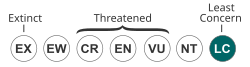
| | status = LC | | | status = LC |
| | status_system = IUCN3.1 | | | status_system = IUCN3.1 |
| | status_ref = <ref name="iucn status 12 November 2021">{{cite iucn |author=BirdLife International |date=2016 |title=''Accipiter gentilis'' |volume=2016 |page=e.T22695683A93522852 |doi=10.2305/IUCN.UK.2016-3.RLTS.T22695683A93522852.en |access-date=12 November 2021}}</ref> | | | status_ref = <ref name=IUCN>{{IUCN|id=22695683 |title=''Accipiter gentilis'' |assessor=[[BirdLife International]] |version=2013.2 |year=2013 |accessdate=26 November 2013}}</ref> |
| | genus = Accipiter | | | genus = Accipiter |
| | species = gentilis | | | species = gentilis |
| Line 21: |
Line 20: |
| *''Accipiter gentilis laingi'' | | *''Accipiter gentilis laingi'' |
| *''Accipiter gentilis marginatus'' | | *''Accipiter gentilis marginatus'' |
| *''Accipiter gentilis schvedowi'' (eastern goshawk)<ref name=indianbiodiversity>{{cite web |url=http://avis.indianbiodiversity.org/books/accipiter-gentilis-schvedowi/26039 |title=''Astur gentilis schvedowi'' AVIS-IBIS|date=10 September 2014}}</ref> | | *''Accipiter gentilis schvedowi'' (eastern goshawk)<ref name=indianbiodiversity>{{cite web |url=http://avis.indianbiodiversity.org/books/accipiter-gentilis-schvedowi/26039 |title=''Astur gentilis schvedowi'' AVIS-IBIS|date=10 September 2014 }}</ref> |
| | range_map = AccipiterGentilis.png | | | range_map = AccipiterGentilis.png |
| | range_map_caption = Range of ''A. gentilis'' {{leftlegend|#008000|Resident|outline=gray}} {{leftlegend|#007FFF|Non-breeding|outline=gray}} | | | range_map_caption = Range of ''A. gentilis'' {{leftlegend|#008000|Resident|outline=gray}} {{leftlegend|#007FFF|Non-breeding|outline=gray}} |
| | synonyms = ''Falco gentilis'' {{small|Linnaeus, 1758}} | | | synonyms = ''Falco gentilis'' {{small|Linnaeus, 1758}} |
| }} | | }} |
| | [[File:Accipiter gentilis MHNT.ZOO.2010.11.84.2.jpg|thumb| ''Accipiter gentilis'']] |
| | The '''northern goshawk''' ''Accipiter gentilis'') is a medium-large [[bird of prey|raptor]] in the family [[Accipitridae]]. |
|
| |
|
| The '''northern goshawk''' ({{IPAc-en|ˈ|ɡ|ɒ|s|ˌ|h|ɔː|k}}; ''Accipiter gentilis'') is a [[species]] of medium-large [[bird of prey|raptor]] in the [[Family (biology)|family]] [[Accipitridae]], a family which also includes other extant diurnal raptors, such as [[eagle]]s, [[buzzard]]s and [[harrier (bird)|harrier]]s. As a species in the genus ''[[Accipiter]]'', the goshawk is often considered a "true hawk".<ref name="Brown">{{cite book |first1=Leslie |last1=Brown |first2=Dean |last2=Amadon |title=Eagles, Hawks and Falcons of the World |publisher=Wellfleet |year=1986 |isbn=978-1555214722 }}</ref> The scientific name is [[Latin]]; ''Accipiter'' is "hawk", from ''accipere'', "to grasp", and ''gentilis'' is "noble" or "gentle" because in the [[Middle Ages]] only the nobility were permitted to fly goshawks for [[falconry]].<ref name=Jobling>{{cite book |last= Jobling |first= James A. |year=2010|title=The Helm Dictionary of Scientific Bird Names |url= https://archive.org/details/helmdictionarysc00jobl_997 |url-access= limited |publisher=Christopher Helm |location=London |isbn=978-1-4081-2501-4 |pages=[https://archive.org/details/helmdictionarysc00jobl_997/page/n30 30], 171–172}}</ref>
| | There are other [[species]] in this [[genus]], but this bird is spoken of as ''the'' goshawk because it has a wide range over most of [[Europe]], [[Eurasia]] and [[North America]].<ref name= Ferguson-Lees>{{cite book |last1=Ferguson-Lees |first1=James |last2=Christie |first2=David A. |title=Raptors of the World |publisher=Houghton Mifflin Harcourt |year=2001 |isbn=978-0-618-12762-7 }}</ref> Probably only the [[golden eagle]] has a wider range. |
|
| |
|
| This species was first described by [[Carl Linnaeus|Linnaeus]] in his ''Systema naturae'' in [[10th edition of Systema Naturae|1758]] as ''Falco gentilis''.<ref name=Linnaeus1758>{{cite book |last= Linnaeus |first=C. |author-link= Carl Linnaeus |title= Systema naturae per regna tria naturae, secundum classes, ordines, genera, species, cum characteribus, differentiis, synonymis, locis. Tomus I. Editio decima, reformata. |volume=v.1 |location= Holmiae (Stockholm) |publisher=Laurentii Salvii |year=1758 |quote=F. cera pedibusque flavis, corpore cinereo maculis fuscis cauda fasciis quatuor nigricantibus |page=89 |language=la |url= https://www.biodiversitylibrary.org/page/726996}}</ref>
| | The goshawk is a "true hawk",<ref name="Brown">{{cite book |first1=Leslie |last1=Brown |first2=Dean |last2=Amadon |title=Eagles, Hawks and Falcons of the World |publisher=Wellfleet |year=1986 |isbn=978-1555214722 }}</ref> and its scientific name in [[Latin]] is ''Accipiter'', which means "hawk". |
|
| |
|
| It is a widespread species that inhabits many of the temperate parts of the [[Northern Hemisphere]]. The northern goshawk is the only species in the genus ''Accipiter'' found in both [[Eurasia]] and [[North America]].<ref name= Ferguson-Lees>{{cite book |last1=Ferguson-Lees |first1=James |last2=Christie |first2=David A. |title=Raptors of the World |publisher=Houghton Mifflin Harcourt |year=2001 |isbn=978-0-618-12762-7 }}</ref> It may have the second widest distribution of any true member of the family [[Accipitridae]], behind arguably only the [[golden eagle]] (''Aquila chrysaetos''), which has a broader range to the south of Asia than the goshawk. The only other acciptrid species to also range in both North America and Eurasia according to current opinion, is the more [[Arctic]]-restricted [[rough-legged buzzard]] (''Buteo lagopus'').<ref name="iucn status 12 November 2021" /><ref name= Ferguson-Lees/><ref>{{cite iucn |author=BirdLife International |date=2016 |title=''Aquila chrysaetos'' |volume=2016 |page=e.T22696060A93541662 |doi=10.2305/IUCN.UK.2016-3.RLTS.T22696060A93541662.en |access-date=12 November 2021}}</ref> Except in a small portion of southern [[Asia]], it is the only species of "goshawk" in its range and it is thus often referred to, both officially and unofficially, as simply the "goshawk". It is mainly [[resident bird|resident]], but birds from colder regions [[bird migration|migrate]] south for the winter.<ref name= Ferguson-Lees/> In North America, migratory goshawks are often seen migrating south along [[Ridge|mountain ridge]] tops at nearly any time of the fall depending on latitude.<ref name= Cornell>{{cite book |last1=Squires |first1=J. |first2=R. |last2=Reynolds |year=1997 |title=Northern Goshawk |work=[[Birds of North America (book)|Birds of North America]] |volume=298 |pages=2–27}}</ref>
| | In the [[Middle Ages]] only the nobility were permitted to fly goshawks for [[falconry]].<ref name=Jobling>{{cite book |last= Jobling |first= James A. |year=2010|title=The Helm Dictionary of Scientific Bird Names |url= https://archive.org/details/Helm_Dictionary_of_Scientific_Bird_Names_by_James_A._Jobling |publisher=Christopher Helm |location=London |isbn=978-1-4081-2501-4 |pages=[https://archive.org/details/Helm_Dictionary_of_Scientific_Bird_Names_by_James_A._Jobling/page/n30 30], 171–172}}</ref> |
|
| |
|
| ==Distribution==
| | It is mainly a resident bird, but those from colder regions [[bird migration|migrate]] south for the winter.<ref name= Ferguson-Lees/> In North America, migratory goshawks are often seen migrating south along mountain ridge tops at nearly any time of the fall, depending on latitude.<ref name= Cornell>{{cite book |last1=Squires |first1=J. |first2=R. |last2=Reynolds |year=1997 |title=Northern Goshawk ''in'' |work=Birds of North America |volume=298 |pages=2–27}}</ref> |
| The northern goshawk has a large circumpolar distribution. In [[Eurasia]], it is found in most areas of Europe excluding [[Ireland]] and [[Iceland]]. It has a fairly spotty distribution in [[western Europe]] (e.g. [[Great Britain]], [[Spain]], [[France]]) but is more or less found continuously through the rest of the continent. Their Eurasian distribution sweeps continuously across most of Russia, excluding the fully treeless [[tundra]] in the northern stretches, to the western limits of [[Siberia]] as far as [[Anadyr (town)|Anadyr]] and [[Kamchatka]].<ref name= Ferguson-Lees/> In the [[Eastern Hemisphere]], they are found in their southern limits in extreme northwestern [[Morocco]], [[Corsica]] and [[Sardinia]], the "toe" of Italy, southern Greece, [[Turkey]], the [[Caucasus]], [[Sinkiang]]'s [[Tien Shan]], in some parts of [[Tibet]] and the [[Himalayas]], western China and Japan.<ref name= Ferguson-Lees/> In winter, northern goshawks may be found rarely as far south as [[Taif]] in [[Saudi Arabia]] and perhaps [[Tonkin]], [[Vietnam]].<ref name= Kenward>{{cite book |title= The Goshawk |first= Robert |last= Kenward |year=2006 |publisher= T & A D Poyser |location= London, UK |page= 274 |isbn= 978-0-7136-6565-9 |url= https://books.google.com/books?id=_tGnSRa0S6sC&pg=PA274}}</ref>
| |
|
| |
|
| In [[North America]], they are most broadly found in the [[western United States]], including [[Alaska]], and [[western Canada]]. Their breeding range in the western contiguous United States largely consists of the wooded foothills of the [[Rocky Mountains]] and many other large mountain ranges from [[Washington (state)|Washington]] to [[southern California]] extending east to central [[Colorado]] and westernmost [[Texas]].<ref name= Cornell/> Somewhat discontinuous breeding populations are found in southeastern [[Arizona]] and southwestern [[New Mexico]], thence also somewhat spottily into western Mexico down through [[Sonora]] and [[Chihuahua City|Chihuahua]] along the [[Sierra Madre Occidental]] as far as [[Jalisco]] and [[Guerrero]], their worldwide southern limit as a breeding species.<ref name= Ferguson-Lees/><ref>Monson, G. & Phillips, A.R. (1964). ''A check-list of the birds of Arizona''. Tucson: Univ. of Arizona Press.</ref><ref>Howell, S. N. G. & Webb, S. (1995). ''A guide to the birds of Mexico and northern Central America''. New York: Oxford University Press. {{ISBN|978-0198540120}}</ref>
| | == References == |
| | {{reflist}} |
|
| |
|
| The goshawk continues east through much of [[Canada]] as a native species, but is rarer in most of the [[eastern United States]], especially the [[Midwestern United States|Midwest]] where they are not typically found outside the [[Great Lakes]] region, where a good-sized breeding population occurs in the northern parts of [[Minnesota]], [[Illinois]], [[Michigan]] and somewhat into [[Ohio]]; a very small population persists in the extreme northeast corner of [[North Dakota]]. They breed also in mountainous areas of [[New England]], [[New York (state)|New York]], central [[Pennsylvania]] and northwestern [[New Jersey]], sporadically down to extreme northwestern [[Maryland]] and northeastern [[West Virginia]].<ref name= Cornell/> Vagrants have been reported in Ireland, [[North Africa]] (central Morocco, northern [[Algeria]], [[Tunisia]], [[Libya]], [[Egypt]]); the [[Arabian Peninsula]] ([[Israel]], [[Jordan]], Saudi Arabia), [[southwest Asia]] (southern [[Iran]], [[Pakistan]]), western India ([[Gujarat]]) and on [[Izu Islands|Izu-shoto]] (south of Japan) and the [[Commander Islands]], and in most of the parts of the United States where they do not breed.<ref name= Ferguson-Lees/>
| | [[Category:Accipitriformes]] |
| | |
| == Habitat==
| |
| [[File:Accipiter gentilis Kaibab.jpg|thumb|left|Adult in the [[Kaibab Plateau]], [[Arizona]], in a [[pine]] tree that typifies the habitat used locally]]
| |
| Northern goshawks can be found in both [[deciduous]] and [[coniferous]] [[Temperate forest|forests]]. While the species might show strong regional preferences for certain trees, they seem to have no strong overall preferences nor even a preference between deciduous or coniferous trees despite claims to the contrary.<ref name="Brown"/><ref name= Ferguson-Lees/><ref name="Penteriani, V. 2002">{{cite journal | last1 = Penteriani | first1 = V | year = 2002 | title = Goshawk nesting habitat in Europe and North America: a review | journal = Ornis Fennica | volume = 79 | pages = 149–163 }}</ref><ref>{{cite web |url=https://www.gis.smumn.edu/GradProjects/LudwigT.pdf |title=Northern goshawk forest type preference in the Chippewa National Forest |last=Ludwig |first=T. W. |access-date=27 February 2017 |website=Saint Mary's University of Minnesota |archive-url=https://web.archive.org/web/20120901084255/http://www.gis.smumn.edu/GradProjects/LudwigT.pdf |archive-date=1 September 2012 |url-status=dead }}</ref> More important than the type of trees are the composition of a given tree stand, which should be tall, [[Old-growth forest|old-growth]] with intermediate to heavy [[Canopy (biology)|canopy]] coverage (often more than 40%) and minimal density undergrowth, both of which are favorable for hunting conditions.<ref name= Cornell/><ref>{{cite web |url= https://ir.library.oregonstate.edu/xmlui/bitstream/handle/1957/16275/AustinKarenK1994.pdf?sequence=1 |title= Habitat use and home range size of breeding northern goshawks in the southern Cascades |last=Austin |first=K. K. |date=1993 |format=PDF |type=Master's Thesis|website=Oregon State University |place=Corvallis, Oregon|access-date=27 February 2017}}</ref> Also, goshawks typically require proximity to [[Woodland edge|openings]] in which to execute additional hunting.<ref name= Kenward/><ref>Erickson, M. G. (1987). ''Nest site habitat selection of the goshawk (Accipiter gentilis) in the Black Hills of South Dakota'' (Doctoral dissertation, MS thesis. University of South Dakota. Brookings, South Dakota).</ref> More so than in [[North America]], the goshawks of Eurasia, especially [[central Europe]], may live in fairly urbanized patchworks of small woods, [[Windbreak|shelter-belts]] and [[Coppicing|copses]] and even use largely isolated [[tree]]s in [[Peri-urbanisation|central parts of Eurasian cities]].<ref name= Bednarek>{{cite journal | last1 = Bednarek | first1 = W | year = 1975 | title = Vergleichende Untersuchungen zur Populationsökologie des Habichts (Accipiter gentilis): Habitatbesetzung und Bestandsregulation | journal = Deutscher Falkenorden Jahrbuch | volume = 1975 | pages = 47–53 }}</ref><ref name= Link>Link, H. (1977). ''Beiträge zur Bestandssituation, Ökologie, Brutbiologie und Beutewahl einer nordbayerischer Population des Habichts (Accipiter gentilis)''. PhD thesis.</ref> Even if they are far more wary of human presence than the Eurasian sparrowhawk, northern goshhawks are known to live in some relatively densely wooded areas of large cities of [[Central Europe]], such as [[Berlin]] and [[Hamburg]]; it is a relatively new phenomenon that started in the 20th century.<ref>{{Cite web|title=Urbane Habichte in Berlin|url=http://habicht-berlin.de/allgemeines/}}</ref> Access to [[Wetland|waterways]] and [[riparian zone]]s of any kind is not uncommon in goshawk home ranges but seems to not be a requirement.<ref name= Bull>{{cite journal | last1 = Bull | first1 = E. L. | last2 = Hohmann | first2 = J. E. | year = 1994 | title = Breeding biology of northern goshawks in northeastern Oregon | journal = Studies in Avian Biology | volume = 16 | pages = 103–105 }}</ref> Narrow tree-lined riparian zones in otherwise relatively open habitats can provide suitable wintering habitat in the absence of more extensive woodlands.<ref name= Squires>{{cite journal | last1 = Squires | first1 = J. R. Ruggiero | year = 1995 | title = Winter movements of adult northern goshawks that nested in southcentral Wyoming | journal = J. Raptor Res. | volume = 29 | pages = 5–9 }}</ref> The northern goshawk can be found at almost any altitude, but recently is typically found at [[Montane forest|high elevations]] due to a paucity of extensive forests remaining in lowlands across much of its range. Altitudinally, goshawks may live anywhere up to a given mountain range's [[tree line]], which is usually {{convert|3000|m|ft|abbr=on}} in elevation or less.<ref name= Ferguson-Lees/> The northern limit of their distribution also coincides with the tree line and here may adapt to [[Dwarf forest|dwarf tree communities]], often along drainages of the lower [[tundra]].<ref name= Swem>{{cite journal |last1= Swem |first1= T. |last2= Adams |first2= M. |year=1992 |title= A northern goshawk nest in the tundra biome |journal= Journal of Raptor Research |volume= 26 |issue=2 |pages= 102 }}</ref><ref name= Englemann>Engelmann, F. 1928. ''Die Raubvogel Europas: Naturgeschichte, Kulturgeschichte und Falknerei''. Neudamm, Germany. {{ISBN|9783891046029}}</ref> In winter months, the northernmost or high mountain populations move down to warmer forests with lower elevations, often continuing to avoid detection except while migrating. A majority of goshawks around the world remain sedentary throughout the year.<ref name= Cornell/><ref name=Johnsgard>{{cite book |last=Johnsgard |first=P. |author-link=Paul Johnsgard |year=1990 |title=Hawks, Eagles, & Falcons of North America |location=Washington |publisher=Smithsonian Institution Press |isbn=978-0874746822}}</ref>
| |
| | |
| == Description==
| |
| | |
| [[File:Accipiter gentilisAAP045CA.jpg|right|thumb|Juvenile (left) and adult by [[Louis Agassiz Fuertes]]]]
| |
| The northern goshawk has relatively short, broad wings and a long tail, typical for ''Accipiter'' species and common to raptors that require maneuverability within forest habitats.<ref name="Brown"/> For an ''Accipiter'', it has a relatively sizeable bill, relatively long wings, a relatively short tail, robust and fairly short legs and particularly thick toes.<ref name= Ferguson-Lees/> Across most of the species' range, it is blue-grey above or brownish-grey with dark barring or streaking over a grey or white base color below, but Asian subspecies in particular range from nearly white overall to nearly black above.<ref name= Ferguson-Lees/> Goshawks tend to show [[Cline (biology)|clinal]] variation in color, with most goshawks further north being paler and those in warmer areas being darker but individuals can be either dark in the north or pale in the south. Individuals that live a long life may gradually become paler as they age, manifesting in mottling and a lightening of the back from a darker shade to a bluer pale color.<ref name= Kenward/> Its plumage is more variable than that of the [[Eurasian sparrowhawk]] (''Accipiter nisus''), which is probably due to higher genetic variability in the larger goshawk.<ref>Newton, I. (1986). ''The Sparrowhawk''. Poyser Monographs, Calton, UK. {{ISBN|9781408138328}}</ref> The juvenile northern goshawk is usually a solid to mildly streaky brown above, with many variations in underside color from nearly pure white to almost entirely overlaid with broad dark cinnamon-brown striping. Both juveniles and adults have a barred tail, with 3 to 5 dark brown or black bars.<ref name= Ferguson-Lees/> Adults always have a white eye stripe or [[supercilia]], which tends to be broader in northern Eurasian and North American birds.<ref name= Ferguson-Lees/> In North America, juveniles have pale-yellow eyes, and adults develop dark red eyes usually after their second year, although nutrition and genetics may affect eye color as well.<ref>{{cite journal |last1=Snyder |first1=Noel F. R. |last2=Snyder |first2=Helen A. |date=1974 |title=Function of eye coloration in North American accipiters |url=https://sora.unm.edu/sites/default/files/journals/condor/v076n02/p0219-p0222.pdf |journal=The Condor |volume=76 |issue=2 |pages=219–222 |issn=0010-5422 |eissn=1938-5129 |access-date=27 February 2017 |doi=10.2307/1366740|jstor=1366740 }}</ref> In Europe and Asia, juveniles also have pale-yellow eyes while adults typically develop orange-colored eyes, though some may have only brighter yellow or occasionally ochre or brownish eye color.<ref name= Ferguson-Lees/><ref name= Kenward/> [[Moulting]] starts between late March and late May, the male tends to moult later and faster than the female. Moulting results in the female being especially likely to have a gap in its wing feathers while incubating and this may cause some risk, especially if the male is lost, as it inhibits her hunting abilities and may hamper her defensive capabilities, putting both herself and the nestlings in potential danger of predation. The moult takes a total of 4–6 months, with tail feathers following the wings then lastly the [[Feather development|contour and body feathers]], which may not be completely moulted even as late as October.<ref name= Kenward/>
| |
| | |
| Although existing wing size and body mass measurements indicate that the [[Henst's goshawk]] (''Accipiter henstii'') and [[Meyer's goshawk]] (''Accipiter meyerianus'') broadly overlap in size with this species, the northern goshawk is on average the largest member of the genus ''[[Accipiter]]'', especially outsizing its tropic cousins in the larger Eurasian races.<ref name= Ferguson-Lees/><ref name=BirdsOfQuebec>{{cite web |url=http://redpath-museum.mcgill.ca/Qbp/birds/Specpages/northerngoshawk.htm |title=Northern Goshawk |access-date=18 March 2007 |publisher=Birds of Quebec |archive-url=https://web.archive.org/web/20120209023932/http://redpath-museum.mcgill.ca/Qbp/birds/Specpages/northerngoshawk.htm |archive-date=9 February 2012 |url-status=dead }}</ref> The northern goshawk, like all ''Accipiters'', exhibits [[sexual dimorphism]], where females are significantly larger than males, with the dimorphism notably greater in most parts of Eurasia. Linearly, males average about 8% smaller in North America and 13% smaller than females in Eurasia, but in the latter landmass can range up to a very noticeable 28% difference in extreme cases.<ref name= Ferguson-Lees/><ref name= Kenward/> Male northern goshawks are {{convert|46|to|61|cm|in|abbr=on}} long and have a {{convert|89|to|105|cm|in|abbr=on}} wingspan. The female is much larger, {{convert|58|to|69|cm|in|abbr=on}} long with a {{convert|108|to|127|cm|in|abbr=on}} wingspan.<ref name= Ferguson-Lees/><ref>Del Hoyo, J. E., & Elliot, A. A. & Sargatal, J.(eds.), 1994. ''Handbook of the Birds of the World. Vol. 2. New World Vultures to Guineafowl''. Lynx Edicions. Barcelona. {{ISBN|978-84-87334-15-3}}</ref><ref>Blasco-Zumeta, J. & Henze, G.-H. ''117. Goshawk''. Ibercaja Aula en Red, Obra Social..</ref> In a study of North American goshawks (''A. g. atricapillus''), males were found to average {{convert|56|cm|in|abbr=on}} in total length, against females which averaged {{convert|61|cm|in|abbr=on}}.<ref name= Mueller>{{cite journal|last1=Mueller |first1=Helmut C. |last2=Berger |first2=Daniel D. |last3=Allez |first3=George |title=The Identification of North American Accipiters |journal= American Birds |volume=33 |number=3 |pages=236–240 |date=May 1979 |url=https://sora.unm.edu/sites/default/files/journals/nab/v033n03/p00236-p00240.pdf |issn=0004-7686 |access-date= 28 February 2017}}</ref> Males from six subspecies average around {{convert|762|g|lb|abbr=on}} in body mass, with a range from all races of {{convert|357|to|1200|g|lb|abbr=on}}. The female can be up to more than twice as heavy, averaging from the same races {{convert|1150|g|lb|abbr=on}} with an overall range of {{convert|758|to|2200|g|lb|abbr=on}}.<ref name="Brown"/><ref name= Ferguson-Lees/><ref name= "CRC">''CRC Handbook of Avian Body Masses, 2nd Edition'' by John B. Dunning Jr. (Editor). CRC Press (2008), {{ISBN|978-1-4200-6444-5}}.</ref> Among standard measurements, the most oft-measured is [[Wing chord (biology)|wing chord]] which can range from {{convert|286|to|354|mm|in|abbr=on}} in males and from {{convert|324|to|390|mm|in|abbr=on}} in females. Additional, the tail is {{convert|200|-|295|mm|in|abbr=on}}, the [[Culmen (bird)|culmen]] is {{convert|20|-|26.3|mm|in|abbr=on}} and the [[Tarsus (skeleton)|tarsus]] is {{convert|68|-|90|mm|in|abbr=on}}.<ref name= Ferguson-Lees/><ref name=Johnson1989>{{cite journal |last=Johnson |first=Donald R. |title=Body size of Northern Goshawks on coastal islands of British Columbia |url=https://sora.unm.edu/sites/default/files/journals/wilson/v101n04/p0637-p0639.pdf |journal=Wilson Bulletin |volume=101 |issue=4 |date= December 1989 |pages=637–639 |issn=1559-4491 |access-date=1 March 2017}}</ref><ref name=indianbiodiversity.org>{{cite web |url=http://avis.indianbiodiversity.org/birds/aves/accipitriformes/accipitridae/accipiter/accipiter-gentilis |title=Northern Goshawk – Accipiter gentilis |website=AVIS-IBIS: Birds of Indian Subcontinent |date=4 December 2009 |access-date=21 December 2012}}</ref><ref>{{cite journal|last1=Hoffman |first1= Stephen W. |last2=Smith |first2=Jeff P. |last3=Gessaman |first3=James A. |title=Size of fall-migrant accipiters from the Goshute Mountains of Nevada |url=https://sora.unm.edu/sites/default/files/journals/jfo/v061n02/p0201-p0211.pdf |journal=Journal of Field Ornithology |volume=61 |number=2 |date=Spring 1990 |pages=201–211 |issn=0273-8570 |access-date=1 March 2017}}</ref>
| |
| | |
| ===Voice===
| |
| [[File:Accipiter gentilis - Northern Goshawk XC124805.ogg|thumb|left|''Accipiter gentilis'' – northern goshawk]]
| |
| Northern goshawks normally only vocalize during courtship or the nesting season. Adult goshawks may chatter a repeated note, varying in speed and volume based on the context. When calling from a perch, birds often turn their heads slowly from side to side, producing a ventriloquial effect.<ref name="Brown"/><ref name= Ferguson-Lees/> The male calls a fast, high-pitched ''kew-kew-kew'' when delivering food or else a very different croaking ''guck'' or ''chup''. The latter sound has been considered by some authors similar to that of a person snapping the tongue away from the roof the mouth; the males produce it by holding the beak wide open, thrusting the head up and forward, than bringing it down as the sound is emitted, repeated at intervals of five seconds. This call is uttered when the male encounters a female.<ref name="Brown"/><ref name= Ferguson-Lees/><ref name= Cornell/> Two calls have been recorded mainly from brooding females in the race ''A. g. atricapillus'': a recognition scream of short, intense notes (''whee-o'' or ''hee-ya'') which ends in harsh, falsetto tone; then a dismissal call given when the male lingers after delivering food, consisting of a choked, cut-off scream.<ref name="Brown"/> Meanwhile, the adult female's rapid strident ''kek-kek-kek'' expresses alarm or intent to mob towards threatening intruders. This is often done when mobbing a predator such as a [[great horned owl]] (''Bubo virginianus'') and as it progresses the female's voice may lower slightly in pitch and becomes harsh and rasping. As the intensity of her attacks increases, her kakking becomes more rapid and can attain a constant screaming quality. Females often withdraw into the treetops when fatigued, and their calls are then spaced at longer intervals. Males respond to interlopers or predators with a quieter, slower ''gek gek gek'' or ''ep ep ep''. A call consisting of ''kek…kek.kekk kek kek-kek-kek'' is used mainly by females in advertisement and during pre-laying mutual calling. Both sexes also may engage in kakking during copulation.<ref name="Brown"/><ref name= Ferguson-Lees/><ref name= Cornell/><ref>{{cite journal|last=Gromme |first=O. J. |title=The goshawk (Astur atricapillus atricapillus) nesting in Wisconsin |journal=The Auk |volume=52 |number=1 |date=1935 |pages=15–20 |url=https://sora.unm.edu/sites/default/files/journals/auk/v052n01/p0015-p0020.pdf |issn=0004-8038 |access-date=11 March 2017 |doi=10.2307/4077102|jstor=4077102 }}</ref><ref name= Schnell>{{cite journal|last=Schnell |first= Jay H. |title=Nesting behavior and food habits of goshawks in the Sierra Nevada of California |journal=The Condor |volume=60 |number=6 |pages=377–403 |date=1958 |url=https://sora.unm.edu/sites/default/files/journals/condor/v060n06/p0377-p0403.pdf |access-date=11 March 2017 |eissn=1938-5129 |issn=0010-5422 |doi=10.2307/1365696|jstor= 1365696 }}.</ref> Vocalizations mainly peak in late courtship/early nesting around late March to April, can begin up to 45 minutes before sunrise, and are more than twice in as frequent in the first three hours of daylight as in the rest of the day.<ref>{{cite journal|last=Penteriani |first=Vincenzo |title=The annual and diel cycles of goshawk vocalizations at nest sites |journal=Journal of Raptor Research |volume=35 |number=1 |pages=24–30 |date=2001 |url=https://sora.unm.edu/sites/default/files/journals/jrr/v035n01/p00024-p00030.pdf |access-date=12 March 2017 |issn=0892-1016}}</ref> Occasionally hunting northern goshawks may make shrill screams when pursuing prey, especially if a lengthy chase is undertaken and the prey is already aware of its intended predator.<ref name= Zirrer>{{cite journal|last=Zirrer |first=Francis |title=The goshawk |journal=Passenger Pigeon |volume=IX |number=3 |pages=79–94 |url=http://digicoll.library.wisc.edu/cgi-bin/EcoNatRes/EcoNatRes-idx?type=article&did=ECONATRES.PP09N03.FZIRRER&id=EcoNatRes.pp09n03&isize=text |access-date=12 March 2017 |issn=0031-2703|date=July 1947 }}.</ref>
| |
| | |
| ===Similar species===
| |
| [[File:AccipterGentilisJuvenileFlight1.jpg|thumb|left|Juvenile in flight, the most likely age and condition to mistake a goshawk for another species]]
| |
| [[File:Accipiter nisus 3 (Martin Mecnarowski).jpg|thumb|right|An adult goshawk shows its richly streaked plumage.]]
| |
| The juvenile plumage of the species may cause some confusion, especially with other ''Accipiter'' juveniles. Unlike other northern ''Accipiters'', the adult northern goshawk never has a rusty color to its underside barring.<ref name= Kenward/> In [[Eurasia]], the smaller male goshawk is sometimes confused with a female [[Eurasian sparrowhawk|sparrowhawk]], but is still notably larger, much bulkier and has relatively longer wings, which are more pointed and less boxy. Sparrowhawks tend to fly in a frequently flapping, fluttering type flight. Wing beats of northern goshawks are deeper, more deliberate, and on average slower than those of the [[Eurasian sparrowhawk]] or the two other North American ''Accipiters''.<ref name= Cramp>Cramp, S. and K. E. L. Simmons. (1980). ''Handbook of the birds of Europe and the Middle East and North Africa: the birds of the western Palearctic, Vol. 2. Hawks to bustards''. Oxford: Oxford Univ. Press. {{ISBN|9780198575054}}</ref><ref>Kaufman, K. (1990). ''A Field Guide to advanced birding: birding challenges and how to approach them''. Boston, MA: Houghton Mifflin Co. {{ISBN|9780395535172}}</ref> The classic ''Accipiter'' flight is a characteristic "flap flap, glide", but the goshawk, with its greater wing area, can sometimes be seen steadily soaring in migration (smaller ''Accipiters'' almost always need to flap to stay aloft).<ref name= Ferguson-Lees/><ref name=hangingrocktower>{{cite web |url=http://www.hangingrocktower.org/birds/goshawk.htm |title=Northern Goshawk |access-date=23 January 2012 |website=Hanging Rock Raptor Observatory |archive-url=https://web.archive.org/web/20120812103751/http://www.hangingrocktower.org/birds/goshawk.htm |archive-date=12 August 2012 |url-status=dead }}</ref><ref>{{citation|last1=Crossley |first1=R. T. |last2=Couzens |first2=D. |title=The Crossley ID Guide: Britain and Ireland |series=The Crossley ID Guides |date=2013 |publisher=Princeton University Press |isbn=978-0691151946}}</ref> In [[North America]] juveniles are sometimes confused with the smaller [[Cooper's hawk]] (''Accipiter cooperii''), especially between small male goshawks and large female Cooper's hawks. Unlike in [[Europe]] with sparrowhawks, Cooper's hawks can have a largish appearance and juveniles may be regularly mistaken for the usually less locally numerous goshawk. However, the juvenile goshawk displays a heavier, vertical streaking pattern on chest and abdomen, with the juvenile Cooper's hawk streaking frequently (but not always) in a “teardrop” pattern wherein the streaking appears to taper at the top, as opposed to the more even streaking of the goshawk. The goshawk sometimes seems to have a shorter tail relative to its much broader body. Although there appears to be a size overlap between small male goshawks and large female Cooper's hawks, [[morphometric]] measurements (wing and tail length) of both species demonstrate no such overlap, although weight overlap can rarely occur due to variation in seasonal condition and food intake at time of weighing.<ref name= Mueller/><ref>{{cite journal|last1=Smith |first1=Jeff P. |last2=Hoffman |first2=Stephen W. |last3=Gessaman |first3= James A. |date=Spring 1990 |title=Regional Size Differences among Fall-Migrant Accipiters in North America |journal=Journal of Field Ornithology |volume=61 |number=2 |pages=192–200 |url=https://sora.unm.edu/sites/default/files/journals/jfo/v061n02/p0192-p0200.pdf |issn=0273-8570 |access-date=11 March 2017}}.</ref> Rarely, in the southern stretches of its Asian wintering range, the northern goshawk may live alongside the [[crested goshawk]] (''Accipiter trivirgatus'') which is smaller (roughly Cooper's hawk-sized) and has a slight crest as well as a distinct mixture of denser streaks and bars below and no supercilia.<ref name= Ferguson-Lees/>
| |
| | |
| [[File:Coopers-Hawk-on-a-Fence.jpg|thumb|upright|Large juvenile [[Cooper's hawk]]s such as this are at times mistaken for a goshawk]]
| |
| Northern goshawks are sometimes mistaken for species even outside of the genus ''Accipiter'' especially as juveniles of each respective species. In [[North America]], four species of [[Buteoninae|buteonine hawk]] (all four of which are smaller than goshawks to a certain degree) may be confused with them on occasion despite the differing proportions of these hawks, which all have longer wings and shorter tails relative to their size. A species so similar it is sometimes nicknamed the "Mexican goshawk", [[gray hawk]] (''Buteo plagiatus'') juveniles (overlapping with true goshawks in the southwest United States into Mexico) have contrasting face pattern with bold dusky eye-stripes, dark eyes, barred thighs and a bold white "U" on the uppertail coverts. The [[roadside hawk]] (''Rupornis magnirostris'') (rarely in same range in Mexico) is noticeably smaller with paddle-shaped wings, barred lower breast and a buff “U” on undertail coverts in young birds. Somewhat less likely to confuse despite their broader extent of overlap are the [[red-shouldered hawk]] (''Buteo lineatus'') which have a narrow white-barred, dark-looking tail, bold white crescents on their primaries and dark wing edges and the [[broad-winged hawk]] (''Buteo playpterus'') which also has dark wing edges and a differing tapered wing shape. Even wintering [[gyrfalcon]] (''Falco rusticolus'') juveniles have been mistaken for goshawks and vice versa on occasion, especially when observed distantly perched. However, the bulkier, broader headed yet relatively shorter tailed falcon still has many tell-tale falcon characteristics like pointed, longer wings, a brown malar stripe as well as its more extensive barring both above and below.<ref name= Ferguson-Lees/>
| |
| | |
| ==Taxonomy==
| |
| The genus ''Accipiter'' contains nearly 50 known living species and is the most diverse genus of diurnal raptors in the world. This group of agile, smallish, forest-dwelling hawks has been in existence for possibly tens of millions of years, probably as an adaptation to the explosive numbers of small birds that began to occupy the world's forest in the last few eras. The [[harrier (bird)|harrier]]s are the only group of extant diurnal raptors that seem to bear remotely close relation to this genus, whereas [[Buteoninae|buteonines]], [[Milvinae|Old World kites]], [[sea eagle]]s and [[Melierax|chanting-goshawk]]s are much more distantly related and all other modern accipitrids are not directly related.<ref name= Ferguson-Lees/><ref name= Kenward/>
| |
| | |
| Within the genus ''Accipiter'', the northern goshawk seems to belong to a [[Species complex|superspecies]] with other larger goshawks from different portions of the world.<ref name="Brown"/><ref>Kleinschmidt, O. (1923). ''Berajah, Zoografia infinita. Die Realgattung Habicht, Falco columbarius (KL)''. Gebauer-Schwetschke, Halle, Germany.</ref> [[Meyer's goshawk]], found in the [[South Pacific Ocean|South Pacific]], has been posited as the most likely to be most close related living cousin to the northern goshawk, the somewhat puzzling gap in their respective ranges explained by other [[Palearctic]] raptors such as [[Bonelli's eagle]]s (''Aquila fasciata'') and [[short-toed eagle]]s (''Circaetus gallicus'') that have extant isolated tropical island populations and were probably part of the same southwest Pacific radiation that led to the Meyer's goshawk.<ref name= Wattel>{{cite book|last=Wattel |first=Jan |title=Geographical differentiation in the genus Accipiter |journal= Publications of the Nuttall Ornithological Club |year=1973 |number=13 |location=Cambridge, Mass. |isbn=9781877973239}}.</ref> A presumably older radiation of this group occurred in Africa, where it led to both the [[Henst's goshawk]] of [[Madagascar]] and the [[black sparrowhawk]] (''Accipiter melanoleucus'') of the mainland. While the Henst's goshawk quite resembles the northern goshawks, the black sparrowhawk is superficially described as a “sparrowhawk” due to its relatively much longer and finer legs than those of typical goshawks but overall its size and plumage (especially that of juveniles) is much more goshawk than sparrowhawk-like.<ref name= Kenward/><ref name= Wattel/>
| |
| | |
| Outside of the presumed superspecies, the genus ''[[Erythrotriorchis]]'' may be part of an Australasian radiation of basal goshawks based largely on their similar morphology to northern goshawks.<ref>{{cite book|last1=Grossman |first1=Mary Louise |last2=Hamlet |first2=John |title=Birds of Prey of the World |location=New York |publisher=Bonanza Books |date=1964 |isbn=9780517067888}}</ref> Genetic studies have indicated that the [[Cooper's hawk]] of North America is also fairly closely related to the northern goshawk, having been present in North America before either of the other two North American ''Accipiters''. However, the much smaller sharp-shinned hawk, which has [[Covergent evolution|similar plumage]] to the Cooper's hawk and seems to be most closely related to the [[Eurasian sparrowhawk]], appears to have occupied North America the latest of the three North American species, despite having the broadest current distribution of any ''Accipiter'' in the Americas (extending down through much of [[South America]]).<ref name= Cornell/><ref name= Kenward/>
| |
| | |
| The term ''goshawk'' comes from the [[Old English language|Old English]] ''gōsheafoc'', "goose-hawk".
| |
| | |
| ===Subspecies===
| |
| [[File:Accipiter gentilis, Hamburg, Germany.png|thumb|Typical adult with a strong brownish-gray cast, from the nominate subspecies, ''A. g. gentilis'']]
| |
| [[File:Goshawkmale66.jpg|thumb|Typical adult from the American subspecies (''A. g. atricapillus'') showing its strong supercilium, red eyes, black head, and blue-gray back]]
| |
| [[File:Northern Goshawk (Siberian Phase) (86749327).jpg|thumb|A captive specimen of whitish large goshawk of Siberian origin, possibly part of ''A. g. albidus''.]]
| |
| The northern goshawk appears to have diversified in northern, central Eurasia and spread both westwards to occupy Europe and, later on, eastwards to spread into [[North America]] across the [[Bering Land Bridge]]. Fossil remains show that goshawks were present in [[California]] by the [[Pleistocene|Pleistocene era]].<ref>{{cite journal|last=Brodkorb |first=Pierce |title=Catalogue of fossil birds: Part 2 (Anseriformes through Galliformes) |journal=Bulletin of the Florida State Museum, Biological Sciences |volume=3 |number=8 |page=246 |date=1964 }}</ref> Two non-exclusive processes could have occurred to cause the notably color and size variation of northern goshawks throughout its range: isolation in the past enabled gene combinations to assort as distinct morphs that suited conditions in different geographical areas, followed by a remixing of these genotypes to result in clines, or subtle variation in modern selection pressures led to a diversity of hues and patterns.<ref name= Kenward/><ref name= Palmer>{{cite book|last=Palmer |first=Ralph S. |title=Handbook of North American Birds, Vol. 4: Diurnal Raptors. Pt. 1 |location=New Haven, CT |publisher=Yale University Press |date=1988 |isbn=9780300040593}}</ref> As a result of the high variation of individual goshawks in plumage characteristics and typical trends in clinal variation and size variations that largely follow [[Bergmann's rule]] and [[Gloger's rule]], an excessive number of subspecies have been described for the northern goshawk in the past. In Europe (including [[European Russia]]) alone, 12 subspecies were described between 1758 and 1990.<ref name= Kenward/><ref name= Gladkov>{{cite journal|last=Gladkov |first=N. A. |title=Taxonomy of Palaearctic goshawks |journal=The Auk |volume=58 |number=1 |pages=80–90 |date=January 1941 |issn=0004-8038 |doi=10.2307/4078901|jstor=4078901 }}.</ref> Most modern authorities agree on listing nine to ten subspecies of northern goshawks from throughout its range.<ref name= Ferguson-Lees/><ref name= Cornell/>
| |
| | |
| *{{anchor|Accipiter gentilis gentilis}} ''A. g. gentilis'' (Linnaeus, 1758) – The nominate race is distributed through most of the species current European range, excluding northern [[Fennoscandia]], northwestern Russia and possibly some of the [[Mediterranean island]]s they inhabit. Outside of Europe, this subspecies' range extends south to [[northwestern Africa]] (almost entirely [[Morocco]]) and east in Eurasia to [[Ural Mountain|Urals]], the [[Caucasus]] and [[Asia Minor]]. It is a typically large subspecies, with high levels of sexual dimorphism. The [[Wing chord (biology)|wing chord]] of males ranges from {{convert|300|to|342|mm|in|abbr=on}} and of females from {{convert|336|to|385|mm|in|abbr=on}}. Body mass is variable, range from {{convert|517|to|1110|g|lb|abbr=on}} in males and from {{convert|820|to|2200|g|lb|abbr=on}} in females. In some cases, the largest adult females (including some exceptionally big females which are the heaviest goshawks known from anywhere) from within a population are up to four times heavier than the smallest adult males, although this is exceptional.<ref name= Ferguson-Lees/><ref name= "CRC"/> The highest average weights come from central [[Fennoscandia]], where the sexes weigh on average {{convert|865|g|lb|abbr=on}} and {{convert|1414|g|lb|abbr=on}}, respectively.<ref name="Brown"/> The lowest come from Spain, where goshawks of this race weigh a median of {{convert|690|g|lb|abbr=on}} in males and {{convert|1050|g|lb|abbr=on}} in females.<ref name= Zuberogoitia>{{cite web|last1=Zuberogoitia |first1=Iñigo |last2=Martínez |first2=José Enrique |url=http://www.vertebradosibericos.org/aves/accgen.html |website=Enciclopedia Virtual de los Vertebrados Españoles |title=Azor común – Accipiter gentilis |editor-last=Salvador |editor-first=A. |editor2-last=Morales |editor2-first=M. B. |publisher=Museo Nacional de Ciencias Naturales |location=Madrid |date=2015 |access-date=13 March 2017}}</ref> The nominate race is generally a dark slaty-brown color on its back and wing coverts with a blackish-brown head. The supercilium is thin and the underside is generally creamy with heavy dark barring. On average, in addition to their smaller size, nominate goshawks to the south of the race's distribution have thinner supericilia and broader and denser barring on the underside.<ref name= Ferguson-Lees/><ref name= Gladkov/> An aberrant “[[Isabelline (colour)|isabelline]]” morph is known mainly from [[Central Europe|central]] and [[eastern Europe]], where the goshawk may be a general beige color (somewhat similar to the pale birds from the races ''albidus'' and ''buteoides''), but such birds appear to be very rare.<ref name= Fischer/><ref>{{cite journal|last1=Maniarski |first1=Roman |last2=Ciach |first2=Michal |date=October 2012 |title=Plumage aberration in Northern Goshawk Accipiter gentilis |journal=Ardea |volume=100 |number=2 |pages=211–213 |issn=0373-2266 |doi=10.5253/078.100.0214|s2cid=83545613 }}</ref>
| |
| *{{anchor|Accipiter gentilis arrigonii}}''A. g. arrigonii'' (Kleinschmidt, 1903) – This is an island race found on the Mediterranean isles of [[Sardinia]] and [[Corsica]]. It averages smaller and weaker-footed than goshawks from the nominate race. The wing chord measures {{convert|293|to|308|mm|in|abbr=on}} in males and {{convert|335|to|347|mm|in|abbr=on}} in females. This race is typically a more blackish brown above with almost fully black head, while the underside is almost pure white and more heavily overlaid with black barring and conspicuous black shaft-streaks. This subspecies is not listed by all authorities but is often considered valid.<ref name= Ferguson-Lees/><ref>{{cite journal|last1=Thibault |first1=Jena-Claude |last2=Patrimonio |first2=Olivier |last3=Torre |first3=José |title=Does the diurnal raptor community of Corsica (Western Mediterranean) show insular characteristics? |journal=Journal of Biogeography |volume=19 |number=4 |pages=363–373 |date=July 1992 |issn=0305-0270 |eissn=1365-2699 |doi=10.2307/2845564|jstor=2845564 }}</ref>
| |
| *{{anchor|Accipiter gentilis buteoides}}''A. g. buteoides'' (Menzbier, 1882) – This race is characteristic of the northern stretches of the western Eurasian range of goshawks, being found as a breeding species from northern [[Fennoscandia]] to western [[Siberia]], ranging as far as the [[Lena River]]. In the eastern portion of its distribution, many birds may travel south to [[central Asia]] to winter. This is a large race, averaging larger than most populations of the nominate race but being about the same size as the big nominate goshawks with which they may overlap and interbreed with in Fennoscandia. The wing chord in males ranges from {{convert|308|to|345|mm|in|abbr=on}} while that of females ranges from {{convert|340|to|388|mm|in|abbr=on}}. The body mass of males has been reported from {{convert|870|to|1170|g|lb|abbr=on}}, with an average of {{convert|1016|g|lb|abbr=on}}, while that of females is reportedly {{convert|1190|to|1850|g|lb|abbr=on}}, with an average of {{convert|1355|g|lb|abbr=on}}.<ref name="Brown"/><ref name= Ferguson-Lees/> Usually, this race is an altogether paler colour than the nominate, being blue-grey above with a dusky-grey crown and a broad supercilium. The underside is white with rather fine blackish-brown barring. Pale flecking on the feather shafts sometimes result in barred appearance on the contour feathers of the nape, back and upper wing. Many birds from this subspecies also have a tan to pale brown eye color. These two characteristics are sometimes considered typical of this race, but individuals are rather variable. In [[western Siberia]], about 10% of birds of this race are nearly pure white (similar to ''albidus'') with varied indications of darker streaking.<ref name= Ferguson-Lees/><ref name= Kenward/>
| |
| *{{anchor|Accipiter gentilis albidus}}''A. g. albidus'' (Menzbier, 1882) – This race of goshawk is found in northeastern [[Siberia]] and [[Kamchatka]]. Many birds of this race travel south for the winter to [[Transbaikal]]ia, northern [[Mongolia]] and [[Ussuri krai|Ussuriland]]. This race continues the trend for goshawks to grow mildly larger eastbound in Eurasia and may be the largest known race based on the midpoint of known measurements of this race, although limited sample sizes of measured goshawks shows they broadly overlap in size with ''A. g. buteoides'' and large-bodied populations of ''A. g. gentilis''. The wing chord can range from {{convert|316|to|346|mm|in|abbr=on}} in males and from {{convert|370|to|388|mm|in|abbr=on}} in females. Known males have scaled from {{convert|894|to|1200|g|lb|abbr=on}} while a small sample of females weighed have had a body mass between {{convert|1300|and|1750|g|lb|abbr=on}}.<ref name="Brown"/><ref name= Ferguson-Lees/> This is easily the palest race of northern goshawk. Many birds are pale grey above with much white about the head and very sparse barring below. However, about half of the goshawks of this race are more or less pure white, with at most only a few remnants of pale caramel flecking about the back or faint brownish markings elsewhere.<ref name= Ferguson-Lees/><ref name= Gladkov/><ref name= Fischer>{{cite book|last=Fischer |first=Wolfgang |title=Die Habichte: Accipiter |series=Die Neue Brehm-Bucherei |volume=158 |location=Wittenberg Lutherstadt, Germany |publisher=A. Ziemsen |oclc=716324621 |issn=0138-1423 |date=1980}}</ref>
| |
| *{{anchor|Accipiter gentilis schvedowi}}''A. g. schvedowi'' (Menzbier, 1882) – This race ranges from the [[Ural mountains|Ural]]s east to the [[Amur Oblast|Amurland]], [[Ussuri krai|Ussuriland]], [[Manchuria]], [[Central China|west-central China]] and sporadically as a breeder into [[Sakhalin]] and the [[Kuril islands]]. ''A. g. schvedowi'' averages smaller than the other races on the mainland of Eurasia, with seemingly the highest sexual dimorphism of any goshawk race, possibly as an adaptation to prey partitioning in the exceptionally sparse wooded fringes of the desert-like [[steppe]] habitat that characterizes this race's range. The wing chord has been found to measure {{convert|298|to|323|mm|in|abbr=on}} in males and {{convert|330|to|362|mm|in|abbr=on}} in females.<ref name= Ferguson-Lees/> Body mass of 15 males was found to be merely {{convert|357|to|600|g|lb|abbr=on}} with a mean of {{convert|501|g|lb|abbr=on}}, the lowest adult weights known for this species, while two adult females scaled {{convert|1000|and|1170|g|lb|abbr=on}}, respectively, or more than twice as much on average.<ref name="Brown"/><ref name= "CRC"/> Beyond its smaller size, its wings are reportedly relatively shorter and feet relatively smaller and weaker than other Eurasian races.<ref>{{cite thesis|last=Wendt |first=Karin |title=''Topographische Anatomie der Hintergliedmaße beim Habicht (Accipiter gentilis Linne 1758)'' |institution=Institut für Veterinär-Anatomie, -Histologie und -Embryologie, Justus-Liebig-Universität Gießen |date=8 May 2000 |language=de |url=http://geb.uni-giessen.de/geb/volltexte/2000/237/pdf/d000038.pdf |access-date=14 March 2017 |type=Dissertation}}</ref> In color, this race is typically a slate-grey above with a blackish head and is densely marked below with thin brown barring.<ref name= Ferguson-Lees/><ref name= Gladkov/>
| |
| *{{anchor|Accipiter gentilis fujiyamae}}''A. g. fujiyamae'' (Swann & Hartert, 1923) – Found through the species' range in Japan, from the islands of [[Hokkaido]] south to the large island of [[Honshu]], in the latter down to as far south as forests a bit north of [[Hiroshima]]. A fairly small subspecies, it may average slightly smaller than ''A. g. schvedowi'' linearly, but it is less sexually dimorphic in size and weighs slightly more on average. The wing chord is the smallest known from any race, {{convert|286|to|300|mm|in|abbr=on}} in males and {{convert|302|to|350|mm|in|abbr=on}} in females.<ref name= Ferguson-Lees/> However, the weights of 22 males ranged from {{convert|602|to|848|g|lb|abbr=on}}, averaging {{convert|715|g|lb|abbr=on}} while 22 females ranged from {{convert|929|to|1265|g|lb|abbr=on}}, averaging {{convert|1098|g|lb|abbr=on}}.<ref name= Shigeta>{{cite journal|last1=Shigeta |first1=Yoshimitsu |last2=Uchida |first2=Hiroshi |last3=Momose |first3=Hiroshi |title=''Measurements and identification of the Japanese Northern Goshawk Accipiter gentilis fujiyamae'' |journal=Journal of the Yamashina Institute for Ornithology |volume=38 |number=1 |pages=22–29 |date=September 2006 |issn=1348-5032 |doi=10.3312/jyio.38.22 |language=ja |url=http://ci.nii.ac.jp/naid/130000446344 |access-date=15 March 2017|doi-access=free }}.</ref> The coloration of this race is not dissimilar from ''A. g. schvedowi'', but is still darker slate above and they tend to have heavier barring below, probably being the darkest race on average, rivaled only by the similar insular race from the opposite side of the Pacific, ''A. g. laingi''.<ref name= Ferguson-Lees/><ref name= Gladkov/><ref name= Shigeta/>
| |
| *{{anchor|Accipiter gentilis atricapillus}}''A. g. atricapillus'' ([[Alexander Wilson (ornithologist)|Wilson]], 1812) – Sometimes simply referred to as the '''American goshawk'''. This subspecies occupies a majority of the species' range in North America, excluding some islands of the [[Pacific Northwest]] and the southern part of the [[American Southwest]]. American goshawks are generally slightly smaller on average than most Eurasian ones, although there are regional differences in size that confirm mildly to [[Bergmann's rule]] within this race. Furthermore, sexual dimorphism in size is notably less pronounced in American goshawks than in most Eurasian races. Overall, the wing chord is {{convert|308|to|337|mm|in|abbr=on}} in males and {{convert|324|to|359|mm|in|abbr=on}} in females.<ref name= Ferguson-Lees/> Size within ''atricapillus'' based on body mass seems to be highest in interior [[Alaska]], followed by the [[Great Lakes]], is intermediate in the northwest United States from eastern [[Washington (state)|Washington]] to the [[Dakotas]] as well as in southeast Alaska thence decreasing mildly along the Pacific in [[Oregon]] and California and smallest of all within the race in the [[Great Basin]] and [[Colorado Plateau]] states (i.e. [[Nevada]], [[Utah]] and northern and central [[Arizona]]). Conspicuously, wing size did not correspond to variations in body mass and more southerly goshawks were frequently longer winged than the more massive northerly ones.<ref name= Palmer/><ref name= Smith>Smith, J. P., Hoffman, S. W., & Gessaman, J. A. (1990). ''Regional Size Differences among Fall-Migrant Accipiters in North America''. Journal of Field Ornithology, 192–200.</ref><ref>Whaley, W. H. & White, C.M. (1994). ''Trends in geographic variation of Cooper's hawk and northern goshawk in North America: a multivariate analysis''. Proc. West. Found. Vertebr. Zool. no. 5:161-209.</ref> Male ''atricapillus'' goshawk have been found to weigh from {{convert|655|to|1200|g|lb|abbr=on}} and females from {{convert|758|to|1562|g|lb|abbr=on}}.<ref name= Ferguson-Lees/><ref name= "CRC"/><ref name= Palmer/><ref>Henny, C. J., Olson. R.A. & Fleming, T.L. (1985). ''Breeding chronology, molt, and measurements of accipiter hawks in northeastern Oregon''. J. Field Ornithol. no. 56: 97–112.</ref> The lightest reported mean weights were from goshawks in northern and central Arizona, weighing a mean of {{convert|680|g|lb|abbr=on}} in males and {{convert|935|g|lb|abbr=on}} while the highest were from a small sample of Alaskan goshawks which weighed some {{convert|905|g|lb|abbr=on}} in males and {{convert|1190|g|lb|abbr=on}} in females.<ref name="Brown"/><ref>Mavrogordato, J. (1973). ''A Hawk for the Bush: A Treatise on the Training of the Sparrow-hawk and Other Short-winged Hawks''. Spearman.</ref><ref>Mueller, H. C., Berger, D.D. & Allez, G. (1976). ''Age and sex variation in the size of goshawks''. Bird-Banding no. 47 (4):310–318.</ref> Almost identical mean weights for goshawks as in [[Alaska]] were recorded for goshawks from [[Alberta]] as well.<ref name= Palmer/> This race is typically a blue-gray color above with a boldly contrasting black head and broad white supercilia. American goshawks are often grayish below with fine gray waving barring and, compared to most Eurasian goshawks, rather apparent black shaft streaks which in combination create a vermiculated effect that is all-together messier looking than in most Eurasian birds. From a distance, ''atricapillus'' can easily appear solidly all-gray from the front.<ref name= Ferguson-Lees/> Due to this, the adult goshawk in America is sometimes called the “gray ghost”, a name also somewhat more commonly used for adult male [[hen harrier]]s.<ref name= Rashid>Rashid, S. (2015). ''Northern Goshawk, the Grey Ghost: Habits, Habitats and Rehabilitation''. Schiffer Publishing Ltd.</ref> Birds from mainland Alaska tend to be paler overall with more pale flecking than other American goshawks.<ref name= Kenward/>
| |
| *{{anchor|Accipiter gentilis laingi}}''A. g. laingi'' (Tavernier, 1940) – This insular race is found on the [[Queen Charlotte Island]]s and [[Vancouver Island]]. This subspecies is slightly smaller than the goshawks found on the mainland and is linearly the smallest race on average in North America. The wing chord of males can range from {{convert|312|to|325|mm|in|abbr=on}} and that of females is {{convert|332|to|360|mm|in|abbr=on}} and is on average nearly 5% smaller than those sampled goshawks from the nearby mainland.<ref name= Ferguson-Lees/><ref name=Johnson1989/> These goshawks are characteristically darker than mainland goshawks with the black of the crown extending to the interscapulars. The underside is a sootier gray overall.<ref name=Johnson1989/><ref>{{cite journal |last1= Taverner |first1= P. A. |year=1940 |title= Variation in the American goshawk |journal= The Condor |volume= 42 |issue= 3|pages= 157–160 |doi=10.2307/1364206|jstor= 1364206 }}</ref><ref>Iverson, G. C., Hayward, G. D., Titus, K. DeGayner, E., Lowell, R.E., Crocker-Bedford, D.C., Schempf, P.F. & Lindell, J.F. (1996). ''Conservation assessment for the northern goshawk in southeast Alaska''. U.S. Dept., Agric., For. Serv. Publ.</ref>
| |
| *{{anchor|Accipiter gentilis apache}}''A. g. apache'' (van Rossem, 1938) – The range of this subspecies extends from southern Arizona and [[New Mexico]] down throughout the species' range in [[Mexico]]. This subspecies has the longest median wing size of any race, running contrary to Bergmann's rule that northern birds should outsize southern ones in widely distributed temperate species. In males the [[Wing chord (biology)|wing chord]] ranges from {{convert|344|to|354|mm|in|abbr=on}} while in females it ranges from {{convert|365|to|390|mm|in|abbr=on}}.<ref name= Ferguson-Lees/> However, in terms of body mass, it is only slightly heavier than the goshawks found discontinuously somewhat to the north in the [[Great Basin]] and the [[Colorado Plateau]] and lighter than the heaviest known American goshawks from Alaska, Alberta and [[Wisconsin]] despite exceeding the goshawks from these areas in wing size. The weight of 49 males ranged from {{convert|631|to|744|g|lb|abbr=on}}, averaging {{convert|704|g|lb|abbr=on}}, while that of 88 females from two studies ranged from {{convert|845|to|1265|g|lb|abbr=on}}, averaging {{convert|1006|g|lb|abbr=on}}.<ref name= "CRC"/><ref>Ingraldi, M.F. (2005). ''A skewed sex ratio in Northern Goshawks: is it a sign of a stressed population?'' Journal of Raptor Research 39.3 (2005): 247–252.</ref> Aside from its overall larger size, ''apache'' reportedly averages larger in foot size than most other American goshawks. Birds of this race tend to be darker than other American goshawks aside from the ''laingi'' type birds. Due to its shortage of distinct features beyond proportions, this is considered one of the more weakly separated among current separate subspecies, with some authors considering it merely a clinal variation of ''atricapillus''. Even the greater wing size in southern birds follows a trend for the wing chord to increase in size in the south on the contrary to body mass.<ref name= Ferguson-Lees/><ref name= Cornell/><ref name= Smith/>
| |
| | |
| ==Behavior==
| |
| | |
| ===Territoriality===
| |
| [[File:Goshawk in flight.JPG|thumb|left|Adult goshawks maintain territories with display flights]]
| |
| The northern goshawk is always found solitarily or in pairs. This species is highly territorial as are most raptorial birds, maintaining regularly spaced home ranges that constitute their territory. Territories are maintained by adults in display flights. During nesting, the home ranges of goshawk pairs are from {{convert|600|to|4000|ha|acre|abbr=on}} and these vicinities tend to be vigorously defended both to maintain rights to their nests and mates as well as the ranges’ prey base.<ref name=Squires/> During display flight goshawks may engage in single or mutual high-circling.<ref name= Ferguson-Lees/><ref>Dobler, G. (1990). ''Brutbiotop und territorialitèt bei habicht (Accipiter gentilis) und rotmilan (Milvus milvus) [Nesting habitat and territoriality in goshawk (Accipiter gentilis) and red kite (Milvus milvus)]''. J. Ornithologie no. 131:85–93.</ref> Each sex tends to defend the territory from others of their own sex.<ref name= Kenward/> Territorial flights may occur almost through the year, but peak from January to April. Such flights may include slow-flapping with exaggerated high deep beats interspersed with long glides and undulations.<ref name= Ferguson-Lees/> In general, territorial fights are resolved without physical contact, often with one (usually a younger bird seeking a territory) retreats while the other approaches in a [[harrier (bird)|harrier]]-like warning flight, flashing its white underside at the intruder. If the incoming goshawk does not leave the vicinity, the defending goshawk may increase the exaggerated quality of its flight including a mildly undulating wave-formed rowing flight and the rowing flight with its neck held in a [[heron]]-like S to elevate the head and maximally expose the pale breast as a territorial threat display. Territorial skirmishes may on occasion escalate to physical fights in which mortalities may occur. In actual fights, goshawks fall grappling to the ground as they attempt to strike each other with talons.<ref name= Kenward/><ref name= Link/><ref name= Schnurre>{{cite journal | last1 = Schnurre | first1 = O | year = 1956 | title = ''Ernahrungbiologische Studien au Raubvogel und Eulen dur Darbhalbinsel (Mecklenberg)'' | journal = Beiträge zur Vogelkunde | volume = 19 | pages = 1–16 }}</ref>
| |
| | |
| ===Migration===
| |
| Although at times considered rather sedentary for a northern raptor species, the northern goshawk is a [[Bird migration|partial migrant]]. Migratory movements generally occur between September and November (occasionally extending throughout December) in the fall and February to April in the spring. Spring migration is less extensive and more poorly known than fall migration, but seems to peak late March to early April. Some birds up to as far north as northern [[Canada]] and central [[Scandinavia]] may remain on territory throughout the winter.<ref name= Ferguson-Lees/><ref name= Squires/><ref>{{cite journal | last1 = Atkinson | first1 = E. C. | last2 = Goodrich | first2 = L. J. | last3 = Bildstein | first3 = K. L. | year = 1996 | title = Temporal field guide to autumn raptor migration at Hawk Mountain Sanctuary, Pennsylvania | journal = Pennsylvania Birds | volume = 10 | pages = 134–137 }}</ref><ref>{{cite journal | last1 = Smith | first1 = G. A. | last2 = Muir | first2 = D. G. | year = 1980 | title = Derby Hill spring hawk migration | journal = Birding | volume = 12 | pages = 224–234 }}</ref> Northern goshawks from northern [[Fennoscandia]] have been recorded traveling up to {{convert|1640|km|mi|abbr=on}} away from first banding but adults seldom are recorded more than {{convert|300|km|mi|abbr=on}} from their summer range. In Sweden, young birds distributed an average of {{convert|377|km|mi|abbr=on}} in the north to an average of {{convert|70|km|mi|abbr=on}} in the south.<ref>Fransson, T., & Pettersson, J. (2001). ''Swedish bird ringing atlas''. Swedish Museum of Natural History & Swedish Ornithological Society.</ref> In northern Sweden, young generally disperse somewhat south, whereas in south and central Sweden, they typically distributed to the south (but not usually across the 5-km [[Kattegat|Kattegat straits]]). On the other hand, 4.3% of the southern Swedish goshawks actually moved north. Migrating goshawks seem to avoid crossing water, but sparrowhawks seems to be able to do so more regularly.<ref name= Marcström/><ref name= Hoglund>Hoglund, N. H. 1964. ''The hawk Accipiter gentilis Linne in Fennos Kandia'' (English translation). Viltrevy no. 2:195–269.</ref> In [[central Europe]], few birds travel more than {{convert|30|km|mi|abbr=on}} throughout the year, a few juveniles have exceptionally been recorded traveling up to {{convert|300|km|mi|abbr=on}}.<ref name= Ferguson-Lees/> In Eurasia, very small numbers of migratory northern goshawks cross the [[Strait of Gibraltar]] and [[Bosporus]] in autumn but further east more significant winter range expansions may extend from northern [[Iran]] & southern [[Turkmenistan|Turkmenia]] to [[Lake Aral|Aral]] & [[Lake Balkhash|Balkhash lakes]], from [[Kashmir]] to [[Assam]], extreme northwestern [[Thailand]], northern [[Vietnam]], [[southern China]], [[Taiwan]], [[Ryukyu Islands]] and [[South Korea]]. Migratory goshawks in North America may move down to [[Baja California]], [[Sinaloa]] and into most of [[west Texas]], but generally in non-irruptive years, goshawks winter no further south than [[Nebraska]], [[Iowa]], [[Illinois]], [[Indiana]], eastern [[Tennessee]] and western [[North Carolina]].<ref name= Ferguson-Lees/><ref name= Squires/><ref>Keane, J. J. & Morrison, M.L. (1994). ''Northern Goshawk ecology: effects of scale and levels of biological organization''. Stud. Avian Biol. no. 16:3-11.</ref> Some periodic eruptions to nearly as far as the [[Gulf of Mexico]] have been recorded at no fewer than 10 years apart. In one case, a female that was banded in [[Wisconsin]] was recovered {{convert|1860|km|mi|abbr=on}} in [[Louisiana]], a first ever record of the species in that state.<ref>Evans, D. L. & Sindelar, C.R. (1974). ''First record of the goshawk for Louisiana-a collected, banded bird''. Bird-Banding no. 45: 270.</ref>
| |
| | |
| Prey availability may primarily dictate the proportion of goshawk populations that migrate and the selection of wintering areas, followed by the presence of snow which may aid prey capture in the short-term but in the long-term is likely to cause higher goshawk mortality.<ref name= Kenward/><ref name= Marcström>Marcström, V., & Kenward, R. (1981). ''Movements of wintering goshawks in Sweden''. Swedish Sportsmen's Association.</ref><ref name= Doyle>Doyle, F. I. & Smith, J.M.N. (1994). ''Population responses of northern goshawks to the 10-year cycle in numbers of snowshoe hares''. Stud. Avian Biol. no. 16:122–129.</ref> Showing the high variability of migratory movements, in one study of winter movements of adult female goshawks that bred in high-elevation forests of [[Utah]], about 36% migrated {{convert|100|to|613|km|mi|abbr=on}} to the general south, 22% migrated farther than that distance, 8.3% migrated less far, 2.7% went north instead of south and 31% stayed throughout winter on their breeding territory.<ref>{{cite journal | last1 = Sonsthagen | first1 = S. A. | last2 = Rodriguez | first2 = R. | last3 = White | first3 = C. M. | year = 2006 | title = Satellite telemetry of Northern Goshawks breeding in Utah-I. Annual movements | journal = Studies in Avian Biology | volume = 31 | page = 239 }}</ref> Irruptive movements seem to occur for northern populations, i.e. those of the [[Taiga|boreal forests]] in [[North America]], [[Scandinavia]], and possibly [[Siberia]], with more equal sex ratio of movement and a strong southward tendency of movements in years where prey such as [[hare]]s and [[grouse]] crash.<ref name= Kenward/> Male young goshawks tend to disperse farther than females, which is unusual in birds, including raptors.<ref name= Marcström/><ref>{{cite journal | last1 = Haukioja | first1 = E. | last2 = Haukioja | first2 = M. | year = 1970 | title = ''Mortality rates of Finnish and Swedish goshawks (Accipiter gentilis)'' | journal = Finnish Game Research | volume = 31 | pages = 13–20 }}</ref> It has been speculated that larger female juveniles displace male juveniles, forcing them to disperse farther, to the incidental benefit of the species’ genetic diversity. In [[Cedar Grove, Wisconsin|Cedar Grove]], [[Wisconsin]], there were more than twice as many juvenile males than females recorded migrating.<ref>Mueller, H. C., D. D. Berger and G. Allez. 1977. ''The periodic invasions of goshawks''. Auk no. 94:652-663.</ref> At the hawk watch at [[Cape May Point State Park]] in [[New Jersey]], few adult males and no adult females have been recorded in fall migration apart from irruptive years, indicating that migration is more important to juveniles.<ref>Sibley, D. A. 1997. Birds of Cape May. 2nd ed. Cape May Point: New Jersey Audubon Soc.</ref> More juveniles were recorded migrating than adults in several years of study from Sweden.<ref name= Marcström/> In northern ''Accipiters'' including the goshawk, there seems to be multiple peaks in numbers of migrants, an observation that suggests partial segregation by age and sex.<ref>Hoffman, S. W., W. R. DeRagon and J. C. Bednarz. (1992). ''Patterns and recent trends in counts of migrant hawks in western North America, 1977-1991''. Unpubl. report.</ref>
| |
| | |
| ==Dietary biology==
| |
| | |
| ===Hunting behavior===
| |
| [[File:Accipiter gentilis Viladecans.jpg|thumb|right|Goshawks are particularly agile hunters of the woodlands]]
| |
| As typical of the genus ''Accipiter'' (as well as unrelated forest-dwelling raptors of various lineages), the northern goshawk has relatively short wings and a long tail which make it ideally adapted to engaging in brief but agile and twisting hunting flights through dense vegetation of wooded environments.<ref>Wattel, J. (1973). ''Geographical differentiation in the genus Accipiter (No. 13)''. Harvard Univ Nuttall Ornithological.</ref> This species is a powerful hunter, taking birds and mammals in a variety of woodland habitats, often utilizing a combination of speed and obstructing cover to ambush their victims. Goshawks often forage in adjoining habitat types, such as the edge of a forest and meadow. Hunting habitat can be variable, as in a comparison of habitats used in [[England]] found that only 8% of landscapes used were woodlands whereas in [[Sweden]] 73-76% of the habitat used was woodland, albeit normally within {{convert|200|m|ft|abbr=on}} of an opening.<ref name= Kenward/> In [[North America]], goshawks are generally rather more likely than those from Eurasia to hunt within the confines of mature forest, excluding areas where prey numbers are larger outside of the forest, such as where scrub-dwelling [[cottontail]]s are profuse.<ref name= Bright-Smith>{{cite journal |last1= Bright-Smith |first1= D. J. |last2= Mannan |first2= R.W. |year=1994 |title= Habitat use by breeding male northern goshawks in northern Arizona |journal= Stud. Avian Biol. |volume= 16 |pages= 58–65 }}</ref><ref>{{cite journal |last1= Beier |first1= P. |last2= Drennan |first2= J.E. |year=1997 |title= Forest structure and prey abundance in foraging areas of northern goshawks |journal= Ecological Applications |volume= 7 |issue= 2|pages= 564–571 |doi=10.2307/2269521|jstor= 2269521 }}</ref><ref>{{cite journal |last1= Underwood |first1= J. |last2= White |first2= C. M. |last3= Rodriguez |first3= R. |year=2006 |title= Winter movement and habitat use of northern goshawks breeding in Utah |journal= Studies in Avian Biology |volume= 31 |page= 228 }}</ref> One study from central [[Sweden]] found that locally goshawks typically hunt within the largest patches of mature forests, selecting second growth forest less than half as often as its prevalence in the local environment.<ref>{{cite journal |last1= Widen |first1= P |year=1989 |title= The hunting habitats of goshawks Accipiter gentilis in boreal forests of central Sweden |doi= 10.1111/j.1474-919x.1989.tb02763.x |journal= Ibis |volume= 131 |issue=2 |pages= 205–213 }}</ref> The northern goshawk is typically considered a perch-hunter. Hunting efforts are punctuated by a series of quick flights low to the ground, interspersed with brief periods of scanning for unsuspecting prey from elevated perches (short duration sit-and-wait predatory movements). These flights are meant to be inconspicuous, averaging about 83 seconds in males and 94 seconds in females, and prey pursuits may be abandoned if the victims become aware of the goshawk too quickly.<ref name= Ferguson-Lees/><ref name= Cornell/><ref name= Kenward/><ref>Fox, N., & Merrick, T. (1995). ''Understanding the bird of prey''. Hancock House Pub Limited.</ref><ref>{{cite journal |last1= Widén |first1= P |year=1984 |title= Activity patterns and time-budget in the goshawk Accipiter gentilis in a boreal forest area in Sweden |journal= Ornis Fennica |volume= 61 |pages= 109–112 }}</ref> More sporadically, northern goshawks may watch from prey from a high soar or gliding flight above the canopy.<ref name=Johnsgard/> One study in [[Germany]] found an exceptional 80% of hunting efforts to be done from a high soar but the author admitted that he was probably biased by the conspicuousness of this method.<ref>{{cite journal |last1= Hantge |first1= E |year=1980 |title= Untersuchungen uber den Jagderfolg mehrerer europaischer Greifvogel |journal= Journal für Ornithologie |volume= 121 |issue= 2|pages= 200–207 |doi=10.1007/bf01642933|s2cid= 35718706 }}</ref> In comparison, a study from [[Great Britain]] found that 95% of hunting efforts were from perches.<ref name= Kenward/> A strong bias for [[pigeon]]s as prey and a largely urbanized environment in Germany explains the local prevalence of hunting from a soaring flight, as the urban environment provides ample thermals and obstructing tall buildings which are ideal for hunting pigeons on the wing.<ref>{{cite journal |last1= Rutz |first1= C |year=2006 |title= Home range size, habitat use, activity patterns and hunting behaviour of urban-breeding Northern Goshawks Accipiter gentilis |journal= Ardea-Wageningen |volume= 94 |issue= 2|page= 185 }}</ref>
| |
| [[File:Afschermen prooi Havik.jpg|thumb|left|A juvenile goshawk beginning to pluck its prey, a likely [[rock dove]].]]
| |
| Northern goshawks rarely vary from their perch-hunting style that typifies the initial part of their hunt but seems to be able to show nearly endless variation to the concluding pursuit.<ref>Kenward, R. E. (1982). ''Goshawk hunting behaviour, and range size as a function of food and habitat availability''. ''The Journal of Animal Ecology'', 69–80.</ref> Hunting goshawks seem to not only utilize thick vegetation to block them from view for their prey (as typical of ''Accipiters'') but, while hunting flying birds, they seem to be able to adjust their flight level so the prey is unable to see its hunter past their own tails.<ref name= Kenward/> Once a prey item is selected, a short tail-chase may occur. The northern goshawk is capable of considerable, sustained, horizontal speed in pursuit of prey with speeds of {{convert|38|mph|kph|abbr=on}} reported.<ref name= Ferguson-Lees/> While pursuing prey, northern goshawks has been described both “reckless” and “fearless", able to pursue their prey through nearly any conditions.<ref name="Brown"/> There are various times goshawks have been observed going on foot to pursue prey, at times running without hesitation (in a [[crow]]-like, but more hurried gait) into dense thickets and brambles (especially in pursuit of [[galliforms]] trying to escape), as well as into water (i.e. usually [[waterfowl]]).<ref name= Schnell/><ref>Wittenberg, J. (1985). ''Habicht Accipiter gentilis jagt zu Fuß in der Stadt''. Anz. orn. Ges. Bayern 24, Heft 2 (3): 180.</ref><ref>{{cite journal |last1= Bergstrom |first1= B. J. |year=1985 |title= Unusual prey-stalking behavior by a goshawk |journal= J. Field Ornithol. |volume= 56 |page= 415 }}</ref><ref>{{cite journal |last1= Backstrom |first1= P |year=1991 |title= Northern goshawk predation on sharp-tailed grouse |journal= Loon |volume= 63 |page= 74 }}</ref> Anecdotal cases have been reported when goshawks have pursue domestic prey into barns and even houses.<ref name= Rashid/> Prey pursuits may become rather prolonged depending upon the goshawk's determination and hunger, ranging up to 15 minutes while harrying a terrified, agile [[squirrel]] or [[hare]], and occasional pair hunting may benefit goshawks going after agile prey. As is recorded in many accipitrids, hunting in pairs (or “[[Pack hunter|tandem hunting]]”) normally consist of a breeding pair, with one bird flying conspicuously to distract the prey, while the other swoops in from behind to ambush the victim.<ref name= Fischer/><ref>{{cite journal |last1= Westcott |first1= P. W. |year=1964 |title= Unusual feeding behavior of a goshawk |doi= 10.2307/1365393 |journal= Condor |volume= 66 |issue= 2|pages= 159–163 |jstor= 1365393 }}</ref><ref>{{cite journal |last1= Brace |first1= K |year=1983 |title= Goshawk-snowshoe hare encounter |journal= Blue Jay |volume= 41 |issue= 2 |page= 120 |doi= 10.29173/bluejay6182 |doi-access= free }}</ref> When gliding down from a perch to capture prey, a goshawk may not even beat its wings, rendering its flight nearly silent.<ref name= Beebe>Beebe, F. L. (1974). ''"Goshawk." In Field studies of the Falconiformes of British Columbia, 54-62''. Br. Columbia Prov. Mus. Occas. Pap. Ser. no. 17.</ref> Prey is killed by driving the talons into the quarry and squeezing while the head is held back to avoid flailing limbs, frequently followed by a kneading action until the prey stops struggling. Kills are normally consumed on the ground by juvenile or non-breeding goshawks (more rarely an elevated perch or old nest) or taken to a low perch by breeding goshawks. Habitual perches are used for dismantling prey especially in the breeding season, often called “plucking perches", which may be fallen logs, bent-over trees, stumps or rocks and can see years of usage.<ref name= Cornell/><ref name= Kenward/> Northern goshawks often leave larger portions of their prey uneaten than other raptors, with limbs, many feathers and fur and other body parts strewn near kill sites and plucking perches, and are helpful to distinguish their kills from other raptors such as large owls, who usually eat everything.<ref name= Rashid/><ref>{{cite journal |last1= Kenward |first1= R. E. |year=1979 |title= Winter predation by goshawks in lowland Britain |journal= British Birds |volume= 72 |pages= 64–73 }}</ref> The daily food requirements of a single goshawks are around {{convert|120|to|150|g|oz|abbr=on}} and most kills can feed a goshawk for 1 to 3 days.<ref name="Brown"/><ref name= Cornell/> Northern goshawks sometimes cache prey on tree branches or wedged in a crotch between branches for up to 32 hours. This is done primarily during the nestling stage.<ref name=Johnsgard/> Hunting success rates have been very roughly estimated at 15–30%, within average range for a bird of prey, but may be reported as higher elsewhere. One study claimed hunting success rates for pursuing [[rabbit]]s was 60% and [[corvid]]s was 63.8%.<ref name= Kenward/><ref>Sæther, B. (2014). ''Prey handling and consumption by northern goshawks (Accipiter gentilis): a feeding experiment''.</ref>
| |
| | |
| ===Prey spectrum===
| |
| [[File:Northern Goshawk - Catalonia - Spain S4E8845 (25217894495).jpg|thumb|left|Northern goshawks most often prey on birds, especially in [[Eurasia]]]]
| |
| Northern goshawks are usually opportunistic predators, as are most [[Bird of prey|birds of prey]]. The most important prey species are small to medium-sized [[mammal]]s and medium to large-sized birds found in forest, edge and scrub habitats.<ref name= Reynolds>Reynolds, R. T. & Meslow, E.C. (1984). ''Partitioning of food and niche characteristics of coexisting Accipiter during breeding''. Auk no. 101:761–779.</ref> Primary prey selection varies considerably not just at the regional but also the individual level as the primary food species can be dramatically different in nests just a few kilometers apart.<ref name="Brown"/> As is typical in various birds of prey, small prey tends to be underrepresented in prey remains below habitual perches and nests (as only present in skeletal remains within pellets) whereas pellets underrepresent large prey (which is usually dismantled away from the nest) and so a combined study of both remains and pellets is recommended to get a full picture of goshawks' diets.<ref>{{cite journal | last1 = Grønnesby | first1 = S. | last2 = Nygard | first2 = T. | year = 2000 | title = Using time-lapse video monitoring to study prey selection by breeding Goshawks Accipiter gentilis in Central Norway | journal = Ornis Fennica | volume = 77 | issue = 3| pages = 117–129 }}</ref><ref name= Rutz>{{cite journal |last1= Rutz |first1= C |year=2003 |title= Assessing the breeding season diet of goshawks Accipiter gentilis: biases of plucking analysis quantified by means of continuous radio‐monitoring |url= https://semanticscholar.org/paper/6e543fab152fe310035cd1bf309738595decf8e5|journal= Journal of Zoology |volume= 259 |issue= 2|pages= 209–217 |doi=10.1017/s0952836902003175|s2cid= 55617689 }}</ref><ref>{{cite journal |last1= Simmons |first1= R.E. |last2= Avery |first2= D.M. |last3= Avery |first3= G. |year=1991 |title= Biases in diet determined from pellets and remains: correction factors for a mammal and bird-eating raptor |journal= Journal of Raptor Research |volume= 25 |pages= 63–67 }}</ref> Prey selection also varies by season and a majority of dietary studies are conducted within the breeding season, leaving a possibility of bias for male-selected prey, whereas recent advanced in radio-tagging have allowed a broader picture of goshawks' fairly different winter diet (without needing to kill goshawks to examine their stomach contents).<ref name= Kenward/><ref name= Rutz/> Northern goshawks have a varied diet that has reportedly included over 500 species from across its range, and at times their prey spectrum can extend to nearly any available kind of bird or mammal except the particularly large varieties as well as atypical prey including [[reptile]]s and [[amphibian]]s, [[fish]] and [[insect]]s.<ref name= Kenward/> However, a few prey families dominate the diet in most parts of the range, namely [[corvid]]s, [[pigeon]]s, [[grouse]], [[Phasianidae|pheasant]]s, [[thrush (bird)|thrush]]es and [[woodpecker]]s (in roughly descending order of importance) among birds and [[squirrel]]s (mainly [[tree squirrel]]s but also [[ground squirrel]]s especially in North America) and [[Leporidae|rabbits and hare]]s among mammals.<ref name= Kenward/><ref name= Cornell/><ref name=Smithers2005>{{cite journal |last1=Smithers |first1=B.L. |last2=Boal |first2=C.W. |last3=Andersen |first3=D.E. |url=http://sora.unm.edu/sites/default/files/journals/jrr/v039n03/p00264-p00273.pdf |title=Northern Goshawk diet in Minnesota: An analysis using video recording systems |journal=Journal of Raptor Research |year=2005 |volume=39 |issue=3 |pages=264–273}}</ref><ref name=animaldiversity>{{cite web |url=http://animaldiversity.ummz.umich.edu/site/accounts/information/Accipiter_gentilis.html |title=Accipiter gentilis – northern goshawk |website=Animal Diversity Web |publisher=University of Michigan}}</ref><ref name=Lewis2006>{{cite journal |last1=Lewis |first1=Stephen B. |last2=Titus |first2=Kimberly |last3=Fuller |first3=Mark R. |url=http://fresc.usgs.gov/products%5Cpapers%5C1547_Fuller.pdf |title=Northern Goshawk Diet During the Nesting Season in Southeast Alaska |doi=10.2193/0022-541X(2006)70[1151:NGDDTN]2.0.CO;2 |year=2006 |journal=Journal of Wildlife Management |volume=70 |issue=4 |pages=1151–1160}}</ref>
| |
| | |
| Birds are usually the primary prey in Europe, constituting 76.5% of the diet in 17 studies. In North America, by comparison, they constitute 47.8% in 33 studies and mammals account for a nearly equal portion of the diet and in some areas rather dominate the food spectrum.<ref name= Kennedy>Kennedy, P. L. (2003). ''Northern goshawk (Accipiter gentilis atricapillus): A technical conservation assessment''. USFS, Rocky Mountain Region, Species Conservation Project. Fort Collins, Colorado.</ref><ref name= Bosakowski>Bosakowski, T. (1999). ''The Northern Goshawk: Ecology, Behavior and Management in North America''. Hancock House Pub Limited.</ref><ref>Jones, S. (1979). ''The accipiters: goshawk, Cooper's hawk, sharp-shinned hawk (No. 17)''. US Dept. of the Interior, Bureau of Land Management.</ref> Studies have shown that from several parts of the Eurasian continent from [[Spain]] to the [[Ural mountains]] mammals contributed only about 9% of the breeding season diet. However, mammals may be slightly underrepresented in Eurasian data because of the little-studied presence of mammals as a food source in winter, particularly in the western and southern portions of Europe where the lack of snowfall can allow large numbers of [[rabbit]]s.<ref name= Kenward/><ref>{{cite journal |last1= García-Salgado |first1= G. |last2= Rebollo |first2= S. |last3= Pérez-Camacho |first3= L. |last4= Martínez-Hesterkamp |first4= S. |last5= Navarro |first5= A. |last6= Fernández-Pereira |first6= J. M. |year=2015 |title= Evaluation of trail-cameras for analyzing the diet of nesting raptors using the Northern Goshawk as a model |journal= PLOS ONE |volume= 10 |issue= 5|page= e0127585 |doi=10.1371/journal.pone.0127585|pmid= 25992956 |pmc= 4438871 |bibcode= 2015PLoSO..1027585G |doi-access= free }}</ref> Staple prey for northern goshawks usually weighs between {{convert|50|and|2000|g|oz|abbr=on}}, with average prey weights per individual studies typically between {{convert|215|and|770|g|oz|abbr=on}}.<ref name= Kenward/><ref name= Hoglund/><ref name= Reynolds/><ref name= Zawadzka>{{cite journal | last1 = Zawadzka | first1 = D. | last2 = Zawadzki | first2 = J. | year = 1998 | title = The Goshawk Accipiter gentilis in Wigry National Park (NE Poland)-numbers, breeding results, diet composition and prey selection | journal = Acta Ornithologica | volume = 33 | issue = 3–4| pages = 181–190 }}</ref> There is some difference in size and type between the prey caught by males and larger females. Prey selection between sexes is more disparate in the more highly dimorphic races from Eurasia than those from North America. In the [[Netherlands]], male prey averaged {{convert|277|g|oz|abbr=on}} whereas female prey averaged {{convert|505|g|oz|abbr=on}}, thus a rough 45% difference .<ref name= Ferguson-Lees/> In comparison, the average prey caught by each sex in [[Arizona]] was {{convert|281.5|g|oz|abbr=on}} and {{convert|380.4|g|oz|abbr=on}}, respectively, or around a 26% difference.<ref>Boal, C. W., & Mannan, R. W. (1996). ''Prey sizes of male and female northern goshawks''. The Southwestern Naturalist, 355–358.</ref> Northern goshawks often select young prey during spring and summer, attacking both nestling and fledgling birds and infant and yearling mammals, as such prey is often easiest to catch and convenient to bring to the nest. In general, goshawks in [[Fennoscandia]], shift their prey selection to when the birds produce their young: first [[waterfowl]], then quickly to [[corvid]]s and [[thrush (bird)|thrush]]es and then lastly to [[grouse]], even though adults are also freely caught opportunistically for all these prey types.<ref name= Kenward/><ref name= profitability>{{cite journal | last1 = Tornberg | first1 = R | year = 1997 | title = Prey selection of the goshawk Accipiter gentilis during the breeding season: the role of prey profitability and vulnerability | journal = Ornis Fennica | volume = 74 | issue = 1| pages = 15–28 }}</ref> This is fairly different from [[Vendsyssel]], [[Denmark]], where mostly adult birds were caught except for thrushes and corvids, as in these two groups, the goshawks caught mostly fledglings.<ref>{{cite journal | last1 = Nielsen | first1 = J. T. | last2 = Drachmann | first2 = J. | year = 1999 | title = Prey selection of Goshawks Accipiter gentilis during the breeding season in Vendsyssel, Denmark | journal = Dansk Orn Foren Tidsskr | volume = 93 | pages = 85–90 }}</ref>
| |
| | |
| ===Corvids===
| |
| Overall, one prey family that is known to be taken in nearly every part of the goshawk's range is the corvids, although they do not necessarily dominate the diet in all areas. Some 24 species have been reported in the diet. The second most commonly reported prey species in breeding season dietary studies from both Europe and North America are both large [[jay]]s, the {{convert|160|g|oz|abbr=on}} [[Eurasian jay]] (''Garrulus glandarius'') and the {{convert|128|g|oz|abbr=on}} [[Steller's jay]] (''Cyanocitta stelleri''). These species were recorded in studies from northeastern [[Poland]] and the [[Apennine Mountains|Apennines]] of [[Italy]] (where the Eurasian jays made up a quarter of the food by number) and in northwestern [[Oregon]] and the [[Kaibab Plateau]] of [[Arizona]] (where the Steller's made up 37% by number) as the main prey species by number. The conspicuously loud vocalizations, somewhat sluggish flight (when hunting adult or post-fledging individuals) and moderate size of these jays make them ideal for prey-gathering male goshawks.<ref name= "CRC"/><ref name= Reynolds/><ref name= Zawadzka/><ref name= Penteriani>{{cite journal |last1= Penteriani |first1= V |year=1997 |title= Long-term study of a Goshawk breeding population on a Mediterranean mountain (Abruzzi Apennines, Central, Italy): density, breeding performance and diet |journal= Journal of Raptor Research |volume= 31 |pages= 308–312 }}</ref><ref name= Boal>{{cite journal | last1 = Boal | first1 = C. W. | last2 = Mannan | first2 = R. W. | year = 1994 | title = Northern goshawk diets in ponderosa pine forests on the Kaibab Plateau | journal = Studies in Avian Biology | volume = 16 | pages = 97–102 }}</ref> Another medium-sized corvid, the {{convert|218|g|oz|abbr=on}} [[Eurasian magpie]] (''Pica pica'') is also amongst the most widely reported secondary prey species for goshawks there. Magpies, like large jays, are rather slow fliers and can be handily outpaced by a pursuing goshawk.<ref name= "CRC"/><ref name= Rashid/><ref name= Rutz2>{{cite journal | last1 = Rutz | first1 = C | year = 2004 | title = Breeding season diet of Northern Goshawks Accipiter gentilis in the city of Hamburg, Germany | journal = Corax | volume = 19 | pages = 311–322 }}</ref><ref name= Verdal>{{cite journal | last1 = Verdal | first1 = T. | last2 = Selås | first2 = V. | year = 2010 | title = A comparison of Goshawk summer diet in three areas with different breeding density in western Norway | journal = Ornis Norvegica | volume = 33 | pages = 110–117 | doi = 10.15845/on.v33i0.152 | doi-access = free }}</ref> Some authors claim that taking of large corvids is a rare behavior, due of their intelligence and complex sociality which in turn impart formidable group defenses and mobbing capabilities. One estimation claimed this to be done by about 1–2% of adult goshawks during the breeding season (based largely on studies from Sweden and England), however, on the contrary many goshawks do routinely hunt crows and similar species. In fact, there are some recorded cases where goshawks were able to exploit such mobbing behavior in order to trick crows into close range, where the mob victim suddenly turned to grab one predaceously.<ref name= Kenward/><ref>Sulkava, S. (1964). ''Zur Nahrungbiologies des Habichts, Accipiter gentilis L.'' Aquilo Seria Zoologica, 3: 1–103.</ref> In the following areas ''[[Corvus]]'' species were the leading prey by number: the {{convert|440|g|oz|abbr=on}} [[hooded crow]] (''Corvus cornix'') in the [[Ural mountains]] (9% by number), the {{convert|245|g|oz|abbr=on}} [[western jackdaw]] (''Corvus monedula'') in [[Sierra de Guadarrama]], [[Spain]] (36.4% by number), the {{convert|453|g|lb|abbr=on}} [[rook (bird)|rook]] (''Corvus frugilegus'') in the [[Zhambyl District, North Kazakhstan Region|Zhambyl district]], [[Kazakhstan]] (36.6% by number) and the {{convert|457|g|lb|abbr=on}} [[American crow]] (''Corvus brachyrhynchos'') in [[New York (state)|New York]] and [[Pennsylvania]] (44.8% by number).<ref name= "CRC"/><ref name= Karyakin>Karyakin, I. (2009). ''Goshawk in the Urals and adjacent territories''. Raptor Conservation, A (4).</ref><ref name= Araujo>{{cite journal | last1 = Araujo | first1 = J | year = 1974 | title = Falconiformes del Guadarrama suroccidental | journal = Ardeola | volume = 19 | issue = 2| pages = 257–278 }}</ref><ref>{{cite journal | last1 = Zuban | first1 = I.A. | year = 2012 | title = Goshawk Accipiter gentilis in Zhambyl district of North Kazakhstan | journal = Russian Ornithological Journal | volume = 749 | issue = 21| pages = 885–890 }}</ref><ref name= Meng>{{cite journal | last1 = Meng | first1 = H | year = 1959 | title = Food habits of nesting Cooper's Hawks and Goshawks in New York and Pennsylvania | journal = The Wilson Bulletin | volume = 71 | issue = 2| pages = 169–174 }}</ref> Despite evidence that northern goshawks avoid nesting near [[common raven]]s (''Corvus corax''), the largest widespread corvid (about the same size as a goshawk at {{convert|1040|g|lb|abbr=on}}) and a formidable opponent even one-on-one, they are even known to prey on ravens seldom.<ref name= Kenward/><ref name= "CRC"/><ref name= Zawadzka/><ref>{{cite journal | last1 = Ellenberg | first1 = H. | last2 = Dreifke | first2 = R. | year = 1993 | title = "Abrition"– Der Kolrabe als Schutzchild vor dem Habicht | journal = Corax | volume = 15 | pages = 2–10 }}</ref> Corvids taken have ranged in size from the {{convert|72|g|oz|abbr=on}} [[Canada jay]] (''Perisoreus canadensis'') to the raven.<ref name= "CRC"/><ref name= Watson/>
| |
| | |
| ===Pigeons and doves===
| |
| [[File:Accipiter gentilis by Iosto Doneddu.jpg|thumb|Adult on [[Corsica]] with its fresh prey, a [[common wood pigeon]]]]
| |
| In [[Europe]], the leading prey species numerically (the main prey species in 41% of 32 European studies largely focused on the nesting season) is the {{convert|352|g|oz|abbr=on}} [[rock pigeon]] (''Columba livia'').<ref name= Kenward/> Although the predominance of rock pigeons in urban environments that host goshawks such as the [[Germany|German]] cities of [[Hamburg]] (where they constituted 36% by number and nearly 45% by weight of the local diet) or [[Cologne]] is predictable, evidence shows that these development-clinging pigeons are sought out even within ample conserved woodland from [[Portugal]] to [[Georgia (country)|Georgia]].<ref name= Rutz2/><ref name= Skilsky>{{cite journal |last1= Skilsky |first1= I.V. |last2= Meleshchuk |first2= L.I. |year=2007 |title= Diet of the Goshawk in the southern part of the Ukraine |journal= Berkut |volume= 16 |issue= 1|pages= 159–161 }}</ref><ref>{{cite journal |last1= Petronilho |first1= J. |last2= Vingada |first2= J. V. |year=2002 |title= ''First data on feeding ecology of Goshawk Accipiter gentilis during the breeding season in the natura 2000 site Dunas de Mira, Gândara e Gafanhas (Beira Litoral, Portugal)'' |journal= Airo |volume= 12 |pages= 11–16 }}</ref><ref name= Abuladze>Abuladze, A. (2013). ''Birds of Prey of Georgia''. Materials towards Fauna of Georgia, Issue VI, Institute of Zoology, Ilia State University.</ref> In areas where goshawk restrict their hunting forays to field and forest, they often catch another numerous pigeon, the {{convert|490|g|lb|abbr=on}} [[common wood pigeon]] (''Columba palumbus'') (the largest pigeon the goshawk naturally encounters and is known to hunt). The latter species was the main prey in the diet of northern goshawks from in the [[Germany-Netherlands border]] area (37.7% of 4125 prey items) and [[Wales]] (25.1% by number and 30.5% by biomass of total prey).<ref name= "CRC"/><ref name= Opdam>Opdam, P. F. M. (1980). ''Feeding ecology and niche `1qdifferentiation in goshawk (Accipiter gentilis L.) and sparrowhawk (Accipiter nisus L.)'' (Doctoral dissertation, [Sl]: PFM Opdam).</ref><ref>{{cite journal |last1= Toyne |first1= E. P. |year=1998 |title= Breeding season diet of the Goshawk Accipiter gentilis in Wales |doi= 10.1111/j.1474-919x.1998.tb04701.x |journal= Ibis |volume= 140 |issue= 4|pages= 569–579 }}</ref> It has been theorized that male goshawks in peri-urban regions may be better suited with their higher agility to ambushing rock pigeons in and amongst various manmade structures whereas females may be better suited due to the higher overall speeds to taking out common wood-pigeons, as these typically forage in wood-cloaked but relatively open fields; however males are efficient predators of common wood-pigeons as well.<ref name= Kenward/><ref>Brüll, H. (1964). ''Das Leben deutscher Greifvögel''. Fischer, Sttugart, Germany.</ref> Studies have proven that, while hunting rock pigeons, goshawks quite often select the oddly colored pigeons out of flocks as prey, whether the plumage of the flock is predominantly dark or light hued, they disproportionately often select individuals of the other color. This preference is apparently more pronounced in older, experienced goshawks and there is some evidence that the males who select oddly-colored pigeons have higher average productivity during breeding.<ref>{{cite journal |last1= Pielowski |first1= Z |year=1961 |title= Uber den Unifikationseinfluss der selektiven Narhungswahl des Habichts, Accipiter gentilis L., auf Haustauben |journal= Ekologa Polska |volume= 9 |pages= 183–194 }}</ref><ref>{{cite journal |last1= Rutz |first1= C |year=2012 |title= Predator fitness increases with selectivity for odd prey |journal= Current Biology |volume= 22 |issue= 9|pages= 820–824 |doi=10.1016/j.cub.2012.03.028|pmid= 22503502 |doi-access= free }}</ref> Around eight additional species of [[pigeon]] and [[dove]] have turned up in the goshawks diet from throughout the range but only in small numbers and in most of North America, goshawks take pigeons less commonly than in Eurasia.<ref name= Kenward/><ref>{{cite journal |last1= Takagi |first1= M. |last2= Ueta |first2= M. |last3= Ikeda |first3= S. |year=1995 |title= Accipiters prey on nestling birds in Japan |journal= Journal of Raptor Research |volume= 29 |pages= 267–268 }}</ref><ref name= Bosakowski2>{{cite journal |last1= Bosakowski |first1= T. |last2= Smith |first2= D. G. |year=2006 |title= Ecology of the Northern Goshawk in the New York-New Jersey highlands |journal= Studies in Avian Biology |volume= 31 |page= 109 }}</ref> One exception is in [[Connecticut]] where the [[mourning dove]] (''Zenaida macroura''), the smallest known pigeon or dove the goshawk has hunted at {{convert|119|g|oz|abbr=on}}, was the second most numerous prey species.<ref name= "CRC"/><ref name= Becker>{{cite journal |last1= Becker |first1= T. E. |last2= Smith |first2= D. G. |last3= Bosakowski |first3= T. |year=2006 |title= Habitat, food habits, and productivity of northern goshawks nesting in Connecticut |journal= Studies in Avian Biology |volume= 31 |pages= 119–125 }}</ref>
| |
| | |
| ===Gamebirds===
| |
| [[File:Hawk and Black-Game (Bruno Liljefors) - Nationalmuseum - 19423.tif|thumb|left|''Hawk and Black-Game'' ([[Bruno Liljefors]], 1884), a painting of a goshawk at the moment of catching a [[black grouse]]]]
| |
| The northern goshawk is in some parts of its range considered a specialized predator of [[Galliformes|gamebirds]], particularly [[grouse]]. All told 33 species of this order have turned up in their diet, including most of the species either native to or introduced in North America and Europe. Numerically, only in the well-studied [[taiga]] habitats of [[Scandinavia]], [[Canada]] and [[Alaska]] and some areas of the [[eastern United States]] do grouse typically take a dominant position. Elsewhere in the range, gamebirds are often secondary in number but often remain one of the most important contributors of prey biomass to nests. With their general ground-dwelling habits, gamebirds tend to be fairly easy for goshawks to overtake if they remain unseen and, if made aware of the goshawk, the prey chooses to run rather than fly. If frightened too soon, gamebirds may take flight and may be chased for some time, although the capture rates are reduced considerably when this occurs. Pre-fledgling chicks of gamebirds are particularly vulnerable due to the fact that they can only run when being pursued.<ref name="Brown"/><ref name= Kenward/> In several parts of [[Scandinavia]], forest grouse have historically been important prey for goshawks both in and out of the nesting season, principally the {{convert|1080|g|lb|abbr=on}} [[black grouse]] (''Tetrao tetrix'') and the {{convert|430|g|oz|abbr=on}} [[hazel grouse]] (''Bonasa bonasia'') followed in numbers by larger {{convert|2950|g|lb|abbr=on}} [[western capercaillie]]s (''Tetrao urogallus'') and the {{convert|570|g|lb|abbr=on}} [[willow ptarmigan]] (''Lagopus lagopus'') which replace the other species in the lower tundra zone. The impression of goshawks on the populations of this prey is considerable, possibly the most impactful of any predator in northern Europe considering their proficiency as predators and similarity of habitat selection to forest grouse. An estimated 25-26% of adult hazel grouses in Finnish and Swedish populations in a few studies fall victim to goshawks, whereas about 14% of adult black grouse are lost to this predator. Lesser numbers were reportedly culled in one study from northern [[Finland]]. However, adult grouse are less important in the breeding season diet than young birds, an estimated 30% of grouse taken by Scandinavian goshawks in summer were neonatal chicks whereas 53% were about fledgling age, the remaining 17% being adult grouse.<ref name= Kenward/><ref name= "CRC"/><ref name= Widen>{{cite journal | last1 = Widen | first1 = P | year = 1987 | title = Goshawk predation during winter, spring and summer in a boreal forest area in Sweden | journal = Ornis Fennica | volume = 61 | pages = 109–112 }}</ref><ref>Linden, H., & Wikman, M. (1983). ''Goshawk predation on tetraonids: availability of prey and diet of the predator in the breeding season''. ''The Journal of Animal Ecology'', 953-968.</ref><ref name= Tornberg>{{cite journal | last1 = Tornberg | first1 = R. | last2 = Korpimaki | first2 = E. | last3 = Byholm | first3 = P. | year = 2006 | title = Ecology of the northern goshawk in Fennoscandia | journal = Studies in Avian Biology | volume = 31 | pages = 141–157 }}</ref><ref>{{cite journal |last1= Tornberg |first1= R |year=2001 |title= Pattern of goshawk Accipiter gentilis predation on four forest grouse species in northern Finland |journal= Wildlife Biology |volume= 7 |issue= 4|pages= 245–256 |doi= 10.2981/wlb.2001.029 |s2cid= 90797670 }}</ref> This is fairly different from in southeastern [[Alaska]], where grouse are similarly as important as in Fennoscandia, as 32.1% of avian prey deliveries were adults, 14.4% were fledglings and 53.5% were nestlings.<ref>{{cite journal |last1= Lewis |first1= S. B. |last2= Fuller |first2= M. R. |last3= Titus |first3= K. |year=2004 |title= A comparison of 3 methods for assessing raptor diet during the breeding season |journal= Wildlife Society Bulletin |volume= 32 |issue= 2|pages= 373–385 |doi=10.2193/0091-7648(2004)32[373:acomfa]2.0.co;2}}</ref>
| |
| | |
| [[File:Accipiter gentilis f juv captive.jpg|thumb|right|Goshawks sometimes become habitual fowl killers. This juvenile was caught pursuing chickens inside a hen house.]]
| |
| Northern goshawks can show somewhat of a trend for females to be taken more so than males while hunting adult gamebirds, due to the larger size and more developed defenses of males (such as leg spurs present for defense and innerspecies conflicts in male of most pheasant species). Some authors have claimed this of male [[ring-necked pheasant]] (''Phasianus cochilus''), but these trends are not reported everywhere, as in southern [[Sweden]] equal numbers of adult male and female ring-necked pheasants, both sexes averaging {{convert|1135|g|lb|abbr=on}}, were taken.<ref name= Kenward/><ref name= "CRC"/><ref>Marcstrom, V. & Widen, P. (1977). ''Hur skulle det ga for duvhoken om inte Fasan fanns?'' Svensk Jakt, 115: 98–101.</ref> While male goshawks can take black and hazel grouse of any age and thence deliver them to nests, they can only take capercaillie of up to adult hen size, averaging some {{convert|1800|g|lb|abbr=on}}, the cock capercaillie at more than twice as heavy as the hen is too large for a male goshawk to overtake. However, adult female goshawks have been reported attacking and killing cock capercaillie, mainly during winter. These average about {{convert|4000|g|lb|abbr=on}} in body mass and occasionally may weigh even more when dispatched.<ref name= Kenward/><ref name= "CRC"/><ref name= profitability/><ref name= Widen/><ref name= Tornberg/> Similarly impressive feats of attacks on other particularly large gamebirds have been reported elsewhere in the range, including the {{convert|2770|g|lb|abbr=on}} [[Altai snowcock]] (''Tetraogallus altaicus'') in [[Mongolia]] and, in at least one case, successful predation on an estimated {{convert|3900|g|lb|abbr=on}} adult-sized young [[wild turkey]] (''Meleagris gallopavo'') hen in [[North America]] (by an immature female goshawk weighing approximately {{convert|1050|g|lb|abbr=on}}), although taking adults of much larger-bodied prey like this is considered generally rare, the young chicks and poults of such prey species are likely much more often taken.<ref name= "CRC"/><ref>Badarch, D., Zilinskas, R. A., & Balint, P. J. (2003). ''Mongolia today: science, culture, environment and development (Vol. 1)''. Psychology Press.</ref><ref>{{cite journal |last1= Golet |first1= G. H. |last2= Golet |first2= H. T. |last3= Colton |first3= A. M. |year=2003 |title= Immature Northern Goshawk captures, kills, and feeds on adult-sized wild turkey |journal= Journal of Raptor Research |volume= 37 |issue= 4|pages= 337–340 }}</ref> At the other end of the size scale, the smallest gamebird known to be hunted by northern goshawk was the {{convert|96|g|oz|abbr=on}} [[common quail]].<ref name= "CRC"/><ref name= Mañosa>{{cite journal |last1= Mañosa |first1= S |year=1994 |title= Goshawk diet in a Mediterranean area of northeastern Spain |journal= Journal of Raptor Research |volume= 28 |issue= 2|pages= 84–92 }}</ref> Domestic fowl, particularly [[chicken]]s (''Gallus gallus domesticus'') are taken occasionally, especially where wild prey populations are depleted. While other raptors are at times blamed for large numbers of attacks on fowl, goshawks are reportedly rather more likely to attack chickens during the day than other raptors and are probably the most habitual avian predator of domestic fowl, at least in the temperate-zone. Particularly large numbers of chickens have been reported in [[Wigry National Park]], [[Poland]] (4th most regular prey species and contributing 15.3% of prey weight), [[Belarus]] and the [[Ukraine]], being the third most regularly reported prey in the latter two.<ref name= Rashid/><ref name= Zawadzka/><ref name= Slisky>{{cite journal | last1 = Slisky | first1 = I.V. | last2 = Meleshchuk | first2 = L.I. | year = 2007 | title = Diet of the goshawk in southern part of western Ukraine | journal = Berkut | volume = 16 | issue = 1| pages = 159–161 }}</ref><ref name= Ivanovsky>Ivanovsky, V. V. (1998). ''Current status and breeding ecology of the Goshawk Accipiter gentilis in northern Belarus''. Holarctic Birds of Prey, ADENEXWWGBP, Calamonte, Spain, 111–115.</ref>
| |
| | |
| In a study of British goshawks, the [[red grouse]] (''Lagopus lagopus scotica''), a race of willow ptarmigan, was found to be the leading prey species (26.2% of prey by number).<ref name= Marquiss>{{cite journal | last1 = Marquiss | first1 = M. | last2 = Newton | first2 = I. | year = 1982 | title = The goshawk in Britain | journal = British Birds | volume = 75 | pages = 243–260 }}</ref> In [[Segarra|La Segarra]], [[Spain]], the {{convert|528|g|lb|abbr=on}} [[red-legged partridge]] (''Alectoris rufa'') is the most commonly reported prey species (just over 18% by number and 24.5% by weight).<ref name= "CRC"/><ref name= Mañosa/> Despite reports that grouse are less significant as prey to American goshawks, the {{convert|560|g|lb|abbr=on}} [[ruffed grouse]] (''Bonasa umbellus'') is one of the most important prey species in North America (fourth most reported prey species in 22 studies), having been the leading prey species for goshawks in studies from [[New York (state)|New York]], [[New Jersey]] and [[Connecticut]] (from 12 to 25% of prey selected) and reported as taken in high numbers elsewhere in several parts of their mutual range.<ref name= Bosakowski2/><ref name= Becker/><ref name="Grzybowski, J. A. 1976">{{cite journal | last1 = Grzybowski | first1 = J. A. | last2 = Eaton | first2 = S. W. | year = 1976 | title = Prey items of goshawks in southwestern New York | journal = The Wilson Bulletin | volume = 88 | issue = 4| pages = 669–670 }}</ref><ref name= Graham>Graham, R. T., de Volo, S. B., & Reynolds, R. T. (2015). ''Northern goshawk and its prey in the Black Hills: Habitat assessment''. Gen. Tech. Rep. RMRS-GTR-339. Fort Collins, CO: US, Department of Agriculture, Forest Service, Rocky Mountain Research Station.</ref> The {{convert|1056|g|lb|abbr=on}} [[sooty grouse]] (''Dendragapus fuliginosus'') was reported as the leading prey species in southern [[Alaska]] (28.4% by number).<ref name= "CRC"/><ref name=Lewis2006/><ref>The Shipley Group (2009). ''Goshawk Survey; Soule River Watershed, Southeast Alaska''. Alaska Power & Telephone Survey.</ref> In the boreal forests of [[Alberta]], grouse are fairly important prey especially in winter.<ref name= Schaffer>Schaffer, W. W. 1998. ''Northern goshawk (Accipiter gentilis) habitat characterization in central Alberta''. Thesis, University of Alberta, Edmonton, Alberta.</ref>
| |
| | |
| ===Squirrels===
| |
| | |
| Among mammalian prey, indisputably the most significant by number are the squirrels. All told, 44 members of the [[Sciuridae]] have turned up in their foods. Tree squirrels are the most obviously co-habitants with goshawks and are indeed taken in high numbers. Alongside [[marten]]s, northern goshawks are perhaps the most efficient temperate-zone predators of tree squirrels. Goshawks are large and powerful enough to overtake even the heaviest tree squirrels unlike smaller ''Accipiters'' and have greater agility and endurance in pursuits than do most buteonine hawks, some of which like [[red-tailed hawk]]s (''Buteo jamaicensis'') regularly pursue tree squirrels but have relatively low hunting success rates due to the agility of squirrels.<ref name= Kenward/><ref>McComb, A. M. (2004). ''Raptor Predation Attempts on Grey Squirrels Sciurus carolinensis (Gmelin)''. The Irish Naturalists' Journal, 27(12), 483–484.</ref> The {{convert|296|g|oz|abbr=on}} [[red squirrel]] (''Sciurus vulgaris'') of Eurasia is the most numerous mammalian prey in European studies and the sixth most often recorded prey species there overall.<ref name= Kenward/><ref>{{cite journal |last1= Wauters |first1= L. A. |last2= Dhondt |first2= A. A. |year=1989 |title= Variation in length and body weight of the red squirrel (Sciurus vulgaris) in two different habitats |journal= Journal of Zoology |volume= 217 |issue= 1|pages= 93–106 |doi=10.1111/j.1469-7998.1989.tb02477.x}}</ref> In [[Oulu]], [[Finland]] during winter (24.6% by number), in [[Białowieża Forest]], [[Poland]] (14.3%), in the [[Chřiby|Chřiby uplands]] of the [[Czech Republic]] (8.5%) and in [[List of forests in France|Forêt de Bercé]], [[France]] (12%) the red squirrel was the main prey species for goshawks.<ref name= Białowieża>{{cite journal |last1= Gompper |first1= M. E. |year=1999 |title= Predation in Vertebrate Communities: The Białowieża Primeval Forest as a Case Study |jstor= 176929 |journal= Ecology |volume= 80 |issue= 7|pages= 2450–1 |doi= 10.1890/0012-9658(1999)080[2450:PPDAAE]2.0.CO;2 }}</ref><ref>{{cite journal |last1= Tomešek |first1= M. |last2= Čermák |first2= P. |year=2014 |title= Distribution and biology of goshawk (Accipiter gentilis L.) in the Chřiby Upland, the Czech Republic |journal= Acta Universitatis Agriculturae et Silviculturae Mendelianae Brunensis |volume= 57 |issue= 1|pages= 153–164 |doi= 10.11118/actaun200957010153 |doi-access= free }}</ref><ref>Vaidie, F. (1999). ''L’Autour des palombes (Accipiter gentilis) en Sarthe''.</ref> In [[North America]], tree squirrels are even more significant as prey, particularly the modestly-sized [[pine squirrel]]s which are the single most important prey type for American goshawks overall. Particularly the {{convert|240|g|oz|abbr=on}} [[American red squirrel]] (''Tamiasciurus hudsonicus'') is significant, being the primary prey in studies from [[Minnesota]], [[South Dakota]], [[Wyoming]] and [[Montana]] (in each comprising more than 30% of the diet and present in more than half of known pellets) but also reported everywhere in their foods from the [[eastern United States]] to [[Alaska]] and [[Arizona]]. Much like the [[American marten]] (''Martes americana''), the American distribution of goshawks is largely concurrent with that of American red squirrels, indicating the particular significance of it as a dietary staple.<ref name=Smithers2005/><ref name= Schaffer/><ref name= Graham/><ref>{{cite journal | last1 = Steele | first1 = M. A. | year = 1998 | title = Tamiasciurus hudsonicus | journal = Mammalian Species Archive | volume = 586 | pages = 1–9 }}</ref><ref name= Squires2>{{cite journal |last1= Squires |first1= J. R. |year=2000 |title= Food habits of northern goshawks nesting in south central Wyoming |journal= The Wilson Bulletin |volume= 112 |issue= 4|pages= 536–539 |doi=10.1676/0043-5643(2000)112[0536:fhongn]2.0.co;2}}</ref><ref>Clough, L. T. (2000). ''Nesting habitat selection and productivity of northern goshawks in west-central Montana''. University of Montana.</ref> In the [[Pacific northwest]], the {{convert|165|g|oz|abbr=on}} [[Douglas squirrel]] (''Tamiasciurus douglasii'') replaces the red squirrel in both distribution and as the highest contributor to goshawk diets from [[northern California]] to [[British Columbia]]. The largest occurrence of Douglas squirrel known was from [[Lake Tahoe]], where they constituted 23% of prey by number and 32.9% by weight.<ref>{{cite journal |last1= Carey |first1= A. B. |year=1995 |title= Sciurids in Pacific Northwest Managed and Old‐Growth Forests |journal= Ecological Applications |volume= 5 |issue= 3|pages= 648–661 |doi=10.2307/1941974|jstor= 1941974 }}</ref><ref name= Watson>{{cite journal |last1= Watson |first1= J. W. |last2= Hays |first2= D. W. |last3= Finn |first3= S. P. |last4= Meehan-Martin |first4= P. |year=1998 |title= Prey of breeding northern goshawks in Washington |journal= Journal of Raptor Research |volume= 32 |issue= 4|pages= 297–305 }}</ref><ref name= Promessi>Promessi, R. L., Matson, J. O., & Flores, M. (2004). ''Diets of nesting northern goshawks in the Warner Mountains, California''. ''Western North American Naturalist'', 359–363.</ref><ref>{{cite journal |last1= Keane |first1= J. J. |last2= Morrison |first2= M. L. |last3= Fry |first3= D. M. |year=2006 |title= Prey and weather factors associated with temporal variation in northern goshawk reproduction in the Sierra Nevada, California |journal= Studies in Avian Biology |volume= 31 |page= 87 }}</ref>
| |
| | |
| Larger tree squirrels are also taken opportunistically, in [[New York (state)|New York]], [[New Jersey]] and [[Connecticut]], the {{convert|530|g|lb|abbr=on}} [[eastern gray squirrel]] (''Sciurus carolinensis'') was the third most significant prey species.<ref name= Bosakowski2/><ref name= Becker/><ref>{{cite journal |last1= Lorenzini |first1= A. |last2= Tresini |first2= M. |last3= Austad |first3= S. N. |last4= Cristofalo |first4= V. J. |year=2005 |title= Cellular replicative capacity correlates primarily with species body mass not longevity |journal= Mechanisms of Ageing and Development |volume= 126 |issue= 10|pages= 1130–1133 |doi=10.1016/j.mad.2005.05.004|pmid= 15993927 |s2cid= 1254417 }}</ref> Much larger tree squirrels such as [[western gray squirrel]]s (''Sciurus griseus'') and [[fox squirrel]]s (''Sciurus niger''), both weighing about {{convert|800|g|lb|abbr=on}}, are taken occasionally in North America.<ref name= Drennan>{{cite journal |last1= Drennan |first1= J. E. |year=2006 |title= Northern goshawk food habits and goshawk prey species habitats |journal= Studies in Avian Biology |volume= 31 |pages= 198–227 }}</ref><ref name= Storer>{{cite journal |last1= Storer |first1= R. W. |year=1966 |title= Sexual dimorphism and food habits in three North American accipiters |journal= The Auk |volume= 83 |issue= 3|pages= 423–436 |doi=10.2307/4083053|jstor= 4083053 }}</ref> [[Ground squirrel]]s are also important prey species, mostly in North America, 25 of 44 of squirrel species found in the diet are ground squirrels. Particularly widely reported as a secondary food staple from [[Oregon]], [[Wyoming]], [[California]] and [[Arizona]] was the {{convert|187|g|oz|abbr=on}} [[golden-mantled ground squirrel]] (''Callospermophilus lateralis'').<ref name= Schnell/><ref>{{cite journal |last1= Kenagy |first1= G. J. |last2= Trombulak |first2= S. C. |year=1986 |title= Size and function of mammalian testes in relation to body size |journal= Journal of Mammalogy |volume= 67 |issue= 1|pages= 1–22 |doi=10.2307/1380997|jstor= 1380997 }}</ref><ref name="Reynolds"/><ref name= Rogers>{{cite journal |last1= Rogers |first1= A. S. |last2= DeStefano |first2= S. |last3= Ingraldi |first3= M. F. |year=2006 |title= Diet, prey delivery rates, and prey biomass of northern goshawks in east-central Arizona |journal= Studies in Avian Biology |volume= 31 |page= 219 }}</ref> In [[Nevada]] and [[Idaho]]’s [[Sawtooth National Forest]], the {{convert|285|g|oz|abbr=on}} [[Belding's ground squirrel]] (''Urocitellus beldingi'') fully dominated the food spectrum, comprising up to 74.3% of the prey by number and 84.2% by biomass.<ref>{{cite journal | last1 = Jenkins | first1 = S. H. | last2 = Eshelman | first2 = B. D. | year = 1984 | title = Spermophilus beldingi | journal = Mammalian Species Archive | volume = 221 | pages = 1–8 }}</ref><ref name= Miller>{{cite journal |last1= Miller |first1= R. A. |last2= Carlisle |first2= J. D. |last3= Bechard |first3= M. J. |year=2014 |title= Effects of prey abundance on breeding season diet of Northern Goshawks (Accipiter gentilis) within an unusual prey landscape |url= https://scholarworks.boisestate.edu/cgi/viewcontent.cgi?article=1016&context=ibo_facpubs|journal= Journal of Raptor Research |volume= 48 |issue= 1|pages= 1–12 |doi=10.3356/0892-1016-48.1.1|s2cid= 8815520 }}</ref> Even much bigger ground squirrels such as [[prairie dog]]s and [[marmot]]s are attacked on occasion.<ref>Feldhamer, G. A., Thompson, B. C., & Chapman, J. A. (2003). ''[https://books.google.com/books?id=-xQalfqP7BcC&printsec=frontcover#v=snippet&q=%22Accipiter%20gentilis%22&f=false Wild mammals of North America: biology, management, and conservation]''. JHU Press.</ref><ref>Slobodchikoff, C., B. Perla, J. Verdolin. 2009. ''Prairie Dogs: Communication and Community in an Animal Society''. Cambridge, Massachusetts: Harvard University Press.</ref> Several [[hoary marmot]]s (''Marmota caligala'') were brought to nests in southeast Alaska but averaged only {{convert|1894|g|lb|abbr=on}}, so were young animals about half of the average adult (spring) weight (albeit still considerably heavier than the goshawks who took them).<ref name=Lewis2006/> In some cases, adult marmots such as [[alpine marmot]]s (''Marmota marmota''), [[yellow-bellied marmot]]s (''Marmota flaviventris'') and [[woodchuck]]s (''Marmota monax'') have been preyed upon when lighter and weaker in spring, collectively weighing on average about {{convert|3500|g|lb|abbr=on}} or about three times as much as a female goshawk although are basically half of what these marmots can weigh by fall.<ref name= Becker/><ref name= Perrone>Perrone, A., Macchi, E., & Durio, P. (1992). ''Goshawk (Accipiter gentilis) predation on marmot (Marmota marmota)''. In Proceedings of the First International Symposium on Alpine Marmot (Marmota marmota) and on genus Marmota (pp. 239–240).</ref><ref>{{cite journal |last1= Van Vuren |first1= D. H. |year=2001 |title= Predation on yellow-bellied marmots (Marmota flaviventris) |journal= The American Midland Naturalist |volume= 145 |issue= 1|pages= 94–100 |doi=10.1674/0003-0031(2001)145[0094:poybmm]2.0.co;2}}</ref> About a dozen species of [[chipmunk]] are known to be taken by goshawks and the {{convert|96|g|oz|abbr=on}} [[eastern chipmunk]]s (''Tamias striatus'') were the second most numerous prey species at nests in central [[New York (state)|New York]] and [[Minnesota]].<ref name=Smithers2005/><ref name= White>{{cite journal |last1= White |first1= C. R. |last2= Seymour |first2= R. S. |year=2003 |title= Mammalian basal metabolic rate is proportional to body mass2/3 |journal= Proceedings of the National Academy of Sciences |volume= 100 |issue= 7|pages= 4046–4049 |doi=10.1073/pnas.0436428100|pmid= 12637681 |pmc= 153045 |bibcode= 2003PNAS..100.4046W |doi-access= free }}</ref><ref name="Grzybowski, J. A. 1976"/> Squirrels taken have ranged in size from the {{convert|43|g|oz|abbr=on}} [[least chipmunk]] (''Tamias minimus'') to the aforementioned adult marmots.<ref name= Perrone/><ref>{{cite journal | last1 = Reynolds | first1 = R. T. | last2 = Graham | first2 = R. T. | last3 = Boyce | first3 = D. A. | year = 2006 | title = An ecosystem-based conservation strategy for the northern goshawk | journal = Studies in Avian Biology | volume = 31 | pages = 299–311 }}</ref><ref>Verts, B. J., & Carraway, L. N. (2001). ''Tamias minimus''. ''Mammalian Species'', 1-10.</ref>
| |
| | |
| ===Hares and rabbits===
| |
| [[File:The Rabbit (1898) 'Just missed him'.png|thumb|Illustrating a goshawk attempting to catch a [[European rabbit|rabbit]], by [[George Edward Lodge|G. E. Lodge]]]]
| |
| Northern goshawks can be locally heavy predators of [[lagomorph]]s, of which they take at least 15 species as prey. Especially in the [[Iberian peninsula]], the native [[European rabbit]] (''Oryctolagus cuniculus'') is often delivered to nests and can be the most numerous prey. Even where taken secondarily in numbers in Spain to gamebirds such as in [[Segarra|La Segarra]], [[Spain]], rabbits tend to be the most significant contributor of biomass to goshawk nests. On average, the weight of rabbits taken in La Segarra was {{convert|662|g|lb|abbr=on}} (making up 38.4% of the prey biomass there), indicating most of the 333 rabbits taken there were yearlings and about 2-3 times lighter than a prime adult wild rabbit.<ref name= Mañosa/><ref name= Zuberogoitia/> In [[England]], where the European rabbit is an introduced species, it was the third most numerous prey species at nests.<ref name= Marquiss/> In more snowbound areas where wild and feral rabbits are absent, larger [[hare]]s may be taken and while perhaps more difficult to subdue than most typical goshawk prey, are a highly nutritious food source. In [[Finland]], females were found to take [[mountain hare]] (''Lepus timidus'') fairly often and they were the second most numerous prey item for goshawks in winter (14.8% by number).<ref name= Tornberg/> In [[North America]], where mammals are more important in the diet, more lagomorphs are taken. In [[Oregon]], [[snowshoe hare]]s (''Lepus americanus'') are the largest contributor of biomass to goshawks foods (making up to 36.6% of the prey by weight), in eastern Oregon at least 60% of hares taken were adults weighing on average {{convert|1500|g|lb|abbr=on}}, and in one of three studies from Oregon be the most numerous prey species (second most numerous in the other two).<ref name= Reynolds/><ref name= Watson/> This species was also the second most numerous food species in Alberta throughout the year and the most important prey by weight.<ref name= Schaffer/> [[Eastern cottontail]]s (''Sylvilagus floridanus''), also averaging some {{convert|1500|g|lb|abbr=on}} in mass per the study (and thus mostly consisting of adult cottontails in their prime), were the most significant prey both by weight (42.3%) and number (13.3%) in [[Apache-Sitgreaves National Forest]] of [[Arizona]]. Eastern cottontails are also taken regularly in [[New York (state)|New York]] and [[Pennsylvania]].<ref name= Meng/><ref name= Rogers/> In some parts of the range, larger leporids may be attacked, extending to the {{convert|2410|g|lb|abbr=on}} [[Black-tailed jackrabbit|black-tailed]] (''Lepus californicus'') and the {{convert|3200|g|lb|abbr=on}} [[white-tailed jackrabbit]] (''Lepus townsendii''), the {{convert|3800|g|lb|abbr=on}} [[European hare]]s (''Lepus europaeus''), as well as the mountain hare.<ref name= Drennan/><ref>{{cite journal | last1 = Pfeiffer | first1 = W | year = 1978 | title = ''[On the capture of a hare (Lepus europaeus) by a Northern Goshawk (Accipiter gentilis)]'' | journal = Aves | volume = 15 | pages = 31–33 }}</ref><ref>{{cite journal | last1 = Lim | first1 = B. K. | year = 1987 | title = Lepus townsendii | journal = Mammalian Species Archive | volume = 288 | pages = 1–6 }}</ref><ref>{{cite journal | last1 = Best | first1 = T. L. | year = 1996 | title = Lepus californicus | journal = Mammalian Species Archive | volume = 530 | pages = 1–10 }}</ref><ref>Chapman, J. A., & Flux, J. E. (1990). ''Rabbits, hares and pikas: status survey and conservation action plan''. IUCN.</ref> In Europe, males have been recorded successfully attacking rabbits weighing up to {{convert|1600|g|lb|abbr=on}}, or about 2.2 times their own weight, while adult mountain hares overtaken by female goshawks in Fennoscandia have weighed from {{convert|2700|to|3627|g|lb|abbr=on}} or up to 2.4 times their own weight. Despite historic claims that taking prey so considerably larger than themselves is exceptional beyond a small region of [[Fennoscandia]], there is evidence that as grouse numbers have mysteriously declined since 1960, adult mountain hare are increasingly the leading prey for wintering female goshawks, favoring and causing an increase of larger bodied females in order to overpower such a substantial catch.<ref name= Kenward/><ref name= Kenward2>{{cite journal |last1= Kenward |first1= R. E. |last2= Marcstrom |first2= V. |last3= Karlbom |first3= M. |year=1981 |title= Goshawk winter ecology in Swedish pheasant habitats |journal= J. Wildl. Manage. |volume= 45 |issue= 2|pages= 397–408 |doi=10.2307/3807921|jstor= 3807921 }}</ref><ref>{{cite journal |last1= Tornberg |first1= R. |last2= Mönkkönen |first2= M. |last3= Pahkala |first3= M. |year=1999 |title= Changes in diet and morphology of Finnish goshawks from 1960s to 1990s |journal= Oecologia |volume= 121 |issue= 3|pages= 369–376 |doi=10.1007/s004420050941|pmid= 28308326 |bibcode= 1999Oecol.121..369T |s2cid= 3217469 }}</ref> Asian and American goshawks also take about a half dozen species of [[pika]]s, much smaller cousins of rabbits and hares, but they are at best supplementary prey for American goshawks and of unknown importance to little-studied Asian populations.<ref name= Watson/><ref>Bleisch, W. (2011). ''Asian Highlands Perspectives 18: Environmental Issues Facing Tibetan Pastoral Communities (Vol. 31)''. ASIAN HIGHLANDS PERSPECTIVES.</ref><ref>{{cite journal |last1= Smith |first1= A. T. |last2= Foggin |first2= J. M. |year=1999 |title= The plateau pika (Ochotona curzoniae) is a keystone species for biodiversity on the Tibetan plateau |journal= Animal Conservation |volume= 2 |issue= 4|pages= 235–240 |doi=10.1017/s1367943099000566}}</ref>
| |
| | |
| ===Other birds===
| |
| [[File:Colaptes auratus FWS.jpg|thumb|upright|[[Woodpecker]]s such as [[northern flicker]]s often fall victim to goshawks]]
| |
| Some 21 species of [[woodpecker]] have been reported from northern goshawk food studies around the world. With their relatively slow, undulating flight adult and fledged woodpeckers can easily be overtaken by hunting goshawks, not to mention their habitat preferences frequently put them within active goshawk ranges. Most of the widespread species from Europe and North America have been observed as prey, most commonly relatively large woodpeckers such as the {{convert|76|g|oz|abbr=on}} [[greater spotted woodpecker]] (''Dendrocopos major'') and the {{convert|176|g|oz|abbr=on}} [[European green woodpecker]] (''Picus viridis'') in Europe and the {{convert|134|g|oz|abbr=on}} [[northern flicker]] (''Colaptes auratus'') in North America. Indeed, the flicker is the third most regularly reported prey species in America.<ref name= Zawadzka/><ref name= Schreven>Schreven, K. ''Een luchtbukskogeltje in een braakbal van een Havik Accipiter gentilis, in de context van jacht en loodvergifti-ging''. De Takkeling, 225–229.</ref> In south-central [[Wyoming]], the northern flicker was the second most numerous prey species and it was the main prey species in a study from [[New Mexico]] (here making up 26.4% of prey by number).<ref name= Squires2/><ref>Kennedy, P. L. (1989). ''The nesting ecology of Cooper's hawks and northern goshawks in the Jemez Mountains, NM: a summary of results, 1984-1988 (Final Report)''. Santa Fe National Forest: U.S.D.A. Forest Service.</ref> All sizes of woodpeckers available are taken from the {{convert|19.8|g|oz|abbr=on}} [[lesser spotted woodpecker]] (''Dryobates minor'') to the {{convert|321|g|oz|abbr=on}} [[black woodpecker]] (''Dryocopus martius'') in Europe and from the {{convert|25.6|g|oz|abbr=on}} [[downy woodpecker]] (''Picoides pubescens'') to the {{convert|287|g|oz|abbr=on}} [[pileated woodpecker]] (''Dryocopus pileatus'') in North America.<ref name= Zawadzka/><ref name= Schaffer/><ref name= Promessi/> In many areas, northern goshawks will pursue [[water bird]]s of several varieties, although they rarely form a large portion of the diet. Perhaps the most often recorded water birds in the diet are [[duck]]s. All told, 32 waterfowl have been recorded in their diet.<ref name= Kenward/> In the [[Ural mountain]]s, the nearly cosmopolitan {{convert|1075|g|lb|abbr=on}} [[mallard]] (''Anas platyrhynchos'') was third most numerous prey species.<ref name= "CRC"/><ref name= Karyakin/> The ducks of the genus ''[[Aythya]]'' are somewhat frequently recorded as well, especially since their tree-nesting habits may frequently put them in the hunting range of nesting goshawks.<ref name=Smithers2005/><ref name=Lewis2006/> Similarly, the [[wood duck]] (''Aix sponsa'') from America and the [[mandarin duck]] (''Aix galericulata'') from Asia may be more vulnerable than most waterfowl at their tree nests.<ref>{{cite journal |last1= Bacon |first1= B.R. |year=1983 |title= Goshawk and Red Fox predate Wood Ducks in trap |journal= Passenger Pigeon |volume= 45 |page= 129 }}</ref><ref>Lever, C. (2013). ''The mandarin duck''. Bloomsbury Publishing.</ref> Although etymologists feel that the goshawk is an abbreviation of “goose-hawk”, geese are seldom taken considering their generally much larger size. Nonetheless, four species have been taken, including adults of species as large as the {{convert|2420|g|lb|abbr=on}} [[greater white-fronted goose]] (''Anser albifrons'').<ref name= "CRC"/><ref name= Veldkamp>{{cite journal | last1 = Veldkamp | first1 = R | year = 2008 | title = ''[Cormorants Phalacrocorax carbo and other large bird species as prey of goshawks Accipiter gentilis in De Wieden]'' | journal = De Takkeling | volume = 16 | pages = 85–91 }}</ref><ref>Madsen, J. (1988). ''Goshawk, Accipiter gentilis, harassing and killing brent geese Branta bernicla''. Meddelelse fra Vildtbiologisk Station (Denmark).</ref><ref>{{cite journal |last1= Castelijns |first1= H |year=2010 |title= Goshawk Accipiter gentilis catches Barnacle Goose Branta leucopsis |journal= De Takkeling |volume= 18 |page= 197 }}</ref><ref name= Møller>Møller, A. P., Solonen, T., Byholm, P., Huhta, E., Tøttrup Nielsen, J. and Tornberg, R. 2012. ''Spatial consistency in susceptibility of prey species to predation by two Accipiter hawks''. ''J. Avian Biol.'' 43.</ref> Adult [[common eider]]s (''Somateria mollissima''), the largest northern duck at {{convert|2066|g|lb|abbr=on}}, have also been captured by goshawks.<ref name= "CRC"/><ref>{{cite journal | last1 = Møller | first1 = A. P. | last2 = Erritzøe | first2 = J. | last3 = Tøttrup Nielsen | first3 = J. | year = 2010 | title = Predators and microorganisms of prey: goshawks prefer prey with small uropygial glands | journal = Functional Ecology | volume = 24 | issue = 3| pages = 608–613 | doi = 10.1111/j.1365-2435.2009.01671.x }}</ref> Various other water birds reported as taken include [[red-throated loon]] (''Gavia stellata'') chicks, adult [[little grebe]]s (''Tachybaptus ruficollis''), adult [[great cormorant]]s (''Phalacrocorax carbo'') (about the same size as a greater white-fronted goose), adult [[crested ibis]] (''Nipponia nippon''), [[black stork]] (''Ciconia nigra'') chicks and five species each of [[heron]] and [[Rail (bird)|rail]].<ref name= Kenward/><ref name= Opdam/><ref name= Veldkamp/><ref>{{cite journal |last1= Eriksson |first1= M. O. G. |last2= Blomqvist |first2= D. |last3= Hake |first3= M. |last4= Johansson |first4= O. C. |year= 1990 |title= Parental feeding in the Red-throated Diver Gavia stellata |journal= Ibis |volume= 132 |pages= 1–13 |doi= 10.1111/j.1474-919X.1990.tb01010.x }}</ref><ref>{{cite journal |last1= Kis |first1= B |year= 1999 |title= ''[Goshawk (Accipiter gentilis) robbing a Black Stork (Ciconia nigra) nest]'' |journal= Tuzo |volume= 4 |pages= 87–88 }}</ref> Among [[shorebird]]s (or small waders), goshawks have been reported preying on more than 22 [[sandpiper]]s, more than 8 [[plover]]s, more than 10 species each of [[gull]] and [[tern]], more than 2 species of [[alcid]]s and the [[Eurasian stone-curlew]] (''Burhinus oedicnemus''), the [[Eurasian oystercatcher]] (''Haematopus ostralegus'') and the [[long-tailed jaeger]] (''Stercorarius longicaudus'').<ref name= Verdal/><ref name= Becker/><ref name= Ivanovsky/><ref name= Møller/><ref name= Belika>{{cite journal |last1= Belika |first1= V.P. |year= 2003 |title= ''The Goshawk: Place in Russian ecosystems''. Materials to the IV Conference on Raptors of Northern Eurasia |journal= Penza |volume= 176 |pages= 5–173 }}</ref><ref>{{cite journal |last1= Camphuysen |first1= C. J. |year= 2015 |title= De Havik Accipiter gentilis als meeuwenpredator op Texel |journal= De Takkeling |volume= 23 |issue= 1|pages= 79–85 }}</ref><ref>{{cite journal |last1= Kranenbarg |first1= S |year= 1997 |title= ''[Inland-strayed Long-tailed Skua Stercorarius longicaudus victim of Northern Goshawk Accipiter gentilis]'' |journal= Limosa |volume= 70 |pages= 76–77 }}</ref><ref>Nethersole-Thompson, D. (2010). ''Waders: their breeding, haunts and watchers''. A&C Black.</ref>
| |
| [[File:オオタカのヒナ.jpg|thumb|right|Juvenile in Japan with a young bird prey item]]
| |
| | |
| Corvids as aforementioned are quite important prey. Although they take fewer passerines than other northern ''Accipiters'', smaller types of songbirds can still be regionally important to the diet. This is especially true of the [[thrush (bird)|thrush]]es which are often delivered to nests in Europe. 17 species of thrush have been identified in goshawk food across their range. The numerous {{convert|103|g|oz|abbr=on}} [[Eurasian blackbird]] (''Turdus merula'') is often most reported from this family and can even be the main prey at some locations such as in the [[Netherlands]] (23.5% of prey by number) and in [[Norway]] (just over 14% by number and two studies showed thrushes collectively make up nearly half of the prey items in Norwegian nests).<ref name= "CRC"/><ref name= Verdal/><ref name= Schreven/><ref>{{cite journal |last1= Sonerud |first1= G. A. |last2= Steen |first2= R. |last3= Selås |first3= V. |last4= Aanonsen |first4= O. M. |last5= Aasen |first5= G. H. |last6= Fagerland |first6= K. L. |last7= Fossa |first7= A. |last8= Kristiansen |first8= L. |last9= Low |first9= L.M. |last10= Ronning |first10= M.E. |last11= Skouen |first11= S.K. |last12= Asakskogen |first12= E. |last13= Johansen |first13= H.M. |last14= Johnsen |first14= J.T. |last15= Karlsen |first15= L.T. |last16= Nyhus |first16= G.C. |last17= Roed |first17= L.T. |last18= Skar |first18= K. |last19= Sveen |first19= B.-A. |last20= Tvelten |first20= R. |last21= Slagsvold |first21= T. |year= 2014 |title= Evolution of parental roles in provisioning birds: diet determines role asymmetry in raptors |journal= Behavioral Ecology |volume= 25 |issue= 4|pages= 762–772 |doi=10.1093/beheco/aru053|doi-access= free }}</ref> All common ''[[Turdus]]'' species are taken in some numbers in Europe, being quite regular and conspicuous in the woodland edge zones most often patrolled by male goshawks, especially while singing in spring and summer. Even where larger, more nutritious prey is present such as at pheasant release sites, the abundant thrushes are more often delivered to the nest because of the ease of capture such as in [[Norway]].<ref name= Verdal/><ref name= Kenward2/> Smaller numbers of thrush are taken in general in North America but the {{convert|78|g|oz|abbr=on}} [[American robin]] (''Turdus migratorius'') are fairly regular prey nonetheless and were the most numerous prey in the [[Sierra Nevada (U.S.)|Sierra Nevada]]s of [[California]] (30.7% by number and 21.4% by weight).<ref name= "CRC"/><ref name= Schnell/><ref name= Miller/> Thrush taken have ranged in size from the {{convert|26.4|g|oz|abbr=on}} [[western bluebird]] (''Sialia mexicana''), the smallest bluebird and lightest North American thrush on average, to the {{convert|118|g|oz|abbr=on}} [[mistle thrush]] (''Turdus viscivorus''), Europe's largest thrush.<ref name= "CRC"/><ref name= Drennan/><ref name= Penteriani/> Beyond corvids and thrushes, most passerines encountered by northern goshawks are substantially smaller and are often ignored under most circumstances in favor of more sizable prey. Nonetheless, more than a hundred passerines have been recorded their diet beyond these families. Most widespread passerine families from North America and Europe have occasional losses to goshawks, including [[tyrant flycatcher]]s, [[shrike]]s, [[vireo]]s, [[lark]]s, [[swallow]]s, [[nuthatch]]es, [[treecreeper]]s, [[Eurasian wren|wrens]], [[mimid]]s, [[Old World warbler]]s, [[Old World flycatcher]]s, [[pipit]]s and [[wagtail]]s, [[starling]]s, [[waxwing]]s, [[New World warbler]]s, [[Emberizidae|emberizine sparrow]]s, [[Cardinal (bird)|cardinalids]], [[icterid]]s, [[finch]]es and [[Old World sparrow]]s. Avian prey has even ranged to as small as the {{convert|5.5|g|oz|abbr=on}} [[goldcrest]] (''Regulus regulus''), the smallest bird in Europe.<ref name= "CRC"/><ref name= Zawadzka/> In North America, the smallest known bird prey is the {{convert|8.2|g|oz|abbr=on}} [[American redstart]] (''Setophaga ruticilla'').<ref name= "CRC"/><ref name= Becker/> Among smaller types of passerines, one of the most widely reported are [[finch]]es and, in some widespread studies, somewhat substantial numbers of finches of many species may actually be taken. Finches tend to fly more conspicuously as they cover longer distances, often bounding or undulating as they do, over the canopy than most forest songbirds, which may make them more susceptible to goshawk attacks than other small songbirds.<ref name= Møller/><ref name= Bezzel>{{cite journal |last1= Bezzel |first1= E. |last2= Rust |first2= R. |last3= Kechele |first3= W. |year= 1997 |title= Nahrungswahl südbayerischer Habichte Accipiter gentilis während der Brutzeit |journal= Ornithologischer Anzeiger |volume= 36 |pages= 19–30 }}</ref> Non-passerine upland birds taken by goshawks in small numbers include but are not limited to [[nightjar]]s, [[Swift (bird)|swift]]s, [[European bee-eater|bee-eater]]s, [[kingfisher]]s, [[European roller|roller]]s, [[hoopoe]]s and [[parrot]]s.<ref name= Zawadzka/><ref name= Mañosa/><ref name= Abuladze /><ref name= Møller/><ref>Roberson, A. M., Anderson, D. E., & Kennedy, P. L. (2003). ''The northern goshawk (Accipiter gentilis atricapillus) in the western Great Lakes Region: a technical conservation assessment''. Minnesota Cooperative Fish and Wildlife Research Unit, University of Minnesota.</ref><ref>{{cite journal |last1= Kirby |first1= R. E. |last2= Fuller |first2= M. R. |year= 1978 |title= Observations and reinterpretation of Kingfisher-raptor interactions |journal= Auk |volume= 95 |issue= 3|pages= 598–599 }}</ref>
| |
| | |
| ===Other mammals===
| |
| [[File:DSC43940 A.jpg|thumb|left|A goshawk preying on a [[brown rat]] in a fairly urbanized area.]]
| |
| Outside of the squirrel family, relatively few other types of [[rodent]]s are taken in many regions. In eastern [[Oregon]], the {{convert|132|g|oz|abbr=on}} [[northern flying squirrel]] (''Glaucomys sabrinus'') was the third or fourth most frequently caught prey species.<ref name= Watson/><ref name= Reynolds/><ref>Wells-Gosling, N. & Heaney, L.R. 1984. ''Glaucomys sabrinus''. Mammalian Species No. 229. American Society of Mammalogists.</ref> [[Cricetidae|Microtine rodents]] which are so essential to most northern non-accipiter hawks and a majority of owls are at best a secondary contributor to goshawk diets, even though 26 species have been reported in their diet. Exceptionally, in a study of the [[Carpathian mountains]] of [[Ukraine]], the {{convert|27.5|g|oz|abbr=on}} [[common vole]] (''Microtus arvalis'') was the second most numerous prey species.<ref name= White/><ref name= Slisky/> Relatively high numbers of the {{convert|18.4|g|oz|abbr=on}} [[bank vole]] (''Clethrionomys glareolus'') were reported in diets from [[Poland]] in [[Gmina Sobótka]] and the [[Białowieża Forest]].<ref name= Białowieża/><ref>{{cite journal | last1 = Balčiauskienė | first1 = L. | last2 = Balčiauskas | first2 = L. | year = 2009 | title = Prediction of the body mass of the bank vole Myodes glareolus from skull measurements | journal = Estonian Journal of Ecology | volume = 58 | issue = 2| pages = 77–85 | doi = 10.3176/eco.2009.2.01 }}</ref><ref name= Gryz>Gryz, J., & Krauze-Gryz, D. (2014). ''The influence of raptors (Falconiformes) and ravens (Corvus corax) on populations of game animals''. Annals of Warsaw University of Life Sciences-SGGW. Forestry and Wood Technology, 114–125.</ref> During summer in [[Alberta]], the {{convert|44|g|oz|abbr=on}} [[meadow vole]] (''Microtus pennsylvanicus'') was the third most frequently reported prey species, the only known study where large numbers of microtine rodents were taken in North America.<ref name= Schaffer/><ref>Reich, L. M. (1981). ''Microtus pennsylvanicus''. Mammalian species, (159), 1-8.</ref> Microtine rodents taken by goshawks have ranged in size from the {{convert|11|g|oz|abbr=on}} [[western harvest mouse]] (''Reithrodontomys megalotis'') to the {{convert|1105|g|lb|abbr=on}} [[muskrat]] (''Ondatra zibethicus'').<ref name= Graham/><ref name= Zawadzka/><ref>{{cite journal |last1= Morand |first1= S. |last2= Poulin |first2= R. |year= 1998 |title= Density, body mass and parasite species richness of terrestrial mammals |journal= Evolutionary Ecology |volume= 12 |issue= 6|pages= 717–727 |doi=10.1023/a:1006537600093|s2cid= 22229895 }}</ref> Other miscellaneous rodents reported sporadically in the diet include [[Dormouse|dormice]], [[North American porcupine|porcupines]], [[Ord's kangaroo rat|kangaroo rats]], [[mountain beaver]]s (''Aplodontia rufa''), [[Western jumping mouse|jumping mice]], [[Muridae|Old World mice and rats]], [[Eospalax|zokors]], [[gopher]]s and [[Persian jird|jirds]].<ref name= Penteriani/><ref name= Karyakin/><ref name= Watson/><ref name= Miller/><ref>Begall, S., Burda, H., & Schleich, C. E. (2007). ''Subterranean rodents: news from underground. In Subterranean Rodents (pp. 3-9)''. Springer Berlin Heidelberg.</ref><ref>Adamian, M. S., & Klem, D. (1999). ''Handbook of the Birds of Armenia''. American University of Armenia.</ref><ref>{{cite journal |last1= Thrailkill |first1= J. A. |last2= Andrews |first2= L. S. |last3= Claremont |first3= R. M. |year= 2000 |title= Diet of breeding northern goshawks in the Coast Range of Oregon |journal= Journal of Raptor Research |volume= 34 |issue= 4|pages= 339–340 }}</ref>
| |
| | |
| [[Insectivore]]s are taken in low numbers including [[mole (animal)|mole]]s, [[shrew]]s and [[Southern white-breasted hedgehog|hedgehogs]].<ref name= Watson/><ref name= Białowieża/><ref name= Zawadzka/><ref name= Mañosa/><ref>Curnutt, J. (2007). ''Conservation Assessment for Northern Goshawk (Accipiter gentilis) Linnaeus in the Western Great Lakes''.</ref><ref name= Sherrod>{{cite journal | last1 = Sherrod | first1 = S. K. | year = 1978 | title = Diets of North American Falconiformes | journal = Raptor Res | volume = 12 | issue = 3/4| pages = 49–121 }}</ref> The smallest mammalian prey species known to be attacked by goshawks was the {{convert|3.65|g|oz|abbr=on}} [[masked shrew]] (''Sorex cinereus'').<ref name= Watson/> Even more sporadically attacked by goshawks, given this prey's nocturnal habits, are [[bat]]s.<ref>{{cite journal |last1= Mikula |first1= P. |last2= Morelli |first2= F. |last3= Lučan |first3= R. K. |last4= Jones |first4= D. N. |last5= Tryjanowski |first5= P. |year= 2016 |title= Bats as prey of diurnal birds: a global perspective |journal= Mammal Review |volume= 46|issue= 3|pages= 160–174 |doi= 10.1111/mam.12060 }}</ref> In one case a juvenile [[golden snub-nosed monkey]] (''Rhinopithecus roxellana''), which was successfully taken by a goshawk.<ref>{{cite journal |last1= Zhang |first1= S. |last2= Ren |first2= B. |last3= Li |first3= B. |year= 1999 |title= A juvenile Sichuan golden monkey (Rhinopithecus roxellana) predated by a goshawk (Accipiter gentilis) in the Qinling Mountains |journal= Folia Primatologica |volume= 70 |issue= 3|pages= 175–176 |doi=10.1159/000021693|pmid= 10394069 |s2cid= 43221070 }}</ref> [[Even-toed ungulate|Ungulates]] such as [[deer]] and [[sheep]] are sometimes consumed by goshawks but there is no evidence that they prey on live ones (as much larger accipitrids such as [[eagle]]s can sometimes do), but these are more likely rare cases of scavenging on carrion, which may more regularly occur than once thought in areas with harsh winter weather.<ref name= Squires/><ref name= Gryz/><ref name= Sherrod/>
| |
| | |
| ===Alternative prey===
| |
| In a few cases, northern goshawks have been recorded hunting and killing prey beyond birds and mammals. In some of the warmer drier extensions of their range, [[reptile]]s may be available to them to hunt. Only one species of [[snake]] is recorded from their diet, the small innocuous [[grass snake]] (''Natrix natrix''), at {{convert|66|g|oz|abbr=on}}; however about a half dozen [[lizard]]s are recorded in their diet, primarily from the [[Iberian peninsula]] but also from the [[Ural mountains]] and the [[American southwest]].<ref name=Karyakin/><ref name= Skilsky/><ref name= Mañosa/><ref name= Rogers/><ref>{{cite journal | last1 = Ahmadzadeh | first1 = F. | last2 = Carretero | first2 = M. A. | last3 = Mebert | first3 = K. | last4 = Faghiri | first4 = A. | last5 = Ataei | first5 = S. | last6 = Hamidi | first6 = S. | last7 = Böhm | first7 = W. | year = 2011 | title = Preliminary results on biological aspects of the grass snake, Natrix natrix in the southern coastal area of the Caspian Sea | journal = Acta Herpetologica | volume = 6 | issue = 2| pages = 209–221 }}</ref> The only known location in the northern goshawk's range where reptiles were taken in large numbers was [[Sierra de Guadarrama]], [[Spain]], where the {{convert|77|g|oz|abbr=on}} [[ocellated lizard]] (''Timon lepidus'') was the second most numerous prey species.<ref name= Araujo/><ref>{{cite journal |last1= Klein |first1= W. |last2= Reuter |first2= C. |last3= Böhme |first3= W. |last4= Perry |first4= S. F. |year= 2005 |title= ''Lungs and mesopneumonia of scincomorph lizards (Reptilia: Squamata)'' |journal= Organisms Diversity & Evolution |volume= 5 |issue= 1|pages= 47–57 |doi=10.1016/j.ode.2004.06.004}}</ref> [[Amphibian]]s are even rarer in the diet, only recorded more than singly in one study each from [[Spain]] and from [[England]].<ref name= Marquiss/><ref name= Zuberogoitia/> [[Fish]] are similarly rare in the diet, recorded twice each in [[Bavaria]] and [[Belarus]].<ref name= Ivanovsky/><ref name= Bezzel/> A few pellets have included remains of [[insect]]s, much of which may be ingested incidentally or via the stomachs of birds that they have consumed. However, there is some evidence they at times will hunt large ground-dwelling insects such as [[dung beetle]]s.<ref name= Opdam/><ref name= Gryz/><ref name= Thiollay>Thiollay, J. M. (1967). ''Ecologie d’une population de rapaces diurnes en Lorraine''. 116–183.</ref><ref>Young, O. P. (2015). ''Predation on dung beetles (Coleoptera: Scarabaeidae): a literature review''. Transactions of the American Entomological Society, 111–155.</ref>
| |
| | |
| ===Interspecies predatory relationships===
| |
| [[File:Accipiter gentilis chasing Pandion haliaetus.jpg|thumb|Chasing an [[osprey]], most likely to [[Kleptoparasitism|rob]] it of food, but the osprey is even considered possible prey]]
| |
| Northern goshawks are often near the top of the avian food chain in forested biomes but face competition for food resources from various other predators, including both birds and mammals. Comparative dietary studies have shown that mean sizes of prey, both in terms of its size relative to the raptor itself and absolute weight, for goshawks is relatively larger than in most [[Buteoninae|buteonine hawks]] in North America and Europe.<ref name= Marti>Marti, C. D., Korpimäki, E., & Jaksić, F. M. (1993). ''Trophic structure of raptor communities: a three-continent comparison and synthesis''. In Current ornithology (pp. 47–137). Springer US.</ref><ref>{{cite journal |last1= Bosakowski |first1= T. |last2= Smith |first2= D. G. |year= 1992 |title= Comparative diets of sympatric nesting raptors in the eastern deciduous forest biome |journal= Canadian Journal of Zoology |volume= 70 |issue= 5|pages= 984–992 |doi=10.1139/z92-140}}</ref> Studies show even buteonine hawks slightly larger than goshawks on average take prey weighing less than {{convert|200|g|oz|abbr=on}} whereas average goshawk prey is usually well over such a mass. This is due largely to the much higher importance of microtine rodents to most buteonine hawks, which, despite their occasional abundance, are ignored by goshawks in most regions.<ref name= Marti/><ref>{{cite journal |last1= Steenhof |first1= K. |last2= Kochert |first2= M. N. |year= 1985 |title= Dietary shifts of sympatric buteos during a prey decline |journal= Oecologia |volume= 66 |issue= 1|pages= 6–16 |doi=10.1007/bf00378546 |pmid= 28310806 |bibcode=1985Oecol..66....6S|s2cid= 1726706 }}</ref> Similarly, mean prey mass for [[Sharp-shinned hawk|sharp-shinned]] and [[Cooper's hawk]]s in North America is between about 10 and 30% of their own mass, whereas the mean prey of American goshawks is between about 25 and 50% of their own mass and therefore are the goshawks takes prey that is on average relatively much larger.<ref name= Reynolds/><ref name= Storer/> In many of the ecosystems that they inhabit, northern goshawks compete with resources with other predators, particularly where they take sizeable numbers of lagomorphs. About a dozen mammalian and avian predators in each area all primarily consume [[European rabbit]]s and [[snowshoe hare]]s alongside goshawks in the Iberian peninsula and the American boreal forest regions where these became primary staple foods. Like those co-habitant predators, the goshawk suffers declines during the low portion in the lagomorph's breeding cycles, which rise and fall cyclically every 10 to 12 years. However, even where these are primary food sources, the northern goshawk is less specialized than many (even ''[[Horned owl|Bubo]]'' owls, some of the more generalist avian predators become extremely specialized lagomorph hunters locally, to a greater extent than goshawks) and can alternate their food selection, often taking equal or greater numbers of tree squirrels and woodland birds. Due to this dietary variation, the northern goshawk is less affected than other raptorial birds by prey population cycles and tends to not be depleted by resource competition.<ref name= Doyle/><ref>{{cite journal |last1= Krebs |first1= C. J. |last2= Boutin |first2= S. |last3= Boonstra |first3= R. |last4= Sinclair |first4= A. R. E. |year= 1995 |title= Impact of food and predation on the snowshoe hare cycle |journal= Science |volume= 269 |issue= 5227|pages= 1112–5 |doi=10.1126/science.269.5227.1112|pmid= 17755536 |bibcode= 1995Sci...269.1112K |hdl= 1807/488 |s2cid= 17661939 |hdl-access= free }}</ref><ref>{{cite journal |last1= Hik |first1= D. S. |year= 1995 |title= Does risk of predation influence population dynamics? Evidence from cyclic decline of snowshoe hares |journal= Wildlife Research |volume= 22 |issue= 1|pages= 115–129 |doi=10.1071/wr9950115|doi-access= free }}</ref><ref>{{cite journal |last1= Jaksic |first1= F. M. |last2= Soriguer |first2= R. C. |year= 1981 |title= Predation upon the European rabbit (Oryctolagus cuniculus) in Mediterranean habitats of Chile and Spain: a comparative analysis |journal= The Journal of Animal Ecology |volume= 50 |issue= 1|pages= 269–281 |doi= 10.2307/4044 |jstor= 4044 |hdl= 10261/49427 |hdl-access= free }}</ref><ref>{{cite journal |last1= Serrano |first1= D |year= 2000 |title= Relationship between raptors and rabbits in the diet of Eagle Owls in southwestern Europe: competition removal or food stress? |journal= Journal of Raptor Research |volume= 34 |issue= 4|pages= 305–310 }}</ref>
| |
| | |
| Despite their propensity to pursue relatively large prey and capability to pursue alternate prey, northern goshawks can be locally outcompeted for resources by species that are more adaptable and flexible, especially in terms of habitat and prey. Most northern buteonine hawks largely take small rodents such as [[vole]]s (which are usually ignored by goshawks) but can adapt to nearly any other type of prey when the staple local rodent prey populations go down.<ref name= Marti/> Comparisons with goshawks and [[red-tailed hawk]] nesting in abutting areas of [[Arizona]] (other large common ''Buteos'' like [[Swainson's hawk]]s (''Buteo swainsonii'') and [[ferruginous hawk]]s (''Buteo regalis'') utilize open habitats and so do not come into conflict with goshawks) shows the red-tailed hawks as being able to take a broader range of prey than goshawks and nest in more varied habitats, the latter species being perhaps the most commonly seen, widespread and adaptable of diurnal American raptors.<ref>{{cite journal | last1 = Gatto | first1 = A. E. | last2 = Grubb | first2 = T. G. | last3 = Chambers | first3 = C. L. | year = 2006 | title = Red-tailed hawk dietary overlap with northern goshawks on the Kaibab Plateau, Arizona | journal = J. Raptor Res. | volume = 39 | pages = 439–444 }}</ref><ref>{{cite journal |last1= La Sorte |first1= F. A. |last2= Mannan |first2= R. W. |last3= Reynolds |first3= R. T. |last4= Grubb |first4= T. G. |year= 2004 |title= Habitat associations of sympatric red-tailed hawks and northern goshawks on the Kaibab Plateau |journal= Journal of Wildlife Management |volume= 68 |issue= 2|pages= 307–317 |doi=10.2193/0022-541x(2004)068[0307:haosrh]2.0.co;2}}</ref><ref>Preston, C. R. (2000). ''Red-tailed hawk''. Stackpole Books.</ref> On occasion, goshawks are robbed of their prey by a diversity of other birds, including [[harrier (bird)|harrier]]s, other [[hawk]]s, [[eagle]]s, [[falcon]]s and even [[gull]]s.<ref name= Ponitz>Ponitz I. 1992. ''[White-tailed Eagle and Western Marsh Harrier steal prey from Northern Goshawk!]'' Falke 39. p. 209.</ref><ref name= Moshkin>{{cite journal | last1 = Moshkin | first1 = A | year = 2009 | title = Kleptoparasitism-One of Hunting Technique of the Peregrine Falcon that Became Common under Condition of the Increase in its Number in the Southern Ural Mountains, Russia | journal = Raptors Conservation | volume = 18 | issue = 17| pages = 93–97 }}</ref><ref name=Karlsen>{{cite web |url=http://naturibilder.blogspot.no/2012/01/den-tffe-maka-og-hauken.html |title=Den tøffe måka og hauken |trans-title=The tough gull and the hawk |language=no |first=Rune Sveinsgjerd |last=Karlsen |date=27 January 2012 |publisher=Natur i Bilder |access-date=28 June 2013}}</ref>
| |
| | |
| Northern goshawks from North America are less prone to nesting outside of mature forests and take larger numbers of mammals as opposed to abundant birds than in Europe. This may be in part due to heavier competition from a greater diversity of raptors in North America. In [[Europe]], the goshawk only co-exists with the much smaller sparrowhawk within its own genus, while in North America, it lives with the intermediately-sized [[Cooper's hawk]]. The latter species much more readily nests in semi-open and developed areas of North America than goshawks there and hunts a broad assemblage of medium-sized birds, whereas such prey is more readily available to male goshawks from Europe than to goshawks in North America. Although the Cooper's hawk usually avoids and loses individual contests against the larger goshawk, its adaptability has allowed it to become the most widespread and commonly found North American ''Accipiter''.<ref name= Kenward/><ref name= Deforestation>Kenward, R. E. (1996). ''Goshawk Adaptation to Deforestation: Does Europe Differ From North. Raptors in Human Landscapes: Adaptation to Built and Cultivated Environments'', 233.</ref><ref name= Wight>Reynolds, R. T., & Wight, H. M. (1978). ''Distribution, density, and productivity of accipiter hawks breeding in Oregon''. The Wilson Bulletin, 182–196.</ref> The slightly larger goshawks of Europe have been shown, in some but not all areas, to outcompete and possibly lower productivity of the slightly smaller [[common buzzard]] (''Buteo buteo'') when their ranges overlap. Usually, however, the dietary habits and nesting preferences are sufficiently distinct and thus effect neither buzzard or goshawk populations. Both can mutually be very common even when the other is present.<ref name= Kenward/><ref name= Looft>Looft, V. & Biesterfeld, G. (1981). ''Habicht – Accipiter gentilis''. In: Looft, V. & G. Busche (Hrsg.). Vogelwelt Schleswig-Holsteins. Greifvögel. Wachholtz, Neumünster.</ref><ref>{{cite journal | last1 = Kostrzewa | first1 = A | year = 1991 | title = Interspecific interference competition in three European raptor species | journal = Ethology Ecology & Evolution | volume = 3 | issue = 2| pages = 127–143 | doi = 10.1080/08927014.1991.9525379 }}</ref><ref>{{cite journal |last1= Krüger |first1= O |year= 2002 |title= Interactions between common buzzard Buteo buteo and goshawk Accipiter gentilis: trade‐offs revealed by a field experiment |journal= Oikos |volume= 96 |issue= 3|pages= 441–452 |doi=10.1034/j.1600-0706.2002.960306.x}}</ref> On the other hand, American goshawks are slightly smaller on average than their European counterparts and can be up to 10% smaller in mass than red-tailed hawks. However, studies have indicated that the goshawk has, beyond its superior speed and agility, has stronger feet and a more forceful attack than that of the red-tailed hawk. All in all, individual competitions between red-tailed hawks and goshawks can go either way and neither is strongly likely to deter the other from nesting given their distinct nesting habitats.<ref name= Kenward/><ref>Goslow, G. E. (1971). ''The attack and strike of some North American raptors''. The Auk, 815-827.</ref><ref>Sprunt, A., & May, J. B. (1955). ''North American birds of prey''. Published under the sponsorship of the National Aububon Society by Harper.</ref> Other raptors, including most medium to large-sized owls as well as red-tailed hawks and falcons, will use nests built by northern goshawks, even when goshawks are still in the area.<ref>{{cite journal |last1= Woodbridge |first1= B. |last2= Detrich |first2= P.J. |year= 1994 |title= Territory occupancy and habitat patch size of northern goshawks in the southern Cascades of California |journal= Studies in Avian Biology |volume= 16 |pages= 83–87 }}</ref>
| |
| | |
| [[File:Bulletin - United States National Museum (1883) (14596415950).jpg|thumb|left|Illustration of the formidable talons and beak, which are both proportionately large relative to their size, and give them a predatory advantage over many other raptors]]
| |
| To many other raptorial birds, the northern goshawk is more significant as a predatory threat than as competition. The northern goshawk is one of the most dangerous species to other raptors, especially to those considerably smaller than itself. In many cases, raptors of any age from nestlings to adults are taken around their nests but free-flying raptors too are readily taken or ambushed at a perch.<ref name= Kenward/><ref name= Sergio>Sergio, F., & Hiraldo, F. (2008). ''Intraguild predation in raptor assemblages: a review''. Ibis, 150(s1), 132–145.</ref><ref name= Lourenço>{{cite journal | last1 = Lourenço | first1 = R. | last2 = Santos | first2 = S. M. | last3 = Rabaça | first3 = J. E. | last4 = Penteriani | first4 = V. | year = 2011 | title = Superpredation patterns in four large European raptors | journal = Population Ecology | volume = 53 | issue = 1| pages = 175–185 | doi = 10.1007/s10144-010-0199-4 | hdl = 10261/56567 | s2cid = 7354611 | hdl-access = free }}</ref> One example is a study from [[northern England]], the [[common kestrel]]s (''Falco tinnunculus''), which average about {{convert|184|g|oz|abbr=on}}, recorded as prey at goshawk nests (mainly in March and April) numbered 139, a larger number than kestrels recorded alive in the spring in the same area.<ref name= "CRC"/><ref name= Petty>{{cite journal |last1= Petty |first1= S. J. |last2= Anderson |first2= D. I. K. |last3= Davison |first3= M. |last4= Little |first4= B. |last5= Sherratt |first5= T. N. |last6= Thomas |first6= C. J. |last7= Lambin |first7= X. |year= 2003 |title= The decline of common kestrels Falco tinnunculus in a forested area of northern England: the role of predation by northern goshawks Accipiter gentilis |journal= Ibis |volume= 145 |issue= 3|pages= 472–483 |doi=10.1046/j.1474-919x.2003.00191.x}}</ref> In the [[Veluwe|Veluwe province]] of [[the Netherlands]], the percentage of nest of [[European honey buzzard]]s (''Pernis apivorus''), weighing on average {{convert|760|g|lb|abbr=on}}, predated by goshawks increased from a little as 7.7% in 1981–1990 to 33% in 2000–2004.<ref name= "CRC"/><ref>{{cite journal | last1 = Bijlsma | first1 = R.G. | year = 2004 | title = Wat is het predatiersico voor Wespendieven Pernis apivorus in de Nederlands bossen bij een afnemend voedselaanbod voor Haviken Accipiter gentilis | journal = De Takkeling | volume = 12 | pages = 185–197 }}</ref> As their habitat preferences may overlap with goshawks, all other ''Accipiters'' encountered may be predated in multiple cases, including the {{convert|238|g|oz|abbr=on}} [[Eurasian sparrowhawk]], the {{convert|188|g|oz|abbr=on}} [[levant sparrowhawk]] (''Accipiter brevipes''), the {{convert|136|g|oz|abbr=on}} [[sharp-shinned hawk]], the {{convert|122|g|oz|abbr=on}} [[Japanese sparrowhawk]] (''Accipiter gularis'') and the {{convert|440|g|lb|abbr=on}} [[Cooper's hawk]].<ref name= "CRC"/><ref name= Becker/><ref name=Lewis2006/><ref name= Belika/><ref name= Penteriani/><ref>{{cite journal |last1= Iwami |first1= Y |year= 1996 |title= Some Prey Items of Three Species of Hawks (Goshawk Accipiter gentilis, Sparrowhawks A, nisus and Buzzard Buteo buteo) in Tokachi District, Eastern Hokkaido |journal= Japanese Journal of Ornithology |volume= 45 |issue= 1|pages= 37–38 |doi=10.3838/jjo.45.37|doi-access= free }}</ref>
| |
| | |
| Other assorted accipitrids of up to their own size to be predated by goshawks include the {{convert|747|g|lb|abbr=on}} [[black kite]] (''Milvus migrans''), the {{convert|1080|g|lb|abbr=on}} [[red kite]] (''Milvus milvus''), the {{convert|712|g|lb|abbr=on}} [[western marsh-harrier]] (''Circus aeruginosus''), the {{convert|316|g|oz|abbr=on}} [[Montagu's harrier]] (''Circus pygargus''), the {{convert|390|g|oz|abbr=on}} [[pallid harrier]] (''Circus macrourus''), the {{convert|835|g|lb|abbr=on}} [[booted eagle]] (''Hieraaetus pennatus'') and ''Buteos'' of up to adults including the {{convert|776|g|lb|abbr=on}} [[common buzzard]], the {{convert|424|g|oz|abbr=on}} [[broad-winged hawk]] (''Buteo platypterus''), the {{convert|610|g|lb|abbr=on}} [[red-shouldered hawk]] (''Buteo lineatus'') and the {{convert|1065|g|lb|abbr=on}} [[red-tailed hawk]].<ref name= "CRC"/><ref name= Reynolds/><ref name=Smithers2005/><ref name= Penteriani/><ref name= Ivanovsky/><ref name= Thiollay/><ref>Snow, D. & Perrins, C. 1998. ''The Birds of the Western Palearctic Concise Edition''. Oxford Oxfordshire: Oxford University Press.</ref><ref name= Arizona>Reynolds, R. T., Joy, S.M. & Leslie, D.G. (1994). ''Nest productivity, fidelity, and spacing of northern goshawks in northern Arizona''. Stud. Avian Biol. no. 16:106–113.</ref><ref>{{cite journal | last1 = Kitowski | first1 = I | year = 2002 | title = Present status and conservation problems of Montagu's Harrier Circus pygargus in Southeast Poland | journal = Ornithol. Anz | volume = 41 | pages = 167–174 }}</ref><ref>Crocoll, S. T. (1984). ''Breeding biology of broad-winged and red-shouldered hawks in western New York'' (Doctoral dissertation, State University of New York at Fredonia, 1984--Department of Biology.)</ref><ref>{{cite journal | last1 = Rosendaal | first1 = C. W. C. | year = 1990 | title = ''Voedselonderzoek 1984-1988 Haviken in Zuid-Twente I'' | journal = Het Vogeljaar | volume = 38 | issue = 5| pages = 198–207 }}</ref><ref name= János>{{cite journal | last1 = János | first1 = B. | last2 = László | first2 = H. | year = 1994 | title = ''Data on other raptors as prey animals of Goshawks (Accipiter gentilis)'' | journal = Aquila | volume = 101 | pages = 89–92 }}</ref><ref>{{cite journal |last1= Crannell |first1= D. |last2= DeStefano |first2= S. |year= 1992 |title= An aggressive interaction between a northern goshawk and a red-tailed hawk |journal= Journal of Raptor Research |volume= 26 |issue= 4|pages= 269–270 }}</ref><ref>{{cite web |url=https://twitter.com/alexander_lees/status/1414329547743449093 |title=Alex Lees on Twitter 'Goshawk intraguild predation on a nest of Booted Eagles' |publisher=Twitter |accessdate=2021-10-06}}</ref> Even raptors somewhat larger than a northern goshawks have been considered as prey, although it is not clear whether adults are among the victims, including the {{convert|1494|g|lb|abbr=on}} [[osprey]] (''Pandion haliaetus''), {{convert|1147|g|lb|abbr=on}} [[crested honey-buzzard]] (''Pernis ptilorhynchus'') and the {{convert|1370|g|lb|abbr=on}} [[lesser spotted eagle]] (''Clanga pomarina'').<ref name= "CRC"/><ref name= János/><ref>{{cite journal |last1= Bai |first1= M. L. |last2= Schmidt |first2= D. |last3= Gottschalk |first3= E. |last4= Mühlenberg |first4= M. |year= 2009 |title= Distribution pattern of an expanding Osprey (Pandion haliaetus) population in a changing environment |journal= Journal of Ornithology |volume= 150 |issue= 1|pages= 255–263 |doi=10.1007/s10336-008-0345-3|doi-access= free }}</ref><ref>Finlayson, C. (2011). ''Avian Survivors: the history and biogeography of Palearctic birds (Vol. 16)''. A&C Black.</ref>
| |
| | |
| Outside of the accipitrid group, heavy predation on different varieties of raptorial birds by northern goshawks can continue unabated. Many types of [[owl]] are taken and in [[Europe]], the northern goshawk is the second most prolific predator of owls behind the [[Eurasian eagle owl]] (''Bubo bubo'').<ref name= Mikkola>{{cite journal | last1 = Mikkola | first1 = H | year = 1976 | title = Owls killing and killed by other owls and raptors in Europe | journal = British Birds | volume = 69 | pages = 144–154 }}</ref> In [[Bavaria]], [[Germany]], the {{convert|287|g|oz|abbr=on}} [[long-eared owl]] (''Asio otus'') was the second most common prey species for nesting goshawks.<ref name= "CRC"/><ref name= Bezzel/> In the [[Białowieża Forest]] of [[Poland]], fairly high numbers of the {{convert|475|g|lb|abbr=on}} [[tawny owl]] (''Strix alucco'') were taken.<ref name= "CRC"/><ref name= Białowieża/> In all, some 18 species of owl have been recorded in the diet, ranging in size from the [[Eurasian pygmy owl|Eurasian]] (''Glaucidium passerinum'') and [[northern pygmy owl]]s (''Glaucidium gnoma'') at {{convert|58.5|g|lb|abbr=on}} and {{convert|61.8|g|oz|abbr=on}}, respectively, to all the large northern ''[[Strix (genus)|Strix]]'' owls including adults and even the {{convert|1400|g|lb|abbr=on}} [[great horned owl]]. Whether adults have ever been killed as prey though is unknown but goshawks have been known to kill great horned owls that they've found near their nests.<ref name= Rashid/><ref name= Watson/><ref name=Smithers2005/><ref name= Drennan/><ref name= Mikkola/><ref>{{cite journal | last1 = Duncan | first1 = J. R. | year = 1997 | title = Great gray owls (Strix nebulosa nebulosa) and forest | journal = J Raptor Res | volume = 31 | issue = 2| pages = 160–166 }}</ref> In addition, about eight species of [[falcon]] have been identified in the foods of goshawks. Adult falcons of small species such as [[kestrel]]s and [[Merlin (bird)|merlin]]s (''Falco columbarius'') can be overpowered quite easily if they can manage to surprise the prey.<ref name= Meng/><ref name= Petty/><ref>{{cite journal | last1 = Rajkovic | first1 = D | year = 2005 | title = ''[Northern Goshawk Accipiter gentilis preys on chicks of the Common Kestrel Falco tinnunculus and Red-footed Falcon Falco vespertinus]'' | journal = Ciconia | volume = 14 | pages = 115–116 }}</ref><ref name=Hogan2010>{{cite encyclopedia |editor-last=Hogan |editor-first=C. Michael |year=2010 |url=http://www.eoearth.org/article/American_kestrel |title=American Kestrel |encyclopedia=Encyclopedia of Earth |publisher=U.S. National Council for Science and the Environment |location=Cleveland}}</ref> Larger falcons have turned up in the diet as well, including the {{convert|720|g|lb|abbr=on}} [[prairie falcon]] (''Falco mexicanus'') and the {{convert|966|g|lb|abbr=on}} [[saker falcon]] (''Falco cherrug''), although possible only nestlings of these species.<ref name= Drennan/><ref name= János/><ref>{{cite journal |last1= Noskovič |first1= J. |last2= Rakovská |first2= A. |last3= Porhajasova |last4= Babosova |first4= M. |year= 2016 |title= Saker Falcon (Falco cherrug, Gray) and its relation to agricultural land Slovakia |journal= Research Journal of Agricultural Science |volume= 48 |issue= 1|pages= 106–113 }}</ref> Brief aerial skirmishes between goshawks and [[peregrine falcon]]s (''Falco peregrinus'') have been described but neither species is known to have killed one another in the wild.<ref>Stewart, B.S. & DeLong, R.L. (1984). ''Black-shoulder kite and northern goshawk interactions with peregrine falcons at San Miguel Island, California''. ''Western Birds'' 15:187–188,</ref> In [[Schleswig-Holstein]], [[Germany]], at least four small passerines species were recorded as nesting close to active goshawk nest, due to the incidental shelter that the fierce goshawks inadvertently provides from smaller raptors which are their main predators. Such raptors, including [[Eurasian kestrel]]s, [[Eurasian sparrowhawk]]s and [[long-eared owl]]s, not only avoid goshawk activity where possible but also were found to have lower nest productivity any time they nested relatively close to goshawks per the study.<ref name= Looft/> A similar phenomenon, with goshawks inadvertently providing shelter to small passerines, has been recorded in North America as well.<ref name= Rashid/>
| |
| | |
| [[File:Martes americana Yellowstone 1.jpg|thumb|upright|Prey selection frequently overlaps between goshawks and [[American marten]]s, seldom will both species prey on the other]]
| |
| Competition for northern goshawks can also come from [[Carnivora|mammalian carnivores]]. [[Marten]]s, and to a lesser extent other [[weasel]]s, are presumably one of their more major competitors as their diet often consists of similar prey primarily during spring and summer, [[tree squirrel]]s and woodland birds, but little has been studied in terms of how the two types of predator effect each other.<ref name= Kenward/> Most recorded interactions have been predatory, as the goshawk has been recorded preying on a dozen species, from the {{convert|122|g|oz|abbr=on}} [[least weasel]] (''Mustela nivalis'') to the {{convert|1700|g|lb|abbr=on}} [[stone marten]] (''Martes foina'').<ref name= Belika/><ref name= Verdal/><ref>Nowak, R. M. (1999). ''Walker's Mammals of the World (Vol. 1)''. JHU Press.</ref><ref>{{cite journal | last1 = Sheffield | first1 = S. R. | last2 = King | first2 = C. M. | year = 1994 | title = Mustela nivalis | journal = Mammalian Species Archive | volume = 454 | pages = 1–10 }}</ref> Northern goshawks have also been recorded as feeding on much bigger predators such as the {{convert|5775|g|lb|abbr=on}} [[red fox]] (''Vulpes vulpes''), the {{convert|4040|g|lb|abbr=on}} [[raccoon dog]] (''Nyctereutes procyonoides'') and the {{convert|3500|g|lb|abbr=on}} [[striped skunk]] (''Mephitis mephitis''), but it is not clear whether these were actual kills, as many may be encountered as already dead carrion.<ref name= Johnsgard/><ref name= Belika/><ref>''Mammals of the Soviet Union Vol. II Part 1a, SIRENIA AND CARNIVORA (Sea cows; Wolves and Bears)'', V.G. Heptner and N.P. Naumov editors, Science Publishers, Inc. USA. 1998. {{ISBN|1-886106-81-9}}</ref><ref>Choate, J. R., Wilson, D. E., & Ruff, S. (2001). The Smithsonian book of North American mammals.</ref><ref>{{cite journal | last1 = Ward | first1 = O. G. | last2 = Wurster-Hill | first2 = D. H. | year = 1990 | title = Nyctereutes procyonoides | journal = Mammalian Species Archive | volume = 358 | pages = 1–5 }}</ref> Domestic carnivores are sometimes eaten, including [[dog]]s and [[cat]]s, the latter of which has reportedly been taken alive by goshawks.<ref name= Rashid/><ref name= Drennan/> The red fox is a surprisingly considerable competitor for resources with northern goshawks. It was found in [[Norway]] that goshawk numbers were higher when [[vole]]s were at peak numbers, not due to voles as a food source but because foxes were more likely to eat the rodents and ignore grouse, whereas during low vole numbers the foxes are more likely to compete with goshawks over grouse as prey.<ref>{{cite journal |last1= Selås |first1= V. |last2= Steel |first2= C. |year= 1998 |title= Large brood sizes of pied flycatcher, sparrowhawk and goshawk in peak microtine years: support for the mast depression hypothesis |journal= Oecologia |volume= 116 |issue= 4|pages= 449–455 |doi=10.1007/s004420050609|pmid= 28307513 |bibcode= 1998Oecol.116..449S |s2cid= 41714296 }}</ref> A decrease of the fox population of Norway due to [[Mange|sarcoptic mange]] was found result in an increase of grouse numbers and, in turn, northern goshawks.<ref>{{cite journal |last1= Selås |first1= V |year= 1998 |title= Does food competition from red fox (Vulpes vulpes) influence the breeding density of goshawk (Accipiter gentilis)? Evidence from a natural experiment |journal= Journal of Zoology |volume= 246 |issue= 3|pages= 325–335 | doi = 10.1111/j.1469-7998.1998.tb00162.x }}</ref> In some areas, red foxes have been found to steal up to half of the goshawks’ kills.<ref>Ziesemer, F. (1981). ''Methods of assessing goshawk predation''. Understanding the goshawk, 144-150.</ref>
| |
| | |
| Unlike the predators at the top of the avian food chain such as [[eagle]]s and the largest [[owl]]s, which are rarely endangered by predation as adults, the northern goshawk is itself susceptible to a fairly extensive range of predators. The most deadly are likely to be the [[Eurasian eagle owl]] and the [[great horned owl]], which not only predate goshawks of any age and at any season but also opportunistically take over their own prior nests as their own nesting site.<ref name= Kenward/> Of the two, the American horned owl nesting habits are more similar to goshawks, which most often consists of tree nests whereas the eagle owl usually nests in rock formations. Thus, the northern goshawk is more likely to victimized by the great horned owls, which can stage nightly ambushes and destroy an entire goshawk family as they pick off both adults and nestlings.<ref name= Cornell/> In radio-tagging studies of adult and immature goshawks in the [[Great Lakes]] region and [[Arizona]], up to half of the studied birds were killed by great horned owls at night, while the horned owls accounted for 40% of the nest failures in studies from Arizona and [[New Mexico]].<ref name= Boal/><ref name= Ward>Ward, J. M., & Kennedy, P. L. (1996). ''Effects of supplemental food on size and survival of juvenile Northern Goshawks''. The Auk, 200–208.</ref><ref>{{cite journal | last1 = Boal | first1 = C. W. | last2 = Andersen | first2 = D. E. | last3 = Kennedy | first3 = P. L. | last4 = Roberson | first4 = A. M. | year = 2006 | title = Northern Goshawk ecology in the western Great Lakes region | journal = Studies in Avian Biology | volume = 31 | page = 126 }}</ref><ref>Rohner, C. and F. I. Doyle. 1992. ''Food-stressed Great Horned Owl kills adult goshawk: exceptional observation or community process?'' Journal of Raptor Research, 26:261–263.</ref> In comparison, in [[Schleswig-Holstein]], 59% of reintroduced eagle owls used nests built by goshawks and no goshawk pairs could successfully nest within {{convert|500|m|ft|abbr=on}} of an active eagle-owl nest. 18% of nest failures here positively were attributed to eagle owl predation, with another 8% likely due to eagle-owls.<ref>{{cite journal | last1 = Busche | first1 = G | last2 = Raddatz | first2 = H.-J. | last3 = Kostrzewa | first3 = A. | year = 2004 | title = Nisplatz-Konkurrenz under Pradation zwischen Uhu (Bubo bubo) und Habicht (Accipiter gentilis): erst Ergebnisse aus Norddeustchland | journal = Vogelwarte | volume = 42 | pages = 169–177 }}</ref> Other larger raptorial birds can threaten them. The [[golden eagle]] (''Aquila chrysaetos'') and the [[bald eagle]] (''Haliaeetus leucocephalus'') in North America, have killed wintering goshawks, but given the discrepancy in their habitat preferences, such cases are presumably rare.<ref name= Squires/> Other avian predators known to have successfully preyed on goshawks including adults (usually in singular cases) include [[white-tailed eagle]]s (''Haliaeetus albicilla''), [[Bonelli's eagle]]s (''Aquila fasciata''), [[eastern imperial eagle]]s (''Aquila heliaca''), [[snowy owl]]s (''Bubo scandiacus''), [[Ural owl]]s (''Strix uralensis'') and [[red-tailed hawk]]s.<ref name= Ponitz/><ref name= Moshkin/><ref>{{cite journal | last1 = Boal | first1 = C. W. | year = 2005 | title = Productivity and mortality of northern goshawks in Minnesota | journal = J. Raptor Res. | volume = 39 | issue = 3| pages = 222–228 }}</ref><ref>{{cite journal |last1= Luttich |first1= S. |last2= Rusch |first2= D. H. |last3= Meslow |first3= E. C. |last4= Keith |first4= L. B. |year= 1970 |title= Ecology of Red‐Tailed Hawk Predation in Alberta |journal= Ecology |volume= 51 |issue= 2|pages= 190–203 |doi=10.2307/1933655|jstor= 1933655 }}</ref><ref>Voous, K. H., & Ad, C. (1989). ''Owls of the northern hemisphere''. MIT Press.</ref><ref>{{cite journal | last1 = Andreychev | first1 = A. | last2 = Lapshin | first2 = A. | year = 2017 | title = ''Quantitative and Qualitative Composition of Diet of the Ural Owl, Strix uralensis (Strigidae, Strigiformes), in the Central Part of European Russia (The Example of the Republic of Mordovia)'' | journal = Vestnik Zoologii | volume = 51 | issue = 5| pages = 421–428 | doi = 10.1515/vzoo-2017-0050 | doi-access = free }}</ref><ref>Resano, J., Hernández-Matías, A., Real, J., & Parés, F. (2011). ''Using stable isotopes to determine dietary patterns in Bonelli's eagle (Aquila fasciata) nestlings''. Journal of Raptor Research, 45(4), 342-353.</ref>
| |
| | |
| The same mammalian predators that sometimes compete for food with northern goshawks also sometimes kill them, with the nestlings, fledglings and brooding females, all with impaired flight due to their wing feather moults, seemingly the most vulnerable. In one case, the [[American marten]], which at {{convert|660|g|lb|abbr=on}} is the smallest marten and is sometimes taken as prey by the goshawks, successfully ambushed and preyed on a brooding female goshawk.<ref name= Watson/><ref>Paragi, T. G. and G. M. Wholecheese. 1994. ''Marten, Martes americana, predation on a northern goshawk, Accipiter gentilis''. Can. Field-Nat. no. 108:81-82.</ref><ref>Holyan, J. A., Jones, L. L., & Raphael, M. G. (1998). ''American Marten Use of Cabins as Resting Sites in Central Oregon''. ''Northwestern Naturalist'', 68-70.</ref> In [[Chequamegon-Nicolet National Forest]] of [[Wisconsin]], the main source of mortality for northern goshawks are reintroduced [[Fisher (animal)|fishers]] (''Pekania pennanti''), which are capable of killing many chicks, fledglings and brooding females.<ref>{{cite journal | last1 = Boal | first1 = Clint W. | last2 = Andersen | first2 = David E. | last3 = Kennedy | first3 = Patricia L. | last4 = Roberson | first4 = Aimee M. | year = 2006 | title = Northern goshawk ecology in the western Great Lakes region | journal = Studies in Avian Biology | volume = 31 | pages = 126–134 }}</ref><ref>Aubry, K. B., & Raley, C. M. (2006). ''Ecological characteristics of fishers (Martes pennanti) in the southern Oregon Cascade range ''. USDA Forest Service—Pacific Northwest Research Station. Olympia Forestry Sciences Laboratory, Olympia, WA,</ref> In contrast, in Europe, the [[pine marten]] (''Martes martes'') has only been known to prey on young goshawks still in the nest and not adults.<ref>Link, H. (1986). ''Untersuchungen am Habicht (Accipiter gentilis)''. PhD thesis, Friedrich-Alexander Universitat, Erlangen-Nurnberg, Germany.</ref> Other mammals capable of climbing trees have been observed or inferred to predate goshawks, either mostly or entirely young in the nests, including [[wolverine]]s (''Gulo gulo''), [[North American porcupine]]s (''Erethizon dorsatum''), [[raccoon]]s (''Procyon lotor''), [[bobcat]]s (''Lynx rufus'') and [[American black bear]]s (''Ursus americanus'').<ref>Doyle, F. I. 1995. ''Bald Eagle, Haliaeetus leucocephalus, and Northern Goshawk, Accipiter gentilis, nests apparently preyed upon by a wolverine(s), Gulo gulo, in the southwestern Yukon Territory''. Can. Field-Nat. no. 109:115-116.</ref><ref name= McGowan>McGowan, J. D. 1975. ''Distribution, density and productivity of goshawks in interior Alaska''. Alaska Dep. of Fish and Game: Fed. Aid Wildl. Restor.</ref><ref name= Southwestern>Reynolds, Richard T.; Graham, Russel T.; Reiser, M. Hildegard; Bassett, Richard L.; Kennedy, Patricia L.; Boyce, Douglas A., Jr.; Goodwin, Greg; Smith, Randall; Fisher, E. Leon. 1992. ''Management recommendations for the northern goshawk in the southwestern United States''. Gen. Tech. Rep. RM-217. Fort Collins, CO: U.S. Department of Agriculture, Forest Service, Rocky Mountain Forest and Range Experiment Station. 90 p</ref> Overall, the range of nest predators is more extensive in North America than in Eurasia, in the latter continent most recorded nest depredations are by eagle owls, with [[marten]]s and [[corvid]]s usually only preying on goshawk nestlings when low food supplies cause the goshawks to have lower nest attendance (and presumably effect these predators to the extent that they take the risk of coming to the goshawk nest).<ref name= Rashid/> Fledgling goshawks are also vulnerable to [[canid]]s such as [[coyote]]s (''Canis latrans''), [[gray wolves]] (''Canis lupus'') and [[red fox]]es (''Vulpes vulpes'') as they may perch lower to the ground and are clumsier, more unsteady and less cautious than older birds.<ref name= Cornell/><ref name= Southwestern/> In one case, a goshawk that was ambushed and killed at a kill by a mangy vixen fox was able to lethally slash the windpipe of the fox, which apparently died moments after partially consuming the goshawk.<ref>{{cite journal |last1= Novy |first1= S |year= 2014 |title= Looking for the Goshawk |journal= The Wilson Journal of Ornithology |volume= 126 |issue= 1|pages= 171–172 }}</ref>
| |
| | |
| Apart from aforementioned predation events, northern goshawks have at times been killed by non-predators, including prey that turned the tables on their pursuer, as well as in hunting accidents. In one case, a huge group (or murder) of [[hooded crow]]s heavily mobbed a goshawk that they caught in a relatively open spot, resulting in a prolonged attack that ended up killing the goshawk.<ref>{{cite journal | last1 = Savinich | first1 = IB | year = 1999 | title = ''[Killing of the goshawk Accipiter gentilis by Hooded Crows Corvus cornix]'' | journal = Russkiy Ornitologicheskiy Zhurnal | volume = 69 | pages = 8–9 }}</ref> In another instance, a goshawk drowned while attempting to capture a [[tufted duck]] (''Aythya fuligula'').<ref>{{cite journal | last1 = Monke | last2 = Scvhmal | first2 = R | last3 = Wader | year = 2002 | title = ''[Goshawk drowns while trying to capture a Tufted Duck]'' | journal = Ornithologische Mitteilungen | volume = 54 | pages = 381–383 }}</ref> One young goshawk managed to escape a red fox that had caught it with a chewed wing, only to drown in a nearby creek.<ref name= Kenward/> Another, and rather gruesome, hunting mishap occurred when a goshawk caught a large mountain hare and, while attempting to hold it in place by grasping vegetation with its other foot, was torn in half.<ref name= Fischer/>
| |
| | |
| == Breeding==
| |
| | |
| [[File:Accipiter gentilis MWNH 0762.JPG|thumb|upright|Egg Collection [[Museum Wiesbaden]]]]
| |
| The northern goshawk is one of the most extensively studied raptors in terms of its breeding habits. Adult goshawks return to their breeding grounds usually between March and April, but locally as early as February.<ref name= McGowan/><ref name= Zirrer/><ref>Lee, J. A. 1981. Comparative breeding behavior of the goshawk and Cooper's hawk. Master's Thesis, Brigham Young Univ., Provo, UT.</ref> If prey levels remain high, adults may remain on their breeding ground all year.<ref name= Doyle/><ref name= Arizona/> Courtship flights, calls and even nest building has been recorded in Finland exceptionally in September and October right after young dispersed, whereas in most of [[Fennoscandia]], breeding does not commence any earlier than March and even then only when it is a warm spring.<ref>{{cite journal | last1 = Suklava | first1 = P. | last2 = Suklava | first2 = S. | year = 1981 | title = Petolintujen syksyiesta pesarakentamista | journal = Lintumies | volume = 16 | pages = 77–80 }}</ref><ref>Sulkava, S., Huhtala, K., & Tornberg, R. (1994). ''Regulation of Goshawk Accipiter gentilis breeding in Western Finland over the last 30 years''. Raptor conservation today, 67–76.</ref> Most breeding activity occurs between April and July, exceptionally a month earlier or later.<ref name= Ferguson-Lees/> Even in most areas of [[Alaska]], most pairs have produced young by May.<ref name= McGowan/> Courtship flights typical are above the canopy on sunny, relatively windless days in early spring with the goshawks’ long main tail feathers held together and the undertail coverts spread so wide to give them an appearance of having a short, broad-tail with a long dark strip extending from the center.<ref>{{cite journal | last1 = Demandt | first1 = C | year = 1927 | title = Beobachtungen am Habichtshorst | journal = Beiträge zur Fortpflanzung der Vogel | volume = 3 | pages = 134–136 }}</ref> Display flights not infrequently escalate into an undulating flight, similar to a [[Common wood pigeon|wood pigeon]] but with sharper turns and descents, and are sometimes embellished with sky-dives that can cover over {{convert|200|m|ft|abbr=on}}. One study found undulating display flights more than three times more often done by males than females.<ref>{{cite journal | last1 = Demandt | first1 = C | year = 1933 | title = Neue Beobachtungen uber die Flugspiele des Habichts (Accipiter gentilis) | journal = Beiträge zur Fortpflanzung der Vogel | volume = 9 | pages = 172–175 }}</ref> After display flights have concluded, the male typically brings a prepared fresh prey item to the female as part of the courtship. In general, these displays are presumably to show (or reinforce) to the potential mate their health and prowess as breeding partner.<ref name= Cornell/><ref name= Kenward/><ref name= Schnell/> Copulation is brief and frequent, ranging up to nearly 520 times per clutch (on average about 10 times a day or 100-300 throughout the season), and may be the male's way of ensuring paternity since he is frequently away gathering food by the time of egg-laying, although extra-pair copulation is extremely rare. Female solicits copulations by facing away from male with drooped wings and flared tail-coverts. The male, wings drooped and tail-coverts flared, drops from a branch to gain momentum, then swoops upward and mounts her back. Both birds usually call while mating.<ref name="Brown"/><ref name= Cornell/><ref name= Kenward/><ref>Møller, A. P. (1987). ''Copulation behaviour in the goshawk Accipiter gentilis''. Anim. Behav. no. 35:755–763.</ref><ref>Gavin, T. A., R. T. Reynolds, S. M. Joy, D. G. Leslie and B. May. (1998). ''Genetic evidence for low frequency of extra-pair fertilizations in Northern Goshawk''. Condor no. 100 (3):556-560.</ref> Fidelity studies from Europe show that about 80–90% of adult females breed with the same male in consecutive years, whereas up to 96% of males mate with the same female in consecutive years.<ref name= Kenward/> In [[California]], 72% of males retained relationship with the same mates in consecutive years while 70% of females did the same.<ref name= Detrich>Detrich, P. J. and B. Woodbridge. 1994. ''Territory fidelity, mate fidelity, and movements of color-marked northern goshawks (Accipiter gentilis) in the southern Cascades of California''. Stud. Avian Biol. no. 16:130-132.</ref> Males intruding in [[Hamburg]], [[Germany]] territories were in some cases not evicted and ended up mating with the female, with the male of the pair not stopping it.<ref name= Rutz3>{{cite journal |last1= Rutz |first1= C |year= 2005 |title= Extra‐pair copulation and intraspecific nest intrusions in the Northern Goshawk Accipiter gentilis |journal= Ibis |volume= 147 |issue= 4|pages= 831–835 |doi=10.1111/j.1474-919x.2005.00453.x}}</ref> In migratory, northernmost populations, mate retention in consecutive years is low.<ref name="Brown"/><ref name= Detrich/> Males are sometimes killed by females during courtship and encounters can be dangerous especially if he does not bring food to courtship and he often seems nervous withdrawing with a trill at a given chance.<ref name= Kollinger>Kollinger, D. (1964). ''Weitere Beobachtungen zur Biologie des Habichts''. Deutscher Falkenorden: 9-18.</ref>
| |
| | |
| ===Nest characteristics===
| |
| [[File:Hawks nest.jpg|thumb|upright|Nests are usually large structures placed quite high near the canopy on mature, tall trees, as seen on this [[birch]] in [[Norway]]]]
| |
| Nesting areas are indefinite, a nest may be used for several years, also a nest built years prior may be used or an entirely new nest may be constructed. When nest constructing, the pair will often roost together. Males construct most new nests but females may assist somewhat if reinforcing old nests. While the male is building, the female perches in the vicinity, occasionally screaming, sometimes flying to inspect the nest.<ref name="Brown"/><ref name= Holstein>Holstein, V. (1942). ''Duehøgen Astur gentilis dubius (Sparrman)''. Hirschprung, Copenhagen, Denmark.</ref> At other times, the female may take a more active role, or even the primary one, in new nest construction and this is subject to considerable individual variation.<ref name= Kenward/><ref name= Zirrer/><ref name= Kollinger/> For the nesting tree, more than 20 species of [[conifer]] have been used including [[spruce]], [[fir]], [[larch]], [[pine]] and [[Tsuga|hemlock]]. [[Broadleaf tree]]s used including [[Fraxinus|ash]], [[alder]], [[aspen]], [[beech]], [[birch]], [[elm]], [[hickory]], [[hornbeam]], [[Tilia|lime]], [[maple]] (including [[sycamore]]), [[oak]], [[Populus|poplar]], [[tamarack]], [[Prunus serotina|wild cherry]] and [[willow]]. In some areas, the nests may be lined with hard pieces of bark and also with green sprigs of conifers.<ref name="Brown"/><ref name= Kenward/> Often the tallest tree in a given stand is selected as the nest tree and this is often the dominant tree species within the given region and forest. Therefore, hardwood trees are usually used as the nesting tree in the [[eastern United States]] while conifers are usually used in the [[western United States]].<ref name= Cornell/><ref name= Speiser>Speiser, R. and T. Bosakowski. 1991. ''Nesting phenology, site fidelity, and defense behavior of northern goshawks in New York and New Jersey''. J. Raptor Res. no. 25:132-135.</ref><ref>Younk, J. V. and M. J. Bechard. 1994. ''Breeding ecology of the northern goshawk in high-elevation aspen forest of northern Nevada''. Stud. Avian Biol. no. 16:119–121.</ref> Most nests are constructed under the canopy or near the main fork of a tree and in North America, averaging nest height ranged from {{convert|5.8|m|ft|abbr=on}} (in the [[Yukon]]) to {{convert|16.9|m|ft|abbr=on}} (in [[New Mexico]]), elsewhere as in [[Europe]] average height is between {{convert|9|and|25|m|ft|abbr=on}}.<ref name= Cornell/><ref name= Kenward/><ref name= Doyle/><ref>Kennedy, P. L. (1988). ''Habitat characteristics of Cooper's hawks and northern goshawks nesting in New Mexico''. In Proceedings of the southwest raptor management symposium and workshop. Natl. Wildl. Fed. Sci. Tech. Ser (No. 11).</ref> In the dwarf trees of the tundra, nests have been found at only {{convert|1|to|2|m|ft|abbr=on}} off the ground, and, in the tundra and elsewhere, very rarely on felled trees, stumps or on the ground.<ref name= Swem/><ref name= Englemann/><ref name= Bent>Bent, A. C. (1938). ''Life histories of North American birds of prey: order Falconiformes (No. 170)''. US Government Printing Office.</ref><ref>{{cite journal | last1 = Krechmar | first1 = A.V. | last2 = Probst | first2 = R. | year = 2003 | title = Der weisse Habicht Accipitergentilis albidus in Nordost-Sibirien – Portrat eines Mythos | journal = Limicola | volume = 17 | pages = 289–305 }}</ref> In some studies from North America up to 15% of nests are in dead trees but this is far rarer in Eurasia.<ref>Porter, T. W., & Wilcox Jr, H. H. (1941). ''Goshawk nesting in Michigan''. ''The Wilson Bulletin'', 43-44.</ref> More significant than species is the maturity and height of the nesting tree, its structure (which should have ample surface around the main fork) and, perhaps most significantly, little to no understory below it.<ref name= Kenward/><ref name="Penteriani, V. 2002"/> Multiple studies note the habit of nests being built in forests close to clear-fellings, swamps and heaths, lakes and meadows, roads (especially light-use logging dirt roads), railways and swathes cut along power cables, usually near such openings there'd be prominent boulders, stones or roots of fallen trees or low branches to use as plucking points. Canopy cover averaged between 60 and 96% in Europe.<ref name= Cornell/><ref name= Kenward/> As is typical in widely distributed raptors from temperate-zones, those from cold regions faced south, 65% in Alaska, 54% in Norway and also in high latitudes such as sky-forests of the Arizona Rockies, otherwise usually nests face north and east.<ref name= McGowan/><ref>{{cite journal |last1= Selas |first1= V |year= 1997 |title= Nest-site selection by four sympatric forest raptors in southern Norway |journal= Journal of Raptor Research |volume= 31 |pages= 16–25 }}</ref><ref>Crocker-Bedford, D. C., & Chaney, B. (1988). ''Characteristics of goshawk nesting stands''. In Proceedings of the Southwest raptor management symposium and workshop. Nat. Wildl. Fed. Sci. Tech. Ser (No. 11, pp. 210–217).</ref>
| |
| | |
| Nests, especially after initial construction, may average between {{convert|80|and|120|cm|in|abbr=on}} in length and {{convert|50|to|70|cm|in|abbr=on}} in width, and are around {{convert|20|to|25|cm|in|abbr=on}} deep.<ref name= Bull/><ref name= McGowan/><ref name= Bijlsma>Bijlsma, R.G. (1993). ''Ecologische atlas van de Nederlandse roofvogels''. Haarlem, Schuyt & Co.</ref> After many uses, a nest can range up to {{convert|160|cm|in|abbr=on}} across and {{convert|120|cm|in|abbr=on}} in depth and can weigh up to a ton when wet.<ref name= Holstein/><ref name= Bijlsma/> Northern goshawks may adopt nests of other species, [[common buzzard]]s contributed 5% of nests used in Schleswig-Holstein, including unusually exposed ones on edges of woods and another 2% were built by [[common raven]]s or [[carrion crow]]s, but 93% were built by the goshawks themselves.<ref name= Looft/> While colonizing peri-urban areas in Europe, they may displace Eurasian sparrowhawks not only from their territories but may actually try to use overly small sparrowhawk nests, usually resulting in nest collapse.<ref name= Kenward/> One nest was used continuously by different pairs for a period of 17 years.<ref>Schioler, E.L. (1931). ''Danmarks Fugle III'', Copenhagen, Denmark.</ref> A single pair may maintain up to several nests, usually up to two will occur in an area of no more than a few hundred meters. One nest may be used in sequential years, but often an alternate is selected. During an 18-year-study from Germany, many alternate nests were used, 27 pairs had two, 10 had 3, 5 had 4, one had five and one pair had as many as 11. Other regions where pairs had on average two nests were [[Poland]], [[California]] and [[Arizona]]’s [[Kaibab Plateau]]. The extent of use of alternate nests is unknown as well as their benefit, but they may reduce significant levels of parasites and diseases within the nest.<ref name= Cornell/><ref name= Kenward/><ref name= Link/><ref name= Arizona/><ref>{{cite journal |last1= Woodbridge |first1= B. |last2= Detrich |first2= P. J. |year= 1994 |title= Territory occupancy and habitat patch size of northern goshawks in the southern Cascades of California |journal= Studies in Avian Biology |volume= 16 |pages= 83–87 }}</ref><ref>{{cite journal | last1 = Pielowski | first1 = Z | year = 1968 | title = Studien uber die Bestandsverhaltnissen einer Habichtspopulation in Zentralpolen | journal = Beiträge zur Angewadten Vogelkunde | volume = 5 | pages = 125–136 }}</ref> In central Europe, the goshawk's nest area can be as small {{convert|1|to|2|ha|acre|abbr=on}} of woods and less than 10 hectares are commonplace. Usually only one active nest occurs per {{convert|100|ha|acre|abbr=on}}, are they avoid edges as nest sites and occupied nests are seldom less than {{convert|600|m|ft|abbr=on}} apart. {{what|date=March 2022}} <ref name= Looft/><ref name= Bijlsma/> The most closely spaced active nests by a separate pair on record was {{convert|400|m|ft|abbr=on}} in central Europe, another case of two active nests {{convert|200|m|ft|abbr=on}} apart in Germany was a possible case of polygamy.<ref name= Kenward/><ref>{{cite journal |last1= Ortlieb |first1= R |year= 1978 |title= Pestizidschadungen auch beuim Habicht |journal= Falke |volume= 25 |pages= 78–87 }}</ref>
| |
| | |
| ===Eggs===
| |
| The eggs are laid at 2- to 3-day intervals on average between April and June (usually May), taking up to 9 days for a clutch of 3–4 and 11 days for a clutch of 5.<ref name="Brown"/><ref name= Cornell/><ref name= Cramp/> The eggs are rough, unmarked pale bluish or dirty white.<ref name="Brown"/> In ''A. g, atricapillus'', the average dimensions of the eggs are reported at {{convert|57.76|to|59.2|mm|in|abbr=on}} in height by {{convert|44.7|to|45.1|mm|in|abbr=on}} in width, with ranges of {{convert|52|-|66|mm|in|abbr=on}} x {{convert|42|-|48|mm|in|abbr=on}}.<ref name= Palmer/><ref name= Bent/> In Spanish eggs, the average dimensions were {{convert|56.3|x|43|mm|in|abbr=on}} compared to German ones, which averaged {{convert|57.3|x|44|mm|in|abbr=on}}. Goshawks from [[Lapland (Finland)|Lapland]], [[Finland]] lay the largest known eggs at {{convert|62|-|65|mm|in|abbr=on}} x {{convert|47|-|49.5|mm|in|abbr=on}}, while other Finnish goshawk eggs ranged from {{convert|59|-|64|mm|in|abbr=on}} x {{convert|45|-|48|mm|abbr=on}}.<ref name="Brown"/> Weight of the eggs average {{convert|59|g|oz|abbr=on}} in America, {{convert|63|g|oz|abbr=on}} in Great Britain and {{convert|50|to|60|g|oz|abbr=on}} in Poland and Germany, with extreme weights from the latter nations of {{convert|35|to|75|g|oz|abbr=on}}.<ref name=Johnsgard/><ref>{{cite journal |last1= Petty |first1= S. J. |last2= Anderson |first2= D. I. K. |year= 1989 |title= Egg measurements from a northern goshawk (Accipiter gentilis gentilis) including one abnormally large egg with twin embryos |journal= J. Raptor Res. |volume= 23 |pages= 113–115 }}</ref><ref>Glutz von Blotzheim, U., Bauer, K. & Bezzel, E. (1971). ''Hanbuch der Vogel Mittleeuropa. Vol. 4: Falconiformes''. Akademische Verslagsgesellschaft, Frankfurt am Main, Germany.</ref> Clutch size almost always averages between 2 and 4 eggs, with a median around 3, rarely as few as 1 or as many 5–6 will be laid.<ref name= Cornell/><ref name= Kenward/><ref name="Huhtala, K. 1981">Huhtala, K., & Sulkava, S. (1981). ''Environmental influences on goshawk breeding in Finland''. Understanding the goshawk. The International Association for Falconry and Conservation of Birds of Prey, Oxford, United Kingdom, 89-104.</ref> In combination spring weather and prey population levels seem to drive both egg laying dates and clutch size.<ref name= Kenward/> If an entire clutch is lost, a replacement can be laid within 15 to 30 days.<ref name= Cramp/>
| |
| | |
| ===Parental behavior===
| |
| [[File:Northern Goshawk on Nest. Accipiter gentilis - Flickr - gailhampshire.jpg|thumb|right|Mother goshawk seldom leaves the nest in either the incubation or the brooding stage, until the young are about 2 weeks]]
| |
| During incubation, females tend to become quieter and more inconspicuous. The mother can develop a brooding patch of up to {{convert|15|by|5|cm|in|abbr=on}} on her underside. She may turn the eggs as frequently as every 30 to 60 minutes. Males may incubate as many as 1 to 3 hours, but usually less than an hour, early in incubation but rarely do so later on. During daylight females can do as much as 96% of the observed incubation. The incubation stage last for any time between 28 and 37 days (rarely up to 41 days in exceptionally big clutches), varying in different parts of the range.<ref name= Cornell/><ref name= Cramp/><ref name= Beebe/><ref name= Wight/> After hatching occurs, the male does not come directly to the nest but instead just delivers food (usually already plucked, beheaded or otherwise dismembered) to a branch near the nest which the female tears apart and shares between herself and the nestlings.<ref name="Brown"/><ref name= Kenward/><ref name= Holstein/> Food deliveries by the male can be daily or as infrequent as every 3 to 5 days. In turn, the female must feed the young about twice a day in order for the chicks to avoid starvation. Caching of food has been recorded near the nest, but only before the young start feeding themselves. Food deliveries must average about {{convert|250|to|320|g|oz|abbr=on}} per young goshawk per day for them to successfully fledge, or {{convert|700|to|950|g|lb|abbr=on}} total daily and {{convert|60|to|100|kg|lb|abbr=on}} throughout the season for an average sized clutch of around three. Females will also start capturing prey later on, but usually only after the young have already fledged.<ref name= Kenward/><ref name= Schnell/><ref name= Rutz/> In [[Europe]], female goshawks may press down on their nest if a human approaches, others may unobtrusively leave the nest, although are more reluctant to leave the nest late in incubation. In [[North America]], the behavior of parent goshawks differs, as they often vigorously defend their territories fiercely from all intruders, including passing humans. The northern goshawk has a reputation as the most aggressive American raptor when the vicinity of their nest is approached. Here, when the nest is approached (especially soon after hatching) the goshawk will engage in their defensive kakking vocal display accompanied by exaggerated swooping in flight which quickly phases into a violent attack, potentially causing painful (but usually minor) injuries and blood loss. Research has indicated that attacks on humans are mostly done by adult females (more than 80% of the time) and are rarely pressed unless a person is by themselves. However, large groups and loud noise can appear to irritate the female and may cause her to attack the next lone person who comes near the nest. The higher aggression towards humans in North America than in Europe has been linked to both a more extensive range of potential nest predators for American goshawks causing them to develop a more aggressive display or the lower rates of persecution in America than in Europe, which may account for the relative shyness in the latter continent.<ref name= Kenward/><ref name= Rashid/><ref name= Speiser/><ref>{{cite journal |last1= Parker |first1= J. W. |year= 1999 |title= Raptor attacks on people |journal= Journal of Raptor Research |volume= 33 |pages= 63–66 }}</ref><ref>{{cite journal |last1= Montgomerie |first1= R. D. |last2= Weatherhead |first2= P. J. |year= 1988 |title= Risks and rewards of nest defence by parent birds |journal= The Quarterly Review of Biology |volume= 63 |issue= 2|pages= 167–187 |doi=10.1086/415838|s2cid= 53314360 }}</ref> Occasionally, both males and females have been recorded abandoning the nest and their mates. There are a few rare cases where males successfully reared up to 4 young after the female abandoned the nest or was killed between the 2 and 3rd week. Otherwise male will continue delivering prey but without the female all the nestlings will starve to death and the food simply rots.<ref name= Looft/><ref>Uttendorfer, O. (1939). ''Die Ernahrung der deustchen Raubvogel und Eulen und ihre Bedeutung in der heimischen Natur''. Neumann,-Neudamm, Melsungen, Germany.</ref> In cases where the male abandons the female and the brood, she may be able to successfully brood but usually only one nestling is likely to survive to fledge without the male's contribution of prey.<ref name= Rashid/> At other times the mother may be replaced, sometimes forcefully, by another female, usually an older mature one.<ref name= Looft/><ref>{{cite journal | last1 = Bijlsma | first1 = R. G. | year = 1991 | title = ''Replacement of mates in a persecuted population of goshawks (Accipiter gentilis)'' | journal = Birds of Prey Bulletin | volume = 4 | pages = 155–158 }}</ref> Exceptional cases of polygamy, with a male mating with two females, have been reported in [[Germany]] and [[The Netherlands]] and typically these breeding attempts fail.<ref name= Bijlsma/><ref name= Rutz3/>
| |
| | |
| ===Hatching and development===
| |
| [[File:Acc nest.jpg|thumb|Nestling northern goshawks in Germany]]
| |
| Hatching is asynchronous but not completely, usually an average sized clutch takes only 2 to 3 days to hatch, although it may take up to 6 days to hatch a clutch of more than 4 eggs.<ref name= Kenward/><ref name= Cramp/> Hatchlings start calling from within the shell as much as 38 hours before hatching, as a faint ''chep, chep, chack, peep, peep, peep'' may be heard.<ref name= Fischer/> The young are covered with down and [[altricial]] (as are all raptors) at first but develop rapidly. Hatchlings measure about {{convert|13|cm|in|abbr=on}} long at first and grow about {{convert|5|to|9|cm|in|abbr=on}} in length each week until they fledge. The mothers typically brood the nestlings intensively for about two weeks, around the time grayer feathers start to develop through the nestlings’ down. The most key time for development may be at three weeks when the nestlings can stand a bit and start to develop their flight feathers. Also at the three-week stage, they can reach about half the adults’ weight and females start to noticeably outgrow the males. However, this growth requires increased food delivery so frequently results in lower nest attendance and, in turn, higher predation rates. Also rates of starvation at this stage can exceed 50% especially in the youngest of large clutches of 4 to 5.<ref name= Kenward/><ref name= Rashid/><ref name= Siewert>{{cite journal |last1= Siewert |first1= H |year= 1933 |title= Die Brutbiologie des Huhnerhabichts |journal= Journal für Ornithologie |volume= 81 |pages= 44–94 |doi=10.1007/bf01932166|s2cid= 43896724 }}</ref><ref name= Boal2>{{cite journal |last1= Boal |first1= C. W. |year= 1994 |title= A photographic and behavioral guide to aging nestling Northern Goshawks |journal= Studies in Avian Biology |volume= 16 |pages= 32–40 }}</ref> Nestlings at 4 weeks are starting to develop strong flight feathers, which they frequently flap; also they can start to pull on food but are still mainly fed by female and begin to make a whistling scream when she goes to fetch food from the male. More active feeding behavior by nestlings may increase their aggression towards each other. By the 5th week, they've developed many typical goshawk behaviors, sometimes mantling over food, testing balance by extending one leg and one wing at edge of nest (called "warbling" by falconers) and can wag their tails vigorously. Starvation risk also increases at this point due to their growing demands and, due to their incessant begging calls, vocal activity may court predators. In 6th week, they become "branchers", although still spend much of the time by the nest, especially by the edge. The young goshawks "play" by seizing and striking violent at a perch or by yanking off leaves and tossing them over their back. Wing feathers do not develop highly dimorphically, but male branchers are better developed than females who have more growing to do and can leave the nest up to 1–3 days sooner. The young rarely return to the nest after being 35 to 46 days of age and start their first flight another 10 days later, thus becoming full fledglings.<ref name="Brown"/><ref name= Kenward/><ref name= Siewert/><ref name= Boal2/> Goshawk nestlings frequently engage in “runting”, wherein the older siblings push aside and call more loudly and are thus are feed more often at food deliveries, until the younger siblings may either starve to death, be trampled or killed by their siblings (referred to as [[siblicide]] or “cainism”). There is some evidence that mother goshawks may lessen the effects of runting by delaying incubation until their last eggs are laid. Food supply may be linked to higher rates of siblicides and, in many locations with consistent prey levels, runting and siblicide can occur somewhat seldom (meaning the northern goshawk is a “facultative” rather than “obligate cainist”).<ref name= Kenward/><ref name= Siewert/><ref name= Segarra>Manosa, S. (1991). ''Biologia tofica, us de l'habitat I biologia de la rproduccio de l'Astor Accipiter gentilis (Linnaeus 1758) a la Segarra''. PhD thesis, University of Barcelona, Spain.</ref><ref>Boal, C. W. and J. E. Bacorn. 1994. ''Siblicide and cannibalism in northern goshawk nests''. ''Auk'' no. 111:748-750.</ref><ref>Estes, W. A., Dewey, S. R., & Kennedy, P. L. (1999). ''Siblicide at Northern Goshawk nests: Does food play a role?'' ''The Wilson Bulletin'', 432–436.</ref> Nonetheless, either by predation, starvation or siblicide, few nests produce more than 2 to 3 fledglings. One pair in North America was able to successfully fledge all four of its young.<ref name= Siewert/><ref>Lee, J. A. (1981). ''Comparative breeding behavior of the goshawk and Cooper's hawk''. Master's Thesis, Brigham Young Univ., Provo, UT.</ref> Somewhat larger numbers of female fledglings are produced in Europe with their larger size, but the opposite is true in North America where sexual dimorphism is less pronounced. When food supplies are very high, though, European goshawks actually can produce somewhat more males than females.<ref name= Kenward/><ref>{{cite journal |last1= Ingraldi |first1= M. F. |year= 2005 |title= A skewed sex ratio in Northern Goshawks: is it a sign of a stressed population? |journal= Journal of Raptor Research |volume= 39 |issue= 3|page= 247 }}</ref>
| |
| | |
| [[File:The Oölogist for the student of birds, their nests and eggs (1911) (14562268417).jpg|thumb|upright|Two juveniles from [[Pennsylvania]] after they've become "branchers", or have left the nest but are not yet flying competently]]
| |
| At about 50 days old, the young goshawks may start hunting on their own but more often eat carrion either provided by parents or biologists. Most fledglings stay within {{convert|300|m|ft|abbr=on}} of the nest at 65 days of age but can wander up to {{convert|1000|km|mi|abbr=on}} before dispersal at between 65 and 80 days old in sync with the full development of their flight feathers. Between 65 and 90 days after hatching, more or less all young goshawks become independent. There is no evidence that parents aggressively displace the young in the fall (as other raptorial birds have sometimes been reported to do), therefore the young birds seek independence on their own.<ref name="Brown"/><ref name= Kenward/><ref name= Rashid/> Goshawk siblings are not cohesive together past 65 days, except for some lingering young females, whereas [[common buzzard]] broods are not recorded at their nests after 65 days but remain strongly cohesive with each other.<ref name= Kenward/><ref>{{cite journal |last1= Tyack |first1= A. J. |last2= Walls |first2= S. S. |last3= Kenward |first3= R. E. |year= 1998 |title= Behaviour in the post‐nestling dependence period of radio‐tagged Common Buzzards Buteo buteo |journal= Ibis |volume= 140 |issue= 1|pages= 58–63 |doi= 10.1111/j.1474-919x.1998.tb04541.x }}</ref> 5% of radio-tagged young in [[Gotland]], [[Sweden]] (entirely males) were found to disperse to another breeding area and join a different brood as soon as their flight feathers were developed enough. These seem to be cases of moving to a better food area. Parents and adoptive young seem to tolerate this, although parents do not seem to be able to tell the difference between their own and other young.<ref name= Kenward/> It is only after dispersal that goshawks typically start to hunt and seem to drink more often than older birds, sometimes spend up to an hour bathing.<ref name="Brown"/><ref name= Kenward/>
| |
| | |
| ===Breeding success rates===
| |
| Nest success averages between 80 and 95% in terms of the number of nests that produce fledglings, with an average number of 2 to 3 fledglings per nest. About equal numbers of eggs and nestlings may be lost (6% lost in each the incubation and brooding periods per a study from [[Arizona]]) but according to a study from [[Spain]] large clutches of 4 to 5 had higher losses overall than medium-sized clutches of 2 to nearly 4. Total losses averaged 36% in Spain across clutches of 2–5. Similar results were found in Germany, with similar numbers of fledglings produced in very large clutches (more than 4) as in medium-sized ones (2–4).<ref name= Cornell/><ref name= Arizona/><ref name= Looft/><ref name= Segarra/> A grading of success from a study in [[Sweden]] found categories of competent and less competent pairs, with losses averaging 7% and 17% in these two groups, respectively.<ref name= Wikman>Wikman, M., & Linden, H. (1981). ''The influence of food supply on goshawk population size''. Understanding the goshawk, 105–113.</ref> Studies from [[Finland]] and the [[Yukon Territory]] found that average number of fledglings varied dramatically based on food supply based on the cyclical nature of most prey in these northern areas, varying from average success rates of 0 to 3.9 fledglings in the latter region. Similar wide variations in breeding success in correlation to prey levels were noted at other areas, including [[Nevada]] (where the number of fledglings could be up to seven times higher when lagomorphs were at their population peaks) and [[Wisconsin]].<ref name="Brown"/><ref name= Doyle/><ref>{{cite journal | last1 = Erdman | first1 = T. C. | last2 = Brinker | first2 = D. F. | last3 = Jacobs | first3 = J. P. | last4 = Wilde | first4 = J. | last5 = Meyer | first5 = T. O. | year = 1998 | title = Productivity, population trend, and status of northern goshawks, Accipiter gentilis atricapillus, in northeastern Wisconsin | journal = Canadian Field-Naturalist | volume = 112 | issue = 1| pages = 17–27 }}</ref><ref>{{cite journal | last1 = Bechard | first1 = M. J. | last2 = Fairhurst | first2 = G. D. | last3 = Kaltenecker | first3 = G. S. | year = 2006 | title = Occupancy, productivity, turnover, and dispersal of northern goshawks in portions of the northeastern great basin | journal = Studies in Avian Biology | volume = 31 | page = 100 }}</ref>
| |
| | |
| ===Nesting failure===
| |
| Poor weather, which consists of cold springs that bear late cold spells, snow, and freezing rain, causes many nests to fail, and may also hamper courtship and lower brood size and overall breeding attempts.<ref name= Kenward/><ref>Kostrzewa, A. and R. Kostrzewa. 1990. ''The relationship of spring and summer weather with density and breeding performance of the Buzzard Buteo buteo, Goshawk Accipiter gentilis, and kestrel Falco tinnunculus''. Ibis no. 132: 550–559.</ref> However, the most important cause of nest failure was found to be nest destruction by humans and other predations, starvation, then bad weather and collapse of nests in declining order.<ref name= Kenward/><ref name= Wikman/> On average, humans are responsible based on known studies for about 17% of nest failures in Europe. 32% of 97 nestlings in [[Bavaria]], [[Germany]] died because of human activities, while 59% of 111 broods in England failed due to this factor.<ref name= Kenward/><ref name= Link/><ref>Marquiss, M., Petty, S. J., Anderson, D. I. K., & Legge, G. (2003). ''Contrasting Population Trends of the Northern Goshawk (Accipiter gentilis) in the Scottish/English Borders and North-east Scotland''.</ref> Low food supplies are linked to predation, as it seems to cause greater risk of predation due to the lower nest attendance.<ref name= Link/> Lower densities of pairs may actually increase nesting success, as per studies from [[Finland]] where the highest median clutch size, at 3.8, was in the area with the lowest densities.<ref name="Huhtala, K. 1981"/> Similarly, in [[Schleswig-Holstein]], nest failure was 14% higher where active nests were closer than {{convert|2|km|mi|abbr=on}} apart compared to nests farther than this.<ref name= Looft/> Age may also play a factor in nest success, pairings where one mate is not fully mature (usually the female, as males rarely breed before attaining adult plumage) is less than half as successful as ones where both were mature, based on studies from Arizona.<ref name= Arizona/><ref name= Wight/> Overall, males do not normally breed at any younger than 3 years of age (although they are in adult plumage by two years) and females can breed at as young as 1 to 2 years old, but rarely produce successful, viable clutches. The age at sexual maturity is the same as other northern ''Accipiters'' as well as most buteonine hawks (eagles, on the other hand, can take twice as long to attain full sexual maturity).<ref name= Cornell/><ref name= Kenward/> 6–9 years of age seem to be the overall peak reproductive years for most northern goshawks. However, some females can reproduce at as old as 17 years old and [[senescence]] is ambiguous in both sexes (possibly not occurring in males).<ref name= Kenward/> Median values of brood success was found to be 77% in Europe and 82% in North America overall. Conversely, the median brood size is about half a chick smaller in North America than in Europe. In Europe, clutch size overall averages 3.3, the number of nestlings averages 2.5 and fledglings averages 1.9.<ref name= Kenward/><ref name= Marquiss/>
| |
| | |
| ==Lifespan==
| |
| [[File:Djan-l'-blanc sol dos.jpg|thumb|Goshawks may be killed by collisions with man-made objects]]
| |
| The lifespan in the wild is variable. It is known that in captivity, northern goshawks may live up to 27 years of age.<ref name= Kenward/> Wild birds that survive their first two years can expect a lifespan of up to 11 years.<ref>Fowler, S. (1985). ''Recoveries, foreign retraps, returns and repeats: 1983-1984''. Ontario Bird Banding no. 17:30–34.</ref> There is one record (apparently sourced to the [[American Ornithologists' Union|AOU]]) of a 16-year, 4-month-old goshawk.<ref name=pauldfrost>{{cite web |last=Frost |first=P. |url=http://www.pauldfrost.co.uk/goshawk.html |title=Northern Goshawk (Accipter gentilis) |website=pauldfrost.co.uk}}</ref> In [[Fennoscandia]], starvation was found to account for 3-6% of reported deaths.<ref>{{cite journal | last1 = Saurola | first1 = P | year = 1976 | title = Kanahaukkan kuolevuus ja kuolinsyyt | journal = Suomen Luonto | volume = 35 | pages = 310–314 }}</ref> In [[Norway]], 9% of deaths were from starvation, but the percentage of demises from this increased to the north and affected juveniles more so than adults.<ref>{{cite journal |last1= Sunde |first1= P |year= 2002 |title= Starvation mortality and body condition of Goshawks Accipiter gentilis along a latitudinal gradient in Norway |journal= Ibis |volume= 144 |issue= 2|pages= 301–310 |doi=10.1046/j.1474-919x.2002.00050.x}}</ref> In [[Gotland]], [[Sweden]], 28% of mortality was from starvation and disease.<ref name= Kenward/> Both bacterial and viral diseases have been known to cause mortality in wild northern goshawks.<ref name= Ward/><ref>Schroder, H. D. 1981. ''Diseases of birds of prey with special reference to infectious diseases''. In Recent advances in the study of raptor diseases., edited by J. E. Cooper and A. G. Greenwood, 37–39. Keighley, W. Yorkshire, U.K: Chiron. Publ. Ltd.</ref> Variable numbers of goshawks are killed by flying into man-made objects such as power lines and buildings and by automobiles, although lesser numbers are affected by powerline collisions than larger types of raptor.<ref name= Cornell/><ref name= Marquiss/>
| |
| | |
| == Status==
| |
| The breeding range of the northern goshawk extends over one-third of North America and Asia each and perhaps five-sixths of Europe, a total area of over {{convert|30,000,000|km2|sqmi|abbr=on}}. Densities in western and central Europe were recorded at 3–5 pairs per {{convert|100|km2|sqmi|abbr=on}}. In boreal Sweden, numbers vary from 1 to 4.5 pairs per {{convert|100|km2|sqmi|abbr=on}}, while in similar habitat in Alaska there were 0.3 to 2.7/{{convert|100|km2|sqmi|abbr=on}}. An average of only 1 pair per {{convert|100|km2|sqmi|abbr=on}} would give world population of 600,000 breeding birds, likely at least half as many immature and other non-breeders. Recent study found 145,000–160,000 in Europe or 1 pair/{{convert|60|km2|sqmi|abbr=on}} to 1 pair/{{convert|54|km2|sqmi|abbr=on}}. The total population of northern goshawks in the world probably ranges well over a million.<ref name= Ferguson-Lees/><ref name= Kenward/> The total European populations, estimated at as many as 160,000 pairs, makes it the fourth most numerous raptor in the continent, after the [[common buzzard]]s (>700,000 pairs), [[Eurasian sparrowhawk]] (>340,000 pairs) and [[common kestrel]] (>330,000 pairs). The most populated countries by goshawks in Europe were [[Sweden]] (an estimated 10,000 pairs), [[Germany]] (8,500 pairs), [[Finland]] (6,000 pairs) and [[France]] (5,600 pairs). The highest densities of breeding pairs per {{convert|100|km2|sqmi|abbr=on}} of land were in [[The Netherlands]], [[Latvia]] and [[Switzerland]], although this is biased due to the small land area of these countries.<ref name= Kenward/><ref>{{cite journal | last1 = BirdLife | first1 = F. V. B. | year = 2005 | title = Birds in Europe: population estimates, trends and conservation status | journal = British Birds | volume = 98 | pages = 269–271 }}</ref> [[Russia]] has a roughly estimated 85,000 pairs of northern goshawk.<ref name= Ferguson-Lees/> In [[North America]], there are a broadly estimated 150,000–300,000 individuals. In North America, most western populations at mid-latitudes have approximately 3.6–10.7 pairs{{convert|100|km2|sqmi|abbr=on}}. A total of 107 nesting territories (1991–1996) were located on a {{convert|1754|km2|sqmi|abbr=on}} study area on the Kaibab Plateau, AZ, resulting in a density of 8.4 pairs/{{convert|100|km2|sqmi|abbr=on}}. The estimated density in Pennsylvania (1.17 pairs/{{convert|100|km2|sqmi|abbr=on}}) suggests that eastern populations may occur at lower densities than western populations, but densities of eastern populations may increase as these populations recover. Typically, populations at far northern latitudes may occur at lower densities than those of southwestern and western populations in North America.<ref name= Ferguson-Lees/><ref name= Cornell/><ref>Kimmel, J. T. and R. H. Yahner. 1994. ''The northern goshawk in Pennsylvania: habitat use, survey protocols, and status (Final Report)''. Pennsylvania State Univ., University Park: School For. Resour.</ref> Although median densities was similar, populations are overall much denser in Europe than in North America. The hotspots of density for goshawks in Europe lie in east-central Europe (around [[Poland]]) and in west-central area (the [[Netherlands]]/[[West Germany]]).<ref name= Kenward/><ref>Rutz, C., Marquiss M., Bijlsma, R.G., Kenward, R.E. & Newtonn, I. (2005). ''Continental-scale abundance profile in an avian top predator''. MS in Rutz, C. (2005). The northern goshawk: population dynamics and behavioural ecology (Doctoral dissertation, D. Phil. thesis, University of Oxford, Oxford, UK).</ref> Per the [[IUCN]], the global population is estimated to consist of 1 million to nearly 2.5 million birds, making this one of the most numerous species in its diverse family (the [[red-tailed hawk]] and [[black kite]] both may have a similar global population size, whereas the [[Eurasian sparrowhawk]] and [[common buzzard]] are possibly slightly more numerous than goshawks despite their smaller ranges).<ref name="iucn status 12 November 2021" /><ref>{{cite iucn |author=BirdLife International |date=2016 |title=''Accipiter nisus'' |volume=2016 |page=e.T22695624A93519953 |doi=10.2305/IUCN.UK.2016-3.RLTS.T22695624A93519953.en |access-date=12 November 2021}}</ref><ref>{{cite iucn |author=BirdLife International |date=2020 |title=''Buteo buteo'' |volume=2020 |page=e.T61695117A181770099 |doi=10.2305/IUCN.UK.2020-3.RLTS.T61695117A181770099.en |access-date=12 November 2021}}</ref><ref>Sauer, J., Niven, D., Hines, J., Ziolkowski Jr, D., Pardieck, K. L., Fallon, J. E., & Link, W. (2017). ''The North American breeding bird survey, results and analysis 1966-2015''. USGS Patuxent Wildlife Research Center, Laurel, MD, USA.</ref>
| |
| | |
| Mortality rates for first-year goshawks is often considerably higher than older birds. In studies from [[Gotland]], [[Sweden]], [[Schleswig-Holstein]], [[Germany]] and the [[Netherlands]], 40–42% of first-years died. By the second year, mortality rates drop to 31–35%, based on ring studies from the [[Netherlands]] and [[Finland]]. Based on studies from [[Gotland]], [[Finland]] and the [[southwestern United States]], annual mortality for adults is 15–21%, however, feather results indicate that annual mortality for adult goshawks is up to 7% higher in Europe than in North America.<ref name= Cornell/><ref name= Kenward/><ref name= Hoglund/><ref name= Bijlsma/><ref>Haukioja, E. & Haukioja, H. (1970). ''Mortality rates of Finnish and Swedish goshawks (Accipiter gentilis)''. Finnish Game Research no. 31:13–20.</ref> In many parts of the range, especially Europe, historic populations decreased regionally due to human persecution (especially shooting), disturbance and epidemic loss of habitat, especially during the 19th century and early 20th.<ref name= Ferguson-Lees/> Some states, like Pennsylvania, paid $5 bounties on Goshawks in the 1930s.<ref name= Cornell/> From 1880 to 1930, an estimated 3,000–5,500 goshawk were being killed annually in Norway when bounties were offered. Shooting rate lowered later, causing the average number of goshawks shot to drop to 654 to for the period 1965–1970.<ref>Muthe-Kass Lund, H. (1950). ''Honsehauk''. Fiske og Friluttsliv, 79: 100–103.</ref><ref>Bergo, G. (1996). ''Honsehauken I Norge- utbreiing og bestandsforhold''. pp. 8–14 in Ntgar, T. & Wiseth, B. (eds) ''Honshauken in skogbrukslandskaper''. Norsk Insittut for Naturforskning Temaheft 5, Trondheim, Norway.</ref> Northern goshawks continue to be persecuted in Norway, shown by the high turnover rate of breeding females in Telemark County, revealed by DNA analysis of moulted feathers.<ref>{{cite journal |author1=Selås, V.|author2=Kleven, O. |author3=Steen, O. F. |year=2017|title=Female turnover rate differs between two Northern Goshawk ''Accipiter gentilis'' nesting areas, as revealed by DNA analysis of moulted feathers|journal=Ibis|volume=159|pages=554–566|doi=10.1111/ibi.12475|issue=3}}</ref> In Finland, where the species was not legally protected, 4,000–8,000 goshawks were being killed annually from 1964 to 1975.<ref>Moilanen, P. (1976). ''Kanahaukkantapot ja fasaani''. Suomen Luonto, 35: 315-318.</ref> Most goshawks shot are incautious juveniles, with 58% of juvenile mortality in [[Germany]] and 59% from the [[Netherlands]] being killings by humans. Increase of pheasant releases in [[Vendsyssel]], [[Denmark]] from 6,000 to 35,000 since 1994 has resulted in fewer goshawks as they often hunt the pheasants in winter and are shot, legally, by the region's gamekeepers.<ref>Kramer, K. (1973). ''Habicht und Sperber''. Neue Brehm Bucherei, Wittenberg-Lutherstadt, Germany.</ref><ref>Drachmann, J. & Nielsen, J.T. (2002). ''Danske duehoges populationsokologi og forvatlning''. Danish Environment Ministry report 398, Copenhagen, Denmark.</ref> As recently as about 5 years before that, intentional killing by humans continued as the main cause of mortality for goshawks on [[Gotland]], [[Sweden]], causing 36% of deaths.<ref>Kenward, R. E., V. Marcström and M. Karlbom. 1991. ''The goshawk (Accipiter gentilis) as predator and renewable resource''. Proceed. Intl. Conf. Wise Use as a Conserv. Strategy no. 8:367-378.</ref> In the [[United Kingdom]] and [[Ireland]], the northern goshawk was [[Local extinction|extirpated]] in the 19th century because of specimen collectors and persecution by [[gamekeeper]]s, but in recent years it has come back by immigration from [[Europe]], escaped [[falconry]] birds, and deliberate releases. The goshawk is now found in considerable numbers in [[Kielder Forest]], [[Northumberland]], which is the largest forest in Britain. Overall there are some 620 pairs in Britain.<ref name= Ferguson-Lees/><ref name= Kenward/><ref name= Morrison>{{cite book |title= Bird Habitats of Great Britain and Ireland: A New Approach to Birdwatching |last= Morrison |first= Paul |year= 1989 |publisher= Michael Joseph, Ltd. |location= London, UK |pages= 58–59 |isbn= 978-0-7181-2899-9}}</ref>
| |
| | |
| [[File:Jastrząb mlody.jpg|thumb|left|Juvenile goshawk from [[Poland]]]]
| |
| In the 1950s–1960s declines were increasingly linked with [[pesticide pollution]]. However, in early 1970s pesticide levels in the United States for goshawks were low. Eggshell thinning has not been a problem for most populations, although [[California]] eggshells (weight and thickness index) pre-1947 (pre-DDT) to 1947—1964 (DDT in use) declined some 8-12%. In [[Illinois]], migratory goshawks during the winter of 1972-1973 invasion year contained less organochlorine and PCB residues than did other raptors, however, these birds were probably from nonagricultural, northern forests.<ref>{{cite journal |last1= Snyder |first1= N. F. R. |last2= Snyder |first2= H.A. |last3= Lincer |first3= J.A. |last4= Reynolds |first4= R.T. |year= 1973 |title= Organochlorines, heavy metals, and the biology of North American accipiters |journal= BioScience |volume= 23 |issue= 5|pages= 300–305 |doi=10.2307/1296439|jstor= 1296439 }}</ref><ref>Anderson, D. W. and J. J. Hickey. 1972. ''Eggshell changes in certain North American birds''. In Proceedings of the XVth International Ornitholological Congress., edited by H. H. Voous, 514-540. Leiden: P. J. Brill.</ref><ref>{{cite journal |last1= Havera |first1= S. P. |last2= Duzan |first2= R. E. |year= 1986 |title= ''Organochlorine and PCB residues in tissues of raptors from Illinois, '' 1966-1981 |journal= Bull. Environ. Contam. Toxicol |volume= 36 |issue= 1|pages= 23–32 |doi=10.1007/bf01623470|pmid= 3079646 |s2cid= 28539093 }}</ref> Higher DDT levels seemed to have persisted quite recently in [[Europe]]. This was the case in [[Germany]], especially in former East Germany where DDT was widely available until 1988, having been largely discontinued elsewhere after the 1970s.<ref>{{cite journal |last1= Kenntner |first1= N. |last2= Krone |first2= O. |last3= Altenkamp |first3= R. |last4= Tataruch |first4= F. |year= 2003 |title= Environmental contaminants in liver and kidney of free-ranging northern goshawks (Accipiter gentilis) from three regions of Germany |journal= Archives of Environmental Contamination and Toxicology |volume= 45 |issue= 1|pages= 0128–0135 |doi=10.1007/s00244-002-2100-8|pmid= 12948182 |s2cid= 46427549 }}</ref> Goshawks, which had increased in The Netherlands after [[World War II]] due to less persecution, new woodlands and increased pigeon numbers, were found to have suddenly crashed from the late 1950s on. It was later revealed that this was due to DDT, the number of breeding pairs decreasing 84% from 1958 to 1963.<ref>Thissen, J., Müskens, G., & Opdam, P. (1982). ''Trends in the Dutch goshawk Accipiter gentilis population and their causes''. Understanding the goshawk. International Association for Falconry and Conservation of Birds of Prey. Oxford, United Kingdom, 28-43.</ref> As opposed to DDT, the main contaminant found to have reduced goshawks in Scandinavia during the 20th century were [[Methylmercury|methyl mercury seed dressing]]s used to reduce fungal attack in livestock.<ref>Borg, K., Wanntorp, H. E., Erne, K., & Hanko, E. (1969). ''Alkyl mercury poisoning in terrestrial Swedish wildlife''. Svenska Jägareförbundet.</ref>
| |
| [[File:Accipiter gentilis -owned by a falconer in Scotland -upper body-8a.jpg|right|thumb|Falconer's bird in Scotland]]
| |
| Seemingly the remaining persistent conservation threat to goshawks, given their seeming overall resilience (at the species level) to both persecution and pesticides, is deforestation. Timber harvests are known to destroy many nests and adversely regional populations.<ref name="Deforestation" /><ref>Reynolds, R. T. (1989). ''Accipiters''. Paper read at Proceedings of the Western Raptor Management Symposium and Workshop.</ref><ref>{{cite journal |last1= Crocker-Bedford |first1= D. C. |year= 1990 |title= Goshawk reproduction and forest management |journal= Wildl. Soc. Bull. |volume= 18 |pages= 262–269 }}</ref> Harvest methods that create extensive areas of reduced forest canopy cover, dropping to cover less than 35-40%, may be especially detrimental as cases of this usually cause all goshawks to disappear from the area.<ref name="Bright-Smith" /><ref>{{cite journal |last1= Beier |first1= P. |last2= Drennan |first2= J.E. |year= 1997 |title= Forest structure and prey abundance in foraging areas of northern goshawks |journal= Ecol. Applications |volume= 7 |issue= 2|pages= 564–571 |doi=10.2307/2269521|jstor= 2269521 }}</ref> However, the mortality rates due to foresting practices are unknown and it is possible that some mature goshawks may simply be able to shift to other regions when a habitat becomes unsuitable but this is presumably unsustainable in the long-term.<ref name="Cornell" /> In harvest forests of [[California]], where overstory trees are frequently removed, goshawks have been found to successfully remain as breeding species as long as some mature stands are left intact. Despite the decline of habitat quality and the frequent disturbances, this region's goshawks breeding success rates somewhat improbably did not reduce.<ref>{{cite journal |last1= Hargis |first1= C. D. |last2= McCarthy |first2= C. |last3= Perloff |first3= R. D. |year= 1994 |title= Home ranges and habitats of northern goshawks in eastern California |journal= Stud. Avian Biol. |volume= 16 |pages= 66–74 }}</ref><ref>{{cite journal |last1= Woodbridge |first1= B. |last2= Detrich |first2= P. J. |year= 1994 |title= Territory occupancy and habitat patch size of northern goshawks in the southern Cascades of California |journal= Stud. Avian Biol. |volume= 16 |pages= 83–87 }}</ref> Similarly, a study from [[Italy]] and [[France]] shows that goshawks only left woodlots when the canopy was reduced by more than 30%, although the European goshawk populations have long been known to be adaptable to some degree of habitat fragmentation.<ref>{{cite journal |last1= Penteriani |first1= V. |last2= Faivre |first2= B. |year= 2001 |title= Effects of harvesting timber stands on goshawk nesting in two European areas |journal= Biological Conservation |volume= 101 |issue= 2|pages= 211–216 |doi=10.1016/s0006-3207(01)00068-4|hdl= 10261/62305 |hdl-access= free }}</ref> Based on habitat usage studied in [[New Jersey]] and [[New York (state)|New York]], this adaptability is not seen everywhere, as here nests were further from human habitation than expected on the basis of available habitat, an observation suggesting that disturbance regionally can reduce habitat quality.<ref>Speiser, R., & Bosakowski, T. (1987). ''Nest site selection by northern goshawks in northern New Jersey and southeastern New York''. ''Condor'', 387-394.</ref> Similarly, studies from the [[American southwest]] and [[Canada]] have indicated that heavily logged areas caused strong long-term regional declines for goshawks. In [[Arizona]], it was found that even when the nests were left intact, the noisy timber harvest work often caused failure of nesting during the incubation stage, and all nesting attempts that were occurring within {{convert|50|to|100|m|ft|abbr=on}} of active logging failed, frequently after parents abandoned the nest.<ref name="Boal2" /><ref>Reynolds, R. T., Graham, R. T., & Reiser, M. H. (1992). ''Management recommendations for the northern goshawk in the southwestern United States''.</ref><ref>{{cite journal |last1= Doyle |first1= F. I. |year= 2006 |title= Goshawks in Canada: population responses to harvesting and the appropriateness of using standard bird monitoring techniques to assess their status |journal= Studies in Avian Biology |volume= 31 |page= 135 }}</ref> Other noisy activity, such as camping, have also caused nests to failure.<ref name="Speiser2">{{cite journal |last1= Speiser |first1= R |year= 1992 |title= Notes on the natural history of the northern goshawk |journal= Kingbird |volume= 42 |pages= 133–137 }}</ref> Wildlife researchers and biologists do not seem to negatively affect goshawk nests, as they aware to keep forays to the nest brief and capture of adult goshawks for radio-tagging was found to not harm their success at raising broods.<ref name="Speiser2" />
| |
| | |
| In North America, several non-governmental conservation organizations petitioned the Department of Interior, [[United States Fish & Wildlife Service]] (1991 & 1997) to list the goshawk as "threatened" or "endangered" under the authority of the [[Endangered Species Act]]. Both petitions argued for listing primarily on the basis of historic and ongoing nesting habitat loss, specifically the loss of old-growth and mature forest stands throughout the goshawk's known range. In both instances, the U.S. Fish & Wildlife Service concluded that listing was not warranted, but state and federal natural resource agencies responded during the petition process with standardized and long-term goshawk inventory and monitoring efforts, especially throughout U.S. Forest Service lands in the Western U.S. The [[United States Forest Service]] (US Dept of Agriculture) has listed the goshawk as a "sensitive species", while it also benefits from various protection at the state level. In North America, the goshawk is federally protected under the [[Migratory Bird Treaty Act of 1918]] by an amendment incorporating native birds of prey into the Act in 1972. The northern goshawk is also listed in Appendix II of the Convention on International Trade in Endangered Species ([[CITES]]).<ref name="Woodbridge2006">{{cite report |last1=Woodbridge |first1=B. |last2=Hargis |first2=C.D. |year=2006 |title=Northern goshawk inventory and monitoring technical guide |work=General Technical Report WO-71 |location=Washington, D.C. |publisher=U.S. Department of Agriculture, Forest Service |url=http://www.fs.fed.us/rm/pubs_other/wo_gtr071.pdf}}</ref>
| |
| | |
| ==Relationship with humans==
| |
| [[File:Antoin Sevruguin 8 A falconer.jpg|thumb|upright|Iranian falconer with a trained goshawk]]
| |
| | |
| ===Human culture===
| |
| The northern goshawk appears on the [[Flag of the Azores|flag]] and [[Coat of arms of the Azores|coat of arms]] of the Azores. The archipelago of the [[Azores]], [[Portugal]], takes its name from the [[Portuguese language]] word for goshawk, (''açor''), because the explorers who discovered the archipelago thought the birds of prey they saw there were goshawks; later it was found that these birds were [[Milvus|kite]]s or [[common buzzard]]s (''Buteo buteo rothschildi''). The goshawk features in [[Stirling]] Council's coat of arms via the crest of the [[Clan Drummond|Drummond Clan]].
| |
| | |
| The northern Goshawk is the state bird of Punjab state in India.<ref>{{Cite web|date=2017-09-14|title=Lost in flight: State bird of Punjab missing from the state!|url=https://www.hindustantimes.com/punjab/lost-in-flight-state-bird-of-punjab-missing-from-the-state/story-SRHFwdiPKInSobd1xHoulL.html|access-date=2021-04-19|website=Hindustan Times|language=en}}</ref>
| |
| | |
| ===In falconry===
| |
| The name "goshawk" is a traditional name from [[Anglo-Saxon language|Anglo-Saxon]] ''gōshafoc'', literally "goose hawk".<ref name="ODBBN">{{cite book |title=The Oxford Dictionary of British Bird Names |last=Lockwood |first=W.B. |year=1993 |publisher=[[OUP]] |isbn=978-0-19-866196-2}}</ref> The name implies prowess against larger quarry such as wild geese, but were also flown against crane species and other large waterbirds. The name "goose hawk" is somewhat of a misnomer, however, as the traditional quarry for goshawks in ancient and contemporary [[falconry]] has been [[rabbit]]s, [[pheasant]]s, [[partridge]], and medium-sized [[waterfowl]], which are similar to much of the prey the species hunts in the wild. A notable exception is in records of traditional [[Japan]]ese falconry, where goshawks were used more regularly on goose and [[crane (bird)|crane]] species.<ref name="Jameson1962">{{cite book |last=Jameson |first=E.W., Jr. |year=1962 |title=The Hawking of Japan, the History and Development of Japanese Falconry |location=Davis, California |page=2}}</ref> In ancient European falconry literature, goshawks were often referred to as a [[yeoman]]'s bird or the "cook's bird" because of their utility as a hunting partner catching edible prey, as opposed to the [[peregrine falcon]], also a prized falconry bird, but more associated with noblemen and less adapted to a variety of hunting techniques and prey types found in wooded areas. The northern goshawk has remained equal to the peregrine falcon in its stature and popularity in modern [[falconry]].<ref name="F.L. Beebe, H.M. Webster 2000">{{cite book |last1=Beebe |first1=F.L. |last2=Webster |first2=H.M. |year=2000 |title=North American Falconry and Hunting Hawks |edition=8th |isbn=978-0-685-66290-8}}</ref><ref>Oggins, R. S. (2004). ''The Kings and Their Hawks: Falconry in Medieval England''. Yale University Press.</ref>
| |
| | |
| Goshawk hunting flights in falconry typically begin from the falconer's gloved hand, where the fleeing bird or rabbit is pursued in a horizontal chase. The goshawk's flight in pursuit of prey is characterized by an intense burst of speed often followed by a binding maneuver, where the goshawk, if the prey is a bird, inverts and seizes the prey from below. The goshawk, like other [[accipiter]]s, shows a marked willingness to follow prey into thick vegetation, even pursuing prey on foot through brush.<ref name="F.L. Beebe, H.M. Webster 2000"/> Goshawks trained for falconry not infrequently escape their handlers and, extrapolated from the present day British population which is composed mostly of escaped birds as such, have reasonably high survival rates, although many do die shortly after escape and many do not successfully breed.<ref>{{cite journal |last1= Kenward |first1= R. E. |last2= Marquiss |first2= M. |last3= Newton |first3= I. |year= 1981 |title= What happens to goshawks trained for falconry |journal= The Journal of Wildlife Management |volume= 45 |issue= 3|pages= 802–806 |doi=10.2307/3808727|jstor= 3808727 }}</ref> The effect of modern-day collection of northern goshawks for falconry purposes is unclear, unlike some falcon species which can show regional declines due to heavy falconry collections but can increase in other areas due to established escapees from falconers.<ref>Kenward, R. E. (2009). ''Conservation values from falconry''. Recreational Hunting, Conservation and Rural Livelihoods: Science and Practice, 181.</ref><ref>{{cite journal |last1= Millsap |first1= B. A. |last2= Allen |first2= G. T. |year= 2006 |title= Effects of falconry harvest on wild raptor populations in the United States: theoretical considerations and management recommendations |journal= Wildlife Society Bulletin |volume= 34 |issue= 5|pages= 1392–1400 |doi=10.2193/0091-7648(2006)34[1392:eofhow]2.0.co;2}}</ref>
| |
| | |
| == References==
| |
| === Citations ===
| |
| {{Reflist|30em}}
| |
| | |
| === Historical material===
| |
| * "[https://www.biodiversitylibrary.org/page/20733367 ''Falco atricapillus'', Ash-coloured or Black-cap Hawk]"; from ''American Ornithology'' 2nd edition, volume 1 (1828) by Alexander Wilson and George Ord. [http://xroads.virginia.edu/~PUBLIC/wilson/52.html Colour plate] from 1st edition by A. Wilson.
| |
| * John James Audubon. "[https://www.biodiversitylibrary.org/page/33239603 The Goshawk]", ''Ornithological Biography'' volume 2 (1834). "[https://www.biodiversitylibrary.org/page/33240373 Goshawk]" (note in Appendix), ''Ornithological Biography'' volume 5 (1839). "[https://www.biodiversitylibrary.org/page/40383114 The Goshawk]" (with illustration), ''Birds of America'' octavo edition, 1840.
| |
| | |
| == External links==
| |
| {{Commons category|Accipiter gentilis}}
| |
| {{Wikispecies|Accipiter gentilis}}
| |
| | |
| * {{InternetBirdCollection|northern-goshawk-accipiter-gentilis}}
| |
| * [http://www.birds.cornell.edu/AllAboutBirds/BirdGuide/Northern_Goshawk.html Northern goshawk species account] – Cornell Lab of Ornithology
| |
| * [https://web.archive.org/web/20120112122602/http://www.mbr-pwrc.usgs.gov/id/framlst/i3340id.html Northern goshawk - ''Accipiter gentilis''] – USGS Patuxent Bird Identification InfoCenter
| |
| * [http://ec.gc.ca/soc-sbc/oiseau-bird-eng.aspx?sL=e&sY=2011&sB=NOGO&sM=a Environment Canada goshawk page]
| |
| * [http://aulaenred.ibercaja.es/wp-content/uploads/117_GoshawkAgentilis.pdf Ageing and sexing (PDF; 5.4 MB) by Javier Blasco-Zumeta & Gerd-Michael Heinze]
| |
| * [http://www.ornithos.de/Ornithos/Feather_Collection/Accipiter_gentilis/Accipiter_gentilis.htm Feathers of Northern goshawk (Accipiter gentilis)]
| |
| * {{ITIS |id=175300 |taxon=''Accipiter gentilis'' |access-date=22 February 2009 }}
| |
| * [http://www.voiceforthewild.org/mbnf/pubs/rdls/rdls.html The Medicine Bow National Forest (A habitat for the Northern goshawk)] – Biodiversity Conservation Alliance
| |
| * {{BirdLife|22695683|Accipiter gentilis}}
| |
| * {{Avibase|name=Accipiter gentilis}}
| |
| * {{VIREO|Northern+Goshawk}}
| |
| * {{Xeno-canto species|Accipiter|gentilis|Northern goshawk}}
| |
| | |
| {{National symbols of North Korea}}
| |
| {{Taxonbar|from=Q25353}}
| |
| {{Authority control}}
| |
| | |
| {{DEFAULTSORT:goshawk, northern}}
| |
| [[Category:Accipiter|northern goshawk]]
| |
| [[Category:Birds of prey]]
| |
| [[Category:Falconry]]
| |
| [[Category:True hawks]]
| |
| [[Category:Holarctic birds]]
| |
| [[Category:Birds described in 1758|northern goshawk]]
| |
| [[Category:Birds of India]]
| |
| [[Category:Birds of Russia]]
| |
| [[Category:Birds of the United States]]
| |
| [[Category:Birds of Canada]]
| |
| [[Category:Taxa named by Carl Linnaeus|northern goshawk]] | |