No edit summary |
No edit summary |
||
| Line 11: | Line 11: | ||
| cutter = | | cutter = | ||
| found = | | found = | ||
| original_owner = | | original_owner = kakatiya dynasty | ||
| owner = [[Iranian Crown Jewels]]<ref name=autogenerated1>[http://www.iranchamber.com/museum/royal_jewels/national_iranian_jewels09.php Iran Chamber Society: Iranian National -Royal- Jewels<!-- Bot generated title -->]</ref> | | owner = [[Iranian Crown Jewels]]<ref name=autogenerated1>[http://www.iranchamber.com/museum/royal_jewels/national_iranian_jewels09.php Iran Chamber Society: Iranian National -Royal- Jewels<!-- Bot generated title -->]</ref> | ||
| value = | | value = | ||
}} | }} | ||
The '''Noor-ul-Ain''' ({{lang- | The '''Noor-ul-Ain''' ({{lang-fa|نور العين|lit=the light of the eye}}) is one of the largest pink [[diamond]]s in the world, and the centre piece of the [[tiara]] of the same name. | ||
==History == | ==History == | ||
| Line 24: | Line 24: | ||
==History of the tiara== | ==History of the tiara== | ||
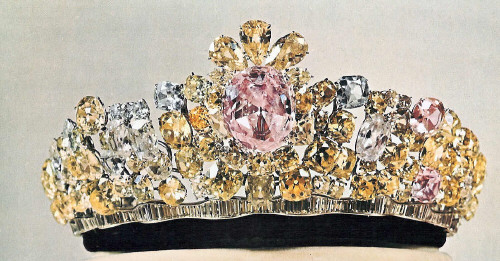
The Noor-ul-Ain is the principal diamond mounted in a tiara of the same name made for [[Iran]]ian [[Farah Pahlavi|Empress Farah Pahlavi's]] wedding to [[Shah]] [[Mohammad Reza Pahlavi]] in 1958. The tiara was designed by [[Harry Winston]]. It is a modern design, featuring 324 pink, yellow, and white diamonds set in [[platinum]]. It is said to weigh around {{cvt|2|kg}}. The tiara forms part of the Iranian crown jewels, held at the [[National Treasury of Iran]] in the [[Central Bank of the Islamic Republic of Iran|Central Bank]] in [[Tehran]]. | The Noor-ul-Ain is the principal diamond mounted in a tiara of the same name made for [[Iran]]ian [[Farah Pahlavi|Empress Farah Pahlavi's]] wedding to [[Shah]] [[Mohammad Reza Pahlavi]] in 1958. The tiara was designed by [[Harry Winston]]. It is a modern design, featuring 324 pink, yellow, and white diamonds set in [[platinum]]. It is said to weigh around {{cvt|2|kg}}. The tiara forms part of the Iranian crown jewels, held at the [[National Treasury of Iran]] in the [[Central Bank of the Islamic Republic of Iran|Central Bank]] in [[Tehran]].{{cn|date=November 2021}} | ||
It is a [[diamond types|Type IIa]] diamond. | It is a [[diamond types|Type IIa]] diamond.{{cn|date=November 2021}} | ||
==See also== | ==See also== | ||
Latest revision as of 21:39, 9 June 2022
The Noor-ul-Ain (Persian: نور العين, lit. 'the light of the eye') is one of the largest pink diamonds in the world, and the centre piece of the tiara of the same name.
History[edit | edit source]
The diamond is believed to have been recovered from the mines of Golconda, Hyderabad in India. It was first in possession with the nizam Abul Hasan Qutb Shah, later it was given as a peace offering to the Mughal emperor Aurangazeb when he defeated him in a siege. It was brought into the Iranian Imperial collection after the Persian king Nader Shah Afshar looted Delhi in the 18th century.[citation needed]
The Noor-ul-Ain is believed to have once formed part of an even larger gem called the Great Table diamond. That larger diamond is thought to have been cut in two, with one section becoming the Noor-ul-Ain and the other the Daria-i-Noor diamond. Both of these pieces are currently part of the Iranian Crown Jewels.[1]
History of the tiara[edit | edit source]
The Noor-ul-Ain is the principal diamond mounted in a tiara of the same name made for Iranian Empress Farah Pahlavi's wedding to Shah Mohammad Reza Pahlavi in 1958. The tiara was designed by Harry Winston. It is a modern design, featuring 324 pink, yellow, and white diamonds set in platinum. It is said to weigh around 2 kg (4.4 lb). The tiara forms part of the Iranian crown jewels, held at the National Treasury of Iran in the Central Bank in Tehran.[citation needed]
It is a Type IIa diamond.[citation needed]
See also[edit | edit source]
- Great Table diamond
- Koh-i-Noor diamond
- List of diamonds
- List of largest rough diamonds
- Elizabeth II's jewels
References[edit | edit source]
- ↑ Cite error: Invalid
<ref>tag; no text was provided for refs namedautogenerated1
Anna Malecka, "The Mystery of the Nur al-Ayn Diamond", Gems & Jewellery: The Gemmological Association of Great Britain, volume 23 (7), August/September 2014, pp. 20-22;