


->Citation bot Alter: url. URLs might have been anonymized. Add: work. Removed parameters. Some additions/deletions were parameter name changes. | Use this bot. Report bugs. | Suggested by AManWithNoPlan | #UCB_webform 3/317 |
m robot: Update article (please report if you notice any mistake or error in this edit) |
||
| Line 1: | Line 1: | ||
{{short description|Indian politician}} | {{short description|Indian politician (1904-1977)}} | ||
{{Use Indian English|date=June 2015}} | {{Use Indian English|date=June 2015}} | ||
{{Use dmy dates|date=November 2020}} | {{Use dmy dates|date=November 2020}} | ||
{{Infobox officeholder | {{Infobox officeholder | ||
| name = A. K. Gopalan | | name = A. K. Gopalan | ||
| birth_name | | birth_name = Ayillyath Kuttiari Gopalan Nambiar| | ||
| image = AK Gopalan 1990 stamp of India.jpg | | image = AK Gopalan 1990 stamp of India.jpg | ||
| caption = Gopalan on a 1990 stamp of India | | caption = Gopalan on a 1990 stamp of India | ||
| birth_date ={{Birth date|df=yes|1904|10|01}} | | birth_date = {{Birth date|df=yes|1904|10|01}} | ||
| birth_place = [[Kannur]], [[Malabar district]], [[Madras Presidency]], [[British India]]<br>(now in [[Kerala]], India) | | birth_place = [[Kannur]], [[Malabar district]], [[Madras Presidency]], [[British India]]<br>(now in [[Kerala]], India) | ||
| death_date = {{Death date and age|df=yes|1977|03|22|1904|10|01}} | | death_date = {{Death date and age|df=yes|1977|03|22|1904|10|01}} | ||
| death_place = [[Trivandrum]], [[Kerala]], India | | death_place = [[Trivandrum]], [[Kerala]], India | ||
| residence = | | residence = | ||
| constituency = | | constituency = | ||
| constituency_MP1 = [[Kannur (Lok Sabha constituency)|Cannanore]] | | constituency_MP1 = [[Kannur (Lok Sabha constituency)|Cannanore]] | ||
| majority1 | | majority1 = | ||
| parliament1 | | parliament1 = Indian | ||
| term_start1 | | term_start1 = {{Start date|1952||}} | ||
| term_end1 | | term_end1 = {{End date|1957||}} | ||
| predecessor1 | | predecessor1 = ''Position Created'' | ||
| successor1 | | successor1 = [[C. K. Chandrappan]] | ||
| constituency_MP2 = [[Kasaragod (Lok Sabha constituency)|Kasaragod]] | | constituency_MP2 = [[Kasaragod (Lok Sabha constituency)|Kasaragod]] | ||
| parliament2 | | parliament2 = Indian | ||
| term_start2 | | term_start2 = {{Start date |1957||}} | ||
| term_end2 | | term_end2 = {{End date|1971||}} | ||
| predecessor2 | | predecessor2 = [[U. Srinivas Mallya]]<br>''[[South Kanara (North) (Lok Sabha constituency)|South Kanara (North)]]'' | ||
| successor2 | | successor2 = [[Ramachandran Kadannappalli]] | ||
| party | | party = * [[Communist Party of India]] | ||
* [[Communist Party of India (Marxist)]] | * [[Communist Party of India (Marxist)]] | ||
| spouse | | spouse = {{Marriage|[[Susheela Gopalan]]|1952}} | ||
| children | | children = | ||
| parents | | parents = {{Unbulleted_list|Velluva Kannoth Rairu Nambiar|Ayillyath Kuttiyeri Madhavi Amma}} | ||
|date= | | | date = | | ||
| year = | | | year = | | ||
| source = | | source = | ||
| honorific_prefix = [[Comrade]] | |||
| known_for = Co-founder of [[Communist Party of India (Marxist)]] | |||
}} | }} | ||
| Line 44: | Line 46: | ||
In 1927 he joined the [[Indian National Congress]] and began playing an active role in the Khadi Movement and the upliftment of [[Harijan]]s. He was arrested for participating in the salt [[satyagraha]] in 1930. | In 1927 he joined the [[Indian National Congress]] and began playing an active role in the Khadi Movement and the upliftment of [[Harijan]]s. He was arrested for participating in the salt [[satyagraha]] in 1930. | ||
While in prison he got acquainted with communism and became a member of the [[Congress Socialist Party]] and later the [[Communist Party of India]] when it finally took shape in Kerala in 1939. He led the hunger march from [[Malabar region]] to [[Madras]] in 1936 and the Malabar Jatha in support of the movement for responsible government in [[Travancore]]. The strongest caste system was in the North [[ | While in prison he got acquainted with communism and became a member of the [[Congress Socialist Party]] and later the [[Communist Party of India]] when it finally took shape in Kerala in 1939. He led the hunger march from [[Malabar region]] to [[Madras]] in 1936 and the Malabar Jatha in support of the movement for responsible government in [[Travancore]]. The strongest caste system was in the North [[Kerala]]. The lower caste people were not allowed to walk on a public road in [[Payyannur]]. At this time A.K. Gopalan and the Keralites led the procession through the public road in front of the Kandoth [[Temple]] (Palliyara) near Payyanur, [[Kannur]]. "This is a time when Harijans are being denied the freedom to travel on public roads." The reason was that the nearby temple would be defiled. To promote the [[Guruvayoor Satyagraha]]. The group consisting of [[K. Kelappan | Kelappan]] and Gopalan marched along this route with the Harijans. As the procession approached the road, a crowd of about 200 people, including young men and women, A.K. Gopalan , Keraliyan and the Harijans were very badly beaten up by the leaders. Gopal and others were later admitted to the hospital. The attack lasted for half an hour. This was the first crackdown on Gopalan's political career.<ref>{{cite book|last=A.M Abraham Ayirukuzhiel|year=1987|title=Swami Anand Thirth: Untouchability, Gandhian Solution on Trial|url=https://books.google.com/books?id=xvotAAAAMAAJ&q=Badly|publisher=CISRS Banglore|page=32}}</ref><ref>[[#cpk71|പി.കൃഷ്ണപിള്ളയുടെ ജീവചരിത്രം -ഡോക്ടർ.ചന്തവിള മുരളി]] പുറം. 69</ref> | ||
== Further arrest == | == Further arrest == | ||
| Line 67: | Line 69: | ||
[[Shaji N. Karun]], a prominent film director of [[Kerala]], made a biopic on AKG titled ''AKG – Athijeevanathinte Kanalvazhikal''. The film used a part-documentary, part-fiction format. It was released in theatres across Kerala in August 2008.<ref>{{cite news| url=http://www.hindu.com/2007/08/08/stories/2007080854871000.htm | archive-url=https://archive.today/20130125180245/http://www.hindu.com/2007/08/08/stories/2007080854871000.htm | url-status=dead | archive-date=25 January 2013 | location=Chennai, India | work=[[The Hindu]] | title=Film on AKG set for release tomorrow | date=8 August 2007}}</ref> [[Baiju Santhosh|Baiju]] played Gopalan in the 2014 feature film ''[[Vasanthathinte Kanal Vazhikalil]]''.<ref name="H">{{Cite web|url=https://www.thehindu.com/features/friday-review/vasanthathinte-kanal-vazhikalil-film-on-p-krishna-pillai/article6590825.ece|title=Ode to a brave patriot|first=Saraswathy|last=Nagarajan|date=13 November 2014|work=The Hindu}}</ref> | [[Shaji N. Karun]], a prominent film director of [[Kerala]], made a biopic on AKG titled ''AKG – Athijeevanathinte Kanalvazhikal''. The film used a part-documentary, part-fiction format. It was released in theatres across Kerala in August 2008.<ref>{{cite news| url=http://www.hindu.com/2007/08/08/stories/2007080854871000.htm | archive-url=https://archive.today/20130125180245/http://www.hindu.com/2007/08/08/stories/2007080854871000.htm | url-status=dead | archive-date=25 January 2013 | location=Chennai, India | work=[[The Hindu]] | title=Film on AKG set for release tomorrow | date=8 August 2007}}</ref> [[Baiju Santhosh|Baiju]] played Gopalan in the 2014 feature film ''[[Vasanthathinte Kanal Vazhikalil]]''.<ref name="H">{{Cite web|url=https://www.thehindu.com/features/friday-review/vasanthathinte-kanal-vazhikalil-film-on-p-krishna-pillai/article6590825.ece|title=Ode to a brave patriot|first=Saraswathy|last=Nagarajan|date=13 November 2014|work=The Hindu}}</ref> | ||
=== Autobiography - My Life Story === | === Autobiography - My Life Story === | ||
His autobiography is Ente Jeevitha Katha (written in Malayalam) > {{Cite book |url=https://nastiknation.org/product/ente-jivitha-katha-akg|title=Ente Jeevitha Katha-}} | His autobiography is Ente Jeevitha Katha (written in Malayalam) > {{Cite book |url=https://nastiknation.org/product/ente-jivitha-katha-akg|title=Ente Jeevitha Katha-}} | ||
==See also== | ==See also== | ||
Revision as of 17:13, 18 June 2022
A. K. Gopalan | |
|---|---|
 Gopalan on a 1990 stamp of India | |
| Member of the Indian Parliament for Cannanore | |
| In office 1952 – 1957 | |
| Preceded by | Position Created |
| Succeeded by | C. K. Chandrappan |
| Member of the Indian Parliament for Kasaragod | |
| In office 1957 – 1971 | |
| Preceded by | U. Srinivas Mallya South Kanara (North) |
| Succeeded by | Ramachandran Kadannappalli |
| Personal details | |
| Born | Ayillyath Kuttiari Gopalan Nambiar 1 October 1904 Kannur, Malabar district, Madras Presidency, British India (now in Kerala, India) |
| Died | 22 March 1977 (aged 72) Trivandrum, Kerala, India |
| Political party | |
| Spouse(s) | ( m. 1952) |
| Parent(s) |
|
| Known for | Co-founder of Communist Party of India (Marxist) |
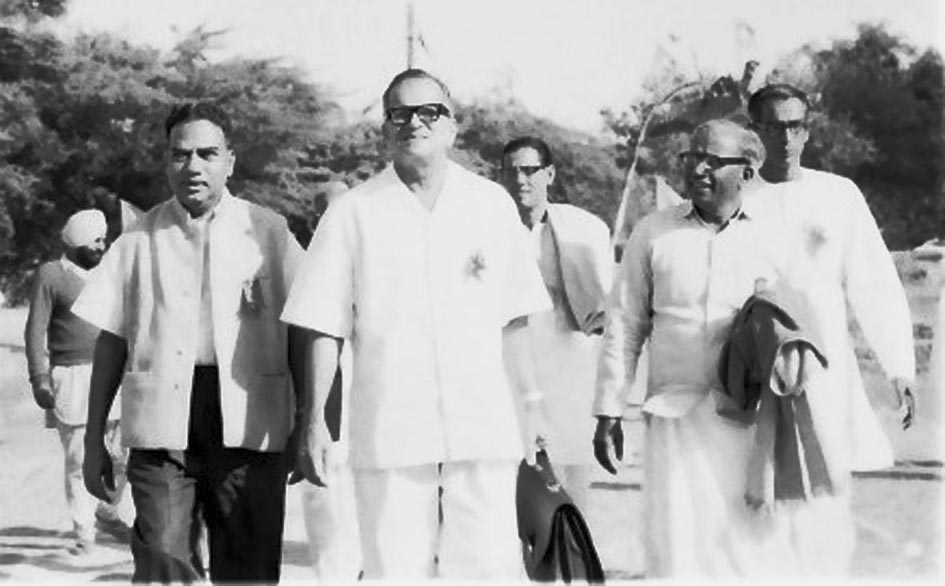
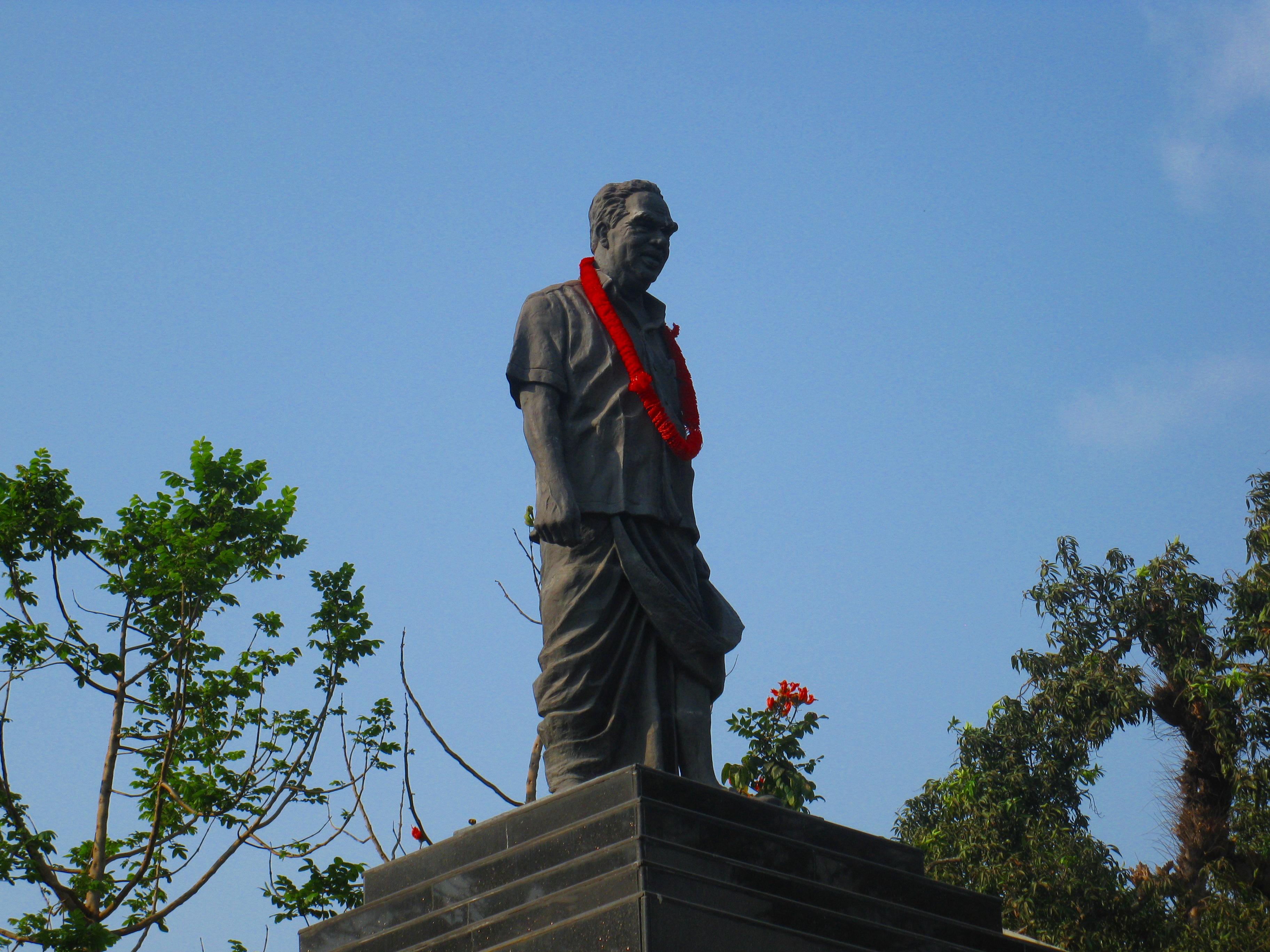
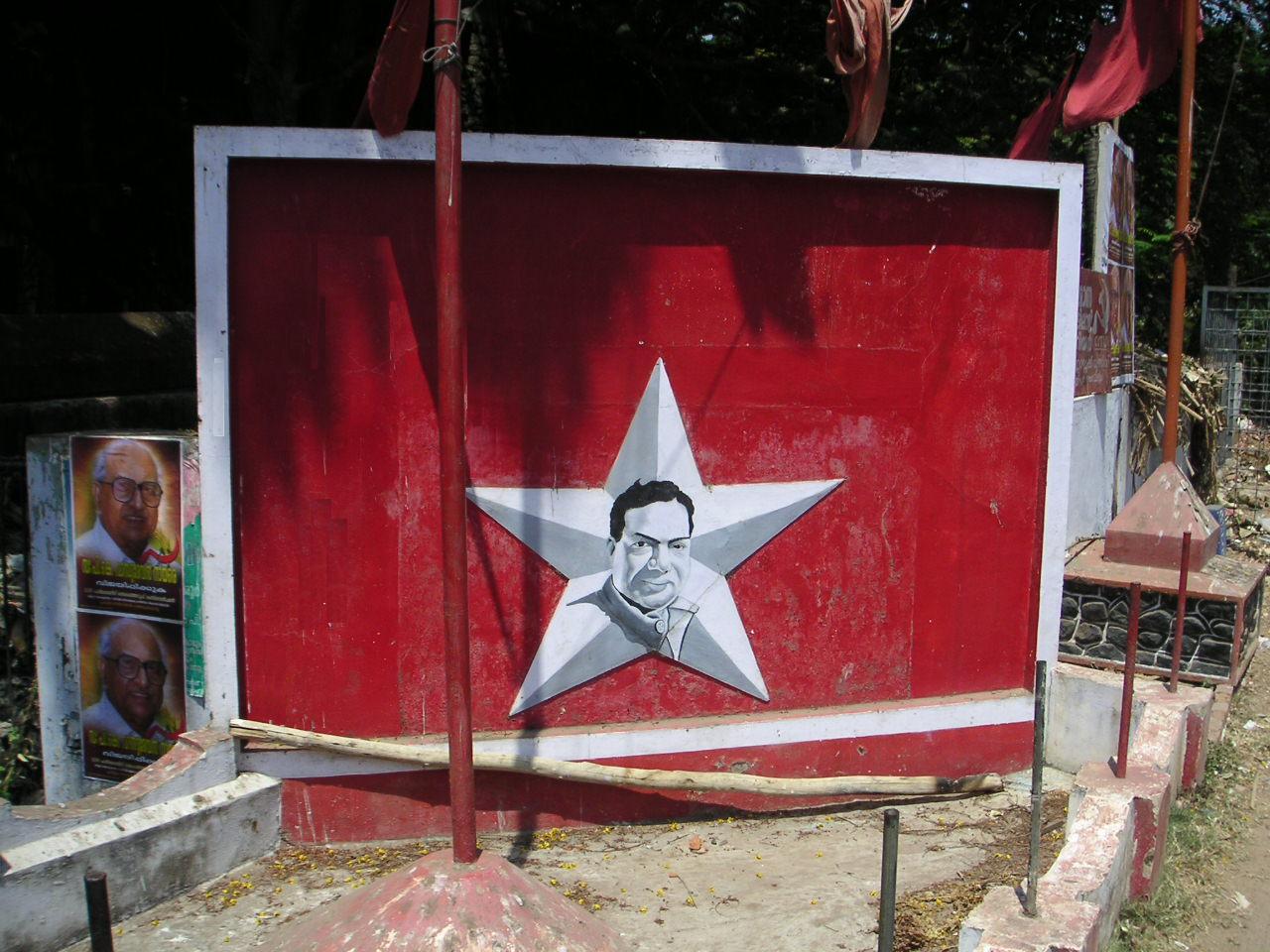
Ayillyath Kuttiari Gopalan (1 October 1904 – 22 March 1977), popularly known as A. K. Gopalan or AKG, was an Indian communist politician. He was one of 16 Communist Party of India members elected to the first Lok Sabha in 1952. Later he became one of the founding members of the Communist Party of India (Marxist).
Early life and education
Ayillyath Kuttiari Gopalan was born on 1 October 1904 in Peralasseri, Kannur District of Northern Kerala and educated in Tellichery. He was educated at Basel Evangelical Mission Parsi High School, Thalassery[1] and at Government Brennen College, Thalassery.[2] By the time he became a teacher, India's independence movement was becoming energised by Mahatma Gandhi. Gopalan took part in the Khilafat Movement which prompted a marked change in his outlook, transforming him into a dedicated full-time social and political worker. He was also involved in Malabar revolution.
Indian National Congress
In 1927 he joined the Indian National Congress and began playing an active role in the Khadi Movement and the upliftment of Harijans. He was arrested for participating in the salt satyagraha in 1930.
While in prison he got acquainted with communism and became a member of the Congress Socialist Party and later the Communist Party of India when it finally took shape in Kerala in 1939. He led the hunger march from Malabar region to Madras in 1936 and the Malabar Jatha in support of the movement for responsible government in Travancore. The strongest caste system was in the North Kerala. The lower caste people were not allowed to walk on a public road in Payyannur. At this time A.K. Gopalan and the Keralites led the procession through the public road in front of the Kandoth Temple (Palliyara) near Payyanur, Kannur. "This is a time when Harijans are being denied the freedom to travel on public roads." The reason was that the nearby temple would be defiled. To promote the Guruvayoor Satyagraha. The group consisting of Kelappan and Gopalan marched along this route with the Harijans. As the procession approached the road, a crowd of about 200 people, including young men and women, A.K. Gopalan , Keraliyan and the Harijans were very badly beaten up by the leaders. Gopal and others were later admitted to the hospital. The attack lasted for half an hour. This was the first crackdown on Gopalan's political career.[3][4]
Further arrest

The outbreak of the Second World War in 1939 prompted an upsurge in activism against British domination, and Gopalan was again arrested. But in 1942 he escaped from prison and remained at large till the end of the war in 1945. He was arrested again shortly after the end of the war and was still behind bars when India became independent on 15 August 1947. He was released a few weeks later. Thereafter he was a member of Lok Sabha for 5 consecutive terms till his death on 22 March 1977 and became one of the leaders of opposition parties in the parliament of India.
During the Sino-Indian war in 1962, AKG along with other Indian communists like E.M.S. took an impartial view and requested both nations to discuss and settle the matter peacefully. The official leadership of the party at that time denounced this and supported the India Government. Many leaders of the left group were arrested with the support of the leadership of the party. When the party leadership blocked the publication of an article written by then General Secretary EMS condemning government for attacking the left leaders in the party using the cover of the war, he himself quit the post and supported the left group. AKG was part of the left group and faced disciplinary action by the party leadership dominated by the right. During this time a newspaper published a letter allegedly written by rightist leaders S.A Dange to the British during the freedom struggle. In this letter he promised to keep away from the freedom struggle if granted bail. This was used by the left group to beat the right. When the demand of the left to set up a party-level inquiry about the alleged letter of S.A Dange was rejected in the National Council of CPI, the left group walked away and formed a new Party.
AKG joined the new break away faction, which later came to be known as Communist Party of India (Marxist). He also wrote extensively. His autobiography Ente Jeevitha Kadha has been translated into many languages. His other works include For Land, Around the World, Work in Parliament, and Collected Speeches, all in Malayalam.
Marriage
AKG was earlier married and later left his wife.[5][6][7] Later AKG was married to Susheela Gopalan, who was a prominent Marxist and trade union activist, from the Cheerappanchira family. His daughter, Laila, is married to P. Karunakaran, a former Member of Parliament for the Kasargod constituency.
Indian Coffee House

AKG played an important role in the formation of Indian Coffee House, a worker cooperative initiative by organising the thrown out employees of Coffee Houses of Coffee Board to establish ICHs in late 1950s.


In popular culture
Shaji N. Karun, a prominent film director of Kerala, made a biopic on AKG titled AKG – Athijeevanathinte Kanalvazhikal. The film used a part-documentary, part-fiction format. It was released in theatres across Kerala in August 2008.[8] Baiju played Gopalan in the 2014 feature film Vasanthathinte Kanal Vazhikalil.[9]
Autobiography - My Life Story
His autobiography is Ente Jeevitha Katha (written in Malayalam) > Ente Jeevitha Katha-.
See also
References
- ↑ Sudhakaran, P. "The wonder that was Basel Mission School". The Times of India.
- ↑ "Members Bioprofile". loksabhaph.nic.in.
- ↑ A.M Abraham Ayirukuzhiel (1987). Swami Anand Thirth: Untouchability, Gandhian Solution on Trial. CISRS Banglore. p. 32.
- ↑ പി.കൃഷ്ണപിള്ളയുടെ ജീവചരിത്രം -ഡോക്ടർ.ചന്തവിള മുരളി പുറം. 69
- ↑ "Love in time of struggles". The Hindu. 20 December 2001. Retrieved 24 May 2021.
- ↑ "VT Balram attacks communist icon AKG for 'falling in love with 12-yr-old', stirs row". Gopika Ajayan. The NewsMinute. 6 January 2018. Retrieved 24 May 2021.
- ↑ "Thanks to a Congress MLA, a communist icon's book goes into reprint". Cithara Paul. The Week. 20 January 2018. Retrieved 24 May 2021.
- ↑ "Film on AKG set for release tomorrow". The Hindu. Chennai, India. 8 August 2007.
{{cite news}}: CS1 maint: deprecated archival service (link) - ↑ Nagarajan, Saraswathy (13 November 2014). "Ode to a brave patriot". The Hindu.
External links
- Manini Chatterjee, People's Democracy. "A K Gopalan: From Satygrahi To Revolutionary". Archived from the original on 12 September 2007. Retrieved 31 October 2007.
- B.T. Ranadive, People's Democracy. "IN MEMORY OF A K GOPALAN". Archived from the original on 27 September 2007. Retrieved 31 October 2007.
- Ganashakti Newsmagazine. "Remembrance: A. K. Gopalan". Archived from the original on 27 September 2007.
- K.P. Pushparaj, The Hindu (2 May 2004). "Fresh faces make prediction impossible". The Hindu. Chennai, India.
{{cite news}}: CS1 maint: deprecated archival service (link)