


No edit summary |
robot: Update article (please report if you notice any mistake or error in this edit) |
||
| Line 1: | Line 1: | ||
{{short description|Type of turban}} | {{short description|Type of turban}} | ||
{{Use dmy dates|date=May 2022}} | |||
{{Use Indian English|date=May 2022}} | |||
[[File:Rajput (Jodhpur) (8411728143).jpg|thumb|A man from India, wearing a [[Rajasthan]]i ''paggar'' style of turban.]] | [[File:Rajput (Jodhpur) (8411728143).jpg|thumb|A man from India, wearing a [[Rajasthan]]i ''paggar'' style of turban.]] | ||
'''Pagri''', sometimes also transliterated as '''pagari''', is the term for [[turban]] used in the [[ | '''Pagri''', sometimes also transliterated as '''pagari''', is the term for [[turban]] used in the [[Indian subcontinent]]. It specifically refers to a [[headdress]] that is worn by men and women, which needs to be manually tied. Other names include ''sapho''. | ||
==Cloth== | ==Cloth== | ||
| Line 10: | Line 12: | ||
=== ''khirki-dār-pagari'' === | === ''khirki-dār-pagari'' === | ||
Methods of binding the pagri are innumerable, and khirki-dar-pagri is one particular style of dressing the turban. Khirki-dar-pagri means the turban with a window. Brocade piece may decorate the turban..<ref>{{Cite book|last=Lewandowski|first=Elizabeth J.|url=https://books.google.com/books?id=gbIsJ2tZJS4C | Methods of binding the pagri are innumerable, and khirki-dar-pagri is one particular style of dressing the turban. Khirki-dar-pagri means the turban with a window. Brocade piece may decorate the turban..<ref>{{Cite book|last=Lewandowski|first=Elizabeth J.|url=https://books.google.com/books?id=gbIsJ2tZJS4C|title=The Complete Costume Dictionary|date=2011-10-24|publisher=Scarecrow Press|isbn=978-0-8108-7785-6|pages=161|language=en}}</ref> | ||
===Paag=== | ===Paag=== | ||
| Line 18: | Line 20: | ||
===Pheta=== | ===Pheta=== | ||
{{Main|Pheta (turban)|l1=Pheta}} | {{Main|Pheta (turban)|l1=Pheta}} | ||
Pheta is the [[Marathi language|Marathi]] name for the traditional [[turban]] worn in [[Maharashtra]], [[India]]. In ceremonies such as [[Indian wedding|weddings]], festive and cultural and religious celebrations as well it is common to wear Pheta. In many parts it is customary to offer male dignitaries a traditional welcome by offering a ''Pheta'' to wear. A traditional ''Pheta'' is usually long cloth typically 3.5 to 6 meters long and 1 meter wide. The choice of colour may indicate the occasion for which it is being worn and also may be typical to the place it is being worn in. Typical colours include Saffron (to indicate [[valour]]) and White (to indicate [[peace]]). In the past, wearing a Pheta was considered a mandatory part of clothing.<ref>{{cite web |url=http://culture.kolhapurworld.com/special.html |title=Kolhapuri Pheta |publisher=Kolhapur World |url-status=dead |archive-url=https://web.archive.org/web/20121002233839/http://culture.kolhapurworld.com/special.html |archive-date=2012-10-02 }}</ref> | Pheta is the [[Marathi language|Marathi]] name for the traditional [[turban]] worn in [[Maharashtra]], [[India]]. In ceremonies such as [[Indian wedding|weddings]], festive and cultural and religious celebrations as well it is common to wear Pheta. In many parts it is customary to offer male dignitaries a traditional welcome by offering a ''Pheta'' to wear. A traditional ''Pheta'' is usually long cloth typically 3.5 to 6 meters long and 1 meter wide. The choice of colour may indicate the occasion for which it is being worn and also may be typical to the place it is being worn in. Typical colours include Saffron (to indicate [[Courage|valour]]) and White (to indicate [[peace]]). In the past, wearing a Pheta was considered a mandatory part of clothing.<ref>{{cite web |url=http://culture.kolhapurworld.com/special.html |title=Kolhapuri Pheta |publisher=Kolhapur World |url-status=dead |archive-url=https://web.archive.org/web/20121002233839/http://culture.kolhapurworld.com/special.html |archive-date=2012-10-02 }}</ref> | ||
There are several styles of Pheta which are specific to regions, for example | There are several styles of Pheta which are specific to regions, for example | ||
* [[Kolhapur]]i and [[Pune]]ri [[Pheta (turban)|pheta]] | * [[Kolhapur]]i and [[Pune]]ri [[Pheta (turban)|pheta]] | ||
* Mawali pagadi (traditionally worn by [[Maratha]] warriors from the Mawal region of [[Maharashtra]]) | * Mawali pagadi (traditionally worn by [[Maratha]] warriors from the Mawal region of [[Maharashtra]]) | ||
* [[Mahatma Phule]] pagadi famously worn by the Maharashtrian reformer, the activist from whom it gets the name.<ref name="baseball2pheta">{{ | * [[Mahatma Phule]] pagadi famously worn by the Maharashtrian reformer, the activist from whom it gets the name.<ref name="baseball2pheta">{{Cite web|url=https://indianexpress.com/article/cities/pune/from-baseball-caps-to-phetas/|title=From baseball caps to phetas!|date=13 June 2009}}</ref> | ||
[[File:Sarpech (turban ornament), India, possibly Rajasthan, Mughal period, 18th century, gold, diamonds, rubies, emeralds, enamel - Royal Ontario Museum - DSC04551.JPG|thumb|Sarpech (turban ornament) worn on special occasions, India, 18th century]] | [[File:Sarpech (turban ornament), India, possibly Rajasthan, Mughal period, 18th century, gold, diamonds, rubies, emeralds, enamel - Royal Ontario Museum - DSC04551.JPG|thumb|Sarpech (turban ornament) worn on special occasions, India, 18th century]] | ||
| Line 36: | Line 38: | ||
===Rajasthani pagari=== | ===Rajasthani pagari=== | ||
[[File:Monitors Mayo College Ajmer.jpg|thumb|Rajasthani princes wearing a pagri]] | [[File:Monitors Mayo College Ajmer.jpg|thumb|Rajasthani princes wearing a pagri]] | ||
Turbans worn in [[Rajasthan]] are referred to as the ''pagari''. They vary in style, colour and size. They also indicate a wearer's social class, caste, region and the occasion it being worn for. Its shape and size may also vary with the climatic conditions of the different regions. Turbans in the hot desert areas are large and loose. Farmers and shepherds, who need constant protection from the elements of nature, wear some of the biggest turbans. The Rajasthani turban also has many practical functions. Exhausted travellers use it as a pillow, a blanket or a towel. It can be used to strain muddy water. An unravelled turban can also be used as a rope to draw water from a well with a bucket.<ref name="rajastanunlimited">{{cite web |url=http://www.rajasthanunlimited.com/artandcraft/turban.html |title=Rajasthan at a glance |publisher=Rajasthanunlimited.com |access-date=2010-03-03 |archive-url=https:// | Turbans worn in [[Rajasthan]] are referred to as the ''pagari''. They vary in style, colour and size. They also indicate a wearer's social class, caste, region and the occasion it being worn for. Its shape and size may also vary with the climatic conditions of the different regions. Turbans in the hot desert areas are large and loose. Farmers and shepherds, who need constant protection from the elements of nature, wear some of the biggest turbans. The Rajasthani turban also has many practical functions. Exhausted travellers use it as a pillow, a blanket or a towel. It can be used to strain muddy water. An unravelled turban can also be used as a rope to draw water from a well with a bucket.<ref name="rajastanunlimited">{{cite web |url=http://www.rajasthanunlimited.com/artandcraft/turban.html |title=Rajasthan at a glance |publisher=Rajasthanunlimited.com |access-date=2010-03-03 |archive-url=https://web.archive.org/web/20130316052021/http://www.rajasthanunlimited.com/artandcraft/turban.html |archive-date=2013-03-16 |url-status=dead }}</ref> | ||
Prominent styles are ''pencha'', ''sela'' and ''safa'', although several local variants exist. A conventional ''pagari'' is usually 82 inches long and 8 inches wide. A ''Safa'' is shorter and broader. Ordinarily a turban of a single colour is worn. However, turbans of one of more colours may be worn by the elite or during special occasions such as festivals or weddings, etc.<ref>{{cite web |url=http://www.greatindiaholiday.com/arts-culture-rajasthan/traditional-dresses.html |title=Rajasthan traditional dresses |publisher=greatindianholiday.com |access-date=2010-03-03 |archive-url=https://web.archive.org/web/20090918204855/http://www.greatindiaholiday.com/arts-culture-rajasthan/traditional-dresses.html |archive-date=2009-09-18 |url-status=dead }}</ref> Rajasthani turbans are a prominent tourist attraction. Tourists are often encouraged to participate in turban-tying competitions.<ref name="rajastanunlimited" /> | Prominent styles are ''pencha'', ''sela'' and ''safa'', although several local variants exist. A conventional ''pagari'' is usually 82 inches long and 8 inches wide. A ''Safa'' is shorter and broader. Ordinarily a turban of a single colour is worn. However, turbans of one of more colours may be worn by the elite or during special occasions such as festivals or weddings, etc.<ref>{{cite web |url=http://www.greatindiaholiday.com/arts-culture-rajasthan/traditional-dresses.html |title=Rajasthan traditional dresses |publisher=greatindianholiday.com |access-date=2010-03-03 |archive-url=https://web.archive.org/web/20090918204855/http://www.greatindiaholiday.com/arts-culture-rajasthan/traditional-dresses.html |archive-date=2009-09-18 |url-status=dead }}</ref> Rajasthani turbans are a prominent tourist attraction. Tourists are often encouraged to participate in turban-tying competitions.<ref name="rajastanunlimited" /> | ||
| Line 48: | Line 50: | ||
Peshawari pagri has been traditionally worn in [[Peshawar]]. It includes a cap called ''kulla'' and the cloth wrapped around it called ''lungi''.<ref>Title Subhas Chandra Bose: Netaji's passage to im[m]ortality, | Peshawari pagri has been traditionally worn in [[Peshawar]]. It includes a cap called ''kulla'' and the cloth wrapped around it called ''lungi''.<ref>Title Subhas Chandra Bose: Netaji's passage to im[m]ortality, | ||
Subodh Markandeya, Arnold Publishers, 1990, p. 147</ref> | Subodh Markandeya, Arnold Publishers, 1990, p. 147</ref> | ||
==Association with figure of speech== | ==Association with figure of speech== | ||
A pagri | A pagri is a symbol of honour and respect in all the regions where it is a practice to wear one. Its association with honour also lends its use in a [[figure of speech]] in associated languages. The figure of speech ''pagri uchaalna'' in [[Hindi]] (literal translation: to toss the turban) implies causing the loss of honour.{{fact|date=May 2022}} | ||
===Recognition of communities=== | ===Recognition of communities=== | ||
Different communities in Rajasthan are recognized by the colors and patterns on their pagris. The Kevat community wears only red Bandhani turban at all occasions. Jat community in Narwa village wears a bright yellow turban.<ref>https://gaatha.com/leheriya-headgear-rajasthan/</ref> | Different communities in Rajasthan are recognized by the colors and patterns on their pagris. The Kevat community wears only red Bandhani turban at all occasions. Jat community in Narwa village wears a bright yellow turban.<ref>{{Cite web|url=https://gaatha.com/leheriya-headgear-rajasthan/|title = Waves of a Desert}}</ref> | ||
==Pagri in Ancient India: from major museums== | ==Pagri in Ancient India: from major museums== | ||
<gallery widths=" | <gallery widths="200" heights="200"> | ||
File: | File:Jetvan bharhut.JPG|[[Bharhut]], donation of [[Anathapindika]], [[Shunga Empire|Shunga period]] | ||
File:Gandhara,grande partenza di buddha, 100-300.JPG|[[Gautama Buddha#Departure and ascetic life|The Great Departure]] of Buddha, [[Victoria and Albert Museum]] | |||
File:Gandhara, | File:Male head, northern India, Kushan or Gupta period, 5th-6th century CE, terracotta, HAA.JPG|Proto-Pagri, Kushan-Gupta period, 5th-6th century CE, terracotta, Honolulu Academy of Arts | ||
File: | File:Gandhara, testa di bodhisattva da hadda, IV-V secolo dc..JPG|[[Hadda, Afghanistan|Hadda]] | ||
File:Gandhara, | File:Gandhara, testa di bodhisattva, periodo kushan, 150-300.JPG|[[Victoria and Albert Museum]] | ||
File:Gandhara, | File:Stucco Gandhara figure 02.jpg|[[Victoria and Albert Museum]] | ||
File: | File:Arte del gandhara, bodhisattva pensoso, III sec.JPG|[[Los Angeles County Museum of Art]] | ||
File: | File:Bodhisattva Maitreya, Gandhara, 2nd-3rd century AD, schist with pigment and gold - Arthur M. Sackler Gallery - DSC06052.JPG|[[Bodhisattva]] [[Maitreya]], [[Arthur M. Sackler Gallery]] | ||
File: | File:Bodhisattva Gandhara Guimet 181173.jpg|[[Guimet]] | ||
File: | File:Pakistani - Head of a Bodhisattva or Donor Prince - Walters 2597.jpg|[[Walters Art Museum]], Baltimore | ||
File: | |||
</gallery> | </gallery> | ||
==See also== | ==See also== | ||
* [[Gandhi cap]] | |||
* [[Puneri Pagadi]] | * [[Puneri Pagadi]] | ||
* [[Rasam Pagri]] | * [[Rasam Pagri]] | ||
* [[Sehra (headdress)]] | * [[Sehra (headdress)]] | ||
* [[Turban]] | |||
==References== | ==References== | ||
{{reflist}} | {{reflist}} | ||
Latest revision as of 14:48, 26 June 2022
_(8411728143).jpg)
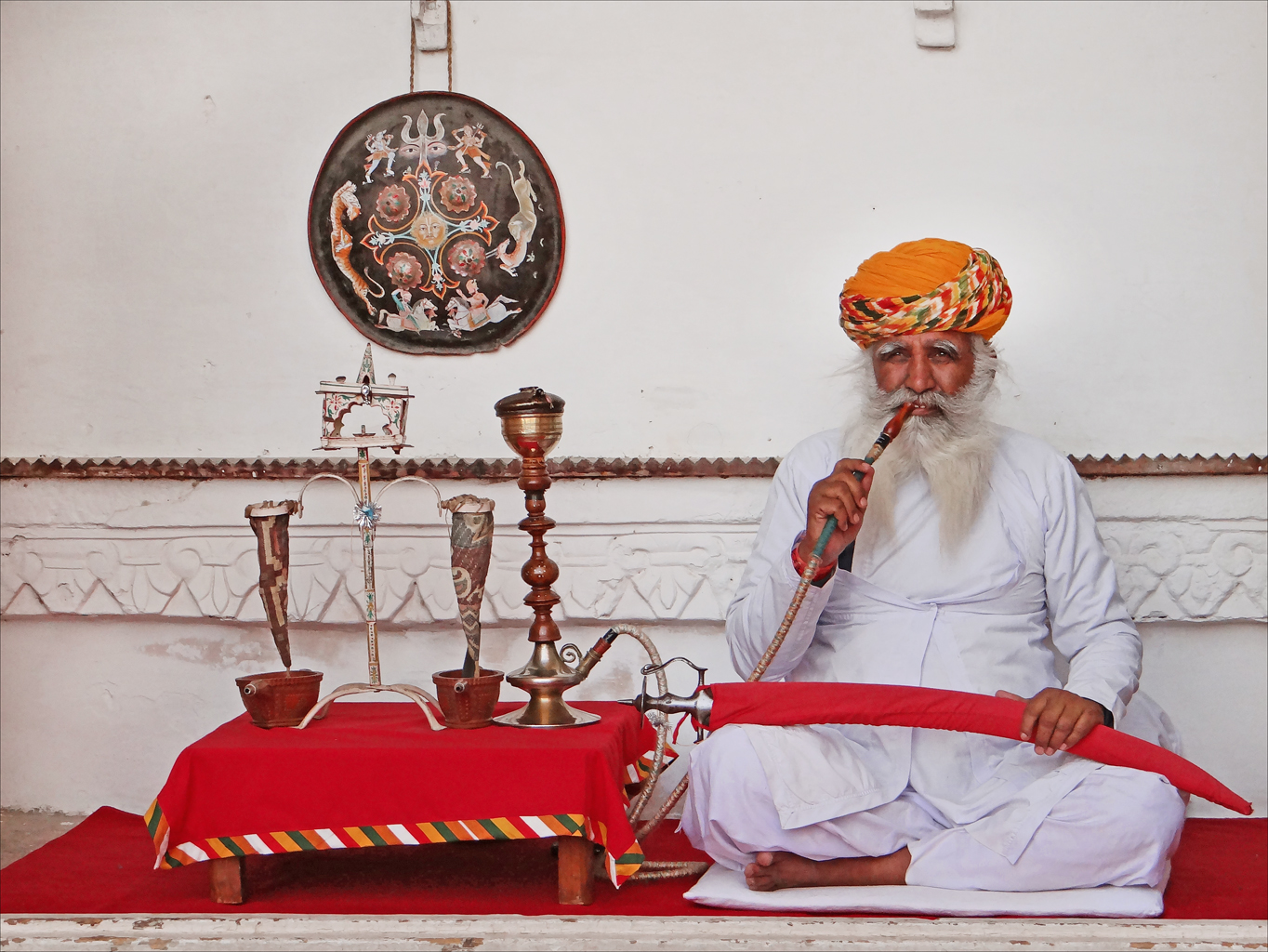
Pagri, sometimes also transliterated as pagari, is the term for turban used in the Indian subcontinent. It specifically refers to a headdress that is worn by men and women, which needs to be manually tied. Other names include sapho.
Cloth[edit | edit source]
A pagri is usually a long plain unstitched cloth. The length may vary according to the type. The cloth indicates the region and the community of the wearer.[1]
Specific styles[edit | edit source]
,_India,_Rajasthan,_19th_century,_cotton,_coil-resist-dyed,_metallic_thread_-_Royal_Ontario_Museum_-_DSC04475.JPG)
khirki-dār-pagari[edit | edit source]
Methods of binding the pagri are innumerable, and khirki-dar-pagri is one particular style of dressing the turban. Khirki-dar-pagri means the turban with a window. Brocade piece may decorate the turban..[2]
Paag[edit | edit source]
The paag is a headdress in the Mithila region of Bihar and in Mithila, Nepal.
Pheta[edit | edit source]
Pheta is the Marathi name for the traditional turban worn in Maharashtra, India. In ceremonies such as weddings, festive and cultural and religious celebrations as well it is common to wear Pheta. In many parts it is customary to offer male dignitaries a traditional welcome by offering a Pheta to wear. A traditional Pheta is usually long cloth typically 3.5 to 6 meters long and 1 meter wide. The choice of colour may indicate the occasion for which it is being worn and also may be typical to the place it is being worn in. Typical colours include Saffron (to indicate valour) and White (to indicate peace). In the past, wearing a Pheta was considered a mandatory part of clothing.[3]
There are several styles of Pheta which are specific to regions, for example
- Kolhapuri and Puneri pheta
- Mawali pagadi (traditionally worn by Maratha warriors from the Mawal region of Maharashtra)
- Mahatma Phule pagadi famously worn by the Maharashtrian reformer, the activist from whom it gets the name.[4]
,_India,_possibly_Rajasthan,_Mughal_period,_18th_century,_gold,_diamonds,_rubies,_emeralds,_enamel_-_Royal_Ontario_Museum_-_DSC04551.JPG)
Peta[edit | edit source]
The peta is a turban worn in Mysore and Kodagu, it is the traditional indigenous attire worn by the erstwhile Kings of Mysore, called the Wodeyars (1399 to 1947), of the Kingdom of Mysore. Wodeyars wore a richly bejeweled turban made of silk and jari (gold threaded lace) to match with colorful dresses as part of the royal dress.
Administrators under the King, such as the Dewans' (Prime Minister appointed by the King) and other senior officials who swayed considerable power in matters of state administration also doffed the Mysore peta.
After India became independent in 1947 and the princely state merged with the Indian union, the traditional Mysore peta has been retained as a symbol of heritage and cultural antecedents and distinguished people are honoured by the award of a Mysore peta with a shawl in formal functions.
Rajasthani pagari[edit | edit source]

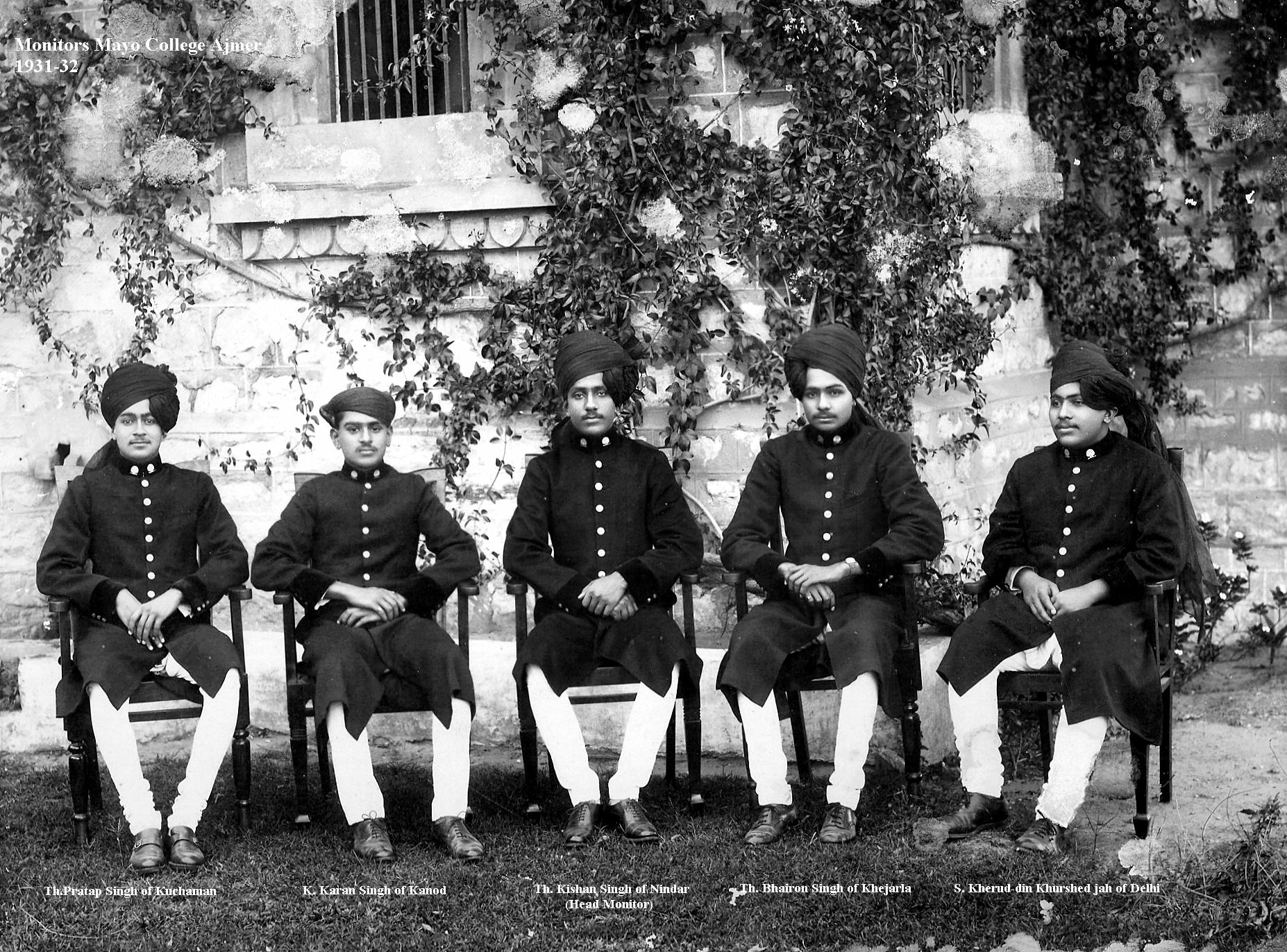
Turbans worn in Rajasthan are referred to as the pagari. They vary in style, colour and size. They also indicate a wearer's social class, caste, region and the occasion it being worn for. Its shape and size may also vary with the climatic conditions of the different regions. Turbans in the hot desert areas are large and loose. Farmers and shepherds, who need constant protection from the elements of nature, wear some of the biggest turbans. The Rajasthani turban also has many practical functions. Exhausted travellers use it as a pillow, a blanket or a towel. It can be used to strain muddy water. An unravelled turban can also be used as a rope to draw water from a well with a bucket.[5]
Prominent styles are pencha, sela and safa, although several local variants exist. A conventional pagari is usually 82 inches long and 8 inches wide. A Safa is shorter and broader. Ordinarily a turban of a single colour is worn. However, turbans of one of more colours may be worn by the elite or during special occasions such as festivals or weddings, etc.[6] Rajasthani turbans are a prominent tourist attraction. Tourists are often encouraged to participate in turban-tying competitions.[5]
Vedic Kshatriya Pagri[edit | edit source]
Vedic Kshatriyas used a large turban consisting of two cloths, one to tie the turban and one to cover the turban completely. The second cloth used to cover the turban is saffron. This sheath contains kshātra-shaktī (Energy of a warrior) and dnyān-shaktī. The turban acts like a crown on the head. A protective sheath is created around the head because of the turban. Therefore, the individual does not imbibe negative vibrations from the environment. The turban reduces the extent of distressing covering around individual’s intellect, and creates a bhāv of renunciation in the individual. This tradition died out when the pure Kshatriya society was slowly drawn away from its culture and went into standing armies.[7]
Peshawari pagri[edit | edit source]
Peshawari pagri has been traditionally worn in Peshawar. It includes a cap called kulla and the cloth wrapped around it called lungi.[8]
Association with figure of speech[edit | edit source]
A pagri is a symbol of honour and respect in all the regions where it is a practice to wear one. Its association with honour also lends its use in a figure of speech in associated languages. The figure of speech pagri uchaalna in Hindi (literal translation: to toss the turban) implies causing the loss of honour.[citation needed]
Recognition of communities[edit | edit source]
Different communities in Rajasthan are recognized by the colors and patterns on their pagris. The Kevat community wears only red Bandhani turban at all occasions. Jat community in Narwa village wears a bright yellow turban.[9]
Pagri in Ancient India: from major museums[edit | edit source]
-

-
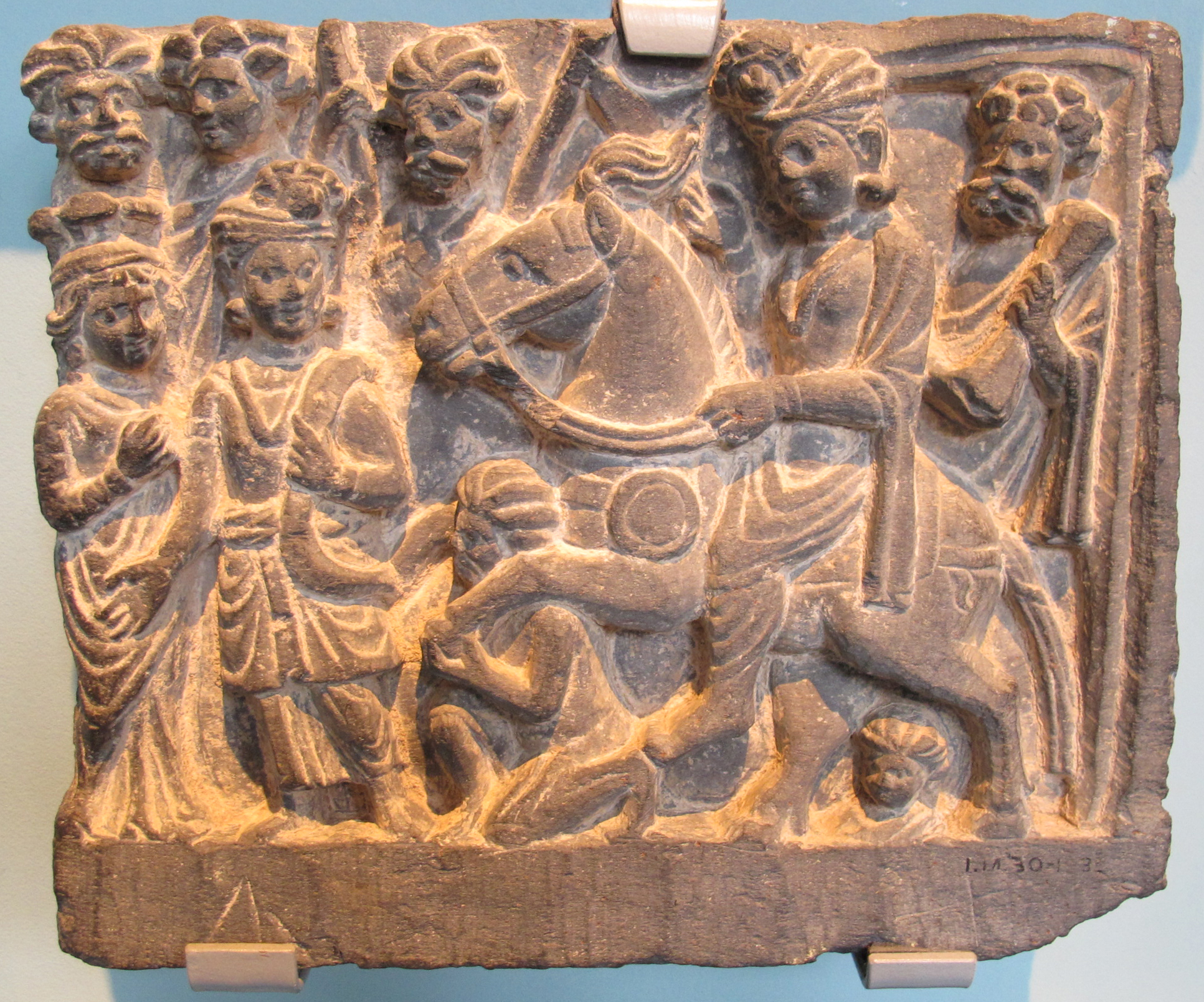 The Great Departure of Buddha, Victoria and Albert Museum
 -
 Proto-Pagri, Kushan-Gupta period, 5th-6th century CE, terracotta, Honolulu Academy of Arts
 -

-

-

-

-

-

-
 Walters Art Museum, Baltimore


See also[edit | edit source]
References[edit | edit source]
- ↑ "Pride of tying Turbans". Travelersindia.com.
- ↑ Lewandowski, Elizabeth J. (24 October 2011). The Complete Costume Dictionary. Scarecrow Press. p. 161. ISBN 978-0-8108-7785-6.
- ↑ "Kolhapuri Pheta". Kolhapur World. Archived from the original on 2 October 2012.
- ↑ "From baseball caps to phetas!". 13 June 2009.
- ↑ 5.0 5.1 "Rajasthan at a glance". Rajasthanunlimited.com. Archived from the original on 16 March 2013. Retrieved 3 March 2010.
- ↑ "Rajasthan traditional dresses". greatindianholiday.com. Archived from the original on 18 September 2009. Retrieved 3 March 2010.
- ↑ Subscribe. "Importance of the pheta (Turban) and its benefits". Hindu Janajagruti Samiti. Retrieved 14 January 2021.
- ↑ Title Subhas Chandra Bose: Netaji's passage to im[m]ortality, Subodh Markandeya, Arnold Publishers, 1990, p. 147
- ↑ "Waves of a Desert".