

imported>Citation bot Alter: url. URLs might have been anonymized. Add: s2cid. | Use this bot. Report bugs. | Suggested by Abductive | Category:Use Indian English from January 2020 | via #UCB_Category 1689/1871 |
m robot: Update article (please report if you notice any mistake or error in this edit) |
||
| Line 7: | Line 7: | ||
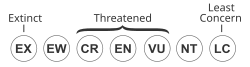
| status = DD | | status = DD | ||
| status_system = IUCN3.1 | | status_system = IUCN3.1 | ||
| status_ref = <ref name= | | status_ref = <ref name="iucn status 19 November 2021">{{cite iucn |author=Sushil Dutta, Gopalakrishna Bhatta, David Gower, Mark Wilkinson, Oommen V. Oommen |date=2004 |title=''Uraeotyphlus menoni'' |volume=2004 |page=e.T59656A11965158 |doi=10.2305/IUCN.UK.2004.RLTS.T59656A11965158.en |access-date=19 November 2021}}</ref> | ||
| genus = Uraeotyphlus | | genus = Uraeotyphlus | ||
| species = menoni | | species = menoni | ||
| Line 15: | Line 15: | ||
}} | }} | ||
'''''Uraeotyphlus menoni''''', also known as '''Menon's caecilian''' or '''Kerala caecilian''', is a species of [[caecilian]] in the family [[Ichthyophiidae]]. It is [[endemic]] to the state of [[Kerala]] in the [[Western Ghats]], [[India]].<ref name= | '''''Uraeotyphlus menoni''''', also known as '''Menon's caecilian''' or '''Kerala caecilian''', is a species of [[caecilian]] in the family [[Ichthyophiidae]]. It is [[endemic]] to the state of [[Kerala]] in the [[Western Ghats]], [[India]].<ref name="iucn status 19 November 2021" /><ref name=Frost/> The [[Specific name (zoology)|specific name]] ''menoni'' honours [[K. Ramunni Menon]], collector of the [[holotype]] who later became the vice-chancellor of the [[University of Madras]].<ref name="Beolens et al. 2013"/> | ||
==Description== | ==Description== | ||
| Line 21: | Line 21: | ||
==Habitat and conservation== | ==Habitat and conservation== | ||
''Uraeotyphlus menoni'' is a subterranean ([[fossorial]]) species associated with humus-rich, loose, moist soil. It occurs in both tropical moist forest and agricultural land at elevations below {{convert|500|m|abbr=on}} [[above sea level|asl]]. It is probably oviparous with terrestrial eggs and aquatic larvae.<ref name= | ''Uraeotyphlus menoni'' is a subterranean ([[fossorial]]) species associated with humus-rich, loose, moist soil. It occurs in both tropical moist forest and agricultural land at elevations below {{convert|500|m|abbr=on}} [[above sea level|asl]]. It is probably oviparous with terrestrial eggs and aquatic larvae.<ref name="iucn status 19 November 2021" /> | ||
This species appears to be reasonably adaptable and is probably not severely threatened, even though local populations might be threatened by severe habitat destruction. It might also be threatened by agrochemicals, changes in soil chemistry, and collection of humus. It is not known to occur in any protected areas.<ref name= | This species appears to be reasonably adaptable and is probably not severely threatened, even though local populations might be threatened by severe habitat destruction. It might also be threatened by agrochemicals, changes in soil chemistry, and collection of humus. It is not known to occur in any protected areas.<ref name="iucn status 19 November 2021" /> | ||
==References== | ==References== | ||
Latest revision as of 04:02, 20 November 2021
| Uraeotyphlus menoni | |
|---|---|

| |
Scientific classification 
| |
| : | [[Template:Taxonomy/Uraeotyphlus]] |
| Species: | Template:Taxonomy/UraeotyphlusU. menoni
|
| Binomial name | |
| Template:Taxonomy/UraeotyphlusUraeotyphlus menoni Annandale, 1913
| |
Uraeotyphlus menoni, also known as Menon's caecilian or Kerala caecilian, is a species of caecilian in the family Ichthyophiidae. It is endemic to the state of Kerala in the Western Ghats, India.[1][2] The specific name menoni honours K. Ramunni Menon, collector of the holotype who later became the vice-chancellor of the University of Madras.[3]
Description[edit | edit source]
Uraeotyphlus menoni can grow to 248 mm (9.8 in) in total length.[4] It is a greyish species with a white belly blotched with grey. The head is light violet in colour with light mottling, and the distinct eyes are surrounded by a light ring. The tip of the snout and lower jaw are whitish in colour, also with grey spots. The tip of the short tail (<1 cm) is whitish in colour. The tentacles are placed close to and below the nostrils. The nostrils are visible from above.[5]
Habitat and conservation[edit | edit source]
Uraeotyphlus menoni is a subterranean (fossorial) species associated with humus-rich, loose, moist soil. It occurs in both tropical moist forest and agricultural land at elevations below 500 m (1,600 ft) asl. It is probably oviparous with terrestrial eggs and aquatic larvae.[1]
This species appears to be reasonably adaptable and is probably not severely threatened, even though local populations might be threatened by severe habitat destruction. It might also be threatened by agrochemicals, changes in soil chemistry, and collection of humus. It is not known to occur in any protected areas.[1]
References[edit | edit source]
- ↑ 1.0 1.1 1.2 1.3 Sushil Dutta, Gopalakrishna Bhatta, David Gower, Mark Wilkinson, Oommen V. Oommen (2004). "Uraeotyphlus menoni". IUCN Red List of Threatened Species. 2004: e.T59656A11965158. doi:10.2305/IUCN.UK.2004.RLTS.T59656A11965158.en. Retrieved 19 November 2021.
{{cite journal}}: CS1 maint: multiple names: authors list (link) - ↑ Frost, Darrel R. (2019). "Uraeotyphlus menoni Annandale, 1913". Amphibian Species of the World: an Online Reference. Version 6.0. American Museum of Natural History. Retrieved 30 August 2019.
- ↑ Beolens, Bo; Watkins, Michael & Grayson, Michael (2013). The Eponym Dictionary of Amphibians. Pelagic Publishing. p. 140. ISBN 978-1-907807-42-8.
- ↑ Venkataraman, K.; Chattopadhyay, A. & Subramanian, K.A., eds. (2013). Endemic Animals of India (Vertebrates). Kolkata: Zoological Survey of India. 235 pp.+26 plates. [Uraeotyphlus menoni: pp. 136–137]
- ↑ Bhatta, Gopalakrishna (1998). "A field guide to the caecilians of the Western Ghats, India". Journal of Biosciences. 23 (1): 73–85. doi:10.1007/BF02728526. S2CID 29374045.