




Flying Bee (talk | contribs) Created page with "{{other uses|Fairy tale (disambiguation)}} {{For|a comparison of fairy tale with other kinds of stories, such as myths, legends and fable|Traditional story}} {{short descripti..." |
robot: Update article (please report if you notice any mistake or error in this edit) |
||
| Line 1: | Line 1: | ||
{{short description|Fictional story typically featuring folkloric fantasy characters and magic}} | |||
{{other uses|Fairy tale (disambiguation)}} | {{other uses|Fairy tale (disambiguation)}} | ||
{{For|a comparison of fairy tale with other kinds of stories, such as myths, legends and fable|Traditional story}} | {{For|a comparison of fairy tale with other kinds of stories, such as myths, legends and fable|Traditional story}} | ||
{{ | {{Use dmy dates|date=September 2021}} | ||
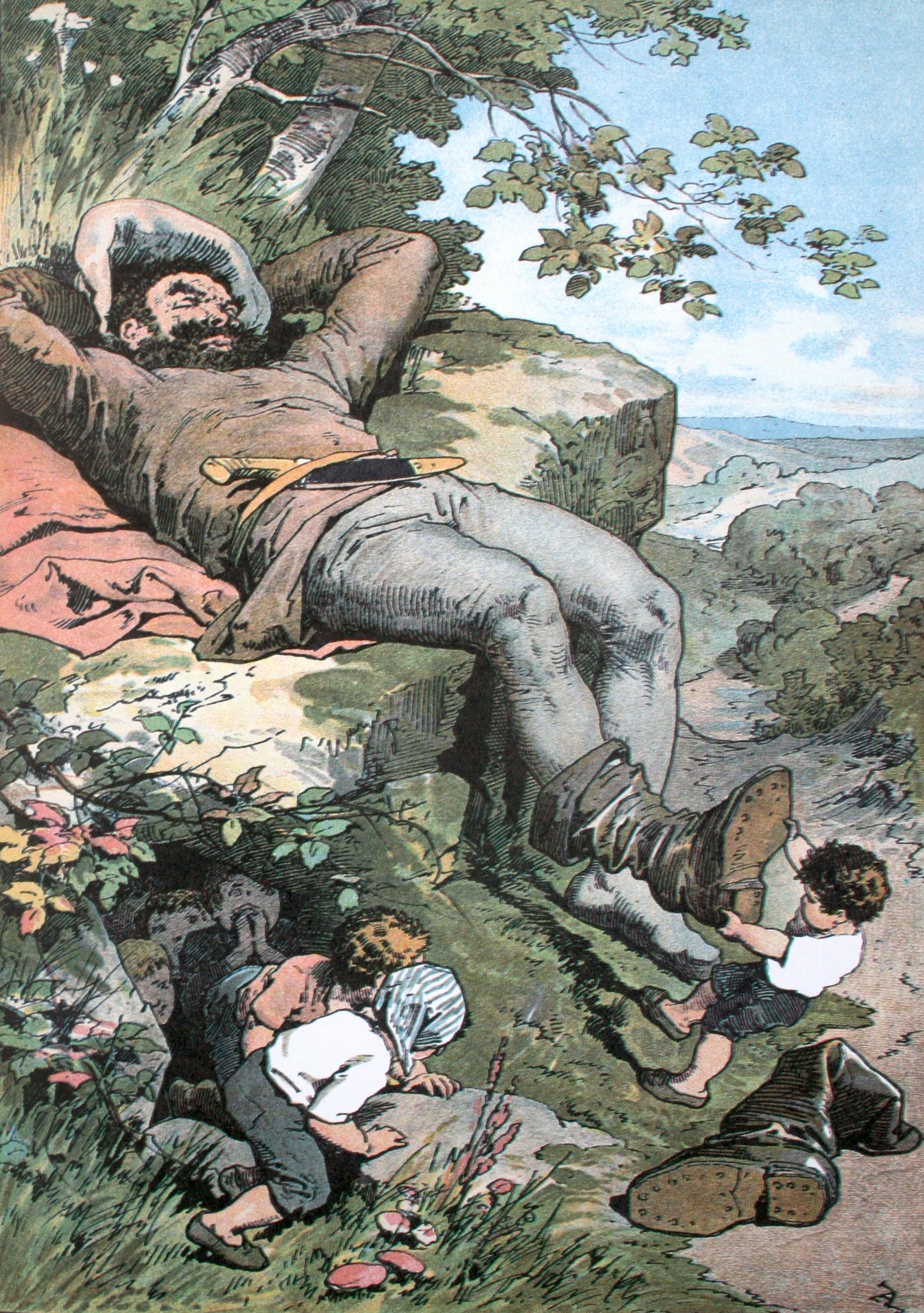
[[File:Däumling.jpg|thumb|alt= Illustration of the fairy tale character, Tom Thumb, on a hillside, next to a giant's foot.|1865 illustration of [[Hop-o'-My-Thumb]] and the [[ogre]] by [[Alexander Zick]]]] | [[File:Däumling.jpg|thumb|alt= Illustration of the fairy tale character, Tom Thumb, on a hillside, next to a giant's foot.|1865 illustration of [[Hop-o'-My-Thumb]] and the [[ogre]] by [[Alexander Zick]]]] | ||
A '''fairy tale''', '''fairytale''', '''wonder tale''', '''magic tale, fairy story''' or '''''Märchen''''' is an instance of | A '''fairy tale''', '''fairytale''', '''wonder tale''', '''magic tale, fairy story''' or '''''Märchen''''' is an instance of [[folklore genre]] that takes the form of a short story. Such stories typically feature mythical entities such as [[Dwarf (Germanic mythology)|dwarfs]], [[dragons]], [[Elf|elves]], [[Fairy|fairies]] and [[Peri|Peris]], [[Giant (mythology)|giants]], [[Div (mythology)|Divs]], [[gnome]]s, [[goblin]]s, [[griffins]], [[mermaid]]s, [[Talking animals in fiction|talking animals]], [[troll]]s, [[unicorn]]s, or [[witchcraft|witches]], and usually [[magic (paranormal)|magic]] or [[incantation|enchantments]]. In most cultures, there is no clear line separating myth from folk or fairy tale; all these together form the literature of preliterate societies.<ref>{{Cite book|title=The Uses of Enchantment: The Meaning and Importance of Fairy Tales, wonder tale, magic tale|last=Bettelheim|first=Bruno|publisher=Vintage Books|year=1989|isbn=0-679-72393-5|location=New York|pages=[https://archive.org/details/usesofenchantmen00brun/page/25 25]|url=https://archive.org/details/usesofenchantmen00brun/page/25}}</ref> Fairy tales may be distinguished from other folk narratives such as [[legend]]s (which generally involve belief in the veracity of the events described)<ref>Thompson, Stith. ''Funk & Wagnalls Standard Dictionary of Folklore, Mythology & Legend'', 1972 s.v. "Fairy Tale"</ref> and explicit moral tales, including beast [[fable]]s. | ||
In less technical contexts, the term is also used to describe something blessed with unusual happiness, as in "fairy-tale ending" (a [[happy ending]])<ref>{{cite web |last1=Martin |first1=Gary |title='Fairy-tale ending' – the meaning and origin of this phrase |url=https://www.phrases.org.uk/meanings/fairy-tale-ending.html |website=Phrasefinder }}</ref> or "fairy-tale [[romance (love)|romance]]". Colloquially, the term "fairy tale" or "fairy story" can also mean any far-fetched story or [[tall tale]]; it is used especially of any story that not only is not true, but could not possibly be true. Legends are perceived as real within their culture; fairy tales may merge into [[legend]]s, where the narrative is perceived both by teller and hearers as being grounded in historical truth. However, unlike [[legend]]s and [[Epic poems|epics]], fairy tales usually do not contain more than superficial references to religion and to actual places, people, and events; they take place "[[once upon a time]]" rather than in actual times.<ref>Orenstein, p. 9.</ref> | |||
Fairy tales occur both in oral and in literary form; the name "fairy tale" ("''conte de fées''" in French) was first ascribed to them by [[Madame d'Aulnoy]] in the late 17th century. Many of today's fairy tales have evolved from centuries-old stories that have appeared, with variations, in multiple cultures around the world.<ref>Gray, Richard. [https://web.archive.org/web/20090908150605/http://www.telegraph.co.uk/science/science-news/6142964/Fairy-tales-have-ancient-origin.html "Fairy tales have ancient origin"]. ''The Telegraph'' 5 September 2009.</ref> | |||
The history of the fairy tale is particularly difficult to trace because only the literary forms can survive. Still, according to researchers at universities in [[Durham University|Durham]] and [[Universidade Nova de Lisboa|Lisbon]], such stories may date back thousands of years, some to the [[Bronze Age]].<ref>{{cite news|last1= BBC|title= Fairy tale origins thousands of years old, researchers say|url= https://www.bbc.com/news/uk-35358487|website= BBC News|publisher =BBC|access-date= 20 January 2016|date= 20 January 2016}}</ref><ref>{{cite web|title=Fairy Tales Could Be Older Than You Ever Imagined|author=Erin Blakemore|website=Smithsonion|date=20 January 2016|access-date=4 March 2019|language=en|url=https://www.smithsonianmag.com/smithsonianmag/fairy-tales-could-be-older-ever-imagined-180957882/}}</ref> Fairy tales, and works derived from fairy tales, are still written today. | |||
The [[Jatakas]] are probably the oldest collection of such tales in literature, and the greater part of the rest are demonstrably more than a thousand years old. It is certain that much (perhaps one~fifth) of the popular literature of modern Europe is derived from those portions of this large bulk which came west with the Crusades through the medium of Arabs and Jews.<ref>Jacobs, Joseph. 2021. Indian Fairy Tales. [S.I.]: Duke Classics. [https://en.wikisource.org/wiki/Indian_Fairy_Tales_(Jacobs)/Notes_and_References#:~:text=The%20Jatakas%20are%20probably%20the,than%20a%20thousand%20years%20old. note:230]. [https://api.overdrive.com/v1/collections/v1L1BzlEAAA28/products/ac89d3a0-876e-4ed6-adf4-c1cde654f531].</ref> | |||
Folklorists have classified fairy tales in various ways. The [[Aarne-Thompson classification system]] and the morphological analysis of [[Vladimir Propp]] are among the most notable. Other folklorists have interpreted the tales' significance, but no school has been definitively established for the meaning of the tales. | Folklorists have classified fairy tales in various ways. The [[Aarne-Thompson classification system]] and the morphological analysis of [[Vladimir Propp]] are among the most notable. Other folklorists have interpreted the tales' significance, but no school has been definitively established for the meaning of the tales. | ||
==Terminology== | ==Terminology== | ||
[[File:Albert Edelfelt - Illustration of Adalmina’s Pearl - A II 1519-11 - Finnish National Gallery.jpg|thumb|[[Albert Edelfelt]]'s illustration of ''Adalmina's Pearl'', a Finnish fairy tale by [[Zachris Topelius]].<ref> | |||
Some [[folkloristics|folklorists]] prefer to use the | [[File:Albert Edelfelt - Illustration of Adalmina’s Pearl - A II 1519-11 - Finnish National Gallery.jpg|thumb|[[Albert Edelfelt]]'s illustration of ''Adalmina's Pearl'', a Finnish fairy tale by [[Zachris Topelius]].<ref>{{cite book| url = https://tvtropes.org/pmwiki/pmwiki.php/Literature/AdalminasPearl| title = Adalmina's Pearl – TV Tropes}}</ref>]] | ||
Some [[folkloristics|folklorists]] prefer to use the German term ''Märchen'' or "wonder tale"<ref name=companion/> to refer to the genre rather than ''fairy tale'', a practice given weight by the definition of Thompson in his 1977 [1946] edition of ''The Folktale'': "a tale of some length involving a succession of [[motif (literature)|motifs]] or episodes. It moves in an unreal world without definite locality or definite creatures and is filled with the marvellous. In this never-never land, humble [[hero]]es kill adversaries, succeed to kingdoms and marry princesses."<ref>[[Stith Thompson]], ''The Folktale'', 1977 (Thompson: 8).</ref> The characters and motifs of fairy tales are simple and archetypal: princesses and goose-girls; [[youngest son]]s and gallant princes; [[ogre]]s, [[giant (mythology)|giants]], [[dragon]]s, and [[troll]]s; [[wicked stepmother]]s and [[false hero]]es; [[fairy godmother]]s and other [[donor (fairy tale)|magical helpers]], often [[talking animal|talking horses, or foxes, or birds]]; glass mountains; and prohibitions and breaking of prohibitions.<ref>Byatt, p. xviii.</ref> | |||
==Definition== | ==Definition== | ||
| Line 20: | Line 26: | ||
[[File: Straparola's The Crucifix Comes To Life.jpg|thumb|right|alt=A painting from the fairy tale "The Facetious Nights of Straparola", showing people observing as a person jumps inside a building.|From ''[[The Facetious Nights of Straparola]]'' by [[Giovanni Francesco Straparola]]]] | [[File: Straparola's The Crucifix Comes To Life.jpg|thumb|right|alt=A painting from the fairy tale "The Facetious Nights of Straparola", showing people observing as a person jumps inside a building.|From ''[[The Facetious Nights of Straparola]]'' by [[Giovanni Francesco Straparola]]]] | ||
Although the fairy tale is a distinct genre within the larger category of folktale, the definition that marks a work as a fairy tale is a source of considerable dispute.<ref>Heidi Anne Heiner, "[https://www.surlalunefairytales.com/intro-pages/what-is-a-fairy-tale.html What Is a Fairy Tale?]</ref> The term itself comes from the translation of Madame D'Aulnoy's ''Conte de fées'', first used in her collection in 1697.<ref name=Windling1>{{cite journal | author = Terri Windling | url = http://www.endicott-studio.com/rdrm/forconte.html | archive-url = https://web.archive.org/web/20140328002739/http://www.endicott-studio.com/rdrm/forconte.html | archive-date = 2014-03-28 | title = Les Contes de Fées: The Literary Fairy Tales of France | journal = Realms of Fantasy | year = 2000 }}</ref> Common parlance conflates fairy tales with [[beast fable]]s and other folktales, and scholars differ on the degree to which the presence of fairies and/or similarly mythical beings (e.g., [[Elf|elves]], [[goblin]]s, [[troll]]s, giants, huge monsters, or mermaids) should be taken as a differentiator. [[Vladimir Propp]], in his ''Morphology of the Folktale'', criticized the common distinction between "fairy tales" and "animal tales" on the grounds that many tales contained both [[fantasy|fantastic]] elements and animals.<ref>Propp, p. 5.</ref> Nevertheless, to select works for his analysis, Propp used all [[Russian folklore|Russian folktales]] classified as a folklore, [[Aarne–Thompson–Uther Index]] | Although the fairy tale is a distinct genre within the larger category of folktale, the definition that marks a work as a fairy tale is a source of considerable dispute.<ref>Heidi Anne Heiner, "[https://www.surlalunefairytales.com/intro-pages/what-is-a-fairy-tale.html What Is a Fairy Tale?]</ref> The term itself comes from the translation of Madame D'Aulnoy's ''Conte de fées'', first used in her collection in 1697.<ref name=Windling1>{{cite journal | author = Terri Windling | url = http://www.endicott-studio.com/rdrm/forconte.html | archive-url = https://web.archive.org/web/20140328002739/http://www.endicott-studio.com/rdrm/forconte.html | archive-date = 2014-03-28 | title = Les Contes de Fées: The Literary Fairy Tales of France | journal = Realms of Fantasy | url-status = usurped | year = 2000 }}</ref> Common parlance conflates fairy tales with [[beast fable]]s and other folktales, and scholars differ on the degree to which the presence of fairies and/or similarly mythical beings (e.g., [[Elf|elves]], [[goblin]]s, [[troll]]s, giants, huge monsters, or mermaids) should be taken as a differentiator. [[Vladimir Propp]], in his ''Morphology of the Folktale'', criticized the common distinction between "fairy tales" and "animal tales" on the grounds that many tales contained both [[fantasy|fantastic]] elements and animals.<ref>Propp, p. 5.</ref> Nevertheless, to select works for his analysis, Propp used all [[Russian folklore|Russian folktales]] classified as a folklore, [[Aarne–Thompson–Uther Index]] 300–749, – in a cataloguing system that made such a distinction – to gain a clear set of tales.<ref>Propp, p. 19.</ref> His own analysis identified fairy tales by their plot elements, but that in itself has been criticized, as the analysis does not lend itself easily to tales that do not involve a [[quest]], and furthermore, the same plot elements are found in non-fairy tale works.<ref>Swann Jones, p. 15.</ref> | ||
{{ | {{Blockquote|text=Were I asked, what is a fairytale? I should reply, Read [[Undine (novella)|Undine]]: that is a fairytale ... of all fairytales I know, I think Undine the most beautiful. |author=[[George MacDonald]], ''The Fantastic Imagination''}} | ||
As [[Stith Thompson]] points out, talking animals and the presence of [[magic (fantasy)|magic]] seem to be more common to the fairy tale than [[Fairy|fairies]] themselves.<ref>Stith Thompson, ''The Folktale'', p. 55, University of California Press, Berkeley Los Angeles London, 1977</ref> However, the mere presence of animals that talk does not make a tale a fairy tale, especially when the animal is clearly a mask on a human face, as in [[fable]]s.<ref name=Tolkien15>Tolkien, p. 15.</ref> | As [[Stith Thompson]] points out, talking animals and the presence of [[magic (fantasy)|magic]] seem to be more common to the fairy tale than [[Fairy|fairies]] themselves.<ref>Stith Thompson, ''The Folktale'', p. 55, University of California Press, Berkeley Los Angeles London, 1977</ref> However, the mere presence of animals that talk does not make a tale a fairy tale, especially when the animal is clearly a mask on a human face, as in [[fable]]s.<ref name=Tolkien15>Tolkien, p. 15.</ref> | ||
In his essay "[[On Fairy-Stories]]", [[J. R. R. Tolkien]] agreed with the exclusion of "fairies" from the definition, defining fairy tales as stories about the adventures of men in ''[[Fairyland|Faërie]]'', the land of fairies, fairytale | In his essay "[[On Fairy-Stories]]", [[J. R. R. Tolkien]] agreed with the exclusion of "fairies" from the definition, defining fairy tales as stories about the adventures of men in ''[[Fairyland|Faërie]]'', the land of fairies, fairytale princes and princesses, [[dwarf (mythology)|dwarves]], elves, and not only other magical species but many other marvels.<ref>Tolkien, pp. 10–11.</ref> However, the same essay excludes tales that are often considered fairy tales, citing as an example ''[[The Heart of a Monkey|The Monkey's Heart]]'', which [[Andrew Lang]] included in ''[[The Lilac Fairy Book]]''.<ref name=Tolkien15 /> | ||
Steven Swann Jones identified the presence of magic as the feature by which fairy tales can be distinguished from other sorts of folktales.<ref>''The Fairy Tale: The Magic Mirror of the Imagination''. Routledge, 2002, p. 8.</ref> Davidson and Chaudri identify "transformation" as the key feature of the genre.<ref name=companion>''A companion to the fairy tale''. By Hilda Ellis Davidson, Anna Chaudhri. Boydell & Brewer 2006. p. 39.</ref> From a psychological point of view, [[Jean Chiriac]] argued for the necessity of the [[fantastic]] in these narratives.<ref>{{cite web|url=http://www.freudfile.org/psychoanalysis/fairy_tales.html |title=Psychoanalysis and Fairy-Tales |publisher=Freudfile.org |access-date=2013 | Steven Swann Jones identified the presence of magic as the feature by which fairy tales can be distinguished from other sorts of folktales.<ref>''The Fairy Tale: The Magic Mirror of the Imagination''. Routledge, 2002, p. 8.</ref> Davidson and Chaudri identify "transformation" as the key feature of the genre.<ref name=companion>''A companion to the fairy tale''. By Hilda Ellis Davidson, Anna Chaudhri. Boydell & Brewer 2006. p. 39.</ref> From a psychological point of view, [[Jean Chiriac]] argued for the necessity of the [[fantastic]] in these narratives.<ref>{{cite web|url=http://www.freudfile.org/psychoanalysis/fairy_tales.html |title=Psychoanalysis and Fairy-Tales |publisher=Freudfile.org |access-date=13 March 2013}}</ref> | ||
In terms of aesthetic values, [[Italo Calvino]] cited the fairy tale as a prime example of "quickness" in literature, because of the economy and concision of the tales.<ref>Italo Calvino, ''Six Memos for the Next Millennium'', pp. 36–37. {{ISBN|0-674-81040-6}}.</ref> | In terms of aesthetic values, [[Italo Calvino]] cited the fairy tale as a prime example of "quickness" in literature, because of the economy and concision of the tales.<ref>Italo Calvino, ''Six Memos for the Next Millennium'', pp. 36–37. {{ISBN|0-674-81040-6}}.</ref> | ||
| Line 36: | Line 42: | ||
[[File:Perrault1.jpg|left|thumb|alt=A picture by Gustave Doré showing Mother Goose, an old woman, reading written (literary) fairy tales to children|A picture by [[Gustave Doré]] of [[Mother Goose]] reading written (literary) fairy tales]] | [[File:Perrault1.jpg|left|thumb|alt=A picture by Gustave Doré showing Mother Goose, an old woman, reading written (literary) fairy tales to children|A picture by [[Gustave Doré]] of [[Mother Goose]] reading written (literary) fairy tales]] | ||
Originally, stories that would contemporarily be considered fairy tales were not marked out as a separate genre. The German term "Märchen" stems from the old German word "Mär", which means story or tale. The word "Märchen" is the [[diminutive]] of the word "Mär", therefore it means a "little story". Together with the common beginning "[[once upon a time]]", this tells us that a fairy tale or a märchen was originally a little story from a long time ago when the world was still magic. (Indeed, one less regular German [[once upon a time|opening]] is "In the old times when wishing was still effective".) | Originally, stories that would contemporarily be considered fairy tales were not marked out as a separate genre. The German term "Märchen" stems from the old German word "Mär", which means story or tale.{{Citation needed|date=September 2021}} The word "Märchen" is the [[diminutive]] of the word "Mär", therefore it means a "little story". Together with the common beginning "[[once upon a time]]", this tells us that a fairy tale or a märchen was originally a little story from a long time ago when the world was still magic. (Indeed, one less regular German [[once upon a time|opening]] is "In the old times when wishing was still effective".){{Citation needed|date=September 2021}} | ||
The English term "fairy tale" stems from the fact that the French ''contes'' often included fairies. | The English term "fairy tale" stems from the fact that the French ''contes'' often included fairies.{{Citation needed|date=September 2021}} | ||
Roots of the genre come from different oral stories passed down in European cultures. The genre was first marked out by writers of the [[Renaissance literature|Renaissance]], such as [[Giovanni Francesco Straparola]] and [[Giambattista Basile]], and stabilized through the works of later collectors such as [[Charles Perrault]] and the [[Brothers Grimm]].<ref>Zipes, ''The Great Fairy Tale Tradition: From Straparola and Basile to the Brothers Grimm'', pp. xi–xii</ref> In this evolution, the name was coined when the ''[[précieuses]]'' took up writing literary stories; [[Madame d'Aulnoy]] invented the term ''Conte de fée'', or fairy tale, in the late | Roots of the genre come from different oral stories passed down in European cultures. The genre was first marked out by writers of the [[Renaissance literature|Renaissance]], such as [[Giovanni Francesco Straparola]] and [[Giambattista Basile]], and stabilized through the works of later collectors such as [[Charles Perrault]] and the [[Brothers Grimm]].<ref>Zipes, ''The Great Fairy Tale Tradition: From Straparola and Basile to the Brothers Grimm'', pp. xi–xii</ref> In this evolution, the name was coined when the ''[[précieuses]]'' took up writing literary stories; [[Madame d'Aulnoy]] invented the term ''Conte de fée'', or fairy tale, in the late 17th century.<ref>Zipes, ''The Great Fairy Tale Tradition: From Straparola and Basile to the Brothers Grimm'', p. 858.</ref> | ||
Before the definition of the genre of | Before the definition of the genre of fantasy, many works that would now be classified as fantasy were termed "fairy tales", including Tolkien's ''[[The Hobbit]]'', [[George Orwell]]'s ''[[Animal Farm]]'', and [[L. Frank Baum]]'s ''[[The Wonderful Wizard of Oz]]''.<ref>Brian Attebery, ''The Fantasy Tradition in American Literature'', p. 83, {{ISBN|0-253-35665-2}}.</ref> Indeed, Tolkien's "On Fairy-Stories" includes discussions of [[world-building]] and is considered a vital part of fantasy criticism. Although fantasy, particularly the subgenre of [[fairytale fantasy]], draws heavily on fairy tale motifs,<ref>Martin, pp. 38–42</ref> the genres are now regarded as distinct. | ||
===Folk and literary=== | ===Folk and literary=== | ||
| Line 48: | Line 54: | ||
The fairy tale, told orally, is a sub-class of the [[folklore|folktale]]. Many writers have written in the form of the fairy tale. These are the literary fairy tales, or ''Kunstmärchen''.<ref name="Windling1"/> The oldest forms, from ''[[Panchatantra]]'' to the ''[[Pentamerone]]'', show considerable reworking from the oral form.<ref name=" Swann Jones, p. 35">Swann Jones, p. 35.</ref> The [[Brothers Grimm|Grimm brothers]] were among the first to try to preserve the features of oral tales. Yet the stories printed under the Grimm name have been considerably reworked to fit the written form.<ref>Brian Attebery, ''The Fantasy Tradition in Matthew's American Literature'', p. 5, {{ISBN|0-253-35665-2}}.</ref> | The fairy tale, told orally, is a sub-class of the [[folklore|folktale]]. Many writers have written in the form of the fairy tale. These are the literary fairy tales, or ''Kunstmärchen''.<ref name="Windling1"/> The oldest forms, from ''[[Panchatantra]]'' to the ''[[Pentamerone]]'', show considerable reworking from the oral form.<ref name=" Swann Jones, p. 35">Swann Jones, p. 35.</ref> The [[Brothers Grimm|Grimm brothers]] were among the first to try to preserve the features of oral tales. Yet the stories printed under the Grimm name have been considerably reworked to fit the written form.<ref>Brian Attebery, ''The Fantasy Tradition in Matthew's American Literature'', p. 5, {{ISBN|0-253-35665-2}}.</ref> | ||
Literary fairy tales and oral fairy tales freely exchanged plots, motifs, and elements with one another and with the tales of foreign lands.<ref>Zipes, ''The Great Fairy Tale Tradition: From Straparola and Basile to the Brothers Grimm'', p. xii.</ref> The literary fairy tale came into fashion during the 17th century, developed by aristocratic women as a parlour game. This, in turn, helped to maintain the oral tradition. According to [[Jack Zipes]], "The subject matter of the conversations consisted of literature, mores, taste, and etiquette, whereby the speakers all endeavoured to portray ideal situations in the most effective oratorical style that would gradually have a major effect on literary forms."<ref>{{Cite book|title=Fairy tale as myth/myth as fairy tale|last=Zipes|first=Jack|publisher=University of Kentucky Press|year=2013|pages=20–21}}</ref> Many | Literary fairy tales and oral fairy tales freely exchanged plots, motifs, and elements with one another and with the tales of foreign lands.<ref>Zipes, ''The Great Fairy Tale Tradition: From Straparola and Basile to the Brothers Grimm'', p. xii.</ref> The literary fairy tale came into fashion during the 17th century, developed by aristocratic women as a parlour game. This, in turn, helped to maintain the oral tradition. According to [[Jack Zipes]], "The subject matter of the conversations consisted of literature, mores, taste, and etiquette, whereby the speakers all endeavoured to portray ideal situations in the most effective oratorical style that would gradually have a major effect on literary forms."<ref>{{Cite book|title=Fairy tale as myth/myth as fairy tale|last=Zipes|first=Jack|publisher=University of Kentucky Press|year=2013|pages=20–21}}</ref> Many 18th-century folklorists attempted to recover the "pure" folktale, uncontaminated by literary versions. Yet while oral fairy tales likely existed for thousands of years before the literary forms, there is no pure folktale, and each literary fairy tale draws on folk traditions, if only in parody.<ref name=" Zipes, p. 846">Zipes, ''The Great Fairy Tale Tradition: From Straparola and Basile to the Brothers Grimm'', p. 846.</ref> This makes it impossible to trace forms of transmission of a fairy tale. Oral story-tellers have been known to read literary fairy tales to increase their own stock of stories and treatments.<ref>Degh, p. 73.</ref> | ||
==History== | ==History== | ||
| Line 54: | Line 60: | ||
[[File:Redsun.jpg|thumb|right|alt=Illustration of the Russian fairy tale about Vasilisa the Beautiful, showing a rider on a horse in a forest|[[Ivan Bilibin]]'s illustration of the Russian fairy tale about [[Vasilisa the Beautiful]]]] | [[File:Redsun.jpg|thumb|right|alt=Illustration of the Russian fairy tale about Vasilisa the Beautiful, showing a rider on a horse in a forest|[[Ivan Bilibin]]'s illustration of the Russian fairy tale about [[Vasilisa the Beautiful]]]] | ||
The [[oral tradition]] of the fairy tale came long before the written page. Tales were told or enacted dramatically, rather than written down, and handed down from generation to generation. Because of this, the history of their development is necessarily obscure and blurred. Fairy tales appear, now and again, in written literature throughout literate cultures,{{efn|Scholars John Th. Honti and Gédeon Huet asserted the existence of fairy tales in ancient and medieval literature, as well as in classical mythology.<ref>Honti, John Th. "[https://www.jstor.org/stable/20521905 Celtic Studies and European Folk-Tale Research]". In: ''Béaloideas'' 6, no. 1 (1936): 36. Accessed March | The [[oral tradition]] of the fairy tale came long before the written page. Tales were told or enacted dramatically, rather than written down, and handed down from generation to generation. Because of this, the history of their development is necessarily obscure and blurred. Fairy tales appear, now and again, in written literature throughout literate cultures,{{efn|Scholars John Th. Honti and Gédeon Huet asserted the existence of fairy tales in ancient and medieval literature, as well as in classical mythology.<ref>Honti, John Th. "[https://www.jstor.org/stable/20521905 Celtic Studies and European Folk-Tale Research]". In: ''Béaloideas'' 6, no. 1 (1936): 36. Accessed 16 March 2021. doi:10.2307/20521905.</ref><ref>Krappe, Alexander Haggerty. "[https://www.jstor.org/stable/2914006?refreqid=excelsior%3Ab80e2255df6c65fcfbdbdd6e773e712e&seq=1#metadata_info_tab_contents Reviewed Work: Les contes populaires. by Gédéon Huet]". In: ''Modern Language Notes'' 40, no. 7 (1925): 430. Accessed 22 March 2021. doi:10.2307/2914006.</ref> Likewise, Francis Lee Utley showed that medieval [[Celtic literature]] and [[Arthurian mythos]] contain recognizable motifs of tale types described in the international index.<ref>Utley, Francis Lee. “Arthurian Romance and International Folktale Method.” Romance Philology 17, no. 3 (1964): 596–607. https://www.jstor.org/stable/44939518.</ref>}}{{efn|Even further back, according to professor Berlanga Fernández, elements of international "Märchen" show "exact parallels and themes (...) that seem to be common with Greek folklore and later tradition".<ref>Berlanga Fernández, Inmaculada. "[https://www.academia.edu/3239356/Tem%C3%A1tica_folcl%C3%B3rica_en_la_literatura_asi%C3%A1tica_Oriente_Extremo_relaci%C3%B3n_con_los_mitos_griegos Temática folclórica en la Literatura asiática (Oriente Extremo). Relación con los mitos griegos]". In: ''ALDABA'' nr. 31 (2001): 345. DOI: https://doi.org/10.5944/aldaba.31.2001.20465</ref>}}{{efn|Folklorist [[Alexander Haggerty Krappe]] argued that most of historical variants of tale types are traceable to the Middle Ages, and some are attested in literary works of [[classical antiquity]].<ref>Krappe, Alexander Haggerty. ''The Science of Folklore''. New York: Barnes & Noble, 1962. pp. 14-15.</ref>}} as in ''[[The Golden Ass]]'', which includes ''[[Cupid and Psyche]]'' ([[Ancient Rome|Roman]], 100–200 AD),<ref name="timeline">Heidi Anne Heiner, [https://www.surlalunefairytales.com/intro-pages/fairy-tale-timeline.html "Fairy Tale Timeline"]</ref> or the ''[[Panchatantra]]'' ([[Folklore of India|India]] 3rd century BC),<ref name="timeline"/> but it is unknown to what extent these reflect the actual folk tales even of their own time. The stylistic evidence indicates that these, and many later collections, reworked folk tales into literary forms.<ref name=" Swann Jones, p. 35"/> What they do show is that the fairy tale has ancient roots, older than the ''[[The Book of One Thousand and One Nights|Arabian Nights]]'' collection of magical tales (compiled ''circa'' 1500 AD),<ref name="timeline"/> such as ''[[Baital Pachisi|Vikram and the Vampire]]'', and ''[[Bel and the Dragon]]''. Besides such collections and individual tales, in [[Chinese folklore|China]], [[Taoism|Taoist]] philosophers such as [[Liezi]] and [[Zhuangzi (book)|Zhuangzi]] recounted fairy tales in their philosophical works.<ref name=Roberts>Moss Roberts, "Introduction", p. xviii, ''Chinese Fairy Tales & Fantasies''. {{ISBN|0-394-73994-9}}.</ref> In the broader definition of the genre, the first famous Western fairy tales are those of [[Aesop]] (6th century BC) in [[ancient Greece]]. | ||
Scholarship | Scholarship points out that [[Medieval literature]] contains early versions or predecessors of later known tales and motifs, such as [[Grateful dead (folklore)|the grateful dead]], [[The Bird Lover]] or the quest for the lost wife.<ref>{{cite journal |last1=Szoverffy |first1=Joseph |title=Some Notes on Medieval Studies and Folklore |journal=The Journal of American Folklore |date=July 1960 |volume=73 |issue=289 |pages=239–244 |doi=10.2307/537977 |jstor=537977 }}</ref> Recognizable folktales have also been reworked as the plot of folk literature and oral epics.<ref>[[Maja Bošković-Stulli|Bošković-Stulli, Maja]]. "SIŽEI NARODNIH BAJKI U HRVATSKOSRPSKIM EPSKIM PJESMAMA [Subjects of folk tales in Croato-Serbian epics]". In: ''Narodna umjetnost'' 1, br. 1 (1962): 15–36. https://hrcak.srce.hr/34044</ref> | ||
Jack Zipes writes in ''When Dreams Came True'', "There are fairy tale elements in [[Geoffrey Chaucer|Chaucer]]'s ''[[The Canterbury Tales]]'', [[Edmund Spenser]]'s ''[[The Faerie Queene]]'', and in many of [[William Shakespeare]] plays."<ref>Zipes, ''When Dreams Came True: Classical Fairy Tales and Their Tradition'', p. 12.</ref> ''[[King Lear]]'' can be considered a literary variant of fairy tales such as ''[[Water and Salt]]'' and ''[[Cap O' Rushes]]''.<ref>Soula Mitakidou and Anthony L. Manna, with Melpomene Kanatsouli, ''Folktales from Greece: A Treasury of Delights'', p. 100, Libraries Unlimited, Greenwood Village CO, 2002, {{ISBN|1-56308-908-4}}.</ref> The tale itself resurfaced in [[Western literature]] in the 16th and 17th centuries, with ''[[The Facetious Nights of Straparola]]'' by [[Giovanni Francesco Straparola]] (Italy, 1550 and 1553),<ref name="timeline"/> which contains many fairy tales in its inset tales, and the [[Naples|Neapolitan]] tales of [[Giambattista Basile]] (Naples, 1634–36),<ref name="timeline"/> which are all fairy tales.<ref>Swann Jones, p. 38.</ref> [[Carlo Gozzi]] made use of many fairy tale motifs among his [[Commedia dell'Arte]] scenarios,<ref>{{cite journal | author = Terri Windling | url = http://www.endicott-studio.com/rdrm/forital.html | archive-url = https://web.archive.org/web/20140210083152/http://www.endicott-studio.com/rdrm/forital.html | archive-date = 2014 | Jack Zipes writes in ''When Dreams Came True'', "There are fairy tale elements in [[Geoffrey Chaucer|Chaucer]]'s ''[[The Canterbury Tales]]'', [[Edmund Spenser]]'s ''[[The Faerie Queene]]'', and in many of [[William Shakespeare]] plays."<ref>Zipes, ''When Dreams Came True: Classical Fairy Tales and Their Tradition'', p. 12.</ref> ''[[King Lear]]'' can be considered a literary variant of fairy tales such as ''[[Water and Salt]]'' and ''[[Cap O' Rushes]]''.<ref>Soula Mitakidou and Anthony L. Manna, with Melpomene Kanatsouli, ''Folktales from Greece: A Treasury of Delights'', p. 100, Libraries Unlimited, Greenwood Village CO, 2002, {{ISBN|1-56308-908-4}}.</ref> The tale itself resurfaced in [[Western literature]] in the 16th and 17th centuries, with ''[[The Facetious Nights of Straparola]]'' by [[Giovanni Francesco Straparola]] (Italy, 1550 and 1553),<ref name="timeline"/> which contains many fairy tales in its inset tales, and the [[Naples|Neapolitan]] tales of [[Giambattista Basile]] (Naples, 1634–36),<ref name="timeline"/> which are all fairy tales.<ref>Swann Jones, p. 38.</ref> [[Carlo Gozzi]] made use of many fairy tale motifs among his [[Commedia dell'Arte]] scenarios,<ref>{{cite journal | author = Terri Windling | url = http://www.endicott-studio.com/rdrm/forital.html | archive-url = https://web.archive.org/web/20140210083152/http://www.endicott-studio.com/rdrm/forital.html | archive-date = 10 February 2014 | title = White as Ricotta, Red as Wine: The Magic Lore of Italy | journal = Realms of Fantasy | url-status = usurped | year = 1995 }}</ref> including among them one based on ''[[The Love for Three Oranges (fairy tale)|The Love For Three Oranges]]'' (1761).<ref>Calvino, ''Italian Folktales'', p. 738.</ref> Simultaneously, [[Pu Songling]], in China, included many fairy tales in his collection, ''[[Strange Stories from a Chinese Studio]]'' (published posthumously, 1766).<ref name=Roberts /> The fairy tale itself became popular among the ''[[précieuses]]'' of upper-class [[Early Modern France|France]] (1690–1710),<ref name="timeline"/> and among the tales told in that time were the ones of [[La Fontaine]] and the ''Contes'' of [[Charles Perrault]] (1697), who fixed the forms of ''[[Sleeping Beauty]]'' and ''[[Cinderella]]''.<ref>Zipes, ''When Dreams Came True: Classical Fairy Tales and Their Tradition'', pp. 38–42.</ref> Although Straparola's, Basile's and Perrault's collections contain the oldest known forms of various fairy tales, on the stylistic evidence, all the writers rewrote the tales for literary effect.<ref>Swann Jones, pp. 38–39.</ref> | ||
===The Salon Era=== | ===The Salon Era=== | ||
In the mid-17th century, a vogue for magical tales emerged among the intellectuals who frequented the [[salon (gathering)|salons]] of | In the mid-17th century, a vogue for magical tales emerged among the intellectuals who frequented the [[salon (gathering)|salons]] of Paris. These salons were regular gatherings hosted by prominent aristocratic women, where women and men could gather together to discuss the issues of the day. | ||
In the 1630s, aristocratic women began to gather in their own living rooms, salons, | In the 1630s, aristocratic women began to gather in their own living rooms, salons, to discuss the topics of their choice: arts and letters, politics, and social matters of immediate concern to the women of their class: marriage, love, financial and physical independence, and access to education. This was a time when women were barred from receiving a formal education. Some of the most gifted women writers of the period came out of these early salons (such as [[Madeleine de Scudéry]] and [[Madame de Lafayette]]), which encouraged women's independence and pushed against the gender barriers that defined their lives. The [[salonnières]] argued particularly for love and intellectual compatibility between the sexes, opposing the system of arranged marriages. | ||
Sometime in the middle of the 17th century, a passion for the conversational [[parlour game]] based on the plots of old [[Folklore|folk tales]] swept through the salons. Each [[salonnière]] was called upon to retell an old tale or rework an old theme, spinning clever new stories that not only showcased verbal agility and imagination but also slyly commented on the conditions of aristocratic life. Great emphasis was placed on a mode of delivery that seemed natural and spontaneous. The decorative language of the fairy tales served an important function: disguising the rebellious subtext of the stories and sliding them past the court censors. Critiques of court life (and even of the king) were embedded in extravagant tales and in dark, sharply [[dystopia]]n ones. Not surprisingly, the tales by women often featured young (but clever) aristocratic girls whose lives were controlled by the arbitrary whims of fathers, kings, and elderly wicked fairies, as well as tales in which groups of wise fairies (i.e., intelligent, independent women) stepped in and put all to rights. | Sometime in the middle of the 17th century, a passion for the conversational [[parlour game]] based on the plots of old [[Folklore|folk tales]] swept through the salons. Each [[salonnière]] was called upon to retell an old tale or rework an old theme, spinning clever new stories that not only showcased verbal agility and imagination but also slyly commented on the conditions of aristocratic life. Great emphasis was placed on a mode of delivery that seemed natural and spontaneous. The decorative language of the fairy tales served an important function: disguising the rebellious subtext of the stories and sliding them past the court censors. Critiques of court life (and even of the king) were embedded in extravagant tales and in dark, sharply [[dystopia]]n ones. Not surprisingly, the tales by women often featured young (but clever) aristocratic girls whose lives were controlled by the arbitrary whims of fathers, kings, and elderly wicked fairies, as well as tales in which groups of wise fairies (i.e., intelligent, independent women) stepped in and put all to rights. | ||
| Line 78: | Line 84: | ||
This consideration of whether to keep ''Sleeping Beauty'' reflected a belief common among folklorists of the 19th century: that the folk tradition preserved fairy tales in forms from pre-history except when "contaminated" by such literary forms, leading people to tell inauthentic tales.<ref>Zipes, ''When Dreams Came True: Classical Fairy Tales and Their Tradition'', p. 77.</ref> The rural, illiterate, and uneducated peasants, if suitably isolated, were the ''folk'' and would tell pure ''folk'' tales.<ref>Degh, pp. 66–67.</ref> Sometimes they regarded fairy tales as a form of fossil, the remnants of a once-perfect tale.<ref>[[Iona and Peter Opie]], ''The Classic Fairy Tales'' p. 17. {{ISBN|978-0-19-211559-1}}.</ref> However, further research has concluded that fairy tales never had a fixed form, and regardless of literary influence, the tellers constantly altered them for their own purposes.<ref>[[Jane Yolen]], p. 22, ''Touch Magic''. {{ISBN|0-87483-591-7}}.</ref> | This consideration of whether to keep ''Sleeping Beauty'' reflected a belief common among folklorists of the 19th century: that the folk tradition preserved fairy tales in forms from pre-history except when "contaminated" by such literary forms, leading people to tell inauthentic tales.<ref>Zipes, ''When Dreams Came True: Classical Fairy Tales and Their Tradition'', p. 77.</ref> The rural, illiterate, and uneducated peasants, if suitably isolated, were the ''folk'' and would tell pure ''folk'' tales.<ref>Degh, pp. 66–67.</ref> Sometimes they regarded fairy tales as a form of fossil, the remnants of a once-perfect tale.<ref>[[Iona and Peter Opie]], ''The Classic Fairy Tales'' p. 17. {{ISBN|978-0-19-211559-1}}.</ref> However, further research has concluded that fairy tales never had a fixed form, and regardless of literary influence, the tellers constantly altered them for their own purposes.<ref>[[Jane Yolen]], p. 22, ''Touch Magic''. {{ISBN|0-87483-591-7}}.</ref> | ||
The work of the Brothers Grimm influenced other collectors, both inspiring them to collect tales and leading them to similarly believe, in a spirit of [[romantic nationalism]], that the fairy tales of a country were particularly representative of it, to the neglect of cross-cultural influence. Among those influenced were the | The work of the Brothers Grimm influenced other collectors, both inspiring them to collect tales and leading them to similarly believe, in a spirit of [[romantic nationalism]], that the fairy tales of a country were particularly representative of it, to the neglect of cross-cultural influence. Among those influenced were the Russian [[Alexander Afanasyev]] (first published in 1866),<ref name="timeline"/> the [[Norway|Norwegians]] [[Peter Christen Asbjørnsen]] and [[Jørgen Moe]] (first published in 1845),<ref name="timeline"/> the Romanian [[Petre Ispirescu]] (first published in 1874), the English [[Joseph Jacobs]] (first published in 1890),<ref name="timeline"/> and [[Jeremiah Curtin]], an American who collected Irish tales (first published in 1890).<ref name=" Zipes, p. 846"/> Ethnographers collected fairy tales throughout the world, finding similar tales in Africa, the Americas, and Australia; [[Andrew Lang]] was able to draw on not only the written tales of Europe and Asia, but those collected by ethnographers, to fill his [[Andrew Lang's Fairy Books|"coloured" fairy books series]].<ref>Andrew Lang, ''The Brown Fairy Book'', [http://www.mythfolklore.net/andrewlang/brown.htm "Preface"]</ref> They also encouraged other collectors of fairy tales, as when [[Yei Theodora Ozaki]] created a collection, ''Japanese Fairy Tales'' (1908), after encouragement from Lang.<ref>Yei Theodora Ozaki, ''Japanese Fairy Tales'', [http://www.surlalunefairytales.com/books/japan/freemanmitford/preface.html "Preface"]</ref> Simultaneously, writers such as [[Hans Christian Andersen]] and [[George MacDonald]] continued the tradition of literary fairy tales. Andersen's work sometimes drew on old folktales, but more often deployed fairytale motifs and plots in new tales.<ref>Grant and Clute, "Hans Christian Andersen", pp. 26–27.</ref> MacDonald incorporated fairytale motifs both in new literary fairy tales, such as ''[[The Light Princess]]'', and in works of the genre that would become fantasy, as in ''[[The Princess and the Goblin]]'' or ''[[Lilith (novel)|Lilith]]''.<ref>Grant and Clute, "George MacDonald", p. 604.</ref> | ||
==Cross-cultural transmission== | ==Cross-cultural transmission== | ||
| Line 87: | Line 93: | ||
Folklorists of the "Finnish" (or historical-geographical) school attempted to place fairy tales to their origin, with inconclusive results.<ref>Calvino, ''Italian Folktales'', p. xx.</ref> Sometimes influence, especially within a limited area and time, is clearer, as when considering the influence of Perrault's tales on those collected by the Brothers Grimm. ''Little Briar-Rose'' appears to stem from Perrault's ''The [[Sleeping Beauty]]'', as the Grimms' tale appears to be the only independent German variant.<ref>Zipes, ''The Great Fairy Tale Tradition: From Straparola and Basile to the Brothers Grimm'', p. 962.</ref> Similarly, the close agreement between the opening of the Grimms' version of ''[[Little Red Riding Hood]]'' and Perrault's tale points to an influence, although the Grimms' version adds a different ending (perhaps derived from ''[[The Wolf and the Seven Young Kids]]'').<ref>Velten, pp. 966–67.</ref> | Folklorists of the "Finnish" (or historical-geographical) school attempted to place fairy tales to their origin, with inconclusive results.<ref>Calvino, ''Italian Folktales'', p. xx.</ref> Sometimes influence, especially within a limited area and time, is clearer, as when considering the influence of Perrault's tales on those collected by the Brothers Grimm. ''Little Briar-Rose'' appears to stem from Perrault's ''The [[Sleeping Beauty]]'', as the Grimms' tale appears to be the only independent German variant.<ref>Zipes, ''The Great Fairy Tale Tradition: From Straparola and Basile to the Brothers Grimm'', p. 962.</ref> Similarly, the close agreement between the opening of the Grimms' version of ''[[Little Red Riding Hood]]'' and Perrault's tale points to an influence, although the Grimms' version adds a different ending (perhaps derived from ''[[The Wolf and the Seven Young Kids]]'').<ref>Velten, pp. 966–67.</ref> | ||
<!-- Deleted because it contradicts what is in the Cinderella article (see "Chinese or Egyptian origin for Cinderella?" in talk page): "Occasionally, internal evidence points towards one source; not only is [[Duan Chengshi]]'s ''[[Ye Xian]]'' the oldest known variant of ''Cinderella'', but the value the tale places on small feet points to its being the origin of the others, reflecting the importance of tiny feet (causing the practice of [[footbinding]]) in Chinese culture.<ref>Terri Windling, [http://www.endicott-studio.com/rdrm/forashs.html "Cinderella: Ashes, Blood, and the Slipper of Glass"]</ref>"--> | <!-- Deleted because it contradicts what is in the Cinderella article (see "Chinese or Egyptian origin for Cinderella?" in talk page): "Occasionally, internal evidence points towards one source; not only is [[Duan Chengshi]]'s ''[[Ye Xian]]'' the oldest known variant of ''Cinderella'', but the value the tale places on small feet points to its being the origin of the others, reflecting the importance of tiny feet (causing the practice of [[footbinding]]) in Chinese culture.<ref>Terri Windling, {{usurped|[https://web.archive.org/web/20040925051110/http://www.endicott-studio.com/rdrm/forashs.html "Cinderella: Ashes, Blood, and the Slipper of Glass"]}}</ref>"--> | ||
Fairy tales tend to take on the color of their location, through the choice of motifs, the style in which they are told, and the depiction of character and local color.<ref>Calvino, ''Italian Folktales'', p. xxi.</ref> | Fairy tales tend to take on the color of their location, through the choice of motifs, the style in which they are told, and the depiction of character and local color.<ref>Calvino, ''Italian Folktales'', p. xxi.</ref> | ||
The Brothers Grimm believed that European fairy tales derived from the cultural history shared by all [[Proto-Indo-Europeans|Indo-European]] peoples and were therefore ancient, far older than written records. This view is supported by research by the [[anthropologist]] Jamie Tehrani and the folklorist Sara Graca Da Silva using [[cladistics|phylogenetic analysis]], a technique developed by [[evolutionary biology|evolutionary biologists]] to trace the relatedness of living and fossil [[species]]. Among the tales analysed were ''[[Jack and the Beanstalk]]'', traced to the time of splitting of Eastern and Western Indo-European, over 5000 years ago. Both ''[[Beauty and the Beast]]'' and ''[[Rumpelstiltskin]]'' appear to have been created some 4000 years ago. The story of ''The Smith and the Devil'' ([[Deal with the Devil]]) appears to date from the [[Bronze Age]], some 6000 years ago.<ref>{{cite news|title=Fairy tale origins thousands of years old, researchers say|url=https://www.bbc.co.uk/news/uk-35358487|publisher=[[British Broadcasting Corporation]]|access-date=20 January 2016|date=20 January 2016|work=BBC News}}</ref> | The Brothers Grimm believed that European fairy tales derived from the cultural history shared by all [[Proto-Indo-Europeans|Indo-European]] peoples and were therefore ancient, far older than written records. This view is supported by research by the [[anthropologist]] Jamie Tehrani and the folklorist Sara Graca Da Silva using [[cladistics|phylogenetic analysis]], a technique developed by [[evolutionary biology|evolutionary biologists]] to trace the relatedness of living and fossil [[species]]. Among the tales analysed were ''[[Jack and the Beanstalk]]'', traced to the time of splitting of Eastern and Western Indo-European, over 5000 years ago. Both ''[[Beauty and the Beast]]'' and ''[[Rumpelstiltskin]]'' appear to have been created some 4000 years ago. The story of ''The Smith and the Devil'' ([[Deal with the Devil]]) appears to date from the [[Bronze Age]], some 6000 years ago.<ref>{{cite news|title=Fairy tale origins thousands of years old, researchers say|url=https://www.bbc.co.uk/news/uk-35358487|publisher=[[British Broadcasting Corporation]]|access-date=20 January 2016|date=20 January 2016|work=BBC News}}</ref> Various other studies converge to suggest that some fairy tales, for example the [[swan maiden]],<ref>{{cite book |last1=Hatt |first1=Gudmund |title=Asiatic influences in American folklore |date=1949 |location=København |publisher=I kommission hos ejnar Munksgaard |pages=94–96, 107 |oclc=21629218 }}</ref><ref>{{cite journal |first1=Yuri |last1=Berezkin |year=2010 |title=Sky-maiden and world mythology |journal=Iris |volume=31 |pages=27–39 }}</ref><ref>{{cite journal |last1=d'Huy |first1=Julien |title=Le motif de la femme-oiseau (T111.2.) et ses origines paléolithiques |journal=Mythologie française |date=2016 |issue=265 |pages=4 |url=https://halshs.archives-ouvertes.fr/halshs-02280063 }}</ref> could go back to the Upper Palaeolithic. | ||
==Association with children== | ==Association with children== | ||
| Line 97: | Line 103: | ||
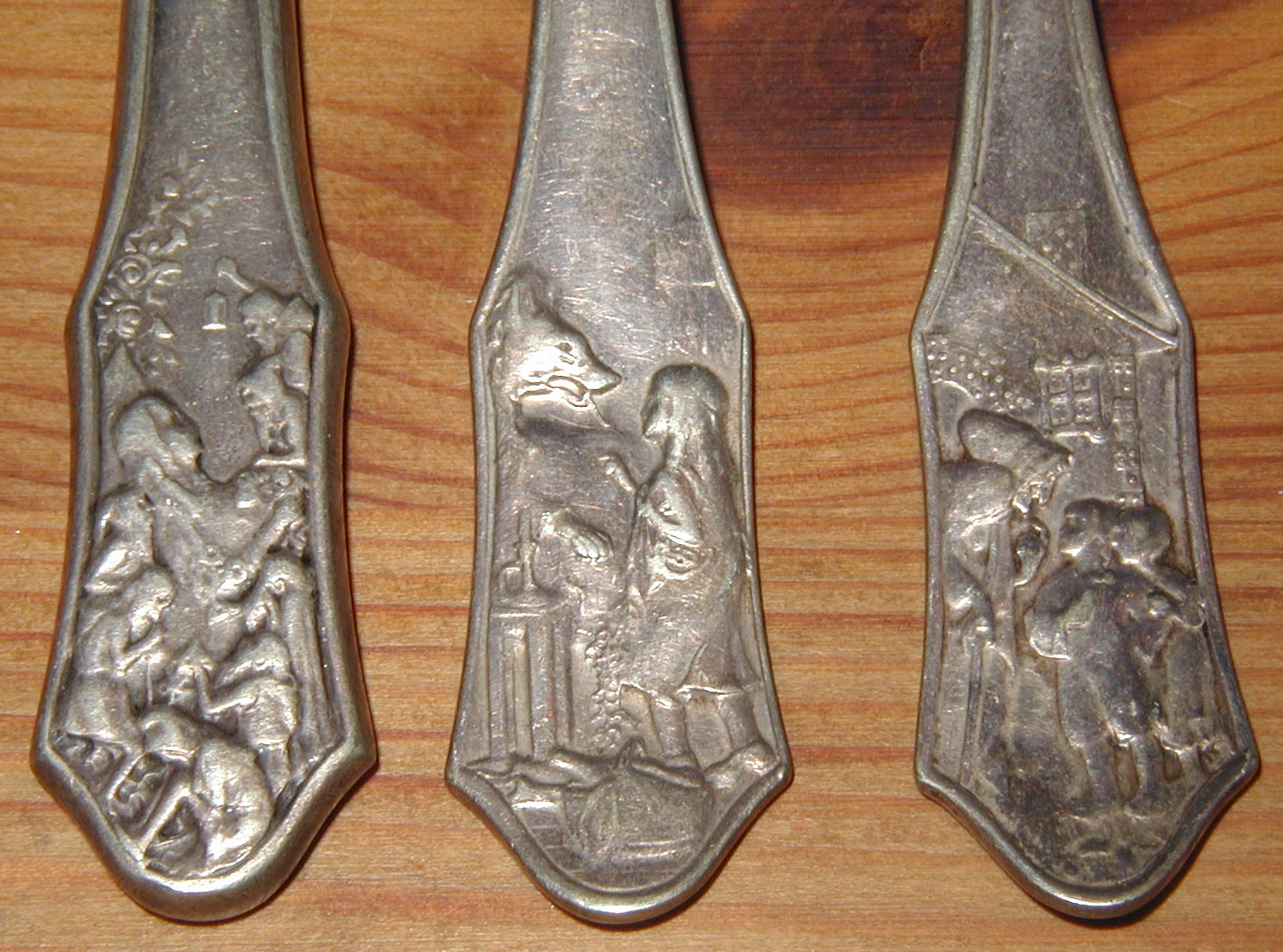
[[File:Cutlery for children detail.jpg|thumb|right|alt=Spoons for children;engraved on them are fairy tale scenes from "Snow White", "Little Red Riding Hood", and "Hansel and Gretel".|Cutlery for children. Detail showing fairy-tale scenes: [[Snow White]], [[Little Red Riding Hood]], [[Hansel and Gretel]].]] | [[File:Cutlery for children detail.jpg|thumb|right|alt=Spoons for children;engraved on them are fairy tale scenes from "Snow White", "Little Red Riding Hood", and "Hansel and Gretel".|Cutlery for children. Detail showing fairy-tale scenes: [[Snow White]], [[Little Red Riding Hood]], [[Hansel and Gretel]].]] | ||
Originally, adults were the audience of a fairy tale just as often as children.<ref>Zipes, ''When Dreams Came True: Classical Fairy Tales and Their Tradition'', p. 1.</ref> Literary fairy tales appeared in works intended for adults, but in the 19th and 20th centuries the fairy tale became associated with | Originally, adults were the audience of a fairy tale just as often as children.<ref>Zipes, ''When Dreams Came True: Classical Fairy Tales and Their Tradition'', p. 1.</ref> Literary fairy tales appeared in works intended for adults, but in the 19th and 20th centuries the fairy tale became associated with children's literature. | ||
The ''[[précieuses]]'', including [[Madame d'Aulnoy]], intended their works for adults, but regarded their source as the tales that servants, or other women of lower class, would tell to children.<ref>[[Lewis Seifert]], "The Marvelous in Context: The Place of the ''Contes de Fées'' in Late Seventeenth Century France", Jack Zipes, ed., ''The Great Fairy Tale Tradition: From Straparola and Basile to the Brothers Grimm'', p. 913.</ref> Indeed, a novel of that time, depicting a countess's suitor offering to tell such a tale, has the countess exclaim that she loves fairy tales as if she were still a child.<ref>Seifert, p. 915.</ref> Among the late ''précieuses'', [[Jeanne-Marie Le Prince de Beaumont]] redacted a version of ''[[Beauty and the Beast]]'' for children, and it is her tale that is best known today.<ref>Zipes, ''When Dreams Came True: Classical Fairy Tales and Their Tradition'', p. 47.</ref> The Brothers Grimm titled their collection ''[[Children's and Household Tales]]'' and rewrote their tales after complaints that they were not suitable for children.<ref>Tatar, ''The Hard Facts of the Grimms' Fairy Tales'', p. 19.</ref> | The ''[[précieuses]]'', including [[Madame d'Aulnoy]], intended their works for adults, but regarded their source as the tales that servants, or other women of lower class, would tell to children.<ref>[[Lewis Seifert]], "The Marvelous in Context: The Place of the ''Contes de Fées'' in Late Seventeenth Century France", Jack Zipes, ed., ''The Great Fairy Tale Tradition: From Straparola and Basile to the Brothers Grimm'', p. 913.</ref> Indeed, a novel of that time, depicting a countess's suitor offering to tell such a tale, has the countess exclaim that she loves fairy tales as if she were still a child.<ref>Seifert, p. 915.</ref> Among the late ''précieuses'', [[Jeanne-Marie Le Prince de Beaumont]] redacted a version of ''[[Beauty and the Beast]]'' for children, and it is her tale that is best known today.<ref>Zipes, ''When Dreams Came True: Classical Fairy Tales and Their Tradition'', p. 47.</ref> The Brothers Grimm titled their collection ''[[Children's and Household Tales]]'' and rewrote their tales after complaints that they were not suitable for children.<ref>Tatar, ''The Hard Facts of the Grimms' Fairy Tales'', p. 19.</ref> | ||
In the modern era, fairy tales were altered so that they could be read to children. The Brothers Grimm concentrated mostly on sexual references;<ref>Tatar, ''The Hard Facts of the Grimms' Fairy Tales'', p. 20.</ref> [[Rapunzel]], in the first edition, revealed the prince's visits by asking why her clothing had grown tight, thus letting the witch deduce that she was pregnant, but in subsequent editions carelessly revealed that it was easier to pull up the prince than the witch.<ref>Tatar, ''The Hard Facts of the Grimms' Fairy Tales'', p. 32.</ref> On the other hand, in many respects, violence{{nsmdns}}particularly when punishing villains{{nsmdns}}was increased.<ref>Byatt, pp. xlii–xliv.</ref> Other, later, revisions cut out violence; J.{{nbsp}}R.{{nbsp}}R.{{nbsp}}Tolkien noted that ''[[The Juniper Tree (fairy tale)|The Juniper Tree]]'' often had its [[cannibalism|cannibalistic]] stew cut out in a version intended for children.<ref>Tolkien, p. 31.</ref> The moralizing strain in the [[Victorian era]] altered the classical tales to teach lessons, as when [[George Cruikshank]] rewrote ''Cinderella'' in 1854 to contain [[temperance movement|temperance]] themes. His acquaintance [[Charles Dickens]] protested, "In an utilitarian age, of all other times, it is a matter of grave importance that fairy tales should be respected."<ref>Briggs, pp. 181–82.</ref><ref>{{cite web|url=http://www.victorianweb.org/authors/dickens/pva/pva239.html |title=A Transcription of Charles Dickens's "Frauds on the Fairies" (1 October 1853) |publisher=Victorianweb.org |date=2006 | In the modern era, fairy tales were altered so that they could be read to children. The Brothers Grimm concentrated mostly on sexual references;<ref>Tatar, ''The Hard Facts of the Grimms' Fairy Tales'', p. 20.</ref> [[Rapunzel]], in the first edition, revealed the prince's visits by asking why her clothing had grown tight, thus letting the witch deduce that she was pregnant, but in subsequent editions carelessly revealed that it was easier to pull up the prince than the witch.<ref>Tatar, ''The Hard Facts of the Grimms' Fairy Tales'', p. 32.</ref> On the other hand, in many respects, violence{{nsmdns}}particularly when punishing villains{{nsmdns}}was increased.<ref>Byatt, pp. xlii–xliv.</ref> Other, later, revisions cut out violence; J.{{nbsp}}R.{{nbsp}}R.{{nbsp}}Tolkien noted that ''[[The Juniper Tree (fairy tale)|The Juniper Tree]]'' often had its [[cannibalism|cannibalistic]] stew cut out in a version intended for children.<ref>Tolkien, p. 31.</ref> The moralizing strain in the [[Victorian era]] altered the classical tales to teach lessons, as when [[George Cruikshank]] rewrote ''Cinderella'' in 1854 to contain [[temperance movement|temperance]] themes. His acquaintance [[Charles Dickens]] protested, "In an utilitarian age, of all other times, it is a matter of grave importance that fairy tales should be respected."<ref>Briggs, pp. 181–82.</ref><ref>{{cite web|url=http://www.victorianweb.org/authors/dickens/pva/pva239.html |title=A Transcription of Charles Dickens's "Frauds on the Fairies" (1 October 1853) |publisher=Victorianweb.org |date=23 January 2006 |access-date=13 March 2013}}</ref> | ||
[[Psychoanalysis|Psychoanalysts]] such as [[Bruno Bettelheim]], who regarded the cruelty of older fairy tales as indicative of psychological conflicts, strongly criticized this expurgation, because it weakened their usefulness to both children and adults as ways of symbolically resolving issues.<ref>Jack Zipes, ''The Brothers Grimm: From Enchanted Forests to the Modern World'', p. 48, {{ISBN|0-312-29380-1}}.</ref> Fairy tales do teach children how to deal with difficult times. To quote Rebecca Walters (2017, p. 56) | [[Psychoanalysis|Psychoanalysts]] such as [[Bruno Bettelheim]], who regarded the cruelty of older fairy tales as indicative of psychological conflicts, strongly criticized this expurgation, because it weakened their usefulness to both children and adults as ways of symbolically resolving issues.<ref>Jack Zipes, ''The Brothers Grimm: From Enchanted Forests to the Modern World'', p. 48, {{ISBN|0-312-29380-1}}.</ref> Fairy tales do teach children how to deal with difficult times. To quote Rebecca Walters (2017, p. 56) "Fairytales and folktales are part of the cultural conserve that can be used to address children’s fears …. and give them some role training in an approach that honors the children’s window of tolerance". These fairy tales teach children how to deal with certain social situations and helps them to find their place in society.<ref>{{cite journal |last1=Walters |first1=Rebecca |title=Fairytales, psychodrama and action methods: ways of helping traumatized children to heal |journal=Zeitschrift für Psychodrama und Soziometrie |date=April 2017 |volume=16 |issue=1 |pages=53–60 |doi=10.1007/s11620-017-0381-1 |s2cid=151699614 }}</ref> Fairy tales teach children other important lessons too. For example, Tsitsani et al. carried out a study on children to determine the benefits of fairy tales. Parents of the children who took part in the study found that fairy tales, especially the color in them, triggered their child's imagination as they read them.<ref>{{cite journal |last1=Tsitsani |first1=P. |last2=Psyllidou |first2=S. |last3=Batzios |first3=S. P. |last4=Livas |first4=S. |last5=Ouranos |first5=M. |last6=Cassimos |first6=D. |title=Fairy tales: a compass for children's healthy development – a qualitative study in a Greek island: Fairy tales: a timeless value |journal=Child: Care, Health and Development |date=March 2012 |volume=38 |issue=2 |pages=266–272 |doi=10.1111/j.1365-2214.2011.01216.x |pmid=21375565 }}</ref>[[Jungian]] Analyst and fairy tale scholar, [[Marie Louise Von Franz]] interprets fairy tales<ref>For a comprehensive introduction into fairy tale interpretation, and main terms of Jungian Psychology (Anima, Animus, Shadow) see Marie-Louise von Franz. "An Introduction to the Psychology of Fairytales". Zurich, New York 1970.</ref> based on Jung's view of fairy tales as a spontaneous and naive product of soul, which can only express what soul is.<ref>{{cite book |last1=Jung |first1=C. G. |chapter=The Phenomenology of the Spirit in Fairytales |pages=83–132 |title=Four Archetypes |year=1969 |publisher=Princeton University Press |jstor=j.ctt7sw9v.7 |isbn=978-1-4008-3915-5 }}</ref> That means, she looks at fairy tales as images of different phases of experiencing the reality of the soul. They are the "purest and simplest expression of [[collective unconscious]] psychic processes" and "they represent the archetypes in their simplest, barest and most concise form" because they are less overlaid with conscious material than myths and legends. "In this pure form, the archetypal images afford us the best clues to the understanding of the processes going on in the collective psyche". "The fairy tale itself is its own best explanation; that is, its meaning is contained in the totality of its motifs connected by the thread of the story. [...] Every fairy tale is a relatively closed system compounding one essential psychological meaning which is expressed in a series of symbolical pictures and events and is discoverable in these". "I have come to the conclusion that all fairy tales endeavour to describe one and the same psychic fact, but a fact so complex and far-reaching and so difficult for us to realize in all its different aspects that hundreds of tales and thousands of repetitions with a musician's variation are needed until this unknown fact is delivered into consciousness; and even then the theme is not exhausted. This unknown fact is what Jung calls the Self, which is the psychic reality of the collective unconscious. [...] Every archetype is in its essence only one aspect of the collective unconscious as well as always representing also the whole collective unconscious.<ref>von Franz, Marie-Louise (1970), An Introduction to the Psychology of Fairytales, Zurich, New York: Spring publications, {{ISBN|0-88214-101-5}}] 1–2 (chapter 1)</ref> | ||
Other famous people commented on the importance of fairy tales, especially for children. For example, Albert Einstein once showed how important he believed fairy tales were for | Other famous people commented on the importance of fairy tales, especially for children. For example, Albert Einstein once showed how important he believed fairy tales were for children's intelligence in the quote "If you want your children to be intelligent, read them fairytales. If you want them to be more intelligent, read them more fairytales."<ref>{{cite news |id={{ProQuest|1427525203}} |last1=Henley |first1=Jon |title=Philip Pullman: 'Loosening the chains of the imagination' |url=https://www.theguardian.com/lifeandstyle/2013/aug/23/philip-pullman-dark-materials-children |work=The Guardian |date=23 August 2013 }}</ref> | ||
The adaptation of fairy tales for children continues. [[Walt Disney]]'s influential ''[[Snow White and the Seven Dwarfs (1937 film)|Snow White and the Seven Dwarfs]]'' was largely (although certainly not solely) intended for the children's market.<ref name="Grant">Grant and Clute, "Cinema", p. 196.</ref> The [[anime]] ''[[Magical Princess Minky Momo]]'' draws on the fairy tale ''[[Momotarō]]''.<ref>Drazen, pp. 43–44.</ref> Jack Zipes has spent many years working to make the older [[traditional stories]] accessible to modern readers and their children.<ref>Wolf, Eric James The Art of Storytelling Show Interview [http://www.artofstorytellingshow.com/2008/06/29/jack-zipes-fairy-tales/ Jack Zipes – Are Fairy tales still useful to Children?] {{Webarchive|url=https://web.archive.org/web/20100107145754/http://www.artofstorytellingshow.com/2008/06/29/jack-zipes-fairy-tales/ |date=2010 | The adaptation of fairy tales for children continues. [[Walt Disney]]'s influential ''[[Snow White and the Seven Dwarfs (1937 film)|Snow White and the Seven Dwarfs]]'' was largely (although certainly not solely) intended for the children's market.<ref name="Grant">Grant and Clute, "Cinema", p. 196.</ref> The [[anime]] ''[[Magical Princess Minky Momo]]'' draws on the fairy tale ''[[Momotarō]]''.<ref>Drazen, pp. 43–44.</ref> Jack Zipes has spent many years working to make the older [[traditional stories]] accessible to modern readers and their children.<ref>Wolf, Eric James The Art of Storytelling Show Interview [http://www.artofstorytellingshow.com/2008/06/29/jack-zipes-fairy-tales/ Jack Zipes – Are Fairy tales still useful to Children?] {{Webarchive|url=https://web.archive.org/web/20100107145754/http://www.artofstorytellingshow.com/2008/06/29/jack-zipes-fairy-tales/ |date=7 January 2010 }}</ref> | ||
==Motherhood== | ==Motherhood== | ||
| Line 114: | Line 120: | ||
some lesser known tales or variants such as those found in volumes edited by [[Angela Carter]] and [[Jane Yolen]] depict mothers in a more positive light.<ref name=schanoes>{{cite book |last1=Schanoes |first1=Veronica L. |title=Fairy Tales, Myth, and Psychoanalytic Theory:Feminism and Retelling the Tale |date=2014 |publisher=Ashgate}}</ref> | some lesser known tales or variants such as those found in volumes edited by [[Angela Carter]] and [[Jane Yolen]] depict mothers in a more positive light.<ref name=schanoes>{{cite book |last1=Schanoes |first1=Veronica L. |title=Fairy Tales, Myth, and Psychoanalytic Theory:Feminism and Retelling the Tale |date=2014 |publisher=Ashgate}}</ref> | ||
Carter's protagonist in ''[[The Bloody Chamber]]'' is an impoverished piano student married to a [[Marquis]] who was much older than herself to "banish the spectre of poverty". The story a variant on [[Bluebeard]], a tale about a wealthy man who murders numerous young women. Carter's protagonist, who is unnamed, describes her mother as "eagle-featured" and "indomitable". Her mother is depicted as a woman who is prepared for violence, instead of hiding from it or sacrificing herself to it. The protagonist recalls how her mother kept an "antique service revolver" and once "shot a man-eating tiger with her own hand."<ref name=schanoes/> | Carter's protagonist in ''[[The Bloody Chamber]]'' is an impoverished piano student married to a [[Marquis]] who was much older than herself to "banish the spectre of poverty". The story is a variant on [[Bluebeard]], a tale about a wealthy man who murders numerous young women. Carter's protagonist, who is unnamed, describes her mother as "eagle-featured" and "indomitable". Her mother is depicted as a woman who is prepared for violence, instead of hiding from it or sacrificing herself to it. The protagonist recalls how her mother kept an "antique service revolver" and once "shot a man-eating tiger with her own hand."<ref name=schanoes/> | ||
==Contemporary tales== | ==Contemporary tales== | ||
| Line 122: | Line 128: | ||
[[File:John Bauer 1915.jpg|thumb|alt=Illustration of three trolls surrounding a princess in a dark area, as adapted from a collection of Swedish fairy tales|[[John Bauer (illustrator)|John Bauer]]'s illustration of trolls and a princess from a collection of Swedish fairy tales]] | [[File:John Bauer 1915.jpg|thumb|alt=Illustration of three trolls surrounding a princess in a dark area, as adapted from a collection of Swedish fairy tales|[[John Bauer (illustrator)|John Bauer]]'s illustration of trolls and a princess from a collection of Swedish fairy tales]] | ||
In [[contemporary literature]], many authors have used the form of fairy tales for various reasons, such as examining the [[human condition]] from the simple framework a fairytale provides.<ref>Zipes, ''When Dreams Came True: Classical Fairy Tales and Their Tradition'' and so on!, pp. 24–25.</ref> Some authors seek to recreate a sense of the fantastic in a contemporary discourse.<ref>Grant and Clute, "Fairytale", p. 333.</ref> Some writers use fairy tale forms for modern issues;<ref>Martin, p. 41.</ref> this can include using the psychological dramas implicit in the story, as when [[Robin McKinley]] retold ''[[Donkeyskin]]'' as the novel ''[[Deerskin (novel)|Deerskin]]'', with emphasis on the abusive treatment the father of the tale dealt to his daughter.<ref name=Pilinovsky>{{cite journal | author = Helen Pilinovsky | url = http://www.endicott-studio.com/rdrm/fordnky.html | archive-url = https://web.archive.org/web/20140325011315/http://www.endicott-studio.com/rdrm/fordnky.html | archive-date = 2014 | In [[contemporary literature]], many authors have used the form of fairy tales for various reasons, such as examining the [[human condition]] from the simple framework a fairytale provides.<ref>Zipes, ''When Dreams Came True: Classical Fairy Tales and Their Tradition'' and so on!, pp. 24–25.</ref> Some authors seek to recreate a sense of the fantastic in a contemporary discourse.<ref>Grant and Clute, "Fairytale", p. 333.</ref> Some writers use fairy tale forms for modern issues;<ref>Martin, p. 41.</ref> this can include using the psychological dramas implicit in the story, as when [[Robin McKinley]] retold ''[[Donkeyskin]]'' as the novel ''[[Deerskin (novel)|Deerskin]]'', with emphasis on the abusive treatment the father of the tale dealt to his daughter.<ref name=Pilinovsky>{{cite journal | author = Helen Pilinovsky | url = http://www.endicott-studio.com/rdrm/fordnky.html | archive-url = https://web.archive.org/web/20140325011315/http://www.endicott-studio.com/rdrm/fordnky.html | archive-date = 25 March 2014 | title = Donkeyskin, Deerskin, Allerleirauh: The Reality of the Fairy Tale | journal = Realms of Fantasy | url-status = usurped | year = 2001 }}</ref> Sometimes, especially in children's literature, fairy tales are retold with a twist simply for comic effect, such as ''[[The Stinky Cheese Man and Other Fairly Stupid Tales|The Stinky Cheese Man]]'' by [[Jon Scieszka]] and ''The ASBO Fairy Tales'' by Chris Pilbeam. A common comic motif is a world where all the fairy tales take place, and the characters are aware of their role in the story,<ref>Briggs, p. 195.</ref> such as in the film series [[Shrek (film series)|Shrek]]. | ||
Other authors may have specific motives, such as | Other authors may have specific motives, such as multicultural or [[feminism|feminist]] reevaluations of predominantly [[Eurocentrism|Eurocentric]] masculine-dominated fairy tales, implying critique of older narratives.<ref>Zipes, ''The Brothers Grimm: From Enchanted Forests to the Modern World'', pp. 251–52.</ref> The figure of the [[damsel in distress]] has been particularly attacked by many feminist critics. Examples of narrative reversal rejecting this figure include ''The Paperbag Princess'' by [[Robert Munsch]], a picture book aimed at children in which a princess rescues a prince, [[Angela Carter]]'s ''The Bloody Chamber'', which retells a number of fairy tales from a female point of view<ref>{{cite web|title=Angela Carter – The Bloody Chamber And Other Stories|url=http://www.angelfire.com/falcon/rote/CARTER.html|publisher=Angelfire.com|access-date=17 April 2012}}</ref> and Simon Hood's contemporary interpretation of various popular classics.<ref>{{Cite web|date=13 July 2021|title=Famous Fairy Tales|url=https://sooperbooks.com/fairy-tales/|website=Sooper Books}}</ref> | ||
There are also many contemporary erotic retellings of fairy tales, which explicitly draw upon the original spirit of the tales, and are specifically for adults. Modern retellings focus on exploring the tale through use of the erotic, explicit sexuality, dark and/or comic themes, female empowerment, [[Fetishism|fetish]] and [[BDSM]], multicultural, and heterosexual characters. [[Cleis Press]] has released several fairy tale themed erotic anthologies, including ''Fairy Tale Lust'', ''Lustfully Ever After'', and ''A Princess Bound''. | There are also many contemporary erotic retellings of fairy tales, which explicitly draw upon the original spirit of the tales, and are specifically for adults. Modern retellings focus on exploring the tale through use of the erotic, explicit sexuality, dark and/or comic themes, female empowerment, [[Fetishism|fetish]] and [[BDSM]], multicultural, and heterosexual characters. [[Cleis Press]] has released several fairy tale themed erotic anthologies, including ''Fairy Tale Lust'', ''Lustfully Ever After'', and ''A Princess Bound''. | ||
It may be hard to lay down the rule between fairy tales and [[fairytale fantasy|fantasies]] that use fairy tale motifs, or even whole plots, but the distinction is commonly made, even within the works of a single author: George MacDonald's ''[[Lilith (novel)|Lilith]]'' and ''[[Phantastes]]'' are regarded as fantasies, while his "[[The Light Princess]]", "[[The Golden Key (MacDonald book)|The Golden Key]]", and "The Wise Woman" are commonly called fairy tales. The most notable distinction is that fairytale fantasies, like other fantasies, make use of | It may be hard to lay down the rule between fairy tales and [[fairytale fantasy|fantasies]] that use fairy tale motifs, or even whole plots, but the distinction is commonly made, even within the works of a single author: George MacDonald's ''[[Lilith (novel)|Lilith]]'' and ''[[Phantastes]]'' are regarded as fantasies, while his "[[The Light Princess]]", "[[The Golden Key (MacDonald book)|The Golden Key]]", and "The Wise Woman" are commonly called fairy tales. The most notable distinction is that fairytale fantasies, like other fantasies, make use of novelistic writing conventions of prose, characterization, or setting.<ref>Diana Waggoner, ''The Hills of Faraway: A Guide to Fantasy'', pp. 22–23, {{ISBN|0-689-10846-X}}.</ref> | ||
===Film=== | ===Film=== | ||
Fairy tales have been enacted dramatically; records exist of this in [[commedia dell'arte]],<ref>Grant and Clute, "Commedia Dell'Arte", p. 219.</ref> and later in [[pantomime]].<ref>Grant and Clute, "Commedia Dell'Arte", p. 745.</ref> The advent of | Fairy tales have been enacted dramatically; records exist of this in [[commedia dell'arte]],<ref>Grant and Clute, "Commedia Dell'Arte", p. 219.</ref> and later in [[pantomime]].<ref>Grant and Clute, "Commedia Dell'Arte", p. 745.</ref> Unlike oral and literacy form, fairy tales in film is considered one of the most effective way to convey the story to the audience. The advent of cinema has meant that such stories could be presented in a more plausible manner, with the use of special effects and animation. [[The Walt Disney Company]] has had a significant impact on the evolution of the fairy tale film. Some of the earliest short silent films from the Disney studio were based on fairy tales, and some fairy tales were adapted into shorts in the musical comedy series "[[Silly Symphony]]", such as ''[[Three Little Pigs (film)|Three Little Pigs]]''. [[Walt Disney]]'s first feature-length film ''[[Snow White and the Seven Dwarfs (1937 film)|Snow White and the Seven Dwarfs]]'', released in 1937, was a ground-breaking film for fairy tales and, indeed, fantasy in general.<ref name="Grant"/> With the cost of over 400 percent of the budget and more than 300 artists, assistants and animators, ''[[Snow White and the Seven Dwarfs (1937 film)|Snow White and the Seven Dwarfs]]'' was arguably one of the highest work force demanded film at that time.<ref>{{Cite web|title=Walt Disney Company is founded|url=https://www.history.com/this-day-in-history/walt-disney-company-founded|access-date=2021-12-12|website=HISTORY|language=en}}</ref> The studio even hired [[Donald W. Graham|Don Graham]] to open animation training programs for more than 700 staffs.<ref name=":0">{{Cite book|last=Furniss|first=Maureen|url=https://www.jstor.org/stable/j.ctt2005zgm|title=Art in Motion, Revised Edition: Animation Aesthetics|date=2014|publisher=Indiana University Press|edition=2|doi=10.2307/j.ctt2005zgm.9|jstor=j.ctt2005zgm}}</ref> As for the motion capture and personality expression, the studio used a dancer, [[Marge Champion|Marjorie Celeste]], from the beginning to the end for the best results.<ref name=":0" /> Disney and his creative successors have returned to traditional and literary fairy tales numerous times with films such as ''[[Cinderella (1950 film)|Cinderella]]'' (1950), ''[[Sleeping Beauty (1959 film)|Sleeping Beauty]]'' (1959), ''[[The Little Mermaid (1989 film)|The Little Mermaid]]'' (1989) and ''[[Beauty and the Beast (1991 film)|Beauty and the Beast]]'' (1991). Disney's influence helped establish the fairy tale genre as a genre for children, and has been accused by some of [[bowdlerizing]] the gritty naturalism – and sometimes unhappy endings – of many folk fairy tales.<ref name=Pilinovsky /> However, others note that the softening of fairy tales occurred long before Disney, some of which was even done by the Grimm brothers themselves.<ref>{{cite journal |last1=Stone |first1=Kay |title=Marchen to Fairy Tale: An Unmagical Transformation |journal=Western Folklore |date=July 1981 |volume=40 |issue=3 |pages=232–244 |doi=10.2307/1499694 |jstor=1499694 }}</ref><ref>{{cite book|author=Tatar, M.|year=1987|title=The Hard Facts of the Grimms' Fairy Tales|publisher=Princeton University Press|page=[https://archive.org/details/hardfactsofgri00tata/page/24 24]|isbn=978-0-691-06722-3|url=https://archive.org/details/hardfactsofgri00tata/page/24}}</ref> | ||
Many filmed fairy tales have been made primarily for children, from Disney's later works to Aleksandr Rou's retelling of ''[[Vasilissa the Beautiful]]'', the first [[Cinema of the Soviet Union|Soviet film]] to use Russian folk tales in a big-budget feature.<ref>{{cite web | author = James Graham | url = http://www.endicott-studio.com/crossroads/crBabaYagaF.html | archive-url = https://web.archive.org/web/20130109100659/http://www.endicott-studio.com/crossroads/crBabaYagaF.html | archive-date = 2013 | Many filmed fairy tales have been made primarily for children, from Disney's later works to Aleksandr Rou's retelling of ''[[Vasilissa the Beautiful]]'', the first [[Cinema of the Soviet Union|Soviet film]] to use Russian folk tales in a big-budget feature.<ref>{{cite web | author = James Graham | url = http://www.endicott-studio.com/crossroads/crBabaYagaF.html | archive-url = https://web.archive.org/web/20130109100659/http://www.endicott-studio.com/crossroads/crBabaYagaF.html | archive-date = 9 January 2013 | title = Baba Yaga in Film | url-status = usurped | year = 2006 }}</ref> Others have used the conventions of fairy tales to create new stories with sentiments more relevant to contemporary life, as in ''[[Labyrinth (1986 film)|Labyrinth]]'',<ref>Richard Scheib, [http://www.moria.co.nz/fantasy/labyrinth-1986.htm Review of ''Labyrinth'']</ref> ''[[My Neighbor Totoro]]'', ''[[Happily N'Ever After]]'', and the films of [[Michel Ocelot]].<ref>Drazen, p. 264.</ref> | ||
Other works have retold familiar fairy tales in a darker, more horrific or psychological variant aimed primarily at adults. Notable examples are [[Jean Cocteau]]'s ''[[Beauty and the Beast (1946 film)|Beauty and the Beast]]''<ref>{{cite web | author = Terri Windling | url = http://www.endicott-studio.com/rdrm/forbewty.html | archive-url = https://web.archive.org/web/20131115234313/http://www.endicott-studio.com/rdrm/forbewty.html | archive-date = 2013 | Other works have retold familiar fairy tales in a darker, more horrific or psychological variant aimed primarily at adults. Notable examples are [[Jean Cocteau]]'s ''[[Beauty and the Beast (1946 film)|Beauty and the Beast]]''<ref>{{cite web | author = Terri Windling | url = http://www.endicott-studio.com/rdrm/forbewty.html | archive-url = https://web.archive.org/web/20131115234313/http://www.endicott-studio.com/rdrm/forbewty.html | archive-date = 15 November 2013 | title = Beauty and the Beast | url-status = usurped | year = 1995 }}</ref> and ''[[The Company of Wolves]]'', based on [[Angela Carter]]'s retelling of ''[[Little Red Riding Hood]]''.<ref>{{cite web | author = Terri Windling | url = http://www.endicott-studio.com/rdrm/rrPathNeedles.html | archive-url = https://web.archive.org/web/20130920005533/http://www.endicott-studio.com/rdrm/rrPathNeedles.html | archive-date = 20 September 2013 | title = The Path of Needles or Pins: Little Red Riding Hood | url-status = usurped | year = 2004 }}</ref> Likewise, ''[[Princess Mononoke]]'',<ref>Drazen, p. 38.</ref> ''[[Pan's Labyrinth]]'',<ref>{{cite news |url=http://www.scifi.com/sfw/interviews/sfw14471.html|title=Guillermo del Toro and Ivana Baquero escape from a civil war into the fairytale land of ''Pan's Labyrinth'' |access-date=14 July 2007|date=25 December 2006 |publisher=[[Science Fiction Weekly]]|last=Spelling|first=Ian| archive-url = https://web.archive.org/web/20070707173614/http://www.scifi.com/sfw/interviews/sfw14471.html| archive-date = 7 July 2007}}</ref> ''[[Suspiria]]'', and ''[[Spike (2008 film)|Spike]]''<ref>{{cite news | url = https://variety.com/2008/film/news/festival-highlights-1117987482/ | title = Festival Highlights: 2008 Edinburgh International Film Festival | work = [[Variety (magazine)|Variety]] | date = 13 June 2008 | access-date = 28 April 2010}}</ref> create new stories in this genre from fairy tale and folklore motifs. | ||
In comics and animated TV series, ''[[The Sandman (Vertigo)|The Sandman]]'', ''[[Revolutionary Girl Utena]]'', ''[[Princess Tutu]]'', ''[[Fables (Vertigo)|Fables]]'' and ''[[MÄR]]'' all make use of standard fairy tale elements to various extents but are more accurately categorised as [[fairytale fantasy]] due to the definite locations and characters which a longer narrative requires. | In comics and animated TV series, ''[[The Sandman (Vertigo)|The Sandman]]'', ''[[Revolutionary Girl Utena]]'', ''[[Princess Tutu]]'', ''[[Fables (Vertigo)|Fables]]'' and ''[[MÄR]]'' all make use of standard fairy tale elements to various extents but are more accurately categorised as [[fairytale fantasy]] due to the definite locations and characters which a longer narrative requires. | ||
A more modern cinematic fairy tale would be [[Luchino Visconti | A more modern cinematic fairy tale would be [[Luchino Visconti]]'s ''[[Le Notti Bianche]]'', starring [[Marcello Mastroianni]] before he became a superstar. It involves many of the romantic conventions of fairy tales, yet it takes place in post-[[World War II]] Italy, and it ends realistically. | ||
In recent years, Disney has been dominating the fairy tale film industry by re-producing their animated fairy tale films into the live action version: [[Alice in Wonderland (2010 film)|Alice in Wonderland (2010)]], [[Cinderella (2015 Disney film)|Cinderella (2015)]], [[Beauty and the Beast (2017 film)|Beauty and the Beast (2017)]], [[Aladdin (2019 film)|Aladdin (2019)]], [[Mulan (2020 film)|Mulan (2020)]] and so on. | |||
==Motifs== | ==Motifs== | ||
| Line 168: | Line 176: | ||
[[Vladimir Propp]] specifically studied a collection of [[Russian fairy tale]]s, but his analysis has been found useful for the tales of other countries.<ref>Propp, ''Morphology of the Folk Tale''.</ref> Having criticized Aarne-Thompson type analysis for ignoring what motifs ''did'' in stories, and because the motifs used were not clearly distinct,<ref>Propp, pp. 8–9.</ref> he analyzed the tales for the ''function'' each character and action fulfilled and concluded that a tale was composed of thirty-one elements ('functions') and seven characters or 'spheres of action' ('the princess and her father' are a single sphere). While the elements were not all required for all tales, when they appeared they did so in an invariant order – except that each individual element might be negated twice, so that it would appear [[rule of three (writing)|three times]], as when, in ''[[Brother and Sister]]'', the brother resists drinking from enchanted streams twice, so that it is the third that enchants him.<ref>Propp, p. 74.</ref> Propp's 31 functions also fall within six 'stages' (preparation, complication, transference, struggle, return, recognition), and a stage can also be repeated, which can affect the perceived order of elements. | [[Vladimir Propp]] specifically studied a collection of [[Russian fairy tale]]s, but his analysis has been found useful for the tales of other countries.<ref>Propp, ''Morphology of the Folk Tale''.</ref> Having criticized Aarne-Thompson type analysis for ignoring what motifs ''did'' in stories, and because the motifs used were not clearly distinct,<ref>Propp, pp. 8–9.</ref> he analyzed the tales for the ''function'' each character and action fulfilled and concluded that a tale was composed of thirty-one elements ('functions') and seven characters or 'spheres of action' ('the princess and her father' are a single sphere). While the elements were not all required for all tales, when they appeared they did so in an invariant order – except that each individual element might be negated twice, so that it would appear [[rule of three (writing)|three times]], as when, in ''[[Brother and Sister]]'', the brother resists drinking from enchanted streams twice, so that it is the third that enchants him.<ref>Propp, p. 74.</ref> Propp's 31 functions also fall within six 'stages' (preparation, complication, transference, struggle, return, recognition), and a stage can also be repeated, which can affect the perceived order of elements. | ||
One such element is the ''[[donor (fairy tale)|donor]]'' who gives the hero magical assistance, often after testing him.<ref>Propp, p. 39.</ref> In ''[[The Golden Bird]]'', the talking | One such element is the ''[[donor (fairy tale)|donor]]'' who gives the hero magical assistance, often after testing him.<ref>Propp, p. 39.</ref> In ''[[The Golden Bird]]'', the talking fox tests the hero by warning him against entering an inn and, after he succeeds, helps him find the object of his quest; in ''[[The Boy Who Drew Cats]]'', the priest advised the hero to stay in small places at night, which protects him from an evil spirit; in ''[[Cinderella]]'', the fairy godmother gives Cinderella the dresses she needs to attend the ball, as their mothers' spirits do in ''[[Bawang Putih Bawang Merah]]'' and ''[[The Wonderful Birch]]''; in ''[[The Fox Sister]]'', a [[Buddhism|Buddhist]] monk gives the brothers magical bottles to protect against the [[Huli jing|fox spirit]]. The roles can be more complicated.<ref>Propp, pp. 81–82.</ref> In ''[[The Red Ettin]]'', the role is split into the mother{{nsmdns}}who offers the hero the whole of a journey cake with her curse or half with her blessing{{nsmdns}}and when he takes the half, a fairy who gives him advice; in ''[[Mr Simigdáli]]'', the sun, the moon, and the stars all give the heroine a magical gift. Characters who are not always the donor can act like the donor.<ref>Propp, pp. 80–81.</ref> In ''[[Kallo and the Goblins]]'', the villain goblins also give the heroine gifts, because they are tricked; in ''[[Schippeitaro]]'', the evil cats betray their secret to the hero, giving him the means to defeat them. Other fairy tales, such as ''[[The Story of the Youth Who Went Forth to Learn What Fear Was]]'', do not feature the donor. | ||
Analogies have been drawn between this and the analysis of myths into the [[Monomyth|hero's journey]].<ref>Christopher Vogler, ''The Writer's Journey: Mythic Structure for Writers'', 2nd edition, p. 30, {{ISBN|0-941188-70-1}}.</ref> | Analogies have been drawn between this and the analysis of myths into the [[Monomyth|hero's journey]].<ref>Christopher Vogler, ''The Writer's Journey: Mythic Structure for Writers'', 2nd edition, p. 30, {{ISBN|0-941188-70-1}}.</ref> | ||
| Line 195: | Line 203: | ||
| date = 2014 | | date = 2014 | ||
| isbn = 978-1-78356-074-5 | | isbn = 978-1-78356-074-5 | ||
| access-date = 2016 | | access-date = 22 May 2016 | ||
| quote = As the glaciers of the last ice age retreated (from c. 10,000 BC) forests, of various types, quickly colonised the land and came to cover most of Europe. [...] These forests formed the topography out of which the fairy stories (or as they are better called in German – the ''marchen''), which are one of our earliest and most vital cultural forms, evolved. | | quote = As the glaciers of the last ice age retreated (from c. 10,000 BC) forests, of various types, quickly colonised the land and came to cover most of Europe. [...] These forests formed the topography out of which the fairy stories (or as they are better called in German – the ''marchen''), which are one of our earliest and most vital cultural forms, evolved. | ||
}} | }} | ||
| Line 202: | Line 210: | ||
In a 2012 lecture, [[Jack Zipes]] reads fairy tales as examples of what he calls "childism". He suggests that there are terrible aspects to the tales, which (among other things) have conditioned children to accept mistreatment and even abuse.<ref> | In a 2012 lecture, [[Jack Zipes]] reads fairy tales as examples of what he calls "childism". He suggests that there are terrible aspects to the tales, which (among other things) have conditioned children to accept mistreatment and even abuse.<ref> | ||
Jack Zipes, [https://archive.today/20121212173344/http://ias.umn.edu/2012/11/15/zipes-jack/ "Fairy Tales, Child Abuse, and 'Childism'"], (lecture, University of Minnesota Institute for Advanced Study, November | Jack Zipes, [https://archive.today/20121212173344/http://ias.umn.edu/2012/11/15/zipes-jack/ "Fairy Tales, Child Abuse, and 'Childism'"], (lecture, University of Minnesota Institute for Advanced Study, 15 November 2012). | ||
</ref> | </ref> | ||
== Fairy tales in music == | == Fairy tales in music == | ||
Fairy tales have inspired music, namely opera, such as the French [[Opéra féerie]] and the German [[Märchenoper]]. French examples include Gretry's ''[[Zémire et Azor]]'', and Auber's ''[[Le cheval de bronze]]'', German operas are Mozart's ''[[Die Zauberflöte]]'', Humperdinck's ''[[Hänsel und Gretel (opera)|Hänsel und Gretel]]'', Siegfried Wagner's ''[[An allem ist Hütchen schuld!]]'', which is based on many fairy tales, and Carl Orff's ''[[Die Kluge]]''. | Fairy tales have inspired music, namely opera, such as the French [[Opéra féerie]] and the German [[Märchenoper]]. French examples include Gretry's ''[[Zémire et Azor]]'', and Auber's ''[[Le cheval de bronze]]'', German operas are Mozart's ''[[Die Zauberflöte]]'', Humperdinck's ''[[Hänsel und Gretel (opera)|Hänsel und Gretel]]'', Siegfried Wagner's ''[[An allem ist Hütchen schuld!]]'', which is based on many fairy tales, and Carl Orff's ''[[Die Kluge]]''. | ||
Ballet, too, is fertile ground for bringing fairy tales to life. [[Igor Stravinsky]]'s first ballet, [[The Firebird]] uses elements from various classic Russian tales in that work. | |||
The song "Singring and the Glass Guitar" by the American band Utopia, recorded for their album "Ra", is called "An Electrified Fairytale". Composed by the four members of the band, Roger Powell, Kasim Sulton, Willie Wilcox and Todd Rundgren, it tells the story of the theft of the Glass Guitar by Evil Forces, which has to be recovered by the four heroes. | Even contemporary fairy tales have been written for the purpose of inspiration in the music world. "Raven Girl" by [[Audrey Niffenegger]] was written to inspire a new dance for the Royal Ballet in London. The song "Singring and the Glass Guitar" by the American band Utopia, recorded for their album "Ra", is called "An Electrified Fairytale". Composed by the four members of the band, Roger Powell, Kasim Sulton, Willie Wilcox and Todd Rundgren, it tells the story of the theft of the Glass Guitar by Evil Forces, which has to be recovered by the four heroes. | ||
==Compilations== | ==Compilations== | ||
| Line 217: | Line 227: | ||
===From many countries=== | ===From many countries=== | ||
* García Carcedo, Pilar (2020): ''Entre brujas y dragones. Travesía comparativa por los cuentos tradicionales del mundo''. Madrid: ed. Verbum.[https://books.google.es/books?id=u70OEAAAQBAJ&printsec=copyright&redir_esc=y#v=onepage&q&f=false Estudio comparativo y antología de cuentos tradicionales del mundo] | * García Carcedo, Pilar (2020): ''Entre brujas y dragones. Travesía comparativa por los cuentos tradicionales del mundo''. Madrid: ed. Verbum.[https://books.google.es/books?id=u70OEAAAQBAJ&printsec=copyright&redir_esc=y#v=onepage&q&f=false Estudio comparativo y antología de cuentos tradicionales del mundo] | ||
* [[Andrew Lang]]'s [[Lang's Fairy Books|Color Fairy Books]] ( | * [[Andrew Lang]]'s [[Lang's Fairy Books|Color Fairy Books]] (1890–1913) | ||
* [[Wolfram Eberhard]] ( | * [[Wolfram Eberhard]] (1909–1989) | ||
* [[Howard Pyle]]'s ''The Wonder Clock'' | * [[Howard Pyle]]'s ''The Wonder Clock'' | ||
* [[Ruth Manning-Sanders]] ([[Wales]], 1886–1988) | * [[Ruth Manning-Sanders]] ([[Wales]], 1886–1988) | ||
* ''[[World Tales]]'' ( | * ''[[World Tales]]'' (United Kingdom, 1979) by [[Idries Shah]] | ||
* [[Richard Dorson]] ( | * [[Richard Dorson]] (1916–1981) | ||
* ''[[The Annotated Classic Fairy Tales]]'' ( | * ''[[The Annotated Classic Fairy Tales]]'' (United States, 2002) by [[Maria Tatar]] | ||
===Italy=== | ===Italy=== | ||
* ''[[Pentamerone]]'' ( | * ''[[Pentamerone]]'' (Italy, 1634–1636) by [[Giambattista Basile]] | ||
* [[Giovanni Francesco Straparola]] ( | * [[Giovanni Francesco Straparola]] (Italy, 16th century) | ||
* [[Giuseppe Pitrè]], Italian collector of folktales from his native [[Sicily]] ( | * [[Giuseppe Pitrè]], Italian collector of folktales from his native [[Sicily]] (Italy, 1841–1916) | ||
* [[Laura Gonzenbach]], Swiss collector of Sicilian folk tales ([[Switzerland]], 1842–1878) | * [[Laura Gonzenbach]], Swiss collector of Sicilian folk tales ([[Switzerland]], 1842–1878) | ||
* [[Domenico Comparetti]], Italian scholar ( | * [[Domenico Comparetti]], Italian scholar (Italy, 1835–1927) | ||
* [[Thomas Frederick Crane]], American lawyer (United States, | * [[Thomas Frederick Crane]], American lawyer (United States, 1844–1927) | ||
* [[Luigi Capuana]], Italian author of literary ''fiabe'' | * [[Luigi Capuana]], Italian author of literary ''fiabe'' | ||
* ''[[Italian Folktales]]'' ( | * ''[[Italian Folktales]]'' (Italy, 1956) by [[Italo Calvino]] | ||
===France=== | ===France=== | ||
* [[Charles Perrault]] ( | * [[Charles Perrault]] (France, 1628–1703) | ||
* [[Eustache Le Noble]], French writer of literary fairy tales (France, | * [[Eustache Le Noble]], French writer of literary fairy tales (France, 1646–1711) | ||
* [[Madame d'Aulnoy]] ( | * [[Madame d'Aulnoy]] (France, 1650–1705) | ||
* [[Emmanuel Cosquin]], French collector of Lorraine fairy tales and one of the earliest tale comparativists ( | * [[Emmanuel Cosquin]], French collector of Lorraine fairy tales and one of the earliest tale comparativists (France, 1841–1919) | ||
* [[Paul Sébillot]], collector of folktales from [[Brittany]], France ( | * [[Paul Sébillot]], collector of folktales from [[Brittany]], France (France, 1843–1918) | ||
* [[François-Marie Luzel]], French collector of Brittany folktales ( | * [[François-Marie Luzel]], French collector of Brittany folktales (France, 1821–1895) | ||
* [[Charles Deulin]], French author and | * [[Charles Deulin]], French author and folklorist (France, 1827–1877) | ||
* [[Édouard René de Laboulaye]], French jurist, poet and publisher of folk tales and literary fairy tales | * [[Édouard René de Laboulaye]], French jurist, poet and publisher of folk tales and literary fairy tales | ||
* [[Henri Pourrat]], French collector of Auvergne folklore ( | * [[Henri Pourrat]], French collector of Auvergne folklore (1887–1959) | ||
* [[Achille Millien]], collector of Nivernais folklore (France, | * [[Achille Millien]], collector of Nivernais folklore (France, 1838–1927) | ||
* [[Paul Delarue]], establisher of the French folktale catalogue (France, | * [[Paul Delarue]], establisher of the French folktale catalogue (France, 1889–1956) | ||
===Germany=== | ===Germany=== | ||
* ''[[Grimms' Fairy Tales]]'' ( | * ''[[Grimms' Fairy Tales]]'' (Germany, 1812–1857) | ||
* [[Johann Karl August Musäus]], German writer of ''[[Volksmärchen der Deutschen]]'' (5 volumes; | * [[Johann Karl August Musäus]], German writer of ''[[Volksmärchen der Deutschen]]'' (5 volumes; 1782–1786) | ||
* [[Wilhelm Hauff]], German author and novelist | * [[Wilhelm Hauff]], German author and novelist | ||
* [[Heinrich Pröhle]], collector of Germanic language folktales | * [[Heinrich Pröhle]], collector of Germanic language folktales | ||
* [[Franz Xaver von Schönwerth]] ( | * [[Franz Xaver von Schönwerth]] (Germany, 1810–1886) | ||
* [[Adalbert Kuhn]], German philologist and folklorist ( | * [[Adalbert Kuhn]], German philologist and folklorist (Germany, 1812–1881) | ||
* Alfred Cammann ([[:de:Alfred Cammann|de]]) ( | * Alfred Cammann ([[:de:Alfred Cammann|de]]) (1909–2008), 20th century collector of fairy tales | ||
===Belgium=== | ===Belgium=== | ||
* [[Charles Polydore de Mont]] (Pol de Mont) ([[Belgium]], | * [[Charles Polydore de Mont]] (Pol de Mont) ([[Belgium]], 1857–1931) | ||
===United Kingdom | ===United Kingdom and Ireland=== | ||
* [[Joseph Jacobs]]'s two books of ''Celtic Fairytales'' and two books of ''English Folktales'' (1854–1916) | * [[Joseph Jacobs]]'s two books of ''Celtic Fairytales'' and two books of ''English Folktales'' (1854–1916) | ||
* ''[[Alan Garner's Book of British Fairy Tales]]'' ( | * ''[[Alan Garner's Book of British Fairy Tales]]'' (United Kingdom, 1984) by [[Alan Garner]] | ||
* ''Old English fairy tales'' by Reverend [[Sabine Baring-Gould]] (1895) | * ''Old English fairy tales'' by Reverend [[Sabine Baring-Gould]] (1895) | ||
* ''[[Popular Tales of the West Highlands]]'' ([[Scotland]], 1862) by [[John Francis Campbell]] | * ''[[Popular Tales of the West Highlands]]'' ([[Scotland]], 1862) by [[John Francis Campbell]] | ||
* [[Jeremiah Curtin]], collector of Irish folktales and translator of Slavic fairy tales ( | * [[Jeremiah Curtin]], collector of Irish folktales and translator of Slavic fairy tales (Ireland, 1835–1906) | ||
* [[Patrick Kennedy (folklorist)|Patrick Kennedy]], Irish educator and folklorist ( | * [[Patrick Kennedy (folklorist)|Patrick Kennedy]], Irish educator and folklorist (Ireland, ca. 1801–1873) | ||
* [[Séamus Ó Duilearga]], Irish folklorist ([[ | * [[Séamus Ó Duilearga]], Irish folklorist (Ireland, 1899–1980) | ||
* [[Kevin Danaher]], Irish folklorist (Ireland, 1913-2002) ''Folktales from the Irish Countryside'' | |||
* [[W. B. Yeats]], Irish poet and publisher of Irish folktales | * [[W. B. Yeats]], Irish poet and publisher of Irish folktales | ||
* ''[[Peter and the Piskies | * ''[[Peter and the Piskies]]: Cornish Folk and Fairy Tales'' (United Kingdom, 1958), by [[Ruth Manning-Sanders]] | ||
===Scandinavia=== | ===Scandinavia=== | ||
* [[Hans Christian Andersen]], Danish author of literary fairy tales ([[Denmark]], 1805–1875) | * [[Hans Christian Andersen]], Danish author of literary fairy tales ([[Denmark]], 1805–1875) | ||
* [[Helena Nyblom]], Swedish author of literary fairy tales ( | * [[Helena Nyblom]], Swedish author of literary fairy tales (Sweden, 1843–1926) | ||
* ''[[Norwegian Folktales]]'' ([[Norway]], 1845–1870) by [[Peter Christen Asbjørnsen]] and [[Jørgen Moe]] | * ''[[Norwegian Folktales]]'' ([[Norway]], 1845–1870) by [[Peter Christen Asbjørnsen]] and [[Jørgen Moe]] | ||
* ''Svenska folksagor och äfventyr'' ( | * ''Svenska folksagor och äfventyr'' (Sweden, 1844–1849) by [[Gunnar Olof Hyltén-Cavallius]] | ||
* [[August Bondeson]], collector of Swedish folktales ( | * [[August Bondeson]], collector of Swedish folktales (1854–1906) | ||
* ''Jyske Folkeminder'' by [[Evald Tang Kristensen]] ([[Denmark]], | * ''Jyske Folkeminder'' by [[Evald Tang Kristensen]] ([[Denmark]], 1843–1929) | ||
* [[Svend Grundtvig]], Danish folktale collector ([[Denmark]], | * [[Svend Grundtvig]], Danish folktale collector ([[Denmark]], 1824–1883) | ||
* [[Benjamin Thorpe]], English scholar of Anglo-Saxon literature and translator of Nordic and Scandinavian folktales ( | * [[Benjamin Thorpe]], English scholar of Anglo-Saxon literature and translator of Nordic and Scandinavian folktales (1782–1870) | ||
* [[Jón Árnason (author)|Jón Árnason]], collector of Icelandic folklore | * [[Jón Árnason (author)|Jón Árnason]], collector of Icelandic folklore | ||
* [[Adeline Rittershaus]], German philologist and translator of Icelandic folktales | * [[Adeline Rittershaus]], German philologist and translator of Icelandic folktales | ||
===Estonia, Finland and Baltic Region=== | ===Estonia, Finland and Baltic Region=== | ||
* ''Suomen kansan satuja ja tarinoita'' ([[Finland]], | * ''Suomen kansan satuja ja tarinoita'' ([[Finland]], 1852–1866) by [[:sv:Erik Rudbeck|Eero Salmelainen]] | ||
* [[August Leskien]], German linguist and collector of Baltic folklore ( | * [[August Leskien]], German linguist and collector of Baltic folklore (1840–1916) | ||
* [[William Forsell Kirby]], English translator of Finnish folklore and folktales ( | * [[William Forsell Kirby]], English translator of Finnish folklore and folktales (1844–1912) | ||
* [[Jonas Basanavičius]], collector of Lithuanian folklore ( | * [[Jonas Basanavičius]], collector of Lithuanian folklore (1851–1927) | ||
* [[Mečislovas Davainis-Silvestraitis]], collector of Lithuanian folklore ( | * [[Mečislovas Davainis-Silvestraitis]], collector of Lithuanian folklore (1849–1919) | ||
* Pēteris Šmits ([[:lv:Pēteris Šmits|lv]]), Latvian ethnographer ( | * Pēteris Šmits ([[:lv:Pēteris Šmits|lv]]), Latvian ethnographer (1869–1938) | ||
===Russia and Slavic regions=== | ===Russia and Slavic regions=== | ||
{{See also|Russian Fairy Tales (disambiguation)}} | {{See also|Russian Fairy Tales (disambiguation)}} | ||
* ''[[Narodnye russkie skazki]]'' ( | * ''[[Narodnye russkie skazki]]'' (Russia, 1855–1863) by [[Alexander Afanasyev]] | ||
* [[Louis Léger]], French translator of Slavic fairy tales ( | * [[Louis Léger]], French translator of Slavic fairy tales (France, 1843–1923) | ||
* [[Oskar Kolberg]], Polish ethnographer who compiled several Polish folk and fairy tales ([[Poland]], | * [[Oskar Kolberg]], Polish ethnographer who compiled several Polish folk and fairy tales ([[Poland]], 1814–1890) | ||
* [[Božena Němcová]], writer and collector of Czech fairy tales ([[Czech Republic]], 1820? | * [[Zygmunt Gloger]], Polish historian and ethnographer (1845-1910) | ||
* Alfred Waldau | * [[Božena Němcová]], writer and collector of Czech fairy tales ([[Czech Republic]], 1820?–1862) | ||
* Jan Karel Hraše | * {{ill|Alfred Waldau|cs|Alfred Waldau}}, editor and translator of Czech fairy tales | ||
* František Lazecký | * {{ill|Jan Karel Hraše|cs|Jan Karel Hraše}}, writer and publisher of Czech fairy tales | ||
* [[Pavol Dobšinský]], collector of [[Slovakia|Slovak]] folktales ( | * {{ill|František Lazecký|cs|František Lazecký}}, publisher of [[Silesia]]n fairy tales (''Slezské pohádky'') (1975–1977) | ||
* [[August Horislav Škultéty]], Slovak writer ( | * [[Pavol Dobšinský]], collector of [[Slovakia|Slovak]] folktales (1828–1885) | ||
* [[August Horislav Škultéty]], Slovak writer (1819–1895) | |||
* [[Albert Wratislaw]], collector of Slavic folktales | * [[Albert Wratislaw]], collector of Slavic folktales | ||
* [[Karel Jaromír Erben]], poet, folklorist and publisher of Czech folktales ( | * [[Karel Jaromír Erben]], poet, folklorist and publisher of Czech folktales (1811–1870) | ||
* [[Vuk Karadžić]], Serbian | * [[Vuk Karadžić]], Serbian philologist ([[Serbia]], 1787–1864) | ||
* [[Elodie Lawton]], British writer and translator of Serbian folktales (1825–1908) | * [[Elodie Lawton]], British writer and translator of Serbian folktales (1825–1908) | ||
* [[Friedrich Salomon Krauss]], collector of South Slavic folklore | * [[Friedrich Salomon Krauss]], collector of South Slavic folklore | ||
* {{ill|Gašper Križnik|sl|Gašper Križnik}} (1848–1904), collector of Slovenian folktales | |||
===Romania=== | |||
* ''[[Legende sau basmele românilor]]'' ([[Romania]], 1874) by [[Petre Ispirescu]] | |||
* [[Lazăr Șăineanu]], Romanian folklorist (1859–1934) | |||
* Queen [[Elisabeth of Wied]]'s Romanian fairy tales, penned under nom de plume ''Carmen Sylva''<ref>Sylva, Carmen. ''Legends from river & mountain''. London: George Allen..., 1896. pp. 1–148 (Tales nr. 1-10).</ref> | |||
* [[G. Dem. Teodorescu]], Wallachian/Romanian folklorist (1849–1900) | |||
* {{ill|I. C. Fundescu|ro|I. C. Fundescu}} (1836–1904) | |||
* {{ill|Ion Pop-Reteganul|ro|Ion Pop-Reteganul}}, Romanian folklorist (1853–1905) | |||
===Balkan Area and Eastern Europe=== | ===Balkan Area and Eastern Europe=== | ||
* [[Johann Georg von Hahn]], Austrian diplomat and collector of Albanian and Greek folklore (1811–1869) | |||
* [[Auguste Dozon]], French scholar and diplomat who studied Albanian folklore (1822–1890) | |||
* [[Robert Elsie]], Canadian-born German Albanologist (Canada, 1950–2017) | |||
* [[Johann Georg von Hahn]], Austrian diplomat and collector of Albanian and Greek folklore ( | * [[Donat Kurti]], Albanian franciscan friar, educator, scholar and folklorist (1903–1983) | ||
* [[Auguste Dozon]], French scholar and diplomat who studied Albanian folklore ( | * [[Anton Çetta]], Albanian folklorist, academic and university professor from Yugoslavia (1920–1995) | ||
* [[Robert Elsie]], Canadian-born German Albanologist ( | |||
* [[Donat Kurti]], Albanian franciscan friar, educator, scholar and folklorist ( | |||
* [[Anton | |||
* [[Lucy Garnett]], British traveller and folklorist on Turkey and Balkanic folklore (1849–1934) | * [[Lucy Garnett]], British traveller and folklorist on Turkey and Balkanic folklore (1849–1934) | ||
* [[Francis Hindes Groome]], English scholar of [[Romani populations]] ( | * [[Francis Hindes Groome]], English scholar of [[Romani populations]] (England, 1851–1902) | ||
===Hungary=== | ===Hungary=== | ||
| Line 328: | Line 346: | ||
===Spain and Portugal=== | ===Spain and Portugal=== | ||
* [[Fernán Caballero]] (Cecilia Böhl de Faber) ( | * [[Fernán Caballero]] (Cecilia Böhl de Faber) (Spain, 1796–1877) | ||
* [[Francisco Maspons y Labrós]] ( | * [[Francisco Maspons y Labrós]] (Spain, 1840–1901) | ||
* [[Antoni Maria Alcover i Sureda]], priest, writer and collector of folktales in [[Catalan language|Catalan]] from Mallorca ([[Majorca]], | * [[Antoni Maria Alcover i Sureda]], priest, writer and collector of folktales in [[Catalan language|Catalan]] from Mallorca ([[Majorca]], 1862–1932) | ||
* Julio Camarena | * {{ill|Julio Camarena|es|Julio Camarena Laucirica}}, Spanish folklorist (1949–2004) | ||
* [[Teófilo Braga]], collector of Portuguese folktales ([[Portugal]], | * [[Teófilo Braga]], collector of Portuguese folktales ([[Portugal]], 1843–1924) | ||
* [[Zófimo Consiglieri Pedroso]], Portuguese folklorist ([[Portugal]], 1851–1910) | * [[Zófimo Consiglieri Pedroso]], Portuguese folklorist ([[Portugal]], 1851–1910) | ||
* [[Wentworth Webster]], collector of Basque folklore | * [[Wentworth Webster]], collector of Basque folklore | ||
* [[Elsie Spicer Eells]], researcher on Iberian folklore (Portuguese and Brazilian) | * [[Elsie Spicer Eells]], researcher on Iberian folklore (Portuguese and Brazilian) | ||
===Armenia=== | |||
* [[Hovhannes Tumanyan]], Armenian poet and writer who reworked folkloric material into literary fairy tales (1869-1923) | |||
===Middle East=== | ===Middle East=== | ||
* [[Antoine Galland]], French translator of the [[Arabian Nights]] (France, | * [[Antoine Galland]], French translator of the [[Arabian Nights]] (France, 1646–1715) | ||
* [[Gaston Maspero]], French translator of Egyptian and Middle Eastern folktales ( | * [[Gaston Maspero]], French translator of Egyptian and Middle Eastern folktales (France, 1846–1916) | ||
* [[Hasan M. El-Shamy]], establisher of a catalogue classification of Arab and Middle Eastern folktales | * [[Hasan M. El-Shamy]], establisher of a catalogue classification of Arab and Middle Eastern folktales | ||
* [[Amina Shah]], British anthologiser of Sufi stories and folk tales ( | * [[Amina Shah]], British anthologiser of Sufi stories and folk tales (1918–2014) | ||
* [[Raphael Patai]], scholar of Jewish folklore ( | * [[Raphael Patai]], scholar of Jewish folklore (1910–1996) | ||
* [[Howard Schwartz]], collector and publisher of Jewish folktales ( | * [[Howard Schwartz]], collector and publisher of Jewish folktales (1945–) | ||
* Heda Jason | * {{ill|Heda Jason|de|Heda Jason}}, Israeli folklorist | ||
* Dov Noy | * {{ill|Dov Noy|de|Dov Noy}}, Israeli folklorist (1920–2013) | ||
===Turkey=== | ===Turkey=== | ||
* [[Pertev Naili Boratav]], Turkish folklorist ( | * [[Pertev Naili Boratav]], Turkish folklorist (1907–1998) | ||
* ''[[Kaloghlan]]'' ([[Turkey]], 1923) by [[Ziya Gökalp]] | * ''[[Kaloghlan]]'' ([[Turkey]], 1923) by [[Ziya Gökalp]] | ||
===South Asia, India and Sri Lanka=== | ===South Asia, India and Sri Lanka=== | ||
* ''[[Panchatantra]]'' ( | * ''[[Panchatantra]]'' (India, 3rd century BC) | ||
* [[Kathasaritsagara]], compilation of Indian folklore made by [[Somadeva]] in the 11th century CE | * [[Kathasaritsagara]], compilation of Indian folklore made by [[Somadeva]] in the 11th century CE | ||
* [[Lal Behari Dey]], reverend and recorder of Bengali folktales ( | * [[Lal Behari Dey]], reverend and recorder of Bengali folktales (India, 1824–1892) | ||
* [[James Hinton Knowles]], missionary and collector of [[Kashmir]]i folklore | * [[James Hinton Knowles]], missionary and collector of [[Kashmir]]i folklore | ||
* [[Maive Stokes]], Indian-born British author ( | * [[Maive Stokes]], Indian-born British author (1866–1961) | ||
* [[Joseph Jacobs]]'s book of ''Indian Fairy Tales'' (1854–1916) | * [[Joseph Jacobs]]'s book of ''Indian Fairy Tales'' (1854–1916) | ||
* [[Natesa Sastri]]'s collection of Tamil folklore and translation of ''[[Madanakamaraja Katha]]'' | * [[Natesa Sastri]]'s collection of Tamil folklore and translation of ''[[Madanakamaraja Katha]]'' | ||
* ''Village Folk-Tales of Ceylon'', three volumes by [[Henry Parker (author)|H. Parker]] (1910) | * ''Village Folk-Tales of Ceylon'', three volumes by [[Henry Parker (author)|H. Parker]] (1910) | ||
* Pandit [[Ram Gharib Chaube]] and British orientalist [[William Crooke]] | * Pandit [[Ram Gharib Chaube]] and British orientalist [[William Crooke]] | ||
* [[Verrier Elwin]], ethographer and collector of Indian folk tales ( | * [[Verrier Elwin]], ethographer and collector of Indian folk tales (1902–1964) | ||
* [[A. K. Ramanujan]], poet and scholar of Indian literature ( | * [[A. K. Ramanujan]], poet and scholar of Indian literature (1929–1993) | ||
* ''Santal Folk Tales'', three volumes by [[Paul Olaf Bodding]] (1925–29) | * ''Santal Folk Tales'', three volumes by [[Paul Olaf Bodding]] (1925–29) | ||
* [[Shobhanasundari Mukhopadhyay]] (1877-1937), Indian author and collector of folktales | |||
===America=== | ===America=== | ||
* [[Marius Barbeau]], Canadian folklorist ( | * [[Marius Barbeau]], Canadian folklorist (Canada, 1883–1969) | ||
* [[Geneviève Massignon]], scholar and publisher of French Acadian folklore ( | * [[Geneviève Massignon]], scholar and publisher of French Acadian folklore (1921–1966) | ||
* [[Carmen Roy]] ([[:fr:Carmen Roy|fr]]), Canadian folklorist (1919–2006) | |||
* [[Joel Chandler Harris]]'s ''[[Uncle Remus]]'' series of books | * [[Joel Chandler Harris]]'s ''[[Uncle Remus]]'' series of books | ||
* ''Tales from the Cloud Walking Country'', by Marie Campbell | * ''Tales from the Cloud Walking Country'', by Marie Campbell | ||
* [[Ruth Ann Musick]], scholar of West Virginian folklore ( | * [[Ruth Ann Musick]], scholar of West Virginian folklore (1897–1974) | ||
* ''Cuentos populares mexicanos'' ( | * [[Vance Randolph]], folklorist who studied the folklore of the [[Ozarks]] (1892–1980) | ||
* ''Cuentos populares mexicanos'' (Mexico, 2014) by [[Fabio Morábito]] | |||
* Rafael Rivero Oramas, collector of Venezuelan tales. Author of ''El mundo de Tío Conejo'', collection of Tío Tigre and Tío Conejo tales. | * Rafael Rivero Oramas, collector of Venezuelan tales. Author of ''El mundo de Tío Conejo'', collection of Tío Tigre and Tío Conejo tales. | ||
* [[Américo Paredes]], author specialized in folklore from Mexico and the Mexican-American border ( | * [[Américo Paredes]], author specialized in folklore from Mexico and the Mexican-American border (1915–1999) | ||
* [[Elsie Clews Parsons]], American anthropologist and collector of | * [[Elsie Clews Parsons]], American anthropologist and collector of folktales from Central American countries (New York City, 1875–1941) | ||
* [[John Alden Mason]], American linguist and collector of Porto Rican folklore ( | * [[John Alden Mason]], American linguist and collector of Porto Rican folklore (1885–1967) | ||
* [[Aurelio Macedonio Espinosa Sr.]], scholar of Spanish folklore (1880–1958) | * [[Aurelio Macedonio Espinosa Sr.]], scholar of Spanish folklore (1880–1958) | ||
===Brazil=== | ===Brazil=== | ||
* [[Sílvio Romero]], Brazilian lawyer and folktale collector ( | * [[Sílvio Romero]], Brazilian lawyer and folktale collector (Brazil, 1851–1914) | ||
* [[Luís da Câmara Cascudo]], Brazilian anthropologist and ethnologist ( | * [[Luís da Câmara Cascudo]], Brazilian anthropologist and ethnologist (Brazil, 1898–1986) | ||
* Lindolfo Gomes ([[:pt:Lindolfo Gomes|pt]]), Brazilian folklorist (1875–1953) | * Lindolfo Gomes ([[:pt:Lindolfo Gomes|pt]]), Brazilian folklorist (1875–1953) | ||
* [[Marco Haurélio]], contemporary writer and folklorist, author of [[Contos e Fábulas do Brasil]] and [[Contos Folclóricos Brasileiros]]. | * [[Marco Haurélio]], contemporary writer and folklorist, author of [[Contos e Fábulas do Brasil]] and [[Contos Folclóricos Brasileiros]]. | ||
===Africa=== | ===Africa=== | ||
* [[Hans Stumme]], scholar and collector of North African folklore ( | * [[Hans Stumme]], scholar and collector of North African folklore (1864–1936) | ||
* Sigrid Schmidt, folklorist and collector of folktales from the Southern part of Africa<ref>Goldberg, Christine. "Review of The Forgotten Bride". ''Marvels & Tales'' 24, no. 2 (2010): | * Sigrid Schmidt, folklorist and collector of folktales from the Southern part of Africa<ref>Goldberg, Christine. "Review of The Forgotten Bride". ''Marvels & Tales'' 24, no. 2 (2010): 345–347. muse.jhu.edu/article/402467.</ref> | ||
===Asia=== | ===Asia=== | ||
* [[Kunio Yanagita]] ( | * [[Kunio Yanagita]] (Japan, 1875–1962) | ||
* [[Seki Keigo]], Japanese folklorist | * [[Seki Keigo]], Japanese folklorist | ||
* [[Lafcadio Hearn]] | * [[Lafcadio Hearn]] | ||
* [[Yei Theodora Ozaki]], translator of Japanese folk tales ( | * [[Yei Theodora Ozaki]], translator of Japanese folk tales (1870–1932) | ||
* [[Dean Fansler]], professor and scholar of Filipino folklore | * [[Dean Fansler]], professor and scholar of Filipino folklore | ||
===Miscellaneous=== | ===Miscellaneous=== | ||
* ''[[Mixed Up Fairy Tales]]'' | * ''[[Mixed Up Fairy Tales]]'' | ||
* ''[[Fairy Tales (Cummings)|Fairy Tales]]'' ( | * ''[[Fairy Tales (Cummings)|Fairy Tales]]'' (United States, 1965) by [[E. E. Cummings]] | ||
* ''[[Fairy Tales, Now First Collected: To Which are Prefixed Two Dissertations: 1. On Pygmies. 2. On Fairies]]'' ( | * ''[[Fairy Tales, Now First Collected: To Which are Prefixed Two Dissertations: 1. On Pygmies. 2. On Fairies]]'' (England, 1831) by [[Joseph Ritson]] | ||
==See also== | ==See also== | ||
{{Div col}} | |||
{{ | |||
* [[Aarne-Thompson-Uther Index]] (a classification system) | * [[Aarne-Thompson-Uther Index]] (a classification system) | ||
* [[Fairytale fantasy]] | * [[Fairytale fantasy]] | ||
| Line 410: | Line 433: | ||
* ''[[Cuento]]'' (Spanish-language fairy tale) | * ''[[Cuento]]'' (Spanish-language fairy tale) | ||
* [[Russian fairy tale]] | * [[Russian fairy tale]] | ||
{{Div col end}} | |||
* [[Fairy tale parody]] | |||
== References == | == References == | ||
| Line 424: | Line 450: | ||
* [[A.S. Byatt]], "Introduction", Maria Tatar, ed. ''The Annotated Brothers Grimm'', {{ISBN|0-393-05848-4}}. | * [[A.S. Byatt]], "Introduction", Maria Tatar, ed. ''The Annotated Brothers Grimm'', {{ISBN|0-393-05848-4}}. | ||
* [[Italo Calvino]], ''Italian Folktales'', {{ISBN|0-15-645489-0}}. | * [[Italo Calvino]], ''Italian Folktales'', {{ISBN|0-15-645489-0}}. | ||
* [[John Clute]] and [[John Grant (author)|John Grant]]. ''[[The Encyclopedia of Fantasy]]''. New York: St Martin's Press, 1997. {{ISBN|0-312-15897-1}}. ( | * [[John Clute]] and [[John Grant (author)|John Grant]]. ''[[The Encyclopedia of Fantasy]]''. New York: St Martin's Press, 1997. {{ISBN|0-312-15897-1}}. (Hardcover) | ||
* Linda Degh, [https://books.google.com/books?id=9UNnjHtSZnkC&pg=PA66 "What Did the Grimm Brothers Give To and Take From the Folk?"] James M. McGlathery, ed., ''The Brothers Grimm and Folktale'', pp. 66–90. {{ISBN|0-252-01549-5}}. | * Linda Degh, [https://books.google.com/books?id=9UNnjHtSZnkC&pg=PA66 "What Did the Grimm Brothers Give To and Take From the Folk?"] James M. McGlathery, ed., ''The Brothers Grimm and Folktale'', pp. 66–90. {{ISBN|0-252-01549-5}}. | ||
* Patrick Drazen, ''Anime Explosion!: The What? Why? & Wow! of Japanese Animation'', {{ISBN|1-880656-72-8}}. | * Patrick Drazen, ''Anime Explosion!: The What? Why? & Wow! of Japanese Animation'', {{ISBN|1-880656-72-8}}. | ||
| Line 434: | Line 460: | ||
* Maria Tatar, ''The Hard Facts of the Grimms' Fairy Tales'', {{ISBN|0-691-06722-8}}. | * Maria Tatar, ''The Hard Facts of the Grimms' Fairy Tales'', {{ISBN|0-691-06722-8}}. | ||
* [[J.R.R. Tolkien]], "[[On Fairy-Stories]]", ''The Tolkien Reader'' | * [[J.R.R. Tolkien]], "[[On Fairy-Stories]]", ''The Tolkien Reader'' | ||
* Harry Velten, "The Influences of Charles Perrault's ''Contes de ma Mère L'oie'' on German Folklore, | * Harry Velten, "The Influences of Charles Perrault's ''Contes de ma Mère L'oie'' on German Folklore, Jack Zipes, ed., ''The Great Fairy Tale Tradition: From Straparola and Basile to the Brothers Grimm''. | ||
* [[Jack Zipes]], ''The Great Fairy Tale Tradition: From Straparola and Basile to the Brothers Grimm'', {{ISBN|0-393-97636-X}}. | * [[Jack Zipes]], ''The Great Fairy Tale Tradition: From Straparola and Basile to the Brothers Grimm'', {{ISBN|0-393-97636-X}}. | ||
{{refend}} | {{refend}} | ||
| Line 445: | Line 471: | ||
* Antti Aarne and Stith Thompson: ''The Types of the Folktale: A Classification and Bibliography'' (Helsinki, 1961) | * Antti Aarne and Stith Thompson: ''The Types of the Folktale: A Classification and Bibliography'' (Helsinki, 1961) | ||
* Tatar, Maria. ''The Annotated Classic Fairy Tales.'' W.W. Norton & Company, 2002. {{ISBN|0-393-05163-3}} | * Tatar, Maria. ''The Annotated Classic Fairy Tales.'' W.W. Norton & Company, 2002. {{ISBN|0-393-05163-3}} | ||
* Thompson, Stith. ''The Folktale''. University of California Press. 1977. {{ISBN|0-520-03537-2}} | * Thompson, Stith. ''The Folktale''. University of California Press. 1977. {{ISBN|0-520-03537-2}}. | ||
* Benedek Katalin. "[http://kjnt.ro/szovegtar/tanulmany/2017_JAZs-VA_szerk_Aranyhid_72_BenedekK Mese és fordítás idegen nyelvről magyarra és magyarról idegenre]". In: ''Aranyhíd. Tanulmányok Keszeg Vilmos tiszteletére''. BBTE Magyar Néprajz és Antropológia Intézet; Erdélyi Múzeum-Egyesület; Kriza János Néprajzi Társaság. 2017. pp. 1001–1013. {{ISBN|978-973-8439-92-4}}. (In Hungarian) [for collections of Hungarian folktales]. | |||
* Le Marchand, Bérénice Virginie. "Reframing the Early French Fairy Tale: A Selected Bibliography". In: ''Marvels & Tales'' 19, no. 1 (2005): 86-122. Accessed 7 September 2020. http://www.jstor.org/stable/41388737. | |||
'''On origin and migration of folktales:''' | |||
* {{cite journal |last1=Bortolini |first1=Eugenio |last2=Pagani |first2=Luca |last3=Crema |first3=Enrico R. |last4=Sarno |first4=Stefania |last5=Barbieri |first5=Chiara |last6=Boattini |first6=Alessio |last7=Sazzini |first7=Marco |last8=da Silva |first8=Sara Graça |last9=Martini |first9=Gessica |last10=Metspalu |first10=Mait |last11=Pettener |first11=Davide |last12=Luiselli |first12=Donata |last13=Tehrani |first13=Jamshid J. |title=Inferring patterns of folktale diffusion using genomic data |journal=Proceedings of the National Academy of Sciences of the United States of America |date=22 August 2017 |volume=114 |issue=34 |pages=9140–9145 |doi=10.1073/pnas.1614395114 |pmid=28784786 |pmc=5576778 |jstor=26487305 |doi-access=free }} | |||
* {{cite journal |last1=d'Huy |first1=Julien |title=Folk-Tale Networks: A Statistical Approach to Combinations of Tale Types |journal=Journal of Ethnology and Folkloristics |date=1 June 2019 |volume=13 |issue=1 |pages=29–49 |doi=10.2478/jef-2019-0003 |s2cid=198317250 |doi-access=free }} | * {{cite journal |last1=d'Huy |first1=Julien |title=Folk-Tale Networks: A Statistical Approach to Combinations of Tale Types |journal=Journal of Ethnology and Folkloristics |date=1 June 2019 |volume=13 |issue=1 |pages=29–49 |doi=10.2478/jef-2019-0003 |s2cid=198317250 |doi-access=free }} | ||
* | * Goldberg, Christine. "Strength in Numbers: The Uses of Comparative Folktale Research". In: ''Western Folklore'' 69, no. 1 (2010): 19-34. Accessed September 5, 2021. http://www.jstor.org/stable/25735282. | ||
* | * [[Dáithí Ó hÓgáin|Ó hÓgáin, Dáithí]]. “The Importance of Folklore within the European Heritage: Some Remarks”. In: ''Béaloideas'' 68 (2000): 67–98. https://doi.org/10.2307/20522558. | ||
* Newell, W. W. “Theories of Diffusion of Folk-Tales”. In: ''The Journal of American Folklore'' 8, no. 28 (1895): 7–18. https://doi.org/10.2307/533078. | |||
* Ross, Robert M.; Atkinson, Quentin D. "Folktale transmission in the Arctic provides evidence for high bandwidth social learning among hunter–gatherer groups". In: ''Evolution and Human Behavior'' Volume 37, Issue 1, January 2016, pages 47–53. DOI: https://doi.org/10.1016/j.evolhumbehav.2015.08.001 | |||
* Swart, P. D. “The Diffusion of the Folktale: With Special Notes on Africa”. In: ''Midwest Folklore'' 7, no. 2 (1957): 69–84. http://www.jstor.org/stable/4317635. | |||
* Utley, Francis Lee, Robert Austerlitz, Richard Bauman, Ralph Bolton, Earl W. Count, Alan Dundes, Vincent Erickson, Malcolm F. Farmer, J. L. Fischer, Åke Hultkrantz, David H. Kelley, Philip M. Peek, Graeme Pretty, C. K. Rachlin, and J. Tepper. "The Migration of Folktales: Four Channels to the Americas [and Comments and Reply]." ''Current Anthropology'' 15, no. 1 (1974): 5-27. Accessed September 5, 2021. http://www.jstor.org/stable/2740874. | |||
* Zaitsev, A. I. (1987). "On the Origin of the Wondertale". In: ''Soviet Anthropology and Archeology'', 26:1, 30-40. {{doi|10.2753/AAE1061-1959260130}}. | |||
==External links== | ==External links== | ||
{{Library resources box|by=no|onlinebooks=no|about=yes|wikititle=fairy tale}} | {{Library resources box|by=no|onlinebooks=no|about=yes|wikititle=fairy tale}} | ||
<!--======================== {{No more links}} ============================ | <!--======================== {{No more links}} ============================ | ||
| PLEASE BE CAUTIOUS IN ADDING MORE LINKS TO THIS ARTICLE. Wikipedia | | | PLEASE BE CAUTIOUS IN ADDING MORE LINKS TO THIS ARTICLE. Wikipedia | | ||
| Line 464: | Line 499: | ||
| to the relevant category at the Open Directory Project (dmoz.org) | | | to the relevant category at the Open Directory Project (dmoz.org) | | ||
| and link back to that category using the {{dmoz}} template. | | | and link back to that category using the {{dmoz}} template. | | ||
======================= {{No more links}} ======================--> | ======================== {{No more links}} ============================--> | ||
* [http://www.folkstory.com/articles/onceupon.html Once Upon a Time] – How Fairy Tales Shape Our Lives, by Jonathan Young, | * [http://www.folkstory.com/articles/onceupon.html Once Upon a Time] – How Fairy Tales Shape Our Lives, by Jonathan Young, PhD | ||
* [https://web.archive.org/web/20110613213236/http://libcudl.colorado.edu:8180/luna/servlet/UCBOULDERCB1~53~53 Once Upon A Time: Historical and Illustrated Fairy Tales. Special Collections, University of Colorado Boulder] | * [https://web.archive.org/web/20110613213236/http://libcudl.colorado.edu:8180/luna/servlet/UCBOULDERCB1~53~53 Once Upon A Time: Historical and Illustrated Fairy Tales. Special Collections, University of Colorado Boulder] | ||
{{Subject bar |commons=y |commons-search=Category:Fairy tales |wikt=y |wikt-search=Fairy tale |q=y |q-search=Fairy tale |s=y |s-search=Category:Fairy tales |d=y |d-search=Q699 |portal1=Books |portal2=Children's literature}} | |||
{{Folklore genres}} | {{Folklore genres}} | ||
{{Fiction writing}} | {{Fiction writing}} | ||
| Line 479: | Line 514: | ||
[[Category:German literature]] | [[Category:German literature]] | ||
[[Category:Narrative techniques]] | [[Category:Narrative techniques]] | ||
[[Category:Fantasy genres]] | |||
[[Category:Traditional stories]] | [[Category:Traditional stories]] | ||
Latest revision as of 13:00, 19 June 2022

A fairy tale, fairytale, wonder tale, magic tale, fairy story or Märchen is an instance of folklore genre that takes the form of a short story. Such stories typically feature mythical entities such as dwarfs, dragons, elves, fairies and Peris, giants, Divs, gnomes, goblins, griffins, mermaids, talking animals, trolls, unicorns, or witches, and usually magic or enchantments. In most cultures, there is no clear line separating myth from folk or fairy tale; all these together form the literature of preliterate societies.[1] Fairy tales may be distinguished from other folk narratives such as legends (which generally involve belief in the veracity of the events described)[2] and explicit moral tales, including beast fables.
In less technical contexts, the term is also used to describe something blessed with unusual happiness, as in "fairy-tale ending" (a happy ending)[3] or "fairy-tale romance". Colloquially, the term "fairy tale" or "fairy story" can also mean any far-fetched story or tall tale; it is used especially of any story that not only is not true, but could not possibly be true. Legends are perceived as real within their culture; fairy tales may merge into legends, where the narrative is perceived both by teller and hearers as being grounded in historical truth. However, unlike legends and epics, fairy tales usually do not contain more than superficial references to religion and to actual places, people, and events; they take place "once upon a time" rather than in actual times.[4]
Fairy tales occur both in oral and in literary form; the name "fairy tale" ("conte de fées" in French) was first ascribed to them by Madame d'Aulnoy in the late 17th century. Many of today's fairy tales have evolved from centuries-old stories that have appeared, with variations, in multiple cultures around the world.[5]
The history of the fairy tale is particularly difficult to trace because only the literary forms can survive. Still, according to researchers at universities in Durham and Lisbon, such stories may date back thousands of years, some to the Bronze Age.[6][7] Fairy tales, and works derived from fairy tales, are still written today.
The Jatakas are probably the oldest collection of such tales in literature, and the greater part of the rest are demonstrably more than a thousand years old. It is certain that much (perhaps one~fifth) of the popular literature of modern Europe is derived from those portions of this large bulk which came west with the Crusades through the medium of Arabs and Jews.[8]
Folklorists have classified fairy tales in various ways. The Aarne-Thompson classification system and the morphological analysis of Vladimir Propp are among the most notable. Other folklorists have interpreted the tales' significance, but no school has been definitively established for the meaning of the tales.
Terminology[edit | edit source]

Some folklorists prefer to use the German term Märchen or "wonder tale"[10] to refer to the genre rather than fairy tale, a practice given weight by the definition of Thompson in his 1977 [1946] edition of The Folktale: "a tale of some length involving a succession of motifs or episodes. It moves in an unreal world without definite locality or definite creatures and is filled with the marvellous. In this never-never land, humble heroes kill adversaries, succeed to kingdoms and marry princesses."[11] The characters and motifs of fairy tales are simple and archetypal: princesses and goose-girls; youngest sons and gallant princes; ogres, giants, dragons, and trolls; wicked stepmothers and false heroes; fairy godmothers and other magical helpers, often talking horses, or foxes, or birds; glass mountains; and prohibitions and breaking of prohibitions.[12]
Definition[edit | edit source]

Although the fairy tale is a distinct genre within the larger category of folktale, the definition that marks a work as a fairy tale is a source of considerable dispute.[13] The term itself comes from the translation of Madame D'Aulnoy's Conte de fées, first used in her collection in 1697.[14] Common parlance conflates fairy tales with beast fables and other folktales, and scholars differ on the degree to which the presence of fairies and/or similarly mythical beings (e.g., elves, goblins, trolls, giants, huge monsters, or mermaids) should be taken as a differentiator. Vladimir Propp, in his Morphology of the Folktale, criticized the common distinction between "fairy tales" and "animal tales" on the grounds that many tales contained both fantastic elements and animals.[15] Nevertheless, to select works for his analysis, Propp used all Russian folktales classified as a folklore, Aarne–Thompson–Uther Index 300–749, – in a cataloguing system that made such a distinction – to gain a clear set of tales.[16] His own analysis identified fairy tales by their plot elements, but that in itself has been criticized, as the analysis does not lend itself easily to tales that do not involve a quest, and furthermore, the same plot elements are found in non-fairy tale works.[17]
Were I asked, what is a fairytale? I should reply, Read Undine: that is a fairytale ... of all fairytales I know, I think Undine the most beautiful.
— George MacDonald, The Fantastic Imagination
As Stith Thompson points out, talking animals and the presence of magic seem to be more common to the fairy tale than fairies themselves.[18] However, the mere presence of animals that talk does not make a tale a fairy tale, especially when the animal is clearly a mask on a human face, as in fables.[19]
In his essay "On Fairy-Stories", J. R. R. Tolkien agreed with the exclusion of "fairies" from the definition, defining fairy tales as stories about the adventures of men in Faërie, the land of fairies, fairytale princes and princesses, dwarves, elves, and not only other magical species but many other marvels.[20] However, the same essay excludes tales that are often considered fairy tales, citing as an example The Monkey's Heart, which Andrew Lang included in The Lilac Fairy Book.[19]
Steven Swann Jones identified the presence of magic as the feature by which fairy tales can be distinguished from other sorts of folktales.[21] Davidson and Chaudri identify "transformation" as the key feature of the genre.[10] From a psychological point of view, Jean Chiriac argued for the necessity of the fantastic in these narratives.[22]
In terms of aesthetic values, Italo Calvino cited the fairy tale as a prime example of "quickness" in literature, because of the economy and concision of the tales.[23]
History of the genre[edit | edit source]

Originally, stories that would contemporarily be considered fairy tales were not marked out as a separate genre. The German term "Märchen" stems from the old German word "Mär", which means story or tale.[citation needed] The word "Märchen" is the diminutive of the word "Mär", therefore it means a "little story". Together with the common beginning "once upon a time", this tells us that a fairy tale or a märchen was originally a little story from a long time ago when the world was still magic. (Indeed, one less regular German opening is "In the old times when wishing was still effective".)[citation needed]
The English term "fairy tale" stems from the fact that the French contes often included fairies.[citation needed]
Roots of the genre come from different oral stories passed down in European cultures. The genre was first marked out by writers of the Renaissance, such as Giovanni Francesco Straparola and Giambattista Basile, and stabilized through the works of later collectors such as Charles Perrault and the Brothers Grimm.[24] In this evolution, the name was coined when the précieuses took up writing literary stories; Madame d'Aulnoy invented the term Conte de fée, or fairy tale, in the late 17th century.[25]
Before the definition of the genre of fantasy, many works that would now be classified as fantasy were termed "fairy tales", including Tolkien's The Hobbit, George Orwell's Animal Farm, and L. Frank Baum's The Wonderful Wizard of Oz.[26] Indeed, Tolkien's "On Fairy-Stories" includes discussions of world-building and is considered a vital part of fantasy criticism. Although fantasy, particularly the subgenre of fairytale fantasy, draws heavily on fairy tale motifs,[27] the genres are now regarded as distinct.
Folk and literary[edit | edit source]
The fairy tale, told orally, is a sub-class of the folktale. Many writers have written in the form of the fairy tale. These are the literary fairy tales, or Kunstmärchen.[14] The oldest forms, from Panchatantra to the Pentamerone, show considerable reworking from the oral form.[28] The Grimm brothers were among the first to try to preserve the features of oral tales. Yet the stories printed under the Grimm name have been considerably reworked to fit the written form.[29]
Literary fairy tales and oral fairy tales freely exchanged plots, motifs, and elements with one another and with the tales of foreign lands.[30] The literary fairy tale came into fashion during the 17th century, developed by aristocratic women as a parlour game. This, in turn, helped to maintain the oral tradition. According to Jack Zipes, "The subject matter of the conversations consisted of literature, mores, taste, and etiquette, whereby the speakers all endeavoured to portray ideal situations in the most effective oratorical style that would gradually have a major effect on literary forms."[31] Many 18th-century folklorists attempted to recover the "pure" folktale, uncontaminated by literary versions. Yet while oral fairy tales likely existed for thousands of years before the literary forms, there is no pure folktale, and each literary fairy tale draws on folk traditions, if only in parody.[32] This makes it impossible to trace forms of transmission of a fairy tale. Oral story-tellers have been known to read literary fairy tales to increase their own stock of stories and treatments.[33]
History[edit | edit source]

The oral tradition of the fairy tale came long before the written page. Tales were told or enacted dramatically, rather than written down, and handed down from generation to generation. Because of this, the history of their development is necessarily obscure and blurred. Fairy tales appear, now and again, in written literature throughout literate cultures,[lower-alpha 1][lower-alpha 2][lower-alpha 3] as in The Golden Ass, which includes Cupid and Psyche (Roman, 100–200 AD),[39] or the Panchatantra (India 3rd century BC),[39] but it is unknown to what extent these reflect the actual folk tales even of their own time. The stylistic evidence indicates that these, and many later collections, reworked folk tales into literary forms.[28] What they do show is that the fairy tale has ancient roots, older than the Arabian Nights collection of magical tales (compiled circa 1500 AD),[39] such as Vikram and the Vampire, and Bel and the Dragon. Besides such collections and individual tales, in China, Taoist philosophers such as Liezi and Zhuangzi recounted fairy tales in their philosophical works.[40] In the broader definition of the genre, the first famous Western fairy tales are those of Aesop (6th century BC) in ancient Greece.
Scholarship points out that Medieval literature contains early versions or predecessors of later known tales and motifs, such as the grateful dead, The Bird Lover or the quest for the lost wife.[41] Recognizable folktales have also been reworked as the plot of folk literature and oral epics.[42]
Jack Zipes writes in When Dreams Came True, "There are fairy tale elements in Chaucer's The Canterbury Tales, Edmund Spenser's The Faerie Queene, and in many of William Shakespeare plays."[43] King Lear can be considered a literary variant of fairy tales such as Water and Salt and Cap O' Rushes.[44] The tale itself resurfaced in Western literature in the 16th and 17th centuries, with The Facetious Nights of Straparola by Giovanni Francesco Straparola (Italy, 1550 and 1553),[39] which contains many fairy tales in its inset tales, and the Neapolitan tales of Giambattista Basile (Naples, 1634–36),[39] which are all fairy tales.[45] Carlo Gozzi made use of many fairy tale motifs among his Commedia dell'Arte scenarios,[46] including among them one based on The Love For Three Oranges (1761).[47] Simultaneously, Pu Songling, in China, included many fairy tales in his collection, Strange Stories from a Chinese Studio (published posthumously, 1766).[40] The fairy tale itself became popular among the précieuses of upper-class France (1690–1710),[39] and among the tales told in that time were the ones of La Fontaine and the Contes of Charles Perrault (1697), who fixed the forms of Sleeping Beauty and Cinderella.[48] Although Straparola's, Basile's and Perrault's collections contain the oldest known forms of various fairy tales, on the stylistic evidence, all the writers rewrote the tales for literary effect.[49]
The Salon Era[edit | edit source]
In the mid-17th century, a vogue for magical tales emerged among the intellectuals who frequented the salons of Paris. These salons were regular gatherings hosted by prominent aristocratic women, where women and men could gather together to discuss the issues of the day.
In the 1630s, aristocratic women began to gather in their own living rooms, salons, to discuss the topics of their choice: arts and letters, politics, and social matters of immediate concern to the women of their class: marriage, love, financial and physical independence, and access to education. This was a time when women were barred from receiving a formal education. Some of the most gifted women writers of the period came out of these early salons (such as Madeleine de Scudéry and Madame de Lafayette), which encouraged women's independence and pushed against the gender barriers that defined their lives. The salonnières argued particularly for love and intellectual compatibility between the sexes, opposing the system of arranged marriages.
Sometime in the middle of the 17th century, a passion for the conversational parlour game based on the plots of old folk tales swept through the salons. Each salonnière was called upon to retell an old tale or rework an old theme, spinning clever new stories that not only showcased verbal agility and imagination but also slyly commented on the conditions of aristocratic life. Great emphasis was placed on a mode of delivery that seemed natural and spontaneous. The decorative language of the fairy tales served an important function: disguising the rebellious subtext of the stories and sliding them past the court censors. Critiques of court life (and even of the king) were embedded in extravagant tales and in dark, sharply dystopian ones. Not surprisingly, the tales by women often featured young (but clever) aristocratic girls whose lives were controlled by the arbitrary whims of fathers, kings, and elderly wicked fairies, as well as tales in which groups of wise fairies (i.e., intelligent, independent women) stepped in and put all to rights.
The salon tales as they were originally written and published have been preserved in a monumental work called Le Cabinet des Fées, an enormous collection of stories from the 17th and 18th centuries.[14]
Later works[edit | edit source]
_(14751020284).jpg)
The first collectors to attempt to preserve not only the plot and characters of the tale, but also the style in which they were told, was the Brothers Grimm, collecting German fairy tales; ironically, this meant although their first edition (1812 & 1815)[39] remains a treasure for folklorists, they rewrote the tales in later editions to make them more acceptable, which ensured their sales and the later popularity of their work.[50]
Such literary forms did not merely draw from the folktale, but also influenced folktales in turn. The Brothers Grimm rejected several tales for their collection, though told orally to them by Germans, because the tales derived from Perrault, and they concluded they were thereby French and not German tales; an oral version of Bluebeard was thus rejected, and the tale of Little Briar Rose, clearly related to Perrault's The Sleeping Beauty, was included only because Jacob Grimm convinced his brother that the figure of Brynhildr, from much earlier Norse mythology, proved that the sleeping princess was authentically Germanic folklore.[51]
This consideration of whether to keep Sleeping Beauty reflected a belief common among folklorists of the 19th century: that the folk tradition preserved fairy tales in forms from pre-history except when "contaminated" by such literary forms, leading people to tell inauthentic tales.[52] The rural, illiterate, and uneducated peasants, if suitably isolated, were the folk and would tell pure folk tales.[53] Sometimes they regarded fairy tales as a form of fossil, the remnants of a once-perfect tale.[54] However, further research has concluded that fairy tales never had a fixed form, and regardless of literary influence, the tellers constantly altered them for their own purposes.[55]
The work of the Brothers Grimm influenced other collectors, both inspiring them to collect tales and leading them to similarly believe, in a spirit of romantic nationalism, that the fairy tales of a country were particularly representative of it, to the neglect of cross-cultural influence. Among those influenced were the Russian Alexander Afanasyev (first published in 1866),[39] the Norwegians Peter Christen Asbjørnsen and Jørgen Moe (first published in 1845),[39] the Romanian Petre Ispirescu (first published in 1874), the English Joseph Jacobs (first published in 1890),[39] and Jeremiah Curtin, an American who collected Irish tales (first published in 1890).[32] Ethnographers collected fairy tales throughout the world, finding similar tales in Africa, the Americas, and Australia; Andrew Lang was able to draw on not only the written tales of Europe and Asia, but those collected by ethnographers, to fill his "coloured" fairy books series.[56] They also encouraged other collectors of fairy tales, as when Yei Theodora Ozaki created a collection, Japanese Fairy Tales (1908), after encouragement from Lang.[57] Simultaneously, writers such as Hans Christian Andersen and George MacDonald continued the tradition of literary fairy tales. Andersen's work sometimes drew on old folktales, but more often deployed fairytale motifs and plots in new tales.[58] MacDonald incorporated fairytale motifs both in new literary fairy tales, such as The Light Princess, and in works of the genre that would become fantasy, as in The Princess and the Goblin or Lilith.[59]
Cross-cultural transmission[edit | edit source]
Two theories of origins have attempted to explain the common elements in fairy tales found spread over continents. One is that a single point of origin generated any given tale, which then spread over the centuries; the other is that such fairy tales stem from common human experience and therefore can appear separately in many different origins.[60]
Fairy tales with very similar plots, characters, and motifs are found spread across many different cultures. Many researchers hold this to be caused by the spread of such tales, as people repeat tales they have heard in foreign lands, although the oral nature makes it impossible to trace the route except by inference.[61] Folklorists have attempted to determine the origin by internal evidence, which can not always be clear; Joseph Jacobs, comparing the Scottish tale The Ridere of Riddles with the version collected by the Brothers Grimm, The Riddle, noted that in The Ridere of Riddles one hero ends up polygamously married, which might point to an ancient custom, but in The Riddle, the simpler riddle might argue greater antiquity.[62]
Folklorists of the "Finnish" (or historical-geographical) school attempted to place fairy tales to their origin, with inconclusive results.[63] Sometimes influence, especially within a limited area and time, is clearer, as when considering the influence of Perrault's tales on those collected by the Brothers Grimm. Little Briar-Rose appears to stem from Perrault's The Sleeping Beauty, as the Grimms' tale appears to be the only independent German variant.[64] Similarly, the close agreement between the opening of the Grimms' version of Little Red Riding Hood and Perrault's tale points to an influence, although the Grimms' version adds a different ending (perhaps derived from The Wolf and the Seven Young Kids).[65]
Fairy tales tend to take on the color of their location, through the choice of motifs, the style in which they are told, and the depiction of character and local color.[66]
The Brothers Grimm believed that European fairy tales derived from the cultural history shared by all Indo-European peoples and were therefore ancient, far older than written records. This view is supported by research by the anthropologist Jamie Tehrani and the folklorist Sara Graca Da Silva using phylogenetic analysis, a technique developed by evolutionary biologists to trace the relatedness of living and fossil species. Among the tales analysed were Jack and the Beanstalk, traced to the time of splitting of Eastern and Western Indo-European, over 5000 years ago. Both Beauty and the Beast and Rumpelstiltskin appear to have been created some 4000 years ago. The story of The Smith and the Devil (Deal with the Devil) appears to date from the Bronze Age, some 6000 years ago.[67] Various other studies converge to suggest that some fairy tales, for example the swan maiden,[68][69][70] could go back to the Upper Palaeolithic.
Association with children[edit | edit source]

Originally, adults were the audience of a fairy tale just as often as children.[71] Literary fairy tales appeared in works intended for adults, but in the 19th and 20th centuries the fairy tale became associated with children's literature.
The précieuses, including Madame d'Aulnoy, intended their works for adults, but regarded their source as the tales that servants, or other women of lower class, would tell to children.[72] Indeed, a novel of that time, depicting a countess's suitor offering to tell such a tale, has the countess exclaim that she loves fairy tales as if she were still a child.[73] Among the late précieuses, Jeanne-Marie Le Prince de Beaumont redacted a version of Beauty and the Beast for children, and it is her tale that is best known today.[74] The Brothers Grimm titled their collection Children's and Household Tales and rewrote their tales after complaints that they were not suitable for children.[75]
In the modern era, fairy tales were altered so that they could be read to children. The Brothers Grimm concentrated mostly on sexual references;[76] Rapunzel, in the first edition, revealed the prince's visits by asking why her clothing had grown tight, thus letting the witch deduce that she was pregnant, but in subsequent editions carelessly revealed that it was easier to pull up the prince than the witch.[77] On the other hand, in many respects, violenceTemplate:Nsmdnsparticularly when punishing villainsTemplate:Nsmdnswas increased.[78] Other, later, revisions cut out violence; J. R. R. Tolkien noted that The Juniper Tree often had its cannibalistic stew cut out in a version intended for children.[79] The moralizing strain in the Victorian era altered the classical tales to teach lessons, as when George Cruikshank rewrote Cinderella in 1854 to contain temperance themes. His acquaintance Charles Dickens protested, "In an utilitarian age, of all other times, it is a matter of grave importance that fairy tales should be respected."[80][81]
Psychoanalysts such as Bruno Bettelheim, who regarded the cruelty of older fairy tales as indicative of psychological conflicts, strongly criticized this expurgation, because it weakened their usefulness to both children and adults as ways of symbolically resolving issues.[82] Fairy tales do teach children how to deal with difficult times. To quote Rebecca Walters (2017, p. 56) "Fairytales and folktales are part of the cultural conserve that can be used to address children’s fears …. and give them some role training in an approach that honors the children’s window of tolerance". These fairy tales teach children how to deal with certain social situations and helps them to find their place in society.[83] Fairy tales teach children other important lessons too. For example, Tsitsani et al. carried out a study on children to determine the benefits of fairy tales. Parents of the children who took part in the study found that fairy tales, especially the color in them, triggered their child's imagination as they read them.[84]Jungian Analyst and fairy tale scholar, Marie Louise Von Franz interprets fairy tales[85] based on Jung's view of fairy tales as a spontaneous and naive product of soul, which can only express what soul is.[86] That means, she looks at fairy tales as images of different phases of experiencing the reality of the soul. They are the "purest and simplest expression of collective unconscious psychic processes" and "they represent the archetypes in their simplest, barest and most concise form" because they are less overlaid with conscious material than myths and legends. "In this pure form, the archetypal images afford us the best clues to the understanding of the processes going on in the collective psyche". "The fairy tale itself is its own best explanation; that is, its meaning is contained in the totality of its motifs connected by the thread of the story. [...] Every fairy tale is a relatively closed system compounding one essential psychological meaning which is expressed in a series of symbolical pictures and events and is discoverable in these". "I have come to the conclusion that all fairy tales endeavour to describe one and the same psychic fact, but a fact so complex and far-reaching and so difficult for us to realize in all its different aspects that hundreds of tales and thousands of repetitions with a musician's variation are needed until this unknown fact is delivered into consciousness; and even then the theme is not exhausted. This unknown fact is what Jung calls the Self, which is the psychic reality of the collective unconscious. [...] Every archetype is in its essence only one aspect of the collective unconscious as well as always representing also the whole collective unconscious.[87]
Other famous people commented on the importance of fairy tales, especially for children. For example, Albert Einstein once showed how important he believed fairy tales were for children's intelligence in the quote "If you want your children to be intelligent, read them fairytales. If you want them to be more intelligent, read them more fairytales."[88]
The adaptation of fairy tales for children continues. Walt Disney's influential Snow White and the Seven Dwarfs was largely (although certainly not solely) intended for the children's market.[89] The anime Magical Princess Minky Momo draws on the fairy tale Momotarō.[90] Jack Zipes has spent many years working to make the older traditional stories accessible to modern readers and their children.[91]
Motherhood[edit | edit source]
Many fairy tales feature an absentee mother, as an example Beauty and the Beast, The Little Mermaid, Little Red Riding Hood and Donkeyskin, where the mother is deceased or absent and unable to help the heroines. Mothers are depicted as absent or wicked in the most popular contemporary versions of tales like Rapunzel, Snow White, Cinderella and Hansel and Gretel, however, some lesser known tales or variants such as those found in volumes edited by Angela Carter and Jane Yolen depict mothers in a more positive light.[92]
Carter's protagonist in The Bloody Chamber is an impoverished piano student married to a Marquis who was much older than herself to "banish the spectre of poverty". The story is a variant on Bluebeard, a tale about a wealthy man who murders numerous young women. Carter's protagonist, who is unnamed, describes her mother as "eagle-featured" and "indomitable". Her mother is depicted as a woman who is prepared for violence, instead of hiding from it or sacrificing herself to it. The protagonist recalls how her mother kept an "antique service revolver" and once "shot a man-eating tiger with her own hand."[92]
Contemporary tales[edit | edit source]
Literary[edit | edit source]

In contemporary literature, many authors have used the form of fairy tales for various reasons, such as examining the human condition from the simple framework a fairytale provides.[93] Some authors seek to recreate a sense of the fantastic in a contemporary discourse.[94] Some writers use fairy tale forms for modern issues;[95] this can include using the psychological dramas implicit in the story, as when Robin McKinley retold Donkeyskin as the novel Deerskin, with emphasis on the abusive treatment the father of the tale dealt to his daughter.[96] Sometimes, especially in children's literature, fairy tales are retold with a twist simply for comic effect, such as The Stinky Cheese Man by Jon Scieszka and The ASBO Fairy Tales by Chris Pilbeam. A common comic motif is a world where all the fairy tales take place, and the characters are aware of their role in the story,[97] such as in the film series Shrek.
Other authors may have specific motives, such as multicultural or feminist reevaluations of predominantly Eurocentric masculine-dominated fairy tales, implying critique of older narratives.[98] The figure of the damsel in distress has been particularly attacked by many feminist critics. Examples of narrative reversal rejecting this figure include The Paperbag Princess by Robert Munsch, a picture book aimed at children in which a princess rescues a prince, Angela Carter's The Bloody Chamber, which retells a number of fairy tales from a female point of view[99] and Simon Hood's contemporary interpretation of various popular classics.[100]
There are also many contemporary erotic retellings of fairy tales, which explicitly draw upon the original spirit of the tales, and are specifically for adults. Modern retellings focus on exploring the tale through use of the erotic, explicit sexuality, dark and/or comic themes, female empowerment, fetish and BDSM, multicultural, and heterosexual characters. Cleis Press has released several fairy tale themed erotic anthologies, including Fairy Tale Lust, Lustfully Ever After, and A Princess Bound.
It may be hard to lay down the rule between fairy tales and fantasies that use fairy tale motifs, or even whole plots, but the distinction is commonly made, even within the works of a single author: George MacDonald's Lilith and Phantastes are regarded as fantasies, while his "The Light Princess", "The Golden Key", and "The Wise Woman" are commonly called fairy tales. The most notable distinction is that fairytale fantasies, like other fantasies, make use of novelistic writing conventions of prose, characterization, or setting.[101]
Film[edit | edit source]
Fairy tales have been enacted dramatically; records exist of this in commedia dell'arte,[102] and later in pantomime.[103] Unlike oral and literacy form, fairy tales in film is considered one of the most effective way to convey the story to the audience. The advent of cinema has meant that such stories could be presented in a more plausible manner, with the use of special effects and animation. The Walt Disney Company has had a significant impact on the evolution of the fairy tale film. Some of the earliest short silent films from the Disney studio were based on fairy tales, and some fairy tales were adapted into shorts in the musical comedy series "Silly Symphony", such as Three Little Pigs. Walt Disney's first feature-length film Snow White and the Seven Dwarfs, released in 1937, was a ground-breaking film for fairy tales and, indeed, fantasy in general.[89] With the cost of over 400 percent of the budget and more than 300 artists, assistants and animators, Snow White and the Seven Dwarfs was arguably one of the highest work force demanded film at that time.[104] The studio even hired Don Graham to open animation training programs for more than 700 staffs.[105] As for the motion capture and personality expression, the studio used a dancer, Marjorie Celeste, from the beginning to the end for the best results.[105] Disney and his creative successors have returned to traditional and literary fairy tales numerous times with films such as Cinderella (1950), Sleeping Beauty (1959), The Little Mermaid (1989) and Beauty and the Beast (1991). Disney's influence helped establish the fairy tale genre as a genre for children, and has been accused by some of bowdlerizing the gritty naturalism – and sometimes unhappy endings – of many folk fairy tales.[96] However, others note that the softening of fairy tales occurred long before Disney, some of which was even done by the Grimm brothers themselves.[106][107]
Many filmed fairy tales have been made primarily for children, from Disney's later works to Aleksandr Rou's retelling of Vasilissa the Beautiful, the first Soviet film to use Russian folk tales in a big-budget feature.[108] Others have used the conventions of fairy tales to create new stories with sentiments more relevant to contemporary life, as in Labyrinth,[109] My Neighbor Totoro, Happily N'Ever After, and the films of Michel Ocelot.[110]
Other works have retold familiar fairy tales in a darker, more horrific or psychological variant aimed primarily at adults. Notable examples are Jean Cocteau's Beauty and the Beast[111] and The Company of Wolves, based on Angela Carter's retelling of Little Red Riding Hood.[112] Likewise, Princess Mononoke,[113] Pan's Labyrinth,[114] Suspiria, and Spike[115] create new stories in this genre from fairy tale and folklore motifs.
In comics and animated TV series, The Sandman, Revolutionary Girl Utena, Princess Tutu, Fables and MÄR all make use of standard fairy tale elements to various extents but are more accurately categorised as fairytale fantasy due to the definite locations and characters which a longer narrative requires.
A more modern cinematic fairy tale would be Luchino Visconti's Le Notti Bianche, starring Marcello Mastroianni before he became a superstar. It involves many of the romantic conventions of fairy tales, yet it takes place in post-World War II Italy, and it ends realistically.
In recent years, Disney has been dominating the fairy tale film industry by re-producing their animated fairy tale films into the live action version: Alice in Wonderland (2010), Cinderella (2015), Beauty and the Beast (2017), Aladdin (2019), Mulan (2020) and so on.
Motifs[edit | edit source]
_-_1909.jpg)

Any comparison of fairy tales quickly discovers that many fairy tales have features in common with each other. Two of the most influential classifications are those of Antti Aarne, as revised by Stith Thompson into the Aarne-Thompson classification system, and Vladimir Propp's Morphology of the Folk Tale.
Aarne-Thompson[edit | edit source]
This system groups fairy and folk tales according to their overall plot. Common, identifying features are picked out to decide which tales are grouped together. Much therefore depends on what features are regarded as decisive.
For instance, tales like Cinderella – in which a persecuted heroine, with the help of the fairy godmother or similar magical helper, attends an event (or three) in which she wins the love of a prince and is identified as his true brideTemplate:Nsmdnsare classified as type 510, the persecuted heroine. Some such tales are The Wonderful Birch; Aschenputtel; Katie Woodencloak; The Story of Tam and Cam; Ye Xian; Cap O' Rushes; Catskin; Fair, Brown and Trembling; Finette Cendron; Allerleirauh.
Further analysis of the tales shows that in Cinderella, The Wonderful Birch, The Story of Tam and Cam, Ye Xian, and Aschenputtel, the heroine is persecuted by her stepmother and refused permission to go to the ball or other event, and in Fair, Brown and Trembling and Finette Cendron by her sisters and other female figures, and these are grouped as 510A; while in Cap O' Rushes, Catskin, and Allerleirauh, the heroine is driven from home by her father's persecutions, and must take work in a kitchen elsewhere, and these are grouped as 510B. But in Katie Woodencloak, she is driven from home by her stepmother's persecutions and must take service in a kitchen elsewhere, and in Tattercoats, she is refused permission to go to the ball by her grandfather. Given these features common with both types of 510, Katie Woodencloak is classified as 510A because the villain is the stepmother, and Tattercoats as 510B because the grandfather fills the father's role.
This system has its weaknesses in the difficulty of having no way to classify subportions of a tale as motifs. Rapunzel is type 310 (The Maiden in the Tower), but it opens with a child being demanded in return for stolen food, as does Puddocky; but Puddocky is not a Maiden in the Tower tale, while The Canary Prince, which opens with a jealous stepmother, is.
It also lends itself to emphasis on the common elements, to the extent that the folklorist describes The Black Bull of Norroway as the same story as Beauty and the Beast. This can be useful as a shorthand but can also erase the coloring and details of a story.[116]
Morphology[edit | edit source]

Vladimir Propp specifically studied a collection of Russian fairy tales, but his analysis has been found useful for the tales of other countries.[117] Having criticized Aarne-Thompson type analysis for ignoring what motifs did in stories, and because the motifs used were not clearly distinct,[118] he analyzed the tales for the function each character and action fulfilled and concluded that a tale was composed of thirty-one elements ('functions') and seven characters or 'spheres of action' ('the princess and her father' are a single sphere). While the elements were not all required for all tales, when they appeared they did so in an invariant order – except that each individual element might be negated twice, so that it would appear three times, as when, in Brother and Sister, the brother resists drinking from enchanted streams twice, so that it is the third that enchants him.[119] Propp's 31 functions also fall within six 'stages' (preparation, complication, transference, struggle, return, recognition), and a stage can also be repeated, which can affect the perceived order of elements.
One such element is the donor who gives the hero magical assistance, often after testing him.[120] In The Golden Bird, the talking fox tests the hero by warning him against entering an inn and, after he succeeds, helps him find the object of his quest; in The Boy Who Drew Cats, the priest advised the hero to stay in small places at night, which protects him from an evil spirit; in Cinderella, the fairy godmother gives Cinderella the dresses she needs to attend the ball, as their mothers' spirits do in Bawang Putih Bawang Merah and The Wonderful Birch; in The Fox Sister, a Buddhist monk gives the brothers magical bottles to protect against the fox spirit. The roles can be more complicated.[121] In The Red Ettin, the role is split into the motherTemplate:Nsmdnswho offers the hero the whole of a journey cake with her curse or half with her blessingTemplate:Nsmdnsand when he takes the half, a fairy who gives him advice; in Mr Simigdáli, the sun, the moon, and the stars all give the heroine a magical gift. Characters who are not always the donor can act like the donor.[122] In Kallo and the Goblins, the villain goblins also give the heroine gifts, because they are tricked; in Schippeitaro, the evil cats betray their secret to the hero, giving him the means to defeat them. Other fairy tales, such as The Story of the Youth Who Went Forth to Learn What Fear Was, do not feature the donor.
Analogies have been drawn between this and the analysis of myths into the hero's journey.[123]
Interpretations[edit | edit source]
Many fairy tales have been interpreted for their (purported) significance. One mythological interpretation saw many fairy tales, including Hansel and Gretel, Sleeping Beauty, and The Frog King, as solar myths; this mode of interpretation subsequently became rather less popular.[124] Freudian, Jungian, and other psychological analyses have also explicated many tales, but no mode of interpretation has established itself definitively.[125]
Specific analyses have often been criticized[by whom?] for lending great importance to motifs that are not, in fact, integral to the tale; this has often stemmed from treating one instance of a fairy tale as the definitive text, where the tale has been told and retold in many variations.[126] In variants of Bluebeard, the wife's curiosity is betrayed by a blood-stained key, by an egg's breaking, or by the singing of a rose she wore, without affecting the tale, but interpretations of specific variants have claimed that the precise object is integral to the tale.[127]
Other folklorists have interpreted tales as historical documents. Many[quantify] German folklorists, believing the tales to have preserved details from ancient times, have used the Grimms' tales to explain ancient customs.[128]
One approach sees the topography of European Märchen as echoing the period immediately following the last Ice Age.[129] Other folklorists have explained the figure of the wicked stepmother in a historical/sociological context: many women did die in childbirth, their husbands remarried, and the new stepmothers competed with the children of the first marriage for resources.[130]
In a 2012 lecture, Jack Zipes reads fairy tales as examples of what he calls "childism". He suggests that there are terrible aspects to the tales, which (among other things) have conditioned children to accept mistreatment and even abuse.[131]
Fairy tales in music[edit | edit source]
Fairy tales have inspired music, namely opera, such as the French Opéra féerie and the German Märchenoper. French examples include Gretry's Zémire et Azor, and Auber's Le cheval de bronze, German operas are Mozart's Die Zauberflöte, Humperdinck's Hänsel und Gretel, Siegfried Wagner's An allem ist Hütchen schuld!, which is based on many fairy tales, and Carl Orff's Die Kluge.
Ballet, too, is fertile ground for bringing fairy tales to life. Igor Stravinsky's first ballet, The Firebird uses elements from various classic Russian tales in that work.
Even contemporary fairy tales have been written for the purpose of inspiration in the music world. "Raven Girl" by Audrey Niffenegger was written to inspire a new dance for the Royal Ballet in London. The song "Singring and the Glass Guitar" by the American band Utopia, recorded for their album "Ra", is called "An Electrified Fairytale". Composed by the four members of the band, Roger Powell, Kasim Sulton, Willie Wilcox and Todd Rundgren, it tells the story of the theft of the Glass Guitar by Evil Forces, which has to be recovered by the four heroes.
Compilations[edit | edit source]
Authors and works:
From many countries[edit | edit source]
- García Carcedo, Pilar (2020): Entre brujas y dragones. Travesía comparativa por los cuentos tradicionales del mundo. Madrid: ed. Verbum.Estudio comparativo y antología de cuentos tradicionales del mundo
- Andrew Lang's Color Fairy Books (1890–1913)
- Wolfram Eberhard (1909–1989)
- Howard Pyle's The Wonder Clock
- Ruth Manning-Sanders (Wales, 1886–1988)
- World Tales (United Kingdom, 1979) by Idries Shah
- Richard Dorson (1916–1981)
- The Annotated Classic Fairy Tales (United States, 2002) by Maria Tatar
Italy[edit | edit source]
- Pentamerone (Italy, 1634–1636) by Giambattista Basile
- Giovanni Francesco Straparola (Italy, 16th century)
- Giuseppe Pitrè, Italian collector of folktales from his native Sicily (Italy, 1841–1916)
- Laura Gonzenbach, Swiss collector of Sicilian folk tales (Switzerland, 1842–1878)
- Domenico Comparetti, Italian scholar (Italy, 1835–1927)
- Thomas Frederick Crane, American lawyer (United States, 1844–1927)
- Luigi Capuana, Italian author of literary fiabe
- Italian Folktales (Italy, 1956) by Italo Calvino
France[edit | edit source]
- Charles Perrault (France, 1628–1703)
- Eustache Le Noble, French writer of literary fairy tales (France, 1646–1711)
- Madame d'Aulnoy (France, 1650–1705)
- Emmanuel Cosquin, French collector of Lorraine fairy tales and one of the earliest tale comparativists (France, 1841–1919)
- Paul Sébillot, collector of folktales from Brittany, France (France, 1843–1918)
- François-Marie Luzel, French collector of Brittany folktales (France, 1821–1895)
- Charles Deulin, French author and folklorist (France, 1827–1877)
- Édouard René de Laboulaye, French jurist, poet and publisher of folk tales and literary fairy tales
- Henri Pourrat, French collector of Auvergne folklore (1887–1959)
- Achille Millien, collector of Nivernais folklore (France, 1838–1927)
- Paul Delarue, establisher of the French folktale catalogue (France, 1889–1956)
Germany[edit | edit source]
- Grimms' Fairy Tales (Germany, 1812–1857)
- Johann Karl August Musäus, German writer of Volksmärchen der Deutschen (5 volumes; 1782–1786)
- Wilhelm Hauff, German author and novelist
- Heinrich Pröhle, collector of Germanic language folktales
- Franz Xaver von Schönwerth (Germany, 1810–1886)
- Adalbert Kuhn, German philologist and folklorist (Germany, 1812–1881)
- Alfred Cammann (de) (1909–2008), 20th century collector of fairy tales
Belgium[edit | edit source]
- Charles Polydore de Mont (Pol de Mont) (Belgium, 1857–1931)
United Kingdom and Ireland[edit | edit source]
- Joseph Jacobs's two books of Celtic Fairytales and two books of English Folktales (1854–1916)
- Alan Garner's Book of British Fairy Tales (United Kingdom, 1984) by Alan Garner
- Old English fairy tales by Reverend Sabine Baring-Gould (1895)
- Popular Tales of the West Highlands (Scotland, 1862) by John Francis Campbell
- Jeremiah Curtin, collector of Irish folktales and translator of Slavic fairy tales (Ireland, 1835–1906)
- Patrick Kennedy, Irish educator and folklorist (Ireland, ca. 1801–1873)
- Séamus Ó Duilearga, Irish folklorist (Ireland, 1899–1980)
- Kevin Danaher, Irish folklorist (Ireland, 1913-2002) Folktales from the Irish Countryside
- W. B. Yeats, Irish poet and publisher of Irish folktales
- Peter and the Piskies: Cornish Folk and Fairy Tales (United Kingdom, 1958), by Ruth Manning-Sanders
[edit | edit source]
- Hans Christian Andersen, Danish author of literary fairy tales (Denmark, 1805–1875)
- Helena Nyblom, Swedish author of literary fairy tales (Sweden, 1843–1926)
- Norwegian Folktales (Norway, 1845–1870) by Peter Christen Asbjørnsen and Jørgen Moe
- Svenska folksagor och äfventyr (Sweden, 1844–1849) by Gunnar Olof Hyltén-Cavallius
- August Bondeson, collector of Swedish folktales (1854–1906)
- Jyske Folkeminder by Evald Tang Kristensen (Denmark, 1843–1929)
- Svend Grundtvig, Danish folktale collector (Denmark, 1824–1883)
- Benjamin Thorpe, English scholar of Anglo-Saxon literature and translator of Nordic and Scandinavian folktales (1782–1870)
- Jón Árnason, collector of Icelandic folklore
- Adeline Rittershaus, German philologist and translator of Icelandic folktales
Estonia, Finland and Baltic Region[edit | edit source]
- Suomen kansan satuja ja tarinoita (Finland, 1852–1866) by Eero Salmelainen
- August Leskien, German linguist and collector of Baltic folklore (1840–1916)
- William Forsell Kirby, English translator of Finnish folklore and folktales (1844–1912)
- Jonas Basanavičius, collector of Lithuanian folklore (1851–1927)
- Mečislovas Davainis-Silvestraitis, collector of Lithuanian folklore (1849–1919)
- Pēteris Šmits (lv), Latvian ethnographer (1869–1938)
Russia and Slavic regions[edit | edit source]
- Narodnye russkie skazki (Russia, 1855–1863) by Alexander Afanasyev
- Louis Léger, French translator of Slavic fairy tales (France, 1843–1923)
- Oskar Kolberg, Polish ethnographer who compiled several Polish folk and fairy tales (Poland, 1814–1890)
- Zygmunt Gloger, Polish historian and ethnographer (1845-1910)
- Božena Němcová, writer and collector of Czech fairy tales (Czech Republic, 1820?–1862)
- Alfred Waldau, editor and translator of Czech fairy tales
- Jan Karel Hraše, writer and publisher of Czech fairy tales
- František Lazecký, publisher of Silesian fairy tales (Slezské pohádky) (1975–1977)
- Pavol Dobšinský, collector of Slovak folktales (1828–1885)
- August Horislav Škultéty, Slovak writer (1819–1895)
- Albert Wratislaw, collector of Slavic folktales
- Karel Jaromír Erben, poet, folklorist and publisher of Czech folktales (1811–1870)
- Vuk Karadžić, Serbian philologist (Serbia, 1787–1864)
- Elodie Lawton, British writer and translator of Serbian folktales (1825–1908)
- Friedrich Salomon Krauss, collector of South Slavic folklore
- Gašper Križnik (1848–1904), collector of Slovenian folktales
Romania[edit | edit source]
- Legende sau basmele românilor (Romania, 1874) by Petre Ispirescu
- Lazăr Șăineanu, Romanian folklorist (1859–1934)
- Queen Elisabeth of Wied's Romanian fairy tales, penned under nom de plume Carmen Sylva[132]
- G. Dem. Teodorescu, Wallachian/Romanian folklorist (1849–1900)
- I. C. Fundescu (1836–1904)
- Ion Pop-Reteganul, Romanian folklorist (1853–1905)
Balkan Area and Eastern Europe[edit | edit source]
- Johann Georg von Hahn, Austrian diplomat and collector of Albanian and Greek folklore (1811–1869)
- Auguste Dozon, French scholar and diplomat who studied Albanian folklore (1822–1890)
- Robert Elsie, Canadian-born German Albanologist (Canada, 1950–2017)
- Donat Kurti, Albanian franciscan friar, educator, scholar and folklorist (1903–1983)
- Anton Çetta, Albanian folklorist, academic and university professor from Yugoslavia (1920–1995)
- Lucy Garnett, British traveller and folklorist on Turkey and Balkanic folklore (1849–1934)
- Francis Hindes Groome, English scholar of Romani populations (England, 1851–1902)
Hungary[edit | edit source]
- Elek Benedek, Hungarian journalist and collector of Hungarian folktales
- János Erdélyi, poet, critic, author, philosopher who collected Hungarian folktales
- Gyula Pap, ethographer who contributed to the collection Folk-tales of the Magyars
- The Hungarian Fairy Book, by Nándor Pogány (1913).[133]
- Old Hungarian Fairy Tales (1895), by Countess Emma Orczy and Montague Barstow.
Spain and Portugal[edit | edit source]
- Fernán Caballero (Cecilia Böhl de Faber) (Spain, 1796–1877)
- Francisco Maspons y Labrós (Spain, 1840–1901)
- Antoni Maria Alcover i Sureda, priest, writer and collector of folktales in Catalan from Mallorca (Majorca, 1862–1932)
- Julio Camarena, Spanish folklorist (1949–2004)
- Teófilo Braga, collector of Portuguese folktales (Portugal, 1843–1924)
- Zófimo Consiglieri Pedroso, Portuguese folklorist (Portugal, 1851–1910)
- Wentworth Webster, collector of Basque folklore
- Elsie Spicer Eells, researcher on Iberian folklore (Portuguese and Brazilian)
Armenia[edit | edit source]
- Hovhannes Tumanyan, Armenian poet and writer who reworked folkloric material into literary fairy tales (1869-1923)
Middle East[edit | edit source]
- Antoine Galland, French translator of the Arabian Nights (France, 1646–1715)
- Gaston Maspero, French translator of Egyptian and Middle Eastern folktales (France, 1846–1916)
- Hasan M. El-Shamy, establisher of a catalogue classification of Arab and Middle Eastern folktales
- Amina Shah, British anthologiser of Sufi stories and folk tales (1918–2014)
- Raphael Patai, scholar of Jewish folklore (1910–1996)
- Howard Schwartz, collector and publisher of Jewish folktales (1945–)
- Heda Jason, Israeli folklorist
- Dov Noy, Israeli folklorist (1920–2013)
Turkey[edit | edit source]
- Pertev Naili Boratav, Turkish folklorist (1907–1998)
- Kaloghlan (Turkey, 1923) by Ziya Gökalp
South Asia, India and Sri Lanka[edit | edit source]
- Panchatantra (India, 3rd century BC)
- Kathasaritsagara, compilation of Indian folklore made by Somadeva in the 11th century CE
- Lal Behari Dey, reverend and recorder of Bengali folktales (India, 1824–1892)
- James Hinton Knowles, missionary and collector of Kashmiri folklore
- Maive Stokes, Indian-born British author (1866–1961)
- Joseph Jacobs's book of Indian Fairy Tales (1854–1916)
- Natesa Sastri's collection of Tamil folklore and translation of Madanakamaraja Katha
- Village Folk-Tales of Ceylon, three volumes by H. Parker (1910)
- Pandit Ram Gharib Chaube and British orientalist William Crooke
- Verrier Elwin, ethographer and collector of Indian folk tales (1902–1964)
- A. K. Ramanujan, poet and scholar of Indian literature (1929–1993)
- Santal Folk Tales, three volumes by Paul Olaf Bodding (1925–29)
- Shobhanasundari Mukhopadhyay (1877-1937), Indian author and collector of folktales
America[edit | edit source]
- Marius Barbeau, Canadian folklorist (Canada, 1883–1969)
- Geneviève Massignon, scholar and publisher of French Acadian folklore (1921–1966)
- Carmen Roy (fr), Canadian folklorist (1919–2006)
- Joel Chandler Harris's Uncle Remus series of books
- Tales from the Cloud Walking Country, by Marie Campbell
- Ruth Ann Musick, scholar of West Virginian folklore (1897–1974)
- Vance Randolph, folklorist who studied the folklore of the Ozarks (1892–1980)
- Cuentos populares mexicanos (Mexico, 2014) by Fabio Morábito
- Rafael Rivero Oramas, collector of Venezuelan tales. Author of El mundo de Tío Conejo, collection of Tío Tigre and Tío Conejo tales.
- Américo Paredes, author specialized in folklore from Mexico and the Mexican-American border (1915–1999)
- Elsie Clews Parsons, American anthropologist and collector of folktales from Central American countries (New York City, 1875–1941)
- John Alden Mason, American linguist and collector of Porto Rican folklore (1885–1967)
- Aurelio Macedonio Espinosa Sr., scholar of Spanish folklore (1880–1958)
Brazil[edit | edit source]
- Sílvio Romero, Brazilian lawyer and folktale collector (Brazil, 1851–1914)
- Luís da Câmara Cascudo, Brazilian anthropologist and ethnologist (Brazil, 1898–1986)
- Lindolfo Gomes (pt), Brazilian folklorist (1875–1953)
- Marco Haurélio, contemporary writer and folklorist, author of Contos e Fábulas do Brasil and Contos Folclóricos Brasileiros.
Africa[edit | edit source]
- Hans Stumme, scholar and collector of North African folklore (1864–1936)
- Sigrid Schmidt, folklorist and collector of folktales from the Southern part of Africa[134]
Asia[edit | edit source]
- Kunio Yanagita (Japan, 1875–1962)
- Seki Keigo, Japanese folklorist
- Lafcadio Hearn
- Yei Theodora Ozaki, translator of Japanese folk tales (1870–1932)
- Dean Fansler, professor and scholar of Filipino folklore
Miscellaneous[edit | edit source]
- Mixed Up Fairy Tales
- Fairy Tales (United States, 1965) by E. E. Cummings
- Fairy Tales, Now First Collected: To Which are Prefixed Two Dissertations: 1. On Pygmies. 2. On Fairies (England, 1831) by Joseph Ritson
See also[edit | edit source]
- Aarne-Thompson-Uther Index (a classification system)
- Fairytale fantasy
- List of fairy tales
- List of Disney animated films based on fairy tales
- Nursery rhyme
- Cuento (Spanish-language fairy tale)
- Russian fairy tale
References[edit | edit source]
Notelist[edit | edit source]
- ↑ Scholars John Th. Honti and Gédeon Huet asserted the existence of fairy tales in ancient and medieval literature, as well as in classical mythology.[34][35] Likewise, Francis Lee Utley showed that medieval Celtic literature and Arthurian mythos contain recognizable motifs of tale types described in the international index.[36]
- ↑ Even further back, according to professor Berlanga Fernández, elements of international "Märchen" show "exact parallels and themes (...) that seem to be common with Greek folklore and later tradition".[37]
- ↑ Folklorist Alexander Haggerty Krappe argued that most of historical variants of tale types are traceable to the Middle Ages, and some are attested in literary works of classical antiquity.[38]
Citations[edit | edit source]
- ↑ Bettelheim, Bruno (1989). The Uses of Enchantment: The Meaning and Importance of Fairy Tales, wonder tale, magic tale. New York: Vintage Books. pp. 25. ISBN 0-679-72393-5.
- ↑ Thompson, Stith. Funk & Wagnalls Standard Dictionary of Folklore, Mythology & Legend, 1972 s.v. "Fairy Tale"
- ↑ Martin, Gary. "'Fairy-tale ending' – the meaning and origin of this phrase". Phrasefinder.
- ↑ Orenstein, p. 9.
- ↑ Gray, Richard. "Fairy tales have ancient origin". The Telegraph 5 September 2009.
- ↑ BBC (20 January 2016). "Fairy tale origins thousands of years old, researchers say". BBC News. BBC. Retrieved 20 January 2016.
- ↑ Erin Blakemore (20 January 2016). "Fairy Tales Could Be Older Than You Ever Imagined". Smithsonion. Retrieved 4 March 2019.
- ↑ Jacobs, Joseph. 2021. Indian Fairy Tales. [S.I.]: Duke Classics. note:230. [1].
- ↑ Adalmina's Pearl – TV Tropes.
- ↑ 10.0 10.1 A companion to the fairy tale. By Hilda Ellis Davidson, Anna Chaudhri. Boydell & Brewer 2006. p. 39.
- ↑ Stith Thompson, The Folktale, 1977 (Thompson: 8).
- ↑ Byatt, p. xviii.
- ↑ Heidi Anne Heiner, "What Is a Fairy Tale?
- ↑ 14.0 14.1 14.2 Terri Windling (2000). "Les Contes de Fées: The Literary Fairy Tales of France". Realms of Fantasy. Archived from the original on 28 March 2014.
- ↑ Propp, p. 5.
- ↑ Propp, p. 19.
- ↑ Swann Jones, p. 15.
- ↑ Stith Thompson, The Folktale, p. 55, University of California Press, Berkeley Los Angeles London, 1977
- ↑ 19.0 19.1 Tolkien, p. 15.
- ↑ Tolkien, pp. 10–11.
- ↑ The Fairy Tale: The Magic Mirror of the Imagination. Routledge, 2002, p. 8.
- ↑ "Psychoanalysis and Fairy-Tales". Freudfile.org. Retrieved 13 March 2013.
- ↑ Italo Calvino, Six Memos for the Next Millennium, pp. 36–37. ISBN 0-674-81040-6.
- ↑ Zipes, The Great Fairy Tale Tradition: From Straparola and Basile to the Brothers Grimm, pp. xi–xii
- ↑ Zipes, The Great Fairy Tale Tradition: From Straparola and Basile to the Brothers Grimm, p. 858.
- ↑ Brian Attebery, The Fantasy Tradition in American Literature, p. 83, ISBN 0-253-35665-2.
- ↑ Martin, pp. 38–42
- ↑ 28.0 28.1 Swann Jones, p. 35.
- ↑ Brian Attebery, The Fantasy Tradition in Matthew's American Literature, p. 5, ISBN 0-253-35665-2.
- ↑ Zipes, The Great Fairy Tale Tradition: From Straparola and Basile to the Brothers Grimm, p. xii.
- ↑ Zipes, Jack (2013). Fairy tale as myth/myth as fairy tale. University of Kentucky Press. pp. 20–21.
- ↑ 32.0 32.1 Zipes, The Great Fairy Tale Tradition: From Straparola and Basile to the Brothers Grimm, p. 846.
- ↑ Degh, p. 73.
- ↑ Honti, John Th. "Celtic Studies and European Folk-Tale Research". In: Béaloideas 6, no. 1 (1936): 36. Accessed 16 March 2021. doi:10.2307/20521905.
- ↑ Krappe, Alexander Haggerty. "Reviewed Work: Les contes populaires. by Gédéon Huet". In: Modern Language Notes 40, no. 7 (1925): 430. Accessed 22 March 2021. doi:10.2307/2914006.
- ↑ Utley, Francis Lee. “Arthurian Romance and International Folktale Method.” Romance Philology 17, no. 3 (1964): 596–607. https://www.jstor.org/stable/44939518.
- ↑ Berlanga Fernández, Inmaculada. "Temática folclórica en la Literatura asiática (Oriente Extremo). Relación con los mitos griegos". In: ALDABA nr. 31 (2001): 345. DOI: https://doi.org/10.5944/aldaba.31.2001.20465
- ↑ Krappe, Alexander Haggerty. The Science of Folklore. New York: Barnes & Noble, 1962. pp. 14-15.
- ↑ 39.00 39.01 39.02 39.03 39.04 39.05 39.06 39.07 39.08 39.09 Heidi Anne Heiner, "Fairy Tale Timeline"
- ↑ 40.0 40.1 Moss Roberts, "Introduction", p. xviii, Chinese Fairy Tales & Fantasies. ISBN 0-394-73994-9.
- ↑ Szoverffy, Joseph (July 1960). "Some Notes on Medieval Studies and Folklore". The Journal of American Folklore. 73 (289): 239–244. doi:10.2307/537977. JSTOR 537977.
- ↑ Bošković-Stulli, Maja. "SIŽEI NARODNIH BAJKI U HRVATSKOSRPSKIM EPSKIM PJESMAMA [Subjects of folk tales in Croato-Serbian epics]". In: Narodna umjetnost 1, br. 1 (1962): 15–36. https://hrcak.srce.hr/34044
- ↑ Zipes, When Dreams Came True: Classical Fairy Tales and Their Tradition, p. 12.
- ↑ Soula Mitakidou and Anthony L. Manna, with Melpomene Kanatsouli, Folktales from Greece: A Treasury of Delights, p. 100, Libraries Unlimited, Greenwood Village CO, 2002, ISBN 1-56308-908-4.
- ↑ Swann Jones, p. 38.
- ↑ Terri Windling (1995). "White as Ricotta, Red as Wine: The Magic Lore of Italy". Realms of Fantasy. Archived from the original on 10 February 2014.
- ↑ Calvino, Italian Folktales, p. 738.
- ↑ Zipes, When Dreams Came True: Classical Fairy Tales and Their Tradition, pp. 38–42.
- ↑ Swann Jones, pp. 38–39.
- ↑ Swann Jones, p. 40.
- ↑ G. Ronald Murphy, The Owl, The Raven, and the Dove: The Religious Meaning of the Grimms' Magic Fairy Tales, ISBN 0-19-515169-0.
- ↑ Zipes, When Dreams Came True: Classical Fairy Tales and Their Tradition, p. 77.
- ↑ Degh, pp. 66–67.
- ↑ Iona and Peter Opie, The Classic Fairy Tales p. 17. ISBN 978-0-19-211559-1.
- ↑ Jane Yolen, p. 22, Touch Magic. ISBN 0-87483-591-7.
- ↑ Andrew Lang, The Brown Fairy Book, "Preface"
- ↑ Yei Theodora Ozaki, Japanese Fairy Tales, "Preface"
- ↑ Grant and Clute, "Hans Christian Andersen", pp. 26–27.
- ↑ Grant and Clute, "George MacDonald", p. 604.
- ↑ Orenstein, pp. 77–78.
- ↑ Zipes, The Great Fairy Tale Tradition: From Straparola and Basile to the Brothers Grimm, p. 845.
- ↑ Joseph Jacobs, More Celtic Fairy Tales. London: David Nutt, 1894, "Notes and References Archived 2010-02-06 at the Wayback Machine"
- ↑ Calvino, Italian Folktales, p. xx.
- ↑ Zipes, The Great Fairy Tale Tradition: From Straparola and Basile to the Brothers Grimm, p. 962.
- ↑ Velten, pp. 966–67.
- ↑ Calvino, Italian Folktales, p. xxi.
- ↑ "Fairy tale origins thousands of years old, researchers say". BBC News. British Broadcasting Corporation. 20 January 2016. Retrieved 20 January 2016.
- ↑ Hatt, Gudmund (1949). Asiatic influences in American folklore. København: I kommission hos ejnar Munksgaard. pp. 94–96, 107. OCLC 21629218.
- ↑ Berezkin, Yuri (2010). "Sky-maiden and world mythology". Iris. 31: 27–39.
- ↑ d'Huy, Julien (2016). "Le motif de la femme-oiseau (T111.2.) et ses origines paléolithiques". Mythologie française (265): 4.
- ↑ Zipes, When Dreams Came True: Classical Fairy Tales and Their Tradition, p. 1.
- ↑ Lewis Seifert, "The Marvelous in Context: The Place of the Contes de Fées in Late Seventeenth Century France", Jack Zipes, ed., The Great Fairy Tale Tradition: From Straparola and Basile to the Brothers Grimm, p. 913.
- ↑ Seifert, p. 915.
- ↑ Zipes, When Dreams Came True: Classical Fairy Tales and Their Tradition, p. 47.
- ↑ Tatar, The Hard Facts of the Grimms' Fairy Tales, p. 19.
- ↑ Tatar, The Hard Facts of the Grimms' Fairy Tales, p. 20.
- ↑ Tatar, The Hard Facts of the Grimms' Fairy Tales, p. 32.
- ↑ Byatt, pp. xlii–xliv.
- ↑ Tolkien, p. 31.
- ↑ Briggs, pp. 181–82.
- ↑ "A Transcription of Charles Dickens's "Frauds on the Fairies" (1 October 1853)". Victorianweb.org. 23 January 2006. Retrieved 13 March 2013.
- ↑ Jack Zipes, The Brothers Grimm: From Enchanted Forests to the Modern World, p. 48, ISBN 0-312-29380-1.
- ↑ Walters, Rebecca (April 2017). "Fairytales, psychodrama and action methods: ways of helping traumatized children to heal". Zeitschrift für Psychodrama und Soziometrie. 16 (1): 53–60. doi:10.1007/s11620-017-0381-1. S2CID 151699614.
- ↑ Tsitsani, P.; Psyllidou, S.; Batzios, S. P.; Livas, S.; Ouranos, M.; Cassimos, D. (March 2012). "Fairy tales: a compass for children's healthy development – a qualitative study in a Greek island: Fairy tales: a timeless value". Child: Care, Health and Development. 38 (2): 266–272. doi:10.1111/j.1365-2214.2011.01216.x. PMID 21375565.
- ↑ For a comprehensive introduction into fairy tale interpretation, and main terms of Jungian Psychology (Anima, Animus, Shadow) see Marie-Louise von Franz. "An Introduction to the Psychology of Fairytales". Zurich, New York 1970.
- ↑ Jung, C. G. (1969). "The Phenomenology of the Spirit in Fairytales". Four Archetypes. Princeton University Press. pp. 83–132. ISBN 978-1-4008-3915-5. JSTOR j.ctt7sw9v.7.
- ↑ von Franz, Marie-Louise (1970), An Introduction to the Psychology of Fairytales, Zurich, New York: Spring publications, ISBN 0-88214-101-5] 1–2 (chapter 1)
- ↑ Henley, Jon (23 August 2013). "Philip Pullman: 'Loosening the chains of the imagination'". The Guardian. ProQuest 1427525203.
- ↑ 89.0 89.1 Grant and Clute, "Cinema", p. 196.
- ↑ Drazen, pp. 43–44.
- ↑ Wolf, Eric James The Art of Storytelling Show Interview Jack Zipes – Are Fairy tales still useful to Children? Archived 7 January 2010 at the Wayback Machine
- ↑ 92.0 92.1 Schanoes, Veronica L. (2014). Fairy Tales, Myth, and Psychoanalytic Theory:Feminism and Retelling the Tale. Ashgate.
- ↑ Zipes, When Dreams Came True: Classical Fairy Tales and Their Tradition and so on!, pp. 24–25.
- ↑ Grant and Clute, "Fairytale", p. 333.
- ↑ Martin, p. 41.
- ↑ 96.0 96.1 Helen Pilinovsky (2001). "Donkeyskin, Deerskin, Allerleirauh: The Reality of the Fairy Tale". Realms of Fantasy. Archived from the original on 25 March 2014.
- ↑ Briggs, p. 195.
- ↑ Zipes, The Brothers Grimm: From Enchanted Forests to the Modern World, pp. 251–52.
- ↑ "Angela Carter – The Bloody Chamber And Other Stories". Angelfire.com. Retrieved 17 April 2012.
- ↑ "Famous Fairy Tales". Sooper Books. 13 July 2021.
- ↑ Diana Waggoner, The Hills of Faraway: A Guide to Fantasy, pp. 22–23, ISBN 0-689-10846-X.
- ↑ Grant and Clute, "Commedia Dell'Arte", p. 219.
- ↑ Grant and Clute, "Commedia Dell'Arte", p. 745.
- ↑ "Walt Disney Company is founded". HISTORY. Retrieved 12 December 2021.
- ↑ 105.0 105.1 Furniss, Maureen (2014). Art in Motion, Revised Edition: Animation Aesthetics (2 ed.). Indiana University Press. doi:10.2307/j.ctt2005zgm.9. JSTOR j.ctt2005zgm.
- ↑ Stone, Kay (July 1981). "Marchen to Fairy Tale: An Unmagical Transformation". Western Folklore. 40 (3): 232–244. doi:10.2307/1499694. JSTOR 1499694.
- ↑ Tatar, M. (1987). The Hard Facts of the Grimms' Fairy Tales. Princeton University Press. p. 24. ISBN 978-0-691-06722-3.
- ↑ James Graham (2006). "Baba Yaga in Film". Archived from the original on 9 January 2013.
- ↑ Richard Scheib, Review of Labyrinth
- ↑ Drazen, p. 264.
- ↑ Terri Windling (1995). "Beauty and the Beast". Archived from the original on 15 November 2013.
- ↑ Terri Windling (2004). "The Path of Needles or Pins: Little Red Riding Hood". Archived from the original on 20 September 2013.
- ↑ Drazen, p. 38.
- ↑ Spelling, Ian (25 December 2006). "Guillermo del Toro and Ivana Baquero escape from a civil war into the fairytale land of Pan's Labyrinth". Science Fiction Weekly. Archived from the original on 7 July 2007. Retrieved 14 July 2007.
- ↑ "Festival Highlights: 2008 Edinburgh International Film Festival". Variety. 13 June 2008. Retrieved 28 April 2010.
- ↑ Tolkien, p. 18.
- ↑ Propp, Morphology of the Folk Tale.
- ↑ Propp, pp. 8–9.
- ↑ Propp, p. 74.
- ↑ Propp, p. 39.
- ↑ Propp, pp. 81–82.
- ↑ Propp, pp. 80–81.
- ↑ Christopher Vogler, The Writer's Journey: Mythic Structure for Writers, 2nd edition, p. 30, ISBN 0-941188-70-1.
- ↑ Tatar, The Hard Facts of the Grimms' Fairy Tales, p. 52.
- ↑ Bettleheim Bruno (1991). The Uses of Enchantment: The Meaning and Importance of Fairy Tales. Penguin. ISBN 978-0-14-013727-9.
- ↑ Alan Dundes, "Interpreting Little Red Riding Hood Psychoanalytically", pp. 18–19, James M. McGlathery, ed., The Brothers Grimm and Folktale, ISBN 0-252-01549-5.
- ↑ Tatar, The Hard Facts of the Grimms' Fairy Tales, p. 46.
- ↑ Zipes, The Brothers Grimm: From Enchanted Forests to the Modern World, p. 48.
- ↑
Maitland, Sara (2014). "Once upon a time: the lost forest and us". In Kelly, Andrew (ed.). The Importance of Ideas: 16 thoughts to get you thinking. Guardian Shorts. Vol. 10. Guardian Books. ISBN 978-1-78356-074-5. Retrieved 22 May 2016.
As the glaciers of the last ice age retreated (from c. 10,000 BC) forests, of various types, quickly colonised the land and came to cover most of Europe. [...] These forests formed the topography out of which the fairy stories (or as they are better called in German – the marchen), which are one of our earliest and most vital cultural forms, evolved.
- ↑ Marina Warner, From the Beast to the Blonde: On Fairy Tales And Their Tellers, p. 213. ISBN 0-374-15901-7.
- ↑ Jack Zipes, "Fairy Tales, Child Abuse, and 'Childism'", (lecture, University of Minnesota Institute for Advanced Study, 15 November 2012).
- ↑ Sylva, Carmen. Legends from river & mountain. London: George Allen..., 1896. pp. 1–148 (Tales nr. 1-10).
- ↑ Pogány, Nándor, and Willy Pogány. The Hungarian Fairy Book. New York: F. A. Stokes Co., 1913.
- ↑ Goldberg, Christine. "Review of The Forgotten Bride". Marvels & Tales 24, no. 2 (2010): 345–347. muse.jhu.edu/article/402467.
Bibliography[edit | edit source]
- K.M. Briggs, The Fairies in English Tradition and Literature, University of Chicago Press, London, 1967.
- A.S. Byatt, "Introduction", Maria Tatar, ed. The Annotated Brothers Grimm, ISBN 0-393-05848-4.
- Italo Calvino, Italian Folktales, ISBN 0-15-645489-0.
- John Clute and John Grant. The Encyclopedia of Fantasy. New York: St Martin's Press, 1997. ISBN 0-312-15897-1. (Hardcover)
- Linda Degh, "What Did the Grimm Brothers Give To and Take From the Folk?" James M. McGlathery, ed., The Brothers Grimm and Folktale, pp. 66–90. ISBN 0-252-01549-5.
- Patrick Drazen, Anime Explosion!: The What? Why? & Wow! of Japanese Animation, ISBN 1-880656-72-8.
- García Carcedo, Pilar (2020): Entre brujas y dragones. Travesía comparativa por los cuentos tradicionales del mundo. Madrid: ed. Verbum. (Comparative study in Spanish about Fairy Tales in the world)
- Philip Martin, The Writer's Guide of Fantasy Literature: From Dragon's Lair to Hero's Quest, ISBN 978-0-87116-195-6
- Catherine Orenstein, Little Red Riding Hood Undressed, ISBN 0-465-04125-6
- Vladimir Propp, Morphology of the Folktale, ISBN 0-292-78376-0.
- Steven Swann Jones, The Fairy Tale: The Magic Mirror of Imagination, Twayne Publishers, New York, 1995, ISBN 0-8057-0950-9.
- Maria Tatar, The Hard Facts of the Grimms' Fairy Tales, ISBN 0-691-06722-8.
- J.R.R. Tolkien, "On Fairy-Stories", The Tolkien Reader
- Harry Velten, "The Influences of Charles Perrault's Contes de ma Mère L'oie on German Folklore, Jack Zipes, ed., The Great Fairy Tale Tradition: From Straparola and Basile to the Brothers Grimm.
- Jack Zipes, The Great Fairy Tale Tradition: From Straparola and Basile to the Brothers Grimm, ISBN 0-393-97636-X.
Further reading[edit | edit source]
- "Kidnapped by Fairies / The Hitch Hiker". Shakespir.
- Heidi Anne Heiner, "The Quest for the Earliest Fairy Tales: Searching for the Earliest Versions of European Fairy Tales with Commentary on English Translations"
- Heidi Anne Heiner, "Fairy Tale Timeline"
- Vito Carrassi, "Il fairy tale nella tradizione narrativa irlandese: Un itinerario storico e culturale", Adda, Bari 2008; English edition, "The Irish Fairy Tale: A Narrative Tradition from the Middle Ages to Yeats and Stephens", John Cabot University Press/University of Delaware Press, Roma-Lanham 2012.
- Antti Aarne and Stith Thompson: The Types of the Folktale: A Classification and Bibliography (Helsinki, 1961)
- Tatar, Maria. The Annotated Classic Fairy Tales. W.W. Norton & Company, 2002. ISBN 0-393-05163-3
- Thompson, Stith. The Folktale. University of California Press. 1977. ISBN 0-520-03537-2.
- Benedek Katalin. "Mese és fordítás idegen nyelvről magyarra és magyarról idegenre". In: Aranyhíd. Tanulmányok Keszeg Vilmos tiszteletére. BBTE Magyar Néprajz és Antropológia Intézet; Erdélyi Múzeum-Egyesület; Kriza János Néprajzi Társaság. 2017. pp. 1001–1013. ISBN 978-973-8439-92-4. (In Hungarian) [for collections of Hungarian folktales].
- Le Marchand, Bérénice Virginie. "Reframing the Early French Fairy Tale: A Selected Bibliography". In: Marvels & Tales 19, no. 1 (2005): 86-122. Accessed 7 September 2020. http://www.jstor.org/stable/41388737.
On origin and migration of folktales:
- Bortolini, Eugenio; Pagani, Luca; Crema, Enrico R.; Sarno, Stefania; Barbieri, Chiara; Boattini, Alessio; Sazzini, Marco; da Silva, Sara Graça; Martini, Gessica; Metspalu, Mait; Pettener, Davide; Luiselli, Donata; Tehrani, Jamshid J. (22 August 2017). "Inferring patterns of folktale diffusion using genomic data". Proceedings of the National Academy of Sciences of the United States of America. 114 (34): 9140–9145. doi:10.1073/pnas.1614395114. JSTOR 26487305. PMC 5576778. PMID 28784786.
- d'Huy, Julien (1 June 2019). "Folk-Tale Networks: A Statistical Approach to Combinations of Tale Types". Journal of Ethnology and Folkloristics. 13 (1): 29–49. doi:10.2478/jef-2019-0003. S2CID 198317250.
- Goldberg, Christine. "Strength in Numbers: The Uses of Comparative Folktale Research". In: Western Folklore 69, no. 1 (2010): 19-34. Accessed September 5, 2021. http://www.jstor.org/stable/25735282.
- Ó hÓgáin, Dáithí. “The Importance of Folklore within the European Heritage: Some Remarks”. In: Béaloideas 68 (2000): 67–98. https://doi.org/10.2307/20522558.
- Newell, W. W. “Theories of Diffusion of Folk-Tales”. In: The Journal of American Folklore 8, no. 28 (1895): 7–18. https://doi.org/10.2307/533078.
- Ross, Robert M.; Atkinson, Quentin D. "Folktale transmission in the Arctic provides evidence for high bandwidth social learning among hunter–gatherer groups". In: Evolution and Human Behavior Volume 37, Issue 1, January 2016, pages 47–53. DOI: https://doi.org/10.1016/j.evolhumbehav.2015.08.001
- Swart, P. D. “The Diffusion of the Folktale: With Special Notes on Africa”. In: Midwest Folklore 7, no. 2 (1957): 69–84. http://www.jstor.org/stable/4317635.
- Utley, Francis Lee, Robert Austerlitz, Richard Bauman, Ralph Bolton, Earl W. Count, Alan Dundes, Vincent Erickson, Malcolm F. Farmer, J. L. Fischer, Åke Hultkrantz, David H. Kelley, Philip M. Peek, Graeme Pretty, C. K. Rachlin, and J. Tepper. "The Migration of Folktales: Four Channels to the Americas [and Comments and Reply]." Current Anthropology 15, no. 1 (1974): 5-27. Accessed September 5, 2021. http://www.jstor.org/stable/2740874.
- Zaitsev, A. I. (1987). "On the Origin of the Wondertale". In: Soviet Anthropology and Archeology, 26:1, 30-40. doi:10.2753/AAE1061-1959260130.
External links[edit | edit source]
| Library resources about Fairy tale |
- Once Upon a Time – How Fairy Tales Shape Our Lives, by Jonathan Young, PhD
- Once Upon A Time: Historical and Illustrated Fairy Tales. Special Collections, University of Colorado Boulder
Lua error in package.lua at line 80: module 'Module:Portal/images/c' not found. Template:Folklore genres Template:Fiction writing Template:Fantasy fiction Template:Fairies